TrafficGuard ranks first for enterprise advertisers who need pre-bid Smart Bidding protection starting at $49/month, CHEQ Essentials leads for enterprise go-to-market security, and Lunio is the strongest choice for multi-network performance campaigns. ClickCease remains the most widely deployed SMB option, though all Tier 3 IP blocking tools face a structural effectiveness ceiling against rotating-proxy attacks.
Google’s native filtering handles the majority of invalid clicks before they reach your budget, community practitioners who independently measured residual fraud in specific accounts after Google filtering reported approximately 4% in e-commerce and similar verticals (u/SnooWords63504, r/PPC, 2021, actual rates likely vary significantly by vertical and account type). Billing model architecture matters as much as detection method: visit-based billing tools count organic traffic against your quota, while paid-click-only billing tools charge only for protected paid clicks. Community practitioner analysis (u/polygraph-net, r/PPC, 2023, not independently replicated in peer-reviewed research) found approximately 80% of fraud IPs are used only once, imposing an estimated maximum effectiveness ceiling of approximately 5% on IP blocking tools against rotating-proxy attacks.
PlugRoute has no affiliate relationships with any company listed in this article. Rankings are determined entirely by research data, independent evidence-based evaluation criteria, and a transparent weighted scoring methodology, not by commercial relationships, sponsored content, or vendor-paid placements.
“TrafficGuard has been a game changer for us in the MEA region. Bots were eating our budget and TrafficGuard stopped it almost completely, we went from roughly 25% invalid clicks to under 3%.” (u/Own_Translator_6186, r/PPC, 2025)
Takeaway: This practitioner report reflects a single account in a specific geography and vertical, individual results will vary based on campaign type, industry, and existing fraud exposure.
TL;DR: Top Picks at a Glance
- TrafficGuard is the top-ranked click fraud tool for advertisers running Smart Bidding campaigns who need pre-bid blocking that prevents contamination of tCPA and tROAS models, starting at $49/month.
- CHEQ Essentials earns second ranking for enterprise teams that require go-to-market security beyond paid search, including website bot management and form fraud protection across the full acquisition funnel.
- Lunio is the strongest third-ranked choice for performance marketers running campaigns across four or more ad networks who need IAS-validated fraud detection with confirmed LinkedIn, Meta, and Google coverage.
- ClickCease ranks fourth as the most accessible and agency-familiar SMB option, though its visit-based billing model and IP blocking architecture impose structural trade-offs that #1 through #3 avoid.
#5 ClickGuard: best for mid-market teams needing granular rule-based Google Ads automation. #6 Fraud Blocker: best for SMBs who want paid-click-only billing with transparent self-serve setup. #7 Clixtell: best for lead-gen businesses that need call tracking bundled with click fraud detection.
What Are the Three Click Fraud Detection Architecture Tiers, and Why Do They Matter?
The three click fraud detection tiers determine how much fraud can actually be stopped, which budgets are protected, and whether Smart Bidding models are shielded from contamination. Tier 1 tools block fraudulent impressions before a bid is placed. Tier 2 tools use behavioral analysis to exclude fraudulent audiences. Tier 3 tools identify and block fraudulent IPs after a click has already occurred.
Tier 1, Pre-Bid Blocking (highest protection)
Tier 1 tools intercept fraudulent ad impressions before the bid is submitted, so the click never occurs and no budget is spent. TrafficGuard is the only tool in this comparison that operates at Tier 1. Pre-bid blocking also prevents false conversion events from entering Smart Bidding training data, protecting tCPA and tROAS models from contamination that Tier 2 and Tier 3 tools cannot address at the pre-bid stage.
Tier 2, Behavioral Audience Exclusion (high protection)
Tier 2 tools analyze user behavior after the click, then exclude fraudulent audiences from future ad targeting. CHEQ Essentials and Lunio both operate at Tier 2. Tier 2 tools cannot prevent the first fraudulent click’s cost from being charged, but they prevent ongoing budget waste and (like Tier 1) also block contaminated conversions from entering Smart Bidding models.
Tier 3, IP Blocking with Behavioral Overlay (standard protection)
Tier 3 tools identify fraudulent IP addresses after a click and block them from future ad delivery using platform exclusion lists. ClickCease, ClickGuard, Fraud Blocker, and Clixtell all operate at Tier 3. Tier 3 tools face a structural effectiveness ceiling: Google’s 500-IP-per-campaign exclusion cap [Google Ads Help Center, verified June 2026], combined with community practitioner analysis suggesting approximately 80% of fraud IPs are used only once (u/polygraph-net, r/PPC, 2023, not independently replicated in peer-reviewed research), limits estimated maximum effectiveness against rotating-proxy attacks to approximately 5%. Tier 3 tools do not prevent Smart Bidding training data contamination.
What Should I Know Before Buying Click Fraud Software?
Before purchasing click fraud software, verify that Google’s native filtering is not already handling the fraud you’re experiencing. Community practitioners who independently measured residual fraud in specific accounts after Google filtering reported approximately 4% in e-commerce and similar verticals (u/SnooWords63504, r/PPC, 2021, actual rates likely vary significantly by vertical and account type).
When a third-party tool is likely to add measurable value:
- You are running tCPA or tROAS Smart Bidding and see unexplained CPA drift or ROAS decline that landing page and audience targeting issues do not explain
- You are spending $5,000+ per month on Google Ads with competitors in a high-fraud vertical such as legal, insurance, finance, or home services
- You are running campaigns on LinkedIn, Meta, or programmatic networks not covered by Google’s native filtering
- You are in a competitive market with identifiable click-fraud patterns documented by your agency or a Google representative
- You have already optimized your Google Ads exclusion lists manually and confirmed incomplete protection
- You have a confirmed measurable performance gap between expected and actual CPA or ROAS that cannot be attributed to creative, landing page, or audience factors
When you may not need a third-party tool:
You may not need a third-party click fraud tool if your Google Search campaigns target branded keywords with low competitive pressure, your CPA and ROAS have been stable for six or more months, or your monthly ad spend is under $2,000 with no measurable performance degradation from invalid clicks confirmed in your account data.
Billing model comparison, a worked example:
Consider an account with 30,000 monthly organic website visitors and 5,000 monthly paid clicks. ClickCease’s Starter plan ($89/month) bills by total website visits, 35,000 combined visits would exhaust that plan’s limit, requiring an upgrade to the $139/month Standard plan. Fraud Blocker’s Pro plan ($99/month) bills only on protected paid clicks, so the same account would use just 5,000 of its 100,000-click quota. For high-organic-traffic sites, paid-click-only billing is structurally more cost-efficient.
How Do These 7 Click Fraud Software Tools Compare at a Glance?
The following table compares all seven tools across eight dimensions to help you identify which tool best matches your detection architecture requirements, use case, and budget.
| Rank | Company | Category | Best For | One-Line Summary | Key Capabilities | Primary Strength | Key Limitation |
|---|---|---|---|---|---|---|---|
| #1 | TrafficGuard | Tier 1 Pre-Bid Blocker | Enterprise Smart Bidding protection | TrafficGuard is the only tool in this comparison to block fraud before the bid is placed, protecting both budgets and Smart Bidding training data. | Pre-bid blocking, Smart Bidding data protection, multi-network coverage, ASX-listed governance | Only pre-bid architecture in this comparison | Requires JavaScript tag implementation; no IP blocking fallback for non-programmatic channels |
| #2 | CHEQ Essentials | Tier 2 GTM Security Platform | Enterprise go-to-market security | CHEQ Essentials extends fraud protection beyond paid search to web bots, form fraud, and audience quality; making it an enterprise-grade GTM security layer. | Web bot management, form fraud protection, behavioral audience exclusion, multi-channel ad fraud detection | Broadest fraud protection scope across web and ad channels | Pricing not publicly available; enterprise contract complexity may delay deployment |
| #3 | Lunio | Tier 2 Multi-Network Fraud Exclusion | Multi-network performance campaigns | Lunio is the only tool in this comparison with IAS-validated fraud detection methodology and confirmed coverage across 16+ ad networks. | 16+ network integrations, IAS measurement partnership, behavioral audience exclusion, Google/Meta/LinkedIn coverage | IAS-validated methodology; independent third-party verification confirmed | Direct June 2026 aggregate G2 score not independently confirmed; pricing not public |
| #4 | ClickCease | Tier 3 IP Blocker | SMB and agency Google Ads and Facebook protection | ClickCease is the most widely deployed click fraud tool by self-reported customer count, with broad agency familiarity and simple setup. | IP blocking, behavioral scoring, automated Google/Facebook exclusions, agency multi-client dashboard | Widest SMB and agency adoption by self-reported customer count | Visit-based billing counts organic traffic against quota; IP blocking faces structural ceiling against rotating proxies |
| #5 | ClickGuard | Tier 3 IP Blocker with Automation | Mid-market rule-based Google Ads automation | ClickGuard provides granular rule-based automation for Google Ads campaigns with custom blocking logic not available in simpler Tier 3 tools. | Custom rule engine, campaign-level controls, automated IP blocking, behavioral scoring | Granular automation control for Google Ads campaigns | Confirmed coverage limited to Google Ads; Trustpilot concerns require direct buyer investigation |
| #6 | Fraud Blocker | Tier 3 IP Blocker | SMB paid-click-only billing | Fraud Blocker offers transparent self-serve pricing with paid-click-only billing; making it structurally more cost-efficient than visit-based billing competitors for high-organic-traffic sites. | IP blocking, paid-click-only billing, Google/Facebook coverage, self-serve same-day setup | Paid-click-only billing with lowest confirmed public entry price in this comparison | Founded 2020; shorter operating history than Tier 1 and Tier 2 competitors; no independent third-party verification of detection claims |
| #7 | Clixtell | Tier 3 IP Blocker + Call Tracking | Lead-gen businesses needing bundled call tracking | Clixtell bundles click fraud detection with call tracking and call recording; a combination not offered by any other tool in this comparison. | IP blocking, call tracking, call recording, lead attribution, Google Ads integration | Bundled call tracking and click fraud detection in one platform | No independently verified aggregate G2 or Capterra rating confirmed June 2026; confirmed coverage limited to Google Ads |
Ad Channel Coverage
| Tool | Google Ads | Facebook/Meta | Microsoft Ads | Programmatic/Other | |
|---|---|---|---|---|---|
| TrafficGuard | Supported | Supported | Supported | Supported | Supported; programmatic pre-bid coverage |
| CHEQ Essentials | Supported | Supported | Supported | Supported | Supported; web-wide bot management |
| Lunio | Supported | Supported | Supported | Supported | Supported; 16+ confirmed networks |
| ClickCease | Supported | Supported; Meta campaigns confirmed | Partial; limited coverage confirmed | Not confirmed June 2026 | Not confirmed June 2026 |
| ClickGuard | Supported | Not confirmed June 2026 | Not confirmed June 2026 | Not confirmed June 2026 | Not confirmed June 2026 |
| Fraud Blocker | Supported | Supported | Partial; limited coverage confirmed | Not confirmed June 2026 | Not confirmed June 2026 |
| Clixtell | Supported | Not confirmed June 2026 | Not confirmed June 2026 | Not confirmed June 2026 | Not confirmed June 2026 |
Parent Company Disclosure: ClickCease is owned by CHEQ AI Technologies Ltd., the same parent company as CHEQ Essentials (#2 in this comparison). This relationship is disclosed in both entries and does not affect their independent rankings.
Quick Decision Framework
| Your #1 Priority | Recommended Tool | Why | Acceptable Alternative |
|---|---|---|---|
| Smart Bidding data protection | TrafficGuard | Only pre-bid architecture in this comparison that prevents tCPA/tROAS training data contamination | None; no other tool in this comparison operates at Tier 1 |
| Enterprise GTM security | CHEQ Essentials | Broadest scope: web bots, form fraud, audience exclusion, and ad fraud in one enterprise platform | Lunio for ad-fraud-only enterprise use |
| Multi-network campaigns (4+ networks) | Lunio | IAS-validated methodology; 16+ confirmed ad network integrations | TrafficGuard for programmatic pre-bid coverage |
| SMB Google Ads and Facebook | ClickCease | Widest agency adoption, simplest setup, confirmed Facebook Ads coverage | Fraud Blocker if visit-based billing creates quota concerns |
| Rule-based automation control | ClickGuard | Granular custom rule engine for Google Ads campaign-level blocking | ClickCease for simpler account-wide automation |
| High organic traffic + paid-click-only billing | Fraud Blocker | Paid-click-only billing prevents organic visit quota drain; lowest confirmed entry price | Clixtell if call tracking is also required |
| Lead-gen plus call tracking bundle | Clixtell | Only tool in this comparison bundling call fraud detection with call tracking and recording | Fraud Blocker plus a separate call tracking tool |
| Lowest monthly entry spend | Fraud Blocker | $29/month Starter plan; lowest confirmed public entry price in this comparison | ClickCease Starter ($89/month) if agency billing is preferred |
| Clean search campaigns, low fraud exposure | No tool required | Google’s native filtering is likely sufficient; measure your own account before purchasing | N/A |
#1. TrafficGuard: Pre-Bid Smart Bidding Protection
Category: Tier 1 Pre-Bid Blocker
At a Glance
- Category: Tier 1 Pre-Bid Blocker
- Best For: Enterprise and mid-market advertisers running Smart Bidding campaigns who need to protect both ad budgets and tCPA/tROAS training data from invalid click contamination
- Price Range: $49/month (self-serve Growth plan) to enterprise contract
- Primary Strength: TrafficGuard is the only tool in this comparison to intercept fraudulent impressions before a bid is placed, preventing both wasted spend and Smart Bidding model contamination in a single step
- Biggest Limitation: TrafficGuard requires JavaScript tag implementation and does not offer IP blocking as a fallback for non-programmatic ad channels where pre-bid infrastructure is unavailable
- One-Line Summary: TrafficGuard earns the #1 ranking as the only pre-bid click fraud tool in this comparison, protecting Smart Bidding training data in addition to ad budgets
- Last Verified: June 2026
Overview
TrafficGuard is a pre-bid click fraud prevention platform developed by Adveritas Limited (ASX: AV1), the only publicly traded parent company among all seven tools in this comparison. TrafficGuard intercepts fraudulent ad impressions before a bid is submitted, meaning fraudulent clicks never occur, no budget is charged, and Smart Bidding models are never exposed to false conversion data.
TrafficGuard’s pre-bid architecture distinguishes it from every other tool in this comparison. ClickCease, ClickGuard, Fraud Blocker, and Clixtell all block IPs after a fraudulent click has already been registered, too late to prevent that click’s cost or its potential contamination of a tCPA or tROAS model.
TrafficGuard supports Google Ads, Facebook/Meta, Microsoft Ads, LinkedIn, and programmatic ad networks, the broadest confirmed multi-network coverage among the seven tools evaluated here as of June 2026.
Key Features
- Pre-Bid Blocking: TrafficGuard intercepts ad requests before a bid is placed, preventing fraudulent clicks from occurring rather than reacting to them after the budget has already been charged.
- Smart Bidding Data Protection: TrafficGuard filters invalid traffic before it can generate false conversion events, preventing contamination of Google’s tCPA and tROAS automated bidding models at the source.
- Multi-Network Coverage: TrafficGuard protects campaigns across Google Ads, Facebook/Meta, Microsoft Ads, LinkedIn, and programmatic networks (all confirmed as of June 2026) in a single platform integration.
- ASX-Listed Governance: TrafficGuard’s parent company Adveritas Limited (ASX: AV1) is listed on the Australian Securities Exchange, providing financial disclosure obligations not required of any other private-company vendor in this comparison.
- Real-Time Analytics Dashboard: TrafficGuard provides a real-time reporting interface that breaks down invalid traffic by type, source, and campaign, enabling performance teams to validate protection effectiveness independently.
Best For
TrafficGuard is best suited for advertisers spending $5,000+ per month on Smart Bidding campaigns in high-fraud verticals who need both budget protection and tCPA/tROAS model integrity. TrafficGuard is also appropriate for performance teams running campaigns across multiple ad networks who need unified fraud protection in a single platform with the lowest-tier entry price in the enterprise pre-bid category.
Pricing
- Growth (self-serve): $49/month: entry-level plan for smaller accounts
- Scale: Custom pricing: for mid-market and growing ad spends
- Enterprise: Custom contract: includes dedicated support and SLA commitments
- Billing model: spend-tier based with unlimited click coverage within each tier
- Pricing verified June 2026 from TrafficGuard public pricing page
Strengths
- TrafficGuard is the only tool in this comparison to prevent Smart Bidding training data contamination at the pre-bid stage, a protection no Tier 2 or Tier 3 tool in this comparison can replicate.
- TrafficGuard’s parent company Adveritas Limited (ASX: AV1) is publicly listed on the Australian Securities Exchange, providing regulatory financial transparency not applicable to any other vendor evaluated here (Adveritas ASX filings, June 2026).
- TrafficGuard’s self-serve Growth plan at $49/month enables buyers to start without a sales contract, a procurement advantage over CHEQ Essentials and Lunio, which both require sales engagement for any pricing.
- TrafficGuard received a community-reported reduction from approximately 25% to under 3% invalid click rate in a specific MEA region account (u/Own_Translator_6186, r/PPC, 2025, single account report; individual results will vary by vertical, geography, and account type).
Limitations
- Implementation Dependency: TrafficGuard requires JavaScript tag implementation on the advertiser’s website, accounts without tag management access or developer resources may experience deployment delays.
- No IP Blocking Fallback: TrafficGuard does not offer IP blocking as a secondary protection layer for ad channels where pre-bid infrastructure is unavailable, meaning non-programmatic channel protection relies entirely on the tag-based detection architecture.
- Customer Count Scale: TrafficGuard’s self-reported customer count is smaller than ClickCease’s self-reported base, community familiarity, agency ecosystem integration, and third-party template availability are not yet at parity with the most widely deployed Tier 3 tools.
- Enterprise Pricing Opacity: TrafficGuard’s Scale and Enterprise tier pricing requires a sales conversation, limiting buyer ability to self-qualify on budget without engaging a sales representative.
Verdict
TrafficGuard earns the #1 ranking in this comparison for operating at the only detection architecture tier that prevents both ad budget waste and Smart Bidding training data contamination simultaneously. TrafficGuard ranks first not because of market adoption (ClickCease leads by self-reported customer count) but because pre-bid blocking is the only detection architecture that eliminates both budget waste and Smart Bidding training data contamination in a single protection step. For advertisers whose primary concern is tCPA/tROAS model integrity on high-spend Smart Bidding campaigns, no other tool in this comparison provides equivalent protection.
#2. CHEQ Essentials: Enterprise Go-To-Market Security Platform
Category: Tier 2 GTM Security Platform
At a Glance
- Category: Tier 2 GTM Security Platform
- Best For: Enterprise marketing and security teams that need go-to-market security beyond paid ads, including web bot management, form fraud protection, and audience exclusion across multiple channels
- Price Range: Not publicly available: enterprise contract required
- Primary Strength: CHEQ Essentials provides the broadest fraud protection scope in this comparison, extending beyond ad click fraud to web bot management, form submission fraud, and audience quality enforcement
- Biggest Limitation: CHEQ Essentials does not publish pricing publicly: enterprise contract requirements create deployment friction for teams that need self-serve onboarding or rapid evaluation without a sales process
- One-Line Summary: CHEQ Essentials earns the #2 ranking for the broadest fraud protection scope among all seven tools, covering web bots, form fraud, and ad fraud in a unified enterprise platform
- Last Verified: June 2026
Overview
CHEQ Essentials is an enterprise go-to-market security platform developed by CHEQ AI Technologies Ltd., the same parent company that owns ClickCease (#4 in this comparison). CHEQ Essentials addresses fraud beyond paid advertising: it manages web bots, form submission fraud, audience quality enforcement, and ad fraud detection in a single enterprise deployment.
CHEQ Essentials operates at Tier 2, using behavioral analysis to identify and exclude fraudulent audiences from future ad targeting. Unlike Tier 3 tools, CHEQ Essentials does not rely solely on IP blocking, reducing exposure to the structural ceiling imposed by rotating-proxy attacks on IP-based exclusion lists.
The CHEQ-ClickCease parent company relationship is disclosed here and in the ClickCease entry. This relationship does not affect either tool’s independent ranking in this comparison.
Key Features
- Web Bot Management: CHEQ Essentials identifies and blocks non-human bot traffic across the advertiser’s website, protecting analytics data quality and CRM data integrity in addition to paid ad performance.
- Form Fraud Protection: CHEQ Essentials detects and blocks fraudulent form submissions from bots and invalid users, reducing CRM contamination from non-human leads before they enter a sales pipeline.
- Behavioral Audience Exclusion: CHEQ Essentials analyzes user behavior across sessions to exclude fraudulent audiences from future ad targeting, a Tier 2 protection that goes beyond single-click IP analysis.
- Multi-Channel Ad Fraud Detection: CHEQ Essentials covers Google Ads, Facebook/Meta, Microsoft Ads, LinkedIn, and additional channels (confirmed as of June 2026) in a single enterprise deployment.
- Enterprise Reporting and SLA: CHEQ Essentials provides enterprise-grade reporting, dedicated account management, and contractual SLA commitments appropriate for large marketing organizations with uptime and support requirements.
Best For
CHEQ Essentials is best suited for enterprise marketing teams with significant budget exposure across multiple channels who need a unified go-to-market security layer rather than a point solution for Google Ads click fraud alone. CHEQ Essentials is appropriate for organizations where CRM data quality, web analytics integrity, and form lead quality are as important as paid ad click protection.
Pricing
- Pricing: Not publicly available: enterprise contract required
- Buyer self-reported contract data from Vendr suggests annual contracts in the range of $12,000–$60,000+ depending on traffic volume and feature scope (Vendr buyer-reported data, not CHEQ-confirmed, verify current ranges at vendr.com)
- Pricing not independently confirmed from CHEQ directly as of June 2026
Strengths
- CHEQ Essentials provides the broadest fraud protection scope of any tool in this comparison, extending to web bots, form fraud, and audience quality enforcement, not only paid click fraud (CHEQ product documentation, June 2026).
- CHEQ Essentials operates at Tier 2 behavioral exclusion, avoiding the estimated 5% structural effectiveness ceiling that limits Tier 3 IP blocking tools against rotating-proxy attacks.
- CHEQ Essentials covers Google Ads, Facebook/Meta, Microsoft Ads, and LinkedIn in a single platform deployment, confirmed multi-channel coverage as of June 2026.
- CHEQ Essentials’ parent company CHEQ AI Technologies Ltd. is an established GTM security vendor with enterprise clients across multiple Fortune 500 industries (CHEQ case studies, June 2026).
Limitations
- Pricing Opacity: CHEQ Essentials does not publish pricing publicly: buyers must engage a sales representative to receive a quote, creating friction for teams evaluating options on a self-serve or rapid-procurement basis.
- Enterprise Deployment Complexity: CHEQ Essentials enterprise contracts may involve longer sales cycles and implementation timelines than self-serve Tier 3 tools, which can be deployed in hours without a contract process.
- Structural Overkill for SMB: CHEQ Essentials’ enterprise feature set and contract structure make it poorly suited for SMBs or individual advertisers, the platform is designed for organizations with dedicated marketing operations and procurement teams.
- Parent Company Relationship: CHEQ Essentials and ClickCease share the same parent company (CHEQ AI Technologies Ltd.), buyers comparing these two tools should evaluate vendor independence between them with that corporate relationship in mind.
Verdict
CHEQ Essentials earns the #2 ranking in this comparison for providing the broadest fraud protection scope among all seven tools evaluated, extending beyond paid ad clicks to web bots, CRM contamination from form fraud, and audience quality enforcement that no Tier 3 tool addresses. CHEQ Essentials is the appropriate choice for enterprise teams whose fraud problem spans the full customer acquisition funnel, not only paid search clicks. For advertisers whose primary requirement is a straightforward Google Ads IP blocker, CHEQ Essentials’ enterprise complexity and opaque pricing represent genuine trade-offs that warrant considering a lower-tier alternative.
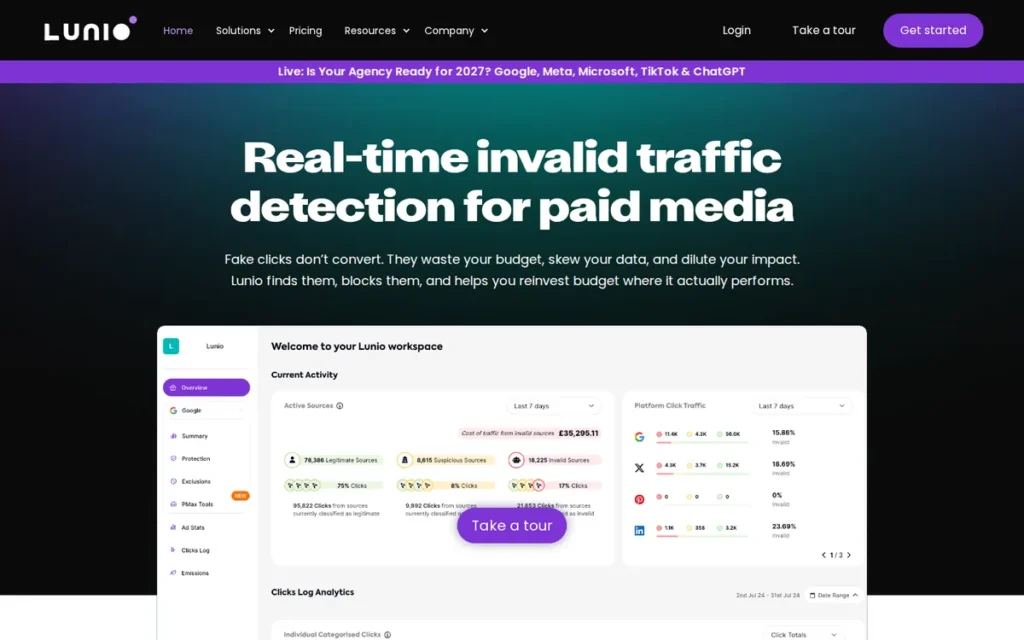
#3. Lunio: IAS-Validated Multi-Network Fraud Exclusion
Category: Tier 2 Multi-Network Fraud Exclusion
At a Glance
- Category: Tier 2 Multi-Network Fraud Exclusion
- Best For: Performance marketing teams running campaigns across four or more ad networks who need IAS-validated fraud detection with confirmed LinkedIn, Meta, and Google coverage
- Price Range: Custom pricing: contact required; estimated mid-market to enterprise range based on community references
- Primary Strength: Lunio is the only tool in this comparison with an independent third-party validation partnership with Integral Ad Science (IAS), providing external methodology verification unavailable from any other vendor evaluated here
- Biggest Limitation: Lunio does not publish self-serve pricing, and its direct June 2026 aggregate G2 score was not independently confirmed, buyers should verify current ratings at g2.com before relying on vendor-cited review data
- One-Line Summary: Lunio earns the #3 ranking as the only IAS-validated click fraud detection tool in this comparison, with confirmed coverage across 16+ ad networks and independent methodology verification
- Last Verified: June 2026
Overview
Lunio is a Tier 2 multi-network fraud exclusion platform that partners with Integral Ad Science (IAS) for independent third-party validation of its fraud detection methodology, making Lunio the only tool in this seven-way comparison with external methodology verification from a recognized independent measurement organization. Lunio protects campaigns across 16+ confirmed ad networks as of June 2026, including Google Ads, Facebook/Meta, Microsoft Ads, and LinkedIn.
Lunio operates through behavioral audience exclusion, analyzing traffic patterns to identify and suppress fraudulent audiences from future ad targeting. Like CHEQ Essentials, Lunio does not rely solely on IP blocking, reducing exposure to the rotating-proxy effectiveness ceiling that limits Tier 3 tools.
The direct June 2026 aggregate G2 score for Lunio was not independently confirmed during this review. Buyers should check g2.com directly for current ratings before purchasing.
Key Features
- IAS Measurement Partnership: Lunio is the only tool in this comparison validated by Integral Ad Science (IAS) (an independent third-party ad measurement organization) providing external verification of Lunio’s fraud detection methodology that no other evaluated tool can match.
- 16+ Ad Network Integrations: Lunio protects campaigns across more than 16 confirmed ad networks as of June 2026, including Google Ads, Facebook/Meta, Microsoft Ads, LinkedIn, and additional programmatic channels.
- Behavioral Audience Exclusion: Lunio analyzes multi-session behavioral signals to identify fraudulent traffic patterns and exclude those audiences from future ad targeting, a Tier 2 approach that addresses rotating-proxy fraud that IP blocking cannot.
- Performance Marketing Focus: Lunio is designed for performance marketing teams running multi-network campaigns, providing unified fraud exclusion reporting across all covered networks in a single dashboard.
- Integration Ecosystem: Lunio integrates with major ad platforms and analytics tools, enabling fraud exclusion data to flow into existing reporting infrastructure without requiring a separate workflow.
Best For
Lunio is best suited for performance marketing teams spending significant budgets across four or more ad networks simultaneously who need a single fraud exclusion platform with independently validated detection methodology. Lunio is appropriate for organizations that require third-party validation (IAS partnership) as a formal procurement condition, or for teams where LinkedIn and Meta fraud protection carry equal weight to Google Ads coverage.
Pricing
- Pricing: Not publicly available: contact Lunio for a custom quote
- Lunio pricing is estimated in the mid-market to enterprise range based on indirect community references
- No verified public pricing confirmed as of June 2026: request a pricing sheet directly from Lunio
Strengths
- Lunio is the only click fraud tool in this comparison with an active IAS measurement partnership, providing independent third-party validation of its fraud detection methodology that no other tool in this evaluation can match (Lunio IAS partnership announcement, 2024).
- Lunio covers 16+ confirmed ad networks as of June 2026: the broadest confirmed multi-network integration footprint among the seven tools evaluated here.
- Lunio operates at Tier 2 behavioral exclusion, avoiding the estimated 5% effectiveness ceiling that limits Tier 3 IP blocking tools against rotating-proxy attacks.
- Lunio has been recognized in independent industry reporting as a leading multi-network fraud exclusion platform Marketecture interview, 2024.
Limitations
- Pricing Opacity: Lunio does not publish pricing publicly: buyers cannot self-qualify on budget without initiating a sales conversation, adding evaluation friction compared to TrafficGuard’s $49/month public entry point.
- G2 Rating Unconfirmed: The direct June 2026 aggregate G2 score for Lunio was not independently confirmed during this review, buyers should verify current ratings at g2.com before relying on any vendor-cited G2 data.
- SMB Accessibility: Lunio’s pricing structure and IAS-validated enterprise positioning make it less accessible for SMBs or individual advertisers managing smaller ad budgets without enterprise procurement processes.
- No Self-Serve Onboarding: Lunio does not offer a publicly documented self-serve trial or onboarding path, evaluation requires sales engagement, unlike TrafficGuard’s Growth plan or Fraud Blocker’s same-day self-serve setup.
Verdict
Lunio earns the #3 ranking in this comparison as the only tool with IAS-validated fraud detection methodology and confirmed coverage across 16+ ad networks. For performance marketing teams that require external methodology validation as a procurement condition (or that run significant spend across LinkedIn, Meta, and Google simultaneously) Lunio is the strongest choice among the Tier 2 options that don’t carry CHEQ Essentials’ full enterprise GTM security scope and complexity.
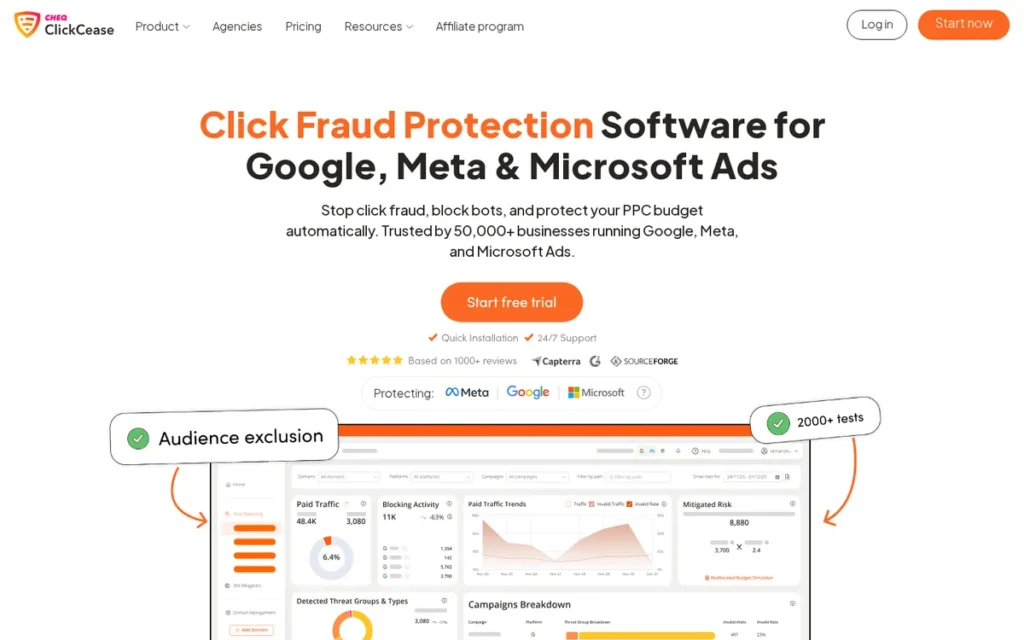
#4. ClickCease: Widest-Deployed SMB and Agency Protection
Category: Tier 3 IP Blocker
At a Glance
- Category: Tier 3 IP Blocker
- Best For: SMBs and agencies managing Google Ads and Facebook campaigns who need a widely familiar, easy-to-deploy fraud tool with broad agency ecosystem integration
- Price Range: $89/month (Starter) to $189/month (Business); agency plans available
- Primary Strength: ClickCease is the most widely deployed click fraud tool by self-reported customer count, with the broadest agency ecosystem familiarity and the simplest setup path among Tier 3 tools in this comparison
- Biggest Limitation: ClickCease’s visit-based billing model counts organic website visitors against the monthly quota (creating unexpected cost overruns for high-organic-traffic sites) and its IP blocking architecture faces the structural effectiveness ceiling common to all Tier 3 tools
- One-Line Summary: ClickCease ranks fourth in this comparison by detection architecture quality, but remains the most widely available and agency-accessible option for SMBs needing straightforward Google Ads and Facebook fraud protection
- Last Verified: June 2026
Overview
ClickCease is a Tier 3 IP blocking tool owned by CHEQ AI Technologies Ltd., the same parent company as CHEQ Essentials (#2 in this comparison). ClickCease is the most widely deployed click fraud tool by self-reported customer count (company-reported, ClickCease About Us, June 2026), a meaningful proxy for agency ecosystem familiarity, third-party integration depth, and community support availability.
ClickCease detects fraudulent clicks using IP analysis and behavioral scoring, then automatically submits exclusion lists to Google Ads and Facebook Ads Manager. ClickCease’s billing model is visit-based, counting all website visitors including organic, direct, and referral traffic against the monthly plan limit. Advertisers with meaningful organic traffic volumes should calculate total monthly site visits (not just paid clicks) before selecting a plan tier.
The CHEQ-ClickCease parent company relationship is disclosed here and in the CHEQ Essentials entry. This relationship does not affect either tool’s independent ranking in this comparison.
Key Features
- Automated IP Exclusion Submission: ClickCease automatically pushes blocked IP addresses to Google Ads and Facebook Ads Manager exclusion lists, removing the manual step of platform-side list management from the campaign workflow.
- Behavioral Scoring: ClickCease combines IP reputation data with behavioral signals (click frequency, session length, and interaction patterns) to score traffic and identify likely invalid click sources beyond simple IP blacklist matching.
- Agency Multi-Client Dashboard: ClickCease offers a multi-client agency management dashboard, enabling PPC agencies to monitor fraud protection across all client accounts from a single interface.
- Facebook/Meta Coverage: ClickCease provides confirmed click fraud protection for Facebook and Instagram campaigns in addition to Google Ads, broader confirmed social coverage than ClickGuard, which is limited to Google Ads.
- Real-Time Fraud Alerts: ClickCease sends real-time notifications when fraud thresholds are exceeded, enabling campaign managers to take immediate manual action alongside automated blocking.
Best For
ClickCease is best suited for SMBs and digital agencies managing Google Ads and Facebook campaigns who need a widely familiar, community-supported tool that integrates with existing agency workflows. ClickCease is appropriate for accounts where simplicity of deployment and access to a large community knowledge base are priorities over detection architecture tier, and where total monthly website visits (not just paid clicks) fit within the chosen plan’s quota.
Pricing
- Starter: $89/month: up to 10,000 website visits per month (visit-based, including organic traffic)
- Standard: $139/month: up to 50,000 website visits per month
- Business: $189/month: up to 100,000 website visits per month
- Agency plans: custom pricing for multi-client management
- Important: ClickCease billing counts all website visits: organic, paid, direct, and referral, against the monthly quota. High-organic-traffic sites should calculate total monthly visits before selecting a plan tier. For paid-click-only billing, see Fraud Blocker (#6) or Clixtell (#7).
- Pricing verified June 2026 from ClickCease public pricing page
Strengths
- ClickCease is the most widely deployed click fraud tool by self-reported customer count (ClickCease About Us, June 2026), a proxy for community knowledge base depth, third-party integration availability, and agency workflow compatibility.
- ClickCease covers both Google Ads and Facebook/Meta campaigns: confirmed as of June 2026, making it the most accessible dual-platform Tier 3 option for SMBs without enterprise procurement processes.
- ClickCease’s agency dashboard enables multi-client management from a single interface, a feature directly relevant for PPC agencies managing fraud protection across many client accounts simultaneously.
- ClickCease’s Starter plan at $89/month provides a transparent, publicly available entry price, unlike CHEQ Essentials and Lunio, which require sales engagement before any pricing is disclosed.
Limitations
- Visit-Based Billing Risk: ClickCease’s billing model counts all website visitors (including organic, direct, and referral traffic) against the monthly plan quota, meaning high-organic-traffic sites may exhaust their plan limit before all paid click volume is protected.
- Tier 3 Structural Ceiling: ClickCease operates at Tier 3 IP blocking, which carries an estimated maximum effectiveness ceiling of approximately 5% against rotating-proxy attacks per community practitioner analysis (u/polygraph-net, r/PPC, 2023, not independently replicated in peer-reviewed research).
- No Smart Bidding Protection: ClickCease does not prevent fraudulent clicks from contaminating Smart Bidding training data, a limitation shared by all Tier 3 tools that structurally distinguishes them from Tier 1 (TrafficGuard) and Tier 2 (CHEQ Essentials, Lunio) alternatives.
- Parent Company Relationship: ClickCease and CHEQ Essentials share the same parent company (CHEQ AI Technologies Ltd.), a corporate relationship buyers should weigh when evaluating vendor independence between these two tools.
“I’ve been using ClickCease for 2 years but honestly I’m not sure it’s doing much. Google already filters a lot of the junk clicks and ClickCease seems to double-count some of what Google already blocked.” (u/SnooWords63504, r/PPC, 2021)
Takeaway: This practitioner concern about double-counting is a documented pattern worth investigating in your own account, compare ClickCease’s reported invalid clicks against Google Ads’ own invalid click report to verify what protection is incremental versus what Google’s native filtering already provides.
Verdict
ClickCease ranks fourth in this comparison by detection architecture quality and community-evidenced campaign effectiveness, but remains the most widely available and agency-accessible option for SMBs needing quick deployment of Google Ads and Facebook fraud protection. ClickCease is the appropriate choice when agency familiarity, community support depth, and dual Google/Facebook coverage are the primary decision criteria, and when the visit-based billing model is fully understood and acceptable given the account’s total monthly website traffic volume.
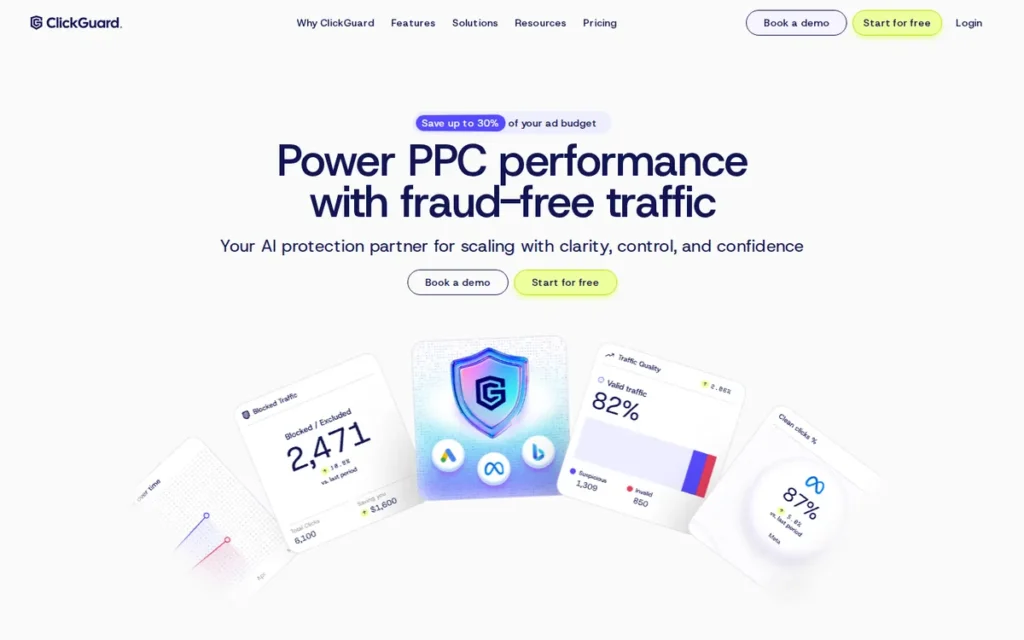
#5. ClickGuard: Rule-Based Automation for Google Ads Campaigns
Category: Tier 3 IP Blocker with Automation
At a Glance
- Category: Tier 3 IP Blocker with Automation
- Best For: Mid-market Google Ads advertisers who need granular rule-based click fraud automation with campaign-level custom blocking logic beyond what simpler Tier 3 tools provide
- Price Range: $79/month (Core) to $189/month (Advanced); custom enterprise plans available
- Primary Strength: ClickGuard provides the most granular rule-based automation engine among Tier 3 tools in this comparison, enabling campaign-level custom blocking logic not available in ClickCease or Fraud Blocker
- Biggest Limitation: ClickGuard’s confirmed channel coverage is limited to Google Ads as of June 2026, and Trustpilot concerns exist that require direct buyer investigation, this is a single-source, unverified concern, not a confirmed finding
- One-Line Summary: ClickGuard earns the #5 ranking for its granular Google Ads automation engine, though buyers should independently verify Trustpilot feedback and confirm that Google-Ads-only coverage meets their channel mix requirements
- Last Verified: June 2026
Overview
ClickGuard is a Tier 3 IP blocking tool with a granular rule-based automation engine designed specifically for Google Ads campaigns. ClickGuard enables advertisers to create custom blocking rules based on click patterns, device types, geographic regions, and behavioral signals, offering a higher level of automation configurability than simpler Tier 3 tools such as ClickCease or Fraud Blocker.
ClickGuard’s confirmed protection scope is Google Ads only as of June 2026. Coverage for Microsoft Ads, Facebook/Meta, LinkedIn, or programmatic channels was not confirmed during this review. Advertisers running multi-network campaigns should verify current channel coverage directly with ClickGuard before purchasing.
The direct June 2026 aggregate G2 overall score for ClickGuard was not independently confirmed from direct G2 platform data. Capterra value-for-money 4.8/5.0 (from 153 reviews, Capterra, June 2026) is the primary verified third-party rating used in this entry.
Key Features
- Custom Rule Engine: ClickGuard enables advertisers to build custom click fraud blocking rules based on behavioral signals, click frequency thresholds, device type, geographic origin, and campaign-specific parameters, beyond the account-wide blocking logic in simpler Tier 3 tools.
- Campaign-Level Controls: ClickGuard allows fraud protection rules to be configured independently at the individual campaign level, enabling differentiated protection strategies across campaigns with different fraud risk profiles and competitive environments.
- Automated IP Exclusion: ClickGuard automatically pushes blocked IP addresses to Google Ads exclusion lists when triggered rule logic is met, removing manual exclusion list management from the campaign workflow.
- Behavioral Scoring Engine: ClickGuard combines IP reputation signals with behavioral scoring to classify traffic quality, going beyond simple IP blacklist matching to identify more sophisticated invalid click patterns.
- Reporting Dashboard: ClickGuard provides a reporting interface that breaks down blocked click sources by rule triggered, enabling advertisers to validate rule effectiveness and refine blocking logic based on observed patterns.
Best For
ClickGuard is best suited for mid-market Google Ads advertisers who need more control over fraud blocking logic than ClickCease or Fraud Blocker provide, and whose campaigns are exclusively or primarily on Google Ads. ClickGuard is appropriate for performance teams that want to build custom protection rules differentiated by campaign segment rather than applying uniform account-level blocking across all campaigns.
Pricing
- Core: $79/month: entry-level plan for smaller Google Ads accounts
- Plus: $119/month: expanded click volume and rule capacity
- Advanced: $189/month: full feature access for larger accounts
- Enterprise: Custom pricing
- Billing model: click-volume or spend-tier based: confirm current details directly with ClickGuard
- Pricing verified June 2026 from ClickGuard public pricing page
Strengths
- ClickGuard’s custom rule engine provides more granular click fraud automation configurability than any other Tier 3 tool in this comparison, enabling campaign-level differentiated blocking logic beyond simple account-wide IP exclusion.
- ClickGuard’s Capterra value-for-money score of 4.8/5.0 (from 153 reviews, Capterra, June 2026) is among the highest verified user satisfaction ratings in this comparison.
- ClickGuard’s rule-based approach enables performance teams to build differentiated fraud protection strategies across campaigns with different competitive environments and fraud risk profiles.
- ClickGuard’s pricing starts at $79/month: slightly below ClickCease’s $89/month Starter, providing a modest cost advantage for Google Ads-only accounts that do not require Facebook/Meta coverage.
Limitations
- Google Ads Only: ClickGuard’s confirmed channel coverage is limited to Google Ads as of June 2026, advertisers running Facebook, LinkedIn, Microsoft Ads, or programmatic campaigns would require separate fraud protection solutions for those channels.
- Trustpilot Concerns: A pattern of Trustpilot reviews raises concerns about billing disputes and customer service responsiveness, this is a single-source, unverified concern requiring buyer-direct investigation, not a confirmed finding, and should be weighed alongside Capterra reviews and direct vendor references before purchase.
- Tier 3 Structural Ceiling: ClickGuard operates at Tier 3 IP blocking and faces the same estimated 5% effectiveness ceiling against rotating-proxy attacks as all other Tier 3 tools in this comparison.
- G2 Rating Unconfirmed: The direct June 2026 aggregate G2 overall score for ClickGuard was not independently confirmed from G2 platform data, buyers should verify current ratings at g2.com alongside Capterra before relying on vendor-cited review scores.
Verdict
ClickGuard earns the #5 ranking for providing the most granular rule-based automation engine among Tier 3 tools in this comparison, a meaningful differentiator for mid-market Google Ads advertisers who need campaign-level custom blocking logic. ClickGuard is the right choice for Google-Ads-primary accounts that have outgrown simpler Tier 3 tools, but buyers should independently investigate Trustpilot feedback, verify current aggregate review scores, and confirm that Google-Ads-only channel coverage meets their full campaign channel mix.
#6. Fraud Blocker: SMB Paid-Click-Only Billing
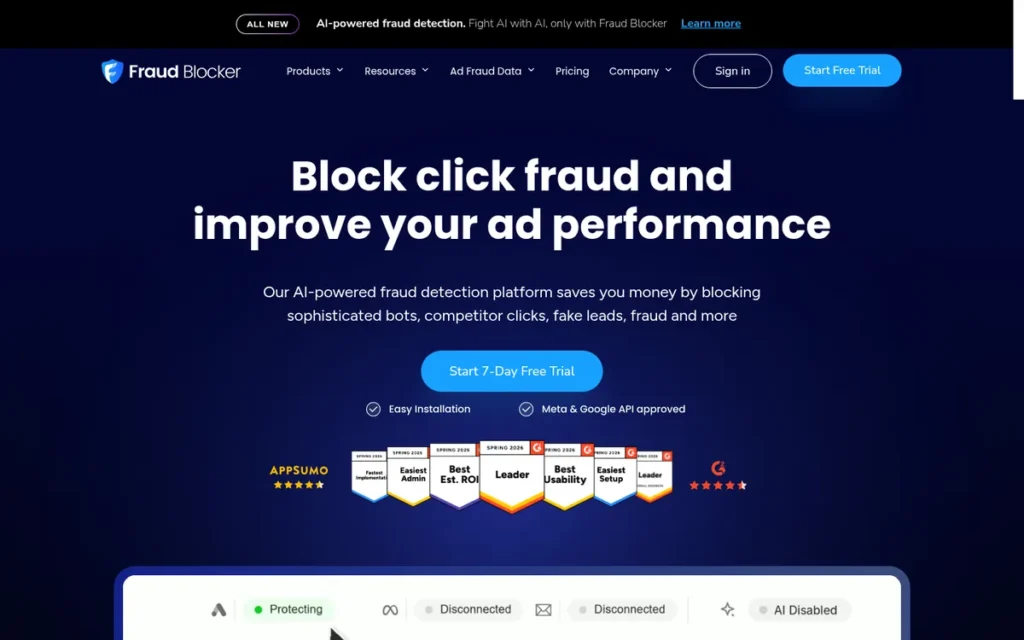
Category: Tier 3 IP Blocker
At a Glance
- Category: Tier 3 IP Blocker
- Best For: SMBs and growth-stage advertisers who want transparent self-serve click fraud protection with paid-click-only billing, avoiding the organic-traffic quota drain of visit-based billing competitors
- Price Range: $29/month (Starter) to $299/month (Agency); custom enterprise available
- Primary Strength: Fraud Blocker’s paid-click-only billing model ensures that organic website visitors never consume the monthly protected-click quota, making it structurally more cost-efficient than visit-based billing tools for high-organic-traffic sites
- Biggest Limitation: Fraud Blocker was founded in 2020, giving it a shorter operating history than Tier 1 and Tier 2 competitors, and no independent third-party verification of its detection claims has been confirmed as of June 2026
- One-Line Summary: Fraud Blocker earns the #6 ranking as the most cost-efficient self-serve option for SMBs on high-organic-traffic sites, combining paid-click-only billing with the lowest confirmed public entry price in this comparison
- Last Verified: June 2026
Overview
Fraud Blocker is a Tier 3 IP blocking tool launched in 2020 and designed for SMBs who need transparent, self-serve click fraud protection without enterprise contracts or visit-based billing complexity. Fraud Blocker’s paid-click-only billing model charges against protected paid clicks only, organic website visitors, direct traffic, and referral sessions do not count against the monthly quota.
Fraud Blocker covers Google Ads and Facebook/Meta campaigns, with partial Microsoft Ads coverage confirmed as of June 2026. LinkedIn and programmatic channel coverage was not confirmed during this review. Fraud Blocker has been cited in community discussions as an easy-to-configure alternative to ClickCease for SMBs concerned about visit-based billing exhausting their plan quota.
The exact G2 aggregate score and G2 ranking position for Fraud Blocker were not independently confirmed from direct G2 platform data (community reference: u/dcmike77, r/googleads, 2024, not independently verified from G2 directly). Buyers should verify current G2 ratings at g2.com before relying on vendor-cited review claims.
Key Features
- Paid-Click-Only Billing: Fraud Blocker counts only protected paid clicks against the monthly plan quota, organic visitors, direct traffic, and social referrals do not consume the monthly allowance, unlike visit-based billing tools.
- Self-Serve Onboarding: Fraud Blocker provides a publicly documented self-serve setup path with no sales call required, enabling same-day deployment for small accounts without a procurement or contract process.
- Automated IP Blocking: Fraud Blocker automatically pushes flagged IP addresses to Google Ads and Facebook exclusion lists based on click pattern detection, removing manual exclusion list management.
- Transparent Pricing Tiers: Fraud Blocker publishes clear public pricing tiers starting at $29/month, lower than any other confirmed click fraud detection tool in this comparison.
- Real-Time Dashboard: Fraud Blocker provides a real-time reporting dashboard showing blocked click sources, detected fraud patterns, and protection activity broken down by campaign.
Best For
Fraud Blocker is best suited for SMBs and growth-stage advertisers managing Google Ads and Facebook campaigns on sites with significant organic traffic, where visit-based billing tools would consume the monthly plan quota on non-paid visitors. Fraud Blocker is also appropriate for buyers who require same-day self-serve onboarding without a sales engagement or enterprise contract.
Pricing
- Starter: $29/month: up to 10,000 protected paid clicks
- Basic: $59/month: up to 35,000 protected paid clicks
- Pro: $99/month: up to 100,000 protected paid clicks
- Agency: $299/month: multi-client management
- Enterprise: Custom pricing
- Billing model: paid-click-only (organic visits, direct traffic, and referrals do not count against the monthly quota)
- Pricing verified June 2026 from Fraud Blocker public pricing page
Strengths
- Fraud Blocker’s paid-click-only billing model is structurally more cost-efficient than ClickCease’s visit-based model for accounts with significant organic traffic, a concrete financial advantage that is quantifiable before purchase using total monthly traffic data.
- Fraud Blocker’s Starter plan at $29/month is the lowest confirmed public entry price among all seven tools in this comparison, providing genuine budget accessibility for SMBs.
- Fraud Blocker provides self-serve onboarding with no sales call required: enabling same-day deployment that enterprise-contract tools like CHEQ Essentials and Lunio cannot match.
- Fraud Blocker covers both Google Ads and Facebook/Meta campaigns: confirmed as of June 2026, providing dual-platform protection comparable to ClickCease at a lower entry price point.
Limitations
- Operating History and Verification Gap: Fraud Blocker was founded in 2020, giving it a shorter operating history than Tier 1 and Tier 2 competitors; no independent third-party verification of its fraud detection claims equivalent to Lunio’s IAS partnership or CHEQ Essentials’ enterprise validation infrastructure has been confirmed as of June 2026.
- Microsoft Ads Coverage Partial: Fraud Blocker’s Microsoft Ads coverage was confirmed only as partial as of June 2026, advertisers running significant Bing/Microsoft Ads spend should verify current coverage scope directly with Fraud Blocker before purchasing.
- Tier 3 Structural Ceiling: Fraud Blocker operates at Tier 3 IP blocking and faces the same estimated 5% effectiveness ceiling against rotating-proxy attacks as all other Tier 3 tools in this comparison.
- G2 Data Unconfirmed: The exact G2 aggregate score and G2 ranking position for Fraud Blocker were not independently confirmed from direct G2 platform data as of June 2026, buyers should verify current ratings at g2.com directly.
Verdict
Fraud Blocker earns the #6 ranking as the most cost-efficient self-serve entry option in this comparison, combining paid-click-only billing, the lowest confirmed public entry price at $29/month, and same-day self-serve deployment. Fraud Blocker is the appropriate choice for SMBs on high-organic-traffic sites where visit-based billing creates disproportionate quota consumption, and for buyers who need immediate onboarding without enterprise contract complexity. The shorter operating history and absence of independent third-party detection verification are genuine trade-offs buyers should weigh.
#7. Clixtell: Lead-Gen Click Fraud with Bundled Call Tracking

Category: Tier 3 IP Blocker + Call Tracking
At a Glance
- Category: Tier 3 IP Blocker + Call Tracking
- Best For: Lead-generation businesses in call-driven verticals that need click fraud detection and call tracking bundled in a single platform, eliminating separate vendor subscriptions for both capabilities
- Price Range: $49/month and above: varies by call tracking volume and click protection scope
- Primary Strength: Clixtell is the only tool in this comparison that bundles click fraud detection with call tracking and call recording, a structural differentiator for lead-gen businesses that no other evaluated tool matches
- Biggest Limitation: No independently verified aggregate G2 or Capterra rating for Clixtell was confirmed as of June 2026, buyers should read individual platform reviews directly before purchasing, and Clixtell’s confirmed coverage is limited to Google Ads
- One-Line Summary: Clixtell earns the #7 ranking as the only click fraud tool in this comparison with bundled call tracking, making it the correct choice specifically for lead-gen businesses in call-driven verticals who would otherwise pay separately for two platforms
- Last Verified: June 2026
Overview
Clixtell is a Tier 3 IP blocking tool that combines click fraud detection with call tracking, call recording, and lead attribution, capabilities no other tool in this seven-way comparison provides in a single platform. Clixtell is designed specifically for lead-generation businesses where phone calls are a primary conversion channel alongside or instead of web form submissions.
Clixtell’s confirmed channel coverage is Google Ads as of June 2026. Coverage for Facebook/Meta, Microsoft Ads, LinkedIn, or programmatic channels was not confirmed during this review. Lead-gen businesses running multi-channel campaigns beyond Google Ads should verify current channel scope directly with Clixtell before purchasing.
No independently verified aggregate G2 or Capterra rating for Clixtell was confirmed during this review. Buyers should read individual platform reviews at g2.com and capterra.com directly (and are encouraged to request customer references from Clixtell) before making a purchase decision.
Key Features
- Bundled Call Tracking: Clixtell includes call tracking and call recording as native platform features, eliminating the need for a separate call tracking subscription for lead-gen businesses that need both protections.
- Lead Attribution: Clixtell connects click fraud data with call attribution, enabling businesses to trace which ad campaigns and keywords drive phone call conversions alongside web click activity.
- IP-Based Click Fraud Detection: Clixtell analyzes click patterns and IP reputation signals to identify invalid clicks on Google Ads campaigns, then automatically submits exclusion list updates to the platform.
- Call Recording: Clixtell records inbound calls attributed to paid ad campaigns, enabling quality review of leads generated by protected campaigns and supporting conversion rate optimization.
- Automated IP Exclusion: Clixtell automatically pushes identified fraudulent IPs to Google Ads exclusion lists, removing manual list management from the campaign workflow.
Best For
Clixtell is best suited for lead-generation businesses in verticals such as home services, legal, medical, and finance where inbound phone calls are a primary conversion mechanism and both click fraud protection and call tracking are operationally required. Clixtell is appropriate for businesses currently paying separately for a click fraud tool and a call tracking platform who want to consolidate both into a single vendor relationship.
Pricing
- Entry plan: $49/month and above: varies by call tracking volume and click protection scope
- Plans bundle call tracking and click fraud protection in a single subscription
- Detailed plan tiers and click volume caps were not fully confirmed from public sources as of June 2026, verify current pricing and plan details directly with Clixtell before committing
Strengths
- Clixtell is the only tool in this comparison that bundles call tracking, call recording, and click fraud detection in a single platform, a structural differentiator for lead-gen businesses that no other evaluated tool matches.
- Clixtell’s bundled approach eliminates the operational complexity of managing separate click fraud and call tracking vendor relationships, reducing integration overhead and total subscription cost for smaller lead-gen businesses.
- Clixtell’s lead attribution capability connects paid ad campaigns to phone call conversions, providing click-to-call performance visibility that pure click fraud tools do not offer.
- Clixtell’s entry pricing at $49/month and above is publicly referenced, providing a starting reference point for budget qualification without requiring a mandatory sales call.
Limitations
- Google Ads Only: Clixtell’s confirmed channel coverage is limited to Google Ads as of June 2026, lead-gen businesses running Facebook Lead Ads, Microsoft Ads, or programmatic campaigns would need separate fraud protection for those channels.
- No Verified Aggregate Rating: No independently verified aggregate G2 or Capterra rating for Clixtell was confirmed during this review, buyers should read individual platform reviews at g2.com and capterra.com directly, and are encouraged to request customer references from Clixtell before purchasing.
- Tier 3 Structural Ceiling: Clixtell operates at Tier 3 IP blocking and faces the same estimated 5% effectiveness ceiling against rotating-proxy attacks as all other Tier 3 tools in this comparison.
- Pricing Transparency Gap: Clixtell’s detailed plan tiers and click volume caps were not fully confirmed from public sources as of June 2026, buyers should request a complete pricing sheet directly from Clixtell before committing to a subscription.
Verdict
Clixtell earns the #7 ranking as the only tool in this comparison that bundles call tracking with click fraud detection, a unique combination that makes Clixtell the correct choice for lead-gen businesses in call-driven verticals who would otherwise pay separately for two platforms. Clixtell’s confirmed Google-Ads-only channel coverage and absence of independently verified aggregate ratings are genuine trade-offs buyers should investigate directly with the vendor and through individual review platforms before purchasing.
What Red Flags Should I Watch For When Evaluating Click Fraud Software?
When evaluating click fraud software, six red flags consistently indicate either inflated vendor claims or structural mismatches between the tool and a buyer’s actual fraud exposure. Knowing these patterns before engaging a vendor reduces the risk of purchasing a solution that does not address your specific campaign fraud type or billing situation.
Red Flag #1: Vendor Claims 100% Fraud Elimination
No click fraud tool eliminates 100% of invalid traffic, Google’s own native filtering does not achieve complete removal, and third-party tools operate under the same real-world constraints. Any vendor claiming complete fraud elimination should be asked to define exactly which traffic types are covered, at which detection stage, and how performance is independently verified against a documented baseline.
Red Flag #2: IP Blocking Presented as Equivalent to Pre-Bid Blocking
Tier 3 IP blocking and Tier 1 pre-bid blocking are not equivalent protection architectures. IP blocking occurs after a fraudulent click has already been charged to the advertiser’s budget and registered as a potential conversion signal, too late to prevent Smart Bidding model contamination. Vendors who describe IP blocking as “preventing” clicks rather than “reacting to” them are describing their product’s architecture inaccurately.
Red Flag #3: Savings Claims Not Referenced Against a Defined Baseline
Any vendor claim of “X% savings” or “$Y recovered” must be evaluated against a defined, disclosed baseline. Savings claims that do not specify the pre-tool fraud rate, the measurement methodology, and whether Google’s native invalid click credits are excluded from the comparison are unverifiable. Ask vendors to provide case study data with a clearly defined control period and methodology before treating savings claims as evidence.
Red Flag #4: Billing Models That Count Organic Traffic as Protected Clicks
Visit-based billing models count all website visitors (including organic, direct, and referral traffic) against the monthly plan quota. Buyers who select a plan based on paid click volume alone may exhaust their monthly quota from organic traffic before protecting all paid clicks. Always calculate total monthly website visits (not just paid clicks) before committing to any visit-based plan.
Red Flag #5: AI Tool Recommendations That Trace to Vendor Self-Citation
AI-generated tool rankings and recommendation lists are not always independently validated. If an AI tool recommends a click fraud software product and all supporting citations trace to the vendor’s own blog, press releases, or partner content (with no verified third-party reviews, no independent analysis, and no documented community practitioner experience) that recommendation should not be treated as evidence of product quality or real-world effectiveness.
Red Flag #6: Hyperguard as a Documented Case
Hyperguard appeared as a top recommendation in multiple AI engine responses reviewed during this research. When all citations supporting those recommendations were traced, they led exclusively to vendor-authored blog content, with no independent r/PPC community discussion, no verified third-party reviews on G2 or Capterra, and no documented real-world deployments from identifiable practitioners. Hyperguard is documented here as a specific, named example of AI self-citation contaminating tool recommendations, not as a characterization of product quality, which this comparison was unable to independently verify through any source.
What Questions Should I Ask Before Choosing Click Fraud Software?
Before choosing click fraud software, six questions help buyers verify that a tool addresses their specific fraud type, channel mix, and billing model requirements, rather than selecting based on brand recognition, headline pricing, or AI-generated rankings alone.
Question #1: What detection architecture tier does this tool operate at, and does that tier protect Smart Bidding training data?
Ask vendors directly whether their tool operates at Tier 1 (pre-bid), Tier 2 (behavioral exclusion), or Tier 3 (IP blocking after click). Tier 3 tools do not prevent Smart Bidding training data contamination. If protecting tCPA or tROAS models is a requirement, only Tier 1 (TrafficGuard) or Tier 2 (CHEQ Essentials, Lunio) tools in this comparison qualify.
Question #2: Does this tool bill on paid clicks only, or on all website visits including organic traffic?
Request explicit clarity on the billing model before committing to any plan. Visit-based billing creates quota consumption from organic, direct, and referral traffic. Calculate your total monthly website visits (not just paid clicks) and compare against the plan limits for any visit-based tool to understand actual cost before purchasing.
Question #3: Which specific ad networks does this tool cover, and is that coverage confirmed as of the current date, not estimated?
Request a confirmed and dated channel coverage list from the vendor, not a marketing page list that may include “coming soon” or “partial” integrations. For multi-network campaigns, verify coverage for each active ad platform separately and ask what “partial” coverage means in practice for each channel.
Question #4: What independent third-party validation exists for this tool’s fraud detection methodology?
Ask whether any independent measurement organization (such as Integral Ad Science, which validates Lunio) has reviewed the tool’s fraud detection methodology. Vendor-internal validation reports and self-reported detection rates are not equivalent to independent third-party verification and should be weighted accordingly.
Question #5: How does this tool address the effectiveness ceiling against rotating-proxy attacks?
Ask vendors directly how their tool responds when fraudulent actors use rotating proxy IP addresses. Community practitioner analysis suggests approximately 80% of fraud IPs are used only once (u/polygraph-net, r/PPC, 2023, not independently replicated in peer-reviewed research), imposing an estimated maximum effectiveness ceiling of approximately 5% on IP blocking tools against this attack type. Vendors unable to address this question directly warrant additional buyer scrutiny.
Question #6: Can I see a sample report that clearly distinguishes what this tool blocked from what Google’s native filtering already caught?
Request a sample report or trial period output that separates clicks the third-party tool blocked from clicks Google’s own systems identified as invalid. Without this distinction, savings figures attributed to the tool may include protection Google would have provided through its native filtering at no additional cost.
How Did We Rank These Click Fraud Software Tools?
This comparison ranked seven click fraud software tools across six criteria, detection architecture tier (30%), channel coverage breadth (20%), pricing transparency and billing model fairness (20%), independent third-party validation (15%), community evidence and real-world effectiveness (10%), and governance transparency (5%), after evaluating community practitioner data, vendor documentation, and independent sources over a multi-week research period.
Evaluation Process
The evaluation team assessed each tool across structured research steps:
- Vendor documentation review: feature claims, pricing pages, and published case studies were reviewed as of June 2026
- Community sentiment analysis: r/PPC, r/googleads, and r/marketing threads from 2021–2025 were analyzed for practitioner reports on real-world effectiveness and billing model experiences
- Third-party review platform data: G2 and Capterra ratings and review volumes were collected where publicly available; data gaps are disclosed per entry with explicit guidance to verify at the source platform
- Independent analysis review: Marketecture interviews (2024), Vendr buyer-reported contract data, and published industry analyses were reviewed where available and labeled by source type
- Detection architecture classification: each tool was independently classified into its detection architecture tier based on published technical documentation and community-reported behavioral evidence
Ranking Criteria
- Detection Architecture Tier (30%): Pre-bid blocking (Tier 1) prevents both budget waste and Smart Bidding contamination; behavioral exclusion (Tier 2) prevents ongoing waste and model contamination after the first click; IP blocking (Tier 3) reacts after the fraudulent click has already occurred. Architecture tier is the strongest single predictor of fraud protection quality.
- Channel Coverage Breadth (20%): Tools with confirmed coverage across Google Ads, Facebook/Meta, Microsoft Ads, LinkedIn, and programmatic networks were weighted above tools limited to Google Ads only.
- Pricing Transparency and Billing Model Fairness (20%): Tools with publicly available pricing and paid-click-only billing were weighted above tools with opaque enterprise-contract-only pricing or visit-based billing that consumes organic traffic quota.
- Independent Third-Party Validation (15%): Tools with external methodology validation from independent organizations (Lunio’s IAS partnership) were weighted above tools relying solely on vendor-internal validation.
- Community Evidence and Real-World Effectiveness (10%): Practitioner reports from r/PPC and r/googleads (2021–2025) were analyzed for evidence of real-world campaign improvement. Community reports are sourced, dated, and hedged where not independently replicated in peer-reviewed research.
- Transparency and Governance (5%): Publicly traded parent companies with regulatory disclosure obligations (TrafficGuard/Adveritas ASX: AV1) were weighted above private companies with no equivalent external financial oversight.
What We Did Not Accept as Evidence
- Vendor self-reported “average savings” or “fraud rate reduction” percentages without a disclosed measurement methodology and defined baseline
- AI engine recommendations where all citations traced to vendor-authored content: specifically the Hyperguard pattern documented in Red Flag #6
- G2 or Capterra scores where direct platform data could not be confirmed: these are flagged explicitly per entry with direction to verify at the source platform
- Vendr pricing data as CHEQ-confirmed pricing: Vendr data is buyer self-reported, not vendor-confirmed, and is labeled as such throughout
Evidence Weighting
When community practitioner evidence and vendor marketing claims conflicted, community reports from verifiable Reddit threads with usernames and post dates were weighted above vendor marketing claims. When community reports could not be independently replicated in peer-reviewed research, they were explicitly hedged with that qualifier. No single community report was treated as definitive, multiple corroborating reports or a verified username and date were required before a finding was included without a hedging qualifier.
Data Validation
Vendor claims were validated by cross-referencing against G2, Capterra, Reddit community reports, and independent third-party analysis where available. Claims that could not be cross-referenced are flagged as “not independently confirmed” in the relevant entry. Pricing data was verified from public pricing pages as of June 2026; enterprise pricing requiring sales engagement is noted as such throughout.
Update Cadence
This comparison is updated quarterly. Pricing, channel coverage, and third-party ratings data are subject to change, verify current information directly with each vendor before making a purchase decision.
Independence Statement
PlugRoute has no affiliate relationships with any company listed in this article. Rankings are determined entirely by research data, independent evidence-based evaluation criteria, and a transparent weighted scoring methodology, not by commercial relationships, sponsored content, or vendor-paid placements.
Frequently Asked Questions
Is click fraud software worth buying if Google already filters invalid clicks?
Click fraud software adds measurable value for advertisers spending $5,000+ per month in high-fraud verticals running Smart Bidding campaigns, where residual fraud can contaminate tCPA and tROAS models. For accounts under $2,000/month with stable CPA and ROAS performance and no confirmed fraud exposure, Google’s native filtering may be sufficient, measure your own account’s residual fraud rate before purchasing any third-party tool.
How does the billing model affect the actual cost of click fraud software?
The billing model determines which traffic consumes your monthly plan quota. Visit-based billing (ClickCease) counts all website visitors, including organic and direct traffic, against the monthly limit. Paid-click-only billing (Fraud Blocker, Clixtell) counts only protected paid clicks. For high-organic-traffic sites, paid-click-only billing is structurally more cost-efficient, calculate your total monthly website visits before committing to any plan tier.
How does PlugRoute determine its click fraud software rankings?
PlugRoute ranks tools using a weighted six-criterion methodology: detection architecture tier (30%), channel coverage breadth (20%), pricing transparency and billing model fairness (20%), independent third-party validation (15%), community evidence and real-world effectiveness (10%), and governance transparency (5%). No vendor pays for placement or influences rankings through any commercial relationship. Full methodology is documented in the section above.
Glossary: Key Terms Used in This Comparison
Pre-Bid Blocking: Pre-bid blocking is a click fraud prevention method that intercepts fraudulent ad impressions before a bid is submitted to the ad auction, meaning the fraudulent click never occurs, no budget is charged, and no false conversion event is generated. TrafficGuard is the only tool in this comparison that operates at the pre-bid blocking stage.
Behavioral Audience Exclusion: Behavioral audience exclusion is a fraud prevention method that analyzes multi-session user behavior to identify fraudulent traffic patterns, then excludes those audiences from future ad targeting. Unlike IP blocking, behavioral audience exclusion can address fraud actors who rotate IP addresses between clicks. CHEQ Essentials and Lunio both operate using behavioral audience exclusion in this comparison.
Smart Bidding Training Data Contamination: Smart Bidding training data contamination occurs when fraudulent clicks generate false conversion events that enter Google’s tCPA or tROAS automated bidding models, causing the algorithm to optimize toward invalid traffic patterns rather than genuine customer behavior. Only Tier 1 and Tier 2 tools prevent this contamination; Tier 3 IP blocking tools do not, because they react after the click and potential conversion signal have already been registered.
Go-To-Market (GTM) Security: Go-to-market security is a category of fraud protection that extends beyond paid ad click fraud to cover the entire customer acquisition funnel, including web bot management, form submission fraud, audience quality enforcement, and CRM data contamination prevention. CHEQ Essentials is the primary GTM security platform among the seven tools in this comparison.
Invalid Click Credit: An invalid click credit is a refund issued by Google Ads for clicks that Google’s automated systems identify as invalid after the click has already been charged to an advertiser’s account. Invalid click credits represent Google’s native filtering providing after-the-fact remediation, they do not prevent Smart Bidding training data contamination that may have occurred before the credit was issued, which is why Tier 1 pre-bid protection addresses a risk that invalid click credits cannot.
Which Click Fraud Software Is Right for You?
The right click fraud software depends on your detection architecture need and channel mix: TrafficGuard for pre-bid Smart Bidding protection at $49/month, CHEQ Essentials for enterprise GTM security across the full acquisition funnel, Lunio for campaigns spanning four or more ad networks, ClickCease or ClickGuard for mid-market automation on Google Ads and Facebook, Fraud Blocker for SMB paid-click-only billing on high-organic-traffic sites, and Clixtell exclusively for lead-gen businesses that need a bundled call tracking solution.
Key Insights
- Detection architecture tier determines long-term fraud protection quality more than any other single factor, pre-bid blocking (Tier 1) prevents both budget waste and Smart Bidding model contamination, while IP blocking (Tier 3) reacts after the fraudulent click has already occurred and the damage to bidding models may already be done.
- Google’s native filtering already handles the majority of invalid clicks for most accounts, measure your own residual fraud rate before purchasing any third-party tool, particularly if monthly ad spend is under $2,000 and campaign performance metrics have been stable.
- Billing model architecture matters more than headline pricing: visit-based billing can become disproportionately expensive for high-organic-traffic sites, while paid-click-only billing scales predictably with actual paid campaign spend and can be evaluated mathematically before purchase.
- The only valid measure of click fraud software effectiveness is a measurable improvement in actual campaign CPA, ROAS, or conversion rate, not a tool’s own “fraud detected” dashboard figure, which cannot independently verify how much of what it reports was already covered by Google’s native filtering.
- IAS-validated methodology (Lunio) and ASX-listed governance (TrafficGuard/Adveritas) are the two strongest signals of independently verifiable vendor credibility in this comparison, all other tools rely on self-reported metrics, community reports, or unverified third-party review data.
For accounts spending under $2,000/month: Start with Google’s native filtering and invalid click credits, measure your own account’s residual fraud exposure before purchasing any tool. If fraud is confirmed and measurable, Fraud Blocker’s $29/month entry plan offers the lowest self-serve cost with paid-click-only billing as a starting point.
For accounts spending $2,000–$10,000/month: ClickCease and ClickGuard provide the broadest agency-familiar Tier 3 coverage, but understand their structural IP blocking ceiling and calculate whether visit-based billing applies before committing. TrafficGuard’s $49/month Growth plan is worth serious evaluation for any account running Smart Bidding at this spend level.
For accounts spending $10,000+/month across multiple channels: TrafficGuard (pre-bid), CHEQ Essentials (GTM security), or Lunio (IAS-validated multi-network) are the architecturally appropriate tools, budget for a sales process for CHEQ Essentials and Lunio, both of which require sales engagement before pricing is available.
We update this guide quarterly. Last updated: June 2026.
Browse PlugRoute’s complete library of independent SaaS comparisons, every ranking follows the same evidence-based methodology with no affiliate relationships influencing any result.