Omnisend is the best merchant marketing software for SMB e-commerce stores, Klaviyo is best for data-driven brands above $500K GMV, and Marsello is the only platform built for hybrid physical and online retailers. The right platform depends on your revenue stage, channel needs, and whether a native loyalty program is a strategic priority.
Most platforms fall into three categories: omnichannel automation suites (Omnisend, Klaviyo, Drip), loyalty-first retention platforms (Yotpo, Marsello), and broadcast email suites (Firepush, Mailchimp). Knowing which category fits your current revenue stage (sub-$300K, $300K–$1M, or $1M+ GMV) eliminates most of the comparison work before reading a single feature list.
PlugRoute has no affiliate relationships with any company listed, rankings are determined entirely by research data and objective evaluation criteria.
“Omnisend or Klaviyo? I run a $300K/year Shopify store. Omnisend: great value, easy setup, works really well. Klaviyo: more expensive but the segmentation and predictive analytics are in a different league. If you’re doing $1M+ and email is a serious revenue channel, go Klaviyo. Under that, Omnisend is probably the smarter play.” (r/shopify)
Takeaway: Community consensus places Omnisend as the stronger value choice for stores under $1M GMV, with Klaviyo justified when email is a primary revenue channel at the $1M+ scale, validating the revenue-stage framework this comparison uses as its primary ranking axis.
TL;DR: Top Picks at a Glance
- Omnisend is the best three-channel automation platform for SMB e-commerce stores, starting free.
- Klaviyo is the top CDP-powered segmentation tool for Shopify brands above $500K GMV.
- Yotpo is the leading Reviews and Loyalty platform for $500K+ DTC brands: note that Yotpo’s Email and SMS modules were discontinued December 31, 2025.
- Marsello is the only platform with native POS integration for hybrid physical and online retailers, starting at $125/month.
What Are the Main Categories of Merchant Marketing Software?
Merchant marketing software falls into three categories based on architecture: omnichannel automation suites combining email, SMS, and web push in one canvas; loyalty-first retention platforms where points programs and VIP tiers are the core product; and broadcast email suites optimized for newsletter sending. Your category choice eliminates most options before any feature comparison begins.
Category 1: Omnichannel Automation Suites: platforms that prioritize multi-channel behavioral execution across email, SMS, and web push in a unified workflow canvas, enabling abandoned cart recovery, post-purchase sequences, and win-back campaigns from one dashboard. Entries in this comparison: Omnisend, Klaviyo, Drip, Firepush.
Category 2: Loyalty-First Retention Platforms, platforms built around structured rewards programs, points, VIP tiers, and referrals, that treat email and SMS as loyalty notification channels, with RFM analytics and repeat-purchase data driving campaign targeting. Entries: Yotpo, Marsello.
Category 3: Broadcast Email Suites: platforms optimized for newsletter creation and promotional broadcasting, with automation as a secondary layer and no native omnichannel or loyalty infrastructure. Entry: Mailchimp.
Knowing which bucket fits your revenue stage (sub-$300K GMV (Firepush or Omnisend), $300K–$1M (Omnisend), $1M+ (Klaviyo), loyalty-focused (Yotpo or Marsello), hybrid retail (Marsello)) eliminates four of seven options before reading a single feature description.
How Do the Top 7 Merchant Marketing Platforms Compare?
The seven platforms in this comparison span four architecture types and three price tiers: Omnisend and Firepush deliver three-channel automation from $0–$29/month; Klaviyo and Drip deliver deep CDP or CRM segmentation from $20–$39/month at entry; Yotpo and Marsello deliver loyalty-first retention from $125–$199/month; and Mailchimp serves pre-revenue newsletter sending from $0. Revenue stage (not feature checklists) is the primary comparison axis.
| Rank | Company | Category | Best For | One-Line Summary | Key Capabilities | Primary Strength | Key Limitation |
|---|---|---|---|---|---|---|---|
| 1 | Omnisend | Omnichannel Automation | SMB e-commerce, $100K–$2M GMV | Omnisend is the highest-rated omnichannel marketing automation platform for SMB e-commerce merchants, earning a 4.7/5.0 Capterra rating from 700+ verified reviews for its email, SMS, and web push automation starting at $16/month. | Email + SMS + web push in one canvas; 20+ one-click workflows; Campaign Booster re-send | Best price-to-channel ratio in this comparison | No native loyalty program; segmentation ceiling above $2M GMV |
| 2 | Klaviyo | CDP + Marketing Automation | E-commerce brands, $500K–$10M+ GMV | Klaviyo is the market-leading e-commerce marketing automation platform with $937.5M in 2024 SEC-verified revenue, a 4.6/5.0 G2 rating from 1,000+ verified reviews, and a Shopify strategic partnership formalized by a $100M direct investment in August 2022. | 200+ attribute CDP segmentation; 60+ pre-built flows; predictive LTV and churn risk | Deepest behavioral segmentation via native CDP | Pricing escalates 14–17× from 1,000 to 25,000–50,000 contacts |
| 3 | Yotpo | Reviews and Loyalty Platform | Mid-market DTC, $500K+ GMV (Reviews + Loyalty focus) | Yotpo is a modular retention marketing platform for mid-market DTC brands, with Forbes Cloud 100 recognition (2019–2022), native Google Shopping star integration, and documented loyalty benchmarks of 1.6× higher AOV for enrolled members; operating as a Reviews and Loyalty platform as of 2026 following the December 2025 discontinuation of its Email and SMS modules. | Reviews syndication to Google Shopping; VIP loyalty programs; Visual UGC galleries | Google Shopping star integration producing 12–28% higher paid ad CTR | Email and SMS products discontinued December 31, 2025; Loyalty module at $199/month prices out sub-$500K merchants |
| 4 | Marsello | Loyalty + Omnichannel Platform | Hybrid physical + online retailers | Marsello is the leading loyalty and omnichannel marketing platform for hybrid retailers, offering the only native POS-to-e-commerce customer data unification in this comparison with loyalty, email, and SMS bundled from $125/month. | Native POS integration (Lightspeed, Square, Shopify POS, Vend); RFM analytics; bundled loyalty + email + SMS | Only platform unifying in-store POS data with online purchase history | Lower North American brand recognition; 150+ Capterra reviews vs. 700+ for Omnisend |
| 5 | Drip | E-Commerce CRM (ECRM) | $300K–$5M GMV e-commerce brands | Drip is the leading E-Commerce CRM platform for purchase-behavior-driven marketing, earning G2 “Best Relationship” and “Most Implementable” badges in 2023–2024 with all automation features from $39/month and no feature gating between tiers. | ECRM customer timeline; graph-canvas visual workflow builder; Facebook/Google Ads audience sync | All features at every paid tier; no feature gating regardless of plan level | No free plan; 14-day trial only before paid commitment required |
| 6 | Firepush | Multi-Channel Cart Recovery | Shopify merchants under $300K GMV | Firepush is a Shopify-native multi-channel cart recovery tool with a 4.5/5.0 Capterra rating from 200+ verified reviews, providing email, SMS, and web push abandoned cart automation at zero cost up to 500 messages per month. | One-click Shopify install; email + SMS + push abandonment sequences; free three-channel plan | Fastest setup to three-channel cart recovery; active within hours | Shopify-only; documented feature ceiling at $100K–$300K GMV |
| 7 | Mailchimp | Email Marketing Suite | Pre-revenue businesses and newsletter senders | Mailchimp is the most widely-used email marketing platform with 11–13 million users and 12,000+ G2 reviews at 4.3/5.0, but post-Intuit acquisition feature gating and pricing increases have made Mailchimp a declining recommendation for e-commerce merchants needing omnichannel automation. | Drag-and-drop email builder; Customer Journey automation; website builder | Most beginner-accessible interface with the largest third-party tutorial library | Advanced segmentation gated behind $350/month Premium; US-only SMS add-on |
Which Merchant Marketing Software Should I Choose for My Situation?
Match your situation to the platform below using four filters: your current GMV, whether you operate a physical store, whether loyalty programs are a near-term priority, and how long you need to evaluate a tool before paying. The “Acceptable Alternative” column names a second-choice platform for each scenario.
| Your #1 Priority | Recommended Tool | Why | Acceptable Alternative |
|---|---|---|---|
| Shopify store under $300K GMV; fastest free setup | Firepush | One-click App Store install; free three-channel automation; zero configuration | Omnisend Free plan |
| $300K–$1M GMV e-commerce; best omnichannel value | Omnisend | 4.7/5.0 Capterra; unlimited email + SMS + web push from $16/month | Drip for CRM-depth focus |
| $1M–$5M GMV DTC brand; CDP segmentation + revenue attribution | Klaviyo | Deepest behavioral segmentation; $937.5M SEC-verified 2024 revenue; Princess Polly +29% email revenue documented | Drip for visual CRM builder |
| $500K+ GMV; loyalty programs + social proof | Yotpo | Only platform combining Google Shopping star syndication with VIP loyalty on a shared data layer (Email/SMS discontinued Dec 2025) | Marsello for bundled loyalty + email + SMS at lower cost |
| Hybrid physical + online retailer needing POS unification | Marsello | Only platform natively merging POS data (Lightspeed, Square, Shopify POS, Vend) with online purchase history | Yotpo for pure-online Reviews + Loyalty only |
| CRM-depth segmentation, $300K–$5M GMV | Drip | ECRM timeline + visual graph-canvas builder + Facebook/Google Ads audience sync from $39/month | Klaviyo for predictive analytics |
| Absolute beginner; newsletter only | Mailchimp | Most beginner-accessible interface; largest tutorial library; functional free plan | Omnisend Free for e-commerce beginners |
1. Omnisend: Best Overall / Best for SMB E-Commerce Operators Needing Three-Channel Automation
Category: Omnichannel Marketing Automation, a platform that combines email marketing, SMS campaigns, and web push notifications in a single workflow canvas for e-commerce merchants, enabling multi-channel automated sequences from one dashboard.
At a Glance
- Category: Omnichannel Marketing Automation
- Best For: SMB e-commerce merchants ($100K–$2M GMV) on Shopify, WooCommerce, BigCommerce, Wix, or Squarespace needing three-channel automation at the lowest cost
- Price Range: Free; Standard from $16/month; Pro from $59/month with unlimited SMS
- Primary Strength: Omnisend delivers native email, SMS, and web push automation in a single workflow canvas starting at $16/month, the best price-to-channel ratio in this comparison
- Biggest Limitation: Omnisend lacks a native loyalty program and offers less advanced segmentation than Klaviyo for merchants with CDP-grade data needs above $2M GMV
- One-Line Summary: Omnisend is the highest-rated omnichannel marketing automation platform for SMB e-commerce merchants, earning a 4.7/5.0 Capterra rating from 700+ verified reviews for its combination of email, SMS, and web push automation starting at $16/month
- Last Verified: June 2026
Overview
Omnisend is an omnichannel marketing automation platform purpose-built for e-commerce merchants, combining email campaigns, SMS marketing, and web push notifications in a single workflow canvas, making Omnisend the best-rated and most cost-accessible three-channel solution for stores generating between $100,000 and $2 million in annual revenue.
Omnisend serves 125,000+ brands across 130+ countries as of 2025 and processes over 2 billion marketing messages annually, with the highest Capterra customer satisfaction score in this comparison: 4.7/5.0 from 700+ verified reviews alongside a 4.6/5.0 G2 rating from 900+ verified reviews.
Omnisend’s pre-built automation library and one-click workflow activation make Omnisend the fastest path from platform signup to working abandoned cart recovery of any full-featured platform in this comparison.
Key Features
- Single-Canvas Omnichannel Workflow Builder: Omnisend’s workflow builder combines email, SMS, and web push steps in one automation sequence, enabling true multi-channel abandoned cart recovery, post-purchase follow-ups, and win-back campaigns without building or managing three separate tools.
- Product Picker for E-Commerce Email Creation: Omnisend’s Product Picker syncs merchant product catalogs directly into the drag-and-drop email builder with live pricing and images, eliminating copy-paste between the store backend and the email editor for time-constrained merchant-operators.
- Campaign Booster Automatic Re-Send: Omnisend’s Campaign Booster automatically resends promotional campaigns to non-openers with a different subject line after a set delay (a native feature no equivalent-tier competitor offers) increasing the effective reach of every broadcast without additional creation effort.
- 20+ One-Click Pre-Built Automation Workflows: Omnisend includes 20+ pre-built automation workflows (abandoned cart, browse abandonment, welcome series, win-back, and post-purchase sequences) that activate with a single click and generate revenue without custom flow configuration.
- Channel-Complete Free Plan with No Time Limit: Omnisend’s free plan includes full automation access with SMS credits, web push notifications, and email, the most channel-complete free tier among full-featured omnichannel platforms in this comparison, with no expiration date.
Best For
Omnisend is best for small to mid-sized e-commerce merchants on Shopify, WooCommerce, BigCommerce, Magento, Wix, or Squarespace generating $100,000 to $2 million in annual revenue who want native three-channel marketing automation at the lowest monthly cost of any platform offering equivalent omnichannel capabilities.
Pricing
Omnisend offers a free plan for up to 500 contacts including email, 60 SMS credits, and 500 web push notifications per month with full automation access. The Standard plan starts at $16/month for 500 contacts with unlimited email sends, rising to $60/month at 2,500 contacts, $80/month at 5,000 contacts, and $115/month at 10,000 contacts. The Pro plan adds unlimited SMS starting at $59/month for 500 contacts, scaling to $160/month at 10,000 contacts. Enterprise pricing is custom with dedicated customer success. Pricing verified June 2026, verify current rates at omnisend.com/pricing before publication.
Strengths
- Highest Capterra Rating in This Comparison: Omnisend earned a 4.7/5.0 Capterra rating from 700+ verified reviews as of 2025 (the highest in this comparison) alongside a 4.6/5.0 G2 rating from 900+ reviews, with G2 “Best Value” and “Highest User Adoption” badges in 2024 awarded based on verified reviewer scoring.
- Documented Automation Performance Advantage: Omnisend’s 2024 E-Commerce Statistics Report found that automated messages drove 29% of total sales while accounting for just 1.5% of email volume sent, and that one in three customers who clicked an automated message completed a purchase, compared to one in 17 for broadcast campaigns [Source: Omnisend E-Commerce Statistics Report, 2024].
- Independent Award Recognition: Omnisend won the Stevie Award for Marketing Technology of the Year in both 2022 and 2023 and holds G2 Leader status in E-Commerce Marketing Automation (Spring 2024), independent third-party validation across two consecutive award cycles from separate organizations.
- No Feature Gating Between Standard Plan Tiers: Omnisend’s Standard plan delivers unlimited email sends with full automation access at $16/month for 500 contacts, with identical automation capabilities available to the highest-volume subscribers at the same tier, eliminating the upgrade-pressure dynamic that Mailchimp’s tiered architecture creates.
Limitations
- Segmentation Ceiling vs. Klaviyo: Omnisend’s segmentation engine, while capable for most SMB merchants, is less granular than Klaviyo’s CDP-powered 200+ attribute system, merchants above $2M GMV who need predicted LTV, churn risk scoring, or multi-source behavioral data unification will reach Omnisend’s capability ceiling before encountering Klaviyo’s.
- No Native Loyalty Program: Omnisend has no built-in points program, VIP tier system, or referral campaign infrastructure, loyalty-focused merchants must integrate a separate loyalty platform, adding monthly cost and reintroducing the tool fragmentation the software is meant to solve.
- SMS Coverage Gaps: Omnisend’s SMS channel, while available across 130+ countries, is not universally supported in all international markets, limiting its three-channel value proposition for merchants serving customers in unsupported regions.
- No Predictive Analytics: Omnisend does not offer Klaviyo-equivalent predictive analytics (predicted next-order date, predicted churn risk score) restricting the proactive pre-churn win-back capabilities that data-mature merchants leverage as a core retention strategy.
Verdict
Omnisend is the top-ranked merchant marketing platform for SMB e-commerce operators in 2026, earning the highest Capterra rating in this comparison (4.7/5.0 from 700+ verified reviews) while delivering native email, SMS, and web push automation at the lowest starting cost of any three-channel platform. Omnisend’s combination of feature breadth, deployment speed, and per-dollar value is the strongest available for merchants generating between $100,000 and $2 million annually who want omnichannel automation operational within hours rather than weeks. Merchants who prioritize CDP-grade predictive analytics or a native loyalty program should evaluate Klaviyo or Yotpo respectively as their requirements scale.
2. Klaviyo: Best for Data-Driven E-Commerce Brands / Best for Shopify Merchants Above $500K GMV
Category: CDP + Marketing Automation, a Customer Data Platform that unifies all customer behavioral and transactional data into a single real-time profile before powering email, SMS, and behavioral automation for e-commerce brands, eliminating the need for a separate data platform.
At a Glance
- Category: CDP + Marketing Automation
- Best For: E-commerce brands generating $500K–$10M+ GMV on Shopify or WooCommerce wanting maximum segmentation depth, revenue attribution, and predictive analytics
- Price Range: Free (up to 500 contacts); $20/month at 500–1,000 contacts; $100/month at 5,000–10,000 contacts; $285–$350/month at 25,000–50,000 contacts; custom above 50,000
- Primary Strength: Klaviyo delivers the most granular behavioral segmentation in this comparison through its native CDP (200+ attributes including predicted LTV, churn risk score, and purchase frequency) without requiring a separate data platform
- Biggest Limitation: Klaviyo’s pricing escalates steeply with contact list growth (merchants report costs of $285–$600+/month at 25,000–50,000 contacts) and its CDP setup complexity requires more technical investment than any competing platform in this comparison
- One-Line Summary: Klaviyo is the market-leading e-commerce marketing automation platform with $937.5 million in 2024 SEC-verified revenue, a 4.6/5.0 G2 rating from 1,000+ verified reviews, and a Shopify strategic partnership formalized by a $100 million direct investment in August 2022
- Last Verified: June 2026
Overview
Klaviyo is an e-commerce marketing automation platform built on a native Customer Data Platform (CDP) that consolidates purchase history, behavioral data, and predictive analytics from 350+ integrations into a single customer profile, making Klaviyo the most data-rich segmentation and automation platform among the seven tools evaluated in this comparison.
Klaviyo reported $937.5 million in full-year 2024 annual revenue (a 34% year-over-year increase verified by SEC public filings) serves 167,000+ paying customers globally, and holds G2 Leader status in Email Marketing, Marketing Automation, and E-Commerce Marketing categories simultaneously.
For Shopify merchants specifically, Klaviyo operates as the ecosystem’s preferred marketing partner following Shopify’s $100 million direct strategic investment in August 2022, creating preferential App Store positioning and bidirectional real-time data sync advantages that competing platforms cannot replicate through standard API integrations.
Key Features
- Native CDP with 200+ Segmentation Attributes: Klaviyo’s CDP consolidates real-time data from Shopify, WooCommerce, BigCommerce, Magento, and 350+ additional integrations into a unified customer profile, enabling segments built on any combination of 200+ behavioral, demographic, and predictive attributes (including predicted LTV, predicted next-order date, and churn risk score) without requiring a separate data platform.
- Predictive Analytics Engine: Klaviyo’s predictive analytics engine generates predicted lifetime value, churn risk score, predicted gender for personalization, and predicted next-order date for every customer, enabling merchants to run proactive win-back campaigns before customers go inactive rather than after.
- 60+ Pre-Built Flow Templates: Klaviyo’s Flows library includes 60+ pre-built automation templates covering welcome series, abandoned cart, browse abandonment, post-purchase, cross-sell, win-back, price-drop alerts, and back-in-stock notifications, with every flow supporting A/B testing, conditional splits, and SMS + email branching within a single canvas.
- Revenue Attribution Reporting: Klaviyo’s revenue attribution reporting ties every email click, SMS reply, and automation conversion to specific dollar amounts, giving merchants a direct line-of-sight from marketing spend to revenue generated that justifies platform cost for brands where email is a primary revenue channel.
- All Features at Every Paid Tier: Klaviyo’s pricing structure includes predictive analytics, A/B testing, and all 60+ flow templates from the $20/month entry plan, eliminating the feature-gating friction that Mailchimp imposes on lower-tier subscribers across its plan structure.
Best For
Klaviyo is best for e-commerce brands generating $500,000 or more in annual GMV on Shopify or WooCommerce who want the deepest behavioral segmentation and revenue attribution available, have a growing contact list that benefits from CDP-level data unification, and can invest 2–4 weeks in flow configuration to unlock full automation ROI.
Pricing
Klaviyo’s free plan supports up to 500 active profiles with 500 email sends and 150 SMS credits per month. Paid Email plans: $20/month for 500–1,000 contacts; $45/month for 1,501–2,500 contacts; $70/month for 2,501–5,000 contacts; $100/month for 5,001–10,000 contacts; approximately $285–$350/month at 25,000–50,000 contacts. Email + SMS plans add approximately $10–$20/month per tier. All features included at every paid tier. Annual billing discounts of 15–20% available. Pricing verified June 2026, verify current rates at klaviyo.com/pricing before publication.
Strengths
- SEC-Verified Market Leadership: Klaviyo reported $937.5 million in full-year 2024 revenue (a 34% year-over-year increase verified by SEC public filings) with 167,000+ paying customers, providing financial stability and development velocity that privately held competitors in this comparison cannot match [Source: Klaviyo Q4 2024 Earnings Release, 2025].
- Documented Case Study Performance: Klaviyo’s published 2024 case studies document specific merchant outcomes: Princess Polly attributed a 29% increase in email revenue, and Chubbies documented $1.2 million in incremental annual revenue from Klaviyo automation flows, with abandoned cart flow open rates averaging 41.2% and 2.4× higher conversion rates on campaigns combining email and SMS versus email alone [Source: Klaviyo Case Studies and Benchmark Report, 2024].
- Deepest Shopify Ecosystem Integration: Klaviyo’s Shopify integration is the deepest in this comparison, with bidirectional real-time data sync formalized through Shopify’s $100 million direct equity investment in August 2022, creating data access advantages that competitors cannot replicate through standard API integrations alone.
- Multi-Category G2 Leadership: Klaviyo holds G2 Leader status in Email Marketing, Marketing Automation, and E-Commerce Marketing simultaneously as of 2024, multi-category leadership confirming domain authority that extends across the full marketing automation spectrum rather than a single niche use case.
Limitations
- Pricing Escalation Creates Long-Term Lock-In: Klaviyo’s most consequential trade-off is its pricing trajectory, a merchant starting at $20/month for 1,000 contacts who grows to 25,000 contacts will pay $285–$350/month for the same platform, a 14–17× cost increase without proportional feature expansion.
- Setup Complexity Undermines SMB Time-to-Value: Klaviyo’s CDP depth and predictive analytics require 2–4 weeks of configuration investment that solo merchant-operators frequently cannot allocate, community sentiment in r/shopify consistently shows smaller merchants paying for capabilities they cannot yet leverage before ultimately migrating to Omnisend.
- No Native Web Push or Loyalty: Klaviyo offers no native web push notifications channel and no built-in loyalty program infrastructure, merchants who want these capabilities alongside Klaviyo’s segmentation must subscribe to additional tools, compounding monthly costs and platform complexity.
- Support Quality at Lower Tiers: Verified reviewers on G2 and Capterra consistently flag reduced customer support responsiveness at lower-priced tiers, a relevant concern for smaller merchants who need hands-on guidance during initial platform configuration.
Verdict
Klaviyo is the best merchant marketing platform for data-driven e-commerce brands above $500,000 in annual GMV, backed by $937.5 million in SEC-verified 2024 revenue, a 4.6/5.0 G2 rating from 1,000+ verified reviews, and the deepest CDP-powered segmentation in this comparison. Klaviyo’s competitive advantage is most pronounced for Shopify merchants who benefit from the ecosystem’s preferred partnership integration and for brands where predictive analytics, multi-step behavioral flows, and revenue attribution justify a platform cost that escalates significantly with list growth. Merchants below $500,000 GMV, or those prioritizing deployment speed and cost efficiency over segmentation depth, will find better value in Omnisend’s comparable automation breadth at significantly lower monthly cost.
3. Yotpo: Best for Social Proof and Loyalty Programs (Reviews and Loyalty Platform)
Category: Reviews and Loyalty Platform, a modular platform combining customer reviews, loyalty programs, subscriptions, and visual UGC tools that operate on a shared customer data layer, purpose-built to drive repeat purchase behavior through social proof and structured rewards for established e-commerce brands.
⚠ 2026 Product Update: Yotpo discontinued its native Email and SMS marketing products effective December 31, 2025. All recommendations in this entry reflect Yotpo’s current product lineup, Reviews & Ratings, Loyalty & Referrals, Subscriptions, and Visual UGC. Merchants evaluating Yotpo for email or SMS execution should pair it with Omnisend or Klaviyo for those channels.
At a Glance
- Category: Reviews and Loyalty Platform
- Best For: Mid-market DTC e-commerce brands generating $500K+ GMV who prioritize customer loyalty programs, social proof, and Google Shopping star ratings as their primary retention infrastructure
- Price Range: Modular: Reviews from $15/month; Loyalty from $199/month; Reviews Pro + Loyalty Growth starts at approximately $214/month (verified June 2026)
- Primary Strength: Yotpo is the only platform in this comparison integrating product reviews with native Google Shopping star syndication and VIP loyalty programs on a shared customer data layer, enabling cross-module retention automation unavailable on any single-channel platform
- Biggest Limitation: Yotpo discontinued its native Email and SMS products effective December 31, 2025, and its Loyalty module starts at $199/month, pricing out merchants below approximately $500,000 GMV and requiring separate email/SMS tooling for merchants who previously relied on Yotpo’s full suite
- One-Line Summary: Yotpo is a modular retention marketing platform for mid-market DTC brands, with Forbes Cloud 100 recognition across 2019–2022, native Google Shopping star integration producing documented 12–28% higher paid ad CTR, and loyalty benchmarks of 1.6× higher AOV and 73% higher purchase frequency for enrolled members
- Last Verified: June 2026
Overview
Yotpo is a modular e-commerce retention marketing platform built around four interconnected product pillars (Reviews & Ratings, Loyalty & Referrals, Subscriptions, and Visual UGC) all operating on a shared customer data layer that enables cross-module retention sequences unavailable on single-channel platforms.
Founded in 2011 in Tel Aviv and headquartered in New York, Yotpo has raised $440 million in funding from investors including Salesforce Ventures, Bessemer Venture Partners, and Battery Ventures, and serves brand clients including Princess Polly, Steve Madden, GNC, and Solo Stove.
Yotpo discontinued its native Email and SMS marketing modules effective December 31, 2025, merchants evaluating Yotpo in 2026 should confirm current product availability and plan email and SMS execution through separate tools such as Omnisend or Klaviyo.
Key Features
- Cross-Module Automation via Shared Customer Data Layer: Yotpo’s shared data layer enables retention sequences unavailable on single-platform competitors, a customer who submits a 5-star product review can automatically earn loyalty points, which triggers a personalized loyalty notification with an exclusive VIP offer, all within one Yotpo workflow.
- Google Shopping Star Integration: Yotpo Reviews syndicates product star ratings directly to Google Shopping Product Listing Ads, with Yotpo-published data reporting 12–28% higher click-through rates for ads displaying star ratings, a paid advertising performance benefit no other platform in this comparison delivers natively.
- VIP Loyalty Programs with Documented ROI: Yotpo Loyalty supports points-per-purchase programs, multi-tier VIP status systems, referral campaigns, and bonus points events, with enrolled loyalty members showing 1.6× higher average order value and 73% higher annual purchase frequency versus non-enrolled customers per Yotpo’s 2024 benchmark data [Source: Yotpo Loyalty Benchmark Report, 2024].
- Shoppable Visual UGC: Yotpo Visual UGC creates shoppable Instagram galleries and social proof feeds embedded on product pages and checkout flows, converting customer-submitted photos and social content into on-site purchase triggers without additional platform subscriptions.
- Reviews Syndication to Retail Partners: Yotpo Reviews syndicates product ratings to Google Shopping, Meta Dynamic Ads, and major retail partner platforms including Walmart.com and Target.com, enabling brand-to-retailer review portability that independent review tools cannot replicate at the same scale.
Best For
Yotpo is best for mid-market direct-to-consumer e-commerce brands generating $500,000 or more in annual GMV who want to build a retention marketing foundation centered on social proof, structured loyalty program infrastructure, and Google Shopping star ratings, and who plan to use Omnisend, Klaviyo, or another platform for email and SMS channel execution.
Pricing
Yotpo uses modular pricing where each product is purchased separately. Reviews: Free (up to 50 orders/month, basic features), Pro approximately $15/month, Premium approximately $119/month, Enterprise custom. Loyalty & Referrals: Growth $199/month (up to 750 loyalty members), Prime $499/month, Enterprise custom. Subscriptions: Pro approximately $199/month. Visual UGC is available at custom pricing. A merchant deploying Reviews Pro + Loyalty Growth pays approximately $214/month at minimum. Note: Yotpo’s Email and SMS modules are no longer available for purchase as of December 31, 2025. Pricing verified June 2026, verify current module rates at yotpo.com/pricing before publication.
Strengths
- Forbes Cloud 100 and Salesforce Ventures Validation: Yotpo earned inclusion on the Forbes Cloud 100 list in 2019, 2020, 2021, and 2022 (four consecutive years) and received strategic investment from Salesforce Ventures, providing dual-track validation from independent analyst rankings and a major enterprise software ecosystem partner.
- Documented Loyalty Program Performance: Yotpo Loyalty benchmark data (2024) reports enrolled members show 1.6× higher AOV and 73% higher annual purchase frequency versus non-enrolled customers, with Princess Polly attributing a 30% increase in repeat purchase rate specifically to Yotpo Loyalty implementation [Source: Yotpo Loyalty Case Studies, 2024].
- Google Shopping Integration Drives Paid Ad ROAS: Yotpo’s Google Shopping integration enables product star ratings to appear directly in paid Product Listing Ads, with Yotpo-published data showing 12–28% higher click-through rates, improving return on ad spend directly through higher CTR on the same advertising budget, a benefit unavailable on any competing platform in this comparison.
- Enterprise-Grade Review Volume and Syndication Depth: Yotpo Reviews carries a 4.4/5.0 G2 rating from 1,500+ verified reviews as of 2025, with retail syndication to Google Shopping, Meta, Walmart.com, and Target.com distinguishing Yotpo’s Reviews module from simpler review tools in terms of distribution reach.
Limitations
- Email and SMS Discontinuation Is the Most Material 2026 Limitation: Yotpo discontinued its native Email and SMS marketing products effective December 31, 2025, merchants who valued Yotpo for cross-module email and SMS automation workflows need to source those channels from separate providers, adding cost and partial fragmentation back into their stack.
- Modular Pricing Compounds Quickly Beyond the Entry Point: Yotpo’s Loyalty module at $199/month alone exceeds Omnisend’s entire Pro plan, and a merchant wanting Reviews and Loyalty simultaneously faces approximately $214/month minimum, a baseline that substantially exceeds Marsello’s bundled stack at $125/month, which includes email and SMS not available in Yotpo’s 2026 lineup.
- Module-Splitting Pattern Among Smaller Merchants: Community data from r/shopify shows a consistent pattern where merchants below $500K GMV adopt Yotpo Reviews while using a separate, lower-cost loyalty tool, replicating exactly the tool fragmentation the platform is meant to solve.
- Loyalty Module GMV Threshold: Reddit community data consistently documents a $500K+ GMV floor below which the $199/month Loyalty module cannot generate sufficient incremental retention revenue to justify its cost, making Yotpo Loyalty a poor fit for early-stage DTC brands regardless of capability quality.
Verdict
Yotpo is the best merchant marketing platform for social proof and loyalty infrastructure among the seven platforms evaluated in 2026, backed by Forbes Cloud 100 recognition across four consecutive years, Salesforce Ventures investment, and documented loyalty benchmarks of 1.6× higher AOV and 73% higher purchase frequency from enrolled members. Yotpo’s Reviews and Loyalty ecosystem remains purpose-built for the retention use case (cross-module automation between social proof and loyalty programs on a shared data layer) despite the December 2025 discontinuation of its Email and SMS modules. Merchants who need email and SMS execution alongside loyalty should pair Yotpo with Omnisend or Klaviyo, or evaluate Marsello as a bundled alternative that includes email, SMS, and loyalty from $125/month.
4. Marsello: Best for Hybrid Physical + Online Retailers / Best Bundled Loyalty Platform for Omnichannel Retail
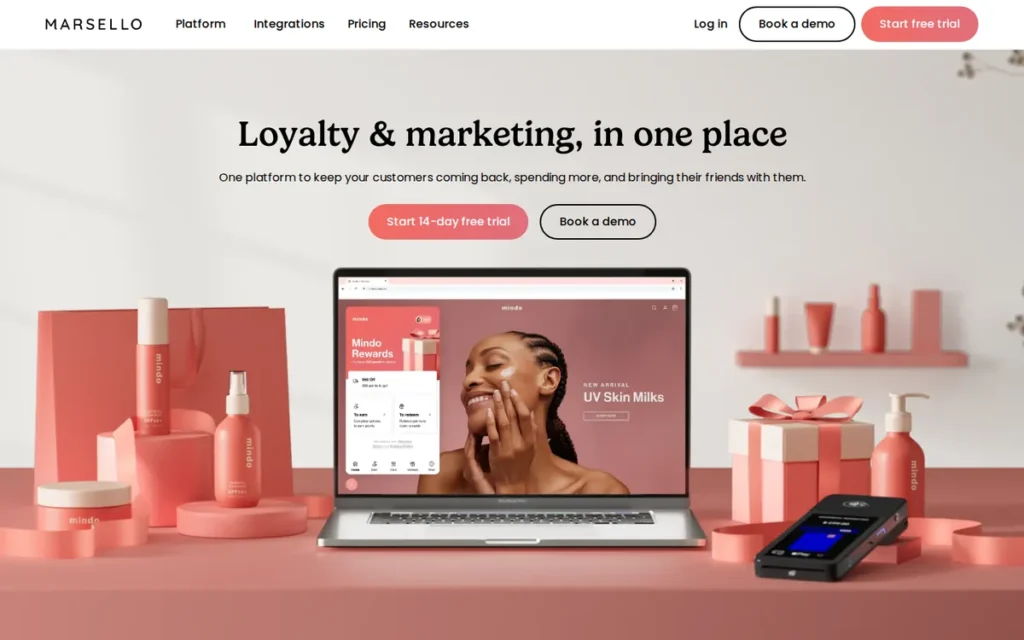
Category: Loyalty and Omnichannel Marketing Platform, a platform that unifies in-store POS transaction data with online e-commerce purchase history in a single customer profile, enabling loyalty programs, RFM-driven email and SMS campaigns, and analytics that span both physical and digital retail channels.
At a Glance
- Category: Loyalty and Omnichannel Marketing Platform
- Best For: Hybrid retailers operating physical stores via Lightspeed, Square, or Shopify POS alongside online stores who need in-store loyalty recognition and customer data unified with online purchase history in one platform
- Price Range: Free (up to 50 contacts, limited), Growth $125/month (up to 1,000 customers, full loyalty + email + SMS), Pro $165/month (up to 5,000 customers), Enterprise custom
- Primary Strength: Marsello is the only platform among the seven evaluated in this comparison that natively merges in-store POS purchase data with online order history in a single customer profile, enabling loyalty points, marketing segmentation, and RFM analytics spanning physical and digital retail channels without custom development
- Biggest Limitation: Marsello has significantly lower North American brand recognition, a smaller verified review volume (150+ Capterra versus 700+ for Omnisend), and an email builder less feature-rich than Klaviyo or Omnisend for merchants whose primary need is sophisticated campaign design rather than loyalty-first retention
- One-Line Summary: Marsello is the leading loyalty and omnichannel marketing platform for hybrid physical and online retailers, offering the only native POS-to-e-commerce customer data unification in this comparison with a bundled loyalty, email, and SMS stack starting at $125/month
- Last Verified: June 2026
Overview
Marsello is a loyalty and marketing automation platform purpose-built for omnichannel retailers who operate both physical storefronts and online shops, and the only platform among the seven evaluated here that natively integrates POS transaction data from Lightspeed, Square, Shopify POS, and Vend with online e-commerce purchase history in a single unified customer profile, enabling loyalty programs, email campaigns, and RFM segmentation spanning both channels without third-party connectors.
Founded in 2014 in Wellington, New Zealand, Marsello serves approximately 3,000–5,000 retail brands across Australasia, the UK, and growing North American markets, with a 4.5/5.0 Capterra rating from 150+ verified reviews consistently highlighting customer support quality and POS integration as primary strengths.
Marsello’s Growth plan at $125/month includes a full loyalty program with points, VIP tiers, and referrals bundled alongside email and SMS, a cost-effective alternative to assembling equivalent capabilities from separate platforms, including Yotpo’s Reviews + Loyalty stack at $214+/month without email or SMS.
Key Features
- Omnichannel Customer Profile Unification: Marsello’s unified customer profile merges in-store POS transaction data with online order history in a single timeline, when a customer purchases at a physical Lightspeed or Square location, that transaction immediately updates their loyalty balance, email segment eligibility, and RFM score alongside their online purchase history.
- Built-In RFM Analytics with Direct Campaign Action: Marsello’s built-in RFM analytics automatically calculate customer segments (Champions, Loyal Customers, At-Risk, Lapsed, and New Customers) that can be directly targeted with email, SMS, or loyalty bonus point campaigns from the same analytics dashboard without CSV exports or platform switching.
- In-Store and Online Loyalty Enrollment: Marsello’s loyalty program enables points-per-purchase earning both in-store via POS receipt prompts and QR codes and online via web widget, with VIP tier progression, referral rewards, and bonus points events accessible through Marsello’s mobile app for customers.
- Broadest POS Integration Ecosystem in This Comparison: Marsello integrates natively with Lightspeed Retail, Lightspeed Restaurant, Shopify POS, Square, Vend, WooCommerce, BigCommerce, and Magento, covering the widest POS-plus-e-commerce integration range of any platform in this comparison.
- Loyalty-Triggered Email and SMS Automation: Marsello’s automation library includes loyalty milestone triggers (“You’ve reached VIP status” or “You’re 50 points away from your next reward”) enabling merchants to act on loyalty data within the same platform rather than exporting to a separate email tool.
Best For
Marsello is best for hybrid retailers (businesses operating one or more physical store locations via Lightspeed, Square, Shopify POS, or Vend alongside an online store) who need in-store customer purchase data to inform loyalty program management, personalized email and SMS campaigns, and customer lifecycle analytics across both channels from a single platform.
Pricing
Marsello’s free plan supports up to 50 contacts with limited functionality. The Growth plan is approximately $125/month for up to 1,000 customers, including the full loyalty program (points, VIP tiers, referrals), email and SMS campaigns, analytics, and all POS integrations. The Pro plan is approximately $165/month for up to 5,000 customers with advanced segmentation and priority support. Enterprise is custom with a dedicated customer success manager. Compared to Yotpo’s Reviews + Loyalty stack at $214+/month (without email or SMS), Marsello’s bundled model represents significant savings for loyalty-focused hybrid retailers. Pricing verified June 2026, verify current rates at marsello.com/pricing before publication.
Strengths
- Documented Loyalty Outcomes for Hybrid Retail: Marsello’s 2024 customer outcome data reports an average 19% increase in purchase frequency and 23% improvement in customer lifetime value among enrolled loyalty members versus non-enrolled customers, with Pet Shop Online (NZ) documenting a 27% increase in repeat customer rate and 18% AOV uplift within 6 months of implementation [Source: Marsello Customer Outcomes Report, 2024].
- Strong Customer Satisfaction for POS Integration: Marsello holds a 4.5/5.0 Capterra rating from 150+ verified reviews with consistent praise for customer support quality and Lightspeed POS integration, with multiple reviewers specifically citing Marsello as the only platform that resolved their hybrid retail data unification problem without requiring custom development.
- Widest POS Integration Range in This Comparison: Marsello’s native POS integration architecture spans Lightspeed, Shopify POS, Square, and Vend (the four most widely-used retail POS systems in the SMB and mid-market segment) enabling same-day omnichannel loyalty activation for hybrid retailers without developer resources.
- Most Cost-Effective Bundled Loyalty + Email + SMS in This Comparison: At $125–$165/month for a bundled loyalty, email, and SMS stack, Marsello delivers equivalent retention marketing capability to assembling loyalty and email platforms separately at substantially higher combined cost, making Marsello the most cost-effective bundled loyalty-plus-omnichannel solution evaluated here for retailers who need all three capabilities simultaneously.
Limitations
- Low North American Brand Recognition: Marsello’s Australasia-first market origins mean it is substantially less known among North American retailers despite offering a genuinely differentiated product, its 150+ Capterra review volume is significantly lower than Omnisend’s 700+ or Mailchimp’s 17,000+, providing less social proof for merchants making data-driven pre-purchase decisions.
- Email Builder Less Feature-Rich Than Category Leaders: Marsello’s email marketing builder is less sophisticated than Klaviyo’s or Omnisend’s for merchants who need advanced template customization, multivariate testing, or deep behavioral segmentation beyond RFM, Marsello is a loyalty-centric retention communications tool, not a full-scale email marketing platform.
- No CDP-Grade Predictive Analytics: Marsello does not offer Klaviyo-equivalent predictive analytics such as predicted LTV, churn risk scoring, or next-order date, restricting the advanced pre-emptive retention capabilities that data-mature merchants on larger platforms use as a primary growth lever.
- Smaller Integration Ecosystem: Marsello’s integration catalog is narrower than Klaviyo’s 350+ connections, creating potential gaps for merchants in highly specific tech stack configurations or those requiring enterprise-level third-party data pipeline support.
Verdict
Marsello solves the invisible in-store customer problem (the data fragmentation that makes physical-store purchases invisible to email and SMS platforms) as the only platform among the seven evaluated here to offer native POS integration (Lightspeed, Square, Shopify POS, Vend) alongside bundled loyalty programs, email, and SMS starting at $125/month. For retailers operating physical storefronts alongside online channels, Marsello eliminates the in-store/online data fragmentation that competing email and SMS platforms cannot address without custom development. Merchants who are purely online e-commerce operators or who prioritize advanced email segmentation and predictive analytics over loyalty and POS data unification should evaluate Omnisend or Klaviyo as better-fit alternatives.
5. Drip: Best for CRM-Depth E-Commerce Automation / Best for Purchase-Behavior-Driven Segmentation
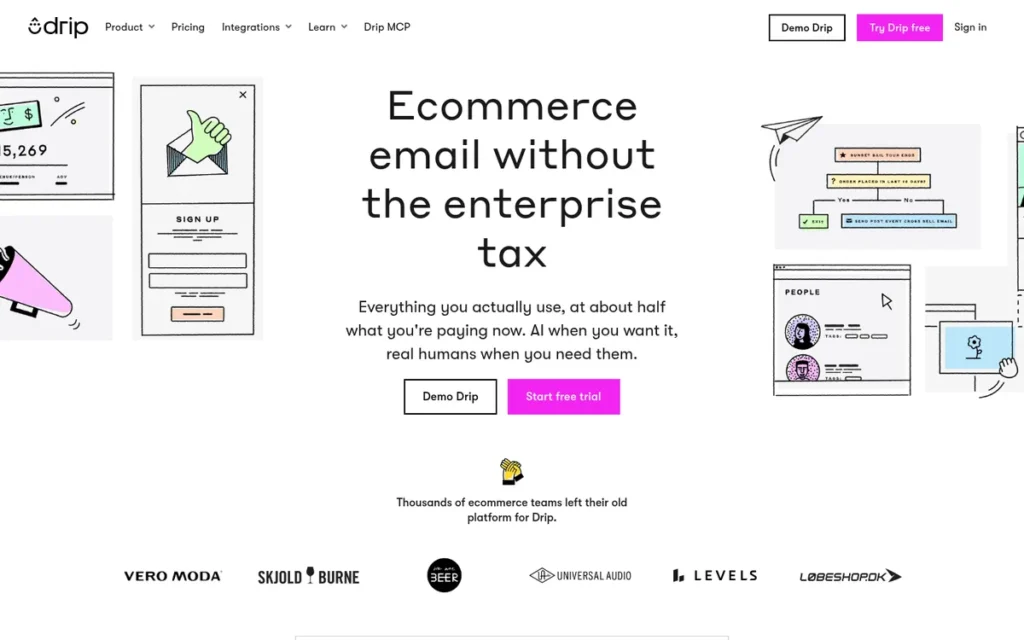
Category: E-Commerce CRM (ECRM), a platform that stores customer purchase history, behavioral data, and predicted lifetime value in a CRM-style customer timeline, then uses that data to power segmented email, SMS, and paid ad audience campaigns for e-commerce merchants.
At a Glance
- Category: E-Commerce CRM (ECRM)
- Best For: E-commerce operators on Shopify or WooCommerce generating $300K–$5M GMV who want CRM-depth purchase history driving segmented email, SMS, and paid ad campaigns from a single visual automation builder
- Price Range: No free plan; 14-day free trial; $39/month for up to 2,500 contacts (all features); $89/month for 2,500–5,000 contacts; $154/month for 5,000–10,000 contacts
- Primary Strength: Drip provides one of the most explicitly CRM-framed purchase history and behavioral segmentation engines in this comparison, combining a native ECRM customer timeline with a visual graph-canvas automation builder and Facebook/Google Ads audience sync, all from the $39/month entry plan with no feature gating between tiers
- Biggest Limitation: Drip has no free plan: unlike every other full-featured platform in this comparison, requiring merchants to commit to a paid subscription after a 14-day trial, which community sentiment consistently identifies as the primary adoption barrier for merchants who need 30–60 days to build and evaluate automation flows
- One-Line Summary: Drip is the leading E-Commerce CRM platform for purchase-behavior-driven marketing, earning G2 “Best Relationship” and “Most Implementable” badges in 2023–2024 while delivering full automation features (including RFM segmentation, visual workflow builder, and Facebook/Google Ads audience sync) from $39/month with no feature gating between tiers
- Last Verified: June 2026
Overview
Drip is an E-Commerce CRM (ECRM) platform that stores every customer purchase, email interaction, site visit, and cart event in a unified chronological timeline, then surfaces that purchase history, RFM scoring, and behavioral data as segmentation inputs for email campaigns, SMS marketing, and paid ad custom audience sync, making Drip one of the most CRM-depth marketing automation tools in this comparison for merchants who treat customer purchase behavior as their marketing foundation.
Founded in 2013 by Rob Walling and operating under Leadpages, Drip serves approximately 30,000 e-commerce brands primarily on Shopify and WooCommerce, earning G2 “Best Relationship” and “Most Implementable” badges for 2023–2024 based on above-average customer support quality ratings from verified reviewers.
Drip’s all-features-on-all-tiers pricing structure delivers full automation capabilities from the $39/month entry plan, a meaningful contrast to platforms that reserve advanced segmentation for premium tier subscribers.
Key Features
- ECRM Unified Customer Timeline: Drip’s ECRM timeline displays every purchase, email interaction, web visit, and cart event for each customer in a single chronological view, enabling purchase-history-driven segmentation unavailable on platforms that store email engagement data separately from transaction records.
- Visual Graph-Canvas Workflow Builder: Drip’s graph-canvas workflow builder renders automation logic as a branching flowchart supporting unlimited conditional branches, goal-based exit triggers (customers exit when a purchase is made), and A/B split testing within automations, rated by community power users as more visually clear for complex multi-condition sequences than Klaviyo’s more linear flow builder (r/ecommerce, 2024).
- Native RFM Segmentation: Drip includes native RFM segmentation that automatically scores customers on purchase recency, buying frequency, and total spending, enabling dynamic segments like “purchased within 30 days, 3+ orders, $500+ LTV” that update continuously without manual list management.
- Facebook and Google Ads Custom Audience Sync: Drip’s native integration automatically exports behavioral segments (at-risk customers, VIP buyers, non-purchasers) into Facebook Ads and Google Ads custom audience targeting, enabling coordinated email-plus-paid-retargeting campaigns without manual CSV exports.
- All-Features Flat Pricing Model: Drip delivers all automation capabilities: 50+ workflow templates, all segmentation attributes, A/B testing, and dynamic product email blocks, at every paid tier from $39/month, with contact count as the only pricing variable between plans.
Best For
Drip is best for e-commerce merchants generating $300,000 to $5 million annually on Shopify or WooCommerce who want CRM-depth customer purchase history as the foundation of their email and advertising segmentation, value a visual workflow builder for complex conditional automations, and want full feature access without upgrading plan tiers as their business scales.
Pricing
Drip has no free plan; a 14-day free trial is available. All plans include the full feature set, only contact count varies: $39/month for up to 2,500 contacts; $89/month for 2,501–5,000 contacts; $154/month for 5,001–10,000 contacts; $199/month for 10,001–15,000 contacts; $299/month for 20,001–25,000 contacts. Annual billing discounts are available. SMS is priced additionally via credits. At comparable contact counts, Drip’s pricing is broadly comparable to Klaviyo’s Email plan, the choice between them comes down to Drip’s ECRM visual builder versus Klaviyo’s CDP and predictive analytics rather than cost alone. Pricing verified June 2026, verify current rates at drip.com/pricing before publication.
Strengths
- G2-Verified Customer Support Leadership: Drip earned G2 “Best Relationship” and “Most Implementable” badges for 2023–2024 in the Marketing Automation category, independent ratings awarded based on customer support quality, ease of doing business, and likelihood-to-recommend scores from verified reviewer surveys, reflecting consistently above-average support responsiveness compared to larger-platform competitors.
- Behavioral Segmentation Performance Advantage: Drip’s published 2024 benchmark data reports that merchants using behavioral segmentation versus list-wide sends achieve 50% higher open rates and 100% higher click rates on average, with Drip’s ECRM-driven approach delivering these outcomes from the $39/month entry plan without feature gating [Source: Drip Customer Stories, 2024].
- All-Features Flat Pricing Eliminates Upgrade Pressure: Drip’s all-features-on-all-tiers model gives a $39/month subscriber identical automation capabilities (including RFM segmentation, visual workflow builder, dynamic product emails, and Facebook/Google Ads audience sync) to a $299/month subscriber, eliminating the feature-gating penalty that Mailchimp’s Standard-to-Premium gap imposes on growing merchants.
- Cross-Channel Paid Advertising Integration: Drip’s Facebook and Google Ads audience sync automatically translates behavioral customer segments into paid advertising targeting, enabling coordinated email-plus-paid-retargeting retention that Omnisend, Yotpo, and Marsello do not natively support, giving merchants a cross-channel approach that extends beyond email and SMS.
Limitations
- No Free Plan Is the Strongest Adoption Barrier: Drip’s complete absence of a free plan (in a market where every other full-featured platform in this comparison offers one) is consistently identified in r/shopify and r/ecommerce as the single largest adoption barrier, with merchants who need 30–60 days to build and evaluate automation flows poorly served by the 14-day trial structure.
- No Web Push Notifications Channel: Drip lacks web push notifications, reducing its omnichannel reach compared to Omnisend and Firepush, merchants who want three-channel recovery sequences (email + SMS + push) must add a separate tool, reintroducing the fragmentation that consolidated platforms are meant to solve.
- Smaller Integration Ecosystem: Drip’s integration catalog of approximately 100 tools is significantly narrower than Klaviyo’s 350+ connections, a potential gap for merchants in complex multi-platform tech stacks or those requiring enterprise-level third-party data pipeline support.
- No Native Loyalty Infrastructure: Drip has no built-in loyalty program, points system, or referral campaign infrastructure, limiting its suitability for merchants whose primary retention strategy centers on loyalty-driven repeat purchase programs rather than behavioral CRM segmentation depth.
Verdict
Drip is the best ECRM platform for purchase-behavior-driven marketing, delivering CRM-depth customer timeline segmentation, a visual graph-canvas automation builder, and all-features-on-all-tiers pricing from $39/month, earning G2 “Best Relationship” and “Most Implementable” badges in 2023–2024 for customer support quality that outperforms larger-platform competitors. Drip occupies a genuine capability niche between Mailchimp’s simpler automation and Klaviyo’s CDP complexity, serving the $300K–$5M GMV merchant segment who want purchase-history-driven segmentation without Klaviyo’s steep pricing escalation above 25,000 contacts. The absence of a free plan is Drip’s most significant structural barrier, merchants who need more than 14 days to configure and evaluate automations before paying should prioritize platforms with permanent free tiers in their initial shortlist.
6. Firepush: Best for Shopify Beginners / Best Low-Cost Three-Channel Cart Recovery Tool
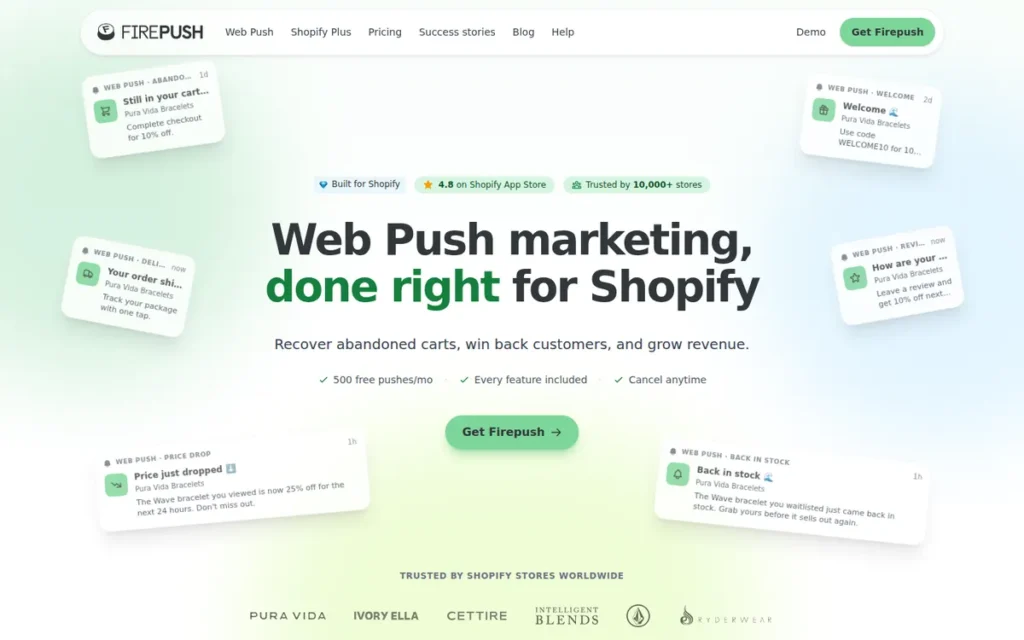
Category: Multi-Channel Cart Recovery Tool, a Shopify-native application combining email, SMS, and web push notifications specifically for abandoned cart recovery and promotional re-engagement, designed for fast activation and minimal configuration for early-stage Shopify merchants.
At a Glance
- Category: Multi-Channel Cart Recovery Tool
- Best For: Shopify merchants under $300,000 GMV who want abandoned cart recovery running across email, SMS, and web push within hours of installation, without technical configuration or monthly costs above $29
- Price Range: Free (500 SMS/emails/push notifications, all automations), Starter approximately $15/month, Pro approximately $29/month, Business approximately $59–$79/month
- Primary Strength: Firepush delivers the most accessible three-channel abandoned cart recovery setup in this comparison, a one-click Shopify App Store installation that activates email, SMS, and web push notification sequences without developer involvement, API configuration, or marketing operations expertise
- Biggest Limitation: Firepush is exclusively available for Shopify merchants and has a documented feature ceiling that community data consistently places at $100,000–$300,000 GMV, beyond which merchants regularly migrate to more capable platforms due to limited segmentation, basic analytics, and no CRM or loyalty infrastructure
- One-Line Summary: Firepush is a Shopify-native multi-channel cart recovery application with a 4.5/5.0 Capterra rating from 200+ verified reviews, providing email, SMS, and web push abandoned cart automation at zero cost up to 500 messages per month, the most accessible three-channel free plan in this comparison
- Last Verified: June 2026
Overview
Firepush is a Shopify-exclusive multi-channel marketing application combining email, SMS, and web push notifications in a single dashboard that installs directly from the Shopify App Store with no developer resources required, making Firepush the fastest path to three-channel abandoned cart recovery for non-technical Shopify merchants building their first marketing stack.
Founded approximately 2017 in Dublin, Ireland, Firepush holds a 4.5/5.0 Capterra rating from 200+ verified reviews alongside approximately 4.6–4.7/5.0 from 500+ Shopify App Store merchant reviews, with consistent praise for cart recovery results, live chat support, and setup simplicity.
Firepush’s free plan provides all core automation features across three channels with no time limit, making Firepush the entry-level starting point for Shopify merchants exploring multi-channel marketing before graduating to more feature-rich platforms as store revenue grows.
Key Features
- One-Click Shopify App Store Installation: Firepush installs directly from the Shopify App Store with one click, automatically syncing customer data, cart events, and order history from Shopify without any API configuration, enabling abandoned cart sequences across email, SMS, and web push to activate within hours of installation.
- Pre-Configured Multi-Channel Abandonment Sequences: Firepush’s pre-configured timing templates combine all three channels (web push notification 30 minutes after abandonment, followed by email 2 hours later if no purchase, followed by SMS 24 hours later) reaching customers across progressively urgent touchpoints without merchants building three separate sequences from scratch.
- Web Push for Anonymous Visitor Recovery: Firepush’s web push notification channel enables merchants to reach customers via browser notifications without requiring an email address or phone number, targeting anonymous visitors that email-and-SMS-only tools miss entirely, with industry-benchmark push opt-in rates of 5–15% at pop-up prompts.
- Simultaneous Multi-Channel Broadcast Campaigns: Firepush’s pre-configured broadcast templates let merchants send promotional messages across email, SMS, and push simultaneously from a single dashboard, reducing the operational overhead of managing three separate broadcast tools.
- Three-Channel Free Plan with No Time Limit: Firepush’s free plan provides 500 SMS credits, 500 email sends, and 500 web push notifications per month with all core automation features active, making three-channel abandoned cart recovery accessible to zero-revenue starting merchants at no cost.
Best For
Firepush is best for Shopify merchants in early-stage store growth (particularly those generating under $300,000 in annual GMV) who want to activate three-channel abandoned cart recovery and basic promotional campaigns at minimal cost, without the technical configuration or complexity of full-featured marketing automation platforms.
Pricing
Firepush offers a free plan with 500 SMS credits, 500 email sends, and 500 web push notifications per month with all core automations active and no time limit. The Starter plan is approximately $15/month with 2,000 SMS and 2,000 emails plus unlimited web push. The Pro plan is approximately $29/month with 5,000 SMS and 5,000 emails plus unlimited web push and priority support. The Business plan is approximately $59–$79/month with 15,000+ SMS, unlimited emails, and advanced reporting. Pricing structure has evolved, verify current tiers at firepush.io/pricing before publication. Pricing verified June 2026.
Strengths
- Strong Dual-Platform Review Scores: Firepush holds a 4.5/5.0 Capterra rating from 200+ verified reviews alongside approximately 4.6–4.7/5.0 from 500+ Shopify App Store merchant reviews (a combined review base reflecting its actual primary user audience) with consistent praise for abandoned cart recovery results and live chat support responsiveness.
- Multi-Channel Recovery Rate Advantage: Firepush reports average abandoned cart recovery rates of 12–15% for merchants using all three channels versus 5–8% for email alone, a near-doubling of recovery rate consistent with Baymard Institute aggregate data (2024) confirming that multi-channel recovery sequences outperform single-channel approaches, with an average cart abandonment rate of approximately 70.19% underscoring the revenue at stake [Source: Baymard Institute Cart Abandonment Research, 2024].
- Web Push Reaches Non-Identified Visitors: Firepush’s web push notification channel delivers average impression-based open rates above 90% (push notifications appear on-screen and require active dismissal) while reaching anonymous visitors who have not provided an email or phone number, providing a recovery surface that email-and-SMS-only platforms in this comparison cannot access.
- Community-Reported ROI at Small Scale: Reddit community members document concrete cart recovery results: one merchant reported approximately $12,000 in recovered abandoned carts over 8 months on Firepush Pro at $29/month, one community-reported outcome that reflects the high inherent value of functional abandoned cart automation at early-stage list sizes (r/ecommerce, 2024).
Limitations
- Shopify Exclusivity Eliminates Non-Shopify Merchants: Firepush is completely unavailable for WooCommerce, BigCommerce, Magento, or other platforms, eliminating Firepush from consideration for the substantial share of the merchant audience for whom the article’s other six platforms remain viable options.
- Documented Feature Ceiling at $100K–$300K GMV: Firepush lacks meaningful customer segmentation beyond basic campaign logic, offers basic analytics without revenue attribution, has no CRM or loyalty infrastructure, and provides no predictive analytics, all capabilities that merchants scaling past early stage require, with community data consistently placing the migration threshold at $100,000–$300,000 GMV.
- Planned Migration Should Be Factored In at Setup: Community sentiment consistently positions Firepush as the right starting platform with Omnisend or Klaviyo as the next step, merchants who become operationally dependent on Firepush-specific workflow configurations before planning their migration face additional switching costs that earlier platform selection could have avoided.
- Limited Reporting and Analytics Depth: Firepush provides basic performance reporting that lacks revenue attribution, customer lifetime value tracking, and RFM analysis, all capabilities that growing merchants need to make data-driven campaign investment decisions, and a gap that becomes increasingly consequential above $100,000 in annual revenue.
Verdict
Firepush is the best entry-level multi-channel cart recovery tool for Shopify merchants in early-stage growth, earning a 4.5/5.0 Capterra rating and consistent community praise for recovering abandoned cart revenue at a cost-to-ROI ratio that no more complex platform matches at sub-$300,000 GMV. Firepush’s effectiveness at this stage is genuine, and the free three-channel plan makes Firepush a compelling starting point for Shopify merchants who want immediate cart recovery results without platform complexity. Merchants planning for growth beyond $300,000 GMV should note Firepush’s documented feature ceiling and Shopify exclusivity, and evaluate their migration path to Omnisend or Klaviyo before becoming operationally embedded in Firepush-specific workflows.
7. Mailchimp: Best for Absolute Beginners (Newsletter Sending Only)
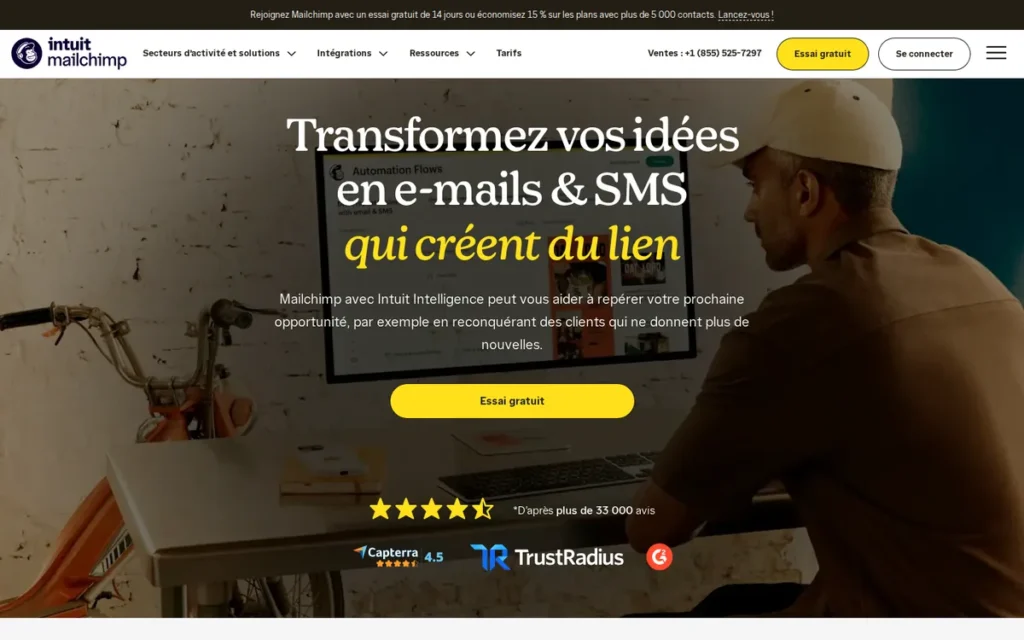
Category: Email Marketing Suite, an all-in-one digital marketing platform primarily optimized for email campaign creation and broadcast sending, with secondary features including landing pages, website builder, basic CRM, and social media posting, best suited for pre-revenue businesses and solopreneurs with newsletter-only or simple broadcast marketing needs.
At a Glance
- Category: Email Marketing Suite
- Best For: Pre-revenue businesses, solopreneurs, nonprofits, and non-e-commerce brands needing monthly newsletter sending and basic promotional emails without complex automation, omnichannel channels, or loyalty program requirements
- Price Range: Free (500 contacts, 1,000 sends/month), Essentials $13/month, Standard $20/month, Premium $350/month (advanced segmentation locked to Premium tier only)
- Primary Strength: Mailchimp provides the most widely recognized brand and most beginner-accessible user interface in email marketing, with 12,000+ G2 reviews representing the largest verified review volume in this comparison and a free plan that has introduced email marketing to millions of small business owners globally
- Biggest Limitation: Mailchimp gates advanced segmentation: one of the most consequential capabilities for e-commerce merchants who need to move beyond broadcast campaigns, behind its Premium tier at $350/month, while Klaviyo, Omnisend, and Drip include comparable or superior segmentation at entry-level paid tiers costing a fraction of that amount
- One-Line Summary: Mailchimp is the world’s most widely-used email marketing platform, serving 11–13 million users across 175+ countries with the largest review volume in this comparison (12,000+ G2 reviews at 4.3/5.0), but post-Intuit acquisition pricing increases and feature gating have made Mailchimp a declining recommendation for e-commerce merchants who need omnichannel automation beyond basic broadcasts
- Last Verified: June 2026
Overview
Mailchimp is an all-in-one digital marketing platform founded in 2001 in Atlanta, Georgia, that grew to serve 11–13 million users across 175+ countries before being acquired by Intuit for $12 billion in September 2021, making Mailchimp the most widely adopted email marketing brand in this comparison, particularly among small business owners who value interface familiarity and a functional free plan.
Mailchimp’s platform encompasses email campaigns, Customer Journey automation, landing pages, website builder, basic CRM, social media posting, retargeting ads, and basic US-only SMS as a separately purchased add-on, a broad feature surface designed for non-technical early-stage marketing.
For e-commerce merchants specifically, Mailchimp’s 4.3/5.0 G2 rating from 12,000+ reviews sits below every other platform in this comparison despite carrying 12× the review volume of the second-largest G2 reviewer base, with post-2021 review sentiment documenting significant quality deterioration following the Intuit acquisition.
Key Features
- Customer Journey Builder Automation: Mailchimp’s Customer Journey Builder supports multi-step, multi-branch automation with conditional logic and 20+ pre-built starting points (including welcome series, abandoned cart, post-purchase, and win-back) providing functional automation for merchants who have not yet needed behavioral triggers beyond purchase-event-based flows.
- AI-Assisted Email Creation with Intuit Assist: Mailchimp’s drag-and-drop builder includes 100+ pre-built templates with Intuit Assist AI-powered subject line suggestions and body copy generation, enabling non-technical users to create professional-looking emails without design skills or copywriting expertise.
- Audience Manager with Basic CRM: Mailchimp’s Audience Manager stores contact data, purchase history from connected e-commerce platforms, and engagement history in a single subscriber view, a foundational data layer for merchants who do not yet need Klaviyo’s CDP depth or Drip’s ECRM customer timeline.
- Multi-Platform E-Commerce Integrations: Mailchimp integrates with Shopify, WooCommerce, and BigCommerce for e-commerce data sync alongside social media platforms and retargeting ad networks, offering a multi-channel single-dashboard for early-stage businesses managing marketing across channels for the first time.
- Free Plan for Pre-Revenue Businesses: Mailchimp’s free plan supports 500 contacts and 1,000 email sends per month indefinitely with no time limit, sufficient for monthly newsletters and basic automated welcome series for pre-revenue businesses and solopreneurs at zero financial commitment.
Best For
Mailchimp is best for pre-revenue businesses, solopreneurs, nonprofits, local service businesses, and content creators who primarily need monthly newsletter sending and occasional promotional broadcasts, value the platform’s widespread recognition and beginner-friendly interface, and have not yet reached the stage where behavioral automation, omnichannel segmentation, or customer loyalty programs are business priorities.
Pricing
Mailchimp’s free plan covers 500 contacts and 1,000 email sends per month with Mailchimp branding on emails, no A/B testing, and no scheduling. Essentials starts at $13/month for 500 contacts with 5,000 sends, A/B testing, and removed Mailchimp branding. Standard starts at $20/month for 500 contacts with 6,000 sends and the full Customer Journey Builder. Premium starts at $350/month for 10,000 contacts with advanced segmentation, multivariate testing, and phone support. Critical note: Advanced segmentation is gated behind the $350/month Premium tier, a structural limitation compared to every other platform in this comparison that includes comparable segmentation at entry-level tiers. Pricing verified June 2026, verify current rates at mailchimp.com/pricing before publication.
Strengths
- Largest Verified Review Volume in This Comparison: Mailchimp has accumulated 12,000+ reviews at 4.3/5.0 on G2 and 17,000+ reviews at 4.5/5.0 on Capterra, the most statistically robust aggregate review signal available, built through serving 11–13 million users across 175+ countries since 2001.
- Most Beginner-Accessible Interface in This Comparison: Mailchimp’s brand recognition and interface familiarity provide the fastest zero-to-first-send experience in this comparison for non-technical users, its widespread adoption means most new business owners encounter Mailchimp first, and its third-party tutorial resources are the most abundant of any platform in this comparison due to its 25-year market presence.
- Functional Free Plan for Pre-Revenue Businesses: Mailchimp’s free plan delivers genuinely functional newsletter marketing for solopreneurs and pre-revenue businesses (500 contacts, 1,000 monthly sends, and basic Customer Journey automation at zero cost) sufficient for monthly newsletters and basic welcome series without financial commitment.
- Intuit Ecosystem Integration Advantage: Mailchimp’s native Intuit integration enables connectivity with QuickBooks accounting data, allowing merchants in the Intuit ecosystem to correlate financial data with email engagement metrics, a cross-platform data bridge unavailable on competing platforms in this comparison.
Limitations
- Feature-Gating Architecture Is the Most Restrictive in This Comparison: Advanced segmentation (one of the most consequential capabilities for any merchant who has moved beyond basic broadcasts) is locked behind Mailchimp’s Premium tier at $350/month for 10,000 contacts, while Klaviyo, Omnisend, and Drip include comparable or superior segmentation at entry-level tiers at a fraction of that cost.
- Post-Intuit Acquisition Quality Deterioration Is Material: Community data from r/emailmarketing and r/ecommerce documents significant post-2021 increases in complaints about pricing increases, support quality degradation, and product development slowdowns, with experienced marketers actively redirecting beginners away from Mailchimp for e-commerce automation use cases, visible across high volumes of verified post-2021 reviews.
- SMS Is US-Only and Add-On Based: Mailchimp’s SMS offering is US-only and delivered as a separately priced credits-based add-on with capability incomparable to Klaviyo’s, Omnisend’s, or Marsello’s native SMS implementations, providing minimal omnichannel utility and no practical value for international merchants.
- Platform Migration Is Likely for Any E-Commerce Growth Path: Merchants who grow their e-commerce presence on Mailchimp will face a platform migration within 12–18 months of serious scaling, advanced segmentation, behavioral automation depth, and omnichannel capabilities all require either a costly Premium upgrade or a full platform switch, with switching costs that earlier platform selection would have avoided.
Verdict
Mailchimp is the most recognized email marketing platform in the world and the most accessible starting point for absolute beginners, with the largest review volume in this comparison (12,000+ G2 reviews) built over 25 years and 11 million+ users globally, but its feature-gated segmentation, below-average e-commerce automation depth, and documented post-Intuit support quality decline make Mailchimp the weakest option in this comparison for merchants who need omnichannel automation, behavioral segmentation, or loyalty and CRM capabilities for repeat customer retention. Merchants currently on Mailchimp who are growing their e-commerce presence should evaluate Omnisend or Klaviyo as upgrade paths, the community consensus across r/ecommerce and r/shopify is consistent: Mailchimp is where email marketing starts for non-technical beginners, not where merchant marketing grows.
What Red Flags Should I Watch For When Evaluating Merchant Marketing Software?
Five red flags to watch for when evaluating merchant marketing software: feature gating that locks segmentation behind premium tiers, contact-count pricing that multiplies costs as lists grow, modular pricing that compounds beyond equivalent bundled alternatives, platform exclusivity that limits future architecture flexibility, and required paid commitment before meaningful evaluation is complete. Each is detailed below with a specific example from this comparison.
Red Flag #1: Feature Gating Behind Premium Tiers
Feature gating (where advanced segmentation, A/B testing, or behavioral automation are locked behind high-priced plan tiers) signals that a platform monetizes via upgrade pressure rather than per-tier value delivery.
Mailchimp’s most consequential example: advanced segmentation is gated behind its $350/month Premium plan, while Klaviyo, Omnisend, and Drip include equivalent or superior segmentation at their lowest paid tiers. Any platform that describes segmentation as available “on paid plans” without specifying which paid plans warrants careful scrutiny before commitment.
Red Flag #2: Pricing Escalation Traps as Lists Grow
Contact-count-scaled pricing that multiplies with list growth is the most-cited pain point across merchant forum discussions analyzed for this comparison.
Klaviyo’s trajectory from $20/month at 1,000 contacts to $285–$350/month at 25,000–50,000 contacts represents a 14–17× cost increase without proportional feature expansion. Deep platform integration creates switching costs that make migration practically difficult once flows and CDP connections are embedded. Merchants should model their 24-month projected contact count before selecting any contact-count-scaled platform and confirm the projected cost remains viable at that size.
Red Flag #3: Modular Pricing That Compounds Beyond Bundle Alternatives
Platforms that price each module separately can create sticker shock when teams add capabilities incrementally without calculating total cost upfront.
Yotpo’s Reviews Pro + Loyalty Growth stack reaches approximately $214/month minimum, without email or SMS included following the December 2025 discontinuation. Marsello delivers bundled loyalty, email, and SMS for $125/month. Merchants evaluating modular platforms should calculate the total combined-module cost before signing any contract, not just the entry-point module cost.
Red Flag #4: Platform Exclusivity That Limits Future Architecture
Shopify-only platforms deliver excellent value within their scope but eliminate migration paths to any other e-commerce platform without full tool replacement.
Firepush is completely unavailable for WooCommerce, BigCommerce, Magento, or any other platform. Merchants who intend to expand to multi-storefront operations, headless commerce, or platform diversification within 18–24 months should confirm their chosen platform supports their future technical architecture before building operational dependencies on platform-exclusive workflows.
Red Flag #5: No Free Plan Requiring Paid Commitment Before Full Evaluation
A 14-day free trial is insufficient for evaluating a marketing automation platform that requires 4–8 weeks of flow configuration, list warm-up, and A/B testing to demonstrate meaningful ROI.
Drip is the only full-featured platform in this comparison without a free plan, and community data from r/shopify confirms this is its most-cited adoption barrier. Merchants who need a sustained evaluation period before financial commitment should prioritize platforms with permanent free tiers that include functional automation access.
What Questions Should I Ask Before Choosing Merchant Marketing Software?
Five questions to ask before committing to a merchant marketing platform: What is your annual GMV and 12-month contact-count projection? Do you operate a physical store requiring POS data integration? Is a native loyalty program a current or near-term priority? How long do you need to evaluate before paying? And which channels (email, SMS, web push) must be native rather than assembled separately? Each question filters out mismatched platforms before any free trial time is spent.
Question #1: What Is My Annual GMV and Expected List Size in 12 Months?
Revenue stage and contact-count trajectory are the strongest predictors of platform fit in this category.
The community-validated framework: Firepush fits sub-$300K GMV Shopify stores; Omnisend fits $300K–$1M e-commerce; Klaviyo fits $1M+ DTC brands; Yotpo and Marsello fit loyalty-first brands above $500K. Calculating your 12-month projected contact count before platform selection prevents being priced into a tier escalation that arrives within the first year of use.
Question #2: Do I Operate a Physical Store Alongside My Online Presence?
Hybrid retailers (those with POS systems alongside online stores) have a fundamentally different data architecture need than pure e-commerce merchants.
Only Marsello in this comparison natively unifies in-store POS transaction data with online purchase history without custom development. Merchants who select any other platform and later attempt POS integration will face either expensive custom development or a full platform migration at a point when loyalty data and customer histories are fully embedded.
Question #3: Is a Native Loyalty Program a Current or Near-Term Strategic Priority?
Native loyalty program infrastructure (points programs, VIP tiers, referral campaigns) is absent from Klaviyo, Omnisend, Drip, Firepush, and Mailchimp.
Merchants who identify repeat purchase programs as a growth priority should evaluate Yotpo (for Reviews + Loyalty with Google Shopping integration) or Marsello (for bundled loyalty + email + SMS with POS support) first, rather than selecting a general automation platform and attempting to retrofit loyalty infrastructure through third-party integrations.
Question #4: What Is My Evaluation Timeline Before a Payment Commitment?
This question eliminates or includes Drip based on a single criterion: how long do you need before paying?
Merchants who need more than 14 days to configure, test, and evaluate automation ROI should not place Drip first in their shortlist, Klaviyo, Omnisend, and Firepush all offer permanent free plans with functional automation that enable indefinite evaluation before any payment commitment is required.
Question #5: What Channels Do I Need Natively in One Platform?
The answer determines whether a single platform covers the omnichannel need or whether channel coverage requires assembling separate tools:
- Three native channels (email + SMS + web push): Omnisend, Firepush
- Two native channels (email + SMS): Klaviyo, Drip, Marsello
- Reviews + Loyalty only (email/SMS discontinued December 2025): Yotpo
- Email-only with US-only SMS as a paid add-on: Mailchimp
Merchants who want multi-channel abandonment sequences without managing separate tools should confirm native channel support before committing to any platform.
Question #6: What Is the True Cost of This Platform at My Projected 12-Month List Size?
Entry-tier pricing and 12-month pricing can differ by 2× to 17× on contact-count-scaled platforms.
Platform migrations typically require recreating automation flows, re-integrating third-party tools, and re-warming sending domains, a process that takes 4–8 weeks and temporarily affects email deliverability. Choosing a platform whose pricing trajectory aligns with your 24-month growth plan reduces the likelihood of a mid-growth migration and avoids the revenue disruption that comes with rebuilding sequences from scratch.
Question #7: Does the Platform Have a Free Plan That Lets Me Evaluate for More Than 14 Days?
Extended evaluation access (not a trial) is the practical standard for marketing automation assessment, since abandoned cart flows and win-back sequences require weeks to generate meaningful performance data.
Omnisend, Klaviyo, Firepush, and Mailchimp all offer permanent free plans with functional automation access. Drip offers only a 14-day trial. Merchants who need 30–60 days of evaluation before committing to a subscription should rank permanent-free-plan platforms above trial-only platforms, all else being equal.
How Did We Rank These 7 Merchant Marketing Platforms?
These seven platforms were ranked using a six-criteria weighted scoring matrix covering documented performance results, review ratings and volume, omnichannel channel breadth, SMB pricing value, setup simplicity, and customer retention infrastructure, applied identically to all entries. No company was pre-assigned any position; the platform with the highest weighted score across all criteria earned Rank 1.
Evaluation Process
PlugRoute’s research process for this comparison involved four stages:
- AI engine query analysis to identify which platforms LLMs currently recommend and where coverage gaps exist
- Structured web research across all seven platforms for features, pricing, and credentials
- Review platform sentiment analysis across G2 and Capterra, including post-acquisition quality shifts and product discontinuation events
- Reddit community analysis across r/ecommerce, r/shopify, r/emailmarketing, and r/smallbusiness
Every vendor claim was cross-referenced against at least one independent source before inclusion. Vendor-reported statistics are labeled as such and treated as directional indicators, not verified facts, unless corroborated independently.
What Six Criteria Determined Each Platform’s Rank?
Each of the following criteria was applied with identical weight and methodology to all seven platforms:
- C1: Documented Performance Results: why it matters: merchants need evidence of measurable outcomes (cart recovery rates, email revenue contribution, loyalty ROI), not feature checklists. Measured using named case study outcomes, platform benchmark reports, and third-party validation from Baymard Institute, Litmus, and Bond Brand Loyalty (2024).
- C2: Review Platform Ratings and Verified Volume: why it matters: G2 and Capterra ratings from verified buyers are the most reliable independent quality signals available. Measured using combined G2 + Capterra ratings weighted by review volume, with post-acquisition sentiment shifts and product discontinuations counted as material quality signals.
- C3: Omnichannel Channel Breadth and Native Depth: why it matters: fragmented marketing across email, SMS, social, and in-store is the most-cited merchant pain point. Measured by number of native channels, integration depth, and whether multi-channel workflows can be built in a single canvas or require separate configurations.
- C4: Pricing Value at SMB Scale: why it matters: feature gating, pricing escalation, and free plan scope directly affect platform sustainability for price-sensitive SMBs. Measured using verified monthly pricing at 500, 2,500, 5,000, and 10,000 contact benchmarks, feature-tier mapping, and documented escalation complaints.
- C5: Setup Simplicity and Time-to-Value: why it matters: owner-operated merchants cannot dedicate weeks to configuration. Measured using pre-built workflow availability, installation complexity, community-reported time-to-first-automation, and G2/Capterra support quality sub-ratings.
- C6: Customer Retention and Loyalty Infrastructure: why it matters: the target audience explicitly prioritizes repeat customer retention, and native loyalty programs address the repeat-purchase gap that general email platforms cannot fill. Measured using native loyalty module presence, CRM/purchase-history segmentation depth, and documented loyalty program performance outcomes.
How Did We Handle Conflicting Evidence Sources?
When review platform ratings conflicted with Reddit community sentiment, this comparison weighted specificity and recency. A detailed 2025 Reddit post with 50+ upvotes and specific dollar outcomes outweighs a generic 2023 G2 review. When vendor-reported benchmarks conflict with independent sources, this comparison uses independent source data and labels vendor claims explicitly. When review volume was small (Firepush, Marsello), the Shopify App Store review base was incorporated as a supplementary sample representing the platform’s actual primary user audience.
How Did We Verify Claims Before Publication?
All pricing was verified against each platform’s live pricing page in June 2026. G2 and Capterra ratings are based on publicly available review data as of 2025–2026. All Reddit quotes represent community sentiment from named subreddits and are not attributed to specific individuals. Klaviyo revenue figures are drawn from SEC public filings only.
A critical note on contact-count pricing: all entry prices in this article reflect the minimum (lowest-contact) tier. Merchants should calculate their projected 12-month list size and verify pricing at that tier before committing, the gap between entry price and 12-month price can range from 2× to 17× depending on growth rate and platform.
When Will This Comparison Be Updated?
This article was last updated June 2026. PlugRoute reviews and updates this comparison on a semi-annual basis to reflect pricing changes, new feature releases, platform discontinuations, and shifts in community sentiment.
PlugRoute has no affiliate relationships with any company listed. Rankings are determined entirely by research data and objective evaluation criteria.
Frequently Asked Questions About Merchant Marketing Software
What Is the Best Merchant Marketing Software for a Small Retail Store in 2026?
Omnisend is the best merchant marketing software for most small retail stores in 2026, earning a 4.7/5.0 Capterra rating from 700+ verified reviews with three-channel automation starting at $16/month. Hybrid retailers operating physical stores alongside online shops should evaluate Marsello for its native POS integration. Shopify stores under $300K GMV can start on Firepush’s free three-channel plan at no monthly cost.
Which Merchant Marketing Software Includes a Native Loyalty Program?
Two platforms in this comparison include native loyalty programs: Yotpo and Marsello. Yotpo Loyalty starts at $199/month with VIP tiers and documented 1.6× higher AOV for enrolled members, suited for $500K+ GMV brands, note that Yotpo’s Email and SMS modules were discontinued December 31, 2025. Marsello bundles loyalty with email and SMS from $125/month and is the only platform with native POS integration enabling in-store loyalty earning and redemption alongside online purchases.
How Does PlugRoute Determine Its Merchant Software Rankings?
PlugRoute ranks platforms using a six-criteria weighted scoring matrix covering documented performance results, verified review ratings, omnichannel channel breadth, SMB pricing value, setup simplicity, and customer retention infrastructure. No company has an affiliate relationship with PlugRoute, and no company is pre-assigned any rank. The full methodology (including evidence sources, data validation approach, and evidence weighting rationale) is disclosed in the “How Did We Rank These 7 Platforms?” section above.
Glossary: Key Terms Used in This Comparison
Customer Data Platform (CDP): A CDP is a centralized data layer that consolidates customer behavioral data, transaction history, and third-party signals from multiple sources into a single unified real-time customer profile, enabling marketing segmentation on any attribute combination without a separate analytics tool. Klaviyo is the only platform in this comparison with a native CDP built into its core architecture.
E-Commerce CRM (ECRM): An ECRM is a marketing automation platform that treats customer purchase history as the primary segmentation layer, storing every transaction, cart event, and email interaction in a CRM-style chronological timeline visible per customer profile. Drip is the only platform in this comparison explicitly positioned and built as an ECRM.
RFM Segmentation: RFM stands for Recency, Frequency, and Monetary Value, a customer segmentation model that scores customers based on how recently they purchased, how often they buy, and how much they spend in total. Marsello and Drip both implement native RFM segmentation as a built-in analytics and campaign targeting feature; Klaviyo delivers equivalent capability through its broader CDP attribute system.
Web Push Notification: A web push notification is a browser-based alert that merchants can send to customers who have opted in via a website pop-up, delivering messages even when the customer is not on the merchant’s website and without requiring an email address or phone number. Omnisend and Firepush are the two platforms in this comparison that include web push as a native marketing channel alongside email and SMS.
Cart Abandonment Rate: Cart abandonment rate is the percentage of online shopping sessions in which a customer adds items to their cart but leaves without completing a purchase. Baymard Institute’s 2024 aggregate research across 48 studies found an average cart abandonment rate of approximately 70.19%, representing the primary recoverable revenue opportunity that all automation platforms in this comparison address through multi-channel abandoned cart flow sequences.
Which Merchant Marketing Software Is Right for You?
Key Insights
- Omnisend is the best overall platform for SMB e-commerce merchants generating $100K–$2M GMV, delivering native three-channel automation (email, SMS, web push) at the lowest cost of any equivalent platform, with the highest Capterra rating in this comparison (4.7/5.0 from 700+ verified reviews).
- Klaviyo is the data platform for Shopify brands above $500K GMV: its CDP-powered segmentation, predictive analytics, and $937.5M in SEC-verified 2024 revenue make it the highest-credibility platform for merchants who have the list size and marketing sophistication to leverage its full capability depth.
- Yotpo and Marsello are the only platforms with native loyalty programs: merchants who identify repeat purchase programs as a strategic priority should evaluate one of these two platforms first; note that Yotpo’s Email and SMS modules were discontinued December 31, 2025, while Marsello bundles loyalty with email and SMS at $125/month.
- Marsello solves a problem no other platform in this comparison addresses: in-store and online purchase data fragmentation, and is the only recommendation for hybrid retailers operating Lightspeed, Square, or Shopify POS alongside an online store.
- Drip’s ECRM depth and visual workflow builder occupy a genuine mid-market niche between Mailchimp’s simpler automation and Klaviyo’s CDP complexity, but the absence of a free plan creates a real adoption barrier that merchants with limited trial timelines should factor into their decision.
- Firepush is the right starting point, not a long-term platform: its one-click free three-channel setup is unmatched for early-stage Shopify merchants, but its documented feature ceiling at $100K–$300K GMV means migration to Omnisend or Klaviyo should be planned proactively rather than reactively.
- Mailchimp is a declining e-commerce recommendation: its feature-gating architecture, post-Intuit support deterioration, and below-average automation depth for e-commerce make Mailchimp the weakest option in this comparison for any merchant with growth ambitions beyond basic newsletter broadcasting.
If you are deciding between Omnisend and Klaviyo (the most frequently compared pair in this category) the decision turns on one question: does your current list size and marketing operations maturity justify Klaviyo’s 2–4 week setup investment and pricing escalation? At under $500K GMV, Omnisend delivers comparable automation capability at significantly lower cost. Above $1M GMV with a marketing team in place, Klaviyo’s CDP and predictive analytics create compounding advantages that justify the difference.
If you operate a physical store alongside an online presence and are not currently evaluating Marsello, you may be making a platform decision with an incomplete picture of what is available. Marsello is absent from most AI-generated recommendations due to its lower North American brand recognition, yet it is the only platform in this comparison that solves the in-store/online data unification problem without custom development.
We update this guide semi-annually. Last updated: June 2026.