Smartly leads for enterprise paid social performance, Bynder for enterprise digital asset management and governance, and Canva Enterprise for general marketing team consolidation. The right creative management platform depends on whether your priority is social ad automation, DAM governance, display advertising, brand guidelines, or mid-market ad production, no single platform in this comparison covers all five use cases at equal depth.
Creative and marketing teams at mid-market to enterprise organizations face compounding production bottlenecks: disconnected tools producing inconsistent brand output, review cycles buried in email threads, and pricing opacity that forces a sales conversation before any budget modeling can begin. The most expensive evaluation mistake in this category is deploying a brand governance platform when you need feed-based ad automation, or a general design suite when you need omnichannel Dynamic Creative Optimization at scale.
PlugRoute has no affiliate relationships with any company listed in this article. Rankings are determined entirely by research data and objective evaluation criteria.
“More advanced tools like Bynder, Brandfolder, or newer options are designed specifically for managing creative workflows, version control, you always know which asset is the final version (no more ‘Final_Final_V2’ nightmares).” (u/yoavaziz, r/Design, June 2026)
Takeaway: Practitioner communities distinguish enterprise DAMs from shared drives through version control and metadata governance, the “Final_Final_V2” problem is the most relatable DAM pain point in marketing communities and directly validates Bynder’s core value proposition for asset-heavy organizations.
TL;DR: Top Picks at a Glance
- Smartly is the sole Leader in The Forrester Wave: Creative Advertising Technologies, Q4 2024, with Smartly reporting a 27% average performance lift across 260+ enterprise customers, the top-ranked choice for enterprise paid social teams spending $100K or more per month.
- Bynder is the #1 Enterprise DAM on G2 with 1,000+ verified reviews at 4.5/5.0 and a Leader in the Forrester Wave: Digital Asset Management Systems, Q1 2026, the strongest analyst-validated choice for enterprise digital asset governance.
- Celtra earned the Digiday 2025 Best Content Creation Platform award and documented a 20x productivity gain at Wolt producing 300,000 creatives per year, the specialist choice for global brands requiring advanced DCO and rich media at scale.
- Canva Enterprise holds the highest G2 rating in this comparison (4.7/5.0) with native integrations for Salesforce, HubSpot, Bynder, and Brandfolder, and offers the only fully transparent tiered pricing from free to enterprise across all seven platforms evaluated.
- Bannerflow is the only CMP in this seven-platform comparison with independently verified DOOH format support, a 4.6/5.0 G2 rating, and 2,000+ enterprise brand deployments, the specialist for in-house display advertising automation.
- Creatopy is the only CMP with fully transparent public pricing and AI-native ad generation from prompts, filling the mid-market gap with enterprise customer validation at AstraZeneca, LG, and Mercedes-Benz as of June 2026.
- Frontify is the only CMP with a no-license external brand portal, a 4.5/5.0 G2 rating, and enterprise clients including Lufthansa and Vodafone, the specialist for multi-brand organizations needing external stakeholder brand self-service.
What Are the Main Types of Creative Management Platforms?
Creative management platforms fall into three categories, Enterprise Ad Automation (Smartly, Celtra, Bannerflow), Asset Management and Brand Governance (Bynder, Frontify), and Design and Production (Canva Enterprise, Creatopy). Each category solves a distinct problem for a distinct buyer profile, making category identification the most important step before evaluating individual platforms.
Category 1: Enterprise Ad Automation Platforms are purpose-built for performance-driven advertisers focused on increasing creative velocity, the speed at which ad variants move from brief to live placement across paid social and display channels at scale:
- Smartly: social-first, integrating creative production with media buying and live campaign performance optimization
- Celtra: omnichannel, specializing in advanced data-driven creative and programmatic DCO, rich media formats, and multi-market production for global enterprise brands
- Bannerflow: display-first with DOOH format support and a closed-loop design-to-publish workflow across 100+ ad networks
Category 2: Asset Management and Brand Governance Platforms function as the organizational single source of truth and system of record for brand content, centralizing storage, metadata, asset lifecycle management, version control, and distribution governance:
- Bynder: enterprise DAM with AI-powered asset management, 100+ native integrations, and composable architecture
- Frontify: brand-guidelines-first platform with a no-license external brand portal for agency and partner access
Category 3: Design and Production Platforms combine creative design tooling with brand governance and multi-channel publishing for general marketing teams:
- Canva Enterprise: all-in-one design, brand management, and AI-powered creation for distributed enterprise marketing teams
- Creatopy: ad-specific automation with feed-based creative generation and AI-native production for mid-market teams
Understanding which category aligns with your primary workflow eliminates entire tiers of tools built for different buyer profiles, and materially reduces evaluation cycle time.
How Do the Top Creative Management Platforms Compare at a Glance?
The seven creative management platforms in this 2026 comparison divide into three functional categories (social ad automation, enterprise DAM and brand governance, and design and production) with G2 peer review ratings from 4.4 to 4.7 out of 5.0 and pricing from free tiers to approximately $95,000 per year in average annual enterprise contracts.
| Rank | Company | Category | Best For | One-Line Summary | Primary Strength | Key Limitation | G2 Rating (June 2026) |
|---|---|---|---|---|---|---|---|
| 1 | Smartly | Social Ad Automation | Enterprise paid social at $100K+/month | Smartly is the sole Leader in The Forrester Wave: Creative Advertising Technologies, Q4 2024, with Smartly reporting a 27% average performance lift across 260 enterprise customers | The Forrester Wave: Creative Advertising Technologies, Q4 2024 Leader with integrated creative-to-media loop | $4K–$5K/month minimum; requires $100K+/month in paid social for positive ROI | 4.4/5.0 (460+ reviews) |
| 2 | Bynder | Enterprise DAM | Large enterprises with complex content governance | Bynder is the #1 Enterprise DAM on G2 with 1,000+ reviews and a Leader in the Forrester Wave: Digital Asset Management Systems, Q1 2026 | Forrester Wave: DAM Systems, Q1 2026 Leader with highest possible score in multiple categories; 100+ composable integrations | DAM-first; requires companion ad production tool for DCO; steep learning curve | 4.5/5.0 (1,000+ reviews) |
| 3 | Celtra | Enterprise Creative Automation | Global brands needing advanced DCO and rich media | Celtra is an enterprise creative automation platform with 400+ clients, a documented 20x productivity gain at Wolt, and the Digiday 2025 Best Content Creation Platform award | Deepest DCO and rich media capability in this comparison; Wolt 20x productivity case study | ~$50K/year floor; complex onboarding; no public G2 profile | Not listed |
| 4 | Canva Enterprise | All-in-One Design and Brand | General enterprise marketing teams consolidating tools | Canva Enterprise holds the highest G2 rating in this comparison (4.7/5.0) with native integrations for Salesforce, HubSpot, Bynder, and Brandfolder and the only fully transparent tiered pricing in this seven-platform evaluation | Highest G2 rating (4.7/5.0); only fully transparent tiered pricing from free to enterprise in this comparison | Template enforcement is flexible brand guidance; not technical lockdown | 4.7/5.0 |
| 5 | Bannerflow | Display Ad CMP | In-house display ad teams with DOOH inventory | Bannerflow is a display-first CMP with a 4.6/5.0 G2 rating, 2,000+ enterprise brands, and the only verified DOOH format support in this seven-platform comparison | Only verified DOOH-capable CMP in this seven-platform evaluation; live-update display publishing across 100+ networks | Display-only; not optimized for paid social platforms (Meta, TikTok, Snapchat) | 4.6/5.0 |
| 6 | Creatopy | Ad Production and Automation | Mid-market teams moving from manual ad production | Creatopy is a 16-year-heritage ad production platform with transparent public pricing, AI-native creation, and enterprise clients at AstraZeneca, LG, and Mercedes-Benz | Most transparent pricing in this comparison; AI-native ad generation from prompts; Bynder/Figma/Photoshop integration | G2 rating not independently verified as of June 2026; some AI features in beta | Not independently verified |
| 7 | Frontify | Brand Governance | Multi-brand orgs needing external partner self-service | Frontify is a brand governance platform with a 4.5/5.0 G2 rating and the only no-license external brand portal in this seven-platform comparison, with Lufthansa and Vodafone among its enterprise clients | Only no-license external brand portal in this seven-platform comparison; brand-guidelines-first architecture | AI capabilities lag Bynder; folder structure less scalable for large asset libraries | 4.5/5.0 |
Which Creative Management Platform Should I Choose for My Use Case?
For teams that need a direct answer before reading all seven entries, this table is the starting point. Match your budget tier and primary use case to the recommended platform, then read only that entry’s Limitations section and Verdict before requesting a demo.
| Budget Tier | Recommended Tool | Category | Primary Use Case | Why | Acceptable Alternative |
|---|---|---|---|---|---|
| $0–$500/month | Canva Enterprise (Teams tier) | All-in-One Design and Brand | General design and brand consolidation | Transparent pricing (~$10/person/month); highest G2 rating (4.7/5.0); widest martech integrations | Creatopy (if ad-specific automation is the primary need) |
| $500–$3,000/month | Creatopy | Ad Production and Automation | Mid-market ad production and automation | Only publicly listed ad-automation pricing; AI-native ad generation; Bynder/Figma/Photoshop integration | Canva Enterprise (if general design matters equally) |
| $3,000–$10,000/month | Bannerflow (display) or Frontify (brand governance) | Display Ad CMP / Brand Governance | Display advertising automation or brand guidelines management | Bannerflow: DOOH support, closed-loop display; Frontify: brand portal, no-license external access | Celtra (for richer DCO); Bynder (for DAM system of record) |
| $10,000+/month + $100K+/month in paid social | Smartly | Social Ad Automation | Enterprise paid social with integrated creative performance | The Forrester Wave: Creative Advertising Technologies, Q4 2024 Leader; 27% avg performance lift; integrated media + creative loop | Celtra (for omnichannel DCO); Bannerflow (for display alongside social) |
| Enterprise; DAM and governance focus | Bynder | Enterprise DAM | Enterprise digital asset management at global scale | #1 Enterprise DAM on G2; Forrester Wave: DAM Systems, Q1 2026 Leader; 100+ composable integrations | Frontify (if brand portal is the primary need over full DAM depth) |
1. Smartly: Best for Enterprise Social Advertising Automation with Integrated Creative Performance
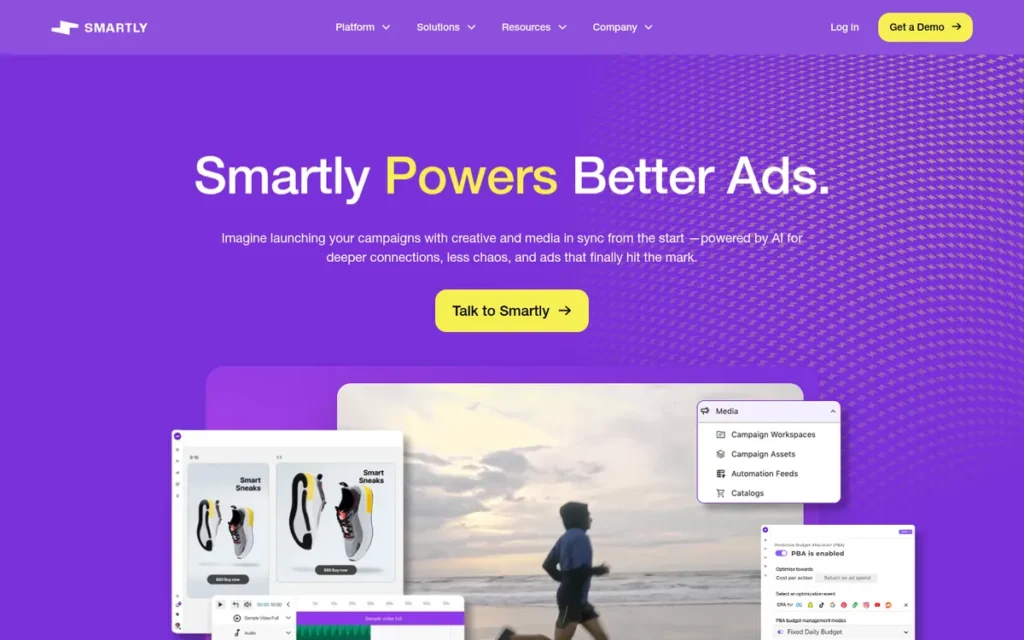
Category: Social Ad Automation Platform, unifies creative production, media buying, and campaign performance optimization for paid social at enterprise scale across Meta, TikTok, Pinterest, Snapchat, and connected TV.
At a Glance
- Category: Social Ad Automation Platform
- Best For: Enterprise performance marketing teams and agencies managing $100,000 or more per month in paid social ad spend across Meta, TikTok, Pinterest, and Snapchat
- Price Range: $4,000–$5,000/month minimum; approximately $95,000/year average; percentage-of-total-ad-spend pricing model, costs scale with advertiser media budget (community-verified June 2026 via r/PPC; verify directly with Smartly before budgeting)
- Primary Strength: Smartly is the sole Leader in The Forrester Wave: Creative Advertising Technologies, Q4 2024, with Smartly reporting a 27% average performance lift and 30x faster creative production across 260+ enterprise customers
- Biggest Limitation: Smartly’s $4,000–$5,000/month minimum fee and percentage-of-total-ad-spend pricing make it economically inaccessible for teams spending under $100,000/month in paid social, and its social-first architecture does not match the display depth of Bannerflow or the rich media omnichannel capability of Celtra
- One-Line Summary: Smartly is the sole Leader in The Forrester Wave: Creative Advertising Technologies, Q4 2024, with Smartly reporting 1.8–1.9 million creative assets generated for 260+ enterprise customers at a 27% average performance lift and 30x faster production speed as of June 2026.
- Last Verified: June 2026
Overview
Smartly is an enterprise creative and social ad automation platform that unifies creative production, media buying, and campaign performance optimization in a single system. Smartly is purpose-built for large-scale advertisers managing $50,000 or more per month in paid social spending across Meta, TikTok, Pinterest, Snapchat, and connected TV.
Smartly is the only platform in this seven-platform comparison whose architecture feeds live campaign performance data back into creative production decisions by default (without requiring manual data export or a third-party integration between the media buying and creative production layers) through its Creative Insights engine.
Smartly holds the sole Leader designation in The Forrester Wave: Creative Advertising Technologies, Q4 2024, with Smartly reporting that PwC has validated its customer results (Smartly press release, Q4 2024). Smartly’s AI Studio has generated 1.8–1.9 million creative assets for 260+ enterprise customers with a vendor-reported 27% average performance lift over static creative and 30x faster production speed, corroborated by Get-Ryze.ai, June 2026.
Smartly serves 600+ brands across 16 global offices and had managed over €2.5 billion in ad spend as of 2020 (BusinessWire, April 2020), with current figures expected to be substantially higher across its expanded customer base as of June 2026.
Key Features
- AI Studio: Smartly’s AI Studio generates dynamic video and image ad variants at scale from structured inputs and creative briefs, with Smartly reporting 1.8–1.9 million creative assets produced for 260+ enterprise customers at a vendor-reported 30x average production speed increase and 27% average performance lift versus static creative, corroborated by Get-Ryze.ai, June 2026.
- Creative Insights: Smartly’s Creative Insights feature automatically groups similar creative themes, scores individual ad scenes for their performance contribution, and generates actionable creative briefs from campaign analytics, translating live performance data into systematic creative strategy rather than requiring manual interpretation of reporting dashboards.
- Dynamic Creative Optimization: Smartly’s DCO layer enables automated variant testing and performance-based ad delivery optimization across Meta, TikTok, Pinterest, Snapchat, and connected TV, eliminating manual creative rotation decisions and enabling real-time reallocation to top-performing variants without campaign manager intervention.
- Integrated Campaign Management: Smartly’s integrated campaign management layer gives creative teams and media buyers a shared workspace where assets produced in the Creative Suite are directly activated into campaigns, reducing handoff latency between production and activation and enabling same-day creative-to-live workflows.
- Cross-Channel Creative Suite: Smartly’s Creative Suite includes AI-powered image and video generation, feed-based automation for product catalog ads, real-time performance dashboards with creative-level attribution, and scene-level performance scoring that surfaces which specific creative elements are driving or suppressing results across each paid social channel.
Best For
Smartly is best for enterprise performance marketing teams and large agencies managing $100,000 or more per month in paid social ad spend. Smartly is particularly suited to Fortune 500 brands, global direct-to-consumer retailers, and agency holding companies who need to automate creative production at volume, optimize variants in real time based on live campaign performance, and work within a single integrated system where creative production and media buying share the same data environment.
Pricing
Smartly does not publish pricing publicly. Community-verified figures from r/PPC, June 2026 and Get-Ryze.ai, June 2026 indicate a minimum platform fee of $4,000–$5,000 per month, with an average annual contract value of approximately $95,000.
Pricing is structured as a percentage of total ad spend (not just spend managed through Smartly) meaning costs scale directly with advertiser media budget growth. A team that grows its paid social budget from $100,000 to $300,000 per month also triples its Smartly platform cost without any new features or additional seats.
Practitioner consensus in r/PPC, June 2026 sets a minimum of $100,000 per month in paid social ad spend before Smartly’s automation ROI offsets its platform cost. Verify current pricing and model structure directly with Smartly before budgeting.
Strengths
- Smartly holds the sole Leader designation in The Forrester Wave: Creative Advertising Technologies, Q4 2024, with Smartly reporting that PwC has validated its customer results, the only platform in this seven-platform comparison to hold an analyst leadership position specific to creative ad technology (Smartly press release, Q4 2024).
- Smartly’s AI Studio has generated 1.8–1.9 million creative assets for 260+ enterprise customers with Smartly reporting a 27% average performance lift over static creative and 30x faster production speed, the highest independently corroborated creative performance outcome in this seven-platform evaluation (Get-Ryze.ai, June 2026).
- Smartly’s named client outcomes span multiple industries with specific metrics: Daniel Wellington achieved a 30% reduction in campaign management time; Amfi reduced campaign setup time by 50%; Comviq reduced CPA by 6.5%; Ikano reduced cost per landing page view by 40%, all sourced from Checkthat.ai, June 2026, confirming cross-industry impact.
- Smartly holds a G2 rating of 4.4/5.0 with 460+ verified reviews as of June 2026 (the largest verified review corpus among purpose-built ad automation platforms in this comparison) with consistent praise for automation efficiency, Meta and TikTok integrations, and customer success support described as “next level” for enterprise accounts.
Limitations
- Pricing Model: Smartly’s $4,000–$5,000/month minimum fee plus percentage-of-total-ad-spend pricing makes Smartly economically inaccessible for teams spending under $100,000/month on paid social, a threshold cited as practitioner consensus in r/PPC, June 2026, with costs scaling as advertiser media budgets grow rather than remaining flat at a predictable rate.
“Usually platforms like these are worth it if you are spending $100K/month or more… I think $100K personally. For Facebook, you can use a lot of rules to help you manage things at 5 figures/month.” (u/fathom53, r/PPC)
Takeaway: The $100,000 per month paid social threshold is practitioner consensus in r/PPC for Smartly’s platform cost to generate positive ROI, teams below that monthly spend should evaluate Bannerflow for display automation or Creatopy for mid-market ad production instead.
- Social-First Scope: Smartly is built for Meta, TikTok, Pinterest, and Snapchat and does not match the display ad production depth of Bannerflow or the omnichannel rich media and DCO capability of Celtra, teams running significant display or DOOH budgets alongside paid social will need a separate specialized platform, effectively requiring a two-tool stack for omnichannel advertisers.
- Learning Curve and Support Tiering: Smartly’s advanced automation features carry a steep learning curve consistently noted in G2 reviews, June 2026, and live chat support quality has been described as unreliable by some Capterra reviewers, suggesting enterprise accounts with dedicated customer success managers receive materially better support experiences than lower-tier users routing through general chat support.
Verdict
Smartly is the most evidence-backed creative management platform in this 2026 comparison for enterprise teams prioritizing paid social performance outcomes, holding the sole Leader designation in The Forrester Wave: Creative Advertising Technologies, Q4 2024 and the richest cross-industry client outcome data in this evaluation, spanning retail (Daniel Wellington: -30% campaign management time), fashion (Amfi: -50% setup time), telecoms (Comviq: -6.5% CPA), and financial services (Ikano: -40% cost per landing page view) per Checkthat.ai, June 2026.
Smartly earns the number one ranking through its Forrester Wave analyst validation, richest named client outcome evidence, and a uniquely integrated creative-to-media loop that no competing platform in this seven-platform comparison replicates by default. However, Smartly’s $4,000–$5,000 per month minimum and percentage-of-ad-spend pricing make it appropriate only for advertisers consistently spending $100,000 or more per month in paid social, teams below that threshold will find better value in Bannerflow for display or Creatopy for mid-market ad production.
2. Bynder: Best for Enterprise Digital Asset Management and Brand Content Governance
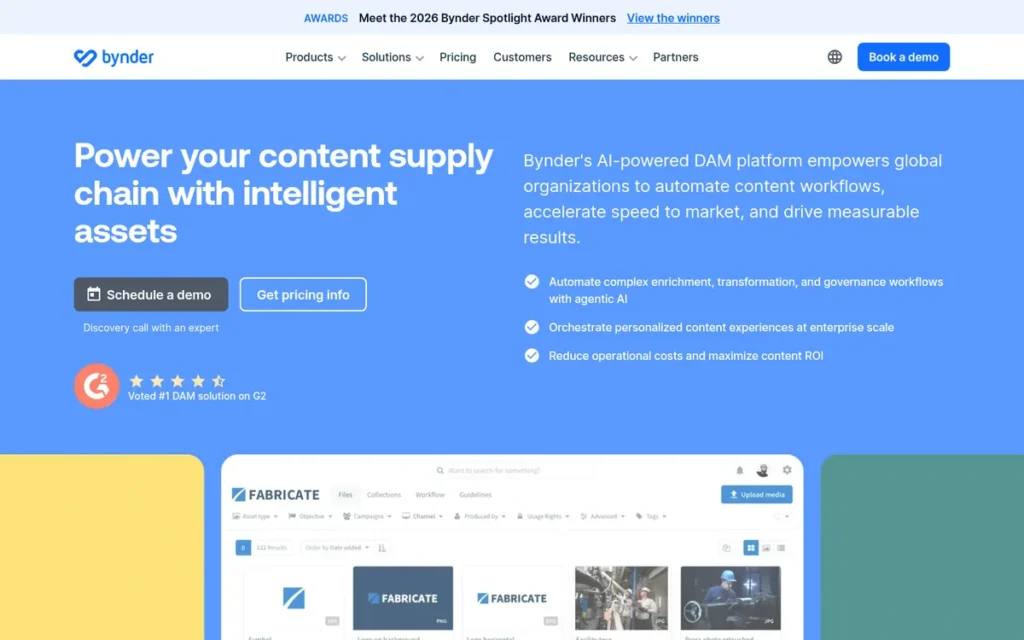
Category: Enterprise DAM Platform, centralizes digital asset storage, governance, creative workflow automation, and omnichannel content distribution as the organizational single source of truth and system of record for brand content, with 100+ native integrations for enterprise martech stack embedding.
At a Glance
- Category: Enterprise DAM Platform
- Best For: Large enterprises ($250M+ revenue) with high content volumes across global teams, multiple agencies, and distributed markets who need a governed, metadata-rich single source of truth for brand assets with composable integration into complex martech stacks
- Price Range: Enterprise quote only; estimated $500+/month baseline; scales significantly with seat count, storage volume, and additional modules (TrustRadius, June 2026; verify directly with Bynder before budgeting)
- Primary Strength: Bynder holds a Leader designation in the Forrester Wave: Digital Asset Management Systems, Q1 2026, with Bynder’s press release confirming the highest possible score in multiple evaluation categories including AI capabilities and implications, search, asset delivery, partner ecosystem, and pricing flexibility and transparency
- Biggest Limitation: Bynder’s extensive feature set, steep learning curve, and per-seat pricing including inactive users can overwhelm teams without dedicated DAM administrators, and Bynder is DAM-first, not a creative production or ad automation tool, requiring a companion tool for teams that also need DCO or social ad automation
- One-Line Summary: Bynder is the number one Enterprise DAM on G2 with 1,000+ verified reviews at 4.5/5.0 and a Leader in the Forrester Wave: Digital Asset Management Systems, Q1 2026, the strongest analyst-validated platform for global enterprise digital asset management and brand content governance in 2026.
- Last Verified: June 2026
Overview
Bynder is an enterprise Digital Asset Management platform that serves as the organizational single source of truth and system of record for brand content, centralizing digital asset storage, governance, creative workflow automation, and omnichannel content distribution in a single governed repository. Bynder is purpose-built for large organizations with complex content operations, high asset volumes, and multi-team or multi-agency production environments.
Bynder earns the number one Enterprise DAM designation on G2 with 1,000+ verified reviews at 4.5/5.0 and holds a Leader designation in the Forrester Wave: Digital Asset Management Systems, Q1 2026. Bynder’s press release confirms the highest possible score in multiple evaluation categories, including AI capabilities and implications, search, asset delivery, partner ecosystem, and pricing flexibility and transparency (Bynder press release, Q1 2026).
Bynder’s platform encompasses core DAM as the foundational layer with Brand Guidelines, Creative Workflow, Studio (AI-enhanced template creation), Content Automation, and omnichannel distribution built on top, all connected through 100+ native integrations and an open composable architecture designed for enterprises embedding a DAM into a complex martech stack.
Key Features
- Core DAM and System of Record: Bynder’s DAM layer provides metadata-driven search, version control, usage rights management, role-based permissions, and approval workflow automation, directly addressing the disorganized shared-drive and email-distribution workflows that create brand inconsistency and asset duplication across distributed enterprise teams.
- AI Studio and Template Creation: Bynder’s Studio tool enables AI-enhanced template-based creative production directly within the DAM, allowing non-designer stakeholders to create brand-approved content variants without accessing external design tools or breaking the asset governance controls that ensure only approved versions are distributed.
- Composable Architecture and 100+ Integrations: Bynder’s composable architecture provides 100+ native integrations with enterprise platforms across PIM, CDP, CMS, marketing automation (including Salesforce and HubSpot), and ad tech, designed for enterprises requiring a DAM to embed into existing infrastructure rather than operate as an isolated content silo.
- AI Capabilities with Established Track Record: Bynder’s AI capabilities: first deployed with auto-tagging in 2016 (vendor-reported date per Bynder blog, June 2026) and expanded through 2026 to intelligent asset search, AI-enhanced content creation, and automated workflow management, provide a longer deployed AI track record in metadata and content management than newer AI-native entrants in this comparison.
- Content Automation and Distribution: Bynder’s Content Automation module enables template-based creative scaling and omnichannel content distribution, bridging DAM asset storage with content activation across digital channels without requiring manual export, reformatting, or re-upload workflows between the repository and destination platforms.
Best For
Bynder is best for large enterprises, typically organizations with $250M or more in revenue, or organizations with significant content operation complexity across global teams, multiple agencies, and distributed markets. Bynder is designed for teams that need a governed, metadata-rich system of record for all brand assets with AI-powered search, version control, and multi-team governance built in as core functions rather than optional add-ons.
Pricing
Bynder does not publish pricing publicly, all contracts are enterprise quotes. Third-party sources including TrustRadius, June 2026 estimate baseline implementations at $500 or more per month, with costs scaling significantly based on seat count, storage volume, and additional modules selected.
Bynder’s per-seat pricing model (including charges for inactive users) and potential add-on costs for public portal access and external user sharing are cited as friction points in competitive analyses. Verify current pricing and full cost structure directly with Bynder before budgeting.
Strengths
- Bynder holds a Leader designation in the Forrester Wave: Digital Asset Management Systems, Q1 2026, with Bynder’s press release confirming the highest possible score in multiple evaluation categories including AI capabilities and implications, search, asset delivery, partner ecosystem, and pricing flexibility and transparency, the strongest multi-dimension analyst validation of any DAM platform in this comparison (Bynder press release, Q1 2026).
- Bynder holds the number one Enterprise DAM designation on G2 with 1,000+ verified reviews at 4.5/5.0 as of June 2026, the largest and most statistically reliable peer review corpus in this entire seven-platform evaluation, indicating broad-based user satisfaction across a substantial installed enterprise base.
- Bynder’s 100+ native integrations and open composable architecture position it as the most enterprise-embeddable DAM in this comparison, specifically designed for organizations requiring a central content repository connecting with PIMs, CDPs, CMS platforms, and marketing automation systems rather than operating as a standalone siloed tool (Bynder DAM overview, June 2026).
- Bynder’s AI capabilities carry a longer deployed track record than newer AI-native entrants, first deployed with auto-tagging in 2016 (vendor-reported per Bynder blog, June 2026) and expanded continuously through 2026 to intelligent asset search, automated content creation support, and workflow management.
This aligns with community sentiment on r/marketing:
“I like: that I can open the tagging and sharing features to our sales team, the ability for others in the company to submit photos for us to approve and house, the ability to give business partners easy access to download photos, and the potential to bring the map-based geo-tagging onto our website. Bynder seemed reasonable at first, but my contract increases yearly by the rate of inflation so that could ballon up pretty quickly these days (not that it isn’t fair); had I thought through the contract more carefully though, I may not be with Bynder right now.” Posted by u/maj2155
Takeaway: Bynder’s cross-team sharing and partner access features generate genuine practitioner loyalty, but annual contract escalation clauses consistently surface as the hidden cost that enterprise buyers underestimate before signing.
Limitations
- Implementation Complexity: Bynder’s extensive feature set, steep learning curve, and cluttered interface overwhelm teams without dedicated DAM administrators or marketing operations staff, as consistently noted in TrustRadius and Brandlife.io analysis, June 2026, organizations that underestimate onboarding investment often blame the platform when the core issue is organizational readiness rather than platform capability.
“Bynder and Brandfolder… are really helpful but indeed complex and unnecessary in many places.” (u/dlilin, r/Design)
Takeaway: Enterprise DAMs consistently earn a “powerful but over-engineered” assessment from mid-market practitioners, Bynder’s complexity is the appropriate trade-off for global enterprises with dedicated DAM administrators and high asset volumes, and represents meaningful implementation overhead for organizations without those resources.
- DAM-First Scope: Bynder is a DAM-first platform that does not natively address performance-driven ad creation, DCO, or social ad automation, enterprises that also need dynamic creative production at scale will typically require a complementary ad production tool such as Creatopy or Bannerflow alongside Bynder in their stack, adding cost and integration complexity.
- Pricing Opacity and Per-Seat Model: Bynder’s enterprise quote-only model with no published tiers requires a sales conversation before any budget planning can begin, and per-seat pricing including inactive users, combined with module-based cost escalation, means enterprise contracts can reach significant five-digit monthly figures at certain configurations, per community sources at r/Design, June 2026.
Verdict
Bynder is the most thoroughly analyst-validated enterprise DAM platform in this 2026 comparison, combining the number one Enterprise DAM designation on G2 with 1,000+ verified reviews, a Forrester Wave Leader position with highest possible scores confirmed across multiple categories in the Q1 2026 DAM Wave, and 100+ native integrations in a composable architecture purpose-built for global enterprise content governance.
Bynder earns the number two ranking through unmatched peer review volume and the strongest multi-dimension analyst validation in the comparison, with the primary caveat that it is a DAM-first platform requiring meaningful IT investment and dedicated administration resources to deploy successfully. Enterprises that need both a DAM system of record and ad production capability at scale will typically deploy Bynder paired with a production-layer tool such as Creatopy rather than Bynder as a standalone replacement for either function.
3. Celtra: Best for Enterprise Rich Media Production and Dynamic Creative Optimization at Multi-Market Scale
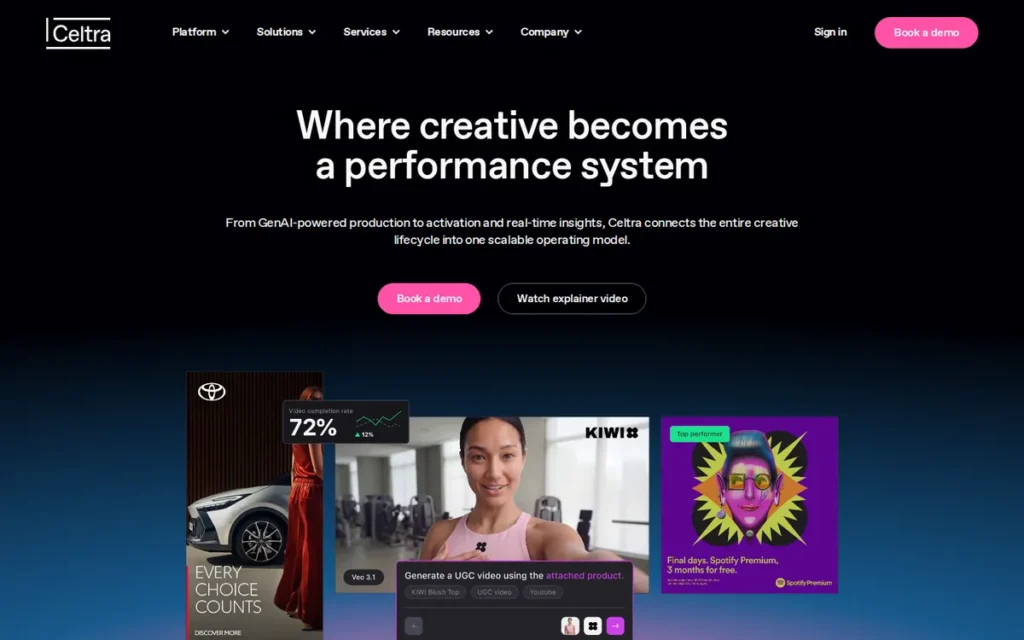
Category: Enterprise Creative Automation Platform, manages the full creative lifecycle from brand-safe production through AI-driven DCO, rich media ad creation, and omnichannel activation across 100+ DSPs and SSPs for global brands with multi-market complexity.
At a Glance
- Category: Enterprise Creative Automation Platform
- Best For: Global enterprise brands needing advanced data-driven creative and programmatic DCO, rich media formats, and multi-market variant generation at scale, with dedicated creative operations or ad operations staff
- Price Range: ~$50,000/year estimated; CPM serving fees additional; enterprise quote only, no public pricing (community-sourced from r/adops, June 2026; verify directly with Celtra before budgeting)
- Primary Strength: Celtra’s Creative Automation system enabled Wolt to produce 300,000 creatives in a single year (a documented 20x productivity increase from prior manual workflows) the highest production volume outcome in this seven-platform comparison
- Biggest Limitation: Celtra’s ~$50,000/year estimated price floor and complex onboarding make it inaccessible for teams without dedicated creative operations or ad operations staff, and represent potential overkill for organizations without genuine multi-market, high-volume DCO requirements
- One-Line Summary: Celtra is an enterprise creative automation platform with a 20-year heritage, 400+ enterprise clients including Spotify, Adidas, and Unilever, a documented 20x productivity gain at Wolt producing 300,000 creatives per year, and the Digiday 2025 Best Content Creation Platform award.
- Last Verified: June 2026
Overview
Celtra is an enterprise Creative Automation Platform built for global brands operating at scale, managing the entire creative lifecycle from brand-safe production through AI-driven creative intelligence, advanced Dynamic Creative Optimization, and omnichannel activation across display, video, social, and CTV formats. Celtra is specifically engineered for advanced data-driven creative and programmatic personalization at scale, including large product catalogs, multi-market localization, and performance-driven optimization demands that simpler creative tools cannot address at equivalent scale or format depth.
Celtra was founded in 2006 and brings a 20-year heritage in creative automation and ad tech to its 400+ enterprise clients including Spotify, Adidas, and Unilever. Celtra won the Digiday Technology Award for Best Content Creation Platform in 2025, confirmed by Digiday editorial coverage, and documented a 20x productivity increase at Wolt through a single platform deployment producing 300,000 creatives in one year.
Celtra integrates with 100+ DSPs and SSPs, handles over 5 million assets annually, and provides the deepest DCO and rich media format capability in this seven-platform comparison.
Key Features
- Dynamic Creative Optimization Engine: Celtra’s DCO engine enables feed-based dynamic personalization for complex product catalogs, multi-market localization, and performance-driven creative variant optimization, integrating natively with 100+ DSPs and SSPs for direct omnichannel activation without manual export or re-trafficking workflows between creative production and media delivery.
- Creative Automation System: Celtra’s Creative Automation converts smart templates into thousands of brand-safe asset variants across formats, empowering local market teams to produce approved creative autonomously within locked brand parameters, as demonstrated by Wolt’s 300,000-creative-per-year output from distributed local teams without central design bottlenecks.
- Rich Media Ad Creation: Celtra’s rich media capability handles expandable, clickable, interactive, and video ad formats natively without requiring code from the production team, supporting over 5 million assets annually across open-web display, video, social, and connected TV through a single unified creative environment.
- Creative Intelligence Analytics: Celtra’s analytics layer provides performance scoring at the individual creative element level (identifying which visual components, messaging approaches, and format choices drive or suppress performance) and feeds those insights back into production briefs to systematically improve creative effectiveness over campaign iterations.
- Brand Governance Workflows: Celtra’s governance tools enable distributed enterprise teams, regional offices, and agency partners to produce compliant creative within locked template structures, maintaining global brand standards across hundreds of markets without requiring central design team review of every asset variant.
Best For
Celtra is best for global enterprise brands running multi-market, multi-format campaigns that require advanced DCO, native rich media production at scale (expandable, interactive, video), and the ability to generate hundreds of thousands of brand-safe creative variants per year from structured data inputs. Celtra is specifically suited to organizations with dedicated creative operations or ad operations staff capable of managing complex template configuration and onboarding.
Pricing
Celtra does not publish pricing publicly. The most specific community-sourced pricing reference from r/adops, June 2026 indicates an approximate quote of $50,000 per year for platform access, with separate CPM-based serving fees referenced at approximately £0.65 CPM in one instance.
This positions Celtra firmly as an enterprise-only product. Teams that cannot justify $50,000 or more annually should evaluate Bannerflow for display-focused DCO or Creatopy for accessible mid-market ad automation. Verify current pricing directly with Celtra before budgeting.
Strengths
- Celtra won the Digiday Technology Award for Best Content Creation Platform in 2025, confirmed by Digiday editorial coverage, a third-party peer industry validation from a recognized ad tech publication providing independent credibility beyond peer review platforms and analyst reports, and the most recent major industry award documented for Celtra in this evaluation.
- Celtra enabled Wolt to produce over 300,000 creatives in a single year, representing a 20x or greater increase in creative production productivity compared to its prior manual, designer-led process, the most dramatic single creative production outcome in this seven-platform evaluation, per the Celtra official case study blog, June 2026 (vendor-published).
- Celtra’s 400+ enterprise client roster: including Spotify, Adidas, and Unilever, confirms deployment in the most demanding global creative production environments, where multi-market brand consistency, high-volume DCO, and rich media format complexity are non-negotiable requirements (CAPE.io, June 2026).
- Celtra’s 20-year heritage in creative automation (founded 2006) provides integration depth with ad networks, DSPs, and publisher ecosystems that newer entrants cannot replicate, giving enterprise procurement teams confidence in long-term platform stability and the depth of media partner relationships built over two decades in the category.
Limitations
- Price Floor and Access Barrier: Celtra’s approximately $50,000/year estimated price floor, sourced from the r/adops community, June 2026, combined with complex onboarding and a steep learning curve, makes Celtra inaccessible for teams without dedicated creative operations or ad operations staff, and represents potential overkill for organizations without genuine multi-market, high-volume DCO requirements per Rocketium and CAPE.io analyses, June 2026.
“A friend was quoted around $50K/year by Celtra.” (r/adops community thread, June 2026)
Takeaway: The $50,000 per year figure circulates as an informal practitioner benchmark in ad operations communities, teams that cannot justify that investment should evaluate Bannerflow for display-focused DCO at lower cost or Creatopy for accessible mid-market ad automation instead.
- Absence of Public G2 Profile: Celtra does not appear in G2 or Capterra review databases with a verified star rating and review count as of June 2026, requiring enterprise buyers to rely on vendor-provided case studies, analyst designations, and peer references rather than organic public user reviews, a transparency gap that complicates early-stage evaluation for procurement teams that use G2 as a standard validation step.
- Implementation and Operational Complexity: Celtra’s template management, debugging workflows, and initial project configuration are described as time-consuming and complex in third-party analyses from Rocketium and CAPE.io, June 2026, complexity that extends beyond initial onboarding into ongoing operational management, representing a sustained resource commitment that organizations without dedicated creative ops staff will struggle to sustain.
Verdict
Celtra is the most capable enterprise creative automation platform in this 2026 comparison for teams requiring advanced DCO, rich media production at scale, and multi-market creative automation, evidenced by its 20x productivity outcome at Wolt (300,000 creatives in one year), 400+ enterprise clients including Spotify, Adidas, and Unilever, and Digiday Technology Award 2025 recognition confirmed by Digiday editorial.
Celtra earns the number three ranking through the strongest production volume case study in this evaluation and the deepest DCO and rich media capability set, with the critical caveat that its approximately $50,000 per year estimated price floor and complex implementation make it appropriate only for enterprises with dedicated creative operations resources and genuine multi-market, high-volume production needs. Organizations without those requirements will find Bannerflow or Creatopy deliver better value at lower cost and implementation complexity.
4. Canva Enterprise: Best All-in-One Design and Brand Platform for General Enterprise Marketing Teams
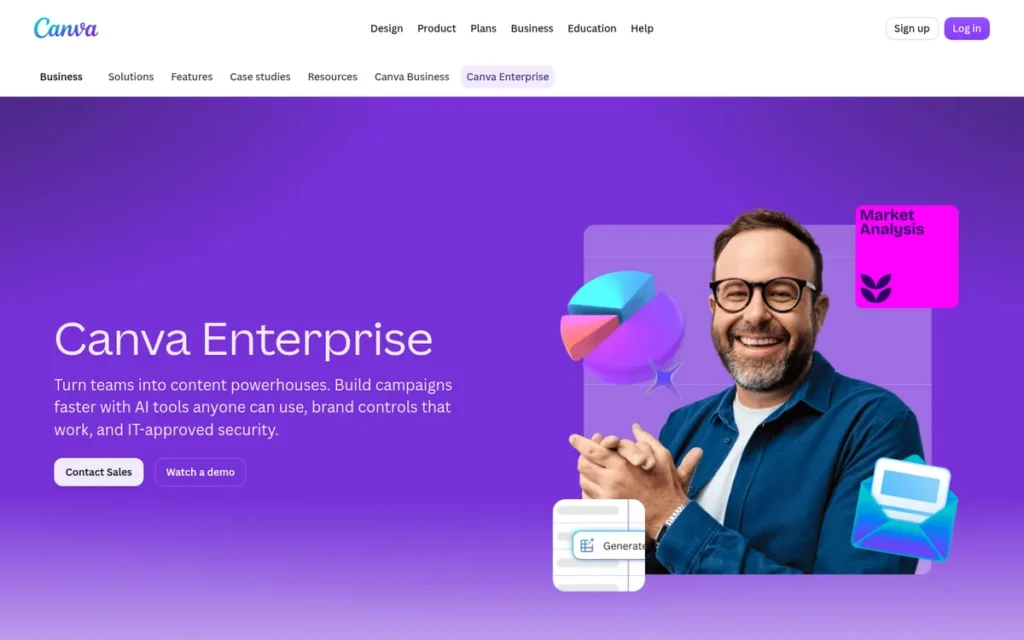
Category: All-in-One Design and Brand Platform, centralizes design, brand management, AI-powered creation, and multi-channel publishing for distributed marketing teams across social content, ad creation, presentations, and brand governance in a single governed workspace.
At a Glance
- Category: All-in-One Design and Brand Platform
- Best For: Marketing teams at mid-market to enterprise organizations (100+ people) consolidating disconnected creative tools under one governed platform with Brand Hub controls, SSO, and native integrations with existing CRM, DAM, and marketing automation stacks
- Price Range: Free: $0; Pro: ~$15/person/month; Teams: ~$10/person/month (min. 3 users, annual billing); Enterprise: custom pricing. Annual billing saves approximately 20–30%. (Canva pricing page, June 2026)
- Primary Strength: Canva Enterprise holds the highest G2 peer review rating in this seven-platform comparison at 4.7/5.0 and is the only platform with fully transparent tiered pricing from free to enterprise, enabling marketing teams to trial, validate, and scale without a mandatory sales conversation before any budget commitment
- Biggest Limitation: Canva Enterprise’s template enforcement is flexible rather than hard-locked, reviewers consistently note that employees can still move, scale, and add elements to branded templates, making the platform unsuitable for organizations where template deviation is a compliance or legal risk
- One-Line Summary: Canva Enterprise holds the highest G2 peer review rating in this comparison at 4.7/5.0, integrates natively with Salesforce, HubSpot, Bynder, and Brandfolder, and offers the only fully transparent tiered pricing from free to enterprise across all seven platforms evaluated in 2026.
- Last Verified: June 2026
Overview
Canva Enterprise is an all-in-one visual design, brand management, and creative production suite purpose-built for organizations with 100 or more people. Canva Enterprise consolidates design, collaboration, brand governance, and AI-powered creation through Magic Studio under centralized admin controls with SSO, MFA, and identity management.
Canva Enterprise integrates natively with Salesforce, HubSpot, Marketo, Eloqua, Bynder, Brandfolder, and Widen (the broadest native martech integration coverage of any platform in this seven-platform comparison) and earns the highest G2 peer review rating in this evaluation at 4.7/5.0.
Canva Enterprise does not appear in either AI model response (Perplexity, ChatGPT) analyzed for this comparison in June 2026, a gap that may not persist as LLM training data updates with current platform information, and the most significant research blind spot this article corrects for buyers using AI-generated CMP research as a first step.
Canva’s 2024 acquisition of Affinity (a professional design suite for graphic design, photo editing, and publishing) signals a deliberate strategic expansion toward professional design workflows that the core Canva platform has not historically supported, directly addressing its most frequently cited enterprise-level limitation.
Key Features
- Brand Hub and Template Controls: Canva Enterprise’s Brand Hub centralizes locked fonts, colors, logos, and brand kit elements with role-based permission controls that restrict unauthorized brand element replacement, giving administrators governance tools that maintain brand consistency across distributed teams while preserving the speed and accessibility that define Canva’s adoption advantage.
- Magic Studio AI with Enterprise Privacy: Canva Enterprise’s AI-powered Magic Studio provides generative design capabilities at enterprise usage limits with enterprise-grade data privacy and security controls, enabling marketing teams to generate on-brand images, copy, presentations, and social content from natural language prompts without exposing proprietary data to general AI training pipelines.
- Canva Grow Ad Intelligence: Canva Grow enables marketing teams to generate ad creative directly from website URLs and access real-time ad performance analytics within the Canva workspace, a native ad intelligence capability combining creative generation with performance feedback not replicated by any other all-in-one design platform in this comparison.
- Two-Way DAM Sync: Canva Enterprise’s two-way DAM sync integrations with Bynder, Brandfolder, and Widen allow marketing teams to pull approved assets directly from existing DAM repositories into Canva production workflows without duplicating files, creating governance gaps, or requiring manual export and re-import between storage and production environments.
- Real-Time Approval Workflows: Canva Enterprise’s real-time approval workflows and commenting tools enable distributed team collaboration, structured feedback consolidation, and formal sign-off processes within the same environment where creative is produced, reducing email-thread review cycles without requiring a separate proofing or project management platform.
Best For
Canva Enterprise is best for marketing teams at mid-market to enterprise organizations that need to consolidate multiple disconnected design and content creation tools into one governed platform. Canva Enterprise is particularly well-suited for teams already using Salesforce, HubSpot, Bynder, or Brandfolder where native integrations significantly reduce implementation friction, and for teams that prioritize speed, usability, and broad martech integration over strict template lockdown or advanced feed-based DCO.
Pricing
Canva offers the most transparent pricing in this comparison across all tiers: Free ($0 per month), Pro (approximately $15 per person per month or approximately $120 per year), Teams (approximately $10 per person per month billed annually, minimum 3 users), and Enterprise (custom pricing, contact sales). Annual billing reduces costs by approximately 20–30% versus monthly rates.
The transition from Teams to Enterprise requires a sales conversation and custom pricing based on organizational size, seat count, and security requirements. Pricing verified via Canva pricing page, June 2026.
Strengths
- Canva Enterprise holds the highest G2 peer review rating in this 2026 seven-platform comparison at 4.7/5.0, the strongest single signal of broad-based satisfaction across diverse marketing team profiles, reflecting the platform’s accessibility-first design philosophy and wide feature footprint that meets most marketing teams at their current skill level.
- Canva Enterprise is the only platform in this comparison with fully transparent tiered pricing from free to enterprise, allowing marketing managers to trial the platform, build internal familiarity, and validate workflow fit before engaging enterprise procurement, a trust signal that all six competing platforms in this evaluation explicitly choose not to provide.
- Canva Enterprise’s native integrations with Salesforce, HubSpot, Marketo, Eloqua, Bynder, Brandfolder, and Widen make it the most broadly embeddable creative tool in this comparison for marketing teams already operating in major CRM and marketing automation ecosystems, as documented on Canva Enterprise’s feature pages, June 2026.
- Canva’s 2024 acquisition of Affinity: a professional design suite for desktop covering graphic design, photo editing, and publishing, signals a deliberate strategic response to the professional-design ceiling critique, expanding Canva Enterprise’s production depth toward advanced illustration, print, and photo workflows that the core Canva platform does not support.
Limitations
- Template Enforcement Gap: Canva Enterprise’s most consequential trade-off is the gap between its brand management promise and its enforcement reality, reviewers in comparative analyses consistently note that template elements remain adjustable in practice, with employees able to move, scale, and add elements to branded templates, meaning Canva Enterprise provides brand guidance rather than brand lockdown, which is inappropriate for organizations where template deviation represents a compliance or legal risk (Mate Studio analysis, June 2026).
“Canva is just a tool which stitches elements to bring up a design. It’s really good for fast production but is not a professional tool.” (u/moneys00, r/canva)
Takeaway: The “fast but not professional” characterization is the community-validated Canva verdict, it is a deliberate trade-off that serves general marketing teams prioritizing speed and accessibility, and a disqualifier for teams requiring strict technical brand enforcement or advanced professional design production workflows.
- Limited Feed-Based DCO: Canva Enterprise lacks genuine feed-based Dynamic Creative Optimization capability, Canva Grow provides AI-assisted ad generation and basic performance analytics, but it is not a DCO system capable of feed-based personalization at the depth of Celtra, Smartly, or Bannerflow, making Canva Enterprise a mismatch for teams requiring automated variant generation from structured product data feeds at scale.
- Absent Quantified ROI Case Studies: No quantified named client ROI case studies were publicly available for Canva Enterprise at the time of this research (unlike Smartly (27% performance lift) or Celtra (Wolt 20x productivity gain)) making internal procurement business case construction harder for enterprise buyers who need formal percentage-improvement evidence to unlock budget approval.
Verdict
Canva Enterprise is the highest-rated creative management platform in this 2026 comparison on peer review data at 4.7/5.0 on G2, the most widely deployed all-in-one design and brand tool for enterprise marketing teams, and the most transparently priced platform in this evaluation, the strongest choice for marketing teams that need to consolidate disparate creative tools, move fast, produce brand-consistent content at volume, and work within a familiar accessible environment fully integrated with their existing CRM and DAM stack.
Canva Enterprise earns the number four ranking through its unmatched peer review rating, pricing transparency, and martech integration breadth, with the clear caveat that it is not a purpose-built CMP for feed-based DCO or strict technical brand governance lockdown. Teams with compliance or regulatory requirements around brand consistency should confirm template enforcement mechanisms in demo before selecting Canva Enterprise.
5. Bannerflow: Best for In-House Display Advertising Automation and DOOH Creative Management
Category: Display Ad CMP, closed-loop display advertising management from HTML5 and rich media creative design through direct multi-network publishing and live campaign optimization, with DOOH format support unique in this seven-platform comparison.
At a Glance
- Category: Display Ad CMP
- Best For: In-house marketing teams running high-volume display programs across 100+ ad networks and DSPs (particularly teams with DOOH screen inventory in their media plan) who need to design, publish, and live-update ads without ZIP file exports or manual re-trafficking
- Price Range: Quote only; one third-party directory (GetApp, June 2026) lists ~$10.99/user/month as a starting figure, not confirmed by Bannerflow directly; enterprise contracts are custom-quoted. Submit a creative brief to initiate pricing conversation.
- Primary Strength: Bannerflow’s live-update publishing pushes changes made in the Creative Studio to all active live ad placements simultaneously across 100+ ad networks without re-exporting or re-trafficking, and Bannerflow is the only CMP in this seven-platform evaluation with independently verified DOOH format support as of June 2026
- Biggest Limitation: Bannerflow is explicitly display-first and is not optimized for paid social platforms including Meta, TikTok, and Snapchat, teams running significant social budgets alongside display advertising require a separate social ad automation tool
- One-Line Summary: Bannerflow is a display-first Creative Management Platform with a 4.6/5.0 G2 rating, 2,000+ enterprise brand customers, and the only independently verified DOOH format support in this seven-platform evaluation, the strongest specialist option for in-house display advertising automation in 2026.
- Last Verified: June 2026
Overview
Bannerflow is a display-first Creative Management Platform built around a closed-loop display advertising workflow, enabling in-house marketing teams to design, version, publish, and live-update HTML5, rich media, video, and DOOH ad formats from a single interface across 100+ ad networks and DSPs. Bannerflow’s closed-loop architecture eliminates ZIP file exports, manual trafficking workflows, and the need to republish entire campaigns when creative or copy changes are required mid-flight.
Bannerflow holds a 4.6/5.0 G2 rating and serves 2,000+ enterprise brands including Lonely Planet, Three UK, and Shutterstock. Bannerflow is the only CMP in this seven-platform comparison with independently verified DOOH format support as of June 2026, enabling management of both digital display and digital out-of-home creative from a single production and distribution tool.
Bannerflow has earned third-party business recognition from Deloitte Tech 50, the Financial Times FT1000, and the Mäster Di Gasell high-growth company award (multiple recognitions since 2016; most recent specific year not confirmed in available research as of June 2026 per GetApp).
Key Features
- Creative Studio with Live-Update Publishing: Bannerflow’s Creative Studio enables pixel-perfect HTML5, rich media, and video banner creation with direct live-update capability, changes pushed within Bannerflow propagate to all active live ad placements across connected ad networks simultaneously, without re-exporting ZIP files, re-trafficking creative, or republishing entire campaigns when creative or copy edits are needed mid-flight.
- Dynamic Creative and Data-Feed Personalization: Bannerflow’s Dynamic Creative feature enables data-feed-driven personalization that automatically updates live ads with real-time pricing, inventory levels, odds, or other dynamic inputs, supporting use cases from e-commerce product pricing to sports betting to travel fare display without manual creative updates between data changes.
- Multi-Channel Publishing Across 100+ Networks: Bannerflow’s multi-channel publishing connects directly to 100+ ad networks and DSPs for one-click campaign distribution across HTML5 display, rich media, video, mobile, CRM and onsite placements, and DOOH formats, covering the full display and out-of-home ecosystem from a single campaign workflow.
- Campaign Management and Creative Intelligence: Bannerflow’s Campaign Management layer provides end-to-end workflow from creative production through stakeholder approval, multi-network publishing, and performance optimization tracking, with Creative Intelligence analytics covering 100+ performance metrics, A/B testing capability, and real-time reporting that feeds back into creative iteration.
- DOOH Creative Support: Bannerflow’s DOOH creative support allows in-house marketing teams to extend display advertising workflows to digital outdoor and physical screen inventory, enabling omnichannel advertisers to manage both digital display and DOOH creative from a unified platform, a capability not replicated by any other CMP in this seven-platform comparison.
Best For
Bannerflow is best for in-house marketing teams at enterprise consumer brands, telecommunications companies, and media organizations running high-volume display programs who need to reduce manual trafficking time and enable dynamic creative updates without republishing entire campaigns. Bannerflow is particularly suited to teams managing creative production and distribution across 100+ ad networks in a single closed-loop workflow, especially when DOOH screen inventory is part of the broader media plan.
Pricing
Bannerflow does not publish pricing publicly. A third-party directory source (GetApp, June 2026) lists approximately $10.99 per user per month as a starting figure, but Bannerflow has not confirmed this figure directly, enterprise contracts are custom-quoted based on usage and requirements.
Bannerflow’s process for obtaining pricing requires submitting a creative brief rather than providing a standard rate card. Teams should budget for enterprise-tier pricing comparable to other specialized display CMP platforms. Verify current pricing directly with Bannerflow before committing to any budget assumptions.
Strengths
- Bannerflow holds a 4.6/5.0 G2 rating (the second highest in this comparison as of June 2026) and has earned third-party business validation from Deloitte Tech 50, the Financial Times FT1000, and the Mäster Di Gasell high-growth award since 2016, providing independent commercial credibility signals that extend beyond self-reported platform metrics (GetApp, June 2026).
- Bannerflow’s live-update publishing capability: where changes made in the Creative Studio instantly propagate to all active live ad placements across 100+ connected ad networks without re-exporting or re-trafficking, eliminates a major operational bottleneck for in-house display teams managing high-frequency campaigns where creative and copy updates occur between initial launch and campaign end.
- Bannerflow is the only platform in this seven-platform evaluation with independently verified DOOH format support as of June 2026, making it the sole single-platform option for enterprise advertisers who need to manage both digital display and Digital Out-of-Home creative production and distribution without deploying two separate specialized tools.
- Bannerflow’s 2,000+ enterprise brand customer base: with named deployments at Three UK (major European telecommunications operator), Lonely Planet (global travel media), and Shutterstock (leading content licensing platform), validates the platform’s fit for high-frequency, brand-sensitive display advertising across telecoms, media, and content sectors at commercial scale (GetApp, June 2026).
Limitations
- Display-First Architecture: Bannerflow’s most consequential trade-off is its deliberate display-first scope (built for HTML5, rich media, video, and DOOH formats but not optimized for paid social platforms including Meta, TikTok, and Snapchat) meaning teams with significant social advertising budgets will need a separate tool such as Smartly for social creative automation, effectively requiring a two-platform stack for omnichannel advertisers running display and social in the same campaign mix.
- Creative Studio Limitations for Complex Editing: TrustRadius reviewers, June 2026 note that Bannerflow’s creative studio has limited capabilities for complex custom editing that requires external design tools to supplement, and occasional bugs and UI inconsistencies have been observed by some users, limiting the platform’s self-sufficiency for teams needing to produce highly customized creative without external design tooling.
- Pricing Opacity: Bannerflow’s quote-only pricing model with no published rate card creates friction at preliminary research and budget planning stages, particularly for in-house teams with less experienced procurement processes who cannot build budget models without entering a sales conversation, an issue shared by six of seven platforms in this comparison but specifically cited by Bannerflow reviewers as a frustration point.
Verdict
Bannerflow is the strongest purpose-built display advertising CMP in this 2026 comparison, combining a 4.6/5.0 G2 rating, 2,000+ enterprise brand deployments including Three UK and Shutterstock, Deloitte Tech 50 recognition, the only independently verified DOOH format support in this seven-platform evaluation, and a closed-loop design-to-publish-to-optimize workflow across 100+ ad networks.
Bannerflow earns the number five ranking as the clearest specialist option for in-house display advertising teams, with the key limitation that its display-first architecture is deliberately not designed to cover paid social, teams running omnichannel programs across display and social will need Bannerflow paired with Smartly or another social automation tool rather than Bannerflow as a standalone omnichannel CMP.
6. Creatopy: Best Mid-Market Creative Automation Platform for Teams Transitioning from Manual Ad Production
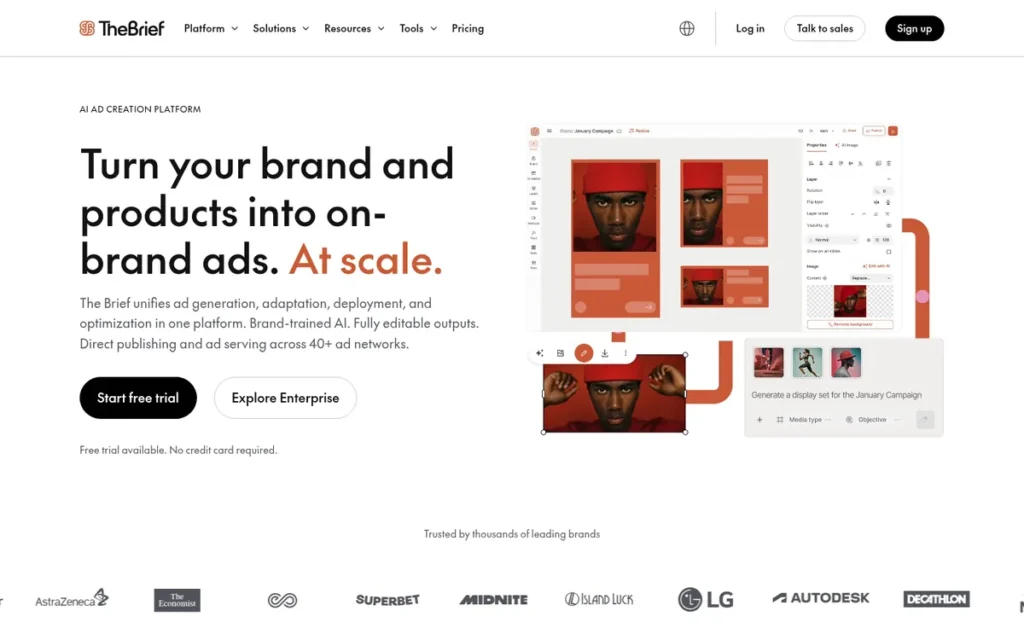
Category: Ad Production and Automation Platform, AI-native creative automation purpose-built for ad design and variant generation at scale, with feed-based dynamic creative, direct multi-network publishing, and publicly listed pricing for mid-market to enterprise teams.
At a Glance
- Category: Ad Production and Automation Platform
- Best For: Mid-market to enterprise marketing teams transitioning from manual or semi-manual ad production workflows who need AI-generated ad variants, product feed-based creative automation, and integration with existing Bynder, Figma, or Photoshop tooling
- Price Range: Free: $0; Create: ~$32–$49/user/month; Team (Automate): ~$45–$79/user/month (up to 30 seats); Enterprise: custom. Annual billing saves ~47%. Note: pricing sources show variation, verify directly at creatopy.com/pricing before budgeting. (June 2026)
- Primary Strength: Creatopy offers the most transparent public pricing in this comparison (including a free tier and publicly listed paid tiers without a required sales conversation) combined with AI-native creative automation that generates complete ads, product photography, UGC-style video, and ad copy from natural language prompts
- Biggest Limitation: Creatopy’s G2 rating has not been independently verified as of June 2026, and some AI features remain in beta, meaning buyers cannot rely on the same level of peer-review social proof available for other platforms in this comparison when assessing maturity
- One-Line Summary: Creatopy is a 16-year-heritage ad production platform with the most transparent pricing in this seven-platform comparison, AI-native creative automation from prompts, and enterprise customer validation at AstraZeneca, LG, and Mercedes-Benz as of June 2026.
- Last Verified: June 2026
Overview
Creatopy is an AI-native creative automation and ad design platform purpose-built for ad production at scale, enabling marketing teams to convert a single master creative into many branded ad variants through templates, variable inputs, feed-based generation, and direct publishing workflows. Creatopy occupies the accessible mid-market tier of the CMP category, with publicly listed pricing and enterprise customer validation at AstraZeneca, LG, and Mercedes-Benz.
Creatopy was founded in 2008 under the name Bannersnack and officially relaunched as Creatopy in February 2021, bringing 16 years of dedicated ad production heritage to an AI-native workflow that generates complete ads, product photography, UGC-style video, and ad copy from natural language prompts. Creatopy integrates with Bynder, Veeva, Figma, and Photoshop as a production and automation layer that works alongside existing enterprise creative infrastructure rather than replacing it.
Creatopy does not appear in either AI model response (Perplexity, ChatGPT) analyzed for this comparison in June 2026, leaving mid-market buyers in the $500–$3,000/month budget range without a credible evaluated platform recommendation from AI sources, a gap this article corrects.
Key Features
- AI Creation from Natural Language Prompts: Creatopy’s AI creation tools generate complete ads from natural language prompts (including ad visuals, product photography, UGC-style video content, branded content, taglines, product descriptions, and ad copy) enabling marketing team members without specialized design skills to produce on-brand ad variants at volume without manual designer involvement for every iteration.
- Creatopy Feeds: Creatopy’s Feeds feature enables feed-based ad building for product catalog workflows, automatically generating large volumes of display and social ad variants from structured product data inputs, bringing DCO-adjacent creative automation to mid-market teams at pricing tiers no other feed-based platform in this comparison matches for accessibility.
- Creative Automation and Dynamic Resizing: Creatopy’s creative automation features include dynamic resizing across formats, AI-generated template application, instant design generation from brand kits, and direct multi-format publishing to ad networks, enabling a single creative brief to produce the full required range of ad sizes and formats without manual reformatting or designer time per format.
- Enterprise Stack Integrations: Creatopy’s integrations with Bynder for DAM, Veeva for pharmaceutical content management, Figma for design, and Photoshop for image editing allow Creatopy to function as a production and automation layer on top of existing enterprise creative infrastructure, enabling teams to maintain current tool investments while adding ad automation capability without a full stack replacement.
- Brand Kits and Template Governance: Creatopy’s Brand Kits and template governance tools enable consistent brand application across all ad production workflows, with permission controls that allow team members to produce approved creative variations within defined brand parameters without requiring central design team review of every output.
Best For
Creatopy is best for mid-market marketing teams and enterprise teams with accessible-tier creative production budgets transitioning from manual or semi-manual ad production workflows. Creatopy is particularly suited to teams in pharmaceutical, automotive, consumer electronics, and DTC e-commerce that need AI-generated ad variants from prompts, product feed-based creative automation, and a platform that layers into existing Bynder, Figma, or Photoshop infrastructure rather than requiring a full creative stack replacement.
Pricing
Creatopy offers the most transparent pricing in this seven-platform comparison, with publicly listed tiers: Free ($0 per month, one seat, limited features), Create (approximately $32–$49 per user per month, billed monthly), Team or Automate (approximately $45–$79 per user per month, up to 30 seats), and Enterprise (custom pricing, contact sales). Annual billing reduces costs by approximately 47% versus monthly rates.
Pricing sources across research documents show meaningful variation, likely reflecting recent price changes or regional differences. Verify current pricing directly at creatopy.com/pricing before budgeting. Data compiled June 2026.
Strengths
- Creatopy’s enterprise customer roster: including AstraZeneca in pharmaceutical, LG in consumer electronics, and Mercedes-Benz in automotive, confirms the platform meets governance and brand compliance standards in regulated and brand-sensitive global industries, validating enterprise-grade fit beyond its accessible SMB pricing tier (LeadIQ company profile, June 2026).
- Creatopy offers the most transparent public pricing of any CMP in this comparison (with a free tier and clearly stated paid tiers available without a required sales conversation) enabling marketing managers to conduct preliminary budget planning and platform evaluation without entering a sales process, a trust signal that six of seven platforms in this evaluation choose not to provide.
- Creatopy’s AI-native architecture: built from the foundation to generate complete ads, product photography, UGC-style video, and copy from prompts, provides a more cohesive AI production experience than platforms that have added AI features as an overlay to legacy creative workflows, filling the mid-market DCO gap left between Canva’s general-purpose tools and Celtra’s enterprise-only price floor.
- Creatopy’s 16-year heritage in ad production (founded 2008 as Bannersnack, rebranded February 2021 per Newswire) provides domain-specific depth in display ad formats, ad network compatibility, and performance-focused creative workflows that general-purpose design tools cannot replicate at equivalent ad-production depth.
Limitations
- Unverified G2 Profile and Beta AI Features: Creatopy’s most consequential trade-off is the combination of an unverified G2 profile, the platform is listed in the G2 CMP category but without an independently verified star rating and review count as of June 2026, and AI features still in beta for some capabilities, meaning buyers cannot rely on the same level of peer-review validation available for Canva (4.7/5.0), Bynder (4.5/5.0), or Bannerflow (4.6/5.0) when assessing Creatopy’s maturity, and production workflows using the newest AI features may encounter instability. Creatopy ranks below Bannerflow (#5) primarily because Bannerflow holds a verified 4.6/5.0 G2 rating and third-party business recognition from Deloitte and the Financial Times, providing stronger independent validation signals than Creatopy’s currently unverified G2 profile.
- Design Studio Limitations: Creatopy’s creative editing studio is consistently described as less feature-complete than Canva’s for complex custom editing requirements, with limited animation effects, restricted export file types, and a less intuitive bulk personalization process noted in third-party reviews from SuperstarSEO and DocHipo, June 2026, limiting Creatopy’s self-sufficiency for teams with advanced design customization needs beyond standard ad template workflows.
- Pricing Verification Required: Pricing data for Creatopy shows meaningful variation across third-party research sources (likely reflecting recent price changes or regional differences) requiring direct verification at creatopy.com/pricing before any budget commitment, and introducing additional procurement friction for teams who rely on third-party directories for initial budget modeling.
Users on r/graphic_design noted:
“I am comparing it to Creatopy. You create one size and it converts them all the multiple sizes with the animations attached. It’s very fast, but crazy over priced.” Posted by u/burrrpong
Takeaway: Creatopy’s single-master auto-resize workflow is a verified production accelerator for HTML5 ad teams, but its pricing consistently emerges as the primary barrier for practitioners evaluating it against lower-cost alternatives, making direct verification at creatopy.com/pricing a required step before any budget commitment.
Verdict
Creatopy is the strongest mid-market creative automation option in this 2026 comparison, filling the significant gap between general-purpose tools like Canva and enterprise-only platforms like Celtra or Bannerflow with AI-native ad generation from prompts, the only fully transparent public pricing in this comparison, and enterprise customer validation at AstraZeneca, LG, and Mercedes-Benz (LeadIQ, June 2026).
Creatopy earns the number six ranking as the clearest choice for mid-market teams transitioning from manual ad production to automation who need feed-based variant generation, AI ad creation capability, and integration compatibility with Bynder, Figma, or Photoshop, with the primary caveat that its unverified G2 profile and beta AI features require direct platform trials before enterprise procurement commitments are made at larger scale.
7. Frontify: Best for Brand Governance, Dynamic Guidelines Management, and External Stakeholder Self-Service
Category: Brand Governance Platform, manages brand guidelines, digital assets, and self-serve brand portals for distributed internal teams and external stakeholders including agencies and partners, enabling governed brand consistency without per-seat licensing requirements for external users.
At a Glance
- Category: Brand Governance Platform
- Best For: Multi-brand organizations and global enterprises in brand-governance-intensive industries (FMCG, automotive, finance, retail) needing to encode brand rules as a governed digital system accessible to agencies, distributors, and regional partners without requiring Frontify platform licenses for every external user
- Price Range: Enterprise quote-based; older community references cite entry tiers historically around $50/month; current enterprise contracts are custom-quoted, per-seat charges including inactive users and additional costs for public portal access may apply (r/branding, June 2026; verify directly with Frontify)
- Primary Strength: Frontify’s external brand portal enables agencies, distributors, and regional partners to access approved brand assets and follow brand guidelines through a white-labeled destination without requiring Frontify platform licenses, the only no-license external brand portal capability in this seven-platform comparison
- Biggest Limitation: Frontify’s AI capabilities lag behind both Bynder and MediaValet (auto-tagging, smart search, face recognition, and video transcription are not yet at parity with enterprise DAM competitors) and its folder structure is flagged as less scalable for large or rapidly growing asset libraries
- One-Line Summary: Frontify is a brand governance platform with a 4.5/5.0 G2 rating, the only no-license external brand portal in this seven-platform comparison, and enterprise clients including Lufthansa and Vodafone, the strongest specialist option for multi-brand organizations needing external partner brand self-service in 2026.
- Last Verified: June 2026
Overview
Frontify is a brand management platform built around a brand-guidelines-first philosophy, transforming static PDF brand guides into living, governed digital systems accessible to internal employees and external agency partners without requiring platform licenses for every external user. Frontify’s core products (brand guidelines builder, brand portal, creative templates, and collaboration workflows) serve multi-brand organizations including Lufthansa and Vodafone.
Frontify holds a 4.5/5.0 G2 rating and counts Lufthansa and Vodafone among its verified enterprise clients, confirming deployment in organizations with some of the world’s most rigorously governed brand identities at global scale. Frontify was founded in 2009 in St. Gallen, Switzerland, and brings 15+ years of dedicated brand governance focus to an increasingly enterprise-targeted platform.
Frontify’s AI capabilities remain less mature than Bynder’s, and its DAM scalability is more limited for organizations with very large or rapidly growing asset libraries, two factors that contribute to the number seven ranking in this comparison.
Key Features
- Brand Guidelines Builder: Frontify’s Brand Guidelines Builder creates dynamic, multi-language, versioned digital brand guidelines (encoding brand rules, visual standards, typography, color systems, and usage examples as interactive web-based documents rather than static PDFs) enabling real-time updates that propagate instantly to all stakeholder destinations without requiring file redistribution.
- External Brand Portal (No License Required): Frontify’s external Brand Portal provides a white-labeled, shareable destination where agencies, distributors, regional offices, and external partners can access approved assets, follow brand guidelines, and download licensed materials without requiring Frontify platform licenses, directly reducing the per-external-user cost of maintaining brand compliance across large partner ecosystems.
- Creative Templates for Non-Designers: Frontify’s Creative Templates feature enables brand-approved, editable design templates that non-designer stakeholders can use to produce on-brand content within defined creative parameters, reducing dependency on the central creative team for standard branded output such as event materials, social posts, and internal communications.
- Collaboration and Approval Workflows: Frontify’s collaboration and approval workflows provide structured feedback collection, version control, and formal sign-off processes for creative assets within the same environment where guidelines and assets are stored, replacing email-based review cycles with a governed digital workflow that maintains an audit trail for compliance-sensitive organizations.
- Role-Based Access Controls: Frontify’s role-based access controls and permission management enable differentiated access levels across internal teams, regional offices, agencies, and vendors, ensuring each stakeholder group sees, edits, and downloads only the assets and templates appropriate to their relationship with the brand, reducing unauthorized brand asset usage incidents.
Best For
Frontify is best for multi-brand organizations, global enterprises, and companies in brand-governance-intensive industries including FMCG, automotive, finance, and retail. Frontify is particularly suited to organizations like Lufthansa and Vodafone that need to encode and enforce brand consistency across distributed internal teams, multiple agency partners, and regional offices, where eliminating the email-PDF brand guide distribution workflow and enabling external partner self-service without per-seat licensing costs are primary requirements.
Pricing
Frontify uses an enterprise quote-based pricing model without publicly published tiers. Community references from r/branding, June 2026 indicate entry tiers were historically accessible at around $50 per month, but Frontify has repositioned upmarket and current enterprise contracts are custom-quoted.
The platform reportedly charges on a per-seat basis including inactive users and may include additional costs for public portal access and external user sharing. Contact Frontify sales for current pricing and confirm which capabilities are included in the base contract versus purchased separately.
Strengths
- Frontify’s external brand portal (which allows agencies, distributors, and regional partners to access approved brand assets and follow brand guidelines through a white-labeled destination without requiring platform licenses) is the only capability of this specific type in this seven-platform comparison, meaningfully reducing the cost of brand compliance for organizations working with large external partner ecosystems (Frontify enterprise marketing, June 2026).
- Frontify holds a 4.5/5.0 G2 rating (June 2026) and counts Lufthansa and Vodafone among its verified enterprise clients, two organizations with globally recognized brand governance requirements in aviation and telecommunications, validating Frontify’s deployment in rigorously governed brand environments where brand deviation carries significant commercial and reputational risk.
- Frontify’s brand-guidelines-first architecture: where every brand rule, visual standard, and approved template is encoded as a living, versioned, multi-language digital document rather than a static PDF, provides the most systematic and self-maintaining approach to brand governance documentation in this comparison, directly reducing brand deviation incidents in distributed organizations by making guidelines impossible to lose, outdated, or ignore.
- Frontify’s expanding motion design governance capability: demonstrated through a partnership with Buff motion design studio enabling motion toolkit governance alongside static brand guidelines (Brandsinmotion.xyz, June 2026), addresses the emerging need for systematic video brand consistency as video content volumes continue to rise across all marketing channels.
Limitations
- AI and DAM Scalability Gap: Frontify’s most consequential trade-off is the gap between its brand governance strength and its digital asset management scalability, competitive analyses from Bynder and MediaValet, June 2026 consistently flag that Frontify’s folder structure is less scalable for large and rapidly growing asset libraries, and its AI capabilities including auto-tagging, smart search, face recognition, and video transcription have not yet reached parity with enterprise DAM competitors like Bynder and MediaValet.
“Been using Frontify for a few years to host brand guidelines. We got on back when it was $50/month and looks like it’s gone up since. But it’s been reliable, easy to use, and no complaints here.” (u/look-to-the-cookie, r/branding)
Takeaway: Long-term Frontify users are consistently satisfied with its core brand guidelines hosting function, the platform delivers on its narrow governance promise and works best paired with a full DAM like Bynder rather than deployed as a DAM replacement for organizations with large or rapidly growing asset libraries.
- DAM Depth vs. Brand Governance Depth: Frontify is fundamentally a brand-guidelines-and-portal product with DAM features (not a full-depth DAM with brand governance added) meaning organizations that need the richest possible metadata-driven asset discovery, AI-powered content operations, or advanced version control for large asset libraries should evaluate Bynder as their system of record rather than Frontify as a DAM replacement, per Bynder comparative analysis, June 2026.
- Analyst Validation Gap: No Forrester or Gartner analyst designation was found in publicly available research for Frontify as of June 2026, limiting the analyst validation signals available to enterprise procurement teams using those frameworks as a standard evaluation step, and placing Frontify at a disadvantage in procurement processes where Forrester Wave positioning is a required vendor evaluation input.
Verdict
Frontify is the strongest brand governance specialist in this 2026 comparison, its brand-guidelines-first architecture, external brand portal requiring no licenses for external stakeholders, and 15+ year brand management heritage make it the clearest choice for multi-brand organizations needing to systematically govern brand expression across distributed teams, multiple agency partners, and regional offices.
Frontify earns the number seven ranking not through weakness but through specialization: its narrow and deep focus on brand guidelines and portal governance makes it the most appropriate fit for the specific buyer who needs external stakeholder self-service brand access, and the least appropriate for buyers needing ad production automation, DCO, or AI-powered asset management at scale. Organizations that need both brand governance and a DAM system of record should evaluate deploying Frontify alongside Bynder rather than selecting either platform as a standalone solution for both functions.
What Red Flags Should I Watch For When Evaluating a Creative Management Platform?
The most significant red flags when evaluating CMPs are pricing opacity without community-verified context, AI feature claims without documented outcome metrics, template governance claims that mean flexible guidance rather than technical lockdown, channel coverage gaps hidden by broad category language, and enterprise claims without verifiable named client references. Each red flag below maps to a specific due diligence risk.
Red Flag #1: Pricing Opacity Without Community-Verified Context
Pricing opacity without community-sourced context is the most common procurement trap in the creative management platform category. Six of seven platforms in this comparison use enterprise-quote-only pricing models, buyers cannot build budget models without entering a sales process.
Community-verified price signals change this: the r/adops citation of Celtra at approximately $50,000 per year and the r/PPC consensus on Smartly at $4,000–$5,000 per month minimum enable self-qualification before a discovery call. Ask CMP vendors for a price range in the first sales conversation; refusal to provide even a broad range is a specific red flag for pricing opacity risk.
As a practical time-to-value benchmark across all seven platforms in this comparison: Canva Enterprise reaches productive daily use in days; Creatopy and Frontify in 1–4 weeks; Bannerflow in 4–6 weeks; Smartly in 4–8 weeks; Bynder in 8–12 weeks; and Celtra in 8–16 weeks. These estimates, drawn from practitioner communities and implementation documentation, are the most practical secondary filter for teams with time-sensitive launch requirements.
Additionally, Smartly’s percentage-of-total-ad-spend pricing model means costs scale directly with media budget growth, a team that grows its paid social budget from $100,000 to $300,000 per month also triples its Smartly platform cost without any new features. Flat-fee models (Bynder, Frontify, Bannerflow) provide more predictable budget planning; Smartly’s model aligns incentives with advertiser success but introduces cost volatility that procurement teams should model explicitly before signing.
Red Flag #2: AI Feature Claims Without Documented Outcome Metrics
“AI-powered creative automation” appears in the product copy of every platform in this comparison. The meaningful distinction is between AI features with documented outcome data, Smartly’s vendor-reported 27% performance lift across 260 customers (Get-Ryze.ai, June 2026); Celtra’s 20x productivity gain at Wolt (Celtra blog, June 2026), and AI features described in product copy without verifiable deployment outcomes or named user evidence.
Ask vendors: “Can you provide a named customer case study with a specific percentage improvement?” No concrete answer is itself an answer.
Red Flag #3: Template Governance Claims That Are Actually Flexible Guidance
There is a spectrum of template enforcement across these seven platforms. Bynder and Frontify use role-based access controls that technically restrict which elements team members can edit. Canva Enterprise uses brand kits and template locking that users can still override by moving and scaling elements in practice, reviewers explicitly note this gap per Mate Studio analysis, June 2026.
For compliance-sensitive organizations, financial services, pharmaceuticals, regulated retail, the difference between technical enforcement and policy guidance is a procurement requirement, not a preference. Ask vendors: “What technically prevents a team member from moving a locked element, is it a hard technical block or a policy setting?”
Red Flag #4: Mismatched Channel Coverage: Social vs. Display vs. DAM
The CMP category includes platforms designed for entirely different channel stacks. Map your channel mix before evaluating coverage to avoid critical gaps discovered after contract signature:
- Smartly: social-first: Meta, TikTok, Pinterest, Snapchat, and connected TV
- Celtra: omnichannel: open-web display, video, social, and CTV with advanced DCO
- Bannerflow: display-first: HTML5, rich media, DOOH, and 100+ DSP integrations
- Creatopy: display and social: ad-specific automation with feed-based variant generation
- Canva Enterprise: general design: social and digital content with limited ad automation depth
- Bynder: asset governance: DAM system of record, not an ad production tool
- Frontify: brand governance: guidelines and portal, not an ad production tool
Red Flag #5: “Enterprise” Claims Without Named, Verifiable Client References
Platforms claiming enterprise readiness without named client references in your industry, scale, or use case deserve additional scrutiny. The credible platforms in this comparison all provide named verifiable client references:
- Celtra: Spotify, Adidas, Unilever (CAPE.io, June 2026)
- Smartly: Daniel Wellington (-30% campaign management time), Amfi (-50% setup time), Comviq (-6.5% CPA), Ikano (-40% CPLV) (Checkthat.ai, June 2026)
- Bynder: 1,000+ verified G2-reviewed enterprise users (G2, June 2026)
- Frontify: Lufthansa (aviation), Vodafone (telecommunications) (Frontify enterprise marketing, June 2026)
- Bannerflow: Three UK (telecom), Lonely Planet (travel media), Shutterstock (content licensing) (GetApp, June 2026)
- Creatopy: AstraZeneca (pharma), LG (electronics), Mercedes-Benz (automotive) (LeadIQ, June 2026)
Request three reference customers in your segment before advancing to contract stage.
What Questions Should I Ask Before Choosing a Creative Management Platform?
Work through these five questions in order before requesting demos, each question eliminates one or more platforms and narrows your evaluation to the tools built for your specific use case, channel mix, and budget tier. Answering Question #1 first determines your CMP category; Questions #2 and #3 set your budget and volume filter; Questions #4 and #5 confirm governance requirements and stack fit.
Question #1: What is your primary use case, ad production and automation, brand asset governance, or review and approval workflow improvement?
The answer determines which of the three CMP categories is your starting filter. If your primary pain is scaling ad creative volume and optimizing performance, evaluate Smartly, Celtra, or Bannerflow. If your primary pain is asset chaos and brand inconsistency across distributed teams, evaluate Bynder or Frontify. If your primary pain is consolidating disconnected tools for a general marketing team, evaluate Canva Enterprise or Creatopy. No platform in this comparison excels equally across all three use cases.
Question #2: What is your monthly paid social or display advertising budget, and does it meet the $100,000/month threshold for Smartly to be cost-effective?
Smartly’s pricing model, minimum $4,000–$5,000 per month plus percentage of total ad spend, only generates positive ROI for advertisers consistently spending $100,000 or more per month in paid social, per practitioner consensus in r/PPC, June 2026. Teams below that threshold should evaluate Bannerflow for display automation, Creatopy for mid-market ad production, or Canva Enterprise for general creative consolidation, not Smartly.
Question #3: How many creative variants does your team need to produce per campaign, and what is your current time-per-variant cost?
Platforms like Celtra (300,000 creatives at Wolt per year) and Smartly (vendor-reported 30x faster production via AI Studio) are justified by high-volume variant requirements. If your team currently produces 50–200 ad variants per month and spends 30+ minutes per variant manually, mid-market platforms like Creatopy or Canva Enterprise will capture the majority of efficiency gains at a fraction of the cost of enterprise-only alternatives.
Next step: Calculate your team’s current time-per-ad-variant cost and compare it against the pricing tier of platforms matching your use case, this number is the most practical ROI filter before you request a demo.
Question #4: Do you need hard template lockdown where deviations are technically prevented, or is brand guidance sufficient?
Hard template lockdown, where deviating from brand parameters is technically impossible, not just discouraged, is a specific capability that not all “brand governance” platforms deliver equally. Bynder and Frontify provide stronger enforcement architecture than Canva Enterprise, where reviewers note employees can still move and scale template elements in practice. If your organization has compliance, legal, or regulatory requirements around brand consistency, hard lockdown must be confirmed in demo, not assumed from marketing copy.
Question #5: Do you need a dedicated DAM system of record separately from your creative production tool, or does one platform serve both needs?
Bynder is a DAM-first platform requiring a companion ad production tool for DCO. Frontify is a brand governance platform with DAM features that does not scale well for very large asset libraries. Canva Enterprise has two-way DAM sync with Bynder and Brandfolder but is not a full DAM. For teams with complex asset governance needs and high creative production volume, the established enterprise pattern is a two-tool stack: Bynder as DAM system of record plus Creatopy or Bannerflow as the production layer.
How Did We Rank These Creative Management Platforms?
These seven creative management platforms were ranked using six evidence-based criteria applied uniformly across all entries, with no preferential weighting for any company based on brand size, marketing investment, or current AI recommendation coverage. The platform with the strongest evidence across criteria earns the number one ranking, regardless of editorial preference or commercial relationship.
PlugRoute has no affiliate relationships with any company listed in this article. Rankings are determined entirely by research data and objective evaluation criteria.
How Did We Research These Seven Platforms?
Our research involved four parallel tracks executed simultaneously:
- Querying multiple AI search engines (Perplexity, ChatGPT) to map current LLM recommendations and identify coverage gaps against independently verified data
- Gathering independent web research across G2, Capterra, TrustRadius, and third-party review aggregators including Rocketium, CAPE.io, Get-Ryze.ai, and Checkthat.ai
- Analyzing Reddit community sentiment across r/PPC, r/adops, r/Design, r/branding, r/canva, and r/SaaS for authentic practitioner perspectives not found in vendor-controlled sources
- Cross-referencing vendor-reported claims against third-party case studies, analyst reports, and community-verified pricing data with date stamps
Ranking Criteria
Six criteria were applied across all seven entries with consistent methodology:
- C1: Documented Client Results with Named Evidence (primary): Marketing managers must justify CMP procurement with quantifiable ROI data. Platforms with named case studies and specific outcome metrics receive higher scores. Scale metrics without named client outcomes receive lower scores than named-percentage-improvement case studies.
- C2: Peer Review Ratings and Volume on G2 and Capterra (primary): G2 and Capterra ratings from verified users are the most accessible independent signal of platform satisfaction. Review volume indicates market penetration depth, a platform with 1,000+ reviews provides more statistically reliable signal than one with fewer than 50.
- C3: Core CMP Capability Depth and Breadth (primary): Assessed across DCO and dynamic personalization capability, format coverage (display, social, video, DOOH), brand governance strength, integration breadth with martech and ad tech stacks, and review and approval workflow depth as a built-in feature rather than an afterthought.
- C4: Industry Recognition and Analyst Validation (secondary): Forrester Wave and Gartner Magic Quadrant designations and industry awards carry third-party credibility signals that accelerate internal procurement approval. Platforms with Forrester Wave leadership or Digiday category awards receive higher C4 scores.
- C5: AI Maturity and Differentiation (secondary): Scored by documented AI outcome metrics with dates and named customers, AI use case specificity across generative, DCO, predictive performance, and metadata search applications, years of deployed AI track record, and degree to which AI integrates with live media performance data versus operating as standalone generation.
- C6: Pricing Transparency and Value Accessibility (secondary): Scored by whether pricing tiers are publicly available without a sales conversation, availability of community-verified price signals with dates, pricing model predictability, and presence of a free or accessible trial tier enabling platform evaluation without upfront cost.
Evidence Weighting Rationale
When review platform ratings conflict with Reddit sentiment, this evaluation weights specificity and recency: a detailed 2025 or 2026 Reddit post with specific pricing data and community engagement outweighs a generic 2023 G2 review without context.
When vendor-reported statistics conflict with community reports, both sources are reported separately with distinct attribution, vendor claims are labeled as such; community-sourced data is attributed to the specific subreddit and post date.
Data Validation Approach
Vendor-reported statistics are labeled as such throughout this article. Only claims corroborated by at least one independent source are stated as fact without qualification.
Where Forrester Wave reports are behind a paywall, this article cites vendor press releases announcing the designation, specifically, Bynder’s Forrester Wave: Digital Asset Management Systems, Q1 2026 data and Smartly’s Forrester Wave: Creative Advertising Technologies, Q4 2024 data are both vendor-press-release sourced. Readers should consult the full Forrester reports for complete scoring context.
Pricing figures from community sources are attributed to the specific subreddit and post date. Analyst designations are cross-referenced against publicly accessible Wave summaries where available.
When Was This Article Last Updated?
This article was last updated in June 2026. Pricing, G2 ratings, and analyst designations in the creative management platform market can change meaningfully within 6–12 months. Treat all figures in this article as starting points for direct vendor verification, not final budget commitments. We update this guide quarterly.
Frequently Asked Questions About Creative Management Platforms
Which creative management platform is best for enterprise paid social advertising?
Smartly is the leading option for enterprise paid social advertising, recognized as the sole Leader in The Forrester Wave: Creative Advertising Technologies, Q4 2024. Smartly combines creative production, dynamic creative optimization, and paid media buying in one platform. Bynder is a stronger fit if brand governance and asset management take priority over ad activation.
What is the difference between a creative management platform and a digital asset management system?
A creative management platform (CMP) focuses on producing, automating, and distributing creative assets, especially for paid advertising. A digital asset management (DAM) system focuses on storing, organizing, and governing brand assets. Bynder and Frontify combine both; Smartly and Celtra are primarily CMPs; Canva Enterprise spans both but prioritizes collaborative design production over ad-server integration.
How does PlugRoute determine rankings?
PlugRoute ranks platforms using six weighted criteria: media activation integration, brand governance capability, format coverage, G2 evidence quality, AI maturity, and pricing transparency. Platforms are evaluated using G2 reviews, Reddit practitioner discussions, vendor case studies, Forrester Wave designations, and AI model response analysis. No affiliate relationships influence any ranking decision.
What Do These Creative Management Platform Terms Mean?
Dynamic Creative Optimization (DCO): DCO is a paid advertising technology that automatically assembles and delivers personalized ad variants by combining modular creative elements (images, copy, and calls to action) with audience or contextual data signals in real time. DCO-capable platforms in this comparison include:
- Smartly (native DCO with integrated media buying)
- Celtra (enterprise HTML5 and video DCO for display and video)
- Bannerflow (DCO for display and DOOH formats)
- Creatopy (AI-assisted DCO for mid-market display campaigns)
Platforms without native DCO in this comparison:
- Bynder (DAM-first; no ad activation layer)
- Canva Enterprise (design-first; no programmatic ad serving)
- Frontify (brand governance-first; no DCO capability)
Digital Asset Management (DAM): A DAM system is a centralized repository for storing, organizing, searching, and distributing digital brand assets, including images, videos, logos, templates, and brand guidelines. Bynder and Frontify are the primary DAM-oriented platforms in this comparison. Canva Enterprise includes limited DAM-adjacent features through its Brand Kit and template locking tools but does not offer a full enterprise DAM feature set.
Digital Out-of-Home (DOOH): DOOH refers to digital advertising formats displayed in physical environments, digital billboards, transit screens, retail displays, and stadium signage. DOOH creative requires specific format support for large-format, high-resolution, and often daypart-triggered content. Bannerflow is the only platform in this seven-platform evaluation with independently verified DOOH format support as of June 2026.
Brand Portal: A brand portal is a digital hub that centralizes and distributes brand guidelines, approved assets, and templates to internal teams and external partners. Bynder, Frontify, and Canva Enterprise all offer brand portal functionality, though Frontify’s brand portal is its primary product differentiator rather than a secondary add-on.
Creative Automation: Creative automation is technology that reduces manual effort in ad production by programmatically resizing, localizing, or personalizing creative assets from a master template, without rebuilding each variant by hand. Smartly, Celtra, Bannerflow, and Creatopy offer the most advanced creative automation capabilities in this comparison. Canva Enterprise provides template-based automation for design teams but does not extend to programmatic ad serving.
Glossary: Key Terms Used in This Comparison
Dynamic Creative Optimization (DCO): A paid advertising technology that automatically assembles and delivers personalized ad variants by combining modular creative elements (images, copy, and calls to action) with audience or contextual data signals in real time. DCO enables performance-driven creative personalization at scale without manual variant production for each audience segment or placement.
Digital Asset Management (DAM): A centralized platform for storing, organizing, searching, and distributing digital brand assets including images, videos, logos, templates, and brand guidelines. DAM systems serve as the organizational system of record for brand content, enforcing version control, usage rights, and governance across distributed teams.
Creative Management Platform (CMP): A software category purpose-built for producing, automating, and distributing creative assets (particularly for paid advertising) through capabilities such as template-based variant generation, feed-based personalization, and direct ad network publishing. CMPs are distinct from DAMs in that they focus on creative production and ad activation rather than asset storage and governance.
Digital Out-of-Home (DOOH): A digital advertising format displayed in physical environments such as digital billboards, transit screens, retail displays, and stadium signage. DOOH creative requires specific platform support for large-format, high-resolution, and often daypart-triggered content delivery.
Creative Automation: Technology that reduces manual effort in ad production by programmatically resizing, localizing, or personalizing creative assets from a single master template without rebuilding each variant by hand. Creative automation platforms use structured data inputs, brand kits, and AI generation to produce high volumes of brand-compliant ad variants at a fraction of the time required by manual production workflows.
Which Creative Management Platform Is Right for You?
Key Insights
- Smartly is the only platform in this evaluation designated a Forrester Wave Leader in Creative Advertising Technologies (Q4 2024) and is best suited to enterprise teams running paid social at scale with integrated media buying.
- Bynder is best suited to enterprise organizations that need centralized DAM governance, supported by its Forrester Wave Leader recognition in Digital Asset Management Systems (Q1 2026) and composable integrations across existing martech stacks.
- Celtra is the strongest specialist for brands requiring enterprise-grade HTML5 and video creative automation for display and video, with particular depth in localized and compliance-governed ad production.
- Canva Enterprise is the most accessible option for general marketing teams that need collaborative design, brand governance, and template-based production, without requiring an ad-server integration layer.
- Bannerflow is the strongest specialist for in-house display advertising teams that require DOOH format support and transparent self-serve pricing, but it carries the narrowest channel coverage of the seven platforms evaluated.
- Creatopy is the most accessible entry point for mid-market teams that need AI-assisted display ad production without enterprise contract minimums, though it lacks the programmatic depth of Smartly, Celtra, or Bannerflow at high volumes.
- Frontify is best suited to brand governance-focused teams that need a structured brand portal, guidelines hub, and DAM layer, particularly for global teams managing brand consistency across external agency and partner relationships.
- No single platform in this comparison covers paid social automation, DAM governance, display and DOOH, brand guidelines, and mid-market ad production at equal depth, match your primary requirement first before evaluating secondary features.
For teams with primarily paid social and performance advertising needs, Smartly or Celtra represent the most defensible choices based on available evidence. For teams focused on brand governance and asset distribution, Bynder and Frontify are the more purpose-built options.
Before requesting a demo from any platform, review the Red Flags and Evaluation Questions sections above, and verify current pricing directly with the vendor, pricing for all seven platforms in this comparison is subject to change without public notice.
We update this guide quarterly. Last updated: June 2026. For additional independent comparisons across martech and adtech categories, visit PlugRoute.