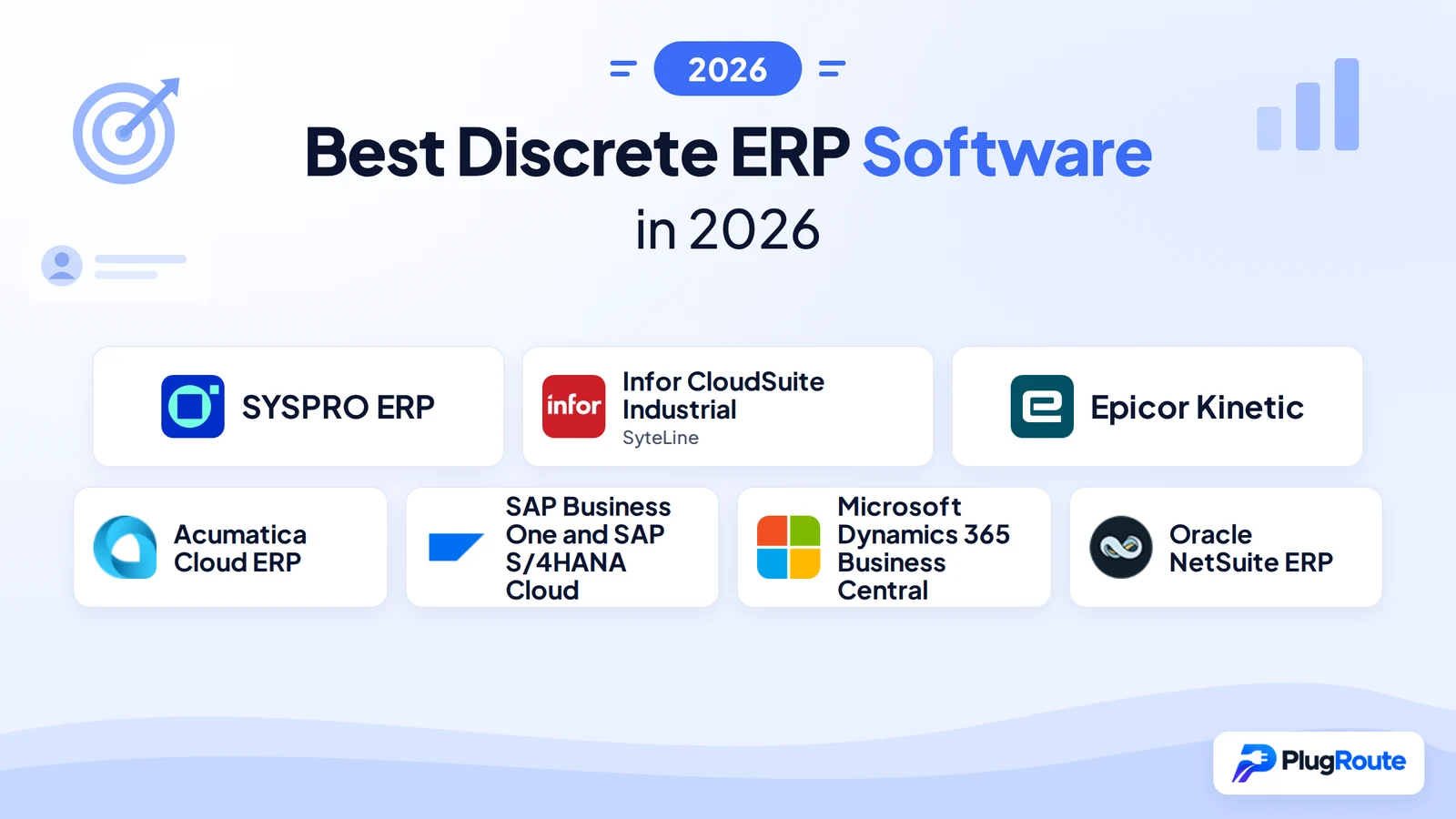
SYSPRO ERP leads independent evidence for SMB and mid-market discrete manufacturing with the highest TEC-certified feature coverage score in this comparison, 96.96% of 1,047 criteria, while Infor CloudSuite Industrial holds four consecutive Gartner Magic Quadrant Leader placements for enterprise manufacturers. The critical decision is matching manufacturing architecture to production model and company size, not selecting the most-marketed platform.
The most common ERP failure in discrete manufacturing is selecting a general-purpose platform that markets “manufacturing support” without genuine discrete architecture, BOM depth, APS, native MES integration. Job shops and make-to-order fabricators typically discover this gap six months post-implementation, not during the sales process. This guide is most useful if you are actively shortlisting ERP options with a defined production model, a target company size, and a general TCO range in mind.
PlugRoute has no affiliate relationships with any company listed in this article; rankings are determined entirely by research data and objective evaluation criteria.
TL;DR: Top Picks at a Glance
- SYSPRO ERP holds the highest independently certified manufacturing breadth in this comparison, a TEC-certified feature coverage score of 96.96% against 1,047 discrete manufacturing criteria, making it the top-ranked discrete ERP for SMB and mid-market manufacturers who prioritize proven manufacturing depth over platform brand recognition.
- Infor CloudSuite Industrial holds four consecutive Gartner Magic Quadrant Leader placements for Cloud ERP for Product-Centric Enterprises (most recently 2024) (the longest consecutive streak in this comparison) making it the most analyst-validated enterprise discrete manufacturing ERP evaluated here, with native multi-site APS and Coleman AI documented by Infor as embedded at the Infor OS data layer.
- Epicor Kinetic is the only discrete manufacturing ERP in this comparison with native Advanced MES that captures machine-level shop floor data (OEE tracking, cycle-time analysis, and machine monitoring) directly into the ERP without requiring a separate third-party MES integration, making it the strongest choice for mid-market job shops and MTO manufacturers needing real-time production visibility.
- Microsoft Dynamics 365 Business Central is the only discrete manufacturing ERP in this comparison with fully published list pricing ($100 per user per month for the Premium tier that includes all manufacturing functionality) making it the most pricing-transparent and accessible option for single-facility SMB manufacturers already operating in the Microsoft ecosystem.
What Is Discrete Manufacturing ERP: And Why Does the Architecture Matter?
Discrete manufacturing ERP is an enterprise resource planning system designed to manage production of distinct, countable items (machined components, fabricated assemblies, engineered products) through BOM-driven production orders, routing-based scheduling, MRP-driven material planning, and shop floor execution. Architecture matters because manufacturing modules added to a general-purpose ERP are not equivalent to manufacturing-first design.
Manufacturing-first ERPs embed BOM management, routing, MES integration, and APS as core architectural capabilities refined over decades of production-focused development. General-purpose ERPs that added manufacturing modules later typically carry shallower BOM logic, less flexible routing, and limited native MES, gaps that discrete manufacturers discover post-implementation, not during vendor demos.
The global discrete manufacturing ERP market was valued at approximately $6.54 billion to $6.95 billion in 2025, depending on scope and methodology (BusinessResearchInsights: $6.54 billion; MarketGrowthReports: $6.95 billion, 2025). Both sources project sustained growth, BusinessResearchInsights forecasts $11.90 billion by 2034 at an 8.8% CAGR; MarketGrowthReports projects $15.04 billion at a 9% CAGR.
AI and real-time analytics features appear in 58% of new ERP deployments as of 2025 (BusinessResearchInsights, 2025). Cloud deployment accounts for 55.11% of the broader ERP market as of 2025. The selection landscape is evolving faster than most published shortlists reflect.
The architectural gap between manufacturing-first ERP and general-purpose ERP with manufacturing modules is the most documented cause of ERP re-implementations in discrete manufacturing. Selecting a Tier 3 manufacturing-capable ERP for a Tier 1 discrete manufacturing operation is the single most predictable cause of ERP re-implementation in this sector, the capability gap is architectural, not configurable.
As one practitioner who evaluated platforms in this category shared on r/Netsuite:
“Netsuite falls short in terms of manufacturing capabilities and the management of quality processes. Most features necessitate some level of customization, additional modules, or extensive scripting and workflows.” Posted by u/No-Perception4860
Takeaway: Manufacturers who discover manufacturing gaps in finance-forward cloud platforms cite persistent customization overhead (not missing individual features) as the primary re-implementation driver, validating this guide’s core architectural gap warning.
What Are the 3 Tiers of Discrete Manufacturing ERP?
Discrete manufacturing ERP platforms fall into three architectural tiers based on whether discrete manufacturing is the system’s founding design principle, a comprehensive native module, or a functional capability with documented ceilings. Identifying the correct tier for a candidate ERP is the first evaluation filter, before feature lists, pricing comparisons, or vendor demos.
Tier 1, Manufacturing-First: SYSPRO ERP, Infor CloudSuite Industrial, Epicor Kinetic
Manufacturing-First systems (also called job shop ERP or fabrication ERP in some markets) are built entirely around manufacturing and distribution as the founding design principle. Key native capabilities include:
- Multi-level bill of materials (BOM) management: native, without add-ons
- Shop floor control with real-time work order tracking
- Advanced Planning and Scheduling (APS) for capacity-constrained environments
- MES integration without third-party middleware requirements
- Job costing with labor, material, and overhead allocation at the work order level
Tier 2, Manufacturing-Strong: Acumatica Cloud ERP, SAP S/4HANA Cloud
Manufacturing-Strong systems have comprehensive native manufacturing modules on a cloud-native or enterprise platform. They may require ISV extensions or an enterprise-tier product to reach the deepest discrete manufacturing functionality. They are strong for manufacturers whose non-manufacturing needs (financials, CRM, supply chain) are equally important strategic priorities.
Tier 3, Manufacturing-Capable: Microsoft Dynamics 365 Business Central, SAP Business One, Oracle NetSuite ERP
Manufacturing-Capable systems provide genuine manufacturing functionality with documented capability ceilings for complex discrete needs. They are optimized for SMB single-facility operations or manufacturers with strong CRM and eCommerce requirements alongside production. Growing manufacturers will encounter ceiling limitations that require platform migration, not a feature upgrade.
The right discrete ERP is the one your team will actually use and your IT department can actually maintain, architectural sophistication that exceeds your operational complexity is a liability, not an asset.
How Do the Top Discrete Manufacturing ERP Systems Compare at a Glance?
The seven discrete manufacturing ERP systems in this comparison span three architectural tiers and serve company sizes from SMB single-facility operations to large enterprise multi-site manufacturers. The table below summarizes each system’s positioning, key capabilities, and primary trade-offs for discrete manufacturing buyers.
| Rank | ERP System | Category Tier | Best For | One-Line Summary | Key Manufacturing Capabilities | Primary Strength | Key Limitation |
|---|---|---|---|---|---|---|---|
| 1 | SYSPRO ERP | Manufacturing-First | SMB–mid-market, broadest native depth | SYSPRO ERP holds the highest TEC-certified manufacturing feature coverage in this comparison at 96.96% of 1,047 criteria; best for SMB and mid-market manufacturers. | BOM variance tracking, APS, real-time MRP, shop floor control, lean manufacturing, quality, traceability | TEC-certified 96.96% of 1,047 manufacturing criteria; manufacturing-only vendor since 1978 | Low brand visibility; narrower ISV ecosystem than larger platforms |
| 2 | Infor CloudSuite Industrial | Enterprise Manufacturing-First | Multi-site, ETO, aerospace/defense, industrial | Infor CloudSuite Industrial holds four consecutive Gartner Magic Quadrant Leader placements for cloud manufacturing ERP; the most analyst-validated enterprise discrete manufacturing system in this comparison. | Native APS, multi-site manufacturing, ETO/MTO/MTS, Coleman AI (Infor OS data layer), cloud/on-prem/hybrid | 4 consecutive Gartner MQ Leader placements; longest streak in this comparison | Implementation complexity; cloud adoption pace uncertainty among practitioners |
| 3 | Epicor Kinetic | Manufacturing-First Mid-Market | Job shops, MTO/ETO needing native MES | Epicor Kinetic is the only mid-market discrete ERP in this comparison with native Advanced MES for machine-level shop floor data and three consecutive Gartner MQ Leader placements. | Native Advanced MES (OEE, cycle-time), APS, product configurator, 7 production modes, quality | Only ERP in this comparison with native machine-level MES; no third-party integration required | G2 3.9/5.0 from 739 reviews (2025); lowest user satisfaction score among manufacturing-first vendors |
| 4 | Acumatica Cloud ERP | Manufacturing-Strong Cloud | Growing headcount, unlimited-user model | Acumatica Cloud ERP is the only discrete manufacturing ERP in this comparison with consumption-based unlimited-user licensing, covering BOM, MRP, APS, and Engineering Change Control. | BOM & routing, MRP, APS, Engineering Change Control, job costing, ISV ecosystem (JAMS) | Only consumption-based unlimited-user licensing model in this comparison | Complete partner-channel dependency; no direct implementation path |
| 5 | SAP (Business One / S/4HANA Cloud) | Dual-Tier ERP Platform | SMB (Business One) or enterprise AI planning (S/4HANA) | SAP S/4HANA Cloud provides the most advanced AI-driven discrete manufacturing planning in this comparison, including native DDMRP; SAP Business One serves SMB discrete manufacturers with separate architecture and no managed upgrade path. | DDMRP, AI Production Agent, Joule AI (S/4HANA); BOM, visual routing, MRP (Business One) | Most advanced native AI manufacturing planning; DDMRP + Production Planning Agent (S/4HANA only) | No managed upgrade path from Business One to S/4HANA Cloud; full re-implementation required |
| 6 | Microsoft Dynamics 365 Business Central | SMB Discrete Manufacturing ERP | Single-facility SMB in Microsoft ecosystem | Microsoft Dynamics 365 Business Central Premium delivers native discrete manufacturing at the only publicly listed price in this comparison; $100 per user per month. | Production orders, versioned BOM, MRP/DRP, machine center routing, Power BI integration | Only ERP with fully published pricing; G2 4.4/5.0 from approximately 1,200 reviews (2025); highest user satisfaction in comparison | Single-facility ceiling; discrete-only scope; advancing to D365 SCM requires full re-implementation at $210/user/month |
| 7 | Oracle NetSuite ERP | Unified Finance-Forward Cloud ERP | D2C manufacturers needing CRM+ERP+eCommerce | Oracle NetSuite ERP is the only platform in this comparison natively unifying discrete manufacturing, CRM, and eCommerce without middleware, supported by 4,673 verified G2 reviews as of 2025. | Multi-level BOM, MRP, work orders, routings, finite/infinite scheduling, Manufacturing Mobile SuiteApp | Only platform natively unifying manufacturing + CRM + eCommerce without middleware | Community evidence of manufacturing investment pace concerns (r/Netsuite, 2025) |
Which Discrete Manufacturing ERP Should I Choose for My Use Case?
The right discrete manufacturing ERP depends on three intersecting factors: production model complexity, organizational size, and operational priorities. Use the framework below to match your primary priority to the recommended system before reviewing individual entries.
| Your #1 Priority | Recommended Tool | Why | Acceptable Alternative |
|---|---|---|---|
| Maximum native manufacturing feature depth (SMB–mid-market) | SYSPRO ERP | TEC-certified 96.96% of 1,047 manufacturing criteria; manufacturing-only vendor since 1978; cloud or on-premise deployment | Epicor Kinetic |
| Enterprise, multi-site, regulated industry (aerospace, defense, industrial machinery) | Infor CloudSuite Industrial | 4 consecutive Gartner MQ Leader placements; native multi-site APS; Coleman AI documented at Infor OS data layer | SAP S/4HANA Cloud |
| Native shop floor MES + machine-level visibility (mid-market job shop or MTO) | Epicor Kinetic | Only ERP in this comparison with native Advanced MES capturing OEE and cycle-time data without third-party integration | Infor CloudSuite Industrial |
| Growing headcount; avoid per-user licensing cost escalation | Acumatica Cloud ERP | Only consumption-based unlimited-user model; all team members access ERP within one subscription; licensing cost stays stable as shop floor headcount scales | Microsoft Dynamics 365 Business Central |
| Transparent pricing + SMB Microsoft ecosystem (single facility) | Microsoft Dynamics 365 Business Central | Only publicly listed pricing ($100/user/month Premium); G2 4.4/5.0 from approximately 1,200 reviews (2025) | SYSPRO ERP |
| Enterprise AI-driven planning with DDMRP | SAP S/4HANA Cloud | Only ERP in this comparison with native Demand-Driven MRP and AI Production Planning Agent as architecturally integrated capabilities | Infor CloudSuite Industrial |
| Manufacturing + CRM + eCommerce unified (D2C or distributor-manufacturer) | Oracle NetSuite ERP | Only platform in this comparison natively unifying all three without integration middleware | Acumatica Cloud ERP |
When to Remove a Vendor From Your Shortlist
Use these filters to eliminate options before reviewing individual entries:
| If This Is True About Your Situation | Remove This Vendor | Why |
|---|---|---|
| Multi-site manufacturing planned within 3 years | Microsoft Dynamics 365 Business Central | Single-facility hard ceiling requires full platform re-implementation to D365 SCM at $210/user/month |
| Budget under $50,000 total project cost | Infor CloudSuite Industrial; SAP S/4HANA Cloud | Enterprise TCO scope ($25,000–$500,000+) exceeds accessible range for most small manufacturers |
| No experienced discrete manufacturing Acumatica partner in your region | Move Acumatica to secondary shortlist | Partner quality is the primary implementation outcome driver for Acumatica deployments |
| Process or lean manufacturing required alongside discrete | Microsoft Dynamics 365 Business Central | Discrete-only native scope; process and lean require D365 SCM as a separate product |
| Native shop floor MES without third-party integration required | Remove Acumatica, Business Central, SAP Business One, Oracle NetSuite from MES-primary shortlist | Only Epicor Kinetic includes native machine-level Advanced MES in this comparison |
With your manufacturing profile matched to a tier and filtered against the shortlist criteria above, the ranked entries below provide the independently verified evidence (TEC certification scores, Gartner MQ placements, G2 ratings with review counts, and practitioner community signals) that supports or qualifies each recommendation.
1. SYSPRO ERP: Best Overall for SMB and Mid-Market Discrete Manufacturing Depth
Category: Manufacturing-Specialist ERP, enterprise resource planning built exclusively for manufacturing and distribution, with no competing product roadmap in other industries and the highest independently certified discrete manufacturing feature coverage in this comparison.
At a Glance
- Category: Manufacturing-Specialist ERP
- Best For: SMB and mid-market discrete, process, and mixed-mode manufacturers: including job shops, metal fabricators, electronics manufacturers, and automotive parts producers, who need the broadest independently certified native manufacturing depth without enterprise ERP pricing or cloud-only constraints
- Price Range: $75–$150/user/month estimated (third-party sources; SYSPRO does not publish a list price); total project cost estimated $25,000–$500,000; minimum implementation estimated at $25,000; cloud subscription (OpEx) and on-premise perpetual license (CapEx) both available
- Primary Strength: SYSPRO ERP holds a TEC-certified manufacturing feature coverage score of 96.96% against 1,047 discrete manufacturing criteria, the highest independently verified manufacturing breadth score of any vendor in this comparison, 2.8 percentage points above the 94.16% market average (TEC Certification Report, 2025)
- Biggest Limitation: SYSPRO ERP has significantly lower brand recognition than SAP, Oracle, Microsoft, and Epicor in North American and European markets, causing it to be excluded from initial shortlists despite carrying the highest independently certified manufacturing feature coverage in this comparison
- One-Line Summary: SYSPRO ERP holds the highest TEC-certified manufacturing feature coverage in this comparison at 96.96% of 1,047 discrete manufacturing criteria, the most comprehensively validated discrete manufacturing ERP for SMB and mid-market manufacturers in 2026.
- Last Verified: June 2026
Overview
SYSPRO ERP is a manufacturing-only enterprise resource planning system designed exclusively for discrete, process, and mixed-mode manufacturers (from small job shops to mid-market multi-site production environments) that need native BOM management, MRP, APS, shop floor control, and full production costing without the overhead of a general-purpose ERP serving multiple industries.
SYSPRO ERP was founded in 1978 and has operated as a manufacturing-focused vendor for 47 years, building discrete manufacturing workflow intelligence through real-world customer implementations across industrial machinery, electronics, automotive parts, and food and beverage industries.
SYSPRO ERP is not currently evaluated in the Gartner Magic Quadrant for Cloud ERP for Product-Centric Enterprises. Gartner’s inclusion thresholds for this Magic Quadrant require a cloud revenue scale that SYSPRO’s portfolio has not yet reached, which reflects portfolio size requirements, not a manufacturing capability assessment.
SYSPRO ERP’s TEC-certified coverage of 96.96% of 1,047 manufacturing criteria (TEC Certification Report for SYSPRO, 2025) (combined with cloud or on-premise deployment flexibility and active UI modernization via SYSPRO Avanti) positions it as the broadest-access manufacturing-specialist ERP for SMB and mid-market buyers in this comparison.
Key Features
- TEC-Certified APS with Constraint-Based Scheduling: SYSPRO ERP’s Advanced Planning and Scheduling module schedules production against real operational constraints (machine capacity, tooling availability, labor assignments, and material lead times simultaneously) rather than using basic lead-time-only MRP calculations that cannot reflect actual shop floor conditions.
- BOM Variance Tracking at the Job Level: SYSPRO ERP’s BOM management tracks expected versus actual production costs at the job level, providing discrete manufacturers with variance analysis that identifies where material, labor, and overhead costs diverge from estimates, a foundation capability for make-to-order quoting accuracy and production margin management.
- Real-Time MRP Engine: SYSPRO ERP’s MRP engine performs real-time recalculation based on current demand, live inventory positions, and supplier lead times, enabling accurate production scheduling and supply chain coordination in dynamic job shop environments where demand and material availability change continuously.
- Lean and Discrete Manufacturing in One Platform: SYSPRO ERP supports both traditional discrete manufacturing production workflows and lean manufacturing models in the same platform, serving manufacturers transitioning from conventional to lean production without requiring a separate ERP implementation or bolt-on lean scheduling tool.
- SYSPRO Avanti Browser-Based Web Client: SYSPRO Avanti is a browser-based web client that provides modern anywhere-access to all SYSPRO ERP functions without requiring Windows client installation, directly addressing the dated-interface criticism historically associated with manufacturing-specialist ERP systems while preserving all native manufacturing workflow logic.
Best For
SYSPRO ERP is best for SMB and mid-market discrete manufacturers (including job shops, metal fabricators, electronics manufacturers, and automotive parts producers) who need a manufacturing-specialist ERP with the highest independently certified BOM, MRP, APS, and shop floor control coverage, and who require cloud or on-premise deployment flexibility that cloud-only competitors cannot offer.
Pricing
SYSPRO ERP does not publish a standard list price. Third-party sources ERPResearch.com and Top10ERP.org estimate subscription pricing at approximately $75–$150/user/month depending on modules and deployment model, with minimum implementation costs estimated at $25,000 and total project costs ranging $25,000–$500,000.
Both cloud subscription (OpEx) and on-premise perpetual license (CapEx) models are available, a deployment optionality that no manufacturing-only cloud competitor in this comparison can match. Contact SYSPRO or a certified SYSPRO partner for verified current pricing. (Pricing estimates from third-party sources; not published by SYSPRO. June 2026)
Strengths
- TEC Independent Certification: TEC (Technology Evaluation Centers) independently certified SYSPRO ERP at 96.96% of 1,047 manufacturing management criteria, 2.8 percentage points above the 94.16% market average, establishing the highest independently verified manufacturing feature breadth of any vendor in this comparison. Independent verification is available at technologyevaluation.com (TEC Certification Report for SYSPRO, 2025).
- Independent Analyst Characterization of Manufacturing Depth: ERPResearch.com independently characterizes SYSPRO ERP’s manufacturing module as a core product strength (not a module addition) explicitly noting support for discrete, process, and mixed-mode manufacturing with integrated MRP/BOM, production management, supply chain, financials, traceability, and quality control ERPResearch.com, 2025.
- Unique Cloud and On-Premise Deployment Flexibility: SYSPRO ERP’s dual deployment model (cloud subscription or on-premise perpetual license) is unique among manufacturing-specialist ERPs in this comparison, preserving CapEx versus OpEx optionality for manufacturers in regulated industries, facilities with limited connectivity, or organizations with existing on-premise infrastructure investments (Top10ERP.org; InvGate.com, 2025).
- Active Modernization via Avanti and BOT: SYSPRO ERP’s SYSPRO Avanti browser-based web client and SYSPRO BOT conversational AI layer provide modern access and AI-assisted task automation without requiring a platform re-implementation, addressing the UI and AI investment gap historically associated with manufacturing-specialist ERP systems (SYSPRO Europe press release; TEC Certification Report Part 4, 2025).
Limitations
- Brand Visibility Gap: SYSPRO ERP’s most consequential limitation is its significantly lower brand recognition compared to SAP, Oracle, Microsoft, and Epicor, despite holding the highest TEC manufacturing certification in this comparison, SYSPRO ERP is systematically excluded from initial evaluation shortlists assembled based on marketing familiarity rather than manufacturing evidence, creating a discovery barrier that no amount of feature depth resolves automatically.
- Narrower ISV and Integration Ecosystem: SYSPRO ERP has a smaller ecosystem of pre-built ISV integrations than Oracle NetSuite or Acumatica, meaning manufacturers who need a wide range of pre-certified third-party connectors will find fewer native options and will likely face custom integration work for tools outside SYSPRO’s partner network.
- Limited Native eCommerce and CRM: SYSPRO ERP has more limited native eCommerce and CRM capabilities than Oracle NetSuite or Acumatica, a genuine trade-off for manufacturers with significant direct-to-consumer or customer-relationship management requirements alongside production operations.
- No G2 or Capterra Rating Surfaced in Research: No specific G2 or Capterra peer review rating for SYSPRO ERP was surfaced in primary research for this comparison, limiting direct head-to-head user satisfaction comparison with vendors that have large, well-documented review pools. Buyers should access the TEC Certification Report directly at technologyevaluation.com and request a minimum of three peer references from SYSPRO or a certified SYSPRO partner, focusing specifically on manufacturers in the same production mode and company size segment.
Verdict
SYSPRO ERP is the independently certified manufacturing-specialist ERP with a TEC-verified feature coverage score of 96.96% against 1,047 discrete manufacturing criteria, the highest independently validated manufacturing breadth score of any vendor in this comparison, making it the most evidence-grounded choice for SMB and mid-market manufacturers who need genuine BOM, MRP, APS, and shop floor depth without enterprise ERP pricing. SYSPRO ERP’s manufacturing-only vendor identity, 47-year production ERP heritage, cloud and on-premise deployment flexibility, and active AI and UX modernization through SYSPRO Avanti and SYSPRO BOT position it as the strongest overall option for discrete manufacturers prioritizing proven manufacturing depth over platform brand recognition. SYSPRO ERP’s primary buyer challenge is discoverability, its systematic absence from AI-generated shortlists is this comparison’s clearest example of how volume-weighted marketing content surfaces brand presence over manufacturing evidence.
2. Infor CloudSuite Industrial (SyteLine): Best for Enterprise and Multi-Site Discrete Manufacturing
Category: Enterprise Manufacturing-First ERP, enterprise resource planning built architecturally for complex discrete and mixed-mode manufacturing, with native multi-site coordination, APS, and Coleman AI documented by Infor as embedded at the Infor OS data layer; the longest Gartner Magic Quadrant Leader streak of any vendor in this comparison.
At a Glance
- Category: Enterprise Manufacturing-First ERP
- Best For: Mid-market to enterprise discrete manufacturers with complex production environments (multi-site facilities, engineer-to-order workflows, mixed-mode operations, or regulated industries (aerospace and defense, industrial machinery, automotive)) who require the deepest natively integrated manufacturing ERP with the strongest sustained analyst recognition
- Price Range: Quote-based only (no published list price); third-party estimates: $25,000–$500,000 total project cost; confirm during evaluation whether you are quoting Infor CSI or the separate Infor M3 product (estimated $200/user/month, $70,000+ minimum implementation)
- Primary Strength: Infor CloudSuite Industrial has earned four consecutive Gartner Magic Quadrant Leader placements for Cloud ERP for Product-Centric Enterprises (most recently 2024) (the longest consecutive streak of any vendor in this comparison) with native APS and multi-site manufacturing coordination
- Biggest Limitation: Infor CloudSuite Industrial has generated documented practitioner uncertainty about its cloud migration adoption pace, the r/ERP thread “Does any company truly use Infor SyteLine Cloud?” signals that its cloud deployment is less established in day-to-day manufacturing communities than its Gartner placements suggest; implementation complexity also positions it outside the accessible range for most SMB manufacturers
- One-Line Summary: Infor CloudSuite Industrial holds four consecutive Gartner Magic Quadrant Leader placements for Cloud ERP for Product-Centric Enterprises (the longest consecutive streak in this comparison) making it the most analyst-validated enterprise discrete manufacturing ERP evaluated here.
- Last Verified: June 2026
Overview
Infor CloudSuite Industrial (commonly known as SyteLine) is an enterprise-grade ERP built specifically for discrete and mixed-mode manufacturing, serving mid-market to large manufacturers across engineer-to-order, make-to-order, make-to-stock, repetitive, and mixed-mode production with native advanced planning and scheduling, multi-site coordination, and deployment flexibility across cloud, on-premise, and hybrid configurations.
Infor CloudSuite Industrial is distinguished from general-purpose ERPs by its product heritage: SyteLine was originally designed in the 1980s specifically for discrete manufacturing, meaning its production management, BOM, routing, and scheduling workflows reflect four decades of manufacturing-specific refinement not present in ERP platforms that added manufacturing modules later.
Infor CloudSuite Industrial is backed by Koch Industries (one of the largest privately held companies in the United States at an estimated $125 billion in annual revenue) providing long-term institutional capital and investment stability uncommon among manufacturing ERP vendors.
The Infor cloud paradox is worth naming directly: this is a system built for factories running three shifts, managing hundreds of part numbers, and unable to afford ERP downtime, yet it now runs on AWS as a cloud subscription. For manufacturers moving off a legacy on-premise system, this means enterprise-depth manufacturing capability without the on-premise infrastructure cost.
Key Features
- Constraint-Based Advanced Planning and Scheduling (APS): Infor CloudSuite Industrial’s APS module performs constraint-based production scheduling that simultaneously accounts for machine capacity, tooling availability, labor assignments, and material lead times, a qualitatively different planning capability from basic lead-time MRP that cannot account for real-time shop floor constraints.
- Native Multi-Site and Multi-Company Manufacturing Support: Infor CloudSuite Industrial supports multi-site and multi-company manufacturing management in a single ERP instance, enabling manufacturers expanding across multiple production facilities to maintain centralized planning with site-specific local execution and consolidated reporting, a hard native limitation in Microsoft Dynamics 365 Business Central that Infor CloudSuite Industrial resolves.
- Coleman AI at the Infor OS Data Layer (Infor-Documented): Infor CloudSuite Industrial’s Coleman AI is documented by Infor as embedded at the Infor OS data layer, providing machine learning, workflow automation, and predictive analytics within ERP production workflows. Buyers should confirm the specific integration architecture with Infor directly, as this characterization derives from Infor product documentation and partner overviews (Infor.com; PCG Services, 2025).
- Engineer-to-Order Full Lifecycle Support: Infor CloudSuite Industrial supports the full engineer-to-order production lifecycle including project-based manufacturing, complex multi-level BOM configurations, customer-specific product traceability, and compliance documentation, the highest-complexity discrete manufacturing workflows in this comparison.
- Cloud, On-Premise, and Hybrid Deployment: Infor CloudSuite Industrial offers deployment flexibility across cloud, on-premise, and hybrid configurations, enabling manufacturers with connectivity limitations, regulatory requirements, or existing on-premise infrastructure investments to access enterprise manufacturing ERP without a mandatory cloud migration.
Best For
Infor CloudSuite Industrial is best for mid-market to enterprise discrete manufacturers operating in complex environments, including multi-site production facilities, engineer-to-order workflows, aerospace and defense traceability requirements, and mixed-mode operations combining discrete BOMs with repetitive or batch production runs, who require the deepest purpose-built manufacturing ERP with the strongest sustained analyst validation.
Pricing
Infor does not publish a standard list price for CloudSuite Industrial. Third-party comparison platforms estimate total project costs of $25,000–$500,000, with complex enterprise deployments frequently exceeding this range.
A separate Infor M3 product carries third-party estimates of approximately $200/user/month with a minimum implementation of approximately $70,000, buyers must confirm during initial conversations which Infor product (CSI versus M3) they are evaluating, as the cost and scope differ substantially (Top10ERP.org, 2025). Contact Infor or a certified Infor partner for current pricing. (Pricing estimates from third-party sources; not published by Infor. June 2026)
Strengths
- Longest Gartner MQ Leader Streak in This Comparison: Infor CloudSuite Industrial earned four consecutive Gartner Magic Quadrant Leader placements for Cloud ERP for Product-Centric Enterprises (most recently 2024) (the longest consecutive Leader streak of any vendor in this comparison) constituting the highest sustained enterprise analyst recognition for manufacturing ERP available in this evaluation (Gartner Magic Quadrant, 2024; per Decision.com citing Gartner).
- Coleman AI at the Data Layer (Infor-Documented): Infor CloudSuite Industrial’s Coleman AI is documented by Infor as embedded at the Infor OS data layer, providing predictive analytics, machine learning automation, and workflow intelligence operating directly on the ERP’s native data model, a structural AI integration approach that Infor positions as distinct from externally API-layered AI tools (Infor.com; PCG Services overview, 2025).
- Native Multi-Site Manufacturing (Versus Business Central Hard Limitation): Infor CloudSuite Industrial supports native multi-site manufacturing management in a single ERP instance, enabling manufacturers expanding across multiple production facilities to maintain centralized planning with site-specific execution, a capability documented as a hard native limitation in Microsoft Dynamics 365 Business Central, requiring the separate D365 SCM product at $210/user/month (Infor.com discrete manufacturing page, 2025).
- Koch Industries Long-Term Investment Backing: Infor CloudSuite Industrial is backed by Koch Industries (estimated at $125 billion or more in annual revenue as a privately held company) providing long-term institutional R&D investment without public-market quarterly earnings pressure, an investment stability characteristic that few manufacturing ERP vendors at any tier can match Infor.com SyteLine page, 2025.
Limitations
- Cloud Adoption Pace Uncertainty: Infor CloudSuite Industrial’s most consequential limitation is documented community uncertainty about its cloud migration adoption pace, the r/ERP thread “Does any company truly use Infor SyteLine Cloud?” signals that Infor CSI’s cloud deployment is less visible in day-to-day manufacturing practitioner communities than expected for a four-time Gartner MQ Leader. Experienced Infor practitioners distinguish between the legacy on-premise modules (mature, deep) and the cloud platform maturity (improving, but newer), buyers should ask Infor specifically for cloud-only references within their company size segment, not Fortune 500 enterprise deployments. Takeaway: Request cloud-deployment-specific references from Infor before shortlisting, on-premise SyteLine reviews may not reflect current CloudSuite Industrial cloud quality.
- Implementation Complexity and Partner Dependency: Common criticisms documented across third-party review sources (PCG Services; Godlan.com) include steep learning curve, high implementation complexity, and significant upgrade friction for organizations migrating from legacy on-premise SyteLine to CloudSuite Industrial, buyers should specifically request references from recent cloud deployments, not legacy on-premise SyteLine implementations.
- SMB Inaccessibility: Infor CloudSuite Industrial’s enterprise depth and estimated TCO ($25,000–$500,000+) position it outside the accessible range for most SMB manufacturers, the system’s implementation investment requires organizational capacity to manage a complex ERP rollout with experienced project management and dedicated IT resources.
- Infor M3 Confusion Risk: The existence of a separate, higher-cost Infor M3 product (estimated $200/user/month, $70,000+ minimum implementation) creates buyer confusion during evaluation, buyers must confirm which Infor product they are evaluating before any budget expectations are set, as conflating the two leads to significantly incorrect TCO projections.
- No G2 or Capterra Peer Review Rating Available: Infor CloudSuite Industrial does not maintain a G2 or Capterra profile as of mid-2026, limiting access to crowd-sourced user sentiment data for independent buyer research. Buyers should consult Gartner Peer Insights (gartner.com/reviews) for enterprise-tier peer satisfaction data on CloudSuite Industrial specifically, and request cloud-deployment-specific references from Infor directly.
Verdict
Infor CloudSuite Industrial is the four-time consecutive Gartner Magic Quadrant Leader for Cloud ERP for Product-Centric Enterprises, the longest consecutive recognition streak of any vendor in this comparison, making it the most analyst-validated enterprise manufacturing ERP for complex discrete and mixed-mode manufacturers with multi-site, ETO, and regulated-industry requirements. Infor CloudSuite Industrial’s four-decade manufacturing heritage, native multi-site support, constraint-based APS, and Coleman AI documented at the Infor OS data layer position it as the most capable enterprise choice in this evaluation. The primary constraint is audience fit: Infor CloudSuite Industrial’s depth, implementation complexity, and estimated TCO position it for mid-market to enterprise manufacturers with organizational capacity to manage a complex implementation, SMB and simpler discrete manufacturers will find better-matched options in SYSPRO ERP, Acumatica Cloud ERP, or Microsoft Dynamics 365 Business Central.
3. Epicor Kinetic: Best for Mid-Market Job Shops, MTO, and ETO Manufacturers with Native MES
Category: Manufacturing-First Mid-Market ERP, enterprise resource planning designed architecturally around discrete and mixed-mode production, with native Advanced MES, APS, and purpose-built support for job shop, MTO, and ETO environments across the mid-market to enterprise tier.
At a Glance
- Category: Manufacturing-First Mid-Market ERP
- Best For: Mid-market discrete manufacturers running job shop, make-to-order, or engineer-to-order operations who need native Advanced MES for real-time machine-level shop floor data, APS-driven production scheduling, and a product configurator in a single purpose-built platform without enterprise-tier implementation investment
- Price Range: Quote-based only (no published list price); third-party TCO estimates: $25,000–$500,000+ depending on scope, user count, and deployment model; cloud and hybrid deployment options available
- Primary Strength: Epicor Kinetic is the only ERP in this comparison with native Advanced MES that captures machine-level shop floor data (including OEE tracking, machine monitoring, and cycle-time analysis) directly into the ERP without requiring a separate third-party MES integration, eliminating the most common IT/OT integration gap in mid-market discrete manufacturing
- Biggest Limitation: Epicor Kinetic has a G2 satisfaction score of 3.9/5.0 from 739 verified reviews as of 2025 (the lowest formal user satisfaction rating among manufacturing-first vendors in this comparison) with users consistently citing a steep learning curve and migration complexity from the Epicor ERP 10 predecessor as the primary friction points
- One-Line Summary: Epicor Kinetic is a three-time consecutive Gartner Magic Quadrant Leader for Cloud ERP for Product-Centric Enterprises and the only discrete manufacturing ERP in this comparison with native Advanced MES for real-time machine-level shop floor data capture without third-party integration.
- Last Verified: June 2026
Overview
Epicor Kinetic is a purpose-built manufacturing ERP serving 23,000+ customers globally with an architecture that centers production management, shop floor execution, Advanced MES, and quality as first-class capabilities (not module additions) explicitly designed for discrete, engineer-to-order, make-to-order, job shop, repetitive, batch, and mixed-mode production environments.
Epicor Kinetic is the only ERP in this comparison with a native Advanced MES layer that captures machine-level operational technology data (OEE, cycle-time, machine monitoring, and automated data capture) directly into the ERP system, eliminating the IT/OT integration project that most discrete manufacturers must solve separately when deploying mid-market ERP.
Founded in 1972 and privately owned by Clayton, Dubilier & Rice, Epicor Kinetic has earned three consecutive Gartner Magic Quadrant Leader placements and a G2 Leader badge in Mixed Mode ERP (Fall 2025), establishing the second-strongest multi-source analyst validation of any manufacturing-first ERP in this evaluation.
Key Features
- Native Advanced MES for Machine-Level OT Data: Epicor Kinetic’s native Advanced MES module captures machine-level operational data (OEE tracking, cycle-time analysis, machine monitoring, and automated data collection) directly into the ERP system without requiring a separate third-party MES integration, providing real-time shop floor visibility that mid-market manufacturers typically can only access through expensive enterprise MES deployments.
- Seven Native Production Modes: Epicor Kinetic supports seven discrete production modes as native first-class capabilities (make-to-order, make-to-stock, engineer-to-order, job shop, repetitive, batch, and mixed-mode) covering the broadest production environment range of any mid-market ERP in this comparison from a single purpose-built platform.
- APS-Driven Constraint-Aware Production Scheduling: Epicor Kinetic’s Advanced Planning and Scheduling module generates optimal production sequences by simultaneously accounting for machine capacity, labor availability, tooling, and material lead times, providing constraint-aware scheduling that reduces production conflicts and enables more accurate customer delivery date commitments.
- Native Product Configurator for MTO/ETO: Epicor Kinetic includes a native Product Configurator that enables make-to-order and engineer-to-order manufacturers to configure complex custom products at the point of quoting or sale, automatically generating the corresponding BOM and routing, reducing configuration errors and compressing the quote-to-production conversion timeline.
- Integrated Native Quality Management: Epicor Kinetic’s quality management module is integrated natively into the production workflow (not a standalone system requiring separate login or data entry) providing real-time quality control checkpoints, non-conformance tracking, and inspection management within the same data environment as production orders and shop floor execution.
Best For
Epicor Kinetic is best for mid-market discrete manufacturers (particularly job shops, make-to-order fabricators, and engineer-to-order producers) who need native shop floor data capture via Advanced MES, APS-driven production scheduling, and a product configurator in a single purpose-built system, and who require more manufacturing depth than Business Central or Acumatica provide natively without the enterprise-tier investment required by Infor CloudSuite Industrial or SAP S/4HANA Cloud.
Pricing
Epicor Kinetic does not publish standard list pricing. All pricing is quote-based and varies by user count, modules selected, deployment model (cloud or hybrid), and implementation scope. Third-party comparison sources estimate total project TCO in the range of $25,000–$500,000+, with Epicor positioned as lower-complexity and lower-cost than SAP S/4HANA for most mid-market discrete scenarios (ERP-Pilot.com, 2025). Contact Epicor directly or through a certified Epicor partner for current pricing. (Pricing estimates from third-party sources; not published by Epicor. June 2026)
Strengths
- Three Consecutive Gartner MQ Leader Placements + G2 Mixed Mode ERP Leader Badge: Epicor Kinetic earned three consecutive Gartner Magic Quadrant Leader placements for Cloud ERP for Product-Centric Enterprises (most recently 2025) and a G2 Leader badge in Mixed Mode ERP based on 213 verified reviews in that specific category (G2 Fall 2025), constituting the strongest multi-source analyst validation of any mid-market manufacturing ERP in this comparison (Gartner MQ 2025; G2 Fall 2025).
- Unique Native Advanced MES Capability: Epicor Kinetic is the only vendor in this comparison with a native Advanced MES module that captures machine-level OT data (OEE tracking, machine monitoring, cycle-time analysis, and automated data capture) directly into the ERP without third-party integration middleware, addressing the most common discrete manufacturing data gap at the mid-market tier (Epicor.com discrete manufacturing page, 2025).
- Independent Third-Party Shop Floor Characterization: ERPResearch.com independently identifies Epicor Kinetic as having “strong shop floor control and production scheduling” (a third-party characterization of a specific product feature area, not vendor marketing) providing external validation of the native Advanced MES and APS positioning claims ERPResearch.com, 2025.
- Largest Manufacturing-First Peer Community: Epicor Kinetic’s 23,000+ customer global install base supports the EpiUsers.help community (one of the most active ERP peer communities in manufacturing) giving prospective buyers access to implementation guidance, configuration best practices, and peer validation from manufacturers in comparable industries and production environments Epicor.com, 2025.
Limitations
- User Satisfaction Gap Versus Analyst Recognition: Epicor Kinetic’s most significant limitation is the gap between analyst recognition and user satisfaction, a G2 score of 3.9/5.0 from 739 verified reviews as of 2025 is the lowest satisfaction rating of any manufacturing-first ERP in this comparison, with users consistently citing a steep learning curve and migration complexity from the Epicor ERP 10 predecessor as primary friction points (G2.com, 2025). A pattern consistent across deep-customization ERPs is that partner implementation quality significantly shapes user review sentiment, Epicor Kinetic’s 3.9/5.0 should be investigated in reference conversations, not accepted as a fixed platform characterization.
- Kinetic Migration Complexity: The EpiUsers.help thread “What are some of your experiences when moving to Kinetic Cloud?” reflects documented user-level anxiety about the platform transition, a material due-diligence signal for any organization considering migration from earlier Epicor ERP versions. When evaluating references, ask specifically whether the migration timeline matched the original estimate, whether post-go-live Kinetic Cloud UI required significant retraining investment beyond what was planned, and whether production scheduling downtime during cutover was within the project’s planned tolerance window.
- Pricing Opacity Before Engagement: Epicor Kinetic does not publish list pricing, requiring full sales engagement before total cost can be understood, a friction point for SMB manufacturers who expect transparent pricing before committing evaluation time, and that makes pre-engagement TCO research more difficult than with Microsoft Dynamics 365 Business Central’s publicly listed pricing.
- Analyst-Satisfaction Discrepancy Requires Investigation: The gap between three consecutive Gartner MQ Leader placements and a 3.9/5.0 user satisfaction score as of 2025 is the single most important signal to investigate in reference calls before finalizing a Kinetic shortlist, buyers should specifically request references from organizations that completed migration from Epicor ERP 10 to Kinetic Cloud within the past 24 months to assess current migration experience quality.
Users on r/epicor offer a candid read of this trade-off:
“Epicor from a software standpoint is a great database with some really good programmable and customizable features. Epicor as a company (especially Sales and Support) completely suck.” Posted by u/EpicorShamer23
Takeaway: Epicor Kinetic’s practitioner community consistently separates the software’s deep manufacturing customizability from the company’s support and sales quality, a distinction that explains the divergence between its three consecutive Gartner Leader placements and its 3.9/5.0 G2 user satisfaction score.
Verdict
Epicor Kinetic is the only discrete manufacturing ERP in this comparison with native Advanced MES for real-time machine-level shop floor data capture, a capability that sets the technical ceiling for what mid-market manufacturers can achieve in production visibility without a separate MES investment. Epicor Kinetic’s three consecutive Gartner Magic Quadrant Leader placements, G2 Mixed Mode ERP Leader badge from 213 verified reviews (Fall 2025), and ERPResearch.com independent characterization of strong shop floor control constitute the second-strongest multi-source analyst validation of any manufacturing ERP in this evaluation. The gap between analyst recognition and user satisfaction (3.9/5.0 G2 as of 2025 versus three Gartner Leader placements) is real, material, and should be specifically investigated in reference conversations, particularly for organizations considering migration from earlier Epicor ERP versions.
4. Acumatica Cloud ERP: Best for Growing Manufacturers Scaling Headcount Without Per-Seat Cost Escalation
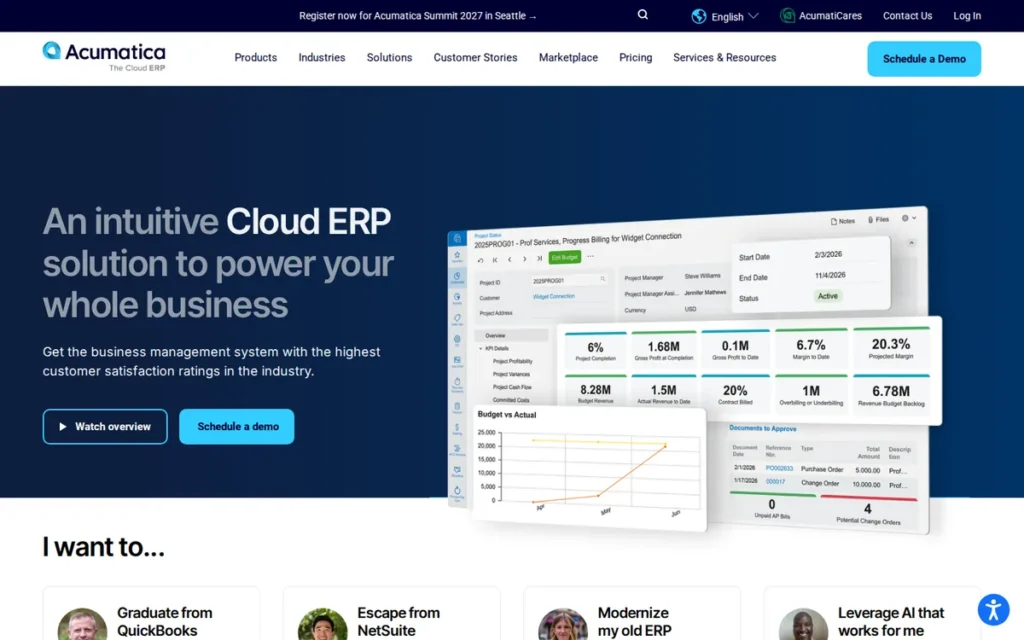
Category: Manufacturing-Strong Cloud ERP, cloud-native enterprise resource planning with comprehensive native manufacturing modules and an open ISV ecosystem that adds discrete depth, built on a consumption-based unlimited-user licensing model that makes it uniquely cost-advantaged for growing manufacturing headcounts.
At a Glance
- Category: Manufacturing-Strong Cloud ERP
- Best For: Growing mid-market discrete manufacturers: particularly job shops, make-to-order operations, and any environment projecting significant headcount growth, who need cloud manufacturing ERP with BOM, MRP, APS, job costing, and Engineering Change Control, and for whom per-user licensing from competing vendors would become prohibitively expensive as team size scales
- Price Range: Consumption-based (no per-user charge); estimated annual software cost $15,000–$50,000+ for small-to-mid manufacturers depending on transaction volume and resource tier; no published list price; partner-delivered implementation adds significantly to total cost
- Primary Strength: Acumatica Cloud ERP is the only manufacturing ERP in this comparison that charges based on transaction consumption rather than per named user, enabling all team members (including shop floor workers, warehouse staff, and supply chain partners) to access the ERP within one subscription without per-seat cost escalation as headcount grows
- Biggest Limitation: Acumatica Cloud ERP is sold exclusively through a partner channel (VARs and ISVs), meaning implementation quality, total project cost, and manufacturing-specific configuration quality vary substantially based on partner selection, a manufacturer who engages an Acumatica partner without discrete manufacturing expertise is taking a significant execution risk regardless of the platform’s native capabilities
- One-Line Summary: Acumatica Cloud ERP is the only discrete manufacturing ERP in this comparison with consumption-based unlimited-user licensing, native modules covering BOM, MRP, APS, and Engineering Change Control, and an open ISV platform that enables discrete manufacturing specialists to add depth on the same data model without integration overhead.
- Last Verified: June 2026
Overview
Acumatica Cloud ERP is a cloud-native enterprise resource planning platform for growing SMB and mid-market manufacturers, offering a Manufacturing Edition with native BOM & Routing, MRP, APS, Production Management, and Engineering Change Control, complemented by an open ISV ecosystem of discrete manufacturing extensions that run natively on the same data model and interface as the core platform.
Acumatica Cloud ERP’s defining commercial differentiator is its consumption-based, all-inclusive user licensing: all users (from executives to shop floor operators to supply chain partners) access the system within a single subscription tier based on transaction volume consumed, eliminating the per-seat cost escalation that inflates ERP TCO as manufacturers grow their teams.
Acumatica Cloud ERP was founded in 2008 and was acquired by EQT Partners in 2019. Acumatica Cloud ERP earned recognition from SoftwareReviews in its 2026 Discrete Manufacturing ERP Category Report for its adaptable cloud technology and unique all-inclusive user licensing model, positioning it among the fastest-growing cloud ERP vendors in the SMB-to-mid-market manufacturing segment by new customer acquisition (SoftwareReviews 2026).
Key Features
- Native Manufacturing Edition with APS and Engineering Change Control: Acumatica Cloud ERP’s Manufacturing Edition includes native BOM & Routing, MRP, Production Management, Advanced Planning and Scheduling (APS), and Engineering Change Control (ECC), covering the core discrete manufacturing capability stack without requiring ISV extensions for standard production workflows.
- Consumption-Based Unlimited-User Licensing: Acumatica Cloud ERP’s consumption-based licensing model allows unlimited named users to access the system within a single subscription tier, enabling shop floor operators, warehouse staff, remote workers, and supply chain partners to have ERP access without per-seat cost escalation, the most buyer-advantaged licensing structure for manufacturers projecting significant headcount growth.
- xRP Open Platform for Native ISV Depth: Acumatica Cloud ERP’s xRP open platform allows ISV partners (including JAMS (JAAS Advanced Manufacturing Software)) to build discrete manufacturing extensions natively on Acumatica’s own data model and UI framework, making ISV-added manufacturing depth operationally seamless compared to third-party integrations requiring separate authentication and data mapping.
- Estimated Versus Actual Job Costing: Acumatica Cloud ERP provides job-level cost variance analysis at the production order level, enabling make-to-order manufacturers to identify where actual material, labor, and overhead costs diverge from estimates, improving quoting accuracy and production margin management without a separate job costing system.
- Unified Manufacturing Data Architecture: Acumatica Cloud ERP’s unified data architecture connects procurement, warehouse, production, financials, supply chain, inventory, and sales in a single system, eliminating the data silos between departments that represent the most common operational inefficiency for discrete manufacturers replacing legacy ERP or spreadsheet-based production tracking.
Best For
Acumatica Cloud ERP is best for growing mid-market discrete manufacturers (particularly job shops, make-to-order producers, and any organization projecting significant headcount expansion across shop floor, warehouse, and supply chain roles) who need native BOM, MRP, APS, and job costing in a cloud-native platform, and who will benefit most from the unlimited-user licensing model as team size grows without proportional ERP licensing cost increases.
Pricing
Acumatica Cloud ERP does not publish standard list pricing. The consumption-based model determines cost based on transaction volume and system resources consumed, not user count. Third-party partner sources estimate software costs starting at approximately $15,000–$30,000 per year for small manufacturers and scaling upward with transaction volume (Blog.cfbs-us.com; Cloud9ERP.com, 2025).
The practical math on the licensing model advantage: a 50-user manufacturer on a per-user ERP at $100/user/month pays $60,000/year in software licensing. When that company grows to 100 users, the per-user bill doubles to $120,000/year. Under Acumatica Cloud ERP’s consumption-based model, adding 50 shop floor workers who primarily report production completions may not trigger a resource tier increase, keeping annual software cost stable while the team doubles. The savings compound at every growth inflection point where per-seat licensing would reset to a higher cost level.
Because Acumatica Cloud ERP is sold exclusively through partner channels, implementation costs vary by partner and add significantly to total project cost. Obtaining multiple partner proposals and evaluating each partner’s discrete manufacturing credentials is essential for accurate TCO projections. (Pricing estimates from third-party partner sources; not published by Acumatica. June 2026)
Strengths
- SoftwareReviews 2026 Discrete Manufacturing ERP Recognition: SoftwareReviews (Info-Tech Research Group) specifically highlights Acumatica Cloud ERP’s “unique all-inclusive user licensing model” and “adaptable cloud and mobile technology” in its 2026 Discrete Manufacturing ERP Category Report, constituting independent analyst recognition of the most commercially differentiated licensing structure in this comparison (SoftwareReviews 2026 Discrete Manufacturing ERP Category Report).
- TEC Discrete Manufacturing Buyer’s Guide Inclusion: Acumatica Cloud ERP’s inclusion in the TEC Discrete Manufacturing Buyer’s Guide confirms formal analyst-level vetting that its manufacturing feature set is considered substantive for enterprise-level ERP selection processes, a distinction not all cloud-native ERPs can claim in the discrete manufacturing category specifically (TEC Discrete Manufacturing Buyer’s Guide, 2025).
- Native ISV Extension Architecture via xRP Platform: Acumatica Cloud ERP’s xRP open platform enables ISV partners (including JAMS for specialized discrete manufacturing depth) to share Acumatica’s native data model and UI, providing ISV-added manufacturing functionality without the integration maintenance overhead and data mapping complexity of third-party tool integrations (Arcus-Universe.com; Cloud9ERP.com, 2025).
- New Customer Acquisition Growth Recognition: Acumatica Cloud ERP’s new customer acquisition in the SMB-to-mid-market manufacturing segment earned recognition in the SoftwareReviews 2026 Discrete Manufacturing ERP Category Report, with EQT Partners’ 2019 acquisition accelerating global expansion and R&D investment pace (SoftwareReviews 2026 Discrete Manufacturing ERP Category Report).
Limitations
- Complete Partner-Channel Dependency: Acumatica Cloud ERP is sold exclusively through a partner channel, meaning total project cost, which Acumatica does not publish, varies substantially based on which partner a buyer selects and that partner’s discrete manufacturing expertise level. A generalist Acumatica partner without discrete manufacturing expertise will deliver a materially different outcome, and a different total cost, than a manufacturing-specialist partner. This is Acumatica Cloud ERP’s most consequential execution risk, independent of the platform’s native capabilities.
- ISV Dependency for Maximum Discrete Depth: The deepest discrete manufacturing functionality in the Acumatica ecosystem (available via JAMS and similar ISV tools) requires engaging a partner with the specific ISV relationship, adding a layer of selection complexity not present with vendors who offer direct implementation services. Advanced Planning and Scheduling for complex multi-constraint routing environments may require ISV augmentation beyond Acumatica’s native APS module.
- No Published List Pricing or Primary G2/Capterra Rating Surfaced in Research: Acumatica Cloud ERP has no publicly published pricing, and no primary G2 or Capterra rating was surfaced in research for this comparison. SoftwareReviews 2026 Discrete Manufacturing ERP Category Report is the primary available peer satisfaction source, buyers should consult SoftwareReviews.com directly for peer sentiment data before evaluating Acumatica Cloud ERP.
- ISV Product Roadmap Risk: Acumatica Cloud ERP’s dependence on ISV extensions for maximum discrete manufacturing depth creates product roadmap risk, if a specific ISV partner’s product falls behind market requirements or is discontinued, the buyer must find an alternative ISV or revert to Acumatica’s base manufacturing capability, a dependency risk absent from manufacturing-first vendors where all capability is internally maintained.
Verdict
Acumatica Cloud ERP is the only manufacturing ERP in this comparison with a consumption-based unlimited-user licensing model, a structural advantage that becomes increasingly valuable as manufacturing headcount grows and traditional per-seat ERP licensing costs compound. Acumatica Cloud ERP’s native Manufacturing Edition, open ISV ecosystem with manufacturing-specialist extensions, and SoftwareReviews 2026 Discrete Manufacturing ERP Category recognition position it as the leading cloud-native option specifically for manufacturers whose primary constraint is per-seat licensing cost escalation as headcount grows. The primary execution risk is partner dependency: selecting a discrete manufacturing-specialist Acumatica partner is as important a decision as selecting Acumatica Cloud ERP itself, and buyers who shortlist the platform should conduct parallel partner evaluation before committing.
5. SAP Business One and SAP S/4HANA Cloud: Best for Enterprise AI-Driven Planning or SMB SAP Ecosystem Entry

Category: Dual-Tier ERP Platform, a two-productERP portfolio where SAP Business One serves SMB discrete manufacturers and SAP S/4HANA Cloud serves enterprise manufacturers; these are distinct platforms requiring separate evaluation and separate implementation projects, not tiers of the same product with a managed upgrade path between them.
At a Glance
- Category: Dual-Tier ERP Platform
- Best For: SAP Business One is best for small discrete manufacturers (under approximately 100 employees, single facility) entering the SAP ecosystem; SAP S/4HANA Cloud is best for large enterprise manufacturers (500+ employees, multi-site, global operations) who need the most advanced AI-driven production planning and can justify enterprise-scale implementation investment
- Price Range: SAP Business One: ~$1,000–$2,500/user one-time license estimated (SAP partner estimates; cloud subscription also available); SAP S/4HANA Cloud: ~$100–$200/user/month estimated + $50,000–$200,000+ implementation; neither product’s pricing is published by SAP as a list price
- Primary Strength: SAP S/4HANA Cloud is the only ERP in this comparison with a native AI Production Planning and Operations Agent and Demand-Driven MRP (DDMRP) with lead time buffering embedded in manufacturing workflows, the most advanced AI-integrated production planning available in a commercial cloud ERP as of 2026
- Biggest Limitation: SAP’s dual-product structure creates significant buyer confusion because Business One and S/4HANA Cloud are separate platforms with no managed upgrade path, a manufacturer who outgrows Business One cannot migrate to S/4HANA Cloud without undertaking a full re-implementation at enterprise-tier cost and timeline
- One-Line Summary: SAP offers two discrete manufacturing ERP products: Business One for SMB manufacturers and S/4HANA Cloud for enterprise manufacturers, with S/4HANA Cloud being the only ERP in this comparison to include a native AI Production Planning Agent and Demand-Driven MRP as architecturally integrated capabilities in 2026.
- Last Verified: June 2026
Overview
SAP offers two distinctly different ERP products for discrete manufacturers: SAP Business One, a lightweight platform for small manufacturers (under approximately 100 employees) needing integrated financials, inventory, BOM management, visual routing, and basic MRP; and SAP S/4HANA Cloud Public Edition, an enterprise-grade ERP for large, complex manufacturers needing AI-assisted routing proposals, Demand-Driven MRP, multi-plant production management, and integration with SAP Digital Manufacturing for shop floor execution.
SAP Business One and SAP S/4HANA Cloud are not tiers of the same product, they are separate platforms requiring separate implementation projects. A manufacturer who outgrows Business One faces a full re-implementation on S/4HANA Cloud rather than a managed migration. This re-implementation requirement is systematically absent from most SAP evaluation conversations, it is the critical buyer protection disclosure for any manufacturer selecting Business One with growth ambitions.
SAP’s institutional scale ($31.2 billion in FY2025 revenue) provides unmatched R&D resources and ecosystem breadth, with S/4HANA Cloud’s AI manufacturing capabilities representing the most advanced native production planning intelligence in this comparison as of 2026.
Key Features
- Demand-Driven MRP (DDMRP), Most Advanced Planning Methodology in This Comparison: SAP S/4HANA Cloud’s DDMRP, referenced in the 2502 release with lead time buffering and mass edit capabilities, uses strategic buffer placement based on demand variability rather than traditional lead-time-only MRP calculations, representing the most sophisticated native planning methodology available in any commercial manufacturing ERP in this comparison (SAP Community Manufacturing page, 2025). Verify specific feature availability with your SAP account executive for your target deployment version.
- AI Production Planning and Operations Agent: SAP S/4HANA Cloud’s Production Planning and Operations Agent provides AI-assisted routing proposals and production order management, automating routing decisions for manufacturers with high SKU counts or complex production configurations, reducing planner cognitive load for decisions that previously required manual expert intervention (SAP Community Manufacturing page, 2025).
- SAP Business One for SMB Discrete Manufacturing: SAP Business One provides SMB discrete manufacturers with visual BOM management, routing, MRP-driven production planning, and purchasing integration in a unified platform that connects manufacturing operations to SAP’s financial management capabilities without requiring enterprise-tier implementation complexity or cost.
- SAP Digital Manufacturing Integration (S/4HANA): SAP S/4HANA Cloud integrates with SAP Digital Manufacturing (formerly SAP ME/MII) for enterprise-level shop floor data capture, connecting OT-layer production data to the S/4HANA data model, an enterprise-scale shop floor integration capability comparable in scope to Epicor Kinetic’s native Advanced MES.
- Joule AI Embedded Across Manufacturing Workflows: SAP S/4HANA Cloud’s Joule AI assistant is embedded across manufacturing workflows including production planning, quality management, and supply chain operations, representing the broadest AI integration across manufacturing workflow contexts of any vendor in this comparison.
Best For
SAP Business One is best for small discrete manufacturers (under approximately 100 employees, single facility, straightforward BOM structures) who need integrated financials and basic production management within the SAP ecosystem. SAP S/4HANA Cloud is best for large enterprise manufacturers (500+ employees, multi-site, global supply chains) who need the most advanced AI-driven production planning, DDMRP, and integration with the broader SAP Digital Manufacturing and supply chain ecosystem, and who can invest in enterprise-scale implementation.
Pricing
SAP does not publish list pricing for either product. SAP Business One: SAP partner estimates indicate approximately $1,000–$2,500/user one-time perpetual license (Professional user tier), with implementation costs of $10,000–$50,000+ depending on scope (Silvertouchinc.com, 2025). SAP S/4HANA Cloud: estimated at approximately $100–$200/user/month subscription, with implementation costs of $50,000–$200,000+ for enterprise deployments, making total first-year cost potentially $250,000–$400,000+ for a 20-user enterprise manufacturer (ECS-Co, 2025).
All figures are third-party estimates from SAP consulting partner materials. (Pricing estimates from SAP partner sources; not published by SAP. June 2026)
Strengths
- Most Advanced Native Manufacturing Planning Methodology: SAP S/4HANA Cloud’s Demand-Driven MRP (DDMRP) with lead time buffering and mass edit capabilities represents the most sophisticated planning methodology available in any commercial manufacturing ERP in this comparison, using strategic buffer placement based on demand variability rather than traditional lead-time MRP, the most advanced planning intelligence in this evaluation (SAP Community Manufacturing page, 2025).
- AI Production Planning Agent, Most Developed in This Comparison: SAP S/4HANA Cloud’s Production Planning and Operations Agent provides AI-assisted routing proposals and production order management, documented at the SAP Community level, representing the most developed native AI integration in production planning workflows of any vendor in this comparison, with Joule AI extending AI coverage across quality and supply chain workflows (SAP Community Manufacturing page, 2025).
- SAP Business One Verified User Satisfaction at SMB Scale: SAP Business One carries an estimated G2 rating of approximately 4.3/5.0 from 1,200+ reviews and Capterra approximately 4.4/5.0 from 900+ reviews (secondary-source estimates from research summaries; verify current figures at G2.com/products/sap-business-one/reviews and Capterra.com before citing in evaluation materials), ratings that validate the platform’s accessibility and deployability for SMB discrete manufacturers within an established global ecosystem (G2 and Capterra aggregates, 2025).
- Strongest Large-Enterprise Manufacturing Social Proof: SAP’s named enterprise manufacturing customer base (including Bosch (automotive components), Siemens (industrial machinery), Honeywell (electronics), and Caterpillar (heavy equipment)) provides the strongest large-enterprise social proof of any vendor in this comparison, validating S/4HANA Cloud’s production-at-scale credentials across demanding discrete manufacturing environments (SAP Customer Stories, 2025).
Limitations
- No Managed Upgrade Path Between Business One and S/4HANA Cloud: SAP’s most consequential structural limitation is the product gap between Business One and S/4HANA Cloud, these are separate platforms, not tiers of the same product. A manufacturer who outgrows Business One must undertake a full ERP re-implementation on S/4HANA Cloud rather than a managed software upgrade, incurring the full cost, disruption, and timeline of a new enterprise ERP project. Takeaway: The SAP-for-SME debate on r/SAP centers on a real capability gap, SAP Business One and S/4HANA Cloud share a brand name but not an architecture; a manufacturer selecting Business One with growth plans must understand that a full re-implementation decision awaits when they outgrow its ceiling.
- Community Skepticism at Sub-Enterprise Scale: Organic practitioner community sentiment reflects skepticism about SAP ROI below true enterprise scale, the thread “Why would you not recommend SAP as an ERP?” on r/SAP and a Business One-to-Epicor migration thread on r/epicor indicate real practitioner concern about implementation cost and complexity relative to outcomes for manufacturers who are not true enterprise buyers (Reddit r/SAP; r/epicor, 2025).
- AI Features Inaccessible to Business One Users: SAP S/4HANA Cloud’s AI features (DDMRP, Production Planning Agent, Joule AI) are exclusive to S/4HANA Cloud and completely unavailable in SAP Business One, creating a wide capability gap between the two SAP products that buyers selecting Business One with growth ambitions must account for in their long-term ERP strategy.
- S/4HANA Cloud Enterprise Implementation Barrier: SAP S/4HANA Cloud’s estimated implementation cost of $50,000–$200,000+ positions it as an enterprise-only purchase, total first-year cost for a 20-user manufacturer could exceed $300,000 when combining software, implementation, and change management, well above the TCO of Acumatica Cloud ERP, SYSPRO ERP, or Microsoft Dynamics 365 Business Central at comparable user counts.
Verdict
SAP S/4HANA Cloud is the most AI-integrated discrete manufacturing ERP in this comparison, the only platform with native Demand-Driven MRP, an AI Production Planning Agent, and Joule AI embedded across manufacturing workflows, making it the strongest choice for large enterprise manufacturers who need the most advanced production planning intelligence and can justify enterprise-scale implementation investment. SAP Business One is a widely adopted SMB ERP for manufacturers entering the SAP ecosystem with straightforward BOM and production planning needs, with estimated G2 ratings of approximately 4.3/5.0 from 1,200+ reviews (secondary-source estimate, 2025) validating its SMB deployability. The critical buyer protection disclosure for SAP is the product gap: manufacturers selecting Business One with growth plans must understand they are not on a managed upgrade path to S/4HANA Cloud, they are on a path toward a full re-implementation decision when they outgrow Business One’s ceiling.
6. Microsoft Dynamics 365 Business Central: Best for Single-Facility SMB Discrete Manufacturers in the Microsoft Ecosystem
Category: SMB Discrete Manufacturing ERP, enterprise resource planning for small-to-mid discrete manufacturers in the Microsoft ecosystem, providing native production orders, BOM management, MRP, and routing for single-facility operations; process manufacturing and multi-facility support require the separate Dynamics 365 Supply Chain Management product at $210/user/month.
At a Glance
- Category: SMB Discrete Manufacturing ERP
- Best For: Small to mid-sized discrete manufacturers (single facility, make-to-order or make-to-stock, under approximately 200 employees) already operating in the Microsoft 365 ecosystem who need transparent, affordable ERP with genuine BOM management, MRP, production order management, and native Power BI integration without enterprise ERP complexity
- Price Range: $100/user/month for Business Central Premium (the only tier that includes manufacturing); Essentials at $70/user/month does NOT include manufacturing; Team Member read-only access at $8/user/month; all pricing publicly listed at Microsoft.com; Dynamics 365 Supply Chain Management (multi-facility/enterprise) is a separate product at $210/user/month
- Primary Strength: Microsoft Dynamics 365 Business Central Premium is the only discrete manufacturing ERP in this comparison with fully published list pricing at $100 per user per month, providing the most transparent buyer pricing experience in the market and the highest G2 user satisfaction score (4.4/5.0 from approximately 1,200 reviews as of 2025) in this comparison
- Biggest Limitation: Microsoft Dynamics 365 Business Central does not support multiple production facilities natively in a single instance and supports discrete manufacturing only, manufacturers who need multi-facility support or mixed-mode manufacturing must move to Microsoft Dynamics 365 Supply Chain Management at $210/user/month, which is a separate product requiring full re-implementation rather than a feature upgrade
- One-Line Summary: Microsoft Dynamics 365 Business Central Premium provides genuine native discrete manufacturing (BOM management, MRP, production orders, and routing) at a publicly listed price of $100 per user per month, making it the most pricing-transparent and accessible discrete manufacturing ERP for single-facility SMB manufacturers in the Microsoft ecosystem.
- Last Verified: June 2026
Overview
Microsoft Dynamics 365 Business Central is a cloud-based ERP for small and mid-sized businesses that includes genuine native discrete manufacturing capabilities, production orders supporting make-to-stock, make-to-order, and assembled order categories, versioned BOM management, MRP/DRP planning, routing integrated with machine centers and capacity calendars, and native Power BI integration for manufacturing KPI dashboards, as standard features in the Premium licensing tier at a publicly published $100/user/month.
Microsoft Dynamics 365 Business Central is the only ERP in this comparison with fully published list pricing, providing buyers with transparent cost information without requiring a sales conversation. Microsoft Dynamics 365 Business Central supports discrete manufacturing only in its native feature set and does not support multiple production facilities in a single manufacturing instance.
Manufacturers with process manufacturing, lean manufacturing, or multi-site production requirements should evaluate Microsoft Dynamics 365 Supply Chain Management at $210/user/month, that is a separate product requiring a new implementation, not a feature upgrade within the Business Central license.
Key Features
- Native Production Orders for Discrete Manufacturing at Published Pricing: Microsoft Dynamics 365 Business Central Premium includes native production orders for discrete make-to-stock, make-to-order, and assembled order production categories (versioned BOM management, routing definitions with machine center capacity calendars, and MRP/DRP planning) as standard features at $100/user/month without requiring ISV extensions for core discrete manufacturing workflows.
- Native Power BI Manufacturing Integration: Microsoft Dynamics 365 Business Central’s native Power BI integration enables manufacturing KPI dashboards covering production throughput, inventory cost visibility, and quality control metrics without requiring separate BI licensing or integration middleware, a direct cost advantage over ERP platforms that require third-party business intelligence tools for production performance reporting.
- Microsoft Ecosystem Native Connectivity: Microsoft Dynamics 365 Business Central connects natively with Microsoft Teams, Azure, and Microsoft Copilot AI assistant, providing workflow notifications, production approvals, AI-assisted data analysis, and cloud infrastructure within the same Microsoft authentication environment that most SMB manufacturing teams already use for email and collaboration.
- Product Family Manufacturing Support: Microsoft Dynamics 365 Business Central’s product family support enables grouped manufacturing of related product variants from a single production order, reducing setup time and improving scheduling efficiency for discrete manufacturers who produce families of similar items in the same production run.
- Most Transparent Pricing in This Comparison: Microsoft Dynamics 365 Business Central publishes all licensing tiers at Microsoft.com (Premium at $100/user/month, Essentials (no manufacturing) at $70/user/month, Team Member read-only at $8/user/month) with no sales conversation required to access pricing, a transparency standard that no other vendor in this evaluation replicates (Microsoft.com, verified June 2026).
Best For
Microsoft Dynamics 365 Business Central is best for small to mid-sized discrete manufacturers operating from a single production facility in the Microsoft ecosystem, particularly manufacturers running make-to-order or make-to-stock operations who need native BOM management, MRP, and production orders at a transparent, affordable price point, and who are already invested in Microsoft 365, Teams, and Azure infrastructure.
Pricing
Microsoft Dynamics 365 Business Central is the only ERP in this comparison with fully publicly accessible list pricing:
- Business Central Premium (includes manufacturing): $100/user/month
- Business Central Essentials (NO manufacturing included): $70/user/month
- Team Member (read-only access): $8/user/month
- Manufacturing functionality requires the Premium tier exclusively.
For a 10-user manufacturing team, Business Central Premium software costs approximately $12,000/year. For manufacturers requiring multi-facility or mixed-mode manufacturing: Dynamics 365 Supply Chain Management costs $210/user/month, a separate product requiring new implementation; for a 10-user team, approximately $25,200/year in software alone. (Pricing published by Microsoft at Microsoft.com, verified June 2026)
Strengths
- Highest G2 and Capterra Ratings in This Comparison: Microsoft Dynamics 365 Business Central holds a G2 rating of 4.4/5.0 from approximately 1,200 verified reviews as of 2025 and a Capterra rating of 4.5/5.0 from approximately 950 verified reviews as of 2025, the highest formal user satisfaction scores on both primary review platforms of any ERP in this comparison (G2.com and Capterra.com, 2025). Note: Business Central’s ratings span all use cases including financial services, retail, and manufacturing, manufacturing-specific satisfaction signals (including the r/BusinessCentral365 learning curve thread) may not be fully represented in the platform-level scores.
- Only Fully Published Pricing in This Comparison: Microsoft Dynamics 365 Business Central is the only ERP in this comparison with fully published list pricing accessible at Microsoft.com without requiring a sales conversation ($100/user/month for Business Central Premium including all discrete manufacturing functionality) a pricing transparency standard that no other vendor in this evaluation replicates (Microsoft.com pricing page, verified June 2026).
- Native Microsoft Ecosystem Integration at No Extra Middleware Cost: Microsoft Dynamics 365 Business Central’s native integration with Power BI, Microsoft Teams, and Azure Copilot AI provides manufacturing KPI dashboards, workflow notifications, and AI-assisted analysis within the same Microsoft authentication environment manufacturers already use for collaboration, without additional middleware, separate BI licensing, or integration costs (Microsoft Learn; Folio3 Dynamics partner analysis, 2025).
- Gartner Peer Insights Enterprise Validation: Gartner Peer Insights reports a 4.3/5.0 rating for Business Central from approximately 400 enterprise reviews, with enterprise IT and operations leaders consistently identifying Business Central’s strength in discrete SMB manufacturing while directing more complex requirements to D365 SCM, confirming the platform’s credibility within its documented scope (Gartner Peer Insights, 2025).
Limitations
- Single-Facility Manufacturing Ceiling: Microsoft Dynamics 365 Business Central’s most consequential limitation is its hard single-facility manufacturing ceiling, Business Central does not support multiple production facilities for the same product in native manufacturing workflows. Any manufacturer planning expansion to a second production site will face a full platform migration to Dynamics 365 Supply Chain Management ($210/user/month), not a managed software upgrade or feature unlock (Vicinity Software; ERPAdvisorsGroup.com, 2025). Takeaway: The Business Central learning curve reflects the gap between its financial-management strength and its manufacturing-module depth, users comfortable with Excel-centric workflows adapt faster than those migrating from purpose-built manufacturing ERP.
- Discrete-Only Manufacturing Scope: Microsoft Dynamics 365 Business Central supports discrete manufacturing only in its native feature set, process manufacturing, lean manufacturing, and mixed-mode operations require Dynamics 365 Supply Chain Management as a separate product at $210/user/month, eliminating Business Central from consideration for manufacturers who run or plan to run any non-discrete production models.
- Learning Curve Gap Versus Formal Ratings: The r/BusinessCentral365 thread “Does Business Central ever get any easier?” reveals practitioner-level frustration with Business Central’s initial adoption complexity not fully captured in the platform’s 4.4–4.5/5.0 formal ratings, suggesting that high satisfaction scores reflect experienced users more than the implementation experience for manufacturers without prior Microsoft ERP background.
- ISV Dependency for Advanced Manufacturing: Complex manufacturing requirements (MES integration, advanced shop floor control, engineer-to-order configurations) typically require ISV extensions for Microsoft Dynamics 365 Business Central, adding partner cost and dependency beyond what appears at list price as a standalone platform, and creating selection complexity for manufacturers with more sophisticated production needs.
Users on r/BusinessCentral365 shared their experience directly:
“tasks that used to take a fraction of the time in Dynamics GP are now taking us four times longer. […] We’re really feeling some serious buyer’s remorse. […] Confusing mess that does not work well or provide useful outputs.” Posted by u/MurkyMitzy
Takeaway: Business Central users migrating from legacy Dynamics GP report a counterintuitive regression in task efficiency during the transition period, a pattern the platform’s 4.4/5.0 G2 rating does not capture for manufacturers in the implementation and go-live phase.
Verdict
Microsoft Dynamics 365 Business Central Premium is the most pricing-transparent discrete manufacturing ERP in this comparison at a publicly listed $100 per user per month, and holds the highest formal user satisfaction scores (G2 4.4/5.0 from approximately 1,200 reviews; Capterra 4.5/5.0 from approximately 950 reviews, 2025) of any vendor evaluated here, making it the clearest value proposition for single-facility SMB discrete manufacturers already operating in the Microsoft ecosystem.
Business Central ranks sixth in this comparison (not sixth in user satisfaction, where it leads) but sixth in manufacturing depth, where its documented single-facility ceiling, discrete-only scope, and ISV dependency for advanced production requirements place it below all five higher-ranked entries on the architecture, validation, and capability criteria.
The Business Central satisfaction paradox is worth naming explicitly: the highest user satisfaction scores in this comparison coexist with the most clearly documented manufacturing capability ceiling. These scores accurately reflect the experience of single-site, discrete-only manufacturers in the Microsoft ecosystem for whom Business Central’s ceiling is never visible. They do not reflect the experience of manufacturers who selected Business Central for growth and discovered the single-facility ceiling mid-expansion. The critical buyer action before shortlisting Business Central is confirming the correct Microsoft product: Business Central for single-facility discrete SMB; Dynamics 365 Supply Chain Management at $210/user/month for multi-facility or mixed-mode manufacturing.
7. Oracle NetSuite ERP: Best for Finance-Forward or Direct-to-Consumer Discrete Manufacturers

Category: Unified Finance-Forward Cloud ERP, cloud enterprise resource planning that combines discrete manufacturing, CRM, eCommerce, and financials in a single platform without middleware, optimized for manufacturers who need equally strong production management and customer-facing business processes, with the largest G2 review community in this comparison.
At a Glance
- Category: Unified Finance-Forward Cloud ERP
- Best For: Discrete manufacturers who equally need production management (BOM, MRP, work orders, routings) and customer-facing capabilities (CRM, eCommerce, subscription billing) in a single cloud platform, particularly distributors who manufacture, manufacturers with significant direct-to-consumer or B2B eCommerce channels, or businesses needing ERP, CRM, and commerce unified in one data environment
- Price Range: Quote-based only (no published list price); annual software cost estimated $20,000–$150,000+ depending on company size, user count, and modules; modular pricing means each additional capability (WMS, advanced manufacturing, CRM) carries incremental subscription cost; implementation estimated $25,000–$150,000+ for mid-size manufacturers
- Primary Strength: Oracle NetSuite ERP is the only platform in this comparison that natively unifies discrete manufacturing, CRM, and eCommerce in a single cloud system without integration middleware, enabling real-time visibility across production, customer relationships, and sales channels from one data environment
- Biggest Limitation: Oracle NetSuite ERP’s manufacturing community on r/Netsuite has documented organic frustration with the platform’s manufacturing investment pace, the thread “Why NetSuite is not investing to improve” specifically cites limited manufacturing depth and MRP limitations as active concerns, suggesting the manufacturing module has not kept pace with the platform’s overall development
- One-Line Summary: Oracle NetSuite ERP is the only platform in this comparison that natively unifies discrete manufacturing, CRM, and eCommerce without integration middleware, supported by 4,673 verified G2 reviews as of 2025 and a TEC mixed-mode manufacturing certification.
- Last Verified: June 2026
Overview
Oracle NetSuite ERP is a unified cloud platform that combines ERP, CRM, and eCommerce in a single system, with manufacturing functionality covering BOM-driven production, multi-level BOMs, work center routing, MRP planning, unit-level traceability, shop floor control via mobile scanner reporting, and real-time financial integration of production completions to the general ledger.
Oracle NetSuite ERP was acquired by Oracle Corporation in 2016 for approximately $9.3 billion and now serves over 40,000 organizations across 217 countries. Oracle NetSuite ERP has accumulated 4,673 verified G2 reviews as of 2025, the largest peer review community in this comparison by a 3× margin over the next-highest review count (Epicor Kinetic at 739 reviews as of 2025). Verify current counts at G2.com/products/netsuite/reviews before citing.
Oracle NetSuite ERP ranks seventh in this comparison, not because it is a weak ERP, but because the article’s primary ranking criteria prioritize discrete manufacturing architecture depth, and NetSuite’s structural advantage (unified manufacturing + CRM + eCommerce) is most valuable for a specific manufacturer profile rather than the production-management-primary majority.
Key Features
- Real-Time Production-to-GL Financial Integration: Oracle NetSuite ERP’s unified data model connects the complete manufacturing workflow (from sales order and process planning through work orders to finished-goods shipping) with real-time COGS and inventory valuation updating in the general ledger as production completions are recorded, eliminating the manual reconciliation between production records and financial accounts common in manufacturers running separate production and accounting systems.
- Manufacturing Mobile SuiteApp for Shop Floor Reporting: Oracle NetSuite ERP’s Manufacturing Mobile SuiteApp enables shop floor operators to report production data (work order completions, material issues, labor time) directly via standard mobile scanners without dedicated MES hardware, providing a lower-cost path to real-time work-in-progress tracking for job shops that cannot justify a full MES investment.
- Finite and Infinite Capacity Scheduling with Multi-Level BOM: Oracle NetSuite ERP supports both finite and infinite capacity scheduling alongside multi-level BOM management, production routing, and MRP-driven work order generation, providing the core planning and execution capabilities required for discrete manufacturing without requiring a separate production planning tool.
- Unified Manufacturing + CRM + eCommerce Without Middleware: Oracle NetSuite ERP natively integrates CRM, eCommerce, and subscription billing in the same cloud platform as manufacturing, enabling manufacturers who sell direct-to-consumer or through eCommerce channels to manage customer relationships, online orders, production scheduling, and financial reporting from a single data environment without integration middleware.
- TEC Mixed-Mode Manufacturing Certification: Oracle NetSuite ERP holds a TEC mixed-mode manufacturing certification (independent formal functional verification of manufacturing capabilities against TEC’s standardized evaluation criteria) confirming that Oracle NetSuite ERP’s manufacturing features have been independently assessed beyond self-reported vendor capability descriptions (TEC Certification Report for Oracle NetSuite ERP Mixed-Mode Manufacturing, verified 2025; confirm certification year at technologyevaluation.com).
Best For
Oracle NetSuite ERP is best for discrete manufacturers who need equally strong production management and customer-facing capabilities in a single platform, particularly distributors who manufacture, manufacturers with significant direct eCommerce or subscription revenue streams alongside production operations, or businesses with complex CRM requirements that make maintaining separate ERP and CRM systems costly, and who are willing to accept manufacturing depth less specialized than manufacturing-first ERPs in exchange for unified front-office and back-office operations.
Pricing
Oracle NetSuite ERP does not publish standard list pricing. All costs are quote-based and composed of base platform license, per-user fees, manufacturing module add-on costs, and incremental module subscriptions for each additional capability (WMS, advanced manufacturing, CRM, eCommerce).
Third-party consulting estimates suggest annual software costs of approximately $20,000–$150,000+ depending on company size and module count, with implementation adding $25,000–$150,000+ for mid-size manufacturers (ERPResearch.com; Rand Group, 2025). Oracle NetSuite ERP’s modular pricing creates documented TCO accumulation risk, capabilities that appear as modest individual additions compound into substantially higher subscription costs as operational needs expand. Request a full-scope quote including all anticipated modules before committing to a NetSuite evaluation. (Pricing estimates from third-party sources; not published by Oracle/NetSuite. June 2026)
Strengths
- Largest G2 Review Community in This Comparison: Oracle NetSuite ERP has accumulated 4,673 verified G2 reviews at 4.1/5.0 as of 2025 (the largest peer review community of any ERP in this comparison by a 3× margin over the next-highest review count (Epicor Kinetic at 739 reviews as of 2025)) providing prospective buyers with the deepest available pool for reference checks, implementation insights, and use-case validation across manufacturing contexts (G2.com, 2025).
- TEC Independent Manufacturing Certification: TEC (Technology Evaluation Centers) has issued a formal certification report for Oracle NetSuite ERP in the mixed-mode manufacturing category, constituting independent functional verification of manufacturing capabilities against TEC’s standardized evaluation criteria, a level of external validation that distinguishes Oracle NetSuite ERP from ERPs making only self-reported manufacturing capability claims (TEC Certification Report for Oracle NetSuite ERP Mixed-Mode Manufacturing, verified 2025).
- Unique Unified Manufacturing + CRM + eCommerce (No Middleware): Oracle NetSuite ERP is the only platform in this comparison that natively unifies discrete manufacturing, CRM, and eCommerce in a single cloud data model, enabling manufacturers who sell direct-to-consumer or through B2B eCommerce to eliminate the integration middleware that typically connects separate manufacturing, CRM, and commerce systems (NetSuite manufacturing page, 2025).
- Oracle Institutional Backing and Global Scale: Oracle Corporation’s 2016 acquisition of Oracle NetSuite ERP for approximately $9.3 billion and sustained cloud infrastructure investment across 217 countries provide institutional R&D backing and global deployment capability that reinforce long-term platform viability for international manufacturing organizations (Oracle corporate history, 2025).
Limitations
- Community Evidence of Manufacturing Investment Gap: Oracle NetSuite ERP’s most consequential limitation for discrete manufacturing buyers is the organic community evidence of manufacturing investment pace dissatisfaction, the r/Netsuite thread “Why NetSuite is not investing to improve” specifically identifies “limited manufacturing depth” and “basic manufacturing features are lacking” as active practitioner concerns (Reddit r/Netsuite, 2025). This unsolicited community feedback carries particular evidential weight as a signal that Oracle NetSuite ERP’s manufacturing module has not kept pace with the platform’s overall development. Takeaway: NetSuite’s update velocity is perceived positively by financially-driven users (frequent improvements) and negatively by operations teams (frequent retraining), this split is consistent with NetSuite’s distribution-first heritage and matters most for manufacturers where shop floor teams are the primary ERP users.
- Lowest G2 Score Among Non-Manufacturing-First ERPs: Oracle NetSuite ERP’s 4.1/5.0 G2 satisfaction score as of 2025 is the lowest among non-manufacturing-first ERPs in this comparison, below Microsoft Dynamics 365 Business Central (4.4/5.0 from approximately 1,200 reviews) and SAP Business One (estimated 4.3/5.0 from 1,200+ reviews), aligning with the community-reported manufacturing feature investment concerns in a way that directionally validates the practitioner dissatisfaction signal.
- Modular Pricing TCO Accumulation Risk: Oracle NetSuite ERP’s modular pricing architecture creates documented total cost accumulation risk, capabilities that appear as modest individual additions (WMS, advanced manufacturing, field service, CRM, eCommerce) compound into substantially higher subscription costs as operational needs expand, making initial licensing discussions a poor predictor of long-term TCO for manufacturers who expect to add modules over time ERPResearch.com, 2025.
- Manufacturing Depth Ceiling Versus Manufacturing-First Competitors: Manufacturers who primarily need deep discrete production management (complex BOM structures, APS, native MES, or complex MTO/ETO workflows) will find more manufacturing-specific depth in SYSPRO ERP, Epicor Kinetic, or Infor CloudSuite Industrial. Oracle NetSuite ERP’s manufacturing module has been noted in community discussions as lagging behind the platform’s financial and inventory modules in production scheduling and capacity planning depth, a gap relative to manufacturing-first vendors that the r/Netsuite community signals confirm.
Users on r/Netsuite articulate the manufacturing investment concern directly:
“I like NetSuite, but I don’t understand why it’s so basic concerning manufacturing. There Is an impressive lacks of basic manufacturing features and also the MRP Is so limited.” Posted by u/Aggressive_potato93
Takeaway: Long-term NetSuite practitioners in manufacturing roles confirm firsthand that the platform’s MRP depth and production module investment have not kept pace with its financial capabilities, lending specific practitioner weight to the community-level manufacturing investment concerns this article documents in the r/Netsuite thread cited above.
Verdict
Oracle NetSuite ERP is the only platform in this comparison that natively unifies discrete manufacturing, CRM, and eCommerce in a single cloud system without integration middleware, a structural advantage for manufacturers equally dependent on customer relationship management or direct sales channels alongside production operations, backed by 4,673 G2 reviews as of 2025 and a TEC mixed-mode manufacturing certification. For manufacturers who primarily need the deepest discrete production management, specialized BOM depth, APS, MES integration, or complex MTO/ETO workflows, the community evidence of manufacturing investment pace dissatisfaction and the lower manufacturing-specific feature depth relative to SYSPRO ERP, Epicor Kinetic, and Infor CloudSuite Industrial position Oracle NetSuite ERP behind the manufacturing-first vendors for pure production-management use cases. Oracle NetSuite ERP belongs on shortlists for the right buyer profile: the manufacturer-plus-distributor, the D2C-and-build operation, or the business that needs ERP, CRM, and eCommerce unified in one system, where no other platform in this comparison delivers all three natively.
What Red Flags Should I Watch For When Evaluating Discrete Manufacturing ERP?
The four most consequential red flags in discrete ERP evaluation arise before a contract is signed. Each signals a gap that surfaces post-contract, vendor certification gaps, product confusion, pricing opacity, and partner pre-qualification failures are the most common causes of discrete manufacturing ERP re-implementations that could have been prevented.
Red Flag #1: Generic ERP Marketed as Manufacturing-Ready Without Independent Evidence
Any vendor claiming “full discrete manufacturing support” without a TEC certification score, a Gartner Magic Quadrant placement, or a G2 category-specific rating in a manufacturing category warrants deep investigation of whether manufacturing is a first-class architecture or a bolted-on module. Ask directly: “Can you provide an independent analyst or certification report that validates your discrete manufacturing feature coverage?”, if the answer is a feature list rather than an independent citation, investigate further before shortlisting.
Red Flag #2: Single Microsoft Product Recommendation Without the Business Central Versus D365 SCM Distinction
Any advisor recommending “Microsoft for manufacturing” without explicitly distinguishing Microsoft Dynamics 365 Business Central (single-facility, discrete-only, $100/user/month) from Dynamics 365 Supply Chain Management (multi-facility, mixed-mode, $210/user/month) is not conducting a complete evaluation. These are separate products with a $110/user/month price difference and a full re-implementation gap between them (not licensing tier names for the same software) and a manufacturer who discovers this distinction after go-live faces an unplanned re-implementation project.
Red Flag #3: Pricing Not Disclosed Before Shortlisting
Six of seven vendors in this comparison require full sales engagement before pricing is knowable, a process friction point that disproportionately disadvantages SMB manufacturers with limited ERP procurement experience. Treat this as a due-diligence trigger: require ballpark TCO ranges from any implementation partner before shortlisting, and require a three-year total cost model (software + implementation + modules + training + support) before signing. Any partner who cannot provide a TCO range for your company size is either withholding information or does not know, both are red flags worth probing.
Red Flag #4: Implementation Partner Not Pre-Qualified for Discrete Manufacturing
For Acumatica Cloud ERP, Microsoft Dynamics 365 Business Central, and SAP Business One (all of which rely heavily on partner ecosystems for manufacturing depth) partner expertise is a primary determinant of implementation outcome quality. Ask any partner to provide three discrete manufacturing references from manufacturers with comparable production models (MTO, job shop, ETO) before engagement.
For each reference, confirm: (1) whether the manufacturer’s production model matched yours; (2) whether the implementation timeline matched the original partner quote; and (3) whether the partner provided manufacturing-specific support (not only ERP configuration support) during post-go-live production stabilization. A partner who cannot provide three such references, or who references deployments in financial services or retail, should be treated as a higher-risk choice.
What Questions Should I Ask Before Choosing a Discrete Manufacturing ERP?
Six questions determine whether a discrete manufacturing ERP is genuinely suited to your production environment. Ask these questions before any demo request, shortlist decision, or partner engagement, each probes a failure mode documented in this comparison that is systematically absent from AI-generated ERP recommendations.
Question #1: Does This ERP Support Our Specific Production Mode Natively, or Through an ISV Extension?
Ask whether your specific production mode (make-to-order, engineer-to-order, job shop, repetitive, batch) is a native architectural feature designed into the system’s core workflow, or whether it requires an ISV extension, a configuration layer, or a separate module purchase. Native support means the production mode is tested, maintained, and upgraded as part of the core product roadmap. ISV dependency means your manufacturing capability can diverge from the core product’s upgrade path, creating long-term maintenance risk that native functionality does not carry.
Question #2: What Is This Platform’s Independently Verified Manufacturing Feature Coverage?
Ask for a specific third-party validation: a TEC certification score, a Gartner Magic Quadrant placement year and tier, or a G2 rating in a manufacturing-specific category, not a general ERP category where satisfaction from non-manufacturing users dilutes the manufacturing signal. Self-reported feature lists from vendors are not independently verifiable. Only certification scores, analyst placements, and verified-review-platform ratings in manufacturing-specific categories provide comparative evidence traceable to a named source.
Question #3: What Is the Pricing Model and What Does Our Projected 3-Year TCO Look Like?
Ask for a full three-year TCO model that includes software licensing (per-user, consumption-based, or perpetual), implementation costs (partner fees, configuration, data migration), training, ongoing support, and expected module additions over three years. The difference between a quoted starting price and actual three-year TCO is the most common source of ERP budget overruns, and it is entirely preventable with a complete model before contract signature. For Acumatica Cloud ERP, model headcount growth to validate the consumption-based model’s advantage. For Oracle NetSuite ERP, model module additions to expose TCO accumulation risk.
Question #4: What Is This Platform’s Capability Ceiling, and What Happens When We Exceed It?
Ask directly what occurs when your company grows beyond the platform’s documented capability limit: is it a feature unlock, a license tier change at incremental cost, or a full re-implementation as a separate product? For Microsoft Business Central (single-facility ceiling → D365 SCM re-implementation at $210/user/month) and SAP Business One (SMB ceiling → S/4HANA Cloud re-implementation at enterprise cost), the answer is a full re-implementation. Knowing this before selection means the stepping-stone cost is factored into the initial decision, not discovered when expansion planning begins.
Question #5: Who Is the Implementation Partner and What Are Their Discrete Manufacturing References?
For platforms sold through partner channels (Acumatica Cloud ERP, Microsoft Dynamics 365 Business Central, SAP Business One) the implementation partner’s discrete manufacturing expertise is as important as the software itself. Request a minimum of three references from manufacturers in your specific production mode (MTO, job shop, ETO) and company size segment before selecting a partner. A generalist partner without discrete manufacturing implementations will deliver a measurably different outcome regardless of the platform’s native capabilities.
Question #6: How Frequently Is the ERP Updated and How Are Breaking Changes Managed?
Ask how frequently the ERP releases major updates, how breaking changes are communicated, and what the typical retraining investment looks like per update cycle. This question is particularly relevant for cloud-first vendors where updates are pushed automatically, and for Epicor Kinetic, where the migration from Epicor ERP 10 to Kinetic Cloud has generated documented practitioner concern about update-related retraining investment and platform transition complexity.
How Did We Rank These Discrete Manufacturing ERP Systems?
Rankings in this comparison are based on six criteria applied to independently published data from TEC certification reports, Gartner Magic Quadrant placements, G2 and Capterra verified reviews with volume counts, SoftwareReviews 2026 Discrete Manufacturing ERP Category data, ERPResearch.com independent analysis, and organic practitioner community signals. No vendor paid to be included or ranked.
How Did We Evaluate These ERP Systems?
We evaluated seven discrete manufacturing ERP systems using a structured four-stage process:
- AI landscape mapping: queried multiple AI answer engines to identify current AI-generated recommendations and document coverage gaps relative to independent evidence.
- Independent research: gathered product, pricing, and user satisfaction data via structured research queries across third-party analyst platforms, review sites, and vendor documentation.
- Practitioner community analysis: identified practitioner-level discussions on Reddit (r/ERP, r/Netsuite, r/BusinessCentral365, r/SAP, r/epicor, r/manufacturing) and specialized ERP forums. Thread content was partially unavailable due to Reddit API server errors (HTTP 500) across 14+ query attempts, documented transparently; thread titles and URLs are cited as directional signals.
- Cross-reference validation: cross-referenced vendor claims against third-party review platforms (G2, Capterra, Gartner Peer Insights), independent analyst reports (TEC, SoftwareReviews, Gartner MQ), and specialized ERP research platforms (ERPResearch.com, ERP-Pilot.com, Top10ERP.org, ERPFocus.com).
All seven products received identical research depth and editorial structure.
What Criteria Determined the Rankings?
Rankings were scored across six weighted criteria:
Criterion #1: Native Discrete Manufacturing Architecture (Primary Weight)
Whether discrete manufacturing is the system’s core architectural design principle, not a module added to a general-purpose platform. Manufacturing-only vendors with dedicated manufacturing product lineage score highest; general-purpose ERPs with manufacturing extensions score lowest. Why it matters: The most common post-implementation failure mode in manufacturing ERP is discovering that manufacturing modules are not architecturally first-class, leading to BOM depth, routing flexibility, or MES integration gaps that surface only during live production.
Criterion #2: Third-Party Validation and Analyst Recognition (Primary Weight)
TEC certification scores versus market average, Gartner MQ placement tier and consecutive year count, G2 and Capterra ratings with verified review volumes, and SoftwareReviews placements. Why it matters: Self-reported vendor capability claims require external validation, buyers typically cannot run six-month parallel evaluations of every platform on a shortlist.
Criterion #3: Critical Discrete Capability Coverage (Primary Weight)
Native support for multi-level BOM with revision control, real-time MRP, production routing with machine center scheduling, MES integration or native shop floor data capture, APS for constraint-based scheduling, and job costing with estimated versus actual variance tracking. Why it matters: These six capabilities consistently differentiate genuine discrete manufacturing ERP from general-purpose platforms, their native versus ISV-extension status determines whether an ERP can replace legacy systems without third-party supplements.
Criterion #4: Documented User Satisfaction and Practitioner Reality (Secondary Weight)
G2 rating and review volume (primary), Capterra and Gartner Peer Insights ratings (secondary), SoftwareReviews Likelihood to Recommend, and organic community signals. Why it matters: Formal review scores can mask manufacturing-specific dissatisfaction, the gap between Business Central’s 4.4/5.0 G2 rating and the r/BusinessCentral365 learning curve thread is precisely the intelligence that separates genuine evaluation from marketing summaries.
Criterion #5: Target Audience Fit and Scalability Range (Secondary Weight)
Breadth of manufacturer sizes served, documented capability ceiling limitations, upgrade path clarity to higher tiers, and multi-site and multi-plant capability documentation. Why it matters: An ERP that serves SMB manufacturers well but has a hard single-facility limitation will require a disruptive re-implementation when the manufacturer expands, converting a value-optimized choice into an unplanned cost.
Criterion #6: Pricing Transparency and Total Cost Accessibility (Secondary Weight)
Whether list pricing is publicly published, licensing model fairness for growing headcounts, TCO accessibility through third-party sources, and implementation cost predictability. Why it matters: Six of seven vendors require full sales engagement before pricing is disclosed, a friction point that disproportionately disadvantages SMB manufacturers with limited ERP procurement experience.
How Did We Distinguish Manufacturing-First from Manufacturing-Capable Systems?
The three-tier manufacturing depth framework is the foundational evaluation lens underpinning all rankings in this comparison:
- Tier 1: Manufacturing-First (SYSPRO ERP, Infor CloudSuite Industrial, Epicor Kinetic): Built entirely around manufacturing and distribution as the founding design principle, with shop floor, BOM, routing, and MES as core product architecture, not module additions. Decades of manufacturing-specific workflow intelligence built through real customer implementations.
- Tier 2: Manufacturing-Strong (Acumatica Cloud ERP, SAP S/4HANA Cloud): Comprehensive native manufacturing modules on a cloud-native or enterprise platform, with ISV extensions or enterprise-tier products available for the deepest functionality. Strong for manufacturers whose non-manufacturing needs are equally important strategic priorities.
- Tier 3: Manufacturing-Capable (Microsoft Dynamics 365 Business Central, SAP Business One, Oracle NetSuite ERP): Genuine manufacturing functionality with documented capability ceilings. Optimized for SMB single-facility manufacturers or those with strong CRM/eCommerce requirements. Growing manufacturers will encounter ceiling limitations that require platform migration, not a feature upgrade.
SYSPRO ERP ranks above Infor CloudSuite Industrial because TEC’s structured 1,047-criterion scoring directly measures discrete manufacturing feature coverage against a standardized framework (the primary ranking criterion in this comparison) while Gartner MQ Leader placements measure market execution and completeness of vision across factors that include sales force effectiveness and geographic presence, not manufacturing architecture depth alone. Infor CloudSuite Industrial ranks above Epicor Kinetic because four consecutive Gartner MQ Leader placements represent more sustained analyst validation than three, and because Infor CSI’s documented native multi-site support addresses a wider range of complex enterprise discrete scenarios.
How Was Evidence Weighted Across Criteria?
When review platform ratings conflict with practitioner community signals, we weight specificity and recency over volume. A 2025 Reddit thread with practitioner-level specificity about manufacturing feature limitations outweighs a 2023 general ERP review from a non-manufacturing user on G2. Vendor-reported performance benchmarks are labeled as vendor-reported estimates, not independently verified outcomes. Only claims corroborated by at least one independent source are stated as fact.
How Was the Data Validated for Accuracy?
All Gartner MQ references include the specific year of the placement cited. All G2 and Capterra ratings include the approximate review count alongside the score, dated as of 2025. TEC certification percentages cite TEC as the source with year. Pricing figures state whether they are published by the vendor or estimated by third parties. Vendor-reported performance statistics are explicitly labeled as such.
How Often Is This Guide Updated?
This article reflects research conducted in June 2026 and is reviewed for accuracy semi-annually. Readers accessing this article more than six months after publication should verify pricing, Gartner MQ placements, and G2/Capterra ratings directly with the sources cited.
Does PlugRoute Have Any Financial Relationships With These Vendors?
PlugRoute has no affiliate relationships with any company listed in this article. Rankings are determined entirely by research data and objective evaluation criteria.
Frequently Asked Questions About Discrete Manufacturing ERP
What Is the Best Discrete Manufacturing ERP for Small Manufacturers in 2026?
Microsoft Dynamics 365 Business Central Premium and SYSPRO ERP are the two strongest discrete manufacturing ERP options for small manufacturers in 2026. Business Central leads on pricing transparency ($100/user/month published) and Microsoft ecosystem fit. SYSPRO ERP leads on independently certified manufacturing depth (TEC 96.96% of 1,047 criteria) and cloud or on-premise deployment flexibility. Company size, production complexity, and Microsoft ecosystem commitment determine which fits better.
What Is the Difference Between Microsoft Dynamics 365 Business Central and Dynamics 365 Supply Chain Management for Manufacturing?
Microsoft Dynamics 365 Business Central supports discrete manufacturing only for single-facility operations at $100/user/month (Premium tier required). Dynamics 365 Supply Chain Management supports discrete and process manufacturing across multiple facilities at $210/user/month and is a separate product (not a feature upgrade) requiring full re-implementation. Manufacturers planning multi-site expansion or mixed-mode production should evaluate D365 SCM from the start, not Business Central.
How Does PlugRoute Determine Discrete ERP Rankings?
PlugRoute ranks discrete manufacturing ERP systems using six independently weighted criteria applied to TEC certification reports, Gartner Magic Quadrant placements, G2 and Capterra verified review ratings with volume counts, the SoftwareReviews 2026 Discrete Manufacturing ERP Category Report, and practitioner community signals. No vendor pays for inclusion or ranking position. The full criteria, evidence sources, and data validation standards are documented in the methodology section above.
What Do These Discrete Manufacturing ERP Terms Mean?
Demand-Driven MRP (DDMRP): Demand-Driven Material Requirements Planning is an advanced production planning methodology that determines replenishment and production quantities based on strategic buffer placement and demand variability signals, rather than traditional MRP’s lead-time-based calculations alone. DDMRP reduces inventory volatility and production disruptions in environments with uncertain or variable customer demand. As of 2026, SAP S/4HANA Cloud is the only ERP in this comparison with native DDMRP as an architecturally integrated manufacturing planning capability.
Advanced Planning and Scheduling (APS): Advanced Planning and Scheduling is a production scheduling methodology that simultaneously accounts for multiple real-world constraints (machine capacity, labor availability, tooling, and material lead times) to generate optimized production sequences. APS is qualitatively different from basic MRP, which schedules based on lead times only without considering real capacity constraints on the shop floor. SYSPRO ERP, Infor CloudSuite Industrial, Epicor Kinetic, and Acumatica Cloud ERP all include native APS modules in this comparison.
Shop Floor Control: Shop floor control is the ERP module that tracks real-time work order status, labor time, and machine utilization on the production floor, the primary integration point between an ERP system and MES systems. Manufacturers with complex discrete production environments typically require shop floor control as a native first-class ERP capability, not a third-party integration. SYSPRO ERP, Infor CloudSuite Industrial, and Epicor Kinetic provide the deepest shop floor control coverage in this comparison.
Make-to-Order (MTO): Make-to-Order is a discrete manufacturing production strategy in which goods are produced only after a confirmed customer order is received, no finished goods inventory is pre-built to stock. Make-to-Order is the dominant model for job shops, metal fabricators, and custom component manufacturers, and it drives specific ERP requirements including job-level costing, customer-specific BOM configurations, and accurate delivery date commitments based on real production capacity constraints.
Engineer-to-Order (ETO): Engineer-to-Order is a discrete manufacturing model in which each customer order requires unique product engineering (custom design, custom BOM development, and custom routing) before production can begin. Engineer-to-Order is the highest-complexity discrete manufacturing workflow and demands ERP support for project-based manufacturing, customer-specific BOM management, complex multi-level product configuration, and compliance documentation. Infor CloudSuite Industrial and Epicor Kinetic are the strongest ETO-capable platforms in this comparison.
Glossary: Key Terms Used in This Comparison
Advanced Planning and Scheduling (APS): A production scheduling methodology that simultaneously accounts for multiple real-world constraints (machine capacity, labor availability, tooling, and material lead times) to generate optimized production sequences. APS is qualitatively different from basic MRP, which schedules based on lead times only without considering actual shop floor capacity constraints.
Demand-Driven MRP (DDMRP): An advanced production planning methodology that determines replenishment and production quantities based on strategic buffer placement and demand variability signals, rather than traditional lead-time-based MRP calculations alone. DDMRP reduces inventory volatility and production disruptions in environments with uncertain or variable customer demand.
Engineer-to-Order (ETO): A discrete manufacturing model in which each customer order requires unique product engineering (custom design, custom BOM development, and custom routing) before production can begin. ETO is the highest-complexity discrete manufacturing workflow, demanding ERP support for project-based manufacturing, customer-specific BOM management, and compliance documentation.
Shop Floor Control: The ERP module that tracks real-time work order status, labor time, and machine utilization on the production floor, serving as the primary integration point between an ERP system and MES systems. Manufacturers with complex discrete production environments typically require shop floor control as a native first-class ERP capability rather than a third-party integration.
Make-to-Order (MTO): A discrete manufacturing production strategy in which goods are produced only after a confirmed customer order is received, with no finished goods inventory pre-built to stock. MTO drives specific ERP requirements including job-level costing, customer-specific BOM configurations, and accurate delivery date commitments based on real production capacity constraints.
Which Discrete Manufacturing ERP Is Right for Your Company Size?
The right discrete manufacturing ERP for your company size depends on three intersecting factors: production model complexity (job shop versus MTO versus ETO versus multi-site), organizational size (SMB, mid-market, or enterprise), and operational priorities (manufacturing depth, pricing transparency, licensing model, or unified front-office capabilities). The Key Insights below summarize the evidence-based recommendation for each profile.
Key Insights
- SYSPRO ERP leads independent evidence for SMB and mid-market manufacturing depth with a TEC-certified feature coverage score of 96.96% against 1,047 discrete manufacturing criteria (the highest independently verified manufacturing breadth of any vendor in this comparison) making it the most evidence-grounded choice for manufacturers who prioritize native manufacturing depth over platform brand recognition.
- Infor CloudSuite Industrial leads analyst recognition for enterprise manufacturing with four consecutive Gartner Magic Quadrant Leader placements (most recently 2024), native multi-site APS, ETO lifecycle support, and Coleman AI documented at the Infor OS data layer, the most analyst-validated choice for complex enterprise manufacturers with multi-facility or regulated-industry requirements.
- Microsoft Dynamics 365 Business Central carries the highest formal user satisfaction scores (G2 4.4/5.0 from approximately 1,200 reviews; Capterra 4.5/5.0 from approximately 950 reviews, 2025) and the only publicly listed pricing ($100/user/month) in this comparison, but has the most clearly documented capability ceiling: single-facility, discrete-only, with a full re-implementation required to advance to D365 Supply Chain Management at $210/user/month.
- Acumatica Cloud ERP is the only manufacturing ERP in this comparison with consumption-based unlimited-user licensing: a structural cost advantage that compounds increasingly as manufacturing headcount grows across shop floor, warehouse, and supply chain roles where per-seat licensing from competing vendors escalates disproportionately.
- SAP S/4HANA Cloud’s Demand-Driven MRP and AI Production Planning Agent represent the most advanced native production planning intelligence in a commercial ERP as of 2026, but are exclusive to the enterprise-tier S/4HANA Cloud product and completely inaccessible to SAP Business One users, who face a full re-implementation to access these capabilities.
- Oracle NetSuite ERP is the only platform in this comparison that natively unifies discrete manufacturing, CRM, and eCommerce without middleware: strongest for finance-forward or D2C manufacturers who need production and customer operations in a single data environment, not for buyers who primarily need the deepest discrete manufacturing architecture.
Your recommended next step: using this guide’s Quick Decision Framework, identify the one or two entries that match your tier and production model. Request pricing and a live demo from each. Then apply the Evaluation Questions above to your demo notes, not to vendor marketing materials.
Manufacturers with complex discrete production needs, job shop, MTO, ETO, multi-site, should prioritize manufacturing-first platforms (SYSPRO ERP, Infor CloudSuite Industrial, Epicor Kinetic) and verify independent certification evidence (TEC score, Gartner MQ placement, G2 manufacturing category rating) before shortlisting. SMB manufacturers in the Microsoft ecosystem with single-site discrete operations will find Business Central Premium the most accessible and pricing-transparent option, with the clear understanding of its expansion ceiling built into the selection decision.
Every ERP selection in discrete manufacturing should include the ceiling conversation: not which ERP serves you now, but which product you need when you outgrow this one, and whether that transition is a license tier change or a full re-implementation.
Explore PlugRoute’s full manufacturing software review methodology and additional independent ERP comparisons for data-driven guidance on your next ERP selection. We update this guide semi-annually. Last updated: June 2026.