InEight leads for integrated capital project controls with a single cost-schedule-field data environment built by Kiewit Corporation, Procore delivers the highest user satisfaction in the category (4.7/5 Capterra) for construction collaboration and field-to-office execution, and Oracle Primavera P6 is the 40-year scheduling standard for enterprise CPM and EVM compliance. The right choice depends on whether your priority is integrated project controls depth, broad field collaboration, or scheduling rigor at scale.
The most consequential distinction in this category is the owner-versus-contractor divide. Tools built for contractors optimize for field crew coordination, RFI management, and daily logs. Tools built for owners govern capital budgets, fund source tracking, approval workflows, and multi-year program oversight. Selecting the wrong category for your organizational role is the primary driver of capital project software implementation failures, and it is a mistake this article is designed to prevent.
As one user on r/projectmanagement described:
“For those involved in substantial capital projects, such as infrastructure, construction, energy, or large-scale industrial initiatives, have you discovered any contemporary project management tools that truly align with how these projects operate? Has anyone actually found a tool that better suits this environment?” Posted by u/larkeowl
Takeaway: The search for PM tools that genuinely handle capital project complexity is a documented community frustration, validating the need for purpose-built capital project management platforms over general-purpose alternatives.
PlugRoute has no affiliate relationships with any company listed in this article, rankings are determined entirely by research data and objective evaluation criteria applied equally to all platforms.
TL;DR: Top Picks at a Glance
- InEight: integrated cost-schedule-field controls for large capital programs, built by Kiewit Corporation
- Procore: highest-rated construction collaboration platform (4.7/5 Capterra) with 250+ ecosystem integrations
- Oracle Primavera P6: 40-year CPM scheduling standard contractually mandated in energy and defense programs
- e-Builder by Trimble: institutional owner governance with three independently verified government deployments
- Hexagon EcoSys: EIA-748-compliant EVM platform for defense contractors and federal infrastructure programs
- Kahua: GSA-designated federal capital project PMIS for government owner program governance
- SAP Project System: ERP-native CAPEX accounting for organizations already running SAP ERP
What Are the Main Categories of Capital Project Management Software?
Capital project management software falls into five functional categories, each optimized for a different organizational role and program phase. Selecting from within the correct category is more consequential than comparing features across categories, a contractor-oriented tool and an owner-oriented PMIS address fundamentally different governance problems.
Before evaluating platforms, identify your context with three questions:
- Are you primarily a capital program owner governing contractor-executed work, or a contractor/EPC delivering capital programs for clients?
- Is your highest-priority requirement project controls depth and EVM compliance, field execution collaboration, or CPM scheduling rigor?
- Does your organization already run SAP ERP or Oracle ERP as its financial backbone?
Your answers identify the one or two platforms most relevant to your situation before you evaluate seven entries in detail.
The five platform categories are:
- Integrated Capital Controls Platforms (InEight): unify cost estimating, scheduling, field execution, and EVM in a single connected data environment, designed for EPCs and large infrastructure owners where data silos between cost, schedule, and field create forecasting failures
- Construction Execution Platforms (Procore): optimize field collaboration, document management, RFI and submittal tracking, and cross-stakeholder coordination, primarily contractor-oriented with owner capital planning modules available
- Enterprise Scheduling Platforms (Oracle Primavera P6): provide CPM scheduling depth, resource leveling, and earned value management at the 10,000-to-100,000-plus activity scale, the scheduling system of record for energy, defense, and large infrastructure
- Owner-Side PMIS (e-Builder by Trimble, Kahua): govern capital improvement programs from the owner’s perspective, managing budgets, approvals, fund sources, audit trails, and program reporting without contractor field execution features
- EVM and Cost Controls Engines (Hexagon EcoSys): serve as the project controls layer connecting ERP actuals and CPM scheduling data, with EIA-748 compliance and native Earned Schedule Management for programs with federal compliance requirements
ERP-native project accounting modules (SAP Project System) represent a sixth category relevant only to organizations already running SAP ERP, treating projects as cost objects within the enterprise financial system rather than as standalone managed entities.
How Do the Top Capital Project Management Platforms Compare?
The seven best capital project management platforms span five functional categories. InEight leads on project controls integration depth, Procore on verified user satisfaction, and Oracle Primavera P6 on CPM scheduling rigor. Owner-side programs should evaluate e-Builder by Trimble or Kahua for governance depth, and Hexagon EcoSys for EIA-748 EVM compliance.
| Rank | Company | Category | Best For | One-Line Summary | Key Capabilities | Primary Strength | Key Limitation |
|---|---|---|---|---|---|---|---|
| 1 | InEight | Integrated Capital Controls | EPCs, heavy industrial, infrastructure owners | InEight is the integrated capital project controls platform built by Kiewit Corporation, reporting management of more than $1 trillion in global project value across cost, schedule, field execution, and EVM in a single connected data environment | Estimating, cost, schedule, field, document, change management in one data model; AI-assisted scheduling; bi-directional SAP and Oracle ERP integration | Single connected data model eliminating cost-schedule-field silos without middleware | High implementation complexity; requires established project controls maturity |
| 2 | Procore | Construction Execution | GCs, owners prioritizing field collaboration | Procore is the highest user-rated construction execution and collaboration platform in this evaluation (4.7/5 Capterra, June 2026), with a self-administered customer survey documenting 29% more construction volume per person and 84% better project health visibility | Field execution, document control, RFI/submittal tracking, 250+ marketplace integrations, Capital Planning module | Highest verified user satisfaction rating in the evaluated group (4.7/5 Capterra, June 2026) | Native scheduling limited; requires P6 supplementation for large CPM programs |
| 3 | Oracle Primavera P6 | Enterprise Scheduling | Schedulers, PMOs, energy/defense/EPC programs | Oracle Primavera P6 is the 40-year industry standard for enterprise capital project scheduling, rated 4.3/5 on Capterra, providing resource leveling precision and EVM capabilities at the 10,000-to-100,000-plus activity scale | CPM scheduling, resource leveling, EVM (CPI/SPI), P6 EPPM portfolio dashboards, Primavera Unifier cost management | Deepest CPM scheduling and resource leveling in the evaluated group; most price-transparent enterprise platform | Aging desktop UI; documented talent scarcity; weak field collaboration |
| 4 | e-Builder by Trimble | Owner-Side PMIS | Government agencies, universities, hospitals | e-Builder by Trimble is the institutional owner capital program platform with 30 years of government and higher-education deployment history, verified at Georgia GSFIC, the University of Nebraska, and Rutgers University | Capital planning, cost management, approval workflow automation, document control, stakeholder reporting | Strongest independently verified government deployment evidence in the evaluated group | ERP and BIM integrations not plug-and-play; 3–6 month learning curve |
| 5 | Hexagon EcoSys | EVM and Cost Controls Engine | Project controls specialists, defense contractors, federal programs | Hexagon EcoSys is the enterprise project controls and EVM platform founded by the original Primavera Systems team, providing EIA-748-compliant earned value management and native Earned Schedule Management | EIA-748-compliant EVM, Earned Schedule Management, ERP-to-P6 integration (SAP, Oracle, JD Edwards, Baan), portfolio-wide EVM analytics | EIA-748 compliance and native Earned Schedule Management; absent as documented features in all other platforms evaluated | Requires pre-existing EVM organizational maturity; no publicly listed review ratings |
| 6 | Kahua | Configurable Capital Program PMIS | Federal, state, and local government owners | Kahua is the GSA-designated federal capital project PMIS, providing configurable multi-organization collaboration, audit-ready cost history, and fund source tracking for government and institutional owner organizations | Low-code configuration, patented multi-organization collaboration, fund source tracking, asset-centric data model for digital handover | GSA-designated federal PMIS; the only platform in this evaluation with an active U.S. General Services Administration designation | Steep learning curve; configuration complexity; smaller market footprint |
| 7 | SAP Project System | ERP-Native Project Accounting | SAP ERP organizations managing CAPEX | SAP Project System is the ERP-native CAPEX accounting module embedded in SAP ERP and S/4HANA, providing WBS-based cost tracking, budget control, and automatic CAPEX-to-asset capitalization for SAP-committed organizations | WBS cost objects in SAP CO, automatic CAPEX settlement rules, native SAP FI/MM/PM integration, budget overspend controls | Native ERP integration eliminating cost-accounting data silos structurally for SAP organizations | Lowest approximate community rating in the group (~4.2/5, indicative); requires SAP ERP; poor UX vs. modern SaaS |
Which Capital Project Management Platform Should I Choose?
The right capital project management platform depends on your organizational role, your program’s primary controls requirement, and your existing technology commitments. Owner organizations governing contractor-executed programs should begin with e-Builder by Trimble or Kahua. EPCs and infrastructure owners requiring integrated cost-schedule-field controls should begin with InEight. Programs prioritizing scheduling rigor at the 10,000-plus activity scale should evaluate Oracle Primavera P6.
| Your #1 Priority | Recommended Tool | Why | Acceptable Alternative |
|---|---|---|---|
| Integrated cost-schedule-field capital controls in one connected data model | InEight | Single connected data model with bi-directional SAP and Oracle ERP integration; developed within Kiewit Corporation from capital construction practice | Oracle Primavera P6 + Hexagon EcoSys (multi-tool architecture) |
| Construction collaboration, field execution, and open integrations | Procore | 4.7/5 Capterra; 250+ marketplace integrations; strongest field execution suite with Capital Planning module for owners | Autodesk Build (not evaluated here) |
| Complex CPM scheduling and EVM compliance at mega-program scale | Oracle Primavera P6 | 40-year scheduling standard; contractually mandated in energy, defense, and government; deepest resource leveling in the category | InEight Schedule (for integrated programs) |
| Institutional and government owner program governance | e-Builder by Trimble | Three independently verified public-sector deployments; 30-year institutional owner workflow depth | Kahua (if federal procurement credentials are required) |
| Enterprise EVM with EIA-748 federal compliance requirements | Hexagon EcoSys | Only platform with publicly documented EIA-748 compliance; native Earned Schedule Management; founded by Primavera Systems team | None at equivalent documented EVM compliance depth |
| Federal government PMIS and multi-organization collaboration | Kahua | GSA-designated federal PMIS; FedRAMP-eligible; fund source tracking and audit-ready cost history | e-Builder by Trimble (for institutional owner depth) |
| SAP ERP-native CAPEX project accounting | SAP Project System | Zero incremental license cost for existing SAP customers; automatic CAPEX-to-asset capitalization via settlement rules | InEight (if standalone integrated platform is preferred) |
If your situation appears in more than one row, your program may benefit from a multi-platform architecture. Many large capital programs run Oracle Primavera P6 for scheduling alongside InEight or Procore for integrated cost and field controls. The Six Evaluation Questions section provides guidance for structuring multi-tool procurement.
1. InEight: Best Overall for Integrated Capital Project Controls
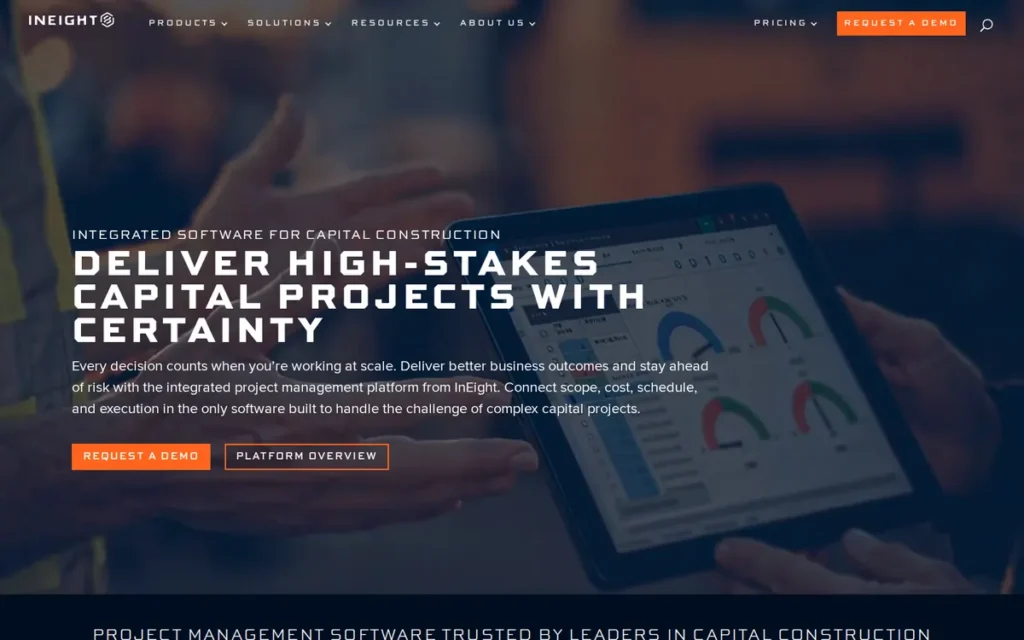
Category: Integrated Capital Controls Platform, a unified suite covering cost estimating, scheduling, field execution, earned value management, and document control in a single connected data environment purpose-built for large capital programs.
Why InEight Ranks #1: InEight earns the top position by scoring highest across all four primary criteria simultaneously. InEight is the only platform in this evaluation combining native EVM, CPM scheduling, and bi-directional ERP integration in a single deployed environment. Its self-reported 850-customer, 575,000-user deployment scale backed by Kiewit Corporation’s capital construction context places it above platforms with higher consumer review ratings but narrower controls depth.
At a Glance
- Category: Integrated Capital Controls Platform
- Best For: EPCs, heavy industrial operators, energy companies, and infrastructure owners managing multi-phase capital programs where integrated cost-schedule-field controls, AI-assisted forecasting, and ERP data reconciliation are organizational requirements
- Price Range: Custom quote only: pricing varies by module, user count, and contract term; no public pricing available as of June 2026
- Primary Strength: InEight provides the most complete integrated capital project controls suite in the evaluated group, connecting estimating, cost, schedule, field, and EVM in a single data environment developed within Kiewit Corporation, one of North America’s largest capital construction organizations
- Biggest Limitation: InEight requires significant organizational investment in implementation, configuration, and training, making it inaccessible for mid-sized programs or teams without established project controls maturity and extended implementation runway
- One-Line Summary: InEight is the integrated capital project controls platform built by Kiewit Corporation, reporting management of more than $1 trillion in global project value across cost, schedule, field execution, and earned value management in a single connected data environment
- Last Verified: June 2026
Overview
InEight is the integrated capital project controls platform developed within and owned by Kiewit Corporation, designed for EPCs, infrastructure owners, and capital-intensive organizations requiring a single connected data environment spanning cost estimating, scheduling, field execution, earned value management, document control, and change management.
InEight reports serving more than 575,000 users across 850 enterprise customers globally, with platform resources documenting deployment across more than $1 trillion in cumulative project value, self-reported metrics from InEight’s platform materials, corroborated contextually by Kiewit Corporation’s public program delivery record but not independently audited (InEight platform resources, 2026).
InEight’s architectural commitment is a unified data model rather than a modular integration requiring middleware. InEight’s single connected data environment is the structural solution to the data silo problem that is capital project management’s most persistent unmet need, and InEight’s unified architecture is the primary reason this platform earns the top position in this evaluation.
Key Features
- Integrated Estimating-to-Cost Pipeline: InEight Estimate flows directly into InEight Cost without manual re-entry, connecting proposal-stage budget data to live cost performance across the project lifecycle, eliminating the estimating-to-cost handoff gap that drives baseline inaccuracy in capital programs from day one (Kiewit InEight overview, 2026).
- AI-Assisted Scheduling: InEight Schedule delivers AI-assisted planning with quantitative risk analysis, collaborative markup, and integrated look-ahead scheduling, going beyond Gantt and CPM to proactively surface schedule risk before delays become cost events at production-verified scale (InEight platform innovations, 2026).
- Time-Phased Cost Forecasting: InEight Cost provides multiple configurable forecasting methodologies (including time-phased forecasting, cost-to-complete (CTC) analysis, resource-based forecasts, and custom methods) enabling project controls teams to model completion scenarios rather than report historical variance after the damage is done (InEight platform innovations, 2026).
- Bi-Directional ERP Integration: InEight provides native bi-directional integration with both SAP and Oracle ERP systems, ensuring cost actuals from enterprise financial systems flow into project controls without manual reconciliation, a structural solution to the most common capital program forecasting error source (InEight Unified Data Environment, 2026).
- Field Data Capture: InEight Field captures on-site production, workforce, equipment, and material data in a mobile-accessible interface, closing the loop between field reality and office-level cost and schedule controls in real time.
Best For
InEight is best for EPCs, large general contractors, energy operators, and infrastructure owners managing multi-phase capital programs above approximately $100 million where integrated cost-schedule-field controls, AI-assisted risk forecasting, and ERP data reconciliation are organizational requirements, not aspirational features on a future roadmap.
Strengths
- InEight reports managing more than $1 trillion in global project value across 850 enterprise customers as of 2026: self-reported scale metrics from InEight’s platform resources, corroborated contextually by Kiewit Corporation’s public program delivery record and reflecting deployment at the highest levels of capital program complexity (InEight platform resources, 2026).
- Bird Construction’s Director of Data Analytics, Daniel Herscovitch, publicly documented InEight’s role in “bringing data together from proposal through construction and into operations” to build the foundation for AI-enabled decision-making, a named, executive-level testimonial demonstrating lifecycle data unification in production, providing data continuity from proposal-stage budget through construction actuals into operations analytics (InEight AI foundation video, 2026).
- InEight’s platform innovation announcements as of 2026 describe AI-assisted planning with quantitative risk analysis and integrated look-ahead scheduling as production-deployed functionality, the most explicitly documented AI scheduling deployment in this evaluated group, based on available published materials from all seven vendors (InEight platform innovations, 2026).
- InEight’s annual Global Capital Projects Outlook survey establishes InEight as an industry data authority, a thought leadership differentiator reflecting the platform’s positioning as a practitioner-built tool with capital construction DNA derived from Kiewit Corporation’s decades of large-scale program delivery (InEight Global Capital Projects Outlook, 2026).
Limitations
InEight’s most consequential trade-off is depth versus accessibility. InEight’s comprehensive integrated architecture requires significant upfront investment in implementation, configuration, and organizational change management, making InEight poorly suited for mid-market capital programs (below approximately $100 million) or teams without established project controls maturity.
A Reddit thread titled “Is InEight Estimating Software Killing Me?” (r/estimators, 2023) signals genuine user frustration with the estimating module’s learning curve, consistent with the complexity profile of a platform built for organizations managing billions in capital programs rather than general-purpose project teams.
Takeaway: InEight Estimate’s learning curve generates documented user frustration, organizations should plan for dedicated module training before go-live and budget a 6–12 month implementation runway before expecting full platform value.
InEight’s modular pricing architecture means organizations must negotiate separate license agreements for each module (Estimate, Cost, Schedule, Field, Document), creating procurement complexity and incremental cost expansion as organizations deepen platform adoption. Organizations should plan for a sequenced module-by-module adoption approach and established project controls specialist resourcing throughout implementation.
Verdict
InEight is the only platform in this evaluation combining native EVM, CPM scheduling, and bi-directional ERP integration in a single connected data environment backed by Kiewit Corporation’s self-reported $1 trillion-plus project portfolio. For EPCs, infrastructure owners, and energy operators managing large-scale capital programs who require unified cost-schedule-field data without middleware-dependent integrations, InEight represents the strongest alignment of platform capability to audience need in this evaluation. Organizations that attempt InEight deployment without established project controls discipline typically experience extended implementation timelines, incomplete module adoption, and cost controls outputs that lag the platform’s capability, consequences that compound rather than resolve the capital program performance problems the software was acquired to address.
2. Procore: Best for Construction Execution, Collaboration, and Field-to-Office Integration
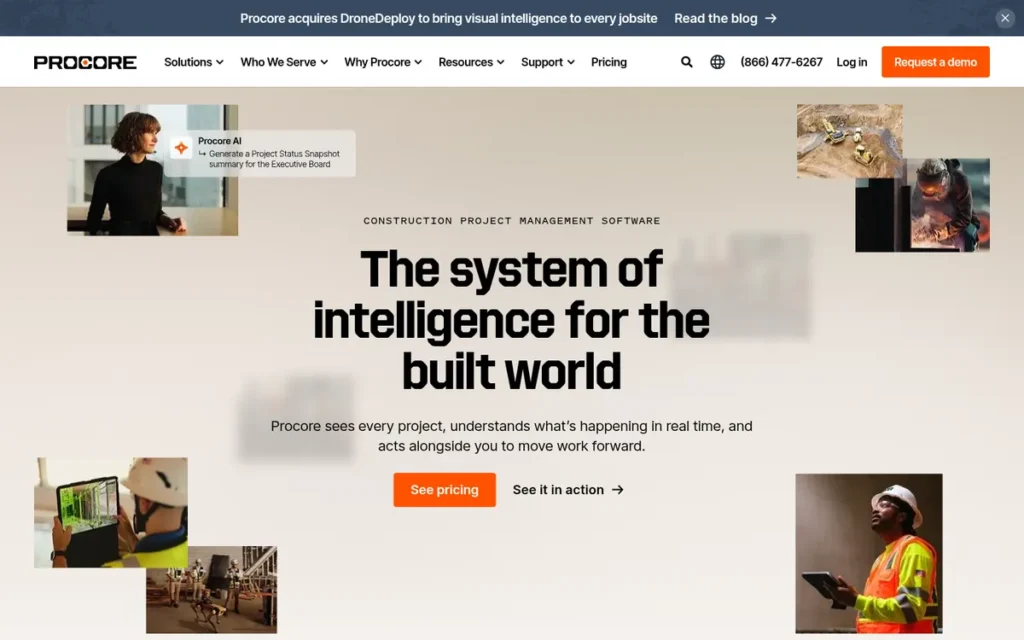
Category: Construction Execution Platform, a field-to-office collaboration and document management suite covering RFIs, submittals, drawings, cost tracking, change management, and owner capital planning across the complete construction project lifecycle.
Why Procore Ranks #2: Procore earns #2 by leading the entire evaluated group on verified user satisfaction (4.7/5 Capterra, the highest in this evaluation), the broadest integration marketplace (250+ connections), and the most quantified customer outcome evidence. Procore ranks below InEight because its native EVM and CPM scheduling capabilities require supplementation with dedicated tools, a structural gap that InEight’s integrated architecture resolves in a single connected environment. Procore’s higher Capterra rating reflects broader contractor-focused adoption satisfaction, not integrated capital controls depth, the criterion weighted highest for this evaluation’s target audience.
At a Glance
- Category: Construction Execution Platform
- Best For: General contractors, construction managers, and owner organizations prioritizing field collaboration, document control, cross-stakeholder coordination, and an open integration ecosystem on construction capital programs
- Price Range: Custom volume-based pricing; third-party estimates: $200,000–$300,000/year at approximately $250 million construction volume; $350,000–$550,000/year at approximately $500 million volume (2026 third-party estimates, not Procore-published figures)
- Primary Strength: Procore delivers the highest verified user satisfaction rating in the capital project management category (4.7/5 Capterra, June 2026) alongside 250+ marketplace integrations and a self-administered customer survey documenting 29% more construction volume per person and 84% better project health visibility
- Biggest Limitation: Procore’s native scheduling capability is limited relative to dedicated CPM platforms like Oracle Primavera P6, requiring most large capital programs to deploy and integrate a separate scheduling tool, adding cost, complexity, and a potential data synchronization gap
- One-Line Summary: Procore is the highest user-rated construction execution and collaboration platform in this evaluation (4.7/5 Capterra, June 2026), with a self-administered customer survey documenting 29% more construction volume per person, 85% better litigation protection, and 84% better project health visibility
- Last Verified: June 2026
Overview
Procore is the cloud-based construction management platform founded in 2002 and publicly traded on NYSE since May 2021 that connects owners, general contractors, specialty contractors, and project stakeholders in a unified collaboration environment covering field execution, document management, cost control, RFI and submittal tracking, and capital planning.
Procore is rated 4.7/5 on Capterra, the highest verified review score among all seven platforms in this evaluation. Procore’s self-administered customer outcomes survey documents a 29% increase in construction volume per person, 84% improvement in project health visibility, and 85% of respondents reporting better protection against claims and litigation (Procore customer outcomes, 2026).
Procore’s Capital Planning and Portfolio Financials modules extend beyond its contractor-execution heritage to serve owner organizations managing budgeting, bidding, change orders, invoice management, and program-level dashboards, connected to 250+ integration partners through an open marketplace (Procore platform overview, 2026).
Key Features
- Capital Planning Module: Procore’s Capital Planning module enables owner organizations to manage capital programs from project inception through closeout, with portfolio-level budget oversight, real-time financial dashboards, and program performance visibility across active and upcoming projects in a single owner-controlled environment (Procore capital planning, 2026).
- Document Management and Audit Trail: Procore’s document management system provides centralized RFI and submittal tracking, drawing version control, and audit-trail documentation, capabilities that 85% of Procore’s self-administered survey respondents report provides better protection against claims and litigation, a high-stakes capability for capital programs with contractual accountability obligations (Procore customer outcomes, 2026).
- Open Integration Marketplace: Procore’s marketplace offers 250+ pre-built connections to ERP, accounting, BIM, scheduling, and HR tools, enabling Procore to function as the connective hub for organizations running Oracle Primavera P6 for scheduling, SAP for financial management, and Autodesk for BIM alongside a single field execution layer (Procore platform overview, 2026).
- Mobile-First Field Execution: Procore’s mobile-first field tools allow on-site crews to capture daily logs, inspections, safety incidents, observations, and punch list items in real time, closing the field-to-office data gap that drives cost and schedule variance in construction capital programs.
- Volume-Based Unlimited-User Pricing: Procore’s volume-based pricing model removes per-seat barriers to broad stakeholder adoption, enabling owner organizations to include subcontractors, inspectors, finance teams, and project executives without incremental licensing costs as programs scale.
Best For
Procore is best for general contractors, construction managers, and owner organizations that prioritize broad stakeholder collaboration, mobile field execution, document control and audit trails, and an open integration ecosystem over deep CPM scheduling or advanced earned value management project controls depth.
Strengths
- Procore’s self-administered customer outcomes survey documents that respondents report 29% more construction volume per person, 84% better project health visibility, and 85% better protection against claims and litigation: the most specific quantified outcome metrics documented across all seven platforms in this evaluation (Procore customer outcomes, 2026).
- Procore’s 4.7/5 rating on Capterra is the highest verified user satisfaction score in the capital project management software category as of June 2026, reflecting broad adoption satisfaction across contractor and owner organizations, a consistently maintained lead over competing platforms (Mastt software comparison, 2026).
- Procore’s 250+ integration marketplace is the broadest ecosystem in the evaluated group, enabling connections to Oracle Primavera P6 for scheduling, SAP and Oracle Financials for ERP, and Autodesk for BIM, making Procore the most integration-extensible platform for organizations running multi-vendor capital program technology stacks (Procore platform overview, 2026).
- Procore’s IPO on NYSE in May 2021 established it as the first major construction-specific SaaS company to enter public markets, signaling financial stability, ongoing R&D investment capacity, and enterprise-grade infrastructure that privately held capital PM software vendors cannot match (BFS Industries blog, 2026).
Limitations
Procore’s most consequential trade-off for capital project directors is scheduling capability. Procore’s native scheduling functionality is explicitly documented as “more limited than dedicated project management software” for large, complex, or portfolio-level programs, which is why most large capital programs run Oracle Primavera P6 alongside Procore, creating an integration dependency, additional licensing cost, and a potential data synchronization gap between the scheduling and execution layers (ProjectManager.com Procore review, 2026).
Procore’s volume-based custom pricing with no public tiers makes total cost of ownership difficult to model without entering a sales engagement, a meaningful friction point for procurement teams with formal budgeting timelines. Procore’s earned value management capabilities are limited compared to dedicated EVM platforms like Hexagon EcoSys or InEight’s cost controls modules, making Procore unsuitable as a standalone project controls solution for programs with contractual EIA-748 compliance requirements.
Procore’s self-administered survey methodology means the 29%, 85%, and 84% outcome figures cannot be independently corroborated, readers should request vendor-supplied reference contacts for direct verification before relying on these figures in procurement justifications.
Users on r/ConstructionManagers noted:
“As the COO of a company specializing in demolition, excavation, and underground wet utilities, I wanted to share some insights from our journey with project management software. A few years ago, we fully embraced Procore, and honestly, it’s been a positive experience. However, as our company expanded, we recognized the need for more comprehensive accounting across our operations. We recently initiated the implementation of Foundation, along with its HR, payroll, and asset tracking features. My main concern, though, is that Procore provides stunning estimates and proposals that are highly customizable.” Posted by u/bread3dollars
Takeaway: Procore’s field execution and estimating strengths earn strong user loyalty in production, but scaling construction companies consistently hit its accounting ceiling and must supplement with deeper ERP or accounting platforms as program complexity grows, precisely the structural limitation this evaluation identifies.
Verdict
Procore is the highest user-rated capital construction platform in 2026, rated 4.7/5 on Capterra with documented outcome metrics from a self-administered survey, and for construction capital programs prioritizing broad stakeholder collaboration, mobile field execution, document control audit trails, and an open integration ecosystem, Procore is the most validated choice in the market. Procore’s primary limitation is project controls depth: its native scheduling and EVM capabilities require augmentation with tools like Oracle Primavera P6 for programs with complex CPM requirements. Organizations choosing the P6-plus-Procore dual-platform approach should budget explicitly for the integration management overhead and data synchronization work that the combination requires, overhead that InEight’s integrated architecture eliminates by design, at the cost of higher implementation complexity.
3. Oracle Primavera P6: Best for Complex Schedule Management and Enterprise Program Planning
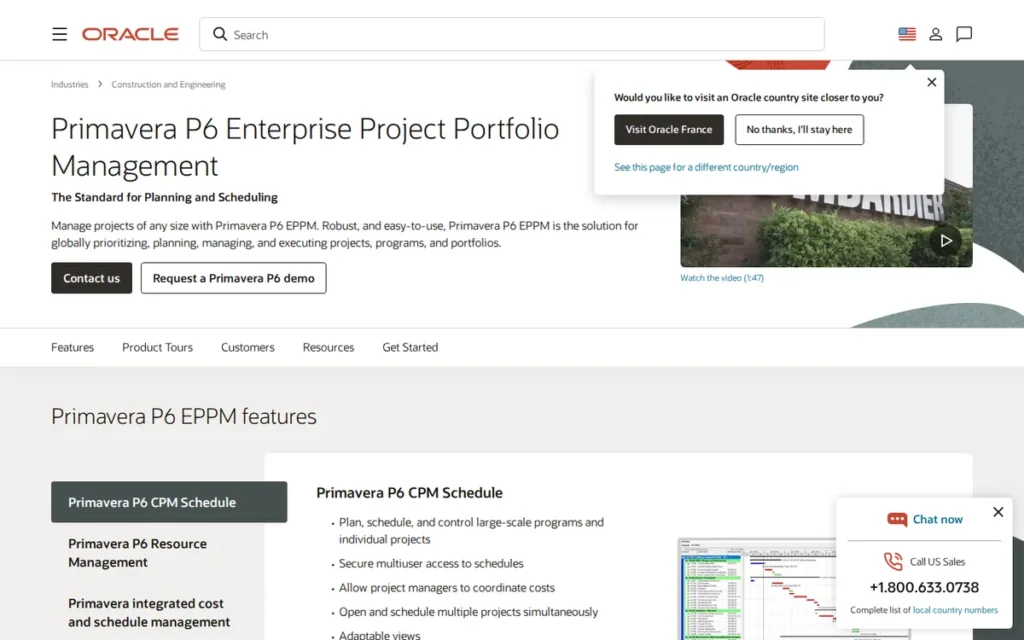
Category: Enterprise Scheduling Platform, a critical path method (CPM) scheduling and enterprise program management system providing scheduling depth, resource optimization, earned value management, and portfolio-level visibility for large capital programs requiring schedule rigor at scale.
Why Oracle Primavera P6 Ranks #3: Oracle Primavera P6 earns #3 as the definitive enterprise scheduling standard, independently ranked by OptimalityPro’s 2026 Capital Project Management Software Guide as the leading enterprise scheduling platform. Oracle Primavera P6 ranks below InEight and Procore because Owner Organization Fit, Integration Architecture breadth, and field collaboration capability score lower than P6’s scheduling excellence. Oracle Primavera P6’s scheduling depth is irreplaceable; its collaboration and cost controls gaps require supplementation.
At a Glance
- Category: Enterprise Scheduling Platform
- Best For: Capital programs requiring deep CPM scheduling rigor, multi-project resource optimization, earned value compliance, or contractual schedule integrity obligations in energy, defense, government, EPC, or infrastructure sectors
- Price Range: P6 Professional: approximately $2,750/user perpetual + $605/user/year support; P6 EPPM Cloud: approximately $125/user/month; P6 Progress Reporter Cloud: approximately $12/user/month; P6 Web Services Cloud: approximately $20/user/month (2026 figures from independent pricing analysis citing Oracle list pricing, actual enterprise pricing reflects negotiated discounts; verify directly with Oracle)
- Primary Strength: Oracle Primavera P6 is the 40-year industry standard for enterprise CPM scheduling, providing the deepest scheduling rigor, multi-project resource leveling precision, and earned value management capabilities available in any commercial capital project platform
- Biggest Limitation: Oracle Primavera P6 Professional’s aging desktop interface, documented talent scarcity, and steep learning curve create significant organizational risk and ongoing human capital dependency for programs that adopt it as their scheduling system of record
- One-Line Summary: Oracle Primavera P6 is the 40-year industry standard for enterprise capital project scheduling, rated 4.3/5 on Capterra, providing resource leveling precision and earned value management capabilities at the 10,000-to-100,000-plus activity scale that no general-purpose project management platform can match
- Last Verified: June 2026
Overview
Oracle Primavera P6 is the enterprise-standard critical path method scheduling and program management platform (developed by Primavera Systems beginning in 1983 and acquired by Oracle in October 2008 for approximately $300 million) serving as the scheduling system of record for capital programs in energy, infrastructure, defense, government, petrochemicals, and EPC environments globally (ProjectManager.com Primavera P6 review, 2026).
Oracle Primavera P6 is available in two primary variants: P6 Professional, a desktop application for detailed single-project scheduling depth, and P6 EPPM, a web-based enterprise system for portfolio-level dashboards and centralized resource optimization, each a distinct buying decision with separate pricing tiers and deployment requirements.
Oracle extends the Primavera suite with Primavera Unifier (capital program administration and cost management) and Primavera Cloud (a cloud-native successor platform), together forming a full Oracle-native capital management stack for organizations committed to the Oracle ecosystem (Oracle Primavera product pages, 2026).
Key Features
- Resource Leveling Engine: Oracle Primavera P6’s resource leveling engine provides project-level and activity-level prioritization (including total float analysis and critical path protection) that automatically resolves resource over-allocations while protecting the critical path, enabling schedule management precision for programs with thousands of activities and hundreds of resources simultaneously in contention (Oracle Help documentation, 2026).
- P6 EPPM Portfolio Management: Oracle Primavera P6 EPPM provides portfolio-level visibility through centralized dashboards, enterprise resource optimization across multi-project environments, and real-time collaboration that enables PMO-level program oversight without requiring individual P6 Professional desktop access for all stakeholders (ProjectManager.com Primavera P6 review, 2026).
- Earned Value Management: Oracle Primavera P6 supports EVM calculations including cost performance index (CPI) and schedule performance index (SPI), with integration into Primavera Unifier for capital program cost control and Oracle ERP for enterprise financial reporting (ProjectManager.com Primavera P6 review, 2026).
- Full Oracle Suite Integration: Oracle’s complete Primavera suite: P6 Professional, P6 EPPM, Primavera Unifier, and Primavera Cloud, provides a vertically integrated capital management stack for Oracle-centric enterprises, enabling tight data flows between scheduling, cost administration, and financial reporting without third-party middleware (Oracle Primavera product pages, 2026).
- Mega-Program Scale Capacity: Oracle Primavera P6’s scheduling architecture supports programs with 10,000 to 100,000 or more activities across energy, petrochemical, defense, and infrastructure environments, a scale at which Oracle Primavera P6 faces no well-documented commercial standalone scheduling alternative of comparable global adoption, based on available independent research as of June 2026 (ScheduleReader resource management guide, 2026).
Best For
Oracle Primavera P6 is best for capital programs in energy, defense, government, EPC, and heavy infrastructure where deep CPM scheduling rigor, multi-project resource optimization, and earned value management are contractual or regulatory requirements, and where organizations have or plan to develop in-house P6 scheduling expertise to sustain the platform’s depth.
Strengths
- Oracle Primavera P6 was independently ranked in OptimalityPro’s 2026 Capital Project Management Software Guide as the leading enterprise scheduling platform: validating four decades of adoption across capital-intensive industries including energy, EPC, defense, and infrastructure, reflecting a market position sustained through demonstrated scheduling capability rather than marketing (OptimalityPro 2026 Guide).
- Oracle Primavera P6’s documented pricing data: approximately $2,750/user perpetual plus $605/year support, or approximately $125/user/month for P6 EPPM Cloud as of 2026, per independent pricing analysis citing Oracle list pricing, makes Oracle Primavera P6 the most price-transparent enterprise capital project platform in this evaluation, enabling procurement teams to model total cost of ownership scenarios before engaging Oracle’s sales team (ProjectManager.com Primavera P6 pricing, 2026).
- Oracle Primavera P6 is contractually mandated on many government, defense, and large infrastructure programs, a unique market position documented in the active Reddit thread “Why is it so hard to find applicants with P6?” (r/primavera, 2024), which reveals that P6 proficiency is a career credential reflecting contractual adoption at scale.
Takeaway: P6 talent scarcity is an active, documented labor market problem, organizations adopting Oracle Primavera P6 should budget for premium salaries for certified schedulers and plan for talent dependency as a long-term organizational risk alongside the licensing investment.
- Oracle Primavera P6’s resource leveling engine: supporting complex activity-level prioritization across multi-project portfolios with 10,000-to-100,000-plus activities, provides scheduling precision at a scale that no general-purpose PM platform or construction execution tool can replicate (ScheduleReader resource management guide, 2026).
Limitations
Oracle Primavera P6’s most consequential trade-off is the gap between scheduling power and organizational accessibility. Oracle Primavera P6 Professional’s steep learning curve is documented consistently across independent reviews, and P6-certified professionals are scarce enough to generate an active Reddit thread asking “Why is it so hard to find applicants with P6?” (r/primavera, 2024), creating institutional dependency on a rare and expensive specialization that adds organizational risk to any program adopting Oracle Primavera P6 as its scheduling standard.
Oracle Primavera P6’s collaboration and mobile field capabilities are significantly weaker than modern SaaS alternatives, driving most capital programs to deploy Procore or a similar field platform alongside Oracle Primavera P6, which reintroduces the data silos that integrated platforms like InEight are designed to eliminate.
Organizations evaluating migration from P6 Professional to Primavera Cloud face a complex, potentially disruptive transition: the cloud-native successor is architecturally different from the legacy desktop environment, and this migration must be planned as a distinct program investment with its own budget and timeline rather than a routine software upgrade (ProjectManager.com Primavera P6 review, 2026).
Verdict
Oracle Primavera P6 is the scheduling standard that capital programs supplement, not replace, when they add field collaboration tools like Procore or integrated cost controls like InEight, because no competing platform provides equivalent CPM precision at the 10,000-to-100,000-plus activity scale. For organizations where CPM precision, multi-project resource optimization, and earned value management are non-negotiable, particularly in defense, energy, and government capital programs where Oracle Primavera P6 may be contractually mandated, it remains the most defensible scheduling system of record in the market. Most large capital programs run Oracle Primavera P6 alongside Procore for field collaboration and InEight or Hexagon EcoSys for integrated cost controls, evidence that Oracle Primavera P6’s scheduling depth remains irreplaceable even as its functional gaps require supplementation.
4. e-Builder by Trimble: Best for Institutional and Government Owner Capital Program Management
Category: Owner-Side PMIS, a capital program management information system purpose-built for institutional owners, government agencies, and program managers governing large capital improvement programs from planning and design through procurement, construction, and closeout.
Why e-Builder by Trimble Ranks #4: e-Builder by Trimble earns #4 because it provides the strongest independently verified deployment evidence in this evaluation, three separately documented public-sector deployments with official government and university documentation. e-Builder by Trimble ranks below the top three because its ERP and BIM integration complexity, documented as not plug-and-play by independent analysts, scores lower on Integration Architecture, and its institutional owner scope limits applicability across the full target audience.
At a Glance
- Category: Owner-Side PMIS
- Best For: State and local government agencies, universities, hospital systems, transit authorities, and airport authorities managing large capital improvement programs where audit trails, approval workflows, fund source tracking, and stakeholder reporting are primary governance requirements
- Price Range: Custom pricing; third-party estimates: $500–$1,000/month for smaller programs; $10,000–$15,000/month for enterprise deployments (2026 third-party estimates, not Trimble-published figures)
- Primary Strength: e-Builder by Trimble provides the deepest owner-side capital program workflow automation in the evaluated group, with 30 years of institutional program management domain knowledge and independently verified deployments at Georgia’s State Financing and Investment Commission, the University of Nebraska, and Rutgers University
- Biggest Limitation: e-Builder by Trimble’s ERP and BIM integrations are documented by independent analysts as not plug-and-play, requiring custom API configuration that adds cost and timeline to implementations already characterized by a 3–6 month user learning curve
- One-Line Summary: e-Builder by Trimble is the institutional owner capital program management platform with 30 years of government and higher-education deployment history, independently verified by active deployments at Georgia’s State Financing and Investment Commission, the University of Nebraska, and Rutgers University
- Last Verified: June 2026
Overview
e-Builder by Trimble is the capital program management information system built specifically for institutional owners (government agencies, municipalities, universities, hospitals, and transportation authorities) managing large capital improvement programs from planning, design, and procurement through construction and closeout.
e-Builder by Trimble was founded in 1995 and acquired by Trimble in February 2018 (Trimble acquisition announcement, 2018). e-Builder by Trimble’s owner-centric architecture separates budget governance, fund-source tracking, and approval workflows from field-crew coordination, making it purpose-built for public agency capital programs rather than contractor operations.
e-Builder by Trimble is rated 4.3/5 on Software Advice across 418 verified reviews, covering capital planning, cost management, approval workflow automation, document management, reporting dashboards, and bid management capabilities (Software Advice e-Builder profile, 2026).
Key Features
- Approval Workflow Automation: e-Builder by Trimble’s workflow automation digitizes owner-side capital program processes (budget approvals, design review cycles, contract award authorization, and change order approvals) providing an audit-ready documentation trail across multi-stakeholder programs with regulatory or fiduciary oversight requirements (Trimble e-Builder enterprise overview, 2026).
- Owner-Side Cost Management: e-Builder by Trimble’s cost management module tracks commitments, contracts, change orders, and invoices from capital budget authorization through final closeout, giving owners real-time budget health visibility without dependence on contractor-reported data that may lag or mischaracterize actual cost status.
- Multi-Year Capital Planning: e-Builder by Trimble’s capital planning tools enable owners to model, prioritize, and govern multi-year capital improvement programs across overlapping project portfolios, managing program-level budget allocations before individual projects are authorized and funded.
- Document Control and Audit Trail: e-Builder by Trimble provides centralized document management and version control across design packages, specifications, correspondence, and RFIs, satisfying the audit trail requirements of public-sector and institutional capital programs with legislative or regulatory oversight (University of Nebraska Facilities Planning, 2026).
- Stakeholder Reporting and Dashboards: e-Builder by Trimble’s reporting capabilities aggregate program performance data across active projects into stakeholder-ready outputs, enabling capital program directors to report to boards, legislatures, bond rating agencies, and regulators without manual data assembly from disconnected project systems (Georgia GSFIC official page, 2026).
Best For
e-Builder by Trimble is best for state and local government agencies, universities, hospital systems, transit authorities, and airport authorities that function as capital program owners (governing programs executed by contractors) where audit trail requirements, multi-year fund source tracking, approval workflow automation, and stakeholder reporting are primary governance needs rather than contractor field execution or deep CPM scheduling depth.
Strengths
The following three institutional deployments represent the highest-independence evidence tier available for capital project software procurement, official government and university department documentation with named institutional contacts:
- Georgia’s State Financing and Investment Commission (GSFIC) maintains an official state government page documenting e-Builder by Trimble as its enterprise construction project management system, describing the platform as helping owner organizations “increase productivity, accountability, and profitability by providing real-time project data”, a government-verified endorsement with the strongest independent credibility signal available in capital PM software procurement (Georgia GSFIC official page, 2026).
- The University of Nebraska’s official Facilities Planning and Capital Programs department page lists e-Builder by Trimble as its standard institutional platform, describing it as providing “a central repository of project information, streamlined communications and processes, standardized workflows, extensive reporting, and project planning”, a publicly documented institutional deployment with five specific value propositions (University of Nebraska Facilities Planning, 2026).
- Rutgers University’s Jerry Thomas (Institutional Planning and Operations) stated in published documentation that e-Builder by Trimble “is faster than AiM especially when uploading documents and creating project budget analysis” and that “everything users need is the click of a button away”, a named institutional staff testimonial providing comparative evidence of operational improvement over a prior IWMS platform (Rutgers IPO article, 2026).
- e-Builder by Trimble’s 30-year continuous focus on institutional owner capital program workflows (founded 1995, three decades of domain knowledge accumulation) represents institutional depth that general-purpose PM platforms or recently pivoted contractor tools cannot replicate through product investment alone (Mastt e-Builder glossary, 2026).
Limitations
e-Builder by Trimble’s most consequential trade-off is integration accessibility. ERP and BIM integrations are documented by independent analysts as not plug-and-play, requiring custom API configuration that adds cost, timeline, and technical complexity to implementations that already carry a 3–6 month user learning curve (Mastt e-Builder glossary, 2026; Nova-Mind analysis, 2026).
e-Builder by Trimble is explicitly not suited for contractors or small job sites, organizations managing primarily contractor-side execution workflows should evaluate Procore or Autodesk Build instead, as e-Builder by Trimble’s owner governance depth is a mismatch for crew coordination and subcontractor management use cases.
The enterprise implementation cost (estimated at $10,000–$15,000/month for large programs plus substantial configuration investment) may also exclude smaller municipalities or school districts with limited capital program administration budgets. Organizations should plan for a full program management investment to deploy and sustain e-Builder by Trimble effectively.
Verdict
e-Builder by Trimble is the most independently verified institutional owner capital program platform in the 2026 market, with documented public-sector deployments at Georgia’s State Financing and Investment Commission, the University of Nebraska, and Rutgers University, evidence that government agencies and institutional owners have repeatedly selected, implemented, and publicly endorsed this platform for programs where audit trails, fund governance, and approval workflow automation are primary requirements. For capital project directors in government agencies, universities, hospitals, and transit authorities, e-Builder by Trimble deserves priority evaluation over platforms built for contractor execution. Organizations requiring tight connections to SAP, Oracle Financials, or BIM environments should prototype those integration paths before contract signature, as these connections require custom development rather than configuration-based setup.
5. Hexagon EcoSys: Best for Enterprise Earned Value Management and Cost Controls Compliance
Category: EVM and Cost Controls Engine, a project controls and earned value management platform that integrates ERP financial actuals and CPM scheduling data to provide portfolio-wide cost performance measurement, EIA-748-compliant earned value, and advanced schedule performance analytics for large capital programs.
Why Hexagon EcoSys Ranks #5: Hexagon EcoSys earns #5 as the only platform evaluated with documented EIA-748 federal EVMS compliance credentials. Hexagon EcoSys ranks #5 rather than higher because it has no publicly verified review platform rating, limited publicly available customer deployment evidence with measurable outcomes, and a narrow buyer profile limited to organizations with pre-existing EVM organizational maturity.
At a Glance
- Category: EVM and Cost Controls Engine
- Best For: Project controls specialists, cost engineers, and capital program directors at defense contractors, energy companies, and large federal infrastructure programs with EIA-748 earned value compliance requirements or mature portfolio-level cost control programs
- Price Range: Custom enterprise pricing only: no public pricing available as of June 2026; implementation and integration services represent significant additional investment
- Primary Strength: Hexagon EcoSys provides best-in-class earned value management with EIA-748 compliance, native Earned Schedule Management, and a unique architectural role connecting ERP actuals and CPM scheduling data, capabilities that no other platform in this evaluation can match for project controls specialists with federal compliance requirements
- Biggest Limitation: Hexagon EcoSys requires pre-existing organizational maturity in earned value management (including established WBS discipline, progress measurement methodology, and data governance practices) before it can deliver value; organizations without this foundation will find EcoSys over-engineered relative to its implementation cost
- One-Line Summary: Hexagon EcoSys is the enterprise project controls and EVM platform founded by the original Primavera Systems team, providing EIA-748-compliant earned value management, native Earned Schedule Management, and ERP-to-scheduling data integration for capital programs requiring the highest level of cost controls rigor and federal compliance credentials
- Last Verified: June 2026
Overview
Hexagon EcoSys is the enterprise project controls and earned value management platform founded in 2006 by alumni of the Primavera Systems team (the same organization that created Oracle Primavera P6) now part of Hexagon’s Asset Lifecycle Intelligence division.
Hexagon EcoSys sits between scheduling engines such as Oracle Primavera P6 and ERP systems including SAP, Oracle, JD Edwards, and Baan, functioning as a project controls integration layer rather than a standalone replacement for any single platform. A common evaluation mistake is treating Hexagon EcoSys as a replacement for Oracle Primavera P6, Hexagon EcoSys is not designed to be. Organizations that already run Oracle Primavera P6 and an ERP system should evaluate Hexagon EcoSys as an integration layer, not as a P6 competitor.
Hexagon EcoSys occupies the technical project controls layer where cost, schedule, and ERP actuals converge for programs with federal EVM compliance obligations, a specialized role that no general project management platform claims with equivalent documented EVM depth (Hexagon AACE presentation, 2026).
Key Features
- EIA-748 Compliance: Hexagon EcoSys provides EIA-748 earned value management system standard compliance (documented in Hexagon’s AACE International materials) meeting the U.S. government’s contractual EVMS requirements, including control account-level budget management and IPMR reporting requirements for programs subject to DCMA surveillance (Hexagon EcoSys EVM resource, 2026).
- Earned Schedule Management: Hexagon EcoSys supports Earned Schedule Management (ESM), the advanced project controls technique that uses time units rather than cost units to analyze schedule performance, detecting actual completion date delays that traditional earned value cost metrics can mask during periods of cost recovery that do not reflect schedule recovery (Hexagon Earned Schedule resource, 2026).
- ERP-to-Scheduling Integration: Hexagon EcoSys serves as the connective tissue between ERP systems (SAP, Oracle, JD Edwards, Baan) where financial actuals live and scheduling systems such as Oracle Primavera P6 where schedule data lives, eliminating the manual cost-schedule-ERP reconciliation burden without requiring organizations to replace either existing system (Hexagon AACE presentation, 2026).
- Portfolio-Wide EVM Analytics: Hexagon EcoSys provides portfolio-wide earned value analytics at the program level, enabling capital program directors to aggregate cost performance index (CPI), schedule performance index (SPI), and completion forecasts across multi-project programs in a single consolidated performance view (Hexagon EcoSys EPC overview demonstration, 2026).
- Change Management Integration: Hexagon EcoSys’s change management integration tracks approved baseline changes and their cost and schedule impacts through the WBS structure, maintaining budget control integrity across programs where scope changes are frequent and each change must be traceable for government audit or contractual change control purposes.
Best For
Hexagon EcoSys is best for project controls specialists, cost engineers, and capital program directors at defense contractors, energy companies, petrochemical operators, and large federal infrastructure programs where EIA-748 earned value compliance is contractually required, existing SAP or Oracle ERP and Primavera P6 systems need to be connected without replacement, and organizational project controls maturity is high enough to sustain a sophisticated EVM deployment.
Strengths
- Hexagon EcoSys provides EIA-748 earned value management system standard compliance (documented in Hexagon’s AACE International conference materials) making Hexagon EcoSys one of the only commercial platforms that explicitly meets the U.S. government’s contractual EVM requirements for defense and large federal capital programs, where non-compliance is disqualifying regardless of other platform capabilities (Hexagon AACE presentation, 2026).
- Hexagon EcoSys’s Earned Schedule Management (ESM) capability, documentedin Hexagon’s published resources as “a powerful enhancement to EVM,” provides schedule performance analysis in time units rather than cost units, detecting actual schedule delays that traditional earned value cost metrics can mask when a program is recovering costs but not recovering schedule (Hexagon Earned Schedule resource, 2026).
- Crown Castle, one of the largest telecommunications infrastructure owners in the United States, is referenced as an EcoSys customer in Hexagon’s platform resources for capital program forecasting applications, though specific outcome metrics from this deployment were not publicly available at the time of this evaluation (Hexagon EcoSys EPC overview demonstration, 2026).
- Hexagon EcoSys was founded in 2006 by the team that originally developed Oracle Primavera, giving Hexagon EcoSys deep CPM scheduling integration DNA and EVM architecture from inception rather than retrofitting EVM capabilities onto a general project management framework not designed for it (Pinnacle Management EVMS overview, 2026).
Limitations
Hexagon EcoSys’s most consequential trade-off is organizational prerequisite. Hexagon’s own materials acknowledge that successful EcoSys implementation requires “a robust Earned Value Management System” already in place, meaning Hexagon EcoSys amplifies existing EVM maturity rather than introduces it to organizations new to the discipline (Hexagon EcoSys EVM resource, 2026).
Hexagon EcoSys has no publicly listed G2 or Capterra review rating, its user base engages through professional associations (AACE International, PMI) rather than consumer review platforms, limiting the independent third-party sentiment data available for procurement teams accustomed to validating software through community review channels.
Hexagon EcoSys also lacks a dedicated mobile field data capture module, Hexagon EcoSys is an office-side project controls platform requiring field progress data to flow in from connected ERP or scheduling systems rather than direct field-to-EcoSys entry, creating a companion-tool dependency for programs with active construction field operations. Hexagon EcoSys delivers maximum value to organizations that arrive at implementation with established project controls maturity, and minimal measurable value to organizations that expect the platform to establish that maturity for them.
Verdict
Hexagon EcoSys is the definitive earned value management platform for capital programs with EIA-748 compliance requirements and mature project controls organizations, providing EVM depth, Earned Schedule Management, and ERP-to-scheduling integration that no general PM platform in this category can match. For defense contractors, federal infrastructure programs, and energy operators where compliance and controls rigor are non-negotiable, Hexagon EcoSys occupies a market position with no credible competitor at equivalent documented EVM depth. Hexagon EcoSys is a capability amplifier, not a capability builder, it requires established WBS discipline, data governance, and EVM measurement practices before deployment can succeed, and organizations that skip those prerequisites will find the implementation cost disproportionate to the value realized.
6. Kahua: Best for Public Sector Owner Program Governance and Multi-Organization Collaboration
Category: Configurable Capital Program PMIS, a project management information system with low-code configuration, multi-organization collaboration, government-grade audit trail capabilities, and fund source tracking for owner organizations governing capital improvement programs.
Why Kahua Ranks #6: Kahua earns #6 on the strength of its GSA federal PMIS designation, the strongest government procurement credential in this evaluated group. Kahua ranks below e-Builder by Trimble because e-Builder provides substantially deeper independently verified deployment evidence, a larger verified user review base (418 Software Advice reviews versus Kahua’s unverified estimated rating), and a 30-year institutional track record versus Kahua’s smaller market footprint.
At a Glance
- Category: Configurable Capital Program PMIS
- Best For: Federal, state, and local government agencies, healthcare systems, and educational institutions serving as capital program owners that require a configurable, multi-organization PMIS with government procurement credentials, fund source tracking, and FedRAMP-eligible cloud deployment
- Price Range: Custom quote only: no public pricing available as of June 2026
- Primary Strength: Kahua is the only platform in this evaluation officially designated by the U.S. General Services Administration as the federal government’s PMIS for capital projects, providing government-credentialed multi-organization collaboration with audit-ready cost history and fund source tracking
- Biggest Limitation: Kahua’s configurability: its primary differentiator, also creates its primary challenge: steep learning curve, customization complexity, and integration hurdles documented by implementation partners, reflected in community-level skepticism about Kahua’s competitive positioning relative to larger platforms
- One-Line Summary: Kahua is the GSA-designated federal capital project PMIS, providing configurable multi-organization collaboration, audit-ready cost history, and fund source tracking for government and institutional owner organizations governing large capital improvement programs
- Last Verified: June 2026
Overview
Kahua is the cloud-based capital program and construction management PMIS designated by the U.S. General Services Administration as the official Project Management Information System for federal government capital projects in federally owned or leased space, covering project agreements, RFIs, schedules, design reviews, and punch lists across the GSA’s federal real property portfolio (GSA PMIS page, 2026).
Kahua’s patented multi-organization collaboration model allows owners, program managers, designers, contractors, and subcontractors to share project data in a single environment, with configurable low-code architecture and an asset-centric data model that captures project information through design and construction phases for digital handover to operations at closeout (Kahua platform homepage, 2026).
Kahua provides audit-ready cost history and fund source tracking explicitly designed for public-sector capital programs funded by bonds, grants, and appropriations, programs where each funding source carries distinct reporting requirements and compliance obligations to auditors and elected oversight bodies, as documented in Kahua’s owner solution resources (Kahua vs. Procore resource, 2026).
Key Features
- GSA PMIS Designation: Kahua’s GSA-designated PMIS status enables federal agency procurement with documented government security, compliance, and workflow compatibility, a procurement credential that eliminates a key evaluation barrier for federal capital program managers subject to FedRAMP and federal acquisition requirements (GSA PMIS page, 2026).
- Low-Code Configuration Engine: Kahua’s low-code platform enables capital program managers to define custom workflows, approval processes, and reporting structures without software development resources, adapting the platform to organization-specific governance frameworks rather than forcing organizations to adapt to preset workflow defaults (Kahua platform homepage, 2026).
- Patented Multi-Organization Collaboration: Kahua’s patented collaboration architecture enables owners, program managers, designers, contractors, and subcontractors to share structured project data in a single environment with role-based access controls and audit-ready transaction histories satisfying public-sector accountability requirements (Onindus Kahua overview, 2026).
- Fund Source Tracking: Kahua’s fund source tracking and audit-ready cost history provide public-sector owners with financial documentation capability required for programs funded by bonds, grants, levies, and appropriations, where each source has distinct reporting requirements and compliance obligations to auditors and elected oversight bodies (Kahua vs. Procore resource, 2026).
- Asset-Centric Data Model: Kahua’s asset-centric data model collects structured information during planning, design, and construction for streamlined digital handover to operations systems at project closeout, reducing the manual data re-entry burden that causes information loss and integrity gaps when capital programs transition from active construction to operational asset management (Kahua platform homepage, 2026).
Best For
Kahua is best for federal government agencies, state and local government program offices, healthcare systems, and educational institutions that function as capital program owners requiring a government-credentialed, configurable PMIS with multi-organization collaboration, audit-ready fund source tracking, and FedRAMP-eligible cloud deployment, particularly programs that must satisfy federal or institutional oversight requirements on fund allocation and multi-party change order approvals.
Strengths
- The U.S. General Services Administration officially designates Kahua as its Project Management Information System for federal capital projects in federally owned or leased space: documented on the official GSA Real Estate project management page, covering project agreements, RFIs, schedules, design reviews, and punch lists, making Kahua the only platform in this evaluation with an active federal government designation as its primary capital PMIS (GSA PMIS page, 2026).
- Kahua’s audit-ready cost history and fund source tracking capabilities are explicitly designed for public-sector capital programs that must document bond, grant, appropriation, and levy fund allocation and expenditure trails, capabilities that contractor-focused platforms like Procore do not address as core architectural features (Kahua vs. Procore resource, 2026).
- Kahua’s asset-centric data model addresses the project closeout data gap by collecting structured project information during planning, design, and construction for digital handover to operations systems, reducing the manual re-entry effort that causes information loss and integrity gaps when capital programs transition to operational asset management (Kahua platform homepage, 2026).
- Kahua’s FedRAMP-eligible government deployment characteristics: a separate security authorization credential from its GSA PMIS designation, provide a federal procurement pathway that many commercial SaaS platforms cannot offer without custom security assessment processes, removing a procurement barrier that is disqualifying for federal capital program software evaluation (Kahua Owners page, 2026).
Limitations
Kahua’s most consequential trade-off is the relationship between configurability and complexity. Kahua’s low-code configuration capability (which enables organizations to define custom workflows and approval processes) also produces steep learning curves, customization complexity, and integration hurdles that Kahua’s own implementation partner Onindus publicly documents (Onindus Kahua overview, 2026).
A Reddit thread titled “How tf is Kahua still around?” (r/ConstructionManagers, 2025) reflects community skepticism about Kahua’s competitive positioning relative to larger platforms, likely reflecting its narrower market footprint, smaller partner ecosystem, and lower community visibility compared to Procore or Oracle Primavera.
Takeaway: Kahua’s community skepticism warrants structured reference validation, specifically, direct conversations with current Kahua government customers asking about long-term vendor support, roadmap commitment, and implementation partner availability before procurement commitment.
Kahua’s organizational background (founding year, team size, and ownership structure) was not independently verified through publicly available sources in this evaluation, reflecting Kahua’s lower public profile relative to publicly traded competitors or those with named corporate parents. Buyers should request company background documentation during the procurement process.
Verdict
Kahua is the federal government’s officially designated capital project PMIS, and for public-sector agencies, federal programs, and government-adjacent institutional owners where procurement credentials, multi-source fund tracking, multi-organization collaboration, and audit-ready cost histories are primary requirements, Kahua represents a uniquely credentialed alternative to more broadly marketed platforms. Prospective buyers should investigate Kahua’s community skepticism through structured reference conversations with current government customers before committing, the platform’s GSA designation is genuine, but its smaller market footprint and implementation complexity are real evaluation factors. For institutional owners who prioritize implementation depth and a broader government reference network over configurability, e-Builder by Trimble may offer a more established deployment track record.
7. SAP Project System: Best for SAP ERP-Native Capital Program Accounting and CAPEX Management
Category: ERP-Native Project Accounting Module, an embedded SAP module that manages CAPEX projects as cost objects within SAP’s Controlling (CO) framework, providing WBS-based cost planning, budget overspend controls, settlement rules, and automatic asset capitalization for organizations running SAP ERP or S/4HANA.
Why SAP Project System Ranks #7: SAP Project System earns #7 because it is not a standalone capital project management platform, SAP Project System requires SAP ERP infrastructure to function, carries the lowest approximate community rating in this evaluation (~4.2/5, indicative from discovery research rather than a verified G2 listing), and is applicable exclusively to organizations already committed to the SAP ecosystem. SAP Project System’s ranking reflects applicability for the broad target audience, not functional limitation within its designed context.
At a Glance
- Category: ERP-Native Project Accounting Module
- Best For: Organizations already running SAP ERP or S/4HANA that manage CAPEX programs and need project costs to integrate natively with SAP Financial Accounting, Controlling, and Asset Accounting, without deploying a separate capital project management platform
- Price Range: Included in SAP ERP and S/4HANA enterprise licensing: no standalone license available; total cost reflects existing SAP enterprise agreement scope and implementation fees
- Primary Strength: SAP Project System provides native ERP integration that eliminates capital project cost-accounting data silos by design, project actuals flow directly into SAP Financial Accounting (FI), Controlling (CO), and Asset Accounting without middleware, making it the only capital project module in this evaluation that resolves the ERP reconciliation problem structurally for SAP organizations
- Biggest Limitation: SAP Project System carries the lowest approximate community rating in this evaluation (~4.2/5, indicative), requires existing SAP ERP infrastructure to function, demands specialized SAP PS consultants for implementation, and provides a poor user experience compared to modern SaaS capital PM tools
- One-Line Summary: SAP Project System is the ERP-native CAPEX accounting module embedded in SAP ERP and S/4HANA, providing WBS-based cost tracking, budget control, and automatic CAPEX-to-asset capitalization for SAP-committed organizations that prioritize ERP financial data integrity over standalone project management features
- Last Verified: June 2026
Overview
SAP Project System (SAP PS) is the project management and CAPEX accounting module natively embedded within SAP ERP (ECC) and SAP S/4HANA, treating capital projects as cost objects within SAP’s Controlling (CO) framework to enable project budgets, actuals, and CAPEX settlements to flow directly into SAP’s enterprise financial reporting without data transfer, integration middleware, or manual reconciliation.
SAP PS uses Work Breakdown Structures (WBS) as cost objects within SAP Controlling (CO), enabling automatic CAPEX-to-fixed-asset capitalization through settlement rules, a depth of financial integration unavailable in purpose-built capital project platforms that do not share SAP’s chart of accounts (SuretySystems SAP PS overview, 2026).
SAP Project System has been part of the SAP application suite since early SAP R/3 versions in the 1990s. SAP Project System is among the most broadly installed enterprise project accounting modules globally by SAP ERP’s cumulative installed base, though specific SAP PS adoption statistics within the total SAP customer base are not independently published by SAP (SAP PS module documentation, 2026). SAP PS carries an approximate community rating in the range of 4.2/5 based on discovery research analysis rather than a verified current G2 review listing, readers should confirm the current rating at g2.com before citing this figure in formal procurement evaluations.
Key Features
- WBS as SAP Cost Object: SAP PS’s Work Breakdown Structure (WBS) enables hierarchical CAPEX project decomposition where each WBS element becomes a cost object in SAP Controlling, allowing project costs to flow into SAP’s cost center, profit center, and business area reporting without manual data transfer or reclassification (RapidViews SAP PS overview, 2026).
- Automatic Settlement Rules: SAP PS’s settlement rules automatically transfer completed project costs to SAP Asset Accounting, fixed assets, cost centers, or other Controlling receivers, triggering CAPEX-to-asset capitalization that eliminates a major post-project accounting process and ensures compliance with fixed asset accounting standards in regulated industries (SAP Help documentation, 2026).
- WBS-Level Budget Controls: SAP PS’s budget management module enables WBS-element-level budget assignment with hard overspend controls, preventing unauthorized budget overruns at the project activity level, a governance capability critical for capital programs with board-level budget authority thresholds and strict financial control mandates (RapidViews SAP PS overview, 2026).
- Native SAP Procurement Integration: SAP PS integrates natively with SAP Procurement (MM) for materials and services purchasing directly from project networks, ensuring that project-related purchase orders, goods receipts, and invoices are automatically attributed to the correct WBS elements without reclassification by the finance team (SuretySystems SAP PS overview, 2026).
- SAP PPM Portfolio Governance: SAP Portfolio and Project Management (SAP PPM) provides portfolio intake, prioritization, and strategic governance at the capital investment program level, enabling organizations to manage the capital authorization process in SAP before individual projects are approved and executed in SAP PS (SuretySystems SAP PS overview, 2026).
Best For
SAP Project System is best for organizations already running SAP ERP or S/4HANA that manage CAPEX investment programs and require project costs to integrate natively with SAP Financial Accounting, Controlling, Asset Accounting, and Procurement, particularly manufacturing, utilities, energy, and industrial organizations where SAP is the established enterprise standard and ERP data integrity is the primary financial governance requirement.
Strengths
- SAP Project System eliminates the ERP-project data reconciliation problem structurally rather than through integration: project actuals in SAP PS are the same data objects as actuals in SAP Financial Accounting (FI) and Controlling (CO), removing the manual reconciliation burden that drives forecasting inaccuracy in capital programs running separate PM and ERP systems on different data models (SuretySystems SAP PS overview, 2026).
- SAP PS’s automatic settlement rule functionality: transferring project costs to SAP fixed assets at project completion and triggering CAPEX-to-asset capitalization in SAP Asset Accounting, automates a major post-project accounting process that typically requires significant manual effort in organizations using standalone PM platforms alongside separate ERP financial systems (SAP Help documentation, 2026).
- SAP Project System’s decades-long deployment across manufacturing, energy, utilities, and infrastructure sectors means SAP PS knowledge, certified consultant networks, and implementation templates are widely available through the SAP partner ecosystem, reducing implementation risk for organizations with established SAP relationships and existing functional or Basis teams (SAP Community blog, 2026).
- For SAP ERP customers whose enterprise agreements already include SAP PS, the zero incremental licensing cost creates a total cost of ownership structural advantage over any standalone capital project management platform, a budget argument particularly compelling for organizations whose capital PM requirements do not justify additional spend on a best-of-breed alternative.
Limitations
SAP Project System’s most consequential trade-off is structural: SAP Project System is not a standalone capital project management platform and cannot be fairly evaluated as one. SAP Project System requires the full SAP ERP infrastructure to function and carries the lowest approximate community rating in this evaluation (~4.2/5, indicative from discovery research rather than a verified G2 listing). Independent reviews consistently document SAP PS’s steep learning curve requiring specialized consultant expertise, poor user experience compared to modern SaaS PM tools, rigid workflow customization requiring configuration changes rather than no-code adjustments, and weak mobile and field capabilities (FocusTribes SAP PS overview, 2026; TechTarget SAP PS definition, 2026).
The S/4HANA migration (underway or planned at most SAP ERP organizations) creates a binary decision point: SAP Project System organizations evaluating a migration must assess whether to continue with SAP PS in S/4HANA, migrate to SAP Commercial Project Management (CPM), or replace PS with a best-of-breed platform. This determination should occur before, not during, a capital program expansion (SAP Community blog, 2026).
The Reddit community frames SAP Project System as a module capability question (r/SAP: “Is SAP PS a good module?” 2023) rather than a PM tool evaluation question, reflecting that PS users self-identify as SAP professionals rather than project management professionals, a talent and adoption dynamic capital program leaders should consider before committing to PS as their primary controls platform.
As one user on r/SAP described:
“I’ve been working as a consultant in the SAP Project System (data migration) for the past two years, and I’m considering a transition to a new company since my current pay is quite low. I find myself grappling with self-doubt regarding my role. I’m curious if SAP PS is a valuable skill to have. Is it sufficient for me to secure a position at another company? My concern stems from the fact that I primarily handle Excel files rather than working directly within SAP.” Posted by u/RoutineZone6465
Takeaway: SAP PS community discussions are driven by SAP consultants evaluating career viability (not by capital project directors assessing governance tools) confirming that SAP Project System adoption is an IT-driven and consultant-driven decision, not one that originates in a program management office.
Verdict
SAP Project System is the right answer to the CAPEX accounting question for every organization running SAP ERP, and the wrong answer for every organization that is not. The structural ERP-native integration SAP Project System provides is achievable no other way, and it comes at zero incremental license cost for existing SAP customers. For every other organization, SAP Project System is the wrong starting point: the SAP ecosystem commitment required, the lowest approximate community rating in the evaluated group (~4.2/5, indicative), and the absence of standalone deployment make it a conditional recommendation rather than a general one. Capital project directors evaluating PM software without an existing SAP ERP mandate should evaluate the other six platforms in this ranking before considering SAP Project System as a path to capital program controls.
What Red Flags Should I Watch For When Evaluating Capital Project Management Software?
The most critical red flags in capital project software evaluation are pricing opacity without any range estimate, EVM capability claims that cannot be traced to EIA-748 documentation, contractor-oriented platforms marketed to owner organizations, integration promises made without prototype evidence, and implementation timelines understated relative to program urgency. Any of these conditions should trigger deeper due diligence before contract commitment.
Red Flag #1: Pricing Opacity Without Any Range Estimate
A capital project software vendor who refuses to provide even a pricing model or rough range before a formal sales engagement warrants scrutiny. Pricing opacity often signals a cost structure designed to appear acceptable only after significant emotional and organizational investment in the sales process.
Procore and InEight both use opaque custom pricing; third-party estimates are available from independent analysts and should be sought before entering demos. Kahua and Hexagon EcoSys have no confirmed third-party estimates available, organizations evaluating these platforms should request a preliminary budget range before committing to a full evaluation cycle.
Red Flag #2: EVM Capability Claims Without EIA-748 Documentation
Platforms claiming “earned value management” without documented EIA-748 compliance may be offering worksheet-level EVM features rather than compliance-grade EVMS. Organizations managing federal contracts or defense capital programs should ask specifically whether the platform has been validated against EIA-748 standards.
Request documentation equivalent to Hexagon EcoSys’s AACE International materials, not a sales assertion. Among the seven platforms evaluated, only Hexagon EcoSys carries publicly documented EIA-748 compliance credentials based on available research as of June 2026, buyers should request equivalent documentation from any other vendor claiming EIA-748 compliance.
Red Flag #3: Contractor-Oriented Tool Marketed to Owner Organizations
Understanding whether the platform’s primary user base is construction contractors or capital program owners is the most practically important evaluation question in this category. Contractor-optimized tools address field crew coordination, daily reporting, and subcontractor management, different governance problems than owner-optimized PMIS platforms that govern budgets, fund sources, and multi-stakeholder approval chains.
Ask the vendor to identify the percentage of their customer base that is owner organizations versus contractors. Review case studies specifically for organizations in your role, government agency, university, utility, or infrastructure operator. Mismatching organizational role to platform orientation is a documented source of capital PM implementation failure.
Red Flag #4: Integration Promises Without Prototype Evidence
ERP and BIM integration capabilities should be prototyped in a working environment before contract signature. Platform data sheets document intent, not working integrations.
The capital project category includes documented examples of integration capabilities described in product marketing that require months of custom development to function in production environments, as e-Builder by Trimble’s ERP integration challenges and Kahua’s integration hurdles both illustrate from independent analyst and partner documentation.
Red Flag #5: Implementation Timeline Understated Against Program Urgency
Capital project software requiring 6–18 months of implementation before delivering project controls value creates an adoption gap during which cost overruns may continue precisely because the new controls system is not yet operational.
Always request customer-reported implementation timelines (not vendor-published target timelines) and assess whether your program can absorb a controls gap of that duration without compounding the performance problems the software is intended to solve.
What Questions Should I Ask Before Choosing Capital Project Management Software?
Before committing to capital project software, capital project directors should ask six questions: whether the platform is built for owners or contractors, whether EVM depth meets compliance requirements, how ERP and BIM integration functions in production, what realistic implementation timelines look like from customer references, what organizational changes are required to sustain the platform, and what total cost of ownership includes beyond the base license fee.
Question #1: Is This Platform Built for an Owner or a Contractor?
Ask the vendor to identify the percentage of their customer base that is owner organizations versus contractors. Review case studies for organizations in your specific role, government agency, university, utility, or infrastructure operator.
Platforms with a contractor-dominant customer base may have features tailored for field crew coordination and subcontractor management rather than budget governance, audit trail compliance, and fund source tracking that owner program managers require.
Question #2: What Is Your EVM Implementation Approach, and Is It EIA-748 Compliant?
If your program has federal funding, defense involvement, or contractual schedule performance obligations, ask specifically whether the platform supports EIA-748 EVMS compliance and whether that compliance has been documented in government or AACE International materials.
Generic “earned value” claims require verification against the specific compliance standard your program requires. Among the evaluated seven, only Hexagon EcoSys carries publicly documented EIA-748 compliance credentials as of June 2026.
Question #3: Can You Demonstrate ERP and BIM Integration in a Working Environment?
Request a live integration demonstration (not a product sheet) showing data flowing between the capital PM platform and your specific ERP version:
- SAP ECC or S/4HANA
- Oracle Financials or JD Edwards
- Autodesk or Trimble Connect BIM environments
Integration limitations are the most consistent unresolved complaint in this category, and the gap between marketing claims and production performance is largest at the ERP-to-PM-platform boundary.
Question #4: What Do Customer-Reported Implementation Timelines Look Like for Similar Organizations?
Ask for three to five customer references in comparable organizations (same industry, similar program size, same ERP environment) and ask each reference how long implementation took before the team was using the system for live project controls decisions.
Vendor-published implementation targets reflect ideal conditions; customer-reported timelines reflect organizational reality and are the more reliable benchmark for planning.
Question #5: What Internal Organizational Changes Are Required to Sustain This Platform?
Each platform in this evaluation carries distinct organizational prerequisites:
- Hexagon EcoSys requires pre-existing EVM organizational maturity
- InEight requires established project controls discipline
- SAP Project System requires SAP-certified consultants
- Oracle Primavera P6 requires certified schedulers documented as scarce in the labor market
Ask vendors explicitly what skills, processes, and data governance practices must exist before deployment succeeds, and assess whether your organization has those capabilities or must build them concurrently with implementation.
Question #6: What Is Included in Total Cost of Ownership Beyond the Base License?
All seven platforms in this evaluation require implementation services beyond base licensing. Ask vendors to provide a total cost model including:
- License fees and module-specific pricing
- Implementation and configuration services
- Integration development (ERP, BIM, scheduling)
- Training and change management investment
- Ongoing platform administration and support costs
Comparing license costs alone will systematically underestimate the true investment by 2–5x for enterprise capital PM platforms.
How Did We Rank These Capital Project Management Software Platforms?
These seven platforms were ranked by applying six weighted criteria (Project Controls and EVM Depth, Verified Deployment Evidence, Integration Architecture, Owner Organization Fit, Review Platform Ratings, and Implementation Accessibility) to research gathered from review platforms, government procurement records, AACE International materials, vendor documentation, and practitioner community sentiment. Criteria 1 through 4 carry primary weight; Criteria 5 and 6 carry secondary weight.
How Did We Evaluate Capital Project Management Software?
The evaluation process began with a discovery query identifying the most frequently recommended and independently verified capital project management software platforms for large-scale capital programs. Seven platforms were selected based on category coverage, evidence availability, and deployment verification across multiple independent sources.
Each platform was evaluated across six defined criteria using a primary-criteria-weighted scoring methodology. Data was gathered using two evidence tiers:
- Higher-weight evidence: Government and institutional documentation (GSA pages, official university department pages, state agency pages); verified third-party review platform ratings (G2, Capterra, Software Advice); officially published or independently documented pricing
- Lower-weight evidence: Vendor-reported performance metrics; self-administered customer surveys; third-party pricing estimates
What Criteria Determine the Rankings on This List?
Criterion 1 (Primary Weight): Project Controls and EVM Depth
Assessed via documented EVM capabilities, EIA-748 standard support, CPM scheduling depth, change management integration, and cost forecasting methodology breadth. Capital project directors cite cost overruns and schedule slippage as top organizational risks, software with deep project controls provides measurable defense at the architecture level, not the feature layer.
Criterion 2 (Primary Weight): Verified Deployment Evidence and Proven Customer Results
Assessed via named customer deployments with verifiable public sources, specific outcome metrics, and review platform volume. Vendor self-reported claims without independent corroboration receive lower evidentiary weight than named institutional deployments with official public documentation.
Criterion 3 (Primary Weight): Integration Architecture and Data Connectivity
Assessed via native ERP integrations, scheduling system connectors, BIM connectivity, open API ecosystem breadth, and documented integration failure modes. Data silos between capital planning tools and field execution systems are the most consistently cited pain point in the category.
Criterion 4 (Primary Weight): Owner Organization Fit and Governance Capabilities
Assessed via explicit owner-focused product positioning, capital planning and portfolio oversight features, approval workflow configurability, audit trail rigor, fund source tracking, and government and institutional deployment credentials. The primary audience for this evaluation is owner-side organizations.
Criterion 5 (Secondary Weight): Review Platform Ratings and Community Sentiment
Assessed via verified ratings on G2, Capterra, and Software Advice, and sentiment patterns in professional community forums. Platforms without publicly listed ratings (Hexagon EcoSys) are scored lower on this criterion due to information scarcity rather than presumed negative sentiment.
Criterion 6 (Secondary Weight): Implementation Accessibility and Total Cost of Ownership
Assessed via pricing transparency, implementation timeline estimates, learning curve characteristics, and specialized expertise requirements. Software requiring 6–18 months of implementation before delivering value creates organizational risk during the adoption gap.
How Is Evidence Weighted Across Ranking Criteria?
When review platform ratings conflict with community sentiment, this evaluation weights specificity and recency, a detailed 2025 Reddit thread with practitioner context outweighs a generic 2023 G2 review.
Government-issued documentation receives the highest independent credibility weighting. Vendor-reported metrics are included with source attribution and labeled as originating from vendor materials. Independent third-party pricing estimates are explicitly labeled as third-party estimates throughout.
How Are Claims Verified Before Publication?
Vendor-reported metrics (such as InEight’s self-reported “$1 trillion in managed project value”) are included with source attribution and labeled as originating from vendor platform resources.
Only claims corroborated by at least one independent source are stated as fact without qualification. Review ratings are cited with platform name and approximate date to enable readers to verify recency. The SAP Project System approximate community rating (~4.2/5) is drawn from discovery research analysis rather than a verified current G2 listing, readers should confirm at g2.com before relying on this figure.
How Often Is This List Updated?
This article reflects research conducted as of June 2026. We update this guide quarterly. Readers evaluating platforms more than six months after the stated research date should verify current pricing and product capabilities directly with vendors.
Does PlugRoute Have Any Affiliate Relationships With Listed Vendors?
PlugRoute has no affiliate relationships with any company listed in this article. Rankings are determined entirely by research data and objective evaluation criteria applied equally to all platforms.
Frequently Asked Questions
These frequently asked questions address the highest-priority decision points for capital project directors evaluating software, covering platform selection by program type, government sector guidance, and this site’s ranking methodology.
What Is the Best Capital Project Management Software for Large Infrastructure Programs?
InEight is the strongest option for large infrastructure programs requiring integrated cost-schedule-field controls, with more than $1 trillion in self-reported managed project value. Oracle Primavera P6 is the scheduling system of record where deep CPM rigor or EVM compliance is required. Procore leads when stakeholder collaboration, mobile field execution, and 250+ ecosystem integrations are the primary requirement. The right choice depends on whether project controls depth, scheduling precision, or broad collaboration is the highest-priority requirement for your program scope.
Which Capital Project Management Software Is Best for Government and Public Sector Programs?
e-Builder by Trimble and Kahua are the two strongest government-oriented platforms. e-Builder by Trimble has deeper independently verified deployment evidence, documented use at Georgia’s State Financing and Investment Commission, the University of Nebraska, and Rutgers University across 418 Software Advice verified reviews. Kahua is the only platform designated by the U.S. General Services Administration as the official federal PMIS for capital projects in federally owned or leased space. Government agencies should evaluate both.
How Does PlugRoute Determine Its Capital Project Software Rankings?
PlugRoute ranks capital project software using six weighted criteria (Project Controls Depth, Verified Deployment Evidence, Integration Architecture, Owner Organization Fit, Review Platform Ratings, and Implementation Accessibility) with the first four carrying primary weight. Rankings are based on publicly verifiable research including government procurement records, independent review platform data, and practitioner community sentiment. No vendor pays for placement or receives preferential treatment.
Glossary: Key Terms Used in This Comparison
This glossary defines six technical terms that appear throughout this capital project management software comparison, essential vocabulary for buyers without a project controls background and for executives, finance leads, and IT decision-makers participating in evaluations alongside technical project controls specialists.
Critical Path Method (CPM): Critical Path Method is a project scheduling technique that identifies the longest sequence of dependent tasks, whose total duration determines the earliest possible project completion date. Oracle Primavera P6 is the dominant CPM scheduling tool in capital-intensive industries, supporting programs with 10,000 to 100,000 or more scheduled activities.
Earned Value Management (EVM): Earned Value Management is a project controls methodology integrating scope, schedule, and cost data to measure project performance and forecast completion. EVM calculates metrics including Cost Performance Index (CPI) and Schedule Performance Index (SPI), providing early warning signals of cost overruns and schedule slippage before they become unrecoverable in large capital programs.
EIA-748: EIA-748 is the U.S. government’s industry standard for Earned Value Management Systems (EVMS), specifying 32 guidelines that a project controls system must meet for use on federal defense and major government capital contracts. EIA-748 compliance is a contractual prerequisite for certain federal programs, among the seven platforms evaluated, only Hexagon EcoSys carries publicly documented EIA-748 compliance credentials based on available research as of June 2026.
PMIS (Project Management Information System): A PMIS is a centralized software platform that collects, organizes, and distributes project information (including cost, schedule, documents, and communications) across the stakeholders of a capital program. Owner-side PMIS platforms like e-Builder by Trimble and Kahua are designed for owner governance; contractor-oriented platforms like Procore optimize for field execution and subcontractor coordination.
Earned Schedule Management (ESM): Earned Schedule Management is an advanced project controls technique that extends traditional EVM by expressing schedule performance in time units rather than cost units, enabling more accurate detection of actual schedule delays that cost-based EVM metrics can mask when a program recovers costs but not completion dates. Hexagon EcoSys is the only platform in this evaluation with documented native ESM support.
Work Breakdown Structure (WBS): A Work Breakdown Structure is a hierarchical decomposition of a capital project’s total scope into manageable components (phases, deliverables, work packages, and activities) that serves as the framework for cost tracking, scheduling, resource assignment, and performance measurement. In SAP Project System, each WBS element is a cost object in SAP Controlling (CO), enabling project costs to flow directly into enterprise financial reporting without data transfer or reclassification.
Which Capital Project Management Software Is Right for You?
After evaluating seven capital project management software platforms across six weighted criteria using government procurement records, independent review platform data, practitioner community sentiment, and vendor documentation, three findings consistently determine the right platform choice: organizational role as owner or contractor, primary controls requirement, and existing technology commitments. The Key Insights below summarize the evidence-based conclusions from this evaluation.
Key Insights
- InEight is the only platform in this evaluation combining native EVM, CPM scheduling, and bi-directional ERP integration in a single connected data environment backed by Kiewit Corporation’s self-reported $1 trillion-plus project portfolio, but InEight rewards organizational project controls maturity and punishes underestimated implementation complexity.
- Procore is the highest user-rated platform in the category (4.7/5 Capterra, June 2026), with a self-administered customer survey documenting 29% more construction volume per person and 84% better project health visibility, and for construction-execution-first programs it is the most validated choice, but Procore requires Oracle Primavera P6 supplementation for CPM scheduling depth on large capital programs.
- Oracle Primavera P6 is the 40-year scheduling standard contractually mandated on many defense, energy, and government capital programs, with the most transparent pricing in the category (approximately $2,750/user perpetual; approximately $125/user/month EPPM Cloud as of 2026, per independent pricing analysis), but its documented talent scarcity, aging desktop UI, and weak field collaboration require augmentation with execution-layer tools.
- e-Builder by Trimble is the institutional owner capital program platform with the strongest independently verified government deployment evidence in this evaluation (three separate publicly documented deployments including an official state government page, an official university department page, and a named staff testimonial) making e-Builder by Trimble the priority recommendation for government agencies and institutional owners.
- Hexagon EcoSys is the only platform in this evaluation with documented EIA-748 EVMS compliance and native Earned Schedule Management (capabilities that are disqualifying absences for federal defense and major federal infrastructure programs) but Hexagon EcoSys requires pre-existing EVM organizational maturity to deliver value proportionate to its implementation investment.
- Kahua is the only platform with an active U.S. General Services Administration designation as the federal capital project PMIS, providing a unique government procurement credential alongside configurable multi-organization collaboration and fund source tracking, but community skepticism about Kahua’s market footprint warrants structured reference validation before commitment.
- SAP Project System is the correct CAPEX accounting choice exclusively for organizations already committed to SAP ERP, where ERP-native integration eliminates data reconciliation problems structurally and zero incremental license cost is a genuine total-cost advantage, but SAP Project System is the wrong platform for any organization without an existing SAP ERP mandate.
For EPCs and heavy industrial capital program organizations, the strongest combination is InEight for integrated cost-schedule-field controls with Oracle Primavera P6 retained for CPM scheduling depth where contractually required. For government agencies and institutional owners (including universities, hospitals, transit authorities, and state agencies) evaluate e-Builder by Trimble for established institutional workflow depth and Kahua for federal procurement credentials and configurable governance.
For organizations running SAP ERP, SAP Project System provides structurally sound CAPEX accounting at zero incremental license cost, but should be paired with a dedicated execution platform like Procore or e-Builder by Trimble if collaboration and workflow depth are also requirements. For construction-execution-first programs where broad stakeholder adoption and an open integration ecosystem take priority over EVM depth, Procore’s 4.7/5 Capterra rating and 250+ integrations make it the most validated starting point.
Explore PlugRoute’s full independent evaluation methodology and see our other capital project and construction technology comparisons to support your software selection process.