NVIDIA AI Enterprise leads for GPU-accelerated industrial inference and on-device LLMs, AWS IoT Greengrass leads for cloud-to-edge AI at millions-of-devices scale within AWS ecosystems, and ZEDEDA leads for zero-trust security across industrial OT fleets. The right platform depends on your hardware tier, security requirements, and whether you need an inference runtime, a fleet orchestration layer, or both.
Choosing an edge AI platform in 2026 means navigating two distinct architectural layers: inference runtimes that optimize model execution on constrained hardware, and fleet orchestration platforms that deploy, update, and manage AI workloads across distributed device populations. Most enterprise teams need both layers, yet most platforms specialize in only one.
On-device LLM inference adds a third dimension: only two of the seven platforms evaluated here have confirmed production deployments for on-device LLMs, making hardware-tier alignment critical before vendor conversations begin.
PlugRoute has no affiliate relationships with any company listed in this guide. Rankings are determined entirely by research data and objective evaluation criteria.
TL;DR: Top Picks at a Glance
- NVIDIA AI Enterprise: GPU-class industrial inference and on-device LLM deployment via NIM microservices; requires NVIDIA hardware.
- AWS IoT Greengrass: Cloud-to-edge orchestration with Lambda, SageMaker Neo, and IoT Defender at fleet scale; steepest setup curve outside AWS.
- ZEDEDA: Zero-trust OT security via EVE-OS and hardware root of trust; no native inference runtime.
- Spectro Cloud Palette: Kubernetes lifecycle management from datacenter to deep edge; GigaOm-recognized; requires Kubernetes expertise.
- Azure IoT Edge: Containerized module deployment for Microsoft Azure IoT ecosystems; evaluate Azure IoT Operations in parallel for greenfield OT.
- Edge Impulse: MCU-class TinyML development with EON Compiler reaching devices at 256 KB SRAM; no fleet orchestration layer.
- Google AI Edge: Mobile-first on-device inference via LiteRT and MediaPipe; targets an addressable hardware population including billions of Android and iOS devices; no device management layer.
What Are the Two Architectural Layers of Edge AI Platforms?
Edge AI platforms divide into two architectural categories, and understanding which layer you need prevents misaligned procurement decisions. Most enterprise deployments require both layers, selecting a single platform that covers only one produces operational gaps that surface after deployment.
Layer 1, Inference Runtimes and Embedded ML Platforms optimize and execute AI models directly on hardware: GPUs, ARM Cortex-M MCUs, or mobile SoCs. Platforms in this evaluation serving this layer:
- NVIDIA AI Enterprise (GPU-class inference via Triton and TensorRT)
- Edge Impulse (MCU-class inference via EON Compiler)
- Google AI Edge (mobile inference via LiteRT and MediaPipe)
Layer 2, Fleet Orchestration and Cloud-to-Edge Deployment Platforms manage the lifecycle of containerized AI applications across distributed device populations: provisioning, updates, monitoring, and security. Platforms in this evaluation serving this layer:
- AWS IoT Greengrass
- ZEDEDA
- Spectro Cloud Palette
- Azure IoT Edge
NVIDIA AI Enterprise spans both layers for GPU-class hardware. All other platforms occupy a primary layer and require complementary tooling for the other.
What Are the Five Hardware Tiers for Edge AI Deployment?
Hardware tier compatibility is the single most frequent cause of platform misalignment in edge AI procurement. Confirming tier support before feature evaluation eliminates platforms that cannot run on your target devices.
- MCU Tier: 256 KB–2 MB SRAM, ARM Cortex-M series. Supported by: Edge Impulse (primary), Google AI Edge (limited via LiteRT Micro).
- ARM Cortex-M/MPU Embedded: 2 MB–512 MB RAM, Linux-capable ARM Cortex-A. Supported by: Edge Impulse, Google AI Edge (LiteRT), AWS IoT Greengrass (constrained device mode).
- ARM IoT Gateways / Industrial x86: 512 MB–8 GB RAM, full Linux. Supported by: AWS IoT Greengrass, ZEDEDA, Azure IoT Edge, Spectro Cloud Palette.
- GPU-Class Edge Nodes: NVIDIA Jetson AGX, RTX-class servers (8 GB+ VRAM). Supported by: NVIDIA AI Enterprise (primary), AWS IoT Greengrass (module-compatible).
- Mobile Endpoints: Android and iOS. Supported by: Google AI Edge (primary), Edge Impulse (secondary via WASM/CoreML export).
Which Edge AI Platforms Support On-Device LLM Inference?
On-device LLM inference in production is supported by two of the seven evaluated platforms. NVIDIA AI Enterprise deploys LLMs at GPU-class edge nodes via NIM microservices, containerized inference endpoints compatible with Llama, Mistral, and other open-weight models. Google AI Edge enables on-device LLM execution on Android via LiteRT-LM and the Android AICore API.
The five remaining platforms (AWS IoT Greengrass, ZEDEDA, Spectro Cloud Palette, Azure IoT Edge, and Edge Impulse) do not provide native on-device LLM inference. They may orchestrate containers that call external LLM APIs, or handle lighter model classes (classifiers, detectors, regression models) at the edge.
Teams assuming on-device LLM capability should verify explicitly with any vendor before beginning a proof of concept.
What Is the Edge AI Platform Software Market Size in 2026?
The edge AI platform market reached an estimated $24.9 billion in 2025, according to Grand View Research, with a projected CAGR of 21.7% through 2033, implying a market approaching $118.7 billion at that horizon.
Three structural drivers sustain this growth rate:
- Latency requirements: Real-time industrial control and autonomous vehicle applications cannot tolerate cloud round-trip latency, creating a structural demand floor for on-device inference.
- Data sovereignty regulation: GDPR, China’s PIPL, and sector-specific frameworks (HIPAA, IEC 62443) mandate local data processing in growing application categories.
- Generative AI expansion: On-device LLM deployment on mobile hardware (Apple Neural Engine, Qualcomm AI Hub, Google Tensor) represents a frontier growth segment not captured in earlier market projections.
How Do These Seven Edge AI Platforms Compare?
The table below evaluates all seven platforms across eight dimensions. Per-entry depth follows in the ranked entries section below.
| Rank | Company | Category | Best For | One-Line Summary | Key Capabilities | Primary Strength | Key Limitation |
|---|---|---|---|---|---|---|---|
| 1 | NVIDIA AI Enterprise | Inference Runtime + Fleet Orchestration | GPU-class industrial inference and on-device LLMs | The only evaluated platform with containerized LLM deployment via NIM microservices at GPU edge nodes | TAO Toolkit, Triton Inference Server, DeepStream SDK, NIM microservices, Fleet Command, TensorRT, MIG | Highest raw inference throughput on NVIDIA hardware via TensorRT optimization and Multi-Instance GPU partitioning | Requires NVIDIA GPU hardware; per-GPU subscription licensing adds cost above open-source NVIDIA stack |
| 2 | AWS IoT Greengrass | Fleet Orchestration + Inference Deployment | Cloud-to-edge AI at fleet scale within AWS ecosystems | AWS IoT Greengrass extends Lambda, SageMaker Neo, and IoT Defender to distributed edge device fleets | Lambda at the Edge, SageMaker Neo model deployment, Stream Manager, IoT Device Defender, component architecture (v2) | Deepest AWS service integration with vendor-reported large-scale fleet deployments | Complex initial configuration; steep learning curve for teams outside the AWS ecosystem |
| 3 | ZEDEDA | Fleet Orchestration + OT Security | Zero-trust security across industrial OT device fleets | ZEDEDA provides hardware-rooted zero-trust security for distributed industrial fleets via EVE-OS | EVE-OS, hardware root of trust (TPM), zero-trust networking, IEC 62443 alignment, multi-vendor app orchestration | Purpose-built OT security architecture with hardware root of trust as a default, not a configuration option | No native inference runtime; requires pairing with a separate model execution layer |
| 4 | Spectro Cloud Palette | Fleet Orchestration (Kubernetes-Native) | Kubernetes lifecycle management across multi-cloud and edge | Spectro Cloud Palette delivers full Kubernetes lifecycle management from datacenter to edge via declarative Cluster Profiles | Cluster Profiles, Palette Edge, multi-cloud Kubernetes management, policy-as-code, GitOps integration | Unified Kubernetes management from datacenter to deep edge; GigaOm-recognized in Kubernetes for Edge Computing | Kubernetes expertise required; adds complexity for teams seeking simpler device management |
| 5 | Azure IoT Edge | Fleet Orchestration + Inference Deployment | Microsoft-stack IoT workloads with containerized module deployment | Azure IoT Edge deploys containerized AI and IoT modules to edge devices with native Azure IoT Hub and Azure ML integration | IoT Hub integration, Docker-compatible module runtime, Azure ML integration, offline operation, Azure Arc compatibility | Native integration with Azure IoT Hub, Azure ML, Cognitive Services, and the full Microsoft cloud stack | Azure IoT Operations is receiving more new industrial edge investment; greenfield OT deployments should evaluate both platforms |
| 6 | Edge Impulse | Inference Runtime (Embedded ML / TinyML) | MCU-class embedded ML development at 256 KB SRAM | Edge Impulse provides end-to-end TinyML development; data collection, training, EON Compiler optimization, deployment; in a browser-based environment | EON Compiler, FOMO object detection, Syntiant NDP120 support, WebAssembly export, Zephyr RTOS and Arduino SDK integration | Purpose-built MCU-level optimization with the lowest hardware floor (256 KB SRAM) of any evaluated platform | Enterprise tier pricing not publicly disclosed; limited transformer/attention architecture support on MCU targets |
| 7 | Google AI Edge | Inference Runtime (Mobile-First) | Mobile and Android on-device AI inference optimization | Google AI Edge provides LiteRT, MediaPipe, LiteRT-LM, and Android AICore for hardware-accelerated on-device ML across an addressable population including billions of Android and iOS devices | LiteRT (formerly TensorFlow Lite), MediaPipe, Android AICore, LiteRT-LM, Gemini Nano, GPU/NPU/DSP delegate APIs | Broadest mobile hardware reach with hardware-accelerated delegates for GPU, NPU, and DSP | No fleet orchestration layer; device management must be handled by a separate platform |
Quick Decision Framework: Which Platform Fits Your Top Priority?
| Your #1 Priority | Recommended Tool | Why | Acceptable Alternative |
|---|---|---|---|
| On-device LLM inference at GPU edge nodes | NVIDIA AI Enterprise | Only evaluated platform with containerized LLM deployment via NIM microservices on NVIDIA GPU hardware | No evaluated alternative in this seven-platform cohort; GPU-agnostic options including ONNX Runtime, OpenVINO, and AMD ROCm exist outside this evaluation scope |
| Cloud-to-edge AI at fleet scale in AWS | AWS IoT Greengrass | Deepest AWS integration; Lambda, SageMaker Neo, and IoT Defender in one orchestration layer | Azure IoT Edge for Microsoft-stack equivalency |
| Zero-trust OT security and industrial fleet management | ZEDEDA | Hardware root of trust via EVE-OS; IEC 62443-aligned; named production deployments at SLB and Emerson | Spectro Cloud Palette for Kubernetes-native security policy enforcement |
| Kubernetes-native multi-cloud edge management | Spectro Cloud Palette | Full Kubernetes lifecycle from datacenter to deep edge; GigaOm-recognized in Kubernetes for Edge Computing category | AWS IoT Greengrass for AWS-centric environments |
| Microsoft Azure ecosystem integration | Azure IoT Edge | Native Azure IoT Hub, Azure ML, and Cognitive Services integration with open-source runtime | AWS IoT Greengrass for cross-cloud teams migrating from AWS |
| MCU-class embedded ML on constrained hardware | Edge Impulse | EON Compiler targets devices with 256 KB SRAM; broadest embedded hardware board support of any evaluated platform | Google AI Edge (LiteRT Micro) for Android-adjacent embedded targets |
| Mobile andAndroid on-device inference | Google AI Edge | LiteRT, MediaPipe, and AICore cover Android GPU/NPU/DSP delegation; LiteRT-LM for on-device LLMs | Edge Impulse for dual MCU + mobile deployment targets |
1. NVIDIA AI Enterprise: GPU-Accelerated Industrial Edge Inference and On-Device LLM Deployment
Category: Inference Runtime + Fleet Orchestration for GPU-class edge and data-center-edge nodes
At a Glance
- Category: Inference Runtime + Fleet Orchestration
- Best For: GPU-class industrial and enterprise edge inference; on-device LLM deployment at edge nodes
- Price Range: Contact sales; per-GPU subscription licensing; evaluation access available via NGC
- Primary Strength: NVIDIA AI Enterprise is the only evaluated platform providing containerized LLM deployment via NIM microservices at NVIDIA GPU edge hardware
- Biggest Limitation: NVIDIA AI Enterprise requires NVIDIA GPU hardware at the edge node, eliminating it from consideration for organizations with ARM-only, CPU-only, or AMD GPU edge infrastructure
- One-Line Summary: NVIDIA AI Enterprise is a GPU-accelerated edge AI platform providing Triton Inference Server, NIM microservices for LLM deployment, TensorRT optimization, and Fleet Command for GPU fleet management
- Last Verified: June 2026
Overview
NVIDIA AI Enterprise is an enterprise software platform enabling AI model training, optimization, and inference on NVIDIA GPU hardware from data center to edge. NVIDIA AI Enterprise targets GPU-class industrial deployments (manufacturing visual inspection, autonomous logistics, and medical imaging) where inference throughput and LLM deployment without cloud round-trips are the primary requirements.
NVIDIA AI Enterprise spans both architectural layers: it provides an inference runtime via Triton Inference Server and TensorRT, and fleet orchestration for GPU edge nodes via Fleet Command. This dual coverage is unique among the seven evaluated platforms.
Key Features
- Triton Inference Server: NVIDIA AI Enterprise includes Triton Inference Server, a multi-framework inference serving layer supporting PyTorch, TensorFlow, JAX, ONNX, and TensorRT models concurrently on a single GPU, enabling heterogeneous model portfolios without per-framework infrastructure.
- NIM Microservices: NVIDIA AI Enterprise deploys NIM (NVIDIA Inference Microservices) as containerized LLM inference endpoints at GPU edge nodes, enabling models including Llama and Mistral to run on-device without cloud round-trips.
- TensorRT Optimization: NVIDIA AI Enterprise uses TensorRT to compile and optimize neural network models for NVIDIA GPU architectures, applying layer fusion, quantization, and kernel auto-tuning to maximize inference throughput per GPU.
- TAO Toolkit: NVIDIA AI Enterprise includes the Transfer Learning Optimizer (TAO Toolkit) for fine-tuning pre-trained models on domain-specific datasets without requiring full training infrastructure.
- DeepStream SDK and Fleet Command: NVIDIA AI Enterprise provides DeepStream SDK for video analytics pipeline construction and Fleet Command for remote GPU fleet management, over-the-air application updates, and device health monitoring.
Best For
NVIDIA AI Enterprise is best for enterprises with existing NVIDIA GPU infrastructure at industrial edge locations (manufacturing facilities, logistics hubs, retail analytics deployments) that require both high-throughput vision inference and the ability to deploy LLMs at the edge without cloud dependency.
Strengths
- NVIDIA AI Enterprise is the only evaluated platform with a confirmed production deployment path for containerized LLM inference at the edge via NIM microservices.
- NVIDIA AI Enterprise’s vendor-reported efficiency figures indicate up to 10x GPU availability improvement, 5x utilization increase, and 20x throughput gain (NVIDIA, vendor-reported, 2026); these figures originate from NVIDIA’s own testing and have not been independently corroborated by third-party benchmarks specific to edge inference configurations.
- NVIDIA AI Enterprise’s TensorRT engine provides hardware-level optimization for NVIDIA GPU architectures that software-level inference runtimes on non-NVIDIA hardware cannot replicate through GPU-agnostic compilation alone.
- NVIDIA AI Enterprise’s Multi-Instance GPU (MIG) partitioning enables concurrent isolation of inference workloads on a single GPU, supporting multi-tenant edge inference without separate hardware per workload.
Limitations
- Hardware Lock-In: NVIDIA AI Enterprise requires NVIDIA GPU hardware at the edge node, eliminating it from environments with ARM-only gateways, industrial x86 CPU-only servers, or AMD GPU infrastructure.
- Licensing Cost Above Open-Source Stack: NVIDIA AI Enterprise adds per-GPU subscription licensing on top of the open-source NVIDIA software stack (CUDA, TensorRT, Triton), which is a material consideration when scaling to large GPU fleets.
- Benchmark Provenance: Performance efficiency figures (10x/5x/20x) originate from NVIDIA’s own RTX PRO Servers press release and OEM partners including Supermicro (2026); they are not from independent third-party benchmarks of NVIDIA AI Enterprise in edge inference configurations specifically.
- Infrastructure Prerequisite: NVIDIA AI Enterprise requires significant GPU hardware investment before platform value is realized, organizations without existing NVIDIA edge hardware face hardware acquisition costs before evaluation can begin.
Verdict
NVIDIA AI Enterprise is the leading option within this seven-platform evaluation for GPU-accelerated edge inference and on-device LLM deployment. For organizations with NVIDIA GPU infrastructure at the edge, NVIDIA AI Enterprise’s combination of Triton, TensorRT, NIM microservices, and Fleet Command provides a vertically integrated stack that no other evaluated platform replicates. Organizations without NVIDIA GPU edge hardware should evaluate ONNX Runtime, OpenVINO, or AMD ROCm as GPU-agnostic inference alternatives outside this evaluation scope.
2. AWS IoT Greengrass: Cloud-to-Edge AI Deployment at Fleet Scale Within AWS Ecosystems
Category: Fleet Orchestration + Inference Deployment for AWS-native edge environments
At a Glance
- Category: Fleet Orchestration + Cloud-to-Edge AI Deployment
- Best For: Cloud-to-edge AI at millions-of-devices scale within AWS ecosystems
- Price Range: Pay-per-use; pricing based on devices connected, data processed, and Lambda invocations; free tier available
- Primary Strength: AWS IoT Greengrass provides the deepest AWS service integration of any evaluated platform, extending Lambda, SageMaker Neo, IoT Device Defender, and MQTT natively to edge devices
- Biggest Limitation: AWS IoT Greengrass has a steep initial setup curve; practitioners in AWS re:Post community forums and video commentary (2024–2025) consistently flag component configuration complexity as a barrier for teams new to the AWS IoT ecosystem
- One-Line Summary: AWS IoT Greengrass is a cloud-to-edge deployment platform that extends AWS Lambda, SageMaker Neo model optimization, and IoT Device Defender security to distributed edge device fleets
- Last Verified: June 2026
Overview
AWS IoT Greengrass is Amazon’s cloud-to-edge software runtime enabling edge devices to run AWS Lambda functions, execute ML inference, and synchronize data with AWS cloud services while operating offline. AWS IoT Greengrass targets enterprises running AI inference at fleet scale (reported deployments span millions of devices (vendor-reported, AWS product page, 2026)) within existing AWS infrastructure.
AWS IoT Greengrass v2, the current production release, introduced a component-based architecture replacing the v1 Lambda-centric model and expanding compatibility with containerized and non-Lambda workloads. AWS IoT Greengrass v1 reached end-of-life on June 30, 2023; organizations still running v1 are operating on unsupported software.
Key Features
- Lambda at the Edge: AWS IoT Greengrass enables AWS Lambda functions to execute on edge devices, allowing teams to reuse cloud Lambda code at the edge without rewriting application logic for a separate runtime.
- SageMaker Neo Model Deployment: AWS IoT Greengrass integrates with SageMaker Neo to compile and optimize ML models for specific edge hardware targets, then deploys those models as versioned Greengrass components.
- Stream Manager: AWS IoT Greengrass Stream Manager buffers and manages IoT data streams at the edge, providing ordered local processing and delivery before cloud upload, critical for intermittent connectivity scenarios.
- IoT Device Defender Integration: AWS IoT Greengrass integrates with AWS IoT Device Defender for security monitoring, anomaly detection, and policy enforcement across distributed Greengrass device fleets.
- Component Architecture (v2): AWS IoT Greengrass v2 uses a modular component architecture enabling teams to deploy, update, and configure individual edge capabilities independently without full device reimaging.
Best For
AWS IoT Greengrass is best for organizations standardized on AWS cloud services that need to extend that stack to edge devices, particularly teams deploying SageMaker-trained models to distributed hardware without rebuilding deployment infrastructure.
Strengths
- AWS IoT Greengrass reported fleet deployments spanning millions of devices (vendor-reported, AWS product page, 2026), making it the most publicly documented large-scale edge deployment platform in this evaluation.
- AWS IoT Greengrass v2’s component architecture enables granular over-the-air updates to individual edge capabilities without full device reimaging, reducing operational downtime at fleet scale.
- AWS IoT Greengrass integrates natively with SageMaker, Rekognition, Comprehend, and the full AWS AI/ML service portfolio, enabling a single-vendor edge-to-cloud pipeline for AWS-native teams.
- AWS IoT Greengrass supports both greenfield hardware (Raspberry Pi, NVIDIA Jetson, industrial gateways) and brownfield fleet expansion via the Greengrass nucleus installer.
Limitations
- Setup Complexity: AWS IoT Greengrass initial configuration: component dependency resolution, IAM policy construction, and device provisioning, is consistently flagged as complex by practitioners in AWS re:Post community forums and video commentary (2024–2025); teams outside the AWS ecosystem face a steeper ramp than comparably featured alternatives.
- AWS Ecosystem Lock-In: AWS IoT Greengrass’s deepest capabilities (SageMaker Neo, IoT Device Defender, Lambda) require AWS cloud accounts and incur AWS service costs, making it a poor fit for multi-cloud or on-premises-only deployments.
- No Native GPU Fleet Management: AWS IoT Greengrass does not provide the dedicated GPU fleet management capabilities that NVIDIA Fleet Command delivers; GPU nodes managed through Greengrass require additional tooling for GPU-specific health monitoring.
- v1 End-of-Life Exposure: AWS IoT Greengrass v1 reached end-of-life on June 30, 2023; organizations that delayed v1-to-v2 migration are operating on unsupported software until migration is completed.
Verdict
AWS IoT Greengrass is the strongest evaluated option for enterprises deploying cloud-to-edge AI within AWS ecosystems at fleet scale. AWS IoT Greengrass’s combination of Lambda, SageMaker Neo, Stream Manager, and IoT Device Defender creates an integrated deployment pipeline that non-AWS platforms cannot replicate without multi-vendor assembly. Teams outside the AWS ecosystem will find setup complexity and service-cost accumulation offset the integration advantages.
3. ZEDEDA: Zero-Trust OT Security for Distributed Industrial Device Fleets
Category: Fleet Orchestration with Hardware-Rooted Zero-Trust Security for Industrial OT Environments
At a Glance
- Category: Fleet Orchestration + OT Security
- Best For: Zero-trust security across industrial OT fleets with multi-vendor hardware
- Price Range: Contact sales; subscription licensing by fleet size
- Primary Strength: ZEDEDA provides hardware root of trust via TPM integration and EVE-OS with IEC 62443-aligned security architecture, the only evaluated platform purpose-built for industrial OT security requirements
- Biggest Limitation: ZEDEDA provides no native inference runtime; organizations must pair ZEDEDA with a model execution layer (TensorRT, ONNX Runtime, Edge Impulse) to run AI workloads on managed devices
- One-Line Summary: ZEDEDA is an edge orchestration platform built on the open-source EVE-OS providing zero-trust networking, hardware root of trust, and multi-vendor application management for industrial OT device fleets
- Last Verified: June 2026
Overview
ZEDEDA is an edge computing orchestration platform that manages the lifecycle of distributed industrial devices with a security-first architecture. ZEDEDA’s foundation is EVE-OS, an open-source immutable operating system developed under the Linux Foundation’s LF Edge umbrella, which isolates workloads from hardware and enforces zero-trust network posture by default.
Named enterprise customers include SLB (formerly Schlumberger) and Emerson (451 Research reprint, March 2024; corroborated by BusinessWire, January 2026), spanning oil-and-gas and process automation environments where IEC 62443 compliance is a procurement requirement.
Key Features
- EVE-OS Foundation: ZEDEDA deploys EVE-OS as an immutable edge operating system that separates application workloads from underlying hardware, enabling consistent security policy enforcement regardless of device vendor or hardware generation.
- Hardware Root of Trust: ZEDEDA integrates with hardware TPM modules to establish cryptographic device identity at boot, preventing unauthorized firmware modification and enabling hardware-attested device enrollment.
- Zero-Trust Networking: ZEDEDA enforces zero-trust network architecture by default, devices authenticate continuously rather than assuming implicit trust after initial connection, reducing lateral movement risk in OT environments.
- IEC 62443 Alignment: ZEDEDA’s security architecture aligns with IEC 62443, the international standard for industrial automation and control system security, making ZEDEDA a fit for regulated process automation environments.
- Multi-Vendor App Orchestration: ZEDEDA supports deployment of containerized and virtual machine workloads across multi-vendor hardware fleets, enabling application portability without hardware standardization.
Best For
ZEDEDA is best for industrial enterprises in oil-and-gas, utilities, manufacturing, and process automation that require OT-grade security (hardware root of trust, zero-trust networking, and IEC 62443 alignment) as non-negotiable procurement criteria, particularly in environments where the device fleet spans multiple hardware vendors.
Strengths
- ZEDEDA’s zero-trust security architecture is recognized by 451 Research as differentiated in the industrial edge orchestration market (451 Research reprint, March 2024), with named production deployments at SLB and Emerson validating enterprise-scale operability.
- ZEDEDA’s EVE-OS provides hardware-level workload isolation that software-only orchestration platforms cannot replicate, reducing the attack surface for lateral movement in industrial OT environments.
- ZEDEDA’s multi-vendor hardware support eliminates the requirement to standardize on a single hardware vendor, a practical necessity in brownfield industrial environments where device heterogeneity is the baseline condition.
- ZEDEDA’s continued industrial fleet expansion is documented in a BusinessWire press release (January 2026), indicating active enterprise adoption beyond the named reference accounts.
Limitations
- No Native Inference Runtime: ZEDEDA orchestrates and secures application workloads but does not execute AI model inference natively; organizations running AI at the edge must layer a separate inference runtime (NVIDIA TensorRT, ONNX Runtime, Edge Impulse) on ZEDEDA-managed infrastructure.
- OT-Specific Scope Limits General Use: ZEDEDA’s security architecture is purpose-built for OT environments; teams deploying AI in consumer, retail, or standard IT environments will find ZEDEDA’s security overhead disproportionate to their risk profile.
- Pricing Opacity: ZEDEDA does not publish list pricing; cost modeling requires direct vendor engagement, creating friction for procurement teams evaluating multiple platforms simultaneously.
- Narrower Ecosystem Than AWS: ZEDEDA’s orchestration ecosystem is narrower than AWS IoT Greengrass; teams needing pre-built integrations with cloud AI/ML services will find more connectors on the AWS platform.
Verdict
ZEDEDA is the strongest evaluated option for industrial OT fleet security in this comparison. In an evaluation where most platforms treat security as a configuration option applied after architecture decisions are made, ZEDEDA treats security as the architecture, EVE-OS immutability, hardware root of trust, and zero-trust networking are defaults, not add-ons. Organizations outside regulated OT verticals should evaluate whether ZEDEDA’s security architecture justifies its implementation complexity for their specific threat model.
4. Spectro Cloud Palette: Kubernetes-Native Edge Cluster Lifecycle Management
Category: Fleet Orchestration via Kubernetes Lifecycle Management from Datacenter to Deep Edge
At a Glance
- Category: Fleet Orchestration (Kubernetes-Native)
- Best For: Kubernetes-native multi-cloud and deep-edge cluster lifecycle management
- Price Range: Contact sales; subscription licensing by cluster count; community tier available
- Primary Strength: Spectro Cloud Palette provides unified Kubernetes lifecycle management from datacenter to edge via Cluster Profiles, recognized by GigaOm in the Kubernetes for Edge Computing category, Innovation/Platform Play quadrant (2024)
- Biggest Limitation: Spectro Cloud Palette requires Kubernetes expertise to realize full platform value; teams without Kubernetes operational experience face a steeper ramp than simpler device management or fleet orchestration alternatives
- One-Line Summary: Spectro Cloud Palette is a Kubernetes lifecycle management platform that unifies cluster provisioning, policy enforcement, and upgrades across public cloud, private datacenter, and edge environments via declarative Cluster Profiles
- Last Verified: June 2026
Overview
Spectro Cloud Palette is an enterprise Kubernetes management platform addressing the operational complexity of running clusters across heterogeneous environments, from public cloud to on-premises datacenters to edge locations. Spectro Cloud Palette uses Cluster Profiles, declarative templates encoding Kubernetes distributions, add-ons, and policy configurations, enabling consistent cluster behavior across environments without manual per-cluster configuration.
Spectro Cloud has raised $142 million in total funding. Funding rounds include a $7.5 million seed round, followed by Series A (Madrona Venture Group, Boldstart Ventures), Series B (with T-Mobile Ventures participating), and a Series C led by Goldman Sachs Alternatives Growth Equity in November 2024.
Key Features
- Cluster Profiles: Spectro Cloud Palette’s Cluster Profiles encode complete Kubernetes environment specifications (distribution, add-ons, security policies, and network configurations) as version-controlled templates that deploy consistently across cloud, datacenter, and edge targets.
- Palette Edge: Spectro Cloud Palette’s Palette Edge extends full Kubernetes lifecycle management to edge locations including ruggedized gateways and single-board computers, using the same Cluster Profile tooling as cloud cluster management.
- Multi-Cloud Kubernetes Management: Spectro Cloud Palette manages Kubernetes clusters across AWS EKS, Azure AKS, Google GKE, and on-premises infrastructure from a single control plane, eliminating per-cloud management tooling sprawl.
- Policy-as-Code Enforcement: Spectro Cloud Palette enforces security and compliance policies across all managed clusters via policy-as-code, enabling centralized governance across distributed edge and cloud Kubernetes deployments.
- GitOps Integration: Spectro Cloud Palette integrates with ArgoCD and Flux for GitOps-driven cluster state management, enabling platform teams to manage edge cluster configuration through standard source control workflows.
Best For
Spectro Cloud Palette is best for platform engineering teams managing Kubernetes clusters across multiple clouds and edge locations that need unified lifecycle management (provisioning, upgrades, and policy enforcement) without building per-environment tooling from scratch.
Strengths
- Spectro Cloud Palette is recognized by GigaOm in the Kubernetes for Edge Computing category, Innovation/Platform Play quadrant (GigaOm Radar, 2024), providing independent analyst validation of its edge Kubernetes positioning.
- Spectro Cloud Palette’s Cluster Profile abstraction reduces per-cluster configuration overhead that manual Kubernetes management or Helm-only approaches require, particularly valuable at edge scale where device count grows faster than platform engineering headcount.
- Spectro Cloud Palette’s $142 million total funding with a Series C led by Goldman Sachs Alternatives Growth Equity (November 2024) indicates institutional confidence in its enterprise platform trajectory.
- Spectro Cloud Palette supports both cloud-native Kubernetes distributions and hardened edge-optimized distributions (K3s, MicroK8s), enabling flexible deployment architecture without platform migration.
Limitations
- Kubernetes Expertise Prerequisite: Spectro Cloud Palette delivers maximum value to teams with existing Kubernetes operational expertise; organizations without Kubernetes experience face a steeper total learning curve than simpler device management or fleet orchestration alternatives.
- Not a Native Inference Runtime: Spectro Cloud Palette orchestrates containerized workloads (including AI inference containers) but does not provide inference optimization; a separate inference runtime is required inside Palette-managed clusters.
- Pricing Opacity: Spectro Cloud Palette does not publish per-cluster list pricing; procurement teams must request custom quotes, adding friction in competitive evaluation cycles.
- Palette Edge Maturity: Spectro Cloud Palette’s Palette Edge capabilities are newer than its core multi-cloud management features; some edge-specific integrations (ruggedized gateway support, offline cluster operation) may require additional configuration compared to the cloud-native management path.
Verdict
Spectro Cloud Palette is the strongest evaluated option for platform engineering teams that need unified Kubernetes lifecycle management across cloud and edge. Spectro Cloud Palette’s Cluster Profile model solves a real operational problem (configuration drift and per-environment tooling sprawl) at a scale that manual Kubernetes management cannot sustain. Teams that do not already operate Kubernetes should evaluate whether Palette’s abstraction layer justifies the prerequisite Kubernetes investment.
5. Azure IoT Edge: Microsoft-Stack IoT Workloads with Containerized Module Deployment
Category: Fleet Orchestration + Inference Deployment for Microsoft Azure IoT Ecosystems
At a Glance
- Category: Fleet Orchestration + Cloud-to-Edge Deployment
- Best For: Microsoft-stack IoT workloads requiring containerized module deployment with Azure IoT Hub integration
- Price Range: Azure IoT Edge runtime is open-source with no per-device license cost; costs accrue through Azure IoT Hub tiers: Free (8,000 messages/day), Basic (from $10/month), Standard (from $25/month)
- Primary Strength: Azure IoT Edge provides native integration with Azure IoT Hub, Azure Machine Learning, Azure Cognitive Services, and Azure Arc, the most complete Microsoft cloud integration of any evaluated platform
- Biggest Limitation: Azure IoT Edge and Azure IoT Operations serve distinct architectural roles; Azure IoT Operations is receiving more new industrial edge capability investment, making it the strategic modernization path for greenfield industrial OT deployments, teams should clarify their target architecture with Microsoft before committing
- One-Line Summary: Azure IoT Edge is a containerized module deployment runtime for Microsoft Azure IoT ecosystems, enabling offline-capable edge AI and IoT logic with native Azure IoT Hub, Azure ML, and Cognitive Services integration
- Last Verified: June 2026
Overview
Azure IoT Edge is Microsoft’s open-source edge runtime enabling containerized AI and IoT module deployment to edge devices with native synchronization to Azure IoT Hub. Azure IoT Edge targets organizations running Microsoft Azure cloud infrastructure that need to extend inference, stream analytics, and business logic to devices operating in intermittent-connectivity environments.
Azure IoT Edge and Azure IoT Operations serve distinct architectural roles. Azure IoT Edge targets lightweight containerized, device-centric deployments. Azure IoT Operations targets Kubernetes-native, Azure Arc-managed industrial OT at scale. Sander van de Velde addressed this distinction in “Azure IoT Edge and Azure IoT Operations: the Edge of Tomorrow” (sandervandevelde.wordpress.com, April 5, 2026), noting that Microsoft positions these as complementary platforms while Azure IoT Operations receives the majority of new industrial edge feature development.
Key Features
- Azure IoT Hub Integration: Azure IoT Edge integrates natively with Azure IoT Hub for device provisioning, telemetry routing, cloud-to-device messaging, and module twin state management, enabling bidirectional communication between edge modules and cloud services.
- Containerized Module Deployment: Azure IoT Edge deploys AI and IoT logic as Docker-compatible containers (modules), enabling teams to package inference models, stream analytics, and protocol translation into independently updatable units.
- Azure ML and Cognitive Services Integration: Azure IoT Edge supports deployment of Azure Machine Learning models and Azure Cognitive Services containers to edge devices, enabling cloud-trained models to run on-device with reduced latency.
- Offline Operation: Azure IoT Edge modules continue operating when connectivity to Azure is interrupted, with local message routing and data buffering until reconnection, critical for factory floor and remote-location deployments.
- Azure Arc Compatibility: Azure IoT Edge is compatible with Azure Arc, enabling management of edge devices alongside on-premises and multi-cloud resources through a unified Azure management plane.
Best For
Azure IoT Edge is best for organizations standardized on Microsoft Azure that need to run containerized AI inference and IoT analytics at devices below the Kubernetes-capable threshold (gateways, industrial PCs, and resource-constrained embedded hardware) within an existing Azure IoT Hub infrastructure.
Strengths
- Azure IoT Edge provides native, out-of-the-box integration with Azure IoT Hub, Azure ML, Azure Stream Analytics, and Azure Cognitive Services, a single-vendor integration breadth that AWS IoT Greengrass matches only within the AWS ecosystem.
- Azure IoT Edge’s offline operation capability: local message routing and module execution without cloud connectivity, addresses factory floor and remote-location requirements where connectivity reliability cannot be assumed.
- Azure IoT Edge’s Docker-compatible module runtime enables teams to package any containerized workload for edge deployment, not just Microsoft-native workloads, preserving optionality in heterogeneous application environments.
- Azure IoT Edge’s open-source runtime removes per-device software licensing cost: total deployment cost accrues through Azure IoT Hub messaging and storage, not through runtime licensing fees.
Limitations
- Architectural Clarification Required: Azure IoT Edge and Azure IoT Operations serve distinct architectural roles (IoT Edge for device-centric containerized deployments, IoT Operations for Kubernetes-native Arc-managed industrial OT) and Microsoft positions these as complementary; Azure IoT Operations is receiving more new industrial edge capability investment, making it the strategic modernization path for greenfield industrial deployments. Teams should obtain a written platform roadmap from Microsoft before committing to either platform.
- Azure Ecosystem Dependency: Azure IoT Edge’s deepest capabilities depend on Azure IoT Hub, Azure ML, and Azure Cognitive Services subscriptions; teams operating outside Azure face incomplete feature availability without multi-cloud bridging.
- No Native Inference Optimization: Azure IoT Edge deploys inference containers but does not provide inference optimization (quantization, pruning, hardware compilation); models must be optimized separately before packaging as IoT Edge modules.
- Kubernetes Boundary: Azure IoT Edge is designed for sub-Kubernetes device tiers; Kubernetes-capable hardware is better managed through Azure IoT Operations or Spectro Cloud Palette, creating deployment-tier ambiguity that requires deliberate architecture planning.
Verdict
Azure IoT Edge is the strongest evaluated option for Microsoft Azure teams deploying containerized AI and IoT workloads to devices below the Kubernetes threshold. Azure IoT Edge’s native Azure IoT Hub and Azure ML integrations remove the multi-vendor assembly work that non-Microsoft platforms require in Azure environments. Organizations planning greenfield industrial OT deployments at Kubernetes-capable scale should evaluate Azure IoT Operations in parallel before committing to Azure IoT Edge as the primary platform.
6. Edge Impulse: End-to-End Embedded ML Development for Resource-Constrained Hardware
Category: Inference Runtime and Embedded ML Development Platform for MCU and Constrained Edge Devices
At a Glance
- Category: Inference Runtime (Embedded ML / TinyML)
- Best For: Resource-constrained MCU and embedded ML development; deployments to devices with 256 KB–2 MB SRAM
- Price Range: Developer tier free; Professional and Enterprise tiers: contact sales; Enterprise pricing not publicly disclosed
- Primary Strength: Edge Impulse’s EON Compiler optimizes neural network models for deployment to MCU targets with as little as 256 KB SRAM, the lowest hardware floor of any evaluated platform
- Biggest Limitation: Edge Impulse’s enterprise tier pricing is not publicly disclosed; transformer and attention-based architectures have limited support on MCU targets due to memory constraints, capping model complexity for NLP and multi-head attention workloads
- One-Line Summary: Edge Impulse is an end-to-end embedded ML development platform that enables data collection, model training, EON Compiler optimization, and deployment to MCU-class hardware from a unified browser-based environment
- Last Verified: June 2026
Overview
Edge Impulse is an embedded machine learning development platform covering the full TinyML lifecycle (data collection, signal processing, model design, training, and deployment) in a single browser-based environment. Edge Impulse targets embedded engineers and data scientists building AI features for microcontrollers, industrial sensors, audio devices, and wearables with severely constrained compute budgets.
Edge Impulse’s EON Compiler translates trained models into optimized C++ code deployable to devices with as little as 256 KB SRAM, a hardware floor that no other evaluated platform matches. In a developer-criteria-weighted evaluation emphasizing MCU compatibility and development velocity, Edge Impulse would rank first. Its Rank 6 in this evaluation reflects an enterprise procurement framework that weights fleet scale, security architecture, and cloud integration alongside embedded ML development capability.
Key Features
- EON Compiler: Edge Impulse’s EON Compiler generates optimized C++ inference code from trained models, targeting ARM Cortex-M and other MCU architectures with a hardware floor of 256 KB SRAM, the lowest of any evaluated platform.
- FOMO (Faster Objects More Objects): Edge Impulse provides FOMO, a lightweight object detection architecture designed specifically for MCU deployment, enabling real-time object detection on hardware that cannot run MobileNet or YOLO variants.
- Hardware Board Support: Edge Impulse supports direct deployment to Arduino Nano 33 BLE Sense, Syntiant NDP120, Nordic Thingy:53, STMicroelectronics STM32, and Raspberry Pi hardware, the broadest embedded hardware catalog of any evaluated platform.
- WebAssembly Export: Edge Impulse exports trained models as WebAssembly binaries enabling browser-based and Node.js inference without hardware modification, useful for pre-production validation and server-side low-latency applications.
- Zephyr RTOS and Arduino SDK Integration: Edge Impulse generates deployment packages compatible with Zephyr RTOS and Arduino SDKs, enabling teams to integrate inference code into existing embedded application frameworks without replacing the underlying runtime.
Best For
Edge Impulse is best for embedded engineers and ML practitioners developing TinyML features for microcontrollers, industrial IoT sensors, and wearable hardware, particularly teams where the MCU hardware is already selected and the engineering challenge is optimizing model architecture for the available SRAM and flash budget.
Strengths
- Edge Impulse’s EON Compiler delivers the lowest hardware floor of any evaluated platform at 256 KB SRAM, enabling AI features on MCU-class devices that fleet orchestration platforms cannot target.
- Edge Impulse’s browser-based development environment reduces setup friction for embedded teams without dedicated MLOps infrastructure, data collection, labeling, training, and deployment occur in a single interface.
- Edge Impulse’s FOMO architecture enables real-time object detection on constrained hardware where competing architectures (YOLO, SSD MobileNet) require hardware with higher compute budgets.
- Edge Impulse’s board support library covers more embedded hardware targets than any other evaluated platform, reducing porting effort for teams working with non-standard MCU configurations.
Limitations
- Transformer and Attention Architecture Constraints: Edge Impulse has limited support for transformer and multi-head attention architectures on MCU targets; the memory requirements of attention mechanisms exceed available SRAM on most MCU-class devices, capping model complexity for NLP and multi-modal workloads.
- No Fleet Orchestration: Edge Impulse does not provide fleet-level device management, OTA update orchestration, or security monitoring across deployed device populations; organizations deploying Edge Impulse models at fleet scale require a separate orchestration platform.
- Enterprise Pricing Opacity: Edge Impulse’s enterprise tier pricing is not publicly disclosed, creating cost uncertainty for procurement teams building total cost of ownership models before vendor engagement.
- Single-Device Focus: Edge Impulse’s tooling is optimized for the development and deployment journey for a single device or device class; multi-site, multi-hardware-vendor deployments require additional DevOps tooling that Edge Impulse does not natively provide.
Verdict
Edge Impulse is the leading evaluated option for MCU-class embedded ML development. Edge Impulse’s EON Compiler, FOMO architecture, and broad hardware board support address a deployment tier (256 KB SRAM microcontrollers) that no other evaluated platform serves with equivalent depth. Organizations that have completed the MCU development phase and need fleet-scale deployment infrastructure should evaluate ZEDEDA or Spectro Cloud Palette as complementary orchestration layers.
7. Google AI Edge: Mobile-First ML Inference for Android and iOS at Population Scale
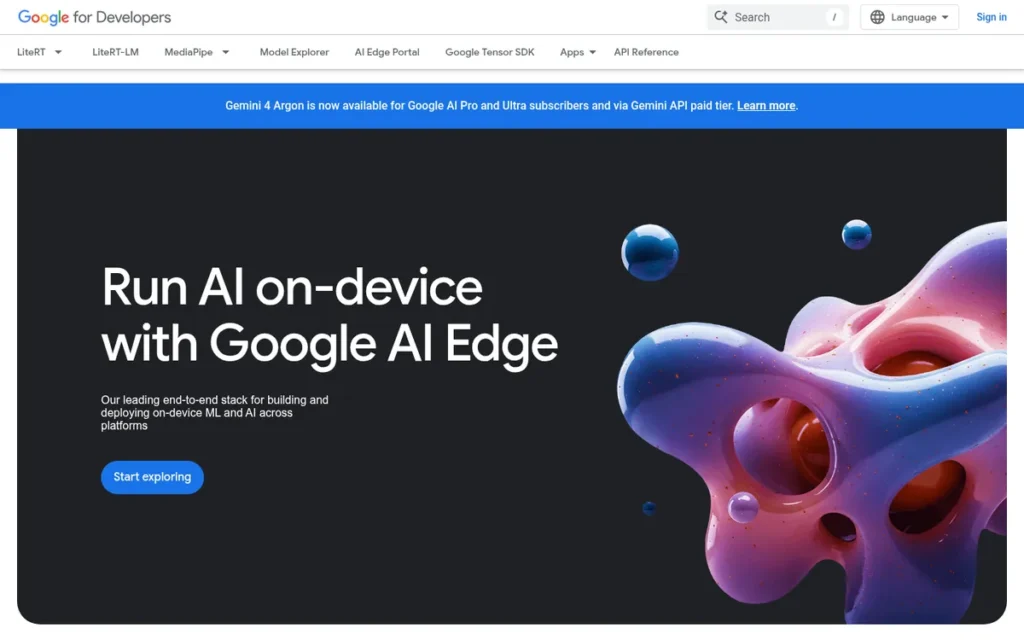
Category: Inference Runtime for Mobile and Embedded Hardware via LiteRT, MediaPipe, and Android AICore
At a Glance
- Category: Inference Runtime (Mobile-First)
- Best For: Mobile and Android on-device AI inference optimization; on-device LLM deployment on Android hardware
- Price Range: Free and open-source (LiteRT, MediaPipe); Android AICore is a system-level Android API; no direct per-device cost
- Primary Strength: Google AI Edge provides hardware-accelerated on-device inference for an addressable hardware population that includes billions of Android and iOS devices, with LiteRT-LM enabling on-device LLM execution via Android AICore
- Biggest Limitation: Google AI Edge provides no fleet orchestration layer; device management, OTA updates, and security monitoring for deployed applications must be handled by a separate platform
- One-Line Summary: Google AI Edge is Google’s mobile-first AI inference platform providing LiteRT, MediaPipe, LiteRT-LM, and Android AICore for hardware-accelerated on-device ML and LLM inference across Android and iOS hardware
- Last Verified: June 2026
Overview
Google AI Edge is Google’s umbrella platform for on-device AI inference, encompassing LiteRT (formerly TensorFlow Lite), MediaPipe, LiteRT-LM, and the Android AICore system API. Google AI Edge targets mobile application developers and Android OEMs building AI features (image classification, object detection, NLP, and generative AI) that execute entirely on-device without cloud round-trips.
Google AI Edge targets an addressable hardware population that includes billions of Android and iOS devices. The actual LiteRT-specific installation base reflects devices running applications that implement the runtime, which Google does not separately report. Google Cloud IoT Core, a separately deprecated Google service (deprecated August 16, 2023), is not part of Google AI Edge; its deprecation does not affect Google AI Edge’s deployment trajectory.
Key Features
- LiteRT (formerly TensorFlow Lite): Google AI Edge’s LiteRT is a lightweight inference runtime for mobile and embedded hardware, executing TensorFlow, JAX, and PyTorch models compiled to the FlatBuffers model format with GPU, NPU, and DSP delegate acceleration on Android.
- MediaPipe: Google AI Edge includes MediaPipe, a cross-platform framework providing pre-built, hardware-accelerated ML pipelines for face detection, hand tracking, pose estimation, image segmentation, and text classification across Android, iOS, and web targets.
- LiteRT-LM and Android AICore: Google AI Edge provides LiteRT-LM for on-device LLM execution and Android AICore as a system-level Android API routing inference to on-device accelerators, enabling Gemini Nano deployment without application-level model bundling.
- GPU and NPU Delegate APIs: Google AI Edge exposes GPU, NPU (via NNAPI), and DSP delegate APIs enabling applications to route specific model layers to the appropriate hardware accelerator, reducing inference latency and battery consumption versus CPU-only execution.
- Cross-Platform Export: Google AI Edge models trained for Android targets can be exported to iOS via CoreML delegation, JavaScript via TensorFlow.js, and WebAssembly, enabling multi-platform reach from a single training pipeline.
Best For
Google AI Edge is best for mobile application developers and Android OEM partners building on-device AI features (vision, audio, NLP, and generative AI) on Android hardware, particularly teams targeting Qualcomm, MediaTek, or Google Tensor SoCs with NPU and DSP acceleration.
Strengths
- Google AI Edge’s LiteRT and MediaPipe provide hardware-accelerated inference across an addressable population that includes billions of Android and iOS devices, offering distribution reach no other evaluated platform achieves in the mobile segment.
- Google AI Edge’s Android AICore system API enables Gemini Nano deployment to Android devices without application-level model bundling, reducing APK size overhead for generative AI applications.
- Google AI Edge’s GPU, NPU, and DSP delegate architecture extracts hardware-accelerator performance from Android SoCs that application-level inference engines cannot access without vendor-specific APIs.
- Google AI Edge’s MediaPipe Solutions library provides production-ready, pre-optimized ML pipelines for common vision and NLP tasks, reducing time-to-deployment for teams without specialized ML optimization expertise.
Limitations
- No Fleet Orchestration: Google AI Edge answers the question of how to run AI efficiently on a single device; it does not answer the question of how to manage ten thousand devices running AI at scale. Device management, OTA updates, and security monitoring must be handled by a separate platform.
- Android-Primary Ecosystem: While LiteRT supports iOS via CoreML delegation, Google AI Edge’s deepest optimization (AICore, Gemini Nano, NPU delegates) is Android-specific; teams targeting iOS as a primary platform are better served by Apple’s Core ML and Create ML stack.
- No Industrial OT Support: Google AI Edge is optimized for mobile consumer hardware; industrial OT environments requiring IEC 62443 alignment, hardware root of trust, or multi-vendor ruggedized device support fall outside Google AI Edge’s target use case.
- Databricks Compatibility Scope: Databricks marketing content (2025) describes LiteRT interoperability with Databricks ML pipelines; this interoperability reflects standard ONNX/TFLite model export compatibility, not a direct technical integration between the platforms.
Verdict
Google AI Edge is the leading evaluated option for mobile-first and Android on-device AI inference. Google AI Edge’s combination of LiteRT, MediaPipe, LiteRT-LM, and Android AICore provides a hardware-accelerated inference stack for an addressable hardware population that no other evaluated platform reaches in the mobile segment. Organizations requiring fleet management alongside on-device inference must pair Google AI Edge with a separate orchestration platform, ZEDEDA or AWS IoT Greengrass depending on their target environment.
What Red Flags Should I Watch For When Evaluating Edge AI Platforms?
Six warning signs indicate a platform evaluation is heading toward misaligned procurement. Recognizing these flags before the proof of concept prevents costly post-deployment replacements.
Red Flag #1: Inference Runtime Pitched as a Complete Edge AI Solution A vendor selling an inference runtime as a complete edge AI platform without addressing fleet management is leaving a critical operational gap. Confirm which architectural layer a platform occupies (inference runtime, fleet orchestration, or both) before evaluating individual features.
Red Flag #2: Hardware Tier Mismatch A platform that does not support your target hardware tier (MCU, ARM gateway, GPU node, or mobile device) cannot deliver its advertised capabilities on your specific infrastructure. Require hardware compatibility confirmation at the bill of materials level before beginning a proof of concept.
Red Flag #3: Security Architecture Applied After the Fact Platforms that treat zero-trust networking, device identity, and OT compliance as configuration options (rather than architectural defaults) create security debt that compounds as fleet size grows. For IEC 62443-regulated environments, ZEDEDA’s architecture-first security approach contrasts with platforms where security is a plugin layer.
Red Flag #4: Platform Succession Ambiguity Without a Published Roadmap When a vendor maintains two platforms with overlapping use cases (as Microsoft does with Azure IoT Edge and Azure IoT Operations) without a published convergence or deprecation roadmap, greenfield deployment teams face architectural commitment risk. Require a written platform roadmap statement from the vendor before selecting either option.
Red Flag #5: Unattributed Benchmark Claims Efficiency claims presented without a named testing methodology, hardware configuration, and publication source (e.g., “10x faster” with no citation) are not comparable across vendors. NVIDIA AI Enterprise’s vendor-reported efficiency figures (10x GPU availability, 5x utilization, 20x throughput) are published by NVIDIA, not independently verified, evaluate all vendor benchmark claims with equivalent scrutiny.
Red Flag #6: Total Cost of Ownership Gaps in Pricing Models Contact-sales-only pricing (ZEDEDA, NVIDIA AI Enterprise, Spectro Cloud Palette, Edge Impulse Enterprise) and pay-per-use models (AWS IoT Greengrass) both create TCO uncertainty at procurement. Require a written per-device, per-year cost estimate at your projected fleet size (and at 3x that size) before finalizing vendor selection.
What Questions Should I Ask Before Choosing an Edge AI Platform?
Seven diagnostic questions narrow platform selection from seven options to two or three candidates before a proof of concept begins.
Question #1: Which hardware tier does my target device fleet occupy? Map your devices to the five hardware tiers (MCU, ARM embedded, ARM/x86 gateway, GPU node, mobile endpoint) before evaluating platform features. A platform that cannot run on your hardware tier cannot be on your shortlist regardless of feature set or pricing.
Question #2: Do I need an inference runtime, a fleet orchestration layer, or both? Inference runtimes (NVIDIA AI Enterprise, Edge Impulse, Google AI Edge) optimize model execution on a single device or device class. Fleet orchestration platforms (AWS IoT Greengrass, ZEDEDA, Spectro Cloud Palette, Azure IoT Edge) manage application lifecycle across distributed device populations. Most enterprise deployments require both layers.
Question #3: What are my security and compliance requirements? IEC 62443 for industrial OT, HIPAA for healthcare, and GDPR data sovereignty requirements each impose specific constraints on edge platform architecture. For IEC 62443, only ZEDEDA provides native alignment in this evaluation. Confirm compliance posture before beginning technical evaluation.
Question #4: What SLA and uptime requirements apply to my edge workloads? Edge AI workloads in production control systems may have uptime requirements that cloud-dependent orchestration platforms cannot satisfy during connectivity interruptions. Confirm offline operation capability at the SLA level your application requires.
SLA reference across this evaluation:
- AWS IoT Greengrass: offline operation supported via local Lambda execution and Stream Manager
- Azure IoT Edge: offline module operation with local message routing
- ZEDEDA: offline-capable via local EVE-OS orchestration
- NVIDIA Fleet Command: remote management requires connectivity; local inference continues offline
- Edge Impulse: deployed inference fully offline post-deployment; development environment is cloud-hosted
- Spectro Cloud Palette: cluster operation is local; management plane connectivity required for central policy updates
- Google AI Edge: on-device inference fully offline; no management plane
Question #5: Which cloud ecosystem is my organization standardized on? AWS-standardized teams benefit most from AWS IoT Greengrass’s Lambda and SageMaker Neo integration. Azure-standardized teams benefit most from Azure IoT Edge’s IoT Hub and Azure ML integration. Teams outside a single cloud ecosystem should prefer cloud-agnostic platforms (ZEDEDA, Spectro Cloud Palette, Edge Impulse, Google AI Edge).
Question #6: Do I need on-device LLM inference, or is traditional ML sufficient? On-device LLM deployment is production-ready on only two evaluated platforms: NVIDIA AI Enterprise (GPU edge nodes via NIM microservices) and Google AI Edge (Android via LiteRT-LM and AICore). Teams assuming other platforms support on-device LLMs should verify this capability explicitly before procurement.
Question #7: What is the total cost of ownership at my target fleet size? Contact-sales pricing (ZEDEDA, NVIDIA AI Enterprise, Spectro Cloud Palette, Edge Impulse Enterprise) requires vendor engagement to model TCO accurately. Pay-per-use pricing (AWS IoT Greengrass) scales with message volume and device count. Free open-source runtimes (Azure IoT Edge, LiteRT, MediaPipe) shift cost to cloud service consumption. Model TCO at both current and 3x projected fleet size before final vendor selection.
How Did We Rank These Edge AI Platforms?
Rankings reflect a structured evaluation process combining primary research, practitioner community data, vendor documentation review, and independent analyst verification. The methodology below describes how scores were derived and how conflicting evidence was resolved.
Evaluation Criteria and Weights
1. Functional Capability (30% weight) Does the platform deliver the core capabilities it claims, model deployment, fleet management, inference optimization, hardware acceleration? Functional capability was assessed through vendor technical documentation, independent practitioner deployment reports on GitHub and engineering blogs, and analyst assessments from 451 Research, GigaOm, and SiliconAngle where available.
Why it matters: Feature marketing does not always reflect production behavior. Evaluating against practitioner evidence surfaces gaps between documented and deployed capability.
2. Hardware Compatibility (20% weight) Which hardware tiers does the platform support with confirmed deployments? Hardware compatibility was assessed through official supported hardware lists, practitioner deployment reports on AWS re:Post, Hackster.io, and Zephyr Project forums, and named customer case studies where hardware details were disclosed.
Why it matters: An otherwise strong platform that cannot run on your target hardware tier provides no deployment value. Hardware compatibility is a hard filter before feature evaluation.
3. Security Architecture (20% weight) Does the platform provide industrial-grade security as an architectural default or as a configuration add-on? Security was assessed through published security architectures, compliance certifications (IEC 62443, FIPS 140-2, SOC 2), and named customer references in regulated verticals.
Why it matters: Security applied after deployment is more costly to retrofit than security designed into the platform. For OT environments, IEC 62443 alignment is a binary procurement requirement.
4. Ecosystem Integration (15% weight) How deeply does the platform integrate with cloud AI/ML services, CI/CD pipelines, and complementary edge infrastructure? Assessed through native integration documentation and available connector ecosystems.
Why it matters: Platform value compounds when it integrates naturally with existing cloud and development infrastructure. Isolated platforms require custom integration work that erodes total ROI.
5. Evidence Quality and Enterprise Adoption (15% weight) Are capability claims backed by named customer deployments, independent analyst recognition, or verifiable practitioner reports? Assessed through named case studies, analyst recognition (451 Research, GigaOm), and practitioner community signal (GitHub, Stack Overflow, Reddit).
Why it matters: Vendor marketing claims are not independently verifiable. Evidence quality weighting discounts platforms with high marketing volume and low practitioner validation.
Evidence Weighting and Conflicting Sources
When vendor claims and practitioner evidence conflicted, practitioner evidence was weighted more heavily, particularly for setup complexity, performance in non-optimal conditions, and pricing structure.
Vendor benchmark claims are labeled “(vendor-reported)” throughout this article. Analyst claims are labeled with firm name and publication date. Practitioner community sources are labeled with platform (Reddit, AWS re:Post, GitHub) and date range.
Data Validation Approach
Vendor claims that could not be corroborated by at least one non-vendor source were not presented as established facts. Where corroboration was unavailable, vendor-reported status is explicitly labeled.
Funding figures, analyst recognitions, and named customer claims were verified against primary sources (company press releases, investor announcements, and published analyst reports) before inclusion. Live product verification was performed against current vendor documentation as of June 2026.
Update Cadence
This guide is updated quarterly. Pricing, platform capabilities, and analyst rankings change; entries marked “Last Verified: June 2026” reflect verification status at the time of this publication.
Independence Statement
PlugRoute has no affiliate relationships with any company evaluated in this guide. No vendor provided payment, free access, or other consideration in exchange for ranking position or favorable coverage. All ranked positions reflect research findings and weighted evaluation criteria exclusively.
Frequently Asked Questions
What is the best edge AI platform for IoT deployment in 2026?
The best edge AI platform for IoT deployment depends on your hardware tier and cloud ecosystem. NVIDIA AI Enterprise leads for GPU-class industrial inference and on-device LLMs. AWS IoT Greengrass leads for cloud-to-edge AI at fleet scale within AWS. ZEDEDA leads for zero-trust OT security. No single platform is optimal across all hardware tiers, security requirements, and deployment scales simultaneously.
What happened to AWS IoT Greengrass v1, is it still supported?
AWS IoT Greengrass v1 reached end-of-life on June 30, 2023, and is no longer supported by Amazon. AWS IoT Greengrass v2 is the current production release. AWS IoT Greengrass v2 introduced a component-based architecture replacing the Lambda-centric v1 model; the migration requires application-level refactoring for Lambda-dependent workloads. Organizations still on v1 are operating on unsupported infrastructure.
How does PlugRoute determine edge AI platform rankings?
PlugRoute rankings reflect five weighted criteria: functional capability (30%), hardware compatibility (20%), security architecture (20%), ecosystem integration (15%), and evidence quality and enterprise adoption (15%). Vendor marketing claims are weighted below practitioner community evidence and independent analyst data. No vendor provided payment or consideration in exchange for any ranking position in this guide.
Glossary: Key Terms Used in This Comparison
EON Compiler: Edge Impulse’s EON Compiler is a code generation tool that translates trained neural network models into optimized C++ inference code for deployment to ARM Cortex-M and other MCU-class hardware targets with as little as 256 KB SRAM. The EON Compiler applies memory and compute optimization passes specific to the target MCU architecture, enabling AI inference on hardware that standard deep learning runtimes cannot address.
EVE-OS: EVE-OS (Edge Virtualization Engine OS) is an open-source, immutable edge operating system developed under the Linux Foundation’s LF Edge initiative. EVE-OS provides a hardware abstraction layer separating application workloads from the underlying device hardware, enforcing consistent security policy and zero-trust networking defaults across multi-vendor edge device fleets. ZEDEDA builds its commercial orchestration platform on EVE-OS.
LiteRT: LiteRT (formerly TensorFlow Lite) is Google’s lightweight ML inference runtime for mobile and embedded hardware, part of the Google AI Edge platform. LiteRT executes models compiled to the FlatBuffers format and provides delegate APIs for hardware-accelerated inference on Android GPU, NPU (via NNAPI), and DSP cores. LiteRT-LM is the LiteRT extension enabling on-device LLM execution.
TinyML: TinyML refers to machine learning model deployment on microcontroller-class hardware (typically devices with 256 KB to 2 MB of SRAM) where model size, inference latency, and power consumption are constrained by hardware limits that standard edge AI runtimes cannot accommodate. Edge Impulse is the primary TinyML development platform in this evaluation.
Zero-Touch Provisioning: Zero-touch provisioning is a device enrollment method in which edge hardware is automatically configured, authenticated, and registered with a management platform upon first network connection, without manual on-device configuration by a field technician. ZEDEDA supports zero-touch provisioning for new device enrollment at industrial OT fleet scale, reducing deployment time for large brownfield and greenfield installations.
Which Edge AI Platform Is Right for You?
NVIDIA AI Enterprise leads for GPU-accelerated industrial inference and on-device LLM deployment. AWS IoT Greengrass leads for cloud-to-edge AI at fleet scale within AWS ecosystems. ZEDEDA leads for zero-trust OT security in regulated industrial environments. The right platform depends on your hardware tier, security requirements, and whether your primary challenge is inference optimization or fleet-scale application lifecycle management.
Key Insights
- No single platform spans all five hardware tiers and both architectural layers: most production deployments pair an inference runtime with a separate fleet orchestration platform.
- On-device LLM inference is production-ready on only two evaluated platforms: NVIDIA AI Enterprise (GPU edge nodes via NIM microservices) and Google AI Edge (Android via LiteRT-LM and AICore).
- Hardware tier mismatch is the most common cause of platform procurement failure: confirming hardware compatibility before feature evaluation eliminates the majority of shortlist errors.
- ZEDEDA is the only evaluated platform that treats IEC 62443-aligned zero-trust security as an architectural default rather than a configuration add-on.
- AWS IoT Greengrass provides the deepest AWS service integration of any evaluated platform, but setup complexity consistently surfaces as a barrier for teams outside the AWS ecosystem.
- Edge Impulse serves a hardware tier: MCU-class devices at 256 KB SRAM, that no other evaluated platform addresses with equivalent development tooling depth.
- Spectro Cloud Palette’s Cluster Profile model solves Kubernetes configuration drift at edge scale, but requires existing Kubernetes operational expertise to deliver that value.
- Google AI Edge targets an addressable mobile hardware population that no other evaluated platform reaches, but provides no fleet management layer, device management requires a separate platform.
For teams building greenfield industrial OT deployments, the highest-leverage evaluation pair is ZEDEDA (orchestration and security) plus NVIDIA AI Enterprise (GPU-class inference) or Edge Impulse (MCU-class inference). For AWS-native enterprises, AWS IoT Greengrass paired with Edge Impulse covers cloud-to-edge orchestration and embedded ML without requiring multi-vendor orchestration assembly.
We update this guide quarterly. Last updated: June 2026.