incident.io is the strongest overall AI SRE platform for 2026, rated 4.8/5 across 181 G2 reviews, free tier available, deployable in days. Rootly leads for Slack-native workflow customization at transparent pricing. Dynatrace Davis AI provides the most rigorous deterministic causal root-cause analysis for enterprise environments. Match your choice to your primary need: incident coordination, causal investigation, or change-intelligence correlation.
SRE teams face compounding pressure from alert fatigue caused by tools that lack context, tribal knowledge lost when experienced engineers leave, and AI recommendations that erode trust because they cannot be interrogated. Traditional observability platforms surface data without reasoning; AI-native tools promise automation but often require instrumentation quality that most teams have not yet achieved.
PlugRoute has no affiliate relationships with any company listed in this article, rankings are determined entirely by research data and objective evaluation criteria, with no input from any company’s marketing, sales, or partnership teams.
“AIOps on top of bad alerts just gives you AI-powered noise.” (u/advancespace, r/sre, 2026)
Takeaway: AI noise reduction tools require high-quality alert foundations, applying AI to structurally poor alerting produces AI-powered noise, not signal, and remains the most preventable AI SRE deployment failure mode.
TL;DR: Top Picks at a Glance
- incident.io: top-rated AI incident manager; free tier; proven same-week deployment
- Rootly: deepest workflow customization; $20/user/mo published; API-first
- Dynatrace Davis AI: strongest deterministic causal RCA; topology-aware reasoning
- Datadog Bits AI: native AI investigation for existing Datadog environments
What Are the Four Categories of AI SRE Tools?
AI SRE tools fall into four architecturally distinct categories that solve different problems at different pipeline stages, selecting the wrong category for your primary pain point is the most common and costly mistake in AI SRE evaluation. These categories are not interchangeable alternatives.
The four categories are:
- AI Observability Platforms (Datadog Bits AI, Dynatrace Davis AI, New Relic AI), embed AI reasoning into full-stack telemetry pipelines; best for teams whose primary need is deep causal or generative investigation of telemetry data
- AI Incident Managers (incident.io, Rootly): automate the coordination and documentation lifecycle from Slack or Teams; best for teams whose primary need is faster incident response and AI-assisted postmortems
- AIOps Event Intelligence Layers (PagerDuty AIOps): apply ML noise reduction and cross-service routing between detection and response; best for teams with complex multi-service alert routing requirements
- Change Intelligence SRE Layers (Harness AI SRE): correlate deployment changes, feature flags, and human conversation context with incident causation; best for teams whose incidents are primarily caused by code and configuration changes
Think of it this way: PagerDuty AIOps is the sorting office, it decides which alerts belong in which pile and routes them to the right team. incident.io is the detective, once an incident is declared, it investigates the scene and proposes what happened. Most teams struggling with alert fatigue need a better sorting office; most teams struggling with slow MTTR need a better detective. Some need both, and these are not the same tool.
How Do the Top 7 AI SRE Tools Compare?
| Rank | Company | Category | Best For | One-Line Summary | Key Capabilities | Primary Strength | Key Limitation |
|---|---|---|---|---|---|---|---|
| 1 | incident.io | Multi-Agent Incident Manager | Replacing PagerDuty; fast deployment | AI-powered incident platform rated 4.8/5 across 181 G2 reviews (June 2026) | Multi-agent investigation; fix PR generation; AI postmortems; related incident detection | Autonomous cross-source investigation with engineer-validated fix suggestions | Opinionated workflow structure limits bespoke customization |
| 2 | Rootly | AI Incident Orchestrator | Complex custom workflows; API depth | Slack-first incident platform rated 4.8/5 across 68 G2 reviews (June 2026) | Workflow engine; AI postmortems; on-call integration; deep API access | Deepest workflow primitives; same-day custom feature deployment documented | Multi-week setup required; less autonomous AI investigation than incident.io |
| 3 | Datadog Bits AI | AI Observability Copilot | Existing Datadog teams; high-quality OTEL | AI SRE agent embedded in the industry’s broadest observability platform (NASDAQ: DDOG) | Monitor-triggered investigation; multi-service RCA; fix code generation; full-platform querying | Minimal integration overhead for existing Datadog customers | AI Credits billing model requires pre-deployment cost modeling; telemetry quality prerequisite |
| 4 | Dynatrace Davis AI | Autonomous Causal AI Engine | Enterprise deterministic RCA | Strongest autonomous RCA among major observability platforms per stackscout.co (June 2026) | Causal AI; Smartscape topology; predictive AI; Davis CoPilot; Grail data lakehouse | Deterministic, traceable root-cause chains via real-time topology mapping | Quote-only DPS pricing; serverless environment limitations documented |
| 5 | PagerDuty AIOps | AIOps Event Intelligence Layer | Deep existing PagerDuty infrastructure | Incumbent 15-year enterprise on-call platform with ML noise reduction (NYSE: PD) | Global Event Orchestration; ML noise reduction; Jeli postmortems; Copilot | Most mature cross-service event routing ML, trained on 15+ years of data | Black-box ML grouping caused documented missed production incident; no explainability mechanism |
| 6 | New Relic AI | AI-Assisted Observability Platform | Teams building AI-powered applications | First APM for AI/LLM stacks per New Relic (BusinessWire, April 2024); private since Nov. 2023 | Natural-language NRQL; APM for AI stacks; Intelligent Workload; SRE agent | Only platform with dedicated LLM/AI stack production observability in this comparison | Late 2023 going-private under Francisco Partners introduces vendor stability risk |
| 7 | Harness AI SRE | Change Intelligence SRE Layer | Existing Harness CI/CD customers | Change-intelligence SRE layer launched January 2026; Human-Aware Change Agent | Human-Aware Change Agent; AI Scribe; Continuous Verification; deployment risk analysis | Only tool treating Slack/Teams/Zoom conversation signals as structured operational data (June 2026) | January 2026 launch; no community validation; opaque pricing; “still evolving” (betterstack.com, June 2026) |
Which AI SRE Tool Fits Your Situation?
| Your #1 Priority | Recommended Tool | Why | Acceptable Alternative |
|---|---|---|---|
| Replacing PagerDuty fast | incident.io | Same-week deployment; free tier; 181 G2 reviews | Rootly (if deep API customization needed) |
| Maximum workflow control | Rootly | Deepest workflow primitives and API depth in category | incident.io (if speed > customization) |
| Deterministic causal RCA | Dynatrace Davis AI | Topology-aware causal AI; traceable evidence chain | Datadog Bits AI (if already on Datadog) |
| Already on Datadog | Datadog Bits AI | Minimal integration overhead; native telemetry context | Dynatrace Davis AI (for deterministic RCA) |
| Transparent budget modeling | incident.io | Free tier; ~$19/user/month published pricing | Rootly (~$20/user/month published) |
| AI/LLM app observability | New Relic AI | First APM-for-AI in this comparison (per New Relic, 2024) | Datadog Bits AI (LLM Observability product) |
| Existing Harness CI/CD | Harness AI SRE | Change-intelligence integration with existing pipeline | incident.io + Datadog as complement |
| Reducing cost vs. PagerDuty | incident.io | Free tier to ~$19/user/month vs. PagerDuty enterprise pricing | Rootly (~$20/user/month for comparable coverage) |
| Starting fresh, unclear primary need | incident.io | Zero-cost entry point; 181 G2 reviews validate approach; same-week deployment | Rootly (if workflow customization needs emerge during trial) |
1. incident.io: Best Overall: Strongest AI Investigation Depth with Transparent Pricing
Category: Multi-Agent Incident Manager, an AI-native platform that autonomously investigates production incidents across code, chat, and telemetry sources simultaneously, then proposes remediation steps and generates documentation across the full incident lifecycle.
At a Glance
- Category: Multi-Agent Incident Manager
- Best For: SRE teams replacing PagerDuty or homegrown incident coordination; fast deployment needed
- Price Range: Free (up to 5 users, vendor-stated); Team ~$19/user/mo; Pro ~$25/user/mo; On-Call ~$20/user/mo; Enterprise: custom quote
- Primary Strength: incident.io’s multi-agent AI SRE autonomously searches GitHub, Slack history, logs, metrics, and distributed traces during active incidents to generate root-cause hypotheses and propose fix pull requests for engineer review
- Biggest Limitation: incident.io’s opinionated workflow defaults constrain teams with highly bespoke, non-standard incident process requirements that demand precise workflow modeling over platform-defined structure
- One-Line Summary: incident.io is an AI-powered incident management platform rated 4.8/5 across 181 independent G2 reviews as of June 2026, the highest peer-review volume of any AI SRE tool in this evaluation.
- Last Verified: June 2026
Overview
incident.io is an AI-native incident management platform founded in 2020, designed for mid-to-enterprise SRE teams who need to manage the full incident lifecycle, from Slack-based detection through autonomous AI investigation and automated postmortem generation, without expanding headcount. incident.io’s multi-agent AI SRE investigates active incidents by querying GitHub repositories, Slack history, logs, metrics, and distributed traces in parallel, then surfaces root-cause hypotheses and proposes fix pull requests for engineer review, the most advanced AI investigation capability of any pure incident management tool in this comparison. incident.io was built by the team that created the open-source Monzo Response incident tool (verified from incident.io blog, 2020), giving the platform practitioner credibility that vendor-first products structurally cannot match.
Key Features
- incident.io’s multi-agent autonomous investigation searches simultaneously across GitHub repositories, Slack incident channels, logs, metrics, and distributed traces to generate root-cause hypotheses, without requiring the on-call engineer to manually construct queries or know where to look first.
- incident.io generates fix pull request suggestions at vendor-stated 90% accuracy, providing engineers with a concrete remediation starting point rather than a list of correlated signals requiring additional interpretation under incident pressure.
- incident.io automates postmortem drafting at vendor-stated 80% completion: compiling AI-generated timelines, mitigation summaries, and resolution context from captured incident data, directly addressing tribal knowledge loss when experienced engineers leave or incidents go undocumented.
- incident.io’s related incident detection automatically surfaces similar past incidents at the moment of triage, enabling engineers to apply institutional memory without relying on manual search or requiring the most senior team member to be on-call.
- incident.io’s suggested follow-ups feature reviews the Slack incident channel after resolution and recommends action items discussed but not formally captured, reducing recurrence probability from undocumented decisions made under high-pressure conditions.
Best For
incident.io is best for SRE and DevOps teams migrating from PagerDuty or homegrown incident coordination setups who need an AI-native replacement deployable in days. incident.io particularly suits companies with high incident volume where AI-assisted postmortem documentation and autonomous investigation directly reduce per-incident engineering overhead.
Pricing
incident.io offers a vendor-stated free tier for up to 5 users, and alongside New Relic’s 100 GB ingest free tier, provides one of two no-cost evaluation paths among the platforms in this comparison (verified June 2026). The Team tier is priced at approximately $19/user/month, below Rootly’s $20/user/month starting rate. The Pro tier runs approximately $25/user/month. On-Call functionality is separately priced at approximately $20/user/month. Enterprise pricing requires a custom quote.
Strengths
- incident.io holds a verified G2 rating of 4.8 out of 5 across 181 independent reviews as of June 2026, the highest peer-review volume of any pure incident management tool in this comparison, indicating consistent user satisfaction at meaningful installed-base scale rather than a small, self-selected review sample (G2, June 2026).
- Multiple independent Reddit practitioners in r/cybersecurity (2025–2026) report same-week production deployment after migrating from PagerDuty, one team described improved MTTR within the first month, attributing the gain to incident.io’s opinionated workflow defaults that required no process reinvention under deadline pressure (u/Even_Reindeer_7769, r/cybersecurity, 2025).
- incident.io’s founding team built the open-source Monzo Response incident tool before commercializing the platform (verified from incident.io blog, 2020), providing domain credibility from engineers who have personally managed production incidents at scale, not from a purely commercial software background.
- incident.io has documented enterprise-scale production deployments at Netflix, Etsy, Airbnb, Intercom, and Skyscanner (per incident.io blog, June 2026), validating platform reliability under high-frequency incident conditions that represent the target audience’s operational environment.
Limitations
- incident.io’s opinionated workflow structure delivers fast time-to-value but constrains teams with highly customized processes, Reddit practitioners who chose Rootly over incident.io consistently cite deep API customization requirements as the deciding factor, describing incident.io as “a finished product” where Rootly is “a toolkit” (u/Even_Reindeer_7769, r/cybersecurity, 2025).
- incident.io’s AI SRE investigation capabilities depend directly on the quality of connected telemetry, teams with incomplete OTEL coverage, inconsistent naming standards, or fragmented log pipelines receive less actionable AI outputs that may not justify the transition effort from existing tooling.
- incident.io’s G2 top cons (June 2026) include “Missing Features” and “Limited Features”, reflecting enterprise users who need deeper customization; specific gaps noted in practitioner evaluations include limited native support for multi-region on-call schedule complexity and constrained integration with legacy ITSM platforms using non-standard webhook configurations.
“Rootly felt more like a toolkit than a finished product. Tons of configuration options but that also meant weeks of setup time we didn’t really have… incident.io just clicked better with how our teams actually work during incidents.” (u/Even_Reindeer_7769, r/cybersecurity, 2025)
Takeaway: incident.io wins evaluations where deployment speed and workflow alignment matter more than maximum configurability, teams replacing PagerDuty under deadline pressure consistently choose incident.io over Rootly.
Verdict
incident.io is the highest-scoring AI SRE tool in this evaluation, earning the top rank through the strongest combination of verified peer-review evidence (G2: 4.8/5, 181 reviews as of June 2026), the most transparent pricing in the category (free tier through ~$19/user/month publicly visible), and the most advanced AI investigation capabilities of any pure incident management platform. incident.io is the strongest first choice for SRE teams replacing legacy on-call coordination tools who need production-grade AI investigation without a lengthy deployment project. Teams with highly customized incident workflows should evaluate Rootly’s greater configurability; teams whose primary requirement is deterministic observability-level causal analysis should evaluate Dynatrace Davis AI.
2. Rootly: Best for Slack-Native Teams Requiring Maximum Workflow Customization and API Flexibility
Category: AI Incident Orchestrator, a Slack-first incident management platform that automates coordination workflows and provides AI-assisted investigation and postmortem generation, with the deepest workflow customization configurability of any tool in this comparison.
At a Glance
- Category: AI Incident Orchestrator
- Best For: Teams with complex custom incident processes needing maximum API flexibility and Slack-native orchestration
- Price Range: Essentials: ~$20/user/mo; On-Call: ~$20/user/mo; Scale: custom quote; 14-day free trial
- Primary Strength: Rootly provides the deepest workflow customization of any AI incident management platform, granular incident type modeling, conditional triggers, and multi-step automation sequences enable teams to replicate existing processes exactly
- Biggest Limitation: Rootly’s extensive workflow primitives require significant upfront investment, independent practitioners report multi-week setup timelines compared to incident.io’s same-week deployment
- One-Line Summary: Rootly is a Slack-first AI incident platform rated 4.8/5 across 68 G2 reviews as of June 2026, recognized for workflow customization depth and founding-team responsiveness with documented same-day feature deployment for customer requests.
- Last Verified: June 2026
Overview
Rootly is an AI-native, Slack-first incident management platform co-founded approximately 2020 by JJ Tang and Quentin Rousseau, who met while working at Instacart, designed for SRE and DevOps teams that need to model complex, organization-specific incident workflows without sacrificing AI capability for postmortem generation and real-time investigation assistance. Rootly integrates natively with Jira, PagerDuty, Opsgenie, Datadog, and Slack, enabling one-click incident coordination across existing toolchains without requiring infrastructure replacement. Rootly co-founder JJ Tang actively participates in Reddit SRE communities with documented same-day custom feature deployment for production customer requests, a responsiveness standard that public-company enterprise vendors structurally cannot match.
Key Features
- Rootly’s workflow customization engine supports granular incident type modeling, conditional triggers, custom fields, and multi-step automation sequences, enabling teams to replicate existing incident processes exactly rather than adapting to platform defaults, which practitioners consistently cite as the primary reason to choose Rootly over incident.io in direct evaluations.
- Rootly’s AI assistant answers natural-language questions during active incidents, surfaces troubleshooting suggestions from similar historical incidents, and generates catch-up summaries for engineers joining in-progress responses, reducing cognitive load without requiring manual context transfer to late responders.
- Rootly automatically creates Slack incident channels, pages on-call responders, starts video bridges, and centralizes alert context from connected tools (Jira, Datadog, PagerDuty, Opsgenie) within seconds of incident declaration, eliminating the manual coordination overhead that compounds MTTR during the first critical minutes of response.
- Rootly generates AI postmortem drafts from captured incident timelines, communication logs, and Slack context, providing a structured starting document that practitioners report requires minimal editing before publication, directly addressing the post-incident documentation burden that consumes senior engineer time.
- Rootly’s deep API access enables custom integrations and automation workflows that practitioners cite as the primary differentiator when choosing Rootly over incident.io, particularly for teams with proprietary toolchains, non-standard paging dependencies, or custom ITSM integrations requiring precise workflow modeling.
Best For
Rootly is best for SRE teams with well-defined, complex incident processes they want to preserve precisely, teams that found incident.io’s opinionated structure too constraining, or organizations with multiple paging systems, proprietary ITSM integrations, or regulatory workflow requirements demanding exact process modeling rather than platform-defined defaults.
Pricing
Rootly publishes transparent pricing at approximately $20/user/month for the Essentials tier, with On-Call functionality also starting at approximately $20/user/month as a separate SKU (both verified June 2026 from toolmage.com). A 14-day free trial is available. The Scale tier requires a custom quote, introducing evaluation friction at enterprise scale.
Strengths
- Rootly holds a verified G2 rating of 4.8 out of 5 across 68 independent reviews as of June 2026, with top-rated dimensions including ease of use and customer support, consistent satisfaction even within a smaller review dataset than incident.io’s 181-review base (G2, June 2026).
- Multiple independent r/sre practitioners with 12–18+ months of production deployment describe Rootly as a tool that “just works without needing a lot of management and upkeep” (u/yguos, r/sre, 2023), a direct validation of low operational overhead for stretched SRE teams.
- Rootly co-founder JJ Tang’s personal Reddit engagement is documented in community threads: one practitioner reported a custom escalation feature supporting multiple paging systems was built and deployed within a single day of the request (u/LaunchAllVipers, r/sre, 2023), a responsiveness standard that large-enterprise vendors structurally cannot replicate.
- Practitioners who migrated from PagerDuty to Rootly and those who chose Rootly over incident.io in head-to-head evaluations consistently cite API depth as the decisive factor (u/Sad-Recognition-8257, r/it, 2025), validating that Rootly’s configurability advantage is real and consequential for non-standard toolchain requirements.
Limitations
- Rootly’s extensive workflow primitives require significant upfront investment: Reddit practitioners who chose incident.io over Rootly in 2025–2026 consistently describe Rootly as requiring “weeks of setup time we didn’t really have,” confirming that Rootly’s power comes at a time-to-value cost that teams replacing legacy tools on a deadline must explicitly plan for.
- Rootly provides AI-assisted postmortem drafting and in-channel question answering but does not offer incident.io’s autonomous cross-source investigation that generates fix pull request suggestions as a core product capability, teams whose primary criterion is AI autonomy during active incidents should evaluate incident.io’s AI SRE alongside Rootly’s workflow depth.
- Rootly’s Scale tier requires a custom quote, introducing evaluation friction for enterprise buyers who need cost modeling across the full user base before committing, limiting the pricing transparency advantage versus competitors at the upper end of the organizational size range.
“We use Rootly and besides all the stuff JJ’s mentioned I’ll add that they have been extraordinarily responsive to our needs and support issues both during the trial and in the subsequent 18 months. Great product… They were able to change the incident escalation feature to allow controllers to select which paging system in, like, a day.” (u/LaunchAllVipers, r/sre, 2023)
Takeaway: Rootly’s same-day custom feature deployment is the most cited vendor behavior differentiator in the mid-market SRE community, and repeatedly functions as a purchase-decision tipping point for teams with non-standard toolchain requirements.
Verdict
Rootly is the strongest AI incident management choice for SRE teams that need maximum workflow configurability and API flexibility, teams who want to model existing incident processes precisely rather than adapt to a platform’s opinionated structure. Rootly’s documented customer support responsiveness, transparent entry-level pricing at ~$20/user/month, and “just works” production reputation make it the most trusted Slack-native incident orchestrator among practitioners with complex operational requirements as of June 2026. Teams prioritizing time-to-value and AI investigation autonomy over customization should evaluate incident.io; teams at enterprise scale requiring observability-level causal analysis should evaluate Dynatrace Davis AI as a complementary platform.
3. Datadog Bits AI: Best for Teams Already Standardized on Datadog with High-Quality Telemetry
Category: AI Observability Copilot, a generative AI layer built into the industry’s broadest full-stack observability platform, providing natural-language investigation, autonomous SRE investigation at monitor trigger, and AI-assisted remediation within an existing Datadog telemetry environment.
At a Glance
- Category: AI Observability Copilot
- Best For: Datadog-standardized teams with strict OTEL naming and complete instrumentation
- Price Range: Host-based base platform (published); Bits AI: ~$6.50–$8.45/investigation via AI Credits model (mid-2026; verify current credits pricing at datadoghq.com/pricing/)
- Primary Strength: Datadog Bits AI provides native AI investigation inside the broadest observability ecosystem, delivering capable multi-service root-cause analysis with minimal integration overhead for existing Datadog customers when telemetry quality is high
- Biggest Limitation: Datadog Bits AI’s AI Credits billing model creates per-use cost economics that can discourage the frequent, exploratory investigation that makes an SRE agent most valuable, compounded by a strict telemetry quality prerequisite to produce actionable outputs
- One-Line Summary: Datadog Bits AI is the AI SRE agent embedded in the industry’s broadest observability platform, delivering capable multi-service root-cause analysis when telemetry quality is high, with an AI Credits billing model that requires pre-deployment cost modeling to avoid usage-deterrent economics.
- Last Verified: June 2026
Overview
Datadog Bits AI is a generative AI SRE agent embedded within Datadog’s unified observability platform (publicly traded on NASDAQ (DDOG)) acting as a 24/7 on-call assistant that triages alerts, drafts incident summaries, and autonomously investigates monitor-triggered events using the full context of Datadog telemetry, runbooks, and connected code repositories. Datadog Bits AI requires minimal additional integration overhead for teams already running Datadog as their primary observability platform, making it the path of least resistance for AI SRE capability within a large installed base. Datadog Bits AI’s value is directly proportional to underlying instrumentation quality: practitioners with strict OTEL tagging report accurate multi-service root-cause analysis, while teams with fragmented telemetry receive generic outputs that do not justify the per-session cost.
Key Features
- Datadog Bits AI SRE autonomously launches investigations at monitor trigger-time: gathering context from Datadog telemetry, runbooks, and service relationships before the on-call engineer has responded, so a structured hypothesis is ready when the engineer engages rather than requiring manual context assembly from scratch (Datadog blog).
- Datadog Bits AI connects to code repositories and, when granted repository access, identifies root causes across multiple services including legacy monoliths, explains the issue in plain language, and generates fix code, documented by an r/sre practitioner in May 2026 as “kinda scary good” for cross-service diagnosis spanning a JavaScript monolith (u/makonde, r/sre, May 2026).
- Datadog Bits AI operates across the complete Datadog platform context: querying logs, traces, metrics, real-user monitoring, synthetic monitoring, security signals, and cloud costs in a unified conversational interface, eliminating context-switching between Datadog product surfaces during active incident investigation.
- Datadog Bits AI generates and verifies root-cause hypotheses by cross-referencing observed signals against service topology context and runbook guidance, providing engineers with structured hypotheses rather than raw correlated anomalies requiring additional interpretation under incident pressure.
- Datadog Bits AI can trigger Datadog Workflows for automated remediation, generate synthetic tests from natural-language descriptions, and produce code fixes, extending AI capability beyond investigation into the remediation and prevention phases of the incident lifecycle.
Best For
Datadog Bits AI is best for organizations already deeply standardized on Datadog (with high-quality OTEL instrumentation, consistent naming conventions, and code repository connections) who want AI investigation capability within their existing toolchain and who can model the AI Credits billing economics before building Bits AI into regular on-call workflows.
Pricing
Datadog has transitioned to an AI Credits billing model for Bits AI (as of mid-2026): 500 credits/month starting at $500 billed annually, or $1.30/credit on-demand. The Bits Investigate autonomous investigation feature costs approximately 6.5 credits per session (~$6.50–$8.45 per investigation at on-demand rates).
Earlier community reports from January–May 2026 cited per-investigation costs of approximately $32 under a prior billing structure, generating documented billing spikes exceeding $600 in a single cycle (u/indigoguy, r/sre, 2026), prompting the pricing revision that Datadog sales had foreshadowed in early 2026.
Buyers should verify current credits pricing directly at datadoghq.com/pricing and request a billing cap mechanism before building Bits AI into daily on-call workflows. Datadog’s base platform follows host-based pricing published on the Datadog pricing page, without a verified free tier.
Strengths
- Datadog is publicly traded on NASDAQ (DDOG) and is characterized by independent comparative analysis from stackscout.co (June 2026) as holding “the broadest integration ecosystem” and “a very strong developer experience” in the observability market, providing AI investigation capability within a proven, enterprise-scale data foundation (750+ integrations per Datadog platform documentation, June 2026).
- When configured with code repository access, Datadog Bits AI demonstrated documented multi-service root-cause analysis that identified an issue “across multiple services including an ancient js monolith, explained it and would have created a PR to fix it”, a practitioner account from r/sre in May 2026 representing the full capability ceiling of Bits AI at implementation maturity.
- Datadog’s Watchdog anomaly detection engine has been learning baseline behavior across metrics, logs, and traces for years before Bits AI was added, giving the platform more historical anomaly pattern data than newer entrants in the AI SRE category, providing richer AI investigation context during active incidents.
- For teams already running Datadog as their primary observability platform, Bits AI requires minimal additional telemetry configuration, time-to-first-investigation can be measured in minutes for existing Datadog customers compared to weeks of integration setup required by standalone AI SRE tools.
Limitations
- Datadog Bits AI’s AI Credits billing model creates a structural economic risk: the per-session cost architecture discourages the frequent, exploratory AI investigation that would make an SRE agent most valuable, engineers self-ration investigations to avoid cost escalation, which reduces operational benefit precisely when usage would be highest. Earlier community reports documented billing spikes exceeding $600 in a single cycle under a prior pricing structure; buyers should verify current credits pricing and request a hard billing cap before deploying Bits AI in routine on-call workflows.
- Datadog Bits AI is characterized by independent comparative analysis from stackscout.co (June 2026) as “a productivity tool more than an investigation tool”, meaning Bits AI helps engineers navigate existing Datadog data more efficiently rather than delivering the deterministic causal chain that Dynatrace Davis AI provides, a meaningful architectural distinction for buyers requiring precise, auditable root-cause identification.
- Datadog Bits AI’s outputs are directly tied to instrumentation quality: practitioners with incomplete OTEL coverage or inconsistent naming standards consistently report generic, low-value outputs that do not justify per-session cost, making a formal telemetry audit a prerequisite before deploying Bits AI as a primary AI SRE capability (r/sre, 2026).
“I started using it a lot and it troubleshooted issues accurately, but then I very soon realized we had a $600 increase in the bill, so now I never use it. It’s insanely expensive for what it does… It does save you time and see patterns you may not if you have everything correctly tagged, but def not worth it in my opinion.” (u/indigoguy, r/sre, 2026)
Takeaway: Bits AI delivered genuine time-saving value when telemetry quality was high, but the prior billing structure through early 2026 made regular use economically infeasible, the $600 billing spike is the most-shared cautionary AI billing narrative in r/sre and directly prompted Datadog’s mid-2026 transition to the AI Credits model.
Verdict
Datadog Bits AI is the strongest AI SRE choice for teams already operating on Datadog as their primary observability platform, providing genuinely capable multi-service investigation, fix code generation, and autonomous monitor-triggered analysis within a minimal-additional-integration context when telemetry quality is high. Datadog Bits AI’s AI Credits billing model requires pre-deployment cost modeling; buyers should verify the current per-session economics and request billing cap mechanisms before building Bits AI into daily on-call workflows. Teams not already on Datadog should evaluate whether Bits AI’s investigation capability justifies adopting the broader Datadog stack versus choosing an AI-native incident management tool at significantly lower and more predictable total cost.
4. Dynatrace Davis AI: Best for Enterprise Teams Requiring Deterministic, Topology-Aware Root-Cause Analysis
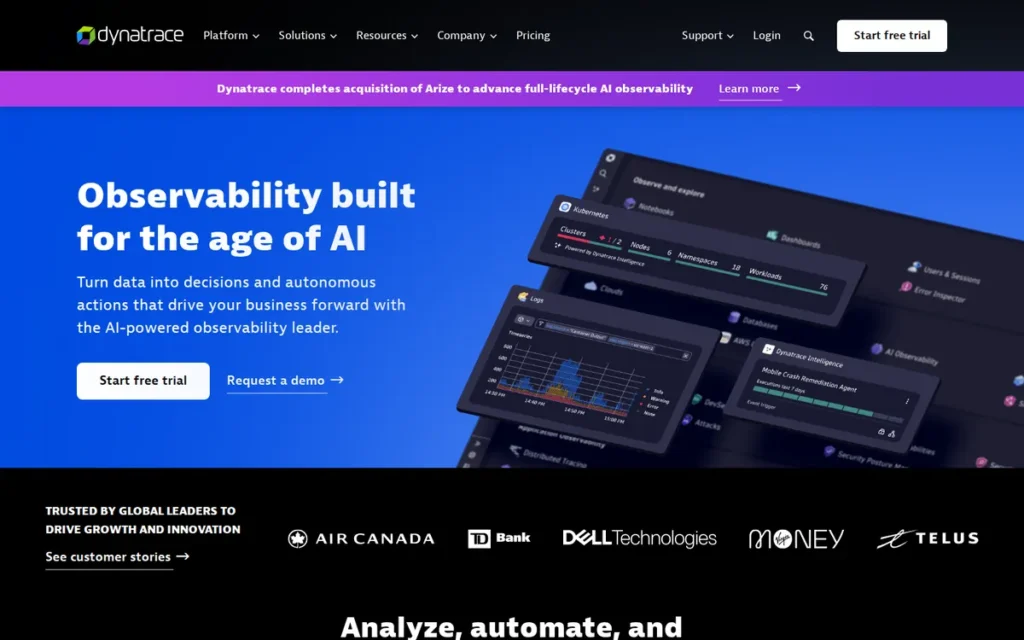
Category: Autonomous Causal AI Engine, an enterprise observability platform that uses topology-aware causal AI to deliver deterministic root-cause identification, distinguishing it from ML-correlation tools by providing a traceable chain of causation rather than a list of statistically associated anomalies.
At a Glance
- Category: Autonomous Causal AI Engine
- Best For: Enterprise SRE teams in complex multi-tier environments; causal chain precision required
- Price Range: Quote-only via Dynatrace Platform Subscription (DPS): no public price anchor; enterprise sales engagement required before any cost can be modeled
- Primary Strength: Dynatrace Davis AI’s causal AI engine uses real-time Smartscape topology to deliver deterministic root-cause analysis, providing a traceable chain of causation rather than correlated anomalies, making AI recommendations auditable during live incidents
- Biggest Limitation: Dynatrace Davis AI’s quote-only DPS pricing prevents pre-sales cost modeling, and the platform’s enterprise-scale complexity creates documented challenges in serverless and AWS Lambda environments
- One-Line Summary: Dynatrace Davis AI is independently characterized by stackscout.co (June 2026) as providing “the strongest autonomous root-cause analysis” among the three major observability platforms, but quote-only pricing and enterprise-scale complexity limit accessibility for mid-market SRE teams.
- Last Verified: June 2026
Overview
Dynatrace Davis AI is the AI engine powering the Dynatrace observability and cybersecurity platform, publicly traded on NYSE (DT), built around “hypermodal AI”: the convergence of causal AI for deterministic root-cause analysis, predictive AI for anomaly forecasting, and generative AI via Davis CoPilot for natural-language interaction (announced July 2023, covered by SiliconAngle and BusinessWire). Dynatrace Davis AI’s technical differentiator is its Smartscape topology engine, a continuously updated real-time dependency map covering all processes, services, hosts, and network relationships, enabling causal AI to trace incident causation chains precisely rather than generating probabilistic correlations. Independent comparative analysis from stackscout.co (June 2026) identifies Dynatrace Davis AI as providing “the strongest autonomous root-cause analysis; causal, topology-aware AI” in a direct comparison against Datadog and New Relic.
Key Features
- Dynatrace Davis AI’s causal AI engine analyzes real-time Smartscape topology to identify the precise originating cause of incidents deterministically, providing engineers with a traceable chain of causation rather than a list of correlated anomalies, directly addressing the explainability requirement the SRE community identifies as non-negotiable during high-stakes production incidents.
- Dynatrace Smartscape automatically discovers and continuously maintains real-time dependency maps (also called service maps) across all processes, services, hosts, and network relationships (including in dynamic Kubernetes environments where service relationships change with every deployment) without requiring manual topology configuration or static documentation.
- Dynatrace Davis AI’s predictive AI component uses dynamic ML models to forecast anomalies before they impact users, moving SRE teams from reactive incident response toward preventive operations by surfacing emerging risk patterns before they escalate to production incidents.
- Dynatrace Davis CoPilot provides a natural-language interface layered on top of causal AI context, enabling engineers to ask questions about system state, create dashboards, and trigger automation workflows conversationally without requiring proprietary query language expertise.
- Dynatrace’s Grail data lakehouse enables Davis AI to reason simultaneously across logs, metrics, distributed traces, events, and security signals without pre-aggregation or sampling loss, preserving the high-cardinality context that deterministic root-cause analysis requires to distinguish signal from noise.
Best For
Dynatrace Davis AI is best for enterprise SRE teams operating complex, multi-tier distributed systems (particularly in financial services, telecommunications, or large technology companies) where the primary requirement is autonomous, deterministic root-cause identification with a traceable evidence chain, and where a single production incident carries regulatory, financial, or reputational consequences that justify the investment.
Pricing
Dynatrace pricing is structured through the Dynatrace Platform Subscription (DPS) model, a consumption-based enterprise licensing framework that is entirely quote-based with no public price anchor (verified June 2026 from Dynatrace pricing page). Teams cannot model cost for Dynatrace without committing to a sales conversation, which is a material evaluation barrier for SRE leads building business cases.
The DPS model prices consumption across multiple dimensions: hosts, services, log ingest, synthetic monitors, and sessions. Compared to transparently-priced competitors, incident.io’s free tier, Rootly’s $20/user/month, New Relic’s consumption model with a public free tier, Dynatrace’s pricing opacity is its most significant adoption barrier for non-enterprise buyers.
Strengths
- Independent comparative analysis from stackscout.co (June 2026) and calmops.com characterize Dynatrace Davis AI as providing the strongest autonomous root-cause analysis among the major observability platforms, the only tool in this evaluation to earn this characterization from an independent third-party analysis.
- Dynatrace Smartscape auto-discovers all service dependencies in real time without manual configuration, a technically differentiated capability specifically valuable in Kubernetes environments where service relationships are ephemeral and change with every deployment, making manual topology documentation structurally impossible for fast-moving engineering organizations (Dynatrace blog, 2024).
- Dynatrace Davis AI’s causal chain transparency directly addresses the SRE community’s most consequential trust failure mode: unlike PagerDuty AIOps’s black-box ML grouping that caused a team to permanently disable the feature after a missed incident, Davis AI’s Smartscape-grounded reasoning provides the “why” behind every recommendation at the exact moment trust is most critical.
- Dynatrace is publicly traded on NYSE (ticker: DT) and coined the “hypermodal AI” concept for the convergence of causal, predictive, and generative AI within a single observability engine, validated by coverage from SiliconAngle (July 2023) and BusinessWire as a meaningful architectural advancement over single-mode AI tools.
Users on r/devops shared their evaluation of Dynatrace across enterprise and smaller-org contexts:
“Bad? No. It’s an extremely powerful and intuitive tool. It’s also huge, and expensive. IMO it shines in large orgs and here’s why I say that. 1. Spinning it up is easy. You either install an agent, extension, or page script. Point it at your environment, and it does the rest for you. 2. In a large multi-cloud org, it lets you trace your network and show tech interactions with very little configuration, making it a very powerful ops tool for troubleshooting. 3. It’s alerting and incident management integrations are excellent, and simple to implement. Reduces glass watching. A pretty dashboard is great. We don’t want to pay people to watch dashboards. Alerting is king. IMO in smaller orgs I honestly don’t think the cost would be worth it because you’re simply not going to use the tool completely. I will also say their support guys were fucking phenomenal and that alone made it high value for us.” Posted by u/jba1224a
Takeaway: Dynatrace Davis AI delivers outsized topology visibility and alerting integration value at enterprise scale, but the “smaller orgs won’t get value” sizing caveat reflects practitioner consensus, not a marketing edge case, and should anchor any pre-procurement scope and cost assessment.
Limitations
- Dynatrace Davis AI’s most consequential limitation for the target audience is quote-only DPS pricing, teams cannot perform any cost modeling before engaging Dynatrace sales, creating a structural evaluation barrier that prevents mid-market SRE teams from building business cases without first committing to a commercial conversation.
- Community feedback from r/devops practitioners who deployed Dynatrace identifies serverless and AWS Lambda environments as areas of relative weakness, one practitioner described Dynatrace as working “fine for ec2/containers but serverless and AWS cloud is very primitive” (u/hashkent, r/devops, 2024), a meaningful limitation for hybrid-cloud teams with Lambda-heavy architectures.
- Dynatrace Davis AI is enterprise-heavy by design: the platform requires dedicated platform engineering investment to configure and maintain, making it poorly suited for smaller SRE teams without the bandwidth to manage an enterprise observability platform alongside active incident response.
- Some experienced SRE practitioners challenge Dynatrace’s deterministic RCA claims, arguing Davis AI “points out where to look” rather than definitively identifying root causes (u/engineered_academic, r/sre, 2022); this 2022 assessment predates the hypermodal AI architecture announced July 2023, and a counterpoint from the same thread notes Davis is “pretty good actually”, the platform should be validated against real infrastructure in a proof-of-concept before committing.
Verdict
Dynatrace Davis AI is the strongest AI SRE choice for enterprise teams in complex, multi-tier distributed environments where deterministic, topology-aware root-cause analysis with a traceable evidence chain is the primary requirement, independently characterized by stackscout.co (June 2026) as providing “the strongest autonomous root-cause analysis” among the three major observability platforms evaluated. Dynatrace’s causal AI architecture directly addresses the SRE community’s core trust requirement: unlike black-box ML tools, Davis AI’s Smartscape-grounded reasoning provides the “why” that engineers need to act with confidence during high-stakes production incidents. Dynatrace’s quote-only pricing, serverless environment limitations, and enterprise-scale complexity make it unsuitable for mid-market teams or organizations running predominantly serverless workloads; those teams should evaluate incident.io for AI-native incident management or Datadog Bits AI for existing Datadog environments.
5. PagerDuty AIOps: Best for Large Enterprises Already Deep in PagerDuty Infrastructure
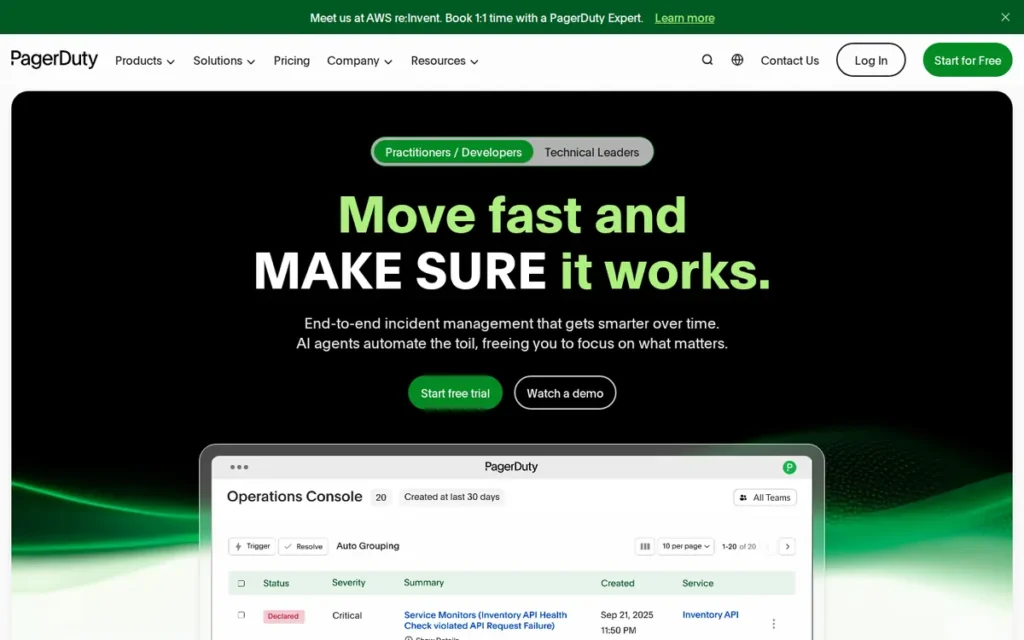
Category: AIOps Event Intelligence Layer (the incumbent enterprise platform for on-call alerting and incident coordination, augmented with ML-based alert noise reduction, cross-service event orchestration, and AI-assisted triage) sitting architecturally between monitoring platforms and incident investigation tools.
At a Glance
- Category: AIOps Event Intelligence Layer
- Best For: Large enterprises with complex multi-team PagerDuty on-call infrastructure already deployed
- Price Range: Professional, Business, Digital Operations tiers (published); AIOps add-on features require sales contact for pricing (June 2026)
- Primary Strength: PagerDuty AIOps’s Global Event Orchestration applies ML-learned organizational context to route events across hundreds of services simultaneously, the most mature cross-service event intelligence of any tool in this comparison, backed by 15+ years of production incident data
- Biggest Limitation: PagerDuty AIOps’s ML-based alert grouping operates as a black box with no explainability mechanism, a documented failure mode in which unexplained grouping caused a missed production incident, leading one enterprise SRE team to permanently disable the feature
- One-Line Summary: PagerDuty AIOps is the 15-year incumbent enterprise on-call platform augmented with ML noise reduction, but its black-box alert grouping and AIOps pricing opacity are generating documented migration intent toward AI-native competitors at both mid-market and enterprise scale.
- Last Verified: June 2026
Overview
PagerDuty AIOps is the artificial intelligence layer built into PagerDuty’s on-call and incident management platform (founded in 2009 and publicly traded on NYSE (PD)) adding ML-based alert noise reduction, automated event orchestration, and AI-assisted triage to the most widely deployed enterprise on-call notification infrastructure in the industry over the past fifteen-plus years. PagerDuty AIOps sits architecturally between monitoring platforms (Datadog, Dynatrace, New Relic) and incident investigation tools (incident.io, Rootly), acting as an intelligent coordination layer that correlates incoming events, suppresses noise, and routes incidents without providing deep causal root-cause analysis or autonomous investigation capability. PagerDuty’s acquisition of Jeli added postmortem learning capabilities that addressed a historically documented gap, though the core PagerDuty AIOps ML model’s lack of explainability remains the category’s most frequently cited trust-erosion failure mode.
Key Features
- PagerDuty AIOps’s Global Event Orchestration uses ML models trained on historical incident patterns to apply cross-service routing decisions at organization-wide scale, routing events across hundreds of services and teams based on learned organizational context rather than static rule sets requiring manual maintenance (SiliconAngle, 2023).
- PagerDuty AIOps groups related alerts using ML pattern recognition and auto-pauses transient alerts for 2–15 minutes before notifying on-call engineers, with PagerDuty vendor-stating 87% alert noise reduction from April 2023 launch materials (BusinessWire, 2023; no independent audit of this figure published as of June 2026).
- PagerDuty AIOps Copilot provides conversational AI assistance for incident work: helping engineers draft status updates, summarize incident context, and generate recommended next steps during active response without requiring manual documentation under time pressure.
- PagerDuty AIOps surfaces probable-cause context at incident creation time by correlating the triggering alert with historical incident patterns, giving on-call engineers a starting hypothesis without requiring manual correlation investigation before response begins.
- PagerDuty’s Automation Actions enable conditional automated remediation workflows triggered by AIOps event routing, connecting AI-identified event patterns to scripted runbook execution without requiring engineer intervention for known, well-documented failure modes.
Best For
PagerDuty AIOps is best for large enterprise organizations with complex, multi-team on-call structures and extensive existing PagerDuty infrastructure, specifically teams managing hundreds of services across multiple business units who need cross-service event intelligence at scale and who cannot migrate existing on-call schedules, escalation policies, and integrations without significant operational risk.
Pricing
PagerDuty’s base pricing tiers (Professional, Business, Digital Operations) are listed on the PagerDuty pricing page, but AIOps-specific features (Event Intelligence, noise reduction ML, and Global Event Orchestration) require a sales conversation for any cost information (verified June 2026). Multiple Reddit practitioners in 2025 describe PagerDuty as expensive and under significant competitive pricing pressure, with one reporting that a 2025 renewal call suggested market disruption: “They must be getting absolutely demolished on the market right now” (u/Soccham, r/devops, 2025).
Strengths
- PagerDuty has been the incumbent enterprise on-call standard since 2009: a 15-plus year operational track record representing the most mature incident notification infrastructure of any platform in this comparison, with SLA guarantees that mission-critical enterprise buyers can reference for business continuity planning.
- PagerDuty’s Global Event Orchestration is the most mature cross-service event routing intelligence in the market (trained on more historical incident data than any AI-native competitor by virtue of PagerDuty’s 15-year operational history relative to competitors founded 2020 or later) enabling routing decisions that reflect the learned operational context of each specific organization.
- PagerDuty’s acquisition of Jeli added postmortem learning capabilities that previously were a documented gap, Jeli’s incident analysis platform enables teams to surface patterns across historical incidents and connect postmortem findings to future alert configuration, addressing institutional knowledge retention at the organizational level.
- PagerDuty vendor-states 87% alert noise reduction from its ML-based grouping engine (April 2023 launch materials, BusinessWire (not independently audited as of June 2026)) a figure that, even discounted for vendor-stated context, represents meaningful potential reduction in on-call interruptions for teams managing high-volume alert environments.
Limitations
- PagerDuty AIOps’s most consequential limitation is the documented black-box ML trust failure: one enterprise SRE team reported that after AIOps alert grouping incorrectly suppressed a critical alert and caused a missed production incident, there was “no way to understand or interrogate why” the grouping decision was made, and after sales representatives responded by repeating “machine learning” without any explainability, the team permanently disabled the feature and never returned (u/evnsio, r/devops, 2025). The failure mode is not merely that the AI was wrong, it is that the team trusted the AI enough to deprioritize the suppressed alert, discovered that trust was unjustified at the worst possible moment, and had no mechanism to prevent recurrence.
- PagerDuty AIOps-specific features require a sales conversation for any cost information, teams cannot model AIOps add-on costs before committing to a commercial conversation, limiting competitive comparison against transparently priced alternatives like incident.io and Rootly.
- Multiple r/devops threads in 2025 describe PagerDuty as having no meaningful new feature releases in two-plus years, with one user noting that “support tickets just disappear” (r/devops, 2025), the most persistent product criticism of any vendor in this evaluation.
- PagerDuty AIOps ML noise reduction is only as effective as the underlying alert quality, “AIOps on top of bad alerts just gives you AI-powered noise” (u/advancespace, r/sre, 2026) confirms that teams with structurally poor alerting cannot resolve alert fatigue by adding an AI layer.
“At a previous job we turned it on, it got some alert grouping wrong, we missed something important in an incident, there was no way to understand or interrogate why, so we turned it off and never went back. Sales reps just kept repeating ‘machine learning’ at me and I lost all confidence.” (u/evnsio, r/devops, 2025)
Takeaway: When AI alert grouping fails silently and the vendor cannot explain why, trust in the feature collapses permanently, this case is the most-cited evidence in practitioner communities for why AI reasoning explainability is a non-negotiable production requirement, not a nice-to-have.
Verdict
PagerDuty AIOps remains the strongest option for large enterprise organizations with extensive existing PagerDuty infrastructure and complex cross-service on-call requirements that cannot be migrated without significant operational risk, the platform’s 15-year reliability track record, Global Event Orchestration depth, and Jeli postmortem integration represent genuine earned strengths for incumbent enterprise deployments. PagerDuty AIOps’s black-box ML trust failure mode, AIOps pricing opacity, and consistent community characterization of stagnant feature development make it a difficult first-choice recommendation for teams with flexibility to evaluate AI-native alternatives. Teams enabling PagerDuty AIOps in production on-call routing must conduct a mandatory proof-of-concept stress-testing grouping behavior under edge-case conditions before go-live.
6. New Relic AI: Best for Teams Building and Operating AI-Powered Applications
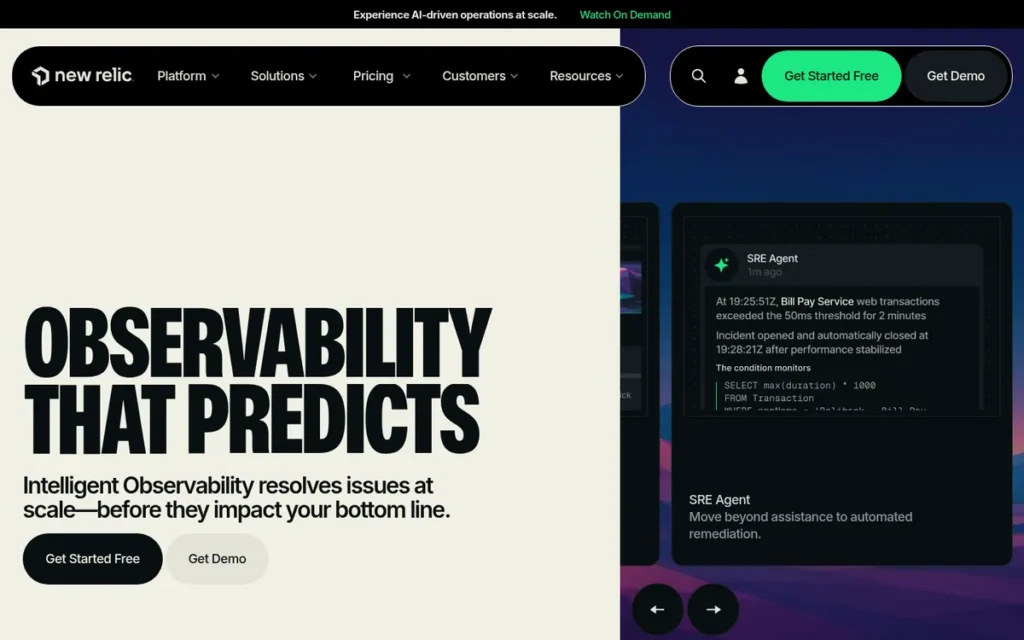
Category: AI-Assisted Observability Platform, a full-stack observability platform that uses AI for natural-language telemetry querying, anomaly detection, and SRE automation, with a uniquely differentiated capability in production observability for AI and LLM application stacks.
At a Glance
- Category: AI-Assisted Observability Platform
- Best For: SRE teams responsible for both infrastructure reliability and AI/LLM application production performance
- Price Range: Free (1 user + 100 GB/month); paid tiers consumption-based; verify current pricing under Francisco Partners ownership (private since November 2023)
- Primary Strength: New Relic AI provides the industry’s first APM for AI and LLM application stacks (per New Relic, BusinessWire April 2024), production observability including model performance, cost-per-query, and real-user feedback integration for AI-powered applications
- Biggest Limitation: New Relic’s late 2023 going-private transaction under Francisco Partners and TPG ($6.5 billion all-cash deal, completed November 8, 2023) introduces material vendor stability uncertainty for enterprise buyers, compounded by SDK-based instrumentation lock-in that increases switching costs
- One-Line Summary: New Relic AI is an AI-assisted observability platform distinguished by the industry’s first production APM for AI and LLM application stacks (per New Relic, BusinessWire April 2024), but its late 2023 going-private transaction under Francisco Partners introduces vendor stability uncertainty that independent analysis explicitly flags as a material concern for enterprise buyers.
- Last Verified: June 2026
Overview
New Relic AI is the artificial intelligence layer built into New Relic’s all-in-one observability platform, founded in 2008, characterized as a Gartner Leader for 13 consecutive years through 2025 (secondary source, checkthat.ai; as a private company for the 2024 and 2025 cycles), and operating as a private company since its late 2023 acquisition by Francisco Partners and TPG ($6.5 billion all-cash deal, announced July 31, 2023, completed November 8, 2023). New Relic AI provides natural-language NRQL query translation, AI-assisted SRE automation, and the industry’s first dedicated APM for AI and LLM application stacks (per New Relic, BusinessWire April 2024). New Relic AI’s unique position in this comparison is its dual role: using AI to help engineers use New Relic more efficiently AND providing AI-specialized observability for teams whose applications include LLM-powered features requiring reliability monitoring distinct from traditional APM.
Key Features
- New Relic AI translates natural-language questions into NRQL queries automatically, enabling engineers to investigate telemetry conversationally without learning proprietary query syntax, with query suggestions and error explanations that accelerate data exploration during time-pressured incident investigation.
- New Relic AI Monitoring provides the industry’s first end-to-end APM for AI application stacks (per New Relic, BusinessWire April 2024), tracking LLM response quality, model performance, per-query cost, real-user feedback correlation, and AI-specific anomaly detection, expanded April 2024 with AWS Amazon Bedrock partnership.
- New Relic AI’s Intelligent Workload feature provides automated dependency mapping and SRE agent functionality for streamlined root-cause analysis and alert prioritization, moving New Relic’s AI capability toward autonomous investigation alongside its established natural-language assistance (global-ai-watch.com, 2025).
- New Relic AI identifies alert coverage gaps across the observed environment: surfacing services or dependencies that lack alerting configuration, directly addressing the alert design quality prerequisite that all AI SRE tools require to function effectively in production.
- New Relic AI generates system health reports from natural-language instructions: providing executive-level or team-level summaries of platform state without requiring manual dashboard review or custom report construction by individual engineers.
Best For
New Relic AI is best for SRE and platform engineering teams at organizations that ship AI-powered products (chatbots, recommendation systems, content generation features, or AI copilots) who need production reliability monitoring for LLM stacks alongside traditional infrastructure observability in a single platform. NewRelic AI also suits teams already instrumented on New Relic who want to extend observability into AI application layers without adding a dedicated AI monitoring tool.
Pricing
New Relic offers a consumption-based pricing model with a free tier that includes one full platform user and 100 GB of data ingest per month (verified from secondary sources, June 2026). Paid tiers scale based on data ingest volume and user type.
New Relic’s consumption model is described by r/devops practitioners as “far too fragmented, and started becoming unpredictable like Datadog at scale” (u/pranabgohain, r/devops, 2024). The late 2023 going-private transaction under Francisco Partners may affect pricing tier structure and enterprise contract terms, buyers should request explicit contract continuity commitments before signing multi-year agreements.
Strengths
- A Forrester Total Economic Impact study cited in New Relic’s materials reports a vendor-commissioned 267% ROI and 70% MTTR reduction for New Relic platform customers (checkthat.ai, 2025), the largest specific MTTR reduction figure cited by any platform in this comparison, though the vendor-commissioned nature means baseline assumptions should be reviewed before applying figures to any specific environment.
- New Relic AI Monitoring expanded in April 2024 with broader language model support, security and privacy controls, and AI-specific anomaly detection in partnership with AWS Amazon Bedrock (BusinessWire, April 2024), establishing New Relic as the earliest major vendor addressing the SRE implications of deploying LLM-powered features in production.
- New Relic was characterized as a Gartner Leader in Observability Platforms for 13 consecutive years through 2025 (secondary source, checkthat.ai; as a private company for the most recent evaluation cycles), indicatingsustained enterprise-grade product investment across multiple technology cycles.
- New Relic’s free tier (1 user, 100 GB ingest per month) provides one of the only no-cost observability platform entry points among the major observability vendors in this comparison, making New Relic AI accessible for smaller SRE teams that Datadog and Dynatrace pricing models structurally exclude.
Limitations
- New Relic AI’s most consequential limitation is the late 2023 going-private transaction under Francisco Partners and TPG ($6.5 billion all-cash acquisition, completed November 8, 2023), independent comparative analysis from betterstack.com explicitly flags this as “a material concern for enterprise buyers evaluating long-term vendor relationships,” introducing product investment uncertainty absent for publicly traded competitors (Datadog NASDAQ: DDOG, Dynatrace NYSE: DT, PagerDuty NYSE: PD). The $6.5 billion acquisition price represents significant PE leverage that historically correlates with cost-structure optimization pressure on acquired SaaS companies.
- New Relic’s SDK-based instrumentation approach creates compounding switching costs, migrating off New Relic requires re-instrumenting telemetry pipelines, amplifying the vendor stability risk for organizations standardized on New Relic agents under Francisco Partners ownership (u/pranabgohain, r/devops, 2024).
- New Relic’s consumption-based model becomes unpredictable at high ingest volumes: described by r/devops practitioners as “becoming unpredictable like Datadog at scale”, creating cost forecasting concerns for teams with high-cardinality telemetry or verbose logging practices that increase data ingest rates.
This community experience on r/devops illustrates how Francisco Partners-era pricing changes have affected practitioners who were previously strong internal advocates:
“Yep, the SRE team layoff was right before when I got to work on a project to migrate off NR and I was quite certain it was the right move. Proven right when in a typical PE cash-grab / golden goose strangling, they decided to more than quadruple the cost of datastorage, which made month-over-month trends and alerting around those patterns useless for us. If you’re gonna cost more than even datadog, we’re gonna go ahead and move the rest of frontend monitoring to datadog, hell with that.” Posted by u/cerephic
Takeaway: New Relic’s post-PE-acquisition pricing volatility has already converted internal platform champions into active migration advocates, the Francisco Partners vendor stability risk flagged in this evaluation is not a projected concern but a documented practitioner experience as of early 2026.
Verdict
New Relic AI is the strongest choice for the specific audience segment responsible for operating both traditional infrastructure and AI-powered application features in production, its APM-for-AI capability is genuinely differentiated and addresses an emerging SRE requirement that no other platform in this comparison meets at comparable depth. For teams evaluating traditional AI SRE and incident management capabilities only, New Relic’s late 2023 going-private transaction under Francisco Partners introduces vendor stability risk that places it below tools with clearer ownership continuity signals. Enterprise buyers considering New Relic should request explicit roadmap commitments, multi-year price protections, and contract continuity assurances under Francisco Partners ownership before signing, and should verify that AI Monitoring capabilities remain on active investment trajectory under private equity management.
7. Harness AI SRE: Best for Harness CI/CD Users: Change-Intelligence-Led Incident Response
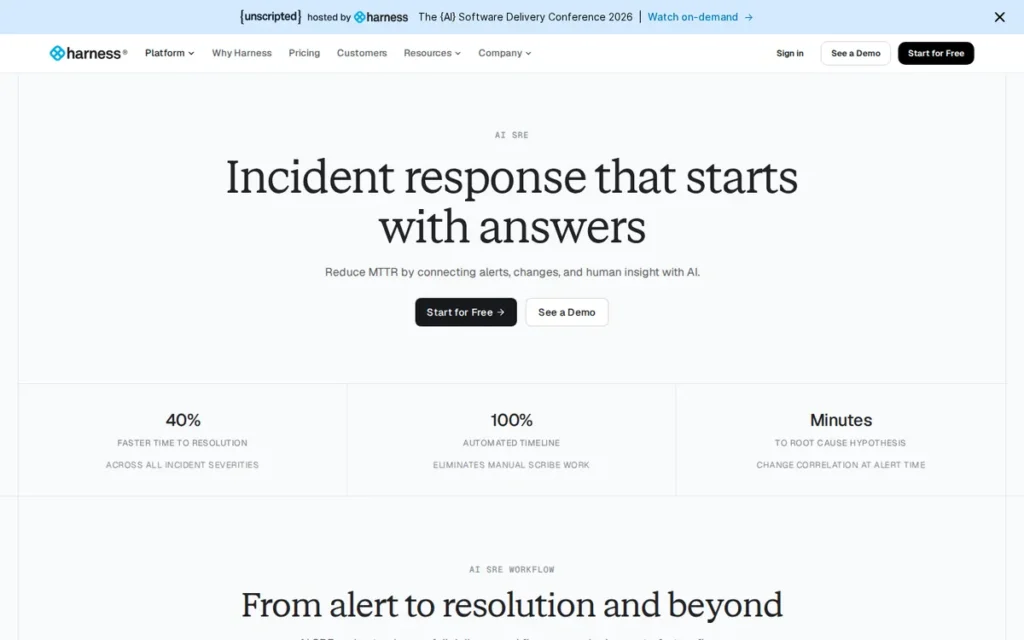
Category: Change Intelligence SRE Layer, an AI-native incident response layer that differentiates from observability and incident management platforms by correlating deployment changes, feature flags, CI/CD context, and human incident conversation signals to identify when code and configuration changes caused production incidents.
At a Glance
- Category: Change Intelligence SRE Layer
- Best For: Existing Harness CI/CD customers with frequent deployment-induced incidents
- Price Range: Bundled into Harness platform; no public AI SRE-specific pricing; enterprise sales required
- Primary Strength: Harness AI SRE’s Human-Aware Change Agent is the only capability in this evaluation (as of June 2026) that treats human incident conversation signals from Slack, Teams, and Zoom as structured operational data, connecting engineer-described symptoms to deployments, feature flags, and infrastructure changes
- Biggest Limitation: Harness AI SRE launched in January 2026 and independent analysis characterizes its SRE-specific capabilities as “still evolving”, with no verified practitioner community validation, completely opaque pricing, and a dependency on existing Harness CI/CD investment to reach full capability
- One-Line Summary: Harness AI SRE is a change-intelligence incident response layer (launched January 2026) that uniquely captures human incident conversation signals as structured operational data, but its absence of independent community validation, opaque pricing, and “still evolving” characterization (betterstack.com, June 2026) make it a roadmap consideration rather than a proven production choice as of June 2026.
- Last Verified: June 2026
Overview
Harness AI SRE is a change-intelligence-led incident response layer launched in January 2026 by Harness, a platform engineering company founded in 2016 by Jyoti Bansal, who previously co-founded AppDynamics before its acquisition by Cisco (industry-cited at approximately $3.7B; specific acquisition price not independently verified at time of research, June 2026). Harness AI SRE differs fundamentally from every other tool in this comparison: it is not primarily an observability platform or Slack-native incident management tool, it is an intelligence layer that reasons about the relationship between what changed (code, configuration, feature flags, CI/CD pipelines) and what broke, using both machine telemetry AND human incident conversation context from Slack, Teams, and Zoom. Harness AI SRE’s Human-Aware Change Agent treats engineer-described symptoms from live incident chat as structured data correlated with deployment records, a capability not matched by any other tool in this evaluation as of June 2026.
Key Features
- Harness AI SRE’s Human-Aware Change Agent captures operational signals from live incident conversations on Slack, Microsoft Teams, and Zoom (filtering chatter from consequential decisions, symptoms, and timeline context) and correlates them with deployment records, feature flag changes, and infrastructure updates to build a structured incident causation model (SiliconAngle, January 2026).
- Harness AI SRE’s deployment risk analysis engine correlates signals across deployments, infrastructure activity, logs, and test pipelines to build a knowledge graph that generates root-cause hypotheses specifically for change-induced incidents, providing CI/CD causal context that pure observability platforms structurally cannot access.
- Harness AI Scribe captures structured operational signals from live incident dialogue, preserving decisions, symptoms, and timelines that would otherwise exist only in expiring Slack threads, directly addressing tribal knowledge loss by creating persistent, queryable incident context at the moment of capture rather than retrospectively through postmortem automation.
- Harness AI SRE’s Continuous Verification (CV) validates releases with telemetry and canary-style feedback to detect deployment issues before wide production impact, enabling teams to identify and roll back problematic deployments before they escalate to full production incidents.
- Harness AI SRE integrates with existing observability and communication platforms as an additive intelligence layer that does not require infrastructure replacement, covered platforms include:
- Observability: Datadog, New Relic, Splunk, Dynatrace, Grafana
- On-call and routing: OpsGenie
- Communication: Slack, Microsoft Teams, Zoom
- Knowledge management: Confluence
Best For
Harness AI SRE is best for engineering organizations already using Harness CI/CD who experience frequent incidents caused by deployment changes, feature flag activations, or infrastructure configuration drift. Harness AI SRE specifically suits teams where connecting code changes to production failures is the primary RCA bottleneck and who have the deployment telemetry that Harness’s change-intelligence architecture requires to function at full capability.
Pricing
Harness AI SRE pricing is bundled into the broader Harness platform and is not publicly available as a standalone AI SRE module price (verified June 2026 from betterstack.com). Teams cannot model AI SRE-specific costs without engaging Harness enterprise sales, the most restricted pricing transparency of any tool in this comparison. Direct comparison against incident.io at ~$19/user/month or Rootly at ~$20/user/month is not possible without a commercial commitment.
Strengths
- Harness AI SRE’s Human-Aware Change Agent: launched January 2026 with SiliconAngle coverage, is the only capability in this evaluation (as of June 2026) that treats human-sourced incident conversation signals from Slack, Teams, and Zoom as structured operational data, addressing tribal knowledge loss at its source during the incident rather than retrospectively.
- Harness was founded in 2016 by Jyoti Bansal, who co-founded AppDynamics: acquired by Cisco for approximately $3.7B (industry-cited figure; not independently verified at time of research, June 2026), providing domain expertise in enterprise production reliability from a founder with direct APM scale experience that validates Harness AI SRE’s architectural approach to incident causation.
- Harness AI SRE functions as an additive intelligence layer that integrates with ten or more major observability, communication, and ITSM platforms (developer.harness.io, 2026), organizations do not need to replace established monitoring infrastructure to gain Harness AI SRE’s change-intelligence capabilities.
- Independent comparative analysis from betterstack.com (June 2026) confirms Harness has strong enterprise traction with more than 1,000 customers on its broader platform, providing a meaningful installed base of potential AI SRE adopters with existing Harness organizational buy-in.
Limitations
- Harness AI SRE launched in January 2026, and independent analysis from betterstack.com (June 2026) explicitly characterizes the AI SRE capabilities as “still evolving” relative to Harness’s mature CI/CD products, meaning buyers are evaluating a product without the practitioner community validation that enables independent confirmation of vendor capability claims.
- No meaningful Reddit or community discussion threads specifically about Harness AI SRE were found in research as of June 2026, the tool launched too recently to have accumulated independent practitioner validation, meaning buyers must rely more heavily on vendor-provided information than is appropriate for thorough evaluation.
Two additional adoption barriers compound the maturity and validation concerns:
- Harness AI SRE pricing is fully bundled, entirely opaque, and requires enterprise sales contact, preventing competitive cost comparison against transparently priced alternatives without a commercial commitment, the most restrictive pricing scenario of any tool in this comparison.
- Harness AI SRE operates as a change-intelligence overlay requiring existing Harness CI/CD adoption and a connected telemetry stack to reach full capability, organizations without prior Harness investment face significantly higher adoption costs than comparable standalone tools.
Users on r/devops with direct Harness platform experience have noted the same ecosystem buy-in dynamic:
“It’s ridiculously over-engineered, but pretty flexible so it checks all the boxes which is probably why it sells. I much rather prefer GitlabCI from a developer’s POV. The org I support had been using GitlabCI with Jenkins/argocd for EKS deployments, and decided to replace jenkins with harness. I essentially try to do as much as possible in GitlabCI as close to our code as possible, for everything CI, and only use Harness and its argo impl for the last mile of CD. it’s better than Jenkins at least.” Posted by u/djkianoosh
Takeaway: Harness platform adoption consistently narrows to last-mile functions in organizations that don’t fully commit to the ecosystem, the same pattern that limits Harness AI SRE’s change-intelligence capability for teams without deep existing Harness CI/CD investment to anchor it.
Verdict
Harness AI SRE is the only AI SRE platform in this evaluation that treats human incident conversation signals from Slack, Teams, and Zoom as structured operational data, a genuinely novel architectural capability addressing tribal knowledge loss at its source, with no equivalent in any other tool in this comparison as of June 2026. Harness AI SRE’s January 2026 launch date, complete absence of independent community validation, fully opaque pricing, and independent characterization as “still evolving” make it the highest-evaluation-risk option in this comparison for teams requiring proven production-grade AI SRE capability. Harness AI SRE is best evaluated as a strategic roadmap consideration for existing Harness CI/CD customers, not as a first-choice platform for teams with urgent incident response automation requirements in the near term.
What Does Your Team Need Before AI SRE Tools Will Actually Help?
AI SRE tools amplify existing observability signal quality, they cannot create signal from poorly instrumented systems, and deploying AI on top of structurally poor alerting produces AI-powered noise rather than actionable intelligence. Teams with incomplete OpenTelemetry coverage, inconsistent naming conventions, or alert-to-SLO misalignment will receive generic outputs regardless of which tool they choose. Audit your instrumentation quality before evaluating any AI SRE tool.
There is a hard irony here: the teams most likely to be evaluating AI SRE tools are frequently the same teams whose instrumentation quality is lowest. Alert fatigue and manual coordination create the pressure to buy AI tooling, but also create the backlog that prevents fixing the telemetry quality that AI tooling requires.
As one practitioner on r/devops framed the structural root cause of on-call burden:
“‘You build it, you own it.’ The team that can permanently fix a service should be on call for it, not ‘DevOps,’ not ‘NOC,’ the developers. Nothing reduces after hours calls as fast as this. The dev team should review any on-call activity in their next standup, and in the case of outages do a CoE to identify root causes and add prevention to the backlog. Alarms that do not require immediate action should be turned into notifications (email, Slack, etc.) that can be investigated the next day. The on-call developer investigates them; this takes priority over sprint work. Frequent after hours call-outs indicate either your software is shit or your alerting is excessive. Your developers must fix this.” Posted by u/TheRealJackOfSpades
Takeaway: AI SRE tools automate triage and investigation, but they cannot substitute for the structural alert quality discipline that only team ownership, post-incident review, and actionable-alert-only standards can build, and the practitioner community consensus is that fixing this foundation delivers more MTTR reduction than any tooling investment alone.
A 2026 practitioner research project cited in r/sre involving interviews across 25+ SRE teams found that 73% had experienced outages from ignored alerts (u/advancespace, r/sre, 2026), confirming that instrumentation quality, not AI tooling, is the prerequisite that determines whether these tools deliver on their claims.
Before evaluating any AI SRE tool, audit the following foundations:
- Alert-to-SLO alignment: Every alert should map to a specific SLO threshold violation, alerts without SLO context cannot be intelligently triaged by any AI tool and generate noise regardless of AI sophistication.
- OpenTelemetry coverage and naming standards: Datadog Bits AI practitioners with strict OTEL tagging report results that “worked really well”; teams with inconsistent naming receive generic advice, this prerequisite applies equally across all seven tools in this comparison.
- Service dependency documentation: Dynatrace Smartscape auto-discovers topology, but every other tool in this comparison benefits from clean service catalog data to produce accurate root-cause analysis.
- Runbook completeness: Datadog Bits AI specifically uses runbooks to generate and verify root-cause hypotheses, AI tools without runbook access produce lower-quality investigation outputs across all platforms.
- Alert fatigue source analysis: Distinguish between alert fatigue caused by volume (AI can help), misconfiguration (alert redesign needed first), and missing deduplication (structural fix required), the root cause determines whether AI SRE tooling is the right intervention.
What Red Flags Should I Watch For When Evaluating AI SRE Tools?
Five AI SRE evaluation red flags have caused real production failures in practitioner communities: black-box ML with no explainability, AI billing models that discourage usage, vendor-stated MTTR claims without baseline conditions, pricing opacity preventing pre-sales cost modeling, and deploying AI tooling before observability foundations are ready. Each is documented by named practitioners in r/sre and r/devops between 2025 and 2026.
Red Flag #1: Black-Box ML With No Explainability
The highest-stakes red flag is AI alert grouping or routing with no mechanism to understand, audit, or challenge the decision. In a documented 2025 case from r/devops, a PagerDuty AIOps deployment caused a missed production incident when the ML grouping algorithm incorrectly suppressed a critical alert, and when the team asked why, the only vendor response was “machine learning.” The team permanently disabled the feature.
The failure mode is not merely that the AI was wrong, it is that the team trusted the AI enough to deprioritize the suppressed alert, discovered that trust was unjustified at the worst possible moment, and had no mechanism to prevent recurrence. This is why AI reasoning transparency is weighted at 2x in this evaluation’s scoring model.
Before enabling any ML-based alert grouping in production, verify that the tool provides at minimum a reason code or evidence list for each grouping decision, and establish a clear internal protocol for handling AI-caused alert suppression before go-live.
Red Flag #2: AI Billing Models That Discourage Usage
Billing structures that charge per AI session create a structural incentive for engineers to avoid AI features during incidents, the opposite of the intended outcome. Datadog Bits AI’s prior per-investigation billing structure, which community reports in January–May 2026 (u/bikeidaho, u/indigoguy, r/sre) cited at approximately $32/session, generating documented billing spikes exceeding $600 in a single cycle, prompted a pricing model revision to an AI Credits system (mid-2026).
The underlying risk category remains: per-use AI billing models discourage the frequent, exploratory investigation that makes SRE agents most valuable. Before adopting any AI SRE tool, request a complete billing model description for all AI-specific features and ask specifically whether per-investigation, per-token, or per-session charges apply.
Red Flag #3: Vendor-Stated MTTR Claims Without Baseline Conditions
Every major platform in this evaluation publishes MTTR improvement figures:
- PagerDuty vendor-states 14% MTTR improvement (BusinessWire, April 2023)
- New Relic references a vendor-commissioned Forrester study reporting 70% MTTR reduction
- Harness vendor-states 40–60% incident mitigation time reduction
None of these figures include baseline MTTR, deployment conditions, team size, or telemetry quality prerequisites. When a vendor presents MTTR improvement data, ask: what was the baseline MTTR, what telemetry quality was assumed, and can they provide named reference customers at comparable scale whose outcomes can be independently verified?
Red Flag #4: Pricing Opacity That Prevents Pre-Sales Cost Modeling
Three of the seven tools in this evaluation cannot provide any AI-specific pricing before a sales conversation:
- Dynatrace: quote-only DPS model
- PagerDuty: AIOps add-on pricing requires sales contact
- Harness AI SRE: bundled, no public AI SRE-specific price
Pricing opacity prevents engineering teams from building budget justifications, comparing total cost of ownership against transparent alternatives, or structuring meaningful proof-of-concept evaluations. Before investing time in any proof-of-concept, request a written estimate from any vendor that does not publish list pricing.
Red Flag #5: Deploying AI SRE Tools Before Observability Foundations Are Ready
AI SRE tools do not fix broken alerting practices, they amplify whatever signal quality exists upstream. The 2026 practitioner finding that 73% of SRE teams experienced outages from ignored alerts (u/advancespace, r/sre, 2026) illustrates that alert discipline is the prerequisite for reducing alert fatigue. Conduct a formal telemetry readiness assessment before initiating any AI SRE tool evaluation, and treat telemetry quality improvement as a parallel workstream during deployment.
What Questions Should I Ask Before Choosing an AI SRE Tool?
Before committing to any AI SRE platform, SRE teams should ask six questions that directly surface the failure modes documented in practitioner community evidence. Each question maps to a documented real-world limitation that vendor demos and sales materials consistently omit.
Question #1: What is this tool’s AI architecture, causal, ML correlation, generative, or multi-agent?
The AI architecture type determines what questions the tool can reliably answer. Causal AI (Dynatrace Davis AI) identifies precise originating causes with a traceable chain; ML correlation (PagerDuty AIOps) identifies statistical patterns without establishing causation; generative AI (Datadog Bits AI, New Relic AI) explains and summarizes within existing telemetry context; multi-agent AI (incident.io) searches across multiple source types simultaneously. Ask the vendor to explain which architectural type powers each AI feature, not just which features exist.
Question #2: Can the AI show its reasoning when it makes a recommendation or suppresses an alert?
Explainability is the non-negotiable trust requirement that divides AI tools teams adopt from tools teams disable after the first failure. Ask specifically: “If your AI groups or suppresses an alert, what information does an on-call engineer have available to understand why that decision was made?” If the answer is “none” or “we can describe how the model generally works,” treat that as a disqualifying limitation for production on-call routing.
Question #3: What is the complete billing model for every AI feature, including per-investigation or per-session charges?
Datadog Bits AI’s prior per-session billing generated practitioners discovering costs via billing surprises rather than upfront disclosure. Ask for a written breakdown of every charge that can result from AI feature usage (session fees, token-based costs, copilot queries, postmortem generation calls, and automated investigation triggers) before building AI SRE into team workflows.
Question #4: What instrumentation quality does this tool require to deliver its stated AI capabilities?
Every AI SRE tool in this comparison performs proportionally to underlying telemetry quality. Ask the vendor: “What happens when this tool is deployed on a team with inconsistent OTEL tagging or missing service naming standards?” Request a reference customer at comparable infrastructure maturity, not a showcase customer with optimally configured telemetry.
Question #5: Does the vendor engage publicly with community criticism and respond to user feedback in r/sre and r/devops?
Founder and support team engagement in Reddit communities is the most accessible proxy for customer-centricity in SRE tooling. incident.io’s Chris Evans and Rootly’s JJ Tang both personally respond to community questions and documented criticism. Search recent r/sre and r/devops threads for the vendor’s name before the sales process, the pattern of vendor response to criticism is more predictive of the long-term support relationship than any demo.
Question #6: What is the vendor’s ownership structure, and what are the implications for long-term product investment?
SRE teams embed tooling deeply into operational workflows, vendor instability creates switching costs that materialize at the worst possible times. Verify whether the vendor is publicly traded (Datadog NASDAQ: DDOG, Dynatrace NYSE: DT, PagerDuty NYSE: PD), private-equity-owned (New Relic under Francisco Partners since November 2023), VC-backed (Rootly, incident.io, Harness), or recently launched with limited track record. For PE-owned vendors, request explicit roadmap commitments and multi-year price protections before signing.
How Did We Rank These AI SRE Tools?
These seven AI SRE tools were ranked using a weighted six-criterion scoring model applied identically to every tool, with no company having any input into rankings and no affiliate relationships influencing any score. AI reasoning transparency and verified community evidence are each weighted at 2x because they are the criteria SRE practitioners most consistently cite as the difference between tools they adopt and tools they disable after the first failure.
How Was the Evaluation Research Conducted?
The evaluation used four parallel research streams:
- AI engine response analysis: querying Perplexity AI and ChatGPT with the target search queries to identify which tools appear in LLM-generated responses and which critical context those responses omit, establishing the coverage gaps this article is designed to fill.
- Independent web research: 20 structured queries across product documentation, third-party comparative analyses (stackscout.co, betterstack.com, calmops.com, graphapp.ai), investor press releases, and news coverage (SiliconAngle, BusinessWire, Forbes, NetworkWorld, apmdigest.com).
- Reddit practitioner community research: 7 targeted searches across r/sre, r/devops, r/it, and r/cybersecurity covering 2022–2026, with upvote-weighted sentiment analysis and verbatim quote extraction from threads with 10+ upvotes.
- Review platform data collection: G2 rating and review volume verification as of June 2026.
Ranking Criteria
Each criterion was scored 1–5 for every tool and combined using the weights below:
Criterion 1: AI Depth and Reasoning Transparency (Primary, 2x weight) SREs under pressure during live production incidents cannot act on AI recommendations they cannot understand. The practitioner community’s documented case of a team permanently disabling PagerDuty AIOps after unexplained alert grouping caused a missed incident illustrates the stakes: unexplained AI recommendations erode trust faster than any other limitation.
Assessed by AI architecture type (causal/deterministic vs. ML-correlation vs. generative vs. multi-agent), whether the tool exposes reasoning to the engineer during active investigation, and practitioner community reports of AI transparency or opacity.
Criterion 2: Verified Community Evidence and Review Ratings (Primary, 2x weight) Mid-to-senior SREs distrust vendor marketing and rely on peer community consensus, G2 ratings with review volume, Reddit practitioner discussions with upvote weighting, and migration narratives with outcome specifics are the primary independent signal of real-world tool performance.
Review volume matters as much as score: 4.8/5 with 181 reviews carries more evidentiary weight than 4.8/5 with 15 reviews. Verbatim practitioner accounts describing billing surprises, missed incidents caused by AI errors, and migration outcomes are treated as the highest-quality independent evidence available.
Criterion 3: Pricing Transparency and Value (Primary, 1.5x weight) Pricing unpredictability is the single most repeated criticism across every tool in the SRE community. Billing architecture directly changes whether engineers use AI features in production at all.
Assessed by public pricing availability, billing model risk (per-investigation vs. per-user vs. consumption with predictable caps), free trial availability, and community-reported billing surprise frequency.
Criterion 4: Incident Response Lifecycle Coverage (Secondary, 1x weight) Tools covering only part of the incident lifecycle require additional point solutions. AI-generated postmortem drafts, follow-up action item surfacing, and institutional knowledge retention directly address tribal knowledge loss that the target audience specifically prioritizes.
Criterion 5: Integration Ecosystem and Deployment Speed (Secondary, 1x weight) SRE teams cannot afford multi-week deployment projects. Community consensus shows tool selection is heavily influenced by time-to-value, with teams replacing PagerDuty on a deadline systematically choosing opinionated defaults over highly configurable tools.
Criterion 6: Vendor Stability and Market Position (Secondary, 1x weight) SRE teams embed tooling deeply into operational workflows, vendor instability creates switching costs that materialize at the worst possible operational times.
Assessed by ownership structure, financial health, product investment trajectory, and community engagement with published criticism.
How Were Vendor Performance Claims Validated?
Vendor-reported statistics are labeled as vendor-stated or vendor-commissioned in every instance throughout this article:
- PagerDuty’s 87% noise reduction and 14% MTTR improvement: vendor-stated, April 2023 launch materials; no independent audit published as of June 2026
- New Relic’s 267% ROI and 70% MTTR reduction: vendor-commissioned Forrester study
- Harness’s 40–60% incident mitigation time reduction: vendor-stated
- incident.io’s 90% fix PR accuracy and 80% postmortem automation: vendor-stated
Only claims corroborated by at least one independent source are stated as fact. Claims appearing only in vendor materials are labeled with source and flagged throughout.
When review platform ratings conflict with Reddit sentiment, recency and specificity are weighted higher. A detailed 2025–2026 Reddit post with 50+ upvotes describing a named tool-specific failure mode outweighs a generic 2023 G2 review with no specifics.
Every limitation in this article (for every tool including the #1-ranked entry) was required to meet the same standard: genuinely consequential, sourced, and sufficient to disqualify that tool for specific buyer types.
Update Cadence
PlugRoute refreshes AI SRE tool rankings quarterly, or upon material changes to any ranked tool’s pricing model, ownership structure, or major feature capability. This article was last updated in June 2026.
Independence Disclosure
PlugRoute has no affiliate relationships with any company listed in this article. Rankings are determined entirely by research data and objective evaluation criteria, with no input from any company’s marketing, sales, or partnership teams.
Frequently Asked Questions
What is the best AI SRE tool for reducing alert fatigue in 2026?
incident.io (G2 4.8/5, 181 reviews) and Rootly (G2 4.8/5, 68 reviews) are the strongest choices for alert fatigue reduction, both deploy within a week at transparent pricing. For teams entrenched in PagerDuty, PagerDuty AIOps vendor-states 87% noise reduction (April 2023 launch data, not independently audited). Critical prerequisite: AI cannot fix structurally poor alerting practices, fix instrumentation quality first.
What makes Dynatrace Davis AI different from Datadog Bits AI for root cause analysis?
Dynatrace Davis AI uses causal AI to deterministically trace the originating cause through real-time topology, providing a traceable evidence chain. Datadog Bits AI uses generative AI to navigate and summarize existing Datadog telemetry, characterized by stackscout.co (June 2026) as “a productivity tool more than an investigation tool.” The practical difference: Davis AI answers “what caused this” deterministically; Bits AI answers “what does this data show me” conversationally.
How does PlugRoute determine its AI SRE tool rankings?
PlugRoute applies a weighted six-criterion scoring model identically to every tool, AI depth and reasoning transparency (2x weight), verified community evidence and review ratings (2x weight), pricing transparency (1.5x), incident response lifecycle coverage (1x), integration ecosystem and deployment speed (1x), and vendor stability (1x). No company has any input into rankings, and no affiliate relationships exist with any tool evaluated.
What Key AI SRE Terms Should I Know Before Evaluating These Tools?
Causal AI: A form of AI reasoning that identifies the precise originating cause of an incident by tracing deterministic chains of causation through a dependency graph or topology model, as opposed to ML correlation, which identifies statistically associated patterns without establishing cause-and-effect. Dynatrace Davis AI is the primary causal AI implementation in this comparison, using the Smartscape topology engine to deliver deterministic root-cause identification.
Mean Time to Resolution (MTTR): The average time elapsed between incident detection and full system restoration to normal operation. MTTR is the primary operational metric used to evaluate AI SRE tool performance; vendor-stated MTTR reduction figures should always be contextualized with the baseline conditions, team size, and telemetry quality prerequisites under which they were measured.
AIOps: Artificial Intelligence for IT Operations, the application of machine learning and AI techniques to automate event correlation, noise reduction, alert grouping, and anomaly detection across IT operations data. AIOps tools sit architecturally between monitoring platforms that generate events and incident management tools that coordinate response, and are distinct from multi-agent AI investigation tools that autonomously investigate incidents after detection.
OpenTelemetry (OTEL): The open-source observability framework and vendor-neutral standard for collecting, processing, and exporting telemetry data, logs, metrics, and distributed traces. OpenTelemetry coverage completeness and naming convention consistency are the most critical infrastructure prerequisites for effective AI SRE tool performance; all seven tools in this comparison depend on OTEL quality to produce actionable AI outputs rather than generic noise.
Smartscape: Dynatrace’s proprietary real-time topology engine that automatically discovers and continuously maps all process, service, host, and network dependencies across a monitored environment, including in dynamic Kubernetes environments where relationships change with every deployment. Smartscape is the data foundation that enables Davis AI’s causal AI capabilities by providing an always-current dependency graph against which incident causation can be traced deterministically without manual configuration.
Glossary: Key Terms Used in This Comparison
AIOps (Artificial Intelligence for IT Operations): The application of machine learning and AI techniques to automate event correlation, noise reduction, alert grouping, and anomaly detection across IT operations data. AIOps tools sit architecturally between monitoring platforms that generate events and incident management tools that coordinate response, and are distinct from multi-agent AI investigation tools that autonomously investigate incidents after detection.
Causal AI: A form of AI reasoning that identifies the precise originating cause of an incident by tracing deterministic chains of causation through a dependency graph or topology model, as opposed to ML correlation, which identifies statistically associated patterns without establishing cause-and-effect. Dynatrace Davis AI is the primary causal AI implementation evaluated here, using real-time topology mapping to deliver traceable root-cause identification rather than probabilistic anomaly lists.
OpenTelemetry (OTEL): The open-source, vendor-neutral framework and standard for collecting, processing, and exporting telemetry data, logs, metrics, and distributed traces. OTEL coverage completeness and naming convention consistency are the most critical infrastructure prerequisites for effective AI SRE tool performance, as all platforms in this comparison depend on instrumentation quality to produce actionable AI outputs rather than generic noise.
Mean Time to Resolution (MTTR): The average elapsed time between incident detection and full system restoration to normal operation. MTTR is the primary operational metric used to evaluate AI SRE tool performance; vendor-stated MTTR reduction figures should always be contextualized with the baseline conditions, team size, and telemetry quality prerequisites under which they were measured.
Smartscape: Dynatrace’s proprietary real-time topology engine that automatically discovers and continuously maps all process, service, host, and network dependencies across a monitored environment, including in dynamic Kubernetes environments where relationships change with every deployment. Smartscape is the data foundation that enables Davis AI’s causal reasoning by providing an always-current dependency graph against which incident causation can be traced deterministically without manual configuration.
Which AI SRE Tool Is Right for Your Team?
The best AI SRE tool for your team in 2026 is determined by one question more than any other: does your team need better incident coordination and documentation, or better root-cause investigation? These are different problems solved by different tool categories, and no single platform in this evaluation does both at the same depth.
Key Insights
- AI architecture type determines what questions a tool can reliably answer: causal AI (Dynatrace Davis AI) identifies precise originating causes with traceable chains; ML correlation (PagerDuty AIOps) identifies statistical patterns without causation; multi-agent AI (incident.io) synthesizes cross-source investigation into actionable fix suggestions; generative AI (Datadog Bits AI, New Relic AI) explains and navigates existing telemetry, these are not interchangeable capabilities for SRE buyers.
- Telemetry quality is the non-negotiable prerequisite for every tool in this comparison: the 2026 finding that 73% of SRE teams experienced outages from ignored alerts confirms that AI SRE tools amplify signal quality rather than create it, teams with structurally poor instrumentation should invest in observability foundations before AI tooling procurement.
- Pricing transparency spans from free tier (incident.io) to completely opaque (Dynatrace, Harness AI SRE): the inability to model AI-specific costs before a sales conversation is a structural evaluation barrier that incident.io and Rootly’s published pricing eliminate entirely, while Datadog, PagerDuty, Dynatrace, and Harness require commercial commitment before any cost can be modeled.
- Vendor stability varies significantly across the seven tools: three are publicly traded (Datadog NASDAQ: DDOG, Dynatrace NYSE: DT, PagerDuty NYSE: PD); New Relic went private under Francisco Partners in late 2023 ($6.5B all-cash, completed November 8, 2023) with documented enterprise buyer concerns; Harness is VC-backed with a January 2026-launched AI SRE module independently characterized as still maturing.
- The black-box explainability requirement is non-negotiable for sustainable production trust: the documented case of a team permanently disabling PagerDuty AIOps after unexplained grouping caused a missed incident illustrates that AI recommendations engineers cannot audit will be disabled at exactly the highest-stakes moment, explainability is the trust prerequisite for any AI feature in a production on-call workflow.
For teams replacing PagerDuty or adopting AI incident management for the first time: incident.io is the strongest first choice, its free tier, transparent pricing, 4.8/5 across 181 G2 reviews, and same-week deployment make it the lowest-risk starting point. Rootly is the right choice when incident workflows are too customized for incident.io’s opinionated structure and API depth outweighs time-to-value as the primary evaluation criterion.
For teams requiring observability-level autonomous root-cause analysis or AI application monitoring: Dynatrace Davis AI is the strongest technical choice for enterprise teams in complex multi-tier distributed environments, require a proof-of-concept against real infrastructure before committing, and budget for enterprise-scale pricing opacity. New Relic AI is the strongest choice for teams building and operating AI-powered products, with the explicit caveat that the late 2023 going-private transaction under Francisco Partners requires vendor stability due diligence before any multi-year contract commitment.
PlugRoute updates this guide quarterly. Last updated: June 2026. Harness AI SRE warrants re-evaluation in late 2026 once independent practitioner evidence has accumulated for the Human-Aware Change Agent capability. Read our full AI SRE evaluation methodology for a complete description of the scoring model and all evidence sources used in this ranking.