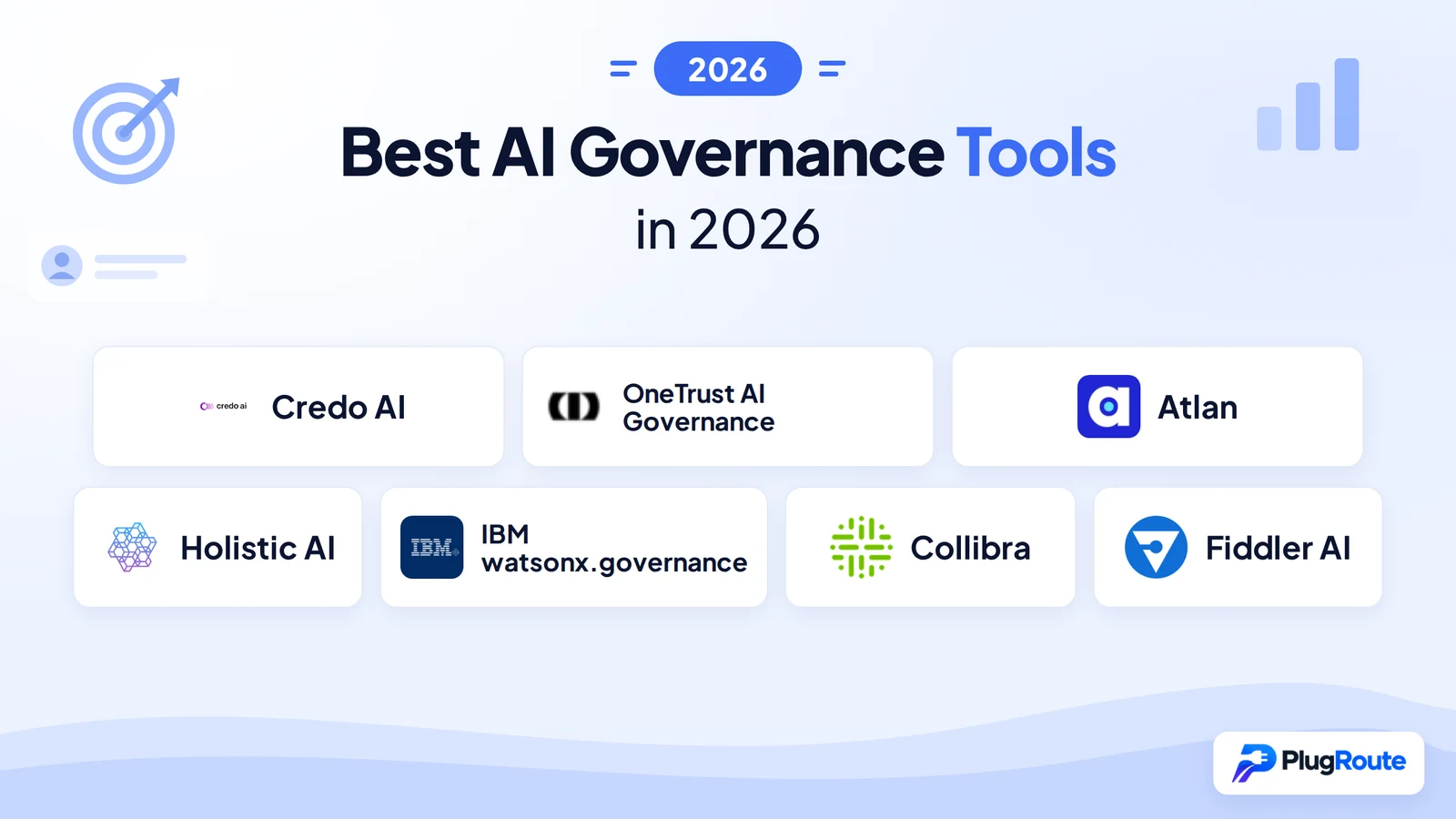
Credo AI is the best overall AI governance platform for enterprise compliance automation, named Forrester Wave Leader in The Forrester Wave™: AI Governance Solutions, Q3 2025. OneTrust AI Governance leads for multi-cloud integration; Atlan for unified data-and-AI governance on open-standard infrastructure. The differentiator most comparisons omit: implementation complexity, which this evaluation treats as a primary criterion alongside analyst recognition.
Enterprise AI leads and compliance officers face an urgent deadline: the EU AI Act’s August 2026 high-risk AI enforcement mandate requires documented evidence trails, automated compliance monitoring, and comprehensive AI system inventory for organizations deploying AI in healthcare, financial services, or critical infrastructure. Most enterprises still lack all three capabilities, and layer onto that the operational pressure of real-time model monitoring and LLM safety guardrails. This evaluation assesses all seven platforms against both regulatory and operational dimensions with equal rigor.
As one enterprise GRC practitioner on r/cybersecurity described:
“The EU AI Act compliance requirements are creating massive demand right now. Companies selling into EU markets need someone who can classify their AI systems by risk tier and build the documentation trail.” Posted by u/Born_Difficulty8309
Takeaway: Enterprise practitioners confirm that EU AI Act compliance is generating concrete, urgent demand for platforms that handle AI risk classification and documentation trail generation, validating this evaluation’s framing of the August 2026 deadline as the primary procurement forcing function.
PlugRoute has no affiliate relationships with any company listed. Rankings are determined entirely by research data and objective evaluation criteria.
TL;DR: Top Picks at a Glance
- Credo AI: deepest regulatory compliance automation; Forrester Wave Leader Q3 2025 (AI Governance Solutions wave); purpose-built cloud-native architecture with zero practitioner implementation complexity warnings
- OneTrust AI Governance: strongest multi-cloud ML platform integration; real-time AI agent detection across AWS Bedrock, Azure AI Foundry, and Google Vertex expanded March 2026
- Atlan: unified data-and-AI governance on open standards; Gartner Magic Quadrant Leader 2025; Medtronic deployment at 3.2M+ governed objects
- Holistic AI: the only platform combining SaaS governance with independent third-party AI audit services; UK Government AI Assurance Registry listed
What Are the Six Categories of AI Governance Tools?
AI governance tools fall into six categories, each covering a different phase or scope of the AI governance lifecycle. The right category depends on whether your primary challenge is regulatory compliance automation, unified data-and-AI inventory, independent audit services, or post-deployment model monitoring.
- Compliance Governance Platforms (Credo AI) automate policy-to-evidence generation across regulatory frameworks including EU AI Act, NIST AI RMF, and ISO 42001, using contextual policy intelligence rather than static checklists.
- Trust Intelligence Platforms (OneTrust AI Governance) integrate AI governance into existing privacy and GRC infrastructure, enabling unified compliance management across data privacy and AI risk from a single control plane.
- Active Metadata Platforms (Atlan) govern data and AI assets through a dynamic, event-driven control plane, metadata directly triggers automated governance actions across connected ML platforms rather than passively cataloging assets.
- AI Risk and Audit Platforms (Holistic AI) combine automated AI risk testing with independent third-party audit services, the only category that satisfies audit independence requirements that self-administered tools structurally cannot.
- Enterprise AI Governance Suites (IBM watsonx.governance, Collibra) extend established enterprise GRC or data governance capabilities into AI use cases, offering broad feature coverage for organizations already invested in these platforms.
- AI Observability Platforms (Fiddler AI) monitor model drift, bias, and LLM safety metrics post-deployment with explainability-first architecture, technically deep but narrower in governance lifecycle scope than full platforms.
The key decision fork:
- Regulatory compliance automation (EU AI Act, NIST AI RMF, August 2026 deadline) → Evaluate Credo AI, OneTrust AI Governance, IBM watsonx.governance
- Unified data and AI governance → Evaluate Atlan, Collibra
- Independent AI audit services → Evaluate Holistic AI
- Post-deployment LLM and model monitoring → Evaluate Fiddler AI, but pair with a full-lifecycle platform for complete coverage
How Do the Top 7 AI Governance Tools Compare?
| Rank | Company | Category | Best For | One-Line Summary | Key Capabilities | Primary Strength | Key Limitation |
|---|---|---|---|---|---|---|---|
| 1 | Credo AI | Compliance Governance Platform | Multi-framework regulatory compliance automation | Credo AI is a purpose-built AI governance platform and Forrester Wave Leader in The Forrester Wave™: AI Governance Solutions, Q3 2025, recognized for its automated, regulation-aware policy engine covering EU AI Act, NIST AI RMF, ISO 42001, and 100+ regulatory frameworks. | Governance Knowledge Graph; Shadow AI discovery; Developer SDK; 100+ regulations tracking; Agentic risk assessment library | Contextual, jurisdiction-aware policy controls that apply different regulatory frameworks to the same model based on deployment context; without manual reconfiguration | No independently verified named customer case studies with quantified governance outcomes; vendor financials not publicly disclosed |
| 2 | OneTrust AI Governance | Trust Intelligence Platform | Multi-cloud governance with existing privacy infrastructure | OneTrust AI Governance is a real-time AI compliance platform integrating natively with AWS SageMaker, Azure ML, Google Vertex AI, and Databricks Unity Catalog, expanded in March 2026 with continuous AI agent detection for AWS Bedrock, Azure AI Foundry, and Google Vertex. | Real-time agent detection (AWS Bedrock, Azure AI Foundry, Google Vertex); Pre-built regulatory assessments; Privacy convergence; Four-platform ML integration | Simultaneous native integration to all four major enterprise ML platforms; March 2026 real-time agent detection expansion across three hyperscaler environments | Forrester recognition is from the Privacy Management Software Wave Q4 2025; not the dedicated AI Governance Solutions Wave Q3 2025; AI module built atop a privacy platform |
| 3 | Atlan | Active Metadata Platform | Unified data and AI governance on modern cloud-native infrastructure | Atlan is a Gartner Magic Quadrant Leader (2025) for Metadata Management with a 4.6/5.0 Gartner Peer Insights rating, governing data and AI assets through an active metadata control plane built on open standards, with a documented Medtronic deployment managing 3.2M+ governed objects. | Active metadata triggers; End-to-end AI lineage; EU AI Act risk classification; Apache Iceberg open standards; Shadow AI detection | Gartner MQ Leader 2025; Medtronic deployment at 3.2M+ objects with 4x faster connector rollout; open-standard architecture prevents vendor lock-in | Regulatory policy automation depth for EU AI Act policy packs less documented than purpose-built compliance platforms |
| 4 | Holistic AI | AI Risk and Audit Platform | Independent AI risk auditing for regulated industries | Holistic AI is an AI risk and audit platform listed on the UK Government’s official AI Assurance Techniques Registry, delivering 100+ automated tests across bias, hallucinations, toxicity, and security attacks alongside independent third-party AI audit services for regulated-industry compliance. | 100+ automated tests; Third-party audit services; UK Gov registry (6 assurance techniques); RAG risk dashboard; Guardian agents and kill switches | Only platform in this review combining SaaS governance with independent third-party audit services; addressing EU AI Act conformity assessment and OCC SR 11-7 audit independence requirements | No named Forrester Wave, Gartner MQ, or IDC MarketScape placement as of April 2026; no verified public review scores |
| 5 | IBM watsonx.governance | Enterprise AI Governance Suite | IBM-ecosystem enterprises and on-premises regulated deployments | IBM watsonx.governance is an IDC MarketScape Leader (2025–2026) enterprise AI governance suite combining model risk management (OpenPages), lifecycle documentation (AI Factsheets), and model monitoring (OpenScale), with on-premises deployment and a confirmed named case study at Banco do Brasil. | AI Factsheets; OpenPages MRM; On-premises/hybrid deployment; SageMaker integration; Regulatory compliance accelerators | On-premises deployment capability unique among top-ranked platforms; Banco do Brasil named case study with documented outcomes; confirmed bank and telco deployments at 500+ models | Technology lineage to 1996 (OpenPages/ACI); practitioners describe implementation as “heavy” with SME scarcity across all three integrated components |
| 6 | Collibra | Data Intelligence Platform (with AI Governance module) | Enterprises already on Collibra extending data governance to AI | Collibra is a data intelligence platform with a Gartner Peer Insights rating of 4.6/5.0 (180+ reviews) and Forrester Wave Strong Performer status in AI Governance Solutions Q3 2025, offering an AI Governance module launched February 2024 as an extension of its 15+-year data governance platform. | AI use case lifecycle management; Data lineage for AI; Databricks Unity Catalog integration; Policy enforcement; Slack/Teams integration | Gartner Peer Insights 4.6/5.0 with 180+ reviews; highest verified customer review score in this research; Gartner MQ Leader Data & Analytics Governance Platforms 2025 (second consecutive year) | AI module launched February 2024; most recently introduced dedicated AI governance capability in this review; practitioners consistently flag implementation as “huge to set up and hard to use” |
| 7 | Fiddler AI | AI Observability Platform | MLOps teams focused on post-deployment model and LLM monitoring | Fiddler AI is an explainability-first AI observability platform monitoring model drift, bias, and LLM safety metrics post-deployment, with a Trust Service scoring LLM outputs across 80+ metrics at sub-100ms latency, 6x lower cost, and 50% higher accuracy than LLM-as-a-Judge, processing 5M+ requests daily. | Model drift/bias monitoring; LLM Trust Service (80+ metrics, sub-100ms); Shapley explainability; Federal distribution via Carahsoft; Multi-modal support | Trust Service: sub-100ms latency, 6x cost advantage, 50% accuracy improvement over LLM-as-a-Judge, 5M+ requests/day; the most technically specified LLM safety monitoring capability in this research | No AI asset discovery, regulatory policy packs, or cross-functional governance workflows; post-deployment monitoring scope only; must be paired with a full governance platform |
Which AI Governance Tool Should I Choose for My Use Case?
| Your #1 Priority | Recommended Tool | Why | Acceptable Alternative |
|---|---|---|---|
| EU AI Act compliance automation (Aug 2026 deadline) | Credo AI | Forrester Wave Leader Q3 2025 (AI Governance Solutions wave); Governance Knowledge Graph maps systems to regulatory frameworks by jurisdiction; deepest pre-built policy packs | OneTrust AI Governance; if already on OneTrust privacy platform |
| Multi-cloud governance without lock-in | OneTrust AI Governance | Native integrations to SageMaker, Azure ML, Vertex AI, and Databricks Unity Catalog simultaneously; March 2026 agent detection across AWS Bedrock, Azure AI Foundry, Google Vertex | Atlan; for data-governance-led multi-cloud environments |
| Unified data and AI governance | Atlan | Gartner MQ Leader 2025; active metadata control plane; Medtronic 3.2M+ deployment; Apache Iceberg open standards prevent lock-in | Collibra; if already deployed on Collibra data governance |
| Independent AI audit for regulated industries | Holistic AI | Only platform with both SaaS governance and third-party audit services; UK Government registry recognition across six AI assurance techniques | IBM watsonx.governance; for IBM GRC ecosystem with on-premises requirements |
| Existing IBM OpenPages/GRC infrastructure | IBM watsonx.governance | Direct extension of OpenPages investment; Banco do Brasil named case study; confirmed bank and telco deployments at 500+ models | Holistic AI; for audit independence requirements alongside IBM tooling |
| Already on Collibra data governance | Collibra | AI Governance module extends existing investment at lower incremental friction; Forrester Wave Strong Performer AI Governance Q3 2025; Gartner MQ Leader second consecutive year | Atlan; if pursuing a modern cloud-native data governance rebuild |
| Post-deployment LLM safety monitoring | Fiddler AI | Trust Service: sub-100ms latency, 6x cost vs. LLM-as-a-Judge, 80+ LLM metrics, 5M+ requests/day; strongest technical monitoring depth in this research | Pair with Credo AI or Atlan; Fiddler alone does not cover asset discovery or regulatory compliance documentation |
1. Credo AI: Best Overall: Best for Purpose-Built Regulatory Compliance Automation Across Multiple Frameworks
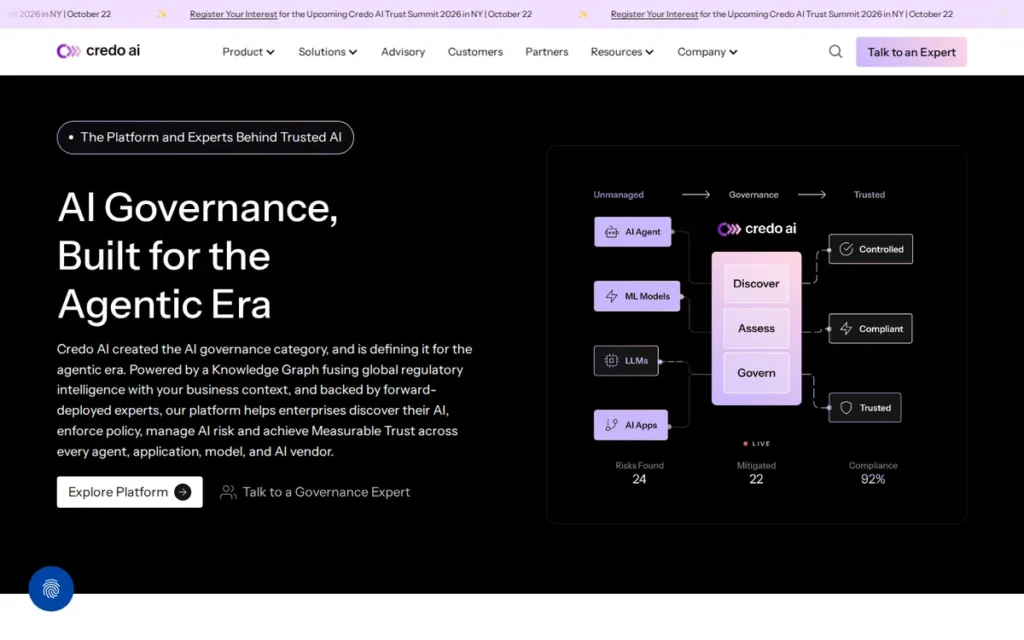
Category: Compliance Governance Platform, automates policy mapping, regulatory evidence generation, and AI system risk assessment across the full AI lifecycle using a purpose-built Governance Knowledge Graph.
At a Glance
- Category: Compliance Governance Platform
- Best For: Enterprise compliance officers and AI risk teams navigating EU AI Act, NIST AI RMF, ISO 42001, HITRUST, and SOC 2 simultaneously, particularly organizations facing the EU AI Act August 2026 high-risk AI enforcement deadline across multinational jurisdictions
- Price Range: Quote-based; no public pricing disclosed. Available on AWS Marketplace for consolidated enterprise billing, enabling organizations with existing AWS Enterprise Discount Programs to apply credits toward Credo AI licensing.
- Primary Strength: Credo AI’s Governance Knowledge Graph automatically applies contextual, jurisdiction-aware policy controls to AI systems, mapping each to the correct regulatory framework based on deployment context rather than applying one-size-fits-all checklists across all jurisdictions
- Biggest Limitation: No publicly verifiable named customer case studies with quantified governance outcomes to independently confirm claimed efficiency gains before purchase; vendor financials not publicly disclosed
- One-Line Summary: Credo AI is a purpose-built AI governance platform and Forrester Wave Leader in The Forrester Wave™: AI Governance Solutions, Q3 2025, delivering automated, regulation-aware policy controls across EU AI Act, NIST AI RMF, ISO 42001, and 100+ additional regulatory frameworks via a proprietary Governance Knowledge Graph.
- Last Verified: April 2026
Overview
Credo AI is a purpose-built AI governance platform designed for enterprise compliance officers, AI risk teams, and regulated-industry organizations that must simultaneously satisfy EU AI Act, NIST AI RMF, ISO 42001, GDPR, and HITRUST requirements across their full AI portfolio without manual regulatory translation.
Credo AI was founded in 2020 and built exclusively for AI governance from its founding (rather than extending from a prior GRC or data catalog product) which produces deeper feature alignment with AI-specific regulatory requirements than platforms that entered governance as a module addition.
Credo AI’s core technical differentiator is its Governance Knowledge Graph: a proprietary layer connecting regulatory requirements, risk scenarios, and AI system configurations to automatically generate policy-to-evidence documentation based on deployment context.
Key Features
- Governance Knowledge Graph: Credo AI’s Governance Knowledge Graph contextually applies different regulatory controls based on an AI system’s jurisdiction, deployment environment, and risk classification, ensuring a credit scoring model deployed in the EU automatically receives EU AI Act Article 9–15 compliance controls while the same model deployed in the US receives NIST AI RMF mapping, without manual reconfiguration by compliance teams.
- AI Registry and Shadow AI Discovery: Credo AI provides a centralized, continuously updated inventory of all AI models, agents, and use cases across the enterprise (including systems deployed without formal governance approval) enabling organizations to address the shadow AI discovery gap before regulatory audits surface undocumented deployments.
- Policy Intelligence Module: Credo AI’s Policy Intelligence includes pre-built policy packs for EU AI Act, NIST AI RMF, ISO 42001, SOC 2, and HITRUST with automated compliance monitoring that evaluates agent traces in real time against active policies, replacing periodic manual review cycles with continuous evidence generation.
- Developer SDK: Credo AI’s developer SDK embeds governance checks directly into existing ML development workflows, allowing data scientists to manage AI use cases from code and integrating governance during development rather than imposing it as a post-deployment compliance layer that creates friction with technical teams (Credo AI SDK blog).
- AI Governance Insights Hub: Credo AI maintains a publicly available AI Governance Insights Hub powered by its Harmonized Controls Framework (HCF), tracking 100+ regulations, 80 risk scenarios, and 100+ controls with weekly updates, providing compliance teams with real-time policy currency as the EU AI Act enforcement calendar evolves through 2025–2027 (Credo AI blog).
Best For
Credo AI is best for multinational enterprises managing AI systems across multiple regulatory jurisdictions simultaneously, particularly organizations with significant EU AI Act high-risk AI exposure facing the August 2026 compliance deadline, and compliance functions that have been relying on manual regulatory mapping that cannot scale to the volume and velocity of current AI deployments.
Strengths
- Credo AI earned Leader status in The Forrester Wave™: AI Governance Solutions, Q3 2025, receiving the highest possible scores in 12 evaluation criteria including AI policy management, AI asset catalog, and innovation. Forrester analyst Michele Goetz stated: “Credo AI excels at AI asset and controls management, transparency, and risk management. The asset catalog, policy management, policy compliance audit, accelerators, and UI/UX are superior” (source: BusinessWire, August 2025). Collibra holds a Strong Performer placement in the same wave, making Credo AI one of two platforms in this review evaluated in that AI-governance-specific wave and the only one at the Leader tier.
- Credo AI is cited in both the Gartner 2025 Market Guide for AI Governance Platforms and named a Gartner Cool Vendor in AI Cybersecurity Governance (October 2025), dual Gartner recognition that is uncommon for a company founded in 2020, validating institutional credibility with regulated-industry procurement teams that require independent analyst pre-qualification (source: Credo AI resources page, 2025).
- Credo AI’s cloud-native architecture, built from its 2020 founding, generates zero practitioner implementation complexity warnings in community research, a meaningful differentiator from IBM watsonx.governance and Collibra, where practitioners on r/IBM and r/dataengineering consistently flag heavy setup and SME scarcity (cloud-native architecture: credo.ai/company, 2026; community research: Reddit, April 2026).
- Credo AI’s free AI Governance Insights Hub tracks 100+ regulations and 80+ risk scenarios with weekly updates, extending platform value for compliance teams monitoring the EU AI Act’s three-milestone enforcement calendar through August 2027 (source: Credo AI blog, 2025).
“If you have the budget for a full enterprise platform, Credo AI is the name that keeps coming up in our guest lectures for full governance and risk monitoring, but I haven’t used it personally.” (u/wy20010120, r/fintech)
Takeaway: Credo AI has crossed from specialist adoption into mainstream professional awareness, its reputation precedes hands-on deployment, a meaningful signal in a category where tool selection follows peer endorsement and analyst credentialing.
Limitations
- Unverified Efficiency Claims: Credo AI’s claimed 60% reduction in manual governance work and 3x team collaboration improvement are self-reported from Credo AI’s own marketing materials (not independently verified through named case studies) making pre-purchase validation of these figures difficult for buyers who must build internal business cases with quantified ROI evidence.
- Absence of Named Deployment Evidence: Credo AI has not publicly documented named enterprise deployments comparable to Atlan’s Medtronic deployment (3.2M+ governed objects) or IBM’s confirmed Banco do Brasil case study, limiting the independently verifiable production evidence available to sophisticated enterprise buyers evaluating practitioner-validated platforms alongside analyst-recognized ones (source: independent research, April 2026).
- Vendor Viability Due Diligence: Credo AI has not publicly disclosed funding rounds, revenue figures, or team size as of April 2026, a vendor viability concern for enterprise buyers committing to multi-year governance contracts where platform continuity is critical once compliance audit trails are in production. Community perception of premium pricing (“if you have the budget for a full enterprise platform”) reinforces the need for prospective buyers to model total cost including any per-AI-system scaling structures before committing.
Verdict
Credo AI is the strongest choice for enterprises that need purpose-built, automated AI governance with the deepest regulatory compliance automation available in this category as of April 2026. Credo AI’s Forrester Wave Leader position in the AI-governance-specific Q3 2025 wave (with Forrester analyst Michele Goetz specifically citing superior policy management, asset catalog, and UI/UX) reflects a platform built from the ground up for AI governance with contextual policy intelligence that platforms entering governance as a module addition structurally cannot replicate. Compliance officers facing the EU AI Act’s August 2026 high-risk AI deadline will find Credo AI’s pre-built policy packs, automated evidence generation, and Governance Knowledge Graph the most direct path to audit-ready governance at scale.
2. OneTrust AI Governance: Best for Multi-Cloud Integration and Existing Privacy Infrastructure
Category: Trust Intelligence Platform, integrates privacy management, AI risk assessment, and real-time policy enforcement into a unified compliance control plane covering privacy, security, and AI governance from a single platform.
At a Glance
- Category: Trust Intelligence Platform
- Best For: Enterprise organizations already using OneTrust for GDPR/CCPA privacy management extending into AI governance, and multi-cloud enterprises with AI systems distributed across AWS, Azure, and Google Cloud needing unified governance without infrastructure migration
- Price Range: Quote-based; no public pricing disclosed. Existing OneTrust customers may access AI Governance as an incremental module addition to existing contracts, request this explicitly during vendor evaluation to assess incremental versus net-new implementation cost.
- Primary Strength: OneTrust AI Governance integrates natively with AWS SageMaker, Azure ML, Google Vertex AI, and Databricks Unity Catalog simultaneously, enabling multi-cloud AI governance without platform migration or lock-in
- Biggest Limitation: OneTrust’s Forrester recognition comes from The Forrester Wave™: Privacy Management Software, Q4 2025, a different evaluation instrument than The Forrester Wave™: AI Governance Solutions, Q3 2025, meaning its scores reflect privacy platform strength with AI capabilities rather than dedicated AI governance platform assessment
- One-Line Summary: OneTrust AI Governance is a real-time AI compliance platform integrating natively with all four major enterprise ML platforms and expanded in March 2026 with continuous AI agent detection for AWS Bedrock, Azure AI Foundry, and Google Vertex, best suited for organizations already on OneTrust’s privacy and GRC platform.
- Last Verified: April 2026
Overview
OneTrust AI Governance is an enterprise AI compliance and risk management platform that extends OneTrust’s established privacy and GRC infrastructure into AI-specific governance, covering AI asset inventory, risk assessment, policy enforcement, and real-time agent monitoring for organizations navigating EU AI Act, NIST AI RMF, ISO 42001, and OECD AI Principles simultaneously.
OneTrust AI Governance’s March 2026 expansion added real-time AI agent detection for AWS Bedrock, Azure AI Foundry, and Google Vertex, moving from static compliance snapshots to continuous monitoring that reflects the enterprise shift toward agentic AI deployment (GlobeNewswire, March 9, 2026).
OneTrust was founded in 2016, has raised over $900 million in total funding, and reached a $5.3 billion valuation as of its August 2021 Series C, a five-year-old valuation figure that prospective buyers should not treat as current, though the funding scale reflects substantial enterprise distribution infrastructure.
Key Features
- Automated AI Asset Inventory and Discovery: OneTrust AI Governance captures ownership, purpose, integrations, data access, lineage, and lifecycle changes for AI agents, models, and datasets (including shadow AI deployed outside formal governance processes) creating a continuously updated enterprise AI registry that supports EU AI Act Article 11 documentation requirements.
- Pre-Built Regulatory Assessments: OneTrust AI Governance includes out-of-the-box risk assessments aligned to EU AI Act, NIST AI RMF, ISO 42001, and OECD AI Principles, enabling compliance teams to conduct structured assessments without manually translating regulatory text into evaluation criteria.
- Real-Time AI Agent Detection: OneTrust AI Governance’s Winter 2026 release added agent detection specifically for AWS Bedrock, Azure AI Foundry, and Google Vertex, discovering AI agents across these platforms and centralizing related models, decisions, outputs, and risks in a searchable governance inventory (GlobeNewswire, March 9, 2026).
- Four-Platform Native ML Integration: OneTrust AI Governance integrates natively with AWS SageMaker, Azure ML, Google Vertex AI, and Databricks Unity Catalog for real-time model synchronization, enabling a single governance layer across heterogeneous multi-cloud ML environments without infrastructure consolidation (Finance Director Europe).
- AI Policy Manager: OneTrust AI Governance’s AI Policy Manager provides prebuilt, standards-aligned policy templates with automated enforcement, allowing policy updates to propagate across all connected AI systems without requiring manual update cycles across each deployment environment.
Best For
OneTrust AI Governance is best for Fortune 500 and large enterprise organizations already licensed on OneTrust’s privacy and GRC platform who want to add AI governance as a modular extension, and for multi-cloud enterprises with AI systems distributed across AWS, Azure, and Google Cloud that need a single governance layer spanning all three environments simultaneously.
Strengths
- OneTrust received the highest possible scores in 22 evaluation criteria, including 7 out of 8 AI-related criteria, in The Forrester Wave™: Privacy Management Software, Q4 2025, demonstrating broad platform strength across integrated privacy and AI governance capabilities. Note: this is the Privacy Management wave, not the AI Governance Solutions wave Q3 2025 that evaluated Credo AI and Collibra, buyers should review both Forrester assessments separately during vendor evaluation, as the two waves assess different competitive peer groups and capability sets (source: OneTrust press release, Q4 2025; confirmed via blog.exceeds.ai, April 2026).
- OneTrust expanded its AI Governance platform in March 2026 with real-time AI agent detection for AWS Bedrock, Azure AI Foundry, and Google Vertex, one of the first documented production capability deliveries for agentic AI governance among the platforms in this review, addressing the transition from static model monitoring to continuous agent oversight (source: GlobeNewswire, March 9, 2026).
- OneTrust’s enterprise infrastructure scale: founded 2016, $900M+ raised, $5.3B valuation as of August 2021 Series C, 2,500+ employees globally, provides established regulatory compliance depth across GDPR, CCPA, and HIPAA, giving AI Governance buyers a cross-sell path from existing privacy tooling rather than starting a net-new vendor relationship (source: OneTrust Series C announcement, August 2021).
Users on r/cybersecurity shared their experience with OneTrust as a compliance platform:
“I chose OneTrust for my business because it is mature in its platform- its easy to understand the flow from Policy to controls to evidence, has a 3rd party risk component, and integrations that make my evidence generation easier. Its risk register component isn’t the greatest, and there’s room for improvement, but they do listen and improve when you have meetings with them. Another reason I chose them over other solutions was the ability to grow with them- in the future if my company needs a privacy add on, or an enterprise risk add-on they have those available and easy to add to our account.” Posted by u/meapet
Takeaway: OneTrust’s mature evidence workflow and modular extensibility are practitioner-validated strengths, but its risk register limitations signal that buyers evaluating the AI Governance module should explicitly probe risk scoring depth rather than assuming parity with purpose-built AI risk platforms.
Limitations
- Forrester Wave Scope Distinction: OneTrust’s Forrester scores come from The Forrester Wave™: Privacy Management Software, Q4 2025, not from The Forrester Wave™: AI Governance Solutions, Q3 2025 that evaluated dedicated AI governance platforms. This means OneTrust was assessed as a privacy platform with AI capabilities, competing against privacy platform peers, not against AI-governance-native vendors like Credo AI. Buyers should request the specific wave report from OneTrust during evaluation and review both instruments independently before treating the credentials as comparable.
- AI Module Maturity: OneTrust AI Governance is a module extension onto a platform whose primary identity remains privacy and GRC management, organizations whose primary challenge is AI-specific regulatory policy automation may find OneTrust’s AI governance depth less specialized than purpose-built AI governance platforms like Credo AI or Holistic AI for AI-only governance use cases.
- Limited AI-Specific Practitioner Reviews: OneTrust AI Governance has no hands-on practitioner reviews of the AI-specific module surfaced through community research, limiting independent real-world performance validation separate from OneTrust’s legacy privacy products, and requiring reference customer conversations to fill the validation gap for AI governance buyers specifically.
Verdict
OneTrust AI Governance is the strongest choice for enterprises seeking to govern AI systems within existing privacy and GRC infrastructure, and for multi-cloud organizations needing simultaneous native integration across AWS, Azure, and Google ML environments from a single platform. OneTrust AI Governance’s March 2026 real-time agent detection expansion for AWS Bedrock, Azure AI Foundry, and Google Vertex positions it ahead of most competitors on documented agentic AI governance readiness as of April 2026. Organizations evaluating OneTrust AI Governance as a standalone AI governance purchase should request hands-on demonstrations of the AI-specific module and ask for reference customers who implemented it outside of OneTrust’s legacy privacy tooling context.
3. Atlan: Best for Unified Data and AI Governance on Modern Cloud-Native Infrastructure
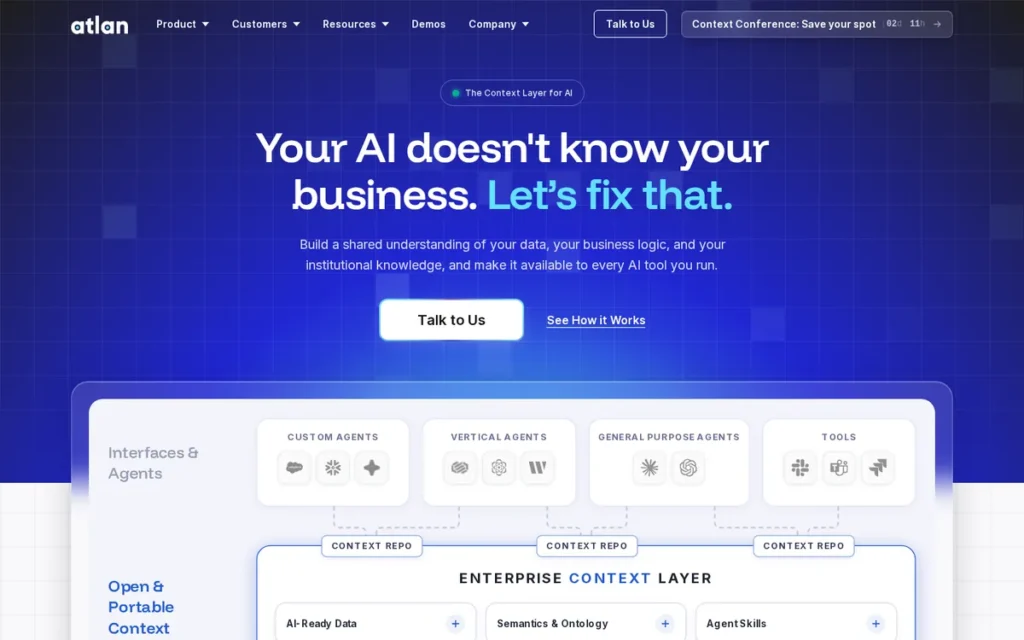
Category: Active Metadata Platform, uses dynamic metadata to govern data and AI assets by triggering automated governance actions across connected systems, rather than passively cataloging them for manual administration.
At a Glance
- Category: Active Metadata Platform
- Best For: Data engineering, MLOps, and data governance teams managing large-scale, multi-platform environments on Snowflake, Databricks, or dbt who want to extend proven data governance into AI asset management without adopting a separate AI-only vendor
- Price Range: Quote-based; no public pricing disclosed. Available on AWS Marketplace. Stratola Research’s 2025 analysis reported 122% ARR growth (single-source, not independently confirmed), suggesting pricing competitive with or below legacy incumbents.
- Primary Strength: Atlan’s active metadata architecture transforms governance from a passive catalog into a dynamic control plane, metadata directly triggers automated governance actions across connected ML platforms, data pipelines, and BI tools without requiring manual intervention
- Biggest Limitation: Regulatory compliance automation depth for AI-specific frameworks (particularly automated EU AI Act policy pack generation and NIST AI RMF controls mapping) is less explicitly documented than purpose-built AI compliance platforms; a minority of practitioners describe Atlan as a front-end layer over open-source components
- One-Line Summary: Atlan is a Gartner Magic Quadrant Leader (2025) for Metadata Management with a 4.6/5.0 Gartner Peer Insights rating, governing data and AI assets through an active metadata control plane built on open standards, with a documented Medtronic deployment managing 3.2M+ governed objects at enterprise scale.
- Last Verified: April 2026
Overview
Atlan is an active metadata platform that governs data and AI assets through a dynamic control plane (where metadata directly triggers automated governance actions across connected systems) serving data engineering teams, MLOps managers, and data governance leads that need to manage AI models, pipelines, datasets, and agents as governed objects within existing data infrastructure.
Atlan earned Gartner Magic Quadrant Leader recognition in 2025 for Metadata Management Solutions, with Gartner specifically citing Atlan’s Model Context Protocol Server and metadata intelligence for AI governance automation (BusinessWire, November 2025).
Atlan is built on open standards (Apache Iceberg, Apache Atlas, Janus Graph) enabling integration across Snowflake, Databricks, MLflow, dbt, and major BI tools without requiring platform migration or creating single-vendor dependency.
The r/dataengineering community consistently identifies Atlan and Alation as the commercially strongest modern data catalog options, differentiating Atlan from legacy incumbents with decade-plus track records.
Key Features
- AI Asset Discovery and Shadow AI Detection: Atlan automatically ingests AI applications and models from connected ML platforms into a centralized AI model registry, providing continuous automated inventory of deployed AI systems including shadow AI discovered through platform scanning, enabling organizations to address undocumented deployments before regulatory audits surface them.
- End-to-End AI Lineage with RAG Visibility: Atlan provides column-level data lineage and RAG pipeline visibility, enabling teams to trace which data assets trained which models and which models feed which downstream applications, creating the provenance documentation required for EU AI Act technical records under Article 11 (Atlan AI Governance page).
- Policy Center with EU AI Act Risk Classification: Atlan’s Policy Center includes prebuilt regulatory templates with a runtime enforcement engine, alongside an EU AI Act risk classification engine that automatically categorizes AI systems into the Act’s risk tiers based on deployment context and data sensitivity.
- Active Metadata Governance Playbooks: Atlan’s Apache Kafka streaming infrastructure enables proactive governance playbooks, automatically pausing data pipelines when quality thresholds are breached, updating access policies when lineage changes are detected, and triggering Slack or ServiceNow alerts when governance conditions are violated.
- Open-Standard Infrastructure at Scale: Atlan’s metadata lakehouse runs on Apache Iceberg, Janus Graph, and Apache Atlas, open standards enabling bidirectional synchronization at the documented scale of Medtronic’s 3.2M+ governed objects, preventing the proprietary lock-in that concerns enterprise buyers managing multi-vendor AI stacks (Stratola Research, September 2025).
Best For
Atlan is best for organizations approaching AI governance from a data governance foundation (particularly those managing large data estates across Snowflake, Databricks, or dbt who want to extend governance to AI models and agents without a separate AI-only tool) and for enterprises prioritizing vendor interoperability and open-standard infrastructure over packaged regulatory policy automation.
Strengths
- Atlan was named a Leader in the 2025 Gartner Magic Quadrant for Metadata Management Solutions (with Gartner specifically citing Atlan’s Model Context Protocol Server and metadata intelligence for AI governance automation) and holds a Gartner Peer Insights rating of 4.6/5.0, validating its competitive position against incumbents with decade-plus track records (source: BusinessWire, November 2025; Gartner Peer Insights via Stratola Research, 2025).
- Atlan’s deployment at Medtronic manages 3.2 million+ governed objects including data assets, models, pipelines, and AI agents, with Medtronic achieving 4x faster connector rollout compared to prior tooling and data workers reducing time spent searching for information from a documented 5.5 hours per week, the most specific independently verifiable enterprise-scale production evidence in this research alongside IBM’s Banco do Brasil case study (source: Stratola Research, September 2025; Atlan.com, 2025).
- Stratola Research’s 2025 competitive analysis reported 122% year-over-year ARR growth for Atlan (a single-source figure that has not been independently confirmed by a second source and should be treated as directional rather than verified) and the r/dataengineering community consistently identifies Atlan and Alation as the commercially strongest modern data catalog options above legacy incumbents (source: Stratola Research, September 2025; u/legoaitech, r/dataengineering).
Limitations
- Regulatory Compliance Automation Gap: Atlan’s AI-specific regulatory compliance depth (particularly automated EU AI Act policy pack generation and NIST AI RMF controls mapping comparable to Credo AI’s Governance Knowledge Graph) is less explicitly documented on Atlan’s product pages, meaning compliance teams needing audit-ready EU AI Act Article 9–15 evidence may require significant platform configuration beyond out-of-the-box capabilities.
- Open-Source Substitution Risk: A minority of practitioners on r/dataengineering describe Atlan as “a shiny front-end wrapper around OpenMetadata,” suggesting that organizations with substantial engineering bandwidth should evaluate open-source alternatives such as OpenMetadata or Datahub before committing to commercial pricing, a criticism Atlan should address during evaluation by demonstrating proprietary capabilities that open-source alternatives do not replicate (source: u/TheGreenScreen1, r/dataengineering).
- No Verified Public Review Score: Atlan has no independently verified G2, Capterra, or Trustpilot aggregate ratings available at research time outside of the Gartner Peer Insights score confirmed via Stratola Research, limiting the independent practitioner performance data available outside of analyst reports and r/dataengineering community discussion, and requiring buyers to rely more heavily on reference customer conversations during evaluation.
Verdict
Atlan is the strongest choice for organizations approaching AI governance from a data governance foundation, particularly those managing large, multi-platform data estates who need AI model and pipeline governance as an integrated extension of existing data catalog infrastructure. Atlan’s Gartner Magic Quadrant Leader position (2025) and the most productivity-enriched enterprise-scale production deployment in this research (Medtronic, 3.2M+ objects, 4x faster connector rollout) make it the most credibly validated platform for unified data-and-AI governance. Organizations whose primary challenge is regulatory compliance automation should evaluate Credo AI or OneTrust alongside Atlan, asking each vendor specifically how their regulatory mapping handles the EU AI Act’s three enforcement milestones through August 2027.
4. Holistic AI: Best for Independent AI Risk Auditing and Regulated-Industry Compliance
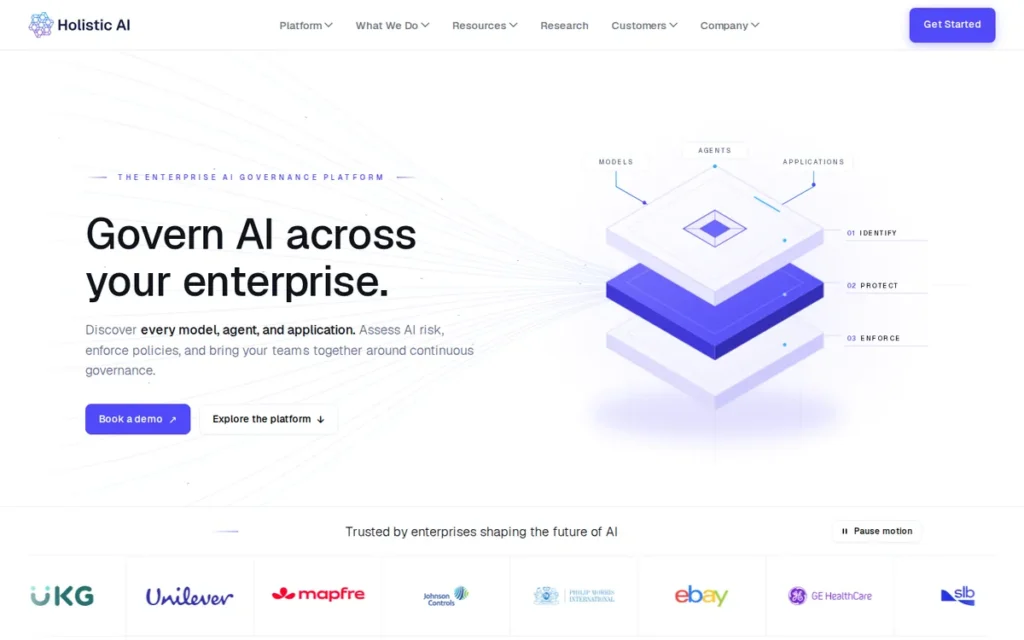
Category: AI Risk and Audit Platform, combines 100+ automated AI risk tests across bias, robustness, efficacy, transparency, and privacy with independent third-party audit services for regulated-industry compliance validation.
At a Glance
- Category: AI Risk and Audit Platform
- Best For: Regulated-industry organizations in banking, healthcare, and insurance requiring independent AI audit services alongside continuous monitoring; compliance teams needing methodologically rigorous bias testing; UK-regulated enterprises where Government AI Assurance Registry listing accelerates procurement
- Price Range: Quote-based; no public pricing disclosed. Dual pricing model likely applies: SaaS subscription for continuous monitoring plus project-based fees for independent audit engagements, request these separately during vendor evaluation.
- Primary Strength: Holistic AI is the only platform in this review combining a SaaS AI governance platform with independent third-party AI audit services, addressing the audit independence requirement that EU AI Act conformity assessments and OCC SR 11-7 banking model validation standards impose and that self-administered tools structurally cannot fulfill
- Biggest Limitation: Holistic AI has not achieved named recognition in Forrester Wave, Gartner Magic Quadrant, or IDC MarketScape reports as of April 2026, the analyst credentials that most Fortune 500 procurement processes require as an initial vendor filter
- One-Line Summary: Holistic AI is an AI risk and audit platform listed on the UK Government’s official AI Assurance Techniques Registry that delivers 100+ automated tests across bias, hallucinations, toxicity, and security attacks alongside independent third-party AI audit services for regulated-industry compliance.
- Last Verified: April 2026
Overview
Holistic AI is an enterprise AI governance and risk management platform that combines automated AI risk testing (covering bias, hallucinations, toxicity, privacy leaks, drift, adversarial attacks, and red teaming across 100+ tests) with independent third-party AI audit services, serving regulated-industry organizations that require both continuous self-governance monitoring and the external audit independence mandated by banking model risk guidelines and EU AI Act conformity assessments.
Holistic AI was co-founded by Dr. Adriano Koshiyama and Dr. Emre Kazim, whose peer-reviewed backgrounds in AI fairness, ethics, and law inform the platform’s interconnected risk scoring across five verticals (bias, robustness, efficacy, transparency, and privacy) where risk dimensions are treated as systemically related rather than independent silos.
Holistic AI holds a listing on the UK Government’s official AI Assurance Techniques Registry as a recognized GRC platform, covering six AI assurance techniques: data assurance, compliance audit, risk assessment, impact assessment, impact evaluation, and conformity assessment (source: gov.uk, verified April 2026).
Key Features
- 100+ Automated AI Risk Tests: Holistic AI’s test suite covers bias, hallucinations, toxicity, privacy leaks, model drift, security attacks, red teaming, jailbreaks, and adversarial probes, enabling organizations to assess AI system risk across all major failure modes through a single interface without requiring separate specialist tooling for each risk dimension.
- Red-Amber-Green Risk Dashboard: Holistic AI’s RAG dashboard classifies AI systems across five interconnected risk verticals (bias, robustness, efficacy, transparency, privacy) with ratings that reflect systemic relationships between risk dimensions rather than treating each as an independent metric, supporting the multidimensional risk evidence required for EU AI Act conformity assessments.
- Independent Third-Party AI Audit Services: Holistic AI’s third-party audit service provides independent validation of AI risk assessments, addressing the audit independence requirement for EU AI Act high-risk AI conformity assessments, OCC SR 11-7 model validation independence standards in banking, and insurance actuarial model audit mandates that prohibit reliance on self-administered tools.
- AI Discovery Across Multi-Cloud and Dev Platforms: Holistic AI automatically detects and catalogs AI systems across AWS, Azure, GCP, Databricks, Snowflake, GitHub, GitLab, and Bitbucket (including shadow AI deployed without formal governance) mapping each discovered system to applicable regulatory requirements upon detection.
- Policy Enforcement with Kill Switches: Holistic AI’s policy enforcement capability includes a visual policy builder, runtime guardrails, deployment gates, approval workflows, kill switches for non-compliant systems, and guardian agents, enabling active enforcement that blocks non-compliant AI system deployments rather than documenting violations after deployment occurs.
Best For
Holistic AI is best for regulated-industry organizations (particularly in banking, healthcare, and insurance) that must demonstrate genuinely rigorous AI risk management rather than checklist compliance, face external audit independence requirements, or need EU AI Act conformity assessment support where self-administered governance tools are structurally insufficient.
Strengths
- Holistic AI is listed on the UK Government’s official AI Assurance Techniques Registry as a recognized Governance, Risk, and Compliance platform covering six AI assurance techniques, a government-level credential that no other platform in this review holds, and one that accelerates procurement pre-qualification for UK-regulated enterprises and public sector organizations subject to UK AI oversight frameworks (source: gov.uk, verified April 2026).
- Holistic AI was co-founded by Dr. Adriano Koshiyama (AI/ML researcher) and Dr. Emre Kazim (AI ethics and law researcher), whose peer-reviewed academic backgrounds provide methodological depth in bias testing and interconnected risk scoring that tools assembled from regulatory compliance checklists cannot credibly replicate, particularly relevant for banking model risk teams defending the rigor of AI risk assessments to OCC examiners (source: holisticai.com/about).
- Holistic AI is the only platform in this review that explicitly provides independent third-party AI audit services alongside its SaaS governance platform, a structural capability absent from all other platforms evaluated, directly addressing the EU AI Act Article 43 conformity assessment requirement and the OCC SR 11-7 model validation independence standard that prevents regulated institutions from self-certifying model risk assessments.
Limitations
- No Major Analyst Placement: Holistic AI has not achieved named recognition in The Forrester Wave™: AI Governance Solutions, Q3 2025, any Gartner Magic Quadrant, or the IDC MarketScape for AI Governance 2025–2026 as of April 2026, the analyst credentials that most Fortune 500 procurement processes require as an initial vendor filter before shortlisting, potentially limiting Holistic AI’s accessibility in enterprise procurement cycles that mandate pre-qualification through named analyst reports.
- Limited Independent Case Study Evidence: No named enterprise case studies with quantified governance outcomes are publicly available through independent research as of April 2026, the UK Government’s techuk.org published a Holistic AI case study without naming the client, providing implicit government endorsement but not the independently verifiable deployment specifics that enterprise buyers use to validate production readiness.
- No Verified Public Review Scores: Holistic AI has no verified G2, Capterra, or Gartner Peer Insights aggregate ratings available at research time, limiting independent practitioner performance data outside of government documentation and academic co-founder credentials, and requiring buyers to rely on direct reference conversations during evaluation.
Verdict
Holistic AI is the most defensible choice for regulated-industry organizations that need methodologically rigorous AI risk assessment and audit independence, particularly those subject to EU AI Act high-risk AI conformity assessment requirements or banking model risk validation standards that prohibit self-administered governance tools. Holistic AI’s combination of 100+ automated tests, UK Government registry recognition across six AI assurance techniques, and third-party audit services addresses the audit independence gap that no other platform in this review can structurally fill. Organizations evaluating Holistic AI against purpose-built compliance platforms like Credo AI should first determine whether audit independence is a mandated requirement or a preference, if mandated, Holistic AI is uniquely positioned; if not, the broader regulatory automation depth of Credo AI or OneTrust may deliver greater enterprise-wide governance value.
5. IBM watsonx.governance: Best for IBM-Ecosystem Enterprises and On-Premises Regulated Deployments
Category: Enterprise AI Governance Suite, assembled multi-product platform combining model risk management (OpenPages), AI lifecycle documentation (AI Factsheets), and model monitoring (OpenScale) under a unified AI governance brand with hybrid cloud and on-premises deployment capability.
At a Glance
- Category: Enterprise AI Governance Suite
- Best For: Large enterprises already deployed on IBM GRC infrastructure (OpenPages) or IBM’s watsonx AI platform where watsonx.governance extends existing tooling, and regulated-industry organizations in banking and healthcare requiring on-premises deployment for data sovereignty compliance
- Price Range: Quote-based; no public pricing disclosed. Component-based licensing (OpenPages + OpenScale + AI Factsheets) likely means substantial costs scaling with deployment scope, user count, and model volume. Request total cost of ownership estimates explicitly including implementation professional services.
- Primary Strength: IBM watsonx.governance provides confirmed on-premises deployment capability (unique among the top-ranked platforms in this review) enabling regulated industries with data sovereignty requirements to implement AI governance without cloud processing dependencies
- Biggest Limitation: Built on technology with lineage dating to 1996 (OpenPages/ACI, acquired by IBM in 2010); multiple independent practitioners describe implementation as “heavy” with meaningful SME scarcity across all three integrated components
- One-Line Summary: IBM watsonx.governance is an IDC MarketScape Leader (2025–2026) enterprise AI governance suite combining model risk management, lifecycle monitoring, and hybrid cloud and on-premises deployment, with a confirmed named case study at Banco do Brasil demonstrating production governance outcomes in a regulated banking environment.
- Last Verified: April 2026
Overview
IBM watsonx.governance is an enterprise AI governance platform that assembles three integrated IBM products (OpenPages for GRC workflow and risk scoring, OpenScale for model monitoring, and AI Factsheets for lifecycle documentation) into a unified governance suite for large enterprises managing complex hybrid cloud AI environments.
IBM watsonx.governance was recognized as an IDC MarketScape Leader for AI Governance 2025–2026 and has a confirmed named enterprise deployment at Banco do Brasil (the second-largest bank in Latin America) where the platform was deployed with EY to automate governance workflows and unify oversight across traditional and generative AI systems (source: IBM case study, IBM.com, 2025).
IBM watsonx.governance’s hybrid cloud and on-premises deployment support directly addresses data sovereignty requirements in banking and healthcare where cloud-only processing may be prohibited by internal IT security policy or regulatory mandate.
Key Features
- AI Factsheets: IBM watsonx.governance’s AI Factsheets systematically collect and document model facts from initial business request through production deployment, generating structured lifecycle records aligned with EU AI Act Article 11 technical documentation requirements and OCC SR 11-7 model risk management documentation standards for banking organizations.
- Regulatory Compliance Accelerators: IBM watsonx.governance provides pre-built automation workflows for EU AI Act, NIST AI RMF, and ISO 42001 compliance, designed to reduce the manual effort required to map model risk controls to specific regulatory requirements at the August 2026 high-risk AI enforcement deadline.
- Hybrid Cloud and On-Premises Deployment: IBM watsonx.governance supports on-premises deployment and integrates natively with Amazon SageMaker, enabling organizations with data sovereignty requirements to implement AI governance without migrating to cloud-only infrastructure, and allowing SageMaker-based ML teams to extend governance without changing their model development platform.
- OpenPages Model Risk Governance: IBM watsonx.governance’s OpenPages GRC foundation provides enterprise risk workflow capability (risk scorecards, approval workflows, escalation paths, and executive dashboards) adapted for AI risk management and integrated with model monitoring data from OpenScale for end-to-end AI lifecycle visibility within a single interface.
- Agentic AI Governance: IBM watsonx.governance includes governed catalogs for AI agents and tools, real-time behavior tracking, and a Risk Atlas for agentic AI risk classification, with IBM claiming a 35% reduction in manual oversight for agentic workflows through automated monitoring (IBM self-reported; not independently verified through a named case study as of April 2026).
Best For
IBM watsonx.governance is best for large enterprises already operating IBM OpenPages for model risk management, where adding watsonx.governance extends existing infrastructure at manageable incremental cost, and for regulated-industry organizations in banking and healthcare where on-premises deployment capability is a non-negotiable procurement filter that disqualifies cloud-native alternatives regardless of their other capabilities.
Strengths
- IBM watsonx.governance was recognized as an IDC MarketScape Leader for AI Governance 2025–2026, providing institutional analyst validation from IDC backed by IBM’s enterprise track record and established relationships with regulated industry clients, particularly in banking and financial services where IBM’s OpenPages MRM heritage is entrenched (source: blog.exceeds.ai and gurustartups.com, April 2026).
- IBM watsonx.governance has a confirmed named enterprise case study at Banco do Brasil (the second-largest bank in Latin America) where the platform was deployed with IBM and EY to automate AI lifecycle governance workflows, unify oversight across traditional and generative AI systems, and implement continuous performance monitoring for regulatory compliance review (source: IBM case study, IBM.com, 2025; IBM-EY partnership case study).
- IBM watsonx.governance’s on-premises deployment capability: unique among the top-ranked platforms in this review, directly addresses data sovereignty requirements in banking organizations under OCC model risk guidelines and healthcare organizations under HIPAA, making it viable for governance where IT security policy prohibits cloud-only data processing (source: IBM product documentation; confirmed via r/IBM community, April 2026).
Limitations
- Legacy Architecture Complexity: IBM watsonx.governance is built on technology with lineage to 1996 (OpenPages was originally developed by ACI and acquired by IBM in 2010) and multiple independent practitioners on r/IBM describe implementation as “heavy” with architecture that predates modern cloud-native design patterns: “watsonx.governance is packaged as fresh AI governance, but under the hood it’s riding on tech like OpenPages, AppConnect, and MQ that’s been around since the ’90s… it explains why implementation still feels… heavy.” (source: u/NoWhereButStillHere, r/IBM).
- SME Scarcity: IBM watsonx.governance’s three-component architecture creates a meaningful implementation risk: qualified consultants who deeply understand all three integrated components (OpenPages + OpenScale + AI Factsheets) simultaneously are rare. A practitioner on r/IBM notes: “it’s a combination of 3 products… there’s a lack of SMEs for this product”, creating professional services dependency and extended deployment timelines for net-new buyers (source: u/Plenty_Tale2612, r/IBM).
- Practitioner Adoption Visibility Gap: Multiple independent non-IBM-affiliated practitioners report that IBM watsonx.governance rarely appears in their client work (“I don’t see it in the wild” and “The AI clients I am working with are not using Watson nor were those in general consideration”) a signal that buyers should probe by requesting IBM reference customers who completed net-new implementations in the past 18 months specifically outside of existing OpenPages upgrade tracks (source: u/HRG-snake-eater, u/Buffett_Goes_OTM, r/IBM).
This aligns with community sentiment on r/IBM:
“watsonx.governance is packaged as fresh AI governance, but under the hood it’s riding on tech like OpenPages, AppConnect, and MQ that’s been around since the ’90s… it explains why implementation still feels… heavy.” Posted by u/NoWhereButStillHere
Takeaway: IBM watsonx.governance’s legacy architecture creates a persistent implementation burden that no amount of rebranding resolves, a critical signal for net-new buyers evaluating it against purpose-built cloud-native alternatives.
Verdict
IBM watsonx.governance is the most credible choice for large enterprises already operating IBM OpenPages for model risk management, where adding watsonx.governance extends existing infrastructure at manageable incremental cost, and for regulated industries where on-premises deployment capability is a non-negotiable procurement filter. IBM watsonx.governance’s IDC MarketScape Leader status and confirmed Banco do Brasil production deployment provide genuine enterprise credibility. Net-new buyers should independently verify implementation timelines with IBM reference customers, probe specifically for post-implementation satisfaction from users without prior IBM GRC experience, and model total cost of ownership including professional services before comparing IBM against purpose-built alternatives with demonstrably lower implementation complexity.
6. Collibra: Best for Enterprises Already on Collibra Data Governance Extending to AI Use Cases
Category: Data Intelligence Platform with AI Governance module, extends a 15+-year enterprise data catalog into AI use case lifecycle management, model registry, data lineage for AI, and policy enforcement as an integrated module launched February 2024.
At a Glance
- Category: Data Intelligence Platform (with AI Governance module)
- Best For: Large enterprises already operating Collibra as their enterprise data governance platform who want to extend governance to AI use cases as a modular addition, particularly in financial services, healthcare, and public sector organizations with dedicated data stewardship teams that have already absorbed Collibra’s administrative complexity
- Price Range: Quote-based; no public pricing disclosed. Widely understood in the enterprise market to carry premium pricing with high total cost of ownership including implementation services, dedicated administration, and training investment. Model full TCO before comparing against purpose-built alternatives.
- Primary Strength: Collibra holds a Gartner Peer Insights rating of 4.6/5.0 based on more than 180 reviews (the highest verified third-party customer review score among all seven platforms in this research) reflecting satisfaction from enterprise customers in regulated industries who praise workflow customization and integration breadth
- Biggest Limitation: Collibra’s AI Governance module was launched in February 2024 (the most recently introduced dedicated AI governance capability in this review) and the broader platform is consistently described by independent practitioners as “huge to set up and hard to use,” with community advice explicitly recommending against legacy incumbents like Collibra for modern data governance needs
- One-Line Summary: Collibra is a data intelligence platform with a Gartner Peer Insights rating of 4.6/5.0 (180+ reviews), Forrester Wave Strong Performer status in The Forrester Wave™: AI Governance Solutions, Q3 2025, and a Gartner Magic Quadrant Leader position for Data and Analytics Governance Platforms 2025, offering an AI Governance module as an extension of its 15+-year enterprise data catalog.
- Last Verified: April 2026
Overview
Collibra is a data intelligence platform that introduced a dedicated AI Governance module on February 29, 2024, extending its 15+-year enterprise data governance heritage into AI use case lifecycle management, model registry, AI data lineage, and policy enforcement for organizations that want to govern AI assets within an existing Collibra deployment.
Collibra holds a Gartner Peer Insights rating of 4.6/5.0 based on more than 180 reviews (the highest verified numerical review score among all seven platforms in this research) reflecting enterprise customer satisfaction in financial services, healthcare, and the public sector.
Collibra’s integration ecosystem (spanning Databricks Unity Catalog, Snowflake, BigQuery, SAP HANA, AWS Athena/Redshift, Slack, and Microsoft Teams) represents more than a decade of enterprise data connector development that provides broader raw ecosystem coverage than most purpose-built AI governance platforms in this review.
Key Features
- AI Use Case Lifecycle Management: Collibra AI Governance documents, monitors, and ensures transparency across AI use cases from initial definition through deployment and ongoing monitoring, creating an auditable record of AI system evolution that supports EU AI Act technical documentation requirements under Article 11 and aligns with OCC SR 11-7 model lifecycle documentation standards.
- AI Model Registry with Data Lineage: Collibra’s AI ModelRegistry integrates with the data catalog to provide model provenance tracking (linking each AI model to the data assets used in training, evaluation metrics, and downstream applications consuming model outputs) through end-to-end data lineage for AI that covers the full data-to-decision chain.
- Policy Enforcement via Slack and Teams: Collibra’s policy enforcement capability centralizes policy management and embeds enforcement directly into Slack and Microsoft Teams workflows, enabling governance policy updates to reach data stewards and business owners through existing collaboration tools without requiring access to a separate governance administration interface.
- Databricks Unity Catalog Integration: Collibra’s integration with Databricks Unity Catalog enables real-time AI governance extension into active ML pipelines, allowing organizations already running Databricks for model training and serving to extend Collibra’s governance policies into active ML workflows without duplicating catalog infrastructure.
- Power of One Governance Approach: Collibra’s “Power of One” architecture provides centralized management of users, permissions, policies, and connections across all connected platforms with automated data profiling on configurable schedules, reducing governance administration fragmentation for complex enterprise data environments where AI models draw from multiple governed data sources.
Best For
Collibra AI Governance is best for large enterprises that already operate Collibra’s data governance platform with dedicated data stewardship teams (where the incremental AI Governance module extends existing infrastructure at lower additional friction) particularly in financial services, healthcare, and public sector organizations with Collibra’s established enterprise presence and a governance team already trained on the platform.
Strengths
- Collibra holds a Gartner Peer Insights rating of 4.6/5.0 based on more than 180 verified reviews (the highest verified customer review score in this research) with enterprise users specifically citing workflow customization and connector breadth as primary strengths, validated across financial services, healthcare, and public sector deployments (source: Gartner Peer Insights via erstudio.com, 2025).
- Collibra was named a Strong Performer in The Forrester Wave™: AI Governance Solutions, Q3 2025 (recognized in the same AI-governance-specific wave that named Credo AI a Leader) with Forrester citing Collibra’s AI asset catalog integration with data governance and its single-pane-of-glass governance approach as core strengths (source: Collibra press release; PRNewswire, 2025).
- Collibra was named a Leader in the 2025 Gartner Magic Quadrant for Data and Analytics Governance Platforms for the second consecutive year, validating its established enterprise credentials in the data governance discipline that underpins the AI Governance module and reinforcing its competitive position against Informatica and other incumbents (source: Collibra newsroom, 2025).
Limitations
- Recent AI Module Entry: Collibra’s AI Governance module was launched in February 2024 (the most recently introduced dedicated AI governance capability in this review) meaning the module has had the least time to mature, accumulate enterprise validation, and develop the regulatory policy automation depth that purpose-built AI governance platforms built between 2020 and 2023 have refined over multiple product cycles.
- Implementation Complexity: The broader Collibra platform is consistently described by independent practitioners as “huge to set up and hard to use”, with multiple r/dataengineering community members explicitly advising buyers to “avoid the old-school big tools, like Collibra and Informatica” in favor of more modern alternatives. This is not a fringe view but a recurring pattern across multiple independently attributed accounts (source: u/[deleted], u/AnApatheticLeopard, r/dataengineering).
- Premium Total Cost of Ownership: Collibra is widely understood in the enterprise data governance market to carry premium pricing with high total cost of ownership (including implementation professional services, dedicated ongoing administration, and required staff training investment) making it most defensible as an incremental AI module addition for existing Collibra customers rather than as a net-new AI governance purchase where purpose-built alternatives offer comparable coverage at lower adoption friction.
Verdict
Collibra AI Governance is a credible choice for organizations that already operate Collibra as their enterprise data governance platform, where the 4.6/5.0 Gartner Peer Insights rating (180+ reviews), Forrester Wave Strong Performer status in the AI Governance Solutions wave, and established financial services and healthcare presence represent genuine incremental governance value at manageable additional adoption cost. Collibra’s February 2024 AI module launch date, consistent practitioner implementation complexity signals, and premium pricing make it a weaker selection for net-new AI governance implementations where purpose-built alternatives like Credo AI for compliance automation or Atlan for unified data-and-AI governance offer more compelling value with lower adoption friction.
7. Fiddler AI: Best for MLOps Teams Focused on Post-Deployment Model Observability and LLM Safety Monitoring
Category: AI Observability Platform, monitors model performance, drift, bias, and LLM safety metrics post-deployment with explainability-first architecture across traditional ML models and large language model applications.
At a Glance
- Category: AI Observability Platform
- Best For: MLOps and data science teams responsible for post-deployment monitoring of traditional ML models (drift, bias, performance degradation) and LLM applications (hallucinations, toxicity, prompt injection, PII), particularly organizations running high-throughput LLM applications where safety scoring latency and cost are operational constraints
- Price Range: Quote-based; no public pricing disclosed. Trust Service explicitly positioned at 6x lower cost than LLM-as-a-Judge alternatives, suggesting deliberate cost-competitive pricing for production-scale LLM monitoring. Request usage-based pricing estimates by prediction volume and model count.
- Primary Strength: Fiddler AI’s Trust Service scores LLM outputs across 80+ metrics at sub-100ms latency at 6x lower cost and 50% higher accuracy than LLM-as-a-Judge approaches, processing over 5 million requests per day, the most technically specified LLM safety monitoring capability among all seven platforms in this research
- Biggest Limitation: Fiddler AI does not provide AI asset discovery and shadow AI inventory, pre-built regulatory compliance policy packs, or cross-functional governance workflows, making it a post-deployment monitoring component rather than a complete AI governance platform
- One-Line Summary: Fiddler AI is an explainability-first AI observability platform monitoring model drift, bias, and LLM safety metrics post-deployment with a Trust Service scoring LLM outputs across 80+ metrics at sub-100ms latency, 6x lower cost, and 50% higher accuracy than LLM-as-a-Judge, processing 5M+ requests daily at enterprise production scale.
- Last Verified: April 2026
Overview
Fiddler AI is an AI observability and model monitoring platform built on an explainability-first philosophy (the premise that AI systems cannot be governed without first being understood) serving MLOps teams and data science organizations that need real-time monitoring of model drift, bias, performance degradation, and LLM safety metrics across production ML applications and generative AI deployments.
Fiddler AI’s Trust Service uses fine-tuned proprietary models to score LLM outputs across 80+ metrics (including faithfulness, toxicity, jailbreaks, PII leakage, hallucinations, and groundedness) at sub-100ms latency, at 6x lower cost and 50% higher accuracy than general-purpose LLM-as-a-Judge scoring methods, processing over 5 million requests per day at enterprise production scale (source: Fiddler.ai Trust Service documentation, verified April 2026).
Fiddler AI serves federal government deployments through a Carahsoft distribution partnership and supports monitoring across structured and unstructured data types (including text and images) making it applicable to enterprises running heterogeneous AI portfolios spanning traditional ML models and LLM applications simultaneously.
Key Features
- Real-Time Model Performance Monitoring: Fiddler AI monitors model accuracy, AUC, precision, recall, F1, latency, and error rates in real time with segment-level analysis by user cohort, geography, and device, enabling MLOps teams to detect and attribute performance degradation to specific model versions, data segments, or deployment conditions rather than surfacing undifferentiated alerts.
- Drift Detection with Root Cause Analysis: Fiddler AI’s drift detection covers data drift, model drift, prediction shifts, and outliers with root cause analysis powered by feature importance, identifying which specific input features are driving observed performance changes rather than generating alerts without diagnostic context.
- Bias and Fairness Monitoring: Fiddler AI monitors for disparate impact, demographic parity, equal opportunity, group benefit, and intersectional bias by protected attributes across production model outputs, enabling organizations to continuously detect discriminatory outcome patterns without relying on periodic offline bias audits.
- LLM Trust Service: Fiddler AI’s Trust Service uses fine-tuned proprietary Trust Models to score LLM outputs across 80+ metrics at sub-100ms latency, at 6x lower cost and 50% higher accuracy than LLM-as-a-Judge approaches, making production-grade LLM safety evaluation operationally viable for high-throughput applications where API-based scoring creates latency and cost barriers (source: Fiddler.ai, verified April 2026).
- Explainability Tools: Fiddler AI provides Shapley Values, Integrated Gradients, Fiddler Shap, and What If simulation capabilities alongside 3D UMAP cluster visualization for LLM output analysis, supporting EU AI Act Article 13 transparency requirements for high-risk AI systems that mandate meaningful explanations for automated decisions affecting individuals.
Best For
Fiddler AI is best for MLOps teams and data science organizations whose primary AI governance challenge is technically deep post-deployment monitoring (particularly organizations running high-throughput LLM applications where the Trust Service’s sub-100ms latency and 6x cost advantage over LLM-as-a-Judge provide direct operational value) and for federal and public sector organizations with cleared procurement requirements served through the Carahsoft distribution partnership.
Strengths
- Fiddler AI’s Trust Service scores LLM outputs across 80+ metrics at sub-100ms latency at 6x lower cost and 50% higher accuracy than LLM-as-a-Judge approaches (processing over 5 million requests per day at enterprise production scale) the most technically specific and independently documented performance differentiator among all seven platforms in this research (source: Fiddler.ai Trust Service documentation, verified April 2026).
- Fiddler AI’s explainability-first architecture: including Shapley Values, Integrated Gradients, Fiddler Shap, and What If simulation, predates most regulatory explainability mandates, providing technical depth in model explanation that directly supports EU AI Act Article 13 transparency requirements for high-risk AI systems requiring documented explainability evidence packages.
- Fiddler AI serves federal government deployments through a Carahsoft distribution partnership, indicating cleared government procurement and security evaluation posture directly relevant to public sector AI monitoring programs where FedRAMP-aligned vendor evaluation is a procurement prerequisite.
Limitations
- Narrow Lifecycle Scope: Fiddler AI is a post-deployment observability platform that does not provide AI asset discovery and shadow AI inventory, pre-built regulatory compliance policy packs for EU AI Act or NIST AI RMF, or audit trail generation for regulatory compliance documentation, meaning Fiddler AI addresses the monitoring phase of AI governance but not the discovery, policy automation, or compliance documentation phases that full-lifecycle platforms cover. Independent practitioners describe this limitation directly: Fiddler is “great for traditional MLOps, model drift detection” but “felt too focused on the training/model layer for what we needed (agent evaluation, production monitoring)” (source: u/SamstyleGhostt, r/aiagents).
- No Regulatory Policy Automation: Fiddler AI does not include pre-built regulatory policy packs, automated EU AI Act compliance evidence generation, or NIST AI RMF controls mapping, meaning organizations using Fiddler as their sole governance tool will lack the automated compliance documentation required for EU AI Act Article 9–15 high-risk AI system obligations by August 2026.
- Governance Stack Dependency: Organizations that need observability alongside regulatory compliance automation, shadow AI discovery, or cross-functional governance workflows must pair Fiddler AI with a complementary full-lifecycle governance platform, increasing total stack cost and integration complexity that should be factored into any TCO comparison against platforms that cover both monitoring and lifecycle governance in a single tool.
Users on r/aiagents noted:
“Fiddler: Great for traditional MLOps, model drift detection. Felt too focused on the training/model layer for what we needed (agent evaluation, production monitoring).” Posted by u/SamstyleGhostt
Takeaway: Fiddler AI’s strength in model-layer monitoring comes with a structural scope ceiling that makes it insufficient as a standalone governance platform for teams needing agent evaluation and production monitoring at the application layer.
Verdict
Fiddler AI is the strongest choice for MLOps teams whose primary need is technically deep, post-deployment AI monitoring, particularly organizations running high-throughput LLM applications where the Trust Service’s sub-100ms latency, 6x cost advantage over LLM-as-a-Judge, and 5M+ requests-per-day production scale provide direct operational value that no comparable alternative in this review matches. Fiddler AI is not a complete AI governance platform: it does not cover AI asset discovery, regulatory policy automation, or cross-functional compliance workflows. Organizations that need end-to-end governance lifecycle coverage should evaluate Credo AI, OneTrust, or Holistic AI as primary platforms, with Fiddler AI as a complementary observability layer for MLOps teams within a broader governance stack.
What Red Flags Should I Watch For When Evaluating AI Governance Tools?
Six red flags recur across AI governance tool evaluations based on community practitioner research and vendor pattern analysis. Recognizing them before signing contracts significantly reduces adoption risk.
As one practitioner on r/cybersecurity put it:
“I’m trying to build out a program for my clients right now. It’s tough. So little is known about the risk because the tech is so new, and every exec wants to cram AI into everything because of the sheer volume of marketing and hype around earth shattering it will be for productivity.” Posted by u/rb3po
Takeaway: Enterprise practitioners building real AI governance programs report that organizational pressure and knowledge gaps compound tool-selection risk, validating this evaluation’s emphasis on implementation complexity and practitioner evidence as primary ranking criteria alongside analyst recognition.
Red Flag #1: Analyst Recognition Without Implementation Reality A Forrester Wave Leader or IDC MarketScape placement validates current offering and strategy but does not guarantee implementation ease. IBM watsonx.governance holds IDC MarketScape Leader status while practitioners independently describe its implementation as “heavy” with documented SME scarcity. Always request references from net-new implementations completed within 18 months, not upgrades from existing platform versions.
Red Flag #2: Legacy Architecture Presented as Cloud-Native Platforms assembled from components with technology lineage predating 2010 carry different implementation risk than purpose-built cloud-native tools. IBM watsonx.governance’s OpenPages core dates to 1996. Ask every vendor directly: what year was the core architecture built, and which components are cloud-native versus cloud-hosted legacy systems?
Red Flag #3: AI Governance Module Added to a Non-Governance Platform When a privacy platform, data catalog, or GRC suite adds an AI governance module, evaluate whether that module has the depth of a purpose-built platform or the coverage of a checkbox addition. Collibra’s AI module launched February 2024. OneTrust’s AI capabilities are built atop a privacy management platform. Module maturity matters when EU AI Act enforcement deadlines are 18 months away.
Red Flag #4: Pricing Opacity as a Total Cost of Ownership Signal No platform in this review publishes pricing. Enterprise AI governance contracts typically range from $50,000 to $500,000+ annually, excluding implementation professional services, which for complex platforms like IBM watsonx.governance can equal or exceed annual licensing costs. Request fully loaded TCO modeling from every vendor before comparing license costs.
Red Flag #5: Unverified Efficiency Claims Without Named Case Studies Self-reported efficiency gains (such as claimed reductions in manual governance work) are marketing benchmarks, not independently verified outcomes. No platform in this review except IBM (Banco do Brasil) and Atlan (Medtronic) provided independently referenceable named production evidence. Ask every vendor: can you connect us with a named customer in our industry who completed implementation in the past 12 months?
Red Flag #6: Point Tool Positioned as a Full Governance Platform Fiddler AI monitors post-deployment model drift and LLM safety metrics with technical depth. It does not provide AI asset discovery, regulatory policy packs, or cross-functional compliance workflows. A monitoring tool is not a governance platform. Verify that any tool you evaluate covers the full lifecycle phases your organization requires before treating it as a standalone governance solution.
What Questions Should I Ask Before Choosing an AI Governance Tool?
Eight questions help narrow a governance tool shortlist from seven candidates to two or three worth detailed evaluation.
Question #1: Is your primary challenge regulatory compliance automation or post-deployment monitoring? If your August 2026 EU AI Act deadline is driving the purchase, prioritize Credo AI, OneTrust AI Governance, or IBM watsonx.governance, all provide pre-built regulatory policy packs. If your primary challenge is LLM drift and safety monitoring in production, evaluate Fiddler AI as a monitoring layer within a broader governance stack anchored by one of the three compliance platforms above.
Question #2: Do you have existing investment in any platform in this review? Organizations already using OneTrust for privacy, Collibra for data governance, or IBM OpenPages for model risk management should evaluate whether extending an existing platform serves their needs before purchasing a net-new vendor. Extension typically reduces implementation friction, training overhead, and vendor management complexity, though it may sacrifice regulatory automation depth.
Question #3: Does your regulatory context require audit independence? EU AI Act Article 43 conformity assessments for high-risk AI systems and OCC SR 11-7 model validation independence standards require external rather than self-administered auditing. If your organization operates under these requirements, only Holistic AI in this review provides independent third-party audit services alongsideSaaS governance. No other platform can structurally satisfy this requirement.
Question #4: What is your tolerance for implementation complexity and timeline? Purpose-built cloud-native platforms, Credo AI, Holistic AI, Fiddler AI, generate no practitioner implementation complexity warnings in community research. Assembled multi-component platforms, IBM watsonx.governance, Collibra, carry documented “heavy” implementation signals with SME scarcity concerns. If your organization cannot absorb an 18–24 month implementation cycle, filter accordingly before shortlisting.
Question #5: What are your ML platform integration requirements, SageMaker, Databricks, Google Vertex AI, or all three? OneTrust AI Governance provides simultaneous native integration to all four major enterprise ML platforms, SageMaker, Azure ML, Google Vertex AI, and Databricks Unity Catalog. Atlan integrates deeply with Snowflake and Databricks. Credo AI offers a developer SDK for custom integrations. If your governance tool must connect to specific ML infrastructure without migration, map each vendor’s documented integrations against your actual stack before shortlisting.
Question #6: What is the EU AI Act risk tier of your AI systems? High-risk AI systems under EU AI Act Annex III (including credit scoring, employment decisions, healthcare diagnostics, and critical infrastructure AI) face the August 2026 compliance deadline with the most demanding Article 9–15 requirements. Limited-risk and minimal-risk systems have lighter obligations. Confirm your organization’s risk tier inventory before selecting a governance tool, as policy automation depth requirements differ significantly by tier.
Question #7: How large is your AI portfolio, and how rapidly is it growing? Organizations managing fewer than 20 AI systems may find that purpose-built lighter-weight platforms (Holistic AI, Fiddler AI) provide sufficient coverage without enterprise-suite overhead. Organizations managing 100+ AI systems across multiple jurisdictions require the portfolio-scale policy automation of Credo AI or the metadata-control-plane architecture of Atlan. Ask every vendor: how does pricing and performance scale at 200 AI systems versus 20?
Question #8: What is your primary compliance deadline, EU AI Act August 2026, NIST AI RMF, or both? The EU AI Act August 2026 high-risk deadline and the NIST AI RMF require different tooling investments. Credo AI’s Governance Knowledge Graph handles both simultaneously through contextual policy mapping. IBM watsonx.governance’s regulatory compliance accelerators cover both. If your primary deadline is NIST AI RMF for a US-federal-adjacent organization, confirm with each vendor specifically whether their NIST mapping includes the AI RMF 1.0 Govern, Map, Measure, and Manage functions at the operational detail level your auditors require.
How Did We Rank These AI Governance Tools?
This evaluation ranks seven AI governance platforms using six criteria applied with equal rigor to every entry. Rankings reflect aggregate evidence quality across all criteria, not single-dimension feature comparisons.
Criterion 1: Regulatory Compliance Depth and Automation (Primary Weight) Enterprise buyers facing EU AI Act enforcement deadlines need pre-built policy packs with automated evidence generation, not manual frameworks requiring legal translation. Assessed by: number and specificity of pre-built regulatory policy packs (EU AI Act Articles 9–15, NIST AI RMF, ISO 42001, GDPR, HITRUST), automation of compliance evidence generation, whether the tool generates audit-ready documentation without manual assembly, and depth of agentic AI compliance support. This criterion matters most because the August 2026 EU AI Act high-risk AI deadline is the immediate procurement forcing function for the target audience.
Criterion 2: Analyst Recognition and Third-Party Validation (Primary Weight) Named analyst placements reduce vendor risk for CROs and procurement functions that require independent endorsement before multi-year enterprise contracts. Assessed by: specific Forrester Wave placement with named evaluation tier and year, Gartner Magic Quadrant or Peer Insights positioning, IDC MarketScape recognition, government registry listings (UK AI Assurance Registry), and presence in independently published market guide reports. Specificity of the credential is weighted above generic analyst mentions, a named wave with a named tier carries more weight than a market guide citation.
Criterion 3: Implementation Complexity and Enterprise Readiness (Primary Weight) The single largest hidden cost in AI governance platform adoption is implementation complexity. This criterion is weighted as primary, equal to regulatory compliance and analyst recognition, because it is the most consequential information gap between analyst-driven comparisons and practitioner experience. Assessed by: architectural lineage (cloud-native purpose-built versus assembled legacy components), documented practitioner reports of implementation difficulty from non-vendor community sources (r/dataengineering, r/IBM, r/aiagents), SME availability, and developer-friendly self-service capability. The explicit decision to treat implementation complexity as a primary criterion, rather than a footnote, is the methodology differentiator that distinguishes this evaluation from most available AI governance comparisons.
Criterion 4: AI Lifecycle Coverage Breadth (Secondary Weight) Governance tools covering discovery, policy automation, monitoring, audit trails, and agentic oversight reduce the supplementary tool purchases required for complete coverage. Assessed by: AI asset discovery and shadow AI detection, model registry and data lineage, post-deployment monitoring, policy enforcement capability, agentic AI governance features, and audit trail generation depth.
Criterion 5: Integration Ecosystem (Secondary Weight) Tools must integrate with existing ML infrastructure (SageMaker, Databricks, Snowflake, Azure ML, Google Vertex AI) without requiring platform migration. Assessed by: breadth of documented ML platform integrations, multi-cloud support without lock-in, use of open standards versus proprietary protocols, and compatibility with existing data governance infrastructure.
Criterion 6: Practitioner Credibility and Production Deployment Evidence (Secondary Weight) Analyst recognition requires validation against observable production deployment evidence. Assessed by: named or described production deployments at enterprise scale with specificity, patterns in practitioner forum discussions (r/dataengineering, r/IBM, r/aiagents, r/fintech) among non-vendor-affiliated users, and absence versus presence of practitioner “not seen in the wild” or “heavy” implementation signals.
Evidence Weighting and Conflict Resolution When analyst recognition and practitioner community signals conflict, as with IBM watsonx.governance, where IDC MarketScape Leader status coexists with multiple independent “not seen in the wild” community reports, both signals are reported transparently and weighted proportionally. Analyst recognition reflects evaluated platform capability; practitioner signals reflect adoption reality. This evaluation weights both dimensions.
Data Validation Approach All statistics and claims were verified against primary sources before inclusion. Key corrections applied in this evaluation include: correcting OneTrust’s Forrester scores to their correct wave (Privacy Management Software Q4 2025, not AI Governance Solutions Q3 2025); correcting Fiddler AI’s Trust Service metric count from “15+” to “80+” per current platform documentation; adding Collibra’s Forrester Wave Strong Performer (AI Governance Q3 2025) and Gartner MQ Leader (Data & Analytics Governance 2025) credentials that were absent from LLM-generated comparisons reviewed during research; and hedging Atlan’s 122% ARR growth figure as single-source.
Update Cadence This evaluation is updated quarterly. The next scheduled update will incorporate EU AI Act August 2026 enforcement developments as they occur. Readers evaluating platforms after July 2026 should verify compliance evidence directly with each vendor.
PlugRoute has no affiliate relationships with any company listed. Rankings are determined entirely by research data and objective evaluation criteria.
Frequently Asked Questions
What is the best AI governance tool for EU AI Act compliance in 2026?
Credo AI is the strongest choice for EU AI Act compliance automation as of April 2026, named Forrester Wave Leader in The Forrester Wave™: AI Governance Solutions, Q3 2025, with pre-built EU AI Act policy packs and a Governance Knowledge Graph that applies Article 9–15 controls automatically by jurisdiction. OneTrust AI Governance is the strongest alternative for organizations already on OneTrust’s privacy platform.
What is the difference between an AI governance platform and an AI observability tool like Fiddler AI?
An AI governance platform, Credo AI, OneTrust, Atlan, Holistic AI, covers the full AI lifecycle: discovery, policy automation, compliance documentation, and audit trails. Fiddler AI is an observability tool covering only the post-deployment monitoring phase, detecting drift, bias, and LLM safety issues. Fiddler AI does not provide regulatory policy packs, shadow AI discovery, or cross-functional compliance workflows. Most enterprise governance stacks ultimately require both layers.
How does PlugRoute determine its AI governance tool rankings?
PlugRoute ranks AI governance tools across six criteria (regulatory compliance depth, analyst recognition, implementation complexity, lifecycle coverage, integration ecosystem, and practitioner credibility) applying equal rigor to every entry. Implementation complexity is treated as a primary criterion because it is the most consequential gap between analyst reports and practitioner reality. No company pays for or influences rankings. Full methodology appears in the “How Did We Rank” section above.
Glossary: Key Terms Used in This Comparison
Conformity Assessment: The formal validation process required under EU AI Act Article 43 for high-risk AI systems before they can be deployed in the EU market. A conformity assessment evaluates whether an AI system meets the EU AI Act’s technical and governance requirements (including risk management, data governance, transparency, and human oversight) and may require independent third-party auditing for the highest-risk system categories. Holistic AI is the only platform in this review providing the independent audit services that third-party conformity assessments require.
Active Metadata: A metadata architecture in which metadata does not merely describe data assets passively but directly triggers automated governance actions across connected systems, pausing pipelines when quality thresholds are breached, updating access policies when lineage changes, or alerting stakeholders when governance conditions are violated. Atlan’s platform is built on an active metadata architecture, contrasting with traditional “passive” data catalogs that catalog assets for manual review without automation capability.
Model Risk Management (MRM): A discipline originating in banking (formalized in the United States through OCC Supervisory Guidance SR 11-7) that requires financial institutions to identify, assess, and mitigate risks arising from AI and statistical model failures. MRM requires documented model development, independent validation by parties separate from model developers, ongoing monitoring, and documented audit trails. IBM watsonx.governance’s OpenPages component is a well-established MRM platform in the banking industry.
AI Factsheets: A systematic, standardized approach to documenting facts about AI models and their lifecycle from initial business request through production deployment, covering training data, evaluation metrics, risk assessments, intended use, and limitations. IBM watsonx.governance uses AI Factsheets as its lifecycle documentation mechanism, generating structured records aligned with EU AI Act Article 11 technical documentation requirements.
Governance Knowledge Graph: A proprietary knowledge representation layer, specific to Credo AI’s platform, that connects regulatory requirements, risk scenarios, AI system configurations, and deployment contexts to enable contextual, jurisdiction-aware policy application. Credo AI’s Governance Knowledge Graph allows the same AI model to automatically receive different regulatory controls depending on where and how it is deployed, EU deployment triggers EU AI Act Article 9–15 controls; US deployment triggers NIST AI RMF mapping, without manual reconfiguration by compliance teams.
Which AI Governance Tool Is Right for You?
Key Insights
- Credo AI holds the deepest regulatory compliance automation credentials in this review as the only Leader-tier placement in The Forrester Wave™: AI Governance Solutions, Q3 2025, with Collibra recognized as a Strong Performer in the same wave and Holistic AI gaining UK Government registry recognition, while IBM, Atlan, and OneTrust are recognized in Gartner and IDC instruments rather than the dedicated AI governance wave.
- Implementation complexity is the most consequential information gap between analyst-driven AI governance comparisons and practitioner experience, IBM watsonx.governance and Collibra carry documented “heavy” implementation signals from multiple independent practitioners, while purpose-built cloud-native platforms like Credo AI generate zero such warnings.
- OneTrust AI Governance’s Forrester scores come from The Forrester Wave™: Privacy Management Software, Q4 2025 (not the dedicated AI Governance Solutions wave) meaning OneTrust’s credentials reflect privacy platform strength with AI capabilities, not head-to-head AI governance platform assessment against Credo AI and Collibra.
- Fiddler AI is a post-deployment observability tool, not a complete AI governance platform: it does not provide AI asset discovery, regulatory policy packs, or cross-functional governance workflows, and must be evaluated as a monitoring component within a broader governance stack.
- The only platform in this review providing independent third-party AI audit services alongside SaaS governance is Holistic AI, a structural capability that EU AI Act conformity assessments and OCC SR 11-7 model validation independence standards require and that no other platform in this review can satisfy.
For compliance-led buyers facing the EU AI Act August 2026 high-risk AI deadline, the strongest starting point is Credo AI for its purpose-built policy automation and Forrester Wave Leader validation in the AI-governance-specific wave, followed by OneTrust AI Governance for organizations already on OneTrust’s privacy platform who want to add AI governance without a new vendor relationship. In both cases, request proof-of-concept access before signing, validate EU AI Act Article 9–15 policy pack coverage against your specific high-risk AI system inventory, and ask each vendor explicitly how their platform handles the three EU AI Act enforcement milestones through August 2027.
For MLOps-led buyers prioritizing monitoring integration, Fiddler AI delivers technically unmatched post-deployment LLM safety scoring, but requires a full-lifecycle governance platform as the primary layer. The most common winning architecture for MLOps-heavy organizations is Atlan or Credo AI as the primary governance platform, with Fiddler AI as the observability component for ML engineering teams. Avoid purchasing two full-lifecycle governance platforms simultaneously, overlap in registry and policy features creates governance conflicts rather than coverage.
We update this guide quarterly. Last updated: April 2026. For updates when rankings are revised for the EU AI Act August 2026 enforcement milestone, visit PlugRoute.