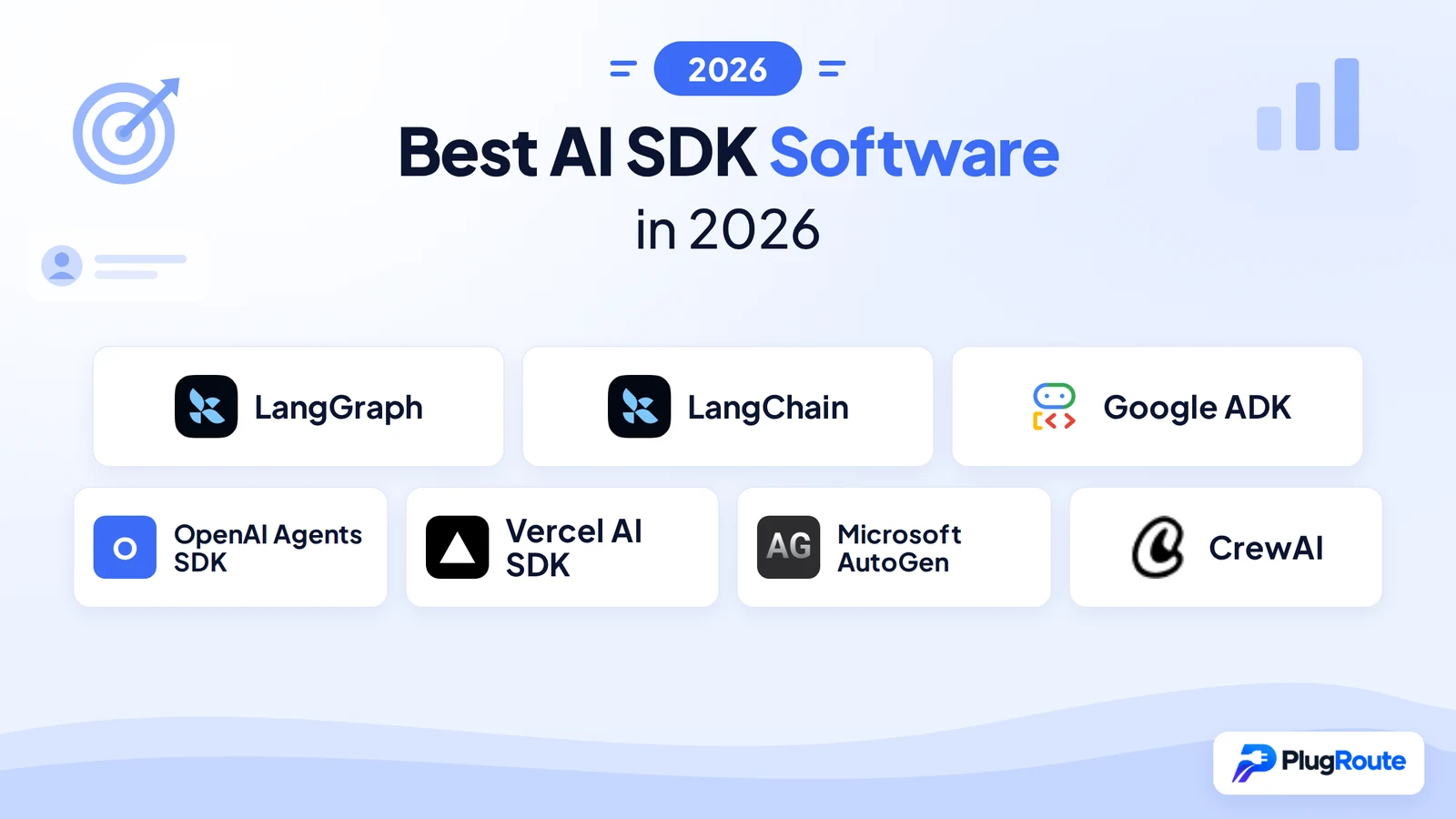
LangGraph leads for stateful, production-grade agent workflows; LangChain leads for 750+ integration ecosystem breadth; and Google ADK leads for multi-language enterprise teams on Google Cloud, each solving a distinct tier of the agent development problem. The right choice depends on whether you are optimizing for prototype speed, production reliability, or your team’s primary programming language.
Developers evaluating AI SDK frameworks in 2026 face a concrete challenge: 260+ competing options with overlapping feature sets, no G2 or Capterra reviews for any of them, and a documented gap between what works in tutorials and what survives production load. Frameworks that look identical in a README often diverge sharply on prompt visibility, memory architecture, and containerized deployment compatibility.
PlugRoute has no affiliate relationships with any company listed. Rankings are determined entirely by research data and objective evaluation criteria.
“The whole of last week I was building with crewAI at work… I don’t even know what’s happening underneath. I don’t know what final prompts are being passed to the LLM. Agents keep calling tools 6 times in a row. Complete execution of a crew takes 10 minutes.” (u/Standard_Region_8928, r/AI_Agents)
Takeaway: A developer who migrated from CrewAI to LangGraph describes the exact production-blocking pain points (prompt opacity, tool call loops, and extended execution times) that the Red Flags section below addresses with systematic guidance for avoiding each failure pattern.
TL;DR: Top Picks at a Glance
- LangGraph: best stateful production agent orchestration with native checkpointing, time-travel debugging, and the broadest reported Fortune 500 enterprise validation in the category
- LangChain: best 750+ integration ecosystem for diverse multi-tool LLM applications; deploy as the integration layer alongside LangGraph for agent orchestration, not as a standalone agent runtime
- Google ADK: best multi-language enterprise framework with first-party Python, TypeScript, Go, and Java SDKs and the only standardized cross-framework Agent-to-Agent protocol in the evaluated category
- OpenAI Agents SDK: best clean orchestrator-to-specialist pipelines for Python teams on OpenAI APIs, with a free built-in tracing dashboard and the fastest 2025 adoption trajectory in this evaluation
- Vercel AI SDK: best unified JavaScript/TypeScript multi-provider LLM abstraction with 20M+ monthly npm downloads, React streaming hooks, and single-line provider switching across 20+ LLMs
- Microsoft AutoGen: best zero-cost agent infrastructure for .NET/Azure enterprise teams who have incorporated the October 2025 maintenance mode announcement into their migration planning timeline
- CrewAI: best fastest-to-prototype multi-agent path at approximately 40% faster time-to-working-agent than LangGraph for standard use cases, with documented architectural limitations requiring migration before enterprise containerized deployment
What Are the 3 Categories of AI SDK Frameworks?
The seven evaluated frameworks divide into three functional categories based on their primary architectural purpose and target user workflow. Understanding which category your project needs eliminates the majority of irrelevant options before evaluating any specific framework’s features.
Agent Orchestrators: LangGraph, OpenAI Agents SDK, Microsoft AutoGen, CrewAI, coordinate multi-agent workflows, manage execution state, and define how agents hand off tasks. These frameworks are designed for teams building autonomous agents that take sequences of actions and must maintain coherent state across steps.
LLM Application Frameworks: LangChain, provide modular integrations and composable pipelines for connecting LLMs to external tools, vector stores, and APIs. LangChain is the integration infrastructure layer that feeds more specialized agent runtimes.
LangChain vs. LangGraph, the warehouse vs. the factory floor. LangChain is the warehouse: thousands of tools, models, and adapters available to pick from. LangGraph is the factory floor: the production machinery that actually runs your agent workflows using those tools. Teams who mistake the warehouse for the factory spend months wondering why their production system has no persistent memory or conditional routing. Using LangChain as the primary orchestration layer for stateful agents is the most consistently documented architectural misapplication in senior developer communities.
AI-Powered Web UI SDKs: Vercel AI SDK, deliver streaming interfaces, multi-provider LLM abstraction, and React/Next.js hooks for teams building AI-powered web applications with real-time output.
Google ADK spans the Agent Orchestrator and Multi-Language Enterprise Development Kit categories, offering first-party SDKs in Python, TypeScript, Go, and Java, plus the only standardized cross-framework Agent-to-Agent (A2A) protocol identified in this evaluation.
If terms like stateful checkpointing, cyclic graph routing, or Agent-to-Agent protocol are unfamiliar, the Glossary at the end defines each in plain language, you do not need to understand them all to use the decision framework below.
How Do the Top AI SDK Frameworks Compare at a Glance?
The seven frameworks range from LangGraph’s production-validated enterprise deployment record to CrewAI’s prototype-speed role-based approach, differing most consequentially on observability (free built-in vs. paid vs. none), language support (Python-only vs. four-language first-party), and architecture (stateful graph vs. minimal primitives vs. streaming hooks).
| Rank | Framework | Category | Best For | One-Line Summary | Primary Language(s) | Built-in Observability | Price Range |
|---|---|---|---|---|---|---|---|
| 1 | LangGraph | Agent Orchestrator | Stateful production agent workflows with checkpointing and conditional routing | LangGraph is the production-grade Python and JavaScript agent orchestration framework from LangChain Inc. with native stateful checkpointing, time-travel debugging, and the highest download volume among evaluated agent frameworks. | Python, JS/TS | Paid; LangSmith $39/user/mo | Free library + LangSmith $39/user/mo |
| 2 | LangChain | LLM Application Framework | Multi-tool LLM applications requiring 750+ integrations and broad ecosystem connectivity | LangChain is the foundational open-source LLM framework with 750+ integrations, 97,000+ combined GitHub stars, and a $1.25B unicorn valuation reached in October 2025; best used as the integration layer alongside LangGraph for agent orchestration. | Python, JS/TS | Paid; LangSmith $39/user/mo | Free core + LangSmith $39/user/mo |
| 3 | Google ADK | Multi-Agent Dev Kit | Enterprise teams on Google Cloud needing multi-language support and enterprise system connectors | Google ADK is a multi-language agent framework with first-party Python, TypeScript, Go, and Java SDKs, the only cross-framework A2A protocol, and Trial ring placement in ThoughtWorks Technology Radar Volume 34 (April 15, 2026). | Python, TS, Go, Java | Free; Cloud Logging (prompt-level tracing requires configuration) | Free SDK + GCP usage costs |
| 4 | OpenAI Agents SDK | Minimal Agent Framework | Python teams on OpenAI APIs needing clean multi-agent pipelines with built-in tracing | OpenAI Agents SDK is a minimal Python framework with three core primitives (Agents, Handoffs, Guardrails), a free built-in tracing dashboard, and monthly PyPI downloads that third-party trackers place between 14 and 21 million as of April 2026. | Python (TS in progress) | Free; built-in dashboard | Free SDK + OpenAI API costs |
| 5 | Vercel AI SDK | AI-Powered Web UI SDK | JS/TS web developers building streaming AI interfaces with multi-provider flexibility | Vercel AI SDK is a unified JavaScript/TypeScript LLM provider abstraction with 20M+ monthly npm downloads, React streaming hooks (useChat, useCompletion), and single-line provider switching across OpenAI, Anthropic, Google Gemini, and 20+ additional providers. | JavaScript/TypeScript | None built-in | Free SDK + optional Vercel $20/user/mo |
| 6 | Microsoft AutoGen | Conversational Multi-Agent | Azure-centric enterprises needing zero-cost agent infrastructure with .NET support | Microsoft AutoGen is a fully free multi-agent conversation framework with Docker sandboxing.NET/C# support, and OpenTelemetry observability; in maintenance mode since October 2025, with active development directed to the Microsoft Agent Framework. | Python.NET/C# | Free; OpenTelemetry | Fully free, MIT license |
| 7 | CrewAI | Role-Based Agent Crew | Rapid prototyping of multi-agent systems with minimal code and no graph-theory knowledge | CrewAI is a Python framework delivering approximately 40% faster prototype development than LangGraph through a role-based YAML interface, with documented production limitations including local-only memory incompatible with containerized enterprise deployments. | Python | None built-in | Free core + Enterprise pricing undisclosed |
Which AI SDK Framework Should I Choose for My Use Case?
Your fastest path to the right framework depends on two filters applied in order: your team’s primary programming language (which eliminates Python-only frameworks for TypeScript teams) and your deployment maturity (which eliminates prototype-optimized frameworks for production requirements).
Before applying this framework: Assess your team’s graph-theory fluency honestly. LangGraph’s production advantages (time-travel debugging, stateful checkpointing, cyclic routing) are only accessible to teams who can reason about state machines and directed graphs. A team without this background is better served starting with CrewAI for prototyping and budgeting a deliberate 60–90 day LangGraph onboarding investment, rather than rushing LangGraph adoption and creating a maintenance burden another framework would have avoided.
| Your #1 Priority | Recommended Framework | Why | Acceptable Alternative |
|---|---|---|---|
| Fastest prototype / proof of concept | CrewAI | Role-based YAML deploys multi-agent systems in under 1 hour, approximately 40% faster than LangGraph for standard use cases | OpenAI Agents SDK; cleaner three-primitive model for Python teams |
| Stateful production agent workflow | LangGraph | Only framework with native checkpointing, time-travel debugging, and reported Fortune 500 cross-sector deployment evidence | OpenAI Agents SDK; for simpler pipelines under 10 agents |
| JavaScript/TypeScript web developer | Vercel AI SDK | Only unified JS/TS multi-provider LLM API with React streaming hooks and 20M+ monthly npm downloads | No JS-native agent orchestration framework with equivalent production validation is included in this evaluation; LangGraph.js exists but lacks the Python counterpart’s documentation depth and enterprise adoption evidence |
| Enterprise connectors (Salesforce, SAP) or multi-language (Go, Java) | Google ADK | First-party SDKs in 4 languages; only cross-framework A2A protocol; Salesforce, SAP, Jira pre-built connectors | LangGraph; Python/JS only, no enterprise connectors |
| Zero framework cost including observability, or .NET support | Microsoft AutoGen | Only evaluated framework with .NET/C# support; fully free including OpenTelemetry and Docker sandbox | LangGraph; if .NET support is not required; plan migration to Microsoft Agent Framework for long-term use |
| Committed to OpenAI APIs with minimal overhead | OpenAI Agents SDK | Cleanest handoff model; free built-in tracing dashboard; active development with April 2026 sandboxing update | LangGraph; for stateful or complex workflows exceeding 8–10 agents |
| Broadest LLM tool integrations ecosystem | LangChain | 750+ integrations across models, vector stores, databases, and APIs; deploy as the integration layer with LangGraph for orchestration | LangGraph; for agent orchestration within the LangChain ecosystem |
| Streaming web UI AND complex backend agent orchestration | Vercel AI SDK + LangGraph | These frameworks serve complementary layers: Vercel AI SDK for real-time streaming interfaces, LangGraph for stateful multi-step agent logic server-side | N/A; this is the documented production architecture for full-stack AI applications |
Common migration paths documented in community research: CrewAI → LangGraph (when containerized deployment requirements emerge); LangChain → LangGraph (when agent orchestration requirements exceed basic chains); Microsoft AutoGen → Microsoft Agent Framework (official vendor-directed migration, Release Candidate available as of April 2026). Planning the migration path before the prototype becomes the product is the most consistently cited advice from developers who have made these transitions.
What Are the 7 Best AI SDK Frameworks for Building LLM Agents in 2026?
LangGraph ranks first for stateful production workflows, LangChain second for ecosystem breadth, and Google ADK third for multi-language enterprise teams, with OpenAI Agents SDK, Vercel AI SDK, Microsoft AutoGen, and CrewAI each holding a distinct position for specific use cases and developer contexts. All seven entries below receive equal analytical depth, structure, and word allocation regardless of market position or corporate backing.
1. LangGraph: Best for Stateful, Production-Grade Agent Workflows
Category: Agent Orchestrator, builds stateful, graph-based multi-agent workflows with persistent checkpointing, cyclic routing, and human-in-the-loop oversight.
At a Glance
- Category: Agent Orchestrator
- Best For: Engineering teams building complex, stateful, production-grade agent workflows requiring conditional routing, long-running task management, multi-step autonomous pipelines, or human oversight at specific decision points
- Price Range: Free (MIT library) + LangSmith $39/user/month for observability (after free 5,000 traces/month Developer tier) + LangGraph Cloud ~$0.001/node execution for managed deployment
- Primary Strength: LangGraph is the only evaluated framework offering native stateful checkpointing and time-travel debugging, with monthly PyPI downloads that independent trackers place between 11.6 million (pypistats.org, April 2026) and 34.5 million (Firecrawl analysis, February 2026), consistently ranking first among evaluated agent frameworks, and reported production deployments at Klarna, Uber, Cisco, LinkedIn, and BlackRock
- Biggest Limitation: LangGraph requires developers to internalize graph-theoretic state machine concepts before becoming productive, and full production observability requires LangSmith at $39/user/month, a learning curve and cost overhead that simpler frameworks avoid
- One-Line Summary: LangGraph is the production-grade Python and JavaScript agent orchestration framework from LangChain Inc. that provides stateful graph-based workflows, native checkpointing, and time-travel debugging, the highest-download and most enterprise-reported agent framework as of April 2026.
- Last Verified: April 2026
Overview
LangGraph is an open-source Python and JavaScript/TypeScript agent orchestration library from LangChain Inc. for engineering teams building stateful, graph-based multi-agent workflows, and the most production-reported agent framework evaluated in 2026, with monthly PyPI downloads that independent trackers place between 11.6 million (pypistats.org, April 2026) and 34.5 million (Firecrawl analysis, February 2026) and reported enterprise deployments across five industry verticals.
LangGraph implements a state machine architecture through its directed graph model, where a shared typed state object flows through nodes connected by conditional or sequential edges, enabling cyclic workflows, retry loops, self-correction chains, and conditional branching that linear chain frameworks structurally cannot support.
LangGraph is developed by LangChain Inc. (founded October 2022, with a $25M Series A from Sequoia Capital in February 2024 at a $200M valuation and a $125M Series B from IVP in October 2025 at a $1.25B unicorn valuation) and is confirmed in production use by LangChain Inc. for its customer support bot and the chat.langchain.com interface.
Key Features
- Native Stateful Checkpointing: LangGraph persists workflow state to SQLite, PostgreSQL, or Redis backends, enabling LangGraph workflows to survive server restarts and supporting long-running agent tasks that span hours or days without data loss, the only framework in this evaluation offering this capability natively to distributed backends.
- Time-Travel Debugging: LangGraph allows developers to replay execution from any historical checkpoint, making LangGraph the only evaluated agent framework offering systematic production incident investigation without manual log reconstruction.
- Cyclic Graph Execution: LangGraph supports workflows where nodes loop back conditionally (implementing a state machine architecture) enabling self-correction loops, retry logic, and multi-step reasoning chains that sequential or linear frameworks structurally cannot replicate.
- Human-in-the-Loop Checkpoints: LangGraph suspends execution mid-graph at configurable approval points, awaiting human input before continuing without losing accumulated workflow state, a compliance-critical capability for regulated environments that most competing frameworks cannot deliver natively.
- LangSmith Native Observability: LangGraph integrates with LangSmith for trace-level prompt payload visibility, token counts, tool call sequences, and per-step latency, providing the prompt inspection capability most consistently cited as a production non-negotiable across developer communities.
Best For
LangGraph is best for engineering teams building production agent systems requiring stateful multi-step workflows, human oversight at decision points, or complex conditional routing, particularly teams at startups scaling beyond prototype stage or enterprise teams deploying agents in regulated environments where debugging and auditability are non-negotiable.
Pricing
LangGraph library is MIT-licensed and free. LangSmith (observability): Developer tier free up to 5,000 traces/month; Plus tier $39/user/month with full evaluation features. LangGraph Cloud (managed deployment): approximately $0.001 per node execution plus a base subscription, teams running 10 million node executions per month should budget approximately $10,000/month, making self-hosting a meaningful cost optimization at high volume. Pricing verified April 2026 via ZenML LangGraph pricing analysis and LangChain pricing page.
Strengths
- LangGraph’s monthly PyPI downloads rank highest among evaluated agent frameworks: between 11.6 million (pypistats.org, April 2026) and 34.5 million (Firecrawl analysis, February 2026) depending on measurement methodology, with production deployments reported at Klarna, AppFolio, Uber, Cisco, LinkedIn, and BlackRock across five distinct industry verticals (LangChain marketing materials and Firecrawl analysis, February 2026).
- LangGraph commands 27,100 monthly Google searches: the highest of any evaluated framework (Gurusup.com, 2026), alongside a 95,496-subscriber r/LangChain community (April 2026), the largest dedicated developer community of any evaluated framework, giving teams the most available troubleshooting resources.
- LangGraph’s PostgreSQL and Redis checkpointing is the only evaluated framework natively capable of executing long-running workflows that survive server restarts and supporting time-travel debugging via checkpoint replay, capabilities that r/AI_Agents developers (344,200+ subscribers, April 2026) consistently cite as the deciding production-readiness factors when migrating from simpler frameworks.
- LangGraph’s human-in-the-loop checkpointing enables mid-execution approval workflows without losing accumulated state, a compliance-critical capability that enterprise teams in regulated industries require but most competing frameworks cannot deliver without external tooling.
Limitations
- Complexity Cost: LangGraph’s graph-based abstraction requires developers to internalize state machine and graph-theory concepts before becoming productive, simple workflows requiring approximately 20 lines in CrewAI require 60+ lines in LangGraph, a genuine time-to-first-working-agent penalty (NXCode.io, 2026).
- Paid Observability Required: LangGraph requires LangSmith at $39/user/month for trace-level prompt visibility and cost monitoring, full-featured production observability has no zero-cost option, a meaningful ongoing expense that AutoGen’s built-in OpenTelemetry and OpenAI Agents SDK’s free dashboard eliminate.
- High-Volume Cloud Cost Scaling: LangGraph Cloud’s $0.001/node pricing accumulates substantially at production scale (approximately $10,000/month at 10 million node executions) creating financial pressure to self-host that adds DevOps overhead (ZenML LangGraph pricing analysis, April 2026).
- Expertise Dependency: Developer sentiment in r/LangChain is bifurcated, senior engineers with graph-theory fluency report exceptional production control, while teams without this background describe LangGraph as “an absolute maintenance nightmare” (u/wavehnter, r/LangChain), indicating LangGraph’s production returns are gated by team expertise in a way that simpler frameworks are not.
Users on r/LangChain noted:
“I’ve been thinking about this a lot. I believe that langgraph is still a l2-l3 abstraction. I dont think that you can use it for full end to end app. My thinking is like this:
- tools are the lowest level functions like processor instructions
- fine tuned agents are specialized tool managers
- langgraph are specialized function combinations – like C++ abstractions over assembler. Very smart but limited
You cant make a super langgraph, it will be good for some generalistic cases, but work bad on the edge cases.
Still there two or three layers missing before you can get to human level abstraction and control.” Posted by u/Apart_Discount5765
Takeaway: Engineers who have internalized LangGraph’s graph abstractions still identify it as a mid-layer tool that works for generalist cases but breaks down at edge cases, confirming that the framework’s expertise cost yields architectural ceiling constraints, not just a learning-curve penalty.
“Personally, I’m using langgraph to build all AI logic, I don’t think there is any other more convenient way to build a sophisticated AI backend than with langgraph, it handles everything and you have it all in one package: monitoring and deployment if you decide to go for their platform solution.” (u/SiriVII, r/LangChain)
Takeaway: A production engineer using LangGraph for all AI logic identifies it as the only framework offering monitoring and deployment as an integrated package, with LangSmith as the specific differentiator that justifies the framework’s complexity cost for teams that have committed to the LangChain Inc. ecosystem.
Verdict
LangGraph is the highest-download, most enterprise-reported agent orchestration framework available to developers in April 2026, with monthly PyPI downloads consistently ranking first among evaluated frameworks and reported production deployments at Klarna, Uber, Cisco, LinkedIn, and BlackRock. Engineering teams building stateful, complex, or compliance-sensitive agent workflows will find LangGraph’s checkpointing, time-travel debugging, and conditional routing capabilities unmatched among the evaluated frameworks. Teams should budget for LangSmith observability costs and account for the graph-based learning curve before committing; teams building simple single-step pipelines or prototyping under tight timelines will find CrewAI or OpenAI Agents SDK faster to productive output, with LangGraph as the natural upgrade path when production demands it.
2. LangChain: Best for LLM Application Integration and Ecosystem Breadth
Category: LLM Application Framework, modular toolkit for building LLM-powered applications, RAG pipelines, and tool integrations across 750+ models, vector stores, and external APIs.
At a Glance
- Category: LLM Application Framework
- Best For: Teams building diverse LLM applications requiring extensive tool integrations (RAG pipelines, document processing, semantic search, or multi-modal workflows) who prioritize ecosystem breadth over specialized agent orchestration
- Price Range: Free (MIT core framework) + LangSmith $39/user/month for observability (after free 5,000 traces/month Developer tier)
- Primary Strength: LangChain provides the largest integration catalog of any evaluated framework (750+ connections covering models, vector stores, databases, and APIs) backed by a 95,496-subscriber community, a $25M Series A in February 2024 and a $125M Series B in October 2025 at a $1.25B unicorn valuation, and a multi-product platform spanning development, observability, and managed deployment
- Biggest Limitation: LangChain’s abstraction layers are widely documented as opaque and debugging-unfriendly in production, with multiple developers reporting that identifying what payload LangChain sends to an LLM required intercepting raw network calls rather than reading framework internals
- One-Line Summary: LangChain is the foundational open-source Python and JavaScript LLM application framework from LangChain Inc. with 750+ tool integrations, 97,000+ combined GitHub stars, a $1.25B unicorn valuation reached in October 2025, and the LangSmith observability platform, the most ecosystem-mature option for teams building multi-tool LLM applications in 2026.
- Last Verified: April 2026
Overview
LangChain is an open-source Python and JavaScript/TypeScript framework from LangChain Inc., founded October 2022, with a $25M Series A from Sequoia Capital in February 2024 at a $200M valuation (Contrary Research; TechCrunch, 2025) and a $125M Series B from IVP in October 2025 at a $1.25B unicorn valuation (TechCrunch, October 2025; Fortune, October 2025), that provides the most integration-rich LLM application toolkit in the evaluated category, with 750+ pre-built connections to models, vector stores, databases, APIs, and document loaders.
LangChain’s LCEL (LangChain Expression Language) enables declarative, composable pipelines supporting streaming and async execution natively through a universal Runnable interface, making LangChain the default integration infrastructure layer for teams building LLM applications across diverse use cases.
LangChain is best understood in 2026 as the ecosystem integration layer for tool connectivity rather than the primary agent execution runtime (that orchestration role is occupied by LangGraph for stateful agent workflows) a distinction senior engineers consistently articulate in r/OpenAI and r/LangChain community discussions (April 2026).
Key Features
- 750+ Pre-Built Integrations: LangChain provides the largest integration catalog of any evaluated framework, covering chat models, legacy LLMs, vector stores, document loaders, retrievers, output parsers, and external APIs, reducing custom connector development for teams with complex tool connectivity requirements.
- LCEL Universal Runnable Interface: LangChain’s LangChain Expression Language standardizes sync, async, batch, and streaming operations across all framework components via a universal Runnable protocol, enabling composable pipeline construction without custom glue code between integrations.
- Dual Language First-Party Support: LangChain provides first-party SDKs in Python (langchain-core on PyPI) and JavaScript/TypeScript (langchain.js), with LangSmith observability SDKs additionally available in Go and Java, broader language coverage than most evaluated frameworks.
- Integrated Full-Stack Ecosystem: LangChain integrates natively with LangSmith (observability and evaluation) and LangGraph (agent orchestration), both maintained by the same engineering team at LangChain Inc., ensuring cross-layer version compatibility without third-party dependency risk.
- Multi-Modal Pipeline Support: LangChain supports pipelines spanning text, images, audio, and structured data through its provider integrations, enabling teams to connect diverse input and output formats without building custom adapters for each modality combination.
Best For
LangChain is best for teams building LLM applications requiring extensive tool connectivity (RAG pipelines, multi-source document processing, semantic search, or applications simultaneously integrating multiple model providers, vector stores, and external APIs) and for teams that want a single-vendor ecosystem spanning development utilities (LangChain), observability (LangSmith), and agent orchestration (LangGraph).
Pricing
LangChain core framework is MIT-licensed and free. LangSmith (observability and evaluation): Developer tier free up to 5,000 traces/month; Plus tier $39/user/month with higher trace limits and full evaluation features; Enterprise at custom pricing. Production deployments requiring observability should budget $39/user/month for LangSmith Plus at minimum. Pricing verified April 2026 via LangChain pricing page.
Strengths
- LangChain reached a $1.25B unicorn valuation in October 2025 following a $125M Series B led by IVP (TechCrunch, October 2025; Fortune, October 2025) (the strongest commercial longevity signal of any evaluated framework) alongside 97,000+ combined GitHub stars across the LangChain and LangGraph repositories (April 2026; verify current count at github.com/langchain-ai) and a 95,496-subscriber r/LangChain community.
- LangChain’s 750+ integration catalog: spanning OpenAI, Anthropic, Google, Hugging Face, Pinecone, Weaviate, PostgreSQL, MongoDB, Slack, and hundreds of additional services (LangChain official site), means teams building LLM applications can typically find a maintained integration rather than building custom connectors, a time-to-market advantage that integration-narrow frameworks cannot match.
- LangChain Inc.’s multi-product platform strategy: with LangChain (integrations), LangGraph (agent orchestration), LangSmith (observability), and LangGraph Cloud (managed deployment) all maintained by the same engineering team (NXCode.io, 2026), reduces integration risk for teams adopting the full stack by ensuring cross-layer compatibility.
- LangChain’s LCEL enables streaming and async execution natively across all components through the Runnable protocol, reducing the custom streaming infrastructure teams would otherwise need to build for real-time LLM output delivery.
This production pattern is confirmed on r/LangChain:
“A lot of people use LangChain to learn about LLM development. That’s fine, but the library was never intended to be that way. It’s supposed to help speed up workflow for people who already know what they’re doing. I use it in prod, and I don’t use any of the agent patterns that are built in. They’re more for demos and prototyping. Instead, I use prompt templates and runnable to construct the agent’s instructions, then plug in my Supabase DB as memory, and pgvector + vecs as vector database. In short, those conversational agent prompts that are built into LangChain are there to showcase that it’s doable at the simplest level. If you’re thinking in prod, then you want to map out your needs first then choose the proper tools.” Posted by u/thanghaimeow
Takeaway: LangChain’s production users consistently bypass its built-in agent patterns in favor of its integration primitives (prompt templates, runnables, and vector store connectors) confirming that LangChain’s production value is as a component toolkit, not an agent orchestrator.
Limitations
- Abstraction Opacity: LangChain’s abstraction layers: designed for composability across 750+ integrations, produce code that is widely documented as difficult to debug in production. Community members describe it as “subclasses of subclasses of subclasses,” and developers report needing to intercept raw network calls to identify what payload LangChain actually sends to an LLM (u/Randomramman, r/OpenAI).
- Breaking Changes History: LangChain’s history of API changes between versions has created documented organizational risk aversion (teams delay framework upgrades and accumulate security debt rather than risk production regressions) a consistent concern in senior engineering community discussions.
- Not Recommended as Primary Orchestration Layer: Senior engineers consistently recommend using LangChain as a utility library for specific components (chunking, vector store clients) and LangGraph for stateful agent workflows, a community consensus implying LangChain’s optimal deployment is narrower than its general-purpose marketing positioning suggests (u/ConsiderationNo3558, r/OpenAI).
- Paid Observability Identical to LangGraph: LangChain’s production observability requires LangSmith at $39/user/month (the same cost as LangGraph’s requirement) meaning teams using the full LangChain ecosystem must budget for this ongoing expense with no zero-cost built-in alternative.
“My gripe with Langchain is that they’ve built the wrong abstractions… The most frustrating part is debugging. Langchain abstractions are all subclasses of subclasses of subclasses. To find out what it’s actually sending to OpenAI, I eventually just printed the network calls from my laptop; could not figure it out in langchain.” (u/Randomramman, r/OpenAI)
Takeaway: A senior developer confirms the abstraction opacity limitation with a specific debugging method (intercepting raw network calls) that should not be necessary in a production framework, validating the Limitations section’s opacity criticism with lived incident-response experience rather than theoretical concern.
Verdict
LangChain is the most integration-rich and ecosystem-mature AI SDK framework evaluated, with 750+ tool connections, 97,000+ GitHub stars, and a $1.25B unicorn valuation reached in October 2025, making it the strongest starting point for teams building diverse LLM applications with complex tool connectivity requirements. LangChain’s primary production limitation, abstraction opacity that makes debugging unreliable, means senior engineering teams should treat LangChain as the integration infrastructure layer and use LangGraph for agent orchestration, rather than relying on LangChain alone for production agent workflows. Teams that structure their architecture with this division will find LangChain’s ecosystem provides a meaningful time-to-market advantage over building integrations from scratch.
3. Google ADK: Best for Multi-Language Enterprise Teams on Google Cloud
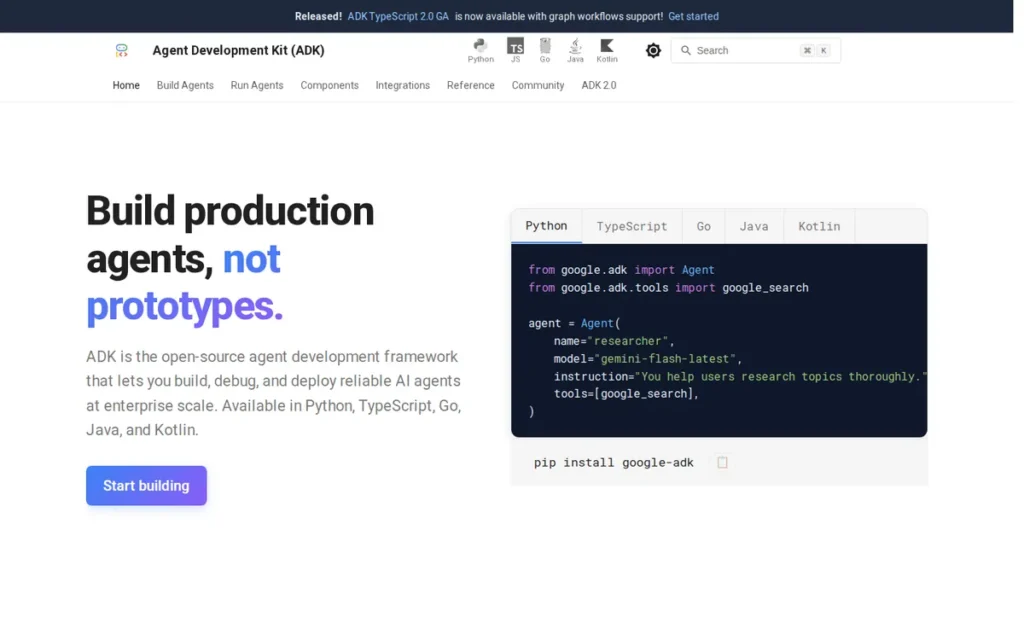
Category: Multi-Agent Development Kit, multi-language framework for building, orchestrating, and deploying enterprise-grade multi-agent AI systems with the only standardized cross-framework Agent-to-Agent (A2A) interoperability protocol identified in the evaluated category.
At a Glance
- Category: Multi-Agent Development Kit
- Best For: Enterprise development teams on Google Cloud who need multi-language support (Python, TypeScript, Go, Java), multimodal agent capabilities, or pre-built connectors to enterprise systems of record (Salesforce, SAP, Jira), including teams managing heterogeneous agent stacks where the A2A protocol enables cross-framework agent invocation
- Price Range: Free SDK (MIT license) + Google Cloud usage costs (Vertex AI inference, Cloud Run, Vertex AI Agent Engine, all pay-per-use at current GCP rates)
- Primary Strength: Google ADK is the only evaluated framework offering first-party SDKs in four programming languages (Python, TypeScript, Go, Java) and the only standardized Agent-to-Agent (A2A) cross-framework protocol, with enterprise connectors for Salesforce, SAP, and Jira included, and Trial ring placement in ThoughtWorks Technology Radar Volume 34 (April 15, 2026) upgraded from the Assess ring in November 2025
- Biggest Limitation: Google ADK carries documented strategic risk from Google’s history of discontinuing developer products, and its April 2025 launch date limits production adoption evidence to under 12 months, making it a higher-risk long-term bet compared to frameworks with multi-year enterprise deployment track records
- One-Line Summary: Google ADK is an open-source, multi-language agent development framework launched by Google in April 2025 with first-party SDKs in Python, TypeScript, Go, and Java, the only standardized cross-framework Agent-to-Agent protocol in the category, and Trial ring placement in ThoughtWorks Technology Radar Volume 34 (April 15, 2026).
- Last Verified: April 2026
Overview
Google ADK (Agent Development Kit) is a free, open-source framework launched at Google Cloud NEXT in April 2025 for building, orchestrating, and deploying multi-agent AI systems, with first-party SDK support in Python, TypeScript, Go, and Java, the broadest language coverage of any evaluated framework, and access to 200+ models via Vertex AI Model Garden and LiteLLM (Google Developers Blog, April 2025).
Google ADK’s defining architectural contribution is the Agent-to-Agent (A2A) gRPC protocol, a standardized inter-agent communication standard enabling ADK agents to invoke LangGraph, CrewAI, or other framework agents as callable tools, an interoperability capability absent from all other evaluated frameworks.
Google ADK was placed in the Trial ring of ThoughtWorks Technology Radar Volume 34 (April 15, 2026, thoughtworks.com/radar) (upgraded from the Assess ring in November 2025) is used internally by Google engineering teams in production, and reached v1.25 within its first year of public availability.
Key Features
- Agent-to-Agent (A2A) Protocol: Google ADK’s standardized gRPC-based A2A layer enables ADK agents to invoke LangGraph, CrewAI, or LlamaIndex agents as callable tool calls, the only cross-framework agent interoperability standard identified in this evaluation as of April 2026, reducing vendor lock-in for enterprises running heterogeneous agent stacks.
- Four-Language First-Party SDKs: Google ADK provides first-party support in Python, TypeScript, Go (added November 2025, InfoQ), and Java, giving polyglot teams consistent agent development capabilities across major backend languages without relying on community-maintained ports.
- Enterprise System Connectors: Google ADK includes pre-built integrations for Salesforce, SAP, GitHub, Jira, MongoDB, Pinecone, Gmail, and Google Sheets, enabling agents to interact with enterprise systems of record without custom integration engineering.
- Four Orchestration Types: Google ADK supports LlmAgent (LLM-driven), Sequential, Parallel, and Loop workflow orchestration, plus an agents-as-tools capability allowing LangGraph, CrewAI, or LlamaIndex agents to be invoked within ADK orchestration (Google Cloud blog).
- Native Multimodal Streaming: Google ADK offers bidirectional audio and video streaming through Gemini multimodal support, enabling real-time voice and video agent interaction that other evaluated frameworks require separate tooling to support.
Best For
Google ADK is best for enterprise development teams already operating on Google Cloud who require multi-language support beyond Python, need pre-built connections to enterprise systems like Salesforce or SAP, or are building multimodal applications requiring real-time audio or video streaming, and for organizations managing heterogeneous agent stacks where the A2A protocol reduces integration complexity.
Pricing
Google ADK is MIT-licensed and free. Production costs depend on underlying Google Cloud services: Vertex AI model inference at token-based pay-per-use pricing, Cloud Run at pay-per-request, and Vertex AI Agent Engine at usage-based managed deployment rates. Teams not already on Google Cloud should factor infrastructure migration costs into the total ownership evaluation. Current GCP rates are at cloud.google.com/vertex-ai/pricing. Pricing status verified April 2026 via Google Cloud ADK documentation.
Strengths
- Google ADK was placed in the Trial ring of ThoughtWorks Technology Radar Volume 34 (April 15, 2026, thoughtworks.com/radar) (upgraded from the Assess ring in November 2025, reflecting growing analyst confidence in ADK for enterprise production consideration) the only framework in this evaluation to receive independent analyst recognition at this level and ring progression in the current calendar year.
- Google ADK’s A2A protocol is the only standardized gRPC-based cross-framework inter-agent communication standard identified in this evaluation as of April 2026, enabling ADK orchestrators to invoke LangGraph or CrewAI agents as callable tool calls, reducing lock-in and enabling incremental migration strategies for enterprises with existing heterogeneous agent deployments.
- Google ADK’s first-party Go SDK (InfoQ, November 2025) makes Google ADK the only evaluated option for high-performance microservices environments where Go is the primary language, a developer population that Python-only frameworks systematically exclude.
- Developers evaluating Google ADK against CrewAI and Agno with smaller local models report that “ADK manages context smoothly” while competing frameworks “quickly choke the memory context and consume more tokens”, a reported advantage for cost-sensitive deployments using resource-constrained models (u/tarikkof, r/AI_Agents, April 2026; single developer observation, not a controlled benchmark).
Limitations
- Google Product Discontinuation Risk: Google ADK carries documented strategic risk from Google’s history of discontinuing developer products, r/LocalLLaMA developers state directly that “Google’s developer products are complete garbage… after a year or two these things will be completely useless” (u/if47, r/LocalLLaMA), reputational risk that no technical quality can fully offset for long-term enterprise adoption decisions.
- Under-12-Month Production Track Record: Google ADK’s April 2025 launch limits production adoption evidence to under 12 months, insufficient confidence for enterprise teams requiring multi-year deployment assurance compared to LangGraph’s cross-sector track record.
- Early-Stage Quality Issues: Developer audits at launch documented 404 links in official documentation and infinite tool call loops with Ollama local models (r/LocalLLaMA), quality control gaps that rapid version cadence (v1.7 to v1.25 in under 12 months) may not have fully resolved.
- RAG Gemini Lock-In: Google ADK’s RAG implementation uses a Gemini-specific API, creating genuine lock-in for teams requiring multi-vector-backend flexibility, a concrete technical constraint noted by developers comparing ADK to more provider-agnostic alternatives (u/funbike, r/LocalLLaMA).
“I think they learned from a lot of LangChain’s mistakes and put together a really strong foundation. They have made sensible choices throughout, not over-engineering or over-abstracting. Even as a huge skeptic of Google products, I was shocked to come to the realization that ADK is quickly becoming my preferred framework.” (u/Constant-Rest-8867, r/LocalLLaMA)
Takeaway: A self-identified Google skeptic endorsing ADK as their preferred framework (specifically crediting better design choices than LangChain) is the strongest independent adoption signal in this entry, because it comes from the audience most likely to discount Google-origin developer tools.
Verdict
Google ADK is the most technically differentiated new entrant in the AI SDK framework category as of April 2026, with first-party four-language support, the category’s only standardized cross-framework Agent-to-Agent protocol, enterprise connectors for Salesforce and SAP, and Trial ring advancement in the ThoughtWorks Technology Radar within a single publication cycle. Engineering teams on Google Cloud building multimodal, enterprise-integrated, or polyglot agent systems will find ADK’s capabilities compelling at zero SDK cost. The honest adoption caveat is strategic: Google’s product discontinuation history is a documented risk that independent evaluation cannot suppress, and the under-12-month production track record means enterprise teams requiring long-term vendor commitment evidence should treat ADK as a monitored-priority adoption rather than a default infrastructure choice.
4. OpenAI Agents SDK: Best for Lightweight Multi-Agent Pipelines and OpenAI Ecosystem Teams
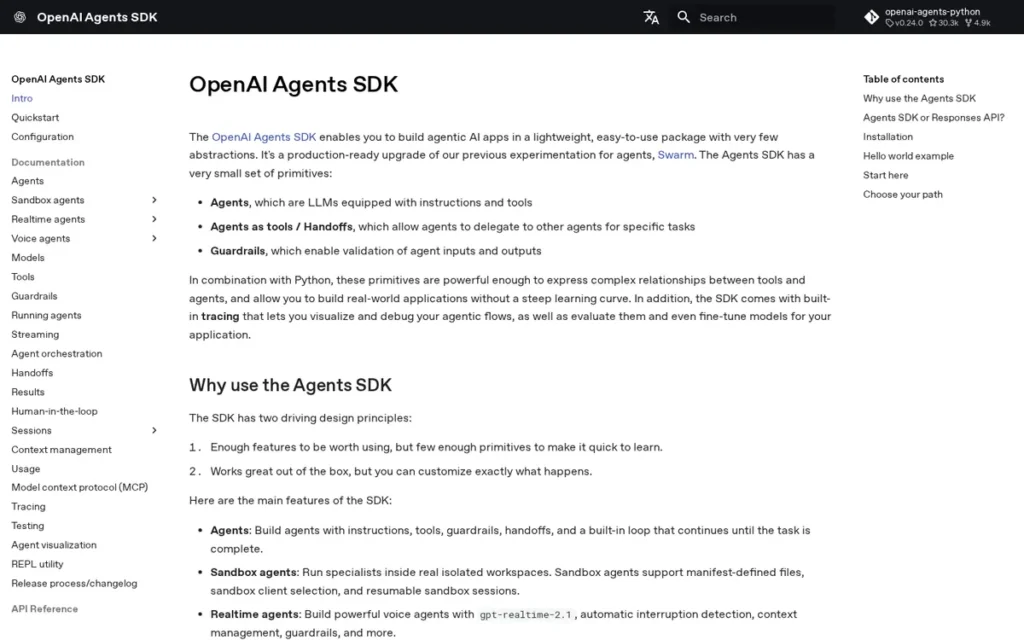
Category: Minimal Agent Framework, lightweight Python SDK providing three core primitives (Agents, Handoffs, Guardrails) for building multi-agent pipelines optimized for the OpenAI ecosystem, with a free built-in tracing dashboard.
At a Glance
- Category: Minimal Agent Framework
- Best For: Python development teams already using OpenAI APIs who need clean multi-agent orchestration with built-in tracing for straightforward orchestrator-to-specialist pipelines of fewer than 8–10 agents
- Price Range: Free SDK (MIT license) + OpenAI API costs (GPT-4o approximately $5/1M input tokens and $15/1M output tokens at April 2026 rates, verify current rates at platform.openai.com/docs/pricing before production cost modeling, as OpenAI updates pricing frequently)
- Primary Strength: OpenAI Agents SDK provides the cleanest agent handoff model of any evaluated framework through three minimal primitives (Agents, Handoffs, Guardrails), a free built-in tracing dashboard, monthly PyPI downloads that third-party trackers place between 14 and 21 million as of April 2026, and a sandboxing and code execution update in April 2026
- Biggest Limitation: OpenAI Agents SDK is Python-only as of April 2026, reaches architectural limits beyond 8–10 agents, and has its most valuable features tied to OpenAI infrastructure specifically, creating vendor dependency that developers consistently identify as the primary adoption risk
- One-Line Summary: OpenAI Agents SDK is a free, open-source Python framework launched in March 2025 that provides three core agent primitives (Agents, Handoffs, and Guardrails) with monthly PyPI downloads that third-party trackers place between 14 and 21 million as of April 2026, and expanding with sandboxing and autonomous coding capabilities in April 2026.
- Last Verified: April 2026
Overview
OpenAI Agents SDK is a free, open-source Python framework launched in March 2025 as the production-grade successor to the experimental Swarm framework, providing a minimal three-primitive architecture (Agents, Handoffs, Guardrails) that accumulated 10.3 million monthly PyPI downloads within its first 12 months (Firecrawl, February 2026), a figure that third-party trackers now place between 14 and 21 million monthly downloads as of April 2026 (pypistats.org), confirming the fastest adoption trajectory of any framework launched in 2025.
OpenAI Agents SDK supports 100+ LLMs via Chat Completions API compatibility, includes a free built-in tracing dashboard through the OpenAI platform, and received a significant April 2026 update adding sandboxing, code execution, file inspection, and command running capabilities (TechCrunch, April 15, 2026). OpenAI Agents SDK is optimized for Python teams already committed to the OpenAI API ecosystem seeking clean multi-agent orchestration without the architectural complexity of graph-based frameworks.
Key Features
- Three-Primitive Architecture: OpenAI Agents SDK’s Agents (LLM-driven reasoning loops with tools), Handoffs (structured agent-to-agent control transfer preserving full conversation history), and Guardrails (configurable input/output validation) provide the cleanest orchestrator-to-specialist delegation pattern of any evaluated framework.
- Free Built-In Tracing Dashboard: OpenAI Agents SDK includes a zero-cost tracing dashboard via the OpenAI platform exposing agent execution traces, tool call sequences, and token usage, the only evaluated framework offering native observability at no additional cost alongside a free SDK.
- April 2026 Sandboxing and Code Execution: OpenAI Agents SDK received an update adding sandboxed code execution, file inspection, command running, and a model harness for long-horizon task management, extending OpenAI Agents SDK toward autonomous coding agent use cases (TechCrunch, April 15, 2026; DevOps.com, April 16, 2026).
- Dynamic Instructions: OpenAI Agents SDK allows agent behavior to be modified at runtime based on context, session state, or user input, enabling conditional behavior without requiring branching workflow graph logic.
- Session Memory via SQLite and Responses API: OpenAI Agents SDK provides conversation continuity within single sessions via SQLite persistence and the Responses API, though OpenAI Agents SDK lacks the cross-session stateful checkpointing that LangGraph’s native PostgreSQL and Redis integration provides for long-running workflows.
Best For
OpenAI Agents SDK is best for Python development teams already using OpenAI APIs who need multi-agent orchestration with a clean handoff model and built-in tracing for straightforward orchestrator-to-specialist pipelines, particularly teams building customer service automation, routing systems, or sequential task delegation workflows with fewer than 8–10 agents in a pipeline.
Pricing
OpenAI Agents SDK is MIT-licensed and free. API costs at April 2026 rates: GPT-4o at approximately $5/1M input tokens and $15/1M output tokens, verify current rates at platform.openai.com/docs/pricing before production cost modeling, as OpenAI updates pricing frequently. A pipeline making 10 LLM calls per user request at average 2,000 tokens per call would cost approximately $0.10–$0.30 per interaction at current rates. The built-in tracing dashboard is included in the OpenAI platform at no additional cost. Pricing verified April 2026 via OpenAI platform documentation.
Strengths
- OpenAI Agents SDK accumulated 10.3 million monthly PyPI downloads within its first 12 months (Firecrawl analysis, February 2026), a figure third-party trackers now place between 14 and 21 million monthly downloads as of April 2026 (pypistats.org), confirming the fastest adoption trajectory of any framework launched in this evaluation period.
- OpenAI Agents SDK’s April 2026 update added sandboxed code execution, file inspection, command running, and a new model harness (TechCrunch, April 15, 2026), extending OpenAI Agents SDK toward autonomous software development agent territory and increasing its competitiveness against LangGraph for engineering automation use cases.
- Developers who evaluated both OpenAI Agents SDK and LangGraph consistently identify the Handoffs primitive as producing “the cleanest available” control flow for orchestrator-to-specialist delegation patterns (Gurusup.com, 2026), meaning teams where delegation clarity is the primary design priority will find OpenAI Agents SDK more intuitive than LangGraph’s stateful graph approach.
- OpenAI’s $300B+ valuation (multiple financial media reports, 2026) and institutional backing provide development continuity assurance that community-dependent frameworks cannot match, teams can reasonably assume OpenAI Agents SDK will receive security patches and model compatibility updates for the foreseeable future.
Limitations
- Vendor Lock-In: OpenAI Agents SDK’s most valuable features, the built-in tracing dashboard, Responses API state management, computer use capabilities, and file retrieval, all require OpenAI infrastructure specifically. Multiple developers noted in r/LangChain launch discussions (March 2025) that the SDK performs measurably better with GPT-4o than with non-OpenAI models despite the 100+ LLM compatibility claim, a concrete behavioral observation supporting the structural conflict concern, and one the April 2026 feature expansion into sandboxed code execution deepens.
- 8–10 Agent Architectural Ceiling: OpenAI Agents SDK’s handoff model “becomes unwieldy” beyond 8–10 agents in a pipeline (Gurusup.com, 2026) and lacks LangGraph’s cross-session stateful persistence, time-travel debugging, and cyclic workflow support, creating a structural ceiling for teams building complex or heavily stateful systems.
- Python-Only as of April 2026: OpenAI Agents SDK’s TypeScript support remains in progress as of April 2026, categorically excluding JavaScript/TypeScript web development teams, a meaningful gap for full-stack engineering organizations.
- Commercial Conflict of Interest: OpenAI’s primary revenue model is model API usage, creating an inherent commercial incentive to make OpenAI Agents SDK optimally functional with OpenAI models specifically, a structural conflict that technical neutrality claims do not resolve for teams evaluating long-term provider independence.
“Having tried both OpenAI AgentSDK and LangGraph, I feel AgentSDK is winning on: (1) Ability to create Visual Agents with Workflow Builder, (2) Visual MCP integration, (3) Built-in Tracing and Observability. But it’s still a newcomer and LangGraph is production grade with lots of use cases and enterprises using it at scale.” (u/GritSar, r/LangChain)
Takeaway: A developer who evaluated both frameworks hands-on identifies specific OpenAI Agents SDK advantages (Workflow Builder, MCP integration, built-in tracing) while accurately labeling it a newcomer against LangGraph’s production track record, reflecting the SDK’s current maturity tier relative to the category leader.
Verdict
OpenAI Agents SDK is the most rapidly adopted agent framework launched in 2025, with monthly PyPI downloads that third-party trackers place between 14 and 21 million as of April 2026 (the fastest adoption trajectory in this evaluation) on the strength of a minimal three-primitive design, a free built-in tracing dashboard, and OpenAI’s institutional backing. OpenAI Agents SDK is the strongest choice for Python teams already committed to the OpenAI API ecosystem who need clean multi-agent orchestration for straightforward orchestrator-to-specialist pipelines with fewer than 10 agents. The core adoption caveat is honest: the SDK’s most valuable capabilities are meaningfully tied to OpenAI infrastructure, vendor lock-in is the most consistently raised concern among developers in community evaluations, and its architectural ceiling means teams building complex or heavily stateful agent systems should evaluate LangGraph alongside it before committing.
5. Vercel AI SDK: Best for JavaScript and TypeScript Web Developers Adding AI Features
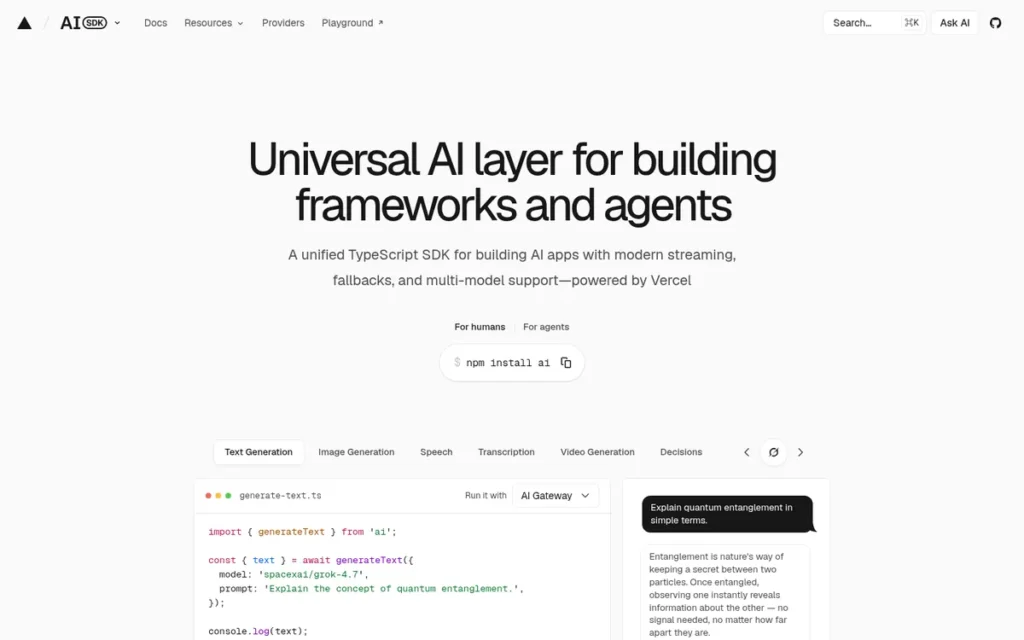
Category: AI-Powered Web UI SDK, streaming-first JavaScript/TypeScript SDK for building AI-powered web applications with React, Next.js, Vue, and Svelte, providing a unified multi-provider LLM abstraction and production-optimized streaming components.
At a Glance
- Category: AI-Powered Web UI SDK
- Best For: JavaScript and TypeScript web developers building AI-powered chatbots, streaming interfaces, semantic search, or multi-modal AI applications in React, Next.js, Vue, or Svelte, who need multi-provider LLM flexibility without vendor lock-in at the code level
- Price Range: Free SDK (MIT license) + optional Vercel platform at $20/user/month Pro tier; SDK is deployable on any Node.js environment including AWS, Cloudflare Workers, and self-hosted infrastructure
- Primary Strength: Vercel AI SDK is the only unified JavaScript/TypeScript API for switching between 20+ LLM providers with a single configuration change, backed by React/Next.js streaming hooks (useChat, useCompletion) and more than 20 million monthly npm downloads, the highest in the evaluated JavaScript AI SDK category
- Biggest Limitation: Vercel AI SDK is not designed for complex agent orchestration (it lacks built-in observability, persistent cross-session state management, multi-agent coordination primitives, and human-in-the-loop workflow support) meaning teams needing more than streaming UI must pair it with a dedicated agent orchestration framework
- One-Line Summary: Vercel AI SDK is a free, open-source JavaScript/TypeScript framework from Vercel (creator of Next.js) that delivers 20 million monthly npm downloads, a unified multi-provider LLM API enabling single-line provider switching, and production-optimized React streaming hooks, the leading JavaScript/TypeScript AI SDK for streaming web interfaces in 2026.
- Last Verified: April 2026
Overview
Vercel AI SDK is a free, open-source JavaScript/TypeScript framework from Vercel, the creator of Next.js, founded 2015, with $150M+ in Series D funding (Vercel company information, 2026), that provides web development teams with a unified provider API enabling single-configuration-line switching between 20+ LLM providers and React/Next.js streaming hooks for building production-ready AI chat interfaces, serving over 20 million monthly npm downloads (Vercel AI SDK 6 blog, 2026).
Vercel AI SDK’s consistent generateText, streamText, generateObject, and streamObject API surface across all supported LLM providers enables provider switching without architectural rewrites, the most structural solution to LLM vendor lock-in in the evaluated category.
Vercel AI SDK is designed for AI-powered web applications and does not provide the stateful agent orchestration, multi-agent coordination, or human-in-the-loop capabilities of purpose-built agent frameworks. Vercel AI SDK is most productively deployed as the streaming web UI layer alongside a dedicated backend orchestration framework such as LangGraph.
Key Features
- Unified Multi-Provider API: Vercel AI SDK’s generateText, streamText, generateObject, and streamObject functions abstract provider differences across OpenAI, Anthropic, Google Gemini, Hugging Face, and 20+ additional providers behind a consistent interface, enabling single-line provider switching without architectural changes.
- React Streaming Hooks: Vercel AI SDK’s useChat and useCompletion hooks enable streaming chat UIs with message history preservation in under 20 lines of code using Server-Sent Events (SSE), delivering production-ready real-time AI interfaces without custom streaming state management.
- Structured Output with Zod Validation: Vercel AI SDK 6 supports structured output generation with Zod and JSON Schema validation, enabling typed, schema-validated LLM responses that integrate directly with TypeScript type systems, reducing runtime validation bugs in AI-powered backends.
- Multi-Modal Support: Vercel AI SDK provides support spanning text, images, PDFs, embeddings, speech (text-to-speech and transcription), and image editing through provider integrations, enabling diverse AI feature types within a single SDK without switching toolkits per modality.
- MCP and Basic Agent Loop Support: Vercel AI SDK 6 added Model Context Protocol (MCP) server support, agent loops with tool execution approval, and local DevTools for debugging, expanding Vercel AI SDK’s capabilities beyond streaming UI into basic agentic tool use with human oversight (Vercel AI SDK 6 blog).
Best For
Vercel AI SDK is best for JavaScript and TypeScript web development teams building AI-powered user interfaces (streaming chatbots, content generation features, semantic search, real-time AI responses) in React, Next.js, Vue, Svelte, or Node.js environments, particularly teams that need multi-provider LLM flexibility and want to avoid architectural rewrites when switching between OpenAI, Anthropic, and Google Gemini.
Pricing
Vercel AI SDK is MIT-licensed and free to use on any hosting environment. Vercel platform (optional): Hobby tier free with usage limits; Pro tier $20/user/month for commercial use; Enterprise at custom pricing. Provider API costs depend entirely on the chosen LLM provider, Vercel does not charge for model inference. Teams deploying on AWS, Cloudflare Workers, or other Node.js environments avoid Vercel platform fees while retaining full SDK functionality. Pricing verified April 2026 via Vercel pricing page.
Strengths
- Vercel AI SDK surpassed 20 million monthly npm downloads following its AI SDK 6 release (Vercel blog, 2026) (the largest download volume of any AI SDK in the JavaScript ecosystem) reflecting adoption “from startups to Fortune 500 companies” and providing stronger JavaScript/TypeScript community evidence than any competing framework in this evaluation.
- Vercel AI SDK 6 added Model Context Protocol (MCP) server support, agent loops with tool execution approval, and local DevTools for debugging (Vercel AI SDK 6 blog, 2026), expanding Vercel AI SDK beyond streaming UI infrastructure into basic agentic tool use with human oversight, confirming an active development trajectory that extends the framework’s addressable use cases.
- Vercel AI SDK’s unified provider abstraction: where switching between OpenAI, Anthropic, and Google Gemini requires a single configuration change rather than framework migration, is the only evaluated SDK that structurally prevents LLM vendor lock-in at the code level, giving teams genuine provider optionality without architectural rewrites.
- Vercel AI SDK’s origin from Vercel (creator of Next.js) provides a structural distribution advantage no other evaluated framework can replicate, every Next.js developer is a direct potential adopter, with Edge Functions providing co-located streaming performance that platform-agnostic deployments cannot match without custom infrastructure investment.
Limitations
- Scoped to Web UI, Not Agent Orchestration: Vercel AI SDK lacks built-in observability, persistent cross-session state management, multi-agent coordination primitives, and human-in-the-loop workflow support, teams that expand from streaming UI into stateful multi-step agent workflows will encounter a ceiling that requires adopting a second dedicated orchestration framework.
- No Built-In Observability: Vercel AI SDK provides no tracing dashboard, no prompt payload inspection, and no token cost monitoring natively, adding observability requires custom implementation or a third-party tool, at cost and integrationcomplexity that AutoGen and OpenAI Agents SDK avoid.
- No Independent Third-Party Throughput Benchmark Identified: No independent third-party throughput benchmark specifically for the Vercel AI SDK was identified in April 2026 research, teams evaluating production performance requirements should conduct their own load testing rather than relying on third-party gateway comparison benchmarks that measure other products’ performance.
- JavaScript/TypeScript Only: Vercel AI SDK’s language design categorically excludes Python-first ML and data engineering teams (the largest segment of the agent development community) making it inaccessible to the majority of AI/ML practitioners regardless of its streaming capabilities.
Users on r/Nuxt described a narrower form of this exclusion:
“And the SDKs? Vercel AI SDK is React-first. Every streaming UI library is React-first. Now here’s the thing nobody is connecting. Founders are vibe-coding their own MVPs now. Bolt, v0, Lovable, Cursor. They prompt their way to a working app. It kind of works. Then they hit a wall. Auth breaks. State management is a mess. Payments don’t work right. So they go on Upwork and post ‘fix my AI-generated app’ or ‘clean up my vibe-coded MVP.’ But guess what framework every single one of these apps is built with. React. Next.js. Every time. Because that’s what the AI tools spit out. So now even the cleanup work goes to React devs. As a Vue/Nuxt developer I’m locked out of both sides. The AI doesn’t help me build as fast. And the new jobs created by AI tools are all in React anyway.” Posted by u/amdwebdev
Takeaway: Vercel AI SDK’s React-first orientation creates secondary exclusion even within the JavaScript ecosystem, Vue and Nuxt developers report being locked out of the AI SDK layer within their own language, extending the exclusion pattern that Python and Go teams face at the language boundary.
- Soft Vercel Platform Lock-In: While deployable on any infrastructure, Vercel AI SDK’s optimized experience on Vercel’s Edge Network creates soft lock-in that enterprise compliance teams may scrutinize for data residency and access control requirements in regulated environments.
“Vercel nails it in one big key area: developer experience (DX). They’re doing something right there, and honestly, I have almost nothing negative to say on that front.” (u/funerr, r/nextjs (a developer who chose AWS for enterprise security reasons))
Takeaway: Even a developer who chose AWS over Vercel for enterprise security reasons acknowledges Vercel’s developer experience as the benchmark, confirming that DX is Vercel AI SDK’s most defensible competitive advantage across audience segments, including those who ultimately select competing infrastructure.
Verdict
Vercel AI SDK is the highest-evidence JavaScript/TypeScript AI development toolkit in the evaluated category, with 20 million monthly npm downloads, a unified multi-provider API that is the most effective structural solution to LLM vendor lock-in available at the code level, and React streaming hooks that set the developer experience benchmark for AI-powered web UI development. Vercel AI SDK is the correct choice for JavaScript and TypeScript web development teams building streaming AI interfaces, and an incorrect choice as a standalone agent orchestration framework. The most productive deployment pattern for teams whose needs span both domains is Vercel AI SDK for the web UI and streaming layer, paired with LangGraph or OpenAI Agents SDK for backend agent orchestration.
6. Microsoft AutoGen: Best for Analytical Multi-Agent Pipelines and Microsoft Azure Enterprises
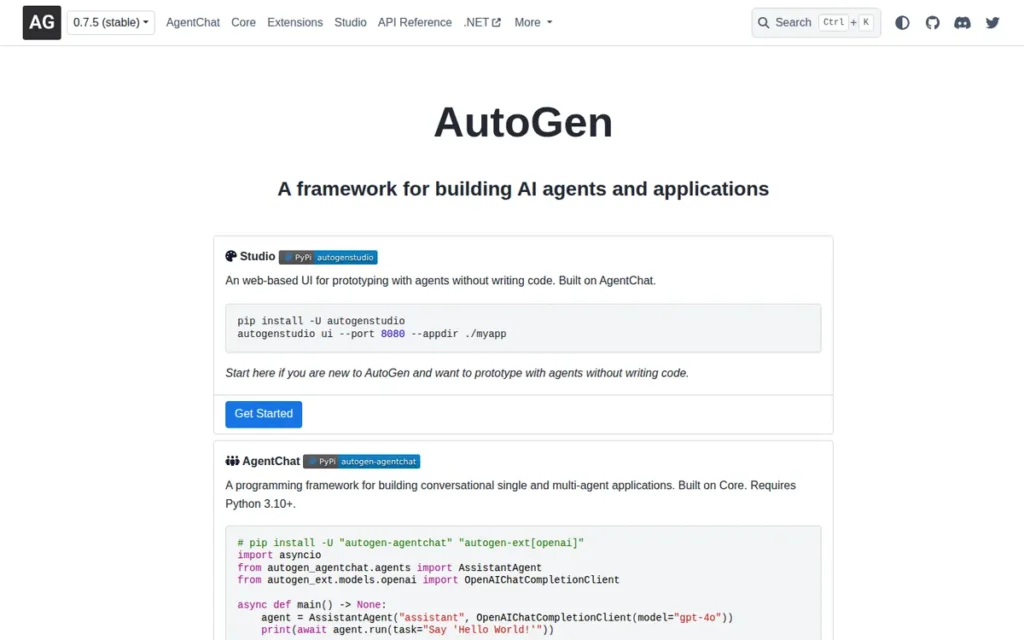
Category: Conversational Multi-Agent Framework, turn-based multi-agent conversation system where agents collaborate through iterative natural language dialogue, with built-in Docker sandboxing.NET/C# support, and fully free deployment.
At a Glance
- Category: Conversational Multi-Agent Framework
- Best For: Microsoft Azure-centric enterprise teams and analytical pipeline developers who need fully free agent infrastructure with .NET/C# language support and built-in Docker sandboxing, and who have incorporated the October 2025 maintenance mode announcement into their migration planning timeline
- Price Range: Fully free (MIT license, no paid tiers for any feature: zero additional cost beyond LLM API inference from the chosen provider)
- Primary Strength: Microsoft AutoGen is the only fully free evaluated framework (with OpenTelemetry observability built-in, Docker code execution sandbox included, AutoGen Studio visual interface at no cost, and no paid deployment tier) backed by 40,000+ GitHub stars and World Economic Forum 2025 recognition from Microsoft Research
- Biggest Limitation: Microsoft announced in October 2025 that AutoGen has entered maintenance mode (receiving bug fixes and security patches but no new capabilities) with development resources redirected to the Microsoft Agent Framework; teams considering long-term adoption must plan migration to the Microsoft Agent Framework Release Candidate
- One-Line Summary: Microsoft AutoGen is a fully free, open-source multi-agent conversation framework from Microsoft Research with Python and .NET support, built-in Docker code execution sandboxing, OpenTelemetry observability, and 40,000+ GitHub stars, in maintenance mode since October 2025, with the Microsoft Agent Framework as the designated migration target.
- Last Verified: April 2026
Overview
Microsoft AutoGen is a fully free, open-source multi-agent conversation framework from Microsoft Research that models agent coordination as emergent natural language dialogue, distinct from graph-based frameworks (LangGraph) and role-based frameworks (CrewAI) by enabling agents to negotiate solutions through iterative turn-based conversation rather than pre-defined execution structures (Microsoft Research).
Microsoft AutoGen provides Python and .NET (C#) first-party support, built-in Docker code execution sandboxing, OpenTelemetry-based observability at zero cost, AutoGen Studio for visual low-code agent configuration, and an async event-driven v0.4 architecture released January 2025, all with no paid tiers.
Microsoft announced in October 2025 that AutoGen has entered maintenance mode, receiving bug fixes and security patches but no new capabilities, with resources redirected to the Microsoft Agent Framework converging AutoGen with Semantic Kernel (Microsoft Agent Framework migration guide, devblogs.microsoft.com, 2026; GitHub Discussion #7066). The Microsoft Agent Framework is at Release Candidate stage as of April 2026, making migration planning an active requirement for teams adopting AutoGen today.
Key Features
- GroupChat Multi-Agent Orchestration: Microsoft AutoGen’s GroupChat enables multiple specialist agents to share a conversation with a configurable GroupChatManager directing speaker selection, enabling emergent multi-agent problem-solving through structured natural language debate without requiring pre-defined delegation graphs.
- Built-In Docker Code Execution Sandbox: Microsoft AutoGen includes a Docker-based sandbox that safely isolates agent-generated Python and shell code at the OS container level, a security isolation guarantee that most evaluated frameworks require external container configuration to approximate.
- Async Event-Driven v0.4 Architecture: Microsoft AutoGen v0.4 (released January 2025) introduced async event-driven design supporting proactive long-running agents, distributed agent networks, and concurrent multi-agent execution (Microsoft Research, January 2025).
- AutoGen Studio Visual Interface: Microsoft AutoGen includes a drag-and-drop visual interface for configuring multi-agent systems, enabling non-engineers such as domain experts and business analysts to define agent teams without writing code.
- Free OpenTelemetry Observability: Microsoft AutoGen includes built-in OpenTelemetry integration for distributed tracing at zero additional cost, providing structured observability without the $39/user/month requirement that LangGraph and LangChain impose for equivalent trace-level visibility.
Best For
Microsoft AutoGen is best for Microsoft Azure-centric enterprise teams who need a fully free agent framework with .NET/C# support for analytical pipelines (data synthesis, research coordination, or iterative problem-solving where emergent agent dialogue produces better results than pre-defined workflow structures) and for organizations that have already incorporated the October 2025 maintenance mode into their migration planning timeline.
Pricing
Microsoft AutoGen is fully free under MIT license with no paid tiers for any feature including observability (OpenTelemetry), visual interface (AutoGen Studio), or Docker execution sandbox. This zero-cost model is unique among evaluated frameworks. Production costs consist entirely of LLM inference from the chosen provider (Azure OpenAI, AWS Bedrock, or others). Teams on Microsoft Azure can consolidate AI billing within existing Azure enterprise agreements. Pricing verified April 2026 via Microsoft Research AutoGen project page.
Strengths
- Microsoft AutoGen received explicit recognition in a World Economic Forum 2025 leave-behind document (Microsoft Research, January 2025) (the only agent framework in this evaluation to receive policy-level institutional acknowledgment) providing credibility with enterprise governance teams that weight WEF participation in procurement decisions.
- Microsoft AutoGen is the only evaluated framework with a fully free production stack: OpenTelemetry observability, Docker execution sandbox, AutoGen Studio visual interface, and the async v0.4 runtime all at zero cost, a total cost of ownership advantage over frameworks requiring $39/user/month for equivalent observability (LangGraph, LangChain) or separate sandboxing tools.
- Microsoft AutoGen’s Python and .NET (C#) first-party language support makes it the only evaluated framework accessible to enterprise Microsoft shops where C# and Azure are the primary development environment, a developer population that Python-only frameworks categorically exclude.
- Microsoft AutoGen’s built-in Docker sandbox isolates agent-generated Python and shell code at the OS container level without requiring external orchestration configuration, a production-grade security guarantee delivered without additional setup cost.
Limitations
- Confirmed Maintenance Mode: Microsoft’s October 2025 announcement confirms AutoGen has entered maintenance mode (receiving bug fixes and security patches but no new capabilities) and the Microsoft Agent Framework migration guide (devblogs.microsoft.com, 2026; GitHub Discussion #7066) explicitly directs teams to migrate. The migration requirement is not speculative but an active vendor directive with a Release Candidate migration target already available as of April 2026.
- Conversation Loop Cost Spikes: Microsoft AutoGen’s conversational multi-agent model creates documented production cost risks (agents can enter dialogue loops generating runaway LLM API costs) a “watch for conversation loops and cost spikes” warning that requires explicit termination logic to prevent (r/AI_Agents production thread, April 2026).
- Documentation and Structured Output Issues: Developer criticisms of Microsoft AutoGen are consistent and specific: “obtuse code structure,” insufficient documentation examples, and structured outputs that “flat out don’t work” in some configurations, independent quality concerns cited across multiple community forums (r/AutoGenAI, 2026).
- AutoGen/AG2 Fork Confusion: The AutoGen/AG2 split: where AG2 at ag2.ai continues AutoGen v0.2’s feature trajectory while microsoft/autogen v0.4 is a complete architectural rewrite, creates adoption confusion requiring teams to evaluate which branch to commit to given their diverging roadmaps and the October 2025 maintenance mode on the Microsoft branch.
“AutoGen’s main problems are that its documentation is quite hard to read, with not enough examples, and there are some things that flat out don’t work. Like structured outputs. Shame because its agent delegation is telepathic.” (u/Z_daybrker426, r/AutoGenAI)
Takeaway: A former AutoGen power user who migrated to LangGraph names the exact limitations that drove the switch (streaming gaps, documentation deficits, structured output failures) while expressing genuine affection for AutoGen’s delegation model, confirming that AutoGen’s conversational architecture has real technical merit that its operational rough edges and maintenance mode status obscure.
Verdict
Microsoft AutoGen is the most cost-effective option in this evaluation for teams that can work within its constraints, delivering OpenTelemetry observability, Docker sandboxing, visual configuration, and async multi-agent coordination at absolute zero cost, with the only first-party .NET support and World Economic Forum-level institutional recognition in the category. A note on total cost: AutoGen’s zero framework fee is genuine and significant, but teams adopting AutoGen today should also budget for migration to the Microsoft Agent Framework, the vendor-confirmed required migration target, with a Release Candidate already available, as that migration represents a deferred but real expense of developer hours, testing, and redeployment. Conversation loop cost spikes require explicit termination logic, and teams building complex stateful agent workflows will find LangGraph’s checkpointing and conditional routing capabilities superior.
7. CrewAI: Best for Rapid Prototyping and Beginner-Friendly Multi-Agent Development
Category: Role-Based Agent Crew Framework, Python framework for orchestrating collaborative teams of AI agents defined by role, goal, and backstory, optimized for rapid prototyping and accessible multi-agent development with documented production deployment limitations.
At a Glance
- Category: Role-Based Agent Crew Framework
- Best For: Startup developers, hackathon participants, and non-technical stakeholders who need a demonstrable multi-agent system in hours rather than days, and who understand that CrewAI’s architecture requires migration to a production-grade framework before enterprise-scale containerized deployment
- Price Range: Free (MIT open-source core) + Enterprise tier pricing not publicly disclosed (contact sales required, published pricing unavailable as of April 2026)
- Primary Strength: CrewAI enables functional multi-agent systems in approximately 20 lines of YAML (approximately 40% faster prototype development than LangGraph for standard role-based use cases per independent developer analyses) through a role-based metaphor (role, goal, backstory) that requires no graph-theory knowledge
- Biggest Limitation: CrewAI’s memory architecture relies on local-only datastores (SQLite, Chroma) fundamentally incompatible with containerized multi-instance enterprise deployments, its hierarchical delegation mode has an unresolved bug confirmed as of April 2026, and it provides no built-in observability
- One-Line Summary: CrewAI is a free, open-source Python framework founded in 2023 that orchestrates role-based multi-agent teams through a YAML-declarative interface (delivering approximately 40% faster prototype development than graph-based alternatives and 14,800 monthly Google searches) while carrying documented architectural limitations including local-only memory stores incompatible with containerized enterprise deployments.
- Last Verified: April 2026
Overview
CrewAI is a free, open-source Python framework founded in 2023 by João Moura (AlphaMatch.ai agentic frameworks analysis, 2026) that enables software developers and non-technical stakeholders to build multi-agent AI systems using a role-based metaphor (where each agent is defined by a role, goal, and backstory) producing functional multi-agent crews in approximately 20 lines of YAML and an estimated 40% faster time-to-prototype than LangGraph for standard role-based use cases, reflecting YAML interface code reduction rather than a formally controlled benchmark (Vadim.blog; NXCode.io, 2026).
CrewAI commands 14,800 monthly Google searches, the second-highest of any evaluated framework (Gurusup.com, 2026), and CrewAI’s dual Crews-and-Flows architecture was designed to bridge rapid prototyping and production deployment within a single framework.
CrewAI is best understood as the fastest path from idea to demonstrable multi-agent system, with community analysis confirming that enterprise-scale production deployment requires migration to a framework with distributed-compatible memory architecture and built-in observability.
Key Features
- Role-Based Agent Definition: CrewAI’s role, goal, and backstory configuration instructs the underlying LLM to adopt a specific persona, reducing the conceptual barrier to multi-agent development compared to graph-theoretic frameworks and enabling non-engineers to define agent behavior in natural language without code.
- YAML-Declarative Workflow Definition: CrewAI enables complete multi-agent crew configurations in approximately 20 lines of code (compared to 60+ lines for equivalent LangGraph implementations) producing functional prototypes in under one hour per independent developer analyses (Vadim.blog; NXCode.io, 2026).
- Dual Crews and Flows Architecture: CrewAI’s Crews layer handles collaborative agent team coordination while its Flows layer provides event-driven workflow orchestration with sequential, parallel, and conditional execution patterns, a single-framework pathway from prototype to more structured pipelines.
- Multi-Agent Tool Integration: CrewAI supports tool integrations across web search, file operations, code execution, and custom tools, with task delegation enabling crews to parallelize work across specialist agents for content creation, market research, code review, and customer support use cases.
- Horizontal Use Case Flexibility: CrewAI’s role-based abstraction has been validated across diverse horizontal applications (content creation pipelines, market research automation, code review crews, and customer support systems) confirming that the crew metaphor flexibly models different organizational workflows beyond tutorial documentation scenarios.
Best For
CrewAI is best for startup developers, hackathon participants, agency teams building client demos, and non-technical product managers who need a demonstrable multi-agent system within hours, and who are explicitly building prototypes or proof-of-concept systems where production-scale requirements such as containerized deployment and enterprise-compatible memory architecture are not yet the binding constraint.
Pricing
CrewAI core framework is MIT-licensed and free. CrewAI Enterprise pricing is not publicly disclosed, teams must contact sales for enterprise deployment pricing, introducing procurement friction that platforms with published pricing tiers do not create. The absence of published enterprise pricing is a maturity signal that enterprise teams requiring cost projections before commercial engagement will encounter. Pricing status verified April 2026 via CrewAI official documentation.
Strengths
- Independent developer analyses and a survey of 21 CrewAI practitioners (r/crewai, 2025) consistently document approximately 40% faster time-to-prototype than LangGraph for standard role-based use cases, with founders reporting “it only took several lines of code to define the agents” and that CrewAI enables teams to “focus on flow and on prompts” rather than infrastructure configuration.
Users on r/AI_Agents shared their experience:
“Of all the agent frameworks, it’s not my favorite, but it helps me get started. Their structure is very rigid compared to others, making it hard to think about as it scales. I’d start by laying out the different parts, thinking of each of the ‘tools’ that you’d want, what the ins <> out of each agent would be, how they need to be connected, and then go from there.” Posted by u/erinmikail
Takeaway: Developers who reach for CrewAI in multi-agent projects confirm the prototyping speed advantage immediately, but identify structural rigidity as the scaling ceiling, validating the article’s core assessment that CrewAI is a prototype-start, not a production-end destination.
- CrewAI commands 14,800 monthly Google searches: the second-highest in the agent framework category (Gurusup.com, 2026), indicating the role/goal/backstory metaphor communicates agent behavior to non-technical stakeholders such as managers and investors without requiring graph theory or DAG orchestration knowledge.
- CrewAI’s dual Crews and Flows architecture provides a single-framework pathway from rapid prototyping to more structured production pipelines, reducing the rewrite cost for teams that begin prototyping and then attempt to scale, even if the production ceiling remains below enterprise-grade frameworks.
- CrewAI’s role-based abstraction has been validated across diverse horizontal use cases (content creation, market research, code review, and customer support) confirming that the crew metaphor is flexible enough to model different organizational workflows beyond specific tutorial documentation scenarios.
Limitations
- Containerized Deployment Incompatibility: CrewAI’s built-in memory relies on local datastores (SQLite and Chroma) incompatible with containerized multi-instance deployments, enterprise teams operating pod pools or Kubernetes clusters cannot work around this structural constraint without replacing CrewAI’s memory layer entirely (u/Frequent-Suspect5758, r/AI_Agents).
- Production-Blocking Runtime Issues: A developer who migrated from CrewAI to LangGraph documented specific blocking issues from lived experience: 1GB virtual environment size, no visibility into final LLM prompt payloads, 10-minute crew execution times, and tool call loops where agents called the same tool six times consecutively without resolution (u/Standard_Region_8928, r/AI_Agents).
- Unresolved Core Feature Bug: As of April 2026, a known bug in CrewAI’s hierarchical delegation mode remains unresolved across multiple framework versions, causing manager agents to behave unpredictably in multi-tier crew structures, an unresolved issue in a feature that enterprise multi-agent architectures specifically require (CrewAI community forum; GitHub Issue #4783, April 2026).
- No Built-In Observability: CrewAI provides no tracing dashboard, no prompt payload inspection, and no token cost monitoring natively, the prompt visibility senior engineers identify as a production non-negotiable must be added through third-party integration at additional cost and complexity.
“Crew.ai is fun for tinkering and small projects but is pretty much overkill for 90% of use cases. LangGraph is better and is supported more widely across deployment stacks.” (u/Slow_Interview8594, r/AI_Agents)
Takeaway: A practitioner who evaluated both CrewAI and LangGraph recommends LangGraph on deployment stack compatibility (the specific criterion the Limitations section identifies as CrewAI’s primary production ceiling) corroborating the article’s ranking logic with an independent developer’s first-hand conclusion.
Verdict
CrewAI is the most accessible entry point into multi-agent AI development in the evaluated category, with a role-based YAML interface that produces functional prototypes in under an hour, approximately 40% faster than LangGraph for standard use cases, and a natural language metaphor that communicates agent behavior to non-technical stakeholders without requiring graph-theory knowledge. CrewAI is the correct starting framework for teams in exploration or proof-of-concept stages who need to demonstrate multi-agent capability quickly and cost-effectively. CrewAI is not the correct choice for teams building production systems requiring containerized deployment, enterprise-grade memory architecture, or full prompt observability, and the research data documents that developers who committed to CrewAI for production encountered specific, blocking limitations requiring migration. The honest guidance: use CrewAI to prototype, evaluate production requirements during that process, and plan the migration path to LangGraph before the prototype becomes the product.
What Red Flags Should I Watch For When Evaluating AI SDK Frameworks?
The five most critical AI SDK framework red flags (confirmed across r/AI_Agents (344,200+ subscribers, April 2026), r/LangChain (95,496, April 2026), and r/crewai community discussions) are: (1) no prompt payload visibility, (2) local-only memory architecture incompatible with containerized deployment, (3) unresolved core feature bugs, (4) confirmed maintenance mode or feature freeze, and (5) conversation loop cost spike risk without explicit termination logic. Each is explained in detail below.
Red Flag #1: No Prompt Payload Visibility
Any framework that does not expose the exact prompt sent to the LLM in production makes debugging unreliable and incident resolution slow.
Multiple developers reported needing to intercept raw network calls to determine what LangChain was actually sending; CrewAI users describe having no visibility into final prompt payloads whatsoever. Require either a built-in free tracing dashboard (OpenAI Agents SDK, AutoGen with OpenTelemetry) or a verified paid integration (LangSmith at $39/user/month for LangGraph and LangChain) before committing to any framework for production use.
Red Flag #2: Local-Only Memory Architecture
Frameworks that store agent memory exclusively in local datastores (SQLite or Chroma on the local filesystem) are fundamentally incompatible with containerized multi-instance deployments, Kubernetes clusters, or horizontally scalable infrastructure.
CrewAI is the primary example in this evaluation. Confirm distributed-compatible persistence (PostgreSQL or Redis) before selecting any framework for enterprise containerized deployment. No configuration workaround eliminates this architectural constraint without replacing the framework’s memory layer entirely.
Red Flag #3: Unresolved Core Feature Bugs
Bugs in a framework’s primary features that remain unresolved for 30+ days signal production risk and maintenance team prioritization issues.
CrewAI’s hierarchical delegation bug (confirmed unresolved as of April 2026 via GitHub Issue #4783) and AutoGen’s historical structured output failures are documented examples. Always search GitHub Issues for open bugs in the exact features your architecture requires before committing.
Red Flag #4: Maintenance Mode or Feature Freeze
A confirmed maintenance mode announcement (as issued for Microsoft AutoGen in October 2025) means no new capabilities, no future compatibility improvements, and an eventual migration requirement.
For AutoGen specifically, the Microsoft Agent Framework migration guide (devblogs.microsoft.com, 2026) is the primary authoritative source confirming maintenance mode and providing the migration target. Verify the maintenance status of any framework by checking recent commits, dated release notes, and public roadmap evidence, not just GitHub star count, which does not change when active development stops.
Red Flag #5: Conversation Loop and Cost Spike Risk
Frameworks using conversational multi-agent models without explicit termination logic can produce runaway LLM API costs, agents pass tasks back and forth without resolution, generating billing spikes that are difficult to detect and bound.
This pattern is documented in AutoGen and early CrewAI deployments. Require explicit per-execution cost caps or conversation termination guarantees before any production deployment using conversational multi-agent coordination.
What Questions Should I Ask Before Choosing an AI SDK Framework?
Five questions distinguish production-ready AI SDK frameworks from demo-grade ones: (1) Can I inspect the exact prompt payload sent to the LLM in production without intercepting network calls? (2) What happens to workflow state if the server restarts mid-execution? (3) What is my total cost at 1 million agent node executions per month, including observability? (4) Does this framework support my team’s primary language with first-party SDKs? (5) Is the core development team still shipping new features with a published roadmap? (6) Is the framework’s memory architecture compatible with my deployment environment? Each question is answered in detail below.
Question #1: Can I inspect the exact prompt payload sent to the LLM in production without intercepting network calls?
The answer determines your incident response capability.
Acceptable: “Yes, via a free built-in dashboard” (OpenAI Agents SDK, AutoGen with OpenTelemetry) or “Yes, via a paid integration at $X/user/month” (LangSmith at $39/user/month for LangGraph and LangChain). Unacceptable for production: “Not natively, you would need to add logging middleware.” This is the single most consistently cited production blocker across r/AI_Agents, r/LangChain, and r/AutoGenAI community discussions.
Question #2: What happens to my workflow state if the server restarts mid-execution?
Frameworks without checkpointing lose all accumulated state on restart, any in-progress agent task must restart from the beginning.
Only LangGraph provides native PostgreSQL and Redis checkpointing that survives server restarts in this evaluation. Other frameworks in this evaluation either lack checkpointing entirely, rely on local-only storage, or require custom external state management infrastructure to handle this failure mode. Official framework documentation rarely addresses server-restart behavior directly, always test this scenario before committing to production.
Question #3: What is my total cost at 1 million agent node executions per month, including observability?
This question surfaces the true total cost of ownership beyond the “it’s free” SDK headline. Cost comparison at 1 million executions per month (April 2026):
- LangGraph: ~$1,000 LangGraph Cloud node costs + $39/user/month LangSmith observability
- Microsoft AutoGen: $0 framework cost: only LLM inference from chosen provider
- OpenAI Agents SDK: ~$0.10–$0.30 per multi-agent interaction (API costs only; varies by model and chain length)
- CrewAI Enterprise: unknown: pricing not publicly disclosed as of April 2026
All figures verified April 2026 and subject to change.
Question #4: Does this framework support my team’s primary programming language with first-party SDK support, not community-maintained ports?
Python-only frameworks (CrewAI, OpenAI Agents SDK as of April 2026) are not viable for TypeScript web teams or Go infrastructure teams regardless of feature depth.
Confirm whether SDK support is first-party (vendor-maintained) or community-maintained, community ports can lag months behind on new features and security patches. Google ADK is the only evaluated framework with first-party SDKs in four languages: Python, TypeScript, Go, and Java.
Question #5: Is the core development team still adding new features, and what is the published roadmap?
Microsoft AutoGen’s October 2025 maintenance mode provides the clearest example of why this question matters, teams that adopted AutoGen before this announcement now face a confirmed migration requirement.
Require recent commits, dated release notes, and a public roadmap as evidence of active development. Star count and download volume are lagging indicators that do not decrease when development stops. For AutoGen specifically, the Microsoft Agent Framework migration guide (devblogs.microsoft.com, 2026) is the definitive reference for current development status.
Question #6: Is the framework’s memory architecture compatible with my deployment environment?
Memory architecture determines whether your framework can run on containerized, horizontally-scaled, or serverless infrastructure.
CrewAI’s local-only SQLite and Chroma memory stores are structurally incompatible with multi-instance container deployments, no configuration change resolves this without replacing the memory layer. LangGraph’s PostgreSQL and Redis backends work natively in containerized environments. Confirm memory backend options before selecting any framework for deployments that require more than a single persistent server.
How Did We Rank These AI SDK Frameworks?
Rankings in this evaluation score each framework across six criteria using verifiable community signals, not vendor marketing, not affiliate revenue, and not test environments that differ from real production conditions. No AI SDK framework in this evaluation has a verified G2 or Capterra listing as of April 2026, these tools are rated through GitHub stars, monthly package downloads, subreddit subscriber counts, developer post-mortems, and attributed community discussions, applied with equal methodological rigor to all seven frameworks.
Evaluation Process
We followed a structured four-step process to evaluate each framework.
- We queried multiple AI search engines (ChatGPT, Perplexity) to identify frameworks with existing LLM coverage and detect gaps, including CrewAI and Vercel AI SDK, both absent from the most detailed ChatGPT comparison responses despite ranking second and highest respectively in search and download volume.
- We gathered independent web research through Perplexity queries for all seven frameworks using consistent templates: core capabilities, production weaknesses, and total cost of ownership.
- We analyzed Reddit community sentiment across r/AI_Agents (344,200+ subscribers, April 2026), r/LangChain (95,496, April 2026), r/AutoGenAI (8,823, April 2026), and r/crewai (6,169, April 2026), collecting developer posts from April 2024 through April 2026 and attributing all quotes with usernames and thread URLs.
- We cross-referenced vendor claims against third-party data: ThoughtWorks Technology Radar Volume 34 (April 15, 2026), the Microsoft Research WEF 2025 document, TechCrunch and DevOps.com coverage of the April 2026 OpenAI Agents SDK update, and the Microsoft Agent Framework migration guide (devblogs.microsoft.com, 2026).
Ranking Criteria
Production Adoption Evidence (Primary): Monthly PyPI/npm download volume, named enterprise adopters with industry diversity, and framework creators’ own confirmed production use. Broader cross-sector enterprise deployment evidence produces higher scores. This criterion is primary because it measures how frameworks perform after deployment, not just in controlled evaluations.
Agent Feature Depth and Architectural Capability (Primary): Stateful persistence, multi-agent coordination primitives, human-in-the-loop mechanisms, cyclic workflow support, structured output reliability, and documented resistance to production failure modes. Features with independent production evidence receive higher weight than vendor-announced-only capabilities.
Observability and Debugging Capability (Primary): Built-in tracing dashboard presence (free vs. paid), ability to view final prompt payloads sent to LLMs, cost monitoring, and time-travel debugging. Zero-cost built-in observability scores higher than frameworks requiring paid third-party tools. This criterion is primary because prompt opacity is the most consistently cited production blocker in developer community discussions.
Community Health and Ecosystem Maturity (Secondary): GitHub stars, download volume, subreddit subscriber count, monthly search volume, and active maintenance evidence, with maintenance mode or discontinuation risk signals weighted as credibility penalties.
Language and Stack Compatibility (Secondary): First-party language SDK count and quality, cross-model LLM provider support, and containerized or serverless deployment environment compatibility. First-party SDKs score higher than community-maintained ports.
Pricing Transparency and Total Cost of Ownership (Secondary): SDK license cost, observability platform cost at realistic production volumes, cost predictability, and published pricing vs. contact-for-quote. Opaque enterprise pricing signals lower procurement maturity.
Evidence Weighting
When community opinions conflict internally (as with LangGraph, simultaneously called essential and “an absolute maintenance nightmare” in the same subreddit) we surface both perspectives with attributed quotes rather than averaging into a synthetic claim.
When a framework receives conflicting signals between newer Reddit discussions and older third-party analyses, we weight specificity and recency. A detailed 2025 developer post with 50+ upvotes describing a specific production failure outweighs a generic 2023 comparative analysis that predates the framework’s production-scale adoption.
PlugRoute principle: We never average conflicting developer opinions into synthetic consensus. When r/LangChain simultaneously calls a framework essential and a maintenance nightmare, we surface both perspectives with attributed quotes, because the specificity and recency of evidence outweigh the count of positive versus negative opinions.
Data Validation
Vendor-reported statistics are labeled as such. Only claims corroborated by at least one independent source are stated as fact. Download figures are cross-referenced between Firecrawl analysis and pypistats.org data, with both figures presented where they diverge substantially. All pricing figures are verified against published pricing pages with direct hyperlinks and dated as of April 2026, pricing for all seven frameworks should be independently re-verified before procurement decisions, as pricing changes frequently.
Update Cadence
This article was researched and written in April 2026. The AI SDK landscape evolves rapidly, the April 2026 OpenAI Agents SDK sandboxing update, the October 2025 AutoGen maintenance mode announcement, and the November 2025 Google ADK Go SDK addition all occurred after the most recent LLM-generated comparison articles available at research time. PlugRoute will update this analysis when framework pricing, features, download volumes, or community signals materially change.
Independence Statement
PlugRoute has no affiliate relationships with any company listed. Rankings are determined entirely by research data and objective evaluation criteria.
Frequently Asked Questions: AI SDK Framework Selection in 2026
These frequently asked questions address the most common AI SDK framework decision points, best overall framework for 2026, the LangChain vs. LangGraph architectural distinction, framework selection by developer type and language, production cost at scale, active development status, and PlugRoute’s ranking methodology, based on developer community research spanning April 2024 through April 2026.
What is the best AI SDK framework for building LLM agents in 2026?
LangGraph is the best AI SDK framework for most production engineering teams building stateful agent workflows in 2026, with reported enterprise deployments at Klarna, Uber, Cisco, LinkedIn, and BlackRock. JavaScript and TypeScript web developers should use Vercel AI SDK for streaming interfaces; teams needing the fastest proof-of-concept should start with CrewAI. The optimal framework depends on your team’s language, deployment environment, and production maturity requirements.
What is the difference between LangChain and LangGraph?
LangChain is the integration layer, 750+ connections to models, vector stores, and APIs for building LLM applications. LangGraph is the agent orchestration runtime, stateful graph workflows with native checkpointing and time-travel debugging. Using them interchangeably is the most consistently documented architectural misapplication in senior developer communities; the correct architecture uses LangChain for integration utility and LangGraph as the agent execution layer.
Which AI SDK framework is best for JavaScript and TypeScript developers?
Vercel AI SDK is the only unified JavaScript/TypeScript AI framework with 20 million monthly npm downloads, React streaming hooks, and single-line provider switching across 20+ LLMs, the correct choice for streaming web interfaces. LangGraph.js exists as a JavaScript port but lacks the Python counterpart’s production documentation depth and enterprise adoption evidence as of April 2026.
How much does LangGraph cost in production at scale?
LangGraph’s production cost at 1 million monthly node executions is approximately $1,000 in LangGraph Cloud fees plus $39/user/month for LangSmith observability. At 10 million monthly executions, LangGraph Cloud costs reach approximately $10,000/month, making self-hosting a meaningful cost optimization at high volume. The core library is MIT-licensed and free; only managed deployment and observability carry fees.
Is Microsoft AutoGen still being actively developed?
Microsoft AutoGen entered maintenance mode in October 2025, receiving bug fixes and security patches but no new capabilities. The official Microsoft Agent Framework migration guide (devblogs.microsoft.com, 2026) explicitly directs teams to migrate AutoGen projects to Microsoft Agent Framework, which is at Release Candidate stage as of April 2026. New production deployments should treat AutoGen as a temporary solution with a confirmed migration requirement.
How does PlugRoute determine its AI SDK framework rankings?
PlugRoute ranks frameworks across six criteria (production adoption evidence, agent feature depth, observability capability, community health, language compatibility, and pricing transparency) applied with equal rigor to all seven frameworks. Since no AI SDK has a G2 or Capterra listing, rankings use GitHub stars, monthly download figures, subreddit activity, developer post-mortems, and third-party benchmarks as equivalent community signals. The full methodology is detailed in the “How Did We Rank These AI SDK Frameworks?” section above.
Glossary: Key Terms Used in This Comparison
Five technical terms appear throughout this comparison and are relevant to understanding the ranking criteria and entry-level trade-offs: stateful checkpointing, agent handoff, human-in-the-loop, Agent-to-Agent (A2A) protocol, and LLM observability. Each is defined below in plain language.
Stateful Checkpointing: A framework capability that saves the current state of an agent workflow, including all accumulated data, completed steps, and intermediate results, to a persistent storage backend such as PostgreSQL or Redis, enabling the workflow to resume from that exact point after a server restart or failure. LangGraph is the only framework in this evaluation offering native stateful checkpointing to distributed backends (PostgreSQL or Redis) as of April 2026, other frameworks in this evaluation either lack checkpointing entirely, rely on local-only storage incompatible with multi-instance deployments, or require external state management infrastructure to approximate this capability (confirmed by absence of equivalent documentation in competing frameworks reviewed during this research).
Agent Handoff: A structured mechanism for one agent to transfer control of a conversation or task to another agent, passing the full conversation history and context with the transfer. OpenAI Agents SDK’s Handoffs primitive is the cleanest documented implementation in the evaluated category; LangGraph implements handoffs as conditional graph edges connecting nodes within a shared typed state object.
Human-in-the-Loop (HITL): A workflow design pattern where an agent system pauses execution at a configurable decision point and waits for a human to review, approve, or modify the planned next action before proceeding. LangGraph provides native mid-graph HITL pause-and-resume without losing accumulated state; most other evaluated frameworks require custom external implementation to approximate this capability.
Agent-to-Agent (A2A) Protocol: Google ADK’s standardized gRPC-based communication specification enabling agents built in different frameworks (ADK, LangGraph, CrewAI) to invoke one another as callable tools within a heterogeneous agent stack. The A2A protocol is the only cross-framework inter-agent communication standard identified in this evaluation as of April 2026.
LLM Observability: The ability to inspect, record, and analyze the exact prompts sent to language models, the tool calls executed by agents, token consumption, cost per execution, and per-step latency during agent workflow runs. Prompt payload visibility (confirming what the framework actually sends to the LLM) is the production requirement most consistently cited as non-negotiable in developer community discussions across r/AI_Agents, r/LangChain, and r/AutoGenAI (April 2024 through April 2026), and the most common documented reason for framework migration.
Which AI SDK Framework Is Right for You?
Key Insights
- LangGraph is the highest-download, most enterprise-reported agent orchestration framework (with monthly PyPI downloads consistently ranking first among evaluated frameworks and reported production deployments at Klarna, Uber, Cisco, LinkedIn, and BlackRock) making it the strongest choice for stateful production workflows requiring checkpointing and time-travel debugging, with LangSmith at $39/user/month as the required observability investment.
- LangChain provides the largest integration ecosystem in the category (750+ connections) and reached a $1.25B unicorn valuation in October 2025, best deployed as the integration utility layer alongside LangGraph for agent orchestration, not as a standalone production agent orchestrator.
- Google ADK is the most technically innovative new entrant, with the only four-language first-party SDK suite, the only standardized cross-framework A2A protocol, and Trial ring placement in ThoughtWorks Technology Radar Volume 34 (April 2026), carrying documented product discontinuation risk from Google’s track record that enterprise teams must factor into long-term adoption decisions.
- OpenAI Agents SDK is the fastest-growing framework by adoption trajectory: with third-party trackers placing monthly downloads between 14 and 21 million as of April 2026, best for Python teams in the OpenAI ecosystem who need clean pipelines under 10 agents, with vendor lock-in as the honest and consequential trade-off.
- Vercel AI SDK is the definitive JavaScript/TypeScript AI web development SDK at 20 million monthly npm downloads, the correct choice for streaming AI interfaces, and an incorrect choice as a standalone agent orchestration framework; pair it with LangGraph for full-stack deployments requiring both streaming UI and stateful backend orchestration.
- Microsoft AutoGen delivers a zero-cost production stack with .NET support and WEF recognition, the October 2025 maintenance mode is a confirmed strategic risk requiring migration planning to the Microsoft Agent Framework before committing to any multi-year production deployment.
- CrewAI is the fastest path to a demonstrable multi-agent prototype at approximately 40% faster than LangGraph for standard use cases, the correct starting framework for teams in exploration stage, with migration to LangGraph as the documented production upgrade path when containerized deployment requirements emerge.
In April 2026, AI SDK framework selection has shifted from feature discovery to maturity triage: LangGraph and LangChain have multi-year production track records; Google ADK and OpenAI Agents SDK are actively expanding from strong bases; Vercel AI SDK dominates its JavaScript niche; and AutoGen and CrewAI serve specific constrained roles with documented migration paths. The decision is no longer which framework has the most features, it is which framework’s documented production behavior matches your team’s specific constraints.
If you cannot decide between LangGraph and CrewAI: Build the same 3-agent workflow in both frameworks, estimated 2–4 hours total. The result will reveal whether your team finds graph-based state management intuitive or burdensome, which is the single variable most predictive of which framework your team will successfully maintain in production rather than abandon after a month.
Teams in exploration or proof-of-concept stages should start with CrewAI for speed, or OpenAI Agents SDK for architectural cleanliness, and evaluate LangGraph as the production upgrade target before the prototype becomes the product. JavaScript/TypeScript teams should deploy Vercel AI SDK for the streaming UI layer and add LangGraph or OpenAI Agents SDK as the backend orchestration layer when agent complexity exceeds basic tool loops.
The AI SDK framework landscape in April 2026 is actively consolidating, the AutoGen maintenance mode, ADK’s rapid version cadence, and the OpenAI Agents SDK’s expansion into sandboxed code execution all confirm that rankings will shift as frameworks mature, stall, or merge. We update this guide quarterly. Last updated: April 2026. If you believe a framework should be evaluated in a future update, submit it for independent review at PlugRoute.