Finale Inventory and Zoho Inventory tie for the top score (3.60/5) in our 2026 ranking of order management software. Finale Inventory fits multichannel sellers with their own warehouse; Zoho Inventory fits budget-conscious small businesses; Oracle NetSuite fits enterprises and manufacturers needing ERP-linked orders. Match the tool to your channels, order volume and accounting stack.
Most buyers start looking after something breaks. Stock drifts out of sync across marketplaces, stores and 3PLs, which causes oversells. Order or integration caps show up after signing. Order data stops matching accounting records. Each problem points to a different category of tool, not one universal winner.
As one user on r/dropshipping described:
“Running Shopify + Amazon + Etsy and the inventory sync situation is driving me crazy. Tried Trunk / Sellbrite / manual updates and still had oversells last month that cost me ~$3k in cancelled orders and pissed off customers.” Posted by u/Friendly_Thought_239
Takeaway: Multichannel sellers who rely on lightweight sync apps or manual updates still absorb real oversell losses, which is why order management software has to be judged on sync reliability rather than feature lists.
PlugRoute has no affiliate relationships with any company listed, and rankings are determined entirely by research data and objective evaluation criteria.
This guide scores seven tools on six published criteria. Every entry gets the same structure, the same evidence types and an evidence-confidence note, so you can match a tool to your own channels and budget.
What Are the 5 Categories of Order Management Software?
Order management software falls into five categories: Warehouse-First OMS (Finale Inventory), Inventory-Led OMS (Zoho Inventory, inFlow Inventory, Cin7 Core), ERP-Embedded OMS (Oracle NetSuite), Retail Operating Systems (Brightpearl by Sage) and Marketplace Order Hubs (Linnworks). Each category solves a different bottleneck, so choose your category before you compare ranks.
- Warehouse-First OMS platforms are built around barcode-driven warehouse work and multichannel stock sync, and Finale Inventory is the ranked example.
- Inventory-Led OMS systems manage sales orders, purchasing and stock across channels and locations while syncing to separate accounting software, and Zoho Inventory, inFlow Inventory and Cin7 Core fall here.
- ERP-Embedded OMS platforms build order management into a full ERP, so orders post directly to the general ledger, manufacturing and multi-entity accounting, and Oracle NetSuite is the ranked example.
- Retail Operating Systems combine automated order routing, inventory, POS and retail accounting for mid-market omnichannel retailers, and Brightpearl by Sage is the ranked example.
- Marketplace Order Hubs centralize orders, listings and stock for sellers on many marketplaces at once, and Linnworks is the ranked example.
Most businesses move up one category at a time. Sellers usually outgrow an Inventory-Led OMS when they add their own warehouse staff (Warehouse-First) or POS and wholesale automation (Retail Operating System). They move to an ERP-Embedded OMS when they add legal entities, revenue recognition or production.
Do I Need a Dedicated Order Management System Yet?
You probably need a dedicated order management system once you sell through more than one channel or location and manual stock updates start causing oversells. A single-channel store with one warehouse can often manage with its store platform’s built-in tools, such as Shopify’s.
The gap is common. A 2025 retailer survey found the following:
- 71% of surveyed retailers have no advanced order management, or only partial coverage (Priority Software, 2025).
- 59% of surveyed retailers track inventory in spreadsheets or disconnected tools (Priority Software, 2025).
- 73% of surveyed retailers report inconsistent data across systems (Priority Software, 2025).
- Only 27% of surveyed retailers run POS, inventory and finance in one system (Priority Software, 2025).
Inventory distortion, meaning out-of-stocks plus overstocks, cost retailers about $1.7 trillion globally in 2024 (IHL Group, 2024). The order management software market was worth $2.9B in 2024 and is forecast to reach $6.1B by 2030 (Virtue Market Research, 2024).
Use these signals to decide what you need:
- Store-platform built-ins (for example, Shopify) are usually enough for one storefront, one stock location and simple fulfillment.
- Shipping-first tools (for example, ShipStation) handle labels and carriers, and they complement an OMS rather than replacing inventory sync or purchasing.
- A dedicated OMS makes sense once multiple channels, warehouses, 3PLs or wholesale orders make oversold stock or manual re-keying a recurring problem.
- An ERP becomes necessary when orders must post to a general ledger, handle revenue recognition, span multiple legal entities or drive production.
Community revenue thresholds are anecdotal reference points, not rules. One example is a Reddit commenter’s view that Cin7 suits companies doing more than $15M in sales (r/InventoryManagement, 2023).
How Do the Top Order Management Software Tools Compare at a Glance?
Finale Inventory and Zoho Inventory tie for the top weighted score (3.60). Oracle NetSuite (3.40) and inFlow Inventory (3.35) are 0.05 points apart, and so are Brightpearl by Sage (2.85) and Cin7 Core (2.80). Within each of those pairs, situational fit should matter more than rank position.
| Rank | Company | Category | Best For | One-Line Summary | Key Capabilities | Primary Strength | Key Limitation |
|---|---|---|---|---|---|---|---|
| 1 | Finale Inventory | Warehouse-First | Multichannel and FBA sellers with their own warehouse | Finale Inventory is a warehouse-first order and inventory platform for growing multichannel sellers who can justify a $499+/month entry price. | Barcode picking, receiving and cycle counts; 40+ channel integrations; lot/serial tracking; EDI | Highest review scores in the ranking (G2 figure second-hand) | No accounting module and no tier under $499/month |
| 2 | Zoho Inventory | Inventory-Led | Small sellers on a budget, especially Zoho users | Zoho Inventory is the lowest-cost order and inventory system in this ranking for small multichannel sellers who plan around its order caps. | Multi-warehouse, drop ship, backorders, native Zoho Books link | Free tier and $29/month entry | Sync reported as less real-time than dedicated tools |
| 3 | Oracle NetSuite | ERP-Embedded | Enterprises, multi-entity firms and manufacturers | Oracle NetSuite is the strongest choice when orders must post directly to an ERP general ledger and production. | Distributed order management, native general ledger, work orders, multi-level BOMs | Orders, accounting and manufacturing in one system | Highest total cost and implementation burden |
| 4 | inFlow Inventory | Inventory-Led | Small wholesale and light-assembly teams | inFlow Inventory is the easiest-to-use order and inventory system in this ranking for small wholesale and light-manufacturing teams. | Bills of materials, B2B Showroom portal, barcode apps | Top ease-of-use and support ratings | Multichannel sync gaps and add-on costs |
| 5 | Brightpearl by Sage | Retail OS | Mid-market Shopify-led retailers | Brightpearl by Sage is a retail operating system that automates multichannel order workflows for Shopify-led mid-market retailers. | Automation Engine, POS, warehouse management, Inventory Planner | Rules-based routing and invoicing automation | Reports of inaccurate COGS and opaque pricing |
| 6 | Cin7 Core | Inventory-Led | DTC + B2B + EDI brands with light manufacturing | Cin7 Core offers the broadest multichannel, B2B and light-manufacturing feature set at a published price in this ranking. | B2B portal, EDI, unlimited locations, MRP on Pro and above | Widest feature set at a published price | Reports of integrations failing silently and price increases |
| 7 | Linnworks | Marketplace Hub | High-volume sellers on many marketplaces | Linnworks is a marketplace-first order hub that keeps stock in sync across many channels. | Multi-marketplace orders and listings, 3PL and carrier routing | Overselling prevention across many channels | Most frequent renewal price-shock reports |
Which Order Management Software Should I Choose for My Use Case?
Start with your single biggest constraint. Budget-limited sellers under about 500 orders a month should start with Zoho Inventory, warehouse operators with Finale Inventory, teams that need simple tools for staff with inFlow Inventory, and ERP or manufacturing buyers with Oracle NetSuite. The table maps ten priorities to a tool.
| Your #1 Priority | Recommended Tool | Why | Acceptable Alternative |
|---|---|---|---|
| Under ~500 orders/month on a budget | Zoho Inventory | Free tier and $29/month Standard plan | inFlow Inventory |
| Own warehouse, multichannel and FBA | Finale Inventory | Barcode workflows and highest review scores | Cin7 Core |
| Wholesale that is easy for staff | inFlow Inventory | Top ease-of-use rating and B2B Showroom | Zoho Inventory |
| DTC + B2B + EDI + light manufacturing | Cin7 Core | Portal, EDI and MRP at a published price | Oracle NetSuite |
| Shopify-led mid-market retail automation | Brightpearl by Sage | Automation Engine and fixed-cost implementation quote | Cin7 Core |
| Selling on many marketplaces | Linnworks | Multi-marketplace orders, listings and routing | Finale Inventory |
| Multi-entity, ERP or manufacturing | Oracle NetSuite | Native general ledger and work orders | Cin7 Core (lighter MRP) |
| Returns-heavy omnichannel retail with stores | Oracle NetSuite | Documented omnichannel returns and exchanges | Brightpearl by Sage (test POS returns) |
| Simple Shopify-only store | Shopify built-in tools (not ranked) | May be enough without an OMS | Zoho Inventory |
| Shipping is the only bottleneck | A shipping tool such as ShipStation (not ranked) | Solves labels, not inventory | Finale Inventory + ShipStation |
What Are the Best Order Management Software Tools in 2026, Ranked?
By weighted evidence score, the seven best order management tools in 2026 are Finale Inventory (3.60), Zoho Inventory (3.60), Oracle NetSuite (3.40), inFlow Inventory (3.35), Brightpearl by Sage (2.85), Cin7 Core (2.80) and Linnworks (2.40). Every entry uses the same structure and covers strengths, real limitations and how strong the evidence is.
In each entry’s score line, C1–C6 are the six weighted criteria defined in the methodology section.
1. Finale Inventory: Best for Growing Multichannel Sellers With Their Own Warehouse
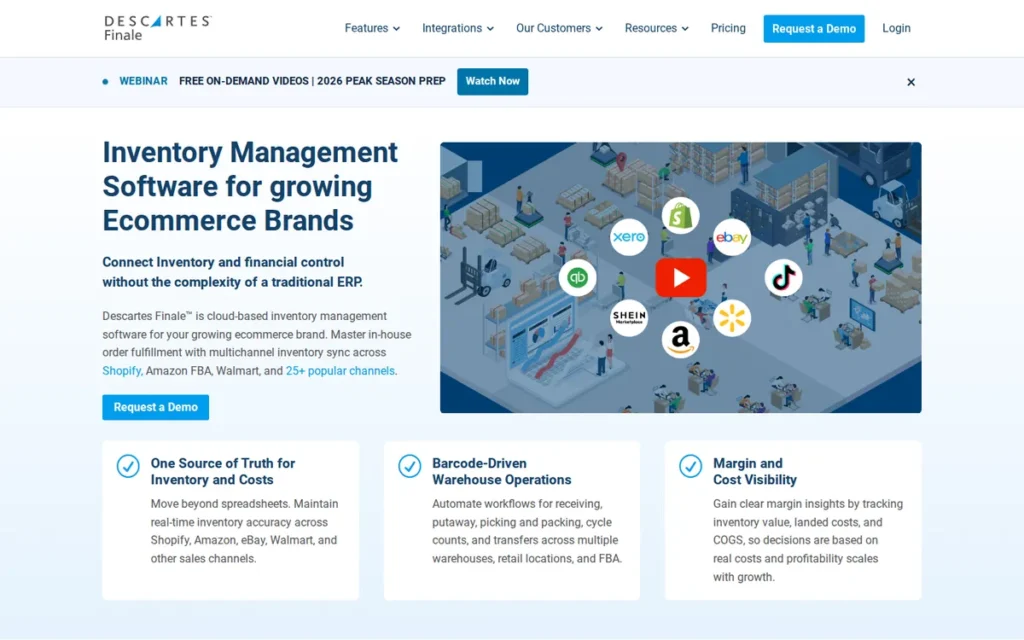
Category: Warehouse-First OMS, inventory and order platforms built around barcode-driven warehouse operations and multichannel stock sync.
At a Glance
- Category: Warehouse-First OMS
- Best For: Growing multichannel sellers (Amazon including FBA, Shopify, Walmart, eBay) running their own warehouse with roughly 2–50 warehouse staff
- Price Range: $499–$799+/month (published; no free tier)
- Primary Strength: Finale Inventory has the highest review scores in this ranking, plus barcode-driven warehouse workflows and real-time multichannel sync.
- Biggest Limitation: Finale Inventory is neither an accounting system nor a full manufacturing system, and its $499/month entry price rules it out for micro-sellers.
- One-Line Summary: Finale Inventory is a warehouse-first order and inventory platform that suits growing multichannel sellers who run their own warehouse and can justify a $499+/month entry price.
- Last Verified: October 2026
Score: C1 4 | C2 5 | C3 3 | C4 2 | C5 3 | C6 4 = 3.60 (wins the C1 tiebreak over Zoho Inventory)
Overview
Finale Inventory is a warehouse- and barcode-first order and inventory platform for growing multichannel sellers that run their own warehouse. It syncs stock in real time across Amazon (including FBA), Shopify, Walmart, eBay and BigCommerce while handling receiving, picking and cycle counts.
Finale Inventory positions itself as a step up from spreadsheets that stops short of a full ERP (Finale Inventory, 2026).
Key Features
- Finale Inventory syncs stock in real time across more than 40 sales channels and uses alias SKUs for listing variations.
- Finale Inventory supports barcode receiving, picking, packing, wave picking and cycle counts.
- Finale Inventory tracks lots, serial numbers and landed cost, and supports kitting and bundles.
- Finale Inventory offers REST and GraphQL APIs and connects to EDI trading partners through SPS Commerce.
- Finale Inventory pairs with shipping tools such as ShipStation for label workflows, as shown in its vendor-published Microfiber Wholesale case study (Finale Inventory, 2026).
Best For
Finale Inventory is best for multichannel and FBA sellers that run their own warehouse and need barcode accuracy more than built-in accounting or production planning.
Strengths
- Finale Inventory holds a 4.7/5 Capterra rating from 218 reviews (Capterra, 2026) and a 4.8/5 G2 rating from 41 reviews (G2 via RFP.wiki, 2026; second-hand), the highest scores in this ranking.
- Finale Inventory’s vendor-published case study reports that Microfiber Wholesale cut shipping errors from 3% to 0.2% after pairing Finale Inventory with ShipStation (Finale Inventory, 2026).
- Finale Inventory’s vendor-published Senior.com case study reports nearly $50,000 saved in the first year by catching supplier overbilling (Finale Inventory, 2026).
- Finale Inventory’s support draws community praise, including a seller on eBay, Amazon and Shopify who reported responses “within an hour” (r/ecommerce, 2024).
Limitations
Finale Inventory gives up breadth for warehouse depth. It is neither an accounting system nor a full manufacturing system, and its pricing excludes the smallest sellers.
- Finale Inventory requires separate accounting software, and a 2022 evaluation reported no Xero integration, which may have changed (r/ecommerce, 2022).
- Finale Inventory has no free or sub-$100 tier, so it does not suit micro-sellers.
- Finale Inventory offers kitting rather than production planning, so manufacturers will need another system.
- Finale Inventory does not publish annual pricing or onboarding fees, so first-year total cost cannot be calculated from its website (Finale Inventory, 2026).
- Evidence confidence: Finale Inventory’s Capterra data is first-hand, but its G2 data is second-hand, its Trustpilot page has only 2 reviews, and independent criticism in our sources is very thin. One source says Descartes Systems Group owns Finale Inventory, but we could not confirm this.
- Rank sensitivity: Finale Inventory’s C1 reliability score reflects no recurring failure reports in a thin evidence base. If C1 were 3, Finale Inventory would total 3.35 and rank third.
Verdict
Finale Inventory is the highest-rated order management choice in 2026 for multichannel sellers who run their own warehouse. It pairs the top review scores in this ranking with real-time sync that includes Amazon FBA. Its #1 rank rests on a one-point tiebreak and thin criticism, so stress-test accounting sync before signing.
2. Zoho Inventory: Best for Small Businesses and Budget-Conscious Multichannel Sellers
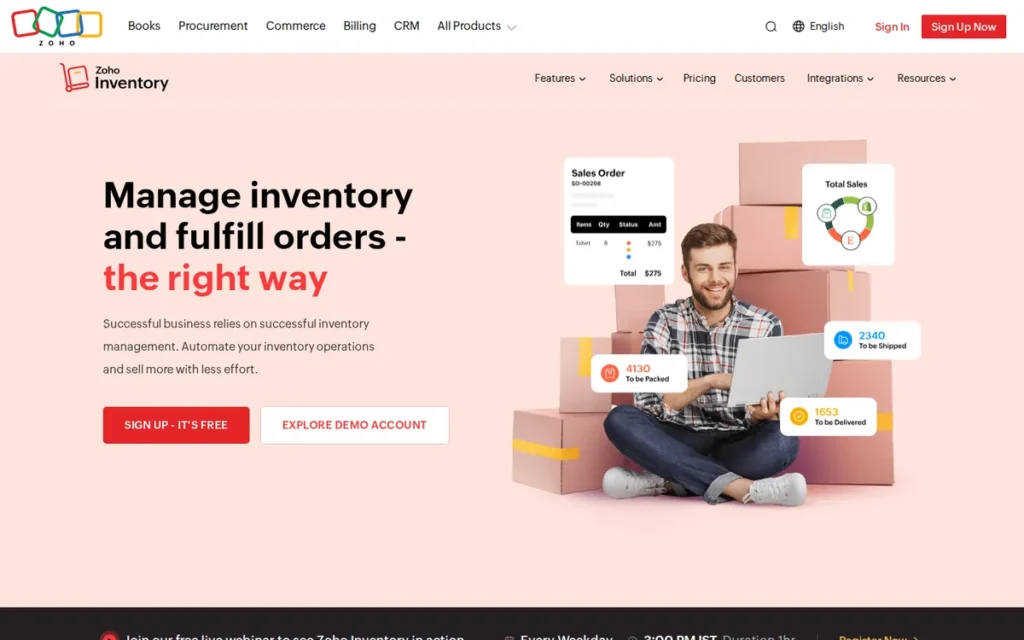
Category: Inventory-Led OMS, inventory systems that manage sales orders, purchasing and stock across channels and locations, syncing to separate accounting software.
At a Glance
- Category: Inventory-Led OMS
- Best For: Small and early-stage multichannel sellers under ~3,000 orders/month, especially existing Zoho users
- Price Range: Free; paid from $29/month (annual) to $79/month for Professional; higher regional tiers listed on Capterra
- Primary Strength: Zoho Inventory offers the lowest-cost entry in this ranking, with a free plan and published order-volume tiers.
- Biggest Limitation: Users report Zoho Inventory’s marketplace and Shopify sync as less real-time than dedicated tools, and its connections sometimes need manual repair.
- One-Line Summary: Zoho Inventory is the lowest-cost order and inventory system in this ranking for small multichannel sellers, provided they plan around its order caps and less-than-real-time sync.
- Last Verified: October 2026
Score: C1 3 | C2 4 | C3 5 | C4 3 | C5 2 | C6 4 = 3.60 (tied for the highest score; loses the tiebreak on C1)
Overview
Zoho Inventory is a low-cost cloud order and inventory system for small businesses selling on Amazon, eBay, Etsy, Shopify and WooCommerce. It combines sales and purchase orders and multi-warehouse stock with a free plan for up to 50 orders a month.
Zoho Inventory gives the most value to businesses already running Zoho Books or Zoho CRM.
Key Features
- Zoho Inventory pulls orders from Amazon, eBay, Etsy, Shopify and WooCommerce into one fulfillment workflow.
- Zoho Inventory supports backorders, drop shipping, partial fulfillment, and multiple warehouses with stock transfers.
- Zoho Inventory includes barcode scanning, serial and batch tracking, and composite items for simple bundles.
- Zoho Inventory integrates natively with Zoho Books, Zoho CRM, Zoho Flow and Zoho Analytics.
Best For
Zoho Inventory is best for small multichannel sellers that need a standalone order and stock system on a tight budget, especially those already using Zoho.
Strengths
- Zoho Inventory holds a 4.5/5 Capterra rating from 423 reviews, with ease of use at 4.4 and value at 4.3 (Capterra, 2026).
- Zoho Inventory’s free plan and $29/month Standard plan are the lowest-cost entry among the seven ranked products (Zoho, 2026).
- Zoho Inventory’s native Zoho Books connection gives Zoho users an order-to-accounting flow without third-party connectors (Zoho, 2026).
- Zoho Inventory was described by a Shopify-and-Amazon seller as “stable and reliable, good value for the price” (r/Zoho, 2021; older report).
Limitations
Zoho Inventory gives up sync depth and customization in exchange for its low price. Sellers whose margins depend on real-time marketplace stock accuracy carry the most risk.
- Zoho Inventory’s Shopify sync is described as “functional but not as tight or real-time” as dedicated tools (Sumtracker, 2026; a competitor’s blog).
- Zoho Inventory’s Amazon and Shopify connections reportedly break at times and need manual fixes (SwadeshiApps, 2026; SMBCompare, 2026).
- Zoho Inventory reviewers say connecting accounting software other than Zoho Books is “not easy” (Capterra, 2026).
- Zoho Inventory offers composite items only, with no full bill of materials or production scheduling, and its mobile app has no offline mode (SMBCompare, 2026).
- Zoho Inventory’s 50/500/3,000 monthly order caps can force an upgrade during peak season (Zoho, 2026).
- Evidence confidence: Zoho Inventory’s Capterra base is large and first-hand. Reddit discussion of Zoho Inventory specifically is thin, and we found no quantified case study.
Verdict
Zoho Inventory is the lowest-cost order management system in this 2026 ranking and fits small multichannel sellers who need a standalone tool under $100 a month. Zoho Inventory shares the top weighted score with Finale Inventory. Sellers relying on real-time marketplace sync or non-Zoho accounting should test those connections first.
3. Oracle NetSuite: Best for Enterprises and Manufacturers Needing Orders Tied to ERP and Production

Category: ERP-Embedded OMS, order management built into a full ERP, so orders post directly to the general ledger, manufacturing and multi-entity accounting.
At a Glance
- Category: ERP-Embedded OMS
- Best For: Mid-market and enterprise businesses, multi-entity companies and manufacturers whose orders must flow into the general ledger and production
- Price Range: Quote-only; third-party estimates of ~$999/month for the core license plus $99–$149/user/month, modules and one-time implementation
- Primary Strength: Oracle NetSuite is the only product in this ranking that runs order management, accounting and manufacturing on one ERP data model.
- Biggest Limitation: Oracle NetSuite has the highest total cost and implementation burden in this ranking, with reported timelines ranging from months to years.
- One-Line Summary: Oracle NetSuite is the strongest choice when order management must post directly to an ERP general ledger and production, but it is overkill for businesses that only need an order and inventory tool.
- Last Verified: October 2026
Score: C1 5 | C2 3* | C3 1 | C4 5 | C5 5 | C6 1 = 3.40 (*neutral midpoint; no verifiable product star rating)
Overview
Oracle NetSuite is a cloud ERP with built-in order management for mid-market and enterprise businesses, including manufacturers. Sales orders flow through fulfillment, invoicing, the general ledger and production in one system instead of syncing between separate tools.
Oracle NetSuite is sold by quote, and partners usually handle implementation.
Key Features
- Oracle NetSuite’s distributed order management uses fulfillment rules to choose the source location, and supports split shipments, drop ship, endless aisle, store fulfillment and exception queues.
- Oracle NetSuite handles omnichannel returns and exchanges alongside order capture, approval, invoicing and payment settlement.
- Oracle NetSuite supports work orders, multi-level bills of materials, assembly builds and backflushing tied to customer orders.
- Oracle NetSuite posts order activity directly to its general ledger, including revenue recognition and multi-subsidiary accounting.
- Oracle NetSuite offers SuiteSuccess preconfigured industry implementations and SuiteCloud tools for customization and APIs.
Best For
Oracle NetSuite is best for multi-entity companies, distributors and manufacturers that have outgrown separate inventory and accounting tools and need one ERP system of record.
Strengths
- Oracle NetSuite holds the top score in Capterra’s order management category ranking, 95/100. That score combines popularity (50/50) and ratings (45/50) and is not a product star rating (Capterra, 2026).
- Oracle NetSuite’s partner-published case studies report mis-shipments cut by 82.5% and shipping capacity raised to 1,100 orders a day without new hires (Beyond Cloud Consulting, 2026). These are partner claims, not audited results.
- Oracle NetSuite is the only product among the seven ranked with full work orders, multi-level BOMs and backflushing linked to sales orders (NetSuite, 2026).
- Oracle NetSuite rollouts can move fast when phased, and one buyer covered accounting, distribution, WMS, light manufacturing and Shopify integration in 3 months (r/Netsuite, 2024).
Limitations
Oracle NetSuite gives up cost and simplicity in exchange for unified data and depth. It has the highest total cost of ownership and the heaviest implementation burden in this ranking.
- Oracle NetSuite renewal increases are reported anecdotally at 5–16% by some consultants and 40–100% by other sources after first-year discounts end (Accord Consulting, 2026; CostBench, 2026).
- Oracle NetSuite implementations reportedly range from 3 months to 2.5 years, depending largely on partner quality (r/Netsuite, 2024).
- Oracle NetSuite reviewers repeatedly mention consultant dependence, a steep learning curve and slow support (Eleven.run, 2026; BestGuide, 2026).
- Oracle NetSuite drew one review describing sales orders taking 30–60 seconds to open months after go-live (Eleven.run, 2026).
- Evidence confidence: We could not verify a star rating for Oracle NetSuite itself. Capterra’s 45/50 ratings sub-score is part of a category ranking, not a star rating with a review count, so C2 stays at the neutral midpoint. Case-study figures come from partners.
Users on r/Netsuite noted:
“It’s not a bad system overall but we were sold the moon but most of it wasn’t included in the quote we signed off so definitely be aware of that, every 5 mins it was “oh you haven’t bought that part you need to pay an extra 10k” my CFO refused any more spend so we’ve had to make do. We had Sage 50 before with mostly spreadsheets as systems so it is a massive improvement and there is a lot I like about it but it has a lot of limitations too.” Posted by u/No_Stress9874
Takeaway: Oracle NetSuite is a real upgrade for companies leaving spreadsheets and entry-level accounting, but buyers who don’t lock down scope before signing face repeated add-on charges after the contract is signed.
Verdict
Oracle NetSuite is the strongest order management option in this 2026 ranking for enterprises and manufacturers whose orders must post directly to an ERP general ledger and the production floor. Small sellers will pay for capability they don’t use. Choose the implementation partner as carefully as the software.
4. inFlow Inventory: Best for Ease of Use in SMB Wholesale and Light Manufacturing
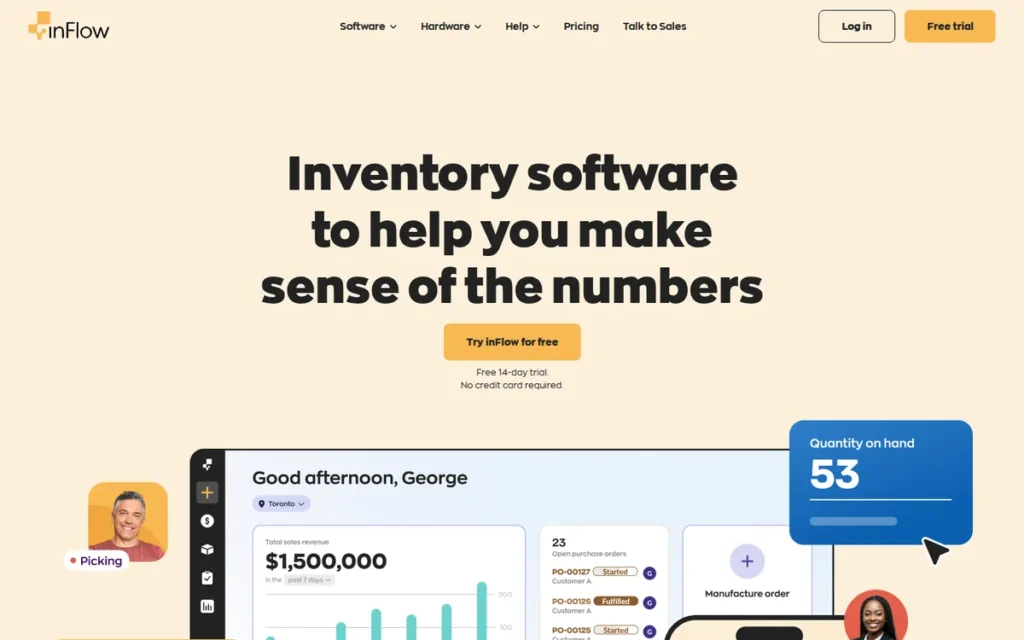
Category: Inventory-Led OMS, inventory systems that manage sales orders, purchasing and stock across channels and locations, syncing to separate accounting software.
At a Glance
- Category: Inventory-Led OMS
- Best For: Small wholesale, B2B and light-assembly businesses that put staff ease of use ahead of high-volume marketplace sync
- Price Range: Tiered by monthly sales orders (100 to 30,000); official price table not retrieved, so confirm with the vendor
- Primary Strength: inFlow Inventory earns the highest ease-of-use and support ratings in this ranking.
- Biggest Limitation: inFlow Inventory has documented gaps in multichannel sync and multi-warehouse routing, plus add-on costs for API access, mobile and order overages.
- One-Line Summary: inFlow Inventory is the easiest-to-use order and inventory system in this ranking for small wholesale and light-manufacturing teams, but high-volume multichannel sellers will hit its sync and add-on limits.
- Last Verified: October 2026
Score: C1 2 | C2 5 | C3 3 | C4 3 | C5 3 | C6 5 = 3.35 (0.05 behind Oracle NetSuite)
Overview
inFlow Inventory is an order and inventory system from Toronto-based Archon Systems for small wholesale, B2B and light-manufacturing businesses. It offers simple ordering, purchasing, barcode scanning and bills of materials that staff can learn quickly.
inFlow Inventory connects to Shopify, Amazon, WooCommerce, QuickBooks Online, Xero and ShipStation.
Key Features
- inFlow Inventory manages sales orders, purchase orders, pick-pack-ship and reorder points across multiple locations.
- inFlow Inventory supports barcode scanning through its mobile and Windows apps.
- inFlow Inventory includes kits and bills of materials for light assembly.
- inFlow Inventory offers a B2B Showroom portal where wholesale customers place orders.
- inFlow Inventory integrates with Shopify, Amazon, WooCommerce, QuickBooks Online, Xero and ShipStation.
Best For
inFlow Inventory is best for small B2B, wholesale and light-assembly businesses where everyday usability for non-technical staff matters more than deep marketplace orchestration.
Strengths
- inFlow Inventory holds a 4.6/5 Capterra rating from 504 reviews, with ease of use and support each at 4.6, the highest usability sub-ratings in this ranking (Capterra, 2026).
- inFlow Inventory’s vendor-published Direct Workwear case study reports manual order entry falling from 5–10 orders a day to 1–2 a month (inFlow, 2026).
- inFlow Inventory’s support was called “SUPER responsive” by a user who switched from Unleashed (r/InventoryManagement, 2023).
- inFlow Inventory kept one frustrated user from leaving because its “core UI / UX experience is better than basically any other” system (r/InventoryManagement, 2024).
Limitations
inFlow Inventory gives up orchestration depth for simplicity. High-volume multichannel and 3PL sellers face the most risk.
- G2 review summaries cite gaps in inFlow Inventory’s multichannel sync and multi-warehouse routing (G2, 2026). Its lower tiers are also limited to 2 sales-channel integrations (Business.org, date unconfirmed).
- inFlow Inventory’s Shopify integration ignored 3PL-managed locations for one D2C brand for 5 months. inFlow says an August 2025 update fixed this (r/InventoryManagement, 2024).
- inFlow Inventory’s Xero integration was called “fragile” by a reviewer whose invoices failed to sync without any error (Trustpilot, 2026).
- inFlow Inventory’s order overages, paid API and paid mobile seats can raise costs quickly as volume grows (Business.org, date unconfirmed).
- inFlow Inventory needed a workaround for lot/serial tracking, which buyers should recheck (r/InventoryManagement, 2024).
- Evidence confidence: inFlow Inventory’s Capterra base is large and first-hand, but its pricing comes from a third party, and two of the criticisms above may be out of date.
Users on r/InventoryManagement shared their experience:
“Not a lot has changed but they are making some improvements to UI here and there. We’re still using them because switching would be more painful.
Support and bug fixing is still as bad – it took them 3 months to fix the most simplest of UI bugs. That said, the overall UX experience is above most other inventory apps I tried.” Posted by u/psych0o
Takeaway: inFlow Inventory keeps long-term customers on the strength of its interface even when slow bug fixes frustrate them, so buyers should weigh its usability lead against how fast it resolves issues.
Verdict
inFlow Inventory is the most user-friendly order and inventory system in this 2026 ranking for small wholesale and light-assembly teams. Its 4.6/5 Capterra rating from 504 reviews and 4.6 ease-of-use sub-rating are the strongest usability signals here. High-volume sellers should model add-on costs and test multi-location sync.
5. Brightpearl by Sage: Best for Mid-Market Shopify-Led Retailers Wanting Order Automation
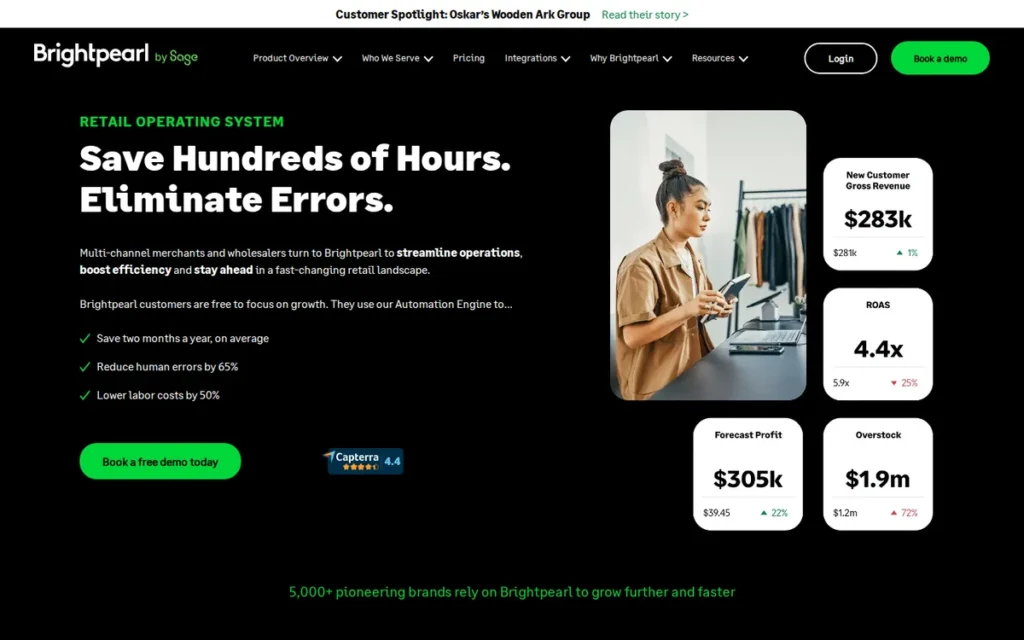
Category: Retail Operating System, mid-market platforms that combine automated order routing, inventory, POS and retail accounting for omnichannel retailers.
At a Glance
- Category: Retail Operating System
- Best For: Mid-market Shopify-led omnichannel retailers and wholesalers that want automated routing, allocation and invoicing
- Price Range: Quote-only, based on order volume or GMV; third-party estimates of ~$499 to $5,000+/month plus implementation
- Primary Strength: Brightpearl by Sage automates order routing, allocation, invoicing and purchase-order creation across retail and wholesale channels.
- Biggest Limitation: Brightpearl by Sage users report inaccurate cost of goods and sync drift on partial shipments, POS returns and kits, at a high and opaque price.
- One-Line Summary: Brightpearl by Sage is a mid-market retail operating system that automates multichannel order workflows for Shopify-led retailers, provided they verify its accounting accuracy and sync before going live.
- Last Verified: October 2026
Score: C1 4 | C2 3* | C3 2 | C4 3 | C5 1 | C6 3 = 2.85 (*neutral midpoint; review counts unverifiable)
Overview
Brightpearl by Sage is a mid-market retail operating system for Shopify-led omnichannel retailers and wholesalers. It combines multichannel orders, an Automation Engine, warehouse management, POS, demand forecasting and built-in retail accounting in one platform.
Brightpearl by Sage is quote-priced, quotes implementation at a fixed cost, and has been owned by Sage since a 2022 acquisition.
Key Features
- Brightpearl by Sage’s Automation Engine routes and allocates orders, raises invoices and creates purchase orders based on rules.
- Brightpearl by Sage handles partial fulfillment, split shipments, drop shipping, back-to-back orders, 3PL connections and Amazon FBA.
- Brightpearl by Sage includes warehouse management and Inventory Planner for demand forecasting.
- Brightpearl by Sage offers POS and built-in retail accounting, or integrates with Sage Intacct, QuickBooks and Xero.
- Brightpearl by Sage quotes implementation at a fixed cost before signing and provides structured onboarding.
Best For
Brightpearl by Sage is best for mid-market retailers running Shopify alongside wholesale, POS or 3PL channels who want order workflows automated end to end.
Strengths
- Brightpearl by Sage quotes implementation at a fixed cost before contract signature (Brightpearl, 2026). We found no comparable published commitment from the other quote-only vendors in this ranking.
- Brightpearl by Sage’s implementation consultants and post-launch support are praised on Trustpilot (Trustpilot, 2026). The vendor also claims a 97% implementation success rate (Brightpearl, 2026; unverified vendor claim).
- A vendor-published Brightpearl by Sage customer testimonial says Inventory Planner stopped the customer from ordering 10,000 units when the season needed 100,000 (Brightpearl, 2026).
- Brightpearl by Sage is described as “a good ERP that can work well with Shopify and Sage,” with “solid” order and inventory features (r/CRM, 2025).
Limitations
Brightpearl by Sage gives up cost predictability and accounting precision in exchange for automation breadth. Finance teams should verify its numbers before relying on them.
- Brightpearl by Sage users call it expensive and opaque on pricing, and one was told to buy Inventory Planner for reports that already existed (G2, 2026).
- Brightpearl by Sage drew a report from one team that moved accounting back to QuickBooks because “COGS was never accurate” (r/CRM, 2025).
- Brightpearl by Sage drew another report of partial shipments, POS returns and kit SKUs “drifting out of sync” (r/CRM, 2025).
- Brightpearl by Sage’s Capterra reviewers call its accounting module minimal, note it has no landed-cost capture, and say it is unsuitable for bespoke manufacturing (Capterra, 2026).
- Evidence confidence: We could not verify independent G2 and Capterra review counts for Brightpearl by Sage, so C2 was scored at the neutral midpoint. Its performance figures are vendor marketing.
Verdict
Brightpearl by Sage is a credible 2026 order automation platform for mid-market Shopify-led retailers, provided buyers verify cost-of-goods and sync accuracy before going live. Its rules-based Automation Engine and fixed-price implementation quote are its clearest documented advantages. Reconcile a trial weekend of orders to the cent.
6. Cin7 Core: Best for Multichannel Sellers Needing B2B, EDI and Light Manufacturing in One Platform
Category: Inventory-Led OMS, inventory systems that manage sales orders, purchasing and stock across channels and locations, syncing to separate accounting software.
At a Glance
- Category: Inventory-Led OMS
- Best For: Growing brands combining DTC, marketplaces, B2B/wholesale and EDI, with light manufacturing and implementation support
- Price Range: $349–$1,199/month published (Core) plus onboarding of ~$800–$1,200; Omni is quote-only
- Primary Strength: Cin7 Core combines multichannel orders, a B2B portal, EDI and MRP in one published-price platform.
- Biggest Limitation: Cin7 Core users repeatedly report integrations failing without alerts, steep price increases and an annual lock that blocks downgrades.
- One-Line Summary: Cin7 Core offers the broadest multichannel, B2B and light-manufacturing feature set at a published price in this ranking, but its polarized reviews make careful contract and integration testing essential.
- Last Verified: October 2026
Score: C1 3 | C2 3 | C3 2 | C4 3 | C5 4 | C6 2 = 2.80
Overview
Cin7 Core is a multichannel order and inventory platform for growing brands that sell on Shopify, Amazon, eBay, Walmart, WooCommerce and BigCommerce alongside wholesale. It adds a B2B portal, EDI, unlimited locations and bills of materials.
Cin7 Core is the published-price sibling of Cin7 Omni, the enterprise product.
Key Features
- Cin7 Core manages orders from Shopify, Amazon, eBay, Walmart, WooCommerce and BigCommerce alongside a B2B wholesale portal.
- Cin7 Core supports unlimited locations with batch, serial and expiry tracking and pick-pack-ship workflows.
- Cin7 Core includes bills of materials, with MRP on Pro plans and above.
- Cin7 Core connects to EDI trading partners and markets more than 700 integrations, including Xero and QuickBooks.
- Cin7 Core offers ForesightAI forecasting, which builds on Cin7’s May 2024 acquisition of Inventoro (Brendon Beebe Substack, 2026).
Best For
Cin7 Core is best for brands running DTC, marketplace and EDI wholesale channels at once, with the operational maturity or partner support to handle a complex setup.
Strengths
- Cin7 Core holds a 4.2/5 G2 rating from 346 reviews (G2, 2026). A second-hand Capterra figure from an inventory-planning vendor puts it at 4.3/5 from 727 reviews (Prediko, 2026).
- Cin7 reports more than 8,000 customers in 100+ countries and lists customers including Fishwife, Friction Labs and Workplace Depot (Cin7, 2026; vendor figures).
- Cin7 Core is the only published-price product among the seven ranked that combines multichannel orders, a B2B portal, EDI and MRP, according to vendor documentation (Cin7, 2026).
- Cin7 Core “works great across all channels and also integrates with our accounting software (xero),” according to one user (r/ecommerce, 2024).
Limitations
Cin7 Core gives up reliability and simplicity in exchange for breadth, and its reviews are the most polarized in this ranking.
- Cin7 Core users report integrations breaking with no alerts, discovered “only… the next day when you have oversold items” (r/InventoryManagement, 2023).
- Cin7 Core drew reports of Shopify stock being zeroed out and a Shopify integration problem lasting more than a year (Trustpilot, 2026).
- Cin7 Core users describe unannounced price increases, costs that “more than tripled” and an “annual lock” that blocks downgrades (Capterra, 2026; Xero App Store, 2026).
- Cin7 Core’s complexity led one 22-store retailer to abandon onboarding (r/Warehousing, 2025).
- Cin7 Core drew a report of an unexplained $80,000 inventory-valuation gap that went unresolved for more than a year (Capterra, 2026).
- Evidence confidence: Cin7 Core’s G2 data is first-hand. Its Capterra and Trustpilot figures are second-hand, via a vendor in an adjacent category.
Verdict
Cin7 Core is the most feature-complete published-price order platform in this 2026 ranking for brands combining marketplaces, B2B wholesale, EDI and light manufacturing. Get integration-failure alerting, renewal caps and downgrade terms in writing. Smaller teams without implementation support may find it more system than they can run.
7. Linnworks: Best for High-Volume Sellers on Many Marketplaces
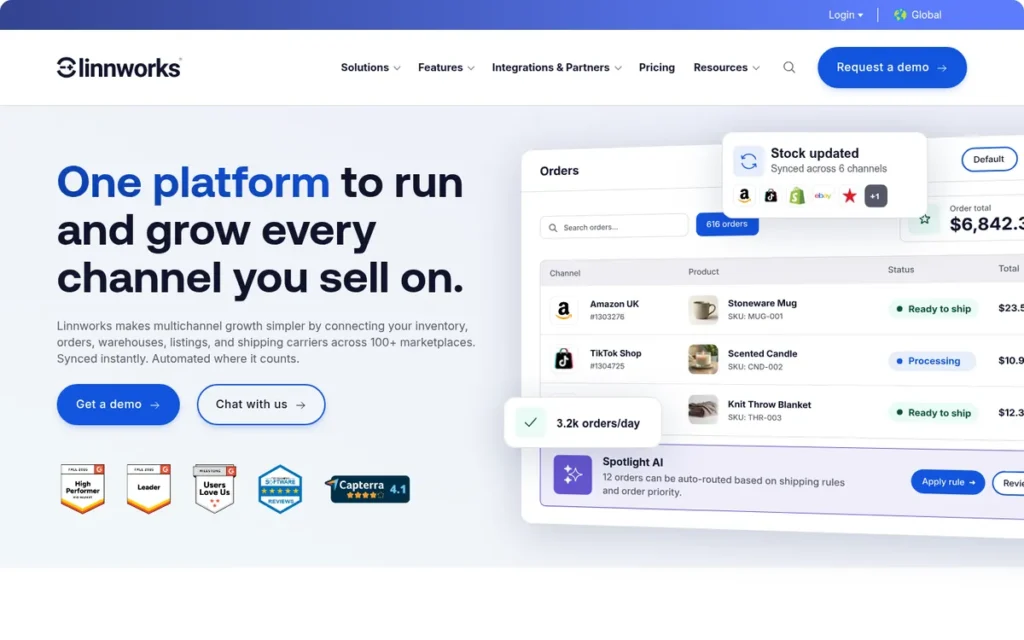
Category: Marketplace Order Hub, centralized order, listing and stock control for sellers on many marketplaces at once.
At a Glance
- Category: Marketplace Order Hub
- Best For: High-volume sellers listing on many marketplaces (Amazon, eBay, Walmart, TikTok Shop) plus DTC stores, often with 3PLs
- Price Range: Quote-only, tied to order volume plus add-ons; user reports range from ~$200/month to £32,000/year
- Primary Strength: Linnworks centralizes orders, listings and stock across many marketplaces, with rules-based warehouse, 3PL and carrier routing.
- Biggest Limitation: Linnworks has the most frequent reports of steep renewal price increases in this ranking, along with strict auto-renewal terms.
- One-Line Summary: Linnworks is a marketplace-first order hub that keeps stock in sync across many channels, but buyers must lock in renewal pricing in writing because of repeated reports of large increases.
- Last Verified: October 2026
Score: C1 4 | C2 3 | C3 1 | C4 2 | C5 1 | C6 2 = 2.40
Overview
Linnworks is a UK-based multichannel order and inventory hub for high-volume sellers on many marketplaces at once. It unifies orders, listings and stock across Amazon, eBay, Walmart, TikTok Shop and DTC stores, and uses rules to route orders to warehouses or 3PLs.
Linnworks prices by quote, based on order volume.
Key Features
- Linnworks provides one order workspace across Amazon, eBay, Walmart, TikTok Shop and DTC storefronts.
- Linnworks syncs inventory across channels and warehouses, and users describe its central stock record as their “source of truth” (Shopify App Store, 2026).
- Linnworks applies rules to route orders to warehouses or 3PLs, choose carriers and print labels automatically.
- Linnworks manages marketplace listings and offers add-ons for WMS and forecasting.
- Linnworks handles purchasing, invoices and shipping manifests in the same platform.
Best For
Linnworks is best for marketplace-heavy sellers on many channels who need overselling prevention and shipping automation more than accounting or manufacturing depth.
Strengths
- Linnworks is credited by a Capterra reviewer selling on 17 channels with preventing any overselling for more than two years (Capterra, 2026).
- Linnworks holds a 4.3/5 G2 rating (review count not retrieved) and an 86% SelectHub satisfaction score from 147 reviews across four sites (G2, 2026; SelectHub, 2026).
- Linnworks support fixed issues the same day over six years, according to a Shopify App Store reviewer (Shopify App Store, 2026).
- Linnworks covers TikTok Shop alongside Amazon, eBay and Walmart in a single order workspace (Mintsoft, 2026).
Limitations
Linnworks gives up cost predictability and accounting precision in exchange for marketplace breadth. Contract terms carry the biggest risk.
- Linnworks has the highest reported renewal-price risk in this ranking, with reports of 384–400% increases and 12-month auto-renewals (Trustpilot, 2026).
- Linnworks reportedly tracks average item cost incorrectly, which changes historical cost-of-goods figures (Shopify App Store, 2026).
- Linnworks is described by Capterra reviewers as “slow and buggy,” with purchase orders over 500 lines taking up to 30 seconds to recalculate (Capterra, 2026).
- Linnworks draws complaints about a dated interface and a learning curve, and it is not built for manufacturing (G2, 2026).
- Evidence confidence: Linnworks has a small Capterra base (47 reviews), a second-hand Trustpilot rating and no Reddit discussion. Its feature descriptions partly come from a competitor (Mintsoft), and its C1 evidence rests mainly on individual reviewer reports.
Verdict
Linnworks is a capable 2026 order hub for high-volume sellers on many marketplaces, but it carries the highest reported renewal-price risk in this ranking. Long-term reviewers rate its routing and overselling prevention well. Secure renewal caps in writing and verify its cost-of-goods calculations.
How Much Does Order Management Software Really Cost?
Order management software costs anything from nothing (Zoho Inventory’s 50-order free plan) to six-figure ERP projects. Panorama Consulting puts the median ERP project at $450,000 and 9 months (Panorama Consulting, 2025). The subscription price is only one part of what you pay over the life of the contract.
Four cost drivers decide what you actually pay:
- Order caps, set monthly or annually, can force a plan upgrade after one strong peak season.
- Paid add-ons for API access, mobile apps, extra seats and modules can raise the price of a cheap plan.
- Onboarding and implementation fees are usually quoted separately from the subscription.
- Renewal increases after year one can change the economics of a multi-year contract.
Pricing and fit snapshot (verified October 2026):
| Company | Pricing Model | Entry Price | Accounting Fit | Manufacturing Depth | Documented Sync Failure Reports | Returns and Split Shipments |
|---|---|---|---|---|---|---|
| Finale Inventory | Published | $499/month (published) | Separate accounting required; Xero connector unconfirmed | Kitting/bundles | None found (thin evidence) | Not documented in our research |
| Zoho Inventory | Published | Free; $29/month annual (published) | Native Zoho Books; other accounting reported “not easy” | Composite items only | Occasional manual repair reported | Backorders, partial fulfillment, drop ship |
| Oracle NetSuite | Quote-only | ~$999/month core (third-party estimate) | Native general ledger | Full work orders, multi-level BOMs | No recurring pattern found | Native omnichannel returns, exchanges, splits |
| inFlow Inventory | Published tiers (official table not retrieved) | Confirm with vendor | QuickBooks Online, Xero; silent Xero invoice failure reported | BOMs | 3PL-location failure reported (fix claimed Aug 2025) | Pick-pack-ship; returns not documented |
| Brightpearl by Sage | Quote-only | ~$499/month (third-party estimate) | Built-in retail accounting or Sage/QBO/Xero; COGS inaccuracy reported | Not built for it | Single sync-drift report | Splits, back-to-back orders; POS-return drift reported |
| Cin7 Core | Published | $349/month (published) | Xero, QuickBooks; $80K valuation gap reported | BOMs + MRP (Pro+) | Repeated silent-failure reports | Pick-pack-ship; returns not documented |
| Linnworks | Quote-only | ~$200/month (user report) | Connectors; average-cost COGS error reported | Not built for it | No recurring pattern found (individual reviews only) | Rules-based routing; returns not documented |
Plan details for each tool:
- Zoho Inventory’s Free plan allows 50 orders a month, 1 user and 1 location, although Zoho’s FAQ says 2 locations (Zoho, 2026).
- Zoho Inventory Standard costs $29/month billed annually or $39 monthly for 500 orders, and Professional costs $79/month billed annually for 3,000 orders (Zoho, 2026).
- inFlow Inventory tiers allow 100, 2,000, 10,000 or 30,000 sales orders a month, with overages sold in 50-order batches at about $16–$29 each (Business.org, date unconfirmed).
- Adding 30,000 orders on inFlow Inventory’s top tier could cost more than $9,600, according to Business.org (Business.org, date unconfirmed).
- inFlow Inventory charges about $50+/month for API access, sells its mobile app with 2 users and adds users in 5-seat blocks (r/InventoryManagement, 2024).
- Finale Inventory’s Entry plan costs $499/month for 1–2 warehouses, and its Growth plan starts at $799/month, which Finale Inventory calls the most common starting point (Finale Inventory, 2026).
- Cin7 Core Standard costs $349/month for 5 users, 2 integrations and 6,000 sales orders a year (Cin7, 2026).
- Cin7 Core Pro costs $599/month for 24,000 orders a year, and Advanced costs $1,199/month for 120,000, though older sources cite $999 (Cin7, 2026).
- Cin7 Core onboarding reportedly costs $800 for group sessions or $1,200 for one-on-one sessions (r/InventoryManagement, 2023).
- Brightpearl by Sage is quoted by order volume or GMV, with a historical third-party starting point of about $499/month and one mid-market estimate of $5,000+/month (r/CRM, 2025).
- Linnworks users report renewal pricing rising from about £3,000 to £10,000 a year, a 384% rise to £32,000, and a 400% rise with 30 days’ notice (Trustpilot, 2026).
- Oracle NetSuite’s core license is estimated by third parties at about $999/month (about $12K a year), plus $99–$149 per user each month (third-party estimates, 2026).
- A 10-user Oracle NetSuite deployment would run about $24,000–$30,000 a year before modules and implementation (our calculation from third-party estimates, 2026).
The same 500-order plan can mean 500 orders every month (Zoho Inventory Standard) or 500 a month on average across a year (Cin7 Core Standard’s 6,000 annual cap). That difference decides whether a November spike forces an upgrade.
Take a seller averaging 400 orders a month who ships 1,200 in November. That seller would exceed Zoho Inventory Standard’s monthly cap and need Professional at $79/month. Cin7 Core’s annual cap would absorb the spike, but at $349/month.
Model every option at 2× and 5× your current order volume. Zoho Inventory caps orders per month, Cin7 Core caps them per year, and inFlow Inventory sells overages in 50-order batches. As a result, the cheapest plan today can become the most expensive one after a strong peak season.
Which Alternatives Did We Not Rank, and Why?
We left out several well-known tools because they belong to a different category or because we collected too little product-specific review evidence to score them fairly. Excluding these tools is not a negative finding. Some of them may suit your business better than any ranked product.
- Shopify built-in tools are a store-platform feature rather than a standalone OMS, and they are often enough for single-channel stores.
- Square for Retail is primarily a POS platform and belongs in a different category.
- ShipStation is a shipping tool that complements an OMS rather than replacing one.
- Salesforce Order Management had almost no product-specific review data in our research, so we replaced it with Linnworks.
- Manhattan Active Order Management serves enterprise omnichannel orchestration, and we collected too little review evidence to score it.
- Fishbowl, Katana and MRPeasy are manufacturing-oriented inventory tools, and we collected too little review evidence to score them in this comparison.
What Red Flags Should I Watch For When Evaluating Order Management Software?
The biggest red flags in order management software are integrations that fail silently, order caps that surface after signing, uncapped renewal increases, cost-of-goods figures that won’t reconcile, paid add-ons that pile up and open-ended implementation scope. User reports tie each pattern to at least one ranked product, so apply every check to every vendor.
In user reports across this ranking, order management tools fail more often through silent sync errors than through missing features.
Red Flag #1: Integrations That Fail Without Alerts A silent integration failure is among the most damaging sync problems, because sellers often discover it only after overselling. Users report this pattern for Cin7 Core (r/InventoryManagement, 2023) and for inFlow Inventory’s Xero sync (Trustpilot, 2026). Ask every vendor, including top-ranked ones, how failures are detected and who is notified.
This aligns with community sentiment on r/InventoryManagement:
“I’d use event-based updates for orders, cancellations, and returns, then a scheduled reconciliation as a safety net. The right interval depends on how quickly the SKU moves: daily can be fine for slow stock, while fast sellers or promotions need near-real-time updates and a buffer. Keep an exception queue for failed syncs and oversells rather than silently overwriting counts, and review that queue before the next fulfillment run.” Posted by u/OkStatistician9190
Takeaway: Experienced inventory operators treat a visible exception queue for failed syncs as a must-have in order management software, because a sync speed claim means little if failures overwrite stock counts without anyone noticing.
Red Flag #2: Order Caps That Surface Late Order caps that become visible only after signing can force an expensive mid-contract upgrade. Zoho Inventory caps orders per month, Cin7 Core caps them per year, and inFlow Inventory sells overages in 50-order batches. Compare every cap against your peak-season volume, not your monthly average.
Red Flag #3: Uncapped Renewal Increases and Annual Lock-In Uncapped renewal clauses expose buyers to large price jumps after year one. Users report 384–400% increases for Linnworks (Trustpilot, 2026) and costs that “more than tripled” for Cin7 Core (Xero App Store, 2026). Annual locks and auto-renewals make these increases harder to escape.
Oracle NetSuite renewal reports range from 5–16% (some consultants) to 40–100% (other sources) after first-year discounts end (Accord Consulting, 2026; CostBench, 2026).
Red Flag #4: Cost-of-Goods That Won’t Reconcile A cost-of-goods figure that won’t reconcile with accounting undermines margin reporting. Users report inaccurate COGS for Brightpearl by Sage (r/CRM, 2025), an average-cost recalculation that changes historical COGS for Linnworks (Shopify App Store, 2026), and an $80,000 valuation gap for Cin7 Core (Capterra, 2026).
Finale Inventory is not an accounting system, so its accounting sync needs the same reconciliation test. Landed-cost capture also varies: Finale Inventory supports it, while Brightpearl by Sage reviewers say it lacks it (Capterra, 2026).
Red Flag #5: Paid API Access and Add-On Creep Paid add-ons can turn an affordable order management plan into an expensive one, because they rarely appear in headline pricing. Ask every vendor for an itemized quote covering every module, seat and connector you need. Reported examples across this ranking include:
- inFlow Inventory charges about $50+ a month for API access (r/InventoryManagement, 2024).
- inFlow Inventory sells its mobile app with 2 users and adds seats in 5-seat blocks (Capterra, 2026).
- Brightpearl by Sage users report paying extra for Inventory Planner forecasting and for the Sage integration (G2, 2026).
- Finale Inventory does not publish annual pricing or onboarding fees, so buyers should request both in writing (Finale Inventory, 2026).
Red Flag #6: Open-Ended Implementation Scope An open-ended implementation scope is a leading driver of runaway total cost. Reported Oracle NetSuite timelines range from 3 months to 2.5 years (r/Netsuite, 2024), and the median ERP project takes 9 months (Panorama Consulting, 2025). Prefer a fixed-price quote (Brightpearl by Sage documents one) or a written scope with milestones.
What Questions Should I Ask Before Choosing Order Management Software?
Before signing, ask every order management vendor eight questions. They cover renewal caps, downgrade terms, integration-failure alerts, API pricing, 3PL location handling, reconciliation trials, implementation cost and returns. Written answers expose most hidden costs and reliability risks, and vague answers are themselves a warning sign.
Question #1: Will you put a renewal-increase cap in writing? A written renewal cap is the strongest protection against price shocks after signing. Users report steep renewal increases for several products in this ranking, including Linnworks, Cin7 Core and Oracle NetSuite. Accept a specific percentage written into the contract, not a verbal assurance from a sales representative.
Question #2: Can we downgrade or cancel mid-term, and what notice is required? Downgrade and cancellation terms decide whether you can respond if a tool fails you. Users report annual locks that block downgrades for Cin7 Core and 12-month auto-renewals with strict notice windows for Linnworks. Ask for these terms in the contract itself, before signature.
Question #3: How are integration failures alerted, and to whom? Integration alerting determines whether a sync failure costs you minutes or a full day of oversold orders. Ask which events trigger an alert, how alerts are delivered, and whether a named person on your team receives them automatically. Then ask the vendor to show a real alert during the demo.
Question #4: Is API access included or a paid add-on? API access matters if you plan custom integrations, reporting or connections to a 3PL. Some vendors include it, while inFlow Inventory charges about $50+ a month for it separately (r/InventoryManagement, 2024). Ask for the API’s price, rate limits and documentation before you commit to a plan.
Question #5: How do you model 3PL- and app-managed locations? 3PL and app-managed locations are a common blind spot for inventory sync. One inFlow Inventory user’s Shopify integration ignored 3PL-managed locations for 5 months before inFlow reported a fix (r/InventoryManagement, 2024). Ask every vendor to demonstrate your exact location setup live, not in slides.
Question #6: Can we reconcile a trial batch to the cent? A reconciliation trial with refunds, exchanges, partial shipments and kit SKUs is the most reliable way to catch sync drift and cost-of-goods errors before go-live. A Reddit user evaluating Brightpearl by Sage advised walking away if totals don’t match your sales channel to the cent (r/CRM, 2025).
Question #7: What is the fixed implementation and onboarding cost? A fixed implementation price makes total cost predictable. Cin7 Core onboarding reportedly costs $800–$1,200 (r/InventoryManagement, 2023), Finale Inventory does not publish onboarding fees, and ERP projects reach a median of $450,000 (Panorama Consulting, 2025). Get a written quote covering migration and training.
Question #8: How do you handle returns, exchanges and split shipments? Returns handling differs sharply across the ranked tools. Oracle NetSuite documents omnichannel returns and exchanges, while Brightpearl by Sage handles splits but drew a report of POS returns drifting out of sync (r/CRM, 2025). For most other tools, our research found little documentation, so include returns in your trial batch.
How Did We Rank These Order Management Software Tools?
We scored seven order management products from 1 to 5 on six weighted criteria, used the same evidence types for every product, and ranked them by weighted total. Data we could not verify was scored at a neutral midpoint and disclosed, and results published by vendors or partners are labeled throughout.
We applied these evidence types to every product:
- Vendor documentation and pricing pages supplied feature and plan data for every product.
- G2, Capterra and Trustpilot ratings supplied review scores, and second-hand figures are flagged.
- Reddit and user-review reports supplied reliability, support and contract evidence.
- Third-party pricing estimates filled gaps for quote-only vendors.
Ranking criteria:
- C1 (Order orchestration and multichannel sync capability and reliability, 25%): C1 carries the most weight because user reports show sync failures, not missing features, are the most common way these tools fail.
- C2 (Verified review ratings and volume, 20%): C2 matters because ratings from verified users are the broadest independent signal of satisfaction.
- C3 (Pricing transparency, total cost of ownership and contract risk, 20%): C3 matters because order caps, add-ons and renewal increases often surface only after signing.
- C4 (Accounting and ERP integration depth and accuracy, 15%): C4 matters because order data that won’t reconcile with the general ledger is a leading cause of buyer regret.
- C5 (Manufacturing and production linkage, 10%): C5 matters because manufacturers need customer orders tied to bills of materials, production and purchasing.
- C6 (Usability, implementation burden and support, 10%): C6 matters because staff adoption and implementation time drive real-world cost.
Scoring rules:
- Tiebreak: Ties go to the higher C1 score, so Finale Inventory beats Zoho Inventory at 3.60 on C1 (4 vs 3).
- Neutral midpoint: Unverifiable data is scored 3 and disclosed, which applies to C2 for Oracle NetSuite and Brightpearl by Sage.
- Thin criticism: A lack of criticism is disclosed and never treated as proof that a product has no weaknesses.
- Sensitivity: Finale Inventory’s C1 reliability score reflects no recurring failure reports in a thin evidence base. At 3, Finale Inventory would total 3.35 and rank third, with Zoho Inventory as the sole #1.
- C1 consistency: Brightpearl by Sage scores 4 on C1 because its sync-drift evidence is a single report. Cin7 Core scores 3 because multiple independent sources report silent failures and Shopify stock overwrites.
| Product | C1 | C2 | C3 | C4 | C5 | C6 | Weighted Total |
|---|---|---|---|---|---|---|---|
| Finale Inventory | 4 | 5 | 3 | 2 | 3 | 4 | 3.60 |
| Zoho Inventory | 3 | 4 | 5 | 3 | 2 | 4 | 3.60 |
| Oracle NetSuite | 5 | 3 | 1 | 5 | 5 | 1 | 3.40 |
| inFlow Inventory | 2 | 5 | 3 | 3 | 3 | 5 | 3.35 |
| Brightpearl by Sage | 4 | 3 | 2 | 3 | 1 | 3 | 2.85 |
| Cin7 Core | 3 | 3 | 2 | 3 | 4 | 2 | 2.80 |
| Linnworks | 4 | 3 | 1 | 2 | 1 | 2 | 2.40 |
Finale Inventory’s #1 rank depends on one point on one criterion: one point lower on sync reliability, and it would rank third. Ranks 1–2, 3–4 and 5–6 are within 0.05 points, so situational fit should decide between those pairs.
No peer-reviewed study evaluates these specific products. We also recorded whether Perplexity or ChatGPT named each product in answers captured October 24, 2026. Neither named Finale Inventory or inFlow Inventory, and this did not affect scores.
PlugRoute has no affiliate relationships with any company listed, and rankings are determined entirely by research data and objective evaluation criteria.
What Do Buyers Most Often Ask About Order Management Software?
Buyers most often ask which tool suits a small business, which tool connects inventory and accounting best, and how independent rankings are produced. The short answers below stand on their own and draw on the same dated evidence as the rest of this guide.
What is the best order management software for small business?
Zoho Inventory is the strongest fit for most small businesses in 2026. It has a free plan, a $29/month Standard tier and a 4.5/5 Capterra rating from 423 reviews (Capterra, 2026). inFlow Inventory suits teams that put staff ease of use first. Finale Inventory suits multichannel sellers that run their own warehouse.
Which order management software has the best inventory and accounting integration?
Oracle NetSuite offers the deepest accounting integration because orders post directly to its own general ledger. Among standalone tools, Zoho Inventory connects natively to Zoho Books. inFlow Inventory, Cin7 Core and Brightpearl by Sage connect to QuickBooks and Xero, though users report reconciliation problems with several of these connectors.
How does PlugRoute determine rankings?
PlugRoute scores every product from 1 to 5 on six published, weighted criteria, using the same evidence types for each product. Sync reliability carries the most weight, at 25%. Unverifiable data gets a neutral midpoint, vendor results are labeled, and ties go to the higher sync score.
Which Order Management Software Is Right for You?
Key Insights
- No single order management tool is best for every business, so category fit should narrow your shortlist before rank does.
- Sync reliability, not feature count, is the most common way order management tools fail, according to user reports across this ranking.
- Total cost should be modeled at 2× and 5× your current order volume, because order caps, add-ons and onboarding fees often surface late.
- A trial batch should be reconciled against your sales channels and accounting to the cent before you sign any contract.
- Renewal-increase caps and downgrade terms belong in writing, since steep renewal increases are reported for several ranked vendors.
- Ranks 1–2, 3–4 and 5–6 in this ranking are near-ties, so your own situation should decide between those pairs.
A practical shortlist process has three steps:
- Pick your category and two or three candidate tools using the Quick Decision Framework table.
- Get written answers to the eight vendor questions from each candidate.
- Run a reconciliation trial with refunds, partial shipments, returns and kit SKUs before signing.
Order management is moving toward rules-based routing, AI forecasting and more social-commerce channels.
To compare tools as they change, read PlugRoute’s full scoring methodology and change log. Our independent guides to inventory sync reliability and the true cost of order management software go deeper on both topics.
We update this guide quarterly. Last updated: October 25, 2026.