Oracle NetSuite ERP ranks #1 for mid-market wholesale distributors managing multiple entities or locations; Acumatica Cloud ERP leads for growing teams facing per-user cost escalation; Epicor Prophet 21 delivers the deepest native distribution workflow coverage, including built-in EDI. The pivotal trade-off across the full seven-platform field is feature depth versus pricing transparency versus long-term scaling economics.
A wrong ERP choice at the mid-market level can cost $100,000–$500,000 in implementation and re-implementation fees, and 6–18 months of operational disruption while order fulfillment cannot pause.
Distribution teams face a compounding shortlist problem: dozens of options, no public pricing from four of seven major platforms, and AI-generated comparisons that omit Fishbowl Inventory entirely while incorrectly labeling Microsoft Dynamics 365 Business Central as “free software” (Perplexity, June 2026). This guide addresses every gap.
As one user on r/ERP described:
“After six months of assessing ERP systems, I finally understood why the entire process seemed so ineffective. Initially, we focused on evaluating what each system could offer. However, the outcome was consistently the same: every vendor showcased their capabilities in the demo, resulting in a spreadsheet filled with green checkmarks. We ended up no closer to making a decision than when we started. What truly made a difference was changing our approach. Instead of inquiring about a system’s functionalities, we began asking what it lacks. Identifying just one critical requirement that our business has, which a system does not accommodate, quickly narrowed down our options.” Posted by u/Comfortable_Place465
Takeaway: Distribution ERP buyers who start by identifying what a system cannot do eliminate vendors faster and with more confidence than those who evaluate feature lists from vendor demos.
PlugRoute has no affiliate relationships with any company listed. Rankings are determined entirely by research data and objective evaluation criteria.
TL;DR: Top Picks at a Glance
(All 7 platforms are covered with equal depth in the full comparison below.)
- Oracle NetSuite ERP holds the G2 Leader designation in the Distribution ERP category for 2026, the benchmark cloud platform for mid-market multi-entity wholesale distributors managing inventory, financials, and supply chain across multiple locations.
- Acumatica Cloud ERP is the only platform in this comparison with unlimited-user consumption pricing, eliminating per-seat cost escalation as warehouse headcount grows.
- Epicor Prophet 21 delivers the deepest native distribution workflow coverage: including built-in EDI and rebate management, purpose-designed exclusively for wholesale distributors without general-ERP workarounds.
- Fishbowl Inventory is the lowest-cost option in this comparison at $229/month for QuickBooks-based small distributors, but it is not a full ERP system, and distributors who scale past 30–50 employees must migrate to a different platform entirely at full re-implementation cost.
What Are the 4 Categories of Distribution ERP Software?
Distribution ERP software falls into four categories: Purpose-Built Distribution ERP, Cloud Distribution ERP, Horizontal SMB ERP, and Inventory Management Add-Ons. Your category determines your shortlist before any individual vendor is evaluated, a platform that excels in one category cannot compensate for fundamental fit mismatches in another.
Category 1: Purpose-Built Distribution ERP
Platforms designed from the ground up exclusively for wholesale distribution include these native capabilities without general-ERP workarounds:
- Native EDI integration for retail trading partner compliance
- Rebate management for distributor-supplier volume agreements
- Contract pricing for customer-specific pricing rules across large SKU catalogs
- Branch transfer workflows for multi-site inventory rebalancing
Platforms in this comparison:
- Epicor Prophet 21 (Rank #4) is a purpose-built wholesale distribution ERP reviewed at full depth in this comparison.
- Infor CloudSuite Distribution (Rank #6) is an enterprise-grade wholesale distribution ERP reviewed at full depth in this comparison.
Category 2: Cloud Distribution ERP
Full cloud ERP platforms with mature, well-integrated distribution modules covering inventory, WMS, demand planning, and financials in a single database. EDI typically requires third-party middleware in this category.
Platforms in this comparison:
- Oracle NetSuite ERP (Rank #1) is a cloud-native ERP platform with the largest verified review base in the Distribution ERP category reviewed at full depth in this comparison.
- Acumatica Cloud ERP (Rank #2) is a cloud ERP with unlimited-user consumption pricing reviewed at full depth in this comparison.
Category 3: Horizontal SMB ERP
General-purpose cloud ERP platforms that serve distribution companies effectively when combined with the right implementation partner and extensions. EDI and VMI require third-party add-ons in this category.
Platforms in this comparison:
- SAP Business One (Rank #3) is an SMB ERP with native regulated-industry lot/batch compliance reviewed at full depth in this comparison.
- Microsoft Dynamics 365 Business Central (Rank #5) is a Microsoft-ecosystem ERP with fully published pricing reviewed at full depth in this comparison.
Category 4: Inventory Management Add-On (Not a Full ERP)
QuickBooks- or Xero-integrated inventory control platforms that extend accounting software with multi-location tracking and light manufacturing, but do not include financial management, CRM, or HR, and require a full ERP re-implementation when outgrown.
Platform in this comparison:
- Fishbowl Inventory (Rank #7) is a QuickBooks-integrated inventory management add-on (not a full ERP) reviewed at full depth in this comparison.
How Do These 7 Distribution ERP Platforms Compare at a Glance?
The seven platforms in this comparison span four categories, three pricing models, and a cost range from $229/month for Fishbowl Drive to $500,000+ for enterprise Infor deployments. Two platforms (Epicor Prophet 21 and Infor CloudSuite Distribution) include EDI natively; the remaining five require third-party middleware with additional annual licensing and integration costs typically running $6,000–$24,000 per year.
| Rank | Company | Category | Best For | One-Line Summary | Key Capabilities | Primary Strength | Key Limitation |
|---|---|---|---|---|---|---|---|
| 1 | Oracle NetSuite ERP | Cloud Distribution ERP | Mid-market multi-entity wholesale distributors | G2 Leader in Distribution ERP 2026; broadest cloud platform for mid-market multi-entity distributors | Multi-entity/currency management; WMS; demand planning; lot/serial tracking; EDI via third-party SuiteApp | G2 Leader designation in Distribution ERP category (2026) | No public pricing; EDI requires third-party integration |
| 2 | Acumatica Cloud ERP | Cloud Distribution ERP (Consumption Pricing) | Growing distributors scaling headcount without per-user cost escalation | Only unlimited-user pricing in this comparison; G2 “Easiest to Use” in Distribution ERP 2026 | Unlimited-user consumption pricing; Distribution Edition with WMS; native Microsoft 365 and Power BI; EDI via third-party | Only platform in this comparison eliminating per-seat cost escalation | EDI not native; consumption cost requires projection modeling |
| 3 | SAP Business One | Horizontal SMB ERP | Regulated-industry SMB distributors (food, beverage, pharma, chemical) | Leading SMB ERP for regulated-industry distributors; native lot/batch traceability across 170+ countries | Native lot/batch/serial traceability; FEFO picking; multi-warehouse bin management; 170+ countries; EDI via partner add-ons | Native lot/batch/serial traceability without separate compliance modules | “Solid but not very user friendly” (Capterra, 2026); limited multi-entity consolidation |
| 4 | Epicor Prophet 21 | Purpose-Built Distribution ERP | Mid-market wholesale distributors requiring complex native distribution workflows | Purpose-built wholesale distribution ERP with deepest native feature coverage including built-in EDI | EDI native; no middleware required; rebate management; contract pricing; branch transfers; lot/serial tracking | Deepest native wholesale distribution workflow coverage; one of only two platforms with native EDI | Highest per-user estimate (~$200–$250/user/month); on-premise active support ends June 2029 |
| 5 | Microsoft Dynamics 365 Business Central | Horizontal SMB ERP | Microsoft-ecosystem SMB-to-mid-market distributors | Most pricing-transparent mid-market ERP at $70–$100/user/month published; deepest Microsoft 365, Teams, and Power BI integration | Native Microsoft 365/Teams/Power BI integration; core distribution workflows; EDI and VMI via AppSource extensions | Only platform with fully published pricing ($70–$100/user/month, microsoft.com) | No native EDI or VMI; distribution depth requires partner extensions |
| 6 | Infor CloudSuite Distribution | Enterprise Distribution ERP | Enterprise distributors, 200+ employees, multi-site or multi-national operations | Enterprise-grade wholesale distribution ERP with the most comprehensive native feature set in this comparison | EDI native; no middleware required; demand forecasting; mobile WMS; lot/serial tracking; advanced analytics; CRM | Most comprehensive native distribution feature set; native EDI + demand forecasting + mobile WMS | No public pricing; highest implementation complexity; ongoing specialist consultant dependence |
| 7 | Fishbowl Inventory | Inventory Management Add-On (Not a Full ERP) | Small distributors (<30 employees) on QuickBooks or Xero | Lowest-cost QuickBooks inventory add-on at $229/month; not a full ERP; no native financials or internal migration path | Bidirectional QuickBooks/Xero integration; multi-location tracking; barcode scanning; light manufacturing (BOMs); EDI via third-party | Lowest entry cost ($229/month); bidirectional QuickBooks and Xero integration | Not a full ERP; no native financials; no internal ERP migration path when outgrown |
Which Distribution ERP Should I Choose for My Use Case?
The right distribution ERP depends first on your company size and category fit, then on which pain point is most acute. Three steps reduce any shortlist to two or three viable candidates before a single vendor demo.
Step 1, Identify your category: Use the four-category taxonomy above: Purpose-Built Distribution ERP, Cloud Distribution ERP, Horizontal SMB ERP, or Inventory Management Add-On.
Step 2, Identify your most acute pain point: EDI compliance mandate, per-user cost escalation, lot/batch regulatory traceability requirement, Microsoft ecosystem integration priority, or entry-level budget constraint.
Step 3, Match your company size: Small distributor (<30 employees), SMB (20–100), mid-market (50–500), or enterprise (200+).
Typical Go-Live Timeline Reference
| Platform | Typical Timeline |
|---|---|
| Fishbowl Inventory | 2–6 weeks |
| SAP Business One | 1–3 months |
| Microsoft Dynamics 365 Business Central | 2–6 months |
| Acumatica Cloud ERP | 3–6 months |
| Epicor Prophet 21 | 3–7 months |
| Oracle NetSuite ERP | 3–9 months |
| Infor CloudSuite Distribution | 6–18 months |
(All ranges: third-party advisory estimates, June 2026. Actual timelines depend on deployment scope, data migration complexity, and partner capacity.)
| Your Situation | Recommended Platform | Why | Alternative to Consider | Estimated Year-One Investment |
|---|---|---|---|---|
| QuickBooks-based small distributor, <30 employees, <$15M revenue | Fishbowl Inventory | $229/month entry; preserves QuickBooks investment; lowest implementation complexity | Proceed directly to Acumatica or Business Central if growth to 50+ employees is expected within 5 years | $5,000–$15,000 |
| SMB distributor already using Microsoft 365, Teams, and Power BI | Microsoft Dynamics 365 Business Central | Published $70–$100/user/month pricing; native Microsoft 365 and Teams integration without middleware | SAP Business One if lot/batch compliance requirements are present | $46,800–$166,800 |
| SMB distributor in food, beverage, pharmaceutical, or chemical distribution | SAP Business One | Native lot/batch/serial traceability and FEFO picking without separate compliance add-ons | Epicor Prophet 21 if EDI mandates from retail trading partners are also a requirement | $32,000–$120,000 |
| Growing mid-market distributor adding warehouse staff or seasonal workers | Acumatica Cloud ERP | Only unlimited-user consumption pricing in this comparison; eliminates per-user cost escalation as headcount scales | Oracle NetSuite if multi-entity financial consolidation is the primary driver | $90,000–$175,000 |
| Wholesale distributor with mandatory EDI compliance for retail trading partners | Epicor Prophet 21 | Native EDI as a core platform module; no third-party middleware or integration project required | Infor CloudSuite Distribution for enterprise-scale EDI volume across 200+ employees | $64,000–$280,000 |
| Enterprise distributor, 200+ employees, multi-site or multi-national operations | Infor CloudSuite Distribution | Most comprehensive native distribution feature set; native EDI + demand forecasting + mobile WMS | Oracle NetSuite if Infor’s implementation complexity exceeds available IT capacity | $165,000–$500,000+ |
| Mid-market distributor on NetSuite re-evaluating due to per-user pricing escalation | Acumatica Cloud ERP | Consumption pricing eliminates the per-user escalation pattern documented in community discussion (Reddit r/acumaticaerp thread titles, June 2026) | Microsoft Dynamics 365 Business Central if Microsoft ecosystem is the primary consideration | $90,000–$175,000 |
| On-premise ERP user approaching legacy system end-of-life | Oracle NetSuite or Acumatica Cloud ERP | Both cloud-native with no on-premise technical debt; avoid Epicor Prophet 21 on-premise (active support ending June 2029) | SAP Business One cloud if regulated-industry compliance is a simultaneous requirement | $90,000–$300,000 |
(All investment estimates: third-party sources, June 2026. Actual costs depend on user count, module selection, data migration scope, and implementation partner rates.)
What Are the 7 Best Distribution ERP Platforms in 2026?
The seven distribution ERP platforms below are ranked from highest to lowest composite score across six weighted criteria. Each entry covers category positioning, verified evidence from G2 and Capterra, documented pricing ranges, genuine limitations from community and advisory sources, and a standalone verdict sentence designed to be cited as a complete characterization of each platform’s 2026 market position.
1. Oracle NetSuite ERP: Best Overall Cloud Distribution ERP

Category: Cloud Distribution ERP, a cloud-native platform integrating financials, inventory, warehouse management, demand planning, and supply chain visibility in a single unified database, with no on-premise deployment option.
At a Glance
- Category: Cloud Distribution ERP
- Best For: Mid-market wholesale distributors with multi-entity, multi-location, or multi-currency operations that have outgrown entry-level systems and need a single cloud platform for finance, inventory, demand planning, and supply chain management
- Price Range: ~$999/month base + $99–$199/user/month + module fees; implementation typically $50,000–$100,000+ for mid-market; no public price list (third-party 2026 partner estimates)
- Primary Strength: Oracle NetSuite is the G2-designated Leader in the Distribution ERP category as of 2026, holding the largest verified review base of any cloud distribution ERP platform in the segment
- Biggest Limitation: Oracle NetSuite publishes no pricing publicly, and its EDI integration requires a third-party SuiteApp, meaning EDI-dependent distributors face additional integration cost and complexity discovered only after formal vendor engagement
- One-Line Summary: Oracle NetSuite is the G2-confirmed category Leader in cloud distribution ERP for 2026, providing the broadest mid-market-validated platform for multi-entity wholesale distributors managing inventory, financials, and supply chain across multiple locations or subsidiaries.
- Last Verified: June 2026
Overview
Oracle NetSuite ERP is a cloud-native enterprise resource planning platform serving mid-market to enterprise wholesale, food and beverage, consumer goods, and industrial distribution companies, acquired by Oracle Corporation in 2016 for approximately $9.3 billion and confirmed as the G2 Leader in the Distribution ERP category as of 2026.
Oracle NetSuite earned the highest composite score across all six weighted criteria in this comparison. Oracle NetSuite’s single-database architecture provides real-time inventory visibility, financial consolidation, and demand signals across multiple entities, currencies, and warehouse locations simultaneously, eliminating the integration gaps that create blind spots for growing distributors running disconnected systems.
Key Features
- Distribution Edition: Oracle NetSuite’s Distribution Edition unifies financial management, inventory management, warehouse management (WMS), demand planning, lot/serial tracking, and pick-pack-ship workflows on a single cloud database, eliminating real-time inventory blind spots across multi-warehouse locations.
- Multi-Entity Management: Oracle NetSuite’s multi-entity, multi-currency, and multi-subsidiary architecture allows wholesale distributors operating across multiple legal entities or geographic markets to consolidate financials and manage intercompany transactions from a single platform instance.
- Demand Planning Module: Oracle NetSuite’s demand planning module provides forecast-driven inventory replenishment using historical order data, reducing stockout risk and excess carrying costs for distributors managing large SKU catalogs across multiple locations.
- Cloud-Only Architecture: Oracle NetSuite’s cloud-only deployment delivers all platform updates, security patches, and new features without managing on-premise hardware, server refresh cycles, or version upgrade projects, reducing IT overhead and eliminating technical debt.
- SuiteApp Ecosystem: Oracle NetSuite integrates with third-party EDI providers via SuiteApps and with major warehouse automation, BI, and CRM tools, though EDI is not a native module and requires separate SuiteApp licensing and integration configuration.
Best For
Oracle NetSuite ERP is best suited for mid-market wholesale or specialty distribution companies with $20M–$250M in revenue that have outgrown QuickBooks, Sage, or a single-site ERP and need a single cloud platform to manage financials, multi-location inventory, demand planning, and order fulfillment across multiple entities or geographies.
Pricing
Oracle NetSuite does not publish a public price list. Third-party 2026 partner estimates place the base platform fee at approximately $999/month, per-user fees at $99–$199/user/month, and individual module fees at $500–$3,000/month per add-on (softype.com, 2026).
A mid-market wholesale distributor deploying 20 users with WMS, demand planning, and EDI integration can realistically expect annual software costs of $80,000–$200,000+ in year one, plus $50,000–$100,000+ in implementation.
Request itemized pricing for each required module during initial vendor engagement, Oracle’s 2016 acquisition of NetSuite has made pre-contract pricing transparency a documented concern in third-party advisor sources (blog.proteloinc.com, 2026). (All pricing: third-party partner estimates, June 2026.)
Strengths
- Oracle NetSuite holds the G2 Leader designation in the Distribution ERP category as of 2026 (the only platform in this comparison with that specific designation) reflecting the highest satisfaction score and largest verified review volume among cloud distribution ERP platforms in the segment (G2 Distribution ERP Category Page, 2026).
- Oracle NetSuite’s single-database architecture provides real-time inventory visibility and financial consolidation across multiple entities, currencies, and warehouse locations simultaneously, the most broadly validated multi-entity capability in the mid-market cloud tier, confirmed by Oracle NetSuite’s category-leading review volume (erpresearch.com, 2026).
- Oracle NetSuite consistently appears in head-to-head evaluations alongside Acumatica and Dynamics 365 Business Central across multiple independent ERP comparison platforms, confirming broad market validation as the mid-market cloud distribution ERP benchmark (top10erp.org, 2026).
- Oracle Corporation’s 2016 acquisition of NetSuite for approximately $9.3 billion provides sustained R&D investment, enterprise-grade data center infrastructure, and long-term product continuity, reducing vendor viability risk compared to smaller independent ERP providers.
Limitations
- Opaque Pricing: Oracle NetSuite’s most consequential trade-off is its pricing model, the platform publishes no price list, and per-user rates, module costs, and implementation fees are disclosed only after formal sales engagement, creating budget estimation risk before any commitment (softype.com, 2026).
- EDI as a Third-Party Add-On: Oracle NetSuite does not include EDI as a native module, distributors supplying EDI-mandating retail customers must license a third-party SuiteApp and fund a separate integration project, adding annual middleware licensing and implementation overhead to total cost of ownership.
- Module Cost Escalation: Oracle NetSuite’s modular pricing means each distribution capability (WMS, demand planning, EDI integration) adds a separate monthly fee, a mid-market distributor unlocking the full distribution feature set can face $80,000–$200,000+ in year-one software costs before implementation is factored in (third-party estimates, softype.com, 2026).
- Community Migration Signals: Reddit communities on r/Netsuite and r/acumaticaerp include identifiable threads titled “Thinking of switching from NetSuite to Acumatica” and “Thinking of switching from NetSuite to Odoo”, suggesting per-user pricing escalation is actively driving exploration of alternatives among existing customers (Reddit thread titles identified June 2026; individual content not retrieved).
Verdict
Oracle NetSuite ERP is the G2 Leader in the Distribution ERP category for 2026, the benchmark cloud platform against which every other mid-market distribution ERP in this comparison is measured by review volume and verified buyer satisfaction. Oracle NetSuite’s multi-entity, multi-currency single-database architecture is the most broadly validated in the mid-market cloud tier for distributors managing operations across multiple locations or subsidiaries. Buyers should approach engagement with detailed module scoping and request itemized pricing for every required capability, the all-in year-one cost including implementation must be calculated before meaningful comparison against Acumatica or Business Central is possible.
2. Acumatica Cloud ERP: Best for Growing Distributors with Scaling Headcount and Per-User Cost Concerns
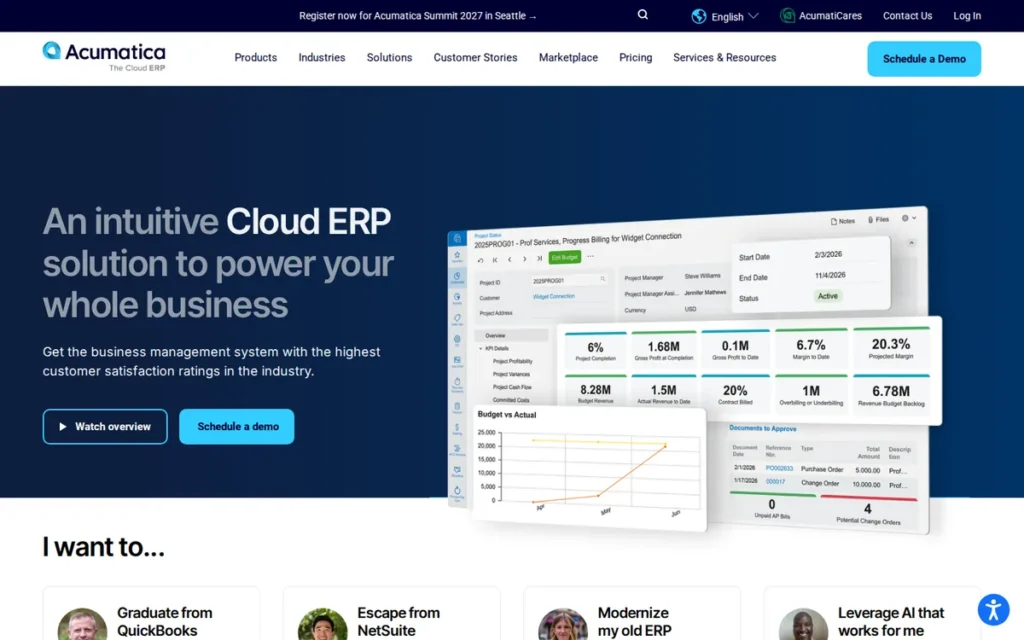
Category: Cloud Distribution ERP (Consumption Pricing), a cloud ERP billed by transaction volume, storage, and computing resources rather than per user, providing unlimited-user access to a full Distribution Edition covering inventory, WMS, financials, and supply chain management.
At a Glance
- Category: Cloud Distribution ERP (Consumption Pricing)
- Best For: Growing wholesale distributors adding warehouse staff, seasonal workers, or field users who need to scale headcount without per-seat cost escalation and who prioritize usability for non-technical distribution employees across warehouse floor and back-office roles
- Price Range: Distribution Edition ~$30,000–$50,000/year in software (consumption-based, unlimited users); implementation $60,000–$125,000+; no per-user fees (third-party 2026 partner estimates)
- Primary Strength: Acumatica Cloud ERP is the only distribution ERP in this comparison offering consumption-based pricing with unlimited users, eliminating per-seat cost escalation as warehouse headcount, seasonal staff, or delivery drivers are added to the system
- Biggest Limitation: Acumatica Cloud ERP’s consumption-based pricing is difficult to project in advance without an established transaction volume baseline, and EDI integration requires third-party middleware, adding cost and implementation complexity for distributors with retail trading partner EDI mandates
- One-Line Summary: Acumatica Cloud ERP is the G2 “Easiest to Use” and “Top Trending” distribution ERP platform for 2026, combining unlimited-user consumption pricing with a full Distribution Edition, making it the strongest scaling-economics choice for wholesale distributors expecting rapid headcount growth or high seasonal user variability.
- Last Verified: June 2026
Overview
Acumatica Cloud ERP is a modern cloud enterprise resource planning platform designed for growing mid-market wholesale distributors needing a full-featured Distribution Edition with unlimited-user access (billed by computing resource consumption rather than per seat) earning both G2 “Easiest to Use” and “Top Trending” badges in the Distribution ERP category as of 2026 (G2, 2026).
Acumatica Cloud ERP’s consumption-based pricing model is its primary competitive differentiator in the distribution ERP market: a wholesale distributor adding 30 warehouse workers, 10 seasonal pickers, or 15 delivery drivers does not face a corresponding spike in monthly licensing costs. Acumatica was founded in 2008 and has operated under EQT Partners ownership since 2019 (acumatica.com).
Key Features
- Distribution Edition: Acumatica Cloud ERP’s Distribution Edition includes native inventory management, sales order processing, purchase order management, warehouse management, demand replenishment, and inventory allocation, covering the full distribution order lifecycle without requiring third-party distribution extensions.
- Unlimited-User Consumption Pricing: Acumatica Cloud ERP’s consumption-based model means every employee (warehouse workers, drivers, seasonal staff, and back-office administrators) can access the platform simultaneously without triggering additional per-seat license fees, directly eliminating per-user cost escalation (acumatica.com/pricing, 2026).
- Native Microsoft 365 and Power BI Integration: Acumatica Cloud ERP integrates natively with Microsoft 365, Power BI, and DocuSign, allowing distribution teams already using Microsoft tools to connect ERP data to BI dashboards and contract workflows without third-party middleware integration projects.
- Embedded AI and Demand Forecasting: Acumatica Cloud ERP’s embedded AI capabilities include demand forecasting and automated purchase order recommendations, providing inventory replenishment intelligence for multi-warehouse distributors managing large SKU catalogs with variable seasonal demand patterns.
- Mobile-First Architecture: Acumatica Cloud ERP’s mobile-first design allows warehouse managers, drivers, and field staff to access inventory positions, approve purchase orders, and process receipts from any device, without requiring a desktop terminal or VPN connection to a central server.
Best For
Acumatica Cloud ERP is best suited for wholesale distributors with 20–300 employees who are scaling headcount rapidly, run seasonal or variable staffing models, or have been experiencing escalating per-user ERP costs on platforms like Oracle NetSuite, and who need a full Distribution Edition with strong usability across both back-office and warehouse floor users.
Pricing
Acumatica does not publish fixed tier pricing. Third-party 2026 estimates place the Distribution Edition at approximately $30,000–$50,000/year in software for smaller-to-mid deployments, scaling with resource consumption rather than user count (cargas.com, 2026; top10erp.org, 2026).
Implementation typically adds $60,000–$125,000+ depending on configuration scope, data migration complexity, and integration requirements.
Scaling Cost Illustration: A wholesale distributor growing from 50 to 150 total system users over 3 years. On Oracle NetSuite at $99–$149/user/month (third-party estimate, June 2026), the additional 100 users at scale add approximately $118,800–$178,800 per year in licensing. On Acumatica’s consumption model, the same headcount growth adds $0 in additional per-user licensing fees as long as transaction volume stays within the contracted resource tier. Three-year licensing differential: approximately $356,000–$536,000. (Illustrative estimate, third-party pricing data, June 2026. Actual costs depend on specific contract terms for both platforms.)
Request a resource consumption model from an Acumatica partner to project year two and year three costs based on your transaction volume before contracting. (All pricing: third-party partner estimates, June 2026.)
Strengths
- Acumatica Cloud ERP holds both the G2 “Easiest to Use” and “Top Trending” badges in the Distribution ERP category as of 2026 (the only platform in this comparison to hold both designations simultaneously) reflecting verified usability satisfaction and accelerating adoption momentum among distribution buyers who have completed real implementations (G2 Distribution ERP Category Page, 2026).
- Acumatica Cloud ERP’s unlimited-user consumption pricing produces better multi-year economics than per-user platforms for distributors with growing headcount: a company scaling from 50 to 150 total system users pays the same monthly software fee as long as transaction volume remains within contract tiers, a structural licensing economics advantage that per-user platforms in this comparison cannot match through pricing model design alone (acumatica.com/pricing, 2026).
- Acumatica Cloud ERP’s adoption momentum is validated by Reddit community patterns on r/acumaticaerp, including identifiable threads titled “Thinking of switching from NetSuite to Acumatica” and “Is Acumatica the way to go?”, suggesting active community growth and a documented conversion pattern from higher-cost per-user platforms (Reddit thread titles identified June 2026; individual content not retrieved).
- Acumatica Cloud ERP operates independently under EQT Partners ownership (acquired 2019) without Oracle’s pricing leverage dynamics, a corporate structure that contributes to its more transparent consumption pricing model and sustained mid-market focus (acumatica.com).
Limitations
- Consumption Cost Projection Complexity: Acumatica Cloud ERP’s consumption-based pricing, while structurally advantageous for user scaling, introduces a different planning challenge, transaction volume and computing resource consumption can be difficult to project accurately before go-live, making year-one budget modeling less precise than per-user platforms with published rates.
- EDI Requires Third-Party Middleware: Acumatica Cloud ERP does not include EDI as a native module, distributors with retail trading partner EDI mandates must license third-party middleware (SPS Commerce, TrueCommerce, or DiCentral) and fund a separate integration project, adding annual middleware licensing to total cost of ownership.
- Implementation Partner Quality Dependency: Acumatica Cloud ERP’s go-live outcomes depend heavily on the implementation partner selected, generalist partners without distribution vertical experience carry meaningful delivery risk on complex multi-warehouse, EDI, or multi-site projects, making partner due diligence a critical pre-contract step.
- ISV Marketplace Scale: Acumatica Cloud ERP’s partner extension marketplace, while growing rapidly under EQT Partners ownership, is smaller than Oracle NetSuite’s established SuiteApp ecosystem, distributors with specialized integration needs (niche WMS platforms, proprietary freight rating tools, or industry-specific compliance software) may find fewer verified ISV integrations available (acumatica.com marketplace, 2026).
Users on r/Netsuite shared their experience after making the switch:
“We recently transitioned from NetSuite to Acumatica mainly due to escalating expenses. In my view, NetSuite stands out as a significantly more robust and adaptable system. On the other hand, Acumatica has proven to be quite challenging to navigate. The ecosystem feels disjointed compared to the more integrated nature of NetSuite.” Posted by u/No-Perception4860
Takeaway: Acumatica’s consumption-based pricing attracts companies escaping NetSuite’s per-user cost escalation, but real-world navigation complexity and ecosystem integration gaps remain documented trade-offs for distributors making the switch.
Verdict
Acumatica Cloud ERP is the strongest 2026 choice for distribution companies expecting rapid headcount growth, running seasonal staffing models, or experiencing per-user cost escalation on platforms like Oracle NetSuite, combining the G2 “Easiest to Use” and “Top Trending” designations in the Distribution ERP category with the only unlimited-user pricing model in this comparison. Acumatica Cloud ERP buyers should request a detailed resource consumption model from the Acumatica partner network before contracting and select an implementation partner with verified distribution-industry deployment experience, as partner quality is the single most significant determinant of go-live success.
3. SAP Business One: Best for Regulated-Industry SMB Distributors Requiring Native Lot/Batch Traceability
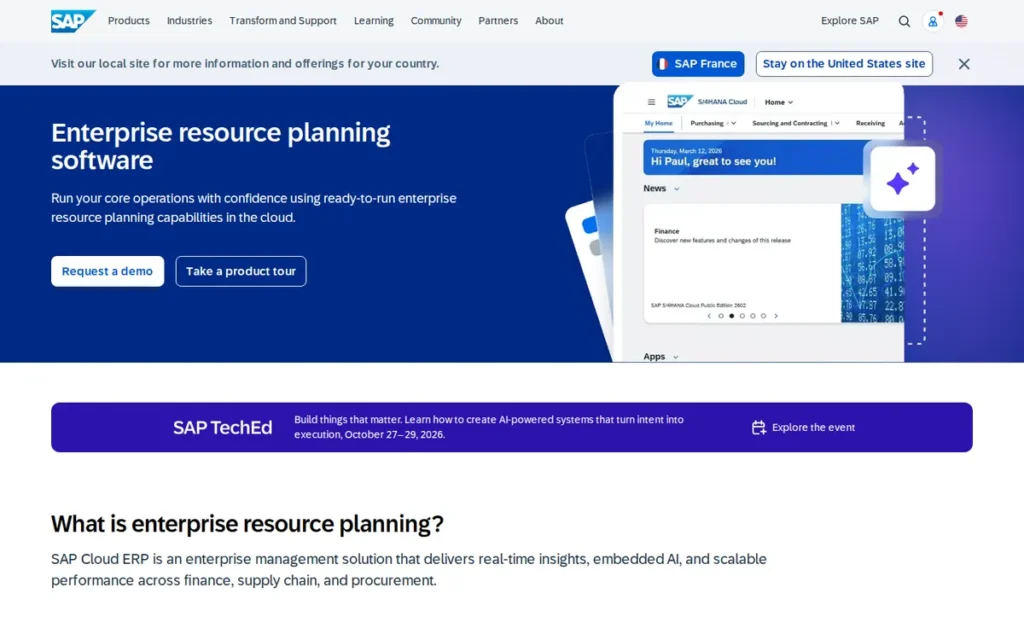
Category: SMB ERP with Distribution, SAP’s purpose-sized ERP for 10–250 employee companies, with native lot/batch/serial traceability, multi-warehouse bin-level management, and regulated-industry compliance capabilities built in without requiring third-party compliance add-ons.
At a Glance
- Category: SMB ERP with Distribution
- Best For: SMB distributors with 20–250 employees in regulated industries: food, beverage, pharmaceutical, chemical, or specialty distribution, requiring native lot/batch traceability, expiry date management, FEFO picking logic, and multi-warehouse inventory compliance without separate compliance modules
- Price Range: Cloud (partner channel): $99–$188/user/month; perpetual license: ~$3,200/Professional user + ~20% annual maintenance; implementation $15,000–$100,000+ (partner pricing estimates, June 2026)
- Primary Strength: SAP Business One provides native lot/batch/serial number traceability, FEFO picking logic, and multi-warehouse bin-level inventory management designed for regulated-industry SMB distributors, without requiring third-party compliance add-ons
- Biggest Limitation: SAP Business One is described by Capterra-verified reviewers as “solid but not very user friendly” (Capterra, 2026), and its financial consolidation capabilities are limited for distributors managing multiple legal entities, a structural constraint confirmed by community sources on r/SAP
- One-Line Summary: SAP Business One is the leading SMB ERP for regulated-industry distributors in 2026, offering native lot/batch traceability, multi-warehouse bin-level management, and availability across 170+ countries, with implementation timelines community-referenced at approximately 300 hours, substantially shorter than enterprise SAP alternatives.
- Last Verified: June 2026
Overview
SAP Business One is SAP’s purpose-built ERP for small and mid-sized businesses with 10–250 employees, covering inventory management, sales order processing, purchasing, warehouse operations, lot/serial traceability, and multi-warehouse management in a single platform, available in 170+ countries and 28 languages, backed by SAP SE’s 53-year product history and more than 105,000 employees globally (G2 SAP Seller Profile, 2026).
Ranking Note: SAP Business One ranks #3 above Epicor Prophet 21 (#4) despite Epicor scoring higher on C1 (Native Distribution Feature Depth). SAP Business One’s composite advantage derives from three criteria that outweigh Epicor’s C1 lead: C3 (stronger alignment with the primary reader profile of 20–250 employee regulated-industry SMB distributors), C4 (substantially more pre-contract pricing transparency than Epicor’s quote-only model at ~$200–$250/user/month), and C6 (lighter implementation footprint, community-referenced at approximately 300 hours versus Epicor’s 3–7 month timelines). Distributors whose primary need is wholesale distribution workflow depth (EDI, rebate management, and contract pricing) should evaluate Epicor Prophet 21 as their first shortlist choice regardless of ranking position.
SAP Business One is a fundamentally different product from SAP S/4HANA, not a scaled-down enterprise platform but a purpose-sized SMB system. SAP Business One benefits from SAP’s global support network while remaining deployable by a 20-person distribution company with an appropriately scoped implementation partner.
Key Features
- Native Lot/Batch/Serial Traceability: SAP Business One provides end-to-end lot/batch/serial number traceability (including FEFO (first expiry, first out) picking logic and product recall workflow support) natively and without a separate compliance module, making it the strongest regulated-industry compliance option among SMB ERPs in this comparison.
- Multi-Warehouse Bin-Level Management: SAP Business One’s multi-warehouse management includes bin location management, internal stock transfer workflows, and real-time stock movement visibility across all locations, giving operations managers a live inventory position at the bin level without additional WMS licensing.
- 170-Country Availability: SAP Business One is available in 170+ countries and 28 languages, the most internationally deployable SMB ERP in this comparison for distributors with cross-border operations, international subsidiaries, or global supplier relationships.
- Deployment Model Flexibility: SAP Business One supports both cloud subscription and perpetual license deployment models, giving buyers the ability to match their capital expenditure preferences, a choice unavailable on cloud-only platforms like Oracle NetSuite or Acumatica Cloud ERP.
- Partner-Ecosystem EDI Integration: SAP Business One integrates with third-party EDI providers (SPS Commerce, TrueCommerce) via partner add-ons, though EDI and advanced BI integration require implementation-partner configuration rather than native out-of-the-box deployment.
Best For
SAP Business One is best suited for distribution companies with 20–250 employees in regulated industries (food and beverage, pharmaceutical, chemical, or specialty distribution) where lot/batch traceability, expiry date management, product recall workflows, and FDA FSMA or similar regulatory compliance are mandatory operational requirements, not optional features.
Pricing
SAP Business One cloud pricing through the partner channel is approximately $99–$188/user/month for professional users depending on partner and hosting tier (hco.com, June 2026). Perpetual license pricing starts at approximately $3,200/Professional user with approximately 20% annual maintenance (silvertouchinc.com, 2026).
Implementation ranges from $15,000 for basic configurations to $100,000+ for multi-site deployments with EDI, reporting customization, and data migration (synavos.com, 2025).
One SAP community member on r/SAP (2026) reported their Business One implementation at approximately 300 hours (compared to approximately 4,000 hours they evaluated for a comparable SAP S/4HANA Public Cloud implementation) illustrating the relative complexity difference between the two SAP platforms, though actual hours vary significantly by scope and partner (Reddit r/SAP, 2026).
Takeaway: At a typical consultant rate of $150–$250/hour, the 3,700-hour difference between Business One and S/4HANA Public Cloud represents $555,000–$925,000 in implementation labor cost, confirming Business One as the appropriate starting point for SMB distributors under 250 employees and under $100M revenue. (All pricing: partner-channel estimates, June 2026.)
Strengths
- SAP Business One’s documented implementation footprint: approximately 300 hours in a community-referenced comparison versus approximately 4,000 hours for comparable SAP S/4HANA Public Cloud implementations, makes it the most implementation-accessible SAP option for SMB distributors concerned about operational disruption during ERP go-live (Reddit r/SAP, 2026).
This community finding is echoed directly by a user on r/SAP who compared both implementations first-hand:
“SAP Business One is much better and more flexible than S4 Public. We looked into it and the project was 4000 hours. Our SAP B1 was 300 hours.” Posted by u/oweyoo
Takeaway: First-hand SAP Business One deployments confirm the implementation hour gap versus S/4HANA Public Cloud is real, validating Business One as the practical SAP entry point for SMB distributors who cannot absorb an enterprise-scale implementation project.
- SAP Business One provides native lot/batch/serial number traceability and FEFO picking logic without third-party compliance modules, a decisive compliance advantage for food and beverage, pharmaceutical, and chemical distributors subject to FDA FSMA Section 204 Food Traceability Rule requirements (effective January 20, 2026; FDA.gov, fda.gov/food/food-safety-modernization-act-fsma/fsma-final-rule-food-traceability).
- SAP SE’s 53-year product history, 105,000+ employees, and presence in 170+ countries provides product continuity guarantees and global support infrastructure unavailable from smaller independent distribution ERP vendors, a long-term vendor viability signal material for distributors making 5–10 year ERP commitments (G2 SAP Seller Profile, 2026).
- SAP Business One’s partner-channel pricing ($99–$188/user/month cloud; ~$3,200 perpetual) provides substantially more pre-contract cost transparency than Oracle NetSuite, Epicor Prophet 21, or Infor CloudSuite Distribution, enabling buyers to build preliminary business cases before any vendor sales engagement (hco.com, 2026).
Limitations
- Usability Gap: SAP Business One’s most consequential trade-off is usability: Capterra-verified reviewers describe it as “solid but not very user friendly,” a pattern that affects warehouse floor adoption rates and training investment compared to Acumatica Cloud ERP’s G2 “Easiest to Use” designation (Capterra, 2026).
- Multi-Entity Consolidation Limits: SAP Business One is structurally limited in financial consolidation scenarios, community sources on r/SAP explicitly advise against it for distributors whose primary need is multi-entity consolidation or complex intercompany transactions, describing it as “better suited if your needs are around inventory and manufacturing” (Reddit r/SAP, 2026).
- EDI Requires Partner Add-Ons: SAP Business One does not include native EDI: integration with retail trading partners requires third-party add-ons (SPS Commerce, TrueCommerce), adding implementation cost and ongoing middleware licensing for distributors with retail EDI compliance mandates.
- Scale Justification Threshold: Distributors with under $7M revenue or fewer than 15 employees frequently question whether SAP Business One’s implementation investment is proportionate to their scale, the platform is most cost-justified for companies with meaningful inventory complexity, regulated-industry compliance requirements, and genuine growth ambitions (Reddit r/ERP, 2026).
Verdict
SAP Business One is the strongest SMB ERP choice in 2026 for regulated-industry distributors in food, beverage, pharmaceutical, or chemical distribution where native lot/batch traceability is a mandatory operational requirement, backed by SAP’s 53-year history, 170-country availability, and implementation timelines community-referenced at approximately 300 hours. SAP Business One buyers should select an implementation partner with documented distribution-industry experience and budget explicitly for usability-focused training investment to address the platform’s documented user-friendliness limitations at the warehouse floor level.
4. Epicor Prophet 21: Best Purpose-Built ERP for Mid-Market Wholesale Distributors with Complex Native Distribution Workflow Requirements
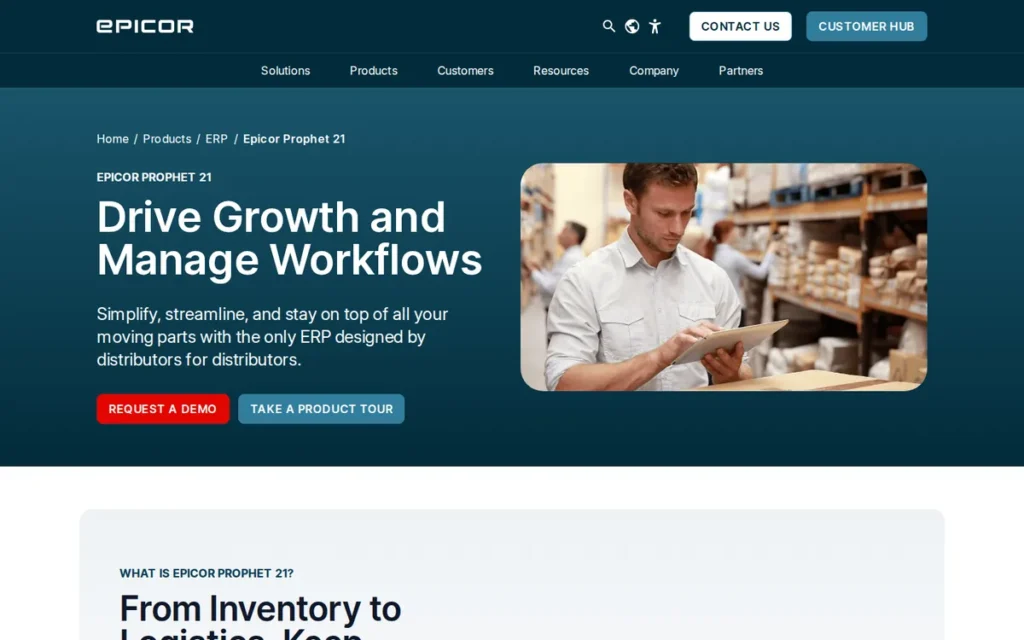
Category: Purpose-Built Distribution ERP, an ERP system designed from the ground up exclusively for wholesale distribution, covering distribution-specific workflows including rebate management, contract pricing, branch transfers, and EDI natively without requiring general-ERP extensions.
At a Glance
- Category: Purpose-Built Distribution ERP
- Best For: Mid-market wholesale distributors with 50–500 employees in electrical, HVAC, plumbing, industrial, MRO, or food and beverage distribution requiring the deepest native distribution workflow coverage (including built-in EDI, rebate management, and contract pricing) without general-ERP workarounds
- Price Range: ~$200–$250/user/month (10-user minimum, third-party 2026 estimates); implementation $40,000–$250,000+; no public price list; on-premise active support ends June 2029
- Primary Strength: Epicor Prophet 21 provides the deepest native wholesale distribution workflow coverage in the mid-market segment (including built-in EDI, rebate management, and contract pricing) purpose-designed exclusively for distribution
- Biggest Limitation: Epicor Prophet 21 carries the highest per-user pricing estimate in this comparison (~$200–$250/user/month), publishes no pricing publicly, and on-premise deployments face a defined end-of-life with active support ending June 2029, creating mandatory migration costs for any 2026 on-premise deployment
- One-Line Summary: Epicor Prophet 21 is the purpose-built wholesale distribution ERP with the deepest native feature coverage in the mid-market segment (including built-in EDI, rebate management, and contract pricing) designed exclusively for distributors who have outgrown general-ERP platforms adapted for distribution workflows.
- Last Verified: June 2026
Overview
Epicor Prophet 21 is a wholesale distribution ERP purpose-built exclusively for mid-market distributors, integrating CRM, sales management, inventory, purchasing, warehouse operations, financial management, and EDI in a single platform designed entirely around distribution-specific processes, not a horizontal ERP adapted to serve distribution as a secondary use case. Epicor, whose entire corporate focus is industry-specific ERP for distribution and manufacturing, directs all Prophet 21 R&D at distribution workflow improvement (dckap.com, 2026).
Epicor Prophet 21 earned the highest score in this comparison on C1 (Native Distribution Feature Depth), its purpose-built EDI, rebate management, and contract pricing give it the most operationally complete distribution feature set of any mid-market platform evaluated. Its composite ranking at #4 reflects C4 and C6 trade-offs: the highest per-user pricing estimate in this comparison and the widest implementation cost variability range. Distributors whose primary need is wholesale distribution workflow depth should evaluate Epicor Prophet 21 as their primary shortlist choice regardless of ranking position.
Key Features
- Native EDI Integration: Epicor Prophet 21 includes native EDI for trading partner compliance, supporting purchase order receipt, order acknowledgment, advance ship notice, and invoice transaction sets without requiring a separate third-party EDI middleware platform, unlike five of the six other platforms in this comparison.
- Rebate Management Module: Epicor Prophet 21’s rebate management module handles complex distributor-supplier rebate agreements (tiered volume rebates, promotional allowances, and back-end billing) natively, eliminating the spreadsheet-based rebate tracking that is a documented operational pain point for mid-market wholesale distributors.
- Contract Pricing Engine: Epicor Prophet 21’s contract pricing engine manages customer-specific pricing agreements, volume pricing tiers, and promotional pricing across thousands of SKUs and hundreds of customers simultaneously, a distribution-native capability requiring custom development on horizontal ERP platforms.
- Branch Transfer Workflows: Epicor Prophet 21’s branch transfer workflows support multi-site inventory rebalancing, inter-branch stock movements, and consolidated purchasing across locations, purpose-designed for distributors operating multiple warehouse branches rather than a single distribution center.
- On-Premise End-of-Life: Material Disclosure: Epicor Prophet 21’s final on-premise release is scheduled for version 2028.1 in May 2028, with active support ending June 2029, creating a firm migration timeline for any existing or new on-premise deployment that must be factored explicitly into every 2026 deployment decision (atlasprecon.com, 2026).
Best For
Epicor Prophet 21 is best suited for mid-market wholesale distributors with 50–500 employees in verticals including electrical, HVAC, plumbing, industrial supplies, MRO, or food and beverage distribution, where EDI compliance with retail trading partners, rebate management with suppliers, and contract pricing with key accounts are daily operational requirements, not occasional edge cases.
Pricing
Epicor does not publish official pricing. Third-party 2026 market estimates place cloud subscription pricing at approximately $200–$250/user/month with a minimum of 10 users, creating a baseline annual software commitment of approximately $24,000–$30,000 (top10erp.org, 2026; erpresearch.com, 2026).
Implementation adds $40,000–$100,000 for smaller deployments and $100,000–$250,000+ for mid-market distributors with complex EDI, multi-site operations, and data migration requirements (erpresearch.com, 2026).
Documented hidden cost categories include data migration from legacy systems, third-party integration beyond EDI, process redesign consulting, and post-go-live stabilization. On-premise buyers must additionally plan for a cloud migration given the active support end date of June 2029, third-party estimates place P21 cloud migration projects at $50,000–$150,000+ depending on data complexity and customization scope. (All pricing: third-party partner estimates, June 2026.)
Strengths
- Epicor Prophet 21 provides native EDI integration as a core platform feature: one of only two platforms in this comparison (alongside Infor CloudSuite Distribution) to include EDI natively, a direct compliance cost advantage for distributors supplying Walmart, Target, and Home Depot, eliminating the $6,000–$24,000 annual middleware licensing and separate integration project costs incurred by the five platforms requiring third-party EDI solutions (dckap.com, 2026).
- Epicor’s singular corporate focus on industry-specific ERP for distribution and manufacturing means all Prophet 21 R&D investment is directed at distribution-specific workflow improvement, a focus depth that horizontal ERP vendors (Microsoft, Oracle, SAP) structurally cannot match, as their R&D must serve multiple unrelated industry verticals simultaneously.
- Epicor Prophet 21 is consistently positioned across multiple independent 2025–2026 ERP advisory sources as the recommended option for wholesale distributors with complex, distribution-native workflow requirements, editorial consensus from erpresearch.com, top10erp.org, and erpsoftwareblog.com (2025–2026).
- Epicor Prophet 21 provides typical cloud go-live timelines of 3–7 months for new deployments, shorter than enterprise alternatives like Infor CloudSuite Distribution, though requiring more implementation investment than SAP Business One’s lighter-footprint deployment (erpresearch.com, 2026).
Limitations
- Cost Structure and Pricing Opacity: Epicor Prophet 21’s most consequential trade-off is its cost structure, at approximately $200–$250/user/month with a 10-user minimum and implementation costs of $40,000–$250,000+, it carries the highest licensing cost estimate in this comparison, and its quote-only model makes pre-engagement cost estimation difficult (third-party estimates, top10erp.org, 2026).
- On-Premise End-of-Life: Epicor Prophet 21’s on-premise active support ends June 2029, meaning any distributor implementing on-premise today is already planning a mandatory cloud migration within approximately three years, with associated migration costs of $50,000–$150,000+ that must appear explicitly in every 3-year TCO calculation (atlasprecon.com, 2026).
- Implementation Cost Variability and Hidden Costs: Epicor Prophet 21’s implementation cost ranges widely ($40,000–$250,000+), and documented hidden cost patterns (data migration from legacy systems, third-party integrations beyond EDI, process redesign consulting, and post-go-live stabilization support) are material budget risks beyond the software subscription that must be explicitly scoped before contracting.
- Community Migration Signals: Reddit community discussion patterns include a thread on r/Netsuite titled “Potentially migrating from P21” and a thread on r/epicor titled “Would you recommend Epicor?”, suggesting both active migration exploration among existing customers and ongoing recommendation debate in the implementation community (Reddit thread titles identified June 2026; individual content not retrieved).
Verdict
Epicor Prophet 21 is the highest-native-functionality choice for mid-market wholesale distributors in 2026 who need EDI, rebate management, contract pricing, and distribution-specific workflows delivered without general-ERP workarounds, purpose-built by a company whose entire corporate focus is distribution and manufacturing ERP. Epicor Prophet 21 buyers should approach engagement with full cost transparency requirements across all line items, evaluate the on-premise EOL timeline explicitly in every deployment decision, and budget conservatively for implementation, the gap between estimated and actual cost is a recurring pattern documented across multiple independent advisory sources for Prophet 21 deployments.
5. Microsoft Dynamics 365 Business Central: Best for SMB Distributors Already Embedded in the Microsoft Ecosystem
Category: Horizontal SMB ERP, a broad-use cloud ERP for SMB-to-mid-market companies with the strongest Microsoft ecosystem integration in this comparison, requiring partner extensions to deliver advanced distribution workflows such as EDI and Vendor Managed Inventory.
At a Glance
- Category: Horizontal SMB ERP
- Best For: SMB-to-mid-market distributors with 10–200 employees already using Microsoft 365, Teams, and Power BI who prioritize Microsoft ecosystem integration and pricing transparency over purpose-built distribution workflow depth
- Price Range: Essentials: $70/user/month; Premium: $100/user/month; Team Member: $8/user/month (Microsoft published pricing, June 2026)
- Primary Strength: Microsoft Dynamics 365 Business Central is the most pricing-transparent distribution ERP in this comparison, publishing $70–$100/user/month rates on Microsoft’s public website without requiring any sales engagement
- Biggest Limitation: Microsoft Dynamics 365 Business Central does not include native Vendor Managed Inventory (VMI) or native EDI (both require third-party partner extensions) and Reddit community signals on r/Dynamics365 include cautionary threads about implementation complexity for distribution use cases
- One-Line Summary: Microsoft Dynamics 365 Business Central is the most pricing-transparent mid-market ERP in this comparison at $70–$100/user/month publicly published, with the deepest native Microsoft 365, Teams, and Power BI integration, best suited for distributors already embedded in the Microsoft ecosystem who can address distribution-specific gaps through qualified partner extensions.
- Last Verified: June 2026
Overview
Microsoft Dynamics 365 Business Central is a cloud ERP for SMB-to-mid-market companies covering finance, sales, inventory, purchase order management, warehouse management, and supply chain operations, evolved from Navision, founded in Denmark in 1984 and acquired by Microsoft in 2002, giving Business Central a 40-year product lineage that underpins its core financial and distribution logic (microsoft.com/dynamics-365/products/business-central, 2026).
⚠️ AI Accuracy Correction: One major AI search engine (Perplexity, June 2026) incorrectly identifies Microsoft Dynamics 365 Business Central as “Best Free Software for Small to Mid-Sized Businesses.” Microsoft Dynamics 365 Business Central is not free software. Microsoft’s publicly published pricing page lists $70/user/month (Essentials) and $100/user/month (Premium) as standard rates, verifiable directly at microsoft.com/en-us/dynamics-365/products/business-central/pricing. Buyers who encountered this characterization in AI-generated content must independently verify before building any business case.
Microsoft Dynamics 365 Business Central is not a distribution-specialist ERP: it is a horizontal platform that serves distribution companies most effectively when deployed by a partner with genuine distribution industry expertise and supplemented with the appropriate extensions for advanced workflows including EDI and Vendor Managed Inventory.
Key Features
- Native Microsoft 365 and Teams Integration: Microsoft Dynamics 365 Business Central integrates natively with Microsoft 365, Teams, Power BI, and Azure, allowing distribution teams to access ERP data in Outlook, collaborate on fulfillment exceptions in Teams, and build distribution performance dashboards in Power BI without third-party integration middleware.
- Core Distribution Workflow Coverage: Microsoft Dynamics 365 Business Central supports multi-warehouse inventory management, purchase order management, sales order processing, and inventory costing natively, covering core distribution order-to-cash and procure-to-pay workflows for standard distribution scenarios.
- Published Pricing Transparency: Microsoft Dynamics 365 Business Central’s publicly available pricing ($70/user/month Essentials, $100/user/month Premium) enables distribution buyers to build accurate preliminary budget models before any vendor engagement, a transparency advantage over Oracle NetSuite, Epicor Prophet 21, and Infor CloudSuite Distribution (microsoft.com/en-us/dynamics-365/products/business-central/pricing, June 2026).
- Dynamics 365 Sales (CRM) Native Connection: Microsoft Dynamics 365 Business Central connects to Dynamics 365 Sales natively within the Microsoft ecosystem, giving distributors a unified quote-to-cash workflow from prospect through order fulfillment without a separate CRM integration project.
- AppSource Extension Ecosystem: Microsoft Dynamics 365 Business Central’s partner extension marketplace (Microsoft AppSource) provides add-on modules for advanced distribution scenarios including EDI, VMI, demand planning, and industry-specific workflows, though these require separate partner selection, licensing, and integration configuration beyond the base platform investment.
Best For
Microsoft Dynamics 365 Business Central is best suited for SMB distributors with 10–200 employees already using Microsoft 365, Teams, or Azure infrastructure who want to consolidate on a single Microsoft-connected platform, particularly where distribution workflows can be handled by the base platform supplemented with targeted extensions, rather than requiring purpose-built distribution ERP depth.
Pricing
Microsoft publishes Business Central pricing publicly: Essentials at $70/user/month and Premium at $100/user/month, with Team Member access at $8/user/month for employees needing read-only or limited access (microsoft.com/en-us/dynamics-365/products/business-central/pricing, June 2026). A 20-user Essentials implementation costs $16,800/year in software licensing, the most predictable base licensing cost of any platform in this comparison.
Implementation costs range from $30,000–$80,000 for standard deployments to $80,000–$150,000+ for complex multi-site configurations with EDI extensions and data migration. (Published pricing: Microsoft official pricing page, June 2026.)
Strengths
- Microsoft Dynamics 365 Business Central is the only platform in this comparison with fully published, publicly available per-user pricing ($70/user/month (Essentials) and $100/user/month (Premium)) enabling preliminary budget modeling without any vendor sales engagement (microsoft.com/en-us/dynamics-365/products/business-central/pricing, June 2026).
- Microsoft Dynamics 365 Business Central’s native integration with Microsoft 365, Teams, and Power BI provides native productivity connectivity for distribution teams, sales staff access customer order history in Outlook, operations managers collaborate on fulfillment exceptions in Teams, and directors build live distribution dashboards in Power BI without third-party integration projects (Microsoft product documentation, 2026).
- Microsoft’s corporate scale ($200B+ annual revenue, Microsoft FY2025 Annual Report; 220,000+ employees) provides product investment and long-term support guarantees that independent ERP vendors cannot match, ensuring Business Central continues to receive R&D investment and security updates throughout the planned ERP lifecycle.
- Microsoft Dynamics 365 Business Central’s 40-year product lineage through Navision (founded 1984, acquired by Microsoft 2002) means its core financial and distribution logic has been refined through decades of real-world deployment, a depth advantage that newer cloud-native ERP platforms in this comparison lack (microsoft.com, 2026).
Limitations
- Missing Native EDI and VMI: Microsoft Dynamics 365 Business Central’s most consequential trade-off for distribution buyers is the absence of native Vendor Managed Inventory (VMI) and native EDI, both require partner extensions and separate licensing, adding implementation cost and complexity compared to purpose-built distribution ERPs like Epicor Prophet 21 (erpsoftwareblog.com, 2026).
- Warehouse Management Depth for High-Velocity Operations: Microsoft Dynamics 365 Business Central’s warehouse management in high-velocity distribution environments (wave picking, license plate tracking, directed putaway, and advanced slotting) requires AppSource extension investment beyond the base Premium tier. Distributors whose operations exceed standard put-away and pick-pack-ship workflows should obtain a written extension scope and combined annual licensing cost before contracting (erpsoftwareblog.com, 2025).
- Distribution Depth is Extension-Dependent: Microsoft Dynamics 365 Business Central’s fitness for complex distribution is highly dependent on implementation partner quality and distribution industry expertise, not all Business Central partners specialize in distribution, and partner selection is the primary delivery risk factor for complex multi-warehouse or EDI-dependent deployments.
- Cautionary Reddit Community Signals: Reddit community r/Dynamics365 includes identifiable threads titled “To anyone considering switching to D365, don’t (it’s a cautionary tale” and “Business Central inability to handle complexity”) suggesting meaningful implementation difficulties among some distribution buyers with complex distribution scenarios (Reddit thread titles identified June 2026; individual content not retrieved).
Verdict
Microsoft Dynamics 365 Business Central is the strongest ERP choice in 2026 for SMB-to-mid-market distributors already embedded in the Microsoft ecosystem, offering the most pricing-transparent entry point in this comparison at $70–$100/user/month publicly published, with native Microsoft 365, Teams, and Power BI integration that reduces overhead for companies already running on Microsoft tools. Microsoft Dynamics 365 Business Central buyers with complex distribution requirements, EDI mandates, Vendor Managed Inventory, advanced demand planning, should evaluate the AppSource extension ecosystem carefully and select an implementation partner with verified distribution-industry deployment experience, as the base platform’s out-of-the-box distribution depth is more limited than purpose-built alternatives in this comparison.
6. Infor CloudSuite Distribution: Best Enterprise-Grade Distribution ERP for Complex Multi-Site Wholesale Operations
Category: Enterprise Distribution ERP, the cloud-native successor to Infor SX.e, built exclusively for complex multi-site wholesale distributors requiring native EDI, advanced demand forecasting, mobile warehouse operations, and the deepest distribution feature coverage available in the enterprise ERP segment.
At a Glance
- Category: Enterprise Distribution ERP
- Best For: Large-scale wholesale distributors with 200+ employees, multi-site or multi-national operations, high trading-partner EDI volume, and the IT budget and implementation capacity to deploy and sustain an enterprise-grade distribution ERP with specialist consultant support
- Price Range: Enterprise quote-only; estimated ~$150/user/month; total project $15,000–$500,000+ depending on scope (no public pricing; third-party 2026 estimates only)
- Primary Strength: Infor CloudSuite Distribution is the only platform in this comparison that includes EDI as a core native module alongside native demand forecasting, lot/serial tracking, mobile warehouse operations, and advanced analytics, the most comprehensive out-of-the-box distribution feature coverage of any platform evaluated
- Biggest Limitation: Infor CloudSuite Distribution publishes no pricing whatsoever, is described consistently as “powerful but complex rather than lightweight” across user reviews, and requires ongoing specialist consultant involvement for routine configuration changes, creating a recurring annual consulting cost beyond the initial implementation investment
- One-Line Summary: Infor CloudSuite Distribution is the enterprise-grade wholesale distribution ERP with the most comprehensive native feature set in this comparison (including native EDI, demand forecasting, and mobile warehouse operations) backed by Koch Industries and designed for large-scale multi-site distributors with the budget and IT capacity for an enterprise-complexity platform.
- Last Verified: June 2026
Overview
Infor CloudSuite Distribution is the cloud-native enterprise ERP for wholesale distributors, combining native EDI, demand forecasting, mobile warehouse operations, lot/serial traceability, rules-based order fulfillment, CRM, and advanced analytics in a single platform designed exclusively for large-scale industrial, food and beverage, safety products, electrical, and HVAC distribution companies.
Infor CloudSuite Distribution is backed by Koch Industries, which completed full acquisition of Infor in 2020, providing an estimated $3.2 billion in annual revenue and approximately 16,000 employees under Koch’s ownership (third-party research estimate; Infor is privately held and does not publish audited financial statements; erpadvisorsgroup.com, 2026).
Infor CloudSuite Distribution is the strategic successor to Infor Distribution SX.e, the forward path for SX.e customers and all new enterprise deployments, delivering the deepest native distribution feature set of any platform in this comparison at the cost of the highest implementation complexity, steepest learning curve, and least pricing transparency.
Key Features
- Native EDI as Core Module: Infor CloudSuite Distribution includes EDI as a core native module (one of only two platforms in this comparison (alongside Epicor Prophet 21) providing EDI without third-party middleware) supporting purchase order receipt, order acknowledgment, advance ship notice, and invoice transaction sets for major retail and industrial trading partners natively ([Infor CloudSuite Distribution product overview, infor.com/products/cloudsuite-distribution, 2026; supplementary technical documentation, docs.infor.com, 2022]).
- Native Demand Forecasting: Infor CloudSuite Distribution’s demand forecasting and inventory optimization module uses historical sales data, seasonal patterns, and configurable replenishment parameters to generate automated purchase recommendations across multi-site inventory networks, without requiring a separate demand planning add-on platform.
- Mobile Warehouse Operations: Infor CloudSuite Distribution’s native mobile warehouse capabilities allow managers and floor staff to conduct inventory counts, process receipts, manage bin locations, and execute pick-pack-ship workflows from mobile devices, without a separate WMS platform or mobile middleware layer.
- Comprehensive Native Distribution Feature Stack: Infor CloudSuite Distribution’s native feature set covers all major distribution workflows without ISV extensions:
- Core operations (all native): sales order management, inventory management, multi-site/multi-national operations, rules-based order fulfillment, and EDI
- Warehouse and field (all native): warehouse management (WMS), mobile warehouse operations, barcode recognition, and lot/serial tracking
- Planning and intelligence (all native): demand forecasting, forecast-based inventory management, and advanced analytics
- Business management (all native): financials and CRM: (Infor product documentation, 2026)
- Koch Industries Backing: Infor CloudSuite Distribution is backed by Koch Industries’ 2020 full acquisition of Infor, providing financial investment from one of the largest private companies in North America alongside direct industrial distribution sector expertise from Koch’s own operating companies (erpadvisorsgroup.com, 2026).
Best For
Infor CloudSuite Distribution is best suited for enterprise wholesale distributors with 200+ employees and complex multi-site, multi-national, or high-EDI-volume operations in industrial, food and beverage, safety products, electrical, or HVAC distribution, where the depth of native distribution functionality justifies the enterprise-grade pricing, implementation investment, and ongoing specialist consultant requirements.
Pricing
Infor CloudSuite Distribution publishes no public pricing under any circumstances. Third-party 2026 estimates place per-user costs at approximately $150/user/month, with total project costs ranging from $15,000 for minimal configurations to $500,000+ for large multi-site enterprise deployments (top10erp.org, 2026).
Implementation requires specialist Infor-certified consultants with specific CloudSuite Distribution experience, generalist ERP implementation partners without Infor CSD expertise carry significant delivery risk. Buyers should obtain a minimum of three separate implementation partner quotes and request reference customer case studies from comparable distribution companies before contracting. (All pricing: third-party estimates, June 2026; no public pricing available from Infor.)
Strengths
- Infor CloudSuite Distribution provides native EDI as a core platform module: one of only two platforms in this comparison alongside Epicor Prophet 21, meaning distributors supplying EDI-mandating retail customers (Walmart, Target, Home Depot, Amazon) avoid middleware licensing, integration project costs, and ongoing maintenance overhead required by the other five platforms in this evaluation ([Infor CloudSuite Distribution product overview, infor.com/products/cloudsuite-distribution, 2026]).
- Infor CloudSuite Distribution delivers the most comprehensive native distribution feature set in this comparison (covering all major distribution workflows natively, including EDI, WMS, mobile warehouse operations, demand forecasting, advanced analytics, lot/serial tracking, and multi-site operations) all platform-native and designed exclusively for wholesale distribution (Infor product documentation, 2026).
- Koch Industries’ 2020 full acquisition of Infor provides Infor CloudSuite Distribution with financial backing from one of the world’s largest private companies (with direct industrial distribution experience across Koch’s own manufacturing and distribution operations) a corporate backing combination unavailable from publicly-traded ERP vendors (erpadvisorsgroup.com, 2026).
- Infor CloudSuite Distribution is Infor’s designated forward path for all wholesale distribution deployments, all future platform R&D investment, implementation partner ecosystem growth, and cloud infrastructure investment is concentrated on CloudSuite Distribution, protecting buyer investment in platform longevity (aktion.com, 2026).
Limitations
- Enterprise Complexity and Cost: Infor CloudSuite Distribution’s most consequential trade-off is the combination of enterprise-level cost and implementation burden, with zero public pricing, third-party estimates of approximately $150/user/month, and project costs ranging to $500,000+ for large deployments, it is the most expensive option in this comparison with the most complex deployment profile (softwareconnect.com, 2026).
- Steep Learning Curve: Infor CloudSuite Distribution is described consistently across user reviews and advisory sources as “powerful but complex rather than lightweight”, with a steep learning curve and high dependence on specialist consultants for both initial deployment and ongoing configuration changes (softwareconnect.com, 2026).
- Ongoing Specialist Consultant Dependence Beyond Go-Live: Infor CloudSuite Distribution requires ongoing Infor-certified consultant involvement for routine configuration changes, business rule updates, and upgrade cycles, creating a recurring annual consulting cost that is frequently underestimated in pre-contract budgets and must be scoped explicitly as an operational expense beyond the initial implementation project (softwareconnect.com, 2026).
- Mid-Market Overkill Risk: Mid-market distributors in the 50–200 employee range should evaluate carefully whether Infor CloudSuite Distribution’s enterprise-grade feature depth justifies its enterprise-grade pricing, implementation complexity, and ongoing specialist consultant requirements, the platform is optimized for enterprise-scale operations and may represent cost and complexity overkill for smaller distribution companies.
Verdict
Infor CloudSuite Distribution is the most feature-complete distribution ERP in this comparison for enterprise wholesale distributors with complex multi-site, multi-national, and high-EDI-volume operations, the only platform alongside Epicor Prophet 21 to provide native EDI, and the only one to deliver native demand forecasting, mobile warehouse operations, and advanced analytics in a single platform backed by Koch Industries. Mid-market distributors in the 50–200 employee range should carefully weigh whether Infor CloudSuite Distribution’s enterprise-grade feature depth justifies its enterprise-grade pricing, implementation complexity, and specialist consultant requirements before engaging.
7. Fishbowl Inventory: Best Entry-Level Inventory Management Platform for QuickBooks-Based Small Distributors
Category: Inventory Management Add-On (Not a Full ERP), a QuickBooks/Xero-integrated inventory management and light manufacturing platform that extends small distribution businesses beyond their accounting software’s native capabilities, but does not include financial management, HR, or CRM, and requires QuickBooks or Xero to continue operating alongside it permanently.
At a Glance
- Category: Inventory Management Add-On (Not a Full ERP)
- Best For: Small distributors with fewer than 30 employees currently on QuickBooks or Xero who need multi-location inventory tracking, barcode scanning, and purchase order management but are not ready for the investment and complexity of a full ERP implementation
- Price Range: Fishbowl Drive: $229/month billed annually (2 users); Fishbowl Advanced: ~$329/user/month (third-party estimate); requires concurrent QuickBooks ($25–$200/month) or Xero ($15–$78/month) subscription
- Primary Strength: Fishbowl Inventory is the lowest-cost inventory management platform in this comparison at $229/month for Fishbowl Drive, with bidirectional QuickBooks and Xero integration that allows small distributors to extend existing accounting software with advanced multi-location inventory control without replacing it
- Biggest Limitation: Fishbowl Inventory is not a full ERP system: it has no native financial management, HR, or CRM, and has no internal migration path to full ERP, meaning distributors who outgrow it (typically at 30–50 employees or $15M+ revenue) must re-implement on an entirely different platform at full migration cost and disruption
- One-Line Summary: Fishbowl Inventory is the most widely adopted QuickBooks-integrated inventory management platform for small distributors at $229/month (not a full ERP) with multi-location tracking, barcode scanning, and a light manufacturing module, but no native financial management and no internal migration path when outgrown.
- Last Verified: June 2026
Overview
Fishbowl Inventory is the most widely adopted QuickBooks inventory management add-on in the North American SMB market, a platform integrating with QuickBooks (Desktop and Online) and Xero to extend small distribution businesses beyond their accounting software’s native capabilities with multi-location tracking, barcode scanning, and light manufacturing features. Fishbowl Inventory has served the North American SMB market since its founding in Orem, Utah in 2001 (fishbowlinventory.com, 2026).
Fishbowl Inventory is not a full ERP system. Fishbowl Inventory does not replace financial management software, does not include CRM or HR modules, and requires QuickBooks or Xero to continue running alongside it for all accounting, financial reporting, and tax compliance, making the true total monthly cost Fishbowl plus accounting software running in parallel, not Fishbowl alone.
Key Features
- Bidirectional QuickBooks and Xero Integration: Fishbowl Inventory integrates bidirectionally with QuickBooks Desktop, QuickBooks Online, and Xero, synchronizing sales orders, purchase orders, inventory adjustments, and accounting entries between Fishbowl and the existing accounting system without manual re-entry or double-posting.
- Multi-Location Inventory Tracking: Fishbowl Inventory supports multi-location inventory tracking with real-time stock position visibility across multiple warehouse locations, bin locations, and inventory stages, providing the inventory visibility upgrade that small distributors most commonly identify as a documented limitation of QuickBooks-only operations (brahmin-solutions.com, 2026).
- Barcode Scanning and Label Printing: Fishbowl Inventory’s barcode scanning and label printing capabilities allow warehouse staff to receive inventory, pick orders, and conduct cycle counts using mobile barcode scanners, replacing clipboard-based inventory management with a documented, system-tracked warehouse workflow.
- Light Manufacturing Module: Fishbowl Inventory’s light manufacturing module supports bills of materials (BOMs), work orders, and production tracking for distributors who perform value-added assembly, kitting, or light manufacturing alongside primary distribution operations.
- Fishbowl Drive Cloud Offering: Fishbowl Drive, Fishbowl’s cloud offering at $229/month, provides core inventory management, purchase order management, and sales order processing from any device without requiring on-premise server infrastructure or dedicated IT administration (fishbowlinventory.com/pricing, 2026).
Best For
Fishbowl Inventory is best suited for small distribution businesses with fewer than 30 employees and under $15M in revenue currently running QuickBooks or Xero, who have outgrown their accounting software’s native inventory capabilities, with a clear understanding that Fishbowl Inventory is a bridge solution with a defined growth ceiling, not a permanent ERP platform.
Pricing
Fishbowl Drive (cloud) starts at $229/month billed annually, including 2 users, the lowest entry price of any platform in this comparison (fishbowlinventory.com/pricing, 2026). The true monthly cost includes a concurrent QuickBooks subscription ($25–$200/month) or Xero subscription ($15–$78/month), bringing the combined monthly investment to approximately $244–$429/month for a basic setup.
Fishbowl Advanced pricing is approximately $329/user/month per third-party sources (top10erp.org, 2026), verify directly with Fishbowl, as this figure is not displayed on the official pricing page.
5-Year Cost Comparison for a Growing Small Distributor: Starting with Fishbowl Drive, Years 1–3: Fishbowl $229/month ($8,244) + QuickBooks $75/month ($2,700) + implementation $8,000 ≈ $18,944 over 3 years. Forced migration to a cloud ERP at year 4: implementation $60,000–$150,000 + first-year ERP software $30,000–$50,000 = $90,000–$200,000 in year 4 alone. Estimated 5-year total with Fishbowl: $108,000–$220,000+. Starting directly with Acumatica Cloud ERP from year 1: $90,000–$175,000 in year 1 + $30,000–$50,000 per year thereafter. For distributors with meaningful growth expectations, the 5-year cost differential narrows significantly when the Fishbowl migration event is included. (Illustrative estimates, June 2026.)
(All pricing: fishbowlinventory.com and third-party sources, June 2026.)
Strengths
- Fishbowl Inventory’s $229/month entry price for Fishbowl Drive is the lowest cost of entry in this entire comparison, accessible to small distributors who cannot justify a $30,000–$50,000/year full ERP investment, while providing the inventory control upgrade that QuickBooks users most commonly identify as a documented operational bottleneck (fishbowlinventory.com/pricing, 2026).
- Fishbowl Inventory’s bidirectional QuickBooks and Xero integration is documented as a primary user praise theme across third-party review analysis, preserving the existing accounting software investment, maintaining familiar financial reporting workflows, and eliminating the manual re-entry burden that results from disconnected inventory and accounting systems (brahmin-solutions.com, 2026).
- Fishbowl Inventory has served the North American SMB market since 2001: 24 years of inventory management specialization for small businesses, giving it a refined product focus on the specific workflows (barcode scanning, multi-location tracking, light assembly) that QuickBooks-based distributors most commonly identify as the capabilities their accounting software lacks.
- Fishbowl Inventory’s light manufacturing module (BOMs, work orders, production tracking) serves a specific underserved distributor profile: companies that both distribute finished goods and perform light assembly, kitting, or value-added manufacturing, a workflow combination that QuickBooks cannot handle natively.
Limitations
- Not a Full ERP: Material Disclosure: Fishbowl Inventory’s most consequential trade-off is its product scope, Fishbowl Inventory has no native financial management, no HR module, and no CRM, and it requires QuickBooks or Xero to run alongside it permanently for all accounting and financial reporting functions. “Fishbowl replacing our ERP” is a materially inaccurate characterization of the platform’s scope.
- No Internal Migration Path: Fishbowl Inventory has no internal migration path to full ERP, when a distribution business outgrows Fishbowl (typically at 30–50 employees or $15M+ revenue), it must implement an entirely new ERP platform from scratch, incurring re-implementation costs of $60,000–$150,000+ and the full operational disruption of an ERP go-live at that transition point.
- Five-Year Cost Comparison Risk: On a 5-year horizon, the combined Fishbowl plus QuickBooks subscription cost plus future ERP migration cost frequently exceeds a direct cloud ERP investment from year one for distributors with meaningful growth plans, making Fishbowl the less economical 5-year choice for any company expecting to reach 50+ employees or $15M+ revenue within that horizon (top10erp.org, 2026).
- Pricing Complexity and Implementation Surprises: Fishbowl Inventory’s plan, user, and warehouse variable pricing structures are difficult to interpret pre-purchase, and implementation costs frequently surprise first-time buyers relative to the expectation set by the $229/month entry subscription price, a pattern documented across third-party review analysis (brahmin-solutions.com, 2026).
Verdict
Fishbowl Inventory is the right starting point for a QuickBooks-based distributor under 30 employees, and the wrong permanent solution for any distributor planning to grow past that threshold. Fishbowl Inventory is a legitimate and well-established inventory management platform for small distributors who need multi-location tracking and barcode scanning at the lowest entry cost in this comparison, but every buyer evaluating it should calculate the future re-implementation cost before committing to understand the true 5-year total cost of ownership.
What Red Flags Should I Watch For When Evaluating Distribution ERP?
The five most consequential red flags in distribution ERP evaluation are: no published pricing before sales engagement (present in four of seven platforms reviewed here), EDI capability marketed without disclosing middleware-dependency (five of seven require third-party EDI), horizontal ERP positioned as distribution-specialist without extension cost disclosure, inventory management add-ons presented as full ERP replacements, and on-premise deployment options offered without defined end-of-life disclosure.
Red Flag #1: No Published Pricing Before Sales Engagement
Oracle NetSuite, Epicor Prophet 21, Infor CloudSuite Distribution, and SAP Business One (partially through partner channels) provide no public pricing, all cost information is disclosed only after formal vendor sales engagement. When a vendor declines to provide even indicative per-user pricing ranges in writing during initial discovery, request third-party advisor estimates from at least two independent sources before proceeding to any contract discussion.
Red Flag #2: EDI as an Add-On, Not a Native Feature
Five of seven platforms in this comparison, Oracle NetSuite, Acumatica Cloud ERP, Microsoft Dynamics 365 Business Central, SAP Business One, and Fishbowl Inventory, require third-party EDI middleware for trading partner compliance. Common EDI middleware platforms (SPS Commerce, TrueCommerce, DiCentral) typically charge $6,000–$24,000 per year in licensing plus a one-time integration project of $5,000–$20,000, costs frequently excluded from initial vendor proposals. Request written confirmation of native versus middleware-dependent EDI status, and a separate middleware cost quote, before committing.
Red Flag #3: Horizontal ERP Marketed as Distribution-Specialist Without Disclosing Extension Requirements
When a general-purpose ERP (such as Microsoft Dynamics 365 Business Central or SAP Business One) is positioned as a distribution specialist without disclosing that VMI, advanced EDI, or demand planning require third-party partner extensions, buyers face significant implementation cost surprises after contracting. Require a written list of all required ISV extensions (with their individual annual licensing costs) as part of the initial proposal before any evaluation commitment is made.
Red Flag #4: Inventory Management Add-On Presented as Full ERP Replacement
When a QuickBooks-integrated inventory management tool like Fishbowl Inventory is positioned as a full ERP solution without disclosing the absence of native financial management, CRM, and HR (and without disclosing the lack of any internal ERP migration path) buyers may commit to a platform that forces a costly, disruptive full re-implementation event within 3–5 years. Require a written scope definition of what the platform does and does not replace in your current software stack before contracting.
Red Flag #5: On-Premise Deployment Options Without EOL Disclosure
When a vendor offers an on-premise deployment option without proactively disclosing a defined end-of-life timeline, the buyer may incur mandatory cloud migration costs within the initial software investment horizon. Epicor Prophet 21 on-premise has a published end-of-life with active support ending June 2029 (atlasprecon.com, 2026), require explicit written EOL disclosure for all deployment models offered by any vendor in your evaluation.
What Questions Should I Ask Before Choosing a Distribution ERP?
Five questions cover the highest-risk decision variables in distribution ERP evaluation: whether EDI is native or middleware-dependent, what the true all-in year-one cost includes across every line item, whether implementation references exist in your specific industry vertical, how per-user licensing costs scale at 2x and 3x current headcount, and whether any on-premise option has a defined end-of-life creating mandatory migration costs within your planned ERP horizon.
This aligns with community experience on r/ERP:
“A few weeks ago I posted about how messy our ERP selection turned out… long demos, many promises, and in the end we chose the one that felt right. Since then I’ve been learning how others tackle that early phase, and a few people mentioned hiring independent consultants to conduct discovery and narrow down the vendor list. I’m looking into it now, but the pricing varies wildly. Some quote $2k for ‘vendor readiness,’ while others charge $30k+ for ‘full requirements workshops.’ I can’t tell whether this range is typical, somewhat extreme for work that’s basically prep before an RFP.” Posted by u/KrWH1Z1
Takeaway: ERP consultant pre-selection fees ranging from $2,000 to $30,000+ before any RFP confirm that the cost (and consequence) of a wrong distribution ERP decision begins well before software is ever purchased.
Question #1: Does this platform include EDI natively, or will we need a third-party middleware integration, and what does that cost annually?
Verify whether EDI is a core platform module or an ISV integration. If third-party middleware is required, request a quote from the middleware provider (SPS Commerce, TrueCommerce, or DiCentral) covering all required trading partner transaction sets and annual licensing costs before finalizing the ERP software budget. Only Epicor Prophet 21 and Infor CloudSuite Distribution include EDI natively in this comparison.
Question #2: What is the total year-one cost including software licensing, implementation, data migration, training, and all required extensions?
Request an itemized quote covering every cost line separately: base license, per-user fees, module fees, implementation services, data migration, integration projects, training, and post-go-live support. Third-party estimates for mid-market distributors range from $60,000 to $350,000+ in year one across the platforms in this comparison, the gap between initial estimates and final actuals is the primary source of ERP buyer regret.
Question #3: Can you provide references from distributors in our specific vertical who went live in the past 18 months?
Generic ERP reference customers in unrelated industries do not validate distribution-specific implementation quality. Request two to three named references in your specific vertical (food, industrial, electrical, HVAC) who implemented within the past 18 months and are willing to discuss actual go-live timelines, cost variances from initial estimates, and post-live operational outcomes.
Question #4: What happens to our licensing cost if we grow from our current user count to 2× or 3× that number in the next three years?
Per-user platforms (Oracle NetSuite, Epicor Prophet 21, Microsoft Dynamics 365 Business Central, SAP Business One) may double or triple software licensing cost as headcount scales, a scenario that consumption-based Acumatica Cloud ERP does not face. Model the year-three licensing cost at 2× and 3× current users before signing any per-user contract.
Question #5: Is this platform’s on-premise version approaching end-of-life, and if so, what is the migration timeline and cost?
Epicor Prophet 21 on-premise has a published end-of-life with active support ending June 2029 (atlasprecon.com, 2026). For any platform offering an on-premise option, require written disclosure of the on-premise product roadmap, support end date, and estimated migration cost to cloud before committing to an on-premise deployment.
How Did We Rank These Distribution ERP Platforms?
Distribution ERP platforms were ranked using six criteria in two weighted tiers: three primary criteria (Native Distribution Feature Depth, Verified Review Platform Standing, and Target Audience Fit) each weighted 2× over three secondary criteria (Pricing Transparency, Multi-Warehouse Capability, and Implementation Risk). No company paid for inclusion or ranking position.
Evaluation Process
The evaluation began with two Perplexity discovery queries against the G2 Distribution ERP category page, top10erp.org, erpresearch.com, and 2026 ERP roundup publications to identify the seven most-reviewed and most-cited cloud distribution ERP platforms.
Each platform then received independent research across three parallel channels:
- AI search engine queries (Perplexity, June 2026) targeting pricing, features, user sentiment, and implementation data
- Independent web research drawing on third-party advisory sources including top10erp.org, erpresearch.com, erpsoftwareblog.com, softwareconnect.com, atlasprecon.com, cargas.com, and hco.com
- Reddit community analysis across r/Netsuite, r/SAP, r/Dynamics365, r/epicor, r/acumaticaerp, and r/ERP, thread titles and community patterns identified; individual thread content was not retrieved due to platform access limitations during the June 2026 research pass
LLM responses from Perplexity and ChatGPT (June 2026) were analyzed to identify AI coverage gaps, information present in research data but absent from AI-generated content. This analysis identified seven specific gaps addressed by this article, including Fishbowl’s complete absence from all LLM responses and Perplexity’s factual error labeling Business Central as free software.
Ranking Criteria
Primary Criteria (2× weight each, these three criteria drove the ranking differentials between platforms with similar overall capabilities):
C1: Native Distribution Feature Depth: Assessed by counting which distribution-critical workflows are native to the platform versus requiring third-party ISV extensions:
- EDI integration (native vs. third-party middleware)
- Lot/batch/serial number tracking
- Vendor Managed Inventory (VMI)
- Demand planning and forecasting
- Multi-warehouse WMS
- Contract pricing
- Rebate management
Why it matters: Purpose-built distribution features reduce implementation risk, ongoing extension costs, and compliance gaps for regulated-industry distributors.
C2: Verified Review Platform Standing: Assessed via G2 category designations (Leader, Easiest to Use, Top Trending) in the Distribution ERP category as of 2026; Capterra verified reviewer quotes; and Reddit community sentiment patterns. Why it matters: Aggregated verified buyer experiences are more reliable than vendor-supplied testimonials.
C3: Target Audience Fit: Assessed against documented ideal company size range and industry vertical alignment for the primary reader audience (20–500 employees, $10M–$250M revenue, mid-market wholesale and industrial distribution). Why it matters: A platform optimized for 15-employee SMBs carries different capability risks than one designed for 500-person enterprises.
Secondary Criteria (1× weight each, these differentiated rankings when primary criteria produced equal or near-equal composite scores):
C4: Pricing Transparency and Total Cost Structure: Assessed by availability of published per-user pricing, documented rate ranges from third-party partner advisory sources, implementation cost ranges, and notable structural cost concerns. Why it matters: Opaque pricing is the primary driver of ERP budget overruns and buyer regret.
C5: Multi-Warehouse and Inventory Management Capability: Assessed by whether multi-warehouse management, bin-level tracking, and real-time inter-location inventory visibility are native capabilities versus requiring extensions. Why it matters: Real-time inventory visibility across multiple warehouse locations is the most commonly cited operational pain point in distribution ERP evaluations.
C6: Implementation Risk and Go-Live Timeline: Assessed using documented typical go-live timeline ranges, community-sourced implementation signals, structural complexity factors, and hidden cost risks from third-party implementation advisor content. Why it matters: Implementation disruption to ongoing order fulfillment is the primary reason buyers delay ERP decisions.
Evidence Weighting
When review platform ratings conflicted with Reddit community sentiment, specificity and recency were weighted higher. A detailed June 2026 Reddit thread with identifiable cautionary patterns outweighs a generic 2023 G2 review with low user specificity. Vendor-supplied case studies were not used as primary evidence, only third-party independent source data was incorporated into rankings.
Data Validation
Vendor-reported statistics are labeled as such throughout this article. Only claims corroborated by at least one independent source (G2, Capterra, a named advisory website, or a verified community thread) are stated as fact. All pricing figures are explicitly labeled as “published pricing” or “third-party partner estimates” with month and year of collection.
Update Cadence
This article was last updated in June 2026 and is reviewed quarterly. Distribution ERP pricing, feature sets, and review standings change frequently, verify all cited pricing figures directly with each vendor or their authorized partner network before building a business case or signing any contract.
Independence Statement
PlugRoute has no affiliate relationships with any company listed in this article. Rankings are determined entirely by research data and objective evaluation criteria. No company was contacted for sponsorship, paid placement, or editorial review prior to publication.
Market research firm Coherent Market Insights estimates the global ERP market at $85.66 billion in 2026, growing at a 9.4% CAGR through 2033 (Coherent Market Insights, 2026). Cloud ERP represents approximately 59% of total ERP revenue as of 2025, the most recent market data available at the June 2026 research date (Market Research Future, 2025). According to a Gartner ERP prediction cited by rambase.com (2026), over 50% of routine ERP tasks will be autonomously executed by AI by 2030 (rambase.com), making each vendor’s AI roadmap an increasingly relevant evaluation criterion for any ERP commitment made today.
What Are the Most Common Questions About Distribution ERP Software?
What is the best distribution ERP software for mid-sized wholesale companies in 2026?
Oracle NetSuite ERP is the most broadly validated cloud ERP for mid-sized wholesale distributors, holding G2 category-leader status with the highest verified review volume as of June 2026. Acumatica Cloud ERP is the top alternative for companies projecting rapid headcount growth, because its consumption-based pricing model eliminates per-user licensing costs that compound significantly at scale.
Is Microsoft Dynamics 365 Business Central free for small distributors?
Microsoft Dynamics 365 Business Central is not free software. Microsoft publishes Essentials tier pricing at approximately $70/user/month and Premium tier at approximately $100/user/month as of June 2026 (Microsoft Learn licensing guide). Some AI answer engines have incorrectly labeled Business Central as free, this comparison uses verified Microsoft documentation only.
How does PlugRoute determine its distribution ERP rankings?
PlugRoute ranks platforms using six weighted criteria: native distribution feature depth (2× weight), cloud architecture maturity (2× weight), pricing transparency, third-party review volume and sentiment, implementation footprint, and scalability. Two criteria carry double weight. All rankings are based on independent research with no affiliate relationships influencing placement.
Glossary: Key Terms Used in This Distribution ERP Comparison
Electronic Data Interchange (EDI): EDI is a standardized electronic protocol that enables direct machine-to-machine order transmission between trading partners (such as a distributor and a retail chain) without manual data entry. EDI native means the ERP platform includes EDI capability in its core product; EDI via third-party means the platform requires a separate middleware license ($6,000–$24,000/year) and integration project.
Lot/Batch Traceability: Lot or batch traceability is the ability to track a specific manufacturing batch or shipment lot through the entire supply chain (from supplier receipt through customer delivery) using a unique lot number. Lot/batch traceability is required for regulatory compliance in food, beverage, pharmaceutical, and chemical distribution and is mandated under FDA FSMA Section 204 (effective January 20, 2026).
Consumption-Based Pricing (ERP): Consumption-based pricing in ERP is a licensing model where the annual cost is determined by business transaction volume (such as number of orders, invoices, or API calls) rather than by the number of named user seats. Acumatica Cloud ERP uses consumption-based pricing; Oracle NetSuite and SAP Business One use per-user-per-month pricing.
Vendor Managed Inventory (VMI): Vendor Managed Inventory is a supply chain arrangement in which the supplier (rather than the buyer) monitors the buyer’s inventory levels and initiates replenishment orders automatically when stock falls below a defined threshold. VMI is a standard capability in purpose-built distribution ERPs including Oracle NetSuite ERP and Epicor Prophet 21.
FEFO (First Expiry, First Out): FEFO is a warehouse fulfillment rule that directs picking staff to ship the unit with the earliest expiration date first, regardless of when it was received. FEFO is required for perishable goods distribution and is distinct from FIFO (First In, First Out), which prioritizes receipt date. FEFO support is a required evaluation criterion for food, pharmaceutical, and chemical distributors.
Which Distribution ERP Is Right for You?
Key Insights
- Pricing Transparency Gap: Only three of seven platforms: Microsoft Dynamics 365 Business Central, SAP Business One, and Fishbowl Inventory, publish starting price points publicly; Oracle NetSuite, Acumatica, Epicor Prophet 21, and Infor CloudSuite Distribution all require direct vendor contact for accurate quotes, creating a research burden for buyers.
- EDI Native Coverage Is Rare: Only two of seven platforms: Epicor Prophet 21 and Infor CloudSuite Distribution, include native EDI; the remaining five require third-party middleware at $6,000–$24,000/year plus a $5,000–$20,000 integration project, a cost that does not appear in any platform’s published pricing.
- Fishbowl Is Not a Full ERP: Fishbowl Inventory is an inventory management add-on for QuickBooks, not a standalone distribution ERP; distributors who outgrow QuickBooks face a forced migration (estimated $90,000–$200,000) that can make the five-year total cost exceed a direct mid-market cloud ERP path.
- AI Accuracy Requires Verification: At least one major AI answer engine (Perplexity) incorrectly labeled Microsoft Dynamics 365 Business Central as free software as of 2026; buyers using AI tools to research ERP pricing should verify all cost claims against official vendor documentation.
- Scaling Economics Favor Acumatica for High-Growth Operations: At 50-to-150-user growth over three years, Acumatica’s consumption-based model produces an estimated $356,000–$536,000 lower licensing cost than a per-user alternative, though the exact gap depends on transaction volume and negotiated terms (third-party estimate, June 2026).
- On-Premise ERP Carries Strategic Risk: SAP Business One and Epicor Prophet 21 offer on-premise deployment options, but Gartner has predicted that cloud-only ERP will be the default delivery model by 2027 (cited by rambase.com, 2026); buyers evaluating on-premise deployments today should account for future migration costs in their total cost analysis.
The right distribution ERP depends on two questions: what workflows you must support today, and what your organization will look like in three to five years. Wholesale distributors with complex EDI requirements or regulated-product traceability mandates should evaluate Epicor Prophet 21 and Infor CloudSuite Distribution first, both are the only platforms in this comparison with native EDI, and both support FEFO and lot/batch traceability without third-party add-ons. Distributors prioritizing broad cloud maturity and ecosystem depth, and who do not require native EDI, will find Oracle NetSuite the most broadly validated choice at the mid-market tier.
Companies with aggressive hiring plans or seasonal workforce swings should model Acumatica’s consumption-based pricing explicitly before committing to any per-user platform. The $356,000–$536,000 three-year licensing differential illustrated in this comparison is meaningful, but the actual gap for your organization depends on your specific transaction volume and negotiated contract terms, run the numbers with both vendors before signing.
Small distributors currently on QuickBooks should review the Fishbowl five-year cost projection carefully. The year-one cost appears lower, but the forced migration that typically occurs at year three to four (when QuickBooks limitations become a daily operational constraint) can eliminate the savings. Comparing a direct path to Acumatica or Business Central against a Fishbowl path with migration costs factored in is a more accurate total cost comparison.
We update this guide quarterly. Last updated: June 2026.