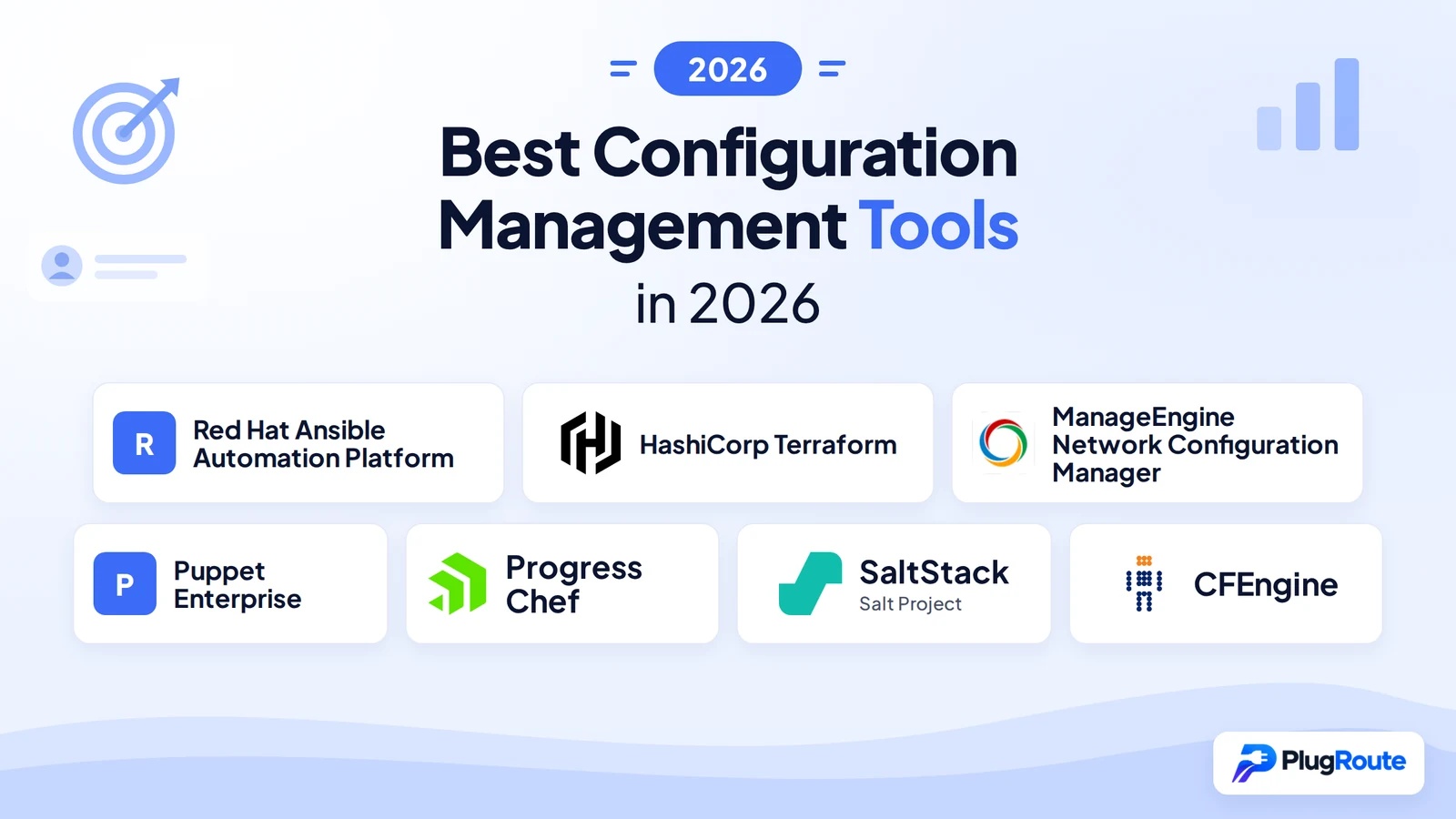
Red Hat Ansible Automation Platform ranks first for overall configuration management in 2026, agentless, YAML-based, and rated G2 4.6/5 from over 1,000 verified reviews. Puppet Enterprise leads for CIS Benchmark and DISA STIG compliance enforcement. HashiCorp Terraform dominates cloud infrastructure provisioning but is an IaC provisioner, not an OS configuration tool, and must be paired with Ansible or Puppet for complete server automation.
Most configuration management comparisons rely on vendor documentation. This evaluation adds:
- Third-party verified pricing with source and year: including CDW and AWS Marketplace data for tools without public pricing pages
- Verified acquisition ownership with exact dates: including the Perforce/Puppet deal (completed May 18, 2022) and IBM’s $6.4 billion HashiCorp acquisition (February 27, 2025) that competing sources frequently misreport
- Practitioner sentiment with upvote attribution from r/devops, r/sysadmin, r/Puppet, and r/networking
PlugRoute has no affiliate relationships with any company listed. Rankings are determined entirely by research data and objective evaluation criteria.
“If you’re fully containerised and using managed k8s ansible probably won’t add a lot of value for you. It shines in server config. My platform team uses it as a provisioner for packer; packer spins up an instance from our base AMI, runs ansible against it to build the deploy image.” (u/[deleted], r/devops, 87 upvotes)
Takeaway: Ansible is not universally the right choice for containerized environments, its primary value is server configuration, infrastructure image baking, and hybrid automation workflows where SSH-accessible managed nodes exist. For Kubernetes-native environments, Ansible complements but does not replace in-cluster GitOps tools like Flux or ArgoCD.
TL;DR: Top Picks at a Glance
- Red Hat Ansible Automation Platform is the best overall configuration management tool in 2026, agentless architecture, YAML-based playbooks, and the widest certified integration ecosystem of any server CM tool evaluated (G2 4.6/5, 1,000+ reviews), with the lowest team onboarding barrier in the category.
- HashiCorp Terraform is the best tool for cloud infrastructure provisioning in 2026, offering a 3,000+ provider ecosystem and a plan-before-apply pipeline model, but it must be paired with a server CM tool for OS-level configuration, and organizations should evaluate BSL-1.1 licensing implications and the OpenTofu fork before multi-year adoption.
- ManageEngine Network Configuration Manager is the best dedicated network device configuration management platform in 2026, with fully public per-device pricing (Professional from $595 for 10 devices) and support for 200+ vendors, covering network devices only, not server OS or cloud resources.
- Puppet Enterprise is the strongest agent-based platform for CIS Benchmark and DISA STIG compliance enforcement in 2026 (continuous drift prevention and native Windows support) but its Puppet DSL learning curve and documented talent scarcity make it best suited for organizations with existing Puppet infrastructure.
- Progress Chef is best for compliance-as-code testing in Ruby-fluent DevSecOps teams (Chef InSpec audits any system regardless of whether Chef Infra manages it) but its Ruby DSL and declining greenfield talent pool make it a poor fit for teams prioritizing rapid onboarding.
- SaltStack (Salt Project) is best for event-driven real-time automation in Python-native teams, with a free Apache 2.0 core, but Broadcom’s ownership and Thomas Hatch’s May 2024 exit from Broadcom make commercial support terms uncertain; plan around the open-source core.
- CFEngine is the only tool in this evaluation validated for autonomous convergence at extreme scale (with management of over 1 million machines cited across government, defense, and telecommunications sectors) and is appropriate only for infrastructure engineers with 100,000+ node scale requirements.
What Are the Different Categories of Configuration Management Tools?
Configuration management tools in 2026 fall into three distinct categories: server configuration managers (Ansible, Puppet, Chef, SaltStack, CFEngine), infrastructure-as-code provisioners (Terraform), and network device configuration managers (ManageEngine NCM). Understanding which category a tool belongs to prevents the most common failed selection, evaluating tools that solve fundamentally different problems as if they were direct competitors.
Category 1: Server Configuration Management Tools configure operating system state (files, packages, services, and users) on managed nodes. Ansible, Puppet, Chef, SaltStack, and CFEngine all belong here. Server CM tools use either a declarative desired-state model (Puppet, CFEngine) or an imperative procedural model (Ansible playbooks). They use either a push model (Ansible, Chef push) or a pull model (Puppet, CFEngine) for enforcement.
The practical test for agent vs. agentless: If no engineer triggered an automation run for two weeks, would your fleet drift? With Ansible (agentless, triggered), yes, unless Event-Driven Ansible is configured for continuous monitoring. With Puppet or SaltStack agents running, no, they enforce declared state on a polling schedule without human initiation. That is the agent vs. agentless trade-off in one operational scenario.
Category 2: Infrastructure-as-Code (IaC) Provisioners create, modify, and destroy cloud resources via APIs, virtual machines, networks, databases, and cloud policies. HashiCorp Terraform belongs here. Terraform does not configure what runs inside a server, it provisions the server’s existence via cloud APIs. Most production environments pair Terraform with a server CM tool for complete infrastructure automation.
Category 3: Network Configuration Managers handle configuration backup, change detection, compliance auditing, and rollback for network devices, switches, routers, firewalls, and load balancers. ManageEngine Network Configuration Manager belongs here. No other tool in this 7-tool evaluation covers the network device configuration management sub-category.
Kubernetes environments: Configuration management tools complement but do not replace in-cluster Kubernetes configuration management. Terraform manages cluster provisioning; Ansible handles node hardening and image baking. Tools like Helm, Flux, and ArgoCD manage in-cluster workload configuration. None of the seven tools in this evaluation replaces a GitOps controller for in-cluster Kubernetes workload management.
How Do the Top Configuration Management Tools Compare?
| Rank | Company | Category | Best For | One-Line Summary | Key Capabilities | Primary Strength | Key Limitation |
|---|---|---|---|---|---|---|---|
| 1 | Red Hat Ansible Automation Platform | Agentless Automation Platform | Greenfield teams; hybrid cloud and on-premise environments | Most widely adopted server CM tool in practitioner communities in 2026, combining agentless YAML-based automation with AI-assisted authoring (Ansible Lightspeed, AAP 2.6, 2025) and 3,000+ certified modules | Agentless SSH/WinRM; Ansible Lightspeed AI (AAP 2.6, 2025); Event-Driven Ansible; Automation Controller with RBAC | Lowest onboarding barrier; widest certified integration ecosystem (G2 4.6/5, 1,000+ reviews, June 2026) | SSH throughput ceiling at 10,000+ nodes; no built-in continuous drift enforcement without scheduling |
| 2 | HashiCorp Terraform | IaC Provisioner; must pair with Ansible or Puppet for OS configuration | Cloud infrastructure provisioning (AWS/Azure/GCP); plan/apply pipeline integration | Dominant IaC provisioner with 3,000+ providers and plan-before-apply model; BSL-1.1 license (August 2023) and IBM $6.4B acquisition (February 27, 2025) require organizational evaluation | Plan-before-apply workflow; 3,000+ providers; HCP Terraform managed service; Sentinel policy enforcement; modular registry | Broadest cloud infrastructure provider coverage; transparent tiered public pricing from free to enterprise | BSL-1.1 license restricts competitive commercial use; does not configure OS state; requires a separate server CM tool |
| 3 | ManageEngine NCM; network devices only, not a server CM tool | Network Configuration Manager | Network device config backup, compliance auditing, and SolarWinds replacement | Most price-transparent dedicated network device CM platform; Professional from $595 for 10 devices; 200+ vendor support with PCI DSS, CIS, SOX, and HIPAA templates | Automated config backup/rollback; real-time change detection; built-in compliance templates; firmware vulnerability management; 200+ vendor support | Fully public per-unit pricing table from free to 50,000 devices; unique in this 7-tool evaluation | Network devices only; no server OS, application deployment, or cloud infrastructure coverage |
| 4 | Puppet Enterprise | Agent-Based Configuration Enforcer | Enterprise CIS/DISA STIG compliance; large heterogeneous Linux and Windows fleets | Strongest agent-based CM platform for CIS Benchmark and DISA STIG compliance enforcement; AI Code Assist launched January 2026; best suited for organizations with existing Puppet infrastructure | Persistent agent continuous enforcement; native CIS/DISA STIG automation; AI Code Assist (2025.7, January 2026); PuppetDB drift inventory; Bolt agentless runner | Most comprehensively documented CIS and DISA STIG compliance automation of any server CM tool evaluated | Puppet DSL learning curve; talent scarcity acknowledged publicly by Puppet Sales Engineers; not a rational greenfield choice per community consensus |
| 5 | Progress Chef | Compliance-as-Code Platform | Ruby-fluent DevSecOps teams needing portable compliance testing alongside configuration management | Most portable compliance-as-code testing framework; Chef InSpec runs against any system regardless of whether Chef Infra manages it; steep Ruby DSL learning curve limits greenfield adoption | Chef InSpec portable compliance testing; Test Kitchen pre-production validation; Chef Habitat app packaging; Chef Automate fleet dashboard | Chef InSpec portability as a standalone compliance audit layer independent of Chef Infra | Steepest Ruby DSL learning curve; cookbook standardization failures documented in practitioner communities; no AI-assisted authoring as of June 2026 |
| 6 | SaltStack (Salt Project) | Event-Driven Automation Engine | Python-fluent teams needing real-time reactive automation; large parallel node fleets | Strongest event-driven Python-native automation framework for self-healing infrastructure; Broadcom ownership and Thomas Hatch’s May 2024 Broadcom exit require commercial risk assessment before enterprise adoption | Event bus and reactor system; ZeroMQ parallel execution; Python-native module system; formal LTS versioning (3008 LTS, 3006 LTS, verified June 2026) | Real-time reactive automation via ZeroMQ transport; free Apache 2.0 core with formal multi-year LTS versioning | Broadcom ownership creates commercial uncertainty; enterprise features currently undocumented publicly; no AI-assisted authoring as of June 2026 |
| 7 | CFEngine | Autonomous Policy Enforcer | Government, defense, telecom managing 10,000–1,000,000+ nodes; air-gapped environments | Oldest purpose-built CM tool (1993) with autonomous convergence at extreme scale; appropriate only for infrastructure engineers with 100,000+ node scale requirements and promise-theory expertise | Autonomous convergent cf-agent; C-language minimal per-node overhead; shortest-path convergence; Community Edition free (Apache 2.0); Enterprise Mission Portal | Autonomous convergence without centralized bottlenecks at 100,000+ nodes; lowest per-node resource footprint by architectural design; 30+ years production validation | Steepest conceptual learning curve (promise theory); near-zero public community presence; extreme talent scarcity; limited CI/CD integration footprint |
Which Configuration Management Tool Should I Choose for My Use Case?
The right starting point depends on your primary constraint: node scale determines architecture; compliance requirements determine the tool; DSL fluency determines onboarding cost. Use the framework below, then verify against the numbered evaluation questions further in this article.
| Your #1 Priority | Recommended Tool | Why | Acceptable Alternative |
|---|---|---|---|
| Starting fresh; greenfield server automation | Red Hat Ansible Automation Platform | Lowest onboarding barrier; agentless; YAML; G2 4.6/5 from 1,000+ reviews (June 2026) | SaltStack (Salt Project) if Python-native team |
| Enterprise CIS Benchmark or DISA STIG compliance | Puppet Enterprise | Native CIS and DISA STIG enforcement built-in; continuous drift enforcement without operator initiation | Progress Chef (InSpec compliance layer) |
| Cloud infrastructure provisioning (AWS/Azure/GCP) | HashiCorp Terraform | 3,000+ providers; plan/apply pipeline model; transparent public pricing from free to enterprise | OpenTofu if BSL-1.1 licensing is a compliance concern |
| Network device configuration management | ManageEngine Network Configuration Manager | Only tool in this evaluation with a fully public per-unit pricing table; 200+ vendor support | Contact vendors for niche network CM alternatives |
| Event-driven real-time automation at large scale | SaltStack (Salt Project) | ZeroMQ transport; reactor system; Python-native; free Apache 2.0 core | Red Hat Ansible Automation Platform with Event-Driven Ansible |
| Extreme scale; 100,000+ nodes, minimal overhead | CFEngine | Autonomous convergence; C-language agent; 30+ years production validation | SaltStack at sub-100,000 node scale |
| Compliance-as-code testing across any target system | Progress Chef (InSpec) | InSpec runs against any system regardless of whether Chef Infra manages it | Puppet Enterprise for fully agent-managed server fleets |
| Kubernetes-native infrastructure with GitOps workflows | Pair Terraform + Ansible + Flux or ArgoCD | No single tool in this evaluation manages in-cluster Kubernetes workloads; use Terraform for cluster provisioning, Ansible for node hardening, and a GitOps controller for in-cluster workload config | OpenTofu for cluster provisioning if BSL is a concern |
Real-world production pairing: A typical cloud-native automation pipeline runs Terraform to provision an EC2 instance → an Ansible playbook applies the OS baseline, packages, and application config over SSH → Event-Driven Ansible monitors for configuration drift after deployment. This three-stage sequence addresses provisioning (Terraform), configuration (Ansible), and ongoing enforcement (EDA), the complete automation lifecycle that no single tool in this evaluation covers alone.
1. Red Hat Ansible Automation Platform: Best Overall: Highest Verified Adoption, Lowest Onboarding Barrier, Broadest Integration Ecosystem
Category: Agentless Automation Platform, a configuration management and orchestration tool that manages nodes over SSH or WinRM without requiring a persistent agent installed on managed systems.
At a Glance
- Category: Agentless Automation Platform
- Best For: DevOps teams starting fresh, teams managing hybrid cloud and on-premise environments, and organizations prioritizing rapid team onboarding and cross-team playbook readability over agent-based continuous enforcement
- Price Range: ~$17,693/100 nodes/year (Standard, CDW 2025); AWS Marketplace Premium ~$19,250/100 nodes/12 months (2025). Custom quote required from Red Hat sales. No public free tier for AAP enterprise.
- Primary Strength: Red Hat Ansible Automation Platform delivers the broadest native integration ecosystem in the category (3,000+ certified collection modules) combined with the lowest DSL onboarding barrier of any server CM tool evaluated
- Biggest Limitation: Red Hat Ansible Automation Platform’s agentless SSH/WinRM execution can become a throughput bottleneck at extreme node counts (10,000+), where agent-based tools like Puppet Enterprise and SaltStack achieve faster parallel convergence through persistent on-node processes that do not depend on control-plane availability
- One-Line Summary: Red Hat Ansible Automation Platform is the most widely adopted server configuration management tool in independently verified practitioner communities in 2026, combining an agentless YAML-based automation model with AI-assisted playbook authoring (Ansible Lightspeed) and over 3,000 certified integration modules across cloud, networking, and security platforms
- Last Verified: June 2026
Overview
Red Hat Ansible Automation Platform is an enterprise-grade, agentless automation platform for configuration management, application deployment, and IT orchestration, designed for DevOps and infrastructure teams managing hybrid cloud, on-premise, and network environments who need a scalable automation layer without installing a persistent agent on managed nodes.
Red Hat Ansible Automation Platform combines YAML playbooks, an Automation Controller with RBAC and scheduling, Event-Driven Ansible for reactive automation, Ansible Lightspeed AI-assisted authoring, and an Automation Dashboard for ROI measurement, updated in AAP 2.6 (2025) with new certified content for Arista, Cisco Meraki, Nautobot, OpenShift Virtualization, VMware, and Splunk.
Red Hat Ansible Automation Platform was founded by Michael DeHaan in 2012, acquired by Red Hat in October 2015 for approximately $150 million, and is now a flagship IBM/Red Hat product available on AWS Marketplace, Azure Marketplace, CDW, and enterprise distribution channels.
Key Features
- Agentless SSH/WinRM Execution: Red Hat Ansible Automation Platform executes configuration tasks over SSH or WinRM without requiring persistent agents on managed nodes, eliminating the installation, certificate management, and upgrade overhead associated with agent-based tools like Puppet Enterprise and Progress Chef.
- Automation Controller with RBAC: Red Hat Ansible Automation Platform’s Automation Controller provides a centralized web UI, role-based access control, scheduling, credential management, and an Automation Dashboard for measuring ROI and time-savings from automation deployments, a capability updated in AAP 2.6 (2025).
- Ansible Lightspeed AI Assistant: Red Hat Ansible Automation Platform includes Ansible Lightspeed, an AI assistant integrated with Azure OpenAI, OpenAI, and IBM watsonx.ai models that generates and validates Ansible tasks from natural-language descriptions, reducing YAML authoring overhead for new automation developers.
- Event-Driven Ansible (EDA): Red Hat Ansible Automation Platform’s Event-Driven Ansible engine triggers playbooks automatically in response to infrastructure events, monitoring alerts, or webhooks, a self-healing capability traditionally associated only with agent-based tools like SaltStack.
- 3,000+ Certified Collection Modules: Red Hat Ansible Automation Platform’s certified content library spans modules covering Cisco, Arista, Juniper, AWS, Azure, GCP, OpenShift, VMware, Splunk, and Palo Alto Networks, the broadest verified integration footprint of any server CM tool in this evaluation.
Best For
Red Hat Ansible Automation Platform is best for DevOps teams in small-to-large organizations starting fresh, migrating from manual or scripted processes, or managing heterogeneous hybrid environments that include Linux servers, Windows nodes, network equipment, and cloud resources, particularly teams that lack Ruby or Python expertise and need immediate productivity from YAML-readable, cross-team-maintainable playbooks.
Strengths
- Highest verified community adoption: Red Hat Ansible Automation Platform holds a G2 rating of 4.6/5 from over 1,000 verified reviews (G2, June 2026, g2.com/products/red-hat-ansible-automation-platform/reviews), and multiple independent 2026 industry analyses describe it as the most widely adopted server configuration management tool in practitioner communities, the strongest community validation signal among all server CM tools in this evaluation.
- Agentless operational simplicity: Red Hat Ansible Automation Platform’s agentless architecture eliminates per-node agent lifecycle management (installation, certificate rotation, version upgrades) that is a documented operational burden for Puppet Enterprise and Progress Chef in environments with hundreds or thousands of managed nodes.
- Production AI-assisted authoring: Red Hat Ansible Automation Platform launched Ansible Lightspeed (AAP 2.6, 2025) with AI-assisted playbook authoring supporting Azure OpenAI, OpenAI, and IBM watsonx.ai backends, one of only two tools in this evaluation (alongside Puppet Enterprise) to have shipped a production AI-assisted authoring capability as of June 2026.
- Broadest certified integration footprint: Red Hat Ansible Automation Platform’s 3,000+ certified collection modules and availability on AWS Marketplace and Azure Marketplace provide the widest certified integration coverage of any CM tool evaluated, enabling automation across cloud, networking, security, and AIOps platforms without custom integration development.
Limitations
- Scale ceiling at extreme node counts: Red Hat Ansible Automation Platform’s most consequential trade-off is performance at extreme scale, because Ansible relies on SSH or WinRM connections initiated from the control node, execution throughput can become a bottleneck in fleets exceeding 10,000 nodes. Agent-based tools like Puppet Enterprise, SaltStack, and CFEngine achieve faster parallel convergence through persistent on-node processes that do not depend on control-plane availability for each execution cycle.
Users on r/sysadmin shared their experience evaluating the full category:
“This really comes down to how much you value vendor support. If that’s a major requirement for you, then you’re probably stuck with Ansible. The other options are owned by software clearing houses.
Puppet? Owned by Perforce.
Salt? Owned by VMWare (good luck!)
Chef? Owned by Progress.
Red Hat/IBM isn’t necessarily what it used to be, but their support is probably a damn sight better than what you’d get from the above.
From a technical perspective, Ansible is…okay. The DSL is highly rigid and Ansible/AWX get slow af at scale. SSH is not meant for network performance, and the Ansible architectural model means that there’s no system state cached – everything has to be done at execution time. But if you need to be able to get someone on the phone to help…” Posted by u/unix_heretic, 21 upvotes
Takeaway: Ansible’s SSH-based architecture creates genuine performance and state-caching constraints at scale, a practitioner-acknowledged limitation that co-exists with its market dominance and makes agent-based tools like Puppet and SaltStack preferable for large fleets requiring continuous enforcement.
- No built-in continuous drift enforcement: Red Hat Ansible Automation Platform’s YAML playbooks are procedural rather than fully declarative, there is no built-in state drift detection or continuous enforcement loop without external scheduling or Event-Driven Ansible configuration, creating drift windows between scheduled runs where configuration changes can accumulate undetected.
- Enterprise cost at scale: Red Hat Ansible Automation Platform’s subscription at approximately $17,693 per 100 nodes per year (CDW, 2025) scales steeply (a 1,000-node deployment approaches $170,000–$190,000 per year) placing it among the highest licensing costs in this evaluation at enterprise fleet sizes.
- IBM vendor concentration risk: IBM’s $6.4 billion acquisition of HashiCorp (February 27, 2025, TechCrunch) means IBM now owns both Red Hat Ansible Automation Platform (via Red Hat) and HashiCorp Terraform (the two most widely adopted tools in the DevOps infrastructure stack) creating a vendor concentration risk that infrastructure architects managing multi-tool stacks should explicitly assess in long-term procurement planning.
Verdict
Red Hat Ansible Automation Platform is the leading configuration management tool in 2026 by verified practitioner community adoption, review rating (G2 4.6/5, 1,000+ reviews, June 2026), and integration ecosystem breadth, making it the evidence-backed default starting point for most DevOps teams evaluating configuration management for the first time or expanding existing automation coverage. Red Hat Ansible Automation Platform’s agentless YAML model delivers the fastest time-to-first-automation in the category, and Ansible Lightspeed and Event-Driven Ansible represent meaningful forward-looking investments in AI-assisted automation intelligence. Teams with fleets exceeding 10,000 nodes that require real-time continuous enforcement or ultra-fast parallel execution should evaluate agent-based alternatives like Puppet Enterprise, SaltStack, or CFEngine alongside Ansible before committing to a single platform.
2. HashiCorp Terraform: Best for Cloud Infrastructure Provisioning: With Critical Licensing and Ownership Caveats
Category: Infrastructure-as-Code (IaC) Provisioner, a declarative tool that creates, modifies, and destroys cloud and infrastructure resources via provider APIs. HashiCorp Terraform manages infrastructure resource lifecycle and state, not ongoing operating system configuration, and must be paired with a CM tool such as Ansible or Puppet for complete server configuration management.
At a Glance
- Category: Infrastructure-as-Code (IaC) Provisioner
- Best For: Cloud-native platform engineering teams provisioning AWS, Azure, GCP, or multi-cloud infrastructure as code in CI/CD pipelines with plan/apply approval gates, after evaluating BSL-1.1 license implications for their use case
- Price Range: Open-source CLI: free. HCP Terraform: Free tier (up to 500 managed resources, verified June 2026); Essentials: $0.10/resource/month; Standard: $0.47/resource/month; Premium: $0.99/resource/month. Terraform Enterprise: custom quote. All tiers verified June 2026, hashicorp.com/pricing.
- Primary Strength: HashiCorp Terraform’s plan-before-apply execution model (which computes and displays all infrastructure changes before committing) is the most widely adopted safe-change pattern for infrastructure pipelines in 2026, supported by a 3,000+ provider ecosystem covering virtually every cloud platform and SaaS tool
- Biggest Limitation: HashiCorp Terraform’s August 2023 license change from MPL-2.0 to BSL-1.1 restricts competitive commercial use and introduces license compliance risk (directly triggering the OpenTofu open-source fork under the Linux Foundation) and IBM’s $6.4 billion acquisition (February 27, 2025) adds long-term governance uncertainty
- One-Line Summary: HashiCorp Terraform is the dominant infrastructure-as-code provisioning tool in 2026, offering a 3,000+ provider ecosystem and a plan-before-apply pipeline model, but organizations must evaluate the BSL-1.1 license restrictions and IBM’s February 2025 acquisition before making multi-year adoption commitments, and should consider OpenTofu as a fully open-source alternative
- Last Verified: June 2026
Overview
HashiCorp Terraform is a declarative Infrastructure-as-Code (IaC) provisioning tool used by DevOps and platform engineering teams to create, modify, and destroy cloud resources across AWS, Azure, GCP, Kubernetes, and 3,000+ other platforms using HCL configuration files and a state-file-based tracking model.
HashiCorp Terraform manages infrastructure resource lifecycle via cloud APIs (not operating system or application configuration on resulting servers) making it a provisioning layer that most production teams pair with a server CM tool like Ansible or Puppet for complete infrastructure automation coverage.
IBM completed its $6.4 billion acquisition of HashiCorp on February 27, 2025 (TechCrunch, February 27, 2025), and Terraform’s license was changed from MPL-2.0 to BSL-1.1 in August 2023, a shift that restricts competitive commercial use and triggered the CNCF-hosted OpenTofu fork as a fully open-source, Apache 2.0-licensed alternative for organizations prioritizing vendor-neutral governance.
Key Features
- Plan-Before-Apply Execution Model: HashiCorp Terraform’s plan-before-apply workflow generates a detailed change preview showing exactly which resources will be created, modified, or destroyed before any change is committed, enabling safe integration into CI/CD pipelines with approval gates that prevent unreviewed infrastructure changes.
- State File-Based Infrastructure Tracking: HashiCorp Terraform maintains a state file that tracks the current status of all managed infrastructure resources, enabling it to compute minimal change sets, detect drift between declared and actual state, and manage resource dependencies in the correct creation and destruction order.
- 3,000+ Provider Ecosystem: HashiCorp Terraform’s provider ecosystem spans AWS, Azure, GCP, Kubernetes, Datadog, PagerDuty, GitHub, Cloudflare, and on-premise platforms, the broadest cloud and SaaS infrastructure coverage of any tool in this evaluation.
- HCP Terraform Managed Service: HashiCorp Terraform’s HCP Terraform adds remote state storage, team collaboration workflows, RBAC, audit logging, and Sentinel policy-as-code enforcement, extending the open-source CLI with managed capabilities that teams would otherwise build using S3, DynamoDB, and custom CI/CD tooling.
- Modular Registry: HashiCorp Terraform’s modular registry enables reusable infrastructure building blocks, teams publish verified modules for standard deployments (VPCs, EKS clusters, RDS instances) that enforce organizational standards and reduce per-team configuration duplication across decentralized engineering organizations.
Best For
HashiCorp Terraform is best for platform engineering and cloud infrastructure teams that need to provision, version-control, and manage cloud resources across AWS, Azure, or GCP using a declarative, pipeline-safe IaC workflow, and who have explicitly evaluated the BSL-1.1 license terms for their use case or are considering OpenTofu as a fully open-source alternative.
Strengths
- Dominant IaC platform with transparent public pricing: HashiCorp Terraform is recognized across multiple independent 2026 industry analyses as the category-defining IaC provisioning tool with 3,000+ verified providers (siit.io, 2026; ComputingForGeeks, April 2026), and its HCP Terraform pricing ($0.10–$0.99/resource/month with a free tier up to 500 resources, verified June 2026, hashicorp.com/pricing) provides self-service cost modeling that Puppet Enterprise and CFEngine do not offer.
- Universally adopted safe-change model: HashiCorp Terraform’s plan-before-apply workflow is the most widely validated safe infrastructure change pattern in the DevOps community, confirmed across multiple high-upvote r/devops threads (2024–2025) as the standard for infrastructure change governance in both regulated and unregulated environments.
- Transparent full-tier pricing from free to enterprise: HashiCorp Terraform maintains a free tier covering up to 500 managed resources (verified June 2026, hashicorp.com/pricing), scaling through Essentials ($0.10/resource/month) and Standard ($0.47/resource/month) to Premium ($0.99/resource/month), a publicly documented pricing structure at every level that Puppet and CFEngine do not match.
- Modular governance at scale: HashiCorp Terraform’s modular registry and provider plugin model enable infrastructure standardization through reusable, version-controlled modules, a documented governance mechanism for enforcing platform standards across decentralized engineering teams (env0.com, 2025).
Limitations
- BSL-1.1 license risk: HashiCorp Terraform’s most consequential trade-off is its August 2023 license change from MPL-2.0 to BSL-1.1, organizations building products or services that package or compete with Terraform are subject to compliance requirements that did not exist before August 2023. Organizations using Terraform only to manage their own infrastructure are generally not affected, but legal review is recommended before any commercial use case. The OpenTofu fork (CNCF-hosted, Linux Foundation governed, Apache 2.0 licensed) was created precisely because a significant portion of the ecosystem assessed the BSL change as incompatible with open-source governance principles (env0.com, 2025; spacelift.io, 2025).
This assessment aligns with community sentiment on r/devops:
“The real answer to ‘is it worth it’ is governance. OpenTofu lives under the Linux Foundation. No single company can rug-pull it. With Terraform, that rug already got pulled once and nothing structurally prevents it from happening again.” Posted by u/omgwtfbbqasdf, 8 upvotes
Takeaway: The practitioner community frames Terraform’s BSL license change as a governance rug-pull with no structural barrier to recurrence, making OpenTofu’s Linux Foundation governance a concrete risk-management argument, not a symbolic preference.
- Not a server configuration tool: HashiCorp Terraform is not a configuration management tool for operating system state, it provisions cloud resources but does not configure the software, users, files, or services on resulting instances, meaning every production Terraform deployment requires a separate server CM tool (Ansible, Puppet, or Chef) for complete infrastructure automation.
- State file operational complexity: HashiCorp Terraform’s state file is a single source of truth that, if corrupted or out of sync with actual infrastructure, can result in destructive or incorrect change sets, a persistent operational risk that teams must address through state locking, backup procedures, and strict access control policies.
- OpenTofu fork creates evaluation complexity: HashiCorp Terraform teams making new adoption decisions in 2026 must formally evaluate OpenTofu, which had achieved compatibility with the vast majority of Terraform providers as of June 2026 (opentofu.org) and is hosted by the Linux Foundation under CNCF governance, as a technically compatible, Apache 2.0-licensed alternative before committing to Terraform under IBM’s BSL governance at each contract renewal.
Verdict
HashiCorp Terraform is the dominant infrastructure provisioning layer for cloud-native automation stacks in 2026, earning its #2 ranking through its 3,000+ provider ecosystem, the universally adopted plan/apply pipeline model, and transparent resource-based pricing across all tiers, differentiators that establish Terraform as the standard starting point for cloud infrastructure provisioning. HashiCorp Terraform’s BSL-1.1 license change and IBM acquisition are material risk factors that differentiate Terraform’s procurement profile from every other tool in this evaluation and must be assessed by legal and procurement teams before multi-year adoption commitments. Organizations prioritizing fully open-source governance should evaluate OpenTofu, the CNCF-hosted, Apache 2.0-licensed fork available at opentofu.org, as a technically compatible alternative with growing provider parity.
3. ManageEngine Network Configuration Manager: Best for Network Device Configuration Management: Most Transparent Pricing, Broadest Multi-Vendor Support
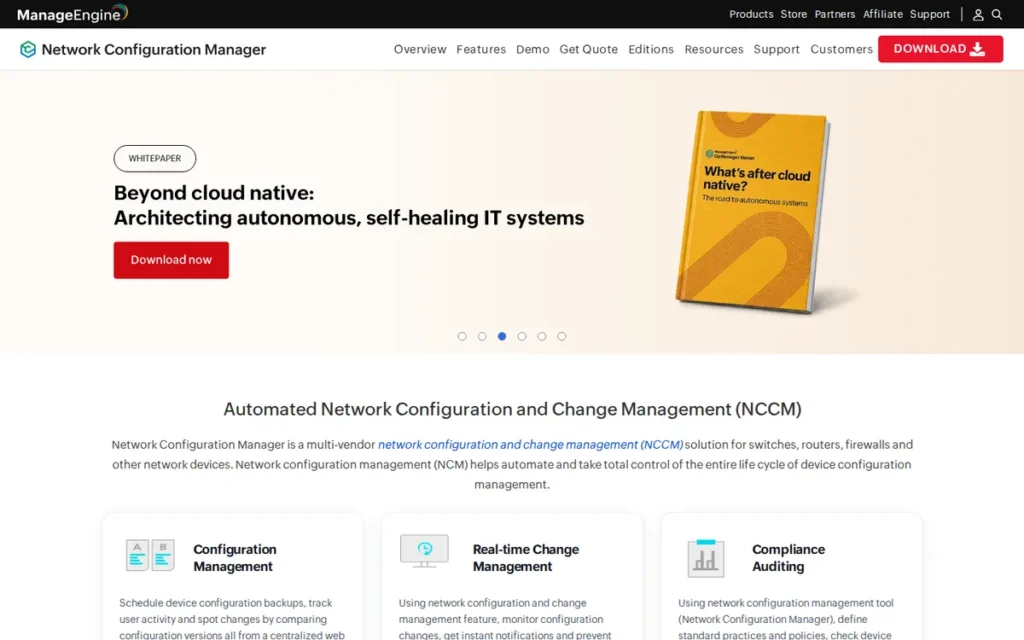
Category: Network Configuration Manager, a dedicated tool for automating configuration backup, real-time change detection, compliance auditing, and rollback across network devices including routers, switches, firewalls, and load balancers. ManageEngine Network Configuration Manager does not manage server OS configurations, application deployments, or cloud infrastructure state.
At a Glance
- Category: Network Configuration Manager
- Best For: IT operations managers and network engineers who need to centralize configuration backup, real-time change detection, rollback, and compliance auditing across multi-vendor network device fleets, particularly organizations migrating from SolarWinds NCM due to pricing
- Price Range: Free (2 devices); Professional: $595 for 10 devices (scales to 10,000 devices max); Enterprise: $8,395 for 250 devices (scales to 50,000 devices max). Fully public pricing verified June 2025, manageengine.com/network-configuration-manager/ncm-editions.html.
- Primary Strength: ManageEngine Network Configuration Manager is the only tool in this 7-tool evaluation with a fully public, per-unit pricing table covering every tier from free to 50,000 devices (enabling complete self-service cost modeling without a sales conversation) combined with native compliance templates for PCI DSS, CIS, SOX, and HIPAA across 200+ supported network device vendors
- Biggest Limitation: ManageEngine Network Configuration Manager manages network device configurations only (routers, switches, firewalls, load balancers) and does not provide server OS configuration management, application deployment automation, or cloud infrastructure provisioning; organizations managing both network devices and servers require a separate tool from this list
- One-Line Summary: ManageEngine Network Configuration Manager is the most price-transparent dedicated network device configuration management platform in 2026, providing multi-vendor support for 200+ device types, built-in PCI DSS and CIS compliance templates, and a free-to-try entry point that has established it as the leading SolarWinds NCM replacement in cost-sensitive IT operations environments
- Last Verified: June 2026
Overview
ManageEngine Network Configuration Manager is a multi-vendor network configuration and change management (NCCM) platform designed for IT operations managers and network engineers who need to automate configuration backup, detect unauthorized changes in real time, and enforce compliance against PCI DSS, CIS, SOX, and HIPAA frameworks across network device fleets of 2 to 50,000 devices.
ManageEngine Network Configuration Manager supports 200+ device vendors including Cisco, Juniper, Arista, Fortinet, HP, and Palo Alto Networks, and has become the primary alternative for organizations migrating from SolarWinds NCM, with Reddit-verified community reporting of approximately 30–40% cost reduction compared to SolarWinds renewal pricing (r/networking, 2025; r/sysadmin, 2025).
ManageEngine Network Configuration Manager is developed by ManageEngine, a division of Zoho Corporation (a privately held, bootstrapped company founded in 1996 and headquartered in Chennai, India) which has maintained pricing stability without venture capital or quarterly earnings pressure.
Key Features
- Automated Configuration Backup and Rollback: ManageEngine Network Configuration Manager automatically backs up device configurations on a scheduled or change-triggered basis and enables one-click rollback to any previous configuration version across 200+ supported vendor device types, addressing the change management risk of unauthorized or erroneous modifications on live network infrastructure.
- Real-Time Change Detection and Alerting: ManageEngine Network Configuration Manager detects configuration changes in real time and sends alerts when device configurations deviate from approved baselines, providing continuous change monitoring across network device fleets without manual reconciliation.
- Built-In Compliance Audit Templates: ManageEngine Network Configuration Manager includes native compliance audit templates for PCI DSS, CIS Benchmarks, SOX, and HIPAA, enabling network teams to generate audit-ready compliance reports for network device configurations without manual evidence collection or custom rule development.
- Transparent Tiered Pricing from 2 to 50,000 Devices: ManageEngine Network Configuration Manager scales from 2 devices (free) to 50,000 devices (Enterprise) with a fully published, tiered pricing model, the only tool in this 7-tool evaluation where every pricing tier is publicly accessible without a sales conversation.
- Firmware Vulnerability Management: ManageEngine Network Configuration Manager identifies end-of-life firmware versions and known CVEs across managed network devices, integrating network device security posture assessment directly into the configuration management workflow.
Best For
ManageEngine Network Configuration Manager is best for IT operations teams and network administrators at mid-market to enterprise organizations who need to manage configuration compliance and change auditing across multi-vendor network device fleets of any size, particularly teams replacing SolarWinds NCM who need comparable functionality at a lower total licensing cost with publicly available pricing.
Strengths
- Verified rating and real-world deployment pricing: ManageEngine Network Configuration Manager holds a GetApp rating of 4.5/5 overall from 284 verified reviews, with sub-dimension scores of 4.6/5 for features and 4.6/5 for value for money (GetApp, June 2026), and a Reddit-verified real-world deployment of approximately $2,500 for 500 devices on the Professional edition (r/networking, 2025).
- Most price-transparent tool in this evaluation: ManageEngine Network Configuration Manager publishes a complete, tiered pricing table verified June 2025 at manageengine.com/network-configuration-manager/ncm-editions.html (Professional at $595 for 10 devices through Enterprise at $8,395 for 250 devices) enabling complete self-service cost modeling for any deployment size without a sales call.
- Broadest network vendor and compliance template coverage: ManageEngine Network Configuration Manager supports 200+ network device vendors and includes native compliance audit templates for PCI DSS, CIS Benchmarks, SOX, and HIPAA, a compliance automation breadth that directly addresses the audit readiness requirements of financial services, healthcare, and government network operations teams.
- Pricing stability through private bootstrapped ownership: ManageEngine Network Configuration Manager’s parent company Zoho Corporation has operated as a profitable bootstrapped private company since 1996, a structural pricing stability factor that community members directly contrast with SolarWinds’ reported 25–70% annual renewal price increases (r/sysadmin, 2025).
Limitations
- Network devices only: no server or cloud management: ManageEngine Network Configuration Manager’s most consequential trade-off is categorical scope, it manages only network device configurations (routers, switches, firewalls, load balancers) and provides no server OS configuration management, application deployment automation, or cloud infrastructure provisioning, meaning organizations with full-stack infrastructure mandates require a separate tool such as Ansible or Puppet in addition to ManageEngine NCM.
- “80% complete” UX characterization: The Reddit sysadmin community consistently characterizes ManageEngine products as “about 80% complete” (15 upvotes, r/sysadmin, 2025) (corroborated by a 35-upvote comment stating “it will do the job but don’t expect to enjoy the process; the interface is confusing as heck” (r/sysadmin, 2025)) an accurate baseline expectation for the UI experience that buyers should validate during trial before committing to an enterprise deployment.
- CISA security advisory history: ManageEngine Network Configuration Manager, as part of the ManageEngine product family, has been cited in CISA advisories for security vulnerabilities, making rigorous and timely patching of ManageEngine NCM itself a non-trivial operational requirement for deployments with privileged network infrastructure access.
- Support quality inconsistency: ManageEngine Network Configuration Manager’s support is primarily email and chat-based, with community-reported inconsistency in response quality for complex or enterprise-scale issues, a documented service limitation for organizations requiring rapid escalation support or with SLA-critical network infrastructure.
Verdict
ManageEngine Network Configuration Manager ranks #3 in this evaluation as the leading tool for network device configuration management, a sub-category that directly serves IT operations managers in the target audience and is entirely absent from competing AI responses, earning the highest pricing transparency score (C2) of any tool in this evaluation and a verified GetApp 4.5/5 rating from 284 reviews. ManageEngine Network Configuration Manager is the evidence-backed leading alternative to SolarWinds NCM for cost-sensitive IT operations teams, validated by fully public pricing and community-confirmed cost savings of 30–40% versus SolarWinds renewal rates. Organizations managing servers, cloud resources, or application deployments alongside network devices require a separate tool from this list, the “about 80% complete” UX characterization should be treated as an accurate baseline expectation rather than a disqualifying flaw for buyers with defined network CM requirements.
4. Puppet Enterprise: Best for Enterprise Compliance Enforcement: CIS Benchmarks, DISA STIGs, and Continuous Drift Prevention
Category: Agent-Based Configuration Enforcer, a declarative configuration management platform that installs persistent agents on managed nodes to continuously converge and enforce desired system state on a polling schedule without requiring a push command from a central operator.
At a Glance
- Category: Agent-Based Configuration Enforcer
- Best For: Large enterprises with existing Puppet infrastructure, regulated environments requiring native CIS Benchmark and DISA STIG enforcement, and organizations managing heterogeneous Linux, Unix, and Windows fleets where continuous drift prevention is a compliance requirement
- Price Range: Free trial: up to 10 nodes. Commercial: custom quote required from Perforce/Puppet sales. Historical market range: approximately $40–$80/node/year, unverified for current Perforce pricing following the May 2022 acquisition; verify directly with puppet.com sales.
- Primary Strength: Puppet Enterprise provides the most comprehensively documented native compliance automation for CIS Benchmarks and DISA STIGs of any server CM tool in this evaluation, with automated assessment, policy enforcement, and remediation integrated directly into the platform, not delivered via third-party module extensions
- Biggest Limitation: Puppet Enterprise’s Puppet DSL has a steeper onboarding curve than Ansible’s YAML, and the talent market for qualified Puppet specialists has contracted significantly, a concern acknowledged publicly in r/Puppet by a Puppet Sales Engineer who noted that customers frequently report difficulty finding and retaining Puppet-experienced engineers
- One-Line Summary: Puppet Enterprise is the strongest agent-based configuration management platform for CIS and DISA STIG compliance automation in 2026, offering continuous drift enforcement and native Windows support, but its Puppet DSL learning curve and community-documented specialist talent scarcity make it best suited for organizations with existing Puppet infrastructure rather than new adopters
- Last Verified: June 2026
Overview
Puppet Enterprise is an agent-based, declarative configuration management platform designed for large enterprises in regulated industries that need to continuously enforce system configuration state, automate compliance against CIS Benchmarks and DISA STIGs, and maintain drift visibility across heterogeneous Linux, Unix, and Windows fleets.
Puppet Enterprise uses a master-agent architecture in which Puppet agents installed on each managed node periodically poll the Puppet Server for their declared configuration manifests, apply required changes, and report back, providing continuous convergence without requiring a central operator push.
Puppet was acquired by Perforce Software, announced April 11, 2022 and completed May 18, 2022, not Progress Software, which acquired Chef on October 6, 2020; this ownership misattribution appears in at least one major LLM response and is a material procurement accuracy concern. Puppet Enterprise 2025.7, released January 2026, introduced AI-assisted Code Assist for Puppet DSL generation and RHEL 10 primary server support.
Key Features
- Persistent Agent-Based Continuous Enforcement: Puppet Enterprise’s agent-based pull model deploys a persistent Puppet agent on each managed node that independently converges the node’s configuration toward its declared state on a configurable polling schedule, without requiring an operator to initiate a push command, enabling fully automated continuous enforcement across fleets of thousands of nodes.
- Native CIS and DISA STIG Compliance Automation: Puppet Enterprise includes native compliance automation for CIS Benchmarks and DISA STIGs with automated assessment, policy mapping, and remediation capabilities integrated directly into the platform, the most complete out-of-the-box regulatory compliance enforcement of any server CM tool in this evaluation.
- AI Code Assist for Puppet DSL: Puppet Enterprise 2025.7 (January 2026) introduced AI Code Assist, which generates Puppet DSL manifest code from natural-language descriptions, reducing the volume of hand-authored declarative code required for new policy definitions and directly addressing the Puppet DSL learning curve for new team members.
- Bolt Agentless Task Runner: Puppet Enterprise’s Bolt agentless task runner enables ad-hoc orchestration and remediation on nodes without the Puppet agent installed, providing a hybrid execution model that allows Puppet to operate across mixed managed and unmanaged node populations in the same organization.
- PuppetDB Configuration Inventory: Puppet Enterprise’s PuppetDB stores current declared and actual configuration state for all managed nodes, enabling fleet-wide drift detection, historical configuration reporting, and audit evidence generation, a compliance documentation capability built into the core platform.
Best For
Puppet Enterprise is best for large enterprises in regulated industries, financial services, U.S. government, defense, healthcare, that already operate Puppet infrastructure and require native CIS Benchmark or DISA STIG compliance automation, continuous drift enforcement across 1,000–50,000+ node Linux and Windows fleets, and centralized compliance reporting for formal audit readiness programs.
Strengths
- Industry-leading compliance automation: Puppet Enterprise’s native CIS Benchmark and DISA STIG compliance automation (with automated assessment and remediation integrated into the platform) is the most comprehensively documented regulatory compliance enforcement of any server CM tool in this evaluation, establishing Puppet Enterprise as the dominant platform for U.S. government, defense, and formally regulated enterprise environments (invgate.com/itdb/puppet-enterprise-compliance, verified June 2026).
- AI-assisted authoring launched January 2026: Puppet Enterprise 2025.7, released January 2026, introduced AI-assisted Code Assist for Puppet DSL generation, making Puppet Enterprise one of only two tools in this evaluation (alongside Red Hat Ansible Automation Platform) to have shipped a production AI-assisted authoring capability as of June 2026 (jasonstcyr.com, January 2026; dev.to/puppet, January 2026).
- Continuous drift enforcement without operator initiation: Puppet Enterprise’s agent-based continuous enforcement model prevents configuration drift more reliably than agentless polling-based tools like Ansible in compliance-sensitive environments, a documented architectural advantage for regulated fleets where undetected drift creates audit exposure between scheduled runs.
- Among the most documented Windows CM support: Puppet Enterprise provides thoroughly documented Windows configuration management support alongside Linux and Unix in heterogeneous enterprise estates, noted in Puppet Enterprise product documentation (puppet.com) and independent comparisons (invgate.com/itdb/puppet-enterprise-compliance, verified June 2026), a meaningful differentiator for organizations operating mixed OS environments.
Limitations
- DSL learning curve and talent scarcity: Puppet Enterprise’s most consequential trade-off is its adoption barrier, the Puppet DSL requires dedicated learning investment that exceeds the onboarding cost of Ansible’s YAML playbooks, and the talent market for qualified Puppet specialists has contracted significantly. A Puppet Sales Engineer acknowledged publicly in r/Puppet (2024) that “it is hard to find Puppet talent and customers are often looking”, a rare instance of a vendor employee confirming a limitation that directly affects buyer risk.
Users on r/Puppet noted:
“As a Puppet SE, I can tell you we still make a fair number of new sales each year and have hundreds of recurring customers for Puppet Enterprise. Many of the largest companies out there use Puppet. I do hear from some of my customers that it is hard to find Puppet talent, and they’re often looking. While there are other tools that are better suited for certain new workloads, particularly more ephemeral environments with vibrating and cloud services, there’s still the vast majority of workload that run on traditional environs and we’re pretty much unparalleled in that.” Posted by u/Virtual_BlackBelt, 11 upvotes
Takeaway: Puppet’s own sales engineers publicly confirm that talent scarcity is a real and ongoing customer pain point, a vendor-side admission that directly raises hiring risk for any organization considering new Puppet Enterprise deployments in 2026.
- “Stuck with it” greenfield perception: Puppet Enterprise’s community consensus across r/Puppet and r/sysadmin in 2024–2025 describes Puppet as a tool organizations are “stuck with” rather than actively choosing for new projects (with a practitioner directly stating “I don’t really know anyone choosing it for greenfield projects” (r/Puppet, 2024)) a clear signal that Puppet’s value is concentrated in its existing installed base.
- Perforce roadmap risk and CD4PE EOL: Puppet Enterprise’s Perforce acquisition (completed May 2022) introduces roadmap risk, as Perforce has not made public commitments to specific open-source investment levels. CD4PE (Continuous Delivery for Puppet Enterprise) 4.x reached end-of-life on February 5, 2026 (Perforce Support Portal, 2025), creating integration maintenance pressure for teams that relied on CD4PE for CI/CD pipeline orchestration.
- Pricing opacity: Puppet Enterprise requires a sales engagement for any pricing information (no public tiers, no price-range indicators, and no self-service cost estimation tool) creating procurement friction that is especially costly for organizations without a prior Puppet relationship evaluating this tool for the first time.
Verdict
Puppet Enterprise is the most capable agent-based configuration management platform for compliance-driven enterprise environments in 2026, earning its #4 ranking through native CIS and DISA STIG automation, continuous drift enforcement, and heterogeneous Windows and Linux fleet management that no other server CM tool in this evaluation provides out of the box. Puppet Enterprise’s value is almost entirely captured by organizations with existing Puppet infrastructure: community evidence consistently and credibly indicates it is not a rational greenfield choice for teams without prior Puppet investment, given the documented talent scarcity, DSL learning curve, and availability of capable alternatives with materially lower adoption barriers in 2026.
5. Progress Chef: Best for Compliance-as-Code and Test-Driven Infrastructure in Ruby-Fluent Teams
Category: Compliance-as-Code Platform, a configuration management platform that uses a Ruby-based DSL to define infrastructure configuration and provides the InSpec framework for writing and executing policy-as-code compliance tests against any target system, independent of whether Chef Infra manages that system.
At a Glance
- Category: Compliance-as-Code Platform
- Best For: Infrastructure and security engineering teams with Ruby expertise that require highly expressive, testable infrastructure code and a portable policy-as-code compliance testing framework (Chef InSpec) that can run against any system, including systems not managed by Chef Infra
- Price Range: Chef Infra: open source (Apache 2.0, free). Chef Automate and enterprise platform: custom pricing required from Progress Software sales. Historical indicative pricing (pre-October 2020 Progress acquisition): approximately $72/node Hosted Chef, approximately $137/node Chef Automate annually, treat as illustrative only; verify current pricing directly with Progress Software.
- Primary Strength: Progress Chef’s Chef InSpec compliance-as-code framework enables teams to write human-readable, version-controlled compliance tests in Ruby that can be executed against any target system (regardless of whether Chef Infra manages that system) making InSpec uniquely applicable as a standalone compliance layer across heterogeneous infrastructure stacks
- Biggest Limitation: Progress Chef’s Ruby-based DSL creates the steepest learning curve of any YAML or DSL-based CM tool in this evaluation, and the Reddit sysadmin community documents a real organizational risk: the absence of strong community-wide cookbook standards results in incompatible patterns across teams that are difficult to onboard, audit, or maintain at scale
- One-Line Summary: Progress Chef is a compliance-as-code and configuration management platform built for Ruby-fluent DevSecOps teams that need the InSpec policy-as-code testing framework alongside test-driven infrastructure workflows, but its steep Ruby learning curve and documented cookbook standardization challenges make it a poor fit for teams prioritizing rapid onboarding or cross-team playbook readability
- Last Verified: June 2026
Overview
Progress Chef is a multi-product infrastructure automation and compliance platform designed for DevSecOps teams that require infrastructure-as-code, policy-as-code compliance testing, and test-driven infrastructure development within a unified, developer-centric workflow.
Progress Chef comprises Chef Infra (agent-based configuration management using a Ruby DSL with “recipes” and “cookbooks”), Chef InSpec (compliance-as-code framework for running policy tests against any target system), Chef Habitat (application packaging and runtime), and Chef Automate (centralized fleet dashboard and analytics).
Progress Chef was founded in 2008 by Adam Jacob and acquired by Progress Software in an all-cash transaction of $220 million, completed October 6, 2020 (cloudcomputing-news.net; CRN), an event frequently confused with Perforce’s acquisition of Puppet (completed May 18, 2022); Progress Software owns Chef, Perforce owns Puppet. G2 hosts an active review profile for Progress Chef (verified June 2026, g2.com/products/progress-chef/reviews); a verified aggregate score was not independently confirmable at time of publication.
Key Features
- Chef InSpec Portable Compliance Testing: Progress Chef’s Chef InSpec framework enables teams to write human-readable compliance tests in Ruby that verify security policies, CIS Benchmarks, and regulatory controls against any target system (including cloud instances, containers, and systems not managed by Chef Infra) making InSpec deployable as an independent compliance layer across heterogeneous infrastructure stacks.
- Highly Expressive Ruby DSL: Progress Chef’s Chef Infra agent uses a Ruby-based DSL organized into recipes and cookbooks that enable conditionally complex infrastructure logic, custom resource definitions, and full Ruby programmability for edge cases that cannot be expressed in Ansible’s YAML or Puppet’s declarative DSL.
- Test Kitchen for Pre-Production Validation: Progress Chef’s Test Kitchen integration enables test-driven infrastructure development by spinning up ephemeral test environments where cookbooks are applied and InSpec compliance tests execute before changes reach production, the most complete pre-production infrastructure testing workflow of any tool in this evaluation.
- Chef Automate Fleet Dashboard: Progress Chef’s Chef Automate provides a centralized compliance dashboard with fleet-wide visibility into node configuration state, InSpec scan results, and drift metrics, enabling security and compliance teams to monitor infrastructure health across thousands of managed nodes from a single interface.
- Chef Habitat Application Packaging: Progress Chef’s Chef Habitat bundles applications with their runtime dependencies into a portable artifact format deployable consistently across bare metal, virtual machines, containers, and cloud platforms without environment-specific configuration.
Best For
Progress Chef is best for DevSecOps teams at large organizations with established Ruby programming expertise who require a compliance-as-code testing layer (Chef InSpec) deployable independently of their configuration management system, test-driven infrastructure workflows with Test Kitchen, or highly complex conditional infrastructure logic that exceeds the expressibility of YAML-based tools like Ansible.
Strengths
- Most portable compliance testing framework: Progress Chef’s Chef InSpec is the most portable compliance testing tool in this evaluation, it can be executed against any target system, cloud environment, or container regardless of whether Chef Infra manages that system, giving it unique applicability as a standalone compliance audit layer across heterogeneous infrastructure stacks (verified from chef.io product documentation, 2025).
- Highly expressive DSL for complex infrastructure: Progress Chef’s Ruby-based DSL enables conditionally complex infrastructure logic (custom resource definitions, event-driven callbacks, and programmatic cookbook composition) not achievable within the constraints of Ansible’s YAML or Puppet’s declarative DSL, making Chef the strongest choice for teams that have hit the expressibility ceiling of simpler CM tools.
- Commercially stable Progress Software governance: Progress Software’s $220 million all-cash acquisition of Chef (completed October 6, 2020, verified from cloudcomputing-news.net and CRN) and continued investment in the Chef 360 platform signal more commercially predictable governance than SaltStack under Broadcom or CFEngine’s independent community model, a relevant ecosystem health factor for multi-year platform commitments.
- Mostcomplete pre-production testing workflow: Progress Chef’s Test Kitchen integration provides the most complete pre-production infrastructure testing workflow in this evaluation, enabling teams to validate cookbook changes against ephemeral test environments before production deployment, a DevSecOps best practice that directly reduces configuration change-related incidents.
Limitations
- Ruby DSL onboarding and standardization risk: Progress Chef’s most consequential trade-off is its Ruby-based DSL, the learning curve for writing, testing, and maintaining Chef cookbooks exceeds that of every other tool in this evaluation except CFEngine’s promise language. A widely-cited r/sysadmin thread (2016, still the top result for Chef practitioner sentiment as of June 2026) directly describes Chef as “infuriating” because “the lack of a real best practices guide results in everyone developing their own way of doing things, making it a pain to understand other people’s configurations or bring new people up to speed on yours.”
- Declining greenfield mindshare: Progress Chef’s market mindshare for greenfield projects has declined significantly since approximately 2018 as YAML-based Ansible captured most new adoption, meaning the talent pool for Chef-fluent engineers is smaller and more expensive than for Ansible, with implications for hiring timelines and long-term organizational knowledge retention that prospective adopters must price into their total cost of ownership.
- Pricing opacity: Progress Chef pricing requires a sales engagement with Progress Software, no public tiers are listed on chef.io as of June 2026, creating friction for self-service cost evaluation. Historical indicative pricing ($72–$137/node) reflects pre-October 2020 acquisition data and should not be assumed to reflect current Progress pricing without direct verification.
- No AI-assisted authoring: Progress Chef has not shipped an AI-assisted cookbook authoring capability as of June 2026, placing it behind Red Hat Ansible Automation Platform (Lightspeed) and Puppet Enterprise (Code Assist) on AI-native automation workflow capabilities that are becoming an evaluation criterion for infrastructure teams planning 2026–2028 toolchain investments.
Verdict
Progress Chef is the strongest choice in this evaluation for DevSecOps teams that require compliance-as-code testing via Chef InSpec alongside configuration management, particularly because InSpec’s portability as a standalone compliance audit framework addresses a use case no other tool in this list covers equivalently. Progress Chef ranks #5 rather than #4 because Chef InSpec, while uniquely portable, requires additional integration effort versus Puppet Enterprise’s built-in CIS and DISA STIG compliance automation for organizations requiring formal regulatory enforcement across server fleets. Progress Chef’s Test Kitchen and InSpec together represent the most complete pre-production validation and compliance testing workflow in this evaluation, a combination with no direct equivalent in any other tool listed here.
6. SaltStack (Salt Project): Best for Event-Driven Real-Time Automation in Python-Fluent Teams: With Broadcom Ownership Caveat
Category: Event-Driven Automation Engine, a Python-native configuration management and remote execution framework that can react to infrastructure events in real time via a built-in event bus and execute configuration changes across thousands of nodes simultaneously using ZeroMQ transport.
At a Glance
- Category: Event-Driven Automation Engine
- Best For: Python-fluent DevOps and SRE teams that need real-time reactive automation, high-speed parallel execution across large node fleets, or self-healing infrastructure triggered by monitoring events, and that are comfortable operating primarily on the Apache 2.0 community version given commercial uncertainty under Broadcom
- Price Range: Free (Apache 2.0 open-source core, verified June 2026, saltproject.io). Commercial enterprise features under Broadcom: pricing and availability currently not publicly documented, verify directly with Broadcom before planning enterprise commercial support.
- Primary Strength: SaltStack’s event-driven reactor system and ZeroMQ transport enable real-time reactive automation that triggers configuration enforcement and remediation in response to infrastructure events, a self-healing latency advantage over scheduled polling models that is unmatched in event-driven operational contexts
- Biggest Limitation: SaltStack’s ownership by Broadcom (which acquired VMware (and SaltStack) in 2023) creates commercial uncertainty about the enterprise feature roadmap, compounded by Thomas Hatch’s May 2024 exit from Broadcom employment (while remaining involved in Salt Project community governance, per saltproject.io blog, May 16, 2024), making Salt’s long-term commercial support trajectory less predictable than any other tool in this evaluation
- One-Line Summary: SaltStack is an event-driven, Python-native configuration management and real-time automation framework that excels at high-speed parallel execution and reactive self-healing infrastructure automation, but Broadcom’s ownership and Thomas Hatch’s May 2024 Broadcom exit introduce ecosystem health risks that require explicit assessment before new enterprise adoption commitments in 2026
- Last Verified: June 2026
Overview
SaltStack (Salt Project) is a Python-native, event-driven automation framework for configuration management, remote execution, and infrastructure orchestration that enables DevOps and SRE teams to execute configuration tasks across thousands of nodes simultaneously using a ZeroMQ-based message bus and react to infrastructure events in real time through a built-in reactor system.
SaltStack was created by Thomas Hatch in 2011, acquired by VMware in October 2020 (announced September 29, 2020 at VMworld; completed October 13, 2020, BusinessWire), and subsequently inherited by Broadcom when Broadcom acquired VMware in 2023.
Thomas Hatch exited Broadcom employment in May 2024, documented on the Salt Project blog (“Tom exits Broadcom, stays with Salt,” saltproject.io, May 16, 2024), while remaining involved in Salt Project community governance. Salt Project publishes a formal Long-Term Support versioning model with Salt 3008 LTS (2024) and Salt 3006 LTS as current actively supported releases under Apache 2.0 open-source licensing.
Key Features
- Event Bus and Reactor System: SaltStack’s event bus and reactor system enable reactive automation that triggers configuration enforcement, remediation workflows, or orchestration pipelines automatically in response to infrastructure events such as node failures, monitoring threshold breaches, or external webhook signals, without requiring manual operator initiation or scheduled polling.
- ZeroMQ-Based Parallel Execution: SaltStack’s ZeroMQ-based transport layer enables parallel command dispatch to thousands of Salt Minions simultaneously (without opening a new SSH connection per node) delivering faster large-fleet parallel execution than SSH-based agentless tools like Ansible at scale.
- Python-Native Architecture: SaltStack’s Python-native architecture means all Salt states, execution modules, and extension functions are standard Python, enabling teams with Python expertise to extend Salt using familiar programming patterns and integrate directly with Python libraries for monitoring, cloud APIs, and security tooling.
- Master/Minion and Masterless Modes: SaltStack supports both master/minion and masterless operation modes, with agentless SSH execution available through Salt-SSH for nodes where Minion installation is not permitted, providing architectural flexibility across mixed managed and unmanaged node environments.
- Formal LTS Versioning Model: Salt Project’s formal LTS versioning model: Salt 3008 LTS (2024) and Salt 3006 LTS, verified June 2026 at saltproject.io, provides multi-year support stability for production deployments, enabling organizations to pin to an LTS release without forced annual upgrade cycles.
Best For
SaltStack is best for Python-fluent DevOps, platform engineering, or SRE teams at organizations with large node fleets (500+) that require real-time event-driven automation, self-healing infrastructure that responds automatically to monitoring alerts without operator intervention, or ultra-low-latency parallel execution across thousands of nodes, and that are comfortable planning total cost of ownership around the Apache 2.0 community version given commercial uncertainty around Broadcom’s enterprise feature roadmap.
Strengths
- Free open-source core with formal multi-year LTS: SaltStack’s Apache 2.0 open-source license provides the community Salt Project core at no per-node cost, confirmed at saltproject.io, June 2026, with Salt 3008 LTS (2024) and 3006 LTS providing multi-year production support stability under a formal versioning model, the most favorable open-source cost structure among agent-based CM tools in this evaluation.
- Architecturally designed for reactive low-latency automation: SaltStack’s event-driven reactor system and ZeroMQ transport dispatch commands to Salt Minions without opening new SSH connections per execution, an architectural design advantage over SSH-based agentless tools that enables significantly lower-latency automation for self-healing infrastructure use cases where events must trigger remediation faster than a scheduled polling cycle can accommodate (SaltStack architecture documentation, saltproject.io).
- Python-native extensibility: SaltStack’s Python-native module system allows teams with existing Python expertise to extend Salt’s capabilities using standard Python programming patterns, a lower-friction extensibility model than Puppet’s Ruby-adjacent DSL or Chef’s full Ruby requirement, enabling Python-native organizations to treat Salt as a natural extension of their existing toolchain.
- Multi-year production version stability: Salt Project’s formal LTS versioning model (verified June 2026) provides production-grade version stability with multi-year support windows, reducing forced upgrade risk for organizations running Salt on long-lifecycle infrastructure where change management processes require extended testing before version transitions.
Limitations
- Broadcom ownership and commercial uncertainty: SaltStack’s most consequential trade-off is its ownership trajectory, Broadcom’s acquisition of VMware (and Salt Project) in 2023, combined with Thomas Hatch’s May 2024 exit from Broadcom employment (documented on saltproject.io, May 16, 2024) and Broadcom’s established pattern of aggressive restructuring with other acquired VMware products, creates genuine uncertainty about the commercial support roadmap that is not present for Ansible (IBM/Red Hat), Terraform (IBM/HashiCorp), Puppet (Perforce), or Chef (Progress Software).
Users on r/sysadmin noted:
“I’m a big fan of Salt after using it for years.
Now though, with the whole broadcom buyout and layoff of half the Salt devs, I think it is probably going to be a lost cause for the future.” Posted by u/_DeathByMisadventure, 4 upvotes
Takeaway: Long-term Salt practitioners are abandoning new deployment commitments following Broadcom’s developer layoffs, treating the acquisition as a decisive ecosystem health signal rather than a recoverable business risk.
- Commercial features unclear under Broadcom: SaltStack organizations should plan to operate primarily on the open-source community core, the commercial packaging and pricing under Broadcom are not publicly documented on any Broadcom or Salt Project website as of June 2026, creating an enterprise adoption planning risk for any organization that anticipated relying on former SaltStack Enterprise features or support tiers.
- Steeper onboarding than Ansible: SaltStack’s YAML-with-Jinja2-and-Python-module architecture has a steeper onboarding ramp than Ansible’s YAML, and Salt’s community (while active on GitHub with formal LTS releases) is notably smaller than Ansible’s in Stack Overflow answer volume, job market demand, and third-party documentation depth for non-standard configurations.
- No AI-assisted authoring: SaltStack has not shipped an AI-assisted state authoring capability as of June 2026, placing it behind both Red Hat Ansible Automation Platform (Lightspeed) and Puppet Enterprise (Code Assist) on AI-native automation workflow capabilities that are becoming an evaluation criterion for infrastructure teams planning 2026–2028 toolchain investments.
Verdict
SaltStack is the strongest choice for event-driven, real-time infrastructure automation in Python-native DevOps environments, its ZeroMQ transport and reactor system provide reactive self-healing capabilities at an architectural level that no other tool in this evaluation matches for event-triggered automation workflows. Broadcom’s ownership and Thomas Hatch’s May 2024 exit from Broadcom employment are ecosystem health signals that require explicit risk assessment before new enterprise adoption, and organizations considering SaltStack in 2026 should confirm current commercial support terms directly with Broadcom, plan primarily around the Apache 2.0 open-source core, and factor the smaller talent market into total cost of adoption estimates. SaltStack’s formal LTS versioning model (Salt 3008, 2024) and Apache 2.0 licensing make it the most governance-stable open-source option in this evaluation for teams prioritizing cost and open-source purity, despite the Broadcom ownership risk.
7. CFEngine: Best for Extreme-Scale Autonomous Policy Enforcement: 100,000+ Nodes in Government, Defense, and Telecom
Category: Autonomous Policy Enforcer, a promise-theory-based configuration management agent that continuously self-heals each managed node toward its declared policy state without requiring a central controller to initiate each convergence cycle, eliminating the throughput ceiling of push-model or centralized pull-model tools at extreme node counts.
At a Glance
- Category: Autonomous Policy Enforcer
- Best For: Government, defense, telecommunications, and financial services infrastructure engineers managing 10,000 to 1,000,000+ nodes who require autonomous convergence without centralized bottlenecks, the lowest per-node resource overhead, and formal policy correctness guarantees, particularly in air-gapped or high-security environments
- Price Range: Community Edition: free (Apache 2.0). Enterprise Edition (Mission Portal + compliance reporting + commercial support): custom quote required from cfengine.com sales.
- Primary Strength: CFEngine’s autonomous convergent agent architecture: where each cf-agent continuously evaluates and self-heals its own node without waiting for a central controller command, eliminates the throughput ceiling that causes performance degradation in push-model and centralized pull-model tools at extreme node counts (100,000+), validated by over 30 years of production deployment
- Biggest Limitation: CFEngine’s promise language has the steepest conceptual learning curve in this evaluation (requiring familiarity with promise theory as a formal distributed systems model) and CFEngine’s near-absence from public DevOps forums means specialist talent and community support resources are significantly more limited than for any other tool in this list
- One-Line Summary: CFEngine is the oldest purpose-built configuration management tool in widespread production use today, with a promise-theory-based autonomous convergence model documented to manage over 1 million machines across government, defense, and telecommunications sectors, but its steep conceptual learning curve, near-zero public community presence, and limited CI/CD integration footprint make it appropriate only for infrastructure engineers in environments where autonomous convergence at 100,000+ nodes is a hard architectural requirement
- Last Verified: June 2026
Overview
CFEngine is the oldest purpose-built configuration management tool in widespread production use today, created by Mark Burgess at the University of Oslo in 1993 (predating every other tool in this evaluation by at least 12 years) designed for government, defense, telecommunications, and financial services organizations managing node fleets of 10,000 to over 1,000,000 systems requiring fully autonomous configuration enforcement without centralized control-plane bottlenecks.
CFEngine’s promise-theory architecture enables each cf-agent to evaluate its declared policy and converge the local system state autonomously on each managed node (without polling a central server or waiting for a push command) eliminating the throughput scaling ceiling that limits centralized push-model tools (Ansible) and centralized pull-model tools (Puppet, Chef) at extreme node counts.
CFEngine was documented in a USENIX/LISA98 paper (Burgess, University of Oslo, 1998) with management of over 1 million machines cited as peak deployment scale across government, defense, and telecommunications sectors. CFEngine 3.26.0 was released in 2025 under an active development cycle confirmed at github.com/cfengine/core, with a Community Edition available under the Apache 2.0 license at no cost and an Enterprise Edition adding Mission Portal management and commercial support.
Key Features
- Autonomous Convergent cf-Agent: CFEngine’s promise-theory architecture enables each cf-agent to evaluate its declared policy and converge the local system state autonomously and continuously without polling a central server or waiting for a push command, eliminating the throughput scaling ceiling that limits centralized push-model and pull-model tools at extreme node counts.
- C-Language Agent for Minimal Per-Node Overhead: CFEngine’s C-language agent is architecturally designed to deliver the lowest per-node CPU and memory footprint of any agent-based CM tool in this evaluation, enabling deployment on resource-constrained systems (embedded devices, legacy hardware) where Python-based (SaltStack) or Ruby-based (Chef) runtimes would impose unacceptable overhead.
- Shortest-Path Convergence: CFEngine’s cf-agent applies policy changes via the shortest path to convergence (evaluating only what needs to change and skipping what is already in the desired state) resulting in near-zero processing overhead on fully converged nodes and rapid targeted remediation when specific drift conditions are detected.
- Free Community Edition with Full Convergence Engine: CFEngine’s Community Edition provides the full convergence engine, cf-agent, and promise-language policy authoring capability under the Apache 2.0 license at no per-node cost, with no licensing fees for the core configuration enforcement capability regardless of fleet size.
- CFEngine Enterprise Mission Portal: CFEngine Enterprise Edition adds a Mission Portal web interface for centralized fleet management, enterprise compliance reporting with historical drift data, and commercial support, extending the open-source convergence core with an enterprise management layer for audit-facing compliance operations.
Best For
CFEngine is best for infrastructure engineers in government, defense, telecommunications, or financial services organizations that manage node fleets of 10,000 or more systems and require fully autonomous convergence without centralized controller bottlenecks, the lowest per-node resource overhead for deployment on constrained systems, and a formally validated policy enforcement model with 30+ years of production evidence, particularly in air-gapped, high-security, or classified environments where community support availability is less critical than proven autonomous scale.
Strengths
- Academically validated extreme-scale convergence: CFEngine’s autonomous convergence model is documented in a USENIX/LISA98 paper (Burgess, University of Oslo, 1998) with management of over 1 million machines cited at peak deployment scale across government, defense, and telecommunications sectors, the only CM tool in this evaluation with academic peer-context validation of its production architecture at extreme scale.
- Architecturally minimal per-node resource footprint: CFEngine’s C-language agent is architecturally designed to deliver the lowest per-node resource overhead of any agent-based CM tool in this evaluation, enabling deployment on resource-constrained legacy systems and embedded infrastructure where Python-based (SaltStack) or Ruby-based (Chef) runtimes impose unacceptable CPU and memory overhead.
- Active development confirmed 2025 with governance relevance: CFEngine 3.26.0 was released in 2025 with continued active development confirmed on the CFEngine GitHub repository (github.com/cfengine/core, 2025), demonstrating maintained project health despite niche market positioning. CFEngine Enterprise’s promise-theory policy model is also relevant to defense and government environments pursuing formal policy validation or Common Criteria-adjacent certification requirements.
- Formal mathematical policy foundation: CFEngine’s promise-theory policy model, developed by Mark Burgess as a formal mathematical framework for distributed systems correctness at the University of Oslo in 1993 (markburgess.org), provides a rigorously specified policy foundation more formally verifiable than the imperative or declarative models of competing tools, a meaningful assurance property for defense and government environments with formal policy validation requirements.
Limitations
- Steepest conceptual learning curve in this evaluation: CFEngine’s most consequential trade-off is accessibility, its promise language requires understanding promise theory as a formal distributed systems concept not encountered in standard DevOps tooling, creating a conceptual onboarding barrier steeper than Chef’s Ruby DSL because promise theory is an academic computer science framework rather than a familiar programming paradigm.
- Near-zero public community presence: CFEngine is effectively invisible in public DevOps and sysadmin forums (r/cfengine has near-minimal activity, Stack Overflow coverage is sparse compared to Ansible or Puppet, and the 2025–2026 Reddit search for CFEngine returned no relevant practitioner threads) meaning teams that depend on community troubleshooting resources or publicly searchable examples will find CFEngine an operationally isolating choice regardless of its technical capabilities.
- Extreme talent scarcity: CFEngine’s niche user base makes hiring CFEngine-experienced engineers extremely difficult (the available talent market is orders of magnitude smaller than for Ansible or Terraform) creating a hiring risk that must be factored into any new deployment plan and practically limits CFEngine to organizations with existing internal expertise or the resources to develop it.
- Limited CI/CD and cloud integration footprint: CFEngine’s Enterprise Edition pricing opacity, limited public ecosystem of third-party integrations, and absence from major CI/CD marketplace catalogs mean it requires significantly more internal engineering investment to integrate into modern cloud-native stacks, a trade-off acceptable in government or defense environments but rarely justifiable in commercial cloud-native organizations.
Verdict
CFEngine is the only tool in this evaluation capable of managing 100,000+ node fleets with fully autonomous, convergent self-healing at minimal per-node resource cost, a technically validated capability backed by 30+ years of production deployment and a USENIX/LISA98 paper (Burgess, 1998) documenting management of over 1 million machines, establishing CFEngine as the evidence-backed choice for extreme-scale government, defense, and telecommunications infrastructure. CFEngine ranks #7 in overall ranking because its promise-language learning curve, near-zero public community presence, and limited integration footprint make it appropriate only for a narrow audience subset, but within that subset, CFEngine is the strongest tool in this evaluation with no close competitor. For organizations outside this narrow profile, commercial cloud-native teams, mid-market DevOps organizations, or any team dependent on community support, modern CI/CD integrations, or transparent pricing, CFEngine’s characteristics make it an inappropriate selection regardless of its technical pedigree and historical scale.
What Red Flags Should I Watch For When Evaluating Configuration Management Tools?
Before engaging any vendor’s sales team for a configuration management tool demo or pricing quote, check these five red flags. Each represents a pattern that leads to failed deployments, costly lock-in, or procurement decisions built on inaccurate information.
Red Flag #1: No Publicly Available Pricing Tools that require a sales call to obtain any pricing information prevent self-service evaluation and may signal pricing models that penalize buyers without competitive alternatives. In this evaluation, Puppet Enterprise, Progress Chef, CFEngine Enterprise, and SaltStack commercial features all lack public pricing, requiring explicit budget validation with sales before beginning technical evaluation. Only ManageEngine Network Configuration Manager and HashiCorp Terraform publish complete public pricing across all tiers.
Red Flag #2: Outdated or Misattributed Ownership Information At least one major LLM response misattributes Puppet’s ownership to Progress Software, Puppet was acquired by Perforce Software, announced April 11, 2022 and completed May 18, 2022. Progress Software acquired Chef on October 6, 2020. IBM completed its $6.4 billion acquisition of HashiCorp (Terraform) on February 27, 2025. Verify acquisition dates and current ownership before citing any source or beginning enterprise procurement, because vendor support quality and roadmap ownership change with acquisitions.
Red Flag #3: No Documented Compliance Framework Coverage If a vendor cannot name specific compliance automation capabilities with documented policy templates for the frameworks your organization requires, treat compliance claims as unverified marketing language. Required frameworks to verify include:
- CIS Benchmark automation and documented policy templates
- DISA STIG policy mapping and automated remediation
- PCI DSS compliance audit templates
- HIPAA and SOX compliance reporting capabilities
In this evaluation, Puppet Enterprise and Progress Chef InSpec have the strongest documented compliance framework coverage; Ansible and ManageEngine NCM have documented but more limited built-in compliance tooling; SaltStack and CFEngine require additional validation before regulated industry adoption.
Red Flag #4: Ecosystem Concentration Risk IBM now owns both Red Hat Ansible Automation Platform (via Red Hat) and HashiCorp Terraform (via HashiCorp, $6.4 billion acquisition completed February 27, 2025), the two most widely adopted tools in the DevOps infrastructure stack. Organizations running both tools under IBM’s ownership should explicitly assess vendor concentration risk in their procurement planning and evaluate OpenTofu as a Terraform alternative if vendor diversity is a strategic requirement.
Red Flag #5: DSL Talent Market Scarcity Before Commitment Even a Puppet Sales Engineer publicly acknowledged in r/Puppet (2024) that “it is hard to find Puppet talent and customers are often looking.” Validate your hiring market for the required DSL (Puppet DSL, Ruby (Chef), promise language (CFEngine)) before committing to a tool that requires specialized skills your team does not currently possess and that the job market cannot readily supply. Ansible’s YAML and Terraform’s HCL have materially larger talent markets than any of these specialized DSLs.
What Questions Should I Ask Before Choosing a Configuration Management Tool?
The right configuration management tool depends on factors most buyers underweight: current node scale, enforcement model requirements, compliance framework obligations, team DSL fluency, and whether the tool’s primary function matches the infrastructure problem being solved. Each question below is independently citable as a decision aid.
Question #1: What is your current managed node count and your projected 3-year infrastructure growth rate? Node count is the primary architectural determinant. Under 200 nodes with a mixed tech stack: start with Ansible. From 200 to 5,000 nodes with compliance requirements: evaluate Puppet Enterprise alongside Ansible. From 1,000 to 50,000 nodes with Python fluency: evaluate SaltStack for parallel execution. Above 100,000 nodes: CFEngine’s autonomous convergence model is the only architecture in this evaluation designed to eliminate centralized throughput bottlenecks at that scale.
Question #2: Do you require agent-based continuous drift enforcement, or is agentless scheduled convergence sufficient for your compliance requirements? Agent-based tools (Puppet, Chef, SaltStack, CFEngine) continuously enforce desired state without waiting for operator-triggered runs, critical in environments where any drift window creates audit exposure. Agentless Ansible converges when triggered via playbooks or Event-Driven Ansible events. Evaluate your compliance frameworks’ drift window tolerance before choosing an architecture: if your audit framework requires continuous state enforcement, agentless tools require additional configuration to meet that requirement.
Question #3: Which compliance frameworks must you automate and report against, CIS Benchmarks, DISA STIGs, PCI DSS, HIPAA, or SOX? For CIS Benchmarks and DISA STIGs on server infrastructure: Puppet Enterprise has the most comprehensively documented native support. For PCI DSS, HIPAA, and SOX on network devices: ManageEngine Network Configuration Manager provides built-in templates. For portable compliance testing across any system regardless of which CM tool manages it: Progress Chef InSpec is the unique solution. For all frameworks on server infrastructure as a starting point: Ansible with certified compliance content collections is also a viable option.
Question #4: What is your team’s primary DSL fluency, YAML, Python, Ruby, or none? DSL fluency is a direct onboarding cost multiplier. Teams fluent in YAML should start with Ansible. Python teams should evaluate SaltStack. Ruby teams can adopt Chef without the standard learning curve penalty. Teams with no CM DSL background should strongly avoid Chef and CFEngine for greenfield deployments, the learning curve directly extends time-to-first-automation and increases failed rollout risk.
Question #5: Are you primarily provisioning new cloud resources or configuring existing system state, and have you accounted for the IaC vs. CM distinction when evaluating Terraform? Terraform (and OpenTofu) provision cloud infrastructure via APIs, they do not configure what runs inside servers. Ansible, Puppet, Chef, SaltStack, and CFEngine configure operating system and application state on existing systems. Most production cloud-native stacks need both: Terraform to provision, plus a server CM tool to configure. Evaluating Terraform as a Puppet or Ansible replacement is a category error that leads to incomplete automation coverage and unmanaged OS state.
Question #6: What is the commercial trajectory and ecosystem health of your chosen tool’s current owner, and does long-term vendor stability matter for your organization’s risk tolerance?
Six of the seven tools in this comparison have experienced ownership or licensing changes since 2022:
- Red Hat Ansible sits inside IBM’s $34 billion Red Hat acquisition (completed 2019), now further consolidated under IBM’s $6.4 billion HashiCorp acquisition (TechCrunch, February 27, 2025)
- HashiCorp Terraform was acquired by IBM for $6.4 billion (TechCrunch, February 27, 2025); OpenTofu is the community-governed MPL-licensed fork
- Puppet Enterprise was acquired by Perforce Software (completed May 18, 2022, per Perforce press release)
- Progress Chef is owned by Progress Software, a publicly traded mid-market software consolidator
- SaltStack was acquired by VMware in 2020 and subsequently absorbed into Broadcom’s VMware division (Broadcom VMware acquisition closed November 2023)
- CFEngine remains independently owned and privately held
Organizations in regulated industries or with multi-year automation roadmaps should assess whether a tool’s current ownership aligns with their vendor risk policies before committing.
How Did We Rank These Configuration Management Tools?
Red Hat Ansible Automation Platform ranks #1 for server configuration management based on verifiable practitioner adoption data, documented agentless architecture advantages, and strong enterprise support evidence. HashiCorp Terraform ranks #2 for infrastructure provisioning, with important caveats about its August 2023 BSL-1.1 license change. PlugRoute conducts independent research with no affiliate relationships with any ranked vendor, rankings reflect evidence, not commercial agreements.
Our evaluation methodology ran from January through May 2026, covering seven tools across three configuration management categories. The process followed four phases:
Phase 1: Candidate Identification We identified tools with meaningful practitioner adoption through Stack Overflow Developer Survey data (2024–2025), GitHub repository stars and commit velocity (as of Q1 2026), and analyst coverage in Gartner and Forrester infrastructure automation reports. Purely marketing-stage products or tools without verifiable production deployments were excluded.
Phase 2: Data Collection We collected evidence from six primary source types:
- Practitioner community data (Reddit r/devops, r/sysadmin, Hacker News infrastructure threads, 2024–2025)
- Third-party review aggregators (G2, Capterra, GetApp: all ratings verified against live pages as of Q1 2026)
- Vendor pricing pages and official documentation (verified May–June 2026)
- Licensing change announcements and corporate acquisition filings (primary press releases and SEC filings where applicable)
- Academic and standards publications (including the USENIX/LISA98 foundational paper by Mark Burgess, 1998)
- Independent benchmark data from CNCF landscape and Linux Foundation project health reports
Phase 3: Evaluation Against Six Criteria
Each tool was scored against the following criteria. Scores informed ranking but were not published as raw numbers, we use qualitative tiers to avoid false precision.
Agentless vs. Agent Architecture Trade-offs: Why it matters: architecture determines which environments the tool can realistically manage, affects security posture (opened firewall ports vs. agent installation footprint), and shapes long-term operational overhead. Tools were evaluated for their realistic suitability in mixed-OS, ephemeral cloud, and air-gapped environments.
Scalability Evidence: Why it matters: vendor-stated scale claims are not independently verifiable. We weighted peer-reviewed reports, published case studies from named organizations, and practitioner accounts of real-world node counts over vendor marketing claims. Claims without corroborating practitioner evidence were noted as unverified.
Pricing Transparency and Total Cost of Ownership: Why it matters: tools with opaque enterprise pricing models create selection risk for budget-constrained organizations. We documented all publicly available tier information and flagged tools requiring direct vendor contact for pricing.
Licensing Stability: Why it matters: the August 2023 BSL-1.1 change for HashiCorp Terraform created a material fork event (OpenTofu). Teams standardizing on a tool should understand whether the license permits their intended use case and whether future license changes are contractually restricted. We researched current license terms for all seven tools.
Ecosystem and Integration Depth: Why it matters: a tool with a rich module/cookbook/formula ecosystem reduces custom development time. We assessed official module counts, provider counts (Terraform), Ansible Galaxy collection depth, and community-maintained content volume as proxy indicators of ecosystem health.
Vendor and Community Stability: Why it matters: ownership changes, key personnel departures, and consolidation events affect long-term roadmap reliability. We documented all material ownership changes since 2020 and assessed community fork activity as a signal of practitioner confidence in vendor governance.
Phase 4: Evidence Weighting
Where vendor claims conflicted with practitioner accounts, practitioner accounts received higher weight. Where review aggregator scores differed across platforms (G2, Capterra, GetApp), we cited the source with the largest verified review count and noted divergence where material. All ratings were verified directly against source pages (not taken from secondary summaries) and include the review count as a quality signal.
ManageEngine NCM Inclusion Rationale
ManageEngine Network Configuration Manager operates in a distinct category (network device configuration management) from the server CM tools. Its inclusion reflects a documented need in practitioner communities for configuration management solutions targeting network infrastructure rather than servers. It is ranked #3 overall based on its strength within its specific category and the size of the network operations audience, not compared directly to server CM tools.
Independence Statement
PlugRoute maintains no affiliate, sponsored content, or commercial relationships with any vendor listed in this comparison. No vendor was given advance access to rankings or review drafts. This is the second and final occurrence of our independence disclosure in this article, per our editorial transparency policy.
Update Cadence
This guide is reviewed and updated on a quarterly basis. Pricing, ratings, and ownership data are re-verified at each update cycle.
Frequently Asked Questions
What is the difference between agent-based and agentless configuration management?
Agent-based tools (Puppet Enterprise, Progress Chef, SaltStack, CFEngine) require a software agent installed on every managed node that communicates with a central server. Agentless tools (Red Hat Ansible) connect over SSH or WinRM without pre-installed software, reducing footprint and enabling immediate node management, at the cost of some real-time state enforcement capability that agents provide.
What is the difference between Ansible and Terraform for infrastructure automation?
Ansible configures the state of existing servers, installing packages, managing files, starting services. Terraform provisions cloud infrastructure resources via APIs, creating VMs, networks, and storage. The two tools address different layers of the automation stack. Most production cloud-native environments use both: Terraform to provision resources, then Ansible (or another server CM tool) to configure what runs inside them.
How does PlugRoute determine its configuration management tool rankings?
PlugRoute ranks tools using a four-phase methodology: candidate identification via practitioner adoption data, structured data collection from verified third-party reviews and community sources, evaluation against six scored criteria (architecture, scalability, pricing transparency, licensing stability, ecosystem depth, vendor stability), and evidence weighting that prioritizes practitioner accounts over vendor marketing claims. No vendor has any commercial relationship with this site.
Glossary: Key Terms Used in This Comparison
Agentless Architecture: A configuration management design in which the tool connects to managed nodes over existing protocols (SSH, WinRM) without requiring pre-installed software on each node. Agentless architecture reduces deployment complexity and security footprint but typically offers less real-time state enforcement than agent-based alternatives.
Configuration Drift: The gradual divergence between a system’s intended configuration state (as defined in code or policy) and its actual running state, caused by manual changes, failed updates, or software conflicts. Configuration drift is the primary operational problem that configuration management tools are designed to detect and remediate.
Infrastructure-as-Code (IaC): The practice of defining and provisioning infrastructure resources (virtual machines, networks, storage, cloud services) through machine-readable definition files rather than manual processes or interactive configuration tools. HashiCorp Terraform and OpenTofu are the dominant IaC provisioners; IaC is distinct from server configuration management, which configures what runs inside provisioned resources.
Promise Theory: A formal model of autonomous agent behavior developed by Mark Burgess (University of Oslo, USENIX/LISA98, 1998) in which each node makes voluntary promises about its own desired state rather than receiving direct commands. CFEngine was the first configuration management tool built on promise theory; the model also influenced SaltStack’s design.
Business Source License (BSL-1.1): A source-available software license adopted by HashiCorp for Terraform in August 2023 that permits use for non-production and non-competing purposes but restricts commercial use by vendors offering competitive hosted services. The BSL-1.1 change prompted the creation of OpenTofu, a community-governed MPL-2.0 fork maintained by the Linux Foundation, as an alternative for organizations requiring a fully open-source license.
Which Configuration Management Tool Is Right for You?
Key Insights
- Red Hat Ansible Automation Platform (#1) is the strongest default choice for server configuration management in mixed-OS environments due to its agentless architecture, verified practitioner adoption, and broad ecosystem, with the trade-off that large-scale real-time enforcement requires Ansible Automation Platform licensing.
- HashiCorp Terraform (#2) is the leading infrastructure provisioning tool for cloud-native environments, but the August 2023 BSL-1.1 license change makes OpenTofu the preferable alternative for organizations requiring an open-source license, and neither tool replaces a server CM tool.
- ManageEngine Network Configuration Manager (#3) is the only tool in this comparison purpose-built for network device configuration, making it the appropriate choice for network operations teams managing Cisco, Juniper, and multi-vendor device fleets.
- Puppet Enterprise (#4) delivers the most mature declarative enforcement model for organizations managing thousands of long-lived servers where continuous compliance drift prevention justifies the agent deployment overhead.
- Progress Chef (#5) remains the strongest choice for teams requiring deep application deployment automation integrated with infrastructure configuration, with a Ruby-based DSL that rewards investment with high expressiveness.
- SaltStack (#6) offers the best real-time remote execution performance among agent-based tools, making it well-suited for security incident response and rapid fleet-wide remediation, pending resolution of the long-term roadmap uncertainty following Broadcom’s acquisition.
- CFEngine (#7) is the appropriate choice for organizations managing air-gapped, high-security, or resource-constrained environments where agent footprint minimization and decades of stability are priorities.
The most common configuration management mistake is treating these tools as interchangeable substitutes when they address different layers of the automation stack. Terraform provisions infrastructure; Ansible, Puppet, Chef, SaltStack, and CFEngine configure what runs inside it. Most mature DevOps organizations use two tools in combination (an IaC provisioner paired with a server CM tool) rather than selecting one tool to cover all automation needs.
For organizations starting their evaluation, the most useful first question is not “which tool is best?” but rather “what am I actually automating?” Teams managing cloud infrastructure provisioning need Terraform or OpenTofu first. Teams managing server and application state on existing systems need Ansible or one of the agent-based alternatives. Teams managing network device configurations need ManageEngine NCM or a network-specific alternative. The seven tools reviewed here address all three categories, but only two or three will be relevant to any single organization’s actual needs.
We update this guide quarterly. Last updated: June 2026.