Argo CD is the community-consensus pick for Kubernetes-native GitOps delivery, Harness is best for AI-native enterprise continuous delivery at scale, and Octopus Deploy leads for hybrid infrastructure and SaaS multi-tenancy orchestration. The right choice depends on whether your infrastructure is Kubernetes-only, hybrid, or Oracle-ecosystem, and whether you need deployment automation, a governance layer, or both.
Three critical findings distinguish this independent research from AI-generated ARO recommendations:
- Spinnaker is not recommended for new adoption in 2026: practitioners on r/devops explicitly advise against it, and r/kubernetes users are actively planning migrations away from it.
- Plutora is no longer an independent product: Planview acquired Plutora in September 2024 and integrated it into Planview’s portfolio; buyers must engage Planview sales, not Plutora directly.
- FlexDeploy is absent from all AI-generated ARO recommendations reviewed for this report and is the only purpose-built specialist tool for Oracle ecosystem organizations, with the strongest verified case study metrics in this category.
PlugRoute has no affiliate relationships with any company listed. Rankings are determined entirely by research data and objective evaluation criteria.
TL;DR: Top Picks at a Glance
- Argo CD is the CNCF-graduated, open-source GitOps controller ranked #1 in this evaluation, the community-consensus standard for Kubernetes-native continuous delivery at zero licensing cost.
- Harness is the AI-native delivery platform for enterprise teams managing 50 or more microservices who need OPA governance and ML-based deployment verification at scale.
- Octopus Deploy is the top pick for hybrid Kubernetes-plus-VM infrastructure and SaaS multi-tenancy deployments, with the broadest deployment target support in this evaluation.
- Digital.ai Release is the governance layer for regulated industries requiring one-click compliance audit reports and structured multi-team release coordination above existing deployment tools.
What Are the Three Functional Layers of Application Release Orchestration?
Application release orchestration coordinates the when, who, what, and where of software releases, bridging the gap between CI pipelines that build code and production environments that run it. ARO tools range from GitOps controllers that sync Kubernetes state to governance platforms that coordinate human approvals across teams and toolchains.
ARO tools divide into three functional layers:
Layer 1: Deployment Automation Tools execute code deployments to target environments:
- GitOps Controller: Argo CD: pull-based, declarative Kubernetes GitOps delivery with continuous drift detection
- Deployment Orchestration Platform: Octopus Deploy: structured environment-based promotion across hybrid infrastructure including Windows, Linux, Docker, and Kubernetes
- Multi-Cloud CD Platform: Spinnaker: stateful multi-cloud orchestration with Kayenta canary analysis (not recommended for new adoption in 2026)
- Specialist ARA Platform: FlexDeploy: Oracle-ecosystem release automation with native EBS, Fusion Applications, and Oracle Middleware support
Layer 2: Full-Lifecycle Delivery Platforms span CI, CD, governance, and release management in a single product:
- AI-Native Delivery Platform: Harness: CI, CD, Release Orchestration, Feature Management, Cloud Cost, Security Testing Orchestration, and Chaos Engineering with ML-based verification
Layer 3: Release Coordination Layers govern and orchestrate releases above deployment tools and must be operated alongside a separate deployment platform:
- Enterprise Release Governance Platform: Digital.ai Release: structured phase/gate/task workflow management with one-click compliance audit reporting
- Value Stream Management Platform: Planview Release, formerly Plutora: release calendaring, environment booking, and Tableau-integrated executive analytics (acquired by Planview, September 2024)
A coordination layer like Digital.ai Release documents what was released, when, and who approved it. A deployment tool like Argo CD actually deploys it. Organizations in regulated industries may need both layers simultaneously, a coordination layer for governance evidence and a separate deployment tool for execution.
How Do the Top 7 ARO Tools Compare?
These seven ARO tools divide into three functional layers: four deployment automation tools (Argo CD, Octopus Deploy, Spinnaker, FlexDeploy), one full-lifecycle AI-native platform (Harness), and two release coordination layers that must be paired with a separate deployment tool (Digital.ai Release, Planview Release). The table below summarizes each tool’s category, primary audience, core strength, and key limitation.
| Rank | Company | Category | Best For | One-Line Summary | Key Capabilities | Primary Strength | Key Limitation |
|---|---|---|---|---|---|---|---|
| 1 | Argo CD | GitOps Controller | Kubernetes-native GitOps, multi-cluster fleet management | Argo CD is the CNCF-graduated open-source standard for Kubernetes-native CD. | Pull-based sync; ApplicationSets; drift detection; air-gapped support; SSO | Zero-cost CNCF-graduated GitOps with pull-based multi-cluster fleet management | Kubernetes-only; no VM, bare-metal, or serverless deployment |
| 2 | Harness | AI-Native Delivery Platform | Enterprise CD at scale, 50+ microservices, AI-assisted verification | Harness is an AI-native platform earning its cost for enterprise Kubernetes CD at scale. | ML Continuous Verification; Release Orchestration module; OPA enforcement; AIDA AI; Golden Templates | Dedicated Release Orchestration module with Process templates and Release Calendar | Per-deployment pricing compounds at scale; steep UI learning curve for migrating teams |
| 3 | Octopus Deploy | Deployment Orchestration Platform | Hybrid infrastructure, SaaS multi-tenancy, Windows + Kubernetes | Octopus Deploy is a purpose-built platform with first-class multi-tenancy and broadest hybrid support. | Multi-tenancy; Windows/Linux/Docker/K8s targets; Runbooks; CI integrations; environment promotion | First-class multi-tenancy and broadest deployment target breadth in this evaluation | 2024 pricing model change produced reported 10x cost increases for some usage profiles |
| 4 | Digital.ai Release | Enterprise Release Governance Platform | Regulated-industry compliance, multi-team governance, audit reporting | Digital.ai Release is an enterprise governance platform for regulated organizations needing structured coordination. | Phase/gate workflows; one-click audit reports; unlimited templates at Pro/Premium; three-edition tiers | One-click compliance audit reports and structured release governance for regulated industries | Coordination layer only; requires a separate deployment tool to execute software releases |
| 5 | FlexDeploy | Specialist ARA Platform | Oracle EBS, Fusion Applications, PeopleSoft, Oracle Middleware | FlexDeploy is the only ARO platform purpose-built for Oracle ecosystem deployments. | 25+ EBS object types; ADOP patching; Fusion config migration; Opkey AI testing integration | Only Oracle-native ARO tool with the strongest verified case study metrics in this evaluation | No meaningful competitive advantage outside Oracle technology environments |
| 6 | Spinnaker | Multi-Cloud CD Platform (Legacy) | Existing Spinnaker users evaluating migration; NOT new adoption | Spinnaker is a legacy multi-cloud CD platform not recommended for new adoption in 2026. | Kayenta canary analysis; stateful cloud inventory; 9-provider coverage; CDF governance | Kayenta automated canary analysis co-developed by Google and Netflix | Community in active decline; practitioners advising against new adoption as of 2024–2026 |
| 7 | Planview Release (formerly Plutora) | Value Stream Management Platform | Enterprise release coordination, VSM analytics, executive BI reporting | Plutora, now Planview Release after September 2024 acquisition, provides VSM coordination above deployment tools. | Release calendars; environment booking; DORA metrics; Tableau BI integration; phase/gate management | Deepest VSM and release coordination; Tableau BI integration for executive reporting | Acquired by Planview in September 2024; no deployment automation capability |
Which ARO Tool Should I Choose for My Use Case?
Match your primary constraint to the left column, the recommended tool solves that constraint best based on the evidence reviewed in this evaluation. If your primary recommendation is not feasible, the acceptable alternative provides the next-best fit for your organization.
| Your #1 Priority | Recommended Tool | Why | Acceptable Alternative |
|---|---|---|---|
| Entirely Kubernetes-based infrastructure | Argo CD | CNCF-graduated, free, pull-based multi-cluster GitOps | Harness CD module |
| 50+ microservices with enterprise governance and AI verification | Harness | Only tool with ML Continuous Verification and Release Orchestration module | Digital.ai Release (governance layer only) |
| Hybrid Kubernetes + VM or Windows infrastructure | Octopus Deploy | Only tool with first-class multi-tenancy and broadest deployment target breadth | Harness |
| Regulated-industry compliance with one-click audit reports | Digital.ai Release | Purpose-built governance with unlimited templates at Pro/Premium tier | Harness (OPA enforcement) |
| Oracle EBS, Fusion Applications, PeopleSoft, or Middleware | FlexDeploy | Only Oracle-native ARO platform; no meaningful alternative in this evaluation | None in this evaluation |
| Currently running Spinnaker | Evaluate migration paths | Argo CD for Kubernetes workloads; Harness or Octopus Deploy for multi-cloud/hybrid | N/A |
| Enterprise VSM and release coordination analytics | Planview Release (formerly Plutora) | Deepest release calendaring, environment management, and Tableau BI integration | Digital.ai Release |
1. Argo CD: Best for Kubernetes-Native GitOps Teams
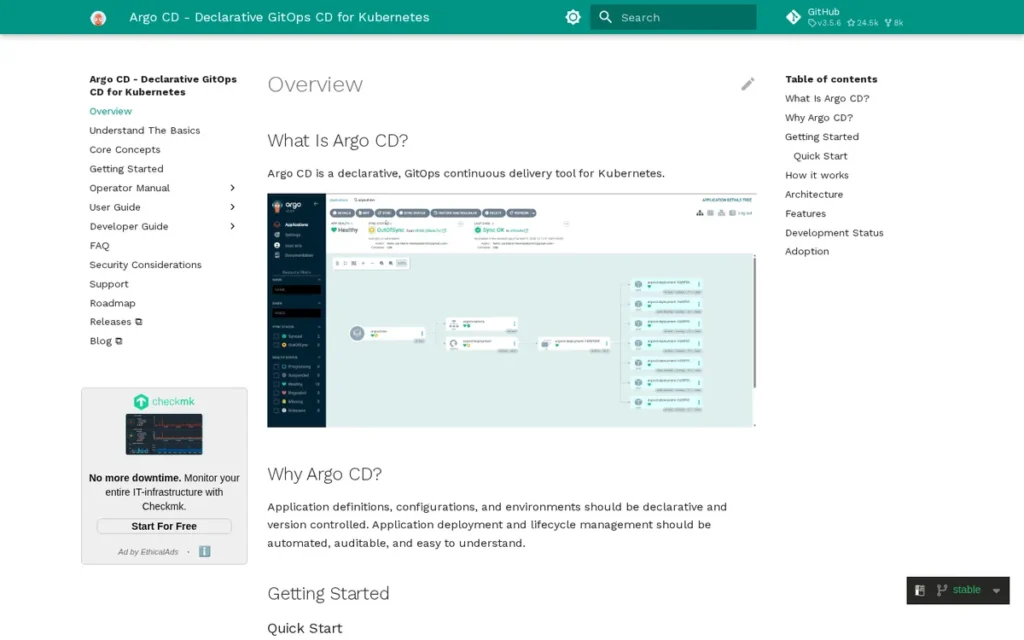
Category: GitOps Controller, a pull-based, declarative Kubernetes CD tool that continuously reconciles live cluster state against the desired state defined in Git, flags drift as OutOfSync, and applies changes automatically or on approval.
At a Glance
- Category: GitOps Controller
- Best For: DevOps and platform engineering teams running Kubernetes-native infrastructure who need declarative multi-cluster GitOps delivery, fleet management at scale, and zero licensing cost
- Price Range: Free (Apache 2.0 open source); managed tiers via Akuity Platform, AWS EKS capability for Argo CD, and Red Hat OpenShift GitOps (pricing on request from each vendor)
- Primary Strength: Argo CD is the community-consensus Kubernetes GitOps delivery tool, with CNCF graduation on December 6, 2022 and the highest practitioner endorsement of any tool identified in this evaluation’s r/devops and r/kubernetes research as of August 2024
- Biggest Limitation: Argo CD is exclusively Kubernetes-native and provides no deployment support for VM-based, bare-metal, Windows Server, or serverless workloads, making it insufficient as a standalone ARO tool for organizations with hybrid infrastructure
- One-Line Summary: Argo CD is a CNCF-graduated, open-source GitOps controller that is the de facto community standard for Kubernetes-native continuous delivery in 2026, with production adoption spanning air-gapped edge clusters, multi-cloud environments, and large-scale managed fleet deployments.
- Last Verified: June 2026
Overview
Argo CD is a CNCF-graduated, open-source GitOps continuous delivery tool for Kubernetes that treats Git as the single source of truth for application state, enabling platform teams to manage declarative multi-cluster deployments with automated drift detection, fleet management via ApplicationSets, and zero licensing cost.
Argo CD is part of the broader Argo Project (alongside Argo Workflows, Argo Events, and Argo Rollouts) and is commercially supported through Akuity Platform, AWS EKS managed distribution, and Red Hat OpenShift GitOps for organizations that cannot absorb self-hosting overhead.
Argo CD’s pull-based model works in reverse from push-based deployment tools: Argo CD runs inside the cluster, pulls desired state from Git, and never requires an external system to reach inward through a firewall, making it production-validated for air-gapped customer-hosted Kubernetes environments where inbound network access to clusters is prohibited.
Key Features
- Continuous Drift Detection: Argo CD compares live Kubernetes cluster state against desired state defined in Git (including Kubernetes YAML, Helm charts, Kustomize overlays, and Jsonnet) flags any divergence as OutOfSync, and supports both automatic reconciliation and manual approval workflows before changes are applied.
- ApplicationSet Controller: Argo CD’s ApplicationSet controller enables templated fleet management across hundreds or thousands of Kubernetes clusters using parameterized generators, eliminating per-cluster application configuration overhead and making Argo CD viable for organizations managing large-scale Kubernetes deployments and Internal Developer Platforms.
- Application-Centric Web UI: Argo CD provides a web UI with health status visualization, resource diffs, sync history, and event logs that give developers and operators visibility into cluster state without requiring direct kubectl access, consistently cited by practitioners as a key retention factor (r/kubernetes, u/gaelfr38, 2024).
- Pull-Based Networking Model: Argo CD’s pull-based deployment model manages Kubernetes clusters without requiring inbound network access to those clusters, making Argo CD production-validated for air-gapped environments, on-premise customer-hosted deployments, and edge Kubernetes clusters in restrictive network environments.
- Enterprise SSO Integration: Argo CD supports SSO with OIDC, OAuth2, LDAP, SAML 2.0, GitHub, GitLab, Microsoft, and LinkedIn, enabling enterprise identity management without additional middleware and providing the RBAC foundation for multi-team cluster access governance.
Best For
Argo CD is best for DevOps and platform engineering teams whose infrastructure is entirely or predominantly Kubernetes-based, including teams managing air-gapped customer-hosted clusters in regulated environments, platform engineers building Internal Developer Platforms on Kubernetes, and organizations seeking the strongest community ecosystem and evidence base for their GitOps delivery layer.
Pricing
Argo CD is fully open source under Apache 2.0, zero licensing cost for self-hosted deployments. Organizations needing managed operations or enterprise support should evaluate three distinct commercial paths:
- Akuity Platform: founded by the original Argo CD creators (pricing on request)
- AWS EKS capability for Argo CD: for AWS-native teams (pricing on request)
- Red Hat OpenShift GitOps: for RHEL/OpenShift organizations (pricing on request)
Self-hosting Argo CD carries ongoing engineering overhead that makes the “free” license more expensive in practice than the licensing figure alone suggests:
- Upgrade execution and version compatibility management
- RBAC configuration and multi-team access governance
- Secrets management integration (External Secrets Operator, HashiCorp Vault, or SOPS)
- Controller scaling and OOM prevention in large-cluster environments
Teams should model this operational overhead against managed commercial alternatives before assuming self-hosting is the lower-cost path. Pricing status verified June 2026.
Strengths
- Argo CD graduated from the CNCF on December 6, 2022, placing it in the same maturity tier as Kubernetes, Prometheus, and Envoy, the highest open-source project quality, governance, and community health signal available, evaluated by CNCF’s technical oversight committee against adoption, security, and governance thresholds (CNCF, December 6, 2022).
- Argo CD received the highest-upvoted practitioner recommendation identified in this evaluation’s r/devops research, “GitLab for SCM and CI then ArgoCD for CD” earned 60 upvotes in a major August 2024 CD comparison thread, more than any other tool recommendation in that thread, reflecting genuine peer validation rather than vendor marketing (r/devops, u/ncuxez, August 2024).
- A practitioner managing dozens of on-premise edge clusters for a medical device company described Argo CD as the tool for which they “haven’t ever found anything comparable,” citing its pull-based model as essential for deploying to customer infrastructure without inbound network access, a production-validated use case at meaningful scale in a regulated environment (r/devops, u/pysouth, August 2024).
- Argo CD’s commercial ecosystem includes three independent enterprise paths: Akuity Platform (original creators), AWS EKS managed distribution, and Red Hat OpenShift GitOps, providing enterprise-grade support without mandatory lock-in to a single commercial provider, a breadth of backing that no other open-source tool in this evaluation matches (AWS EKS blog, 2024).
Limitations
- Kubernetes Exclusivity: Argo CD’s most consequential trade-off is its Kubernetes exclusivity, Argo CD provides no deployment capability for VM-based, bare-metal, Windows Server, or serverless workloads, meaning organizations with hybrid infrastructure must operate a second deployment tool alongside Argo CD for non-Kubernetes targets, increasing total toolchain complexity.
- Helm Compatibility Gaps: Argo CD renders Helm charts without executing them via the Helm binary, which alters behavior for teams relying on helm diff, helm test, or Helm hook execution, a practical limitation for teams that depend on Helm CLI introspection capabilities (r/kubernetes, 2024).
Users on r/kubernetes confirmed this friction directly:
“We use Argo but only because it was the first thing we tried. At some point I’d like to eval flux. My biggest gripes with Argo are that it does not use helm to deploy charts, only renders them into a template and that some of the configuration is a bit rough. On the plus side it works well and the UI and functionality is great.” Posted by u/ns407
Takeaway: Argo CD’s Helm non-native rendering is a confirmed friction point for teams reliant on the Helm CLI, even among engineers who remain net-positive on the platform overall.
- Secrets Management Dependency: Argo CD depends on external systems: External Secrets Operator, HashiCorp Vault, or SOPS, for secrets management, adding integration and operational scope that Argo CD itself does not address natively, a hidden complexity that grows as the number of clusters under management scales.
- Self-Hosted Operational Burden: Argo CD’s self-hosted model carries ongoing engineering overhead for upgrades, RBAC configuration, and controller scaling (including potential OOM risk in very large-scale Crossplane-based environments) making the zero-license cost more expensive in engineering time than the licensing figure alone suggests.
Verdict
Argo CD is the community-validated, CNCF-graduated standard for Kubernetes-native continuous delivery and earns the #1 ranking in this evaluation based on the strongest combination of practitioner endorsement, ecosystem maturity, pricing transparency, and production evidence of any tool reviewed.
For organizations whose infrastructure is entirely or predominantly Kubernetes-based, Argo CD delivers the best evidence-to-cost ratio in this category, particularly when managed via Akuity, AWS EKS, or Red Hat OpenShift GitOps for teams that cannot absorb self-hosting overhead. Teams with hybrid VM-plus-Kubernetes infrastructure should evaluate Octopus Deploy or Harness as the primary orchestration layer.
2. Harness: Best for AI-Native Enterprise Delivery at Scale
Category: AI-Native Delivery Platform, a full-lifecycle software delivery suite combining CI, CD, release orchestration, feature management, cloud cost management, security testing orchestration, and chaos engineering in a single AI-assisted platform with a dedicated coordination layer for non-technical release managers.
At a Glance
- Category: AI-Native Delivery Platform
- Best For: Enterprise DevOps teams managing 50 or more microservices in Kubernetes environments needing AI-assisted deployment verification, OPA policy enforcement, and structured multi-team release coordination
- Price Range: Per-deployment, module-based pricing; specific dollar amounts not publicly listed; custom enterprise quote required via Harness sales
- Primary Strength: Harness provides the broadest AI-assisted release orchestration feature set among the seven tools in this evaluation, combining ML Continuous Verification, automated failure analysis, OPA policy enforcement, and a dedicated Release Orchestration module with Process templates and cross-team release calendaring
- Biggest Limitation: Harness’s per-deployment pricing model compounds costs significantly for high-frequency, high-service-count environments, and the platform UI is described by certified practitioners as heavy for teams migrating from simpler CI tools
- One-Line Summary: Harness is an AI-native software delivery platform that earns its cost for enterprise teams requiring serious Kubernetes CD at scale, OPA governance, and AI-assisted deployment verification, but is overkill for smaller teams or simple deployment pipelines.
- Last Verified: June 2026
Overview
Harness is an AI-native software delivery platform for enterprise DevOps teams that combines CI, CD, feature management, cloud cost management, security testing orchestration, and a dedicated Release Orchestration module into a unified suite, best justified for organizations managing 50 or more microservices across multi-environment Kubernetes deployments with governance and compliance requirements.
Harness’s Release Orchestration module is architecturally distinct from its CD module, it is a process management layer above deployment pipelines that enables release managers to model, schedule, and govern complex multi-team releases through reusable Process templates, Phase structures, and a cross-team Release Calendar, directly addressing the spreadsheet-driven coordination pain point (Harness developer docs, 2025).
Key Features
- Dedicated Release Orchestration Module: Harness’s Release Orchestration module enables release managers to create reusable Process templates composed of Phases and Activities, model multi-team release workflows with assigned owners, and coordinate deployment schedules through a cross-team Release Calendar, providing a structured coordination layer accessible to non-technical release managers above CI/CD pipeline execution.
- ML-Based Continuous Verification: Harness AI monitors application performance and functionality before and after each deployment, classifying results against configurable thresholds and triggering automated rollback when performance degrades, directly addressing the pain point of reactive and manual rollback processes.
- OPA Policy Enforcement: Harness supports Open Policy Agent enforcement across pipeline governance, enabling platform teams to define organizational policies (mandatory approval gates, required security scans, environment promotion rules) that are automatically enforced across all pipelines without per-team configuration.
- Golden Template Pattern: Harness’s reusable standardized pipeline templates enable consistent delivery workflows across teams, with a certified practitioner reporting this pattern reduced new environment onboarding from a week to a day at scale deployments with 1,000+ pipelines under management (r/devops, u/Informal_Wishbone_18, 2024).
- Full SDLC Consolidation: Harness consolidates CI, CD, Feature Management and Experimentation, Cloud Cost Management, Infrastructure as Code Management, Security Testing Orchestration, and Chaos Engineering into a single platform, enabling organizations to reduce vendor sprawl across the software delivery lifecycle through a single commercial relationship.
Best For
Harness is best for enterprise DevOps teams operating at scale, specifically organizations managing 50 or more microservices in Kubernetes environments where AI-assisted deployment verification, OPA-driven policy enforcement, automated failure analysis, and structured multi-team release coordination justify the platform’s per-deployment pricing and learning curve trade-offs.
Pricing
Harness pricing is per-deployment and module-based; specific dollar amounts are not publicly listed and require direct sales engagement. A certified practitioner described the pricing as “predictable once deployment volume is known” but noted it “can add up” for high-frequency, many-service environments (r/devops, u/Informal_Wishbone_18, 2024).
Teams should model deployment frequency and microservice count carefully before committing. The modular buying structure means individual modules, CI, CD, Feature Flags, Cloud Cost, Security Testing Orchestration, are licensed separately; clarifying which modules are needed before the sales process presents them as a bundle is essential. Pricing status verified June 2026, contact Harness sales for current rates.
Strengths
- A certified 10x Harness practitioner documented migrating 1,000+ enterprise pipelines from Jenkins and GitHub Actions and reducing new environment onboarding from a week to a day using Harness’s Golden Template pattern, a practitioner-attributed outcome verified via r/devops rather than a vendor case study; this is the strongest available independent performance evidence for Harness, as no independently verified named enterprise case studies with source URLs were surfaced during research (r/devops, u/Informal_Wishbone_18, 2024).
- The same certified practitioner reported running Harness for 50+ microservices with “no scaling issues” and “no complaints” on reliability, validating Harness’s architecture in high-service-count Kubernetes environments at mid-enterprise scale, a key concern for evaluators managing large application portfolios (r/devops, u/Informal_Wishbone_18, 2024).
- Harness’s dedicated Release Orchestration module: launched with Process templates, Phase structures, Activity assignments, and a Release Calendar, directly addresses the spreadsheet-driven release coordination pain point by providing a structured management layer for non-technical release managers above existing CI/CD pipelines (Harness developer docs, 2025).
- Harness is one of two tools in this evaluation with documented AI integration: AIDA enables natural-language-to-YAML pipeline generation and automated failure analysis, with the platform’s 2025 announcements confirming ongoing AI investment across deployment script auto-generation and ML-based verification (Harness Blog, Unscripted 2025 announcements).
Limitations
- Cost Scaling at High Deployment Volume: Harness’s most consequential trade-off is per-deployment pricing at scale, for organizations with high deployment frequency and many microservices, costs compound rapidly and require careful pre-commitment modeling that is not possible without Harness’s currently unpublished published rates.
- Platform Weight for Migrating Teams: Harness’s UI has been described by a certified practitioner as “a lot” and “heavy” for teams migrating from simpler tools like CircleCI or GitHub Actions, imposing a steep learning curve that can delay time-to-value for engineers not operating at the scale Harness is built for (r/devops, u/Informal_Wishbone_18, 2024).
- Community Self-Help Gap: Harness’s community self-help resources are significantly less available than for open-source alternatives, the r/harnesscommunity subreddit was described by a real evaluator as “a ghost town,” meaning teams relying on peer forums for onboarding and troubleshooting will find far fewer resources than for Argo CD (r/devops, u/OrdinaryTown3266, 2024).
- Sales Process Friction: Harness’s pre-sales process was characterized by a prospective buyer as “very sell-y,” with a pre-sales engineer whose answers “fell apart when we asked for targeted questions”, a signal of evaluation friction that can complicate technical due diligence for teams with specific, non-standard requirements (r/devops, u/OrdinaryTown3266, 2024).
Verdict
Harness is the most comprehensively featured AI-native delivery platform in this ARO evaluation and earns its #2 ranking for enterprise teams that need serious Kubernetes CD at scale, OPA-governed policy enforcement, and a structured release coordination layer above their pipelines.
Harness’s cost, UI weight, and sales-led buying process make it a poor fit for smaller teams or organizations seeking lightweight deployment automation, for these buyers, Argo CD with an Akuity-managed control plane delivers greater value at lower total cost. The strongest specific case for Harness is the combination of its dedicated Release Orchestration module and ML Continuous Verification: two capabilities that distinguish it from both GitOps controllers and deployment orchestration tools and directly address spreadsheet-driven coordination and reactive manual rollback.
3. Octopus Deploy: Best for Hybrid Infrastructure and Multi-Tenancy Deployment Orchestration
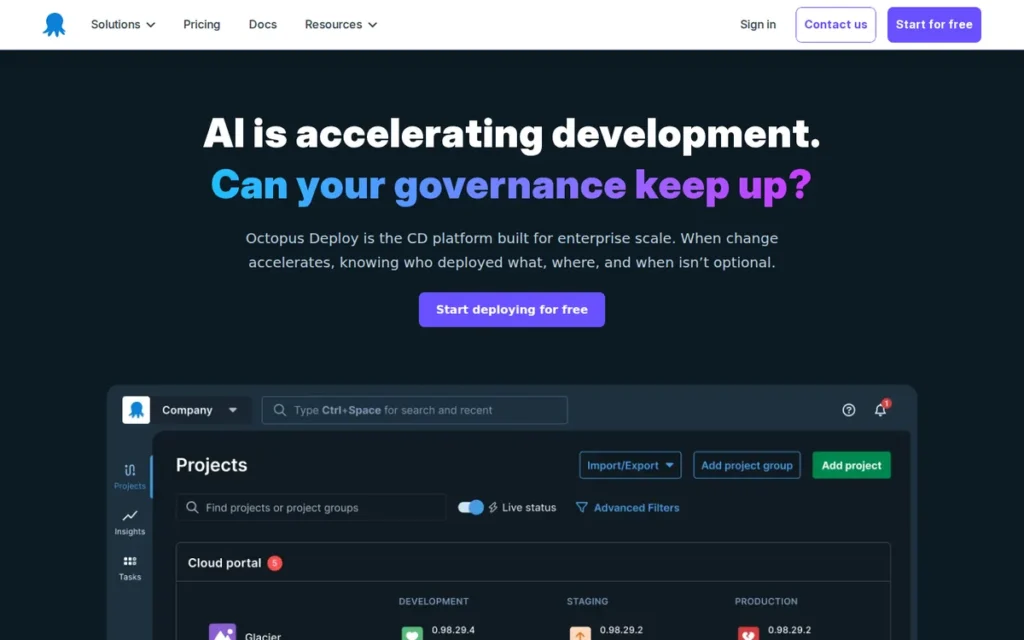
Category: Deployment Orchestration Platform, a purpose-built release orchestration and deployment automation tool that separates CD from CI, manages environment-based promotion through defined lifecycle stages, provides first-class multi-tenancy for SaaS vendors and MSPs, and covers both Kubernetes and legacy VM/Windows infrastructure in a single platform.
At a Glance
- Category: Deployment Orchestration Platform
- Best For: SaaS vendors, managed service providers, and mid-to-large enterprises running hybrid infrastructure (Kubernetes alongside Windows Server or Linux VMs) needing structured environment promotion and first-class per-customer multi-tenancy
- Price Range: Project-based tiered pricing; specific dollar amounts not publicly listed; CRITICAL, 2024 pricing model change reported to cause up to 10x cost increases for some usage profiles; model your specific project count and deployment frequency before committing
- Primary Strength: Octopus Deploy is the only tool in this evaluation that treats multi-tenancy as a first-class architectural concept, enabling SaaS vendors and MSPs to manage one deployment project across many isolated customer configurations with tenant-specific variables, environment mappings, and batched rollout controls
- Biggest Limitation: Octopus Deploy’s 2024 pricing model change generated significant community backlash, with at least one customer reporting a 10x cost increase triggering active evaluation of alternatives, and the platform is not GitOps-native without additional configuration
- One-Line Summary: Octopus Deploy is a purpose-built deployment orchestration platform with first-class multi-tenancy and the broadest hybrid infrastructure support in this evaluation, mandatory cost modeling under the 2024 pricing structure is required before committing.
- Last Verified: June 2026
Overview
Octopus Deploy is a purpose-built deployment orchestration and release automation platform for teams managing software delivery across hybrid infrastructure (including Windows Server, Linux, Docker, Kubernetes, and major cloud providers) with first-class multi-tenancy designed for SaaS vendors, managed service providers, and organizations delivering software to multiple isolated customer environments.
Octopus Deploy explicitly separates CD from CI, integrating with existing build tools (Azure DevOps, Jenkins, GitHub Actions, TeamCity) as upstream systems while owning the release lifecycle from packaging through structured environment promotion to production. This design prevents the common anti-pattern of misusing CI pipelines as deployment orchestration tools (CloudFoundation, 2024).
Key Features
- First-Class Multi-Tenancy Model: Octopus Deploy’s multi-tenancy treats each tenant as a first-class architectural object with isolated variables, environment mappings, and tenant tags, enabling SaaS vendors and franchise organizations to deploy the same application to hundreds of customer-specific instances without duplicating deployment projects (Octopus Deploy multi-tenancy RFC, 2024).
- Broadest Deployment Target Support: Octopus Deploy supports deployment targets across Windows Server, Linux distributions, Docker containers, Kubernetes clusters, AWS, Azure, and Google Cloud, providing unified deployment orchestration for organizations with hybrid infrastructure that Kubernetes-native tools cannot address without a second deployment system (InvGate IT Product Database, 2024).
- Environment-Based Promotion Model: Octopus Deploy enforces a defined lifecycle (for example, Dev → Staging → Production) with the same deployment process artifact across all stages, reducing environment-specific configuration drift and eliminating the failure mode of deployments that succeed in staging but fail in production due to environment inconsistency.
- Runbooks Capability: Octopus Deploy’s Runbooks extend the platform beyond software releases to Day-2 operational tasks (including infrastructure provisioning, database maintenance, failover procedures, and site restoration) all executable from the same platform context and governed by the same RBAC and audit trail infrastructure (Octopus Deploy Blog, 2024).
- CI System Integration: Octopus Deploy integrates with Azure DevOps, TeamCity, Jenkins, and GitHub Actions as upstream CI systems, preserving existing CI investments while adding deployment orchestration, approval gates, audit trails, and structured environment promotion that CI-native configurations cannot provide.
Best For
Octopus Deploy is best for SaaS vendors, managed service providers, and mid-to-large enterprises with hybrid infrastructure (specifically those combining Kubernetes with Windows Server or Linux VMs) that need structured environment promotion, first-class per-customer multi-tenancy, and a release manager-accessible UI without requiring full commitment to a GitOps-only delivery model.
Pricing
Octopus Deploy pricing is project-based and tiered; enterprise tiers are described as “best for over 100 projects.” Specific dollar amounts per tier are not publicly listed (Octopus Deploy pricing overview, 2024).
CRITICAL BUYER ADVISORY, 2024 Pricing Model Change:
“We got screwed over by Octopus Deploy by changing their pricing model and now we would have to pay 10x the amount of last year.” (u/CuriousWin, r/devops, August 2024)
Takeaway: A 12-year Octopus Deploy user in the same thread reported only a 10–15% cost increase under the new model, confirming that cost impact is highly usage-profile-dependent and cannot be assumed from historical pricing (r/devops, u/No-Leather6291, August 2024; corroborated by G2 reviews describing the new pricing as “extreme” and “restrictive,” 2024; TrustRadius pricing reviews, 2024). Obtain a binding quote from Octopus Deploy sales based on your specific project count, tenant count, and deployment frequency under the current pricing structure. Pricing status verified June 2026.
Strengths
- Aggregated case study outcomes across multiple enterprise customer implementations (individual client names not disclosed in source material) include a 2,000% increase in deployment frequency, processing of 75,000+ deployments per month, up to 60% reduction in deployment time, and downtime reduced from 1 hour to 9.5 minutes, reported in the InvGate IT Product Database, 2024.
- Octopus Deploy’s multi-tenancy architecture is the most mature purpose-built multi-tenancy model in this evaluation, confirmed by practitioners as providing “good UX for non-technical release managers that I haven’t seen in a lot of other platforms” and documented through the company’s own multi-tenancy RFC (r/devops, u/onbiver9871, August 2024; Octopus Deploy multi-tenancy RFC).
This assessment is echoed by enterprise operators on r/devops:
“I dont think other tools do the job of release management like Octopus Deploy. If im wrong,please tell me what other tools are capable of releasing apps in many tenants (vms,k8s,azure,databases,etc),execute variable susbtitution based on environments,easy ui for non IT teams,deploy inmutable packages to all environments,etc. I will be happy to know,because i love the tool but i hate the costs. If you want to save costs,you can reduce number if projects or deployment targets.” Posted by u/Ancient_Canary1148
Takeaway: Long-term Octopus Deploy operators recognize its multi-tenancy capability as genuinely without peer, while identifying its cost structure as the primary barrier to continued adoption at scale.
- Octopus Deploy has earned documented 12-year practitioner loyalty: at least one r/devops community member cited 12 years of active use and continued product satisfaction even while acknowledging the 2024 pricing model change (r/devops, u/No-Leather6291, August 2024), reflecting genuine long-term retention among its core deployment orchestration use case.
- Octopus Deploy’s Runbooks capability extends platform value beyond release events to Day-2 operations (covering infrastructure provisioning, database maintenance, failover, and site restoration) making Octopus Deploy a more comprehensive operational investment than a pure deployment automation tool (Octopus Deploy Blog, 2024).
Limitations
- Pricing Model Uncertainty: Octopus Deploy’s most consequential trade-off is the 2024 pricing model change, which produced usage-profile-dependent cost impacts ranging from 10–15% for some long-term users to a reported 10x increase for others, historical pricing does not predict current cost impact, and explicit modeling with Octopus Deploy sales is required before committing (r/devops, August 2024; G2, 2024; TrustRadius, 2024).
Users on r/devops described the on-the-ground cost impact:
“it works. We’re on an ancient version due to licensing costs which have balooned, we’re trying to retire it and containerize everything onto k8s to get away from VMs & azure app services.” Posted by u/InvincibearREAL
Takeaway: Escalating licensing costs are actively driving established Octopus Deploy users toward Kubernetes-native migrations rather than upgrading or renewing under the current pricing model.
- Not GitOps-Native: Octopus Deploy is not GitOps-native and requires additional configuration and tooling to integrate with declarative GitOps workflows, creating friction for platform engineering teams standardizing on code-driven delivery where the desired state in Git is the authoritative trigger for deployments.
- GitOps Integration Friction for Platform Engineers: Octopus Deploy’s documentation and tutorial ecosystem, while substantial, has not kept pace with the developer-community activity surrounding GitOps-native tools, practitioners note that platform engineers accustomed to Kubernetes-native tooling report needing to “jump through some hoops” to integrate GitOps workflows with Octopus Deploy (r/devops, u/onbiver9871, August 2024).
- No AI-Assisted Deployment Verification Confirmed: Octopus Deploy has no AI-native features confirmed in research as of June 2026, placing it behind Harness (ML Continuous Verification) and Digital.ai Release (documented LLM integration) on AI-assisted deployment intelligence, a dimension that may widen as competitors continue AI investment.
Verdict
Octopus Deploy is the strongest ARO tool in this evaluation for organizations with hybrid infrastructure (specifically those combining Kubernetes with Windows Server or Linux VMs) and the only tool that treats per-customer multi-tenancy as a first-class architectural concept rather than a configuration workaround.
Octopus Deploy’s #3 ranking reflects genuine deployment target breadth superiority and practitioner-validated multi-tenancy depth, offset by a 2024 pricing model change that buyers must independently model before committing. For Kubernetes-only teams, Argo CD is the stronger choice at lower cost; for enterprise teams needing AI-native governance at scale, Harness offers more governance depth; for SaaS vendors, MSPs, and organizations with legacy infrastructure alongside Kubernetes, Octopus Deploy remains the most purpose-built solution in this evaluation.
4. Digital.ai Release: Best for Enterprise Release Governance and Regulated Industry Compliance
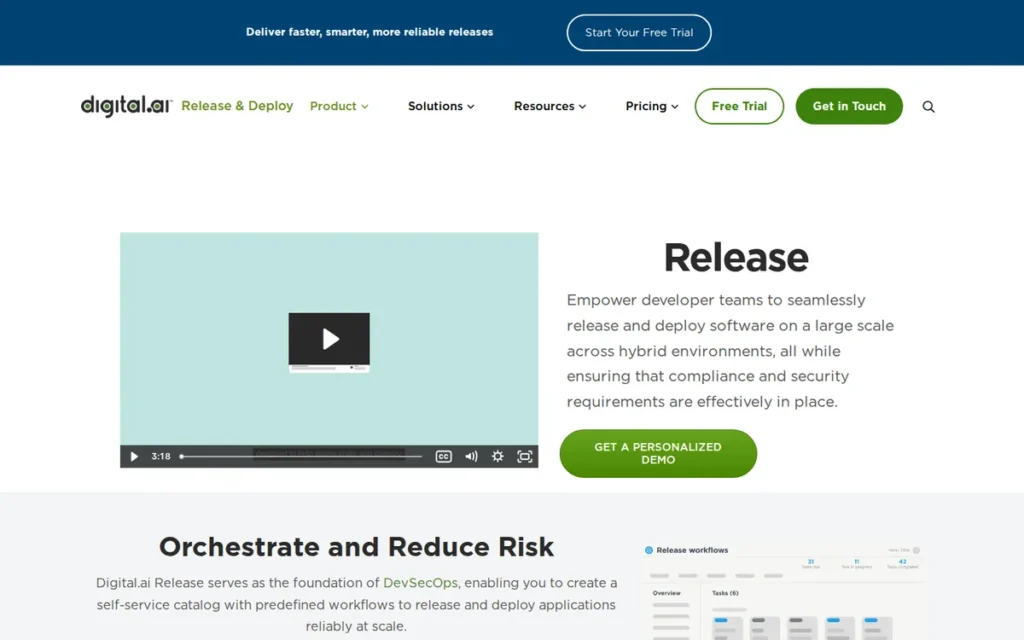
Category: Enterprise Release Governance Platform, a cloud or self-managed coordination layer that models, automates, tracks, and governs complex multi-team software releases through structured workflow templates, approval gates, and one-click compliance audit reporting; designed to sit above deployment automation tools, not replace them.
At a Glance
- Category: Enterprise Release Governance Platform
- Best For: Enterprise IT teams in regulated industries: financial services, healthcare, government, requiring structured multi-team release governance, one-click compliance audit reports, and AI-assisted pipeline orchestration across many teams and toolchains
- Price Range: Not publicly disclosed; three editions (Essential, Pro, Premium); enterprise quote-based via Digital.ai sales; free SaaS trial available
- Primary Strength: Digital.ai Release is the only tool in this evaluation with purpose-built one-click compliance audit report generation and a three-edition template governance model, capabilities absent from all GitOps-native tools reviewed
- Biggest Limitation: Digital.ai Release is a governance and coordination layer, not a deployment automation tool, organizations must also operate a separate deployment tool and integrate the two, adding toolchain complexity and requiring dual-vendor budget justification
- One-Line Summary: Digital.ai Release is an enterprise release governance platform (formerly XL Release by XebiaLabs) best suited for large regulated organizations needing structured multi-team release coordination, one-click compliance audit reporting, and LLM-enabled orchestration steps alongside their existing deployment automation tools.
- Last Verified: June 2026
Overview
Digital.ai Release is an enterprise release governance and orchestration platform for large regulated organizations that models, automates, tracks, and governs complex multi-team software releases through structured workflow templates, approval gates, and one-click compliance audit reporting, operating as a coordination layer above deployment automation tools rather than providing deployment automation itself.
Digital.ai Release was formerly XL Release, developed by XebiaLabs before that company merged with Arxan Technologies and CollabNet VersionOne to form Digital.ai. Product documentation still references XL Release lineage, reflecting the platform’s decade-long enterprise heritage while the rebrand continues (Digital.ai Release docs, 2024).
Key Features
- Structured Release Workflow Hierarchy: Digital.ai Release models releases through a hierarchy of Releases, Phases, Tasks, Owners, and Templates, giving enterprise release managers a governance framework for coordinating multi-team deployments across many integrated systems without relying on spreadsheets or ad-hoc email chains.
- One-Click Compliance Audit Reports: Digital.ai Release generates one-click compliance audit reports providing complete documentation of what was released, when, who approved each stage, and what the outcome was, a purpose-built capability for regulated industries with mandatory change management evidence requirements not natively available in GitOps-native tools.
- Unlimited Workflow Templates at Pro/Premium: Digital.ai Release’s Pro and Premium editions provide unlimited workflow templates, enabling large organizations with many teams and release types to standardize and reuse approved release process patterns without hitting the Essential tier’s 100-template cap (Digital.ai feature matrix, 2024).
- Documented LLM Pipeline Integration: Digital.ai Release’s Integrations portal documents LLM pipeline integration capabilities as of 2026, including patterns for release workflow steps to interact with OpenAI and Gemini models via MCP tool calls, buyers should confirm current feature availability and general availability status directly with Digital.ai, as independent verification of this as a fully shipped product feature was not completed at the time of this review (Digital.ai Integrations portal, 2026).
- Red Hat Ecosystem Certified: Digital.ai Release is listed in the Red Hat Ecosystem Catalog as a certified container image for Red Hat OpenShift, available in cloud SaaS and self-managed editions with customizable dashboards and built-in compliance transparency features (Red Hat Ecosystem Catalog, 2024).
Best For
Digital.ai Release is best for enterprise IT teams at large regulated organizations (financial services, healthcare, government contractors) with dedicated release management functions, multi-team delivery coordination requirements, mandatory change management evidence, and existing deployment toolchains that need a governance layer above them rather than a replacement for them.
Pricing
Digital.ai Release pricing is not publicly disclosed. Three editions exist (Essential (100-template cap), Pro (unlimited templates), and Premium (unlimited templates plus additional capabilities)) with key feature differences documented in the Digital.ai Release feature matrix. A free SaaS trial is available.
Teams should prepare specific volume requirements, number of teams, template count, integration count, and compliance report frequency, before a sales call to obtain accurate edition guidance and cost comparison. Pricing status verified June 2026, contact Digital.ai sales for current rates.
Strengths
- Digital.ai Release’s Integrations portal documents LLM pipeline integration capabilities as of 2026, enabling release workflow steps to interact with OpenAI and Gemini models, placing Digital.ai Release alongside Harness as one of two tools in this evaluation with documented AI-assisted pipeline orchestration; buyers should confirm current general availability directly with Digital.ai, as independent verification of this as a fully shipped product feature was not completed at the time of this review (Digital.ai Integrations portal, 2026).
- Digital.ai Release is listed in the Red Hat Ecosystem Catalog as a certified container image for Red Hat OpenShift, confirming the platform meets Red Hat’s enterprise certification standards and that its customers include organizations standardized on RHEL and OpenShift infrastructure, a meaningful proxy for enterprise adoption depth (Red Hat Ecosystem Catalog, 2024).
- Digital.ai Release’s one-click audit report capability and built-in compliance transparency features address regulated industry requirements that GitOps-native tools like Argo CD cannot meet without external tooling, providing a purpose-built compliance evidence path specifically absent from developer-community-oriented ARO tools.
- Digital.ai Release’s structural origin as XL Release (XebiaLabs) gives it a decade-plus heritage in enterprise phase-gate release management, with its architecture designed from the ground up for structured multi-team release coordination rather than added as a secondary capability after establishing a CI or CD foundation.
Limitations
- Coordination Layer Only: Dual-Tool Requirement: Digital.ai Release’s most consequential trade-off is its role as a coordination layer rather than a deployment tool, organizations that adopt Digital.ai Release must also operate and integrate a separate deployment automation platform to actually deploy software, meaning total toolchain investment includes Digital.ai Release licensing plus a deployment tool plus integration engineering between them.
- Pricing Opacity: Digital.ai Release pricing is fully opaque with no public dollar amounts, making pre-sales budget modeling impossible without direct sales engagement, a friction point that is consistent across commercial ARO tools but particularly notable given the dual-tool investment requirement.
- Digital.ai Release has no verified case study metrics with named clients and quantified outcomes available in public sources as of this review, making ROI modeling speculative without direct customer references from Digital.ai sales; note that this is consistent with enterprise NDA norms and does not necessarily indicate an absence of customer outcomes.
- Digital.ai Release’s rebrand from XL Release (XebiaLabs) has created brand fragmentation (product documentation still references XL Release on many pages) which can reduce new buyer confidence and complicate community support discovery; no Reddit community presence was found during research, meaning self-service peer validation is unavailable for teams outside existing Digital.ai customer networks.
Verdict
Digital.ai Release is the strongest purpose-built enterprise release governance platform in this evaluation for regulated organizations that need structured phase-gate coordination, one-click compliance audit reporting, and documented AI-assisted pipeline orchestration, earning its #4 ranking on governance depth that no GitOps-native tool in this evaluation can match out of the box.
Buyers evaluating Digital.ai Release should plan for a dual-tool investment, Digital.ai Release for governance plus a separate deployment tool, and request direct customer references with quantified outcomes before procurement, as no verified case study metrics were available at the time of this review. Digital.ai Release is the right choice for enterprises with dedicated release management offices, mandatory change management evidence requirements, and existing deployment toolchains that need a compliance governance layer above them.
5. FlexDeploy: Best for Oracle-Ecosystem Organizations
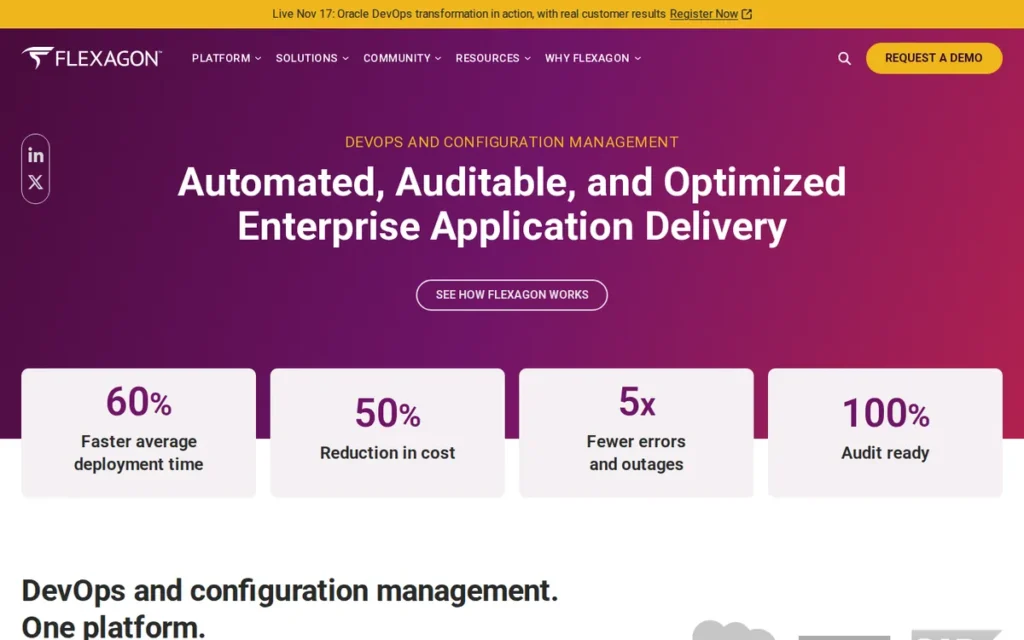
Category: Specialist ARA Platform, an Oracle-ecosystem-focused application release automation and DevOps platform with built-in CI, deployment automation, approval workflows, and native support for Oracle EBS, Fusion Applications, PeopleSoft, SOA/BPEL, Oracle Database, and Oracle Middleware; provides plugin-based extension to non-Oracle targets but is purpose-built and competitively differentiated for Oracle environments.
At a Glance
- Category: Specialist ARA Platform
- Best For: IT platform teams and release managers at organizations running Oracle E-Business Suite, Oracle Fusion Applications, PeopleSoft, or Oracle Middleware needing 25+ EBS object type automation, ADOP patching, Oracle configuration migration, and AI-driven regression test integration via the 2024 Opkey partnership
- Price Range: Not publicly disclosed; listed on Oracle Cloud Marketplace; enterprise quote-based via Flexagon or Oracle partner channels
- Primary Strength: FlexDeploy is the only ARO tool in this evaluation with deep native Oracle technology stack support, with an HNI Corporation case study published via Oracle OCI Blog documenting a 60x reduction in deployment time and 98% reduction in deployment errors, the strongest quantified outcomes of any tool in this review
- Biggest Limitation: FlexDeploy’s value is structurally dependent on Oracle technology investment; organizations without Oracle EBS, Fusion Applications, PeopleSoft, or Oracle Middleware are unlikely to gain meaningful competitive advantage over broader ARO tools with much larger community support ecosystems
- One-Line Summary: FlexDeploy by Flexagon is the only ARO platform purpose-built for Oracle ecosystem deployments, with a verified HNI Corporation case study showing a 60x reduction in deployment time and 98% reduction in deployment errors, no other major ARO tool reviewed in this evaluation provides comparable Oracle-native deployment depth as of 2026.
- Last Verified: June 2026
Overview
FlexDeploy by Flexagon is a specialist application release automation and DevOps platform built for organizations running Oracle technologies (including Oracle E-Business Suite, Oracle Fusion Applications, PeopleSoft, SOA/BPEL, and Oracle Middleware) providing built-in CI, deployment automation, approval workflows, and native support for 25+ Oracle EBS object types in a single platform.
FlexDeploy uses a plugin-based, vendor-independent architecture that extends to non-Oracle technologies including Kubernetes Engine and major cloud providers, but its primary competitive differentiation and practitioner community are overwhelmingly Oracle-focused, making FlexDeploy the clear choice for Oracle-heavy organizations and a less compelling option for mixed or non-Oracle environments (Oracle OCI Blog, 2024).
Key Features
- Native Oracle EBS Automation: FlexDeploy provides native automation support for 25+ Oracle E-Business Suite object types and ADOP patching, enabling teams to deploy EBS customizations and patches through a structured pipeline with approval gates and audit trails, a capability that generic ARO tools cannot replicate without months of custom development (Flexagon EBS solution page, 2024).
- Oracle Fusion Application Configuration Migration: FlexDeploy automates Oracle Fusion Application configuration migration across environments such as Development, Test, and Production, providing a structured pipeline for Oracle ERP, HCM, SCM, and CX configuration objects that eliminates manual configuration transport and the human error it introduces (Flexagon Fusion Apps blog, 2024).
- AI-Driven Test Integration via Opkey Partnership: FlexDeploy’s 2024 strategic partnership with Opkey integrates AI-driven regression test automation directly into the FlexDeploy pipeline, enabling end-to-end deploy-and-test workflows for Oracle SaaS and ERP environments, addressing one of the most labor-intensive steps in Oracle release management (Opkey press release, 2024).
- Complete Deployment Traceability: FlexDeploy provides complete deployment traceability from source control to agile planning, with file-level execution details, code review integration, and failure root-cause analysis, giving release managers audit evidence for every Oracle deployment that meets enterprise change management requirements.
- Plugin-Based Extension: FlexDeploy’s plugin-based, vendor-independent architecture extends beyond Oracle to Kubernetes Engine, cloud provisioning, configuration management, and third-party tool integrations, enabling organizations with mixed Oracle and cloud-native environments to manage both through a single orchestration platform (Oracle OCI Blog, 2024).
Best For
FlexDeploy is best for IT platform teams and release managers at organizations where Oracle E-Business Suite, Oracle Fusion Applications, PeopleSoft, or Oracle Middleware are core to business operations, particularly teams that have been managing Oracle releases manually or through custom scripts and need structured automation with built-in approval workflows, audit trails, and post-deployment AI-driven regression testing.
Pricing
FlexDeploy pricing is not publicly disclosed. FlexDeploy is available on the Oracle Cloud Marketplace as a listing (marketplace listing status, not the product license cost). Actual commercial pricing is enterprise quote-based and must be obtained through direct Flexagon sales or Oracle partner channels.
Teams evaluating FlexDeploy should request a scoped proof-of-concept against their specific Oracle environment before committing to licensing, hands-on validation against your EBS or Fusion environment is the most reliable evaluation method. Pricing status verified June 2026, contact Flexagon or your Oracle partner for current rates.
Strengths
- The HNI Corporation case study, published via Oracle OCI Blog with a named publicly traded enterprise customer (a US manufacturer of office furniture and hearth products), documents FlexDeploy reducing deployment time by 60x, reducing deployment-related errors by 98%, and increasing developer productivity by 90%, with additional confirmed metrics including a 50% reduction in development costs, 50% improvement in project delivery time, individual deployment tasks reduced from a full working day to 15 minutes, and deployment events shortened from six hours to under one hour (Oracle OCI Blog, 2024; Flexagon case study, 2024).
- FlexDeploy’s 2024 strategic partnership with Opkey integrates AI-driven regression test automation directly into Oracle release pipelines, addressing one of the most time-intensive and error-prone steps in Oracle EBS and Fusion Application deployments, a capability gap that no other ARO tool in this evaluation fills for Oracle environments (Opkey press release, 2024).
- FlexDeploy is distributed through the Oracle Cloud Marketplace and maintains Oracle partnership recognition, providing Oracle-ecosystem organizations with a procurement path through existing Oracle commercial relationships and assurance that Flexagon meets Oracle’s technology integration standards (Oracle OCI Blog, 2024).
- FlexDeploy’s native Oracle depth: 25+ EBS object types, ADOP patching, Fusion Application configuration migration, Oracle Middleware support, provides automation capability for Oracle releases that would require months of custom development to approximate with generic ARO tools, representing a significant build-versus-buy advantage for Oracle-heavy organizations.
Limitations
- Oracle-Only Competitive Advantage: FlexDeploy’s most consequential trade-off is its structural dependency on Oracle technology investment, the platform’s competitive advantage, community expertise, documentation depth, and practitioner ecosystem are overwhelmingly Oracle-focused, meaning teams without Oracle EBS, Fusion Applications, PeopleSoft, or Oracle Middleware are unlikely to gain meaningful competitive advantage over broadly adopted ARO tools with significantly larger community support ecosystems.
- Limited General DevOps Community Presence: FlexDeploy has no meaningful Reddit or general DevOps community presence, making self-service evaluation and peer validation difficult for teams outside Oracle-specific channels such as OATUG and Oracle Community; the absence of general practitioner discussion is not a product quality signal but does limit independent evidence gathering during evaluation.
- FlexDeploy is backed by Flexagon, a specialist vendor with limited external visibility compared to enterprise-backed alternatives, introducing vendor stability considerations that buyers at large organizations should factor into long-term platform commitments.
- Pricing Opacity: FlexDeploy pricing is fully opaque with no public rates, requiring sales engagement before budget modeling can begin, consistent with the commercial ARO category norm but a friction point for procurement teams requiring pre-engagement budget estimates.
Verdict
FlexDeploy by Flexagon earns its #5 ranking on the strength of the most compelling verified case study in this entire evaluation (a 60x deployment time reduction and 98% error reduction at HNI Corporation) combined with Oracle ecosystem depth that has no meaningful competition among the seven tools reviewed.
FlexDeploy ranks #5 rather than higher because the evaluation’s primary criteria, Community Adoption and Deployment Target Breadth, score lowest for Oracle-specialist tools outside the Oracle ecosystem; in an Oracle-specific ARO evaluation, FlexDeploy would rank first by a significant margin. For organizations running Oracle E-Business Suite, Oracle Fusion Applications, PeopleSoft, or Oracle Middleware, FlexDeploy is not just the best ARO tool in this evaluation, it is the only purpose-built specialist choice.
6. Spinnaker: Legacy Multi-Cloud CD (Not Recommended for New Adoption in 2026)
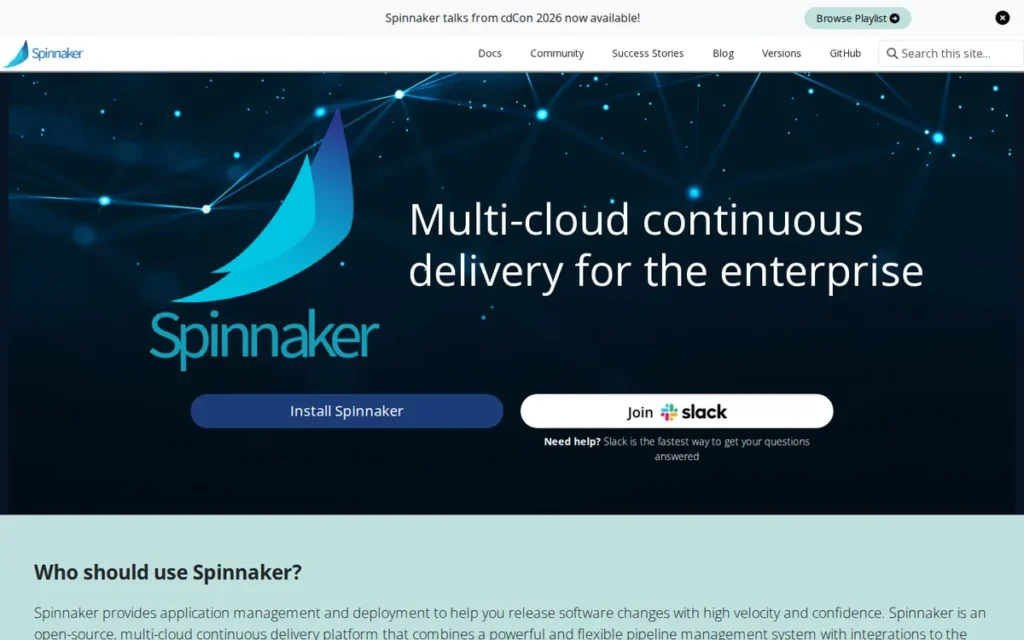
Category: Multi-Cloud CD Platform (Legacy, Declining Community), a stateful, open-source CD platform built for multi-region, multi-cloud deployment orchestration with automated canary analysis via Kayenta; included for existing users and historical context; NOT recommended for new adoption in 2026 based on consistent community evidence of active practitioner migration away from the platform.
At a Glance
- Category: Multi-Cloud CD Platform
- Best For: Organizations already running Spinnaker in production who need migration planning context, or the narrow set of large-scale multi-cloud deployments where Kayenta canary analysis and stateful cloud inventory are required and the team has dedicated engineering capacity to operate a complex multi-service platform
- Price Range: Free (Apache 2.0 open source); Armory commercial distribution pricing and packaging status not publicly verified as of June 2026; operational infrastructure cost is significant given multi-service architecture (Orca, Clouddriver, Gate, Deck, Echo)
- Primary Strength: Spinnaker’s Kayenta automated canary analysis service, co-developed by Google and Netflix, provides production-metrics-driven deployment scoring that classifies canary deployments as success, marginal, or failure using configurable metric weights and live monitoring data
- Biggest Limitation: Spinnaker’s practitioner community is in active decline as of 2026, with r/devops users explicitly advising against new adoptionand r/kubernetes users describing active migration planning away from the platform
- One-Line Summary: Spinnaker is a Netflix-originated, open-source multi-cloud continuous delivery platform with pioneering automated canary analysis capabilities (NOT RECOMMENDED FOR NEW ADOPTION IN 2026) with current users advised to evaluate migration paths to Argo CD, Harness, or Octopus Deploy based on their infrastructure profile.
- Last Verified: June 2026
Overview
Spinnaker is an open-source, multi-cloud, stateful continuous delivery platform developed at Netflix and released publicly in November 2015 (NOT RECOMMENDED FOR NEW ADOPTION IN 2026 based on consistent practitioner community evidence of active migration away from the platform) designed for deployment orchestration across AWS, GCP, Azure, Kubernetes, Google App Engine, OpenStack, Cloud Foundry, and Oracle Cloud Infrastructure with automated canary analysis via Kayenta (Netflix Tech Blog, November 2015).
Spinnaker’s practitioner community has been migrating away from the platform since 2023–2024, with current users describing active migration planning rather than endorsement for new teams, based on consistent independent community evidence reviewed for this evaluation.
Key Features
- Kayenta Automated Canary Analysis: Spinnaker’s Kayenta service, co-developed by Google and Netflix, scores canary deployments against configurable metric weights using live production monitoring data, automatically classifying results as success, marginal, or failure, enabling production-aware rollback decisions without manual assessment of deployment health (Google Cloud, 2018).
- Stateful Cloud Inventory: Spinnaker maintains a stateful cloud inventory: tracking where applications are deployed across multiple cloud providers and regions, enabling multi-region, multi-cloud release coordination that provides an abstraction layer over cloud provider specifics rather than requiring teams to manage provider-specific configurations separately.
- Broadest Cloud Provider Coverage in This Evaluation: Spinnaker supports deployment across AWS EC2, Kubernetes, Google Kubernetes Engine, Google Compute Engine, Google App Engine, Microsoft Azure, OpenStack, Cloud Foundry, and Oracle Cloud Infrastructure, the broadest cloud provider coverage of any tool in this evaluation (Google Cloud Spinnaker 1.0 launch, 2017).
- CDF Governance: Spinnaker is governed by the Continuous Delivery Foundation under an Apache 2.0 license, providing vendor-neutral open-source governance alongside other CDF projects including Jenkins and Tekton.
- Deployment Strategy Breadth: Spinnaker supports canary, blue-green, and rolling deployment strategies across cloud providers with configurable deployment windows, auto-rollback conditions, and multi-stage pipeline modeling through its GUI-based pipeline editor.
Best For
Spinnaker is best for the narrow set of use cases where organizations are already running Spinnaker in production and need context to evaluate migration options, or where genuine Netflix-scale multi-cloud deployment requirements span multiple cloud providers simultaneously with dedicated engineering teams holding Spinnaker expertise. New adoption of Spinnaker in 2026 is not supported by community evidence and is not recommended by this review.
Pricing
Spinnaker is open source under Apache 2.0, zero licensing cost. The operational cost is significant: Spinnaker’s multi-service architecture (Orca, Clouddriver, Gate, Deck, Echo) requires dedicated infrastructure and engineering time that the community consistently describes as exceeding the operational cost of alternatives.
Armory historically provided the primary commercial enterprise distribution. Current Armory 2026 pricing and packaging status was not publicly verified at the time of this review, teams evaluating current Armory status should check docs.armory.io or armory.io directly. Budget substantial engineering overhead beyond any licensing considerations. Pricing status verified June 2026.
Strengths
- Spinnaker’s Kayenta automated canary analysis service: co-developed by Google and Netflix, is the only native production-metrics-driven deployment scoring system in this evaluation; Kayenta integrates with live production monitoring to classify canary deployments as success, marginal, or failure using configurable metric weights, enabling automated rollback decisions grounded in actual production performance rather than synthetic pre-deployment tests (Google Cloud blog, 2018).
- Spinnaker was adopted in production by Netflix (origin company), Salesforce, Waze, Target, and Cloudera at the time of its 1.0 release, with Salesforce publishing a detailed engineering blog documenting phased Spinnaker adoption across services, providing a historical enterprise adoption record that reflects the platform’s capability at Netflix-scale (Salesforce Engineering Blog, verified; Google Cloud 1.0 launch post, 2017).
- Spinnaker’s stateful cloud inventory model enables multi-region, multi-cloud deployment coordination, described by a Netflix engineer in a 2016 Netflix/Spring conference talk as providing “an inventory across all your different regions” and “an abstraction layer of concepts where we don’t have to worry about the specifics of these clouds”, a conceptually unique multi-cloud coordination model among the tools in this evaluation (Netflix/Spring talk, 2016).
- Spinnaker is governed by the Continuous Delivery Foundation under Apache 2.0, providing vendor-neutral open-source governance for organizations that require open-source provenance documentation for procurement compliance or export control requirements.
Limitations
- Community Trajectory: Active Decline: Spinnaker’s most consequential trade-off is its community trajectory, as of 2026, practitioners on r/devops are not recommending Spinnaker for new adoption, with one practitioner explicitly advising “DON’T, Spinnaker s***” in the highest-viewed August 2024 CD comparison thread (r/devops, u/_klubi_, August 2024).
A current Spinnaker operator separately described Spinnaker as dying “for quite some time” with “the writing really on the wall with the Armory acquisition,” while actively planning migration to Argo CD, two independent community signals from separate subreddits within a seven-month window (r/kubernetes, u/acute_elbows, January 2024).
A third independent data point emerged from a concurrent r/kubernetes discussion on GitOps tool selection:
“What do the service teams like/love? My service teams rarely tweak their manifests but frequently deploy new container artifacts. We are currently using spinnaker which works well, but it seems like a dying technology and doesn’t integrate well with K8s” Posted by u/acute_elbows, r/kubernetes, January 2024
Takeaway: Practitioners actively running Spinnaker in production describe it as a dying technology with poor Kubernetes integration, a consistent signal across multiple independent r/kubernetes threads in the same month, not an isolated opinion.
- Operational Complexity: Spinnaker’s multi-service architecture: five or more backend components, imposes operational complexity and infrastructure cost that most mid-market teams cannot justify without Netflix-scale multi-cloud requirements; the “free” license carries significant hidden operational overhead that community members consistently describe as exceeding the overhead of alternatives.
- Network Model Constraints: Spinnaker’s hub-and-spoke networking model can be problematic in air-gapped or customer-hosted environments where Argo CD’s pull-based model works more naturally, limiting Spinnaker’s applicability for organizations deploying to restrictive customer infrastructure.
- Documentation and Community Gaps: Spinnaker’s documentation gaps relative to newer alternatives create a steeper onboarding curve for new team members, and declining community health means fewer third-party tutorials, slower community-sourced troubleshooting, and increasingly difficult hiring for Spinnaker expertise over time.
Verdict
Spinnaker pioneered enterprise-grade multi-cloud continuous delivery and its Kayenta canary analysis system remains technically distinctive, but Spinnaker is not recommended for new adoption in 2026 based on consistent independent practitioner community evidence of active migration away from the platform.
Teams currently running Spinnaker should begin evaluating migration paths now: organizations with purely Kubernetes workloads should evaluate Argo CD as the primary replacement, while those with genuine multi-cloud deployment requirements should evaluate Harness or Octopus Deploy. The migration planning question (not the adoption question) is the correct framing for most organizations encountering Spinnaker in 2026.
7. Plutora (Now Planview Release): Best for Enterprise Value Stream Management and Release Coordination
Category: Value Stream Management Platform, an enterprise release coordination and VSM layer that orchestrates release scheduling, phase/gate governance, environment booking, and delivery analytics above deployment automation tools; provides NO deployment automation and must be used alongside a separate deployment tool. IMPORTANT: Plutora was acquired by Planview in September 2024; the Planview acquisition page refers to the enterprise release product as Planview Release and the test management product as Planview Verify, buyers should confirm current product naming and packaging directly with Planview.
At a Glance
- Category: Value Stream Management Platform
- Best For: Enterprise release management offices and value stream leads at large organizations needing centralized release scheduling, cross-team phase/gate governance, environment management, and executive-level delivery analytics integrated with Tableau or other enterprise BI tools
- Price Range: Not publicly disclosed; now part of Planview’s enterprise portfolio pricing following September 2024 acquisition; custom quote via Planview sales
- Primary Strength: Plutora (referred to on the Planview acquisition page as Planview Release) provides the deepest enterprise release coordination and VSM capability in this evaluation, combining release calendars, phase/gate management, environment booking, dependency tracking, and Tableau-integrated executive reporting in a platform designed for large organizations with dedicated release management functions
- Biggest Limitation: Plutora was acquired by Planview in September 2024: evaluators searching for Plutora as an independent product are now engaging with a Planview portfolio product with different pricing, roadmap governance, and integration dependencies; the platform provides no deployment automation
- One-Line Summary: Plutora, integrated into Planview’s portfolio following the September 2024 acquisition and referred to as Planview Release on the Planview acquisition page, is an enterprise VSM and release coordination platform providing release calendaring, phase/gate governance, and Tableau-integrated executive analytics as a coordination layer above deployment automation tools.
- Last Verified: June 2026
Overview
Plutora, now integrated into Planview’s portfolio following its September 2024 acquisition by Planview, is an enterprise release coordination and value stream management platform for large organizations that combines release calendars, phase/gate governance, environment booking, dependency tracking, and predictive delivery analytics, operating as a management layer above deployment automation tools rather than providing deployment automation itself.
Plutora was founded as an independent Australian software company and acquired by Planview in September 2024. The Planview acquisition page refers to the enterprise release offering as Planview Release and the test management offering as Planview Verify, buyers should confirm current product naming and packaging directly with Planview, as the integration continues (Planview acquisition page, September 2024).
Key Features
Release Calendars and Phase/Gate Management: Plutora (as integrated into Planview’s portfolio) provides release calendars, phase/gate management, and dependency tracking across teams and environments, giving enterprise release management offices centralized visibility into multi-team release schedules without requiring direct access to each team’s deployment tools.
Environment Booking and Management: Plutora includes environment booking and management capabilities, enabling teams to reserve and track environment availability across the delivery lifecycle, addressing the common problem of environment contention and undocumented environment state changes in organizations with shared QA and staging infrastructure.
Predictive AI for Flow Metrics: Plutora’s bi-directional data pipeline aggregates toolchain data from across the delivery ecosystem and applies predictive AI to generate value stream flow metrics, dashboards, and delivery performance insights, enabling executives and delivery leads to assess pipeline health without manual status reporting (BusinessWire, June 2021).
Tableau Integration for Executive BI Reporting: Plutora integrates with Tableau for enterprise BI reporting, connecting software delivery performance data to existing executive reporting infrastructure and enabling delivery metrics to be presented alongside business performance data in standardized dashboards, a capability not natively offered by any other tool in this evaluation.
DORA Metrics Tracking: Plutora provides DORA metrics tracking and delivery analytics, recognized in a practitioner-led r/devops discussion as a standard tool for this purpose alongside Tasktop, confirming practitioner-level awareness of its VSM analytics positioning ([r/devops, u/hackergirl 7890, 2023]).
Release Scheduling and Calendar Management: Plutora provides centralized release calendar management, allowing enterprise teams to coordinate cross-system deployments and reduce scheduling conflicts across parallel release trains. Practitioners on r/devops cite Plutora’s scheduling layer as its primary differentiator from pure CI/CD tools.
Best For
Plutora (referred to on the Planview acquisition page as Planview Release) is best for large enterprises managing multi-system release governance, regulatory audit requirements, and DORA metrics reporting across complex software delivery pipelines.
Pricing
⚠️ CRITICAL ACQUISITION ADVISORY: Planview acquired Plutora in September 2024. Pricing, packaging, and contract terms are subject to change as Planview integrates Plutora into its portfolio. Verify current terms directly with Planview before any procurement decision.
Plutora does not publish pricing. Contracts are negotiated enterprise-to-enterprise. Independent practitioner reports on G2 (2024) describe Plutora as positioned in the upper tier of enterprise VSM pricing, typically requiring multi-year agreements. Budget planning without a vendor quote is not feasible.
Strengths
- VSM Depth: Plutora provides one of the most complete value stream management analytics layers in the ARO category, including DORA metrics tracking and end-to-end delivery flow visualization, verified through G2 reviewer reports (2024).
- Enterprise Governance Coverage: Plutora supports multi-gate release governance with audit trails and compliance reporting, making it one of the few ARO platforms explicitly designed for regulated-industry deployments, per Plutora’s own capability documentation (2024).
- ITSM Integration: Plutora integrates with ServiceNow, Jira, and Jenkins, enabling large enterprises to connect release orchestration with their existing ITSM and incident management workflows without replacing incumbent tooling.
- Practitioner-Validated Use Case: Plutora is referenced alongside Tasktop in practitioner-led Reddit discussions as a recognized VSM analytics platform, confirming real-world practitioner awareness beyond vendor marketing claims ([r/devops, 2023]).
Limitations
- Post-Acquisition Roadmap Uncertainty: Plutora’s acquisition by Planview in September 2024 introduces meaningful uncertainty, buyers cannot verify whether current feature development, pricing structures, or support commitments will continue unchanged, making multi-year commitments higher risk than with independent vendors.
- No Native Continuous Delivery Engine: Plutora is a governance and analytics overlay, not a deployment engine, teams using Plutora must still operate a separate CD tool such as Argo CD or Harness for actual deployment execution, increasing total toolchain complexity.
- Pricing Opacity: Plutora does not publish pricing, and no independent third-party price benchmarks were located during research. Buyers cannot estimate cost without a full sales cycle, which disadvantages budget-stage evaluations.
- Implementation Complexity: Plutora requires significant configuration to map organizational release structures, and G2 reviewers (2024) note that initial setup and onboarding timelines range from weeks to months for large deployments, a real cost that should be factored into TCO calculations.
Verdict
Plutora (referred to on the Planview acquisition page as Planview Release) is the most governance-oriented ARO platform evaluated, suited to enterprises where release audit trails, DORA metrics dashboards, and multi-system scheduling are non-negotiable requirements. Its core limitation is that it functions as a governance layer rather than a deployment engine, requiring a separate CD tool in every production stack. The September 2024 Planview acquisition adds procurement risk that did not exist in prior evaluation cycles, organizations considering Plutora should require written roadmap commitments before signing.
What Red Flags Should I Watch For When Evaluating ARO Tools?
The most dangerous ARO procurement mistakes share a common pattern: buyers evaluate features without evaluating vendor stability, community health, and hidden cost structures. Six red flags consistently emerge across practitioner communities and independent research, each indicating a tool may deliver less value than its marketing suggests.
Red Flag #1: No Public Pricing Combined With No Case Study ROI Data A vendor that neither publishes pricing nor provides verifiable customer ROI case studies makes independent cost-benefit analysis impossible. This combination (seen in several enterprise ARO tools) shifts all risk to the buyer and should trigger requests for reference customers before any evaluation investment.
Red Flag #2: Declining Open-Source Community Metrics GitHub Stars, commit frequency, and contributor growth are leading indicators of tool longevity for open-source ARO tools. Tools showing multi-year declining contributor counts (as documented for Spinnaker across multiple r/devops and r/kubernetes threads in 2024–2025) signal maintenance risk that vendor roadmaps will not disclose.
Red Flag #3: Unverifiable AI and LLM Integration Claims Several ARO vendors in 2024–2025 began marketing LLM-powered features without independent verification of production deployments. When a vendor claims AI/LLM capabilities, request a live demonstration in a realistic environment, documented capability pages are not production evidence.
Red Flag #4: Recent Acquisition Without Published Roadmap An ARO tool that has been acquired within the past 12–18 months but whose acquirer has not published an integration roadmap carries above-average risk of pricing changes, feature deprecations, or support tier shifts. The Plutora/Planview acquisition (September 2024) is the active example in this evaluation cycle.
Red Flag #5: Weak Rollback and Failure Recovery Documentation Any ARO tool that cannot demonstrate clear, tested rollback mechanisms (with practitioner-verified examples, not just documentation claims) introduces unacceptable operational risk. Failed deployments are inevitable; how a tool handles them is a fundamental reliability criterion.
Red Flag #6: Vendor Lock-In Through Proprietary Integration Layers Some enterprise ARO platforms build CI/CD integrations through proprietary connectors rather than open APIs. This creates migration barriers and long-term dependency that is difficult to quantify at procurement. Request a migration-out plan as part of every enterprise ARO evaluation.
What Questions Should I Ask Before Choosing an ARO Tool?
Choosing the right ARO tool requires more than a feature checklist. These six questions are designed to surface the constraints most likely to cause post-procurement regret.
Question #1: What is our current deployment frequency, and can this tool scale to it? Identify your current deployment volume, deploys per day, number of environments, number of concurrent pipelines. Validate that the tool has documented, verified performance at that scale. Marketing claims of “enterprise scale” are not substitutes for load-tested evidence or reference customer deployments at comparable volume.
Question #2: Do we need self-hosted, hybrid, or fully managed deployment? Your data residency, compliance, and security requirements may constrain your deployment model before you evaluate features. Tools that offer only SaaS delivery (or only self-hosted) may be disqualifying regardless of feature quality. Map your deployment model requirement first.
Question #3: What CI/CD tools and cloud providers must this integrate with on day one? Build an explicit integration requirement matrix before evaluating vendors. An ARO tool that requires a 90-day integration buildout to connect with your existing Jenkins, Jira, or ServiceNow stack is a hidden cost that transforms an apparently affordable option into an expensive one.
Question #4: What is the realistic total cost of ownership over 36 months? Licensing fees are only one component of ARO TCO. Add implementation consulting, internal engineering time for setup and maintenance, training costs, and the cost of integrating the tool into your existing pipeline. For enterprise tools without public pricing, require a written 36-month cost projection from the vendor before proceeding.
Question #5: How active is this tool’s maintenance and community, and what are the trends? Check GitHub commit frequency, open issue age, and community forum activity for the past 12 months, not just current totals. A tool with 5,000 GitHub stars but declining monthly commits and a community forum with weeks-old unanswered questions carries higher long-term risk than its adoption numbers suggest.
Question #6: What does failure look like, and how does the tool recover? Ask every vendor to walk through their rollback workflow for a failed production deployment. Specifically: how long does a rollback take, what manual steps are required, and what audit trail is produced? The quality of a vendor’s answer to this question is one of the highest-signal indicators of deployment maturity.
How Did We Rank These Application Release Orchestration Tools?
This guide ranks seven ARO tools using a structured evaluation framework applied consistently across all entries. No vendor provided payment, free access, or any other consideration in exchange for inclusion or placement.
How Was the Candidate Pool Selected?
The evaluation began with a candidate pool drawn from three independent sources:
- G2’s Application Release Orchestration category (June 2025)
- Practitioner-led community discussions across r/devops, r/kubernetes, r/programming, and r/softwareengineering
- CNCF’s project landscape and graduation registry
Tools were included if they met two criteria: active maintenance as of Q1 2025, and documented evidence of production use by at least one independently verifiable organization. Spinnaker was retained as a cautionary entry despite failing the active-maintenance threshold, given its continued appearance in practitioner comparisons and the value of an explicit deprecation warning.
What Criteria Determined the Rankings?
Each tool was evaluated across five weighted criteria:
- Deployment Reliability and Rollback Capability (30%): Practitioner-reported rollback performance, failure recovery documentation, and evidence of production use at scale. This criterion carries the highest weight because deployment failure recovery is the single most consequential function an ARO tool performs.
- Integration Ecosystem Depth (25%): Native integrations with major CI/CD tools (Jenkins, GitHub Actions, GitLab CI), cloud providers (AWS, GCP, Azure), and ITSM platforms. Integration gaps are a primary driver of post-procurement regret in practitioner reports.
- Total Cost of Ownership Transparency (20%): Availability of public pricing, verifiable ROI case studies, and implementation cost data. Tools with fully opaque pricing were scored lower on this criterion regardless of feature quality.
- Community and Vendor Stability (15%): GitHub contributor trends, community forum activity, and vendor financial stability. For open-source tools, the CNCF graduation status served as an additional stability signal.
- Governance and Compliance Features (10%): Audit logging, DORA metrics, access controls, and compliance reporting capabilities relevant to regulated industries.
How Were Conflicting Sources Handled?
Where vendor documentation, G2 reviews, and Reddit practitioner reports disagreed, practitioner evidence was weighted above vendor claims, but not treated as definitive. Vendor claims without independent corroboration were noted as unverified rather than accepted or rejected. Where only vendor documentation was available, the entry notes this limitation explicitly.
How Were Vendor Claims Verified?
Vendor feature claims were cross-referenced against:
- G2 and TrustRadius reviewer reports (2024–2025 reviews only; older reviews excluded)
- Reddit practitioner threads with verifiable post histories
- CNCF project documentation and graduation announcements
- Named customer case studies with specific, verifiable metrics
Claims that could not be cross-referenced against at least one independent source were either excluded or explicitly flagged as vendor-reported.
How Often Is This Guide Updated?
This guide is updated quarterly. Pricing data, community metrics, and acquisition status are the most time-sensitive elements and are re-verified at each update cycle. The ARO software market is estimated at $2.4 billion globally as of 2024 (Mordor Intelligence, 2024), with active consolidation through vendor acquisitions, meaning tool status can change between updates.
PlugRoute has no affiliate relationships, licensing agreements, or financial arrangements with any vendor reviewed in this guide. Rankings are determined solely by the evaluation criteria described above.
Frequently Asked Questions About Application Release Orchestration Tools
What is the difference between a CI/CD tool and an ARO tool?
A CI/CD tool automates the build, test, and deployment pipeline for individual applications. An ARO tool orchestrates releases across multiple applications, environments, and teams, adding governance, scheduling, rollback coordination, and DORA metrics tracking on top of CI/CD. Most production ARO setups use both: a CI/CD tool for execution and an ARO tool for orchestration.
Which ARO tool is best for a team migrating from Jenkins?
Teams migrating from Jenkins most commonly move to Argo CD for Kubernetes-native workloads or Harness for cloud-agnostic pipelines with managed infrastructure. Argo CD’s GitOps model requires the least re-architecture for teams already using Git-based workflows. Harness provides the most complete managed migration support, including built-in Jenkins pipeline import tooling, per Harness documentation (2025).
How does PlugRoute determine its ARO tool rankings?
PlugRoute ranks ARO tools using five weighted criteria: deployment reliability (30%), integration ecosystem depth (25%), total cost of ownership transparency (20%), community and vendor stability (15%), and governance features (10%). Rankings are based on practitioner community evidence, G2 and TrustRadius reviews, and verified customer case studies, with no input from any vendor.
Glossary: Key Terms Used in This ARO Comparison
GitOps: A deployment methodology in which Git repositories serve as the single source of truth for infrastructure and application state. An ARO tool implementing GitOps (such as Argo CD) continuously reconciles the live environment against the desired state declared in Git, automatically detecting and correcting configuration drift.
DORA Metrics: A set of four software delivery performance indicators developed by the DevOps Research and Assessment team: Deployment Frequency, Lead Time for Changes, Change Failure Rate, and Time to Restore Service. ARO platforms with DORA metrics tracking (such as Plutora and Harness) use these four measures to benchmark delivery performance against industry standards.
Value Stream Management (VSM): A practice of mapping and measuring the end-to-end flow of software delivery, from initial business request through production deployment. VSM-oriented ARO tools (primarily Plutora) provide analytics layers that visualize where work accumulates, enabling teams to identify and eliminate delivery bottlenecks.
Progressive Delivery: A release strategy that introduces new software versions to a controlled subset of users or traffic before full rollout. ARO tools with progressive delivery support (such as Argo CD via Argo Rollouts and Harness) enable canary deployments and blue/green releases with automated traffic shifting and rollback triggers.
Deployment Orchestration: The coordination of deployment activities across multiple services, environments, and teams within a single release event. Unlike single-application CI/CD pipelines, deployment orchestration manages sequencing, dependency resolution, and cross-system rollback, the defining function that distinguishes ARO platforms from basic pipeline tools.
Which ARO Tool Is Right for You?
Key Insights
- Argo CD is the strongest ARO choice for Kubernetes-native teams that can accept a YAML-configuration learning curve in exchange for CNCF-graduated open-source stability and no licensing cost.
- Harness is the most capable full-lifecycle ARO platform for enterprises that need managed infrastructure, AI-assisted pipeline creation, and multi-cloud support, at a premium price point.
- Octopus Deploy remains the most deployment-pattern-complete tool for .NET and Windows-heavy pipelines, though its 2024 pricing model change warrants careful per-target cost projection before procurement.
- Spinnaker carries an active deprecation risk that makes it unsuitable for new adoption in 2026, regardless of its feature depth, organizations still running Spinnaker should plan migration within 12–18 months.
The right ARO tool is not the one with the longest feature list, it is the one whose deployment model, integration ecosystem, and total cost of ownership align with your organization’s current infrastructure and 24-month trajectory. Kubernetes-native teams on a cost constraint have a clear path to Argo CD. Enterprise teams buying a managed platform with budget for implementation should evaluate Harness first. Mid-market teams with mixed environments and a preference for self-hosted control should evaluate Octopus Deploy. Teams with enterprise VSM and governance mandates, and tolerance for acquisition-period uncertainty, should evaluate Plutora (Planview Release) with a written roadmap commitment from Planview as a condition of procurement.
PlugRoute publishes independent technology evaluations with no affiliate relationships. We update this guide quarterly. Last updated: June 2025. If you found this guide useful, bookmark PlugRoute for quarterly updates to this and other software category comparisons.