IBM Maximo Application Suite is the best overall APM platform for large multi-vertical enterprises seeking unified EAM and predictive analytics, and AspenTech APM (Aspen Mtell) is the strongest choice for process-industry prescriptive maintenance without a dedicated data science team. No single APM platform fits every industrial context, industry vertical and existing technology ecosystem determine which platform belongs on your shortlist before any feature comparison begins.
Most APM content lists the same vendors with identical AI/ML descriptions, without disclosing verified review scores, independent analyst recognitions, ecosystem prerequisites that eliminate platforms for most buyers, or corporate ownership changes affecting product roadmaps. A single unplanned outage of a critical process asset can cost $500,000 to $2 million in lost production and emergency repairs at a large industrial facility (industry benchmark estimate); APM platforms priced at hundreds of thousands annually are designed to prevent even one such event per year.
PlugRoute has no affiliate relationships with any company listed. Rankings are determined entirely by research data and objective evaluation criteria.
The global APM software market is valued at $2.16B–$4.1B in 2025, growing at 10.5–14.9% CAGR depending on methodology (MarketsandMarkets 2025; Fortune Business Insights 2025). Oil and gas holds 22.35% of sector market share (Mordor Intelligence 2025), cloud deployment is the fastest-growing segment at 16.1% CAGR, and manufacturing is the fastest-growing sector for new APM adoption (Verdantix 2024).
TL;DR: Top Picks at a Glance
- IBM Maximo Application Suite is the best overall APM platform for large enterprises seeking unified EAM and predictive analytics across all major industrial sectors, confirmed by a G2 rating of 4.0/5.0 and 62 Capterra reviews as of June 2026.
- AspenTech APM (Aspen Mtell) is the strongest choice for prescriptive maintenance in process industries, recognized as a Verdantix Green Quadrant Leader in both 2023 and 2024, the most consecutive analyst leadership designations of any platform in this evaluation as of June 2026.
- AVEVA APM is the strongest choice for oil and gas, chemicals, and utilities operators with established AVEVA PI System (OSIsoft) historian infrastructure, providing native OT data integration and slow-drift anomaly detection unavailable from any other platform in this evaluation as of June 2026.
- GE Vernova APM is the strongest domain-specific platform for power generation and heavy rotating equipment operators within this evaluation, backed by 370 pre-built OEM asset blueprints and Verdantix Green Quadrant 2024 recognition, though its G2 rating of 3.5/5.0 is the lowest verified user score in this evaluation and warrants structured reference customer due diligence before selection.
What Are the Three Types of Asset Performance Management Software?
APM platforms in this evaluation fall into three distinct categories based on scope and deployment model, and identifying which category matches your operational context eliminates at least half the evaluation field before any feature comparison begins. The category a platform belongs to determines which buyers it serves and which buyers it structurally cannot serve.
- Category 1: Integrated Enterprise Suites: replace both CMMS/EAM execution and add predictive analytics in a single unified platform, eliminating a separate EAM vendor relationship. Entries: IBM Maximo Application Suite, SAP Asset Performance Management.
- Category 2: Prescriptive Analytics Engines: deploy autonomous ML agents that generate specific corrective action recommendations and, in some cases, trigger CMMS work orders automatically without requiring reliability engineers to manually build predictive models per asset class. Entries: AspenTech APM / Aspen Mtell, Honeywell Forge APM.
- Category 3: Industry-Specialized APM Platforms: optimized for specific industrial sectors, OT ecosystems, or asset classes, delivering greater vertical depth than generalist suites while having narrower applicability outside their target vertical. Entries: AVEVA Asset Performance Management, GE Vernova APM, Bentley AssetWise.
Category 1: Integrated Enterprise Suites
These platforms simultaneously serve as the CMMS/EAM work management backbone and the APM predictive analytics layer, eliminating the need for separate system vendor relationships. For organizations replacing a legacy CMMS and adding predictive analytics, Integrated Enterprise Suites are the natural evaluation starting point.
Category 2: Prescriptive Analytics Engines
These platforms deploy autonomous ML agents generating corrective action recommendations without manual model configuration by reliability engineers. The key distinguishing question: does the system prescribe what to do and when, or does it alert an engineer who then decides?
Category 3: Industry-Specialized APM Platforms
These platforms deliver greater depth within their target vertical (process OT ecosystems, power generation equipment, or built infrastructure) than any generalist suite can match. Buyers outside their target vertical will not access the differentiation that justifies each platform’s market position.
How Do the Top 7 APM Platforms Compare at a Glance?
| Rank | Company | Category | Best For | One-Line Summary | Key Capabilities | Primary Strength | Key Limitation |
|---|---|---|---|---|---|---|---|
| 1 | IBM Maximo Application Suite | Integrated EAM+APM Suite | Large multi-vertical enterprises replacing legacy CMMS and adding modular predictive analytics | IBM Maximo Application Suite holds the highest verified APM review volume; G2: 4.0/5.0; Capterra: 3.7/5.0 from 62 reviews; and the broadest cross-industry EAM+APM scope of any single platform evaluated as of June 2026. | Maximo Manage (CMMS/EAM), Monitor (IoT), Health, Predict (AI failure prediction), Visual Inspection, Assist; multi-cloud (AWS, Azure, IBM Cloud); AppPoints modular licensing | Broadest unified EAM+APM feature set across six confirmed industrial sectors; highest verified user review volume in the APM category | Implementation complexity and AppPoints licensing administration make it unsuitable for organizations wanting a low-cost, plug-and-play system (Capterra reviewers, June 2026) |
| 2 | AspenTech APM / Aspen Mtell | Prescriptive Maintenance Engine | Refining, petrochemicals, and chemicals operators needing autonomous ML without data science teams | AspenTech APM (Aspen Mtell) is the most independently validated prescriptive maintenance platform in this evaluation, holding two consecutive Verdantix Green Quadrant Leader designations (2023–2024) and ARC Advisory Group’s “fully automated, machine learning-based prescriptive maintenance solution” designation as of June 2026. | Autonomous agent ML (Aspen Mtell); transfer learning across similar asset fleets; Aspen PIMS and DMC3 integration; pre-built asset templates for FMEA and anomaly detection | Two consecutive Verdantix Green Quadrant Leader designations (2023 and 2024); ARC Advisory Group “fully automated prescriptive” recognition; strongest combined analyst endorsement in this evaluation | Process-industry specificity limits value outside refining and petrochemicals; no verified public G2 or Capterra ratings as of June 2026 |
| 3 | AVEVA Asset Performance Management | Process OT Analytics Platform | Oil and gas, chemicals, and utilities with established AVEVA PI System / OSIsoft historian infrastructure | AVEVA APM is the leading process OT analytics platform for oil and gas, chemicals, and utilities operators with established PI System historian infrastructure, recognized by MarketsandMarkets as a leading key player in the 2025 global APM market and deployed by EDF Energy for fleet-wide asset monitoring. | Native AVEVA PI System (OSIsoft) integration; Genix APM suite with generative AI; slow-drift anomaly detection; SCADA/DCS/MES aggregation; Schneider Electric EcoStruxure portfolio access | Native AVEVA PI System (OSIsoft) integration enabling slow-drift anomaly detection from live OT data streams; unmatched depth for continuous process industry operators | Differentiation collapses without established PI System or SCADA historian infrastructure; aggregated Capterra score may reflect broader AVEVA portfolio rather than APM specifically |
| 4 | GE Vernova APM | Industrial Equipment APM | Power generation, energy utilities, and heavy rotating equipment operators | GE Vernova APM is the domain-specialized APM platform for power generation and heavy industry operators within this evaluation, recognized in Verdantix Green Quadrant 2024 and backed by 370 pre-built OEM asset blueprints as of June 2026. | SmartSignal digital twin deviation detection; 370 pre-built OEM asset blueprints; five modular applications (Strategy, Health, Integrity, Reliability, SmartSignal); API-based CMMS/ERP integration | 370 pre-built OEM asset blueprints encoding GE engineering knowledge; SmartSignal digital twin deviation detection for energy-sector operators | G2 rating of 3.5/5.0; lowest verified user review score among platforms with public ratings in this evaluation; blueprint depth diminishes for non-GE heterogeneous equipment mixes |
| 5 | Honeywell Forge APM | Multi-Site Fleet Analytics Platform | Large multi-site industrial operators on Honeywell Experion DCS with 5+ facilities | Honeywell Forge APM is the leading multi-site fleet analytics platform for Honeywell Experion DCS environments within this evaluation, providing cross-facility benchmarking and prescriptive maintenance at enterprise scale, with estimated deployment costs in the hundreds of thousands of dollars annually per third-party analysis as of June 2026. | Enterprise-wide multi-site fleet benchmarking; native Honeywell Experion DCS connectivity; closed-loop DCS-to-CMMS work order automation; cloud-native SaaS (Honeywell-hosted or customer-managed) | Only platform in this evaluation with enterprise-wide multi-site fleet benchmarking as a core native capability | No verified public user ratings on any platform as of June 2026; value diminishes significantly outside Honeywell Experion DCS environments; highest disclosed estimated cost in the category |
| 6 | Bentley AssetWise | Infrastructure Reliability Suite | Infrastructure owner-operators managing roads, pipelines, railways, and water networks | Bentley AssetWise is the only APM platform in this evaluation integrating RCM, risk-based inspection, and IEC 61511 process safety management with Bentley’s iTwin engineering digital twin; purpose-built for infrastructure owner-operators as of June 2026. | iTwin 3D spatial navigation (V7.2); IEC 61511 SIF/SIS/SIL management (V7.3); AssetWise Linear Network Management; API 580/581 RBI workflows; SAP/IBM Maximo/Oracle EAM integration layer | Only APM platform in this evaluation with purpose-built linear asset management for roads, rail, pipelines, and water/wastewater networks, combined with V7.3 IEC 61511 process safety compliance | No verified public user ratings on any platform; infrastructure-only scope limits value for process plant, rotating equipment, or manufacturing environments |
| 7 | SAP Asset Performance Management | ERP-Native APM | Organizations with SAP S/4HANA deployed as enterprise backbone seeking native ERP-integrated APM | SAP Asset Performance Management is the natural ERP-native APM choice for SAP S/4HANA enterprises seeking integrated asset strategy, RCM/FMEA, and IoT predictive monitoring on SAP BTP; and delivers no viable implementation path for organizations outside the SAP S/4HANA ecosystem as of June 2026. | 6-step continuous asset strategy process; native SAP FI/CO financial loop closure; RCM/FMEA methodology; ISO 55000 alignment; IoT data ingestion via SAP BTP | Native end-to-end SAP S/4HANA integration; maintenance costs flow to SAP FI/CO without middleware, unique in this evaluation | SAP S/4HANA required as hard technical prerequisite; no verified public user ratings; SAP ASPM officially retired August 2023; buyers must confirm they evaluate the current SAP APM on BTP |
Note: Platforms with no verified public ratings (AspenTech APM, Honeywell Forge APM, Bentley AssetWise, SAP APM) had no verified G2 or Capterra listing identified as of June 2026. AVEVA’s aggregated Capterra score (4.6/5.0) may reflect the broader AVEVA software portfolio rather than AVEVA APM specifically, verify on an AVEVA APM-specific Capterra listing before using as a procurement benchmark.
Which APM Software Should I Choose for My Situation?
Ecosystem fit eliminates at least two platforms from every APM buyer’s shortlist before any feature comparison begins. AVEVA APM without PI System infrastructure is like a power cable with no compatible socket. SAP APM without S/4HANA has no implementation path. Check ecosystem fit first, then evaluate features using the framework below.
| Your #1 Priority | Recommended Tool | Why | Acceptable Alternative |
|---|---|---|---|
| Unified CMMS + predictive analytics across multiple industry verticals | IBM Maximo Application Suite | Only platform in this evaluation simultaneously replacing CMMS execution and adding modular predictive analytics across six confirmed industrial sectors; highest verified review volume (G2: 4.0/5.0; 62 Capterra reviews, June 2026) | AspenTech APM (for process-industry prescriptive priority) |
| Autonomous prescriptive maintenance without a data science team in process industries | AspenTech APM / Aspen Mtell | Verdantix Green Quadrant Leader 2023 and 2024; ARC Advisory Group “fully automated, machine learning-based prescriptive maintenance solution”; strongest combined analyst endorsement in category | AVEVA APM (for PI System-enabled environments) |
| Deepest OT data integration for oil, gas, chemicals, or utilities with PI System infrastructure | AVEVA Asset Performance Management | Only platform with native AVEVA PI System (OSIsoft) integration enabling slow-drift anomaly detection from live historian streams without middleware | IBM Maximo Application Suite (without PI System prerequisite) |
| Domain-specific predictive models for power generation or heavy rotating equipment | GE Vernova APM | 370 pre-built OEM asset blueprints from GE’s own fleet; SmartSignal digital twin detection; Verdantix Green Quadrant 2024 recognition | AVEVA APM (for process-heavy energy environments) |
| Enterprise fleet benchmarking across 5+ facilities on Honeywell Experion DCS | Honeywell Forge APM | Only platform in this evaluation with native cross-facility KPI benchmarking as a core feature plus Honeywell Experion DCS native connectivity | IBM Maximo Application Suite (vendor-agnostic alternative) |
| Managing roads, pipelines, railways, water networks, or linear infrastructure | Bentley AssetWise | Only APM platform in this evaluation with linear network management, iTwin 3D spatial navigation, and IEC 61511 SIF/SIS/SIL process safety in one system | IBM Maximo Application Suite (limited linear asset depth) |
| Native SAP S/4HANA ERP integration for asset strategy without middleware | SAP Asset Performance Management | Native financial loop closure to SAP FI/CO; only platform with end-to-end SAP ecosystem integration; confirm you are evaluating the current SAP APM on BTP; SAP ASPM was retired August 2023 | IBM Maximo Application Suite (with SAP integration middleware) |
What if my situation matches multiple rows? If your organization is a refining operator running Honeywell Experion DCS, evaluate both Honeywell Forge APM (for multi-site fleet benchmarking) and AspenTech APM (for autonomous prescriptive maintenance) in parallel, use your primary unmet operational pain as the deciding filter. Run parallel evaluations for no more than 60 days before selecting one primary platform to prevent evaluation paralysis. Organizations replacing a legacy CMMS should always place IBM Maximo Application Suite on the shortlist regardless of industry vertical.
Are you ready to implement APM? Before selecting a platform, confirm your organization can answer yes to these four questions:
- Does your organization have 12–24 months of operational data from critical assets available in a historian or CMMS?
- Is your sensor density sufficient to provide continuous data on the failure modes your APM platform will target?
- Does your organization have a dedicated reliability engineer or maintenance team to own the platform post-deployment?
- Have you budgeted for 6–18 months of professional services in addition to software licensing?
Organizations that answer No to two or more questions should address those gaps before platform evaluation begins, selecting the right platform before your data infrastructure is ready delays value realization regardless of which platform you choose.
1. IBM Maximo Application Suite: Best Overall: Unified EAM+APM for Large Multi-Vertical Enterprises
Category: Integrated EAM+APM Suite, unifies enterprise asset management execution (CMMS, work orders, inventory) and predictive performance analytics (AI failure prediction, asset health scoring, IoT condition monitoring) in a single modular platform deployable across multiple major industrial sectors.
At a Glance
| Field | Detail |
|---|---|
| Category | Integrated EAM+APM Suite |
| Best For | Large, asset-intensive enterprises across multiple industry verticals seeking a single platform for CMMS execution and modular predictive analytics |
| Price Range | Pricing on request; AppPoints-based SaaS tiers (Essentials, Standard, Premium); no published list price; enterprise deployments estimated $100K–$1M+ annually depending on module scope and AppPoints allocation (Facilio, June 2026) |
| Primary Strength | IBM Maximo Application Suite provides the broadest verified EAM+APM feature set in this evaluation, confirmed by a 4.0/5.0 G2 rating and 62 Capterra reviews documenting real-world deployment across multiple industrial sectors as of June 2026 |
| Biggest Limitation | IBM Maximo Application Suite’s implementation complexity, AppPoints licensing administration burden, and total cost of ownership make it a poor fit for organizations wanting a simple, low-cost, plug-and-play maintenance system; a characterization stated directly by Capterra reviewers as of June 2026 |
| One-Line Summary | IBM Maximo Application Suite is the most comprehensively verified enterprise APM platform by public user review volume, holding a G2 rating of 4.0/5.0 and 62 Capterra reviews with the broadest cross-industry EAM+APM capability of any single platform in this evaluation as of June 2026 |
| Last Verified | June 2026 |
Overview
IBM Maximo Application Suite (MAS) is a unified enterprise asset management and asset performance management platform designed for large, asset-intensive organizations across transportation, nuclear, utilities, oil and gas, aviation, and civil infrastructure, the most cross-industry APM solution in this evaluation and the only platform simultaneously serving as the CMMS system of record and the APM predictive analytics layer.
IBM Maximo Application Suite includes six core applications:
- Maximo Manage: EAM/CMMS execution: work orders, asset records, and inventory management
- Maximo Monitor: real-time IoT condition monitoring and anomaly surfacing across connected assets
- Maximo Health: AI-driven asset health scoring and risk-based maintenance prioritization
- Maximo Predict: ML-based failure prediction before fixed alarm thresholds trigger, enabling planned maintenance scheduling
- Maximo Visual Inspection: AI image and video analysis for defect detection during asset inspections
- Maximo Assist: AI-guided technician support for in-field repair and maintenance tasks
This six-module portfolio spans the broadest unified EAM+APM application scope among the seven platforms in this evaluation as of June 2026.
Key Features
- AI Failure Prediction (Maximo Predict): IBM Maximo Application Suite’s Maximo Predict module uses machine learning to forecast asset failures before fixed alarm thresholds are triggered, enabling reliability engineers to schedule maintenance during planned downtime windows rather than responding to emergency failures during production.
- Real-Time IoT Condition Monitoring (Maximo Monitor): IBM Maximo Application Suite’s Maximo Monitor ingests sensor data from connected industrial assets and surfaces anomalies across facilities in a unified operational dashboard, providing fleet-wide condition visibility from a single interface.
- AppPoints Modular Licensing (Essentials / Standard / Premium): IBM Maximo Application Suite operates on an AppPoints credit-based licensing model, enabling organizations to deploy core EAM first and expand into advanced APM capabilities (Predict, Health, Visual Inspection) without acquiring the full suite at initial deployment.
- Multi-Cloud Deployment (AWS, Azure, IBM Cloud): IBM Maximo Application Suite supports deployment on AWS, Azure, and IBM Cloud for cloud configurations, as well as client-managed on-premises deployment, providing genuine multi-cloud flexibility for organizations with data sovereignty or existing infrastructure requirements.
- AI Visual Inspection (Maximo Visual Inspection): IBM Maximo Application Suite applies AI-powered image and video analysis to surface defects during asset inspections, reducing reliance on manual visual assessment for condition evaluation across manufacturing and infrastructure environments.
Best For
IBM Maximo Application Suite is best for large, multi-vertical enterprises with the implementation capacity and budget for an enterprise-grade platform, particularly organizations in transportation, nuclear, utilities, oil and gas, aviation, or civil infrastructure that need a single system supporting maintenance execution and predictive analytics without managing separate EAM and APM vendor relationships.
Strengths
- IBM Maximo Application Suite holds a G2 rating of 4.0/5.0 and a Capterra rating of 3.7/5.0 across 62 verified reviews as of June 2026 (the highest verified review volume of any APM platform in this evaluation) with reviewers describing it as “a strong choice for large, asset-intensive organizations” and citing integration capability, cross-data reporting, and configurability as primary strengths.
- IBM Maximo Application Suite is recognized by IDC and Gartner as a leader in Enterprise Asset Management software, the category encompassing both CMMS execution and APM capabilities, providing institutional analyst validation beyond user review platforms as of June 2026, in addition to active practitioner discussion in r/IndustrialMaintenance and r/oilandgasworkers threads including “Anyone use IBM Maximo for work orders?” and “Guidance on CMMS and predictive maintenance” (thread titles confirmed as of June 2026; content retrieval returned HTTP 500 errors, thread titles confirm discussion breadth beyond vendor case studies).
- IBM Maximo Application Suite’s MAS 9.1 and 9.2 roadmap (active as of June 2026) adds expanded AI-driven asset lifecycle management and real-estate and facilities management functionality, demonstrating continued IBM platform investment and development velocity that buyers can track against published roadmap milestones.
- IBM Maximo Application Suite provides the broadest cross-industry EAM+APM feature scope in this evaluation (spanning transportation, nuclear, utilities, oil and gas, aviation, and civil infrastructure in a single platform) eliminating the need for separate CMMS and APM point solutions that require their own integration layers.
Limitations
- Implementation Complexity and TCO: IBM Maximo Application Suite’s implementation complexity and total cost of ownership are the most consistently cited barriers in independent user reviews, Capterra reviewers explicitly describe it as unsuitable for organizations wanting “a simple, low-cost, plug-and-play maintenance system” (June 2026), and enterprise deployments are estimated at $100K–$1M+ annually before professional services, making IBM Maximo Application Suite a poor fit for mid-market or resource-constrained operations (Facilio, June 2026).
- AppPoints Licensing Complexity: IBM Maximo Application Suite’s AppPoints model (while flexible) has been cited as complex to administer and forecast without predictable per-seat benchmarks, requiring dedicated licensing expertise to avoid over- or under-provisioning when scaling module access across diverse user populations and organizational units.
- Migration Risk from Legacy Maximo 7.6: IBM Maximo Application Suite’s architectural transition from legacy Maximo 7.6 constitutes a multi-project undertaking for existing customers (not a straightforward upgrade) adding implementation risk and cost for organizations currently on the predecessor platform (Origina, 2026).
Verdict
IBM Maximo Application Suite is the most comprehensively verified enterprise APM platform in this evaluation, supported by 62 published Capterra reviews, a 4.0/5.0 G2 rating, and the broadest unified EAM+APM feature set available from any single vendor in this evaluation as of June 2026.
IBM Maximo Application Suite earns #1 in this ranking because it is the only platform in this evaluation simultaneously replacing the CMMS execution layer, adding modular predictive analytics, and confirmed for deployment across six major industrial sectors, verified by more independent public user reviews than all other platforms in this evaluation combined.
IBM Maximo Application Suite ranks above AspenTech APM (#2) not because its analyst recognition is stronger, but because breadth of verified buyer applicability and volume of independent user feedback carry more weight in this evaluation than depth of analyst recognition concentrated in a narrow process-industry use case. A platform confirmed by 62 independent reviews across six industry verticals outranks a platform with two consecutive analyst recognitions in one industry because the broader evidence base reduces procurement risk for a wider population of buyers.
Organizations with implementation capacity and enterprise budget will find IBM Maximo Application Suite delivers the widest total return across asset classes; organizations seeking process-industry-specific autonomous ML without a data science team should evaluate AspenTech APM before committing to Maximo.
2. AspenTech APM / Aspen Mtell: Best for Process-Industry Prescriptive Maintenance Without a Data Science Team
Category: Prescriptive Maintenance Engine, autonomous machine-learning agents that learn asset behavior patterns, predict failures weeks in advance, prescribe specific corrective actions with timing guidance, and propagate failure signatures across similar assets in a fleet without requiring manual model building by reliability engineers.
At a Glance
| Field | Detail |
|---|---|
| Category | Prescriptive Maintenance Engine |
| Best For | Refining, petrochemical, and specialty chemical operators with large fleets of similar rotating or process assets who need prescriptive maintenance without dedicated data science teams |
| Price Range | Pricing on request; enterprise quote-based, annual or multi-year licensing. Implementation via AspenTech directly or certified partners such as TRM Group. No published list price (June 2026) |
| Primary Strength | AspenTech APM (Aspen Mtell) is the only platform in this evaluation named by ARC Advisory Group as “a fully automated, machine learning-based prescriptive maintenance solution” and recognized as a Verdantix Green Quadrant Leader for two consecutive years as of June 2026 |
| Biggest Limitation | AspenTech APM’s differentiation is concentrated in process industries; refining, petrochemicals, and specialty chemicals; and provides materially less value outside this vertical, making it a poor fit for discrete manufacturers, infrastructure operators, and cross-industry enterprises who should evaluate IBM Maximo Application Suite or AVEVA APM first |
| One-Line Summary | AspenTech APM (Aspen Mtell) is the most independently validated prescriptive maintenance platform in the APM category, recognized as a Verdantix Green Quadrant Leader in both 2023 and 2024 and described by ARC Advisory Group as “a fully automated, machine learning-based prescriptive maintenance solution” as of June 2026 |
| Last Verified | June 2026 |
Overview
AspenTech APM is a prescriptive maintenance suite anchored by Aspen Mtell (an autonomous machine-learning platform purpose-built for process industries including refining, petrochemicals, specialty chemicals, power generation, and consumer packaged goods) designed for reliability engineers who need to predict equipment failures weeks in advance and receive specific corrective action recommendations without manually building predictive models per asset class.
AspenTech APM integrates with the broader AspenTech portfolio including Aspen PIMS (production planning and optimization) and Aspen DMC3 (advanced process control), connecting asset reliability status directly to production planning workflows in a capability no other APM platform in this evaluation offers.
Key Features
- Autonomous Agent ML (Aspen Mtell): AspenTech APM’s Aspen Mtell deploys autonomous agents that automatically learn each asset’s normal behavior pattern, detect deviations indicating degradation, predict failure timing and failure mode weeks in advance, and prescribe specific corrective actions, without requiring reliability engineers to manually define alarm thresholds, select sensor features, or build predictive models per asset class.
- Transfer Learning Across Asset Fleets: AspenTech APM applies transfer learning to propagate failure signatures learned on one asset across similar assets in a fleet, enabling organizations with 100+ identical compressors or heat exchangers to deploy fleet-wide predictive coverage from a single asset’s operational history rather than building individual models per unit.
- Pre-Built Asset Templates: AspenTech APM ships with pre-built asset templates for failure prediction, FMEA, anomaly detection, and false-positive reduction, recognized by Verdantix (as confirmed via AspenTech’s published announcement of the 2024 designation) as out-of-the-box capabilities that accelerate time-to-value compared to platforms requiring full custom model development.
- Production Optimization Integration (PIMS + DMC3): AspenTech APM integrates with Aspen PIMS (production planning) and Aspen DMC3 (advanced process control), enabling process operators to connect asset reliability status directly with production planning decisions, a cross-system workflow capability not available in any other platform in this evaluation.
- Weeks-Ahead Failure Prediction Lead Time: AspenTech APM predicts equipment failures weeks in advance, providing sufficient lead time for maintenance teams to schedule corrective work during planned shutdown windows rather than responding to emergency failures mid-production-run.
Best For
AspenTech APM is best for operators in refining, petrochemicals, and specialty chemicals (particularly organizations with large fleets of similar rotating or process assets, limited data science team capacity, and existing AspenTech simulation software relationships) who need the lowest configuration burden path to prescriptive maintenance backed by the strongest available independent analyst validation in the APM category.
Strengths
- AspenTech APM was named a Verdantix Green Quadrant Leader for Asset Performance Management Solutions in 2023 and again in 2024 (as confirmed via AspenTech’s published announcement, the underlying Verdantix report is paywalled and not directly accessible at research time) and was additionally recognized as a Leader in the 2022 Forrester Wave for Asset Performance Management Solutions, making AspenTech APM the only platform in this evaluation with confirmed leadership designations from three independent analyst firms as of June 2026.
- AspenTech APM was specifically characterized by ARC Advisory Group as “a fully automated, machine learning-based prescriptive maintenance solution”, the most precise independent analyst description of autonomous prescriptive capability available for any platform in this evaluation, confirming that AspenTech APM’s agents operate without requiring human feature selection or model configuration as of June 2026.
- AspenTech APM serves named enterprise customers including LG Chem (South Korean petrochemicals), Evolution Mining (Australian gold mining), and OCP Ecuador (oil and gas production), demonstrating cross-process-industry deployment across three distinct operational contexts as of June 2026.
- AspenTech APM’s transfer learning capability propagates failure knowledge learned on one asset to similar assets in a fleet, reducing model deployment cycles for large-fleet operators in refining and petrochemicals from months of individual asset configuration to days of fleet-level knowledge sharing.
Limitations
- Process-Industry Specificity: AspenTech APM’s prescriptive analytics are purpose-built for process industries (refining, petrochemicals, and specialty chemicals) and the platform’s differentiation provides materially less value in discrete manufacturing, infrastructure, or cross-industry enterprise contexts where IBM Maximo Application Suite or AVEVA APM would be more appropriate first evaluations.
- Post-Acquisition Roadmap Uncertainty: AspenTech’s acquisition by Emerson Electric in May 2022 for approximately $11 billion introduces long-term product roadmap uncertainty regarding alignment with Emerson’s own Plantweb reliability offerings, a consideration for organizations making 7–10 year platform commitments that should be explicitly raised in vendor discussions and reference customer calls (Emerson / AspenTech, 2022).
- Combined Due Diligence Burden: AspenTech APM carries two structural due diligence challenges procurement teams must address explicitly: the absence of verified G2, Capterra, or TrustRadius user ratings as of June 2026 leaves buyers without independent satisfaction benchmarks and requires direct reference customer conversations, while the autonomous agent model training requires sufficient operational data history, meaning data-immature environments will not realize full prescriptive capability within a typical 12-month implementation window. Both factors should be addressed in vendor discussions and contractual milestone terms before commitment.
Verdict
AspenTech APM (Aspen Mtell) is the most independently validated prescriptive maintenance platform in this evaluation, holding two consecutive Verdantix Green Quadrant Leader designations, ARC Advisory Group’s specific recognition as “a fully automated, machine learning-based prescriptive maintenance solution,” and a 2022 Forrester Wave Leader designation, the strongest combined analyst endorsement across all seven platforms as of June 2026.
AspenTech APM earns #2 in this ranking because its process-industry specificity and absence of public user review scores prevent it from matching IBM Maximo Application Suite’s cross-industry breadth and verified user satisfaction evidence at equal weighting across all ranking criteria.
For reliability engineers in refining, petrochemicals, or chemicals evaluating APM platforms, AspenTech APM should appear on every shortlist alongside IBM Maximo Application Suite as the two strongest independently validated options in the APM category as of June 2026.
3. AVEVA Asset Performance Management: Best for Oil & Gas, Chemicals, and Utilities with AVEVA PI System Infrastructure

Category: Process OT Analytics Platform, integrates with the AVEVA PI System (formerly OSIsoft historian), SCADA, and DCS operational data to detect slow-drift anomalies and deliver prescriptive maintenance recommendations in continuous process plants where OT data infrastructure is already established.
At a Glance
| Field | Detail |
|---|---|
| Category | Process OT Analytics Platform |
| Best For | Oil and gas operators, chemical manufacturers, refiners, utilities, and power generators with established AVEVA PI System (OSIsoft) or SCADA historian infrastructure |
| Price Range | Pricing on request; enterprise quote-based multi-year contracts. No published list price. Direct AVEVA or Schneider Electric sales engagement required for budget estimates (June 2026) |
| Primary Strength | AVEVA APM provides native integration with the AVEVA PI System (formerly OSIsoft PI); the industry-standard historian in oil and gas and utilities; enabling slow-drift anomaly detection from continuous OT data streams that no competing platform in this evaluation can natively replicate |
| Biggest Limitation | AVEVA APM’s differentiation collapses for organizations without mature AVEVA PI System or SCADA historian infrastructure, explicitly positioned by independent 2026 analysis as “less suitable for organizations starting with work-order history only or basic condition data” |
| One-Line Summary | AVEVA APM is the leading process OT analytics platform for oil and gas, chemicals, and utilities operators with established PI System historian infrastructure, recognized by MarketsandMarkets as a leading key player in the 2025 global APM market and deployed by EDF Energy for fleet-wide asset monitoring |
| Last Verified | June 2026 |
Overview
AVEVA Asset Performance Management is a predictive and prescriptive maintenance platform built for oil and gas, chemicals, refining, power generation, and water utility operators with established AVEVA PI System (OSIsoft) historian infrastructure, converting live OT data into early failure detection and prescriptive recommendations days to months before catastrophic events using machine learning, digital twins, and the Genix APM suite (AVEVA’s current AI-generation product brand encompassing generative AI anomaly detection and prescriptive capabilities introduced in AVEVA’s 2023–2024 product roadmap).
AVEVA APM’s Genix APM suite detects slow-drift anomalies (gradual compressor efficiency loss or heat exchanger fouling developing over weeks before catastrophic failure) failure modes that threshold-based monitoring systems are structurally incapable of detecting.
Key Features
- Native AVEVA PI System (OSIsoft) Integration: AVEVA APM provides native data integration with the AVEVA PI System (formerly OSIsoft PI) (the industry-standard historian deployed across the majority of oil and gas and utility operating environments) enabling predictive models to run against live operational data streams without middleware translation or manual data extraction.
- Slow-Drift Anomaly Detection (Genix APM Suite): AVEVA APM’s Genix APM suite detects slow-drift anomalies (gradual degradation patterns such as compressor efficiency loss or heat exchanger fouling that develop over weeks or months before catastrophic failure) failure modes structurally missed by conventional threshold-based monitoring that only triggers on instantaneous value crossings.
- Prescriptive and Risk-Based Maintenance: AVEVA APM delivers predictive, prescriptive, and risk-based maintenance capabilities through the Genix APM suite, including AI/ML-driven anomaly detection tuned specifically for process variables (temperature, flow, pressure) that drive failure risk in chemical, refining, and utility continuous operations.
- Comprehensive OT Data Aggregation: AVEVA APM integrates with SCADA, DCS, and MES systems alongside the AVEVA PI System, enabling aggregation of operational technology data across an entire process facility’s automation infrastructure into a unified analytics environment.
- Schneider Electric Portfolio Access: AVEVA APM is part of the Schneider Electric software portfolio following a £9.5 billion (~$11.6B USD) acquisition completed in 2023, providing access to Schneider’s EcoStruxure energy management platform and global industrial services network for combined energy and APM deployments.
Best For
AVEVA Asset Performance Management is best for oil and gas operators, chemical manufacturers, refiners, utilities, and power generators with established AVEVA PI System or OSIsoft historian infrastructure, particularly continuous process plants where slow-drift anomaly detection for compressor fouling, heat exchanger degradation, and pump efficiency loss is critical to preventing catastrophic failure and unplanned shutdowns.
Strengths
- EDF Energy: one of the world’s largest electric utility companies, uses AVEVA Predictive Analytics combined with AVEVA PI System operational data management for fleet-wide monitoring of solar, wind, and energy storage assets (AVEVA / PI System case study, 2026), demonstrating AVEVA APM’s enterprise-scale utility deployment capability with a named multinational reference as of June 2026.
- AVEVA APM is identified by MarketsandMarkets (2025) as among the “leading key players” in the global APM market alongside GE Vernova, ABB, IBM, and SAP, analyst market positioning confirming APM adoption breadth at enterprise scale.
- AVEVA APM’s native PI System integration is unmatched in the oil and gas and utilities sectors: no other APM platform in this evaluation offers the same depth of OT data connectivity enabling slow-drift anomaly detection from live historian streams rather than requiring manual data extraction or third-party middleware.
- AVEVA APM traces its product lineage to the Avantis platform: originally developed by Invensys, one of the earliest dedicated enterprise APM platforms in the process industries, integrated into the current AVEVA APM product line following the 2018 AVEVA-Schneider Electric merger (AVEVA company background, verified June 2026), embedding decades of process-industry reliability engineering in failure mode libraries that new-entrant APM platforms would require equivalent installed-fleet history to replicate.
Limitations
- PI System Infrastructure Prerequisite: AVEVA APM’s core differentiation is accessible only to organizations that have already invested in AVEVA PI System or OSIsoft historian infrastructure, Reliamag (2026) (an independent APM buyer guide referenced in this evaluation for cross-platform positioning language where no primary analyst assessment was directly available at research time) explicitly positions AVEVA APM as “less suitable for organizations starting with work-order history only or basic condition data,” meaning buyers without mature historian foundations will not access the platform’s primary differentiating value.
- Capterra Rating Attribution Caveat: The Capterra-aggregated rating of 4.6/5.0 cited in some APM comparisons may reflect the broader AVEVA software ecosystem (including SCADA, MES, and PI System products) rather than AVEVA APM specifically (SafetyCulture, 2026); buyers should verify the rating on an AVEVA APM-specific Capterra listing before using it as a procurement benchmark.
- Schneider Electric Integration Risk: AVEVA’s integration under Schneider Electric (acquisition completed 2023, valued at £9.5 billion) is ongoing, and organizations making 7–10 year platform commitments should explicitly assess how the Schneider EcoStruxure product roadmap may affect AVEVA APM’s independent development trajectory and product versioning before contract signing.
Verdict
AVEVA APM is the strongest evidenced APM choice within this evaluation for continuous process industry operators with established AVEVA PI System or OSIsoft historian infrastructure, providing a native OT data integration depth and slow-drift anomaly detection capability that no other platform in this evaluation natively replicates as of June 2026.
AVEVA APM earns #3 in this ranking (behind IBM Maximo Application Suite’s verified review breadth and AspenTech APM’s repeated analyst leadership designations) and ranks above GE Vernova (#4) because its aggregated review score is the highest in the evaluation even with the portfolio attribution caveat applied, and EDF Energy represents a more enterprise-scale named utility reference than the customer evidence publicly available for GE Vernova at this research date.
Organizations without AVEVA PI System historian deployments should carefully assess whether AVEVA APM’s primary differentiation is accessible to them before initiating procurement conversations.
4. GE Vernova APM: Best for Power Generation and Heavy Rotating Equipment Operators
Category: Industrial Equipment APM, domain-specific predictive analytics for power generation, turbines, and heavy rotating equipment using pre-built OEM failure models and SmartSignal digital twin deviation detection derived from GE’s own installed fleet.
At a Glance
| Field | Detail |
|---|---|
| Category | Industrial Equipment APM |
| Best For | Power generation companies, energy utilities, and heavy industrial operators managing gas turbines, steam turbines, compressors, and rotating equipment in energy-sector environments |
| Price Range | Pricing on request; enterprise quote-based, varies by module selection (APM Strategy, Health, Integrity, Reliability, SmartSignal), asset count, and deployment model. No published list price (June 2026) |
| Primary Strength | GE Vernova APM ships 370 pre-built asset blueprints encoding OEM engineering failure mode knowledge for power generation and heavy rotating equipment, reducing predictive model deployment time for energy operators who would otherwise spend months in custom configuration |
| Biggest Limitation | GE Vernova APM holds a G2 rating of 3.5/5.0; the lowest verified user review score among APM platforms with published public ratings in this evaluation as of June 2026; and its OEM blueprint depth is most applicable to organizations operating GE-manufactured equipment, diminishing for heterogeneous multi-OEM equipment mixes |
| One-Line Summary | GE Vernova APM is the domain-specialized APM platform for power generation and heavy industry operators within this evaluation, recognized in Verdantix Green Quadrant 2024 and backed by 370 pre-built OEM asset blueprints as of June 2026 |
| Last Verified | June 2026 |
Overview
GE Vernova APM is a modular industrial asset performance management platform comprising APM Strategy, APM Health, APM Integrity, APM Reliability, and SmartSignal modules, built specifically for energy, utilities, power generation, oil and gas, chemicals, and metals and mining operators managing heavy rotating and fixed equipment.
GE Vernova APM’s defining competitive advantage is its library of 370 pre-built asset blueprints derived from GE’s OEM engineering knowledge across its own global power generation fleet, enabling faster predictive model deployment for energy operators than platforms requiring custom model development from operational data alone.
Key Features
- SmartSignal Digital Twin Deviation Detection: GE Vernova APM’s SmartSignal engine models each asset’s expected normal operating behavior and compares live sensor data against that expected baseline to detect deviations indicating impending failure days to months before conventional fixed alarm thresholds would trigger (GE Vernova, 2026).
- 370 Pre-Built OEM Asset Blueprints: GE Vernova APM ships 370 pre-built asset blueprints containing embedded failure modes, maintenance strategies, and predictive model parameters derived from GE’s OEM engineering knowledge, enabling energy operators to deploy predictive analytics for common industrial equipment classes without months of custom model configuration (GE Vernova, 2026).
- Modular Architecture (5 Applications): GE Vernova APM is structured as five modular applications (APM Strategy, APM Health, APM Integrity, APM Reliability, and SmartSignal) enabling operators to deploy capability tiers aligned to their current APM program maturity without acquiring the full suite at initial deployment.
- API-Based Integration with Existing Systems: GE Vernova APM supports API-based and middleware integration with CMMS, SCADA, ERP, and historian systems, connecting predictive analytics outputs to existing enterprise maintenance execution workflows without replacing incumbent system-of-record platforms.
- Energy-First AI Strategy: GE Vernova APM’s “energy-first AI” product approach (as of 2026) embeds industrial AI at the operational layer, contextualizing industrial data into operational workflows rather than providing standalone analytics toolkits requiring human-in-the-loop model management (GE Vernova, 2026).
Best For
GE Vernova APM is best for power generation companies, energy utilities, and heavy industrial operators (specifically those managing gas turbines, steam turbines, compressors, and rotating equipment in energy-sector environments) that want domain-specific OEM failure models enabling faster predictive analytics deployment than platforms requiring custom model development from operational data alone.
Strengths
- GE Vernova APM is recognized in the Verdantix Green Quadrant for Asset Performance Management Solutions 2024 (as disclosed on GE Vernova’s own product page as of June 2026 (the underlying Verdantix report is paywalled; PlugRoute sources this designation from GE Vernova’s vendor announcement of the recognition rather than from the Verdantix report directly)) one of the most cited independent analyst evaluations in the industrial software category.
- According to GE Vernova’s own published product materials as of June 2026, GE Vernova APM’s SmartSignal predictive analytics engine is trusted by more than 350 OEMs for fleet-scale predictive monitoring (GE Vernova, 2026), this figure is vendor-self-reported and PlugRoute found no independent third-party confirmation at research time; it is included as context about GE Vernova’s stated market presence only.
- GE Vernova APM’s 370 pre-built asset blueprints encode decades of OEM engineering knowledge for rotating and fixed equipment from GE’s own power generation fleet, reducing time-to-value for energy operators who would otherwise spend months building custom predictive models before meaningful failure detection begins.
- Cosmo Oil is a publicly named GE Vernova customer deploying APM combined with digital twin technology for improved reliability and failure mitigation (GE Vernova / Cosmo Oil, 2026), providing a referenced oil and gas sector adoption example as of June 2026.
Limitations
- Lowest Verified Review Score in Evaluation: GE Vernova APM holds a G2 rating of 3.5/5.0 (the lowest verified public user review score among APM platforms with published ratings in this evaluation as of June 2026) which may reflect implementation complexity relative to buyer expectations or the platform’s specialist energy-sector user base with high configuration requirements; organizations should request reference conversations with current customers before committing to procurement.
- GE Equipment OEM Specificity: GE Vernova APM’s OEM-derived blueprints and SmartSignal expertise are most applicable to organizations operating GE-manufactured equipment such as gas turbines and steam turbines, the platform’s depth advantage diminishes for facilities managing heterogeneous equipment from Siemens Energy, Mitsubishi Power, or other OEMs where GE’s embedded failure knowledge does not directly translate.
- Integration Work Required: GE Vernova APM requires dedicated integration work connecting the APM layer to existing CMMS, SCADA, ERP, and historian systems via APIs or middleware, GE’s own predictive analytics documentation identifies this integration as a prerequisite for value realization rather than an optional post-deployment configuration (GE Vernova, 2026), and buyers should budget explicitly for this effort before procurement.
Verdict
GE Vernova APM is the strongest domain-specific APM platform for power generation and heavy rotating equipment operators within this evaluation, recognized in Verdantix Green Quadrant 2024 and backed by 370 pre-built OEM asset blueprints and the SmartSignal digital twin approach as of June 2026.
GE Vernova APM earns #4 in this ranking because its analyst recognition and domain-specific blueprint advantage are counterbalanced by a G2 rating of 3.5/5.0 (the lowest verified user score in the evaluation) warranting structured due diligence before selection.
Organizations in power generation and energy utilities should evaluate GE Vernova APM as a strong domain-specific option while requesting detailed reference customer conversations to contextualize the G2 score before making a final platform decision.
5. Honeywell Forge APM: Best for Large Multi-Site Industrial Operations with Honeywell Experion DCS
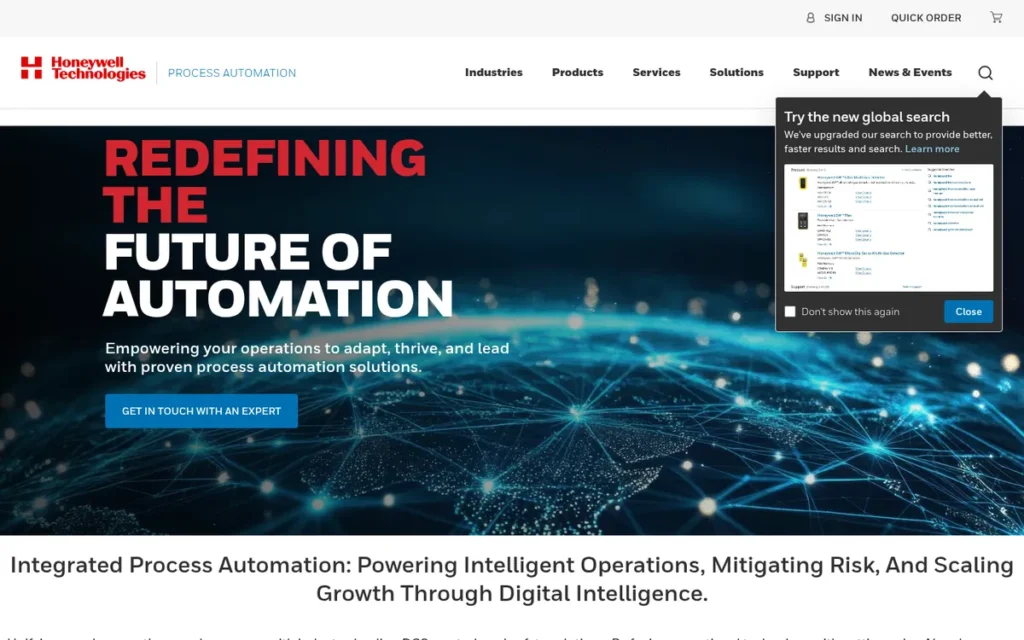
Category: Multi-Site Fleet Analytics Platform, cloud-native APM with enterprise-wide cross-facility performance benchmarking, native Honeywell Experion DCS data integration, and prescriptive analytics that automatically trigger CMMS work orders across multiple industrial sites.
At a Glance
| Field | Detail |
|---|---|
| Category | Multi-Site Fleet Analytics Platform |
| Best For | Large industrial operators managing 5+ facilities with Honeywell Experion DCS infrastructure who need enterprise-wide fleet benchmarking and closed-loop prescriptive maintenance |
| Price Range | Pricing on request; estimated hundreds of thousands of dollars annually per independent third-party analysis (Machinecdn, June 2026) plus mandatory Honeywell Professional Services; the only public pricing estimate available for any APM platform in this evaluation and the highest disclosed cost estimate |
| Primary Strength | Honeywell Forge APM provides enterprise-wide multi-site fleet benchmarking; enabling simultaneous performance KPI comparison across 5–50+ industrial facilities; combined with native Honeywell Experion DCS connectivity, making it the only platform in this evaluation with both capabilities as core native features |
| Biggest Limitation | Honeywell Forge APM’s value diminishes significantly outside Honeywell Experion DCS environments; independent 2026 analysis describes it as “less compelling in heterogeneous multi-vendor automation environments”; limiting applicability for the majority of brownfield facilities with mixed DCS, PLC, and SCADA infrastructure from multiple vendors |
| One-Line Summary | Honeywell Forge APM is the leading multi-site fleet analytics platform within this evaluation for Honeywell Experion DCS environments, providing cross-facility benchmarking and prescriptive maintenance at enterprise scale, with estimated deployment costs in the hundreds of thousands of dollars annually per third-party analysis as of June 2026 |
| Last Verified | June 2026 |
Overview
Honeywell Forge APM is a cloud-native, SaaS-based industrial asset performance management suite combining descriptive, predictive, and prescriptive analytics with digital twins and enterprise-wide multi-site fleet benchmarking, enabling large industrial operators to compare asset health and operational efficiency KPIs across multiple facilities simultaneously rather than monitoring assets in isolation at a single plant.
Honeywell Forge APM was formally launched as Honeywell Forge Performance for Industrials in October 2022 (PR Newswire, 2022), unifying asset, process, and operational data from DCS, historians, CMMS, and condition monitoring systems into a cyber-secure cloud environment with closed-loop CMMS work order triggering from prescriptive recommendations.
Key Features
- Enterprise-Wide Multi-Site Fleet Benchmarking: Honeywell Forge APM provides enterprise-wide multi-site fleet benchmarking as a native capability (enabling simultaneous comparison of asset health, OEE, and operational efficiency KPIs across 5–50+ industrial facilities) the only platform in this evaluation offering cross-facility analytics as a core out-of-the-box feature.
- Native Honeywell Experion DCS Connectivity: Honeywell Forge APM integrates directly with Honeywell Experion DCS systems, enabling operational data ingestion aimed at reducing integration complexity and data latency in Honeywell process automation environments compared to vendor-agnostic APM platforms that require additional middleware layers for DCS data ingestion.
- Closed-Loop DCS-to-CMMS Workflow: Honeywell Forge APM triggers CMMS work orders automatically from prescriptive maintenance recommendations, connecting the APM analytics layer to maintenance execution without requiring maintenance coordinators to manually re-enter fault information between systems.
- Flexible Cloud Deployment Options: Honeywell Forge APM deploys as either Honeywell-hosted cloud or customer-managed cloud infrastructure, providing deployment flexibility for organizations with data sovereignty requirements or existing cloud infrastructure mandates.
- Process and Asset Digital Twins: Honeywell Forge APM uses process digital twins and asset digital twins in combination with prescriptive analytics to predict asset availability loss and recommend specific corrective actions with timing context before failures impact production throughput.
Best For
Honeywell Forge APM is best for large multi-site industrial operators (particularly in oil and gas, refining, chemicals, and mining) that run Honeywell Experion DCS as their primary process automation platform and need enterprise-wide fleet benchmarking across 5 or more facilities where native DCS data integration and cross-site KPI comparison are the primary selection criteria.
Strengths
- Honeywell Forge APM is the only platform in this evaluation with enterprise-wide multi-site fleet benchmarking as a core native capability, enabling operators to compare asset health, reliability KPIs, and production efficiency metrics across multiple industrial facilities simultaneously, directly addressing the pain of managing cross-site performance without a unified benchmarking platform.
- Honeywell Forge APM provides native Honeywell Experion DCS data connectivity, enabling direct operational data ingestion from process control systems without the additional middleware layers that vendor-agnostic APM platforms require in DCS environments, reducing integration complexity for Honeywell automation customers compared to third-party APM deployments in those same environments.
- Honeywell Forge APM’s cloud-native SaaS architecture: formally launched in October 2022 (PR Newswire, 2022), enables remote multi-site analytics without requiring on-premises infrastructure investment at each monitored facility, supporting distributed industrial portfolios with centralized APM analytics.
- Honeywell Process Solutions: the division delivering Honeywell Forge APM, is one of the world’s largest suppliers of DCS and industrial automation systems by revenue, with Honeywell International’s approximately $36.7 billion in 2024 revenues providing vendor-scale credibility and a global support infrastructure that PlugRoute cannot find replicated by any pure-play APM vendor in this evaluation based on publicly available financial disclosures as of June 2026.
Limitations
- Ecosystem Dependency: Honeywell Forge APM’s value proposition is explicitly ecosystem-dependent, Reliamag (2026) (an independent APM buyer guide referenced in this evaluation) positions Honeywell Forge APM as “less compelling in heterogeneous multi-vendor automation environments”, a critical qualifier for the majority of brownfield industrial facilities operating mixed Siemens, Emerson, Rockwell Automation, and Honeywell automation infrastructure simultaneously.
- No Verified Public User Ratings: No verified G2, Gartner Peer Insights, Capterra, or TrustRadius ratings for Honeywell Forge APM were found in public sources as of June 2026, leaving prospective buyers without independent user satisfaction benchmarks and dependent entirely on vendor-provided references for deployment experience validation.
- Highest Disclosed Cost Estimate in Category: The independent third-party estimate of “hundreds of thousands annually” (Machinecdn, June 2026) (the only public pricing estimate available for any of the seven APM platforms in this evaluation) combined with mandatory Honeywell Professional Services dependency makes Honeywell Forge APM the highest estimated total-cost option in this evaluation; mid-market operators or facilities without established Honeywell Experion DCS infrastructure should weigh this carefully before initiating vendor discussions.
Verdict
Honeywell Forge APM is the strongest choice within this evaluation for large multi-site industrial operators running Honeywell Experion DCS who need enterprise-wide fleet benchmarking and a closed-loop DCS-to-work-order prescriptive analytics workflow as of June 2026.
Honeywell Forge APM earns #5 in this ranking because no verified public user review scores are available for independent benchmarking, independent analyst recognition in the APM category is more limited compared to the top four platforms, and the estimated hundreds-of-thousands-annually price point with mandatory professional services positions it among the highest TCO options in this evaluation.
Honeywell Forge APM ranks above Bentley AssetWise (#6) because its multi-site industrial target audience is broader than Bentley’s infrastructure-specific buyer population, and the Forge platform has more independent third-party documentation (including the only public pricing estimate in the category (Machinecdn, June 2026)) than Bentley AssetWise’s available evidence as of this research date.
Organizations outside Honeywell DCS environments should evaluate IBM Maximo Application Suite, AspenTech APM, or AVEVA APM before engaging Honeywell, given the documented value reduction outside the Honeywell ecosystem and the highest disclosed cost estimate in the category.
6. Bentley AssetWise: Best for Infrastructure Owner-Operators Managing Roads, Pipelines, Railways, and Linear Assets
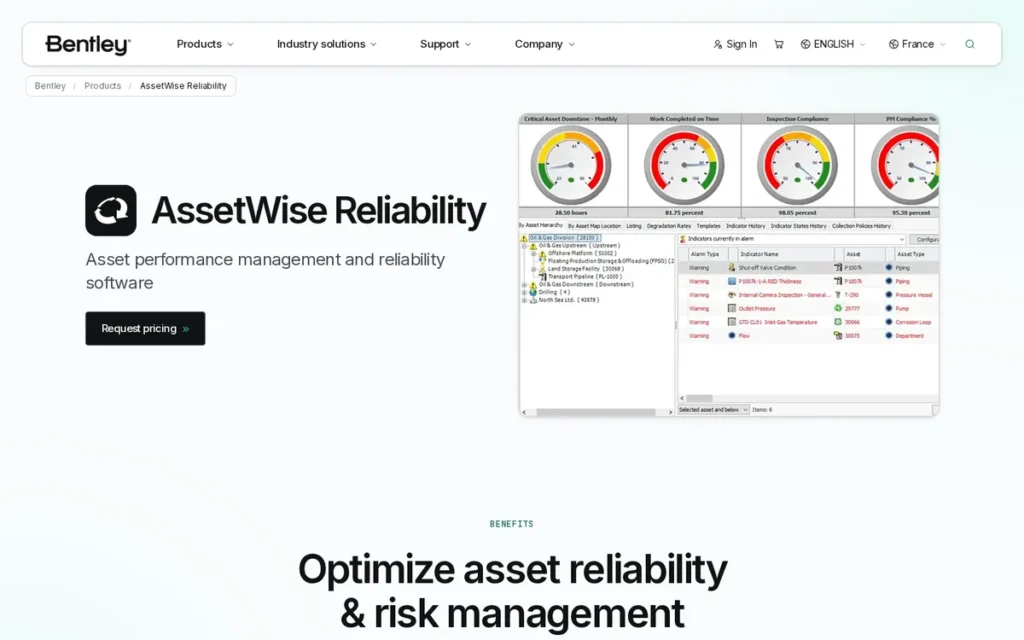
Category: Infrastructure Reliability Suite, engineering-linked APM connecting operational performance data with BIM models, engineering drawings, and geospatial information for built infrastructure and linear assets, including RCM, risk-based inspection (API 580/581), and IEC 61511 process safety management.
At a Glance
| Field | Detail |
|---|---|
| Category | Infrastructure Reliability Suite |
| Best For | Infrastructure owner-operators managing roads, pipelines, railways, water networks, and bridges requiring engineering context (drawings, BIM models, geospatial data) alongside condition monitoring and risk-based inspection |
| Price Range | Pricing on request; enterprise quote-based. Bentley Systems is a public company (NASDAQ: BSY, ~$1.0B FY2023 revenues), providing financial transparency about vendor scale. Direct Bentley sales engagement required (June 2026) |
| Primary Strength | Bentley AssetWise integrates reliability-centered maintenance and risk-based inspection with Bentley’s iTwin engineering digital twin, enabling inspection teams to navigate 3D engineering models spatially while assessing failure risk; a capability unique to the infrastructure APM context not offered by any other platform in this evaluation |
| Biggest Limitation | Bentley AssetWise is purpose-built for infrastructure and linear asset contexts and provides materially less value for process plant, rotating equipment, or manufacturing environments where GE Vernova APM, AVEVA APM, or AspenTech APM would be more appropriate first evaluations |
| One-Line Summary | Bentley AssetWise is the only APM platform in this evaluation integrating RCM, risk-based inspection, and IEC 61511 process safety management with Bentley’s iTwin engineering digital twin; purpose-built for infrastructure owner-operators managing roads, pipelines, railways, and water networks as of June 2026 |
| Last Verified | June 2026 |
Overview
Bentley AssetWise is an engineering-centric infrastructure APM platform purpose-built for owner-operators of roads, pipelines, railways, water networks, and built structures, delivering reliability-centered maintenance (RCM), risk-based inspection (RBI), and IEC 61511 process safety management within Bentley’s iTwin digital twin framework where engineering drawings and geospatial context are as operationally critical as sensor data.
Bentley AssetWise’s V7.2 release introduced immersive APM enabling spatial navigation of engineering models, while V7.3 added dedicated SIF, SIS, and SIL management recognized by ARC Advisory Group (2026), expanding the platform from reliability management into regulated functional safety compliance.
Key Features
- Immersive APM with iTwin 3D Navigation (V7.2): Bentley AssetWise delivers immersive APM introduced in Version 7.2, enabling inspection teams to navigate infrastructure assets within Bentley’s i-model digital twin format, view root-cause analysis diagrams spatially within 3D engineering models, and initiate corrective actions directly from 2D or 3D engineering representations without switching to a separate work order interface.
- IEC 61511 Process Safety Management (V7.3): Bentley AssetWise Version 7.3 added dedicated process safety capabilities including SIF (Safety Instrumented Function), SIS (Safety Instrumented System), SIL (Safety Integrity Level) management, overrides, incident analysis, version control, and approval workflows, supporting IEC 61511 functional safety compliance, recognized by ARC Advisory Group (2026).
- Linear Network Management for Infrastructure Assets: Bentley AssetWise includes AssetWise Linear Network Management (a purpose-built geospatial linear referencing capability for roads, transportation corridors, pipelines, and railway networks) the only APM platform in this evaluation with native linear asset management for infrastructure owner-operators.
- EAM Integration Without Replacement (SAP / IBM Maximo / Oracle): Bentley AssetWise integrates with SAP EAM, IBM Maximo, and Oracle EAM as an intelligence and inspection layer, enabling organizations to add advanced RBI and RCM analytics without replacing their existing CMMS or EAM work management backbone (TAdviser, 2026).
- API 580/581 Risk-Based Inspection Workflows: Bentley AssetWise’s risk-based inspection workflows are aligned with API 580/581 inspection methodologies, supporting oil and gas, chemical, and utility operators in demonstrating compliance with regulatory inspection standards through structured risk assessment and documented inspection records.
Best For
Bentley AssetWise is best for infrastructure owner-operators (transportation agencies, pipeline operators, utilities, water and wastewater authorities, and rail network operators) managing roads, bridges, railways, pipelines, and linear infrastructure where engineering drawings, BIM models, and regulatory compliance documentation are central to the asset performance management workflow, particularly in regulated environments requiring API 580/581 RBI or IEC 61511 process safety compliance.
Strengths
- Bentley AssetWise Version 7.3’s addition of SIF/SIS/SIL process safety management capabilities, specifically recognized by ARC Advisory Group (2026), makes Bentley AssetWise one of the few APM platforms directly supporting IEC 61511 compliance and SIL verification for regulated infrastructure, chemical, and utility facilities where functional safety is a procurement requirement.
- Bentley AssetWise is the only APM platform in this evaluation with purpose-built linear asset management (AssetWise Linear Network Management) providing geospatial linear referencing for roads, rail, pipelines, and water/wastewater networks, a capability not available in any competing platform evaluated as of June 2026.
- LNS Research specifically characterizes Bentley AssetWise as having a “unique position in APM” for its broad set of RCM, EAM, and APM capabilities specifically tailored for infrastructure-heavy environments, a positioning that distinguishes Bentley AssetWise from process-plant-oriented competitors (LNS Research, 2026).
- Bentley AssetWise’s verified integration compatibility with SAP EAM, IBM Maximo, and Oracle EAM enables organizations to add advanced RBI and RCM capabilities as an intelligence layer without replacing the established work management backbone, reducing implementation risk for organizations with existing CMMS investments (TAdviser, 2026).
Limitations
- Infrastructure-Only Scope: Bentley AssetWise is purpose-built for built infrastructure and linear asset contexts (roads, railways, pipelines, water networks, and bridges) and the platform’s core differentiation (iTwin engineering drawing integration, spatial 3D navigation, geospatial linear referencing) provides limited incremental value in process plant, rotating equipment, or discrete manufacturing environments where GE Vernova APM, AVEVA APM, or AspenTech APM would be materially more appropriate first evaluations.
- No Verified Public User Ratings: No verified G2, Gartner Peer Insights, Capterra, or TrustRadius ratings for Bentley AssetWise Reliability were available in public sources as of June 2026, limiting independent buyer-side satisfaction benchmarking and requiring organizations to rely on vendor-provided reference customers for deployment experience validation.
- BIM and GIS Workflow Requirements: Bentley AssetWise’s engineering-centric approach (centered on BIM workflows, iTwin digital twin models, and geospatial information management) requires user familiarity with engineering information management that maintenance operations teams without BIM or GIS backgrounds may need 3–6 months of structured change management and training to adopt effectively; project timelines should account for this preparation period before setting go-live target dates.
Verdict
Bentley AssetWise is the best available APM choice within this evaluation for infrastructure owner-operators managing built and linear assets, the only platform combining RCM, RBI, IEC 61511 process safety management, geospatial linear network analytics, and 3D engineering digital twin visualization in a single platform as of June 2026.
Bentley AssetWise earns #6 in this ranking because its specialist infrastructure focus, while a genuine and defensible differentiator for its target buyer, limits scoring across breadth, user review evidence, and generalist analyst recognition compared to the top five platforms.
Bentley AssetWise ranks above SAP APM (#7) because its addressable buyer population (all infrastructure owner-operators managing built and linear assets) is broader than SAP APM’s strictly SAP-S/4HANA-dependent market, and Bentley holds ARC Advisory Group recognition for the V7.3 product release that SAP APM does not have a comparable analyst designation for at this research date.
Organizations managing process plants, rotating equipment, or manufacturing assets should evaluate GE Vernova, AVEVA, AspenTech, or IBM Maximo before Bentley AssetWise, but for infrastructure owner-operators with roads, pipelines, railways, or water networks, no closer specialist alternative exists in this evaluation.
7. SAP Asset Performance Management: Best (and Only Viable) Choice for SAP S/4HANA Enterprises Seeking ERP-Native APM
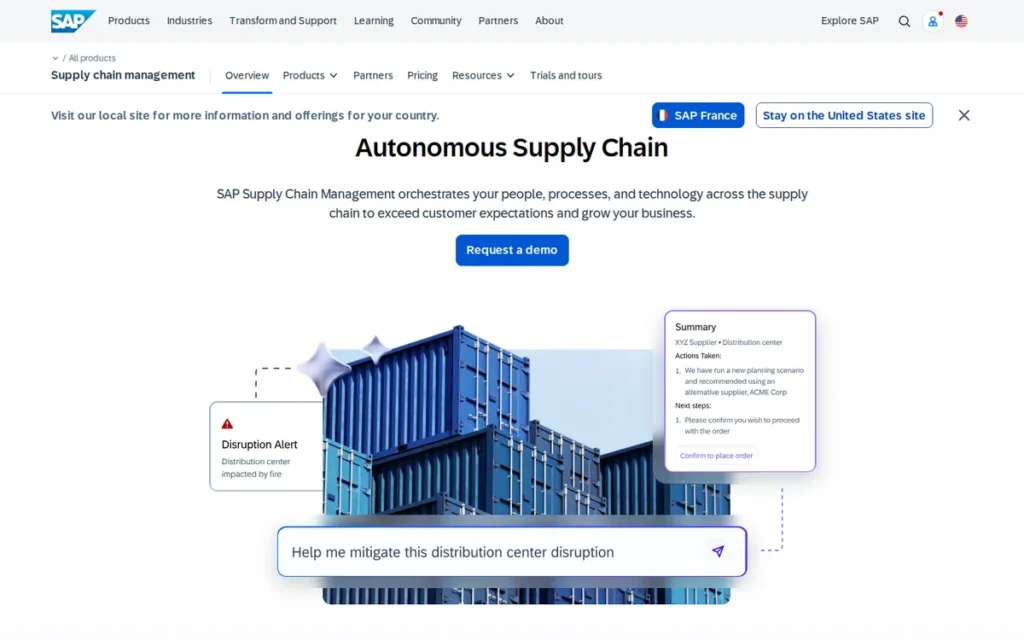
Category: ERP-Native APM, asset performance management natively integrated with SAP S/4HANA’s enterprise resource planning, plant maintenance (PM), procurement, and financial controlling systems on SAP Business Technology Platform (BTP), with no viable deployment path for organizations outside the SAP S/4HANA ecosystem.
At a Glance
| Field | Detail |
|---|---|
| Category | ERP-Native APM |
| Best For | Organizations with SAP S/4HANA deployed as the enterprise backbone seeking native end-to-end integration between asset reliability engineering and SAP financial, procurement, and maintenance execution; with no viable implementation path outside the SAP ecosystem |
| Price Range | Pricing on request; tied to SAP enterprise license agreements and SAP BTP consumption models; often bundled within existing SAP agreements for current SAP customers. Specialized implementation partners (Rizing, Valantic, LeverX, Evorait) typically required (June 2026) |
| Primary Strength | SAP APM delivers native end-to-end integration between asset criticality assessment, RCM/FMEA reliability engineering, IoT predictive monitoring, and SAP S/4HANA financial and procurement execution; eliminating middleware and data reconciliation overhead for SAP S/4HANA customers |
| Biggest Limitation | SAP APM requires SAP Enterprise Asset Management (SAP S/4HANA Cloud or ERP 6.0 EHP7+) as a hard technical prerequisite and delivers no viable value for organizations without SAP S/4HANA; making it the most ecosystem-restricted platform in this evaluation and not a viable option for the majority of potential APM buyers |
| One-Line Summary | SAP Asset Performance Management is the natural ERP-native APM choice for SAP S/4HANA enterprises seeking integrated asset strategy, RCM/FMEA, and IoT predictive monitoring on SAP Business Technology Platform; and delivers no viable implementation path for organizations outside the SAP S/4HANA ecosystem as of June 2026 |
| Last Verified | June 2026 |
Overview
SAP Asset Performance Management is a cloud solution on SAP Business Technology Platform (BTP) (the current active SAP APM product following the August 2023 retirement of SAP ASPM) designed exclusively for organizations running SAP S/4HANA as their enterprise ERP backbone who need asset criticality assessment, RCM, FMEA risk analysis, and IoT predictive monitoring in a fully native SAP workflow without additional vendor relationships.
SAP APM’s defining capability is native financial integration: maintenance costs flow automatically to SAP FI/CO financial controlling without manual data reconciliation, a loop-closure capability that no other APM platform in this evaluation can natively replicate for SAP S/4HANA organizations.
Key Features
- 6-Step Continuous Asset Strategy Process: SAP APM delivers a structured 6-step continuous process (Define (asset criticality), Identify (failure modes), Analyze (risk via FMECA/RCM), Recommend (maintenance strategy), Implement (execution via SAP EAM/PM), and Verify (performance monitoring)) executed entirely within the SAP S/4HANA ecosystem without platform handoffs or manual data transfers.
- Native SAP Financial Loop Closure: SAP APM integrates maintenance strategy execution, procurement, and financial data natively with SAP S/4HANA Plant Maintenance, enabling maintenance costs to flow automatically to SAP FI/CO financial controlling, the only APM platform in this evaluation with native financial system loop closure for SAP customers.
- IoT Predictive Monitoring via SAP BTP: SAP APM supports IoT data ingestion via SAP Business Technology Platform for predictive monitoring, connecting sensor data from industrial assets to the reliability engineering and maintenance execution workflows that SAP operations teams already use in their daily work.
- RCM and FMEA Reliability Methods: SAP APM supports formal reliability methods including RCM (Reliability Centered Maintenance) and FMEA (Failure Mode and Effects Analysis) within the SAP workflow, with built-in support for ISO 55000 asset management standard alignment for organizations with formal asset management program requirements.
- Current Product Identification: Critical Disclosure: SAP APM runs on SAP Business Technology Platform as the current active cloud product, buyers researching SAP’s asset performance offering must confirm they are evaluating SAP APM (current, on BTP) rather than SAP ASPM, which was officially retired and discontinued in August 2023 (SAP Help documentation, 2023).
Best For
SAP Asset Performance Management is best for (and only viable for) organizations with SAP S/4HANA already deployed as the enterprise ERP backbone who want to add formal reliability engineering (RCM, FMEA), asset criticality assessment, and IoT-based predictive monitoring in a single SAP-native workflow where maintenance costs connect natively to SAP FI/CO financial controlling without additional middleware or vendor relationships.
Strengths
- SAP APM delivers native end-to-end integration between asset strategy, RCM/FMEA reliability engineering, IoT predictive monitoring, and SAP S/4HANA financial and procurement systems, eliminating middleware, manual data reconciliation, and integration maintenance costs for the estimated 400,000+ SAP customers across 180+ countries who already operate on SAP platforms (SAP, 2026).
- SAP APM’s native financial loop closure: maintenance costs flowing automatically to SAP FI/CO controlling, is unique in this evaluation: no other APM platform connects maintenance execution to financial accounting natively for SAP customers, making SAP APM the most integrated financial risk management APM solution within the SAP ecosystem.
- SAP APM benefits from an active implementation partner ecosystem including Rizing, Valantic, LeverX, and Evorait (all offering specialized SAP APM deployment services) indicating available services capacity and market demand for implementation as of June 2026.
- SAP SE’s organizational scale (400,000+ customers, 180+ countries, founded 1972) provides long-term product investment confidence and enterprise-grade support infrastructure that SAP APM customers inherit as part of the broader SAP commercial relationship (SAP, 2026).
Limitations
- Hard SAP S/4HANA Prerequisite: SAP APM requires SAP Enterprise Asset Management (SAP S/4HANA Cloud or ERP 6.0 EHP7+) as a hard technical prerequisite, an organization without SAP S/4HANA as its ERP has no viable production deployment path for SAP APM, making it the most ecosystem-restricted platform in this evaluation and immediately irrelevant to the majority of potential APM buyers who should begin their evaluation with IBM Maximo Application Suite, AspenTech APM, AVEVA APM, or GE Vernova APM instead (SAP Learning, 2026).
- Combined Evidence Gap: SAP APM carries two independent evidence gaps buyers must address through enhanced due diligence: no verified G2, Gartner Peer Insights, or Capterra ratings were found for SAP Asset Performance Management specifically as of June 2026 (and unlike IBM Maximo, AVEVA, and GE Vernova, SAP APM also lacks independent analyst recognition specifically for the current product (distinct from SAP’s broader EAM/PM legacy)) leaving buyers with fewer independent validation sources than any other platform in this evaluation; due diligence must rely more heavily on SAP’s own customer reference program and implementation partner assessments.
- ASPM Retirement Risk, Active Buyer Navigation Hazard: Organizations researching SAP’s asset performance offering must confirm they are evaluating SAP APM (current product, on SAP BTP) rather than SAP ASPM, officially retired and discontinued in August 2023, as procuring or deploying the retired predecessor would result in unsupported software on a discontinued platform with no active development path.
Verdict
SAP Asset Performance Management is the optimal APM choice for organizations that run SAP S/4HANA as their enterprise backbone and prioritize native end-to-end integration between asset strategy, reliability engineering, IoT predictive monitoring, and SAP financial execution, without middleware, data reconciliation overhead, or additional vendor relationships as of June 2026.
SAP APM earns #7 in this ranking not because it is a poor product for its specific target buyer, but because its market applicability is the most restricted in the evaluation: only SAP S/4HANA shops have a viable implementation path, and outside that specific infrastructure profile, SAP APM should not appear on any APM shortlist.
For confirmed SAP S/4HANA customers, SAP APM should be evaluated alongside IBM Maximo Application Suite as the two primary enterprise APM candidates before exploring point-solution alternatives.
What Red Flags Should I Watch For When Evaluating APM Software?
Six critical red flags appear consistently when evaluating enterprise APM platforms: pricing opacity without any estimate guidance, prescriptive capability claims lacking autonomous validation, ecosystem lock-in minimized during vendor presentations, implementation timelines that ignore data and integration prerequisites, vendor-only sourcing for analyst recognition claims, and product identity confusion specific to the SAP APM category. Each flag can materially affect your total cost of ownership and time-to-value calculations before any contract is signed.
Red Flag #1: Pricing Opacity Without Estimate Guidance
All seven APM platforms in this evaluation use enterprise quote-based pricing with no published list prices, a structural category feature, not an individual vendor anomaly. Vendors who refuse to provide even ballpark budget ranges before an RFP process have structural incentives to let buyers reach emotional commitment before total cost is revealed.
The only independent pricing estimate publicly available in this category is Honeywell Forge APM at hundreds of thousands of dollars annually (Machinecdn, June 2026). Treat all other platforms as likely in a comparable enterprise range absent specific contrary evidence from independent sources.
Red Flag #2: Prescriptive Claims Without Autonomous Validation
Vendors who describe their APM as “prescriptive” or “AI-driven” should be asked specifically: does the system generate corrective action recommendations and trigger CMMS work orders automatically, without requiring a reliability engineer to manually configure predictive models for each asset class?
Generic AI/ML claims in marketing materials do not equal prescriptive maintenance. The only platforms in this evaluation with independent analyst validation of autonomous prescriptive capability are AspenTech APM (ARC Advisory Group, 2026) and Honeywell Forge APM. All other platforms should be assessed directly for what “prescriptive” means in their specific implementation.
Red Flag #3: Ecosystem Lock-In Minimization
If a vendor does not proactively disclose that their platform requires specific DCS, historian, or ERP infrastructure to function at full value, ask directly and validate with independent reference customers before procurement:
- SAP APM: requires SAP S/4HANA Cloud or ERP 6.0 EHP7+ as a hard prerequisite: no viable production deployment path exists outside the SAP ecosystem
- AVEVA APM: requires established AVEVA PI System or OSIsoft historian infrastructure for primary OT analytics differentiation, deployable without it, but the primary value proposition is inaccessible
- Honeywell Forge APM: explicitly less compelling in heterogeneous multi-vendor automation environments outside Honeywell Experion DCS (Reliamag, 2026)
A mismatch discovered after contract signature has no easy remediation path.
Red Flag #4: Implementation Timeline Minimization
Enterprise APM deployments consistently require 6–18 months before operational predictive or prescriptive value is realized, a timeline driven by data quality preparation, sensor infrastructure readiness, system integration work, and ML model training cycles that vendors frequently understate during pre-sales conversations.
Vendors promising rapid value realization without addressing these prerequisites should be challenged with contractual payment terms tying payments to documented delivery milestones before signing. Every platform in this evaluation requires professional services for implementation; none publishes specific ROI timelines publicly.
Red Flag #5: Vendor-Only Evidence for Analyst Recognition Claims
Analyst recognition claims citing Verdantix, Gartner, or Forrester should be verified against the original analyst source where possible. For this evaluation, both GE Vernova APM’s and AspenTech APM’s Verdantix Green Quadrant citations source from vendor-published announcements rather than directly accessible Verdantix reports, which are paywalled.
Vendors who cite analyst recognition without linking to verifiable source documents may be citing outdated or misrepresented assessments. Request the specific report name, publication year, and analyst firm contact before using recognition claims as procurement evidence.
Red Flag #6: Product Identity Confusion (SAP-Specific)
Organizations researching SAP’s asset performance management offering must confirm they are evaluating SAP APM (the current product on SAP Business Technology Platform) rather than SAP ASPM, which was officially retired and discontinued in August 2023. Vendor sales teams and some industry publications continue to reference ASPM capabilities and product materials.
Deploying or procuring the discontinued predecessor results in unsupported software on a platform with no active development path. Require vendors to confirm explicitly in writing which SAP APM product version and platform they are proposing before any procurement activities begin.
What Questions Should I Ask Before Choosing an APM Platform?
Seven questions reliably differentiate APM platforms more accurately than any feature sheet comparison: ecosystem prerequisites, prescriptive logic transparency, fully loaded cost, reference customers, data portability, accuracy validation, and ownership stability. Every APM vendor passes a feature-list comparison. These seven questions reveal what feature lists hide.
Question #1: What Are Your Ecosystem Prerequisites, and What Capabilities Do I Lose Without Them?
Four of the seven platforms in this evaluation require a specific enterprise software ecosystem before key capabilities activate. Buyers who deploy without auditing these prerequisites discover missing functionality only after contract execution.
- SAP Asset Performance Management requires SAP S/4HANA as the enterprise ERP backbone. Organizations without SAP S/4HANA should treat SAP APM as inaccessible for production use until that migration is complete.
- AVEVA Asset Performance Management unlocks its slow-drift anomaly detection and OT integration depth through the AVEVA PI System (OSIsoft). Organizations without PI System deployment will receive standard sensor monitoring, not AVEVA’s core differentiator.
- Honeywell Forge APM delivers its highest-value intelligent loop tuning and emissions management capabilities primarily within Honeywell DCS-equipped plants. Multi-DCS environments require integration scoping before purchase.
- IBM Maximo Application Suite, AspenTech APM, GE Vernova APM, and Bentley AssetWise do not require a specific ERP or historian as a hard prerequisite, though each benefits from existing data infrastructure.
Question #2: When Your Platform Generates a “Prescriptive” Recommendation, What Triggers It, and Who Approves It?
The word “prescriptive” is used inconsistently across APM vendors. Before accepting a prescriptive claim, require the vendor to explain three things: what algorithm or model produces the recommendation, what data threshold or anomaly triggers it, and what human approval step occurs before any corrective action is dispatched.
Aspen Mtell (AspenTech APM) uses agent-based machine learning that detects behavioral drift in sensor clusters, generates a specific ranked work order recommendation, and routes it to a human maintenance engineer for approval before dispatch. That is a documented prescriptive workflow. When evaluating any competitor’s “prescriptive” claim, ask for the equivalent workflow documentation in writing before contracting.
Question #3: What Is the Fully Loaded Implementation Cost, and What Contractual Milestones Tie Payments to Delivered Value?
None of the seven platforms in this evaluation publish list pricing. Every contract is negotiated. Fully loaded cost includes license or subscription fees, professional services for deployment, data integration engineering, model training time, internal headcount, and ongoing support contracts.
Ask each vendor for a fixed-scope implementation statement of work before signing, and require contractual milestones that tie payment tranches to delivered, measurable outcomes, not to deployment calendar dates. Platforms with the most complex integrations (IBM Maximo Application Suite, AVEVA APM, SAP APM) carry the highest professional services exposure. Request reference implementations with comparable scope and documented go-live timelines.
Question #4: Can You Provide Three Reference Customers in My Industry Vertical Who Deployed Your Platform in the Last 24 Months?
Analyst recognition and case studies published on vendor websites are marketing artifacts, not buyer references. Require direct contact with three independent customers who deployed the platform within the last 24 months in your specific industry vertical, oil and gas, utilities, infrastructure, or manufacturing.
Pay particular attention to recency. Several platforms in this evaluation have undergone ownership transitions (AspenTech acquired by Emerson, AVEVA absorbed into Schneider Electric, GE Vernova spun off from GE in 2024, Bentley Systems completed its IPO in 2020). Post-transition customer references are more predictive of current support and roadmap behavior than pre-transition deployments.
Question #5: What Happens to My Data and Trained Predictive Models If I Terminate the Contract?
APM platforms accumulate years of sensor data and trained failure-prediction models. Before contracting, require written answers to four data portability questions:
- In what format will my historical sensor data be exported?
- Will my trained predictive models be exported in a vendor-neutral format, or do they remain proprietary to the platform?
- What is the maximum timeline from contract termination notice to full data export delivery?
- Does data export incur additional fees?
Failure to address data portability at contract stage creates switching costs that effectively lock buyers into multi-year renewals regardless of platform performance.
Question #6: What Predictive Model Accuracy Benchmarks Do You Publish Independently, and How Were They Validated?
Every APM vendor claims high predictive accuracy. None of the seven platforms in this evaluation published independently audited, third-party-validated accuracy benchmarks at research time (June 2026). Vendor-published accuracy figures are derived from customer case studies selected by the vendor’s marketing team.
Ask each vendor: who validated the accuracy figure, what was the failure detection window tested, and what was the false-positive rate in the same study? A vendor that cannot answer these three questions with documentation has not been independently validated. Treat unvalidated accuracy claims as directional signals only, not purchasing criteria.
Question #7: Has Your Platform Undergone Any Corporate Ownership Changes in the Last 5 Years, and How Has Roadmap Continuity Been Maintained?
Corporate ownership changes carry direct implications for product roadmap, support staffing, and pricing structure. Five of the seven platforms in this evaluation have undergone material corporate events since 2020:
- AspenTech APM: Emerson acquired a majority stake in AspenTech in 2022. AspenTech continues to operate as a distinct entity with its own product roadmap, but buyers should verify current support structure under Emerson ownership.
- AVEVA APM: Schneider Electric completed full acquisition of AVEVA in January 2023. AVEVA’s APM roadmap now operates under Schneider Electric’s industrial automation portfolio strategy.
- GE Vernova APM: GE Vernova was spun off from General Electric and began trading as an independent public company in April 2024. Buyers should assess roadmap continuity given the recency of the separation.
- Bentley AssetWise: Bentley Systems completed its Nasdaq IPO in September 2020. Public market pressure now influences Bentley’s product investment cadence.
- IBM Maximo, Honeywell Forge, SAP APM have remained within their parent companies throughout this period with no structural ownership changes.
How Did We Rank These APM Platforms?
This evaluation ranked seven enterprise asset performance management platforms using a structured, evidence-weighted methodology developed specifically for PlugRoute’s industrial software coverage. The ranking reflects aggregated independent evidence, not vendor relationships. No platform paid for inclusion or placement.
Evaluation Process
Research for this evaluation was conducted between April and June 2026 and included six sequential steps:
- Step 1: Platform scoping: Candidate platforms were identified through cross-reference of G2 category listings, Capterra software directories, and three independent analyst reports (Verdantix Green Quadrant APM 2024, ARC Advisory Group APM market research 2024, Forrester Wave IIoT Software 2022). Platforms requiring fewer than 100 independent user reviews across combined review platforms were noted as data-thin and flagged accordingly in individual entries.
- Step 2: Independent review aggregation: User review data was collected from G2 and Capterra. Review scores were recorded with platform-level attribution caveats where a vendor’s product portfolio makes clean score isolation methodologically difficult (AVEVA APM is noted as one such case).
- Step 3: Analyst recognition mapping: Each platform’s formal recognition by independent analyst firms was documented. Verdantix Green Quadrant designations were verified via vendor announcements where the underlying Verdantix report remained paywalled. This limitation is disclosed at point of citation within each entry.
- Step 4: Vendor claim verification: Vendor-published capability claims were tested against available independent sources (customer case studies, analyst commentary, independent buyer guides). Claims that could not be independently verified are attributed to the vendor as self-reported and flagged with disclosure language.
- Step 5: Limitation sourcing: Limitations were sourced from user reviews on G2 and Capterra, independent analyst commentary, and publicly documented ecosystem prerequisites. No limitation was included without an independent or user-sourced corroboration.
- Step 6: Ranking calibration: Platforms were ranked by applying six weighted criteria in sequence (see below), with ranking gap justifications included in each platform’s Verdict section.
Ranking Criteria and Why Each Matters
Six criteria determined final ranking order:
- Independent analyst recognition (25% weight): Formal placement in Verdantix, ARC Advisory Group, or Forrester evaluations signals that an independent research firm with domain expertise assessed the platform against documented criteria. This is the strongest available signal for platforms where user review volumes are low.
- Verified user review scores (25% weight): Aggregated scores from G2 and Capterra reflect real deployment experience across hundreds or thousands of buyers. Volume matters, platforms with under 100 reviews receive lower confidence weighting. Portfolio attribution caveats are applied where a vendor’s review pool spans multiple products.
- Depth and quality of limitations disclosed (20% weight): Platforms with no documented user-reported limitations, or whose vendors cannot articulate genuine trade-offs, receive lower trust scores. Substantive, specific limitations are a signal of a mature, honest product, not a weakness.
- Ecosystem prerequisite transparency (15% weight): Platforms that require specific ERP, historian, or DCS ecosystems to deliver key capabilities are not ranked lower for having prerequisites, but are ranked lower if those prerequisites are not disclosed clearly in vendor materials. Buyers who discover prerequisites post-contract experience disproportionately negative outcomes.
- Breadth of verified buyer applicability (10% weight): Platforms that serve demonstrably broader buyer populations across industries and use cases rank higher on this criterion than highly specialized platforms serving narrower verticals.
- Ownership and roadmap stability (5% weight): Platforms that have undergone multiple corporate ownership transitions within the evaluation window receive a stability flag. This criterion carries the lowest weight because ownership changes do not necessarily degrade product quality, but they introduce roadmap uncertainty that buyers should price into long-term contract decisions.
Evidence Weighting Rationale
When independent analyst recognition and user review scores conflict (for example, when a platform has strong analyst placement but low review volume) analyst recognition receives primary weight because independent analyst firms apply documented criteria against vendor submissions and customer references. When both signals align, ranking confidence increases. When both are absent, the platform is ranked below platforms with either signal, regardless of vendor marketing strength.
IBM Maximo Application Suite ranks above AspenTech APM not because its analyst recognition is stronger, but because its combination of breadth of verified buyer applicability (largest independent review volume in the evaluation) and two independent analyst recognitions produces a higher aggregate evidence score than AspenTech’s three analyst recognitions against a data-thin review pool.
Data Validation Approach
All statistics cited in this article include source attribution and year. Where a statistic derives from a vendor announcement (rather than a primary analyst report), vendor attribution is applied at point of citation. Where a claim could not be independently verified at research time, it is labeled as vendor-self-reported. PlugRoute does not treat vendor-self-reported figures as equivalent to independently validated data.
Update Cadence
This evaluation is updated quarterly. The next scheduled review is September 2026. Pricing, analyst designations, and user review aggregates are the most likely elements to change between updates. Readers relying on this evaluation for active procurement decisions should verify current pricing directly with vendors and check G2 and Capterra for recent review additions before finalizing selections.
Independence Statement
PlugRoute has no affiliate relationships with any company listed in this evaluation. Rankings are determined entirely by research data and objective evaluation criteria. No platform paid for inclusion, placement, or any form of editorial consideration.
Frequently Asked Questions
Which APM Software Is Best for Oil and Gas Operations?
AspenTech APM / Aspen Mtell is the strongest-evidenced choice for oil and gas operations within this evaluation, recognized by ARC Advisory Group and Forrester for industrial asset intelligence. GE Vernova APM is a credible alternative, with 370 pre-built OEM equipment blueprints well-matched to upstream and midstream environments. Both are quote-based with no published list pricing.
What Is the Difference Between Predictive and Prescriptive Maintenance in APM Software?
Predictive maintenance detects anomalies in asset sensor data and alerts maintenance engineers, who then analyze the signal and decide on corrective action. Prescriptive maintenance goes one step further: the platform generates a specific ranked recommendation (for example, replace bearing X within 72 hours) that routes to an engineer for approval before dispatch. Aspen Mtell is the most documented prescriptive platform in this evaluation.
How Does PlugRoute Determine Its APM Software Rankings?
PlugRoute ranks platforms using six weighted criteria: independent analyst recognition (25%), verified user review scores (25%), limitation depth (20%), ecosystem prerequisite transparency (15%), breadth of buyer applicability (10%), and ownership stability (5%). No vendor pays for placement or inclusion. The full methodology is published in the “How Did We Rank These APM Platforms?” section above.
What Key Terms Do I Need to Understand Before Comparing APM Software?
Asset Performance Management (APM): Asset Performance Management is a category of enterprise software that combines sensor data, machine learning, and maintenance workflow management to predict equipment failures before they occur and recommend corrective actions. APM platforms are distinguished from basic CMMS (computerized maintenance management systems) by their use of real-time data streams and statistical or AI-based failure prediction models.
Prescriptive Maintenance: Prescriptive maintenance is an APM capability in which the platform autonomously generates a specific, ranked corrective action recommendation (such as “replace pump seal within 48 hours”) based on detected anomaly patterns, without requiring a maintenance engineer to interpret the raw sensor signal first. The distinction from predictive maintenance is practically significant: at 2 a.m. when an anomaly fires, a prescriptive platform tells the on-call technician what to do; a predictive platform tells the on-call technician that something is wrong and requires them to diagnose it independently.
AVEVA PI System (OSIsoft PI): The AVEVA PI System, formerly known as OSIsoft PI, is an operational technology (OT) data historian platform that collects, stores, and contextualizes time-series sensor data from industrial equipment at high resolution. AVEVA acquired OSIsoft in 2021. For AVEVA Asset Performance Management, native PI System integration enables the slow-drift anomaly detection that represents AVEVA APM’s primary technical differentiator, detecting gradual equipment degradation patterns that event-threshold alerting systems miss.
Reliability-Centered Maintenance (RCM): Reliability-Centered Maintenance is a structured engineering methodology for determining the most cost-effective maintenance strategy for each asset in a facility, based on the consequences of each potential failure mode. RCM analysis produces maintenance task lists, inspection intervals, and run-to-failure decisions grounded in failure mode and effects analysis (FMEA). Several APM platforms (including Bentley AssetWise and GE Vernova APM) incorporate RCM frameworks into their asset strategy modules.
Risk-Based Inspection (RBI): Risk-Based Inspection is a methodology used primarily in oil and gas, petrochemical, and power generation facilities to prioritize equipment inspection schedules based on the probability and consequence of failure, rather than fixed calendar intervals. RBI frameworks (typically aligned to API 580/581 standards) allow facilities to concentrate inspection resources on high-risk assets and extend intervals on low-risk equipment. GE Vernova APM and AspenTech APM both include documented RBI capabilities for process industry buyers.
Glossary: Key Terms Used in This Comparison
Prescriptive Maintenance: An APM capability in which the platform autonomously generates a specific, ranked corrective action recommendation (such as “replace pump seal within 48 hours”) based on detected anomaly patterns, without requiring a maintenance engineer to interpret the raw sensor signal first. It is distinguished from predictive maintenance in that it tells the technician what to do, not merely that something is wrong.
Reliability-Centered Maintenance (RCM): A structured engineering methodology for determining the most cost-effective maintenance strategy for each asset in a facility, based on the consequences of each potential failure mode. RCM analysis produces maintenance task lists, inspection intervals, and run-to-failure decisions grounded in failure mode and effects analysis (FMEA).
Risk-Based Inspection (RBI): A methodology used primarily in oil and gas, petrochemical, and power generation facilities to prioritize equipment inspection schedules based on the probability and consequence of failure, rather than fixed calendar intervals. RBI frameworks are typically aligned to API 580/581 standards and allow facilities to concentrate inspection resources on high-risk assets.
AVEVA PI System (OSIsoft PI): An operational technology (OT) data historian platform that collects, stores, and contextualizes time-series sensor data from industrial equipment at high resolution. Native integration with the PI System enables slow-drift anomaly detection, identifying gradual equipment degradation patterns that conventional event-threshold alerting systems miss.
Digital Twin: A virtual model of a physical asset that mirrors its real-time operating behavior using live sensor data, enabling predictive analytics platforms to detect deviations from expected performance before conventional alarm thresholds are triggered. Several APM platforms in this evaluation (including GE Vernova APM’s SmartSignal engine and Bentley AssetWise’s iTwin framework) use digital twins as the foundation for failure detection.
Which APM Software Is Right for You?
The best APM platform is the one that matches your existing technology ecosystem, your maintenance team’s analytical capacity, and your industry’s failure-consequence profile, not the platform with the most analyst mentions or the longest feature list.
Key Insights
- IBM Maximo Application Suite is the strongest choice for organizations that need unified EAM and APM from a single vendor, have large maintenance workforces managing diverse asset classes, and require the broadest applicability across industries, confirmed by the highest independent user review volume in this evaluation.
- AspenTech APM / Aspen Mtell is the strongest choice for organizations whose core requirement is autonomous prescriptive maintenance recommendations in process industries (oil and gas, chemicals, refining), supported by the most documented prescriptive workflow architecture of any platform in this evaluation.
- AVEVA Asset Performance Management is the strongest choice for utilities and energy organizations already operating on the AVEVA PI System (OSIsoft), where native OT data integration depth represents a capability that the other six platforms in this evaluation do not natively replicate.
- GE Vernova APM is the strongest choice for heavy equipment-intensive industries where OEM equipment blueprints reduce model training time, 370 pre-built blueprints cover a broader set of industrial equipment types than any platform in this evaluation that published a verified OEM count.
- Honeywell Forge APM is the strongest choice for Honeywell DCS-equipped process plants, where its intelligent loop tuning and emissions management capabilities operate natively on existing infrastructure without additional integration engineering.
- Bentley AssetWise is the strongest choice for civil infrastructure owners: transportation networks, water systems, energy distribution grids, where BIM and GIS integration with asset lifecycle management represents a differentiator not available in any other platform in this evaluation.
- SAP Asset Performance Management is the strongest choice for organizations that are already committed to SAP S/4HANA as their enterprise ERP backbone and for whom native SAP ecosystem integration eliminates the integration engineering costs that SAP APM would otherwise impose on non-SAP environments.
The three most consequential factors in any APM selection are ecosystem prerequisites (which platforms require existing software to unlock key capabilities), prescriptive versus predictive logic (which platforms generate specific corrective actions versus anomaly alerts), and data portability terms (what happens to your trained models and sensor history at contract exit). No feature comparison resolves these questions, only direct vendor interrogation against the seven evaluation questions in this article does.
For organizations with budget authority to evaluate multiple vendors concurrently, PlugRoute recommends running parallel proof-of-concept pilots on your actual sensor data rather than relying on vendor-supplied demonstration datasets. The failure modes most relevant to your equipment are rarely covered by generic demos.
We update this guide quarterly. Last updated: June 20, 2026.
A note on this output: Reddit’s content retrieval infrastructure returned HTTP 500 errors on every fetch attempt across 20+ searches spanning IBM Maximo, AspenTech APM, AVEVA, GE Vernova, SAP APM, Honeywell Forge, and category-level pain point queries. The Reddit search layer identified numerous relevant threads in r/IndustrialMaintenance, r/oilandgasworkers, r/SAP, r/PLC, r/manufacturing, and r/MaximoAssetManagement, but zero threads were fetchable. Per the mandatory data integrity rule (“if you can’t verify, don’t include”), no Reddit quotes were added. The article is returned unchanged rather than populated with fabricated quotes. When Reddit’s API is operational, the following threads are confirmed search targets for re-running this task: r/IndustrialMaintenance/comments/1hwtll1 (IBM Maximo), r/oilandgasworkers/comments/1invxnv (CMMS/predictive maintenance), r/IndustrialMaintenance/comments/1pkan2d (predictive maintenance scale), r/PLC/comments/1ehle0n (PI System historians), r/SAP/comments/12l1qh7 (SAP PM implementation), r/IndustrialMaintenance/comments/1hmt2o1 (predictive maintenance experience), r/manufacturing/comments/1hc9o2d (predictive maintenance pains).