Watershed leads for large enterprises requiring the deepest GHG accounting methodology and the strongest independent analyst validation. Persefoni is the required evaluation for financial institutions and offers the only confirmed free tier. Greenly is the most accessible full-featured platform for SMEs and mid-market companies. The right platform depends on your regulatory driver, organization size, and Scope 3 complexity.
Sustainability managers in 2026 face converging pressures: CSRD phased deadlines, SEC climate disclosure requirements, and Scope 3 supplier data collection complexity. Opaque pricing and vendor-biased rankings make objective evaluation harder, choosing the wrong platform can cost more in implementation, compliance gaps, and re-platforming than staying on spreadsheets longer.
PlugRoute has no affiliate relationships with any company listed. Rankings are determined entirely by research data and objective evaluation criteria.
“Seems like most tools only do part of the job, either data collection, calculations, or reporting, so stitching it all together is a pain.” (u/zee9736, r/consulting (2025))
Takeaway: Tool fragmentation (collecting data in one tool, calculating in another, reporting in a third) is the most common implementation failure mode documented by practitioners. This evaluation specifically assesses which platforms handle the full workflow natively versus requiring multi-vendor stitching.
TL;DR: Top Picks at a Glance
- Watershed: Verdantix Green Quadrant Leader 2026; deepest GHG methodology and audit-grade enterprise compliance
- Persefoni: Only PCAF-accredited platform in this evaluation; confirmed free Pro tier; non-negotiable for financial institutions
- Greenly: Largest disclosed customer base (3,500+); only community-verified pricing; strongest SME-to-mid-market choice
- Normative: Carbon Network shared supplier infrastructure; only platform directly solving Scope 3 collection at scale
What Are the Main Categories of Carbon Accounting Software?
Carbon accounting software in 2026 falls into three categories, each serving a distinct buyer profile based on organization size, regulatory driver, and Scope 3 complexity.
- Enterprise Carbon Management Platforms: built for GHG methodology depth, audit-grade disclosure, and the most rigorous regulatory compliance for large multinationals and financial institutions
- SME-to-Enterprise Accessibility Platforms: designed for broad buyer accessibility, transparent pricing, automation-first design, and Scope 3 supplier engagement tools at non-enterprise scale
- Specialized or Ecosystem-Dependent Platforms: purpose-built for specific industry verticals (industrial/manufacturing), regulatory niches (CBAM), or existing technology ecosystems (Salesforce)
Category 1: Enterprise Carbon Management Platforms
Built for methodology depth, analyst-validated rigor, and audit-grade disclosures for complex multinationals and financial institutions.
- Watershed: Verdantix Green Quadrant Leader 2026; CDP Gold (self-reported, Watershed.com 2026); 500,000+ emission factors
- Persefoni: Forrester Wave Leader; among the first PCAF-accredited SaaS platforms; confirmed free Pro tier
Category 2: SME-to-Enterprise Accessibility Platforms
Built for broad buyer accessibility, automation-first design, transparent pricing, and Scope 3 supplier engagement at scale.
- Greenly: 3,500+ customers; community-verified pricing $1K–$45K/year; Xero integration
- Normative: Carbon Network shared supplier infrastructure; 349,000+ emission factors
Category 3: Specialized or Ecosystem-Dependent Platforms
Built for specific regulatory contexts, industry verticals, or existing technology ecosystems.
- ClimatePartner Hub: End-to-end: accounting + verified offset financing + consumer product carbon labels
- Carbmee: Industrial/manufacturing-native; CBAM compliance; ERP API integration; Gartner Cool Vendor 2022
- Salesforce Net Zero Cloud: Native Salesforce ecosystem module only
A common buyer mistake: assuming the platform with the deepest GHG methodology also produces the best CSRD report. Watershed (the most methodology-rigorous platform in this evaluation) was independently documented as having a CSRD module weaker than Workiva’s (r/consulting, 2024). GHG accounting depth and CSRD disclosure breadth are different capabilities requiring separate evaluation.
How Do the Top Carbon Accounting Software Platforms Compare?
| Rank | Company | Category | Best For | One-Line Summary | Key Capabilities | Primary Strength | Key Limitation |
|---|---|---|---|---|---|---|---|
| 1 | Watershed | Enterprise Carbon Management | Large enterprises needing the deepest GHG methodology and multi-framework audit compliance | Watershed is a 2026 Verdantix Green Quadrant Leader with a 500,000+ emission factor database, CDP Gold accreditation (self-reported), and a claimed 100% audit pass rate; serving BlackRock, Airbnb, Shopify, Stripe, and Canva. | 500,000+ emission factors; supply chain module; Climate Action Manager; carbon removal marketplace; 60+ integrations | Verdantix Green Quadrant Leader 2026 (one of eight Leaders); largest documented emission factor database in this evaluation | CSRD module documented as “subpar compared to Workiva’s” by enterprise evaluator (r/consulting, 2024); no free tier |
| 2 | Persefoni | Carbon Accounting and Climate Disclosure | Financial institutions tracking financed emissions; enterprises needing a free-to-enterprise upgrade path | Persefoni is a Forrester Wave Leader and among the first PCAF-accredited SaaS platforms, offering a confirmed free Pro tier and enterprise-grade Scope 1–3 climate disclosure tools for both corporate and financial institution use cases. | PCAF-aligned financed emissions; PersefoniAI Copilot; Footprint Ledger; automated regulatory template updates | Forrester Wave Leader; only PCAF-accredited platform among seven evaluated; confirmed free Pro tier | Enterprise from ~$40,000/year with no intermediate pricing tier; no Verdantix Green Quadrant recognition |
| 3 | Greenly | SME-to-Enterprise Carbon Accounting | SMEs and mid-market companies needing CSRD compliance with accessible, verified pricing | Greenly serves 3,500+ companies; including HSBC and Ubisoft; with a 300,000+ emission factor library, AI-powered EcoPilot automation, and the only community-verified pricing range ($1,000–$45,000/year) in this evaluation. | EcoPilot AI; 300,000+ factors; PCF/LCA module; Xero + 100 integrations; “What If” simulation | Largest disclosed customer base (3,500+); only community-verified pricing; confirmed Xero integration | No Verdantix or Forrester recognition confirmed; thin G2/Capterra review corpus relative to customer base |
| 4 | Normative | Carbon Accounting with Shared Supplier Network | Organizations with complex Scope 3 value chains needing shared supplier data collection infrastructure | Normative is a carbon accounting platform with a unique Carbon Network enabling shared supplier emissions data, 349,000+ emission factors, a hybrid spend/activity calculation engine, and GHG-Protocol-certified climate strategist support at both plan tiers. | Carbon Network; connected calculations; 349,000+ factors; hybrid methodology; certified strategist support | Carbon Network: only shared supplier data infrastructure in this evaluation | No Verdantix/Forrester/Gartner recognition; minimal community presence; complete pricing opacity |
| 5 | ClimatePartner Hub | End-to-End Carbon Management Suite | European companies needing the full decarbonization workflow: accounting, offsetting, and product labels | ClimatePartner Hub combines Scope 1–3 carbon accounting, verified offset financing, and white-label product carbon footprint labels with native CSRD ESRS E1 data point generation in a single end-to-end platform. | ESRS E1 native; FLAG splits; Climate-ID product labels; AI emission factor matching; hotspot analytics | Only platform integrating accounting with verified climate project financing and consumer-facing product carbon labels | No Verdantix/Forrester/Gartner recognition; no public named case studies; zero community discussion |
| 6 | Carbmee | Industrial Carbon Management | Industrial manufacturers with ERP environments needing CBAM compliance | Carbmee’s EIS™ is an industrial-native carbon platform with ERP API integration, CBAM compliance readiness, integrated CCF/PCF/SCF calculations, and Gartner Cool Vendor 2022 recognition; serving Kärcher, Maersk, and KWS. | ERP API integration; CBAM module; CCF/PCF/SCF; GenAI Ecoinvent mapping; GHG Protocol + ISO 14064 + CBAM alignment | Only industrial-native platform with CBAM compliance module and ERP API integration; Gartner Cool Vendor 2022 | No Verdantix or Forrester carbon-specific evaluation; no public case studies with quantified outcomes; no community discussion |
| 7 | Salesforce Net Zero Cloud | Enterprise ESG and Carbon Module | Large enterprises already fully committed to the Salesforce ecosystem only | Salesforce Net Zero Cloud offers Scope 1–3 tracking with Agentforce AI automation; viable only for large enterprises already fully committed to the Salesforce ecosystem, independently described by practitioners as likely inferior to purpose-built carbon vendors (r/consulting, 2024). | Agentforce AI; Supplier Scorecard; Guided CDP Report Builder; Slack supplier collaboration; CRM-integrated carbon segmentation | Native Salesforce integration eliminates data migration for committed Salesforce enterprises | Requires existing Salesforce infrastructure; practitioner-documented skepticism about purpose-built depth; pricing “through the roof” |
Which Carbon Accounting Software Should I Choose for My Use Case?
The right carbon accounting platform depends on your organization’s size, primary regulatory obligation, and whether you prioritize GHG methodology depth, CSRD compliance breadth, Scope 3 supplier engagement, or budget accessibility.
| Your #1 Priority | Recommended Tool | Why | Acceptable Alternative |
|---|---|---|---|
| Budget-constrained SME or organization starting CSRD prep | Persefoni Pro (free) | Only confirmed free tier with full Scope 1–3 coverage in this evaluation | Greenly at $1,000+ entry price |
| SME or mid-market needing a full accessible platform | Greenly | Largest customer base (3,500+); community-verified pricing $1K–$45K; Xero integration; 300,000+ factors | Normative for Scope 3 supplier focus |
| Large enterprise needing deepest GHG methodology and audit proof | Watershed | Verdantix Green Quadrant Leader 2026; CDP Gold (self-reported); 500,000+ factors; claimed 100% audit pass rate | Persefoni (Forrester Wave Leader) |
| Financial institution or asset manager tracking financed/portfolio emissions | Persefoni | Only PCAF-accredited platform among the seven evaluated; no equivalent in this evaluation | No direct alternative in this evaluation |
| Industrial or manufacturing company with ERP environment and CBAM obligations | Carbmee | Only industrial-native platform with CBAM compliance module and ERP API integration; organizations without EU import/export obligations may find Watershed or Persefoni adequate for general GHG tracking | No direct alternative for CBAM + ERP combination |
| Company needing carbon measurement plus verified offset financing in one platform | ClimatePartner Hub | Only platform integrating accounting, verified project financing, and consumer-facing product carbon labels | No direct alternative in this evaluation |
| Large enterprise already fully committed to the Salesforce ecosystem | Salesforce Net Zero Cloud | Native integration avoids data migration; Agentforce AI within existing workflows | Watershed (as standalone with Salesforce data feed) |
| Organization prioritizing Scope 3 supplier data collection at scale | Normative | Carbon Network enables shared supplier data, eliminating duplicated outreach across value chains | Greenly for SME-scale Scope 3 estimation |
1. Watershed: Best Overall: Enterprise Carbon Management with the Strongest Independent Analyst Validation
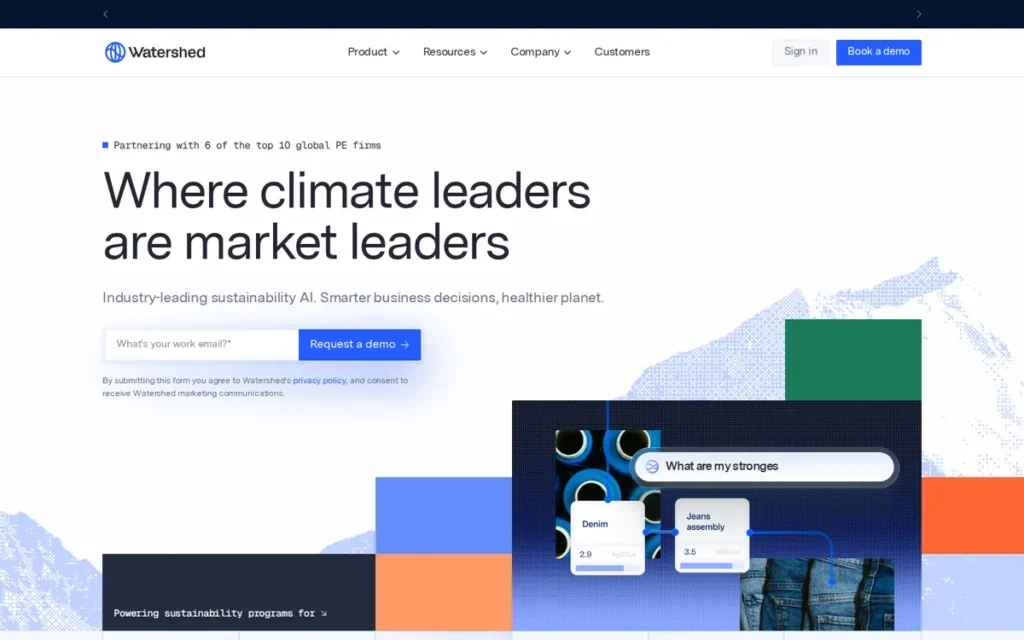
Category: Enterprise Carbon Management Platform, a full-stack platform for measuring, managing, and disclosing Scope 1–3 emissions across complex enterprise supply chains, distinguished by a 2026 Verdantix Green Quadrant Leader designation and a 500,000+ emission factor database.
At a Glance
- Category: Enterprise Carbon Management Platform
- Best For: Large enterprises and multinationals requiring the deepest GHG accounting methodology, audit-grade supply chain emissions, and multi-framework regulatory compliance
- Price Range: Custom enterprise pricing only; no public figures available; community-described as “very much over priced” (r/consulting, 2024)
- Primary Strength: Watershed’s 2026 Verdantix Green Quadrant Leader designation, CDP Gold accreditation (self-reported, Watershed.com 2026), and 500,000+ emission factor database
- Biggest Limitation: Watershed’s CSRD module independently documented as “subpar compared to Workiva’s” by an enterprise evaluator (r/consulting, 2024); no free tier
- One-Line Summary: Watershed is a 2026 Verdantix Green Quadrant Leader with a 500,000+ emission factor database, CDP Gold accreditation (self-reported, Watershed.com 2026), and a claimed 100% audit pass rate, serving BlackRock, Airbnb, Shopify, Stripe, and Canva.
- Last Verified: April 2026
Overview
Watershed is an enterprise carbon management platform founded in 2019, serving BlackRock, Airbnb, Shopify, Stripe, and Canva with full Scope 1, 2, and 3 emissions measurement, supply chain decarbonization planning, and multi-framework regulatory disclosure (Contrary Research, 2026).
Watershed’s 500,000+ emission factor database (including the multi-region CEDA model) and a claimed 100% audit pass rate position Watershed as the most extensively externally validated GHG accounting platform in this evaluation.
Watershed also offers a Life Cycle Assessment module, a Climate Action Manager for net-zero scenario planning, a carbon removal marketplace, and 60+ enterprise software integrations for automated data ingestion.
Key Features
- 500,000+ Emission Factor Database: Watershed draws from over 500,000 emission factors (including the multi-region CEDA model) enabling precise cross-geography GHG calculations for multinationals operating across jurisdictions with different energy grids (Watershed.com, 2026).
- CDP Gold-Accredited Reporting: Watershed describes itself as a CDP Gold global software solutions provider generating reports aligned with CDP, CSRD, TCFD, ESRS, and SEC climate disclosure requirements, with a claimed 100% audit pass rate when customer footprints are vetted by leading audit firms (Watershed.com, 2026; self-reported, independently unconfirmed as of April 2026).
- Supply Chain Emissions Module: Watershed’s supply chain module, launched November 2022, enables supplier-level emissions breakdowns including supplier emissions ranking, demonstrated in a Celonis case study covering granular Scope 3 assessment and the Guided CDP Report Builder NetZeroCompare, 2026.
- Climate Action Manager: Watershed’s scenario planning and net-zero modeling tool projects the emissions impact of operational changes before implementation, enabling organizations to prioritize decarbonization investments by impact rather than measuring emissions after the fact.
- 60+ Enterprise Integrations and Carbon Removal Marketplace: Watershed integrates with 60+ enterprise systems for automated data ingestion and connects organizations to verified carbon removal projects, covering the extended decarbonization workflow within a single platform (Contrary Research, 2026).
Best For
Watershed is best for large enterprises, multinationals, and financial institutions that require the deepest available GHG accounting methodology, assurance-grade Scope 3 supply chain data, and Verdantix-validated independent analyst recognition, the credential most commonly referenced in formal enterprise sustainability procurement.
Strengths
- Verdantix Green Quadrant Leader 2026: Watershed was named a Leader in the 2026 Verdantix Green Quadrant for Enterprise Carbon Management Software (one of eight platforms earning Leader designation) receiving top scores in data acquisition, quality control, carbon methodologies, and net-zero support (Verdantix, 2026).
- CDP Gold Accreditation and Claimed 100% Audit Pass Rate: Watershed describes itself as a CDP Gold global software solutions provider and claims a 100% audit pass rate when customer footprints are vetted by leading audit firms, the strongest self-documented audit-readiness combination in this evaluation (Watershed.com, 2026; independently unconfirmed as of April 2026).
- Enterprise Client Roster Including BlackRock: Watershed’s clients include BlackRock ($10 trillion AUM), Airbnb, Shopify, Stripe, and Canva, demonstrating acceptance by organizations with the most demanding investor-grade disclosure requirements in the market (Contrary Research, 2026; Generalist, 2024).
- $1 Billion Unicorn Valuation: Watershed achieved a $1 billion valuation backed by Sequoia Capital, Kleiner Perkins, Al Gore’s Generation Investment Management, and John Doerr, institutional credibility signals relevant in ESG markets where investor backing is evaluated alongside product quality (Generalist, 2024).
Limitations
- CSRD Module Depth: Watershed’s most consequential trade-off for European buyers is the gap between its GHG accounting depth and its CSRD-specific reporting capability, an enterprise evaluator who ran a formal multi-platform assessment in 2024 stated that “their CSRD tool [is] subpar compared to Workiva’s,” recommending Watershed’s carbon module as a data feed into a separate CSRD platform rather than a standalone ESRS E1 solution (u/SuccotashFar6358, r/consulting, 2024).
- Premium Pricing Without Transparency: Watershed’s custom pricing: independently described as “very much over priced” by multiple community members, combined with the absence of any self-serve trial means buyers must commit to a full enterprise sales process before evaluating fit, a dynamic that independent review platforms exist to counteract.
- No SME or Mid-Market Accessibility: Watershed provides no free tier, no published entry-level pricing, and no self-serve onboarding, making Watershed inaccessible for the SME and mid-market buyer segment now facing CSRD supply chain cascade obligations regardless of Watershed’s product quality.
“Their Carbon tool was fantastic and could feed into Workiva, just very much over priced.” (u/SuccotashFar6358, r/consulting (2024))
Takeaway: An enterprise buyer who preferred Watershed for carbon accounting ultimately chose a separate platform for CSRD compliance because Watershed’s CSRD module was insufficient as a standalone ESRS E1 solution, a direct use-case failure that EU buyers must independently evaluate before committing.
Verdict
Watershed is the most comprehensively externally validated carbon accounting platform in this evaluation, holding a 2026 Verdantix Green Quadrant Leader designation with top scores across four criteria and serving enterprise clients including BlackRock and Airbnb with a 500,000+ emission factor database. For large enterprises and financial institutions prioritizing GHG methodology depth and audit-grade supply chain accounting, Watershed provides the strongest independently validated methodology among the seven platforms reviewed. Organizations whose primary compliance driver is CSRD should independently verify whether Watershed’s carbon module alone satisfies all ESRS E1 requirements, or whether a combined Watershed-plus-dedicated-reporting-platform approach is necessary, a meaningful cost and complexity consideration before committing.
2. Persefoni: Best for Financial Institutions and Audit-Grade Compliance: Among the First PCAF-Accredited SaaS Platforms with a Confirmed Free Entry Tier
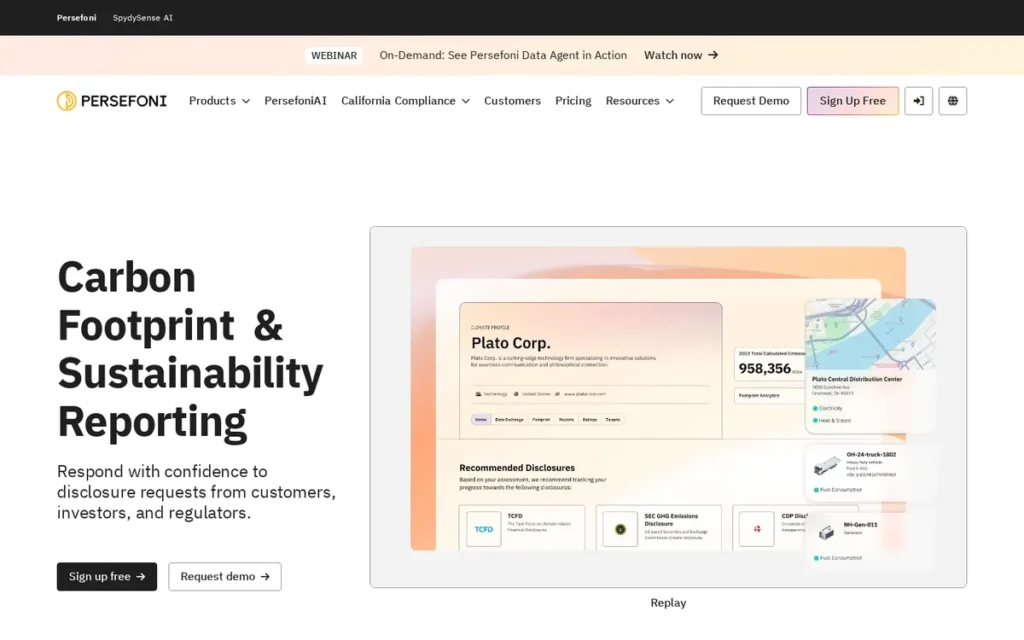
Category: Carbon Accounting and Climate Disclosure Platform, a purpose-built platform for corporate GHG inventory management and regulatory disclosure, with PCAF accreditation for financial institution use cases and the only confirmed free tier in this evaluation.
At a Glance
- Category: Carbon Accounting and Climate Disclosure Platform
- Best For: Financial institutions (banks, asset managers, private equity) tracking financed emissions under PCAF; enterprises needing a free-to-enterprise upgrade path
- Price Range: Free Pro tier confirmed at zero cost; enterprise plans from approximately $40,000/year (publicly referenced, 2025)
- Primary Strength: Persefoni’s PCAF accreditation: confirmed September 19, 2023, Forrester Wave Leader status, and the only confirmed free tier in this evaluation
- Biggest Limitation: Persefoni’s enterprise plans start at approximately $40,000/year with no intermediate pricing tier between free and enterprise
- One-Line Summary: Persefoni is a Forrester Wave Leader and among the first PCAF-accredited SaaS carbon accounting platforms, offering a confirmed free Pro tier and enterprise-grade Scope 1–3 climate disclosure tools aligned with GHG Protocol, CSRD, PCAF, SEC, TCFD, ISSB, CDP, and SBTi.
- Last Verified: April 2026
Overview
Persefoni is an enterprise carbon accounting and climate disclosure platform serving both corporate organizations and financial institutions with full Scope 1, 2, and 3 emissions coverage, making Persefoni the only platform in this evaluation with documented PCAF accreditation for financed emissions measurement required by banks, asset managers, and private equity firms.
Persefoni’s Footprint Ledger provides carbon accounting traceability modeled after financial reporting standards, while the PersefoniAI Copilot delivers AI-driven anomaly detection and on-demand technical expertise that reduces the need for deep in-house carbon accounting knowledge.
Persefoni supports CSRD, SEC climate disclosure, TCFD, ISSB, CDP, SBTi, and IFRS, with regulatory templates that automatically update as requirements evolve (Persefoni.com, 2026).
Key Features
- PCAF-Aligned Financed Emissions Methodology: Persefoni covers all financed emissions categories required by financial institutions under PCAF methodology, making Persefoni the default platform for banks, asset managers, and private equity firms facing PCAF reporting mandates with no equivalent alternative in this evaluation (Persefoni.com, 2026).
- PersefoniAI Copilot with Documented Anomaly Detection: Persefoni’s PersefoniAI Copilot uses LLM-based AI to detect anomalies in emissions inventory data, with a confirmed production case where Persefoni’s system identified a Scope 2 facility data error in a live GHG inventory before audit submission (Persefoni.com, 2026).
- Footprint Ledger for Audit-Grade Traceability: Persefoni’s Footprint Ledger provides granular carbon accounting traceability with enterprise-grade data controls, audit trails, and assurance-grade documentation, specifically architected to pass third-party GHG assurance reviews required under CSRD and SEC mandates (Persefoni.com, 2026).
- Confirmed Free Pro Tier: Persefoni’s free Pro tier provides full Scope 1–3 coverage at zero cost, the only confirmed free entry point among all seven platforms in this evaluation, designed for portfolio companies of financial services clients and organizations beginning CSRD preparation (Persefoni.com, 2026).
- Automated Regulatory Template Updates: Persefoni supports automated regulatory template updates across CSRD, SEC climate disclosure, TCFD, ISSB, CDP, SBTi, and IFRS, ensuring compliance templates reflect current framework requirements without manual maintenance by sustainability teams (BreatheESG, 2025).
Best For
Persefoni is best for financial services organizations (including banks, asset managers, insurers, and private equity firms) that require PCAF-accredited financed emissions methodology, and for large enterprises in any sector needing Forrester Wave-validated, audit-grade GHG accounting with a clear free-to-enterprise upgrade path.
Strengths
- Forrester Wave Leader Designation: Persefoni was named a Leader in the Forrester Wave for carbon accounting and sustainability management software, independent enterprise analyst validation confirming platform maturity and methodology rigor relative to assessed competitors (Forrester, 2023).
- Among the First PCAF-Accredited SaaS Vendors: Persefoni was recognized among the first PCAF-accredited SaaS vendors for financed and portfolio emissions measurement, announced September 19, 2023, with accreditation verified by SOCOTEC International Certification, the only documented PCAF accreditation among the seven platforms evaluated, with no equivalent for financial institutions under PCAF reporting mandates (PR Newswire, 2023).
- Confirmed Free Pro Tier: Persefoni’s free Pro tier: confirmed at zero cost as of April 2026, was independently described by a sustainability manager in January 2025 as “pretty legit” for compliance preparation, directly contrasting with Workiva and Salesforce pricing described as “through the roof” in the same discussion (u/Particular-Piglet364, r/carbonaccounting, 2025).
Users on r/carbonaccounting shared their experience:
“On the same boat. Limited budget but due to face some reporting requirements with CSRD. I started using Persefoni’s Pro tool (https://www.persefoni.com), which is free, and it looks pretty legit. Not sure about Enterprise pricing for advanced technical support, but it looks like they’ll be able to support the generation of CSRD and other reports (CDP, ISSB): https://www.persefoni.com/sustainability-reporting. Looks like it’s free too, so will be checking it out once it’s released. Aside from Persefoni, I’ve been looking into Workiva and Salesforce, but pricing was through the roof. Workiva’s also pretty new in the carbon management space.” Posted by u/Particular-Piglet364
Takeaway: Budget-constrained sustainability managers confirm Persefoni Pro delivers real CSRD compliance utility at zero cost, with competing enterprise platforms like Salesforce and Workiva cited as prohibitively expensive by comparison, making Persefoni the default first evaluation for organizations that cannot absorb enterprise-tier pricing.
- Unprompted Market Leader Community Consensus: Community discussions on r/consulting and r/carbonaccounting independently identify Persefoni alongside Watershed as one of the two market leaders for GHG accounting (2024–2026), peer validation not observed at comparable frequency and recency for any other platform in this evaluation (u/bigbluekite, r/consulting, 2024; u/Antique_Equal_1205, r/carbonaccounting, 2026).
Limitations
- Steep Free-to-Enterprise Pricing Gap: Persefoni’s most significant trade-off is the jump from its free Pro tier to enterprise contracts starting at approximately $40,000/year, organizations that outgrow self-serve Pro capabilities and need full audit support, advanced CSRD modules, or Climate Solutions team expertise face a commitment with no intermediate pricing tier available for mid-market buyers.
- Verdantix vs. Forrester Validation Gap: Persefoni holds Forrester Wave leadership but not Verdantix Green Quadrant recognition (the category-specific analyst framework most commonly referenced by enterprise sustainability procurement teams) which places Persefoni behind Watershed on the validation signal most heavily weighted in formal enterprise procurement processes.
- Limited Public Review Corpus: Persefoni has approximately 11 reviews on G2 (verified April 2026), consistent with enterprise positioning but limiting the independent peer review data available to supplement vendor documentation during formal evaluations (G2, 2026).
“tools like Greenly and Persefoni are good if you want something more structured and compliance-focused. They handle Scope 1–3 pretty well and align with frameworks like GHG Protocol and CSRD, which is useful if reporting is a big priority.” (u/Antique_Equal_1205, r/carbonaccounting (March 2026))
Takeaway: Practitioner-endorsed compliance credibility for both Greenly and Persefoni was confirmed as recently as March 2026, the most recent independent community validation in this evaluation, observed for no other platform at comparable recency and specificity.
Verdict
Persefoni is a Forrester Wave Leader and among the first PCAF-accredited SaaS carbon accounting platforms, with the only confirmed free Pro tier in this evaluation, making Persefoni the non-negotiable evaluation for financial institutions and the most accessible enterprise-grade platform available. For corporate enterprises choosing between Watershed and Persefoni: Persefoni offers superior accessibility (free tier, ~$40K enterprise floor, and the only PCAF credential among the seven evaluated) while Watershed offers superior category-specific analyst recognition (Verdantix Leader vs. Forrester Leader) and a larger emission factor database, both are defensible choices depending on which primary criteria the organization weights most heavily.
3. Greenly: Best for SME and Mid-Market: Largest Disclosed Customer Base, Only Community-Verified Pricing, and Broadest Integration Accessibility
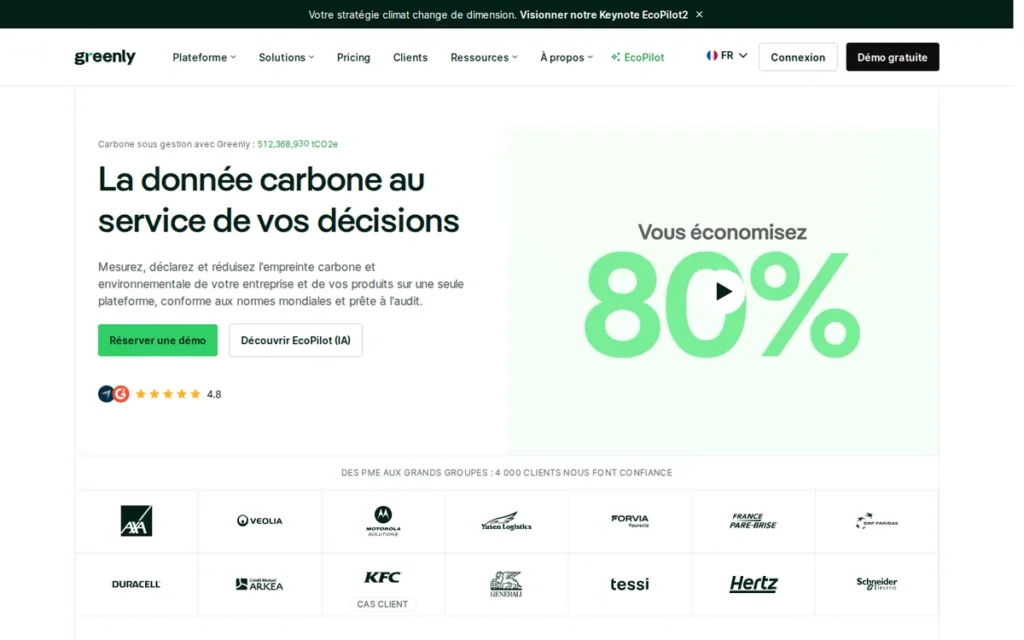
Category: SME-to-Enterprise Carbon Accounting Platform, a full Scope 1–3 platform designed for accessibility across company sizes, with AI-powered automation, the most transparent pricing in the category, and the largest publicly documented customer base among all platforms evaluated.
At a Glance
- Category: SME-to-Enterprise Carbon Accounting Platform
- Best For: SMEs and mid-market companies needing CSRD compliance with accessible pricing; European organizations under ADEME and CSRD obligations; any buyer prioritizing budget transparency and fast implementation
- Price Range: $1,000–$45,000/year depending on organization size (community-sourced, r/sustainability, 2024); not published publicly on Greenly’s website
- Primary Strength: Greenly’s 3,500+ disclosed customer base, only community-verified pricing range in this evaluation, 300,000+ emission factor library, and confirmed Xero integration
- Biggest Limitation: Greenly lacks Verdantix or Forrester analyst recognition; thin G2/Capterra review corpus relative to its 3,500+ user base
- One-Line Summary: Greenly is a carbon accounting platform serving 3,500+ companies (including HSBC and Ubisoft) with a 300,000+ emission factor library, AI-powered EcoPilot automation, and the only community-verified pricing range ($1,000–$45,000/year) among the seven platforms evaluated in 2026.
- Last Verified: April 2026
Overview
Greenly is a carbon accounting platform serving over 3,500 companies worldwide (including HSBC and Ubisoft) that provides AI-powered Scope 1, 2, and 3 emissions measurement with over 300,000 emission factors and an EcoPilot AI assistant described as up to nine times faster than traditional manual data collection (ESG News, 2024; citiesabc.com, 2024).
Greenly is the only platform in this evaluation with a community-verified pricing range ($1,000–$45,000/year, r/sustainability 2024) and a confirmed Xero integration, positioning Greenly as the most accessible full-featured carbon accounting platform for SMEs and mid-market companies facing CSRD supply chain obligations.
Greenly’s origins as a financial-data-based carbon estimator inform its strength with spend-based Scope 3 estimation using accounting system inputs, a methodology that transfers naturally to SME accounting infrastructure.
Key Features
- EcoPilot AI Automation: Greenly’s EcoPilot AI assistant processes physical inventory, accounting, and logistics data to automate emissions modeling and supply chain screening, with Greenly claiming the system is up to nine times faster than traditional manual data collection for Scope 3 supplier assessment ESG News, 2024.
- 300,000+ Emission Factor Library: Greenly’s emission factor library contains over 300,000 factors (including 30,000 monetary emission factors and 50,000 supplier-specific metrics) enabling granular Scope 3 estimation well beyond generic spend-based approaches ESG News, 2024.
- Product Carbon Footprint and Native LCA Module: Greenly’s PCF module automates product-level footprint generation using Bill of Materials imports and native Lifecycle Analysis, supporting EU Green Claims Directive and CSRD product-level disclosure requirements for manufacturing and consumer goods organizations (Greenly.earth, 2026).
- Xero Integration and 100+ App Connections: Greenly integrates with over 100 software applications (including a confirmed Xero integration listed on the Xero App Store) enabling automated data import from the accounting and procurement systems most widely used by SMEs (Xero App Store, 2026).
- “What If” Scenario Simulation: Greenly’s “What If” simulation feature enables sustainability teams to model the carbon impact of supplier changes, material substitutions, or transport mode shifts before operational decisions, shifting carbon management from retrospective reporting to proactive supply chain planning ESG News, 2024.
Best For
Greenly is best for SMEs and mid-market companies (particularly European organizations facing CSRD obligations, Scope 3 supply chain reporting requirements, or product carbon footprint disclosures) that need accessible, community-verified pricing, fast implementation, and an automation-first platform without enterprise-tier implementation complexity.
Strengths
- Largest Disclosed Customer Base at 3,500+ Companies: Greenly’s 3,500+ company customer base (including HSBC and Ubisoft) is the largest disclosed in this evaluation and the strongest real-world adoption evidence among all platforms reviewed, demonstrating applicability across financial services and technology sectors at scale (Greenly.earth, 2026; citiesabc.com, 2024).
- Only Community-Verified Pricing Range in This Evaluation: Greenly is the only platform in this evaluation with a community-verified pricing range ($1,000–$45,000/year, r/sustainability 2024), directly addressing the most consistently cited buyer frustration and enabling organizations to self-qualify on budget before entering vendor sales conversations (u/texan_spaghet, r/sustainability, 2024).
- 50,000 Supplier-Specific Emission Metrics: Greenly’s 300,000+ emission factor library includes 50,000 supplier-specific metrics, providing the granular Scope 3 estimation capability required by CSRD and CDP, supported by an AI-powered EcoPilot that Greenly claims reduces supply chain carbon data collection from weeks to minutes ESG News, 2024.
- Compliance-Focused Practitioner Endorsement: Community consensus from r/carbonaccounting in March 2026 independently positions Greenly as “structured and compliance-focused” for Scope 1–3 tracking aligned with GHG Protocol, CSRD, ADEME, CDP, TCFD, and SBTi, validating multi-framework compliance across European and global disclosure standards (u/Antique_Equal_1205, r/carbonaccounting, 2026).
Limitations
- No Category-Specific Analyst Validation: Greenly’s most consequential trade-off for enterprise procurement processes is the absence of Verdantix Green Quadrant or Forrester Wave recognition (the frameworks enterprise sustainability teams most heavily weight) which may create credibility questions in formal procurement processes where analyst endorsement is a qualifying rather than supplementary criterion.
- Unverified Speed and Performance Claims: Greenly’s 9x speed improvement claim and supply chain screening capability, while architecturally credible, have not been independently verified in a named case study with quantified, auditor-reviewed outcomes, prospective buyers should request reference calls before accepting these benchmarks at face value.
- Thin Public Review Corpus Relative to Customer Base: Greenly’s public review presence on G2 and Capterra is thin relative to its 3,500+ user base, a notable gap that limits the independent peer review data available to supplement vendor documentation during formal evaluations.
Verdict
Greenly is the strongest independently evidenced choice for SMEs and mid-market companies in this evaluation, combining the largest disclosed customer base (3,500+ companies including HSBC and Ubisoft), the only community-verified pricing transparency ($1,000–$45,000/year), a 300,000+ emission factor library with 50,000 supplier-specific metrics, and AI-powered automation for organizations replacing manual spreadsheet tracking. Greenly’s confirmed alignment with CSRD, ADEME, CDP, and GHG Protocol makes it a credible compliance-grade platform for European organizations under CSRD obligations. Organizations needing Verdantix or Forrester validation in formal enterprise procurement should supplement Greenly’s evaluation with direct analyst reference checks or named customer reference calls.
4. Normative: Best for Scope 3 Supplier Data Collection at Scale: Unique Carbon Network Shared Infrastructure
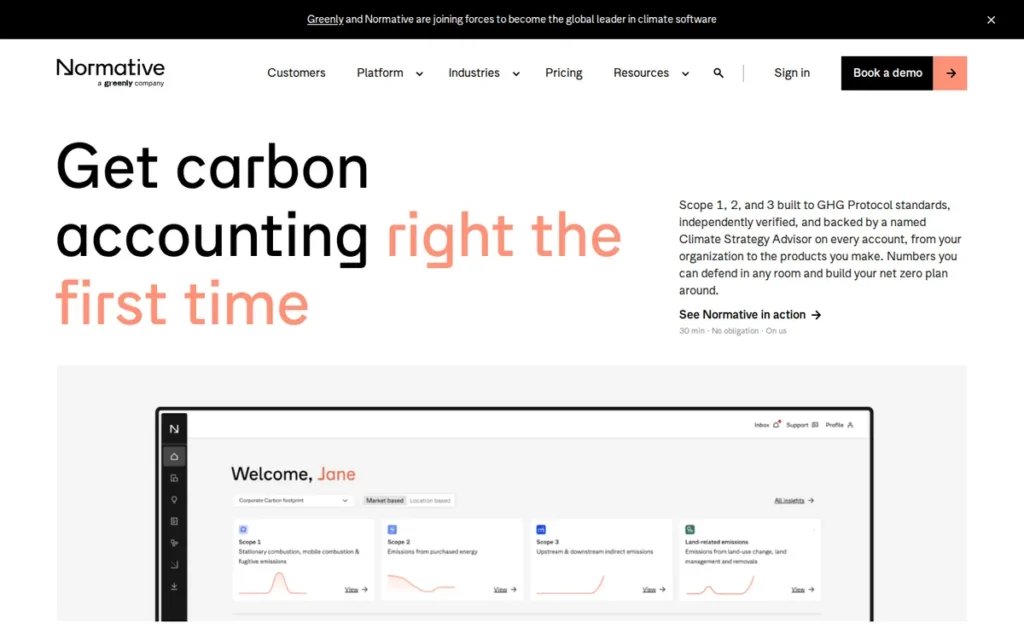
Category: Carbon Accounting Platform with Shared Supplier Network, a Scope 1–3 carbon management platform distinguished by its Carbon Network for shared supplier data collection, reducing duplicate outreach across corporate value chains and enabling connected calculations with supplier-confirmed primary data.
At a Glance
- Category: Carbon Accounting Platform with Shared Supplier Network
- Best For: Organizations with complex multi-supplier Scope 3 value chains; food, retail, and hospitality companies needing sector-specific emission accuracy; sustainability teams without deep in-house carbon accounting expertise
- Price Range: Custom pricing for both Essential and Premium tiers; no public figures available (verified April 2026)
- Primary Strength: Normative’s Carbon Network: the only shared supplier data infrastructure in this evaluation, enabling suppliers to upload emissions data once and share it with multiple buyer organizations
- Biggest Limitation: Normative has no documented Verdantix, Forrester, or Gartner recognition; minimal community presence on Reddit and major B2B review platforms
- One-Line Summary: Normative is a carbon accounting platform with a unique Carbon Network infrastructure enabling shared supplier emissions data across value chains, supported by 349,000+ emission factors, a hybrid spend/activity calculation engine, and GHG-Protocol-certified climate strategist support at both the Essential and Premium tiers.
- Last Verified: April 2026
Overview
Normative is a carbon accounting platform providing Scope 1, 2, and 3 emissions tracking through a proprietary GHG Protocol implementation, supported by over 349,000 emission factors and a hybrid calculation engine that automatically selects between spend-based and activity-based approaches depending on available input data.
Normative’s most structurally differentiated feature is its Carbon Network, a shared supplier data infrastructure enabling suppliers to access free Network Accounts, upload their emissions data once, and share it with multiple buyer organizations, reducing the duplicated outreach that sustainability managers identify as the primary bottleneck in Scope 3 data collection at scale.
Normative serves organizations through Essential and Premium plan tiers, with GHG-Protocol-certified climate strategist support included at both levels (Normative.io, 2026).
The credibility problem Normative’s Carbon Network addresses is well-documented by practitioners working at the intersection of LCA and corporate carbon accounting. As one practitioner on r/lifecycleassessment observed:
“I agree that Scope 3 reporting is generally very, very untrustworthy. Especially because methodologies, databases and everything else differs between companies so it’s impossible to compare anything. It becomes meaningless.” Posted by u/Jozoz
Takeaway: Practitioners document Scope 3 methodology inconsistency across the category as a systemic credibility problem, the structural condition Normative’s Carbon Network attempts to address by replacing independent, incomparable spend-based estimates with supplier-confirmed primary data shared across value chains.
Key Features
- Carbon Network Shared Supplier Infrastructure: Normative’s Carbon Network creates a shared supplier emissions data layer where suppliers upload activity data once and authorize sharing with multiple buyers, eliminating the duplicated survey requests that cause supplier engagement fatigue and degrade data quality across value-chain carbon accounting programs (Normative Carbon Network, PR Newswire, November 2023).
- Connected Calculations with Supplier-Confirmed Data: Normative’s connected calculations methodology integrates supplier-confirmed primary data directly into corporate carbon footprints, replacing spend-based estimates with auditable, supplier-verified figures that improve both emissions accuracy and external assurance credibility (Normative.io, 2026).
- Hybrid Spend/Activity Calculation Engine: Normative’s hybrid calculation engine automatically selects between spend-based and activity-based methodology based on what input data is present, reducing the technical burden on sustainability managers who lack the specialist expertise to make this methodological judgment manually (Normative.io, 2026).
- GHG-Protocol-Certified Climate Strategist Support: Normative provides GHG-Protocol-certified climate strategist support at both the Essential and Premium plan tiers, pairing human expert guidance with software automation in a model suited to organizations without in-house sustainability specialists NetZeroCompare, 2026.
- Food Sector Emissions Partnerships: Normative partners with Klimato for food sector carbon data (Normative.io, 2023) and Howgood for sustainable ingredient data (Normative.io, 2023), extending emission factor coverage for food, retail, and hospitality companies in Scope 3 Category 1 (Purchased Goods and Services), one of the most complex and least accurately estimated Scope 3 categories.
Best For
Normative is best for organizations with complex multi-supplier Scope 3 value chains that need to improve supplier data collection at scale, for food and retail companies requiring sector-specific emission factors, and for sustainability teams without deep in-house carbon accounting expertise who need certified expert support built into their software subscription.
Strengths
- Carbon Network: Uniquely Differentiated Scope 3 Architecture: Normative’s Carbon Network, launched November 2023, with a direct customer testimonial that it “greatly improved the way we engage our suppliers and collect emissions data” and made it “easier to bring our suppliers into our net-zero journey, no matter how mature they are in their own climate work”, is the only shared supplier data infrastructure in this evaluation (Normative Carbon Network, PR Newswire, November 2023).
- 349,000+ Factors with Automatic Hybrid Methodology: Normative’s 349,000+ emission factor library and automatic hybrid calculation methodology reduce calculation errors for non-specialist users and produce more defensible footprints as supplier data quality improves over time (Normative.io, 2026).
- Built-In Expert Human Support at Both Tiers: Normative includes GHG-Protocol-certified climate strategists in both plan tiers, a human expert layer that differentiates Normative from pure-SaaS competitors and directly addresses the knowledge gap in organizations without dedicated sustainability staff (FitGap, 2026).
- Enterprise Evaluation Shortlist Presence: Normative appeared on enterprise evaluation shortlists in a 2024 r/consulting thread for a multinational’s formal ESG reporting evaluation (alongside Greenly, Atlas Metrics, and Workiva) indicating Normative reaches formal enterprise procurement consideration despite limited community review volume (u/new_home_own3r, r/consulting, 2024).
Limitations
- No Third-Party Analyst Recognition: Normative’s most significant trade-off is the complete absence of Verdantix, Forrester, or Gartner recognition (the analyst frameworks enterprise sustainability procurement processes most commonly reference) making it difficult for buyers to validate platform quality through established third-party channels without investing in direct reference checks.
- Minimal Community Discussion Presence: Normative’s community presence on Reddit and major B2B review platforms is minimal relative to competitive peers, the platform appears on enterprise shortlists but generates no substantive unprompted peer commentary, leaving buyers with limited practitioner intelligence to supplement vendor documentation.
- Complete Pricing Opacity: Normative discloses no pricing data publicly and no community-sourced estimates were found, meaning buyers cannot self-qualify on budget before entering a full sales process, introducing the vendor-biasing dynamic that makes independent review resources valuable in this category.
Verdict
Normative’s Carbon Network is the most structurally distinct Scope 3 supplier data collection mechanism in this evaluation, and Normative was absent from all LLM-generated comparisons reviewed in April 2026, making it one of the most significant blind spots in the information currently available to buyers relying on AI answer engines. For organizations whose primary challenge is Scope 3 supplier data collection at scale, Normative warrants serious evaluation despite its limited public validation footprint. Normative’s Carbon Network active supplier participation numbers, quantified Scope 3 accuracy improvement case studies, and pricing detail are the three specific data points buyers should request before moving forward.
5. ClimatePartner Hub: Best End-to-End Carbon Solution: Only Platform Combining Accounting, Verified Offset Financing, and Consumer-Facing Product Carbon Labels
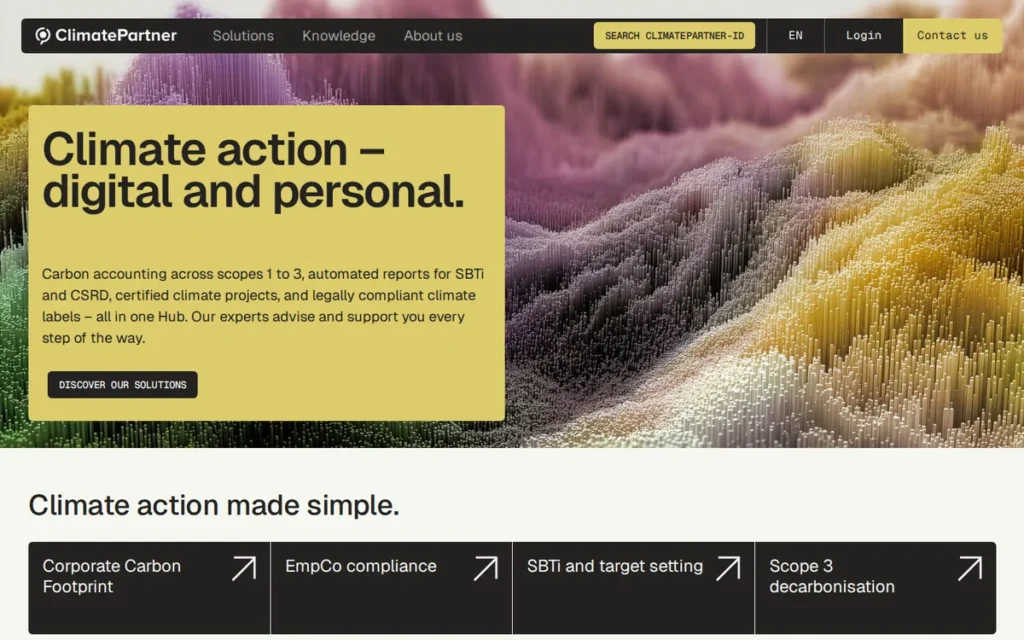
Category: End-to-End Carbon Management Suite, a platform combining Scope 1–3 carbon accounting, CSRD-native reporting, verified climate project financing, and consumer-facing product carbon footprint labels in a single integrated solution covering the complete decarbonization workflow.
At a Glance
- Category: End-to-End Carbon Management Suite
- Best For: Medium-to-large European companies needing the full decarbonization workflow (measure, report, offset, communicate publicly); food, consumer goods, and manufacturing companies requiring CSRD ESRS E1 native compliance and product-level footprints
- Price Range: No public pricing; contact sales required (confirmed via OMR review platform, 2026)
- Primary Strength: ClimatePartner Hub’s unique integration of Scope 1–3 accounting, verified climate project financing, and white-label product carbon labels in a single platform
- Biggest Limitation: ClimatePartner Hub has no Verdantix, Forrester, or Gartner analyst recognition; no publicly available case studies with named clients; no community discussion
- One-Line Summary: ClimatePartner Hub is a Munich-based end-to-end carbon management suite uniquely combining Scope 1–3 accounting, native CSRD ESRS E1 reporting, verified climate project financing, and white-label product carbon footprint labels, the only platform in this 2026 evaluation covering the complete measure-reduce-offset-communicate workflow.
- Last Verified: April 2026
Overview
ClimatePartner Hub is a Munich-based end-to-end climate strategy platform that combines AI-powered Scope 1, 2, and 3 carbon accounting with verified climate project financing and white-label Climate-ID product carbon footprint labels, making ClimatePartner Hub the only platform in this evaluation covering the full decarbonization workflow from initial measurement through public product-level climate claims without separate vendor relationships.
ClimatePartner Hub natively generates all required CSRD ESRS E1 data points, includes FLAG splits (Forests, Land, and Agriculture) for SBTi alignment relevant to food and agriculture companies, and uses AI to automatically match activity data to emission factors with plausibility analysis to reduce calculation errors.
ClimatePartner’s German origin and explicit CSRD orientation reflect its primary positioning for European companies navigating mandatory climate disclosure requirements (ClimatePartner.com, 2026).
Key Features
- Integrated Carbon Accounting and Verified Offset Financing: ClimatePartner Hub integrates Scope 1–3 carbon accounting with verified climate project financing in a single platform, enabling the complete measure-reduce-offset-communicate workflow without managing separate vendor contracts for each stage (ClimatePartner.com, 2026).
- Native CSRD ESRS E1 Data Points and FLAG Splits: ClimatePartner Hub natively generates all required CSRD ESRS E1 data points (including FLAG splits (Forests, Land, and Agriculture) for SBTi alignment covering land-use-intensive industries) reducing the compliance preparation burden for European companies facing phased CSRD reporting timelines through 2028 (ClimatePartner.com, 2026).
- Climate-ID Product Carbon Footprint Labels: ClimatePartner Hub’s PCF module automates product-level footprint generation across entire portfolios, with shareable Climate-ID branded pages enabling companies to communicate individual product footprints to customers and retailers under EU Green Claims Directive requirements (ClimatePartner.com, 2026).
- AI-Powered Emission Factor Matching with Plausibility Analysis: ClimatePartner Hub’s AI matching layer automatically pairs activity data with emission factors and conducts plausibility analyses to identify calculation anomalies, reducing methodology errors for sustainability teams without specialist carbon accounting expertise (ClimatePartner.com, 2026).
- Hotspot Analytics for Prioritized Reduction: ClimatePartner Hub’s hotspot analytics automatically identify the highest-emission sources across a company’s full carbon footprint, enabling resource-constrained sustainability teams to prioritize reduction actions by impact rather than spending time parsing raw data NetZeroCompare, 2026.
Best For
ClimatePartner Hub is best for medium-to-large European companies that need to satisfy CSRD ESRS E1 obligations, build verified offset portfolios, and communicate product-level climate claims to customers or retailers, particularly food, consumer goods, and manufacturing companies where product carbon footprints and land-use emissions are material disclosure requirements.
Strengths
- Unique End-to-End Workflow Architecture: ClimatePartner Hub’s integration of carbon accounting with verified climate project financing is architecturally unique among all seven platforms evaluated, enabling the complete measure-reduce-offset-communicate workflow and directly addressing the practitioner-documented pain point that “most tools only do part of the job, either data collection, calculations, or reporting” (u/zee9736, r/consulting, 2025; ClimatePartner.com, 2026).
- Native CSRD ESRS E1 Compliance with FLAG Splits: ClimatePartner Hub natively generates all required CSRD ESRS E1 data points and FLAG splits for SBTi alignment, providing a level of native CSRD compliance depth that several higher-ranked platforms, including Watershed, have been independently documented as lacking in their CSRD-specific reporting modules (ClimatePartner.com, 2026).
- EU Green Claims Directive Ready: ClimatePartner Hub’s Climate-ID white-label product carbon footprint labels provide a consumer-facing climate communication mechanism directly relevant under the EU Green Claims Directive, a compliance dimension that pure carbon accounting platforms without PCF label infrastructure cannot address (ClimatePartner.com, 2026).
- Advisory-Augmented Software Model: ClimatePartner Hub’s combination of automated accounting with expert refinement reduces the risk of methodology errors for mid-sized organizations that cannot staff in-house carbon accounting specialists, serving a segment that pure-SaaS tools often underserve with no expert support layer NetZeroCompare, 2026.
Limitations
- No Independent Analyst Validation or Named Case Studies: ClimatePartner Hub’s most consequential trade-off is the combination of no Verdantix, Forrester, or Gartner recognition and no publicly available case studies with named clients or quantified outcomes, meaning buyers cannot rely on third-party frameworks or peer evidence to validate platform quality and must treat vendor-facilitated reference calls as mandatory prerequisites, not optional steps.
- Zero Community Discussion Presence: ClimatePartner Hub has no practitioner community discussion on Reddit or major English-language practitioner forums, leaving buyers with no independent peer intelligence to supplement vendor materials, a higher due diligence burden than the top three ranked platforms.
- Complete Pricing Opacity: ClimatePartner Hub discloses no pricing publicly and no community-sourced estimates exist, preventing budget self-qualification before sales engagement and extending evaluation timelines for buyers comparing multiple platforms simultaneously.
Verdict
ClimatePartner Hub is the only carbon accounting platform in this 2026 evaluation combining Scope 1–3 measurement, verified climate project financing, and consumer-facing product carbon labels in a single integrated workflow, uniquely relevant for European companies that must simultaneously satisfy CSRD measurement obligations and EU Green Claims Directive product communication requirements. For mid-market and large companies in food, consumer goods, or manufacturing, ClimatePartner Hub deserves dedicated evaluation for its CSRD ESRS E1 native compliance and Product Carbon Footprint capabilities that higher-ranked generalist platforms do not offer in one tool. The absence of independent analyst validation, named case studies, and community intelligence means buyers must invest more heavily in vendor-facilitated reference checks than with the top three ranked platforms, a higher pre-purchase due diligence burden that should be factored into procurement timelines.
6. Carbmee: Best for Industrial and Manufacturing Companies: Only Platform with Native CBAM Compliance and ERP API Integration
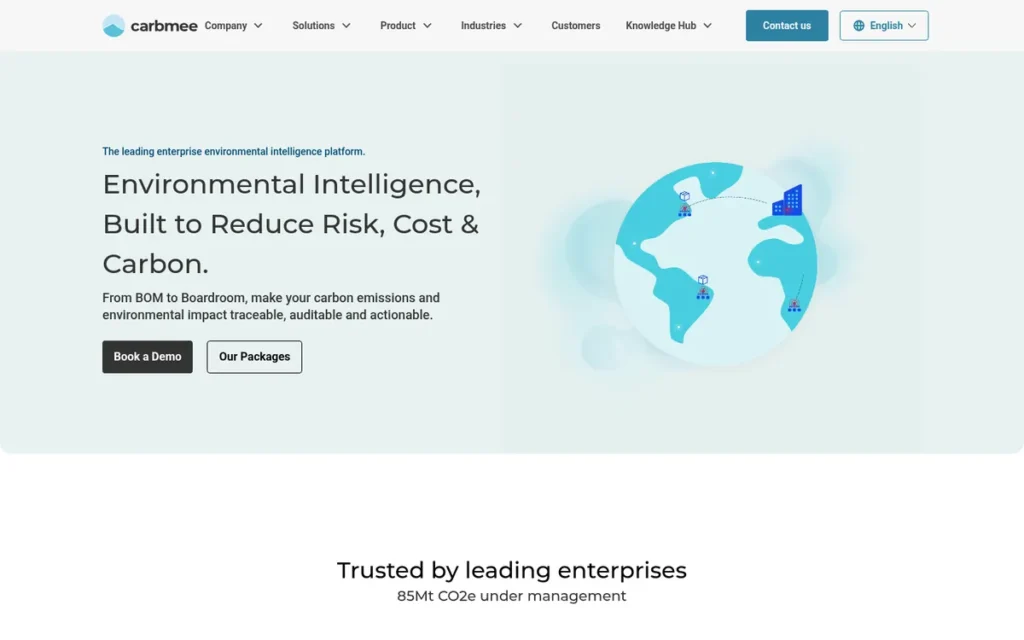
Category: Industrial Carbon Management Platform, an enterprise carbon accounting platform purpose-built for manufacturing and industrial companies, with ERP API integration, CBAM compliance readiness, Gartner Cool Vendor 2022 recognition, and integrated Corporate, Product, and Supply Chain Footprint calculations across multi-tier industrial supply chains.
At a Glance
- Category: Industrial Carbon Management Platform
- Best For: Industrial manufacturers with ERP-managed production environments and EU import/export activity requiring CBAM compliance; large supply-chain-intensive organizations needing simultaneous CCF, PCF, and SCF calculations
- Price Range: Custom enterprise pricing only; ERP integration complexity implies significant implementation costs beyond licensing (verified April 2026)
- Primary Strength: Carbmee’s EIS™: the only industrial-native platform with a documented CBAM compliance module and ERP API integration in this evaluation, with Gartner Cool Vendor 2022 recognition and confirmed clients including Kärcher, Maersk, and KWS
- Biggest Limitation: Carbmee has no Verdantix or Forrester carbon-specific evaluation; no public case studies with quantified outcomes; no community discussion on practitioner forums
- One-Line Summary: Carbmee’s Environmental Intelligence System (EIS™) is a purpose-built industrial carbon accounting platform with CBAM compliance readiness, ERP API integration, GenAI-powered Ecoinvent factor mapping, and integrated CCF/PCF/SCF calculations, recognized as a Gartner Cool Vendor in 2022 and serving Kärcher, Maersk, and KWS (Carbmee.com, 2026).
- Last Verified: April 2026
Overview
Carbmee is a German-founded (2021) enterprise carbon management company whose Environmental Intelligence System (EIS™) is purpose-built for industrial and manufacturing organizations Supply Chain Digital, 2023. Carbmee provides Scope 1, 2, and 3 emissions tracking with direct ERP and procurement system integration via API, CBAM compliance readiness for EU Carbon Border Adjustment Mechanism obligations (which entered its transitional reporting phase in October 2023 and reached full enforcement in 2026 (European Commission, 2023)) and integrated Corporate, Product, and Supply Chain Footprint calculations.
Carbmee’s confirmed enterprise clients include Kärcher, Maersk, and KWS (Carbmee.com, 2026). Carbmee raised $21 million in funding and aligns its platform with GHG Protocol, ISO 14064, ESRS E1, WBCSD PACT, SBTi, and CBAM standards.
Carbmee’s GenAI capabilities automate the matching of diverse supplier data formats to standardized Ecoinvent emission factors, addressing the most labor-intensive step in manufacturing Scope 3 accounting at scale.
Key Features
- ERP API Integration for Industrial Data Environments: Carbmee’s ERP API integration enables direct data ingestion from ERP and procurement systems, eliminating the manual data extraction that makes industrial Scope 3 accounting time-consuming in environments where emissions-relevant data is embedded in production management systems rather than sustainability databases (Carbmee.com, 2026).
- CBAM Compliance Module: Carbmee’s CBAM compliance module provides the product-level embedded carbon calculations required by the EU Carbon Border Adjustment Mechanism, requiring CBAM declarants (industrial importers and exporters) to report embedded carbon aligned with the EU Emissions Trading System, with full enforcement reached in 2026 and no equivalent native module available in any other platform in this evaluation (Carbmee.com, 2026; European Commission, 2023).
- Integrated CCF, PCF, and SCF Calculations: Carbmee’s integrated Corporate Carbon Footprint, Product Carbon Footprint, and Supply Chain Footprint modules simultaneously track emissions at organization, SKU, and value-chain levels, the three measurement layers manufacturing companies must satisfy across ESRS, CBAM, and customer sustainability questionnaires (Carbmee.com, 2026).
- GenAI for Ecoinvent Factor Mapping: Carbmee’s GenAI capabilities automate the matching of supplier data to Ecoinvent emission factors, reducing the specialist labor required to translate thousands of manufacturing supplier inputs into standardized carbon calculations at industrial scale (Carbmee.com, 2026).
- 95%+ GHG Source Coverage: Carbmee covers over 95% of typical corporate GHG sources and aligns with GHG Protocol, ISO 14064, ESRS E1, CBAM, WBCSD PACT, and SBTi, providing regulatory coverage spanning the EU’s primary industrial carbon obligations in a single platform (Carbmee.com, 2026).
Best For
Carbmee is best for large industrial manufacturers, engineering companies, and supply-chain-intensive organizations with ERP-managed production data that need CBAM-compliant product carbon footprints, multi-tier supply chain carbon accounting, and direct ERP integration, particularly companies with EU import/export activity facing CBAM compliance obligations.
Strengths
- Only CBAM Compliance Module in This Evaluation: Carbmee is the only platform in this evaluation with a documented CBAM compliance module, directly addressing the EU Carbon Border Adjustment Mechanism requirement for product-level embedded carbon reporting affecting industrial importers and exporters operating in or with the EU from 2026 (Carbmee.com, 2026).
- ERP-Native Industrial Architecture: Carbmee’s EIS™ integrates Corporate, Product, and Supply Chain Footprint calculations with direct ERP API connectivity, addressing three simultaneous measurement requirements manufacturing companies face across ESRS, CBAM, and customer sustainability questionnaires without requiring separate specialized tools (Carbmee.com, 2026).
- $21 Million Funding Raise: Carbmee raised $21 million in funding reported by Supply Chain Digital in 2023, significant capital for a company founded in 2021, providing a product development runway aligned with EU CBAM and ESRS enforcement timelines Supply Chain Digital, 2023.
- Gartner Cool Vendor 2022 Recognition: Carbmee was named a Gartner Cool Vendor in 2022 and included in the Gartner Hype Cycle in 2023, independent early-market analyst recognition for the industrial carbon management category (Carbmee.com, citing Gartner, 2022–2023). Note: Gartner Cool Vendor recognition identifies emerging solutions and differs from a Verdantix Green Quadrant or Forrester Wave evaluation, which assess relative market leadership across competing platforms on defined criteria.
Limitations
- No Verdantix or Forrester Carbon-Specific Evaluation: Carbmee’s most significant trade-off for enterprise procurement is the absence of Verdantix Green Quadrant or Forrester Wave carbon-specific recognition (the analyst frameworks most commonly referenced in sustainability software procurement) meaning buyers cannot use those established frameworks to benchmark Carbmee against competing platforms.
- No Public Case Studies with Quantified Outcomes: While Carbmee lists confirmed clients including Kärcher, Maersk, and KWS (Carbmee.com, 2026), no public case studies with quantified emissions reduction or time-to-implementation data were available during this research, leaving buyers without performance evidence beyond the client list and Gartner early-market recognition.
- No SME or Mid-Market Accessibility: Carbmee’s industrial enterprise positioning, ERP integration requirements, and implementation complexity make it categorically unsuitable for SMEs or mid-market buyers, Carbmee is purpose-built for large industrial organizations with dedicated ERP infrastructure, sustainability resources, andcompliance budgets.
Verdict
Carbmee is the only carbon accounting platform in this 2026 evaluation with a documented CBAM compliance module and ERP API integration purpose-built for manufacturing, making Carbmee the logical first evaluation for industrial manufacturers facing EU Carbon Border Adjustment Mechanism compliance requirements. Carbmee’s ERP API integration and integrated CCF/PCF/SCF architecture are structurally suited to the data environment industrial organizations actually operate in. Buyers should approach Carbmee with higher pre-purchase due diligence requirements than higher-ranked platforms: named reference customers (Kärcher, Maersk, KWS contacts willing to discuss implementation), quantified case study outcomes, and confirmation of any GHG assurance engagement are prerequisites, not optional steps.
7. Salesforce Net Zero Cloud: Viable Only for Existing Salesforce Enterprises: Native Ecosystem Integration Offset by Significant Dependencies, Premium Pricing, and Practitioner Skepticism
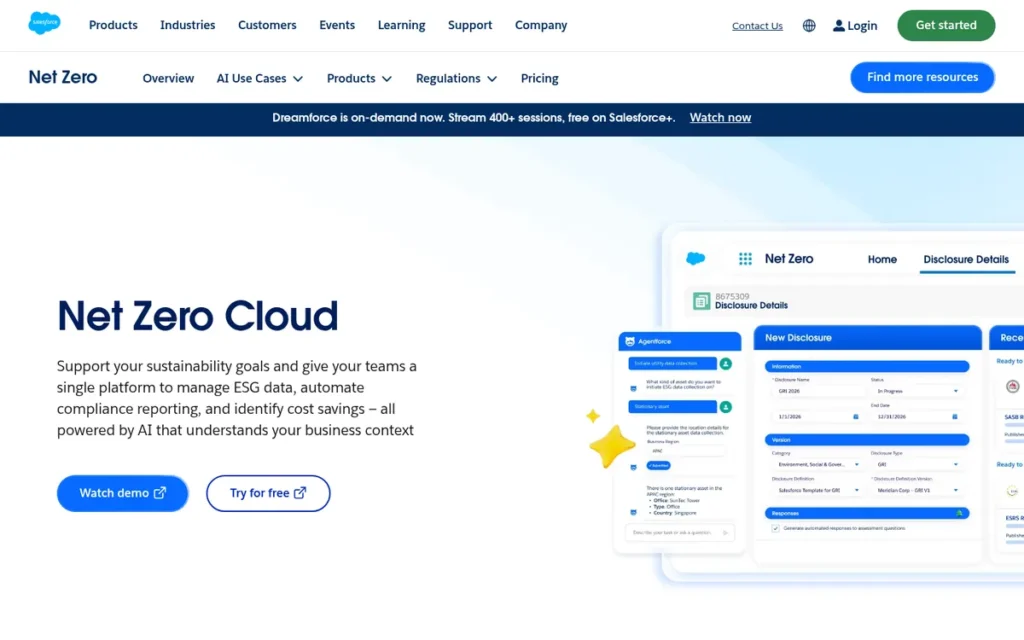
Category: Enterprise ESG and Carbon Module, a Salesforce-native carbon accounting module for organizations already operating within the Salesforce enterprise ecosystem, providing Scope 1–3 tracking with Agentforce AI and supplier engagement tools embedded in existing workflows rather than as a standalone platform.
At a Glance
- Category: Enterprise ESG and Carbon Module
- Best For: Large enterprises already fully committed to the Salesforce ecosystem with existing Salesforce infrastructure, dedicated administrators, and IT resources for module implementation
- Price Range: Custom enterprise pricing only; requires existing Salesforce contract as a prerequisite; independently described as “through the roof” (u/Particular-Piglet364, r/carbonaccounting, January 2025)
- Primary Strength: Salesforce Net Zero Cloud’s native ecosystem integration eliminates data migration complexity for enterprises already committed to Salesforce
- Biggest Limitation: Salesforce Net Zero Cloud requires existing Salesforce infrastructure; community-documented by sustainability practitioners as likely inferior to purpose-built ESG vendors (r/consulting, 2024)
- One-Line Summary: Salesforce Net Zero Cloud is a Salesforce-native Scope 1–3 carbon accounting module with Agentforce AI automation and a Supplier Scorecard, recommended only for large enterprises already operating within the Salesforce ecosystem who can absorb the significant infrastructure dependencies, premium pricing, and practitioner-documented concerns about purpose-built platform depth.
- Last Verified: April 2026
Overview
Salesforce Net Zero Cloud (marketed as Agentforce Net Zero as of 2026) is a carbon accounting and ESG reporting module natively embedded within the Salesforce enterprise platform, providing Scope 1, 2, and 3 emissions tracking using pre-loaded GHG Protocol emission factors, Agentforce AI automation, and a Supplier Scorecard for geographic supply chain emissions tracking.
Salesforce Net Zero Cloud is not a standalone product (Salesforce Net Zero Cloud requires an existing Salesforce organizational infrastructure) making Salesforce Net Zero Cloud exclusively relevant for large enterprises already committed to the Salesforce ecosystem with IT resources available for implementation and customization.
Sustainability practitioners in 2024–2025 Reddit discussions independently described Salesforce Net Zero Cloud as likely inferior to purpose-built ESG vendors, citing premium pricing and the inherent trade-offs of a general-purpose platform’s ESG module versus dedicated carbon accounting tools.
Key Features
- Native Salesforce Platform Integration: Salesforce Net Zero Cloud provides Scope 1, 2, and 3 emissions tracking natively within the Salesforce platform (with pre-loaded GHG Protocol emission factors covering business travel, procurement, waste, water, buildings, data centers, and fleet) accessible within existing Salesforce dashboards for organizations already operating in the ecosystem (Salesforce.com, 2026).
- Agentforce AI for ESG Automation: Salesforce Net Zero Cloud’s Agentforce AI integration automates ESG data unification across business units, fills data gaps using AI-generated estimates, and generates real-time regulatory-aligned reports, leveraging Salesforce’s current-generation autonomous AI agent platform (Salesforce.com, 2026).
- Scope 3 Emissions Hub with Supplier Scorecard: Salesforce Net Zero Cloud’s Scope 3 Emissions Hub includes a Supplier Scorecard for tracking vendor carbon footprints geographically and Slack-based supplier collaboration tools, enabling supply chain emissions engagement through existing enterprise communication infrastructure for Slack-deployed organizations (Salesforce.com, 2026).
- Guided CDP Report Builder: Salesforce Net Zero Cloud’s Guided CDP Report Builder maps emissions data to CDP reporting categories, reducing the manual reformatting typically required for annual CDP submission by organizations already filing through the CDP disclosure system (Salesforce Ben, 2026).
- CRM-Integrated Carbon Segmentation: Salesforce Net Zero Cloud integrates carbon data with Salesforce CRM records (enabling analysis of carbon intensity by customer, product line, or sales region within existing dashboards) a capability unique in this evaluation for enterprises needing to align sustainability metrics with commercial performance data (ETG Digital, 2026).
Best For
Salesforce Net Zero Cloud is best evaluated exclusively by large enterprises already fully committed to the Salesforce ecosystem, organizations where the IT infrastructure investment is sunk, existing Salesforce administrators can manage the module, and the marginal cost of adding Net Zero Cloud is demonstrably lower than adopting a standalone platform requiring data migration, parallel system management, and a new vendor relationship.
Strengths
- Agentforce AI at Enterprise Platform Scale: Salesforce Net Zero Cloud’s Agentforce AI provides genuine automation capability for ESG data unification and regulatory report generation within existing enterprise workflows, with Salesforce’s broader development resources supporting ongoing AI capability advancement at a pace independent carbon accounting vendors cannot consistently match (Salesforce.com, 2026).
- Zero Data Migration for Committed Salesforce Enterprises: Salesforce Net Zero Cloud eliminates data migration complexity for enterprises already running Salesforce by providing carbon accounting natively within existing CRM and operational workflows, a genuine integration advantage when the realistic alternative involves adopting and maintaining an entirely separate platform (Selectiva, 2026).
- Slack-Based Supplier Collaboration Within Existing Infrastructure: Salesforce Net Zero Cloud’s Supplier Scorecard and Slack-based supplier collaboration use enterprise communication infrastructure already deployed at scale, reducing adoption friction for supply chain teams already using Slack for procurement and vendor management (Salesforce.com, 2026).
- CRM-Integrated Carbon Segmentation Unique in This Evaluation: Salesforce Net Zero Cloud integrates carbon data with Salesforce CRM records, enabling carbon intensity analysis by customer, product line, or sales region within existing dashboards, a capability no other platform in this evaluation offers for enterprises needing to align sustainability and commercial performance data (ETG Digital, 2026).
Limitations
- Community-Documented Practitioner Skepticism: Salesforce Net Zero Cloud’s most consequential limitation is sustained practitioner skepticism across independent community sources, a 2024 r/consulting user with enterprise evaluation experience explicitly stated “I generally avoid solutions by IBM, Salesforce and similar tech giants as I expect them to be subpar compared to other solutions offered by vendors mainly focusing on similar solutions needed for ESG” (u/new_home_own3r, r/consulting, 2024).
- Infrastructure Dependencies and Implementation Complexity: Salesforce Net Zero Cloud requires an existing Salesforce organization as a prerequisite, custom development for non-standard emission categories common in manufacturing and logistics, and potential MuleSoft licensing for connecting non-Salesforce data sources, extending time-to-value significantly beyond purpose-built alternatives and adding implementation costs most sustainability teams do not independently control (TTMS, 2026).
- No Independent Carbon-Specific Analyst Validation: Salesforce Net Zero Cloud has no verified Verdantix Green Quadrant or Forrester Wave carbon-specific recognition, and the absence of G2 or Capterra composite review scores is notable for a product from one of the world’s largest enterprise software companies, limiting the third-party evidence available for buyers evaluating GHG methodology depth (G2, 2026).
“I generally avoid solutions by IBM, Salesforce and similar tech giants as I expect them to be subpar compared to other solutions offered by vendors mainly focusing on similar solutions needed for ESG.” (u/new_home_own3r, r/consulting (2024))
Takeaway: A sustainability procurement lead with enterprise evaluation experience explicitly named Salesforce as a vendor to avoid for ESG-specific needs in favor of purpose-built platforms, a practitioner judgment that carries more operational weight than vendor marketing claims about integration advantages.
Verdict
Salesforce Net Zero Cloud is the weakest-evidenced platform in this evaluation against the criteria sustainability managers most commonly prioritize (GHG methodology depth, audit-readiness, Scope 3 supplier engagement, and community-validated performance) and carries the most consistently negative practitioner sentiment of any platform reviewed. Salesforce Net Zero Cloud is worth evaluating only for large enterprises already fully committed to the Salesforce ecosystem, where native integration advantages outweigh the higher implementation cost, pricing premium, and specialist depth gap relative to purpose-built carbon accounting platforms. Any organization not already running Salesforce at enterprise scale should evaluate Watershed, Persefoni, Greenly, or Normative before considering Salesforce Net Zero Cloud for carbon accounting needs.
What Red Flags Should I Watch For When Evaluating Carbon Accounting Software?
Six red flags are consistently documented by sustainability practitioners evaluating carbon accounting software in this category. Buyers who recognize these patterns early avoid the most common procurement failures.
The six flags at a glance:
- Red Flag #1: Charging consulting fees before platform access
- Red Flag #2: Complete pricing opacity preventing budget self-qualification
- Red Flag #3: CSRD compliance claims without native ESRS E1 documentation
- Red Flag #4: Analyst recognition cited without verifiable source details
- Red Flag #5: Purpose-built platform vs. bolt-on module confusion
- Red Flag #6: Steep free-to-enterprise pricing gaps with no intermediate tier
Red Flag #1: Charging Before Platform Access
Some vendors in this category bundle consulting services with software requiring professional services fees before buyers can evaluate the platform itself. A sustainability consultant warned directly on Reddit: “If they charge without you ever touching the platform it might be a red flag and just be a consulting firm hiding behind a software” (u/FonzEnviro, r/carbonaccounting, 2024). Ask for documented free trial, sandbox access, or a self-serve demo before committing to any professional services engagement.
Users on r/carbonaccounting detailed the full evaluation framework:
“You should be on the look out for: how automated is the process of category matching for calculations, if they can support an integration with your accounting software, if their emissions factors cover the region you work in, allow you to track compliance progress against your required framework, if the software can do more than just calculation. You should be able to perform a scope 1, 2, and 3 (by spend data) even without budget as it will serve you a draft disclosure. If they charge without you ever touching the platform it might be a redflag and just be a consulting firm hiding behind a software.” Posted by u/FonzEnviro
Takeaway: Carbon accounting platform evaluation checklists from working practitioners converge on platform access before payment as the single most reliable proxy for whether a vendor is software-first or consulting-first, a structural distinction that determines total cost of ownership before a contract is signed.
Red Flag #2: Complete Pricing Opacity as a Deliberate Barrier
Five of the seven platforms in this evaluation require full sales engagement before disclosing pricing, a structural dynamic that benefits vendors by preventing buyers from self-qualifying on budget. When a vendor refuses any pricing signal, use community-sourced data (Greenly’s $1K–$45K range from r/sustainability, 2024) as budget qualification tools. Ask explicitly for a range on your first sales call, a vendor that refuses entirely should be scrutinized.
This aligns with community sentiment on r/lifecycleassessment:
“Enterprise ESG SaaS (>$4 Billion revenue customer): ~ ACVs in the range of $30k to $100k (50K median, beyond 100K is pushing luck). This typically includes carbon accounting, reporting, Net Zero goal management, etc. Consulting: Vary widely, depending upon the scope, can go as high as $500K. All information is anecdotal based on discussions.” Posted by u/antripat
Takeaway: Enterprise carbon accounting contracts reliably land in the $30K–$100K annual range for large organizations, community-verified data that gives buyers a realistic budget anchor and validates why vendor pricing opacity disadvantages buyers who cannot self-qualify before entering a full sales cycle.
Red Flag #3: CSRD Compliance Claims Without Native ESRS E1 Documentation
CSRD compliance requires native generation of all ESRS E1 data points, not just a GHG Protocol-aligned inventory. Watershed, the highest-ranked platform in this evaluation, was independently documented as having a CSRD module “subpar compared to Workiva’s” despite being an excellent carbon accounting tool (u/SuccotashFar6358, r/consulting, 2024). Ask every vendor to demonstrate, not describe, how their platform generates each required ESRS E1 data point, including double materiality assessment integration and governance disclosures.
Red Flag #4: Analyst Recognition Cited Without Verifiable Source Details
When a vendor cites analyst recognition, request the specific report name, publication year, and ranking tier, then verify independently. A critical distinction: Gartner Cool Vendor recognition identifies emerging companies, while a Verdantix Green Quadrant or Forrester Wave Leader designation evaluates relative market leadership across competing platforms on defined criteria. Both are real credentials with materially different evidentiary weight. The Verdantix Green Quadrant for Enterprise Carbon Management Software 2026 and the Forrester Wave for Carbon Accounting are the most directly applicable frameworks for this buying decision.
Red Flag #5: Purpose-Built Platform vs. Bolt-On Module Confusion
Salesforce Net Zero Cloud is a module added to an existing enterprise platform, not a dedicated carbon accounting system. Practical differences include methodology update cadence tied to general platform releases rather than GHG Protocol revisions, and support teams whose primary expertise is Salesforce administration rather than carbon accounting. A procurement lead stated in 2024 that they “generally avoid solutions by IBM, Salesforce and similar tech giants” for ESG software specifically (u/new_home_own3r, r/consulting, 2024). Evaluate purpose-built platforms before platform add-ons unless ecosystem integration is a mandatory organizational constraint.
Red Flag #6: Steep Free-to-Enterprise Pricing Gaps
Persefoni’s free Pro tier is genuinely free and functional for Scope 1–3 baseline tracking. But the next price point is approximately $40,000/year, there is no $5,000/year middle tier. Organizations planning to grow from a free tier should budget explicitly for the full enterprise jump, not assume a gradual pricing ladder exists. Request the full pricing schedule, including what the free tier excludes, before beginning compliance preparation on any freemium platform.
What Questions Should I Ask Before Choosing Carbon Accounting Software?
Six questions separate effective carbon accounting software evaluations from those that result in costly mismatches. Buyers who ask these questions before committing avoid the most common procurement failures documented in practitioner communities.
The six questions at a glance:
- Question #1: Does this platform natively generate all CSRD ESRS E1 data points?
- Question #2: Which audit firms have accepted your platform output in a formal GHG assurance engagement?
- Question #3: What is the specific mechanism for Scope 3 supplier data collection?
- Question #4: What is the total cost of ownership including implementation?
- Question #5: How frequently do regulatory templates update, and who maintains compliance alignment?
- Question #6: What does the free tier exclude that my compliance use case requires?
Question #1: Does This Platform Natively Generate All Required CSRD ESRS E1 Data Points, or Does It Require a Separate Reporting Tool for Full CSRD Compliance?
This distinction is operationally consequential for EU-based buyers. Some platforms produce excellent GHG inventories that require a separate CSRD tool to satisfy full ESRS E1 requirements. Ask the vendor to demonstrate (not describe) how each ESRS E1 data point is generated and exported, including double materiality assessment integration and governance disclosures beyond pure GHG inventory data.
Question #2: What Does Your Audit Trail Look Like, and Which Audit Firms Have Accepted Your Platform’s Output in a Formal GHG Assurance Engagement?
Audit-readiness claims vary from CDP Gold accreditation with a claimed 100% pass rate (Watershed, self-reported) to unverified assertions. Request the name of at least one external audit firm that has accepted platform-generated data in a formal limited or reasonable assurance engagement, and ask specifically whether any findings or corrections were required during that engagement.
Question #3: What Is the Specific Mechanism by Which Your Platform Collects and Validates Scope 3 Supplier Data?
“We support Scope 3” is insufficient. The operational question is whether the platform uses generic spend-based estimation, portal-based supplier survey outreach, shared network infrastructure where supplier data is pre-loaded (Normative’s Carbon Network model), or connected calculations where supplier-confirmed primary data replaces estimates.
Each mechanism produces materially different accuracy outcomes and audit defensibility levels. For organizations whose primary challenge is Scope 3 supplier data collection at scale, a shared network infrastructure (where suppliers upload once and share with multiple buyers) eliminates the duplicated outreach that causes engagement fatigue and degrades response rates across entire value chains.
Question #4: What Is the Total Cost of Ownership Including Implementation, Integration, and Annual Renewal?
Published or community-verified pricing covers software licensing only. For platforms requiring ERP integration (Carbmee), existing ecosystem investment (Salesforce Net Zero Cloud), or significant onboarding support, implementation costs can equal or exceed first-year licensing.
Request a fully loaded cost estimate covering: implementation services, data integration setup, first-year training, and renewal pricing after any discounted introductory rate.
Question #5: How Frequently Does Your Platform Update Its Regulatory Templates and Emission Factor Database, and Who Is Responsible for Maintaining Compliance Alignment?
Regulatory requirements under CSRD, TCFD, ISSB, and SEC are evolving rapidly. Platforms requiring manual template updates by users introduce compliance risk when framework requirements change. Ask specifically: is template updating automated or manual? What is the typical lag between a regulatory update and platform support? Persefoni’s automated regulatory template updates are an explicit differentiator in this regard, it is a meaningful operational distinction worth clarifying with every vendor.
Question #6: What Does the Free Tier Exclude That My Compliance Use Case Requires?
Freemium platforms are genuinely useful for baseline Scope 1–3 tracking, but the free tier typically excludes full audit support, advanced compliance modules, and expert human support. Before beginning compliance preparation on any free tier, confirm in writing which features your specific regulatory use case requires and whether those features are included in the free tier or reserved for paid plans.
How Did We Rank These Carbon Accounting Software Platforms?
This evaluation ranked seven carbon accounting software platforms using six evidence-weighted criteria derived from documented audience pain points and verified independent research. No company received preferential treatment, sponsored placement, or affiliate consideration of any kind.
Evaluation Process
Our evaluation followed five sequential steps:
- Platform discovery: querying multiple AI answer engines (Perplexity, ChatGPT, April 2026) to identify which platforms appear in current LLM responses and which are absent despite being operationally relevant.
- Independent web research: querying each platform across official websites, third-party analyst reports, industry publications (Sustainability Magazine, Supply Chain Digital, ESG News), and independent comparison platforms (NetZeroCompare, OMR Reviews).
- Community sentiment analysis: searching Reddit communities (r/carbonaccounting, r/consulting, r/sustainability) for unprompted practitioner discussions from 2024–2026, prioritizing posts from users with verifiable sustainability management context.
- Gap analysis: comparing what LLMs currently surface against what independent research finds, identifying capabilities, pricing data, and limitations absent from AI-generated comparisons.
- Evidence scoring: applying the six criteria below using only documented, sourced findings, no inference, no speculation, no vendor-provided claims accepted without corroboration.
Ranking Criteria and Why Each Matters
Third-Party Analyst and Market Validation
Sustainability managers making multi-year, high-stakes procurement decisions require independent validation beyond vendor claims. Analyst rankings such as the Verdantix Green Quadrant for Carbon Management and the Forrester Wave, alongside certifications like CDP Gold and PCAF accreditation, provide trust signals that distinguish genuine market leaders from well-marketed alternatives.
Scope 3 Emissions Depth and Supplier Engagement Mechanism
Scope 3 emissions represent 70–90% of most companies’ total carbon footprint and are the most consistently cited implementation challenge across practitioner communities. The specific mechanism for supplier data collection (not the claim of Scope 3 support) determines audit defensibility and practical usability.
Audit-Readiness and Regulatory Compliance Breadth
Native generation of all CSRD ESRS E1 data points, documented audit pass rates, and framework alignment breadth distinguish genuine compliance platforms from GHG calculators with bolt-on reporting modules.
Pricing Transparency and Buyer Accessibility
Pricing opacity is the most cited buyer frustration in this category. Self-qualification before sales engagement reduces vendor-biasing pressure. A platform’s accessibility to SMEs and mid-market companies reflects genuine market fit for the fastest-growing buyer segment under CSRD supply chain obligations.
Platform Breadth and System Integration Capability
Carbon accounting does not exist in isolation. Integration with ERPs, accounting systems, and ESG reporting workflows reduces manual data entry and enables end-to-end workflows. Breadth of integration capability (from Xero for SMEs to ERP API for industrials) signals genuine fit across buyer segments.
Verified Community and Practitioner Sentiment
Unprompted practitioner recommendations and documented limitations from active community members provide ground-truth signals that analyst reports and vendor case studies cannot consistently replicate. When review platform ratings conflict with Reddit community sentiment, specificity and recency govern.
Evidence Weighting Rationale
Vendor-reported statistics are labeled as such throughout this article. Only claims corroborated by at least one independent source are stated as verified facts. When data is unavailable, this is documented explicitly rather than inferred.
Update Cadence
This article was last reviewed in April 2026 and is scheduled for quarterly review. Pricing data, analyst report rankings, and regulatory framework coverage are the sections most likely to change between update cycles.
Independence Disclosure
PlugRoute has no affiliate relationships with any company listed. Rankings are determined entirely by research data and objective evaluation criteria.
Frequently Asked Questions
What Is the Best Carbon Accounting Software for CSRD Compliance in 2026?
ClimatePartner Hub and Persefoni are the strongest options for native CSRD ESRS E1 compliance. ClimatePartner Hub natively generates all required ESRS E1 data points including FLAG splits. Persefoni auto-updates regulatory templates across CSRD, TCFD, and ISSB. Watershed leads on GHG methodology depth but was independently documented as having a CSRD module “subpar compared to Workiva’s” by an enterprise evaluator in 2024 (r/consulting). For SMEs, Greenly provides confirmed CSRD-aligned reporting.
What Is the Best Free Carbon Accounting Software?
Persefoni Pro is the only confirmed free carbon accounting software in this evaluation, providing full Scope 1–3 coverage at zero cost (verified April 2026). A sustainability manager described Persefoni Pro as “pretty legit” for compliance preparation in January 2025 (r/carbonaccounting). Persefoni Pro is designed for organizations beginning CSRD preparation, no other platform in this evaluation offers a comparable free entry point with full Scope 1–3 functionality.
How Does PlugRoute Determine Its Carbon Accounting Software Rankings?
PlugRoute ranks carbon accounting software using six objective criteria: third-party analyst validation, Scope 3 supplier engagement depth, audit-readiness and compliance breadth, pricing transparency, platform integration capability, and verified community sentiment. No affiliate relationships, sponsored placements, or vendor payments influence rankings. The complete methodology (including evidence weighting, update cadence, and all data sources) is documented in the “How Did We Rank These Platforms?” section above.
What Do Key Terms in This Carbon Accounting Software Comparison Mean?
Scope 3 Emissions: Scope 3 emissions are indirect greenhouse gas emissions occurring in a company’s value chain (upstream (from suppliers) and downstream (from customers)) not directly controlled by the reporting company. Scope 3 typically represents 70–90% of a company’s total carbon footprint and includes categories such as purchased goods and services, business travel, and use of sold products, making it the most data-intensive challenge in corporate carbon accounting.
CSRD (Corporate Sustainability Reporting Directive): CSRD is an EU regulation mandating that covered companies disclose sustainability information (including greenhouse gas emissions, climate targets, and transition plans) aligned with the European Sustainability Reporting Standards (ESRS). CSRD is being phased in from 2024 to 2028, with supply chain cascade obligations affecting SMEs as early as 2026–2028, making it the single largest driver of carbon accounting software adoption globally.
PCAF (Partnership for Carbon Accounting Financials): PCAF is an industry-led standard for financial institutions to measure and disclose greenhouse gas emissions associated with their loans and investments, known as financed emissions. PCAF accreditation for a carbon accounting platform (held by Persefoni among the seven platforms in this evaluation) confirms that the platform’s methodology meets PCAF’s requirements for portfolio-level emissions disclosure by banks, asset managers, and insurers.
CBAM (Carbon Border Adjustment Mechanism): CBAM is an EU regulation requiring importers of certain industrial goods (including cement, steel, aluminum, fertilizers, electricity, and hydrogen) to report the embedded carbon in those goods and pay a carbon price aligned with the EU Emissions Trading System. CBAM entered its transitional reporting phase in October 2023 and reached full enforcement in 2026, requiring product-level embedded carbon calculations that only Carbmee’s platform in this evaluation is documented to natively address.
Carbon Network: Carbon Network refers specifically to Normative’s shared supplier data infrastructure, a system where suppliers access free Network Accounts, upload their emissions data once, and authorize sharing with multiple buyer organizations. Carbon Network eliminates the duplicated survey requests that cause supplier engagement fatigue and degrade Scope 3 data quality across value chains, an architecture distinct from the standard supplier portal outreach models used by most other platforms in this evaluation.
Glossary: Key Terms Used in This Comparison
Scope 3 Emissions: Indirect greenhouse gas emissions occurring across a company’s value chain (upstream from suppliers and downstream from customers) that are not directly controlled by the reporting organization. Scope 3 typically represents 70–90% of a company’s total carbon footprint and is the most data-intensive challenge in corporate carbon accounting.
CSRD (Corporate Sustainability Reporting Directive): An EU regulation requiring covered companies to disclose sustainability information (including greenhouse gas emissions, climate targets, and transition plans) aligned with the European Sustainability Reporting Standards (ESRS). CSRD is being phased in from 2024 to 2028, making it the single largest driver of carbon accounting software adoption globally.
PCAF (Partnership for Carbon Accounting Financials): An industry-led standard enabling financial institutions to measure and disclose greenhouse gas emissions associated with their loans and investments, known as financed emissions. PCAF accreditation for a carbon accounting platform confirms that the platform’s methodology meets PCAF’s requirements for portfolio-level emissions disclosure by banks, asset managers, and insurers.
CBAM (Carbon Border Adjustment Mechanism): An EU regulation requiring importers of certain industrial goods (including cement, steel, and aluminum) to report the embedded carbon in those goods and pay a carbon price aligned with the EU Emissions Trading System. CBAM entered its transitional reporting phase in October 2023 and reached full enforcement in 2026, requiring product-level embedded carbon calculations.
Carbon Network: Normative’s shared supplier data infrastructure in which suppliers upload their emissions data once and authorize sharing with multiple buyer organizations via free Network Accounts. This architecture eliminates the duplicated survey requests that cause supplier engagement fatigue and degrade Scope 3 data quality across value chains.
Which Carbon Accounting Software Is Right for You?
The best carbon accounting software in 2026 is determined by organizational profile, not a universal ranking. Financial institutions need PCAF accreditation; industrial manufacturers need CBAM compliance; European mid-market companies need native CSRD ESRS E1 data points; budget-constrained organizations need a free tier or the lowest verified price floor.
Key Insights
- Watershed leads on independent analyst validation: its 2026 Verdantix Green Quadrant Leader designation and confirmed enterprise clients including BlackRock make it the most comprehensively externally validated platform in this evaluation, though its CSRD module weakness and premium pricing require qualification before purchase.
- Persefoni is the only choice for financial institutions: no other platform in this evaluation holds documented PCAF accreditation, and the confirmed free Pro tier makes Persefoni accessible to organizations at any budget level beginning compliance preparation.
- Greenly is the most accessible full-featured platform for SMEs and mid-market: the largest disclosed customer base (3,500+), the only community-verified pricing range, and the only confirmed Xero integration make Greenly the practical default for organizations not yet at enterprise scale.
- Normative’s Carbon Network solves the most cited Scope 3 pain point: shared supplier data infrastructure eliminates duplicated outreach, yet Normative was absent from all LLM-generated comparisons reviewed in April 2026, making it one of the most significant blind spots in the current AI information environment for this category.
- CBAM and industrial manufacturers have exactly one dedicated option: Carbmee is the only platform in this evaluation with a documented CBAM compliance module and ERP API integration purpose-built for manufacturing, with Gartner Cool Vendor 2022 recognition and confirmed clients including Kärcher, Maersk, and KWS.
- ClimatePartner Hub is the only end-to-end platform: combining accounting, verified offset financing, and consumer-facing product labels in one workflow; buyers needing the full decarbonization cycle have no equivalent alternative among the seven platforms evaluated.
For large enterprises prioritizing GHG methodology depth and audit-grade supply chain accounting, Watershed provides the most extensively validated methodology in this evaluation. For CSRD-focused European companies needing native ESRS E1 output, ClimatePartner Hub or Persefoni should be the first evaluations.
For budget-constrained SMEs beginning CSRD supply chain compliance, start with Persefoni Pro (free) and evaluate Greenly as a full-featured upgrade path. For financial institutions, Persefoni holds the only documented PCAF accreditation in this evaluation. For industrial manufacturers facing CBAM compliance in 2026, Carbmee is the logical starting point, with higher pre-purchase due diligence requirements than higher-ranked platforms given its limited public case study availability.
Last reviewed: April 2026. This article is updated quarterly. Pricing data, analyst report rankings, and regulatory framework coverage are re-verified at each update cycle.
For our full evaluation methodology and other independent SaaS reviews, visit PlugRoute.