Flutter is the best application development software for performance-critical cross-platform apps, React Native is best for JavaScript and React teams going mobile, and Bubble.io is best for non-technical founders building commercial web products, the right choice depends entirely on team skill level, target platform, and organizational scale, and no single tool serves all three needs equally.
The application development software market spans completely free open-source frameworks to $36,300-per-year enterprise contracts across three fundamentally different tool categories: code-first cross-platform frameworks, enterprise low-code platforms, and no-code platforms. Evaluating these without a clear framework (especially with AI-assisted development changing the cost and skill calculus across all three categories in 2026) wastes months and risks a multi-year commitment to the wrong platform.
PlugRoute has no affiliate relationships with any company listed. Rankings are determined entirely by research data and objective evaluation criteria.
TL;DR: Top Picks at a Glance
- Flutter: highest-performance cross-platform framework at zero cost; best for design-driven teams prepared to invest in Dart
- React Native: strongest mobile framework for JavaScript and React developers; production-validated by Meta, Microsoft, Shopify, and Discord at hundreds of millions of users
- Microsoft Power Apps: top enterprise low-code for Microsoft 365 organizations; may already be included in existing M365 licensing at no incremental cost
- Bubble.io: only full-stack no-code platform for non-technical founders; 13+ years of operation; workload unit pricing requires careful modeling before scaling
- Mendix: top enterprise low-code for industrial and manufacturing organizations requiring Gartner Magic Quadrant validation (eighth consecutive year as Leader)
- OutSystems: most AI-advanced enterprise low-code with Mentor agent full SDLC automation; $36,300+/year minimum and documented 300% renewal price increases require contractual safeguards before signing
- Ionic Framework: viable for Angular/Vue/React web teams building simple mobile apps or PWAs; use Capacitor alone for production native features
What Are the 3 Categories of Application Development Tools in 2026?
Application development tools fall into three distinct categories based on team skill level and project scale: code-first cross-platform frameworks for developers, enterprise low-code platforms for IT teams at large organizations, and no-code platforms for non-technical founders. Anchoring first on your category eliminates four or five tools before any detailed evaluation, mixing categories without this anchor is the most common cause of mismatched platform selection.
If you are unsure which category applies, use this decision rule: do your team members write code for a living? If yes, start in Category 1. If you are building internal tools for a large company, start in Category 2. If you have no engineers and need to build a product, go directly to Category 3 (Bubble.io).
Category 1: Code-First Cross-Platform Frameworks
Code-first frameworks serve teams with programming expertise building production mobile and desktop apps. The Flutter vs. React Native choice within this category resolves almost entirely at team skill, JavaScript teams default to React Native; teams open to Dart should benchmark Flutter’s performance advantage. This comparison includes:
- Flutter (#1): Best for design-driven, performance-critical cross-platform apps
- React Native (#2): Best for JavaScript and React teams adding mobile to existing products
- Ionic Framework (#7): Best for Angular/Vue/React web teams building simple mobile apps or PWAs
Category 2: Enterprise Low-Code Platforms
Enterprise low-code platforms serve IT teams and developers at large organizations building internal business apps with governance, compliance, and integration requirements. This comparison includes:
- Microsoft Power Apps (#3): Best for Microsoft 365-standardized enterprises
- Mendix (#5): Best for industrial and manufacturing enterprises requiring Gartner validation
- OutSystems (#6): Best for large enterprises needing AI-driven full SDLC automation
Category 3: No-Code Platforms
No-code platforms serve non-technical founders, solopreneurs, and small teams building commercial web products without writing code. This comparison includes:
- Bubble.io (#4): The only full-stack no-code platform in this review; the sole recommendation for zero-code commercial web application development
How Do These 7 Application Development Tools Compare?
| Rank | Company | Category | Best For | One-Line Summary | Key Capabilities | Primary Strength | Key Limitation |
|---|---|---|---|---|---|---|---|
| 1 | Flutter | Cross-Platform Framework | Design-driven teams needing pixel-perfect multi-platform apps | Flutter is the highest-performance cross-platform framework in 2026, with benchmark-leading cold starts and production deployments at Google Pay and the Toyota RAV4 | Impeller GPU rendering; AOT Dart compilation; six-platform single codebase; 200+ widget library | ~250ms cold start, stable 120 FPS, 0% dropped frames BolderApps, 2026; ~46% cross-platform developer market share | Requires Dart; pub.dev ecosystem has documented maintenance gaps on device APIs |
| 2 | React Native | Cross-Platform Framework | JavaScript/React teams extending existing skills to production mobile apps | React Native is the strongest mobile framework for JavaScript-fluent teams, production-validated by Meta, Microsoft, Shopify, and Discord at hundreds of millions of users | New Architecture (JSI + Fabric + TurboModules); native UI component rendering; full npm/React ecosystem | Multi-company governance (Meta, Microsoft, Shopify, Expo); New Architecture permanently eliminates legacy bridge | ~350ms cold start trails Flutter; graphics-intensive apps widen performance gap |
| 3 | Power Apps | Enterprise Low-Code | Microsoft 365 organizations building internal business applications | Power Apps is the top enterprise low-code platform for M365 organizations in 2026, with the deepest Microsoft ecosystem integration of any platform reviewed | Canvas apps, model-driven apps, agent-based experiences; native M365/Teams/SharePoint/Dataverse integration | Deepest M365/Teams/SharePoint/Azure integration; 48,525 r/PowerApps subscribers; largest enterprise low-code community reviewed | Value degrades significantly outside Microsoft stack; premium connector costs for Salesforce/SAP are opaque |
| 4 | Bubble.io | No-Code Platform | Non-technical founders building commercial full-stack web applications | Bubble.io is the most capable no-code platform for non-technical founders in 2026, with 13 years of operation and community-verified production deployments at ERP and consumer-delivery scale | Unified UI + logic + database + API environment; 5,000+ plugin marketplace; multi-user app architecture | Only full-stack no-code platform in this review; 6 million+ builders on platform; 128,739-subscriber r/nocode community | Workload unit pricing creates unpredictable cost escalation; 2023 retroactive pricing change damaged community trust |
| 5 | Mendix | Enterprise Low-Code | Industrial/manufacturing enterprises bridging IT and OT teams | Mendix is the top enterprise low-code platform for industrial organizations in 2026, backed by Siemens and a Gartner Magic Quadrant Leader for the eighth consecutive year | Studio Pro IDE with Git-based version control; collaborative business-IT development; multi-cloud and on-premises deployment | Gartner MQ Leader 2024 (eighth consecutive year, highest Ability to Execute); Siemens acquisition (~$730M, 2018) | Steep learning curve for non-developers; Forrester-estimated 3-year TCO ~$696,900 limits to large enterprise |
| 6 | OutSystems | Enterprise Low-Code | Large enterprises needing AI-driven full SDLC automation | OutSystems is the most AI-advanced enterprise low-code platform in 2026, but its $36,300/year minimum and documented reports of 300% renewal price increases make it the highest financial-risk vendor reviewed | Mentor AI agent (GA January 2025): 10+ specialized agents for full SDLC automation; C#/JS extensibility; cloud-native ODC | Mentor AI agent orchestrates 10+ agents for full SDLC automation (GA January 2025); 25-year enterprise track record | $36,300/year minimum; documented reports of 300% renewal price increases; severe vendor lock-in |
| 7 | Ionic Framework | Cross-Platform Framework | Angular/Vue/React web teams building simple mobile apps or PWAs | Ionic Framework remains viable for web-tech teams building low-complexity apps or PWAs, but community consensus has shifted toward Capacitor alone for production applications | 100+ adaptive mobile UI components; Capacitor native bridge; multi-framework compatibility (Angular, React, Vue); PWA support | Web-technology foundation (HTML/CSS/JS); Capacitor bridge independently endorsed; completely free | WebView produces documented performance failures on older Android devices; third-party plugin ecosystem widely described as stale in 2025–2026 |
Which Application Development Tool Should I Choose for My Use Case?
| Your #1 Priority | Recommended Tool | Why | Acceptable Alternative |
|---|---|---|---|
| JavaScript/React team adding mobile | React Native + Expo | Full npm/React ecosystem reuse; production-validated by Meta, Microsoft, Shopify, Discord; EAS Build from ~$99/month | Ionic/Capacitor for simpler apps or PWAs |
| Maximum rendering performance and visual quality | Flutter | ~250ms cold start, stable 120 FPS; highest measured performance of any cross-platform framework BolderApps, 2026 | React Native with New Architecture for non-animation-heavy use cases |
| Microsoft 365-standardized enterprise | Power Apps | Deepest M365/Teams/SharePoint integration; may already be included in existing M365 licensing at no incremental cost | Mendix if industrial/OT context required |
| Non-technical founder building commercial web SaaS | Bubble.io | Only full-stack no-code platform in this review; 13+ years of operation; 6 million+ builders; 5,000+ plugins | None at this capability level for zero-code builders |
| Industrial/manufacturing enterprise with Gartner requirement | Mendix | Siemens-backed; Gartner MQ Leader 2024 (eighth consecutive year); IT-OT collaboration model | OutSystems if AI/SDLC automation is primary need |
| Large enterprise needing AI full SDLC automation ($36K+ budget) | OutSystems | Mentor AI agent (GA January 2025) orchestrates 10+ agents for full SDLC automation; negotiate contractual price protection before signing | Mendix if industrial context is primary |
| Angular/Vue/React web team building simple mobile app or PWA | Ionic / Capacitor | Zero cost; web-tech familiarity; use Capacitor alone for production native features | React Native if performance is a concern |
| Mixed team with both developers and non-technical business analysts | Power Apps or Mendix | Power Apps if Microsoft 365-standardized; Mendix if industrial/manufacturing context; both support simultaneous technical and non-technical development in the same environment | OutSystems if budget exceeds $36K/year and AI SDLC automation is the priority |
1. Flutter: Best for Performance-Critical Cross-Platform Mobile and Desktop Apps
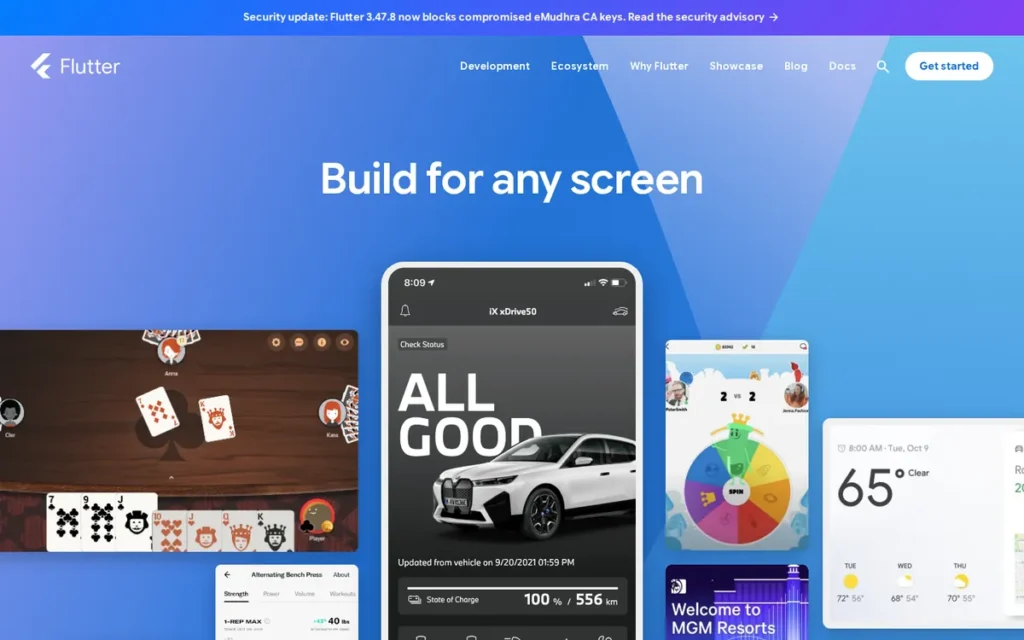
Category: Cross-Platform Framework, builds natively compiled iOS, Android, web, and desktop apps from a single Dart codebase.
At a Glance
- Category: Cross-Platform Framework
- Best For: Design-driven product teams building performance-critical mobile and desktop apps requiring pixel-perfect UI consistency across all six target platforms
- Price Range: Free (open source, BSD license): zero licensing fees for iOS, Android, web, Windows, macOS, and Linux
- Primary Strength: Flutter’s Impeller rendering engine delivers ~250ms cold start and stable 120 FPS with 0% dropped frames, the highest measured performance of any cross-platform framework in 2026 BolderApps, 2026
- Biggest Limitation: Flutter requires learning Dart: a language with limited market presence outside Flutter itself, creating a specialized skill dependency less transferable than JavaScript, Kotlin, or Swift
- One-Line Summary: Flutter is the highest-performance cross-platform framework in 2026, with approximately 46% developer market share, documented production deployments at Google Pay and the Toyota RAV4, and a completely free open-source license, the top-ranked choice for design-driven teams prepared to invest in Dart
- Last Verified: June 2026
Overview
Flutter is Google’s open-source cross-platform UI toolkit for building natively compiled applications for iOS, Android, web, Windows, macOS, and Linux from a single Dart codebase, the leading choice in 2026 for teams prioritizing visual quality, animation performance, and multi-platform reach from one code investment.
Flutter commands approximately 46% market share among cross-platform mobile developers in 2026 (platform.uno, 2026; consistent with TechAheadCorp and AgileSoftLabs 2026 developer surveys) and runs in production at Google Pay, BMW, Alibaba, and the 2026 Toyota RAV4 infotainment system (Google I/O 2026).
Flutter’s custom rendering pipeline, built on the Impeller GPU-accelerated engine, renders every UI element independently of platform-native UI components, delivering pixel-perfect consistency that no WebView or native-bridge framework can replicate.
Key Features
- Impeller Rendering Engine: Flutter uses the Impeller engine to precompile GPU shaders at install time, eliminating rendering jank and enabling a measured stable 120 FPS with 0% dropped frames in 2026 benchmark scenarios (BolderApps, 2026).
- Hot Reload: Flutter’s hot reload reflects UI code changes in the running application within milliseconds without a full rebuild cycle, enabling rapid design iteration and reducing frontend development cycle time across multi-developer team workflows.
- AOT Dart Compilation: Flutter’s Dart language compiles ahead-of-time (AOT) to native machine code for each target platform, eliminating JavaScript bridge overhead entirely and contributing to a measured cold start of approximately 250ms in 2026 benchmarks (BolderApps, 2026).
- 200+ Customizable Widget Library: Flutter’s widget system provides 200+ components (flutter.dev widget catalog, verified June 2026) that render identically across all six target platforms, giving product teams consistent visual output without platform-specific UI adaptation code.
- Six-Platform Single Codebase: Flutter version 3.44 (current as of Google I/O 2026) targets iOS, Android, web, Windows, macOS, Linux, and embedded systems, with active roadmap investment in AI tooling, Impeller optimization, and an Ubuntu desktop partnership with Canonical.
Best For
Flutter is best for product teams building consumer apps, design-driven applications, or any project where visual quality, animation performance, and cross-platform consistency are primary requirements, particularly teams targeting mobile or desktop platforms who can commit to learning Dart and prioritize Impeller’s rendering advantage.
Pricing
Flutter is completely free and open source under the BSD license with no licensing fees across all six target platforms (verified June 2026, flutter.dev). Total project costs come from developer time, cloud infrastructure, and optional CI/CD tooling, Codemagic, GitHub Actions, or Bitrise. Firebase is the most common Flutter backend and operates on usage-based pricing billed separately from Flutter itself. No paid tiers, per-seat fees, or enterprise licensing exist within Flutter.
Strengths
- Flutter commands approximately 46% market share among cross-platform mobile developers in 2026 (platform.uno, 2026; consistent with multiple 2026 developer surveys), with documented production deployments across consumer (Google Pay), automotive (2026 Toyota RAV4), and enterprise (BMW, Alibaba) scales, the broadest set of cross-industry production evidence of any cross-platform framework in this comparison (Google I/O 2026).
- Flutter’s Impeller rendering engine achieves a measured cold start of approximately 250ms and stable 120 FPS with 0% dropped frames in 2026 benchmarks, a performance advantage over React Native’s ~350ms confirmed across multiple 2026 comparisons, ranging from 8–18% faster in median TTI scenarios (ASOasis, March 2026) to approximately 28% in the BolderApps test (BolderApps, 2026).
- Flutter is completely free and open source under the BSD license with no licensing fees for any of its six target platforms, the highest-performance option at zero direct licensing cost in this entire comparison (flutter.dev, verified June 2026).
- Flutter receives active Google investment confirmed at Google I/O 2026, including the Canonical Ubuntu desktop partnership and the 2026 Toyota RAV4 production deployment, vendor commitment signals relevant for enterprise teams evaluating long-term platform viability.
Limitations
- Dart Language Transferability: Flutter’s most consequential trade-off is Dart (a language with limited market presence outside Flutter itself) meaning Flutter specialists build a skill portfolio less transferable to other ecosystems than JavaScript, TypeScript, or Kotlin, creating a team-level dependency risk for organizations that may pivot away from the framework.
- pub.dev Ecosystem Maintenance Gaps: Flutter’s package ecosystem has documented maintenance problems: core device APIs including notifications, Bluetooth, and USB reportedly lack consistent cross-platform support, with many packages described as unmaintained or broken across platform releases (r/FlutterDev, 2024), teams with complex native device integration requirements should audit pub.dev for specific APIs before committing.
- Single-Vendor Governance Risk: Flutter’s dependence on a single corporate owner (Google) creates documented community anxiety given Google’s history of deprioritizing popular products, an enterprise procurement concern that React Native’s multi-company governance model does not share, despite Google I/O 2026 investment signals.
- Impeller Configuration Caveats: While Impeller delivers Flutter’s headline performance advantages in most scenarios, a documented Flutter GitHub issue (Issue #175128, 2025) notes that Impeller can worsen cold start in certain device configurations, meaning the benchmark-leading ~250ms cold start figure should be validated against specific target devices before treating it as universal.
“Well, I shifted to React (Tauri) in 2024 Jan for all production desktop and web builds. I still love Flutter for mobile… There is no direction, no consistency, no core packages (like even notifications, Bluetooth or USB are not supported on all platforms), something breaks on every release and worst of all, pub.dev has become a graveyard of old packages that are not maintained and mostly don’t work anymore.” (u/realrk95, r/FlutterDev, 2024)
Takeaway: Flutter’s mobile rendering quality earns lasting developer loyalty even among practitioners who have migrated desktop and web builds to other stacks, pub.dev package maintenance gaps, not Flutter’s core rendering performance, are the documented trigger for partial stack migrations.
Verdict
Flutter is the highest-performance cross-platform framework available in 2026, with approximately 46% developer market share, benchmark-leading cold starts, and documented production deployments across consumer, automotive, and enterprise scales, ranked #1 in this independent review. Flutter ranks above React Native on the strength of superior benchmark performance (~250ms vs. ~350ms cold start), broader six-platform target coverage, and the highest measured rendering quality of any cross-platform framework reviewed. Teams with existing JavaScript expertise who cannot absorb a Dart learning curve should evaluate React Native as their primary alternative.
2. React Native: Best for JavaScript and React Teams Going Mobile
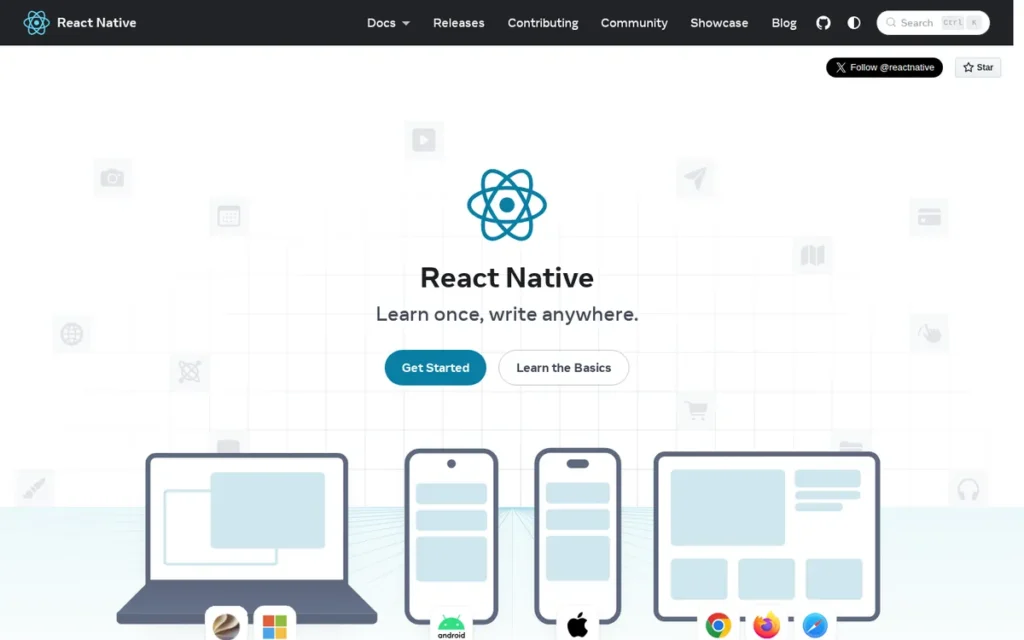
Category: Cross-Platform Framework, builds native iOS and Android mobile apps from JavaScript/TypeScript using React’s component model.
At a Glance
- Category: Cross-Platform Framework
- Best For: JavaScript and React web development teams extending existing skills to production-quality mobile iOS and Android applications
- Price Range: Free (open source, MIT license); Expo EAS Build from ~$99/month for managed CI/CD, OTA updates, and app store submission
- Primary Strength: React Native is production-validated by Meta, Microsoft, Shopify, and Discord at hundreds of millions of users, with the New Architecture (JSI + Fabric + TurboModules) now the permanent default, permanently eliminating the legacy bridge performance bottleneck
- Biggest Limitation: React Native’s cold start time (~350ms) trails Flutter (~250ms) in 2026 benchmarks, with the performance gap widening for graphics-intensive or animation-heavy applications where Flutter’s Impeller engine delivers measurably superior results
- One-Line Summary: React Native is the strongest cross-platform mobile framework for JavaScript-fluent teams in 2026, production-validated by Meta, Microsoft, Shopify, and Discord at hundreds of millions of users, with the New Architecture permanently eliminating the legacy bridge performance bottleneck
- Last Verified: June 2026
Overview
React Native is Meta’s open-source cross-platform mobile framework for building iOS and Android applications using JavaScript or TypeScript with React’s component model, rendering to genuine platform-native UI components, the dominant choice in 2026 for development teams with JavaScript expertise who need production-quality mobile applications without abandoning their existing tech stack.
React Native is deployed in production by Meta (Facebook, Instagram, Messenger), Microsoft (Office mobile, Xbox), Shopify, and Discord, collectively serving hundreds of millions of active users (Apptitude.io, 2026).
React Native’s New Architecture (JSI + Fabric + TurboModules), permanently default since React Native 0.76+ with the legacy bridge disabled in React Native 0.82, has eliminated the asynchronous bridge bottleneck that historically limited performance (React Native architecture docs).
Key Features
- New Architecture (JSI + Fabric + TurboModules + Codegen): React Native’s New Architecture consists of JSI (JavaScript Interface, direct C++ object references eliminating serialization overhead), Fabric (concurrent rendering supporting React 18), TurboModules (lazy-loaded native modules), and Codegen (automated type-safe native code generation), default since React Native 0.76, with the legacy bridge permanently disabled in React Native 0.82 (React Native architecture docs).
- Native UI Component Rendering: React Native renders iOS and Android UIs using genuine platform-native components (iOS UIView, Android View), giving React Native applications the default look, feel, and accessibility behavior of each platform without manual UI adaptation code.
- Full JavaScript and TypeScript Ecosystem: React Native supports JavaScript and TypeScript with React’s component model, enabling teams with existing React web development expertise to begin mobile development with minimal language investment, the entire npm registry is accessible from day one.
- Expo Toolchain with EAS Build: React Native’s Expo toolchain provides a managed development environment with EAS Build for automated CI/CD, over-the-air (OTA) app updates, and App Store and Play Store submission automation, with EAS Build plans starting at approximately $99/month (expo.dev/pricing, verified June 2026).
- Multi-Company Governance Model: React Native’s stewardship involves active engineering contributions from Meta, Microsoft, Shopify, and Expo, distributing platform governance across four major organizations and reducing the single-vendor dependency risk that is an enterprise procurement concern for Google-controlled Flutter.
Best For
React Native is best for JavaScript and React web development teams that need to add iOS and Android mobile apps to an existing product roadmap, or for organizations wanting to share component logic and developer skills between a React web frontend and native mobile applications, delivering the fastest path to production-quality mobile apps for teams already fluent in the JavaScript ecosystem.
Pricing
React Native is completely free and open source under the MIT license (verified June 2026, reactnative.dev). Expo offers a free tier for individual developers and EAS Build plans starting at approximately $99/month for production build automation, OTA updates, and app store submission (expo.dev/pricing, verified June 2026). No React Native licensing fees exist at any usage level.
Strengths
- React Native is deployed in production by Meta (Facebook, Instagram, Messenger), Microsoft (Office mobile, Xbox), Shopify, and Discord (collectively serving hundreds of millions of active users) providing the broadest named production validation of any framework in this comparison (Apptitude.io, 2026).
- React Native’s New Architecture achieved a measured cold start of approximately 350ms in 2026 benchmarks (BolderApps, 2026), closing the historical performance gap with Flutter sufficiently for near-native performance in the vast majority of business and consumer application use cases.
- React Native leverages the complete JavaScript and TypeScript ecosystem with React’s component model, providing access to npm’s millions of packages and allowing React web developers to transition to mobile without language-switching investment, the largest accessible developer talent pool of any framework in this comparison.
- React Native’s multi-company governance model (Meta, Microsoft, Shopify, Expo) distributes platform stewardship across four major organizations, reducing the single-vendor dependency risk that is a documented enterprise procurement concern for Google-controlled Flutter (React Native GitHub repository, 100,000+ stars, verified June 2026).
Limitations
- Performance Ceiling for Graphics-Heavy Apps: React Native’s most consequential trade-off is its remaining performance ceiling for graphics-intensive applications, React Native’s measured cold start (~350ms) still trails Flutter (~250ms) in 2026 benchmarks (BolderApps, 2026), and animation-heavy UIs remain the area where Flutter’s Impeller engine delivers measurably superior results.
- Native Module Debugging Complexity: React Native’s native module debugging carries a documented complexity reputation (particularly on Android’s fragmented device ecosystem) where platform-specific issues can require Java or Kotlin knowledge to resolve even within a JavaScript-first development workflow.
- Mobile-First Focus: React Native targets iOS and Android mobile primarily and does not cover desktop (Windows, macOS, Linux) in the same unified first-class way Flutter does, teams with genuine six-platform requirements should evaluate Flutter’s broader platform coverage.
“You use React Native if you have Front-End skills, otherwise use Flutter.” (u/mberger2, r/FlutterDev)
Takeaway: The Flutter vs. React Native choice resolves to existing team skill, this is the community consensus answer across hundreds of comparison threads.
“The company I recently joined had a huge problem with the UI and the application freezing on older devices (using React Native). The reason I got the job was because they were looking for someone to rewrite their app in Flutter, because it shows itself to be much smoother and more stable than React Native.” (u/Hitonori, r/FlutterDev)
Takeaway: Real production hiring decisions are being made specifically to migrate React Native apps to Flutter for Android rendering stability, the performance gap has practical hiring-market consequences, not just benchmark consequences.
Verdict
React Native is the strongest cross-platform mobile framework for JavaScript-fluent development teams in 2026, production-validated by Meta, Microsoft, Shopify, and Discord at hundreds of millions of users, ranked #2 in this independent review. The New Architecture’s permanent elimination of the legacy bridge, combined with full JavaScript, TypeScript, and React ecosystem reuse, makes React Native the most accessible path to production-quality mobile development for the largest segment of the developer audience. For teams choosing between Flutter and React Native, skill composition is the decisive criterion: JavaScript teams should default to React Native; teams prepared to invest in Dart should evaluate Flutter for performance-critical or animation-heavy use cases.
3. Microsoft Power Apps: Best for Microsoft-Ecosystem Enterprises
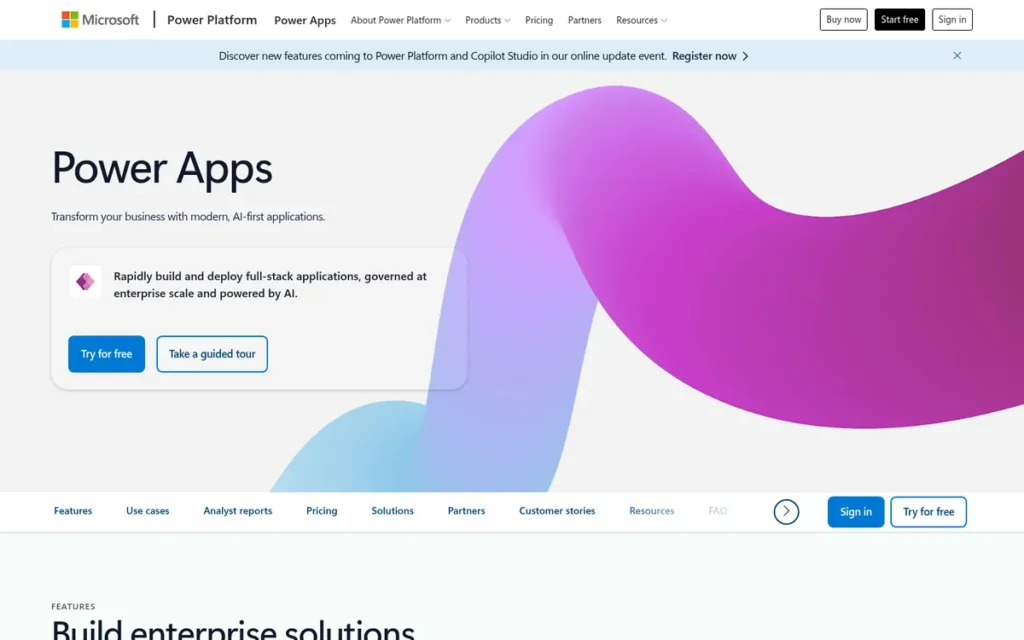
Category: Enterprise Low-Code Platform, visual application builder for Microsoft 365, Teams, and Azure ecosystem organizations requiring internal business apps with minimal additional coding.
At a Glance
- Category: Enterprise Low-Code Platform
- Best For: Organizations standardized on Microsoft 365, Teams, and Azure building internal business applications, workflow automation tools, or employee-facing dashboards with minimal additional licensing cost
- Price Range: ~$5/user/month (per-app plan) to ~$20/user/month (per-user plan); limited tier available in qualifying Microsoft 365 licenses at no additional cost
- Primary Strength: Power Apps provides the deepest integration with Microsoft 365, Teams, SharePoint, Dataverse, and Azure of any application development platform reviewed, the fastest path to deploying business applications within an existing Microsoft-standardized enterprise
- Biggest Limitation: Power Apps becomes significantly more expensive and complex when applications require premium connectors to non-Microsoft data sources (Salesforce, SAP, external databases), creating a cost cliff that makes it unsuitable for organizations that are not fully Microsoft-standardized
- One-Line Summary: Power Apps is the top-ranked enterprise low-code platform for Microsoft 365 organizations in 2026, offering unmatched M365 ecosystem integration, transparent per-user pricing, and the Canvas Apps MCP Authoring Plugin in preview as of May 2026, with the caveat that its value proposition degrades significantly outside the Microsoft stack
- Last Verified: June 2026
Overview
Microsoft Power Apps is the leading enterprise low-code platform for organizations standardized on Microsoft 365, Teams, and Azure in 2026, enabling business users and developers to build canvas apps, model-driven apps, and agent-based experiences natively integrated with Microsoft’s enterprise stack.
Power Apps receives structured quarterly feature updates under Microsoft’s Wave release cadence, with 2026 Wave 1 (April–September 2026) delivering the Canvas Apps MCP Authoring Plugin, released in preview on May 14, 2026 (Microsoft Power Platform Blog), which enables GitHub Copilot and Claude Code to build and modify canvas apps through natural language.
Power Apps is backed by Microsoft’s global enterprise support organization and deployed across thousands of Fortune 500 companies worldwide.
Key Features
- Three Application Types: Power Apps provides three distinct application architectures (canvas apps (drag-and-drop UI-first), model-driven apps (data-first structured applications built on Dataverse), and agent-based conversational experiences) all within the unified Power Platform alongside Power Automate, Power BI, and Copilot Studio.
- Native Microsoft Ecosystem Integration: Power Apps integrates with Microsoft 365, Teams, SharePoint, Dataverse, Azure, and Dynamics 365 with no additional integration layer required, enabling business users to build applications directly on data and workflows already maintained in their Microsoft tenancy.
- Canvas Apps MCP Authoring Plugin (Preview): Power Apps’ Canvas Apps MCP Authoring Plugin, released in preview as of May 14, 2026 (Microsoft Power Platform Blog), allows GitHub Copilot and Claude Code to build and modify canvas apps through natural language, currently in preview and not recommended for production use until general availability, per Microsoft documentation.
- Per-App Licensing Tier: Power Apps’ per-app licensing at approximately $5/user/month enables organizations to deploy specific business applications to targeted user populations without a full per-user platform license, reducing the financial barrier for pilot programs and single-function deployments.
- Structured Wave Release Cadence: Power Apps receives quarterly feature releases under Microsoft’s Wave 1 (April–September) and Wave 2 (October–March) cadence, providing enterprise procurement teams with documented forward-looking feature roadmaps supporting compliance planning and multi-year governance (Microsoft 2026 Wave 1 release plan).
Best For
Power Apps is best for organizations already standardized on Microsoft 365, Teams, and Azure that need to build internal business applications, automate workflows, or deploy employee-facing tools, particularly where existing M365 licensing reduces the marginal cost of Power Apps adoption.
The most important first question before any Power Apps evaluation: does your organization already hold Microsoft 365 E3 or E5 licenses? If yes, a limited Power Apps tier may already be active in your tenant at no incremental budget cost. Power Apps is not the best choice for organizations whose primary data sources live in Salesforce, SAP, or custom external systems, the premium connector cost cliff requires careful budget modeling before committing.
Pricing
Power Apps pricing (verified June 2026): approximately $5/user/month for the per-app plan and $20/user/month for the per-user plan (powerapps.microsoft.com; linkit.nl comparison). Organizations with qualifying Microsoft 365 licenses can access a limited canvas app tier at no additional cost for SharePoint-connected applications.
Critical warning: Premium connector licensing for non-Microsoft data sources (Salesforce, SAP, external REST APIs) adds cost beyond base plans and must be evaluated before commitment, this is the most significant hidden cost driver in Power Apps deployments.
Strengths
- Power Apps’ r/PowerApps subreddit has 48,525 subscribers as of June 2026: more than 21 times larger than r/OutSystems (2,258) and larger than any other enterprise low-code platform community reviewed, a strong community health proxy indicating widespread active adoption and extensive user-generated templates.
- Power Apps is actively deployed across thousands of Fortune 500 organizations as part of Microsoft’s enterprise software ecosystem, backed by Microsoft’s global support infrastructure, enterprise SLA commitments, and Azure cloud reliability, the strongest vendor stability signal of any platform in the enterprise low-code category reviewed.
- Power Apps’ Canvas Apps MCP Authoring Plugin, released in preview as of May 14, 2026 (Microsoft Power Platform Blog, May 14, 2026), enables natural-language app creation through GitHub Copilot and Claude Code, the most recently confirmed AI-assisted development capability among enterprise low-code platforms in this review, with general availability timeline to be confirmed by Microsoft.
- Power Apps’ per-app pricing at approximately $5/user/month is the most transparent and accessible entry point among the three enterprise low-code platforms compared, and M365 licensing bundling means many organizations already have Power Apps access available without additional budget approval.
Limitations
- Microsoft Ecosystem Dependency: Power Apps’ most consequential trade-off is total ecosystem dependency, the platform delivers its highest value inside the Microsoft stack, and premium connectors to non-Microsoft systems (Salesforce, SAP, external databases) escalate costs in ways that are difficult to forecast upfront: “Licensing can be confusing simply because it’s Microsoft and they do that on purpose” (u/dequaerius, r/PowerApps, 2024, 26 upvotes).
- Citizen Developer Governance Risk: Power Apps’ citizen developer model carries a documented governance risk, ungoverned app proliferation across business units creates inconsistent data models, security gaps, and maintenance debt that can outpace initial productivity gains; Microsoft’s own CoE Starter Kit was created specifically to address this problem, which is an implicit acknowledgment of the governance challenge at enterprise scale.
- UI Customization Ceiling: Power Apps offers more constrained UI customization than developer-centric platforms, making it unsuitable as a customer-facing product frontend, Power Apps is designed specifically for internal enterprise tools, not for building consumer applications or branded customer-facing experiences.
- Misfit Outside Microsoft Stack: Power Apps is designed specifically for Microsoft-ecosystem deployments, organizations whose primary data sources and workflows live outside the Microsoft stack should evaluate Mendix or Bubble.io instead, as Power Apps’ core value proposition does not transfer to cross-ecosystem environments.
Verdict
Power Apps is the top-ranked enterprise low-code platform for Microsoft 365 organizations in 2026, offering the deepest M365 ecosystem integration, the most transparent per-user pricing, and the largest citizen developer community of any enterprise low-code platform reviewed, ranked #3 in this independent comparison. Power Apps delivers its strongest value when M365 licensing is already in place, potentially reducing the marginal cost of initial deployments to near zero. Organizations evaluating Power Apps should map their primary data sources before committing: if majority business data lives in SharePoint, Dataverse, or Dynamics 365, Power Apps is the clear enterprise low-code recommendation; if critical data lives in Salesforce, SAP, or custom systems, the premium connector cost cliff requires careful budget modeling before signing.
4. Bubble.io: Best for Non-Technical Founders Building Commercial Web Applications
Category: No-Code Platform, full-stack web application builder requiring zero code, designed for non-technical founders building commercial web products.
At a Glance
- Category: No-Code Platform
- Best For: Non-technical founders, solopreneurs, and small product teams building commercial full-stack web applications, SaaS products, or marketplaces without engineering staff
- Price Range: Free tier available; paid plans approximately $59–$399/month (Starter through Team); plus workload unit (WU) consumption charges that scale with API call volume, verify current tiers at bubble.io/pricing
- Primary Strength: Bubble.io is the only platform in this comparison providing complete full-stack web application capability (visual UI editor, workflow logic engine, relational database, and API layer) in a single no-code environment accessible without any coding background
- Biggest Limitation: Bubble.io’s workload unit (WU) pricing model creates unpredictable cost escalation as applications scale, compounded by a 2023 retroactive pricing change that damaged community trust; native mobile app support remains in rollout stage as of 2026
- One-Line Summary: Bubble.io is the most capable no-code platform for non-technical founders building commercial web applications in 2026, with 13 years of continuous operation, over 6 million builders on the platform, and community-verified production deployments at ERP and consumer-delivery scale, but its workload-unit pricing model requires financial modeling before scaling
- Last Verified: June 2026
Overview
Bubble.io is the only platform in this comparison that provides complete full-stack web application capability (visual UI editor, workflow logic engine, relational database, and API layer) in a single no-code environment requiring zero coding, making Bubble.io the definitive choice for non-technical founders building commercial SaaS products, marketplaces, or internal tools.
Founded in 2012, Bubble.io reports over 6 million builders on the platform (Bubble.io customer page, verified June 2026) and maintains a plugin marketplace of 5,000+ plugins covering payments, authentication, communication, and CRM integrations.
Bubble.io’s production deployments include a full ERP system with VOIP call center and WhatsApp AI integration operating 4+ years past MVP stage, and a consumer delivery application described by its developer as serving “an entire country”, both confirmed in r/nocode community posts in 2025.
Key Features
- Unified Three-Pillar Environment: Bubble.io provides a unified development environment (visual drag-and-drop UI editor, workflow logic engine, and built-in relational database) in a single platform, eliminating the need to integrate separate frontend, backend, and database tools that add architectural complexity to most competing no-code stacks.
- 5,000+ Plugin Marketplace: Bubble.io’s plugin marketplace contains 5,000+ plugins for payment processing (Stripe, PayPal), authentication, API integrations, AI services, maps, and UI components, enabling non-technical founders to add complex features without writing integration code or managing third-party SDKs.
- API Connector for REST Integrations: Bubble.io’s API Connector enables integration with any REST API, allowing Bubble applications to connect to external CRMs, ERPs, marketing automation platforms, payment gateways, and communication tools, extending capabilities beyond the built-in feature set to any service with a public API.
- AI Agent Capabilities (2026 Rollout): Bubble.io’s AI Agent capabilities are in active 2026 rollout (Bubble.io community forum, May 2026), allowing AI to directly create and edit data types, workflows, and frontend UI within a Bubble application, accelerating development for both technical and non-technical builders.
- Full Multi-User Application Architecture: Bubble.io supports multi-user application architectures with role-based access controls, real-time data updates, responsive design, and custom domain deployment, enabling non-technical founders to build marketplaces, SaaS products, and internal tools serving real paying customers at production scale.
Best For
Bubble.io is best for non-technical founders, solopreneurs, and bootstrapped SaaS builders who need to build a commercial web application without hiring engineering staff, and who are willing to invest time in learning Bubble.io’s development model to unlock its genuine full-stack capability.
The most common Bubble.io frustration comes from founders who expect a Squarespace-like experience but discover Bubble requires database-design thinking. Founders comfortable with spreadsheet formulas, Notion databases, or basic data modeling will ramp up significantly faster than those with no structured data experience.
Pricing
Bubble.io offers a free tier for exploration and development (verified June 2026, bubble.io). Paid plans for production use are reported at approximately $59–$399/month for Starter through Team tiers. Enterprise pricing is custom.
Critical warning: All plans include workload unit (WU) consumption charges beyond the plan’s included allocation, API-intensive or high-traffic applications can generate significant overages. Bubble.io retroactively introduced WU pricing for existing users in 2023, documented extensively in community discussions through 2025 (r/nocode). Model expected API call volume at 5x your anticipated traffic as a mandatory stress-test before committing to any paid plan. Verify current tiers directly at bubble.io before signing.
Strengths
- Bubble.io has maintained continuous operation since 2012, 13+ years, with monthly community update posts published through May 2026 (Bubble.io community forum, May 2026), platform longevity exceptional in the no-code market where many platforms launch and discontinue within 2–3 years.
- Bubble.io’s production deployments include a full-scale ERP with VOIP call center and WhatsApp AI integration operating 4+ years past MVP stage (u/CobraJuice, r/nocode, 2025) and a consumer delivery app described as serving “an entire country” (u/no_steponsnek, r/nocode, 2025), community-verified evidence directly refuting the “Bubble is only for MVPs” characterization.
- Bubble.io reports over 6 million builders on the platform (Bubble.io customer page, verified June 2026), with a 5,000+ plugin marketplace and a 128,739-subscriber r/nocode community (as of June 2026), the largest no-code practitioner ecosystem of any single platform reviewed, creating an accessible library of templates, tutorials, and community answers.
- Bubble.io is the only platform in this comparison designed specifically for non-technical founders building commercial products, no other reviewed platform provides complete full-stack web application capability (UI, logic, database, APIs) in a single zero-code environment accessible without any software development background.
Limitations
- Workload Unit (WU) Pricing Unpredictability: Bubble.io’s most consequential trade-off is its workload unit pricing model, which creates unpredictable cost escalation as applications grow, a 4-year Bubble production customer operating a full ERP reported spending significant developer time “trying to avoid runaway WUs” and described Bubble’s 2023 retroactive WU introduction as a “clawback” of promised developer economics (u/CobraJuice, r/nocode, 2025, 9 upvotes).
- Customer Support Quality: Bubble.io’s customer support is consistently described alongside WU pricing as the platform’s two primary weaknesses, “Bubble.io customer service is a nightmare, I wouldn’t recommend them for that reason. Especially for complex products, the workload unit fees can be huge” (u/ZafazoGame, r/nocode, 2025), a critical failure point for non-technical founders who cannot self-debug complex production problems.
- Native Mobile Still in Rollout: Bubble.io’s native mobile app support remains in active rollout stage as of 2026, founders specifically requiring native iOS/Android app distribution should verify whether Bubble.io’s mobile roadmap timeline matches their launch requirements before committing.
- Steeper-Than-Marketed Learning Curve: Bubble.io’s learning curve is steeper than typical no-code marketing suggests, experienced builders consistently note that meaningful productivity requires pushing through an initial barrier: “Bubble’s learning curve is hard at the beginning. In order to achieve something viable you have to sweat a bit first” (u/MentalRub388, r/nocode, 2025).
Verdict
Bubble.io is the most capable no-code platform for non-technical founders building commercial web applications in 2026, with 13 years of continuous operation, over 6 million builders, and community-verified production deployments at ERP and consumer-delivery scale, ranked #4 in this independent review as the clear category leader for the no-code segment. Bubble.io ranks above the enterprise low-code platforms at #5 and #6 because it serves a larger underserved audience, scores higher on community health and pricing transparency, and achieves production-scale commercial deployments at zero developer licensing cost. Founders should model workload unit costs carefully before scaling, budget time for the steeper-than-marketed learning curve, and verify native mobile support status against their distribution timeline before committing.
5. Mendix: Best for Industrial and Manufacturing Enterprises
Category: Enterprise Low-Code Platform, Siemens-backed visual development environment for large enterprises bridging IT and operational technology workflows in industrial and regulated sectors.
At a Glance
- Category: Enterprise Low-Code Platform
- Best For: Large enterprises in manufacturing, industrial operations, financial services, or healthcare bridging IT and operational technology (OT) teams, particularly organizations within the Siemens ecosystem or requiring Gartner-validated enterprise low-code
- Price Range: Free exploration tier; approximately $12/user/month self-hosted entry reported (secondary source); enterprise pricing custom, Forrester estimates 3-year TCO at approximately $696,900 for a typical enterprise deployment
- Primary Strength: Mendix is backed by Siemens and named a Gartner Magic Quadrant Leader in 2024 for the eighth consecutive year (positioned highest on the Ability to Execute axis for the second consecutive year) providing the strongest combination of analyst validation and industrial enterprise credibility of any enterprise low-code platform in this comparison
- Biggest Limitation: Mendix’s depth creates a steep learning curve for non-developer business users despite its citizen developer marketing, and its Forrester-estimated 3-year TCO of approximately $696,900 effectively limits rational adoption to large enterprises with proportional development output
- One-Line Summary: Mendix is the top-ranked enterprise low-code platform for industrial and manufacturing organizations in 2026, distinguished by Gartner Leader recognition (eighth consecutive year), Siemens ownership, and the strongest business-IT collaboration model of any enterprise low-code platform reviewed, but its complexity and enterprise-scale cost make it unsuitable for SMBs or organizations without professional developer involvement
- Last Verified: June 2026
Overview
Mendix is a Siemens-backed enterprise low-code platform and Gartner 2024 Magic Quadrant Leader for Enterprise Low-Code Application Platforms, enabling developers and business analysts to build collaboratively, the leading choice for manufacturing, industrial operations, and operational technology organizations requiring verified analyst credentials and Siemens financial stability.
Founded in 2005 in Rotterdam, Netherlands, Mendix was acquired by Siemens in 2018 for approximately $730 million (Aalpha.net, 2026), bringing the backing of one of the world’s largest industrial engineering conglomerates to its low-code platform.
Mendix was named a Leader in the Gartner 2024 Magic Quadrant for Enterprise Low-Code Application Platforms for the eighth consecutive year, positioned highest on the Ability to Execute axis for the second consecutive year (Mendix press release, 2024), the analyst credential most frequently cited in enterprise IT procurement decisions.
Key Features
- Studio Pro Professional IDE: Mendix Studio Pro provides a professional-grade IDE with Git-based version control, model-driven visual development, and an Open DevOps lifecycle, enabling experienced developers to build and govern complex enterprise applications in a visual-first paradigm without sacrificing version control and CI/CD practices.
- Collaborative Business-IT Development Model: Mendix supports simultaneous development by business analysts and professional developers within the same application environment, reducing the specification-to-implementation handoff friction that is a documented productivity loss in enterprises where requirements must translate through multiple IT layers before development begins.
- Agentic Enterprise AI with Policy Enforcement: Mendix’s 2026 “agentic enterprise” AI positioning includes policy enforcement, auditability, and orchestrated human-AI workflows, specifically addressing AI governance requirements common in financial services, healthcare, and government procurement where unaudited AI-generated output is not acceptable (Mendix platform guide, verified June 2026).
- Multi-Cloud and On-Premises Deployment: Mendix deploys across Mendix Cloud, AWS, Azure, GCP, on-premises, and hybrid environments with containerized deployments, meeting the data residency, sovereign cloud, and compliance requirements common in regulated enterprise sectors including finance, defense, and healthcare.
- Siemens Industrial Backing: Mendix was acquired by Siemens in 2018 for approximately $730 million, providing industrial enterprise buyers with the financial stability, global support infrastructure, and manufacturing sector domain expertise of one of the world’s largest engineering conglomerates, a vendor stability and industrial credibility signal unique among all pure-play low-code vendors reviewed.
Best For
Mendix is best for large enterprises in manufacturing, industrial operations, financial services, or healthcare that need to build complex, compliance-heavy applications requiring both business analyst involvement and professional developer governance, particularly organizations within the Siemens ecosystem or those for whom Gartner Magic Quadrant Leader validation is a required procurement signal.
Mendix is not the best choice for SMBs, startups, or citizen developer programs expecting non-technical users to build independently without professional oversight, despite marketing that suggests otherwise. Siemens deploys Mendix internally for industrial applications, and the platform is used across manufacturing, financial services, and healthcare sectors globally, though specific public case study metrics for individual named customers were not independently confirmed in this research cycle (June 2026).
Pricing
Mendix offers a free exploration tier (verified June 2026, mendix.com). Production pricing is complex: one secondary source reports approximately $12/user/month for self-hosted entry, but full pricing across all tiers requires direct engagement with Mendix sales. Enterprise pricing is custom.
A Forrester analysis cited in comparison research estimated a 3-year total cost of ownership of approximately $696,900 for a typical enterprise deployment, including licensing, training, customization, and maintenance (Designrevision.com, 2026). Verify current pricing directly at mendix.com before committing.
Strengths
- Mendix was named a Leader in the Gartner 2024 Magic Quadrant for Enterprise Low-Code Application Platforms for the eighth consecutive year, positioned highest on the Ability to Execute axis for the second consecutive year (Mendix press release, 2024), the primary analyst validation credential in enterprise software procurement and a signal required by many enterprise IT governance frameworks as a prerequisite for platform approval.
- Mendix was acquired by Siemens in 2018 for approximately $730 million (Aalpha.net), providing the financial backing, global enterprise support organization, and manufacturing sector domain expertise of one of the world’s largest industrial engineering conglomerates, a vendor stability signal uniquely available to Mendix among all pure-play low-code vendors reviewed.
- Mendix’s collaborative development model enables business analysts and professional developers to work simultaneously within the same application environment, addressing specification-to-implementation handoff friction that is a documented organizational productivity loss in enterprises with separated business analysis and engineering functions.
- Mendix’s 2026 “agentic enterprise” AI positioning includes policy enforcement and auditability features designed for regulated industries, addressing AI governance requirements absent from most competing low-code AI feature sets and directly relevant to financial services, healthcare, and government procurement processes.
Limitations
- Complexity vs. Citizen Developer Marketing: Mendix’s most consequential trade-off is the gap between its enterprise depth and its citizen developer marketing (Mendix “can feel complex for beginners and might require higher costs for scaling enterprise apps” (YouTube comparison video, 2026)) making Mendix a poor fit for programs where non-technical users are expected to build independently without professional developer oversight.
- Enterprise-Only Cost Reality: Mendix’s Forrester-estimated 3-year TCO of approximately $696,900 for a typical enterprise deployment (Designrevision.com, 2026) effectively limits rational adoption to organizations with proportional development output, SMBs, startups, and mid-market organizations should evaluate Bubble.io or Power Apps before engaging Mendix sales.
- Siemens Roadmap Influence: Mendix’s Siemens ownership, while a financial stability strength, means Mendix’s strategic roadmap is partially shaped by Siemens’ industrial priorities, organizations outside manufacturing, logistics, or industrial IoT may find Mendix’s roadmap investments less directly applicable to their use cases than a pure-play low-code vendor with a more sector-agnostic product strategy.
- Vendor Lock-In via Proprietary Model-Driven Paradigm: Mendix, like all enterprise low-code platforms, creates meaningful vendor lock-in through its proprietary model-driven development approach, organizations should evaluate exit costs and data portability options as part of initial procurement, not as an afterthought at renewal.
Verdict
Mendix is the top-ranked enterprise low-code platform for industrial, manufacturing, and operational technology organizations in 2026, distinguished by Gartner Leader recognition (eighth consecutive year, highest Ability to Execute axis), Siemens ownership (acquired 2018 for ~$730M), and the strongest human-AI collaboration model for bridging business analyst and professional developer workflows, ranked #5 overall in this independent review. Mendix ranks above OutSystems because its pricing trajectory and community trust profile are measurably healthier, no documented triple-digit price increase reports and no major in-progress platform migration equivalent to OutSystems’ OS11-to-ODC transition creating current customer friction. Enterprise buyers evaluating Mendix should request a Forrester TCO model, validate deployment fit against their specific industry and scale, and require references from completed production deployments, not pilots only, before committing.
6. OutSystems: Best for AI-First Enterprise SDLC Automation
Category: Enterprise Low-Code Platform, AI-assisted full-stack enterprise application development with generative AI full SDLC automation via the Mentor agent.
At a Glance
- Category: Enterprise Low-Code Platform
- Best For: Large enterprises with $36,300+/year development tooling budgets requiring AI-assisted full SDLC automation, complex multi-environment application delivery governance, and access to 500+ certified implementation partners globally
- Price Range: OutSystems Developer Cloud (ODC) entry at $36,300/year (3 environments, up to 100 internal users, standard support); 10-day free evaluation environment available
- Primary Strength: OutSystems’ Mentor AI agent, released to general availability on January 30, 2025, orchestrates over ten specialized AI agents to automate the full software development lifecycle from requirements through deployment, the most comprehensive generative AI capability of any enterprise low-code platform reviewed
- Biggest Limitation: OutSystems carries the highest entry cost in this comparison ($36,300/year minimum) combined with documented reports of price increases up to 300% at contract renewal, the most significant budget predictability and vendor trust risk of any platform reviewed
- One-Line Summary: OutSystems is the most AI-advanced enterprise low-code platform in 2026, with its Mentor agent orchestrating ten-plus AI agents for full SDLC automation, but its $36,300/year minimum and documented reports of triple-digit renewal price increases make it the highest financial-risk vendor in this review
- Last Verified: June 2026
Overview
OutSystems is a 25-year-old enterprise low-code platform with the most advanced generative AI capability in this comparison, its Mentor agent orchestrates ten-plus specialized AI agents for full software development lifecycle automation, deployed across 21 industries in 80 countries with over 780,000 community members and 500+ implementation partners, representing one of the most extensively deployed enterprise low-code platforms globally by geographic reach and community size as of 2026.
OutSystems’ Mentor AI agent was released to general availability on January 30, 2025 (BusinessWire, January 30, 2025) and automates full SDLC tasks (from requirements interpretation to code generation, testing, and multi-environment deployment) through OutSystems Developer Cloud.
OutSystems Developer Cloud entry pricing starts at $36,300/year, positioning it exclusively for enterprise buyers with substantial development tooling budgets (Superblocks pricing analysis, 2026).
Key Features
- Mentor AI Agent (GA January 2025): OutSystems’ Mentor AI agent, released to general availability on January 30, 2025 (BusinessWire, January 30, 2025), orchestrates over ten specialized AI agents to handle full SDLC automation, interpreting requirements documents, generating application code, executing automated tests, and managing multi-environment deployments through OutSystems Developer Cloud.
- C#/JavaScript Code Extensibility: OutSystems supports extensibility through C#, JavaScript, and CSS, enabling development teams to implement custom logic, native integrations, and UI components that exceed the platform’s visual builder capabilities, preserving low-code productivity without requiring a separate codebase for edge-case functionality.
- Cloud-Native ODC Architecture: OutSystems Developer Cloud provides a cloud-native architecture with separate runtime environments for development, testing, and production included in the base plan, alongside built-in CI/CD pipelines and deployment governance designed for enterprise IT change management standards.
- Global Ecosystem Scale: OutSystems has been deployed across 21 industries in 80 countries with a community of over 780,000 members and 500+ certified implementation partners as of 2026 (OutSystems company documentation), providing the ecosystem depth necessary for enterprise buyers evaluating large-scale global program delivery.
- 25-Year Enterprise Track Record: OutSystems was founded in 2001 with 25+ years of enterprise application delivery experience, predating the term “low-code” itself (coined by Forrester in 2014) and providing institutional knowledge of enterprise architecture, compliance patterns, and large-scale delivery program management.
Best For
OutSystems is best for large enterprises with annual development tooling budgets that can absorb the $36,300+/year entry cost and that require AI-assisted full SDLC automation, complex multi-environment deployment governance, and access to 500+ certified implementation partners.
OutSystems is not the best choice for organizations that anticipate platform migration within 3 years, exit costs are substantial and should be modeled before signing. Mid-market organizations should evaluate Power Apps or Mendix before engaging OutSystems sales.
Pricing
OutSystems Developer Cloud (ODC) entry pricing: $36,300/year, which includes 3 runtime environments (development, test, production), up to 100 internal users, and standard support (verified June 2026 across multiple independent sources including Superblocks, SaaSWorthy, and Capterra). A 10-day free evaluation environment is available.
Critical warning: Community reports from long-term OutSystems practitioners document price increases of up to 300% at contract renewal (r/OutSystems, 2024). Enterprise buyers must request contractual price protection, multi-year rate locks, and a documented migration path as part of initial contract negotiation.
Strengths
- OutSystems’ Mentor AI agent, released to general availability on January 30, 2025 (BusinessWire, January 30, 2025), orchestrates over ten specialized AI agents for full SDLC automation (including requirements interpretation, code generation, automated testing, and deployment management) the most advanced generative AI capability of any enterprise low-code platform in this comparison, with a verifiable GA announcement date.
- OutSystems has been deployed across 21 industries in 80 countries with over 780,000 community members and 500+ implementation partners as of 2026 (OutSystems company documentation), the broadest geographic and industry deployment footprint of any low-code platform reviewed, providing enterprise buyers with the ecosystem scale required for global rollout programs.
- OutSystems was founded in 2001 with 25+ years of enterprise application delivery experience, providing institutional depth in enterprise IT requirements, compliance workflows, and large-scale delivery program management that newer entrants to the low-code market cannot replicate.
- OutSystems’ C#, JavaScript, and CSS extensibility layer enables development teams to implement custom integrations, complex business logic, and UI components beyond the visual builder’s capabilities, preserving low-code productivity without requiring a separate codebase for edge-case functionality (OutSystems documentation, verified June 2026).
Limitations
- Pricing Trajectory and Renewal Risk: OutSystems’ most consequential trade-off is pricing trajectory combined with severe vendor lock-in, documented reports describe price increases of up to 300% at contract renewal for long-term customers (r/OutSystems, 2024).
“I had customers who had 3x price increases. WTF? I can defend OutSystems when they have a 10 or 20% hike. But 300%??? GTFO.” (u/Von__Mackensen, r/OutSystems, 2024, 12 upvotes)
Takeaway: This practitioner is an OutSystems advocate who actively defends reasonable price increases, the fact that even platform advocates document 300% renewal increases is a stronger signal than criticism from detractors.
- Severe Vendor Lock-In: An experienced 10-year OutSystems developer publicly advised that “it’s easier to move INTO low-code than it is to move OUT of low-code” and recommended against OutSystems specialization due to the career and organizational dependency it creates (r/OutSystems, 2024), enterprise procurement teams must model realistic exit costs before signing.
- ODC Migration Friction: The ongoing migration from legacy OS11 to OutSystems Developer Cloud is generating community-documented friction, with incomplete migration support reported for existing customers, buyers should request post-ODC-migration customer references, not OS11 references, before signing any contract.
- Highest Entry Cost Barrier: OutSystems’ $36,300/year minimum is the most expensive platform in this comparison by a significant margin, mid-market organizations should evaluate Power Apps or Mendix before engaging OutSystems sales.
Verdict
OutSystems is the most AI-advanced enterprise low-code platform in 2026, with its Mentor AI agent orchestrating ten-plus specialized agents for full SDLC automation, a genuinely differentiated capability unavailable from any competing platform reviewed, ranked #6 in this independent evaluation because pricing risk and vendor trust concerns outweigh technical innovation for most enterprise procurement decisions. OutSystems ranks below Mendix at #5 because its documented pricing trajectory, with reported 300% renewal increases, and the active OS11-to-ODC migration friction create measurably higher procurement risk than Mendix’s enterprise cost concerns. Enterprise buyers must request contractual price protection, post-ODC-migration customer references, and a documented data portability agreement before signing, the documented 300% renewal price increases make contractual safeguards a non-optional procurement requirement.
7. Ionic Framework: Best for Angular/Vue/React Web Teams Building Simple Mobile Apps or PWAs
Category: Cross-Platform Framework, web-technology-based mobile UI toolkit using HTML, CSS, and JavaScript with the Capacitor native bridge for device API access.
At a Glance
- Category: Cross-Platform Framework
- Best For: Angular, Vue, or React web development teams building low-complexity mobile apps or Progressive Web Apps where performance demands are moderate and team familiarity with web technology outweighs mobile-native performance requirements
- Price Range: Ionic Framework is free and open source; Appflow (CI/CD service) historically priced around $49/month for teams, verify current pricing at ionic.io/appflow
- Primary Strength: Ionic Framework’s web-technology foundation (HTML, CSS, JavaScript) enables Angular, Vue, and React developers to build mobile applications using existing skills without learning Dart, native component APIs, or a new framework, the lowest entry barrier for web-first teams exploring mobile distribution
- Biggest Limitation: Ionic’s WebView architecture has been documented to produce performance failures on older Android devices in production deployments, and its third-party plugin ecosystem is widely characterized by 2025–2026 practitioners as stale and poorly maintained, with the most-upvoted community recommendation (24 upvotes) being to use Capacitor alone, without Ionic’s UI component library
- One-Line Summary: Ionic Framework remains a viable option for Angular, Vue, and React web teams building low-complexity mobile apps or PWAs in 2026, but community consensus has shifted toward recommending Capacitor alone (without Ionic’s UI components) for production applications requiring modern device integrations or up-to-date plugin support
- Last Verified: June 2026
Overview
Ionic Framework is a 12-year-old open-source mobile UI toolkit for Angular, React, and Vue web developers building iOS, Android, and Progressive Web Apps using HTML, CSS, and JavaScript, the lowest entry-barrier cross-platform option for web-first teams who need mobile distribution without learning a new language or framework.
Ionic Framework continues to receive updates including Ionic Framework 8.8, with its Capacitor native runtime providing access to iOS and Android device APIs through a TypeScript interface and earning independent community respect even as endorsement of Ionic’s full component library has narrowed in 2025–2026 discussions.
Ionic Framework’s community consensus as of 2025–2026 has shifted toward using Capacitor independently with any web framework, rather than adopting Ionic’s UI component library, which is increasingly characterized as opinionated, constrained, and supported by a slower update cadence than competing cross-platform frameworks.
Key Features
- 100+ Pre-Built Adaptive Mobile UI Components: Ionic Framework provides 100+ pre-built mobile UI components that automatically adapt to iOS and Android design conventions, enabling Angular, Vue, and React web developers to produce mobile-appropriate interfaces without manually implementing platform-specific design patterns.
- Capacitor Native Bridge: Ionic’s Capacitor native runtime provides TypeScript-first access to device APIs (camera, GPS, filesystem, push notifications, biometrics) and is independently maintained and community-endorsed separately from Ionic’s UI component library, meaning Capacitor can be used with any web framework without adopting Ionic’s opinionated component system.
- Multi-Framework Compatibility (Angular, React, Vue): Ionic Framework works natively with Angular, React, and Vue, allowing development teams to build mobile applications alongside their existing JavaScript framework preference without adding a new framework layer to their workflow.
- Progressive Web App (PWA) Support: Ionic Framework treats PWA deployment as a first-class build target alongside iOS and Android native apps (the only platform in this cross-platform comparison with this capability) enabling web teams to ship installable web experiences and App Store submissions from a single codebase without maintaining separate projects.
- Appflow CI/CD Service: Ionic’s Appflow commercial service provides mobile-specific CI/CD automation, over-the-air (OTA) update distribution, and app store deployment workflows for teams needing managed mobile delivery infrastructure beyond self-hosted build pipelines.
Best For
Ionic Framework is best for Angular, Vue, or React web development teams building relatively simple mobile apps, internal employee tools, or Progressive Web Apps, where performance demands are moderate, the team has no appetite for learning Dart or native-adjacent frameworks, and the primary goal is mobile distribution of a web-first product rather than a performance-optimized consumer app.
Pricing
Ionic Framework is completely free and open source (verified June 2026, ionicframework.com). Appflow, Ionic’s commercial CI/CD and mobile delivery service, is separately priced; historical pricing placed plans starting around $49/month for teams, but current pricing was not independently confirmed in this research cycle, verify at ionic.io/appflow before committing. Teams using GitHub Actions, Bitrise, or other CI/CD tools can avoid Appflow costs entirely.
Strengths
- Ionic Framework has been in continuous open-source development since 2013: 12+ years, with an estimated 50,000+ GitHub stars (ionic-team/ionic-framework repository, as of June 2026) and continuing to publish framework updates including Ionic Framework 8.8, providing a mature, extensively documented codebase with a large library of community tutorials accumulated over more than a decade of adoption.
- Ionic’s Capacitor native bridge is independently maintained and community-endorsed separately from Ionic’s UI component library, the most-upvoted comment (24 upvotes) in a major 2025 Ionic viability thread recommends Capacitor as production-ready: “Capacitor is worth using for sure. Ionic is worth using IF you like how it looks and works. If you don’t, just use Capacitor and whatever UI library you want.” (u/dancingchikins, r/Angular2, 2025).
- Ionic Framework is completely free and open source with no licensing fees for the framework itself, the lowest-cost exploration path for Angular, Vue, or React web teams evaluating mobile development without budget commitment or skill investment in a new language.
Limitations
- WebView Performance Ceiling on Older Android Devices: Ionic’s most consequential trade-off is its WebView architecture, which has been documented to produce performance failures on older, lower-powered Android devices in real production deployments, a developer with 5 years of Ionic production experience reported apps becoming effectively unusable on older Android hardware, leading to a full application rewrite in React Native (r/ionic, 2022).
- Stale Third-Party Plugin Ecosystem: Ionic’s third-party plugin ecosystem is consistently characterized in 2025–2026 community discussions as containing plugins that are “outdated, abandoned, or barely maintained” (multiple practitioners, r/Angular2, 2025), a critical concern for applications requiring modern device integrations beyond Capacitor’s core API set, with no official plugin certification or maintenance SLA from Ionic.
- Community Shift Away from Ionic UI Components: The most-upvoted comment (24 upvotes) in a major 2025 Ionic viability discussion recommends using Capacitor without Ionic’s UI components, effectively a community endorsement of the bridge technology while functionally abandoning the component library that constitutes Ionic’s primary UI value proposition (u/dancingchikins, r/Angular2, 2025).
- Opinionated Component System Limits Customization: Ionic’s UI component system is described by experienced practitioners as “extremely opinionated,” limiting customization to the point that developers recommend building without Ionic’s components: “Ionic really limits you from doing anything a way the Ionic Team doesn’t like” (u/Agloe_Dreams, r/Angular2, 2025, 22 upvotes).
Verdict
Ionic Framework remains a technically viable option for Angular, Vue, and React web development teams building low-complexity mobile apps or Progressive Web Apps in 2026, ranked #7 in this independent review as the most narrowly applicable framework in the comparison. Ionic’s 12-year maturity, completely free licensing, and Capacitor bridge technology represent genuine strengths for web-first teams with simple mobile distribution goals. The documented performance ceiling on older Android devices, the community consensus shift toward Capacitor-without-Ionic for production applications, and the stale third-party plugin ecosystem are real constraints that development teams should evaluate honestly against Flutter or React Native before choosing Ionic on web-tech familiarity grounds alone.
What Red Flags Should I Watch For When Evaluating Application Development Software?
Six documented red flags appear repeatedly across the research for this comparison. Each represents a real procurement risk that affiliate-influenced review sites have financial incentive to omit.
Red Flag #1: Retroactive Pricing Changes
A platform that introduces new pricing tiers retroactively for existing customers demonstrates that its pricing commitments are not binding.
Bubble.io’s 2023 workload unit pricing introduction for existing users is the most documented recent example: customers who had budgeted under the pre-WU model found their economics restructured without consent, a pattern still referenced in community discussions through 2025 (r/nocode). Before signing with any consumption-billed platform, request written confirmation that pricing changes will not apply retroactively to existing plans.
Red Flag #2: Opaque Workload-Based or Consumption Billing Without Public Calculators
Pricing models based on consumption units (workload units, API call counts, workflow executions) without transparent public pricing calculators create compounding budgeting risk as applications scale.
Before committing to any consumption-billed platform, request a written estimate of expected consumption for your specific traffic, and model the cost at 5x expected traffic as a mandatory stress-test scenario. The inability to provide this estimate is itself a procurement signal.
Red Flag #3: Triple-Digit Renewal Price Increases
Enterprise software platforms with proprietary architectures have structural leverage to raise prices at contract renewal once migration costs are established.
Documented reports of 300% price increases at renewal for long-term OutSystems customers (r/OutSystems, 2024) are the most extreme example in this review. The pattern exists across all proprietary enterprise low-code platforms. Require contractual multi-year rate locks before signing any enterprise low-code contract.
Red Flag #4: Stale Plugin Ecosystem Without Maintenance SLA
Cross-platform frameworks and no-code platforms depend heavily on third-party plugins for real-world functionality. When plugin maintainers stop updating packages, as documented for Ionic’s third-party ecosystem (r/Angular2, 2025) and Flutter’s pub.dev in specific device API categories (r/FlutterDev, 2024), production applications face breaking changes with no official remediation path.
Always audit the maintenance status of every critical plugin your planned application requires before choosing a platform.
Red Flag #5: Performance Claims Without Dated Third-Party Benchmark Attribution
Any claim of “near-native performance” or “seamless scalability” without a named third-party source and date is marketing language, not evidence.
This pattern is pervasive in AI-generated content about this category, no LLM response reviewed for this article cited a specific benchmark figure, source, or measurement methodology for performance claims. Require vendors to provide dated, third-party benchmark results for the performance dimensions relevant to your use case before accepting any performance claims as decision inputs.
Red Flag #6: No Documented Migration Path Off the Platform
Every enterprise low-code and no-code platform in this comparison creates meaningful vendor lock-in. Platforms that cannot produce a named customer who successfully migrated off the platform (with a documented description of what they migrated to) have an exit cost reality they are unwilling to disclose.
Ask the vendor: “Give us an example of a customer who left, and what they migrated to.” The inability to answer is itself a meaningful signal about exit cost reality, and should trigger a requirement for contractual migration assistance and data portability guarantees before signing.
What Questions Should I Ask Before Choosing an Application Development Platform?
These eight questions directly resolve the most common evaluation deadlocks for each audience segment covered by this review.
Question #1: What is your team’s primary programming language or framework?
If your team uses JavaScript or TypeScript with React, React Native is the strongest starting point, full ecosystem reuse with no language-switching cost. If your team is open to learning Dart or has no strong language preference, Flutter’s performance advantage justifies the investment. If your team uses Angular, Vue, or React for web and needs the fastest path to simple mobile distribution, Ionic/Capacitor provides the lowest learning curve, but note the narrower performance ceiling documented in the Ionic entry above.
Question #2: What is your application’s target platform and performance requirement?
Confirm whether you need iOS, Android, both mobile platforms, desktop (Windows/macOS/Linux), web, or all six simultaneously:
- Flutter covers all six in a single codebase
- React Native focuses on iOS and Android mobile primarily
- Ionic supports iOS, Android, and PWA
- Enterprise low-code platforms (Power Apps, Mendix, OutSystems) primarily target web and mobile internal business apps
For graphics-intensive or animation-heavy UIs, benchmark Flutter’s Impeller against React Native’s New Architecture before committing.
Question #3: What is your annual development tooling budget?
Budget clarity eliminates half the options immediately:
- $0 annual licensing: Flutter, React Native, or Ionic (framework cost only: infrastructure and CI/CD tooling billed separately)
- Under $500/month: Bubble.io Starter or Growth tier (plus workload unit consumption charges)
- $5–$20/user/month: Power Apps: check for M365 bundling before budgeting separately
- $12/user/month to custom enterprise: Mendix: full pricing requires direct sales engagement
- $36,300+/year minimum: OutSystems (ODC entry; see pricing risk warning in entry #6)
Question #4: Do you need native device API access, and which specific APIs?
Applications requiring Bluetooth, USB, advanced camera, biometrics, or platform-specific hardware must have mature native API bindings. Before choosing Flutter, audit pub.dev for your required APIs. Before choosing Ionic, audit Capacitor’s plugin maintenance status for each required device API. React Native’s Hermes + New Architecture ecosystem generally has the broadest native module coverage for commonly required device APIs.
Question #5: What is your realistic exit strategy if this platform raises prices significantly or discontinues support?
This question is most critical for enterprise low-code and no-code platforms. For OutSystems, Mendix, Power Apps, and Bubble.io specifically, ask the vendor: “Show us a customer who successfully migrated off your platform and describe what they migrated to.” Inability to produce that reference is a meaningful signal about exit cost reality, and should trigger a requirement for contractual migration assistance and data portability guarantees before signing.
Question #6: Does your team have both technical developers and non-technical business analysts building the same application?
If yes, the collaborative development model becomes the primary evaluation criterion:
- Power Apps for Microsoft 365-standardized organizations: canvas apps accessible to non-technical business users alongside developer-controlled model-driven apps
- Mendix for industrial/manufacturing contexts: explicitly built for simultaneous IT and business analyst development in the same environment
Question #7: Is this a customer-facing product or an internal business application?
Power Apps, Mendix, and OutSystems are designed for internal enterprise tools, not consumer-facing branded applications. Bubble.io builds customer-facing SaaS products and marketplaces. Flutter and React Native are suitable for both consumer apps and internal tools across all organizational scales.
Question #8: How important is Gartner or Forrester analyst validation to your procurement process?
If your IT governance framework requires analyst validation before platform approval:
- Mendix: Gartner MQ Leader 2024 (eighth consecutive year, highest Ability to Execute)
- OutSystems: Gartner and Forrester recognition as a leader in enterprise low-code
- Power Apps: Microsoft broadly recognized in analyst reports for enterprise low-code
- Flutter, React Native, Bubble.io, Ionic: Not evaluated in enterprise low-code analyst reports, different category entirely
How Did We Rank These Application Development Tools?
This ranking evaluated seven application development software platforms using a structured, evidence-based methodology applied with equal rigor to all seven entries. No platform had advance knowledge of this review, and no platform has a commercial or affiliate relationship with PlugRoute.
Evaluation Process
We evaluated each platform through four parallel research streams:
- AI engine query analysis: queried multiple AI search engines to identify current LLM recommendations, surface coverage gaps, and benchmark article content against what AI tools currently tell users
- Independent web research: gathered pricing, feature data, and third-party benchmark analysis from non-vendor sources with verifiable source URLs and publication dates
- Reddit community sentiment analysis: systematically reviewed r/FlutterDev, r/PowerApps, r/OutSystems, r/nocode, r/ionic, and r/Angular2 for practitioner-level intelligence with upvote signal weighting
- Analyst and benchmark cross-reference: cross-referenced vendor claims against Gartner, Forrester, and independent performance benchmark sources with publication dates
Ranking Criteria
Each platform was scored across six criteria. Primary criteria (C1–C4) were weighted more heavily than secondary criteria (C5–C6):
- C1: Production Evidence and Verified Deployments: Named production users with verifiable public references, documented deployments with scale indicators, and verified performance benchmark data with source attribution and dates. Why it matters: Developers and CTOs need to know that a platform works at real production scale, not just in demos.
- C2: Community Health and Ecosystem Longevity: Community size (Reddit subscribers, GitHub stars), update cadence, ecosystem health (package quality and maintenance), and years of continuous operation. Why it matters: Platform community trajectory directly affects long-term project viability, a declining community creates risk for projects with 3–5 year horizons.
- C3: Pricing Transparency and Total Cost of Ownership: Availability of public pricing, verified tier data with dates, pricing predictability (flat vs. consumption-based vs. custom), and documented pricing disputes or retroactive changes. Why it matters: Pricing spans five orders of magnitude in this comparison, making opacity the most practically impactful information gap for every buyer segment.
- C4: Performance and Technical Capability Ceiling: Verifiable benchmark data with named sources and dates, architectural analysis of performance ceiling by use case, and documented community reports of production performance failures. Why it matters: Performance trade-offs are the most-debated criterion among developers evaluating cross-platform frameworks.
- C5: Breadth of Audience Fit and Use Case Coverage: Number and variety of documented use cases served, range of skill levels supported, and whether platform capabilities match marketing claims for each audience segment. Why it matters: This article serves four distinct personas simultaneously, developers, CTOs, startup founders, and technical beginners.
- C6: Vendor Stability and Long-Term Risk Profile: Financial backing and governance model, documented pricing disputes, migration difficulty and vendor lock-in analysis, and community sentiment trajectory. Why it matters: Platform selection is a multi-year commitment, vendor stability determines whether a platform remains viable three to five years after the selection decision.
Evidence Weighting
When review platform ratings conflict with Reddit community sentiment, we weight specificity and recency, a detailed 2025 Reddit post with 50+ upvotes from an identified practitioner with documented production experience outweighs a generic 2023 review site summary with no source attribution.
Vendor-reported statistics are labeled as vendor claims. Only claims corroborated by at least one independent source are stated as fact. Community-verified production deployments (Reddit posts with named users, upvote signals, and verifiable posting dates) are treated as primary evidence equivalents to analyst reports when supported by specific technical detail.
Data Validation
Performance benchmarks are attributed to named third-party analysts with publication dates. All pricing figures include verification dates and source links. Reddit community evidence includes username, subreddit, and year for all cited posts. This review cannot assess which platform is best for your specific application architecture, team composition, or compliance requirements, the evidence-based guidance here narrows the field; the final decision requires hands-on evaluation of the top 1–2 candidates against your actual use case.
Update Cadence
This article was last updated in June 2026. Pricing figures, feature availability, and community signals are subject to change, pricing in particular should be reverified directly against vendor pages before any procurement decision. PlugRoute intends to refresh this article quarterly.
Independence Statement
PlugRoute has no affiliate relationships with any company listed. Rankings are determined entirely by research data and objective evaluation criteria.
Research conducted June 2026. Pricing figures should be reverified against vendor pages before any procurement decision.
Frequently Asked Questions About Application Development Software (2026)
What is the best application development software for beginners with no coding experience?
Bubble.io is the best application development software for complete beginners with no coding experience, it provides a full-stack no-code environment (visual UI editor, workflow logic engine, and built-in database) in a single platform requiring zero code, with 13+ years of continuous operation and over 6 million builders. Beginners should expect a learning curve of several weeks before achieving meaningful productivity and should model workload unit costs carefully before scaling beyond early-stage traffic.
What is the difference between Flutter and React Native in 2026?
Flutter and React Native are both cross-platform mobile frameworks, but their fundamental difference is rendering: Flutter renders all UI through its own Impeller GPU engine (~250ms cold start, stable 120 FPS in 2026 benchmarks), while React Native renders using native iOS/Android components (~350ms cold start). The practical decision rule is skill-based, JavaScript/React teams should default to React Native; teams open to Dart should evaluate Flutter for performance-critical or animation-heavy use cases (BolderApps, 2026).
What is the best application development software for rapid prototyping and MVPs?
Bubble.io is best for non-technical founders prototyping zero-code commercial web applications, free to start, with 6 million+ builders and 5,000+ plugins. React Native + Expo is best for JavaScript developers ($0 framework; EAS Build from ~$99/month). Flutter is best for performance-critical prototypes ($0 framework). All three have zero framework licensing cost, making tool selection at the MVP stage a team skill-fit decision, not a budget decision.
Can you build a real business on Bubble.io, or is it only for MVPs?
Yes, Bubble.io supports real production businesses at significant scale. Community-verified deployments include a full ERP with VOIP call center operating 4+ years past MVP stage and a consumer delivery app serving national scale (r/nocode, 2025). However, workload unit pricing requires active management at the growth stage, and customer support limitations are a documented concern for complex production applications, model WU costs at 5x expected traffic before committing to a paid plan.
Is Ionic Framework still worth using in 2026?
Capacitor (Ionic’s native bridge) remains production-recommended, with the most-upvoted 2025 community guidance (24 upvotes, r/Angular2) endorsing Capacitor while treating Ionic’s UI component library as optional. New projects with modern device API requirements, performance demands on Android, or complex plugin needs should evaluate Flutter or React Native first. Ionic’s strongest remaining use case is Angular/Vue/React web teams building simple mobile apps or PWAs where Capacitor’s core device access is sufficient.
Which enterprise low-code platform is best: OutSystems, Mendix, or Power Apps?
The best enterprise low-code platform depends on organizational stack and sector. Power Apps is best for Microsoft 365-standardized organizations, and may already be included in existing M365 licensing at no incremental cost. Mendix is best for industrial, manufacturing, or OT enterprises, Gartner MQ Leader 2024 (eighth consecutive year); Siemens-backed. OutSystems is best for large enterprises needing AI-driven full SDLC automation with a $36,300+/year tooling budget, but negotiate contractual price protection before signing.
How much does application development software cost in 2026?
Application development software costs range from $0 to $36,300+/year. Specifically:
- $0: Flutter, React Native, and Ionic (framework licensing only: infrastructure and CI/CD tooling billed separately)
- $59–$399/month plus workload unit consumption charges: Bubble.io (verify current tiers at bubble.io/pricing)
- $5–$20/user/month: Power Apps (check for M365 bundling before budgeting separately)
- Custom enterprise pricing, with a Forrester-estimated 3-year TCO of ~$696,900: Mendix
- $36,300/year minimum: OutSystems Developer Cloud entry: with documented reports of up to 300% renewal price increases requiring contractual safeguards
How does PlugRoute determine its application development software rankings?
PlugRoute ranks application development software using six evidence-weighted criteria, production deployment evidence, community health and ecosystem longevity, pricing transparency and total cost of ownership, performance and technical capability ceiling, breadth of audience fit, and vendor stability and long-term risk profile, applied equally to all seven platforms with no affiliate relationships influencing any ranking. Primary criteria (C1–C4) are weighted more heavily than secondary criteria (C5–C6). All research was conducted in June 2026 using independent web research, Reddit community analysis, analyst reports, and dated performance benchmarks. The complete methodology is in the “How Did We Rank These Application Development Tools?” section above.
Glossary: Key Terms Used in This Comparison
Cross-Platform Framework: A software development toolkit that allows a developer to write a single codebase and compile or run it on multiple target platforms (iOS, Android, web, and desktop) as opposed to writing separate native applications for each platform. Flutter, React Native, and Ionic Framework are the cross-platform frameworks reviewed in this comparison.
Low-Code Platform: An application development environment that uses visual, model-driven interfaces, drag-and-drop components, and pre-built logic modules to enable faster application development with significantly reduced hand-written code, targeting professional developers and technical business analysts, not non-technical users. OutSystems, Mendix, and Microsoft Power Apps are the enterprise low-code platforms reviewed in this comparison.
No-Code Platform: An application development environment designed to allow users with no programming background to build functional applications entirely through visual interfaces and workflow configuration, without writing any code. Bubble.io is the no-code platform reviewed in this comparison and the only platform genuinely accessible to users with zero technical background.
Workload Unit (WU): Bubble.io’s consumption-based pricing metric measuring the computational resources consumed by backend operations including database reads/writes, workflow executions, and API calls. Workload unit pricing compounds with application traffic, creating cost unpredictability at scale, the most consistently cited Bubble.io limitation in practitioner reviews and the subject of a controversial 2023 retroactive pricing change for existing customers.
Capacitor: Ionic’s open-source native runtime providing TypeScript access to iOS and Android device APIs including camera, GPS, push notifications, and biometrics. Capacitor is independently maintained and community-endorsed separately from Ionic’s UI component library, the most-upvoted community recommendation in 2025 Ionic viability discussions endorses Capacitor for production applications while treating Ionic’s component library as optional.
WebView: A browser rendering engine embedded inside a native app shell, used by Ionic Framework to display HTML/CSS/JavaScript-built UIs as a mobile app. WebView apps deliver web-speed performance, acceptable for many use cases but inferior to Flutter’s GPU-rendered Impeller pipeline or React Native’s native component rendering for graphics-intensive applications, with documented performance failures on lower-powered Android devices in production deployments.
Which Application Development Tool Is Right for You?
Key Insights
- Flutter is the highest-performance cross-platform framework at zero cost, with approximately 46% developer market share and documented production deployments at Google Pay and the Toyota RAV4 (platform.uno, 2026; BolderApps, 2026), the default recommendation for design-driven teams prepared to invest in Dart.
- React Native is the strongest mobile framework for JavaScript teams, production-validated by Meta, Microsoft, Shopify, and Discord at hundreds of millions of users, the correct choice for the majority of developers already working in the JavaScript ecosystem.
- Power Apps is the only rational enterprise low-code recommendation for Microsoft-standardized organizations, with 21x the community size of OutSystems and per-user pricing that may already be bundled into existing M365 licenses at no incremental cost.
- Bubble.io is absent from AI-generated application development software recommendations despite being the community-consensus choice for non-technical founders, a platform with over 6 million builders, 13 years of operation, and production deployments at ERP and national consumer-delivery scale that current LLM responses systematically fail to surface for this query category.
- OutSystems and Mendix serve the highest-budget enterprise segment: OutSystems’ Mentor AI agent (GA January 2025) is differentiated by full SDLC automation, and Mendix is differentiated by Siemens backing and Gartner Leader validation (eighth consecutive year), but neither is suitable below large enterprise budget thresholds, and OutSystems’ documented pricing trajectory requires contractual safeguards before signing.
- Ionic Framework’s community has functionally split into Capacitor (independently endorsed for production) and Ionic UI components (optional at best), web teams exploring mobile should evaluate Flutter or React Native before defaulting to Ionic on web-tech familiarity grounds alone.
The most common decision scenario, Flutter vs. React Native for code-first teams, resolves entirely at team skill level. JavaScript teams building mobile apps should begin with React Native and Expo. Teams without a JavaScript commitment who prioritize the highest possible rendering performance should evaluate Flutter. Neither choice is wrong when team fit is matched correctly.
For enterprise procurement decisions, the path simplifies to three questions:
- Is your organization standardized on Microsoft 365? Start with Power Apps: it may already be active in your M365 license.
- Do you require Gartner validation for industrial or operational technology contexts? Evaluate Mendix (Gartner MQ Leader 2024; Siemens-backed).
- Do you need AI-driven full SDLC automation with a $36,300+/year tooling budget? Request an OutSystems Mentor demo, but negotiate contractual price protection before signing.
Browse our other independent SaaS reviews and methodology documentation at PlugRoute for evidence-based tool evaluations with no affiliate relationships. We update this guide quarterly. Last updated: June 2026.