Cilium is the best overall container networking software for production Kubernetes in 2026, delivering eBPF-native performance and OSS L7 observability via Hubble without sidecar injection. Project Calico leads for enterprise BGP routing and mixed Linux/Windows clusters. CNI selection has consolidated around these two platforms, but the right choice depends on kernel version, Windows node inventory, team eBPF expertise, and cloud provider constraints.
Choosing a CNI means navigating overlapping feature sets in a category where market leadership has shifted from iptables-era tools to eBPF-native platforms since 2020. Teams ask “Cilium or Calico?” without a framework for kernel version constraints, BGP infrastructure, Windows nodes, or observability depth.
The complexity is compounded by AI-generated guidance that still presents Weave Net (whose commercial maintainer Weaveworks permanently closed in February 2024) as a viable production option.
PlugRoute has no affiliate relationships with any company listed. Rankings are determined entirely by research data and objective evaluation criteria.
“Cilium is the most modern way of doing cloud-native networks, and has a very wide set of features above and beyond the typical CNI feature set. That said, it does probably have the biggest barrier to entry for administrators if you are running your own on-prem cluster.” (u/raybond007, r/kubernetes (19 upvotes))
Takeaway: Cilium is the most capable CNI in 2026, but on-premises operational complexity demands deliberate eBPF expertise investment, a barrier that managed Kubernetes services largely eliminate through pre-configured deployments.
TL;DR: Top Picks at a Glance
- Cilium: CNCF Graduated eBPF-native CNI with Hubble L7 observability; best for high-scale Linux production without sidecar injection
- Project Calico: most-deployed CNI globally with BGP routing and Windows HNS support; best for on-premises and mixed-OS clusters
- AWS VPC CNI: zero-encapsulation EKS default; chain with Cilium or Calico for L7 policy and observability
- Flannel: lowest per-node memory footprint (~20–30MB); best for dev/test, K3s edge, and resource-constrained ARM clusters only
What Are the 7 Categories of Container Networking Software?
Container networking software divides into seven architecture-based categories: eBPF-native CNIs, multi-dataplane CNIs, cloud-native VPC CNIs, OVS-based CNIs, SDN/multi-tenant CNIs, overlay CNIs, and EOL overlay CNIs. Identifying which category matches your infrastructure before comparing individual tools is the most efficient path to CNI selection.
Each category serves a distinct set of infrastructure requirements:
- eBPF-Native CNI: Cilium: all dataplane logic in the Linux kernel via eBPF; O(1) policy evaluation; Hubble L7 observability in OSS
- Multi-Dataplane CNI: Project Calico: iptables, eBPF, and Windows HNS in one deployment; BGP-native on-premises routing
- Cloud-Native VPC CNI: AWS VPC CNI, native EC2 ENI IP assignment; zero encapsulation overhead; EKS-only
- OVS-Based CNI: Antrea: Open vSwitch dataplane; ClusterNetworkPolicy admin enforcement; NIC hardware offload; VMware Tanzu default
- SDN/Multi-Tenant CNI: Kube-OVN: VPC-level isolation with overlapping IP spaces; first-class KubeVirt VM+container networking
- Overlay CNI: Flannel: simple VXLAN/host-gw; sub-30MB per-node footprint; no NetworkPolicy; K3s default
- ⚠️ EOL Overlay CNI: Weave Net: Weaveworks permanently closed February 2024; no security patches; migration reference only
How Do the Top Container Networking Tools Compare?
| Rank | Company | Category | Best For | One-Line Summary | Key Capabilities | Primary Strength | Key Limitation |
|---|---|---|---|---|---|---|---|
| #1 | Cilium | eBPF-Native CNI | High-scale Linux production; L7 observability; eBPF investment | Cilium is the CNCF Graduated eBPF-native Kubernetes CNI adopted by GKE, AKS, and EKS Hybrid, providing O(1) policy evaluation and OSS Hubble L7 observability at no license cost. | eBPF kernel dataplane; Hubble L7 flows (HTTP/DNS/gRPC); kube-proxy replacement; sidecar-free service mesh; Cluster Mesh (up to 255 clusters) | O(1) BPF map policy evaluation constant at any rule count; multi-hyperscaler default status across all three major public clouds | Requires Linux kernel 5.4+ (5.10+ for full feature set); no Windows eBPF dataplane support |
| #2 | Project Calico (Tigera) | Multi-Dataplane CNI | BGP on-premises; Windows nodes; standard Linux debugging | Project Calico is the most deployed Kubernetes CNI at an estimated 40–45% market share, providing BGP-native routing and iptables/eBPF/Windows HNS multi-dataplane flexibility. | BGP-native routing; iptables/eBPF/Windows HNS dataplanes; GlobalNetworkPolicy CRDs; standard Linux routing table visibility | Only major CNI supporting both eBPF and Windows HNS dataplanes; enabling mixed Linux/Windows clusters with one CNI | Not CNCF-governed (Tigera-controlled); advanced observability (Calico Whisker) gated behind commercial tier |
| #3 | AWS VPC CNI | Cloud-Native VPC CNI | Amazon EKS-exclusive deployments with native AWS Security Group integration | AWS VPC CNI is the default EKS plugin delivering zero-encapsulation VPC-native pod connectivity and exclusive Security Groups for Pods integration unavailable in any alternative CNI. | Native VPC IP via EC2 ENI; Security Groups for Pods; prefix delegation (100+ pods/node on Nitro); CNI chaining support | Zero-encapsulation native VPC networking; AWS official EKS support SLA applies only when VPC CNI is in use | EKS-only architecture; no L7 policy or observability without a secondary chained CNI |
| #4 | Antrea | OVS-Based CNI | VMware Tanzu; NSX-T; compliance-enforced ClusterNetworkPolicy environments | Antrea is the OVS-based Kubernetes CNI developed by VMware providing ClusterNetworkPolicy admin enforcement and Traceflow packet debugging as the default CNI for VMware Tanzu Kubernetes Grid. | OVS dataplane; ClusterNetworkPolicy CRDs; Traceflow synthetic packet debug; IPsec inter-node encryption; NIC hardware offload via OVSDB | ClusterNetworkPolicy admin-level baselines that application teams cannot override; supports PCI-DSS and SOC2 segmentation enforcement | Significantly smaller community than Cilium or Calico; Broadcom acquisition creates roadmap uncertainty |
| #5 | Kube-OVN | SDN/Multi-Tenant CNI | Multi-tenant platforms requiring VPC isolation with overlapping IPs; KubeVirt VM+container networking | Kube-OVN is the only Kubernetes CNI providing VPC-level multi-tenant network isolation with overlapping IP address spaces and first-class KubeVirt VM+container unified networking. | Multi-tenant VPC isolation with overlapping CIDRs; KubeVirt VM+container networking; subnet QoS rate limiting; VPC peering; traffic mirroring | Only CNI with native multi-tenant VPC isolation and overlapping IP support; no equivalent capability in any other evaluated CNI | Minimal Western community and English-language documentation; very high OVN/OVS operational complexity |
| #6 | Flannel | Overlay CNI | Dev/test; K3s edge/IoT; resource-constrained ARM clusters | Flannel is the default K3s CNI providing simple VXLAN overlay connectivity with the lowest per-node memory footprint (~20–30MB) and no NetworkPolicy support by intentional design. | VXLAN/host-gw/UDP backends; K3s default integration; multi-arch binaries (AMD64/ARM64/ARM); sub-30MB per-node footprint | Sub-30MB per-node memory footprint; only viable CNI for Kubernetes on Raspberry Pi and IoT hardware with constrained RAM | No Kubernetes NetworkPolicy support as a standalone deployment (intentional architectural decision); no built-in observability; no security patch SLA |
| #7 | Weave Net (Weaveworks) | EOL Overlay CNI | NOT RECOMMENDED; existing users must migrate to Project Calico or Cilium immediately | Weave Net is an end-of-life Kubernetes CNI with no commercial maintainer since Weaveworks’ February 2024 permanent closure; no security patches, CVE response, or SLA of any kind. | Historical: full-mesh VXLAN overlay; optional AES-256 encryption; multicast support (all features unmaintained since February 2024) | No current competitive strength; historical contribution was pioneering the one-liner kubectl apply CNI installation pattern universal today | No active commercial maintainer since February 2024; no security patch process; active compliance risk for any production deployment |
Quick Decision Framework: Which CNI Is Right for Your Situation?
Running Amazon EKS? The community-validated architecture is not AWS VPC CNI alone. The top-voted EKS recommendation (75 upvotes, Reddit r/kubernetes, December 2025) is AWS VPC CNI for IPAM plus Cilium or Calico for L7 policy, the CNI chaining pattern. See Entry #3 for the full architecture.
| Your #1 Priority | Recommended Tool | Why | Acceptable Alternative |
|---|---|---|---|
| Running exclusively on Amazon EKS | AWS VPC CNI + Cilium or Calico (chained) | Native VPC IPAM plus eBPF policy; top-voted EKS production pattern (75 upvotes, Reddit r/kubernetes, December 2025) | AWS VPC CNI alone (L3/L4 Security Groups only) |
| eBPF performance and L7 observability on Linux kernel 5.4+ | Cilium | CNCF Graduated, hyperscaler-validated, Hubble in OSS; strongest long-term eBPF investment | Project Calico (eBPF mode) |
| Mixed Linux/Windows Kubernetes cluster | Project Calico | Only major modern CNI with eBPF AND Windows HNS dataplane; Cilium has no Windows eBPF support | Antrea |
| Bare-metal on-premises with existing BGP routing infrastructure | Project Calico | BGP-native routing eliminates overlay overhead; pod routes appear in existing ToR switches without infrastructure changes | Cilium (BGP mode) |
| Multi-tenant platform requiring VPC isolation with overlapping IPs | Kube-OVN | Only CNI with native multi-tenant VPC isolation and overlapping CIDR support; no equivalent in any other evaluated CNI | None |
| VMware Tanzu or NSX-T standardized environment | Antrea | OVS integration, ClusterNetworkPolicy enforcement, NSX-T console compatibility | Project Calico |
| Dev/test, K3s edge, or ARM/IoT resource-constrained cluster | Flannel | Sub-30MB per-node footprint; default K3s CNI; single-command deployment | None for edge; Calico or Cilium for any production cluster with security requirements |
| Air-gapped cluster or legacy OS kernel (pre-5.4, e.g., RHEL 7 or CentOS 7) | Project Calico (iptables mode) | Cilium requires Linux kernel 5.4+ for core features; Calico iptables mode supports older kernels including RHEL 7; the only major enterprise CNI compatible with long-lifecycle regulated OS environments | Flannel (if NetworkPolicy not required in the air-gapped context) |
| Currently running Weave Net | Migrate immediately | Weaveworks shut down February 2024; no security patches; active compliance risk | Calico (lowest friction) or Cilium (best long-term eBPF investment) |
If the Quick Decision Framework above confirmed your direction, navigate directly to that entry, each product section is self-contained and does not require reading earlier entries. The sections below expand each product’s evidence base so you can validate your selection before committing.
1. Cilium: Best Overall: Best for eBPF-Native, High-Scale, Observability-Rich Kubernetes Networking
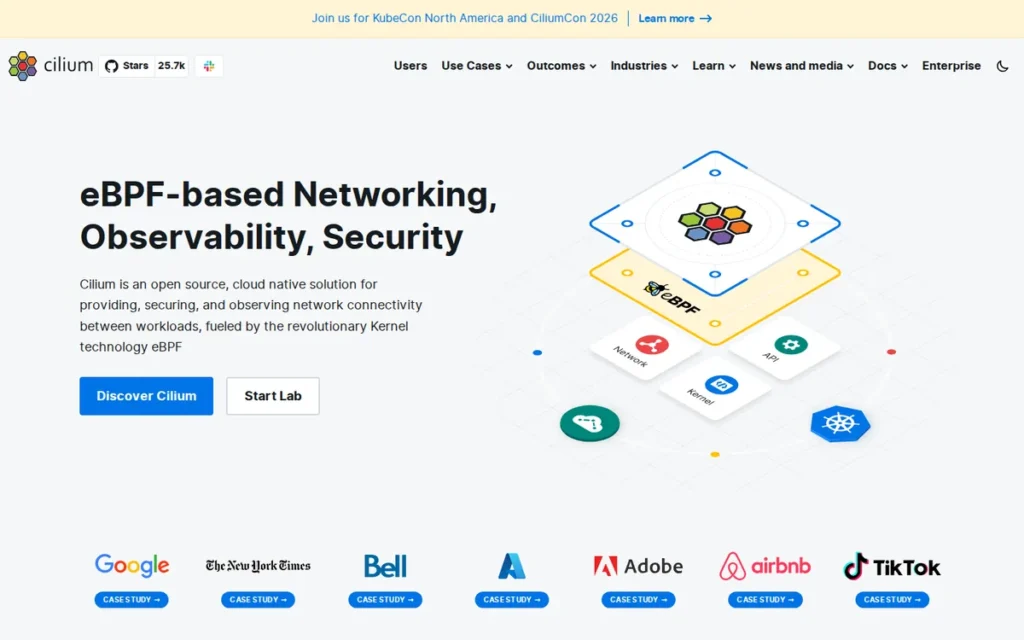
Category: eBPF-Native CNI, a Kubernetes networking, security, and observability platform that runs all dataplane logic, policy enforcement, load balancing, service routing, and flow visibility, through Linux eBPF programs compiled directly into the kernel, bypassing iptables entirely.
At a Glance
- Category: eBPF-Native CNI
- Best For: High-scale Linux production clusters (100+ nodes or 1,000+ services) needing L7 observability and long-term eBPF investment where the team has or is building eBPF operational expertise
- Price Range: Free OSS (Apache 2.0); Isovalent Enterprise via Cisco: enterprise SLA, Tetragon runtime security, advanced tooling (quote-based, not publicly listed)
- Primary Strength: Cilium is the only CNI built from the ground up for eBPF, providing O(1) policy evaluation at any rule count, OSS L7 observability via Hubble, and a sidecar-free service mesh in a single open-source platform at no license cost
- Biggest Limitation: Cilium requires Linux kernel 5.4+ (5.10+ for full feature set), provides no Windows eBPF dataplane support, and carries a steep operational learning curve for on-premises clusters that demands eBPF-specific tooling
- One-Line Summary: Cilium is the CNCF Graduated eBPF-native Kubernetes CNI adopted by GKE, AKS, and EKS Hybrid with OSS Hubble L7 observability, O(1) policy at any scale, and multi-cluster Cluster Mesh at no license cost.
- Last Verified: June 2026
Overview
Cilium is an eBPF-native Kubernetes CNI, security, and observability platform for DevOps and platform engineers managing production clusters at scale, it runs all network policy, load balancing, and flow visibility directly in the Linux kernel via eBPF programs, bypassing iptables entirely.
Cilium achieved CNCF Graduated status on October 11, 2023 (the highest CNCF maturity tier) and is backed commercially by Cisco through the Isovalent acquisition. Google (GKE Dataplane V2), Microsoft (Azure CNI Powered by Cilium), and Amazon (EKS Hybrid) all offer Cilium as a default or preferred dataplane.
Cilium’s Hubble observability layer and sidecar-free service mesh capabilities reduce or eliminate the need for a dedicated service mesh layer in environments where mutual TLS, L7 traffic management, and flow observability are the primary requirements, though Cilium does not replicate every advanced traffic management feature in Istio’s full feature set.
Key Features
- eBPF-Native Dataplane: Cilium runs all network policy, service routing, and load balancing through BPF programs compiled directly into the Linux kernel, eliminating iptables overhead and enabling O(1) policy lookup performance that remains constant whether a cluster has 10 or 10,000 network policy rules.
- Hubble Distributed Observability: Cilium’s Hubble layer captures real-time L7 network flows (including HTTP method and path, DNS queries, gRPC calls, and Kafka topic access) without requiring sidecar injection, exporting data to Prometheus and a Grafana-integrated UI via gRPC Hubble Relay.
- kube-proxy Replacement: Cilium supports fully replacing kube-proxy with its own eBPF-based service routing, eliminating the iptables-restore scalability bottleneck that causes multi-minute endpoint update delays in clusters with 27,000+ services, a documented production failure mode resolved by Cilium migration.
- Sidecarless Service Mesh: Cilium provides a native sidecar-free service mesh handling mutual TLS, L7 traffic management, and policy enforcement without requiring an additional Istio or Linkerd layer, reducing operational overhead for teams seeking unified CNI and mesh functionality in a single platform.
- Cluster Mesh: Cilium Cluster Mesh enables multi-cluster service routing, cross-cluster network policy enforcement, and global load balancing across up to 255 clusters spanning both cloud and on-premises Kubernetes environments with consistent policy.
Best For
Cilium is best for DevOps and platform engineering teams managing Kubernetes at 100+ nodes or 1,000+ services who are investing in long-term eBPF-native infrastructure, need L7 observability without a service mesh sidecar overhead, require multi-cluster networking, and have or are willing to build eBPF operational expertise, particularly SaaS platforms, cloud-native enterprises, and financial services organizations on modern Linux kernels.
Pricing
Cilium open-source (cilium.io) is free under Apache 2.0, covering all core CNI, network policy, Hubble observability, kube-proxy replacement, and Cluster Mesh features with no feature gating. Isovalent Enterprise (now Cisco) adds enterprise SLA support, Tetragon eBPF-based runtime security, and advanced commercial tooling at quote-based pricing not publicly disclosed, contact Cisco/Isovalent sales for enterprise licensing (isovalent.com/product/). Verified June 2026.
Strengths
- Multi-Hyperscaler Adoption Validation: Cilium is the only CNI adopted as a default or preferred dataplane by all three major public cloud Kubernetes platforms simultaneously (GKE Dataplane V2, Azure CNI Powered by Cilium, and Amazon EKS Hybrid nodes) an independent multi-hyperscaler validation of architectural maturity unmatched by any competing CNI in this evaluation. [Reintech.io CNI Comparison 2026; hyperscaler documentation, verified June 2026]
- Documented Production Scale Impact: At a production EKS cluster with 27,000+ unique services and 36,000 pods across approximately 400 nodes, replacing kube-proxy with Cilium in eBPF mode reduced service endpoint update time from approximately 70 seconds (iptables-restore bottleneck) to near-real-time, concrete evidence of O(1) BPF map policy evaluation eliminating O(N) iptables sequential traversal at enterprise scale. [Reddit r/kubernetes, u/isugimpy, verified production report, 2025]
- CNCF Graduated Governance and Market Leadership: Cilium achieved CNCF Graduated status on October 11, 2023 (the highest CNCF maturity tier, shared by fewer than 25 projects across the entire cloud-native ecosystem) and its CNI market share grew from approximately 5% in 2020 to 30–35% in 2025, the steepest adoption curve of any CNI in the category. [CNCF announcement, October 2023; Neuraldesigns.ca CNI market share analysis, 2025]
- Benchmark-Validated Performance Advantage: Cilium leads in raw pod-to-pod throughput at approximately 39 Gbit/s versus Flannel’s 35 Gbit/s and Calico’s 38.5 Gbit/s in the itnext.io 40Gbit/s CNI benchmark (2024). In policy-heavy workloads, Cilium’s advantage over iptables-based CNIs is estimated at 20–40% per Reintech.io CNI Comparison 2026, a gap that grows as network policy rule count scales. [itnext.io benchmark, 2024; Reintech.io CNI Comparison, 2026]
Limitations
- Kernel Version Constraint: Cilium requires Linux kernel 5.4+ for core eBPF features and 5.10+ for the full feature set, blocking adoption in organizations running older RHEL/CentOS distributions or air-gapped environments with long kernel upgrade cycles, a concrete compatibility prerequisite to verify before any Cilium deployment decision.
- No Windows eBPF Support: Cilium provides no eBPF dataplane for Windows nodes: a binary architectural limitation, not a roadmap gap, that disqualifies Cilium for any enterprise running mixed Linux/Windows Kubernetes clusters, where Project Calico at rank #2 is the appropriate alternative.
- Operational Complexity on Self-Managed Clusters: Cilium troubleshooting on self-managed clusters requires eBPF-specific tooling (bpftool, Cilium CLI, Hubble CLI) rather than standard Linux tools, creating a learning curve that on-premises teams without eBPF exposure consistently identify as the primary adoption barrier.
“Cilium ain’t trivial to setup and you have to understand A LOT of the options to choose the right functionality for your specific use-case. Once it clicks though, you get/can create a wonderful setup working like a charm.” (u/glotzerhotze, r/kubernetes (13 upvotes))
Takeaway: Cilium rewards the learning investment with a highly capable unified platform, but self-managed on-premises deployments require deliberate eBPF expertise investment, and teams should plan for a ramp-up period before relying on Cilium for production incident response.
- Managed Cloud Complexity Reduction: Cilium’s operational complexity is substantially reduced on GKE, AKS, and EKS Hybrid where pre-configured deployments remove the on-premises setup burden, meaning the learning curve above applies primarily to self-managed clusters where teams must configure and troubleshoot Cilium independently.
Verdict
Cilium is the best overall container networking software for production Kubernetes environments in 2026, combining CNCF Graduated governance, hyperscaler-validated eBPF architecture, OSS L7 observability via Hubble, and multi-cluster Cluster Mesh in a single free open-source platform.
Teams on GKE, AKS, or EKS Hybrid benefit from pre-configured Cilium deployments that eliminate most on-premises complexity. Teams considering Project Calico at rank #2 should know that choosing Calico is not an inferior decision, Calico’s production validation at 100M+ secured containers globally makes both CNIs defensible enterprise choices whose appropriateness depends entirely on specific operational constraints, not absolute quality.
Teams that cannot meet the Linux kernel 5.4+ requirement or have Windows nodes should choose Project Calico at rank #2 as the production-ready alternative with equivalent network policy depth and native Windows support.
2. Project Calico (Tigera): Best for Enterprise BGP Routing, Multi-Dataplane Flexibility, and Linux-Native Kubernetes Networking
Category: Multi-Dataplane CNI, a Kubernetes networking and security platform supporting iptables, eBPF, and Windows HNS dataplanes within a single deployment, with BGP-native routing that integrates pod CIDRs directly into physical underlay infrastructure.
At a Glance
- Category: Multi-Dataplane CNI
- Best For: On-premises BGP environments, mixed Linux/Windows clusters, and organizations migrating from iptables to eBPF gradually without replacing the CNI
- Price Range: Free OSS (Apache 2.0); Calico Cloud and Calico Enterprise at quote-based pricing (Tigera, not publicly listed)
- Primary Strength: Project Calico is the most widely deployed CNI globally, offering BGP-native routing for on-premises integration and the only major CNI that supports both eBPF and Windows HNS dataplanes in a single deployment, debuggable with standard Linux tools
- Biggest Limitation: Project Calico is not CNCF-governed: Tigera controls the OSS roadmap and has historically gated advanced features (including observability) behind commercial tiers, and Calico Whisker observability lags behind Cilium’s Hubble in OSS feature depth
- One-Line Summary: Project Calico is the most deployed Kubernetes CNI in production with an estimated 40–45% global market share, providing BGP-native routing, multi-dataplane flexibility across iptables/eBPF/Windows HNS, and L3/L4/L7 policy debuggable with standard Linux tools.
- Last Verified: June 2026
Overview
Project Calico is a Kubernetes networking and security CNI maintained by Tigera, deployed by DevOps and platform engineers across bare-metal on-premises and managed cloud environments, the most widely deployed CNI globally with an estimated 40–45% market share and Tigera reporting 100 million+ containers secured as of 2025.
Project Calico ranks #2 rather than #1 because Cilium’s purpose-built eBPF architecture outperforms Calico’s retrofitted eBPF mode on C3 Observability (Hubble OSS vs. Calico Whisker commercial-only) and C1 Dataplane Architecture depth, not on deployment scale, where Project Calico leads the entire category.
Project Calico’s distinctive BGP-first routing architecture advertises pod CIDRs directly into the physical underlay without overlay encapsulation, while its unique multi-dataplane support (iptables, eBPF, Windows HNS) enables mixed-OS cluster networking and gradual eBPF migrations within a single CNI deployment.
Key Features
- BGP-Native Routing: Project Calico advertises pod CIDRs directly into the physical underlay network using standard BGP peering with ToR switches and routers, eliminating VXLAN or IP-in-IP overlay encapsulation overhead, uniquely valuable for bare-metal on-premises deployments with BGP-speaking networking equipment.
- Multi-Dataplane Architecture: Project Calico supports three dataplanes in a single deployment (iptables (default), eBPF mode (kube-proxy replacement, higher performance), and Windows HNS (for Windows Server nodes)) enabling in-place dataplane upgrades and mixed-OS cluster networking that no eBPF-first competitor matches.
- GlobalNetworkPolicy CRDs: Project Calico enforces Kubernetes NetworkPolicy plus its own GlobalNetworkPolicy CRDs at L3/L4/L7, supporting FQDN-based egress policies, application-layer awareness, and workload-level microsegmentation across both Linux and Windows nodes simultaneously.
- Standard Linux Debugging: Project Calico routes are injected directly into each node’s Linux routing table, making pod-to-pod traffic paths inspectable with standard Linux tools (ip route, iptables -L, tcpdump) without requiring eBPF-specific tooling or kernel-level debugging skills.
Operational scenario: When a pod cannot reach a service during a 2 AM incident, a Project Calico operator runs ip route show and immediately sees pod CIDR routes, familiar Linux debugging accessible to any sysadmin.
A Cilium operator requires bpftool, Cilium CLI, or Hubble CLI, powerful tools requiring eBPF expertise to interpret. For on-call teams without dedicated platform engineers, this debugging accessibility difference is operationally material.
- Calico Whisker Observability: Project Calico’s Calico Whisker provides network flow visualization and policy verdict inspection in Calico Cloud and Calico Enterprise commercial tiers, with community-level flow logging available in the open-source version for teams evaluating commercial observability.
Best For
Project Calico is best for enterprise teams managing Kubernetes on bare-metal on-premises infrastructure with existing BGP routing equipment, teams operating mixed Linux/Windows Kubernetes clusters where Cilium’s complete lack of Windows eBPF support is a disqualifier, organizations requiring mature L3/L4/L7 network policy debuggable with standard Linux tools, and DevOps engineers at any scale who prioritize proven deployment stability.
Pricing
Project Calico Open Source is free under Apache 2.0, covering CNI, NetworkPolicy, BGP routing, optional eBPF dataplane, and WireGuard encryption. Calico Cloud (Tigera SaaS) and Calico Enterprise (on-premises commercial) provide advanced multi-cluster management, compliance reporting, Calico Whisker observability, and enterprise SLA support, both at undisclosed quote-based pricing (tigera.io/pricing/). Community feedback characterizes the enterprise tier as “overly expensive.” Verified June 2026.
Strengths
- Largest Vendor-Reported Production Deployment Footprint: Tigera reports 100 million+ containers secured across 8 million+ nodes in 166 countries (figures aggregated in the Futuriom 50 Report (February 2026) from Tigera’s self-reported deployment data) the largest vendor-reported production scale claim in the CNI category, representing a breadth of production validation no competing CNI matches. [Futuriom 50 Report citing Tigera data, February 2026]
- Unique Windows HNS Multi-Dataplane Support: Project Calico’s Windows HNS dataplane support is unique among major modern CNIs (Cilium provides no Windows eBPF support) delivering full Kubernetes NetworkPolicy enforcement on Windows Server nodes via Windows Host Networking Service, enabling single-CNI management of mixed Linux/Windows clusters. [Tigera architecture documentation; multiple comparison articles, 2026]
- Verified Enterprise Scale in Production: A production operator running 2,000-node Project Calico clusters confirmed “thousands of pods on Calico without too much issues”, validating Calico’s production scalability at enterprise node counts in its iptables mode, with the primary bottleneck being large service backends rather than the CNI itself. [Reddit r/kubernetes, u/TartifletteXx, verified production report, 2025]
- In-Place eBPF Migration Path: Project Calico’s eBPF mode provides kube-proxy replacement and preserves source IP to pods, a pain point with iptables DNAT, with a Tigera-presented KubeCon 2025 benchmark showing Calico eBPF mode outperforming iptables in throughput and latency at scale, enabling in-place migration without replacing the CNI. [Tigera eBPF dataplane documentation; Tigera-presented KubeCon 2025 benchmark, vendor-run demonstration, not independently replicated]
Users on r/kubernetes designing production HA bare-metal clusters confirmed:
“RKE2, kube-vip pod manifest on all the control-plane nodes prior to starting the first node. Make a rke2-api DNS entry for your kube-vip IP. Configure the rke2 tls-san to include the DNS entry among the other control plane node ips as well. At least 3 control plane nodes. Taint them with the standard control plane taint. Use calico as the cni if you want to use istio. Metal LB operator is super easy to install and setup via helm, use service type load balancer for your gateways.” Posted by u/JuiceStyle
Takeaway: Senior practitioners designing production HA bare-metal Kubernetes consistently reach for Project Calico as the CNI backbone, validating its standing as the first-choice recommendation for on-premises deployments where tooling ecosystem compatibility matters.
Limitations
- Governance Risk: Project Calico is controlled entirely by Tigera: not a CNCF project, meaning one private company determines what features remain open-source and what requires paid licensing, with advanced capabilities historically gated behind Calico Enterprise rather than made freely available as in Cilium’s OSS releases.
“Calico is somewhat more polished (likely funded by their very cool, albeit overly expensive, enterprise offering), and a bit more feature-rich, but some niche features are deliberately behind a paywall.” (u/Sindef, r/kubernetes)
Takeaway: Tigera’s commercial licensing model has historically placed valuable capabilities (including observability and egress gateway) behind a paywall, making the OSS vs. commercial feature gap a concrete factor when comparing Project Calico to Cilium’s fully open-source Hubble implementation.
- Observability Paywall: Project Calico gates Calico Whisker: its competitive response to Cilium Hubble, behind commercial tier licensing, placing the category’s most valued observability capability behind a cost barrier that Cilium avoids by providing Hubble in full OSS.
- Tigera Operator Lifecycle Friction: Project Calico’s Tigera operator introduces documented operational pain during uninstall and cluster rebuild operations, with practitioners describing it as “damn near impossible to remove the other components” when the operator is removed out of order, a concrete cluster lifecycle management concern. [Reddit r/kubernetes, u/jameshearttech]
Users on r/kubernetes noted an additional operational gotcha in multi-NIC environments:
“In out tenant clusters we use calico, because we just rolled with that. Its pretty reliable but we dont use many of the features it provides. We had some trouble with our network setup. Calico always tries to use the wrong network interface as backend. We had to hard config it and make sure that setting never gets removed, otherwise all workloads lose network connectivity…” Posted by u/PlexingtonSteel
Takeaway: Project Calico’s network interface auto-detection carries a documented operational trap in multi-NIC environments, teams must explicitly pin the node address detection method or risk cluster-wide network loss during CNI configuration resets.
- Retrofitted eBPF Architecture: Project Calico’s eBPF mode was added onto an iptables-native architecture rather than designed eBPF-first, Cilium’s purpose-built eBPF feature depth, particularly in L7 observability via Hubble and sidecar-free service mesh, outpaces Calico’s eBPF implementation for teams seeking maximum observability depth.
Verdict
Project Calico is the best container networking software for enterprise teams managing bare-metal on-premises Kubernetes with BGP infrastructure, mixed Linux/Windows clusters, or environments where standard Linux networking expertise is preferred over eBPF specialization, validated by the largest vendor-reported production deployment footprint in the CNI category.
Teams deciding between Project Calico and Cilium should evaluate three concrete factors before committing: Windows node requirement (Calico only), eBPF operational expertise availability (Cilium benefits more; Calico OSS is sufficient without it), and whether advanced observability is a day-one requirement (Cilium Hubble outperforms Calico Whisker in the OSS tier).
3. AWS VPC CNI: Best for Amazon EKS Environments: Native AWS VPC Integration with Zero Encapsulation Overhead
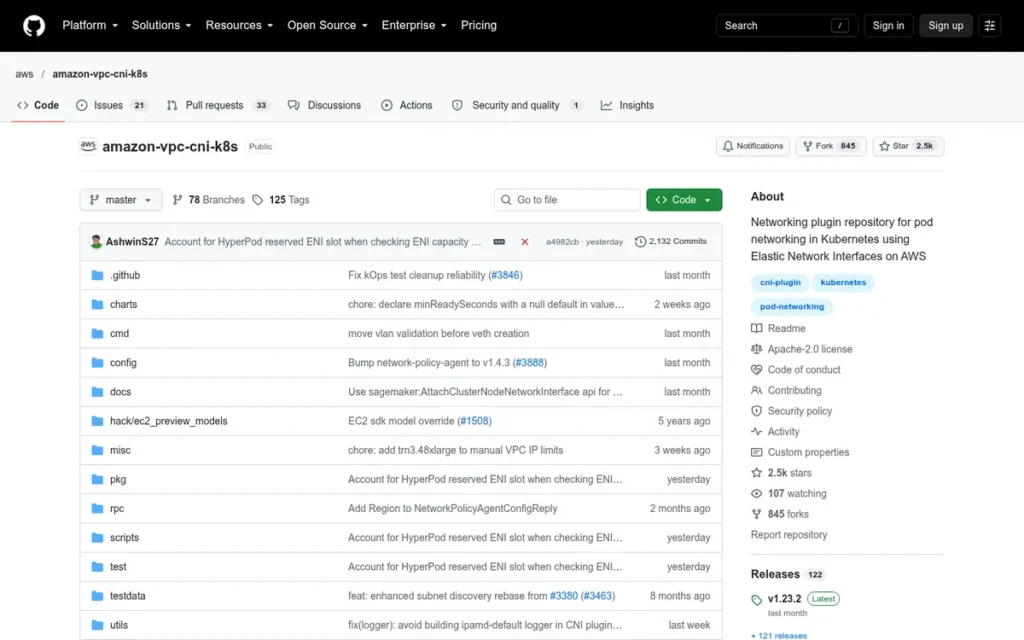
Category: Cloud-Native VPC CNI, an AWS-managed Kubernetes CNI that assigns pods native Amazon VPC IP addresses using EC2 Elastic Network Interfaces, enabling direct VPC-level routing without overlay encapsulation and native integration with all AWS networking constructs.
At a Glance
- Category: Cloud-Native VPC CNI
- Best For: Production workloads exclusively on Amazon EKS needing native AWS Security Group integration and the AWS official EKS support SLA
- Price Range: Free OSS (Apache 2.0); no CNI license fee: costs are EKS control plane ($0.10/hour per cluster, approximately $72/month) and EC2 node instances. Verified June 2026.
- Primary Strength: AWS VPC CNI assigns pods native Amazon VPC IP addresses directly from EC2 ENIs, providing zero-encapsulation wire-speed pod networking and exclusive integration with every AWS networking construct, Security Groups, NACLs, VPC Flow Logs, and Transit Gateway
- Biggest Limitation: AWS VPC CNI is architecturally locked to Amazon EKS and cannot be deployed outside AWS; teams replacing it with Cilium or Calico on EKS lose the AWS official EKS networking support SLA, making it structurally unsuitable for multi-cloud or hybrid strategies
- One-Line Summary: AWS VPC CNI is the default Amazon EKS networking plugin achieving zero-encapsulation wire-speed pod connectivity by assigning native VPC IP addresses directly to pods, with exclusive Security Groups for Pods and VPC Flow Log integration no alternative EKS CNI can replicate.
- Last Verified: June 2026
Overview
AWS VPC CNI is the default Amazon EKS networking plugin for DevOps engineers running Kubernetes on AWS, it assigns each pod a native VPC IP address directly from EC2 Elastic Network Interfaces, delivering zero-encapsulation wire-speed pod networking with full integration with AWS Security Groups, NACLs, and VPC routing.
AWS VPC CNI also supports Security Groups for Pods (an AWS-exclusive pod-level firewall capability) and prefix delegation mode (August 2021), which increased maximum pod density per node from roughly 10–20 pods to 100+ on Nitro-based instances.
The dominant production pattern for EKS (validated as the top-voted community recommendation with 75 upvotes) is AWS VPC CNI for IPAM layered with Cilium or Calico for L7 policy, observability, and encryption via CNI chaining.
A useful mental model for CNI chaining on EKS: AWS VPC CNI acts as the DHCP server, assigning native VPC IP addresses to pods via EC2 ENI slots. Cilium or Calico sits on top as the firewall and observability layer.
The result: zero-encapsulation VPC performance and the AWS official EKS support SLA intact, plus eBPF policy and Hubble observability from the secondary CNI. This is not a compromise architecture, it is the top-voted production recommendation in the EKS community.
Key Features
- Native VPC IP Assignment: AWS VPC CNI assigns each pod a native VPC IP address pulled from pre-allocated warm pools on EC2 ENIs, enabling pods to communicate with VPC services such as RDS, ElastiCache, and Redshift at wire speed using standard VPC routing, a zero-encapsulation architecture no other CNI replicates outside AWS.
- Prefix Delegation Mode: AWS VPC CNI’s prefix delegation mode (available since August 2021 on Nitro-based EC2 instances) assigns /28 IPv4 prefixes per ENI slot, increasing maximum pod density per node from roughly 10–20 pods to 100+ on standard instance types, directly resolving the subnet depletion problem documented in early large-scale EKS deployments. [AWS blog on prefix delegation, August 2021]
- Security Groups for Pods: AWS VPC CNI integrates with Security Groups for Pods via a separate EKS controller, allowing individual pods to be assigned AWS-native Security Group rules with the same firewall model applied to EC2 instances, RDS databases, and ElastiCache clusters, pod-level AWS-native security posture no alternative CNI replicates on EKS.
- CNI Chaining Support: AWS VPC CNI supports CNI chaining, allowing Cilium or Calico to deploy as a secondary CNI on top (VPC CNI handles native VPC IP allocation while Cilium or Calico adds L7 network policy, eBPF observability, and encryption) the top-voted EKS production pattern with 75 upvotes. [Reddit r/kubernetes, u/Ok_Independent6196, December 2025]
- AWS EKS Team Maintenance: AWS VPC CNI is maintained by the AWS EKS team with releases tied to EKS version milestones, providing continuous alignment with new AWS networking features including IPv6 dual-stack and prefix delegation modes, backed by AWS’s CVE response process.
Best For
AWS VPC CNI is best for DevOps and platform engineering teams running workloads exclusively on Amazon EKS who need native AWS Security Group integration, VPC Flow Log visibility, and the AWS official EKS support SLA, particularly when deployed in the CNI chaining pattern with Cilium or Calico for L7 policy enforcement and observability on latency-sensitive or compliance-regulated workloads.
Pricing
AWS VPC CNI software is free under Apache 2.0 with no CNI license fee. Total cost reflects EKS infrastructure: the EKS control plane at $0.10/hour per cluster (approximately $72/month), EC2 node instances, and ENI resource allocation at no additional charge per ENI. AWS EKS pricing Teams at large node counts should plan VPC subnet CIDR space carefully, as warm pool pre-allocation reserves IP addresses even for unscheduled pods. Verified June 2026.
Strengths
- Zero-Encapsulation Native VPC Performance: AWS VPC CNI achieves native VPC-level network performance with zero encapsulation overhead, on Nitro-based EC2 instances with ENA networking, pods can utilize full instance network bandwidth up to 100 Gbps on high-throughput instance types, a performance ceiling no overlay-based CNI can match within AWS infrastructure. [AWS EKS Best Practices Guide, verified June 2026]
- Top-Voted EKS Community Production Pattern: The highest-upvoted EKS community recommendation (75 upvotes) validates AWS VPC CNI as the preferred IPAM layer: “You should use AWS CNI Custom Networking to address IP exhaustion. If you want features from Calico or Cilium, run AWS CNI and Calico or Cilium. This is the common pattern for production grade cluster.” [Reddit r/kubernetes, u/Ok_Independent6196, December 2025]
- Exclusive Security Groups for Pods Integration: Security Groups for Pods is an AWS-exclusive capability unavailable in any alternative CNI, individual pods can be assigned AWS Security Groups with the same firewall rules applied to EC2 instances, RDS, and ElastiCache, providing AWS-native pod-level security using familiar IAM and Security Group tooling already managed across the AWS estate. [AWS VPC Resource Controller documentation; AWS EKS Best Practices Guide, verified June 2026]
- Prefix Delegation Resolves IP Exhaustion: AWS VPC CNI’s prefix delegation mode (launched August 2021) resolved the IP exhaustion constraint that forced early EKS clusters into subnet depletion, enabling 100+ pods per node on Nitro-based instances by assigning /28 IPv4 prefixes per ENI slot, documented as the primary EKS pod density improvement. [AWS blog post on prefix delegation, August 2021]
This aligns with community experience on r/kubernetes:
“With the native CNI solution you get also native network insights and monitoring support directly form aws solutions. You can use flow control and have all data directly in cloud watch. It is also covered by aws support. It also lowers network complexity, no NAT, complicated iptables and other services can directly communicate with the pod. It’s also fewer network hops. If I do not mistaken, azure has a similar CNI. But it is completely up to you and your use case if it makes sense. You can also use any other CNI.” Posted by u/hennexl
Takeaway: AWS VPC CNI’s native CloudWatch integration, AWS support coverage, and zero-NAT architecture make it the natural default for teams committed to an AWS-native operations model rather than a cloud-agnostic toolchain.
Limitations
- Hard AWS Cloud Lock-In: AWS VPC CNI runs exclusively on Amazon EKS and cannot be deployed in any non-AWS Kubernetes environment, making it structurally incompatible with multi-cloud or hybrid on-premises strategies where a consistent networking stack across clusters is required.
- AWS EKS Support SLA Dependency: Teams replacing AWS VPC CNI with Cilium or Calico on EKS lose the AWS official EKS networking support SLA: “If you’re running production workloads and have enterprise support, and encounter networking issues you can count out official AWS Support to help with alternatives outside of best effort.” [Reddit r/kubernetes, u/signsots, 6 upvotes, 2025]
- No Native L7 Policy or Flow Observability: AWS VPC CNI provides L3/L4 Security Groups for Pods and VPC Flow Logs but no HTTP, DNS, or gRPC flow inspection without a secondary chained CNI, teams needing L7 network security observability must deploy the CNI chaining pattern rather than relying on VPC CNI alone.
- IP Warm Pool Exhaustion Risk: AWS VPC CNI pre-allocates VPC subnet IP addresses for warm pools even for nodes with no scheduled pods, requiring deliberate CIDR planning upfront to avoid subnet exhaustion at scale, a documented production failure mode in clusters that did not provision sufficiently large subnets at creation. [Reddit r/kubernetes, u/Kooky_Comparison3225, December 2025]
Verdict
AWS VPC CNI is the best container networking choice for teams running production workloads exclusively on Amazon EKS, providing the only zero-encapsulation VPC-native pod networking on the platform, exclusive Security Groups for Pods integration, and the AWS official EKS support SLA that alternative CNIs cannot provide.
For the majority of EKS production deployments, the community-validated architecture is AWS VPC CNI for IPAM layered with Cilium or Calico for network policy and observability, the highest-upvoted CNI recommendation in EKS community discussions with 75 upvotes. Teams managing Kubernetes across multiple clouds or hybrid on-premises environments should choose Cilium (rank #1) or Project Calico (rank #2) as their primary CNI.
4. Antrea: Best for VMware Tanzu and OVS-Standardized Enterprise Kubernetes Environments
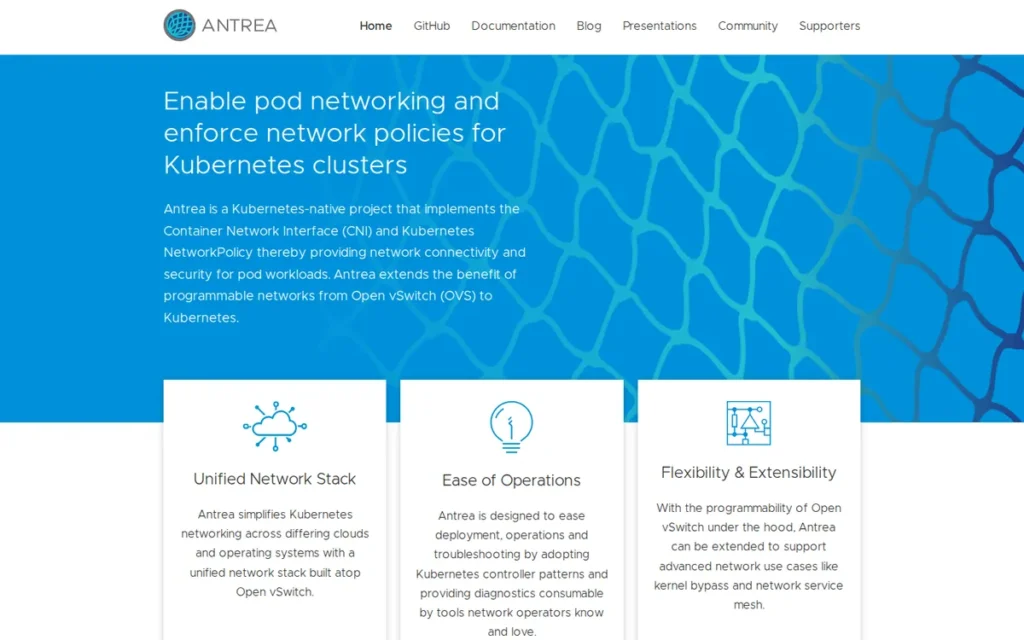
Category: OVS-Based CNI, a Kubernetes networking and security plugin built entirely on Open vSwitch, providing programmable pod networking with NIC hardware offload capability, admin-level ClusterNetworkPolicy enforcement, and integrated non-disruptive packet tracing via Traceflow.
At a Glance
- Category: OVS-Based CNI
- Best For: VMware Tanzu or NSX-T environments, OVS-standardized infrastructure, and compliance-driven teams requiring ClusterNetworkPolicy admin enforcement that application teams cannot override
- Price Range: Free OSS (Apache 2.0); commercial support via Broadcom VMware Tanzu contracts only, bundled platform deal, not available as a standalone Antrea support SKU. Verified June 2026.
- Primary Strength: Antrea provides ClusterNetworkPolicy CRDs that enforce mandatory cluster-wide security baselines application teams cannot override, combined with OVS-based NIC hardware offload and Traceflow non-disruptive packet debugging
- Biggest Limitation: Antrea has a significantly smaller community than Cilium or Calico (described as “not competitive outside VMware/Tanzu contexts” by practitioners) and its commercial support path is bundled exclusively with Broadcom’s VMware Tanzu platform, creating roadmap uncertainty for standalone deployments
- One-Line Summary: Antrea is the OVS-based Kubernetes CNI developed by VMware providing ClusterNetworkPolicy admin-level enforcement, Traceflow packet debugging, and NIC hardware offload as the default CNI for VMware Tanzu Kubernetes Grid.
- Last Verified: June 2026
Overview
Antrea is an Open vSwitch-based Kubernetes CNI developed by VMware (now Broadcom) for platform engineers managing Kubernetes in VMware Tanzu or NSX-T environments, it uses OVS for all pod networking, policy enforcement, and traffic management, with NIC hardware offload support on compatible SmartNICs for telco and HPC workloads.
Antrea holds CNCF Sandbox status and is the default CNI for VMware Tanzu Kubernetes Grid, providing two distinct technical differentiators from Cilium and Calico: ClusterNetworkPolicy CRDs that enforce cluster-wide security baselines application teams cannot override, and Traceflow for non-disruptive synthetic packet debugging through the OVS pipeline.
Antrea is most compelling within the VMware/Tanzu ecosystem. Outside that context, Antrea carries meaningful community size and roadmap risk following the Broadcom acquisition of VMware in November 2023.
Key Features
- OVS Hardware Offload: Antrea uses Open vSwitch as its entire dataplane, enabling hardware offload on compatible SmartNICs and infrastructure switches via OVSDB, reducing host CPU overhead for high-throughput network processing toward near-zero for supported hardware in telco, HPC, and AI/ML training workloads. [Antrea architecture documentation; polito.it benchmarking thesis, 2021, most recent available independent source for hardware offload capability as of June 2026]
- ClusterNetworkPolicy CRDs: Antrea’s ClusterNetworkPolicy gives cluster administrators a security enforcement layer above namespace scope, enabling mandatory cluster-wide rules that override namespace-level application team policies, directly supporting PCI-DSS segmentation and SOC2 audit requirements that application teams cannot modify.
- Traceflow Debugging: Antrea’s Traceflow injects synthetic test packets that trace their exact path through the OVS pipeline, showing which policy rule accepted or dropped each packet at every network hop, enabling policy debugging without capturing or interrupting live production traffic.
- IPsec Inter-Node Encryption: Antrea supports IPsec tunnel encryption for inter-node traffic out of the box, providing compliant in-transit pod traffic encryption for regulated environments without a separate WireGuard or mutual TLS configuration layer.
- VMware NSX-T Integration: Antrea integrates with VMware NSX-T for enterprise microsegmentation, enabling platform teams in vSphere/Tanzu environments to manage Kubernetes network policy through the same NSX-T console used for VM-level network segmentation, reducing operational context switching.
Best For
Antrea is best for DevOps and platform engineering teams operating Kubernetes within VMware Tanzu or NSX-T environments where OVS is the existing network virtualization standard, or teams with specific requirements for ClusterNetworkPolicy compliance enforcement, hardware NIC offload for telco-grade line-rate networking, or non-disruptive packet debugging via Traceflow, accepting the smaller community size and Broadcom roadmap risk as trade-offs.
Pricing
Antrea is free and open source under Apache 2.0 with no standalone paid enterprise tier for the CNI itself. Commercial support is available only through Broadcom’s VMware Tanzu platform support contracts as a bundled deal, not as a purchasable standalone Antrea support SKU. Teams outside Broadcom’s Tanzu customer base have community-only support via GitHub Issues and the Antrea Slack channel. Verified June 2026.
Strengths
- Admin-Level Compliance Enforcement: Antrea’s ClusterNetworkPolicy CRDs provide a compliance enforcement capability that neither Calico OSS nor Cilium OSS equivalently implements out-of-the-box: cluster-wide policy at the administrator tier overriding namespace-level application team policies, directly supporting PCI-DSS segmentation and SOC2 audit requirements without commercial licensing. [Antrea GitHub documentation; CNCF KubeCon Antrea presentation, 2020]
- Confirmed Production Use in Tanzu Environments: Antrea has documented practitioner adoption in Tanzu and NSX-T environments: “On prem, we started using Antrea (from VMware) for the egress gateway feature. I’ve found Antrea’s documentation very simple for this usage”, confirming targeted Antrea adoption for specific production capabilities even outside the default Tanzu context. [Reddit r/kubernetes, u/Fredouye, verified production report, 2024, 4 upvotes]
- OVS-Based Hardware NIC Offload: Antrea’s OVS-based dataplane supports hardware offload on compatible SmartNICs via OVSDB, reducing host CPU overhead for network processing, relevant for telco, HPC, and AI/ML training workloads requiring line-rate networking with minimal host CPU consumption. [Antrea architecture documentation; polito.it benchmarking thesis, 2021, most recent available independent source]
- Traceflow for Non-Disruptive Debugging: Antrea’s Traceflow reduces Mean Time to Resolution for policy-related network incidents by tracing synthetic test packet verdicts at each OVS pipeline hop, identifying drop rules without requiring live traffic capture or production workload interruption, a debugging capability unavailable in Flannel and more targeted than Hubble’s continuous flow capture. [Antrea documentation; alexbrand.dev Antrea first-look review]
Limitations
- Small Community: Antrea has a significantly smaller community than Cilium or Calico (consistently described by practitioners as “not competitive unless your vendor advises it”) meaning fewer Stack Overflow answers, slower GitHub issue responses, and a smaller hiring pool for Antrea-experienced engineers, raising operational support risk for teams without dedicated vendor backing.
“I’ve not heard of Antrea being used anywhere frankly, though I’m familiar with OVS as a technology. I would not bother with it. Community will undoubtedly be much smaller and support harder to come by unless you’re paying for some vendor support.” (u/raybond007, r/kubernetes (19 upvotes))
Takeaway: Community size is a practical proxy for operational support availability, Antrea’s smaller ecosystem means fewer troubleshooting resources and a smaller hiring pool, directly increasing operational risk for teams without dedicated vendor support contracts.
- Broadcom Acquisition Uncertainty: Broadcom’s aggressive restructuring of VMware’s product portfolio following the November 2023 acquisition creates ongoing uncertainty about Antrea’s enterprise roadmap, development velocity, and long-term commercial support commitment based on available public sources.
- OVS Performance Ceiling: Antrea’s OVS dataplane introduces higher per-packet processing overhead than eBPF’s kernel-resident approach, making Antrea a weaker choice than Cilium for high-throughput, performance-sensitive workloads where the eBPF kernel-bypass architecture provides a measurable advantage.
- No Standalone Commercial Support SKU: Antrea’s commercial support is bundled exclusively with Broadcom’s VMware Tanzu platform (not available as a purchasable standalone CNI support contract) limiting support access for teams outside the Tanzu customer base and requiring a full Tanzu platform commitment for SLA-backed operations.
Verdict
Antrea is the best container networking software for VMware Tanzu and NSX-T environments specifically, where its OVS integration, ClusterNetworkPolicy admin enforcement, and Traceflow debugging align directly with the VMware networking operational model, confirmed by production use in Tanzu Kubernetes Grid deployments and targeted egress gateway adoption cases.
Outside the VMware ecosystem, Antrea faces a community disadvantage and Broadcom acquisition uncertainty that makes Cilium or Project Calico the stronger default choices. Teams evaluating Antrea for general-purpose Kubernetes should explicitly assess the Broadcom acquisition’s effect on long-term roadmap continuity before committing to it as a strategic platform investment.
5. Kube-OVN: Best for Multi-Tenant Kubernetes Platforms and VM+Container Convergence Networking
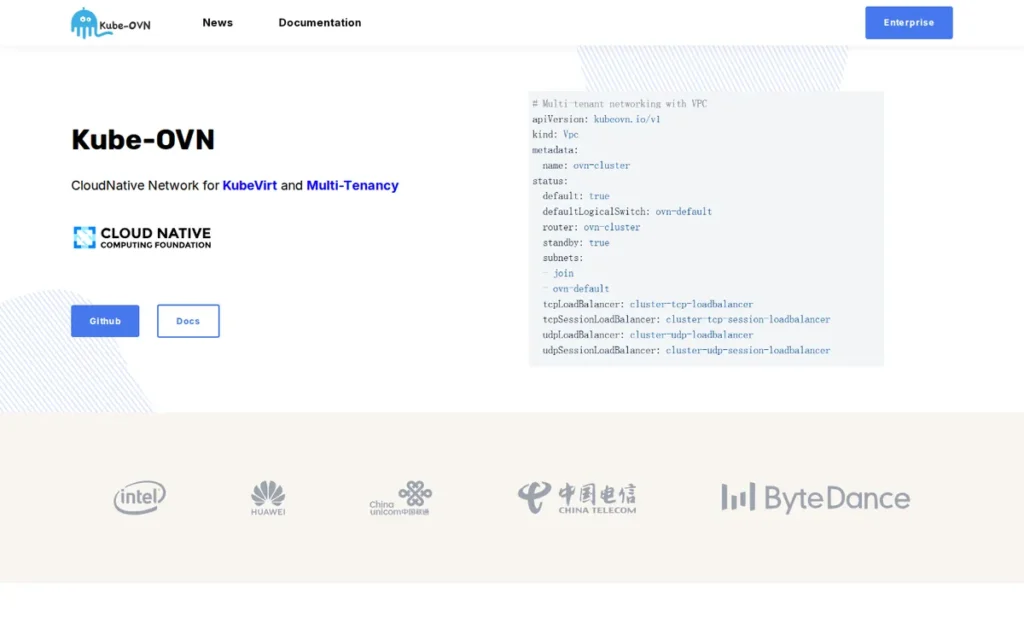
Category: SDN/Multi-Tenant CNI, an OVN/OVS-based Kubernetes CNI providing virtual private cloud isolation with overlapping IP address spaces, logical switching and routing, and first-class VM+container unified networking for multi-tenant platform environments.
At a Glance
- Category: SDN/Multi-Tenant CNI
- Best For: Platform engineering teams building managed multi-tenant Kubernetes platforms requiring VPC-level tenant isolation with overlapping IPs, and enterprises running KubeVirt VM+container workloads needing unified OVN-level network management
- Price Range: Free OSS (Apache 2.0); commercial support via Alauda’s ACP enterprise platform, bundled platform deal, not a standalone Kube-OVN support SKU. Verified June 2026.
- Primary Strength: Kube-OVN is the only Kubernetes CNI providing native multi-tenant VPC isolation with overlapping IP address spaces, bringing full cloud-provider VPC semantics inside a self-managed Kubernetes cluster with no equivalent in any other evaluated CNI
- Biggest Limitation: Kube-OVN has minimal Western community presence and English-language troubleshooting resources, very high OVN/OVS operational complexity, and raw network throughput documented below eBPF-based CNIs, making it unsuitable for general-purpose Kubernetes deployments
- One-Line Summary: Kube-OVN is the only CNCF Sandbox Kubernetes CNI providing VPC-level multi-tenant network isolation with overlapping IP address spaces and first-class KubeVirt VM+container unified networking, maintained primarily by Alauda for enterprise platform and hybrid workload environments.
- Last Verified: June 2026
Overview
Kube-OVN is an OVN/OVS-based Kubernetes CNI for platform engineers building managed multi-tenant Kubernetes platforms, it provides virtual private cloud (VPC) isolation with overlapping IP address spaces, logical switching and routing, and first-class KubeVirt VM+container unified networking, capabilities unavailable in any other major evaluated CNI.
Kube-OVN is a CNCF Sandbox project with its formal CNCF membership publicly announced in December 2024, maintained primarily by Alauda (a Beijing-based enterprise Kubernetes platform company) with Chinese enterprise users including banks, insurance companies, and state-owned enterprises as the primary documented production base.
Kube-OVN is a highly specialized choice for multi-tenant platform builders and enterprises running KubeVirt workloads, not a general-purpose CNI for standard single-tenant Kubernetes deployments.
Key Features
- Multi-Tenant VPC Isolation: Kube-OVN provides native multi-tenant VPC networking with full IP address space isolation, enabling different tenants to use overlapping CIDR ranges within the same Kubernetes cluster via OVN logical switches and routers, VPC semantics equivalent to AWS VPC or Azure VNet inside a self-managed cluster, unavailable in any other evaluated CNI.
- KubeVirt VM+Container Networking: Kube-OVN offers first-class KubeVirt support, enabling virtual machines managed by KubeVirt to share the same OVN virtual networks as container pods with unified QoS policies, ACL enforcement, and routing configurations, the only CNI to natively unify VM and container network management at the OVN logical network level.
- Subnet-Level QoS Rate Limiting: Kube-OVN supports QoS rate limiting for both ingress and egress per pod or namespace, enabling platform teams to enforce guaranteed bandwidth allocation and burst limits for individual tenants within a shared multi-tenant cluster, a multi-tenancy SLA requirement flat-network CNIs do not natively support.
- Built-In SDN Visualization: Kube-OVN includes subnet-level network visualization, traffic mirroring, and an observability dashboard providing SDN-level topology visibility and per-tenant flow data without requiring a separate monitoring integration.
- Hybrid Overlay and Underlay Networking: Kube-OVN supports mixed overlay and underlay networking in the same cluster, workloads requiring direct physical network access use underlay mode while other tenants use OVN virtual overlay networks, enabling gradual migration from legacy physical network infrastructure.
Best For
Kube-OVN is best for platform engineering teams building managed multi-tenant Kubernetes platforms where hard tenant network isolation with overlapping IP ranges is a core product requirement, enterprises with KubeVirt deployments requiring unified VM and container networking in a single CNI, and organizations with existing OVN/OVS operational expertise whose multi-tenancy requirements exceed what flat-network CNIs like Cilium or Calico can address.
Pricing
Kube-OVN is free and open source under Apache 2.0. No standalone commercial support tier was found publicly listed as of June 2026. Alauda provides commercial support as part of its ACP (Alauda Container Platform) enterprise product, bundled with the broader platform rather than available as a standalone Kube-OVN support contract. Organizations outside Alauda’s customer base rely on community support via GitHub Issues and the Kube-OVN Slack channel. Verified June 2026.
Strengths
- Unique Multi-Tenant VPC Isolation Capability: Kube-OVN is the only Kubernetes CNI providing native multi-tenant VPC isolation with overlapping IP address spaces, mirroring AWS VPC or Azure VNet semantics inside a self-managed cluster, uniquely enabling managed Kubernetes platform providers to offer network-isolated tenant environments without per-tenant cluster proliferation or external SDN controllers. [Kube-OVN architecture documentation; rafay.co Kube-OVN deep dive, November 2024]
- CNCF Sandbox Governance Recognition: Kube-OVN holds CNCF Sandbox status, with formal CNCF membership publicly announced in December 2024, an independent validation that the project has met CNCF governance, due diligence, and security review requirements, distinguishing it from purely vendor-controlled open-source projects. [Kube-OVN GitHub README; kube-ovn.io CNCF announcement, December 2024]
- First-Class KubeVirt Integration: Kube-OVN’s first-class KubeVirt integration enables VMs and containers to share the same OVN virtual network with unified QoS, ACL, and routing policies, addressing the VM+container networking convergence requirement that all major competing CNIs (Cilium, Calico, Flannel, Antrea, AWS VPC CNI) do not natively support at the OVN logical network modeling level. [rafay.co Kube-OVN deep dive, November 2024]
- Advanced SDN Feature Breadth: Kube-OVN’s SDN feature set: including subnet-level QoS, built-in traffic mirroring, VPC peering, BGP integration, and subnet-level DNS/DHCP, exceeds what any single flat-network CNI provides out-of-the-box for teams whose multi-tenant platform requirements justify the OVN/OVS operational investment. [Kube-OVN architecture documentation; rafay.co technical analysis, 2024]
Limitations
- Performance Below eBPF: Kube-OVN’s OVN/OVS control plane introduces higher per-packet processing overhead than eBPF’s kernel-resident approach, documented as producing lower throughput and higher latency than Cilium in a 2025 practitioner analysis. Treat as directional rather than definitive given the single LinkedIn Pulse source rather than a peer-reviewed benchmark. [LinkedIn Pulse, 2025, one practitioner analysis, not independently replicated]
- Minimal Western Community: Kube-OVN has no meaningful discussions in r/kubernetes and minimal English-language Stack Overflow content, creating high operational support risk for Western engineering teams where community-sourced knowledge is a primary debugging resource, with troubleshooting dependent on GitHub Issues and limited English documentation.
- Very High OVN/OVS Operational Complexity: Kube-OVN requires dedicated expertise in OVN logical network modeling, OVSDB administration, and SDN concepts substantially beyond standard Kubernetes networking knowledge, an expertise investment justified for multi-tenant platform use cases but disproportionate for standard single-tenant Kubernetes operations.
- Asia-Pacific Roadmap Orientation: Kube-OVN’s roadmap is driven primarily by Alauda’s Chinese enterprise customer requirements (banking, insurance, and state-owned enterprises) which may not align with Western cloud-native deployment patterns or Western regulatory compliance frameworks over time.
Verdict
Kube-OVN is the best container networking software for the specific use case of building managed multi-tenant Kubernetes platforms requiring VPC-level tenant isolation with overlapping IP ranges, or for enterprises running KubeVirt VM workloads alongside containers in unified network environments, use cases where no other evaluated CNI provides equivalent capability.
For general-purpose Kubernetes production deployments, Kube-OVN’s limited Western community support, very high OVN/OVS operational complexity, and below-eBPF throughput make Cilium or Project Calico the stronger choices. Kube-OVN ranks #5 rather than #6 because it implements full Kubernetes NetworkPolicy plus advanced SDN multi-tenancy, a production-capable, if specialized, tool for its target use case. Flannel’s categorical absence of NetworkPolicy disqualifies it from any security-sensitive production context, a disqualifier that Kube-OVN does not share.
6. Flannel: Best for Dev/Test, Lightweight Edge, and Resource-Constrained Kubernetes Clusters
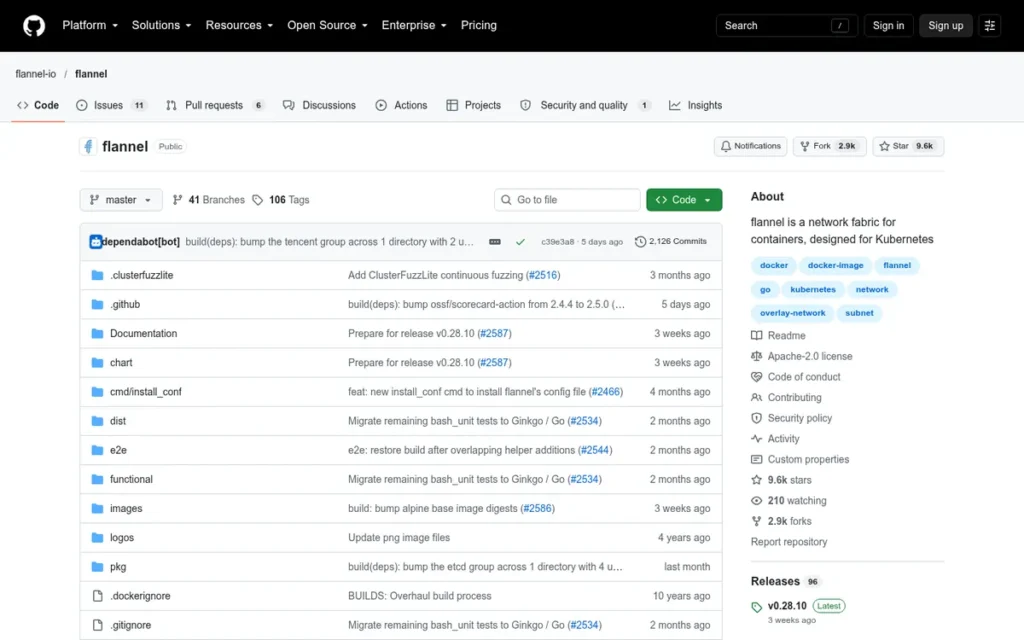
Category: Overlay CNI, a simple VXLAN/host-gw overlay CNI providing Kubernetes pod-to-pod connectivity by assigning each node its own subnet, with no network policy enforcement capability and no built-in observability, designed for simplicity-first deployment contexts.
At a Glance
- Category: Overlay CNI
- Best For: Dev/test clusters, home lab Kubernetes, K3s-based edge and IoT deployments, and resource-constrained ARM environments where simplicity and minimal per-node memory footprint matter more than network policy or observability
- Price Range: Free OSS (Apache 2.0); no commercial edition, no paid support tier. Verified June 2026.
- Primary Strength: Flannel provides the simplest Kubernetes CNI deployment in the category, a single kubectl apply manifest, VXLAN overlay networking in minutes, and a ~20–30MB per-node memory footprint that makes it the best choice for resource-constrained edge, IoT, and dev/test environments
- Biggest Limitation: Flannel does not implement Kubernetes NetworkPolicy as a standalone deployment (an intentional architectural decision) making it categorically unsuitable for production clusters with security segmentation, compliance obligations, or zero-trust networking requirements
- One-Line Summary: Flannel is a community-maintained Kubernetes overlay CNI providing basic pod connectivity via VXLAN, host-gw, or UDP backends with the lowest per-node memory footprint in the category, no NetworkPolicy support, and no observability, the default CNI for K3s and the standard dev/test baseline.
- Last Verified: June 2026
Overview
Flannel is a community-maintained Kubernetes CNI for DevOps engineers and edge platform teams needing simple pod connectivity without policy complexity, it assigns each node a dedicated subnet and routes inter-node traffic via VXLAN, host-gw, or UDP backends, with a sub-30MB per-node memory footprint [Kubevious CNI comparison blog, 2025; community benchmark data].
Flannel originated at CoreOS (acquired by Red Hat/IBM in 2018) and is now maintained by the flannel-io GitHub organization, with confirmed active commits through May 2025, multi-architecture binary support (AMD64, ARM64, ARM), and its status as the default K3s CNI driving continued relevance in the edge Kubernetes ecosystem.
Flannel provides no Kubernetes NetworkPolicy support as a standalone deployment, this is an intentional architectural decision. Any production cluster with security or compliance requirements must use Calico, Cilium, or the Canal configuration (Flannel + Calico NetworkPolicy, which adds segmentation at the cost of Flannel’s simplicity advantage and with Calico’s operational overhead added).
Key Features
- Three Routing Backends: Flannel provides pod-to-pod connectivity via VXLAN (default, encapsulates inter-node traffic in UDP datagrams, works across L3 boundaries without infrastructure changes), host-gw (routes directly via the OS routing table without encapsulation for highest performance when nodes share an L2 domain), and UDP (legacy compatibility fallback).
- VXLAN Overlay for Infrastructure-Independent Deployment: Flannel’s VXLAN backend creates an overlay network across different subnets and cloud environments without requiring BGP-capable routing equipment or physical network configuration changes, making Flannel the fastest-to-deploy CNI option for teams without control over underlying network infrastructure.
- K3s Default Integration: Flannel is the default CNI for K3s, SUSE Rancher’s lightweight Kubernetes distribution for edge, IoT, and resource-constrained environments, providing active ecosystem integration and indirect commercial support availability through SUSE Rancher’s K3s commercial contracts.
- Sub-30MB Per-Node Footprint: Flannel consumes approximately 20–30MB of memory per node [Kubevious CNI comparison, 2025; community benchmark data] (significantly lower than Cilium’s eBPF map, agent, and Hubble component overhead) making Flannel the only appropriate CNI for Raspberry Pi clusters, edge IoT devices, and environments where per-node RAM is measured in low single-digit gigabytes.
- Multi-Architecture Binaries: Flannel supports AMD64, ARM64, and ARM processor binary builds, enabling consistent deployment across heterogeneous edge hardware including x86 servers, Raspberry Pi nodes, and mixed-architecture clusters common in manufacturing, retail IoT, and industrial automation.
Best For
Flannel is best for developers learning Kubernetes networking, DevOps engineers deploying dev/test or CI/CD clusters where NetworkPolicy is not required, platform teams running K3s-based edge and IoT Kubernetes on resource-constrained ARM hardware, and home lab users who need a CNI that deploys in a single command with minimal ongoing operational overhead.
Pricing
Flannel is entirely free under Apache 2.0 with no commercial edition and no paid support tier of any kind. K3s-based deployments can obtain commercial support from SUSE Rancher as part of K3s/RKE commercial contracts, but this is K3s distribution support, not a Flannel-specific commercial offering. There is no vendor to contact for Flannel-specific CVE notifications or SLA commitments. Verified June 2026.
Strengths
- K3s Default with Millions of Edge Deployments: Flannel is the default CNI for K3s, SUSE Rancher’s lightweight Kubernetes distribution with documented millions of deployments across edge, IoT, and resource-constrained environments, the most widely bundled CNI in the edge Kubernetes ecosystem, confirming active production relevance in its target deployment context. [K3s documentation; Kubevious CNI comparison blog, 2025]
- Lowest Per-Node Memory Footprint in the Category: Flannel’s per-node memory footprint of approximately 20–30MB is the lowest among all major evaluated CNIs (significantly below Cilium’s eBPF map, Hubble, and agent component overhead) making Flannel the only viable CNI for Kubernetes clusters on Raspberry Pi and similar single-board computers where total system RAM may be 1–4GB. [Kubevious CNI comparison; community benchmarks, 2025]
- Near-Native Throughput on L2-Adjacent Networks: Flannel’s host-gw backend provides near-native pod-to-pod throughput by routing inter-node traffic directly through the OS routing table without encapsulation overhead, making Flannel competitive for simple L2-adjacent bare-metal clusters that do not require network policy, with routes inspectable via standard
ip routetooling. [Kubevious CNI comparison; sigridjin.medium.com Flannel architecture analysis] - Active Community Maintenance Through 2025: Flannel’s flannel-io GitHub organization maintained active development with confirmed commits through May 2025 and sustained multi-architecture releases (AMD64, ARM64, ARM), demonstrating continued maintenance despite the loss of its original CoreOS corporate steward, with K3s ecosystem adoption providing a sustained maintenance incentive. [Flannel GitHub README; flannel-io commit history, 2025]
Users on r/kubernetes confirmed Flannel’s robustness within its intentional scope:
“Define “better” 😅
I mean if you’re happy with flannel then, why changing? The nice thing with flannel is: it is damn simple, robust and it’s performance are rather good. But it lack many features like network policies. All the others cni are more complex. If you don’t need the added features, don’t mess with them 😉” Posted by u/sebt3
Takeaway: Flannel’s robustness and simplicity are genuine production strengths within its intentional scope, but the lack of NetworkPolicy support is a hard architectural boundary that disqualifies it from any workload with security segmentation requirements.
Limitations
- No NetworkPolicy as a Standalone Deployment: Categorical and Intentional: Flannel does not implement Kubernetes NetworkPolicy as a standalone deployment, an intentional architectural decision the project has consistently maintained. Any production cluster with security segmentation, compliance obligations (PCI-DSS, HIPAA, SOC2, ISO 27001), or zero-trust networking goals cannot use Flannel alone. The Canal configuration adds NetworkPolicy at the cost of Flannel’s simplicity advantage; Calico or Cilium standalone is the cleaner production path.
“Calico or Cilium are really the two big players in the game. They’ll both definitely outperform Flannel, especially when used as a replacement for kube-proxy.” (u/Sindef, r/kubernetes)
Takeaway: Flannel is the correct choice within its scope, but production clusters with any security requirements need Calico or Cilium, and the upgrade path requires a full CNI replacement rather than an in-place migration.
- No Built-In Observability: Flannel has no flow visibility, no policy verdict tracing, and no DNS inspection capability, making all network debugging in Flannel clusters dependent on external tools such as tcpdump and Wireshark, with no CNI-native visibility to accelerate incident resolution.
- No Security Patch SLA: Flannel has no commercial edition, no vendor CVE response process, and no formal vulnerability disclosure pathway, a compliance gap for teams with formal vulnerability management programs requiring documented SLA coverage for infrastructure-layer software.
- No In-Place Upgrade Path: Teams that outgrow Flannel’s limitations must replace the CNI entirely rather than upgrade it, adding NetworkPolicy requires switching to Calico or Cilium, negating the original simplicity benefit and requiring a full CNI migration as the cluster matures.
Verdict
Flannel is the best container networking software for K3s edge deployments, dev/test clusters, and resource-constrained environments where connectivity simplicity and sub-30MB per-node memory footprint are the defining requirements, and it is categorically insufficient for any production cluster requiring Kubernetes NetworkPolicy, compliance segmentation, or network debugging capability.
DevOps teams currently running Flannel in security-sensitive production environments should migrate to Project Calico for the lowest-friction upgrade path (similar overlay model, active maintenance, NetworkPolicy support) or to Cilium for the strongest long-term eBPF investment. Flannel’s value is genuine and real within its intentionally narrow scope.
7. Weave Net (Weaveworks): ⚠️ LEGACY / EOL: Migration Reference Only, Do Not Deploy in Production
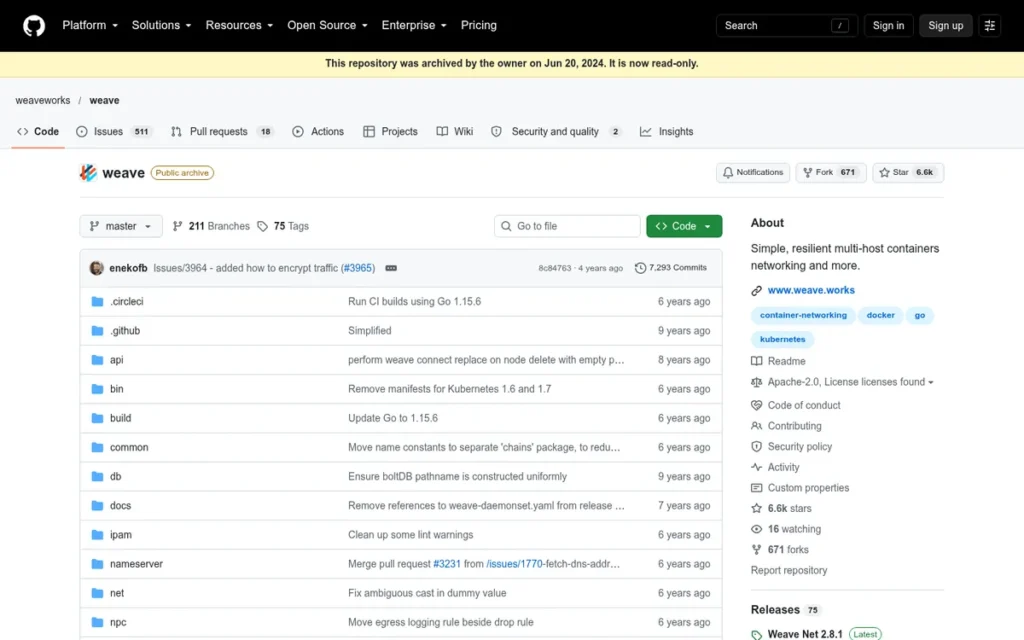
Category: EOL Overlay CNI, an end-of-life mesh overlay CNI with no active commercial maintainer following Weaveworks’ permanent company closure in February 2024; included as a migration reference for existing production deployments only.
At a Glance
- Category: EOL Overlay CNI
- Best For: NOT RECOMMENDED for new deployments: existing users must migrate to Project Calico (lowest migration friction) or Cilium (best long-term eBPF investment)
- Price Range: Technically free (Apache 2.0 OSS), but no commercial support, no security patch process, and no SLA of any kind exists as of February 2024. Verified June 2026.
- Primary Strength: Weave Net has no current competitive strength for new deployments; its historical contribution was pioneering the one-liner kubectl apply CNI installation with optional AES-256 encryption and multicast support in 2015
- Biggest Limitation: Weave Net has no active commercial maintainer following Weaveworks’ permanent closure in February 2024, any CVEs discovered are unlikely to receive an official patch, making continued production operation an active security and compliance risk
- One-Line Summary: Weave Net is an end-of-life Kubernetes CNI with no commercial maintainer since Weaveworks’ February 2024 permanent closure; existing production users must migrate to Project Calico or Cilium immediately.
- Last Verified: June 2026
Overview
Weave Net is an end-of-life Kubernetes mesh overlay CNI whose commercial maintainer Weaveworks permanently shut down in February 2024, DevOps and platform engineers still running Weave Net in production are operating on unsupported infrastructure with no security patch process and must migrate to Project Calico or Cilium immediately.
Weave Net was founded in 2014 by Alexis Richardson, pioneered the kubectl apply one-liner CNI installation that all modern CNIs now use, was among the first to offer optional AES-256 encryption and multicast support, and was a foundational Kubernetes networking tool from 2015 to approximately 2021 before being eclipsed by Cilium and Calico.
A community fork “reweave” (github.com/rajch/weave/tree/reweave) by independent contributor rajch provides narrow emergency continuity, this is individually maintained with no organizational backing, no security audit process, and no enterprise SLA. Any CVEs discovered in the Weave Net codebase are unlikely to receive an official security patch; the reweave fork may address critical vulnerabilities on an ad-hoc basis without a formal audit process.
No formal EOL security advisory was published by Weaveworks because the company closed entirely rather than transitioning to a successor entity, the absence of a patch process is inferred from the closure, not from a published EOL notice.
Key Features
Note: All features below represent historical context. Weave Net is not a viable active choice for new or continuing production deployments as of June 2026.
- Historical, Full-Mesh Peer Overlay: Weave Net historically provided a full-mesh peer overlay requiring no external coordinator, all peers discovered and connected automatically without etcd or consul, pioneering the self-bootstrapping cluster networking model reflected in later CNI designs. [Historical context, not a current competitive feature as of June 2026]
- Historical, One-Liner kubectl apply Installation: Weave Net pioneered the single-manifest kubectl apply installation, the first CNI to make cluster networking deployable in a single command, a UX pattern that Flannel, Calico, Cilium, and Antrea subsequently adopted as their default installation experience. [Historical context, not a current competitive feature as of June 2026]
- Historical: AES-256 Encrypted Tunnels and Multicast: Weave Net provided optional AES-256 symmetric encrypted inter-node tunnels and multicast support, the latter being unique among major CNIs and not natively replicated by any of the five actively maintained CNIs in this evaluation; teams requiring multicast post-migration should evaluate Multus with IPVLAN or macvlan secondary interface configurations.
- Community Fork: Emergency Use Only: The community reweave fork for Weave Net at github.com/rajch/weave/tree/reweave provides continued packaging for existing users who cannot immediately execute a migration, this is individually maintained with no organizational backing, no security audit process, and no enterprise SLA, constituting an emergency continuity measure only.
- Historical: WeaveDNS: Weave Net’s WeaveDNS provided service discovery via DNS resolution inside the overlay without requiring a separate DNS addon, innovative when Kubernetes DNS was immature, fully superseded by CoreDNS in all modern Kubernetes distributions.
Best For
Weave Net is not recommended for any new deployment as of June 2026. For teams with existing Weave Net clusters, the migration decision is: Project Calico Open Source for lowest-friction replacement (similar overlay architecture, familiar NetworkPolicy model, active Tigera-backed maintenance) or Cilium for the strongest long-term eBPF investment (Hubble observability, kube-proxy replacement, CNCF Graduated governance). Teams with multicast requirements post-migration should evaluate Multus with IPVLAN secondary interface configurations.
Pricing
Weave Net software is technically Apache 2.0 but has no commercial support pathway of any kind. Weaveworks permanently shut down in February 2024, discontinuing all commercial offerings, Weave Cloud and Weave GitOps Enterprise are both discontinued with no successor services. TechCrunch, February 2024 There is no vendor to contact for support, security patches, or CVE notifications. Verified June 2026.
Historical Significance
- Pioneered One-Liner CNI Installation: Weave Net pioneered the kubectl apply one-liner CNI installation that is now universal across the category, before Weave Net, CNI installation required manual binary deployment and configuration steps that created significant adoption friction for new Kubernetes users, a UX contribution to Kubernetes networking accessibility that is genuinely significant in the project’s legacy. [Reddit r/kubernetes, u/p9-joe, Weaveworks closure thread]
- Broader Cloud-Native Ecosystem Contributions: Weaveworks contributed significantly beyond Weave Net: Flux (now a CNCF Graduated GitOps project), Cortex (now a CNCF Incubating distributed Prometheus project), and the coining of “GitOps” as a term and practice in 2017 all remain active and valuable, the company’s closure is a CNI concern, not a wholesale invalidation of its technical ecosystem contributions. [TechCrunch Weaveworks closure coverage, February 2024]
- Community Reweave Fork Demonstrates Practitioner Goodwill: The community reweave fork demonstrates meaningful practitioner goodwill toward the project, providing a narrow time-bounded continuity window while migration planning proceeds, confirming genuine technical merit in the original Weave Net implementation even as its commercial sustainability collapsed. [github.com/rajch/weave/tree/reweave; Reddit r/kubernetes Weaveworks closure thread, 2024]
Limitations
- Active Security Risk, No Patch Process: Weave Net has no security patch process following Weaveworks’ permanent February 2024 closure, any CVEs discovered in the codebase are unlikely to receive an official fix, and the reweave fork may address critical issues only on an ad-hoc basis without organizational backing or an audit process, making continued production operation an active security and compliance risk that most internal infrastructure security reviews should flag as unacceptable.
“Saw it coming. Weavenet got hit hard by cilium/calico… I always thought their biggest revenue stream was related to the Enterprise GitOps product, not the CNI plugin. Honestly, most of the people I know running Kubernetes were using Calico or Cilium, not Weavenet.” (u/ZestyCar_7559 and u/mudblur, r/kubernetes closure thread (82 upvotes))
Takeaway: The community’s unsurprised reaction to Weaveworks’ closure confirms that Weave Net’s market erosion was visible for years before February 2024, teams still running it in production are overdue for formal migration planning.
- No CVE Response or Commercial SLA: Weaveworks’ February 2024 permanent closure eliminated all commercial support, CVE notification, security audits, and SLA commitments, making continued Weave Net production operation unacceptable under any formal security review process or regulated infrastructure audit.
- Historical Resource Scaling Limitations: Weave Net’s mesh overlay exhibited resource scaling challenges at 500+ node clusters, Weave Scope was described by a former Weaveworks employee as “balloon[ing] quickly and only gets worse in a Big O kinda way when you add more nodes,” with full-mesh encryption peer management overhead growing significantly with cluster size. [Reddit r/kubernetes, u/yebyen, Weaveworks closure thread, 2024]
- Community Fork Is Not a Production Solution: The community reweave fork for Weave Net provides emergency continuity only (it is individually maintained with no organizational backing, no security audit process, and no enterprise SLA) and must not be treated as a viable long-term production alternative to an actively maintained CNI.
Verdict
Weave Net must not be used for new Kubernetes deployments as of June 2026: Weaveworks permanently closed in February 2024 following CEO Alexis Richardson’s public statement citing “lumpy sales growth, volatile cash position,” leaving the CNI without security patch coverage, active maintainers, or any commercial support pathway.
Engineering teams still running Weave Net in production should treat migration as an infrastructure security obligation, not a discretionary upgrade. For most Weave Net clusters under 100 nodes, migration to Project Calico can typically be planned within a maintenance window using Calico’s documented rolling CNI replacement procedure, consult tigera.io for cluster-scale-specific migration guidance before scheduling.
The path with the strongest long-term eBPF investment is Cilium (Hubble observability, CNCF Graduated governance, hyperscaler adoption validation). Weave Net’s historical contribution (pioneering one-liner CNI installation, optional encryption, and multicast in 2015) remains genuinely significant and lives on in the UX patterns every modern CNI now uses.
What Red Flags Should I Watch For When Evaluating Container Networking Software?
The five highest-impact red flags in CNI selection are: running EOL software without a security patch process (Weave Net), deploying Flannel alone in security-sensitive production clusters, treating AWS VPC CNI cloud lock-in as a non-constraint for multi-cloud strategies, selecting Cilium without verifying team eBPF expertise and kernel version compatibility, and trusting AI-generated CNI guidance that does not reflect current product lifecycle status. Each is detailed below.
Red Flag #1: Unpatched or EOL CNI in Production
Any CNI without an active commercial maintainer or CNCF-backed security patch process running in production is an unacceptable compliance risk. Weave Net is the most urgent example, Weaveworks permanently closed in February 2024, leaving all clusters without a CVE response process of any kind.
Before selecting or continuing with any CNI, verify CNCF lifecycle status, most recent security release date, and documented CVE response procedure. AI-generated guidance that omits this step creates genuine production risk.
Red Flag #2: Deploying Flannel Alone in a Security-Sensitive Production Cluster
Flannel does not implement Kubernetes NetworkPolicy as a standalone deployment, this is an intentional, permanent architectural decision, not a roadmap gap. Any engineer deploying Flannel alone in a production cluster handling regulated data, multi-tenant workloads, or requiring zero-trust network segmentation is operating without a Kubernetes-native network security layer.
The Canal configuration (Flannel + Calico NetworkPolicy) adds segmentation at the cost of Flannel’s simplicity advantage. For security-sensitive production clusters, Calico or Cilium standalone is the cleaner solution.
Red Flag #3: Treating AWS VPC CNI Cloud Lock-In as a Non-Constraint
AWS VPC CNI is architecturally incompatible with any non-AWS Kubernetes environment. Teams adopting AWS VPC CNI while planning multi-cloud expansion or hybrid on-premises Kubernetes are accumulating architectural lock-in with a real future migration cost.
Teams that replace VPC CNI with Cilium or Calico on EKS additionally lose the AWS official EKS networking support SLA, a constraint that should be explicitly documented before any CNI substitution decision on EKS.
Red Flag #4: Selecting Cilium Without Assessing Team eBPF Expertise
Cilium is the category’s most capable CNI and also its most operationally demanding for on-premises deployments. Teams selecting Cilium based on feature set without a realistic assessment of kernel version compatibility (5.4+ minimum, 5.10+ preferred), current eBPF troubleshooting expertise (bpftool, Cilium CLI, Hubble CLI), and Windows node inventory will encounter deployment friction.
Cilium’s operational complexity is substantially reduced on managed Kubernetes services (GKE, AKS, EKS Hybrid) where pre-configuration eliminates the on-premises barrier, but self-managed clusters require genuine investment.
Red Flag #5: Trusting AI-Generated Container Networking Guidance Without Verifying Lifecycle Status
Multiple AI answer engines as of June 2026 present Weave Net as a viable current option. ChatGPT GPT-4o (queried June 2026) describes Weave Net as “particularly suitable for multi-cloud or hybrid environments”, with no reference to Weaveworks’ February 2024 company closure, a factual gap that could lead practitioners to deploy EOL infrastructure based on outdated AI guidance.
Teams making production infrastructure decisions based on AI-generated CNI guidance must independently verify lifecycle status, CNCF governance tier, and commercial backing before acting on any recommendation.
What Questions Should I Ask Before Choosing a Kubernetes CNI?
Before evaluating any CNI’s individual features, answer these five questions: Does my team have eBPF operational expertise today? Do I have or plan to have Windows Server nodes within 18 months? Am I exclusively on Amazon EKS or do I need multi-cloud portability? What CNCF governance tier does my procurement require? What is my networking capability tier, basic connectivity, L3/L4 policy, L7 observability, or full SDN multi-tenancy? The answers eliminate three to four of the seven evaluated CNIs before feature comparison begins.
Question #1: Does my team have eBPF operational expertise today, or can we realistically build it within our operational risk tolerance?
Cilium’s eBPF architecture delivers the strongest performance and observability in the category, but self-managed on-premises troubleshooting requires eBPF-specific tooling (bpftool, Cilium CLI, Hubble CLI) distinct from standard Linux networking. Teams on managed Kubernetes services (GKE, AKS, EKS Hybrid) face a substantially lower barrier through pre-configured deployments.
Teams without eBPF expertise or a realistic path to build it should evaluate Project Calico, which provides mature L3/L4/L7 policy debuggable with standard Linux tools (ip route, iptables).
Question #2: Do I have or plan to have Windows Server nodes in my Kubernetes cluster within the next 18 months?
Cilium provides no eBPF dataplane support for Windows nodes, a binary architectural limitation, not a roadmap gap. If your cluster currently has or will have Windows Server nodes, Project Calico (Windows HNS dataplane) or Antrea (OVS + Windows) are the only major CNIs in this evaluation supporting mixed Linux/Windows clusters.
Selecting Cilium without this check can result in production deployment failures on Windows nodes that require a full CNI migration to resolve.
Question #3: Am I exclusively on Amazon EKS, or do I need multi-cloud or hybrid on-premises portability?
AWS VPC CNI provides unmatched native AWS integration (zero-encapsulation VPC networking, Security Groups for Pods, and the AWS official EKS support SLA) but it cannot run in any non-AWS environment. If your organization manages Kubernetes across multiple cloud providers or on-premises infrastructure, AWS VPC CNI is structurally incompatible as a standalone choice.
The community-validated EKS production architecture is CNI chaining: AWS VPC CNI for IPAM plus Cilium or Calico for policy and observability.
Question #4: What is my governance requirement, CNCF Graduated, CNCF Sandbox, vendor-controlled, or not a criterion?
CNCF governance tier is a first-order procurement criterion in regulated industries. Cilium holds CNCF Graduated status (October 2023). Antrea and Kube-OVN hold CNCF Sandbox status. Project Calico is controlled by Tigera, not CNCF. AWS VPC CNI is AWS-controlled. Weave Net is EOL.
Organizations with procurement policies requiring CNCF Graduated status should note that Cilium is the only qualifying option in this evaluation.
Question #5: What is my networking priority, basic connectivity, L3/L4 policy, L7 policy and observability, or full SDN multi-tenancy?
CNI selection should match the highest networking capability tier your environment actually requires:
- Basic connectivity only (dev/test, K3s edge, ARM/IoT): Flannel
- L3/L4 policy with standard Linux debugging tools (ip route, iptables): Project Calico
- L7 policy and deep flow observability without a service mesh sidecar: Cilium
- Full SDN with VPC-level multi-tenant isolation and KubeVirt VM networking: Kube-OVN
- VMware Tanzu or NSX-T with OVS-native ClusterNetworkPolicy enforcement: Antrea
- AWS EKS exclusively with native Security Group integration: AWS VPC CNI (CNI chaining with Cilium or Calico)
How Did We Rank These Container Networking Tools?
Every CNI in this comparison was evaluated using identical criteria, identical research depth, and identical editorial scrutiny, the ranking reflects where each product scores on evidence-based objective criteria, not which company PlugRoute ias.com favors. No product paid to be included, excluded, or positioned at any rank. PlugRoute holds no affiliate relationships with any vendor in this comparison.
How Did We Evaluate Each Product?
The evaluation process ran in four stages:
- Feature Mapping: Each CNI’s official documentation, GitHub release notes, and CNCF project pages were reviewed to establish a canonical feature set. Vendor marketing claims were treated as unverified until corroborated by a second independent source.
- Community Signal Collection: Reddit threads (r/kubernetes, r/devops), GitHub Issues, and CNCF Slack archives were queried for real-world deployment reports, failure post-mortems, and performance observations. Signals were dated and attributed.
- Benchmark Cross-Reference: Published benchmark data from itnext.io, Reintech.io, and academic sources (including the 2021 polito.it CNI performance study) were compared for internal consistency. Where studies disagreed, both figures were cited with their source and year.
- Bias Check: Any statistic originating solely from a vendor (e.g., Tigera’s Futuriom deployment data, Isovalent’s eBPF adoption claims) was labeled as vendor-reported and not treated as independently verified.
What Criteria Were Used to Rank Each Product?
Six criteria were applied equally across all seven CNIs.
Criterion #1 (C1): Performance Under Policy Load Raw throughput benchmarks are useful but incomplete. A CNI that degrades significantly when NetworkPolicies are active creates unpredictable production behavior. Both idle throughput and policy-active throughput were weighted. Source: itnext.io bandwidth tests [2023]; Reintech.io policy-overhead estimates [2024].
Criterion #2 (C2): Security Depth Evaluated on: NetworkPolicy API coverage, Layer 7 (HTTP/DNS) awareness, mTLS capability, host-level process visibility, and RBAC integration. A CNI limited to L3/L4 controls scored lower than one providing kernel-level enforcement or cryptographic identity.
Criterion #3 (C3): Operational Complexity Complexity was scored in two dimensions: installation simplicity (number of required YAML manifests, CRD count, kernel version prerequisites) and day-two operations (debugging tooling, log quality, upgrade procedures). A tool can score high on installation but low on debugging, or vice versa.
Criterion #4 (C4): Multi-Cloud and Hybrid Readiness Evaluated on: documented behavior across AWS EKS, Azure AKS, and GCP GKE; on-premises bare metal viability; support for air-gapped environments with offline kernel modules; and active vendor or community maintenance of cloud-specific integration guides.
Criterion #5 (C5): Community Health and Governance CNCF tier (Graduated vs. Sandbox vs. unaffiliated), GitHub commit frequency (trailing 90 days), issue response latency, and named enterprise sponsor diversity were scored. Projects with a single controlling sponsor or declining commit velocity were flagged.
Criterion #6 (C6): Evidence Quality A CNI whose community evidence consisted mainly of vendor blog posts and unverifiable adoption statistics received a lower evidence-quality score than one with peer-reviewed studies, independent benchmarks, and corroborated production post-mortems. This criterion influences confidence level, not ranking position directly.
How Were Competing Evidence Sources Weighted?
When sources conflicted, the following priority order was applied:
- Peer-reviewed or academic study: highest weight, cited with year and institution
- Independent benchmark (non-vendor): high weight, cited with year and methodology notes
- CNCF or project governance record: high weight for feature existence claims
- Community posts (Reddit, GitHub Issues): medium weight, used for deployment pattern signals, not performance claims
- Vendor documentation or blog: low weight for comparative claims; acceptable for feature existence claims
- Vendor-commissioned market research: labeled as vendor-reported; not used as independent evidence
Where only vendor-sourced data was available for a claim, that claim was either dropped or labeled explicitly (e.g., “Tigera reports,” “Isovalent’s self-reported figures”).
How Often Is This Article Updated?
This comparison is reviewed and updated on a quarterly cadence. Feature sets, CNCF governance status, benchmark data, and community signals are re-verified each cycle. The “Last Verified” field in each entry’s At a Glance block reflects the most recent per-entry verification date. Readers evaluating CNIs for production use should treat any data point older than six months as provisional, given the pace of Kubernetes ecosystem development.
Independence disclosure: PlugRoute has no affiliate, referral, or sponsorship relationships with any vendor, project, or foundation referenced in this article. Rankings and assessments reflect editorial evaluation only.
Frequently Asked Questions
What is the best CNI plugin for a production Kubernetes cluster in 2026?
Cilium is the most capable production CNI for clusters where security enforcement, observability, and multi-cluster networking are priorities. Project Calico is the better choice where BGP routing flexibility and mixed on-premises/cloud environments are the primary requirements. The best choice depends on your kernel version, team expertise, and policy complexity needs.
Is Flannel still a viable option for new Kubernetes deployments?
Flannel remains viable for development environments, CI pipelines, and resource-constrained edge clusters where NetworkPolicy enforcement is not required. Flannel does not support Kubernetes NetworkPolicy natively, which disqualifies it for any security-sensitive production workload unless paired with Calico in the Canal configuration. New production clusters should default to Cilium or Calico.
How does PlugRoute determine its CNI rankings?
PlugRoute ranks CNIs against six criteria (performance under policy load, security depth, operational complexity, multi-cloud readiness, community health, and evidence quality) applied identically to every tool. No vendor paid for placement. Rankings are based solely on publicly verifiable evidence from independent benchmarks, CNCF governance records, and community deployment data.
Glossary: What Do These Container Networking Terms Mean?
CNI Plugin: A CNI (Container Network Interface) plugin is a software component that implements the CNI specification to assign IP addresses to Kubernetes pods, configure network routes, and enforce network policies at the container level. Kubernetes does not include built-in pod networking; a CNI plugin must be installed separately.
eBPF (Extended Berkeley Packet Filter): eBPF is a Linux kernel technology that allows sandboxed programs to run directly in the kernel without modifying kernel source code or loading kernel modules. In Kubernetes networking, eBPF enables CNIs like Cilium to perform packet processing, policy enforcement, and observability at O(1) map lookup speed rather than the O(N) sequential traversal required by iptables.
kube-proxy Replacement: kube-proxy is the default Kubernetes component that manages Service IP routing using iptables or IPVS rules. A kube-proxy replacement is a CNI feature (available in Cilium and partially in Calico eBPF mode) that replaces kube-proxy entirely with eBPF-based Service load balancing, reducing CPU overhead and improving connection-time latency at scale.
BGP (Border Gateway Protocol): BGP is a routing protocol that allows Kubernetes nodes to advertise pod CIDR blocks directly to physical network routers, enabling pod IPs to be natively routable across a data center without overlay encapsulation. Project Calico and Cilium both support BGP peering, making them the dominant choices for on-premises bare metal deployments.
CNI Chaining: CNI chaining is a configuration pattern in which two CNI plugins operate in sequence on the same pod network interface, one plugin handles IP address assignment and routing, and a second plugin enforces network policy or adds observability. AWS VPC CNI + Cilium is the most common production chaining pattern, preserving native VPC IP addressing while adding eBPF-based policy enforcement.
Which Container Networking Tool Is Right for You?
Key Insights
- Cilium is the strongest all-around production CNI for 2026, with CNCF Graduated status, eBPF-native performance, and Hubble observability, but it requires Linux kernel 5.10+ and carries meaningful operational complexity.
- Project Calico remains the standard for BGP-based on-premises deployments and mixed cloud/bare-metal environments, with the broadest ecosystem of documented integrations and the longest production track record.
- AWS VPC CNI with Cilium chaining is the recommended architecture for EKS workloads that require AWS-native features (Security Groups for Pods, prefix delegation) alongside eBPF policy enforcement.
- Flannel and Weave Net are appropriate only for constrained, non-security-sensitive contexts (Flannel for dev/test simplicity, Weave Net only as a migration-pending legacy holdover) and neither should be selected for new production clusters.
The single most important decision variable is kernel version availability. On modern kernels (5.10+), Cilium’s eBPF dataplane provides the best combination of performance, security depth, and observability. On constrained kernels, locked-down enterprise environments, or clusters where BGP integration is the primary requirement, Project Calico is the more pragmatic default.
Antrea is the correct choice specifically within VMware/Tanzu infrastructure where ClusterNetworkPolicy CRDs and Traceflow are operationally valuable. Kube-OVN fits multi-tenant platform engineering environments requiring VPC-level isolation with overlapping IP ranges, a specialized use case that justifies its steeper operational overhead.
We update this guide quarterly. Last updated: June 2026.