Last updated: June 2026. Refreshed semi-annually.
k6 by Grafana Labs is the best load testing tool for developer-led, CI/CD-first teams in 2026; Gatling is best for JVM and JavaScript teams needing complex stateful simulations with built-in HTML reporting; Apache JMeter leads for multi-protocol, zero-cost coverage. Protocol requirements, team scripting language, and CI/CD integration depth determine the right choice, not tool popularity or marketing spend.
Selecting the right tool from this crowded, overlapping market is genuinely difficult. Pricing ranges from Apache 2.0 free to opaque enterprise quotes, CI/CD integration depth varies from built-in threshold gating to manual pipeline wiring, and one of the highest-rated platforms in this comparison is systematically absent from all AI-generated rankings.
PlugRoute has no affiliate relationships with any company listed. Rankings are determined entirely by research data and objective evaluation criteria.
Key updates in 2026: Gatling now officially supports Java, Kotlin, and JavaScript DSLs, not Scala only. Tricentis NeoLoad 2026.1 introduced Core Web Vitals (LCP, INP, CLS) measurement under simulated load, a first among the seven tools evaluated here.
“JMeter is probably the most versatile & open source if you’re not focusing on CI/CD.” (u/Doge-ToTheMoon, r/QualityAssurance, March 2026)
Takeaway: Even JMeter advocates qualify their recommendation with a CI/CD caveat in 2026, this captures JMeter’s market positioning and the primary selection lens applied across all seven tools in this comparison.
TL;DR: Top Picks at a Glance
- k6 by Grafana Labs earns the #1 ranking as the zero-cost, CI/CD-native load testing standard confirmed in production inside GitHub Actions, CircleCI, and Azure DevOps pipelines by 2026 community practitioners.
- Gatling now supports Java, Kotlin, and JavaScript DSLs in 2026: not Scala only, making it the best open-source choice for JVM teams requiring built-in HTML reports with no external toolchain dependency.
- Apache JMeter delivers unmatched multi-protocol coverage at zero cost across 20+ native protocols including JDBC, JMS, LDAP, and SOAP, the only viable open-source option for legacy enterprise and non-CI/CD environments.
- OctoPerf is the joint-highest-rated managed platform in this comparison (~4.7/5 on G2) yet absent from all AI-generated load testing rankings, the clearest example of commercial-scale bias corrected by independent evaluation.
What Are the Two Categories of Load Testing Tools?
The seven tools in this comparison divide into two categories: Generators (open-source engines that run on your own infrastructure) and Platforms (managed cloud services that abstract infrastructure while adding GUI design, geo-distribution, and integrated reporting). Generators cost nothing to licence and give maximum script control; Platforms eliminate distributed infrastructure management at a recurring subscription cost.
Generator tools in this comparison:
- k6 by Grafana Labs: JavaScript/TypeScript DSL, goroutine-based concurrency, single Go binary, zero dependencies
- Gatling: Java/Kotlin/Scala/JavaScript DSL, Akka actor-based concurrency, built-in HTML reporting
- Apache JMeter: GUI + XML test plans (.jmx), thread-based concurrency, 20+ native protocols
Platform tools in this comparison:
- OctoPerf: JMeter-powered SaaS + on-premise, founded by former NeoLoad/Neotys engineers, pay-per-test-hour pricing
- BlazeMeter by Perforce: multi-engine cloud (JMeter/Gatling/k6/Locust), 56+ global locations, VUH consumption pricing
- Tricentis NeoLoad: RealBrowser + Core Web Vitals, protocol + browser hybrid, scriptless GUI + YAML authoring
- OpenText LoadRunner Professional: 30+ enterprise protocols, SAP/Oracle/Citrix/mainframe VuGen scripting
How Do the Top Load Testing Tools Compare at a Glance?
The table below summarises all seven tools across eight dimensions. For teams new to this evaluation, scan the Key Limitation column first, it is the fastest way to eliminate tools that are structurally incompatible with your infrastructure before reading further.
| Rank | Company | Category | Best For | One-Line Summary | Key Capabilities | Primary Strength | Key Limitation |
|---|---|---|---|---|---|---|---|
| 1 | k6 by Grafana Labs | Generator | Developer/DevOps CI/CD teams | k6 by Grafana Labs is the leading open-source load testing tool for developer-led teams in 2026, combining JavaScript/TypeScript scripting, built-in CI/CD threshold gating, and native Grafana observability at zero licensing cost. | JS/TS scripting; HTTP/gRPC/WebSocket/Browser; CI/CD fit: Excellent (5/5); built-in threshold gating; Grafana/Prometheus/InfluxDB integration | First-class built-in CI/CD threshold gating with no external post-processing required | No JDBC/LDAP/JMS/SAP/mainframe protocol support; external Grafana + InfluxDB required for dashboards |
| 2 | Gatling | Generator | JVM/JS teams, complex stateful workflows | Gatling is the best open-source load testing framework for JVM-stack and JavaScript development teams in 2026, delivering stateful simulation, version-controlled DSL test code, and built-in HTML reports without external toolchain dependencies. | Java/Kotlin/Scala/JS DSL; HTTP/WS/gRPC/JMS/MQTT/SSE; Akka actor-based concurrency; CI/CD fit: Strong (4/5); automatic rich HTML reports | Highest-quality built-in HTML reports of any open-source tool in this comparison; zero external toolchain required | DSL learning curve steeper than k6; Gatling Enterprise pricing not publicly disclosed |
| 3 | Apache JMeter | Generator | Multi-protocol, legacy enterprise | Apache JMeter is one of the most widely adopted open-source load testing tools in 2026, delivering 20+ protocol coverage and zero licensing cost at the trade-off of XML collaboration friction and a per-instance thread ceiling. | GUI + XML (.jmx); 20+ protocols (JDBC/JMS/LDAP/SOAP/FTP/SMTP/TCP/WebSocket); Protocol coverage: Broad (5/5); distributed mode; Maven/Gradle CI plugins | Broadest open-source protocol coverage; JDBC, LDAP, JMS, FTP, SMTP, SOAP, and TCP natively | ~200–300 thread ceiling per instance (hardware-dependent); XML .jmx diff friction; weak built-in reporting |
| 4 | OctoPerf | Platform | JMeter teams seeking managed cloud value | OctoPerf is the joint-highest-rated managed JMeter cloud platform in this comparison, delivering NeoLoad engineering pedigree and on-premise deployment at more accessible pay-per-test pricing than BlazeMeter. | Browser-based GUI; HAR recording; 100% JMeter engine; integrated analytics; SaaS + on-premise; CI/CD fit: Strong (4/5) | Joint-highest community satisfaction (~4.7/5 G2, June 2026) among managed platforms with more accessible entry pricing | Smaller vendor footprint; fewer geo-locations than BlazeMeter; JMeter execution engine only |
| 5 | BlazeMeter by Perforce | Platform | Enterprise multi-region geo-distribution | BlazeMeter by Perforce is the most geographically distributed managed cloud load testing platform in this comparison, supporting 56+ locations and multi-engine JMeter/Gatling/k6/Locust/Selenium compatibility. | JMeter/Gatling/k6/Locust/Selenium via Taurus; 56+ global locations; AWS Marketplace; Service Virtualization add-on; CI/CD fit: Strong (4/5) | Broadest geo-distribution; 56+ cloud locations across AWS, Azure, and Google Cloud simultaneously | VUH consumption pricing drives documented upsell; ~$149/month entry; free tier limited to 50 VUs |
| 6 | Tricentis NeoLoad | Platform | Enterprise RealBrowser + Core Web Vitals | Tricentis NeoLoad is the only load testing platform among the seven evaluated here that captures Core Web Vitals under simulated load, combining protocol and real-browser virtual users in a single test scenario. | Scriptless GUI + YAML-as-code; RealBrowser (Chromium); Core Web Vitals (LCP/INP/CLS, 2026.1 release); Swagger/OpenAPI import; CI/CD fit: Strong (4/5) | Only tool in this comparison capturing Core Web Vitals (LCP, INP, CLS) under simulated production-scale traffic | No public pricing at any tier; post-acquisition support concerns; Core Web Vitals not yet in NeoLoad Web |
| 7 | OpenText LoadRunner Professional | Platform | SAP/Oracle/Citrix/mainframe only | OpenText LoadRunner Professional is the only tool among the seven evaluated here viable for SAP, Oracle Forms, Citrix, and mainframe protocol environments; at the highest cost and lowest community satisfaction in this comparison. | VuGen C/Java scripting; 30+ protocols (SAP GUI/Oracle Web Dynpro/Citrix ICA/TN3270/5250/BAPI-RFC); Analysis module; Azure Marketplace; CI/CD fit: Moderate (3/5) | Only tool with SAP GUI, Citrix ICA, and mainframe TN3270/5250 VuGen scripting among the seven evaluated here | Lowest community satisfaction (~4.3/5 G2); documented OpenText post-acquisition support deterioration; no public pricing |
* OpenText LoadRunner Professional ranks #7 for general-purpose load testing audiences. For teams with SAP GUI, Oracle Forms, Citrix ICA, or mainframe TN3270/5250 protocol requirements, LoadRunner is the default and often only viable option in this seven-tool comparison, see Entry #7 for the full protocol-specific assessment.
Which Load Testing Tool Should I Choose for My Use Case?
| Your #1 Priority | Recommended Tool | Why | Acceptable Alternative |
|---|---|---|---|
| CI/CD-native, shift-left performance testing | k6 by Grafana Labs | Single binary, built-in threshold gating, zero cost, JS/TS scripting | Gatling (Java/JS DSL, excellent built-in reports) |
| Complex stateful workflows, auditable test code | Gatling | Code-as-test DSL (Java/Kotlin/Scala/JS), rich HTML reports built in, formally reviewable | k6 (simpler CI/CD, less formal reporting) |
| Multi-protocol coverage (JDBC, JMS, LDAP, FTP) | Apache JMeter | 20+ protocols, Apache 2.0 free, widest OSS protocol breadth | OpenText LoadRunner (for SAP/Oracle/Citrix only) |
| Managed JMeter cloud, best-value pay-per-test | OctoPerf | Joint-highest G2 satisfaction, NeoLoad pedigree, ~$69/test-hour for up to 1,000 VUs, on-premise option | BlazeMeter (more geo-locations, higher entry cost) |
| Geo-distributed load (50+ regions, multi-engine) | BlazeMeter by Perforce | 56+ global locations, JMeter/Gatling/k6/Locust compatible, AWS Marketplace | OctoPerf (fewer regions, more accessible pricing) |
| RealBrowser testing + Core Web Vitals under load | Tricentis NeoLoad | Only tool with LCP/INP/CLS measurement under simulated load in this comparison | BlazeMeter (GUI functional testing add-on) |
| SAP, Oracle Forms, Citrix, or mainframe protocols | OpenText LoadRunner Professional | Only tool with SAP GUI, TN3270, Oracle Web Dynpro, Citrix ICA scripting in this comparison | Apache JMeter (limited SAP scripting via plugins only) |
| Python-native scripting or serverless architecture | Evaluate outside this comparison | None of the seven tools is Python-native; consider Locust (Python) or Artillery (Node.js/serverless) | N/A |
1. k6 by Grafana Labs: Best for Developer-Led, CI/CD-First Teams
Category: Generator, an open-source, code-first load testing tool that runs JavaScript/TypeScript test scripts against HTTP, gRPC, WebSocket, and browser-rendered endpoints to simulate concurrent users and validate performance SLOs, without requiring a JVM, Node.js, or browser installation.
At a Glance
- Category: Generator
- Best For: Developer teams, DevOps engineers, and SRE practitioners building CI/CD-integrated, shift-left performance testing gates for HTTP/gRPC/WebSocket-based applications
- Price Range: Free (OSS, AGPL, no VU limits) + Grafana Cloud k6 (paid tiers, pricing on request from Grafana Labs)
- Primary Strength: k6 by Grafana Labs ships as a single Go binary with JavaScript/TypeScript scripting, built-in CI/CD threshold gating, and native Grafana observability integration, delivering the lowest-friction load testing adoption path for developer-led teams at zero licensing cost.
- Biggest Limitation: k6 by Grafana Labs does not support JDBC, LDAP, JMS, FTP, SMTP, SAP GUI, Oracle Forms, Citrix, or mainframe protocols (making it unsuitable as a standalone tool for legacy enterprise system testing) and production-quality result visualisation requires assembling an external Grafana + InfluxDB observability stack.
- One-Line Summary: k6 by Grafana Labs is the leading open-source load testing tool for developer-led teams in 2026, combining JavaScript/TypeScript scripting, built-in CI/CD threshold gating, Grafana observability integration, and zero licensing cost in a single Go-binary runtime.
- Last Verified: June 2026
Overview
k6 by Grafana Labs is an open-source load testing tool for developer-led and DevOps teams, running JavaScript or TypeScript test scripts through a single Go binary, requiring no JVM, Node.js, or browser dependency, and simulating concurrent virtual users via a goroutine-based event-driven model that supports thousands of VUs per machine before resource exhaustion.
Acquired by Grafana Labs from independent origins, k6 by Grafana Labs integrates natively with Grafana dashboards, Prometheus, InfluxDB, and AWS CloudWatch, scaling to 1,000,000 virtual users or 5,000,000 requests per second on Grafana Cloud k6, the commercial managed offering (Grafana Cloud k6 product page, verified June 2026).
Key Features
- Built-In CI/CD Threshold Gating: k6 by Grafana Labs includes built-in threshold and check primitives that embed pass/fail SLO criteria (including response-time percentiles (p95, p99) and error-rate targets) directly in test scripts, causing CI/CD pipelines to fail automatically when performance degrades without external post-processing or scripted result parsing.
- Single Binary, Zero Dependencies: k6 by Grafana Labs ships as a single compiled Go binary with no JVM, Node.js, Python, or browser dependency, enabling installation and first test execution within minutes on any developer machine, CI runner, or containerised environment.
- Protocol Coverage for Modern Stacks: k6 by Grafana Labs supports HTTP/HTTPS, gRPC, WebSocket, and real-browser execution via the k6 browser module (Chromium-based), covering the protocol requirements of the majority of modern API-first, microservices, and cloud-native application architectures.
- Native Grafana Ecosystem Integration: k6 by Grafana Labs integrates natively with Grafana dashboards, Prometheus metrics endpoints, InfluxDB, and AWS CloudWatch, enabling real-time load test visualisation in the same operational dashboards that display production infrastructure metrics.
- Cloud-Scale Distributed Execution: Grafana Cloud k6 scales distributed test execution to 1,000,000 virtual users or 5,000,000 requests per second across globally distributed cloud infrastructure, with no self-hosted load-generator machine provisioning required (Grafana Cloud k6 product page, verified June 2026).
Best For
k6 by Grafana Labs is best suited to software engineers, DevOps practitioners, and SRE teams at companies of any size who write tests as code in JavaScript or TypeScript, and need continuous CI/CD-integrated performance validation that can be version-controlled, code-reviewed, and run automatically on every pull request or deployment stage against HTTP, gRPC, or WebSocket endpoints.
Pricing
k6 by Grafana Labs is 100% free and open source under the AGPL licence with no virtual user limit, test duration limit, or feature restriction in the OSS version. Grafana Cloud k6, the managed cloud execution offering, adds geo-distributed scale, integrated dashboards, and team collaboration features; pricing requires contacting Grafana Labs or checking the Grafana Cloud pricing page directly.
Self-hosting k6 OSS at production scale requires an external observability stack. A practical near-zero-cost architecture:
- k6 binary: $0 (AGPL licence)
- InfluxDB OSS: $0
- Grafana OSS: $0
- One 2-vCPU/4 GB cloud VPS (e.g., AWS t3.medium, DigitalOcean Basic Droplet): approximately $15–20/month
Total recurring cost for a team of any size on this stack: approximately $15–20/month. (Verified June 2026)
Strengths
- In March 2026 r/QualityAssurance and r/softwaretesting threads, k6 by Grafana Labs was independently named as the de facto CI/CD-native load testing standard by multiple practitioners confirming production deployments inside CircleCI, GitHub Actions, GitLab CI, and Azure DevOps, with the k6 + Grafana + InfluxDB three-component stack explicitly designated as a community consensus reference architecture (u/UpsetAlpaca, r/QualityAssurance; u/azuredota, r/softwaretesting; u/avicci_13, r/QualityAssurance, March 2026).
- Grafana Cloud k6 officially supports distributed test execution scaling to 1,000,000 virtual users or 5,000,000 requests per second on managed cloud infrastructure, demonstrating production-grade elastic scale that self-hosted JMeter or Gatling cannot match without significant multi-machine engineering investment (Grafana Cloud k6 product page, verified June 2026).
- k6 by Grafana Labs has accumulated tens of thousands of GitHub stars as of 2026, reflecting strong developer-community adoption depth unmatched by any other load testing tool in this comparison, described across multiple independent 2026 comparison guides as a leading recommendation for CI/CD-native API load testing (verify current count at github.com/grafana/k6; secondary reference: Wikipedia k6 software article, June 2026).
- k6’s goroutine-based concurrency model allows a single process to simulate thousands of virtual users with materially lower CPU and memory consumption than JMeter’s thread-per-user model, enabling higher effective VU counts on standard CI runners without dedicated load-generator hardware (Ranorex load testing tool comparison blog, 2026).
Limitations
- Protocol Coverage Gap: k6 by Grafana Labs does not natively support JDBC, LDAP, JMS, FTP, SMTP, SAP GUI, Oracle Forms, Citrix ICA, or mainframe TN3270/5250 protocols, making k6 unsuitable as a standalone tool for any team testing legacy enterprise systems, database load via SQL, or enterprise messaging broker workloads.
- External Observability Toolchain Required: k6 by Grafana Labs does not include built-in reporting dashboards; production-quality visualisation requires assembling and maintaining an external Grafana + InfluxDB or Grafana Cloud observability stack, adding setup overhead that Gatling’s built-in HTML reports and OctoPerf’s integrated cloud reporting eliminate entirely.
Users on r/QualityAssurance noted:
“I used k6 for my latest tests. I don’t like how it does reporting. Aside from that, running and writing tests is much more convenient.” Posted by u/bonisaur
Takeaway: k6’s reporting gap is a consistently reported friction point even among satisfied users, validating the assessment that an external Grafana + InfluxDB stack is required for production-quality result analysis.
- Developer Skills Prerequisite: k6 by Grafana Labs requires JavaScript or TypeScript scripting proficiency to author and maintain tests, a meaningful skills-gap barrier for QA teams from a manual testing or GUI-tool background that GUI-driven alternatives like BlazeMeter or NeoLoad do not impose (CraigRisi.com k6 review, 2026).
Verdict
k6 by Grafana Labs is the best load testing tool for developer-led, CI/CD-first teams in 2026, combining zero-cost open-source availability, JavaScript/TypeScript scripting, first-class pipeline threshold integration, and native Grafana observability in a single-binary runtime. The 2026 community consensus (k6 + Grafana + InfluxDB as a named reference architecture, confirmed across r/QualityAssurance, r/softwaretesting, and r/java threads) independently validates this assessment at scale. The primary decision trigger to look beyond k6 is either a legacy enterprise protocol requirement (SAP, Oracle, Citrix, JDBC) or a team composition where non-developer QA engineers need a GUI-driven test authoring environment.
2. Gatling: Best for JVM and JavaScript Teams: Code-as-Test with Built-In Reporting
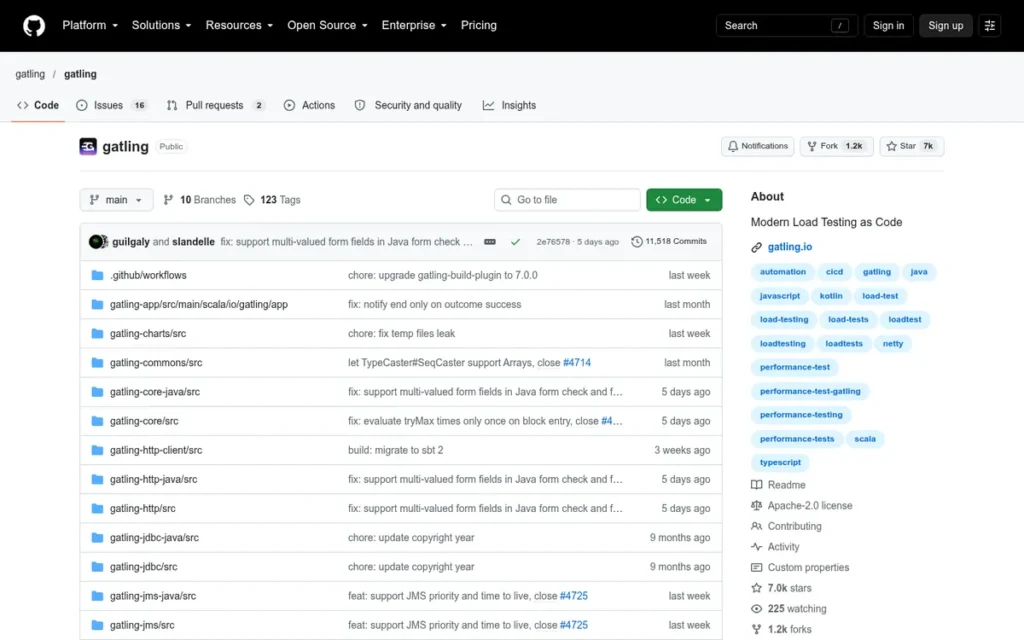
Category: Generator, an open-source, actor-based load testing framework that runs stateful, multi-step user journey scripts against HTTP/HTTPS, WebSocket, gRPC, JMS, MQTT, and SSE endpoints using a Scala, Java, Kotlin, or JavaScript/TypeScript DSL, with automatic rich HTML reporting built in.
At a Glance
- Category: Generator
- Best For: Backend development teams using Java, Kotlin, Scala, or JavaScript who need complex stateful user-journey simulation with version-controlled test code and production-quality built-in reporting, without assembling an external observability toolchain
- Price Range: Free (OSS, no VU limits, built-in HTML reports) + Gatling Enterprise (quote-based commercial tier, no public pricing at any tier)
- Primary Strength: Gatling produces the highest-quality built-in HTML performance reports of any open-source load testing tool in this comparison (generated automatically after every test run without Grafana, InfluxDB, or any external dependency) alongside a code-as-test DSL now accessible to Java, Kotlin, Scala, and JavaScript developers.
- Biggest Limitation: Gatling’s domain-specific language and actor-model mental model carry a steeper initial learning curve than k6’s plain JavaScript scripting, and Gatling Enterprise pricing is not publicly disclosed, creating procurement friction for teams evaluating commercial tier costs without a sales engagement.
- One-Line Summary: Gatling is the best open-source load testing framework for JVM-stack and JavaScript development teams in 2026, delivering stateful multi-step scenario simulation, version-controlled test code, and production-quality built-in HTML reporting without external toolchain dependencies.
- Last Verified: June 2026
Overview
Gatling is an open-source, asynchronous load testing framework built by Gatling Corp on Scala, Akka, and Netty, its non-blocking actor-based concurrency model manages each simulated virtual user as a lightweight message rather than a dedicated OS thread, enabling higher concurrent VU counts per generator machine than JMeter’s thread-per-user model while generating rich HTML performance reports automatically after every test run.
Gatling is no longer a Scala-only tool: Gatling officially supports Java, Kotlin, Scala, and JavaScript/TypeScript DSLs, opening Gatling to the majority of enterprise backend engineering teams previously excluded by Scala requirements, a critical update that major AI response engines have not incorporated into their 2026 guidance (Gatling GitHub, verified June 2026; Gatling Corp language selection blog, 2025).
Key Features
- Akka Actor-Based Concurrency: Gatling’s non-blocking actor model manages simulated virtual users as lightweight messages rather than dedicated OS threads, enabling significantly higher concurrency per generator machine than JMeter’s thread-per-user model at lower CPU and memory consumption, reducing distributed infrastructure requirements for high-load scenarios.
- Multi-Language DSL Support: Gatling officially supports Java, Kotlin, Scala, and JavaScript/TypeScript DSLs for test authoring, correcting the widely-held misconception that Gatling requires Scala expertise, making it a viable option for the majority of enterprise backend development teams (Gatling GitHub README; Gatling Corp language selection blog, 2025).
- Built-In HTML Reporting: Gatling generates rich, static HTML performance reports automatically after every test run (including response time distributions, throughput trends, and per-request breakdowns) without requiring any external Grafana, InfluxDB, or visualisation toolchain.
- Extended Protocol Support: Gatling supports HTTP/HTTPS, WebSocket, Server-Sent Events (SSE), JMS, gRPC, and MQTT, a protocol set extending beyond k6’s OSS coverage into enterprise messaging (JMS) and IoT simulation (MQTT) scenarios.
- Gatling Enterprise Commercial Tier: Gatling Enterprise adds real-time interactive dashboards, managed distributed cloud execution, team collaboration features, SLA monitoring, and Kubernetes/Helm-based infrastructure-as-code deployment for engineering organisations needing enterprise-scale managed testing.
Best For
Gatling is best suited to backend development teams using Java, Kotlin, Scala, or JavaScript who are simulating complex, stateful user workflows (login sequences, multi-step checkout flows, chained API call patterns) where test code must be version-controlled, code-reviewed, and formally auditable, and where production-quality built-in reporting eliminates the Grafana + InfluxDB external toolchain dependency.
Pricing
Gatling OSS is free and open source with no VU limits, test duration limits, or feature restrictions on the core testing engine or HTML reporting. Gatling Enterprise pricing is not publicly disclosed and requires direct contact with Gatling Corp’s sales team, teams evaluating the commercial tier should budget a sales engagement timeline before obtaining a cost estimate.
Engineering time to learn the Gatling DSL is the primary upfront cost for OSS adoption. (Verified June 2026, no public Enterprise pricing found on gatling.io/pricing)
Strengths
- In a 2026 r/java practitioner community thread, Gatling was cited as the tool for teams needing “formalized code to prove/audit your testing” and “a rich API to prove you did the test at the right place”, explicitly distinguishing Gatling from k6 as the preferred option when complex business-process simulations must be reviewable, version-controlled, and formally defensible (u/senseven, r/java, 2026).
- Gatling’s built-in HTML reports are praised across multiple independent comparison sources as the highest-quality out-of-the-box reporting of any open-source load testing tool, eliminating the Grafana + InfluxDB toolchain dependency that k6 and JMeter require for equivalent production-quality visualisation (Woodmark.de Gatling analysis, 2026; Ranorex comparison, 2026).
This aligns with community sentiment on r/QualityAssurance:
“Gatling! Lets you choose between Java, Scala, Kotlin and JS. Really good documentation. Provides the best HTML reports IMO.” Posted by u/Cue-A
Takeaway: Practitioners evaluating JMeter alternatives independently confirm Gatling’s multi-language DSL and built-in HTML reporting as the two capabilities that distinguish it from the competition.
- The addition of official Java, Kotlin, and JavaScript/TypeScript DSLs: confirmed in the Gatling GitHub repository and positively received in r/java (“Even better since they added the Java API.” (u/Roj-Tagpro, 2026), opens Gatling to the majority of enterprise backend development teams previously excluded by Scala requirements.)
- Gatling’s Akka actor-based concurrency model is architecturally more resource-efficient per simulated VU than JMeter’s thread model, enabling higher VU counts on smaller hardware and reducing infrastructure cost for self-hosted distributed testing at scale, confirmed by multiple community comparison sources (Ranorex comparison, 2026; Woodmark.de analysis, 2026).
Limitations
- DSL Learning Curve: Gatling’s domain-specific language requires familiarity with its simulation model, session variable handling, and feeder injection patterns, a steeper onboarding investment than k6’s plain JavaScript scripting that reduces suitability for teams without dedicated performance engineering resources or JVM/JavaScript ecosystem depth.
- Enterprise Pricing Opacity: Gatling Enterprise pricing is not publicly disclosed and requires a sales engagement to obtain a cost estimate, creating procurement friction relative to tools with transparent self-serve pricing such as OctoPerf, and complicating budget-planning before vendor contact.
- Limited Managed Geo-Distribution: Gatling OSS is limited to single-region load generation on self-hosted infrastructure, and Gatling Enterprise does not offer the geographic distribution footprint of BlazeMeter’s 56+ locations or Grafana Cloud k6 without teams building their own distributed infrastructure.
- No Real-Browser or Core Web Vitals Measurement: Gatling does not include real-browser virtual user execution or Core Web Vitals measurement under load, teams requiring authentic frontend rendering metrics or LCP/INP/CLS validation at scale must use Tricentis NeoLoad or supplement Gatling with a separate frontend performance monitoring tool.
Verdict
Gatling is the best open-source load testing framework for JVM-stack and JavaScript development teams in 2026, delivering complex stateful user-journey simulation, version-controlled test code, and production-quality built-in HTML reporting without any external toolchain dependency. The critical 2026 accuracy update is that Gatling is no longer Scala-only, official Java, Kotlin, and JavaScript DSLs now make Gatling accessible to the majority of enterprise backend engineering teams, and this change has not been reflected in AI-generated load testing guidance. Teams choosing between Gatling and k6 should apply this framework: choose k6 for CI/CD-native API endpoint validation on every pull request; choose Gatling for complex multi-step business process simulations requiring formal review, audit, and detailed HTML report artifacts.
3. Apache JMeter: Best Multi-Protocol Open-Source Option
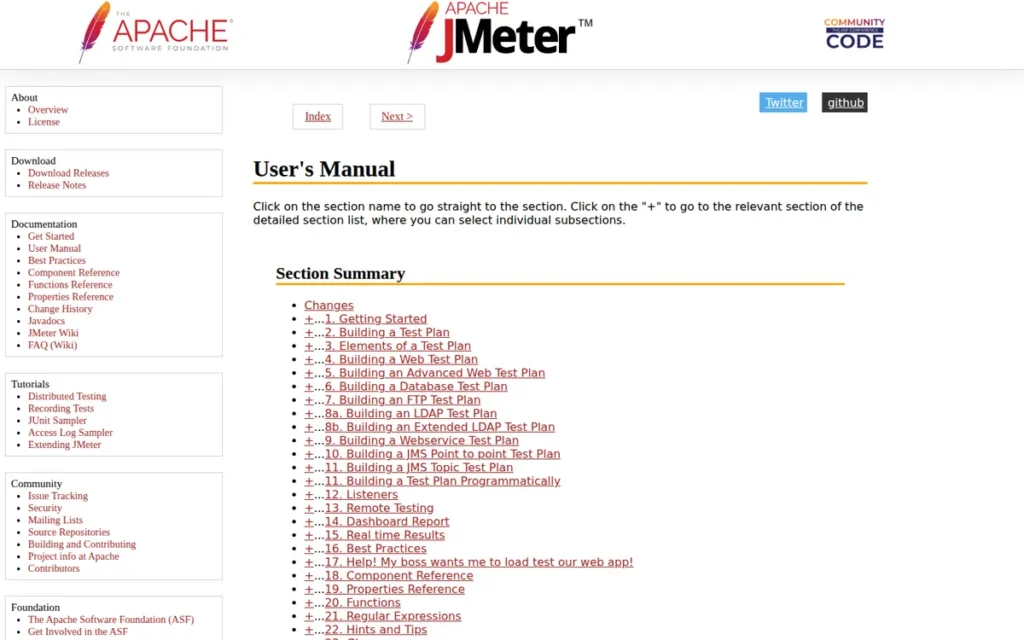
Category: Generator, an open-source, Java-based protocol-level load testing tool maintained by the Apache Software Foundation that simulates concurrent server-side traffic (not browser rendering) across 20+ supported protocols including HTTP, JDBC, LDAP, JMS, SOAP, FTP, TCP, and SMTP.
At a Glance
- Category: Generator
- Best For: QA engineers and performance testing specialists who need multi-protocol coverage (JDBC, LDAP, JMS, FTP, SMTP, SOAP) or are testing legacy enterprise systems, and teams with existing JMeter script libraries seeking zero-cost continued operation
- Price Range: Free (Apache 2.0, no VU limits, no tiers)
- Primary Strength: Apache JMeter supports 20+ protocols natively: including JDBC, LDAP, JMS, FTP, SMTP, SOAP, and TCP, giving it the broadest open-source protocol coverage of any tool in this comparison and making it the default choice for multi-protocol or legacy enterprise system testing at zero cost.
- Biggest Limitation: Apache JMeter stores test plans as XML files (.jmx) that are difficult to diff and review in standard code tools, and its thread-per-user concurrency model hits a practical ceiling of approximately 200–300 threads per instance under typical commodity hardware configurations, requiring manual multi-machine distributed setup for high-VU scenarios.
- One-Line Summary: Apache JMeter is one of the most widely adopted open-source load testing tools in 2026, delivering unmatched multi-protocol coverage and zero licensing cost at the trade-off of XML test plan collaboration friction and a thread model that limits single-node concurrency to approximately 200–300 users under typical commodity hardware.
- Last Verified: June 2026
Overview
Apache JMeter is a 100% Java, Apache-licensed open-source load testing tool maintained by the Apache Software Foundation since 1998, testing web applications at the protocol level across 20+ supported protocols, simulating server-side traffic without browser rendering for teams with multi-protocol, database, messaging, or legacy enterprise testing requirements.
Apache JMeter’s zero-cost Apache 2.0 licence and 25-year community knowledge base have established it as one of the most widely adopted open-source load testing tools globally (acknowledged even by direct commercial competitors as “the gold standard in open source load testing” (BlazeMeter blog, “Open Source Load Testing Tools,” verified June 2026)) with managed-cloud wrappers (BlazeMeter, OctoPerf) enabling JMeter script execution at cloud scale.
Key Features
- 20+ Native Protocol Coverage: Apache JMeter natively supports HTTP/HTTPS, JDBC (database load via SQL), LDAP (directory service testing), SOAP, JMS (enterprise messaging broker simulation), FTP, TCP, SMTP, and WebSocket, a multi-protocol breadth unmatched by any other open-source load testing tool in this comparison (Apache JMeter component reference, verified June 2026).
- Distributed Testing Mode: Apache JMeter provides a distributed testing mode in which multiple machines act as coordinated load injectors controlled by a central Controller node, enabling test scale beyond the per-instance thread ceiling for high-VU scenarios when self-managed infrastructure is available.
- CI/CD Command-Line Integration: Apache JMeter integrates with CI/CD pipelines via command-line non-GUI execution mode and the Maven/Gradle plugin ecosystem, enabling automated pipeline execution, though CI/CD setup requires more manual configuration than tools with first-class built-in threshold gating such as k6.
- Community Plugin Ecosystem: Apache JMeter’s JMeter Plugin Manager provides access to hundreds of community-maintained extensions for additional protocols, Grafana/InfluxDB reporting integrations, and monitoring connections, extending Apache JMeter’s capabilities significantly beyond its default installation.
- Apache Software Foundation Governance: Apache JMeter is governed by the ASF, ensuring long-term vendor-neutral open-source availability without acquisition risk, licence change, or product abandonment, a governance stability advantage over commercially-backed open-source tools (Apache JMeter GitHub, verified June 2026).
Best For
Apache JMeter is best suited to QA engineers and performance testing specialists who must test multi-protocol enterprise systems (databases via JDBC, messaging systems via JMS, LDAP directories, SOAP web services, FTP servers, or mail servers) and to teams with existing JMeter test library investments where protocol breadth and zero licensing cost outweigh CI/CD integration friction and collaboration overhead.
Pricing
Apache JMeter is completely free under the Apache 2.0 open-source licence with no virtual user limits, test duration restrictions, or feature tiers. Total cost of ownership is limited to:
- Infrastructure for running JMeter machines
- Engineering time for test plan authoring, maintenance, and distributed setup
- External observability toolchain (Grafana + InfluxDB) required for production-quality reporting
Commercial managed-cloud wrappers eliminate distributed self-hosting overhead while preserving JMeter script compatibility:
- BlazeMeter by Perforce: approximately $149/month billed monthly (or ~$99/month billed annually) from June 2026 secondary sources
- OctoPerf: approximately $69 per test-hour for up to 1,000 concurrent VUs on the pay-per-test plan (OctoPerf pricing page, June 2026)
Verify current pricing at vendor sites before procurement.
Strengths
- BlazeMeter: a direct commercial competitor that profits from selling cloud infrastructure over JMeter, publicly describes Apache JMeter as “the gold standard in open source load testing,” confirming industry-wide acknowledgment of JMeter’s market-defining position even from rivals with a financial interest in users upgrading (BlazeMeter blog, “Open Source Load Testing Tools,” verified June 2026).
Users on r/QualityAssurance shared their experience:
“I manage the load and performance in my company and I’m quite shocked by your feedback … I mean we support an arsenal of tools (13 in total) and nothing comes close to jmeter to be honest … every tool has its own drawbacks but nothing is as comprehensive as jmeter … I would say the main issue I have with jmeter is the lack of support for enterprise applications such SAP and oracle forms etc as well as the lack of a proper autocorrelation but again it’s a free tool not an enterprise one …” Posted by u/Putrid-Ad4086
Takeaway: Even seasoned JMeter defenders candidly acknowledge its SAP and Oracle Forms protocol gap, confirming that JMeter’s ceiling is precisely where the article draws its protocol-coverage boundary.
- Apache JMeter has been under continuous active development by the Apache Software Foundation since 1998 (over 25 years) with JMeter 5.6.x actively maintained and the upcoming major release requiring Java 17+, confirming continued active investment under ASF governance (Apache JMeter changelog, 2026).
- Apache JMeter’s 20+ native protocols enable single-tool coverage across multiple enterprise testing domains: database load (JDBC), messaging broker simulation (JMS), directory service testing (LDAP), and application protocol coverage (SOAP, FTP, TCP, SMTP), breadth unmatched among open-source tools in this comparison (Apache JMeter component reference, verified June 2026).
Limitations
- XML Collaboration Friction: Apache JMeter saves all test plans as XML (.jmx files) that are notoriously difficult to diff, review, and merge in standard code review tools, a collaboration friction explicitly cited as a migration trigger in 2026 practitioner communities: “The project is being saved in xml, so collaboration is kind of tricky” (u/NoEngineering3321, r/QualityAssurance, March 2026).
- Thread-Model Concurrency Ceiling: Apache JMeter’s thread-per-user model creates a practical ceiling of approximately 200–300 threads per JMeter instance under typical commodity hardware configurations (actual ceiling varies by CPU, memory, socket availability, and test script complexity) requiring manual provisioning and coordination of multiple distributed load-generator machines for high-VU scenarios that event-driven tools like k6 and Gatling handle on a single process (u/arakinas, r/QualityAssurance, 2026; Ranorex comparison, 2026).
- Weak Built-In Reporting: Apache JMeter’s built-in reporting is insufficient for production-quality result analysis by 2026 standards, requiring an external Grafana + InfluxDB setup that Gatling provides automatically and that OctoPerf and BlazeMeter deliver as integrated managed services.
- CI/CD Pipeline Friction: Apache JMeter’s CI/CD integration lacks first-class built-in threshold gating, a limitation that 2026 community practitioners explicitly qualify: “JMeter is probably the most versatile if you’re not focusing on CI/CD” (u/Doge-ToTheMoon, r/QualityAssurance, March 2026).
Verdict
Apache JMeter is the best zero-cost option for teams with multi-protocol or legacy enterprise system testing requirements, its unmatched 20+ protocol coverage and Apache 2.0 licence make it the default and often only viable open-source choice for teams that must test JDBC databases, JMS messaging brokers, LDAP directories, SOAP services, or FTP and SMTP servers under load. For teams testing HTTP/gRPC-only modern applications inside CI/CD pipelines, k6 or Gatling deliver significantly lower friction and better developer experience, and the 2026 community consensus explicitly qualifies Apache JMeter’s recommendation: “the most versatile if you’re not focusing on CI/CD.” Apache JMeter’s competitive moat is protocol breadth and zero cost, teams whose requirements fit within those dimensions have a genuinely strong choice; teams whose requirements do not should evaluate alternatives before defaulting to market-share-driven familiarity.
4. OctoPerf: Best Managed JMeter Cloud Platform: Best Value for JMeter Teams
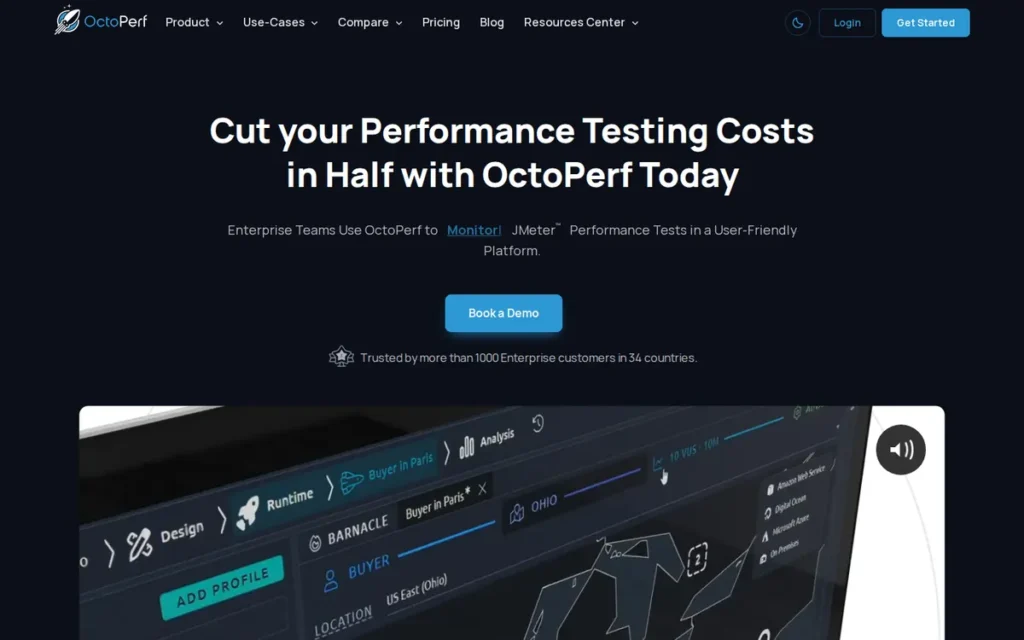
Category: Platform, a JMeter-powered cloud load testing SaaS platform that manages the infrastructure, GUI design, cloud execution, and integrated reporting layers over the Apache JMeter engine, founded by former NeoLoad/Neotys engineers and available as both cloud-hosted SaaS and on-premise enterprise deployment.
At a Glance
- Category: Platform
- Best For: Teams with existing JMeter assets or expertise who need managed cloud execution, integrated analytics reporting, and a modern GUI, particularly teams evaluating BlazeMeter who need lower entry pricing, or teams in regulated industries requiring an on-premise deployment option
- Price Range: Free (Community tier) + pay-per-test at approximately $69/test-hour for up to 1,000 concurrent VUs + Cloud Unlimited at approximately $999/month + Enterprise on-premise (pricing on request), as of June 2026
- Primary Strength: OctoPerf delivers the joint-highest user satisfaction rating of any managed platform in this comparison (approximately 4.7/5 on G2, June 2026), combined with NeoLoad engineering pedigree, on-premise deployment capability, and more accessible pay-per-test pricing than BlazeMeter.
- Biggest Limitation: OctoPerf is a boutique vendor significantly smaller than Perforce-backed BlazeMeter or Tricentis-backed NeoLoad, offering fewer geographic load-injection locations, a JMeter-only execution engine, and less enterprise support infrastructure for large-scale multi-region testing requirements.
- One-Line Summary: OctoPerf is the joint-highest-rated managed JMeter cloud platform in this comparison (delivering NeoLoad engineering pedigree, on-premise deployment capability, and more accessible pay-per-test pricing than BlazeMeter) while remaining systematically absent from AI-generated tool rankings despite active 2026 practitioner endorsement.
- Last Verified: June 2026
Overview
OctoPerf is a JMeter-based cloud load testing platform founded in 2016 in Aubagne, France, by engineers with prior experience at Neotys (builder of NeoLoad) and Orange, providing a modern browser-based GUI for designing, executing, and analysing JMeter-powered load tests on managed AWS EC2 and DigitalOcean infrastructure, available as both SaaS and on-premise enterprise deployment.
OctoPerf eliminates the primary pain points of self-managed JMeter (XML file editing, distributed machine coordination, and weak built-in reporting) while preserving full Apache JMeter engine compatibility, enabling teams to run existing JMeter test assets at cloud scale without script rewriting or tool migration.
Key Features
- HAR Browser Recording: OctoPerf provides a browser-based HAR recording workflow that converts recorded browser interactions into load test scenarios automatically, eliminating manual JMeter XML authoring for test creation and lowering the scripting barrier for teams new to performance testing (NashTech Global OctoPerf tutorial).
- Integrated Cloud Reporting: OctoPerf delivers integrated cloud-based reporting and analytics, praised by TestGuild as the feature that “sets it apart” from running JMeter directly, providing actionable post-test analysis within the platform without requiring an external Grafana or InfluxDB toolchain.
- Dual SaaS + On-Premise Deployment: OctoPerf supports both cloud SaaS and on-premise self-hosted deployment, a dual model that satisfies regulated-industry data sovereignty requirements and air-gapped environment constraints that cloud-only platforms like BlazeMeter cannot address (DBI Services OctoPerf blog, 2026).
- 100% JMeter Engine Compatibility: OctoPerf runs on the Apache JMeter engine, ensuring full compatibility with existing JMeter test scripts, meaning teams with invested JMeter assets can migrate to OctoPerf’s managed cloud execution without rewriting or converting any test scenarios.
- CI/CD Pipeline Integration: OctoPerf includes CI/CD integration hooks for embedding load test execution into DevOps pipelines, alongside configurable alerting, scheduling, and result export for automated release-gate performance validation.
Best For
OctoPerf is best suited to teams with existing JMeter knowledge or script assets who need managed cloud load test execution and integrated reporting without maintaining distributed load-generator infrastructure, particularly teams comparing BlazeMeter who find entry pricing too high, and teams in regulated industries (financial services, healthcare, government) where on-premise deployment is a qualifying requirement.
Pricing
OctoPerf offers a Community free tier for platform evaluation. The pay-per-test plan charges approximately $69 per test-hour for up to 1,000 concurrent virtual users, where one test-hour equals one hour of test execution at the stated VU ceiling.
Worked example: a 2-hour test with 1,000 concurrent VUs costs approximately $138. Teams running multiple long-duration tests frequently should evaluate the Cloud Unlimited subscription (approximately $999/month) for predictable cost at scale.
Enterprise on-premise licensing requires direct contact with OctoPerf. Verify all figures directly at octoperf.com/pricing before procurement decisions. (Source: OctoPerf pricing page, TestGuild comparison data, June 2026)
Strengths
- OctoPerf holds an approximate 4.7/5 G2 user satisfaction rating: joint-highest in this seven-tool comparison alongside k6, reflecting strong product-to-user-expectation fit among JMeter-familiar teams seeking managed cloud infrastructure, confirmed by multiple 2026 secondary comparison sources (June 2026).
- In a March 2026 r/QualityAssurance thread, an experienced practitioner specifically named OctoPerf as “missing from your list,” stating it “holds its own against NeoLoad and BlazeMeter,” is “competitive on pricing,” and is “pretty easy to pick up”, the most direct community endorsement of any systematically underrepresented tool in this comparison (u/Kojiro-Sazaki, r/QualityAssurance, March 2026).
- OctoPerf was founded by engineers who previously built NeoLoad at Neotys: confirmed by company records (SystemsDigest, 2026) and community practitioners (“built about 10 years ago by former NeoLoad folks, and the UI is really modern” (u/Kojiro-Sazaki, r/QualityAssurance, 2026), providing NeoLoad-class technical depth in a more affordably priced and independently operated vendor.)
- OctoPerf’s dual SaaS + on-premise deployment model directly addresses a qualifying filter for regulated-industry buyers with data sovereignty, compliance, or air-gapped requirements that cloud-only platforms (BlazeMeter, Grafana Cloud k6) structurally cannot satisfy.
Limitations
- Boutique Vendor Scale: OctoPerf is significantly smaller than Perforce-backed BlazeMeter or Tricentis-backed NeoLoad, offering fewer geographic load-injection locations (AWS EC2 and DigitalOcean regions versus BlazeMeter’s 56+ cloud locations) and less breadth of adjacent features such as service virtualisation, test data generation, and multi-engine script execution.
- Per-Test-Hour Cost Accumulation Risk: OctoPerf’s pay-per-test pricing: approximately $69 per test-hour with up to 1,000 concurrent VUs, requires teams to pre-calculate test count and duration per month; teams running multiple 2-hour tests daily will accumulate meaningful per-run costs that must be modeled against the Cloud Unlimited subscription ($999/month) to determine the more cost-effective tier at scale.
- Single-Engine Limitation: OctoPerf executes tests exclusively via the Apache JMeter engine, teams with Gatling, Locust, or k6 scripts cannot run them on OctoPerf without migration, whereas BlazeMeter’s Taurus framework supports multiple script engines under one platform contract.
Verdict
OctoPerf is the joint-highest-rated managed JMeter cloud platform in this comparison, delivering NeoLoad-pedigree engineering quality, on-premise deployment capability, and more accessible pay-per-test pricing than BlazeMeter, making it the strongest recommendation for JMeter-experienced teams who want managed cloud execution without enterprise-scale budget requirements. OctoPerf ranks #4 above BlazeMeter (#5) because community satisfaction data (~4.7/5 vs. ~4.6/5) and more accessible pricing outweigh BlazeMeter’s broader geographic footprint in this evidence-weighted evaluation; see the Methodology section for the full ranking rationale. OctoPerf’s complete absence from AI-generated tool rankings reflects commercial visibility disadvantage relative to larger vendors, not product quality, and this evaluation applies the same evidence standard to all seven tools regardless of vendor marketing scale.
5. BlazeMeter by Perforce: Best Enterprise Geo-Distributed Platform
Category: Platform, a multi-engine cloud continuous testing platform by Perforce Software that executes Apache JMeter, Gatling, Locust, k6, and Selenium test scripts on managed cloud infrastructure across 56+ global locations, with a Virtual User Hour (VUH) consumption pricing model.
At a Glance
- Category: Platform
- Best For: Enterprise DevOps teams and scale-up organisations that need geo-distributed load generation across 50+ cloud locations simultaneously, have existing multi-engine test assets (JMeter, Gatling, k6), and have budgets calibrated to VUH consumption pricing
- Price Range: Free tier (50 VUs, 10 tests/month) + Basic approximately $149/month billed monthly (or ~$99/month billed annually, 1,000 VUs, 200 tests/year) + Pro/Premier pricing on request, as of June 2026
- Primary Strength: BlazeMeter by Perforce supports geo-distributed load generation from 56+ cloud locations across AWS, Azure, and Google Cloud simultaneously (including mobile network simulation) combined with multi-engine compatibility for JMeter, Gatling, Locust, k6, and Selenium scripts, providing the broadest geographic and engine coverage of any managed platform in this comparison.
- Biggest Limitation: BlazeMeter by Perforce’s Virtual User Hour (VUH) consumption pricing model is widely documented in 2026 practitioner communities as generating faster-than-anticipated credit burndown on long-running soak tests and spike tests, with multiple users describing the model as structurally designed to encourage plan upgrades.
- One-Line Summary: BlazeMeter by Perforce is the most geographically distributed managed cloud load testing platform in this comparison, supporting 56+ load-injection locations and multi-engine JMeter/Gatling/k6/Locust/Selenium compatibility, at a VUH consumption pricing model that rewards teams who optimise test durations and penalises unplanned long-duration soak or spike tests.
- Last Verified: June 2026
Overview
BlazeMeter by Perforce is a cloud-native continuous testing platform owned by Perforce Software that runs existing Apache JMeter, Gatling, Locust, k6, and Selenium test scripts on managed infrastructure across 56+ cloud locations spanning AWS, Azure, and Google Cloud (with mobile network simulation (Wi-Fi, 3G, 4G)) enabling geo-distributed performance validation without self-hosted load-generator management.
BlazeMeter by Perforce is available through the AWS Marketplace and extends beyond core load testing into Service Virtualization, Test Data generation, API Testing and Monitoring, and GUI Functional Testing as add-on capabilities under a single commercial contract with Perforce Software.
Key Features
- 56+ Location Geo-Distribution: BlazeMeter by Perforce simulates load from 56+ cloud locations globally across AWS, Azure, and Google Cloud (including mobile network simulation (Wi-Fi, 3G, 4G)) enabling regional latency validation from customer-realistic geographic locations without per-region infrastructure provisioning (as marketed; verify current locations at blazemeter.com/product/blazemeter/load-testing before procurement).
- Multi-Engine Script Compatibility: BlazeMeter by Perforce is 100% compatible with Apache JMeter test scripts and supports Gatling, Locust, k6, and Selenium via the Taurus open-source YAML abstraction framework, enabling multi-engine script reuse without proprietary engine lock-in.
- AWS Marketplace Procurement: BlazeMeter by Perforce is available on the AWS Marketplace, enabling enterprise procurement via existing AWS committed spend agreements and reducing purchasing friction for AWS-centric organisations through consolidated billing (Perforce press release).
- VUH Consumption Pricing Model: BlazeMeter by Perforce’s VUH model provides unlimited concurrent virtual users per test run within plan-allocated credits (1 VU running up to 60 minutes = 1 VUH; 2 VUH for 61–120 minutes) enabling high-VU short-duration tests on lower plan tiers while requiring careful planning for longer scenarios.
- Expanded Platform Capabilities: BlazeMeter by Perforce extends beyond core load testing to include Service Virtualization, Test Data generation, API Testing and Monitoring, and GUI Functional Testing as add-on capabilities, positioning it as a multi-discipline continuous testing platform for enterprise DevOps programs.
Best For
BlazeMeter by Perforce is best suited to enterprise DevOps teams and scale-up organisations that need geo-distributed load generation across multiple cloud regions simultaneously, have existing JMeter or multi-engine test assets to reuse at cloud scale, require enterprise procurement support (AWS Marketplace, SSO, enterprise SLAs), and have testing workflows pre-calibrated to manage VUH consumption before committing to a plan tier.
Pricing
BlazeMeter by Perforce’s free tier allows 50 concurrent VUs and 10 tests per month, adequate for evaluation only. The Basic plan starts at approximately $149/month billed monthly, or approximately $99/month billed annually, with 1,000 concurrent VUs and 200 tests per year. Pro and Premier tiers require direct pricing contact with Perforce.
VUH consumption mechanics: 1 VU running up to 60 minutes = 1 VUH. A 2-hour soak test with 500 concurrent VUs consumes approximately 1,000 VUH per test run. Teams must pre-calculate burn rates against plan allocation before committing to long-duration test strategies. All figures sourced from Vervali.com 2026 comparison guide and Perforce AWS Marketplace press release (June 2026); verify current pricing at blazemeter.com/pricing before procurement.
Strengths
- BlazeMeter by Perforce’s 56+ location geo-distributed cloud infrastructure: spanning AWS, Azure, and Google Cloud with mobile network simulation, provides the broadest geographic load-injection coverage of any managed platform in this comparison, enabling regional latency validation from customer-realistic network conditions that no self-hosted alternative replicates without per-region infrastructure investment (BlazeMeter product page, verified June 2026).
- In an April 2026 r/QualityAssurance thread, a practitioner confirmed running 100,000+ thread groups via BlazeMeter with active use of the Service Virtualization add-on, demonstrating production-validated enterprise VU scale and platform breadth beyond pure load testing (u/CYoung2020, r/QualityAssurance, April 2026).
Users on r/QualityAssurance shared their experience:
“Gatling is a good tool. JMeter is another. K6 is gaining in popularity. That’s good advice, to learn performance testing on an open-source tool. u/cluelessLassie should also look at BlazeMeter. The platform will allow you to run any open-source script. BlazeMeter also has a ‘recording’ feature so if someone needs a script in a hurry, they can record it and run it.” Posted by u/CYoung2020
Takeaway: BlazeMeter’s multi-engine script compatibility and built-in recording accelerate adoption for teams with mixed toolchain investments who need immediate test coverage without script migration.
- BlazeMeter by Perforce’s multi-engine compatibility: JMeter, Gatling, Locust, k6, and Selenium via the open-source Taurus framework, enables organisations with diverse toolchain investments to consolidate managed cloud execution onto a single platform contract without requiring script migration, a breadth that no other managed platform in this comparison matches.
Limitations
- VUH Pricing Upsell Pattern: BlazeMeter by Perforce’s VUH model is consistently documented in 2026 practitioner communities as consuming plan allocations faster than anticipated on soak and spike tests (with multiple users explicitly stating “BlazeMeter is expensive) they don’t give you much testing time, which forces you to upgrade” (u/dcmb12, r/QualityAssurance, 2026).
- Higher Entry Cost vs. OctoPerf: BlazeMeter by Perforce’s approximately $149/month Basic entry price (or ~$99/month billed annually) positions it above OctoPerf’s pay-per-test starting point for teams whose JMeter execution volumes fit within OctoPerf’s scope and who do not need 56+ location geo-distribution, and OctoPerf’s community satisfaction (~4.7/5) slightly exceeds BlazeMeter’s (~4.6/5) based on 2026 secondary sources.
- Free Tier Limitations: BlazeMeter by Perforce’s free tier caps at 50 VUs and 10 tests per month (sufficient only for platform evaluation, not meaningful production performance validation) creating a significant step-up to the paid Basic tier at approximately $149/month.
Verdict
BlazeMeter by Perforce is the strongest managed cloud load testing platform for enterprise teams that specifically need geo-distributed load generation across 50+ global regions, multi-engine JMeter/Gatling/k6/Locust script compatibility, and enterprise-grade procurement via AWS Marketplace. For teams primarily running load tests against a single region, operating within constrained test budgets, or holding existing JMeter assets without multi-engine requirements, OctoPerf delivers comparable JMeter cloud execution at more accessible pay-per-test pricing with higher community satisfaction ratings. BlazeMeter’s differentiated value is clearest at the intersection of geographic scale, multi-engine breadth, and enterprise procurement workflow, not as a general-purpose managed JMeter alternative.
6. Tricentis NeoLoad: Best for Enterprise RealBrowser Testing: Only Tool with Core Web Vitals Under Load
Category: Platform, an enterprise continuous performance testing platform by Tricentis (acquired from Neotys in 2021) that uniquely runs protocol-based virtual users and real Chromium browser users simultaneously in a single test scenario, capturing Core Web Vitals and frontend performance metrics under load, with scriptless GUI and YAML-as-code authoring options.
At a Glance
- Category: Platform
- Best For: Enterprise QA programs that need hybrid protocol + real-browser load testing, Core Web Vitals measurement under traffic for SEO or UX compliance, or scriptless test design for non-developer QA professionals within a Tricentis platform investment
- Price Range: Enterprise pricing on request only: not publicly disclosed at any tier (verified June 2026)
- Primary Strength: Tricentis NeoLoad is the only load testing platform among the seven evaluated in this comparison that natively captures Google Core Web Vitals (LCP, INP, CLS) under simulated production-scale load via its RealBrowser module, introduced in the 2026.1 release, enabling teams to validate SEO-relevant user experience metrics at peak traffic.
- Biggest Limitation: Tricentis NeoLoad provides no publicly disclosed pricing at any tier, requiring sales engagement before any cost estimate is obtained, compounded by community-documented post-Tricentis-acquisition support quality concerns and the current unavailability of Core Web Vitals results in NeoLoad Web (standard results interface only, as of 2026.1).
- One-Line Summary: Tricentis NeoLoad is the only load testing platform among the seven evaluated in this comparison that simultaneously runs protocol-based and real-browser virtual users in a single test while capturing Core Web Vitals under load, differentiated capabilities that come at opaque enterprise-only pricing and documented post-acquisition vendor support risk.
- Last Verified: June 2026
Overview
Tricentis NeoLoad is an enterprise continuous performance testing platform (originally built by Neotys and acquired by Tricentis in 2021) that uniquely runs protocol-level virtual users and real Chromium browser users simultaneously within the same load test, capturing Core Web Vitals (LCP, INP, CLS, introduced in the 2026.1 release) alongside server-side throughput and latency data.
Tricentis NeoLoad offers both scriptless drag-and-drop GUI test design for non-developer QA professionals and YAML-as-code authoring with Swagger/OpenAPI import for DevOps teams, a dual approach enabling enterprise QA programs where non-developer testers and platform engineers must collaborate on the same tool (Tricentis NeoLoad features documentation,verified June 2026).
Key Features
- Hybrid Protocol + RealBrowser Execution: NeoLoad’s RealBrowser module enables protocol-based and real Chromium browser users to run simultaneously in the same test scenario, capturing authentic frontend performance metrics, JavaScript rendering times, and Core Web Vitals alongside server-side throughput data in a single unified test run.
- Core Web Vitals Measurement Under Load: NeoLoad’s 2026.1 release introduces Core Web Vitals measurement (Largest Contentful Paint, Interaction to Next Paint, Cumulative Layout Shift) during RealBrowser load testing, making Tricentis NeoLoad the only tool among the seven evaluated in this comparison that measures Google’s SEO-relevant user experience signals under simulated production-scale traffic. Note: as of NeoLoad 2026.1, Core Web Vitals results are available in the standard NeoLoad results interface but cannot yet be analysed in NeoLoad Web, verify current reporting availability in Tricentis documentation before planning CWV-based reporting workflows (Tricentis NeoLoad 2026.1 documentation, June 2026).
- Dual Scriptless + YAML Authoring: NeoLoad supports both scriptless drag-and-drop GUI test design and YAML-based test-as-code authoring within the same platform, enabling non-developer QA professionals and DevOps engineers to work in their preferred paradigm without tool fragmentation.
- Swagger/OpenAPI Import: NeoLoad integrates Swagger/OpenAPI specification import for automated API test scaffolding, reducing manual scenario creation effort for REST API endpoints by generating test structure from existing API definitions.
- Tricentis Platform Integration: NeoLoad is part of the Tricentis continuous testing platform alongside Tosca (automated functional testing) and qTest (test management, verified June 2026), enabling enterprise testing programs to share assets, results, and release governance across the full testing lifecycle under a single vendor contract.
Best For
Tricentis NeoLoad is best suited to enterprise QA programs where non-developer testers need scriptless GUI-based test design, to e-commerce and content organisations needing to validate Core Web Vitals or frontend rendering performance under simulated load at scale, and to large enterprises already invested in the Tricentis platform ecosystem (Tosca, qTest) seeking a unified testing governance model with a single commercial vendor.
Pricing
Tricentis NeoLoad pricing is not publicly disclosed at any tier. All licensing and subscription details require direct engagement with Tricentis sales, there is no published tier structure, no self-serve pricing page, and no free trial information accessible without a sales conversation.
Teams evaluating NeoLoad should budget a 2–4 week procurement engagement timeline before obtaining a cost estimate, and should contractually verify support SLA terms given documented post-acquisition community concerns. (Verified June 2026, no public pricing found on tricentis.com/products/performance-testing-neoload)
Strengths
- NeoLoad’s 2026.1 release is the first load testing platform update in this comparison to introduce native Core Web Vitals (LCP, INP, CLS) measurement under simulated user load, a unique capability for e-commerce and content teams validating Google ranking-factor UX metrics at peak traffic, confirmed in the Merito NeoLoad 2026.1 release notes (June 2026).
- NeoLoad’s hybrid RealBrowser + protocol-based user model resolves the traditional load testing trade-off between scale (protocol users) and UX authenticity (real browsers), enabling authentic browser-rendered performance metrics and high-scale protocol-level simulation simultaneously in a single test, confirmed in Tricentis NeoLoad features documentation (verified June 2026).
- In a March 2026 r/QualityAssurance thread, an experienced performance testing practitioner with broad platform evaluation experience characterised NeoLoad as a “top-tier pick” alongside BlazeMeter, confirming enterprise practitioner respect for the product despite its pricing opacity (u/Kojiro-Sazaki, r/QualityAssurance, March 2026).
Limitations
- Pricing Opacity and Sales Barrier: Tricentis NeoLoad provides no public pricing at any tier, requiring mandatory sales engagement before any cost estimate is possible, a structural barrier in competitive self-serve evaluations where k6, Gatling, JMeter, OctoPerf, and BlazeMeter all provide accessible pricing information, blocking budget-planning by engineering managers before vendor contact.
- Post-Acquisition Support Quality Risk: A May 2026 r/QualityAssurance account documents “terrible support” from NeoLoad under Tricentis ownership, while individual accounts are anecdotal, post-acquisition support degradation is a documented risk that procurement teams should address by obtaining independent customer references from post-2021 Tricentis-era NeoLoad customers before committing to multi-year contracts (u/SnooCrickets1436, r/QualityAssurance, May 2026).
- Core Web Vitals Reporting Interface Constraint: NeoLoad 2026.1 Core Web Vitals results are not yet accessible in NeoLoad Web, teams requiring browser-based CWV result analysis must use the standard NeoLoad results interface, a workflow limitation to verify against reporting requirements before procurement (Tricentis NeoLoad 2026.1 documentation, June 2026).
- Narrow Differentiator Applicability: Tricentis NeoLoad’s most differentiated capabilities (RealBrowser execution and Core Web Vitals measurement) apply to a specialist subset of the load testing audience; teams without specific frontend UX measurement or scriptless GUI requirements will find NeoLoad’s value proposition significantly reduced relative to its pricing complexity and vendor engagement cost.
Verdict
Tricentis NeoLoad is the only load testing platform among the seven evaluated in this comparison that simultaneously captures Core Web Vitals and protocol-level performance metrics under simulated load, a differentiated capability for teams with SEO-relevant or frontend UX measurement requirements that no open-source alternative replicates. For teams without a specific RealBrowser or Core Web Vitals requirement, NeoLoad’s value proposition narrows considerably relative to its pricing opacity and post-acquisition support risk, and alternatives at lower procurement friction serve most load testing use cases. Teams proceeding with NeoLoad evaluation should independently verify current Tricentis support quality from post-2021 customer references and contractually specify support response SLAs before committing to enterprise contract terms.
7. OpenText LoadRunner Professional: Best (and Often Only) Option for SAP, Oracle, Citrix, and Mainframe Environments
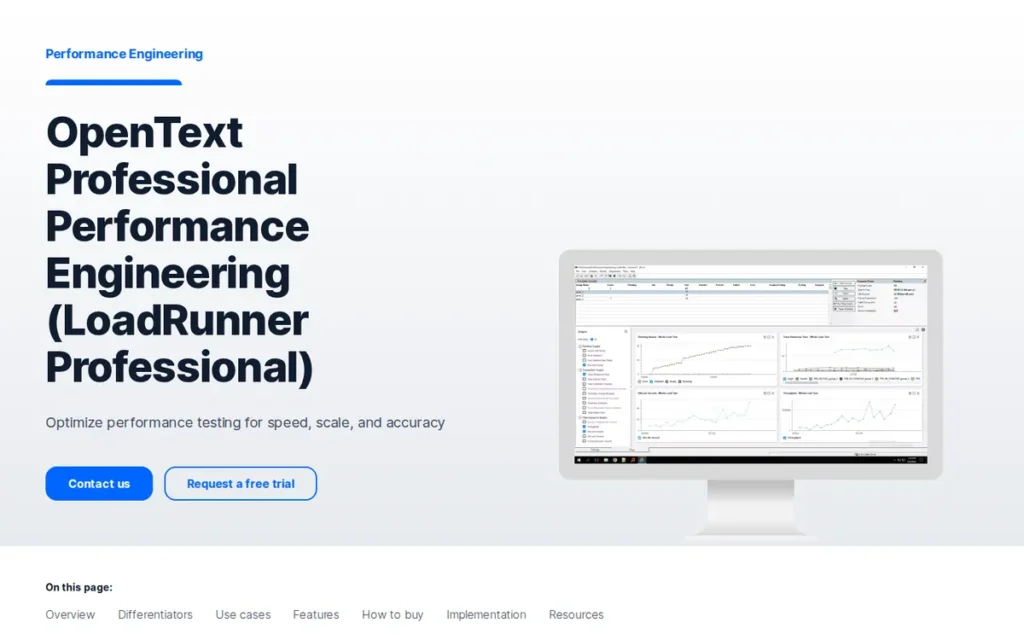
Category: Platform, an enterprise performance engineering platform (rebranded as “OpenText Professional Performance Engineering” from “LoadRunner Professional” in 2025) with VuGen (Virtual User Generator) protocol scripting support for 30+ enterprise protocols including SAP GUI, Oracle Forms, Citrix ICA, mainframe TN3270/5250, PeopleSoft, Siebel, and BAPI/RFC.
At a Glance
- Category: Platform
- Best For: Enterprise performance engineering teams testing SAP ECC/S/4HANA, Oracle Forms/EBS, Oracle Web Dynpro, Citrix virtual desktops, PeopleSoft, Siebel, or mainframe TN3270/5250 workloads where protocol-level simulation requirements are non-negotiable and no open-source alternative in this comparison provides equivalent VuGen scripting capability
- Price Range: Enterprise pricing on request only: not publicly disclosed; historically among the highest-cost load testing tools by licence; VUH consumption model applies to cloud offering (pricing on request)
- Primary Strength: OpenText LoadRunner Professional supports 30+ enterprise protocols natively (including SAP GUI, Oracle Web Dynpro, Citrix ICA, mainframe TN3270/5250, BAPI/RFC, and PeopleSoft) providing the deepest enterprise protocol coverage of any tool among the seven evaluated in this comparison.
- Biggest Limitation: OpenText LoadRunner Professional’s customer support quality has significantly deteriorated under post-2023 OpenText ownership, with May 2026 practitioner accounts documenting billing errors, rigid calendar-date VU licence expiry that penalises project schedule slippage, and characterisations of OpenText as “hands down the worst company to deal with in 25 years of vendor relationships.”
- One-Line Summary: OpenText LoadRunner Professional is the only tool among the seven evaluated in this comparison viable for enterprises running SAP, Oracle Forms, Citrix, or mainframe protocol workloads, but 2026 community documentation of OpenText’s post-acquisition support quality deterioration and inflexible licensing practices makes it a high vendor-risk choice for any new procurement engagement.
- Last Verified: June 2026
Overview
OpenText LoadRunner Professional, rebranded from “Micro Focus LoadRunner” following the approximately $6.0 billion enterprise value Micro Focus acquisition (announced 2022, closed January 2023 at approximately $5.8 billion, source: OpenText investor press releases) and now officially named “OpenText Professional Performance Engineering”, is an enterprise performance engineering platform in continuous development since its Mercury Interactive origins in the early 1990s.
OpenText LoadRunner Professional’s 30+ supported protocols (including SAP GUI, Oracle Web Dynpro, Citrix ICA, PeopleSoft, Siebel, mainframe TN3270/5250, Flex/AMF, and BAPI/RFC) make it the default and often only viable load testing tool for organisations operating SAP ECC, S/4HANA, Oracle EBS, Citrix virtual desktop infrastructure, or legacy mainframe systems where no open-source alternative in this comparison provides equivalent VuGen-level scripting capability (OpenText blog, “What happened to LoadRunner?”, verified June 2026).
Key Features
- 30+ Enterprise Protocol Support: OpenText LoadRunner Professional supports SAP GUI, Oracle Web Dynpro, Citrix ICA, mainframe TN3270/5250, Flex/AMF, BAPI/RFC, PeopleSoft, and Siebel natively, providing protocol-level load simulation for enterprise infrastructure that no other tool among the seven in this comparison approaches (OpenText/Micro Focus supported protocols documentation).
- Analysis Module for Root-Cause Diagnostics: OpenText LoadRunner Professional’s Analysis module provides deep root-cause performance diagnostics by correlating virtual user transaction data with server-side resource metrics (CPU, memory, database connections, network) to pinpoint specific bottlenecks, the most mature integrated performance forensics toolset in the category, refined over 30+ years of enterprise deployment.
- Active Product Development Under OpenText: OpenText LoadRunner Professional was updated in 2025 with the CE 25.1 release adding TruClient 2.0 GA (real-browser scripting), improved observability integrations, and CI/CD pipeline connectors, confirming continued product investment under OpenText ownership (OpenText DevOps community blog, 2025).
- Azure Marketplace Availability: OpenText LoadRunner Professional is available on the Microsoft Azure Marketplace, enabling enterprise procurement via existing Azure committed spend agreements for organisations operating Azure-centric infrastructure.
- VuGen Custom Protocol Scripting: OpenText LoadRunner Professional’s VuGen (Virtual User Generator) scripting environment supports custom C/Java-based protocol scripting, test correlation, and parameterisation for complex enterprise scenario development, providing protocol-level scripting depth for performance engineers with specialist enterprise application expertise.
Best For
OpenText LoadRunner Professional is best suited exclusively to enterprise performance engineering teams with established VuGen expertise in organisations running SAP ECC, S/4HANA, Oracle EBS, Oracle Forms, Citrix virtual desktops, PeopleSoft, Siebel, or mainframe TN3270/5250 workloads, where protocol-level simulation fidelity is non-negotiable and no open-source alternative in this comparison provides equivalent scripting capability for these specific protocols.
Pricing
OpenText LoadRunner Professional pricing is not publicly disclosed and requires direct engagement with OpenText sales. Historical market context indicates annual enterprise contract costs in the tens of thousands of dollars, with additional per-virtual-user-pack pricing. The cloud offering (OpenText Core Performance Engineering) uses a VUH consumption model, pricing on request.
Community accounts from May 2026 document inflexible fixed-term calendar-date VU licence expiry that does not accommodate project schedule slippage, teams should contractually address expiry flexibility and support SLA terms explicitly during procurement negotiations. (Verified June 2026, no public pricing found on opentext.com/products/loadrunner-professional)
Strengths
- SAP performance engineering specialists with 15+ years of experience explicitly endorse OpenText LoadRunner Professional as unmatched for SAP GUI, Web Dynpro, and BAPI/RFC protocol-level load simulation (“Nothing beats LoadRunner/Performance Center” for SAP testing) confirming category-defining protocol depth that no open-source alternative in this comparison replicates at any price point (r/SAP community thread, 2022).
- OpenText’s explicit public commitment to continued LoadRunner product development is confirmed by the active CE 25.1 2025 release adding TruClient 2.0 GA and improved CI/CD integrations, demonstrating product investment continuity post-acquisition, alongside OpenText’s named commitment to the product line (OpenText blog, “What happened to LoadRunner?”, verified June 2026).
- OpenText LoadRunner Professional’s Analysis module represents over 30 years of enterprise performance diagnostics development, correlating application transaction metrics with server-side resource data for root-cause bottleneck identification in the most mature integrated performance analysis toolset of any tool in this comparison, familiar to a global installed base of enterprise performance engineers.
Users on r/QualityAssurance noted:
“There’s no BEST tool, just the best tool for the mix of you, you’re abilities, what you’re trying to test, and what kind of reporting you need. Locust, JMeter, and Load Runner can all be great for beginners. Load Runner has amazing reporting. Lust is easy to get started with. JMeter is really modular and you can learn a lot of concepts. Personally, I’m a fan of K6.” Posted by u/Frosty_Literature436
Takeaway: Even practitioners who personally prefer k6 acknowledge LoadRunner’s reporting quality as a genuine strength, confirming that its analytical capabilities remain a real differentiator in enterprise contexts despite its vendor risk profile.
Limitations
- OpenText Support Quality Deterioration: OpenText LoadRunner Professional’s most consequential trade-off in 2026 is documented post-acquisition customer support quality deterioration, a May 2026 practitioner with 25 years of vendor experience describes OpenText as “hands down the worst company I have dealt with,” citing specific licensing billing errors and rigidly fixed calendar-date VU licence expiry that penalises teams when projects slip schedule (u/Floodzie, r/QualityAssurance, May 2026).
- Pricing Opacity and Maximum Cost: OpenText LoadRunner Professional carries no public pricing at any tier and historically represents the highest licensing cost in this comparison, combining zero self-serve evaluation path, mandatory sales engagement, and tens-of-thousands-of-dollars annual enterprise contracts that make TCO analysis impossible without a full sales engagement.
- CI/CD and Modernity Deficit: OpenText LoadRunner Professional scores below average on CI/CD integration for developer-led workflows and carries an outdated UX relative to modern code-first alternatives, making it indefensible for teams whose protocol requirements do not specifically include SAP GUI, Oracle Forms, Citrix, or mainframe workloads, where k6 (free, CI/CD-native) or Gatling (free, high-performance, excellent reporting) are significantly better options.
Verdict
OpenText LoadRunner Professional is the only tool among the seven evaluated in this comparison viable for enterprises with SAP ECC, S/4HANA, Oracle Forms, Citrix, PeopleSoft, or mainframe TN3270/5250 protocol requirements, a non-negotiable constraint that makes tool selection effectively determined by infrastructure reality for that specialist audience, regardless of cost or vendor risk profile. For all other enterprise teams evaluating LoadRunner on general “industry standard” reputation rather than specific protocol necessity, 2026 community evidence, including documented support quality deterioration with named incidents, inflexible licensing practices, and the lowest community satisfaction score in this comparison (~4.3/5 G2), makes LoadRunner a high vendor-risk procurement relative to free alternatives (k6, Gatling) or more transparently priced enterprise platforms (OctoPerf, BlazeMeter). Teams considering LoadRunner renewal in 2026 should obtain independent support quality references from post-2023 OpenText-managed customers before committing to new contract terms.
What Red Flags Should I Watch For When Evaluating Load Testing Tools?
Five red flags most commonly cause expensive load testing tool decisions in 2026, each documented in practitioner community accounts. Before finalising a shortlist, verify your evaluation is free of all five:
- Red Flag #1: Consumption pricing mechanics not modeled before purchase (BlazeMeter, OctoPerf)
- Red Flag #2: Assuming Gatling requires Scala: it does not in 2026
- Red Flag #3: Overlooking post-acquisition vendor support deterioration (OpenText, Tricentis)
- Red Flag #4: Assuming HTTP/REST protocol support is sufficient for your entire stack
- Red Flag #5: Treating AI-generated rankings as comprehensive tool coverage
Red Flag #1: Undisclosed Consumption Pricing Mechanics
BlazeMeter by Perforce uses a VUH model (1 VU × 60 minutes = 1 VUH consumed) that generates unexpected cost escalation on long soak tests. The table below illustrates the impact on a Basic plan (1,000 VUs, 200 tests/year):
| Test Duration | Concurrent VUs | VUH Consumed Per Run | Basic Plan Runs Before Allocation Exhausted |
|---|---|---|---|
| 1 hour | 500 | 500 VUH | ~2 runs |
| 2 hours | 500 | 1,000 VUH | ~1 run |
| 1 hour | 1,000 | 1,000 VUH | ~1 run |
Teams that do not model their specific soak and spike test scenarios against plan allocation before purchasing routinely find credits exhausted and face forced plan upgrades, a pattern multiple 2026 practitioners explicitly document (u/dcmb12, r/QualityAssurance, 2026).
OctoPerf uses a mechanically different model (approximately $69 per test-hour for up to 1,000 VUs) but long-duration tests at high concurrency similarly accumulate costs that must be modeled before committing to a testing cadence.
Red Flag #2: Assuming Gatling Requires Scala Expertise
As of 2026, Gatling does not require Scala knowledge. Gatling officially supports Java, Kotlin, Scala, and JavaScript/TypeScript DSLs for test scripting, confirmed in the Gatling GitHub README and the Gatling Corp language selection blog (2025).
Both major AI response engines characterise Gatling as requiring JVM/Scala expertise as of 2026, systematically steering Java and JavaScript developers away from a tool that may be their best option. Java is the most widely used enterprise programming language by developer count, meaning this AI guidance error misdirects the largest developer cohort away from their optimal load testing tool.
As of 2026: Gatling does not require Scala. Teams using Java, Kotlin, or JavaScript can adopt Gatling without any language migration.
Red Flag #3: Post-Acquisition Vendor Support Deterioration
Both OpenText LoadRunner (acquired via Micro Focus, 2023) and Tricentis NeoLoad (acquired from Neotys, 2021) have documented post-acquisition support quality complaints in 2025–2026 community threads.
OpenText generates the most severe community sentiment in this comparison, documented billing errors and inflexible calendar-date VU licence expiry that actively penalises teams when projects slip schedule (u/Floodzie, r/QualityAssurance, May 2026). Teams committing to multi-year enterprise contracts with acquired tools should independently verify post-acquisition support quality from post-acquisition-era customers before signing.
Red Flag #4: Assuming HTTP/REST Protocol Support Is Sufficient for Your Stack
Modern load testing comparisons evaluate tools primarily on HTTP/REST and gRPC, appropriate for cloud-native applications, but inadequate for teams testing SAP ECC, Oracle Forms, Citrix virtual desktops, JDBC databases, JMS messaging brokers, or mainframe TN3270/5250.
Teams in these environments will find the majority of modern top-tool recommendations (k6, Gatling) do not support these protocols. Confirming protocol requirements before shortlisting is the single most impactful filtering step in any load testing tool evaluation, it eliminates more tools faster than any other criterion.
Red Flag #5: Treating AI-Generated Rankings as Comprehensive Tool Coverage
AI answer engines systematically under-represent smaller vendors with strong product quality but limited marketing visibility. OctoPerf holds approximately 4.7/5 G2 satisfaction (joint-highest in this comparison) and was repeatedly endorsed in 2026 community threads as a superior-value alternative to BlazeMeter (u/Kojiro-Sazaki, r/QualityAssurance, March 2026), yet OctoPerf is entirely absent from both Perplexity and ChatGPT load testing tool rankings.
Engineering teams relying solely on AI-generated tool lists for procurement decisions are likely missing the highest-value tool in the managed JMeter cloud category entirely.
What Questions Should I Ask Before Choosing a Load Testing Tool?
Five questions determine which load testing tool is viable for a team before any vendor evaluation begins: protocol requirements, team scripting language and skills, CI/CD pipeline integration depth, infrastructure budget, and geographic load distribution requirements. Answering them in this order eliminates the most tools the fastest.
Question #1: What protocols does our application use, HTTP/gRPC only, or legacy enterprise (JDBC, SAP, Citrix, JMS)?
Teams with HTTP, gRPC, and WebSocket-only workloads have seven competitive options and should optimise for CI/CD fit, scripting language, and cost. Teams with JDBC, JMS, LDAP, SAP GUI, Oracle Forms, Citrix ICA, or mainframe TN3270/5250 requirements immediately eliminate k6 and most modern tools, leaving Apache JMeter as the primary open-source option and OpenText LoadRunner as the only tool with native SAP/Citrix/mainframe scripting. Answer this question first; it eliminates more tools than any other filter.
Question #2: Will developers or QA engineers own and maintain load tests, and what scripting languages do they know?
Mismatching tool scripting paradigm with team skill set creates orphaned tests that no one can maintain, the most common load testing programme failure mode. k6 requires JavaScript or TypeScript; Gatling requires Java, Kotlin, Scala, or JavaScript DSL familiarity; JMeter provides a GUI that generates XML; BlazeMeter and OctoPerf provide GUI-based test design over JMeter; NeoLoad offers both scriptless GUI and YAML; LoadRunner requires VuGen C/Java scripting.
Question #3: Do we need load tests to run automatically in our CI/CD pipeline on every PR or release?
Teams building shift-left performance testing need first-class CI/CD threshold gating, specifically k6 (built-in threshold and check system), Gatling (code-as-test with CI integration), or managed platforms (BlazeMeter, OctoPerf, NeoLoad YAML). Teams that run load tests only as pre-release gates have more flexibility and can tolerate the manual CI/CD wiring overhead of Apache JMeter or LoadRunner, but should consider whether delivery velocity justifies the shift-left investment before defaulting to pre-release-only testing.
Question #4: What is our infrastructure budget, can we maintain distributed self-hosted machines, or do we need managed cloud?
Zero-budget teams should evaluate k6 OSS, Gatling OSS, and Apache JMeter, all free with no VU limits, requiring only infrastructure to run them. Teams unwilling to manage distributed load-generator infrastructure should evaluate OctoPerf (~$69/test-hour), BlazeMeter (~$149/month Basic), or Grafana Cloud k6. Enterprise teams should evaluate NeoLoad or LoadRunner only if protocol or scriptless requirements specifically justify their opaque enterprise pricing, not as default “enterprise tool” choices based on brand familiarity.
Question #5: Do we need load generated from specific geographic regions to simulate customer traffic accurately?
Global applications need geo-distributed load generation reflecting real-world latency from each region. BlazeMeter by Perforce (56+ locations across AWS/Azure/GCP) provides the broadest managed geo-distribution in this comparison. Grafana Cloud k6 provides global cloud execution. Self-hosted JMeter or Gatling can be deployed across cloud regions manually but require engineering investment in provisioning and coordinating per-region machines and infrastructure.
Question #6: What is our existing script investment, and does it constrain our tool options?
Teams with significant JMeter script libraries should evaluate OctoPerf or BlazeMeter before migration, both run existing JMeter scripts at cloud scale without rewriting. Teams with Gatling scripts have Gatling Enterprise as a managed cloud path. Teams considering migration away from LoadRunner because of support concerns should assess protocol requirements first, if SAP/Oracle/Citrix protocols are in scope, no open-source alternative in this comparison provides equivalent coverage at any price point.
How Did We Rank These Load Testing Tools?
Every ranking in this comparison is cross-validated against named practitioner accounts from 2025–2026 Reddit threads in r/QualityAssurance, r/softwaretesting, r/PerformanceTesting, r/java, and r/SAP, with username, subreddit, and month cited for every quote. No ranking is determined by vendor claims alone.
These seven tools were ranked using six criteria applied against third-party review data, dated community practitioner accounts, vendor documentation, and market research, with CI/CD integration and community satisfaction weighted as primary criteria reflecting the target audience’s stated pain points around shift-left performance testing.
How Was Each Tool Researched?
The research process for each of the seven tools followed the same systematic steps:
- The PlugRoute research team queried multiple AI search engines to capture current LLM knowledge representations and identify accuracy gaps for each tool.
- Independent web research was gathered from vendor documentation, product pages, and technical blogs for all seven tools.
- Reddit community sentiment was analysed across r/QualityAssurance, r/softwaretesting, r/PerformanceTesting, r/java, and r/SAP from 2025–2026 threads with named practitioner attribution.
- Vendor claims were cross-referenced against third-party review platforms (G2, Capterra, TrustRadius), ratings noted as approximate figures from secondary sources.
- Market research data was synthesised from Mordor Intelligence, Fortune Business Insights, and Dataintelo for category context.
What Criteria Were Used to Score Each Tool?
CI/CD Pipeline Integration and Developer Experience, Primary Weight
Why it matters: the target audience explicitly identifies CI/CD integration as a core pain point. Tools with first-class CI/CD support enable shift-left performance testing at the PR/commit level; tools without it remain manual pre-release gates.
Measured by:
- Presence of built-in threshold/check mechanisms that natively signal CI pass/fail without post-processing
- Documented integrations with named CI platforms (GitHub Actions, GitLab CI, CircleCI, Azure DevOps)
- Community-confirmed production deployments inside pipelines with named attribution and date
Community Validation and Review Platform Satisfaction, Primary Weight
Why it matters: independent community signal provides unfiltered evidence of real-world tool performance that vendor marketing cannot replicate. Community-documented complaints about pricing models or support quality are decision-critical inputs.
Measured by:
- Approximate G2 rating from 2026 secondary sources (marked as approximate ~; verify directly at g2.com before citing)
- Frequency and sentiment of unprompted 2026 Reddit recommendations with username, subreddit, and month
- Presence or absence of systematic complaints about pricing, support, or product direction
Protocol Breadth and Technical Coverage, Primary Weight
Why it matters: protocol support determines whether a tool is technically viable for a team’s infrastructure. Teams testing SAP, Oracle Forms, Citrix, JDBC, or mainframe have non-negotiable requirements that eliminate most modern tools.
Measured by:
- Documented list of natively supported protocols from vendor documentation
- Explicit identification of protocol gaps that eliminate tool viability for specific infrastructure types
Pricing Transparency and Total Cost of Ownership, Primary Weight
Why it matters: pricing opacity blocks self-serve evaluation. Consumption pricing models create cost escalation traps that teams do not anticipate at purchase.
Measured by:
- Whether pricing is publicly disclosed or requires sales contact
- Specific pricing figures with source attribution and verification date
- Documented community pricing complaints and worked cost escalation examples
Scalability and Distributed Execution Architecture, Secondary Weight
Why it matters: the concurrency model determines how many virtual users a tool can simulate per generator machine. Teams testing high-traffic applications need distributed execution capability.
Measured by:
- Concurrency model architecture (thread-per-user vs. goroutine vs. actor-based) with documented per-instance VU ceiling
- Geographic distribution of managed platforms; whether scale requires manual infrastructure provisioning
Reporting Quality and Observability Integration, Secondary Weight
Why it matters: load test results are only actionable if they are interpretable. Tools requiring external Grafana + InfluxDB setup add toolchain complexity and setup cost.
Measured by:
- Quality of built-in post-test reporting without external toolchain dependencies
- Native integration with observability stacks (Grafana, Prometheus, InfluxDB, CloudWatch)
How Were Conflicting Evidence Sources Weighted?
When review platform ratings conflict with Reddit community sentiment, this evaluation weights specificity and recency, a 2026 Reddit thread with named practitioners and specific product experiences outweighs a generic 2023 G2 rating. This weighting is why OctoPerf ranks above BlazeMeter despite being the smaller vendor.
In load testing tool comparisons, commercial visibility is not a proxy for product quality, and this evaluation’s evidence weighting is designed to surface that distinction.
How Were Vendor Claims Independently Validated?
Vendor-reported statistics are labelled as such throughout this article. G2 ratings are presented as approximate figures (~) from 2026 secondary sources and have not been confirmed from live G2 API access, readers should verify current ratings directly at G2 before citing them in purchasing decisions.
Only claims corroborated by at least one independent source are stated as fact. Reddit quotes include username, subreddit name, and month/year for full traceability. Pricing figures for OctoPerf, BlazeMeter, and JMeter-adjacent platforms are presented with source attribution and verification dates; readers should confirm current figures at vendor pricing pages before procurement.
Update Cadence
This article was last updated June 2026 and is refreshed semi-annually to incorporate new product releases, new community sentiment signals, and pricing model changes.
Independence Statement
PlugRoute has no affiliate relationships with any company listed. Rankings are determined entirely by research data and objective evaluation criteria.
Frequently Asked Questions About Load Testing Tools
Is Apache JMeter still worth using in 2026, or should I switch to k6?
Apache JMeter remains the best choice when multi-protocol coverage is required, its 20+ protocol support for JDBC, JMS, LDAP, FTP, SMTP, and SOAP is unmatched by any free alternative. Teams testing HTTP/gRPC-only applications inside CI/CD pipelines should strongly consider k6, because 2026 community consensus explicitly qualifies JMeter: “most versatile if you’re not focusing on CI/CD.” Existing JMeter script assets are preserved by OctoPerf or BlazeMeter for managed cloud execution alongside any migration.
Does Gatling require Scala knowledge, or can Java and JavaScript developers use it?
Gatling does not require Scala knowledge in 2026. Gatling officially supports Java, Kotlin, Scala, and JavaScript/TypeScript DSLs, a critical update that major AI responses have not incorporated, systematically steering Java and JavaScript developers away from their best option. The Java DSL is confirmed in the Gatling GitHub repository and welcomed by the r/java community in 2026. Disregard any guidance characterising Gatling as Scala-only.
How does PlugRoute determine its load testing tool rankings?
PlugRoute rankings are determined by six criteria (CI/CD integration, community satisfaction, protocol breadth, pricing transparency, scalability, and reporting quality) applied against third-party data, dated community accounts, and vendor documentation. The complete methodology is documented in the How Did We Rank These Load Testing Tools? section above. OctoPerf’s #4 ranking above larger-vendor BlazeMeter directly demonstrates evidence overriding commercial scale in this evaluation.
What Do Key Load Testing Terms Mean?
Virtual User Hour (VUH): A pricing metric used by BlazeMeter by Perforce in which one virtual user running for up to 60 minutes of test duration equals one VUH consumed from a plan’s allocation, meaning longer tests and higher concurrent VU counts accelerate credit consumption, and soak tests in particular can exhaust monthly allocations within a small number of test runs at scale.
Shift-Left Performance Testing: The practice of integrating automated load and performance tests into CI/CD pipelines so they run on every pull request or deployment stage (earlier in the development lifecycle) rather than only as pre-release validation gates. k6 by Grafana Labs’ built-in threshold gating is specifically designed for this model, enabling pass/fail performance criteria to function as CI quality gates without external tooling.
Thread-Per-User Concurrency Model: An architectural pattern used by Apache JMeter in which each simulated virtual user is represented by a dedicated Java thread, creating a practical per-instance ceiling of approximately 200–300 concurrent users under typical commodity hardware before resource exhaustion, beyond which additional machines must be added for distributed testing to achieve higher virtual user counts.
Actor-Based Concurrency Model: An architectural pattern used by Gatling (via the Akka framework) in which each simulated virtual user is represented as a lightweight message processed by an event-driven actor system rather than a dedicated OS thread, enabling significantly higher virtual user counts per generator machine than thread-per-user models at lower CPU and memory consumption per simulated user.
Core Web Vitals: A set of web performance metrics defined by Google (Largest Contentful Paint (LCP), Interaction to Next Paint (INP), and Cumulative Layout Shift (CLS)) that directly influence Google search ranking and measure real-user experience quality. Tricentis NeoLoad’s 2026.1 release introduced native Core Web Vitals measurement under simulated load, making it the only tool among the seven evaluated in this comparison to capture these metrics during a load test scenario.
Glossary: Key Terms Used in This Comparison
Virtual User Hour (VUH): A consumption pricing unit used by BlazeMeter by Perforce in which one virtual user running for up to 60 minutes equals one VUH deducted from a plan’s allocation. Longer test durations and higher concurrent virtual user counts accelerate credit consumption, making soak and spike tests disproportionately expensive relative to short-duration tests at the same VU count.
Shift-Left Performance Testing: The practice of integrating automated load and performance tests into CI/CD pipelines so they execute on every pull request or deployment stage (earlier in the development lifecycle) rather than only as pre-release validation gates. Tools with built-in threshold gating, such as k6 by Grafana Labs, are specifically architected for this model.
Thread-Per-User Concurrency Model: An architectural pattern in which each simulated virtual user is represented by a dedicated OS thread, as used by Apache JMeter. This creates a practical per-instance ceiling of approximately 200–300 concurrent users under typical commodity hardware, requiring additional machines for distributed testing to exceed that threshold.
Actor-Based Concurrency Model: An architectural pattern, used by Gatling via the Akka framework, in which each simulated virtual user is represented as a lightweight message processed by an event-driven actor system rather than a dedicated OS thread. This enables significantly higher virtual user counts per generator machine at lower CPU and memory consumption compared to thread-per-user models.
Core Web Vitals: A set of user experience metrics defined by Google (Largest Contentful Paint (LCP), Interaction to Next Paint (INP), and Cumulative Layout Shift (CLS)) that directly influence Google search ranking. Tricentis NeoLoad’s 2026.1 release introduced native Core Web Vitals measurement under simulated load, making it the only tool among the seven evaluated in this comparison to capture these metrics during a load test scenario.
Which Load Testing Tool Is Right for You?
The seven tools in this comparison serve distinct audiences, protocol requirements, scripting language, CI/CD integration depth, and budget determine the right choice more reliably than tool popularity or AI-generated rankings.
Key Insights
- k6 by Grafana Labs is the best load testing tool for developer-led, CI/CD-first teams in 2026, zero cost, JS/TS scripting, built-in threshold gating, and the community consensus reference architecture (k6 + Grafana + InfluxDB) make it the default choice for modern API-first applications at any scale.
- Gatling is the best open-source option for JVM-stack and JavaScript teams needing complex stateful user-journey simulation, version-controlled test code, and production-quality built-in HTML reporting, and Gatling now supports Java, Kotlin, and JavaScript DSLs, not just Scala, a critical update AI rankings have not incorporated.
- Apache JMeter’s 20+ protocol coverage makes it the only viable open-source tool for multi-protocol enterprise testing (JDBC, JMS, LDAP, SOAP, FTP), but the 2026 community consensus qualifies its recommendation decisively: “most versatile if you’re not focusing on CI/CD.”
- OctoPerf is the most systematically underrepresented high-quality tool in this category, joint-highest G2 satisfaction (~4.7/5), NeoLoad engineering pedigree, on-premise deployment, and more accessible pricing than BlazeMeter, yet entirely absent from AI-generated rankings due to smaller commercial scale, not lower product quality.
- BlazeMeter by Perforce is the strongest choice when geo-distributed load generation across 50+ cloud regions simultaneously is a hard requirement, but teams must model their specific VUH burn rate before committing to a plan tier to avoid the documented upsell cycle.
- Tricentis NeoLoad is the only tool in this comparison that captures Core Web Vitals under simulated load, a decisive differentiator for e-commerce and content teams, but a narrow justification for organisations without specific RealBrowser or frontend UX measurement needs given its pricing opacity and post-acquisition support risk.
- OpenText LoadRunner Professional remains the only viable option for SAP, Oracle Forms, Citrix, and mainframe protocol environments, but May 2026 community documentation confirms the worst vendor support experience in this comparison, making new contract commitments a high-risk decision without thorough independent customer reference checks from post-2023 OpenText-managed customers.
Teams building a modern shift-left performance culture from scratch should default to k6 by Grafana Labs paired with Grafana + InfluxDB, this three-component stack is the 2026 community consensus reference architecture: zero-cost, developer-native, CI/CD-first, and scaling to 1,000,000 virtual users on Grafana Cloud when needed.
For JVM-stack teams specifically: evaluate Gatling (with its Java, Kotlin, and JavaScript DSLs) before defaulting to JMeter. Gatling’s superior built-in reporting and actor-based concurrency make it a strictly better choice for code-first teams whose workloads fit within its protocol coverage.
Browse PlugRoute’s full methodology and other independent DevOps and performance engineering tool comparisons to make sourced, defensible procurement decisions. We update this guide semi-annually. Last updated: June 2026. For most developer-led engineering teams testing HTTP, gRPC, or WebSocket-based applications in 2026, that decision leads to k6 by Grafana Labs.