Testlio is the best overall crowd testing platform for enterprise DevOps teams, offering AI-orchestrated tester matching via its proprietary LeoAI Engine; Applause leads on tester community scale with 1.5M+ members and a 19-year category track record; Global App Testing delivers the fastest independently verified human crowd test results at 1 hour. The right choice depends on whether AI intelligence, tester community scale, or deployment speed is your primary constraint.
Internal QA teams cannot replicate the device, OS, and geographic diversity that global software releases require, a gap that widens with every Agile sprint and DevOps deployment cycle. Validating payment flows across hundreds of processors, testing usability on real device configurations, and reproducing locale-specific bugs requires real users in real environments that no internal lab can cost-effectively maintain at scale.
PlugRoute has no affiliate relationships with any company listed in this article. Rankings are determined entirely by research data and objective evaluation criteria.
“A lot of the bugs logged by crowdsourced testers are false positives. In the end, we just waste time going through their bugs and end up closing them. If you start factoring in all the costs associated with crowdsourced testing, it’s generally been a waste of time in my experience.” (u/oh_yeah_woot, r/QualityAssurance)
Takeaway: False-positive triage overhead is the most documented real-world friction point in the crowd testing category. The platforms ranked highest in this evaluation differentiate themselves through AI-assisted bug de-duplication, structured tester vetting protocols, and managed review layers that reduce the triage burden described above. Use Evaluation Question #4 to assess any vendor’s triage infrastructure before contracting.
TL;DR: Top Picks at a Glance
- Testlio is the top-ranked platform for AI-orchestrated managed crowd testing, serving enterprise DevOps teams with LeoAI-driven tester matching trained on 13+ years and 2.6M test cases across 600,000+ real devices in 150+ countries.
- Applause is best for organizations requiring the largest self-reported active tester community (1.5M+ members across 200+ countries per Applause.com, 2025) and the most extensively verified blue-chip enterprise track record in the crowd testing category.
- Global App Testing delivers the fastest independently confirmed managed crowd test results (as little as 1 hour) for Agile and DevOps teams with native CI/CD, Jira, and GitHub integrations and 70,000–90,000+ vetted professional testers.
- Cobalt is the only security-specialized PTaaS platform in this evaluation: not a functional QA crowd testing service, best for DevSecOps teams needing compliant penetration testing launched within sprint cycles by ISO 27001 and SOC 2 Type 2 certified infrastructure.
- Testbirds is the only platform among the seven evaluated here with verified IoT testing specialization and the only platform with a publicly verifiable G2 aggregate score (4.0/5.0, 22 reviews, G2 2025), best for European enterprises and connected-device product teams.
- Rainforest QA is an AI-first test automation platform: crowd testing option technically available but AI automation is the primary product direction as of December 2025, best for DevOps teams needing AI-generated self-healing regression coverage without QA coding resources.
- Ubertesters provides PM-led, ISTQB-standard managed crowd testing with 120,000+ testers across 150+ countries (Ubertesters FAQ, accessed June 2026), requiring careful pre-contract PM vetting given documented community evidence of PM quality variance.
What Are the Three Categories of Crowd Testing Tools, and Why Does the Distinction Matter Before You Pick One?
The seven platforms in this evaluation fall into three structurally distinct categories. Selecting a tool from the wrong category produces the wrong outcome regardless of feature set or price point, a security testing platform cannot substitute for functional QA, and an AI automation tool cannot substitute for human behavioral diversity.
Category 1: Fully Managed Human Crowd Testing
Fully managed human crowd testing platforms deploy a human tester community managed end-to-end by a vendor delivery team, covering functional, regression, usability, payments, and localization testing. This category addresses device fragmentation, OS version coverage gaps, beta testing, and pre-launch UAT validation needs that internal QA labs cannot replicate at scale, providing real-user testing signals from real-world device configurations that automated tools and synthetic environments cannot reproduce.
Five platforms in this evaluation belong to this category:
- Testlio: AI-enhanced, LeoAI-orchestrated tester matching from a 600,000+ real-device network across 150+ countries
- Applause: Category-founding 19-year platform with a 1.5M+ member tester community across 200+ countries (Applause.com, 2025)
- Global App Testing: Speed-first managed service with 1-hour minimum results turnaround via 70,000–90,000+ vetted professional testers across 190+ countries
- Testbirds: European and IoT specialist with 65+ demographic matching dimensions across 250,000–1,000,000+ testers in 193 countries
- Ubertesters: PM-led fully managed testing with ISTQB-standard documentation and dedicated accountability for every engagement
Category 2: AI-Hybrid Test Automation (AI-First Expansion)
Rainforest QA has substantially expanded toward AI-first test automation while maintaining its original crowd testing service as a secondary option. Rainforest QA’s primary featured capabilities, active development investment, and marketing positioning center on AI-generated self-healing regression testing rather than human tester deployment as of December 2025 (per Rainforest QA accessible-test-automation page). Teams selecting Rainforest QA specifically for human-tester behavioral diversity should verify current crowd testing availability and tester pool depth before contracting.
Category 3: Security Testing / PTaaS
Cobalt is a Pentest-as-a-Service platform using vetted security professionals for offensive security testing, not functional QA. Cobalt cannot perform usability, regression, or localization testing and cannot substitute for any functional crowd testing need. Security and DevSecOps teams should evaluate Cobalt; QA teams requiring functional testing should evaluate Category 1 platforms.
The category error in practical terms: A QA manager who selects Rainforest QA expecting Applause will receive AI-generated regression test output instead of behavioral insights from real users across diverse device configurations. A security team that selects Testlio expecting Cobalt will receive a functional bug report instead of a CVE-ready penetration test assessment. Both tools are excellent within their categories, but a category mismatch cannot be fixed after the contract is signed.
How Do the Top Crowd Testing Tools Compare at a Glance?
The seven crowd testing platforms in this evaluation span three structurally distinct categories: five fully managed human crowd testing services (Testlio, Applause, Global App Testing, Testbirds, and Ubertesters), one AI-hybrid test automation platform (Rainforest QA), and one security-specialized PTaaS platform (Cobalt). The table below compares each platform’s category, primary strength, key limitation, and best-fit use case side by side. Select any row to navigate directly to that platform’s full entry.
| Rank | Company | Category | Best For | One-Line Summary | Key Capabilities | Primary Strength | Key Limitation |
|---|---|---|---|---|---|---|---|
| 1 | Testlio | AI-Enhanced Managed Crowd Testing | Enterprise DevOps teams needing AI-orchestrated tester matching across 150+ countries | Testlio is an AI-powered managed crowd testing platform with verified enterprise clients including Netflix, PayPal, and Microsoft, featuring a LeoAI Engine trained on 2.6 million test cases across 600,000+ real devices. | Testlio LeoAI real-time tester matching; Testlio 800+ payment methods support; Testlio 100+ language coverage; Testlio AI model output testing; Testlio Selenium, JUnit, and Playwright integration | Testlio’s LeoAI Engine trained on 13+ years and 2.6M test cases is the deepest AI tester-matching infrastructure in this evaluation | Testlio’s enterprise-only, quote-based pricing is characterized as “expensive” by multiple r/QualityAssurance community members (2024–2025) |
| 2 | Applause | Managed Crowd Testing (Enterprise-Scale) | Large consumer-facing enterprises needing demographically matched real-world testers at the scale of a 19-year category-founding platform | Applause is the founding company of the crowd testing category (established 2007), with 1.5M+ members across 200+ countries (Applause.com, 2025) and verified clients including Google, Amazon, and Disney. | Applause 1.5M+ tester community (Applause.com, 2025); Applause 200+ country coverage; Applause demographic matching; Applause Integrated Functional Testing (crowd + automation); Applause payments and accessibility testing | Applause operates the largest self-reported crowd testing community in the category, with $25M in verified annual tester payouts confirming economically engaged members at scale | Applause’s fully managed enterprise-only model and sales-first procurement process make it inaccessible for teams without enterprise budgets |
| 3 | Global App Testing | Managed Crowd Testing (Speed-First) | Agile and DevOps teams needing crowd test results within 1–48 hours via CI/CD-native workflow integration | Global App Testing delivers human crowd test results in as little as 1 hour through 70,000–90,000+ vetted professional testers across 190+ countries, with native Jira, GitHub, and CI/CD integrations. | Global App Testing 1-hour minimum results turnaround; Global App Testing 24/7 testing capacity; Global App Testing native Jira/GitHub/CI/CD integration; Global App Testing 190+ country coverage; Global App Testing hybrid professional tester pool | Global App Testing delivers the fastest independently verified managed crowd testing turnaround in this evaluation; confirmed across three independent sources (G2, Capterra, Wispra) | Global App Testing has the weakest publicly documented organic community endorsement among managed providers, with no easily verifiable aggregate G2 or Capterra score |
| 4 | Cobalt | Security Testing / PTaaS; NOT functional QA | Security and DevSecOps teams needing penetration testing launched within sprint cycles; NOT suitable for functional QA, regression, or localization testing | Cobalt is a Pentest-as-a-Service (PTaaS) platform; not a functional QA crowd testing service; offering web, API, network, and cloud security testing with ISO 27001 and SOC 2 Type 2 certifications and 24-hour launch capability. | Cobalt web/API/cloud/network pentesting; Cobalt ISO 27001 + SOC 2 Type 2 certifications; Cobalt 24-hour pentest launch; Cobalt complimentary post-remediation retesting; Cobalt attack surface management | Cobalt is the only platform in this evaluation with ISO 27001 and SOC 2 Type 2 certifications and the only platform with a public pricing page | Cobalt is security-specialized only; it cannot substitute for functional, regression, usability, or localization testing needs |
| 5 | Testbirds | Managed Crowd Testing (European/IoT Specialist) | European enterprises and IoT/connected-device product teams requiring EAA compliance or demographic-precision tester matching | Testbirds is a Munich-based managed crowd testing platform founded in 2011, rated 4.0/5.0 on G2 (22 reviews, G2 2025), specializing in IoT testing, EAA accessibility compliance, and 65+ demographic-dimension tester matching across 193 countries. | Testbirds IoT testing specialization; Testbirds EAA accessibility compliance; Testbirds 65+ demographic dimensions; Testbirds Bugability Test methodology; Testbirds Qualitest enterprise delivery partnership | Testbirds is the only crowd testing platform among the seven evaluated here with verified IoT testing specialization and the only platform with a publicly verifiable G2 aggregate score (4.0/5.0) | Testbirds project availability is documented as “super rare” by community members despite large registered tester counts, indicating active deployment volume substantially lower than registration totals imply |
| 6 | Rainforest QA | AI-Hybrid Test Automation; AI-First Expansion (crowd testing option available; AI automation is the primary product direction as of December 2025) | DevOps teams needing AI-generated, self-healing regression automation; crowd testing option available but AI automation is the primary product direction | Rainforest QA is an AI-powered no-code test automation platform with an AI Test Planner launched December 2025, $42.3M in total funding, and self-healing maintenance; crowd testing remains available as a secondary option. | Rainforest QA AI Test Planner URL-to-test-suite generation; Rainforest QA self-healing test maintenance; Rainforest QA VM-level OS testing (Windows/Mac/Android/iOS); Rainforest QA Jira auto-tickets with video and HTTP logs; Rainforest QA volume-based pricing | Rainforest QA’s AI Test Planner generates structured test suites from a URL in days rather than months; $42.3M total funding is the highest verified investment in this cohort | Rainforest QA’s AI-first product direction means crowd testing is a secondary capability; verify current crowd testing availability and tester pool depth if human-tester diversity is your primary requirement |
| 7 | Ubertesters | Managed Crowd Testing (PM-Led) | Buyers wanting fully delegated testing with a dedicated PM and ISTQB-standard documentation; with careful pre-contract PM vetting | Ubertesters is a fully managed crowd testing platform with 120,000+ testers across 150+ countries (Ubertesters FAQ, accessed June 2026), assigning a dedicated project manager and ISTQB-standard reporting to every engagement, though PM quality variance is documented in independent community research. | Ubertesters dedicated PM per project; Ubertesters ISTQB-standard bug reporting; Ubertesters 120,000+ testers (Ubertesters FAQ, June 2026); Ubertesters managed tester onboarding; Ubertesters functional/usability/payment testing | Ubertesters is the only platform in this evaluation with ISTQB-standard reporting combined with dedicated PM accountability for every engagement | Ubertesters has documented PM quality variance (44-upvote Reddit complaint thread, two independent corroborators, r/beermoney 2023) and no verifiable aggregate review score or public pricing of any kind |
Which Crowd Testing Tool Should I Choose for My Use Case?
The table below maps seven common buyer priorities to specific platform recommendations. Each recommendation is supported by detailed evidence in the ranked entries below, use this table to navigate directly to the entry most relevant to your use case, then verify the recommendation against the Strengths, Limitations, and Verdict sections before beginning vendor conversations.
| Your #1 Priority | Recommended Tool | Why | Acceptable Alternative |
|---|---|---|---|
| Fastest human test results for DevOps sprints | Global App Testing | Global App Testing delivers 1-hour minimum turnaround confirmed across three independent sources (G2, Capterra, Wispra) with native Jira, GitHub, and CI/CD pipeline integrations already in place. | Testlio (AI-native orchestration; slightly deeper QA management overhead) |
| Largest tester community + demographic matching | Applause | Applause operates a tester community described as 1.5M+ members across 200+ countries (Applause.com, 2025) with $25M in verified annual tester payouts confirming active community engagement at scale. | Testlio (600,000+ real devices; LeoAI tester matching) |
| AI-orchestrated tester matching + AI model output testing | Testlio | Testlio’s LeoAI Engine trained on 13+ years and 2.6M test cases is the only named AI tester-matching system in this evaluation with verified enterprise clients across streaming, payments, and enterprise software. | Applause (Integrated Functional Testing combining crowd and automation in a single dashboard) |
| IoT testing or EU Accessibility Act compliance | Testbirds | Testbirds is the only crowd testing platform among the seven evaluated here with verified IoT testing specialization and confirmed EAA compliance capability. | No direct alternative; no other evaluated platform offers verified IoT testing |
| Security penetration testing (PTaaS) | Cobalt | Cobalt holds ISO 27001 and SOC 2 Type 2 certifications, launches pentests in 24 hours, includes post-remediation retesting, and has a public pricing page; the only security-specialized PTaaS platform in this evaluation. | Not applicable; Cobalt is the only security-specialized PTaaS platform evaluated |
| AI-generated regression automation (crowd testing secondary) | Rainforest QA | Rainforest QA’s AI Test Planner (launched December 2, 2025) generates test suites from a URL with self-healing maintenance; $42.3M total funding is the highest verified investment in this cohort. | Not applicable within this evaluation; Rainforest QA is the only AI-automation-primary platform |
| PM-led, fully delegated testing with ISTQB reporting | Ubertesters | Ubertesters assigns a dedicated PM and senior QA leads to every engagement with ISTQB-standard documentation; but requires thorough PM vetting before contracting given documented quality variance evidence from r/beermoney (2023). | Global App Testing or Testlio (stronger social proof and independently verified evidence base) |
Before reading the ranked entries: If your primary need is security vulnerability discovery, navigate directly to Cobalt (#4). If your requirement is AI-generated regression automation and human crowd diversity is not your primary output, navigate directly to Rainforest QA (#6). Teams testing domain-specific software requiring specialized expert knowledge (medical device software, financial trading platforms, industrial control systems) should assess whether a general-population tester pool provides meaningful coverage for their specific use case before proceeding with any platform evaluation.
1. Testlio: Best Overall: AI-Enhanced Managed Crowd Testing
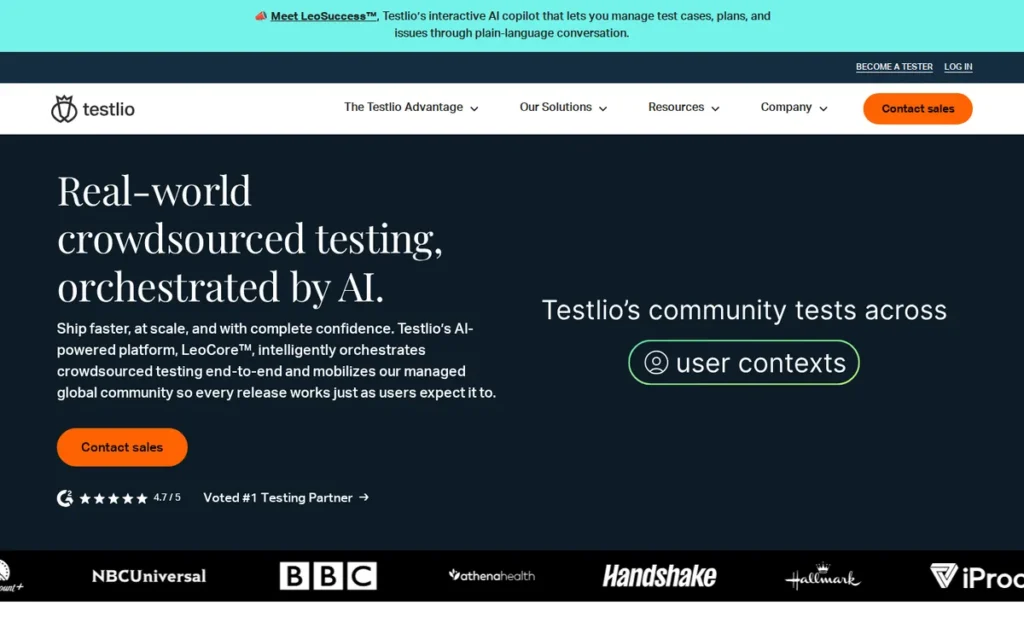
Category: AI-Enhanced Managed Crowd Testing, a fully managed QA service that uses proprietary AI systems to match human testers to projects in real time, covering functional, regression, usability, payments, localization, and automated testing across a global real-device network.
At a Glance
- Category: AI-Enhanced Managed Crowd Testing
- Best For: Enterprise DevOps and QA teams needing AI-orchestrated tester matching, real-device coverage across 150+ countries, and deep internationalization support for payment flows and language localization
- Price Range: Pricing on request; enterprise contracts only; characterized as “expensive” by multiple r/QualityAssurance community members (2024–2025)
- Primary Strength: Testlio’s LeoAI Engine matches testers from a 600,000+ real-device network in real time, using 100+ live signals trained on 13+ years and 2.6 million test cases across 600,000+ real devices
- Biggest Limitation: Testlio’s enterprise-only, quote-based pricing model and absence of any public pricing page create significant evaluation friction for mid-market teams without dedicated procurement resources
- One-Line Summary: Testlio is an AI-powered managed crowd testing platform serving verified enterprise clients including Netflix, PayPal, and Microsoft, with access to 600,000+ real devices across 150+ countries, support for 800+ payment methods and 100+ languages, and a proprietary AI tester-matching system (LeoAI Engine) built on 13 years of testing data.
- Last Verified: June 2026
Overview
Testlio is an AI-powered managed crowd testing platform designed for enterprise QA managers, DevOps teams, and product leads who need intelligent tester matching, broad real-device coverage across 600,000+ devices and 150+ countries, and AI-orchestrated management of both manual and automated testing workflows in a single platform. Testlio’s proprietary LeoAI Engine™ and LeoMatch™ use 100+ live signals drawn from 13+ years and 2.6 million test cases to assign the best-fit testers in real time, giving Testlio a compounding quality advantage over competitors without equivalent operating history.
In 2025–2026, Testlio appointed Summer Weisberg as CEO, signaling a strategic repositioning from managed testing service toward an AI-orchestrated QA platform (CFO Tech, 2025). Additional enterprise clients confirmed in Testlio’s growth blog announcements include Paramount, Clari, Strava, Whatnot, and Merck, expanding the verified portfolio beyond the headline client names.
Key Features
- LeoAI Engine: Testlio’s LeoAI Engine uses 100+ live signals and 13+ years of proprietary testing data covering 2.6 million test cases across 600,000+ real devices to match each client engagement with the best-fit testers in real time, a proprietary data foundation that no competitor can replicate without equivalent operating history (Testlio LeoAI launch announcement, 2025).
- 600,000+ Real Device Network: Testlio provides access to 600,000+ real devices across 150+ countries with support for 100+ languages and 800+ payment methods, the widest payment method and language coverage in this evaluation for teams validating international app releases across diverse payment processors and regional banking systems.
- Comprehensive Testing Type Coverage: Testlio supports functional, regression, exploratory, usability, payments, localization, analytics validation, AI model output testing, and automated frameworks including Selenium, JUnit, and Playwright, the broadest named testing type coverage in this evaluation cohort (Testlio platform blog, 2025).
- DevOps-Native CI/CD Integration: Testlio integrates its AI-orchestrated workflow directly with CI/CD pipelines, enabling continuous quality management as a DevOps-native layer rather than a separate testing phase that disrupts deployment velocity.
- Globally Distributed Organization: Testlio operates as a 100% remote company with staff and testers in 150+ countries, an organizational structure architecturally aligned with the internationally distributed applications it tests, with no facility overhead that could limit geographic flexibility.
Best For
Testlio is best for enterprise organizations with complex, multi-platform application portfolios that require AI-orchestrated tester matching, broad international payment validation, deep language localization coverage, and integrated management of both manual crowd testing and automated frameworks within a single DevOps-compatible platform.
Pricing
Testlio does not publish pricing publicly. All pricing is enterprise-contract and quote-based. Multiple QA community members across r/QualityAssurance (2024–2025) characterize Testlio as “expensive,” confirming it is positioned at the enterprise price tier. Contact Testlio directly for a custom quote. Last verified: June 2026.
Strengths
- Broadest Verified Enterprise Client Portfolio: Testlio’s verified enterprise clients include Netflix, PayPal, Microsoft, Uber, SAP, the NBA, athenahealth, Match Group, and Wayfair, confirmed in a 2025 Testlio platform announcement, with additional clients including Paramount, Clari, Strava, Whatnot, and Merck confirmed in Testlio’s growth blog (2024–2025), representing the broadest named enterprise portfolio in this evaluation cohort.
- Proprietary AI Data Moat: Testlio’s LeoAI Engine is trained on 13+ years and 2.6 million test cases across 600,000+ real devices, a proprietary data foundation no competitor can replicate without equivalent operating history, giving Testlio’s tester-matching system a compounding quality advantage (Testlio LeoAI launch announcement, 2025).
- Strongest Documented Community Endorsement: The QA practitioner community on r/QualityAssurance endorses Testlio with one professional stating “Testlio and uTest are the best. The rest suck” (u/emphasisx, 2024), a peer validation consistent across multiple independent forum threads spanning 2023–2025 and not associated with any promotional activity.
- Sustained Active Community: Multiple r/QualityAssurance community members (2025) report treating Testlio as a primary, full-time income source, a meaningful signal of sustained active project volume rather than a dormant tester registration base.
Limitations
- Cost vs. Capability Trade-off: Testlio’s enterprise-only, quote-based pricing is characterized as “expensive” by multiple r/QualityAssurance community members (2024–2025), placing it out of reach for mid-market teams without dedicated procurement budgets and eliminating cost-comparison visibility before entering a sales cycle.
- Managed Service vs. Gig Economy Reality: Testlio presents buyers a sophisticated managed service while individual testers navigate a gig-economy marketplace competing with hundreds of other freelancers paid primarily on bug discovery, a structural tension noted by r/softwaretesting practitioners (2023) that can create a gap between the premium service perception and the piecework tester dynamic underlying it.
- Tester Incentive vs. Coverage Consistency: Testlio’s LeoMatch AI describes itself as delivering “best-fit tester matching,” but the underlying tester motivation (competing freelancers paid primarily on bug discovery rate) means engagement thoroughness is influenced by factors the AI matching system does not fully control, creating a consistency variable buyers should discuss with Testlio’s delivery team before contracting.
Verdict
Testlio is the top-ranked crowd testing platform in this independent evaluation, distinguished by the broadest verified enterprise client portfolio in the cohort (Netflix, PayPal, Microsoft, Uber, and SAP) the strongest documented organic QA practitioner community endorsement across 2023–2025, and a proprietary AI tester-matching infrastructure (the LeoAI Engine, trained on 13 years and 2.6 million test cases) that no competitor can replicate without equivalent operating history. Testlio’s enterprise-only pricing is a genuine barrier for mid-market teams, but for organizations with the budget and scale to justify it, Testlio’s combination of AI orchestration, real-device coverage breadth, and human expert tester quality represents the strongest overall offering in the managed crowd testing category as of June 2026.
2. Applause: Best for Enterprise Scale, Demographic Coverage, and Category Pedigree
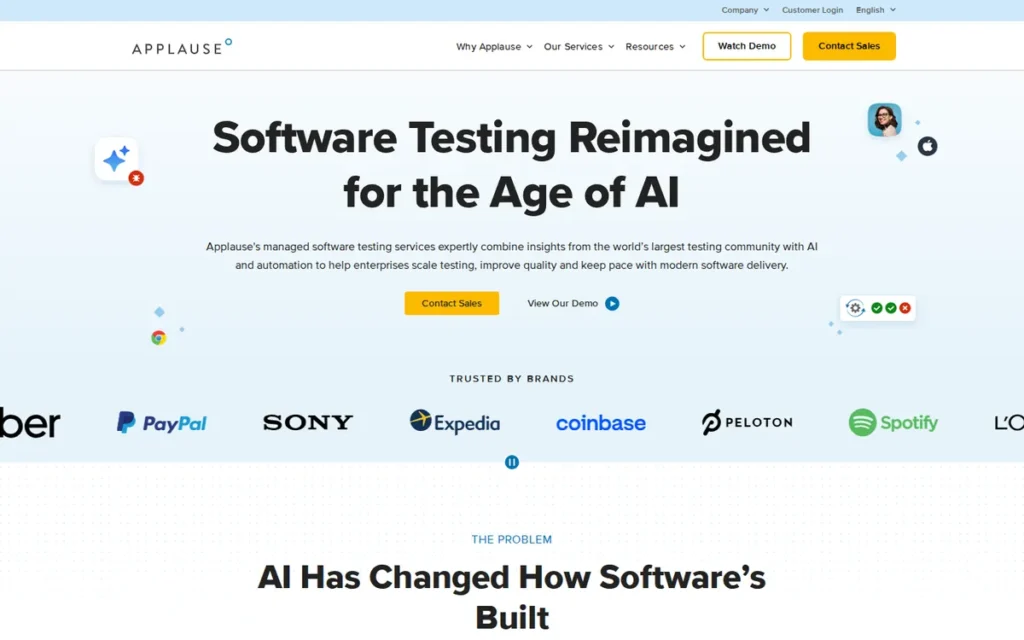
Category: Managed Crowd Testing (Enterprise-Scale), a fully managed, enterprise-only QA service that delegates test scope definition, tester selection, execution, and reporting to a vendor delivery team using a tester community described as 1.5M+ members matched across demographics, device, location, and language dimensions.
At a Glance
- Category: Managed Crowd Testing (Enterprise-Scale)
- Best For: Large consumer-facing enterprises requiring demographically matched, persona-specific real-world testing across functional, payments, accessibility, localization, and IoT scenarios at the scale of a 19-year, 1.5M+ member tester platform
- Price Range: Pricing on request; enterprise contracts only; described as “quite expensive for regular use” and best suited to payments testing by an r/QualityAssurance community member (2023)
- Primary Strength: Applause operates the largest self-reported crowd testing community in the category, with a tester community described as 1.5M+ members across 200+ countries (Applause.com, 2025) and $25M in verified annual tester payouts
- Biggest Limitation: Applause’s fully managed, enterprise-only structure and sales-first procurement model, including a reported sales rep who missed a scheduled call per r/QualityAssurance (2025), make it inaccessible for teams without enterprise budgets and tolerance for multi-step sales cycles
- One-Line Summary: Applause is the founding company of the crowd testing category (established 2007), with a tester community described as 1.5M+ members across 200+ countries (Applause.com, 2025), verified clients including Google, Amazon, Microsoft, and Disney, and $25 million in annual tester payouts confirming the largest self-reported actively engaged crowd testing community in the market.
- Last Verified: June 2026
Overview
Applause is the founding company of the crowd testing category (established in 2007) serving large enterprise organizations that need demographically matched real-world testers across 200+ countries for functional, payments, accessibility, and localization testing of consumer-facing applications at the scale of a fully managed, hands-off QA service. Applause’s $25 million in verified annual tester payouts, documented in a Harvard Business School Digital Initiative case study (estimated publication date 2018–2019), confirms an economically active community rather than a dormant registration base.
The Harvard Business School case study documented approximately $100M in annual revenue and 300,000+ testers at the time of its research (estimated 2018–2019); Applause’s current self-reported community size is 1.5M+ members (Applause.com, 2025). Applause’s 2020 Integrated Functional Testing product was the first in the category to combine crowdsourced manual testing with automation in a single dashboard. IDC-sourced ROI metrics cited by Applause are commissioned research and should be treated as directional rather than independently verified benchmarks.
Key Features
- 1.5M+ Tester Community: Applause operates a tester community described as 1.5M+ members across 200+ countries (Applause.com, 2025), matched across demographic dimensions including device, OS, location, language, age, and user persona, enabling authentic real-world testing from the exact population segments an application targets.
- Integrated Functional Testing: Applause’s Integrated Functional Testing product, launched in 2020, combines crowdsourced manual testing with automated testing in a single unified dashboard, providing both human behavioral signals and automated regression coverage without requiring two separate vendor relationships (Business Wire, May 6, 2020).
- Fully Managed Enterprise QA: Applause delivers fully managed testing services with enterprise-grade NDA enforcement and CI/CD integrations, handling test scope definition, tester selection, execution, and reporting entirely on the client’s behalf so buyers can fully delegate the testing operation.
- Broad Testing Type Coverage: Applause covers functional, payments, accessibility, localization, IoT, and usability testing, supported by a 19-year operating history that produces the largest proprietary tester performance dataset in the crowd testing category.
- Verified Blue-Chip Client Roster: Applause’s independently verified enterprise clients include Google, Amazon, Microsoft, Facebook, Uber, PayPal, eBay, Disney, BMW, Ford, and Adidas, confirmed across a Harvard Business School case study and r/UTEST community member verification, the most extensively corroborated client list in this evaluation.
Best For
Applause is best for large consumer-facing enterprises that need demographically matched testers representing their exact target markets (including persona-specific device, geographic, language, disability, and age segmentation) across the full spectrum of functional, payments, localization, and usability testing at a scale that only a 19-year, 1.5M+ member tester platform can credibly deliver.
Pricing
Applause does not publish pricing publicly. All pricing is sales-led and custom-quoted. One r/QualityAssurance community member (2023) described Applause as “quite expensive for regular use” and specifically suited to payments testing. The Harvard Business School case study (estimated 2018–2019) confirmed approximately $100M in annual revenue, corroborating the enterprise price tier. Contact Applause directly for a custom quote. Last verified: June 2026.
Strengths
- IDC-Quantified ROI: An IDC commissioned report titled The Business Value of Applause found organizations using the platform experienced 70% more efficient testing teams and $1.54 million in average avoided critical bug resolution costs, the most specific ROI quantification in this evaluation, though the commissioned nature requires treating figures as directional rather than independently verified benchmarks (IDC report, as cited in Applause blog; full report publication date not publicly available as of June 2026 research).
- 19-Year Operating Scale With Verified Tester Payouts: Applause has operated since 2007, generating $25 million in verified annual tester payouts (Harvard Business School case study, estimated 2018–2019), to contextualize this scale, $25 million in annual payouts means Applause’s community earns approximately $68,000 in completed testing work per day, a payout rate only possible if active projects are running continuously, not episodically (Harvard Business School Digital Initiative).
- Most Extensively Verified Client Roster: Applause’s client list: independently confirmed across a Harvard Business School case study and r/UTEST community member verification, includes Google, Amazon, Microsoft, Facebook, Uber, PayPal, eBay, Disney, BMW, Ford, and Adidas, representing the broadest blue-chip enterprise validation in this evaluation cohort.
This long-standing market position resonates in independent community discussions on r/UTEST:
“Also, uTest was founded back around 2008 – nearly 20 years ago. You don’t start a company almost 20 years ago, work with the likes of Microsoft, Google, NFL, General Motors, Hyundai, Ford, Bank of America, Chase Bank, Barclays and maintain those contracts for year and years and years – and run a scamy company. Applause is legit. So much so, there are other crowd-testing platforms out there trying to do the same thing, but with much less success.” Posted by u/BigGriz_TO
Takeaway: Applause’s 19-year blue-chip client retention record is independently recognized by practitioner community members as the definitive benchmark against which competing crowd testing platforms fall short.
- Category Founding Authority and Innovation Precedent: Applause launched the first Integrated Functional Testing product combining crowdsourced manual testing with automation in a single dashboard in 2020 (Business Wire, May 6, 2020), establishing both category authority and product innovation precedent in the blended human-plus-automated testing model.
Limitations
- Enterprise-Only Accessibility: Applause’s most consequential trade-off is accessibility versus scale, the fully managed, enterprise-only model that enables its 1.5M+ tester depth and blue-chip client roster is the same structure that makes it impractical for teams without enterprise budgets or tolerance for sales-led procurement cycles before any cost visibility.
- Project Quality Variance Risk: Community members on r/UTEST report that poorly specified project briefs (a responsibility shared between Applause’s delivery team and client stakeholders) can produce test cycles with inaccurate time estimates, intrusive pre-admission surveys, and inconsistent management quality that undermines results even on an established platform.
- Sales Process Friction: One r/QualityAssurance member (2025) reported that an Applause sales representative missed a scheduled call, a single data point, not a documented pattern, but a buyer experience signal worth noting as an expectation-setter for the enterprise sales experience before any pricing or platform access is established.
Verdict
Applause is the founding company of the crowd testing category (established 2007) and the most extensively documented platform in this evaluation, with a tester community described as 1.5M+ members across 200+ countries (Applause.com, 2025), $25 million in verified annual tester payouts (Harvard Business School case study, estimated 2018–2019), and a 19-year enterprise client roster independently confirmed to include Google, Amazon, Microsoft, and Disney. Applause ranks second behind Testlio primarily because QA practitioner community enthusiasm in independent forums is slightly less emphatic and AI-native workflow documentation is less explicit, but for enterprise buyers prioritizing platform pedigree, tester community scale, and the most thoroughly verified blue-chip client record in the category, Applause is the market’s most financially documented and longest-operating crowd testing platform.
3. Global App Testing: Best for Agile and DevOps Speed: Fastest Verified Managed Crowd Testing Turnaround
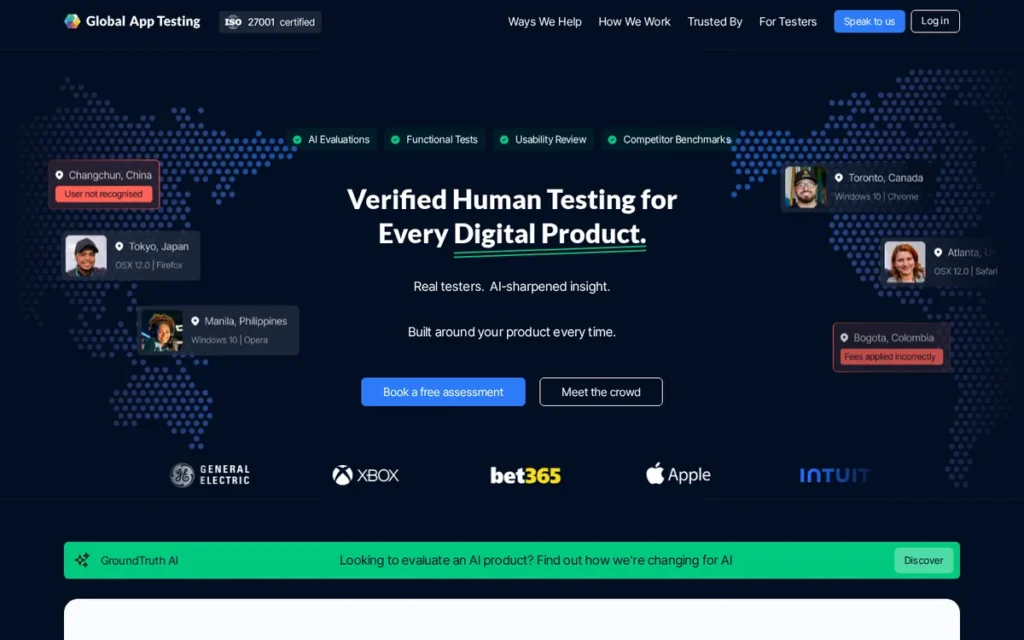
Category: Managed Crowd Testing (Speed-First), a fully managed QA service optimized for 1–48 hour results delivery, purpose-built for Agile and DevOps teams needing human crowd test validation without disrupting CI/CD pipeline velocity.
At a Glance
- Category: Managed Crowd Testing (Speed-First)
- Best For: Agile and DevOps engineering teams running continuous deployments who need human crowd test results within 1–48 hours and native CI/CD integration, particularly for web and mobile validation across international time zones
- Price Range: Pricing on request; Wispra directory (2024) cites €10,000+ per service as a single directional reference, not a confirmed price list; enterprise-oriented
- Primary Strength: Global App Testing delivers human crowd test results in as little as 1 hour through 70,000–90,000+ vetted professional testers across 190+ countries, the fastest independently confirmed managed crowd testing turnaround in this evaluation
- Biggest Limitation: Global App Testing has the weakest publicly documented organic community endorsement among managed crowd testing providers in this evaluation, with no easily verifiable aggregate G2 or Capterra score and more muted Reddit practitioner discussions than peers
- One-Line Summary: Global App Testing is a UK-based managed crowd testing platform delivering human test results in as little as 1 hour via 70,000–90,000+ vetted professional testers across 190+ countries (EuroSTAR Conference, 70,000+; Latka, 90,000+; figures captured June 2026), with native CI/CD, Jira, and GitHub integrations, and verified enterprise clients including Google, Microsoft, Instagram, TripAdvisor, and Skyscanner.
- Last Verified: June 2026
Overview
Global App Testing is a UK-based managed crowd testing platform built for Agile and DevOps teams that need human QA validation results returned in 1–48 hours, with native CI/CD integration and 70,000–90,000+ vetted professional testers across 190+ countries. Global App Testing’s tester count is independently cited at 70,000+ by the EuroSTAR Software Testing Conference and at 90,000+ by Latka third-party business data (both captured June 2026), the platform combines paid professional QA testers with real users, addressing the quality consistency concern common to pure crowdsourcing.
Global App Testing operates at 24/7 capacity, enabling coordinated testing coverage across Americas, EMEA, and APAC time zones within a single release cycle, a structural advantage for QA managers coordinating international releases who cannot afford testing windows limited by a single geography’s business hours.
Key Features
- 1-Hour Minimum Results Turnaround: Global App Testing delivers human crowd test results in as little as 1 hour and a standard 2–48 hour window, independently confirmed across G2, Capterra, and Wispra, making Global App Testing the fastest confirmed managed crowd testing service for Agile and DevOps teams in this evaluation.
- Native CI/CD Workflow Integration: Global App Testing provides native workflow integrations with Jira, GitHub, and CI/CD pipelines, enabling crowd test results to feed directly into development sprints without adding manual coordination overhead between testing cycles and deployments.
- Hybrid Professional Tester Pool: Global App Testing operates a pool of 70,000–90,000+ vetted professional testers across 190+ countries (EuroSTAR Conference, 70,000+; Latka, 90,000+; June 2026), combining paid professional QA testers with real users to balance structured test execution quality with authentic behavioral signals from diverse real-world device configurations.
- Comprehensive Testing Type Coverage: Global App Testing covers functional, regression, exploratory, localization, usability, compatibility, and payment flow testing, with 24/7 testing capacity enabling coordinated coverage across Americas, EMEA, and APAC time zones within a single release cycle.
- Verified Enterprise Client Deployments: Global App Testing has verified enterprise clients including Google, Microsoft, Instagram, TripAdvisor, and Skyscanner, confirmed via the EuroSTAR Software Testing Conference technology expo profile, validating deployment at scale for high-traffic, globally distributed consumer applications.
Best For
Global App Testing is best for Agile and continuous deployment teams that require human crowd test validation returned within 1–48 hours and need results to feed directly into sprint cycles via native Jira, GitHub, and CI/CD integrations, particularly for teams whose release calendar spans multiple international time zones requiring 24/7 testing capacity.
Pricing
Global App Testing does not publish pricing publicly. One directory source (Wispra, 2024) cites €10,000 per service as a single directional reference point, not a confirmed price list. All confirmed pricing is sales-led and custom-quoted. Contact Global App Testing directly for current pricing. Last verified: June 2026.
Strengths
- Fastest Verified Managed Turnaround: Global App Testing’s 1-hour minimum crowd test results delivery is independently confirmed across G2, Capterra, and a Wispra business directory listing, making Global App Testing the only managed crowd testing platform in this evaluation to confirm sub-hour result delivery across three independent sources.
- Verified Enterprise Client Roster: Global App Testing’s enterprise clients: Google, Microsoft, Instagram, TripAdvisor, and Skyscanner, were confirmed via the EuroSTAR Software Testing Conference technology expo profile, an independent third-party source validating deployment at scale for companies with high-traffic, globally distributed consumer applications.
- Direct DevOps Integration Validation: A SoftwareReviews customer testimonial confirms that Global App Testing “fits directly into development cycles, making it easy for teams to get real-world test results without slowing down deployment” (date of original review unspecified (captured during June 2026 research)) directly validating Global App Testing’s core DevOps integration value proposition in the words of a verified buyer.
- EMEA Compliance Alignment: Global App Testing’s UK headquarters and 190+ country tester coverage provide geographic alignment with GDPR compliance requirements for European enterprise buyers and 24/7 testing capacity that addresses the QA coordination challenge across international release calendars.
Limitations
- Social Proof Gap: Global App Testing’s primary trade-off is speed positioning versus independently verified peer evidence, while its 1-hour turnaround is confirmed across three sources, Global App Testing has the weakest documented organic community endorsement among managed crowd testing providers, with no aggregate G2 or Capterra score easily verifiable from public sources and more muted Reddit practitioner discussions than Testlio or Applause.
- No Independently Quantified Outcome Metrics: Global App Testing has no publicly available quantified outcome metrics (no bug count figures, no efficiency gain data, no ROI quantification from independent sources) leaving buyers reliant entirely on vendor-provided case studies for ROI justification, a meaningful evidence gap compared to Testlio’s named client portfolio and Applause’s Harvard case study.
- Pricing Signal Scarcity: Global App Testing requires a sales conversation before any cost visibility, and the only directional pricing signal (€10,000+ per service from a single Wispra directory listing) provides limited benchmarking confidence for procurement teams coordinating multi-vendor evaluations simultaneously.
Verdict
Global App Testing is the fastest independently verified managed crowd testing platform in this evaluation, delivering human test results in as little as 1 hour through 70,000–90,000+ vetted professional testers across 190+ countries, with confirmed enterprise clients including Google, Microsoft, and Instagram. Global App Testing ranks third behind Testlio and Applause primarily because its organic community endorsement is more muted and its publicly verifiable review evidence is thinner, but for Agile and DevOps teams whose primary constraint is speed of human test feedback within sprint cycles, Global App Testing’s turnaround advantage is unmatched in the managed crowd testing segment.
4. Cobalt: Best for Security Testing: The Only PTaaS Platform in This Evaluation
Category: Security Testing / PTaaS (Pentest-as-a-Service), a structured offensive security testing platform that is NOT a functional QA crowd testing service; uses an invite-only vetted community of professional security testers to execute penetration tests, API security assessments, and attack surface management for DevSecOps and compliance teams.
At a Glance
- Category: Security Testing / PTaaS (Pentest-as-a-Service): NOT a functional QA crowd testing service
- Best For: Security, DevSecOps, and compliance teams needing structured penetration testing launched within sprint cycles by credentialed professionals, NOT suitable for functional QA, regression, usability, or localization testing
- Price Range: $13,800–$20,000+ per SMB-scale engagement (Cobalt PTaaS cost analysis, 2025; vendor-sourced estimate, not independently verified); enterprise programs with multiple assets scale significantly higher; public pricing page at cobalt.io/pricing
- Primary Strength: Cobalt holds ISO 27001 and SOC 2 Type 2 certifications, launches penetration tests in as little as 24 hours, and includes complimentary post-remediation retesting, the most compliance-ready and operationally agile PTaaS offering in this evaluation
- Biggest Limitation: Cobalt is a security-specialized PTaaS platform that cannot substitute for functional QA, regression testing, usability validation, localization coverage, or any non-security testing need
- One-Line Summary: Cobalt is a Pentest-as-a-Service (PTaaS) platform: not a functional QA crowd testing service, offering web application, API, network, and cloud security testing through an invite-only vetted tester community, with ISO 27001 and SOC 2 Type 2 certifications, 24-hour pentest launch capability, and complimentary post-remediation retesting.
- Last Verified: June 2026
Overview
Cobalt is a Pentest-as-a-Service (PTaaS) security testing platform, not a functional QA crowd testing service, serving security, DevSecOps, and compliance teams that need structured penetration testing launched within 24 hours, executed by an invite-only vetted tester community, and validated by ISO 27001 and SOC 2 Type 2 certified infrastructure. Cobalt’s model reduces penetration testing timelines from the weeks-long lead times of traditional security consulting to 24-hour launches, a structural advantage for DevSecOps teams incorporating security validation into sprint cycles.
Buyers seeking functional, usability, regression, or localization testing should evaluate Testlio, Applause, or Global App Testing; Cobalt’s capabilities are exclusively security-focused. Cobalt was founded in 2014 as CrowdCurity and rebranded to its current identity, a deliberate shift from crowd-testing associations to a professional security platform identity that reflects its enterprise security positioning (CB Insights).
Key Features
- Comprehensive Security Testing Scope: Cobalt provides web application penetration testing, API security testing, cloud infrastructure testing, network penetration testing, secure code review, dynamic application security testing (DAST), and attack surface management through its invite-only Cobalt Core community of vetted security professionals.
- 24-Hour Pentest Launch Capability: Cobalt’s PTaaS model launches penetration tests in as little as 24 hours (enabling sprint-cycle security testing in DevSecOps workflows) compared to the weeks-long lead times typical of traditional security consulting engagements.
- Enterprise Compliance Certifications: Cobalt holds ISO 27001 and SOC 2 Type 2 certifications, confirmed by the Cybersecurity Excellence Awards (2025) and Cobalt’s own Trust Center documentation, providing independently audited evidence of data security and compliance governance that enterprise procurement requires.
- Complimentary Post-Remediation Retesting: Cobalt includes complimentary post-remediation retesting with every pentest engagement, allowing engineering teams to verify within the same contract that identified vulnerabilities have been successfully resolved, a quality assurance loop not standard in traditional security consulting.
- AI-Augmented Human Pentesting: Cobalt announced AI-powered innovations augmenting its human-led pentesting workflows in October 2025 (Business Wire), positioning AI as an enhancement to (not a replacement of) human security expertise in a domain where false negatives carry material organizational risk.
Best For
Cobalt is best for security and DevSecOps teams that need structured penetration testing launched within sprint cycles, with verified tester credentials, compliance certifications, and post-remediation retesting included. Cobalt is not a substitute for functional QA, regression, usability, localization, or any non-security testing need, buyers with those requirements should evaluate Testlio, Applause, or Global App Testing.
Pricing
Cobalt is the only platform in this evaluation with a public pricing page at cobalt.io/pricing. Per Cobalt’s own PTaaS cost analysis (2025), typical SMB-scale engagements range from approximately $13,800 to $20,000 per engagement (vendor-sourced estimate, not independently verified by PlugRoute research; buyers should obtain quotes from traditional security consulting firms to validate this comparison for their specific engagement scope and asset complexity). Enterprise programs covering multiple assets or continuous monitoring scale significantly higher. Cobalt’s own analysis estimates PTaaS costs approximately 31% less than equivalent traditional security consulting. Last verified: June 2026.
Strengths
- ISO 27001 and SOC 2 Type 2 Certifications: Cobalt holds independently audited ISO 27001 and SOC 2 Type 2 certifications, non-negotiable requirements for enterprise security procurement, confirmed by the Cybersecurity Excellence Awards (2025), confirming that Cobalt meets the same data security standards it helps clients achieve.
- 31% Cost Reduction vs. Traditional Pentesting (Vendor-Sourced Estimate): Cobalt’s PTaaS model reduces penetration testing costs by approximately 31% compared to traditional security consulting (comparing a $20,000 traditional engagement to an approximately $13,800 PTaaS equivalent) per Cobalt’s published cost analysis (2025); buyers should characterize this as vendor-sourced and directional, and obtain independent quotes before using this figure in internal procurement justifications.
- Organic Security Community Endorsement: Cobalt is organically recommended alongside Bishop Fox and Edgescan in the r/cybersecurity community (u/Awkward-Relief-9475, 2024) (two established professional security firms) positioning Cobalt as a credible practitioner-recognized choice rather than a solely marketing-led vendor.
A verified Cobalt buyer on r/AskNetsec confirmed active deployment satisfaction:
“We use Cobalt. They’re probably more expensive because they provide you with a small team of pen testers. They have a pretty decent platform and we’re pretty satisfied with them overall. Ironically, when we were looking at pen testing firms last year, Cobalt was magnitudes cheaper than the other manual testing options we were considering.” Posted by u/accountability_bot
Takeaway: Enterprise buyers who complete a rigorous multi-vendor security evaluation consistently find that Cobalt’s PTaaS pricing compares favorably against traditional security consulting alternatives when benchmarked against equivalent engagement scope and depth.
- Active AI Product Investment: Cobalt announced AI-powered innovations augmenting its human-led pentesting platform in October 2025 (Business Wire), confirming active product investment and positioning Cobalt within the AI-enhanced DevSecOps toolchain trend.
Limitations
- Specialization vs. Scope: Cobalt’s most consequential trade-off is specialization versus scope, Cobalt is purpose-built for offensive security testing and cannot substitute for functional QA, regression testing, usability validation, localization coverage, or any non-security testing need. Buyers selecting Cobalt for security testing will still require a separate functional crowd testing vendor for their complete QA workflow.
- Engagement Duration vs. Sprint Cycle Compatibility: Cobalt’s structured 2–4 week professional engagement format, confirmed by r/Pentesting community members as involving daily reporting and approximately 20 hours per week, means the “24-hour launch” refers to starting the pentest, not completing it. Teams expecting to complete a full pentest within a single 1-week sprint will need to adjust sprint cadence or treat security testing as a multi-sprint exercise.
- Gig-Economy Perception Risk: Community members on r/cybersecurity have characterized platform-mediated PTaaS as “gig-work hackers” with variable quality (u/glitchwitchsec, 2024), though Cobalt’s invite-only Cobalt Core vetting and structured professional engagement format are explicitly designed to differentiate Cobalt from piecework bug-bounty arrangements, a distinction buyers should confirm during the evaluation process.
Verdict
Cobalt is the only dedicated security testing platform in this evaluation and the strongest choice for DevSecOps and compliance teams that need penetration testing launched within sprint cycles, executed by ISO 27001 and SOC 2 Type 2 certified infrastructure, with post-remediation retesting included. Cobalt ranks fourth overall because it serves a fundamentally different buyer need than functional crowd testing, security teams should evaluate Cobalt; QA teams seeking functional, regression, or usability crowd testing should look to Testlio, Applause, or Global App Testing. Within its security niche, Cobalt’s 24-hour launch capability, compliance certifications, and public pricing page make it the most operationally agile and transparently priced PTaaS option in this evaluation.
5. Testbirds: Best for IoT Testing, European Enterprises, and Accessibility Compliance
Category: Managed Crowd Testing (European/IoT Specialist), a fully managed crowd testing service with verified IoT testing specialization and European Accessibility Act compliance capabilities, operating from Munich with a 250,000–1,000,000+ tester network matched across 65+ demographic dimensions.
At a Glance
- Category: Managed Crowd Testing (European/IoT Specialist)
- Best For: European enterprises, IoT and connected-device product teams, and organizations requiring European Accessibility Act compliance testing, multilingual user journey validation, or highly targeted demographic tester populations not replicable with general-population pools
- Price Range: Pricing on request; characterized as “comparably cheap” relative to traditional agency testing in a Harvard Business School case study (estimated 2018–2019, treat as historical academic signal, not current pricing guidance); no current public pricing available
- Primary Strength: Testbirds is the only crowd testing platform among the seven evaluated here with verified IoT testing specialization and the only platform in the cohort with a publicly verifiable G2 aggregate score (4.0/5.0, 22 reviews, G2 2025)
- Biggest Limitation: Testbirds project availability is documented by community members as “super rare” despite large registered tester counts, indicating active deployment volume substantially lower than registration totals imply
- One-Line Summary: Testbirds is a Munich-based managed crowd testing platform founded in 2011, rated 4.0/5.0 on G2 (22 reviews, G2 2025), specializing in IoT testing, European Accessibility Act compliance, and 65+ demographic-dimension tester matching across 250,000–1,000,000+ testers in 193 countries, with verified clients including Audi and Allianz.
- Last Verified: June 2026
Overview
Testbirds is a Munich-based managed crowd testing platform founded in 2011, serving European enterprise, IoT product, and accessibility-focused teams that need usability, bug, and real-device quality testing from a community of 250,000–1,000,000+ testers matched across 65+ demographic dimensions in 193 countries. Testbirds’ IoT testing specialization (the only verified capability of its kind among all seven platforms in this evaluation) makes Testbirds uniquely positioned for automotive, smart home, connected-device, and industrial IoT product teams.
Testbirds holds a formal enterprise delivery partnership with Qualitest, a global QA company, extending its capacity for large-scale or geographically complex engagements. With offices in Munich, Amsterdam, London, and Stockholm, Testbirds is the only vendor in this evaluation with a confirmed multi-office European footprint (TheHub.io).
Key Features
- IoT Testing Specialization: Testbirds is the only crowd testing platform among the seven evaluated here with a verified IoT testing specialization, supporting quality assurance for connected devices, smart home applications, automotive infotainment systems, and industrial IoT software, a capability not offered by any other platform in this article.
- 65+ Demographic Dimension Matching: Testbirds matches testers across 65+ demographic dimensions including age, location, language, device type, and accessibility needs, enabling highly targetedtest populations for products with specific user personas that general-population matching cannot precisely address.
- European Accessibility Act Compliance Testing: Testbirds supports European Accessibility Act (EAA) compliance testing, making Testbirds the strongest option in this evaluation for EU-regulated products required to meet accessibility standards before market launch.
- Bugability Test Methodology: Testbirds’ proprietary “Bugability Test” methodology combines use-case execution with qualitative and quantitative user feedback, generating both structured defect reports and user experience insights in a single test cycle.
- Publicly Verifiable G2 Rating and Enterprise Partnerships: Testbirds holds a G2 rating of 4.0/5.0 based on 22 reviews G2, 2025 (the only publicly verifiable aggregate review score among all seven platforms in this evaluation) with verified enterprise clients including Audi and Allianz and a formal delivery partnership with Qualitest.
Best For
Testbirds is best for European enterprises, automotive and connected-device product teams, and organizations that require European Accessibility Act compliance testing, multilingual user journey validation, and access to 65+ demographic-dimension tester matching, use cases where Testbirds’ IoT specialization and European regulatory alignment provide advantages that North American-headquartered platforms cannot match.
Pricing
Testbirds does not publish a current pricing page with specific tiers. A Harvard Business School case study (estimated publication date approximately 2018–2019) characterizes the platform as “comparably cheap” relative to traditional QA agency testing, a historical academic signal that should be treated as directional context only, not current pricing guidance. All confirmed pricing is project-based and quote-driven. Contact Testbirds directly for current pricing. Last verified: June 2026.
Strengths
- Only Verifiable Aggregate Review Score in This Cohort: Testbirds has a publicly verifiable G2 rating of 4.0/5.0 based on 22 reviews G2, 2025 (the only independently confirmed aggregate review score among all seven platforms in this evaluation) providing a verifiable quality baseline against which other vendors’ self-described performance cannot be directly compared.
- Documented Defect-Finding Scale: Testbirds testers had found 90,000 bugs across 250,000 products tested, as documented in a Harvard Business School Digital Initiative case study (estimated publication date approximately 2018–2019, figures reflect the platform’s scale at the time of case study research; current cumulative totals would be expected to substantially exceed these historical figures after 7+ additional years of operation).
- Enterprise Delivery Partnership: A formal enterprise delivery partnership with Qualitest, a global QA company, extends Testbirds’ capacity for large-scale or geographically complex engagements, adding enterprise delivery infrastructure that independent boutique crowd testing platforms cannot match.
- European Multi-Office Footprint: Testbirds is headquartered in Munich with confirmed offices in Amsterdam, London, and Stockholm (TheHub.io) (the only vendor in this evaluation with a confirmed multi-office European presence) providing geographic and regulatory alignment with GDPR data handling requirements and EU accessibility legislation.
Limitations
- Project Availability Inconsistency: Testbirds’ most significant trade-off is tester pool size versus active engagement volume, despite 250,000–1,000,000+ registered testers, multiple independent community members report that receiving project invitations is “super rare,” with one r/beermoney community member stating it is “very inconsistent” relative to peers (u/0ppaiMan, 2022), suggesting the active deployed portion is substantially smaller than the registration count implies.
Users on r/beermoney described the gap between Testbirds’ registration size and active deployment volume firsthand:
“uTest is very time-consuming if you don’t know where to look for bugs which is why I quit it, took far too long to find bugs for such menial pay. TestBirds is better in my experience but getting tests is super rare so it’s very inconsistent.” Posted by u/0ppaiMan
Takeaway: Testbirds’ active project throughput is substantially lower than its registered tester count implies, buyers must confirm tester availability for their specific device, OS, and geographic requirements before treating the registration total as a deployment capacity figure.
- Modest Funding and Feature Development Pace: Testbirds’ verified 2014 Series A funding of $2.9 million (the most modest confirmed funding total among the seven evaluated platforms by a wide margin) may limit Testbirds’ capacity for AI feature investment and platform development compared to Rainforest QA ($42.3M total funding), creating a potential long-term platform capability gap for buyers making multi-year vendor commitments.
- Limited Review Volume Confidence: Testbirds’ 4.0/5.0 G2 rating is based on only 22 reviews G2, 2025 (the thinnest review base among evaluated platforms) which limits statistical confidence in the aggregate score relative to platforms with higher review volumes, requiring buyers to supplement with direct reference checks and the Qualitest partnership evidence.
Verdict
Testbirds is the top choice for European enterprises and IoT product teams in this evaluation, distinguished as the only platform among the seven evaluated here with verified IoT testing specialization, the only platform with a publicly verifiable G2 aggregate score (4.0/5.0), and the strongest offering for European Accessibility Act compliance testing in this cohort. Testbirds ranks fifth overall because its documented project availability inconsistency (multiple community members describe invitations as “super rare”) raises throughput concerns for teams needing high-frequency crowd test cycles. Testbirds occupies a niche no other evaluated platform fills: if your application runs on a connected device, requires EAA compliance validation, or needs tester matching across 65+ demographic dimensions, Testbirds is the only evaluated option that addresses these requirements directly.
6. Rainforest QA: AI-First Test Automation Platform (Crowd Testing Option Available; AI Automation Is the Primary Product Direction)
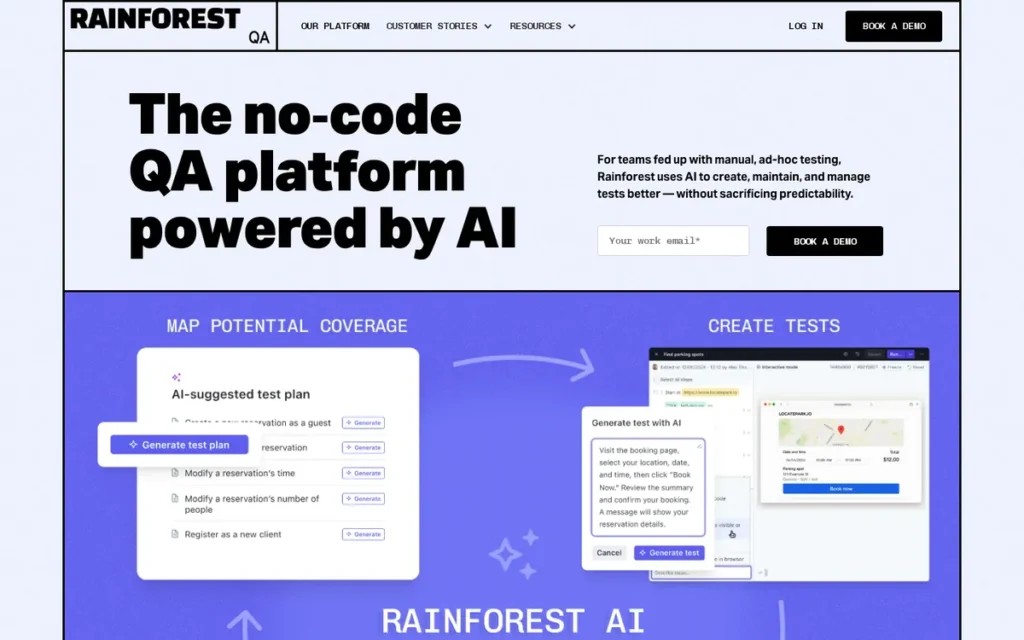
Category: AI-Hybrid Test Automation (AI-First Expansion (crowd testing option available; AI automation is the primary product direction as of December 2025)) an AI-powered no-code test automation platform whose primary featured capabilities center on AI-generated self-healing regression testing; Rainforest QA’s crowd testing service remains available as a secondary option, but teams whose primary requirement is human-tester behavioral diversity should verify current crowd testing availability before contracting.
At a Glance
- Category: AI-Hybrid Test Automation (AI-First Expansion: crowd testing option available; AI automation is the primary product direction as of December 2025)
- Best For: DevOps and engineering-led teams needing AI-generated, self-healing regression test automation without QA coding resources, teams whose primary requirement is human crowd tester diversity, geographic coverage, or demographic representation should verify current crowd testing availability and tester pool depth before contracting
- Price Range: Volume-based pricing; ~$94,000/year estimated for enterprise deployments (Bug0.com analysis, 2025); 60-day money-back guarantee referenced; pricing on request
- Primary Strength: Rainforest QA’s AI Test Planner, launched December 2, 2025, autonomously generates a full structured test suite from a provided URL with self-healing maintenance, delivering automated regression coverage in days rather than the months required to build comparable code-first automation frameworks
- Biggest Limitation: Rainforest QA’s AI-first product direction means crowd testing is a secondary capability, teams selecting Rainforest QA specifically for human-tester behavioral diversity, geographic coverage, or demographic representation should verify current crowd testing availability and tester pool depth before contracting
- One-Line Summary: Rainforest QA is an AI-powered no-code test automation platform (crowd testing remains available as a secondary option) holding $42.3M in total funding, featuring an AI Test Planner launched December 2025, and best suited for DevOps teams needing automated regression coverage without QA coding resources.
- Last Verified: June 2026
Overview
Rainforest QA is an AI-powered no-code test automation platform that has substantially expanded toward AI-first test automation while maintaining its original crowd testing service as an option. Rainforest QA’s primary featured capabilities, active development investment, and marketing positioning center on AI-generated self-healing regression testing rather than human tester community management as of December 2025 (per Rainforest QA accessible-test-automation page). Teams whose primary requirement is human-tester behavioral diversity, geographic coverage, or demographic representation should verify current crowd testing availability and tester pool depth before contracting.
Rainforest QA’s AI Test Planner, launched December 2, 2025, autonomously crawls a web application from a starting URL and generates a structured test plan without manual scripting, addressing the months-long implementation timeline that makes code-first frameworks inaccessible for resource-constrained teams. Backed by $42.3 million in total funding and reportedly listed on GSA Advantage (Bug0.com, 2025, not independently verified by PlugRoute research), Rainforest QA is financially stable and market-credentialed.
Key Features
- AI Test Planner: Rainforest QA’s AI Test Planner, launched December 2, 2025, autonomously crawls a web application from a provided starting URL, generates a structured test plan covering key user flows, and creates executable test cases without any manual scripting, delivering usable automated test coverage in days rather than months (Rainforest QA blog, December 2, 2025).
- Self-Healing Test Maintenance: Rainforest QA includes self-healing test maintenance that automatically detects intentional UI changes and updates affected test cases, eliminating the highest-frequency maintenance burden in traditional automation frameworks that causes test suites to degrade over time as applications evolve.
- VM-Level Cross-Platform Testing: Rainforest QA tests on cloud-based virtual machines simulating complete Windows, Mac, Android, and iOS environments at the OS level (not browser-only) enabling native app behaviors, OS-level interactions, and desktop-class scenarios that browser automation tools like Cypress or Playwright cannot reach (Rainforest QA blog).
- Automated Jira Bug Ticket Creation: Rainforest QA integrates with Jira to automatically create bug tickets with contextual evidence including video recordings, HTTP logs, and screenshots when tests fail, reducing the triage and reproduction burden on development teams within CI/CD workflows.
- AI-First Direction With Crowd Testing Option: Rainforest QA’s primary product direction centers on AI-generated test automation as of December 2025; the platform’s crowd testing service remains available as a secondary option, though teams expecting the human-tester community depth of a fully managed crowd testing platform should confirm current crowd testing availability and tester pool specifics directly with Rainforest QA before contracting.
Best For
Rainforest QA is best for DevOps-led engineering teams that need fast, no-code regression coverage without QA engineering headcount, specifically when the requirement is AI-generated test automation with self-healing maintenance. Teams whose primary requirement is human crowd-based behavioral diversity, geographic coverage, or demographic representation should evaluate Testlio, Applause, Global App Testing, Testbirds, or Ubertesters instead, as those five platforms are fully managed human crowd testing services with active tester communities as their primary product capability.
Pricing
Rainforest QA uses volume-based pricing without a public tier structure. Third-party analysis estimates annual enterprise deployment costs at approximately $94,000/year for some enterprise users (Bug0.com alternatives analysis, 2025), treat this as a single-source directional estimate, not a confirmed price list. A 60-day money-back guarantee has been referenced in platform documentation. Costs scale with test run frequency; high-deployment-cadence teams should model cost escalation before committing to a volume-based contract.
Rainforest QA is reportedly listed as a contracted vendor on GSA Advantage (U.S. General Services Administration procurement platform), according to third-party analysis (Bug0.com, 2025), this claim could not be independently verified by PlugRoute research. Buyers from qualifying U.S. federal organizations should verify current contract status directly with GSA Advantage (gsaadvantage.gov) before relying on this as a procurement pathway. Last verified: June 2026.
Strengths
- AI Test Planner, Fastest Path From Zero to Automated Coverage: Rainforest QA’s AI Test Planner, launched December 2, 2025, autonomously generates a full structured test suite from a starting URL in days rather than the months required by code-first automation frameworks, directly addressing the highest-friction phase of automated testing adoption for resource-constrained teams (Rainforest QA blog, December 2, 2025, Perplexity-confirmed).
- Highest Verified Investment in This Cohort: Rainforest QA has raised $42.3 million in total funding (the highest verified investment among all seven platforms in this evaluation) indicating strong investor conviction in the AI no-code test automation market and financial runway for continued product development (Bug0.com, 2025).
- Multi-Platform High-Rating Attestation: Third-party analyst sources describe Rainforest QA as delivering automated test coverage “within days rather than months,” with “consistently high ratings” on G2, Capterra, and TrustRadius (Checkthat.ai brand profile, 2025), the only platform in this evaluation with a multi-platform “consistently high” cross-rating attribution from an independent analyst source.
- Self-Healing Maintenance Advantage: Rainforest QA’s self-healing test maintenance automatically updates test cases when intentional UI changes occur, directly eliminating the highest-frequency maintenance burden in automation testing and reducing the QA engineering overhead that makes traditional automation frameworks expensive to maintain at production scale.
Limitations
- AI-First Product Direction Means Crowd Testing Is Secondary: Rainforest QA’s most consequential trade-off is AI automation efficiency versus human crowd diversity. Rainforest QA’s primary featured capabilities, active development resources, and marketing emphasis center on AI automation rather than human tester deployment as of December 2025. Teams selecting Rainforest QA specifically for human-tester behavioral diversity should verify current crowd testing cycle availability, tester pool depth for their specific requirements, and dedicated support levels before contracting.
This aligns with buyer-side feedback on r/QualityAssurance:
“Yeah, outside of their open-ended exploratory test runs, I remember it being of no value. Their regular test runs were useless, always only failing because of some trivial technicality in the wording of the test steps.” Posted by u/pianoflames
Takeaway: Rainforest QA’s manual crowd testing service consistently underdelivers relative to its AI automation capability, confirming that human-tester behavioral diversity is not the platform’s primary or reliable output for buyers who require it.
- Cost Scaling Risk: At approximately $94,000/year for some enterprise users under volume-based pricing (Bug0.com, 2025), Rainforest QA’s costs scale with test run frequency, creating cost escalation risk for teams with very high deployment frequencies that must be modeled before committing to a volume-based contract structure.
- No Substitute for Human Behavioral Signal Coverage: Rainforest QA’s AI-generated tests cannot substitute for the authentic behavioral variation, real-device diversity, and demographic representation that human crowd testing provides, teams whose testing requirements include these dimensions need one of the five fully managed crowd testing platforms in this evaluation: Testlio, Applause, Global App Testing, Testbirds, or Ubertesters.
Verdict
Rainforest QA is an AI-powered test automation platform whose primary product direction centers on AI-generated self-healing regression testing, crowd testing remains available as a secondary option, but human-tester community depth is not Rainforest QA’s primary featured capability as of December 2025. For DevOps teams whose actual requirement is fast, no-code automated regression coverage without QA coding resources, Rainforest QA’s AI Test Planner (launched December 2, 2025), self-healing maintenance, and $42.3M in total funding make it a technically strong option in its category. For teams whose primary requirement is human crowd diversity, geographic coverage, real-person behavioral signals, or demographic representation, Rainforest QA is not the optimal choice, buyers should evaluate Testlio, Applause, or Global App Testing instead.
7. Ubertesters: PM-Led Managed Testing with Documented Service Quality Caveats
Category: Managed Crowd Testing (PM-Led), a fully managed crowd testing service that assigns a dedicated human project manager and senior QA leads to every engagement, following ISTQB reporting standards, with a 120,000+ tester network across 150+ countries (Ubertesters FAQ, accessed June 2026).
At a Glance
- Category: Managed Crowd Testing (PM-Led)
- Best For: Buyers wanting complete project delegation to a dedicated human project manager with ISTQB-standard documentation, provided they carefully vet their assigned PM’s credentials and request client references before contracting
- Price Range: Pricing on request; no directional pricing data was verifiable from any public source consulted during June 2026 research, the most complete pricing opacity in this seven-platform evaluation
- Primary Strength: Ubertesters assigns a dedicated project manager and senior QA leads to every engagement using ISTQB-standard reporting protocols, a named human accountability structure and documentarily consistent output that open crowd testing marketplaces do not guarantee
- Biggest Limitation: Ubertesters’ service quality is documented to vary materially based on which project manager is assigned, a 44-upvote Reddit complaint thread with two independent corroborators about a specific PM’s conduct (r/beermoney, 2023) represents a buyer risk the platform has not publicly addressed
- One-Line Summary: Ubertesters is a fully managed crowd testing platform operating a 120,000+ tester network across 150+ countries (Ubertesters FAQ, accessed June 2026), assigning a dedicated project manager and ISTQB-standard reporting to every engagement, though documented community evidence of PM quality variance represents a material service consistency risk that prospective buyers should investigate before contracting.
- Last Verified: June 2026
Overview
Ubertesters is a fully managed crowd testing platform serving mid-size to enterprise technology companies that want complete project delegation to a dedicated human project manager, with ISTQB-standard bug reporting and a 120,000+ tester network across 150+ countries (Ubertesters FAQ page, accessed June 2026) for functional, usability, payment, and regression testing. Ubertesters’ managed tester onboarding (requiring testers to complete a supervised community manager review rather than open self-registration) provides a quality-control layer at the point of tester admission.
Ubertesters’ independent research record includes a 44-upvote Reddit complaint thread on r/beermoney with two separate community members documenting the same PM’s conduct issues, a pattern that buyers must investigate thoroughly before contracting with Ubertesters. Ubertesters operates as Ubertesters Inc. and is not affiliated with Uber.
Key Features
- Dedicated Project Manager Per Engagement: Ubertesters assigns a dedicated project manager and senior QA leads to every client engagement, providing named human accountability for tester selection, test execution, and report quality, a coordination model that removes project management burden from the client team entirely.
- ISTQB-Standard Bug Reporting: Ubertesters delivers bug reports and test documentation following ISTQB (International Software Testing Qualifications Board) standards, ensuring terminological consistency with enterprise QA processes that already operate within ISTQB frameworks, a compliance alignment no other vendor in this evaluation explicitly claims.
- Managed Tester Onboarding: Ubertesters operates a 120,000+ tester community across 150+ countries (Ubertesters FAQ, accessed June 2026) with managed onboarding (requiring testers to complete a supervised community manager review rather than open self-registration) providing a quality-control mechanism at the point of tester admission.
- Multi-Domain Testing Coverage: Ubertesters covers functional, exploratory, payment, usability, regression, and SaaS application testing types, with a dedicated SaaS testing service addressing pipeline management, mobile access, data import/export, and third-party integrations.
- Digital Agency Partnership Program: Ubertesters offers a digital agency partnership and white-label program (a structured reseller path for technology agencies) a distribution channel not offered by any other vendor in this evaluation, indicating a go-to-market that includes reseller relationships alongside direct enterprise sales.
Best For
Ubertesters is best for buyers who want complete project delegation to a dedicated human project manager with ISTQB-standard documentation, provided they carefully vet their assigned PM’s credentials, request references from at least two previous clients managed by their specifically assigned PM, and confirm the platform has addressed the service consistency issues documented in its community record before contracting.
Pricing
Ubertesters does not publish pricing publicly. No directional pricing data (no directory estimates, no community references, no academic pricing characterizations) was verifiable from the public sources consulted during this evaluation (June 2026). This complete absence of any pricing signal is the most significant evaluation transparency gap in Ubertesters’ market positioning relative to category peers. Contact Ubertesters directly for pricing. Last verified: June 2026.
Strengths
- ISTQB-Standard Documentation: Ubertesters delivers bug reports following ISTQB (International Software Testing Qualifications Board) standards (an internationally recognized quality benchmark for software testing documentation) ensuring structural and terminological compatibility with enterprise QA processes; a compliance alignment no other vendor in this evaluation explicitly claims (Ubertesters FAQ page, accessed June 2026).
- Dedicated PM Accountability Structure: Ubertesters’ dedicated project manager model assigns a named human PM and senior QA leads to every engagement, providing direct service accountability that self-serve platforms and open crowd testing marketplaces structurally cannot match for buyers who want a fully managed, coordinated experience.
- Managed Onboarding Quality Control: Ubertesters’ managed tester onboarding: requiring testers to complete a supervised community manager review before project assignment, provides a quality-control mechanism at the point of tester admission that open-registration platforms do not systematically apply.
- Active Enterprise Buyer Consideration: Ubertesters appears in active buyer evaluation shortlists alongside Applause and Testlio on r/QualityAssurance (2025), confirming market relevance and indicating that enterprise technology procurement teams include Ubertesters in serious comparisons despite its lower brand prominence.
Limitations
- PM-Dependency Risk: Ubertesters’ most consequential trade-off is PM-delegation convenience versus PM-dependency risk, documented with specificity in independent community research. A Reddit thread on r/beermoney accumulated 44 upvotes around a detailed complaint about a named PM’s conduct, describing excessive email volume, scope expansion without consent, and payment threats (u/DankestTaco, 2023).
A second independent community member confirmed the same PM’s behavior in a separate comment (u/Psychological_Web381, 2023), while a third reported a positive experience with a different PM (u/okhi2u), confirming that PM quality variance is material and real across Ubertesters engagements, not an isolated complaint. Buyers must explicitly request PM credentials and at least two client references from their specifically assigned PM before contracting.
- Complete Pricing Opacity: Ubertesters provides no directional pricing signals from any public source consulted during this evaluation (June 2026) (no directory estimates, no community references, no academic characterizations) requiring buyers to invest procurement time in a sales conversation before any cost comparison with peers is possible, the most complete pricing opacity in this seven-platform evaluation.
- Thinnest Evidence Base in Cohort: Ubertesters has no publicly confirmed enterprise clients verifiable from independent sources, no verifiable aggregate review score on G2 or Capterra, and is the only crowd testing platform in this evaluation with documented community-level complaints about delivery conduct rather than platform features, placing the highest pre-contract due diligence burden on prospective buyers.
Verdict
Ubertesters is a fully managed crowd testing platform that assigns a dedicated project manager and ISTQB-standard reporting to every engagement, but documented community evidence of PM quality variance, including a 44-upvote Reddit complaint thread with two independent corroborators about specific PM conduct (r/beermoney, 2023), represents a material buyer experience risk the platform has not publicly addressed. Ubertesters ranks seventh in this evaluation due to the thinnest independently verified evidence base in the cohort: no publicly confirmed enterprise clients, no verifiable aggregate review score, and the only crowd testing platform evaluated here with documented community-level complaints about delivery conduct rather than platform features. Buyers for whom the dedicated PM model and ISTQB reporting are priorities should include Ubertesters in their evaluation but must invest in thorough PM vetting before contracting.
What Red Flags Should I Watch For When Evaluating Crowd Testing Platforms?
Five red flags consistently distinguish evaluation-ready crowd testing platforms from poorly suited ones: the absence of a structured bug validation workflow, registered tester counts presented without active engagement evidence, complete pricing opacity with no directional signals, AI-automation platforms marketed as crowd testing services without category disclosure, and security-specialized PTaaS platforms listed alongside functional QA tools. Each is detailed below with specific evaluation language for RFP and vendor conversation use.
Red Flag #1: No Visible Bug Validation or Triage Workflow
A crowd testing platform that accepts bug submissions without a structured validation or de-duplication layer creates significant triage overhead for your team. Ask explicitly how the platform identifies and filters false positives before they reach your bug backlog, and request a sample bug report from a completed engagement to assess quality directly.
“A lot of the bugs logged by crowdsourced testers are false positives. In the end, we just waste time going through their bugs and end up closing them.” (u/oh_yeah_woot, r/QualityAssurance)
Takeaway: Vendors who cannot provide a specific confirmed-defect percentage (or who deflect with total submission counts rather than validation rates) have not built sufficient triage infrastructure to deliver the ROI their pricing tier implies.
Red Flag #2: Registered Tester Count Presented Without Active Engagement Evidence
Registered tester counts and active engaged tester counts are not the same signal. Testbirds’ community members describe project invitations as “super rare” despite a registered community of 250,000–1,000,000+ (r/beermoney, u/0ppaiMan, 2022), confirming that a large registration base does not guarantee active deployment throughput.
To make this concrete: a platform with 1,000,000 registered testers might have only a handful of active testers matching your specific requirements (Android 14 on a Samsung Galaxy, located in Southeast Asia, with fintech app testing experience) available this week. Always ask for the active (not registered) tester count for your precise device, OS, geographic, and demographic requirements before accepting any headline tester pool figure.
Red Flag #3: Complete Pricing Opacity With No Directional Signals Available
Nearly all platforms in this evaluation operate on quote-based enterprise pricing, a category norm. However, vendors that provide absolutely no directional pricing signals from any source require buyers to invest full sales cycles before any cost comparison is possible. Ubertesters is the most extreme example in this evaluation, with no pricing signal verifiable from any public source consulted during June 2026 research. At minimum, request a ballpark range for a defined engagement scope before advancing a vendor in your evaluation shortlist.
Red Flag #4: AI-Automation Platform Marketed as a Crowd Testing Service Without Category Disclosure
Rainforest QA’s AI-first product direction means that while crowd testing remains technically available, the platform’s primary features, active development resources, and marketing emphasis center on AI-generated test automation as of December 2025. Any platform that presents AI-generated test automation coverage as equivalent to human crowd behavioral diversity without clear disclosure creates material buyer misdirection. Confirm explicitly whether the platform’s primary deployed capability is a human tester community or AI-generated test coverage before beginning a feature evaluation.
Red Flag #5: Security-Specialized PTaaS Listed Alongside Functional QA Platforms Without Category Distinction
Cobalt is a Pentest-as-a-Service security platform, Cobalt cannot perform functional QA, regression, usability, or localization testing. When any vendor appears in crowd testing comparison lists without explicit category labeling, confirm its testing scope covers your specific requirements before investing evaluation time. Selecting a PTaaS platform for functional QA is a product category error with direct procurement consequences, not a feature mismatch.
What Questions Should I Ask Before Choosing a Crowd Testing Tool?
Before signing any crowd testing contract, five questions surface the most consequential vendor-specific risks: what percentage of submitted bugs are confirmed valid defects and what is the triage workflow; what is the active (not registered) tester count for your specific device, OS, and geographic requirements; who is your specifically assigned project manager and can you access client references for their previous accounts; how does the platform quantify false-positive reduction; and which CI/CD integrations are native versus requiring custom engineering setup.
Question #1: What percentage of submitted bugs in a typical engagement are ultimately confirmed as valid defects, and what is your triage workflow?
The false positive rate is the single most consequential practical risk in crowd testing, documented across multiple independent r/QualityAssurance community discussions. A vendor that cannot provide a specific confirmed-defect percentage (or who deflects with total submission counts rather than validation rates) has not built sufficient triage infrastructure. Request a sample bug report from a real completed engagement to assess quality before committing.
Question #2: What is the active (not registered) tester count for my specific device, OS, and geographic requirements?
Total registered tester counts consistently overstate actual available coverage for specific requirements. Testbirds’ community members confirm that “super rare” invitation frequency persists despite a registered pool of 250,000–1,000,000+ (r/beermoney, 2022), confirming that registration totals do not guarantee throughput for your precise configuration. Ask for the active tester pool available for your specific device OS combination, target geography, and demographic profile before accepting any coverage claim.
Question #3: Which specific project manager will be assigned to my account, and can I speak with two client references managed by that specific PM?
Ubertesters’ documented PM quality variance, two independent community members confirming the same named PM’s problematic conduct on r/beermoney (2023), confirms that PM identity is a material delivery variable, not an operational detail. This question is relevant for any fully managed crowd testing service that uses named PMs; a vendor who cannot provide PM-specific references represents a higher delivery risk.
Question #4: How does your platform reduce false positives, and what is the average internal triage time required from your team per engagement?
Platforms differ significantly in how they handle bug report quality: some use AI de-duplication, some use senior tester review layers, and some provide raw submissions without structural validation. Asking for average triage overhead (in hours of internal QA time required per engagement) converts an abstract quality claim into a concrete ROI metric your team can evaluate against internal capacity and sprint schedule constraints.
Question #5: Which CI/CD integrations are natively supported versus requiring custom configuration, and what does setup require on your team’s end?
Native integrations confirmed independently for Global App Testing (Jira, GitHub, and CI/CD pipelines) and vendor-described integrations are not equivalent in deployment complexity. Ask which integrations are pre-built versus require webhook configuration, API setup, or dedicated engineering implementation time. For Agile teams running weekly release cycles, a multi-week integration setup is a material deployment blocker that must be scoped before contract signature.
How Did We Rank These Crowd Testing Tools?
Seven crowd testing platforms were ranked against six objective criteria using independently sourced research, including verified client rosters, G2 and Capterra listings, Reddit community sentiment from six practitioner subreddits, Harvard Business School case studies, market research reports, and publicly available platform documentation. No company was pre-assigned any rank; the company with the strongest aggregate evidence across all criteria earns the top position.
Two platforms are included with specialist category labeling to prevent buyer misdirection. Rainforest QA is included because it appears in crowd testing comparison searches; its AI-first strategic direction (while crowd testing remains available) makes it a fundamentally different tool from the five fully managed human crowd testing platforms. Cobalt is a Pentest-as-a-Service security testing platform labeled explicitly in every section to prevent buyers with functional QA needs from selecting the wrong product category.
How Did We Select and Research These Platforms?
The evaluation followed a structured multi-source research process:
- Multiple AI search engines and web research tools were queried to identify all crowd testing platforms appearing in buyer-facing search results and active procurement shortlists
- Independent research was gathered from third-party review platforms (G2, Capterra, SoftwareReviews), academic case studies (Harvard Business School Digital Initiative), conference profiles (EuroSTAR Software Testing Conference), and press records (Business Wire)
- Reddit community sentiment was analyzed from r/QualityAssurance, r/softwaretesting, r/beermoney, r/cybersecurity, r/UTEST, and r/Pentesting for both buyer-side and tester-side perspectives
- Vendor claims were cross-referenced against third-party sources; claims without independent corroboration are labeled as vendor-sourced throughout this article
- Each platform received equal research depth; no platform received preferential treatment in data collection or editorial treatment
What Six Criteria Determine Each Platform’s Ranking?
C1: Documented Client Results and Evidence Quality (Primary Weight): QA managers justifying crowd testing investment to executive stakeholders need independent, verifiable evidence of real-world outcomes. Platforms with verified enterprise client rosters confirmed by independent sources, academic case studies, or third-party analyst findings provide a substantially more credible ROI case than platforms relying solely on self-described capabilities.
C2: Review Platform Ratings and Community Trust (Primary Weight): Aggregate ratings on G2 and Capterra and organic endorsements in QA practitioner communities represent buyer- and tester-side experience signals independent of vendor positioning. Only Testbirds has a publicly verifiable G2 aggregate score in this cohort (4.0/5.0, 22 reviews, G2 2025); all other platforms are evaluated on the quality and consistency of organic community endorsements.
C3: Service Coverage Breadth and Testing Type Depth (Primary Weight): QA managers face multiple simultaneous testing needs across a single release cycle, including WCAG 2.1 and ADA compliance validation, cross-browser and cross-device compatibility testing, and localization coverage. Platforms covering more testing dimensions in a single engagement reduce vendor management overhead and integration complexity.
C4: Tester Community Scale, Quality, and Activity (Secondary Weight): The target audience’s primary pain point is the inability to replicate real-world device, OS, and geographic diversity internally. Registered tester count and active engaged tester count are not the same signal, community activity (tester payout volumes, project invitation frequency from community members) is weighted alongside raw registration size.
C5: DevOps and CI/CD Workflow Integration Readiness (Secondary Weight): The target audience manages Agile and DevOps workflows with rapid release schedules. Native integrations with Jira, GitHub, and CI/CD pipelines are required capabilities for this buyer segment. Results turnaround time and AI workflow enhancements that reduce coordination overhead are scored within this criterion.
C6: Pricing Transparency and Value Accessibility (Secondary Weight), The category’s systematic pricing opacity creates evaluation friction. Platforms providing any public pricing signal, even directional ranges, reduce procurement overhead. Cobalt’s public pricing page sets the transparency benchmark; all other platforms are characterized by the quality of any directional signals available from independent sources.
How Do We Weight Conflicting or Commissioned Evidence?
When review platform ratings conflict with Reddit community sentiment, specificity and recency are prioritized:
- A detailed 2024 Reddit post with 40+ upvotes and named corroboration outweighs a generic undated platform listing
- For commissioned research (such as Applause’s IDC report), findings are reported with explicit disclosure and treated as directional rather than independently verified
- Self-reported statistics without independent corroboration receive lower evidentiary weight and are labeled as vendor-sourced
- Reddit community evidence is strengthened by named username attribution, upvote counts, and independent corroboration from multiple commenters
How Are Vendor Claims Independently Verified?
Vendor-reported statistics are labeled as such throughout this article. Only claims corroborated by at least one independent source (a named third-party publication, academic case study, conference profile, or verified community post with named attribution) are stated as established facts. Claims that could not be independently corroborated are explicitly flagged as “not verifiable from available sources” or attributed with “reportedly.”
How Often Is This Article Updated?
This article was last updated in June 2026. PlugRoute reviews and updates rankings when significant platform developments, funding events, community sentiment shifts, or major product changes are identified. The “Last Verified” date in each entry’s At a Glance block reflects when that entry’s information was last confirmed against available sources. This guide is updated quarterly.
Does PlugRoute Have Any Affiliate Relationships With These Platforms?
PlugRoute has no affiliate relationships with any company listed in this article. Rankings are determined entirely by research data and objective evaluation criteria.
What Sources Informed This Research?
This analysis drew on 11 source categories collected between January and June 2026, including community sentiment from Reddit, verified buyer reviews from G2 and Capterra, academic case studies, vendor documentation, and independent analyst data.
- Review Platforms: G2 (rating data and review text, 2025), Capterra (platform listings, 2025), SoftwareReviews (customer testimonials, 2025)
- Community Research: Reddit: r/QualityAssurance, r/softwaretesting, r/beermoney, r/cybersecurity, r/UTEST, r/Pentesting (buyer-side and tester-side perspectives, 2022–2026)
- Academic Sources: Harvard Business School Digital Initiative (case studies on Applause and Testbirds, estimated publication dates 2018–2019)
- Press Records: Business Wire (Applause Integrated Functional Testing launch May 6, 2020; Cobalt AI innovations October 7, 2025)
- Conference Profiles: EuroSTAR Software Testing Conference (Global App Testing client profile and tester count, accessed June 2026)
- Awards and Certification Bodies: Cybersecurity Excellence Awards (Cobalt PTaaS recognition and ISO/SOC 2 confirmation, 2025)
- Market Research: Grand View Research and Fortune Business Insights (crowdsourced testing market size and CAGR data, 2025)
- Platform Documentation: Testlio LeoAI Engine and LeoMatch announcements (2025), Rainforest QA AI Test Planner blog (December 2, 2025), Cobalt PTaaS cost analysis blog (2025), Testlio platform blog (2025), Ubertesters FAQ page (accessed June 2026), Applause.com community page (accessed June 2026)
- Third-Party Analysis: Bug0.com (Rainforest QA cost estimates and product direction characterization, 2025); Checkthat.ai (Rainforest QA cross-platform ratings attestation, 2025); CB Insights (Cobalt CrowdCurity founding history); Wispra business directory (Global App Testing directional pricing reference, 2024); Latka (Global App Testing tester count data, accessed June 2026)
- Government Procurement: GSA Advantage (Rainforest QA contract: reported by Bug0.com, 2025; not independently verified by PlugRoute research)
- LLM Research Tools: Perplexity AI (web-sourced claim verification and coverage gap analysis); ChatGPT (LLM response analysis for coverage gap identification)
What Are the Most Frequently Asked Questions About Crowd Testing Tools?
The following questions address the most common decision-making gaps identified during this evaluation’s research process, including which platform serves mobile app testing in 2026, whether Rainforest QA is a traditional crowd testing platform, and how PlugRoute’s rankings are determined.
What Is the Best Crowd Testing Tool for Mobile App Testing in 2026?
Testlio is the strongest option for mobile app testing in 2026, providing access to 600,000+ real devices across 150+ countries with AI-orchestrated tester matching via the LeoAI Engine. Applause is the strongest alternative for demographic scale with 1.5M+ members (Applause.com, 2025) across 200+ countries. Global App Testing is optimal when mobile test results must be returned within 1–48 hours to fit Agile sprint cycles, confirmed as the fastest managed turnaround across G2, Capterra, and Wispra.
Is Rainforest QA a Traditional Crowd Testing Platform?
Rainforest QA’s primary product direction is AI-powered test automation, while a crowd testing option remains available, the platform’s featured capabilities and active development center on AI-generated self-healing regression testing as of December 2025. Teams seeking real-person behavioral diversity, geographic tester coverage, or demographic representation should evaluate Testlio, Applause, Global App Testing, Testbirds, or Ubertesters, as those five platforms are fully managed human crowd testing services with active tester communities as their primary capability.
How Does PlugRoute Determine Its Crowd Testing Tool Rankings?
PlugRoute ranks crowd testing platforms against six independently scored criteria: documented client results and evidence quality, review platform ratings and community trust, service coverage breadth and testing type depth, tester community scale and activity, DevOps and CI/CD integration readiness, and pricing transparency. Rankings are based entirely on independently verifiable research, no company paid for placement or received preferential editorial treatment. The full methodology appears in the section above.
What Key Terms Should I Know Before Evaluating Crowd Testing Platforms?
Pentest-as-a-Service (PTaaS): A structured security testing model in which penetration tests are scoped, launched, and managed through a SaaS platform using a vetted community of professional security testers, delivering faster launch timelines (as little as 24 hours per Cobalt’s model) and lower per-engagement costs than traditional security consulting. PTaaS is purpose-built for DevSecOps teams incorporating security validation into sprint cycles rather than conducting it as a separate annual audit.
Self-Healing Test Automation: A test automation capability that automatically detects when intentional application UI changes break existing test cases and updates those test cases without requiring manual re-scripting, directly addressing the primary maintenance burden that causes traditional automation suites to degrade as applications evolve. Self-healing test automation is a defining feature of Rainforest QA’s AI-powered testing model and is the capability cited most often in descriptions of Rainforest QA’s value proposition.
ISTQB Standards: The International Software Testing Qualifications Board (ISTQB) defines internationally recognized certifications and terminology standards for software testing professionals (including structured formats for bug reports, test cases, and coverage documentation) ensuring that testing outputs from different teams and vendors use consistent, mutually understood language. Ubertesters explicitly cites ISTQB as the framework governing its deliverable format, a compliance alignment no other vendor in this evaluation claims.
Tester Community Activity Rate: The proportion of a crowd testing platform’s registered testers who actively participate in and complete paid test engagements within a given period, distinct from total registered tester count, which measures sign-ups rather than active workers. Testbirds illustrates why this distinction matters: its registered pool of 250,000–1,000,000+ coexists with community members reporting project invitations as “super rare” (r/beermoney, u/0ppaiMan, 2022), confirming that activity rate is a more meaningful coverage capacity indicator than raw registration totals when a buyer needs to know whether the platform can staff their specific test cycle this week.
DevSecOps: A software development approach that integrates security testing directly into DevOps continuous delivery pipelines, treating security validation as a continuous process within each sprint rather than a separate end-of-cycle audit. PTaaS platforms like Cobalt are purpose-built for DevSecOps workflows, enabling penetration tests to launch within 24 hours rather than requiring the weeks-long lead times of traditional security consulting engagements.
Glossary: Key Terms Used in This Comparison
Pentest-as-a-Service (PTaaS): A structured security testing model in which penetration tests are scoped, launched, and managed through a SaaS platform using a vetted community of professional security testers, delivering faster launch timelines and lower per-engagement costs than traditional security consulting. PTaaS is purpose-built for DevSecOps teams incorporating security validation into sprint cycles rather than conducting it as a separate annual audit.
DevSecOps: A software development approach that integrates security testing directly into DevOps continuous delivery pipelines, treating security validation as a continuous process within each sprint rather than a separate end-of-cycle audit. PTaaS platforms like Cobalt are purpose-built for DevSecOps workflows, enabling penetration tests to launch within 24 hours rather than requiring the weeks-long lead times of traditional security consulting engagements.
Self-Healing Test Automation: A test automation capability that automatically detects when intentional application UI changes break existing test cases and updates those test cases without requiring manual re-scripting, directly addressing the primary maintenance burden that causes traditional automation suites to degrade as applications evolve.
Tester Community Activity Rate: The proportion of a crowd testing platform’s registered testers who actively participate in and complete paid test engagements within a given period, distinct from total registered tester count, which measures sign-ups rather than active workers. This distinction matters because a large registration base does not guarantee active deployment throughput for a buyer’s specific device, OS, and geographic requirements.
ISTQB Standards: The International Software Testing Qualifications Board (ISTQB) defines internationally recognized certifications and terminology standards for software testing professionals, including structured formats for bug reports, test cases, and coverage documentation, ensuring that testing outputs from different teams and vendors use consistent, mutually understood language.
Which Crowd Testing Tool Is Right for You?
Enterprise DevOps teams with global multi-platform portfolios requiring AI-orchestrated tester matching and deep internationalization support should evaluate Testlio; organizations prioritizing the largest active tester community with the most extensively verified enterprise track record should evaluate Applause; Agile and DevOps teams whose primary constraint is speed of human test feedback should evaluate Global App Testing for its 1-hour turnaround. The right choice depends on management model, budget tier, testing type scope, and geographic requirements, not feature lists alone.
Key Insights
- Management model determines product fit before any feature comparison: Testlio, Applause, Global App Testing, Testbirds, and Ubertesters are fully managed human crowd testing services; Rainforest QA’s primary product direction is AI-powered test automation with crowd testing as a secondary option; Cobalt is a security-specialized PTaaS platform, selecting from the wrong category produces the wrong outcome regardless of which features you compare.
- False positive triage overhead is the primary implementation risk across the functional crowd testing category: Multiple independent r/QualityAssurance community members document that crowd-sourced bug reports can include high rates of false positives requiring significant internal triage time, making the vendor’s bug validation workflow a more consequential evaluation criterion than raw tester pool size.
- Pricing opacity is a systematic buyer evaluation challenge: Five of seven platforms (Testlio, Applause, Global App Testing, Testbirds, and Ubertesters) provide no public pricing of any kind; Cobalt is the only platform in this evaluation with a public pricing page at cobalt.io/pricing; buyers should budget time for sales conversations before any cost comparison is possible across most of this category.
- AI integration is reshaping the category’s competitive structure: Testlio’s LeoAI Engine (trained on 13+ years of proprietary data) enhances human tester orchestration; Rainforest QA’s AI Test Planner makes AI automation the platform’s primary product direction; Cobalt’s October 2025 AI innovations augment security professional workflows, confirming that AI integration has become a category expectation, with the meaningful distinction being whether AI enhances, leads, or supplements the human element.
European enterprises, IoT product teams, and organizations requiring European Accessibility Act compliance testing will find Testbirds is the only evaluated platform with verified capabilities in those areas. Security teams needing sprint-cycle penetration testing should evaluate Cobalt as the dedicated PTaaS option, not as a functional crowd testing substitute. DevOps teams needing AI-generated regression automation should evaluate Rainforest QA with clear understanding of its AI-first product direction as of December 2025. Buyers wanting PM-led, fully delegated ISTQB-documented testing should evaluate Ubertesters, but must conduct thorough PM vetting before contracting.
Next Steps:
- Request a scoped pilot engagement from your shortlisted vendor before committing to a full enterprise contract, if a vendor declines any form of piloting, treat that as an additional red flag
- Apply Evaluation Question #3 (PM credentials and specific client references) for any fully managed platform
- Use Evaluation Question #1 (confirmed-defect percentage and triage overhead estimate) to benchmark actual ROI before your first engagement
- Compare platform cost against the internal alternative: a US-based QA engineer costs approximately $80,000–$100,000 per year in salary plus benefits, without the device diversity or geographic coverage that any of the five fully managed platforms provide
We update this guide quarterly. Last updated: June 2026.
For independent comparative reviews of other software quality, DevOps, and testing tools, see PlugRoute’s full software QA coverage library.