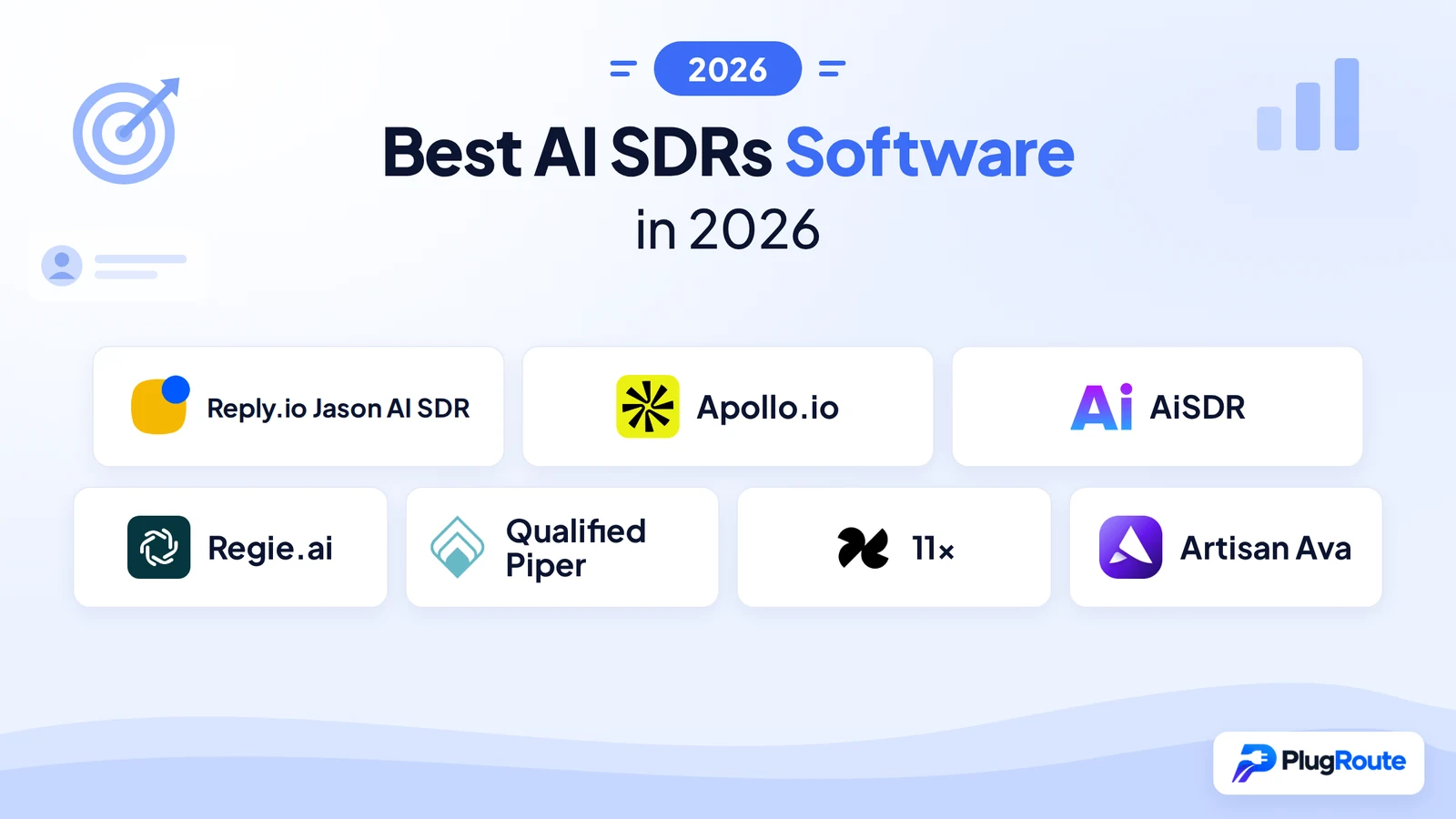
Reply.io Jason AI SDR ranks first for most small and mid-size outbound teams because it pairs consistent 4.6/5 ratings with published pricing and a human approval mode. Apollo.io is the lowest-cost start for rep-led prospecting, and AiSDR is the lowest-commitment autonomous pilot. Inbound Salesforce teams should look at Qualified Piper.
AI SDR software is hard to compare. Vendors use one label for very different products and price them in units that don’t line up. None of the seven vendors reviewed publishes independently verified proof of meetings booked or revenue as of October 2026, so fit matters more than vendor claims.
PlugRoute has no affiliate relationships with any company listed. Rankings are determined entirely by research data and objective evaluation criteria.
“closer to 40%, not the 90% vendors promise” (u/Aggressive-Sweet828, on net founder time saved with AI SDR tools (Reddit r/startups, 2026))
Takeaway: Budget for ongoing human oversight, even with an autonomous AI SDR.
What Are the 4 Categories of AI SDR Tools?
AI SDR tools fall into four categories: Autonomous Agents (AiSDR, 11x, Artisan Ava), Embedded Agents (Reply.io, Regie.ai), Data-First Platforms (Apollo.io) and Inbound Qualifiers (Qualified Piper). The category decides how much human control you keep, so choose the category before you compare individual tools.
- Autonomous Agent: An Autonomous Agent finds prospects, researches them, sends outreach, handles replies and books meetings with little human input. AiSDR, 11x Alice and Artisan Ava are in this category.
- Embedded Agent: An Embedded Agent is an AI SDR built into a sales engagement platform (SEP), so warm-up, sequencing and multichannel tools come with it. Reply.io Jason AI SDR and Regie.ai are in this category.
- Data-First Platform: A Data-First Platform pairs a large B2B contact database with sequencing and AI help, and reps stay in control. Apollo.io is in this category.
- Inbound Qualifier: An Inbound Qualifier talks to website visitors in real time, qualifies them and books meetings. Qualified Piper is in this category, and 11x Julian also covers inbound phone and chat.
Data and enrichment layers such as Clay sit next to AI SDRs but are not ranked here. Practitioners often run Clay alongside one of these tools rather than as a standalone AI SDR.
Practitioners also say inputs matter more than the tool. “A mediocre list with perfect copy performs worse than a great list with mediocre copy,” one founder wrote (Reddit r/startups, 2026).
Takeaway: Fix your list and buying signals before you switch AI SDR tools.
How Do the Top AI SDR Tools Compare at a Glance?
Reply.io Jason AI SDR leads the seven tools, and Artisan Ava finishes last. The table below shows each tool’s category, best-fit buyer and main trade-off. No vendor publishes independently verified meeting or revenue data, so the rankings measure evidence quality, pricing transparency and buyer risk, not proven sales results.
| Rank | Company | Category | Best For | One-Line Summary | Key Capabilities | Primary Strength | Key Limitation |
|---|---|---|---|---|---|---|---|
| 1 | Reply.io Jason AI SDR | Embedded Agent | Small and mid-size outbound teams | Reply.io Jason AI SDR is an outbound AI agent with approval or autopilot sending and the lowest published per-contact price among the dedicated AI SDRs reviewed. | Prospecting, email and LinkedIn sequences, reply handling, booking | Consistent 4.6/5 on G2, Capterra and Trustpilot | AI SDR plans billed annually; reports of skipped sequence steps |
| 2 | Apollo.io | Data-First Platform | Budget-conscious, rep-led teams | Apollo.io is a data-first sales platform and the lowest-cost starting point for teams that want AI to support reps rather than replace them. | Contact database, sequencing, dialer, AI Assistant, CRM sync | Largest review base (G2 4.7/5, about 9,600–9,800 reviews) | Not autonomous; stale-data and billing complaints |
| 3 | AiSDR | Autonomous Agent | Small teams piloting autonomy | AiSDR is a partly managed autonomous AI SDR with published pricing from $250 a month and no annual lock-in. | Signal-based research, email and LinkedIn, reply handling, managed mailboxes | Monthly, cancel-anytime entry plan | Moderate review base; 3–4 week learning curve |
| 4 | Regie.ai | Embedded Agent | Teams augmenting human SDRs | Regie.ai is a hybrid AI sales platform with the only multi-line parallel dialer documented among the seven tools reviewed. | Prospecting agents, AI copy, 9-line dialer, SEP and CRM integrations | Hybrid human-in-the-loop design | RegieOne starts at about $35,000/yr |
| 5 | Qualified Piper | Inbound Qualifier | Salesforce companies with inbound traffic | Qualified Piper is an inbound AI SDR with the category’s highest G2 rating and native Salesforce Sales Cloud and Account Engagement integration. | Real-time website chat, qualification, routing, booking | G2 4.9/5 from about 1,555 reviews | Quote-only; est. $40K–$100K+/yr |
| 6 | 11x | Autonomous Agent | Enterprises seeking maximum autonomy | 11x pairs the Alice outbound agent with the Julian inbound voice and chat agent, sold on annual contracts that start around $45,000 a year. | Outbound agent, inbound voice and chat agent, deliverability setup | Covers both outbound and inbound voice | About 33 G2 reviews; disputed 2025 customer claims |
| 7 | Artisan Ava | Autonomous Agent | Teams committed to SDR replacement | Artisan Ava is an autonomous AI BDR whose independent reviews are the most polarized in the category. | Natural-language search over 400M+ contacts, enrichment, outreach, booking | Waterfall enrichment billed only on usable data | Conflicting G2 scores; reported annual lock-in |
Which AI SDR Tool Should I Choose for My Use Case?
Choose an AI SDR by your top constraint. AiSDR suits low-commitment autonomous pilots, Reply.io Jason AI SDR suits published pricing with an approval gate, Apollo.io suits budget rep-led prospecting, Regie.ai suits phone-heavy SDR teams, Qualified Piper suits Salesforce inbound, and 11x and Artisan Ava suit autonomy-first buyers who secure exit rights.
Start with one diagnostic question. If most of your pipeline starts as website visits, start in the Inbound Qualifier category. If it starts with cold lists, start with Autonomous or Embedded Agents.
| Your #1 Priority | Recommended Tool | Why | Acceptable Alternative |
|---|---|---|---|
| Low-risk autonomous pilot | AiSDR | Solo plan is $250/month, monthly and cancel-anytime | Reply.io Jason AI SDR (approval mode, annual billing) |
| Autonomy with an approval gate at published prices | Reply.io Jason AI SDR | Approval and autopilot modes; $500/month for 1,000 contacts | AiSDR |
| Cheap data plus sequencing with reps in control | Apollo.io | Free plan; Professional $79/user/month billed annually | RegieGO (free to $150/seat) |
| Boost existing SDRs and phone output | Regie.ai | Hybrid review workflow and 9-line parallel dialer | Apollo.io (standard dialer included) |
| Inbound website conversion on Salesforce | Qualified Piper | G2 4.9/5 from about 1,555 reviews; native Salesforce integration | 11x Julian (inbound chat and voice) |
| Enterprise maximum autonomy, including inbound voice | 11x (insist on exit rights) | Only vendor here with both outbound and inbound voice agents | Artisan Ava (test small first) |
| Committed to SDR replacement in a broad market | Artisan Ava (test small first) | Artisan says 90%+ of customers run Ava autonomously (vendor-reported) | AiSDR (shorter commitment) |
How Do Review Evidence and Contract Terms Compare?
The most heavily marketed autonomous agents have the fewest independent reviews. 11x and Artisan Ava each have under 100 G2 reviews, while Apollo.io, Qualified Piper and Reply.io each have more than 1,500. Commitment terms run from monthly (AiSDR Solo) to annual (11x, Artisan, RegieOne and Reply.io’s AI SDR plans).
| Company | G2 Rating (Review Count) | Motion | Autonomy Level | Public Pricing | Entry Price | Commitment Term | Human Approval Option |
|---|---|---|---|---|---|---|---|
| Reply.io Jason AI SDR | 4.6/5 (~1,540) | Outbound | Approval or autopilot | Yes | $500/mo | Annual (AI SDR plans) | Yes: approval mode |
| Apollo.io | 4.7/5 (~9,600–9,800) | Outbound | Rep-led, AI-assisted | Yes | Free | Monthly or annual | Reps send by design |
| AiSDR | 4.6/5 (101–102) | Outbound | Managed autonomous | Yes | $250/mo | Monthly (Solo); quarterly | Escalation of tricky replies |
| Regie.ai | 4.4/5 (337–355) | Outbound + dialer | Hybrid | Partly (RegieGO) | Free (RegieGO) | Annual, seat minimums (RegieOne) | Yes: reps review drafts |
| Qualified Piper | 4.9/5 (1,555–1,558) | Inbound | Autonomous on website | No | Est. $40K+/yr | Enterprise annual | Not publicly documented (October 2026) |
| 11x | 4.4/5 (32–33) | Outbound + inbound voice | Fully autonomous | Partly | $3,750/mo (annual) | Annual | Thinly documented |
| Artisan Ava | 4.2/5 (62) vs. 3.9/5 (conflicting) | Outbound | Fully autonomous | No | Quote-only | Annual (reported) | Vendor-described; not verified (October 2026) |
All ratings and prices were checked in October 2026.
Which AI SDR Tools Rank Highest in 2026?
Reply.io Jason AI SDR ranks highest at 38/45, followed by Apollo.io (36), AiSDR (34), Regie.ai (33), Qualified Piper (29), 11x (20) and Artisan Ava (17). Every entry uses the same structure and shows six criterion scores. The scores measure evidence quality, pricing transparency and buyer risk, not verified meetings booked.
1. Reply.io Jason AI SDR: Best Overall for Teams That Want Autonomy With an Approval Switch
Category: Embedded Agent, an AI SDR built into an established sales engagement platform.
Scorecard: C1 Review Signal 5 · C2 Pricing/Commitment 4 · C3 Human Control 5 · C4 Evidence 2 · C5 Workflow 4 · C6 Operations 4 = 38/45
Why #1: Reply.io Jason AI SDR ranks first because it is the only tool to score 5 on two primary criteria: cross-platform review consistency (C1) and a documented approval mode (C3). Reply.io’s weakest score is C4 Evidence (2/5) because its results claims name no customers.
At a Glance
- Category: Embedded Agent
- Best For: Small and mid-size B2B teams that want an outbound AI SDR with published pricing and a human approval option
- Price Range: $500–$1,000/month (AI SDR Starter, 1,000–3,000 active contacts, billed annually); Growth from $1,500/month; outreach seats from $59/user/month
- Primary Strength: Reply.io Jason AI SDR has the most consistent independent review profile of any outbound AI SDR in this ranking, at 4.6/5 across G2, Capterra and Trustpilot.
- Biggest Limitation: Reply.io’s AI SDR plans are billed annually, and reviewers repeatedly report skipped sequence steps and a steep learning curve.
- One-Line Summary: Reply.io Jason AI SDR is an outbound AI agent inside a sales engagement platform that has run since 2014, with approval or autopilot sending and the lowest published per-contact price of the dedicated AI SDRs reviewed.
- Last Verified: October 2026
Overview
Reply.io Jason AI SDR is an outbound AI agent built into Reply.io’s sales engagement platform. It finds prospects, writes email and LinkedIn sequences, handles replies and books meetings for small and mid-size B2B teams that want published pricing.
Reply.io Jason AI SDR lets teams choose between approval mode, where a human reviews drafts, and autopilot mode (Emelia, 2026). Reply.io reports response rates above 65% for one customer, but the claim is vendor-reported and names no customer (Reply.io, 2026).
Key Features
- Reply.io Jason AI SDR searches a contact database the vendor reports at more than 1 billion records and builds an ideal customer profile (ICP) from the customer’s website.
- Reply.io Jason AI SDR runs email and LinkedIn sequences and can add call, SMS and WhatsApp tasks.
- Reply.io Jason AI SDR offers an approval mode in which a human reviews AI drafts before sending, plus an autopilot mode that sends without review (Emelia, 2026).
- Reply.io includes email warm-up and unlimited inboxes in its sales engagement platform to support deliverability.
- Reply.io Jason AI SDR handles incoming replies and books meetings directly into calendars.
Best For
Reply.io Jason AI SDR fits small and mid-size outbound teams that want an autonomous agent at a predictable published price, with a human approval gate available during the pilot. Reply.io’s Starter tiers are sized for 1,000–3,000 active contacts a month.
Pricing
- Reply.io AI SDR Starter costs $500/month for 1,000 active contacts, $800 for 2,000 and $1,000 for 3,000, all billed annually (Reply.io, 2026).
- Reply.io AI SDR Growth starts at $1,500/month, and a $3,000 tier is also shown, billed annually (Reply.io, 2026).
- Reply.io’s standard outreach plans start at $59/user/month (Email Volume) and $89/user/month (Multichannel, annual), though one third-party source lists Multichannel at $99 (Emelia, 2026).
- Reply.io’s Starter tiers work out to about $0.33–$0.50 per active contact (PlugRoute arithmetic, 2026).
- Prospeo relays a second-hand Reddit complaint that an advertised $499 price did not match upgrade options of $1,200 or more (Prospeo, 2026).
Strengths
- Reply.io holds 4.6/5 on G2 (~1,540 reviews), Capterra (95 reviews) and Trustpilot (97–267 reviews, depending on snapshot), the most consistent cross-platform profile of any outbound AI SDR reviewed (G2, 2026; Capterra, 2026; Trustpilot, 2026).
- Reply.io Jason AI SDR has a documented approval mode, which directly lowers the risk of off-brand messages going out without review (Emelia, 2026; jasonai.reviews, 2026, independence uncertain).
- Reply.io publishes AI SDR prices at set contact volumes, so buyers can work out the cost at their own volume without a sales call (Reply.io, 2026).
- Reply.io has run its outreach platform since 2014, with warm-up, multichannel sequences and inbox management built in rather than sold as add-ons (Reply.io, 2026).
Limitations
Reply.io Jason AI SDR trades flexibility for commitment. Reply.io bills its AI SDR plans annually, so a failed pilot can still cost a full year.
- Reply.io reviews aggregated by Prospeo include 21 mentions of skipped or out-of-order sequence steps and about 54 mentions of learning difficulty (Prospeo, 2026).
- Reply.io users report LinkedIn account restrictions and a LinkedIn importer that overwrote personalization fields (Prospeo, 2026).
- Reply.io’s Trustpilot reviews include complaints about long support waits and billing difficulties, with about 28 one-star reviews (Trustpilot, 2026).
- Reply.io’s results claims name no customers, no significant Reddit discussion of Jason was found, and company details such as founder name and funding could not be consistently verified (Emelia, 2026).
Verdict
Reply.io Jason AI SDR has the most consistent independent review profile of any outbound AI SDR in this ranking, which makes it the strongest overall pick for most small and mid-size B2B teams in 2026.
Reply.io Jason AI SDR’s annual billing means buyers should ask for written pilot terms before signing. Teams should start in approval mode, check sequence-step reliability, and judge the trial on cost per qualified meeting before switching to autopilot.
An outreach agency operator on r/B2BSaaS noted:
“the claims are inflated in the typical ai saas ad way. reply.io is a solid sending platform and jason has some genuinely useful features but “handling conversations” is where the gap between marketing and reality is widest.” Posted by u/ilovedumplingss
Takeaway: Reply.io Jason AI SDR earns credit as a sending platform, but its autonomous reply handling is where practitioners see the widest gap between marketing and reality.
2. Apollo.io: Best Low-Cost All-in-One Starting Point for Rep-Led Prospecting
Category: Data-First Platform, a B2B contact database with AI-assisted prospecting and sequencing.
Scorecard: C1 Review Signal 4 · C2 Pricing/Commitment 5 · C3 Human Control 4 · C4 Evidence 3 · C5 Workflow 4 · C6 Operations 3 = 36/45
Why #2: Apollo.io has the largest review base and the lowest entry price, but a 3.1/5 Trustpilot rating holds its C1 score at 4. Apollo.io ranks below Reply.io because it is AI-assisted rather than a dedicated AI SDR agent, and its C2 score of 5 reflects a free plan plus monthly terms.
At a Glance
- Category: Data-First Platform
- Best For: Budget-conscious teams and founders who want contact data, sequencing and AI help while keeping reps in control
- Price Range: Free plan; Basic about $65/user/month; Professional $79/user/month annual ($99 monthly); Organization $119/user/month annual ($149 monthly)
- Primary Strength: Apollo.io has the largest independent review base in the AI SDR category, with a G2 rating of 4.7/5 from about 9,600–9,800 reviews.
- Biggest Limitation: Apollo.io is an AI-assisted platform rather than an autonomous AI SDR, and users report stale contact data and billing surprises.
- One-Line Summary: Apollo.io is a data-first sales platform that combines a B2B contact database, sequencing, a dialer and AI assistance, making it the lowest-cost starting point for teams that want AI to support reps rather than replace them.
- Last Verified: October 2026
Overview
Apollo.io is a B2B sales intelligence and engagement platform for budget-conscious teams that want reps to stay in control. Apollo.io combines a contact database reported at 210–240 million+ contacts with email sequencing, a dialer and AI-assisted prospecting.
Apollo.io calls its platform “agentic.” Competitor-authored comparisons from ZoomInfo and AiSDR describe Apollo.io’s AI as less autonomous than dedicated AI SDRs, so treat that view as directional (ZoomInfo, 2026; AiSDR, 2026).
Key Features
- Apollo.io provides a B2B contact database reported at 210–240 million+ contacts and 73 million+ companies, depending on the source, with enrichment and intent signals (Salesforge, 2026).
- Apollo.io combines email sequencing, a dialer with call recording, and Salesforce and HubSpot sync in a single platform.
- Apollo.io’s AI Assistant helps reps find prospects and work through outreach, and it can be reached through API, MCP and CLI.
- Apollo.io offers a free plan with limited access, so teams can test the workflow before paying.
- Apollo.io states that it holds SOC 2 Type II and ISO 27001 certification and is GDPR compliant, relying on legitimate interest as the legal basis for its database (Apollo.io, 2026).
Best For
Apollo.io fits founders, small teams and cost-conscious mid-market teams that mainly need contact data and sequencing with AI help, not a hands-off agent. Apollo.io also works as a data layer alongside another sending or enrichment tool.
Pricing
- Apollo.io offers a free plan, and Basic costs about $65/user/month (Salesforge, 2026).
- Apollo.io Professional costs $79/user/month billed annually or $99 monthly (Salesforge, 2026).
- Apollo.io Organization costs $119/user/month billed annually or $149 monthly (Salesforge, 2026).
- Apollo.io Professional for five seats comes to about $4,740 a year (Salesforge, 2026).
- Apollo.io charges $0.20 per extra credit with a 250-credit ($50) minimum, bills warm-up separately, and users report credits running out faster than expected (SmartReach, 2026).
Strengths
- Apollo.io holds a G2 rating of 4.7/5 from about 9,600–9,800 reviews, by far the largest sample here, and reviewers most often praise ease of use and CRM sync (Apollo cites 9,600+; Supered reports ~9,839) (G2, 2026; Supered, 2026).
- Apollo.io has nearly 100,000 paying customers as of February 2026 and estimated ARR of about $265M as of September 2026, according to outside estimates (Sacra, 2026).
- Apollo.io has the lowest entry cost in this ranking, and one user said they pay under $14,000 a year against a ZoomInfo quote of about $60,000 (Reddit r/gtmengineering, 2026).
- Apollo.io bundles sequencing, dialing and call recording with its data, so small teams need fewer separate tools (Reddit r/gtmengineering, 2026).
Limitations
Apollo.io trades autonomy and data freshness for price and breadth. Apollo.io does not run the SDR workflow from start to finish, so reps still do the outreach and conversation work.
- Apollo.io’s Trustpilot rating is 3.1/5 from 1,333 reviews, with complaints about unexpected charges, auto-renewal, cancellation difficulty and data quality (Trustpilot, 2026).
- Apollo.io users in a September 2026 thread reported connect rates falling from about 15% to 8% and credits spent just to find working contacts (Reddit r/gtmengineering, 2026).
- Apollo.io’s semi-automated domain setup broke one user’s DKIM/DMARC records, according to the same thread (Reddit r/gtmengineering, 2026).
- Apollo.io G2 reviewers cite weak audit-log export, limited do-not-call (DNC) and consent tracking, and unapproved numbers entering calling workflows (G2, 2026).
Users on r/growmybusiness shared their experience:
“We’re seeing the exact same thing with Apollo. Data was genuinely solid in 2023-2024. Something changed. Our bounce rates have crept up from 4% to 10-11% over the past 6 months with no changes on our end. We haven’t switched yet because migrating 6 clients off Apollo is a nightmare but it’s getting harder to justify staying” Posted by u/ishaammusic
Takeaway: Apollo.io’s data freshness has slipped for some long-time agency users, with bounce rates now high enough that switching costs are the main reason they stay.
Verdict
Apollo.io is the lowest-cost and most widely reviewed starting point for B2B teams that want AI-assisted prospecting with reps in control, but it is not a fully autonomous AI SDR.
Apollo.io buyers should budget for extra credits and warm-up and check data freshness in their own market before scaling. Track cost per qualified meeting, and consider pairing Apollo.io with a second data source, as many experienced teams do.
3. AiSDR: Best for Low-Risk Autonomous Outbound Pilots
Category: Autonomous Agent, an AI SDR that runs prospecting, outreach, replies and booking with minimal human input.
Scorecard: C1 Review Signal 3 · C2 Pricing/Commitment 5 · C3 Human Control 4 · C4 Evidence 3 · C5 Workflow 3 · C6 Operations 4 = 34/45
Why #3: AiSDR earns the top pricing and commitment score among autonomous agents thanks to its monthly Solo plan. AiSDR is held back by a moderate G2 sample of about 102 reviews (C1 = 3) and by coverage limited to email and LinkedIn (C5 = 3).
At a Glance
- Category: Autonomous Agent
- Best For: Small teams and founders who want to pilot autonomous outbound without an annual contract or in-house RevOps
- Price Range: $250–$2,500/month (Solo monthly; Explore and Scale quarterly)
- Primary Strength: AiSDR is the only autonomous AI SDR in this ranking with a monthly, cancel-anytime entry plan and published pricing at every tier.
- Biggest Limitation: AiSDR’s independent review base is moderate at about 100 G2 reviews, and users report a 3–4 week learning curve and messages that can read as templated at scale.
- One-Line Summary: AiSDR is a partly managed autonomous AI SDR for email and LinkedIn outbound, with published pricing from $250 a month and no annual lock-in, which makes it the lowest-risk way to pilot an autonomous agent.
- Last Verified: October 2026
Overview
AiSDR is an autonomous AI SDR that researches prospects using live buying signals, runs email and LinkedIn outreach, handles replies and books meetings. AiSDR is aimed at small teams that want a low-commitment autonomous pilot with managed setup.
AiSDR assigns a GTM engineer on every plan except Solo. AiSDR reports 250+ customers and 12,000+ meetings booked in 2025 and names customers including Archangel Group, Classter, Metal and Satchel Pulse, all vendor-reported (AiSDR, 2026).
Key Features
- AiSDR researches prospects in real time and uses live buying signals to personalize email and LinkedIn outreach.
- AiSDR handles replies, which the vendor says happens in under 10 minutes, books meetings and escalates tricky replies to a human (AiSDR, 2026).
- AiSDR assigns a GTM engineer on Explore and Scale plans to set up the ICP, sequences and CRM, and to monitor campaigns.
- AiSDR manages mailbox setup, warm-up and inbox health, with domain and mailbox allowances set by plan.
- AiSDR integrates mainly with HubSpot and also connects to Salesforce and Aircall (AgentsIndex, 2026).
Best For
AiSDR fits founders and small B2B teams that want an autonomous outbound agent they can cancel monthly and that lack the RevOps capacity to configure one themselves. AiSDR works best for HubSpot users.
Pricing
- AiSDR Solo costs $250/month for 200 contacts, 1 domain, 3 mailboxes and 1 user, billed monthly with cancel-anytime terms (AgentsIndex, 2026).
- AiSDR Explore costs $900/month for 800 contacts, 2 domains, 6 mailboxes and 5 LinkedIn accounts, on a quarterly contract (AgentsIndex, 2026).
- AiSDR Scale costs $2,500/month for 2,500 contacts, 6 domains, 18 mailboxes and 20 LinkedIn accounts, on a quarterly contract (AgentsIndex, 2026).
- AiSDR’s tiers work out to about $1.00–$1.25 per contact, which is more per contact than Reply.io but on shorter commitments (PlugRoute arithmetic, 2026).
Strengths
- AiSDR offers a $250/month Solo plan on monthly, cancel-anytime terms, making it the only autonomous agent here that can be piloted without a quarterly or annual commitment (AgentsIndex, 2026).
- AiSDR holds a 4.6/5 G2 rating from 101–102 reviews, and one reviewer said the team helped “at every step,” including tuning the AI (G2, 2026).
- AiSDR manages mailbox setup, warm-up and inbox health and escalates difficult replies to a human, which lowers sender-reputation and brand risk for teams without RevOps staff (SBL, 2026).
- AiSDR states that it is SOC 2 certified, though this is vendor-stated and PlugRoute did not review the report (AiSDR, 2026).
Limitations
AiSDR trades low commitment for a higher per-contact cost of about $1.00–$1.25 and a narrower scope. AiSDR covers email and LinkedIn only and relies on Aircall for calling.
- AiSDR has a 3–4 week learning curve, according to an independent review that also reports days spent fixing Outlook safe-sender problems (SBL, 2026).
- AiSDR G2 reviewers say messages are sometimes “less relevant” and that the AI sometimes jumps into conversations too early (G2, 2026).
- AiSDR personalization “can still read as templated at scale,” according to a third-party roundup of Reddit sentiment (YALC, 2026).
- AiSDR’s Reddit mentions are thin and partly suspected to be vendor-linked, and its Capterra 5.0/5 rests on only 3 reviews (Reddit r/gtmengineering, 2025; Capterra, 2026).
Verdict
AiSDR is the lowest-risk way for a small B2B team to pilot a fully autonomous outbound AI SDR in 2026, because it is the only one in this ranking with monthly cancel-anytime pricing and managed setup.
AiSDR buyers should expect a 3–4 week ramp and review sample messages before raising volume. Judge the pilot on cost per qualified meeting, not on the vendor’s stated response rates.
4. Regie.ai: Best for Augmenting Existing Human SDR Teams
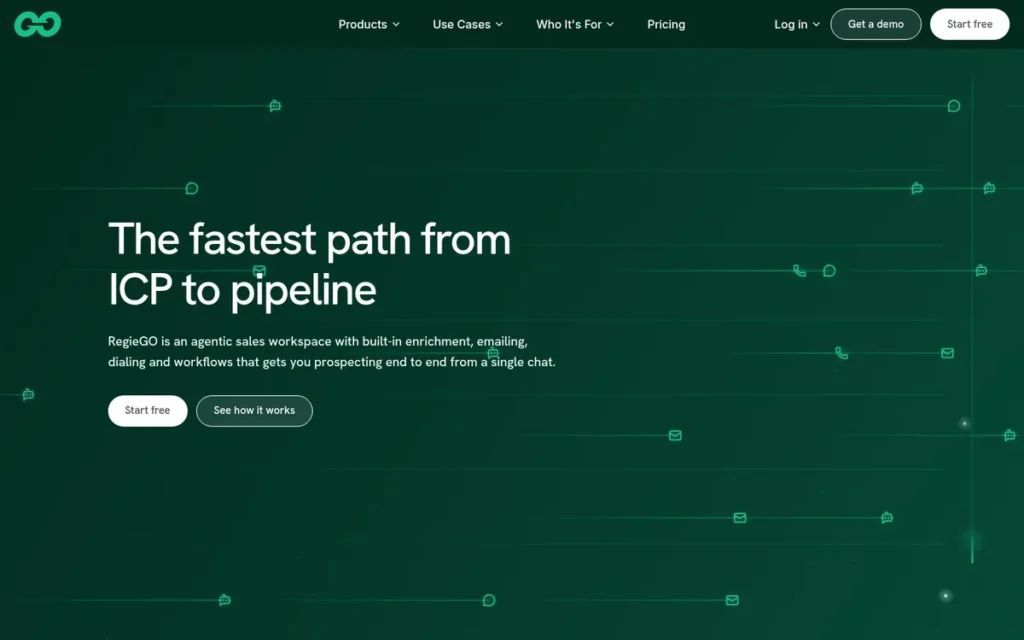
Category: Embedded Agent, an AI SDR built into an established sales engagement platform.
Scorecard: C1 Review Signal 3 · C2 Pricing/Commitment 3 · C3 Human Control 5 · C4 Evidence 3 · C5 Workflow 5 · C6 Operations 3 = 33/45
Why #4: Regie.ai ties for the top human-control score and has the top workflow score in this ranking. Regie.ai’s C2 score is held at 3 by the jump from free RegieGO to a RegieOne contract of about $35,000 a year with seat minimums.
At a Glance
- Category: Embedded Agent
- Best For: Mid-size and enterprise teams that want AI to speed up existing human SDRs, especially phone-heavy teams
- Price Range: RegieGO free to $150/seat/month; RegieOne from about $35,000/year with annual contract and seat minimums
- Primary Strength: Regie.ai combines AI prospecting agents, AI-written copy and a 9-line parallel dialer in one hybrid platform designed to keep human reps in the loop.
- Biggest Limitation: Regie.ai’s full RegieOne platform jumps from free self-serve pricing to about $35,000 a year, and reviewers report generic copy and stale contact data.
- One-Line Summary: Regie.ai is a hybrid AI sales platform in which AI agents research, prioritize and draft outreach while human reps review and run conversations, with the only multi-line parallel dialer documented among the seven tools reviewed.
- Last Verified: October 2026
Overview
Regie.ai is an AI sales engagement platform that combines prospecting agents, AI-written email and social copy, and a 9-line parallel dialer. Regie.ai is aimed at teams that want AI to speed up existing human SDRs rather than replace them.
Regie.ai sells two products: RegieGO, a self-serve product priced from free to $150 per seat, and RegieOne, an enterprise platform (Regie.ai, 2026).
Key Features
- Regie.ai’s prospecting agents search a reported 220 million+ contacts, enrich records from several data providers and include an Auto-Pilot sourcing mode.
- Regie.ai generates AI email and social copy that human reps review before sending, as part of its hybrid workflow.
- Regie.ai includes a 9-line parallel dialer with AI voicemail and call coaching, the only multi-line parallel dialer documented among the seven tools (Apollo.io includes a standard dialer).
- Regie.ai integrates with Salesforce, HubSpot, Outreach and Salesloft (Dashly, 2026).
- Regie.ai offers RegieGO as a self-serve tier with a free plan for up to 10 people and credits for prospecting actions.
Best For
Regie.ai fits mid-size and enterprise sales teams that want to raise rep productivity, especially teams that combine phone and email prospecting. Regie.ai’s RegieGO tier suits individuals and small teams testing AI-assisted prospecting at low cost.
Pricing
- Regie.ai RegieGO is free for up to 10 people with 250 credits each (Regie.ai, 2026).
- Regie.ai RegieGO Pro costs $41/month annually or $49 monthly, and Team costs $125/seat/month annually or $150 monthly with a 2-seat minimum (Regie.ai, 2026).
- Regie.ai says RegieOne starts at about $35,000 a year, and Capterra lists “Contact vendor for pricing” (Regie.ai, 2026; Capterra, 2026).
- Regie.ai’s AI SEP is reported at $180/user/month with a 10-seat annual minimum, and “Force Multiplier Rep” at $499/user/month with a 5-seat minimum, both third-party figures (AgentsIndex, 2026).
- Regie.ai has a large price jump between self-serve RegieGO and enterprise RegieOne (PlugRoute analysis, 2026).
Strengths
- Regie.ai reports that AI agents contributed to more than 40% of meetings in its own SDR team and lifted prospecting from about 25 to 60–100 prospects per rep per day, all vendor-reported self-use figures (Regie.ai, 2026).
- Regie.ai reports that an unnamed enterprise security customer reached more than 75% of an $800K annual pipeline goal within four months, a vendor-reported, unnamed result (Regie.ai, 2026).
- Regie.ai holds a G2 rating of 4.4/5 from 337–355 reviews, and reviewers say the parallel dialer increases live connects (G2, 2026).
- Regie.ai’s hybrid model matches what practitioners report, namely that partial automation with a human in the loop gets better response rates (Reddit r/gtmengineering, 2025).
- Regie.ai has the broadest documented SEP integration set in this ranking and raised a $30M Series B in February 2025 (AgentsIndex, 2025).
Limitations
Regie.ai trades autonomy and entry-level affordability for rep productivity. Regie.ai does not replace SDR headcount, and the full RegieOne platform starts at about $35,000 a year.
- Regie.ai copy can be generic or off-brand and often needs editing, according to Prospeo’s aggregation of reviews (Prospeo, 2026).
- Regie.ai reviewers report wrong phone numbers, stale job titles, a HubSpot integration issue and Chrome extension glitches (Prospeo, 2026).
- Regie.ai’s Capterra rating of about 4.0/5 rests on only 13 reviews and could not be confirmed (Capterra, 2026).
- Regie.ai has no confirmed security certification, and no significant Reddit discussion of Regie.ai was found as of October 2026.
Verdict
Regie.ai is the best-matched tool in this ranking for teams that want AI to speed up existing human SDRs, because of its hybrid review workflow and built-in parallel dialer.
Small teams can test Regie.ai’s RegieGO for free. Teams considering RegieOne should test data accuracy, copy quality and cost per qualified meeting in a pilot before committing to the roughly $35,000-a-year entry point.
5. Qualified Piper: Best for Inbound Website Qualification at Salesforce-Centric Companies
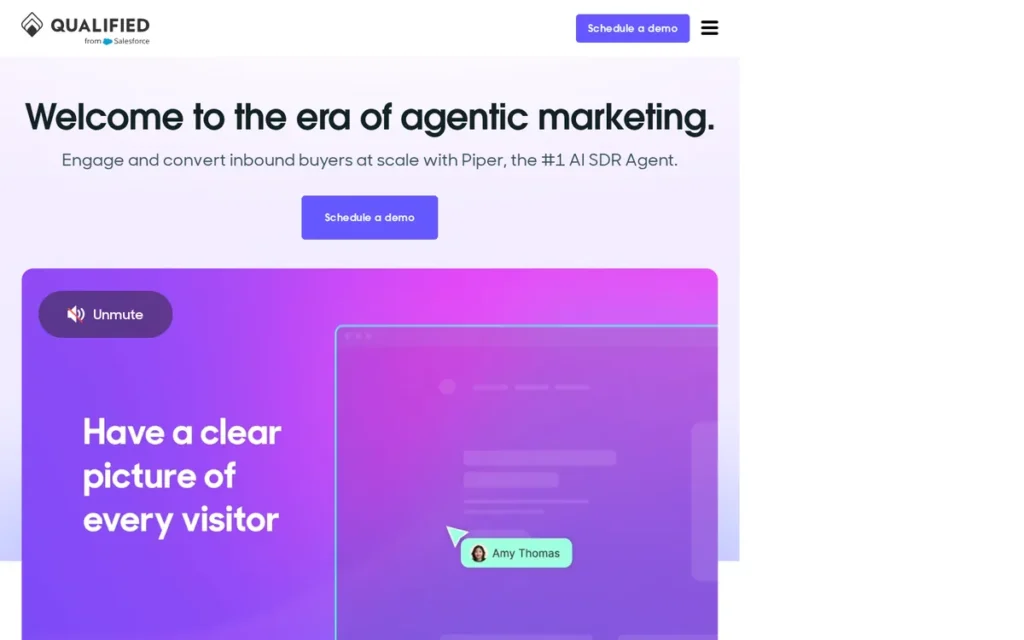
Category: Inbound Qualifier, an AI SDR that engages, qualifies and books website visitors in real time.
Scorecard: C1 Review Signal 5 · C2 Pricing/Commitment 1 · C3 Human Control 3 · C4 Evidence 4 · C5 Workflow 3 · C6 Operations 4 = 29/45
Why #5: Qualified Piper has the highest G2 rating in this ranking but scores 1/5 on pricing transparency, because it is quote-only with an estimated cost of $40K–$100K+ a year. As an inbound-only, Salesforce-first tool, Qualified Piper fits fewer buyers, but it is the top option in its own category.
At a Glance
- Category: Inbound Qualifier
- Best For: Salesforce-centric B2B companies with meaningful inbound website traffic
- Price Range: Pricing on request; third-party estimate about $40,000–$100,000+/year (unofficial)
- Primary Strength: Qualified Piper has the highest G2 rating in the AI SDR category, at 4.9/5 from about 1,555 reviews.
- Biggest Limitation: Qualified Piper is quote-only, estimated at $40,000–$100,000+ a year, built for Salesforce, and not designed for cold outbound.
- One-Line Summary: Qualified Piper is an inbound AI SDR that chats with website visitors in real time, qualifies and routes them, and books meetings, with the category’s highest G2 rating and native Salesforce Sales Cloud and Account Engagement integration.
- Last Verified: October 2026
Overview
Qualified Piper is an inbound AI SDR that chats with website visitors in real time, answers questions from the company’s own content, qualifies and routes leads and books meetings. Qualified Piper is built for Salesforce-centric B2B companies where speed-to-lead on inbound traffic matters most.
Qualified Piper also handles event and closed-lost follow-up. TrustRadius reviewers describe Qualified Piper as less suited to cold outbound (TrustRadius, 2026).
Key Features
- Qualified Piper chats with website visitors in real time and answers questions using the company’s own content and knowledge base.
- Qualified Piper qualifies visitors, routes them to the right rep and books meetings, and it supports multiple languages.
- Qualified Piper integrates natively with Salesforce Sales Cloud, Account Engagement (Pardot) and Slack (Salesforge, 2026).
- Qualified Piper runs event and closed-lost follow-up in addition to live website conversations.
- Qualified offers API and MCP access for Piper on higher pricing tiers.
Best For
Qualified Piper fits Salesforce-centric mid-market and enterprise companies whose main goal is turning inbound website traffic into meetings. Qualified Piper is not the natural first choice for cold outbound or for companies that don’t use Salesforce.
Pricing
- Qualified publishes no prices for Piper as of October 2026, and its Premier, Enterprise and Ultimate tiers are sold through the sales team.
- Qualified Piper is estimated at about $40,000–$100,000+ a year by a competitor-authored source, and the estimate is unofficial (Salesforge, 2026).
- Qualified Piper’s estimated range works out to about $3,333–$8,333+ a month (PlugRoute arithmetic, 2026).
- Qualified has no Vendr contract data available in this research, so small teams should expect enterprise-level pricing.
Strengths
- Qualified Piper holds a G2 rating of 4.9/5 from about 1,555 reviews, with vendor-reported G2 sub-scores of 9.2 for ease of setup and 9.9 for support quality (G2, 2026; Qualified, 2026).
- Qualified publishes named case studies, including Crunchbase with 3x more meetings, FreshBooks with 6x revenue growth and NextGen Healthcare with $7.5M in pipeline, all vendor-reported (Qualified, 2026).
- Qualified Piper’s Salesforce integration is described as straightforward by AWS Marketplace reviewers, who also praise onboarding (AWS Marketplace, 2026).
- Qualified Piper engages visitors who have already shown intent, which some practitioners see as lower risk, though others question handing high-intent buyers to a bot (Reddit r/gtmengineering, 2025).
- Qualified raised a $12M Series A (2020), a $51M Series B led by Salesforce Ventures (2021) and a $95M Series C (2022) (Wikipedia, 2026; PR Newswire, 2020).
Limitations
Qualified Piper trades breadth and price accessibility for inbound depth. Qualified Piper is quote-only, is built mainly for Salesforce users, and does not do cold outbound.
- Qualified Piper “occasionally moved beyond expected guardrails” and needed heavy tuning, according to one G2 reviewer (G2, 2026).
- Qualified Piper can give incorrect answers when the knowledge base doesn’t cover a question, according to TrustRadius reviewers (TrustRadius, 2026).
- Qualified Piper creates a post-booking Salesforce task that one G2 reviewer called “too bare,” because it lacks the AI summary shown in Slack (G2, 2026).
- Qualified has no publicly confirmed SOC 2 report, and a reported Salesforce acquisition comes only from a competitor’s blog and is unconfirmed as of October 2026 (Artisan, 2026).
Verdict
Qualified Piper is the best-reviewed AI SDR for converting inbound website traffic at Salesforce-centric companies, with a 4.9/5 G2 rating from about 1,555 reviews.
Qualified Piper’s quote-only pricing and dependence on Salesforce make it a poor fit for small teams or outbound-first motions. Buyers should check knowledge-base coverage, request SOC 2 documentation and measure cost per qualified meeting before committing.
6. 11x: Best for Enterprises Seeking Maximum Autonomy Across Outbound and Inbound Voice
Category: Autonomous Agent, an AI SDR that runs prospecting, outreach, replies and booking with minimal human input.
Scorecard: C1 Review Signal 2 · C2 Pricing/Commitment 2 · C3 Human Control 2 · C4 Evidence 1 · C5 Workflow 4 · C6 Operations 3 = 20/45
Why #6: 11x scores low on all three primary criteria because of a small G2 sample of about 33 reviews, the highest disclosed entry price and thinly documented approval controls. 11x’s C4 score is 1 because TechCrunch reported disputed customer claims in March 2025, which 11x contested.
At a Glance
- Category: Autonomous Agent
- Best For: Well-funded enterprise and upper mid-market teams that want maximum autonomy across outbound and inbound voice
- Price Range: Alice Growth $3,750/month billed annually (~$45,000/year); Vendr-based median contract about $55,050/year; Pro and Enterprise custom
- Primary Strength: 11x is the only vendor in this ranking that pairs an autonomous outbound SDR (Alice) with an inbound phone and chat agent (Julian).
- Biggest Limitation: 11x has the highest disclosed entry cost in this ranking, only about 33 G2 reviews, and customer and revenue claims that TechCrunch reported as disputed in 2025.
- One-Line Summary: 11x is a highly autonomous AI SDR vendor whose Alice agent runs multichannel outbound and whose Julian agent handles inbound voice and chat, sold on annual contracts that start around $45,000 a year.
- Last Verified: October 2026
Overview
11x is an AI SDR vendor whose Alice agent finds, researches and contacts prospects across email and LinkedIn, handles replies and books meetings. 11x is aimed at enterprise teams that want to automate the whole SDR role rather than individual tasks.
11x also sells Julian, an inbound phone and chat agent that qualifies and routes leads 24/7 to improve speed-to-lead. 11x charges per lead rather than per message sent (11x, 2026).
Key Features
- 11x Alice finds prospects, researches them, writes multistep email and LinkedIn outreach, handles replies and books meetings (11x, 2026).
- 11x Julian is an inbound phone and chat agent that qualifies and routes leads around the clock.
- 11x markets its Alice Growth plan as including deliverability setup, and buyers should confirm in writing which mailbox, domain and warm-up services are included.
- 11x charges per lead rather than per message sent, and the Growth plan covers about 2,000 new prospects a month and up to 5 users (11x, 2026).
- 11x offers custom Pro and Enterprise tiers for larger deployments.
Best For
11x fits well-funded enterprise or upper mid-market teams with an established outbound channel that want to test maximum autonomy across outbound and inbound voice. 11x is likely more than small teams need while they are still validating outbound.
Pricing
- 11x Alice Growth costs $3,750/month billed annually, about $45,000 a year, though the same pricing page also says pricing “starts at $36,000/yr” (11x, 2026).
- 11x Julian Chat costs $2,417/month and Julian Voice $5,333/month, both billed annually (11x, 2026).
- 11x’s median contract is about $55,050 a year, with a range of $38,250–$89,850, based on Vendr data (AgenticSalesCall, 2026).
- 11x contracts are typically annual, sometimes with a three-month trial period (AgenticSalesCall, 2026).
- 11x’s Growth plan works out to about $1.88 per prospect at its 2,000-prospect monthly allowance (PlugRoute arithmetic, 2026).
Strengths
- 11x reports that Leica Biosystems generated $4M in pipeline with a 9.7% reply rate and that Workera generated $1.2M+, though these vendor-reported claims need extra checking given TechCrunch’s March 2025 report of disputed 11x customer claims (11x, 2026).
- 11x is the only vendor in this ranking with both an outbound agent and an inbound voice agent, so one vendor can cover both motions (11x, 2026).
- 11x reports that Unitech cut speed-to-lead from 8+ hours to under 2 minutes, a vendor-reported figure (11x, 2026).
- 11x raised about $76M across three rounds by November 2024, including a $24M Series A led by Benchmark and a $50M Series B led by a16z (AgentsAI, 2024).
Users on r/SaaS shared their experience:
“We evaluated a few of the AI SDR vendors mentioned here and ended up sticking with 11x. The main reason was that Alice actually handled outbound execution instead of just generating messaging ideas. It took some tuning at the beginning but once it was dialed in the pipeline activity became pretty steady. It works best when you treat it as support for reps rather than a full replacement.” Posted by u/Massive_Airport_993
Takeaway: 11x Alice can produce steady outbound pipeline activity after initial tuning, but its satisfied users treat it as rep support rather than a full SDR replacement.
Limitations
11x trades transparency and low entry cost for maximum autonomy. 11x displayed ZoomInfo and Airtable as customers when both companies said they were not (TechCrunch, 2025).
- 11x was described by ZoomInfo as performing “significantly worse than our SDR employees” in a roughly one-month trial (TechCrunch, 2025).
- 11x faced former-employee allegations of inflated ARR and 70–80% churn, which 11x disputed while stating 79% retention (TechCrunch, 2025).
- 11x’s G2 rating of 4.4/5 rests on only 32–33 reviews, which cite generic personalization, poorly targeted prospects and rigid annual contracts (G2, 2026).
- 11x drew one two-star review, relayed by a competitor, describing $9,000 spent on 9,000 messages with zero meeting requests, which is a single report (Salesforge, 2026).
- 11x founder Hasan Sukkar moved to non-executive chairman and CTO Prabhav Jain became CEO, so buyers should confirm roadmap and account-team continuity (UsagePricing, 2025).
Verdict
11x offers the broadest autonomous coverage in this ranking, with outbound (Alice) and inbound voice and chat (Julian) agents, but its thin reviews and disputed 2025 claims make it a high-risk choice.
Enterprises considering 11x should insist on written pilot exit rights and ask for reference customers they can contact directly. Set success metrics on cost per qualified meeting.
7. Artisan Ava: Best for Teams Committed to SDR Replacement That Will Test Before Signing
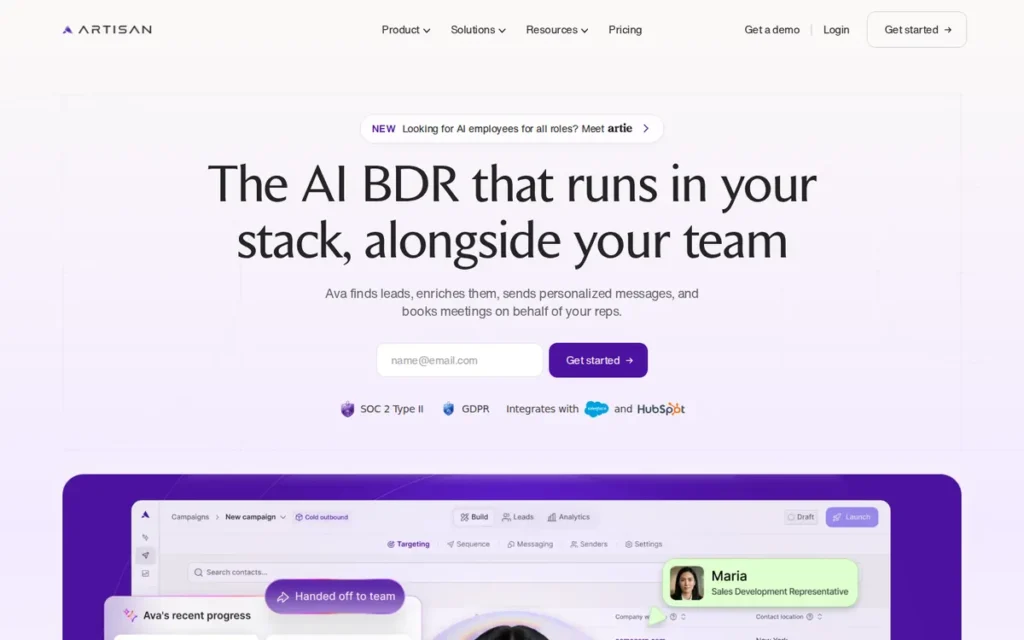
Category: Autonomous Agent, an AI SDR that runs prospecting, outreach, replies and booking with minimal human input.
Scorecard: C1 Review Signal 1 · C2 Pricing/Commitment 1 · C3 Human Control 3 · C4 Evidence 2 · C5 Workflow 3 · C6 Operations 2 = 17/45
Why #7: Artisan Ava scores 1/5 on both review signal and pricing transparency. Its 62 reviews would normally score 2, but conflicting G2 figures (4.2 vs. 3.9) lower Artisan Ava’s C1 to 1, and quote-only pricing with reported annual lock-in sets C2 at 1.
At a Glance
- Category: Autonomous Agent
- Best For: Teams that want to replace outbound SDR capacity and are willing to test on a small sample before an annual commitment
- Price Range: Pricing on request (usage-based); Capterra lists “from $250/month”; annual commitments reported
- Primary Strength: Artisan Ava combines natural-language prospect search across a reported 400 million+ contacts with waterfall enrichment and autonomous outreach and booking.
- Biggest Limitation: Artisan Ava has conflicting and polarized G2 ratings, quote-only pricing with reported annual lock-in, and multiple user reports of campaigns producing zero replies.
- One-Line Summary: Artisan Ava is an autonomous AI BDR marketed as a replacement for human SDRs that sources, enriches and contacts prospects and books meetings, but its independent reviews are the most polarized in the category.
- Last Verified: October 2026
Overview
Artisan Ava is an autonomous AI BDR that searches a reported 400 million+ contacts in plain English, enriches records, sends personalized outreach, handles objections and books meetings. Artisan Ava is aimed at teams that want to replace outbound SDR capacity.
Artisan states that more than 90% of its customers run Artisan Ava fully autonomously, a vendor-reported figure (Artisan, 2026). Artisan’s “Stop Hiring Humans” billboard campaign frames Ava as an AI employee.
Key Features
- Artisan Ava searches a reported 400 million+ contacts using natural-language queries and enriches them from several providers, charging only when usable data is found (Artisan, 2026).
- Artisan Ava sends personalized email and social outreach with A/B variants.
- Artisan Ava handles objections using a company knowledge base and books meetings that are routed to the CRM owner.
- Artisan Ava’s human approval options should be demonstrated by Artisan before signing, because Artisan reports that most customers run Ava fully autonomously (Artisan, 2026).
- Artisan offers usage-based Ava plans sized by annual lead volume, according to third-party listings (ColdEmailKit, 2026).
Best For
Artisan Ava fits outbound teams in broad, well-covered markets that want to reduce SDR headcount and can run a small paid test before committing to an annual plan. Artisan Ava is a weaker fit for niche verticals with narrow audiences.
Pricing
- Artisan publishes no list prices for Ava as of October 2026, and pricing is usage-based and quote-only.
- Artisan Ava is listed on Capterra “from $250/mo, usage-based” (Capterra, 2026).
- Artisan plans are sized at Accelerate (~12,000 leads a year), Supercharge (35,000 leads) and Blitzscale (65,000 leads), according to third parties (ColdEmailKit, 2026).
- Artisan reviewers report annual commitments, auto-renewal and short cancellation windows, so buyers should get a written quote and exit terms (MarketBetter, 2026).
This aligns with community sentiment on r/Entrepreneur:
“I really dislike how they hide pricing now, over the last few minutes I first checked Apollo pricing and thought “cool, I could pay for that” and then checked Artisan and felt really annoyed to not see any numbers, just “Request pricing”” Posted by u/FancyName_132
Takeaway: Artisan’s request-only pricing puts off buyers who compare it against transparently priced tools like Apollo.io, and that friction shows up before any demo.
Strengths
- Artisan reports that customer Raise sourced more than $700K ARR in six months, a vendor-reported figure, and named customers include SaaStr, SumUp, CookUnity and Quora (Artisan, 2026).
- Artisan Ava charges for waterfall enrichment only when it finds usable contact data, which reduces wasted spend on bad records (Artisan, 2026).
- Artisan reviewers on G2 praise the interface, personalization, time savings and the customer success team (G2, 2026).
- Artisan Ava drew the top-voted reply (91 upvotes) in a three-tool comparison thread, which defended the product (Reddit r/gtmengineering, 2025).
- Artisan Ava had “noticeably gotten better” by September 2026, according to a commenter who said it still struggles in niche verticals (Reddit r/gtmengineering, 2025).
Limitations
Artisan Ava trades transparency and predictability for maximum autonomy. Artisan Ava’s reported G2 scores conflict, at 4.2/5 from 62 reviews on a competitor page and 3.9/5 from an aggregator (AiSDR, 2026; RyWalker, 2026).
- Artisan Ava users report campaigns of 1,000–1,400 emails with zero replies, and one reviewer reported a 0.07% positive-response rate (RyWalker, 2026; Hunter.io, 2026).
- Artisan Ava reviewers cite generic AI-sounding emails, DNS and warm-up problems, and only 3–7 matching C-level contacts in one niche search (RyWalker, 2026).
- Artisan Ava was called “a sequence workflow software” with “no real AI” by one Reddit user, in threads that also contain accusations of competitor promotion (Reddit r/SalesOperations, 2025).
- Artisan’s company page was restricted by LinkedIn for about two weeks from December 19, 2025, over use of the LinkedIn name and data brokers, not spam sent by Ava (Yahoo Tech, 2025).
Verdict
Artisan Ava has the most polarized independent evidence of any AI SDR in this ranking: named customers report strong results, while multiple users report zero-reply campaigns and annual lock-in.
Buyers should test Artisan Ava on a small sample in their own market before signing anything annual. Get cancellation terms in writing, confirm contact coverage for niche targets and track cost per qualified meeting.
Should You Choose an AI SDR or a Human SDR?
Most B2B teams should use a hybrid, where AI handles research and first touches and humans handle replies and discovery calls. A fully loaded human SDR costs about $100,000–$150,000+ a year (Bridge Group, 2025). Outbound AI SDR agents here cost about $3,000–$55,000 a year, but their output is not equivalent.
Inbound Qualified Piper sits outside that range, at an estimated $40,000–$100,000+ a year (Salesforge, 2026). The Bridge Group 2025 benchmark, based on 351 companies, sets the human SDR baseline:
- Human SDRs have a median on-target earnings of about $80,000 (Bridge Group, 2025).
- Human SDRs take a median of 3.0 months to ramp (Bridge Group, 2025).
- Human SDRs stay an average of 1.9 years in the role (Bridge Group, 2025).
- Human SDR teams see 40% median annual attrition (Bridge Group, 2025).
AI SDRs remove ramp time and attrition but don’t remove oversight. Founders on Reddit report 3–6 hours of weekly upkeep, even with autonomous tools (Reddit r/startups, 2026).
ZoomInfo said 11x performed “significantly worse than our SDR employees” in a roughly one-month trial (TechCrunch, 2025). Claims that 50–70% of AI SDR deployments churn are widely repeated but poorly sourced, and the 11x reporting remains the best-documented data point.
“i prefer just automating some of the manual parts of outbound, helps me keep human in the loop and ive seen better response rates” (u/Acrobatic-Strain-242 (Reddit r/gtmengineering, 2025))
Takeaway: Partial automation with human review is the setup practitioners prefer in 2026.
Cold-email benchmarks help put vendor reply-rate claims in context:
- Instantly reports an average reply rate of about 3.43%, with top performers at 10.7% or higher (VersionSeven, 2026).
- Woodpecker reports a 5.8% reply rate for campaigns under 50 recipients, falling to 2.1% at 500+ recipients (OutreachBloom, 2026).
- Belkins reports a 0.45% unique reply rate across 7.53 million emails (OutreachBloom, 2026).
- These benchmark sources count replies differently, so treat them as ranges rather than direct comparisons.
Against those figures, the vendor-reported reply rates of about 9% (AiSDR) and 9.7% (11x) sit near the top tier. User reports for Artisan Ava include a 0.07% positive-response rate. Judge any claim against your own baseline.
Broader adoption is still early:
- McKinsey found 62% of organizations experimenting with AI agents and 23% scaling one, as cited in a secondary summary (McKinsey, 2025).
- Gartner predicts AI agents could outnumber human sellers 10 to 1 by 2028, while fewer than 40% of sellers will say agents improved their productivity, as cited in a secondary summary (Gartner, 2025).
- MarketsandMarkets valued the AI SDR market at $4.12B in 2025 and forecasts $15.01B by 2030 (MarketsandMarkets, 2025).
How Much Does AI SDR Software Really Cost?
AI SDR software costs anywhere from $0 (Apollo.io and RegieGO free plans) to an estimated $100,000+ a year (Qualified Piper). Vendors price per seat, per contact, per lead or by quote. At about 1,000 contacts a month, published options run from about $500/month (Reply.io) to $3,750/month (11x Growth).
| Company | Entry Price | Est. Cost at ~1,000 Contacts/Month | Est. Cost at ~2,500 Contacts/Month | Commitment | Seat Minimums | Add-Ons and Notes |
|---|---|---|---|---|---|---|
| Reply.io Jason AI SDR | $500/mo | $500/mo (Starter tier) | $1,000/mo (3,000-contact tier) | Annual | None documented | ~$0.33–$0.50/contact |
| Apollo.io | Free | Seat-based ($79/user/mo annual + credits) | Seat-based | Monthly or annual | None documented | Credits $0.20 each; warm-up extra |
| AiSDR | $250/mo | $2,500/mo (Scale; Explore covers only 800 contacts) | $2,500/mo (Scale) | Monthly (Solo); quarterly | None documented | Managed setup on Explore and Scale |
| Regie.ai | Free (RegieGO) | Seat-based; RegieOne ~$2,917/mo (~$35K/yr ÷ 12) | Seat-based | Annual (RegieOne) | 2 seats (Team); 10 seats (AI SEP, third-party) | Dialer included |
| Qualified Piper | Quote-only | Not contact-based (inbound); est. ~$3,333–$8,333+/mo | Not contact-based | Enterprise annual | Not documented | Estimate is unofficial |
| 11x | $3,750/mo (annual) | $3,750/mo (Growth minimum) | Above Growth allowance; Pro is custom | Annual | Up to 5 users on Growth | Julian billed separately |
| Artisan Ava | Quote-only | Accelerate (~12,000 leads/yr) price not public | Quote-only | Annual (reported) | Not documented | Enrichment billed on usable data |
Notes on reading this table:
- All monthly and per-contact figures are PlugRoute arithmetic from prices verified in October 2026.
- Reply.io counts “active contacts” for billing.
- 11x counts “new prospects” for billing.
- Artisan counts “leads” for billing.
- Cross-vendor comparisons are therefore approximate.
For a small team, an AI SDR’s contract term is a bigger financial risk than its monthly price. A $500/month annual plan commits $6,000, while a $250/month monthly plan commits $250.
A worked example shows the effect. A team targeting 2,000 contacts a month would pay about $9,600 a year on Reply.io’s annual Starter tier, about $30,000 on AiSDR Scale (quarterly) and about $45,000 on 11x Growth (PlugRoute arithmetic, 2026).
Only AiSDR in that example lets the team stop after three months. A failed AiSDR quarter costs $7,500, while a failed Reply.io year costs the full $9,600.
What Red Flags Should I Watch For When Evaluating AI SDR Software?
Six AI SDR red flags come up again and again in documented reviews, news reporting and community threads about the tools in this ranking. Each red flag below names a specific risk, gives an example from the evidence and points to something you can test during a pilot, before any contract is signed.
Red Flag #1: Annual Contract Before a Proven Pilot
An annual AI SDR contract signed before a pilot proves results is one of the most frequently cited sources of buyer regret in the reviews analyzed. Reviewers report annual lock-in with Artisan and rigid annual contracts with 11x (MarketBetter, 2026; G2, 2026).
Reply.io’s AI SDR plans and Regie.ai’s RegieOne are also billed annually, so the same written pilot-terms check applies to them (Reply.io, 2026; AgentsIndex, 2026).
Red Flag #2: Customer Logos You Can’t Verify
AI SDR customer logos and case studies are almost always vendor-reported, and at least one vendor’s logos were publicly disputed. TechCrunch reported that 11x displayed ZoomInfo and Airtable as customers when both companies said they were not (TechCrunch, 2025). Ask for references you can call.
Red Flag #3: No Human Approval or Reply Escalation
An AI SDR without approval gates or human escalation can send off-brand or inaccurate messages at scale. One G2 reviewer said Qualified Piper “occasionally moved beyond expected guardrails” (G2, 2026). A Reddit user reported 11x contacting existing customers, a claim relayed second-hand (Reddit r/SaaS, 2025).
Red Flag #4: Vendor-Managed Domain Setup Without Authentication Checks
Automated domain and mailbox setup can break email authentication and damage sender reputation. One Apollo.io user reported broken DKIM/DMARC records and a 10% open rate (Reddit r/gtmengineering, 2026). Reply.io users report LinkedIn account restrictions (Prospeo, 2026).
Since February 2024, major mailbox providers have set these rules for bulk senders (Google and Yahoo sender requirements, 2024):
- Google and Yahoo require bulk senders to authenticate email with SPF, DKIM and DMARC.
- Google and Yahoo require bulk senders to offer one-click unsubscribe.
- Google and Yahoo require bulk senders to keep spam complaint rates below 0.3%, ideally below 0.1%.
Red Flag #5: Ratings Based on Tiny Review Samples
An AI SDR rating built on a small sample is weak evidence, however high the score. Gaps between platforms also matter, because G2 tends to reflect day-to-day product use while Trustpilot catches billing and support problems. These examples come from this ranking:
- 11x’s G2 rating of 4.4/5 rests on 32–33 reviews (G2, 2026).
- AiSDR’s Capterra 5.0/5 rests on 3 reviews (Capterra, 2026).
- Artisan Ava’s reported G2 scores conflict, at 4.2/5 vs. 3.9/5 (AiSDR, 2026; RyWalker, 2026).
- Apollo.io scores 4.7 on G2 but 3.1 on Trustpilot (G2, 2026; Trustpilot, 2026).
Red Flag #6: Features Promised “Very Soon”
AI SDR features promised for a future release should not count toward a buying decision, because buyers on annual contracts pay for them before they exist. One Reddit user said most of a vendor’s AI SDR features “worked very poorly and the other half were promised… ‘very soon'” (Reddit r/gtmengineering, 2025).
Takeaway: Evaluate only features you can test during the pilot.
What Questions Should I Ask Before Choosing AI SDR Software?
Ask every AI SDR vendor the seven questions below before you sign a pilot agreement. The answers expose most of the risks documented in this ranking. Vendors that can’t answer in writing, or won’t, give you useful evidence in that refusal, whatever their review scores or marketing say.
Question #1: Can I exit the contract if the pilot fails?
AI SDR exit terms matter more than list price for teams that haven’t yet proven ROI. Look for monthly or quarterly terms, such as AiSDR Solo, or a written trial period, such as the three-month trial 11x sometimes offers (AgenticSalesCall, 2026). Get any exit clause in the signed contract.
Question #2: What will this cost at my monthly contact volume, including credits and warm-up?
AI SDR pricing units differ by vendor, so ask for a written quote at your actual monthly volume. Ask specifically about add-ons, because Apollo.io charges separately for warm-up and extra credits (Salesforge, 2026). Also ask how the vendor defines a “contact,” “lead” or “prospect.”
Question #3: Can I approve messages before they send?
AI SDR approval gates are the most direct control over brand risk, and documented controls differ across the tools in this ranking. Ask each vendor to show its controls live during a demo, not just describe them.
- Reply.io Jason AI SDR documents an approval mode (Emelia, 2026).
- Regie.ai uses human review of drafts by design.
- AiSDR escalates tricky replies to a human.
- Other vendors in this ranking should be asked to demonstrate their controls.
As one user on r/B2BSaaS described:
“not a sales tool person so take this with a grain of salt, but from the CX side I’ve seen enough of these AI SDR tools to know the “handles entire conversations” claims are always a stretch. they’re usually fine at volume and sequences, less good at anything that requires actual context. the “sounds human” part is where most of them fall apart the fastest tbh.” Posted by u/sarbeans9001
Takeaway: AI SDR tools handle volume and sequencing well but break down in conversations that need context, so an approval gate is essential protection for your brand.
Question #4: How does the tool suppress existing customers and sync to my CRM?
AI SDR CRM sync failures show up as contacted customers, duplicate records and missing activity logs. A Reddit user reported 11x contacting existing customers (relayed second-hand), and a G2 reviewer called Qualified’s post-booking Salesforce task “too bare.” Ask how suppression lists work and which fields sync back to Salesforce or HubSpot.
Question #5: How are SPF, DKIM and DMARC configured, and who monitors spam rates?
AI SDR deliverability depends on correct email authentication and on monitoring complaint rates against the Google and Yahoo thresholds. Ask who owns domain setup, how sender reputation is tracked, and what the vendor does if spam complaints rise above 0.3% during the pilot.
Question #6: Can I speak to a reference customer directly?
AI SDR case studies in this category are vendor-reported, so a direct conversation with a reference is the closest thing to independent evidence. Ask for a reference in your own industry and deal size, and ask that reference about cost per qualified meeting and weekly upkeep.
Question #7: What security certifications and data-sourcing basis can you document?
AI SDR contact data carries compliance risk, so ask for documents rather than claims. Apollo.io states SOC 2 Type II and ISO 27001 certification and relies on GDPR legitimate interest, and AiSDR states SOC 2 certification. Qualified and Regie.ai certifications could not be confirmed as of October 2026.
How Did We Rank These AI SDR Tools?
PlugRoute ranked seven AI SDR tools on six criteria, each scored 1–5. Three primary criteria count double and three secondary criteria count once, for a maximum of 45. No AI SDR vendor publishes independently verified meetings-booked or revenue data as of October 2026, so the scores measure buyer risk, not proven sales output.
PlugRoute has no affiliate relationships with any company listed. Rankings are determined entirely by research data and objective evaluation criteria.
Primary criteria (counted twice):
- C1 Independent Review Signal Strength: C1 matters because review platforms are the closest thing to independent proof. A score of 5 means 1,000+ reviews with platforms in agreement, and a score of 1 means conflicting or polarized figures. Under 50 reviews caps the score at 2.
- C2 Pricing Transparency and Commitment Risk: C2 matters because quote-only pricing and annual lock-in are major buyer pain points. A score of 5 means published prices plus monthly terms, and a score of 1 means quote-only pricing with reported annual lock-in.
- C3 Human Control and Governance: C3 matters because approval gates reduce brand and deliverability risk. A score of 5 means a documented approval mode or hybrid design, and a score of 1 means no documented controls.
Secondary criteria (counted once):
- C4 Evidence of Results and Vendor Credibility: C4 matters because buyers need to know whether customer logos and pipeline claims are real.
- C5 Workflow Coverage and Integration Fit: C5 matters because the tool must cover the SDR tasks you want automated and sync reliably with your CRM.
- C6 Operational Burden and Deliverability Safeguards: C6 matters because setup failures and weekly upkeep are common reasons pilots fail.
| Company | C1 (x2) | C2 (x2) | C3 (x2) | C4 | C5 | C6 | Total /45 |
|---|---|---|---|---|---|---|---|
| Reply.io Jason AI SDR | 5 | 4 | 5 | 2 | 4 | 4 | 38 |
| Apollo.io | 4 | 5 | 4 | 3 | 4 | 3 | 36 |
| AiSDR | 3 | 5 | 4 | 3 | 3 | 4 | 34 |
| Regie.ai | 3 | 3 | 5 | 3 | 5 | 3 | 33 |
| Qualified Piper | 5 | 1 | 3 | 4 | 3 | 4 | 29 |
| 11x | 2 | 2 | 2 | 1 | 4 | 3 | 20 |
| Artisan Ava | 1 | 1 | 3 | 2 | 3 | 2 | 17 |
Every data point carries one of four evidence labels:
- Vendor-reported: This label marks data from the company’s own website or case studies.
- Independent review platform: This label marks data from G2, Capterra, Trustpilot, TrustRadius or AWS Marketplace, always shown with sample size.
- Competitor-authored: This label marks data from a rival vendor’s content.
- Community: This label marks Reddit data, which carries an astroturfing caveat.
Outreach was excluded because it is mainly an enterprise sales engagement platform, a segment already covered here by Apollo.io and Regie.ai.
These open conflicts and score sensitivities are disclosed rather than resolved:
- Artisan Ava’s G2 score is reported as 4.2/5 by one source and 3.9/5 by another.
- Artisan Ava’s optional approval gates are unverified, and C3 would fall to 2 (total 15) if they are absent, with no change in rank.
- 11x’s included mailbox and warm-up services are unverified, and C6 would fall to 2 (total 19) if they are not included, with no change in rank.
- Apollo.io’s C2 score of 5 weighs monthly terms above billing complaints, and a C2 of 4 would tie it with AiSDR at 34, with the tie broken by C1.
- Qualified’s C1 score rests on a single large G2 sample, so cross-platform agreement could not be tested.
- 11x’s pricing page lists both $36,000/yr and ~$45,000/yr as the entry price.
- The reported Salesforce acquisition of Qualified has only a competitor source.
- Reply.io’s founder details differ across sources, and a second-hand report says its advertised pricing did not match upgrade options.
Where a web source had no publication date, the year shown reflects the October 2026 access date.
What Else Do Buyers Ask About AI SDR Software?
Buyers comparing AI SDR software most often ask which tool suits a small team, which suits outbound prospecting, and how independent rankings are built. The short answers below cover all three, using the same evidence and October 2026 verification date as the full ranking above, so each answer works without reading the rest of the article.
What is the best AI SDR software for small teams in 2026?
AiSDR and Reply.io Jason AI SDR are the strongest small-team options in this ranking. AiSDR offers a $250/month Solo plan on monthly, cancel-anytime terms. Reply.io Jason AI SDR starts at $500/month for 1,000 contacts but bills annually. Apollo.io’s free plan suits founders who prefer rep-led prospecting (pricing verified October 2026).
What is the best AI SDR software for outbound prospecting?
Reply.io Jason AI SDR is the strongest outbound pick for most teams, pairing consistent 4.6/5 ratings with published per-contact pricing and an approval mode. AiSDR suits low-commitment autonomous pilots. Apollo.io suits rep-led prospecting on a budget. 11x and Artisan Ava offer maximum autonomy but carry higher contract and evidence risk.
How does PlugRoute determine rankings?
PlugRoute ranks AI SDR tools with a published weighted scorecard of six criteria, each scored 1–5, for a maximum of 45 points. Review signal strength, pricing transparency and human control count double. Evidence of results, workflow coverage and operational burden count once. Every data point is tagged by source type and was checked in October 2026.
Which AI SDR Tool Is Right for You?
Key Insights
- No single AI SDR tool is best for every team, because the right choice depends on sales motion, desired autonomy and contract risk tolerance.
- The most heavily marketed AI SDR tools have the thinnest independent evidence, with 11x at about 33 G2 reviews and Artisan Ava at 62 reviews with conflicting scores.
- Every meetings-booked and pipeline claim in this ranking is vendor-reported, so buyers should judge AI SDR tools on their own pilot data.
- AI SDR commitment terms range from monthly (AiSDR Solo, Apollo.io) to annual (Reply.io AI SDR plans, 11x, Artisan Ava, RegieOne), and the term matters more than list price for small teams.
- Hybrid human-in-the-loop setups are the practitioner consensus in 2026, and approval modes such as Reply.io Jason AI SDR’s reduce brand and deliverability risk.
Match the tool to your situation:
- Small teams that want autonomy with low commitment should start with AiSDR.
- Teams that want autonomy with an approval gate at published prices should choose Reply.io Jason AI SDR.
- Teams that mainly need data and sequencing for reps should choose Apollo.io.
- Teams that want to boost an existing SDR team, especially on the phone, should choose Regie.ai.
- Salesforce companies focused on inbound should choose Qualified Piper.
- Enterprises that want maximum autonomy across outbound and inbound voice should consider 11x, with written exit rights.
- Teams committed to SDR replacement in broad markets should consider Artisan Ava after a small paid test.
Pilot two finalists with the same ICP, offer and evaluation window, and compare them on cost per qualified meeting. Track five pilot metrics:
- Cost per qualified meeting shows the AI SDR’s true efficiency.
- Positive reply rate shows whether the AI SDR’s messaging lands.
- Spam complaint rate shows deliverability risk and should stay under 0.3%.
- The share of AI drafts sent without edits shows how far reps trust the AI SDR’s output.
- Weekly hours of human upkeep show the AI SDR’s real operating cost.
Vendors are experimenting with per-meeting and outcome-based pricing, so ask your finalists whether either model is available. For a step-by-step plan, read PlugRoute’s full methodology and see our AI SDR pilot checklist.
We update this guide quarterly. Last updated: October 2026.