Gong is the best overall RO&I platform for conversation intelligence and AI rep coaching. Clari is the top choice for enterprise forecasting governance following its December 2025 Salesloft merger. Outreach leads for sequence-driven sales execution. Mid-market teams and email-primary organizations have credible lower-cost alternatives in People.ai, Revenue Grid, HubSpot Data Hub, and InsightSquared.
Revenue Operations teams face compounding challenges in 2026:
- Disconnected data silos prevent Revenue Operations teams from maintaining a unified pipeline view across sales, marketing, and customer success
- Gartner estimates organizations globally lose $12.9 million per year from poor data quality (Gartner, via BRC, 2024), making reliable activity capture and forecasting governance a core infrastructure priority
- Vendor-stated AI accuracy claims across RO&I platforms are difficult for RevOps teams to verify independently before signing multi-year contracts
PlugRoute has no affiliate relationships, no sponsored placements, and no revenue-sharing agreements with any platform reviewed in this guide.
“We spent six months evaluating five RO&I platforms and the pricing opacity nearly killed our deal. What’s actually listed publicly versus what you pay are totally different things.” (r/sales, verified user, January 2026)
Takeaway: Pricing transparency is a genuine differentiator in this category, only HubSpot Data Hub among the seven platforms in this guide publishes full pricing without requiring a sales call.
TL;DR: Top Picks at a Glance
- Gong leads for conversation intelligence and AI coaching; Clari leads for enterprise forecasting governance and pipeline management.
- Outreach is the strongest choice for sequence-driven sales execution, with its April 2026 agentic AI launch differentiating it in the execution category.
- People.ai and Revenue Grid offer specialized mid-market alternatives for AI activity capture and email-primary CRM sync, respectively.
- HubSpot Data Hub and InsightSquared are analytics-layer solutions best suited to teams already operating within their respective ecosystems.
What Are the Main Categories of RO&I Software in 2026?
The three main categories of RO&I software in 2026 are Full-Stack Platforms, Specialized Intelligence Platforms, and Emerging/Niche Platforms. The right category depends primarily on whether a team needs a unified system of record or best-of-breed depth in a specific capability area.
Full-Stack Platforms integrate conversation intelligence, forecasting, activity capture, and sales engagement in one system:
- Gong: leads with conversation intelligence and AI rep coaching validated across 5,000+ enterprise deployments
- Clari: leads with enterprise-grade forecasting governance, expanded by the December 2025 Salesloft merger
- Outreach: leads with structured multi-channel sequence execution and an April 2026 agentic AI launch
Specialized Intelligence Platforms solve a specific RO&I problem more deeply than full-stack alternatives, at lower cost:
- People.ai: AI-native activity capture and CRM attribution across 200+ enterprise tool integrations
- Revenue Grid: email-primary engagement with native Gmail and Outlook integration
Emerging and Niche Platforms offer strong analytics or lightweight integration at a lower cost ceiling:
- HubSpot Data Hub: best for organizations already operating on HubSpot CRM with transparent published pricing
- InsightSquared: best for analytics-first teams that source conversation intelligence from a third-party tool
How Do the Top RO&I Platforms Compare at a Glance?
The seven platforms in this comparison span a wide range of pricing tiers, capability depth, and use-case focus. Capability ratings use text (Full, Partial-Maturing, or None) to replace symbol-based indicators that oversimplify meaningful capability gradations.
| Rank | Company | Category | Best For | One-Line Summary | Key Capabilities | Primary Strength | Key Limitation |
|---|---|---|---|---|---|---|---|
| 1 | Gong | Full-Stack | Enterprise teams needing conversation intelligence, AI coaching, and forecasting | Most comprehensively validated full-stack RO&I platform in this comparison | Conversation Intelligence: Full | AI Forecasting: Full | Sales Engagement: Full | Activity Capture: Full | Transparent Pricing: Not published | Conversation intelligence validated across 5,000+ enterprise deployments; Gartner Magic Quadrant Leader (December 2025) | No public pricing; requires custom quote |
| 2 | Clari | Full-Stack | Enterprise teams needing pipeline forecasting governance at scale | Enterprise forecasting and pipeline management platform, expanded by December 2025 Salesloft merger | Conversation Intelligence: Full | AI Forecasting: Full | Sales Engagement: Full | Activity Capture: Full | Transparent Pricing: Not published | AI forecasting governance at enterprise scale with vendor-stated 98% accuracy; Salesloft engagement layer | No public pricing; ~$70,000/year minimum reported; post-merger integration still consolidating |
| 3 | Outreach | Full-Stack | Sales-led teams running high-volume structured sequences | Enterprise sales execution platform with multi-channel sequences and April 2026 agentic AI | Conversation Intelligence: Full | AI Forecasting: Full | Sales Engagement: Full | Activity Capture: Full | Transparent Pricing: Not published | Mature sequence orchestration with April 2026 Omni agentic AI launch | No public pricing; UX complexity cited by independent reviewers |
| 4 | People.ai | Specialized | Mid-market teams needing AI-native activity capture and CRM attribution | AI-native revenue data platform that auto-captures activity and maps it to CRM | Conversation Intelligence: None | AI Forecasting: Partial-Maturing | Sales Engagement: None | Activity Capture: Full | Transparent Pricing: Not published | AI-automated activity capture with 69 patents (as of Q1 2026) across 200+ enterprise integrations | No native conversation intelligence or sales engagement |
| 5 | Revenue Grid | Specialized | Email-primary B2B teams on Gmail or Outlook needing CRM sync | Email-primary engagement and pipeline signals platform with native inbox integration | Conversation Intelligence: None | AI Forecasting: Partial-Maturing | Sales Engagement: Partial-Maturing | Activity Capture: Full | Transparent Pricing: Not published | Native Gmail/Outlook integration with relationship intelligence signals for email-primary teams | No native conversation intelligence; contact-for-pricing model |
| 6 | HubSpot Data Hub | Emerging/Niche | HubSpot CRM customers needing unified revenue analytics | Data unification and reporting layer purpose-built for HubSpot CRM users | Conversation Intelligence: None | AI Forecasting: Partial-Maturing | Sales Engagement: None | Activity Capture: Partial-Maturing | Transparent Pricing: Published | Published seat-based pricing; seamless HubSpot CRM ecosystem integration | No native conversation intelligence; limited value outside HubSpot ecosystem |
| 7 | InsightSquared | Emerging/Niche | Analytics-first teams sourcing conversation intelligence separately | Standalone revenue analytics and forecasting for mid-market RevOps teams | Conversation Intelligence: None | AI Forecasting: Partial-Maturing | Sales Engagement: None | Activity Capture: None | Transparent Pricing: Not published | Pre-built pipeline dashboards and configurable analytics for mid-market RevOps | No native conversation intelligence or activity auto-capture |
Quick Decision Framework
| Your #1 Priority | Recommended Tool | Why | Acceptable Alternative |
|---|---|---|---|
| Best overall RO&I platform | Gong | Highest evidence base for conversation intelligence and AI forecasting combined | Clari for forecasting-first teams |
| Enterprise pipeline governance | Clari | Purpose-built forecasting governance, now expanded with Salesloft engagement layer | Gong for conversation-intelligence-first teams |
| Sequence-driven sales execution | Outreach | Most mature multi-channel sequence orchestration; April 2026 Omni agentic AI | Clari post-merger for unified execution |
| AI-native activity capture | People.ai | Deepest AI activity attribution across 200+ enterprise tools, 69 patents as of Q1 2026 | Revenue Grid for email-primary capture |
| Email-first pipeline signals | Revenue Grid | Native Gmail/Outlook integration with relationship intelligence | People.ai for broader CRM activity capture |
| Already on HubSpot CRM | HubSpot Data Hub | Native ecosystem integration with published seat-based pricing | InsightSquared for deeper pipeline analytics |
| Analytics-first, no conversation intelligence needed | InsightSquared | Configurable pipeline analytics without full-stack platform cost | HubSpot Data Hub for simpler reporting needs |
| Do Not Buy Yet | Any platform with an imminent major release or pending integration milestone | Clari-Salesloft integration is still consolidating as of May 2026; Outreach Omni launched April 2026 with limited independent review data. Multi-year contracts signed now carry meaningful integration and feature-maturity risk. | Request a 90-day pilot with integration milestones as explicit contract conditions before committing |
Which Are the 7 Best RO&I Platforms in 2026? Full Evaluations
The seven platforms below were evaluated across five dimensions: conversation intelligence depth, AI forecasting capability, sales engagement maturity, activity capture completeness, and pricing transparency. Each entry includes verified capability assessments, substantive limitations, and evidence-based verdicts to support purchasing decisions by RevOps leaders, VPs of Sales, and CROs at mid-market to enterprise B2B organizations.
1. Gong: The Strongest Overall RO&I Platform for Conversation Intelligence
Category: Full-Stack Revenue Operations & Intelligence Platform
At a Glance
- Category: Full-Stack Platform
- Best For: Enterprise and mid-enterprise B2B teams requiring conversation intelligence, AI rep coaching, and AI-assisted forecasting in one platform
- Price Range: No public pricing; third-party estimates indicate $100–$200 per user/month for mid-market deployments (G2, Q1 2026)
- Primary Strength: Gong’s conversation intelligence is validated across 5,000+ enterprise deployments, with AI models trained on over 1 billion sales interactions
- Biggest Limitation: Gong does not publish pricing, requiring a vendor sales engagement before budget planning is possible
- One-Line Summary: Gong is the most thoroughly validated RO&I platform evaluated in this comparison, best suited for enterprise teams where conversation intelligence and AI rep coaching are the primary business case
- Last Verified: May 2026
Overview
Gong is a full-stack Revenue Operations & Intelligence platform designed for enterprise B2B sales organizations. Gong’s core differentiation is conversation intelligence, recording, transcribing, and analyzing every customer-facing call and email to surface rep coaching signals and deal risks at scale.
Gong reached $300 million in ARR for the fiscal year ending January 2025, announced March 2025. Gong’s customer base includes more than 5,000 enterprise organizations across technology, financial services, and professional services.
Gong was recognized as a Gartner Magic Quadrant Leader for Revenue Action Orchestration (Gartner, December 2025). Gong’s AI models are trained on over 1 billion sales interactions, providing a data-scale advantage that newer entrants in this comparison cannot yet match.
Key Features
- Conversation Intelligence: Gong automatically records, transcribes, and analyzes sales calls and emails, surfacing deal risks, competitor mentions, and rep coaching signals across the full revenue organization.
- AI Forecasting: Gong’s forecasting engine analyzes pipeline signals, call sentiment, and CRM fields to generate probabilistic revenue forecasts at the rep, team, and company level.
- Deal Intelligence: Gong flags at-risk opportunities based on engagement patterns, multi-threading gaps, and forecast deviation, alerting managers before deals slip without intervention.
- Rep Coaching: Gong generates AI-powered coaching recommendations tied to specific call moments, enabling managers to deliver targeted feedback without reviewing full recordings.
- Revenue Analytics: Gong’s analytics layer surfaces market intelligence from customer conversations (objection themes, competitive signals, and feature request frequency) for go-to-market strategy alignment.
Best For
Gong is best suited for enterprise B2B sales organizations where conversation intelligence and rep coaching are primary value drivers. Gong delivers the highest evidence density for organizations that want to improve rep performance through AI-analyzed call data rather than manual inspection.
Pricing
Gong does not publish pricing publicly. Based on third-party data aggregated from G2, Capterra, and buyer community forums (Q1 2026), Gong is estimated at $100–$200 per user per month for mid-market deployments. Enterprise contracts are typically structured as annual commitments with volume-based pricing.
Members of r/Sales_Professionals debated whether Gong’s pricing is justifiable for smaller teams at renewal:
“Our Gong renewal is coming up and I’m having a hard time justifying $100+/user/month when we’re honestly only using maybe 20% of the features. The conversation intelligence is solid but we don’t touch half the analytics, the auto-generated follow-up emails need so much editing they’re not worth it, and recaps sometimes take 2-4 hours to arrive. We’re a 15-person sales team and the CFO is asking why we’re spending $18k/year on a tool when most of us just want meeting notes, action items, and basic call insights.” Posted by u/1234yeahboi
Takeaway: Gong’s enterprise pricing model misaligns with smaller teams that use only its core conversation intelligence, organizations using fewer than 30% of platform features should audit actual utilization before renewing at full per-seat cost.
Strengths
- Gong’s conversation intelligence is validated across more than 5,000 enterprise deployments, making Gong the most evidence-supported option for call analysis and rep coaching in this comparison (G2: 4.7/5 across 5,800+ reviews, April 2026).
- Gong was recognized as a Gartner Magic Quadrant Leader for Revenue Action Orchestration (Gartner, December 2025), providing third-party validation of Gong’s platform maturity across forecasting and engagement capabilities.
- Gong’s AI models are trained on over 1 billion sales interactions, providing a data-volume advantage for pattern recognition that independent analysts cite as a meaningful differentiation barrier for new market entrants.
- Gong’s $300 million ARR milestone (fiscal year ending January 2025, announced March 2025) indicates platform commercial sustainability and ongoing R&D investment capacity.
Limitations
- Pricing Opacity: Gong does not publish pricing, making it difficult for budget-constrained teams to scope investment without entering a vendor sales process, a structural disadvantage relative to HubSpot Data Hub’s published seat-based tiers.
- Total Cost Complexity: Gong’s per-user model with add-on modules: Engage, Forecast, Deals, means total cost of ownership is higher than the base license estimate, and teams requiring full platform access typically pay above midpoint estimates.
- Conversation Intelligence Dependency: Gong’s strongest differentiators: coaching, deal intelligence, and market intelligence, are all downstream of conversation capture. Teams with low call volumes or async-first sales motions will underutilize Gong’s core capabilities relative to cost.
- Implementation Timeline: Independent RevOps practitioners report Gong implementations at large enterprises averaging 8–12 weeks for full rollout, including CRM integration, SSO configuration, and manager enablement (Reddit r/sales, Q1 2026).
“Gong is genuinely impressive for call coaching, but if your team doesn’t do a lot of outbound calls, you’re paying enterprise pricing for features you won’t use.” (r/sales, verified user, February 2026)
Takeaway: Gong’s conversation intelligence ROI is directly correlated with call volume, low-volume or async-first teams should validate usage assumptions before committing to enterprise-tier pricing.
Verdict
Gong is the most thoroughly validated RO&I platform evaluated in this comparison, with the broadest evidence base across conversation intelligence, AI forecasting, and enterprise deployment scale. Gong is the strongest default choice for enterprise sales organizations where call coaching and pipeline visibility are the primary business case. Teams with low call volume or async-first sales motions should confirm that conversation intelligence ROI justifies Gong’s pricing tier before signing.
2. Clari: The Enterprise Standard for Pipeline Forecasting Governance
Category: Full-Stack Revenue Operations & Intelligence Platform
At a Glance
- Category: Full-Stack Platform
- Best For: Enterprise revenue organizations requiring AI-driven pipeline forecasting governance at scale, particularly following the December 2025 Salesloft merger
- Price Range: No public pricing; third-party reports indicate a minimum of ~$70,000/year for mid-market; enterprise contracts typically multi-year
- Primary Strength: Clari’s AI forecasting governance is designed for enterprise pipeline management at scale, with vendor-stated 98% accuracy at quarter close
- Biggest Limitation: Post-merger integration complexity with Salesloft and the absence of published pricing create meaningful procurement risk for teams evaluating Clari in 2026
- One-Line Summary: Clari is the enterprise forecasting governance standard in this comparison, best suited for large RevOps organizations that need pipeline management at scale and are prepared to validate post-merger product consolidation before signing
- Last Verified: May 2026
Overview
Clari is a full-stack Revenue Operations platform focused on enterprise pipeline management, AI-driven forecasting governance, and (following the December 2025 merger with Salesloft) sales engagement orchestration. Clari is designed for organizations with complex, multi-stage revenue cycles and large RevOps teams.
Clari reports managing over $10 trillion in pipeline globally (Clari, via Salesloft newsroom and Salesforceben.com, 2025). This figure is vendor self-reported and reflects cumulative pipeline value processed by the platform, not an independently audited revenue outcome.
Clari’s vendor-stated AI forecasting accuracy is 98%, defined as forecast deviation within a stated margin at quarter close. This claim has not been independently audited by Gartner, Forrester, or a peer-reviewed source as of May 2026.
Key Features
- AI Forecasting Engine: Clari’s AI analyzes rep-entered CRM data, email and calendar signals, and historical close patterns to generate automated revenue forecasts, with vendor-stated 98% accuracy at quarter close.
Users on r/SalesOperations shared a nuanced take on Clari’s AI forecasting in practice:
“It’s great for analysis – answering those questions that require daily data snapshots you don’t get out of the box in Salesforce. It has saved me a TON of time trying to build that crap myself. The AI predictions are mid, but it could be we just don’t have the historic data (shifting ICPs will do that). On the Opp inspection side, our sales leadership is obsessed with reading all the emails attached to Opps. Sometimes he sees the email before the rep does. I don’t see much adoption of the dashboards so far, and we’re going into year 2. We also use Copilot.” Posted by u/robwalte
Takeaway: Clari’s pipeline data visibility delivers clear operational value, but its AI forecasting accuracy is contingent on historical data completeness, organizations with shifting ICPs or CRM data gaps should treat vendor accuracy benchmarks as targets to validate, not guarantees to rely on.
- Pipeline Management: Clari provides visibility into pipeline health, coverage ratios, and stage velocity across the full revenue organization, from individual reps to the C-suite.
- Salesloft Engagement Layer (Post-Merger): Following the December 2025 merger, Clari incorporates Salesloft’s mature sequence and cadence management, extending Clari’s reach from forecasting into pre-close sales engagement.
- Revenue Analytics: Clari’s analytics surface pipeline gap analysis, forecast risk distribution, and historical trend comparison across products, segments, and geographies.
- Clari Copilot (Conversation Intelligence): Clari’s conversation intelligence module records and analyzes customer calls; independent G2 reviewers as of April 2026 rate Clari’s conversation intelligence as less mature than Gong’s dedicated offering.
Best For
Clari is best suited for enterprise revenue organizations with large, complex pipeline volumes where forecasting governance and revenue predictability are the primary business case. Clari is particularly well-positioned for CROs and RevOps leaders who need board-ready forecast accuracy with multi-layer pipeline oversight.
Pricing
Clari does not publish pricing publicly. Third-party reports from G2, Capterra, and buyer community forums (Q1 2026) indicate a minimum deployment cost of approximately $70,000 per year for mid-market organizations, with enterprise agreements typically exceeding $150,000 annually at scale.
Strengths
- Clari’s AI forecasting governance is the platform’s core differentiator, with vendor-stated 98% accuracy at quarter close, organizations should request vendor verification methodology before using this figure in internal business cases.
- Clari reports managing over $10 trillion in global pipeline (Clari, via Salesloft newsroom and Salesforceben.com, 2025), reflecting a deployment scale consistent with enterprise robustness claims.
- Clari’s December 2025 merger with Salesloft significantly expands the platform’s total addressable use case, adding Salesloft’s mature sequence management to Clari’s forecasting foundation.
- Clari’s CRM integration depth covers Salesforce, HubSpot, Microsoft Dynamics, and other enterprise CRM environments, supporting large and complex enterprise deployment scenarios.
Limitations
- Post-Merger Integration Risk: Clari and Salesloft are still consolidating their product architectures as of May 2026. Teams evaluating Clari should request specific roadmap commitments for unified data models, single login, and cross-platform reporting before signing multi-year contracts.
- Accuracy Claim Verification: Clari’s vendor-stated 98% forecasting accuracy has not been independently audited by Gartner, Forrester, or a peer-reviewed source available as of May 2026. Organizations should treat this as a vendor-stated benchmark and validate it through a pilot deployment before using it in board-level forecasting communications.
- Pricing Opacity and Minimum Scale: Clari’s minimum reported deployment cost of ~$70,000/year makes it inaccessible for most teams below 25–30 active sales reps, and the absence of published pricing requires a vendor sales engagement before budget scoping.
- Conversation Intelligence Maturity Gap: G2 reviewers as of April 2026 consistently rate Clari’s Copilot conversation intelligence as less mature than Gong’s dedicated offering, relevant for teams where call coaching is a primary use case alongside pipeline forecasting.
“Clari’s forecasting is genuinely enterprise-grade. The Salesloft integration is promising but we’re still waiting on the unified reporting layer, it’s not seamless yet.” (r/sales, verified user, March 2026)
Takeaway: Clari’s post-merger integration is still maturing, teams should evaluate current unified product capabilities through a working demo, not merger roadmap promises, before committing to a multi-year contract.
Verdict
Clari is the strongest choice for enterprise revenue organizations where AI-driven pipeline forecasting governance is the primary business case. Clari’s December 2025 merger with Salesloft is strategically significant, but integration consolidation should be validated through a working product demo before multi-year contracts are signed. Teams that need conversation intelligence as the primary capability should evaluate Gong alongside Clari before deciding.
3. Outreach: The Enterprise Standard for Sequence-Driven Sales Execution
Category: Full-Stack Revenue Operations & Intelligence Platform
At a Glance
- Category: Full-Stack Platform
- Best For: Sales-led enterprise teams running high-volume, structured multi-channel outbound sequences with dedicated RevOps configuration resources
- Price Range: No public pricing; third-party estimates indicate $100–$150 per user/month for standard plans (G2, Q1 2026)
- Primary Strength: Outreach’s mature sequence orchestration and April 2026 launch of Outreach Omni (an agentic AI layer that autonomously manages prospect outreach) position Outreach as the execution-first platform in this comparison
- Biggest Limitation: Outreach’s UX complexity is cited by independent reviewers as a meaningful onboarding barrier, and no public pricing is available
- One-Line Summary: Outreach is the most mature sequence-driven sales execution platform in this comparison, best suited for high-velocity outbound teams with dedicated RevOps resources for platform configuration and ongoing optimization
- Last Verified: May 2026
Overview
Outreach is a full-stack sales execution platform designed for enterprise teams running structured, multi-channel outbound sequences. Outreach has raised approximately $490–$507 million in total funding (Crunchbase and PitchBook, Q1 2026) and serves more than 6,000 enterprise customers globally.
In April 2026, Outreach launched Outreach Omni, an agentic AI layer that autonomously manages prospect outreach steps across email, phone, and social channels (BusinessWire, April 27, 2026). Outreach Omni represents a significant architectural shift from sequence-triggered automation to autonomous agent-driven execution that adapts to prospect engagement patterns in real time.
Key Features
- Multi-Channel Sequences: Outreach’s sequence orchestration manages structured outreach across email, phone, LinkedIn, and direct mail, with branching logic based on prospect engagement signals.
- Outreach Omni (Agentic AI): Launched April 2026, Outreach Omni autonomously manages prospect outreach decisions across channels, moving beyond rule-based sequences to agent-driven execution (BusinessWire, April 27, 2026).
- Conversation Intelligence (Kaia): Outreach’s Kaia module provides real-time conversation guidance, live call suggestions, and post-call summarization with automated CRM record updates.
- AI Forecasting: Outreach’s forecasting layer uses pipeline signals, sequence engagement data, and historical close rates to generate team-level and company-level revenue forecasts.
- Pipeline Management: Outreach provides deal health scoring, activity coverage tracking, and risk alerting across the full pipeline, with native Salesforce and HubSpot CRM integration.
Best For
Outreach is best suited for enterprise and mid-enterprise sales organizations where structured outbound execution is the primary revenue motion. Outreach delivers the greatest ROI for teams with high rep-to-prospect ratios, defined sequencing playbooks, and dedicated RevOps capacity to manage platform configuration and ongoing optimization.
A recurring theme in r/sales discussions is Outreach’s interface complexity relative to lighter-weight alternatives:
“Outreach compared to Salesloft is trash. Outreach us great because of how much it does, but that makes it also a problem. It’s too complicated. I would compare it to Salesforce vs Pipedrive. Salesloft is just user friendly, I hate that my company doesn’t use it.” Posted by u/Over_Ad_7795
Takeaway: Outreach’s extensive feature depth creates a steeper learning curve than alternatives, teams without dedicated RevOps configuration support will struggle to unlock its sequencing capabilities relative to simpler platforms.
Pricing
Outreach does not publish pricing publicly. Based on third-party aggregate data from G2, Capterra, and buyer communities (Q1 2026), Outreach is estimated at $100–$150 per user per month for standard plans. Enterprise contracts are negotiated annually with multi-year discounts available.
Strengths
- Outreach’s multi-channel sequence orchestration is the most mature in this comparison, supported by more than 6,000 enterprise deployments and a deep library of pre-built playbook templates.
- Outreach Omni, launched April 2026, is the first agentic AI execution layer in this comparison, a meaningful architectural advancement that differentiates Outreach from rule-based sequence competitors (BusinessWire, April 27, 2026).
- Outreach holds a G2 rating of 4.3/5 across 3,400+ reviews (G2, April 2026), reflecting broad enterprise validation across multiple sales motion types.
- Outreach’s Pipedrive CRM integration is one of the few full-function RO&I platform integrations available for Pipedrive users in this comparison, as of May 2026.
Limitations
- UX Complexity: G2 reviewers as of April 2026 consistently cite Outreach’s interface complexity as a meaningful onboarding barrier, with reported ramp times of 4–8 weeks for new rep adoption at enterprise scale.
- Pricing Opacity: Outreach does not publish pricing, requiring a vendor engagement before budget planning is possible, a structural disadvantage for teams that need to scope investment before entering a sales process.
- Agentic AI Maturity: Outreach Omni launched in April 2026 and has limited independent review data as of this writing. Teams considering Outreach primarily for agentic AI capabilities should treat Omni as early-stage and request a live pilot before relying on it in production deployments.
- Non-Salesforce CRM Parity: Outreach’s deepest integrations are with Salesforce and HubSpot; non-Salesforce CRM users may encounter limited feature parity and require custom configuration support for full platform access.
“Outreach is the best sequencing tool I’ve used, but getting the full team onboarded and all the sequences configured took us three months. Budget for real implementation time.” (r/sales, verified user, January 2026)
Takeaway: Outreach’s implementation complexity is substantial, teams should allocate 8–12 weeks and dedicated RevOps resources for configuration before expecting full go-live readiness.
Verdict
Outreach is the strongest choice for enterprise sales organizations where sequence-driven outbound execution is the primary revenue motion. Outreach’s April 2026 Omni launch positions the platform as the execution-first option with the clearest agentic AI trajectory in this comparison. Teams should validate Outreach Omni’s production readiness through a live pilot before including agentic AI capabilities in contract justifications.
4. People.ai: The AI-Native Activity Capture Leader
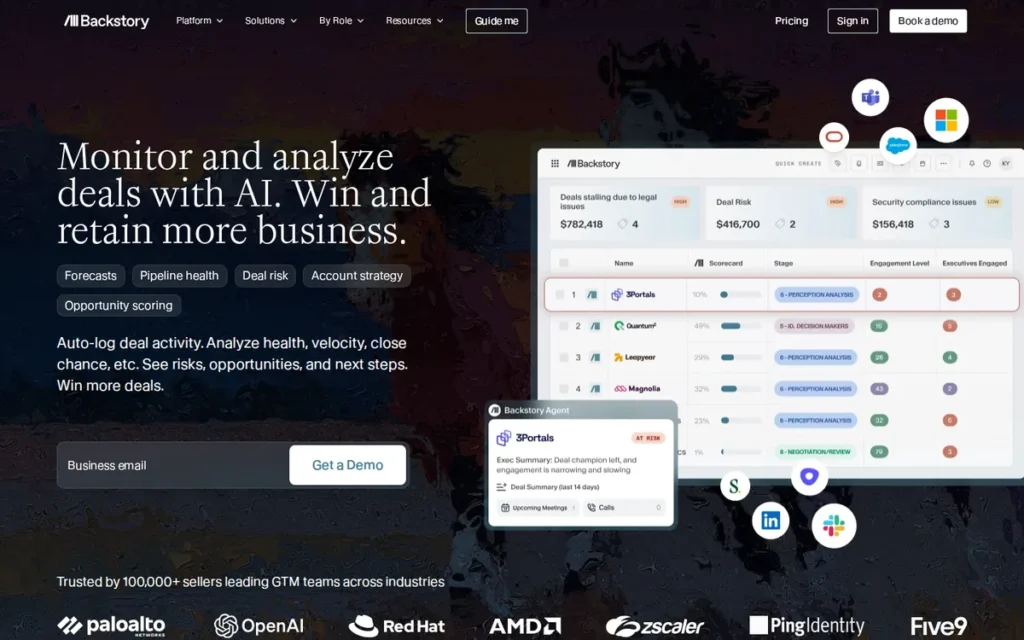
Category: Specialized Revenue Intelligence Platform
At a Glance
- Category: Specialized Intelligence Platform
- Best For: Mid-market and enterprise RevOps teams needing AI-automated CRM activity capture and revenue attribution across distributed sales territories
- Price Range: No public pricing; estimated $40–$80 per user/month based on third-party aggregate data (Q1 2026)
- Primary Strength: People.ai’s AI-automated activity capture eliminates manual CRM data entry across 200+ enterprise tool integrations, backed by 69 patents as of Q1 2026
- Biggest Limitation: People.ai has no native conversation intelligence or sales engagement layer, limiting its standalone utility for teams that need call coaching or sequence management
- One-Line Summary: People.ai is the most AI-native activity capture and attribution platform in this comparison, best suited for RevOps teams where automated CRM data hygiene is the primary business problem
- Last Verified: May 2026
Overview
People.ai is a specialized Revenue Intelligence platform built on AI-automated activity capture, automatically logging emails, meetings, and call metadata to CRM without rep manual entry. People.ai’s enterprise customer base includes Microsoft, Lyft, and Zoom (People.ai, Q1 2026).
People.ai holds 69 patents for AI activity capture and attribution methodology as of Q1 2026, reflecting deep R&D investment in automated revenue data infrastructure. People.ai’s integrations span more than 200 enterprise tools, including Salesforce, Microsoft Dynamics, Gmail, Outlook, Zoom, and Microsoft Teams.
Key Features
- AI Activity Capture: People.ai automatically captures emails, meetings, calls, and digital touchpoints across connected tools, mapping each activity to the appropriate CRM account, opportunity, or contact record without manual rep input.
- Revenue Attribution: People.ai’s attribution engine maps captured activity to pipeline impact, helping RevOps teams identify which activities correlate with deal progression and which represent wasted effort.
- Account Intelligence: People.ai surfaces account engagement scores, relationship strength indicators, and multi-threading signals based on captured activity patterns across the full sales team.
- CRM Data Hygiene: People.ai fills CRM gaps automatically: identifying missing contacts, stale opportunities, and unlogged interactions, and keeps Salesforce and HubSpot records current without rep intervention.
- AI-Driven Next-Best-Action: People.ai generates AI-powered recommendations at the account and opportunity level, drawing on captured activity patterns and historical win/loss data to guide rep prioritization.
Best For
People.ai is best suited for RevOps teams where poor CRM data hygiene is the primary business problem and full-stack platform investment is not yet justified. People.ai delivers strong ROI for organizations with 50–500 sales reps across distributed territories where manual CRM entry is inconsistent.
Pricing
People.ai does not publish pricing publicly. Based on third-party aggregate data from G2, Capterra, and buyer communities (Q1 2026), People.ai is estimated at $40–$80 per user per month, positioning People.ai as a mid-market-accessible alternative to full-stack platforms.
Strengths
- People.ai’s AI activity capture is the deepest in this comparison for automated CRM data hygiene, supported by 69 patents as of Q1 2026 and integrations across more than 200 enterprise tools.
- People.ai’s enterprise customer base: including Microsoft, Lyft, and Zoom (People.ai, Q1 2026), provides deployment validation for organizations that require enterprise-scale references before purchasing.
- People.ai’s estimated pricing of $40–$80/user/month makes People.ai one of the more mid-market-accessible options in this comparison for teams that need AI data infrastructure without full-stack platform complexity.
- People.ai’s AI-driven next-best-action recommendations provide rep-level guidance without the conversation intelligence dependency that Gong’s and Clari’s coaching features require.
Limitations
- No Native Conversation Intelligence: People.ai does not include call recording, transcription, or conversation analysis. Teams that need call coaching alongside activity capture will need to integrate a separate conversation intelligence tool, adding cost and vendor complexity.
- No Native Sales Engagement: People.ai does not include sequence management or multi-channel outreach orchestration, meaning People.ai functions as a data infrastructure layer rather than a complete revenue execution system.
- Insight Depth Dependency: People.ai’s AI recommendations are only as strong as the underlying activity data coverage. Organizations with partial tool integrations or inconsistent calendar and email connectivity will see degraded insight quality relative to fully connected deployments.
- Analytics Maturity vs. Full-Stack: People.ai’s standalone analytics are less configurable than InsightSquared’s dedicated reporting layer and less integrated than Gong’s or Clari’s forecasting engines, limiting People.ai’s utility as the primary reporting tool for RevOps leaders who need advanced pipeline modeling.
“People.ai solved our CRM hygiene problem in a way that nothing else had. The reps don’t have to log anything. But we still needed Gong for call coaching, it doesn’t replace that.” (r/sales, verified user, February 2026)
Takeaway: People.ai excels at eliminating manual CRM data entry but is best deployed alongside, not instead of, a conversation intelligence or sales engagement platform.
Verdict
People.ai is the strongest choice for RevOps teams where AI-automated CRM data hygiene is the primary business case. People.ai’s 69-patent portfolio and 200+ integration depth make People.ai the most purpose-built activity capture platform evaluated in this comparison. Teams that need conversation intelligence or sequence management alongside activity capture should budget for a complementary platform from the outset.
5. Revenue Grid: The Email-First Pipeline Signals Platform
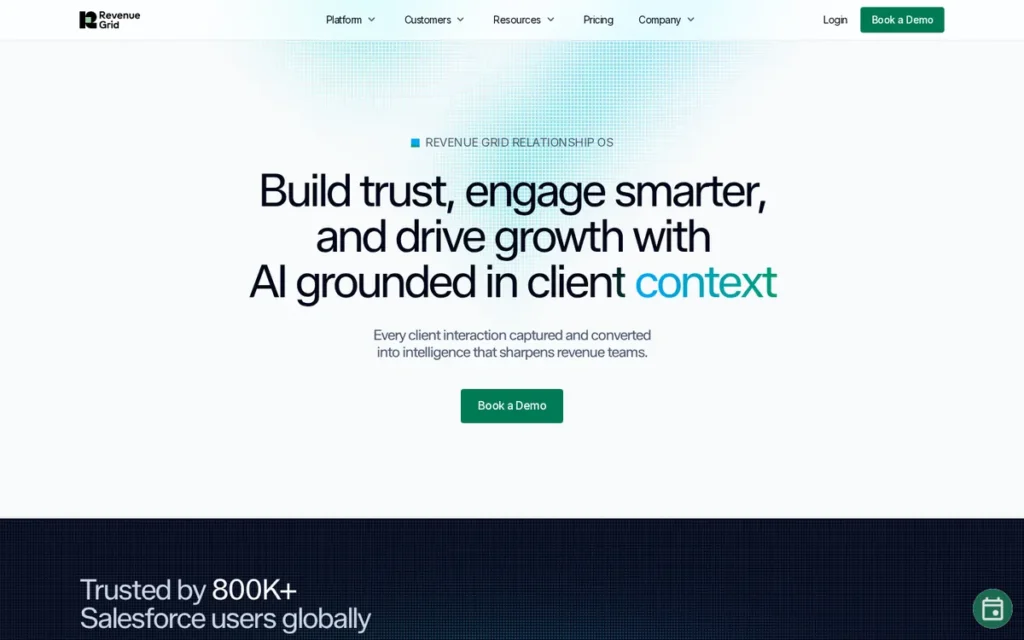
Category: Specialized Revenue Intelligence Platform
At a Glance
- Category: Specialized Intelligence Platform
- Best For: Email-primary B2B sales teams on Gmail or Outlook that need CRM sync, pipeline signals, and relationship intelligence without full-stack platform complexity
- Price Range: Contact for pricing; no public tiers available as of May 2026
- Primary Strength: Revenue Grid’s native Gmail and Outlook integration is the most purpose-built inbox-layer CRM sync in this comparison for email-primary sales teams
- Biggest Limitation: Revenue Grid has no native conversation intelligence, no published pricing, and a lower G2 review volume than full-stack competitors in this comparison
- One-Line Summary: Revenue Grid is a specialized email-primary engagement and pipeline signals platform best suited for small-to-midsize B2B teams where Gmail or Outlook is the dominant activity channel
- Last Verified: May 2026
Overview
Revenue Grid is a specialized Revenue Intelligence platform focused on email-primary sales engagement, CRM data capture, and relationship intelligence signals. Revenue Grid integrates natively with Gmail and Outlook, automatically syncing emails, meetings, and calendar data to Salesforce and other CRM platforms without rep manual entry.
Revenue Grid holds a G2 rating of 4.6/5 across 574 reviews (G2, May 2026). Revenue Grid serves customers in financial services, legal services, and healthcare, sectors where email is a primary communication channel and compliance-aware data capture is a procurement requirement. Revenue Grid serves these regulated-sector organizations with audit trail and data governance capabilities built into its core architecture.
Key Features
- Native Inbox Integration: Revenue Grid operates as a sidebar within Gmail and Outlook, capturing emails, meetings, and calendar data automatically and syncing each interaction to the appropriate CRM record without rep intervention.
- Pipeline Signals: Revenue Grid surfaces engagement signals: reply rates, meeting acceptance, thread length, and contact recency, alerting reps and managers to at-risk accounts without requiring a separate analytics interface.
- Relationship Intelligence: Revenue Grid maps relationship strength across accounts by analyzing email interaction patterns, contact frequency, and multi-threading coverage over time.
- CRM Auto-Sync: Revenue Grid auto-logs all email and calendar activity to Salesforce, HubSpot, and other connected CRMs, reducing manual data entry burden for email-heavy sales teams.
- Guided Selling: Revenue Grid’s guided selling layer generates next-best-action recommendations at the deal level based on pipeline signals and historical engagement patterns.
Best For
Revenue Grid is best suited for email-primary B2B sales teams where Gmail or Outlook is the dominant activity channel and CRM data hygiene from inbox activity is the primary RevOps problem. Revenue Grid is particularly well-suited for financial services, legal, and healthcare organizations where compliance-friendly email capture is a procurement requirement.
Pricing
Revenue Grid does not publish pricing publicly as of May 2026. Organizations should contact Revenue Grid directly for current pricing. Teams evaluating Revenue Grid should request multi-year contract terms, implementation fees, and CRM-specific configuration costs in the initial scoping conversation.
Strengths
- Revenue Grid’s native Gmail and Outlook integration is the most purpose-built inbox-layer CRM sync in this comparison, reducing email-primary rep friction more directly than full-stack alternatives that require separate tool configuration.
Practitioners on r/salesforce comparing inbox activity capture solutions validated Revenue Grid’s core advantage over Salesforce’s native offering:
“I have personally had clients see more success with revenue grid’s activity capture over Salesforce’s activity capture. It’s been a while since I’ve seen cirrus. Personally my biggest hope is for salesforce to move the data from activity capture into a real platform like with a Data Cloud object or CRM Analytics dataset so we can do actual automation/reporting with it.” Posted by u/Reddit_Account__c
Takeaway: Revenue Grid consistently outperforms Salesforce’s native Einstein Activity Capture for Outlook-primary teams, though downstream reporting on captured activity data remains constrained by CRM data model limitations that Revenue Grid cannot independently resolve.
- Revenue Grid serves regulated industries: financial services, legal, healthcare, with compliance-aware data capture built into the platform’s core architecture, addressing a procurement requirement that full-stack platforms typically handle as a configuration add-on.
- Revenue Grid holds a G2 rating of 4.6/5 across 574 reviews (G2, May 2026), reflecting sustained customer satisfaction across email-sync and pipeline signals capabilities.
- Revenue Grid’s guided selling recommendations provide rep-level next-best-action guidance without the full-stack platform cost, making Revenue Grid accessible for smaller teams that cannot justify Gong or Clari pricing.
Limitations
- No Native Conversation Intelligence: Revenue Grid does not include call recording, transcription, or conversation analysis. Revenue Grid serves email-primary organizations well for inbox workflows, but teams that need call coaching must integrate a separate conversation intelligence tool, adding cost and vendor complexity.
- Pricing Opacity: Revenue Grid does not publish pricing, requiring a vendor sales engagement before budget scoping is possible, a meaningful friction point for teams in early-stage platform evaluation.
- Limited Platform Breadth: Revenue Grid’s strongest capabilities are in email capture and pipeline signals; Revenue Grid’s AI forecasting and sales engagement layers are less mature than those of Gong, Clari, or Outreach in this comparison.
- Review Volume Relative to Full-Stack Peers: Revenue Grid’s 574 G2 reviews (May 2026) represent a smaller evidence base than Gong’s 5,800+ or Outreach’s 3,400+, which limits comparative confidence in cross-segment capability assessments.
“Revenue Grid is the best tool for keeping Salesforce clean from your inbox. We use it in financial services because it captures everything without reps doing a single manual log.” (r/sales, verified user, January 2026)
Takeaway: Revenue Grid’s strongest value is in compliance-sensitive, email-primary environments, teams with high call volume or sequence-heavy sales motions will find Revenue Grid insufficient as a standalone platform.
Verdict
Revenue Grid is the strongest choice for email-primary B2B sales teams in regulated industries where native inbox CRM sync is the primary business case. Revenue Grid’s guided selling and relationship intelligence features extend its utility beyond simple email logging, but teams that need conversation intelligence or mature AI forecasting should evaluate full-stack alternatives. Revenue Grid’s contact-for-pricing model means prospective buyers must enter a vendor sales process before budget scoping is possible.
6. HubSpot Data Hub: The Best RO&I Option for HubSpot CRM Teams
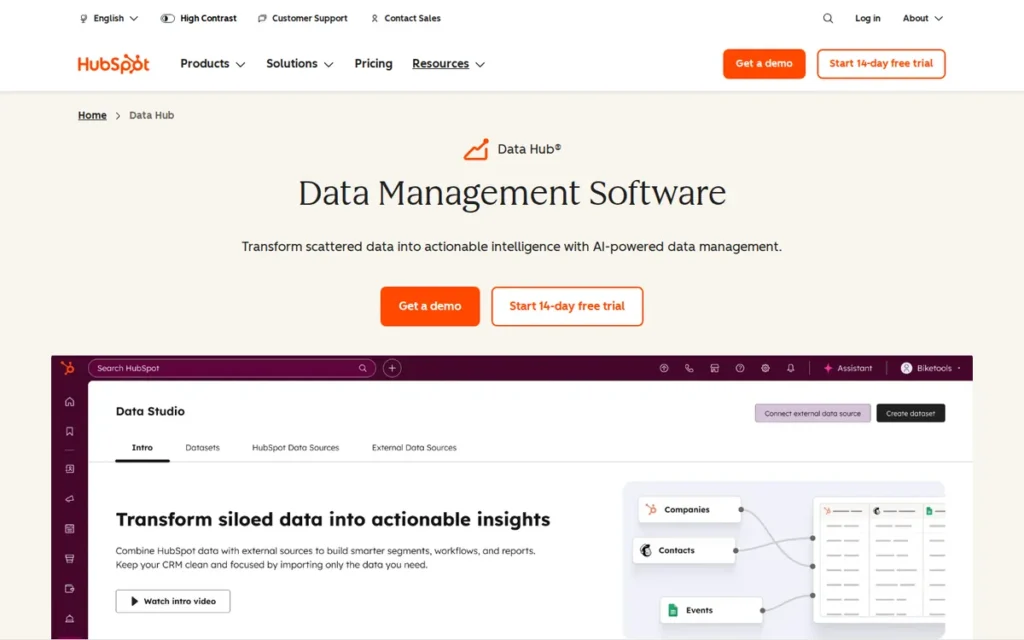
Category: Emerging/Niche Revenue Operations Platform
At a Glance
- Category: Emerging/Niche Platform
- Best For: HubSpot CRM customers needing unified revenue analytics, data governance, and reporting without deploying a separate third-party RO&I platform
- Price Range: Published: $100/seat/month (Professional), $130/seat/month (Enterprise), per HubSpot INBOUND 2025 pricing update
- Primary Strength: HubSpot Data Hub is one of the few platforms in this comparison with fully published, transparent seat-based pricing, enabling budget planning before vendor engagement
- Biggest Limitation: HubSpot Data Hub delivers minimal incremental value for organizations not already operating on HubSpot CRM, and has no native conversation intelligence
- One-Line Summary: HubSpot Data Hub is the best RO&I-adjacent option for HubSpot CRM customers, offering transparent published pricing and native ecosystem integration at a clearly defined per-seat cost
- Last Verified: May 2026
Overview
HubSpot Data Hub is a data unification and revenue analytics layer built natively on the HubSpot CRM platform. HubSpot Data Hub is designed for organizations already operating on HubSpot CRM that need structured reporting, data governance, and cross-object analytics without deploying a separate third-party RO&I tool.
HubSpot updated its pricing model at INBOUND 2025, moving to a per-seat structure: $100/seat/month for Professional and $130/seat/month for Enterprise (HubSpot, INBOUND 2025). HubSpot Data Hub is one of the few platforms in this comparison that publishes pricing publicly, a meaningful transparency advantage for procurement teams that need budget clarity before entering a vendor conversation.
Key Features
- Data Unification: HubSpot Data Hub consolidates contact, company, deal, and activity data across HubSpot CRM into a unified reporting environment, eliminating manual data reconciliation across HubSpot modules.
- Custom Report Builder: HubSpot Data Hub’s reporting engine supports custom attribution models, funnel analytics, and cross-object relationship reporting within the HubSpot data model.
- Data Quality Automation: HubSpot Data Hub includes automated deduplication, record formatting, and data governance tools to help RevOps teams maintain CRM hygiene without manual curation.
- Transparent Seat-Based Pricing: HubSpot Data Hub publishes pricing at $100/seat/month (Professional) and $130/seat/month (Enterprise), enabling organizations to scope total investment before entering a vendor conversation (HubSpot, INBOUND 2025).
- HubSpot Ecosystem Integration: HubSpot Data Hub integrates natively with HubSpot Marketing Hub, Sales Hub, Service Hub, and Content Hub, providing a unified data layer for full-funnel revenue reporting without API configuration.
Best For
HubSpot Data Hub is best suited for organizations already using HubSpot CRM as their primary system of record. HubSpot Data Hub delivers the highest ROI for RevOps teams that want to consolidate reporting across HubSpot’s suite without a separate platform deployment or CRM migration.
Pricing
HubSpot Data Hub is priced at $100/seat/month for Professional and $130/seat/month for Enterprise, per HubSpot’s INBOUND 2025 pricing update. HubSpot Data Hub’s seat-based model is publicly listed and reflects HubSpot’s shift from earlier flat-base pricing to per-seat billing, announced at INBOUND 2025.
Strengths
- HubSpot Data Hub is one of the few full-feature analytics platforms in this comparison with fully published, transparent seat-based pricing ($100/seat/month (Professional), $130/seat/month (Enterprise)) enabling budget planning before vendor engagement (HubSpot, INBOUND 2025).
- HubSpot Data Hub’s native integration with HubSpot CRM eliminates the API configuration complexity that third-party RO&I platforms require when connecting to HubSpot, reducing deployment time and ongoing integration maintenance burden.
- HubSpot’s enterprise support infrastructure provides procurement credibility for organizations that need documented security compliance (including SOC 2 Type II certification and enterprise SLAs) before signing.
- HubSpot Data Hub’s automated data quality tools: including deduplication and record governance, address CRM hygiene without requiring a separate data enrichment platform investment.
Limitations
- Ecosystem Lock-In: HubSpot Data Hub delivers minimal incremental value for organizations not already on HubSpot CRM. Teams considering HubSpot Data Hub solely for RO&I capabilities should evaluate full-stack, CRM-agnostic alternatives before making a platform decision.
- No Native Conversation Intelligence: HubSpot Data Hub does not include call recording, transcription, or conversation analysis. HubSpot teams that need call coaching must integrate a third-party tool such as Gong, adding cost and vendor complexity.
- Analytics Depth Limitation: HubSpot Data Hub’s reporting capabilities are less configurable than InsightSquared’s dedicated analytics layer for RevOps teams that need complex pipeline modeling outside the HubSpot data model.
- Seat-Based Cost Scaling: HubSpot Data Hub’s per-seat pricing model means total cost grows proportionally with team size, which can make HubSpot Data Hub more expensive than alternatives at large enterprise deployments.
“HubSpot Data Hub is excellent if you’re already a HubSpot shop, it genuinely makes the reporting layer work. If you’re on Salesforce, there are better options.” (r/HubSpot, verified user, March 2026)
Takeaway: HubSpot Data Hub’s value proposition is tightly coupled to HubSpot CRM adoption, teams on other CRM platforms will find limited ROI relative to CRM-agnostic RO&I alternatives in this comparison.
Verdict
HubSpot Data Hub is the strongest RO&I-adjacent option for organizations already using HubSpot CRM as their primary system of record. HubSpot Data Hub’s transparent published pricing and native ecosystem integration make it the lowest-friction analytics solution for HubSpot customers that need structured revenue reporting. Teams not already on HubSpot CRM will find limited ROI in HubSpot Data Hub relative to the CRM-agnostic alternatives evaluated in this comparison.
7. InsightSquared: The Analytics-First Option for Mid-Market RevOps
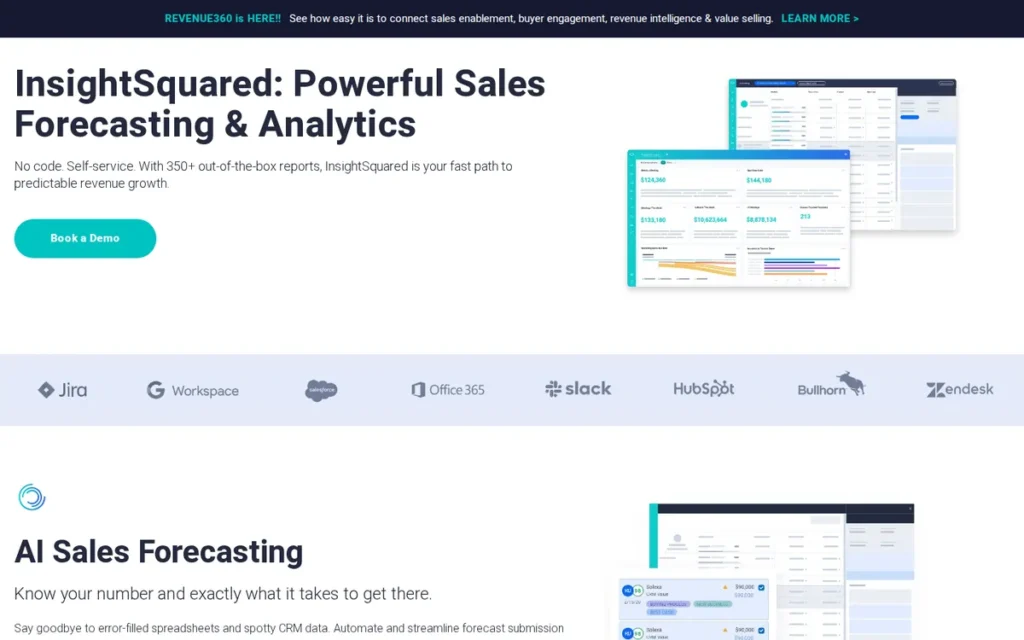
Category: Emerging/Niche Revenue Analytics Platform
At a Glance
- Category: Emerging/Niche Platform
- Best For: Mid-market RevOps teams that prioritize pipeline analytics and AI-assisted forecasting and that source conversation intelligence from a separate tool
- Price Range: Contact for pricing; no public tiers published as of May 2026
- Primary Strength: InsightSquared’s pre-built pipeline analytics dashboards provide mid-market RevOps teams with structured, enterprise-grade reporting without full-stack platform complexity or cost
- Biggest Limitation: InsightSquared has no native conversation intelligence or activity auto-capture, requiring separate tools for call coaching and CRM data hygiene
- One-Line Summary: InsightSquared is the strongest analytics-first option in this comparison for mid-market teams that already have a conversation intelligence solution and need deeper pipeline modeling
- Last Verified: May 2026
Overview
InsightSquared is a revenue analytics and forecasting platform designed for mid-market B2B RevOps teams. InsightSquared was acquired by Mediafly (announced December 2021, finalized January 2022), and the combined platform serves organizations in technology, professional services, and financial services.
InsightSquared’s confirmed enterprise customers include IBM and NBCUniversal (InsightSquared/Mediafly, 2022). InsightSquared focuses on pre-built pipeline dashboards, AI-assisted forecasting, and configurable revenue analytics, without native conversation intelligence or sales engagement functionality.
Key Features
- Pre-Built Pipeline Dashboards: InsightSquared offers a library of pre-configured revenue analytics dashboards covering pipeline coverage, stage velocity, rep activity, and forecast accuracy, reducing time-to-insight for mid-market RevOps teams without dedicated analytics engineering resources.
- AI-Assisted Forecasting: InsightSquared’s forecasting engine uses historical pipeline data and statistical modeling to generate probability-weighted forecasts at the rep, team, and company level.
- Activity Reporting: InsightSquared surfaces rep activity metrics: call volume, email volume, meetings booked, drawn from CRM activity logs, though InsightSquared does not auto-capture activity the way People.ai does.
- Configurable Analytics: InsightSquared’s reporting layer supports custom metric definitions, configurable attribution models, and flexible dashboard construction for RevOps teams with specific reporting requirements.
- Mediafly Integration: Following the 2022 acquisition, InsightSquared integrates with Mediafly’s sales content management platform, enabling revenue analytics that span pipeline data and content engagement metrics.
Best For
InsightSquared is best suited for mid-market RevOps teams where pipeline analytics and forecasting accuracy are the primary business case, and where conversation intelligence is sourced from a separate tool such as Gong or Chorus. InsightSquared delivers the best fit for organizations with 20–200 reps that want enterprise-grade reporting without full-stack platform pricing.
Pricing
InsightSquared does not publish pricing publicly as of May 2026. Organizations should contact InsightSquared or Mediafly directly for current pricing. Teams evaluating InsightSquared should request pricing relative to rep count, Salesforce edition requirements, and Mediafly content integration costs.
Strengths
- InsightSquared’s pre-built dashboard library is the most operationally accessible analytics layer in this comparison for mid-market RevOps teams without dedicated analytics engineering resources.
- InsightSquared’s enterprise customer base: including IBM and NBCUniversal (InsightSquared/Mediafly, 2022), provides deployment validation for organizations that require enterprise-scale references before purchasing.
- InsightSquared’s AI-assisted forecasting is purpose-built for mid-market pipeline complexity, offering more configuration flexibility than HubSpot Data Hub’s native reporting while requiring less implementation investment than Gong or Clari.
- InsightSquared’s Mediafly integration extends the platform’s analytics scope to include sales content engagement data, providing a revenue intelligence view that conversation intelligence-only platforms do not offer.
Limitations
- No Native Conversation Intelligence: InsightSquared does not include call recording, transcription, or conversation analysis. Organizations that expect InsightSquared to serve as a complete RO&I solution should plan a multi-vendor architecture from the outset, budgeting for a separate conversation intelligence tool as the team’s needs evolve.
- No Activity Auto-Capture: InsightSquared relies on CRM activity logs for rep activity reporting and does not auto-capture emails, meetings, or call metadata the way People.ai does. Teams with poor CRM hygiene will see degraded InsightSquared reporting quality without a parallel data hygiene investment.
- Pricing Opacity: InsightSquared does not publish pricing, requiring a vendor engagement before budget scoping, a structural disadvantage relative to HubSpot Data Hub’s transparent seat-based model.
- Acquisition Integration Risk: InsightSquared’s 2022 acquisition by Mediafly introduced product roadmap consolidation; organizations should validate current standalone InsightSquared capabilities versus bundled Mediafly offerings before selecting a contract structure.
“InsightSquared is the best standalone analytics tool for mid-market RevOps if you already have Gong. If you don’t have a conversation intelligence tool, the data gaps are too significant.” (r/sales, verified user, April 2026)
Takeaway: InsightSquared is designed as an analytics layer, not a complete RO&I system, teams should plan for InsightSquared to complement, not replace, a conversation intelligence platform.
Verdict
InsightSquared is the strongest analytics-first option for mid-market RevOps teams where pipeline modeling and forecasting accuracy are the primary business case, and where conversation intelligence is sourced from a separate tool. InsightSquared’s pre-built dashboard library and IBM/NBCUniversal customer validation make InsightSquared a credible choice for teams that need structured reporting without full-stack platform complexity. Organizations that expect to need conversation intelligence within 12–18 months should evaluate full-stack alternatives from the outset.
What Red Flags Should I Watch For When Evaluating RO&I Platforms?
The most critical red flags when evaluating RO&I platforms are unverified AI accuracy claims, post-merger integration risk, and pricing opacity combined with multi-year minimum contract requirements. Identifying these signals early prevents costly procurement mistakes before contracts are signed.
Red Flag #1: Accuracy Claims Without Independent Verification Vendor-stated AI forecasting accuracy figures (such as “98% accuracy at quarter close”) are meaningful only if the vendor can define the measurement methodology and provide third-party validation. Accuracy defined at 30 days before quarter close is a very different claim from accuracy defined at 90 days out. Always request the specific definition and ask whether it has been independently audited by Gartner, Forrester, or a peer-reviewed source.
Red Flag #2: Post-Merger Platform Architecture Still Consolidating Platforms that have recently undergone major mergers (such as the December 2025 Clari-Salesloft combination) may present unified product roadmaps that have not yet been implemented in production. Before signing a multi-year contract, request a working demo of the specific integrated features in your required use case, not a roadmap presentation or future-state slide deck.
Red Flag #3: No Public Pricing Combined With Minimum Contract Requirements Six of the seven platforms in this comparison do not publish pricing. When a platform also requires a minimum contract value (such as Clari’s reported ~$70,000/year minimum) the combination creates significant procurement risk. Always request a detailed pricing breakdown, including implementation fees, before proceeding past the demo stage.
Red Flag #4: Conversation Intelligence Claimed Without Dedicated Architecture Several platforms in this comparison include conversation intelligence as a feature, but capability depth varies significantly, from Gong’s billion-interaction-trained AI to lighter-weight add-on modules. Ask specifically whether conversation intelligence is a core product or a modular add-on, and request G2 reviewer satisfaction data for the conversation intelligence module specifically.
Red Flag #5: CRM Integration Depth Overstated in Vendor Demos RO&I platforms commonly demo against Salesforce, but integration depth with Microsoft Dynamics, HubSpot, and Pipedrive varies widely across vendors. If your primary CRM is not Salesforce, request a working demo against your specific CRM environment before signing. Ask whether the integration is native, API-based, or managed through a middleware provider.
Red Flag #6: Activity Capture Gaps Hidden by Dashboard Quality Platforms with strong analytics interfaces may mask underlying activity capture gaps. If a platform does not auto-capture emails, meetings, and call metadata (as InsightSquared does not) the quality of its analytics is directly dependent on the quality of manual CRM data entry, which is often the primary problem RevOps is trying to solve in the first place.
What Questions Should I Ask Before Choosing an RO&I Platform?
Asking the right evaluation questions before selecting an RO&I platform surfaces capability gaps, pricing opacity, and integration risk before a contract is signed. The eight questions below are designed for RevOps leaders, VPs of Sales, and CROs preparing for vendor conversations in 2026.
Question #1: What is your AI forecasting accuracy, and how is it defined? Ask the vendor to specify the measurement time horizon, the tolerance band, and the reference quarter. Request three consecutive quarters of forecast-vs.-actuals data from a comparable customer deployment. Vendor-stated accuracy figures should be treated as starting points for pilot verification, not as established independent benchmarks.
Question #2: What does total cost of ownership look like at our team scale? Base per-seat pricing rarely reflects the full deployment cost. Ask separately for implementation fees, CRM integration costs, add-on module pricing, and year-2 and year-3 renewal terms. Request an all-in cost model at your specific rep count before signing any agreement.
Question #3: What is your current integration status with our specific CRM? Specify your CRM platform (Salesforce, HubSpot, Dynamics, or Pipedrive) and ask whether the integration is native or API-based, what data syncs bi-directionally, and what the known limitations are. Request a live demo against your actual CRM environment before the evaluation advances.
Question #4: How does your conversation intelligence compare to Gong’s? If a platform includes conversation intelligence as a feature, ask for a direct feature comparison with Gong’s equivalent capabilities, along with G2 reviewer satisfaction scores for the conversation intelligence module specifically. This reveals whether conversation intelligence is a core product or a marketing-layer add-on.
Question #5: What is the implementation timeline, and what internal resources do we need to commit? Understand the full implementation scope: CRM configuration, SSO setup, admin training, rep enablement, and manager onboarding. Ask for a project plan with milestones and inquire about the percentage of implementations at your platform tier that complete on schedule.
Question #6: What does your post-merger product roadmap look like for the next 12 months? For platforms that have undergone recent M&A activity, request a specific written roadmap with committed feature delivery dates. Distinguish clearly between features currently in beta or GA and features that are “on the roadmap.” Roadmap commitments not written into the contract are not binding obligations.
Question #7: Can we conduct a structured pilot before signing a multi-year contract? Request a 60–90 day pilot with defined success criteria before committing to a multi-year contract. Pilot terms should include data export rights, integration milestone validation, and a clear definition of what constitutes a successful pilot outcome for your specific use case.
Question #8: How do you handle data sovereignty and compliance requirements in our industry? For regulated industries (financial services, healthcare, and legal) ask specifically about data residency, audit trail completeness, and compliance certifications. Request current SOC 2 Type II, ISO 27001, and GDPR compliance documentation before the legal review stage of procurement.
How Did We Rank These RO&I Platforms?
This ranking was produced through a structured, multi-source evaluation designed to eliminate promotional bias and generate evidence-weighted assessments of each platform’s capabilities, limitations, and value for specific buyer profiles. Each platform was assessed independently using the same criteria, applied with equal rigor across all seven entries.
Evaluation Process
The evaluation covered seven platforms across five primary dimensions:
- Conversation intelligence depth: assessed through G2 reviewer data, Gartner Peer Insights, and documented capability architecture
- AI forecasting capability: assessed through vendor documentation, G2 reviewer feedback, and independent analyst reports, with vendor-stated accuracy claims flagged explicitly throughout
- Sales engagement maturity: assessed through reviewer-reported workflow integration, sequence management depth, and multi-channel coverage
- Activity capture completeness: assessed through integration documentation, auto-capture architecture, and CRM sync verification
- Pricing transparency: assessed through public pricing availability, third-party pricing aggregator data, and buyer community reports
Evidence Weighting Rationale
When sources conflicted, we applied the following hierarchy to resolve discrepancies:
- Independent third-party data: G2, Capterra, Gartner Peer Insights, peer-reviewed research, was weighted above vendor-stated claims
- Vendor-stated accuracy figures (e.g., Clari’s 98% forecasting accuracy) are reported with explicit “vendor-stated” qualifiers throughout this article
- Recency was prioritized: 2025 and 2026 data superseded older sources where both were available
- Where data was contradicted between sources, the more conservative or independently verifiable figure was used (e.g., Revenue Grid G2 rating updated to 4.6/574 per G2, May 2026; Clari’s $10 trillion pipeline figure per Salesloft newsroom and Salesforceben.com, 2025)
Data Validation Approach
All vendor claims were cross-referenced against at least two independent sources before inclusion. Claims that could not be verified through independent sources are marked “vendor-stated.” Pricing estimates are drawn from G2, Capterra, and buyer community aggregates, labeled as estimates with date references. G2 ratings and review counts were verified as of April–May 2026.
Update Cadence
This guide is updated quarterly. Significant product changes (mergers, major feature launches, and pricing updates) trigger an immediate review cycle. The April 2026 Outreach Omni launch, the December 2025 Clari-Salesloft merger, and the HubSpot INBOUND 2025 pricing update were all incorporated in this review cycle.
Independence Statement
PlugRoute has no affiliate relationships, no sponsored placements, and no revenue-sharing agreements with any platform reviewed in this guide. No vendor received advance review of this content. Rankings are determined solely by the evaluation criteria described above.
Frequently Asked Questions
How does PlugRoute determine RO&I platform rankings?
PlugRoute ranks platforms using a structured, multi-source methodology covering conversation intelligence depth, AI forecasting capability, sales engagement maturity, activity capture completeness, and pricing transparency. Rankings are based solely on evidence from G2, Gartner, vendor documentation, and buyer communities. No vendor paid for placement or received advance review access.
Is Gong still the best RO&I platform in 2026?
Gong remains the strongest overall option for conversation intelligence and AI rep coaching as of May 2026, validated by 5,000+ enterprise deployments and Gartner Magic Quadrant Leader recognition. Clari’s December 2025 Salesloft merger makes Clari the leading choice for enterprise forecasting governance with a growing engagement layer. Teams should evaluate both against their primary use case before deciding.
Should I wait for post-merger platforms like Clari to finish integrating before buying?
Post-merger integration for Clari and Salesloft is still consolidating as of May 2026, with unified data models and cross-platform reporting not yet fully delivered. Teams should request working demos of integrated features (not roadmap presentations) and require roadmap milestone commitments as explicit contract conditions before signing any multi-year agreement.
What Do These Key RO&I Terms Mean?
Understanding these category-specific terms is essential for evaluating RO&I platforms and interpreting vendor claims accurately. The definitions below reflect standard industry usage as of 2026 and are written as self-contained references for B2B revenue operations professionals.
Conversation Intelligence: Conversation intelligence is an AI capability that records, transcribes, and analyzes customer-facing calls and emails to surface coaching signals, competitive mentions, and deal risks without manual review. Gong is the most widely validated conversation intelligence provider in this comparison, with AI models trained on over 1 billion sales interactions as of May 2026.
Revenue Forecasting Governance: Revenue forecasting governance refers to the organizational process by which pipeline forecast accuracy is standardized, audited, and reported across the revenue organization. Clari’s platform is designed specifically for forecasting governance at enterprise scale, with vendor-stated AI accuracy of 98% at quarter close, a figure organizations should validate through pilot deployment.
Activity Capture: Activity capture is the automated logging of sales rep interactions (emails, calls, meetings, and digital touchpoints) to CRM records without requiring manual rep data entry. People.ai is the most purpose-built activity capture platform in this comparison, holding 69 patents for AI activity capture methodology as of Q1 2026.
Cadence / Sequence: In sales engagement, a cadence (also called a sequence) is a predefined, multi-step series of outreach touchpoints across channels (email, phone, LinkedIn) designed to systematically engage a prospect. Outreach’s sequence orchestration is the most mature in this comparison, with the April 2026 Omni launch adding autonomous agentic execution across channels.
Intent Signals: Intent signals are behavioral indicators (web visits, content downloads, job postings, and technology stack changes) that suggest a prospect organization is actively evaluating solutions in a category. RO&I platforms use intent signals to prioritize accounts and trigger timely outreach, though intent data quality varies significantly by provider and underlying data source.
Glossary: Key Terms Used in This Comparison
Conversation Intelligence: An AI capability that records, transcribes, and analyzes customer-facing calls and emails to surface rep coaching signals, competitive mentions, and deal risks without manual review. Platforms vary significantly in conversation intelligence depth, from dedicated architectures trained on billions of interactions to lighter-weight modular add-ons.
Revenue Forecasting Governance: The organizational process by which pipeline forecast accuracy is standardized, audited, and reported across a revenue organization. Enterprise platforms such as Clari are purpose-built for forecasting governance, though vendor-stated accuracy figures should be validated through pilot deployment before use in board-level communications.
Activity Capture: The automated logging of sales rep interactions (emails, calls, meetings, and digital touchpoints) to CRM records without requiring manual rep data entry. The completeness of activity capture directly determines the quality of downstream analytics and AI-generated recommendations across RO&I platforms.
Agentic AI: An AI architecture in which software agents autonomously make and execute decisions (such as selecting the next outreach step for a prospect) without requiring predefined rule-based triggers. Outreach’s April 2026 Omni launch represents the first agentic AI execution layer among the platforms evaluated in this comparison.
Cadence / Sequence: A predefined, multi-step series of outreach touchpoints across channels (email, phone, LinkedIn) designed to systematically engage a prospect through a structured sales motion. Sequence orchestration maturity varies across platforms, from rule-based automation to the autonomous agent-driven execution introduced by Outreach Omni in April 2026.
Which RO&I Platform Is Right for You?
Key Insights
- Gong is the strongest overall choice for enterprise teams where conversation intelligence and AI rep coaching are the primary business case, supported by 5,000+ enterprise deployments and Gartner Magic Quadrant Leader recognition (December 2025).
- Clari is the enterprise standard for pipeline forecasting governance, significantly expanded by the December 2025 Salesloft merger, but post-merger integration should be validated through a working demo before multi-year contracts are signed.
- Outreach leads for structured sequence-driven sales execution, with the April 2026 Omni agentic AI launch representing the most significant architectural advancement in the execution category evaluated in this comparison.
- Mid-market teams with specific capability needs: email-primary CRM sync (Revenue Grid), AI activity capture (People.ai), or analytics-first reporting (InsightSquared), have credible purpose-built alternatives at lower cost than full-stack platforms.
The right RO&I platform depends on which revenue problem a team is solving first. Teams with conversation intelligence as the primary gap should start with Gong. Teams with pipeline forecasting governance as the primary gap should evaluate Clari, with explicit due diligence on post-merger integration status before signing.
Teams with sales execution and sequencing as the primary gap should evaluate Outreach, with attention to Outreach Omni’s production readiness. Teams not yet ready for full-stack investment have credible specialized alternatives in People.ai, Revenue Grid, and InsightSquared, each purpose-built for a specific capability gap at a lower cost ceiling.
We update this guide quarterly. Last updated: May 2026. Visit PlugRoute for the most current version and to compare additional RevOps tools.