LeanData is best overall for enterprise Salesforce routing orchestration, Traction Complete for Salesforce-native routing plus deduplication and account hierarchy management, and Chili Piper for converting inbound form fills into booked meetings instantly. The right choice depends on whether your primary pain is routing depth, data hygiene, or conversion speed, and whether your CRM is Salesforce or HubSpot.
RevOps teams at mid-market and enterprise B2B companies face a consistent operational failure: leads arrive in the CRM unmatched to existing accounts. They reach the wrong rep or territory. They generate duplicate outreach on named accounts. They leave no audit trail for diagnosing what went wrong. The seven tools in this evaluation address these failures, assessed for routing depth, audit trail governance, CRM compatibility, pricing transparency, and independently verified results.
PlugRoute has no affiliate relationships with any company listed, rankings are determined entirely by research data and objective evaluation criteria.
“I’ve been working with LeanData for years and it’s something I swear by. The only issue I find is that the routing rules can get pretty complex and users can get confused why Leads were assigned to them or to others.” Posted by u/That-Jeweler, r/salesforce, 2025
Takeaway: Even practitioners who advocate strongly for their chosen routing tool acknowledge implementation complexity as the category’s most persistent operational challenge, a reality that applies across all seven tools in this evaluation.
What Are the Top Picks for Lead-to-Account Matching and Routing Software?
TL;DR: Top Picks at a Glance
- LeanData: deepest Salesforce-native routing orchestration for enterprise ABM teams with complex territory hierarchies
- Traction Complete: four-app Salesforce-native suite: routing, deduplication, account hierarchies, and relationship mapping without deployment overhead
- Chili Piper: fastest form-fill-to-booked-meeting inbound conversion for high-volume inbound teams
- LeadAngel: only routing specialist with three publicly listed pricing tiers ($99/$500/$2,042 per month) and multi-CRM support
- ZoomInfo Operations: enrichment-before-routing for enterprise teams already contracted with ZoomInfo
- RevenueHero: easiest-to-implement routing plus scheduling with full meeting lifecycle tracking
- Apollo.io: only tool with a free tier and self-serve pricing for growth-stage GTM consolidation
What Are the Seven Categories of Lead-to-Account Matching and Routing Tools?
Lead-to-account matching and routing tools fall into seven philosophy categories based on which operational failure they are designed to solve first. Selecting the wrong philosophy category for your primary pain is the most common implementation failure RevOps teams make when evaluating routing software.
The seven categories are:
- Orchestrator (LeanData): coordinates complex multi-object routing through a visual flow builder with audit trails and SLA enforcement, built for enterprise teams running account-based selling with complex territory hierarchies
- Hygienist (Traction Complete): cleans, deduplicates, and governs CRM records before and during routing, built for Salesforce teams where data quality degradation is the root cause of matching failures
- Converter (Chili Piper): routes inbound form fills and books a meeting at the moment of highest buyer intent, built for teams where speed-to-meeting is the primary pipeline KPI
- Matcher (LeadAngel): integrates lead-to-account matching, deduplication, multi-object routing, and scheduling in one engine with multi-CRM support, built for mid-market teams at accessible price points
- Enricher (ZoomInfo Operations): enriches incomplete CRM records from a proprietary database before routing logic runs, built for teams already inside the ZoomInfo data ecosystem
- Scheduler (RevenueHero): combines routing and scheduling with full meeting lifecycle tracking from form fill through meeting held, built for mid-market teams prioritizing ease of implementation
- Prospector (Apollo.io): consolidates prospecting, database enrichment, sequencing, and basic routing in one GTM platform, built for growth-stage teams that need breadth, not routing depth
A common implementation failure looks like this: a RevOps team buys a Converter (Chili Piper) because they need speed-to-meeting, but their actual bottleneck is that 40% of inbound leads cannot match to their named account list because their CRM data is dirty. A Converter does not fix matching accuracy; that requires a Hygienist (Traction Complete) or Matcher (LeadAngel). The team purchases two tools, and the routing problem persists until the data problem is fixed first.
How Do the Top Lead-to-Account Routing Tools Compare at a Glance?
The seven tools in this comparison fall into three evidence tiers: tools with published named case studies and large review communities (LeanData, Chili Piper, Apollo.io), tools with strong architectural credentials but smaller validation bases (Traction Complete, ZoomInfo Operations), and tools with strong functional differentiation but limited public results documentation (LeadAngel, RevenueHero). Use the table below to identify which tool matches your primary pain, then verify evidence quality in the individual entries.
| Rank | Company | Category | Best For | One-Line Summary | Key Capabilities | Primary Strength | Key Limitation |
|---|---|---|---|---|---|---|---|
| 1 | LeanData | Orchestrator | Enterprise Salesforce ABM with complex territory hierarchies | Salesforce-native routing orchestration with six-dimension fuzzy matching and complete audit trails | Six-dimension matching; visual FlowBuilder; SLA enforcement; Salesforce-only; no native HubSpot | Deepest routing orchestration with the strongest audit trail governance in the category | No native account deduplication; steep setup complexity; pricing on request |
| 2 | Traction Complete | Hygienist | Salesforce teams needing routing + dedup + hierarchies in one vendor | Four-app Salesforce-native suite combining routing, DUNS-level hierarchies, and deduplication without deployments | Deployment-free rule changes; DUNS matching; multi-object dedup; Salesforce-only; no HubSpot | Four-app suite covers routing, dedup, hierarchy, and relationship mapping from one vendor | Small public review community; 80% speed claim is vendor self-reported; Salesforce-only |
| 3 | Chili Piper | Converter | High-volume inbound teams needing form-fill-to-meeting in seconds | Inbound conversion platform that routes and books meetings at form submission before the prospect leaves | Concierge booking; Distro routing; Salesforce + HubSpot via API; modular pricing per product | Fastest form-fill-to-booked-meeting workflow in the category | Modular pricing escalates significantly; limited routing orchestration depth at enterprise scale |
| 4 | LeadAngel | Matcher | Mid-market teams needing three published pricing tiers and multi-CRM routing | Only routing specialist with three public pricing tiers ($99–$2,042/month) and integrated deduplication | Three published tiers ($99/$500/$2,042/month); multi-CRM; integrated dedup; Salesforce + HubSpot | Only routing specialist with three fully disclosed pricing tiers, enabling pre-sales cost modeling | No named quantified case studies publicly available; auto-save limitation reported |
| 5 | ZoomInfo Operations | Enricher | Enterprise teams already contracted with ZoomInfo | Data-first routing platform that enriches incomplete leads from a 275M+ database before routing runs | Enrichment-before-routing; intent data routing; NASDAQ: ZI; requires ZoomInfo data subscription | Unique intent-signal routing and enrichment accuracy on sparse lead records | Lower reviewer ratings on core routing functions; full value requires ZoomInfo data subscription |
| 6 | RevenueHero | Scheduler | Mid-market teams wanting routing + scheduling + meeting outcome tracking with low setup complexity | Routing-and-scheduling platform with meeting lifecycle tracking from form fill through meeting held | Four round-robin modes; full routing logs; meeting lifecycle tracking; Salesforce + HubSpot | G2-recognized for ease of use; tracks meetings from booked through held for rep-level outcome data | No public pricing; limited practitioner community; no named quantified case studies publicly available |
| 7 | Apollo.io | Prospector | Growth-stage teams needing prospecting + enrichment + basic routing in one self-serve platform | GTM intelligence platform with free tier, published pricing, and basic routing backed by 275M+ contacts | Free tier + $49/$79/user/month published pricing; 7,000+ G2 reviews; Salesforce + HubSpot | Only tool with a free entry tier and fully self-serve pricing from $49/user/month | Routing “basically nonexistent” at enterprise scale (practitioner, r/SalesOps, 2025); geographic data gaps outside North America |
Which Lead-to-Account Routing Tool Should I Choose for My Use Case?
The fastest path to the right tool is two filters applied in order: first, eliminate tools your CRM does not support (LeanData and Traction Complete are Salesforce-only); second, match your primary pain to the philosophy category, routing depth, data hygiene, conversion speed, or budget transparency. The table below maps the most common buyer priorities to specific tool recommendations.
| Your #1 Priority | Recommended Tool | Why | Acceptable Alternative |
|---|---|---|---|
| Enterprise Salesforce ABM with complex territory hierarchies | LeanData | Six-dimension fuzzy matching, visual FlowBuilder, full routing audit trails, Salesforce-native real-time processing | Traction Complete |
| Routing + deduplication + account hierarchies without Salesforce deployment overhead | Traction Complete | Four-app suite covers routing, dedup, hierarchy management, and relationship mapping; all reconfigurable without Salesforce deployments | LeanData + separate dedup tool |
| Convert inbound form fills to booked meetings at maximum speed | Chili Piper | Concierge routes and books a meeting before the prospect leaves the landing page | RevenueHero |
| Mid-market routing with disclosed pricing; three published tiers, no sales call required | LeadAngel | Only routing specialist with published tiers: Lite $99/month, Professional $500/month, Professional Plus $2,042/month | Apollo.io (free tier) |
| Already contracted with ZoomInfo; want routing inside existing vendor relationship | ZoomInfo Operations | Consolidates routing inside ZoomInfo contract; enriches incomplete leads before routing logic runs | LeanData |
| Easiest-to-implement routing + scheduling on Salesforce or HubSpot | RevenueHero | G2-recognized for ease of use; four round-robin modes; full routing logs; meeting outcome tracking | Chili Piper |
| Growth-stage consolidation of prospecting + enrichment + basic routing | Apollo.io | Free tier; transparent $49/$79/user/month pricing; 275M+ database; 7,000+ G2 reviews | LeadAngel |
1. LeanData: Best Overall: Deepest Routing Orchestration for Enterprise Salesforce RevOps
Category: Orchestrator, coordinates fuzzy matching, territory routing, SLA enforcement, and full audit trails inside Salesforce in one visual flow.
At a Glance
- Category: Orchestrator
- Best For: Enterprise RevOps and Sales Operations teams on Salesforce running account-based selling with complex territory hierarchies, multiple routing objects, and governance requirements
- Price Range: Pricing on request: no public tiers; community-described as enterprise-priced; custom-quoted based on record volume, modules, and routing complexity
- Primary Strength: LeanData delivers the deepest lead-to-account routing orchestration in the category through a visual FlowBuilder combining six-dimension fuzzy matching with real-time Salesforce-native processing and complete decision audit trails
- Biggest Limitation: LeanData does not include native account-level deduplication, pricing is not publicly listed, and the platform’s configuration complexity creates a steep learning curve for new admins
- One-Line Summary: LeanData is the longest-established Salesforce-native routing orchestration platform that matches inbound leads to accounts across six data dimensions and routes them through visual, auditable flows, the standard choice for enterprise ABM teams with complex territory structures.
- Last Verified: May 2026
Overview
LeanData is the defining Salesforce-native lead-to-account routing orchestration platform, built for enterprise RevOps and Sales Operations teams running account-based selling motions with complex territory hierarchies, multi-object routing requirements, and governance-grade audit trail needs. LeanData created the Lead-to-Account Matching and Routing G2 software category in 2012 and has 12+ years of routing orchestration depth that purpose-built alternatives have not yet matched.
LeanData’s Salesforce-native architecture executes all routing decisions inside Salesforce’s data layer, no external API dependency, no third-party sync, and no latency between form submission and lead assignment. This structural advantage is critical for speed-to-lead SLAs where minutes materially reduce contact rates.
Key Features
- Six-Dimension Fuzzy Matching: LeanData matches inbound leads against CRM accounts across six data dimensions simultaneously (company name, email and website domain, phone number, mailing address, ZIP code, and a configurable special field for external IDs) reducing false-negative matches on records with personal email addresses or abbreviated company names (LeanData Matching Algorithm documentation).
- Visual FlowBuilder: LeanData’s drag-and-drop FlowBuilder enables RevOps teams without developer resources to build complex multi-object routing flows across leads, contacts, accounts, and opportunities, with configurable tie-breaker logic, weighted assignment, and round-robin controls in one visual interface.
- Full Routing Audit Trail: LeanData records the exact logic path for each routing decision, enabling RevOps managers to show any sales rep or executive precisely why a specific lead was assigned to a specific person, the feature most consistently praised by practitioners across RevOps communities (r/salesforce, 2025).
- Native SLA Enforcement: LeanData enforces SLA timers natively within routing flows, automatically escalating or reassigning leads that breach defined response windows, closing the governance gap that manual routing creates for speed-to-lead accountability.
- Broad Integration Hub: LeanData integrates natively with Salesforce and connects to Salesloft, Outreach, Marketo, Pardot, and scheduling tools, enabling LeanData to function as the routing hub in a multi-tool RevOps stack rather than a standalone assignment tool (LeanData resources).
Best For
LeanData is best for enterprise B2B companies on Salesforce with active ABM programs, named account lists, and VP Sales governance requirements for routing decisions. LeanData’s ideal use cases include:
- Active ABM programs requiring precise lead-to-named-account association before rep engagement
- Complex territory hierarchies including parent-child and subsidiary account structures
- Multi-object routing across leads, contacts, and accounts in a single visual flow
- VP Sales accountability requirements where routing decisions must be explainable and auditable
LeanData is not the right fit for HubSpot-based teams (Salesforce-native architecture only), early-stage teams that cannot absorb the implementation investment, or organizations needing transparent pre-engagement pricing.
Pricing
LeanData does not publish pricing tiers as of May 2026 (leandata.com/pricing). Pricing is custom-quoted based on CRM record volume, routing complexity, and modules required.
Reddit community discussions describe LeanData as enterprise-level in cost. One practitioner noted it can be “so expensive for something that flow can do” (r/salesforce, 2025). Teams should request a quote and compare against the total cost of building equivalent logic in Salesforce Flows, including developer time, long-term maintenance debt, and the absence of native audit trails in Salesforce Flow builds.
Strengths
- Named Case Study with Quantified Results: Saviynt (cybersecurity and identity governance) reported a 53% increase in leads successfully matched to accounts after implementing LeanData, versus their prior matching solution, plus 5 hours per week saved by sales leadership previously spent on manual lead triage, one of the few quantified, named case studies in the entire lead-to-account matching category (LeanData case study, leandata.com/resources/saviynt-case-study/, verified May 2026).
- G2-Recognized Category Standing: LeanData has a 4.0/5.0 rating across 1,010+ G2 reviews and is included in G2’s Top 50 Best Sales Products list for 2026, buyers should verify current category Grid placement at g2.com/categories/lead-to-account-matching-and-routing (G2, May 2026).
- Salesforce-Native Real-Time Processing: LeanData’s Salesforce-native architecture processes routing decisions inside Salesforce’s data layer with no external API sync, critical for speed-to-lead SLAs, given industry research establishing that contact rates drop significantly after the first 5 minutes following form submission (Harvard Business Review, 2011).
- Practitioner Community Advocacy: RevOps practitioners in the r/salesforce community describe LeanData as a tool they “swear by” and “love,” specifically citing its routing audit trail as uniquely valuable for explaining routing decisions to sales leadership (r/salesforce, 2025).
Limitations
- Account Deduplication Gap: LeanData does not include native account-level deduplication, a gap confirmed by a practitioner who wrote “I wish they’d do that natively” (r/salesforce, 2025). Teams that need both routing and account dedup must evaluate and integrate a separate deduplication tool, adding vendor overhead and integration maintenance.
- Configuration Complexity: Multiple Salesforce practitioners with LeanData certifications describe the platform as “a beast” and “a ton of actions to learn,” noting that the FlowBuilder’s flexibility means configurations can become “messier than they need to be” without ongoing governance discipline (r/salesforce, 2025).
- Pricing Opacity: Unlike LeadAngel (three published tiers from $99/month) and Apollo.io ($49/$79/user/month published), LeanData publishes no public pricing tiers, making it impossible to build a business case before entering a vendor sales engagement, the highest-friction step for mid-market RevOps teams with limited procurement resources.
“Yes, LeanData is amazing for lead-to-account matching and de-duping leads and contacts (not accounts, I wish they’d do that natively)… LeanData is also amazing for its auditing, you can see how and why a record was routed or changed… That sounds like a damn commercial, but I swear I don’t work for them. I just love the tool.” Posted by u/robwalte, r/salesforce, 2025
Takeaway: LeanData generates genuine practitioner affection for its audit trail and matching capabilities while exposing a documented product gap, the absence of native account deduplication requires a supplemental tool for teams with full data hygiene workflows.
Verdict
LeanData is the longest-established and most evidence-documented lead-to-account routing orchestration platform in this evaluation, distinguished by its six-dimension fuzzy matching engine, Salesforce-native real-time processing, and the routing audit trail that enterprise RevOps teams require to govern territory decisions at scale. For organizations running account-based selling on Salesforce with complex territory hierarchies, LeanData represents the highest routing ceiling available, at the cost of the category’s steepest learning curve, a native account deduplication gap requiring a supplemental tool, and the least transparent pricing structure of any tool evaluated. Teams with simpler routing needs, HubSpot environments, or tight budgets should evaluate the tools ranked below before committing to LeanData’s implementation investment.
2. Traction Complete: Best Salesforce-Native Suite: Routing, Hierarchies, Deduplication, and Relationship Mapping Without Deployments
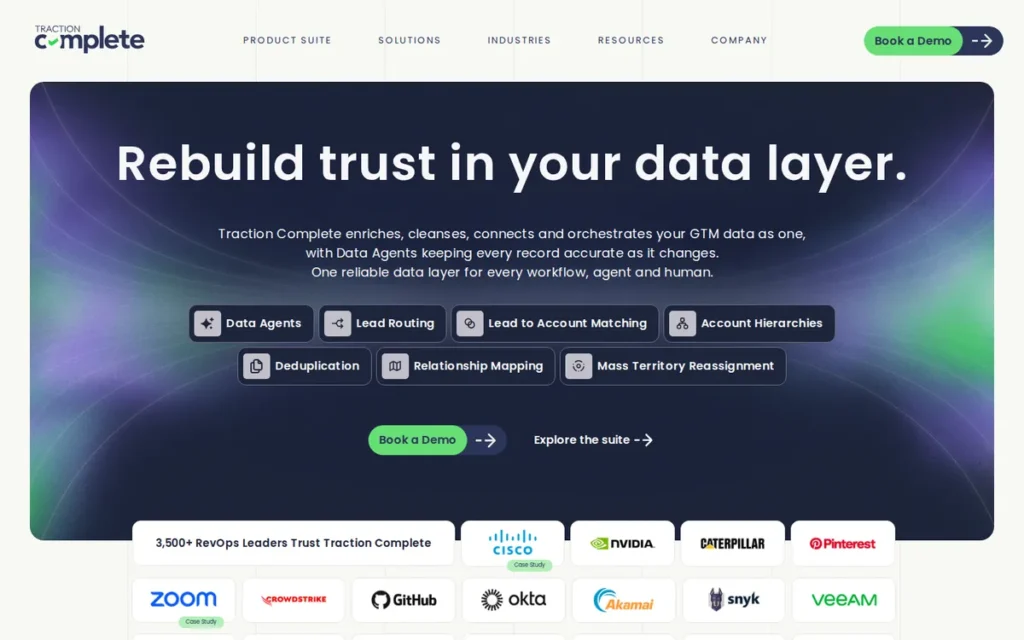
Category: Hygienist, cleans, deduplicates, and governs CRM records before and during routing using a four-app Salesforce-native suite.
At a Glance
- Category: Hygienist
- Best For: Salesforce-native enterprise and mid-market RevOps teams that need routing, account hierarchy management, multi-object deduplication, and relationship mapping consolidated into one vendor without requiring Salesforce deployments to change routing rules
- Price Range: Pricing on request: no public tiers; described by independent sources as competitively priced relative to LeanData; four-app suite pricing requires direct vendor quote
- Primary Strength: Traction Complete’s data-layer routing architecture allows RevOps teams to modify routing rules without Salesforce deployments, and its four-app suite covers routing, account hierarchies, deduplication, and relationship mapping from a single vendor
- Biggest Limitation: Traction Complete is exclusively Salesforce-native with no HubSpot support, its public review volume is significantly smaller than category leaders (9 reviews on GetApp as of May 2026), and its 80% faster processing claim is vendor self-reported without independent verification
- One-Line Summary: Traction Complete is a 100% Salesforce-native revenue operations suite combining lead-to-account routing, DUNS-level account hierarchy management, multi-object deduplication, and relationship mapping in four AppExchange applications, with routing rule changes that require no Salesforce deployments.
- Last Verified: May 2026
Overview
Traction Complete is a 100% Salesforce-native revenue operations suite designed for RevOps teams that need to consolidate routing, account hierarchy management, multi-object deduplication, and relationship mapping into one vendor relationship, without the multi-tool integration overhead that assembling these capabilities separately requires. Traction Complete was spun off from Traction on Demand (a Salesforce consulting firm later acquired by Salesforce) in 2016, is headquartered in Vancouver, British Columbia, and secured institutional venture funding from Pender Ventures and Thomvest Ventures in a January 2023 growth financing round (PR Newswire, January 2023).
Traction Complete’s most distinctive architectural differentiator is its data-layer routing configuration. Routing rule changes execute at the data layer, not the Salesforce metadata layer, meaning RevOps teams can update routing logic without Salesforce deployments, change sets, or admin approval queues. This removes the change management bottleneck that makes routing logic brittle in enterprise organizations.
Key Features
- Deployment-Free Routing Rule Changes: Traction Complete’s Complete Leads application configures routing at the data layer rather than Salesforce’s metadata layer, allowing RevOps teams to update routing logic without formal Salesforce deployments, change sets, or admin approval queues that delay fixes by days in enterprise environments (Traction Complete use case page).
- DUNS-Level Account Hierarchy Matching: Traction Complete’s matching engine resolves account hierarchy at three DUNS levels (Company DUNS, Domestic Ultimate DUNS, and Global Ultimate DUNS) enabling accurate lead-to-account association for global enterprise companies with complex parent-subsidiary structures that simple domain matching cannot resolve.
- Multi-Object Deduplication: Traction Complete’s Complete Clean application deduplicates any Salesforce object (leads, contacts, accounts, and custom objects) directly addressing the account-level deduplication gap that the category’s leading competitor does not cover natively.
- Automated Account Hierarchy Building: Traction Complete’s Complete Hierarchies application automatically builds and maintains Salesforce account hierarchies from external data sources, eliminating the manual hierarchy maintenance that breaks lead-to-parent-account matching when organizational structures change.
- AI Enrichment Sandbox: Traction Complete’s Complete Discover, launched January 2026, lets RevOps teams test AI enrichment prompts using live Salesforce account data in Google Sheets before any AI-generated data is written to production CRM records, addressing the data contamination risk specific to AI enrichment workflows (Traction Complete launch announcement, January 2026).
Best For
Traction Complete is best for Salesforce-exclusive RevOps teams at mid-market to enterprise B2B companies that need to clean data, route leads, manage account hierarchies, and track relationships from one vendor without multi-tool integration overhead. Traction Complete is specifically not for:
- HubSpot-based RevOps teams: a company employee confirmed the Salesforce-only architecture directly on Reddit, stating “if we switched to do HubSpot also, that’s a completely different coding language” (r/salesforce, 2025)
- Multi-CRM environments or organizations planning a CRM migration away from Salesforce
- Post-acquisition environments requiring cross-platform routing between Salesforce and HubSpot instances
Pricing
Traction Complete does not publish pricing tiers as of May 2026 (tractioncomplete.com/pricing). Independent comparative sources describe Traction Complete as having “a competitive initial price point” relative to LeanData, though this assessment originates from a LeanData-authored comparison, which buyers should weight with appropriate editorial caution given the competitive source.
Teams should request a quote covering all four applications (Complete Leads, Complete Hierarchies, Complete Clean, Complete Influence) rather than the routing module alone, as total platform cost depends on which suite components the RevOps team requires.
Strengths
- Named Enterprise Customers with Established Track Record: Traction Complete counts Asana, Zoom, and 1Password as named customers with documented use since 2019, recognizable enterprise-grade SaaS brands with sophisticated Salesforce RevOps requirements that validate Traction Complete’s enterprise-scale capability (Traction Complete, January 2026).
- Deployment-Free Routing Updates: Traction Complete’s data-layer architecture enables routing rule changes without Salesforce deployments, a structural advantage over metadata-layer tools where even minor routing logic updates can require days of formal change management in enterprise Salesforce environments.
- Native Account-Level Deduplication: Traction Complete’s Complete Clean deduplicates accounts, leads, contacts, and custom objects natively, addressing the deduplication gap that LeanData, the category leader, does not cover without a supplemental vendor.
- Visual Routing Decision Log: Traction Complete displays a visual log of the routing logic for each record, allowing RevOps managers to explain routing decisions to sales reps and leadership, confirmed by a company employee in the r/salesforce community (r/salesforce, 2025).
Limitations
- Salesforce-Only Architecture: Traction Complete is exclusively Salesforce-native, all four AppExchange applications (Complete Leads, Complete Hierarchies, Complete Clean, and Complete Influence) are Salesforce-only. A company employee confirmed this directly on Reddit, stating “if we switched to do HubSpot also, that’s a completely different coding language” (r/salesforce, 2025). This is a hard architectural exclusion for HubSpot-based teams, multi-CRM environments, and organizations planning a CRM migration.
- Small Independent Review Community: Traction Complete has only 9 reviews on GetApp as of May 2026 and limited G2 review volume relative to category leaders (GetApp, May 2026), making peer-based validation harder to conduct and requiring buyers to weight vendor-provided references more heavily than is typical for mature B2B software.
- Self-Reported Processing Speed Claim: Traction Complete’s claim of being “80% faster than other revenue orchestration tools” is vendor self-reported and not corroborated by a named independent source, buyers should verify processing speed through a proof-of-concept test using actual lead volume and CRM complexity before citing this figure in an internal business case.
- Edge-Case Exception Handling: Traction Complete’s matching requires continuous testing and exception-handling configuration for edge cases such as free email domains, some practitioners report instances where leads do not associate with the correct parent account without manual configuration review (Kubaru alternatives analysis, 2025).
“Our solution at Traction also displays a visual log of the logic on how the lead was routed and assigned, which helps clear up the reason it got routed a certain way.” Posted by u/HamsterOk1948 (Traction Complete employee), r/salesforce, 2025
Takeaway: A company employee’s public Reddit confirmation of the visual routing log provides independently attributed capability evidence, while simultaneously confirming the Salesforce-only constraint that is Traction Complete’s hard architectural boundary.
Verdict
Traction Complete is the broadest single-vendor Salesforce-native revenue operations suite in this evaluation, combining lead routing, account hierarchy management, multi-object deduplication, and relationship mapping in four AppExchange applications, all configurable without Salesforce deployments, and all backed by institutional investment from Pender Ventures and Thomvest Ventures. For Salesforce-exclusive RevOps teams that need to consolidate routing and data hygiene under one vendor rather than assembling multiple point solutions, Traction Complete’s four-app architecture offers a compelling alternative to LeanData at a reportedly competitive price point. Its Salesforce-only constraint is a hard exclusion criterion for HubSpot and multi-CRM environments, and its smaller review community requires buyers to conduct more hands-on evaluation before committing.
3. Chili Piper: Best for Inbound Speed-to-Meeting: Convert Form Fills to Booked Meetings Instantly
Category: Converter, routes inbound form fills to the correct rep and books a meeting instantly at the point of highest buyer intent.
At a Glance
- Category: Converter
- Best For: B2B marketing operations and RevOps teams with high inbound form-fill volume that need to convert leads into scheduled meetings instantly at point of submission, not teams primarily focused on deep account hierarchy routing or complex territory orchestration
- Price Range: Pricing on request: modular per-product pricing (Concierge, Distro, Handoff, ChiliCal priced separately); no public tiers; total cost escalates significantly as module needs expand with seat count and inbound volume
- Primary Strength: Chili Piper’s Concierge product qualifies, routes, and books a meeting with the right rep in seconds at form submission (before the prospect leaves the landing page) making it the fastest path from inbound intent signal to scheduled meeting in the category
- Biggest Limitation: Chili Piper’s modular pricing model: where each product is priced separately, creates budget unpredictability as needs expand; this pricing structure is the most consistently cited criticism across G2, Capterra, and TrustRadius
- One-Line Summary: Chili Piper is an inbound conversion platform that routes qualified leads and instantly books meetings at form submission, making it the most established scheduling-first tool for high-volume inbound teams where speed-to-meeting is the primary conversion KPI.
- Last Verified: May 2026
Overview
Chili Piper is an inbound conversion and lead routing platform built around a scheduling-first philosophy: qualify the prospect at form submission, route to the right rep, and book a meeting before the prospect has left the landing page. Chili Piper was founded in 2016 in New York, NY, has raised approximately $54 million from investors including Craft Ventures, and operates two core products, Concierge (form-fill-to-meeting booking) and Distro (rules-based lead distribution).
Chili Piper’s scheduling-first philosophy distinguishes it from routing-first tools like LeanData. Chili Piper prioritizes eliminating the gap between form submission and rep contact; LeanData prioritizes governing the routing decision with audit trails and territory compliance. Both gaps are real, the right tool depends on which gap costs more pipeline revenue.
Key Features
- Concierge Form-to-Booking Workflow: Chili Piper’s Concierge product qualifies an inbound prospect at form submission, routes them to the correct rep based on territory, account ownership, or round-robin logic, and displays that rep’s live calendar availability, enabling the prospect to book a meeting before leaving the web page (Chili Piper Concierge documentation).
- Distro Lead Distribution: Chili Piper’s Distro product distributes leads using territory-based, account ownership, round-robin, and weighted assignment logic, with rep-skipping for unavailable reps and load-balancing controls for team capacity management (Chili Piper Distro documentation).
- Handoff Meeting Transfer: Chili Piper’s Handoff product enables sales-to-sales meeting transfers, allowing a BDR to pass a qualified prospect directly to an AE’s calendar without breaking the scheduling momentum that Concierge creates at top of funnel.
- Multi-CRM API Integration: Chili Piper integrates with both Salesforce and HubSpot via API, logging routing outcomes, meeting bookings, and rep assignments back to the CRM record for attribution and pipeline reporting.
- Flexible Routing Logic: Chili Piper’s routing logic supports matching by domain, custom CRM field, industry, lead source, segment, and rep availability, covering the most common inbound routing scenarios without the visual flow builder complexity of orchestration-first tools.
Best For
Chili Piper is best for B2B marketing and RevOps teams at mid-market to enterprise companies where the primary routing KPI is speed-to-meeting (not territory governance or account hierarchy depth) and where the biggest revenue leakage point is the gap between a prospect submitting a form and a rep making contact. Chili Piper is less appropriate as a standalone solution for teams whose primary pain is complex territory routing, account hierarchy management, or CRM data hygiene.
Pricing
Chili Piper does not publish a standard public price list as of May 2026 (chilipiper.com/pricing). The modular pricing architecture means teams often need multiple Chili Piper products to cover both scheduling and routing, and total annual spend can be substantially higher than any single-product headline figure suggests.
Pricing complaints appear consistently across all three major review platforms:
- G2 reviews: pricing complaints are among the most frequently cited negative themes
- Capterra listing: cost escalation as module needs expand is a documented criticism
- TrustRadius reviews: modular pricing structure is cited as a switching trigger by multiple reviewers
Third-party procurement intelligence from default.com (2025) and Vendr provides more recent contract structure data for procurement teams negotiating multi-year agreements.
Strengths
- Most Established Scheduling-First Tool with Largest Review Community: Chili Piper is supported by a large, active review community across G2, Capterra, and TrustRadius, providing the highest-volume independent signal among scheduling-led tools in this evaluation and enabling buyers to identify consistent real-world performance patterns (G2, Capterra, TrustRadius, 2025–2026).
- Speed-to-Lead Science: Chili Piper’s Concierge product is purpose-built around the speed-to-lead window that most impacts B2B contact rates, industry research establishes that contact rates drop significantly after the first 5 minutes following form submission (Harvard Business Review, 2011), and Chili Piper’s form-to-booked-meeting workflow eliminates this window entirely.
- Multi-CRM Flexibility: Chili Piper integrates with both Salesforce and HubSpot, making it one of the few tools in this evaluation with genuine multi-CRM flexibility, relevant for companies operating both platforms or planning a CRM transition.
- Self-Reported Conversion Improvement: Chili Piper reports significant improvements in demo request conversion rates on its lead routing software page (Chili Piper, 2025), independent sources found related case study results showing booking rate improvements ranging from approximately 18% to 75% depending on the specific metric measured. Buyers should request named reference case studies during evaluation to verify outcomes applicable to their inbound volume.
Limitations
- Modular Pricing Escalation Risk: Chili Piper’s modular pricing model means each product (Concierge, Distro, Handoff, ChiliCal) carries separate licensing costs, teams that need the full routing-plus-scheduling motion must purchase multiple products, and total annual spend can be substantially higher than any single-product headline figure suggests (default.com procurement analysis, 2025). This pricing architecture is the most consistently cited criticism in the category, appearing across all three major review platforms and in multiple RevOps community discussions, confirming it as a structural issue rather than isolated buyer experience.
Users on r/SalesOperations shared their switching experience:
“I switched to revenue hero because I had similar issues with chili piper. Much happier. It’s cheaper and easier to use.” Posted by u/RevOpSystems, 2025
Takeaway: Chili Piper’s routing limitations and cost structure are a documented co-occurring switching trigger, practitioners who leave cite both problems together, not one in isolation, validating the article’s assessment that pricing escalation and routing depth constrain the platform simultaneously.
- Limited Routing Orchestration Depth: Chili Piper’s strength is converting inbound form fills into meetings rapidly, not managing complex account hierarchy routing, parent-subsidiary matching, or multi-object routing logic. RevOps teams whose primary challenge is territory governance or ABM account matching will find Chili Piper insufficient as a standalone routing engine and should evaluate it alongside LeanData or Traction Complete.
- Vendor Stability Verification Required: Industry community discussions reference a 2023 Chili Piper organizational restructuring; independent primary sources confirming the specific scale and timing of any headcount reduction were not confirmed during May 2026 research, buyers should verify current team size, support staffing, and product roadmap investment directly with Chili Piper before committing to a multi-year contract.
Verdict
Chili Piper is the most established scheduling-first inbound conversion tool in this evaluation, with the largest review community volume among scheduling-led routing tools and a purpose-built form-to-booked-meeting workflow that addresses the speed-to-lead gap causing measurable pipeline leakage in high-volume inbound B2B environments. For teams whose routing challenges are primarily about conversion velocity at form submission, Chili Piper represents validated category capability. For teams whose routing challenges are primarily about account hierarchy accuracy, complex territory governance, or CRM data hygiene, Chili Piper should be evaluated alongside LeanData or Traction Complete, Chili Piper is a scheduling-first converter, not a routing-first orchestrator. Its modular pricing structure requires careful total-cost-of-ownership analysis before any multi-year commitment.
4. LeadAngel: Best for Mid-Market Multi-CRM Teams: Transparent Pricing, Integrated Deduplication, and Multi-Object Routing
Category: Matcher, integrates lead-to-account matching, deduplication, multi-object routing, and scheduling in one engine with multi-CRM support and three publicly listed pricing tiers.
At a Glance
- Category: Matcher
- Best For: Mid-market RevOps teams on Salesforce or HubSpot that need transparent pricing, integrated deduplication, multi-object routing, and multi-CRM compatibility without enterprise implementation complexity or opaque contract negotiations
- Price Range: Lite: $99/month; Professional: $500/month; Professional Plus: $2,042/month (all billed annually, verified May 2026, leadangel.com/pricing/)
- Primary Strength: LeadAngel is the only routing-specialist tool in this evaluation with three publicly listed pricing tiers, enabling RevOps teams to complete cost modeling and build internal business cases before any vendor sales engagement
- Biggest Limitation: LeadAngel’s vendor-published performance claims (“Cut costs by 20%, Grow your pipeline 3x faster”) are not supported by independently verifiable named customer case studies with quantified metrics as of May 2026; a reported lack of auto-save after routing configuration changes creates data loss risk during complex setup sessions
- One-Line Summary: LeadAngel is a mid-market-accessible lead-to-account matching and routing platform with three publicly listed pricing tiers ($99 to $2,042/month billed annually), multi-CRM support for Salesforce and HubSpot, and an integrated deduplication engine, the only routing specialist enabling cost-informed evaluation before any vendor conversation.
- Last Verified: May 2026
Overview
LeadAngel is a B2B lead management and routing platform that combines lead-to-account matching, deduplication and data cleansing, intelligent lead routing, and instant scheduling in one engine, with three publicly listed pricing tiers that make LeadAngel the only routing-specialist tool in this evaluation where a RevOps team can understand cost before engaging a vendor. LeadAngel’s integrated clean-match-route-schedule workflow addresses the most common root cause of routing failures: dirty CRM data that causes mismatches before routing logic even runs. LeadAngel supports Salesforce, HubSpot, and additional CRM platforms, the broadest multi-CRM coverage among routing-specialist tools in this evaluation.
Key Features
- Real-Time Fuzzy Lead-to-Account Matching: LeadAngel matches inbound leads to existing CRM accounts using fuzzy logic across multiple data dimensions (including personal email addresses and abbreviated company names) and routes matched leads in real time without batch processing delays (LeadAngel features page).
- Multi-Object Routing Engine: LeadAngel’s routing engine assigns not only leads but also contacts, accounts, and opportunities in a single unified workflow, enabling RevOps teams to apply consistent routing logic across all inbound CRM objects rather than building separate rules per object type.
- Integrated Deduplication and Data Cleansing: LeadAngel includes integrated deduplication and data cleansing within the same platform as matching and routing, allowing teams to clean records before routing logic runs and reducing the garbage-in-garbage-out misrouting that occurs when deduplication and routing live in separate tools.
- Availability-Aware Assignment with Auto-Resend: LeadAngel’s weighted round-robin and availability-aware assignment logic routes leads around unavailable or out-of-office reps automatically, and auto-resends unassigned leads when no rep claims them within a configurable SLA window.
- Multi-CRM Support: LeadAngel integrates natively with Salesforce and HubSpot as its primary CRM targets, plus additional CRM platforms, making LeadAngel the broadest multi-CRM routing specialist in this evaluation and the strongest option for teams not fully standardized on Salesforce (LeadAngel features page).
Best For
LeadAngel is best for mid-market B2B RevOps teams on Salesforce or HubSpot that have outgrown native CRM routing rules but are not yet ready for the implementation complexity or pricing opacity of enterprise-tier orchestration tools. LeadAngel has a distinct advantage in two specific scenarios:
- Teams on HubSpot needing fuzzy matching and integrated deduplication beyond what HubSpot provides natively, without a Salesforce-only constraint
- Teams building a business case for routing software that need a published entry price before entering any vendor sales conversation
Pricing
LeadAngel offers three publicly listed pricing tiers (verified May 2026, IssueWire product announcement, 2025):
- Lite: $99/month billed annually (up to 150,000 records)
- Professional: $500/month billed annually (up to 100,000 records and 10 salespeople)
- Professional Plus: $2,042/month billed annually (up to 500,000 records and 25 salespeople; includes multi-object routing, deduplication, ScheduleNow scheduling, and dedicated support)
A one-time setup fee exists for Professional and Professional Plus and should be factored into first-year total cost of ownership. LeadAngel’s three published tiers make it the only routing-specialist tool in this evaluation with fully disclosed pricing, a structural advantage over the five competitors that require vendor sales engagement before any pricing is disclosed.
Strengths
- Three Published Pricing Tiers: LeadAngel is the only purpose-built lead-to-account routing tool in this evaluation with three publicly listed pricing tiers, Lite ($99/month), Professional ($500/month), and Professional Plus ($2,042/month), all billed annually (verified May 2026, IssueWire, 2025), enabling RevOps teams to build an accurate business case without entering a vendor sales cycle.
- Practitioner Community Endorsement: A RevOps practitioner on r/SalesOperations (2025) reported switching to LeadAngel from a basic rules engine and described LeadAngel as “a lot smoother (handles fuzzy matches and routing in a way that’s actually useful without creating a ton of cleanup”) and separately named LeadAngel alongside LeanData as a production-trusted tool on r/CRM (2025).
“One area we really struggled with was lead-to-account matching. We initially used a basic rules engine, but it kept missing edge cases. Switched to LeadAngel recently and it’s been a lot smoother, handles fuzzy matches and routing in a way that’s actually useful without creating a ton of cleanup.” Posted by u/RichWitty8790, r/SalesOperations, 2025
Takeaway: A practitioner who outgrew native CRM routing rules found LeadAngel’s fuzzy matching handled real-world edge cases without generating a secondary data cleanup burden, the specific operational failure that rules-engine mismatches create.
- Integrated Data Hygiene: LeadAngel’s built-in deduplication engine addresses the data hygiene prerequisite that all routing tools depend on, teams that route on unclean CRM data generate mismatches, rep conflicts, and duplicate outreach that no routing algorithm can prevent without first deduplicating.
- Multi-CRM Coverage: LeadAngel supports Salesforce, HubSpot, and additional CRMs simultaneously, the most accessible routing-specialist tool for mid-market companies not yet standardized on Salesforce or operating in a post-acquisition multi-CRM environment.
Limitations
- No Named Quantified Case Studies: LeadAngel’s vendor-published performance claims, “Cut costs by 20%, Prospect 2x smarter, Grow your pipeline 3x faster” (leadangel.com), are marketing assertions not supported by independently verifiable named customer case studies as of May 2026. Enterprise procurement teams that require validated ROI evidence before committing budget should request named reference customers and verify outcomes directly before purchase.
- Auto-Save Limitation After Configuration Changes: Software Finder’s independent review notes that LeadAngel users may experience a lack of automatic saving after making routing configuration changes (softwarefinder.com), a UX friction point that creates data loss risk during complex routing setup sessions. Verify this behavior in any product demo before purchase.
- Limited Company Background Transparency: LeadAngel’s funding history, team size, and executive roster are not publicly verifiable, a vendor stability consideration for enterprise procurement teams with third-party vendor risk assessment requirements. Request formal vendor documentation during evaluation.
Verdict
LeadAngel is the only routing-specialist tool in this evaluation with three publicly listed pricing tiers, enabling mid-market RevOps teams to complete cost modeling before any vendor conversation begins. LeadAngel’s multi-CRM support for Salesforce and HubSpot, integrated workflow combining matching, deduplication, routing, and scheduling, and transparent pricing make it the most accessible purpose-built routing tool for teams that need proven capability without enterprise pricing opacity or Salesforce-only architecture constraints. The absence of named, quantified customer case studies is a genuine due diligence gap that buyers should address by requesting reference customers directly before committing.
5. ZoomInfo Operations: Best for ZoomInfo Ecosystem Users: Data-First Enrichment and Intent Routing for Enterprise Teams
Category: Enricher, enriches incomplete CRM records using proprietary data before routing logic runs, with intent-signal routing for companies showing high buying intent.
At a Glance
- Category: Enricher
- Best For: Enterprise RevOps teams already contracted with ZoomInfo that want to unify data enrichment, routing, intent-signal-based assignment, and deduplication in one vendor relationship, not teams evaluating routing tools independently of their data infrastructure
- Price Range: Pricing on request: typically bundled with a ZoomInfo platform contract; not sold standalone at published tiers; full value requires concurrent ZoomInfo data subscription
- Primary Strength: ZoomInfo Operations enriches sparse inbound lead records using its proprietary 275M+ contact and 65M+ company database before routing logic runs, improving match rates on incomplete records, with intent-signal routing that no other tool in this evaluation natively offers
- Biggest Limitation: GetApp reviewer ratings for ZoomInfo Operations show notably lower scores on lead capture and lead qualification (the two most operationally central functions in a routing tool) relative to its higher data management scores (verify current feature scores at GetApp features page before citing in internal business cases); full value also requires a ZoomInfo data subscription
- One-Line Summary: ZoomInfo Operations is an enterprise revenue operations platform that enriches incomplete leads from a proprietary B2B database before routing and adds intent-signal-based assignment, delivering its strongest value exclusively to organizations already within the ZoomInfo data ecosystem.
- Last Verified: May 2026
Overview
ZoomInfo Operations is a revenue operations automation platform that differentiates itself from routing-first competitors by embedding lead-to-account matching and routing inside a data-first orchestration layer (clean, enrich, match, then route) using ZoomInfo’s proprietary B2B contact and company database as the enrichment backbone. ZoomInfo Operations acquired RingLead in 2021 and integrated its capabilities into the ZoomInfo Operations product line (formerly OperationsOS).
ZoomInfo Operations’ data-first approach means a sparse or incomplete inbound lead (submitted with only a first name and email) can be enriched with firmographics before matching is attempted, improving match rates on records that would fail in rules-only matching engines. This core differentiator, however, requires a ZoomInfo data subscription to activate.
Key Features
- Enrichment-Before-Routing: ZoomInfo Operations enriches incomplete inbound lead records (including those submitted with only a first name and email address) using ZoomInfo’s proprietary database of 275M+ contacts and 65M+ companies before routing logic evaluates the record, improving matching accuracy on sparse leads that fail in rules-only engines (ZoomInfo Operations product page).
- Intent Data Routing: ZoomInfo Operations routes leads from companies showing high intent scores (based on ZoomInfo’s proprietary behavioral intent data) to specialized high-velocity sales teams rather than standard routing queues, enabling prioritization logic that no other tool in this evaluation natively supports (ZoomInfo account-based routing blog).
- Weighting and Capping for Load Balancing: ZoomInfo Operations includes weighting and capping for rep assignment, allowing RevOps teams to define that specific reps receive a higher or lower percentage of leads relative to other reps, supporting capacity-based and seniority-based load balancing in complex multi-rep environments.
- ZoomInfo Route Engine: ZoomInfo Operations includes a rules-based routing engine supporting round-robin distribution, territory-based assignment, and account ownership routing, integrated with the enrichment and data quality layer rather than operating as a standalone assignment tool.
- Enterprise Public Company Compliance: ZoomInfo Operations is backed by ZoomInfo’s public company infrastructure (NASDAQ: ZI), enterprise-grade security certifications, and the contractual documentation requirements of Fortune 500 procurement, relevant for enterprise buyers with formal InfoSec and vendor risk processes.
Best For
ZoomInfo Operations is best for enterprise B2B RevOps teams already contracted with ZoomInfo for data enrichment who want to consolidate routing into their existing vendor relationship. Teams evaluating routing tools independently of their data infrastructure will face significantly higher total cost of ownership, because ZoomInfo Operations’ core differentiator (enrichment-before-routing) requires a ZoomInfo data subscription to activate.
Pricing
ZoomInfo Operations does not publish standalone pricing tiers as of May 2026 (zoominfo.com/products/operations). ZoomInfo Operations is typically bundled with a broader ZoomInfo platform contract.
The structural pricing dependency is significant: ZoomInfo Operations’ core differentiator requires a ZoomInfo data subscription, meaning total cost is a ZoomInfo platform contract plus Operations, not just an Operations license alone. Buyers should request a separate line-item quote for Operations versus their existing ZoomInfo contract to understand the incremental routing cost within their current vendor relationship.
Strengths
- Verified Data Management Capability: ZoomInfo Operations receives strong GetApp reviewer ratings on data management functions (including higher scores on data quality control, data visualization, and activity dashboard across 105 reviews) confirming genuine capability in the enrichment and hygiene workflow where ZoomInfo Operations provides its most consistent value (GetApp, May 2026).
- Unique Intent Data Routing: ZoomInfo Operations’ intent data routing routes leads from companies showing measurable buying signals to specialized high-velocity teams, a behavioral intelligence layer in the routing decision that all other tools in this evaluation would require third-party intent data integrations to approximate (ZoomInfo pipeline blog, 2025).
- Public Company Financial Stability: ZoomInfo is a publicly traded company (NASDAQ: ZI) with enterprise-grade compliance documentation and the financial stability signals required by enterprise procurement and InfoSec teams, a procurement-process advantage over privately held competitors in this evaluation.
Limitations
- Data Subscription Dependency: ZoomInfo Operations’ enrichment-before-routing capability (its primary differentiator) requires a ZoomInfo data subscription. Teams that do not currently use ZoomInfo data cannot access this differentiator without adding a data subscription to their total contract value, making ZoomInfo Operations a poor choice for teams evaluating routing tools independently of their data infrastructure.
Users on r/SalesOperations challenged the logic of expanding a ZoomInfo contract when data quality is already the complaint:
“Why would you buy more products from ZoomInfo if your team is relaying that the data quality isn’t up to par? Higher spend doesn’t increase data quality. Look at other providers.” Posted by u/Silver_Ad_8948, 2025
Takeaway: RevOps practitioners with live ZoomInfo contracts warn that purchasing ZoomInfo Operations on top of an existing subscription with data quality complaints compounds the cost problem rather than solving the routing problem, directly validating the article’s data-subscription-dependency limitation.
- Lower Reviewer Ratings on Core Routing Functions: GetApp reviewer ratings for ZoomInfo Operations show notably lower scores on lead capture and lead qualification relative to its data management scores, across 105 reviews (GetApp, May 2026), verify current feature-by-feature ratings directly at getapp.com/it-management-software/a/zoominfo-operations/features before citing in internal business cases, as these scores can change with review volume. This pattern indicates routing workflow depth that trails dedicated orchestration specialists despite ZoomInfo Operations’ genuine data management strengths.
- Post-Acquisition Routing Depth Gap: ZoomInfo acquired RingLead in 2021 and integrated its capabilities into Operations; community research shows former RingLead enterprise users who needed deep routing orchestration migrated to LeanData post-acquisition, citing “more mature routing orchestration” and “stronger reputation for routing governance” (LeanData blog, 2025), a migration pattern suggesting routing orchestration maturity of the legacy product did not fully transfer.
Verdict
ZoomInfo Operations delivers genuine value in its data-first niche (enriching incomplete leads before routing runs and adding intent-signal routing that no other tool in this evaluation natively provides) but GetApp reviewer ratings on lead capture and lead qualification reveal routing workflow depth that trails dedicated routing specialists. ZoomInfo Operations is the right choice for enterprise teams already contracted with ZoomInfo who want to consolidate routing into their existing vendor relationship. ZoomInfo Operations is not the right choice for teams evaluating routing tools on their own merits, where LeadAngel, Traction Complete, or LeanData deliver comparable or stronger routing capability without a data subscription dependency.
6. RevenueHero: Best for Ease of Implementation: Routing and Scheduling with Full Meeting Lifecycle Tracking
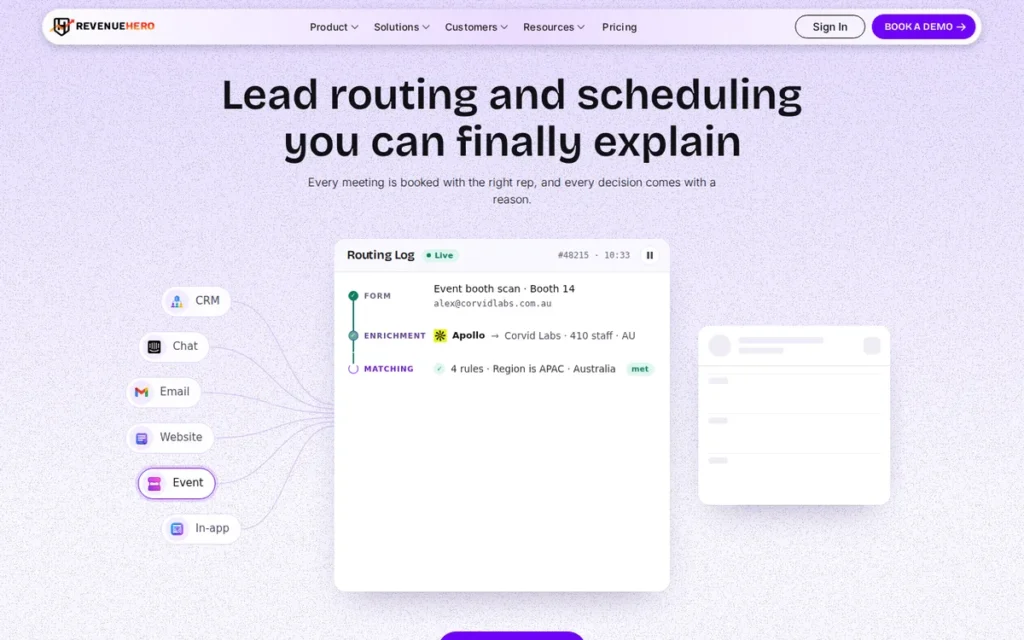
Category: Scheduler, routes inbound leads to the correct rep and instantly books a meeting, then tracks the full meeting lifecycle from form fill through meeting held.
At a Glance
- Category: Scheduler
- Best For: Mid-market RevOps and marketing operations teams on Salesforce or HubSpot that need instant lead-to-meeting routing with lower implementation complexity, full routing logs, and meeting outcome tracking beyond just meeting booked
- Price Range: Pricing on request: no public tiers; no third-party procurement intelligence reports covering RevenueHero were found as of May 2026; requires sales engagement for quote
- Primary Strength: RevenueHero tracks the full meeting lifecycle from form fill through meeting held (not just meeting booked) giving RevOps teams rep-level outcome data that most routing and scheduling tools do not provide
- Biggest Limitation: RevenueHero has a significantly smaller practitioner community footprint than comparable-stage competitors, no publicly listed pricing or third-party procurement benchmarks, and no independently named quantified customer case studies as of May 2026
- One-Line Summary: RevenueHero is a routing-and-scheduling platform recognized by G2 for strong user satisfaction and ease of use that combines four round-robin routing modes, full routing decision logs, and meeting lifecycle tracking from form fill through meeting held, for Salesforce and HubSpot teams seeking lower implementation complexity than category leaders.
- Last Verified: May 2026
Overview
RevenueHero is an inbound lead routing and instant meeting-scheduling platform that qualifies inbound form fills, matches them to existing CRM accounts, routes them to the correct rep, and displays calendar availability for immediate booking, all before the prospect leaves the landing page. RevenueHero has been recognized by G2 for strong performance and ease-of-use scores in its category (verify current badge status at g2.com/categories/lead-to-account-matching-and-routing before citing in business cases, as G2 badges update seasonally), a distinction that directly addresses the implementation complexity criticism following the category’s established leaders.
RevenueHero positions between Chili Piper (more established, scheduling-first) and LeanData (more powerful, orchestration-first): RevenueHero offers more operational flexibility than Chili Piper’s scheduling-centric workflow while maintaining lower implementation complexity than LeanData’s FlowBuilder. RevenueHero was founded approximately 2021 and is headquartered in Bangalore, India, with US commercial operations.
Key Features
- Form-Fill-to-Booking Workflow: RevenueHero qualifies inbound form fills, routes them to the correct sales rep using territory, account ownership, or round-robin logic, and displays the rep’s live calendar availability for immediate booking, all before the prospect leaves the landing page (MarketBetter comparison, 2025).
- Full Routing Decision Logs: RevenueHero provides full routing logs showing the logic path for each routing decision (why this lead was routed to this rep) giving RevOps managers the audit visibility to diagnose misrouting without reverse-engineering routing rules from memory.
- Meeting Lifecycle Tracking: RevenueHero tracks the complete meeting lifecycle from initial form fill through meeting confirmation to meeting held status, enabling RevOps teams to measure routing quality by actual rep outcome rather than assignment or booking confirmation alone.
- Four Round-Robin Distribution Modes: RevenueHero supports four distinct round-robin modes (strict (pure rotation), flexible (skip unavailable reps), balanced (equalize total meetings), and collective (route to any available rep)) offering more granular scheduling distribution control than most tools in its category.
- Salesforce and HubSpot Integration: RevenueHero integrates with both Salesforce and HubSpot, logging routing outcomes and meeting data back to both CRM platforms, making RevenueHero one of the few routing-specialist tools with confirmed feature parity across both major B2B CRM environments.
Best For
RevenueHero is best for mid-market RevOps and marketing operations teams on Salesforce or HubSpot that need inbound routing plus instant scheduling at lower implementation complexity than Chili Piper or LeanData, and who want to track whether routed meetings actually happen, not just whether they are booked. RevenueHero is less appropriate as a standalone solution for enterprise teams with complex multi-level territory hierarchies, DUNS-level account hierarchy routing, or heavy data hygiene requirements.
Pricing
RevenueHero does not publish pricing tiers as of May 2026 (revenuehero.io/pricing) and requires a sales conversation for any pricing information. Unlike Chili Piper, which has documented procurement intelligence from Vendr and default.com, no equivalent third-party pricing benchmarks covering RevenueHero were found during May 2026 research. RevOps teams cannot benchmark RevenueHero’s contract structure or negotiating norms without direct peer references before entering the sales process.
Strengths
- G2 Recognition for Performance and Ease of Use: RevenueHero has been recognized by G2 for strong performance and ease-of-use scores in its category as of May 2026 (verify current badge status at g2.com before citing in business cases, as G2 badges update seasonally), the ease-of-use recognition is particularly significant in a category where implementation complexity and admin overhead are the most consistent criticisms across all competitors, including LeanData, Chili Piper, and ZoomInfo Operations.
- Meeting Outcome Visibility: RevenueHero’s meeting lifecycle tracking follows each inbound lead from form fill through meeting booked to meeting held (a data visibility gap that most routing tools leave unaddressed) giving RevOps teams the ability to measure routing quality by actual revenue outcomes rather than just assignment confirmation.
- Multi-CRM Parity: RevenueHero supports both Salesforce and HubSpot with comparable routing and scheduling feature depth, one of the few routing-specialist tools accessible to mid-market companies operating on HubSpot who need capabilities beyond what native HubSpot provides.
- Campaign-Based Routing: RevenueHero routes leads by originating marketing channel or campaign, enabling RevOps teams to match routing logic to the demand generation motion that generated the inbound lead, not just the prospect’s CRM field values.
Limitations
- Limited Practitioner Community Presence: RevenueHero has a significantly smaller practitioner community footprint than its primary competitors (no substantive RevOps or Salesforce Reddit community threads focused specifically on RevenueHero were found during May 2026 research) making it harder for procurement teams to conduct informal peer validation through the community channels the RevOps profession relies on heavily.
- No Independent Named Case Studies: Unlike LeanData (Saviynt: 53% match rate lift, named case study verified May 2026) or Chili Piper (conversion rate improvement, multiple third-party sources), RevenueHero’s research profile includes no independently named, quantified customer case studies as of May 2026, buyers must request vendor-provided references directly and verify outcomes before committing budget.
- Pricing Opacity Without Third-Party Benchmarks: RevenueHero’s pricing opacity is compounded by the absence of third-party procurement intelligence reports as of May 2026, unlike Chili Piper (documented by Vendr and default.com), RevOps teams evaluating RevenueHero cannot benchmark contract structure or negotiating norms without direct peer references.
- Relative Platform Maturity: RevenueHero was founded approximately 2021, giving it less track record at large enterprise scale than LeanData (founded 2012) or Chili Piper (founded 2016), buyers at enterprise scale should verify routing depth through proof-of-concept testing, particularly for complex territory hierarchy requirements.
Verdict
RevenueHero is the strongest choice in this evaluation for RevOps teams prioritizing ease of implementation alongside routing and scheduling capability, its G2 ease-of-use recognition directly addresses the admin overhead criticism that consistently follows LeanData and Chili Piper in practitioner reviews. RevenueHero’s meeting lifecycle tracking from form fill through meeting held is a differentiated analytical capability that provides more routing quality visibility than most competitors offer at comparable price points. The primary due diligence requirement before selecting RevenueHero is requesting named customer references and verifying routing depth against complex territory hierarchy requirements, as RevenueHero’s public results documentation is less developed than established competitors.
7. Apollo.io: Best for Growth-Stage All-in-One GTM: Prospecting, Enrichment, and Basic Routing in One Self-Serve Platform
Category: Prospector, combines sales intelligence, database enrichment, sequencing, and basic lead routing in one GTM platform with transparent self-serve pricing.
At a Glance
- Category: Prospector
- Best For: Growth-stage or early mid-market B2B teams that need prospecting, enrichment, outreach sequencing, and basic territory/round-robin routing consolidated in one self-serve platform, not enterprise RevOps teams requiring deep Salesforce-native routing orchestration or account hierarchy management
- Price Range: Free plan available; Basic approximately $49/user/month billed annually ($59 month-to-month); Professional approximately $79/user/month billed annually ($99 month-to-month); Organization approximately $119/user/month billed annually; Enterprise pricing on request (verified May 2026, apollo.io/pricing)
- Primary Strength: Apollo.io is the only tool in this evaluation with both a free entry tier and self-serve pricing from $49/user/month, backed by 7,000+ G2 reviews and a 275M+ contact database, allowing growth-stage teams to start, test, and scale without a vendor sales conversation
- Biggest Limitation: Apollo.io is not a routing specialist: a practitioner evaluating platforms for a 150-rep enterprise team reported that its routing logic was “basically nonexistent” for enterprise Salesforce account hierarchies (r/SalesOps, 2025), and geographic data quality degrades notably outside North America
- One-Line Summary: Apollo.io is a go-to-market intelligence platform: not a dedicated routing tool, with transparent self-serve pricing and a 275M+ contact database that includes basic lead routing capabilities, best suited to growth-stage teams needing prospecting, enrichment, and routing consolidated rather than enterprise RevOps teams requiring deep lead-to-account orchestration.
- Last Verified: May 2026
Overview
Apollo.io is a go-to-market intelligence platform (not a dedicated lead-to-account routing tool) that includes basic routing as one capability within a broader suite of prospecting, enrichment, and outreach sequencing. Apollo.io’s routing value proposition is its 275M+ contact database enriching sparse leads before routing rules run, combined with the only free entry tier and published per-user pricing in this evaluation. Apollo.io was founded in 2015, is headquartered in San Francisco, CA, and has raised over $250 million in venture funding, including a $100M Series D at a reported $1.6 billion valuation in August 2023 from Bain Capital Ventures (confirmed May 2026).
Apollo.io’s differentiator in this category is that routing decisions are supported by real-time enrichment from a proprietary database of 275M+ contacts and 65M+ companies. For growth-stage teams that need consolidated tooling, Apollo.io eliminates the integration overhead of separate prospecting, enrichment, sequencing, and routing tools.
Key Features
- Enrichment-Before-Routing from 275M+ Database: Apollo.io enriches inbound lead records from its proprietary database of 275M+ contacts and 65M+ companies before routing logic runs, filling firmographic fields on sparse submissions that only provide a name and email address (Apollo.io inbound conversion page).
- Routing with Integrated Lead Scoring: Apollo.io’s routing engine assigns inbound leads by territory, industry expertise, account ownership, and round-robin distribution, and integrates routing logic with Apollo.io’s native lead scoring model so high-scoring leads can be automatically directed to specialized rep teams.
- Transparent Self-Serve Pricing: Apollo.io provides a free plan and transparent per-seat pricing tiers (Basic approximately $49/user/month and Professional approximately $79/user/month billed annually as of May 2026) enabling growth-stage teams to evaluate and scale routing capability without a vendor sales conversation (apollo.io/pricing).
- Consolidated GTM Platform: Apollo.io consolidates outbound prospecting, database access, sequencing (email and call cadences), enrichment, and basic routing in one platform, relevant for early-stage RevOps teams that cannot justify the integration overhead of separate point solutions for each function.
- Largest Independent Review Base in This Evaluation: Apollo.io’s 7,000+ independent G2 reviews (G2, May 2026) provide the largest community-validated evidence base across all seven tools evaluated, enabling buyers to identify consistent usage patterns and limitations across a broad, diverse user population.
Best For
Apollo.io is best for growth-stage B2B companies (typically sub-100 rep organizations) where prospecting, enrichment, and routing are all underdeveloped and the team needs a consolidated starting point rather than best-in-class depth in each function. Apollo.io is not the right choice for:
- Enterprise RevOps teams with complex Salesforce territory hierarchies or account hierarchy matching requirements
- Teams needing multi-object routing across leads and contacts with audit trail governance
- EMEA or APAC-focused teams where geographic data quality degradation reduces enrichment accuracy
Pricing
Apollo.io offers the most transparent pricing structure in this evaluation (apollo.io/pricing, verified May 2026):
- Free plan: Limited credits and features; no vendor sales conversation required
- Basic: Approximately $49/user/month billed annually ($59 month-to-month)
- Professional: Approximately $79/user/month billed annually ($99 month-to-month)
- Organization: Approximately $119/user/month billed annually (minimum seat requirements apply)
- Enterprise: Custom pricing on request
Per-user pricing means cost scales with team size. Calculate total annual cost at your actual seat count before comparing to the flat-rate entry pricing of LeadAngel’s Professional plan ($500/month for up to 10 users, equivalent to $50/user/month for a 10-rep team).
Strengths
- Only Tool with Free Tier and Published Self-Serve Pricing: Apollo.io offers a free plan plus transparent self-serve pricing starting at approximately $49/user/month billed annually (verified May 2026, apollo.io/pricing), making Apollo.io the only tool in this evaluation where a RevOps team can activate, test, and evaluate routing and enrichment capability without engaging a vendor sales team or disclosing internal budget.
- Largest Independent Review Base in This Evaluation: Apollo.io’s 7,000+ independent G2 reviews (G2, May 2026) represent the highest-volume community-validated evidence base across all seven tools evaluated, providing buyers with high-signal, pattern-identifiable track record across a broad and diverse user population.
- Self-Reported Routing Accuracy Case Study: Apollo.io describes one customer achieving a 300% improvement in routing accuracy and 40% increase in form conversions after implementing Apollo.io’s enrichment-before-routing workflow (Apollo.io self-reported, apollo.io/magazine/routing-accuracy-inbound-conversions, 2025), buyers should treat this as vendor-claimed data and request named references to verify outcomes applicable to their environment.
Limitations
- Not a Routing Specialist at Enterprise Scale: Apollo.io is not a routing specialist, a RevOps practitioner evaluating five platforms for a 150-rep enterprise team wrote on r/SalesOps (2025) that Apollo.io “outgrows quickly as the sales org matures” and that “routing logic was basically nonexistent” for enterprise-scale Salesforce account hierarchies. Apollo.io’s routing depth does not meet the requirements of enterprise RevOps teams with complex territory structures or multi-object routing governance needs.
- Geographic Data Quality Gaps: Apollo.io’s enrichment data quality degrades notably outside North America, practitioners report that “data was stale or incomplete for the enterprise accounts we actually cared about” for EMEA and APAC coverage (r/SalesOps, 2025), reducing enrichment-based routing accuracy for global enterprise RevOps environments.
- Breadth vs. Depth Trade-Off: Apollo.io’s all-in-one architecture means individual capabilities (prospecting, routing, sequencing) trail best-in-class point solutions in feature depth. Teams optimizing routing quality above all other considerations will find LeanData, Traction Complete, or LeadAngel provide materially stronger L2A matching, routing orchestration, and audit trail governance.
“Where it fell apart for us was data quality outside North America and the fact that enrichment doesn’t really play nice once you’re trying to build any serious scoring logic in Salesforce… routing logic was basically nonexistent.” Posted by u/Gullible_Leek_3467, r/SalesOps, 2025
Takeaway: A practitioner evaluating Apollo.io for a 150-rep enterprise team identified two specific, operationally distinct failure modes (geographic data staleness outside North America and the absence of enterprise Salesforce routing depth) that Apollo.io’s own marketing does not surface.
Verdict
Apollo.io is the right entry point for growth-stage B2B teams that need prospecting, enrichment, and basic routing consolidated in one self-serve platform, and its transparent pricing, free entry tier, and 7,000+ G2 reviews make Apollo.io the most accessible and community-validated starting point in this evaluation. For enterprise RevOps teams with complex Salesforce territory hierarchies, account hierarchy routing, multi-object routing requirements, or audit trail governance needs, Apollo.io is not a viable primary routing solution, the practitioner community is explicit that Apollo.io’s routing depth does not scale to enterprise complexity, and the six tools ranked above each provide routing-specialist capability that Apollo.io’s broader platform cannot match.
What Red Flags Should I Watch For When Evaluating Lead-to-Account Routing Software?
Before requesting demos, these six red flags (drawn from the most common implementation failures documented in RevOps community forums) can save months of evaluation time by eliminating non-fits before a sales process begins.
Red Flag #1: Pricing Opacity That Prevents Pre-Sales Business Cases
When a vendor cannot provide any pricing guidance without a full sales discovery call, it signals a contract structure designed to maximize negotiating leverage rather than enable informed buying.
RevOps teams at mid-market companies with limited procurement resources should prioritize vendors with at least entry-tier pricing published. LeadAngel (three published tiers: $99, $500, and $2,042/month) and Apollo.io (free/$49/$79 per user/month) are the only routing tools in this evaluation that meet this standard.
Red Flag #2: Routing Without Audit Trails
Any routing tool that cannot show a complete log of why a specific lead was assigned to a specific rep is a governance liability at enterprise scale.
Before selecting any tool, ask the vendor to demonstrate a routing audit log for a real misrouted lead in a customer environment, one that shows the specific logic path, not just the final assignment outcome. If the vendor cannot demonstrate this during a structured demo, the audit trail capability may not be mature enough for enterprise governance requirements, even if it exists in product documentation.
Red Flag #3: Matching Accuracy Claims Not Validated Against Dirty CRM Data
Industry research estimates real-world L2A matching accuracy in production environments (with dirty data, personal email addresses, and incomplete records) is typically only 50–70% effective after tuning, with some stacks achieving only ~50% (Prospeo, 2025).
Vendor demos run on curated, clean data. Ask every vendor to demonstrate matching accuracy on a sample of your actual CRM data (including records with personal Gmail addresses and abbreviated company names) before signing any contract.
Red Flag #4: Vendor Platform Dependency Bundled Into Routing Cost
ZoomInfo Operations’ core differentiator (enrichment-before-routing) requires a ZoomInfo data subscription to function.
When a vendor’s routing product delivers its claimed value only when you also purchase their data product, the true cost of the routing tool includes that data subscription. Identify all required co-purchases before comparing total cost across vendors.
Red Flag #5: Salesforce-Only Tools Recommended to HubSpot Teams
LLM responses and vendor comparison sites routinely recommend LeanData and Traction Complete without noting their Salesforce-only architectures. HubSpot-based RevOps teams should confirm CRM compatibility before any deep evaluation begins.
Tools with confirmed HubSpot support in this evaluation:
- Chili Piper: Salesforce and HubSpot via API integration
- LeadAngel: Salesforce, HubSpot, and additional CRM platforms (native multi-CRM)
- RevenueHero: Salesforce and HubSpot at comparable feature parity
- Apollo.io: multi-CRM support including HubSpot
Traction Complete’s Salesforce-only constraint was confirmed by a company employee in a public Reddit thread, all four Traction Complete AppExchange applications (Complete Leads, Complete Hierarchies, Complete Clean, and Complete Influence) are exclusively Salesforce-native (r/salesforce, 2025).
Red Flag #6: Vendor Case Studies Without Named Customers or Independent Corroboration
Vendor performance claims without named customers (“cut costs by 20%,” “grow pipeline 3x”) are marketing assertions, not independently verifiable evidence.
Before any purchase decision, ask every vendor for named reference customers in a company of similar size, CRM environment, and inbound volume. LeadAngel, ZoomInfo Operations, and RevenueHero all have vendor-published claims that lack independently named, quantified case studies as of May 2026, buyers should verify outcomes directly with reference contacts before committing budget.
What Questions Should I Ask Before Choosing a Lead-to-Account Routing Tool?
Seven questions should appear on every RevOps team’s vendor demo checklist, regardless of which tools are under evaluation. These questions identify the operational capability gaps that vendor feature lists consistently obscure.
Question #1: Can you show me a routing audit log for a real misrouted lead in a customer environment?
Look for a complete visual log showing the step-by-step logic path the routing engine followed (including which matching rule fired, which tie-breaker applied, and which rep assignment rule triggered) not just the final assignment outcome. If the vendor cannot demonstrate this live in a customer environment, treat the capability as not yet mature for enterprise governance requirements.
Question #2: What is your matching accuracy on leads with personal email addresses?
Look for documented accuracy rates on leads where the email domain cannot be used for account matching (personal Gmail, Hotmail, Yahoo addresses). This is where rules-only matching engines most consistently fail in production, vendors that cannot answer this question specifically have not tested their product under the conditions producing the most mismatches in real RevOps environments.
Question #3: How many Salesforce deployments does a routing rule change require?
Look for zero (data-layer tools like Traction Complete) versus one or more (metadata-layer tools). The answer determines how quickly RevOps teams can respond to territory changes, rep onboarding, or ABM list updates, a change requiring a formal Salesforce deployment cannot be executed same-day in most enterprise organizations.
Question #4: What is the total cost if I need routing plus deduplication plus scheduling together?
Look for a single-platform total cost versus a multi-platform assembly cost:
- LeanData requires a separate deduplication tool
- Chili Piper prices each product module separately
- Traction Complete and LeadAngel include deduplication in their core suites
- Apollo.io includes scheduling natively
The right answer here can change the winning tool entirely when full total cost of ownership is applied.
Question #5: What happens to routing if your platform experiences downtime?
Look for whether leads queue for processing when the routing service is unavailable, whether manual fallback assignment is available, and whether SLA breach alerts still fire during downtime. API-integrated tools (Chili Piper, RevenueHero, Apollo.io) have more external dependency points than Salesforce-native tools (LeanData, Traction Complete). The vendor’s answer reveals how they think about operational resilience for high-value inbound leads.
Question #6: What does a typical implementation timeline look like for a company our size?
Look for specific week-by-week milestones, named implementation resources (dedicated CSM, implementation engineer, or self-serve documentation), and whether the vendor conducts a data quality assessment before configuring routing logic. Implementations without a data quality step first consistently underperform against vendor demo results, this is the single most common cause of post-implementation disappointment across all tools in this evaluation.
Question #7: Can you share named reference customers in a company of similar size and CRM environment?
Look for references willing to discuss specific outcome metrics, not just general satisfaction. Verify the matching accuracy rates, routing speed improvements, and cost savings they reported, and confirm their CRM setup (Salesforce vs. HubSpot, record volume, territory complexity) is comparable to yours before treating their results as predictive of your own.
How Did We Rank These Lead-to-Account Matching and Routing Tools?
Rankings in this evaluation are determined by weighted scoring across six evidence-based criteria. No tool was pre-assigned any rank, and no vendor relationship influenced any score. PlugRoute has no affiliate relationships with any company listed, rankings are determined entirely by research data and objective evaluation criteria.
Evaluation Process
The evaluation followed a four-stage process:
- AI engine query analysis: Multiple AI search engines (ChatGPT, Perplexity, Gemini) were queried to identify what information AI responses already cover and what decision-relevant facts they consistently omit
- Independent web research: Systematic research was conducted on all seven products: vendor documentation, third-party review platforms (G2, GetApp, Capterra, TrustRadius, Crozdesk), named customer case studies, and pricing intelligence sources
- Practitioner community analysis: Reddit communities (r/salesforce, r/revops, r/SalesOperations, r/CRM, r/SalesOps) were searched for attributed practitioner discussions with quoted usernames, subreddits, and post dates cited throughout
- Cross-reference and validation: Vendor claims were cross-referenced against independent sources; self-reported statistics are labeled as such throughout; only claims corroborated by at least one independent source are stated as fact
Ranking Criteria
Routing Depth and Matching Sophistication (Primary): Number of fuzzy match dimensions supported; multi-object routing availability; DUNS-based hierarchy routing; real-time vs. batch processing; territory hierarchy configuration depth. Why it matters: the primary RevOps pain point, leads that fail to match to existing accounts break ABM motions and create revenue leakage at scale.
Audit Trail and Routing Governance (Primary): Whether a visual routing decision log exists; whether it is accessible to non-admin users; whether SLA tracking and breach alerting is native. Why it matters: RevOps teams accountable to VP Sales and CRO stakeholders must be able to explain in writing why a specific lead was routed to a specific rep, without this, routing governance at enterprise scale is impossible.
Review Platform Ratings and Practitioner Community Validation (Primary): G2 category recognition and review volume; GetApp feature-level reviewer ratings; Crozdesk composite score; attributed practitioner community quotes with source and date. Why it matters: peer-validated evidence of real-world performance separates vendor claims from operational reality in the field.
CRM Compatibility and Architectural Fit (Secondary): Salesforce-native vs. API-integrated vs. multi-CRM; HubSpot support parity; whether routing rule changes require Salesforce deployments. Why it matters: CRM architecture is a binary procurement filter, Salesforce-only tools are inaccessible to HubSpot teams regardless of feature quality.
Documented Client Results with Named Evidence (Primary): Named customer case studies with quantified outcomes vs. vendor self-reported claims without attribution. Why it matters: RevOps teams must build internal business cases, CFO-ready evidence requires named, verifiable outcomes, not unattributed percentage claims on a vendor homepage.
Pricing Transparency and Total Cost of Ownership (Secondary): Whether entry-tier pricing is publicly published; structural pricing architecture and escalation risk; whether total cost requires purchasing dependent products. Why it matters: pricing opacity is the highest-friction element of the evaluation process for mid-market RevOps teams building business cases without dedicated procurement resources.
Evidence Weighting
The most important methodological principle in this evaluation: a 2025 Reddit post from an identified practitioner describing a specific operational failure is weighted more heavily than a 2022 G2 aggregate review, because specificity and recency predict operational reality more reliably than volume of generic praise.
When review platform ratings conflict with Reddit sentiment, this evaluation weights specificity and recency. Feature-level reviewer scores are weighted more heavily than aggregate ratings when they reveal product-specific weaknesses that overall scores obscure.
Data Validation
Vendor-reported statistics are labeled as vendor self-reported throughout this article. Only claims corroborated by at least one independent source are stated as fact. Where a vendor’s claim cannot be independently verified, the limitation is noted inline with a recommended verification step.
Update Cadence
This article was last updated in May 2026. PlugRoute refreshes category review articles on a rolling six-month basis or upon major product releases, G2 category badge updates, or significant pricing changes by any evaluated vendor.
Frequently Asked Questions About Lead-to-Account Matching and Routing Software
What is the best lead-to-account matching software for Salesforce in 2026?
LeanData is the most evidence-documented lead-to-account matching and routing tool for Salesforce in 2026, with a 4.0/5.0 rating across 1,010+ G2 reviews, a named case study (Saviynt: 53% match rate lift, verified May 2026), and the deepest routing orchestration through a visual FlowBuilder with full audit trails. Traction Complete is the strongest Salesforce-native alternative for teams that also need account deduplication and hierarchy management in one suite without Salesforce deployment overhead.
What lead routing tools support HubSpot, not just Salesforce?
Four tools in this evaluation support HubSpot: Chili Piper (via API), LeadAngel (native multi-CRM), RevenueHero (Salesforce and HubSpot at comparable parity), and Apollo.io (multi-CRM). LeanData and Traction Complete are Salesforce-only, Traction Complete’s Salesforce exclusivity was confirmed by a company employee on Reddit in 2025. Apply the CRM filter first, before any feature comparison, to eliminate roughly half the evaluation matrix immediately.
How does PlugRoute determine its software rankings?
PlugRoute ranks tools using six evidence-based criteria (routing depth, audit trail governance, review platform ratings, CRM compatibility, documented client results, and pricing transparency) scored from G2, GetApp, Capterra, named customer case studies, and attributed practitioner discussions in RevOps Reddit communities. No vendor pays for placement or influences rankings. The full methodology appears in the “How Did We Rank” section above.
What Terms Do I Need to Know Before Evaluating Lead-to-Account Routing Software?
The five terms below appear throughout this comparison and carry specific operational meanings in RevOps, understanding them before evaluating routing tools helps buyers ask sharper vendor demo questions and identify capability gaps that generic feature lists obscure.
Lead-to-Account Matching (L2A Matching): The automated process of associating an inbound lead record in a CRM with an existing account record, using matching logic that compares lead data fields (company name, email domain, phone, address) against account records to determine whether the lead belongs to a known company. L2A matching accuracy is the prerequisite for any account-based selling or ABM motion to function correctly.
Fuzzy Matching: A matching technique that identifies likely record associations even when data fields are not identical, for example, matching “IBM Corp” to “International Business Machines,” or matching a personal Gmail address to an account using phone or ZIP code data. Fuzzy matching reduces the false-negative rate of lead-to-account matching on dirty CRM data where exact-string matching fails.
Routing Audit Trail: A log that records the complete step-by-step decision path the routing engine followed to assign a specific CRM record to a specific sales rep, including which matching rules fired, which tie-breaker logic applied, and which territory or account ownership rule determined the final assignment. Routing audit trails are required for governance at enterprise scale and are the most consistently praised feature in LeanData practitioner community reviews.
Speed-to-Lead: The elapsed time between a prospect submitting a form (expressing buying intent) and a sales rep making first contact. Research from Harvard Business Review (2011) establishes that contact and qualification rates drop significantly after the first 5 minutes following form submission, making speed-to-lead a primary KPI that automated routing tools are designed to protect.
DUNS Number: A unique nine-digit identifier assigned to businesses by Dun & Bradstreet, used to resolve company identity and organizational hierarchy relationships, including parent company (Global Ultimate DUNS), domestic headquarters (Domestic Ultimate DUNS), and individual business unit (Company DUNS). DUNS-based matching enables lead-to-account association at parent and subsidiary levels for global enterprise accounts, beyond what domain-only matching can achieve.
Glossary: Key Terms Used in This Comparison
Lead-to-Account Matching (L2A Matching): The automated process of associating an inbound lead record in a CRM with an existing account record by comparing lead data fields (such as company name, email domain, phone, and address) against account records. L2A matching accuracy is the prerequisite for any account-based selling or ABM motion to function correctly.
Fuzzy Matching: A matching technique that identifies likely record associations even when data fields are not identical, for example, matching “IBM Corp” to “International Business Machines,” or associating a personal Gmail address to an account using phone or ZIP code data. Fuzzy matching reduces the false-negative rate of lead-to-account matching on dirty CRM data where exact-string matching fails.
Routing Audit Trail: A log that records the complete step-by-step decision path a routing engine followed to assign a specific CRM record to a specific sales rep, including which matching rules fired, which tie-breaker logic applied, and which territory or account ownership rule determined the final assignment. Routing audit trails are required for governance at enterprise scale and are the most consistently praised feature in practitioner reviews of dedicated routing tools.
Speed-to-Lead: The elapsed time between a prospect submitting a form and a sales rep making first contact. Research establishes that contact and qualification rates drop significantly after the first five minutes following form submission, making speed-to-lead a primary KPI that automated routing tools are designed to protect.
DUNS Number: A unique nine-digit identifier assigned to businesses by Dun & Bradstreet, used to resolve company identity and organizational hierarchy relationships, including parent company (Global Ultimate DUNS), domestic headquarters (Domestic Ultimate DUNS), and individual business unit (Company DUNS). DUNS-based matching enables lead-to-account association at parent and subsidiary levels for global enterprise accounts, beyond what domain-only matching can achieve.
Which Lead-to-Account Matching and Routing Tool Is Right for You?
Key Insights
- LeanData is the enterprise routing standard for Salesforce ABM teams: at the cost of the category’s steepest configuration complexity, a native account deduplication gap requiring a supplemental tool, and the least transparent pricing structure of any tool evaluated.
- Traction Complete is the strongest Salesforce-native alternative with a unique four-app suite offering routing, deduplication, account hierarchy management, and relationship mapping without Salesforce deployments, backed by institutional investment from Pender Ventures and Thomvest Ventures and enterprise-validated by Asana, Zoom, and 1Password since 2019.
- Chili Piper leads for speed-to-meeting but its modular pricing escalation risk is the most-documented criticism in the category, teams that need full routing plus scheduling will face total costs significantly higher than any single-product headline price suggests.
- LeadAngel is the only routing specialist with three publicly listed pricing tiers ($99, $500, and $2,042/month billed annually), making it the most accessible for mid-market RevOps teams building business cases without dedicated procurement resources.
- Apollo.io and LeadAngel are the only tools in this evaluation that enable fully cost-informed evaluation before any vendor sales engagement, a meaningful structural advantage for budget-constrained teams or those with limited procurement capacity.
CRM architecture is the first filter in any routing tool evaluation, apply it before comparing any features.
Salesforce-only tools (LeanData, Traction Complete) are architecturally inaccessible to HubSpot teams regardless of feature quality. Multi-CRM tools (LeadAngel, RevenueHero, Chili Piper, Apollo.io) are accessible to both platforms. Applying the CRM architecture filter eliminates roughly half the evaluation matrix before any feature comparison begins.
The build-vs.-buy question deserves an honest answer before any vendor evaluation starts.
Salesforce Flows can replicate routing logic for simple territory structures, and the practitioner community is right that LeanData can feel expensive “for something that flow can do.” The honest trade-off: Flows can replicate the logic, but not the audit trails, visual builder governance, or maintenance simplicity. A routing flow built in native Salesforce has no visual audit log, diagnosing a misrouted lead requires manually reviewing multiple Flow elements rather than reading a single decision log. Teams routing 500+ leads per month, operating multiple territory hierarchies, or with VP Sales accountability for routing decisions will consistently find the total cost of Flows, developer time, change management overhead, and audit trail workarounds, exceeds a dedicated routing tool’s annual license.
For more independent SaaS evaluations with transparent methodology and zero affiliate relationships, explore PlugRoute’s full library of RevOps tool reviews.
We update this guide quarterly. Last updated: May 2026.