HubSpot Sales Hub is the best AI sales assistant for most teams in 2026, ranking #1 for CRM-native architecture, transparent pricing, and the largest verified review base in the category. Apollo.io leads for outbound prospecting. Gong leads for enterprise conversation intelligence. No single tool covers all three functional layers of the modern sales stack.
Sales reps spend too much time on manual tasks (CRM data entry, follow-up emails, meeting notes) when they should be selling. Teams that consistently report the best AI ROI build deliberate 2–3 tool combinations targeting specific stack layers rather than expecting one platform to eliminate all the friction.
PlugRoute has no affiliate relationships with any company listed. Rankings are determined entirely by research data and objective evaluation criteria.
“Most AI sales tools right now are optimizing the wrong layer of the stack… The ones that help reps run better conversations are the ones that actually move revenue.” (u/uhohitsrico, r/b2bmarketing, 2026)
Takeaway: Practitioners with direct production experience consistently endorse tools that eliminate administrative burden over tools that automate the judgment elements of selling, the orientation that drives every ranking in this evaluation.
Which AI Sales Assistant Tools Made the Top 7 in 2026?
- HubSpot Sales Hub is the best AI sales assistant for SMB and mid-market teams that need CRM, AI-assisted outreach, and email sequences in a single platform with transparent self-serve pricing starting at $0.
- Apollo.io is the most accessible all-in-one B2B prospecting platform, combining a 275M+ contact database, AI-powered sequence automation, and a built-in dialer with fully public self-serve pricing starting at $0.
- Gong is the leading enterprise conversation intelligence platform, analyzing 300+ behavioral signals per recorded sales call across 5,000+ enterprise customers including LinkedIn, HubSpot, and Shopify.
- Clay aggregates 150+ data providers in waterfall enrichment to achieve 80%+ email match rates, making it the strongest available contact enrichment tool for technically capable RevOps and growth teams.
- Lavender is the #1-rated AI email coaching tool in G2’s Writing Assistants category, improving cold email reply rates through real-time 0–100 scoring trained on 200M+ B2B sales emails, with plans starting at $29/month per rep.
- Salesloft is the enterprise AI revenue orchestration platform serving IBM, Cisco, and Dell with AI-prioritized cadences, Conductor AI deal intelligence, and natively integrated Drift conversational agents for web, email, and LinkedIn.
- Nooks is an AI-native parallel dialer that enables SDR teams to reach 2–5x more prospects per day through simultaneous 3–5 line dialing, real-time AI call coaching, and a Virtual Salesfloor for remote teams, purpose-built for high-volume outbound cold calling.
What Are the 3 Functional Layers of AI Sales Assistant Software?
AI sales assistant software divides into three functional layers: data enrichment (finding and verifying contact data), outreach execution (sequencing, email, and cold calling), and coaching intelligence (call analysis, rep coaching, and forecasting). Most tools in this evaluation cover one or two layers reliably, not all three.
Understanding which layer your team’s gap falls in is the fastest path to the right purchase decision.
Data Enrichment Layer: tools that find, verify, and enrich contact data before outreach begins:
- Clay: 150+ data provider waterfall enrichment achieving 80%+ email match rates for RevOps teams
- Apollo.io: 275M+ contact database with intent data, AI lead scoring, and list-building (also covers outreach execution)
Outreach Execution Layer: tools that manage sequences, email delivery, and calling:
- Apollo.io: database plus multi-channel sequencing and a built-in dialer
- HubSpot Sales Hub: CRM-native sequences, email automation, and AI prospecting in one system
- Salesloft: enterprise cadences, AI-prioritized task management, and native Drift chat agents
- Nooks: parallel dialing and virtual salesfloor for high-volume cold calling teams
- Lavender: real-time email quality coaching inside Gmail, Outlook, Salesloft, and Outreach
Coaching Intelligence Layer: tools that analyze interactions to improve rep performance and forecast revenue:
- Gong: conversation intelligence platform analyzing 300+ behavioral signals per recorded call
- Salesloft: Conductor AI covers deal intelligence, engagement scoring, and predictive forecasting
- Nooks: AI Battle Cards deliver real-time in-call objection coaching at the moment of need
The Two Types of AI Sales Tools
Within each layer, AI tools split into two philosophies:
- AI-as-coach teaches reps to perform better: Lavender, Gong, and Nooks’s Battle Cards all amplify human judgment rather than replacing it.
- AI-as-executor handles tasks autonomously: Apollo.io’s AI Assistant, Clay’s Claygent, and HubSpot’s Breeze Agents automate genuinely repetitive work.
The practitioner community across r/sales, r/coldemail, and r/b2bmarketing in 2026 consistently rates AI-as-coach tools higher for sustained ROI. AI-as-executor tools deliver value when the task is genuinely repetitive (CRM data entry, contact enrichment) and risk when applied to judgment-dependent tasks like qualifying, objection handling, and relationship-building.
No single tool in this evaluation covers all three layers with equal depth.
How Do the Top 7 AI Sales Assistant Tools Compare?
| Rank | Company | Category | Best For | One-Line Summary | Key Capabilities | Primary Strength | Key Limitation |
|---|---|---|---|---|---|---|---|
| 1 | HubSpot Sales Hub | CRM-Native AI Hub | SMB–mid-market teams needing AI + CRM + sequences in one platform | Best-reviewed AI sales platform for unified CRM, outreach, and transparent pricing from $0 | Breeze AI (80+ features), 200M+ profile database, native lead scoring, sequence automation | Native CRM architecture; AI insights and pipeline data share one data model | Breeze AI autonomous features rated “undercooked” by practitioners; steep Starter-to-Pro tier jump |
| 2 | Apollo.io | All-in-One Prospector | Outbound SDR teams needing a large B2B database + sequence automation | Most accessible all-in-one prospecting platform with 275M+ contacts and public pricing from $0 | 275M+ database, AI Assistant (natural language workflows), multi-channel sequencer, built-in dialer | 275M+ contact database with 14,000+ intent topics at self-serve pricing | 10–15% bounce rates on “verified” contacts; weaker sending infrastructure than dedicated platforms |
| 3 | Gong | Conversation Intelligence | Enterprise teams (20+ seats) needing call analytics, deal coaching, and forecasting | Leading enterprise conversation intelligence platform trusted by 5,000+ organizations | Revenue Graph (300+ signals), AI Data Extractor, Deal Reviewer AI, revenue forecasting | Revenue Graph trained on billions of B2B conversations; no publicly equivalent dataset in this evaluation | Custom enterprise pricing only; months to deploy; GDPR call consent complexity in EU |
| 4 | Clay | GTM Data Platform | RevOps teams needing best-available contact enrichment and hyper-personalization | Most technically powerful enrichment platform achieving 80%+ email match rates via waterfall architecture | 150+ provider waterfall enrichment, Claygent AI research agent, no-code workflow builder | 150+ provider waterfall achieving 80%+ email match rates vs. 40–50% for single-source tools | 4–6 week learning curve; credit system complexity; requires dedicated RevOps operator |
| 5 | Lavender | AI Email Coach | SDRs and managers improving cold email reply rates and team quality standards | #1-rated AI email coaching tool in G2’s Writing Assistants category, scoring every draft 0–100 | Real-time 0–100 email scoring, manager performance dashboard, native Gmail/Outlook/Salesloft/Outreach integrations | 200M+ B2B sales email training corpus with documented reply rate improvement for 90+ scores | Email-only scope; no database, sequencing, or CRM write capability; Chrome browser dependency |
| 6 | Salesloft | Revenue Orchestration | Enterprise teams (50+ seats) needing full-lifecycle cadences + AI forecasting + Drift agents | Enterprise AI revenue orchestration platform serving IBM, Cisco, and Dell | Conductor AI, Rhythm task queue, native Drift AI agents, enterprise cadence automation | Broadest single-platform coverage including native Drift AI agents for web, email, and LinkedIn | Custom pricing only; documented post-acquisition product quality concerns; support resolution lag |
| 7 | Nooks | AI Parallel Dialer | SDR teams where cold calling is the verified primary pipeline source | AI-native parallel dialer enabling 2–5x more live conversations per rep per day | Parallel dialing (3–5 lines), Virtual Salesfloor, AI Battle Cards, AI Prospector | Parallel dialing multiplying live conversation volume without increasing headcount | Highest per-seat cost (~$417/seat/month, single-source estimate); no verified third-party case studies |
Which AI Sales Assistant Tool Should I Choose for My Use Case?
| Your #1 Priority | Recommended Tool | Why | Acceptable Alternative |
|---|---|---|---|
| CRM + AI + sequences in one place | HubSpot Sales Hub | Native CRM data model; transparent pricing from $0; ~13,700 G2 reviews | Salesloft (enterprise teams only) |
| Large B2B database + outbound sequences | Apollo.io | 275M+ contacts; public pricing; functional free tier | Clay + dedicated sequencer |
| Call intelligence + deal coaching + forecasting | Gong | Revenue Graph; 300+ behavioral signals; 5,000+ enterprise customers | Salesloft Conductor AI |
| Best-available contact data quality | Clay | 150+ data providers; 80%+ email match rates; Meritech Capital-led Series B | Apollo.io (single-source) |
| Improve cold email reply rates and coach SDR team | Lavender | 200M+ email training corpus; documented reply rate improvement for 90+ scores; $29/month | HubSpot Breeze AI (supplemental) |
| Full-lifecycle enterprise orchestration + AI agents | Salesloft | Conductor AI + Rhythm + native Drift agents; IBM/Cisco/Dell validated | HubSpot Sales Hub |
| Dramatically increase live conversations per calling rep | Nooks | Parallel dialing 3–5 lines simultaneously; Virtual Salesfloor for remote teams | Apollo.io built-in dialer |
| 2–3 stack layers within one budget (mid-market) | Apollo.io + Lavender | Apollo.io (data + outreach, ~$99/seat) paired with Lavender (coaching, $29/month) under $130/seat/month total | Apollo.io + HubSpot Sales Hub |
The tables above are starting points, not endpoints. Each entry below provides the specific evidence, pricing nuances, and community-validated limitations you need to evaluate whether a tool belongs on your final shortlist.
1. HubSpot Sales Hub: Best for SMB to Mid-Market Teams Wanting CRM-Native AI Without Pricing Surprises
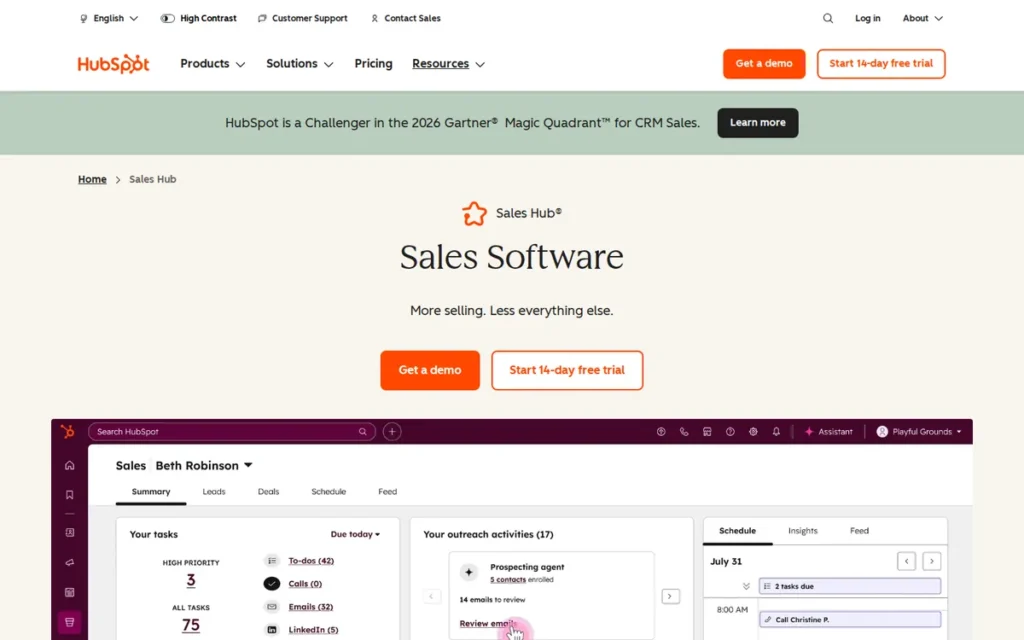
Category: CRM-Native AI Sales Hub, an all-in-one CRM platform with embedded AI that manages contacts, sequences, pipeline, and outreach from a single interface without requiring external tool integration.
At a Glance
- Category: CRM-Native AI Sales Hub
- Best For: SMB to mid-market sales teams (1–200 seats) needing AI-assisted prospecting, email, sequences, and pipeline management inside a single CRM without a multi-tool stack
- Price Range: Free (2 seats) / Starter $20/seat/month / Professional $90/seat/month / Enterprise $150/seat/month (all publicly listed, 2026)
- Primary Strength: HubSpot Sales Hub is the only tool in this evaluation where AI insights, contact enrichment, sequence automation, and CRM pipeline data share a native data model, significantly reducing the integration complexity that most competing tools require.
- Biggest Limitation: HubSpot Sales Hub’s Breeze AI autonomous workflow and prospecting agent features are rated “deeply undercooked” by its own practitioner community in 2025–2026, consistently underperforming dedicated point solutions for conversation intelligence and outbound automation.
- One-Line Summary: HubSpot Sales Hub is the best-reviewed AI sales platform for teams that need a CRM, sequences, and AI assistance in a single system with publicly transparent pricing starting at $0.
- Last Verified: May 2026
Overview
HubSpot Sales Hub is a CRM-native AI sales platform designed for SMB to mid-market teams that need prospecting intelligence, email sequencing, pipeline management, and AI-assisted outreach within a single unified interface, without relying on external integrations to connect their data.
HubSpot Sales Hub’s Breeze AI suite includes over 80 embedded features: the Breeze Prospecting Agent monitors 200M+ profiles for buying signals, the Breeze Copilot drafts emails and meeting prep notes, and predictive lead scoring surfaces priority contacts from behavioral CRM data.
HubSpot Sales Hub holds approximately 13,700 verified G2 reviews (the highest review volume of any tool in this evaluation) and reported $2.17B in 2024 revenue with 28% year-over-year growth, per HubSpot Investor Relations FY2024 earnings report.
Key Features
- Breeze Prospecting Agent: HubSpot Sales Hub’s Breeze Prospecting Agent monitors target accounts for buying signals across a 200M+ profile database and drafts personalized outreach without requiring manual research or tab-switching between tools.
- Breeze Copilot: HubSpot Sales Hub’s Breeze Copilot generates email drafts, meeting preparation notes, and deal summaries from CRM context, enabling reps to complete routine communication tasks in seconds rather than minutes.
- Native AI Lead Scoring: HubSpot Sales Hub analyzes behavioral CRM data: page visits, email engagement, deal stage history, to surface the highest-priority contacts in a rep’s queue without manual scoring configuration.
- Sequence Automation: HubSpot Sales Hub allows reps to enroll contacts in personalized multi-step email and task workflows directly from the CRM record, with AI-suggested follow-up timing based on engagement signals.
- Breeze Intelligence Database: HubSpot Sales Hub enables anonymous website visitor identification and real-time firmographic enrichment of CRM records using behavioral and firmographic data from 200M+ profiles, per HubSpot’s AI product page.
Best For
HubSpot Sales Hub is best for SMB and mid-market sales teams (particularly those starting from scratch or consolidating a fragmented tool stack) who need AI-assisted prospecting, email, sequences, and pipeline management in one place without the implementation complexity, pricing opacity, or multi-vendor maintenance burden that specialized point solutions require.
Pricing
HubSpot Sales Hub pricing as of 2026 is fully publicly listed at hubspot.com/pricing/sales: Free tier supports 2 seats with basic CRM and limited AI features; Starter at $20/seat/month adds email automation and sequences; Professional at $90/seat/month (3-seat minimum) unlocks Breeze Copilot, predictive lead scoring, and custom reporting; Enterprise at $150/seat/month (5-seat minimum, approximately $9,000/year minimum) adds advanced permissions and SSO.
Important: HubSpot enterprise account executives have been documented adding undisclosed “AI credits” line items to renewal quotes, the top-rated post in r/hubspot during the research period (51 upvotes) documented this specifically, per r/hubspot, 2026. Teams should explicitly clarify AI credit policies before signing enterprise contracts.
Strengths
- Review Volume and Score: HubSpot Sales Hub is backed by the most statistically robust user satisfaction dataset in this category, approximately 13,700 verified G2 reviews at 4.4/5 and 5,000+ Capterra reviews at 4.5/5 as of 2026, reflecting broad adoption across team sizes and industries.
- Named Case Study Evidence: Named HubSpot customer Agicap reported saving 750 hours per week and achieving 20% faster deal velocity after deploying Breeze AI; Sandler reported 4x sales leads and 25% more engagement, per HubSpot’s official 2026 case study library (vendor-published; independently unaudited).
- Native CRM Architecture: HubSpot Sales Hub’s native CRM data model means AI insights, enrichment data, sequence logic, and pipeline stages all share the same underlying structure, eliminating synchronization gaps, API configuration burden, and cross-tool reporting inconsistency that external integrations introduce.
This aligns with community sentiment on r/hubspot:
“HubSpot CRM over everything for b2b companies. Hubspot now pulls weight in terms of customizing the UI, creating it to fit the mold of your business vs. forcing your biz to adapt to an out of box setup. I’ve used hs for over a decade and let me tell you, it’s gotten so much better. No need for hs<>salesforce for full commercial teams. HubSpot is expensive, yes, but at what cost? How much more expensive is it to have a shitty crm or duplicate tools that don’t fit business needs but were bought for cost savings instead?” Posted by u/printsmyshkin
Takeaway: Long-term HubSpot practitioners consistently validate the platform’s CRM-native consolidation argument, framing the true cost comparison not as HubSpot’s price versus zero, but as HubSpot’s price versus the combined cost and operational friction of duplicate tools that don’t share a data model.
- Financial Stability: HubSpot is the only publicly traded, profitable company in this evaluation, $2.17B in 2024 revenue with 28% YoY growth, per HubSpot Investor Relations FY2024 earnings report, providing procurement teams with the strongest available signal of vendor financial stability.
Limitations
- AI Feature Maturity Gap: HubSpot Sales Hub’s most consequential trade-off is the gap between its AI marketing claims and the production-ready quality of its autonomous features, the top-voted r/hubspot thread in late 2025 described Breeze AI as “deeply undercooked” and “nearly useless” for workflow automation (20 upvotes), with community consensus specifically criticizing the Prospecting Agent as having “quite a way to go,” per r/hubspot, 2025.
- Steep Starter-to-Professional Tier Jump: HubSpot Sales Hub’s jump from Starter ($20/seat) to Professional ($90/seat) is steep and frequently cited as a painful threshold, teams growing from 3 to 10 reps face a cost increase that outpaces the value delivered by incremental feature unlocks at that tier boundary.
- Undisclosed Enterprise AI Credit Charges: HubSpot Sales Hub enterprise renewal quotes have been documented adding “$2,000 AI credits” line items not reflected in public pricing, per the highest-rated post in r/hubspot during the research period, a pricing transparency concern at the enterprise tier that teams should surface before contract signing.
- Conversation Intelligence Gap: HubSpot Sales Hub’s call transcription and meeting analysis features are rated “mediocre at best compared to point solutions” by community practitioners, teams requiring Gong-quality conversation intelligence will not find a comparable substitute within the HubSpot Sales Hub platform.
“The AI transcription/summarization is mediocre at best compared to point solutions… We’re in discussions to increase our seat count and they just added ‘$2,000 AI credits’ to the quote, out of the blue.” (u/MaterialDoughnut, r/hubspot, 2026)
Takeaway: HubSpot Sales Hub’s most defensible AI value (email drafting, CRM record summaries, and sequence automation) is validated by community evidence; its autonomous prospecting agent features are not yet production-ready by the same community’s consensus.
Verdict
HubSpot Sales Hub is the best AI sales assistant platform for teams that need a unified CRM, AI-assisted outreach, and transparent self-serve pricing in a single system, ranking #1 in this evaluation on the strength of approximately 13,700 verified G2 reviews, fully public pricing, native CRM architecture, and named enterprise case studies with specific attributed outcomes. Teams that need best-in-class conversation intelligence (Gong), data enrichment breadth (Clay), or high-volume cold calling productivity (Nooks) will find those specialist tools outperform HubSpot Sales Hub’s corresponding AI features. For the broadest range of sales teams, particularly those consolidating a fragmented stack or deploying AI tools for the first time, HubSpot Sales Hub provides the strongest combination of accessible entry pricing, verified real-world results, and unified platform value.
2. Apollo.io: Best for Outbound Prospecting: Best All-in-One for B2B Teams Prioritizing Database Access and Sequence Automation
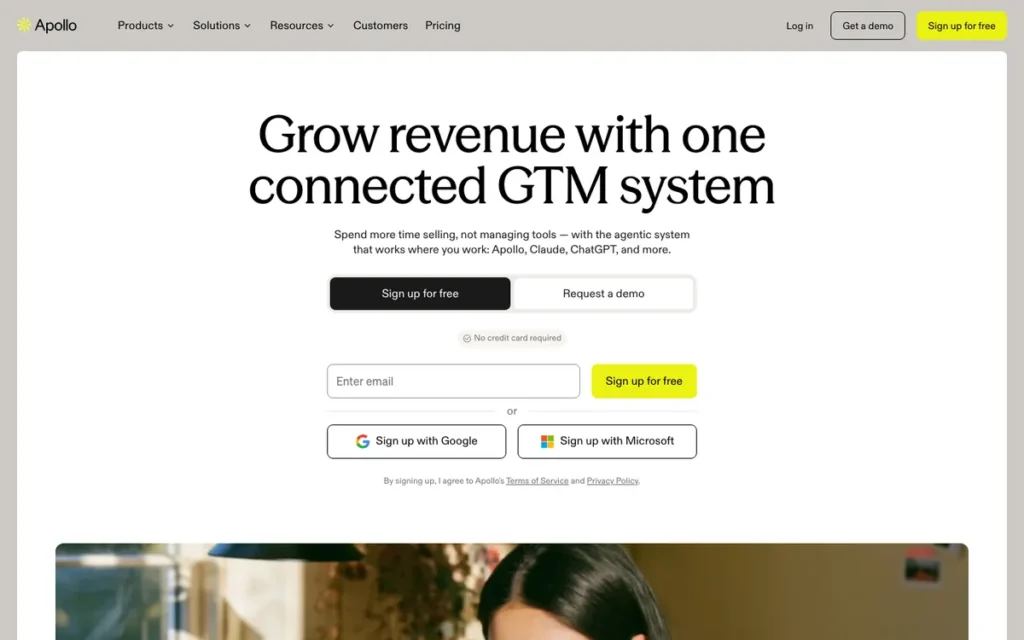
Category: All-in-One Prospector, a B2B sales intelligence and engagement platform that combines contact database access, AI-powered lead scoring, email sequencing, and a built-in dialer in a single interface.
At a Glance
- Category: All-in-One Prospector
- Best For: SDR and outbound sales teams at SMB to mid-market companies needing a large B2B contact database, sequence automation, and AI-assisted prospecting workflows with self-serve pricing
- Price Range: Free (limited credits) / Basic ~$49–59/seat/month / Professional ~$99/seat/month / Organization ~$149/seat/month (all publicly listed, 2026)
- Primary Strength: Apollo.io provides access to a 275M+ contact B2B database with 14,000+ Bombora intent topics, sequence automation, AI lead scoring, and a built-in dialer, all in a single platform with publicly listed pricing starting at $0.
- Biggest Limitation: Apollo.io’s contact data carries documented 10–15% bounce rates even on “verified” contacts, and its email sending infrastructure is consistently rated weaker than dedicated deliverability-focused platforms by the r/coldemail practitioner community.
- One-Line Summary: Apollo.io is the most accessible all-in-one B2B prospecting platform combining a 275M+ contact database, AI-powered sequence automation, and a built-in dialer with fully public self-serve pricing starting at $0.
- Last Verified: May 2026
Overview
Apollo.io is an all-in-one B2B sales intelligence and engagement platform designed for SDR and outbound sales teams at SMB to mid-market companies who need database access, lead scoring, sequence automation, and calling capability in a single interface without managing separate subscriptions for each function.
Apollo.io’s AI Assistant accepts natural language prompts (“Find 30 VP of Sales at Series B fintech SaaS companies in North America, research their recent activity, and build a 5-step personalized sequence”) and executes the full workflow including email drafting, filtering, and CRM enrichment without tab-switching, per Apollo.io’s AI platform.
Apollo.io’s functional free tier and G2 Winter 2026 recognition make it the most accessible entry point in this category for teams evaluating outbound AI for the first time.
Key Features
- 275M+ Contact Database: Apollo.io’s database includes 200+ search filters and 14,000+ Bombora intent topics, enabling granular ICP targeting by job title, company size, funding stage, technology stack, and real-time buying signals, the broadest self-serve prospecting dataset available at this price point.
- AI Assistant (Natural Language Workflows): Apollo.io’s AI Assistant processes natural language prospecting prompts end-to-end (building target lists, researching account activity, generating personalized email drafts, and enrolling contacts in sequences) without requiring manual workflow configuration by the rep.
- Multi-Channel Sequence Automation: Apollo.io’s sequence engine manages multi-step outreach workflows across email, phone, and LinkedIn tasks, with AI-suggested send timing and branching logic based on each prospect’s engagement behavior.
- Built-In Dialer: Apollo.io’s built-in dialer supports call recording, automatic CRM logging, and AI-generated call scripts, enabling prospecting, outreach, and calling without switching between platforms.
- AI Lead Scoring: Apollo.io’s lead scoring model uses behavioral signals, firmographic data, and intent topics to automatically prioritize the contacts in a rep’s queue most likely to convert based on current buying activity.
Best For
Apollo.io is best for outbound-first B2B sales teams at SMB and mid-market companies (particularly those building their first prospecting infrastructure) who want a single platform covering database access, sequence automation, and calling without enterprise pricing or procurement complexity.
Pricing
Apollo.io pricing as of 2026 is fully publicly listed at apollo.io/pricing: Free tier offers limited export credits and basic sequencing; Basic at approximately $49–59/seat/month (annual) adds more credits and filters; Professional at approximately $99/seat/month unlocks the full dialer, advanced reporting, and higher credit volumes; Organization at approximately $149/seat/month adds custom permissions and analytics.
Important: Export and AI credits deplete faster than most users anticipate. Teams should model their target prospecting volume against credit allowances before committing to a tier, as overages can meaningfully increase effective per-seat cost beyond headline pricing, per Artisan’s 2026 Apollo comparison.
Strengths
- Independent Performance Validation: An April 2026 Tolly Group report (published via PR Newswire, April 8, 2026) independently confirmed Apollo.io’s email-to-meeting conversion rate at 2.37%, exceeding the 0.5–1.5% industry average, the strongest third-party performance validation publicly available for Apollo.io as of 2026. Apollo.io separately reports 500% year-over-year AI platform adoption growth and 46% more meetings booked for AI Research Agent users (Apollo.io internal data, 2026; independently unaudited).
- G2 Rating and Category Recognition: Apollo.io holds a G2 rating of 4.7/5 across 9,600+ verified reviews, per Apollo.io’s own G2 Winter 2026 report, with reviewers specifically citing “dizzying filtering opportunities” and “prospecting on autopilot” as standout capabilities, per Artisan’s 2026 competitive analysis.
- Functional Free Tier: Apollo.io’s free tier is one of the genuinely functional free entries in this category (not a restricted trial) enabling pre-revenue and early-stage teams to validate their ICP and outbound motion with real prospect data before committing to a paid plan.
- Stack Consolidation Value: Apollo.io replaces the need for separate subscriptions to a data vendor, a sequencer, a dialer, and a CRM enrichment tool, at a per-seat cost that significantly undercuts enterprise data alternatives, making it the strongest single-platform consolidation option for resource-constrained teams building from scratch.
Users on r/UseApolloIo described their production Apollo workflows:
“Been using it for a bit now and it’s been solid for me, especially for mobile numbers and emails. My current workflow is pretty simple: Find prospects on LinkedIn, Use the Apollo extension to push them into HubSpot, Run sequences + calls from HubSpot. I haven’t really touched Apollo sequences yet. Sticking with HubSpot since that’s what I’m used to. But starting to think I might be missing out if Apollo can make things more efficient.” Posted by u/espionrs
Takeaway: Apollo users who report positive results consistently use the platform for data sourcing and contact discovery while routing execution to a separate CRM or sequencing layer, a real-world workflow pattern that directly validates Apollo.io’s positioning as a database and research tool rather than a complete end-to-end outreach stack.
Limitations
- Data Accuracy Gap: Apollo.io’s most consequential limitation is the structural gap between its database breadth and its data accuracy, practitioners on r/coldemail consistently report 10–15% bounce rates even on contacts marked “verified,” with data staleness particularly pronounced in specific industries and EMEA geographies, traced to Apollo.io’s shift from LinkedIn scraping to third-party data broker partnerships after 2021.
- Sending Infrastructure Weakness: Apollo.io’s email sending layer is consistently rated weaker than dedicated deliverability platforms by the r/coldemail community in 2026, with practitioner consensus recommending Apollo.io be used as a data layer only (paired with a dedicated platform like Smartlead or Instantly for outreach execution) to protect sender domain reputation from AI-accelerated high-volume sending.
- Tracking Reliability Issues: Apollo.io’s email tracking metrics have been documented as unreliable by practitioners, with one r/coldemail user reporting Apollo.io showing 8 link clicks while Clarity (with UTM identifiers) simultaneously showed 12, raising legitimate reliability concerns for teams making sequence performance decisions from Apollo.io’s native reporting dashboard.
- Credit System Cost Escalation: Apollo.io’s export and AI credits deplete faster than most new users anticipate, creating effective per-seat costs that can meaningfully exceed headline pricing when prospecting volume scales, teams should model actual credit consumption against target list sizes before committing to a tier.
“Apollo’s good for leads, not great for sending. Data quality varies by region and industry. Credits burn fast. Their sending tool is basic, better off using Smartlead or Instantly for campaigns.” (u/HyperkeOfficial, r/coldemail, 2026)
Takeaway: The practitioner consensus treats Apollo.io as a data sourcing and research layer, not a full outreach stack, teams that pair Apollo.io with a dedicated sending platform consistently report better deliverability and more reliable performance data.
Verdict
Apollo.io is the best all-in-one AI prospecting platform for outbound B2B teams that need a large contact database, sequence automation, and a built-in dialer with publicly listed pricing starting at $0, earning its #2 ranking through its 4.7/5 G2 score across 9,600+ verified reviews, transparent pricing, and the broadest self-serve database in the category. Apollo.io performs most reliably when deployed as a data and research layer paired with a dedicated sending platform for outreach execution, teams that treat Apollo.io as a full end-to-end replacement for deliverability-optimized sending infrastructure consistently report data quality and tracking reliability issues that undermine campaign performance and domain reputation over time.
3. Gong: Best for Conversation Intelligence: Best for Enterprise Teams Needing Call Analytics, Deal Visibility, and Revenue Coaching
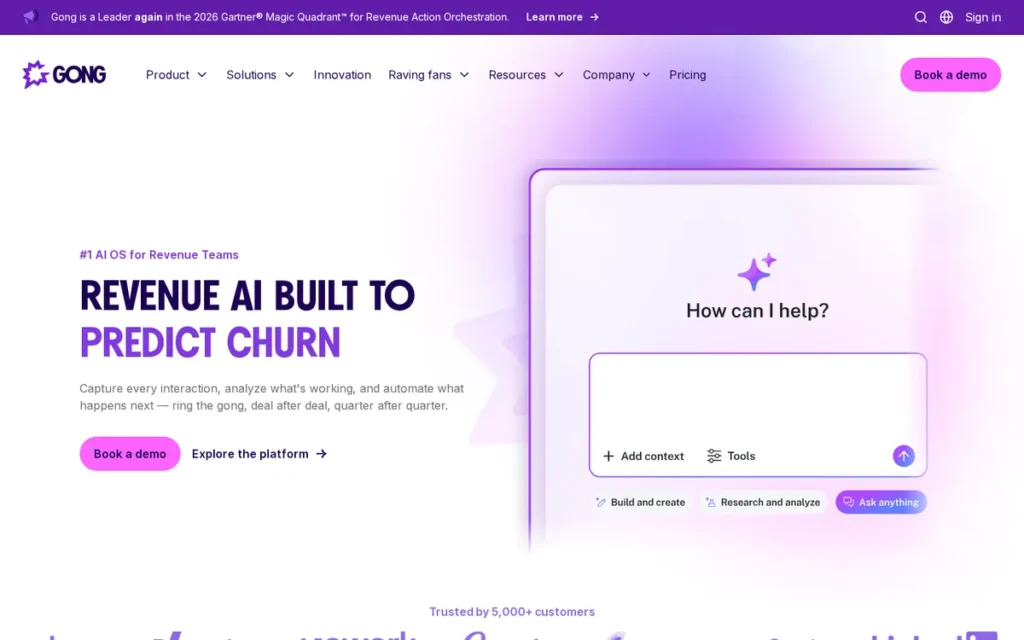
Category: Conversation Intelligence Platform, captures, transcribes, and analyzes sales calls and meetings using AI to generate deal intelligence, coaching insights, forecasting signals, and automated CRM updates from actual conversation data.
At a Glance
- Category: Conversation Intelligence Platform
- Best For: Mid-market to enterprise revenue teams (typically 20+ seats) with call-driven sales motions who need AI-powered deal visibility, rep coaching, revenue forecasting, and CRM automation grounded in actual conversation data
- Price Range: Custom enterprise pricing only: estimated $100–200/seat/month plus $5,000+ annual platform fee; annual contracts standard (not publicly listed, 2026)
- Primary Strength: Gong’s Revenue Graph: trained on billions of B2B sales conversations, the largest training corpus for conversation intelligence any vendor in this evaluation has publicly disclosed, analyzes 300+ behavioral signals per call.
- Biggest Limitation: Gong is inaccessible to most teams under 20–30 seats due to custom enterprise pricing, requires months for full enterprise deployment, and its call recording workflows carry documented GDPR consent obligations in European markets that require legal review before deployment.
- One-Line Summary: Gong is the leading enterprise conversation intelligence platform, trusted by 5,000+ organizations including LinkedIn, HubSpot, and Shopify to analyze 300+ behavioral signals per sales call and automate CRM data entry from actual conversation content.
- Last Verified: May 2026
Overview
Gong is the Revenue AI Platform designed for mid-market to enterprise sales organizations that need to transform every customer interaction (calls, video meetings, emails, and web conversations) into structured deal intelligence, rep coaching signals, and revenue forecasts grounded in actual conversation data rather than manually entered CRM records.
Gong captures 99% of customer interactions via automatic recording and transcription, then applies its proprietary Revenue Graph AI to analyze 300+ behavioral signals per conversation, including talk-to-listen ratios, sentiment shifts, competitor mentions, and deal risk indicators that precede pipeline loss, per Gong’s conversation intelligence platform page.
Gong serves 5,000+ enterprise customers and has raised $584M at a $7.25B valuation [Source: Gong official website, 2026], making it one of the most well-capitalized pure-play AI sales intelligence platforms in the market.
Key Features
- Revenue Graph AI (300+ Signal Analysis): Gong’s Revenue Graph AI analyzes 300+ behavioral signals per recorded call (including talk ratios, sentiment progression, objection patterns, competitive mentions, and methodology adherence) using a training corpus of billions of B2B sales interactions that no competitor in this evaluation has publicly disclosed matching at equivalent scale, as of May 2026.
- AI Data Extractor (Automated CRM Population): Gong’s AI Data Extractor automatically creates and populates CRM fields from call content without manual data entry, directly addressing the administrative burden that practitioners estimate consumes 20–30% of a sales rep’s working time, per G2 review data and community discussion (2026).
- Deal Reviewer AI: Gong’s Deal Reviewer AI surfaces deal health scores, suggested CRM updates, and recommended next steps from conversation content, giving revenue leaders real-time pipeline visibility without relying on rep-reported data that diverges from actual conversation evidence.
- Coaching Intelligence: Gong’s coaching intelligence layer identifies specific conversation moments (objection handling, competitor discussions, pricing sensitivity signals) and delivers rep-specific feedback tied to methodology adherence and historical performance benchmarks across the team.
- Revenue Forecasting: Gong’s revenue forecasting module generates pipeline predictions from deal-level conversation signals rather than manually entered forecast categories, producing forecasts that update in real time as conversation evidence changes.
Best For
Gong is best for mid-market to enterprise revenue teams of 20+ seats with call-heavy sales motions (particularly organizations with dedicated revenue operations, active sales coaching programs, and multi-rep account-based selling) where the ROI from conversation intelligence, automated CRM population, and AI-driven forecasting justifies the pricing premium and implementation timeline.
Pricing
Gong does not publicly list pricing as of 2026. Independent estimates from CloudTalk’s 2026 Gong pricing guide place pricing at approximately $100–200 per user per month, plus an annual platform fee estimated at $5,000 or more, typically requiring annual contracts.
Teams evaluating Gong should:
- Request all-in total contract value during initial discovery: not just per-seat rates
- Explicitly ask about platform fees separate from per-seat charges before receiving a quote
- Factor implementation timeline (often several months for enterprise deployments) into ROI modeling
- Budget 3–5 weeks minimum for the procurement process before receiving a final quote
At an estimated $150/seat/month for a 10-seat team, Gong’s break-even is approximately one additional deal retained per quarter through improved coaching, at a typical $50,000 ACV, that is roughly 3x the annual Gong investment. Gong is generally not cost-justified for teams under 15–20 seats.
Strengths
- Enterprise Customer Validation: Gong’s 5,000+ enterprise customer base: including LinkedIn, HubSpot, Dropbox, Shopify, and monday.com, provides the strongest independent validation of enterprise deployment reliability in this evaluation, per Gong’s official website and multiple independent review sources (2026).
- Proprietary Training Data Moat: Gong’s Revenue Graph is trained on billions of actual B2B sales conversations (a dataset that no competitor in this evaluation has publicly disclosed matching at equivalent scale, as of May 2026) enabling detection of complex behavioral patterns, including deal risk signals that precede pipeline loss by weeks.
- CRM Automation Value: Gong’s AI Data Extractor directly addresses one of the top pain points in the target audience, automated CRM field population from call content eliminates the manual data entry that practitioners estimate consumes 20–30% of a sales rep’s non-selling time.
- G2 Review Quality and Volume: Gong holds a G2 rating of 4.7/5 with 6,400+ verified reviews as of 2026 (one of the highest review volumes at this score level in the conversation intelligence category) and practitioners rate Gong’s conversation intelligence as clearly superior to alternatives even when they find Gong’s sales process frustrating.
Limitations
- Pricing Opacity and SMB Inaccessibility: Gong’s combination of custom enterprise pricing (estimated $100–200/seat/month plus $5,000+ annual platform fee) and no self-serve evaluation path makes Gong structurally inaccessible to teams under approximately 20 seats or those without dedicated procurement resources, and the sales process required to receive a quote is itself a meaningful time investment that smaller teams cannot absorb.
The pricing barrier surfaces consistently in community renewal discussions. From r/Sales_Professionals:
“Our Gong renewal is coming up and I’m having a hard time justifying $100+/user/month when we’re honestly only using maybe 20% of the features. The conversation intelligence is solid but we don’t touch half the analytics, the auto-generated follow-up emails need so much editing they’re not worth it, and recaps sometimes take 2-4 hours to arrive. We’re a 15-person sales team and the CFO is asking why we’re spending $18k/year on a tool when most of us just want meeting notes, action items, and basic call insights.” Posted by u/1234yeahboi
Takeaway: Even teams large enough to deploy Gong report significant feature utilization gaps at renewal, reinforcing that Gong’s ROI case depends on organizations actively using its full conversation intelligence and forecasting depth, not just its call recording functionality.
- Gong Engage Quality Concerns: Gong’s expansion into sales engagement via Gong Engage is not yet rated as a mature alternative to dedicated sequencing platforms, r/sales practitioners in 2026 warn it is “missing a lot of features” including A/B testing and auto-dialer integrations, and crashes “every 5 actions”, meaning buyers should use Gong for conversation intelligence and pair it with a dedicated sales engagement platform for execution.
- GDPR Call Recording Compliance: Gong’s call recording workflows carry documented GDPR consent obligations in European markets where two-party consent laws require explicit opt-in for recording, an operational compliance risk that requires legal review and consent infrastructure configuration before deployment in EU jurisdictions.
- Enterprise Deployment Timeline: Gong enterprise deployments routinely take months from contract signing to full production value, teams accustomed to SaaS tools delivering value in days must explicitly plan for and resource this implementation timeline before signing an annual contract.
“SL AI recording transcription is supremely dogshit, it thinks I’m the prospect 90% of the time and never captures next steps the way Gong would. As annoying Gong reps are I like the product.” (u/Im_Mr_November, r/sales, 2026)
Takeaway: Even users who dislike Gong’s sales process rate its core conversation intelligence as meaningfully superior to alternatives, a consistent pattern that validates the technology’s quality while reinforcing the pricing and procurement friction as a legitimate barrier for teams under 20 seats.
Verdict
Gong is the best AI conversation intelligence platform for enterprise sales organizations that need the deepest available analysis of sales call data, automated CRM population from conversation content, and AI-driven revenue forecasting grounded in behavioral signals rather than rep-reported pipeline entries. Gong ranks #3 in this evaluation, behind HubSpot Sales Hub on pricing accessibility and review volume, and behind Apollo.io on self-serve entry, but leads all evaluated tools on conversation intelligence depth, enterprise customer validation (5,000+ organizations), and proprietary AI training data. Teams should evaluate Gong specifically for its core strength; community evidence is clear that Gong Engage as a sequencing replacement and Gong for teams under 20 seats represent significantly weaker value propositions than the platform’s core calling intelligence capability.
4. Clay: Best for Data Enrichment: Best for RevOps and Growth Teams Building Hyper-Personalized Outbound at Scale
Category: GTM Data Platform, a no-code data enrichment and workflow automation platform that aggregates 150+ data providers via waterfall enrichment logic and an AI research agent to prepare hyper-personalized contact data and outreach materials for sales execution.
At a Glance
- Category: GTM Data Platform
- Best For: RevOps professionals and growth teams at SMB to mid-market companies needing the highest available contact data quality for hyper-personalized outbound, with a 4–6 week learning investment and a dedicated technical operator
- Price Range: Free (limited credits) / Starter $149/month (1,000 credits, annual) / Explorer $349/month (5,000 credits, annual) / Pro $800+/month (20,000+ credits, unlimited users, annual) / Enterprise custom (all publicly listed, 2026)
- Primary Strength: Clay aggregates 150+ data providers in a waterfall enrichment sequence, achieving 80%+ email match rates versus the 40–50% typical of single-source tools, combined with Claygent, an AI research agent that generates personalized talking points from unstructured web sources at scale.
- Biggest Limitation: Clay requires a 4–6 week minimum learning curve and a technically capable RevOps or growth operator to configure production workflows, making it unsuitable as a self-service tool for frontline SDRs or teams without dedicated technical resources.
- One-Line Summary: Clay is the AI data enrichment platform achieving 80%+ email match rates through 150+ data provider waterfall enrichment, the broadest multi-source enrichment architecture of any tool in this evaluation.
- Last Verified: May 2026
Overview
Clay is a no-code GTM data platform designed for RevOps professionals and growth teams at SMB to mid-market companies who need the highest available contact data quality and personalization depth for outbound sales, combining 150+ data providers in a waterfall enrichment sequence with Claygent, an AI research agent that browses the web to generate personalized talking points from unstructured sources.
Clay achieves 80%+ email match rates by querying multiple data providers sequentially (if Apollo yields no email for a contact, Clay queries Hunter, then People Data Labs, then Snovio, continuing until a verified result is found) a data architecture that no single-source tool can replicate, per DataBar’s 2025 enrichment guide.
Clay raised a $46M Series B led by Meritech Capital in June 2024, with participation from Sequoia, First Round Capital, Box Group, and Boldstart Ventures [Source: BuiltIn NYC, June 2024; SiliconAngle, June 2024], and subsequently closed a Series C at approximately $3B valuation in June 2025, confirming its trajectory as a category-defining GTM data infrastructure layer.
Key Features
- 150+ Provider Waterfall Enrichment: Clay’s waterfall enrichment engine queries 150+ data providers sequentially (including Apollo, Clearbit, People Data Labs, Hunter, BuiltWith, LinkedIn, and Bombora) achieving 80%+ email match rates by automatically falling through to the next provider when the previous one returns no result, per Clay’s official platform.
- Claygent AI Research Agent: Clay’s Claygent AI research agent browses company websites, LinkedIn profiles, and unstructured public sources to generate personalized talking points, role-specific context, and account intelligence at scale, automating research that would previously require individual manual SDR effort per account.
- No-Code GTM Workflow Builder: Clay’s spreadsheet-style workflow builder enables RevOps teams to configure complex GTM automation sequences (CRM enrichment, audience segmentation, trigger-based outreach, and account scoring) without engineering resources, using conditional logic and connections to 150+ data sources.
- Competitor Data Aggregation Architecture: Clay treats platforms like Apollo, ZoomInfo, Clearbit, and LinkedIn as enrichment inputs simultaneously, giving teams the best available data from all sources through one credit-based interface at a fraction of the cost of subscribing to each vendor independently.
- Granular Credit-Based Cost Control: Clay’s credit system allows teams to apply premium, higher-cost data sources only to high-priority accounts while using cheaper sources for volume prospecting, enabling cost optimization that flat-fee data vendors cannot provide.
Best For
Clay is best for technically capable RevOps professionals and growth teams at B2B companies that have already validated their ICP, have an existing CRM and outreach execution platform, and need to improve contact data quality and personalization depth at scale, particularly teams whose current single-source data tool leaves 50–60% of prospecting contacts without verified email addresses.
Pricing
Clay pricing as of 2026 is fully publicly listed at clay.com/pricing: Free tier offers limited credits for evaluation; Starter at $149/month (annual) or $179/month (monthly) provides 1,000 credits per month; Explorer at $349/month annual provides 5,000 credits; Pro at $800+/month annual provides 20,000+ credits with unlimited user seats; Enterprise pricing is custom with dedicated support, SSO, and unlimited credits.
At the Explorer tier ($349/month), Clay’s break-even is approximately one additional SQL generated per month from improved contact match rates, at a typical $20,000–50,000 B2B ACV, that SQL is worth 57x–142x the monthly plan cost.
Critical: Claygent AI research calls consume 5–10x more credits than basic email lookups. Teams using Claygent extensively for account research should model production credit consumption carefully before committing to a tier. “Credit shock” (discovering actual monthly costs 3–5x higher than the base plan) is the most documented first-month experience among new Clay users, per DataBar’s alternatives guide.
Strengths
- Documented Enrichment Rate Improvement: Clay’s waterfall enrichment architecture achieves 80%+ email match rates versus the 40–50% typical of single-source data tools, with multiple r/coldemail power users documenting 3x enrichment rate improvements versus Apollo-only data procurement as of 2026, confirmed by Clay’s own published platform data.
- Institutional Validation at Scale: Clay raised a $46M Series B led by Meritech Capital in June 2024, with participation from Sequoia, First Round Capital, Box Group, and Boldstart Ventures [Source: BuiltIn NYC, June 2024], and subsequently closed a Series C at approximately $3B valuation (June 2025, per TechCrunch), the strongest multi-round institutional validation signal in this evaluation for a company of Clay’s size.
- Near-Universal User Satisfaction: Clay holds a G2 rating of 4.9/5 across 250+ verified reviews and a Capterra rating of 4.8/5 across 100+ reviews as of 2026, reflecting near-universal satisfaction among RevOps professionals and growth operators who have completed the learning curve and unlocked full workflow capability.
- Structural Cost Efficiency at Scale: Clay’s data aggregation model can be more cost-effective for high-volume enrichment than subscribing to each data vendor independently, accessing Apollo data, LinkedIn enrichment, and Bombora intent through a single Clay credit system, per r/coldemail community evidence (2026).
Limitations
- Learning Curve and Technical Resource Requirement: Clay’s most consequential trade-off is the combination of its 4–6 week minimum learning curve and its requirement for a technically proficient RevOps operator, teams without a dedicated technical resource should budget 40–80 hours of configuration work before reaching production value, not just the subscription fee.
Users on r/coldemail evaluating Clay during their trial reported:
“I’ve been watching the Clay University clips and different YouTube videos for about a week. Playing with the free trial here and there. My take is that it is incredibly complicated and seems to require a knowledge of coding and AI interfacing in order to make the platform perform as it should. In other words, it’s incredibly hard to learn if you don’t have some kind of software engineering chops. But high functioning sales and email marketing folks seem to fully believe in it, which leads me to think that it not being immediately useful for me is a user error more than anything.” Posted by u/10teja15
Takeaway: Clay’s learning curve is not marketing language, community evidence confirms that users without a technical RevOps background hit a genuine capability wall before reaching Clay’s full waterfall enrichment value, and that the platform’s high satisfaction scores reflect the users who cleared that barrier, not those who didn’t.
- Credit System Complexity and Cost Unpredictability: Clay’s credit system: where Claygent AI research calls consume 5–10x more credits than basic email lookups, creates unpredictable cost scaling that regularly produces “credit shock” during first production months, a pattern consistently documented in the r/coldemail community and DataBar’s 2025 guide.
- Not a Frontline SDR Self-Service Tool: Clay is explicitly RevOps and growth infrastructure (not a tool that frontline SDRs can operate independently) and organizations whose only technical resource is their SDRs should not expect Clay to deliver value without significant configuration investment well beyond the subscription fee.
- GDPR Data Sourcing Obligations: Clay’s aggregation of 150+ third-party data providers means teams operating under strict GDPR data sourcing obligations should conduct due diligence on the provenance of specific enrichment sources before deploying Clay for European contact enrichment at scale.
“If you need better data coverage or want to stack multiple sources, Clay with waterfall enrichment beats Apollo. More expensive (cheaper if you use your own APIs for tools), but way better data quality.” (u/HyperkeOfficial, r/coldemail, 2026)
Takeaway: Clay’s competitive advantage is its waterfall architecture, not just its volume of integrations. Teams comparing Clay and Apollo.io are choosing between the breadth of a single database and the depth of a multi-source enrichment system.
Verdict
Clay is the best AI-powered GTM data platform for technically capable RevOps and growth teams that need the highest available contact data quality and personalization depth, ranking #4 in this evaluation on the strength of its 4.9/5 G2 score, Meritech Capital-led institutional validation including a subsequent $3B Series C, 150+ data provider waterfall architecture, and documented 3x enrichment rate improvements over single-source tools. Clay is not a tool for frontline SDRs or teams without a dedicated technical operator; its value is maximized as an enrichment and personalization infrastructure layer paired with a CRM (HubSpot, Salesforce) and an outreach execution platform (Outreach, Instantly, or Salesloft). Teams that have already validated their ICP and are hitting a data quality ceiling with their current single-source tool will find Clay provides disproportionate value at the Pro tier and above.
5. Lavender: Best for Email Coaching: Best for Individual SDRs and Managers Who Want to Build and Measure Email Quality Across Their Team
Category: AI Email Coach, a browser-based AI tool that scores outbound sales email drafts in real time on a 0–100 scale and delivers specific, inline coaching suggestions to improve reply rates, based on training from 200M+ B2B sales emails.
At a Glance
- Category: AI Email Coach
- Best For: Individual SDRs and AEs writing cold outbound emails daily, and sales managers standardizing email quality and tracking team performance across their SDR org, particularly within Gmail, Outlook, Salesloft, or Outreach
- Price Range: Free (limited emails) / Individual $29–49/month / Teams $89+/user/month (publicly listed, 2026)
- Primary Strength: Lavender’s AI, trained on 200M+ B2B sales emails (per Lavender’s published platform documentation), scores each draft in real time and delivers inline coaching on the specific factors (subject line, length, reading level, personalization depth, question placement) that its data shows drive reply rate improvements.
- Biggest Limitation: Lavender is an email-only tool with no contact database, no outreach sequencing, no CRM write capability, and no multi-channel coverage, it is a “last mile” email quality layer that requires pairing with a prospecting and outreach platform to deliver value.
- One-Line Summary: Lavender is the #1-rated AI email coaching tool in G2’s Writing Assistants category, training its real-time scoring system on 200M+ B2B sales emails to help SDRs and sales managers improve cold email reply rates with specific, data-backed coaching suggestions.
- Last Verified: May 2026
Overview
Lavender is a purpose-built AI email coaching tool designed for individual SDRs and AEs who write cold outbound emails daily and for sales managers who need to standardize and measure email quality across their team, integrating directly into Gmail, Outlook, Salesloft, and Outreach as a browser extension to score each draft in real time.
Lavender’s AI is trained on 200M+ B2B sales emails (per Lavender’s published platform documentation; no independent audit of corpus size is publicly available) and scores each draft on a 0–100 scale based on factors empirically correlated with reply rates, providing inline coaching that explains why a change improves the score, not just what to change.
Lavender is rated #1 in G2’s AI Writing Assistants category as of 2026, with a 4.8/5 rating across 60+ verified reviews (a directional satisfaction signal reflecting its specialist SDR email coaching audience) and named customers including Sendoso, Twilio, Chili Piper, and Clari [Source: Lavender.ai customer page, as cited in MarketBetter Lavender review, 2026].
Key Features
- Real-Time Email Scoring (0–100): Lavender’s scoring engine analyzes each draft on a 0–100 scale, providing specific inline coaching suggestions before the email is sent, with Lavender’s benchmark data from 231,818 cold emails showing A-grade emails achieve meaningfully higher reply rates than below-threshold emails, per Lavender’s own published benchmarks.
- Native Integration with Existing Workflows: Lavender’s Gmail, Outlook, Salesloft, and Outreach integrations embed the scoring and coaching interface directly within the rep’s existing workflow, eliminating tab-switching and reducing the friction barrier to using AI assistance on every email written.
- Manager Performance Dashboard: Lavender’s team performance dashboard gives sales managers visibility into email quality scores across their entire SDR team, enabling data-driven coaching conversations grounded in evidence rather than manager intuition about why individual reps are or aren’t getting replies.
- AI Personalization Suggestions: Lavender generates personalization suggestions by pulling context from LinkedIn profiles and CRM data associated with the email recipient, enabling reps to include relevant personalization without manual research time before each send.
- Continuously Updated Model: Lavender’s AI model incorporates new data from its email corpus as market conditions shift, ensuring coaching recommendations reflect current inbox behavior patterns rather than static best practices from prior years when different formats drove replies.
Best For
Lavender is best for SDR teams of 2–30 reps where email is a primary outreach channel and where a sales manager needs both individual-rep coaching and team-level performance visibility, particularly teams within organizations already using Salesloft, Outreach, Gmail, or Outlook who want to improve email quality without replacing their existing execution infrastructure.
Pricing
Lavender pricing as of 2026 is fully publicly listed at lavender.ai/pricing: Free tier allows limited emails per month for evaluation; Individual plans at $29–49/month unlock full scoring and coaching for a single user; Teams plans at $89+/user/month add the manager performance dashboard and team analytics.
At $29–49/month for an individual rep, Lavender’s ROI threshold is low. At a standard B2B ACV of $10,000–50,000, a single additional meeting booked per month from improved email reply rates produces 20–100x+ ROI on the tool cost. Enterprise volumes at approximately $1,460/month for 2,500 credits have been cited in one analysis, teams over 20 seats should confirm current enterprise pricing directly with Lavender, per MarketBetter’s 2026 Lavender review.
Strengths
- Documented Performance Evidence: Named customer Chili Piper documented saving 30–45 minutes per rep daily using Lavender for email drafting and coaching (MarketBetter Lavender review, 2026), and Lavender’s benchmark data from 231,818 cold emails confirms A-grade emails achieve meaningfully higher reply rates than below-threshold emails, a commercially significant improvement at any outbound volume above 10 emails per day.
- G2 Category Leadership: Lavender is rated #1 in G2’s AI Writing Assistants category as of 2026, with a 4.8/5 rating across 60+ verified reviews reflecting its specialist SDR email coaching audience, and organic community endorsements across r/sales (571,000+ subscribers) and named adoption at Sendoso, Twilio, Chili Piper, and Clari.
- Team-Scale Standardization Value: Lavender’s manager dashboard standardizes email quality across an entire SDR team, a capability identified by r/SaaS practitioners as the key differentiator at team sizes above 5–8 reps, where voice inconsistency from multiple reps prompting general-purpose LLMs differently becomes operationally significant.
- Purpose-Built Sales Email Training Data: Lavender’s AI is trained specifically on B2B sales emails and updated continuously as market conditions shift, per DemandGen Report spotlight, ensuring coaching recommendations reflect what is currently working in live B2B email environments, not static best practices from prior years.
Limitations
- Narrow Email-Only Scope: Lavender’s most consequential trade-off is its deliberately email-only scope (no contact database, no outreach sequencing, no CRM write capability, and no multi-channel coverage) meaning every team that deploys Lavender must pair it with a separate data tool (Apollo.io, Clay) and a sequencing platform (HubSpot Sales Hub, Outreach, or Salesloft), adding to total stack cost and management complexity.
- LLM Substitution Risk at Individual Scale: The substitution risk from general-purpose LLMs is real and documented, r/SaaS practitioners note that for individual users at pre-growth-stage startups under 5 reps, Claude or ChatGPT at $20/month covers basic email drafting at lower cost, with Lavender’s differentiated value becoming clearer at team sizes above 5–8 reps where manager dashboard visibility and coaching standardization justify the per-seat premium.
- Chrome Browser Dependency: Lavender’s Chrome browser dependency means it is not natively accessible in non-Chrome browsers or in environments where browser extensions are restricted by IT policy, a deployment constraint teams with managed device policies should verify before purchasing.
- No CRM Write Capability: Lavender reads from CRM context to enable personalization but does not natively write data back to CRM systems, meaning rep coaching outcomes, email quality trends, and team performance improvements tracked in Lavender’s dashboard remain siloed from CRM reporting and pipeline analytics.
“One thing worth flagging: you mentioned cutting Lavender because Claude covers writing. That math works now at 4 people. Watch it at 8–10, the moment multiple people are prompting Claude differently for the same type of output, you start getting voice inconsistency.” (u/Fill-Important, r/SaaS, 2026)
Takeaway: Lavender’s team-scale value (voice standardization and manager visibility across an SDR team) justifies the per-seat premium at 5+ reps; individual users should honestly assess whether a general-purpose LLM covers their specific email quality needs at lower cost before committing.
Verdict
Lavender is the best AI email coaching tool for SDR teams where cold email is a primary outreach channel and where a sales manager needs both rep-level coaching and team-level performance visibility, ranking #5 in this evaluation on the strength of its #1 G2 category rating, documented time savings from named customer Chili Piper, and the most accessible individual pricing in this evaluation at $29/month. Lavender is a “last mile” email quality layer, not a standalone sales assistant, teams evaluating Lavender should budget for the complementary tools required (database, sequencer, CRM) to deliver its coaching value within a complete outreach workflow, and individual users at pre-team-scale should honestly assess whether a general-purpose LLM covers their specific email quality needs at lower cost before committing.
6. Salesloft: Best for Full-Lifecycle Sales Orchestration: Best for Enterprise Teams That Need Cadences, Conversation Intelligence, and AI Forecasting in One Platform
Category: Revenue Orchestration Platform, an enterprise sales engagement platform combining AI-prioritized cadences, conversation intelligence, deal management, predictive forecasting, and native Drift conversational AI agents across the full sales lifecycle from first touch to close.
At a Glance
- Category: Revenue Orchestration Platform
- Best For: Enterprise revenue teams (typically 50+ seats) needing AI-orchestrated cadences, conversation intelligence, deal forecasting, and conversational AI agents in a single platform with complex Salesforce CRM workflow requirements
- Price Range: Custom enterprise pricing only: estimated Essentials ~$100/seat/month, Advanced ~$125/seat/month, Premier ~$150/seat/month; annual contracts required (not publicly listed, 2026)
- Primary Strength: Salesloft’s Conductor AI layer combines cadence automation, conversation intelligence, deal management, and predictive forecasting across the full revenue lifecycle (including native Drift conversational AI agents for web, email, and LinkedIn acquired in 2023) the broadest single-platform coverage of any tool in this evaluation, without separate licensing.
- Biggest Limitation: Salesloft’s pricing opacity requires a full enterprise sales cycle before ROI evaluation is possible, its post-Vista Equity acquisition product development pace has generated documented community criticism, and persistent bug reports with slow support resolution have eroded trust among its existing user base.
- One-Line Summary: Salesloft is an enterprise AI revenue orchestration platform serving IBM, Cisco, and Dell with AI-prioritized cadences, Conductor AI deal intelligence, and native Drift conversational agents, but its custom-only pricing and documented post-acquisition product quality concerns make it best evaluated by enterprise teams with dedicated procurement resources.
- Last Verified: May 2026
Overview
Salesloft is an AI Revenue Orchestration Platform designed for enterprise sales organizations that need to manage the full revenue lifecycle (from prospecting cadences and multi-channel outreach through conversation intelligence, deal management, and AI-powered forecasting) in a single platform with deep Salesforce CRM integration.
Salesloft’s platform includes Conductor AI (deal summaries, engagement scoring from 30+ signals, emaildrafts, predictive forecasts), Rhythm (AI-prioritized daily task queues from intent signals and CRM data), and native Drift conversational AI agents for web, email, and LinkedIn, acquired in 2023 and integrated natively, per ISG-One’s market perspective.
Salesloft serves enterprise customers including IBM, Cisco, and Dell, holds a G2 rating of 4.5/5 across 4,270+ verified reviews, and has been in market since 2011, providing more platform maturity and enterprise compliance infrastructure than any newly funded competitor in this evaluation.
Key Features
- Conductor AI (Full-Lifecycle Intelligence): Salesloft’s Conductor AI synthesizes deal summaries, engagement scores derived from 30+ behavioral signals, AI-drafted email and call scripts, and predictive pipeline forecasts, giving revenue leaders a single AI-generated view of deal health without switching between tools.
- Rhythm (AI-Prioritized Task Queue): Salesloft’s Rhythm workflow generates AI-prioritized daily task queues for every rep, surfacing the highest-priority activities from buyer intent signals, CRM data, and engagement history, directly addressing rep prioritization challenges that drive inconsistent pipeline generation across SDR teams.
- Native Drift AI Conversational Agents: Salesloft’s native Drift AI agents: acquired in 2023 and integrated into the platform, enable conversational AI qualification and engagement on websites, through email, and on LinkedIn simultaneously, providing a buyer-engagement surface area that no other tool in this evaluation offers as a natively integrated component without separate licensing.
- Enterprise Cadence Automation: Salesloft’s cadence automation engine manages multi-step, multi-channel outreach sequences at enterprise scale with A/B testing, branching logic, and CRM bi-directional sync, validated by IBM, Cisco, and Dell deployments spanning hundreds of concurrent reps.
- Conversation Intelligence: Salesloft’s conversation intelligence module records and transcribes calls, identifies coaching moments, and syncs action items and deal updates to CRM automatically, though community evidence consistently rates Salesloft’s transcription quality below Gong’s purpose-built conversation intelligence, with r/sales users in 2026 noting Salesloft AI “thinks I’m the prospect 90% of the time.”
Best For
Salesloft is best for enterprise revenue organizations with 50+ seats, dedicated RevOps teams, and established Salesforce CRM infrastructure that need a single platform to orchestrate outbound cadences, conversational AI agents, deal intelligence, and revenue forecasting, particularly organizations that have outgrown point solutions and need enterprise-grade compliance, audit trails, and role-based permissions at scale.
Pricing
Salesloft does not publicly list pricing as of 2026. Industry estimates from MarketBetter’s Salesloft pricing analysis suggest three tiers at approximately $100/seat/month (Essentials), $125/seat/month (Advanced), and $150/seat/month (Premier), all billed annually and requiring custom quotes.
Teams evaluating Salesloft should:
- Budget 3–5 weeks minimum for the procurement process before receiving a final quote
- Explicitly ask about platform fees beyond per-seat rates before any commercial discussion
- Request customer references from deployments comparable in team size and sales motion
- Factor implementation complexity: weeks to months for full cadence migration and Salesforce configuration, into ROI timeline
The absence of self-serve pricing evaluation makes Salesloft structurally inappropriate for teams under 20 seats or those without a dedicated procurement budget.
Strengths
- Enterprise Customer Validation at Scale: Salesloft serves IBM, Cisco, and Dell (three of the largest enterprise sales organizations in B2B technology) validating its SOC 2 security posture, CRM sync reliability at multi-thousand-seat scale, and enterprise support infrastructure, per G2 review data and Trellus platform analysis (2026).
- Review Volume and Platform Maturity: Salesloft’s G2 rating of 4.5/5 across 4,270+ verified reviews and Capterra rating of 4.4/5 across 1,800+ reviews reflect 13+ years of enterprise market presence, providing more historical product iteration data and long-term customer retention evidence than any newly funded competitor in this evaluation.
- Native Drift Conversational AI: Salesloft’s acquisition of Drift in 2023 gives the platform native AI conversational agents for web, email, and LinkedIn, a buyer-engagement capability that no other tool in this evaluation offers as a natively integrated component, enabling real-time qualification and engagement at scale.
- Rhythm AI Workflow Adoption Evidence: A G2-attributed quote from a Sales Director at IBM cites that “Rhythm transformed our prioritization (closed 20% more deals”) providing directional enterprise validation of the workflow’s pipeline impact, per Salesloft’s G2 review data (independent audit of this specific claim is recommended before using it in procurement justification).
Limitations
- Community Trust Erosion Post-Acquisition: Salesloft’s most consequential limitation in 2026 is documented community trust erosion since its 2021 Vista Equity Partners acquisition, the most upvoted r/sales post about Salesloft in the research period (98 upvotes) was titled “Sales Loft sucks a bag of dicks,” and the top comment at 72 upvotes stated “I miss the pre AI bullshit Salesloft from 2020–2023”, reflecting experienced users who perceive the post-acquisition product as having prioritized AI feature surface area over stability and polish.
- Persistent Bug Reports and Support Quality Gap: Multiple verified G2 and Capterra reviews document persistent bugs, support tickets taking weeks to resolve unless escalated to Tier 2, and AI features adding administrative complexity rather than reducing it, patterns suggesting that implementation success with Salesloft depends heavily on dedicated RevOps support and proactive escalation management.
- Pricing Opacity Barrier: Salesloft’s custom-only pricing requires a full enterprise sales cycle before ROI evaluation is possible, creating friction that structurally disadvantages mid-market teams who cannot afford 3–5 weeks of procurement investment before validating fit, and making competitive comparison with transparently priced alternatives extremely difficult.
- Conversation Intelligence Quality Gap: Salesloft’s conversation intelligence module is rated by community practitioners as meaningfully inferior to Gong’s, with r/sales users noting in 2026 that Salesloft’s AI transcription “thinks I’m the prospect 90% of the time and never captures next steps the way Gong would”, a meaningful quality gap for teams whose coaching and forecasting depends on transcription accuracy.
“I’m low key obsessed with Salesloft. I can get through my daily tasks in almost half the time it would take me with HubSpot or Salesforce.” (u/ButterscotchButtons, r/sales, 2026)
Takeaway: Salesloft delivers genuine workflow efficiency for users who implement it well, but the split community reaction reflects how heavily implementation quality and dedicated RevOps support determine outcomes with this platform.
Verdict
Salesloft is the best single-platform option for enterprise revenue organizations that need AI-orchestrated cadences, native conversational AI agents via Drift, deal intelligence, and predictive forecasting under one contract, ranking #6 in this evaluation because its genuine platform breadth is offset by custom-only pricing that prevents self-serve ROI evaluation and by documented community evidence of product quality regression since the 2021 Vista Equity acquisition. Teams considering Salesloft should request direct customer references from comparable deployments, explicitly test Salesloft’s AI features during a structured pilot against their specific use cases, and verify current bug fix velocity and support SLA commitments before committing to an annual contract at $100–150/seat/month.
7. Nooks: Best for High-Volume Cold Calling: Best for SDR Teams Where Cold Calling Is the Verified Primary Pipeline Source

Category: AI Parallel Dialer, an AI-native sales engagement platform built for SDR and BDR teams doing high-volume outbound cold calling, combining parallel dialing of 3–5 simultaneous lines with a virtual salesfloor, real-time AI call coaching, and signal-based prospecting in a single workspace.
At a Glance
- Category: AI Parallel Dialer
- Best For: SDR and BDR teams of 5+ reps at companies where cold calling is the primary, validated pipeline source and where per-rep live conversation volume is the key performance constraint, typically mid-market to enterprise teams with budgets exceeding $400/seat/month
- Price Range: Approximately $5,000/user/year (~$417/seat/month), reported by Outbound Sales Pro (2026); this figure was not independently corroborated from a second source and should be treated as directional; no public pricing; contact sales required; free trial available
- Primary Strength: Nooks’s parallel dialing engine dials 3–5 numbers simultaneously, with Nooks reporting 2–5x more live conversations per rep per day compared to single-line dialing, directly multiplying the primary input to SDR pipeline generation without increasing headcount.
- Biggest Limitation: Nooks has no named third-party customer case studies with verified ROI metrics publicly available, its ~$417/seat/month pricing is the highest in this evaluation, and its parallel dialing architecture carries a documented 1–7 second connection delay that practitioners report causes prospect hang-ups and creates spam-caller perception risk.
- One-Line Summary: Nooks is an AI-native parallel dialer and virtual salesfloor platform that enables SDR teams to reach 2–5x more prospects per day via simultaneous multi-line dialing, real-time AI call coaching, and signal-based prospecting, purpose-built for high-volume outbound cold calling teams.
- Last Verified: May 2026
Overview
Nooks is an AI-native sales engagement platform purpose-built for SDR and BDR teams that conduct high-volume outbound cold calling as their primary pipeline generation activity, combining a parallel dialing engine (3–5 simultaneous lines), a Virtual Salesfloor (always-on video workspace for remote teams), AI Battle Cards for real-time in-call objection coaching, and signal-based prospecting from LinkedIn, intent data, and CRM history.
Nooks positions itself as “AI-native” (built from scratch for the outbound calling use case rather than retrofitted with AI features like legacy sales engagement platforms) and raised a $43M Series B led by Kleiner Perkins in October 2024, with participation from Lachy Groom and Tola Capital, per PR Newswire.
Nooks is best understood as a specialist amplifier for organizations where the quantity and quality of live sales conversations is the primary constraint on SDR pipeline output, not as a general-purpose AI sales assistant for teams with mixed or non-calling sales motions.
Key Features
- Parallel Dialing Engine (3–5 Simultaneous Lines): Nooks’s parallel dialing engine dials 3–5 prospect lines simultaneously, automatically connecting the rep to the first answered call, with Nooks reporting connection delays under 1 second for over 90% of calls under optimal hardware and browser conditions, per Nooks’s published parallel dialer guide.
- Virtual Salesfloor: Nooks’s Virtual Salesfloor provides an always-on video workspace that replicates the energy and peer accountability of a physical in-office SDR floor for remote and hybrid teams, enabling reps to celebrate connects, share live coaching, and maintain collaborative productivity without physical co-location.
- AI Battle Cards (Real-Time In-Call Coaching): Nooks’s AI Battle Cards surface real-time objection handling suggestions, competitive responses, and talk track guidance during live calls, delivering coaching at the moment of need rather than after the call when the opportunity has already passed.
- AI Prospector (Signal-Based Call Queue Prioritization): Nooks’s AI Prospector identifies high-propensity calling targets from buying signals sourced from LinkedIn activity, intent data feeds, and CRM history, prioritizing reps’ call queues based on which prospects are most likely to be in an active buying conversation.
- Bi-Directional CRM Integration: Nooks integrates bi-directionally with Salesforce, HubSpot, Outreach, Salesloft, Groove, and Apollo for loading call tasks, functioning as a productivity amplification layer on top of existing sales engagement platforms rather than requiring platform replacement, per Gong Collective’s integration listing.
Best For
Nooks is best for SDR and BDR teams at mid-market to enterprise companies where cold calling is a verified, primary pipeline source generating measurable revenue, specifically organizations with 5+ active outbound callers, existing sales engagement platform infrastructure, and per-rep pipeline targets that justify a ~$417/seat/month investment based on a break-even of 1–2 additional booked meetings per rep per month.
Pricing
Nooks does not publicly list pricing as of 2026. The estimated cost is approximately $5,000 per user per year (~$417/seat/month) billed annually, per Outbound Sales Pro (2026), the only publicly available pricing estimate PlugRoute’s research could identify; this figure was not independently corroborated from a second source and should be treated as directional. A free trial is available, but pricing requires a full sales engagement to receive a quote.
For context, Nooks’s per-seat cost is approximately:
- 5x–8x Apollo.io’s Professional tier (~$99/month)
- 4x–5x HubSpot Sales Hub’s Professional tier (~$90/month)
- 3x–5x Salesloft’s estimated Essentials tier (~$100/month)
Teams should model break-even explicitly: if each rep currently books 5 meetings per month from cold calling and Nooks delivers a 40% improvement (2 additional meetings per rep per month), that math must be evaluated against the ACV of those meetings before entering a sales engagement.
Strengths
- Kleiner Perkins-Led Series B Validation: Nooks raised a $43M Series B led by Kleiner Perkins (October 2024, per PR Newswire), with participation from Lachy Groom and Tola Capital, the strongest available third-party validation signal for Nooks in the absence of public customer case studies, indicating investor conviction in its parallel dialing and virtual salesfloor technology.
- Irreversible Productivity Transformation: Nooks practitioners who adopt parallel dialing consistently report the productivity shift is irreversible, the r/sales community’s top-rated comment about Nooks states “once you’ve cold called with Nooks you’ll literally never want to go back to dialing without”, reflecting a genuine qualitative shift in SDR productivity, not marginal improvement.
- Competitive UX Advantage Over Direct Alternatives: A r/techsales practitioner documented switching from Orum to Nooks due to “better UX, unlimited cell numbers vs. a cap of 10 on Orum, and better handling of technical issues”, a peer-to-peer comparison validating Nooks’s competitive positioning within the parallel dialing category specifically.
- Virtual Salesfloor Differentiation: Nooks’s Virtual Salesfloor addresses a documented gap in remote and hybrid SDR team management (recreating the in-office energy, peer accountability, and spontaneous coaching moments that drive SDR performance) a capability no other tool in this evaluation offers as a native feature, per TitanX’s review of Nooks (2026).
Limitations
- Pricing Premium Without Verified Third-Party Evidence: Nooks is the only platform in this evaluation with no named customer case studies or independently verified ROI metrics in publicly accessible sources (yet carries the highest per-seat cost (~$417/seat/month, single-source estimate from Outbound Sales Pro, 2026; independently unverified)) requiring buyers to rely entirely on Nooks’s own platform claims (2–5x more conversations, 2–3x meeting conversion rates).
- Parallel Dialing Delay and Prospect Experience Risk: Nooks’s parallel dialing connection delay, documented by community practitioners at 1–7 seconds in real use despite Nooks’s claim of sub-1-second performance for 90% of calls, creates a prospect-facing perception problem where extended silence on answer is interpreted as a spam dialer, potentially damaging connect-to-conversation conversion rates even as raw dial volume increases.
- Carrier-Level Spam Filtering Existential Risk: A structural long-term risk documented by r/techsales practitioners (April 2025) is carrier-level spam filtering (with mobile carriers actively tightening spam detection and parallel dialing architectures considered “one carrier update away from having the spam dialer killed” (u/OnlineParacosm)) a multi-year platform commitment risk that evaluation teams should weigh explicitly before signing an annual contract.
- Narrow Scope and High Stack Dependency: Nooks is not a standalone sales assistant, it requires integration with an existing SEP (Outreach, Salesloft, or Apollo.io) for sequence management, a separate CRM for pipeline tracking, and a data tool for prospecting lists, meaning the total stack cost for a Nooks-centered operation is substantially higher than the per-seat figure alone suggests.
“Sometimes people get delayed connection (approx 6–7 seconds) and prospects might hang up saying hello hello while it still awaits connecting them with you. But honestly once you’ve cold called with Nooks you’ll literally never want to go back to dialing without.” (u/Ruzro and u/1cenine, r/sales, 2026)
Takeaway: The split reaction to Nooks captures its core trade-off, the parallel dialing delay is a real friction point, but for teams that optimize their setup and have validated cold calling as their primary pipeline source, the productivity gain is significant enough that most users report never wanting to revert.
Verdict
Nooks is the best AI parallel dialer for SDR teams where high-volume cold calling is a verified primary pipeline channel, but ranks #7 in this evaluation because its ~$417/seat/month pricing is the highest of any tool reviewed, no named third-party customer case studies are publicly available to validate its ROI claims, and its value is limited to organizations with a specific high-volume outbound calling motion. Teams that have validated cold calling as their primary pipeline source, have 5+ active outbound callers, and can model break-even before committing will find Nooks’s parallel dialing productivity gains genuinely compelling; teams earlier in their outbound journey or with mixed sales motions will find stronger value at lower cost from Apollo.io, HubSpot Sales Hub, or a targeted specialist combination from this list.
What Red Flags Should I Watch For When Evaluating AI Sales Assistant Software?
Five red flags consistently appear in AI sales tool evaluations that go wrong. Recognizing them before signing a contract protects buyers from the most documented and preventable sources of wasted spend in this category.
Red Flag #1: AI Features Shipped Before They Work
The AI sales software market has a documented pattern of features released before they reliably deliver results. HubSpot Sales Hub’s Breeze Prospecting Agent and Salesloft’s post-acquisition AI additions have both been rated “undercooked” or “nearly useless” by their own practitioner communities in 2025–2026 reviews.
Before committing to any platform, request a 30-day structured pilot using your own data and target accounts (not a vendor-controlled demo) to verify that the specific AI features your team will rely on actually perform in your production environment.
During the pilot, measure: (1) time-to-first-usable-output; (2) adoption rate after week 2; (3) one concrete business metric relevant to that tool’s category, reply rates for Lavender, match rates for Clay, or meetings booked for Apollo.io.
Red Flag #2: Pricing That Requires a Sales Cycle to Evaluate
Gong, Salesloft, and Nooks all require a full sales engagement before revealing their pricing, creating a structural information asymmetry that disfavors buyers. If a vendor won’t disclose even a rough price range in the first conversation, assume pricing will exceed your initial budget estimate by at least 30–50%.
This pattern also structurally disadvantages smaller teams who cannot afford weeks of procurement time before validating fit. Every tool in this evaluation with custom-only pricing scored lower on the primary pricing transparency criterion as a direct consequence.
Red Flag #3: Data Accuracy Gaps in Verified Contact Databases
Apollo.io’s “verified” contacts carry documented 10–15% bounce rates per r/coldemail community evidence (2026), and this is not an Apollo.io-specific problem but a structural limitation of any B2B contact database relying on third-party data broker feeds.
Before relying on any database for bulk outreach, test 100 contacts against a deliverability verification tool such as NeverBounce, ZeroBounce, or Hunter’s email verification, and measure actual bounce rates before launching campaigns that could damage your sender domain reputation.
Red Flag #4: Call Recording Consent Requirements in European Markets
Gong and Nooks both use automatic call recording as a core feature, but GDPR-regulated markets in Europe require explicit two-party consent for call recording in many jurisdictions, including France, Germany, and Spain.
Teams operating in or selling into the EU, UK, or other consent-law jurisdictions must configure consent infrastructure and legal disclosures before deploying either platform. Neither vendor’s marketing materials prominently disclose this operational compliance requirement during the evaluation process.
Red Flag #5: Domain Reputation Risk from AI-Accelerated Outreach Volume
AI sales tools that automate high-volume email sending, particularly Apollo.io’s native sending infrastructure, create email domain reputation risk when outreach volume increases faster than deliverability infrastructure can absorb it.
The r/coldemail community (2026) consistently documents domain burnout as the #1 cost of treating an all-in-one prospecting tool as a primary sending platform. Separating data procurement (Apollo.io, Clay) from outreach execution (dedicated deliverability platforms with proper warm-up protocols) is the standard practitioner safeguard.
Teams that separate data procurement, outreach execution, and coaching intelligence into deliberate tool layers consistently report the best AI sales ROI across the practitioner communities reviewed for this evaluation.
Red Flag #6: Credit Systems That Obscure True Monthly Cost
Clay, Apollo.io, and HubSpot Sales Hub all use credit-based metering for AI features. Before committing to any credit-based tier, ask the vendor: what is the average monthly credit consumption for a team my size at typical usage levels, then add 30% for your first production month. The hidden cost patterns to watch for are:
- Clay’s Claygent calls consume 5–10x more credits than basic email lookups
- Apollo.io’s AI Research Agent depletes credit allowances faster than most new users anticipate
- HubSpot Sales Hub adds undisclosed AI credit line items to enterprise renewal quotes
What Questions Should I Ask Before Choosing an AI Sales Assistant?
Five questions reveal more about an AI sales tool’s real-world fit than any vendor demo. Direct, specific answers to all five separate buyers who achieve ROI from those who regret the purchase within 90 days.
Question #1: Does This Tool Strengthen Your Team’s Selling Judgment, or Try to Replace It?
AI tools that automate the judgment parts of selling (qualifying, objection handling, relationship building) tend to accelerate bad outcomes faster rather than improve conversion rates. AI tools that eliminate non-selling administrative burden (CRM data entry, meeting notes, manual research) consistently deliver ROI.
Ask vendors to demonstrate specifically which parts of the sales process their AI assists versus which parts it attempts to automate entirely, and look for community evidence from practitioners who have used the tool in production, not just vendor case studies.
Question #2: What Is the True Monthly Cost Including Platform Fees, Credits, and Overages?
Ask every vendor for the all-in annual cost based on your team’s actual size and projected usage volume, not the headline per-seat rate. The documented hidden costs by tool are:
- Gong: Estimated $5,000+ annual platform fee layered on top of $100–200/seat/month
- HubSpot Sales Hub: Undisclosed AI credit charges added to enterprise renewal quotes
- Clay: Claygent AI research calls consume 5–10x more credits than basic email lookups
- Apollo.io: Export and AI credits deplete faster than most users anticipate at volume
Question #3: Which of the Three Stack Layers Does This Tool Actually Cover Well?
Every AI sales tool markets itself as covering more capabilities than it reliably delivers. Map each tool candidate against three questions: Does it source and verify contact data at the quality your team needs? Does it execute outreach sequences and calls with production-ready reliability? Does it analyze sales conversations and coach reps with specificity?
Most tools genuinely cover one or two of these layers well. Plan to build a 2–3 tool stack rather than searching for a single platform that does everything at the same quality level.
Question #4: What Does the Onboarding Timeline Look Like, and What Internal Resources Does It Require?
HubSpot Sales Hub delivers value in days; Clay requires 4–6 weeks of RevOps configuration with a technical operator; Gong enterprise deployments routinely take months from contract signing to full production.
Ask each vendor for their median time-to-value for teams your size, what internal resources are required (dedicated RevOps? IT configuration? Legal review for GDPR?), and what happens to your onboarding investment if those resources aren’t available when implementation begins.
Question #5: How Does the Vendor Handle GDPR Compliance for Call Recording and Contact Data in European Markets?
For teams operating in or selling into European markets, this is a non-negotiable due diligence question before any contract is signed. Ask specifically:
- Does your platform handle two-party call recording consent automatically, or must my team configure it?
- Where is contact enrichment data sourced, and can I trace specific records to their origin provider?
- What data deletion and portability capabilities does the platform provide under GDPR Articles 17 and 20?
Answers that are vague, deferred, or directed to a legal FAQ page warrant independent legal review before proceeding.
How Did We Rank These 7 AI Sales Assistant Tools?
Seven AI sales assistant tools were evaluated across six equally applied criteria: documented results, review platform ratings, pricing transparency, AI capability depth, integration compatibility, and compliance posture. The tool with the highest weighted evidence score across all criteria earned rank #1, regardless of market prominence or category familiarity.
At PlugRoute, a 2026 practitioner post describing a specific product failure with 50+ upvotes outweighs a generic 2023 G2 review, because specificity and recency are more predictive of current user experience than review volume alone.
What Was Our Evaluation Process?
The ranking methodology followed a four-step process:
Step 1, AI Discovery: Multiple AI answer engines (ChatGPT GPT-4o, Perplexity AI) were queried with the primary article prompt and related queries to identify which tools appear in AI-generated recommendations and what specific claims those recommendations make about each tool.
Step 2, Independent Web Research: Web research was conducted for each tool covering vendor documentation, G2, Capterra, Trustpilot, independent analyst coverage (ISG-One, Precedence Research, MarketsandMarkets, BCC Research), and specialist review sites (MarketBetter, Outbound Sales Pro, CloudTalk, DataBar, TitanX, DemandGen Report).
Step 3, Reddit Practitioner Community Analysis: Community discussions were reviewed across r/sales (571K subscribers), r/coldemail (75K subscribers), r/hubspot (20K subscribers), r/b2bmarketing (84K subscribers), r/techsales, and r/SaaS, with upvote counts used as proxy signals for practitioner consensus strength.
Step 4, Cross-Reference and Conflict Resolution: Vendor-reported statistics were labeled as such throughout the article. Claims were cross-referenced against a minimum of two independent sources before being stated as fact. Claims from a single source are directly attributed to that source.
What Criteria Did We Use to Rank Each Tool?
Six criteria were applied equally to all seven tools:
C1, Documented Results and Verified Performance Evidence (Primary): Named customer case studies with specific attributed metrics; platform-reported data with disclosed methodology; independent validation of core capability claims. Matters because budget decisions require evidence of measurable outcomes, not feature lists.
C2, Review Platform Ratings and Volume (Primary): G2 overall score and verified review count; Capterra score and review count; qualitative patterns in review content. Matters because high review volume at a high score is the most statistically robust available signal of real-world user satisfaction across diverse team types and use cases.
C3, Pricing Transparency and SMB Accessibility (Primary): Whether full pricing is publicly listed without a sales interaction; existence and functionality of free or starter tiers; clarity of pricing structure; documented hidden costs such as platform fees, AI credit upsells, or overage charges. Matters because teams under 20 seats cannot evaluate ROI before committing if pricing requires a full enterprise sales cycle.
C4, Core AI Capability Depth and Real-World Reliability (Secondary): Breadth and verified quality of core AI features in the platform’s primary function; community-validated reliability versus vendor-marketed capabilities. Matters because the market has a documented pattern of features shipped before they work reliably, buyers need to distinguish production-ready AI from marketed-but-not-reliable features.
C5, Integration and Stack Compatibility (Secondary): Number and quality of documented integrations with major CRMs and sales engagement platforms; native CRM functionality versus integration-dependent; API availability; community-documented integration reliability. Matters because no single tool covers all three stack layers, clean integration determines practical combined value.
C6, Compliance Posture and Data Risk (Secondary): Published GDPR and CCPA compliance documentation; call recording consent handling; contact data sourcing transparency; SOC 2 certification; documented compliance risk areas. Matters because GDPR and CCPA failures carry legal and financial consequences for teams using AI tools that process personal data without proper consent.
How Did We Handle Conflicting Evidence?
When review platform ratings conflict with Reddit practitioner sentiment, PlugRoute weights specificity and recency. A detailed 2026 Reddit post with 50+ upvotes from a named practitioner describing a specific product failure outweighs a generic 2023 G2 review with no operational detail.
Vendor-reported statistics are identified throughout the article with phrases such as “Apollo.io internal data,” “Nooks’s platform claim,” and “per HubSpot’s official case study library.” These are directional evidence, not independently audited figures.
How Do We Validate the Data We Use?
Named customer case studies are attributed to their documented source (whether vendor-published, G2-attributed, or independent analyst-cited) and the source is identified so readers can independently verify. Reddit quotes include username, community name, and direct URL wherever available.
Only claims corroborated by at least one independent source are stated as fact without qualification. Single-source claims are directly attributed to that source.
How Often Do We Update This Guide?
This article was researched and published in May 2026. PlugRoute reviews and updates ranked articles on a semi-annual cycle or following significant product announcements, pricing changes, or material shifts in community sentiment.
Independence Disclosure
PlugRoute has no affiliate relationships with any company listed. Rankings are determined entirely by research data and objective evaluation criteria.
Frequently Asked Questions
What Is the Best AI Sales Assistant Software for Small Teams in 2026?
HubSpot Sales Hub is the best AI sales assistant for small teams in 2026, offering a functional free tier, transparent pricing from $20/seat/month, and native CRM integration that eliminates the multi-tool stack management burden. Lavender at $29/month is the best complementary email coaching add-on. Together, these two tools cover foundational AI sales needs for under $70/seat/month with fully public pricing and no enterprise sales cycle required.
What Is the Difference Between HubSpot Sales Hub, Apollo.io, and Gong?
HubSpot Sales Hub is a CRM-native platform covering sequences, pipeline, and AI-assisted outreach in one system, best when you need everything in one interface. Apollo.io is a B2B prospecting database with sequence automation and a built-in dialer, strongest as a data and research layer. Gong analyzes sales calls and automates CRM updates from conversation content, optimized for post-call coaching and revenue forecasting, not prospecting.
How Does PlugRoute Determine Its Rankings?
PlugRoute ranks tools across six documented criteria: verified performance evidence, review platform ratings and volume, pricing transparency and SMB accessibility, AI capability depth and real-world reliability, integration and stack compatibility, and compliance posture. Every tool receives equal structural depth, equal rigor in limitations analysis, and equal word count. No company has paid for placement, sponsored content, or affiliate relationships of any kind.
What Do Key AI Sales Assistant Terms Mean?
Waterfall Enrichment: A contact data enrichment architecture that queries multiple data providers sequentially, moving to the next provider only when the previous one returns no result for a given contact. Clay’s 150+ provider waterfall enrichment achieves 80%+ email match rates by exhausting multiple sources before marking a contact as unenrichable, compared to single-source tools that stop at the first miss and leave 40–60% of contacts without verified emails.
Parallel Dialing: A calling technique in which sales software dials multiple prospect phone numbers simultaneously, connecting the rep to the first answered call and dropping the remaining lines. Nooks’s parallel dialing engine dials 3–5 simultaneous lines, which Nooks reports delivers 2–5x more live conversations per rep per day compared to sequential single-line dialing, at the cost of a documented 1–7 second connection delay that community practitioners report creates spam-caller perception risk.
Revenue Orchestration: An enterprise sales category term describing platforms that coordinate the full sales lifecycle (from cadence execution and outreach through conversation intelligence, deal management, and forecasting) within a single system. Salesloft uses “AI Revenue Orchestration Platform” to position its Conductor AI and Rhythm workflow as an integrated alternative to separate point solutions at each lifecycle stage.
Conversation Intelligence: AI-powered analysis of recorded sales calls and meetings that identifies behavioral patterns (talk ratios, sentiment shifts, objections, competitor mentions, deal risk signals) and generates coaching insights, automated CRM updates, and revenue forecasts from actual conversation content. Gong’s Revenue Graph is trained on billions of B2B conversations to deliver conversation intelligence through analysis of 300+ behavioral signals per call, enabling deal risk detection weeks before pipeline loss occurs.
Intent Signals: Behavioral data indicating that a company or individual contact is actively researching a product category or preparing to make a purchase decision, typically captured from web research activity, content consumption, third-party review site visits, and technographic changes. Apollo.io integrates 14,000+ Bombora intent topics to enable SDRs to prioritize outreach toward accounts currently demonstrating active buying behavior, surfaced via the AI lead scoring model.
Glossary: Key Terms Used in This Comparison
Waterfall Enrichment: A contact data enrichment architecture that queries multiple data providers sequentially, moving to the next provider only when the previous one returns no result for a given contact. Clay’s 150+ provider waterfall enrichment achieves 80%+ email match rates by exhausting multiple sources before marking a contact as unenrichable, compared to the 40–50% match rates typical of single-source tools.
Parallel Dialing: A calling technique in which sales software dials multiple prospect phone numbers simultaneously, connecting the rep to the first answered call and dropping the remaining lines. Nooks’s parallel dialing engine dials 3–5 simultaneous lines, which Nooks reports delivers 2–5x more live conversations per rep per day compared to sequential single-line dialing.
Conversation Intelligence: AI-powered analysis of recorded sales calls and meetings that identifies behavioral patterns (talk ratios, sentiment shifts, objections, competitor mentions, and deal risk signals) to generate coaching insights, automated CRM updates, and revenue forecasts from actual conversation content. Gong’s Revenue Graph analyzes 300+ behavioral signals per call using a training corpus of billions of B2B sales conversations.
Intent Signals: Behavioral data indicating that a company or individual contact is actively researching a product category or preparing to make a purchase decision, typically captured from web research activity, content consumption, third-party review site visits, and technographic changes. Apollo.io integrates 14,000+ Bombora intent topics to enable SDRs to prioritize outreach toward accounts currently demonstrating active buying behavior.
Revenue Orchestration: An enterprise sales category describing platforms that coordinate the full sales lifecycle (from cadence execution and outreach through conversation intelligence, deal management, and forecasting) within a single system. Salesloft uses this term to position its Conductor AI and Rhythm workflow as an integrated alternative to managing separate point solutions at each lifecycle stage.
Which AI Sales Assistant Tool Is Right for Your Team?
Key Insights
- HubSpot Sales Hub is the best starting point for SMB and mid-market teams that need CRM, sequences, and AI in one platform with fully transparent self-serve pricing, but its autonomous Breeze AI features are community-rated as underdelivering compared to specialized point solutions in conversation intelligence and data enrichment.
- Apollo.io is the most accessible all-in-one B2B prospecting tool for outbound teams, delivering its strongest ROI when deployed as a data and research layer paired with a dedicated sending platform, not as a full end-to-end outreach stack using its native sending infrastructure.
- Gong is the definitive conversation intelligence platform for enterprise teams with 20+ seats (delivering the deepest call analysis and CRM automation from actual conversation data) but its custom pricing, months-long deployment, and GDPR call consent requirements demand enterprise procurement resources to evaluate and implement responsibly.
- Clay provides the highest available contact data quality through 150+ provider waterfall enrichment, most valuable as upstream RevOps infrastructure for teams that have validated their ICP and are hitting a data quality ceiling with their current single-source data vendor.
- Lavender delivers measurable reply rate improvement through real-time email coaching at the most accessible individual price in this evaluation, best deployed as a last-mile email quality layer within an existing outreach stack, with its differentiated team-scale value appearing above 5–8 reps where voice standardization and manager visibility justify the per-seat premium.
- Salesloft is the broadest single-platform option for enterprise revenue orchestration (uniquely including native Drift conversational AI agents) but community trust erosion since the 2021 Vista Equity acquisition requires careful due diligence including direct customer references and a structured pilot before committing.
- Nooks is the best parallel dialer for high-volume cold calling teams where calling is the validated primary pipeline source (delivering genuine productivity transformation for committed SDR callers) but at the highest per-seat cost and lowest verified evidence base in this evaluation, requiring explicit ROI modeling before engagement.
The most durable AI sales ROI comes not from buying the most features, but from matching the right tool to the right layer of the stack your team actually uses.
Most teams evaluating this list will not find a single platform that covers all three stack layers reliably. The most consistently validated mid-market combination is:
- Data Enrichment Layer: Apollo.io (self-serve, free–$149/seat/month) or Clay ($149–$800+/month, RevOps-operated)
- Outreach Execution Layer: HubSpot Sales Hub (free–$150/seat/month, CRM-native)
- Coaching Intelligence Layer: Gong (enterprise, custom pricing) or Lavender ($29–$89/user/month, email-focused)
The AI sales assistant category is growing at a 23.7% CAGR through 2035, projected to reach $26.09B from $3.11B in 2025, per Precedence Research. The practitioner community’s 2026 consensus is consistent across r/sales, r/coldemail, and r/b2bmarketing: AI that removes non-selling busy work delivers measurable ROI; AI that tries to replace human judgment in conversations accelerates bad outcomes faster.
The tools in this list earning the highest sustained community ratings (Gong, Lavender, Clay) all amplify human selling capability rather than attempting to automate it away.
We update this guide quarterly. Last updated: May 2026. For additional independent SaaS tool comparisons, pricing transparency reports, and methodology documentation, visit PlugRoute.