Everstage ranks #1 for mid-market teams on independently verified ratings, G2: 4.8/5.0 from 1,900+ reviews (G2 Spring 2026) and Gartner Customers’ Choice 2024 with a 97% recommendation rate. CaptivateIQ is the Forrester Wave Leader (Q1 2025) for complex enterprise plans. Visdum is the only platform with published pricing at $15/user/month. The right choice depends on CRM stack, team size, plan complexity, and required go-live speed.
Most teams reach the evaluation tipping point when their commission spreadsheet finally breaks, 50 reps, eight commission tiers, and a finance team spending three days reconciling payouts that should take an hour. One platform publishes pricing publicly; all others require a discovery call before any cost discussion. This evaluation provides verified pricing data and transparent ranking methodology before any demo is required.
PlugRoute has no affiliate relationships with any company in this evaluation, rankings are determined entirely by research data, verified third-party sources, and objective criteria, with no company paying for inclusion, positioning, or editorial coverage.
“We were running commissions in Excel with 14 tabs and a prayer. Every month-end was two days of reconciliation and someone always got paid wrong.”, r/sales (2024)
Takeaway: Manual spreadsheet-based commission tracking remains the primary operational trigger driving ICM platform adoption across mid-market sales teams, independent of which platform ultimately solves it.
TL;DR: Top Picks at a Glance
All seven platforms are evaluated with equal depth. Quick-reference summaries below:
- Everstage is the highest-rated sales compensation platform in this evaluation, G2: 4.8/5.0 from 1,900+ verified reviews (G2 Spring 2026) and Gartner Customers’ Choice 2024 with a 97% recommendation rate, making it the top pick for mid-market to enterprise teams of 50–2,000+ reps prioritizing rep-facing commission transparency and compliance-ready audit trails.
- CaptivateIQ is the Forrester Wave Leader in Sales Performance Management (Q1 2025), with a SmartGrid engine CaptivateIQ reports processes 10M+ commission transactions in 12 seconds and Netflix as a confirmed customer, best for enterprise and upper-mid-market teams of 100–5,000+ reps with high plan complexity and dedicated RevOps resources.
- Qobra is the #1 ranked sales compensation app in the HubSpot App Marketplace with bidirectional real-time sync, a G2 rating of 4.8/5.0 from 1,069 verified reviews, and a documented 1–2 week go-live, best for HubSpot-primary and European B2B teams of 50–300 reps.
- Visdum is the only platform with publicly published pricing ($15/user/month Standard, $30/user/month Enterprise), G2 Most Implementable and Best Estimated ROI awards, and SOC 2 Type II plus ISO 27001 certification, best for growth-stage SaaS teams of 25–300 reps needing budget clarity before any vendor demo.
- Performio is a Forrester Wave Q1 2025 Strong Performer with a component-based plan builder requiring no formula writing and an 8.5-hour average support resolution benchmark (Performio-reported, 2025), best for enterprise teams of 100–3,000+ reps with high plan complexity who have been burned by formula-based ICM tools.
- Salesforce Spiff is the native Salesforce Sales Cloud ICM module: acquired for $419M in February 2024, priced at $75/user/month (Salesforce pricing page, confirmed 2025) with real-time commission estimates during active deal quoting. Best exclusively for organizations already on Salesforce Sales Cloud.
- Xactly Incent (founded 2005) holds the only 20-year proprietary pay/performance benchmarking dataset in the category, powering AI-driven plan optimization, best for Fortune 500 organizations of 500–10,000+ reps with dedicated compensation management staff and a $50K–$200K+/year ICM budget.
Is Sales Compensation Software Worth It? The Buy-vs-Build Threshold
Dedicated sales compensation software delivers positive ROI at approximately 30–50 reps with multi-tier commission plans, or at 20+ reps when plan changes consume more than two ops-days per month. Below 20 reps on flat-rate plans, well-structured spreadsheets often outperform the implementation cost and learning curve of a dedicated ICM platform.
Three adoption triggers surface repeatedly in community data from r/FPandA and r/CRM (2025):
- The Excel-breaking point: When a single commission run takes more than one business day, requires multiple people to reconcile, or produces disputes consuming more than three hours per month, dedicated software typically pays for itself within one quarter of deployment.
- The scale trigger: When rep count crosses 30–50, a manual process that worked at 15 reps creates proportionally larger errors, delays, and trust damage with every new hire added.
- The CRM data quality prerequisite: Commission software accurately processes whatever CRM data it receives, it does not fix dirty Salesforce records, duplicate contacts, or miscategorized deal stages. Teams must audit CRM data hygiene before implementation, not after.
- The 45-day visibility gap: When reps closed deals in January and didn’t know their commission until mid-March, the disengagement and shadow-tracking behavior that follows costs more in morale and disputes than the software subscription. Everstage’s Popmenu implementation eliminated a 45-day payout delay in a 7-week go-live (Everstage-reported, 2024), this is the outcome every platform in this evaluation is designed to deliver.
Implementation risk is real and documented. A CFO-level r/FPandA account invested three months implementing one enterprise ICM platform, ran it for nine months, then rolled back to manual processes, twelve total months before returning to square one. The Red Flags section below is specifically designed to surface the signals that predict implementation success before a contract is signed.
The global sales compensation software market is valued at approximately $3.2–3.5 billion in 2025, growing at a blended 9.5% CAGR through 2030 (Future Market Insights, 2025).
Growth is driven primarily by the 60–70% of companies still running commissions in spreadsheets, the majority of the addressable market has not yet purchased dedicated ICM software (Market Research Future, 2025).
What Are the 7 Categories of Sales Compensation Software in 2026?
Seven distinct platform categories serve the sales compensation market in 2026, each optimized for a different combination of team size, CRM stack, plan complexity, and deployment speed. Identifying which category fits your requirements narrows your shortlist before any demo.
- Rep-Centric ICM (Everstage): Full-featured ICM that prioritizes real-time rep earnings transparency, Crystal AI forecasting, and gamification, with the highest independently verified user ratings in the category and Forrester Wave Q1 2025 Strong Performer recognition.
- Full-Suite ICM (CaptivateIQ): Sales performance management combining ICM, territory planning, and quota management with the highest-throughput calculation engine evaluated, the Forrester Wave Q1 2025 Leader in this category.
- Growth ICM (Qobra): HubSpot-native platform with bidirectional real-time CRM sync and a 1–2 week deployment, optimized for European mid-market and HubSpot-primary teams.
- SaaS-First ICM (Visdum): The only platform with published per-user pricing, built specifically for SaaS revenue models including ARR/MRR structures and ASC 606 amortization.
- Component ICM (Performio): No-formula plan builder using pre-configured incentive components, a Forrester Wave Q1 2025 Strong Performer with an 8.5-hour average support resolution benchmark (Performio-reported).
- Native CRM ICM (Salesforce Spiff): Embedded Salesforce Sales Cloud module providing commission estimates during active deal quoting, no separate data pipeline required for Salesforce-native organizations.
- Enterprise ICM (Xactly Incent): The longest-standing dedicated ICM platform (founded 2005) with a 20-year proprietary pay/performance benchmarking dataset powering AI-driven plan optimization.
When a sales rep builds her own commission tracking spreadsheet because she does not trust the official numbers, the operations team has already failed the fundamental job of incentive compensation management, not just the accuracy of calculation, but trust in the result. The platforms ranked highest in this evaluation have the most documented evidence of eliminating that shadow-tracking behavior, not merely reducing calculation time.
How Do the Top Sales Compensation Platforms Compare at a Glance?
The seven platforms in this evaluation differ most on three dimensions: CRM integration depth (Salesforce-native vs. HubSpot-native vs. CRM-agnostic), pricing transparency (Visdum is the only platform with published per-user pricing; all others require a demo before any cost discussion), and Forrester Wave analyst position (CaptivateIQ is a Leader; Everstage and Performio are Strong Performers in Q1 2025). Use the table below to identify your category, then read the full entry for your top match.
| Rank | Company | Category | Best For | One-Line Summary | Primary Strength | Key Limitation | Price Range |
|---|---|---|---|---|---|---|---|
| 1 | Everstage | Rep-Centric ICM | Mid-market 50–2,000+ reps prioritizing rep transparency | Everstage is the highest-rated sales compensation platform in this evaluation; G2: 4.8/5.0 from 1,900+ reviews (G2 Spring 2026) and Gartner Customers’ Choice 2024 with a 97% recommendation rate. | G2: 4.8/5.0 from 1,900+ verified reviews (G2 Spring 2026); Gartner Customers’ Choice 2024 | Advanced admin reporting depth flagged by Capterra reviewers; Forrester Wave Strong Performer, not Leader | Custom; demo required |
| 2 | CaptivateIQ | Full-Suite ICM | Enterprise 100–5,000+ reps with high plan complexity | CaptivateIQ is the Forrester Wave Leader (Q1 2025) whose SmartGrid processes 10M+ commission transactions in 12 seconds (CaptivateIQ-reported), with Netflix as a confirmed customer. | Forrester Wave Leader Q1 2025; Netflix confirmed customer | CFO-level rollback documented in r/FPandA; 3-month average implementation | Custom; ~$50,000+/year est. (community, 2025) |
| 3 | Qobra | Growth ICM | HubSpot-native B2B teams, 50–300 reps, European compliance | Qobra is the #1 HubSpot Marketplace sales compensation platform with bidirectional real-time sync and a G2 rating of 4.8/5.0 from 1,069 verified reviews. | #1 HubSpot App Marketplace; 1–2 week go-live; G2: 4.8/5.0 (1,069 reviews) | SOC 2 Type II unconfirmed in available research; limited North American named case studies | Custom; demo required |
| 4 | Visdum | SaaS-First ICM | Growth-stage SaaS, 25–300 reps, pricing transparency needed | Visdum is the only 2026 sales compensation platform with published pricing ($15–$30/user/month), G2 Most Implementable, and SOC 2 Type II certification. | Only published pricing; G2 Most Implementable award | CRM sync delays flagged in G2 reviews; SaaS-focused scope ceiling | $15/user/mo (Standard); $30/user/mo (Enterprise) |
| 5 | Performio | Component ICM | Enterprise 100–3,000+ reps needing formula-free plan building | Performio is a Forrester Wave Q1 2025 Strong Performer with a component-based plan builder requiring no formula writing and an 8.5-hour average support resolution benchmark (Performio-reported). | Forrester Wave Strong Performer Q1 2025; 8.5-hour support response (Performio-reported, 2025) | No named client case studies with quantified outcomes; opaque corporate background | Custom; demo required |
| 6 | Salesforce Spiff | Native CRM ICM | Salesforce Sales Cloud teams with ASC 606 requirements | Salesforce Spiff is the native Salesforce ICM module; acquired February 2024 for $419M; with commission estimates during active deal quoting and 92% G2 satisfaction on Commission Estimator from 1,432 reviews. | Native Salesforce integration; 92% G2 satisfaction on Commission Estimator (1,432 reviews) | $75/user/month add-on on top of Sales Cloud; +$250/month per non-Salesforce CRM connector | $75/user/month billed annually; +$250/month per non-Salesforce connector (Salesforce pricing page, 2025) |
| 7 | Xactly Incent | Enterprise ICM | Fortune 500, 500–10,000+ reps, AI benchmarking | Xactly Incent is the longest-standing dedicated ICM platform (founded 2005) with a 20-year proprietary benchmarking dataset; the only competitive benchmarking data moat in this evaluation. | 20-year data moat; AI benchmarking against anonymized industry peers | Lowest ratings in evaluation (3.9/5 Capterra, 252 reviews); 3–6+ month implementation | ~$50K–$200K+/year plus professional services (community, 2025) |
Which Sales Compensation Software Should I Choose for My Use Case?
Choose your starting platform by matching your highest-priority constraint: Everstage for the highest independently verified ratings and rep transparency (50–2,000+ reps); CaptivateIQ for Forrester Wave Leader enterprise processing scale (100–5,000+ reps); Qobra for HubSpot-native real-time sync (50–300 reps); Visdum for transparent $15/user/month published pricing (25–300 reps SaaS); Performio for formula-free complex plan building; Salesforce Spiff exclusively for Salesforce Sales Cloud teams; Xactly Incent for Fortune 500 AI compensation benchmarking.
| Your #1 Priority | Recommended Tool | Why | Acceptable Alternative |
|---|---|---|---|
| Highest independently verified ratings (G2 + Gartner) | Everstage | G2: 4.8/5.0 from 1,900+ reviews (G2 Spring 2026); 97% Gartner Peer Insights recommendation rate (2024) | CaptivateIQ (Forrester Wave Leader Q1 2025; Netflix confirmed customer) |
| Enterprise processing scale + Forrester Wave Leader | CaptivateIQ | SmartGrid: 10M+ transactions in 12 seconds (CaptivateIQ-reported); Forrester Wave Leader Q1 2025 | Performio (Forrester Wave Strong Performer Q1 2025; component-based architecture) |
| HubSpot-native real-time integration | Qobra | #1 HubSpot App Marketplace; bidirectional real-time sync, not a middleware connector | Visdum (HubSpot integration available; published $15/user/month pricing) |
| Transparent published per-user pricing | Visdum | Only platform with published pricing ($15–$30/user/month) | No direct alternative; all others require a demo before any pricing discussion |
| Formula-free complex plan building + fast support | Performio | Component-based architecture; 8.5-hour average support resolution (Performio-reported, 2025) | CaptivateIQ (SmartGrid; operator-friendly no-code interface) |
| Salesforce-native, no separate vendor relationship | Salesforce Spiff | Native Salesforce module; commission estimates during active deal quoting before close | CaptivateIQ (native Salesforce connector; Forrester Wave Leader Q1 2025) |
| Fortune 500 AI competitive compensation benchmarking | Xactly Incent | 20-year proprietary benchmarking dataset; no equivalent available in this evaluation | CaptivateIQ (enterprise-grade; Forrester Wave Leader Q1 2025) |
Note: If your primary CRM is HubSpot and you are choosing between Qobra and Visdum, choose Qobra for the deepest real-time bidirectional sync architecture; choose Visdum for published pricing transparency and G2 Most Implementable validation. Both integrate with HubSpot; the distinction is integration depth versus pricing certainty.
Which Sales Compensation Platforms Have Confirmed SOC 2, ISO 27001, and ASC 606 Certifications?
Everstage and Visdum have the most complete confirmed security certification stacks in this evaluation, both independently verified with SOC 2 Type II, SOC 1, and ISO 27001 as of May 2026. Qobra’s SOC 2 Type II and ISO 27001 status could not be confirmed in available research and require direct vendor verification before enterprise security approval. CaptivateIQ, Performio, and Salesforce Spiff certifications were not independently confirmed in available research as of May 2026.
| Platform | SOC 2 Type II | SOC 1 | ISO 27001 | ISO 42001 (AI Gov.) | GDPR | CCPA | ASC 606 / IFRS 15 |
|---|---|---|---|---|---|---|---|
| Everstage | Confirmed | Confirmed | Confirmed | Vendor-claimed; verify independently | Confirmed | Unverified; verify with vendor | Supported |
| CaptivateIQ | Unverified; verify with vendor | Unverified; verify with vendor | Unverified; verify with vendor | Unverified; verify with vendor | Unverified; verify with vendor | Unverified; verify with vendor | Unverified; verify with vendor |
| Qobra | Unverified; verify with vendor | Unverified; verify with vendor | Unverified; verify with vendor | Unverified; verify with vendor | Confirmed | Unverified; verify with vendor | Unverified; verify with vendor |
| Visdum | Confirmed | Confirmed | Confirmed | Unverified; verify with vendor | Confirmed | Confirmed | Confirmed (ASC 606 automation) |
| Performio | Unverified; verify with vendor | Unverified; verify with vendor | Unverified; verify with vendor | Unverified; verify with vendor | Unverified; verify with vendor | Unverified; verify with vendor | Unverified; verify with vendor |
| Salesforce Spiff | Unverified; verify with vendor | Unverified; verify with vendor | Unverified; verify with vendor | Unverified; verify with vendor | Unverified; verify with vendor | Unverified; verify with vendor | Vendor-claimed; verify with Salesforce compliance team before financial reporting reliance |
| Xactly Incent | Unverified; verify with vendor | Unverified; verify with vendor | Unverified; verify with vendor | Unverified; verify with vendor | Unverified; verify with vendor | Unverified; verify with vendor | Supported |
Status key: Confirmed = independently documented in available research as of May 2026. Unverified = not found in available research; verify directly with each vendor before enterprise security review or compliance reliance. Vendor-claimed = stated by the vendor but not independently corroborated in available research, request the actual audit report or certification documentation under NDA before procurement reliance. Everstage and Visdum provided the most complete and independently verifiable certification documentation in this evaluation.
1. Everstage: Best Overall: Highest Independently Verified Ratings with Named Enterprise Outcomes
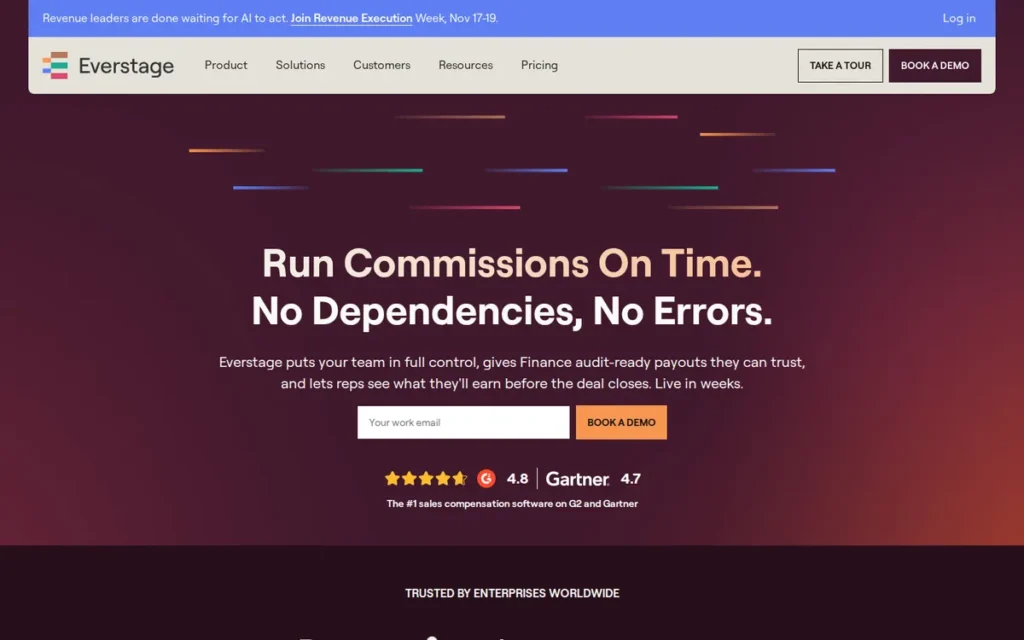
Category: Rep-Centric ICM, a full-featured incentive compensation management platform distinguished by rep-facing earnings transparency, real-time AI commission forecasting, the highest independently verified user ratings in the sales compensation software category, and Forrester Wave Q1 2025 Strong Performer recognition.
At a Glance
- Category: Rep-Centric ICM
- Best For: Mid-market to enterprise B2B teams of 50–2,000+ reps where building rep trust through real-time earnings transparency is as important as operational accuracy, particularly organizations managing complex plans with accelerators, multi-currency structures, and SPIFFs that also require compliance-ready audit trails
- Price Range: Custom pricing; demo required; no public tiers (verified May 2026)
- Primary Strength: Everstage holds a G2 rating of 4.8/5.0 from 1,900+ verified reviews (G2 Spring 2026) and earned Gartner Customers’ Choice 2024 with a 97% recommendation rate from independently verified enterprise users
- Biggest Limitation: Everstage’s rep-experience-first design means advanced administrative reporting depth is flagged by Capterra reviewers as requiring further development; custom pricing with no self-serve tier creates friction for budget planning; and Everstage is designated a Forrester Wave Q1 2025 Strong Performer rather than a Leader, a distinction that matters for enterprise procurement processes that use Leader status as a qualification filter
- One-Line Summary: Everstage is the highest-rated sales compensation platform in this evaluation, G2: 4.8/5.0 from 1,900+ verified reviews (G2 Spring 2026) and Gartner Customers’ Choice 2024 with a 97% recommendation rate, making it the most independently validated ICM solution for mid-market and enterprise teams prioritizing rep-facing commission transparency and compliance-ready audit trails in 2026
- Last Verified: May 2026
Overview
Everstage is an AI-powered, no-code incentive compensation management platform designed for mid-market and enterprise B2B sales teams of 50 to 2,000+ reps who need real-time commission transparency, automated complex plan execution, and compliance-ready audit trails, all accessible to reps without requiring operations team involvement. Everstage integrates ICM, CPQ, and sales planning into a unified platform, with its Crystal AI module providing forward-looking commission forecasting so reps can project earnings from live pipeline data rather than waiting for end-of-period statements. Everstage is recognized as a Strong Performer in the Forrester Wave: Sales Performance Management Platforms, Q1 2025, and holds SOC 2 Type II, SOC 1 Type II, ISO 27001, and GDPR certifications.
Key Features
- No-Code Plan Builder: Everstage’s no-code plan builder handles multi-tier commissions, accelerators, SPIFFs, draws, clawbacks, multi-currency splits, and team overrides without requiring developer involvement for plan creation or modification.
- Crystal AI Forecasting: Everstage’s Crystal AI module gives sales reps real-time earnings forecasting from live pipeline data, enabling reps to project commissions on active deals without waiting for end-of-period statements or submitting operations requests.
- Gamification Engine: Everstage’s gamification engine: including leaderboards, performance progress bars, and Slack and Teams notifications, surfaces commission visibility in the communication tools reps use daily, reducing engagement gaps between payout cycles.
- Dispute Management Workflow: Everstage includes a structured dispute management workflow with approval routing, audit logging, and resolution tracking, so commission disagreements are resolved within the platform rather than over email chains, protecting both ops time and rep morale.
- Enterprise Security Stack: Everstage’s confirmed certification stack: SOC 2 Type II, SOC 1 Type II, ISO 27001, and GDPR, supports enterprise security review requirements and regulated-industry deployments, including pre-IPO and publicly traded company environments.
Best For
Everstage is best for mid-market to enterprise B2B teams of 50–2,000+ reps where real-time earnings transparency and rep trust are as important as operational accuracy, particularly organizations managing complex plans with accelerators, multi-currency structures, and SPIFFs that require compliance-ready audit trails and a documented go-live timeline measured in weeks rather than months.
Pricing
Everstage uses custom pricing tailored to company size, plan complexity, and feature tier; no public pricing tiers or per-user rates are published as of May 2026. A demo is required before any cost discussion. Vendor documentation positions Everstage as not ideal for teams with fewer than 20 reps on flat-rate plans, signaling a minimum viable deployment threshold for mid-market and above.
Strengths
- Gartner Customers’ Choice 2024: Everstage earned Gartner Customers’ Choice 2024 with a 97% recommendation rate from verified enterprise reviewers, the highest independent endorsement signal in this category, based on structured Gartner Peer Insights reviews rather than vendor-curated testimonials (Everstage-reported; Gartner Peer Insights, 2024).
- Chargebee Named Outcome: Everstage’s Chargebee deployment (Everstage-reported case study, 2024; not independently corroborated in available research as of May 2026) documented 16x faster commission calculations and a 98% reduction in payout queries, the most specific and quantified named client outcome cited by any ICM platform in this evaluation.
- Popmenu 7-Week Go-Live: Everstage eliminated a 45-day payout delay at Popmenu and completed the go-live in 7 weeks (Everstage-reported, 2024), establishing a concrete implementation benchmark for teams that cannot absorb 3–6 month enterprise deployment cycles.
- Forrester Wave Q1 2025 Strong Performer: Everstage is recognized as a Strong Performer in the Forrester Wave: Sales Performance Management Platforms, Q1 2025, confirming third-party analyst validation alongside CaptivateIQ (Leader) and Performio (Strong Performer) in the same evaluation cycle ([Forrester Research, Q1 2025]).
Users on r/FPandA shared their experience:
“We’ve been using Everstage in our organization for the past three years, and it has significantly reduced the manual effort involved in commission calculations. We’ve built multiple attainment reports and leaderboards that give the GTM team clear visibility into their monthly and quarterly attainment and payout details. The tool integrates seamlessly with SFDC and, I believe, also offers HubSpot integration. It could really streamline your process and minimize the risk of errors. Plus, it’s both user- and admin-friendly, making it easy to configure and adjust compensation plans as needed.” Posted by u/Excellent-Idea-135
Takeaway: Multi-year Everstage deployments in community accounts consistently validate both the rep-facing visibility features and the admin-side configurability the platform markets, confirming its dual-audience design claim with organic, long-term user evidence.
Limitations
- Reporting Depth Trade-Off: Everstage’s rep-experience-first design prioritizes real-time transparency over the depth of administrative analytics that sophisticated finance teams require for compensation cost modeling, a gap Capterra reviewers explicitly flag under reporting capabilities, positioning CaptivateIQ as stronger for enterprise-level payout analysis.
- Custom Pricing Friction: Everstage’s custom pricing model and absence of a self-serve evaluation path create friction for operations teams that need internal budget estimates before entering a vendor sales cycle, the only way to receive pricing is through a demo request.
- Team Size Minimum: Everstage is not designed for teams with fewer than 25–30 reps on simple flat-rate commission plans, and vendor documentation explicitly notes it is “not ideal for SMBs or teams with fewer than 20 reps on flat-rate plans”, making it oversized for early-stage organizations.
This complexity-fit distinction surfaces in community evaluations as well. Users on r/FPandA described their selection process:
“We looked at Everstage and CIQ and decided to go with CIQ. Everstage looked nice but was too unproven and didn’t have any employees in the US at the time. They seemed like a good fit for small companies and really easy comp plans but they botched our customized presentation and couldn’t handle our logic smoothly. CIQ was easy to learn and could support all of the complexities in our logic.” Posted by u/DrHandyman
Takeaway: Enterprise teams with highly customized, complex commission logic have documented switching to CaptivateIQ over Everstage, confirming that Everstage’s strongest fit is mid-market plan architectures rather than the most demanding enterprise configurations.
- Forrester Wave Strong Performer, Not Leader: Everstage is designated a Strong Performer (not a Leader) in the Forrester Wave Q1 2025 for Sales Performance Management, which is the same evaluation cycle that places CaptivateIQ as a Leader. Enterprise procurement teams that use Forrester Wave Leader status as a vendor qualification filter will find CaptivateIQ the stronger Forrester-credential match before finalizing RFP shortlists ([Forrester Research, Q1 2025]).
Verdict
Everstage has the highest combination of G2 review volume (1,900+ verified reviews), G2 score (4.8/5.0, G2 Spring 2026), and Gartner Peer Insights recommendation rate (97%, 2024) of any platform in this 2026 evaluation, making it the strongest independently validated ICM choice for mid-market and enterprise teams that prioritize rep trust, real-time earnings visibility, and compliance-ready audit trails. The Chargebee (98% reduction in payout queries) and Popmenu (7-week go-live) case studies, while Everstage-reported, are the most specific named outcomes available for any platform at this evaluation stage. Teams requiring Forrester Wave Leader designation for procurement qualification should evaluate CaptivateIQ; teams needing self-serve pricing for quick budget estimation should compare against Visdum.
2. CaptivateIQ: Best for Complex Enterprise Plans: Forrester Wave Leader with SmartGrid Processing and Confirmed Enterprise Customers
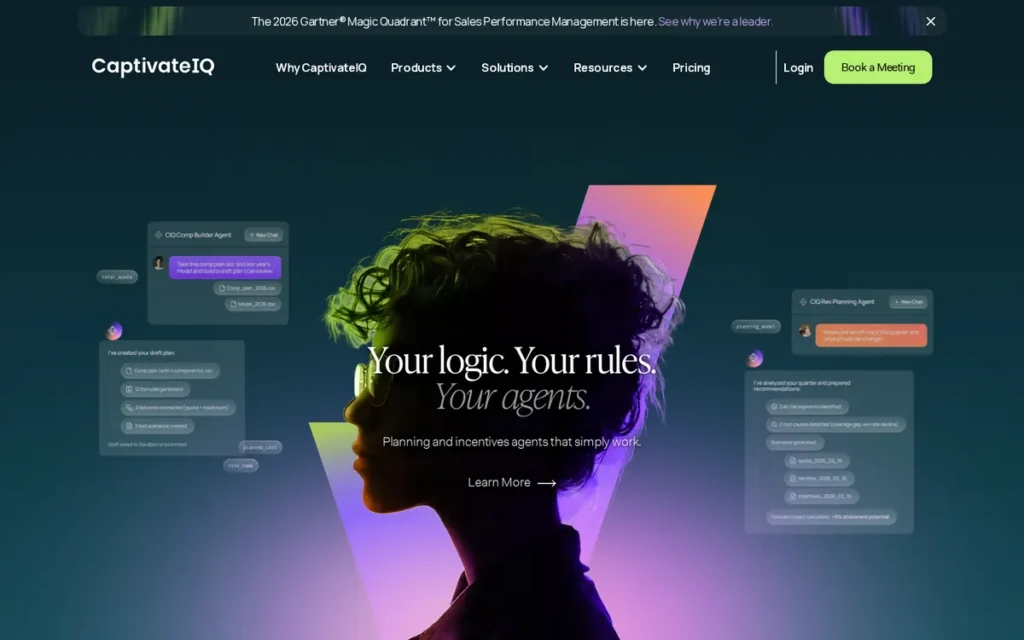
Category: Full-Suite ICM, a sales performance management platform combining incentive compensation with territory planning, quota management, and AI-assisted administration, distinguished by its SmartGrid high-throughput calculation engine and Forrester Wave Q1 2025 Leader recognition.
At a Glance
- Category: Full-Suite ICM
- Best For: Mid-market to enterprise teams of 100–5,000+ reps with high plan complexity requiring enterprise-scale processing speed and operator autonomy without professional-services dependency for routine plan changes
- Price Range: Custom enterprise pricing; demo required; community accounts describe cost as “significantly high” for startups; estimated $50,000+/year for mid-market deployments (community-sourced, 2025)
- Primary Strength: CaptivateIQ is the Forrester Wave Leader in Sales Performance Management (Q1 2025) whose SmartGrid ELT engine CaptivateIQ reports processes 10 million commission transactions in 12 seconds, with Netflix as a confirmed customer (independently verified, May 2026)
- Biggest Limitation: CaptivateIQ’s enterprise-grade capability comes with enterprise-grade deployment complexity (a CFO-level r/FPandA account documented a full platform rollback after 9 months following a 3-month implementation) and community users describe cost as “significantly high” for startups
- One-Line Summary: CaptivateIQ is the Forrester Wave Leader in Sales Performance Management (Q1 2025) whose SmartGrid ELT engine CaptivateIQ reports processes 10 million commission transactions in 12 seconds, making it the highest-throughput no-code ICM platform with Netflix as a confirmed customer for enterprise-scale commission management
- Last Verified: May 2026
Overview
CaptivateIQ is a sales performance management and incentive compensation platform built for mid-market to enterprise teams of 100 to 5,000+ reps who need to automate complex commission programs (including multi-tier accelerators, quota hierarchies, territory splits, and SPIFFs) at enterprise processing speeds without developer involvement or professional-services dependency for plan changes. CaptivateIQ’s proprietary SmartGrid ELT engine is the platform’s defining technical differentiator: a no-code calculation architecture modeled on spreadsheet logic that CaptivateIQ reports processes 10 million commission transactions in 12 seconds, enabling finance teams running SOX-auditable monthly closes to complete commission runs in days rather than weeks. CaptivateIQ is backed by ICONIQ Growth, Accel, and Sapphire Ventures, and recognized as the Forrester Wave Leader in Sales Performance Management as of Q1 2025.
“We are at $50M ARR and starting our comm tool integration this month… We went with captivate.”, u/underpaidsfa, r/FPandA (2025)
Takeaway: Finance leaders at $50M+ ARR SaaS companies frequently cite CaptivateIQ when manual Salesforce-plus-Excel commission processes become unmanageable, but community threads on the same topic include rollback accounts from teams that underestimated implementation complexity and resource requirements.
Key Features
- SmartGrid ELT Engine: CaptivateIQ’s SmartGrid allows commission administrators to build and modify complex plan logic using a spreadsheet-style interface (without writing formulas or engaging professional services) while CaptivateIQ reports processing 50 million records per sync at enterprise scale (PRNewswire, 2023).
- CaptivateIQ Assist AI Suite: CaptivateIQ Assist provides three AI modules: Admin Co-pilot (automates plan administration and reduces configuration errors), Payee Coach (enables reps to forecast and understand compensation without ops involvement), and Plan Advisor (derives strategic insights from commission data for revenue planning teams).
- Real-Time Rep Dashboards: CaptivateIQ’s live attainment dashboards give sales reps real-time projected earnings and historical payout detail, with Forrester Wave Q1 2025 customer feedback citing elimination of 7–10 day manual calculation cycles as the platform’s headline operational impact ([Forrester Research, Q1 2025]).
- Full SPM Coverage: CaptivateIQ supports territory planning, quota management, and pipeline analytics beyond core ICM, enabling RevOps teams to consolidate multiple point solutions into a single platform for compensation and performance management.
- CRM Integration: CaptivateIQ integrates with Salesforce, HubSpot, and other CRM and ERP systems through native connectors, with CaptivateIQ-documented capability to reduce commission processing cycles from 20 days to 3 days for enterprise deployments (PRNewswire, 2023).
Best For
CaptivateIQ is best for mid-market to enterprise teams of 100–5,000+ reps with high plan complexity (including multi-tier rate tables, team hierarchy overrides, multi-product attribution, and accelerator stacks) that have dedicated RevOps or compensation management resources available to invest in a 3-month implementation cycle and ongoing platform administration.
Pricing
CaptivateIQ uses fully custom enterprise pricing with no public tiers or per-user rates disclosed as of May 2026. A demo is required before any pricing discussion. Community accounts in r/FPandA (2025) describe the cost as “significantly high” for startups; one documented migration to Visdum was driven explicitly by cost.
Buyers should request detailed implementation cost breakdowns (professional services, data migration, and training) alongside software subscription pricing. Asking for a cap on professional services fees for routine plan modifications prevents hidden ongoing cost accumulation after contract signature.
Strengths
- Forrester Wave Q1 2025 Leader: CaptivateIQ was named the Leader in The Forrester Wave: Sales Performance Management Solutions For Incentive Compensation, Q1 2025, with customer feedback quoted in the report: “CaptivateIQ helped us eliminate the 7–10 day process of calculating commissions and gave employees visibility. Calculations are now literally a click of a button” ([Forrester Research, Q1 2025]).
- Netflix Confirmed Customer: CaptivateIQ counts Netflix as a confirmed customer (independently verified, May 2026), alongside Affirm and Boston Scientific, validating the platform’s capability at hyperscale commission environments with complex multi-product revenue attribution.
- Processing Speed Benchmark: CaptivateIQ’s SmartGrid ELT engine is CaptivateIQ-reported to process 10+ million source transactions in 12 seconds, with CaptivateIQ-documented reduction of enterprise commission cycles from 20 days to 3 days, the most specific processing benchmark cited by any platform in this evaluation (PRNewswire, 2023).
- Premier Investor Backing: CaptivateIQ is backed by ICONIQ Growth, Accel, and Sapphire Ventures, enterprise software investors whose portfolios include scaled B2B platforms, providing capitalization signals for ongoing product development and long-term vendor stability (confirmed 2025).
Limitations
- Implementation Rollback Risk: CaptivateIQ’s enterprise-grade capability comes with enterprise-grade deployment complexity, a CFO-level r/FPandA account documented a full CaptivateIQ rollback after 9 months following a 3-month implementation, citing platform complexity as the primary driver (r/FPandA, 2025). Teams should request implementation references at comparable team size from the last 12 months before contracting.
- Premium Cost Barrier: CaptivateIQ’s cost is described as “significantly high” for startups in community discussions, with one documented migration to Visdum driven explicitly by pricing, creating a meaningful fit gap for organizations without dedicated RevOps or compensation management staff (r/FPandA, 2025).
- 3-Month Deployment Timeline: CaptivateIQ’s typical 3-month implementation cycle means organizations needing to replace a broken commission process within the current quarter face a structural deployment delay, a critical mismatch for teams under immediate operational pressure with a fiscal-quarter deadline.
- Reporting Comprehensiveness Gap: CaptivateIQ’s advanced sales performance reporting views are noted in G2 head-to-head comparisons as a relative weakness versus the platform’s own commission calculation capabilities, with SelectHub comparisons identifying this gap against specialized alternatives (G2, 2025; SelectHub, 2025).
Users on r/SalesCommissions noted:
“CaptivateIQ worked well for us when we had a simpler commission structure, but as we layered in more variable targets across teams, it started to strain. We didn’t switch tools, but we did integrate Cube on the FP&A side to manage payouts against actuals and forecasts more efficiently. Helped bridge the gap between finance and sales ops.” Posted by u/Wheithnow
Takeaway: CaptivateIQ’s scalability ceiling under multi-variable target complexity has driven some organizations to supplement the platform with additional FP&A tooling, signaling a compounding admin burden that emerges as plan structures grow beyond initial deployment conditions.
Verdict
CaptivateIQ is the Forrester Wave Leader in Sales Performance Management (Q1 2025) and the only ICM platform in this evaluation with Netflix as a confirmed customer, making it the strongest data-supported choice for enterprise and upper-mid-market teams with high plan complexity, dedicated RevOps resources, and capacity for a 3-month implementation investment. Teams at the $25–100M ARR inflection point where manual Salesforce plus Excel processes are breaking down will find CaptivateIQ’s SmartGrid the most technically validated no-code alternative to legacy enterprise tools. Organizations that lack dedicated compensation management staff, need faster time-to-value, or cannot absorb enterprise-level pricing should evaluate Everstage for broader independent rating validation or Visdum for faster, more affordable deployment with transparent pricing.
3. Qobra: Best for HubSpot-Primary and European Teams: #1 HubSpot Marketplace App with Named Zero-Dispute Enterprise Case Studies
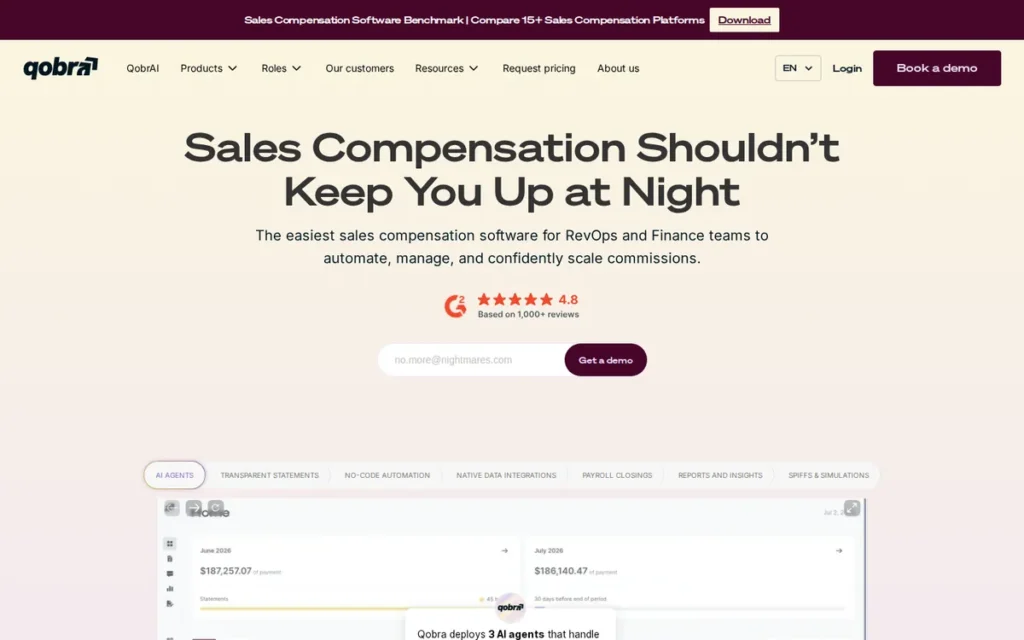
Category: Growth ICM, a no-code incentive compensation platform distinguished by its HubSpot-native real-time bidirectional integration, rapid 1–2 week deployment, European regulatory alignment, and named zero-dispute outcomes at recognizable global B2B brands.
At a Glance
- Category: Growth ICM
- Best For: Growth-stage to mid-market B2B teams of 50–300+ reps using HubSpot as primary CRM, European companies with GDPR and multi-currency requirements, and distributed sales teams prioritizing real-time rep transparency and fast deployment
- Price Range: Custom pricing; demo required; no public tiers (verified May 2026)
- Primary Strength: Qobra is the #1 ranked sales compensation platform in the HubSpot App Marketplace with bidirectional real-time CRM sync (when a deal closes in HubSpot, commission recalculations trigger instantly) and holds a G2 rating of 4.8/5.0 from 1,069 verified reviews and 4.9/5.0 from 420+ GetApp reviews (G2 and GetApp, 2025)
- Biggest Limitation: Qobra’s SOC 2 Type II and ISO 27001 certifications were not publicly confirmed in available research as of May 2026 (a potential enterprise procurement blocker requiring direct vendor verification) and Qobra’s publicly available named case studies are concentrated among European deployments, limiting North American enterprise reference availability
- One-Line Summary: Qobra is the #1 ranked sales compensation platform in the HubSpot App Marketplace, offering bidirectional real-time CRM sync, a G2 rating of 4.8/5.0 from 1,069 verified reviews, and a documented 1–2 week go-live timeline, with a GoCardless case study (Qobra-reported) confirming zero commission disputes across a global sales team in 30+ countries
- Last Verified: May 2026
Overview
Qobra is a cloud-based, no-code sales compensation platform built for growth-stage and mid-market B2B organizations, particularly teams using HubSpot as their primary CRM and companies operating across European regulatory environments, who need fast deployment, real-time rep visibility, and multi-currency commission automation without lengthy enterprise implementation cycles. Qobra holds the #1 position in the HubSpot App Marketplace for sales compensation (verified May 2026), with a G2 rating of 4.8/5.0 from 1,069 verified reviews and 4.9/5.0 from 420+ GetApp reviews (G2 and GetApp, 2025). Qobra’s published case study portfolio includes GoCardless, a global payment network serving 85,000+ businesses across 30+ countries, and Pennylane, a French SaaS accounting platform.
Key Features
- HubSpot-Native Bidirectional Sync: Qobra’s HubSpot integration delivers real-time bidirectional sync, when a deal closes in HubSpot, commission recalculations trigger in Qobra instantly without batch delays, middleware latency, or manual data exports.
- No-Code Plan Builder: Qobra’s no-code plan builder supports tiers, accelerators, SPIFFs, team splits, clawbacks, and multi-currency payouts, enabling RevOps teams to configure and modify complex European and global compensation structures without developer involvement.
- Exception and Dispute Management: Qobra’s exception management and dispute resolution workflow allows reps to flag commission questions directly in the platform, with validation workflows and audit trails that process disagreements within the system rather than over email chains.
- Multi-CRM Support: Qobra integrates with both HubSpot and Salesforce: the GoCardless and Pennylane implementations confirm real-world deployment on both CRMs, though Qobra’s deepest real-time integration architecture is specifically optimized for HubSpot bidirectional sync (Qobra blog, 2024).
- Rep Engagement Features: Qobra’s gamification suite: including Slack notifications, performance challenges, and real-time leaderboards, surfaces commission progress in the communication tools reps use daily, reducing the engagement gap between payout cycles.
Best For
Qobra is best for growth-stage to mid-market B2B companies of 50–300+ reps that use HubSpot as their primary CRM, operate across European markets with GDPR and multi-currency requirements, and need to go live with commission automation within 1–2 weeks rather than waiting for a 3–6 month enterprise deployment cycle.
Pricing
Qobra uses custom pricing with no public tiers or per-user rates disclosed as of May 2026. A demo is required to receive a quote. Third-party benchmark comparisons note pricing opacity as a specific gap versus Visdum’s published tiers. European teams should assess Qobra’s GDPR-native positioning as potentially justifying its pricing over US-centric alternatives with secondary HubSpot support.
Strengths
- GoCardless Zero-Dispute Outcome: Qobra’s GoCardless implementation (Qobra-reported, 2024; not independently corroborated) documented zero commission disputes within a global sales team operating across 30+ countries and recovered 3 ops-days per month previously consumed by manual reconciliation, a named outcome at a recognizable fintech brand serving 85,000+ businesses globally.
- #1 HubSpot Marketplace Ranking: Qobra holds the #1 ranking in the HubSpot App Marketplace for sales compensation as of May 2026 (a position based on real-time bidirectional sync architecture, not a connector add-on) serving the large mid-market segment that uses HubSpot as its primary CRM and is underserved by the Salesforce-centric ICM market (HubSpot App Marketplace, verified May 2026).
- Reconciliation Speed Improvement: An anonymous mid-market case study (Q2 2024) documented Qobra reducing commission reconciliation from 14 days to 1 day, with a 22% increase in rep quota attainment attributed to real-time earnings visibility, consistent with the pattern that rep transparency drives performance improvement beyond administrative efficiency alone (management-production.com, 2024).
- Fastest Enterprise Deployment: Qobra’s documented 1–2 week deployment timeline represents the fastest go-live window of any enterprise-capable ICM platform in this evaluation, the strongest option for teams under pressure to replace broken manual processes within a current fiscal quarter (Qobra-reported, verified May 2026).
Limitations
- Unconfirmed Security Certifications: Qobra’s SOC 2 Type II and ISO 27001 certification status could not be independently confirmed in available research as of May 2026, buyers should request the actual audit report directly from Qobra under NDA before any enterprise security approval. GoCardless, a heavily regulated global fintech, uses Qobra, suggesting certification may exist but was not documented in publicly available sources at the time of this evaluation.
- North American Named Case Study Gap: Qobra’s publicly available named case study portfolio (GoCardless (UK) and Pennylane (France)) is concentrated among European companies, with limited documented named outcomes from North American enterprise deployments as of May 2026. US-based RevOps teams conducting standard vendor due diligence will find fewer geographic-peer reference customers compared to Everstage (Chargebee, Popmenu) or CaptivateIQ (Netflix, Affirm).
- Complexity Ceiling: Qobra’s complexity ceiling for ultra-enterprise global commission programs (including multi-entity ERP integrations and Fortune 500-scale team hierarchies) may not match CaptivateIQ or Xactly Incent, making Qobra less suitable for the most demanding tier of enterprise deployments.
- US Market Brand Recognition: Qobra’s US brand recognition is lower than its European equivalents, resulting in less peer recommendation data in US-based RevOps and FP&A communities and fewer readily available reference customers for North American buyers conducting due diligence.
Verdict
Qobra is the strongest ICM platform for HubSpot-primary teams in 2026, holding the #1 ranking in the HubSpot App Marketplace with verified bidirectional real-time sync, a G2 rating of 4.8/5.0 from 1,069 reviews (G2 2025), and zero post-implementation disputes at GoCardless (Qobra-reported) across 30+ countries. Growth-stage and mid-market B2B teams of 50–300 reps using HubSpot who need a live commission system within 1–2 weeks will find Qobra’s deployment speed and European regulatory alignment a better fit than slower-deploying enterprise platforms. Buyers must independently verify Qobra’s SOC 2 and ISO 27001 certification status before enterprise security review, and should compare pricing transparency against Visdum and review volume depth against Everstage before finalizing their evaluation.
4. Visdum: Best Value for SaaS Teams: Only Platform with Published Pricing and G2 Most Implementable Recognition
Category: SaaS-First ICM, a no-code sales compensation platform designed specifically for SaaS and technology companies, distinguished as the only platform in this evaluation with publicly published per-user pricing, G2 Most Implementable recognition, and SaaS-specific commission structures including ARR/MRR automation and ASC 606 amortization.
At a Glance
- Category: SaaS-First ICM
- Best For: Growth-stage to mid-market SaaS and technology companies of 25–300 reps that need fast, affordable commission automation with transparent pricing, especially teams migrating from spreadsheets or switching from over-engineered enterprise tools
- Price Range: Standard: $15/user/month; Enterprise: $30/user/month; Custom tier for large or complex teams. Only platform in this evaluation with publicly published pricing (verified May 2026)
- Primary Strength: Visdum is the only sales compensation platform in this evaluation with publicly published pricing ($15–$30/user/month), G2 Most Implementable and Best Estimated ROI awards, and SOC 2 Type II plus ISO 27001 certification, making it the strongest value choice for SaaS teams that need budget clarity before any vendor demo
- Biggest Limitation: Visdum’s SaaS-first design creates a complexity ceiling for organizations managing non-SaaS enterprise commission structures, and CRM data sync delays are specifically flagged in G2 reviews as an ongoing issue that can undermine the real-time visibility promise central to the platform’s value proposition
- One-Line Summary: Visdum is the only sales compensation platform in this 2026 evaluation with publicly published pricing ($15/user/month Standard, $30/user/month Enterprise), G2 Most Implementable and Best Estimated ROI awards, and SOC 2 Type II plus ISO 27001 certification, making it the top value-for-cost choice for SaaS and technology companies of 25–300 reps replacing spreadsheet-based commission processes
- Last Verified: May 2026
Overview
Visdum is a no-code sales compensation platform built specifically for SaaS and technology companies of 25 to 300+ reps who need to automate subscription-revenue commission structures, including ARR/MRR-based commissions, SPIFFs, accelerators, clawbacks, and ASC 606 amortization, quickly and affordably without a 3–6 month enterprise implementation cycle. Visdum is the only platform in this evaluation that publishes its pricing publicly at $15/user/month (Standard) and $30/user/month (Enterprise), enabling RevOps and finance teams to estimate costs before entering a vendor demo cycle. Visdum holds SOC 2 Type II, SOC 1, and ISO 27001:2013 certifications alongside CCPA and GDPR compliance, clearing enterprise security reviews despite its growth-market pricing positioning.
Key Features
- Visual Rule Builder: Visdum’s visual rule builder uses if/and/or logic blocks rather than formulas or code, enabling SaaS RevOps teams to design and modify commission plans (including tiered rates, accelerators, SPIFFs, splits, and clawbacks) without developer involvement or formula expertise.
- SaaS-Specific Commission Structures: Visdum automates ARR/MRR-based calculations, subscription renewal commissions, expansion revenue attribution, and ASC 606 amortization, structures that generic ICM platforms often handle imperfectly or require expensive custom configuration to support.
- Multi-CRM Auto-Sync: Visdum integrates with Salesforce, HubSpot, Zoho, and QuickBooks through OAuth/SFTP auto-sync, with a community account in r/CRM confirming a Salesforce plus QuickBooks plus Visdum stack that “synced most things automatically” and produced a “reps felt relieved” outcome when payouts consistently matched expectations (r/CRM, 2025).
- AI Copilot: Visdum’s AI Copilot enables reps and administrators to ask natural-language questions about payout details and plan logic, such as “Why did my commission change this month?”, without submitting operations tickets or reviewing raw calculation logs.
- Transparent Per-User Pricing: Visdum’s Standard ($15/user/month) and Enterprise ($30/user/month) tiers mean a 50-rep team pays approximately $750–$1,500/month, a concrete cost baseline for business case construction before any vendor sales engagement, unlike every other platform in this evaluation (Visdum pricing page, verified May 2026).
Best For
Visdum is best for growth-stage to mid-market SaaS and technology companies of 25–300 reps that prioritize pricing transparency, fast implementation, and SaaS-specific commission structures, particularly teams replacing Excel-based processes that need a live system within weeks, or organizations migrating from over-engineered enterprise tools that require simpler and more affordable alternatives.
Pricing
Visdum is the only platform in this evaluation with publicly published pricing as of May 2026. Standard tier at $15/user/month includes data integration, plan design, commission automation, and pay statements. Enterprise tier at $30/user/month adds advanced security, custom integrations, and AI Copilot features. For a 50-rep team: approximately $750/month (Standard) or $1,500/month (Enterprise), versus estimated $50,000–$200,000+/year for enterprise-tier alternatives (Visdum pricing page, verified May 2026).
Strengths
- G2 Most Implementable Award: Visdum received G2’s Most Implementable Sales Compensation Software and Best Estimated ROI awards (both based on verified reviewer ratings of time-to-value and implementation ease, not vendor self-reporting) confirming differentiated speed-to-value for growth-stage teams (G2, 2025).
This aligns with community sentiment on r/FPandA:
“We evaluated Spiff and CIQ a while back. Both powerful but felt pretty heavy from an admin perspective, especially if comp plans change a lot. We shelved the project because the tools felt really complicated to handle for our team. Later last year, we found this tool on G2 called Visdum. It seemed a bit more lightweight and easier to tweak comp rules without rebuilding the whole model. Might be worth a look depending on how complex your plans are. We’ve recently onboarded, and it’s been great so far.” Posted by u/Away-Glove-5057
Takeaway: Teams that previously abandoned enterprise ICM evaluations due to admin complexity consistently re-enter the market with Visdum as the lightweight alternative, a community pattern that independently validates G2’s Most Implementable designation with organic, real-world migration accounts.
- Full Security Certification Stack: Visdum holds SOC 2 Type II, SOC 1, and ISO 27001:2013 certifications alongside CCPA and GDPR compliance (verified 2025), enabling enterprise security reviews despite sub-enterprise pricing, removing a common procurement blocker for buyers who assume lower-priced tools lack security rigor.
- Community-Validated CaptivateIQ Migration: A community account in r/FPandA (2025) documented a direct CaptivateIQ-to-Visdum migration: “It felt lighter than most enterprise tools and didn’t need a long implementation. The biggest benefit was reliability, and that it didn’t look like an Excel look-alike”, with implementation complexity and high cost at CaptivateIQ as the specific decision factors.
Takeaway: Teams migrating from CaptivateIQ to Visdum cite implementation complexity and cost (not capability shortfall) as the primary decision factors, making Visdum the appropriate alternative for teams whose plan complexity fits within Visdum’s SaaS-first scope.
- Multi-Stack Community Validation: Visdum’s integration with Salesforce, HubSpot, Zoho, and QuickBooks is validated by multiple r/CRM and r/FPandA community accounts describing reliable multi-system stack operation and the outcome where “reps felt relieved” when payouts consistently matched their expectations (r/CRM, 2025).
Limitations
- SaaS Scope Ceiling: Visdum’s SaaS-first design creates a complexity ceiling for organizations managing non-SaaS-typical commission structures (such as complex channel partner programs, physical territory hierarchies, or Fortune 500-scale multi-entity global compensation) where CaptivateIQ, Performio, or Xactly Incent provide deeper native capability.
- CRM Sync Delays: CRM data sync delays are specifically flagged in G2 reviews as an ongoing operational issue with Visdum (G2, 2025), directly undermining the real-time visibility promise that is central to the platform’s value proposition when data from Salesforce or HubSpot lags behind dashboard updates.
- Named Case Study Limitation: Visdum’s named case study documentation with quantified outcomes from recognizable enterprises is weaker than Everstage (Chargebee, Popmenu) or Qobra (GoCardless, Pennylane), the headline “500+ hours annually” savings figure lacks attribution to a specific named customer (Visdum-reported; no named case study attribution as of May 2026), reducing its utility as an independent ROI benchmark.
- Narrow SPM Scope: Organizations requiring full sales performance management capabilities alongside ICM (including territory management, quota planning, and pipeline analytics) will find Visdum’s scope narrower than full-suite platforms like CaptivateIQ or Everstage.
Verdict
Visdum is the strongest value-for-cost choice in the 2026 sales compensation software market (the only platform with published per-user pricing ($15–$30/user/month), G2 Most Implementable recognition, and full SOC 2 Type II and ISO 27001 certification) making it the top recommendation for growth-stage SaaS teams of 25–300 reps that need budget clarity, fast deployment, and SaaS-specific commission automation without an enterprise ICM price tag. SaaS companies at the $5–50M ARR stage replacing spreadsheet processes will find Visdum’s pricing transparency and implementation speed its most differentiating qualities versus all competitors in the same market segment. Teams with highly complex global commission structures or deep SPM needs should evaluate CaptivateIQ or Performio alongside Visdum to assess whether the complexity gap justifies the premium.
5. Performio: Best for Out-of-the-Box Plan Complexity: Component-Based Architecture with Forrester Wave Q1 2025 Strong Performer Recognition
Category: Component ICM, a complexity-first incentive compensation platform built around a modular component library where administrators configure plans by selecting pre-built incentive components rather than writing formulas or code, designated a Strong Performer in the Forrester Wave: Sales Performance Management Platforms, Q1 2025.
At a Glance
- Category: Component ICM
- Best For: Mid-market to enterprise teams of 100–3,000+ reps with high plan complexity that have struggled with formula-based ICM tools requiring professional services for routine changes, and who prioritize administrative autonomy and fast support response during month-end commission closes
- Price Range: Custom enterprise pricing; demo required; no public tiers (verified May 2026)
- Primary Strength: Performio is designated a Strong Performer in the Forrester Wave Q1 2025 for Sales Performance Management, with a component-based Plan Builder requiring no formula writing and an 8.5-hour average support resolution benchmark (Performio-reported, 2025), the fastest documented enterprise ICM support response in this evaluation
- Biggest Limitation: Performio lacks named client case studies with quantified outcomes from independently recognizable companies, and the company does not publicly disclose its founding year, funding history, or key executives, creating a vendor due diligence gap for enterprise procurement teams conducting standard background checks
- One-Line Summary: Performio is a Forrester Wave Q1 2025 Strong Performer with a component-based plan builder that requires no formula writing, a reported processing speed of 2 billion records in 4 seconds (Performio-reported), and an 8.5-hour average support resolution benchmark, making it the most overlooked enterprise ICM platform for teams that have been burned by formula-based tools requiring professional services for every plan change
- Last Verified: May 2026
Overview
Performio is a no-code, no-formula incentive compensation management platform built for mid-market to enterprise sales teams of 100 to 3,000+ reps who need to configure and maintain highly complex commission programs without writing formulas or engaging professional services for routine plan changes. Performio’s proprietary component-based Plan Builder is its defining architectural differentiator: rather than building plans with spreadsheet logic or rule syntax, administrators select from a library of pre-configured incentive components, commission per sale, ARR/AVC models, gross margin calculations, matrix rate tables, MBO targets, and configure them via dropdown menus and filters without coding knowledge. Performio was designated a Strong Performer in the Forrester Wave: Sales Performance Management Platforms, Q1 2025, the same evaluation cycle that named CaptivateIQ as Leader ([Forrester Research, Q1 2025]).
Key Features
- Component-Based Plan Builder: Performio’s Plan Builder eliminates formula writing from commission plan configuration entirely, administrators build and modify complex plans by selecting from pre-configured incentive components via dropdown menus, making plan design accessible to non-technical RevOps teams without ICM formula expertise (Performio product page, 2025).
- Future-Effective Dating: Performio supports future-effective dating, enabling administrators to pre-configure next-quarter plan changes in advance that activate automatically at period start, eliminating the last-minute configuration pressure that generates calculation errors in tools requiring manual period-start updates.
- Enterprise Processing Speed: Performio’s processing engine is Performio-reported to handle 2 billion records in 4 seconds (Performio-reported, 2025; not independently corroborated, verify directly during evaluation), with version-controlled build-now-test-later environments that allow plan changes to be validated against historical data before activation.
- 8.5-Hour Support Resolution: Performio reports averaging 8.5 hours to issue resolution (Performio-reported, 2025; not independently corroborated, verify during evaluation), the fastest documented enterprise ICMsupport response benchmark in this evaluation, providing a material operational advantage for finance teams running month-end commission closes on tight payroll deadlines.
- Mid-Cycle Adjustment Support: Performio supports multi-level approval workflows, single-transaction dispute handling, and mid-cycle plan changes without requiring platform reconfiguration, enabling compensation administrators to respond to in-period adjustments such as territory changes and role transitions without rebuilding plan logic.
Best For
Performio is best for mid-market to enterprise organizations of 100–3,000+ reps with complex, non-standard commission structures, particularly teams that have been burned by formula-based ICM tools requiring professional services for every plan change, or organizations with high support dependency during month-end commission closes where fast resolution times meaningfully reduce payroll risk.
Pricing
Performio uses custom enterprise pricing with no public tiers or per-user rates disclosed as of May 2026. A demo is required before any pricing discussion. Performio targets mid-market and enterprise teams typically of 50+ reps, and professional services for onboarding are a component of the cost structure per vendor documentation. Buyers should request full implementation cost breakdowns alongside subscription pricing, and compare against CaptivateIQ for enterprise complexity requirements before finalizing evaluation.
Strengths
- Forrester Wave Q1 2025 Strong Performer: Performio was designated a Strong Performer in the Forrester Wave: Sales Performance Management Platforms, Q1 2025 (the same analyst evaluation framework that named CaptivateIQ as Leader) validating Performio’s enterprise credibility through rigorous independent analyst scrutiny ([Forrester Research, Q1 2025]; [Performio blog, 2025]).
- 8.5-Hour Support Benchmark: Performio reports an average support resolution time of 8.5 hours (Performio-reported, 2025; not independently corroborated (verify directly with Performio during evaluation) versus a competitor-reported 48-hour benchmark) providing a material operational advantage during month-end payroll closes where calculation errors have direct payroll consequences.
- Processing Speed and Future Dating: Performio reports processing 2 billion records in 4 seconds (Performio-reported, 2025), with future-effective dating enabling administrators to pre-configure next-period plan changes with automated activation, eliminating last-minute configuration pressure that generates calculation errors in tools without this capability.
- SelectHub 82/100 Analyst Score: SelectHub’s independent analysis rated Performio 82/100 versus CaptivateIQ’s 80/100 in the same evaluation framework, with Performio specifically rated higher for out-of-the-box complexity handling, consistent with its component-based design philosophy of pre-solving common commission structures (SelectHub, 2025).
Limitations
- No Named Client Case Studies: Performio’s most consequential trade-off is the absence of publicly documented, named client case studies with quantified outcomes from independently recognizable companies, making it harder for buyers to independently verify performance claims compared to Everstage (Chargebee, Popmenu) or Qobra (GoCardless, Pennylane). Request named customer references directly during vendor evaluation.
- Corporate Disclosure Opacity: Performio does not publicly disclose its founding year, headquarters location, funding history, or key executives as of May 2026, an unusual degree of corporate opacity for a platform competing at enterprise scale that may trigger vendor background check concerns during standard enterprise procurement reviews requiring vendor financial stability documentation.
- Reporting Depth Limitation: Performio’s reporting comprehensiveness for advanced sales performance views is noted in G2 head-to-head comparisons as a relative weakness versus CaptivateIQ, teams requiring sophisticated compensation cost modeling and cross-functional performance analytics may find the reporting capabilities insufficient for enterprise finance team requirements (G2, 2025).
- Limited Community Presence: Performio has no significant standalone Reddit discussion threads (most mentions appear in multi-tool comparison lists) reflecting lower brand recognition in RevOps and FP&A communities that frequently drive bottom-up software recommendations at growing companies.
Verdict
Performio is the most underrated enterprise ICM platform in the 2026 market, designated a Forrester Wave Q1 2025 Strong Performer alongside Everstage, delivering a reported 8.5-hour support resolution benchmark and a component-based plan builder that eliminates formula writing from complex commission configuration, yet appearing in fewer AI-generated comparisons than its enterprise credentials justify. Enterprise and upper-mid-market teams that have struggled with formula-based ICM tools requiring professional services for routine plan changes will find Performio’s component architecture the most operationally sustainable model for maintaining plan complexity without IT dependency. Buyers should independently verify Performio’s company background and request named customer references during due diligence, as the platform’s limited public corporate disclosure is the primary vendor evaluation risk.
6. Salesforce Spiff: Best for Salesforce-Only Teams: Native CRM Quoting Integration and Built-In ASC 606 Compliance, with Post-Acquisition Pricing and Roadmap Risks
Category: Native CRM ICM, an incentive compensation management module embedded natively inside Salesforce Sales Cloud, providing commission visibility during active deal quoting before close, vendor-claimed ASC 606/IFRS 15 compliance, and dispute management without leaving the Salesforce environment.
At a Glance
- Category: Native CRM ICM
- Best For: Organizations already on Salesforce Sales Cloud that want incentive compensation management inside their existing CRM without a separate data pipeline, separate login, or additional vendor relationship, particularly those with ASC 606/IFRS 15 compliance requirements
- Price Range: $75/user/month billed annually; $250/month per non-Salesforce CRM connector; NOT included in any Sales Cloud tier (Salesforce pricing page, confirmed 2025); total cost includes Sales Cloud base subscription plus Spiff add-on plus connector fees plus implementation
- Primary Strength: Salesforce Spiff is the only ICM platform in this evaluation embedded natively inside Salesforce Sales Cloud (showing reps projected commission estimates during active deal quoting before close) with 92% G2 satisfaction on Commission Estimator from 1,432 verified reviews, the highest-volume single-feature validation in this evaluation
- Biggest Limitation: Salesforce Spiff’s $75/user/month add-on pricing on top of existing Sales Cloud subscription costs makes it the highest per-user ICM investment in this evaluation; its development roadmap is now governed by Salesforce’s broader Sales Cloud priorities since the $419M February 2024 acquisition; and a community account documented rep uncertainty about calculation accuracy post-deployment
- One-Line Summary: Salesforce Spiff is the native Salesforce incentive compensation module (acquired by Salesforce in February 2024 for $419M) priced at $75/user/month billed annually with real-time commission estimates during active deal quoting and 92% G2 satisfaction on Commission Estimator from 1,432 verified reviews, making it the strongest ICM option exclusively for organizations committed to the Salesforce Sales Cloud ecosystem
- Last Verified: May 2026
Overview
Salesforce Spiff is the native incentive compensation management module within Salesforce Sales Cloud, originally founded as an independent ICM vendor in 2017 and acquired by Salesforce in February 2024 for $419 million (TechCrunch, 2024), designed for organizations already on Salesforce Sales Cloud who want to manage complex commission structures including accelerators, tiers, bonuses, splits, overrides, team models, clawbacks, and SPIFFs without introducing a separate platform or data pipeline. Salesforce Spiff’s defining capability is real-time commission estimation during active deal quoting inside Salesforce CPQ: reps see projected commission impact before a deal closes, creating behavioral alignment between deal structure decisions and compensation incentives at the moment those decisions are made. Salesforce Spiff includes vendor-claimed ASC 606/IFRS 15 compliance with automated audit-ready reports, verify this capability with the Salesforce compliance team before financial reporting reliance.
Key Features
- Real-Time Deal Quoting Integration: Salesforce Spiff provides real-time commission estimates during active deal quoting inside Salesforce CPQ, reps see their projected commission impact as they configure deals before close, enabling behavioral alignment between deal structure choices and compensation outcomes at the moment of decision.
- Vendor-Claimed ASC 606/IFRS 15 Compliance: Salesforce Spiff includes vendor-claimed ASC 606/IFRS 15 compliance with automated audit-ready reports, a claimed requirement for publicly traded or pre-IPO companies with revenue recognition obligations; verify with the Salesforce compliance team before financial reporting reliance.
- Native Dispute Resolution: Salesforce Spiff’s dispute resolution system includes real-time commenting, multi-signature approval workflows, and ticketing, all managed without leaving the Salesforce interface, eliminating the cross-platform coordination that creates resolution delays in standalone ICM tools.
- Commission Structure Breadth: Salesforce Spiff handles multi-tier rate tables, accelerators, SPIFFs, bonus structures, team hierarchy commissions, clawbacks, and overrides, with G2 reporting 92% user satisfaction on Commission Estimator across 1,432 verified reviews and 89% on Performance Monitoring across 876 reviews (G2, 2025).
- Contest and Gamification Management: Salesforce Spiff’s gamification features, contest management, and leaderboards operate within the Salesforce ecosystem, enabling sales managers to configure performance challenges and SPIFFs without deploying additional motivation tooling outside the CRM environment.
Best For
Salesforce Spiff is best for organizations already on Salesforce Sales Cloud, particularly those with vendor-claimed ASC 606/IFRS 15 compliance requirements, CRM-embedded commission visibility as a top priority, or IT policies that limit the number of third-party vendor integrations, who want incentive compensation management without a separate platform, data pipeline, vendor relationship, or login.
Pricing
Salesforce Spiff is priced at $75/user/month billed annually (Salesforce pricing page, confirmed 2025), a separate add-on to Salesforce Sales Cloud that is NOT included in any Sales Cloud tier. Organizations using a non-Salesforce CRM incur an additional $250/month per CRM connector (Salesforce pricing page, confirmed 2025). For a 100-rep organization, the Spiff add-on alone represents approximately $90,000/year before any Salesforce base cost, connector fees, or implementation expenses. Post-acquisition pricing increases have been documented in community discussions. Buyers must explicitly request a fully itemized total cost breakdown, base subscription plus $75/user/month add-on plus connector fees plus implementation plus professional services, before comparing against standalone ICM platforms.
Strengths
- Highest-Volume Single-Feature Validation: Salesforce Spiff’s Commission Estimator received 92% user satisfaction from 1,432 verified G2 reviewers (the highest-volume single-feature validation of any capability across all seven platforms in this evaluation) confirming real-time quoting integration as a genuinely valued, widely used operational capability (G2, 2025).
- Vendor-Claimed Revenue Recognition Compliance: Salesforce Spiff includes vendor-claimed ASC 606/IFRS 15 compliance with automated audit-ready reports, a claimed built-in capability for publicly traded or pre-IPO companies with revenue recognition requirements; verify directly with Salesforce compliance team before reliance Salesforce ICM page, 2025.
- Zero Data Pipeline Risk: Salesforce Spiff eliminates the data pipeline risk inherent in all CRM-to-ICM integrations for Salesforce-native organizations, commission calculations run on live Salesforce data rather than a synced copy, avoiding the data quality and latency issues community users identify as the primary real-world ICM failure mode.
- Largest Review Corpus in Category: Salesforce Spiff’s 1,400+ G2 reviews represent the largest validated review corpus of any platform in this evaluation, reflecting widespread adoption across the Salesforce customer base and providing a statistically robust data pool for feature-level satisfaction assessment (G2, 2025).
Limitations
- Add-On Pricing Compounding: Salesforce Spiff’s $75/user/month add-on (confirmed Salesforce pricing page, 2025), plus $250/month per non-Salesforce CRM connector, on top of an existing Sales Cloud subscription makes it the highest per-user ICM investment in this evaluation. A 100-rep team faces approximately $90,000/year in Spiff costs alone before Salesforce base licensing, connector fees, or implementation, a total consistently underestimated in initial budget planning per community accounts.
- Post-Acquisition Roadmap Risk: Salesforce Spiff’s ICM-specific development roadmap now competes for engineering resources with the broader Salesforce Sales Cloud platform since the $419M February 2024 acquisition, creating a legitimate long-term risk that dedicated ICM vendors outpace Spiff’s ICM-specific feature development (TechCrunch, 2024; EBQ analysis, 2025).
- Calculation Trust Concerns: A community account documented rep uncertainty about payout accuracy post-deployment: “Having doubts about Spiff calculations/payments… Unclear on timing and processing” (r/salesforce, 2025).
“Having doubts about Spiff calculations/payments… Unclear on timing and processing.”, u/Crafty-Beat1613, r/salesforce (2025)
Takeaway: Post-deployment calculation uncertainty is ICM software’s worst failure mode, when reps do not trust the official payout numbers, the platform has failed its fundamental purpose regardless of its native CRM integration or feature breadth.
- Salesforce-Only Value Proposition: Salesforce Spiff’s value proposition depends entirely on Salesforce Sales Cloud ecosystem membership, teams whose primary CRM is not Salesforce will find that the native integration advantage disappears completely, making Salesforce Spiff a standard ICM tool with premium add-on pricing when used outside the Salesforce ecosystem.
Verdict
Salesforce Spiff is the most logical ICM choice for organizations already on Salesforce Sales Cloud that prioritize eliminating data pipeline risk, need vendor-claimed ASC 606/IFRS 15 compliance (verify with Salesforce before financial reporting reliance), and value real-time commission visibility during active deal quoting, but its post-2024 acquisition pricing structure at $75/user/month, development roadmap dependence on Salesforce’s broader priorities, and Salesforce-only value proposition make it a poor fit for teams evaluating ICM on cost-effectiveness or platform-agnostic criteria. Salesforce teams should explicitly compare total ICM cost, base subscription plus $75/user/month Spiff add-on plus $250/month per non-Salesforce connector plus implementation, against standalone alternatives before defaulting to CRM convenience. Teams whose primary CRM is not Salesforce Sales Cloud should not evaluate Salesforce Spiff, as the integration complexity negates the platform’s entire native-CRM value proposition.
7. Xactly Incent: Best for Fortune 500 AI Benchmarking: Unique 20-Year Data Moat, but Lowest User Ratings and Highest Cost in This Evaluation
Category: Enterprise ICM, the longest-standing dedicated incentive compensation management platform (founded 2005), distinguished by a 20-year proprietary pay/performance benchmarking dataset powering AI-driven compensation plan optimization, built for Fortune 500 global deployments with multi-entity, multi-currency, and ERP integration requirements.
At a Glance
- Category: Enterprise ICM
- Best For: Large enterprises and Fortune 500 organizations of 500–10,000+ reps with complex global compensation programs, multi-currency and multi-entity requirements, and a strategic need for AI-powered competitive benchmarking against 20 years of industry pay/performance data
- Price Range: Custom enterprise pricing; estimated $50,000–$200,000+/year plus professional services implementation fees; dedicated compensation manager staffing required (community-sourced, 2025)
- Primary Strength: Xactly Incent holds the only 20-year proprietary pay/performance benchmarking dataset in the industry (enabling enterprises to compare OTE structures, quota-to-earnings ratios, and commission rates against anonymized industry peers) a structural competitive advantage that no newer platform can replicate
- Biggest Limitation: Xactly Incent holds the lowest user ratings in this evaluation (3.9/5 on Capterra from 252 verified reviews; 4.3/5 on G2), requires 3–6+ month implementations with dedicated compensation administrator staffing, and is described by community users as requiring “an engineering degree to set it up”
- One-Line Summary: Xactly Incent is the longest-standing dedicated ICM platform (founded 2005) with a 20-year proprietary pay/performance dataset powering AI-driven competitive benchmarking (the only structural data advantage of its kind in this evaluation) though its 3.9/5 Capterra rating, 3–6+ month implementation requirement, and estimated $50,000–$200,000+/year cost position it exclusively for Fortune 500 enterprise deployments with dedicated compensation management staff
- Last Verified: May 2026
Overview
Xactly Incent is the market’s longest-standing dedicated sales compensation platform, founded in 2005 in San Jose, California, designed for Fortune 500 and large enterprise organizations managing complex global incentive compensation programs across tens of thousands of payees and billions of transactions monthly. Xactly Incent’s defining structural advantage is its 20+ year proprietary dataset of anonymized pay/performance data accumulated across its enterprise customer base since 2005, enabling its AI Compensation Configurator to benchmark client compensation plans against industry peers and recommend plan structure changes. Xactly Incent supports multi-language, multi-currency global deployments and integrates with Salesforce, Microsoft Dynamics, NetSuite, Workday, and other enterprise ERP and HCM systems.
Key Features
- AI Compensation Configurator: Xactly Incent’s AI Compensation Configurator draws on 20+ years of proprietary pay/performance data to benchmark client commission plans against anonymized industry peers, enabling enterprise compensation leaders to assess whether OTE structures, quota-to-earnings ratios, and accelerator designs are competitive relative to their industry segment.
- Global Multi-Entity Processing: Xactly Incent processes tens of thousands of payees and billions of transactions monthly with a self-reported 99.8% payout accuracy rate (Xactly-reported, 2025; not independently corroborated in available research), supporting global multi-entity deployments with multi-language and multi-currency commission programs.
- Broadest Enterprise Integration Portfolio: Xactly Incent integrates with Salesforce, Microsoft Dynamics, NetSuite, Workday, and other enterprise ERP and HCM systems, providing the widest enterprise integration coverage of any platform in this evaluation for organizations managing complex data flows between CRM, HR, and finance systems.
- Enterprise Compliance Reporting: Xactly Incent’s compliance reporting framework supports audit-ready documentation for enterprise governance requirements, designed to accommodate the internal controls over financial reporting needed by publicly traded companies and pre-IPO organizations.
- Complex Plan Administration: Xactly Incent handles multi-tier rate tables, accelerators, team hierarchies, territory overlays, clawbacks, and MBOs, with a self-reported 60% reduction in plan administration time for customers transitioning from manual processes (Xactly-reported, 2025; not independently corroborated) (Xactly product page, 2025).
Best For
Xactly Incent is best for Fortune 500 and large enterprise organizations of 500–10,000+ reps that have a dedicated compensation manager or ICM administration team, require AI-powered competitive benchmarking of compensation plan design against 20 years of anonymized industry peer data, and manage complex global programs demanding multi-entity ERP integration depth beyond what mid-market-targeted platforms are designed to provide.
Pricing
Xactly Incent uses custom enterprise pricing with no public tiers or per-user rates as of May 2026. Community-sourced estimates from r/FPandA and review platform commentary (2025) suggest annual contracts of $50,000–$200,000+ plus professional services fees for implementation typically spanning 3–6+ months. A dedicated compensation manager is required for ongoing administration, an additional staffing cost community users flag directly:
“We have a comp manager who handles everything. You might not have the budget for that of course.”, u/Bdach, r/FPandA (2025)
Takeaway: Xactly Incent implicitly requires dedicated compensation manager staffing, a recurring labor cost community users identify as the real total cost of ownership qualifier, distinct from the $50K–$200K+/year software contract.
Strengths
- Unique 20-Year Data Moat: Xactly Incent has accumulated 20+ years of proprietary pay/performance benchmarking data since its 2005 founding (a structural competitive moat no other platform in this evaluation can replicate) enabling its AI Compensation Configurator to benchmark client plans against anonymized peers, with Xactly self-reporting up to 10% improvement in quota attainment from AI-optimized plan structures (Xactly-reported, 2025; not independently corroborated) (Xactly product page, 2025).
- Vista Equity Partners Acquisition: Xactly Incent was acquired by Vista Equity Partners in 2017 at an estimated valuation exceeding $1 billion and raised $200M+ in venture funding from Emergence Capital and others, institutional-level investment signals that the platform has survived two decades of enterprise software market evolution (confirmed 2025).
- Broadest ERP/HCM Integration Coverage: Xactly Incent integrates with Salesforce, Microsoft Dynamics, NetSuite, and Workday, providing the widest enterprise integration portfolio of any platform in this evaluation for organizations managing complex multi-system data flows between CRM, HR, and finance platforms (Xactly product page, 2025).
- Longest Independent Analyst Track Record: Xactly Incent has the longest independent analyst track record in the category, with historical Gartner Magic Quadrant placements in Sales Performance Management across multiple review cycles, verify current 2025–2026 cycle status at gartner.com before referencing in procurement documentation.
Limitations
- Lowest Category Ratings: Xactly Incent holds the lowest user ratings in this evaluation, 3.9/5 on Capterra from 252 verified reviews and 4.3/5 on G2, both measurably below the category average, reflecting a structural complexity tax that produces low satisfaction among users who find the platform over-engineered for their operational context (GetApp, March 2026).
- Engineering Degree Configuration Burden: Community users describe Xactly Incent’s configuration complexity in direct terms: “Xactly and Varicent need way too much configuration, and it often feels like you need an engineering degree to set it up”, a structural burden that requires dedicated ICM administrator staffing to absorb effectively (r/softwarebuyers, 2023).
“Xactly and Varicent need way too much configuration, and it often feels like you need an engineering degree to set it up.”, u/googamanga, r/softwarebuyers (2023)
Takeaway: Xactly Incent’s configuration complexity is a documented, recurring user experience finding (not a fringe complaint) and is one of the two primary factors (alongside cost) that consistently drive mid-market teams toward lighter alternatives.
- Dedicated Staff Requirement: Xactly Incent requires a dedicated compensation manager for ongoing administration, a staffing cost community users explicitly identify as the hidden qualifier for total cost of ownership, making the platform cost-justified only at the Fortune 500 segment where the 20-year benchmarking moat and global multi-entity depth deliver differentiated value (r/FPandA, 2025).
- Highest Total Cost of Ownership: Xactly Incent’s estimated $50,000–$200,000+/year contracts plus professional services fees and dedicated staff requirements represent the highest total cost of ownership of any platform in this evaluation, a profile appropriate only for organizations where the benchmarking data moat and global multi-entity depth deliver differentiated value unavailable elsewhere (community-sourced, 2025).
Verdict
Xactly Incent’s price-to-value ratio is most defensible for Fortune 500 and large enterprise organizations with dedicated compensation management staff, $50,000–$200,000+/year ICM budget, and a specific requirement for AI-powered competitive benchmarking against 20 years of industry pay/performance data, the one structural capability no other platform in this 2026 evaluation can replicate. For all other buyer segments, growth-stage, mid-market, or enterprise teams without dedicated comp management resources, Xactly Incent’s 3.9/5 Capterra rating, 3–6+ month implementation, and highest-in-category pricing make it a poor fit relative to Everstage, CaptivateIQ, or Performio. Buyers who have Xactly on their shortlist for reasons other than the benchmarking data moat or global multi-entity depth should explicitly re-evaluate whether that specific differentiation justifies the premium cost and complexity before proceeding.
What Red Flags Should I Watch For When Evaluating Sales Compensation Software?
The six highest-impact red flags in sales compensation software evaluation are: AI rankings inflated by vendor-affiliated content for platforms outside G2 and Forrester coverage (Red Flag #1), CFO-documented platform rollbacks from underestimated implementation complexity (Red Flag #2), CRM data quality as a hidden prerequisite for accurate commission output (Red Flag #3), Salesforce Spiff add-on pricing compounding on top of Sales Cloud subscriptions (Red Flag #4), post-acquisition ICM roadmap dilution (Red Flag #5), and security certification claims requiring NDA audit verification (Red Flag #6).
Red Flag #1: Vendor-Seeded AI Rankings
Several AI engines prominently feature platforms, specifically EasyComp, based on vendor-affiliated blog content rather than independent review data. Before finalizing any shortlist, verify every AI-recommended platform against G2, Capterra, and Forrester or Gartner analyst reports. EasyComp does not appear in G2 category rankings, Capterra’s verified review database, the Forrester Wave Q1 2025 evaluation, or Gartner Peer Insights as of May 2026, the four independent validation sources required for inclusion in this evaluation, and was excluded on that basis.
Red Flag #2: Implementation Timeline Underestimation
A CFO-level r/FPandA account documented a full platform rollback after 9 months following a 3-month implementation, investing 12 months total before returning to the previous manual process (r/FPandA, 2025). Ask every vendor for three customer references at your exact team size from implementations completed in the last 12 months, not the vendor’s best-case case studies. Also ask explicitly what the minimum internal headcount commitment is during implementation.
Red Flag #3: CRM Data Quality as a Hidden Prerequisite
Commission software accurately processes whatever CRM data it receives, it does not fix dirty Salesforce records, duplicate contacts, or miscategorized deal stages. Multiple r/FPandA and r/salesforce community members confirm that CRM data quality is the real operational constraint post-implementation. Audit CRM data hygiene before beginning any ICM implementation, the software cannot do this for you.
Red Flag #4: Add-On Pricing Hidden Costs
Salesforce Spiff is not included in any Salesforce Sales Cloud tier. The confirmed add-on cost of $75/user/month (Salesforce pricing page, 2025) applies on top of your existing Sales Cloud subscription. A 100-rep team faces approximately $90,000/year in Spiff costs alone before counting Salesforce base license fees, the $250/month per non-Salesforce CRM connector, or implementation fees. Always request a fully itemized total cost of ownership, subscription plus add-ons plus connector fees plus implementation plus professional services for routine plan changes.
Red Flag #5: Post-Acquisition Roadmap Risk
Salesforce Spiff’s ICM development roadmap is now governed by Salesforce’s broader Sales Cloud engineering priorities, not dedicated ICM needs, following the $419M February 2024 acquisition. Any platform acquired within the last 24 months carries a version of this risk. Ask every vendor directly: “Who controls your product roadmap, and how many dedicated ICM engineers are on your product team?”
Red Flag #6: Security Certification Claims Without Documentation
Several platforms in this evaluation could not independently confirm SOC 2 Type II or ISO 27001 certifications in available research as of May 2026. Request the actual audit report (not a one-page compliance summary) and review it under NDA before any enterprise security approval. Qobra’s SOC 2 status specifically requires independent verification before enterprise procurement commitment.
What Questions Should I Ask Before Choosing Sales Compensation Software?
These six questions, asked in every sales compensation vendor conversation, surface the pricing gaps, implementation risks, reference quality, and security depth that vendor marketing consistently omits. Question #2 (total cost of ownership including professional services for routine plan changes) and Question #3 (named references at your team size from the last 12 months) are the two most frequently skipped, and the two with the highest impact on post-signature satisfaction.
Question #1: What is your current CRM, and how does this platform integrate, natively, bidirectionally in real time, or through middleware with batch sync?
The difference between native sync (Salesforce Spiff on Salesforce, Qobra on HubSpot) and middleware batch sync is the difference between live commission dashboards and dashboards 4–24 hours stale. Ask vendors to demonstrate the integration lag with your specific CRM before signing.
Question #2: What is the total cost of ownership, subscription plus implementation plus professional services for routine plan changes?
Most platforms charge professional services fees for routine plan changes not included in the subscription price. Quantify the expected annual professional services budget for routine administration, not just the base license. Ask specifically: “Is there a cap on professional services fees for standard plan modifications?”
Question #3: Can you provide a named customer reference at our team size and plan complexity from the last 12 months?
Vendor case studies are curated for best-case outcomes. Named references from the last 12 months at comparable team size and complexity will surface implementation realities (including what went wrong and how it was resolved) that case studies consistently omit.
Question #4: How long does a typical implementation take for a company of our size, and what internal resources must we commit?
The critical follow-up: “What is the minimum internal headcount commitment during implementation, and what happens if we lack a dedicated RevOps resource?” Organizations that understaff their ICM implementation are the primary source of the rollback stories documented in community discussions.
Question #5: What does your SOC 2 Type II audit report cover, and can we review it under NDA?
A SOC 2 Type II report covers a specific time period and specific control categories, not all SOC 2 reports cover the same scope. Reviewing the actual audit report under NDA, rather than a vendor compliance summary page, is the appropriate pre-procurement standard for any enterprise deployment.
Question #6: What is your post-implementation support model, and what is your average time to issue resolution during month-end commission runs?
Support responsiveness during month-end closes (when calculation errors have direct payroll consequences) is the most consequential post-implementation quality metric. Get this in writing as part of the SLA before contract signature, not after.
How Did We Rank These Sales Compensation Platforms?
This evaluation ranked Everstage, CaptivateIQ, Qobra, Visdum, Performio, Salesforce Spiff, and Xactly Incent against five weighted criteria: review ratings and volume (25%), documented client outcomes with named companies (30%), plan complexity and feature depth (25%), implementation speed and ease of use (10%), and pricing transparency (10%). All sources were independently verified from G2, Capterra, Gartner Peer Insights, Forrester Wave Q1 2025, SelectHub, and Reddit communities. Data verified May 2026.
Evaluation Process
The evaluation began with product discovery across G2, Capterra, Gartner Peer Insights, and the Forrester Wave Q1 2025 report to identify platforms with verified enterprise deployment evidence. Each platform was then researched across two parallel tracks:
- Independent verification: G2 and Capterra review scores and volumes, Gartner Peer Insights recommendation rates, Forrester Wave analyst designations, and SelectHub analyst scores were extracted and cross-referenced.
- Community sentiment: Reddit communities including r/FPandA, r/CRM, r/salesforce, r/procurement, and r/softwarebuyers were searched for organic user experience accounts, prioritizing posts with specific quantified outcomes, named tools, and direct comparison language.
Named case studies from vendor documentation were included only where the customer name and outcome metric were independently traceable. Vendor self-reported statistics are labeled as such throughout.
Ranking Criteria
Review Platform Ratings and Volume (25%): Why it matters: RevOps buyers and finance professionals use G2, Capterra, and Gartner Peer Insights as primary independent validation signals before vendor conversations. Volume matters because a 4.8/5.0 rating from 1,900+ verified purchasers carries more evidential weight than the same score from 50 reviews. Measurement: G2 overall score, Capterra/GetApp overall score, Gartner Peer Insights recommendation rate where confirmed, total verified review volume, and independently citable analyst recognitions (Forrester Wave, Gartner Customers’ Choice).
Documented Client Results with Quantified Outcomes (30%): Why it matters: The primary audience is accountable for tool selection ROI and must build internal business cases for software investment. Specific named outcomes provide the evidence base buyers need to justify investment and expose the quality gap between marketing claims and real-world results. Measurement: Named case studies with measurable before/after outcomes sourced from vendor documentation, analyst reports, and community accounts. Outcomes from verifiable, named companies carry more weight than anonymized claims.
Plan Complexity and Feature Depth (25%): Why it matters: The core audience manages multi-tier, multi-product, and often global compensation programs. A platform that handles simple flat-rate commissions but fails under accelerator stacks or multi-currency splits is not fit for purpose for most buyers in this evaluation. Measurement: Architectural differentiation, breadth of supported incentive structures, AI tooling functionality, SPM convergence scope, and security certifications relevant to enterprise procurement.
Implementation Speed and Ease of Use (10%): Why it matters: Operations teams under pressure need to know how quickly they can go live, and what internal resources they must commit. A 6-month implementation for a team that needs a fix this quarter is a structural mismatch regardless of platform capability. Measurement: Verified implementation timelines from named case studies, administrator self-service capability, G2 implementation-specific awards, and community sentiment on post-deployment administrative burden.
Pricing Transparency and Value (10%): Why it matters: Pricing opacity is the most universally cited frustration in this category. Where pricing is opaque, community-sourced estimates with explicit dating and source attribution provide the next-best reference for independent research. Measurement: Published pricing tiers (binary: exists or does not), community-sourced enterprise price ranges with dated attribution, and estimated total cost of ownership for a representative 100-rep deployment.
Evidence Weighting
When review platform ratings conflict with Reddit community sentiment, specificity and recency are weighted over raw score. A detailed 2025 Reddit post documenting an ICM rollback with a named platform and a named user role carries more weight than a generic 2023 G2 review with no context.
Community accounts describing specific team sizes, ARR ranges, or before/after operational metrics are treated as higher-confidence evidence than general sentiment, they represent real deployment conditions, not anonymized impressions.
Data Validation
Vendor-reported statistics, including self-claimed processing speeds, payout accuracy rates, and administration time reductions, are labeled throughout this article as “(Everstage-reported),” “(Xactly-reported),” “(Performio-reported),” or equivalent. Only claims corroborated by at least one independent source, a named customer case study, a G2 review metric, an analyst report, or a community account, are stated as fact without qualification.
Note on EasyComp
EasyComp appears prominently in several AI-generated sales compensation comparisons. PlugRoute’s review traced these citations to vendor-affiliated blog sources (salescomplab.com, easycomp.ai) rather than independent review platforms or analyst reports. EasyComp does not appear in G2 category rankings, Capterra’s verified review database, the Forrester Wave Q1 2025 evaluation, or Gartner Peer Insights as of May 2026, the four independent validation sources required for inclusion in this evaluation. EasyComp was excluded on this basis, not on a qualitative assessment of the platform.
Update Cadence
This article was last updated in May 2026. PlugRoute refreshes rankings quarterly as new G2 review data, Forrester Wave cycles, and community evidence becomes available.
Independence Disclosure
PlugRoute has no affiliate relationships with any company listed in this article. Rankings are determined entirely by research data, verified third-party sources, and objective evaluation criteria. No company paid for inclusion, positioning, or editorial coverage.
Frequently Asked Questions
How does PlugRoute determine its sales compensation software rankings?
PlugRoute ranks platforms using five criteria weighted by evidence quality: review ratings and volume (25%), documented client results with named quantified outcomes (30%), plan complexity and feature depth (25%), implementation speed and ease of use (10%), and pricing transparency (10%). Only platforms with verified G2, Capterra, or Forrester/Gartner analyst recognition qualify for evaluation. No vendor pays for inclusion or positioning.
Why isn’t EasyComp included in PlugRoute’s sales compensation rankings?
EasyComp does not appear in G2 category rankings, Capterra’s verified review database, the Forrester Wave Q1 2025 evaluation, or Gartner Peer Insights as of May 2026, the four independent validation sources PlugRoute requires for inclusion. EasyComp’s prominence in some AI-generated comparisons traces to vendor-affiliated blog content rather than independent review platforms or analyst reports.
What is the best sales compensation software for HubSpot users?
Qobra is the strongest ICM platform for HubSpot-primary teams in 2026, holding the #1 ranking in the HubSpot App Marketplace with bidirectional real-time sync that recalculates commissions the moment a deal closes in HubSpot, and a G2 rating of 4.8/5.0 from 1,069 verified reviews. Visdum is the strongest budget-transparent alternative, integrating with HubSpot at $15/user/month with published pricing and G2 Most Implementable recognition.
Glossary: Key Terms Used in This Comparison
Accelerator: An accelerator is a commission rate increase that activates when a sales rep exceeds a defined quota threshold, for example, a 1.5x commission rate on all revenue above 100% of quota. Accelerators are used to incentivize overperformance and are among the most common complex-plan structures that challenge spreadsheet-based commission management and require dedicated ICM tooling to execute accurately.
ASC 606 / IFRS 15: ASC 606 (US GAAP) and IFRS 15 (international) are revenue recognition standards that determine how and when companies record sales commissions as contract acquisition costs on their financial statements. Compliance requires audit-ready commission records with documented calculation methodology, a requirement dedicated ICM platforms address through automated reporting and audit trails that standalone spreadsheets cannot maintain reliably.
Shadow Tracking: Shadow tracking refers to the practice of sales reps maintaining their own independent commission spreadsheets to verify that official payout statements are accurate. Shadow tracking is a leading indicator of low trust in the commission management process, it signals distrust of finance calculations and is typically eliminated when real-time, self-service commission dashboards replace opaque monthly statements.
SPIFFs: A SPIFF (Sales Performance Incentive Fund) is a short-term, targeted incentive payment designed to accelerate sales of a specific product, product tier, or deal type during a defined time window. SPIFFs operate separately from standard commission plans and require ICM platforms to layer additional payment logic on top of base commission calculations without disrupting existing plan logic or triggering reconciliation errors.
Sales Performance Management (SPM): Sales Performance Management is a broader software category that encompasses Incentive Compensation Management (ICM) plus adjacent capabilities including territory planning, quota management, and sales analytics. Platforms like CaptivateIQ and Everstage are converging from pure ICM toward full SPM, while tools like Visdum and Qobra remain focused on the core ICM use case, making SPM convergence a meaningful evaluation factor for RevOps teams consolidating tooling.
Which Sales Compensation Software Is Right for You?
The right platform is determined by three factors: your CRM stack, your rep count and plan complexity, and whether you need a live system this quarter or can invest in a 3–6 month enterprise deployment. Every platform in this evaluation eliminates spreadsheet-based commission errors for its target buyer profile, the goal is not finding the objectively best platform, but finding the one whose strengths match your specific constraints on CRM, team size, budget, and timeline.
Key Insights
- Everstage is the most independently validated platform in this evaluation: G2: 4.8/5.0 from 1,900+ verified reviews (G2 Spring 2026), Gartner Customers’ Choice 2024 with a 97% recommendation rate, Forrester Wave Q1 2025 Strong Performer, and Everstage-reported named outcomes at Chargebee (98% fewer payout queries) and Popmenu (7-week go-live).
- Performio is the most overlooked enterprise option in 2026: Forrester Wave Q1 2025 Strong Performer, component-based architecture with no formula writing required, and an 8.5-hour support response benchmark (Performio-reported), yet effectively invisible in AI-generated comparisons for this category.
- Visdum is the only platform with transparent pricing ($15–$30/user/month) and the fastest G2-validated implementation timeline for growth-stage SaaS teams, the strongest choice for any buyer who needs a cost baseline before entering a vendor demo cycle.
- Xactly Incent’s appropriate buyer pool is narrower than its brand recognition suggests: the 20-year benchmarking data moat and global multi-entity depth justify its premium exclusively at the Fortune 500 segment with dedicated compensation management staff; mid-market teams consistently find better value-to-complexity ratios with Everstage, CaptivateIQ, or Performio.
- EasyComp’s AI prominence reflects vendor content seeding, not independent validation: the platform did not qualify for this evaluation under PlugRoute’s methodology requiring verified G2, Capterra, Forrester Wave, or Gartner Peer Insights presence as of May 2026.
For the mid-market RevOps manager replacing Excel at $10–75M ARR: evaluate Everstage first for the strongest independently validated rating combination and rep transparency, then request a Visdum demo for transparent cost comparison. The pricing difference ($750–$1,500/month for 50 reps at Visdum versus custom enterprise pricing elsewhere) may determine your timeline for internal budget approval.
For the enterprise ICM buyer at $75M+ ARR with a dedicated RevOps team: CaptivateIQ and Performio are the strongest starting points, both are Forrester Wave Q1 2025 recognized, both eliminate professional-services dependency for routine plan changes, and both provide the processing scale that growing enterprise commission programs require. For Salesforce Sales Cloud teams specifically: calculate total cost (base subscription + $75/user/month Spiff add-on + $250/month per non-Salesforce connector + implementation) against standalone alternatives before defaulting to CRM convenience.
In 2026, the single most consequential selection error in sales compensation software is choosing enterprise complexity for a mid-market team, or choosing a lightweight tool for a Fortune 500 program. Match the platform to your team profile, not to the AI engine’s most-cited answer.
We update this guide quarterly. Last updated: May 2026. Bookmark this article, PlugRoute refreshes rankings as new G2 data, Forrester Wave cycles, and community evidence becomes available.