Freshsales is the best overall CRM for most SMBs in 2026, built-in telephony at $9/user/month, day-one usability confirmed by independent reviewers, and Freddy AI from $39/month. HubSpot CRM leads for inbound marketing-plus-sales integration with tens of thousands of verified G2 reviews. Monday CRM is the top pick for collaborative teams needing CRM and project management unified.
The most common failure pattern: partial implementation, team reversion to spreadsheets, and switching costs that exceed the original budget. Independent research documents a 30–70% CRM implementation failure rate, driven by adoption barriers, not technology limitations (Gartner, Forrester, VantagePoint 2026). For SMBs without IT departments, adoption probability is the first evaluation variable, more predictive of ROI than any feature comparison. If your primary sales channel is not phone-intensive, the Quick Decision Framework below will route you to your correct match more efficiently than reading all seven entries.
As one small-business owner on r/CRM described:
“Small team here too 🙂 most all the CRMs I tried felt like piloting a 747 just to send an email. I worked through this list and settled on HS for now.” Posted by u/Sea_sociate
Takeaway: For small teams evaluating CRM options, platform complexity (not price) is the dominant adoption barrier, which is why architectural fit predicts implementation success more reliably than any feature comparison.
PlugRoute has no affiliate relationships with any company listed. Rankings are determined entirely by research data and objective evaluation criteria.
TL;DR: Top Picks at a Glance
- Freshsales is the best CRM for SMB sales teams needing built-in telephony and fast onboarding, combining calling, pipeline management, and Freddy AI (from $39/month Pro) in a platform that reaches day-one productivity without IT support.
- HubSpot CRM is the most extensively validated option for inbound-driven businesses, with tens of thousands of verified G2 reviews at 4.4/5 and Gartner Magic Quadrant Leader recognition, making it the lowest-risk choice for content-led growth companies.
- Monday CRM is the best CRM for collaborative teams that need sales pipeline and project management on shared visual boards, earning the highest CRM-specific G2 rating (4.6/5) in this comparison and rated more approachable than HubSpot by non-technical users in independent community testing.
- Zoho CRM delivers the widest feature set per dollar in this comparison: enterprise AI, omnichannel communication, and custom automation at $14–40/user/month, for budget-conscious teams willing to invest in initial configuration.
- Pipedrive is the most deliberately sales-execution-focused CRM in this comparison (activity-based selling philosophy, Pulse AI, and Spring 2026 admin-time savings) for B2B teams that have scoped out marketing automation and telephony as separate tools.
- Insightly is the only purpose-built deal-to-delivery CRM: designed for service businesses tracking customer relationships from first lead through post-sale project delivery, addressing a gap that six of the seven platforms in this comparison leave unresolved.
- Salesforce Sales Cloud is the world’s most capable enterprise CRM and the worst fit for SMBs without a dedicated Salesforce Administrator ($80,000–120,000/year) and a $50,000+ annual CRM budget, the gap between its brand reputation and SMB adoption reality is the most consequential mismatch in current AI CRM recommendations.
What Are the Seven Types of CRM Platforms, and Which Fits Your Business?
The seven CRM platforms reviewed here span seven distinct architectural categories: Communications CRM (Freshsales), Sales-and-Marketing CRM (HubSpot CRM), Work OS CRM (Monday CRM), Value-Stack CRM (Zoho CRM), Sales-Pipeline CRM (Pipedrive), Project-Bridge CRM (Insightly), and Enterprise CRM (Salesforce Sales Cloud).
Matching your workflow to the right architecture matters more than comparing feature counts.
A CRM structurally misaligned with your business model is the primary driver of the 30–70% implementation failure rate documented across Gartner, Forrester, and independent research, not technology limitations. The seven categories:
- Communications CRM (Freshsales): Built around native telephony, email, and chat; eliminates a separate calling solution at the $9/user/month entry tier.
- Sales-and-Marketing CRM (HubSpot CRM): Unifies marketing automation and sales pipeline on one Inbound Flywheel database; optimal when marketing and sales share data and growth is content-led.
- Work OS CRM (Monday CRM): A visual work operating system extended to CRM; uniquely merges sales pipeline and project delivery on shared boards without separate tools.
- Value-Stack CRM (Zoho CRM): Enterprise feature depth at SMB pricing; 100% bootstrapped, never taken venture capital, enabling long-term pricing stability.
- Sales-Pipeline CRM (Pipedrive): Purpose-built for activity-based B2B selling; the visual pipeline is the primary interface, not a management reporting tab.
- Project-Bridge CRM (Insightly): The only platform in this comparison architecturally built to track customer relationships from first lead through post-sale project delivery.
- Enterprise CRM (Salesforce Sales Cloud): Requires a dedicated admin and $50,000+ annual budget; commands 21% global CRM market share (IDC).
How Do the Top 7 CRM Platforms Compare?
All prices verified May 2026. Verify at each vendor’s pricing page before purchasing.
| Rank | Company | Category | Best For | One-Line Summary | Key Capabilities | Primary Strength | Key Limitation |
|---|---|---|---|---|---|---|---|
| #1 | Freshsales | Communications CRM | Phone-intensive SMB sales teams | Freshsales is the best CRM for SMB sales teams in 2026 that need built-in telephony, day-one usability, and auditable AI without enterprise-tier prices. | Native telephony (Growth tier), Freddy AI (Pro tier), CPQ, visual pipeline | Only CRM in this comparison with native telephony at the $9/user/month entry tier | Narrower third-party integration library than HubSpot or Salesforce |
| #2 | HubSpot CRM | Sales-and-Marketing CRM | Inbound-driven, content-led growth businesses | HubSpot CRM is the most extensively validated CRM platform in 2026; with tens of thousands of verified G2 reviews at 4.4/5 and simultaneous Gartner and Forrester analyst recognition. | Inbound Flywheel, Breeze AI (multi-LLM), 1,000+ integrations, functionally complete free tier | Largest verified review base and multi-analyst recognition of any CRM in this comparison | Sharp pricing cliff from Starter (~$20/month) to Professional (~$100/month) |
| #3 | Monday CRM | Work OS CRM | Collaborative and cross-functional teams | Monday CRM is the best CRM for collaborative teams in 2026 that need sales pipeline management and project or operations tracking unified on one visual platform. | Work OS shared boards, AI SDR Agents, Zero Update CRM (incremental 2026 rollout), Account 360 | Highest CRM-specific G2 rating (4.6/5) in this comparison; natively unifies CRM and project management on shared boards | Standard plan automation ceiling; 3-seat minimum on all plans |
| #4 | Zoho CRM | Value-Stack CRM | Budget-conscious teams wanting maximum features per dollar | Zoho CRM is the best-value CRM for feature depth in 2026, delivering enterprise-level AI and omnichannel communication at $14–40/user/month. | Zia AI (22+ capabilities), Canvas AI (image-to-CRM-UI), omnichannel, Zoho One ecosystem | Deepest features per dollar in this comparison; 100% bootstrapped with no VC pricing pressure | UI complexity creates a documented adoption barrier for non-technical teams |
| #5 | Pipedrive | Sales-Pipeline CRM | Pure B2B sales pipeline management | Pipedrive is the best CRM for pure B2B sales pipeline management in 2026, serving 100,000+ companies with an activity-based selling interface built for execution. | Visual pipeline (primary interface), Pulse AI, Lead Inbox, Spring 2026 automated webhooks | Most deliberately sales-execution-optimized interface in this comparison | No free plan; no native marketing automation or telephony; documented add-on cost escalation |
| #6 | Insightly | Project-Bridge CRM | Service businesses tracking deals through post-sale delivery | Insightly is the best CRM for service businesses in 2026 that need to track customer relationships from first contact through delivered project. | Native deal-to-project conversion, AI Copilot, AppConnect (separate paid add-on), 2025 UI refresh | Only purpose-built deal-to-delivery CRM in this comparison | Reporting depth most limited in this comparison; AppConnect integration builder is a separate paid add-on |
| #7 | Salesforce Sales Cloud | Enterprise CRM | Enterprises with dedicated admin, 50+ users, complex integrations | Salesforce Sales Cloud is the world’s largest CRM by market share; the correct choice for complex enterprise deployments and the incorrect choice for SMBs without a Salesforce Administrator and a $50,000+ annual CRM budget. | Agentforce autonomous AI, 7,000+ AppExchange apps, Einstein AI suite (6 capabilities), Data Cloud Zero-Copy | 21% global CRM market share (IDC); most advanced agentic AI in this comparison | True TCO for 10-person team ($115,000–240,000+ including admin salary) incompatible with most SMB budgets |
Which CRM Should I Choose for My Use Case?
| Your #1 Priority | Recommended Tool | Why | Acceptable Alternative |
|---|---|---|---|
| Phone-intensive outbound sales | Freshsales | Only CRM with native telephony at the $9/user/month Growth tier; consolidates a separate $30–80/user/month calling tool | Zoho CRM (omnichannel native; higher configuration burden) |
| Inbound or content-marketing-led growth | HubSpot CRM | Inbound Flywheel architecture; tens of thousands of G2 reviews; Breeze AI with multi-LLM integration | Freshsales (simpler onboarding; lower scaling cost) |
| Agency or consultancy: CRM + project management unified | Monday CRM | Work OS architecture natively unifies CRM and project delivery on shared boards without separate integrations | Insightly (deal-to-delivery; better for larger service teams) |
| Maximum features per dollar; willing to invest in setup | Zoho CRM | Enterprise AI and omnichannel at $14–40/user/month; Zoho One at ~$37/user/month covers 40+ apps | Freshsales (easier onboarding; narrower feature set) |
| Pure B2B sales pipeline discipline only | Pipedrive | Activity-based selling philosophy; Pulse AI; visual pipeline as primary interface | Freshsales (adds telephony at comparable entry price) |
| Service business: CRM through post-sale project delivery | Insightly | Only purpose-built deal-to-delivery CRM; DocuSign integration; faster implementation than enterprise alternatives per Ascend2 2025 | Monday CRM (more flexible; less sales-specific depth) |
| Enterprise with dedicated admin, 50+ users, complex integrations | Salesforce Sales Cloud | Agentforce AI; 7,000+ AppExchange apps; 21% global market share; Gartner MQ Leader | HubSpot CRM (lower cost; less enterprise customization depth) |
How to Use This Comparison: If you know your primary use case, jump directly to your matched entry using the framework above. If you are comparing 2–3 finalists, read each entry’s Verdict and Limitations sections. If pricing transparency is your priority, read Red Flags #1 through #3 before any entry.
Which Are the 7 Best CRM Platforms for Small Business in 2026?
1. Freshsales: Best Overall for SMBs: Best for Communication-Intensive Sales Teams
Category: Communications CRM, a CRM platform built around native telephony, email, and chat, unifying customer communication and pipeline management in one tool without requiring a separate calling solution for most SMB telephony use cases.
At a Glance
- Category: Communications CRM
- Best For: SMB sales teams of 1–50 people where phone and email outreach are the primary sales channels, particularly teams currently paying $30–80/user/month for a separate calling tool on top of a CRM
- Price Range: Free ($0, max 3 users, no telephony or AI); Growth $9/user/month; Pro $39/user/month; Enterprise $69/user/month (billed annually, May 2026)
- Primary Strength: Freshsales is the only CRM in this comparison that includes native cloud telephony (click-to-call, call recording, and voicemail drop) at the $9/user/month Growth tier, reducing or eliminating the cost and complexity of a separate calling platform for most SMB telephony use cases
- Biggest Limitation: Freshsales’ third-party integration library is narrower than HubSpot’s 1,000+ app marketplace or Salesforce’s 7,000+ AppExchange, which matters for businesses using non-standard or industry-specific SaaS tools requiring native CRM connectors rather than middleware
- One-Line Summary: Freshsales is the best CRM for SMB sales teams in 2026 that need built-in telephony, day-one usability, and auditable AI without paying enterprise-tier prices or managing a separate calling solution.
- Last Verified: May 2026
Overview
Freshsales (by Freshworks, NASDAQ: FRSH) is a communications-centric CRM built for SMB sales teams that need phone outreach, email tracking, pipeline management, and AI-assisted lead prioritization in a single platform, without dedicated IT support, ranking first in this 2026 SMB evaluation for adoption probability and telephony consolidation value. Freshsales was developed alongside Freshdesk, the company’s market-leading helpdesk product, which explains why its native communication infrastructure, telephony, chat, email, SMS, is architecturally deeper than any sales-only CRM in this comparison.
Freshworks serves over 67,000 customers globally and is publicly listed on NASDAQ (FRSH). Most SMB sales teams running a separate CRM plus a separate calling tool (Aircall from $30/user/month, JustCall from $19/user/month, Dialpad from $23/user/month, pricing verified May 2026 at each vendor’s pricing page) are already paying $228–$960/year per rep in calling costs before the CRM subscription. Freshsales Growth at $9/user/month includes both.
Key Features
- Native Cloud Telephony on All Paid Plans: Freshsales includes click-to-call, call recording, automatic call logging, voicemail drop, and international numbers directly inside the CRM, reducing or eliminating the need for a third-party dialer for most SMB telephony use cases, starting at the $9/user/month Growth tier with no additional calling subscription required.
- Freddy AI with Auditable Source Citations (Pro Plan): Freshsales’ Freddy AI delivers predictive lead scoring, deal health analysis, email drafting suggestions, and next-best-action recommendations beginning at the Pro plan ($39/user/month), with each AI answer citing the specific email or call transcript it drew from, making every recommendation verifiable rather than a black-box output.
- CPQ Included from Growth Plan: Freshsales provides Configure, Price, Quote functionality from the $9/user/month Growth plan, allowing sales reps to generate proposals and close quotes without switching to a separate tool, a capability typically reserved for mid-market CRM tiers.
- Native Freshworks Ecosystem Sync: Freshsales provides zero-configuration sync with Freshdesk (customer support) and Freshservice (IT service management), creating a unified customer view across sales, support, and IT interactions for businesses already using the Freshworks suite.
- Rotten Deal Detection in the Pipeline: Freshsales’ deal pipeline includes visual Kanban boards, activity timelines, and AI-powered deal health analysis that flags stalled opportunities before they go cold, accessible from the Growth tier with predictive depth unlocking at the Pro plan.
Best For
Freshsales is best for SMB sales teams of 1–50 people where telephone outreach is a primary sales channel and the team needs a CRM operationally ready within hours of signup, particularly businesses currently paying separately for a calling tool such as Aircall, JustCall, or Dialpad on top of their CRM, which Freshsales consolidates into the $9/user/month Growth tier subscription.
Pricing
As of May 2026:
- Free: Supports up to 3 users with basic contact management and pipeline tracking, no telephony, no AI, no automation; the features that most differentiate Freshsales cannot be evaluated at zero cost
- Growth: $9/user/month billed annually: includes built-in telephony, CPQ, and 1 pipeline; Freddy AI predictive features unlock at Pro
- Pro: $39/user/month: adds Freddy AI lead scoring, deal health analysis, sequences, and multiple pipeline management
- Enterprise: $69/user/month: full Freddy AI suite, custom modules, audit logs, and advanced forecasting
For a 10-person team: Growth costs $1,080/year (telephony included); Pro costs $4,680/year (telephony plus Freddy AI). Both remain materially below HubSpot Professional at approximately $12,000/year for a comparable team. Verify current pricing at freshworks.com/crm/pricing.
Strengths
- BusinessNewsDaily independently designated Freshsales “Best Pick for Communications-Focused CRM” in its 2025 CRM analysis, citing the combination of native telephony, Freddy AI chatbot, and email integration as uniquely comprehensive in the SMB market segment; this is a category award from an editorially independent business technology publication, not a vendor-submitted recognition.
- TechRadar’s 2025 independent Freshsales review specifically identified the AI-powered lead scoring as “particularly useful, helping to prioritize the most promising opportunities based on their likelihood to convert”, a positive assessment from an editorial publication that conducts hands-on product testing, not a vendor-provided evaluation.
- Multiple independent reviewers confirm Freshsales delivers “signup to pipeline in under an hour” and “most teams productive on day one”, the fastest verified time-to-value in this seven-platform comparison, critically important for SMBs where implementation delays translate directly to lost pipeline visibility and delayed ROI.
- Freshsales consolidates the documented cost of a separate calling solution into the $9/user/month Growth tier, for a 10-person team, this represents $3,600–$9,600/year in potential savings relative to running a CRM plus a separate dialer simultaneously (Aircall, JustCall, and Dialpad pricing verified May 2026).
This aligns with community sentiment on r/sales:
“Freshworks, find it incredibly good, all in one without third party software. Support is unreal, always on hand, always jump on a zoom to solve things, and constantly adding upgrading features.” Posted by u/LegacyKd
Takeaway: Freshsales users consistently highlight the all-in-one consolidation (eliminating third-party calling and support tools) as the platform’s most concrete operational advantage over similarly priced CRMs.
Limitations
- Ecosystem Breadth: Freshsales’ most consequential trade-off is integration depth, the platform’s third-party library is narrower than HubSpot’s 1,000+ app marketplace or Salesforce’s 7,000+ AppExchange, which matters for businesses using non-standard or industry-specific SaaS tools requiring native connectors rather than Zapier middleware.
- Freshworks Ecosystem Lock-In: Teams heavily invested in non-Freshworks products (particularly those using HubSpot’s marketing hub, Salesforce’s analytics, or specialized vertical software) may face integration gaps that require API configuration, adding technical complexity that undercuts Freshsales’ simplicity advantage.
- Freddy AI Requires Pro Upgrade: Freshsales’ most differentiating AI capability (Freddy AI’s predictive lead scoring and auditable deal analysis) is gated behind the Pro plan at $39/user/month, not the $9/user/month Growth tier; teams evaluating Freshsales specifically for AI-driven prioritization must budget for Pro before comparing against HubSpot Starter or Zoho Standard.
- Free Plan Feature Withholding: Freshsales’ free plan (3 users) withholds telephony, AI, and automation entirely, meaning the features that most differentiate Freshsales from competitors cannot be evaluated at zero cost before committing to a paid tier.
Verdict
Freshsales is the top-ranked CRM for SMB teams in 2026 that need built-in telephony, day-one usability, and practical AI without enterprise-tier pricing or a dedicated IT department. For phone-intensive sales teams, Freshsales’ Growth plan at $9/user/month delivers a communications stack, calling, email tracking, pipeline management, and CPQ, that consolidates a separate calling tool into one subscription. Teams wanting Freddy AI’s predictive scoring should budget $39/month (Pro), still materially below HubSpot Professional (~$100/month) for comparable AI plus telephony. Teams needing enterprise-grade marketing automation, an extensive third-party app ecosystem, or Salesforce-level customization depth should evaluate HubSpot (#2) or Zoho CRM (#4) instead.
2. HubSpot CRM: Best for Inbound Marketing + Sales Integration
Category: Sales-and-Marketing CRM, a unified platform where CRM, marketing automation, sales pipeline, and customer service operate on a shared customer database using the Inbound Flywheel model, making it optimal for businesses where marketing and sales are aligned and growth is content-led.
At a Glance
- Category: Sales-and-Marketing CRM
- Best For: Inbound-driven businesses where marketing and sales teams share data and workflows, particularly content-led growth companies, SaaS startups, and B2B businesses where marketing attribution and pipeline visibility are equally critical
- Price Range: Free ($0, approximately 2-user cap, HubSpot branding on outbound emails, verify current limits at hubspot.com/pricing); Starter Customer Platform ~$20/month bundled; Professional ~$100/core seat/month; Enterprise ~$150/core seat/month (May 2026)
- Primary Strength: HubSpot CRM holds the largest verified review base of any CRM platform across G2’s Sales and Marketing Hub products, with tens of thousands of reviews at 4.4/5, and is the only platform in this comparison to achieve Gartner Magic Quadrant Leader status and Forrester Wave Leader recognition across three separate independent analyst reports simultaneously
- Biggest Limitation: HubSpot CRM’s pricing structure creates a documented “seat tax” for growing teams, the jump from Starter (~$20/month) to Professional (~$100/month) is where meaningful automation and AI features unlock, and mid-market companies regularly reach $50,000+/year, a cost trajectory TrustRadius 2026 and Gartner Peer Insights describe as a 20–30% mandatory “platform tax”
- One-Line Summary: HubSpot CRM is the most extensively validated CRM platform in 2026, with tens of thousands of verified G2 reviews at 4.4/5 and simultaneous Gartner and Forrester analyst recognition, making it the lowest-risk choice for inbound-driven businesses that need marketing automation and sales pipeline management on one unified database.
- Last Verified: May 2026
Overview
HubSpot CRM is a unified sales-and-marketing platform for small to mid-sized businesses that need marketing automation, pipeline management, and customer service on a single shared customer database, earning tens of thousands of verified G2 reviews at 4.4/5 and Gartner Magic Quadrant Leader status, making it the most extensively validated CRM in this seven-platform comparison. HubSpot was founded in 2006 at MIT by Brian Halligan and Dharmesh Shah as the originator of “inbound marketing,” and its platform architecture reflects this origin: marketing capabilities are native and deep, while sales and service tools were added later.
This origin matters for use-case fit. Pure outbound sales teams may find HubSpot more marketing-heavy than their workflow requires, making Freshsales (#1) or Pipedrive (#5) more cost-efficient alternatives. HubSpot is publicly traded on NYSE (HUBS), and the Starter-to-Professional pricing jump is the single most important financial variable to model before committing.
Key Features
- Inbound Flywheel Architecture: HubSpot CRM connects six product Hubs: Marketing, Sales, Service, Content, Operations, and Commerce, on one shared customer database, meaning every team member from marketing to support operates from a single customer record without requiring data synchronization between separate tools.
- Breeze AI with Multi-LLM Integration: HubSpot’s Breeze AI layer natively integrates with external LLMs (including Anthropic Claude, Google Gemini, and OpenAI ChatGPT) to power AI-assisted sales research, content generation, and contact enrichment across all Hubs without requiring a separate AI tool subscription.
- Functionally Complete Free Tier: HubSpot’s free plan includes visual deal pipeline management, email tracking with open notifications, 360-degree contact views, activity history logging, and forms and landing pages, making it one of the most functionally complete free CRM tiers available for startups evaluating the platform before committing.
- 1,000+ App Marketplace: HubSpot’s App Marketplace includes native integrations covering:
- Google Workspace, Microsoft 365, Slack, Zoom, and Shopify
- Native bidirectional Salesforce sync for hybrid tech stacks
- 1,000+ total connections for standard SMB tool stacks
- Quadruple G2 Leader Recognition: HubSpot achieved G2 Leader status in all four 2025 Grid Report cycles for CRM, Marketing Automation, and Sales Enablement, recognition requiring both high satisfaction scores and substantial verified review volume, not self-reported vendor achievement.
Best For
HubSpot CRM is best for inbound-driven businesses (particularly content marketing agencies, SaaS startups, and B2B companies where lead generation is content-led) that need marketing automation and sales pipeline management unified on one platform and want the most extensively validated CRM option before committing to a paid tier.
Pricing
As of May 2026:
- Free: Unlimited contacts subject to marketing send limits; community testing confirms approximately 2-user cap with HubSpot branding on outbound emails, verify current limits at hubspot.com/pricing
- Starter Customer Platform: ~$20/month annually, bundling Starter tiers of all Hubs
- Professional: ~$100/core seat/month (includes 3 core seats): the minimum tier for meaningful marketing automation and AI; the most critical pricing cliff in this evaluation
- Enterprise: ~$150/core seat/month (includes 5 core seats)
For a 10-person team, Professional costs approximately $12,000/year before add-ons, compared to ~$240/year for Starter. Per ElefanteRevOps’ 2026 HubSpot pricing analysis, mid-market companies frequently reach $50,000+/year as teams grow past 15–20 users.
Strengths
- HubSpot was independently designated a Gartner Magic Quadrant Leader for CRM Customer Engagement Center (2025) and a Forrester Wave Leader in B2B Marketing Automation (Q4 2025) and Customer Service Solutions (Q1 2026), multi-analyst recognition across three separate authoritative industry reports through independent evaluation methodology, not vendor-submitted data [Source: Gartner Magic Quadrant 2025; Forrester Wave Q4 2025 and Q1 2026, verify current placement at gartner.com and forrester.com].
- HubSpot holds G2 Leader status across all four 2025 Grid Report cycles for CRM and earned 15+ G2 badges including “Best ROI” and “Easiest to Use”, validated by tens of thousands of verified reviews across its Sales Hub and Marketing Hub products, making it the most statistically reliable satisfaction signal in this seven-platform comparison.
- A HubSpot-published Webflow case study (2026) documents a 30% customer acquisition cost reduction and 25% referral increase after unifying marketing and sales on HubSpot’s platform, figures directionally consistent with independent CRM ROI benchmarks showing an average $8.71 return per $1 invested in CRM (SellersCommerce, 2026), though the Webflow figures originate from HubSpot and should be treated as directional rather than independently audited [Source: hubspot.com/case-studies/webflow].
- HubSpot’s SOC 2 Type II and ISO 27001 certifications provide enterprise-grade data security compliance for businesses in regulated industries or with enterprise customer data requirements, security credentials that apply across all platform tiers including free.
Users on r/salestechniques shared their experience:
“…HubSpot fit my sales team’s workflow very well and the automations were pretty simple to set up plus they have lots of integrations that help with a variety of tasks. Both require manual input of data but for inbound leads HubSpot is really good at capturing, enriching, organizing and displaying data in a usable way. Their CSV upload feature is also super flexible so I can upload my customer/prospect lists in any format I want and can map the columns accordingly. I’m a big fan of HubSpot, I subscribed when we had 3 salespeople and it’s scaled very well to handle my team of 53 reps with ease.” Posted by u/icystew
Takeaway: HubSpot’s ability to scale from a 3-person team to 53 reps on a single platform without a migration is its most compelling real-world differentiator from narrower CRMs that require re-platforming at growth inflection points.
Limitations
- Pricing Trajectory for Growing Teams: HubSpot CRM’s most consequential trade-off is its cost escalation pattern, strategically designed to make free and Starter tiers attractive, then escalate sharply at Professional (~$100/seat/month) where meaningful automation first unlocks. TrustRadius 2026 and Gartner Peer Insights document this as a 20–30% mandatory “platform tax,” with mid-market companies frequently reaching $50,000+/year as teams grow.
Users on r/CRMSoftware noted:
“Recommending Hubspot to small businesses isn’t a great practice in my opinion. Yes, it’s scalable, yes it’s ‘free’…to Start. A small business an aspiration of unicorn growth might benefit from that scalability, but most others will end up paying a prohibitive amount in a couple years time for all the features and usage they’ve slowly added to. That’s if they realize the pot of water they are in is about to reach a boil. You’ll hear this sentiment a lot in this sub, at least amongst honest conversations. If not, they end up hosting their website on Hubspot, and at that point their business is hardly theirs. They cut one bill (Hubspot) and their business is quite literally unplugged in the process.” Posted by u/UncleNarol
Takeaway: HubSpot’s pricing architecture is deliberately designed to increase switching costs over time, and the community-documented experience of small businesses is that the cost trajectory catches most teams before they realize the platform has become their operational infrastructure.
- Free Plan Operational Gotchas: HubSpot’s free plan inserts HubSpot branding into outbound customer-facing emails (a reputational concern for teams sending proposals) and caps at approximately 2 users, limiting its utility for team-level evaluation before committing to a paid tier.
- Marketing-First Architecture Trade-Off: HubSpot CRM’s marketing-first DNA: its primary strength for content-led businesses, can feel like paying for features you won’t use if your sales motion is primarily outbound or phone-based rather than inbound content-driven, making Freshsales (#1) or Pipedrive (#5) more cost-efficient alternatives for pure sales teams.
Verdict
HubSpot CRM is the most extensively validated CRM platform in 2026, with tens of thousands of verified G2 reviews at 4.4/5 and simultaneous Gartner and Forrester analyst recognition, making it the lowest-risk platform selection for businesses that want the market’s most broadly proven option. HubSpot earns the #2 position because its Inbound Flywheel architecture is optimal for content-led growth businesses, and its free tier provides genuine utility for startups evaluating before committing to a paid plan. Buyers must model the Starter-to-Professional pricing cliff before signing up: for teams expected to grow beyond 10–15 people, HubSpot Professional’s total cost trajectory frequently exceeds SMB budgets, and Freshsales (#1), Zoho CRM (#4), or Pipedrive (#5) may deliver comparable pipeline management at materially lower total cost of ownership.
3. Monday CRM: Best for Collaborative and Cross-Functional Teams
Category: Work OS CRM, a CRM built on a visual work operating system where sales pipeline, project delivery, and operations workflows coexist on shared boards, eliminating the tool boundary between CRM and project management for collaborative, cross-functional teams.
At a Glance
- Category: Work OS CRM
- Best For: Collaborative, cross-functional teams: agencies, consultancies, tech startups, and service businesses, where sales pipeline management and project or operations tracking overlap and where eliminating the CRM-to-project-management context switch is a primary productivity and consolidation goal
- Price Range: Free (2 users, Work OS only, very limited CRM features); Standard $17/user/month; Pro $28/user/month; Enterprise: custom pricing, minimum 3 seats required on all plans (billed annually, May 2026)
- Primary Strength: Monday CRM is the only platform in this comparison where sales pipeline management and project delivery workflows share a single visual board environment, eliminating the context switch between CRM and project management tools that most service businesses currently manage across two separate subscriptions
- Biggest Limitation: Monday CRM’s Standard plan automation ceiling is restrictively low for teams running multi-touch outreach sequences, verify current limit at monday.com/pricing, making the Pro tier at $28/user/month a practical necessity for sales automation; the 3-seat minimum also creates above-average per-user costs for solo operators or 2-person teams
- One-Line Summary: Monday CRM is the best CRM for collaborative teams in 2026 that need sales pipeline management and project or operations tracking unified on one visual platform, earning the highest CRM-specific G2 rating (4.6/5) in this comparison and rated more approachable than HubSpot by non-technical users in independent community testing.
- Last Verified: May 2026
Overview
Monday CRM is a visual, Work OS-based CRM designed for collaborative, cross-functional teams, including agencies, consultancies, and service-oriented startups, that need sales pipeline management and project delivery or operations tracking on one platform rather than split across separate tools, earning a CRM-specific G2 rating of 4.6/5 from 1,155 CRM-product reviews, the highest CRM-product G2 rating in this seven-platform comparison. Monday CRM is built on monday.com’s broader Work OS serving 225,000+ organizations globally; the platform-wide Work OS holds a 4.7/5 G2 rating across 15,000+ reviews.
Monday.com is publicly traded on NASDAQ (MNDY) with $966 million in FY2024 revenue (monday.com annual report, 2024), providing enterprise-grade infrastructure stability. Monday CRM’s general-purpose Work OS flexibility comes at the cost of some sales-specific CRM depth compared to dedicated pipeline tools like Pipedrive or Freshsales.
Key Features
- Work OS Shared Board Architecture: Monday CRM’s boards allow contacts, deals, projects, and operational tasks to coexist in one visual environment, meaning a deal closed in the CRM can automatically trigger a project board for delivery, eliminating the manual context switch that costs service businesses time in duplicate data entry per deal.
- Zero Update CRM AI Initiative (Incremental 2026 Rollout): Monday CRM’s 2026 Zero Update CRM initiative deploys AI agents that automatically pull fresh information from emails, activities, and meeting notes to update CRM records and deal statuses without rep intervention, targeting the single most cited CRM pain point of manual data entry; this feature is in incremental rollout as of May 2026 and should be verified at monday.com/whats-new before basing purchasing decisions on it.
- AI SDR Agents for Automated Lead Qualification: Monday CRM’s AI SDR Agents enable automated lead qualification and meeting booking around the clock, agentic AI sales automation that is the most accessible version of this capability in this comparison outside Salesforce’s enterprise-tier Agentforce.
- Account 360 with Health Metrics: Monday CRM’s Account 360 provides a unified customer view with complete touchpoint history, Renewal Risk scores, and Account Health metrics, enabling account management and customer success workflows alongside sales pipeline tracking in the same platform.
- Enhanced Microsoft Teams Integration (2026): Monday CRM includes native 2-way Gmail and Outlook sync, quotes and invoices generation, Funnel Chart and Deal Stages widgets, and a 2026-enhanced Microsoft Teams integration, positioning it as the default workspace for Microsoft-ecosystem teams wanting CRM and collaboration unified.
Best For
Monday CRM is best for agencies, consultancies, and service-oriented SMBs of 3–100 users where the same team manages both sales conversations and project or client delivery, particularly businesses currently paying for both a separate CRM and a project management tool who want to consolidate those functions into one visual platform.
Pricing
As of May 2026:
- Free: 2 users, Work OS boards only: very limited CRM-specific features; not suited to CRM operations
- Standard: $17/user/month billed annually: minimum tier for CRM functionality including 2-way Gmail/Outlook sync, deal management, and quotes/invoices; verify current automation action limit at monday.com/pricing before publication
- Pro: $28/user/month: adds sales forecasting, email tracking open rates, higher automation volume, and mass email capabilities
- Enterprise: Custom pricing; typically structured for 25+ seats: contact sales
All plans require a minimum of 3 seats, a 2-person team pays for 3 seats at minimum.
Strengths
- Monday CRM earns a CRM-specific G2 rating of 4.6/5 from 1,155 CRM-product reviews, the highest CRM-product rating in this seven-platform comparison, with independent community testing in r/mondaydotcom confirming that Monday CRM is “more approachable than HubSpot for someone like me who’s not very technical”, a significant finding given HubSpot’s “Easiest to Use” G2 badge recognition.
- A verified monday.com user review (r/mondaydotcom, consistent with ongoing 2026 community consensus) documents specific operational outcomes after migration: “we saved time creating new tasks, preparing for our weekly management meetings, and we saved money tracking the progress of projects”, productivity gains from CRM-and-project unification that dedicated sales CRMs cannot replicate for service-oriented teams.
- Monday CRM’s AI SDR Agent capability: conducting automated lead qualification and meeting booking, represents the most accessible version of agentic AI sales automation in this comparison outside Salesforce’s enterprise-tier Agentforce, making it a practical AI entry point for SMBs wanting autonomous lead handling without enterprise pricing.
- Monday.com’s NASDAQ listing ($966M FY2024 revenue, annual report 2024) and enterprise infrastructure across 225,000+ organizations in 200 countries provide platform stability and security credentials that smaller or privately held CRM vendors in this comparison cannot independently verify at equivalent scale.
Limitations
- Work OS vs. CRM Depth Trade-Off: Monday CRM’s most consequential trade-off is that its general-purpose Work OS flexibility comes at the cost of sales-specific depth, Monday CRM lacks native telephony, activity-based selling enforcement, and the granular pipeline reporting of dedicated tools like Pipedrive or Freshsales, which matters for pure B2B sales teams.
- Automation Ceiling on Standard Plan: Monday CRM’s Standard plan automation limit is restrictively low for teams running multi-touch outreach sequences or automated lead nurturing, making the Pro tier ($28/user/month) a practical necessity for sales automation use cases rather than an optional upgrade; verify current limits at monday.com/pricing before committing.
- 3-Seat Minimum and Zero Update CRM Availability: The 3-seat minimum creates above-average per-user cost for solo operators or 2-person teams. Additionally, Monday CRM’s Zero Update CRM AI initiative (the platform’s flagship 2026 AI capability) is in incremental rollout as of May 2026 and should be treated as a near-term roadmap commitment rather than a fully deployed production feature.
Verdict
Monday CRM is the highest CRM-specific G2-rated platform (4.6/5) in this 2026 comparison and earns the #3 ranking for its unique Work OS architecture that natively unifies CRM and project management, a capability no other platform in this evaluation provides without separate tools and integrations. Monday CRM is the optimal choice for collaborative, cross-functional teams, particularly agencies, consultancies, and service-oriented startups, where the same people manage both client acquisition and delivery, and where tool consolidation is as important as feature depth. Teams that need dedicated sales CRM depth with native telephony, a genuine free tier, or the deepest AI features per dollar should evaluate Freshsales (#1), HubSpot (#2), or Zoho CRM (#4) instead.
4. Zoho CRM: Best Value CRM: Best for Feature Depth Per Dollar
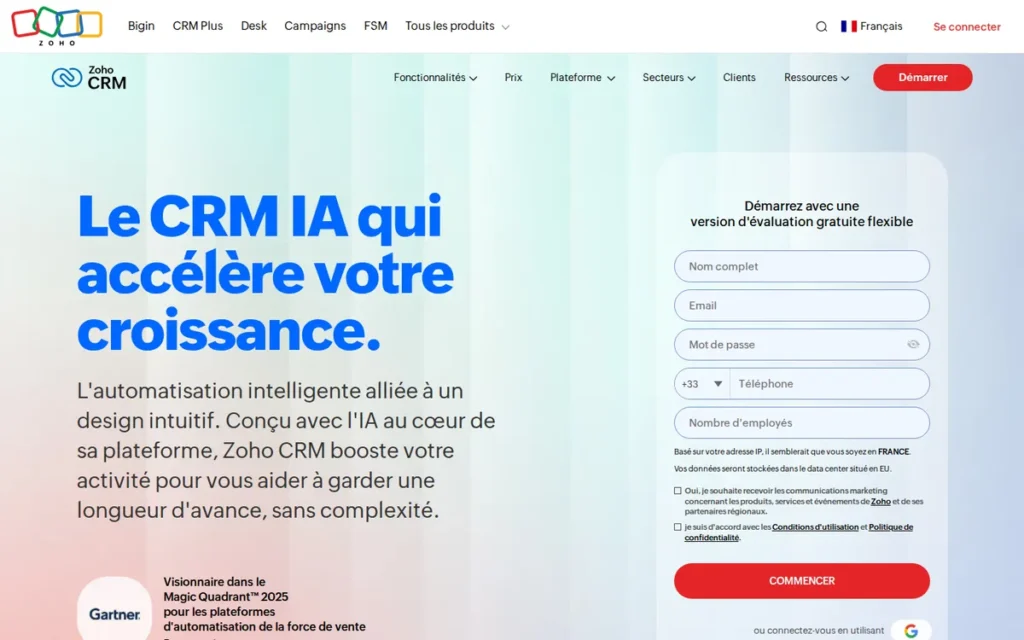
Category: Value-Stack CRM, a feature-maximalist CRM platform delivering enterprise-level AI, automation, and omnichannel capabilities at SMB-friendly pricing through a bootstrapped, ecosystem-driven architecture designed for teams willing to invest in initial configuration.
At a Glance
- Category: Value-Stack CRM
- Best For: Budget-conscious SMBs and mid-market teams willing to invest time in initial configuration in exchange for the deepest feature set and lowest cost-per-capability in the CRM market, particularly businesses considering Zoho One to consolidate multiple SaaS tools under one subscription
- Price Range: Free ($0, max 3 users, storage and record limits apply including a documented 5,000-record cap, verify current limits at zoho.com/crm/pricing.html); Standard $14/user/month; Professional $35/user/month; Enterprise $40/user/month; Ultimate $52/user/month (billed annually, May 2026, verify before purchase at zoho.com/crm/pricing.html as Zoho pricing changes periodically)
- Primary Strength: Zoho CRM delivers the widest feature-per-dollar ratio in this seven-platform comparison: the $40/user/month Enterprise tier includes Zia AI agents, Canvas AI with image-to-CRM-UI conversion, full omnichannel communication across email, calls, SMS, WhatsApp, and social, and custom modules, capabilities that cost $165–330/user/month in Salesforce Sales Cloud
- Biggest Limitation: Zoho CRM’s UI complexity and configuration depth create a documented adoption barrier: Reddit communities consistently describe the platform as requiring “ongoing configuration investment that is prohibitive for solo operators,” and the free tier’s storage and record limits make it unsuitable for businesses accumulating contact history or document attachments
- One-Line Summary: Zoho CRM is the best-value CRM for feature depth in 2026, delivering enterprise-level AI, omnichannel communication, and custom automation at $14–40/user/month (roughly one-third the cost of comparable Salesforce tiers) for teams with the technical confidence or implementation support to realize its full capability.
- Last Verified: May 2026
Overview
Zoho CRM is a value-maximalist CRM platform for SMBs and mid-market companies that need enterprise-level feature depth, including 22+ Zia AI capabilities, omnichannel communication, and deep automation, at pricing typically one-third to one-fifth the cost of Salesforce or HubSpot Professional equivalents, making it the optimal choice for budget-conscious teams willing to invest in initial configuration. Zoho Corporation was founded in 1996 in Chennai, India by Sridhar Vembu and Tony Thomas and remains 100% bootstrapped and privately owned, the only major CRM platform in this comparison that has never taken venture capital.
Zoho serves enterprise customers including Toyota, Panasonic, and Suzuki alongside thousands of SMBs. At $40/user/month Enterprise versus Salesforce Enterprise at $165/user/month, Zoho CRM delivers a 10-person annual cost of $4,800/year versus Salesforce’s $19,800/year, a $15,000/year differential (pricing verified May 2026; verify before purchase at each vendor’s pricing page).
Key Features
- Zia AI with 22+ Capabilities: Zoho CRM’s Zia AI delivers capabilities across five families (Predictions, Automation, Communications, Analytics, and Generative AI) including lead scoring, anomaly detection in sales trends, workflow automation suggestions, and conversational AI queries, with call transcription achieving 94% accuracy in tested environments (TheRavenLabs, 2026).
- Canvas AI with Image-to-CRM-UI Conversion: Zoho CRM’s Canvas AI Designer accepts a screenshot or photograph of a desired CRM interface layout and automatically converts it into an editable, field-mapped Canvas template, a unique capability in this comparison that eliminates the need for technical customization work for non-technical teams wanting custom CRM views.
- Native Omnichannel Communication: Zoho CRM provides native communication across email, phone calls, SMS, live chat, WhatsApp, and social media, all logging activity to the same contact record without requiring third-party integrations or additional per-channel subscription costs.
- Zoho One Super-Bundle: Zoho One: the bundle of 40+ Zoho applications including CRM, Zoho Desk, Zoho Campaigns, Zoho Analytics, and Zoho Projects, is priced at approximately $37/user/month annually, consolidating the functionality of multiple separate SaaS subscriptions into one invoice at a price point below HubSpot Starter for equivalent coverage.
- Enterprise-Validated Scalability: Zoho CRM’s enterprise customer base: including Toyota, Panasonic, and Suzuki, alongside HIPAA and GDPR compliance positioning validates the platform’s scalability for regulated-industry SMBs that need compliance features without add-on costs.
Best For
Zoho CRM is best for budget-conscious SMBs and technically capable mid-market teams of 5–100 users that want maximum feature depth per dollar, particularly businesses open to consolidating their SaaS stack around Zoho One, teams in regulated industries requiring HIPAA or GDPR compliance, and organizations where a part-time Zoho administrator or implementation partner is available to handle initial platform configuration.
Pricing
As of May 2026 (verify all figures at zoho.com/crm/pricing.html before purchasing, Zoho pricing changes periodically):
- Free: Up to 3 users: carries storage and record limits, including a documented 5,000-record cap; suitable for evaluation only, not operational use
- Standard: $14/user/month billed annually
- Professional: $35/user/month
- Enterprise: $40/user/month: recommended minimum for meaningful AI and automation including Zia AI agents and Canvas AI
- Ultimate: $52/user/month: advanced analytics included
- Zoho One: ~$37/user/month annually for 40+ apps: best-value SaaS bundle for teams open to Zoho ecosystem standardization
Monthly billing carries a 20–40% premium over annual rates.
Strengths
- Zoho CRM’s 100% bootstrapped private ownership model: maintaining independence from venture capital since its 1996 founding, provides structurally unique pricing stability documented in Zentix Software’s 2026 Zoho analysis: unlike VC-backed competitors facing investor pressure to raise prices, Zoho’s pricing decisions have been governed by operational sustainability across 28 years of zero external funding.
- Zoho CRM’s Zia AI achieved 94% speech-to-text accuracy in tested environments (Australian English benchmark, TheRavenLabs 2026), and Zoho DataPrep string operations run 2,000–10,000% faster following 2025 performance updates (Zoho DataPrep 2025 Lookback), translating to measurably faster data cleaning workflows and reliable call summary auto-population.
- Zoho CRM’s enterprise customer base including Toyota, Panasonic, and Suzuki validates platform scalability for organizations that grow significantly without forcing migration, demonstrating that the same platform serving a 2-person consulting firm also handles Fortune 500 CRM requirements without a platform switch.
- G2 reviewers cite specific user outcomes including “Zia AI automates 80% of my workflows, game-changer” (Sales Manager, G2 2026) and Capterra reviewers note “Canvas + Zia turned mockups into CRM in seconds, intuitive!” (2026), user-sourced productivity claims from verified third-party review platforms, not vendor-published testimonials.
Limitations
- Adoption Difficulty: Zoho CRM’s most consequential trade-off is implementation complexity, the platform’s exceptional feature depth comes with a configuration burden that is consistently documented in community research as prohibitive for non-technical small business owners. Reddit communities describe the real-world experience as “you can either run your business or piddle with Zoho, but you can’t do both”, a friction pattern confirmed by multiple independent user accounts reflecting genuine operational reality, not isolated complaints.
“I use a CRM as a repository of customer information and interaction. Zoho is good for storing diverse information but the quoting system sucks… you can either run your business or piddle with Zoho, but you can’t do both.” (u/Crowiswatching, r/CRM, 2024)
Takeaway: Zoho CRM delivers real feature depth, but for solo operators or small teams without a dedicated configuration resource, that depth can become a daily overhead rather than a productivity tool.
- Free Plan Record and Storage Limits: Zoho CRM’s free plan carries storage and record limits (including a documented 5,000-record cap) that make it unsuitable for businesses accumulating substantial contact history or email attachments; verify current free plan limits at zoho.com/crm/pricing.html before publication, as limits have changed historically.
- Support at Lower Tiers: Support response times for free and Standard tier users are consistently rated lower than HubSpot’s equivalent tier support in independent reviews, teams without internal CRM expertise may face delays resolving configuration issues, compounding the platform’s adoption complexity challenge.
Verdict
Zoho CRM is the best-value CRM on a features-per-dollar basis in 2026, delivering Zia AI, omnichannel communication, and deep automation at $14–40/user/month, approximately one-third the cost of Salesforce equivalent tiers with no venture capital pressure to increase prices. Zoho CRM earns the #4 ranking because its exceptional value and feature depth are offset by a documented adoption challenge: non-technical teams consistently report that Zoho’s UI complexity and configuration requirements create an implementation barrier that defeats the cost advantage if the platform is never fully adopted. The right buyer for Zoho CRM is a technically confident team leader, a company with access to a Zoho implementation partner, or a business actively evaluating Zoho One for full SaaS stack consolidation, for those buyers, Zoho CRM may be the single best total-value decision in this comparison.
5. Pipedrive: Best for Sales Pipeline Management: Best for Activity-Based Selling Teams
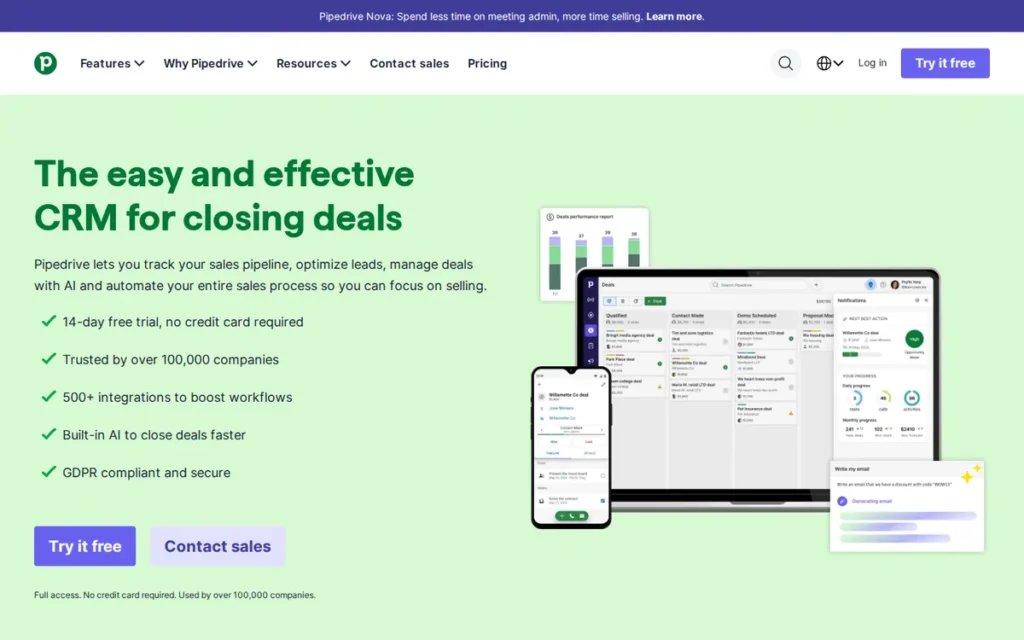
Category: Sales-Pipeline CRM, a CRM built exclusively around activity-based selling, where pipeline visualization is the primary interface and every feature is designed to minimize admin time and maximize rep activity on deal-advancing actions, without bundled marketing automation or service features.
At a Glance
- Category: Sales-Pipeline CRM
- Best For: B2B sales teams of 1–50 people focused on deal pipeline management and activity discipline, particularly teams that do not need marketing automation or built-in telephony and want the lowest-friction CRM for tracking deals from first contact to close
- Price Range: No free plan (14-day free trial, no credit card required); Essential ~$14/user/month; Advanced ~$29/user/month; Professional ~$49/user/month; Power ~$64/user/month; Enterprise ~$99/user/month (billed annually, May 2026)
- Primary Strength: Pipedrive’s activity-based selling philosophy: built by sales professionals, not software engineers, produces the most deliberately sales-execution-optimized interface in this comparison, with Spring 2026 updates saving an estimated 15–30 minutes of admin time per rep per day through automated deal-closure webhooks and Pulse AI retrospective field population
- Biggest Limitation: Pipedrive’s sales-only architecture is simultaneously its defining strength and most significant trade-off, the platform has no native marketing automation, no built-in telephony, and no post-sale project tracking; long-term users also document a pattern where add-on features are superseded by more expensive enhanced versions over time
- One-Line Summary: Pipedrive is the best CRM for pure B2B sales pipeline management in 2026, serving 100,000+ companies with an activity-based selling interface built for sales execution, not management reporting or marketing automation.
- Last Verified: May 2026
Overview
Pipedrive is a sales-pipeline CRM purpose-built for B2B sales teams that need the clearest possible visibility into deal progress and activity discipline, designed from its founding in 2010 by sales professionals frustrated with CRMs built for managers rather than the people using them daily, making it the most deliberately sales-execution-focused platform in this seven-CRM comparison, serving 100,000+ companies globally. Pipedrive does not offer a free plan, only a 14-day free trial requiring no credit card, which is its most immediate barrier for budget-constrained teams wanting to evaluate the platform without financial commitment.
Pipedrive’s Spring 2026 updates materially improved its automation capabilities with deal-closure webhooks, data enrichment, and Pulse AI retrospective field population, directly addressing historical criticisms about admin burden per DaVame’s Spring 2026 analysis, an independent Pipedrive ecosystem analyst that publishes feature-by-feature analysis of Pipedrive releases.
Key Features
- Visual Pipeline as Primary Interface: Pipedrive’s drag-and-drop pipeline is the platform’s home screen (not a reporting tab) reflecting the activity-based selling philosophy that every design decision prioritizes time spent on deal-advancing activities over time spent in admin or reporting workflows, the defining UI choice that separates Pipedrive from management-oriented CRMs.
- Pulse AI Toolkit: Pipedrive’s Pulse AI toolkit analyzes deal history, lead activity, and pipeline patterns to recommend next steps, flag stalled deals, provide email writing suggestions, and enable lead enrichment, operating from existing pipeline data without requiring AI configuration, historical data minimums, or data science resources.
- Spring 2026 Automated Webhooks: Pipedrive’s Spring 2026 automated webhooks trigger downstream actions (including invoice creation, task assignment, and CRM field updates) automatically when deals reach defined stages or close, saving an estimated 15–30 minutes of post-close admin time per rep per day (per DaVame analysis, May 2026; validate this estimate against your team’s current manual workflow before using in ROI projections).
- Lead Inbox for Pipeline Hygiene: Pipedrive’s Lead Inbox separates early-stage unqualified prospects from active pipeline deals, preventing pipeline pollution from contacts not yet ready for deal-stage tracking, a native deal hygiene feature that is more complex to configure in HubSpot’s free tier.
- Data Enrichment and Retrospective Field Population: Pipedrive’s data enrichment capability (Spring 2026) automatically populates phone numbers, email addresses, and company details for contacts using public data sources, and Pulse AI’s retrospective field population uses past emails and meeting transcripts to fill historical CRM data without manual entry.
Best For
Pipedrive is best for B2B sales teams (including solo salespeople, small sales teams of 2–15 people, and field sales organizations) where pipeline discipline and deal activity tracking are the primary objectives and where the team does not need built-in marketing automation, native calling, or project management integration included in the CRM price.
Pricing
As of May 2026:
- No free plan: 14-day free trial only, no credit card required
- Essential: ~$14/user/month billed annually
- Advanced: ~$29/user/month
- Professional: ~$49/user/month
- Power: ~$64/user/month
- Enterprise: ~$99/user/month
Add-on modules (including the Campaigns email marketing module and LeadBooster web chat) are priced per company rather than per user: economical for larger teams but a fixed overhead for solo users. Community sources on r/CRM document a long-term add-on cost escalation pattern buyers should factor into 18–24 month TCO modeling explicitly before committing. Verify current pricing at pipedrive.com/en/pricing.
Strengths
- CRM.org, an independent CRM research publication, recognized Pipedrive among its best CRM solutions in 2026, citing visual pipeline management, fast setup time, improved deal visibility, and consistent follow-up improvement as the basis for recognition [verify this recognition remains current at crm.org before publication].
- Pipedrive’s Spring 2026 feature updates produce a documented time savings of 15–30 minutes per sales rep per day through automated deal-closure triggers and column filtering automation (per DaVame analysis, May 2026), translating to approximately 6–12 hours per rep per month reclaimed for selling activities.
- Pipedrive is trusted by over 100,000 companies globally across B2B industries including technology, real estate, manufacturing, and professional services, validating the activity-based selling philosophy across diverse sales contexts beyond technology-sector companies.
- Capterra reviewers independently cite Pipedrive’s Lead Inbox as “a feature not found in all CRMs” and specifically praise its “user-friendly interface and intuitive logic, along with strong customer support and almost seamless automation options”, consistent with Pipedrive’s top-tier positioning for Ease of Use and Quality of Support among dedicated sales CRMs.
Limitations
- Narrow Scope by Design: Pipedrive’s most consequential trade-off is the deliberate absence of native marketing automation, built-in telephony, and post-sale project tracking, meaning any team that evolves to need email campaigns, a dialer, or client project management must pay for separate add-on modules or third-party integrations, adding cost and complexity not reflected in the entry pricing.
- No Free Plan: Unlike five other platforms in this comparison, Pipedrive provides no zero-cost tier for extended operational evaluation, the 14-day trial may be insufficient to validate the platform for complex or multi-stage sales processes before committing financially.
- Add-On Cost Escalation Risk: Long-term users on r/CRM document a concerning pricing pattern: “they nickel and dime you for everything and it’s gotten worse, they roll out campaigns, and once you pay that add-on, now they have the super even-better campaigns, and you guessed it, even more expensive” (r/CRM, “Best replacement for Pipedrive?” thread, 2026). Pipedrive’s add-on trajectory should be factored explicitly into any multi-year cost projection before committing.
“Pipedrive is okay but they nickel and dime you for everything and it’s gotten worse… Been with them for over 3 years. Ready to cancel.”, Original poster, r/CRM, 2026
Takeaway: Add-on escalation is a documented long-term risk, model your 18–24 month TCO explicitly, including likely add-on adoption for email marketing or advanced automation, before committing to Pipedrive.
Verdict
Pipedrive is the most deliberately sales-execution-optimized CRM in this 2026 comparison, serving 100,000+ companies with an activity-based selling philosophy that produces measurable rep productivity gains, an estimated 15–30 minutes saved per rep per day per Spring 2026 analysis. Pipedrive earns the #5 ranking because its sales-only scope, absent free plan, and documented long-term add-on cost escalation represent meaningful barriers for the SMB audience evaluating all-in-one platforms with free tiers and broader capabilities. For a B2B sales team that has clearly defined its need as pipeline management only, and has separately budgeted for email marketing and calling tools, Pipedrive may be the optimal sales execution tool. Teams wanting telephony, marketing automation, or post-sale project tracking included in the CRM price should evaluate Freshsales (#1), HubSpot (#2), or Insightly (#6) instead.
6. Insightly: Best for Service Businesses: Best Deal-to-Delivery CRM
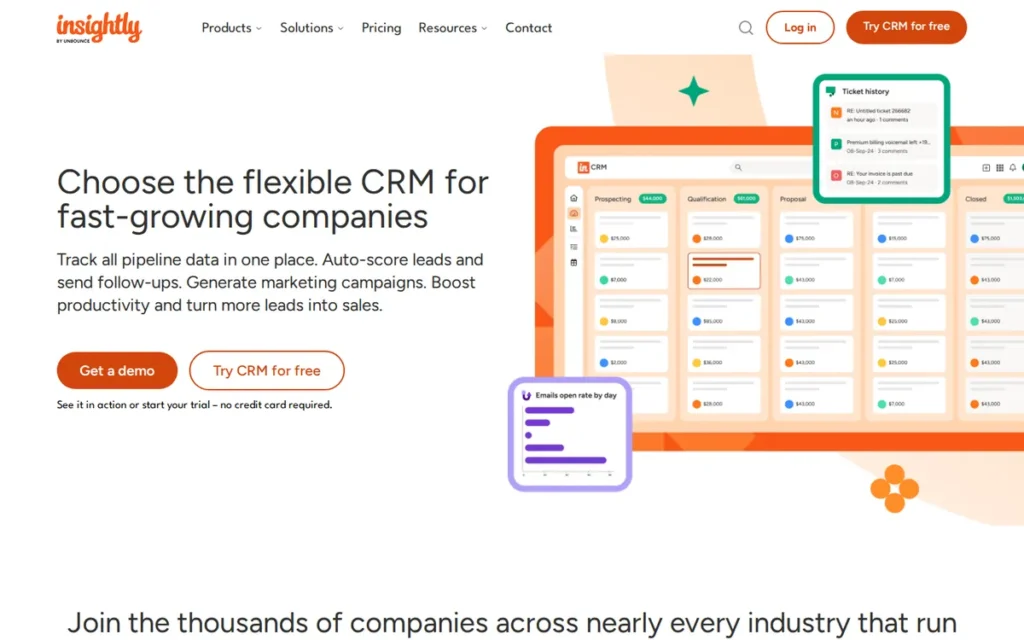
Category: Project-Bridge CRM, a CRM built to track customer relationships continuously from initial lead through post-sale project delivery, eliminating the data gap that standard sales CRMs create when the customer relationship continues actively beyond contract signature.
At a Glance
- Category: Project-Bridge CRM
- Best For: Service businesses: including marketing agencies, consultancies, professional services firms, contractors, and field service companies, where the customer relationship continues through active project delivery after the sale closes and a single platform for CRM and project management eliminates costly tool fragmentation
- Price Range: No free plan (free trial available); Plus $29/user/month; Professional $49/user/month; Enterprise $99/user/month (billed annually, May 2026, verify at insightly.com/pricing-plans)
- Primary Strength: Insightly is the only CRM in this seven-platform comparison architecturally designed from the ground up to convert won deals into managed projects within the same database, Monday CRM’s Work OS can approximate this with board configuration, but Insightly’s deal-to-project conversion is a native, automatic workflow requiring no setup
- Biggest Limitation: Insightly’s reporting depth is the most consistently cited limitation across G2 and Capterra reviews, teams requiring advanced custom sales analytics, ad-hoc pipeline reporting, or deep predictive forecasting will find Insightly’s capabilities more limited than HubSpot Professional or Salesforce Enterprise; additionally, the AppConnect integration builder is a separate paid add-on (from $249/month) not included in base CRM pricing
- One-Line Summary: Insightly is the best CRM for service businesses in 2026 that need to track customer relationships from first contact through delivered project, with the only native deal-to-project conversion in this comparison, faster implementation than comparable enterprise alternatives per Ascend2 2025 independent research, and a documented 40% software cost reduction for businesses consolidating separate CRM and project management tools.
- Last Verified: May 2026
Overview
Insightly is a project-bridge CRM designed specifically for mid-market service businesses, including agencies, consultancies, professional services firms, and contractors, that need to track customer relationships continuously from the initial lead stage through post-sale project delivery, addressing the “deal-to-delivery gap” that most CRM platforms create when the customer relationship continues actively after the contract is signed. Insightly serves over 1 million users worldwide and features AppConnect, a no-code integration builder available as a separate paid add-on, Plus: $249/month, Professional: $799/month, Enterprise: $1,899/month (verify at insightly.com/pricing-plans, May 2026), providing access to 2,000+ integration connections.
An independent research study conducted by Ascend2 (2025) (though commissioned by Insightly, using Ascend2’s published methodology with independent sampling standards) found that Insightly deployments achieve faster go-live times and lower total cost of ownership compared to two major enterprise CRM alternatives (likely Salesforce and HubSpot Professional based on the described deployment profile)for mid-market use cases.
Key Features
- Deal-to-Project Conversion Architecture: Insightly’s core architecture allows a won deal to automatically convert into a fully tracked project within the same CRM database, preserving the complete contact history, communication timeline, and customer context from the sales process into the delivery phase without data re-entry or tool switching.
- AppConnect Integration Builder (Separate Paid Add-On): Insightly’s AppConnect provides access to 2,000+ integration connections in a no-code visual interface, including DocuSign for in-CRM electronic signatures (added 2025) and Unbounce for real-time lead capture; AppConnect is a separate paid add-on starting at $249/month (Plus), $799/month (Professional), and $1,899/month (Enterprise) per insightly.com/pricing-plans, May 2026, and is not included in base CRM pricing.
- Closed-Loop Marketing Attribution: Insightly’s 2025 marketing automation additions (including lead scoring, customer journey mapping, A/B testing, and closed-loop revenue attribution) connect marketing campaign performance directly to CRM deal outcomes, allowing service businesses to identify which marketing investments generate the highest-value client relationships.
- AI Copilot for Email Workflows: Insightly’s 2025 AI Copilot provides email summarization and reply drafting from within the CRM (available at 75 queries/month on Professional and 100 queries/month on Enterprise) enabling sales reps and project managers to process client communications faster without leaving the platform, though at the category-minimum AI feature depth in this comparison.
- Modernized 2025 UI: Insightly’s 2025 UI refresh introduced a new color system, modernized navigation, and improved mobile interface, addressing the most frequently cited historical criticism of the platform and bringing it to visual parity with newer CRM entrants in this comparison.
Best For
Insightly is best for service businesses with 5–100 users (including marketing agencies, B2B consultancies, professional services firms, contractors, field service companies, and training or certification organizations) where the client relationship spans both a sales pipeline and an active delivery project, and where currently running both a CRM and a project management tool on separate subscriptions creates data fragmentation and duplicate data entry.
Pricing
As of May 2026 (verify at insightly.com/pricing-plans):
- No free plan: free trial available
- Plus: $29/user/month billed annually ($35/month billed monthly)
- Professional: $49/user/month billed annually ($59/month billed monthly)
- Enterprise: $99/user/month billed annually
AppConnect add-on pricing (separate from base CRM license):
- Plus tier: $249/month (25,000 tasks)
- Professional tier: $799/month (100,000 tasks)
- Enterprise tier: $1,899/month (250,000 tasks)
For service businesses currently paying separately for a CRM (~$29/user/month) plus a project management tool (~$15–25/user/month), Insightly Plus at $29/user/month represents a material consolidation saving on the base CRM-plus-project use case, even before AppConnect is factored in. The Ascend2 2025 research documents faster implementation timelines versus comparable enterprise alternatives, reducing the hidden cost of delayed go-live.
Strengths
- An independent Ascend2 research study (2025) (conducted using Ascend2’s published methodology with independent sampling standards, though commissioned by Insightly) found that Insightly achieves “faster go-live time and lower total cost of ownership vs. two major enterprise CRM competitors” for mid-market deployments; Ascend2’s methodology requirements mean findings must be reproducible and verifiable, adding credibility beyond typical vendor-published case studies.
- A verified Insightly customer testimonial documents a 40% reduction in total software costs after consolidating three separate tools into Insightly’s unified Sales plus CRM plus Project platform: “We wanted one system that could do everything that we were doing with three separate systems, so we went with Insightly”, a consolidation outcome that directly addresses the tool-fragmentation pain point common in service businesses.
- Insightly’s DocuSign native integration (added 2025) enables in-CRM electronic signature workflows that eliminate the context switch to a separate e-signature tool during contract execution, available through the AppConnect add-on (verify current AppConnect pricing at insightly.com/pricing-plans before budgeting).
- Reddit communities across r/CRM specifically recommend Insightly for service-based businesses when the CRM evaluation criteria include post-sale project tracking: “If you need to track both the sales process AND the delivery/project after the sale, Insightly is worth evaluating before defaulting to Salesforce”, practitioner-sourced validation reflecting Insightly’s authentic niche leadership in a segment that standard CRM reviews systematically ignore.
Limitations
- Reporting Depth Gap: Insightly’s most consequential trade-off is reporting depth, teams that require advanced custom sales analytics, ad-hoc pipeline reporting, or deep predictive revenue forecasting will find Insightly’s reporting capabilities more limited than HubSpot Professional or Salesforce Enterprise, confirmed across both Capterra and G2 reviews that specifically note “limited reporting depth” and “flexibility constraints in lead tracking compared to Salesforce or HubSpot Enterprise.”
- AppConnect Is a Separate Paid Add-On: Insightly’s AppConnect integration builder (the source of 2,000+ integration connections) is not included in base CRM pricing; AppConnect is a separate paid add-on starting at $249/month (Plus), $799/month (Professional), and $1,899/month (Enterprise) per insightly.com/pricing-plans (May 2026). Teams planning to use AppConnect for workflow automation must add this cost to their TCO model before comparing Insightly’s base price against HubSpot or Salesforce.
- AI Copilot at Minimum Viable Level: Insightly’s AI Copilot provides email summarization and reply drafting at 75 queries/month (Professional) and 100 queries/month (Enterprise), the minimum viable AI feature set in this comparison, with a hard monthly query cap. Buyers specifically wanting AI-driven lead scoring, predictive deal health analysis, or auditable AI recommendations should evaluate Freshsales’ Freddy AI or Zoho CRM’s Zia instead.
- No Free Plan Evaluation Path: Insightly’s absence of a free plan creates an evaluation barrier unlike five other platforms in this comparison, the trial period may be insufficient to validate the deal-to-delivery workflow for service businesses with complex project structures, making it harder to confirm Insightly’s core value proposition before committing financially.
Verdict
Insightly is the best CRM for service businesses in 2026 that need to track customer relationships continuously from first contact through delivered project, a use case that six of the seven platforms in this comparison leave entirely unaddressed, making Insightly the only purpose-built solution for agencies, consultancies, and professional services firms facing the deal-to-delivery data gap. Insightly earns the #6 overall ranking because its G2 score (~4.1/5), limited AI capabilities, absent free plan, and AppConnect’s separate pricing suppress its broad-audience competitiveness, but for service businesses specifically, these trade-offs are secondary to the platform’s unique architectural strength. Any service business owner currently paying separately for a sales CRM and a project management tool should evaluate Insightly’s consolidation value before renewing either subscription.
7. Salesforce Sales Cloud: Best for Enterprise-Scale Requirements (Not Recommended for SMBs Without Dedicated IT Support)
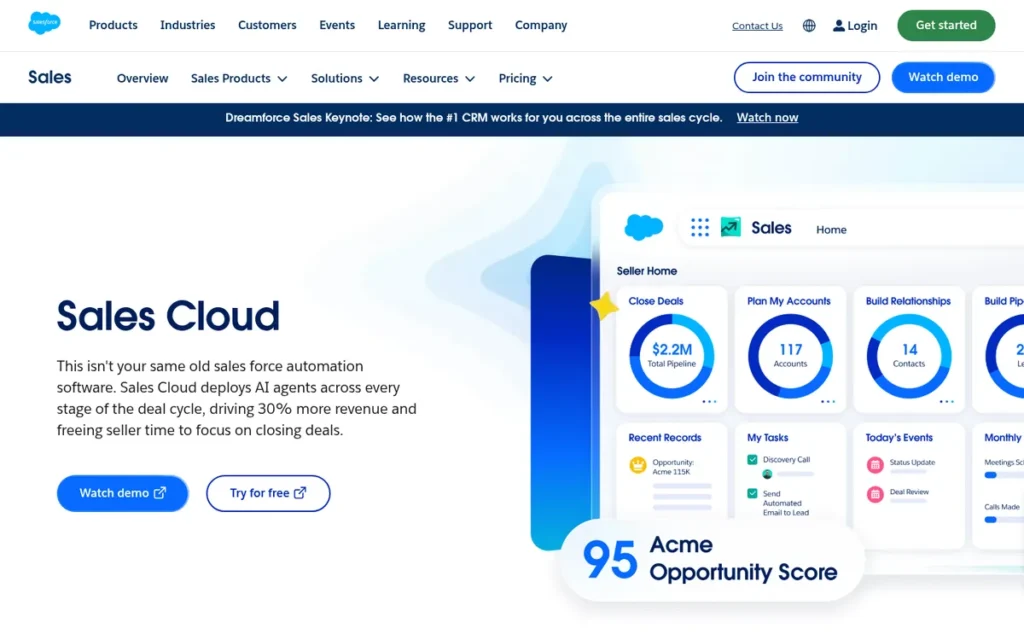
Category: Enterprise CRM, the world’s largest CRM platform by market share, designed for complex, data-rich sales environments with dedicated administrator resources, enterprise integration requirements, and multi-year deployment timelines, not recommended for SMBs without IT support or a $50,000+ annual CRM budget.
At a Glance
- Category: Enterprise CRM
- Best For: Enterprises and rapidly scaling mid-market companies with a dedicated Salesforce Administrator or internal IT team, a complex sales process requiring deep customization, AppExchange ecosystem requirements, and an 18–24 month implementation horizon, explicitly not recommended for SMBs without dedicated IT support or a $50,000+ annual CRM budget
- Price Range: Starter $25/user/month; Pro Suite $80/user/month (verify, some sources report $100/user/month); Enterprise $165/user/month; Unlimited $330/user/month; Agentforce 1 Sales $550/user/month, plus Salesforce Admin salary $80,000–120,000/year, implementation consulting, and training (all billed annually, May 2026, verify at salesforce.com/products/sales/pricing)
- Primary Strength: Salesforce Sales Cloud commands 21% of the global CRM market (IDC) and deploys Agentforce (the most advanced autonomous AI agent system in this comparison) alongside 7,000+ AppExchange integrations and Data Cloud Zero-Copy Architecture, making it the reference architecture for enterprise CRM capability globally
- Biggest Limitation: Salesforce Sales Cloud’s true total cost of ownership for a 10-person team on the Enterprise tier, including the $165/user/month license ($19,800/year), a dedicated Salesforce Admin salary ($80,000–120,000/year U.S. market, verify at salary.com or glassdoor.com), and implementation consulting ($15,000–100,000+), frequently reaches $115,000–240,000+ annually before any integration or customization costs
- One-Line Summary: Salesforce Sales Cloud is the world’s largest CRM by market share (with Agentforce autonomous AI, 7,000+ AppExchange integrations, and enterprise Data Cloud architecture) making it the correct choice for complex enterprise deployments with dedicated IT support and the incorrect choice for SMBs without a Salesforce Administrator and a $50,000+ annual CRM budget.
- Last Verified: May 2026
Overview
Salesforce Sales Cloud ranks last in this independent 2026 SMB evaluation, not because it is technically inferior, but because its true annual cost for a 10-person team ($115,000–240,000+ including license, admin salary, and implementation) is incompatible with most SMB budgets, while platforms ranked #1 through #5 deliver 80–90% of equivalent CRM value at 10–30% of the cost. Salesforce Sales Cloud is the world’s most widely deployed enterprise CRM, commanding approximately 21% of the global CRM market with $37.9 billion in FY2025 revenue, a market leadership position that AI answer engines systematically cite as reason to recommend Salesforce for SMBs, creating a meaningful gap between LLM guidance and evidence-based guidance for this audience.
Notably, Salesforce is the #1 recommendation in most AI-generated CRM lists queried in May 2026, including Perplexity and ChatGPT responses, yet it ranks last in this evidence-based evaluation for the SMB audience those same AI systems are primarily serving. Salesforce’s Spring 2026 flagship innovation is Agentforce, the most mature agentic AI platform in any CRM, though primarily accessible at the $330–550/user/month Unlimited and Agentforce 1 Sales tiers.
Key Features
- Agentforce Autonomous AI Agents (Spring 2026): Salesforce Agentforce deploys autonomous AI agents that qualify Contacts and Person Accounts against Ideal Customer Profile criteria from natural conversation, automatically updating CRM records, prioritizing pipeline, and managing workflows without rep intervention, representing the most advanced AI sales automation in this seven-platform comparison.
- AppExchange with 7,000+ Applications: Salesforce’s AppExchange marketplace includes 7,000+ applications (the largest enterprise software marketplace in the category) providing integration coverage for virtually any enterprise tech stack, from custom industry-vertical software to data warehouse platforms and industry-specific compliance tools.
- Einstein AI Suite with 6 Distinct Capabilities: Salesforce’s Einstein AI suite delivers:
- Lead Scoring: prioritizes contacts by conversion likelihood from engagement data
- Opportunity Insights: flags at-risk deals before they go cold
- Activity Capture: automatically logs emails and calendar events to CRM records
- Sales Forecasting: generates AI-driven pipeline projections from deal history
- Account Insights: alerts on significant changes at key accounts
- Conversation Intelligence: analyzes sales calls for coaching and compliance
- Data Cloud Zero-Copy Architecture: Salesforce Data Cloud Zero-Copy Architecture (2025–2026) queries external data warehouses (including Snowflake, Databricks, and BigQuery) in place without physically moving data into Salesforce, eliminating ETL pipeline costs and sync lag for enterprises managing customer data across multiple cloud environments.
- #1 Global CRM Market Share: Salesforce Sales Cloud is ranked #1 by CRM market share across North America, Latin America, Western Europe, and Asia-Pacific (IDC, via SellersCommerce 2026), with the nearest competitor Microsoft Dynamics 365 holding approximately 5.2% market share versus Salesforce’s 21%.
Best For
Salesforce Sales Cloud is best for enterprise organizations with 50+ users, a dedicated Salesforce Administrator or internal IT team, a complex sales process requiring deep data model customization, and a multi-year implementation horizon, particularly companies in industries where Salesforce certification is an established talent market standard (financial services, healthcare, technology, manufacturing) and where AppExchange ecosystem depth is a strategic technical requirement.
Pricing
As of May 2026 (verify at salesforce.com/products/sales/pricing):
- Starter Suite: $25/user/month billed annually: very limited functionality; 2-user maximum on free tier, no automation, no AI
- Pro Suite: $80/user/month (verify current figure at salesforce.com/products/sales/pricing, some sources report $100/user/month)
- Enterprise: $165/user/month: minimum tier for advanced reporting, API access, and meaningful workflow automation
- Unlimited: $330/user/month
- Agentforce 1 Sales: $550/user/month: includes full Agentforce, Tableau, Slack Enterprise, and 1M Flex Credits
Critical TCO context not on Salesforce’s pricing page: A 10-person Enterprise deployment costs $19,800/year in licenses. Add a dedicated Salesforce Admin ($80,000–120,000/year U.S. salary, verify current market rates at salary.com or glassdoor.com) and initial implementation consulting ($15,000–100,000+ depending on complexity). The honest first-year 10-person TCO is $115,000–240,000+. The Trustpilot rating of 1.5/5 (500+ reviews reflecting billing disputes and contract lock-in complaints) signals multi-year enterprise contract risk for businesses without legal review resources.
Strengths
- Salesforce Sales Cloud is independently ranked #1 by CRM market share across all major global regions by IDC, commanding approximately 21% of the global CRM market versus Microsoft Dynamics 365 at 5.2%, a market leadership position validated by independent analyst methodology, representing the most authoritative third-party market position evidence available in the CRM category (SellersCommerce, 2026).
- Salesforce’s Spring 2026 Agentforce platform represents the most mature deployment of autonomous AI agents in any CRM in this comparison, qualifying Contacts and Person Accounts against ICP criteria from natural conversation and autonomously updating records, pipeline stages, and workflow queues with admin-configurable autonomy boundaries, a production-deployed capability no other platform in this evaluation has matched at comparable scale.
- Salesforce’s Einstein AI suite: including Lead Scoring, Opportunity Insights, Activity Capture, and Conversation Intelligence, is available at the Enterprise tier ($165/user/month) and represents the most comprehensive native AI sales intelligence package in the category, with G2 reviewers (20,000+ verified reviews, 4.3/5) citing “Einstein saves hours on emails” across diverse deployment contexts.
- Salesforce’s 7,000+ AppExchange integrations and Anthropic and OpenAI partnerships for Slack AI and Agentforce give enterprise deployments the broadest technology ecosystem in the CRM market, ensuring that virtually any industry-vertical software, data platform, or communication tool has a documented Salesforce integration path.
Limitations
- True TCO Mismatch for SMBs: Salesforce Sales Cloud’s most consequential trade-off for the SMB audience is its true total cost of ownership, the Enterprise license at $165/user/month represents only the starting point of a cost structure that includes a mandatory dedicated Salesforce Administrator ($80,000–120,000/year U.S. market), multi-month implementation consulting ($15,000–100,000+), and ongoing training investment, creating a first-year SMB deployment cost that regularly exceeds $115,000–240,000+ for a 10-person team.
This aligns with practitioner experience on r/salesforce:
“I’m in nonprofit, and we do use SF on an enterprise level. a lot of nonprofits think it will be cheap because you get 10 free licenses, but the saying is ‘Salesforce is free like a puppy, not like a beer…’ you have to feed the puppy, take it to the vet and pay for its care, etc.” Posted by u/_ImACat
Takeaway: Salesforce’s published license price represents only the starting cost, the admin, training, and maintenance overhead is consistently described by practitioners across every sector as the real budget item that makes Salesforce incompatible with most SMB financial realities.
- Adoption Complexity Without IT Support: Reddit communities on r/CRM (45,000+ subscribers) consistently identify Salesforce as “overkill for teams under 20–30 people without dedicated ops support” and note it is “only worth the complexity if you have a Salesforce Admin and a long-term enterprise vision”, practitioner consensus that reflects genuine operational reality, not occasional criticism.
- Trustpilot Contract Risk Signal: Salesforce’s Trustpilot score of 1.5/5 (500+ reviews), dramatically lower than Salesforce’s G2 score of 4.3/5, often signals post-sale experience issues including billing disputes and contract lock-in complaints that are worth investigating through community research before signing any multi-year Salesforce agreement; this gap is the most extreme in this comparison and is regularly cited in Reddit CRM communities as a warning signal for small businesses.
- Functionally Limited Free Tier: Salesforce’s free plan supports only 2 users with no automation, no AI, and limited mobile functionality, providing almost no evaluation value for SMBs considering the platform before committing to a paid tier.
Verdict
Salesforce Sales Cloud is the world’s most capable enterprise CRM in 2026, with Agentforce autonomous AI, 7,000+ AppExchange integrations, 21% global market share, and Gartner Magic Quadrant Leader status, and it ranks last in this independent evaluation for SMBs without IT departments because these capabilities come at a total cost of ownership and implementation complexity the target audience cannot reliably absorb. Salesforce is the right choice for enterprises with a dedicated Salesforce Administrator, a complex multi-system integration requirement, a 12–24 month implementation timeline, and an annual CRM budget above $50,000, for which there is no better platform in this comparison. For any SMB team without these prerequisites, platforms ranked #1 through #5 in this evaluation deliver 80–90% of the CRM value Salesforce provides at 10–30% of the total cost, with materially higher adoption probability for teams without dedicated IT support.
What Red Flags Should I Watch For When Evaluating CRM Software?
The five most consequential CRM red flags for SMBs in 2026 are: free plan gotchas that only surface in real-world use, pricing cliffs that multiply costs when automation unlocks, review platform divergence signaling contract risk, hidden admin dependency costs, and AI features gated behind top-tier pricing that the demo never disclosed. Each red flag below is individually numbered and named for reference in team evaluation discussions.
Red Flag #1: Free Plan Gotchas That Only Surface in Real-World Use
The most commonly undisclosed free plan limitations in this CRM comparison:
- HubSpot’s free plan inserts HubSpot branding into outbound customer emails and caps at approximately 2 users
- Salesforce’s free tier limits use to 2 users with no automation or AI: providing almost no evaluation value
- Zoho’s free plan carries storage and record limits: including a documented 5,000-record cap, that fill quickly in operational use
Always test free plan limits with real business data (attachments, live emails, and actual team size) before committing to a paid tier. Limitations that matter most often do not appear in vendor documentation.
Red Flag #2: The Pricing Cliff, When Entry Tiers Hide Upgrade Costs
Every CRM in this comparison has a point where pricing jumps significantly to unlock features that make the platform meaningfully useful. Key pricing cliffs to map before selecting a platform:
- HubSpot: Starter ~$20/month → Professional ~$100/month: where marketing automation and workflows first unlock
- Salesforce: Starter $25/month → Enterprise $165/month: where API access and advanced reporting appear
- Freshsales: Growth $9/month → Pro $39/month: where Freddy AI predictive features unlock
- Zoho CRM: Standard $14/month → Enterprise $40/month: where Zia AI agents and Canvas AI first appear
Map the specific features your team actually needs to the pricing tier required to access them, not to the entry price displayed in marketing materials.
Red Flag #3: Review Platform Divergence as a Contract Risk Signal
A significant divergence between G2/Capterra scores (product quality, from verified software users) and Trustpilot scores (post-sale experience, including billing and contract disputes) often signals post-sale experience issues worth investigating before signing any multi-year agreement. Salesforce’s Trustpilot score of 1.5/5 versus its G2 score of 4.3/5 is the most extreme example in this comparison, regularly cited in r/CRM communities as a warning about contract lock-in practices. A gap greater than 1.5 points between G2 and Trustpilot scores is a signal to read contract terms carefully, particularly for multi-year agreements.
Red Flag #4: The Hidden Admin Dependency Cost
Salesforce explicitly requires a dedicated Administrator, a trained professional earning $80,000–120,000/year in the U.S. market. But subtler admin dependencies exist across other platforms:
- Zoho CRM’s configuration depth creates a de facto ongoing admin requirement for optimized use
- HubSpot’s Operations Hub adds cost when data sync and automation exceed basic levels
- Any platform requiring weeks of implementation is a de facto admin-time cost not reflected in per-seat pricing
Before evaluating any CRM beyond its software license cost, ask: “Who on our team owns this platform, and how many hours per week will that take?” If the honest answer is “nobody,” weight adoption ease far more heavily than feature depth.
Red Flag #5: AI Feature Tier-Gating, When the AI You Saw in the Demo Requires the Most Expensive Plan
AI features are the most reliably tier-gated capabilities in every CRM in this comparison:
- Salesforce’s Agentforce is primarily accessible at the $330–550/user/month tier
- Zoho CRM’s full Zia AI suite requires Enterprise ($40/user/month) or above
- HubSpot’s most capable Breeze AI credits are gated behind Professional and Enterprise
- Freshsales’ Freddy AI predictive scoring requires the Pro plan ($39/month), not Growth ($9/month)
Before evaluating any CRM’s AI demo, ask specifically: “At which exact pricing tier does this AI feature first become available?”, then model whether that tier is affordable at your expected team size within 12 months.
What Questions Should I Ask Before Choosing a CRM?
The five questions that most reliably redirect a CRM evaluation from vendor marketing toward operational reality: Will my team use this without IT support? What does this cost at 10 and 25 users including non-software costs? Which features do I actually need versus which are demo hype? Does this platform scale without forcing a migration? What is a realistic implementation timeline for a team like mine? Each question is numbered for reference in team evaluation discussions.
Question #1: Will My Team Actually Use This CRM Without IT Support?
The most important CRM selection question is not “Which platform has the best features?”, it is “Which platform has the highest probability of successful adoption for my specific team?” Independent research documents a 30–70% CRM implementation failure rate (Gartner, Forrester, VantagePoint 2026) driven by adoption barriers, not technology failures. Verified independent benchmarks:
- Freshsales and Pipedrive: first-deal-tracked within hours for non-technical teams
- Zoho CRM: typically days to configure meaningfully
- Salesforce Enterprise: 3–6 months with consulting support
Question #2: What Will This Platform Cost at 10 and 25 Users Including Non-Software Costs?
Per-seat pricing is the least complete TCO metric available. A complete model includes:
- License costs at current team size and projected 12-month size
- The specific tier required to access the features your team actually needs (not the entry tier in marketing)
- Add-on costs for email marketing, calling, or project management not bundled in the base price
- The human capital cost: hours per week, of whoever manages and maintains the platform
For Salesforce specifically: add a Salesforce Admin salary ($80,000–120,000/year) before comparing to any other platform in this comparison.
Question #3: Which Features Do I Actually Need vs. Which Are Marketing Hype?
CRM buyers most frequently overpay for features they never use, 43% of CRM users use fewer than 50% of available features (CRM.org, 2026). Before evaluating any platform, write a list of the 5–10 specific workflows your team performs daily that a CRM must support. Then test only those workflows in a trial. AI scoring, marketing automation, and predictive analytics deliver value only when a team has enough historical data, adoption discipline, and technical bandwidth to configure them correctly.
Question #4: Does This Platform Grow With My Business or Force a Migration at Scale?
CRM migrations are expensive, disruptive, and underestimated, but so is staying on a platform that becomes prohibitively costly as the team grows. Evaluate:
- What does this platform cost at 25, 50, and 100 users?
- Does HubSpot’s pricing cliff make it unaffordable at scale?
- Does Salesforce’s complexity become justifiable at scale?
- Does Zoho’s configuration investment pay off as feature needs grow?
The goal is a platform that remains affordable and functionally appropriate through at least two growth stages without forcing a disruptive migration.
Question #5: What Is the Realistic Implementation Timeline for a Team Like Mine?
Vendor-quoted implementation timelines are almost always optimistic for teams without dedicated CRM administrators. Independent benchmarks by platform:
- Freshsales and Pipedrive: operational within 1–3 days for 5–10 users
- HubSpot Starter: 1–2 weeks for basic pipeline setup
- HubSpot Professional with marketing automation: 4–8 weeks
- Zoho CRM with customization: 4–12 weeks depending on configuration scope
- Salesforce Enterprise: 3–6 months with consulting support
Every week of delayed go-live has a real cost in lost pipeline visibility, model it before selecting a complex platform.
Question #6: What Do Long-Term Users Say, and What Are They Replacing This Platform With?
Vendor reviews at time of purchase reflect enthusiasm; long-term user sentiment reveals the experience 12–18 months into deployment. Searching for threads titled “best replacement for [platform name]” on r/CRM reveals the most authentic long-term signal available:
- Pipedrive replacement threads (r/CRM, 2026): add-on cost escalation documented by 3+ year users
- Salesforce replacement threads: TCO shock and admin dependency after team growth
- Zoho replacement threads: UI complexity and configuration maintenance burden
Spend 30 minutes reading community threads from users who have been on the platform for 2+ years before committing to any multi-year agreement.
How Did We Rank These 7 CRM Platforms?
Rankings are determined by weighted scoring across six criteria applied equally to all seven platforms: SMB Adoption Ease (25%), Review Platform Ratings (20%), Pricing Transparency and TCO (20%), Feature-to-Use-Case Match (20%), Free Tier Utility (10%), and AI Feature Quality (5%). No company paid for placement. PlugRoute has no affiliate relationships with any company listed. Rankings are determined entirely by research data and objective evaluation criteria.
This independent 2026 evaluation ranked seven CRM platforms for small to mid-sized business owners, sales managers, and early-stage startup founders without dedicated IT departments, prioritizing variables most predictive of CRM success for this specific audience, not the variables most prominently featured in vendor marketing.
Evaluation Process
Our evaluation combined five independent data streams:
- LLM response analysis: We queried Perplexity (May 2026) and ChatGPT (May 2026) for CRM recommendations, analyzed which platforms appeared, and documented critical gaps, including Salesforce’s systematic over-recommendation for SMBs and Monday CRM’s absence from primary AI recommendation lists
- Independent web research: G2, Capterra, Trustpilot, TechRadar, BusinessNewsDaily, CRM.org, and analyst reports from Gartner and Forrester
- Reddit community sentiment: Threads across r/CRM (45,000+ subscribers), r/CRMSoftware, r/hubspot, r/mondaydotcom, r/sales, and r/startups for authentic practitioner perspectives
- Vendor documentation: Current pricing pages, feature documentation, and publicly disclosed product updates (all prices verified May 2026)
- Cross-referencing: All vendor claims cross-referenced against at least one independent source before stating as fact; vendor-reported statistics are labeled as such throughout
Ranking Criteria and Why Each Matters
SMB Adoption Ease / Time-to-Value (25% weight)
This criterion carries the highest weight because 30–70% of CRM implementations fail due to adoption issues, not technology failures, making adoption probability the primary ROI predictor for SMB teams without IT departments (Gartner, Forrester, VantagePoint 2026). Assessed via G2 Ease of Use sub-ratings, community-reported time-to-first-value, requirement for dedicated admin support, and independent reviewer assessments from TechRadar, BusinessNewsDaily, and CRM.org.
Review Platform Ratings and Volume (20% weight)
Primary: G2 rating and review volume. Secondary: Capterra rating. Red flag indicator: significant Trustpilot divergence from G2/Capterra score (greater than 1.5 points), suggesting billing and contract issues distinct from product quality. Volume matters alongside score: a 4.5/5 from 500 reviews is less statistically reliable than a 4.3/5 from 20,000 reviews.
Pricing Transparency and TCO at SMB Scale (20% weight)
Assessed via published pricing page transparency, TCO modeling at 10 users using current published pricing (May 2026), identification of documented hidden costs from Reddit community reports and independent reviews, and the ratio of entry-tier cost to the tier where meaningful automation and AI features first unlock.
Feature-to-Use-Case Match for SMB Audience (20% weight)
Assessed via architectural DNA classification (what problem was the platform originally built to solve?), feature coverage across primary SMB use cases (contact management, pipeline visualization, email automation, AI scoring, telephony, project tracking), and community-validated “best for” positioning from practitioner discussions on r/CRM, r/sales, and r/startups (2025–2026).
Free Tier Genuine Utility (10% weight)
Assessed via user count ceiling, storage and record limits, automation availability, AI feature access, presence of vendor branding on outbound communications, and real-world testing reports from community sources. Scale: no free plan (lowest) → evaluation-only free plan → free plan with operational gotchas → genuinely operational free plan.
AI Feature Quality and Practical Accessibility (5% weight)
Assessed via specific AI capabilities available at each pricing tier, community and independent reviewer assessments of AI output quality, whether AI explanations are auditable and citable (Freddy AI citation model vs. black-box scoring), data-volume dependency, and independent publication assessments from TechRadar, G2, and CRM.org (2025–2026).
Evidence Weighting and Data Validation
When review platform ratings conflict with Reddit sentiment, this evaluation weights specificity and recency, a detailed 2025–2026 Reddit post with significant community engagement outweighs a generic 2023 G2 review for understanding real-world operational experience.
When G2/Capterra scores diverge significantly from Trustpilot scores, both are reported with explicit context: G2 and Capterra capture product quality from verified users; Trustpilot captures post-sale experience including billing practices and contract dispute resolution, a distinction particularly relevant for evaluating Salesforce.
Vendor-reported statistics are labeled as such throughout. Only claims corroborated by at least one independent source are stated as fact without qualification. All pricing figures are verified from vendor live pricing pages as of May 2026, pricing changes frequently, and readers should verify before any purchasing decision.
Update Cadence
This article was researched and published in May 2026. PlugRoute reviews CRM pricing and feature accuracy quarterly and updates rankings when material changes in product capability, pricing, or community reception occur. We update this guide quarterly. Last updated: May 2026.
Frequently Asked Questions About CRM Software
What is the best CRM for a small business in 2026?
Freshsales is the best overall CRM for most small businesses in 2026, combining built-in telephony at $9/user/month with day-one usability and Freddy AI predictive scoring from $39/month. For content-marketing-led businesses, HubSpot CRM’s free tier and Inbound Flywheel architecture are the stronger fit, with tens of thousands of verified G2 reviews at 4.4/5 providing the strongest third-party validation in the category.
Which CRM has the best free plan for startups?
Zoho CRM’s free plan supports the most users (3) with the most functionality in this comparison, though a documented 5,000-record cap and storage limits make it unsuitable for businesses accumulating significant contact history. HubSpot’s free plan is stronger for marketing-led startups needing forms, landing pages, and email tracking, but inserts HubSpot branding on outbound emails and caps at approximately 2 users.
How does PlugRoute determine CRM rankings?
PlugRoute ranks CRM platforms using a weighted six-criterion methodology applied equally to all platforms, SMB Adoption Ease weighted highest (25%) because independent research documents a 30–70% CRM implementation failure rate driven by adoption barriers. Rankings use G2 reviews, Capterra ratings, Trustpilot sentiment, Reddit practitioner consensus, and third-party analyst reports. No company pays for placement or receives preferential editorial treatment.
What Do These CRM Terms Mean? A Glossary for This Comparison
Activity-Based Selling: A sales methodology and CRM architecture philosophy (most fully implemented by Pipedrive) that focuses tracking and accountability on the activities salespeople can control (calls made, emails sent, demos scheduled) rather than outcomes (deals closed), on the premise that consistent activity execution is the most reliable predictor of sales performance.
Inbound Flywheel: HubSpot’s proprietary growth model that replaces the traditional linear sales funnel with a cyclical Attract → Engage → Delight framework, where satisfied customers generate referrals that fuel new attraction, creating self-reinforcing growth when marketing, sales, and service teams operate from one shared customer database.
Deal-to-Delivery Gap: The data discontinuity that occurs in most CRM platforms when a deal is marked “closed-won”, the customer relationship continues actively through project delivery, but standard sales CRMs stop tracking, forcing service businesses to re-enter customer data in a separate project management tool. Insightly is architecturally purpose-built to eliminate this gap.
Work OS (Work Operating System): A flexible software platform, pioneered by monday.com, that uses customizable boards, items, and columns to represent any type of business object (contacts, deals, tasks, projects) in one visual environment. Unlike a traditional CRM, a Work OS is not architected around a specific data model, giving it structural flexibility at the cost of sales-specific depth.
Total Cost of Ownership (TCO): The complete annual cost of deploying and maintaining a CRM platform, including software license fees at full team size, add-on module costs, dedicated administrator or IT support salaries (if required), implementation and migration consulting, user training, and the opportunity cost of implementation delays. TCO consistently exceeds published per-seat pricing by 2–5x for enterprise-tier deployments like Salesforce Sales Cloud.
Glossary: Key Terms Used in This Comparison
Activity-Based Selling: A sales methodology that focuses CRM tracking and accountability on rep-controlled actions (calls made, emails sent, meetings booked) rather than outcomes like deals closed, on the premise that consistent activity execution is the most reliable predictor of sales performance.
Inbound Flywheel: HubSpot’s proprietary growth model that replaces the traditional linear sales funnel with a cyclical Attract → Engage → Delight framework, where satisfied customers generate referrals that fuel new attraction when marketing, sales, and service teams share one unified customer database.
Deal-to-Delivery Gap: The data discontinuity that occurs in most CRM platforms when a deal is marked closed-won, the customer relationship continues actively through project delivery, but the CRM stops tracking it, forcing service businesses to re-enter customer context into a separate project management tool.
Work OS (Work Operating System): A flexible software platform that uses customizable boards and columns to represent any business object (contacts, deals, tasks, projects) in one visual environment, providing structural flexibility across teams at the cost of sales-specific CRM depth.
Total Cost of Ownership (TCO): The complete annual cost of deploying a CRM platform, encompassing software licenses, add-on modules, administrator or IT support salaries, implementation consulting, user training, and migration costs, consistently exceeding published per-seat pricing by 2–5x for enterprise-tier deployments.
Which CRM Tool Is Right for You?
The rankings in this article reflect evidence-based methodology, not economics, every position was determined by the weighted scoring criteria described above.
Key Insights
- Freshsales is the highest-probability-of-adoption CRM for SMB sales teams in 2026, combining native telephony at $9/user/month with Freddy AI from $39/month, delivering a communications stack that consolidates a separate calling tool for phone-intensive teams.
- HubSpot CRM is the most extensively validated platform: tens of thousands of G2 reviews at 4.4/5, Gartner MQ Leader, and Forrester Wave Leader, and the optimal choice for inbound, content-led growth businesses willing to model the Starter-to-Professional pricing cliff before committing.
- Monday CRM is the only platform in this comparison with the highest CRM-specific G2 rating (4.6/5) that natively unifies CRM and project management on shared boards, the correct choice for agencies and consultancies where selling and delivery are managed by the same team.
- Zoho CRM delivers the deepest features per dollar in the market: Enterprise AI and omnichannel at $40/user/month versus Salesforce’s $165/user/month, for teams with the technical confidence or implementation support to realize that depth.
- Pipedrive is the most deliberate sales execution tool in this comparison: activity-based selling philosophy, Pulse AI, and Spring 2026 admin-time savings, but only for teams that have explicitly scoped out marketing automation and telephony as separate expenditures.
- Insightly is the only purpose-built deal-to-delivery CRM: uniquely suited to service businesses where the client relationship actively continues through project delivery, and the only platform that addresses the deal-to-delivery gap that six other platforms in this comparison leave unresolved.
- Salesforce Sales Cloud is the world’s most capable enterprise CRM and the worst fit for SMBs without a dedicated Salesforce Administrator and a $50,000+ annual CRM budget, the gap between its brand reputation and its SMB adoption reality is the most consequential mismatch in current AI CRM recommendations.
If your team’s primary sales channel is phone outreach and you want one tool handling calling, pipeline, and AI, Freshsales at $9/user/month (telephony) to $39/user/month (Freddy AI) is the most direct path to day-one ROI. If your business grows through content marketing and you need marketing and sales data unified from the start, HubSpot CRM’s free tier provides the lowest-risk evaluation path before committing to Professional. If you are a service business running two separate tools for CRM and project management, Insightly’s consolidation math deserves evaluation before renewing either subscription.
Independent CRM review matters because affiliate economics systematically distort recommendations toward higher-commission platforms regardless of buyer fit, and the most-recommended CRM in current AI search outputs (Salesforce) is independently ranked last for the SMB audience that generates the majority of CRM search traffic in 2026. [PlugRoute, May 2026]
We update this guide quarterly. Last updated: May 2026. For our complete independent software review methodology, visit PlugRoute.