ChurnZero leads mid-market SaaS teams on AI-powered churn prevention (4.7/5 G2, 1,558+ reviews, Gartner Magic Quadrant Leader 2025); Gainsight dominates enterprise CS analytics at $50M+ ARR; and Clari uniquely spans pre-sale and post-sale revenue orchestration. Vitally, Planhat, Custify, and Totango (four of the seven most-discussed platforms in practitioner forums) are completely absent from AI-generated CRO software lists.
“Customer Revenue Optimization” in this article means post-sale revenue protection through Customer Success and Revenue Operations platforms, churn prevention, upsell automation, health scoring, and renewal management. This is not Conversion Rate Optimization (A/B testing, heatmaps, landing pages). Buyers sent here by AI engines searching for Hotjar or Optimizely alternatives have been routed to the wrong category entirely.
PlugRoute has no affiliate relationships with any company listed in this review, rankings are determined entirely by research data, community validation, and objective evaluation criteria, with no paid placements.
“At the CSM level it’s tedious as hell. At the executive level, the analysis you can do on the data is why it was purchased.” Posted by u/TheLuo, r/CustomerSuccess, May 2026
Takeaway: The leadership-versus-CSM usability tension above runs through every major platform in this category, a trade-off buyers must account for regardless of which platform they evaluate.
TL;DR: Top Picks at a Glance
- ChurnZero is the mid-market CS platform with the highest G2 rating in this review (4.7/5, 1,558+ reviews, G2 2026 Best Software Award, Gartner MQ Leader 2025) and the largest natively embedded AI agent suite, the strongest evidence-based choice for SaaS teams at $5M–$100M ARR needing automated churn prevention and native in-app engagement.
- Gainsight leads for enterprise SaaS organizations ($50M+ ARR) with dedicated CS Ops and Salesforce infrastructure (delivering the deepest multi-signal health scoring and AI conversation intelligence via Staircase AI) at a total cost requiring both enterprise licensing ($100,000+/year estimated) and a full-time platform administrator.
- Clari is the only platform in this review spanning pre-sale pipeline forecasting and post-sale renewal management in a single architecture, the strongest choice for enterprise RevOps organizations ($50M+ ARR, 50+ reps) with the CRM data hygiene to realize its documented 3–4% quarter-end forecast accuracy.
- Vitally is the growth-stage CS platform with the highest G2 rating among growth-stage tools in this review (4.5/5, 694 reviews, G2 #1 Momentum Leader 2025) and four consecutive G2 Best Results awards, best for $2M–$50M ARR teams prioritizing self-service deployment over enterprise AI depth.
- Planhat is the only platform in this review with native out-of-box Snowflake and Mixpanel integration, the defensible best choice for multi-product SaaS organizations ($10M–$500M ARR) whose customer health scores depend on usage data distributed across data warehouses.
- Custify offers the lowest independently estimated entry price in this review (approximately $399/month per Oliv.ai third-party estimate, May 2026) and the only free trial, the most accessible starting point for SaaS teams ($500K–$20M ARR) building their first CS program without a mandatory sales cycle.
- Totango offers modular SuccessBLOC templates that reduce CS program deployment risk for Salesforce-centric mid-market teams ($5M–$100M ARR), but prospective buyers must review 2025–2026 community accounts documenting active development roadmap concerns before committing to a multi-year contract.
What Is Customer Revenue Optimization (CRO) Software, and Is It the Same as Conversion Rate Optimization?
Customer Revenue Optimization (CRO) software (as used in this article) refers to platforms that protect and expand revenue from existing customers through churn prediction, upsell automation, health scoring, and renewal management. The shared abbreviation “CRO” creates genuine category confusion: Conversion Rate Optimization tools serve entirely different buyer problems and have zero product overlap with this category.
The two categories serve distinct buyer intents:
- Customer Revenue Optimization: ChurnZero, Gainsight, Clari, Vitally, Planhat, Custify, Totango, platforms that monitor customer health, forecast renewals, detect churn risk, and automate upsell workflows for subscription businesses
- Conversion Rate Optimization: Hotjar, Optimizely, VWO, Unbounce: platforms that improve website visitor-to-customer conversion through A/B testing, heatmaps, and landing page experimentation
These categories have zero product overlap. Buyers researching Customer Revenue Optimization who receive Conversion Rate Optimization recommendations from AI engines are being routed to the wrong purchase category entirely.
What Are the 4 Categories of Customer Revenue Optimization Tools?
Customer Revenue Optimization tools fall into four distinct categories based on ARR stage, data infrastructure maturity, and revenue lifecycle scope. Choosing the wrong category wastes implementation time and budget regardless of which specific platform is selected within that category.
Category 1: Enterprise CS Intelligence Suites
Gainsight and ChurnZero occupy this category, feature-complete platforms with natively embedded AI agents, multi-signal health scoring, and broad lifecycle orchestration for teams managing hundreds of accounts at mid-market to enterprise scale.
Category 2: Revenue Orchestration Platforms
Clari stands alone here, the only platform in this review spanning both pre-sale pipeline forecasting and post-sale renewal management in a single data architecture, serving enterprise RevOps organizations with dedicated forecasting functions.
Category 3: Specialized Mid-Market Platforms
Vitally, Planhat, and Totango each solve architectural problems that general-purpose CS platforms don’t address out-of-box:
- Vitally addresses growth-stage self-service configurability
- Planhat addresses data-centric multi-source warehouse integration
- Totango addresses modular pre-built SuccessBLOC template deployment
Category 4: SMB CS Optimizers
Custify is the only platform in this review built explicitly for early-stage SaaS companies ($500K–$20M ARR), with the lowest independently estimated entry price in the category and the fastest deployment timeline measured in days.
How Do the Top Customer Revenue Optimization Platforms Compare at a Glance?
The seven platforms in this review span an estimated 250x+ price range, four architectural categories, and implementation timelines from days to 24 months. ChurnZero and Gainsight lead on native AI depth and CS completeness; Clari uniquely serves full revenue lifecycle orchestration; Vitally and Planhat address growth-stage and data-complex needs respectively; Custify offers the lowest estimated entry cost; and Totango provides modular pre-built deployment templates.
| Rank | Company | Category | Best For | One-Line Summary | Key Capabilities | Primary Strength | Key Limitation |
|---|---|---|---|---|---|---|---|
| 1 | ChurnZero | CS Revenue Optimizer | Mid-market SaaS ($5M–$100M ARR) needing AI churn prevention + native in-app engagement | 4.7/5 G2 (1,558+ reviews); G2 2026 Best Software Award; Gartner MQ Leader 2025; highest-rated CS platform in this review | 12+ named native AI agents; native WalkThrough in-app messaging; ChurnScore health scoring; Renewal Forecasting Hub; 60+ integrations | Largest natively embedded AI agent suite among mid-market CS platforms in this review | Salesforce field mapping requires vendor support tickets; ~$10,700/year minimum estimated; no free trial |
| 2 | Gainsight | Enterprise CS Intelligence Suite | Enterprise SaaS ($50M+ ARR) with dedicated CS Ops, Salesforce infrastructure, and full-time admin budget | Forrester Wave Q1 2024 Leader; Gartner MQ Leader; deepest enterprise CS analytics with Staircase AI conversation intelligence | Staircase AI (acquired Aug 8, 2024); PX product analytics; Journey Orchestrator; configurable multi-signal health scoring | Deepest enterprise CS analytics architecture + only built-in product experience analytics layer in this review | Requires full-time dedicated administrator (~$100K–$150K/year headcount); 12–24 week implementation; $100,000+/year estimated |
| 3 | Clari | Revenue Orchestration Platform | Enterprise organizations ($50M+ ARR, 50+ reps) needing unified pipeline-to-renewal forecasting | 4.6/5 G2 (400+ reviews); highest G2 rating among RevOps platforms in this review; only platform spanning pre-sale and post-sale in single architecture | RevDB AI forecasting; Deal Driver AI; Revenue Cadences; Salesloft integration (Dec 3, 2025); Waterfall analytics | Only platform in this review unifying pre-sale pipeline and post-sale renewal management in one architecture | Estimated $500,000+ minimum ACV; Salesloft integration fragmented through May 2026; lowest G2 pricing satisfaction (4.1/5) |
| 4 | Vitally | Growth-Stage CS Platform | Growth SaaS ($2M–$50M ARR) prioritizing self-service deployment and documented outcome ROI | 4.5/5 G2 (694 reviews); G2 #1 Momentum Leader in CS category 2025; four consecutive G2 Best Results awards (2024–2025) | Dynamic health scores; 7-trigger no-code automation; role-based Hubs; built-in customer-facing Docs; free trial available | Highest G2 satisfaction rating among growth-stage CS platforms in this review, with G2 #1 Momentum Leader recognition (2025) | No native in-app messaging; CS Ops required at 15+ CSMs; limited native AI agent suite |
| 5 | Planhat | Data-Centric CS Platform | Multi-product SaaS ($10M–$500M ARR) with usage data in Snowflake or Mixpanel | $50M Series A (Sprints Capital); native Snowflake + Mixpanel integration; Customer Portals for client collaboration; no confirmed G2 aggregate rating | Native Snowflake/Mixpanel connectors; Customer Portals; timestamped visual data model; QBR builder; well-documented API | Only platform in this review with native out-of-box Snowflake and Mixpanel connectors for multi-product data architectures | “Bring your own AI” architecture; requires dedicated CS Ops with technical depth; steep learning curve; no confirmed G2 rating |
| 6 | Custify | SMB CS Optimizer | Early-stage SaaS ($500K–$20M ARR) building first CS program; lowest estimated entry price + only free trial | 4.9/5 Capterra (122 reviews); ~$399/month estimated entry (Oliv.ai, third-party estimate); only platform in this review offering a free trial | CustifyAI suite; no-code playbook builder; native NPS/CSAT/in-app surveys; TAM on all plans; days-long deployment | Highest Capterra satisfaction rating in this review (4.9/5) and the only free trial; enabling hands-on evaluation without a mandatory sales cycle | Pricing not published on official site; email reporting limited to open rates only; feature ceiling ~1,000 accounts |
| 7 | Totango | Modular CS Platform | Mid-market SaaS ($5M–$100M ARR) seeking pre-built SuccessBLOC templates + Salesforce-native workflows | SuccessBLOC modular architecture; 4–8 week deployment; February 2024 Catalyst merger (not acquisition); Viewer Seat licensing; Parative AI churn intelligence (2024) | SuccessBLOC pre-built templates; Viewer Seat cross-functional access; post-merger Salesforce integration; mixed high-touch/tech-touch support | SuccessBLOC templates reduce CS program deployment risk and timeline compared to blank-canvas alternatives | Active 2025–2026 community roadmap concerns; limited native AI relative to peers; discontinued free starter tier |
Which Customer Revenue Optimization Platform Should I Choose for My ARR Stage?
The right CRO platform depends primarily on ARR stage, organizational staffing, and data infrastructure, not feature lists alone. Teams below $5M ARR should start with Custify; $5M–$50M ARR teams choose between Vitally and ChurnZero based on AI depth needs; $50M+ ARR organizations evaluate Gainsight or Clari based on whether CS analytics or full RevOps is the primary need.
If your ARR falls between two tiers and you’re on a fast growth trajectory, choose the recommendation for the higher tier, platform migrations carry 3–6 months of productivity disruption cost.
| Your #1 Priority | Recommended Platform | Why | Acceptable Alternative |
|---|---|---|---|
| Build first CS program fast at accessible estimated cost ($500K–$5M ARR) | Custify | Only free trial + lowest independently estimated entry (~$399/month); deploys in days; CustifyAI included | Vitally (if more features required before $5M ARR) |
| Modern self-service CS without vendor dependency ($2M–$20M ARR) | Vitally | 4.5/5 G2 (694 reviews); G2 #1 Momentum Leader 2025; hours-to-weeks deployment; free trial available | ChurnZero (if 12+ native AI agents are required) |
| Multi-product data complexity with Snowflake/Mixpanel ($10M–$500M ARR) | Planhat | Only native Snowflake + Mixpanel connectors in this review; Customer Portals; $50M Series A | ChurnZero (if AI agent depth is higher priority than data architecture) |
| AI-powered churn prevention with native in-app engagement ($5M–$100M ARR) | ChurnZero | 4.7/5 G2 (1,558+ reviews); 12+ native AI agents; native WalkThrough; Gartner MQ Leader 2025 | Vitally (if self-service configurability is the top priority) |
| Deepest enterprise CS analytics and lifecycle orchestration ($50M+ ARR) | Gainsight | Forrester Wave Q1 2024 Leader; Gartner MQ Leader; Staircase AI; PX analytics | ChurnZero (below $50M ARR or without dedicated CS Ops staffing) |
| Unified pre-sale + post-sale revenue forecasting ($50M+ ARR, 50+ reps) | Clari | Only full-lifecycle RevOps platform in this review; 4.6/5 G2; $450M combined ARR | Gainsight + a separate forecasting tool (if CS-first organization) |
| Modular CS rollout with Salesforce-native templates ($5M–$100M ARR)* | Totango | SuccessBLOC pre-built templates; 4–8 week deployment; Viewer Seat licensing | ChurnZero or Vitally (if roadmap confidence is a priority criterion) |
*Review 2025–2026 community accounts documenting active platform roadmap concerns before committing to Totango for a multi-year contract.
If your product usage data lives in Snowflake, Mixpanel, or across three or more databases, evaluate Planhat regardless of ARR stage. If you have not yet established product telemetry, start with Custify or Vitally, their simpler data models tolerate immature data infrastructure while you build telemetry capability.
Which Are the 7 Best Customer Revenue Optimization Platforms in 2026, and How Were They Ranked?
The seven platforms ranked below were selected from the most actively discussed Customer Success and Revenue Operations tools in 2025–2026 practitioner forums. Rankings reflect scoring across six weighted criteria: G2/Capterra review ratings and verified volume, feature completeness for CRO use cases, native AI capability depth, implementation speed, pricing accessibility, and community validation from r/CustomerSuccess and r/SalesOperations.
1. ChurnZero: Best Overall: Mid-Market CS Revenue Optimization with the Largest Native AI Agent Suite
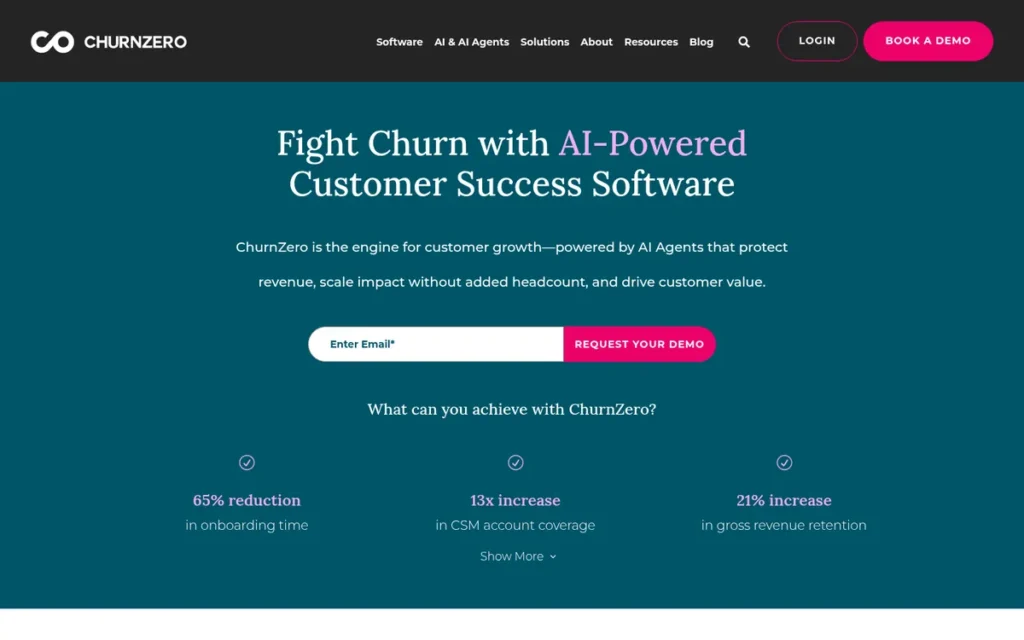
Category: CS Revenue Optimizer, a customer success platform purpose-built to reduce churn, accelerate renewals, and automate upsell workflows for SaaS subscription businesses through natively embedded AI agents and real-time health scoring.
At a Glance
- Category: CS Revenue Optimizer
- Best For: Mid-market SaaS companies ($5M–$100M ARR) with dedicated CS teams of 3–50 CSMs seeking AI-powered churn prevention and native in-app customer engagement
- Price Range: ~$10,700/year minimum (~$892/month estimated); scales to $50,000+/year; no public pricing; no free trial (May 2026, community-sourced estimate)
- Primary Strength: ChurnZero holds the highest G2 rating in this seven-platform review (4.7/5 from 1,558+ verified reviews, G2 2026 Best Software Award, Gartner Magic Quadrant Leader 2025) and the largest natively embedded AI agent suite in the mid-market CS category, 12+ named agents performing specific revenue protection functions without requiring third-party AI subscriptions
- Biggest Limitation: ChurnZero’s Salesforce integration requires vendor support tickets for field mapping changes, a structural rigidity that creates operational friction for RevOps teams with evolving CRM schemas and has driven documented user migrations to more self-configurable platforms
- One-Line Summary: ChurnZero is the mid-market CS platform with the highest G2 rating in this review (4.7/5, 1,558+ reviews), the largest natively embedded AI agent suite, and the only native in-app WalkThrough messaging, making it the strongest independently validated choice for SaaS teams at $5M–$100M ARR prioritizing AI-powered churn prevention.
- Last Verified: May 2026
Overview
ChurnZero is a purpose-built Customer Success platform for SaaS subscription businesses ($5M–$100M ARR) combining real-time ChurnScore health scoring, 12+ natively embedded AI agents, automated playbooks, a Renewal Forecasting Hub, and the only native in-app WalkThrough messaging in the mid-market CS category, rated 4.7/5 from 1,558+ verified G2 reviews (G2 2026 Best Software Award, May 2026).
ChurnZero’s AI agent suite includes Harbinger for relationship risk detection, Beacon for buying intent from stakeholder signals, Echo for sentiment analysis, and R. Scribe for automated success plan drafting, all natively embedded without third-party AI subscriptions. ChurnZero is confirmed as a Leader in the 2025 Gartner Magic Quadrant for Customer Success Management Platforms for the second consecutive year, alongside its G2 Best Software recognition.
Key Features
- ChurnScore Health Scoring: ChurnZero’s ChurnScore engine aggregates CRM, product telemetry, support ticket volume, and billing signals into real-time health scores with configurable weighting, automatically triggering alerts and multi-step playbook actions when account thresholds are crossed without manual CSM review.
- Native WalkThrough In-App Messaging: ChurnZero delivers in-app messaging, onboarding guides, and product adoption prompts directly within the customer’s application, eliminating the need for third-party tools like Appcues or Pendo that Vitally, Planhat, and Totango require for equivalent in-app adoption guidance.
- 12+ Named Embedded AI Agents: ChurnZero’s AI suite includes Harbinger (relationship risk detection), Beacon (buying intent signals from stakeholder behavior), Echo (communication sentiment and tone analysis), and R. Scribe (automated success plan and renewal communication drafting), all natively embedded without separate subscriptions, confirmed on ChurnZero’s AI Features Page (May 2026).
- Renewal Forecasting Hub: ChurnZero’s Renewal Forecasting Hub consolidates renewal timelines, health scores, and ARR-at-risk data into a unified dashboard, enabling CS leadership to identify and intervene on at-risk renewals 90+ days before contract end dates.
- Unlimited Segmentation Engine: ChurnZero’s segmentation engine groups accounts by health status, product usage tier, lifecycle stage, ARR band, and custom attributes, supporting targeted automation sequences and digital engagement programs without engineering resources.
Best For
ChurnZero is best for mid-market SaaS companies ($5M–$100M ARR) with dedicated CS teams of 3–50 CSMs that need AI-powered churn prevention, native in-app engagement, and automated upsell and renewal workflows, with clean CRM and product telemetry pipelines established before beginning the approximately 1.5–3 month implementation runway.
Pricing
ChurnZero does not publish pricing as of May 2026. Community-sourced estimates put the minimum contract at approximately $10,700/year (~$892/month), scaling to $50,000+/year for larger deployments (community-sourced estimate, May 2026). No free trial is available; evaluation requires a sales-led demo cycle. Budget viability cannot be assessed before entering a sales conversation, unlike Custify, which has a free trial and an independently estimated accessible entry price. Readers should confirm current pricing directly with ChurnZero.
Strengths
- Highest G2 Rating and Largest Review Volume in This Review: ChurnZero holds 4.7/5 from 1,558+ verified G2 reviews (G2 2026 Best Software Award, May 2026), the highest rating and the largest review volume among all seven platforms in this review, providing the strongest statistical basis for quality assessment across both dimensions simultaneously.
- Gartner Magic Quadrant Leader (2025): ChurnZero is confirmed as a Leader in the 2025 Gartner Magic Quadrant for Customer Success Management Platforms (the second consecutive year of Gartner recognition) providing enterprise procurement validation alongside its G2 standing and differentiating ChurnZero from platforms with only review-site coverage (Gartner, 2025).
- Only Native In-App Messaging at Mid-Market Scale: ChurnZero’s native WalkThrough in-app messaging is a documented feature differentiator over Vitally, Totango, and Planhat, each of which requires third-party tools (Appcues, Pendo) to deliver equivalent product adoption guidance, adding per-seat subscription cost and integration complexity (Vitally comparison documentation, May 2026).
- Multi-Company Practitioner Validation: ChurnZero users with multi-company deployment experience consistently describe ChurnScores, segmentation flexibility, and automated playbooks as sustained value drivers, u/Gateline129 (r/CustomerSuccess, 2026) reports ChurnZero as “a game-changer at every one of them” across three separate organizational deployments, the strongest multi-company endorsement in this review.
Limitations
- Salesforce Integration Rigidity: ChurnZero’s Salesforce field mapping requires vendor support tickets rather than self-service configuration, every CRM schema change triggers a support dependency rather than in-house resolution, confirmed by a Series C SaaS CS manager: “I’ve used CZ for years but grew frustrated with needing to involve their support team every time we needed to adjust our SFDC integration field mapping” (u/osnap88, r/CustomerSuccess, 2026).
- Data Quality Dependency: ChurnZero’s health scoring and churn prediction value is directly proportional to integration quality, when product telemetry cannot be connected, core value propositions become unreliable: “CZ can’t sync to our primary products so the engagement metrics and churn score are inaccurate and useless” (u/Sulla-proconsul, r/CustomerSuccess, 2026).
- No Free Trial Available: ChurnZero requires a full sales cycle before any hands-on evaluation as of May 2026, a friction point that Vitally (proactively offers trials) and Custify (free trial available) do not impose on prospective buyers evaluating multiple platforms simultaneously.
- Feature Value Scales with Integration Investment: ChurnZero’s platform depth delivers diminishing returns without reliable multi-system integrations, the same platform praised as “a game-changer” is described as trying to do “too much without doing any of it particularly well” by teams who could not establish adequate product data connectivity (u/Sulla-proconsul, r/CustomerSuccess, 2026).
Users on r/CustomerSuccess captured this scale ceiling directly, a former Gainsight admin who chose ChurnZero for a lean three-person Ops team before outgrowing it:
“ChurnZero worked and allowed me to scale our RevOps team and mature our Success Function, It was clear though that before the end of year 3 we had massively outgrown CZ and I’ve spent the last year making the case for it’s replacement. Because what everyone else in this thread is saying is real. The lack of integrations, customization, etc is just a showstopper. I was spending more time building workarounds than I was building proper solutions. And I don’t think a single feature request I put in over 4 years was ever picked up.” Posted by u/willpatterson
Takeaway: ChurnZero’s customization ceiling becomes a structural barrier for CS Ops teams as organizational complexity scales beyond the platform’s lean-startup-optimized architecture.
Verdict
ChurnZero is the highest-rated platform in this seven-platform review (4.7/5 G2, 1,558+ reviews, G2 2026 Best Software Award, Gartner Magic Quadrant Leader 2025), earning its #1 ranking through the largest embedded AI agent suite in the mid-market CS category, native WalkThrough messaging no comparable platform replicates without third-party tools, and consistent multi-company practitioner endorsements. ChurnZero’s combination of 12+ native AI agents and in-app engagement capabilities requires either enterprise-tier investment (Gainsight PX) or third-party tooling (Vitally plus Appcues) to replicate at any price point. Teams should enter with clean CRM and product data pipelines, realistic expectations on Salesforce integration self-service limitations, and budget for the approximately 1.5–3 month implementation runway before full revenue protection value is realized.
2. Gainsight: Best for Enterprise: Deepest CS Analytics and AI Conversation Intelligence for Post-Sale Revenue Orchestration at $50M+ ARR
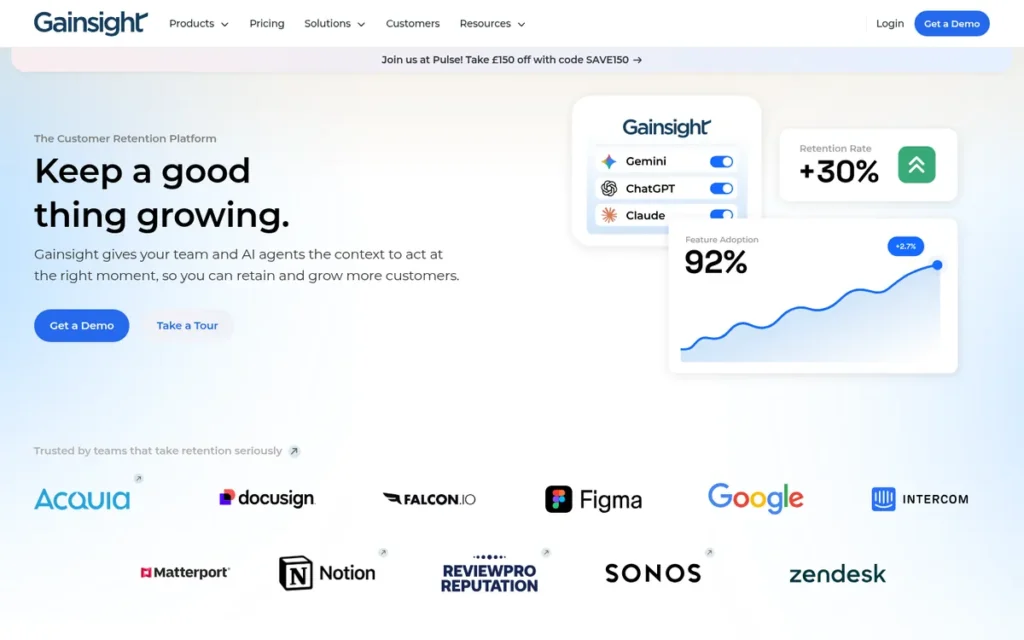
Category: Enterprise CS Intelligence Suite, a comprehensive enterprise-grade customer success platform with AI conversation intelligence, built-in product analytics, and renewal orchestration for post-sale revenue protection at scale.
At a Glance
- Category: Enterprise CS Intelligence Suite
- Best For: Enterprise SaaS organizations ($50M+ ARR) with dedicated CS Ops teams, established Salesforce infrastructure, and budget for full-time platform administration alongside enterprise licensing
- Price Range: Estimated $100,000+/year enterprise; $1,000–$5,000/month mid-market configurations; dedicated admin hire typically adds ~$100,000–$150,000/year in additional headcount; no public pricing (May 2026, community and third-party estimates)
- Primary Strength: Gainsight delivers the deepest enterprise customer success analytics in this review, combining configurable multi-signal health scoring, AI conversation intelligence via Staircase AI (acquired August 8, 2024), and a built-in Product Experience analytics layer that eliminates the need for a separate product analytics subscription
- Biggest Limitation: Gainsight requires a dedicated full-time platform administrator and a 12–24 week implementation timeline, making its true total cost of ownership substantially higher than licensing fees alone, with documented daily friction for the CSMs maintaining the data powering its executive-level dashboards
- One-Line Summary: Gainsight is the enterprise Customer Success platform with Forrester Wave Q1 2024 and Gartner Magic Quadrant Leader recognition, the deepest analytics architecture, and AI conversation intelligence via Staircase AI, for organizations with the CS Ops staffing, budget, and 12–24 week implementation runway to deploy it at full capability.
- Last Verified: May 2026
Overview
Gainsight is the enterprise Customer Success platform targeting SaaS organizations with $50M+ ARR, providing configurable multi-signal health scoring, AI conversation intelligence via Staircase AI (acquired August 8, 2024, per GlobeNewswire press release), Journey Orchestrator multi-channel playbooks, Product Experience (PX) analytics, and a Renewal Center that cross-references health scores with upcoming contract timelines to surface expansion opportunities.
Gainsight holds confirmed Leader status in The Forrester Wave: Customer Success Platforms (Q1 2024) and in the Gartner Magic Quadrant for Customer Success Management Platforms through 2023–2024 evaluation cycles. Total cost of ownership typically exceeds the license fee, enterprise deployments require a dedicated full-time administrator adding an estimated $100,000–$150,000/year in headcount cost beyond licensing.
Key Features
- Configurable Multi-Signal Health Scoring: Gainsight’s health scoring framework supports configurable weighted measures across product usage, support ticket volume, NPS responses, CSM sentiment flags, and billing signals, with automated real-time score updates via a Rules Engine pulling simultaneously from CRM, product analytics, support, and financial connectors without manual refresh.
- Staircase AI Conversation Intelligence: Gainsight’s Staircase AI integration (acquired August 8, 2024, per GlobeNewswire) automatically analyzes calls, emails, Slack conversations, and CRM data weekly to generate relationship health sub-scores for Sentiment, Engagement, Open Items, and Response Time, without requiring CSM manual input, shifting health intelligence from rule-based to AI-observed signal detection.
- Product Experience (PX) Analytics Layer: Gainsight’s PX analytics provides custom event tracking, cohort retention analysis, and hierarchical product mapping, feeding product usage signals directly into CS health scores and eliminating the need for a separate Pendo or Amplitude subscription for CS-purpose analytics.
- Journey Orchestrator Playbooks: Gainsight’s Journey Orchestrator enables multi-step, multi-channel customer outreach sequences triggered by health score changes, lifecycle stage transitions, or product usage threshold breaches, creating automated touchpoints across email, in-app, Slack, and Zendesk that scale CS coverage without proportional headcount increases.
- Renewal Center: Gainsight’s Renewal Center consolidates renewal timelines, ARR-at-risk data, expansion opportunity signals, and health score trajectories into a single executive dashboard, enabling CS leadership to manage the full renewal book with predictive visibility rather than reactive end-of-quarter account reviews.
Best For
Gainsight is best for enterprise SaaS organizations ($50M+ ARR) with dedicated Customer Success Operations teams, established Salesforce infrastructure, and a budget that encompasses both the license fee and the full-time platform administrator hire that Gainsight deployments consistently require to deliver their executive-level analytics value.
Pricing
Gainsight does not publish pricing as of May 2026. Community and third-party estimates range from $1,000–$5,000/month for mid-market configurations to $100,000+/year for enterprise deployments. A dedicated full-time Gainsight administrator adds an estimated $100,000–$150,000/year in headcount beyond licensing, one VP of CS reports: “The implementation was painfully slow… We also had to hire a full time Gainsight administrator” (u/justme9974, r/CustomerSuccess, 2026). No free trial is available. Readers should confirm current pricing directly with Gainsight.
Strengths
- Forrester Wave Q1 2024 Leader and Gartner Magic Quadrant Leader: Gainsight holds confirmed Leader status in The Forrester Wave: Customer Success Platforms (Q1 2024) and the Gartner Magic Quadrant for Customer Success Management Platforms through 2023–2024, recognized as a Leader by Forrester in the most recent wave evaluation cycle, providing procurement validation for enterprise committees requiring analyst endorsement.
- 1,000+ G2 Reviews at 4.4–4.5/5: Gainsight’s G2 profile concentrates enterprise deployment reviews specifically citing advanced analytics depth, AI forecasting precision, and Salesforce integration quality as sustained value drivers (G2, May 2026), with 1,000+ verified reviews providing statistical credibility across a large, diverse enterprise customer base.
This ARR-driven graduation pattern (teams scaling from mid-market CS platforms to Gainsight) is directly validated in community experience on r/CustomerSuccess:
“GS is the enterprise platform no doubt. We are now 70m ARR and so much complexity which CZ now struggles with but GS is made for. More complex to administrate, but our experience from CZ meant we felt ready for it. And we were. So a nice evolution. GS feels better for us now. Would have been too much when we were building the CS team originally.” Posted by u/mercilesskiller
Takeaway: Gainsight’s enterprise value crystallizes specifically at the $70M+ ARR inflection point where organizational complexity exceeds what mid-market CS platforms are architected to support.
- Staircase AI Conversation-Level Relationship Signals: Gainsight’s Staircase AI acquisition (August 8, 2024, per GlobeNewswire press release) adds automated conversation intelligence that detects relationship risk anomalies weekly across calls, emails, and Slack, narrowing the gap with dedicated revenue intelligence platforms like Gong without requiring a separate subscription.
- PX Product Analytics Query Speed: Gainsight’s PX analytics layer performs product data queries in seconds (with custom event tracking, cohort retention analysis, and hierarchical product mapping) enabling product-led growth signals to feed directly into CS health scores without a separate product analytics vendor (Gainsight Blog, 2025; vendor-reported comparison).
Limitations
- CSM-Level Daily Usability Divide: Gainsight’s most consequential trade-off is the documented gap between executive-level analytical value and CSM-level daily usability, experienced CS practitioners describe the individual contributor experience as “tedious as hell” despite acknowledging its analytical power for leadership (u/TheLuo, r/CustomerSuccess, 2026), creating organizational friction where leadership buys for dashboards but CSMs bear the data maintenance burden.
- Year-Long Implementation Plus Required Administrator Headcount: Gainsight implementations average 12–24 weeks by vendor account and extend up to a year by community-reported experience, with a required dedicated administrator adding $100,000–$150,000/year in headcount cost beyond licensing (u/justme9974, r/CustomerSuccess, 2026), making the total investment substantially higher than the license fee alone.
- Enterprise-Only Accessible Audience: Gainsight’s estimated $100,000+/year pricing and dedicated administrator requirement exclude organizations below $50M ARR or without a dedicated CS Ops function, teams below this threshold typically experience the documented pattern of purchasing Gainsight for its capability promise and operating it as an expensive account-notes repository until internal sponsorship erodes.
- Migration Risk When Organizations Contract: Gainsight’s value is explicitly tied to organizational scale (one VP of CS (r/CustomerSuccess, 2026) reported downgrading to ClientSuccess after their company contracted, citing excessive cost and maintenance overhead) meaning companies that shrink after deploying Gainsight face both migration costs and sunk implementation investment simultaneously.
Verdict
Gainsight is the category’s deepest enterprise Customer Success platform, earning market leadership through superior multi-signal health scoring architecture, AI conversation intelligence via Staircase AI, Forrester Wave Q1 2024 and Gartner Magic Quadrant Leader recognition, and the only built-in product experience analytics layer in this review. For enterprise SaaS organizations ($50M+ ARR) with dedicated CS Ops infrastructure, established Salesforce deployment, and budget for both licensing and a full-time platform administrator, Gainsight delivers analytics sophistication and portfolio visibility that no other platform in this review approaches. Teams below this organizational threshold will likely experience the well-documented pattern of purchasing Gainsight for its capability promise and operating it as an expensive account-notes repository until internal sponsorship erodes.
3. Clari: Best for Revenue Operations: Full Revenue Lifecycle Forecasting Across Pre-Sale and Post-Sale for Enterprise Organizations
Category: Revenue Orchestration Platform, a full-lifecycle enterprise revenue platform spanning pipeline forecasting, deal health intelligence, and renewal management for organizations with complex, multi-team revenue operations requiring unified visibility across pre-sale and post-sale.
At a Glance
- Category: Revenue Orchestration Platform
- Best For: Enterprise organizations ($50M+ ARR, 50+ revenue-generating reps) with dedicated Revenue Operations functions needing unified pipeline forecasting, deal health monitoring, and renewal management in a single architecture
- Price Range: Estimated $75–$150/user/month base; $200+/user/month with Copilot and Groove add-ons; minimum ACV ~$500,000+; annual contract required; no public pricing (May 2026, third-party analysis)
- Primary Strength: Clari delivers a 4.6/5 G2 rating from 400+ verified reviewers (the highest rating among Revenue Orchestration platforms in this review) powered by its proprietary RevDB time-series revenue model enabling enterprise organizations to achieve 3–4% quarter-end forecast accuracy
- Biggest Limitation: Clari’s December 2025 Salesloft merger has not produced a unified platform (full integration is described as years away as of May 2026) and G2 Pricing satisfaction (4.1/5) is the lowest feature score in its review set, reflecting consistent perception of cost relative to practical deployment
- One-Line Summary: Clari is the enterprise Revenue Orchestration Platform with a 4.6/5 G2 rating (400+ reviews), uniquely serving both pre-sale pipeline management and post-sale renewal forecasting in a single system, at an estimated $500,000+ minimum ACV that restricts it to organizations with 50+ reps, dedicated RevOps functions, and enterprise-tier CRM data hygiene.
- Last Verified: May 2026
Overview
Clari is an enterprise Revenue Orchestration Platform (the only tool in this seven-platform review purpose-built to serve both pre-sale pipeline forecasting and post-sale renewal management in a single data architecture) targeting organizations with $50M+ ARR, 50+ sales representatives, and dedicated Revenue Operations teams.
Clari’s RevDB AI forecasting engine, Revenue Cadences, Copilot conversation intelligence, and Deal Driver AI agent create a unified revenue platform, further expanded by the Salesloft merger (closed December 3, 2025, per Salesloft official merger page). As of May 2026, no unified product roadmap has shipped from the combined entity, full integration is described as years away by independent analysis (Salesforceben.com, Aviso, May 2026). Clari holds a 4.6/5 G2 rating from 400+ verified reviewers, with enterprise deployments at Okta, Zoom, and Adobe reporting 3–4% quarter-end forecast accuracy.
Key Features
- RevDB Proprietary Time-Series Revenue Model: Clari’s RevDB model automatically captures activity data from email, CRM, and meeting tools to build AI forecasting models that roll up across teams, product lines, geographies, and customer segments, scaling from organizations with 5 to 5,000+ revenue-generating reps within the same platform architecture.
- Waterfall Analytics for Forecast Slippage: Clari’s Waterfall analytics surfaces pipeline slippage, pull-ins, and commit versus best-case scenario changes in real-time, enabling revenue leaders to identify forecast risk weeks before quarter-end rather than in final-week pipeline reviews when intervention options are limited.
- Deal Driver AI Agent: Clari’s Deal Driver AI monitors deal health signals across email sentiment, meeting frequency, multi-threading depth, and CRM activity patterns, automatically flagging at-risk deals with specific recommended interventions without requiring manager-initiated deal reviews.
- Revenue Cadences for Standardized Execution: Clari’s Revenue Cadences enforce standardized execution workflows across pipeline reviews, forecast calls, and QBRs, capturing consistent activity data that improves AI forecasting model accuracy over time as the system learns from each team’s historical patterns.
- Post-Salesloft Integration (December 2025): Clari integrates sales engagement cadences via its December 3, 2025 Salesloft merger, however, as of May 2026, no unified product roadmap has shipped and full integration is described as years away (Salesforceben.com, Aviso analysis, May 2026), meaning buyers should not purchase for immediate unified workflow benefits.
Best For
Clari is best for enterprise organizations ($50M+ ARR, 50+ revenue-generating reps) with dedicated Revenue Operations functions that need to eliminate tool fragmentation between pipeline forecasting and renewal management, and who have the CRM data hygiene infrastructure, dedicated RevOps staffing, and enterprise-tier budget required to realize Clari’s documented forecasting accuracy.
Pricing
Clari does not publish pricing as of May 2026. Third-party analysis estimates base platform pricing at $75–$150/user/month, with add-on modules (Copilot, Groove cadences) at $200+/user/month total (third-party analysis, May 2026). Minimum deployment requires approximately 50 users, with full-suite Annual Contract Values estimated at $500,000+. Mid-market organizations under 50 reps are outside Clari’s documented ideal customer profile and should evaluate ChurnZero or Vitally for post-sale revenue optimization. Readers should confirm current pricing directly with Clari.
Strengths
- Highest G2 Rating Among Revenue Orchestration Platforms: Clari holds 4.6/5 from 400+ verified G2 reviews (Tellius Revenue Intelligence Report, 2026) (the highest rating among Revenue Orchestration platforms in this review) with Forecasting Accuracy specifically rated 4.8/5, the highest documented feature-level score in this comparative analysis.
- $450M Combined ARR Post-Salesloft Merger: Clari’s combined ARR of approximately $450M following the December 3, 2025 Salesloft merger (per Salesloft official merger page and Oliv AI Blog, 2025–2026) represents deep enterprise market entrenchment, with named deployments at Okta, Zoom, and Adobe providing procurement validation for enterprise buying committees.
- 78% RevOps Leaders Report Data Quality Improvement: 78% of revenue operations leaders report improvement in data quality after deploying Clari’s AI-driven activity capture and CRM automation (Clari RevOps Framework Blog, 2025; self-reported research), a directional figure from Clari’s own research, weighted accordingly in this independent assessment.
- Scalable to 5,000+ Reps Without Architecture Changes: Clari’s platform scales from 5 to 5,000+ revenue-generating reps within the same system (the widest enterprise scalability range in this review) enabling organizations to grow through multiple ARR stages without productivity-disrupting platform migrations.
Limitations
- Enterprise-Only Accessibility: Clari’s estimated $500,000+ minimum ACV, 50+ rep requirement, and modular add-on pricing (where Copilot and Groove cost extra beyond an enterprise-tier base) position Clari outside the budget and organizational reality of the majority of this review’s target audience: “Complex setup and expensive add-ons (e.g., Copilot) make it overkill for mid-market” (G2 VP Sales, via Tellius Revenue Intelligence, 2026).
- Salesloft Integration Remains Fragmented: Clari’s December 2025 Salesloft merger has not produced a unified product platform as of May 2026, no consolidated roadmap has shipped, duplicate tools remain across the combined entity, and full integration is described as years away (Salesforceben.com, Aviso analysis, May 2026). Buyers should not purchase for immediate post-merger workflow unification.
- CRM Data Hygiene as Non-Negotiable Precondition: Clari’s AI forecasting accuracy is entirely dependent on consistent, high-quality CRM data entry (“only as good as your CRM hygiene” (G2 Sales Manager, Tellius Revenue Intelligence, 2026)) meaning organizations with inconsistent activity logging will fail to realize documented 3–4% quarter-end accuracy despite full platform deployment.
An independent RevOps practitioner with deployment experience across 15+ B2B companies ($10M–$500M ARR) corroborated Clari’s ARR-stage dependency and data hygiene prerequisite on r/revops:
“$30-100M ARR: Clari/Gong make sense if you have clean data (>80% of deals have complete fields). The ROI comes from automated roll-ups, call intelligence signals, and historical pattern recognition, deal anomaly detection. $100M+ ARR: Clari becomes infrastructure, not optional. The multi-team, multi-product, multi-region complexity makes manual forecasting too slow.” Posted by u/ProgressNotGuesswork
Takeaway: Independent RevOps practitioners consistently frame Clari as infrastructure-grade tooling that only delivers documented ROI at organizations with both the ARR scale and the CRM data quality to support it.
- Lowest G2 Pricing Satisfaction Score: Clari’s Pricing satisfaction (4.1/5) is the lowest feature score in its G2 review set (Tellius Revenue Intelligence, 2026), consistently reflecting that users believe they are paying for more capability than their organization can practically deploy, particularly for teams that underutilize the Copilot and Groove modules.
Verdict
Clari is the only platform in this review purpose-built to unify pre-sale pipeline forecasting and post-sale renewal management in a single revenue orchestration architecture, making it the defensible best choice for enterprise RevOps organizations ($50M+ ARR, 50+ reps) that have the CRM data hygiene infrastructure and budget to realize its documented 3–4% quarter-end forecast precision. Clari’s 4.6/5 G2 rating and $450M combined ARR post-Salesloft merger signal deep enterprise market entrenchment that no CS-specific platform in this review approaches for full-funnel revenue intelligence. Organizations below enterprise scale, or without established CRM data hygiene, will find Clari’s value proposition difficult to achieve at the required price points, and should evaluate ChurnZero or Vitally for post-sale revenue optimization instead.
4. Vitally: Best for Growth-Stage SaaS: Highest G2 Rating Among Growth-Stage Platforms with Self-Service Configuration and Fast Deployment
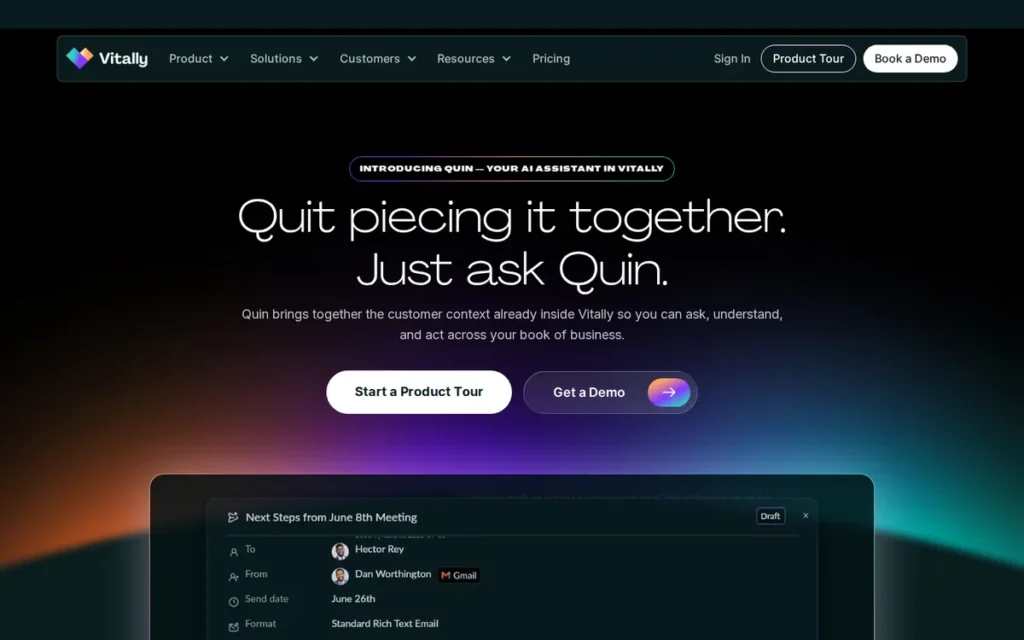
Category: Growth-Stage CS Platform, a modern, self-service customer success platform designed for fast implementation, high configurability, and strong outcome-to-effort ratio for scaling SaaS businesses that prioritize CSM autonomy over enterprise-tier analytics depth.
At a Glance
- Category: Growth-Stage CS Platform
- Best For: Growth-stage SaaS companies ($2M–$50M ARR) with 2–15 CSMs prioritizing rapid self-service deployment and documented outcome achievement over enterprise AI depth or native in-app messaging
- Price Range: Estimated $1,000–$1,500/month for baseline configurations; scales with ARR bands and seat counts; no public pricing; free trial proactively offered (May 2026, community-sourced estimate)
- Primary Strength: Vitally holds the highest G2 satisfaction rating among growth-stage CS platforms in this review (4.5/5 from 694 verified reviews) and is confirmed as G2’s #1 Momentum Leader in the Customer Success category (2025), with four consecutive G2 Best Results awards (2024–2025) based on user-reported ROI achievement
- Biggest Limitation: Vitally lacks native in-app messaging, requiring third-party tools such as Appcues or Pendo to deliver product adoption guidance within the customer’s application, adding cost and integration complexity for CS teams relying on in-app engagement as a core digital motion
- One-Line Summary: Vitally is the growth-stage CS platform with the highest G2 rating among growth-stage tools in this review (4.5/5, 694 reviews, G2 #1 Momentum Leader 2025) and four consecutive G2 Best Results awards (2024–2025), the strongest independently validated choice for SaaS teams ($2M–$50M ARR) prioritizing self-service deployment and documented ROI over enterprise AI depth.
- Last Verified: May 2026
Overview
Vitally is a modern Customer Success platform purpose-built for growth-stage SaaS companies ($2M–$50M ARR), rated 4.5/5 from 694 verified G2 reviews and confirmed as G2’s #1 Momentum Leader in the Customer Success category (2025), offering multi-factor health scoring with real-time updates, no-code automation with 7 trigger types and branching logic, role-based Hubs, built-in customer-facing Docs, ARR/NRR tracking, and native integrations with Salesforce, HubSpot, Zendesk, Slack, Recurly, Looker, and Gong.
Vitally is built to give individual-contributor CSMs a platform that reduces administrative overhead, with implementation timelines measured in hours-to-weeks rather than the months required by ChurnZero or Gainsight. Vitally has earned G2’s “Best Results” award for four consecutive quarters (2024–2025) based on user-reported ROI realization, with approximately $53M in total funding including a reported $40M Series B from Bessemer Venture Partners (2021; per community research synthesis, not independently verified through public filings as of May 2026).
Key Features
- Dynamic Multi-Factor Health Scores: Vitally’s health scores update in real-time based on any data change across connected CRM, billing, support, and product analytics sources, with configurable weighting and branching threshold logic that CSMs and CS Ops can modify without vendor support tickets, a self-service advantage over ChurnZero’s vendor-dependent Salesforce field mapping.
- No-Code Automation with Branching Logic: Vitally’s automation builder supports 7 trigger types and multi-step branching logic, enabling CS Ops to create conditional playbooks (such as triggering a Slack alert and creating a CSM task simultaneously when high-ARR accounts breach a health score threshold) without engineering resources.
- Built-in Customer-Facing Docs: Vitally’s Docs feature allows CSMs to create customer-facing success plans, QBR presentations, and onboarding guides directly within the platform with auto-populated account data and a shareable customer portal link, reducing tool-switching overhead that adds untracked administrative time in competing platforms.
- Role-Based Hubs: Vitally’s Hubs enable each team function: CS leadership, individual CSM, executive sponsors, to see a customized workspace showing the metrics, accounts, and tasks relevant to their specific role, reducing the dashboard clutter that makes enterprise CS tools feel overwhelming at the individual contributor level.
- Self-Service Integration Configuration: Vitally integrates natively with Salesforce, HubSpot, Zendesk, Slack, Recurly, Gong, and Looker, with integration field mappings confirmed as self-modifiable by a Series C company managing 1,000+ customer accounts with 8-figure managed ARR without vendor support tickets (u/osnap88, r/CustomerSuccess, 2026).
Best For
Vitally is best for growth-stage SaaS companies ($2M–$50M ARR) with 2–15 CSMs that need a modern, self-service CS platform they can deploy in hours-to-weeks and configure without vendor support tickets, and who have, or plan to designate, at least one CS Ops owner to maintain configuration quality as the team scales beyond 15 CSMs.
Pricing
Vitally does not publish pricing publicly as of May 2026. Third-party analysis and community accounts estimate starting prices at approximately $1,000–$1,500/month for baseline configurations, scaling with ARR bands and seat counts (community-sourced estimate, May 2026). Unlike most platforms in this review, Vitally proactively offers free trials, noted in multiple 2025–2026 r/CustomerSuccess evaluation threads as a meaningful differentiator over ChurnZero and Gainsight, which require demo-only sales cycles. Readers should confirm current pricing directly with Vitally.
Strengths
- G2 #1 Momentum Leader in Customer Success (2025) and Four Consecutive Best Results Awards: Vitally is confirmed as G2’s #1 Momentum Leader in the Customer Success category (2025, Vitally blog) alongside four consecutive G2 Best Results awards (2024–2025) (based specifically on user-reported outcome realization, goal achievement, and ROI) making Vitally the platform with the most directly published evidence of proportional outcome performance among growth-stage CS tools.
- Self-Service Configurability Confirmed at Scale: Vitally’s self-service field mapping and health score configuration is independently confirmed by a Series C SaaS CS manager running a 1,000+ customer portfolio with integrations spanning Zendesk, Salesforce, Recurly, Slack, Looker, and Gong, without vendor support tickets (u/osnap88, r/CustomerSuccess, 2026), a structural advantage over ChurnZero’s vendor-dependent Salesforce mapping.
- “Hours, Not Months” Implementation Velocity: Vitally’s implementation velocity is described as “hours, not months” (u/tomax83, r/CustomerSuccess, 2026) (the second-fastest deployment among feature-complete CS platforms in this review, after Custify’s days-long deployment) enabling growth-stage teams to reach value before internal sponsorship pressure builds.
- Free Trial Availability: Vitally proactively offers free trials: confirmed across multiple 2025–2026 r/CustomerSuccess evaluation threads, making Vitally one of only two platforms in this review (alongside Custify) where buyers can conduct hands-on evaluation before committing to a full sales cycle or annual contract.
This trial advantage is specifically documented by an active evaluator who compared Vitally head-to-head against ChurnZero on r/CustomerSuccess:
“Vitally – Proactively offered me a free trial. (CZ typically stays away from this, I asked, there was hesitation) Vitally has a good sales tactic. (whether this proves they are better product or not, TBD but loved they offered this much earlier in the sales cycle). Vitally provided a free trial period. We hastily plugged in our hubspot data to Vitally so there was some mismatched data however, we could very quickly envision what our day to day operations would look like. Feedback on their UI/UX is legit, its slick and fairly user friendly. With a little nudge from support, we created relevant and usable dashboards, workflows, surveys, health scoring etc.. IMO they appear to be better suited for leaner smaller startups, which fits us.” Posted by u/Far-Pop-4987
Takeaway: Vitally’s free trial and fast time-to-operational-clarity is a documented structural differentiator over ChurnZero for growth-stage teams that need to validate platform fit before committing to a full sales cycle.
Limitations
- No Native In-App Messaging: Vitally lacks native in-app messaging: unlike ChurnZero’s WalkThrough feature, Vitally cannot deliver product adoption guides or onboarding prompts within the customer’s application without third-party tools like Appcues or Pendo, adding per-seat subscription cost and integration complexity for CS teams relying on in-app engagement as a core digital motion (Vitally comparison documentation, May 2026).
- CS Ops Prerequisite at 15+ CSM Scale: Vitally’s value is conditionally dependent on designated CS Ops ownership, at approximately 15+ CSMs, the flexible “everyone updates everything” model begins generating data inconsistency: “Vitally is solid but once you’re at 15+ CSMs the ‘everyone updating everything’ thing just does not scale… You need some Ops resource dedicated to keep it running well” (u/wagwanbruv, r/CustomerSuccess, 2026).
- Flexibility Without Strategy Becomes a Liability: Vitally’s configurability can work against teams without a clear CS Ops strategy, without structured ownership, Vitally risks becoming “a glorified Google doc” rather than a revenue optimization engine (u/bizarro289, r/CustomerSuccess, 2026), a failure mode that reflects organizational readiness gaps buyers should plan to avoid before scaling.
- Limited Native AI Capability: Vitally does not offer a named suite of embedded AI agents comparable to ChurnZero’s 12+ agents or Gainsight’s Staircase AI, meaning Vitally users must rely on manual rule-based automations and third-party AI tools for churn prediction functions that ChurnZero performs natively, a gap the TSIA State of Customer Success 2026 identifies as increasingly significant as AI becomes a purchase threshold.
Verdict
Vitally is the strongest independent choice for growth-stage SaaS teams ($2M–$50M ARR) that need a modern, self-service CS platform deployable in hours-to-weeks without vendor support tickets, with the highest G2 rating among growth-stage platforms in this review (4.5/5 from 694 reviews), G2 #1 Momentum Leader recognition (2025), and four consecutive G2 Best Results awards (2024–2025) providing the most directly published evidence of proportional ROI achievement in the segment. Vitally’s self-service configurability is a documented structural advantage over ChurnZero for teams with evolving CRM schemas. Teams should plan for a designated CS Ops owner before scaling past 15 CSMs, and should budget for third-party in-app engagement tooling if product adoption guidance within the customer’s product is a required CS motion.
5. Planhat: Best for Data-Complex SaaS: Multi-Source Customer Intelligence for Multi-Product Businesses with Snowflake or Mixpanel Data
Category: Data-Centric CS Platform, a customer success platform built around a unified multi-source data model, designed for businesses managing product usage data across multiple products, data warehouses, and behavioral analytics systems requiring native Snowflake and Mixpanel integration.
At a Glance
- Category: Data-Centric CS Platform
- Best For: Multi-product SaaS companies ($10M–$500M ARR) with product usage data in Snowflake, Mixpanel, or multiple disparate systems, and a CS Ops function with technical depth to configure and maintain the platform’s data model
- Price Range: Estimated $75,000–$100,000+/year; no public pricing: requires sales engagement; described by multiple independent community accounts as “not cheap” relative to alternatives; no confirmed free trial (May 2026, community-sourced estimate)
- Primary Strength: Planhat provides native Snowflake and Mixpanel integration alongside a unified visual data model that aggregates CRM, billing, support, and multi-product usage data into a single timestamped customer record, the strongest multi-source data architecture in this review for organizations managing complex product portfolios; note that no aggregated G2 rating for Planhat is publicly confirmed as of May 2026
- Biggest Limitation: Planhat operates a “bring your own AI” model in a 2026 market where natively embedded AI agents are increasingly a purchase threshold, requiring organizations to source, integrate, and maintain third-party AI tools that ChurnZero and Gainsight provide natively
- One-Line Summary: Planhat is the data-centric customer success platform with the strongest multi-source product analytics integration in this review (including native Snowflake and Mixpanel connectivity) making it the defensible best choice for multi-product SaaS organizations whose customer health scores depend on usage data distributed across data warehouses and behavioral analytics systems.
- Last Verified: May 2026
Overview
Planhat is a Customer Success platform built around a unified visual data model that aggregates CRM, billing, support, product telemetry, and communications into a single timestamped customer record, designed specifically for organizations managing product usage data across multiple products, data warehouses, and behavioral analytics systems.
Planhat is headquartered in Stockholm, Sweden, and secured a $50M Series A led by Sprints Capital (per Planhat press release, planhat.com/press) after approximately seven years of bootstrapped development, demonstrating product-market fit before institutional capital investment. Planhat offers native Snowflake and Mixpanel integration out-of-box, Customer Portals for client-facing collaboration, Workflows 2.0 for email sequences and automation, and QBR builder functionality. No aggregated G2 rating for Planhat is publicly confirmed as of May 2026.
Key Features
- Native Snowflake and Mixpanel Integration: Planhat’s native Snowflake and Mixpanel connectors allow CS teams to ingest product usage data directly from data warehouses and behavioral analytics tools without custom middleware, enabling customer health scores that reflect actual multi-product usage patterns from the sources where that data lives (Planhat support documentation, May 2026).
- Customer Portals for Client-Facing Collaboration: Planhat’s Customer Portals create a shared interactive workspace where CS teams publish dashboards, renewal timelines, success plan progress, and account health data that customers can access and engage with directly, a client-facing collaboration feature not replicated natively in any other platform in this seven-platform review.
- Unified Timestamped Visual Data Model: Planhat’s data model timestamps every customer event, tracks the originating data source for each signal, and overlays usage trends onto commercial records, producing account records that Zapier’s independent CS tools evaluation (2025) describes as reading “like a single story rather than a collection of disconnectedfiles.”
- QBR and Presentation Builder: Planhat’s QBR builder auto-populates customer account data into shareable presentation templates, reducing the time CSMs spend on manual data assembly for quarterly reviews and enabling consistent cross-account QBR quality without individual heroic data-gathering efforts.
- Well-Documented API for Custom Integrations: Planhat’s API is independently described as “extremely well-documented” by technical practitioners on r/CustomerSuccess, enabling custom dashboard integrations with tools like Grafana and custom data pipeline connections for organizations with unique reporting infrastructure requirements.
Best For
Planhat is best for multi-product SaaS companies ($10M–$500M ARR) with product usage data distributed across Snowflake, Mixpanel, and multiple product databases, and with a dedicated CS Ops or RevOps function that has the technical depth to configure Planhat’s data model, maintain integration quality, and leverage its customization capabilities over time.
Pricing
Planhat does not publish pricing as of May 2026. Community accounts describe it as “not cheap” (u/Dekkars, r/CustomerSuccess), with third-party estimates placing pricing at $75,000–$100,000+/year for mid-to-enterprise configurations (community-sourced estimate, May 2026). Planhat’s pricing model is described in community discussions as platform-based at scale rather than purely per-user seat, a structural advantage for large teams. No free trial is confirmed as available. Readers should confirm current pricing and data residency terms directly with Planhat.
Strengths
- Largest Single-Account Scale Deployment Documented in This Review: Planhat successfully deployed across a portfolio of 20,000+ B2B SaaS clients for one customer (after head-to-head evaluation against Gainsight, Totango, ChurnZero, and others) expanding from an initial 1,500-account high-touch pilot to a full portfolio rollout over 2–3 years (u/dansf2000, r/CustomerSuccess, 2024), the strongest documented scale deployment evidence across any single customer account in this review.
- Only Native Snowflake + Mixpanel Integration in This Review: Planhat’s native data warehouse and behavioral analytics connectivity is confirmed in Planhat support documentation and independently validated by practitioners managing five-product portfolios with usage data distributed across multiple systems (u/Al_Goreskin, r/CustomerSuccess, 2026), the only platform in this review with confirmed native out-of-box connectors for both Snowflake and Mixpanel.
- EU-Based Data Infrastructure via Stockholm HQ: Planhat’s Stockholm headquarters provides EU-based data infrastructure, positioning Planhat as a strong consideration for enterprise deployments in EU-regulated industries where data sovereignty is a procurement disqualification criterion. Buyers in financial services or healthcare should confirm data residency terms directly with Planhat before purchasing.
- Independent Endorsement for Data Visibility: Zapier’s independent CS tools evaluation (2025) specifically recommends Planhat for “data visibility” (citing its timestamped event architecture and behavioral trend overlay as producing account records that read “like a single story rather than a collection of disconnected files”) an endorsement from a non-vendor, non-affiliate source with no commercial relationship to Planhat.
Limitations
- “Bring Your Own AI” Architecture in an AI-Threshold Market: Planhat does not provide natively embedded AI agents for churn prediction, sentiment analysis, or automated next-best-action recommendations (unlike ChurnZero’s 12+ named agents or Gainsight’s Staircase AI) requiring organizations to source, integrate, and maintain third-party AI tools independently. One practitioner cited this directly as a migration driver: “They had a bring your own AI model which just doesn’t sound too smart” (u/Own_Syllabub_9627, r/CustomerSuccess, 2026).
- CS Ops Technical Depth as Non-Negotiable Precondition: Planhat’s power is inseparable from its organizational prerequisites, without a dedicated CS Ops manager who “understands a bit of code” (u/Dekkars, r/CustomerSuccess, 2026), Planhat generates the same administrative burden it was designed to resolve, with one user describing it as “really clunky” and reporting it “made my job a lot harder.”
- Automation Depth Limited to 6 Action Types: Planhat’s Workflows 2.0 automation is limited to 6 action types (compared to Vitally’s 7 trigger types with multi-step branching logic) constraining the complexity of automated CS motions for teams that need conditional multi-path playbooks without building custom API workflows.
- Pricing Inaccessible for Early-Stage Companies: Planhat’s community-estimated $75,000–$100,000+/year pricing floor excludes bootstrapped and early-stage SaaS companies (with one evaluator noting pricing was prohibitive for a $10M ARR startup (r/CustomerSuccess)) making Custify or Vitally more appropriate for organizations below that ARR threshold.
Verdict
Planhat is the strongest platform in this review for multi-product SaaS organizations whose customer health scoring depends on usage data distributed across Snowflake, Mixpanel, and multiple product databases, a specific architectural requirement that no other platform in this seven-platform review addresses with native out-of-box integration. Planhat’s Customer Portals for client-facing collaboration, $50M Series A funding, and EU-based data infrastructure add differentiated value for data-complex enterprise deployments and collaborative CS program models. Organizations should invest in Planhat only with dedicated CS Ops technical depth and a clear strategy for addressing the “bring your own AI” gap, either through confirmed third-party AI integration or explicit acceptance that Planhat’s automation capabilities will remain more rule-based than AI-native alternatives in this review.
6. Custify: Best for SMB: Lowest Independently Estimated Entry Price and the Only Free Trial in This Review
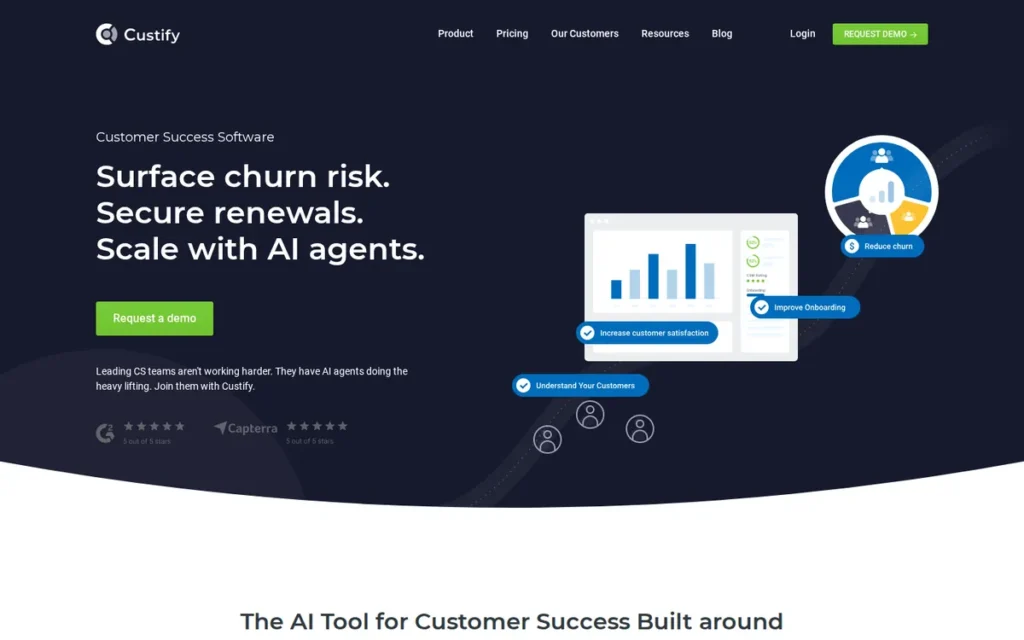
Category: SMB CS Optimizer, an accessible customer success platform for early-stage and growing SaaS businesses building their first structured CS program, with AI-powered churn risk analysis and the only free trial in this seven-platform review.
At a Glance
- Category: SMB CS Optimizer
- Best For: Early-stage and growing SaaS companies ($500K–$20M ARR) with 1–10 CSMs building their first formal customer success program and seeking fast deployment, AI-powered churn risk analysis, and a free trial before committing
- Price Range: ~$399/month estimated starting price (Oliv.ai third-party estimate, May 2026); Custify’s official pricing page (custify.com/pricing) requires a custom quote, no published pricing tiers; free trial available (May 2026)
- Primary Strength: Custify holds the highest Capterra satisfaction rating in this seven-platform review (4.9/5 from 122 verified reviews) and is the only platform in this review offering a free trial, enabling hands-on evaluation without a mandatory sales engagement cycle
- Biggest Limitation: Custify’s email reporting capability is limited to open rate tracking only, with no click-through rate or advanced email engagement analytics, a documented functional gap that constrains CS teams relying on email campaign performance data for digital health monitoring
- One-Line Summary: Custify is the SMB customer success platform with the highest Capterra satisfaction rating in this review (4.9/5, 122 reviews), the lowest independently estimated entry price (~$399/month), and the only free trial, making it the clearest accessible choice for SaaS companies ($500K–$20M ARR) building their first structured customer success program.
- Last Verified: May 2026
Overview
Custify is an SMB-first Customer Success platform headquartered in Bucharest, Romania, rated 4.9/5 from 122 verified Capterra reviews (Capterra, May 2026), offering real-time health scoring, lifecycle management, no-code visual playbook automation, churn and upsell alerts, NPS and CSAT surveys, in-app surveys, and CustifyAI (automated customer summaries, churn risk analysis, SWOT generation, and sentiment scoring).
Custify is purpose-designed for SaaS teams ($500K–$20M ARR) with 1–10 CSMs building or formalizing their first customer success program. Custify’s official pricing page (custify.com/pricing) requires a custom quote as of May 2026, the approximately $399/month starting price referenced in this review is a third-party estimate from Oliv.ai (May 2026), not a figure published on Custify’s official site. Deployment is measured in days, making Custify the fastest-deploying platform in this review.
Key Features
- Real-Time Health Scoring with No-Code Setup: Custify’s health scoring aggregates CRM, product telemetry, billing, and support signals into configurable health scores that automatically trigger churn alerts and upsell opportunity notifications, with no-code setup enabling teams without dedicated CS Ops resources to configure without engineering support.
- CustifyAI Suite Across All Tiers: Custify’s CustifyAI generates automated customer summaries, churn risk analyses, SWOT evaluations, and sentiment scores, providing SMB teams with AI-powered analytics capabilities at an estimated $399/month entry price, confirmed on Custify’s product page (May 2026).
- No-Code Visual Playbook Builder: Custify’s drag-and-drop playbook builder enables CS teams to create multi-step automated workflows triggered by health score thresholds, lifecycle stage changes, or behavioral events, with no technical configuration knowledge required from the building CSM.
- Native NPS, CSAT, and In-App Survey Tools: Custify includes native NPS, CSAT, and in-app survey tools without requiring a separate Delighted or SurveyMonkey subscription, capturing voice-of-customer data alongside CS health data in a single platform at the estimated SMB entry price tier.
- Technical Account Manager on All Plans: Custify provides a Technical Account Manager in addition to a Customer Success Manager on all plans, independently confirmed as superior to Vitally’s single onboarding Zoom call at a comparable evaluation price point: “The guys from Custify offered unlimited calls and they also offer a Technical AM, on top of the CSM” (u/VStrim, r/CustomerSuccess, 2026).
Best For
Custify is best for SaaS companies at $500K–$20M ARR with 1–10 CSMs that need to formalize their customer success program quickly at an accessible estimated cost (without committing to the weeks-to-months implementation timelines that mid-market platforms require) particularly companies where CRM data is still maturing and a simpler platform is more operationally appropriate than data-intensive tools like Planhat.
Pricing
Custify does not publish pricing on its official site as of May 2026, custify.com/pricing requires a custom quote submission. Third-party estimates suggest an approximate starting price of $399/month for entry-level configurations (Oliv.ai, May 2026); other third-party sources estimate ranges from $199 to $899/month, reflecting quote-based pricing variability. A free trial is available, making Custify the only platform in this review where buyers can conduct hands-on evaluation before entering a mandatory sales engagement cycle. Readers should confirm current pricing directly with Custify.
Strengths
- Highest Capterra Satisfaction Rating in This Review: Custify holds 4.9/5 from 122 verified Capterra reviews (Capterra, May 2026) (the highest aggregate satisfaction score in this seven-platform comparison) with independent community endorsements confirming that teams evaluating Custify alongside Gainsight, Vitally, and Catalyst selected Custify for superior feature-to-cost ratio at the SMB tier.
- Only Free Trial in This Seven-Platform Review: Custify’s free trial: confirmed across multiple 2025–2026 r/CustomerSuccess evaluation threads, is the only hands-on evaluation pathway in this review that does not require a mandatory sales engagement cycle, a structural differentiator specifically valued by SMB buyers evaluating multiple tools with limited procurement bandwidth.
- TAM + CSM Dual Support on All Plans: Custify’s Technical Account Manager plus Customer Success Manager support model on all plans was reported as superior to Vitally’s single onboarding Zoom call at a comparable evaluation price point (u/VStrim, r/CustomerSuccess, 2026), delivering both strategic CS guidance and hands-on technical configuration support without gating this model behind premium tier requirements.
Community members actively evaluating CS tooling for new programs on r/CustomerSuccess specifically called out Custify’s onboarding and dedicated support model as the deciding factor:
“As for recommendations, I’d personally go with Custify for most new CS teams. Their onboarding is what really sets them apart from the rest, and the dedicated CSMs are some of the best out there. Plus, recent AI updates have really been a game-changer for CSMs.” Posted by u/bogdanminute
Takeaway: For CS teams building their first structured program, Custify’s onboarding infrastructure and dedicated CSM support model consistently stand out as the deciding factors over competing SMB-tier platforms.
- AI-Powered Churn Risk at Estimated SMB Price Points: Custify’s CustifyAI suite (including automated churn risk analysis, customer summaries, SWOT generation, and sentiment scoring (Custify product page, May 2026)) delivers AI-driven CS analytics at an estimated $399/month entry price, making AI-powered churn intelligence accessible at a price point where most competing platforms offer only rule-based health scoring.
Limitations
- Pricing Not Published on Official Site: Custify’s official pricing page (custify.com/pricing) requires a custom quote submission as of May 2026, the approximately $399/month starting estimate in this review is sourced from Oliv.ai third-party analysis, not Custify’s official pricing page. Buyers must request a custom quote to confirm current pricing, which eliminates the full pricing transparency that community discussions sometimes attribute to Custify.
- Email Reporting Limited to Open Rates Only: Custify tracks only email open rates, with no click-through rate or advanced email engagement analytics available (confirmed by u/NicoleC5, r/CustomerSuccess, 2026), a functional gap that constrains CS-led digital engagement programs relying on email performance optimization for health monitoring.
- Feature Ceiling at ~1,000 Accounts: Custify’s SMB-first design targets teams managing up to approximately 500–1,000 customer accounts with 1–10 CSMs, community accounts confirm Custify does not scale smoothly into complex multi-product account hierarchies, advanced cohort analytics, or enterprise-grade NRR forecasting that ChurnZero, Vitally, and Planhat address more completely.
- Scale Ceiling Migration Cost Risk: Teams at the boundary of Custify’s scale ceiling ($15M–$25M ARR, 8–12 CSMs) should assess their 12-month growth trajectory before committing, a platform migration triggered by outgrowing Custify typically carries 3–6 months of productivity disruption cost that may exceed the savings realized from Custify’s entry-tier estimated pricing.
Verdict
Custify is the strongest choice for SaaS companies ($500K–$20M ARR) that need to build a formal CS program quickly at an accessible estimated price, with the highest Capterra satisfaction rating in this review (4.9/5 from 122 reviews), the only free trial in this category, the fastest deployment timeline (days), and AI-powered churn risk analysis across all plan tiers. Custify delivers more accessible value-per-dollar in the SMB segment than any comparable platform in this review. Teams should assess their 12-month growth trajectory before committing, organizations approaching $20M ARR with rapidly expanding portfolios may need to begin evaluating ChurnZero or Vitally before Custify’s initial investment has been fully recovered.
7. Totango: Best for Modular Adoption: Pre-Built SuccessBLOC Templates for Mid-Market CS Program Rollout with Salesforce-Native Integration
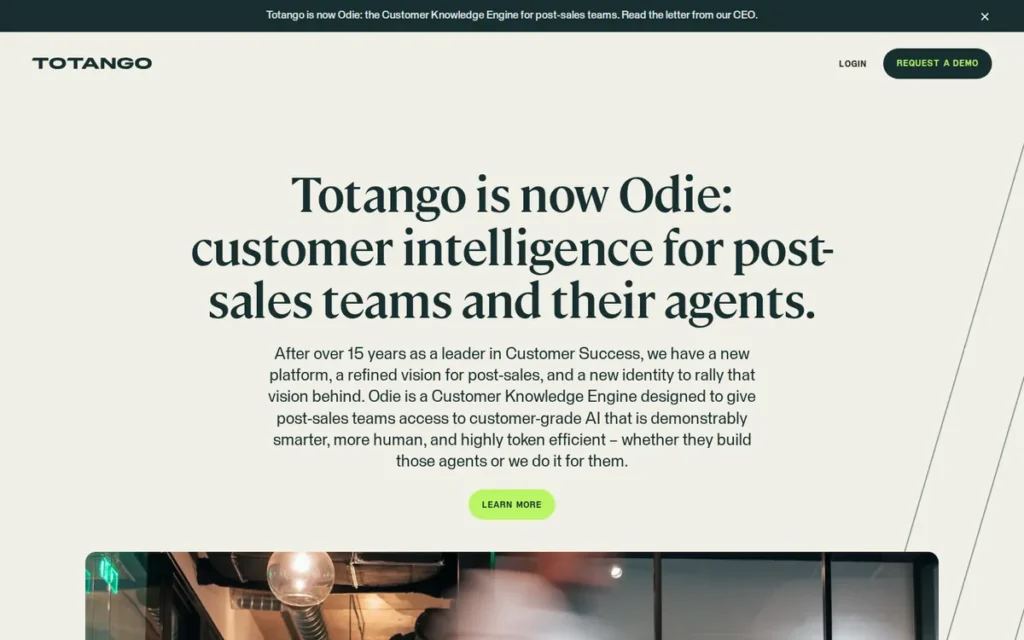
Category: Modular CS Platform, a customer success platform built around pre-configured, best-practice SuccessBLOC modules that accelerate CS program deployment for mid-market teams by providing ready-to-deploy templates for each phase of the customer lifecycle.
At a Glance
- Category: Modular CS Platform
- Best For: Mid-market SaaS companies ($5M–$100M ARR) seeking faster CS program rollout through pre-built modular templates, particularly those with Salesforce-centric tech stacks who benefit from Totango’s post-merger integration depth
- Price Range: Estimated $75,000–$100,000+/year; no public pricing: requires sales engagement; historical free starter tier discontinued per 2024–2025 community accounts (May 2026, community-sourced estimate)
- Primary Strength: Totango’s SuccessBLOC modular architecture provides pre-built templates for each CS program phase (Onboarding, Adoption, Risk Detection, Renewals, and Upsell) reducing implementation risk and timeline by enabling CS teams to deploy best-practice configurations without building from blank fields
- Biggest Limitation: Totango’s 2025–2026 community accounts from current users document consistent development roadmap concerns, platform glitches at scale, and feature depth limitations compared to ChurnZero and Vitally, with multiple practitioners citing these as active migration drivers, not historical complaints about resolved issues
- One-Line Summary: Totango is a modular customer success platform whose pre-built SuccessBLOC templates reduce CS program deployment risk and timeline, but whose 2025–2026 community accounts document active roadmap concerns and feature depth limitations that have driven documented user migrations to ChurnZero and Vitally.
- Last Verified: May 2026
Overview
Totango is one of the earliest purpose-built Customer Success platforms (founded approximately 2010), offering a modular SuccessBLOC architecture designed to reduce CS program deployment risk and timeline, targeting mid-market SaaS teams ($5M–$100M ARR) with pre-built templates for Onboarding, Adoption, Renewals, Upsell, and Risk Detection.
Totango’s February 2024 merger with Catalyst (a merger of equals with no money changing hands, per Totango press release and TechCrunch, February 28, 2024) expanded its Salesforce-native workflow depth. Totango separately acquired technology and team from Parative AI in 2024 to add an AI-driven Churn Intelligence capability (Totango press release, 2024). Totango’s Viewer Seat licensing enables company-wide customer health visibility without multiplying per-seat costs. Prospective buyers should weigh 2025–2026 community accounts documenting development roadmap concerns and active migration patterns before making a multi-year platform commitment.
Key Features
- SuccessBLOC Modular Templates: Totango’s SuccessBLOC pre-configured templates provide Onboarding, Adoption, Risk Detection, Renewals, and Upsell workflows, each embedding best-practice KPIs, customer segments, health score thresholds, playbooks, and automation rules that CS teams can deploy and customize without starting from blank configuration screens (451 Alliance Research; Totango platform documentation).
- Viewer Seat Cross-Functional Access Licensing: Totango’s Viewer Seat licensing provides read-only access to health dashboards, account health summaries, and portfolio KPIs for executive, product, and finance stakeholders, enabling company-wide customer health visibility without adding full CS platform licensing costs for non-CS team members (451 Alliance Research).
- Post-Catalyst-Merger Salesforce Integration: Totango’s February 2024 merger with Catalyst (per Totango press release, TechCrunch, February 28, 2024) supports bidirectional data sync between Totango’s CS workflows and Salesforce CRM, enabling CS teams to operate health scoring and playbooks within a Salesforce-centric tech stack without requiring separate synchronization middleware.
- Mixed High-Touch and Tech-Touch Portfolio Management: Totango supports simultaneous high-touch managed account management and tech-touch digital engagement within the same platform, enabling CS teams managing a mixed portfolio of enterprise accounts and long-tail SMB customers to apply differentiated engagement strategies without operating separate systems.
- 4–8 Week Implementation Timeline: Totango’s modular SuccessBLOC architecture enables a vendor-stated 4–8 week implementation timeline (451 Alliance Research analysis), positioned between Vitally’s hours-to-weeks deployment and ChurnZero’s approximately 1.5–3 month average, enabling faster time-to-value than enterprise platforms while providing more configuration depth than SMB-tier tools.
Best For
Totango is best for mid-market SaaS companies ($5M–$100M ARR) seeking to accelerate CS program rollout through pre-built SuccessBLOC templates (particularly those with Salesforce-centric tech stacks) and who have evaluated the 2025–2026 community evidence about platform roadmap trajectory and concluded that the current feature set meets their near-term requirements without requiring significant platform evolution.
Pricing
Totango does not publish pricing as of May 2026. Third-party analysis estimates pricing at $75,000–$100,000+/year for enterprise deployments with setup fees (community-sourced estimate, May 2026). Totango’s historical free starter tier (which had enabled low-risk SMB evaluation) was discontinued in 2024–2025 per multiple r/CustomerSuccess community accounts. All evaluations now require sales engagement. Buyers should confirm current pricing structure and SuccessBLOC licensing model directly with Totango.
Strengths
- SuccessBLOC Architecture Reduces Implementation Risk: Totango’s modular architecture is independently validated by 451 Alliance Research as reducing implementation risk and time-to-live compared to blank-canvas enterprise CS platforms, with a documented 4–8 week deployment timeline that eliminates the 12–24 week implementation barrier Gainsight imposes on comparable mid-market deployments, enabling faster internal value demonstration.
- Viewer Seat Licensing for Cross-Functional Visibility: Totango’s Viewer Seat licensing (451 Alliance Research) enables executives, product teams, and finance leaders to access customer health data with read-only licenses, preventing customer health intelligence from being siloed within the CS team and supporting cross-functional retention-led growth coordination without multiplying platform licensing costs.
- Post-Merger Salesforce-Native Integration Depth: Totango’s February 2024 merger with Catalyst (per Totango press release, TechCrunch, February 28, 2024) expanded its Salesforce-native integration by combining Totango’s modular SuccessBLOC architecture with Catalyst’s established Salesforce-embedded workflow expertise, providing a stronger Salesforce integration story for CS teams operating within Salesforce-centric revenue operations environments.
- Parative AI Churn Intelligence Addition (2024): Totango acquired technology and team from Parative AI in 2024 (Totango press release, 2024) to add an AI-driven Churn Intelligence capability, partially addressing the native AI depth gap relative to ChurnZero’s 12+ agents, though the maturity and depth of this addition relative to established AI suites warrants direct verification with Totango before purchase.
Limitations
- Active 2025–2026 Community Reports of Roadmap Concerns: Totango’s most consequential trade-off is the gap between its architectural concept and current-state platform trajectory, current users in 2025–2026 (not historical critics of a legacy version) document active development roadmap concerns and platform glitches at scale: “We are leaving Totango because we have concerns about their development roadmap, lots of glitches, and it’s not evolving as our business is scaling” (u/Recent_Weekend_7666, r/CustomerSuccess, 2026).
- Feature Depth Trails Mid-Market Competitors: Totango consistently underperforms for teams requiring highly customized analytics or complex multi-product hierarchy management, one independent evaluator conducting a structured competitive assessment reported Totango “came dead last in most features” (u/trachtmanconsulting, r/CustomerSuccess), a pattern consistent with G2 comparison data showing ChurnZero outperforming Totango on advanced analytics and workflow support.
- Limited Native AI Capability Relative to Peers: Totango’s AI capability: even after the 2024 Parative AI technology acquisition, is limited compared to ChurnZero’s 12+ natively embedded agents and Gainsight’s Staircase AI, in a 2026 market where the TSIA State of Customer Success (2026) identifies native AI as a purchase threshold rather than a differentiator.
- Historical Free Starter Tier Discontinued: Totango’s previously available free starter tier (which had enabled low-risk SMB evaluation) was discontinued in 2024–2025 per multiple r/CustomerSuccess community accounts, requiring all prospective buyers to commit to a sales cycle before assessing hands-on platform fit and removing the trial-before-purchase option that both Vitally and Custify offer.
Verdict
Totango is a modular CS platform with a genuine architectural advantage in SuccessBLOC-accelerated deployment and Viewer Seat cross-functional visibility, but prospective buyers must weigh the 2025–2026 community evidence of active roadmap concerns and feature depth limitations before committing to a multi-year platform investment in a category where migration carries 3–6 months of productivity disruption cost. Totango’s strongest case is for mid-market Salesforce-centric teams that need pre-built CS program templates and are evaluating at a company scale where ChurnZero’s advanced AI depth and Vitally’s self-service configurability are not yet required. Buyers for whom platform AI capability and long-term roadmap confidence are high-priority selection criteria should evaluate ChurnZero or Vitally as primary alternatives before committing to Totango.
What Red Flags Should I Watch For When Evaluating Customer Revenue Optimization Software?
Every health score, churn prediction, and upsell alert in this review depends on the same upstream precondition: clean, connected, consistently maintained CRM and product telemetry data. A platform that solves the wrong problem (or arrives before the data infrastructure can support it) is not a good purchase at any price point. Four red flags consistently differentiate successful CRO deployments from expensive failures in 2026 practitioner community data.
Red Flag #1: Pricing Opacity Used as a Standard Sales Practice
Six of seven platforms in this review require a mandatory sales conversation before revealing any pricing, forcing buyers into multi-week sales cycles before basic budget viability can be assessed. The estimated price range in this category spans from approximately $399/month (Custify, third-party estimate) to $500,000+ ACV (Clari), a 250x+ spread that is entirely invisible without independent research.
Treat pricing opacity as a structural friction cost: build time for at least 3–4 parallel sales cycles into your evaluation timeline. Use Custify’s approximately $399/month independently estimated entry as a calibration anchor before entering conversations with platforms that require full discovery before quoting. The most expensive customer success platform is not the one with the highest license fee, it is the one deployed before the organization has the data infrastructure to make it work.
Red Flag #2: Implementation Timeline Underestimation
Vendor-stated implementation timelines consistently understate community-reported deployment reality. Gainsight’s vendor documentation suggests 12–24 weeks, but community accounts document year-long implementations for enterprise deployments.
ChurnZero’s approximately 1.5–3 month timeline is faster but still meaningfully longer than Vitally’s hours-to-weeks or Custify’s days. A platform you cannot deploy before internal executive sponsorship pressure builds will be terminated before ROI is realized. Always confirm community-reported timelines (not just vendor marketing claims) before committing.
Red Flag #3: AI Marketing Without Named Embedded Agents
Platforms that describe themselves as “AI-powered” without naming specific embedded agents, their documented functions, and the data sources they operate on should be treated as “bring your own AI” architectures until proven otherwise.
Planhat’s “bring your own AI” model is explicitly acknowledged by community practitioners (r/CustomerSuccess, 2026). Totango’s AI claims lack specific named agents in independent validation prior to its 2024 Parative AI acquisition, and that acquisition’s depth relative to peers warrants direct verification. Contrast both with ChurnZero’s 12+ named agents confirmed on ChurnZero’s AI Features Page (May 2026): Harbinger, Beacon, Echo, R. Scribe. The distinction between named embedded agents and generic AI marketing determines whether AI will be available at deployment or require separate post-purchase integration work.
Red Flag #4: Organizational Readiness Assumptions
Every platform in this review is only as good as the data pipelines feeding it. An evaluation process that assesses platform features without assessing CRM data quality, product telemetry availability, and CS Ops staffing capacity will produce a deployment mismatch, the platform’s capabilities far exceeding the organization’s ability to leverage them.
Confirm data infrastructure readiness (clean CRM, connected product analytics, available integration pathways) before signing any contract. Platforms like Clari and ChurnZero that depend on high-quality CRM data for AI accuracy will fail to deliver their documented outcomes in organizations with inconsistent activity logging, regardless of how robust the platform itself may be.
What Questions Should I Ask Before Choosing a Customer Revenue Optimization Platform?
Four questions consistently separate informed platform selections from costly mismatches, covering primary revenue friction, CRM data quality, CS Ops staffing, and implementation runway. Answering each before entering any vendor sales cycle reduces the risk of purchasing a platform mismatched to your organizational maturity and data infrastructure.
Question #1: What Is Our Primary Revenue Friction Right Now?
Identifying your single most acute revenue problem determines which platform category is appropriate before any feature comparison begins. Churn and upsell problems point toward CS Intelligence Suites (ChurnZero, Gainsight, Vitally, Custify); pipeline forecasting and renewal management problems point toward Revenue Orchestration (Clari); data complexity problems point toward Planhat; modular template needs point toward Totango.
A platform that solves the wrong problem at a competitive price is not a good purchase.
Question #2: What Is Our Current CRM Data Quality?
Every platform in this review depends on CRM data as a foundational input, and platforms like Clari (AI forecasting) and ChurnZero (AI health scoring) are most sensitive to data inconsistency. Conduct a CRM audit before platform evaluation: assess contact record completeness, product telemetry connectivity, billing system integration, and activity log consistency.
If your CRM has significant data quality gaps, Custify’s simpler data model and Vitally’s flexible configuration are more forgiving starting points than Planhat’s data-warehouse-first architecture or Clari’s RevDB precision requirements.
Question #3: Do We Have or Will We Hire a Dedicated CS Ops Function?
Gainsight requires a full-time dedicated administrator (r/CustomerSuccess, 2026). Planhat requires CS Ops with technical depth to configure its data model. Vitally becomes data-inconsistent at 15+ CSMs without a designated Ops owner. Only Custify and Totango (for smaller deployments) are designed to function without dedicated CS Ops at early stages.
Calculate the full-time-equivalent staffing cost required for each platform’s sustainable operation (not just the license fee) before making any budget comparison.
Question #4: What Is Our Realistic Implementation Runway?
The time your organization can sustain executive sponsorship before demanding measurable results determines which implementation timeline is viable. If your runway is 30 days, Custify (days to deploy) is the only platform that fits. If it is 3 months, Vitally or ChurnZero are candidates. If it is 6 months or more with a dedicated implementation team, Gainsight and Clari are accessible.
Treat the community-reported implementation timeline as the conservative planning assumption, never the vendor’s optimistic estimate.
How Did We Rank These Customer Revenue Optimization Platforms?
These seven platforms were ranked by scoring each against six objective criteria derived from independent research across G2, Capterra, Reddit practitioner forums, analyst reports, and vendor documentation, with no input from any vendor and no commercial relationship influencing the methodology or outcome.
Evidence Confidence Key
Three confidence levels apply throughout this article:
- Confirmed: Corroborated by two or more independent sources
- Community-Sourced Estimate: Sourced from practitioner forums and third-party analysis without vendor confirmation, labeled with source and date
- Vendor-Reported: From vendor materials only: flagged explicitly throughout
Evaluation Process
Research proceeded in three stages:
Stage 1, Product Discovery: Identifying the seven most actively discussed Customer Revenue Optimization platforms in 2025–2026 practitioner forums (r/CustomerSuccess, r/SalesOperations), cross-referenced against G2 category leaders and analyst-covered vendors.
Stage 2, Multi-Source Parallel Research: Querying AI-assisted web research tools for profiles, pricing, features, and market positioning, then independently conducting Reddit sentiment analysis across practitioner evaluation threads.
Stage 3, Cross-Validation: Reconciling vendor claims against community-reported deployment realities, flagging discrepancies between marketing timelines and practitioner-documented timelines, and weighting community evidence over vendor marketing claims where conflicts existed.
Ranking Criteria
Primary Criteria (weighted highest):
- Review Platform Ratings and Verified Volume: G2 and Capterra scores cross-referenced with verified review volume; both rating and volume matter because a 4.7/5 from 120 reviewers carries different statistical confidence than 4.6/5 from 1,200 reviewers
- Feature Completeness for Revenue Optimization Use Cases: breadth and depth across health scoring, AI churn prediction, upsell automation, pipeline forecasting, renewal management, and in-app engagement; generic CRM features did not qualify
- Community Validation and Practitioner Sentiment: qualitative synthesis of r/CustomerSuccess and r/SalesOperations threads, weighted toward accounts with multi-company deployment experience; migration stories treated as higher-signal than static satisfaction accounts
Secondary Criteria:
- Native AI Capability Depth: whether AI is genuinely embedded (named agents with specific documented functions) versus modular add-on versus “bring your own AI”; per TSIA State of Customer Success 2026, native AI is a purchase threshold
- Implementation Speed and Time-to-Value: vendor-stated timelines cross-referenced with community-reported timelines; where discrepancies existed, community-reported timelines were used as the primary figure
- Pricing Accessibility: estimated minimum annual cost with explicit confidence indicators; lower estimated pricing floor and free trial access yields higher criterion score
Evidence Weighting
When review platform ratings conflicted with Reddit sentiment, specificity and recency determined which source received higher weight. A detailed 2026 Reddit post from a practitioner with multi-company deployment experience outweighed a generic 2023 G2 review with no operational context. Vendor-reported statistics are labeled as such throughout, only claims corroborated by at least one independent source are stated as fact without qualification.
Data Validation
Vendor-reported outcome metrics (ChurnZero’s aggregate performance claims, Clari’s 78% data quality improvement figure) are labeled as marketing claims or self-reported research throughout the article. Every cited statistic includes a year and named source. Pricing figures sourced from community accounts are labeled “community-sourced estimate” with the date of verification.
Update Cadence
This article was researched and written in May 2026. PlugRoute updates category rankings when substantive pricing changes, platform acquisitions, or AI capability updates are independently confirmed. Readers should verify current pricing directly with each vendor, as pricing in this category changes without public announcement.
Independence Statement
PlugRoute has no affiliate relationships with any company listed in this review. Rankings are determined entirely by research data, community validation, and objective evaluation criteria. No company paid for placement, received advance notice of their ranking, or had editorial input into this content.
Frequently Asked Questions
What is the best customer revenue optimization software for SaaS in 2026?
ChurnZero leads for mid-market SaaS teams ($5M–$100M ARR) with the highest G2 rating in this review (4.7/5, 1,558+ reviews, G2 2026 Best Software Award) and the largest natively embedded AI agent suite. Gainsight leads for enterprise organizations ($50M+ ARR). Custify is the most accessible starting point, with the only free trial in this review and an independently estimated entry price of approximately $399/month (Oliv.ai, May 2026).
How much does customer success software cost in 2026?
Customer success software costs range from approximately $399/month estimated entry (Custify, Oliv.ai third-party estimate, May 2026) to $500,000+ annual contract minimum (Clari, third-party analysis), a 250x+ spread hidden behind sales cycles for all seven platforms. Every platform in this review requires a custom quote to confirm current pricing. Custify’s estimated entry is the only independently quantified low-end reference point available without a mandatory sales conversation.
How does PlugRoute determine its software rankings?
PlugRoute ranks software using six objective criteria weighted by primary and secondary importance: G2/Capterra ratings and verified review volume; feature completeness for the specific use case; native AI capability depth; implementation speed and time-to-value; pricing accessibility; and community validation from practitioner forums. No company pays for placement or receives advance notice of its ranking. Rankings are fully verifiable against the evidence cited in each entry.
What Do the Key Terms in This Customer Revenue Optimization Comparison Mean?
The following terms appear throughout this article and are defined here for independent reference. Each definition is written to stand alone without surrounding context.
Health Score: A composite, configurable metric generated by Customer Success platforms that aggregates signals from CRM activity, product usage, support ticket volume, NPS responses, and billing data to represent the overall condition of a customer account, used to identify churn risk and expansion opportunities before they become visible through manual CSM review alone.
SuccessBLOC: Totango’s proprietary modular template architecture, pre-built Customer Success program components (Onboarding, Adoption, Risk Detection, Renewals, Upsell) that embed best-practice KPIs, health score configurations, customer segments, and automation playbooks, enabling CS teams to deploy structured programs without building configurations from blank fields.
Revenue Orchestration: The practice of managing the full revenue lifecycle (from initial pipeline creation through deal closure, post-sale adoption, renewal, and expansion) within a single connected platform rather than across separate sales, CS, and RevOps tools. Clari uses this term to describe its positioning as the only platform in this review that spans both pre-sale and post-sale revenue management in a unified data architecture.
Net Revenue Retention (NRR): The percentage of recurring revenue retained from existing customers over a given period after accounting for churn, downgrades, and upsell or expansion revenue. An NRR above 100% indicates that expansion revenue from existing customers exceeds lost revenue from churn and contraction, the primary metric that Customer Revenue Optimization platforms are designed to improve.
In-App Messaging: A CS engagement capability that delivers product adoption guides, onboarding prompts, NPS surveys, and feature announcements directly within a customer’s product interface without requiring email outreach. ChurnZero’s WalkThrough is the only native in-app messaging feature among the seven platforms in this review; Vitally, Totango, and Planhat require third-party tools (Appcues, Pendo) to replicate this capability.
Glossary: Key Terms Used in This Comparison
Health Score: A composite, configurable metric generated by Customer Success platforms that aggregates signals from CRM activity, product usage, support ticket volume, NPS responses, and billing data to represent the overall condition of a customer account. It is used to identify churn risk and expansion opportunities before they become visible through manual CSM review alone.
SuccessBLOC: Totango’s proprietary modular template architecture consisting of pre-built Customer Success program components (including Onboarding, Adoption, Risk Detection, Renewals, and Upsell) that embed best-practice KPIs, health score configurations, and automation playbooks. These templates enable CS teams to deploy structured programs without building configurations from blank fields.
Revenue Orchestration: The practice of managing the full revenue lifecycle (from initial pipeline creation through deal closure, post-sale adoption, renewal, and expansion) within a single connected platform rather than across separate sales, CS, and RevOps tools. Clari is the only platform in this review that spans both pre-sale and post-sale revenue management in a unified data architecture using this approach.
Net Revenue Retention (NRR): The percentage of recurring revenue retained from existing customers over a given period after accounting for churn, downgrades, and upsell or expansion revenue. An NRR above 100% indicates that expansion revenue from existing customers exceeds lost revenue from churn and contraction, the primary metric that Customer Revenue Optimization platforms are designed to improve.
In-App Messaging: A CS engagement capability that delivers product adoption guides, onboarding prompts, NPS surveys, and feature announcements directly within a customer’s product interface without requiring email outreach. ChurnZero’s WalkThrough is the only native in-app messaging feature among the seven platforms in this review; Vitally, Totango, and Planhat require third-party tools such as Appcues or Pendo to replicate this capability.
Which Customer Revenue Optimization Platform Is Right for You?
The right CRO platform is determined by ARR stage, data infrastructure maturity, CS Ops capacity, and the specific revenue friction you need to solve, not by feature marketing or analyst quadrants alone.
Key Insights
- ChurnZero is the highest-rated platform in this seven-platform review (4.7/5 G2, 1,558+ reviews, G2 2026 Best Software Award, Gartner MQ Leader 2025), with 12+ natively embedded AI agents and the only native WalkThrough in-app messaging at mid-market scale, making it the most AI-complete CS platform accessible below enterprise pricing for SaaS teams between $5M and $100M ARR.
- Gainsight is the enterprise CS leader for $50M+ ARR organizations with dedicated CS Ops (holding Forrester Wave Q1 2024 and Gartner Magic Quadrant Leader recognition) but its estimated $100,000+/year pricing plus required dedicated administrator ($100,000–$150,000/year headcount) makes it accessible only to organizations with established CS infrastructure.
- Clari is the only platform in this review spanning pre-sale pipeline forecasting and post-sale renewal management in a single architecture, uniquely serving the enterprise RevOps use case at an estimated $500,000+ minimum ACV that restricts it to organizations with 50+ reps, dedicated RevOps functions, and enterprise-tier CRM data hygiene.
- Vitally holds the highest G2 satisfaction rating among growth-stage CS platforms in this review (4.5/5, 694 reviews, G2 #1 Momentum Leader 2025) with four consecutive G2 Best Results awards, the strongest choice for $2M–$50M ARR SaaS teams prioritizing self-service configuration and rapid deployment over enterprise AI depth.
- Planhat is the only platform in this review with native out-of-box Snowflake and Mixpanel integration, the defensible best choice for multi-product SaaS organizations ($10M–$500M ARR) whose health scores depend on usage data distributed across data warehouses, and the only platform in this review with a $50M Series A from Sprints Capital validating its enterprise data architecture.
- Custify holds the highest Capterra satisfaction rating in this review (4.9/5, 122 reviews) and offers the only free trial in this category, making it the clearest accessible choice for SaaS companies ($500K–$20M ARR) formalizing their first CS program, with an independently estimated entry price of approximately $399/month and deployment measured in days.
- Totango offers the most accessible modular deployment path for mid-market Salesforce-centric teams through SuccessBLOC pre-built templates, but prospective buyers must treat 2025–2026 community accounts documenting active roadmap concerns and feature depth limitations as material information before committing to a multi-year contract.
If your primary challenge is churn prevention with AI automation and in-app engagement at mid-market scale, ChurnZero is the strongest evidence-based choice. If you need executive-grade revenue forecasting accuracy across both pipeline and renewals at enterprise scale, Clari is the only platform purpose-built for that use case. If you need to deploy a formal CS program this quarter without a mandatory sales cycle, Custify is the only platform with a free trial and an independently estimated accessible price point.
The platforms that will compound in value through 2030 are those with the data infrastructure to learn from each customer interaction and the AI architecture to act on that learning without human intervention. Evaluate platforms on their data model depth and native AI architecture, not their current feature checklist alone.
We update this guide quarterly. Last updated: May 2026. Check PlugRoute for updates when platform pricing, AI capabilities, or ownership structures change materially.