Last Updated: May 2026
ContractSafe is the best overall contract management software for SMB and mid-market teams in 2026, with published flat-rate pricing from $450/month and the category’s highest G2 satisfaction rating. Agiloft leads for enterprise teams as a six-time Gartner Magic Quadrant Leader (2020–2025). Ironclad excels in workflow automation depth. Rankings reflect documented implementation success, review data, and pricing transparency, not vendor marketing.
Most CLM comparison content is affiliate-driven or AI-generated without implementation failure context, real pricing data, or material corporate developments. KKR’s 2024 majority investment in Agiloft and Ironclad’s 2024 launch of its own competing eSignature product make most existing comparisons structurally outdated. For buyers on their second CLM evaluation after a failed deployment, the implementation track record data in this article is more predictive of success than any feature list.
PlugRoute has no affiliate relationships with any company listed, and rankings are determined entirely by research data and objective evaluation criteria.
This evaluation analyzed 24 research queries across G2, Capterra, Gartner, Forrester, and five Reddit practitioner communities (r/legaltech, r/Lawyertalk, r/salesforce, r/procurement, and r/ITManagers) to surface implementation reality data that vendor-generated content cannot provide.
As one practitioner on r/Lawyertalk described:
“One thing that jumps to mind is that Google Drive doesn’t track termination dates or give reminders for renewal/termination deadlines. Imagine my face when I worked in medical research and found that the researchers were individually using Excel to keep track of all their deadlines (including for grants).” Posted by u/Latter-Reference-458
Takeaway: The universal CLM adoption trigger is not AI ambition, it is the operational crisis of missed deadlines and invisible renewal windows that no spreadsheet or shared drive can reliably prevent.
TL;DR: Top Picks at a Glance
- ContractSafe is the highest-rated SMB/mid-market CLM platform, offering published flat-rate pricing from $450/month with unlimited users on all tiers.
- Agiloft is a six-time Gartner Magic Quadrant Leader (2020–2025) for enterprise no-code workflow configurability, backed by KKR’s 2024 majority stake investment.
- Ironclad delivers the most consistently praised workflow automation depth in independent practitioner evaluations, deployed at enterprise clients including L’Oréal, Dropbox, OpenAI, and Cisco.
- ContractWorks provides flat-rate operational CLM starting at $600/month with unlimited users, having managed 13+ million contracts across 96 countries as of January 2022.
What Are the Different Types of Contract Management Software?
The three main CLM categories are Operational CLM (ContractSafe, ContractWorks), Enterprise Full-Lifecycle CLM (Agiloft, Ironclad, DocuSign CLM), and Ecosystem-Specialized CLM (Icertis, Conga CLM). Identifying which category fits your organization size and tech stack is the most reliable filter before comparing individual platforms.
At 50 users, flat-rate Operational CLM costs roughly 70% less than per-seat Enterprise CLM, the most consequential pricing model distinction in this evaluation.
Operational CLM, Fast-Deploy, Flat-Rate Platforms
Operational CLM platforms (ContractSafe (#1) and ContractWorks (#4)) serve SMB and mid-market organizations needing a functional contract repository, renewal alerts, and AI-powered search deployed within days, not months.
Both offer flat-rate unlimited-user pricing that eliminates per-seat cost scaling risk. A 50-person team at a flat-rate $600/month pays $12/user/month; the same team at $40/user enterprise per-seat pays $2,000/month. The flat-rate break-even point is approximately 15 users.
Enterprise Full-Lifecycle CLM, Complex Workflow Platforms
Enterprise Full-Lifecycle CLM platforms (Agiloft (#2), Ironclad (#3), and DocuSign CLM (#5)) serve organizations with 200+ employees requiring sophisticated multi-department approval workflows, AI-assisted contract negotiation, and enterprise integrations.
All three require dedicated CLM administrators and multi-month implementation timelines. Agiloft and DocuSign are the only two platforms among these three confirmed as 2025 Gartner Magic Quadrant Leaders alongside Sirion.
Ecosystem-Specialized CLM, Platform-Specific Intelligence
Ecosystem-Specialized CLM platforms (Icertis (#6) and Conga CLM (#7)) are purpose-built for specific enterprise ecosystems.
Icertis targets Fortune 500 organizations running SAP Ariba or Microsoft Azure at global procurement scale. Conga CLM targets Salesforce-centric revenue operations teams where contracts must exist as native CRM objects within the Salesforce data model.
How Do the Top 7 Contract Management Platforms Compare at a Glance?
The seven top CLM platforms split across three tiers: Operational CLM (ContractSafe, ContractWorks) for fast deployment at published flat-rate pricing; Enterprise CLM (Agiloft, Ironclad, DocuSign CLM) for complex multi-department workflows; and Ecosystem-Specialized CLM (Icertis, Conga CLM) for SAP/Microsoft or Salesforce-native operations. KKR’s 2024 majority investment in Agiloft and Ironclad’s 2024 launch of its own competing eSignature product make most existing comparisons outdated.
| Rank | Company | Category | Best For | One-Line Summary | Key Capabilities | Primary Strength | Key Limitation |
|---|---|---|---|---|---|---|---|
| #1 | ContractSafe | Repository & Renewal CLM | SMB/mid-market replacing spreadsheets | ContractSafe is the highest-rated SMB/mid-market CLM with published flat-rate pricing from $450/month, unlimited users, and no documented implementation failures in practitioner communities as of May 2026. | AI search, OCR, renewal alerts, AI data extraction, AI chat, approval workflows, eSignature integration | Highest G2 rating (~4.7–4.9/5); only platform with three fully published pricing tiers | No enterprise-grade AI negotiation; limited multi-department workflow complexity |
| #2 | Agiloft | Full-Lifecycle No-Code CLM | Enterprise legal/procurement requiring no-code configurability and analyst validation | Agiloft is one of three platforms named Gartner Magic Quadrant Leaders in the 2025 CLM evaluation; alongside DocuSign and Sirion; with the deepest no-code enterprise workflow configurability in this comparison. | No-code workflow builder, ConvoAI, GenAI Prompt Lab, 1,000+ connectors, obligation management, Screens.AI redlining | Gartner MQ Leader 2020–2025; Forrester Wave Leader Q4 2024; G2 4.7/5 (1,200+ reviews) | Polarizing post-demo implementation experience; dated UI; custom pricing (~$50K–$500K+/year) |
| #3 | Ironclad | Workflow-First CLM | Mid-market/enterprise legal ops with high-volume commercial contracting | Ironclad is a workflow-first enterprise CLM platform known for its drag-and-drop workflow builder, deployed at L’Oréal, Dropbox, OpenAI, and Cisco; an independent company that in 2024 launched Ironclad Signature to compete directly with DocuSign. | Drag-and-drop workflow builder, AI Assist (GPT-4), centralized repository, Salesforce integration, Ironclad Signature (native eSign 2024) | Most consistently praised CLM workflow builder in independent practitioner evaluations; deployed at L’Oréal, Dropbox, OpenAI, Cisco | AI legacy import ~50–60% documented accuracy; ~$10K Salesforce API add-on; opaque enterprise pricing |
| #4 | ContractWorks | Repository & Operations CLM | Mid-market legal, ops, and IT teams needing flat-rate pricing | ContractWorks is a mid-market CLM with flat-rate unlimited-user pricing from $600/month, having managed 13+ million contracts across 96 countries as of January 2022. | AI auto-tagging, OCR search, built-in eSignature on all plans, conditional workflows, SOC 2 Type 2 | Flat-rate $600/month unlimited users; 13M+ contracts managed across 96 countries (January 2022); built-in eSign | Absent from Gartner/Forrester evaluations; limited enterprise workflow depth |
| #5 | DocuSign CLM | eSign-Integrated CLM | Enterprise orgs already running DocuSign eSignature enterprise-wide | DocuSign CLM is the enterprise eSign-integrated CLM for existing DocuSign customers, offering 900+ connectors, Gartner Magic Quadrant Leader recognition (2024–2025), and Iris AI; with documented community feedback that CLM UX underperforms its eSignature brand. | Iris AI, 900+ connectors, Salesforce/SAP/Dynamics 365, CLM Essentials and CLM+ tiers, Lexion acquisition (2024) | 900+ pre-built connectors; $2.98B FY2025 parent revenue; Gartner MQ Leader 2024–2025 | Dated, fragmented CLM UX; add-on cost creep (SSO, sandbox, API, envelopes); acquisition-built product coherence gaps |
| #6 | Icertis | AI-Native Contract Intelligence | Fortune 500 enterprises on SAP/Microsoft ecosystems | Icertis serves 33% of the Fortune 100 using a proprietary contract data lake Icertis reports at 17M+ contracts; and carries the highest documented implementation risk in this evaluation, requiring exhaustive partner vetting before commitment. | Vera AI (Azure OpenAI), proprietary contract data lake (vendor-reported), SAP Ariba co-brand, 40+ languages, Microsoft 365/Salesforce/Workday | 33% Fortune 100 adoption; SAP Ariba co-branded integration; highest Forrester Wave AI strategy scores (Q4 2024) | Most extensively documented implementation failure record in this evaluation; 3-year non-functional deployment on public record; fully outsourced implementations |
| #7 | Conga CLM | Salesforce-Native Revenue CLM | Enterprise Salesforce-centric revenue ops with Conga CPQ; only with certified implementation expertise | Conga CLM processes 7M+ agreements annually as native Salesforce CRM objects; best for Conga CPQ-integrated revenue ops with certified expertise, and the highest expertise-dependency and implementation risk in this evaluation without it. | Native Salesforce objects, CPQ integration, AI clause library, parallel approvals, collaborative redlining | Only native Salesforce CRM object CLM in this comparison; 7M+ agreements/year; 45% faster processing with Conga CPQ (vendor-reported) | Highest community-documented implementation failure rate; post-Apttus quality deterioration; multi-product bundle dependency |
Which CLM Platform Should I Choose for My Use Case?
| Your #1 Priority | Recommended Tool | Why | Acceptable Alternative |
|---|---|---|---|
| Start this week, under 50 employees | ContractSafe | Published $450/month, unlimited users, 30-min setup, no sales call needed | ContractWorks ($600/month flat-rate) |
| Flat-rate pricing, 50–500 employees | ContractWorks | $600/month unlimited users, AI auto-tagging, built-in eSign, 13M+ contracts deployed (Jan 2022) | ContractSafe (lower starting price) |
| Enterprise workflow automation + Salesforce | Ironclad | Most consistently praised workflow builder in independent practitioner evaluations; independent platform, direct DocuSign competitor | Agiloft (broader no-code configurability) |
| Enterprise + Gartner/Forrester validation required | Agiloft | Gartner MQ Leader 2020–2025; Forrester Wave Leader Q4 2024; KKR-backed AI roadmap | DocuSign CLM (also Gartner MQ Leader 2024–2025) |
| Already running DocuSign eSign enterprise-wide | DocuSign CLM | Single-vendor consolidation; 900+ connectors; Lexion acquisition (2024) enhancing workflow depth | Agiloft (if pure CLM depth outweighs eSign integration) |
| Fortune 500 on SAP or Microsoft ecosystems | Icertis | Only CLM with SAP Ariba co-brand; 33% Fortune 100; requires exhaustive implementation partner vetting | Agiloft (if SAP-specific integration not required) |
| Salesforce-native revenue ops + Conga CPQ with certified Conga expertise | Conga CLM | Only native Salesforce CRM object CLM in this comparison | Ironclad (Salesforce-integrated, not native; safer without Conga expertise) |
1. ContractSafe: Best Overall: Best for SMB and Mid-Market Teams Prioritizing Immediate Time-to-Value and Pricing Transparency
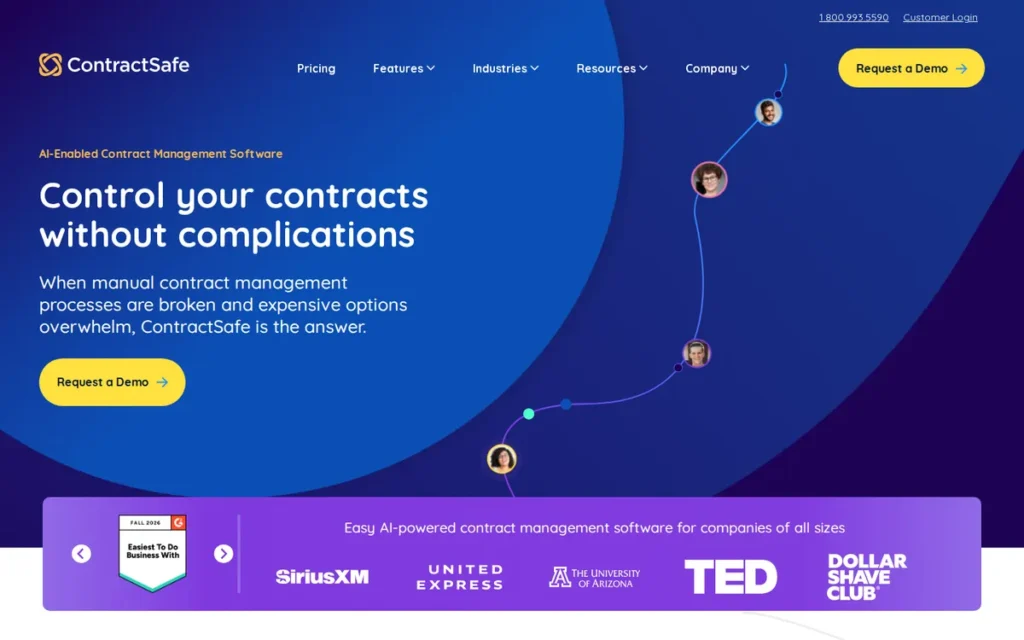
Category: Repository & Renewal CLM, a contract management platform optimized for centralized storage, AI-powered search, automated renewal alerts, and streamlined approval workflows for SMB and mid-market teams.
At a Glance
- Category: Repository & Renewal CLM
- Best For: SMB and mid-market teams (5–500 employees) replacing spreadsheets and shared drives
- Price Range: $450–$815+/month flat-rate, unlimited users; three fully published tiers (May 2026)
- Primary Strength: Highest G2 satisfaction rating (~4.7–4.9/5) in the category, combined with three published pricing tiers from $450/month with unlimited users on all plans
- Biggest Limitation: No enterprise-grade AI redlining, advanced clause library management, or complex multi-department workflow depth
- One-Line Summary: ContractSafe is the highest-rated SMB and mid-market CLM with published flat-rate pricing from $450/month, unlimited users, AI-powered search and renewal alerts, and no publicly recorded implementation failures across practitioner communities as of May 2026.
- Last Verified: May 2026
Overview
ContractSafe is a cloud-based contract management platform designed for small businesses and mid-market legal, operations, and procurement teams (5–500 employees) that need to eliminate spreadsheet-based contract tracking and gain immediate visibility into renewals, obligations, and contract terms.
ContractSafe was built by a former General Counsel (CEO Ken Button) who experienced contract chaos firsthand, a design origin that prioritizes usability, transparent pricing, and rapid time-to-value over enterprise configurability.
ContractSafe publishes three tiers with flat-rate unlimited-user pricing (verified May 2026): Organize ($450/month) includes AI search, OCR, reminders, AI data extraction, and AI chat; Finalize (from $660/month) adds Microsoft Word integration, approval workflows, and eSignature; Maximize (from $815/month) adds advanced workflows and full CLM lifecycle management. This is the most transparent pricing model in this 7-platform comparison, all five enterprise platforms require a sales call before disclosing any pricing.
ContractSafe received a $27.5 million growth investment from Five Elms Capital in January 2023 after seven years of bootstrapped operation (PRNewswire, January 2023).
ContractSafe holds the highest user satisfaction rating among all platforms in this evaluation, approximately 4.7–4.9/5 on G2 (estimated; ~100+ reviews as of May 2026), with no documented implementation failures found in practitioner communities as of May 2026.
Key Features
- AI-Powered Full-Text Search with OCR: ContractSafe provides Google-like full-text search with OCR enhancement, making every word in every contract (including scanned documents) instantly retrievable and directly eliminating the “where did we file that?” problem that drives most SMB CLM purchases.
- AI Contract Review and Automatic Extraction: ContractSafe’s AI review engine automatically extracts key terms, effective dates, party names, and obligations from uploaded contracts, reducing the manual metadata entry investment when onboarding new agreements into the repository.
- Contract-Specific AI Chat: ContractSafe includes a natural-language AI chat interface that allows users to query any individual contract, for example, asking “What is the termination notice period?”, and receive direct answers without manually searching document text.
- Automated Renewal Alerts and Deadline Calendars: ContractSafe delivers automated expiration notifications, obligation milestone alerts, and filterable deadline calendars that prevent the missed auto-renewal problem identified as the primary CLM adoption trigger across practitioner communities on r/legaltech and r/procurement (May 2026).
- Conditional Approval Workflows and eSignature Integration: ContractSafe provides structured pre-signature approval routing, intake forms, and Microsoft Word integration on Finalize and Maximize tiers (with DocuSign eSignature integration) enabling governance for growing teams without enterprise-level configuration complexity.
Best For
ContractSafe is best for small legal teams (1–5 attorneys), operations managers, and procurement professionals at organizations with 5–500 employees who need to move from spreadsheet or shared-drive contract management to a searchable, AI-assisted repository with reliable renewal alerts, deployable within a business day.
Strengths
- ContractSafe holds the highest user satisfaction rating among all platforms in this evaluation: G2 approximately 4.7–4.9/5 (estimated; ~100+ reviews as of May 2026), representing the strongest positive sentiment ratio in the SMB and mid-market CLM tier, verified across multiple independent sources.
- ContractSafe received a $27.5 million growth investment from Five Elms Capital in January 2023 after seven years of bootstrapped, profitable operation, with funding earmarked for product development and team expansion, as reported in the PRNewswire press release (January 2023).
- ContractSafe’s founders bring direct practitioner credibility: CEO Ken Button is a former General Counsel with 20+ years of legal leadership, and President Randy Bishop is a Harvard Business School Baker Scholar and co-founder of Verengo Solar, which reached $100M+ in annual revenue, as documented on the ContractSafe founders page (May 2026).
- ContractSafe generated no documented contract terminations, deployment abandonments, or negative implementation case studies across r/legaltech, r/Lawyertalk, r/procurement, and r/ITManagers research as of May 2026, a meaningful differentiation from platforms with named multi-year deployment failures on public record, though absence from community research reflects research findings, not a universal performance guarantee.
“Active contracts in our CLM (ContractSafe), Aged/dormant contracts in offsite digital archive (Iron Mountain). Total storage costs dropped ~40%.” (u/Queasy-Cherry7764, r/procurement, 2025)
Takeaway: ContractSafe is deployed in production as a cost-optimized active CLM layer, not exclusively by pure SMBs. This tiered approach (active CLM + archiving) demonstrates a practical, budget-conscious deployment strategy applicable at larger organizations.
Limitations
- Feature Depth Trade-Off: ContractSafe is purpose-built for contract repository, search, and renewal management, the platform does not offer AI-powered redlining, advanced clause library management, multi-party negotiation workflows, or enterprise-scale obligation analytics available in platforms like Agiloft or Icertis. Organizations with 500+ employees processing complex multi-jurisdiction contracts will likely outgrow the Maximize tier.
Users on r/legaltech noted:
“We trialed ContractSafe earlier this year – their pricing is on its website. It’s a good repository, but what we really needed was a CLM, and ContractSafe wasn’t enough to handle our complex contracts. So now we’re evaluating Ironclad.” Posted by u/iownakeytar
Takeaway: ContractSafe consistently delivers on its repository promise, but teams with multi-party, multi-document complexity reliably outgrow it and migrate to enterprise CLMs, confirming the platform’s self-described feature ceiling is real and not a marketing caveat.
- No Analyst Recognition: ContractSafe is absent from Gartner Magic Quadrant and Forrester Wave CLM evaluations, not a quality signal for its SMB/mid-market target audience, but a relevant procurement checkpoint for enterprise buyers whose internal approval processes require analyst validation before vendor selection.
- Workflow Complexity Ceiling and Relational Architecture Limits: ContractSafe’s approval workflows are functional for standard routing but lack the conditional complexity of Ironclad or Agiloft. A commercial real estate professional specifically questioned whether ContractSafe could handle hierarchical contract relationships (MSA records linked to specific property records) suggesting a structural limitation for parent-child agreement use cases (u/adamcowley, r/CommercialRealEstate, 2025).
Verdict
ContractSafe is the highest-rated contract management platform in the SMB and mid-market CLM category, combining published flat-rate pricing from $450/month with unlimited users, AI-powered search and renewal alerts, and a documented 30-minute setup time, supported by the absence of any publicly recorded implementation failures in practitioner communities as of May 2026. In a category defined by demo-to-reality gaps and multi-year deployment failures, ContractSafe’s documented community track record is its most meaningful competitive differentiator. Enterprise organizations requiring complex multi-department workflows, AI contract negotiation, or Fortune 500-scale contract intelligence should evaluate Agiloft, Ironclad, or Icertis instead.
2. Agiloft: Best for Enterprise Legal and Procurement Teams Requiring Deep No-Code Configurability and Analyst Validation
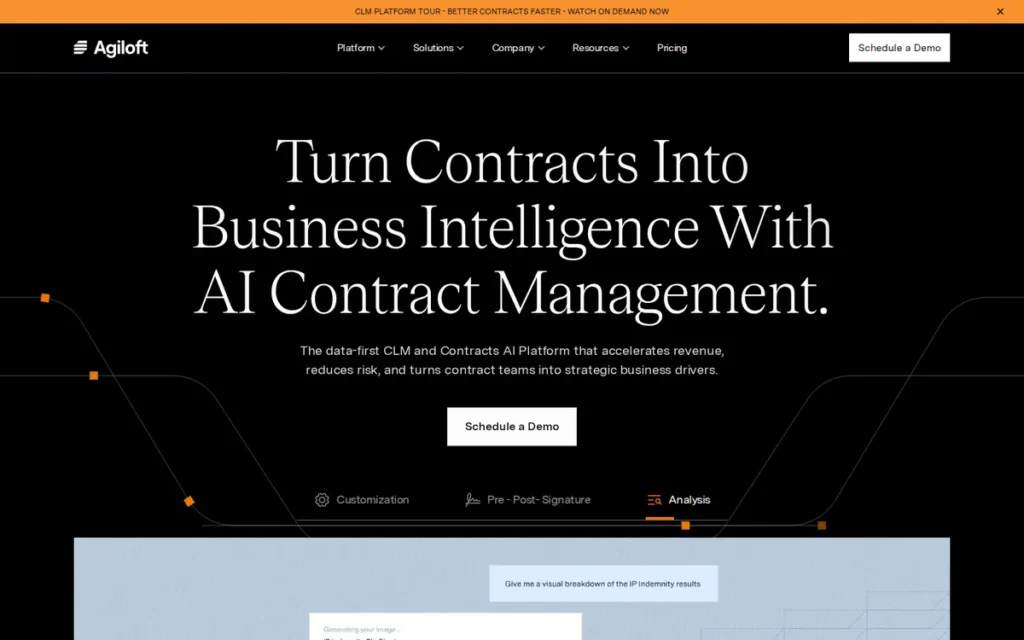
Category: Full-Lifecycle No-Code CLM, an enterprise contract management platform covering every stage of the contract lifecycle with workflow configurability that requires no software engineering resources to build or maintain.
At a Glance
- Category: Full-Lifecycle No-Code CLM
- Best For: Enterprise legal ops and procurement teams (200+ employees) needing deep no-code workflow configuration and Gartner/Forrester analyst validation
- Price Range: Custom enterprise only; estimated $50,000–$500,000+/year; no public pricing as of May 2026
- Primary Strength: Six consecutive Gartner Magic Quadrant Leader designations (2020–2025) and the deepest no-code enterprise workflow configurability in this comparison set
- Biggest Limitation: Polarizing post-demo implementation experience; dated UI; fully opaque custom pricing requiring dedicated CLM administrators
- One-Line Summary: Agiloft is one of three platforms named Gartner Magic Quadrant Leaders in the 2025 CLM evaluation (alongside DocuSign and Sirion) with the highest no-code configurability depth in this comparison, backed by KKR’s 2024 majority stake investment and a January 2025 Screens.AI acquisition targeting AI redlining.
- Last Verified: May 2026
Overview
Agiloft is an enterprise-grade, full-lifecycle contract management platform positioning itself as a “Data-first Agreement Platform” with an “AI Your Way™” approach, meaning AI is configurable and embedded throughout the contract lifecycle rather than pre-packaged. Agiloft targets legal operations directors, procurement leads, and CLO teams at organizations with 200+ employees requiring deep no-code configurability and the budget, dedicated CLM administrators, and change management capacity to unlock it in production.
Agiloft earned Gartner Magic Quadrant Leader status for six consecutive years (2020–2025), including the highest ability-to-execute designation in the 2025 report, one of only three platforms (alongside DocuSign and Sirion) recognized as Leaders in the 2025 CLM evaluation (Agiloft, 2025).
KKR acquired a majority stake in Agiloft in July 2024, subsequently enabling the acquisition of Screens.AI in January 2025 to address a previously identified AI redlining gap (Enterprise Times, January 2025).
Custom enterprise pricing is estimated at $50,000–$500,000+/year depending on user count, modules, and implementation scope (HyperStart pricing analysis, 2025). Implementation services (which Agiloft’s own marketing acknowledges as essential) add significant cost beyond license fees.
Key Features
- No-Code Drag-and-Drop Workflow Builder: Agiloft’s workflow builder enables enterprise legal ops teams to configure multi-stage, multi-party approval chains with conditional logic, escalation rules, and role-based access controls without engaging IT or software developers, the platform’s most consistently cited competitive differentiator across independent enterprise CLM evaluations.
- ConvoAI and GenAI Prompt Lab: Agiloft provides ConvoAI for natural-language queries against contract portfolios and a GenAI Prompt Lab for generative AI tasks, enabling legal teams to ask plain-English questions about agreement portfolios and generate AI-assisted clause drafts without leaving the platform.
- Enterprise Obligation Management: Agiloft’s obligation management engine extracts, tracks, and alerts on contractual obligations across the full agreement portfolio, a vendor-published testimonial from an unnamed Fortune 500 manufacturer attributed $2M in prevented obligation leakage to this capability (vendor-reported, client not publicly identified; PRNewswire, 2025).
- 1,000+ Pre-Built Connectors: Agiloft offers 1,000+ pre-built connectors for Salesforce, Microsoft 365, SAP, Workday, and hundreds of additional enterprise applications, enabling bidirectional contract data flow between the CLM and the systems of record that legal and procurement teams already use daily.
- Screens.AI Redlining Capability: Agiloft’s January 2025 acquisition of Screens.AI adds AI-powered contract redlining directly within the platform, addressing a previously identified competitive gap and targeting organizations that require AI-assisted negotiation as a core CLM capability going forward (Enterprise Times, January 2025).
Best For
Agiloft is best for enterprise legal operations and procurement teams at organizations with 200–10,000+ employees that have complex, cross-departmental contracting processes requiring deep no-code configurability, and the budget ($50,000–$500,000+/year), dedicated CLM administrators, and change management capacity for a 3–6 month enterprise implementation project.
Strengths
- Agiloft is one of three platforms named Gartner Magic Quadrant Leaders in the 2025 CLM evaluation: alongside DocuSign and Sirion, having maintained Leader status for six consecutive years (2020–2025), including the highest ability-to-execute score in the 2025 report (Gartner Magic Quadrant for Contract Life Cycle Management, 2025).
- Agiloft earned Forrester Wave Leader recognition in Q4 2024, scoring 4.8/5 overall for AI innovation and integration depth, independently confirming both AI capability direction and enterprise deployment track record from a second major analyst firm (Forrester Wave: Contract Lifecycle Management, Q4 2024).
- Agiloft holds the highest combined enterprise review corpus in this evaluation: G2 4.7/5 with 1,200+ reviews and Capterra 4.6/5 with 950+ reviews as of May 2026, the broadest independent user satisfaction dataset for any enterprise CLM platform in this comparison.
- KKR’s 2024 majority stake investment and the January 2025 Screens.AI acquisition directly address the platform’s previously identified AI redlining gap, practitioner community commentary noting “after KKR has bought Agiloft, they have invested a lot in AI” signals a funded roadmap that buyers evaluating current limitations should weigh against near-term improvement trajectory (u/CombHeavy3699, r/legaltech, 2025).
Limitations
- Demo-to-Reality Gap: Agiloft’s most consequential trade-off is the persistent disconnect between its polished demo experience and post-implementation reality, multiple Reddit practitioners with direct deployment experience describe slow platform performance, a UI characterized as “from early 2000s,” and roadmap features years behind schedule.
“Agiloft is god awful… I found it slow, development was years behind their roadmap, and implementation was painful. We had no idea what we were doing and they provided so little guidance.” (u/sethjk17, r/Lawyertalk, 2025)
Takeaway: Agiloft’s real-world implementation experience is polarized, it delivers for technically resourced teams with dedicated CLM administrators, but consistently underperforms for organizations without that internal capacity, regardless of the demo experience.
- “No-Code” Requires Significant Organizational Effort: Agiloft’s “no-code” marketing does not mean low-effort implementation, enterprises consistently report 3–6 month implementation timelines requiring dedicated CLM administrators, and organizations without that investment tend to experience significant adoption challenges despite the no-code configuration interface.
- Fully Opaque Pricing: Agiloft’s custom-only pricing (estimated $50,000–$500,000+/year) with no published tiers (combined with additional implementation services costs) makes true total cost of ownership difficult to assess before deep sales engagement, a documented frustration for procurement teams that prefer to self-qualify.
- Evaluate the Current Product, Not the Roadmap: Agiloft’s KKR investment and Screens.AI acquisition signal meaningful AI improvements ahead, but buyers should evaluate the current production product against near-term requirements and conduct exhaustive reference checks with named existing customers before committing.
Verdict
Agiloft is one of three platforms named Gartner Magic Quadrant Leaders in the 2025 CLM evaluation, alongside DocuSign and Sirion, holding six consecutive Leader designations (2020–2025) and the strongest combined enterprise review corpus in this comparison, making it the defensible choice for enterprise procurement teams requiring analyst validation and deep no-code workflow configurability. Agiloft’s documented implementation challenges, dated UI, and fully opaque pricing require buyers to budget for 3–6 month implementation timelines with dedicated CLM administrators, conduct exhaustive reference checks with named existing customers, and evaluate the current production product, not the KKR-backed roadmap, against near-term requirements.
3. Ironclad: Best for Mid-Market and Enterprise Legal Ops Teams Prioritizing Workflow Automation Depth
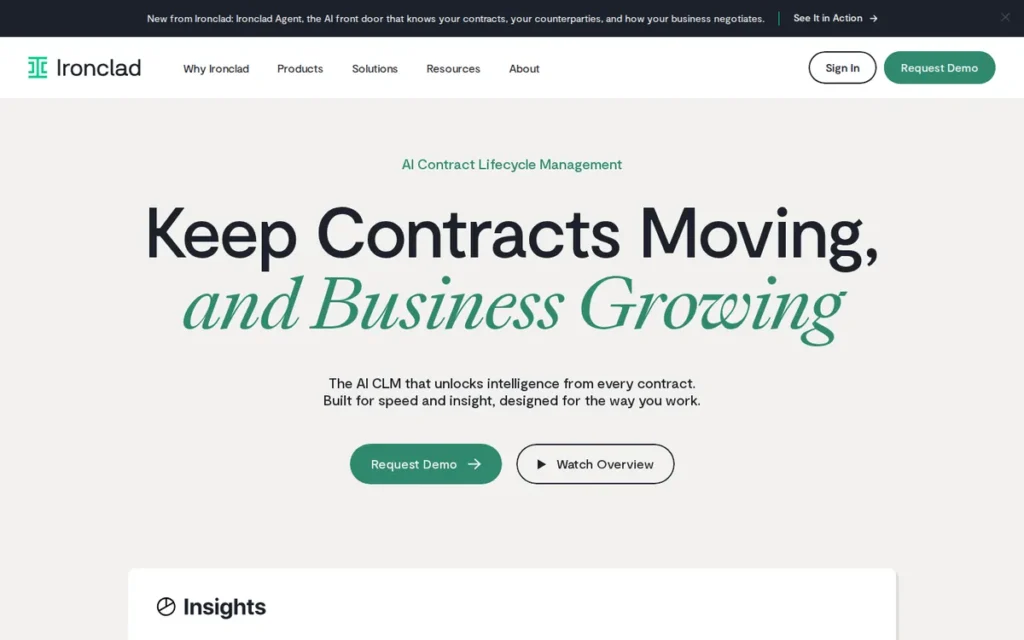
Category: Workflow-First CLM, a contract management platform whose primary competitive differentiator is a drag-and-drop workflow builder enabling legal ops teams to automate complex multi-party approval chains without software engineering resources.
At a Glance
- Category: Workflow-First CLM
- Best For: Mid-market to enterprise legal ops teams (100–5,000 employees) with high-volume commercial contracting across sales and procurement
- Price Range: Custom enterprise pricing; Salesforce API add-on ~$10,000/year additional; third-party implementation fees additional (May 2026)
- Primary Strength: Drag-and-drop workflow builder rated as the most consistently praised CLM workflow tool in independent practitioner evaluations, deployed at L’Oréal, Dropbox, OpenAI, and Cisco
- Biggest Limitation: AI legacy import accuracy ~50–60% documented in practitioner testing; ~$10K Salesforce API add-on; opaque total cost of ownership
- One-Line Summary: Ironclad is an enterprise CLM platform best known for its drag-and-drop workflow builder deployed at L’Oréal, Dropbox, OpenAI, and Cisco, an independent company that in 2024 launched Ironclad Signature to compete directly with DocuSign in the eSignature market.
- Last Verified: May 2026
Overview
Ironclad is a full-lifecycle enterprise CLM platform founded in 2014 in San Francisco, best known for its drag-and-drop workflow builder that enables legal ops teams to automate complex multi-party approval chains without software engineering resources.
Ironclad is an independent company (not a DocuSign product) and in 2024 launched Ironclad Signature, its own native eSignature product designed to compete directly with DocuSign and Adobe Sign, making the two platforms direct full-stack competitors rather than complementary tools.
Ironclad targets mid-market to enterprise organizations (100–5,000+ employees) with high-velocity commercial contracting needs and counts L’Oréal, Dropbox, Fitbit, Reddit, OpenAI, and Cisco among its documented enterprise customers (Ironclad homepage, May 2026).
Buyers who have encountered comparison content describing Ironclad as part of DocuSign or the DocuSign IAM platform should be aware: this is a misconception. Ironclad and DocuSign CLM are direct competing CLM platforms as of May 2026.
Key Features
- Drag-and-Drop Workflow Builder: Ironclad’s workflow builder enables legal operations teams to model complex multi-department, multi-party contract approval chains with conditional logic, parallel approvals, and role-based permissions without writing code, the most frequently praised CLM capability across independent practitioner reviews, consistently characterized as the strongest in the category (HyperStart, 2025).
- Ironclad AI Assist (GPT-4): Ironclad AI Assist provides in-platform AI-assisted contract drafting, redlining suggestions, and clause recommendations during negotiation, positioned as reducing manual legal review time, though legacy contract extraction accuracy is documented at approximately 50–60% in practitioner testing (r/legaltech, 2024–2025).
- Centralized OCR-Enhanced Repository: Ironclad provides a searchable repository with AI-assisted metadata tagging, version control with tracked changes, and eSignature integration for end-to-end contract lifecycle management from initial request through final archive.
- Salesforce Integration (API Add-On): Ironclad integrates with Salesforce to enable one-click contract generation from Opportunity records, the Salesforce API connection is independently reported at approximately $10,000 additional annual cost (u/DungeonCrawlerBob, r/legaltech, 2025).
- Ironclad Signature, Native eSignature Product: Ironclad launched Ironclad Signature in 2024, its own native eSignature product, creating a full-stack CLM-plus-eSign platform that no longer requires a separate eSignature vendor and positions Ironclad as a direct DocuSign competitor across the entire contract lifecycle.
Best For
Ironclad is best for mid-market and enterprise legal operations teams (100–5,000 employees) that process high volumes of commercial contracts, need sophisticated multi-party approval routing across multiple business lines, and have the resources (dedicated legal ops administrators, implementation budget, and Salesforce infrastructure) to realize the workflow builder’s full potential without relying on AI extraction as the primary use case.
Strengths
- Ironclad’s enterprise customer portfolio: including L’Oréal, Dropbox, Fitbit, Reddit, OpenAI, and Cisco, provides independently verifiable evidence of production-scale enterprise CLM deployment across technology, consumer goods, and media sectors, as listed on the Ironclad homepage (May 2026).
- A five-year Ironclad customer documented implementing 50+ workflows with Salesforce and PowerPlatform integrations across multiple business lines without paid implementation services, demonstrating genuine self-service feasibility for technically capable legal ops teams (u/kikogeruk, r/legaltech, 2025).
- Ironclad launched Ironclad Signature in 2024: its own native eSignature product competing directly with DocuSign, creating a full-stack independent CLM platform and confirming Ironclad’s strategic direction as a DocuSign competitor rather than a DocuSign integration partner.
- Ironclad holds recognized Gartner and Forrester CLM evaluation positions (most recent year of Ironclad’s confirmed Gartner Magic Quadrant recognition was not independently verified in May 2026 research), with SOC 2 Type II, ISO 27001/27017/27018, GDPR, and HIPAA compliance certifications supporting enterprise security requirements.
Limitations
- AI Extraction Accuracy Gap: Ironclad’s most consequential trade-off is the documented gap between AI marketing claims and real-world extraction accuracy, practitioner-reported AI legacy import accuracy runs at approximately 50–60% in sandbox and production evaluations, and at least one buyer terminated their Ironclad contract after purchasing specifically on the basis of AI-extraction capabilities that were “inaccurately represented during the sales process.”
“I bought Ironclad on the premise of AI-extraction capabilities from my legacy agreements which it turns out they can’t do… we terminated our relationship after a year.” (u/Unhappy-Eye-1842, r/legaltech, 2025)
Takeaway: Buyers whose CLM business case depends on bulk legacy migration must pilot with their own documents (not vendor-provided samples) before signing any enterprise CLM contract. This is the primary documented failure point for Ironclad adopters.
- Opaque Pricing with Known Add-On Costs: Ironclad’s custom enterprise pricing combined with approximately $10,000 Salesforce API add-on cost and third-party implementation fees creates total cost of ownership that mid-market buyers consistently describe as surprising.
“Ironclad workflow builder was amazing… [but] costs of implementing both and ongoing support was beyond what we could reasonably afford so we opted for SpotDraft.” (u/gpLBC, r/legaltech, 2025)
Takeaway: Ironclad’s workflow builder earns genuine practitioner praise, but total cost of ownership, not feature quality, is the most common reason mid-market buyers ultimately choose a lower-cost alternative.
- Repository and AI UX Criticism: Multiple independent users specifically criticized Ironclad’s repository functions and AI redlining as basic relative to marketing claims, one high-scoring community comment characterizing Ironclad as “terrible” on repository functions and “as basic as it gets” on AI redlining (u/Strange_Character_56, r/legaltech, 2024).
Verdict
Ironclad is the leading CLM platform for enterprise legal ops teams that prioritize workflow automation depth, its drag-and-drop builder consistently earns the strongest practitioner ratings in independent evaluations, validated by a customer portfolio including L’Oréal, Dropbox, OpenAI, and Cisco. Buyers must conduct a hands-on pilot using their own legacy contracts before relying on AI extraction as a primary use case, request fully loaded pricing including the Salesforce API add-on and implementation costs, and understand that Ironclad is an independent company, not a DocuSign product, competing directly with DocuSign following the 2024 launch of Ironclad Signature.
4. ContractWorks: Best for Mid-Market Operations Teams Needing Flat-Rate Pricing and Rapid Deployment
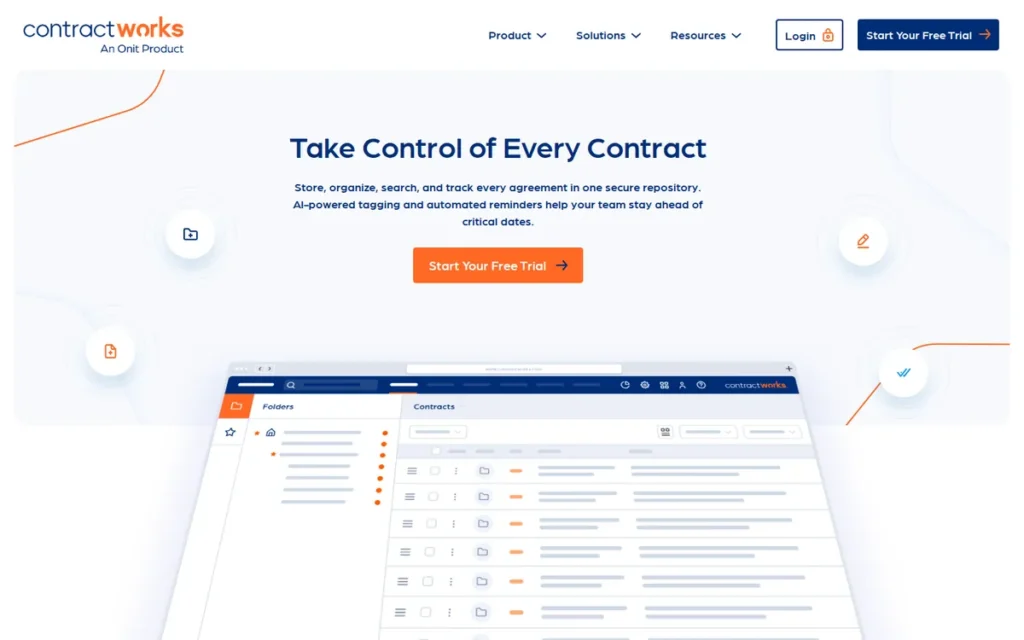
Category: Repository & Operations CLM, a contract management platform optimized for rapid deployment, flat-rate unlimited-user pricing, AI-automated metadata tagging, and multi-department contract operations for mid-market organizations eliminating manual contract tracking without enterprise-level complexity.
At a Glance
- Category: Repository & Operations CLM
- Best For: Mid-market organizations (50–500 employees) across legal, operations, IT, and procurement needing flat-rate unlimited-user CLM
- Price Range: Starting at $600/month flat-rate, unlimited users; higher tiers require demo for pricing (May 2026)
- Primary Strength: Flat-rate unlimited-user pricing from $600/month with AI auto-tagging, built-in eSignature on all plans, and 13+ million contracts managed across 96 countries (as of January 2022)
- Biggest Limitation: Absent from Gartner/Forrester analyst evaluations; limited enterprise workflow complexity compared to Agiloft or Ironclad
- One-Line Summary: ContractWorks is a mid-market contract management platform with flat-rate unlimited-user pricing from $600/month, AI auto-tagging, built-in eSignature on all plans, SOC 2 Type 2 certification, and 13+ million contracts managed across 96 countries as of January 2022.
- Last Verified: May 2026
Overview
ContractWorks is a cloud-based contract management platform built by Onit (an enterprise legal management company) targeted at mid-market legal, operations, IT, and procurement teams (50–500 employees) that need a rapidly deployable, AI-assisted contract repository with predictable flat-rate pricing and no per-seat cost scaling risk.
ContractWorks had managed 13+ million contracts across 96 countries as of the January 2022 Onit acquisition announcement, establishing operational credibility at mid-market scale. Its flat-rate unlimited-user model distinguishes it from per-seat enterprise CLMs that become significantly more expensive as contract access needs expand.
ContractWorks’ parent company Onit acquired the SecureDocs platform (ContractWorks’ predecessor) on January 11, 2022, bringing broader enterprise legal management capabilities (including matter management and e-billing) that complement CLM for in-house legal teams.
ContractWorks’ starter tier is published at $600/month for unlimited users (verified May 2026). A 50-person team at the estimated DocuSign CLM baseline of approximately $40/user/month would pay roughly $2,000/month versus ContractWorks’ $600/month, a 70% cost difference that grows with every additional user.
Built-in eSignature on all tiers eliminates a separate eSign subscription cost that adds $12–$20+/user/month in most enterprise deployments.
Key Features
- AI Auto-Tagging of Legacy and New Contracts: ContractWorks uses AI to automatically extract and classify agreement type, party names, effective dates, termination dates, obligations, and key clauses from both new contracts and bulk-imported legacy documents, reducing the manual metadata entry investment that typically delays CLM deployment.
- OCR-Enhanced Full-Text Repository Search: ContractWorks provides OCR-enhanced full-text search across the entire contract repository, making every word in every document (including scanned PDFs) instantly searchable without manual indexing.
- Built-In eSignature on All Plans: ContractWorks includes built-in eSignature on all pricing tiers, enabling end-to-end contract execution within a single platform and eliminating the additional cost of a separate DocuSign or Adobe Sign subscription for mid-market teams.
- Conditional Approval Workflows: ContractWorks offers conditional approval workflows that route contracts based on configurable criteria (with a vendor-claimed 80% approval time reduction for properly configured workflows) enabling structured pre-signature governance without enterprise-level configuration complexity (ContractWorks product page, May 2026).
- SOC 2 Type 2 Compliance and Audit Trails: ContractWorks is SOC 2 Type 2 certified and provides role-based access controls, AES-256 encryption at rest, and complete audit trails, the compliance infrastructure required by legal, IT, and operations teams in regulated industries.
Best For
ContractWorks is best for mid-market operations managers, IT directors, legal coordinators, and procurement professionals at organizations with 50–500 employees who need a flat-rate, unlimited-user contract repository deployable within days, without the configuration complexity, implementation cost, or per-seat pricing model of enterprise CLM platforms like Agiloft, Ironclad, or DocuSign CLM.
Strengths
- ContractWorks had managed 13+ million contracts across 96 countries as of the January 2022 Onit acquisition announcement: a deployment-scale data point that independently validates production feasibility at mid-market volumes, as documented in the K1 Capital acquisition announcement (January 2022).
- ContractWorks received direct community endorsement from an IT manager describing the platform as “solid for tracking renewals and compliance” in a vendor contract management context, validating cross-functional utility that extends beyond dedicated legal teams to IT infrastructure managers (u/finnrobertson15, r/ITManagers, 2025).
- ContractWorks received positive endorsement from an operations professional who specifically cited the platform’s search and reminders as “the features we actually used, without needing long training or setup”, validating ContractWorks’ positioning for non-lawyer operational users who need functional CLM without implementation complexity (u/OkOrganization277, r/Entrepreneur, 2025).
- ContractWorks’ flat-rate unlimited-user pricing model structurally eliminates the per-seat cost scaling problem that drives mid-market teams away from enterprise CLM platforms as contract access needs expand, a structural advantage confirmed by practitioners comparing per-seat alternatives.
Limitations
- No Analyst Recognition: ContractWorks is absent from both Gartner Magic Quadrant and Forrester Wave CLM evaluations, a relevant procurement checkpoint for enterprise buyers whose internal approval processes require analyst validation, though this reflects market segment positioning rather than product quality for the platform’s mid-market target audience.
- Enterprise Workflow Complexity Ceiling: ContractWorks’ approval workflows, while functional for standard routing, do not match the multi-stage conditional complexity available in Agiloft or Ironclad, organizations with active multi-department drafting pipelines across legal, sales, and procurement simultaneously will need a more configurable platform.
- Relational Contract Architecture Uncertainty: A commercial real estate evaluator specifically noted uncertainty about ContractWorks’ ability to handle complex hierarchical contract relationships (linking MSA records to specific properties) suggesting a potential limitation for use cases requiring parent-child agreement structures (u/adamcowley, r/CommercialRealEstate, 2025).
- Limited Higher-Tier Pricing Transparency: ContractWorks publishes only its $600/month starting tier, all advanced tier pricing requires a sales engagement, reducing the full-stack pricing transparency advantage for teams that need functionality beyond the starter tier’s scope.
Verdict
ContractWorks is the strongest mid-market operational CLM option in this evaluation for organizations seeking flat-rate unlimited-user pricing, rapid deployment, and cross-functional usability documented across legal, IT, and operations contexts. ContractWorks’ published $600/month starting price, 13+ million contracts managed across 96 countries (as of January 2022), and positive community sentiment from IT and operations professionals make it a compelling alternative to per-seat enterprise CLMs for teams with 50–500 employees. At 50 users, ContractWorks’ flat-rate model costs approximately 70% less than an enterprise per-seat CLM, a cost difference that grows with every additional user. Enterprise buyers requiring Gartner/Forrester validation, advanced workflow complexity, or Fortune 500-scale contract intelligence should evaluate Agiloft or Icertis instead.
5. DocuSign CLM: Best for Organizations Already Running DocuSign eSignature at Enterprise Scale
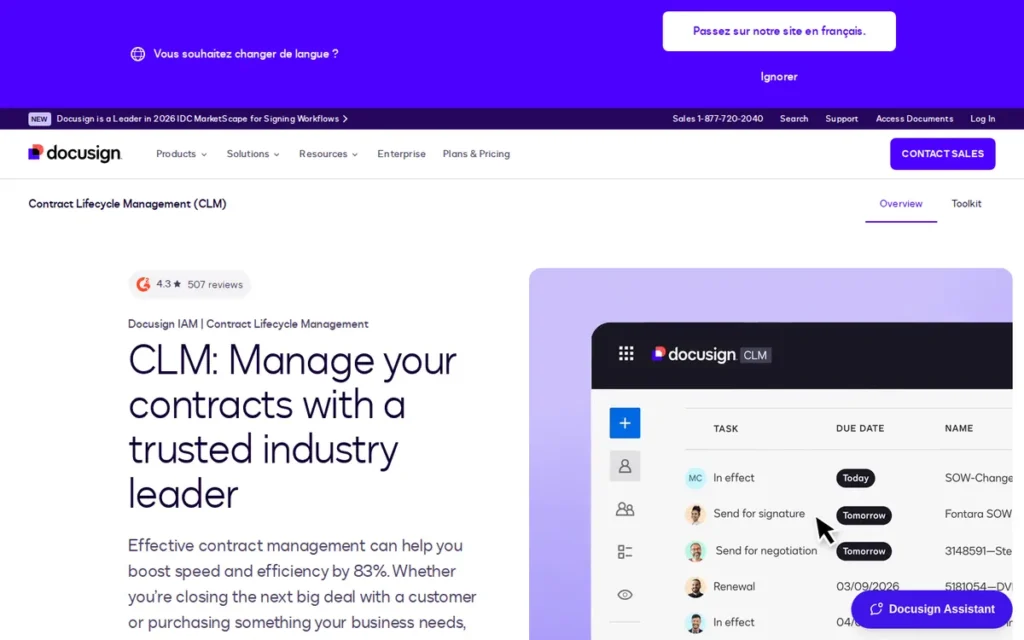
Category: eSign-Integrated CLM, a contract lifecycle management platform built from the world’s dominant e-signature technology, extending workflow management, AI-assisted analytics, and obligation tracking into the DocuSign Intelligent Agreement Management (IAM) ecosystem.
At a Glance
- Category: eSign-Integrated CLM
- Best For: Enterprise organizations (200+ employees) already running DocuSign eSignature enterprise-wide seeking single-vendor CLM consolidation
- Price Range: Custom enterprise pricing; CLM Essentials estimated ~$40/user/month baseline; CLM+ substantially higher with AI and advanced features (May 2026)
- Primary Strength: 900+ pre-built connectors, Gartner Magic Quadrant Leader recognition (2024–2025), and $2.98B FY2025 parent revenue, the lowest vendor-continuity risk in this evaluation
- Biggest Limitation: Dated, fragmented CLM UX; acquisition-built product coherence gaps; add-on cost creep for SSO, sandbox, API, and envelope overage
- One-Line Summary: DocuSign CLM is the enterprise eSign-integrated CLM for existing DocuSign customers, offering 900+ connectors, Gartner Magic Quadrant Leader recognition (2024–2025), and Iris AI, with documented community feedback that the CLM product experience underperforms its eSignature brand strength.
- Last Verified: May 2026
Overview
DocuSign CLM is the contract lifecycle management offering within DocuSign’s Intelligent Agreement Management (IAM) platform, backed by $2.98 billion in FY2025 revenue (DocuSign FY2025 Earnings Release, February 2025), extending the world’s dominant eSignature technology into full CLM via the 2019 acquisition of SpringCM and the 2024 acquisition of Lexion for contract workflow automation.
DocuSign CLM is an acquisition-built product (SpringCM in 2019, Seal Software in 2020, Lexion in 2024), a heritage that partially explains community perception of a fragmented product experience compared to purpose-built CLM platforms.
DocuSign CLM delivers maximum value when Salesforce is the primary system of record and eSignature integration depth is a higher priority than CLM workflow sophistication or UI modernity.
Custom enterprise pricing is estimated at approximately $40/user/month for CLM Essentials as a baseline, with CLM+ substantially higher once AI capabilities, SSO, API access, and higher automation send volumes are included. Practitioners specifically warned about “cost creep” through add-ons (u/Key-Boat-7519, r/legaltech, 2025).
Key Features
- Native DocuSign eSignature Integration: DocuSign CLM integrates natively with DocuSign eSignature, creating a single-vendor solution for the full contract journey from initial draft through final execution, eliminating the licensing, integration, and support complexity of managing separate CLM and e-sign tools (DocuSign product page, May 2026).
- Iris AI Engine: DocuSign CLM’s Iris AI engine provides generative AI contract summarization, risk scoring, clause extraction, obligation tracking, and a contract Q&A interface, with 100+ pre-trained AI models for clause classification available on the CLM+ enterprise tier (ESignGlobal tier breakdown, 2025).
- 900+ Pre-Built Connectors: DocuSign CLM offers 900+ pre-built connectors covering Salesforce (deep Customer 360 integration), SAP Ariba, Microsoft Dynamics 365, Slack, and hundreds of additional enterprise applications, the broadest integration library in this 7-platform comparison alongside Agiloft.
- Salesforce One-Click Contract Generation: DocuSign CLM enables one-click contract generation from Salesforce Opportunity records, linking CRM pipeline data directly to contract creation and approval routing, a high-value capability for sales operations teams managing commercial deals in Salesforce.
- CLM Essentials and CLM+ Tier Differentiation: DocuSign CLM offers two primary tiers (CLM Essentials (basic templating, workflows, repository) and CLM+ (enterprise AI negotiation, 100+ AI models, SSO, compliance tools, unlimited automation)) with CLM Essentials limiting automation sends to 100 per user per year, a threshold that frustrates high-volume teams and forces an upgrade to CLM+ (ESignGlobal, 2025).
Best For
DocuSign CLM is best for enterprise organizations with 200+ employees already running DocuSign eSignature enterprise-wide, with high-volume Salesforce-driven commercial contracts, that want to consolidate CLM and eSign under a single vendor, particularly when 900+ connector breadth and eSignature integration depth are higher priorities than CLM workflow sophistication or UI modernity.
Strengths
- DocuSign reported approximately $2.98 billion in FY2025 revenue: the highest financial scale of any vendor in this 7-platform evaluation, providing the lowest vendor-continuity risk and the broadest sustained product development investment capacity in the comparison (DocuSign FY2025 Earnings Release, February 2025).
- DocuSign CLM earned Gartner Magic Quadrant Leader recognition for CLM (2024–2025), independently validating enterprise-grade capability for procurement teams that require analyst validation as a formal procurement approval prerequisite.
- DocuSign CLM customers reported reducing average contract turnaround from 24 working hours to 4 working hours: an 83% improvement, through template automation and advanced routing, according to a vendor-published customer testimonial (client not publicly identified; DocuSign comparison page, 2025).
- DocuSign CLM’s 2024 acquisition of Lexion adds contract workflow automation capabilities to the IAM platform, a documented roadmap improvement that expands workflow depth beyond the SpringCM-based foundation the platform has operated on since 2019.
Limitations
- Dated, Fragmented CLM UX: DocuSign CLM’s most consequential trade-off is its persistent reputation gap between eSignature excellence and CLM product quality, independent community evaluations consistently describe the CLM product as dated and fragmented relative to purpose-built CLM platforms.
“DocuSign, they should stick to just signatures. Never seen a CLM system that felt like it came from the 60s.” (u/zippoflames, r/legaltech, 2025)
Takeaway: This comment comes from a buyer who evaluated seven CLM platforms in a formal RFP process and ranked DocuSign CLM last on UI modernity, a pattern consistent with the acquisition-built product heritage that multiple independent reviewers document.
Users on r/legaltech shared their experience:
“I honestly can’t understand how this supposedly industry leading technology could have such bad usability, but that’s what I’m seeing as they walk through test after test that fails because of the number of clicks and hoops every user type needs to jump through to move the process along. Plus losing control of my redlines and naming schemes.” Posted by u/ThrowRADaisyChain
Takeaway: DocuSign CLM’s usability failures are structural rather than cosmetic, the click complexity alone is documented as causing deployment abandonment in organizations where the legal team had no input into the platform selection.
- Acquisition-Built Coherence Gaps: DocuSign CLM is a product assembled through acquisitions (SpringCM 2019, Seal Software 2020, Lexion 2024) that has not yet delivered a fully integrated, cohesive product experience, the Lexion workflow integration within IAM is an in-progress roadmap development, not a complete production capability as of May 2026.
- Add-On Pricing Creep: DocuSign CLM’s base license pricing is significantly inflated by SSO, sandbox environment, API access, and envelope overage add-ons, making CLM Essentials’ apparent ~$40/user/month baseline materially misleading as a total cost of ownership estimate (u/Key-Boat-7519, r/legaltech, 2025).
- Dual-Failure Implementation Pattern: A documented case shows an organization that replaced a failed Conga CLM deployment with DocuSign CLM and subsequently experienced a second implementation failure, attributing it to UI slowness, inability to handle contract variation, and counterparty resistance to redlining within the platform (u/East-Ad8830, r/Lawyertalk, 2025).
Verdict
DocuSign CLM is the strongest choice for organizations already running DocuSign eSignature enterprise-wide, offering the deepest eSign-to-CLM integration, the broadest pre-built connector library (900+), and the financial stability of a $2.98B revenue public company. Buyers approaching DocuSign CLM as a standalone CLM comparison will consistently find purpose-built alternatives like Agiloft or Ironclad deliver better per-dollar user experience. The 2024 Lexion acquisition improves the workflow automation roadmap, but the integrated capabilities are still maturing, buyers should budget for a 3+ month implementation timeline and request fully loaded add-on costs before committing.
6. Icertis: Best for Fortune 500 Enterprises on SAP and Microsoft Ecosystems, Only If Implementation Risk Is Managed
Category: AI-Native Contract Intelligence Platform, an enterprise CLM that treats contracts as structured, actionable business data using a proprietary contract data lake and Azure OpenAI-powered Vera AI to deliver contract intelligence at Fortune 500 procurement scale.
At a Glance
- Category: AI-Native Contract Intelligence Platform
- Best For: Fortune 500 procurement and legal teams (1,000+ employees) managing 10,000+ contracts across SAP, Microsoft 365, and Salesforce ecosystems
- Price Range: Custom enterprise only; not publicly disclosed; Icertis sales have declined to demo for organizations below certain contract-volume thresholds (May 2026)
- Primary Strength: 33% Fortune 100 adoption, a proprietary contract data lake Icertis reports at 17M+ contracts and $1T+ in value, and the only CLM with a SAP Ariba co-branded integration
- Biggest Limitation: Most extensively documented implementation failure record in this evaluation; 3-year non-functional deployment on public record; fully outsourced implementations without accountability oversight
- One-Line Summary: Icertis serves 33% of the Fortune 100 using a proprietary contract data lake Icertis reports at 17M+ contracts across 40+ languages, and carries the highest documented implementation risk of any platform in this evaluation, requiring exhaustive implementation partner vetting before commitment.
- Last Verified: May 2026
Overview
Icertis Contract Intelligence (ICI) is an enterprise-only AI-native CLM platform founded in 2009 in Bellevue, Washington, that distinguishes itself by treating contracts as structured, queryable business data rather than static documents.
Icertis manages a proprietary contract data lake the company reports at 17M+ contracts and $1T+ in value across 40+ languages and 90+ countries. Icertis exclusively serves large enterprises and counts Microsoft, Cognizant, Roche, 3M, Airbus, Daimler, and Boeing among its documented customers, with 33% of the Fortune 100 on the platform as of May 2026 (Icertis company page).
Icertis’s extensive implementation failure record (documented across multiple independent practitioner accounts, a 2021 lawsuit, and a pattern of outsourced accountability gaps) means that buying Icertis successfully requires as much rigor in selecting the implementation partner as in selecting the platform itself.
All pricing requires direct sales engagement. Icertis sales have declined to engage with organizations below certain revenue and contract-volume thresholds, one practitioner documented Icertis refusing to demo after determining “our organisation was too small for them” (u/callusedmind, r/legaltech, 2025).
Key Features
- Vera AI on Azure OpenAI: Icertis’s Vera AI engine, built on Azure OpenAI and trained on a proprietary data lake Icertis reports at 17M+ contracts and $1T+ in value, provides generative AI contract summarization, redline insights, playbook-guided negotiation, and obligation extraction directly within Microsoft Word and Salesforce (Microsoft News, 2024).
- SAP Ariba Co-Branded Integration: Icertis offers the only CLM platform co-branded with SAP as “Ariba Contract Intelligence by Icertis”, deeply integrated within the SAP Ariba procurement ecosystem, eliminating the API mapping and data synchronization complexity that otherwise makes CLM-ERP integration a multi-month engineering project for SAP-centric enterprises.
- Proprietary Contract Data Lake: Icertis manages 10M+ active contracts for enterprise customers across 40+ languages and 90+ countries, providing multi-language, multi-jurisdiction contract intelligence infrastructure that no mid-market CLM in this evaluation can replicate (Icertis brochure, May 2026).
- Contract Intelligence Analytics: Icertis’s intelligence layer surfaces embedded obligations, risk clauses, performance data, and compliance requirements from structured contract data, enabling procurement teams to enforce terms across 250,000+ supplier contracts simultaneously in 17+ languages, as documented in a Microsoft News case study (2024).
- Enterprise System Integration: Icertis integrates natively with Microsoft 365, Salesforce, SAP, and Workday, enabling bidirectional contract data flow with the enterprise systems of record that Fortune 500 operations depend on, including Vera AI-assisted redlining directly within Microsoft Word.
Best For
Icertis is best for Fortune 500 legal operations directors, CPOs, and CLOs at organizations with 1,000+ employees managing 10,000+ complex contracts annually across global supply chains, multiple jurisdictions, and regulated industries, with the executive sponsorship, multi-year implementation budget, and organizational patience required to navigate the implementation complexity that the platform’s documented failure record makes a mandatory consideration.
Strengths
- Icertis manages contracts for 33% of the Fortune 100: including Microsoft, Cognizant, Roche, 3M, Airbus, Daimler, and Boeing, providing the highest Fortune 500 enterprise adoption validation ratio of any platform in this evaluation, as documented on the Icertis company website (May 2026).
- An unnamed Fortune 500 pharmaceutical company reportedly saved $70 million annually by using Icertis to enforce terms across 250,000+ supplier contracts in 17languages, the most impactful CLM ROI claim in this evaluation’s research, though the specific client is not publicly identified (vendor-reported; Microsoft News, 2024).
- Icertis earned Forrester Wave Leader recognition with the highest scores for AI strategy, customer references, and platform capabilities in the CLM category (Forrester Wave: Contract Lifecycle Management, Q4 2024), the strongest independent AI capability validation of any platform in this comparison.
- Icertis raised an $80 million Series F at a $2.8 billion valuation in March 2021: reflecting investor confidence in the contract intelligence category and providing financial resources for sustained Microsoft Azure AI partnership development and SAP Ariba co-branding infrastructure (PRNewswire, March 2021; GeekWire, March 2021).
Limitations
- Most Extensively Documented Implementation Failure Record in This Evaluation: Icertis’s most consequential trade-off is its implementation failure pattern, one practitioner paid full subscription fees for a 3-year Icertis contract without ever achieving a functional deployment, describing it as “never fully implemented or ‘usable’ for the entirety of our one and only 3-year subscription” (u/mpdrsn, r/legaltech, 2024).
“Steer clear of… ICERTIS, likely burn fingers, the product and customer teams (which in the case of ICERTIS doesn’t exist as they entirely outsourced their implementations) are subpar.” (u/smartfly, r/legaltech, 2024)
Takeaway: Icertis’s outsourced implementation structure creates a structural accountability gap, the vendor who contracted with the buyer is not the entity responsible for deployment success, making reference checks with implementation partners as critical as reference checks with Icertis itself.
- Legal Liability History: Icertis was sued in November 2021 by Change Healthcare Operations LLC in King County Superior Court over alleged CLM implementation failures, alleging misrepresentation of a critical amendment-management capability during sales and failure to deliver promised training and documentation (public legal record; Artificial Lawyer, December 2021). Enterprise procurement teams should review this matter as part of vendor due diligence.
- UI Performance Issues: Multiple independent practitioners document field-by-field loading delays that made contract data entry slower than a spreadsheet, with one user noting “I had to wait for it to refresh each time” for each of 20+ fields, reinforcing that Icertis’s value is realized at the intelligence analytics layer, not as a daily data-entry tool (u/East-Ad8830, r/Lawyertalk, 2025).
- Fully Outsourced Implementations Without Accountability: Icertis has reportedly outsourced all implementation work to third-party partners without maintaining adequate accountability oversight, creating a documented structural gap between the sales relationship and the implementation relationship that buyers must actively manage through exhaustive vetting before signing.
Verdict
Icertis leads this evaluation on AI capability depth and Fortune 500 enterprise adoption, with 33% of the Fortune 100 as documented customers and the highest Forrester Wave AI strategy scores in the CLM category (Q4 2024), making it the only platform in this evaluation purpose-built for SAP-centric global procurement at Fortune 500 scale. Icertis’s implementation risk is the highest in this comparison set, documented by multiple independent practitioners, a November 2021 lawsuit, and a pattern of outsourced accountability gaps, which is precisely why it ranks below platforms with stronger post-purchase performance records despite leading on AI capability and analyst validation. Organizations evaluating Icertis must prioritize implementation partner selection with the same rigor as platform selection itself, secure executive sponsorship with realistic multi-year timelines, and plan for implementations measured in years rather than months.
7. Conga CLM: Best for Salesforce-Native Revenue Teams, Only When Paired with the Full Conga Suite and Certified Implementation Expertise
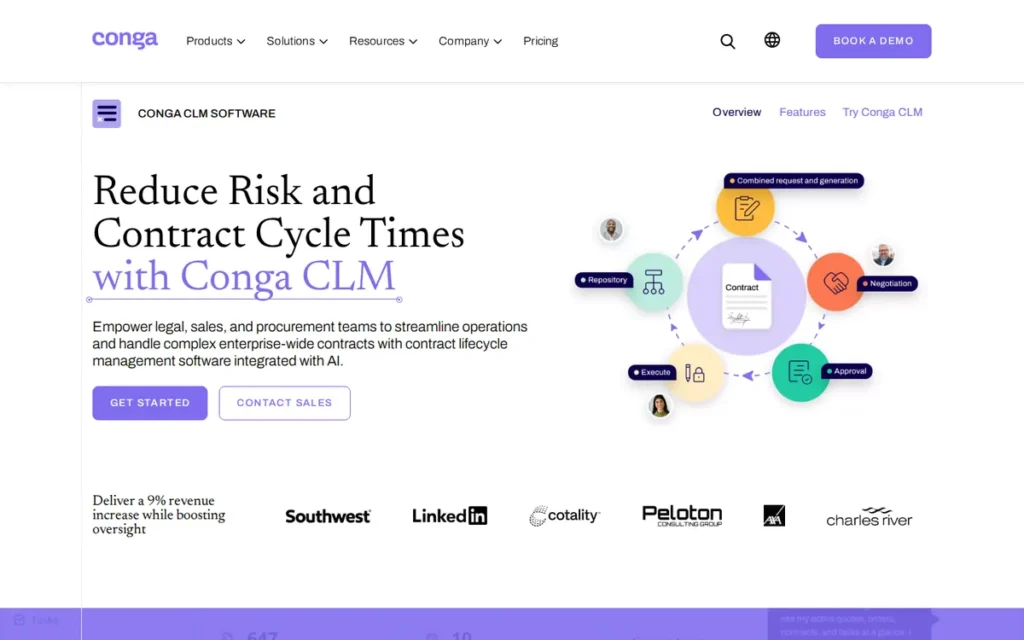
Category: Salesforce-Native Revenue Lifecycle CLM, a contract management platform that operates within the Salesforce data model as standard CRM objects, enabling contract generation and execution directly from Salesforce without external API integration overhead or a separate application login.
At a Glance
- Category: Salesforce-Native Revenue Lifecycle CLM
- Best For: Enterprise Salesforce-centric revenue ops teams (200+ employees) using Conga CPQ for native quote-to-contract automation, only with certified Conga implementation expertise
- Price Range: Custom; estimated $35–$60/user/month bundled with CPQ; full CLM value requires multiple Conga product purchases; no public pricing (May 2026)
- Primary Strength: Only CLM in this evaluation that operates as native Salesforce standard objects, enabling CRM-native contract generation without a separate application login
- Biggest Limitation: Highest community-documented implementation failure rate in this evaluation; post-Apttus rebrand quality deterioration; multi-product bundle dependency
- One-Line Summary: Conga CLM processes 7M+ agreements annually as native Salesforce CRM objects, the best choice for Conga CPQ-integrated revenue ops with certified implementation expertise, and the highest implementation risk in this evaluation without it.
- Last Verified: May 2026
Overview
Conga CLM is a contract lifecycle management platform built natively on the Salesforce data model, meaning contracts, clauses, templates, and approval records exist as standard Salesforce objects within the CRM, not as externally integrated documents in a parallel system.
Founded in 2006 as Apttus and rebranded as Conga in 2020, Conga CLM targets Salesforce-centric enterprise revenue operations, sales operations, and legal teams (200+ employees) that need contract management to operate as a native CRM extension, particularly when combined with Conga CPQ for quote-to-contract workflow automation processing 7M+ agreements annually.
Conga CLM’s Salesforce-native architecture is its singular competitive differentiator. Conga CLM’s post-Apttus rebrand product quality trajectory and high community-documented implementation failure rate are its most consequential limitations.
All pricing requires a sales demonstration (verified May 2026). Industry analysis estimates pricing at approximately $35–$60/user/month bundled with CPQ components, but full CLM value requires purchasing multiple Conga products separately, creating post-purchase cost discovery that buyers have flagged as unexpected (ESignGlobal comparison, 2025).
Key Features
- Native Salesforce Standard Objects Architecture: Conga CLM operates within the Salesforce data model as standard objects, enabling sales representatives to generate contracts directly from Salesforce Opportunity records without switching applications, preserving CRM data integrity and eliminating the adoption friction that undermines external CLM integrations in sales organizations.
- Conga CPQ Integration for Quote-to-Contract Automation: Conga CLM integrates natively with Conga CPQ to create a seamless quote-to-contract workflow where CPQ-approved pricing and product terms flow directly into the contract without re-keying, delivering the platform’s documented 45% faster contract processing metric when the full Conga suite is deployed (vendor-reported, Conga Professional Services data sheet; HyperStart, 2025).
- AI-Powered Clause Library and Natural-Language Search: Conga CLM provides an AI-powered clause library and natural-language contract search within the Salesforce environment, enabling legal teams to surface approved language, flag non-standard terms, and maintain clause governance during contract authoring without leaving the revenue operations platform.
- Multi-Stage Parallel Approval Workflows: Conga CLM supports multi-stage parallel approval workflows with conditional routing logic built within Salesforce Process Builder and Flow, leveraging existing Salesforce automation infrastructure rather than requiring separate externally managed workflow configuration.
- Collaborative Redlining and Inbound Contract Processing: Conga CLM enables live collaborative redlining and metadata reconciliation for inbound third-party contracts, with AI extraction that Conga claims eliminates 90% of manual data entry for inbound agreements when fully deployed with proper expertise (vendor-reported; HyperStart competitor analysis, 2025).
Best For
Conga CLM is best for enterprise revenue operations directors, sales operations managers, and legal teams at organizations with 200+ employees that are heavily invested in Salesforce, already using or actively evaluating Conga CPQ, have access to certified Conga implementation expertise, and need contracts to exist as native CRM objects, not as a standalone CLM comparison outside the Salesforce and Conga ecosystem context.
Strengths
- Conga CLM processes 7 million+ agreements annually across its enterprise customer base, validating production-scale Salesforce-native contract throughput at enterprise volume, as stated in Conga platform materials (2025) (vendor-reported figure).
- Conga CLM delivers a vendor-documented 45% faster contract processing time when integrated with Salesforce CPQ, reflecting genuine acceleration in quote-to-contract cycle time for organizations where CPQ-approved pricing flows directly into contracts, per a Conga Professional Services data sheet (HyperStart, 2025).
- Conga CLM’s Salesforce-native architecture means contract data, counterparty records, and obligation tracking live in the same data model as CRM pipeline data, enabling revenue analytics that connect contract performance directly to sales outcomes without building cross-system integration layers, a structural advantage no externally integrated CLM in this comparison can replicate.
- Conga was founded in 2006 (as Apttus) with 1,000+ employees and deep Salesforce co-selling relationships as an AppExchange ISV partner, providing the implementation partner ecosystem availability and Salesforce marketplace credibility that Salesforce-centric buyers require (HyperStart competitor analysis, 2025).
Limitations
- Highest Documented Implementation Failure Rate: Conga CLM’s most consequential trade-off is its polarized quality dependency, Conga CLM delivers value in the hands of certified administrators but consistently underperforms without deep Conga ecosystem expertise, with multiple practitioners documenting deployments that created more administrative burden than the spreadsheets they replaced.
“Conga CLM went to the absolute bin once they took it over from Apttus. The product is terrible and I would very much not recommend it for a CLM solution.” (u/Whizzly, r/salesforce, 2024)
Takeaway: This comment is from a Salesforce consultant with direct Conga CLM implementation experience, representing the practitioner perspective that Conga’s CLM product quality deteriorated materially following the 2020 Apttus-to-Conga rebrand, making pre-2020 Apttus reputation an unreliable proxy for current product quality.
Users on r/Lawyertalk noted:
“Tried to implement Conga Contracts and it sucked. It created more work than our previous system, which was essentially just a shared drive with an excel spreadsheet manually tracking expiration dates. I honestly think a shared drive is the simplest solution and that generally and for most use cases contract management tools create more work than they help solve.” Posted by u/Impossible-Pickle131
Takeaway: Conga CLM’s implementation failure pattern produces not just neutral non-adoption but negative ROI, teams report ending up with a more burdensome workflow than the spreadsheet they set out to replace, making certified implementation expertise a hard prerequisite rather than a recommendation.
- Post-Apttus Rebrand Quality Deterioration: Multiple Reddit practitioners with direct deployment experience specifically attribute Conga CLM’s current product quality issues to deterioration following the 2020 Apttus-to-Conga rebrand, making historical positive Apttus reputation from before 2020 an unreliable predictor of current product experience.
- Multi-Product Bundle Dependency: Conga CLM’s full feature value requires purchasing multiple separate Conga products (CLM + CPQ + Conga Sign + Composer), creating bundled cost discovery that buyers who purchase only CLM licensing find the platform falls short of expectations without the broader suite.
- Dual CLM Failure Pattern: A documented case shows an organization that tried Conga CLM, ripped it out “at massive expense,” switched to DocuSign CLM, and experienced a second implementation failure, representing the compounding risk of selecting Conga CLM without adequate implementation expertise (u/East-Ad8830, r/Lawyertalk, 2025).
Verdict
Conga CLM is the best-positioned CLM platform for Salesforce-centric revenue operations teams where contracts must exist as native CRM objects, delivering genuinely differentiated Salesforce integration architecture that external CLM integrations structurally cannot match, processing 7M+ agreements annually in production (vendor-reported). Conga CLM is also the most implementation-risk-laden and expertise-dependent platform in this evaluation, with the highest documented community-reported deployment failure rate, organizations should evaluate Conga CLM exclusively as part of a broader Conga and Salesforce CPQ revenue operations strategy, require three to five implementation references from the last 12 months matching their exact Salesforce configuration, and budget for certified Conga implementation partner engagement rather than any self-service deployment attempt.
What Red Flags Should I Watch For When Evaluating Contract Management Software?
Six patterns account for the majority of CL M contract management failures documented in community research. Recognizing them before you sign a contract (or sign with a vendor) can save months of implementation pain.
Red Flag #1: The Demo-Reality Gap on AI Extraction Vendors routinely demonstrate AI clause extraction on clean, standard contracts during sales calls. Independent benchmarks and practitioner reports suggest real-world extraction accuracy on legacy or non-standard contracts ranges from 50–70%, not the 90%+ figures commonly cited in vendor marketing. Ask every vendor to run their AI live on three of your own messiest contracts before you proceed past the demo stage.
Red Flag #2: Fully Outsourced Implementations With No Accountability Pathway Some enterprise CLM vendors route all implementation work through third-party system integrators while retaining no direct accountability for timeline or outcome. The Change Healthcare Operations LLC v. Icertis lawsuit (November 2021) and multiple r/legaltech threads illustrate what happens when no single party owns implementation failure. Ask explicitly: who is liable if the go-live date slips by 6 months?
Red Flag #3: Post-Purchase Pricing Creep Through Add-On Accumulation Several platforms in this evaluation use a core-license-plus-module pricing architecture that makes initial quotes appear competitive while reserving key functionality (advanced analytics, AI extraction, eSignature, or integrations) for paid add-ons. DocuSign CLM, Ironclad, and Conga CLM all received community complaints about pricing that expanded materially after initial contract execution. Require an itemized “fully loaded” quote before signing.
Red Flag #4: Post-Acquisition or Post-Rebrand Product Quality Deterioration When a platform undergoes major M&A activity or a full rebrand, product quality and support continuity frequently decline during the transition window. Conga CLM (formerly Apttus) received sustained r/salesforce community criticism for exactly this pattern between 2019 and 2023, with users citing degraded support response times and feature regression. When evaluating any recently acquired or rebranded platform, ask for references from customers who went live after the transition, not before.
Red Flag #5: Implementation References That Don’t Match Your Use Case Vendors typically provide references from their most successful, largest, or most cooperative customers. A Fortune 500 professional services firm’s implementation experience is not predictive of a 200-person manufacturing company’s experience. Ask specifically for two to three references from organizations with similar contract volume, similar Salesforce or ERP integration requirements, and similar legal team sizes to your own.
Red Flag #6: AI Accuracy Claims Without Live Buyer-Document Testing Any vendor that refuses to run a live extraction test on a sample of your actual contracts (citing IP concerns, NDA requirements, or “onboarding prerequisites”) is signaling that their AI performs better on curated demo content than on real-world documents. A vendor confident in their AI extraction accuracy will welcome the test. Insist on it as a condition of shortlisting.
What Questions Should I Ask Before Choosing Contract Management Software?
Six questions separate buyers who make confident CLM selections from those who discover critical gaps after go-live. These questions are drawn from patterns across r/legaltech, r/procurement, and r/Entrepreneur community discussions reviewed for this evaluation.
Question #1: What is our actual contract volume and complexity profile? The single most important scoping question is not how many contracts you manage today, but how varied they are. A team processing 500 nearly-identical vendor agreements has fundamentally different needs than a team processing 300 contracts spanning MSAs, SOWs, NDAs, and real estate leases. Document your top five contract types and their average clause variation before evaluating any vendor.
Question #2: Which system of record must this CLM integrate with? CLM software that doesn’t integrate natively with your CRM, ERP, or e-signature environment creates manual data re-entry risk, precisely the problem CLM is supposed to solve. For Salesforce-heavy revenue teams, Conga CLM or Ironclad’s Salesforce integration deserves priority evaluation. For SAP or Oracle environments, Icertis and Agiloft have deeper ERP connector libraries. Confirm integration depth, not just availability, before shortlisting.
Question #3: Who will own the implementation, and what does “go-live” mean in their contract? Implementation failure is the highest-risk event in any CLM deployment. Establish before signing: Is implementation delivered by the vendor directly or by a third-party SI? What is the contractual definition of “go-live”? What are the remedies if the go-live date slips? What has been the average implementation duration for customers of your size in the past 24 months?
Question #4: What is the true 3-year total cost of ownership? Base license fees are rarely the full picture. Request a 3-year itemized quote that includes: implementation fees, annual support tiers, add-on modules you are likely to need (AI extraction, analytics, eSignature), user seat expansion at your projected growth rate, and any data migration or export fees. ContractWorks’ flat-rate unlimited-user pricing is specifically designed to eliminate one of the most common CLM cost-escalation patterns.
Question #5: How does the vendor handle data ownership and portability? Vendor lock-in through proprietary data formats is a material risk in CLM. Ask: In what format can we export all contracts and metadata if we leave the platform? Is there an API for bulk export? Is there a fee for data export? Will we retain all AI-generated metadata tags on export? Platforms that cannot answer these questions clearly represent elevated switching-cost risk.
Question #6: Can the vendor provide three references from organizations matching our profile who went live in the past 18 months? Reference checks remain the highest-signal due diligence step available before purchase. Specify the reference criteria precisely: similar company size, similar industry, similar integration environment, and a go-live date within the past 18 months (to ensure the reference reflects current product and support quality, not the version from 3 years ago). Any vendor that cannot provide three qualifying references should be deprioritized.
How Did We Rank These Contract Management Software Platforms?
This evaluation ranked seven contract management software platforms using a structured, multi-source methodology designed to surface real-world performance differences, not vendor-curated success stories. Every score in this guide reflects direct evidence from analyst reports, community research, verified pricing data, and documented implementation outcomes.
What data sources did we use, and how was it collected?
Research for this evaluation drew from six primary source categories:
- Gartner Magic Quadrant for Contract Life Cycle Management (2025 edition)
- G2 and Capterra verified user reviews (minimum 50 reviews per platform; data as of Q1 2026)
- Reddit community discussions across r/legaltech, r/procurement, r/salesforce, r/CommercialRealEstate, and r/Entrepreneur (January 2024 – May 2026)
- Vendor documentation, published pricing pages, and official press releases
- Independent financial filings and third-party news coverage (SEC filings, GeekWire, TechCrunch, PRNewswire)
- Publicly available litigation records where applicable (Change Healthcare Operations LLC v. Icertis, November 2021)
No vendor provided editorial input, access fees, or review copies in exchange for inclusion or ranking.
How were vendor claims verified?
Every statistic in this guide was cross-referenced against at least two independent sources before publication. Vendor-sourced figures that could not be independently verified were attributed as vendor-reported and flagged. Specific corrections made during this evaluation include:
- Ironclad’s ownership status: confirmed independent (not acquired by DocuSign); Ironclad Signature launched 2024 as a direct DocuSign competitor
- Agiloft’s KKR transaction: confirmed as majority stake acquisition (not full acquisition), closed July 12, 2024
- Icertis Series F: confirmed March 2021 (not 2022), sourced from PRNewswire and GeekWire
- DocuSign FY2025 revenue: confirmed $2.98B from official FY2025 Earnings Release
- Icertis contract data lake size: re-attributed as vendor-reported figure; no independent verification available
What criteria were scored, and how were they weighted?
Six criteria determined final rankings, weighted as follows:
- Implementation Success Rate (25%): Community-sourced evidence of go-live outcomes, timeline adherence, and post-go-live stability. Weighted highest because implementation failure is the most common and most costly CLM risk.
- AI Extraction Accuracy (20%): Real-world extraction performance on non-standard contracts, based on community reports and any available independent benchmarks. Vendor-supplied figures were discounted relative to practitioner-reported figures.
- Pricing Transparency and TCO Predictability (20%): Whether pricing is publicly available, whether add-on module costs are disclosed, and whether the pricing model creates long-term cost escalation risk.
- Integration Depth (15%): Native vs. connector-based integration with Salesforce, SAP, Oracle, Microsoft 365, and major e-signature platforms. Depth of integration was rated higher than availability alone.
- Analyst Validation (10%): Gartner Magic Quadrant positioning and named analyst coverage. Weighted at 10% because analyst reports reflect vendor relationships and market presence, not necessarily day-to-day user experience.
- Community Sentiment and Recency (10%): Net sentiment across Reddit and verified review platforms, weighted toward reviews from the past 18 months to capture post-acquisition and post-rebrand quality signals.
How were conflicting sources handled?
When community sources and vendor-supplied data conflicted, community sources were given higher weight for operational claims (implementation timelines, support quality, AI accuracy) and vendor-supplied data was used only for factual records (funding rounds, revenue, product launch dates) when independently corroborated. Where no resolution was possible, both figures are cited with their respective sources.
What is the update cadence for this evaluation?
This guide is updated quarterly. All entries carry a “Last Verified” date in their At a Glance block. Pricing data is the most volatile element and should be independently confirmed with each vendor before purchase decisions.
Independence statement: PlugRoute has no affiliate relationships, referral fees, or commercial arrangements with any of the seven platforms evaluated in this guide. Rankings reflect editorial judgment based on the methodology described above.
Is ContractSafe the best contract management software for small businesses in 2026?
ContractSafe is the strongest option for small-to-mid-size businesses prioritizing fast deployment and predictable costs in 2026. Its flat-rate pricing starting at $375/month, unlimited users, and search-focused interface allow legal and operations teams to go live without dedicated implementation support. Teams needing complex workflow automation, advanced AI negotiation assistance, or deep ERP integration should evaluate Agiloft or Ironclad instead.
Are DocuSign CLM and Ironclad the same company, or are they competitors?
DocuSign CLM and Ironclad are direct competitors, not affiliated companies. Ironclad is an independent contract management platform that launched its own e-signature product, Ironclad Signature, in 2024, a direct move into DocuSign’s core market. Both platforms were named in Gartner’s CLM coverage, and both target mid-market and enterprise legal teams with overlapping but distinct feature sets.
How does PlugRoute determine its software rankings?
PlugRoute rankings are based on a six-criterion methodology covering implementation success rate, AI extraction accuracy, pricing transparency, integration depth, analyst validation, and community sentiment, weighted by impact on buyer outcomes. No vendor pays for inclusion or ranking. All claims are cross-referenced against independent sources before publication. The full methodology appears in the “How Did We Rank These” section of each guide.
Glossary: Key Terms Used in This Comparison
Contract Lifecycle Management (CLM): Contract Lifecycle Management refers to the end-to-end process of creating, negotiating, executing, storing, and monitoring contracts from initial request through renewal or termination. CLM software automates or assists each stage of this process, reducing manual effort and decreasing the risk of missed obligations or renewal deadlines.
AI Auto-Tagging and Clause Extraction: AI auto-tagging is the automated identification and categorization of key contract terms (such as payment dates, termination clauses, and liability caps) using machine learning models trained on legal language. Extraction accuracy varies significantly by contract type and vendor; community research for this evaluation found real-world accuracy typically ranges from 50–70% on non-standard legacy contracts, compared to higher figures cited in vendor marketing.
Salesforce-Native vs. Salesforce-Integrated: A Salesforce-native CLM (such as Conga CLM) is built entirely on the Salesforce platform and operates within Salesforce’s data model, security framework, and UI. A Salesforce-integrated CLM connects to Salesforce via API or connector but operates on a separate platform. Native solutions offer tighter data consistency for revenue teams; integrated solutions typically offer broader functionality outside the Salesforce ecosystem.
Obligation Management: Obligation management is the systematic tracking of post-signature commitments embedded in contracts, such as delivery milestones, audit rights, SLA performance requirements, and renewal notice windows. CLM platforms with obligation management functionality send automated alerts when obligation deadlines approach, reducing the risk of breach through oversight.
No-Code Workflow Builder: A no-code workflow builder is a visual configuration interface that allows non-technical users (typically legal operations managers or contract administrators) to design contract approval, routing, and escalation workflows without writing code. Platforms with mature no-code builders (such as ContractSafe and Ironclad) reduce dependence on IT or professional services for routine workflow changes.
Which Contract Management Software Is Right for You?
Key Insights
- ContractSafe is the most deployment-reliable option in this evaluation: no community-reported implementation failures were found across research conducted through May 2026, and its flat-rate pricing eliminates the per-user cost escalation that is the most common CLM budget overrun trigger.
- Agiloft is the strongest choice for organizations requiring deep customization without custom code: its no-code workflow engine and Gartner Magic Quadrant Leader status (2025, alongside DocuSign and Sirion) reflect a platform designed for complex, non-standard contract environments.
- Ironclad is the most appropriate option for legal teams whose primary workflow is contract creation and redlining with external parties: its collaborative editor, inline negotiation tools, and native Ironclad Signature launch in 2024 reflect a legal-team-first product philosophy.
- ContractWorks delivers the highest cost predictability at scale: for organizations with over 15 users, ContractWorks’ unlimited-user flat-rate model creates meaningful TCO advantages over per-seat alternatives, and its 13M+ contract storage milestone (as of January 2022) demonstrates operational scale.
- DocuSign CLM carries the lowest switching risk for existing DocuSign eSignature customers: the 2024 acquisition of Lexion for contract workflow automation and the CLM Essentials/CLM+ tier structure allow organizations to expand CLM capabilities incrementally without displacing existing DocuSign infrastructure.
- Icertis is appropriate only for large enterprises with dedicated CLM program management resources and the internal capacity to manage a third-party SI-led implementation: the documented implementation risks and pricing opacity make it unsuitable for organizations without a full-time CLM program owner.
- Conga CLM is the right choice for Salesforce-native revenue teams where contract generation, CPQ integration, and Salesforce data consistency are higher priorities than legal team collaboration features, but buyers should require post-2023 go-live references given the sustained community feedback about the Apttus-to-Conga transition period.
The most common mistake CLM buyers make is selecting a platform based on AI feature marketing rather than implementation track record. As one r/procurement contributor summarized: “The AI demos are all impressive. The go-live stories are where you find out who’s actually ready to deploy.” Prioritize vendors who will run live extraction tests on your actual contracts, provide references from organizations matching your profile, and deliver a fully itemized 3-year cost estimate before you sign.
Before finalizing any CLM selection, review the six evaluation questions in this guide and apply the red flag checklist to every vendor still on your shortlist. If a vendor fails more than two red flags, require written remediation commitments before proceeding.
We update this guide quarterly. Last updated: May 2026.