Ironclad is the best overall CLM for legal-led mid-to-large enterprises, combining no-code workflow automation and GPT-4 AI at the highest composite score in this evaluation. ContractSafe is the best choice for mid-market organizations, the only platform publishing fully transparent pricing ($450–$815/month, unlimited users) with the fastest documented deployment at 4–6 weeks. Icertis is the only appropriate recommendation for Fortune 100 organizations standardized on SAP or Microsoft Azure. The right CLM depends entirely on organization size, existing tech stack, AI requirements, and implementation capacity.
CLM implementations fail more often than vendor demos suggest. Practitioners document 3-year subscriptions that never became operational, AI that fails on the non-standard legacy documents legal teams most need analyzed, and pricing that escalates beyond initial quotes once SSO, API access, and implementation services are factored in.
PlugRoute has no affiliate relationships with any company listed. Rankings are determined entirely by research data and objective evaluation criteria.
“I can’t tell you how many clients I’ve worked with to migrate from one failed implementation to a new CLM, only to see them back again 18 months later.” (u/3yl, r/legaltech)
Takeaway: Failed CLM migrations are the category’s most documented outcome, not an outlier experience. The evaluation below is built specifically to surface the implementation risks that vendor demos do not reveal, sourcing from verified practitioner accounts rather than vendor-supplied case studies.
TL;DR: Top Picks at a Glance
- Ironclad: Best overall for legal workflow automation at mid-to-large enterprises; 4.4/5.0 G2 (285+ reviews, verified May 2026)
- ContractSafe: The only CLM with fully public pricing ($450–$815/month, unlimited users); fastest deployment at 4–6 weeks; 4.8/5.0 G2 and Capterra
- Icertis: Unmatched for Fortune 100 global supplier compliance on SAP/Azure; Vera AI trained on 2B+ contract metadata points
- Agiloft: Maximum no-code configurability for complex enterprise requirements; 1,000+ integrations; six consecutive Gartner Magic Quadrant Leader recognitions (2020–2025)
What Are the Main Categories of CLM Software in 2026?
CLM platforms fall into three categories based on their primary design philosophy: Enterprise AI and Compliance platforms built for Fortune 100 scale and regulatory complexity; Legal Workflow and Analytics platforms designed for in-house legal teams driving contract automation; and Ecosystem-Native and Mid-Market platforms optimized for Salesforce integration or accessible deployment without long implementation timelines.
Category 1: Enterprise AI and Compliance CLM
Platforms built for massive contract volumes, multi-language global compliance, and proprietary AI trained on real enterprise data. This category includes:
- Icertis (#4): purpose-built for Fortune 100 and Global 2000 organizations on SAP Ariba or Microsoft Azure
- Agiloft (#3): maximum no-code configurability for complex enterprise workflow requirements
Best suited for organizations with $500M+ revenue, dedicated legal ops and IT teams, and a 12+ month implementation runway.
Category 2: Legal Workflow and Analytics CLM
Platforms designed from the ground up for in-house legal teams, covering automated approval workflows, AI-powered redlining, and post-signature analytics. This category includes:
- Ironclad (#1): best overall for legal ops at mid-to-large enterprises with complex approval workflows
- LinkSquares (#5): legal-first AI analytics with practitioner-confirmed M&A due diligence processing advantage
- DocuSign CLM (#6): agreement cloud extension for organizations standardized on DocuSign eSignature
Best for organizations with complex multi-stakeholder approval processes and Salesforce or Microsoft integration requirements.
Category 3: Ecosystem-Native and Mid-Market CLM
Platforms optimized either for Salesforce-native CPQ-to-contract revenue workflows or for mid-market teams needing fast, affordable, transparent contract management. This category includes:
- ContractSafe (#2): mid-market repository and lifecycle CLM with the only fully public pricing in the evaluated set
- Conga CLM (#7): Salesforce-native revenue CLM for CPQ-to-contract workflow continuity
Best for organizations prioritizing speed to value, pricing clarity, or deep Salesforce CPQ integration.
How Do the Top CLM Platforms Compare at a Glance?
The seven CLM platforms in this evaluation span four distinct market tiers: enterprise contract intelligence platforms (Icertis, Agiloft), legal workflow automation platforms (Ironclad, LinkSquares), eSignature-ecosystem platforms (DocuSign CLM, Conga CLM), and the only platform with transparent public pricing (ContractSafe). The table below maps each platform to its primary use case, main strength, and key trade-off.
| Rank | Company | Category | Best For | One-Line Summary | Key Capabilities | Primary Strength | Key Limitation |
|---|---|---|---|---|---|---|---|
| 1 | Ironclad | Workflow Automation CLM | Legal ops at mid-to-large enterprises with complex approval workflows | Ironclad is the highest-rated CLM for legal-led enterprises (4.4/5.0 G2, 285+ reviews; Gartner Customers’ Choice 2023), combining a no-code Workflow Designer, GPT-4 AI Assist, and 200+ integrations | No-code Workflow Designer; GPT-4 AI Assist; 194+ clause types; embedded eSignature; 200+ integrations | No-code Workflow Designer rated best-in-category by verified 5-year enterprise customers across independent community accounts | AI extraction documented to fail on legacy, non-standard, and acquisition-originated contracts not created within the platform |
| 2 | ContractSafe | Repository and Lifecycle CLM | Mid-market organizations (50–500 employees) needing fast deployment and transparent pricing | ContractSafe is the only CLM in this evaluation with fully public pricing ($450–$815/month, unlimited users), the highest verified satisfaction scores (4.8/5.0 G2 and Capterra), and a 4-to-6-week implementation timeline | OCR full-text search; automated renewal alerts; transparent tiered pricing; Microsoft Word integration; AI natural language assistant | Only CLM in this evaluation with public pricing ($450–$815/month, unlimited users on all tiers) | AI depth is foundational; insufficient for enterprise-grade risk detection or large-scale portfolio analytics |
| 3 | Agiloft | No-Code Enterprise CLM | Enterprises needing maximum custom workflow configurability without developer involvement | Agiloft is a no-code enterprise CLM with six consecutive Gartner Magic Quadrant Leader recognitions (2020–2025), 1,000+ integrations, a 4.6/5.0 G2 rating, and KKR majority backing | No-code workflow engine; ConvoAI and GenAI Lab; 1,000+ integrations; smart legacy import; advanced ROI analytics (Premium) | 1,000+ integrations; widest catalog in the evaluated set; and six consecutive Gartner MQ Leader years (2020–2025) | Highly variable implementation outcomes; teams without dedicated CLM administrators consistently report difficulty |
| 4 | Icertis | Enterprise Contract Intelligence | Fortune 100 and Global 2000 organizations on SAP Ariba or Microsoft Azure | Icertis is an enterprise contract intelligence platform trusted by 33% of the Fortune 100 to manage 10M+ contracts representing $1T+ in commercial value, with Vera AI trained on 2B+ contract metadata points | Vera AI engine (Copilot, Agents, Analytics); SAP-native via Ariba; Microsoft Azure-native; 40+ language workflow engine; contract portfolio intelligence | Vera AI trained on 2B+ contract metadata points from $1T+ in managed commercial value | Implementations require 6–18 months; verified 3-year subscriptions documented as never becoming fully operational |
| 5 | LinkSquares | AI Legal Analytics CLM | In-house legal teams prioritizing post-signature analytics and M&A due diligence | LinkSquares is a legal-first CLM with a 4.7/5.0 G2 rating (300+ reviews), a LinkAI engine trained on 10M+ contracts, and a practitioner-confirmed M&A due diligence advantage over general-purpose CLM alternatives | LinkAI engine (120+ smart values); unified pre/post-signature coverage; M&A due diligence processing; C-suite analytics dashboards; Microsoft Word redlining | LinkAI engine trained on 10M+ contracts with practitioner-confirmed M&A document processing superiority over general-purpose alternatives | AI extraction rigid on non-standard formats; documented customer service and implementation concerns (r/legaltech, March 2026) |
| 6 | DocuSign CLM | Agreement Cloud CLM | Organizations already standardized on DocuSign eSignature with Salesforce as CRM | DocuSign CLM is an enterprise agreement management platform with Gartner Magic Quadrant Leader recognition and a March 2026 Iris AI launch, but the lowest G2 rating in this evaluation (4.2/5.0) reflects practitioner consensus that its CLM functionality trails purpose-built alternatives | Iris AI Contract Review Assistant (March 2026); native Salesforce integration; drag-and-drop workflow automation; CLM+ obligation management; unified eSignature infrastructure | Lowest-friction adoption path for organizations already standardized on DocuSign eSignature, with Nasdaq stability (DOCU) and 20+ year operating history | Lowest G2 rating in the evaluated set (4.2/5.0); practitioners consistently describe it as eSignature with CLM features added |
| 7 | Conga CLM | Salesforce-Native Revenue CLM | Salesforce CPQ organizations needing native quote-to-contract workflow continuity | Conga CLM is the most downloaded paid CLM on the Salesforce AppExchange for 10+ consecutive years and the only fully Salesforce-native CLM in this evaluation, but post-Apttus merger quality concerns and documented implementations that increased administrative effort limit its viable use case | Salesforce-native architecture (no API required); CPQ-to-contract workflow continuity; AI contract review; Conga Sign eSignature; post-signature obligation management | Only fully Salesforce-native CLM; operates inside Salesforce, not via API; eliminating data sync complexity for CPQ-centric organizations | Post-Apttus merger (2019) product quality decline widely cited; implementations documented to create more administrative work than no-CLM predecessor systems |
This comparison is produced by PlugRoute, no placement fees, referral arrangements, or commercial relationships exist with any of the seven evaluated platforms.
Which CLM Platform Should I Choose for My Use Case?
| Your #1 Priority | Recommended Tool | Why | Acceptable Alternative |
|---|---|---|---|
| Best overall: AI depth + workflow automation + integrations | Ironclad | 4.4/5.0 G2 (285+ reviews), Gartner Customers’ Choice 2023, GPT-4 AI Assist, 200+ integrations, self-serve implementation confirmed by 5-year enterprise customers | Agiloft |
| Operational CLM live within 6 weeks, no implementation partner | ContractSafe | 4-to-6-week documented go-live, 4.8/5.0 G2 and Capterra, no mandatory partner required | Ironclad |
| Transparent public pricing before any sales call | ContractSafe | Only platform in this evaluation with public pricing ($450–$815/month, unlimited users); all six other platforms require a sales call before any pricing is disclosed (verified May 2026) | No alternative in this evaluation offers public pricing |
| Fortune 100 scale, SAP/Microsoft stack, global supplier compliance in 40+ languages | Icertis | 33% Fortune 100 adoption, Vera AI trained on 2B+ metadata points, SAP-native via Ariba extension, 40+ language workflow engine | Agiloft |
| Enforce compliance obligations across a global supplier network in multiple languages | Icertis | Only platform in this evaluation with 40+ language support, SAP-native integration, and Vera AI trained on $1T+ in commercial contract data | Agiloft (with custom language configuration) |
| Maximum no-code customization and widest integration catalog | Agiloft | 1,000+ integrations, six consecutive Gartner MQ Leader years (2020–2025), no-code architecture | Icertis |
| Post-signature analytics and M&A due diligence processing | LinkSquares | Practitioner-confirmed M&A processing advantage over Ironclad; LinkAI trained on 10M+ contracts | Ironclad |
| Already standardized on DocuSign eSignature, Salesforce as CRM | DocuSign CLM | Lowest adoption friction for existing DocuSign customers; Iris AI launched March 2026 | Ironclad |
| Salesforce CPQ deployed at scale, native quote-to-contract continuity | Conga CLM | Only fully Salesforce-native CLM; 10+ years most downloaded AppExchange CLM | DocuSign CLM |
A note on AI capability claims before reading the entries: Every CLM AI in this evaluation performs well on clean, standardized contracts in vendor demos. The evaluations below specifically document each platform’s performance on non-standard, legacy, and acquisition-originated documents, the contracts that determine whether a CLM purchase delivers on its promise in real deployment. If terms like AI Playbook, legacy contract ingestion, or Salesforce-native architecture are unfamiliar, the Glossary near the end of this article defines each. These concepts are central to understanding the trade-offs between platforms.
1. Ironclad: Best Overall for Legal-Led Mid-to-Large Enterprises
Category: Workflow Automation CLM, an end-to-end contract lifecycle platform purpose-built for legal teams, offering no-code workflow design, GPT-4-powered AI assistance, and embedded eSignature without requiring developer resources.
At a Glance
- Category: Workflow Automation CLM
- Best For: Legal operations teams at mid-to-large enterprises (100–10,000+ employees) building complex multi-stakeholder contract approval workflows with deep Salesforce integration and a preference for self-serve implementation
- Price Range: Custom pricing only; estimated $500+/month for mid-market entry; advanced API connection adds approximately $10,000; no public tiers published (verified May 2026)
- Primary Strength: Ironclad’s no-code Workflow Designer enables legal teams to build and iterate multi-step conditional approval workflows without developer involvement, rated best-in-category by verified 5-year enterprise customers across multiple independent community accounts
- Biggest Limitation: Ironclad’s AI extraction performs reliably on contracts created within the platform but has documented failure on legacy, non-standard, and acquisition-originated documents ingested from outside the system, leaving pre-existing contract libraries as untracked as before purchase
- One-Line Summary: Ironclad is the highest-rated CLM for legal-led mid-to-large enterprises (4.4/5.0 G2, 285+ reviews; Gartner Customers’ Choice 2023: 4.7/5.0 from 117 reviews), combining a no-code Workflow Designer, GPT-4 AI Assist with 194+ clause types, and 200+ integrations including deep Salesforce connectivity
- Last Verified: May 2026
Overview
Ironclad is a digital contracting platform founded in 2014 by attorney Jason Boehmig and CTO Cai GoGwilt, purpose-built for in-house legal teams at mid-to-large enterprises that need to automate multi-step approval workflows, enforce negotiation playbooks via AI, and execute contracts without switching out of their existing tools. Ironclad’s Workflow Designer enables conditional approval routing based on contract value, region, or risk tier using drag-and-drop configuration without code, while AI Assist (powered by GPT-4) handles drafting, redlining, and clause-level review against customizable playbooks.
Ironclad has raised $500M+ in venture funding, reached a peak unicorn valuation of approximately $3.2 billion, and counts Dropbox, LinkedIn, and Mastercard among its documented enterprise customers (business-software.com, 2025). Ironclad’s founding team’s legal practitioner background gives the platform credibility with in-house legal audiences that few competitors match.
Key Features
- Ironclad’s no-code Workflow Designer allows legal teams to construct drag-and-drop conditional approval trees that route contracts by value threshold, geographic region, or risk flag without involving developers or implementation consultants.
- Ironclad’s AI Assist, powered by GPT-4, drafts contract language, redlines counterparty edits, and checks clause compliance against custom AI Playbooks that encode the legal team’s negotiation standards and acceptable deviation ranges.
- Ironclad detects 194+ clause types via OCR-based analysis across both new and historical contracts, enabling full-text querying and automated extraction of key metadata fields across the repository.
- Ironclad includes embedded eSignature functionality, allowing organizations to execute contracts within the Ironclad workflow without purchasing a separate DocuSign or Adobe Sign license.
- Ironclad provides 200+ pre-built integrations: including deep Salesforce API connectivity that syncs contract status, counterparty data, and approval stages into Salesforce Opportunity records in real time.
Best For
Ironclad is best for legal operations teams at organizations with 100 to 10,000+ employees that are building or scaling contract approval workflows, have a Salesforce-centric commercial operation, and have the internal technical sophistication to implement and administer the platform without ongoing external partner dependency.
Pricing
Ironclad pricing is entirely custom and quote-based with no public tier structure (verified May 2026). Key cost factors include:
- Mid-market base: estimated $500+/month
- Advanced API access: approximately $10,000 additional
- SSO, sandbox environments, and eSignature volume: documented as add-on cost escalation sources
Buyers should request fully itemized quotes covering all add-ons before comparing Ironclad’s total cost against alternatives. Multiple community accounts confirm implementation and support costs can significantly exceed base licensing.
Strengths
- In the 2023 Gartner Peer Insights Voice of the Customer report, Ironclad earned “Customers’ Choice” recognition with a 4.7/5.0 score from 117 verified enterprise reviews, one of the highest independent practitioner validation signals in the CLM category (Gartner Peer Insights, 2023). Ironclad’s current G2 rating of 4.4/5.0 from 285+ verified reviews (G2.com, verified May 2026) reflects sustained practitioner satisfaction above the CLM category average.
- A verified 5-year Ironclad customer deployed 50+ workflows including Salesforce and Power Platform integrations across multiple business lines without paying for an implementation partner, confirming the self-serve implementation path works for technically capable legal ops teams (u/kikogeruk, r/legaltech, 2025).
- Ironclad’s Hackett Group Digital World Class CLM Provider recognition and enterprise customer roster, Dropbox, LinkedIn, Mastercard (as referenced in business-software.com 2025 AI CLM vendor analysis), validate enterprise-grade security standards and workflow complexity at Fortune 500 scale.
- Ironclad’s $500M+ total funding and approximately $3.2 billion peak unicorn valuation provide sustained R&D runway for AI capability development, reducing vendor-viability risk over a multi-year contract term (business-software.com, 2025).
Limitations
- **Ironclad: Legacy Contract Ingestion Failure, ** Ironclad’s most consequential limitation is its documented failure on legacy contract ingestion: one verified customer purchased Ironclad specifically for AI extraction from 7,500 legacy agreements and found the system required contracts to originate through Ironclad’s Workflow Designer, leaving all pre-existing agreements as untracked as before, resulting in a terminated subscription after one year (u/Unhappy-Eye-1842, r/legaltech).
- **Ironclad: Non-Standard Document AI Inconsistency, ** Ironclad’s AI performs reliably on new contracts created within the platform but inconsistently on non-standard, acquisition-originated, or historically archived documents, making a live legacy extraction test using the buyer’s own non-standard contracts a non-negotiable evaluation step before purchase.
- **Ironclad: API and Implementation Cost Escalation, ** Ironclad’s advanced API connection carries approximately $10,000 in additional fees, and total implementation costs for organizations relying on third-party partners can significantly exceed base licensing, multiple community accounts confirm implementation and support costs ultimately drove buyers to lighter alternatives (u/gpLBC, r/legaltech).
Users on r/legaltech offered a granular breakdown of these cost and capability trade-offs:
“Ironclad has a ton of integrations but you’ll have to pay for their API connection (~$10k). You’re likely using SFDC, which Ironclad supports an API connection to, but be careful which CPQ solution you use as Ironclad doesn’t support every CPQ solution. Ironclad workflows are pretty straight forward, but the manual metadata tagging is gnarly, especially for legacy agreements you’ll bulk upload. I also don’t find Ironclad’s analytics to be as savvy as some other legal tech vendors FYI so do your diligence on what you need v what they provide. You can always get a low cost AI Legal vendor to provide better analytics reporting (e.g., pull all agreements with T4C or auto-renewal clauses). All in all, Ironclad is pretty much way to use for requesters, but has its limitations.” Posted by u/DungeonCrawlerBob
Takeaway: Ironclad’s API costs, legacy metadata tagging friction, and analytics depth are documented gaps that buyers should pressure-test against their specific reporting and repository requirements before committing.
- **Ironclad: No Public Pricing, ** Ironclad provides no public pricing structure, requiring sales engagement before any cost comparison is possible, a friction point for buyers building internal business cases before a formal evaluation process.
Verdict
Ironclad is the top-ranked CLM platform for legal-led mid-to-large enterprises in this evaluation, earning its #1 position through the strongest composite score across practitioner satisfaction (4.4/5.0 G2, 285+ reviews; Gartner Customers’ Choice 2023), best-in-category no-code Workflow Designer, GPT-4 AI Assist, and documented enterprise deployment at Dropbox, LinkedIn, and Mastercard. Ironclad leads on AI depth (C2), integration breadth (C5), and enterprise scalability (C6), though ContractSafe leads on User Satisfaction (C1: 4.8/5.0 vs. 4.4/5.0) and Implementation Speed (C3: 4–6 weeks vs. several months), making Ironclad’s #1 composite ranking dependent on the full buyer profile rather than any single criterion. Ironclad’s primary documented risk, AI extraction failure on legacy contracts, is a known and testable limitation that buyers can validate during demos by submitting non-standard historical documents and requesting live extraction results without advance notice.
2. ContractSafe: Best for Mid-Market Organizations and the Only CLM with Transparent Public Pricing
Category: Repository and Lifecycle CLM, a scalable contract management platform covering OCR-powered full-text search, automated renewal alerts, and full lifecycle management across three transparent pricing tiers with unlimited users at every level.
At a Glance
- Category: Repository and Lifecycle CLM
- Best For: Mid-market organizations (50–500 employees) and multi-department teams needing fast-deploy contract storage, OCR full-text search, automated renewal alerts, and lifecycle management at flat-rate pricing without per-seat cost escalation
- Price Range: $450–$815/month fully public pricing (Organize $450, Finalize $660, Maximize $815; all tiers include unlimited users, verified May 2026)
- Primary Strength: ContractSafe is the only CLM platform among the seven evaluated with fully public pricing and an unlimited-user licensing model, enabling accurate budget planning and stakeholder cost modeling before any sales contact
- Biggest Limitation: ContractSafe’s AI capabilities are foundational: OCR, NLP-powered search, and basic extraction, rather than enterprise-grade, making it insufficient for complex AI risk detection, deep obligation tracking at scale, or large-scale contract portfolio analytics
- One-Line Summary: ContractSafe is the only CLM platform in this evaluation with fully public pricing starting at $450/month for unlimited users, the highest verified satisfaction scores (4.8/5.0 G2 and Capterra), and a 4-to-6-week implementation timeline requiring no external implementation partner
- Last Verified: May 2026
Overview
ContractSafe is a scalable contract lifecycle management platform founded in 2016 and headquartered in Denver, Colorado, designed for mid-market organizations and multi-department teams that need fast, reliable contract storage, search, and renewal tracking without the implementation complexity or per-seat pricing models of enterprise CLM platforms. ContractSafe’s OCR-powered search enables Google-like querying across all contracts including scanned PDFs, and its three public pricing tiers ($450–$815/month, unlimited users) make it the only platform in this evaluation that enables preliminary budget planning before any sales conversation.
ContractSafe earned the highest verified satisfaction scores among all seven platforms in this evaluation, 4.8/5.0 on both G2 and Capterra (Capterra: 177 reviews, verified May 2026), with Easiest to Use and Best Customer Support recognition on both platforms. ContractSafe’s bootstrapped structure (no major VC funding rounds publicized), founded in 2016 under CEO Ken Button, means the platform has operated through a full CLM market cycle without growth-pressure-driven product compromises.
Key Features
- ContractSafe’s OCR-powered search engine enables Google-like full-text querying across all contracts including scanned PDFs, with natural language processing that returns results in seconds without requiring manual tagging or metadata entry.
- ContractSafe’s automated alert system tracks any custom date field: renewal dates, termination windows, payment milestones, compliance deadlines, and sends reminders to any designated recipient, with a filterable calendar view showing all upcoming contractual dates across the portfolio.
- ContractSafe’s three public tiers: Organize ($450/month), Finalize ($660/month), and Maximize ($815/month), all include unlimited users regardless of tier, eliminating per-seat cost escalation as legal, procurement, and finance stakeholders are added.
- ContractSafe’s Microsoft Word integration on the Finalize and Maximize tiers enables AI-assisted contract review and redlining within Word’s familiar interface, eliminating the learning curve of an entirely new drafting environment.
- ContractSafe’s AI assistant provides natural language querying against the contract repository, extracting relevant clause language and key terms from stored agreements in response to plain-English questions without requiring structured search syntax.
Best For
ContractSafe is best for mid-market organizations with 50 to 500 employees, multi-department teams adding stakeholders from legal, finance, and procurement simultaneously, and buyers who need an operational CLM system within weeks (not months) and require a budget-defensible cost structure presentable to finance without a custom quote negotiation.
Pricing
ContractSafe is the only CLM platform in this evaluation with fully public pricing (verified May 2026):
- Organize: $450/month: secure storage, AI search (OCR + NLP), unlimited users, automated alerts, AI assistant, custom dashboards
- Finalize: $660/month: all Organize features plus contract redlining, eSignature integration (DocuSign or Adobe Sign), basic API/Zapier, and Microsoft Word integration
- Maximize: $815/month: all Finalize features plus Salesforce integration, advanced API, custom intake forms, and IP whitelisting
Among the seven platforms in this comparison, ContractSafe is the only one where a buyer can calculate an annual budget before speaking with a sales representative, all six other platforms require a sales call before any pricing is disclosed (verified May 2026).
To illustrate the unlimited-user advantage: adding 25 stakeholders from legal, procurement, finance, and IT costs $815/month (unchanged) under ContractSafe’s unlimited-user model. Under a $50/user/month per-seat structure common in enterprise CLM, the same 25 users cost $1,250/month, and user counts commonly double within 18 months as teams expand access.
Strengths
- ContractSafe holds the highest verified satisfaction scores among all seven evaluated platforms, 4.8/5.0 on both G2 and Capterra (Capterra: 177 reviews, verified May 2026; G2: verified May 2026), with Easiest to Use and Best Customer Support recognition on both platforms, reflecting consistently positive practitioner experience across the customer base.
- An unaffiliated practitioner reported a 40% reduction in CLM storage costs by using ContractSafe for active contracts and tiering aged documents to Iron Mountain, a specific, credible financial outcome from a user with no commercial relationship to ContractSafe (u/Queasy-Cherry7764, r/procurement, 2025).
- ContractSafe’s public pricing model ($450–$815/month, unlimited users) directly solves the budget planning problem affecting all other six platforms in this evaluation, enabling finance and IT decision-makers to build internal business cases before entering any sales process.
- ContractSafe’s 4-to-6-week average implementation timeline: per ContractSafe’s published customer account for Bench (accounting SaaS) achieving a 4-week go-live, is the fastest documented path to an operational CLM system in the evaluated set, with no mandatory implementation partner requirement (ContractSafe blog, 2026).
Limitations
- **ContractSafe: Foundational AI Ceiling, ** ContractSafe provides OCR-powered search and NLP querying but does not offer enterprise-grade AI risk detection, complex obligation tracking at high volume, clause-by-clause playbook enforcement, or large-scale portfolio analytics that legal operations teams managing thousands of active commercial contracts require.
- **ContractSafe: Not Appropriate for Enterprise Scale, ** ContractSafe is purpose-built for mid-market buyers and does not compete at Fortune 500 scale, organizations processing thousands of complex commercial contracts monthly, managing global supplier compliance across multiple languages, or requiring AI-driven risk scoring across large portfolios should evaluate Ironclad, Agiloft, or Icertis instead.
Users on r/legaltech described encountering this ceiling in practice:
“We trialed ContractSafe earlier this year – their pricing is on its website. It’s a good repository, but what we really needed was a CLM, and ContractSafe wasn’t enough to handle our complex contracts. So now we’re evaluating Ironclad.” Posted by u/iownakeytar
Takeaway: ContractSafe’s transparent pricing and rapid deployment are genuine advantages, but organizations managing multi-document deal structures with complex clause libraries will outgrow its CLM depth and require a migration to a more capable platform.
- **ContractSafe: Bootstrapped R&D Constraints, ** ContractSafe has not published a formal AI development roadmap comparable to VC-backed Ironclad ($500M+ funded) or PE-backed Agiloft (KKR-backed since 2024), making the pace of future AI feature development less predictable for organizations planning multi-year CLM commitments (no public roadmap available as of May 2026).
- **ContractSafe: Limited Advanced Reporting, ** User feedback consistently identifies ContractSafe’s advanced reporting and analytics as less robust than enterprise CLM platforms, a documented constraint for organizations requiring C-suite contract portfolio dashboards or complex obligation compliance reports across large active contract libraries.
Verdict
ContractSafe ranks #2 overall in this evaluation and #1 for mid-market organizations, earning the highest verified satisfaction scores of all seven platforms (4.8/5.0 G2 and Capterra), the only fully public pricing model in the set ($450–$815/month, unlimited users), and the fastest documented implementation timeline at 4 to 6 weeks with no external partner required. ContractSafe does not serve Fortune 500-scale contract complexity or enterprise-grade AI risk detection needs (organizations with those requirements should evaluate Ironclad (#1) or Icertis (#4)) but for mid-market buyers prioritizing time-to-value, multi-department accessibility, and transparent pricing, no platform in this comparison delivers a stronger combination.
3. Agiloft: Best for No-Code Enterprise Customization and Complex Workflow Requirements
Category: No-Code Enterprise CLM, a fully configurable contract lifecycle management platform built on a no-code architecture that allows enterprise legal operations teams to construct, modify, and extend complex workflows, clause libraries, and AI prompts without developer or external implementation partner involvement after initial setup.
At a Glance
- Category: No-Code Enterprise CLM
- Best For: Enterprises with complex, organization-specific workflow requirements (multiple approval tiers, custom clause libraries, unique business logic) that want maximum CLM configurability and have the internal resources to invest in initial platform configuration
- Price Range: Custom pricing only; three named tiers (Essentials, Advanced, Premium) with no published dollar amounts; implementation services cost additional (verified May 2026)
- Primary Strength: Agiloft’s no-code architecture provides the deepest enterprise workflow configurability in the evaluated set, backed by 1,000+ integrations and five consecutive Gartner Magic Quadrant Leader recognitions (2020–2024), with a sixth consecutive recognition confirmed in the 2025 report
- Biggest Limitation: Agiloft’s no-code promise does not eliminate the need for sustained configuration investment, teams without dedicated legal ops or CLM administrator resources consistently report difficulty achieving and maintaining complex workflow functionality post-implementation
- One-Line Summary: Agiloft is a no-code enterprise CLM platform with six consecutive Gartner Magic Quadrant Leader recognitions (2020–2025), 1,000+ integrations, a 4.6/5.0 G2 rating, and KKR majority backing that provides maximum workflow configurability for enterprises willing to invest in initial platform setup
- Last Verified: May 2026
Overview
Agiloft is a no-code enterprise contract lifecycle management platform founded in 2001 in Redwood City, California, positioned as a Data-first Agreement Platform that enables legal operations teams to build complex approval workflows, clause libraries, and AI-powered contract review processes without writing code or engaging external developers. Agiloft received a KKR majority investment in July 2024 (with FTV Capital reinvesting and JMI Equity joining as a minority investor) providing substantial capital for AI development acceleration and global enterprise sales expansion (Agiloft press release, July 2024).
Agiloft holds five consecutive Gartner Magic Quadrant Leader recognitions from 2020 through 2024, with a sixth consecutive Leader recognition confirmed in the 2025 report, the longest sustained Leader streak among all seven evaluated platforms (Agiloft press release, October 2025). Agiloft’s 1,000+ integration catalog makes it the strongest option for enterprises with unique, organization-specific workflow requirements that off-the-shelf configurations cannot accommodate.
Key Features
- Agiloft’s no-code workflow engine allows legal operations teams to drag-and-drop conditional approval routing, escalation triggers, and parallel review stages without writing code, enabling workflow modifications by legal ops staff rather than requiring developer involvement after each process change.
- Agiloft’s ConvoAI natural language search enables plain-English repository querying, while the GenAI Lab allows teams to create custom AI prompts for contract review, clause extraction, and risk flagging without developer involvement.
- Agiloft’s integration hub connects with 1,000+ business tools including Salesforce, Microsoft Word (with in-app clause library and track-changes support), Google Docs, and Splunk, the broadest integration catalog in the evaluated set enabling bidirectional data flows across a wider enterprise tech stack than any competing platform.
- Agiloft’s AI-powered clause extraction and smart legacy import feature enables bulk ingestion of historical contracts with automated metadata extraction, supporting migration from legacy repositories or shared drives.
- Agiloft’s Premium tier includes dedicated implementation and training support alongside advanced ROI analytics dashboards that track time-to-signature, approval cycle durations, and clause deviation frequency for executive reporting.
Best For
Agiloft is best for mid-to-large enterprises with complex, organization-specific contract workflow requirements (multiple approval tiers, custom clause libraries, and unique business logic) that need maximum configurability without long-term developer dependency, and are willing to dedicate internal resources to initial platform setup and ongoing CLM administration.
Pricing
Agiloft pricing is entirely custom with no published dollar amounts (verified May 2026). Three named tiers exist:
- Essentials: AI contract review, no-code workflow automation, ConvoAI natural-language search
- Advanced: All Essentials plus full CLM workflows, AI clause extraction, obligation tracking, and smart legacy imports
- Premium: All Advanced plus dedicated implementation and training, 1,000+ integration hub, and advanced ROI analytics
All pricing requires direct sales engagement. Buyers should budget for implementation services in addition to licensing, complex custom configurations require meaningful initial time investment regardless of the no-code architecture.
Strengths
- Agiloft earned five consecutive Gartner Magic Quadrant Leader recognitions from 2020 through 2024, with a sixth consecutive Leader recognition confirmed in the 2025 report, the longest sustained CLM Magic Quadrant Leader streak among all seven evaluated platforms, reflecting deep enterprise configurability validated across multiple annual analyst evaluation cycles (Agiloft press release, October 2025).
- KKR’s July 2024 majority acquisition of Agiloft provides substantial capital for AI development acceleration and global enterprise sales expansion, reducing long-term vendor-viability risk for organizations committing multi-year CLM contracts (Agiloft press release, July 2024).
- Agiloft’s vendor-stated 99.6% implementation success rate is supported directionally by the platform’s sustained Gartner Leader position and 4.6/5.0 G2 rating from approximately 200 verified enterprise reviews, though “success” is vendor-defined and community accounts reveal outcome variance by team sophistication (HyperStart, 2024).
- Agiloft’s 1,000+ integration catalog is the widest in the evaluated set, enabling bidirectional data flows with a broader range of enterprise systems than any competitor, a critical advantage for organizations with complex existing tech stacks requiring CLM to connect with multiple upstream and downstream data sources.
This aligns with practitioner experience on r/Lawyertalk, where the platform’s depth became visible only after users moved away from it:
“It’ll depend on what your workflows look like, but we just moved off agiloft and onto another system and by God agiloft was so much better than the system we switched to, and I miss it badly. Agiloft was somewhat complicated on its face and included a ton of fields and functionality that we never ended up actually using. The business teams seem to like the new system because it’s pretty straightforward but as the main person who actually drafts/manages the contracts it takes four times longer to do literally anything or get any relevant information when you’re looking for it. I would ask for demos from some vendors and see how they might accommodate your specific needs.” Posted by u/BeigeChocobo
Takeaway: Agiloft’s contract management depth is often invisible until users migrate away, practitioners who manage complex contracts directly report that simpler replacement systems take significantly longer for core contract work, validating Agiloft’s capability premium for serious legal ops use cases.
Limitations
- **Agiloft: No-Code vs. No-Effort Gap, ** Agiloft’s most consequential trade-off is the gap between its no-code promise and implementation complexity reality, one practitioner described the implementation as painful, slow, and significantly behind the product roadmap, with routine edge cases like contract amendments requiring custom builds that never worked properly (u/sethjk17, r/Lawyertalk).
- **Agiloft: Dated User Interface, ** Agiloft’s user interface is consistently described as dated across multiple independent community accounts, one buyer who selected Agiloft and returned months later specifically described “the workflows are wonky and the UI is from early 2000s,” with a community member adding “Agiloft is god awful” in the same thread (u/zippoflames and u/DancingConstellation, r/legaltech).
- **Agiloft: Highly Variable Outcomes by Team Sophistication, ** Agiloft’s outcomes split sharply between power users who invest in platform mastery and teams expecting an off-the-shelf experience, divergent sentiment is documented in the same r/Lawyertalk thread, 2025, where u/Latter-Reference-458 called Agiloft the best CLM used, while u/sethjk17 in the same thread called implementation painful and slow (r/Lawyertalk, 2025).
- **Agiloft: No Public Pricing, ** Agiloft provides no published pricing, requiring sales engagement before any cost comparison is possible and making TCO planning for the full implementation (licensing plus configuration services) difficult to scope in advance.
Verdict
Agiloft ranks #3 in this evaluation as the best CLM platform for enterprises requiring maximum no-code workflow configurability, validated by six consecutive Gartner Magic Quadrant Leader recognitions (2020–2025), a 4.6/5.0 G2 rating, 1,000+ integrations, and KKR-backed financial stability. Agiloft’s outcome is highly variable by implementation quality, organizations with dedicated CLM administrators achieve strong results, while teams without internal resources to invest in sustained configuration report significant frustration. Buyers should request a structured implementation plan with documented milestones and customer references from organizations comparable in size and workflow complexity before committing.
4. Icertis: Best for Fortune 100 Enterprises and SAP/Microsoft Ecosystem Organizations
Category: Enterprise Contract Intelligence, a global-scale CLM platform that transforms contract data into operational intelligence using proprietary AI trained on $1 trillion in managed contract value, designed exclusively for Fortune 100 and Global 2000 organizations managing high-volume, multi-language, multi-jurisdiction contracts.
At a Glance
- Category: Enterprise Contract Intelligence
- Best For: Fortune 100 and Global 2000 organizations with $500M+ revenue, global supplier ecosystems requiring compliance tracking in 40+ languages, and SAP or Microsoft Azure as primary enterprise infrastructure
- Price Range: Custom pricing only; minimum organizational scale applies; Icertis has documented cases of declining to demo for organizations it considers too small; pricing driven by contract volume, user count, and deployment complexity (verified May 2026)
- Primary Strength: Icertis’s Vera AI engine: launched September 2025, trained on 2 billion metadata points from $1 trillion+ in managed contract value, delivers enterprise contract intelligence that platforms using generic AI models cannot replicate for complex MSA-SOW hierarchies and global supply chain obligations
- Biggest Limitation: Icertis implementations typically require 6 to 18 months with a dedicated enterprise team, and verified practitioner accounts document 3-year subscriptions where the platform was never successfully deployed, representing the highest implementation risk in the evaluated set
- One-Line Summary: Icertis is an enterprise contract intelligence platform trusted by 33% of the Fortune 100 to manage over 10 million contracts representing more than $1 trillion in commercial value, with a Vera AI engine trained on 2 billion contract metadata points that delivers compliance enforcement and obligation tracking at a scale that no other platform in this seven-platform evaluation approaches
- Last Verified: May 2026
Overview
Icertis Contract Intelligence (ICI) is an enterprise CLM platform founded in 2011 by Samir Bodas and Monish Darda and headquartered in Bellevue, Washington, purpose-built for Fortune 100 and Global 2000 organizations managing global supplier ecosystems, complex regulatory compliance obligations, and high-volume commercial contracts across multiple jurisdictions. Icertis manages more than 10 million contracts representing over $1 trillion in commercial value for organizations in 90+ countries and 40+ languages, with 33% Fortune 100 adoption making it the most widely deployed CLM platform at the largest enterprise tier.
Icertis launched Vera in September 2025 (a proprietary AI engine trained on over 2 billion metadata points from its contract repository) replacing generic LLM-based AI with a system that understands MSA-SOW hierarchies, supply chain obligation structures, and enterprise compliance relationships that domain-agnostic models cannot replicate (Icertis press release, September 2025; as reported in Artificial Lawyer, September 2025).
Key Features
- Icertis’s Vera AI engine, launched September 2025, includes Vera Copilot (conversational AI for contract queries), Vera Agents (autonomous agentic workflows for obligation management), and Vera Analytics (AI-driven portfolio-level risk insights), all trained on 2 billion metadata points from real enterprise contracts rather than generic language model foundations [Icertis press release, September 2025].
- Icertis integrates natively with SAP via the Ariba Contract Intelligence extension, enabling seamless source-to-pay workflow extension for organizations already on SAP Ariba without a separate API integration project, the deepest native SAP integration available in any CLM platform evaluated.
- Icertis runs natively on Microsoft Azure with Azure OpenAI Service integration and supports Microsoft Word, Teams, and Office 365 as primary user interfaces, enabling contract workflows within Microsoft-standardized enterprise environments without additional infrastructure.
- Icertis’s dynamic workflow engine manages complex multi-party, multi-geography approval chains with automated obligation tracking, renewal management, and penalty enforcement across 40+ languages and 90+ countries.
- Icertis’s analytics layer surfaces contract portfolio risk exposure, term compliance rates, and revenue leakage from unenforced rebates or volume discounts, converting contract repository data into procurement and finance operational intelligence.
Best For
Icertis is best for Fortune 100 and Global 2000 organizations with $500M+ annual revenue that are standardized on SAP Ariba or Microsoft Azure, managing global supplier contracts across multiple languages and jurisdictions, and have a dedicated enterprise implementation team with a 12+ month runway for a successful CLM deployment.
Pricing
Icertis pricing is entirely custom and not publicly disclosed (verified May 2026). The platform explicitly targets Fortune 100 and Global 2000 scale organizations. Practitioner accounts confirm Icertis has declined to demo for organizations it considered too small (confirmed in r/legaltech CLM evaluation threads, 2025–2026). Total cost of ownership includes:
- Custom licensing (driven by contract volume, user count, deployment complexity)
- Enterprise implementation engagement: community consensus strongly recommends third-party consultancies over Icertis’s internal implementation team
- Ongoing dedicated administration across a 6-to-18-month deployment window
Organizations below $500M annual revenue should evaluate Ironclad or Agiloft as more appropriately sized alternatives.
Strengths
- An unnamed Fortune 500 global pharmaceutical company reported $70 million in annual savings (vendor-cited outcome referenced in Microsoft News, 2024, an independently audited breakdown of this figure has not been publicly released) by using Icertis to enforce terms, rebates, volume discounts, and penalty clauses, across 250,000+ supplier contracts in 17 languages, the largest single-vendor-cited financial outcome referenced for any CLM deployment in this evaluation set (Microsoft News case study, 2024).
- Icertis’s Vera AI engine, launched September 2025, is trained on over 2 billion metadata points from the platform’s managed contract repository [Icertis press release, September 2025; as reported in Artificial Lawyer, September 2025], a proprietary training data advantage that makes Vera’s understanding of enterprise contract structures materially superior to CLM AI built on general-purpose language models.
- Icertis holds consistent Leader recognition across Gartner Magic Quadrant (2021–2025), Forrester Wave CLM (2024), and IDC MarketScape (the most comprehensive multi-analyst validation of any platform in this evaluation) plus the 2025 AI Breakthrough Award for the Vera AI system.
- Icertis’s SAP-native integration via the Ariba Contract Intelligence extension and Microsoft Azure-native architecture allow enterprise deployment within existing IT infrastructure for the two most common global enterprise stacks, eliminating integration development cost for organizations already standardized on SAP or Microsoft (SAP product page).
Limitations
- **Icertis: Severe Implementation Risk, ** Icertis’s most consequential limitation is implementation risk at a scale unique in the evaluated set, a verified practitioner describes a 3-year subscription ending without the platform ever becoming fully operational, with Icertis’s own implementation partner disputing the organization’s negative satisfaction survey rather than resolving deployment failures (u/mpdrsn, r/legaltech).
- **Icertis: UI Performance Issues, ** UI performance is a consistent secondary criticism, one practitioner described waiting for a field-by-field refresh while entering data across 20 contract fields, describing the experience as “worse than just using a spreadsheet” (u/East-Ad8830, r/Lawyertalk).
- **Icertis: Internal Implementation Team Warning, ** Multiple independent practitioners specifically warn against using Icertis’s internal implementation team and recommend third-party consultancies instead, adding a cost burden buyers must factor into TCO before comparing Icertis licensing fees against alternatives (u/UmpireAgitated6254, r/legaltech).
- **Icertis: Minimum Scale Screening, ** Icertis actively screens out organizations it considers too small, practitioner accounts confirm the company declined to demo for at least one organization that did not meet their scale threshold (confirmed across r/legaltech CLM evaluation threads, 2025–2026), meaning organizations outside the Fortune 500/Global 2000 tier may find Icertis an inappropriate recommendation regardless of AI capability appeal.
Verdict
Icertis is the definitive CLM platform for Fortune 100 and Global 2000 organizations managing global supplier ecosystems, ranking #4 overall due to implementation complexity and practitioner-reported UI friction but holding clear superiority for the specific enterprise tier it serves. Organizations deploying Icertis gain access to Vera AI trained on $1 trillion in real contract data, native SAP integration, and a platform that 33% of the Fortune 100 trusts for mission-critical commercial compliance. Organizations outside the Fortune 500/Global 2000 tier should carefully evaluate whether the 6-to-18-month implementation investment and documented failure risk justify the AI capability premium over Ironclad (#1) or Agiloft (#3).
5. LinkSquares: Best for In-House Legal Teams Prioritizing Post-Signature Analytics and M&A Due Diligence
Category: AI Legal Analytics CLM, a legal-first AI platform covering end-to-end contract lifecycle management with proprietary AI trained on 10 million contracts, specialized for in-house legal teams prioritizing post-signature repository intelligence, obligation tracking, and M&A due diligence document processing.
At a Glance
- Category: AI Legal Analytics CLM
- Best For: In-house legal teams at mid-to-large organizations prioritizing post-signature contract analytics, automated obligation tracking, C-suite contract portfolio dashboards, and M&A due diligence bulk document processing
- Price Range: Custom pricing only; no public tiers; demo required before pricing is disclosed; add-ons for custom smart tags beyond the standard 120+ metadata fields carry additional cost (verified May 2026)
- Primary Strength: LinkSquares’ LinkAI engine, trained on over 10 million real-world legal contracts, extracts 120+ data points with claimed 95%+ field-level accuracy and a practitioner-confirmed M&A due diligence processing advantage over general-purpose CLM alternatives
- Biggest Limitation: LinkSquares’ AI extraction is rigid on non-standard document formats, when key data fields appear in non-standard positions as in complex acquisition agreements, the system fails to extract them, producing the opposite of the automation capabilities marketed
- One-Line Summary: LinkSquares is a legal-first CLM platform whose LinkAI engine, trained on 10 million contracts, provides the strongest M&A due diligence and post-signature analytics capability in the mid-market CLM set, with a 4.7/5.0 G2 rating from 300+ reviews and a practitioner-confirmed advantage over Ironclad for M&A document processing
- Last Verified: May 2026
Overview
LinkSquares is an AI-first contract lifecycle management platform founded approximately in 2017 and headquartered in Boston, Massachusetts, designed for in-house legal teams at mid-to-large organizations that need post-signature contract intelligence (obligation tracking, renewal alerts, M&A due diligence, and portfolio-level risk analytics) alongside pre-signature drafting and approval workflow tools. LinkSquares’ proprietary LinkAI engine is trained on over 10 million real-world legal contracts, extracting 120+ data points (called smart values) including dates, clauses, obligations, and payment terms with a claimed 95%+ field-level accuracy rate.
LinkSquares holds a 4.7/5.0 G2 rating from over 300 verified reviews (G2.com, verify before publication), making it one of the higher-rated platforms in this evaluation. A dedicated March 2026 community thread on r/legaltech, however, surfaced specific customer service and AI extraction failure patterns that constitute material limitations requiring equal coverage alongside the platform’s genuine strengths.
Key Features
- LinkSquares’ LinkAI engine extracts 120+ smart value data points from contracts: including renewal dates, payment terms, governing law, and clause-level obligations, with a claimed 95%+ field-level accuracy rate from a training set of over 10 million real-world legal contracts.
- LinkSquares provides unified pre-signature and post-signature CLM coverage: pre-signature includes AI-powered drafting, automated redlining, playbook compliance checking, and Microsoft Word integration; post-signature includes centralized repository, obligation tracking, renewal alerts, and portfolio-level risk dashboards.
- LinkSquares’ M&A due diligence capability enables parallel processing of large acquisition document sets, extracting obligations, risk flags, and key terms from complex agreements, a practitioner-confirmed advantage over general-purpose CLM tools for legal departments with active M&A workflows.
- LinkSquares’ reporting and analytics layer generates C-suite-ready dashboards of contract portfolio risk exposure, upcoming renewal dates, and obligation compliance rates without requiring custom report configuration by legal or IT staff.
- LinkSquares integrates with Microsoft Word for AI-assisted redlining in Word’s native environment, enabling legal teams to receive AI-powered clause suggestions without leaving their primary contract drafting tool.
Best For
LinkSquares is best for in-house legal teams at mid-to-large organizations whose primary CLM driver is post-signature analytics and intelligence, organizations with significant ongoing contract obligations to track, M&A activity requiring bulk document due diligence, or legal leadership that prioritizes C-suite contract portfolio visibility over complex pre-signature workflow automation.
Pricing
LinkSquares pricing is custom and entirely quote-based with no public tiers published (verified May 2026). A demo is required before any pricing is disclosed. Add-ons for custom smart tags beyond the standard 120+ metadata fields carry additional cost.
Practitioner accounts report pricing escalation at renewal, at least one team switched to a lighter alternative specifically because of cost escalation (u/N0_Concentrate, r/legaltech), suggesting buyers should negotiate renewal price caps during initial contract signing. ContractSafe offers comparable repository-and-search functionality at fully transparent flat-rate pricing for organizations whose requirements do not demand LinkSquares’ AI analytics depth.
Strengths
- A practitioner evaluating Ironclad, LinkSquares, and IntelaGree for a dental consolidator specifically selected LinkSquares because it was “significantly better at showing how I could leverage the tool for future M&A related activities like diligence and post-diligence integration of the documents”, direct practitioner comparison confirming LinkSquares’ M&A document processing advantage over alternatives (u/PaperOpening9656, r/legaltech, 2025).
- LinkSquares’ LinkAI engine is trained on over 10 million real-world legal contracts (the second-largest proprietary contract training dataset in this evaluation after Icertis) enabling contextual clause extraction from legal-specific document structures that general LLM-based AI systems cannot replicate at the same fidelity.
- LinkSquares holds a 4.7/5.0 G2 rating from over 300 verified reviews: among the highest in this evaluation, with user praise centering on intuitive search functionality, out-of-the-box reporting for C-suite stakeholders, and fast adoption by non-technical legal staff.
- LinkSquares’ unified pre/post-signature platform eliminates the need for separate CLM tools for drafting workflows and post-execution repository management, reducing vendor count and integration complexity for legal teams building a complete contracting stack.
Limitations
- **LinkSquares: AI Extraction Rigidity on Non-Standard Documents, ** LinkSquares’ most consequential limitation is the gap between its marketed AI capability and documented real-world extraction performance on non-standard documents, a practitioner processing acquisition agreements found the system “expected certain info to be in particular parts of the documents” and “could not account for it” in non-standard positions, describing the result as “the opposite of the automation they try to sell” (u/Tampa_Bay_Cuckaneers, r/legaltech).
- **LinkSquares: Customer Service and Implementation Concerns, ** A March 2026 r/legaltech thread dedicated to LinkSquares surfaced a pattern of bad customer service and implementation quality (u/bvc900) alongside extraction failures on real production documents (u/tina-the-enchantress), a combination of AI limitation and service quality issues creating meaningful deployment risk for buyers without strong internal implementation resources (r/legaltech, March 2026).
- **LinkSquares: Pricing Escalation at Renewal, ** Practitioner accounts report pricing escalation at renewal, with at least one team switching to a lighter alternative specifically because of cost increases, suggesting the initial quote may not reflect long-term cost trajectory, and buyers should negotiate renewal caps during initial contract signing (u/N0_Concentrate, r/legaltech).
- **LinkSquares: Complete Pricing Opacity, ** LinkSquares’ requirement for a demo before any cost information is disclosed creates additional budget planning friction compared to ContractSafe’s transparent public tiers, a material disadvantage for buyers who need to build preliminary business cases before a formal vendor evaluation.
Verdict
LinkSquares ranks #5 in this evaluation as the strongest CLM option for in-house legal teams whose primary driver is post-signature contract analytics and M&A due diligence capability, its LinkAI engine trained on 10 million contracts and practitioner-confirmed M&A processing advantage over general-purpose CLM alternatives are genuine differentiators worth the evaluation investment. LinkSquares’ limitations, AI rigidity on non-standard documents, documented customer service and implementation quality concerns in 2026 community accounts, and pricing opacity, require buyers to bring a representative sample of their actual contract formats to demos, request live unannounced extraction results, and speak with current customers at comparable organizations before committing.
6. DocuSign CLM: Best for Organizations Already Embedded in the DocuSign eSignature Ecosystem
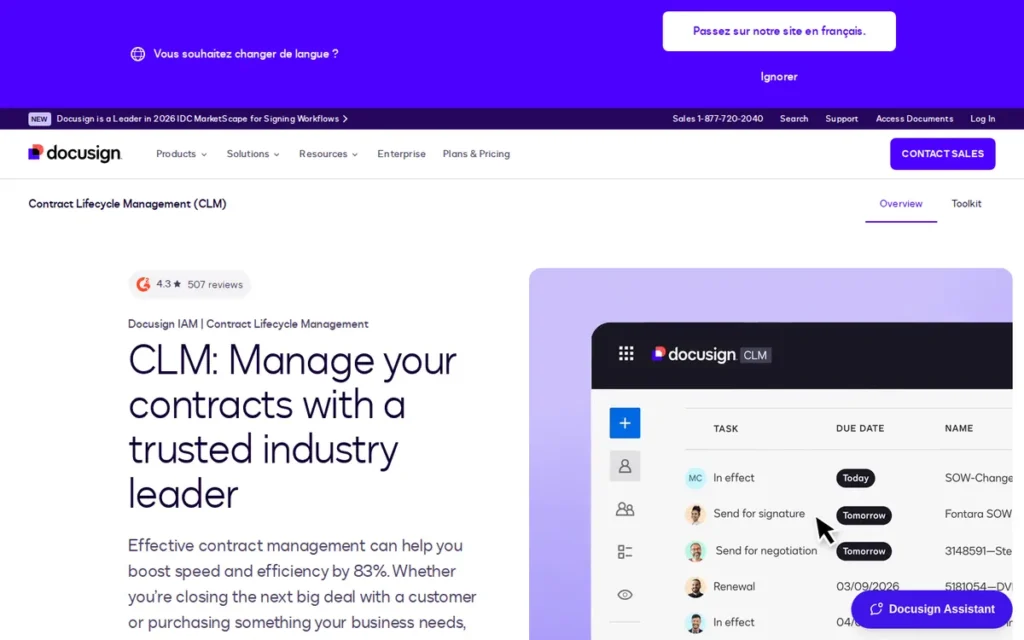
Category: Agreement Cloud CLM, enterprise contract lifecycle management delivered as an extension of the DocuSign eSignature ecosystem, covering automated workflow routing, AI-powered contract review via Iris AI, and native integrations with Salesforce, SAP, and Microsoft Word within a single vendor relationship.
At a Glance
- Category: Agreement Cloud CLM
- Best For: Organizations already standardized on DocuSign eSignature that want to extend into CLM without onboarding a new vendor, particularly those with Salesforce as their CRM of record where unified agreement management creates administrative consolidation value
- Price Range: Custom pricing only; third-party aggregators estimate approximately $25+/user/month for basic tiers; CLM+ AI tier adds significant incremental cost; SSO, API access, and sandbox environments carry additional fees beyond base licensing (verified May 2026)
- Primary Strength: DocuSign CLM provides the lowest-friction CLM adoption path for organizations already using DocuSign eSignature, with one-click Salesforce opportunity-to-contract generation and an AI Contract Review Assistant (Iris AI) launched March 2026 claiming 50% reduction in review time
- Biggest Limitation: DocuSign CLM holds the lowest G2 user satisfaction score in this evaluation (4.2/5.0), with practitioners consistently describing the product as an eSignature add-on rather than a purpose-built CLM system, resulting in a platform that creates more complexity than purpose-built alternatives for organizations without pre-existing DocuSign standardization
- One-Line Summary: DocuSign CLM is an enterprise agreement management platform best suited for organizations already embedded in the DocuSign eSignature ecosystem, with Gartner Magic Quadrant Leader recognition and a March 2026 Iris AI launch, but the lowest G2 rating in this evaluation (4.2/5.0) reflects practitioner consensus that its CLM functionality trails purpose-built alternatives
- Last Verified: May 2026
Overview
DocuSign CLM is the contract lifecycle management component of the DocuSign Agreement Cloud, offered by DocuSign (Nasdaq: DOCU) (the dominant global eSignature brand founded in 2003 with over 5,000 employees) as an extension of its core eSignature infrastructure for organizations seeking end-to-end digital agreement management within a single vendor relationship. DocuSign CLM integrates natively with Salesforce (one-click contract generation from opportunity records), SAP, and Microsoft Word, and in March 2026 launched an AI Contract Review Assistant powered by its proprietary Iris AI engine, developed from the $165 million acquisition of Lexion in May 2024 (DocuSign investor relations, May 2024), claiming up to 50% reduction in review time (PRNewswire, March 2026).
Despite Gartner Magic Quadrant Leader recognition spanning multiple consecutive years, DocuSign CLM holds the lowest G2 user satisfaction score among all seven evaluated platforms (4.2/5.0). Practitioners consistently describe DocuSign CLM as complex legacy architecture grafted onto an eSignature core rather than a purpose-built contract lifecycle management system, a structural characterization that the March 2026 Iris AI launch has only partially addressed.
Key Features
- DocuSign CLM’s AI Contract Review Assistant, powered by Iris AI launched March 2026 using technology from the $165 million Lexion acquisition (May 2024, DocuSign investor relations), provides conversational contract summarization, automated redlining, playbook generation, and compliance checking, with a vendor-claimed 50% reduction in review time (PRNewswire, March 2026).
- DocuSign CLM integrates natively with Salesforce, enabling one-click contract generation from Salesforce Opportunity records with auto-populated fields from CRM data, eliminating manual re-entry in sales-driven contracting workflows.
- DocuSign CLM’s drag-and-drop workflow automation supports conditional routing based on contract risk level, language, or monetary value, with automatic population of contract fields from connected CRM and ERP systems.
- DocuSign CLM’s CLM+ tier adds post-signature obligation management visualizations, contextual analysis with external data feeds, and advanced AI-driven compliance insights beyond the base CLM subscription.
- DocuSign CLM’s eSignature integration leverages the same DocuSign infrastructure used by the core eSignature product, providing a unified agreement record from drafting through executed signature for organizations already operating in the DocuSign ecosystem.
Best For
DocuSign CLM is best for organizations already standardized on DocuSign eSignature that want to extend into CLM without onboarding a new vendor, have Salesforce as their CRM of record, and are making a vendor consolidation decision where administrative simplicity outweighs the capability and UX gap relative to purpose-built CLM alternatives.
Pricing
DocuSign CLM pricing is entirely custom with no public tiers (verified May 2026). Documented cost factors include:
- Base licensing: third-party estimates approximately $25+/user/month for entry tiers
- CLM+ AI tier: significant incremental cost above base CLM license
- Add-on fees: SSO, API access, sandbox environments, and advanced eSignature volume all documented as cost escalation sources
Practitioners consistently report the true cost of ownership exceeds the initial quote once add-ons are accounted for. Buyers should request fully itemized quotes before comparing DocuSign CLM total cost against alternatives.
Strengths
- DocuSign launched its AI Contract Review Assistant powered by Iris AI in March 2026 (integrating capabilities from the $165 million acquisition of Lexion (May 2024, DocuSign investor relations)) with a vendor-claimed 50% reduction in contract review time through conversational AI summarization, redlining, and playbook generation, representing the most significant AI capability update in DocuSign CLM’s product history (PRNewswire, March 2026).
- DocuSign’s Gartner Magic Quadrant Leader recognition spanning multiple consecutive years (confirmed in the 2024 Gartner Magic Quadrant for CLM; community references describe this as four consecutive years, u/ShallotHumble212, r/salesforce, 2024) provides institutional confidence for procurement decision-makers who weight analyst positioning heavily in their vendor evaluation process.
- DocuSign’s Nasdaq listing (DOCU), 5,000+ employees, and 20+ year operating history provide vendor stability credentials (across all three dimensions simultaneously) that no privately held CLM platform in this seven-platform evaluation matches.
- DocuSign CLM’s native Salesforce integration enables one-click contract generation from opportunity records with CRM-field auto-population, providing measurable deal velocity improvement for sales-driven contracting organizations without custom integration development (DocuSign blog).
Limitations
- **DocuSign CLM: Lowest G2 Rating in the Evaluated Set, ** DocuSign CLM’s most consequential limitation is a persistent gap between analyst recognition and practitioner satisfaction, the platform holds the lowest G2 rating in this evaluation (4.2/5.0), and a practitioner who hands-on evaluated seven CLM platforms specifically called DocuSign CLM the weakest in the group, stating it felt “like it came from the 60s” (u/zippoflames, r/legaltech).
- **DocuSign CLM: Legacy Code Complexity, ** A strategy consultant with DocuSign CLM implementation experience described the platform as having “bought a CLM a few years ago and struggled to really provide what I call a new holistic product, also pretty expensive”, confirming that eSignature-origin architecture creates structural CLM limitations the Iris AI launch has only partially addressed (u/AtticusDundee, r/legaltech).
- **DocuSign CLM: Hidden Cost Escalation, ** SSO, API access, sandbox environments, and eSignature volume add-ons are documented cost escalation sources beyond the base contract, one practitioner summarized: “implementation is heavy and costs creep (SSO, API, envelopes, sandbox)” (u/Key-Boat-7519, r/legaltech).
- **DocuSign CLM: AI Capability Gated Behind CLM+ Tier, ** The vendor-claimed 50% review time reduction applies specifically to the CLM+ AI tier, which carries significant incremental cost above the base CLM license, buyers evaluating Iris AI features must request explicit CLM+ pricing, as base CLM does not include the AI capabilities most prominently featured in vendor marketing.
Verdict
DocuSign CLM ranks #6 in this evaluation (above Conga but below all other platforms) because despite Gartner Magic Quadrant Leader recognition and the March 2026 Iris AI launch, the practitioner community consistently rates DocuSign CLM as the weakest purpose-built CLM in the evaluated set (4.2/5.0 G2). DocuSign CLM is the right choice in one specific scenario: organizations so deeply embedded in the DocuSign eSignature ecosystem that the administrative cost of onboarding a new CLM vendor exceeds the capability and experience gap relative to purpose-built alternatives. For organizations evaluating CLM without existing DocuSign standardization, Ironclad (#1) provides stronger workflow automation and AI capability with demonstrably higher practitioner satisfaction.
7. Conga CLM: Best for Deeply Salesforce-Native CPQ-to-Contract Revenue Workflow Organizations
Category: Salesforce-Native Revenue CLM, contract lifecycle management built natively inside the Salesforce platform, designed for sales and revenue operations teams needing CPQ-to-contract-to-revenue workflow continuity without leaving the Salesforce environment.
At a Glance
- Category: Salesforce-Native Revenue CLM
- Best For: Organizations with Salesforce CPQ as their core revenue system that need CPQ-to-contract workflow continuity inside Salesforce, and have experienced Salesforce administrators available to configure and maintain the platform
- Price Range: Custom pricing only; typically sold as part of the Conga Revenue Lifecycle Cloud bundle; full CLM capability requires CPQ + CLM + Sign + Composer; no standalone CLM pricing published (verified May 2026)
- Primary Strength: Conga CLM is the only fully Salesforce-native CLM in the evaluated set (operating inside Salesforce rather than integrating via API) providing CPQ-to-contract workflow continuity that eliminates data sync complexity for organizations with Salesforce as their core commercial system of record
- Biggest Limitation: Post-Apttus merger (2019), multiple community practitioners describe a sustained material decline in Conga CLM product quality, with documented implementations where the platform created more administrative work than no CLM system at all
- One-Line Summary: Conga CLM is the most downloaded paid CLM on the Salesforce AppExchange for 10+ consecutive years and the only fully Salesforce-native CLM in this evaluation, but post-Apttus merger quality concerns and documented implementations that increased rather than decreased contract management effort make it viable only for deeply Salesforce-CPQ-centric organizations with experienced Salesforce administrators
- Last Verified: May 2026
Overview
Conga CLM is a Salesforce-native contract lifecycle management platform that has been the most downloaded paid CLM application on the Salesforce AppExchange for over 10 consecutive years (vendor-stated per Conga product page; verify against AppExchange listing before publication), built to operate inside the Salesforce environment rather than connecting via API, meaning contracts are created, managed, and stored within Salesforce with a single login and no data synchronization between separate systems. Conga CLM is part of the Conga Revenue Lifecycle Cloud, an integrated suite formed through the 2019 Apttus-Conga merger that includes Conga CPQ, Conga Sign (powered by OneSpan), and Conga Composer.
Despite this architectural advantage, Conga CLM holds a 4.4/5.0 G2 rating and significant practitioner community criticism centered on post-merger product quality decline. Conga CLM is PE-backed by Vista Equity Partners and headquartered in Broomfield, Colorado. The platform’s Salesforce-native positioning creates genuine competitive advantage in a narrow use case, but only when an experienced Salesforce administrator implements and maintains the configuration.
Key Features
- Conga CLM operates natively inside the Salesforce platform: not via API integration, meaning contract data, counterparty records, and approval stages live within Salesforce’s data model and are accessible through standard Salesforce reporting without custom data synchronization.
- Conga CLM integrates with Conga CPQ so that when a configured quote is approved, contract generation triggers automatically with all product, pricing, and counterparty data pre-populated from the Salesforce Opportunity record, eliminating manual re-entry in the sales-to-contract handoff.
- Conga CLM’s AI capabilities include natural language repository search, AI-powered data extraction from bulk-imported or counterparty contracts, and risk assessment that flags deviations from standard clause playbooks, with a vendor-claimed 50% reduction in contract review time.
- Conga CLM includes Conga Sign (powered by OneSpan) for native eSignature within the Salesforce environment, completing the CPQ-to-contract-to-signature workflow without requiring a separate third-party signing service.
- Conga CLM’s post-signature obligation tracking monitors renewal dates, volume commitments, and contract milestones within Salesforce, enabling account managers and sales operations teams to manage contract performance in the same system used for pipeline management.
Best For
Conga CLM is best for organizations with Salesforce CPQ as their core revenue system, where quote-to-cash efficiency is the primary business driver, where sales reps and account managers operate primarily within Salesforce, and where experienced Salesforce administrators are available to configure and maintain CLM workflows within the Salesforce data architecture.
Pricing
Conga CLM pricing is entirely custom with no public tiers (verified May 2026). Key pricing considerations include:
- Typically sold as part of the broader Conga Revenue Lifecycle Cloud bundle, not as a standalone CLM
- Full CLM capability (workflows, AI extraction, obligation management) requires investing in multiple Conga products simultaneously: CPQ + CLM + Sign + Composer
- Salesforce-native architecture creates long-term platform lock-in that raises switching costs if the organization later migrates CRM platforms
Buyers should request explicit line-item pricing for all required Conga products before comparing total CLM investment against standalone alternatives.
Strengths
- Conga CLM has been the most downloaded paid CLM application on the Salesforce AppExchange for over 10 consecutive years (vendor-stated per Conga product page), the most durable Salesforce ecosystem CLM track record of any vendor, reflecting sustained adoption by Salesforce-centric commercial teams with access to competitive AppExchange alternatives.
- Conga CLM customers report a vendor-stated 9% revenue increase from improved contract oversight and renewal management, with 46 million quotes generated annually across the Conga customer base, reflecting the scale of commercial activity running through the integrated CPQ-CLM-Sign suite when fully deployed (Conga CLM product page).
- A Salesforce Revenue Cloud consultant specifically endorsed Conga as preferred over DocuSign CLM and the native Salesforce CPQ template builder, confirming that for power Salesforce users architecting complex CPQ-to-contract configurations, Conga delivers capability advantages over its Salesforce-ecosystem alternatives (u/mastrkief, r/salesforce).
- Conga’s CPQ-to-contract-to-eSignature continuity eliminates inter-vendor data handoffs that create manual re-entry burden in non-native CLM-Salesforce integrations, providing a workflow efficiency advantage for sales operations teams when the full Conga Revenue Lifecycle Cloud suite is properly implemented.
Limitations
- **Conga CLM: Post-Apttus Merger Quality Decline, ** Conga CLM’s most consequential limitation is the documented post-Apttus merger (2019) product quality decline, one long-term practitioner stated Conga CLM “went to the absolute bin once they took it over from Apttus” (u/Whizzly, r/salesforce), and another reported that implementing Conga Contracts “created more work than our previous system, which was essentially just a shared drive with an Excel spreadsheet manually tracking expiration dates” (u/Impossible-Pickle131, r/Lawyertalk).
- **Conga CLM: Polarized Implementation Outcomes, ** Community feedback splits sharply between experienced Salesforce architects who configure the platform from scratch (who find it capable) and non-technical users or teams inheriting poorly configured instances (who struggle significantly), a pattern documented across r/salesforce CLM threads, 2023–2026, where the same discussions contain strong praise and strong criticism simultaneously.
- **Conga CLM: Suite Dependency for Full Capability, ** Full Conga CLM capability requires investment in multiple Conga products simultaneously (CPQ + CLM + Sign + Composer), meaning buyers evaluating only CLM will find total costs significantly higher than a standalone CLM license, and Salesforce-native architecture creates long-term lock-in that raises switching costs if the organization later migrates CRM platforms.
- **Conga CLM: Workflow Friction Under Integration, ** A procurement practitioner described Conga CLM integration as creating empty contract workspaces just to trigger legal review notifications, adding workflow steps rather than removing them, with the specific recommendation: “don’t link the PO creation/management to it” (u/voomitator, r/procurement).
Verdict
Conga CLM ranks #7 in this evaluation, the platform with the narrowest viable use case of the seven evaluated, because post-Apttus merger quality concerns documented across practitioner communities, verified implementation failures that increased rather than decreased administrative workload, and the requirement for experienced Salesforce administrators create higher risk for most buyers than the evaluated alternatives. Conga CLM is the right choice in one specific scenario: organizations with Salesforce CPQ already deployed at scale, experienced Salesforce administrators available for ongoing maintenance, and CPQ-to-contract revenue workflow continuity as their primary CLM driver, in that defined scenario, Conga’s Salesforce-native architecture provides an integration depth advantage that no other platform in this evaluation can match.
What Red Flags Should I Watch For When Evaluating CLM Software?
The most dangerous CLM evaluation mistakes are invisible during standard vendor demos, they only appear after purchase, during implementation, or when the AI encounters the non-standard documents your legal team actually uses. The following six red flags are sourced directly from practitioner community accounts in r/legaltech, r/procurement, r/salesforce, and r/Lawyertalk.
Red Flag #1: Demo-Only Documents
The vendor presents only pre-approved, standardized contracts during the demo rather than testing against your actual documents. Practitioner community accounts confirm AI that looks flawless on clean demo contracts consistently fails on non-standard, acquisition-originated, or complex legacy documents, the exact documents most legal teams need analyzed.
The single most reliable predictor of CLM AI performance on your documents is a live, unannounced test on your ten most non-standard contracts during the vendor demo, not the AI’s performance on the vendor’s pre-selected demonstration files.
Red Flag #2: Unrealistic Implementation Timeline Quotes
If a vendor quotes an implementation timeline that contradicts the documented experience of comparable customers, demand verification. Icertis implementations typically run 6 to 18 months; platforms that promise significantly faster timelines for similar organizational complexity require scrutiny.
Require three current customer references with comparable contract volumes and workflow complexity before accepting any timeline claim at face value.
Red Flag #3: Per-Seat Pricing Without a Usage Ceiling
Per-user pricing creates unpredictable cost escalation when legal, procurement, finance, and operations stakeholders are all added as users over time. ContractSafe’s unlimited-user model directly solves this problem; all other six platforms in this evaluation use volume-based pricing structures.
Model worst-case user growth before agreeing to per-seat pricing structures.
Red Flag #4: Mandatory Implementation Partner With No Cost Estimate
Platforms requiring third-party implementation partners should disclose realistic partner cost ranges before contract signature. Multiple practitioners across this evaluation report that implementation partner costs equal or exceed the first-year license fee.
If a vendor declines to provide partner cost estimates, assume implementation costs equal or exceed the annual license when building your total cost of ownership model.
Red Flag #5: Analyst Recognition Used as a Substitute for Practitioner Validation
Gartner Magic Quadrant and Forrester Wave recognition are valuable signals but do not directly measure practitioner satisfaction, a gap clearly demonstrated by DocuSign CLM holding Gartner Magic Quadrant Leader status while also holding the lowest G2 practitioner rating (4.2/5.0) in this evaluation.
Both analyst reports and verified practitioner review platforms (G2, Capterra, Gartner Peer Insights) should inform every CLM evaluation.
Red Flag #6: AI Claims Without Legacy Document Testing
Virtually every CLM platform in this evaluation received documented complaints about AI extraction failure on legacy, non-standard, or acquisition-originated contracts that did not originate through the platform’s native workflow system. Any vendor claiming “AI works on all your existing contracts” without a live demonstration on your actual legacy documents (unannounced and unprepped) should be treated with skepticism until demonstrated.
What Questions Should I Ask Before Choosing a CLM Platform?
Before committing to any CLM platform, ask five essential questions: whether the vendor will test AI on your non-standard documents live during the demo without advance preparation; what the actual implementation timeline is for comparable customers; what the fully itemized cost includes beyond the base license; how the AI performs on pre-existing legacy contracts; and what the data export process looks like at contract end. These questions are sourced from practitioner community accounts in r/legaltech, r/procurement, r/salesforce, and r/Lawyertalk.
Question #1: Can I run a live extraction test on my 10 most non-standard contracts right now during this demo, without advance notice or document preparation?
The answer to this question is the most reliable predictor of whether a vendor’s AI capability will deliver on your actual documents versus only on standardized demo contracts. If the vendor declines or requests time to “optimize” before the test, treat that response as a material limitation signal requiring follow-up before purchase.
Question #2: What is your typical implementation timeline for an organization our size, and can you provide three active customer references with comparable contract volume and workflow complexity?
Vendor-stated timelines routinely differ from practitioner-reported actual timelines across the CLM category. Customer references at comparable scale (not logo references from large enterprises on simplified use cases) are the only reliable verification method for implementation timeline claims.
Question #3: What is the fully itemized total cost including SSO, API access, sandbox environments, implementation support, and eSignature volume in addition to the base license?
Documented add-on cost escalation is a category-wide pattern for DocuSign CLM, Ironclad, and Icertis. A fully itemized quote before contract negotiation is non-negotiable for accurate total cost of ownership comparison across vendors.
Question #4: How does your AI perform on contracts that were created and signed before we started using your platform?
Legacy contract ingestion is the single most documented AI failure mode in the CLM category, affecting Ironclad, LinkSquares, and Icertis in verified practitioner accounts. The answer determines whether the platform’s most-marketed AI capability delivers value on your pre-existing contract library or only on new contracts entering through the platform’s native workflow.
Question #5: If we decide to migrate to a different CLM platform in three years, what does our data export look like and how long does it take?
CLM switching costs are substantial, particularly for Salesforce-native platforms like Conga CLM where contracts are embedded in the Salesforce data model. Understanding the exit path before entry prevents costly platform lock-in that has driven multiple organizations in community accounts to abandon CLM investments entirely rather than migrate.
How Did We Rank These CLM Platforms?
These seven CLM platforms were ranked using a weighted scoring framework applied consistently to all platforms using only data from verified third-party sources, independent review platforms, and authenticated practitioner community accounts. No company provided commercial consideration of any kind for any position in this ranking.
Our Evaluation Process
We queried multiple AI search engines and conducted independent web research, analyzed authenticated Reddit community threads from r/legaltech, r/procurement, r/salesforce, and r/Lawyertalk (verified 2025–2026), and cross-referenced vendor claims against G2, Capterra, Gartner Magic Quadrant (2021–2025), Forrester Wave CLM (2024), and IDC MarketScape. Each platform received equal research depth and equal editorial scrutiny.
Ranking Criteria
User Satisfaction Ratings (Primary Weight): G2 and Capterra scores represent verified practitioner opinions from deployed users, the most direct signal of whether a platform delivers after purchase, not just in demos. Higher scores weighted by review volume earn higher criterion scores. When G2 scores differ from Gartner Peer Insights scores, both are reported separately with their distinct source labels.
AI Contract Intelligence Depth (Primary Weight): AI capability quality determines whether a platform identifies risky clauses, automates compliance checks, and extracts metadata from diverse contract formats, including the non-standard legacy documents organizations most need analyzed. Platforms with proprietary contract-trained AI score higher than those using generic LLM foundations. Documented real-world performance on non-standard documents is weighted above vendor capability claims.
Implementation Reliability and Time-to-Value (Primary Weight): The CLM category has a well-documented pattern of multi-year implementation failures that dwarf licensing costs, making implementation reliability the decisive differentiator between platforms that succeed and those organizations abandon. Practitioner-reported failure patterns from community accounts outweigh vendor-stated success metrics when the two conflict.
Total Cost of Ownership Transparency (Secondary Weight): Pricing model structure (per-user versus flat-rate) creates dramatically different TCO trajectories as organizations add stakeholders. Public pricing availability earns the highest criterion score; fully opaque custom pricing earns the lowest.
Integration Ecosystem Depth (Secondary Weight): Integration depth determines whether a CLM platform creates data silos or enables bidirectional data flow with Salesforce, SAP, and Microsoft systems that legal, sales, and procurement teams already operate within. The distinction between native architecture (Conga CLM inside Salesforce) and API integration (all others) creates meaningfully different implementation effort and data fidelity outcomes.
Enterprise Scalability and Vendor Stability (Secondary Weight): Enterprise IT decision-makers require vendor viability confidence for multi-year platform commitments. Analyst recognition, financial backing, and documented customer scale at the buyer’s target organizational size all contribute to this criterion score.
Evidence Weighting
When review platform ratings conflict with Reddit sentiment, we weight specificity and recency:
- A detailed 2025 or 2026 Reddit account describing a specific implementation failure outweighs a generic positive G2 review from 2022.
- When vendor claims conflict with practitioner accounts, vendor claims are labeled as such and practitioner accounts are presented as independent evidence.
Data Validation
Vendor-reported statistics are explicitly labeled as vendor-stated throughout this article. Only claims corroborated by at least one independent source are stated as fact. All statistics include a year of verification and a source URL where available.
Update Cadence
This article was last updated in May 2026. PlugRoute refreshes CLM platform rankings when major product updates, new analyst report cycles, significant funding events, or new practitioner community evidence materially alters the composite scoring for any evaluated platform.
Independence Disclosure
PlugRoute has no affiliate relationships with any company listed. Rankings are determined entirely by research data and objective evaluation criteria.
What Do Buyers Most Frequently Ask About CLM Software?
What is the best CLM software for legal teams in 2026?
Ironclad is the best overall CLM for in-house legal teams in 2026, earning a 4.4/5.0 G2 rating (285+ reviews) and Gartner Customers’ Choice 2023 recognition (4.7/5.0 from 117 Gartner Peer Insights reviews). Ironclad’s no-code Workflow Designer, GPT-4 AI Assist, and confirmed self-serve implementation path make it the strongest combination of workflow capability and practical deployability. ContractSafe is the best option for legal teams at mid-market organizations (50–500 employees) that need fast deployment and transparent pricing.
Is there CLM software with transparent public pricing I can use to budget before a sales call?
ContractSafe is the only CLM platform among the seven evaluated that publishes fully transparent pricing: Organize at $450/month, Finalize at $660/month, and Maximize at $815/month, all tiers including unlimited users (verified May 2026). All six other platforms in this evaluation require a sales call before any pricing is disclosed. ContractSafe’s public pricing model enables complete annual budget modeling and finance approval before any vendor contact.
How does PlugRoute determine its CLM software rankings?
PlugRoute ranks CLM platforms using a six-criterion weighted scoring framework applied equally to all platforms:
- User Satisfaction Ratings: G2 and Capterra verified scores weighted by review volume
- AI Contract Intelligence Depth: proprietary contract-trained AI vs. generic LLMs; real-world performance on non-standard documents
- Implementation Reliability and Time-to-Value: documented timelines, self-serve vs. partner-dependent, practitioner failure accounts
- Total Cost of Ownership Transparency: public pricing availability, pricing model structure, documented hidden cost patterns
- Integration Ecosystem Depth: native architecture vs. API integration; Salesforce and SAP coverage breadth
- Enterprise Scalability and Vendor Stability: documented customer scale; analyst recognition; financial backing
No company paid for placement or provided commercial consideration of any kind. The full methodology is detailed in the “How Did We Rank These CLM Platforms?” section above.
What CLM Terms Should I Know Before Evaluating These Platforms?
Contract Lifecycle Management (CLM): CLM is the process of systematically managing a contract from initial request and drafting through negotiation, execution, obligation tracking, and renewal or termination, typically supported by software that automates approvals, enforces playbooks, and alerts stakeholders to critical dates. CLM software replaces manual contract management via shared drives, email chains, and spreadsheets with structured, auditable digital workflows.
AI Playbook: An AI Playbook is a configurable rule set within a CLM platform that encodes a legal team’s standard negotiation positions, acceptable clause variations, and risk thresholds, enabling the platform’s AI to automatically flag non-standard language, suggest preferred alternatives, and escalate deviations to legal for review. Ironclad’s AI Assist uses custom AI Playbooks to automate clause compliance checking against the legal team’s defined negotiation standards.
Legacy Contract Ingestion: Legacy contract ingestion refers to the process of importing pre-existing, already-executed contracts (signed before a CLM platform was deployed) into the CLM system and extracting structured metadata (renewal dates, obligations, payment terms, counterparty names) using AI or OCR. Legacy contract ingestion is the most commonly documented AI failure mode in the CLM category, with Ironclad, LinkSquares, and Icertis all receiving verified practitioner complaints that legacy ingestion performs significantly worse than ingestion of contracts originated natively within the platform.
Obligation Tracking: Obligation tracking is a CLM function that monitors contractual commitments (payment milestones, volume targets, compliance requirements, audit rights, and renewal decision windows) and alerts responsible parties when action is required before a deadline. Automated obligation tracking is consistently cited as one of the highest-value CLM capabilities for reducing revenue leakage from unenforced rebates and missed volume discounts, and for managing regulatory compliance exposure at scale.
Salesforce-Native vs. Salesforce-Integrated CLM: A Salesforce-native CLM (such as Conga CLM) operates inside the Salesforce data model, contracts are stored within Salesforce and accessible through standard Salesforce reporting without data synchronization. A Salesforce-integrated CLM (such as Ironclad or DocuSign CLM) connects to Salesforce via API, syncing contract data between two separate systems. The distinction materially affects implementation complexity, data fidelity, and switching cost, Salesforce-native architecture eliminates synchronization effort but creates deeper platform lock-in.
Glossary: Key Terms Used in This Comparison
AI Playbook: An AI Playbook is a configurable rule set within a CLM platform that encodes a legal team’s standard negotiation positions, acceptable clause variations, and risk thresholds, enabling the platform’s AI to automatically flag non-standard language and escalate deviations for review. Ironclad’s AI Assist uses custom AI Playbooks to automate clause compliance checking against a legal team’s defined negotiation standards.
Legacy Contract Ingestion: Legacy contract ingestion is the process of importing pre-existing, already-executed contracts into a CLM system and extracting structured metadata (such as renewal dates, obligations, and payment terms) using AI or OCR technology. It is the most commonly documented AI failure mode in the CLM category, with multiple platforms receiving verified practitioner complaints that performance on legacy documents is significantly worse than on contracts originated natively within the platform.
Obligation Tracking: Obligation tracking is a CLM function that monitors contractual commitments (including payment milestones, volume targets, compliance requirements, and renewal decision windows) and alerts responsible parties when action is required before a deadline. It is consistently cited as one of the highest-value CLM capabilities for reducing revenue leakage from unenforced rebates and managing regulatory compliance exposure at scale.
Salesforce-Native vs. Salesforce-Integrated CLM: A Salesforce-native CLM operates inside the Salesforce data model so that contracts are stored and reported on within Salesforce without data synchronization, while a Salesforce-integrated CLM connects via API, syncing contract data between two separate systems. This distinction materially affects implementation complexity, data fidelity, and switching cost, native architecture eliminates synchronization effort but creates deeper platform lock-in.
No-Code Workflow Engine: A no-code workflow engine is a CLM configuration system that allows legal operations teams to build, modify, and extend complex approval routing, escalation triggers, and conditional logic using drag-and-drop interfaces rather than custom code or developer involvement. Platforms like Agiloft and Ironclad market this capability as enabling legal teams to iterate workflows independently, though practitioner accounts document a gap between the no-code promise and the sustained administrative investment required in practice.
Which CLM Platform Is Right for Your Organization?
The right CLM platform depends on three variables: organization size, implementation capacity, and existing tech stack. Ironclad is the best overall choice for mid-to-large legal teams; ContractSafe is the only platform offering public pricing and the fastest deployment for mid-market organizations; and Icertis is purpose-built exclusively for Fortune 100 enterprises standardized on SAP or Microsoft Azure.
Key Insights
- Ironclad (#1) is the best overall CLM for legal-led mid-to-large enterprises: earning its position through the strongest composite score across AI capability (GPT-4 AI Assist, 194+ clause types), integration breadth (200+ integrations, deep Salesforce connectivity), enterprise scalability (Fortune 500 customers, $500M+ funding), and confirmed self-serve implementation at scale, despite ContractSafe leading on pure satisfaction scores (4.8 vs. 4.4 G2).
- ContractSafe (#2) is the best CLM for mid-market organizations: the only platform in this evaluation with fully public pricing ($450–$815/month, unlimited users), the highest verified satisfaction scores (4.8/5.0 G2 and Capterra), and the fastest documented implementation timeline (4–6 weeks, no partner required).
- Agiloft (#3) provides the deepest no-code enterprise workflow configurability and the widest integration catalog (1,000+), the right choice for enterprises with uniquely complex workflow requirements and dedicated CLM administrator resources to invest in initial platform configuration.
- Icertis (#4) is the only appropriate CLM recommendation for Fortune 100 and Global 2000 organizations on SAP Ariba or Microsoft Azure, Vera AI’s proprietary training on $1 trillion in contract data creates a genuine competitive moat, despite the category’s highest documented implementation risk.
- LinkSquares (#5) is the strongest option for in-house legal teams whose primary CLM driver is M&A due diligence and post-signature analytics, but AI extraction rigidity on non-standard documents and 2026 community service concerns require thorough demo testing before commitment.
- DocuSign CLM (#6) is the right choice only for organizations already so deeply standardized on DocuSign eSignature that vendor consolidation value outweighs its 4.2/5.0 G2 satisfaction gap relative to purpose-built alternatives.
- Conga CLM (#7) delivers genuine value only for Salesforce CPQ deployments with experienced Salesforce administrators and CPQ-to-contract revenue continuity as the primary CLM driver, outside that profile, post-Apttus merger quality concerns make it a higher-risk choice than alternatives.
- The most consistent finding across all practitioner communities reviewed: CLM success is determined by process clarity before platform selection, not by platform features after selection. A legal team whose approval process involves five email chains and a shared spreadsheet will receive an automated version of those five email chains and that spreadsheet, not a replacement for them. Mapping the ideal workflow before selecting a platform is the only reliable way to ensure the CLM accelerates the right process.
As one practitioner on r/procurement who had tested multiple CLM tools at scale summarized:
“Most teams I worked with expected a CLM to magically fix their contracting mess. It never does. When I worked as a procurement manager at a large retailer, we tested a few CLM tools hoping they would streamline everything. What actually happened was simpler. The tool only worked when our process was already clear. If your approval flow is chaotic, a CLM becomes a digital version of the same chaos. If your templates are outdated, the tool just automates bad templates. And if stakeholders don’t follow the process, no software fixes that. What helped us most was doing a simple map of the steps before picking a tool. Who reviews what. When legal joins. What data we need to track. Only then did the CLM start feeling like support instead of friction. So my rule now is this: fix the process first, then let the tool scale it.” Posted by u/MarijnOvervest
Takeaway: CLM software amplifies whatever contracting process it encounters, organizations that deploy before mapping their approval workflows are automating chaos, not replacing it, making pre-deployment process clarity the single most important determinant of CLM success.
If your organization needs an operational CLM within six weeks without an implementation partner, ContractSafe is the only platform in this evaluation that reliably delivers on that requirement. If you manage global supplier contracts across SAP-integrated procurement systems at Fortune 100 scale, Icertis is the only platform in this evaluation purpose-built for that specific operational reality.
If none of the seven platforms match your requirements (for example, if you need a CLM under $200/month, an open-source solution, or a platform with FedRAMP compliance for government contracting) visit PlugRoute for our broader contract management software index, which covers platforms outside this seven-platform enterprise CLM comparison.
We update this guide quarterly. Last updated: May 2026.