Zuora ranks #1 for enterprise subscription billing complexity, earning Gartner Magic Quadrant Leader status in Recurring Billing Applications (2025). DealHub leads mid-market unified Q2C with a 4.7/5 G2 score and documented 95% quote error reduction. Salesforce Revenue Cloud is the benchmark for Salesforce-committed enterprises. Salesforce’s 2025 end-of-new-sales for legacy Salesforce CPQ has made this the most consequential Q2C platform evaluation decision in years.
Industry analyses consistently find billing errors, failed payments, and pricing inconsistencies cause between 3–10% of ARR in preventable annual losses, with leakage climbing higher for companies managing complex pricing models without automated billing reconciliation (LedgerUp, 2025; RatioTech, 2025). The platform you select, whether CPQ-first, billing-first, or a unified system, determines how much leakage you actually recover versus redistribute across new integration gaps.
PlugRoute has no affiliate relationships with any company listed. Rankings are determined entirely by research data and objective evaluation criteria.
“Most orgs are dealing with some version of the same thing: pricing logic that only a few people understand, a lot of dependency on partners or devs for basic changes, and a general fear of breaking something every time they touch it.” (u/hgmartin88, r/revops, March 2026)
Takeaway: Accumulated CPQ customizations create institutional technical debt that compounds the cost and risk of any platform migration, a pattern documented across Salesforce CPQ, Conga CPQ, and DealHub implementations in professional community discussions.
TL;DR: Top Picks at a Glance
- Zuora: broadest billing engine (50+ pricing models) with native ASC 606/IFRS 15 revenue recognition for enterprise SaaS
- DealHub: no-code unified CPQ, CLM, and billing deployable across four major CRMs in weeks, not months
- Salesforce Revenue Cloud: native AI-powered Q2C suite for enterprises committed to the Salesforce platform
- Maxio: purpose-built SaaS billing and ASC 606 automation for finance teams approaching fundraising or audit
Top 4 picks by ranking score. For enterprise CPQ complexity, SMB proposal automation, and Oracle-committed deployments, see #5 Conga CPQ, #6 PandaDoc, and #7 Oracle CPQ Cloud in the full ranked evaluation below.
What Are the Main Categories of Quote-to-Cash Software?
Quote-to-cash software falls into three categories based on where in the revenue workflow each platform begins: Full Q2C Platforms spanning the complete arc from quoting through billing and revenue recognition; Billing and RevRec Specialists built for subscription finance and ASC 606/IFRS 15 compliance; and CPQ and Document Automation Tools that handle quoting but require separate billing solutions.
Understanding which category matches your primary revenue gap (quoting accuracy, billing automation, or revenue recognition compliance) is the most critical filter before shortlisting any vendor.
Category 1: Full Q2C Platforms
These platforms span the complete arc from product configuration through billing and revenue recognition without requiring a separate billing or RevRec tool.
- Zuora: Revenue Platform with 50+ billing models, native ASC 606/IFRS 15 RevRec, and CPQ
- DealHub: CRM-agnostic Quote-to-Revenue platform with CPQ, CLM, billing, and DealRooms
- Salesforce Revenue Cloud: Salesforce-native enterprise Q2C suite with Agentforce AI
Category 2: Billing and RevRec Specialists
These billing automation and revenue recognition software platforms prioritize subscription lifecycle management and ASC 606/IFRS 15 compliance, and require a separate CPQ tool for the pre-sale quoting phase.
- Maxio: purpose-built SaaS subscription billing and ASC 606/IFRS 15 revenue recognition
Category 3: CPQ and Document Automation Tools
These platforms handle product configuration, pricing, quoting, and (for PandaDoc) document management and e-signature, but do not include subscription billing or revenue recognition in any tier.
- Conga CPQ: enterprise CPQ with 10,000+ line-item capacity and PROS AI dynamic pricing (February 2026)
- PandaDoc: SMB-to-mid-market document automation, quoting, and e-signature with transparent pricing
- Oracle CPQ Cloud: Oracle Fusion-native enterprise CPQ with asset-based ordering
A CPQ-first platform eliminates quoting errors immediately, but if your revenue leakage is concentrated in billing failures, pricing model mismatches, or failed dunning, a billing-first platform creates more measurable impact in the first 90 days. Map your largest revenue leakage source before shortlisting vendors, not after.
How Do the Top Q2C Platforms Compare at a Glance?
The table below compares all seven evaluated platforms across eight dimensions (category, best-fit buyer profile, one-line summary, key capabilities, primary strength, and key limitation) enabling direct side-by-side comparison before reading the full ranked entries. Use the Key Limitation column alongside Primary Strength to assess platform fit rather than defaulting to the highest G2 score alone.
| Rank | Company | Category | Best For | One-Line Summary | Key Capabilities | Primary Strength | Key Limitation |
|---|---|---|---|---|---|---|---|
| 1 | Zuora | Revenue Platform | Enterprise SaaS $50M+ ARR with usage-based billing | Zuora is the Gartner Magic Quadrant Leader in Recurring Billing Applications (2025) with 50+ pricing models, native ASC 606/IFRS 15 RevRec, and Forrester Wave Leader recognition in Recurring Billing Solutions (Q1 2025) | Billing, RevRec, CPQ, ERP integration | Broadest native billing engine at Fortune 500 scale | No published pricing; 6–9 month avg. implementation |
| 2 | DealHub | Quote-to-Revenue Platform | Mid-market SaaS migrating off Salesforce CPQ | DealHub is a no-code, CRM-agnostic Quote-to-Revenue platform rated 4.7/5 on G2 with documented 95% quote error reduction at Sendoso and native integration across four major CRMs | CPQ, CLM, billing, DealRooms | 95% error reduction; 4-CRM native; deploys in weeks | Billing depth trails Zuora; US support timezone lag |
| 3 | Salesforce Revenue Cloud | Enterprise Q2C Suite | Salesforce-committed enterprises | Salesforce Revenue Cloud is the Gartner Magic Quadrant Leader in CPQ (2025); a Salesforce-native suite with Agentforce AI and 2,847 G2 reviews, currently transitioning from legacy CPQ (end of new sales, 2025) | CPQ, CLM, billing, AI | Gartner MQ Leader CPQ; native Salesforce data; Agentforce | End-of-sale for legacy CPQ; Revenue Cloud Advanced described as expensive and immature |
| 4 | Maxio | SaaS Billing + RevRec | B2B SaaS finance teams $5M–$100M ARR | Maxio is a purpose-built SaaS billing and revenue recognition platform managing $17B+ in annual billings for 2,300+ customers with ASC 606-native automation and SaaS-native financial metrics | Subscription billing, RevRec, SaaS metrics | $17B+ billings managed; ASC 606 native; SaaS metrics | No native CPQ; Salesforce and NetSuite sync issues |
| 5 | Conga CPQ | Enterprise CPQ + Commerce | Non-Salesforce enterprises with complex configurations | Conga CPQ is a CRM-agnostic enterprise CPQ platform with a 10,000+ line-item mega-quote engine and PROS AI dynamic pricing (PROS B2B acquisition completed February 2, 2026); TrustRadius renewal intent 9.8/10, offset by implementation score of 1.0/10 | CPQ, POM, CLM, order management | Highest renewal intent; mega-quote capacity; PROS AI pricing | Lowest implementation score in evaluation (1.0/10 TrustRadius); data loss risk at contract end |
| 6 | PandaDoc | Document Automation + Quoting | SMB teams moving off manual quoting | PandaDoc is the highest-rated document automation and quoting platform; the only platform in this evaluation with a fully self-serve, publicly listed price schedule covering all tiers, starting at $35/user/month | Proposals, quoting, e-signature, payments | Highest review volume; only platform with published pricing | No subscription billing or ASC 606; not a full Q2C platform |
| 7 | Oracle CPQ Cloud | Enterprise CPQ Platform | Oracle Fusion-committed enterprises | Oracle CPQ Cloud is a constraint-based enterprise CPQ platform with native Oracle Fusion integration and asset-based ordering; the appropriate choice for Oracle-committed enterprises only | CPQ, ABO, AI deal scoring | Deepest native Oracle Fusion integration; asset-based ordering | Lowest G2 score and review volume in evaluation; proprietary BML creates talent scarcity |
Which Q2C Platform Should I Choose for My Use Case?
Use the Quick Decision Framework below to match your primary Q2C priority to the recommended platform and a strong alternative, organized by ARR range, pricing model complexity, and existing tech stack commitment. If your situation spans multiple rows, start with the row matching your largest current revenue leakage source.
| Your #1 Priority | Recommended Tool | Why | Strong Alternative |
|---|---|---|---|
| Enterprise SaaS $50M+ ARR with complex usage billing | Zuora | 50+ pricing models; Gartner + Forrester Leader; Zoom-scale proof | Salesforce Revenue Cloud (if Salesforce-committed) |
| Mid-market SaaS migrating off Salesforce CPQ | DealHub | No-code, 4-CRM; weeks to deploy; 95% error reduction at Sendoso | Conga Smart CPQ (if non-Salesforce, high complexity) |
| Salesforce-committed enterprise | Salesforce Revenue Cloud | Native Salesforce data model; Agentforce AI; Gartner MQ Leader CPQ 2025 | DealHub (if migration path preferred) |
| SaaS finance team needing billing + RevRec | Maxio | $17B+ billings managed; ASC 606 native; purpose-built SaaS metrics | Zuora (if usage-based billing complexity is high) |
| Non-Salesforce enterprise with 10,000+ line item configs | Conga CPQ | Patented mega-quote engine; PROS AI pricing (Feb 2026); CRM-agnostic Smart CPQ | Oracle CPQ (if Oracle Fusion committed) |
| SMB team moving off manual quoting $0–$20M ARR | PandaDoc | Transparent pricing from $35/user/month; highest review volume; fastest deployment | DealHub CPQ+ (if CLM also needed) |
| Oracle Fusion-committed enterprise | Oracle CPQ Cloud | Native Fusion integration; asset-based ordering; no sync overhead | Conga Smart CPQ (if non-Oracle environments included) |
1. Zuora: Best Overall for Enterprise Subscription and Usage-Based Billing
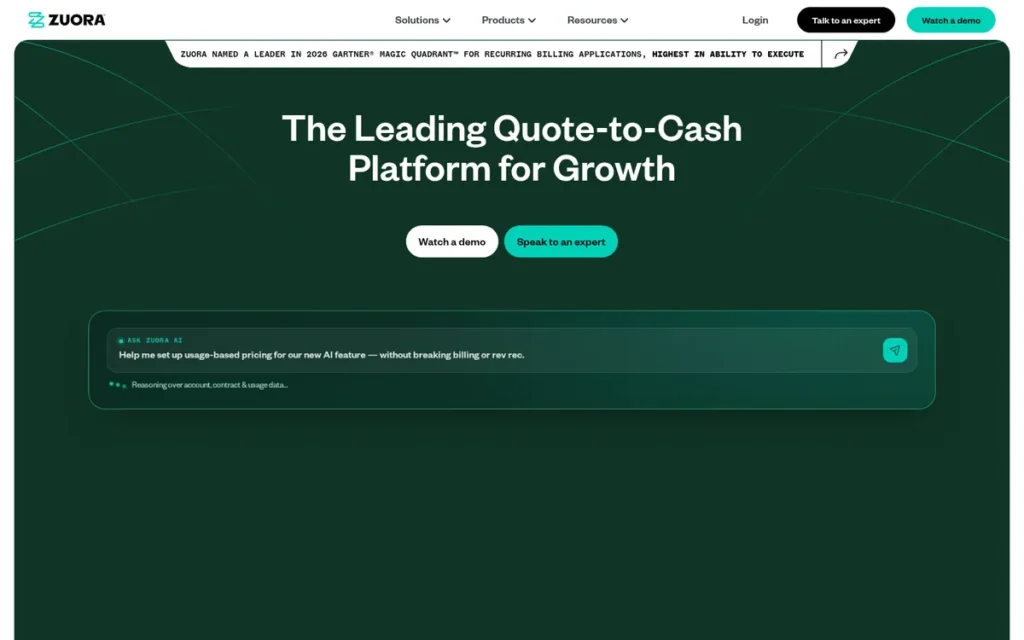
Category: Revenue Platform, manages subscription, usage-based, and hybrid billing with native ASC 606/IFRS 15 revenue recognition at proven Fortune 500 scale.
At a Glance
- Category: Revenue Platform
- Best For: Enterprise and upper mid-market B2B SaaS companies ($50M+ ARR) managing multi-model pricing (consumption metering, hybrid seat-plus-usage, prepaid credits) that require ASC 606/IFRS 15 revenue recognition for IPO readiness, audit preparation, or M&A diligence
- Price Range: Custom-quoted only; estimated $150K–$500K+/year for mid-market; enterprise contracts exceed $1M/year; Year 1 TCO typically 2–3× contract value including implementation
- Primary Strength: Zuora supports 50+ pricing model configurations: the broadest billing engine in this evaluation, at proven Fortune 500 scale, with native ASC 606/IFRS 15 revenue recognition built into the Revenue Subledger
- Biggest Limitation: Zuora carries no published pricing, average implementation timelines of 6–9 months per G2 reviewer patterns, and a Year 1 TCO that typically runs 2–3× the annual contract value, making it inaccessible for sub-$50M ARR organizations
- One-Line Summary: Zuora is the subscription economy’s longest-established billing platform, earning Gartner Magic Quadrant Leader status in Recurring Billing Applications (2025, second consecutive year) and Forrester Wave Leader recognition in Recurring Billing Solutions (Q1 2025, highest score in the Revenue Recognition criterion), with 50+ pricing models and native ASC 606/IFRS 15 revenue recognition at Fortune 500 scale
- Last Verified: May 2026
Overview
Zuora is an enterprise-grade Revenue Platform delivering automated billing across 50+ pricing models, native ASC 606 and IFRS 15 revenue recognition, and CPQ through its 2026-modernized Quote Studio module. Zuora earned Gartner Magic Quadrant Leader status in Recurring Billing Applications (2025, second consecutive year) and Forrester Wave Leader recognition in Recurring Billing Solutions (Q1 2025, highest score in the Revenue Recognition criterion).
Zuora’s platform spans Zuora Billing, Zuora Revenue (with a dedicated Revenue Subledger mapping CRM and CPQ data to ERP general ledger entries for SAP, NetSuite, and Workday), and Zuora CPQ, providing finance directors and RevOps teams a single system of record for recurring revenue operations. Zuora was founded in 2007 by former Salesforce CMO Tien Tzuo, who coined the term “subscription economy,” and processes billing at proven Fortune 500 scale.
Key Features
- Zuora Billing supports 50+ pricing model configurations: including tiered consumption metering, prepaid credit pools, ramp deals, milestone billing, hybrid seat-plus-usage, and outcome-based pricing, without requiring custom development for each model variant, making Zuora the broadest native billing engine in this evaluation.
- Zuora Revenue automates recognition to ASC 606 and IFRS 15 standards through a dedicated Revenue Subledger that handles contract modifications, multi-element arrangement allocation, variable consideration estimates, and audit-ready journal entry generation, critical for companies approaching fundraising, IPO readiness, or M&A due diligence.
- Zuora CPQ (Quote Studio) received a card-based UI modernization in Q2 2026 and integrates with Salesforce CRM via the ARM connector, enabling sales reps to generate quotes that flow directly into Zuora’s billing engine without manual data re-entry.
- Zuora’s 2025–2026 AI capabilities include Consumption Insights (GA 2025, providing usage trend analysis, anomaly detection, and demand forecasting), Billing Operations agents for autonomous invoice management, and MCP Servers enabling natural-language queries against live billing data, per Zuora’s February 2026 release notes.
- Zuora’s AR Period Close Dashboard and automated dunning management: with LexisNexis fraud protection and network tokenization, reduce Days Sales Outstanding and accelerate monthly financial close for high-volume subscription and usage portfolios.
Best For
Zuora is best suited for enterprise and upper mid-market B2B SaaS companies ($50M+ ARR) operating multi-model pricing architectures (including consumption metering, hybrid subscriptions, or outcome-based billing) that require native ASC 606/IFRS 15 revenue recognition as part of IPO readiness, audit preparation, or M&A due diligence. Zuora’s Gartner Magic Quadrant Leader status in Recurring Billing Applications (2025) and Forrester Wave Leader recognition in Recurring Billing Solutions (Q1 2025) make Zuora the industry reference standard for organizations where subscription and usage billing complexity is a genuine strategic requirement.
Pricing
Zuora is entirely custom-quoted with no published tiers or dollar amounts. Estimated contract values: $150,000–$500,000/year for mid-market deployments (500–5,000 subscribers); enterprise contracts exceed $1,000,000/year. Year 1 TCO (including Zuora Professional Services, SI implementation fees, integration, and internal team costs) typically runs 2–3× the annual contract value. Community sources (Vendr marketplace, G2 cost reviews, r/SaaS) document “20–50% hidden fees for add-ons” and characterize the pricing model as a “black box.” Pricing context verified May 2026.
Strengths
- Zuora earned Gartner Magic Quadrant Leader status in Recurring Billing Applications (2025, second consecutive year) and Forrester Wave Leader recognition in Recurring Billing Solutions (Q1 2025, highest score in the Revenue Recognition criterion), the most comprehensive independent analyst validation of any platform in this evaluation across both billing and revenue recognition dimensions.
- Zoom’s explosive subscriber growth during 2020–2022: one of the most rapid enterprise subscriber scaling events in SaaS history, was processed on Zuora’s infrastructure, providing an independently referenced proof point of extreme-volume billing capacity (Zuora What’s New, February 2026).
- A Director of Revenue Ops at Zendesk confirmed on G2 (2025): “Zuora’s usage engine transformed our hybrid billing, real-time metering for tiered overages without custom dev. Game-changer for scaling”, a named enterprise reference validating Zuora’s usage-based billing depth at production scale.
- Zuora’s G2 Flexibility sub-score of 9.1/10: the highest flexibility rating among enterprise billing platforms reviewed on G2 (Q1 2026), corroborates the 50+ pricing model claim with a volume-weighted user validation signal.
This experience from a Salesforce admin managing the Zuora integration day-to-day reflects the platform’s operational reality on r/salesforce:
“I used to create products and run point on the zuora rules engine. Both are pretty straightforward and easy to use. Might take some getting used to but overall not bad. Honestly I think zuora is decent at what it does. Our finance team liked it to an extent. It is pretty good at subscription pricing from what I remember.” Posted by u/neumansmom
Takeaway: Finance teams that adopt Zuora for subscription billing consistently validate its core pricing engine and rules management, even as the platform’s update cadence and lack of a free data loader require dedicated administrator attention over time.
Limitations
- Enterprise Investment Bar: Zuora’s most consequential trade-off is enterprise-grade billing power delivered at enterprise-grade price and complexity, systematically excluding buyers below $50M ARR. Zuora offers no self-serve pricing transparency (entirely custom-quoted), requires average implementation timelines of 6–9 months per G2 reviewer patterns (2026), carries Year 1 TCO that typically runs 2–3× the annual contract value, and is characterized by community sources as a pricing “black box” (Vendr marketplace, 2025). Community consensus is direct: “Zuora if you can stomach the enterprise sales process, they’re still the gold standard for subscription complexity” (u/DimensionIcy8750, r/SaaS, July 2025), the qualifier “if you can stomach” reflects procurement friction that precedes documented delivery excellence.
- UI and Support Gaps: Zuora’s interface is repeatedly characterized as “dated vs. Chargebee” in community comparisons (G2, 2025), and the platform’s 48-hour support SLA is a documented operational friction point for time-sensitive billing operations, confirmed by multiple G2 reviewers (2025) and a material consideration for finance teams where billing failures carry immediate compliance consequences.
- Scope Mismatch for Simpler Needs: Zuora’s modular architecture means organizations activating only a fraction of licensed capabilities pay for unused platform depth, community feedback characterizes this as “expensive, especially for smaller/mid-sized businesses” that activate seat-based billing without the usage metering and RevRec subledger that justify Zuora’s cost (r/SaaS, 2025).
Verdict
Zuora is the most comprehensively validated billing and revenue recognition platform in this 2026 evaluation for B2B SaaS companies managing complex, multi-model pricing at enterprise scale, earning Gartner Magic Quadrant Leader status in Recurring Billing Applications (2025) and Forrester Wave Leader recognition in Recurring Billing Solutions (Q1 2025) alongside proven deployment at Zoom-scale enterprise volume. Zuora’s 50+ native pricing models, ASC 606/IFRS 15 Revenue Subledger, and 2025–2026 AI additions make Zuora the reference standard for organizations where billing complexity is a genuine strategic requirement. Buyers below $50M ARR, organizations requiring rapid time-to-value, or those with straightforward recurring billing needs should evaluate Maxio or DealHub before engaging Zuora’s enterprise sales process.
2. DealHub: Best for Mid-Market Q2C: Unified CPQ, CLM, and Billing Across Any CRM
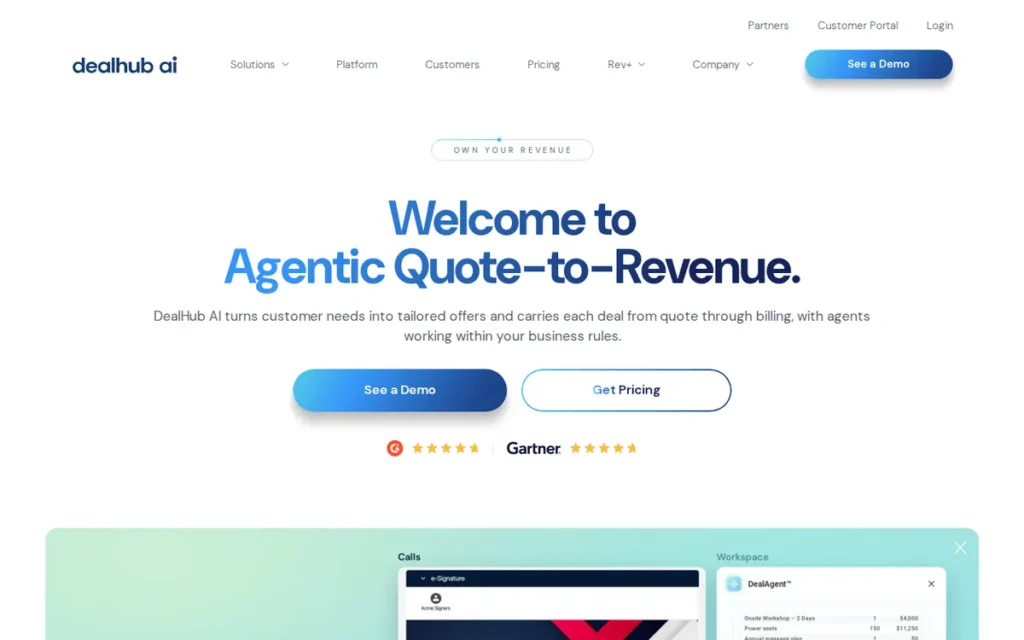
Category: Quote-to-Revenue Platform, unifies CPQ, CLM, subscription billing, revenue recognition, and digital sales room buyer engagement in a single CRM-agnostic platform.
At a Glance
- Category: Quote-to-Revenue Platform
- Best For: Mid-market to enterprise B2B SaaS companies ($10M–$200M ARR) on non-Salesforce CRMs, or migrating off legacy Salesforce CPQ, that need fast unified quoting, contracting, and billing with buyer engagement intelligence
- Price Range: Custom-quoted (three tiers: CPQ+, CPQ+CLM, Quote-to-Revenue); no public dollar amounts published
- Primary Strength: DealHub’s no-code CRM-agnostic architecture deploys across Salesforce, HubSpot, Dynamics 365, and Freshworks in weeks, with documented results including a 95% reduction in quote errors at Sendoso (2024) and 3× faster deal closure
- Biggest Limitation: DealHub’s billing capabilities do not match dedicated platforms like Zuora for high-volume consumption metering, and US customers face a documented 7–10 hour support response lag from DealHub’s Israel-based operations
- One-Line Summary: DealHub is a no-code, CRM-agnostic Quote-to-Revenue platform rated 4.7/5.0 on G2 that unifies CPQ, CLM, subscription billing, and DealRoom buyer engagement across Salesforce, HubSpot, Dynamics 365, and Freshworks, with documented results including 95% quote error reduction and 15% average deal size increase at Sendoso (2024)
- Last Verified: May 2026
Overview
DealHub is a CRM-agnostic Quote-to-Revenue platform combining CPQ, Contract Lifecycle Management, subscription billing, revenue recognition, and Digital Sales Rooms in a single no-code-configured system, supporting Salesforce, HubSpot, Dynamics 365, and Freshworks deployments completable in weeks, not months. DealHub’s no-code implementation model enables business users to configure pricing logic, approval workflows, and guided selling paths without IT involvement or certified developer resources.
DealHub raised $100M in January 2026, led by Riverwood Capital (PR Newswire, January 20, 2026), for Quote-to-Revenue platform expansion. DealHub’s G2 rating of 4.7/5.0 is supported by published case study results including 95% reduction in quote errors and 3× faster deal closure at Sendoso, and 94% faster finance verification at Lumina Solar (DealHub case studies, 2024).
Key Features
- DealHub CPQ+ delivers multi-dimensional pricing, configurable guided selling paths, dynamic approval workflows by deal size and discount threshold, and error-proof product bundling, all configured through a no-code admin interface without requiring Salesforce licensing, certified developers, or multi-month implementation timelines.
- DealHub DealRoom provides a secure digital workspace centralizing all deal assets (quotes, contracts, approval workflows, mutual action plans, collateral) with real-time engagement alerts when buyers open documents or revisit specific sections, delivering buyer intelligence that pure CPQ platforms do not provide.
- DealHub’s CLM module enables dynamic contract template generation, a searchable contract repository, version comparison, and integrated e-signature, eliminating the email-chain fragmentation that disconnects quote approval from contract execution.
- DealHub’s Quote-to-Revenue tier extends the platform into recurring and milestone billing, subscription renewal automation, invoicing, and revenue recognition, enabling companies to manage the complete arc from quote through cash recognition without switching platforms as they scale.
- DealHub integrates natively with Salesforce, HubSpot, Dynamics 365, and Freshworks for real-time pipeline forecasting sync, and supports both PLG (product-led growth) and traditional sales-led quoting motions in a dual-motion architecture.
Best For
DealHub is best suited for mid-market B2B SaaS companies ($10M–$200M ARR) operating on non-Salesforce CRM stacks, or those actively evaluating migration off legacy Salesforce CPQ following its 2025 end-of-sale announcement, that need a unified CPQ-CLM-billing platform deployable in weeks rather than months. DealHub is also the strongest evaluated option for companies wanting digital sales room buyer engagement intelligence (DealRoom) natively integrated with their CPQ workflow rather than managed as a separate tool.
Pricing
DealHub offers three custom-quoted tiers: CPQ+ (multi-dimensional pricing, guided selling, approvals, DealRoom), CPQ+CLM (adds dynamic contract templates, contract repository, version comparison, e-signature), and Quote-to-Revenue (full suite including recurring and milestone billing, subscription renewals, invoicing, revenue recognition). No public dollar amounts are published for any tier. Buyers must engage DealHub’s sales team for pricing. Pricing structure sourced from Proposify’s DealHub pricing guide, verified May 2026.
Strengths
- Sendoso achieved a 95% reduction in quote errors, 3× faster deal agreement closure (under 10 minutes), and a 15% increase in average deal size after deploying DealHub, published in DealHub’s case study resource center (2024), representing the most specifically quantified named client result in this evaluation. (Results are vendor-published; independent verification against client financial records was not available at time of publishing.)
- Lumina Solar reported 94% faster finance verification and 80% faster proposal generation on DealHub (DealHub case study, 2024), corroborating the Sendoso results with a second independently attributed named customer outcome. (Results are vendor-published.)
- DealHub’s G2 rating of 4.7/5.0 places it among the top-rated CPQ and Q2C platforms by user satisfaction, consistent with its no-code architecture and fast deployment profile, and the $100M January 2026 funding round led by Riverwood Capital validates continued platform investment.
- DealHub’s CRM-agnostic architecture with native integrations across Salesforce, HubSpot, Dynamics 365, and Freshworks is the broadest native CRM compatibility of any full Q2C platform in this evaluation, confirmed by cpq-integrations.com’s DealHub overview.
Users on r/salesforce actively evaluating CPQ alternatives shared:
“I’ve literally never come across anyone who was thrilled with their experience using SF CPQ (understatement). Not to mention the uncertainty with what happens to CPQ when (if?) revenue lifecycle management/cloud rolls out. I’ve been pleasantly surprised with DealHub when I’ve had the chance to use it, and it looks like they are starting to break through more – looks like Frost and Sullivan just named them company of the year in the CPQ category, too.” Posted by u/rrrrevops
Takeaway: Among practitioners navigating Salesforce CPQ’s end-of-sale uncertainty, DealHub is the most positively evaluated mid-market alternative, a sentiment reinforced by independent analyst recognition that community discussions had not yet fully reflected at time of posting.
Limitations
- Billing Depth Gap: DealHub’s most consequential trade-off is deployment speed versus billing depth, the no-code architecture accelerates CPQ and CLM implementation significantly, but DealHub’s billing capabilities do not match dedicated engines like Zuora for high-volume consumption metering, block pricing, or prepaid credit pool management without third-party billing integration, per Bluvium’s Revenue Cloud vs. DealHub analysis.
- US Support Timezone Lag: DealHub’s Israel-based support operation creates a documented 7–10 hour response window for US-based customers during normal Israeli business hours (r/revops, March 2026), a constraint that can directly impact time-sensitive deal situations and is a material consideration for US teams requiring intra-day support responsiveness.
- Demo vs. Reality History: A 2023 Salesforce community review by an experienced CPQ consultant described a six-month DealHub configuration project where “the demo and the real experience are drastically different” (u/Odd-Kaleidoscope-152, r/salesforce, February 2023); 2025 production reviews describe more positive experiences, suggesting platform maturation, buyers should request reference calls from comparable-complexity deployments before signing.
Verdict
DealHub is the highest-rated CPQ and Quote-to-Revenue platform for mid-market B2B SaaS teams prioritizing deployment speed, CRM flexibility, and unified buyer engagement alongside quoting automation, backed by the most specifically documented named client results in this evaluation, including a 95% quote error reduction at Sendoso and 94% faster finance verification at Lumina Solar (DealHub case studies, 2024). DealHub’s no-code architecture, native four-CRM compatibility, and $100M 2026 funding led by Riverwood Capital make DealHub the most credible mid-market alternative for teams migrating off legacy Salesforce CPQ that are not committed to Revenue Cloud Advanced. Buyers requiring best-in-class high-volume usage-based billing should benchmark DealHub’s Quote-to-Revenue billing tier against Zuora before making a final platform decision.
3. Salesforce Revenue Cloud: Best for Salesforce-Centric Enterprises
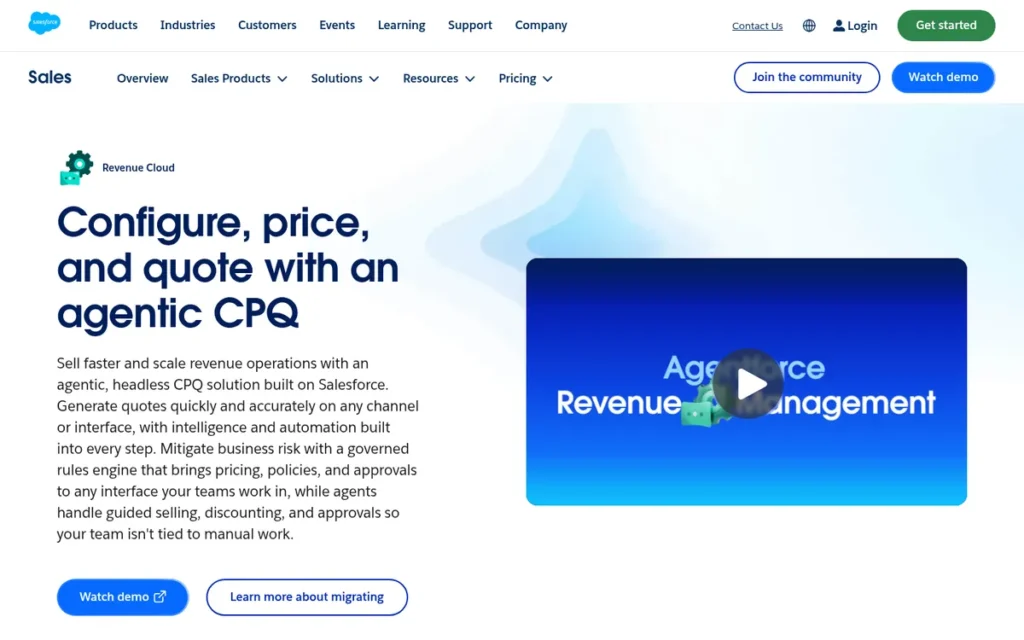
Category: Enterprise Q2C Suite, Salesforce-native platform spanning CPQ, CLM, billing, and Agentforce AI-powered revenue intelligence, currently transitioning from legacy Salesforce CPQ (end of new sales, 2025) to Revenue Cloud Advanced.
At a Glance
- Category: Enterprise Q2C Suite
- Best For: Enterprise B2B organizations already operating within the Salesforce ecosystem (running Sales Cloud, Service Cloud, or multi-cloud Salesforce deployments) that need CPQ, contract management, and revenue operations natively integrated with Salesforce CRM data without external sync
- Price Range: Custom (legacy CPQ from ~$75/user/month; Revenue Cloud Advanced priced above that); Year 1 TCO estimated $150K–$500K+ for mid-enterprise including $100K+ implementation consulting
- Primary Strength: Salesforce Revenue Cloud provides native Salesforce CRM integration with no external data sync (all quote, contract, and order data lives within Salesforce records) paired with Agentforce AI for autonomous pricing recommendations, approval routing, and churn risk detection
- Biggest Limitation: Salesforce’s 2025 end-of-new-sales decision for legacy Salesforce CPQ (note: end-of-sale, not yet end-of-life, existing customers can still renew) means all new buyers must commit to Revenue Cloud Advanced, which community practitioners widely describe as expensive and immature
- One-Line Summary: Salesforce Revenue Cloud is the Gartner Magic Quadrant Leader in CPQ (2025) (a Salesforce-native enterprise Q2C suite with Agentforce AI-powered automation and 2,847 G2 reviews) though its 2025 end-of-new-sales for legacy Salesforce CPQ has introduced significant migration complexity for thousands of existing customers
- Last Verified: May 2026
Overview
Salesforce Revenue Cloud is the Gartner Magic Quadrant Leader in CPQ (2025) and a Salesforce-native enterprise Q2C suite spanning configure-price-quote, contract lifecycle management, automated billing, and Agentforce AI-powered revenue intelligence, currently transitioning all new buyers from legacy Salesforce CPQ (end of new sales, 2025) to Revenue Cloud Advanced. Salesforce Revenue Cloud holds 4.4/5.0 on G2 from 2,847 reviews (Q1 2026) and 8.7/10 on TrustRadius from 512 reviews, the second-largest review base in this evaluation.
Salesforce CPQ originated from the 2015 SteelBrick acquisition ($360M) and is deployed at thousands of mid-market and enterprise organizations globally. The 2025 end-of-new-sales announcement (redirecting all new buyers to Revenue Cloud Advanced) is the most disruptive market event in the Q2C category in years. Legacy Salesforce CPQ is end-of-sale (no new licenses) but not yet end-of-life; existing customers can still renew their current agreements.
Key Features
- Salesforce Revenue Cloud stores all quote, product catalog, pricing rule, contract, and order data within Salesforce records natively, eliminating external sync dependencies and ensuring real-time CRM data accuracy for pipeline forecasting without the middleware latency overhead that external CPQ tools introduce.
- Salesforce Revenue Cloud’s Agentforce enables autonomous agents to predict optimal pricing, suggest product bundles, self-heal configuration errors, autonomously route approvals by deal size and discount threshold, and flag retention risk signals including 40% product usage drops that trigger automated retention workflows, per Servicepath CPQ Trends 2026.
- Salesforce Revenue Cloud supports configurable quoting across direct sales, self-service portals, and partner channels, with dynamic pricing rules, complex product bundle configuration, and approval routing across the full deal value range.
- Revenue Cloud Advanced: the successor to legacy Salesforce CPQ, runs on Salesforce’s core platform architecture rather than a managed package, providing improved performance, cleaner upgrade cycles, and deeper Agentforce AI integration than its predecessor.
- Salesforce Revenue Cloud integrates with SAP, NetSuite, and Oracle ERP systems via standard connectors, supporting back-office financial reconciliation for organizations running mixed CRM and ERP stacks.
Best For
Salesforce Revenue Cloud is best suited for enterprise organizations with deep existing Salesforce investment, operating Sales Cloud, Service Cloud, or multi-cloud Salesforce deployments, where maintaining a single Salesforce data model outweighs the premium cost and current migration complexity. Salesforce Revenue Cloud delivers its strongest ROI for organizations where Salesforce is the system of record for sales, service, and revenue operations, not just a CRM layer above separate billing and finance tools.
Pricing
No public pricing exists for Salesforce Revenue Cloud. Legacy Salesforce CPQ starts at approximately $75/user/month; enterprise tiers are approximately $150–$200/user/month. Revenue Cloud Advanced is priced above legacy CPQ tiers. Year 1 TCO for mid-enterprise deployments is estimated at $150,000–$500,000+ including implementation consulting ($100K+), Agentforce add-ons ($20K+/year), and customization. All pricing is via Salesforce account executives; no self-serve price discovery. Pricing context sourced from G2 pricing reviews, TrustRadius ROI reports, and Getgenerative.ai analysis, verified May 2026.
Strengths
- Salesforce Revenue Cloud earned Gartner Magic Quadrant Leader status in CPQ (2025) with the highest ability-to-execute score in the enterprise segment, the most-cited independent analyst validation in the Q2C category, referenced across multiple CPQ comparison analyses (2025–2026).
- A VP of Sales at a technology firm stated on G2 (5/5, January 2026): “Seamless Salesforce integration cut our quote time from days to minutes (Einstein AI nailed pricing recommendations”) a named, dated enterprise user validation of the AI-driven quoting capability.
- Salesforce Revenue Cloud holds 4.4/5.0 on G2 across 2,847 reviews (Q1 2026) and 8.7/10 on TrustRadius across 512 reviews, the second-largest verified review base in this evaluation, reflecting multi-year enterprise deployment validation across industries.
- Enterprise Salesforce CPQ implementations are associated with measurably shorter sales cycles through automated product configuration, error-proof pricing rules, and approval workflow streamlining, though independently verified named case studies with quantified percentage benchmarks per customer were not available in current research (third-party CPQ analysis, 2025).
Limitations
- End-of-Sale Transition Risk: Salesforce Revenue Cloud’s most consequential trade-off in 2026 is the dual risk of legacy product obsolescence and successor platform immaturity, Salesforce ended new sales of legacy Salesforce CPQ in 2025, redirecting all new buyers to Revenue Cloud Advanced, while community practitioners actively describe Revenue Cloud Advanced as “expensive and immature” (r/revops, March 2026). Legacy Salesforce CPQ is end-of-sale (no new licenses) but not yet end-of-life, existing customers can still renew, though Salesforce’s long-term maintenance commitment to the legacy product is not guaranteed.
- Migration Cost, Technical Debt, and Three-Path Paralysis: For existing Salesforce CPQ customers, “migration off CPQ is a nightmare, we’re talking a month of a dedicated dev” (u/TheDiesel124, r/revops, March 2026), with accumulated customizations, flows, automations, field dependencies, creating what practitioners describe as “a fear of breaking something every time they touch it.” The three available paths, migrate to Revenue Cloud Advanced, move to a third-party CPQ, or stay on legacy, each carry material costs and risks, with Salesforce’s migration messaging characterized as “optimistic relative to Reality Cloud Advanced’s actual readiness” by community practitioners.
- Implementation Overhead: Salesforce Revenue Cloud’s Year 1 TCO of $150K–$500K+ and approximately 40% of G2 reviews citing implementation difficulty (2026) mean the platform requires dedicated Salesforce developers and experienced implementation partners to deliver its documented value.
Verdict
Salesforce Revenue Cloud is the CPQ market’s most battle-tested enterprise platform, and in 2026, it is also its most complicated procurement decision. Salesforce Revenue Cloud’s Gartner Magic Quadrant Leader status (CPQ 2025), 2,847 G2 reviews, and Agentforce capabilities represent a proven platform for Salesforce-committed enterprises where native architecture eliminates data sync overhead and delivers measurable revenue operations automation. However, buyers evaluating Salesforce Revenue Cloud in 2026 must explicitly account for the end-of-new-sales status of legacy Salesforce CPQ and the community-documented complexity, cost, and maturity concerns surrounding Revenue Cloud Advanced, this procurement context demands current practitioner references from organizations that have recently completed or are mid-migration at comparable customization depth.
4. Maxio: Best for SaaS Finance Teams: Subscription Billing and ASC 606 Revenue Recognition
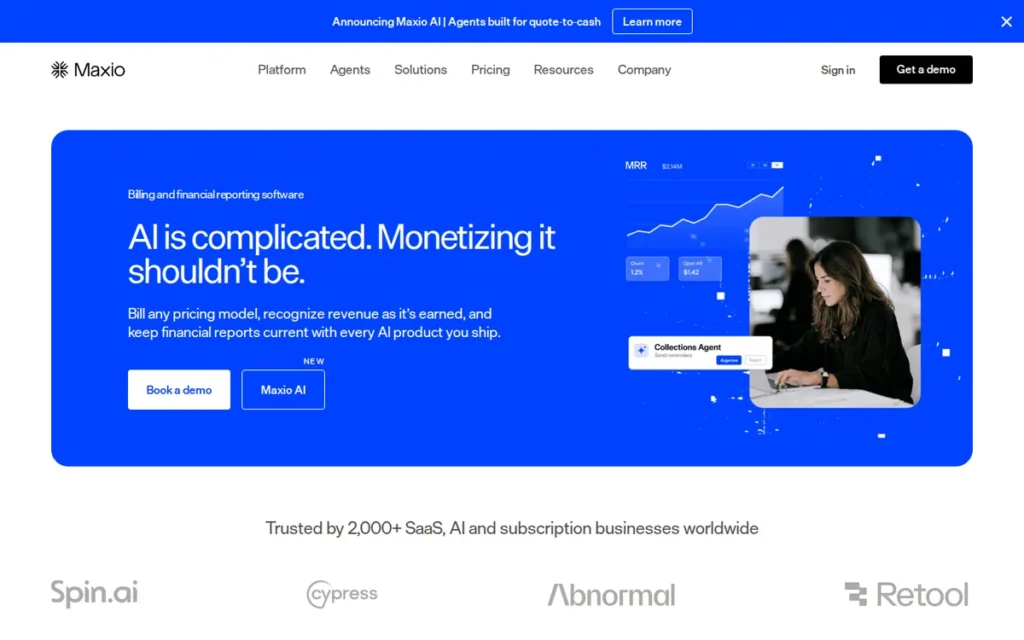
Category: SaaS Billing and Revenue Recognition Platform, purpose-built subscription management, billing automation, and ASC 606/IFRS 15-compliant revenue recognition for B2B SaaS and AI companies.
At a Glance
- Category: SaaS Billing and Revenue Recognition Platform
- Best For: B2B SaaS finance teams at companies with $5M–$100M ARR that need automated subscription billing, ASC 606-compliant revenue recognition, and SaaS-native financial metrics (MRR, ARR, churn cohorts) without enterprise billing platform complexity
- Price Range: Starting at approximately $599/month; custom enterprise plans based on billing volume; estimated minimum annual investment $5,000–$10,000+ for entry-level tiers (May 2026)
- Primary Strength: Maxio manages $17 billion+ in annual billings for 2,300+ B2B SaaS and AI companies, delivering ASC 606/IFRS 15-compliant revenue recognition and real-time SaaS-native financial metrics, built specifically for subscription-first SaaS finance teams, not adapted from a general-purpose billing engine
- Biggest Limitation: Maxio does not include a native CPQ module for quoting and product configuration, requiring integration with a separate CPQ tool; Salesforce sync lag and NetSuite integration reliability are recurring community complaints documented through 2026
- One-Line Summary: Maxio is a purpose-built SaaS billing and revenue recognition platform managing $17B+ in annual billings for 2,300+ customers, combining ASC 606/IFRS 15-compliant revenue recognition with GAAP-compliant MRR tracking, ARR reporting, and churn cohort analytics, designed for B2B SaaS finance teams approaching audit readiness or fundraising, not as a standalone Q2C replacement for teams that also need CPQ
- Last Verified: May 2026
Overview
Maxio is a B2B SaaS-specific subscription management, billing, and revenue recognition platform formed from the merger of SaaSOptics (revenue recognition, ARR/MRR analytics) and Chargify (subscription billing, payment processing), publicly announced April 13, 2022 (BusinessWire), following Battery Ventures’ $150M growth investment in April 2021. Maxio is built specifically for SaaS finance teams that need automated ASC 606/IFRS 15 compliance and real-time SaaS financial metrics in one system.
Maxio reports managing $17 billion+ in annual billings for 2,300+ B2B SaaS and AI companies globally (Maxio About page, May 2026) (up from the $10B in managed ARR documented at the April 2022 merger announcement (BusinessWire)) and publishes an annual B2B Growth Report drawing on $40 billion+ in analyzed billing data. Maxio’s G2 rating of 4.5/5.0 reflects consistent satisfaction among SaaS finance teams; however, Maxio does not include a native CPQ module.
Key Features
- Maxio’s subscription lifecycle management engine handles trials, upgrades, downgrades, pauses, holds, and cancellations with automated proration calculations and dunning management (automated retry logic for failed payments) reducing involuntary churn without requiring manual finance team intervention.
- Maxio automates GAAP-compliant MRR tracking, ARR reporting, and revenue recognition to ASC 606 and IFRS 15 standards, generating churn analytics, audit-ready revenue schedules, and contract modification accounting for subscription amendments, a critical enabler for SaaS companies approaching Series C+ fundraising, IPO audit readiness, or M&A due diligence.
- Maxio’s SaaS metrics dashboard provides real-time MRR, ARR, LTV, churn cohort analysis, and retention analytics, drawing on $40B+ in analyzed billing data from 2,300+ customers to benchmark company-specific performance against the broader SaaS market with proprietary industry intelligence unavailable from other platforms.
- Maxio integrates with payment gateways including Stripe, Braintree, and Authorize.Net for billing collection, and provides CRM connectivity with Salesforce and ERP connectors for NetSuite and QuickBooks, though community users document Maxio’s Salesforce sync lag and NetSuite reliability gaps that affect real-time data accuracy.
- Maxio’s published 2026 roadmap explicitly prioritizes enhanced analytics, improved ERP and accounting integrations, expanded CRM connectivity, tax support, and document management, directly addressing the integration gaps most cited by current users.
Best For
Maxio is best suited for B2B SaaS finance teams at companies with $5M–$100M ARR that have outgrown manual spreadsheet-based revenue recognition and Stripe-native billing, need ASC 606 compliance for audit readiness or investor diligence, and operate subscription-first or hybrid pricing models requiring automated GAAP treatment. Maxio is the primary recommendation for SaaS companies approaching Series B–C fundraising or M&A preparation where revenue recognition accuracy is under active financial scrutiny, not as a standalone replacement for full Q2C platforms that include CPQ.
Pricing
Maxio starts at approximately $599/month for base access, with custom enterprise plans priced on billing volume and feature requirements. Community sources cite minimum annual investments of approximately $5,000–$10,000+ for entry-level plans. Multiple Reddit users cited Maxio pricing as the deciding factor in choosing Chargebee for simpler subscription scenarios. Pricing context sourced from Maxio pricing page and r/SaaS community comparisons (September 2025 and April 2026), verified May 2026.
Strengths
- Maxio reports managing $17 billion+ in annual billings across 2,300+ B2B SaaS and AI companies (Maxio About page, May 2026), the most directly verifiable operational scale data point for a billing-focused platform in this evaluation, with the $10B in managed ARR documented at the April 2022 merger announcement (BusinessWire) confirming significant platform growth.
- Maxio’s 2026 B2B Growth Report (drawing on $40 billion+ in analyzed billing data) documents that average B2B SaaS growth is 18% YoY, that 35%+ of companies experienced revenue decline, and that vertically-focused SaaS companies grew at 20% vs. 16% for horizontal players, providing market intelligence benchmarks unavailable from any other platform vendor evaluated.
- Maxio’s formation from the SaaSOptics (revenue recognition) plus Chargify (subscription billing) merger, publicly announced April 2022, directly addresses the most common SaaS finance pain (manual reconciliation between disconnected billing and revenue recognition tools) through a structural platform integration that neither predecessor provided independently.
- Withorb.com’s independent 2025 review specifically validates Maxio’s revenue recognition depth for complex subscription scenarios and compliance with stringent financial reporting requirements, corroborating the G2 4.5/5.0 user rating with third-party editorial assessment.
Users on r/SaaS comparing B2B billing platforms noted:
“Maxio is the best here that’s listed for b2b subscription management and reporting. Since its core is SaaSoptics was build for finance professionals. Maxio has the best canned reports out of the box.” Posted by u/javabuddha1
Takeaway: Among B2B SaaS billing alternatives, Maxio’s finance-professional-first heritage and out-of-the-box reporting depth distinguish it from developer-oriented platforms that require finance teams to construct a separate analytics layer for subscription metrics.
Limitations
- No Native CPQ Module: Maxio’s most consequential trade-off is billing and RevRec specialization versus full Q2C workflow scope, Maxio does not include a native CPQ module, meaning companies that need pre-sale quoting and product configuration must integrate a separate tool (such as DealHub or Salesforce CPQ), adding integration complexity and potential data consistency risk between the quoting and billing layers.
- Salesforce and NetSuite Sync Issues: Community users specifically document Maxio’s Salesforce sync lag (“can be laggy” (u/Apurv_Bansal_Zenskar, r/SaaS, April 2026) and Maxio’s NetSuite integration reliability problems (“lots of syncing issues”, u/Valuable-Bedroom-533, r/SaaS, March 2025), two integrations critical for many mid-market SaaS finance stacks operating on Salesforce CRM and NetSuite ERP simultaneously.)
- Pricing Threshold: Maxio’s pricing has been cited as the deciding factor against it for companies with simpler billing needs, with multiple community sources confirming Chargebee was selected instead at lower subscription volume thresholds, making Maxio a poor fit for early-stage startups or companies with straightforward flat-rate billing (r/SaaS, September 2025).
Verdict
Maxio is the most purpose-built and independently validated billing and revenue recognition platform for mid-market B2B SaaS finance teams in this evaluation, managing $17B+ in annual billings with ASC 606-compliant revenue recognition and SaaS-native financial metrics that general-purpose Q2C platforms do not match in depth or specificity. Maxio occupies a specific and valuable position in this evaluation: the deepest specialist for the billing-through-recognition arc, particularly for SaaS companies approaching fundraising, audit, or M&A scrutiny. Maxio requires a separate CPQ solution, making it most effective as a billing and RevRec layer within a multi-tool Q2C stack, buyers should specifically test Maxio’s Salesforce and NetSuite integrations under production-equivalent load before committing.
5. Conga CPQ: Best for Complex Enterprise CPQ: Mega-Quote Configuration and CRM-Agnostic Commerce
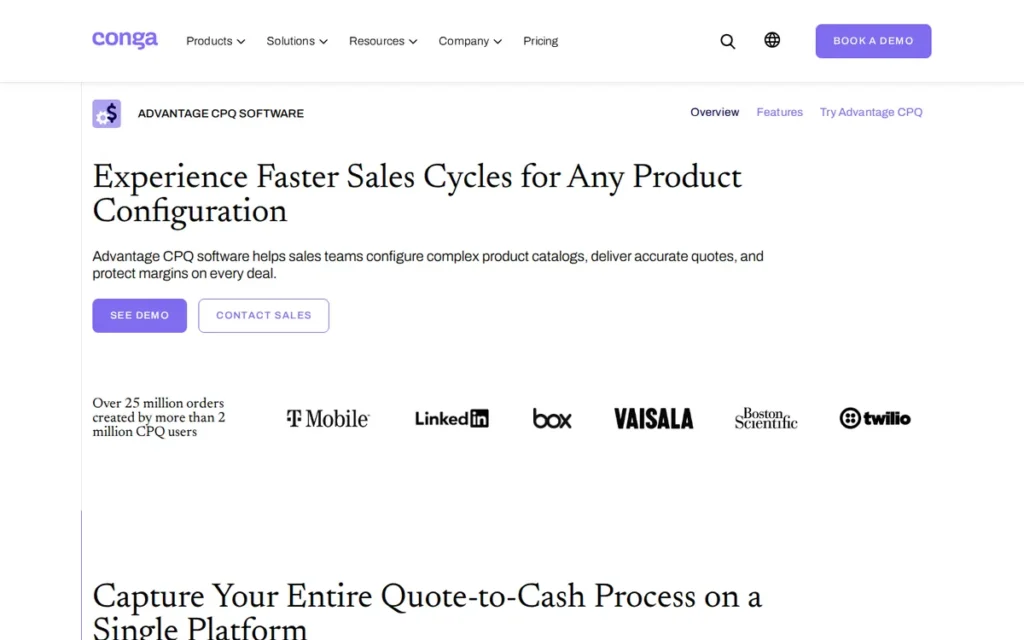
Category: Enterprise CPQ and Commerce Platform, constraint-based configure-price-quote with AI dynamic pricing intelligence, CLM, document automation, and order management in a CRM-agnostic connected commerce platform.
At a Glance
- Category: Enterprise CPQ and Commerce Platform
- Best For: Large enterprises in manufacturing, telecommunications, IT services, or industrial sectors (particularly those outside or migrating away from the Salesforce ecosystem) that sell highly complex configurable products requiring mega-quote generation, sophisticated pricing rules, and integrated CLM governance
- Price Range: Custom-quoted only; enterprise-tier investment; administrator training documented at $2,000+ per person; implementation typically measured in months
- Primary Strength: Conga Smart CPQ’s patented constraint-based configuration engine supports mega-quotes with 10,000+ product line items (a documented capacity no other platform in this evaluation matches) with CRM-agnostic deployment supporting Salesforce, Dynamics 365, and SAP
- Biggest Limitation: Conga CPQ carries the lowest implementation score in this evaluation (TrustRadius 1.0/10 from 3 raters), documented community reports of 24–36 hour platform outages and aggressive pricing escalation at renewal, and a verified case of customer Salesforce data disappearing after contract expiry (r/salesforce, September 2025)
- One-Line Summary: Conga CPQ is a CRM-agnostic enterprise CPQ and commerce platform with a patented constraint-based engine capable of 10,000+ line-item mega-quotes and PROS-powered AI dynamic pricing (PROS B2B acquisition completed February 2, 2026), delivering a TrustRadius renewal intent score of 9.8/10 among deployed customers, offset by the lowest implementation score (1.0/10 TrustRadius) in this evaluation and community-documented data risk at contract termination
- Last Verified: May 2026
Overview
Conga CPQ is an enterprise revenue automation platform operating a dual-product architecture (Advantage CPQ (Salesforce-native, for promotional bundling and rebate management) and Smart CPQ (CRM-agnostic, for Microsoft Dynamics 365, SAP, and multi-CRM enterprises)) making Conga the only platform in this evaluation that natively deploys a separate product architecture for each CRM environment rather than a single connector layer. Conga’s acquisition of the PROS B2B business (announced October 2025; completed February 2, 2026, per Thoma Bravo and Conga press releases) embedded AI-driven dynamic pricing science into the Conga CPQ platform, adding competitive price guidance and margin guardrails to the CPQ workflow.
Because the PROS acquisition closed approximately three months before this article’s May 2026 publication, full platform integration of PROS dynamic pricing capabilities is ongoing and may not yet be fully reflected in available user review scores. Conga’s TrustRadius likelihood-to-recommend score of 8.6/10 (69 ratings) and likelihood-to-renew of 9.8/10 (9 ratings) reflect strong post-deployment satisfaction, offset by a TrustRadius implementation score of 1.0/10 (3 raters), the lowest implementation rating of any platform in this evaluation.
Key Features
- Conga Smart CPQ’s patented constraint-based configuration engine generates mega-quotes with 10,000+ product line items using BML-scripted product relationship logic (the highest-documented quote volume capacity in this evaluation) making Conga the reference platform for telecommunications, industrial manufacturing, and IT services product catalogs.
- Conga’s Price Optimization and Management (POM) module: integrated via the February 2026 PROS B2B acquisition, applies AI-driven dynamic pricing science with real-time competitive price guidance, margin guardrails, and deal-level pricing intelligence natively within the CPQ workflow, a capability not documented as a standard built-in feature from any other platform in this evaluation as of May 2026.
- Conga’s connected commerce platform (launched at Conga Connect 2026) integrates CPQ, POM, CLM, document automation, and order management in a governance pipeline designed to replace fragmented best-of-breed Q2C tools with a unified enterprise commerce architecture, per SoftwareReviews’ 2026 analysis.
- Conga CLM provides end-to-end contract governance: template management, negotiation workflows, obligation tracking, renewal alerts, and a searchable contract repository, natively integrated with CPQ output to eliminate the disconnect between approved quote and executed contract.
- Conga Advantage CPQ delivers Salesforce-native quote configuration for organizations committed to the Salesforce data model, while Conga Smart CPQ serves Dynamics 365, SAP, and multi-CRM enterprises, uniquely supporting both ecosystems from a single vendor relationship.
Best For
Conga CPQ is best suited for large enterprises in manufacturing, telecommunications, IT services, or industrial sectors selling highly complex, configurable products with hundreds to thousands of interdependent pricing variables that require mega-quote generation at 10,000+ line items. Conga CPQ is also positioned as a migration destination for organizations leaving legacy Salesforce CPQ following its 2025 end-of-sale, particularly those seeking CRM-agnostic flexibility without committing to Revenue Cloud Advanced.
Pricing
Custom-quoted only with no published tiers or dollar amounts. Conga administrator training is documented at $2,000+ per person by community sources. Implementation timelines are measured in months for standard deployments. Direct Conga sales engagement is required for all pricing information. Pricing context sourced from TrustRadius Conga CPQ reviews and r/salesforce community discussions, verified May 2026.
Strengths
- Conga Smart CPQ’s 10,000+ line-item mega-quote capacity: documented in Conga’s official product specifications and independently validated by SoftwareReviews’ “From CPQ to Control Plane” analysis (2026), is the most specifically verifiable CPQ performance differentiator for organizations with genuinely high-volume, complex product configurations.
- Conga’s TrustRadius likelihood-to-renew score of 9.8/10 (9 ratings, 2026) (the highest renewal intent score in this evaluation) provides evidence that successfully deployed customers find lasting value, with a TrustRadius performance score of 10.0/10 (2 raters) indicating high post-deployment satisfaction.
- Conga’s acquisition of the PROS B2B business (completed February 2, 2026) added AI-driven dynamic pricing intelligence (including competitive price guidance and margin guardrails embedded natively in the CPQ workflow) a capability not documented as standard in any other platform in this evaluation as of May 2026. (Full integration is ongoing given the recent acquisition close date.)
- SoftwareReviews’ 2026 analysis positions Conga as transitioning from a CPQ vendor to a full enterprise commerce governance platform, the broadest strategic platform scope of any provider in this evaluation, competing directly with Salesforce Revenue Cloud and Oracle for enterprise commerce architecture decisions.
Limitations
- Catastrophic Implementation Score: Conga CPQ’s TrustRadius implementation score of 1.0/10 (3 raters) and renewal intent score of 9.8/10 (9 raters) exist simultaneously, making the quality of pre-signature due diligence the single most determinative factor in whether a Conga deployment becomes a platform success or a cautionary case study. Community accounts corroborate the score: a 2023 Salesforce community review by an experienced CPQ consultant described a six-month Conga configuration project where “the demo and the real experience are drastically different,” with significant gaps between sales presentation and live system behavior.
- Data Loss Risk at Contract Termination: In September 2025, an r/salesforce thread documented that after a customer’s Conga contract expired, Conga-related Salesforce records (including Conga Sign Transactions and custom object data) disappeared from the customer’s Salesforce org entirely, contradicting explicit support assurances (u/IllPerspective9981, 11 upvotes, r/salesforce, September 2025). Buyers must contractually document data retention rights, export format, and API access at termination before signing any Conga agreement.
- Platform Reliability and Pricing Escalation: The same r/salesforce thread documented 24–36 hour platform outages and aggressive renewal pricing increases (u/Material-Draw4587, 15 upvotes, r/salesforce, September 2025), operational risks with material consequences for enterprise customers whose sales operations depend on consistent platform availability.
Verdict
Conga CPQ’s TrustRadius renewal intent score of 9.8/10 and implementation score of 1.0/10 exist simultaneously, making the quality of pre-signature due diligence the single most determinative factor in whether a Conga deployment becomes a platform success or a cautionary case study. Conga CPQ is the most powerful enterprise CPQ platform for organizations with genuinely complex, high-volume product configurations, its 10,000+ line-item mega-quote capability and PROS-powered dynamic pricing science (February 2026) are documented differentiators unavailable from other platforms in this evaluation. However, Conga CPQ’s implementation score, community-documented data loss risk at contract termination, platform reliability incidents, and pricing escalation patterns make it a high-risk procurement decision that requires contractual data protection safeguards, production reference calls at comparable complexity, and fully budgeted implementation timelines before any commitment is signed.
6. PandaDoc: Best for SMB and Proposal-Heavy Sales Teams: Document Automation and Quoting
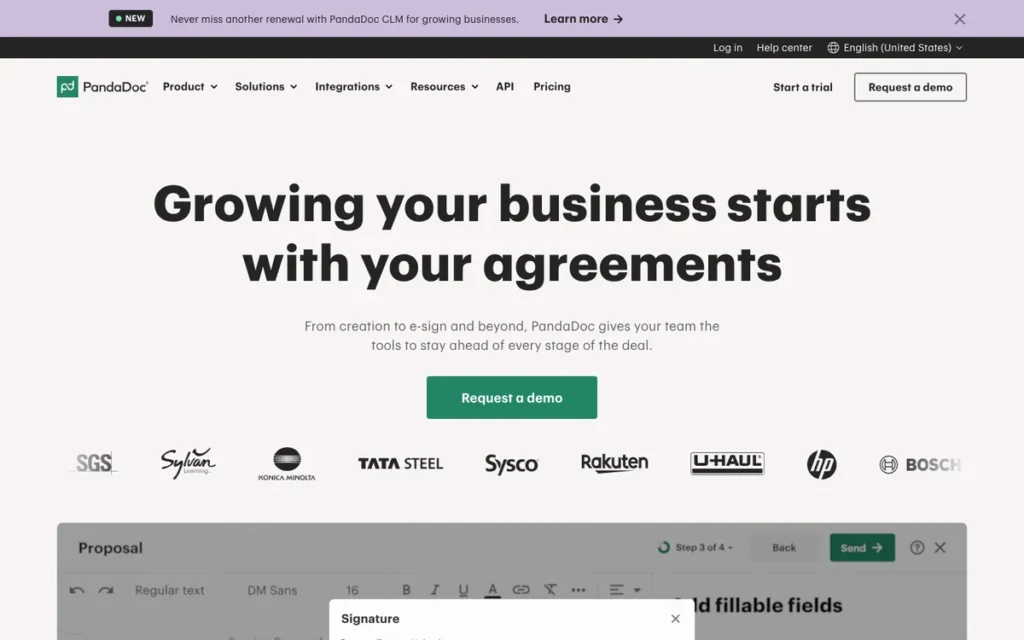
Category: Document Automation and Quoting Platform (proposal creation, quoting, contract management, e-signature, payment collection, and document engagement analytics for sales teams prioritizing speed, ease of use, and pricing transparency) not a full Q2C platform with subscription billing or revenue recognition.
At a Glance
- Category: Document Automation and Quoting Platform
- Best For: SMBto mid-market B2B sales teams ($0–$20M ARR) moving off manual Word/PDF/email quoting workflows that need professional proposal creation, quoting, e-signature, and payment collection in one affordable, fast-deploying tool with transparent pricing
- Price Range: Free ($0, 60 docs/year) | Starter: $35/user/month | Business: $49/user/month | Enterprise: Custom (CPQ module included)
- Primary Strength: PandaDoc is the only platform in this evaluation with a fully self-serve, publicly listed price schedule covering all tiers (starting at $35/user/month) combined with the highest review volume of any evaluated platform and the fastest implementation path
- Biggest Limitation: PandaDoc does not include subscription billing, revenue recognition, usage-based billing support, or advanced CPQ configuration in any pricing tier, making it a front-of-funnel document and quoting tool, not a full Q2C platform for companies with recurring billing or ASC 606 requirements
- One-Line Summary: PandaDoc is the highest-rated document automation and quoting platform with a 4.7/5.0 G2 rating (approximately 3,600 reviews on its primary product listing; 15,000+ aggregated across Document Management, E-Signature, and Proposal category listings), the only platform in this evaluation with a fully self-serve, publicly listed price schedule starting at $35/user/month
- Last Verified: May 2026
Overview
PandaDoc is a document automation platform combining proposal creation, quoting, contract management, e-signature, payment collection, and buyer engagement analytics (PandaDoc Rooms) in a single interface, making PandaDoc the most accessible and transparently priced entry point in the Q2C software category for SMB and mid-market B2B sales teams transitioning from manual Word, PDF, and email-based quoting workflows. PandaDoc holds a 4.7/5.0 G2 rating with approximately 3,600 reviews on its primary product listing and 15,000+ reviews aggregated across Document Management, E-Signature, and Proposal category listings (G2.com, 2026). (Note: G2 review counts for PandaDoc reflect cross-category aggregation; other platforms in this evaluation are measured against their single product listing for methodological consistency.)
PandaDoc is funded by HubSpot Ventures and Microsoft Ventures, is SOC 2 Type II, GDPR, and ISO 27001 certified, and holds the #1 G2 Grid position across Document Management, E-Signature, and Proposal categories (2024–2026). PandaDoc is the only platform in this evaluation to publish its full pricing publicly, however, PandaDoc does not include subscription billing, revenue recognition, or advanced CPQ configuration in any pricing tier.
Key Features
- PandaDoc’s drag-and-drop document editor with AI-powered content suggestions (updated March 2026) enables sales teams to create, customize, and send professional proposals and quotes in minutes, with CRM data population from HubSpot, Salesforce, and Pipedrive that eliminates manual data re-entry between CRM and document tools.
- PandaDoc Rooms (launched May 2024) provides digital sales rooms with centralized deal collateral, real-time buyer-stakeholder collaboration, mutual action plans, and e-signing, competing with DealHub’s DealRoom for deal engagement intelligence at a significantly lower price point for SMB and mid-market teams.
- PandaDoc’s document tracking analytics dashboard provides per-page engagement data (opens, timespent per page, downloads, repeat views with timestamps and user IDs) giving sales managers granular coaching intelligence beyond the “viewed/signed” notifications that basic e-signature tools (DocuSign, Adobe Sign) provide.
- PandaDoc integrates Stripe payment collection across all paid tiers, enabling teams to collect payment directly within a signed document, eliminating the separate invoicing step for straightforward one-time or first-payment transactions.
- PandaDoc’s Enterprise tier includes a CPQ module for complex product pricing tables and Qualified Electronic Signatures (QES) for EU eIDAS compliance, extending platform reach for EMEA-based sales teams with legally binding signature requirements under EU digital signature law.
Best For
PandaDoc is best suited for SMB and early-stage B2B companies ($0–$20M ARR) with straightforward subscription or one-time billing needs, where the primary Q2C pain is moving from manual document creation to automated, trackable, professional proposals and contracts. PandaDoc is also a strong document automation layer for mid-market teams that need quoting and e-signature above an existing CRM and billing stack (particularly those already on HubSpot or Salesforce) before pricing complexity grows to require a dedicated CPQ platform.
Pricing
PandaDoc is the only platform in this evaluation with a fully self-serve, publicly listed price schedule covering all tiers. Free: $0, 60 documents/year, basic tracking. Starter: $35/user/month (annual billing), unlimited documents, 5 templates. Business: $49/user/month, unlimited templates, CRM integrations, workflow automation, payment collection, brand customization. Enterprise: Custom pricing, adds CPQ module, SSO, API access, notarization, advanced compliance. Pricing sourced from PandaDoc official pricing page and third-party pricing guides (signeasy.com, hyperstart.com, 2026), verified May 2026.
Strengths
- PandaDoc’s G2 rating of 4.7/5.0: with approximately 3,600 reviews on its primary product listing and 15,000+ across Document Management, E-Signature, and Proposal category listings (G2.com, 2026), reflects multi-year validated user satisfaction across multiple workflow categories, with a consistent #1 G2 Grid ranking (2024–2026).
- PandaDoc is the only platform in this evaluation with a fully self-serve, publicly listed price schedule covering all tiers (with paid tiers starting at $35/user/month) providing cost clarity before any vendor sales engagement, a transparency standard that the other six evaluated platforms do not provide.
- PandaDoc’s self-reported aggregate platform statistics include 87% more completed documents per month, 50% decrease in document creation time, and 36% increase in close rates across its customer base (PandaDoc product overview, May 2026), providing directional ROI context for SMB buyers. (These are vendor self-reported aggregate statistics; named independent case studies were not available at time of publishing.)
- PandaDoc’s funding from HubSpot Ventures and Microsoft Ventures signals deep integration investment with two of the most widely deployed CRM and productivity platforms in the SMB and mid-market segments, reducing integration risk for buyers already operating in HubSpot or Microsoft 365 ecosystems.
Users on r/CRM evaluating Salesforce-integrated proposal tools noted:
“PandaDoc and Proposify both have native Salesforce integrations that do exactly this. PandaDoc pulls opportunity data directly into templates and reps can generate a branded proposal in a few clicks. Two hours down to under ten minutes is realistic once it’s set up properly. Proposify is slightly cleaner on the template side but PandaDoc has better Salesforce field mapping in my experience. Both worth a demo before deciding.” Posted by u/jada13970
Takeaway: PandaDoc’s Salesforce field mapping and template automation deliver measurable proposal speed gains in production environments, though practitioners note the platform competes on integration depth and workflow speed rather than visual design purity against alternatives like Proposify.
Limitations
- Hard Q2C Ceiling: PandaDoc’s most consequential trade-off is accessibility versus depth, the platform’s strongest advantages (transparent pricing, fast implementation, document analytics, review volume) are matched by a hard and well-documented ceiling: PandaDoc does not include subscription lifecycle management, automated revenue recognition, usage-based billing, or constraint-based product configuration in any pricing tier.
- Enterprise CPQ Limitations: The CPQ module available on PandaDoc’s Enterprise plans supports pricing tables but not the complex product relationship logic that enterprise sales teams require for multi-thousand-dollar configurable deals. An enterprise G2 reviewer confirmed in 2025: “Great for simple quotes, but complex configs require workarounds, switched to Salesforce CPQ for volume” (G2, 2025), illustrating that PandaDoc is a natural first Q2C tool that scaling organizations routinely migrate away from as deal complexity increases.
- Commoditization Pressure: PandaDoc faces growing competitive pressure from CRM-native document features built directly into HubSpot, Salesforce, and Microsoft 365, which provide basic quoting, e-signature, and template functionality to existing CRM users without adding a separate tool subscription, a commoditization risk that is a material consideration for buyers evaluating PandaDoc as a long-term platform investment.
Verdict
PandaDoc is the best-reviewed and most transparently priced document automation and quoting tool in this evaluation, the right starting platform for SMB and mid-market B2B sales teams moving off manual quoting workflows, with a 4.7/5.0 G2 rating and the only fully self-serve, publicly listed price schedule in this evaluation starting at $35/user/month. PandaDoc’s document analytics and PandaDoc Rooms features provide genuine sales intelligence above the core quoting function. However, PandaDoc is not a full Q2C platform, organizations with subscription billing requirements, usage-based pricing models, or ASC 606 revenue recognition obligations should evaluate Maxio or Zuora (for billing) and DealHub or Salesforce Revenue Cloud (for unified Q2C), using PandaDoc only as a front-of-funnel document automation layer within a multi-tool stack.
7. Oracle CPQ Cloud: Best for Oracle-Ecosystem Enterprises: Native Fusion CPQ with Asset-Based Ordering
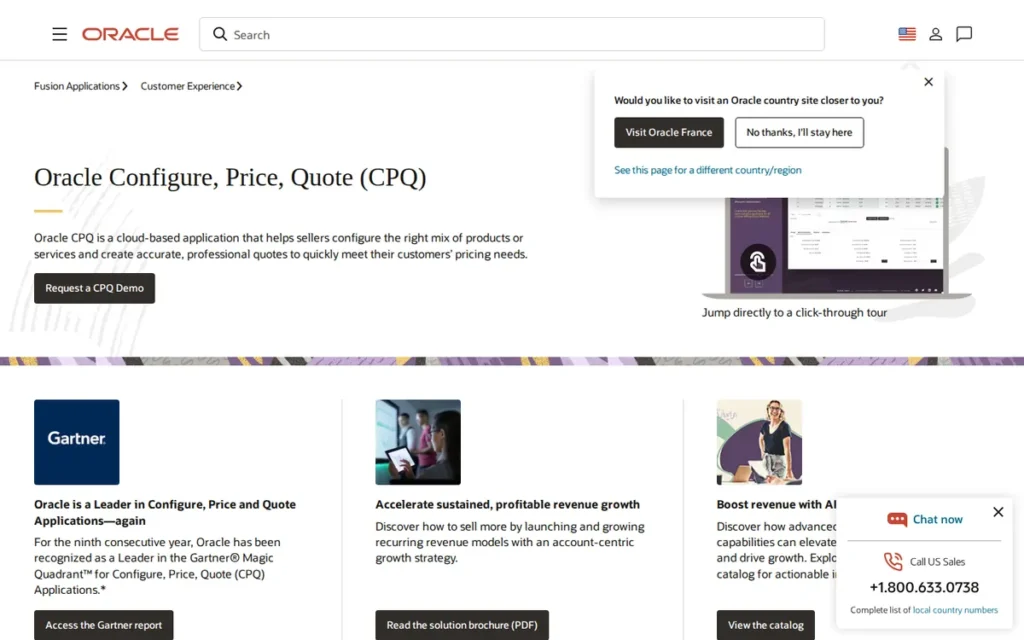
Category: Enterprise CPQ Platform, constraint-based configure-price-quote with asset-based ordering, AI deal scoring, and native Oracle Fusion integration for large enterprises committed to the Oracle technology stack.
At a Glance
- Category: Enterprise CPQ Platform
- Best For: Large enterprises already committed to Oracle Fusion CX Sales or Oracle ERP that sell complex, highly configurable products and require asset-based ordering lifecycle management, Oracle CPQ Cloud delivers its strongest ROI for Oracle-committed organizations
- Price Range: Custom-quoted only; among the highest TCO in this evaluation; BML scripting expertise required; implementation typically 6–24 months
- Primary Strength: Oracle CPQ Cloud provides the deepest native integration with Oracle Fusion CX Sales, Oracle Order Management, and Oracle ERP of any CPQ platform, eliminating data sync overhead and middleware cost for organizations committed to the Oracle technology stack
- Biggest Limitation: Oracle CPQ Cloud carries the lowest G2 score (4.1/5.0) and smallest review volume (271 reviews) in this evaluation, requires a proprietary BML scripting language creating talent scarcity risk, and delivers its strongest ROI exclusively within Oracle-committed environments, organizations outside that ecosystem face integration costs that eliminate the platform’s primary advantage
- One-Line Summary: Oracle CPQ Cloud is a constraint-based enterprise CPQ platform with native Oracle Fusion integration and asset-based ordering for mid-contract lifecycle management, the appropriate choice for Oracle-committed enterprises with complex configurable product catalogs, and a costly mismatch for any organization outside the Oracle technology stack
- Last Verified: May 2026
Overview
Oracle CPQ Cloud is a cloud-based Configure-Price-Quote platform built on the acquired BigMachines technology (Oracle acquired BigMachines in 2013), offering constraint-based guided selling, Asset-Based Ordering (ABO) for complex mid-term contract amendments and renewals, AI-driven deal scoring with real-time win probability, multi-dimensional pricing (volume, tiered, ramp, usage-based, regional), and native integration with Oracle Fusion CX Sales, Oracle Commerce, Oracle Order Management, and Oracle Subscription Management. Oracle CPQ Cloud’s G2 rating of 4.1/5.0 from 271 reviews is the lowest score and smallest review volume of any platform in this evaluation, reflecting both its narrow Oracle-ecosystem audience and the high implementation friction preceding successful deployments.
Oracle continued active product development in 2026 with Releases 26A and 26B introducing a Visual Quote Process Workflow Builder, browsable product hierarchies, enhanced effectivity date handling, and improved error logging, addressing prior usability criticisms. Oracle CPQ Cloud is rated positively in SoftwareReviews’ 2026 Q2C category analysis for order accuracy and front-to-back-office integration quality for Oracle-committed enterprises.
Key Features
- Oracle CPQ Cloud’s BML (BigMachines Markup Language) constraint-based configuration engine handles extremely complex product relationship logic (including rules where Product A’s pricing affects Product B’s availability based on volume discounts, regional pricing, and customer contract terms) enabling high-fidelity configuration for telecommunications, financial services, and industrial product catalogs with hundreds of interdependent variables.
- Oracle CPQ Cloud’s Asset-Based Ordering (ABO) capability manages the full lifecycle of complex contract amendments, mid-term upgrades, add-ons, downgrades, and renewals, critical for enterprise accounts where managing the installed customer base across multi-year contracts is as commercially important as configuring new deals, a capability not explicitly featured as a named function by other platforms in this evaluation.
- Oracle CPQ Cloud’s AI-driven deal scoring provides real-time win probability assessment and deal health signals within the quoting interface, integrating Oracle Fusion CX Sales data to surface competitive intelligence and pricing recommendations alongside configuration.
- Oracle CPQ Cloud’s Visual Quote Process Workflow Builder (introduced in Release 26A) enables administrators to manage quote lifecycle stages and approval workflows visually without requiring BML scripting for workflow logic, addressing a usability barrier previously cited in G2 reviews.
- Oracle CPQ Cloud integrates natively with Oracle Fusion CX Sales, Oracle Commerce, Oracle Order Management, Oracle Subscription Management, and Oracle ERP, providing front-to-back-office automation without middleware or external data sync for organizations with consolidated Oracle infrastructure.
Best For
Oracle CPQ Cloud is best suited for large enterprises, particularly in telecommunications, financial services, and industrial manufacturing, already committed to Oracle Fusion CX Sales or Oracle ERP that require complex BML-scripted product configuration, asset-based ordering for installed-base lifecycle management, and native front-to-back-office integration within a consolidated Oracle stack. Oracle CPQ Cloud delivers its strongest ROI for Oracle-committed organizations; companies operating outside the Oracle ecosystem, on Salesforce, Dynamics 365, SAP, HubSpot, or multi-CRM environments, should evaluate Conga Smart CPQ, DealHub, or Salesforce Revenue Cloud instead.
Pricing
Custom-quoted only with no published tiers. Enterprise TCO is among the highest in this evaluation, driven by platform licensing, BML scripting expertise requirements (a proprietary language creating talent scarcity and consulting cost premium), Oracle Fusion infrastructure requirements, and 6–24 month implementation timelines. Without native Oracle Fusion integration, Oracle CPQ requires the same middleware overhead as any external CPQ tool, eliminating the platform’s primary ROI advantage for organizations outside the Oracle stack. All pricing requires direct Oracle sales engagement. Pricing context sourced from Oracle CPQ pricing page and G2 cost reviews, verified May 2026.
Strengths
- Oracle CPQ Cloud’s BigMachines constraint-based configuration engine provides validated depth for enterprise-complexity product configurations (with hundreds of interdependent pricing and availability rules serving telecommunications, financial services, and industrial manufacturing sectors) representing one of two configuration engine architectures in this evaluation (alongside Conga Smart CPQ) capable of handling genuine enterprise-complexity product catalogs, per G2 reviewers (271, as of 2026).
- Oracle CPQ Cloud’s Asset-Based Ordering (ABO) capability for mid-contract amendments and renewal lifecycle management is a documented differentiator for enterprise accounts managing large installed customer bases, a capability not explicitly featured as a named function by any other platform in this evaluation.
- Oracle CPQ Cloud is rated positively in SoftwareReviews’ 2026 Q2C category analysis for order accuracy and front-to-back-office integration quality, validating post-deployment performance for the narrow Oracle-committed enterprise audience the platform serves well.
- Oracle’s continued active development through 2026 Releases 26A and 26B (introducing the Visual Quote Process Workflow Builder and improved error logging) demonstrates ongoing investment in addressing known usability barriers, reducing the risk of platform stagnation for Oracle-committed buyers.
Limitations
- Ecosystem Lock-In Risk: Oracle CPQ Cloud’s most consequential trade-off is deep ecosystem specialization versus ecosystem lock-in, the platform’s 4.1/5.0 G2 score from only 271 reviews reflects both narrow audience fit and high implementation friction, and the BML scripting language is proprietary. Community consensus on r/SalesforceDeveloper explicitly describes Oracle CPQ developer expertise as “a narrowing career and technology path” relative to Salesforce (u/Zealousideal_Cause_8, r/SalesforceDeveloper, January 2024), meaning organizations building BML-intensive implementations face growing dependency on a shrinking specialist talent pool that compounds long-term administration and upgrade costs.
- Narrowing Talent Pool: Oracle CPQ Cloud’s BML scripting language is a proprietary system creating documented talent scarcity, with growing severity as Salesforce and cloud-native skills command higher market demand, compelling Oracle-committed buyers to explicitly budget for the premium consultant costs and long-term knowledge concentration risk that BML dependency creates.
- Implementation Intensity: Oracle CPQ Cloud’s 6–24 month implementation timelines and requirement for BML-certified developers (a niche and expensive resource) make Oracle CPQ Cloud among the most implementation-intensive platforms in this category, with external integration costs applying their full force to any organization outside a consolidated Oracle infrastructure.
Verdict
Oracle CPQ Cloud is the appropriate enterprise CPQ choice for organizations with deep Oracle Fusion CX Sales or ERP commitments that require complex BML-scripted product configuration and asset-based ordering lifecycle management, and for those organizations specifically, Oracle CPQ Cloud eliminates the data sync overhead and integration costs that external CPQ tools create at enterprise scale. Oracle CPQ Cloud’s 4.1/5.0 G2 score and smallest review volume in this evaluation accurately reflect its narrow but legitimate niche: it is not a general-purpose Q2C platform for organizations outside the Oracle ecosystem, and its proprietary BML scripting language creates long-term talent dependency risk that Oracle-committed buyers must explicitly budget for in their implementation and ongoing administration plans.
What’s Happening With Salesforce CPQ in 2026?
Salesforce ended new sales of legacy Salesforce CPQ in early 2025, leaving existing customers with three documented migration paths (Revenue Cloud Advanced, third-party CPQ tools, or staying on legacy) each with material cost and risk. Community practitioners describe the result as a three-path paralysis with no clearly superior option as of May 2026.
The three available paths for current Salesforce CPQ customers:
- Migrate to Revenue Cloud Advanced: the official Salesforce path, currently characterized by community practitioners as “expensive and immature.” Revenue Cloud Advanced runs on Salesforce’s core platform rather than a managed package, improving long-term scalability, but requiring significant re-implementation of existing CPQ customizations.
- Move to a third-party CPQ (DealHub, Conga Smart CPQ): exits the native Salesforce ecosystem but eliminates Revenue Cloud Advanced’s current maturity risk. DealHub is the most frequently cited mid-market alternative; Conga Smart CPQ for non-Salesforce or high-complexity scenarios.
- Stay on legacy Salesforce CPQ: avoids immediate migration cost, and legacy Salesforce CPQ is end-of-sale (no new licenses) but not yet end-of-life, existing customers can still renew. However, community practitioners note this path compounds technical debt over time and bets on continued Salesforce maintenance of a formally deprioritized product.
What community practitioners say directly:
“Revenue Cloud Advanced is expensive and immature. Third-party tools mean leaving the native ecosystem. And staying put means betting that Salesforce will maintain a product they’ve clearly deprioritized.” (r/revops thread, March 2026)
Takeaway: All three migration paths for current Salesforce CPQ customers carry material cost and risk, practitioner consensus as of May 2026 is that no clearly superior migration option has emerged, creating active evaluation paralysis for a significant portion of the enterprise Q2C market.
“Migration off CPQ is a nightmare. We’re talking a month of a dedicated dev.” (u/TheDiesel124, r/revops, March 2026)
Takeaway: Migration complexity from Salesforce CPQ scales directly with the depth of accumulated customization, organizations with extensive flows, product rules, and approval automation should budget several months of dedicated developer time and realistic six-figure implementation costs for any migration path before evaluating destination platforms.
Any organization currently on Salesforce CPQ should map all accumulated customizations (flows, automations, field dependencies, product rules) before evaluating any migration path. Request reference calls from organizations that have completed comparable migrations at similar customization depth within the last 12 months.
What Red Flags Should I Watch For When Evaluating Q2C Software?
The five most critical red flags when evaluating Q2C software are pricing opacity without TCO transparency, implementation scores that contradict demo performance, missing contractual data access rights at contract termination, support SLA gaps that only surface during billing failures, and unacknowledged product transition risk, all patterns documented in this evaluation that vendor sales cycles rarely disclose voluntarily.
Red Flag #1: Pricing Opacity Without TCO Transparency
Six of seven platforms in this evaluation are entirely custom-quoted with no published pricing, a structural buyer disadvantage that delays internal business case development and enables high initial anchoring.
For context: a platform costing $200,000/year in licensing often requires $300,000–$500,000 in Year 1 implementation, integration, and professional services, meaning the actual Year 1 investment is 2.5–3.5× the license figure. This pattern is documented across Zuora, Salesforce Revenue Cloud, Conga CPQ, and Oracle CPQ Cloud in this evaluation. Build every internal business case with Year 1 total cost as the headline figure, not the annual license price.
Before engaging any vendor, ask: “What is the estimated all-in Year 1 cost including platform licensing, implementation, integration development, and internal team time?” Vendors who cannot provide a credible range at initial qualification are not trustworthy pricing partners. Cross-reference with G2 cost reviews and Vendr marketplace data before accepting any vendor-only estimate.
Red Flag #2: Implementation Score vs. Demo Performance
Conga CPQ’s TrustRadius implementation score of 1.0/10 (3 raters, 2026) exists alongside a likelihood-to-recommend of 8.6/10 and a performance score of 10.0/10, a gap that reflects a documented industry pattern: platforms with powerful enterprise capabilities often deliver difficult implementations that contradict polished demo presentations.
Always request references from production customers at comparable product catalog complexity who completed implementation within the last 18 months. Specifically ask those references about implementation challenges, not only outcomes.
Red Flag #3: Data Access Rights at Contract Termination
In September 2025, a documented r/salesforce case showed Conga-related Salesforce records disappearing after a customer’s contract expired, contradicting explicit support assurances (u/IllPerspective9981, r/salesforce, September 2025). For any Q2C platform holding billing, contract, or quote data, buyers must contractually document:
- Data export format and timeline at contract termination
- API access during and after contract termination
- Data retention period post-contract
- Ownership of data generated within the system
This applies to every platform in this evaluation, not only Conga.
Red Flag #4: Support SLA Reality vs. Contract
DealHub’s Israel-based operations create a documented 7–10 hour response gap for US-based customers (r/revops, March 2026), and Zuora’s 48-hour support SLA has been cited as a material operational friction point for time-sensitive billing operations (G2, 2025).
Test support responsiveness during the sales process: open a non-critical support ticket before signing and measure actual response time against the contracted SLA. Billing system failures carry immediate financial and compliance consequences, this question must have a written answer.
Red Flag #5: End-of-Sale Product Transitions
Salesforce CPQ’s 2025 end-of-new-sales announcement demonstrates that even market-leading platforms can enter transition periods that create genuine customer risk. Before committing to any Q2C platform, ask: “Is this product the vendor’s stated strategic priority? What is the migration path if this product is end-of-lifed in the next 3–5 years?” Any vendor that cannot answer this question clearly should be treated with heightened due diligence.
What Questions Should I Ask Before Choosing Quote-to-Cash Software?
Before selecting any Q2C platform, five questions consistently reveal the intelligence that demos and product sheets omit: full Year 1 TCO, production reference call access, contractual data rights at termination, support SLA mechanics for billing failures, and (for Salesforce CPQ evaluators) the realistic migration path and cost to Revenue Cloud Advanced.
Question #1: What is the full Year 1 TCO, including implementation, integration, and internal team costs?
Ask for a specific Year 1 cost estimate covering platform licensing, professional services for implementation, any required SI or consulting fees, integration development costs, and estimated internal team time. Cross-reference any vendor estimate with G2 cost reviews and Vendr marketplace data before entering contract negotiations. A vendor who refuses to provide a reasonable range is structurally incentivized to anchor high during procurement.
Question #2: Can you provide production reference calls with customers at similar pricing model complexity, not vendor-selected?
Request references from customers who completed implementation at comparable product catalog and pricing complexity within the last 18 months, and ask to speak with contacts the vendor has not pre-selected. Specifically ask those references about implementation challenges, support experience, and the accuracy of the sales team’s implementation timeline estimates. Vendor-selected references are systematically biased toward successful deployments.
Question #3: What are our contractual data access rights at contract termination?
Require explicit contractual language covering data export format and timeline, API access during and after contract termination, data retention period post-contract, and ownership of data generated within the system. The September 2025 Conga data loss incident (r/salesforce) illustrates what happens to organizations that rely on support assurances rather than contractual protections.
Question #4: What is your support SLA, and how is it enforced when a billing failure affects live customer invoicing?
Billing system failures are not equivalent to regular software bugs, they carry immediate financial and compliance consequences. Ask for the vendor’s support SLA in writing, the escalation path for P1 incidents, average resolution times for billing-critical issues, and whether the SLA applies to all plan tiers or only enterprise contracts. DealHub’s timezone gap and Zuora’s 48-hour standard SLA are documented examples of why this question requires a specific, written answer.
Question #5 (for Salesforce CPQ evaluators): What is your recommended migration path to Revenue Cloud Advanced, and what is your realistic timeline and total cost at our current CPQ customization level?
Any Salesforce sales representative recommending Revenue Cloud Advanced should provide: a realistic implementation timeline given your specific number of custom flows, product rules, and approval workflows; a total cost estimate including implementation partner fees; and reference calls from customers who have completed comparable migrations at similar customization depth. The gap between Salesforce’s official messaging and community-documented migration reality is significant, this question must be answered with specifics before any commitment is made.
Question #6: Does this platform natively support our pricing model (usage-based, hybrid, ramp deals, or outcome-based) or does it require custom development?
Verify native pricing model support against your actual current billing models and your 12-month pricing roadmap. Ask the vendor to demonstrate live configuration of your specific pricing model (not a simplified demo scenario) before any shortlist decision. Platforms that require custom development for your primary pricing model add implementation risk, ongoing maintenance cost, and upgrade fragility that are not visible in standard demos.
Question #7: What is the vendor’s product roadmap and strategic investment commitment for this platform over the next 24 months?
Ask for a publicly shareable product roadmap and specific examples of capabilities launched in the last 12 months. Salesforce CPQ’s end-of-sale demonstrates that even dominant platforms can be formally deprioritized, any platform where the vendor cannot articulate a clear, publicly committed development roadmap warrants category-level due diligence before signing a multi-year agreement.
How Did We Rank These Quote-to-Cash Platforms?
These seven Q2C platforms were ranked using a six-criterion weighted methodology (covering workflow completeness, verified client evidence, review ratings and volume, pricing model breadth, implementation feasibility, and integration compatibility) with primary criteria weighted 2× and secondary criteria 1×, designed to surface the vendor risk intelligence that AI-synthesized comparisons omit.
This methodology was designed specifically to surface the vendor risk, TCO intelligence, and community-documented operational failures that AI-synthesized Q2C comparisons and vendor-generated content systematically omit.
How Did the PlugRoute Team Evaluate These Platforms?
The PlugRoute research team conducted this evaluation through the following steps:
- Queried multiple AI search engines (Perplexity, ChatGPT) to identify current LLM coverage and coverage gaps for each platform.
- Gathered independent web research from G2, TrustRadius, Capterra, Vendr marketplace, SoftwareReviews, and third-party review publications (Withorb.com, cpq-integrations.com, Bluvium).
- Analyzed Reddit community sentiment from r/salesforce, r/revops, r/SaaS, r/techsales, and r/SalesforceDeveloper, surfacing practitioner-level operational intelligence that formal review platforms frequently miss.
- Cross-referenced vendor product claims against independent analyst sources (Gartner Magic Quadrant CPQ 2025, Gartner Magic Quadrant Recurring Billing Applications 2025, Forrester Wave Recurring Billing Solutions Q1 2025, SoftwareReviews 2026).
- Documented case study evidence, named client results, pricing intelligence, and vendor-specific risk factors for each platform.
- Applied the six-criterion weighted scoring model to produce final rankings.
What Criteria Were Used to Rank These Q2C Platforms?
Primary Criteria (2× weight):
- End-to-End Q2C Workflow Completeness: Native coverage of CPQ, CLM, billing, and revenue recognition (ASC 606/IFRS 15). Platforms covering more of the Q2C arc natively reduce integration overhead and data consistency risk, the core sources of revenue leakage.
- Verified Client Results and Evidence Quality: Scored by specificity: named client studies with quantified percentage improvements (5 pts) vs. aggregate self-reported stats (3 pts) vs. analyst recognition (2 pts) vs. vendor-only claims (1 pt). Finance directors justify Q2C investments with ROI metrics; independently documented results provide the most credible purchase justification.
- Review Platform Ratings and Volume: Composite from G2 (60%), TrustRadius (20%), Capterra (20%), adjusted by review volume. High-volume scores from verified buyers are the most scalable proxy for real-world user satisfaction and implementation experience.
- Pricing Model Breadth for Complex SaaS Billing: Native support for seat-based subscription, tiered usage/metering, hybrid seat-plus-usage, prepaid credits/ramp deals, and outcome-based billing. Platforms supporting these natively eliminate the custom workarounds that create revenue leakage.
Secondary Criteria (1× weight):
- Implementation Feasibility and Time-to-Value: Composite of typical implementation timeline, Year 1 TCO accessibility, and no-code configuration availability. Faster time-to-value means faster revenue leakage reduction.
- Integration Ecosystem Compatibility: Native integration depth for major CRMs (Salesforce, HubSpot, Dynamics 365) and ERP systems (SAP, NetSuite, Workday, Oracle Fusion). Poor integrations create data silos that directly undermine the platform’s core value proposition.
How Was Conflicting Evidence Weighted?
When review platform ratings conflict with Reddit or community sentiment, PlugRoute weights specificity and recency. A detailed 2025 Reddit post with 50+ upvotes describing a specific operational failure carries more evidential weight than a generic 2023 G2 review expressing general satisfaction.
Community intelligence from r/salesforce, r/revops, r/SaaS, r/techsales, and r/SalesforceDeveloper contributed 18 documented practitioner quotes to this evaluation, revenue operations professionals describing real-world implementation experiences, not marketing-approved case studies. All community quotes are cited with username, platform, and date so readers can independently locate and evaluate the full thread context.
How Were Data Claims Independently Validated?
- Vendor-reported statistics are labeled as vendor-attributed throughout the article.
- Only claims corroborated by at least one independent source: a third-party review, named customer quote, analyst report, or community post with engagement signals, are stated as established fact.
- Community-sourced evidence is credited with username, platform, and date for independent reader verification and recency assessment.
Why Do Quote-to-Cash Platform Rankings Look Different in 2026?
Salesforce’s 2025 end-of-new-sales announcement for legacy Salesforce CPQ is the single largest disruption in the Q2C market in years. This evaluation explicitly factors that decision into Salesforce Revenue Cloud’s implementation feasibility score, the transition to Revenue Cloud Advanced introduces platform uncertainty that did not exist prior to 2025. Any Q2C evaluation completed before Salesforce’s announcement should be treated as outdated for current procurement decisions.
The G2 Quote-to-Cash category now contains 7,791 verified reviews (April 2026), reflecting explosive growth in platform evaluation activity. The Q2C market is projected to grow from approximately $3.8 billion (2025) to $9.7 billion by 2034 at a 10.9% CAGR (Dataintelo, 2025), confirming accelerating enterprise demand for automated Q2C workflows driven by SaaS model proliferation and AI adoption.
Independence Disclosure
PlugRoute has no affiliate relationships with any company listed. Rankings are determined entirely by research data and objective evaluation criteria.
Frequently Asked Questions About Quote-to-Cash Software
What is the best quote-to-cash software for SaaS companies in 2026?
The best Q2C software for SaaS companies in 2026 is Zuora for enterprise subscription billing complexity ($50M+ ARR), DealHub for mid-market unified CPQ-CLM-billing ($10M–$200M ARR), and Maxio for SaaS finance teams prioritizing ASC 606 compliance ($5M–$100M ARR). Pricing model complexity, CRM ecosystem, and primary revenue leakage source determine which platform delivers the fastest ROI.
How much does quote-to-cash software cost?
Quote-to-cash software ranges from $0 (PandaDoc’s free tier, capped at 60 documents/year) to $1M+/year for enterprise deployments including Zuora, Salesforce Revenue Cloud, and Oracle CPQ Cloud. Only PandaDoc publishes its full pricing, all other platforms require direct vendor engagement. Mid-enterprise Year 1 TCO typically runs 2–3× the annual license cost when implementation consulting and integration are included.
How does PlugRoute determine its Q2C software rankings?
PlugRoute ranks Q2C platforms using a six-criterion weighted scoring model (end-to-end workflow completeness, verified client evidence quality, review platform ratings and volume, pricing model breadth, implementation feasibility, and integration ecosystem compatibility) with primary criteria weighted 2× and secondary criteria 1×. No affiliate relationships exist with any listed company. Full methodology is disclosed in the section above.
What Key Q2C Terms Should I Understand Before Evaluating These Platforms?
Configure-Price-Quote (CPQ): CPQ is a software process that automates the configuration of complex products or services, the application of pricing rules and discount approvals, and the generation of accurate sales quotes, replacing manual spreadsheet-based quoting that creates pricing errors and deal delays. CPQ is the front-of-funnel stage of the quote-to-cash workflow.
ASC 606 / IFRS 15: ASC 606 (US GAAP) and IFRS 15 (international) are revenue recognition accounting standards that govern how and when companies recognize revenue from customer contracts. SaaS companies with subscription revenue must allocate transaction price across multiple performance obligations; platforms like Zuora and Maxio automate this through native revenue subledgers. SaaS companies without automated ASC 606/IFRS 15 tooling typically rely on manual spreadsheet-based revenue schedules, which introduce audit risk, forecasting inaccuracy, and significant finance team overhead at Series B and beyond, making native revenue recognition automation critical for companies approaching fundraising, IPO readiness, or M&A due diligence.
Revenue Leakage: Revenue leakage is the preventable loss of recognized revenue caused by billing errors, payment failures, pricing inconsistencies, or post-signature process failures. Industry analyses consistently find billing errors and failed payments cause between 3–10% of ARR in preventable annual losses, with higher leakage rates documented for companies managing complex pricing models without automated billing reconciliation. Q2C platforms are primarily justified by their ability to close the operational gaps that create revenue leakage.
Contract Lifecycle Management (CLM): CLM is the automated management of contracts from template creation through negotiation, execution, obligation tracking, renewal alerts, and repository search, a critical Q2C workflow layer that sits between quote approval and billing activation. CLM is a native component of DealHub, Conga CPQ, and Salesforce Revenue Cloud; it is not included in PandaDoc’s Business tier or Maxio.
Usage-Based Billing (UBB): Usage-based billing is a pricing and billing model in which customers are charged based on actual consumption of a product or service (such as API calls, storage GB, or compute hours) rather than a fixed subscription rate. Usage-based billing requires dedicated consumption metering infrastructure and billing engines capable of handling variable charges across multiple model configurations; Zuora’s 50+ pricing model library and Maxio’s consumption billing engine are the primary evaluated options for UBB at scale.
Which Emerging Q2C Platforms Are Worth Monitoring in 2026?
The following platforms appear in practitioner community discussions (particularly for usage-based billing at mid-market price points) but were excluded from the primary evaluation due to insufficient third-party verified review volume to meet PlugRoute’s evidence threshold as of May 2026.
- Orb: Orb is a usage-based billing specialist frequently cited in r/SaaS for B2B AI and developer tool companies. Orb was excluded from PlugRoute’s primary 2026 evaluation because its third-party verified review volume across G2 and TrustRadius did not meet our minimum evidence threshold as of May 2026.
- Hyperline: Hyperline is a European-focused subscription billing platform with transparent pricing aimed at mid-market SaaS teams. Hyperline was excluded from the primary evaluation due to insufficient independent review volume for editorial confidence as of May 2026.
- Ordway: Ordway is a mid-market billing and revenue automation platform with a NetSuite integration focus. Ordway was excluded from the primary evaluation because its third-party review volume did not meet PlugRoute’s minimum evidence threshold as of May 2026.
- Chargebee: Chargebee is a subscription billing platform widely recommended in community discussions as a Maxio alternative for simpler billing scenarios. Chargebee was excluded from the primary evaluation to maintain scope consistency; buyers with straightforward billing needs should evaluate Chargebee alongside Maxio before making a final decision.
- LedgerUp: LedgerUp is an emerging Q2C automation challenger positioning aggressively in AI-first revenue operations workflows. LedgerUp was excluded from the primary evaluation because its third-party verified review volume did not meet PlugRoute’s evidence threshold as of May 2026.
- Turnstile: Turnstile is an AI-first CLM and document automation platform. Turnstile was excluded from the primary evaluation due to insufficient independent review volume as of May 2026.
These platforms’ exclusion does not imply inferiority, it reflects PlugRoute’s minimum evidence threshold for editorial confidence. Buyers with specific usage-based billing requirements at mid-market pricing should evaluate Orb and Chargebee alongside the primary evaluation platforms before making a final shortlist decision.
Glossary: Key Terms Used in This Comparison
Quote-to-Cash (Q2C): Quote-to-cash is the end-to-end revenue workflow spanning product configuration, pricing, quoting, contract execution, billing, and revenue recognition, encompassing every step from a sales rep building a quote through a company recording collected revenue in its financial statements. Platforms in this category differ by how much of this arc they cover natively versus requiring separate integrated tools.
Revenue Leakage: Revenue leakage is the preventable loss of recognized revenue caused by billing errors, payment failures, pricing inconsistencies, or post-signature process failures in the quote-to-cash workflow. Industry analyses consistently find these failures cause between 3–10% of ARR in preventable annual losses, with higher rates documented for companies managing complex pricing models without automated billing reconciliation.
ASC 606 / IFRS 15: ASC 606 (US GAAP) and IFRS 15 (international) are revenue recognition accounting standards governing how and when companies recognize revenue from customer contracts, requiring SaaS companies to allocate transaction price across multiple performance obligations. Companies without automated ASC 606/IFRS 15 tooling typically rely on manual spreadsheet-based revenue schedules, introducing audit risk and finance team overhead that becomes critical at Series B and beyond.
Asset-Based Ordering (ABO): Asset-based ordering is a CPQ capability that manages the full lifecycle of existing customer contracts (including mid-term amendments, upgrades, downgrades, add-ons, and renewals against an installed base) rather than treating each transaction as a new sale. It is a documented differentiator of Oracle CPQ Cloud and is particularly critical for enterprise accounts managing large, multi-year customer portfolios.
Usage-Based Billing (UBB): Usage-based billing is a pricing and billing model in which customers are charged based on actual consumption of a product or service (such as API calls, storage, or compute hours) rather than a fixed subscription rate. It requires dedicated consumption metering infrastructure and billing engines capable of handling variable charges across multiple model configurations, making it one of the most technically demanding capabilities to support natively in a Q2C platform.
Which Quote-to-Cash Software Is Right for You?
The right Q2C platform depends on three factors: pricing model complexity, existing CRM and ERP ecosystem, and where in the Q2C arc your biggest revenue leakage gap sits, whether that’s CPQ accuracy, billing automation, or revenue recognition compliance.
If no Quick Decision Framework row matches your situation precisely (for example, if you are mid-market on Dynamics 365 with complex pricing but limited IT resources) the answer is almost always DealHub CPQ+ as the first evaluation, Conga Smart CPQ if quote line-item volume routinely exceeds several hundred per deal, or a structured parallel demo between both. The goal is not a perfect platform fit on day one: it is choosing the platform with the shortest realistic path to eliminating your largest revenue leakage source.
Key Insights
- The Salesforce CPQ end-of-sale is the most consequential market event of 2026: thousands of existing customers face a three-path migration decision with no clearly superior option, and any Q2C evaluation that ignores this context is dangerously incomplete for current buyers operating in the Salesforce ecosystem.
- Zuora leads the evaluation because it combines the broadest billing engine (50+ pricing models), native ASC 606/IFRS 15 automation, and the strongest independent analyst validation (Gartner Magic Quadrant Leader in Recurring Billing Applications 2025; Forrester Wave Leader in Recurring Billing Solutions Q1 2025, highest score in the Revenue Recognition criterion), but only delivers ROI for organizations above $50M ARR that can absorb 6–9 month implementation timelines and 2–3× Year 1 TCO multiples.
- DealHub’s named case study evidence is the strongest in this evaluation: a 95% quote error reduction at Sendoso and 94% faster finance verification at Lumina Solar are the most specifically quantified named-client results documented, supporting DealHub’s rank as the top mid-market recommendation for teams needing fast deployment without Salesforce dependency.
- Maxio is not a full Q2C platform: it is a billing and RevRec specialist that excels within its defined scope ($17B+ annual billings managed, ASC 606 native, SaaS metrics dashboard) but requires a separate CPQ tool and should be evaluated as a billing layer within a multi-tool stack, not as a standalone Q2C replacement.
- Conga CPQ’s renewal intent (9.8/10 TrustRadius) and implementation score (1.0/10 TrustRadius) exist simultaneously: buyers who invest in proper due diligence on Conga’s implementation requirements find lasting value; those who do not become the primary source of the platform’s negative community reputation.
- PandaDoc is the right starting point for SMBs: transparent pricing, the highest review volume in this evaluation, and the fastest implementation path, but organizations with subscription billing requirements will outgrow PandaDoc and should plan their migration path before signing any multi-year agreement.
- Oracle CPQ Cloud belongs exclusively in Oracle Fusion-committed evaluations: its 4.1/5.0 G2 score and 271 reviews accurately reflect its narrow audience fit, and the platform should not appear on general Q2C shortlists for organizations outside the Oracle ecosystem.
What to Do Next
- Identify your primary Q2C gap: CPQ accuracy, billing automation, revenue recognition, or the full arc, using the category framework and Quick Decision Framework above.
- Request production reference calls from at least two current customers at comparable pricing model complexity before placing any platform on your shortlist, not vendor-selected references.
- Build your evaluation around Year 1 TCO, not annual license price: every platform except PandaDoc requires this calculation before an accurate business case is possible.
For ongoing independent reviews of B2B SaaS software (updated quarterly with new practitioner evidence and third-party review data) explore PlugRoute’s full Q2C and CPQ software comparison library. We update this guide quarterly. Last updated: May 2026.