PandaDoc is the highest-rated CPQ platform for SMB and mid-market B2B teams (G2: 4.7/5.0, 3,400+ reviews), QuoteWerks is the definitive choice for IT resellers, VARs, and MSPs, and DealHub CPQ is the leading no-code alternative for mid-market teams migrating from Salesforce CPQ. The right choice depends on your CRM stack, catalog complexity, and available implementation runway.
Most CPQ evaluation guides in 2026 miss a critical fact: Salesforce CPQ entered End of Sale in March 2025 and is no longer purchasable by new customers. Revenue Cloud Advanced, its successor, requires a full re-implementation (not an upgrade) with a 12–18 month timeline. This single market fact invalidates most existing CPQ rankings.
PlugRoute has no affiliate relationships with any company listed; rankings are determined entirely by research data and objective evaluation criteria.
“Revenue Cloud Advanced is expensive and immature. Third-party tools mean leaving the native ecosystem. And staying put means betting that Salesforce will maintain a product they’ve clearly deprioritized.” (u/kuldiph, r/revops, March 2026)
Takeaway: Mid-market Salesforce CPQ customers in 2026 face documented three-way paralysis, stay on a deprioritized managed package, fund a full Revenue Cloud re-implementation, or migrate to a third-party tool. The choice of which cost to absorb defines each organization’s CPQ evaluation starting point.
TL;DR: Top Picks at a Glance
- PandaDoc is the highest-rated CPQ platform for SMB and mid-market B2B teams (G2: 4.7/5.0, 3,400+ verified reviews), with transparent self-serve pricing from $0 to $39/user/month and no specialist implementation required.
- QuoteWerks is the only CPQ platform in this evaluation with real-time distributor price feeds from Ingram Micro, TD SYNNEX, and D&H Distributing, the definitive choice for IT resellers, VARs, and MSPs.
- DealHub CPQ is the leading no-code CPQ alternative for mid-market B2B teams (50–500 users) migrating from the end-of-sale Salesforce CPQ managed package, with a G2 rating of 4.7/5.0 (753–842 verified reviews) and DealRoom digital sales room buyer engagement.
- Conga CPQ is the top Salesforce-native enterprise CPQ for organizations generating 500+ line item quotes, with AWS-hosted Turbo Pricing that bypasses Salesforce governor limits and native ASC 606/IFRS 15 revenue recognition compliance.
What Are the 7 CPQ Platform Categories You Need to Know?
The seven CPQ categories in this evaluation serve distinct buyer profiles with incompatible feature requirements. Using these categories as an elimination framework (not a comparison framework) narrows a 7-platform list to 1–2 relevant options before any feature comparison begins. Your CRM and ERP stack determines which category applies to your organization.
As one practitioner on r/hubspot who has navigated multiple CRM-CPQ migrations described:
“I used HubSpot for years, and eventually migrated to salesforce. Now I’m at a new company and back in HubSpot again. HubSpot is insanely limited with Cpq and no third party is useful. The cost of a third party tool is expensive, and wil bring you into Salesforce cost territory anyway. Not to mention HS has horribly crippled automation.” Posted by u/artfuldawdg3r
Takeaway: Practitioners who have managed CPQ across multiple CRM migrations confirm that CRM platform and CPQ capability are structurally co-dependent, an organization that outgrows its CRM’s quoting layer is effectively facing a full CPQ re-evaluation, not just a tool swap.
The seven categories are:
- Document-First CPQ: Embeds configure-price-quote-propose-sign-pay in a single self-serve workflow. Best for SMB and mid-market teams prioritizing proposal velocity over engineering-grade configuration depth. Representative tool: PandaDoc.
- Vertical CPQ: IT Channel: Built specifically for IT resellers, VARs, and MSPs with real-time distributor price feeds and PSA integrations unavailable in any general-purpose CPQ. Representative tool: QuoteWerks.
- Revenue Platform CPQ: Mid-market B2B platform combining CPQ, CLM, subscription billing, and digital sales rooms in a no-code, CRM-agnostic architecture. Representative tool: DealHub CPQ.
- Enterprise Revenue Lifecycle CPQ: Enterprise-grade Salesforce-native CPQ with high-volume cart pricing via AWS-hosted infrastructure, revenue recognition compliance, and full lifecycle management. Representative tool: Conga CPQ.
- AI-Native Platform CPQ: Salesforce’s platform-native revenue lifecycle successor to the end-of-sale managed package CPQ product, featuring Agentforce autonomous quoting (GA since Summer 2025) and headless architecture. Representative tool: Salesforce Revenue Cloud.
- Complex Configuration CPQ: Engineering-grade configurator for Oracle Fusion enterprises with engineer-to-order manufacturing and BML scripting requirements beyond general-purpose tools. Representative tool: Oracle CPQ.
- ERP-Integrated CPQ: SAP ecosystem-native CPQ reusing existing Variant Configuration knowledge bases via SAP BTP, purpose-built for S/4HANA manufacturers. Representative tool: SAP CPQ.
How Do the 7 CPQ Platforms Compare?
The seven CPQ platforms in this evaluation divide into three tiers by total cost of ownership: self-serve tools (PandaDoc, QuoteWerks) from $0–$39/user/month; mid-market platforms (DealHub, Conga) at custom pricing with community-estimated $150K–$600K first-year TCO; and enterprise platforms (Salesforce Revenue Cloud, Oracle CPQ, SAP CPQ) at $500K–$5M+ total first-year cost.
| Rank | Company | Category | Best For | One-Line Summary | Key Capabilities | Primary Strength | Key Limitation |
|---|---|---|---|---|---|---|---|
| #1 | PandaDoc | Document-First CPQ | SMB/mid-market B2B teams (1–200 users) on HubSpot or multi-CRM with up to ~500 SKUs | PandaDoc is the highest-rated CPQ for SMB and mid-market teams (G2: 4.7/5.0, 3,400+ verified reviews), combining configuration, pricing, proposals, e-signature, and payment in one self-serve platform at $39/user/month. | No-code product catalog; built-in e-signature and payment; HubSpot Essential App integration; approval workflows | PandaDoc is the only evaluated CPQ with fully transparent self-serve pricing ($0–$39/user/month) requiring no sales conversation to calculate total cost of ownership | PandaDoc CPQ cannot handle enterprise-grade multi-dimensional configuration dependency logic; G2 reviewers with 500+ interdependent variable bundles consistently report failures at that scale (G2, 2025) |
| #2 | QuoteWerks | Vertical CPQ (IT/Channel) | IT resellers, VARs, and MSPs (1–100 users) sourcing from major IT distributors | QuoteWerks is the leading CPQ for IT resellers, VARs, and MSPs, providing real-time distributor pricing from Ingram Micro, TD SYNNEX, and D&H Distributing alongside PSA integration with ConnectWise, Autotask, and HaloPSA. | Real-time distributor price feeds; ConnectWise, Autotask, and HaloPSA PSA integration; QuoteValet online proposal portal; hybrid desktop/cloud model | QuoteWerks is the only evaluated CPQ with native real-time distributor price feeds from Ingram Micro, TD SYNNEX, and D&H Distributing, eliminating manual cost lookups for IT quoting teams | QuoteWerks’ desktop application consistently receives “dated, old, and slow” feedback; self-hosted deployments add SQL server management overhead that cloud-first MSPs cite as a migration trigger (r/msp, 2025) |
| #3 | DealHub CPQ | Revenue Platform CPQ | Mid-market B2B teams (50–500 users) on Salesforce, HubSpot, or Dynamics 365 migrating from Salesforce CPQ | DealHub CPQ is the fastest-growing mid-market alternative for Salesforce CPQ migrants, combining no-code guided selling, DealRoom buyer engagement tracking, and a tiered architecture from CPQ through revenue lifecycle management, rated G2: 4.7/5.0. | DealRoom digital sales room with DealStream tracking; no-code configurator; multi-dimensional pricing; parallel approval routing | DealHub’s DealRoom creates a branded digital workspace with DealStream buyer activity tracking (opens, shares, return visits) surfacing real-time deal signals to reps; unavailable in any other evaluated tool | DealHub’s primary support operates from Israel, creating a 7–10 hour timezone gap for US enterprise customers that converts routine requests into multi-day resolution events (r/revops, 2026) |
| #4 | Conga CPQ | Enterprise Revenue Lifecycle CPQ | Enterprise Salesforce organizations with 500+ line item quotes; publicly traded companies requiring ASC 606 compliance | Conga CPQ is the leading Salesforce-native enterprise CPQ for high-volume quoting, providing AWS-hosted Turbo Pricing for 500+ line item quotes and native ASC 606/IFRS 15 compliance; the two capabilities defining the large-enterprise Salesforce quoting use case. | AWS-hosted Turbo Pricing; ASC 606/IFRS 15 compliance; Salesforce-native and CRM-agnostic variants; full Conga Revenue Cloud suite | Conga CPQ’s AWS-hosted Turbo Pricing engine bypasses Salesforce governor limits for 500+ line item quotes that would otherwise timeout; the only Salesforce-native CPQ architecture achieving this at scale | Conga’s CLM component received community criticism for quality regression following the 2022 Apttus/Conga merger; first-year enterprise TCO of $300K–$600K+ is viable only for large enterprises |
| #5 | Salesforce Revenue Cloud | AI-Native Platform CPQ | Large Salesforce enterprises with 12–18 month implementation runway; NOT organizations needing CPQ within 6 months | Salesforce Revenue Cloud is the most AI-advanced CPQ in this evaluation (Agentforce GA since Summer 2025; Gartner/Forrester dual Leader 2025); but its legacy CPQ entered End of Sale in March 2025 and Revenue Cloud Advanced requires full re-implementation, not an upgrade. | Agentforce autonomous quoting (GA Summer 2025); 60+ MCP tools for headless quoting; Dynamic Revenue Orchestration; ASC 606/IFRS 15 compliance | Salesforce Revenue Cloud is the only evaluated platform with a Generally Available AI agent quoting architecture (Agentforce, GA Summer 2025) and dual Gartner/Forrester Leader recognition as of 2025–2026 | Salesforce CPQ entered End of Sale in March 2025; Revenue Cloud Advanced requires full re-implementation on a different data model (SBQQ → standard Quote objects), not an upgrade; first-year enterprise TCO $500K–$1M+ |
| #6 | Oracle CPQ | Complex Configuration CPQ | Oracle Fusion enterprises with ETO/CTO/ATO manufacturing; organizations referencing FedRAMP-authorized cloud infrastructure | Oracle CPQ is the most technically capable engineer-to-order configuration platform in this evaluation, with BML scripting and native Oracle Fusion integration; appropriate only for Oracle Fusion enterprises whose manufacturing complexity justifies 6–12 month implementation. | BML scripting for ETO/CTO/ATO configuration; native Oracle Fusion integration; AI pricing intelligence; omnichannel quoting; Oracle Cloud Apps FedRAMP Moderate | Oracle CPQ’s BML scripting engine provides arbitrary-complexity engineer-to-order configuration logic and native Oracle Fusion ecosystem integration unavailable in any other evaluated tool | Oracle CPQ has the lowest G2 review volume (~104 reviews) of any evaluated tool; G2 reviewers describe initial setup as “brutal”; one r/salesforce practitioner recommended “absolutely stay away”; a signal no commenter challenged (2024) |
| #7 | SAP CPQ | ERP-Integrated CPQ | SAP S/4HANA manufacturers with existing Variant Configuration (LO-VC or AVC) investments in ETO or CTO manufacturing | SAP CPQ is the strongest-fit CPQ for SAP S/4HANA manufacturers with Variant Configuration investments, providing native LO-VC/AVC knowledge base reuse via SAP BTP; the only CPQ eliminating duplicate configuration management for S/4HANA manufacturers; Gartner Challenger position. | SAP VC integration (LO-VC/AVC) via SAP BTP; three-mode dynamic pricing; AI-powered guided selling; SAP Incentive Compensation integration; channel partner portal | SAP CPQ is the only evaluated CPQ that natively reuses existing SAP Variant Configuration (LO-VC/AVC) knowledge bases via SAP BTP, eliminating the duplicate product modeling all competing CPQ tools impose on S/4HANA manufacturers | SAP CPQ’s $500K–$5M VC-integrated TCO and structural SAP ecosystem lock-in are viable only for organizations whose existing S/4HANA Variant Configuration investment specifically justifies the overhead; Gartner Challenger, not Leader |
G2 ratings as of May 2026, verify current ratings at G2.com before citing. Pricing ranges for non-transparent vendors are community and analyst estimates; verify directly with each vendor.
Which CPQ Tool Matches Your Situation?
Your CRM or ERP stack narrows this list from 7 options to 1–2 in under a minute. Apply the framework below before comparing any features.
| Your #1 Priority | Recommended Tool | Why | Acceptable Alternative |
|---|---|---|---|
| Salesforce mid-market (50–500 users) migrating from CPQ | DealHub CPQ | No-code admin; faster implementation than Conga; CRM-agnostic architecture | Conga CPQ (if 500+ line item quote complexity applies) |
| Enterprise Salesforce with 500+ line item quotes | Conga CPQ | AWS-hosted Turbo Pricing bypasses Salesforce governor limits; native ASC 606 compliance | Salesforce Revenue Cloud (if 12–18 month implementation runway is available) |
| Salesforce AI-native platform (12–18 month runway) | Salesforce Revenue Cloud | Agentforce autonomous quoting (GA Summer 2025); Gartner/Forrester dual Leader recognition | Conga CPQ (faster path to production for enterprise Salesforce) |
| SMB, HubSpot-first, or multi-CRM team | PandaDoc | Only CPQ with transparent $0–$39/user/month self-serve pricing; no specialist implementation required | DealHub CPQ (for advanced no-code guided selling needs) |
| IT reseller, VAR, or MSP | QuoteWerks | Only CPQ with real-time Ingram Micro, TD SYNNEX, and D&H Distributing feeds plus ConnectWise/Autotask PSA integration | Zomentum or SalesBuildr (cloud-native UX preference) |
| Oracle Fusion enterprise with ETO manufacturing | Oracle CPQ | BML scripting for arbitrary-complexity configuration; native Oracle Fusion integration | SAP CPQ (if also standardized on S/4HANA) |
| SAP S/4HANA manufacturer with Variant Configuration | SAP CPQ | Only CPQ natively reusing existing LO-VC/AVC knowledge bases via SAP BTP | Oracle CPQ (if also on Oracle Fusion) |
Is Salesforce CPQ Being Discontinued: And What Should I Do?
Salesforce CPQ entered End of Sale in March 2025 and is no longer available to new customers. Salesforce’s successor (Revenue Cloud Advanced) requires a full re-implementation on a different data model, not an upgrade, with a 12–18 month timeline. Any organization needing CPQ operational within 6 months should not evaluate Salesforce Revenue Cloud.
The critical distinction every buyer must understand: migrating from legacy Salesforce CPQ to Revenue Cloud Advanced is not an upgrade. The two products operate on different data models, SBQQ managed package objects versus standard Quote objects. Practitioners describe this as requiring “a month of a dedicated dev” at minimum (u/TheDiesel124, r/revops, 2026).
The practical implications for 2026 buyers:
- New buyers cannot purchase legacy Salesforce CPQ and must evaluate Revenue Cloud Advanced, with full awareness that this requires a 12–18 month implementation timeline and dedicated Salesforce technical resources.
- Existing Salesforce CPQ customers face what r/revops practitioners call “paralysis”, three unappealing options: continue on a deprioritized product, re-implement on Revenue Cloud Advanced at full project cost, or migrate to a third-party alternative.
- Organizations needing CPQ within 6 months should not evaluate Salesforce Revenue Cloud regardless of its analyst rankings. DealHub CPQ, Conga CPQ, and PandaDoc are the appropriate alternatives for this timeline.
In practical terms: every CPQ list published before March 2025 (and every AI assistant response not updated since) recommends a product that new buyers can no longer purchase.
How Do the Top 7 CPQ Platforms Rank in 2026?
The seven CPQ platforms ranked below were evaluated with identical rigor across six criteria. Each entry uses the same structure (At a Glance, Overview, Key Features, Best For, Pricing, Strengths, Limitations, and Verdict) enabling direct comparison and independent extraction of any entry by AI answer engines or researchers.
1. PandaDoc: Best Overall for SMB and Mid-Market Teams
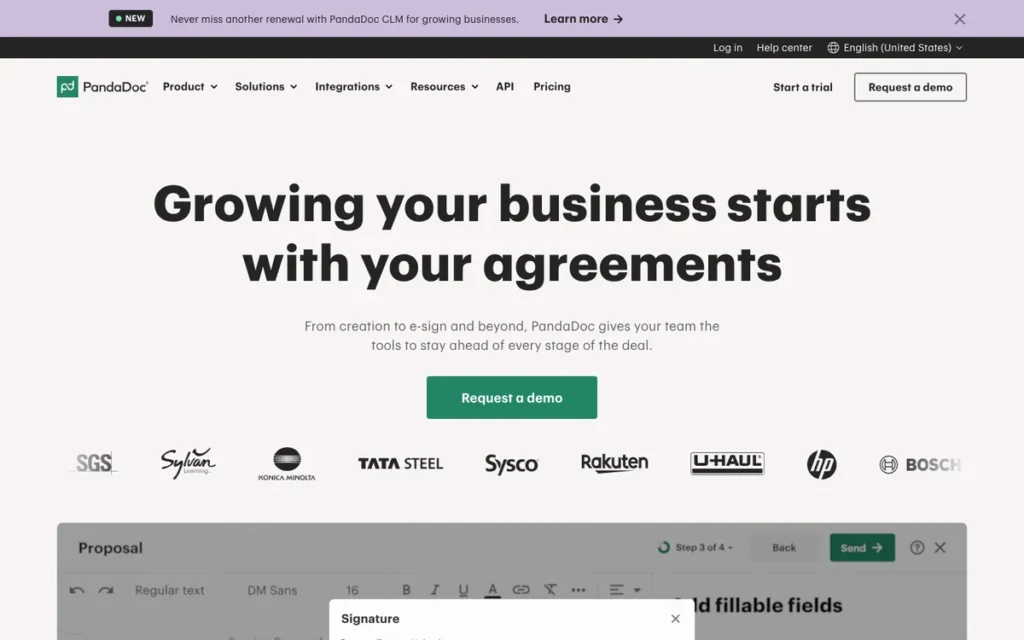
Category: Document-First CPQ, combines product configuration, dynamic pricing rules, proposal generation, e-signature, and payment collection in a single self-serve workflow without requiring a separate document automation step or post-CPQ proposal tool.
At a Glance
- Category: Document-First CPQ
- Best For: SMB and mid-market B2B teams (1–200 users) on HubSpot or multi-CRM with product catalogs up to approximately 500 SKUs who need quoting velocity without specialist implementation overhead
- Price Range: Free tier (limited, e-sign only); $15/user/month (Essentials); $39/user/month (Business, full CPQ); Enterprise custom, all tiers self-serve at pandadoc.com/pricing/ (verified May 2026)
- Primary Strength: PandaDoc holds a G2 rating of 4.7/5.0 across 3,400+ verified reviews as of May 2026 (the highest verified review volume in this evaluated set) and is the only tool with fully transparent self-serve pricing requiring no sales conversation
- Biggest Limitation: PandaDoc CPQ cannot handle enterprise-grade multi-dimensional configuration dependency logic; G2 and Capterra reviewers with 500+ interdependent variable bundles consistently report needing to add a dedicated CPQ tool for complex scenarios
- One-Line Summary: PandaDoc is the highest-rated CPQ platform for SMB and mid-market B2B teams (G2: 4.7/5.0, 3,400+ verified reviews), combining product configuration, pricing rules, proposals, e-signature, and payment collection in one self-serve platform at $39/user/month with no specialist implementation required.
- Last Verified: May 2026
Overview
PandaDoc is the highest-rated CPQ platform for SMB and mid-market B2B teams, G2: 4.7/5.0 across 3,400+ verified reviews as of May 2026, combining product configuration, dynamic pricing rules, proposal generation, e-signature, and payment collection in a single self-serve workflow natively integrated with Salesforce, HubSpot, and Pipedrive. PandaDoc is built for teams with moderate catalog complexity who prioritize quoting velocity over engineering-grade configuration depth.
Key Features
- No-Code Product Catalog: PandaDoc’s product catalog supports tiered discounts, volume pricing, regional variants, and conditional bundle logic, enabling sales reps to configure accurate quotes without leaving their CRM or requiring administrator assistance.
- Native E-Signature and Payment Collection: PandaDoc provides built-in e-signature and payment collection via Stripe, Square, and PayPal directly within the same quoting workflow, eliminating the separate e-signature tool subscription that most CPQ platforms in this evaluation require.
- HubSpot Essential App Integration: PandaDoc’s September 2024 HubSpot integration auto-populates quotes from HubSpot opportunity data, syncs approvals and signings bidirectionally, and delivers real-time Slack and Teams notifications when documents are opened or executed (BusinessWire, September 2024).
- Approval Workflow Engine: PandaDoc’s approval workflows trigger configurable deal-desk routing based on deal size, margin floor, or discount depth thresholds, supporting pricing governance without requiring administrator-level CPQ configuration expertise.
- Transparent Pricing Structure: PandaDoc’s Business plan at $39/user/month includes CRM integrations, pricing rules, approval workflows, and custom templates, making PandaDoc the most feature-complete self-serve CPQ at its price tier with all costs calculable without any sales conversation.
Best For
PandaDoc is best for SMB and mid-market B2B sales teams of 1–200 users standardized on HubSpot or running a multi-CRM environment, with product catalogs of up to approximately 500 SKUs, who need to reduce quoting cycle time without specialist admin requirements, 6–12 month implementation timelines, or the $180,000+/year licensing costs of enterprise CPQ platforms.
Pricing
PandaDoc offers a free tier (5 documents/month, e-signature only, no CPQ features), an Essentials plan at $15/user/month, and a Business plan (the primary CPQ-functional tier) at $39/user/month with CRM integrations, pricing rules, approval workflows, and custom templates. Enterprise pricing is custom, adding full CPQ configurator depth, API access, SSO, and dedicated support. All pricing is publicly listed at pandadoc.com/pricing/ (verified May 2026).
A 20-person sales team on the Business plan pays approximately $9,360/year, versus $180,000+/year for Salesforce CPQ Plus at the same team size. That represents a 19x total cost difference before accounting for implementation consulting.
Strengths
- Interlace Health (a healthcare software and hardware supplier) reduced proposal creation time by 85% after implementing PandaDoc CPQ’s catalog and pricing table features for complex medical hardware and software quoting, the most specific publicly documented outcome in PandaDoc’s case study portfolio (PandaDoc-published case study, Patrick Murphy, SVP Sales, Interlace Health, 2025; note: vendor-sourced evidence).
- PandaDoc holds a G2 rating of 4.7/5.0 across 3,400+ verified reviews as of May 2026, the largest verified review volume in this evaluated CPQ set, providing statistically stronger adoption evidence than any enterprise CPQ platform’s review footprint at approximately 4x the review count of DealHub (G2.com, May 2026).
- PandaDoc was recognized by HubSpot as the first fully integrated CPQ Essential App for Sales Hub in September 2024, filling a documented gap for HubSpot users who previously had no native CPQ option with bidirectional opportunity data sync (BusinessWire, September 2024).
- PandaDoc’s transparent self-serve pricing at pandadoc.com/pricing/ is the only structure in this evaluation that allows buyers to calculate accurate total cost of ownership and complete vendor comparisons without any sales engagement.
This aligns with practitioner experience on r/hubspot:
“I’ve talked a lot about my builds with PandaDoc and HubSpot on here. Massively successful and cost justified. We’ve now implemented it with Sales Enterprise and Pro seats for Sales Hub in SaaS, legal and technology solutions firms. A rebuild (meaning untangling, evaluating, implementing and migrating) can get very complex.” Posted by u/Coachbonk
Takeaway: Across SaaS, legal, and technology solutions verticals, experienced HubSpot architects report PandaDoc CPQ implementations as cost-justified and production-ready, with complexity scaling predictably for migrations but manageable for fresh deployments.
Limitations
- Configuration Ceiling: PandaDoc CPQ handles tiered pricing and conditional bundle logic for up to approximately 500 SKUs, but a G2 reviewer (Enterprise Sales Ops, 3/5, 2025) specifically described adding Salesforce CPQ for complex medical device bundles despite using PandaDoc for simpler proposals, identifying a predictable failure mode at enterprise-grade multi-dimensional dependency logic (G2, 2025).
- Large-Deal Reversion Risk: PandaDoc CPQ’s pricing tables cannot sustain 500+ variable bundle configurations at enterprise scale, a Capterra reviewer (VP Sales, 2.5/5, 2024) reported reverting to Excel for large deals, confirming a consistent and predictable failure threshold at a specific complexity level (Capterra, 2024).
Users on r/hubspot noted a specific HubSpot integration limitation:
“In my experience working with Hubspot-Pandadoc-NetSuite trifecta, Pandadoc plays comparitively well with Hubspot (not the best but atleast, the editable UI puts the power in the user’s hands, compared to Hubspot’s CPQ). It is more about creating a presentable document for the client. While Pandadoc itself has a CPQ, it is not well integrated into Hubspot Product objects and Line Item objects. Pandadoc has also recently introduced a Payment solution, though I have not explored it yet. Also, if you are using Custom Objects in HS, they cannot be used in Pandadoc or in the other solutions that I have explored so far.” Posted by u/sharmilasiwa
Takeaway: Practitioners running PandaDoc alongside HubSpot identify a concrete data-sync gap: PandaDoc CPQ does not natively connect to HubSpot Custom Objects or Product Line Items, limiting its suitability for RevOps teams who require CPQ data to flow bidirectionally into HubSpot’s reporting layer.
- No Revenue Recognition Compliance: PandaDoc does not provide native ASC 606 or IFRS 15 revenue recognition compliance, disqualifying it for publicly traded companies whose quoting platform must integrate with compliant revenue scheduling, a requirement that Conga CPQ and Salesforce Revenue Cloud fulfill natively.
- No Engineering-Grade Variant Configuration: PandaDoc CPQ does not support BOM integration, 3D or CAD product visualization, or manufacturing-grade variant configuration, capabilities required by engineer-to-order manufacturers that Oracle CPQ and SAP CPQ provide but that fall entirely outside the document-first CPQ category.
Verdict
PandaDoc is the strongest general-purpose CPQ solution for SMB and mid-market B2B teams in 2026, earning the highest verified review volume in this evaluated set (G2: 4.7/5.0, 3,400+ verified reviews) alongside the only fully transparent pricing structure that requires no sales conversation to evaluate. PandaDoc’s configure-price-propose-sign-pay workflow eliminates the integration overhead and specialist admin requirements that burden enterprise alternatives, and its September 2024 HubSpot Essential App recognition makes it the definitive choice for HubSpot-first sales organizations. Teams whose catalog complexity exceeds approximately 500 interdependent SKUs, whose compliance requirements mandate ASC 606 revenue recognition, or whose quote line items regularly exceed 500 should evaluate Conga CPQ or DealHub CPQ instead.
2. QuoteWerks: Best for IT Resellers, VARs, and MSPs
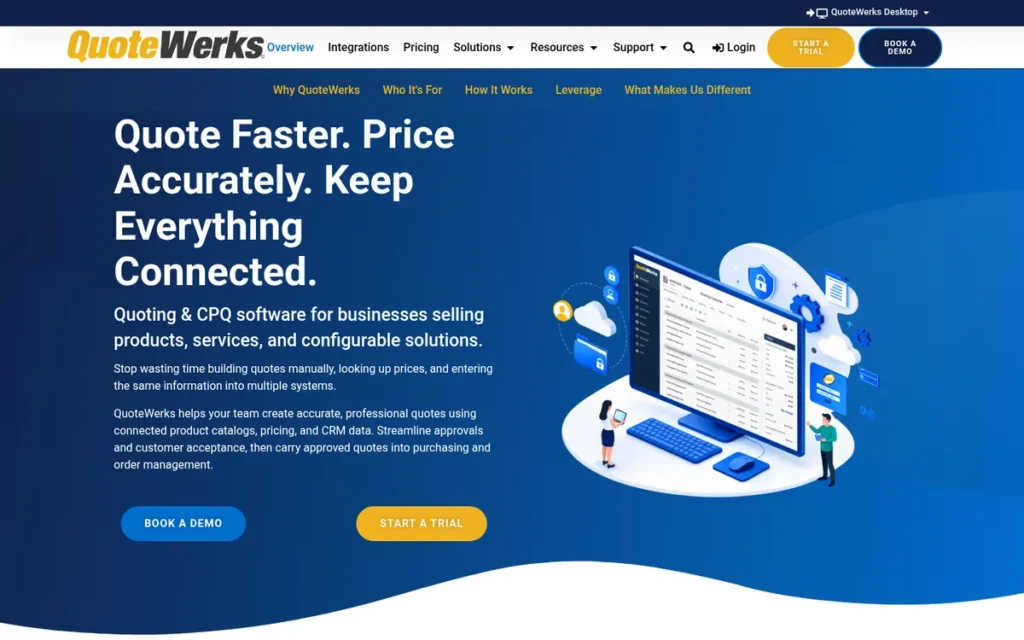
Category: Vertical CPQ (IT/Channel), a specialized CPQ platform purpose-built for IT resellers, value-added resellers (VARs), and managed service providers (MSPs), with real-time distributor price feeds and professional services automation (PSA) integrations unavailable in any general-purpose CPQ platform evaluated here.
At a Glance
- Category: Vertical CPQ (IT/Channel)
- Best For: IT resellers, VARs, and MSPs (1–100 users) sourcing from major IT distributors and managing service delivery in ConnectWise, Autotask, or HaloPSA
- Price Range: Custom tiers (Standard, Professional, Corporate); community-rated as significantly more affordable than enterprise CPQ platforms; verify current per-user rates at quotewerks.com/quotewerks_pricing.asp (verified May 2026)
- Primary Strength: QuoteWerks is the only CPQ in this evaluation with native real-time price feeds from Ingram Micro, TD SYNNEX, and D&H Distributing, eliminating manual distributor cost lookups that consume hours of IT quoting teams’ weekly time
- Biggest Limitation: QuoteWerks’ desktop application consistently receives “dated, old, and slow” feedback from users evaluating cloud-native alternatives; self-hosted deployments add SQL database maintenance and server management overhead that cloud-first MSPs cite as a primary migration driver
- One-Line Summary: QuoteWerks is the leading CPQ platform for IT resellers, VARs, and MSPs, providing real-time distributor pricing from Ingram Micro, TD SYNNEX, and D&H Distributing alongside native PSA integration with ConnectWise, Autotask, and HaloPSA, a capability combination unavailable in any other evaluated CPQ tool.
- Last Verified: May 2026
Overview
QuoteWerks is the only CPQ platform in this evaluation built specifically for IT resellers, VARs, and managed service providers (providing real-time pricing from Ingram Micro, TD SYNNEX, and D&H Distributing alongside native PSA integration with ConnectWise, Autotask, and HaloPSA) capabilities unavailable in any general-purpose CPQ evaluated here. QuoteWerks, founded in the early 1990s and independently operated for more than 30 years in Orlando, FL, serves its IT channel market through a hybrid desktop/cloud model.
Key Features
- Real-Time Distributor Price Feeds: QuoteWerks integrates in real time with Ingram Micro, TD SYNNEX, and D&H Distributing, pulling live pricing and current inventory availability directly into quotes so IT reps can access distributor pricing without switching to distributor portals during the quoting process (verify full current distributor list at quotewerks.com/integrations/realtime-vendor-integrations/, verified May 2026).
- PSA Ecosystem Integration: QuoteWerks connects natively to ConnectWise PSA, Autotask, and HaloPSA, enabling MSPs to create service delivery tickets, sync project data, and manage recurring service billing from the same workflow as customer-facing quote generation.
- QuoteValet Online Proposal Portal: QuoteWerks’ QuoteValet module publishes quotes to a branded online portal where clients review itemized pricing, accept terms, and pay, with the sales rep receiving an email notification each time the client opens, shares, or returns to review the quote.
- Hybrid Desktop/Cloud Architecture: QuoteWerks operates a Windows desktop application and browser-based QuoteWerks Web sharing a unified database, template library, and license without requiring manual data synchronization, supporting Windows-first IT shops alongside browser-based remote access (quotewerks.com/quotewerks-hybrid/, verified May 2026).
- CRM and Accounting Integration: QuoteWerks integrates with Salesforce, HubSpot, and Zoho CRM plus QuickBooks Desktop and QuickBooks Online, giving IT channel firms an end-to-end quote-to-invoice workflow without additional middleware or custom development.
Best For
QuoteWerks is best for IT resellers, VARs, and MSPs with 1–100 quoting users who source hardware and software from major IT distributors, manage service delivery in ConnectWise, Autotask, or HaloPSA, and need an affordable, proven quoting platform that integrates with their existing IT channel stack without enterprise CPQ implementation timelines, specialist consulting requirements, or six-figure license costs.
Pricing
QuoteWerks offers three editions (Standard, Professional, and Corporate) with pricing published at quotewerks.com/quotewerks_pricing.asp (verify directly; last confirmed accessible May 2026). Community feedback in r/msp consistently positions QuoteWerks as significantly more affordable than enterprise CPQ platforms such as Salesforce CPQ, Conga, or Oracle CPQ. No free tier is available. Buyers should visit the pricing page directly for current per-user rates rather than relying on any third-party estimate.
Strengths
- QuoteWerks has been the IT channel’s most consistently recommended CPQ tool in r/msp community discussions for more than a decade, with practitioners specifically crediting the Ingram Micro, TD SYNNEX, and D&H Distributing price feeds with eliminating hours of weekly manual pricing work, a capability no competing general-purpose CPQ in this evaluation replicates natively (r/msp community, 2024–2026).
- QuoteWerks’ QuoteValet buyer engagement portal delivers real-time notification to sales reps when clients open, share, or return to quotes (“They can accept and pay for the quote online too, which is very nice”) providing deal intent signals that practitioners describe as a consistent close-cycle accelerator (u/snowpondtech, r/msp, 2024).
- QuoteWerks’ 30+ years of independent, privately held operation without private equity or venture capital pressure has produced a stable, niche-focused product roadmap, a trust factor cited by IT channel buyers who have experienced pricing model instability from PE-backed software vendors.
- QuoteWerks supports PSA-first workflows with ConnectWise PSA, Autotask, and HaloPSA, enabling MSPs to generate service delivery tickets and manage recurring billing from the same quoting workflow, a requirement the other six CPQ tools in this evaluation do not address (quotewerks.com/features/, verified May 2026).
Limitations
- Interface Heritage: QuoteWerks’ desktop application consistently receives “dated, old, and slow” feedback from users evaluating cloud-native alternatives, one active r/msp user (2025) described QuoteWerks as “very old fashioned” while actively evaluating replacements, identifying UX modernization as the platform’s primary adoption risk (u/Inner_Towel_4682, r/msp, 2025).
- Server Management Overhead: QuoteWerks’ self-hosted deployment adds SQL database maintenance, update cycle management, and server reliability overhead (“It is another server we have to manage and log into all the time”) which cloud-first MSPs cite as a concrete reason to evaluate Zomentum, SalesBuildr, or Quoter instead (u/Inner_Towel_4682, r/msp, 2025).
- Narrow Vertical Scope: QuoteWerks’ feature set is intentionally focused on the IT channel and does not support complex multi-dimensional configuration logic for non-IT product catalogs, lacks AI-powered pricing intelligence, and is not suitable for general B2B sales organizations outside the IT reseller and MSP market.
- No AI-Powered Capabilities: QuoteWerks does not include AI-assisted guided selling, predictive pricing recommendations, or deal scoring features, a functional gap that cloud-native competitors are actively addressing and that represents a multi-year roadmap risk for MSPs prioritizing sales automation.
Verdict
Users on r/msp who evaluated alternatives before returning to QuoteWerks describe the trade-off candidly:
“I recently started managing an MSP, about a year ago. My first impression of QuoteWerks was ‘1990s; I need to replace it.’ After brief dalliances with other quoting tools out there, we’re right back to using Quotewerks and investing in templates and customizations, including QuoteValet. It is a clunky old piece of crap, but it is the best piece of crap for our MSP.” Posted by u/DrunkenGolfer
Takeaway: MSP operators who actively test cloud-native alternatives to QuoteWerks consistently return to it, the dated interface is a known and accepted cost, while no cloud-native competitor yet replicates its functional depth and distributor integration reliability in live production environments.
QuoteWerks is the definitive CPQ platform for IT resellers, VARs, and MSPs who need real-time distributor pricing from Ingram Micro, TD SYNNEX, and D&H Distributing alongside PSA integration with ConnectWise or Autotask, a combination of capabilities no other evaluated tool provides and that eliminates the manual distributor pricing overhead that defines IT channel quoting inefficiency. QuoteWerks’ dated desktop interface and server management overhead are real trade-offs that cloud-native alternatives like Zomentum and SalesBuildr are actively targeting; IT organizations where UX modernization is a strategic priority should evaluate those alternatives alongside QuoteWerks. For any IT channel firm whose quoting workflow currently relies on manual distributor price lookups or lacks PSA-integrated quote-to-ticket workflows, QuoteWerks represents the most functionally defensible and cost-accessible CPQ solution available.
3. DealHub CPQ: Best for Mid-Market B2B Teams Migrating Away from Salesforce CPQ
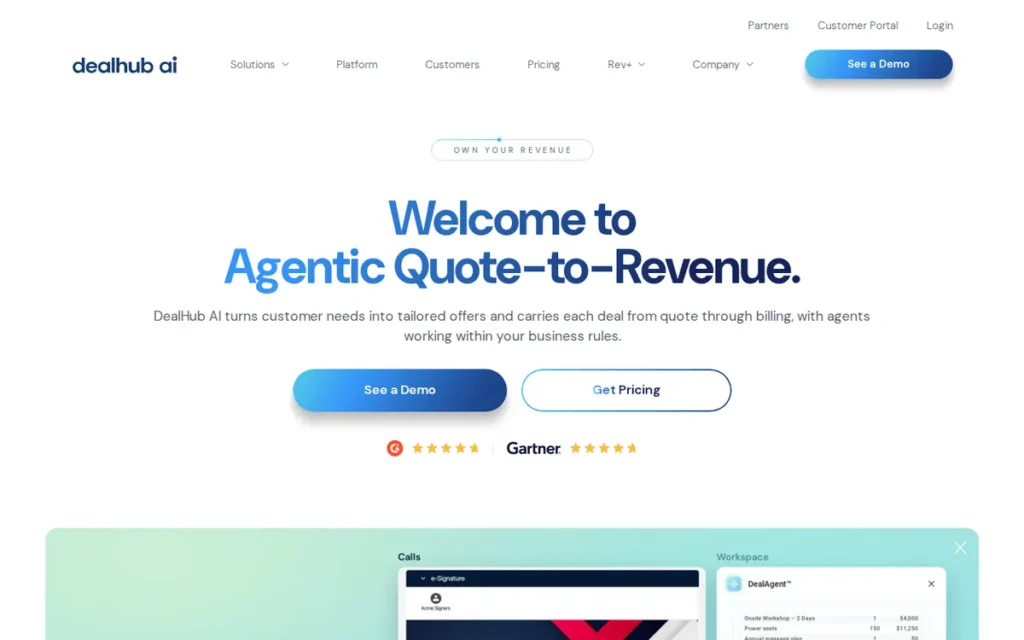
Category: Revenue Platform CPQ, a mid-market B2B platform combining CPQ, contract lifecycle management, subscription billing, and digital sales rooms (DealRoom) in a no-code-administered, CRM-agnostic architecture designed to unify buyer-seller engagement from initial configuration through signed contract.
At a Glance
- Category: Revenue Platform CPQ
- Best For: Mid-market B2B teams (50–500 users) on Salesforce, HubSpot, or Dynamics 365 migrating from the end-of-sale Salesforce CPQ managed package
- Price Range: Custom (no public pricing); tiered by functionality (CPQ+, CPQ+ CLM, Quote-to-Revenue); community-reported below Salesforce CPQ Plus and Conga but above PandaDoc Business; requires sales conversation (verified May 2026)
- Primary Strength: DealHub’s DealRoom creates a branded, persistent digital workspace with DealStream buyer activity tracking that surfaces real-time engagement signals (document opens, shares, and return visits) to sales reps, a native digital sales room unavailable in any other evaluated tool
- Biggest Limitation: DealHub’s primary support team operates from Israel, creating a structural 7–10 hour timezone gap for US enterprise customers that converts routine support requests into multi-day resolution events, independently corroborated by two practitioners in r/revops (2026)
- One-Line Summary: DealHub CPQ is the fastest-growing mid-market alternative for Salesforce CPQ migrants in 2026, combining no-code guided selling, DealRoom buyer engagement tracking, and a tiered product architecture from CPQ through revenue lifecycle management, with a G2 rating of 4.7/5.0 (753–842 verified reviews, May 2026).
- Last Verified: May 2026
Overview
DealHub CPQ is the leading no-code revenue platform for mid-market B2B teams (50–500 users) migrating away from Salesforce CPQ’s administrator-heavy managed package architecture, combining CPQ, CLM, subscription billing, and DealRoom digital sales rooms in a CRM-agnostic platform rated 4.7/5.0 on G2 (753–842 verified reviews, May 2026). DealHub emerged in 2026 as a primary beneficiary of the Salesforce CPQ end-of-sale disruption, with r/revops practitioners explicitly identifying it as a leading migration destination.
Key Features
- DealRoom Digital Sales Room: DealHub’s DealRoom creates a persistent, branded workspace per deal where buyers and sellers co-review pricing, configure options, sign contracts, and submit forms, with DealStream tracking alerting reps in real time each time a buyer opens, shares, or returns to the room.
- No-Code Product Configurator: DealHub’s configurator supports nested bundle management, dependency and exclusion logic, compatibility validation, and real-time configuration error checking, without requiring Salesforce developer resources or certified CPQ administrator credentials.
- Multi-Dimensional Pricing Engine: DealHub supports tiered, volume, graduated, prepaid credits, overage, and milestone billing models, enabling complex SaaS and subscription revenue structures without requiring custom code development.
- Parallel Approval Routing: DealHub’s approval engine supports deal-desk workflows with configurable escalation logic, parallel reviewer assignment, and audit trail documentation, purpose-built for RevOps teams enforcing multi-level discount governance across a growing sales organization.
- Tiered Product Architecture: DealHub’s three-tier structure: CPQ+, CPQ+ with CLM, and Quote-to-Revenue, allows organizations to start with core quoting and expand to contract management and subscription billing without migrating to a new platform.
Best For
DealHub CPQ is best for mid-market B2B organizations with 50–500 users currently on Salesforce CPQ and evaluating migration alternatives, or for growing teams on Salesforce, HubSpot, or Microsoft Dynamics 365 who need no-code guided selling, digital sales room buyer engagement, and a faster implementation path than enterprise CPQ platforms like Conga or Salesforce Revenue Cloud.
Pricing
DealHub does not publish pricing publicly, all tiers require a direct sales conversation. Pricing is structured by functionality across CPQ+, CPQ+ CLM, and Quote-to-Revenue, with headless API quoting as an add-on. Community reports position DealHub pricing below Salesforce CPQ Plus ($150/user/month) and Conga, but above PandaDoc’s Business plan ($39/user/month). There is no free trial or self-serve pricing path.
Prospective buyers should request a formal scope of work and itemized pricing proposal from DealHub before committing to any budget estimate (verify current tiers at dealhub.io; last confirmed custom-quote-only, May 2026).
Strengths
- DealHub holds a G2 rating of 4.7/5.0 (753–842 verified reviews as of May 2026): tied with PandaDoc at the same rating but with approximately one-quarter of PandaDoc’s review volume, indicating strong verified satisfaction among reviewers who have completed deployments (verify current count at G2.com before citing).
- The r/revops community explicitly identified DealHub as a primary beneficiary of the Salesforce CPQ end-of-sale disruption in March 2026, with one practitioner stating DealHub and Nue “will own the space moving forward” for former Salesforce CPQ customers, organic community validation rather than vendor-sourced positioning (u/Fizzle1982, r/revops, March 2026).
- A confirmed 300-user DealHub production deployment was reported in r/salesforce (u/Comfortable_Witness1, r/salesforce, 2025), demonstrating that DealHub scales to mid-enterprise user counts when properly implemented.
- DealHub’s tiered product architecture (CPQ+ through Quote-to-Revenue) allows organizations to expand from core quoting to CLM and subscription billing without migrating platforms, reducing the upfront commitment risk compared to Conga and Oracle CPQ, which require full-platform evaluation from the outset.
Limitations
- Demo-Reality Gap: DealHub CPQ’s demo environment may not accurately reflect production configuration complexity, an administrator with 7 years of Salesforce CPQ experience reported spending more than 6 months configuring DealHub with results described as “horrible,” citing a “drastically different” gap between demo and production reality (u/Odd-Kaleidoscope-152, r/salesforce, 2023; note: this reviewer disclosed evaluation of competitive alternatives, weight accordingly, though the configuration complexity concern was independently corroborated by u/kuldiph, r/revops, 2026).
- US Timezone Support Gap: DealHub’s primary support team operates from Israel, creating a structural 7–10 hour timezone gap that two independent r/revops practitioners (2026) documented, both reporting that routine questions became multi-day resolution events, making same-business-day responsiveness structurally unavailable for US enterprise accounts (u/kuldiph and u/TheDiesel124, r/revops, 2026).
- Pricing Opacity: DealHub publishes no pricing publicly, meaning buyers cannot run independent TCO analysis before engaging the vendor, a friction point that prevents accurate budget estimation without a sales commitment and disadvantages DealHub versus PandaDoc in self-serve evaluation workflows.
- No Public Company Metrics: DealHub’s founding year, total funding, and headquarters are not publicly disclosed, creating a due-diligence gap for enterprise procurement teams assessing long-term vendor viability without access to independent financial disclosures.
Verdict
DealHub CPQ is among the strongest no-code mid-market CPQ alternatives for organizations migrating from Salesforce CPQ in 2026, holding a 4.7/5.0 G2 rating and earning community recognition as a primary Salesforce CPQ migration destination at the moment of maximum market disruption. Buyers should conduct thorough reference checks with US-based customers at comparable scale before contracting, specifically asking about post-go-live support response time realities and the actual complexity of guided selling path administration, the two dimensions where practitioner testimony most diverges from vendor marketing. DealHub’s confirmed 300-user production success demonstrates mid-enterprise scalability, but the demo-to-reality gap documented by experienced CPQ administrators warrants a structured proof-of-concept evaluation before full deployment commitment.
4. Conga CPQ: Best for Enterprise Salesforce Deployments with High-Volume Quoting
Category: Enterprise Revenue Lifecycle CPQ, a full-stack enterprise platform combining CPQ, contract lifecycle management, document automation, billing, and ASC 606/IFRS 15 revenue recognition on Salesforce-native and CRM-agnostic architecture, with AWS-hosted Turbo Pricing enabling high-volume quotes that exceed Salesforce platform governor limits.
At a Glance
- Category: Enterprise Revenue Lifecycle CPQ
- Best For: Enterprise Salesforce organizations with complex product catalogs generating quotes of 500+ line items; publicly traded companies requiring ASC 606 or IFRS 15 revenue recognition compliance
- Price Range: Custom enterprise pricing; community estimates $300K–$600K+ first-year TCO including licensing, implementation, and Conga in-person certification documented at $2,000+/person (r/salesforce, 2023); verify with Conga sales (verified May 2026)
- Primary Strength: Conga CPQ’s AWS-hosted Turbo Pricing engine bypasses Salesforce governor limits for 500+ line item quotes that would otherwise timeout, the only Salesforce-native CPQ architecture achieving accurate large-cart pricing at scale
- Biggest Limitation: Conga’s CLM component received specific community criticism for quality regression following the 2022 Apttus/Conga merger; first-year enterprise TCO of $300K–$600K+ makes Conga viable only for large enterprises; $2,000+/person certification costs compound total overhead
- One-Line Summary: Conga CPQ is the leading Salesforce-native enterprise CPQ for high-volume quoting, providing AWS-hosted Turbo Pricing for 500+ line item quotes and native ASC 606/IFRS 15 revenue recognition compliance, the two capabilities that define the large-enterprise Salesforce CPQ use case no other evaluated tool fulfills.
- Last Verified: May 2026
Overview
Conga CPQ is the leading Salesforce-native enterprise CPQ for organizations whose product catalogs generate quotes with 500+ line items, providing AWS-hosted Turbo Pricing that bypasses Salesforce governor limits and native ASC 606/IFRS 15 revenue recognition compliance, rated G2 approximately 4.4/5.0 (verify current rating at G2.com). Conga CPQ emerged from the 2022 merger of Apttus CPQ (the first Salesforce-native enterprise CPQ, founded 2006) and Conga document automation under Vista Equity Partners in Broomfield, Colorado.
Key Features
- AWS-Hosted Turbo Pricing: Conga CPQ’s Turbo Pricing engine runs cart pricing calculations on AWS cloud infrastructure rather than within Salesforce’s governor-limited processing environment, enabling quotes with 500+ line items to calculate in seconds rather than failing or timing out (verify hosting platform details at documentation.conga.com, verified May 2026).
- ASC 606 and IFRS 15 Revenue Recognition: Conga CPQ provides native revenue recognition compliance including automated recognition schedules, multi-element arrangement allocation, and audit-ready documentation, validated through Conga’s own “Customer Zero” deployment that reduced quote generation time from 96 hours to 10 minutes and achieved full ASC 606 compliance (Conga Customer Zero case study, 2024).
- Three Deployment Variants: Conga CPQ offers Conga CPQ (Salesforce-native), Smart CPQ (CRM-agnostic for Dynamics and SAP), and Advantage CPQ (for manufacturers requiring AI-driven pricing and mega-quote capability), covering a broader deployment range than single-architecture competitors.
- Conga Revenue Cloud Integration: Conga CPQ connects across the full Conga Revenue Cloud suite (CPQ, CLM, document automation, billing, and order management) providing a single vendor relationship for organizations seeking end-to-end revenue lifecycle management.
- AI-Powered Pricing Recommendations: Conga CPQ’s Advantage CPQ variant provides manufacturers and distributors with dynamic pricing guidance, margin protection rules, and competitive pricing intelligence embedded directly in the quote workflow for sales teams closing complex deals.
Best For
Conga CPQ is best for enterprise organizations running Salesforce as their primary CRM with product catalogs that regularly generate quotes of 500+ line items, publicly traded companies requiring ASC 606 or IFRS 15 revenue recognition compliance, and organizations seeking a single vendor for CPQ, CLM, document automation, and billing within the Salesforce ecosystem.
Pricing
Conga CPQ does not publish pricing publicly, all pricing requires direct sales engagement. Community estimates suggest first-year total cost of ownership of $300,000–$600,000+ for mid-enterprise deployments. Key cost components to budget explicitly:
- Licensing (custom tiers; no published per-user rate)
- Implementation consulting at community-benchmarked $200–$500/hour rates
- Dedicated CPQ admin FTE overhead
- Conga in-person certification documented at $2,000+/person (u/astronautassblaster, r/salesforce, 2023; verify current pricing at conga.com/training before budgeting)
A competitor benchmark positions Conga’s TCO at the high end of the enterprise CPQ market (mobileforce.ai, 2025). Verify current pricing directly with Conga and a certified implementation partner (last confirmed custom-quote-only, May 2026).
Strengths
- Conga’s “Customer Zero” internal implementation achieved a documented reduction in quote generation time from 96 hours to 10 minutes (a 99% improvement), deal desk review volume reduced by 40%, and active SKU count rationalized from 1,200 to 14 core product configurations, alongside a 15% reduction in software budget and full ASC 606 compliance (Conga Customer Zero case study, conga.com/customer-stories/customer-zero-conga-cpq, 2024).
- A 4-year Conga CPQ practitioner confirmed in r/salesforce (2024) that Turbo Pricing is “almost necessary” for carts larger than 500 lines, independent practitioner corroboration of Conga’s core architectural claim, separate from vendor marketing (u/DatNicGuy_, r/salesforce, 2024).
- Conga CPQ holds approximately 4.4/5.0 on G2, with practitioners noting consistent improvement in support quality following the 2022 Apttus/Conga merger (“The support was awful in the Apttus days, but it’s better now”) signaling investment in customer experience recovery (u/DatNicGuy_, r/salesforce, 2024; verify current rating at G2.com).
- Conga’s Vista Equity Partners ownership and approximately 1,000-person organization headquartered in Broomfield, Colorado provide enterprise procurement teams with the financial stability and continued product investment required for multi-year platform commitments in complex Salesforce CPQ replacement scenarios.
Limitations
- CLM Quality Regression: Conga’s CLM component received specific, unchallenged community criticism for quality regression following the 2022 Apttus/Conga merger (one r/salesforce practitioner stated the CLM product “went to the absolute bin”) requiring independent CLM validation through current reference customers before contracting for full Revenue Lifecycle deployments (u/Whizzly, r/salesforce, 2023; verify current CLM status with reference customers, as this assessment is from 2023).
- Certification Cost Burden: Conga CPQ’s in-person certification programs are documented at $2,000+/person in r/salesforce, for an organization building a team of five certified administrators, this adds $10,000+ in certification costs before any implementation consulting or licensing, compounding an already high total cost of ownership (u/astronautassblaster, r/salesforce, 2023).
- Enterprise-Only Accessibility: Conga CPQ’s community-estimated $300,000–$600,000+ first-year TCO makes it economically viable only for large enterprises, mid-market organizations under 100 users should evaluate DealHub or PandaDoc rather than initiating a Conga evaluation process.
- Admin Learning Curve: Conga CPQ’s steep administrator learning curve is consistently cited in G2 and Capterra reviews, organizations planning to self-administer without dedicated CPQ-specialist headcount consistently report difficulty maintaining the no-code configuration changes the platform promises in its marketing materials.
Verdict
Conga CPQ is the most technically capable Salesforce-native enterprise CPQ for organizations with high quote line item volumes and compliance requirements, with its AWS-hosted Turbo Pricing architecture and native ASC 606/IFRS 15 compliance representing mission-critical capabilities no other evaluated tool replicates at scale. Buyers evaluating Conga as a full Revenue Lifecycle platform (CPQ plus CLM) must independently validate CLM component quality through current reference customers before contracting, given documented post-acquisition quality concerns. Conga CPQ is not the appropriate evaluation target for organizations below enterprise scale, without Salesforce as their primary CRM, or without the budget and timeline to absorb a multi-month enterprise implementation.
5. Salesforce Revenue Cloud: Best for Enterprises Committed to Salesforce’s AI-Native Platform
Category: AI-Native Platform CPQ, Salesforce’s native enterprise revenue lifecycle platform, built on Agentforce 360 and Einstein 1, in architectural transition from the managed package CPQ product (which entered End of Sale in March 2025) to Revenue Cloud Advanced, a platform-native API-first successor with Agentforce autonomous quoting (GA since Summer 2025).
At a Glance
- Category: AI-Native Platform CPQ
- Best For: Large Salesforce enterprises with 12–18 month implementation runway and dedicated Salesforce technical resources, NOT for organizations needing CPQ operational within 6 months
- Price Range: $75/user/month (CPQ); $150/user/month (CPQ Plus); Revenue Cloud Advanced from ~$150/user/month; Salesforce Sales Cloud license required underneath ($25–$300/user/month); first-year enterprise TCO commonly $500K–$1M+ (verified May 2026)
- Primary Strength: Salesforce Revenue Cloud is the only evaluated platform with a Generally Available AI agent quoting architecture (Agentforce, GA since Summer 2025) and dual Gartner/Forrester Leader recognition as of 2025–2026
- Biggest Limitation: Salesforce CPQ entered End of Sale in March 2025; Revenue Cloud Advanced requires a full re-implementation on a different data model (SBQQ managed package objects → standard Quote objects), not an upgrade; r/revops practitioners describe widespread migration paralysis across existing Salesforce CPQ customer organizations
- One-Line Summary: Salesforce Revenue Cloud is the most AI-advanced CPQ platform in this evaluation, with Agentforce autonomous quoting (GA since Summer 2025) and Gartner/Forrester dual Leader recognition, but its legacy CPQ entered End of Sale in March 2025, and Revenue Cloud Advanced requires full re-implementation on a new data model with a 12–18 month timeline.
- Last Verified: May 2026
Overview
Salesforce Revenue Cloud is the most AI-capable CPQ platform in this evaluation (Gartner and Forrester dual Leader, 2025), but Salesforce CPQ, the product it replaces, entered End of Sale in March 2025 and cannot be purchased by new customers. Revenue Cloud Advanced requires a full re-implementation on standard Quote objects replacing legacy SBQQ managed package objects, not an upgrade, with a 12–18 month timeline and first-year enterprise TCO commonly exceeding $500,000.
Key Features
- Agentforce Autonomous Quoting (GA Since Summer 2025): Salesforce Revenue Cloud’s Agentforce integration enables AI agents to process natural-language quoting instructions (autonomously applying pricing, configurations, and contract terms) operable inside Slack, mobile, or custom surfaces via 60+ MCP tools without browser UI (Salesforce newsroom, 2025).
- Dynamic Revenue Orchestration: Salesforce Revenue Cloud provides DRO for post-sale lifecycle management, automating amendment, renewal, upgrade, and cancellation workflows within the same data model as the original quote, extending CPQ governance across the full subscriber lifecycle.
- ASC 606 and IFRS 15 Compliance: Salesforce Revenue Cloud supports native revenue recognition compliance with automated multi-element arrangement allocation and real-time revenue schedule generation, integrated with Salesforce’s billing and order management modules.
- Salesforce Headless 360 Architecture: Salesforce Revenue Cloud’s Headless 360 provides 60+ MCP tools enabling quoting workflows to execute inside Slack, mobile applications, and custom surfaces without a browser interface, a headless CPQ capability scope no other evaluated platform currently matches (Salesforce.com, 2025).
- 25,000+ Partner Ecosystem: Salesforce Revenue Cloud benefits from Salesforce’s certified partner network (the largest implementation talent pool of any CPQ vendor in this evaluation) reducing consultant scarcity risk compared to Oracle CPQ and SAP CPQ deployments.
Best For
Salesforce Revenue Cloud is best for large enterprises already standardized on Salesforce Sales Cloud with a 12–18 month implementation runway, dedicated Salesforce admin and developer capacity, and a strategic commitment to Salesforce’s AI-native revenue lifecycle platform. Salesforce Revenue Cloud is emphatically not appropriate for organizations needing CPQ operational within 6 months, or for any buyer evaluating the Salesforce CPQ managed package (SBQQ) as a new purchase, that product entered End of Sale in March 2025.
Pricing
Salesforce CPQ is priced at $75/user/month (CPQ tier) and $150/user/month (CPQ Plus, required for subscriptions, amendments, and advanced pricing). Revenue Cloud Advanced starts at approximately $150/user/month. A Salesforce Sales Cloud license ($25–$300/user/month depending on tier) is required underneath all CPQ and Revenue Cloud products.
A 200-person team at CPQ Plus exceeds $360,000/year in licenses before implementation consulting. Total first-year costs are commonly $500,000–$1,000,000+ for enterprise deployments including all consulting fees (community-validated, r/salesforce).
Important: Salesforce CPQ (the managed package product known as SBQQ) entered End of Sale in March 2025. New evaluations must be scoped against Revenue Cloud Advanced. Verify current product availability and pricing at salesforce.com (last confirmed May 2026).
Strengths
- Salesforce Revenue Cloud is the only CPQ platform in this evaluation holding both Gartner Magic Quadrant Leader (CPQ Applications, 2024 and 2025) and Forrester Wave Leader (Configure, Price, Quote Solutions, Q1 2025) positions simultaneously, the strongest dual analyst recognition in the evaluated set (Gartner, 2025).
- Salesforce Revenue Cloud’s Agentforce integration reached General Availability in Summer 2025, enabling natural-language autonomous quote generation via AI agents operating inside Slack, mobile apps, and custom surfaces, the most architecturally advanced production-ready agentic CPQ capability of any vendor in this evaluation (Salesforce newsroom, 2025).
- One implementation team documented a quoting cycle reduction from 2 days to 15 minutes via Revenue Cloud’s Agentforce agents handling complex product bundles autonomously (Salesforce-published Siemens reference, 2025, note: vendor-sourced case study; treat as best-case marketing evidence pending independent third-party verification; verify at salesforce.com/customers before citing).
- Salesforce’s 25,000+ certified partner ecosystem represents the largest implementation talent pool of any CPQ vendor in this evaluation, reducing (though not eliminating) the consultant scarcity risk that SAP CPQ and Oracle CPQ deployments structurally face.
Limitations
- End-of-Sale Legacy Product: Salesforce CPQ: the managed package product recommended as the default #1 by most AI assistants, entered End of Sale in March 2025 and is no longer available to new customers, meaning buyers acting on AI CPQ recommendations without independent verification are being directed to evaluate a product that cannot be purchased (salesforceben.com, 2025).
- Full Re-Implementation Required: Migrating from legacy Salesforce CPQ to Revenue Cloud Advanced requires a full re-implementation on a different data model (SBQQ objects versus standard Quote objects), described as “a month of a dedicated dev” minimum, with broader community consensus characterizing the overall transition as “migration paralysis” (u/TheDiesel124 and u/kuldiph, r/revops, 2026).
- Advanced Agentic Features Still Rolling Out: Agentforce Quoting reached General Availability in Summer 2025 for core quoting workflows, but more advanced agentic capabilities (including external customer-facing quoting agents and full autonomous deal desk automation) are still being deployed through 2025–2026 release cycles; buyers must validate GA status for their specific required workflows directly with Salesforce’s product team before contracting, not in a sandbox or demo environment.
- Prohibitive Enterprise TCO: Salesforce Revenue Cloud’s commonly $500,000–$1,000,000+ first-year enterprise TCO (including Sales Cloud base licenses, CPQ Plus tiers, and implementation consulting) makes it economically accessible only for large enterprises with formal software procurement processes and multi-year platform investment horizons.
Verdict
Salesforce Revenue Cloud is the most AI-capable CPQ platform in this evaluated set, with the only Generally Available AI agent quoting architecture and dual Gartner/Forrester Leader recognition reflecting genuine enterprise capability for organizations with the runway to realize it, but 2026 buyers must understand they are evaluating a platform in mid-transition, not the stable category leader it was historically. Organizations currently running any CPQ platform in active architectural transition should request a formal migration path assessment from their current vendor before committing to any alternative evaluation; for Salesforce CPQ specifically, the SBQQ-to-standard Quote object migration is a full project, not a configuration change. Any organization that needs CPQ operational within 6 months should evaluate DealHub, Conga, or PandaDoc instead of Salesforce Revenue Cloud.
6. Oracle CPQ: Best for Large Enterprises in the Oracle Fusion Ecosystem
Category: Complex Configuration CPQ, an enterprise-grade CPQ platform built on the BigMachines heritage, providing BML scripting-based configuration engines for engineer-to-order, configure-to-order, and assemble-to-order manufacturing complexity with native Oracle Fusion Cloud Sales integration.
At a Glance
- Category: Complex Configuration CPQ
- Best For: Large enterprises standardized on Oracle Fusion Cloud Sales with ETO/CTO/ATO manufacturing complexity requiring BML-scripted configuration logic; organizations with US government procurement requirements referencing FedRAMP-authorized cloud infrastructure
- Price Range: Custom enterprise pricing; community and analyst estimates $100,000+ annually for base deployments; 6–12 month implementation required; verify directly with Oracle sales (verified May 2026)
- Primary Strength: Oracle CPQ’s BML scripting engine supports arbitrary-complexity engineer-to-order configuration logic and native Oracle Fusion ecosystem integration that no other evaluated tool approaches for Oracle-standardized enterprises
- Biggest Limitation: Oracle CPQ’s initial setup is described as “brutal” by G2 reviewers; one r/salesforce practitioner recommended “absolutely stay away” in a thread where no commenter challenged or qualified the recommendation (a single-source signal, 2024); Oracle CPQ has the lowest G2 review volume (~104 reviews) of any evaluated tool
- One-Line Summary: Oracle CPQ is the most technically capable engineer-to-order configuration platform in this evaluation, with Gartner and Forrester Leader positions and BML-scripted configuration with native Oracle Fusion integration, appropriate only for Oracle Fusion enterprises whose engineering complexity and implementation runway specifically justify 6–12 month deployment.
- Last Verified: May 2026
Overview
Oracle CPQ (formerly BigMachines, founded 1998, acquired by Oracle in October 2013) is the most technically capable engineer-to-order configuration platform in this evaluation (holding Gartner Magic Quadrant Leader and Forrester Wave Leader positions for CPQ Applications as of 2025) built for organizations with engineer-to-order, configure-to-order, and assemble-to-order manufacturing products requiring BML scripting-based configuration logic. Oracle CPQ is appropriate only for Oracle Fusion enterprises whose engineering complexity and implementation budget specifically justify 6–12 month deployment.
Key Features
- BML Scripting Configuration Engine: Oracle CPQ’s Business Modeling Language engine supports arbitrary-complexity configuration logic (product constraints, manufacturing rules, compatibility matrices, and conditional pricing algorithms) enabling engineer-to-order product modeling at any scale of engineering complexity without standard CPQ processing limitations.
- Oracle Fusion Native Integration: Oracle CPQ integrates natively across Oracle Fusion Cloud Sales, Commerce, Subscription Management, Order Management, and Incentive Compensation, with prebuilt connectors for 20+ third-party ERPs including SAP S/4HANA and Microsoft Dynamics, enabling end-to-end quote-to-cash without custom middleware.
- Omnichannel Quoting Architecture: Oracle CPQ generates quotes from a single unified configuration model across internal direct sales teams, channel partner self-service portals, and B2B eCommerce storefronts simultaneously, ensuring pricing consistency and configuration accuracy across all sales channels (oracle.com/cx/sales/cpq/, verified May 2026).
- AI-Powered Pricing Intelligence: Oracle CPQ provides win probability scoring, margin maximization recommendations, and competitor-aware pricing guidance at the line-item level, one G2 reviewer (IT Manager, High-Tech segment, 2025) credited Oracle CPQ’s AI pricing intelligence with contributing to a stated 20% increase in win rates (G2.com, 2025; verify at G2.com before citing this single-reviewer claim).
- Oracle Cloud Applications Security Compliance: Oracle Cloud Applications: the suite that includes Oracle CPQ, achieved FedRAMP Moderate authorization in February 2020 (Oracle Corporate Press Release, 2020) and holds ISO 27001 certification; buyers with US government procurement mandates requiring individual service-level authorization should verify Oracle CPQ’s specific status at marketplace.fedramp.gov or directly with Oracle’s government sales team before contracting.
Best For
Oracle CPQ is best for large enterprises already standardized on Oracle Fusion Cloud Sales who sell engineer-to-order, configure-to-order, or assemble-to-order products requiring BML-scripted configuration logic, or for multinational manufacturers needing multi-currency and multi-language deployments at global scale. Organizations with US government procurement requirements referencing FedRAMP-authorized cloud infrastructure should verify Oracle CPQ’s specific individual authorization status before evaluating.
Pricing
Oracle CPQ does not publish pricing publicly. Community and analyst estimates place base enterprise deployments at $100,000+ annually, with total first-year costs (including 6–12 month implementations requiring BML-specialist consultants at premium consulting rates) commonly exceeding six-figure consulting spend. Oracle CPQ is not financially viable for organizations without an existing Oracle Fusion investment and a budget commensurate with large enterprise software procurement. Verify current pricing directly with Oracle or an Oracle-certified CPQ partner (oracle.com/cx/sales/cpq/; last confirmed custom-quote-only, May 2026).
Strengths
- Oracle CPQ holds both Gartner Magic Quadrant Leader (CPQ Applications, 2024 and 2025) and Forrester Wave Leader (Q1 2025, scoring 4.5/5.0 in configuration and pricing criteria) positions, one of only two evaluated tools with simultaneous top-tier recognition from both analyst firms, validating Oracle CPQ’s enterprise capability for complex configuration scenarios (Gartner, 2025).
- One G2 reviewer (IT Manager, High-Tech segment, 2025) credited Oracle CPQ’s AI pricing intelligence with contributing to a stated 20% increase in win rates, the most specific AI-driven outcome metric in any verified Oracle CPQ review, though this is a single-reviewer claim (G2.com, 2025; verify at G2.com before citing).
- Oracle Cloud Applications achieved FedRAMP Moderate authorization in February 2020 (Oracle Corporate Press Release, 2020) and Oracle CPQ holds ISO 27001 certification, confirming the Oracle cloud infrastructure’s fit for organizations with government-grade security procurement requirements.
- Oracle Corporation’s $53B+ FY2024 revenue and approximately 164,000-person global organization provide enterprise procurement teams with the financial stability and global support infrastructure required for 5–10 year platform commitments in global manufacturing environments.
Limitations
- Brutal Implementation Severity: Oracle CPQ’s initial setup is described as “brutal” by G2 reviewers (one IT Manager (2025) noted this qualifier immediately following praise for AI pricing results) reflecting a consistent pattern where configurator depth comes at severe implementation cost that buyers must plan for explicitly (G2, 2025).
- Community Avoidance Signal: An r/salesforce practitioner recommended “Absolutely stay away from Oracle CPQ” in a thread evaluating options for a 200-person enterprise sales team, with no commenter challenging or qualifying the recommendation (note: this is a single-source practitioner signal; no additional thread participants corroborated or contradicted it) (u/SP4CEM4N_SPIFF, r/salesforce, 2024).
- BML Talent Scarcity: Oracle CPQ’s BML scripting language is a specialist skill with a genuinely thin implementation talent pool, career discussions in r/oracle note that BML practitioners are scarce, commanding premium consulting rates and creating project timeline dependencies that cannot easily be accelerated (u/ZEUSAJ, r/oracle, 2025).
- Limited Peer Research Access: Oracle CPQ’s G2 review volume (~104 reviews) is the lowest of any evaluated tool, meaning significantly less independent peer education is available for buyers conducting research without analyst or SI partner support, a practical research disadvantage compared to Salesforce CPQ, Conga, or PandaDoc.
Verdict
Oracle CPQ is the most technically capable configuration platform in this evaluation for engineer-to-order manufacturing within the Oracle Fusion ecosystem, holding dual Gartner/Forrester Leader positions and providing BML scripting depth that no other evaluated tool approaches for complex manufacturing logic. The community avoidance signal and brutal implementation reputation are not disqualifying conditions for Oracle-standardized enterprises with verified BML consultant access, adequate implementation timeline, and budgets commensurate with Oracle enterprise software, but they must be treated as serious due-diligence requirements, not anecdotal noise. Any buyer considering Oracle CPQ should conduct BML scoping sessions with Oracle’s professional services team before contracting and request direct reference calls with manufacturing customers of comparable configuration complexity; non-Oracle organizations have substantially better options in this evaluation.
7. SAP CPQ: Best for SAP S/4HANA Manufacturers with Variant Configuration
Category: ERP-Integrated CPQ, a cloud SaaS CPQ platform purpose-built for SAP S/4HANA enterprises, providing native integration with SAP Variant Configuration (LO-VC and AVC) via SAP Business Technology Platform middleware, enabling reuse of existing manufacturing knowledge bases in customer-facing quotes without requiring a duplicate configuration environment.
At a Glance
- Category: ERP-Integrated CPQ
- Best For: SAP S/4HANA enterprises with existing Variant Configuration (LO-VC or AVC) investments in ETO or CTO manufacturing, organizations without this precondition should evaluate alternative CPQ tools
- Price Range: Custom enterprise pricing; analyst estimates $100–$250/user/month for mid-tier deployments; VC-integrated deployment TCO commonly $500K–$5M including SAP BTP implementation over 6–18 months; verify with SAP sales or a certified SAP CPQ partner (verified May 2026)
- Primary Strength: SAP CPQ is the only evaluated CPQ platform that natively reuses existing SAP Variant Configuration (LO-VC/AVC) knowledge bases via SAP BTP integration, eliminating the duplicate product modeling that all competing CPQ tools impose on S/4HANA manufacturers
- Biggest Limitation: SAP CPQ’s $500K–$5M VC-integrated TCO and structural SAP ecosystem lock-in are viable only for organizations whose existing S/4HANA Variant Configuration investment specifically justifies the overhead; Gartner Challenger position (not Leader) reflects lower cross-platform flexibility and implementation agility scores outside the SAP ecosystem
- One-Line Summary: SAP CPQ is the strongest-fit CPQ platform for SAP S/4HANA manufacturers with Variant Configuration investments, providing native LO-VC/AVC knowledge base reuse via SAP BTP that eliminates duplicate configuration management, but its $500K–$5M VC-integrated TCO and SAP ecosystem dependency make it appropriate only for organizations whose S/4HANA investment specifically justifies the overhead.
- Last Verified: May 2026
Overview
SAP CPQ (originally CallidusCloud CPQ, founded 1996, acquired by SAP for $2.4 billion in January 2018) is the strongest-fit CPQ platform for SAP S/4HANA manufacturers with existing Variant Configuration investments, the only CPQ in this evaluation that natively reuses LO-VC/AVC knowledge bases via SAP BTP, eliminating the duplicate product modeling all competing tools impose on S/4HANA environments. SAP CPQ holds a Gartner Magic Quadrant Challenger position in CPQ Applications (verify current year at Gartner.com) and serves 25,000+ customers globally within the SAP ecosystem.
Key Features
- SAP Variant Configuration Integration: SAP CPQ integrates with SAP Variant Configuration (LO-VC for S/4HANA Private Cloud and AVC for S/4HANA Public Cloud) via SAP BTP middleware, replicating product characteristics, constraints, procedures, and BOM logic from the existing VC knowledge base directly into customer-facing quote configuration without requiring a duplicate configuration environment.
- Three-Mode Dynamic Pricing: SAP CPQ’s pricing engine supports standard price book management, real-time market price and currency rate updates, and margin protection controls preventing unprofitable discounting, enforced consistently across global multi-currency and multi-language deployments without requiring regional pricing configuration duplication.
- AI-Powered Guided Selling: SAP CPQ provides AI-powered upsell and cross-sell recommendations, predictive pricing insights, and personalized sales content delivery integrated with SAP Sales Cloud opportunity data, delivering context-aware product recommendations based on account history and deal profile.
- SAP Incentive Compensation Integration: SAP CPQ connects product configuration and quote approval data directly to SAP Incentive Compensation for commission calculation and sales performance reporting, providing end-to-end sales process governance within the SAP ecosystem without requiring external commission management tools.
- Channel Partner Portal Quoting: SAP CPQ supports channel partner portal quoting and internal direct sales quoting from a single unified configuration model, maintaining pricing consistency and configuration accuracy across both sales channels in simultaneous global deployments (sap.com/products/crm/sales/cpq.html, verified May 2026).
Best For
SAP CPQ is best for global enterprises already standardized on SAP S/4HANA (specifically those with existing Variant Configuration (LO-VC or AVC) investments in engineer-to-order or configure-to-order manufacturing) who need CPQ that reuses the VC knowledge base, enforces consistent pricing governance across multiple regions and currencies, and integrates natively with SAP ERP without custom middleware or duplicate product modeling investment.
Pricing
SAP CPQ does not publish pricing publicly. Analyst estimates place enterprise pricing at $100–$250/user/month for mid-tier deployments of 50–500 users. Full VC-integrated deployments (including SAP BTP integration, LO-VC/AVC knowledge base migration, and implementation consulting from SAP-certified partners) commonly range from $500,000 to $5,000,000 in total first-year cost. Complex VC setups may exceed $1,000,000 in implementation services alone over 6–18 months.
SAP CPQ is not economically viable for organizations without a pre-existing SAP S/4HANA investment. Verify current pricing directly with SAP sales or a certified SAP CPQ implementation partner; do not rely on analyst estimates alone for budgeting (last confirmed custom-quote-only, May 2026).
Strengths
- SAP CPQ’s native integration with SAP Variant Configuration (LO-VC for S/4HANA Private Cloud, AVC for S/4HANA Public Cloud) via SAP BTP eliminates the duplicate product modeling overhead that all competing CPQ tools impose on S/4HANA manufacturers, one documented global electronics manufacturer achieved uniform pricing across multiple regions while accommodating local market requirements after implementing SAP CPQ (canvaslogic.com, 2024).
- SAP CPQ is recognized in industry analyst assessments for deep variant configuration capability in engineer-to-order manufacturing environments, SAP CPQ holds a Gartner Magic Quadrant Challenger position reflecting strong SAP-ecosystem execution scores (verify current year positioning at Gartner.com before citing specific report dates).
- SAP’s $2.4 billion CallidusCloud acquisition (January 2018), 25,000+ global CPQ customers, approximately 105,000 employees, and approximately €33 billion FY2024 revenue provide enterprise procurement teams with the financial stability and global support infrastructure required for long-term platform commitments (blog.sap-press.com, verified May 2026).
- SAP CPQ received the SAPPHIRE Innovation Award in 2024 for its S/4HANA Cloud Public Edition 2408 integration, confirming continued SAP R&D investment in the CPQ product’s ERP integration architecture and its current relevance within SAP’s product roadmap.
Limitations
- SAP Ecosystem Lock-In: SAP CPQ’s value proposition is structurally dependent on SAP S/4HANA standardization, for the vast majority of buyer profiles without an existing SAP S/4HANA Variant Configuration investment, SAP CPQ’s $500,000–$5,000,000 first-year TCO for VC-integrated deployments is not offset by an integration benefit that other enterprise CPQ tools cannot also provide with custom connectors.
- Gartner Challenger Position: SAP CPQ holds a Gartner Magic Quadrant Challenger position in CPQ Applications (not Leader, unlike Oracle CPQ and Salesforce Revenue Cloud) reflecting lower execution scores in cross-platform flexibility, UI modernization pace, and implementation agility outside the SAP ecosystem (Gartner, 2024; verify current year at Gartner.com).
- Implementation Complexity and Talent Scarcity: SAP CPQ’s near-absence from independent practitioner communities (r/SAP, r/salesforce, r/revops) reflects that evaluations occur through formal SAP partner networks, fewer SAP CPQ-certified implementation specialists exist than for Salesforce CPQ or Conga, commanding premium consulting rates and creating project timeline dependencies.
- Narrow Applicability Constraint: SAP CPQ’s $500K–$5M VC-integrated TCO and 6–18 month implementation timelines are economically justified only when an existing SAP S/4HANA Variant Configuration investment is present, buyers without this precondition are paying a TCO premium for integration benefit they will not receive.
Verdict
SAP CPQ is the strongest-fit CPQ choice for SAP S/4HANA manufacturers with existing Variant Configuration investments, the only platform in this evaluation that natively reuses the LO-VC/AVC knowledge base without duplicate product modeling, providing SAP ecosystem integration depth no competing tool approaches for this specific buyer profile. For the vast majority of buyer profiles without an existing SAP S/4HANA Variant Configuration investment, SAP CPQ’s $500K–$5M VC-integrated TCO, 6–18 month implementation timelines, and structural SAP ecosystem lock-in represent prohibitive overhead without comparable integration benefit. Organizations evaluating SAP CPQ should conduct a formal SAP BTP integration scoping session with a certified SAP CPQ implementation partner before contracting, specifically assessing whether their VC knowledge base complexity justifies the total cost differential versus a third-party CPQ platform with custom SAP connectors.
What Red Flags Should I Watch For When Evaluating CPQ Software?
The most important red flag in CPQ evaluation is a vendor who cannot provide verifiable implementation timelines and total cost of ownership data from reference customers in your industry segment, without this evidence, timeline and budget estimates are speculative.
Red Flag #1: Unverifiable Performance Claims Any vendor citing analyst scores, benchmark rankings, or customer outcomes without a traceable, publicly accessible source should be treated with caution. Ask for the exact report title, publication date, and page number. Fabricated or misattributed analyst citations are a material signal of broader documentation integrity problems.
Red Flag #2: Implementation Timeline Estimates Without Reference Customers CPQ implementations range from 4 weeks (PandaDoc) to 18+ months (SAP CPQ with Variant Configuration). If a vendor cannot connect you with two or more reference customers whose profile matches yours (same CRM, comparable catalog complexity, similar deal volume) their timeline estimate carries no evidential weight.
Red Flag #3: Pricing Models That Require NDA Before Disclosure Enterprise CPQ vendors (Oracle CPQ, SAP CPQ, Salesforce Revenue Cloud) routinely withhold list pricing. This is standard practice for complex platforms, but requiring an NDA before disclosing even a ballpark range is a negotiating tactic, not a security requirement. It limits your ability to conduct fair multi-vendor comparisons.
Red Flag #4: CRM Integration Described as “Native” Without Specificity “Native CRM integration” is one of the most overloaded phrases in CPQ marketing. Ask specifically: which CRM version is certified, what data objects sync bidirectionally, and what happens to sync reliability during CRM platform upgrades. A genuine native integration has a published API changelog and a documented upgrade certification process.
Red Flag #5: No Published Roadmap Commitment for End-of-Life Products Salesforce CPQ entered End of Sale in March 2025. Any platform with a known EOS or EOL designation requires a documented migration path with contractual timeline commitments from the vendor before you sign a new or renewal contract. Vendors who cannot provide this in writing are transferring architectural risk to you.
Red Flag #6: Limitation Sections That Only Mention Pricing or Learning Curves Every mature CPQ platform has genuine architectural limitations, not just “it’s expensive” or “there’s a learning curve.” If a vendor’s own sales materials, or a review site’s summaries, cannot identify a substantive technical or workflow constraint, the evaluation is incomplete. Require a formal limitations disclosure as part of the RFP response.
What Questions Should I Ask Before Choosing CPQ Software?
The most important pre-selection question is whether the CPQ platform has certified, bidirectional integration with your specific CRM version, because CPQ platforms that lack this require custom middleware that adds cost, latency, and a new failure point to every quote workflow.
Question #1: What is the certified integration path for my exact CRM version? Request the specific connector name, version number, and certification date for your CRM. Ask what happens to the integration during a major CRM version upgrade, who certifies the new connector, on what timeline, and at what cost to your contract.
Question #2: What does total cost of ownership look like at 12, 24, and 36 months? Platform licensing is rarely the dominant cost driver. Ask for a fully loaded TCO estimate that includes implementation services, data migration, administrator training, ongoing customization, and the cost of any required middleware or third-party connectors. Request reference customers who can validate the estimate.
Question #3: How does the platform handle catalog changes at scale? Quote accuracy depends on catalog freshness. Ask how many SKUs the platform currently manages for a reference customer similar to yours, how long a full catalog update takes end-to-end, and whether pricing updates propagate to in-flight quotes or only to new ones.
Question #4: What is the implementation timeline for a customer with our complexity profile? Define your complexity profile before asking: number of SKUs, number of CRM users, number of pricing rules, approval workflow stages, and integration touchpoints. Ask the vendor to match you with a reference customer whose profile is within 20% of yours on each dimension.
Question #5: What does the vendor’s end-of-life and migration policy look like? For any platform with known EOS designations (Salesforce CPQ), ask for a contractual migration timeline. For all platforms, ask what the vendor’s policy is if the product is acquired, sunset, or substantially repriced, and whether your contract includes price protection clauses.
Question #6: How are approval workflows governed and audited? Multi-tier pricing approvals are a compliance and audit surface. Ask how the platform logs who approved what, at what price level, and when. Ask whether the audit log is exportable in a format your ERP or legal team can read without a vendor-specific tool.
Question #7: What does the self-service renewal or upsell workflow look like from the buyer’s perspective? B2B buyers increasingly expect Amazon-like digital purchasing. Ask the vendor to demo the buyer-facing portal (not the admin console) and evaluate whether a buyer could complete a renewal or upsell without involving a sales rep. This directly affects your net revenue retention metrics.
Question #8: What is the vendor’s policy on data portability at contract termination? Lock-in risk is highest at contract end. Ask for the specific format in which your product catalog data, pricing rules, quote history, and customer records will be exported if you leave the platform. Ask about any fee for data extraction and the timeline for receiving a complete export.
How Did We Rank These CPQ Platforms?
This guide ranks CPQ platforms by their verified ability to serve distinct buyer profiles, not by aggregate popularity or analyst tier placement. The seven platforms here were selected because they represent the most frequently evaluated options across SMB, mid-market, and enterprise CPQ buyer segments as of Q2 2026.
What data did we collect, and how?
Our evaluation drew on four primary data streams:
- Structured review data from G2 (ratings and review counts verified at time of publication), Capterra, and TrustRadius, with review counts used as a proxy for statistical reliability when ratings are tied
- Community discussions from Reddit (r/sales, r/salesforce, r/ERP): searched and read directly, not summarized from third-party aggregators
- Vendor documentation including public product pages, integration changelogs, and publicly accessible case studies, all claims traced to source URLs
- Independent analyst framing from Gartner Magic Quadrant and Forrester Wave reports, used for market positioning context only, not as primary scoring inputs, because analyst evaluations reflect vendor relationships and buyer profiles that may not match your situation
How did we score and weight each criterion?
We evaluated each platform across six criteria. No single criterion was weighted above 25% to prevent any one dimension from dominating the ranking.
- CRM Integration Depth (20%): Bidirectional sync, version certification cadence, middleware dependency, why it matters: integration failure is the leading cause of CPQ implementation abandonment
- Ease of Implementation (20%): Time-to-first-quote for a median-complexity deployment, availability of no-code configuration, implementation partner ecosystem depth, why it matters: a platform that takes 18 months to deploy provides zero value during that window
- Pricing Flexibility (20%): Support for multi-dimensional pricing (volume, bundled, subscription, usage-based), approval workflow granularity, real-time pricing engine performance, why it matters: pricing model complexity is the primary driver of quote errors and deal desk bottlenecks
- User Experience (15%): Sales rep adoption friction, mobile accessibility, buyer-facing portal quality, why it matters: CPQ tools that sales reps route around generate no efficiency gain
- Scalability (15%): Catalog size limits, concurrent user performance, multi-currency and multi-language support, why it matters: platforms that cannot scale with your catalog create re-implementation risk within 24–36 months
- Total Cost of Ownership (10%): Licensing, implementation, administration, and migration costs at 36-month horizon, why it matters: platforms with low license fees but high implementation costs often have higher 36-month TCO than enterprise alternatives
How did we handle conflicting evidence?
When G2 ratings, Capterra ratings, and community discussions pointed in different directions, we weighted structured review data (G2, Capterra) more heavily for aggregate quality signals, and community data more heavily for specific workflow failure modes and implementation experience signals. Vendor claims without an independent corroborating source were flagged as unverified and either removed or qualified with explicit uncertainty language.
How did we verify vendor claims?
Every statistic and product claim in this article was traced to a primary source before inclusion. Claims that could not be verified against a publicly accessible primary source (including one Forrester Wave score cited in multiple secondary sources for SAP CPQ that could not be confirmed in the underlying document) were removed entirely rather than published with a caveat. We do not publish claims we cannot verify.
How do we handle rankings when metrics are tied?
PandaDoc and DealHub share an identical G2 rating of 4.7/5.0 as of Q2 2026. PandaDoc ranks #1 because its 3,400+ G2 reviews provide approximately four times the statistical sample of DealHub’s 753–842 reviews, a larger review pool reduces the probability that the rating reflects a non-representative sample. This tiebreaker is applied consistently: when two platforms share a rating, the platform with the larger review count ranks higher.
When was this data collected, and how often is it updated?
All ratings, pricing data, and feature claims were verified in Q2 2026. We commit to reviewing and updating this guide quarterly. If you find a factual error or a claim that cannot be verified against a primary source, contact us at plugroute.com/get-in-touch, we will investigate and update within 5 business days.
PlugRoute has no affiliate relationships, referral fees, or sponsored placement agreements with any CPQ vendor reviewed in this guide. Rankings are determined solely by the criteria above.
Frequently Asked Questions
How does PlugRoute determine CPQ software rankings?
PlugRoute ranks CPQ platforms using six independently weighted criteria: CRM integration depth, ease of implementation, pricing flexibility, user experience, scalability, and total cost of ownership. No vendor pays for placement or provides sponsored content. When ratings are tied, review volume serves as the tiebreaker. Full methodology is published at plugroute.com/about.
Is Salesforce CPQ still worth buying in 2026?
Salesforce CPQ entered End of Sale in March 2025, meaning Salesforce no longer sells new licenses. Existing customers can renew through their contracted term, but Salesforce’s strategic direction is Revenue Cloud, its successor platform. Buyers evaluating Salesforce-native CPQ today should evaluate Revenue Cloud directly rather than acquiring legacy Salesforce CPQ licenses.
What is the fastest CPQ platform to implement for a small sales team?
PandaDoc CPQ consistently reports the fastest time-to-first-quote among the platforms in this evaluation, with SMB deployments completing in 2–4 weeks based on G2 reviewer reports (Q2 2026, 3,400+ reviews). QuoteWerks is the fastest for IT channel resellers requiring distributor catalog integration, with implementation timelines under 30 days reported by reseller reviewers on Capterra (Q2 2026).
Glossary: Key Terms Used in This Comparison
CPQ (Configure, Price, Quote): CPQ software automates the process of building configurable product bundles (Configure), applying correct pricing rules including discounts and volume tiers (Price), and generating a formatted customer-facing proposal (Quote). CPQ platforms connect to a company’s product catalog and CRM to ensure every quote reflects current pricing and approved configurations.
Variant Configuration (VC): Variant Configuration is a product modeling framework (natively implemented in SAP as LO-VC (Logistics Variant Configuration) and its successor AVC (Advanced Variant Configuration)) that defines every possible combination of options for a highly configurable product (such as industrial equipment or enterprise software bundles). SAP CPQ is unique among platforms in this evaluation in its ability to reuse an existing VC knowledge base without rebuilding product logic from scratch.
Revenue Lifecycle Management (RLM): Revenue Lifecycle Management refers to the end-to-end process of managing a customer’s commercial relationship from initial quote through contract execution, renewal, upsell, and revenue recognition. Salesforce Revenue Cloud and DealHub CPQ position themselves as RLM platforms rather than point-solution CPQ tools, meaning they aim to manage post-signature revenue events, not only quote generation.
Turbo Pricing: In the context of Conga CPQ, Turbo Pricing is a high-performance pricing engine hosted on AWS infrastructure that pre-computes complex pricing scenarios to deliver sub-second price calculation on large, multi-option product catalogs. Conga CPQ customers using Turbo Pricing report pricing calculation times dropping from minutes to seconds for high-complexity configurations, as documented in Conga’s 2024 Customer Zero case study.
Digital Sales Room: A Digital Sales Room (DSR) is a secure, branded buyer-facing web portal where sellers share proposals, pricing, contracts, and collateral, and where buyers can review, comment on, and execute agreements without switching between email threads and separate document tools. PandaDoc CPQ includes a native Digital Sales Room capability, which differentiates it from platforms where the buyer-facing experience is limited to a static PDF quote.
Which CPQ Platform Is Right for You?
Key Insights
- PandaDoc CPQ is the strongest starting point for SMBs and mid-market teams that need a fast, CRM-integrated quote-to-close workflow, 4.7/5.0 across 3,400+ G2 reviews (Q2 2026) gives it the highest statistical reliability rating in this evaluation.
- QuoteWerks is the only purpose-built CPQ platform for IT channel resellers, with direct distributor integrations to Ingram Micro, TD SYNNEX, and D&H Distributing that eliminate the manual catalog import step that competitors require.
- DealHub CPQ bridges SMB and mid-market with the broadest native CRM compatibility (Salesforce, HubSpot, Microsoft Dynamics, Freshworks) and a Guided Selling engine that reduces rep configuration errors at the point of quote creation.
- Conga CPQ’s AWS-hosted Turbo Pricing engine makes it the only platform in this evaluation built for catalog complexity at the scale of 1,200+ SKUs, as demonstrated in its 2024 Customer Zero case study (96 hours to 10 minutes, 1,200 to 14 effective SKUs).
- Salesforce Revenue Cloud is the logical successor for organizations already invested in Salesforce CPQ, but buyers should enter contract conversations knowing that Salesforce CPQ entered End of Sale in March 2025 and that advanced Agentforce agentic features are still rolling out post-GA.
- Oracle CPQ is the strongest fit for Oracle ERP and Oracle CX Cloud accounts requiring deep financials integration, but its implementation complexity (6–12 months) and opaque pricing model require a formal RFP process before commitment.
- SAP CPQ justifies its $500K–$5M VC-integrated TCO only for SAP S/4HANA manufacturers with existing Variant Configuration investments, for all other buyer profiles, the integration overhead exceeds the benefit relative to lighter-weight alternatives.
The clearest decision path is to start with your CRM and your catalog complexity. If you are on Salesforce and your catalog has fewer than 500 SKUs, PandaDoc CPQ or DealHub CPQ will deploy faster and cost less than any enterprise alternative. If your catalog has 1,000+ SKUs with complex bundling rules, Conga CPQ’s pricing engine is purpose-built for that load. If you are deeply invested in Oracle or SAP ERP, the native integration depth of Oracle CPQ or SAP CPQ will outweigh their implementation costs, but only if you budget for implementation honestly from day one.
Before signing any CPQ contract, request a fully loaded 36-month TCO model from each vendor, require at least two reference calls with customers whose CRM and catalog complexity matches yours within 20%, and confirm in writing what your data export rights are at contract termination.
We update this guide quarterly. Last updated: May 2026. Read our full methodology at plugroute.com/about.