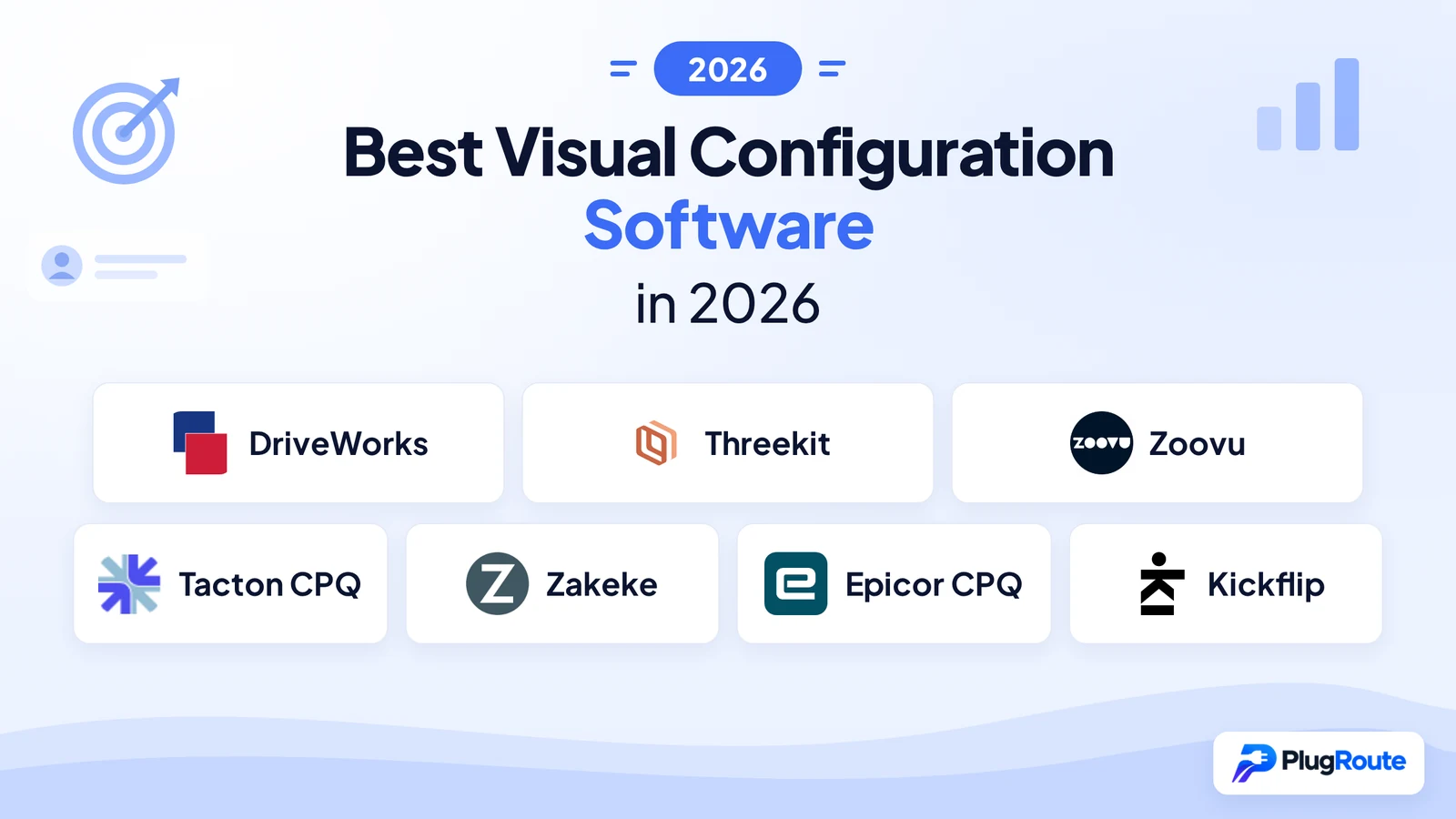
DriveWorks ranks #1 for SOLIDWORKS manufacturers, combining a free entry tier with the strongest named-client ROI evidence in the category; Threekit ranks #2 for enterprise visual commerce with photorealistic 3D rendering and AR; Zoovu ranks #3 for AI-guided product discovery across high-SKU catalogs. These three tools serve fundamentally distinct use cases, not interchangeable alternatives.
The most expensive mistake in this category is comparing tools built for different use cases. A SOLIDWORKS design automator, a no-code Shopify customizer, and an enterprise AI guided selling platform all carry the “visual configuration” label, but they serve different buyers at different price points, and selecting across categories produces a mismatch no implementation effort can fix.
PlugRoute has no affiliate relationships with any company listed. Rankings are determined entirely by research data and objective evaluation criteria.
“Whatever you do, don’t underestimate the asset pipeline. Managing hundreds of variants is a data nightmare.” (u/burgerking-, r/smallbusiness)
Takeaway: Asset pipeline management (creating, organizing, and maintaining hundreds or thousands of 3D models and variants) is consistently cited by practitioners as the largest hidden implementation cost in visual configuration adoption, regardless of which platform is selected.
TL;DR: Top Picks at a Glance
- DriveWorks: strongest named-client ROI evidence for SOLIDWORKS engineering teams; free Xpress tier requires no budget approval
- Threekit: photorealistic 3D and AR for enterprise brands; enterprise budget and 6-month timeline required
- Zoovu: AI-guided product discovery for high-SKU enterprise catalogs; not a 3D visual configurator
- Zakeke: broadest native storefront integration (7 platforms) for D2C e-commerce merchants
What Are the Five Categories of Visual Configuration Software?
Visual configuration software divides into five distinct categories, each solving a different business problem for a different buyer type: CAD Design Automator, Enterprise Visual Commerce Platform, AI Guided Selling Platform, Manufacturing CPQ, and E-Commerce / No-Code Configurator. Choosing across categories (comparing a SOLIDWORKS design automator to a Shopify customizer) is the single most common and costly error in this market.
The five categories are:
1. CAD Design Automator: automates repetitive SOLIDWORKS model, drawing, and BOM generation for engineer-to-order manufacturers. Tool in this evaluation: DriveWorks.
2. Enterprise Visual Commerce Platform: combines photorealistic 3D rendering, AI imaging, WebAR, and CPQ/ERP integration for Fortune 500 retail and manufacturing brands. Tool in this evaluation: Threekit.
3. AI Guided Selling Platform: uses conversational AI and semantic search to guide buyers to the correct product within a large catalog; does NOT include built-in 3D visual product customization. Tool in this evaluation: Zoovu.
4. Manufacturing CPQ: constraint-based or rules-driven Configure-Price-Quote platforms for complex engineer-to-order manufacturers, generating engineering-accurate 3D views, BOMs, and pricing simultaneously. Tools in this evaluation: Tacton CPQ and Epicor CPQ.
5. E-Commerce / No-Code Configurator: visual product customization tools for D2C and SMB merchants on Shopify, WooCommerce, and similar storefronts. Tools in this evaluation: Zakeke and Kickflip.
Which category matches your use case? Jump to the right section.
- Engineering team eliminating manual CAD repetition → DriveWorks (Rank #1)
- Enterprise retail or automotive brand building visual catalogs → Threekit (Rank #2)
- High-SKU retailer helping buyers navigate thousands of options → Zoovu (Rank #3)
- ETO manufacturer needing engineering-accurate CPQ → Tacton CPQ (Rank #4) or Epicor CPQ (Rank #6)
- D2C e-commerce merchant customizing individual products → Zakeke (Rank #5) or Kickflip (Rank #7)
If your use case spans two categories (for example, you need both manufacturing CPQ and a customer-facing e-commerce configurator) skip directly to the FAQ section, which addresses combination-stack scenarios.
How Do the Top Visual Configuration Tools Compare at a Glance?
The table below compares all seven tools across eight dimensions. One-Line Summaries are written as standalone sentences for independent citation, each stands alone without surrounding context, allowing buyers to reference individual tool descriptions without reading the full article.
| Rank | Company | Category | Best For | One-Line Summary | Key Capabilities | Primary Strength | Key Limitation |
|---|---|---|---|---|---|---|---|
| 1 | DriveWorks | CAD Design Automator | SOLIDWORKS engineering teams at ETO manufacturers | DriveWorks is the only visual configuration platform with a free SOLIDWORKS-bundled entry tier, published reseller pricing, and named-client case studies documenting 50–90% engineering design time reductions. | SOLIDWORKS parametric rule engine; automated BOM and drawing generation; web configurator with CPQ output; free Xpress tier | Named-client case study ROI: 80% design time reduction at Jee Ltd; 90% error reduction at Anvil International | SOLIDWORKS-only; inaccessible to any other CAD environment |
| 2 | Threekit | Visual Commerce Platform | Enterprise retailers, furniture, and automotive brands | Threekit is a Salesforce Ventures–backed enterprise Visual Commerce Platform serving Crate & Barrel, Mercedes-Benz, and Steelcase with photorealistic 3D configuration and WebAR. | Virtual Photographer™ AI imaging; WebAR; Salesforce CPQ integration; SAP Certified Partner status | Highest independently reviewed 3D rendering quality in this evaluation (G2: 4.6/5, 73 reviews); VFX-heritage founding team | No public pricing; 3–6 month implementation; enterprise budget required |
| 3 | Zoovu | AI Guided Selling | Enterprise e-commerce with high-SKU catalogs | Zoovu is the most financially established AI-guided selling platform in this evaluation, serving Amazon, AT&T, Microsoft, Bosch, and Samsung with a 166% conversion lift among assisted vs. non-assisted shoppers at Microsoft. | Millions of SKUs daily AI enrichment; generative AI “Zoe” assistant (2025); content enrichment engine | Strongest enterprise client roster in evaluation; estimated $42M ARR (ZoomInfo, 2026; unaudited) | Does NOT offer 3D visual product rendering or customization |
| 4 | Tacton CPQ | Manufacturing CPQ | Enterprise ETO manufacturers with complex interdependent parts | Tacton CPQ is a 20+-year Stockholm-based manufacturing CPQ platform whose proprietary constraint-based architecture serves Siemens, Scania, and Yanmar with documented 60% order error cost reductions. | Proprietary CSP constraint solver; engineering-accurate 3D visualization; BOM automation; multinational deployment | Only constraint-based (non-rules-based) CPQ engine in this evaluation | Only 39 G2 reviews for a 20-year-old enterprise platform |
| 5 | Zakeke | E-Commerce Configurator | D2C merchants in apparel, print-on-demand, furniture | Zakeke is the broadest-integration e-commerce visual configurator in this evaluation, serving 25,000+ businesses globally with native support for seven storefronts and the only automated web-to-print pipeline in the category. | 7-storefront native integration; web-to-print file automation; browser-native WebAR; AI Agent Studio (2025) | Broadest e-commerce platform coverage; only automated web-to-print pipeline in category | 3D rendering functional, not photorealistic; per-sale pricing model requires direct verification |
| 6 | Epicor CPQ | Visual CPQ | Epicor ERP users; multi-CAD manufacturers | Epicor CPQ (formerly KBMax, acquired 2021) is the only manufacturing visual CPQ platform with a published Standard price of $150/user/month, multi-CAD support, and a G2 rating of 4.5/5 (98 reviews). | Snap Rules low-code engine; multi-CAD automation; AR/VR visualization; Epicor ERP integration | Only published price in manufacturing CPQ ($150/user/month Standard); multi-CAD support | No publicly accessible named-client case studies with documented percentage-improvement outcomes; post-acquisition roadmap dependency |
| 7 | Kickflip | No-Code Configurator | Non-technical SMB Shopify merchants prioritizing fastest launch | Kickflip is a no-code product customizer with a confirmed $59/month starting price and Shopify App Store rating of 4.2/5 (125 reviews), but lacks a confirmed aggregate G2/Capterra score, disclosed company background, and confirmed AR capability. | No-code product customization builder; Shopify Hydrogen headless support; white-label storefront pages | Community-described as easiest to set up in its segment; Shopify App Store 4.2/5 (125 reviews, confirmed May 2026) | No confirmed aggregate G2 or Capterra numerical score; no company background disclosed; AR capability unconfirmed |
Which Visual Configuration Tool Should I Choose for My Use Case?
The table below routes buyers to the highest-evidence tool in each category based on their primary decision priority. Identify your #1 priority, confirm it matches your use case category from the framework above, and proceed directly to that tool’s entry for full evidence, limitations, and pricing context.
| Your #1 Priority | Recommended Tool | Why | Acceptable Alternative |
|---|---|---|---|
| SOLIDWORKS automation + free entry | DriveWorks | Free Xpress tier; 50–90% design time reduction in named case studies; SOLIDWORKS Gold Partner | Epicor CPQ (multi-CAD environments) |
| Enterprise 3D visual commerce + AR | Threekit | Virtual Photographer™ AI imaging; Salesforce Ventures–backed CPQ integration; SAP Certified Partner | Zoovu (if catalog navigation is priority over visual customization) |
| High-SKU guided selling + AI discovery | Zoovu | Millions of SKUs processed daily; 166% conversion lift among assisted shoppers at Microsoft; estimated $42M ARR | Threekit (if visual product configuration is also needed) |
| Complex ETO manufacturing CPQ | Tacton CPQ | Constraint-based CSP solver; 20+ years manufacturing heritage; Siemens, Scania, Yanmar clients | Epicor CPQ (if already in Epicor ecosystem) |
| D2C e-commerce visual customization | Zakeke | Broadest storefront integration (7 platforms); web-to-print automation; confirmed mobile WebAR | Kickflip (faster setup; lower independent verification depth) |
| Epicor ERP user needing visual CPQ | Epicor CPQ | Native Epicor ERP integration; only published price in manufacturing CPQ ($150/user/month); G2: 4.5/5 (98 reviews) | DriveWorks Pro (SOLIDWORKS-centric teams only) |
| Mid-market brand outgrowing SMB configurator limits | Threekit (if budget permits) | CPQ backend handles regional pricing logic and multi-site complexity that entry-tier e-commerce tools cannot | Mimeeq or Threedium (mid-market challengers cited in r/EntrepreneurRideAlong, 2025; not reviewed in this evaluation) |
| Fastest no-code launch; smallest SMB | Kickflip | Community-described as easiest to set up; Shopify Hydrogen compatible; $59/month starting price confirmed | Zakeke (better documented; broader verified features) |
1. DriveWorks: Best for SOLIDWORKS-Dependent Manufacturers: #1 Documented ROI in Category
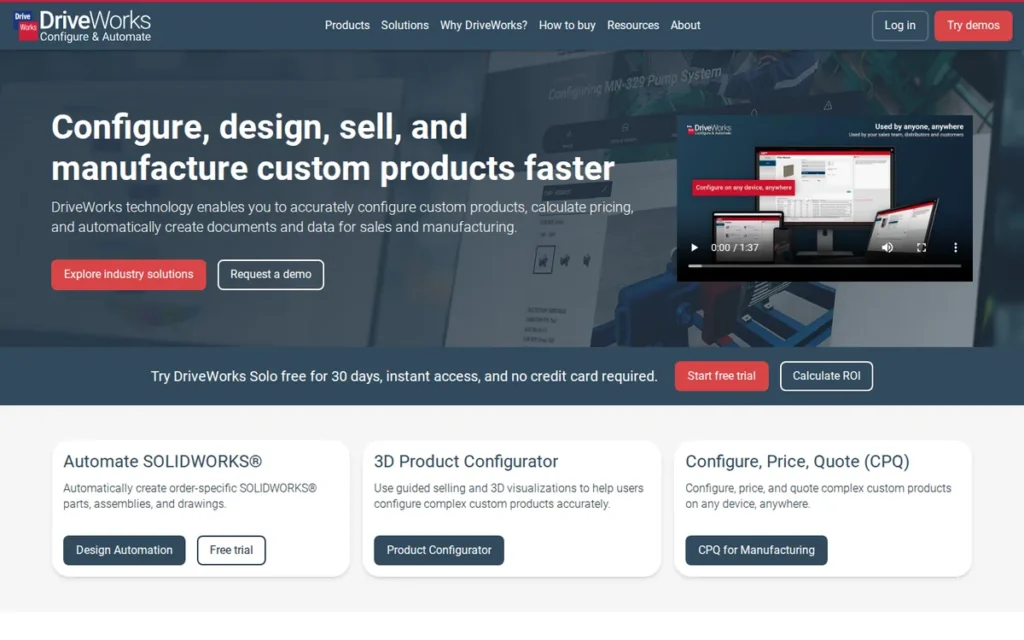
Category: CAD Design Automator, automates SOLIDWORKS model generation, drawing output, BOM creation, and web-based product configuration from a single rules-driven master model; requires an active SOLIDWORKS license for all three editions.
At a Glance
- Category: CAD Design Automator
- Best For: SOLIDWORKS engineering teams at custom, engineer-to-order, or configure-to-order manufacturers who need to eliminate repetitive design work and accelerate quoting without purchasing a separate CPQ platform
- Price Range: Free (Xpress, with any SOLIDWORKS license) | ~$1,500/year (Solo) | ~$5,000+/year (Pro) via authorized resellers, estimates confirmed May 2026; perpetual license + maintenance model
- Primary Strength: DriveWorks delivers the most independently documented ROI in this evaluation, with named clients reporting 50–90% reductions in engineering design and quoting time across published case studies
- Biggest Limitation: DriveWorks requires an active SOLIDWORKS license for all three editions, the platform is entirely inaccessible to manufacturers running any other CAD system
- One-Line Summary: DriveWorks is the only visual configuration platform offering a free SOLIDWORKS-bundled entry tier, published reseller pricing across three tiers, and named-client case studies documenting 50–90% reductions in engineering design time, making it the best-documented ROI option in the category for SOLIDWORKS-dependent manufacturers.
- Last Verified: May 2026
Overview
DriveWorks is a SOLIDWORKS-native design automation and visual configuration platform, founded in 2001 in Southampton, UK, that enables engineering teams at custom and engineer-to-order manufacturers to automate repetitive CAD work. DriveWorks produces 3D previews, drawings, BOMs, and CPQ documents from a single parametric master model without rebuilding designs per project.
DriveWorks is built exclusively for organizations that already use SOLIDWORKS, making it the strongest choice in the category for SOLIDWORKS-centric manufacturers, but entirely inaccessible to multi-CAD or non-engineering buyers. DriveWorks ships in three editions: Xpress (free with every SOLIDWORKS license), Solo (~$1,500/year), and Pro (~$5,000+/year via resellers), with each tier progressively expanding from single-model rule capture to a full customer-facing web configurator with CPQ output.
Key Features
- SOLIDWORKS Task Pane Rule Engine: DriveWorks captures SOLIDWORKS model dimensions, features, properties, and materials via a Task Pane add-in and drives them with rule logic and 30+ generation tasks, enabling engineers to automate parts, assemblies, drawings, and BOMs from a single master model without rebuilding each custom project from scratch.
- Customer-Facing Web Configurator (Pro): DriveWorks Pro includes a customer-facing web and mobile configurator with browser-based 3D preview, allowing sales teams and resellers to configure complex products visually and generate accurate quotes without CAD access or engineer involvement in each transaction.
- Free Xpress Entry Tier: DriveWorks Xpress is bundled with every SOLIDWORKS license at no additional cost, enabling any SOLIDWORKS engineering team to begin automation without budget approval, a zero-friction pilot path found nowhere else in the enterprise configuration category.
- Automated CPQ Document Generation: DriveWorks Pro automatically generates custom sales proposals, order confirmations, manufacturing instructions, and engineering drawings from customer configurations, closing the loop between sales input and production instruction without a separate quoting system.
- Excel-Like Rule Syntax: DriveWorks’ rule engine uses formula syntax familiar to SOLIDWORKS engineers without programming experience, though community practitioners note that automation output quality depends directly on how well the underlying SOLIDWORKS model was originally architected for parametric variation (u/D_Man_GR, r/SolidWorks, 2016).
Best For
DriveWorks Pro is best for SOLIDWORKS-dependent manufacturers (particularly engineer-to-order and configure-to-order businesses in precision tooling, subsea engineering, piping products, and capital equipment) who need to eliminate manual design repetition, accelerate quoting cycles, and provide customers a visual configuration interface without purchasing a separate CPQ platform.
DriveWorks is not suited for manufacturers using SolidEdge, CATIA, Creo, or Inventor; for e-commerce merchants needing storefront configurators; or for any organization considering CAD platform migration within the product’s expected deployment horizon.
Pricing
DriveWorks is sold exclusively through authorized resellers (including GoEngineer, TriMech, Javelin-Tech, and Hawk Ridge Systems) not directly from the company. Published estimates as of May 2026:
- Xpress: free with any SOLIDWORKS license
- Solo: approximately $1,500/year
- Pro: approximately $5,000+/year (floating license options available)
Costs vary by reseller and geography. Quotes from multiple resellers are recommended before committing.
DriveWorks uses a perpetual-license-plus-maintenance model rather than a per-user subscription. A practitioner in r/SolidWorks independently cited this as a meaningful five-year total-cost advantage over competing subscription-based manufacturing CPQ tools (u/metalman7, r/SolidWorks, 2021).
Strengths
- Named-Client Case Studies with Specific Outcomes: DriveWorks holds the strongest independently documented ROI record in this evaluation, Jee Ltd (subsea engineering) achieved an 80% reduction in engineering design time with ROI in 6 months; Parlec (precision tooling) reported 50% faster quoting and 70% design time reduction across 1,000+ tool variants; Anvil International (piping products) eliminated 90% of manual processing errors while handling 500+ custom orders monthly without adding headcount (DriveWorks-published case studies, 2024–2026).
- Independent Certifications: DriveWorks holds SOLIDWORKS Gold Partner certification (the highest tier in the SOLIDWORKS partner ecosystem, requiring demonstrated technical depth and verified customer success metrics) and has received the SWUGN (SOLIDWORKS User Group Network) Partner of the Year Award for design automation (DriveWorks.co.uk/solutions/design-automation/).
- Enterprise-Scale Throughput Validation: A community practitioner in r/SolidWorks documented automating 7% of a 100-person engineering department’s total annual CAD output (approximately 10,850 of 155,000 parts and assemblies produced in 2015) single-handedly using DriveWorks, independently corroborating the platform’s throughput multiplier at enterprise engineering scale (u/metalman7, r/SolidWorks, 2021).
Users on r/SolidWorks shared their experience:
“I started the design automation program in my design department in a group of about 100 designers spread between two facilities back in 2013 with Driveworks. While it does have a steep learning curve, the volume of output and speed us ridiculous. Once I figured out the infrastructure (part number reuse, PLM semi-integration, standardized models, etc) I was not only continuing to develop other product lines for automation, but, I was generating 7% of the total production CAD data for the group. In 2015, that group of 100ish designers output roughly 155,000 parts/assemblies with drawings.
While design automation could lead to job reduction, the most significant benefit I saw was the increase in throughput, speed, accuracy, and standardization.” Posted by u/metalman7
Takeaway: DriveWorks delivers real enterprise-scale throughput gains for SOLIDWORKS teams, but practitioners who have deployed it at scale consistently identify a steep learning curve and a dedicated implementation resource as non-negotiable prerequisites before those gains materialize.
- Vendor Longevity: DriveWorks was founded in 2001: the oldest vendor in this evaluation at 24 years, with no disclosed acquisitions, no institutional investor dependencies, and continuous SOLIDWORKS ecosystem operation, providing the strongest vendor stability signal of any tool reviewed.
Limitations
- Absolute SOLIDWORKS Dependency: DriveWorks’ most consequential limitation is that all three editions require an active SOLIDWORKS license, placing the platform entirely out of reach for manufacturers using SolidEdge, CATIA, Creo, Inventor, or any multi-CAD environment, for organizations considering CAD platform migration, DriveWorks represents a switching-cost lock-in that must be factored into total cost of adoption before any commitment.
- Model Architecture Prerequisite: DriveWorks Pro’s automation output quality depends directly on how well the underlying SOLIDWORKS model was architected for parametric variation before rules are written, community practitioners describe this as “making model design very important” (u/D_Man_GR, r/SolidWorks, 2016); poorly structured master models produce poor automation outputs regardless of rule quality.
- Reseller-Only Distribution Variance: DriveWorks sells exclusively through an authorized reseller network, meaning pricing, support quality, and training vary by geography and reseller, buyers should obtain quotes from multiple resellers and budget separately for implementation and training costs beyond the license fee.
Verdict
DriveWorks is the best-documented visual configuration platform in this evaluation, with more named-client case studies and independently verifiable percentage-improvement outcomes than any competing tool, including an 80% design time reduction at Jee Ltd, a 90% error reduction at Anvil International, and a 70% design time improvement at Parlec, all published and attributable. DriveWorks earned the #1 rank by combining a free entry tier (Xpress), published reseller pricing estimates, vendor longevity (24 years, no acquisition risk), SOLIDWORKS Gold Partner certification, and the SWUGN Partner of the Year Award, the strongest combined evidence profile in this evaluation. In the visual configuration category, DriveWorks is the only tool where a free trial is also a production-ready instrument, Xpress is not a demo; it is a fully operational SOLIDWORKS automation engine bundled with every license. Buyers outside the SOLIDWORKS ecosystem should evaluate Epicor CPQ (multi-CAD) or Tacton CPQ (constraint-based architecture) instead.
2. Threekit: Best Enterprise Visual Commerce Platform: Highest 3D Rendering Quality in This Evaluation
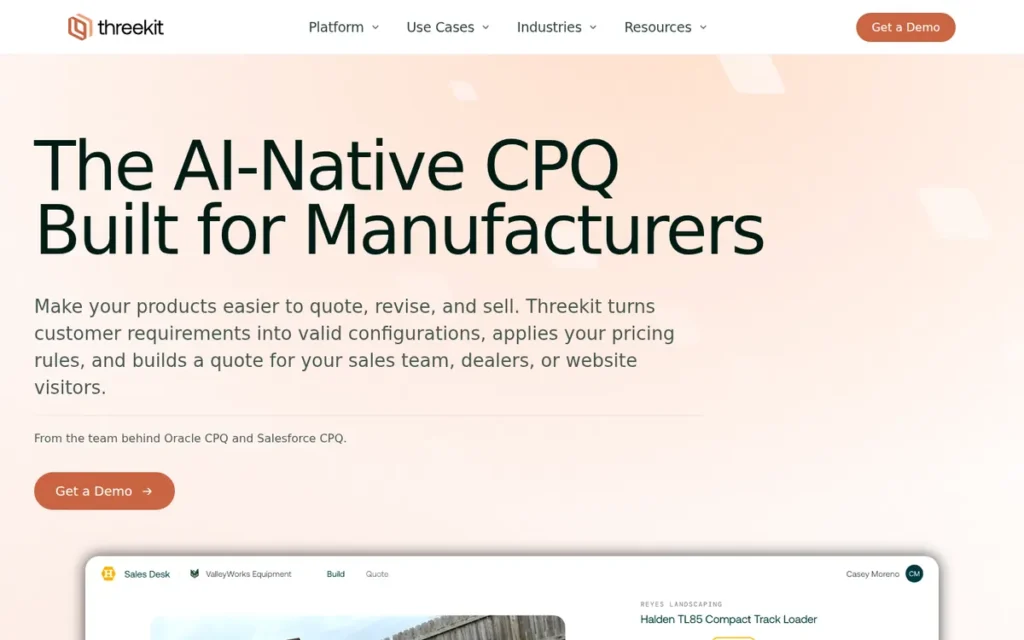
Category: Visual Commerce Platform, combines photorealistic 3D product configuration, AI-powered automated product photography (Virtual Photographer™), WebAR, and enterprise CPQ/ERP integration into a unified platform; designed for enterprise-scale brands with multi-month implementation timelines.
At a Glance
- Category: Visual Commerce Platform
- Best For: Enterprise retailers, furniture and automotive brands, and B2B manufacturers managing large, complex product catalogs who need photorealistic 3D configuration, WebAR, and Salesforce or SAP CPQ integration from a single vendor
- Price Range: Pricing on request: no public tiers; all pricing custom-quoted through sales; positioned for enterprise budgets only; 3–6 month implementation timeline standard
- Primary Strength: Threekit’s Virtual Photographer™ was on track to surpass 10 million photorealistic product images by year-end 2020 (with 7 million confirmed by September 2020) backed by $35M in funding with Salesforce Ventures as a participant and SAP Certified Partner status
- Biggest Limitation: Threekit’s pricing is entirely opaque, community-characterized as viable only for brands with significant budgets, with a 3–6 month implementation timeline and no self-serve or mid-market entry path
- One-Line Summary: Threekit is a Salesforce Ventures–backed enterprise Visual Commerce Platform serving Crate & Barrel, Mercedes-Benz, and Steelcase with photorealistic 3D configuration and WebAR, but its pricing is enterprise-only and implementation takes 3–6 months.
- Last Verified: May 2026
Overview
Threekit is an enterprise Visual Commerce Platform founded in 2017 in Chicago, backed by $35M in funding with Salesforce Ventures participating in the 2021 Leaders Fund–led round, that combines a 3D product configurator, Virtual Photographer™ AI imaging engine, WebAR, and CPQ/ERP integration into a single platform. Threekit serves Fortune 500 brands including Crate & Barrel, Mercedes-Benz, and Steelcase.
Threekit is built for organizations with enterprise-scale product catalogs, technical implementation teams, and budget capacity for a 3–6 month deployment. Threekit’s founding team created the Deadline Render Manager, Krakatoa particle renderer, and Clara.io (professional VFX pipeline tools used in Hollywood and game studios) giving the platform rendering quality foundations that pure-SaaS configurator competitors cannot replicate (Eyedex.co Threekit Review, 2026).
Key Features
- Virtual Photographer™ AI Imaging: Threekit’s Virtual Photographer™ generates photorealistic 2D product images from a single 3D asset using material libraries, automated lighting, and camera-angle variation, Threekit was on track to surpass 10 million images by year-end 2020, with 7 million confirmed by September of that year, making photography-free catalog production viable for large-SKU brands at a fraction of traditional photoshoot costs (GlobeNewswire, September 2020).
- Omnichannel Headless API Delivery: Threekit supports omnichannel 3D and AR delivery through headless APIs with confirmed native integrations across Salesforce Commerce Cloud, SAP Commerce Cloud, Shopify Plus, and WooCommerce, enabling consistent photorealistic configuration across every customer touchpoint simultaneously.
- SAP Certified Partner Status: Threekit holds SAP Certified Partner status, listed in the SAP Partner Directory (verify current status at sap.com/products/crm/partners/threekit-inc-threekit-3d-and-augmented-reality.html), an independently verified integration credential for enterprises on SAP Commerce Cloud or SAP ERP.
- CAD Import and Automated BOM Generation: Threekit imports CAD files from Unity, Unreal, and 3DS Max and automatically generates Bills of Materials from customer configurations, connecting the visual sales layer to production and fulfillment workflows without manual engineering review per transaction.
- Salesforce CPQ Native Integration: Threekit integrates natively with Salesforce CPQ and received a Salesforce Ventures investment in 2021, positioning it as the strategic visual configuration layer for enterprises running Salesforce Sales Cloud, Revenue Cloud, or Salesforce CPQ at scale (Eyedex.co Threekit Review, 2026).
Best For
Threekit is best for Fortune 500 and mid-to-large enterprise retailers, furniture brands, automotive OEMs, and B2B manufacturers whose visual catalog complexity (high SKU count, regional pricing rules, multi-platform distribution, and photorealistic brand standards) justifies a multi-month implementation and enterprise-tier investment.
Threekit is not suited for SMBs, mid-market self-serve buyers, or any organization for whom pricing transparency or fast time-to-market is a primary requirement.
Pricing
Threekit publishes no pricing tiers or dollar amounts on its pricing page. All pricing is custom-quoted through the sales team based on SKU volume, configurations, integration scope, and asset management requirements.
Community practitioners consistently characterize Threekit as appropriate only for brands with significant budgets. One practitioner who has deployed both Threekit and Zakeke for furniture brands stated directly:
“The amount they charge you is a bit insane, borderline highway robbery. Sure if you are Nike by all means, but for the mere mortal brands out there, there’s alternatives.” (u/sech8420, r/smallbusiness, 2025)
Takeaway: Threekit’s pricing model is enterprise-tier by community consensus. Budget for professional services costs beyond the subscription, the “Threekit Way” implementation methodology implies 3–6 months before first revenue-generating deployment, with those professional services costs potentially exceeding the platform license itself.
Strengths
- Salesforce Ventures Investment Signal: Threekit received a Salesforce Ventures investment as part of its $35M funding round in 2021, led by Leaders Fund, Salesforce Ventures selects portfolio companies that best extend the Salesforce platform’s value, independently signaling that Threekit is the strategic visual layer for enterprises running Salesforce Sales Cloud, Revenue Cloud, or Salesforce CPQ (Eyedex.co Threekit Review, 2026).
- SAP Certified Partner Status: Threekit holds SAP Certified Partner status, listed in the SAP Partner Directory, a third-party integration credential for SAP Commerce Cloud or SAP ERP environments, not a vendor self-report; verify current status directly at the SAP Partner Directory URL.
- VFX-Heritage Rendering Foundations: Threekit’s founding team built the Deadline Render Manager, Krakatoa particle renderer, and Clara.io browser-based 3D editor (later acquired by Amazon) (professional VFX pipeline infrastructure used in Hollywood and game production) providing rendering quality depth that pure-SaaS configurator startups do not possess (Eyedex.co Threekit Review, 2026).
- Fortune 500 Client Validation and Review Ratings: Named enterprise clients including Crate & Barrel, Mercedes-Benz, and Steelcase independently validate Threekit’s enterprise deployment capability, backed by the highest combined review average in this evaluation, G2: 4.6/5 (73 reviews); Capterra: 4.7/5 (19 reviews, confirmed May 2026).
Limitations
- Pricing Exclusivity: Threekit’s most consequential limitation is the combination of total pricing opacity and community-documented exclusivity, practitioners describe Threekit as viable “only for brands with really huge budgets” even while acknowledging technical superiority, with a second community member calling the pricing “borderline highway robbery” for non-enterprise buyers (u/EugeneGorKorolev, r/EntrepreneurRideAlong, 2025; u/sech8420, r/smallbusiness, 2025).
- Extended Implementation Timeline: Threekit’s 3–6 month “Threekit Way” implementation methodology means the gap between contract signing and first revenue-generating deployment is longer than any other platform in this evaluation, buyers who need fast time-to-market should evaluate Zakeke or Kickflip instead.
- No Mid-Market Entry Path: Threekit has no self-serve tier, no trial, and no published pricing anchor, making it inaccessible to buyers without enterprise procurement infrastructure, a dedicated IT implementation team, and budget approval well above the mid-market range.
Verdict
Threekit is the highest-quality enterprise Visual Commerce Platform in this evaluation, delivering photorealistic 3D rendering, Virtual Photographer™ AI imaging at verified scale, confirmed WebAR, and Salesforce Ventures–backed CPQ integration depth that no other tool in this evaluation matches for enterprise visual commerce. Threekit ranked second overall due to total pricing opacity, 3–6 month implementation timelines, and the absence of independently documented case studies with specific percentage-improvement outcomes, limitations that Fortune 500 clients can absorb but that make Threekit inaccessible to mid-market buyers. Organizations already running Salesforce or SAP ecosystems with enterprise-level budgets and a six-month deployment horizon should prioritize Threekit; all others should confirm budget fit before requesting a demo.
3. Zoovu: Best AI-Guided Product Discovery Platform: Most Financially Established in Category
Category: Guided Selling Platform, uses AI-powered conversational assistants, semantic search, and product enrichment engines to guide buyers to the correct product within a large catalog; Zoovu does NOT offer built-in 3D visual product rendering or customization, buyers seeking visual product configuration should evaluate Threekit, Zakeke, or Epicor CPQ instead.
At a Glance
- Category: Guided Selling Platform
- Best For: Enterprise e-commerce retailers and B2B manufacturers with high-SKU catalogs in electronics, industrial equipment, healthcare, or consumer goods, where buyers need AI guidance to find the right product, not visual customization of an individual chosen product
- Price Range: Pricing on request: no public tiers; contact sales only; estimated $42M ARR (ZoomInfo revenue estimate, 2026, unaudited) across ~3,500 businesses implies a wide range of contract values
- Primary Strength: Zoovu processes millions of SKUs daily through AI enrichment and delivered a 166% higher conversion rate among Zoovu-assisted Microsoft shoppers vs. non-assisted shoppers, plus a 25% conversion uplift on product detail pages across 250+ experiences on 100+ retail sites (Zoovu Microsoft Case Study, zoovu.com/case-study/microsoft)
- Biggest Limitation: Zoovu does not offer built-in 3D visual product rendering or customization, buyers who need to show a customer what their configured product looks like should select a 3D configurator instead
- One-Line Summary: Zoovu is the most financially established AI-guided selling platform in this evaluation, serving Amazon, AT&T, Microsoft, Bosch, and Samsung with a 166% conversion lift among assisted shoppers at Microsoft, but it is a product discovery tool, not a 3D visual product configurator.
- Last Verified: May 2026
Overview
Zoovu is an enterprise AI-powered product discovery and guided selling platform founded in 2010 in Boston that unifies semantic search, conversational selling assistants, content enrichment, and product configuration across e-commerce storefronts. Zoovu generates an estimated $42M in annual revenue (ZoomInfo revenue estimate, 2026, unaudited) across approximately 3,500 businesses.
Zoovu’s core value proposition is categorically different from all other platforms in this evaluation: rather than enabling buyers to visually customize a specific chosen product, Zoovu’s AI guides buyers to the correct product within a vast catalog. Zoovu is most relevant for high-SKU electronics, industrial equipment, medical devices, and consumer goods retailers, not for brands offering individual product visual customization. Named enterprise accounts include Amazon, AT&T, Whirlpool, Microsoft, Bosch, HP, and Samsung (ZoomInfo; BuiltInBoston, 2025–2026).
Key Features
- High-Volume AI SKU Enrichment: Zoovu’s AI product discovery engine processes millions of SKUs daily through semantic enrichment, transforming raw technical specifications into customer-friendly language and enabling accurate product recommendations across large catalogs without manual data preparation, a data processing scale no other platform in this evaluation approaches (Zoovu.com, 2025, vendor self-reported).
- “Zoe” Generative AI Shopping Assistant (2025): Zoovu launched “Zoe” in September 2025, a generative AI conversational assistant that integrates natively across product detail pages, search results, and category pages, using NLP, predictive analytics, and CRM data to deliver context-aware product guidance at enterprise scale (Zoovu News, September 2025).
- Content Enrichment Engine: Zoovu’s Content Enrichment Engine automatically transforms technical product specifications into buyer-language descriptions with multi-language and auto-translation support, enabling global catalog deployments without manual localization work, a capability with no direct equivalent in other tools in this evaluation.
- Aggregated Platform Performance Benchmarks: Zoovu’s guided selling deployments report platform-wide benchmarks of 53% conversion uplift, 65% average order value increase, and 35% reduction in search abandonment across the client base, vendor self-reported aggregated benchmarks, with Bosch, GE Healthcare, 3M, and Einhell providing named enterprise context (Zoovu.com, 2025).
- Verified Microsoft Client Outcome: Zoovu’s most independently documented result is the Microsoft deployment, 166% higher conversion rate among Zoovu-assisted shoppers vs. non-assisted shoppers, a 25% conversion uplift on product detail pages, and 90% higher engagement across 250+ experiences on 100+ retail sites (Zoovu Microsoft Case Study, zoovu.com/case-study/microsoft).
Best For
Zoovu is best for enterprise retailers and B2B manufacturers with catalogs of thousands to millions of SKUs (specifically in electronics, industrial equipment, medical devices, and complex consumer goods) where the buyer’s primary problem is “I don’t know which of your 10,000 products I need” rather than “I want to customize the specific product I’ve already chosen.”
Zoovu is not suited for e-commerce merchants who need individual product visual customization, print-on-demand personalization, or manufacturing CAD automation.
Pricing
Zoovu publishes no pricing on its website and is contact-sales-only throughout. Zoovu’s estimated $42M in annual revenue (ZoomInfo estimate, 2026, unaudited) across approximately 3,500 businesses implies contract values ranging from modest engagements to multi-million-dollar enterprise agreements.
There is no published self-serve or SMB entry path. Buyers should prepare a clear brief of SKU count, monthly traffic, number of deployment surfaces, and integration requirements before contacting sales to receive a relevant custom quote.
Strengths
- Verified Microsoft Client Outcome: Zoovu’s Microsoft deployment is the most credibly documented client result in this evaluation, Zoovu-assisted Microsoft shoppers achieved a 166% higher conversion rate vs. non-assisted shoppers, a 25% conversion uplift on product detail pages, and 90% higher engagement across 250+ experiences on 100+ retail sites (Zoovu Microsoft Case Study, zoovu.com/case-study/microsoft).
- Financial Maturity: Zoovu is the most financially mature platform in this evaluation (founded in 2010, generating an estimated $42M in annual revenue (ZoomInfo revenue estimate, 2026) unaudited), employing 208–250 people at its Boston headquarters, and serving Amazon, AT&T, Whirlpool, HP, and Samsung (ZoomInfo; BuiltInBoston, 2025–2026).
- Broadest Performance Dataset: Zoovu’s platform-wide benchmarks, 53% conversion uplift, 65% average order value increase, 35% reduction in search abandonment, are the broadest aggregated performance dataset of any platform in this evaluation, reflecting outcomes across 3,500 client deployments (Zoovu.com, 2025, vendor self-reported aggregated benchmarks).
- 2025 Generative AI Innovation: Zoovu’s September 2025 launch of the “Zoe” generative AI assistant represents the most recent major product innovation in this category, adding LLM-native conversational guidance to existing semantic search and content enrichment capabilities (Zoovu News, September 2025).
Limitations
- No 3D Visual Configuration: Zoovu’s most consequential limitation for readers of a “best visual configuration software” guide is categorical, Zoovu does not offer built-in 3D product rendering or visual customization, meaning buyers who need to show a customer what their configured sofa, machine, or apparel item looks like should select Threekit, Zakeke, or Epicor CPQ instead; Zoovu solves product discovery navigation, not visual product customization.
- Enterprise-Only Accessibility: Zoovu’s complete pricing opacity and enterprise-only client profile create a practical barrier for SMB and mid-market buyers without institutional IT resources or formal RFP procurement processes, research found zero Reddit community discussions of Zoovu among practitioners, consistent with a platform enterprise buyers discover through analyst reports, not peer community forums.
- Implementation Resource Requirements: Zoovu deployments require meaningful IT resources (the Einhell deployment required approximately 4 weeks, and the Microsoft engagement spanned 250+ separately configured experiences) representing a commitment that excludes buyers without enterprise implementation capacity.
- No Community Peer Validation: Zoovu’s complete absence from practitioner community forums means no peer-validated operational feedback is accessible before procurement, enterprise buyers must rely entirely on vendor-provided references and the published Microsoft case study, with no independent practitioner accounts to validate operational reality.
Verdict
Zoovu is the best AI-guided product discovery platform for enterprise retailers managing high-SKU catalogs, backed by a documented 166% conversion lift among assisted shoppers at Microsoft, an estimated $42M annual revenue base, and a Fortune 500 client roster including Amazon, AT&T, HP, and Samsung that no other platform in this evaluation approaches. Zoovu ranked third overall because its absence of 3D visual configuration capability narrows its relevance to buyers needing AI-guided catalog navigation rather than visual product customization, and its complete pricing opacity makes it inaccessible without enterprise procurement resources. Organizations in electronics, industrial equipment, or high-SKU B2B verticals evaluating guided selling should request a Zoovu demo; organizations seeking 3D product customization should begin with Threekit or Zakeke.
4. Tacton CPQ: Best for Complex Engineer-to-Order Manufacturing: Constraint-Based Architecture
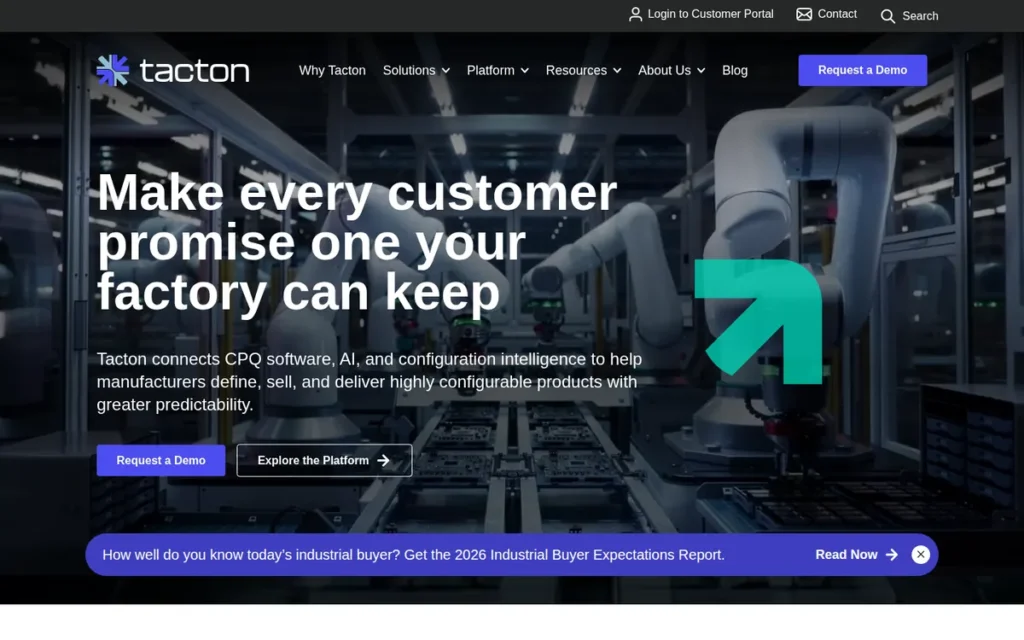
Category: Manufacturing CPQ, a constraint-based Configure-Price-Quote platform for complex engineer-to-order and configure-to-order manufacturers; integrates engineering-accurate 3D visualization, CAD automation, and BOM generation within the sales workflow; distinct from e-commerce visual customization tools.
At a Glance
- Category: Manufacturing CPQ
- Best For: Large enterprises in industrial equipment, heavy machinery, automotive components, and precision engineering with true engineer-to-order complexity, thousands of interdependent configurable components where an invalid configuration creates production errors or safety risks
- Price Range: Pricing on request: no public tiers; enterprise custom pricing only; use Epicor CPQ’s published $150/user/month Standard tier as a budget orientation benchmark for the manufacturing CPQ category
- Primary Strength: Tacton CPQ’s proprietary Constraint Satisfaction Problem solver simultaneously validates all possible configurations in real time, architecturally eliminating the rule-maintenance cascade burden that accumulates in rules-based CPQ systems as product complexity scales
- Biggest Limitation: Tacton CPQ has only 39 G2 reviews for a 20-year-old enterprise platform (the thinnest public review footprint relative to age in this evaluation) making peer-verified independent validation difficult for standard procurement due diligence
- One-Line Summary: Tacton CPQ is a Stockholm-based manufacturing CPQ platform with over 20 years of operation whose proprietary constraint-based architecture (unique in this evaluation) serves Siemens, Scania, and Yanmar with documented 60% order error cost reductions, but its near-absence from public review platforms limits independent validation.
- Last Verified: May 2026
Overview
Tacton CPQ is a Stockholm-based manufacturing Configure-Price-Quote platform with over 20 years of operation that serves enterprise manufacturers including Siemens, Scania, and Yanmar. Tacton CPQ combines a proprietary Constraint Satisfaction Problem (CSP) solver, real-time engineering-accurate 3D visualization, CAD automation, and BOM generation into a unified sales and engineering configuration workflow.
Tacton CPQ is the only platform in this evaluation built on constraint-based architecture rather than if-then rule logic, a structural distinction that means the system validates all possible configurations simultaneously in real time rather than sequentially. Tacton CPQ targets the engineer-to-order and configure-to-order manufacturing segments where a logically invalid CPQ configuration can cascade into costly production errors, rework, and customer dissatisfaction downstream (Tacton CPQ Blog, 2025).
Key Features
- Proprietary CSP Constraint Solver: Tacton CPQ’s Constraint Satisfaction Problem solver validates all possible product configurations simultaneously in real time, rather than sequentially checking if-then rules, allowing new components to be added without cascading rule rewrites; for a manufacturer adding a new bolt-pattern variant to a machine bed, the new variant is defined once as a constraint relationship and all affected configurations update automatically, without auditing dozens of existing rules (Tacton CPQ Blog, 2025; CPQ.se Analysis, 2025).
- Engineering-Accurate 3D Visualization: Tacton CPQ integrates engineering-accurate 3D digital asset management and real-time visualization within the CPQ workflow, ensuring that every configuration a sales team presents to a buyer is simultaneously valid from an engineering production standpoint, not cosmetically plausible but potentially structurally impossible to manufacture.
- Automated BOM and Production Document Generation: Tacton CPQ automatically generates Bills of Materials, production instructions, and pricing outputs from every validated configuration, connecting the visual sales process directly to manufacturing execution without manual engineering review per quote.
- Reseller and Distributor Configurator Access: Tacton CPQ supports reseller and distributor-facing configurator deployment, enabling channel partners to independently configure complex products using the same constraint-validated logic as internal sales teams, critical for manufacturers with global distribution networks.
- Validated Multinational Deployment Infrastructure: Tacton CPQ’s 20+ year heritage includes a confirmed Siemens deployment where quoting time was reduced from 8 days to minutes, regional-language sites for Germany, Japan, and Nordic markets, and named client operations across three continents, validating enterprise-scale international manufacturing support (Tacton CPQ Blog, 2025).
Best For
Tacton CPQ is best for large enterprises in industrial equipment, heavy machinery, automotive components, and precision engineering, specifically manufacturers with true engineer-to-order complexity where a single product has thousands of interdependent configuration variables and where an invalid configuration creates production waste, safety risks, or contractual failures that dwarf the cost of the CPQ software itself.
Tacton CPQ is not suited for SMBs, e-commerce merchants, or manufacturers whose product complexity is adequately handled by a rules-based CPQ or a SOLIDWORKS-native design automator.
Pricing
Tacton CPQ publishes no pricing and is available only via direct sales contact. All pricing is enterprise custom-quoted based on user count, product complexity, geographic deployment, and integration scope.
For budget orientation, Epicor CPQ’s published Standard tier at $150/user/month (confirmed on G2, GetApp, Capterra, and SelectHub, May 2026) is the only public price anchor in the manufacturing visual CPQ category, use it as a floor estimate when building initial business cases before a formal RFP process begins. Contact Tacton at tacton.com to initiate a demo and pricing conversation.
Strengths
- Constraint-Based Architecture Differentiation: Tacton CPQ’s proprietary CSP architecture is a documented technical differentiator with no equivalent in this evaluation, unlike rules-based CPQ systems that require rule rewrites when product components change, constraint-based systems separate data from logic, a structural advantage that CPQ practitioner literature identifies as materially superior for true ETO manufacturing scalability (Tacton CPQ Blog, 2025; CPQ.se Analysis, 2025).
- Aggregated Manufacturing Outcome Benchmarks with Named Client Confirmation: Tacton CPQ publishes aggregated outcome statistics, 30% reduction in sales and quoting labor costs, 60% reduction in order error costs, and 8% increased profit from higher order volume (Tacton.com, 2025, vendor self-reported aggregated benchmarks), with the Siemens quoting improvement from 8 days to minutes as the most independently corroborated client-level outcome.
- 20+ Years of Manufacturing Sector Heritage: Tacton CPQ has operated continuously for over 20 years in Stockholm-based precision manufacturing markets, serving Siemens (Germany), Scania (Sweden), and Yanmar (Japan) as named clients, demonstrating sustained viability across multiple product generations and economic cycles.
- Validated Multinational Deployment Reach: Tacton CPQ maintains separate regional language sites for Germany, Japan, and Nordic markets, independently validating enterprise-scale international manufacturing support that most visual configuration tools in this evaluation do not provide.
Limitations
- Thin Review Footprint Relative to Age: Tacton CPQ’s most consequential limitation for procurement teams is its thin public review presence, 39 G2 reviews for a 20+-year-old enterprise platform is the lowest reviews-to-age ratio in this evaluation, making peer-verified quality validation difficult; note that Scania and Yanmar are confirmed named clients without published percentage-outcome case studies distinct from aggregated benchmarks.
- Single Community Practitioner Negative Signal: A 2021 practitioner community comparison in r/SolidWorks found an experienced engineer actively advising against Tacton and recommending DriveWorks and KBMax/Epicor CPQ instead, the most concrete community-sourced negative signal in available Tacton research, though it is a single data point from 2021 that should not be weighted disproportionately (u/metalman7, r/SolidWorks, 2021).
- Complete Pricing Opacity: Tacton CPQ requires a full sales engagement before any budget planning is possible, the absence of even a ballpark public price range creates a procurement friction barrier for buyers who need internal budget approval before formal vendor engagement begins.
Verdict
Tacton CPQ is the architecturally most sophisticated manufacturing CPQ platform in this evaluation, with a proprietary Constraint Satisfaction Problem solver that makes it fundamentally more scalable for true engineer-to-order product complexity than any rules-based competitor, a technical advantage confirmed by 20+ years serving Siemens, Scania, and Yanmar. Tacton ranked fourth overall due to a thin review platform presence (39 G2 reviews for a 20-year-old platform), complete pricing opacity, and a single community practitioner recommendation against it in a 2021 ETO comparison, not because of feature quality concerns, but because of limited independent validation evidence relative to its category-defining technical claims. Manufacturers at Siemens or Scania scale evaluating a constraint-based CPQ upgrade should request a Tacton demo; manufacturers already in the Epicor or SOLIDWORKS ecosystem should evaluate Epicor CPQ or DriveWorks Pro first.
5. Zakeke: Best E-Commerce Visual Configurator: Broadest Platform Integration and Web-to-Print Automation
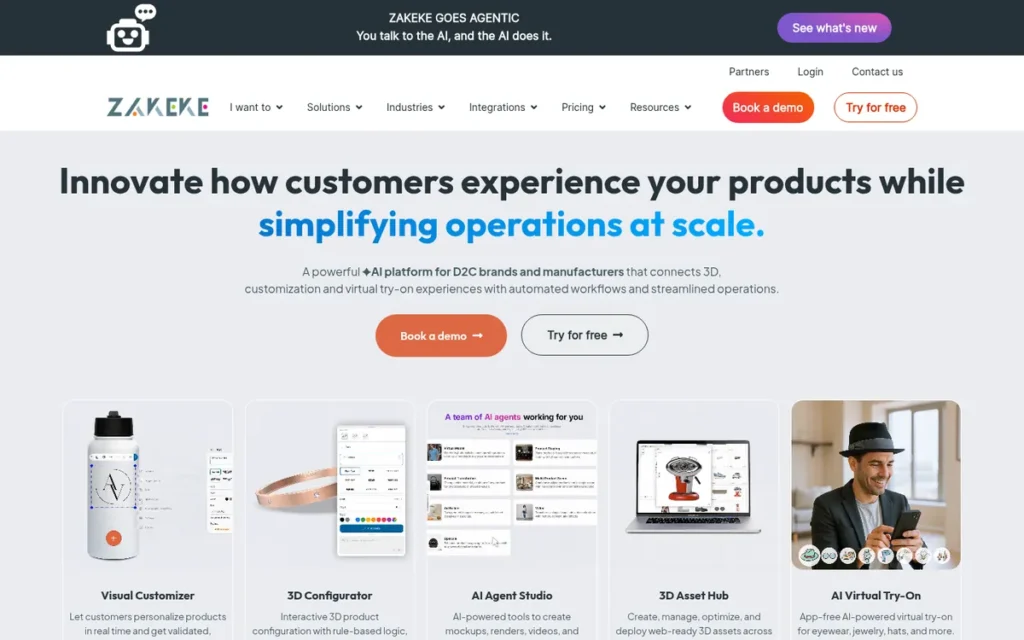
Category: E-Commerce Configurator, cloud-based visual product customization platform for D2C merchants and e-commerce brands, combining 2D personalization, 3D WebGL configuration, browser-native WebAR, and an automated web-to-print production file pipeline; designed for e-commerce operations, not manufacturing CPQ or engineering design automation.
At a Glance
- Category: E-Commerce Configurator
- Best For: D2C and e-commerce merchants in apparel, print-on-demand, gifts, accessories, and mid-market furniture on Shopify, WooCommerce, or similar platforms who need visual customization with integrated web-to-print automation or AI product imagery
- Price Range: Pricing on request: “Pay-as-you-Grow” model; 14-day free trial available; community-reported possible per-sale revenue percentage in addition to subscription (unverified, confirm directly with Zakeke before any high-volume commercial commitment)
- Primary Strength: Zakeke offers the broadest native e-commerce platform integration of any tool in this evaluation and is the only platform with a built-in web-to-print production file pipeline generating print-ready files directly from customer configurations
- Biggest Limitation: Zakeke’s 3D rendering quality is functional but not photorealistic (cited consistently in G2 reviews as a limitation for premium brands) and a community-reported per-sale revenue percentage model creates compounding cost risk at high sales volumes
- One-Line Summary: Zakeke is the broadest-integration e-commerce visual configurator in this evaluation, serving 25,000+ businesses globally with native support for seven storefronts, confirmed mobile WebAR, and the category’s only automated web-to-print pipeline, but 3D render quality falls short of enterprise-tier tools and pricing transparency requires direct verification.
- Last Verified: May 2026
Overview
Zakeke is a cloud-based visual product customization platform founded in 2016 in Palermo, Italy, that serves 25,000+ D2C and e-commerce businesses globally with a 2D Visual Customizer, 3D product configurator, mobile-native WebAR, and a fully automated web-to-print engine that generates production-ready print files directly from customer designs (Zakeke About Us, 2025, vendor self-reported). Zakeke is the only platform in this evaluation with this complete e-commerce customization-to-production workflow.
Zakeke launched originally as a 2D print-on-demand personalization tool, and its web-to-print pipeline remains its most technically mature and distinctive capability. Zakeke holds the highest combined G2 and Capterra review volume among the e-commerce-focused tools in this evaluation, G2: 4.5/5 (78 reviews); Capterra: 4.6/5 (23 reviews, confirmed May 2026).
Key Features
- 7-Storefront Native Integration: Zakeke integrates natively with Shopify, WooCommerce, PrestaShop, Wix, BigCommerce, Squarespace, and Etsy without custom development, the broadest native e-commerce platform coverage in this evaluation, independently validated by the Eyedex.co 2026 review as a capability “few competitors match.”
- Automated Web-to-Print Pipeline: Zakeke’s web-to-print automation generates production-ready print files (PDF, PNG, SVG, DXF) directly from customer configurations with no manual processing, a verified user testimonial confirmed “streamlining over 80% of our workflow” for sublimation businesses, corroborating the platform’s claim of up to 90% manual print preparation reduction (Zakeke.com, 2025, vendor self-reported).
- Mobile-Native Browser WebAR: Zakeke’s WebAR is browser-native and requires no app download, independently validated in a community deployment for a modular sofa brand with “millions of permutations,” where the practitioner described mobile-browser AR on large furniture products as “huge for conversion” (u/Wagyu_BeefA5, r/smallbusiness, 2025).
- AI Agent Studio (2025): Zakeke’s AI Agent Studio, launched in 2025, adds Virtual Model (renders designs on realistic human models), Product Transformer (AI color and material variants), and Video Agent (image-to-video output), enabling AI-generated 4K product imagery without photoshoots for apparel and print-on-demand merchants (Zakeke Blog, 2025).
- 3D WebGL Configurator: Zakeke’s customer-facing 3D configurator uses WebGL rendering for real-time product visualization across all seven supported storefronts, enabling non-technical merchants to deploy interactive 3D product experiences without developer involvement, though render quality is functional rather than photorealistic, a gap G2 reviewers note consistently for premium brand use cases.
Best For
Zakeke is best for D2C and e-commerce merchants in apparel, print-on-demand, gifts, accessories, and mid-market furniture who need to deploy visual product customization quickly across multiple storefronts, automate production file generation from customer designs, and leverage browser-native AR, without enterprise-level budget, technical resources, or a 3–6 month implementation timeline.
Zakeke is not suited for enterprise brands requiring photorealistic rendering, manufacturers needing engineering-accurate CPQ, or high-volume merchants who cannot verify and budget for a potential per-sale revenue percentage.
Pricing
Zakeke does not publish specific pricing tiers or dollar amounts on its pricing page. The platform promotes a “Pay-as-you-Grow” model with a 14-day free trial.
A community-sourced comment in r/smallbusiness (2025) indicates Zakeke may charge a percentage of each sale in addition to a base subscription fee. This claim is unverified and originates from a source whose conflict of interest cannot be fully assessed. High-volume merchants must verify the complete pricing structure (specifically whether a per-sale revenue percentage applies) directly with Zakeke before any commercial commitment.
Strengths
- Web-to-Print Technical Differentiation: Zakeke’s automated production file pipeline is the platform’s most technically mature differentiator, connecting customer design input directly to print-ready output files (PDF, PNG, SVG, DXF) without manual processing, confirmed across user testimonials and the Eyedex.co 2026 independent review as the platform’s strongest differentiator for print-on-demand and sublimation merchants.
- Verified Independent Ratings: Zakeke holds confirmed ratings on two independent review platforms, G2: 4.5/5 (78 reviews, confirmed May 2026) and Capterra: 4.6/5 (23 reviews, confirmed May 2026), alongside the Eyedex.co 2026 review separately validating storefront integration breadth as a capability “few competitors match.”
- Community-Confirmed Mobile WebAR: Zakeke’s mobile-native browser WebAR was independently validated in a real-world deployment for a modular sofa brand, a practitioner managing “millions of permutations” specifically cited browser-native AR (no app required) as “huge for conversion” on large furniture products (u/Wagyu_BeefA5, r/smallbusiness, 2025).
Users on r/smallbusiness shared their experience:
“I worked on a project for a modular sofa brand that had literally millions of permutations. We were worried about the ‘enterprise-scale’ thing too, but Zakeke actually handled it better than the more expensive competitors we trialed.
The best part was the asset mangement. When you have hundreds of variants, you don’t want to be uploading files one by one. Their bulk management tools and the way they handle textures saved us weeks of work.
Also, the AR feature is baked in and actually works on mobile browsers without an app. For a big furniture brand, that’s huge for conversion. Just make sure your 3D models are optimized (GLB/USDZ) and Zakeke does the rest of the heavy lifting. Real solid experience so far.” Posted by u/Wagyu_BeefA5
Takeaway: Zakeke’s browser-native WebAR delivers measurable conversion value for furniture brands managing complex variant catalogs, but practitioners who have deployed it at scale identify optimized 3D asset preparation (not the platform itself) as the determinant of deployment success.
- 2025 AI Product Imagery Integration: Zakeke’s AI Agent Studio launch in 2025 positions it as the only e-commerce configurator in this evaluation with an integrated AI product imagery system, enabling merchants to generate 4K product visuals (including Virtual Model and Product Transformer outputs) without traditional photoshoots (Zakeke Blog, 2025).
Limitations
- 3D Rendering Quality Gap: Zakeke’s most consequential limitation for premium brand buyers is render quality, the Eyedex.co 2026 independent review states directly that Zakeke’s 3D renders are “functional” but “not photorealistic,” and this gap “appears consistently in G2 reviews”; for luxury or premium brands where product imagery is inseparable from brand identity, Zakeke’s rendering ceiling may disqualify it regardless of its substantial integration advantages.
- Unverified Per-Sale Pricing Risk: A community-sourced claim suggests Zakeke charges a revenue percentage on each sale in addition to the base subscription, if accurate, a high-volume merchant could pay multiples of their anticipated subscription cost within 12 months, making direct pricing model verification a mandatory prerequisite before any commercial commitment (u/sech8420, r/smallbusiness, 2025).
- No Disclosed Institutional Backing: Zakeke is a Palermo, Italy–based company with no publicly disclosed institutional funding, no named investors, and no public board, vendor longevity risk factors that enterprise procurement teams must address through direct due diligence, even if SMB buyers on a 14-day trial treat them as secondary.
- Setup Complexity vs. Marketing Claims: Zakeke markets “no IT skills required,” but community practitioners (including satisfied users) independently describe initial product setup as “a pain in the ass, very tedious” (u/ButterflyOk1301, r/Printify, 2025), suggesting the no-code label applies to the software interface, not to the asset preparation and configuration work required before launch.
Verdict
Zakeke is the best independently verified e-commerce visual configurator for D2C brands and SMB merchants who need broad storefront compatibility (seven platforms, native), mobile-native browser WebAR, and automated web-to-print production file generation, capabilities no other tool in this evaluation combines in one platform. Zakeke ranked fifth overall due to 3D rendering quality that G2 reviewers consistently describe as functional but not photorealistic, unverified per-sale pricing risk requiring direct clarification before any high-volume commercial commitment, and the absence of disclosed institutional backing creating vendor longevity uncertainty at mid-market scale. The community consensus for managing Zakeke adoption risk is a single-SKU pilot on the 14-day free trial before any catalog-wide deployment commitment.
6. Epicor CPQ: Best for Epicor ERP Users: Only Manufacturing CPQ With Published Standard Pricing
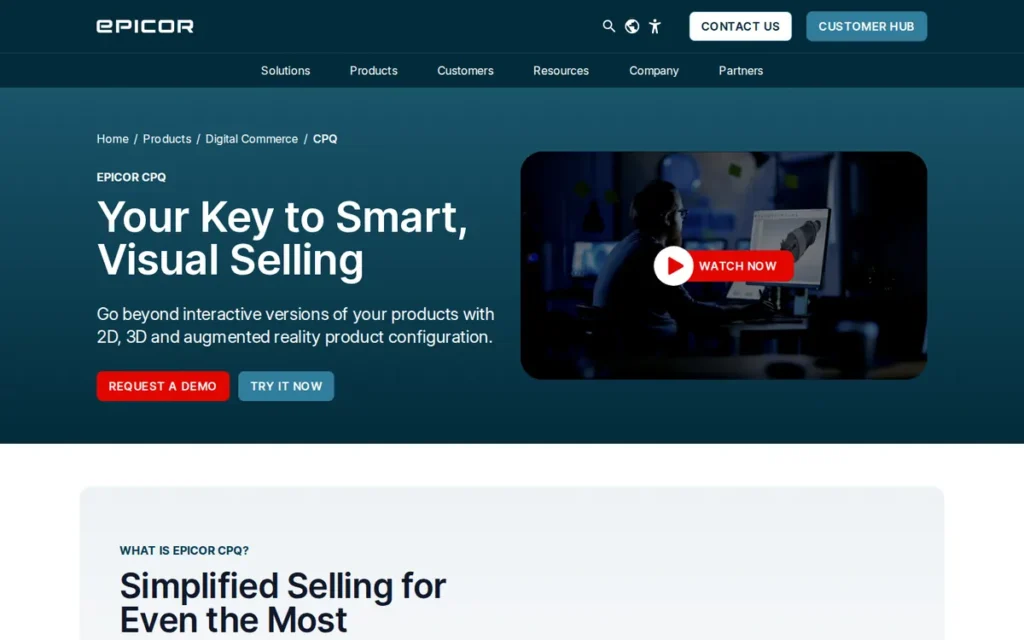
Category: Visual CPQ, a unified Configure-Price-Quote platform that natively integrates 2D/3D/AR/VR visualization, multi-CAD automation, BOM generation, and manufacturing workflow data within a single system; distinct from e-commerce visual customizers and from standalone 3D rendering platforms that connect to external CPQ tools.
At a Glance
- Category: Visual CPQ
- Best For: Mid-to-enterprise manufacturers already using Epicor ERP, or those in multi-CAD engineering environments, who need a unified visual CPQ platform with CAD output and published Standard-tier pricing
- Price Range: $150/user/month (Standard tier, confirmed on G2, GetApp, Capterra, and SelectHub, May 2026); Plus tier pricing on request; 10-user team = $18,000/year Standard before implementation costs
- Primary Strength: Epicor CPQ is the only platform in this evaluation that natively unifies 3D/AR/VR visualization, multi-CAD automation, BOM generation, and CPQ in a single architecture, and the only manufacturing CPQ tool with a publicly disclosed price point
- Biggest Limitation: No publicly accessible named-client case studies with documented percentage-improvement outcomes; post-2021 acquisition creates product roadmap dependency on Epicor’s broader ERP suite priorities
- One-Line Summary: Epicor CPQ (formerly KBMax, acquired 2021) is the only manufacturing visual CPQ platform with a published Standard price of $150/user/month, multi-CAD support, and a G2 rating of 4.5/5 (98 reviews), but no publicly accessible named-client case studies document specific percentage-improvement outcomes.
- Last Verified: May 2026
Overview
Epicor CPQ, formerly KBMax before its 2021 acquisition by Epicor Software Corporation, is a manufacturing-grade visual Configure-Price-Quote platform that natively unifies 2D/3D/AR/VR product visualization, multi-CAD automation, BOM generation, assembly instruction creation, and Epicor ERP integration under a single architecture, without requiring external visualization tools or separate CPQ platforms.
Epicor CPQ is the only manufacturing visual CPQ tool in this evaluation with a publicly disclosed price point, $150/user/month at Standard tier (confirmed on G2, GetApp, Capterra, and SelectHub, May 2026). Epicor CPQ targets mid-to-enterprise manufacturers who need a platform serving both sales teams (visual configurator) and engineering teams (CAD output and BOM), particularly organizations already in the Epicor ERP ecosystem or in multi-CAD engineering environments (Epicor.com CPQ Product Page, 2026).
Key Features
- Snap Rules Low-Code Configuration Engine: Epicor CPQ’s proprietary Snap Rules engine provides a visual drag-and-drop interface for building product configuration logic, pricing tiers, and workflow automation connected directly to 3D models, reducing the rule-building skill barrier compared to code-heavy alternatives, though “low-code” in manufacturing CPQ context still requires meaningful technical expertise for CAD imports and ERP data mapping (KBMax CPQ Platform Blog, 2025).
- Full AR-through-VR Visualization Spectrum: Epicor CPQ natively supports AR at actual physical scale (placing industrial products in real B2B environments for spatial verification before purchase) plus VR showroom deployments and 2D/3D dynamic rendering within the CPQ workflow, making it the only tool in this evaluation covering the complete AR-through-VR visualization spectrum for manufacturing sales (KBMax AR/VR CPQ Blog, 2025).
- Multi-CAD Automation Support: Epicor CPQ’s multi-CAD integration supports automation outputs across different CAD platforms (not limited to SOLIDWORKS) giving it broader engineering environment applicability than DriveWorks Pro, which requires SOLIDWORKS as a prerequisite for all three editions (Xpress, Solo, and Pro).
- Published Standard Tier Pricing: Epicor CPQ’s Standard tier ($150/user/month, confirmed on G2, GetApp, Capterra, and SelectHub, May 2026) includes 2D/3D visualization, AR, BOM generation, CAD outputs, cut sheets, document generation, Snap Rules, workflow automation, and product catalog management, the only manufacturing CPQ tool in this evaluation with a published feature-by-tier price structure.
- Enterprise Integration Stack: Epicor CPQ integrates natively with:
- Salesforce (CRM, CPQ, B2B Commerce, and Communities)
- Epicor ERP
- Teamcenter (Siemens PLM)
- Magento
- MuleSoft (Plus tier)
Best For
Epicor CPQ is best for mid-to-enterprise manufacturers already inside the Epicor ERP ecosystem, or those in multi-CAD engineering environments who need a single platform for visual configuration, CAD automation, and BOM generation without a SOLIDWORKS dependency, particularly buyers who want to build a budget case around a published Standard price before entering enterprise sales negotiations.
Epicor CPQ is not suited for e-commerce merchants, SOLIDWORKS-only engineering teams better served by DriveWorks, or buyers who require publicly accessible named-client case studies with documented percentage outcomes before procurement commitment.
Pricing
Epicor CPQ publishes a Standard tier at $150/user/month (confirmed on G2, GetApp, Capterra, and SelectHub, May 2026), which includes 2D/3D visualization, AR, BOMs, CAD outputs, document generation, Snap Rules, and product catalog management. A Plus tier adds MuleSoft and native Salesforce B2B Commerce, CPQ, and Communities integrations and is contact-sales-only.
For a 10-user sales team, the Standard tier costs $18,000/year before implementation, training, and integration fees. Confirm whether Salesforce B2B Commerce integration is required before signing, it may shift the effective tier to Plus pricing and eliminate the transparency advantage entirely.
Strengths
- Only Published Price in Manufacturing CPQ: Epicor CPQ is the only manufacturing visual CPQ tool in this evaluation with a publicly disclosed price point ($150/user/month at Standard tier, confirmed on G2, GetApp, Capterra, and SelectHub in May 2026) enabling budget case construction before any sales interaction, a transparency advantage no other enterprise manufacturing CPQ platform in this evaluation provides.
- Community-Validated Platform Robustness: Epicor CPQ’s unified platform architecture was independently validated by an experienced manufacturing engineer who described KBMax as “hands down the most robust” multi-CAD CPQ option, evaluated across an extensive ETO automation selection process for a 100-person engineering department (u/metalman7, r/SolidWorks, 2021).
This aligns with community sentiment on r/SolidWorks:
“I highly recommend Driveworks or KBMax for that matter. Both are very capable. I would avoid other packages like RuleStream, Tacton, or Infor. Some packages have significant limitations and from my evaluations, KBMax and Driveworks are hands down the most robust. Driveworks is probably more limited than KB, but not necessarily in a bad way. If Driveworks was a sandbox, KB would be like a beach. DW is Solidworks specific, KB will integrate with other CAD systems.
I like Driveworks’ fixed pricing + maintenance model over KBMax’s subscription style, but both have their pros and cons that would need to be considered per group.” Posted by u/metalman7
Takeaway: Among practitioners who have directly evaluated multiple manufacturing CPQ platforms at enterprise scale, Epicor CPQ (KBMax) ranks as the most robust multi-CAD option in the category, with the tradeoff that its subscription pricing model carries a long-term cost disadvantage relative to DriveWorks’ perpetual license for budget-sensitive teams.
- Multi-CAD vs. SOLIDWORKS-Only Advantage: Epicor CPQ’s multi-CAD support was directly contrasted with DriveWorks’ SOLIDWORKS-only scope by the same practitioner: “DriveWorks is a sandbox; KBMax is like a beach (DW is SOLIDWORKS-specific; KB will integrate with other CAD systems”) a decisive structural advantage for manufacturers in multi-CAD or CAD-agnostic engineering environments (u/metalman7, r/SolidWorks, 2021).
- Strong Independent Review Profile: Epicor CPQ holds G2: 4.5/5 (98 reviews, confirmed May 2026), rated High Performer across Visual Configuration, CPQ, and Dynamic Pricing grids on G2, plus GetApp: 4.6/5 (21 reviews) and a confirmed Capterra profile, reflecting peer-validated quality across multiple independent review platforms.
Limitations
- No Publicly Accessible Named-Client Case Studies: Epicor CPQ’s most consequential limitation is the absence of publicly accessible named-client case studies with documented percentage-improvement outcomes, unlike DriveWorks (three named case studies with 50–90% outcome ranges) or Tacton CPQ (Siemens quoting from 8 days to minutes), Epicor CPQ has no equivalent independently accessible ROI documentation, making evidence-based procurement conversations dependent entirely on vendor-provided references.
- Post-Acquisition Roadmap Dependency: The 2021 Epicor acquisition means Epicor CPQ’s product roadmap is subordinate to Epicor’s broader ERP suite priorities, buyers should specifically inquire about post-acquisition feature development velocity and support responsiveness before signing a multi-year contract; review profiles are also fragmented across “KBMax” and “Epicor CPQ” brand names, requiring cross-referencing during standard due diligence research.
- “Low-Code” Requires Technical Depth: The Snap Rules “low-code” label should be treated with appropriate caution, in manufacturing CPQ context, “low-code” still requires substantial technical expertise for CAD model imports, ERP field mapping, and complex product variant definition; organizations without experienced implementation resources should budget for significant professional services costs that will materially exceed the Standard tier subscription.
Verdict
Epicor CPQ is the best choice for manufacturers already inside the Epicor ERP ecosystem who need a unified visual CPQ platform with published Standard pricing, multi-CAD support, and the only AR-through-VR visualization spectrum in the manufacturing CPQ category under a single vendor contract, confirmed by a strong G2 review profile (4.5/5, 98 reviews) and community practitioner validation. Epicor CPQ ranked sixth overall primarily due to the absence of publicly accessible named-client case studies with documented percentage-improvement outcomes and the post-acquisition product roadmap risk inherent in any enterprise software integration into a larger parent company. Manufacturers outside the Epicor ecosystem who need manufacturing CPQ should evaluate Tacton CPQ (constraint-based architecture) or DriveWorks Pro (SOLIDWORKS-native, best-documented ROI) before Epicor CPQ.
7. Kickflip: Fastest No-Code Deployment: Most Verification Gaps of Any Tool in This Evaluation
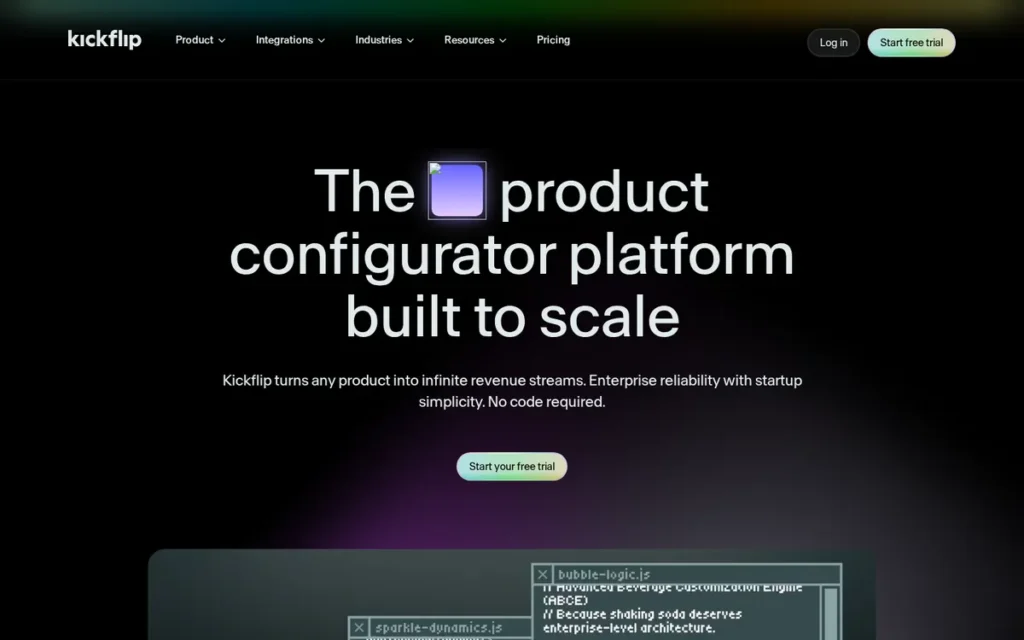
Category: No-Code Configurator, a no-code visual product customization builder for e-commerce store owners; enables interactive product customization with multi-perspective previews and dynamic pricing without developer involvement; AR capability unconfirmed as of May 2026.
At a Glance
- Category: No-Code Configurator
- Best For: Non-technical SMB and startup Shopify or WooCommerce merchants who prioritize fastest possible deployment over vendor transparency, rendering quality, or aggregate third-party review validation
- Price Range: Starting at $59/month (confirmed at gokickflip.com/pricing, May 2026); complete pricing model including any per-sale revenue percentage requires direct verification
- Primary Strength: Kickflip is community-described as the fastest-to-set-up no-code product customizer in its segment (“less clunky and easier to set up” than Zakeke) with Shopify Hydrogen headless compatibility and a Shopify App Store rating of 4.2/5 (125 reviews, confirmed May 2026)
- Biggest Limitation: No confirmed aggregate G2 or Capterra numerical score; no founding team, HQ, or company background publicly disclosed; AR capability unconfirmed in any public documentation as of May 2026
- One-Line Summary: Kickflip is a no-code product customizer with a confirmed $59/month starting price and Shopify App Store rating of 4.2/5 (125 reviews), but lacks a confirmed aggregate G2/Capterra score, disclosed company background, confirmed AR capability, and named-client case studies, making it the most difficult tool in this evaluation to independently validate before purchase.
- Last Verified: May 2026
Overview
Kickflip (GoKickflip) is a no-code visual product configurator for e-commerce merchants, offering interactive product customization experiences with live multi-perspective previews, dynamic pricing, and a Shopify-native deployment path that the company positions as launchable “in days” without developer involvement. Kickflip is also available for WooCommerce, Wix, and headless storefronts via API.
Kickflip targets the SMB and startup segment where enterprise tools are priced out of reach and fast time-to-market is the primary constraint, community practitioners independently describe it as “less clunky and easier to set up” than competing SMB alternatives (u/Competitive-Neat-810, r/Printify, 2025). Kickflip is the most difficult tool in this evaluation to independently verify before purchase: while an active G2 profile exists at g2.com/products/kickflip-kickflip with qualitative reviews, no confirmed aggregate numerical score is published; no founding team or company background is publicly disclosed; AR capability is unconfirmed; and no independently documented case studies with named clients or quantified outcomes exist in accessible public sources as of May 2026.
Key Features
- No-Code Product Customization Builder: Kickflip’s no-code builder enables non-technical e-commerce merchants to create interactive product customization experiences on Shopify, WooCommerce, Wix, and headless storefronts without hiring developers, with live multi-perspective product previews and real-time dynamic pricing updating as customers make selections.
- Shopify Hydrogen Headless Integration: Kickflip supports Shopify Hydrogen (React-based headless commerce) integration, enabling technically advanced front-end teams to embed the configurator within custom storefronts without sacrificing site architecture flexibility, confirmed by independent technical review (Makereden.io, 2025), differentiating Kickflip from pure app-store plugins.
- White-Label Branded Storefront Pages: Kickflip’s white-label option allows merchants to create dedicated product customization experiences with their own branding, fonts, and color schemes, positioning the configurator as native to the merchant’s brand presentation without additional development work.
- Real-Time Dynamic Pricing Logic: Kickflip’s dynamic pricing logic updates the displayed price in real time as customers add, remove, or change product options, enabling price transparency throughout the customization workflow without requiring developer involvement.
- Active Platform Maintenance Signals: Kickflip maintains a dedicated help center at help.gokickflip.com, regular blog content, video tutorials, and an active Shopify App Store listing as of May 2026, indicating ongoing platform development despite the absence of publicly disclosed company information.
Best For
Kickflip is best for small-to-mid-size D2C merchants and non-technical Shopify store owners who prioritize fast deployment speed and ease of setup above vendor transparency, 3D rendering quality, or aggregate independently verified review scores, and who are prepared to verify AR capability and the complete pricing structure directly with the company before committing.
Kickflip is not suited for buyers who require a confirmed aggregate G2 or Capterra numerical score, disclosed company background, confirmed AR capability, or named-client outcome evidence before purchase.
Pricing
Kickflip lists a starting price of $59/month, confirmed at gokickflip.com/pricing (May 2026). The complete pricing model (including whether a per-sale revenue percentage applies) requires direct verification with the company.
Community discussions provide additional context: one community member described Kickflip as potentially “a few hundred bucks per month including all fees” in r/smallbusiness, and a competing product founder cited $59 plus a possible revenue percentage in r/Printify (u/sech8420, r/smallbusiness, 2025; u/fragilePeculiar, r/Printify, 2025). Both sources carry potential conflicts of interest, treat their figures as orientation estimates only. Verify the complete pricing structure, including any per-sale revenue percentage, directly at gokickflip.com/pricing before building any budget case.
Strengths
- Ease-of-Setup Community Recognition: Kickflip’s no-code deployment path is community-described as the fastest and least technically demanding in its segment, organic mentions in r/Printify independently describe Kickflip as “less clunky and easier to set up” than both Zakeke and TeeInBlue, from a non-affiliated user with no commercial relationship to Kickflip (u/Competitive-Neat-810, r/Printify, 2025).
- Shopify Hydrogen Technical Compatibility: Kickflip’s Shopify Hydrogen headless commerce integration differentiates it from simpler app-store plugins, confirmed by independent technical review (Makereden.io, 2025), making Kickflip accessible to development teams building custom React-based storefronts where traditional Shopify plugins would break site architecture.
- Shopify App Store Peer Rating: Kickflip holds a Shopify App Store rating of 4.2/5 (125 reviews, confirmed May 2026), a platform-specific peer review signal that, while not transferable to software-independent aggregators like G2 or Capterra, provides an independently accessible validation benchmark for Shopify-focused merchants.
- Active Product Maintenance: Kickflip maintains active development signals as of May 2026 (regular blog content, active help center, video tutorials, and an active Shopify App Store listing) indicating ongoing platform maintenance and a baseline stability indicator for SMB buyers evaluating a monthly subscription tool.
Limitations
- No Confirmed Aggregate G2 or Capterra Score: Kickflip’s most consequential limitation for procurement teams is the absence of a confirmed aggregate numerical score on G2 or Capterra, an active G2 profile exists with qualitative reviews, but no published overall score is available; for procurement teams required to submit three independent peer-review platform ratings before budget approval, Kickflip cannot complete that checklist today, a requirement-blocking gap regardless of how well the product performs in a hands-on trial.
- No Disclosed Company Background: No founding date, founders, team size, headquarters, or institutional backing is disclosed on GoKickflip.com or in any accessible external source, representing the highest corporate opacity of any tool in this evaluation, a dealbreaker for procurement teams with vendor stability requirements and an active due diligence gap for any buyer, not just enterprise.
- Unconfirmed AR Capability: Kickflip’s AR capability is unconfirmed in any public documentation or user testimonial accessible in May 2026 research, unlike Zakeke (WebAR validated in community deployments) and Threekit (WebAR confirmed in enterprise deployments), no public source independently confirms Kickflip’s AR capability; buyers for whom AR drives conversion must verify this directly via a live mobile browser test, not a recorded demo, before selecting the platform.
- Pricing Model Requires Direct Verification: While the $59/month starting price is confirmed at gokickflip.com/pricing, whether a per-sale revenue percentage applies cannot be independently assessed without contacting the company directly, the highest-stakes pricing risk in the e-commerce configurator segment.
Users on r/Printify noted:
“Kickflip is quite expensive. $59 + $49 for white label + revenue cut. It could be easily 1 few hundred bucks. We’ve actually built an alternative of Kickflip. Free for 1st 1000 believers :)” Posted by u/fragilePeculiar
Takeaway: Kickflip’s advertised $59/month starting price is a floor rather than a ceiling, practitioners cite white-label fees and per-sale revenue components that can compound total monthly costs to several hundred dollars, though this assessment originates from a competing product founder and requires direct verification with Kickflip before any commercial commitment.
Verdict
Kickflip is the fastest-to-deploy no-code product customizer in this evaluation for non-technical SMB merchants who prioritize launch speed, but it ranked last (seventh) due to the absence of a confirmed aggregate G2/Capterra score, undisclosed company background, unconfirmed AR capability, absent named-client case studies, and a complete pricing model requiring direct verification, the lowest independent verifiability score across all standard procurement due diligence dimensions. Kickflip may be the right choice for a non-technical merchant who evaluates the platform hands-on during a trial, verifies AR capability directly via a live mobile browser demo, and confirms the complete pricing model, including any per-sale revenue percentage, before any commercial commitment. Any buyer for whom vendor transparency, aggregate peer-review validation, or AR-confirmed conversion optimization is a requirement should evaluate Zakeke instead.
What Red Flags Should I Watch For When Evaluating Visual Configuration Software?
Five structural red flags appear consistently across this evaluation’s research and apply regardless of which tool category a buyer is evaluating. Each red flag is independently citable and represents a real procurement risk, not a minor caveat.
Red Flag #1: No Published Pricing
Any visual configuration tool that cannot provide even a ballpark price range before a formal demo request creates a procurement friction barrier that disproportionately disadvantages buyers who need internal budget approval before vendor engagement. Six of the seven tools in this evaluation require sales contact before any budget planning is possible, only Epicor CPQ ($150/user/month Standard, confirmed May 2026) and DriveWorks (~$1,500–$5,000+/year via resellers) provide public price anchors.
Treat pricing opacity as a procurement process compatibility issue, not just a negotiation tactic. Buyers who need budget approval before first vendor contact should account for this in their evaluation timeline.
Red Flag #2: Unconfirmed AR Capability
Augmented reality is increasingly a baseline expectation in e-commerce visual configuration, with AR-enabled product visualizations documented to reduce returns by 15–25% in furniture, electronics, and apparel categories (Business Research Insights, 2024).
Kickflip’s AR capability is unconfirmed in any public source as of May 2026. Vendors that do not explicitly confirm WebAR capability in public documentation require live verification (not a recorded demo) on a mobile browser before any selection decision.
Red Flag #3: Per-Sale Revenue Percentage Models
Some SMB-tier e-commerce configurators charge a percentage of each sale in addition to a monthly subscription, a cost model that compounds unpredictably at high sales volumes. A merchant generating $50,000 per month in custom products who signs a 1% per-sale clause pays $500 extra per month before their first annual renewal; verify the complete pricing model in writing before any commercial commitment with Zakeke or Kickflip.
Community discussions in r/smallbusiness and r/Printify (2025) raise this concern for both platforms. Do not rely on community estimates, verify directly with the vendor.
Red Flag #4: Thin or Missing Review Platform Presence
Tools with fewer than 20 reviews on G2 or Capterra (or no confirmed aggregate score at all) require alternative validation methods including direct reference requests from named customers. Kickflip has no confirmed aggregate G2 or Capterra numerical score. Tacton CPQ has only 39 G2 reviews for a 20-year-old enterprise platform.
Buyers evaluating tools with thin review profiles should request named customer references in their specific industry segment from the vendor before signing any contract.
Red Flag #5: Category Mismatch
The single most consequential purchase error in this category is selecting a tool built for a fundamentally different use case. Comparing a SOLIDWORKS design automator to a Shopify product customizer because both carry the “visual configuration” label is like comparing a CNC machine to an iPad case because both are used in product development, the category is the decision, not the feature list.
Specific mismatches to avoid:
- Zoovu is an AI-guided product discovery platform: not a 3D visual configurator.
- DriveWorks is a SOLIDWORKS-native design automator: not an e-commerce tool.
- Tacton CPQ is a manufacturing CPQ engine: not a consumer product personalizer.
Evaluate tools within their correct category using the framework in this article’s opening section before entering any demo or pricing conversation.
What Questions Should I Ask Before Choosing Visual Configuration Software?
Buyers should ask each vendor these six questions before entering a contract. Evasive or incomplete answers are active due diligence signals requiring follow-up, not edge cases to be resolved after signing.
Question #1: Does this tool handle complex conditional logic, or only simple cosmetic customization?
Ask vendors to demonstrate conditional rules (not just color swaps) in a live product demo. For manufacturing CPQ, ask specifically whether the engine is rules-based (if-then logic) or constraint-based (CSP solver).
Verify in writing:
- Can the system prevent an invalid configuration from being quoted: not just flagged after the fact?
- What happens when a new product component is added? Does it require manual rule updates?
- Can the vendor show a live demo of a complex rule interaction on an actual product in your category?
Question #2: Does the pricing model include a per-sale revenue percentage in addition to the subscription fee?
Request the complete pricing structure in writing before the demo. For e-commerce configurators, the per-sale revenue percentage risk is the most consequential hidden cost, documented in community discussions for Zakeke and Kickflip but absent from both platforms’ public pricing pages.
Verify in writing:
- Base monthly subscription cost at your expected usage tier.
- Whether a per-sale revenue percentage applies and at what rate.
- Any rendering volume caps or configuration count limits that trigger overage fees.
Question #3: Is AR browser-native (no app download), or does it require a native app installation?
App-download friction materially reduces AR adoption rates in consumer and B2B purchase flows alike. Zakeke and Threekit both confirm browser-native WebAR. Kickflip’s AR capability is unconfirmed as of May 2026.
Verify in writing:
- Request a live AR demo on a mobile browser: not a recorded video, on your own device.
- Confirm whether AR requires a branded app download or works via a standard browser URL.
Question #4: What does total cost of ownership look like at 12, 24, and 36 months?
Request a full TCO model from the vendor: subscription fees, implementation costs, integration fees, training, and any per-sale revenue components.
Verify in writing:
- Threekit’s 3–6 month implementation adds significant professional services costs beyond the subscription.
- DriveWorks’ reseller-only distribution means implementation costs vary by reseller partner.
- Epicor CPQ’s $150/user/month Standard price does not include implementation, training, or integration work at any tier.
Question #5: Does the tool require an active license for a specific CAD platform as a prerequisite?
For engineering-focused tools, ask specifically about software prerequisites before any evaluation begins.
Verify in writing:
- DriveWorks requires an active SOLIDWORKS license for all three editions: if your organization transitions away from SOLIDWORKS, DriveWorks becomes inaccessible regardless of remaining contract value.
- Epicor CPQ supports multi-CAD environments without a SOLIDWORKS prerequisite.
- Factor CAD platform dependency into the long-term TCO model before committing to any engineering configuration tool.
Question #6: Can you provide three customer references in my specific industry segment?
Named references in your industry segment carry more evidential weight than general case studies or aggregated benchmarks. Tacton CPQ and Epicor CPQ have thin publicly accessible case study documentation, request direct references from both vendors before signing any contract.
Verify in writing:
- Request contact information for references, not just company names.
- Confirm the reference is in your specific vertical (industrial equipment, e-commerce apparel, etc.).
- Ask the reference directly about implementation timeline, total cost, and ongoing support responsiveness.
Minimum Verification Checklist Before Signing Any Contract
Regardless of which tool you select, complete these five steps before any commercial commitment:
- Live WebAR demo on a mobile browser: open the AR feature on your own phone; do not accept a recorded demo as confirmation.
- Complete pricing model in writing: base subscription, any per-sale revenue percentage, rendering volume caps, and implementation fees.
- Three customer references in your industry segment: with contact information, not just company names.
- Current 12-month product roadmap: especially critical if the vendor was acquired in the past three years (Epicor CPQ, 2021).
- Total cost of ownership model at 12, 24, and 36 months: including implementation, integration, and training costs beyond the subscription.
How Did We Rank These Visual Configuration Tools?
PlugRoute ranked all seven tools against six criteria weighted 60% primary (Documented Client Results, Review Platform Ratings, Feature Depth and Category Fit) and 40% secondary (Integration Breadth, Pricing Transparency, Vendor Stability), with no tool pre-assigned any position and every entry receiving identical research depth and editorial standards.
How Was Each Tool Researched and Evaluated?
The evaluation followed a five-step research process:
- Product Discovery: identified seven tools across five distinct visual configuration categories; verified each tool against G2, Capterra, and GetApp to confirm active market presence and category fit.
- Structured Entity Research: conducted two rounds of structured research per tool covering core features, pricing, integrations, client outcomes, technical architecture, and founding context.
- Reddit Community Sentiment Analysis: searched r/smallbusiness, r/SolidWorks, r/EntrepreneurRideAlong, and r/Printify for unsolicited practitioner discussions; all community citations include username, subreddit, and year.
- LLM Gap Analysis: queried multiple AI systems to identify tools and details missing or incorrectly stated in current AI-generated recommendations, including Tacton CPQ incorrectly described as “rules-based” when its architecture is constraint-based, and Zoovu’s Microsoft case study misrepresented with unverified figures.
- Independent Cross-Referencing: cross-referenced vendor claims against G2, Capterra, GetApp, Eyedex.co, SAP Partner Directory, ZoomInfo, BuiltInBoston, and named case study documentation.
What Six Criteria Determined the Rankings?
Rankings were determined by scoring each tool against six criteria, weighted as primary (60% combined) or secondary (40% combined):
Primary Criteria (60%):
- Documented Client Results and ROI Evidence: named-client case studies with specific percentage outcomes score highest; aggregated vendor-reported benchmarks score mid-range; marketing claims with no named client evidence score low; this criterion differentiates independently corroborated outcomes from promotional assertions.
- Review Platform Ratings and Volume: G2, Capterra, and GetApp ratings reflect aggregate peer-verified experience independent of vendor marketing; review volume matters alongside score; thin or absent review profiles create procurement due diligence gaps.
- Feature Depth and Category Fit: the most consequential purchase error in this category is buying a tool built for a different use case; feature depth is assessed within each tool’s intended category; proprietary architectural advantages (CSP constraint solver, VFX-heritage rendering engine, SOLIDWORKS-native API) score highest.
Secondary Criteria (40%):
- Integration Breadth with Existing Infrastructure: native certified integrations with dominant platforms in the buyer’s segment reduce total cost of ownership; evaluated per the tool’s target segment, not globally.
- Pricing Transparency and Value: published pricing tiers score highest; free tiers with upgrade paths score high; contact-sales-only with no public anchor score lowest; per-sale revenue percentage models receive a risk penalty.
- Vendor Stability and Credibility Signals: founding year, disclosed funding, independent certifications (SOLIDWORKS Gold Partner, SAP Certified Partner, Salesforce Ventures investment), and review platform presence all signal vendor viability over the buyer’s expected deployment horizon.
How Were Conflicting Sources Weighted?
When review platform ratings conflicted with Reddit community sentiment, this evaluation weighted specificity and recency. A detailed 2025 Reddit post from a practitioner who deployed a tool for a named business type carries more evidential weight than a generic 2023 G2 review.
Community-sourced pricing data is labeled as such and treated as orientation only, never as verified budget input. Vendor self-reported statistics are labeled “vendor self-reported” or “vendor self-reported aggregated benchmarks” throughout. Claims corroborated by at least one independent source are stated as established findings.
How Were Vendor Claims Verified?
Vendor-reported statistics are labeled throughout this article. Only claims corroborated by at least one independent source (a named review platform, independent analyst, or unaffiliated community practitioner) are stated as established fact.
Three factual corrections applied in this article relative to common AI-generated descriptions of these tools:
- Zoovu’s Microsoft case study documents a 166% higher conversion rate among assisted vs. non-assisted shoppers and a 25% PDP lift, not “2x conversion lift and 30x ROI” as commonly misrepresented in LLM-generated content.
- Tacton CPQ uses a constraint-based CSP architecture: not “rules-based” as incorrectly stated in multiple AI-generated responses evaluated in this research.
- Epicor CPQ holds G2: 4.5/5 (98 reviews, confirmed May 2026): not the “no confirmed G2 profile” stated in pre-verification research drafts.
How Often Is This Article Updated?
This article was researched and published in May 2026. The evaluation is refreshed on a rolling basis as new review data, pricing changes, or product developments are confirmed. The “Last Verified: May 2026” field on every entry indicates when that entry’s data was last independently verified. Readers should confirm current pricing and feature availability directly with vendors before any procurement decision.
PlugRoute has no affiliate relationships with any company listed. Rankings are determined entirely by research data and objective evaluation criteria.
What Do Buyers Most Frequently Ask About Visual Configuration Software?
The following questions address the most common decision-blocking queries for buyers evaluating visual configuration software in 2026, from free tier availability and pricing ranges to the distinction between a 3D configurator and an AI-guided selling platform.
What is the best visual configuration software for e-commerce in 2026?
Zakeke is the best independently verified e-commerce visual configurator for D2C merchants in 2026, rated G2: 4.5/5 (78 reviews) and Capterra: 4.6/5 (23 reviews, confirmed May 2026), with native integration across seven storefronts, mobile-native WebAR, and the only automated web-to-print pipeline in the category. Threekit is the stronger option for enterprise retailers who require photorealistic 3D rendering, at a significantly larger budget and a 3–6 month implementation timeline.
Is there a free visual configuration software for manufacturers?
DriveWorks Xpress is the only genuinely free visual configuration tool for manufacturers, bundled with every SOLIDWORKS license at no additional cost. Xpress covers model rule automation but lacks a customer-facing web configurator; DriveWorks Solo (~$1,500/year) and Pro (~$5,000+/year) add that capability. Epicor CPQ’s $150/user/month Standard tier is the lowest published entry price among full-featured manufacturing visual CPQ platforms.
How does PlugRoute determine its visual configuration software rankings?
PlugRoute ranks tools using a six-criterion weighted framework, primary criteria (60%): Documented Client Results, Review Platform Ratings, and Feature Depth; secondary (40%): Integration Breadth, Pricing Transparency, and Vendor Stability. Every tool receives identical research depth with no pre-assigned positions and no affiliate relationships. The complete methodology, data sources, and evidence weighting rationale appear in the “How Did We Rank These Visual Configuration Tools?” section.
What Key Terms Should I Know Before Evaluating Visual Configuration Software?
The following five terms appear throughout this comparison and are defined here for readers who encounter them in vendor materials or in this article without prior context in the visual configuration software category.
Configure-Price-Quote (CPQ): A software category that automates the process of configuring complex products, generating accurate pricing, and producing professional sales quotes, typically used by manufacturers and B2B sales teams who sell products with many interdependent options; in this evaluation, Tacton CPQ, Epicor CPQ, and DriveWorks Pro all include CPQ functionality integrated with visual configuration.
Constraint Satisfaction Problem (CSP) Solver: A mathematical optimization engine that validates all possible product configurations simultaneously by defining relationships between variables as constraints rather than sequential if-then rules; in manufacturing CPQ, a CSP solver scales more efficiently than rules-based engines as product complexity grows because adding a new component does not require rewriting existing rules, Tacton CPQ is the only platform in this evaluation using this architecture.
Engineer-to-Order (ETO): A manufacturing model in which each customer order requires custom engineering work (new or modified designs) before production can begin; ETO manufacturers have the most complex CPQ needs because no two orders are identical, making visual configuration tools that enforce engineering constraints (Tacton CPQ, Epicor CPQ, DriveWorks) essential to preventing costly production errors.
Web-to-Print Automation: A software capability that automatically converts customer-facing design or customization input into production-ready print files (PDF, PNG, SVG, DXF) without manual graphic design processing; in this evaluation, Zakeke is the only platform with a built-in web-to-print pipeline, making it uniquely suited for print-on-demand, sublimation, and apparel merchants whose production depends on automated file generation directly from customer designs.
WebAR (Web-Based Augmented Reality): Augmented reality delivered through a standard mobile web browser without requiring a native app download; WebAR allows customers to visualize products in their physical environment (furniture in a room, apparel on a body) by pointing a smartphone camera at the space; Zakeke and Threekit both confirm browser-native WebAR, while Kickflip’s WebAR capability is unconfirmed as of May 2026; browser-native delivery is commercially important because app-download friction materially reduces AR adoption rates in consumer and B2B purchase flows alike.
Glossary: Key Terms Used in This Comparison
Configure-Price-Quote (CPQ): A software category that automates the process of configuring complex products, generating accurate pricing, and producing professional sales quotes for manufacturers and B2B sales teams who sell products with many interdependent options. In this evaluation, Tacton CPQ, Epicor CPQ, and DriveWorks Pro all include CPQ functionality integrated with visual configuration.
Constraint Satisfaction Problem (CSP) Solver: A mathematical optimization engine that validates all possible product configurations simultaneously by defining relationships between variables as constraints rather than sequential if-then rules. Tacton CPQ is the only platform in this evaluation using this architecture, making it more scalable than rules-based engines as product complexity grows.
Engineer-to-Order (ETO): A manufacturing model in which each customer order requires custom engineering work (new or modified designs) before production can begin. ETO manufacturers have the most complex CPQ needs because no two orders are identical, making visual configuration tools that enforce engineering constraints essential to preventing costly production errors.
Web-to-Print Automation: A software capability that automatically converts customer-facing design or customization input into production-ready print files (PDF, PNG, SVG, DXF) without manual graphic design processing. Zakeke is the only platform in this evaluation with a built-in web-to-print pipeline, making it uniquely suited for print-on-demand, sublimation, and apparel merchants.
WebAR (Web-Based Augmented Reality): Augmented reality delivered through a standard mobile web browser without requiring a native app download, allowing customers to visualize products in their physical environment by pointing a smartphone camera at a space. Browser-native delivery is commercially significant because app-download friction materially reduces AR adoption rates in both consumer and B2B purchase flows.
Which Visual Configuration Tool Is Right for You?
The right visual configuration tool depends on use case category first: SOLIDWORKS manufacturers choose DriveWorks (free Xpress entry); enterprise visual commerce brands choose Threekit; high-SKU guided selling needs choose Zoovu; D2C e-commerce merchants choose Zakeke. Budget and technical resources determine tier within each category, not feature list length or brand recognition.
Key Insights
- DriveWorks is the highest-evidence choice for SOLIDWORKS manufacturers: named case studies document 50–90% engineering time reductions at Jee Ltd, Parlec, and Anvil International; a free Xpress tier eliminates budget barriers to piloting; and 24 years of vendor stability with no acquisition risk provide the lowest deployment uncertainty in the evaluation.
- Threekit leads enterprise visual commerce with photorealistic 3D rendering, Virtual Photographer™ AI imaging at documented scale, and Salesforce Ventures–backed CPQ integration depth, but enterprise budget, a technical implementation team, and a 6-month deployment window are non-negotiable prerequisites before any commitment.
- Zoovu is the most financially mature platform in this evaluation at an estimated $42M ARR with a 166% conversion lift among assisted shoppers documented at Microsoft, but Zoovu is a guided selling tool for high-SKU catalog navigation, not a 3D product visual customizer; confirm category fit before requesting a demo.
- Zakeke’s broadest storefront integration (7 platforms), web-to-print automation, and confirmed mobile WebAR make it the strongest all-around e-commerce configurator for D2C merchants, but per-sale pricing risk and 3D render quality limitations require direct verification before any high-volume commercial commitment.
- The manufacturing CPQ category has exactly one published price point: Epicor CPQ’s $150/user/month Standard tier, all other manufacturing CPQ and visual commerce platforms require sales engagement before any budget planning is possible, a category-wide transparency gap buyers should account for in their procurement timeline.
If you are a SOLIDWORKS engineering team eliminating repetitive manual design work, start with DriveWorks Xpress, it costs nothing and delivers measurable ROI data before any budget decision is required. Because Xpress is bundled with every existing SOLIDWORKS license, an engineering manager can run a legitimate productivity pilot, measuring actual hours saved on real production jobs, before asking finance for a Solo or Pro budget.
If you are an enterprise retailer managing complex visual product catalogs, request a Threekit demo after confirming budget capacity and a 6-month implementation window. If you manage a high-SKU electronics, industrial, or healthcare catalog, Zoovu is the only solution in this evaluation architected for AI-guided product discovery at that scale.
For mid-market manufacturers inside the Epicor ecosystem, Epicor CPQ’s published pricing makes it the only option enabling budget modeling before sales contact. For D2C e-commerce merchants on Shopify or WooCommerce, Zakeke’s 14-day free trial is the lowest-risk evaluation path, pilot one SKU, verify the pricing model including any per-sale components, and expand from there.
D2C brands who have outgrown Zakeke’s conditional logic capabilities but cannot yet justify Threekit’s enterprise pricing should evaluate mid-market challengers, Mimeeq and Threedium were cited by practitioners in r/EntrepreneurRideAlong (2025) as alternatives occupying the gap between SMB and enterprise visual commerce pricing. These tools were not reviewed in this evaluation.
We update this guide quarterly. Last updated: May 2026.
Explore additional independent software comparisons at PlugRoute.