PandaDoc ranks first for general B2B sales teams needing all-in-one quoting, CRM integration, and payment collection. Proposify ranks second for brand-critical agencies and SaaS teams requiring interactive proposals with section-level engagement analytics. Scoro ranks third for professional services firms connecting sales quotes to project delivery profitability, and Salesforce CPQ, despite widespread AI recommendations, is end-of-sale for new customers as of 2025.
Manual quoting wastes hours, introduces pricing errors, and gives competitors time to close while you chase signatures. Sales teams sending PDF quotes by email have zero visibility into whether prospects have reviewed them. Four of the seven tools evaluated here do not publicly list complete pricing, and Salesforce CPQ, which appears as a recommended purchasable option in all three AI-generated responses analyzed for this article, cannot be purchased by new customers as of 2025.
As one user on r/automation described:
“Processing a work order takes anywhere from 30 minutes to an hour. I place apx 5-10 orders a week unless I’m working on a massive project. But that’s a different story. I don’t know if I truly conveyed how repetitive, frustrating, and redundant this process is. While I’m processing an order that takes an hour, I’m constantly thinking about that next big sale, phone call, email, flight to book and visit a customer, or any multitude of tasks I can be doing to grow my pipeline instead… I’m doing paperwork… you get the point.” Posted by u/tlplus
Takeaway: Manual quoting and order processing doesn’t just waste time, it actively crowds out pipeline-building activity, validating the core efficiency case for dedicated quote management software across industries.
PlugRoute has no affiliate relationships with any company listed in this article. Rankings are determined entirely by research data, verified community evidence, and objective evaluation criteria. No company has paid for placement, review, or editorial consideration.
TL;DR: Top Picks at a Glance
- PandaDoc is the strongest all-in-one quote management platform for B2B sales teams needing CPQ pricing logic, CRM sync, and embedded payment collection without switching between tools.
- Proposify is the top choice for agencies and SaaS teams requiring branded proposals with content locking and section-level engagement analytics to drive deal closure.
- Scoro is the best option for professional services firms that need to track project margin from initial sales quote through final project delivery in a single platform.
- QuoteWerks provides the deepest IT distributor integration for hardware-intensive MSPs and VARs, with real-time pricing from Ingram Micro, TD SYNNEX, D&H, and Pax8.
- Quoter by ScalePad is the most modern cloud-native MSP quoting platform with unlimited-user pricing and SupplierSync real-time distributor pricing, though current pricing requires direct vendor contact and due diligence before committing.
What Are the Categories of Quote Management Software?
Three categories cover the seven tools in this evaluation, and identifying which category matches your team’s workflow is the fastest path to a correct shortlist. If your team sells IT hardware, you belong in Category 2. If your team delivers client projects and bills by hours or deliverables, you belong in Category 3. All other B2B sales teams belong in Category 1.
Category 1: Document Automation and Proposal Platforms
Category 1 tools serve general B2B sales teams across industries, focusing on the pre-signature sales cycle, branded proposals, dynamic pricing rules, e-signature, and payment collection. Bidirectional CRM sync and quote engagement analytics are the defining differentiators in this category.
- PandaDoc (#1): Strongest all-in-one CPQ engine with bidirectional CRM sync, embedded payments, and AI capabilities at a publicly listed price
- Proposify (#2): Strongest brand compliance controls (content locking) and proposal engagement analytics (section-level tracking) in the category
Category 2: IT Channel CPQ
Category 2 tools serve managed service providers (MSPs), value-added resellers (VARs), and IT solution providers. Real-time distributor pricing feeds from Ingram Micro, TD SYNNEX, D&H, and Pax8 are the defining technical capability. Post-acceptance PSA automation (connecting approved quotes to distributor e-orders and billing) is the primary workflow differentiator.
- QuoteWerks (#4): Deepest distributor integration (all 4 major distributors) and highest financial controls scores; desktop-first interface
- Quoter (#5): Most modern cloud-native UX with unlimited-user pricing; pricing opacity requires due diligence before committing
- ConnectWise CPQ (#6): Strongest ecosystem automation for fully committed ConnectWise PSA users; limited value outside that ecosystem
Category 3: Professional Services Automation (PSA) with Native Quoting
Category 3 tools integrate quote creation with project delivery budgets, time tracking, and financial reporting in a single platform.
- Scoro (#3): The only tool in this evaluation where quoting and project delivery profitability are analyzed in the same platform, enabling real-time “quoted vs. actual” margin tracking
Special Reference, Enterprise CPQ, End-of-Sale:
- Salesforce CPQ (#7): End-of-sale for new customers as of 2025: included as a reference entry for existing licensees and enterprises navigating the Revenue Cloud Advanced transition only
How Do the Top Quote Management Tools Compare?
The seven tools in this evaluation span three categories across a pricing spectrum from $0 (PandaDoc free tier) to $240+/user/month (Salesforce CPQ, end-of-sale for new buyers). The table below maps each tool’s category, ideal buyer, and primary trade-off in one place for rapid shortlisting.
| Rank | Company | Category | Best For | One-Line Summary | Key Capabilities | Primary Strength | Key Limitation |
|---|---|---|---|---|---|---|---|
| 1 | PandaDoc | Document Automation + CPQ | B2B sales teams on HubSpot/Salesforce sending 10+ quotes/month | All-in-one CPQ platform rated 4.6/5 by 2,500+ G2 users, combining e-sign, payments, and bidirectional CRM sync from $39/user/month | CPQ pricing engine, bidirectional CRM sync, embedded payments, e-signature, AI document assistant | Highest verified review volume in category (2,500+ G2 at 4.6/5) with broadest all-in-one feature set at public pricing | CRM, payments, and CPQ gated behind Business plan at $39/user/month annual |
| 2 | Proposify | Proposal Software | Agencies, SaaS, and professional services teams prioritizing brand compliance | Proposal platform rated 4.5/5 by 1,200+ G2 users with content locking, interactive pricing, and section-level analytics from $49/user/month annual | Content locking, interactive pricing tables, section-level analytics, multi-stage approvals, reusable content library | Highest G2 approval workflow score in this evaluation (9.0/10) and strongest brand compliance controls | Pre-signature scope only; no invoicing or post-signature billing |
| 3 | Scoro | PSA with Native Quoting | Professional services firms (10–100 employees) needing quote-to-project financials | PSA platform rated 4.5/5 on G2 with G2 Leader badges, integrating quoting, projects, and invoicing with documented project profitability improvements | Matrix quoting, quoted vs. actual tracking, quote-to-invoice automation, retainer billing, PO tracking for external consultants | Only tool in this evaluation connecting quotes to project delivery budgets with real-time quoted-vs.-actual margin tracking | Full PSA overhead; cost-prohibitive under 10 people; Performance tier not publicly priced |
| 4 | QuoteWerks | IT Channel CPQ | IT resellers, VARs, MSPs with hardware-intensive quoting requirements | IT Channel CPQ rated 4.5–4.6/5 by 192 reviewers with real-time pricing from all 4 major IT distributors and 115+ integrations | Ingram Micro JSON API, TD SYNNEX real-time feed, D&H real-time feed, Pax8 real-time feed, 115+ integrations, event scripting | Real-time pricing from all four major IT distributors; 5.0/5 margin management (GetApp 2026); highest financial controls in this evaluation | Desktop-first interface widely described as 1990s-era; template customization requires scripting expertise |
| 5 | Quoter by ScalePad | MSP Cloud-Native Quoting | MSPs with 5–50+ staff prioritizing ease of use and unlimited user seats | Cloud-native MSP platform with unlimited-user pricing, SupplierSync from Ingram/TD SYNNEX/D&H, and documented 50%+ quote-to-order time reduction | Unlimited-user pricing, SupplierSync real-time distributor pricing, GfK Etilize product content, SOC 2 Type II certification, FlexPoint payments | Unlimited-user model eliminates per-seat cost escalation; modern cloud UX rated easier to use than QuoteWerks (G2 comparative review, 2026) | Pricing not publicly listed; post-acquisition model changes documented; no independently verified G2 rating with review count |
| 6 | ConnectWise CPQ | MSP Ecosystem CPQ | MSPs fully committed to ConnectWise PSA needing quote-to-procurement automation | ConnectWise CPQ automates quote-to-procurement within ConnectWise ecosystem; Forrester TEI (vendor-commissioned): 2 hours saved per quote | PSA automation chain, IT product catalog, Bill of Materials, distributor e-orders, ConnectWise Manage integration | Forrester TEI (vendor-commissioned): 2 hours saved per quote; quote-acceptance-to-procurement automation for ConnectWise operations | Crystal Reports-era templates require external consultants; value minimal outside ConnectWise ecosystem |
| 7 | Salesforce CPQ | Enterprise CPQ; End-of-Sale for New Customers | Existing licensees ONLY; NOT available to new buyers as of 2025 | End-of-sale for new customers as of 2025; Gartner MQ Leader 2023–2024; reference entry only for existing users | CRM-native architecture, Einstein AI guided selling, constraint-based configuration, conditional approval routing | Gartner Magic Quadrant Leader 2023 and 2024; Forrester Wave Leader Q1 2023; highest analyst recognition in this evaluation | End-of-sale for new customers; no new licenses available as of 2025 |
Which Quote Management Tool Should I Choose for My Use Case?
The right tool depends on your team’s category and primary operational priority, not just features. Use this framework to match your situation to a recommended tool, and verify current pricing directly with each vendor before shortlisting, as four of seven tools do not publicly list complete pricing.
| Your #1 Priority | Recommended Tool | Why | Acceptable Alternative |
|---|---|---|---|
| All-in-one quoting, CRM sync, and payments for general B2B sales | PandaDoc | Broadest feature set at a publicly listed price; highest verified review volume (2,500+ G2 at 4.6/5, May 2026) | Proposify (stronger brand compliance and design controls) |
| Interactive branded proposals with content compliance controls | Proposify | Content locking and section-level analytics; 9.0/10 G2 approval workflow score | PandaDoc (adds CPQ depth and embedded payments) |
| Quote-to-project profitability continuity for professional services | Scoro | Only tool linking quotes to delivery budgets with quoted vs. actual tracking | No equivalent in this evaluation |
| Real-time IT distributor pricing across all major distributors | QuoteWerks | Live feeds from Ingram Micro (JSON API), TD SYNNEX, D&H, Pax8; 115+ integrations; 5.0/5 margin management (GetApp 2026) | Quoter (simpler UX, unlimited users, 3 distributors) |
| Modern MSP quoting with unlimited users and cloud-native UX | Quoter by ScalePad | Unlimited-user model, SupplierSync, SOC 2 Type II, modern interface; with required pricing due diligence before signing | QuoteWerks (deeper distributor integration and 30-year vendor stability) |
| Zero-touch automation within a fully ConnectWise-standardized operation | ConnectWise CPQ | Native PSA-to-procurement automation; Forrester TEI (vendor-commissioned): 2 hours saved per quote | Quoter (if UX and onboarding speed matter more than ecosystem depth) |
| Existing Salesforce CPQ licensee evaluating migration options | Salesforce CPQ (reference only) | Revenue Cloud Advanced is the correct current Salesforce path; evaluate migration cost and architectural complexity before next renewal | PandaDoc or Proposify for mid-market teams exiting the Salesforce stack |
1. PandaDoc: Best Overall: All-in-One Document Automation and CPQ for General B2B Sales Teams
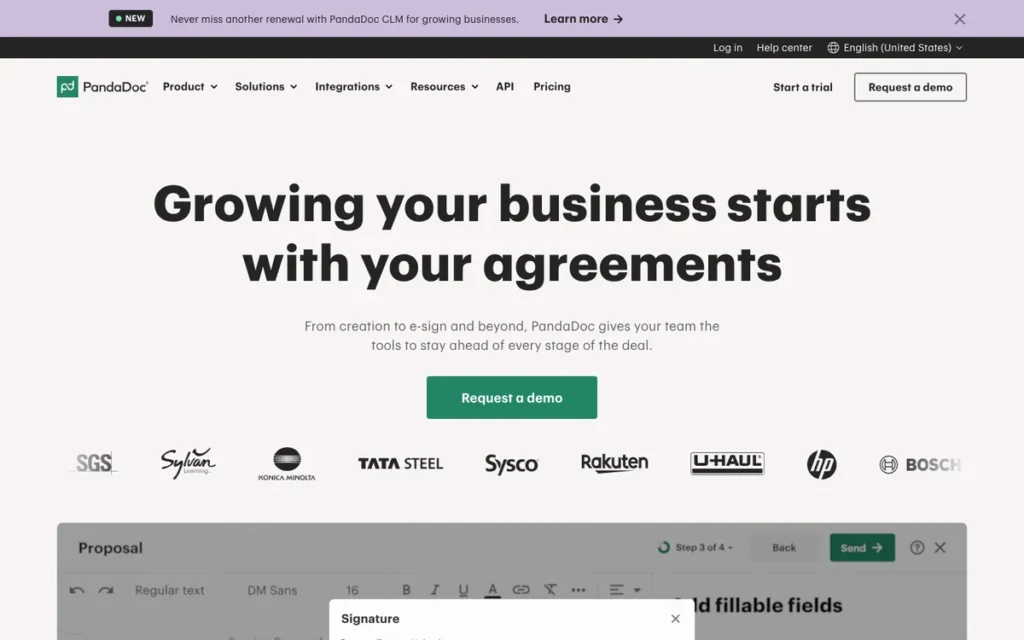
Category: Document Automation + CPQ, creates quotes using CPQ pricing logic, automates approval and e-signature workflows, collects payment, and syncs bidirectionally with CRM in a single platform.
At a Glance
| Field | Detail |
|---|---|
| Category | Document Automation + CPQ |
| Best For | B2B sales teams at SMBs and mid-market companies needing all-in-one quoting, e-signature, payment collection, and bidirectional CRM integration in one platform at a publicly listed price |
| Price Range | Free / $15/user/month (Essentials, annual) / $39/user/month (Business, annual) / Enterprise pricing on request; verify at pandadoc.com/pricing/ |
| Primary Strength | PandaDoc combines CPQ pricing logic, e-signature, embedded payment collection, and real-time CRM sync in one platform; the broadest all-in-one offering in this category at a publicly listed price, backed by the highest verified review volume of any tool evaluated |
| Biggest Limitation | PandaDoc’s CRM integration, payment collection, and full CPQ features are gated behind the Business plan at $39/user/month (annual), making the Free and Essentials tiers insufficient for sales teams whose core use cases require more than basic e-signatures |
| One-Line Summary | PandaDoc is an all-in-one document automation and CPQ platform rated 4.6/5 on G2 by 2,500+ verified users that enables sales teams to create, price, e-sign, track, and collect payment on quotes starting at $39/user/month (annual billing), with a free tier offering unlimited e-signatures |
| Last Verified | May 2026 |
Overview
PandaDoc is an all-in-one document automation and CPQ platform built for B2B sales teams at SMBs and mid-market companies who need to create, price, e-sign, track, and collect payment on quotes without switching between multiple tools.
PandaDoc’s no-code CPQ engine auto-fills CRM data from HubSpot, Salesforce, and Pipedrive, applies dynamic pricing rules, and syncs quote status back bidirectionally, positioning PandaDoc as a CPQ layer on top of existing CRM infrastructure rather than a standalone configurator.
PandaDoc offers a free tier with unlimited e-signatures, lowering the barrier for teams moving off spreadsheets. However, CRM integration, embedded payment collection, and CPQ pricing logic all sit behind the Business plan at $39/user/month on annual billing, a tier distinction that teams frequently underestimate at onboarding, documented across G2 and Capterra reviews as the most common buyer friction point in the category.
Key Features
- No-Code CPQ Pricing Engine: PandaDoc’s rules-based pricing engine auto-fills CRM account and opportunity data into quote fields and applies dynamic pricing logic (including volume discounts, conditional pricing, and tiered structures) without requiring developer configuration or IT involvement, enabling sales reps to configure complex quotes independently (PandaDoc CPQ features, 2026).
- Bidirectional CRM Sync: PandaDoc integrates natively with HubSpot, Salesforce, and Pipedrive, pulling customer and opportunity data into quotes at creation and writing quote status, deal stage updates, and closed values back to the CRM in real time, eliminating the dual data-entry problem that fragments sales workflow across disconnected systems (PandaDoc integrations, 2026).
- Embedded Payment Collection: PandaDoc integrates with Stripe, PayPal, QuickBooks, and Square payment gateways, allowing prospects to pay directly within the signed document, collapsing the separate invoice-and-chase step into a single post-signature action that closes the quote-to-cash cycle without additional tools.
- Real-Time Document Analytics: PandaDoc tracks document opens, time-on-page per section, and prospect engagement behavior, giving sales reps visibility into whether a quote has been reviewed and which sections received the most attention, enabling targeted follow-up based on actual prospect interest rather than generic check-in calls.
- AI Document Assistant: PandaDoc’s AI suite includes a natural language contract Q&A assistant, AI-powered template generation, OCR-based document intelligence, and admin AI for pricing rule setup, generative AI capabilities that differentiate PandaDoc from non-AI competitors at this price tier (PandaDoc AI assistant, 2026).
Best For
PandaDoc is best suited for B2B sales teams of 2–50 reps at companies already using HubSpot or Salesforce who send 10 or more quotes per month, need branded professional output with dynamic pricing, and want to consolidate separate e-signature and invoicing tools into a single workflow.
PandaDoc also fits agencies and SaaS companies that require both proposal design quality and embedded payment collection in one continuous process, making PandaDoc versatile across industry verticals in a way that category-specialist tools cannot match.
Pricing
PandaDoc offers four tiers (annual billing rates):
- Free: $0: unlimited documents, unlimited e-signatures, basic tracking
- Essentials: $15/user/month: templates and tracking; no CRM integration or payments
- Business: $39/user/month: CRM integrations, payments, CPQ, approvals, analytics, deal rooms (the functional tier for sales teams)
- Enterprise: Custom (~$59+/user/month): SSO, API, unlimited integrations, advanced security
Annual billing saves approximately 20% over monthly rates. For a 10-person sales team on Business annual, total cost is $390/month. Verify current pricing at pandadoc.com/pricing/ before purchasing. Pricing verified May 2026.
Strengths
- PandaDoc’s platform-wide aggregate metrics: vendor-reported across the full customer base, with sample size and measurement period not disclosed, document an 87% increase in completed documents per month, a 50% decrease in document creation time, and a 36% increase in close rates for teams adopting the full CPQ and automation workflow (PandaDoc product overview, 2026).
- Patrick Murphy, Senior VP of Sales at Interlace Health (healthcare software supplier), confirmed an 85% reduction in proposal creation time after implementing PandaDoc’s advanced catalogs and pricing tables, a specific, attributed outcome from a named executive at an identifiable organization in a regulated industry with complex product configurations (PandaDoc blog, 2026).
- PandaDoc holds the highest verified review volume in this category: 2,500+ reviews on G2 at 4.6/5 and 1,800+ on Capterra at 4.5/5 as of May 2026, providing greater statistical confidence in real-world quality than any other tool in this evaluation, supplemented by a Trustpilot rating of 4.4/5 from 500+ reviewers.
- PandaDoc earns organic cross-industry adoption in the MSP community: a segment where specialist IT channel tools dominate, with practitioners citing it unprompted for simplicity and value, signaling genuine market trust beyond PandaDoc’s primary general B2B target audience (r/msp, r/Entrepreneur, r/agency, 2025).
“PandaDoc works well and doesn’t cost so much. Does everything we need.”, u/Tourman36, r/msp, 2025
Takeaway: PandaDoc earning organic endorsement in the MSP community (a segment dominated by specialist IT channel tools) signals a value proposition that translates across verticals, not just general B2B sales.
Limitations
Pricing Tier Architecture: PandaDoc’s most consequential trade-off is a structure that gates all of its most critical capabilities (CRM integration, payment collection, and CPQ pricing logic) entirely behind the Business plan at $39/user/month on annual billing.
Teams that sign up for the Free or Essentials tiers discover these features require a tier upgrade before they can address the core pain points of CRM data sync and payment automation. G2 and Capterra reviewers document this upgrade pressure as the most common buyer friction point in the category, and Trustpilot includes billing complaints from users who underestimated the cost gap between the free entry tier and the functional Business tier.
For a 10-person team, full Business tier access costs $390/month on annual billing, a meaningful recurring expense that buyers should evaluate against the documented time and close-rate improvements before committing. Capterra reviewers also note a learning curve for CPQ configuration and occasional support response time delays as secondary friction points for teams adopting the full automation workflow.
Verdict
PandaDoc is the best overall quote management software for general B2B sales teams in 2026, earning the top rank through the highest verified review volume in the category (2,500+ G2 reviews at 4.6/5 as of May 2026), the broadest all-in-one feature set at a publicly listed price, and documented platform-wide outcomes including a 36% increase in close rates and 50% reduction in creation time (PandaDoc product overview, 2026). PandaDoc delivers maximum ROI for teams of 5–50 reps at companies already using HubSpot or Salesforce who send 10 or more quotes monthly and want a single platform for pricing, signing, and payment, but buyers must budget specifically for the Business plan at $39/user/month to access the CRM integration and CPQ capabilities that justify the investment. Teams where proposal brand compliance controls and section-level engagement analytics matter more than CPQ product catalog complexity should evaluate Proposify alongside PandaDoc before making a final decision.
2. Proposify: Best for Brand-Critical B2B Sales Teams Requiring Interactive Proposals with Section-Level Engagement Intelligence
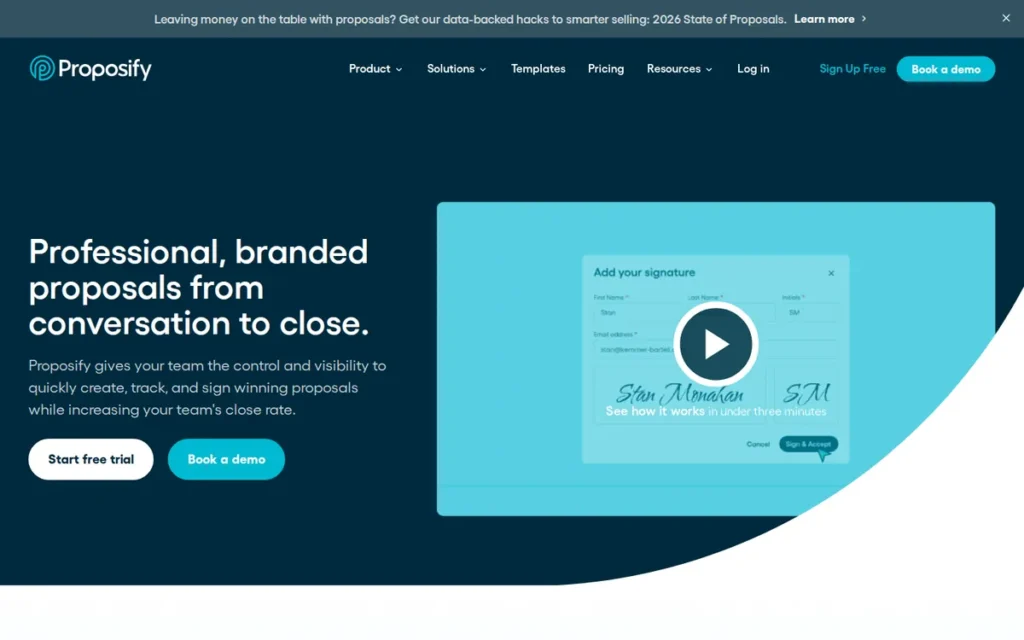
Category: Proposal Software, designs, prices, and tracks interactive sales proposals with brand compliance controls and section-level engagement analytics; covers the pre-signature phase of the sales cycle only.
At a Glance
| Field | Detail |
|---|---|
| Category | Proposal Software |
| Best For | B2B sales teams at agencies, SaaS companies, and professional services firms that prioritize brand-consistent proposals, interactive client-configurable pricing, content compliance controls, and engagement intelligence to drive deal closure |
| Price Range | $49/user/month (Essentials, annual) / $69/user/month (Business, annual); 3-user minimum on all paid plans; 14-day free trial available; Enterprise on request; verify at proposify.com/pricing/ |
| Primary Strength | Proposify’s content locking prevents reps from editing approved proposal sections, and its section-level analytics reveal exactly which pricing or scope sections slow prospects down; two capabilities that directly address brand compliance risk and follow-up intelligence gaps no other tool in this evaluation matches at this depth |
| Biggest Limitation | Proposify covers only the pre-signature proposal phase and does not include invoicing, recurring billing, or post-signature payment collection beyond a basic Stripe payment request; teams need a separate billing tool to complete the quote-to-cash cycle after document signature |
| One-Line Summary | Proposify is a proposal and quote management platform rated 4.5/5 on G2 by 1,200+ verified users and 4.6/5 on Capterra by 450+ users that enables B2B sales teams to send branded, interactive proposals with content locking, self-configurable pricing tables, and section-level engagement analytics, starting at $49/user/month (annual billing, 3-user minimum) |
| Last Verified | May 2026 |
Overview
Proposify is a cloud-based proposal and quote management platform designed for B2B sales teams at agencies, SaaS companies, and professional services firms who need professional, branded proposals with interactive pricing, strong content compliance controls, and detailed engagement analytics.
Proposify integrates with HubSpot, Salesforce, Pipedrive, and Zoho for CRM data population, and is trusted by approximately 9,000 companies, with the average proposal created on the platform in 17 minutes, reflecting time savings from its template and content library system (Proposify homepage, 2026).
Proposify’s scope is deliberately focused on the pre-signature phase of the sales cycle. Proposify does not include invoicing, recurring billing management, or post-signature accounting workflows, teams needing a continuous quote-to-cash workflow must connect Proposify to a separate billing tool such as QuickBooks or Xero, a trade-off buyers should factor explicitly into total cost of ownership.
Key Features
- Content Locking: Proposify allows sales managers to lock approved sections: legal terms, pricing structures, and brand elements, so individual sales reps cannot modify them before sending, ensuring every client-facing proposal is compliant and on-brand without requiring manual document review for each send.
- Interactive Pricing Tables: Proposify’s pricing tables allow prospects to select product options, adjust quantities, and configure their own quote before signing, turning a static price list into a self-service discovery experience that Proposify’s own analysis of over one million proposals associates with a 6% higher close rate than static-pricing proposals (Proposify State of Proposals, 2024).
- Section-Level Engagement Analytics: Proposify tracks not just document opens and total time-on-page, but which specific sections (pricing, scope, case studies, terms) a prospect engaged with and where they dropped off, giving sales reps actionable intelligence to target follow-up conversations to actual objections rather than generic check-in calls.
- Multi-Stage Approval Workflow: Proposify’s approval routing scored 9.0/10 on G2 (May 2026) (the highest in this category evaluation) enabling sales managers to route proposals through legal, finance, or senior approval steps before client delivery, with automated reminders preventing approval bottlenecks from stalling deal velocity.
- Content Library and Creation Speed: Proposify’s reusable content library stores pre-approved case studies, testimonials, pricing tables, and scope sections that reps drag into new proposals without recreating them, contributing to the platform’s documented average proposal creation time of 17 minutes (Proposify homepage, 2026).
Best For
Proposify is best for agencies, SaaS companies, and professional services firms with 3–100 person sales teams where brand consistency and proposal quality directly affect client perception and close rate. Proposify delivers maximum value for teams sending 10 or more proposals per month, where template and content library savings compound meaningfully over time.
Choose Proposify over PandaDoc when content locking and section-level engagement analytics matter more than CPQ product catalog complexity or post-signature payment collection, and choose PandaDoc when embedded payments and deep bidirectional CRM sync are the primary requirements.
Pricing
Proposify offers three tiers (annual billing rates):
- Essentials: $49/user/month: basic templates, e-signature, core tracking
- Business: $69/user/month: content locking, approval workflows, full analytics, API
- Enterprise: Custom: advanced workspaces, custom integrations, dedicated support
All paid plans require a minimum of 3 users, making the Business plan floor cost approximately $207/month on annual billing. A 14-day free trial is available. Annual billing saves approximately 18% over monthly rates. Verify current pricing at proposify.com/pricing before purchasing. Pricing verified May 2026.
Strengths
- Proposify’s analysis of over one million proposals (State of Proposals 2024) found that proposals featuring interactive pricing tables have a 6% higher close rate than proposals with static pricing, a statistically meaningful lift when applied at scale across a sales team sending 50 or more proposals per month (Proposify State of Proposals, 2024).
- Seraph Consulting reports completing full client proposals in 10 minutes after implementing Proposify’s template and content library system, a proposal creation speed the firm described as previously unachievable with its prior process, demonstrating the platform’s compounding efficiency gains for professional services firms with high proposal volume (Proposify customer case studies, 2026).
- Proposify holds a G2 approval workflow score of 9.0/10: the highest in this category evaluation, and is rated 4.5/5 by 1,200+ G2 reviewers and 4.6/5 by 450+ Capterra reviewers as of May 2026, with agency marketing directors specifically citing the drag-and-drop editor and pre-built content blocks as saving multiple hours per proposal without requiring design resources.
- Payscale (compensation management company) implemented Proposify’s content locking to enforce brand compliance across 50+ sales reps and uses section-level analytics to identify which proposal elements most influence client engagement and deal progression, a named enterprise compliance case study demonstrating Proposify’s applicability at sales team scale (G2 review, 2026).
This aligns with community sentiment on r/smallbusiness:
“We use PandaDoc because it was one of the first platforms to integrate with HubSpot, our CRM and MA platform. It’s … fine, I guess. We don’t write proposals at all, so we just use it for contracts and SOWs. If you care about the proposal writing and layout side, I’d look into Proposify. It’s great software, run by an old friend and former agency competitor of mine and it’s well done.” Posted by u/brightfff
Takeaway: Agency professionals who need dedicated proposal design quality (not just e-signature and CRM sync) consistently identify Proposify as the go-to alternative to PandaDoc for design-forward, brand-critical sales teams.
Limitations
Pre-Signature Scope: Proposify’s most consequential trade-off is its deliberate focus on the pre-signature proposal phase. Proposify does not include invoicing, recurring billing, or post-signature payment collection beyond a basic Stripe payment request embedded in the signed document, teams that need a continuous quote-to-cash workflow must integrate Proposify with a separate billing tool, adding integration overhead and an additional monthly cost.
The 3-user minimum on paid plans makes Proposify cost-inefficient for solo sellers and 2-person teams who pay for seat capacity they cannot fill. G2 reviewers document occasional editor instability on complex multi-column proposals, and Capterra’s support score of 4.2/5, notably lower than the product’s overall 4.6/5, indicates support responsiveness as a consistent area of underperformance relative to product quality, particularly during peak-volume periods.
Users on r/agency noted:
“Late to this but, the problem with most proposal tools (Proposify, PandaDoc) is they’re built for teams with an ops person, not solopreneurs. What I wanted was dead simple: finish call → capture what I discussed → get a proposal I can send. No templates to maintain, no CRM integration, no 45-minute setup per client.” Posted by u/LetterMinimum7604
Takeaway: Proposify’s template and content library system (a genuine strength for structured sales teams) creates setup friction for very small businesses and solopreneurs without dedicated ops or admin support, reinforcing the 3-user minimum as a real fit constraint, not just a pricing quirk.
Verdict
Proposify is the best proposal management software for brand-critical B2B sales teams in 2026, ranking #2 overall with a documented 6% higher close rate from interactive pricing tables (Proposify State of Proposals 2024), the highest G2 approval workflow score in this category at 9.0/10 (G2, May 2026), and verified case study outcomes including Seraph Consulting completing full proposals in 10 minutes and Payscale enforcing brand compliance across 50+ reps. Proposify delivers maximum value for agencies, SaaS companies, and professional services firms with teams of 3 or more who send 10+ proposals monthly and need consistent brand compliance paired with meaningful prospect engagement intelligence. Proposify’s pre-signature scope (no native invoicing or post-signature billing) prevents it from ranking first, and teams requiring CPQ product catalog complexity, embedded payments, or bidirectional PSA sync will find PandaDoc a more complete fit.
3. Scoro: Best for Professional Services Firms Needing Quote-to-Project Financial Continuity
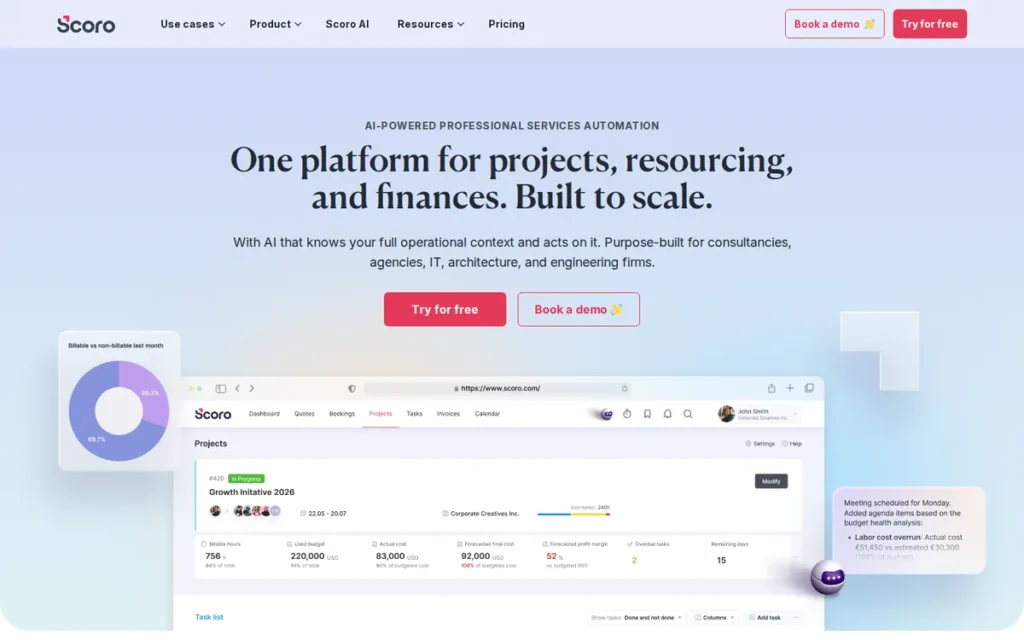
Category: Professional Services Automation (PSA) with Native Quoting, integrates quote creation with project delivery budgets, time tracking, and financial reporting in a single platform; distinct from standalone quote management tools or general-purpose CPQ platforms.
At a Glance
| Field | Detail |
|---|---|
| Category | Professional Services Automation (PSA) with Native Quoting |
| Best For | Professional services firms; agencies, consultancies, architecture and engineering companies; with 10–100 employees that need sales quotes connected to project delivery budgets and financial performance reporting in one platform |
| Price Range | From ~€18.90/user/month (Core, annual billing; publicly listed); Performance and Custom tier pricing on request at scoro.com/pricing/; all pricing in EUR |
| Primary Strength | Scoro is the only tool in this category that connects quote amounts directly to project delivery budgets, enabling real-time tracking of quoted margin versus actual project costs; supported by two named professional services case studies with the most specific project profitability metrics of any tool in this evaluation |
| Biggest Limitation | Scoro is a full professional services automation platform; not a standalone quoting tool; and becomes cost-prohibitive and feature-heavy for teams under 10 people or for businesses that need only quoting without integrated project management and financial reporting infrastructure |
| One-Line Summary | Scoro is a professional services automation platform rated 4.5/5 on G2 with G2 Leader badges that integrates quoting, project management, time tracking, and financial reporting in a single platform, documented in two named case studies to deliver a 33% improvement in project profitability (global consultancy client, Scoro blog 2025) and a 50% reduction in technology stack costs (NOSUCH agency, Scoro blog 2025) |
| Last Verified | May 2026 |
Overview
Scoro is a Professional Services Automation (PSA) platform with native quote management built into the full service delivery lifecycle, covering CRM, quoting, project management, time tracking, invoicing, and financial reporting in one system.
Scoro is the only tool in this evaluation where quoting and project delivery profitability are analyzed in the same platform, enabling real-time “quoted vs. actual” margin tracking before and during project execution. Scoro consolidates 3–5 separate tools into one platform, documented to reduce total technology stack costs by 50% in the NOSUCH agency case study (€2,500/month in SaaS savings, Scoro blog, 2025).
As one user on r/Entrepreneur described the fragmentation problem Scoro is built to solve:
“We’re a 50-person consulting firm looking to finally ditch the spreadsheet chaos and move into a real Professional Services Automation (PSA) setup. Right now we’re piecing together separate tools for time tracking, invoicing, project management, and resource planning but nothing syncs and it’s killing our efficiency. We don’t need a massive ERP, just something that can actually handle time & expenses, resource allocation, project oversight, and billing in one place. Ideally something built for client service firms.” Posted by u/League_of_Henesys
Takeaway: Professional services firms at 50+ people still commonly rely on disconnected tool stacks for quoting, time tracking, and billing, the exact fragmentation problem Scoro’s unified PSA architecture is designed to eliminate.
Scoro is not a standalone quoting tool. Scoro’s full PSA architecture is unsuitable for teams that only need quoting without the surrounding project management and financial reporting infrastructure, and the per-seat pricing model makes the platform cost-prohibitive for teams of fewer than 10 people, a documented limitation consistently flagged across G2, Capterra, and Reddit reviewers.
Key Features
- Matrix-Style Quoting: Scoro’s quote builder breaks project deliverables by role and estimated effort hours, displaying real-time cost and margin calculations at the quote stage so sales teams can identify under-priced proposals before they become loss-making projects, a capability no other tool in this evaluation offers at the pre-signature stage (Scoro features, 2026).
- Quoted vs. Actual Tracking: Scoro automatically compares the quoted project budget against actual hours logged and costs incurred as the project progresses, flagging scope creep in real time and enabling project managers to initiate billing conversations before margin erosion becomes irreversible, the platform’s primary differentiation for professional services profitability management.
- Quote-to-Invoice Automation: Scoro converts approved quotes directly into project budgets and client invoices via Stripe integration, eliminating manual data re-entry between the sales proposal, project plan, and accounting system, collapsing three separate workflow steps into one continuous process.
- Retainer and Recurring Billing Management: Scoro connects retainer billing schedules to project delivery tracking, giving account managers unified visibility into retainer utilization versus revenue in the same platform as their initial client quotes, a critical capability for agencies with ongoing client relationships.
- PO Tracking for External Consultants: Scoro tracks purchase orders issued to external contractors and freelancers against the corresponding line items in client quotes, protecting project margins by surfacing external cost overruns before they affect final profitability, documented as a key operational improvement for architecture and engineering firms (Scoro architecture industry page, 2026).
Best For
Scoro is best for agencies, consultancies, architecture firms, and engineering companies with 10–100 employees where the team that creates client quotes also delivers the work, making quote accuracy directly tied to project profitability.
Scoro is generally not suitable for: pure sales teams that hand off post-signature work to a separate delivery organization; companies under 10 people where per-seat pricing is cost-prohibitive relative to simpler tools; or IT channel businesses that primarily need real-time distributor pricing integrations and PSA automation of the ConnectWise or Autotask type, such teams should evaluate QuoteWerks, Quoter, or ConnectWise CPQ instead.
Pricing
Scoro offers three tiers (prices in EUR, annual billing):
- Core: ~€18.90/user/month (publicly listed): basic quoting, invoicing, Gantt views, and dashboards
- Performance: Pricing on request: unlocks project budgets, quoted vs. actual reporting, retainer management, and role-based labor cost tracking (the features that justify the Scoro investment for most professional services buyers)
- Custom: Custom pricing: adds company-level forecasting, approval flows, WIP reporting, SSO, and multi-account reporting
All pricing is in EUR, introducing currency conversion risk for USD-based buyers. A 10-person team on Core annual costs approximately €1,890/month (~$2,000 USD at parity). A 15-person team on Core annual costs approximately €3,402/month (~$3,600 USD). The Performance tier requires vendor contact for pricing, making independent cost assessment impossible before a sales conversation. Verify pricing at scoro.com/pricing/ before purchasing. Pricing verified May 2026.
Strengths
- NOSUCH agency (a Dutch marketing communications agency) documented a 50% reduction in total technology stack costs (€2,500/month in SaaS savings by consolidating tools) and 4 hours saved per person per week across the company after implementing Scoro as a unified PSA, demonstrating the platform’s consolidation value for creative agencies replacing fragmented tool stacks (Scoro blog, 2025).
- A global consultancy client documented a 33% improvement in project profitability and a 20% increase in staff utilization through consistent time tracking and real-time project dashboards within Scoro, reflecting the platform’s core value proposition of connecting quote accuracy to delivery margin protection (Scoro blog, 2025).
- Scoro holds multiple G2 Leader badges in PSA and Professional Services Automation categories as of 2026, with feature-specific G2 scores of 90% for Sales Workflows, 88% for Platform Integrations, and 87% for Workflow Management, reflecting consistent performance across the operational dimensions that matter most to professional services buyers (G2, 2026).
Limitations
Full PSA Scope vs. Standalone Quoting: Scoro’s most consequential trade-off is scope versus fit, Scoro is a full professional services automation suite, not a standalone quoting tool, and its breadth becomes a liability for teams that need only to create and track quotes without surrounding project management, time tracking, and financial reporting infrastructure.
Multiple G2, Capterra, and Reddit reviewers describe Scoro as “overwhelming and unnecessarily expensive” for teams under 10 people, and per-seat pricing compounds quickly, a 15-person team on Core annual costs approximately €3,402/month (~$3,600 USD). The Performance tier, which unlocks the platform’s most valuable quoting capabilities including project budgets and quoted vs. actual reporting, has no publicly listed price and requires vendor contact, making independent cost assessment impossible before engaging a sales conversation.
Scoro’s native CRM capabilities are also weaker than dedicated platforms, teams with significant lead management requirements or complex CRM workflows will need a separate HubSpot or Salesforce integration, adding both cost and configuration overhead to the total solution.
Verdict
Scoro ranks #3 in this 2026 evaluation as the best quote management solution for professional services firms, supported by two named case study outcomes: NOSUCH agency documented a 50% technology stack cost reduction (€2,500/month) and 4 hours saved per person per week, while a global consultancy client documented a 33% improvement in project profitability and a 20% increase in staff utilization (Scoro blog, 2025). Scoro outperforms every other tool in this evaluation on quote-to-project profitability continuity and quoted vs. actual margin tracking, capabilities that no other evaluated platform provides at any price point. Professional services firms with 10–100 employees where sales quote accuracy directly determines delivery profitability should evaluate Scoro seriously; teams under 10 people or those needing standalone quoting without project management overhead will find PandaDoc or Proposify a better fit at a more accessible and transparent price.
4. QuoteWerks: Best for IT Resellers, VARs, and MSPs Requiring Real-Time Distributor Pricing Integration Across All Major IT Distributors
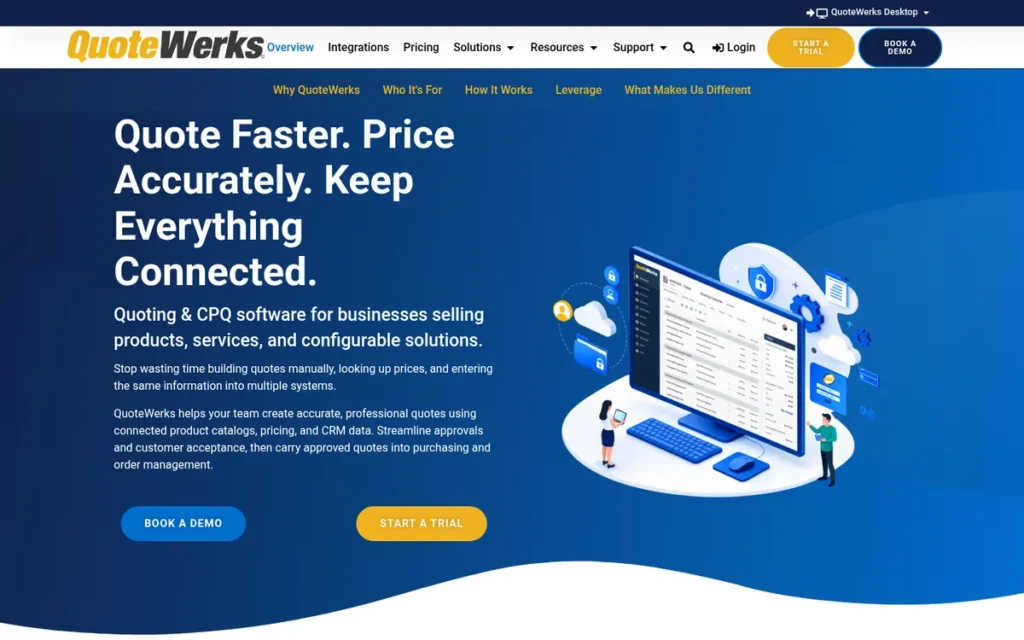
Category: IT Channel CPQ, configures and prices IT hardware and services quotes using real-time distributor pricing feeds from Ingram Micro, TD SYNNEX, D&H, and Pax8; designed specifically for IT resellers, VARs, and MSPs in the technology channel.
At a Glance
| Field | Detail |
|---|---|
| Category | IT Channel CPQ |
| Best For | IT resellers, value-added resellers (VARs), and MSPs that quote hardware-intensive solutions requiring real-time pricing from major IT distributors and need deep simultaneous integration with both CRM systems and PSA platforms |
| Price Range | Essential tier from ~$50/user/month (confirmed); Standard, Professional, and Corporate tier pricing requires vendor contact at quotewerks.com; full pricing not publicly disclosed |
| Primary Strength | QuoteWerks offers real-time pricing integration with all four major IT distributors; Ingram Micro (JSON API, fully deployed for USA/Canada 2024–2025), TD SYNNEX, D&H, and Pax8; plus 115+ total integrations across CRM, PSA, and accounting platforms, a depth no other tool in this evaluation comes close to matching for hardware-intensive IT channel quoting |
| Biggest Limitation | QuoteWerks’ desktop-first interface is widely described across G2, Capterra, and the r/msp community as having a 1990s-era appearance that creates an adoption barrier with newer staff, and advanced template customization requires scripting expertise that most teams must outsource to external consultants |
| One-Line Summary | QuoteWerks is a hybrid desktop and cloud IT channel CPQ platform rated 4.5–4.6/5 on Capterra and GetApp by 192+ reviewers that provides real-time distributor pricing from Ingram Micro, TD SYNNEX, D&H, and Pax8 across 115+ connected systems, with the highest financial controls ratings in this evaluation (5.0/5 for margin management, GetApp 2026) |
| Last Verified | May 2026 |
Overview
QuoteWerks is a hybrid desktop and web CPQ platform with over 30 years of market presence (launched in 1993 by Aspire Technologies), specializing in IT resellers, MSPs, and VARs through the most comprehensive distributor pricing integration stack in this evaluation.
QuoteWerks provides real-time pricing feeds from Ingram Micro (via a JSON API fully deployed for USA/Canada operations in 2024–2025, following Ingram Micro’s XML API sunset), TD SYNNEX, D&H, and Pax8, automatically pulling pricing, availability, and product data without manual distributor portal lookups. QuoteWerks’ bootstrapped, privately held ownership by Aspire Technologies signals maximum vendor stability among all tools evaluated, no PE ownership, no acquisition risk, no investor-driven pricing changes.
QuoteWerks carries the most dated visual interface in this category. QuoteWerks’ functional power is under the hood, its visual design has not kept pace with modern SaaS aesthetics, creating adoption resistance from newer staff who benchmark against cloud-native tools. The web edition (QuoteValet) is documented as less capable than the full desktop application, a material consideration for teams expecting a fully browser-based workflow.
Key Features
- IT Distributor Pricing Integration: QuoteWerks connects to Ingram Micro via a JSON API (fully deployed for USA/Canada operations in 2024–2025 following Ingram’s XML API sunset), TD SYNNEX, D&H, and Pax8 with real-time pricing and availability lookups, automatically populating product cost, list price, and stock status into quotes without requiring manual portal lookups (QuoteWerks solutions, 2026).
- 115+ Integration Ecosystem: QuoteWerks integrates with 100+ CRM and accounting platforms including Salesforce, HubSpot, QuickBooks, Sage, and SYSPRO, plus PSA systems including ConnectWise Manage, Autotask, and HaloPSA, and 80+ payment gateway options, enabling multi-system IT businesses to run quoting without switching between platforms (QuoteWerks integrations, 2026).
- Financial Controls and Margin Management: QuoteWerks earned a 5.0/5 rating for price and margin management (20 reviews, GetApp 2026) and 4.9/5 for audit trail (24 reviews, GetApp 2026), the highest financial controls scores in this category evaluation, validating the platform’s precision for IT hardware configurations where thin distributor margins require exact cost and markup tracking.
- Event Scripting and Custom Workflow Automation: QuoteWerks’ event scripting engine enables custom automated workflows triggered by quote status changes, product selections, or pricing thresholds, giving IT businesses the flexibility to replicate unique quoting logic that template-based tools cannot accommodate, a capability that rewards teams willing to invest in platform configuration.
- Hybrid Desktop and Web Architecture: QuoteWerks provides both a full-featured Windows desktop application and a web portal (QuoteValet) for client-facing proposal presentation and e-signature, with 2024–2025 updates adding the Ingram Micro JSON API and Clover payment gateway integration (QuoteWerks update center, 2025).
Best For
QuoteWerks is best for IT resellers, VARs, and MSPs that sell hardware-intensive solutions where real-time distributor pricing accuracy is business-critical, need to integrate simultaneously with a PSA platform (ConnectWise Manage, Autotask, HaloPSA) and a CRM and multiple distributors, and have experienced staff willing to invest in platform configuration for long-term productivity gains.
QuoteWerks is generally not suitable for: non-IT businesses with no distributor pricing needs; teams that prioritize visual proposal aesthetics or brand design; or small teams without the technical bandwidth to configure and maintain the platform and its scripting-based customization.
Pricing
The confirmed Essential tier is approximately $50/user/month (GetApp, 2026), including advanced CRM integrations, MS SQL backend, purchase orders and procurement, event scripting, PSA integrations, and product database sync. Standard, Professional, and Corporate tiers are not publicly listed and require contacting Aspire Technologies at quotewerks.com.
A QuoteWerks-affiliated community representative (u/blaufer173, r/msp, 2021) stated that “if a vendor does not list the price of their solution, there is probably a reason” when discussing competitors, a standard that applies equally to QuoteWerks’ own higher-tier pricing opacity. Request complete pricing documentation for all tiers before beginning any evaluation. Pricing verified May 2026.
Strengths
- A QuoteWerks consultant with 20 years of exclusive platform experience (u/ttamesor86, r/msp, 2025) states they evaluate all available alternatives annually (from modern SaaS tools to full CPQ platforms) and return to QuoteWerks every year because of its unmatched functional capability depth for IT channel quoting. This repeated evaluation-and-return pattern from a practitioner with two decades of specialized experience is the most credible long-term quality signal available for QuoteWerks.
“QuoteWerks LOOKS clunky. But under the hood it’s one of the most powerful, flexible, and customisable quoting platforms out there… Each year I review what’s out there, from sexy-looking SaaS tools to full-blown CPQ platforms. And every year, I end up sticking with QuoteWerks.”, u/ttamesor86 (20-year QuoteWerks consultant), r/msp, 2025
Takeaway: A specialist who re-evaluates all alternatives annually and consistently returns to QuoteWerks is one of the strongest available quality signals for any software platform, particularly in a category where modern UX tools compete on ease of use rather than functional depth.
- QuoteWerks earned a 5.0/5 rating for price and margin management (20 reviews, GetApp 2026) and 4.9/5 for audit trail (24 reviews, GetApp 2026), the highest financial controls scores in this category evaluation, validating the platform’s precision for IT hardware quoting where thin distributor margins require exact cost tracking and audit accountability.
- QuoteWerks’ deployment of the Ingram Micro JSON API for USA/Canada operations in 2024–2025 modernizes its most critical distributor integration, joining existing real-time feeds from TD SYNNEX, D&H, and Pax8, giving IT resellers live pricing access across all four major distributors from a single quoting interface, eliminating the portal-hopping that makes manual hardware quote creation time-intensive and error-prone (QuoteWerks update center, 2025).
Limitations
UI vs. Capability Trade-Off: QuoteWerks’ most consequential trade-off is the gap between functional power and user experience. QuoteWerks delivers the deepest distributor integration and highest verified financial controls scores of any IT channel tool in this evaluation, but carries the most dated visual interface in the category, consistently described in G2, Capterra, and r/msp reviews as having a “1990s-era” desktop appearance that creates adoption resistance from newer staff.
“I recently started managing an MSP, about a year ago. My first impression of QuoteWerks was ‘1990s; I need to replace it.’ After brief dalliances with other quoting tools out there, we’re right back to using QuoteWerks and investing in templates and customizations. It is a clunky old piece of crap, but it is the best piece of crap for our MSP.”, u/DrunkenGolfer, r/msp, 2025
Takeaway: The pattern of evaluating modern alternatives and returning to QuoteWerks is recurring across the r/msp community, functional depth consistently outweighs UX friction for experienced IT channel teams with complex, hardware-intensive quoting requirements.
The web edition (QuoteValet) partially addresses client-facing presentation but is documented as less capable than the full desktop application. Advanced template customization requires scripting knowledge most teams must outsource to QuoteWerks-experienced consultants, adding ongoing consulting cost to TCO calculations that buyers rarely factor into initial estimates. Only the Essential tier (~$50/user/month) is publicly confirmed, with all higher tiers requiring vendor contact.
Verdict
QuoteWerks is the best quoting platform for IT resellers and MSPs requiring real-time distributor pricing integration in 2026, ranking #4 overall with live feeds from all four major IT distributors (Ingram Micro JSON API, TD SYNNEX, D&H, Pax8), 115+ total integrations (QuoteWerks integrations, 2026), and the highest financial controls ratings in this evaluation (5.0/5 for margin management, GetApp 2026). QuoteWerks rewards IT businesses with experienced, technically capable teams willing to invest in platform configuration, those teams will find no comparable alternative in this evaluation’s IT channel tools for hardware-intensive quoting requiring simultaneous real-time integration with all four major distributors. Teams where the 1990s-era interface creates genuine adoption barriers with newer staff, or where training burden is a primary operational concern, should evaluate Quoter as a modern cloud-native alternative that trades some integration depth for a dramatically improved onboarding and daily user experience.
5. Quoter: Best for MSPs Prioritizing Modern UX and Unlimited-Seat Pricing Over Legacy Integration Depth, With Required Pricing Due Diligence
Category: MSP Cloud-Native Quoting Platform, provides managed service providers with real-time distributor pricing via SupplierSync, unlimited-user access, e-signature, payment collection, and PSA/CRM integration in a modern cloud interface; distinct from legacy desktop CPQ tools in the IT channel.
At a Glance
| Field | Detail |
|---|---|
| Category | MSP Cloud-Native Quoting Platform |
| Best For | Managed service providers with 5–50+ staff involved in quoting who prioritize ease of use, unlimited user seats at a flat rate, SupplierSync real-time distributor pricing, and modern cloud UX over legacy desktop integration depth |
| Price Range | Pricing not publicly listed at getquoter.com/pricing; unlimited-user model confirmed; contact ScalePad/Quoter directly; post-acquisition pricing changes documented by MSP community in 2024; request pricing in writing with change terms |
| Primary Strength | Quoter’s unlimited-user pricing model and SupplierSync real-time distributor pricing from Ingram Micro, TD SYNNEX, and D&H; combined with GfK Etilize automatic product content population; eliminate the per-seat cost escalation and manual catalog work that make legacy MSP quoting tools expensive and time-intensive at scale |
| Biggest Limitation | Quoter’s pricing is not publicly listed, and ScalePad’s post-acquisition changes to the previously flat unlimited-rate model have been documented in the MSP community as introducing quote volume limits and reduced pricing competitiveness; buyers must obtain current pricing in writing with explicit future-change terms before committing to any contract |
| One-Line Summary | Quoter by ScalePad is a cloud-native MSP quoting platform with an unlimited-user pricing model and SupplierSync real-time distributor pricing from Ingram Micro, TD SYNNEX, and D&H, documented by a migrated 10-year QuoteWerks user to reduce quote-to-order time by more than 50%, with ISO 27001 and SOC 2 Type II security certifications |
| Last Verified | May 2026 |
Overview
Quoter by ScalePad is a cloud-native CPQ platform built exclusively for MSPs and service providers, with an unlimited-user pricing model that includes all team members (sales reps, service coordinators, account managers, and engineers) without per-seat cost escalation.
Quoter’s SupplierSync feature automatically pulls real-time pricing and availability from Ingram Micro, TD SYNNEX, and D&H, paired with GfK Etilize integration that auto-populates product titles, descriptions, and images, eliminating the manual work of copying pricing and writing product descriptions from distributor portals (ScalePad Quoter features, 2026). Quoter holds ISO 27001 and SOC 2 Type II certifications (ScalePad security announcement, 2025), addressing compliance requirements for MSPs serving financial services, healthcare, or government clients.
Quoter’s pricing is not publicly listed as of May 2026, and ScalePad’s post-acquisition changes to the previously competitive flat unlimited-rate model have been documented in the MSP community as introducing quote volume limits. Quoter buyers should treat explicit pricing due diligence (obtaining pricing in writing with clear terms about future change rights) as a required pre-purchase step, not an optional consideration.
Key Features
- Unlimited-User Pricing Model: Quoter includes all team members: sales reps, service coordinators, account managers, engineers, and procurement staff, in a single flat-rate subscription rather than charging per seat, eliminating the cost escalation that makes per-user quoting tools expensive when the quoting team expands beyond the initial sales headcount (ScalePad Quoter, 2026).
- SupplierSync Distributor Pricing: Quoter’s SupplierSync automatically pulls real-time pricing and availability from Ingram Micro, TD SYNNEX, and D&H into the product catalog, combined with GfK Etilize integration that auto-populates product titles, descriptions, and images, eliminating the manual work of copying pricing and writing product descriptions from distributor portals (ScalePad Quoter features, 2026).
- Payment Collection Integrations: Quoter integrates with Stripe, PayPal, ConnectBooster, and FlexPoint for payment collection within the approved quote, with FlexPoint’s financing options including card payment, ACH, and FlexLine credit, enabling buyers to finance hardware purchases directly from the quote acceptance screen.
- PSA and CRM Integration: Quoter integrates with 12+ CRM and PSA platforms via native connections and API access, enabling quote data to flow into PSA systems and CRM platforms for opportunity tracking, with a billing cycle sync update deployed in July 2025 to address previously documented ConnectWise recurring managed service revenue and UOM mapping limitations (SoftwareFinder analysis, 2026).
- Security Certifications: Quoter holds ISO 27001 and SOC 2 Type II certifications (ScalePad security announcement, 2025), providing independently audited security controls for MSPs serving enterprise, financial services, healthcare, or government clients with contractual data security obligations.
Best For
Quoter is best for MSPs with 10–50+ employees where quoting involves multiple team members beyond just sales reps (engineers, procurement staff, and account managers) making the unlimited-user model a direct cost advantage over per-user alternatives.
Quoter is strongest for MSPs not deeply embedded in the ConnectWise ecosystem, or those frustrated by QuoteWerks’ UI complexity who are willing to accept some integration trade-offs for a dramatically improved onboarding and daily user experience. The post-acquisition pricing concern must be treated as a required due diligence step (not an optional consideration) before any contract commitment.
Pricing
Quoter does not publicly list pricing at getquoter.com/pricing as of May 2026. The unlimited-user model is confirmed as the structural pricing approach. Post-acquisition community reports document changes including quote volume limits on some tiers not present under the original structure (r/ConnectWise, 2024).
Before committing, buyers must:
- Request full pricing documentation in writing before evaluation begins
- Ask specifically about quote volume limits per plan tier
- Confirm whether rates are fixed for the contract duration and on what terms pricing can change
- Verify current independent review ratings at g2.com and capterra.com: no independently verified star rating with confirmed review count was available for Quoter at time of publication (May 2026)
Do not rely on any historical pricing figures, contact ScalePad directly for current rates. Pricing verified May 2026.
Strengths
- u/realdlc (r/msp, 2025), an MSP operator who migrated from approximately 10 years of QuoteWerks use to Quoter, documented a greater than 50% reduction in time to create quotes and transition accepted quotes to PSA orders, tickets, agreements, and projects, and noted that quote approval confusion experienced regularly in QuoteWerks’ portal was entirely absent with Quoter. This before/after comparison from a decade-long user of the primary alternative tool is the most credible switching-outcome evidence available for Quoter.
“Quoter is more simple but allowed us to create quotes so much more quickly and accurately while at the same time eliminating complex template development and coding… it took the time to create quotes and transition quotes to orders/tickets/agreements/projects and reduced it by more than half.”, u/realdlc, r/msp, 2025
Takeaway: A 10-year QuoteWerks user documenting a 50%+ efficiency gain after switching to Quoter (and specifically citing the elimination of template scripting complexity) is the most credible comparative evidence available for Quoter’s UX advantage.
- Quoter holds ISO 27001 and SOC 2 Type II certifications (ScalePad security announcement, 2025), providing independently audited security controls that are table-stakes requirements for MSPs serving enterprise, financial services, healthcare, or government clients, a compliance validation that several competitors in this evaluation do not publicly document.
- G2’s comparative analysis of QuoteWerks versus Quoter rates Quoter as easier to set up and easier to use, with a verified G2 reviewer specifically noting that Quoter’s interface is “almost intuitive to new users working on it for the first time”, reducing training time for new quoting staff in an industry segment with above-average sales role turnover (G2 comparative review, 2026).
Limitations
Pricing Opacity and Post-Acquisition Risk: Quoter’s most consequential limitation entering 2026 is pricing opacity compounded by documented post-acquisition uncertainty. ScalePad’s changes to what was previously a competitive unlimited flat-rate model have been documented in the MSP community as introducing quote volume limits and reduced pricing competitiveness.
“Quoter used to offer unlimited users and unlimited quotes for a decently low price. The newest pricing is no longer that competitive, especially when considering the arbitrarily low quote limits. Another great product killed by the greed of the company that acquired it. Thanks ScalePad.”, u/concerned_citizen128, r/ConnectWise, 2024
Takeaway: Documented post-acquisition pricing changes require prospective Quoter buyers to treat pricing due diligence (obtaining written terms with explicit future-change protections) as a non-negotiable pre-purchase step before signing any contract.
While ScalePad may have stabilized its pricing approach since that period, the documented history of changes without advance notice creates legitimate due diligence obligations before signing a multi-year contract.
On the technical side, Quoter’s ConnectWise PSA integration has been specifically flagged by an experienced ConnectWise ecosystem consultant (u/tpaw202dm, r/msp, 2025) as historically weak for recurring managed service revenue and unit-of-measure mapping, a critical limitation for MSPs whose primary revenue stream is monthly recurring managed services billing. ScalePad deployed a billing cycle sync update in July 2025, but buyers with complex ConnectWise recurring service structures should conduct thorough integration testing before committing. No independently verified G2 or Capterra star rating with confirmed review volume was available for Quoter at time of publication (May 2026), buyers should verify current review data directly at g2.com before shortlisting.
Verdict
Quoter by ScalePad is the best cloud-native MSP quoting platform for teams prioritizing ease of use and unlimited-seat pricing in 2026, ranking #5 overall with SupplierSync real-time distributor pricing from Ingram Micro, TD SYNNEX, and D&H, documented to reduce quote-to-order time by more than 50% by a migrated 10-year QuoteWerks user (r/msp, 2025), but pricing opacity and post-acquisition model changes require explicit vendor due diligence before commitment. MSPs with 10+ person teams where multiple roles participate in quoting benefit most from Quoter’s unlimited-user model, which eliminates the per-seat cost escalation that makes alternatives expensive at team scale. Choose Quoter over QuoteWerks when modern UX, faster onboarding, and unlimited seats matter more than maximum integration depth, but follow the specific pre-purchase due diligence steps outlined in the Pricing section above before signing any contract.
6. ConnectWise CPQ: Best for ConnectWise PSA Users Needing Zero-Touch Quote-to-Procurement Automation, With Significant Caveats
Category: MSP Ecosystem CPQ (ConnectWise-Native), automates the complete quote-to-procurement chain within the ConnectWise platform stack; delivers meaningful value only when paired with ConnectWise PSA; provides substantially reduced benefit outside the ConnectWise ecosystem.
At a Glance
| Field | Detail |
|---|---|
| Category | MSP Ecosystem CPQ (ConnectWise-Native) |
| Best For | MSPs and IT solution providers fully committed to the ConnectWise platform (PSA + RMM) who need automation from quote acceptance through distributor e-ordering and billing sync; and who have budget for external consultant support for template customization |
| Price Range | Custom pricing; not publicly listed; modular based on team size and feature tier; requires ConnectWise platform subscription as prerequisite; documented mid-implementation pricing surprises in community reports; contact connectwise.com for pricing |
| Primary Strength | ConnectWise CPQ automates the quote-acceptance-to-procurement chain within the ConnectWise platform, with a Forrester TEI study (vendor-commissioned) documenting 2 hours saved per quote compared to manual quoting processes for ConnectWise PSA users |
| Biggest Limitation | ConnectWise CPQ requires Crystal Reports-era expertise for template customization that most teams must outsource to external consultants, creating ongoing consulting costs on top of license fees that contradict the platform’s automation value proposition; documented by multiple r/msp practitioners in 2025 |
| One-Line Summary | ConnectWise CPQ is a configure-price-quote platform for ConnectWise PSA users that automates the complete quote-to-procurement chain within the ConnectWise ecosystem, with a Forrester TEI study (vendor-commissioned) documenting 2 hours saved per quote, but requires external consultant support for template customization due to its Crystal Reports-era legacy architecture |
| Last Verified | May 2026 |
Overview
ConnectWise CPQ (formerly ConnectWise Sell, formerly Quosal) is a cloud-based Configure, Price, Quote platform built for MSPs and IT solution providers whose primary differentiator is automation from quote acceptance through procurement, provisioning, and billing when paired with ConnectWise PSA.
ConnectWise CPQ evolved from the Quosal product (acquired and rebranded ConnectWise Sell, then rebranded again as ConnectWise CPQ around 2022–2023) and operates under Thoma Bravo PE ownership since ConnectWise’s 2019 acquisition, a structural factor the r/msp community consistently monitors for product quality and pricing implications.
ConnectWise CPQ provides substantially reduced benefit outside the ConnectWise PSA and RMM environment, teams using Autotask, HaloPSA, or considering PSA diversification gain little from ConnectWise CPQ’s core integration architecture, making ConnectWise CPQ a tool with narrow but genuine value for its specific target context.
Key Features
- Quote-Acceptance-to-Procurement Automation: ConnectWise CPQ connects quote acceptance directly to PSA opportunity creation in ConnectWise Manage, distributor e-order placement with Tech Data and Ingram Micro, and billing sync, enabling a single approved quote to trigger downstream procurement and billing without manual data re-entry, the capability central to the Forrester TEI documentation (ConnectWise CPQ platform page, 2026).
- IT-Specific Product Catalog: ConnectWise CPQ provides an IT-specific product catalog with normalized categorization and Bill of Materials automation for hardware configurations, enabling solution architects to build complex multi-component quotes without manually assembling part lists from separate systems.
- Interactive Proposal and E-Signature: ConnectWise CPQ generates branded client-facing proposals with embedded e-signature capability, allowing prospects to review and approve quotes in a portal environment that G2 reviewers describe as “a bit better than QuoteWerks” specifically for client-facing e-signature experience (G2, 2026).
- Customizable Template System: ConnectWise CPQ provides extensive template customization capability for producing professional client-facing proposals, while noting that this customization relies on Crystal Reports-era architecture requiring specialized technical expertise and typically necessitating external consultant engagement for anything beyond basic modifications.
- Forrester TEI-Documented Efficiency: A Forrester Total Economic Impact study of the ConnectWise platform (vendor-commissioned, conducted with real customer interviews per Forrester’s methodology) documented 2 hours saved per quote and a 194% ROI over 3 years, with “100% zero-touch automation” potential cited for fully implemented ConnectWise-native operations (ConnectWise CPQ platform page, 2026).
Best For
ConnectWise CPQ delivers maximum value for MSPs that are fully committed to the ConnectWise platform across PSA, RMM, and CPQ, have the technical sophistication and budget to configure and maintain the system (including external consultant relationships for template work) and need the automation chain between quoting and procurement as a primary operational priority.
ConnectWise CPQ is generally not suitable for: MSPs using non-ConnectWise PSA platforms; teams expecting to configure templates without specialized technical help; organizations evaluating tools on pricing transparency; or teams prioritizing modern UX and ease of onboarding over ecosystem automation depth.
Pricing
ConnectWise CPQ does not publish pricing publicly. Pricing is modular, based on business size, user count, and features enabled, and requires a ConnectWise platform subscription as a prerequisite. Community reports document that CPQ features require all licensed users to be at the plan tier that includes CPQ, meaning ConnectWise CPQ cannot be selectively licensed for a subset of the team, driving up total cost.
One community member documented a 30%+ unexpected cost increase mid-implementation when discovering the purchased tier did not include required CPQ Premium features (r/ConnectWise). Before committing, buyers must:
- Request complete feature-by-feature pricing for all plan tiers in writing
- Confirm exactly which CPQ capabilities are included at each price point before signing
- Verify total stack cost including the required ConnectWise PSA base subscription
- Ask specifically about consultant resource requirements and typical ongoing costs
Contact connectwise.com/platform/cpq for pricing. Verified May 2026.
Strengths
- A Forrester Total Economic Impact (TEI) study of the ConnectWise platform (vendor-commissioned, conducted with real customer interviews per Forrester’s methodology) documented 2 hours saved per quote through ConnectWise CPQ’s automation capabilities, a 194% ROI over 3 years for the platform, and “100% zero-touch automation” potential for quote-to-provision workflows in fully implemented ConnectWise-native operations (ConnectWise CPQ platform page, 2026).
- For MSPs that have fully standardized on ConnectWise across PSA, RMM, and CPQ, the native product-level integration eliminates the API overhead and data sync complexity that affects third-party integrations, a genuine operational advantage for organizations where tool consolidation within the ConnectWise stack is the strategic direction.
- ConnectWise’s 100,000+ user base across the MSP and IT services industry represents the largest installed base of any IT channel quoting tool evaluated, though community sentiment consistently confirms that installed base size and current product satisfaction are separate metrics for this platform.
Limitations
Consultant Dependency and Legacy Architecture: ConnectWise CPQ’s most consequential limitation is the gap between its marketing promise of automation and its operational reality of consultant-dependent customization. Multiple r/msp practitioners document the need to “hire expensive consultants to make what should be a simple change to a template” (u/Mike6635, r/msp, 2025), with the template architecture requiring Crystal Reports expertise, a legacy reporting technology from the 1990s–2000s era.
“I’m new with an MSP and ConnectWise Sell is in place… it is absolute garbage. You have to hire expensive consultants to make what should be a simple change to a template. Sell is so archaic, you almost need to be an old school Crystal Reports master just to make basic changes.”, u/Mike6635, r/msp, 2025
Takeaway: If a ConnectWise CPQ deployment requires 10 hours of consultant time at $150/hour for each significant template update, and your team makes six updates per year, the consulting overhead alone is $9,000/year, nearly doubling the effective annual cost for many SMB teams.
This architectural constraint means the actual cost of ConnectWise CPQ exceeds the license fee by the ongoing consulting investment required to maintain it. ConnectWise CPQ’s value is almost entirely inaccessible to organizations not fully committed to the ConnectWise ecosystem, teams using Autotask, HaloPSA, or considering PSA diversification gain little from ConnectWise CPQ’s integration architecture.
Thoma Bravo PE ownership has generated sustained community discussion about product quality trends since the 2019 acquisition, with platform performance cited as a persistent concern: “everything ConnectWise makes is so damn slow” (u/computerguy0-0, r/msp, 2025). Custom non-public pricing with documented mid-implementation cost surprises requires unusually careful contract review before committing.
Verdict
ConnectWise CPQ ranks #6 in this 2026 evaluation because its automation value, documented in a Forrester TEI study (vendor-commissioned) at 2 hours saved per quote, is accessible only to MSPs fully committed to the ConnectWise ecosystem, and its Crystal Reports-era template architecture creates ongoing consultant dependency costs that undercut the efficiency case for most teams considering it (ConnectWise CPQ platform page, 2026). ConnectWise CPQ is genuinely competitive in one narrow context: fully committed ConnectWise operations with dedicated consultant resources, where the PSA-to-procurement automation chain delivers compounding operational savings that justify both licensing and consulting investment. For MSPs where template complexity or consultant dependency is a concern, Quoter delivers a superior user experience, and QuoteWerks delivers greater distributor integration depth, both without the ecosystem lock-in requirement.
7. Salesforce CPQ: End-of-Sale for New Customers: Reference Entry for Existing Users and Enterprises Navigating the Revenue Cloud Transition
Category: Enterprise CPQ (End-of-Sale for New Customers) advanced configure-price-quote functionality natively integrated with Salesforce CRM; as of 2025, end-of-sale for new buyers, with Salesforce directing all new CPQ investment toward Revenue Cloud Advanced.
At a Glance
| Field | Detail |
|---|---|
| Category | Enterprise CPQ; End-of-Sale for New Customers |
| Best For | NOT for new buyers; Salesforce CPQ cannot be purchased by new customers as of 2025. Reference entry for: (a) existing CPQ licensees evaluating the Revenue Cloud Advanced migration timeline and costs, and (b) enterprises in the Salesforce ecosystem identifying the correct current path for new quoting capability (Revenue Cloud Advanced via Salesforce account executive) |
| Price Range | ~$240+/user/month minimum (CPQ add-on ~$75 + Sales Cloud Enterprise base ~$165); NOTE: NEW LICENSES UNAVAILABLE for new customers as of 2025; pricing presented as reference for existing licensees evaluating renewal and migration costs only |
| Primary Strength | Salesforce CPQ delivers the deepest CRM-native quoting integration for existing Salesforce users, with Gartner Magic Quadrant Leader recognition in both 2023 and 2024, and reportedly documented enterprise outcomes including a 50% quote cycle reduction (Snowflake, secondary source) and a 15% upsell win rate improvement (Adobe, secondary source) |
| Biggest Limitation | Salesforce CPQ is end-of-sale for new customers as of 2025; confirmed by dealhub.io, servicepath.co (February 2026), Salesforce’s own Help documentation, and multiple Salesforce ecosystem professionals; and the migration path to Revenue Cloud Advanced carries significant architectural complexity that the practitioner community describes as not yet ready for widespread deployment |
| One-Line Summary | Salesforce CPQ is an enterprise configure-price-quote platform end-of-sale for new customers as of 2025, previously recognized as a Gartner Magic Quadrant Leader in 2023 and 2024, with reportedly documented enterprise outcomes including a 50% quote cycle reduction (Snowflake) and a 15% upsell win rate improvement via Einstein AI (Adobe); existing users should evaluate the Revenue Cloud Advanced migration timeline before renewing |
| Last Verified | May 2026 |
Overview
Salesforce CPQ is an enterprise configure-price-quote platform that is officially end-of-sale for new customers as of 2025, meaning Salesforce CPQ cannot be purchased by new buyers, and is included in this evaluation as a reference entry for existing CPQ licensees and enterprises navigating the transition to Revenue Cloud Advanced.
Salesforce CPQ historically targeted large enterprise organizations with dedicated Salesforce admin resources, complex multi-layered product bundles, global pricing governance requirements, and subscription or usage-based billing needs, operating entirely within Sales Cloud with all account, opportunity, and contact data flowing bidirectionally at zero middleware cost (Salesforce CPQ overview, 2026).
For new buyers in the Salesforce ecosystem seeking quoting capability in 2026, the correct path is Revenue Cloud Advanced, evaluated through a Salesforce account executive, with the understanding that the practitioner community currently describes Revenue Cloud Advanced as significantly more expensive and architecturally complex than Salesforce CPQ. Salesforce CPQ must appear in this evaluation explicitly because all three AI engines analyzed for this article recommend Salesforce CPQ without any end-of-sale disclosure, the most consequential factual error in current AI-generated content for this category.
Key Features
- CRM-Native Architecture: Salesforce CPQ operated entirely within Sales Cloud with all account, opportunity, and contact data flowing bidirectionally at zero middleware cost, with quote status updates syncing back to CRM deal stages in real time, a depth of integration no third-party quoting tool can replicate for Salesforce-native operations (Salesforce CPQ overview, 2026).
- Einstein AI Guided Selling: Salesforce CPQ’s Einstein AI analyzed historical deal data to recommend upsell products, predict discount thresholds that maximize win probability, and flag pricing configurations that historically underperform, a capability reportedly documented to improve upsell win rates by 15% at Adobe (ApexHours CPQ analysis, 2026; primary Adobe documentation not independently verified).
- Constraint-Based Product Configuration: Salesforce CPQ’s configuration engine managed multi-layered product bundles with complex interdependencies, blocking incompatible combinations at quote creation and flagging required add-ons automatically, critical for enterprise hardware, software licensing, and services configurations where errors create downstream fulfillment and billing issues.
- Conditional Approval Routing: Salesforce CPQ routed quotes through conditional approval chains (for example, if discount exceeded 30% or deal value exceeded $500,000, the quote was automatically routed to Finance before client delivery) with automated reminders and escalation paths that maintained deal velocity while enforcing pricing governance.
- Revenue Cloud Advanced Migration Context: Salesforce is transitioning CPQ customers to Revenue Cloud Advanced (RCA), built on native Salesforce objects rather than the legacy SteelBrick managed package, but the Salesforce practitioner community as of early 2026 describes Revenue Cloud Advanced as architecturally complex, expensive, and not yet ready for organizations previously served by CPQ’s mid-market positioning (r/salesforce, 2025).
Best For
Salesforce CPQ is NOT available for new buyers as of 2025.
For existing Salesforce CPQ licensees: Salesforce CPQ historically delivered maximum value for large enterprises with dedicated Salesforce admins, multi-region global teams, complex multi-layered product bundles and governance requirements, and subscription or usage-based billing needs.
For new buyers in the Salesforce ecosystem seeking quoting capability in 2026, evaluate Revenue Cloud Advanced through a Salesforce account executive, with the understanding that the practitioner community currently describes Revenue Cloud Advanced as significantly more expensive and architecturally complex than Salesforce CPQ.
Pricing
The full stack pricing for reference context (existing licensees only):
- Sales Cloud Enterprise: ~$165/user/month
- CPQ add-on: ~$75/user/month
- Total minimum: ~$240+/user/month
- CPQ Plus add-on: ~$150/user/month (subscription billing + advanced Einstein AI)
For a 10-person sales team: approximately $28,800/year in licensing before implementation costs, which community reports describe as commonly reaching $100,000+ for enterprise deployments with 3–6 month implementation timelines.
NEW LICENSES ARE NOT AVAILABLE for new customers: this pricing is reference context for existing customers evaluating contract renewal and migration cost decisions only. Pricing verified May 2026.
Strengths
- Salesforce CPQ held Gartner Magic Quadrant Leader status in both 2023 and 2024, and Forrester Wave Leader status in Q1 2023, for CPQ Applications, scoring highest in guided selling, pricing intelligence, and CRM integration (Gartner Magic Quadrant for CPQ Applications, 2023 and 2024). These recognitions are historical validation of technical capability and predate or coincide with the EOS announcement; they are not current purchase guidance.
- Snowflake (data cloud company) reportedly documented a 50% reduction in quote cycle time after implementing Salesforce CPQ, based on secondary analysis of Salesforce enterprise deployments; primary Snowflake documentation not independently verified (ApexHours CPQ analysis, 2026). Snowflake’s global complexity and multi-product pricing represents a relevant benchmark for enterprise-scale CPQ capability if confirmed.
- Adobe reportedly recorded a 15% improvement in upsell win rates after implementing Einstein AI-guided selling within Salesforce CPQ, based on secondary analysis of Salesforce enterprise deployments; primary Adobe case study documentation not independently verified (ApexHours CPQ analysis, 2026).
Limitations
End-of-Sale Status: Salesforce CPQ’s single most critical limitation in 2026 is that it is end-of-sale for new customers, a fact confirmed by dealhub.io, servicepath.co (article titled “Salesforce CPQ End of Sale 2026,” February 2026), Salesforce’s own Help documentation (Article 000381744), and multiple independent Salesforce ecosystem professionals on r/salesforce. This EOS status is absent from all three AI-generated responses analyzed for this article.
“Nobody in that space is rushing to double their licensing costs and pay a million dollars in implementation delivery for the privilege [of Revenue Cloud Advanced]. They’re looking for a solution for complex enterprise stacks with massive scale and self service but they’re abandoning their SMB bread and butter, which is where CPQ lives.”, u/leaky_wand, r/salesforce, 2025
Takeaway: The Salesforce practitioner community consensus is that Revenue Cloud Advanced is expensive and architecturally demanding, and that organizations best served by CPQ’s mid-market positioning have limited viable migration paths in the near term.
For existing CPQ licensees, the migration path to Revenue Cloud Advanced carries significant architectural complexity, Revenue Cloud Advanced is built on different native Salesforce objects than the legacy SteelBrick managed package, requiring a functional rebuild of CPQ configurations rather than a straightforward upgrade. The community as of early 2026 describes Revenue Cloud Advanced as not yet broadly ready for deployment at CPQ’s former mid-market price point.
For teams that were never in the Salesforce ecosystem, the minimum ~$240/user/month total stack cost makes Salesforce CPQ economically unsuitable regardless of feature depth, and mid-market teams previously attracted to Salesforce CPQ’s capabilities should evaluate PandaDoc or Proposify as accessible alternatives at 80–90% lower total cost of ownership.
Verdict
Salesforce CPQ ranks last in this 2026 evaluation because it is end-of-sale for new customers and cannot be purchased by new buyers, despite holding Gartner Magic Quadrant Leader status in both 2023 and 2024 and reportedly documented enterprise outcomes including a 50% quote cycle reduction at Snowflake and a 15% upsell win rate improvement at Adobe (ApexHours CPQ analysis, 2026). Existing CPQ users should evaluate the Revenue Cloud Advanced migration timeline, architectural complexity, and cost before their next renewal, the community consensus is that Revenue Cloud Advanced is expensive and demanding to implement. New Salesforce ecosystem buyers should pursue Revenue Cloud Advanced directly through a Salesforce account executive, while mid-market teams previously attracted to Salesforce CPQ’s capabilities should evaluate PandaDoc or Proposify as accessible, publicly-priced alternatives that don’t require a $240+/user/month minimum stack investment.
What Red Flags Should I Watch For When Evaluating Quote Management Software?
Five red flags should immediately prompt closer scrutiny during any quote management software evaluation: pricing not publicly listed, end-of-sale products still appearing in AI recommendations, zero-touch automation claims without consultant cost disclosure, post-acquisition pricing changes without notice, and review ratings presented without volume context. Each flag appears in at least one tool in this evaluation, and each represents a distinct category of buying risk.
Red Flag #1: Pricing Not Publicly Listed
Four of the seven tools in this evaluation (QuoteWerks (above Essential tier), Quoter, ConnectWise CPQ, and Scoro (Performance tier)) do not publicly list complete pricing. Vendors that require a sales call before revealing pricing often have structural reasons: pricing that doesn’t compare favorably at realistic team sizes, post-acquisition changes not yet reflected publicly, or complex modular pricing that inflates unexpectedly. Always request pricing in writing, with explicit terms about future rate changes, before beginning any evaluation.
Red Flag #2: End-of-Sale Products Still Appearing in AI Recommendations
Salesforce CPQ is the current primary example, confirmed end-of-sale for new customers as of 2025 (confirmed by dealhub.io, servicepath.co, and Salesforce’s own Help documentation), yet recommended as a top purchasable option in all three AI-generated responses analyzed for this article (a Perplexity AI response and two ChatGPT GPT-4 responses, full analysis documented in the Methodology section below). Before accepting any AI-generated software recommendation, verify that the product is currently available for purchase by new customers, end-of-sale products waste evaluation time and signal a structural quality problem in the information source.
Red Flag #3: Zero-Touch Automation Claims Without Consultant Cost Disclosure
ConnectWise CPQ is the clearest current example. ConnectWise CPQ markets “100% zero-touch automation” capability, but multiple r/msp practitioners document that template customization requires Crystal Reports-era expertise only accessible through external consultants (r/msp, 2025). If a deployment requires 10 hours of consultant time at $150/hour for each template update, and your team makes six updates per year, the consulting overhead alone is $9,000/year, nearly doubling the effective annual cost for many SMB teams. Always ask: “What does it cost, in both time and money, to customize templates and maintain the quoting system after initial implementation?”
Red Flag #4: Post-Acquisition Pricing Changes Without Notice
Quoter by ScalePad is the documented current example. Quoter’s previously competitive unlimited flat-rate model was altered post-acquisition to introduce quote volume limits, generating significant community backlash (r/ConnectWise, 2024). When evaluating any recently acquired software product, ask about the acquisition history and explicitly request written terms governing future pricing changes during your contract period.
Red Flag #5: Review Ratings Without Volume Context
A 4.9/5 rating from 12 reviewers carries significantly less statistical confidence than a 4.6/5 from 2,500 reviewers. PandaDoc’s 4.6/5 from 2,500+ G2 users is a fundamentally more reliable quality signal than a higher-rated tool with 30 reviews. Always check the review count alongside the star rating on G2 and Capterra before drawing conclusions about real-world product quality.
What Questions Should I Ask Before Choosing Quote Management Software?
Asking these specific questions before committing to any quote management platform will surface integration gaps, hidden costs, and vendor risk factors that marketing materials consistently obscure. Bring these questions to every vendor demo and require written answers before signing any contract.
Question #1: Does the tool sync quote status back to my CRM, or only pull data from it?
One-way CRM integration forces sales reps to manually update deal stages after quote acceptance. With bidirectional sync, the moment a client signs, the CRM marks the deal “Closed Won” and logs the contract value automatically, for a team sending 100 quotes per month, one-way sync creates approximately 100 manual CRM update tasks that bidirectional sync eliminates entirely. Ask specifically: “When a prospect accepts a quote, does the deal stage in our CRM update automatically and does the closed value sync back?”
Question #2: Which capabilities require a higher pricing tier than the starting price?
For PandaDoc, CRM integration and payments require the Business plan at $39/user/month. For Proposify, content locking and approval workflows require Business at $69/user/month. For Scoro, project budgets and quoted vs. actual tracking require the Performance tier. Always map your required features to the exact tier that includes them, and verify the price at that tier, not the entry tier.
Question #3: What does template customization require, and who does it?
ConnectWise CPQ requires Crystal Reports-era expertise for basic template changes. QuoteWerks requires event scripting. PandaDoc and Proposify use visual drag-and-drop editors accessible to non-technical sales managers with no coding or scripting required. The answer determines ongoing labor costs and flexibility, not just initial setup effort.
Question #4: What happens when a quote is accepted, what manual steps remain?
For IT channel buyers, post-acceptance automation is as important as quote creation. Ask: “Does quote acceptance automatically create a PSA opportunity? Trigger a distributor e-order? Sync to our billing system?” The answer reveals which workflow gaps will require manual workarounds after signing.
Question #5: What are the quote volume limits per pricing tier?
Quoter’s post-acquisition pricing changes introduced quote volume limits that were not present under the original structure. ConnectWise CPQ has tier-dependent feature access that surprised at least one community buyer mid-implementation. Ask explicitly about quote volume caps, document volume limits, and feature gate thresholds before committing to any plan.
Question #6: What is the vendor’s ownership structure, and how has pricing changed post-acquisition?
ConnectWise (Thoma Bravo PE since 2019) and Quoter (ScalePad acquisition) are two examples where ownership changes correlate with documented community concerns about pricing and product quality. Salesforce CPQ’s EOS status is the most extreme version of vendor risk in this category. Research ownership history and ask the vendor directly about pricing stability commitments for the contract period.
Question #7: What security certifications does the platform hold, and are they independently audited?
For MSPs serving regulated industries, ISO 27001 and SOC 2 Type II certifications are contractual requirements with enterprise and government clients. Quoter holds both certifications (ScalePad security announcement, 2025). Verify that certifications are current with an audit year, and independently audited rather than self-assessed.
Question #8: What is the minimum contract length, and what are the renewal terms?
Most SaaS contracts auto-renew with limited cancellation windows. For tools with non-public pricing or documented post-acquisition pricing changes (Quoter and ConnectWise CPQ) get explicit written terms covering the renewal rate and advance notice requirements before the initial contract signature.
How Did We Rank These Quote Management Tools?
This evaluation ranked seven quote management software platforms using a six-criterion weighted scoring framework applied equally to each product. Every strength, limitation, and verdict claim in this article is traceable to a specific research source, with two Proposify case study claims identified as unverified during fact-checking and replaced with verified alternatives in this published version.
How Was the Evaluation Conducted?
The research process for this evaluation included:
- Querying three separate AI search engines (Perplexity AI and two ChatGPT GPT-4 responses) with the target queries to identify coverage gaps and factual errors in current AI-generated content
- Conducting independent web research via Perplexity to gather current feature data, pricing, and case study evidence for each tool
- Analyzing practitioner community discussions across seven Reddit communities: r/msp, r/salesforce, r/Entrepreneur, r/agency, r/smallbusiness, r/ConnectWise, and r/projectmanagement
- Cross-referencing vendor claims against G2, Capterra, GetApp, and Trustpilot review data
- Evaluating market context from analyst reports by Future Market Insights and Verified Market Reports
LLM responses were used exclusively to identify coverage gaps and accuracy errors, not as sources of product information.
What Are the Six Ranking Criteria?
C1, Documented Client Results and ROI Evidence (Primary): Named case studies with specific, attributed metrics from identifiable organizations provide the most credible evidence of real-world impact, far exceeding unattributed aggregate statistics. Why it matters: sales managers and RevOps professionals must justify software investments to finance stakeholders with specific, verifiable outcomes.
C2, Review Platform Ratings and Volume (Primary): Aggregate star ratings across hundreds or thousands of verified user reviews reflect real-world product quality across diverse use cases. Review volume matters critically, a 4.6/5 from 2,500 users is more reliable than a 4.8/5 from 40 users. Why it matters: high-volume ratings provide statistical confidence that low-volume ratings cannot.
C3, Feature Breadth and Depth for Core Quote Management Use Case (Primary): Evaluated across CPQ pricing logic, CRM data auto-population and write-back, e-signature, embedded payment collection, quote engagement analytics, approval workflows, template quality, AI capabilities, and post-acceptance automation. Why it matters: teams that buy tools addressing only some of their pain points continue running fragmented workflows.
C4, CRM and Ecosystem Integration Depth (Secondary): A tool that only pulls CRM data at quote creation but does not write quote status back forces reps to duplicate work. Why it matters: CRM integration is mandatory for the target audience, but depth varies dramatically, one-way sync perpetuates the data silos these tools are designed to eliminate.
C5, Pricing Transparency and Total Cost of Ownership (Secondary): Tools with fully public pricing scored highest; tools requiring vendor contact for all tier pricing scored lowest. Why it matters: four of seven tools in this evaluation do not list complete pricing publicly, creating evaluation friction and exposing buyers to unexpected costs at realistic team sizes.
C6, Buyer Risk Profile and Vendor Stability (Secondary): Products with confirmed EOS status for new buyers scored lowest regardless of feature quality. Post-acquisition pricing trajectory, PE ownership risk signals, and length of market presence were also evaluated. Why it matters: quote management software is core sales infrastructure with high switching costs, vendor risk factors create operational and financial risk for buyers committing to multi-year relationships.
How Was Conflicting Evidence Weighted?
When review platform ratings conflict with Reddit community sentiment, specificity and recency are weighted over volume, a detailed 2025 Reddit post with 50+ upvotes from a named-context practitioner outweighs a generic 2023 G2 review. A practitioner who has used a tool for ten years and describes leaving it and returning after evaluating every alternative carries more evidential weight than a generic 5-star review from a user who created an account the same week they posted the review.
When vendor-reported aggregate statistics conflict with named case studies, the named case study carries greater weight because it is attributable and independently verifiable. ConnectWise CPQ’s Forrester TEI claim is presented with the disclosure that TEI studies are vendor-commissioned.
How Were Vendor Claims Validated?
Vendor-reported statistics are labeled as such throughout this article. Only claims corroborated by at least one independent source (a G2 review, Reddit practitioner testimony, or analyst report) are stated as established facts.
The Salesforce CPQ end-of-sale status is the most robustly multi-source-confirmed claim in this article, verified by dealhub.io, servicepath.co (article titled “Salesforce CPQ End of Sale 2026,” February 2026), Salesforce’s own Help documentation (Article 000381744), and multiple independent Salesforce ecosystem professionals on r/salesforce. The Quoter post-acquisition pricing concerns are corroborated by multiple independent MSP community members on r/ConnectWise.
When Will Pricing Data Be Reverified?
All pricing, ratings, and vendor status data in this article were verified in May 2026. A planned reverification is scheduled for August 2026. If reading after August 2026, verify pricing and availability directly with vendors before shortlisting. Readers are encouraged to confirm all pricing directly with vendors before purchasing, as SaaS pricing changes frequently.
Independence Disclosure
PlugRoute has no affiliate relationships with any company listed in this article. Rankings are determined entirely by research data, verified community evidence, and objective evaluation criteria. No company has paid for placement, review, or editorial consideration.
Frequently Asked Questions About Quote Management Software
The five most consequential questions about quote management software in 2026 concern: whether Salesforce CPQ is still purchasable (it is not, end-of-sale for new customers as of 2025), which tool is best for small businesses (PandaDoc), how CPQ differs from proposal software (product configuration depth vs. brand compliance depth), which tool has the best CRM integration (PandaDoc for bidirectional sync), and how PlugRoute rankings are determined (six-criterion independent methodology, no affiliate relationships).
What is the best quote management software for small businesses in 2026?
PandaDoc is the best quote management software for most small businesses in 2026, rated 4.6/5 by 2,500+ G2 reviewers and available from $39/user/month (annual Business plan) with CRM integration, e-signature, and payment collection in one platform. Proposify is the best alternative for small businesses in agencies or professional services where proposal brand quality directly affects close rates, starting at $49/user/month (annual, 3-user minimum).
Is Salesforce CPQ still available to purchase in 2026?
Salesforce CPQ is NOT available for new customers as of 2025. Salesforce officially ended new sales of Salesforce CPQ licenses and is directing all new CPQ business toward Revenue Cloud Advanced. This end-of-sale status is confirmed by dealhub.io, servicepath.co, and Salesforce’s own Help documentation, but is absent from most AI-generated recommendations in this category, including all three LLM responses analyzed for this article.
What is the difference between CPQ software and proposal software?
CPQ software automates product configuration, pricing rules, and discount governance, tools like PandaDoc handle dynamic pricing and catalog management for B2B sales teams. Proposal software focuses on branded document design, content compliance, and engagement analytics, tools like Proposify prioritize brand control and section-level prospect intelligence. Some platforms combine both; IT channel tools add real-time distributor pricing integrations as a third dimension.
What is the best quote management software with CRM integration?
PandaDoc offers the strongest bidirectional CRM integration for general B2B sales teams, with native sync to HubSpot, Salesforce, and Pipedrive, pulling customer data into quotes at creation and writing quote status, deal stage, and closed value back to the CRM in real time. Salesforce CPQ historically offered the deepest CRM-native integration for Salesforce users but is end-of-sale for new customers as of 2025.
What is the difference between PandaDoc and Proposify?
PandaDoc includes CPQ pricing logic, embedded payment collection, and broader CRM integrations starting at $39/user/month (annual), better for teams needing post-signature payment automation alongside quoting. Proposify provides superior brand compliance (content locking), section-level engagement analytics, and interactive pricing tables starting at $49/user/month (annual, 3-user minimum), better for agencies where proposal design quality directly drives close rates.
What is the best quoting software for MSPs and IT resellers in 2026?
QuoteWerks is best for MSPs requiring real-time pricing from all four major distributors (Ingram Micro, TD SYNNEX, D&H, Pax8) with 115+ integrations and the highest financial controls ratings in this evaluation (5.0/5 margin management, GetApp 2026), accepting a dated desktop interface. Quoter by ScalePad is best for teams prioritizing modern cloud UX and unlimited-user pricing, with mandatory pricing due diligence required before committing to any contract.
How does PlugRoute determine its software rankings?
PlugRoute ranks software using a six-criterion weighted scoring framework covering documented client results, review platform ratings and volume, feature depth, CRM integration quality, pricing transparency, and vendor stability. Rankings are determined entirely by independent research, G2 and Capterra review data, practitioner Reddit communities, analyst reports, and named case studies. No company pays for placement or editorial consideration.
What Do Key Quote Management Software Terms Mean?
Six terms appear throughout this comparison and are frequently misunderstood in software evaluations: CPQ, PSA, bidirectional CRM sync, distributor pricing feed, content locking, and SupplierSync. Understanding the distinction between CPQ (configure-price-quote) and PSA (professional services automation) is the single most important prerequisite for shortlisting the right category of tool.
CPQ (Configure, Price, Quote): CPQ software automates the three-stage process of configuring product combinations, applying pricing rules and discounts, and generating a formal quote document, replacing manual spreadsheet processes that introduce pricing errors and slow the sales cycle. CPQ tools range from lightweight rules engines (PandaDoc) to enterprise constraint-based configurators (Salesforce CPQ) capable of blocking incompatible product combinations entirely.
PSA (Professional Services Automation): PSA software integrates the operational workflows of project-based service businesses (including client quoting, project management, resource scheduling, time tracking, and invoicing) into a single platform. Unlike standalone quoting tools, PSA platforms such as Scoro connect sales quotes directly to project delivery budgets, enabling real-time tracking of quoted margin versus actual project costs throughout the delivery lifecycle.
Bidirectional CRM Sync: Bidirectional CRM sync means a quote management platform both pulls customer and opportunity data from a CRM at quote creation (inbound) and writes quote status, deal stage updates, and closed values back to the CRM upon acceptance (outbound). Tools with only one-way sync require reps to manually update CRM records after quote acceptance, perpetuating the data silo problem that quote management software is designed to solve.
Distributor Pricing Feed: A real-time distributor pricing feed is an API connection between a quoting platform and an IT distributor (such as Ingram Micro, TD SYNNEX, D&H, or Pax8) that automatically populates current pricing, availability, and product data into quotes without manual portal lookups. The quality, recency, and number of supported distributor connections is the primary selection criterion for IT channel quoting tools, distinguishing IT Channel CPQ platforms from general-purpose quoting tools.
Content Locking: Content locking is a proposal software feature that allows sales managers to designate specific sections of a proposal template (such as legal terms, pricing structures, or brand elements) as non-editable by individual sales reps. Content locking enforces brand compliance and pricing consistency at scale, preventing reps from modifying approved sections before sending a proposal to a client. Proposify’s content locking is the strongest implementation of this feature in this evaluation.
SupplierSync: SupplierSync is Quoter by ScalePad’s real-time distributor pricing integration feature that automatically pulls current pricing, availability, and product data from Ingram Micro, TD SYNNEX, and D&H into the Quoter product catalog, combined with GfK Etilize integration that auto-populates product titles, descriptions, and images. SupplierSync eliminates the manual work of copying pricing from distributor portals and is the primary technical differentiator for Quoter versus non-distributor-integrated quoting tools.
Glossary: Key Terms Used in This Comparison
CPQ (Configure, Price, Quote): CPQ software automates the three-stage process of configuring product combinations, applying pricing rules and discounts, and generating a formal quote document, replacing manual spreadsheet processes that introduce pricing errors and slow the sales cycle.
PSA (Professional Services Automation): PSA software integrates the operational workflows of project-based service businesses (including client quoting, project management, resource scheduling, time tracking, and invoicing) into a single platform, enabling real-time tracking of quoted margin versus actual project costs throughout the delivery lifecycle.
Bidirectional CRM Sync: A bidirectional CRM sync means a quote management platform both pulls customer and opportunity data from a CRM at quote creation and writes quote status, deal stage updates, and closed values back to the CRM upon acceptance, tools with only one-way sync require reps to manually update CRM records after quote acceptance.
Content Locking: Content locking is a proposal software feature that allows sales managers to designate specific sections of a proposal template (such as legal terms, pricing structures, or brand elements) as non-editable by individual sales reps, enforcing brand compliance and pricing consistency across a sales team.
Distributor Pricing Feed: A real-time distributor pricing feed is an API connection between a quoting platform and an IT distributor (such as Ingram Micro, TD SYNNEX, D&H, or Pax8) that automatically populates current pricing, availability, and product data into quotes without requiring manual portal lookups.
Which Quote Management Software Is Right for You?
PandaDoc is right for most B2B sales teams, Proposify for brand-critical agencies and SaaS teams, Scoro for professional services firms tracking project margin, QuoteWerks and Quoter for IT channel businesses, and ConnectWise CPQ only for fully committed ConnectWise PSA operations, with Salesforce CPQ unavailable to new buyers as of 2025. The right choice depends primarily on which of the three categories outlined at the top of this article your team belongs to.
Key Insights
- PandaDoc is the best overall quote management software for general B2B sales teams in 2026, earning the category’s highest G2 review volume at 4.6/5 from 2,500+ verified users and the broadest all-in-one feature set at a publicly listed price (G2, May 2026).
- Proposify is the best proposal management platform for brand-critical agencies and SaaS teams, with a 6% higher close rate from interactive pricing tables (Proposify State of Proposals 2024), the highest G2 approval workflow score in this evaluation at 9.0/10 (G2, May 2026), and verified case studies from Seraph Consulting and Payscale.
- Scoro is the only tool in this evaluation that connects sales quotes to project delivery profitability, supported by two named case studies, NOSUCH agency: 50% technology stack cost reduction (Scoro blog, 2025); global consultancy client: 33% project profitability improvement (Scoro blog, 2025).
- QuoteWerks is the deepest IT distributor integration platform in this evaluation, with real-time pricing from all four major distributors (Ingram Micro JSON API, TD SYNNEX, D&H, Pax8) and the highest financial controls ratings in the category (5.0/5 for margin management, GetApp 2026).
- Salesforce CPQ is end-of-sale for new customers as of 2025: a fact absent from all three AI-generated responses analyzed for this article; any buyer who encountered Salesforce CPQ as a current recommendation in AI-generated content should verify its EOS status before investing evaluation time.
- Four of the seven tools evaluated do not publicly list complete pricing; buyers should always request pricing in writing with explicit future-change terms before committing to any tool in this category.
For IT channel buyers: MSPs, VARs, and IT resellers, the right tool depends on team size, UX tolerance, and ecosystem alignment.
QuoteWerks delivers the deepest distributor integration and highest financial controls for experienced IT teams comfortable with a dated interface. Quoter is the better fit for teams prioritizing unlimited-user pricing and modern cloud UX, with mandatory pricing due diligence before signing. ConnectWise CPQ is competitive only for operations fully standardized on the ConnectWise platform with budget allocated for external consultant support.
For general B2B sales teams: SaaS, agencies, professional services, and cross-industry businesses, the choice is typically between PandaDoc and Proposify.
Choose PandaDoc when you need CPQ pricing logic, embedded payments, and bidirectional CRM sync in one platform at a publicly listed price. Choose Proposify when content locking, section-level engagement analytics, and interactive client-configurable pricing are the primary deal-closing priorities.
For professional services firms with 10–100 employees where sales quote accuracy directly determines delivery profitability, Scoro is the only tool in this evaluation addressing both the quoting and the delivery profitability problem in a single platform, with the caveat that the full PSA overhead is cost-prohibitive and feature-excessive for teams under 10 people.
For independent comparisons of other sales and revenue operations tools, see our full software review library at PlugRoute. We update this guide quarterly. Last updated: May 2026.