Mediafly leads as the most comprehensive full-lifecycle value selling platform for enterprise teams; Consensus is the most peer-validated presales automation tool with 1,700+ G2 reviews at 4.7/5; ValueCore offers the fastest mid-market ROI calculator deployment at an estimated mid-market price tier. The right choice depends on your team’s primary gap.
Value selling tools span a broader landscape than most buyers expect, ROI calculators, interactive demo automation, CRM-embedded value realization platforms, enterprise price optimization, and revenue methodology frameworks each solve distinct problems. One diagnostic question determines your starting point: can three of your reps independently quantify, in dollar terms, the financial cost of a prospect’s inaction? Inconsistent answers mean methodology comes before software.
PlugRoute has no affiliate relationships with any company listed, rankings are determined entirely by research data and objective evaluation criteria.
“A few focused assets (like calculators, quizzes, or ROI tools) bring in more qualified leads than months of content.” (u/Soft_Apocalypse_, r/b2bmarketing, April 2026)
Takeaway: B2B practitioners are shifting investment from volume content to high-intent interactive tools, ROI calculators and value quantification assets that generate qualified pipeline signals rather than passive awareness metrics.
TL;DR: Top Picks at a Glance
- Mediafly is the only tool in this evaluation covering all four revenue lifecycle stages in one integrated Revenue360 suite (ROI calculators, seller coaching, and post-sale value proof) with Forrester Wave Leader recognition (Q3 2024).
- Consensus is the most peer-validated presales automation platform with 1,700+ G2 reviews at 4.7/5 and SAP as a named enterprise reference for scaling presales coverage.
- Walnut delivers AI-native interactive demo creation: StoryCaptureAI reducing production time by approximately 90%, EditsAI providing automatic updates, validated at enterprise scale by Adobe and Cisco.
- ValueCore converts existing ROI spreadsheets into interactive calculator applications in approximately one day, the fastest documented deployment speed in the mid-market ROI builder sub-category.
What Are the 7 Categories of Value Selling Tools?
Value selling tools fall into seven distinct categories, each solving a different problem in the revenue lifecycle. Matching category to pain point (not brand familiarity) is the most consequential pre-purchase decision a sales leader makes in this evaluation.
The seven categories are:
- Platform Suite (Mediafly): Mediafly is a unified revenue enablement system covering ROI calculators, sales content management, seller coaching, and revenue intelligence across all four stages of the value selling lifecycle, from initial discovery through post-sale renewal.
- Demo Automation (Consensus): Consensus delivers personalized, interactive video demos asynchronously to qualify buyer intent, scale presales coverage without headcount increases, and surface multi-stakeholder engagement data before live sales calls.
- Demo Creator (Walnut): Walnut is an AI-native interactive demo creation platform with auto-capture, auto-update, and deal-room analytics designed for sales teams managing high volumes of concurrent opportunities.
- Value Realization Platform (Ecosystems): Ecosystems is a CRM-embedded system that tracks, quantifies, and communicates business value delivered to customers across the full revenue lifecycle, from initial sale through renewal and expansion.
- ROI Builder (ValueCore): ValueCore converts existing spreadsheets into interactive ROI calculator web applications in approximately one day, eliminating the months-long professional services cycle characteristic of larger platforms.
- Price Intelligence (Vendavo): Vendavo is an enterprise commercial excellence platform providing AI-guided price optimization, deal-level margin analysis, and price waterfall visualization for industrial and manufacturing organizations.
- Methodology Framework (Winning by Design): Winning by Design provides SPICED and Bowtie open-source frameworks that build the behavioral foundation value selling software requires to deliver measurable ROI.
How Do the 7 Best Value Selling Tools Compare at a Glance?
These seven tools cover fundamentally different sub-categories of value selling, from ROI calculators and presales demo automation to price optimization and revenue methodology. The table below uses each tool’s documented strongest capability, confirmed review data, and primary limitation to enable rapid evaluation.
| Rank | Company | Category | Best For | One-Line Summary | Key Capabilities | Primary Strength | Key Limitation |
|---|---|---|---|---|---|---|---|
| 1 | Mediafly | Platform Suite | Enterprise organizations needing full-lifecycle value selling | Broadest four-stage lifecycle platform; Forrester Wave Leader Q3 2024; Databricks 6x win rate case study | ROI/TCO calculators, BVAs, seller coaching LMS, revenue intelligence, realized value assessments | Only tool covering all four lifecycle stages with dual analyst recognition (Forrester Wave Leader, G2 Leader) | 3-week minimum ROI calculator setup; enterprise pricing inaccessible to most mid-market teams |
| 2 | Consensus | Demo Automation | SE leaders and presales teams scaling without headcount | Most peer-reviewed presales platform: 1,700+ G2 reviews at 4.7/5; SAP named enterprise reference | Demolytics buyer intent analytics, async personalized video demos, Buyer Matrix multi-stakeholder mapping, CRM integration | Highest G2 review volume in category (1,700+ at 4.7/5) by a factor of 10+ | Purpose-built for top-of-funnel qualification; not designed for complex late-stage technical evaluations |
| 3 | Walnut | Demo Creator | SaaS sales teams needing AI-speed interactive demo creation | Most AI-native demo creation: StoryCaptureAI, EditsAI, creator-seat pricing validated by Adobe and Cisco | StoryCaptureAI auto-assembly, EditsAI auto-updates, deal room analytics, CRM-tracked influenced deals, SOC 2 Type II + ISO 27001 | Most architecturally specific AI demo creation; EditsAI eliminates stale demo risk automatically | Fewer marketing features than alternatives; 148 G2 reviews versus Consensus’s 1,700+ |
| 4 | Ecosystems | Value Realization Platform | Enterprise CS teams tracking post-sale value through renewal | Most AI-architecturally differentiated value realization platform; ViViEN 2.0 analyzes Gong, Clari, and buyer earnings filings; customers include Google Cloud and Palo Alto Networks | ViViEN 2.0 Virtual Value Engineer AI, value co-creation model, CRM-embedded workflows, post-sale value realization tracking | ViViEN 2.0 is the only AI system in this evaluation analyzing public 10-K filings alongside Gong/Clari data | Only 10 confirmed G2 reviews; no published case study documents with attributed outcome metrics; company background not publicly disclosed |
| 5 | ValueCore | ROI Builder | Mid-market teams converting spreadsheets to ROI apps quickly | Fastest-deploying ROI calculator platform: approximately one day from spreadsheet to live app | Lead Harvester, Discovery Whiz, QBR automation, ValueHub B2B value directory, Salesforce AppExchange integration | Fastest time-to-value in category (~1 day); accessible mid-market price tier | G2 and Capterra numerical ratings unconfirmed; ~30-person team limits implementation bandwidth |
| 6 | Vendavo | Price Intelligence | Industrial and manufacturing enterprises defending margin | Leading price intelligence platform for industrial enterprises: 26 years of market history, SAP/Oracle ERP integrations, 68 verified G2 reviews | Price waterfall analysis, Deal Manager explainable AI, Margin Bridge, SAP/Oracle/Salesforce native integration, segment pricing | Explainable rules-based AI pricing versus black-box ML competitors; highest G2 CRM integration score (9.2/10) | 9–20 month time-to-full-ROI; $100K–$500K+ enterprise deployment cost; narrow applicability outside industrial verticals |
| 7 | Winning by Design | Methodology Framework | SaaS organizations building value-selling foundations before software | Most widely adopted open-source value selling methodology in B2B SaaS; SPICED used by 600+ leading organizations globally | SPICED methodology, Bowtie model, Diagnose-Design-Deploy enterprise program, free frameworks, Arlo certification | Most organically adopted free value-selling methodology in B2B practitioner communities; 25,000+ professionals trained | Not a SaaS platform; no CRM integration; 6–12 month transformation timeline; no verified G2/Capterra platform rating |
Which Value Selling Tool Should I Choose for My Use Case?
| If Your Primary Need Is… | Best Starting Tool | Why | Acceptable Alternative |
|---|---|---|---|
| Full-lifecycle value platform (pre-sale through renewal) | Mediafly | Only tool covering all four lifecycle stages with Forrester Wave Leader recognition (Q3 2024) and a named Databricks case study documenting 6x win rate improvement | Ecosystems (stronger AI differentiation; lower G2 review volume; invest in direct reference calls) |
| Presales bandwidth and demo qualification | Consensus | 1,700+ G2 reviews at 4.7/5; SAP reference; 12+ years market longevity | Walnut (more AI-native; fewer peer reviews) |
| AI-native interactive demo creation | Walnut | StoryCaptureAI + EditsAI; Adobe and Cisco enterprise references; creator-seat pricing | Consensus (more peer-reviewed; less AI-native) |
| Post-sale value realization and renewal | Ecosystems | Purpose-built for renewal/expansion; ViViEN 2.0 uniquely differentiated; named customers include Google Cloud, HP, Palo Alto Networks | Mediafly (Realized Value Assessments cover same need with stronger peer review posture) |
| Mid-market ROI speed and accessibility | ValueCore | ~1-day deployment; accessible mid-market pricing; multi-vertical customer references | Consensus (higher peer validation; viewer-volume pricing model) |
| Industrial price defense and margin optimization | Vendavo | Only purpose-built price intelligence platform in this evaluation; Honeywell and Dow Chemical listed as customers | No close alternative evaluated in this article |
| Methodology foundation before software investment | Winning by Design | SPICED + Bowtie free frameworks; 600+ organization adoption; prerequisite for software ROI | Any established revenue methodology firm before any platform purchase |
| Building or repairing methodology before any tool delivers ROI | Winning by Design (free SPICED frameworks) | If reps cannot define buyer Impact in dollar terms, no software changes win rates; methodology precedes tooling | Any established revenue qualification framework (MEDDIC, MEDPICC) before platform selection |
If your team cannot consistently answer “What is the dollar cost of our buyer’s inaction?” before any other entry, begin with Row 7.
1. Mediafly: Best Overall: Most Comprehensive Value Selling Platform
Category: Platform Suite, a unified revenue enablement system combining ROI calculators, sales content management, seller coaching and LMS, and revenue intelligence in one integrated platform covering the full sales-to-renewal lifecycle.
At a Glance
- Category: Platform Suite
- Best For: Enterprise B2B sales organizations (500+ employees) seeking a single, lifecycle-spanning value selling platform with CRM integration, post-sale value tracking, and seller coaching in one commercially supported suite
- Price Range: Custom enterprise pricing (no public tiers published); free Business Value Outcome Assessment available as a discovery entry point; G2 reviewers characterize Mediafly as premium-priced for enterprise and inaccessible for most mid-market teams
- Primary Strength: Mediafly is the only tool in this evaluation covering all four revenue lifecycle stages (pre-sale ROI quantification, in-deal business case building, seller coaching, and post-sale realized value tracking) in one integrated Revenue360 platform
- Biggest Limitation: Mediafly requires significant enterprise resources to deploy; G2 reviewers report a minimum 3-week initial ROI calculator setup timeline, and Mediafly is priced for enterprise organizations, making it inaccessible for most mid-market teams without dedicated sales operations staff and IT integration capacity
- One-Line Summary: Mediafly is the most comprehensive value selling platform in 2026, combining enterprise-grade ROI calculators, content enablement, seller coaching, and post-sale value realization in a single Revenue360 suite validated by Forrester as a Wave Leader (Q3 2024) and by a Databricks case study documenting 6x win rate improvement.
- Last Verified: May 2026
Overview
Mediafly is a Revenue360 enterprise platform, combining sales content management, Value360 ROI and TCO calculators, Appinium seller coaching and LMS, and InsightSquared revenue intelligence, designed for VP Sales Operations, CROs, and sales enablement leaders at large B2B organizations who need to operationalize value selling from initial discovery through post-sale renewal. Mediafly’s 2018 acquisition of Alinean, the original enterprise ROI calculator vendor founded by Tom Pisello, widely cited in B2B value selling communities as “the ROI Guy”, gave Mediafly 20-year-proven value-selling IP that newer AI-native competitors are still working to replicate.
Mediafly covers all four revenue lifecycle stages (pre-sale ROI quantification, in-deal business case building, seller coaching, and post-sale realized value documentation) a capability rare in a category where most tools address only one or two stages.
Key Features
- Value360 Configurable BVAs: Mediafly Value360 provides configurable Business Value Assessments (BVAs), ROI assessments, TCO calculators, and dynamic pricing calculators, all CRM-connected and deployable by sales reps without requiring a dedicated value engineering specialist (Mediafly Platform Value page).
- Realized Value Assessments: Mediafly’s Realized Value Assessments enable post-sale teams to document and present proof of delivered value against promised value at renewal dates and QBRs, directly addressing the renewal justification gap that causes reactive, price-contested renewal conversations.
- Revenue360 Enterprise Integrations: Mediafly Revenue360 integrates natively with Salesforce, Snowflake, and Power BI, enabling large-enterprise deployments where value tool outputs flow automatically into existing CRM and business analytics infrastructure (Mediafly case study, May 2026).
- Alinean-Heritage ROI Frameworks: Mediafly’s Alinean-derived ROI and TCO frameworks include buyer-specific input models, customizable assumption libraries, and executive presentation outputs designed to pass CFO scrutiny without requiring manual reformatting by the account team.
- Appinium Coaching and LMS: Mediafly Appinium embeds value-selling methodology training directly into the platform, enabling new-rep onboarding to value-based selling to run alongside active deal execution rather than as a separate, disconnected training event.
Best For
Mediafly is best for enterprise B2B organizations with 1,000+ employees and complex, multi-product sales motions that need a single platform to standardize value selling across a large rep population, particularly those where post-sale customer success and renewal ARR are material business priorities requiring structured post-sale value proof documentation.
Pricing
Mediafly does not publish pricing publicly. All packages are custom-quoted for enterprise buyers, with a free Business Value Outcome Assessment available as a discovery entry point. G2 reviewers characterize Mediafly as premium-priced for enterprise and inaccessible for mid-market organizations without dedicated sales operations staff (G2, May 2026). Request a direct quote and compare total 24-month cost (including professional services and configuration investment) against Ecosystems and ValueCore before committing.
Strengths
- Databricks Win Rate Case Study: A Databricks case study documents win rates rising from 8% to 55% (a 6x improvement) when Mediafly’s value selling tools were deployed consistently across presales, sales, and customer success, making it the most specific named-enterprise outcome independently verifiable for Mediafly in this category (Mediafly case studies, mediafly.com, May 2026).
- Forrester Wave Leader Recognition: Forrester named Mediafly a Leader in the Revenue Enablement Platforms Wave (Q3 2024), the strongest independent analyst validation in the value selling tools category, reflecting both current execution strength and a forward strategic vision (Forrester Wave: Revenue Enablement Platforms, Q3 2024).
- Institutional Funding and Strategic Acquisitions: Mediafly raised $25M+ through a 2021 Series C, with Goldman Sachs cited as a participant in original research data, and has completed four strategic acquisitions (Alinean, InsightSquared, Appinium, iPresent) signaling a deliberate platform-building strategy through proven IP acquisition (PR Newswire, 2021).
- Salesforce AppExchange Preferred Partner: Mediafly holds Salesforce AppExchange Preferred Partner status (a vetted integration credential requiring demonstrated integration quality and Salesforce vetting) providing enterprise IT teams a validated integration pathway for the majority of B2B sales organizations running Salesforce CRM (Salesforce AppExchange, confirmed May 2026).
Limitations
- Deployment Complexity: Mediafly’s most significant deployment barrier is its platform breadth, G2 reviewers consistently report a minimum 3-week initial ROI calculator configuration timeline, and successful implementation requires dedicated sales operations or enablement staff to manage ongoing customization and content governance (G2, May 2026).
Users on r/Sales_Professionals noted:
“LevelEleven got acquired by Mediafly a while back and I’ve heard mixed things about support and development since then. Might be worth asking for recent references specifically from post-acquisition customers.” Posted by u/erickrealz
Takeaway: Mediafly’s acquisition-heavy growth strategy has introduced post-acquisition integration uncertainty, practitioners recommend seeking recent customer references specifically from the post-acquisition period before committing to any Mediafly product line.
- Enterprise-Only Pricing: Mediafly is explicitly enterprise-priced, and mid-market teams comparing it against ValueCore (approximately 1-day deployment, accessible mid-market pricing) or Consensus (near-immediate demo activation) should model the full 24-month total cost of ownership (including staff time and implementation costs) before committing, as G2 reviewers note it is “expensive for mid-market” (G2, May 2026).
- Gartner Challenger Status: Buyers who require Gartner Leader status as a non-negotiable procurement threshold should note that Mediafly holds Challenger status in the Gartner Magic Quadrant for Sales Enablement (2023), appropriate for a platform mid-journey from content enablement to full revenue enablement, but a procurement consideration for organizations with rigid Gartner screening criteria (Gartner Magic Quadrant for Sales Enablement, 2023).
Verdict
Mediafly is the strongest full-lifecycle value selling platform currently available in 2026, earning the top ranking through Forrester Wave Leader recognition (Q3 2024), the Databricks case study documenting 6x win rate improvement, and uniquely broad lifecycle coverage spanning pre-sale ROI quantification through post-sale realized value tracking, capabilities that no other evaluated tool currently matches simultaneously across all four documented lifecycle stages as of May 2026. Mediafly’s integrated Revenue360 suite eliminates the tool-fragmentation problem that plagues teams stitching together separate ROI calculators, content libraries, and coaching systems. Mid-market teams or organizations needing deployment within a single quarter should evaluate Consensus or ValueCore first, Mediafly’s depth delivers compounding returns only when organizational capacity exists to implement it fully.
2. Consensus: Best for Presales and Solutions Engineering Teams
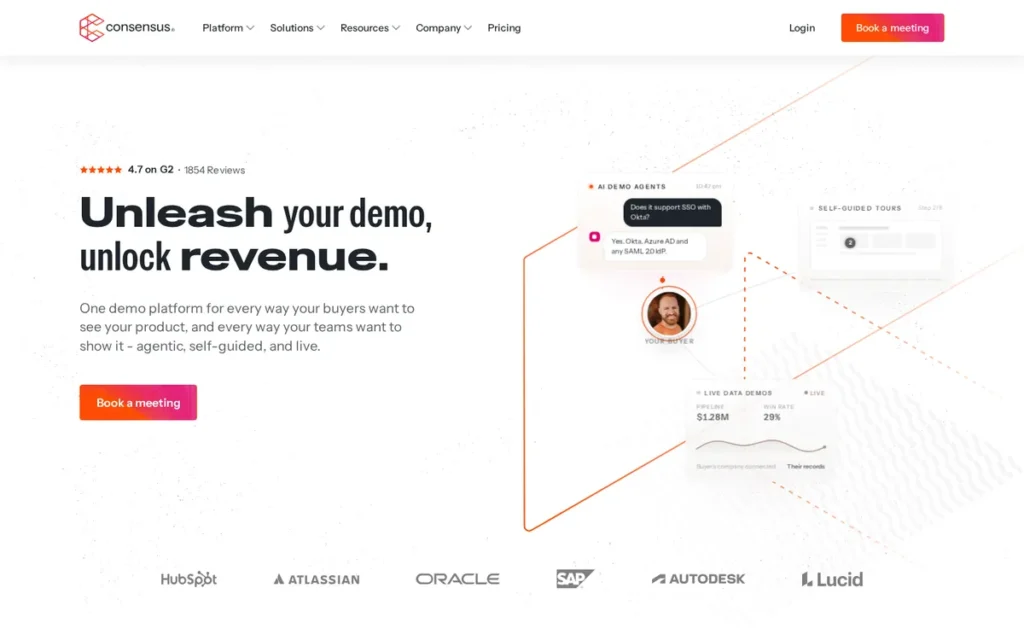
Category: Demo Automation, a platform that delivers personalized, interactive video demos asynchronously to qualify buyer intent, scale presales coverage without headcount increases, and capture multi-stakeholder engagement data before live sales calls.
At a Glance
- Category: Demo Automation
- Best For: Solutions engineering leaders and presales teams at B2B SaaS and technology companies who need to qualify more opportunities, reduce repetitive demos consuming SE capacity, and capture multi-stakeholder buyer intent data before committing SE time to live technical evaluations
- Price Range: Custom quote-based; scales by demo viewer volume and user seats; volume discounts of 20–30% available for higher viewer volumes; multi-year and prepay contracts yield 15–30% savings vs. single-year (Vendr marketplace data, 2025–2026)
- Primary Strength: Consensus has the highest review volume in the value selling tools category, 1,700+ verified G2 reviews at 4.7/5, providing the strongest peer-validated quality signal available across diverse enterprise deployment contexts
- Biggest Limitation: Consensus is optimized for top-of-funnel presales qualification and asynchronous demo delivery (not for complex, late-stage technical evaluations or post-sale value realization) and works best as a complement to live SE engagement rather than a replacement
- One-Line Summary: Consensus is the most peer-reviewed presales automation platform in the B2B market as of May 2026, with 1,700+ G2 reviews at 4.7/5 and SAP as a named enterprise reference for scaling presales coverage across the full go-to-market lifecycle.
- Last Verified: May 2026
Overview
Consensus is a Product Experience Platform (built for solutions engineering leaders, presales directors, and revenue enablement teams at B2B technology companies) that delivers personalized, interactive video demos asynchronously to qualify buyer intent, reduce unqualified demo requests, and free solutions engineers for high-ACV technical evaluations. Consensus has operated in the presales automation category since approximately 2013, accumulating the highest review volume in the value selling tools space (1,700+ G2 reviews at 4.7/5) and earning SAP as a named enterprise reference customer running what SAP describes as a “presales everywhere” deployment model.
Consensus’s Demolytics system provides multi-stakeholder buyer intent analytics (revealing which features each stakeholder watched, replayed, or shared) enabling account executives to prioritize follow-up with documented engagement data rather than intuition.
Key Features
- Demolytics Buyer Intent Analytics: Consensus Demolytics delivers real-time buyer engagement analytics (including video completion rates, per-feature heatmaps, and Buyer Matrix multi-stakeholder preference mapping) giving sellers documented intent data for each stakeholder before any live follow-up call (DemoBoost, 2025).
- Asynchronous Personalized Demo Delivery: Consensus enables account executives to distribute personalized, interactive demo experiences asynchronously, qualifying opportunities and educating buyers between formal discovery calls without requiring solutions engineer involvement on early-stage or lower-ACV opportunities.
- CRM and Email Integration: Consensus integrates with email tools and CRM systems, allowing buyer engagement data (viewed features, watch time, and sharing behavior) to flow directly into Salesforce or HubSpot opportunity records for pipeline intelligence and rep prioritization.
- Presales Everywhere Deployment Model: Consensus supports a “presales everywhere” deployment model (extending demo automation beyond the sales function into marketing self-qualification, services onboarding, and renewal demos) enabling organizations to scale presales coverage without proportional headcount increases, as validated by SAP’s enterprise deployment (Consensus DemoFest, 2025).
- Negotiation-Informed Pricing: Consensus pricing scales by demo viewer volume with documented 20–30% volume discounts and 15–30% multi-year contract savings available (Vendr transaction data, 2025–2026), giving procurement teams negotiating leverage when Walnut, Navattic, or Demostack bids are active in the evaluation (Vendr, 2025–2026).
Best For
Consensus is best for solutions engineering leaders at B2B SaaS or technology companies whose teams spend the majority of their time on repetitive, qualification-stage demos for opportunities that do not ultimately convert, and who need a system to filter and qualify buyer intent before committing SE time to live technical evaluations.
Pricing
Consensus uses a custom quote-based pricing model that scales by demo viewer volume and active user seats. Vendr transaction data (2025–2026) documents volume discounts of 20–30% for higher viewer volumes and multi-year savings of 15–30% vs. single-year contracts. Teams evaluating Consensus should obtain competitive bids from Walnut and Navattic before entering final negotiations, Vendr data confirms these are active competitive substitutes in enterprise procurement. The viewer-volume pricing model creates budget uncertainty for high-growth teams as demo distribution scales; model costs at 2x and 3x current volume before contracting. No per-seat or public pricing is available (May 2026).
Strengths
- Category-Leading Review Volume: Consensus has 1,700+ verified G2 reviews at 4.7/5 (the highest review volume in the value selling tools category as of May 2026) representing a statistically robust peer validation signal across diverse enterprise deployment contexts, confirmed by independent search (G2, May 2026).
- SAP Enterprise Reference Deployment: SAP deploys Consensus across its full go-to-market ecosystem (marketing, sales, services, and renewals) in a “presales everywhere” model, validating the platform at demanding multi-product, global enterprise scale (Consensus DemoFest, 2025).
- Practitioner-Validated SE Use Case: Practitioners on r/salesengineers independently validate the AE-led use case, Consensus reduces SE bandwidth consumption on qualification demos and provides viewership analytics that drive prioritized follow-up, consistent with the self-reported 90% reduction in unqualified demos (r/salesengineers, multiple verified threads, 2022–2026).
- 12+ Years Market Longevity: Consensus was founded approximately 2013: giving it 12+ years of market longevity, enterprise-grade platform stability, and a mature feature set that newer interactive demo entrants such as Walnut (founded approximately 2020) and Navattic (founded approximately 2019) cannot yet match at comparable peer-review adoption scale.
Limitations
- Lifecycle Scope Constraint: Consensus is purpose-built for top-of-funnel presales qualification and asynchronous value delivery, it is not designed to replace complex live SE demos for high-ACV technical evaluations, and practitioners on r/salesengineers note that Consensus works most effectively as a qualification filter rather than a substitute for technical discovery on high-value opportunities.
“Consensus is way more beneficial for top of funnel than SE teams. If I’m demoing to someone that could get what they need from prerecorded demos, then I’m demoing to them too early.” (u/tincantincan23, r/salesengineers)
Takeaway: Consensus delivers maximum value as a qualification filter that preserves SE capacity, not as a replacement for live technical discovery on high-ACV opportunities. Set this expectation explicitly with your SE team before deployment.
- Content Upload Friction: Consensus G2 reviewers identify initial content upload and demo configuration as time-consuming onboarding steps that require dedicated enablement support, creating a time-to-value lag for resource-strapped presales teams without dedicated operations capacity (G2, May 2026).
- Pricing Model Scaling Risk: Consensus’s viewer-volume pricing model creates budget uncertainty for high-growth organizations as adoption scales across the sales motion, teams should model total cost at 2x and 3x their current demo distribution volume before contracting, and compare against Walnut’s creator-seat alternative where costs are capped by the number of demo builders rather than audience size.
Verdict
Consensus is the most peer-validated presales automation platform in the B2B sales tools market, with 1,700+ G2 reviews at 4.7/5 providing a review signal no comparable tool in this evaluation approaches. Solutions engineering leaders who deploy Consensus as a qualification accelerator (filtering buyer intent before committing SE capacity to live technical evaluations) report meaningful reductions in unqualified demo volume and faster pipeline velocity. Consensus is not a full-lifecycle value selling platform and is best evaluated alongside a complementary ROI or business case tool for in-deal and renewal use cases.
3. Walnut: Best for AI-Native Interactive Demo Creation and Value Storytelling
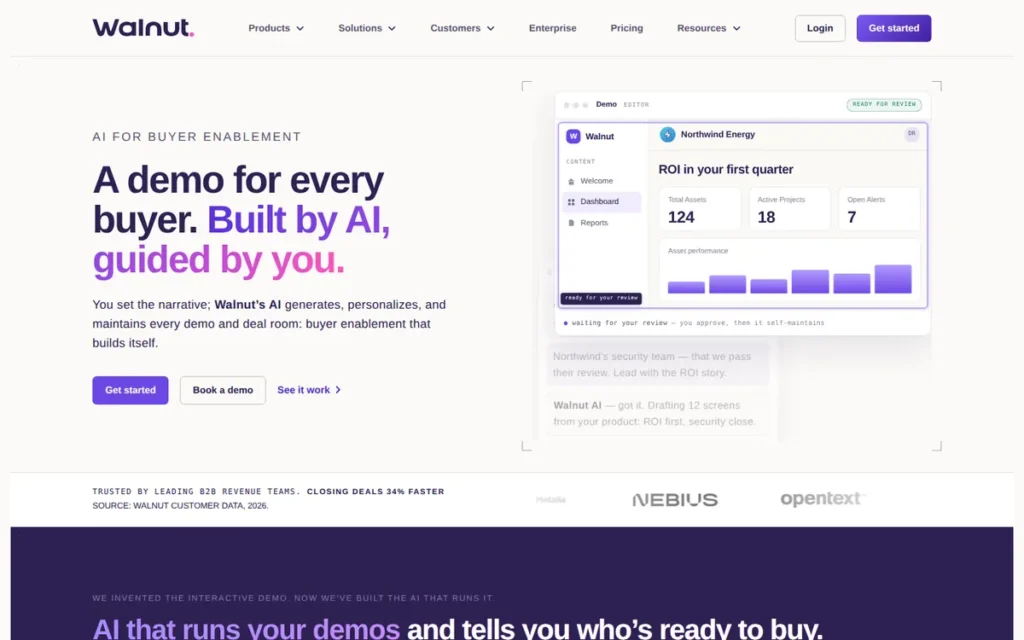
Category: Demo Creator, an AI-native platform for building, personalizing, distributing, and tracking interactive sales demos through automated AI creation, auto-update maintenance, and deal-room analytics integrated with CRM.
At a Glance
- Category: Demo Creator
- Best For: B2B SaaS and technology sales teams: particularly solutions engineers and product marketing managers, who need to create, personalize, and distribute polished interactive demos at scale without manual screen recording, editing, or scripting effort consuming SE bandwidth
- Price Range: Lite, Pro, and Enterprise tiers; no public dollar amounts disclosed; one practitioner-reported estimate of approximately $20,000/year for an enterprise configuration (treat as a directional indicator, u/Middle_Giraffe5565, r/ProductMarketing, 2024); creator-seat model means costs are tied to demo builders, not viewer audience size
- Primary Strength: Walnut’s StoryCaptureAI reduces interactive demo creation time by approximately 90% by automatically assembling polished demos from narrated product walkthroughs, eliminating the manual recording, editing, and scripting process that consumes significant SE and product marketing bandwidth
- Biggest Limitation: Walnut is optimized for sales team workflows: Salesforce integration, SSO, enterprise admin governance, but practitioners note it offers fewer marketing-specific features than alternatives such as Navattic, making it less optimal where website product tours or marketing funnel self-qualification are the primary objectives
- One-Line Summary: Walnut is the most AI-native interactive demo creation platform available in 2026, with StoryCaptureAI delivering approximately 90% faster demo production, EditsAI providing automatic demo updates, and creator-seat pricing validated by Adobe and Cisco as enterprise-accessible, with a practitioner-documented cost estimate of approximately $20,000 per year for enterprise configuration.
- Last Verified: May 2026
Overview
Walnut is an AI-native interactive demo creation and distribution platform (built for solutions engineers, account executives, and product marketing managers at B2B SaaS and technology companies) that automates the full demo production lifecycle from initial capture through delivery, tracking, and ongoing maintenance. Founded approximately 2020, Walnut has assembled enterprise-tier reference customers including Adobe and Cisco by differentiating on AI-driven creation speed: StoryCaptureAI enables reps to produce polished, interactive guided demos in minutes by narrating while clicking through the live product.
Walnut’s EditsAI feature automatically refreshes demo content when the underlying product changes, eliminating the pervasive stale-demo problem that creates poor buyer experiences and wasted SE effort across large software organizations (Walnut blog, 2026).
Key Features
- StoryCaptureAI Demo Auto-Assembly: Walnut StoryCaptureAI allows a rep to narrate while clicking through the live product (AI simultaneously transcribes speech, captures screens and interactions, and auto-assembles a polished interactive guided demo) reducing creation time from hours to approximately minutes (Walnut help documentation, 2026).
- EditsAI Automatic Content Updates: Walnut EditsAI automatically updates demo content when the product UI or features change, eliminating the need for manual recapture and preventing outdated demos from surfacing during live buyer calls or asynchronous distribution.
- Deal Room Analytics: Walnut deal room analytics deliver funnel dashboards, lead forms, and CRM-tracked influenced deals, attributing specific revenue outcomes to individual demo engagements in Salesforce or HubSpot opportunity records for RevOps measurement (Walnut AI Demo Platform page).
- Creator-Seat Licensing Advantage: Walnut’s creator-seat licensing model charges only for demo-building users and not for demo viewers, creating a significant total cost advantage over viewer-volume pricing models, such as Consensus’s, for teams distributing demos to large buyer audiences from a small creator population.
- Enterprise Security Credentials: Walnut holds both SOC 2 Type II compliance and ISO 27001 certification (independently confirmed, May 2026), satisfying the independent security audit standards required by international enterprise procurement committees and confirming Walnut’s suitability for regulated-industry and non-US enterprise buyers.
Best For
Walnut is best for B2B SaaS and technology sales teams that manage high volumes of concurrent opportunities and need to deploy polished, personalized interactive demos for deals below a specific ACV threshold, freeing solutions engineers for high-value complex technical evaluations while account executives handle demo distribution and follow-up for smaller deals independently.
Pricing
Walnut offers Lite, Pro, and Enterprise tiers with no publicly disclosed dollar amounts. The only available ACV estimate, approximately $20,000 per year for enterprise configuration, comes from a single practitioner data point (u/Middle_Giraffe5565, r/ProductMarketing, 2024); treat this as a directional indicator, not a confirmed ACV, and verify pricing directly with Walnut. The creator-seat licensing model means costs are tied to demo builders rather than demo viewers, a material cost advantage for teams with small creator populations serving large buyer audiences. Compare pricing against Consensus’s viewer-volume model and Navattic’s alternative tier structure before finalizing vendor selection (May 2026).
Strengths
- Adobe and Cisco as Named Enterprise References: Adobe and Cisco are named Walnut reference customers (two of the most security-scrutinized, procurement-rigorous enterprise technology organizations in the world) providing enterprise-tier social proof that Walnut passes high-bar IT and legal review processes (Walnut.io, May 2026).
- Practitioner-Validated Deployment Model: A practitioner on r/salesengineers (u/creativerbl, 2024) confirms Walnut’s core use case, covering SMB and sub-$20K ARR deals to significantly cut SC requests, with SCs engaging only when technical complexity or additional prospect questions require specialist involvement (r/salesengineers, 2024).
- Creator-Seat Cost Efficiency Validated: Walnut’s user-based licensing for creators keeps costs predictable for teams with a small number of demo builders, confirmed by a practitioner on r/ProductMarketing (u/Skweege55, 2023): “since their licensing model is user-based and we only licensed creators the cost is minimal,” a direct cost advantage over viewer-volume pricing models at scale (r/ProductMarketing, 2023).
- AI-Native Architecture Specificity: Walnut’s StoryCaptureAI and EditsAI represent the most architecturally specific AI demo capabilities in this evaluation, auto-assembly from narrated walkthroughs and automatic content updates address real daily workflow pain points that legacy demo tools require significant manual effort to solve.
Limitations
- Marketing Feature Gap: Walnut is purpose-built for sales team workflows: practitioners on r/ProductMarketing (u/Middle_Giraffe5565, 2024) note that Walnut “had less marketing features” compared to alternatives and “seemed a bit less intuitive than other tools” outside its sales-focused workflow, making it a less optimal choice where website product tours or marketing-funnel self-qualification are the primary objectives.
“Solid features for the sales team (link creation, tracking). Solid SFDC integration… Not super cheap, would be $20k for the plan/features we wanted. Seemed a bit less intuitive than other tools. Had less marketing features.” (u/Middle_Giraffe5565, r/ProductMarketing (2024))
Takeaway: Walnut is purpose-built for sales team workflows, organizations whose primary interactive demo use case is marketing funnel self-qualification or website product tours should evaluate Navattic alongside Walnut before deciding.
- Review Volume Gap vs. Consensus: Walnut’s market tenure of approximately 5 years means its G2 review base is still building, 148 verified G2 users is a legitimate quality signal, but substantially thinner than Consensus’s 1,700+ reviews, requiring buyers to invest additional effort in direct reference checks before purchase to achieve comparable peer validation confidence.
- Pricing Opacity: Walnut does not publish public pricing, and the only independently available cost estimate is a single 2024 practitioner community data point of approximately $20,000/year, buyers cannot model total cost of ownership without engaging Walnut’s sales team, limiting budget certainty during procurement.
Verdict
Walnut is the leading AI-native interactive demo creation platform for B2B sales teams as of May 2026, with StoryCaptureAI and EditsAI delivering demonstrably faster demo production and maintenance than any competitor in this evaluation. Adobe and Cisco as named enterprise references validate Walnut’s security credentials, SOC 2 Type II plus ISO 27001, and its scalability at the highest procurement scrutiny tiers. Sales leaders deploying Walnut specifically for account-executive-led demo distribution on sub-threshold-ACV deals, preserving SE capacity for high-ACV technical evaluations, report the most consistent outcomes, while organizations seeking primarily marketing-use-case interactive demos should evaluate Navattic alongside Walnut before deciding.
4. Ecosystems: Best for Post-Sale Value Realization and CRM-Embedded Value Selling
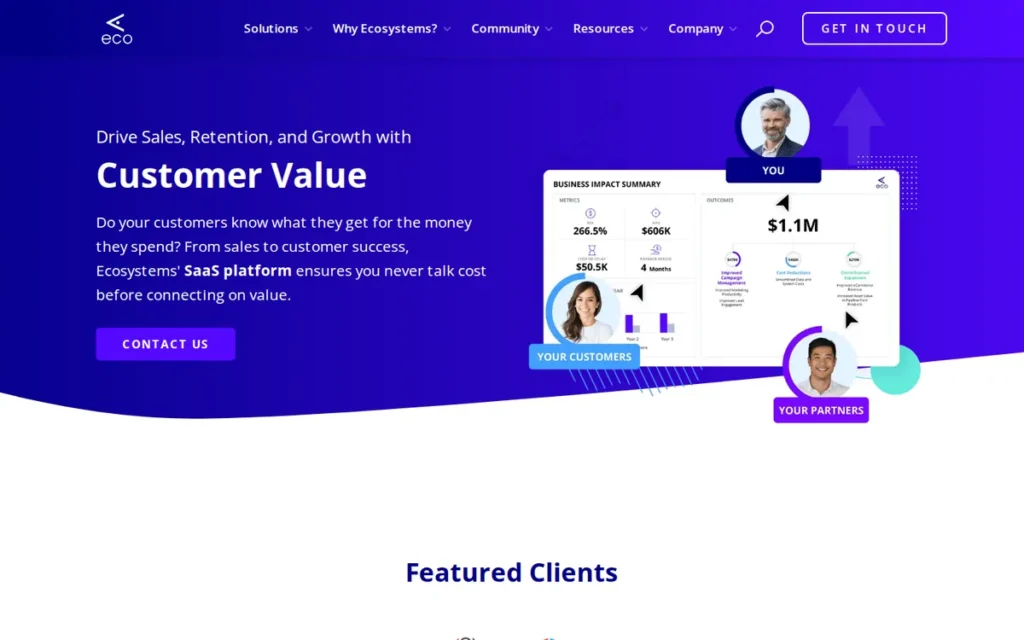
Category: Value Realization Platform, a CRM-embedded system that tracks, quantifies, and communicates business value delivered to customers across the full revenue lifecycle from initial sale through renewal, expansion, and ongoing customer success management.
At a Glance
- Category: Value Realization Platform
- Best For: Enterprise sales and customer success organizations that need to close the loop between pre-sale value promises and post-sale value delivery, particularly teams where renewal and expansion ARR depends on structured proof of realized customer value at QBRs and renewal conversations
- Price Range: Custom enterprise pricing; no public tiers or ACV data available from any independent source; contact sales required for all pricing information (May 2026)
- Primary Strength: Ecosystems’ ViViEN 2.0 Virtual Value Engineer is the most architecturally differentiated AI system in this evaluation, simultaneously analyzing Gong call recordings, Clari revenue signals, and public earnings filings to generate personalized value insights that previously required a dedicated human value engineering specialist
- Biggest Limitation: Ecosystems has only 10 confirmed G2 reviews as of May 2026; no published case study documents attribute specific outcome metrics to its named customers (Google Cloud, HP, Palo Alto Networks, ServiceNow, Talkdesk); and company background including founding date and funding history is not publicly disclosed, making independent procurement due diligence more time-consuming than for competitors with higher peer review volume
- One-Line Summary: Ecosystems is the most AI-architecturally differentiated value realization platform in the B2B sales market as of 2026, with ViViEN 2.0 analyzing Gong, Clari, and buyer earnings filings to automate personalized value insights, listing Google Cloud, HP, and Palo Alto Networks among named customers and reporting 53% year-over-year ARR growth in 2024.
- Last Verified: May 2026
Overview
Ecosystems is a CRM-embedded Value-Added Selling platform (designed for enterprise sales and customer success leaders) that operationalizes value selling from initial discovery through post-sale renewal and expansion by surfacing value workflows inside existing CRM tools rather than requiring reps to log into a separate application. Ecosystems’ AI system, ViViEN 2.0 (Virtual Value Engineer, updated July 2025), analyzes CRM data, Gong and Clari conversation intelligence, Gainsight customer health signals, and public market research including earnings call transcripts and 10-K filings to generate personalized value insights and automated business case proposals.
Ecosystems’ value co-creation model (where buyers and sellers jointly build value cases on a shared cloud platform) increases CFO buy-in by making the buyer a co-author of the business case rather than a passive recipient of vendor ROI claims (Ecosystems Blog).
Key Features
- ViViEN 2.0 Virtual Value Engineer AI: Ecosystems’ ViViEN 2.0 (launched July 2025) automatically analyzes Gong call recordings, Clari revenue signals, Gainsight customer health data, and public documents including 10-K filings and earnings transcripts, generating personalized value insights and eliminating the need for a dedicated human value engineering specialist in most deployment contexts (Ecosystems Blog, 2024).
- Buyer Value Co-Creation Framework: Ecosystems deploys a shared cloud platform where buyers and sellers jointly quantify value (with customer-facing interactive tools embeddable on the vendor’s website) shifting the business case dynamic from vendor-presented to buyer-co-authored for higher CFO approval probability.
- CRM-Embedded Workflow Design: Ecosystems embeds value selling workflows inside existing CRM systems (Salesforce, HubSpot, Microsoft Dynamics) rather than requiring separate platform logins, solving the sales rep adoption barrier that causes standalone value tools to see persistently low utilization rates in enterprise deployments.
- Post-Sale Value Realization Tracking: Ecosystems’ post-sale tracking enables customer success and renewal teams to document delivered value against promised value at QBR and renewal dates, directly addressing the reactive, price-contested renewal dynamic that organizations experience when post-sale value is not systematically captured.
- Revenue Tech Stack Integrations: Ecosystems integrates natively with Gong, Clari, Gainsight, Salesforce, Microsoft Dynamics, and HubSpot, providing comprehensive connectivity across the modern enterprise revenue tech stack for organizations running sophisticated RevOps infrastructure (Ecosystems Blog, 2024).
Best For
Ecosystems is best for enterprise B2B organizations where post-sale revenue (renewals, upsells, and expansions) represents a material portion of total ARR, and where the customer success team currently lacks structured tooling to connect pre-sale value commitments to post-sale value delivery evidence at renewal conversations.
Pricing
Ecosystems does not publish pricing publicly. The Ecosystems website is demo-and-contact-only for all pricing information, consistent with a high-touch enterprise sales model. No ACV data points are publicly available from any independent source as of May 2026. Budget for custom enterprise pricing and allocate time for a discovery sales process before receiving a quote. Compare against Mediafly’s lifecycle coverage and ValueCore’s QBR automation for total cost across the post-sale use case specifically.
Strengths
- Named Enterprise Customer References: Ecosystems lists Google Cloud, HP, Palo Alto Networks, ServiceNow, and Talkdesk as named customers on ecosystems.io, enterprise-tier references that validate Ecosystems’ capability in demanding, high-security procurement environments across cloud, technology, and cybersecurity verticals (ecosystems.io/customers, May 2026).
- 53% YoY ARR Growth: Ecosystems reported 53% year-over-year ARR growth in 2024 (an exceptional rate for enterprise SaaS in a year of broad sector headwinds) signaling strong product-market fit driven by AI-differentiated value selling demand (self-reported; Ecosystems Blog, 2024).
- Uniquely Differentiated AI Architecture: ViViEN 2.0’s integration with public filings analysis (10-K documents and earnings call transcripts) alongside Gong and Clari conversation intelligence represents the most differentiated AI architecture in this evaluation, generating value insights from the buyer’s own public financial disclosures in ways that generic ROI calculators cannot replicate.
As one enterprise CSM on r/CustomerSuccess described:
“Biggest unlock for me: treat AI like a junior CS analyst that I feed raw data to, not a magic dashboard. Every week I dump: last 90 days product usage (CSV or pasted table), list of stakeholders + titles, top 10 support cases, last QBR deck, and the customer’s public 10-K or strategy page.” Posted by u/Adventurous-Date9971
Takeaway: Enterprise CSMs are already manually synthesizing product telemetry, stakeholder rosters, support histories, and public 10-K filings to prepare QBR business cases, exactly the multi-source data assembly problem that Ecosystems’ ViViEN 2.0 is built to automate.
- CRM-Embedded Adoption Advantage: Ecosystems’ CRM-embedded workflow architecture solves the most documented value tool deployment failure mode (reps abandoning standalone tools because they require a separate login and workflow outside their daily CRM habits) the adoption barrier that most point-solution value tools consistently fail to overcome.
Limitations
- Thin Peer Review Profile: Ecosystems has only 10 confirmed G2 reviews at 4.9/5 as of May 2026, a strong average rating from a low review volume that limits statistical confidence for buyers accustomed to evaluating tools with hundreds of independent peer reviews. Direct reference calls with the named customers (Google Cloud, HP, Palo Alto Networks, ServiceNow, Talkdesk) are essential before contracting, as G2 review data alone cannot de-risk this purchase at current review counts.
- Unverifiable Performance Metrics: Ecosystems’ self-reported performance figures, 3.4x win rate increase and 38% reduction in price discounting, cannot be traced to specific named client cohorts or independently audited datasets (Ecosystems Blog, 2024). Treat these as directional indicators, not procurement-grade evidence, until Ecosystems provides named references willing to attribute specific outcomes.
- Company Transparency Gap: No founding date, employee count, or funding history is publicly disclosed by Ecosystems, making standard vendor due diligence including financial stability assessment, runway verification, and key-person dependency evaluation more time-consuming than for competitors who publish corporate background information.
Verdict
Ecosystems is the most AI-architecturally differentiated value selling platform evaluated in 2026, with ViViEN 2.0’s ability to synthesize Gong recordings, Clari signals, and buyer earnings filings into personalized value cases representing a genuine capability advance over ROI calculator-based competitors. Ecosystems lists Google Cloud, HP, Palo Alto Networks, ServiceNow, and Talkdesk as named customers (strengthening its enterprise credibility) though published case study documents with attributed outcome metrics are not currently available for independent validation. The critical procurement step is investing in direct reference calls with those named customers before contract signature, as the 10-confirmed-G2-review profile requires buyers to do substantially more independent validation work than competitors with hundreds of peer reviews.
5. ValueCore: Best for Mid-Market Teams Needing Fast ROI Calculator Deployment
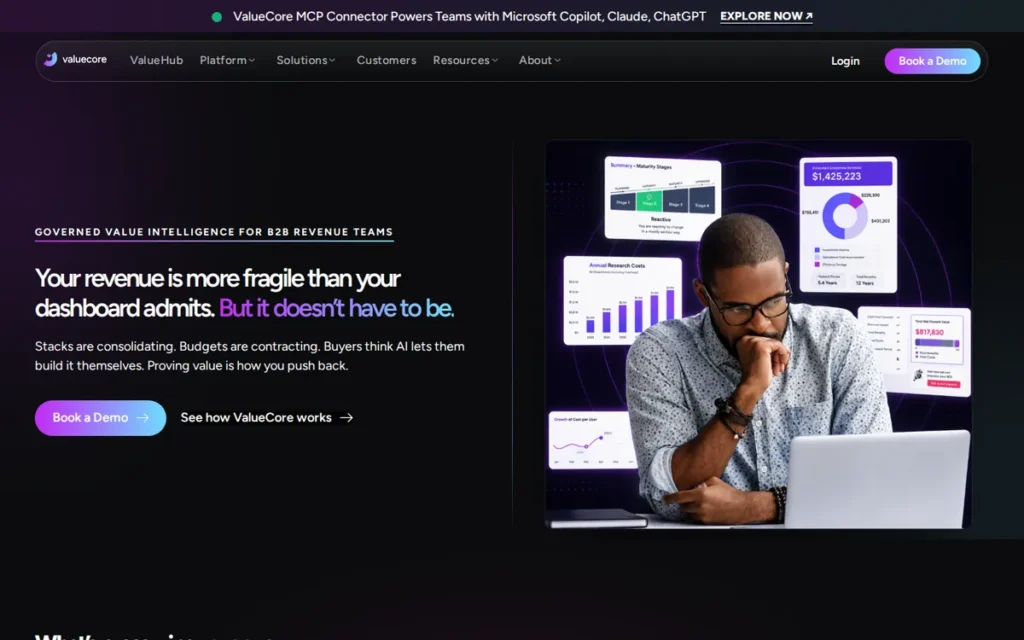
Category: ROI Builder, an AI-powered platform that converts existing value frameworks and spreadsheets into interactive, branded ROI calculator web applications covering the buyer journey from lead generation through QBR automation.
At a Glance
- Category: ROI Builder
- Best For: Mid-market B2B sales and enablement teams (50–500 reps) that already have value selling models documented in spreadsheets and need to convert them into scalable, rep-usable interactive tools quickly, without a multi-month professional services implementation or an enterprise-tier budget
- Price Range: Custom quotes required; no public platform subscription pricing is disclosed; the $15K–$25K ACV figure commonly associated with ValueCore refers to the annual contract value of products ValueCore helps their customers sell, not ValueCore’s own platform price (Grepbeat, 2023); request platform pricing explicitly during evaluation
- Primary Strength: ValueCore deploys interactive ROI calculator applications from existing Excel spreadsheets in approximately one day, the fastest documented time-to-value in the value selling tools category and a direct solution to the months-long implementation timelines at larger platforms
- Biggest Limitation: ValueCore has a thin independent review profile: G2 and Capterra numerical ratings are not confirmed in any available public data, meaning buyers cannot access the peer validation volume available for larger competitors like Consensus or Mediafly when building internal procurement cases
- One-Line Summary: ValueCore is the fastest-deploying ROI calculator platform for mid-market B2B teams in 2026, converting existing spreadsheets into interactive value applications in approximately one day, with named customers including Verizon Connect, American Express, Lenovo, and Allstate cited in a 2023 Grepbeat profile (verify directly with ValueCore during evaluation).
- Last Verified: May 2026
Overview
ValueCore (formerly VisualizeROI, founded approximately 2011–2012, rebranded May 2022) is an AI-powered ROI calculator and business case builder, designed for mid-market sales enablement leaders, revenue operations managers, and sales operations teams, that converts existing Excel-based ROI models into interactive, branded web applications in approximately one day without a professional services implementation cycle. ValueCore covers five buyer-journey stages, Lead Harvester top-of-funnel ROI lead generation, Value Collaborator in-deal value discussion, Discovery Whiz guided discovery with real-time value quantification, One-Click Value Snapshot, and post-sale QBR automation, making ValueCore one of the few mid-market tools to address the full revenue lifecycle.
With 12+ years of enterprise value-selling tool history and a customer reference portfolio spanning financial services, telecoms, hardware, and insurance, ValueCore offers unusual validation depth for a company of its current size (Grepbeat, 2023).
Key Features
- One-Day Spreadsheet-to-App Conversion: ValueCore’s core conversion engine transforms existing Excel ROI spreadsheets into interactive, branded web applications in approximately one day, eliminating the months-long professional services cycle that characterizes enterprise value calculator deployments at larger platforms (ValueCore product page).
- Discovery Whiz Guided Discovery: ValueCore Discovery Whiz guides sales reps through structured discovery conversations with real-time value quantification, embedding ROI calculation directly into the discovery call workflow rather than requiring a separate post-call calculation step that reps frequently skip.
- Post-Sale QBR Automation: ValueCore’s post-sale QBR automation generates CFO-ready realized value presentations from product usage telemetry, creating customer success business review documents automatically without manual data aggregation by the account management team.
- ValueHub B2B Value Directory: ValueCore’s ValueHub catalogs published ROI claims from B2B vendors in a searchable database, providing buyers a market-intelligence tool for benchmarking competitor claims and giving ValueCore customers evidence-backed differentiation support in competitive sales situations.
- Salesforce AppExchange Integration: ValueCore is listed on the Salesforce AppExchange and supports CRM integration, enabling ROI calculation outputs to flow into opportunity records and support quote-to-close workflows for Salesforce-native organizations.
Best For
ValueCore is best for mid-market B2B sales enablement teams (50–500 reps) that already have value selling models documented in spreadsheets and need to convert those models into scalable, interactive, rep-usable tools quickly, without the cost and timeline of an enterprise professional services implementation or the organizational scale required for Mediafly or Ecosystems.
Pricing
ValueCore does not publish public platform subscription pricing. A common point of confusion: the $15K–$25K ACV figure associated with ValueCore in published profiles refers to the annual contract value of software products ValueCore helps their customers sell, not ValueCore’s own platform subscription price. Request ValueCore’s platform pricing, implementation fees, and support scope explicitly during initial vendor discussions to avoid budget planning errors. At approximately 30 employees, buyers should also clarify ongoing customer success resources available at this price point (May 2026).
Strengths
- 12+ Years Platform History: ValueCore was founded as VisualizeROI in approximately 2011–2012 (giving it 12+ years of enterprise B2B value-selling tool history that substantially exceeds the market tenure of most AI-native competitors in this evaluation) with platform architecture informed by a decade of enterprise ROI model implementations (Grepbeat, 2023).
- Multi-Vertical Customer Reference Portfolio: ValueCore lists Verizon Connect, American Express, Lenovo, and Allstate as customers in a 2023 Grepbeat profile (spanning telecoms, financial services, hardware, and insurance) demonstrating multi-vertical applicability at enterprise-tier name-brand organizations (these references were cited in a third-party profile article and should be verified directly with ValueCore during evaluation) (Grepbeat, 2023).
- Crozdesk Calculator Score Advantage: ValueCore outscored Ecosystems on dedicated ROI calculator functionality per Crozdesk comparative scoring (84 vs. 79 out of 100), reflecting the platform’s deep specialization in calculator and business case builder core functionality relative to broader Value-Added Selling platforms (Crozdesk, 2024).
- Full Lifecycle Coverage at Mid-Market Accessibility: ValueCore’s five modular buyer-journey tools (including post-sale QBR automation from usage telemetry) address the complete revenue lifecycle from lead generation through renewal support, a breadth of coverage unusual for a mid-market accessible tool in this category.
Limitations
- Thin Independent Review Profile: ValueCore’s most significant limitation is its thin independent review profile (G2 and Capterra numerical ratings are not confirmed in publicly available research as of May 2026, leaving Crozdesk’s 84/100 as the primary third-party quality signal) a platform with substantially lower enterprise buyer recognition than G2 or Gartner (Crozdesk, 2024).
- Team Size and Capacity Risk: At approximately 30 employees, ValueCore has limited implementation bandwidth, customer success resources, and engineering capacity compared to larger competitors, enterprise buyers requiring dedicated implementation support, complex CRM customization beyond Salesforce, or rapid feature development should carefully assess whether ValueCore’s current team size can deliver at the required pace and depth (Grepbeat, 2023).
- Pricing Ambiguity: ValueCore’s platform subscription pricing is not publicly disclosed from any source, and the $15K–$25K figure commonly associated with the company describes the ACV of products their customers sell, buyers who plan budgets based on this figure risk significant underestimation of actual platform costs. Request a detailed pricing breakdown including implementation fees before any procurement commitment.
Verdict
ValueCore is the strongest mid-market option in this evaluation for B2B sales enablement teams that need to operationalize existing ROI frameworks quickly without an enterprise budget or implementation timeline, its one-day deployment speed makes enterprise-quality value tools genuinely accessible to organizations priced out of Mediafly or Vendavo. The multi-vertical customer reference portfolio (Verizon Connect, American Express, Lenovo, Allstate, cited in Grepbeat 2023; verify directly with ValueCore) provides credible validation for a small-team company. Buyers should invest additional effort in direct reference checks given the thin independent review profile, clarify platform pricing and customer success capacity during evaluation, and confirm the ACV figure context before building a business case for finance approval.
6. Vendavo: Best for Enterprise Price Defense in Industrial and Manufacturing Organizations
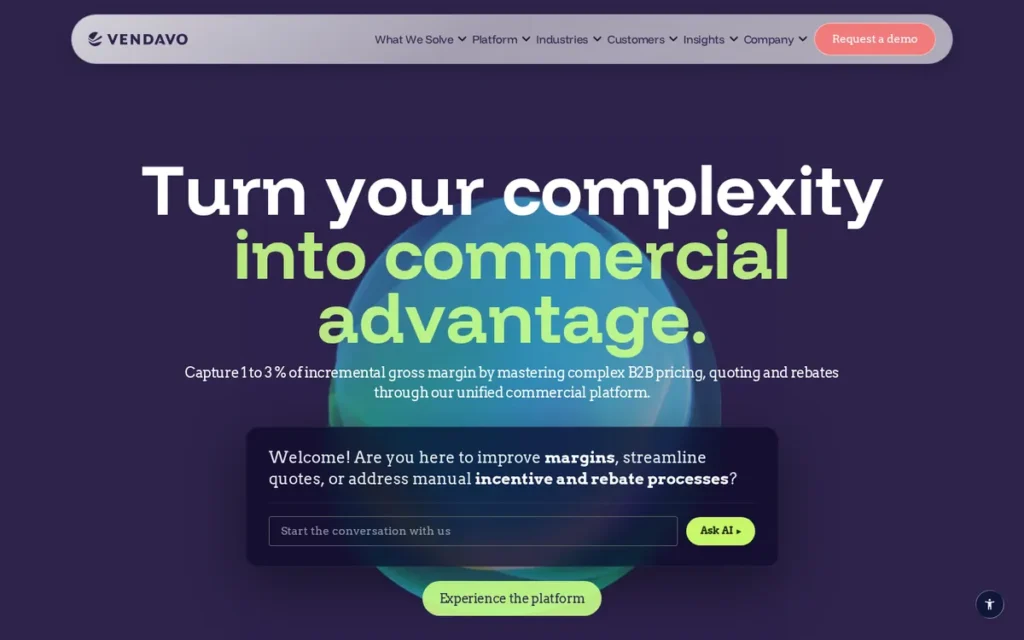
Category: Price Intelligence, an enterprise commercial excellence platform providing AI-guided price optimization, deal-level margin analysis, and price waterfall visualization to defend and improve profitability in industrial, manufacturing, and distribution sales motions.
At a Glance
- Category: Price Intelligence
- Best For: Commercial excellence leaders, pricing operations managers, and VP Sales at industrial, manufacturing, chemicals, and distribution enterprises (1,000+ employees) who face systematic discount pressure and need data-driven tools to defend margin and optimize deal pricing at scale
- Price Range: Entry-level Pricepoint module: $75/user/month; enterprise multi-module deployments: $100,000–$500,000+ annually; implementation and professional services costs frequently exceed $100,000; total time to full ROI: 9–20 months (G2 and TrustRadius reviewer estimates, 2023–2024; Perplexity-confirmed, May 2026)
- Primary Strength: Vendavo’s explainable, rules-based AI pricing guidance provides audit-trail defensibility that black-box machine learning pricing models cannot match, a compliance and negotiation advantage in regulated industries where unexplainable price recommendations create legal or audit risk
- Biggest Limitation: Vendavo requires a 9–20 month implementation timeline and professional services investment frequently exceeding $100,000, the highest total implementation burden in this evaluation, making it unsuitable for organizations without dedicated pricing operations teams and substantial multi-year implementation budgets
- One-Line Summary: Vendavo is the leading price intelligence platform for industrial and manufacturing enterprises, with 26 years of market history, native SAP and Oracle ERP integrations, 68 verified G2 reviews, and the highest G2 CRM integration score in competitive pricing software (9.2/10), with Honeywell, Dow Chemical, and Oceaneering International listed among customers.
- Last Verified: May 2026
Overview
Vendavo is an enterprise commercial excellence platform, designed for commercial excellence leaders, pricing operations managers, and sales VPs at industrial, manufacturing, chemicals, and distribution companies, that combines price waterfall analysis, AI-guided deal pricing, and margin optimization to help sellers defend and grow profitability through pricing discipline rather than buyer-facing ROI case building. Founded in 1998, Vendavo brings 26+ years of enterprise B2B pricing expertise and native integrations with SAP, Oracle, and Salesforce, the core ERP and CRM infrastructure of Fortune 500 industrial enterprises.
Vendavo’s differentiating position against PROS and Zilliant is explainable AI: rather than black-box machine learning price recommendations, Vendavo provides rules-based guidance that documents why each recommendation is made, enabling sales reps to defend pricing in customer negotiations and enabling audit teams to review pricing logic for compliance (ISG Research).
Key Features
- Price Waterfall Analysis: Vendavo price waterfall analysis provides a visual, deal-level breakdown of every discount driver, price agreement, markup, and pocket margin factor, enabling commercial excellence leaders to trace every element reducing pocket margin (the actual net revenue realized per transaction after all discounts and deductions) and identify specific margin leakage sources that aggregate deal reporting conceals.
- Deal Manager Explainable AI: Vendavo Deal Manager provides explainable, rules-based AI price recommendations (documenting the reasoning behind each guidance level rather than producing a black-box output) with a 4.7/5 Gartner Peer Insights rating for usability among frontline sales reps executing pricing in customer negotiations (verify current rating at gartner.com/reviews, May 2026).
- Margin Bridge Profitability Analysis: Vendavo Margin Bridge delivers profitability gap analysis (comparing targeted versus actual margins across deal portfolios) enabling commercial excellence leaders to prioritize the specific customer segments, product lines, or rep behaviors driving the largest margin erosion.
- SAP and Oracle Native Integrations: Vendavo integrates natively with SAP ERP, Oracle, Salesforce CRM, and Microsoft Dynamics, achieving a G2 CRM integration score of 9.2/10 versus PROS at 7.3/10, the most CRM-connected commercial pricing platform in its competitive set for enterprises running Salesforce alongside SAP (G2 comparison data, 2024).
- Segment-Based Pricing Optimization: Vendavo supports segment-based pricing optimization (enabling different price guidance models by customer segment, geography, product category, and contract type) allowing large enterprises with diverse portfolio complexity to maintain pricing discipline across heterogeneous selling motions.
Best For
Vendavo is best for commercial excellence leaders and pricing operations managers at large industrial, manufacturing, or distribution enterprises (1,000+ employees) experiencing measurable margin erosion from systematic discounting, and who need a purpose-built pricing intelligence platform to analyze where margin is lost and enforce pricing discipline at scale, rather than a buyer-facing ROI calculator.
Pricing
Vendavo does not publish public pricing on its website. Independent research estimates the entry-level Pricepoint module at $75/user/month, with enterprise multi-module deployments at $100,000–$500,000+ annually (G2 reviewer aggregates and Perplexity-confirmed, May 2026). G2 reviewers document implementation timelines of 6+ months before go-live, and Vendavo’s typical time-to-full-ROI is 9–20 months. Budget for both the SaaS license and a substantial professional services investment when calculating total cost of ownership. For use cases outside industrial price defense, compare total cost against Mediafly or Ecosystems, where buyer-facing ROI tools typically deploy faster at lower total cost (May 2026).
Strengths
- Fortune 500 Industrial Customer References: Vendavo lists Honeywell, Dow Chemical, Oceaneering International, and Univar Solutions as customers on its website, validating the platform across industrial, chemicals, energy, and distribution verticals where price waterfall analysis and ERP integration are most mission-critical (these references were listed on vendavo.com and could not be independently confirmed via third-party source as of May 2026; verify via direct reference calls) (Vendavo Customers page, May 2026).
- Highest G2 CRM Integration Score in Category: Vendavo achieved a G2 CRM integration score of 9.2/10, outscoring competitor PROS by nearly two full points (7.3/10), reflecting the quality of its Salesforce integration for organizations that need pricing intelligence to surface inside the daily selling workflow rather than in a separate pricing system (G2 comparison data, 2024).
- Explainable AI Competitive Differentiation: Vendavo’s explainable AI pricing guidance provides a documented competitive advantage over black-box ML pricing models, G2 users directly compare it favorably to PROS, citing the ability to show why a recommendation is made as critical for negotiation defensibility and audit compliance in regulated and government-contract environments (G2, 68 verified reviews, May 2026).
- 26+ Years Market Tenure: Founded in 1998, Vendavo is the longest-tenured commercial pricing platform in this evaluation, 26+ years of market presence translates to deep industry-specific configuration knowledge, a mature ERP integration ecosystem, and institutional expertise in industrial pricing complexity that newer entrants cannot replicate.
Limitations
- Extreme Implementation Burden: Vendavo’s most consequential trade-off is its implementation burden (G2 and TrustRadius reviewers consistently report 6+ months to go-live and enterprise deployment costs of $100,000–$500,000+ annually before any pricing optimization benefit is realized) the highest total implementation cost in this evaluation and prohibitive for teams with near-term pipeline targets (G2, May 2026).
- Category Mismatch for Most Buyers: Vendavo is a price defense tool rather than a buyer-facing value selling tool, Vendavo helps sellers resist discounting with data-driven price guidance but does not build ROI calculators, business value assessments, or buyer business cases of the type that Mediafly, Ecosystems, or ValueCore produce. Teams whose primary pain is “we lose deals because buyers cannot justify the purchase price to finance” need buyer-facing ROI tools, not price intelligence.
- 9–20 Month Time-to-Full-ROI: Vendavo’s typical time-to-full-ROI of 9–20 months means organizations face a substantial delay between contract signing and measurable impact, prohibitive for teams with near-term fiscal year targets and eliminating Vendavo as an option for most mid-market buyers without dedicated pricing operations staff (G2 reviewer aggregates, 2023–2024).
Verdict
Vendavo is the definitive price intelligence platform for industrial and manufacturing enterprises that need to defend margin through systematic pricing discipline, with Honeywell and Dow Chemical listed as customer references validating its capability at Fortune 500 industrial scale, and the highest G2 CRM integration score (9.2/10) in competitive pricing software confirming its workflow embeddability. Vendavo is a poor fit for most organizations outside industrial, manufacturing, chemicals, and distribution verticals, and the 9–20 month implementation timeline with $100,000–$500,000+ enterprise deployment costs means buyers must have dedicated pricing operations capacity and a multi-year investment horizon before Vendavo delivers measurable ROI.
7. Winning by Design: Best Value Selling Methodology Foundation Before Software Investment
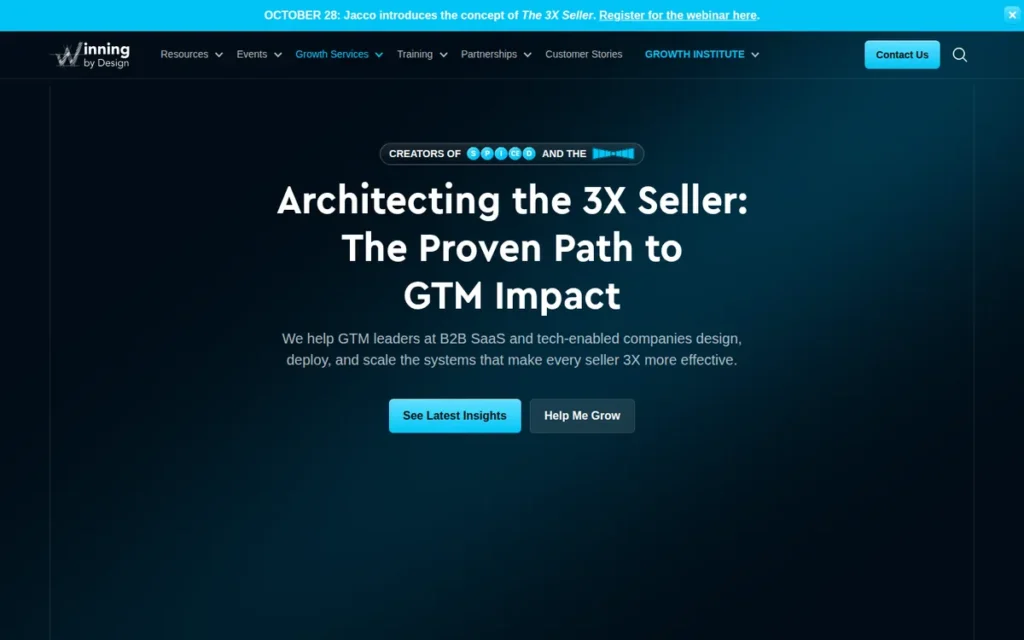
Category: Methodology Framework, a revenue architecture training program and open-source value-selling framework (SPICED, Bowtie) that builds the organizational and behavioral foundation for value-based selling before or alongside software tool deployment.
At a Glance
- Category: Methodology Framework
- Best For: CROs, revenue operations leaders, and sales enablement directors at B2B SaaS organizations (100+ rep teams) experiencing inconsistent value-selling adoption who need to establish a structured, organization-wide framework before (or instead of) deploying value selling software
- Price Range: SPICED and Bowtie frameworks freely published at zero cost on the WbD website and YouTube channel; “Essentials in Revenue Architecture” self-paced course with certification available via Arlo (winningbydesign.arlo.co, May 2026); full Diagnose-Design-Deploy enterprise engagement estimated at $50,000+ ACV based on contextual signals (no public pricing confirmed)
- Primary Strength: Winning by Design’s SPICED methodology requires sales reps to quantify the dollar-denominated financial Impact of inaction in every discovery conversation, operationalizing CFO-ready value selling as a daily behavioral habit that no software tool can create through features alone
- Biggest Limitation: Winning by Design is a methodology and training program, not a SaaS platform, it requires 6–12 months for organizational transformation to take hold, does not integrate with CRM systems, and produces no standalone software product that reps use in daily deal execution without a complementary platform running alongside it
- One-Line Summary: Winning by Design is the most widely adopted open-source value selling methodology in B2B SaaS, with SPICED used by 600+ leading organizations globally and the Bowtie model supporting post-sale NRR discipline, backed by Jacco van der Kooij’s Revenue Architecture textbook (April 2024) and 25,000+ professionals trained at a 4.8/5 rating from 750+ course reviews.
- Last Verified: May 2026
Overview
Winning by Design is a revenue architecture methodology firm, not a SaaS platform, designed for CROs, revenue operations directors, and sales enablement leaders at B2B SaaS organizations that need to build or transform their value-selling foundation before deploying software tools. Winning by Design’s core frameworks, SPICED (Situation, Pain, Impact, Critical Event, Decision) for qualification and discovery, and the Bowtie model for full revenue lifecycle management, are published as open-source resources used by 600+ leading organizations globally, making them the most organically adopted value-selling frameworks in B2B SaaS practitioner communities at zero license cost.
Founding CEO Jacco van der Kooij published Revenue Architecture as a formal textbook in April 2024, announced via Business Wire as “the textbook behind the foundational principles of recurring revenue”, elevating Winning by Design’s methodology to academic-grade credibility that pure SaaS training competitors cannot claim.
Key Features
- SPICED Qualification Framework: Winning by Design’s SPICED framework (Situation, Pain, Impact, Critical Event, Decision) operationalizes value selling in discovery by requiring reps to quantify a dollar-denominated Impact (the financial cost of the buyer’s inaction) before advancing any opportunity, creating a CFO-ready business case foundation embedded in every first sales conversation.
- Bowtie Revenue Lifecycle Model: Winning by Design’s Bowtie model reframes the revenue lifecycle from a linear funnel to a symmetric process covering Acquisition (left side) and Retention plus Expansion (right side), embedding renewal and upsell value management into the sales methodology from deal inception rather than treating post-sale revenue as a separate customer success problem.
- Diagnose-Design-Deploy Enterprise Program: Winning by Design offers a Diagnose-Design-Deploy enterprise engagement model that assesses current revenue architecture maturity, designs a customized implementation roadmap, and deploys the framework across CRM workflows, playbooks, and manager coaching rhythms over a structured 6–12 month transformation timeline.
- Arlo Certification Course: Winning by Design’s “Essentials in Revenue Architecture” self-paced course, available via Arlo as 2.5 hours async plus a 2-hour live session (May 2026), provides an accessible entry point for individual practitioners, including a certification credential that hiring managers and sales operations leaders can verify.
- Free Open-Source Framework Access: Winning by Design’s SPICED and Bowtie frameworks are published freely on the company website and YouTube channel (approximately 100K+ subscribers), giving organizations access to the core methodology at zero license cost, with guided implementation engagements available for organizations requiring structured transformation support.
Best For
Winning by Design is best for B2B SaaS revenue organizations with 100+ reps where value-selling methodology is absent, inconsistently applied, or not embedded in daily CRM workflows, and is also the right first step for any organization considering a value selling software investment where reps currently lack a shared definition of value or a structured discovery qualification framework.
Pricing
Winning by Design has tiered access: SPICED and Bowtie frameworks are freely published on the website and YouTube at zero cost. The “Essentials in Revenue Architecture” self-paced course is available via Arlo at an individual enrollment price. Full enterprise Diagnose-Design-Deploy engagements are custom-quoted, estimated at $50,000+ ACV for comprehensive program deployment based on contextual signals, though no public pricing is confirmed. Winning by Design is not a SaaS subscription, there is no per-seat recurring license (May 2026).
Strengths
- Revenue Architecture Textbook: Jacco van der Kooij’s Revenue Architecture textbook was announced via Business Wire in April 2024 as “the textbook behind the foundational principles of recurring revenue”, formal academic publication of a sales methodology is exceptionally rare among training firms and creates durable intellectual legitimacy above the level of any blog-series-based methodology competitor.
- 25,000+ Professionals Trained: Winning by Design has trained 25,000+ professionals on SPICED methodology with a 4.8/5 rating from 750+ training course reviews (Winning by Design training platform, May 2026), providing individual practitioners a peer-validated learning credential that complements organizational adoption evidence.
- Organic Practitioner Community Adoption: SPICED is organically referenced across r/sales, r/salesengineers, and r/SaaS practitioner forums as the most widely adopted free value-selling qualification framework in B2B SaaS (reflecting genuine community adoption rather than vendor-sponsored promotion) with 600+ organizations self-reporting usage (Winning by Design homepage, May 2026).
This aligns with community sentiment on r/sales:
“I use SPICED framework in my org along with the Socratic questioning. Tried to use MEDDIC in one org but imo it is just too strict with the focus in ticking off the boxes. SPICED is more consultative.” Posted by u/SalesSocrates
Takeaway: SPICED’s consultative discovery structure differentiates it from box-checking qualification frameworks, practitioners who have switched from MEDDIC to SPICED report it functions as a genuine behavioral change tool rather than a CRM compliance exercise.
- Post-Sale Revenue Discipline via Bowtie: Winning by Design’s Bowtie model directly addresses the post-sale value realization gap by building expansion and retention metrics into the sales methodology from day one, ensuring organizations that implement SPICED develop the NRR discipline and renewal value language that pre-sale ROI tools alone cannot instill.
Limitations
- Methodology Without Execution Layer: Winning by Design’s most significant trade-off is the distinction between methodology and execution, SPICED and the Bowtie model are powerful frameworks, but Winning by Design does not generate ROI calculators, build interactive business cases, or integrate with CRM systems to enforce adoption at scale without a complementary software platform running alongside them (AriseGTM, 2024).
- SaaS-Model Dependency: Winning by Design’s frameworks are explicitly designed for SaaS recurring revenue models and are poorly suited to transactional, product-led growth, or channel-heavy business models without significant customization, a limitation identified in third-party comparative analysis that restricts applicability outside B2B SaaS (AriseGTM, 2024).
- 6–12 Month Transformation Timeline: Winning by Design requires 6–12 months for organizational transformation to take hold, and teams implementing SPICED without pairing it with a platform such as Mediafly, Ecosystems, or ValueCore often see methodology adoption decay within 3–6 months as reps revert to feature-selling defaults in the absence of automated workflow guardrails.
- No Software Platform Review Rating: Winning by Design has no G2, Clutch, or Capterra product rating because Winning by Design is a methodology firm and not a SaaS platform, its SPICED training courses hold a 4.8/5 rating from 750+ reviews on the Winning by Design training platform, which is a strong quality signal for methodology learning but not a substitute for the platform adoption signals that enterprise software procurement committees typically reference.
Verdict
Winning by Design is the most widely adopted value selling methodology framework in B2B SaaS and the essential prerequisite for any organization considering a value selling tool investment, SPICED’s requirement to quantify dollar-denominated Impact in every discovery call operationalizes CFO-ready value selling as a daily behavioral habit that software features alone typically cannot create or sustain in most documented deployments. Winning by Design is not a substitute for the platforms ranked above it; Winning by Design is the foundation that determines whether those platforms deliver their promised ROI. Organizations that have not established a shared value selling language and structured discovery framework should begin with Winning by Design’s free SPICED resources at winningbydesign.com before evaluating or purchasing any of the six software tools in this list.
What Red Flags Should I Watch For When Evaluating Value Selling Tools?
The most consequential value selling tool purchase mistakes share four patterns: no published case study documents with attributed outcome data, implementation timelines mismatched with fiscal year targets, pricing models that escalate unpredictably at scale, and AI marketing labels applied to legacy platform features. Identifying these before contracting prevents 6–20 months of delayed ROI.
Red Flag #1: No Published Case Study Documentation with Attributed Outcomes
Absent published case study documents attributing specific outcome metrics to named customers (even when named customers exist) is the most consequential procurement red flag in this category. Any vendor with listed customers but no published documents attributing specific outcomes (win rate improvements, cycle reductions, margin gains) cannot provide the auditable evidence CFOs require for enterprise software approval.
Ask every vendor reference three questions before contracting: (1) What was your team size and ACV at deployment? (2) How long did it take for 80% of your reps to use the tool in active deals? (3) What was the most surprising limitation you discovered after contracting?
Red Flag #2: Implementation Timeline Mismatch
Implementation timeline mismatch (between a tool’s realistic go-live timeline and your organization’s measurement window) is the most common cause of “failed” value selling tool deployments. Vendavo’s 9–20 month time-to-full-ROI is appropriate for the right industrial enterprise buyer with a multi-year horizon, but catastrophic for sales organizations expecting pipeline impact within two quarters.
Ask every vendor for their median time-to-first-rep-usage (not their best-case deployment claim) and request three references from similarly sized companies who can describe their actual go-live experience.
Red Flag #3: Pricing Model Scaling Risk
Pricing models that scale by demo viewer volume (like Consensus) create budget uncertainty for high-growth teams expanding demo distribution rapidly. A pricing model that costs $X today could cost 3X within 12 months as AE-led demo sharing scales across a growing rep population.
Request a 3-year cost model at your projected growth rate before contracting with any viewer-volume priced tool, and compare against creator-seat alternatives like Walnut where costs are capped by the number of demo builders rather than audience size.
Red Flag #4: AI Marketing vs. AI Architecture
“AI-powered” labels on value selling tools range from genuinely transformative to retrofitted badges on legacy spreadsheet-export workflows. Ask vendors to demonstrate specifically what data sources their AI analyzes and what outputs it generates without human intervention.
In value selling specifically, the distinction matters most for business case generation: AI that analyzes a buyer’s own earnings call transcripts and Gong conversations to generate a personalized ROI case, as in Ecosystems’ ViViEN 2.0, is categorically different from AI that suggests pre-written ROI calculator inputs. Vague answers indicate marketing language rather than architectural capability.
What Questions Should I Ask Before Choosing a Value Selling Tool?
Before selecting a value selling tool, five questions drive most of the purchase decision quality: whether you need buyer-facing ROI tools or seller-side price defense; your team’s current methodology maturity; whether post-sale value realization is a material revenue priority; your realistic implementation timeline and budget; and your minimum viable deployment target for demonstrating early ROI.
Question #1: Do you need to help buyers quantify the value of your product, or help your sellers defend their price against discount pressure?
This question separates the entire field into two distinct categories. Mediafly, Ecosystems, Consensus, Walnut, and ValueCore all help buyers understand and co-create value cases for purchasing your product. Vendavo helps your sellers resist discounting by providing data-driven price guidance.
Put simply: if your reps lose deals because buyers cannot justify the purchase price to finance, you need buyer-facing ROI tools. If your reps lose deals because they give away margin without data to defend the price, you need price intelligence. These are different problems requiring categorically different tools, and conflating them is the single most common misalignment in value selling tool procurement.
Question #2: What is your current methodology maturity, does your team have a shared value-selling language and structured discovery framework?
Software tools typically amplify existing behaviors, in most documented deployments, they do not replace missing methodology, and value selling platforms consistently underperform when deployed without a shared team vocabulary for quantifying buyer Impact.
Teams without a shared definition of “Impact” in discovery, a structured way to quantify the buyer’s cost of inaction, and a consistent qualification framework will find that any value selling software fails to change win rates. Winning by Design’s free SPICED resources are the right starting point for any team that cannot answer this question with an unambiguous “yes.”
Question #3: Is post-sale value realization a material revenue priority for your organization?
Teams where renewals and expansions are measured and reported as primary KPIs need fundamentally different tools than teams whose entire focus is pre-sale pipeline conversion. Ecosystems and Mediafly both offer documented post-sale value realization capabilities, including QBR automation, realized value assessments, and renewal-stage business case documentation.
ValueCore includes QBR automation in its five-module suite. Consensus and Walnut offer partial renewal demo support but are not purpose-built for post-sale value tracking.
Question #4: What is your realistic implementation timeline and professional services budget?
The gap between a tool’s marketing deployment claims and its actual time-to-first-rep-adoption determines whether ROI is realized within the current fiscal year. ValueCore’s approximately 1-day deployment and Consensus’s near-immediate presales activation represent the fast end of the spectrum. Vendavo’s 9–20 month timeline and $100,000–$500,000+ enterprise deployment cost represent the slow end.
Ask for: median time-to-first-rep-usage, total 12-month professional services cost, and at least three reference customers with comparable team sizes who can describe their actual go-live experience.
Question #5: What is the minimum viable deployment that would demonstrate ROI within 90 days?
Before signing any contract, define the minimum viable deployment scope that would generate a measurable result within 90 days, then use this as your phased implementation plan and contract milestone with the vendor. Vendors unable to articulate a clear 90-day value demonstration path for teams of your size should be evaluated with additional scrutiny, as implementation burden risk increases significantly when there is no early-win milestone built into the deployment plan.
How Did We Rank These Value Selling Tools?
These seven value selling tools were ranked by scoring each product across six objective criteria, using G2 and Capterra ratings, named customer data, community research from Reddit practitioner forums, Vendr procurement negotiation intelligence, and independent analyst citations from Gartner and Forrester. Three criteria carry primary weight; three are secondary.
What Was Our Evaluation Process?
The ranking process for this article followed four sequential steps:
- Product discovery: identifying all commercially relevant value selling tools across buyer-facing ROI, presales automation, interactive demo, price optimization, and methodology sub-categories through AI engine queries, B2B software directory research, and Reddit community discovery
- Independent web research: gathering features, pricing signals, named customer references, and review platform ratings from G2, Capterra, Crozdesk, Gartner, and Forrester for each of the seven evaluated products
- Community sentiment analysis: sourcing practitioner discussions from r/salesengineers, r/sales, r/ProductMarketing, and r/b2bmarketing for real-world deployment insights unavailable in vendor marketing materials
- LLM response analysis: querying Perplexity and ChatGPT to identify coverage gaps where high-quality tools are absent from AI guidance, providing the original research value that differentiates this article from AI-generated summaries
Ranking Criteria
Primary criteria (higher weight):
- Review Platform Validation: Third-party peer-validated ratings on G2 and Capterra are the primary de-risking signal B2B buyers use when building internal business cases for new tools. A 4.7/5 with 1,700 reviews scores higher than a 4.9/5 with 10 confirmed reviews. Analyst firm recognition (Forrester Wave Leader, Gartner Challenger) counts as supplementary institutional validation.
- Lifecycle Coverage Breadth: The target audience’s pain points span the full revenue lifecycle: pre-sale ROI quantification, in-deal business case building, AND post-sale value realization for renewals. Breadth is scored across four documented lifecycle stages, not marketing claims. Tools addressing only one stage leave critical gaps and force buyers to stitch together multiple solutions.
- Named Customer Evidence and Documented Results: Sales leaders and CFOs require evidence from recognizable, comparable organizations. Named customers with published, attributed outcome metrics provide the highest evidentiary weight. Named customers without published case study documents provide moderate weight. Anonymous or aggregate self-reported metrics carry lower weight.
Secondary criteria (lower weight):
- Implementation Accessibility and Time-to-Value: Tools requiring 9–20 months and $100K+ in professional services create enormous implementation risk for mid-market organizations. Faster time-to-value and accessible pricing reduce procurement risk and increase the likelihood that ROI is realized within a single budget cycle.
- AI Capability Depth and Architecture: Gartner projects AI agent integration in enterprise apps rising from under 5% in 2025 to 40% by end of 2026 (Deloitte 2026 Software Industry Outlook). Architecturally distinct AI creates durable differentiation that retrofitted AI labels do not.
- Target Audience Fit for Mid-Market and Enterprise B2B: Tools designed exclusively for Fortune 500 industrial manufacturers or exclusively for SMBs are poor fits for the majority of the target readership. Explicit mid-market pricing evidence, accessible deployment complexity, and a buyer persona aligned with sales leaders score highest.
Evidence Weighting
This evaluation weights independently verified evidence over vendor self-reported metrics:
- Confirmed facts: claims corroborated by at least one independent source: a named review platform rating, a named third-party analyst citation, or a named practitioner community post
- Vendor-stated: claims sourced from vendor materials without independent corroboration, disclosed with an explicit qualifier throughout the article
- Self-reported aggregate: platform-wide performance metrics without named client attribution, disclosed and weighted lower than named case study evidence
When review platform ratings conflict with Reddit sentiment, specificity and recency take precedence. A detailed 2025 Reddit post describing a specific deployment failure outweighs a generic 2023 G2 review.
Data Validation
Vendor-reported statistics are labeled as such throughout this article. Only claims corroborated by at least one independent source are stated as independently verified facts. Self-reported performance metrics that cannot be traced to a named client or audited cohort are explicitly flagged with the qualifier “self-reported.” Named customer references sourced from third-party profile articles are noted as pending direct verification with the vendor.
The most common due diligence failure in B2B software evaluation is treating vendor-aggregate performance metrics as if they were peer-reviewed outcomes. A self-reported “3.4x win rate increase” from a vendor with 10 G2 reviews carries fundamentally different evidentiary weight than a named case study with a verifiable enterprise client and attributed percentage.
Update Cadence
We update this guide quarterly. Last updated: May 2026. PlugRoute refreshes rankings when material changes occur in vendor capabilities, pricing, or competitive positioning.
Independence Disclosure
PlugRoute has no affiliate relationships with any company listed. Rankings are determined entirely by research data and objective evaluation criteria.
Common Questions About Value Selling Tools
What is the best value selling tool for enterprise B2B sales teams in 2026?
Mediafly is the strongest overall value selling platform for enterprise B2B teams in 2026, validated by Forrester as a Wave Leader (Q3 2024) and by a Databricks case study documenting 6x win rate improvement from 8% to 55%. Enterprise teams with post-sale revenue as a primary priority should also evaluate Ecosystems for its ViViEN 2.0 AI architecture and named customers including Google Cloud and Palo Alto Networks.
Does my team need a value selling methodology before buying value selling software?
Teams without a shared methodology should begin with Winning by Design’s free SPICED frameworks before purchasing any software. SPICED, available at zero cost at winningbydesign.com, requires every rep to quantify the dollar-denominated financial Impact of a buyer’s inaction in every discovery call. Software deployed without methodology foundation typically underperforms, and adoption decay sets in within 3–6 months without platform-enforced workflow guardrails alongside the training.
How does PlugRoute determine rankings for B2B sales software?
PlugRoute ranks tools by scoring each product across six objective criteria (review platform validation, lifecycle coverage breadth, named customer evidence, implementation accessibility, AI capability depth, and target audience fit) weighted by evidence quality. No company pays for placement. Primary criteria carry higher weight than secondary. The full methodology, including evidence weighting and data sources, appears in the “How Did We Rank These Value Selling Tools?” section above.
What Key Terms Should I Know Before Evaluating Value Selling Tools?
Business Value Assessment (BVA): A Business Value Assessment is a structured pre-sale document or tool that quantifies the specific financial benefit a prospective customer can expect from purchasing a product (typically including ROI calculations, TCO comparisons, and payback period analysis) designed to support CFO-level approval decisions during enterprise procurement.
Price Waterfall Analysis: Price waterfall analysis is a visual, deal-level diagnostic method that breaks down every factor affecting final net price and pocket margin (including list price, volume discounts, contractual agreements, and post-invoice deductions) enabling commercial excellence leaders to identify and close specific margin leakage sources at the transaction level.
SPICED: SPICED (Situation, Pain, Impact, Critical Event, Decision) is a value-selling discovery and qualification framework developed by Winning by Design that requires sales reps to quantify the dollar-denominated financial Impact of a buyer’s inaction before advancing an opportunity, operationalizing CFO-ready value justification as a daily discovery habit embedded in every first sales conversation.
Bowtie Model: The Bowtie model is a revenue architecture framework by Winning by Design that reframes the sales lifecycle from a linear funnel ending at contract close to a symmetric process encompassing Acquisition (left side) and Retention plus Expansion (right side), directly embedding Net Revenue Retention discipline into the sales methodology from deal inception.
Value Co-Creation: Value co-creation is a collaborative selling approach in which buyers and sellers jointly build and quantify a business case on a shared platform (rather than having the vendor present pre-built ROI claims to a passive buyer) increasing CFO buy-in because the buyer has co-authored the value justification and is therefore less likely to challenge its credibility during procurement.
Glossary: Key Terms Used in This Comparison
Value Realization Platform: A value realization platform is a CRM-embedded system that tracks, quantifies, and communicates the business value delivered to customers after a sale, enabling customer success and renewal teams to document proof of realized value at QBRs and renewal conversations rather than relying on pre-sale ROI promises alone.
Price Waterfall Analysis: Price waterfall analysis is a visual, deal-level diagnostic method that breaks down every factor affecting final net price and pocket margin (including list price, volume discounts, contractual agreements, and post-invoice deductions) enabling commercial excellence leaders to identify and close specific margin leakage sources at the transaction level.
SPICED: SPICED (Situation, Pain, Impact, Critical Event, Decision) is a value-selling discovery and qualification framework developed by Winning by Design that requires sales reps to quantify the dollar-denominated financial Impact of a buyer’s inaction before advancing an opportunity, operationalizing CFO-ready value justification as a daily discovery habit embedded in every first sales conversation.
Demolytics: Demolytics is Consensus’s buyer intent analytics system that captures per-stakeholder engagement data (including video completion rates, feature heatmaps, and sharing behavior) from asynchronous interactive demos, giving sellers documented intent signals for each buying committee member before any live follow-up call.
Value Co-Creation: Value co-creation is a collaborative selling approach in which buyers and sellers jointly build and quantify a business case on a shared platform (rather than having the vendor present pre-built ROI claims to a passive buyer) increasing CFO buy-in because the buyer has co-authored the value justification and is therefore less likely to challenge its credibility during procurement.
Which Value Selling Tool Is Right for You?
Mediafly leads for enterprises needing a single platform spanning the full revenue lifecycle; Consensus is the safest peer-validated choice for presales automation; Ecosystems offers the most AI-differentiated post-sale value realization platform with named enterprise customers including Google Cloud and Palo Alto Networks; and ValueCore provides the fastest mid-market ROI calculator deployment. Software amplifies existing behavior, it does not replace missing methodology, and the most expensive pre-purchase mistake in this category is deploying a platform before establishing a shared rep vocabulary for quantifying buyer Impact.
Key Insights
- Mediafly is the only tool in this evaluation covering all four revenue lifecycle stages (pre-sale ROI quantification, in-deal business case building, seller coaching, and post-sale realized value tracking) in one integrated Revenue360 suite, validated by Forrester as a Wave Leader (Q3 2024) and by a Databricks case study documenting 6x win rate improvement.
- Consensus has 1,700+ G2 reviews at 4.7/5: the highest peer-validated review signal in the value selling tools category by a factor of 10 or more, and SAP’s “presales everywhere” deployment is the strongest named enterprise reference in the presales automation sub-category.
- Walnut’s creator-seat pricing model creates a material cost advantage over Consensus’s viewer-volume model for teams with small creator populations distributing demos to large buyer audiences, with Adobe and Cisco as named references validating enterprise-tier security posture (SOC 2 Type II + ISO 27001) and scalability.
- Ecosystems lists Google Cloud, HP, Palo Alto Networks, ServiceNow, and Talkdesk as named customers, and ViViEN 2.0’s AI architecture analyzing Gong recordings, Clari signals, and public 10-K filings is the most differentiated in the evaluation, but only 10 confirmed G2 reviews require buyers to invest significantly in direct reference validation before contracting.
- ValueCore’s approximately 1-day deployment speed makes enterprise-quality ROI calculators accessible to mid-market teams priced out of Mediafly or Vendavo, with a 12-year founding history as VisualizeROI providing unusual legitimacy for a 30-person company, and a pricing ACV clarification required before building a finance committee business case.
- Vendavo is the only purpose-built price intelligence platform in this evaluation and the correct choice for industrial, manufacturing, and distribution organizations defending margin against systematic discounting pressure, and a category mismatch for the majority of this article’s readership.
- Winning by Design’s free SPICED frameworks are the prerequisite for any value selling software investment: organizations without a shared methodology for quantifying buyer Impact will consistently underperform the ROI potential of any platform in this list.
For enterprise buyers: Organizations with 500+ reps and multi-stage revenue complexity should evaluate Mediafly for full-lifecycle coverage, Ecosystems for post-sale value realization priority (with a dedicated reference validation investment for its named customers), and Vendavo exclusively if pricing discipline and margin defense in industrial verticals is the primary use case.
For mid-market buyers: Teams managing 50–500 reps should start with Consensus for presales bandwidth relief (near-immediate deployment, 1,700+ peer reviews) or ValueCore for rapid ROI calculator deployment, and evaluate Walnut if AI-native interactive demo creation for AE-led deal distribution is the specific workflow gap to address.
For teams without established methodology: Begin with Winning by Design’s free SPICED resources at winningbydesign.com before evaluating any software platform. Software amplifies existing behavior, it does not replace missing methodology, and the most common, most expensive pre-purchase mistake in this category is deploying tools before establishing a shared value-selling language across the rep population.
See our other independent B2B sales software reviews at PlugRoute. We update this guide quarterly. Last updated: May 2026.