Ambition is the best sales gamification software for enterprise teams needing coaching orchestration alongside contest mechanics, backed by a Harvard Business Review-validated customer outcome. SalesScreen earns the highest G2 rating among pure gamification platforms (4.7/5.0, 486 reviews). The critical trade-offs most comparisons omit: vendor acquisition risks, HubSpot integration gaps, and the 60-day shelfware pattern that consistently kills adoption.
Sales managers at this decision point have typically exhausted informal leaderboard spreadsheets and contest whiteboards that collapsed when the champion manager changed roles. The platforms below serve organizations with real procurement budgets, CRM integration dependencies, and economic buyers who will demand ROI evidence before renewal. If your primary problem is rep skill quality rather than activity motivation, dedicated coaching platforms fall outside this review’s scope.
As one sales manager described on r/sales:
“I manage a sales team that is scattered globally, all have their own cultural differences for sales but recently seeing a dip, and lack of competition amongst smaller teams. I’m looking to put a leaderboard in place and looking for suggestions on what people have used/using/or even any ideas in addition to this… Aim to create some healthy competition against personal targets, keep motivated on monthly/yearly incentives and in general reduce my time having to be mr motivator” Posted by u/Wrong-Big4819
Takeaway: Globally distributed sales teams experiencing motivation dips represent the core buyer entering the gamification software evaluation, the underlying need is structured competitive accountability around personal targets without increasing manager overhead.
PlugRoute has no affiliate relationships with any company listed. Rankings are determined entirely by research data and objective evaluation criteria.
“These tools only work if managers actually use them consistently. I’ve seen plenty of orgs buy Ambition or similar, get hyped for two months, then it becomes shelfware because nobody enforced the process. The best tool is the one your managers will actually log into every day, not the one with the most features on a comparison spreadsheet.” (u/erickrealz, r/Sales_Professionals)
Takeaway: The leading cause of sales gamification platform failure is management non-adoption, not rep resistance, the best platform is the one your managers will open every day, not the one with the most impressive feature demo.
TL;DR: Top Picks at a Glance
- Ambition is the best overall pick for enterprise sales organizations needing coaching orchestration plus gamification, and is the only platform in this evaluation with a Harvard Business Review-validated customer outcome.
- SalesScreen earns the highest G2 rating among pure gamification platforms (4.7/5.0, 486 reviews), ranked #1 in G2’s Sales Gamification category for Spring 2026, and offers Multi-Round and Lifeline contest mechanics designed to keep the full rep distribution engaged past week one.
- OneUp Sales holds the highest absolute G2 rating in this evaluation (4.9/5.0, 165 reviews) and is the strongest option for HubSpot, Pipedrive, and Salesforce teams that want a fair Target Percentage Leaderboard.
- Spinify is the best AI-forward option for teams where manager time is the binding constraint, using AI competition automation and an AI Coaching Agent to reduce the admin overhead that causes platform abandonment.
- Plecto serves organizations needing performance visibility across sales, support, and operations simultaneously, with 100+ integrations and a dashboard-first architecture used by 80,000+ self-reported users (Plecto YouTube, 2025).
- LevelEleven is the only Salesforce-native platform in this evaluation, best for long B2B sales cycles where leading-indicator behavior tracking and early warning pacing alerts are the primary need.
- Hoopla by Raydiant is the only platform with confirmed Microsoft Dynamics 365 and Talkdesk integrations, making it a specific fit for in-office Microsoft-stack environments where no other evaluated platform applies.
What Are the Main Categories of Sales Gamification Software?
Sales gamification platforms fall into three structural categories, and selecting the right category first prevents the most costly tool mismatches.
Category 1 (Performance Platforms treat coaching orchestration as equally important as gamification) a first-class product pillar, not a bolt-on feature:
- Ambition: three equal pillars: Gamification, Coaching Orchestration, and Performance Intelligence
Category 2, Pure Gamification Platforms deliver contest mechanics, leaderboards, recognition, and sales floor energy as the primary product:
- SalesScreen: Multi-Round contests, Battle Mode, Lifelines, TV celebrations, coin-based reward shop
- OneUp Sales: Target Percentage Leaderboard, native HubSpot/Pipedrive/Salesforce flexibility
- Spinify: AI-automated competition design, simultaneous multi-KPI contests, Slack and Zoom integration
- Hoopla by Raydiant: broadcast-first TV display; Microsoft Dynamics 365 and Talkdesk specialist
Category 3, Operational Visibility Platforms lead with analytics and use gamification as a motivational layer on top of a data foundation:
- Plecto: 100+ integrations, dashboard-first architecture for multi-department KPI visibility
- LevelEleven: Salesforce-native behavior management with real-time pacing algorithms and early warning alerts
These platforms are also marketed under adjacent category labels including sales performance management (SPM) software, sales contest software, and employee engagement gamification, buyers may need to search under these terms to find all relevant options.
Users on r/techsales validated why purpose-built platforms in these categories outperform CRM dashboards for frontline sales management:
“It’s a fair question but there’s actually a pretty big gap between ‘can technically do it’ and ‘works well for frontline managers day to day.’ Salesforce can track metrics sure, Gong does coaching reviews, Outreach handles sequences. But none of them are really built to give a sales manager a single view of ‘here’s what each rep should be doing today, here’s who’s falling behind, here’s your 1:1 agenda based on actual data.’ I’ve managed teams of 15+ and the reality is you end up duct-taping dashboards together across three tabs and still missing stuff. The tools OP listed (Ambition, SalesScreen etc) are specifically designed around that manager workflow. Like daily standups, rep scorecards, coaching cadences tied to activity gaps. It’s the difference between having the data somewhere vs having it organized in a way that actually changes manager behavior. Two very different problems IME.” Posted by u/mainaisakyuhoon
Takeaway: Sales gamification platforms like Ambition and SalesScreen solve a categorically different problem than CRM and revenue intelligence tools, the value is not data availability but performance data organized into daily manager workflows that actually drive behavior change.
How Do the Top Sales Gamification Platforms Compare at a Glance?
The seven best sales gamification platforms for 2026 span three structural categories: Performance Platforms like Ambition leading with coaching orchestration, Pure Gamification Platforms like SalesScreen, OneUp Sales, Spinify, and Hoopla prioritizing competitive mechanics, and Operational Visibility Platforms like Plecto and LevelEleven leading with analytics. G2 ratings range from 4.4/5.0 (LevelEleven, Hoopla) to 4.9/5.0 (OneUp Sales, 165 reviews).
| Rank | Company | Category | Best For | One-Line Summary | Key Capabilities | Primary Strength | Key Limitation |
|---|---|---|---|---|---|---|---|
| 1 | Ambition | Performance Platform | Enterprise 50+ reps on Salesforce needing coaching + gamification with verified ROI | Ambition is the only sales gamification platform with an HBR-validated outcome and triple G2 Leader status across Gamification, Coaching, and Performance Management. | Salesforce-native; coaching orchestration; fantasy-sports contests; TV wallboards; G2: 4.6/5.0 (verify review count on G2) | HBR-validated ROI; coaching as first-class pillar; triple G2 Leader | High shelfware risk; Salesforce-centric; steep admin overhead |
| 2 | SalesScreen | Gamification OS | Mid-market to enterprise 25–200+ reps, multi-CRM teams | SalesScreen is the highest-rated pure gamification platform in this evaluation (4.7/5.0, 486 reviews) with unique Multi-Round, Battle Mode, and Lifeline contest mechanics. | Salesforce, HubSpot, Microsoft Dynamics; G2 #1 Sales Gamification Spring 2026; G2: 4.7/5.0 (486 reviews) | G2 #1 Sales Gamification Spring 2026; multi-round mechanics sustain engagement past week one | Lighter coaching depth than Ambition; quote-only pricing |
| 3 | OneUp Sales | Visual Gamification | SMB to mid-market 10–100 reps on HubSpot, Pipedrive, or Salesforce | OneUp Sales holds the highest absolute G2 rating in this evaluation (4.9/5.0, 165 reviews) and the only Target Percentage Leaderboard ranking reps by goal attainment rather than raw volume. | HubSpot, Salesforce, Pipedrive + VoIP; Target % Leaderboard; G2: 4.9/5.0 (165 reviews) | Highest absolute G2 rating (4.9/5.0, 165 reviews); fairest leaderboard mechanic in evaluation | Light coaching infrastructure; 165-review corpus requires statistical context |
| 4 | Spinify | AI-Powered Gamification | High-growth SMB to mid-market 15–100 reps, hybrid/remote teams | Spinify is an AI-powered sales gamification platform whose AI competition automation (marketed as SpinifyGPT) reduces manager contest overhead, with a 4.6/5.0 G2 rating (942 reviews) and Slack + Zoom integration. | CRM-agnostic (no specific named CRM integration confirmed in available sources); Slack and Zoom confirmed; G2: 4.6/5.0 (942 reviews) | AI-automated contest design; largest G2 review corpus in evaluation (942 reviews) | No named client outcome evidence; SpinifyGPT product name not confirmed in external listings |
| 5 | Plecto | Dashboard + Gamification | Multi-department orgs; European GDPR compliance requirements | Plecto is a Denmark-based real-time KPI dashboard platform with 100+ integrations and a three-KPI-type architecture for cross-department performance visibility, with gamification as a motivational overlay. | 100+ integrations (CRM, telephony, helpdesk); GDPR-native; G2: 4.6/5.0 (verify review count on G2) | Broadest integration ecosystem (100+); GDPR-native European design; three-KPI-type architecture | Gamification is secondary to dashboards; setup requires admin sophistication |
| 6 | LevelEleven | Behavior Management | Salesforce-native enterprise 50+ reps with long B2B sales cycles | LevelEleven is a Salesforce-native behavior management platform with real-time pacing algorithms and a Detroit Pistons case study documenting a 127% increase in daily appointments set (GamesBeat, 2014). | Salesforce ONLY (native architecture); pacing algorithms; early warning alerts; G2: 4.4/5.0 (verify review count on G2) | Only Salesforce-native platform in evaluation; behavior-based leading-indicator tracking | Excludes all non-Salesforce orgs; unresolved vendor ownership ambiguity |
| 7 | Hoopla by Raydiant | Broadcast Gamification | In-office teams on Microsoft Dynamics 365 or Talkdesk | Hoopla by Raydiant is a TV broadcast gamification platform with the only confirmed Microsoft Dynamics 365 Marketplace listing and Talkdesk integration in this evaluation. | Salesforce, Microsoft Dynamics 365 + Talkdesk; TV broadcast first; G2: 4.4/5.0 (verify review count on G2) | Only Dynamics 365 Marketplace + Talkdesk integration in this evaluated group | Post-acquisition roadmap uncertainty; lowest G2 rating (4.4/5.0) |
Which Sales Gamification Platform Should I Choose for My Use Case?
Platform selection depends on three primary variables: CRM environment (Salesforce organizations should evaluate Ambition or LevelEleven first; HubSpot and Pipedrive teams should start with OneUp Sales), team size and sophistication (enterprise 50+ reps: Ambition or SalesScreen; SMB 10–50 reps: OneUp Sales, Spinify, or Plecto), and deployment context (in-office teams benefit from SalesScreen or Hoopla’s broadcast mechanics; hybrid or remote teams benefit from Spinify’s Slack and Zoom integration).
| Your #1 Priority | Recommended Tool | Why | Acceptable Alternative |
|---|---|---|---|
| Enterprise coaching + gamification with verified ROI evidence | Ambition | Only HBR-validated outcome; triple G2 Leader; coaching as first-class pillar | SalesScreen |
| Highest-rated pure gamification for Salesforce, HubSpot, or Dynamics | SalesScreen | G2 #1 Sales Gamification Spring 2026; 4.7/5.0 (486 reviews); multi-round mechanics; three-CRM support | Ambition |
| HubSpot or Pipedrive team wanting fair competition mechanics | OneUp Sales | 4.9/5.0 G2 (165 reviews); Target % Leaderboard; native HubSpot + Pipedrive + Salesforce | Spinify |
| AI-automated contest management for hybrid or remote teams | Spinify | AI competition automation; Slack + Zoom integration; publicly available tiered pricing; 4.6/5.0 (942 reviews) | OneUp Sales |
| Multi-department KPI visibility across 100+ integrated systems | Plecto | 100+ integrations; dashboard-first; GDPR-native; 80,000+ self-reported users (Plecto YouTube, 2025) | SalesScreen |
| Salesforce-native behavior management with long B2B sales cycles | LevelEleven | Only native Salesforce architecture in evaluation; pacing algorithms; Detroit Pistons named outcome | Ambition |
| Microsoft Dynamics 365 or Talkdesk in-office environment | Hoopla by Raydiant | Only Dynamics 365 Marketplace + Talkdesk integration in this evaluated group | SalesScreen |
1. Ambition: Best Overall: Enterprise Sales Performance Platform with Coaching Orchestration
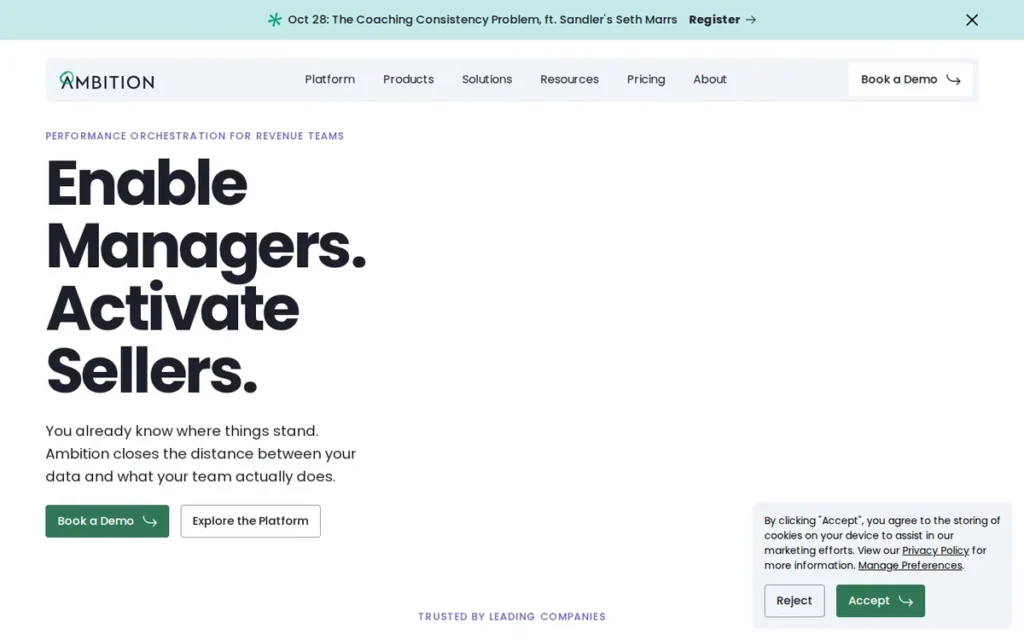
Category: Performance Platform, combines sales gamification contests, structured coaching orchestration, and real-time KPI analytics in a unified revenue execution system designed for enterprise sales organizations.
At a Glance
- Category: Performance Platform
- Best For: Enterprise sales organizations (50+ reps) running Salesforce that need gamification and structured coaching orchestration in a single system with documented ROI evidence
- Price Range: Pricing on request (annual contract; no public per-seat figures available as of May 2026)
- Primary Strength: Ambition is the only sales gamification platform in this evaluation with a Harvard Business Review-validated customer outcome, combined with triple G2 Leader status across Gamification, Coaching, and Performance Management categories simultaneously
- Biggest Limitation: Ambition’s three-pillar depth creates meaningful admin overhead and high shelfware risk for organizations where managers do not consistently enforce coaching cadences, practitioners document a consistent 60-day abandonment pattern at organizations that deploy without process enforcement frameworks
- One-Line Summary: Ambition is an enterprise sales performance platform that unifies gamification contests, structured coaching orchestration, and real-time KPI analytics in a single Salesforce-focused system, the only platform in this evaluation with a Harvard Business Review-validated customer outcome.
- Last Verified: May 2026
Overview
Ambition is an enterprise-grade revenue execution platform built for sales organizations of 50 or more reps that need gamification, structured coaching workflows, and real-time performance analytics unified in a single system. Ambition is the only platform in this evaluation with third-party outcome validation published in the Harvard Business Review, “The Sales Director Who Turned Work into a Fantasy Sports Competition,” March 2015.
Ambition organizes its product around three equally weighted pillars:
- Performance Intelligence: configurable KPI scorecards with real-time tracking at the rep, manager, and executive level, surfacing contextual performance trends and saved multi-level reports
- Coaching Orchestration: structured 1:1 sessions (defined as scheduled, recurring conversations with tracked discussion topics, action plans, and cadence enforcement) documented within the platform
- Sales Gamification: fantasy-style contests, SPIFFs, raffles, challenges, leaderboards, accolades, and digital clubs including milestone recognition such as a “500 Calls Club”
Ambition was founded in 2013 as a Y Combinator alumni company, is backed by Primus Capital private equity, and holds a Salesforce AppExchange listing under “Coaching Orchestration and Gamification for Sales.”
Key Features
- Coaching Orchestration Module: Ambition’s Coaching Orchestration pillar enables managers to run structured 1:1 sessions with tracked discussion topics, action plans, and recurring coaching cadences, making Ambition the only platform in this group that treats coaching documentation as a first-class product pillar rather than a bolt-on feature.
- Fantasy-Sports Team Gamification: Ambition’s contest system allows managers to draft sales reps into competing teams for head-to-head season-format competitions, a distinctive fantasy-sports mechanic directly traceable to the Harvard Business Review-documented Clayton Homes implementation (Ambition Case Study; HBR, March 2015).
- Performance Intelligence Layer: Ambition’s KPI scorecards deliver configurable real-time tracking at the rep, manager, and executive level with contextual performance trends and saved multi-level reports, providing visibility across the full sales hierarchy rather than only front-line rep dashboards.
- TV Wallboard and Digital Clubs: Ambition broadcasts live leaderboards, accolades, digital club memberships, and milestone recognition to office screens and remote team channels, maintaining competitive energy for both in-office and distributed organizations.
- Salesforce AppExchange Integration: Ambition’s Salesforce integration operates within Salesforce objects, respects Salesforce permissions, and supports SSO and user provisioning, reducing implementation risk for organizations already deeply invested in the Salesforce ecosystem (Salesforce AppExchange, 2026).
Best For
Ambition is best for enterprise sales organizations with 50 or more reps that are already operating on Salesforce, have a VP of Sales or RevOps leader who will actively enforce manager coaching cadences, and need documented ROI evidence to justify the platform investment to economic buyers, particularly in B2B SaaS, financial services, and enterprise software verticals where structured coaching accountability is as important as competitive motivation.
Pricing
Ambition does not publish standard pricing tiers; all pricing is quote-based and sales-led with no verified public per-seat or per-month amounts available from third-party comparison databases as of May 2026 (Ambition Products Page). Ambition buyers should expect annual contract structures and request itemized pricing that separates platform fees from per-seat costs. Verify current pricing directly with Ambition before building internal budget models.
Strengths
- HBR-Validated Customer Outcome: Ambition’s Clayton Homes implementation: independently covered in the Harvard Business Review (March 2015), produced an 18% spike in outbound calls, a 100% increase in first sales meetings, an 800% increase in calls leading to warm leads, and a 200%+ increase in qualified sales meetings, making Ambition the only platform in this evaluation with an independently published third-party outcome validation (Ambition Case Study, Clayton Homes; HBR, March 2015).
- Triple G2 Category Leadership: Ambition holds G2 Leader status across Sales Gamification, Sales Performance Management, and Sales Coaching simultaneously as of May 2026 with a 4.6/5.0 overall rating, the only platform in this group recognized as a leader across all three categories at once; verify current review count directly on G2 (G2, 2026).
- Practitioner Enterprise Endorsement: Experienced RevOps consultants in Reddit’s r/Sales_Professionals validate Ambition as “probably your best bet” for large inside sales organizations, citing “strong Salesforce integration, solid leaderboards, and a coaching module that actually works for structured one-on-ones” in the context of 200-plus rep enterprise evaluations (u/erickrealz, r/Sales_Professionals, 2025).
- Platform-Level Performance Benchmarks: Ambition’s marketing materials cite 21% reduced rep turnover in Year 1, 33% faster ramp time for new reps, and 20% month-over-month increase in leads created, vendor-reported directional benchmarks not independently audited; treat as illustrative ranges when building internal business cases and verify current figures during vendor evaluation (Ambition Products Page, 2026).
Limitations
- Shelfware Risk: Ambition’s depth is its most consequential practical trade-off, Reddit practitioners consistently identify Ambition as a high-shelfware-risk platform because “nobody enforced the process” after initial rollout, and the sophistication that makes Ambition powerful at scale becomes an adoption burden for organizations without sustained RevOps process enforcement (u/erickrealz, r/Sales_Professionals, 2025).
- Salesforce-Centric Integration: Ambition’s CRM ecosystem is primarily Salesforce-focused, meaning organizations running HubSpot, Pipedrive, or Microsoft Dynamics as their primary CRM will face integration friction not experienced by Salesforce-native buyers, a material limitation for the majority of mid-market buyers not on the Salesforce platform.
- Retrospective Complexity: Ambition is described by practitioners as “more manager-led and retrospective than some competitors,” excelling at reviewing what happened and documenting coaching cadence rather than driving real-time in-the-moment rep motivation, and G2 critics describe the platform as “complicated” and “not intuitive,” requiring sustained manager training investment beyond initial deployment (Spinify Ambition Alternative Page, 2025).
This aligns with practitioner evaluations on r/techsales:
“Ambition is solid for gamification and leaderboards. Works well if your team is motivated by competition and you want real time visibility into activity metrics. The coaching module is decent but fairly basic, it’s more about tracking that coaching happened than improving its quality.” Posted by u/mohan-thatguy
Takeaway: Practitioners who have evaluated Ambition consistently find its gamification and leaderboard capabilities strong but its coaching module oriented toward activity compliance tracking rather than coaching quality improvement, a meaningful gap for organizations investing in Ambition primarily for skill development rather than motivation.
Verdict
Ambition is the strongest evidence-backed enterprise sales performance platform in this evaluation, the only tool with a Harvard Business Review-validated customer outcome and the only platform where coaching orchestration is an equal product pillar alongside gamification, not a feature bolted onto a motivation core. Ambition earns the #1 ranking because no other platform in this group scores as highly across verified outcome evidence, feature depth, and coaching infrastructure, the three criteria most consequential for enterprise organizations justifying a platform investment to economic buyers. Buyers needing a motivation-only layer with lighter management overhead will find Ambition over-engineered; buyers needing gamification and structured coaching in one system at enterprise scale will find nothing in this category better supported by independent evidence.
2. SalesScreen: Best for High-Energy Sales Floor Motivation: Highest-Rated Pure Gamification Platform
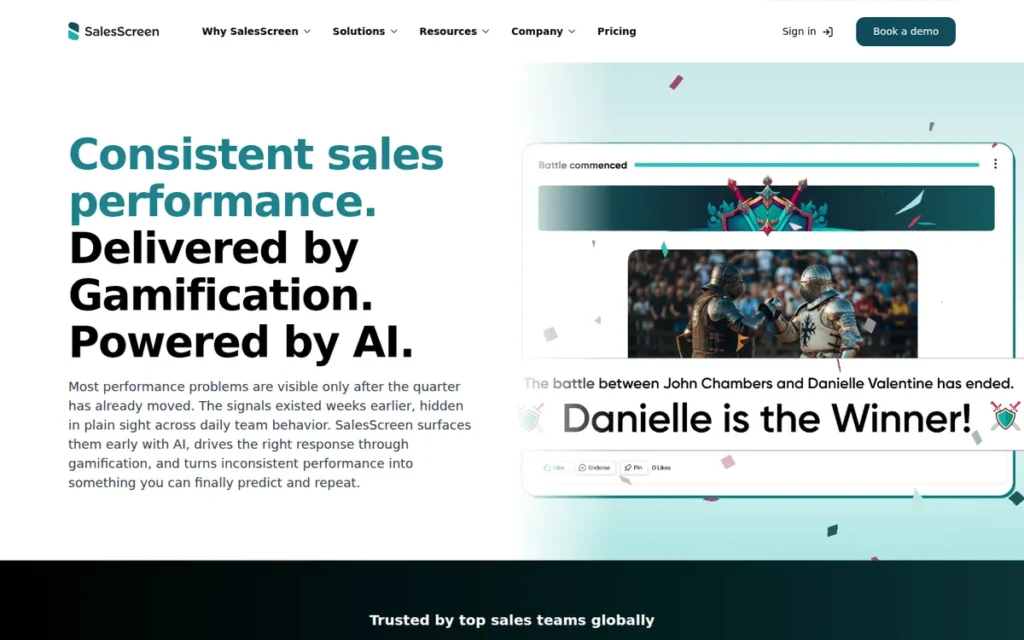
Category: Gamification OS, a full-stack sales motivation and recognition platform combining real-time leaderboards, multi-round contests, TV celebrations, a coin-based rewards shop, and CRM-connected performance dashboards.
At a Glance
- Category: Gamification OS
- Best For: Mid-market to enterprise sales teams (25–200+ reps) wanting the highest-rated pure gamification experience with Salesforce, HubSpot, and Microsoft Dynamics support
- Price Range: Pricing on request (public pricing page at salesscreen.com/pricing; specific tier amounts require direct verification as of May 2026)
- Primary Strength: SalesScreen ranked #1 in G2’s Sales Gamification category for Spring 2026 and Summer 2025, holds the highest G2 rating among pure gamification platforms in this evaluation (4.7/5.0, 486 verified reviews), and offers Multi-Round contests, Battle Mode, and Lifeline second-chance mechanics designed to maintain full-team engagement past week one
- Biggest Limitation: SalesScreen’s coaching depth is lighter than Ambition’s structured orchestration module, practitioners describe it as excellent for daily motivation and TV dashboard floor energy but insufficient as a standalone coaching documentation and action plan tracking system
- One-Line Summary: SalesScreen is a sales gamification and performance visibility platform ranked #1 in G2’s Sales Gamification category for Spring 2026, with a 4.7/5.0 G2 rating across 486 reviews, and distinctive Multi-Round contest mechanics with Lifeline re-engagement features confirming Salesforce, HubSpot, and Microsoft Dynamics integrations.
- Last Verified: May 2026
Overview
SalesScreen is a sales gamification and performance visibility platform built for mid-market and enterprise sales teams wanting a high-energy, CRM-connected motivation system combining real-time leaderboards, automated contests, milestone recognition, and TV broadcasting. SalesScreen ranked #1 in G2’s Sales Gamification category for both Spring 2026 and Summer 2025, and holds the highest G2 rating among pure gamification platforms in this evaluation (4.7/5.0, 486 verified reviews), with G2 reviewers specifically validating that the platform eliminates manual data entry friction through confirmed CRM integrations.
SalesScreen differentiates from all other platforms in this evaluation through three contest mechanics not widely matched in the category:
- Multi-Round competitions: staged contests with increasing difficulty levels that maintain engagement across multi-week periods
- Battle Mode: 1-on-1 rep challenges creating personal accountability through direct peer matchups
- Lifelines: second-chance mechanics preventing lagging reps from disengaging after week one of a contest
SalesScreen is headquartered in Norway and references enterprise-tier customers including DNB, SATS, and Visma in marketing materials, predominantly Nordic and European organizations consistent with the platform’s regional market focus. SalesScreen is repositioning in 2026 under the “Agentic AI, Sales Performance Management” designation on G2 (SalesScreen Sales Gamification Page, 2026).
Key Features
- Multi-Round and Lifeline Contest Mechanics: SalesScreen’s Multi-Round competitions stage contests with increasing difficulty levels over time, and the Lifeline mechanic provides lagging reps a second-chance opportunity mid-contest, two features designed to maintain full-team engagement beyond the first week, which is the documented drop-off point for most single-round gamification deployments (SalesScreen Gamification Page, 2026).
- Battle Mode 1-on-1 Challenges: SalesScreen’s Battle Mode enables managers to configure direct peer challenges alongside team-wide competitions, creating personal accountability through targeted competitive matchups that generate engagement beyond generic leaderboard dynamics.
- Personalized TV Deal Celebrations: SalesScreen’s TV celebration system displays each rep’s photo and theme music on office monitors at the moment of deal closure, a feature that G2 reviewers specifically praised for creating cultural recognition moments and visible floor energy for the entire team simultaneously (G2, 2026).
- Coin-Based Reward Shop: SalesScreen’s reward shop allows reps to accumulate points from performance milestones and redeem them from a configurable rewards catalog, creating a tangible incentive layer that extends motivation beyond recognition-only mechanics into concrete earned rewards.
- Three-CRM Integration: SalesScreen integrates with Salesforce, HubSpot, and Microsoft Dynamics with G2 reviewers documenting that “CRM integration removes manual steps needed”, eliminating double-entry friction practitioners identify as the primary adoption killer within the first 60 days of deployment (G2, 2026).
Best For
SalesScreen is best for mid-market to enterprise sales teams of 25 to 200-plus reps that prioritize daily rep motivation and floor energy over structured coaching documentation, are not exclusively locked into Salesforce, and want distinctive multi-round contest mechanics designed to keep the full rep distribution engaged throughout the entire duration of a contest rather than only consistent top performers.
Pricing
SalesScreen maintains a public pricing page at salesscreen.com/pricing, but specific tier names and per-user or per-month dollar amounts were not confirmed through available third-party comparison databases as of May 2026. Pricing is effectively contact-for-quote, consistent with mid-market enterprise sales performance tools. SalesScreen buyers should request an itemized quote distinguishing platform fees from per-seat costs and confirm whether the reward shop catalog is included in standard pricing or a separate add-on.
Strengths
- G2 #1 in Sales Gamification and Highest Pure-Gamification Rating in This Evaluation: SalesScreen ranked #1 in G2’s Sales Gamification category for Spring 2026 and Summer 2025 (an independently confirmable designation stronger than a raw rating alone) and earned a 4.7/5.0 G2 score across 486 verified reviews, the highest among pure gamification platforms evaluated; reviewers specifically praised real-time CRM-connected tracking, intuitive UI, and responsive support (G2, 2026).
- Full-Rep-Distribution Focus: SalesScreen’s marketing data asserts its gamification system lifts middle performers’ KPIs by 61% and low performers’ KPIs by 107%, vendor-reported figures positioning SalesScreen as designed to improve the full rep distribution, not only recognize existing top performers; treat as directional benchmarks pending independent verification and verify current figures during evaluation (SalesScreen Sales Gamification Page, 2026).
- Enterprise-Scale Community Validation: Reddit practitioners in r/Sales_Professionals validate SalesScreen as a legitimate enterprise alternative to Ambition for organizations with 200-plus reps, describing it as the clear choice for “front-line motivation and visual energy” with a “surprisingly good TV dashboard mode” validated in direct head-to-head comparisons with Ambition (u/mainaisakyuhoon, r/Sales_Professionals, 2025).
- 2026 AI Strategic Repositioning: SalesScreen’s active repositioning to “Agentic AI, Sales Performance Management” on G2 in 2026, combined with confirmed multi-CRM support across Salesforce, HubSpot, and Microsoft Dynamics, signals a technology investment trajectory relevant for organizations planning multi-year platform roadmaps (G2, 2026).
Limitations
- Coaching Depth Gap: SalesScreen’s primary trade-off relative to top-ranked Ambition is coaching infrastructure, practitioners directly describe SalesScreen as excellent for “daily motivation and TV dashboards on the sales floor, less depth on the coaching side,” meaning organizations requiring structured 1:1 documentation, action plan tracking, and coaching cadence enforcement alongside gamification will need either Ambition or a separate dedicated coaching tool (u/mohan-thatguy, r/techsales, 2025).
- European Customer Concentration: SalesScreen’s enterprise reference customers (referenced in SalesScreen marketing materials as including DNB, SATS, and Visma) are predominantly Nordic and European, which may carry less social proof weight for North American enterprise procurement teams seeking geographically relevant references; buyers should specifically request North American customer references during evaluation (Viewpoint Analysis, 2025).
- Quote-Only Pricing Friction: SalesScreen does not publish standard per-seat pricing tiers, requiring buyers to enter a sales discovery cycle before confirming budget fit, a meaningful barrier for SMB buyers who cannot invest discovery time before knowing whether the platform is accessible at their team size and budget level.
Verdict
SalesScreen is the highest-rated pure gamification platform in this evaluation, ranked #1 in G2’s Sales Gamification category for Spring 2026, earning a 4.7/5.0 score across 486 reviews and offering the most distinctive contest mechanics in the category. SalesScreen earns the #2 ranking through top-tier user satisfaction, confirmed multi-CRM flexibility across Salesforce, HubSpot, and Dynamics, and unique Multi-Round and Lifeline mechanics that no competing platform in this group offers. Sales organizations prioritizing daily rep motivation, office floor energy, and broad CRM compatibility over structured coaching orchestration will find SalesScreen the strongest option in this group.
3. OneUp Sales: Best for Non-Salesforce Teams: Highest Absolute G2 Rating with Fairer Competition Mechanics
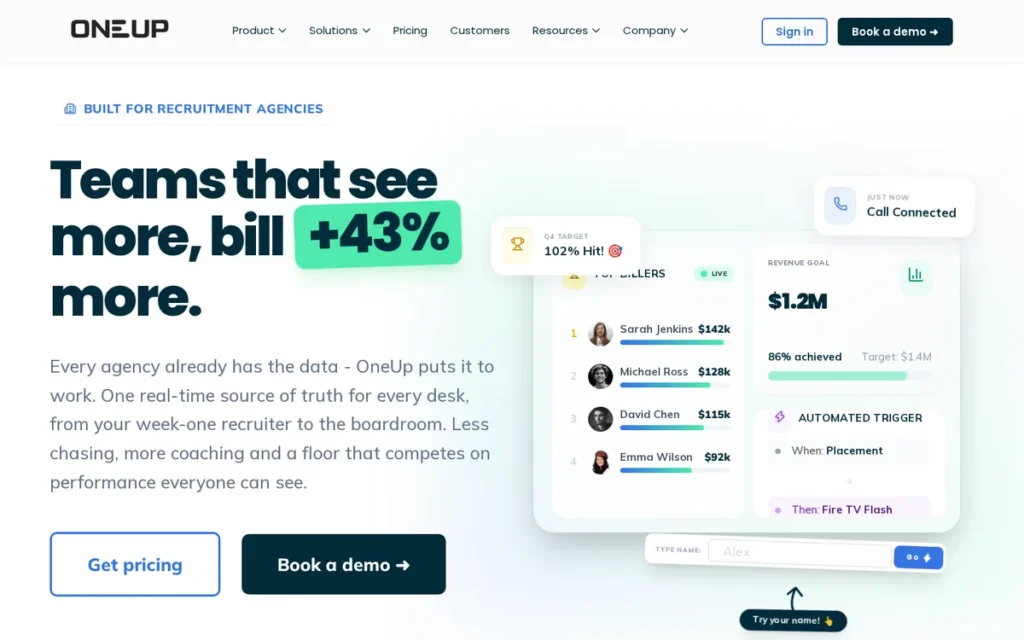
Category: Visual Gamification, a CRM-connected sales motivation platform using real-time leaderboards, automated competitions, and Target Percentage scoring to create fair, visible performance competition across sales teams with varied quota structures.
At a Glance
- Category: Visual Gamification
- Best For: SMB to mid-market sales teams (10–100 reps) running HubSpot, Pipedrive, or Salesforce that want the highest-rated user satisfaction in the category with fairer competition mechanics and accessible pricing
- Price Range: Accessible for SMBs (public pricing page at oneupsales.com/pricing; described as cost-effective for teams under 100 reps as of May 2026)
- Primary Strength: OneUp Sales holds the highest absolute G2 rating in this entire evaluation (4.9/5.0, 165 verified reviews as of May 2026) and is the only platform offering a Target Percentage Leaderboard ranking reps by percentage toward their individual goal rather than raw activity volume
- Biggest Limitation: OneUp Sales’ coaching infrastructure is a light analytics layer rather than a first-class orchestration system, organizations needing structured 1:1 documentation, action plan tracking, and coaching cadence enforcement alongside gamification will find OneUp Sales’ coaching capabilities insufficient for enterprise coaching workflows
- One-Line Summary: OneUp Sales is a UK-based CRM-connected sales gamification platform with the highest absolute G2 rating in this evaluation (4.9/5.0, 165 reviews), native HubSpot and Pipedrive integration alongside Salesforce, and a Target Percentage Leaderboard ranking reps by percentage toward individual goals rather than raw activity volume.
- Last Verified: May 2026
Overview
OneUp Sales is a UK-based CRM-connected sales gamification and performance management platform built for SMB to mid-market sales teams of 10 to 100 reps that want real-time leaderboards, automated competitions, and performance visibility dashboards natively connected to HubSpot, Pipedrive, or Salesforce. OneUp Sales holds a 4.9/5.0 G2 rating (the highest absolute rating of all seven platforms evaluated as of May 2026, based on 165 verified reviews) and is designed around fair competition mechanics that motivate the full rep distribution.
OneUp Sales’ defining product differentiation is its Target Leaderboard, which ranks every rep by their percentage toward individual goal attainment rather than absolute activity volume. A rep who has completed 95% of a lower quota ranks above one who has completed 70% of a higher quota, creating equitable competitive dynamics for teams with varied quota structures, territories, or seniority levels (OneUp Sales Help Center). OneUp Sales confirms native integration across the three most commonly deployed CRMs by mid-market companies and accessible pricing positioning that serves the majority of the buyer market excluded by enterprise-tier contract minimums.
Key Features
- Target Percentage Leaderboard: OneUp Sales’ Target Leaderboard ranks every rep by their percentage toward their individual goal rather than raw activity volume, creating a fair competitive environment where reps with different quota sizes, territories, or seniority levels compete on equal terms rather than producing demotivating displays that always show the same top performers (OneUp Sales Help Center).
- Automated Competition Management: OneUp Sales’ system supports missions, leagues, challenges, and multi-type contests that self-manage once configured, reducing the ongoing admin overhead that practitioners consistently identify as the primary reason sales gamification platforms become shelfware within the first 90 days of deployment.
- Multi-CRM Native Connectivity: OneUp Sales connects natively to HubSpot, Salesforce, and Pipedrive with confirmed live data sync, ensuring leaderboard standings reflect real-time CRM activity rather than batch-updated snapshots that erode rep trust in competition mechanics (G2 OneUp Sales Features, 2026).
- OneUp TV Display System: OneUp Sales broadcasts live competition standings, pipeline movements, and rep leaderboards to office monitors, described in partner documentation as “the next iteration of the whiteboard,” providing visual workplace performance visibility without requiring reps to log into a separate platform (Chameleon-i Partner Article).
- Performance Analytics Dashboards: OneUp Sales provides rep-level and team-level KPI tracking alongside pipeline management updates, enabling managers to make targeted coaching decisions based on live performance data rather than retrospective weekly reporting (G2 OneUp Sales Features, 2026).
Best For
OneUp Sales is best for SMB to mid-market sales teams of 10 to 100 reps running HubSpot or Pipedrive as their primary CRM rather than Salesforce, with mixed quota structures where fairness in competition design is a management priority, that need accessible pricing with strong out-of-the-box CRM connectivity without the complexity of enterprise-tier platform configuration.
Pricing
OneUp Sales’ pricing page is publicly active at oneupsales.com/pricing. Third-party comparison sources describe OneUp Sales as “cost-effective for smaller teams” and “generally more accessible in pricing” than enterprise platforms as of May 2026 (FitGap, 2025). Specific published tier amounts were not independently confirmed through third-party research; buyers should verify current pricing directly and expect SMB-accessible rates rather than enterprise-contract minimums typical of Ambition or LevelEleven.
Strengths
- Highest Absolute G2 Rating in This Evaluation: OneUp Sales holds a 4.9/5.0 G2 rating based on 165 verified reviews as of May 2026 (the highest absolute rating of all seven platforms evaluated) with reviewer praise citing the gamification as “the best unique feature,” dashboards as “great for displaying key metrics clearly to every consultant daily,” and competition mechanics as “a great way of uniting the entire team around a goal” (G2, 2026).
- Broadest Non-Salesforce CRM Flexibility: OneUp Sales confirms native CRM integration with HubSpot, Salesforce, and Pipedrive (the three most commonly deployed CRMs by SMB and mid-market companies) plus VoIP tools and payroll software connections, making it the most CRM-flexible option in this group for organizations not on Salesforce (Fugo.ai, 2026).
- Named Customer Reference: Investigo, a UK-based recruitment agency, is a referenced OneUp Sales customer with documented benefits including “streamlined data management,” “self-service access to performance tracking,” and “targeted coaching decisions”, validating applicability in high-volume inside sales environments where activity tracking is the primary management lever (Fugo.ai, 2026).
- Fairness-Correcting Leaderboard Design: OneUp Sales’ Target Percentage Leaderboard is the only fairness mechanic in this evaluation that directly addresses the practitioner-documented problem that raw-volume leaderboards demotivate the 60–80% of reps who are not perennial top performers, a design intervention creating sustainable engagement rather than disengagement for the majority of the team.
Limitations
- G2 Review Corpus Context Required: OneUp Sales’ 4.9/5.0 G2 rating is based on 165 verified reviews as of May 2026 (the smallest confirmed review corpus in this evaluation, compared to Spinify’s 942 reviews and SalesScreen’s 486 reviews) and buyers should weight this rating in the context of the smaller statistical sample rather than equating it directly with higher-volume review corpora, even though the underlying reviewer sentiment is strongly positive.
- Light Coaching Infrastructure: OneUp Sales’ most substantive structural trade-off is coaching depth, while the platform delivers strong competition mechanics and performance visibility, its coaching capability is a light analytics layer rather than a first-class orchestration system, and organizations needing structured 1:1 documentation, action plan tracking, and coaching cadence enforcement should evaluate Ambition instead.
- Limited Enterprise-Scale North American References: OneUp Sales’ enterprise-scale deployment references are primarily UK and European, making it harder for US-headquartered enterprise procurement teams to surface peer geographic references during vendor evaluation; buyers should specifically request relevant North American references during demos.
Verdict
OneUp Sales is the highest absolute user-satisfaction-rated platform in this evaluation (4.9/5.0 G2, 165 reviews) and the strongest option for non-Salesforce organizations seeking accessible, fair, and CRM-native sales gamification. OneUp Sales earns the #3 ranking through its combination of top G2 satisfaction, genuine CRM flexibility across HubSpot, Pipedrive, and Salesforce, and the Target Percentage Leaderboard, the only fairness-correcting innovation in this group that directly addresses the well-documented leaderboard demotivation problem for non-top performers. Sales teams of 10 to 100 reps not on Salesforce that want a high-quality gamification platform without enterprise pricing complexity will find OneUp Sales the strongest evidence-backed option in this group.
4. Spinify: Best for AI-Automated Contest Management: Reduces Manager Admin Overhead with AI-Powered Competition Design
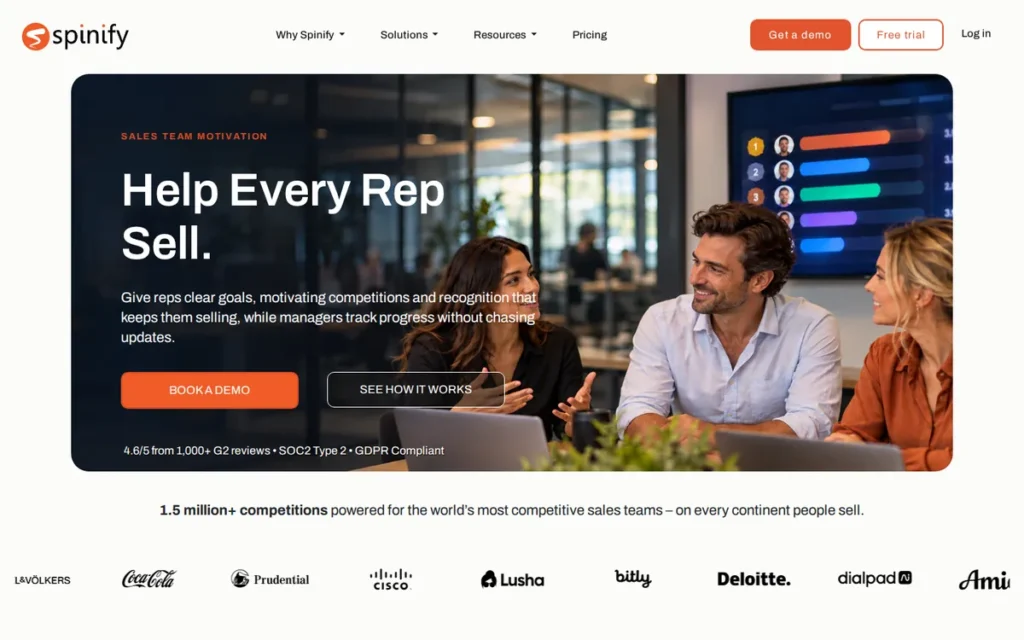
Category: AI-Powered Gamification, an AI-assisted sales motivation platform using AI competition automation (marketed by Spinify as SpinifyGPT) to generate custom contests and the Spinify AI Coaching Agent to personalize rep coaching nudges using individual CRM performance data.
At a Glance
- Category: AI-Powered Gamification
- Best For: High-growth SMB to mid-market sales teams (15–100 reps) where managers lack time for manual contest design and want AI-automated competition management with Slack and Zoom integration for remote or hybrid deployment
- Price Range: Tiered pricing published at spinify.com/pricing (specific current amounts require direct verification as of May 2026)
- Primary Strength: Spinify’s AI competition automation and AI Coaching Agent automate both contest design and personalized coaching nudges using each rep’s own CRM performance data, reducing the manager time investment practitioners identify as the primary reason gamification platforms become shelfware; Spinify holds a 4.6/5.0 G2 rating across 942 verified reviews, the largest confirmed review corpus in this evaluation
- Biggest Limitation: Spinify’s vendor-reported outcome statistics (117% daily SAO increase, 40% customer communication improvement) carry no named client attribution in available sources, buyers seeking independently verified ROI evidence to justify the purchase to economic stakeholders will find Spinify’s evidence portfolio weaker than Ambition or LevelEleven
- One-Line Summary: Spinify is an AI-powered sales gamification platform whose AI competition automation (marketed as SpinifyGPT) reduces manager contest design overhead using individual rep CRM data, with a 4.6/5.0 G2 rating across 942 reviews (the largest review corpus in this evaluation), simultaneous-competition capabilities, and publicly available tiered pricing.
- Last Verified: May 2026
Overview
Spinify is an AI-powered sales gamification platform built for high-growth SMB to mid-market sales teams that want to automate the two most time-consuming elements of gamification management (contest design and personalized rep coaching) using an AI layer that draws from each rep’s own CRM performance data rather than generic templates.
Spinify’s core product differentiators include:
- AI competition automation (marketed by Spinify as “SpinifyGPT” on vendor channels, note: this product name was not independently confirmed in external G2 or review platform listings as of May 2026) generates custom competitions calibrated to individual rep history and behavioral patterns
- Spinify AI Coaching Agent delivers real-time personalized feedback, automated coaching tasks, performance reviews, and wellness monitoring, a holistic approach to rep wellbeing not found in competing platforms in this evaluation
Spinify holds a 4.6/5.0 G2 rating across 942 verified reviews, the largest confirmed review corpus of any platform in this evaluation. Spinify maintains publicly available tiered pricing at spinify.com/pricing and confirms integrations with CRM systems, Slack, and Zoom, making it the most accessible AI-forward gamification option for teams where manager time is the binding constraint on sustained adoption.
Key Features
- AI Competition Automation: Spinify’s AI competition engine (marketed as SpinifyGPT on Spinify’s own channels) creates custom sales contests using each rep’s individual CRM performance history, moving beyond generic templates to AI-designed challenges calibrated to actual behavioral patterns, directly reducing the manager configuration time practitioners identify as the primary driver of gamification platform abandonment (Spinify AI Blog, 2025).
- AI Coaching Agent with Wellness Tracking: Spinify’s AI Coaching Agent delivers real-time personalized feedback, automated coaching tasks, follow-up reminders, and wellness monitoring for individual reps, creating a continuous coaching presence between scheduled manager 1:1s and tracking rep wellbeing in a dimension no other platform in this evaluation addresses (Spinify AI Coaching Agent Knowledge Base).
- Simultaneous Multi-KPI Competitions: Spinify supports running multiple concurrent contests in parallel (enabling a weekly call volume contest alongside a monthly pipeline-add contest) without forcing the sales team to choose between competing incentive priorities or requiring managers to pause one contest before launching another (G2 Spinify Features, 2026).
- Slack and Zoom Integration: Spinify integrates with Slack and Zoom in addition to CRM systems, enabling deal celebrations and rep recognition to surface in the communication tools reps already use throughout the workday, particularly valuable for remote and hybrid sales teams that lack physical sales floor screens as a recognition delivery mechanism (Spinify Blog, 2025).
- Cross-Device Recognition: Spinify’s achievement badges, points and tier system, and real-time leaderboards display on TV and office screens and on mobile apps for iOS and Android, ensuring recognition is visible whether reps are working on the sales floor, from home, or in the field.
Best For
Spinify is best for high-growth sales teams of 15 to 100 reps where managers lack time to manually design and maintain gamification contests, and where AI-driven automation reducing ongoing admin overhead is valued more than enterprise coaching orchestration, particularly for hybrid and remote deployments where Slack and Zoom integration replaces office screen-based recognition as the primary delivery mechanism.
Pricing
Spinify publishes tiered pricing at spinify.com/pricing, making it one of two platforms in this evaluation with publicly available pricing rather than quote-only access. Specific current per-user or per-month dollar amounts should be verified directly on the pricing page, as rates may have been updated since available third-party references were published. Spinify is consistently characterized in comparison reviews as more price-accessible than enterprise-tier alternatives like Ambition, but buyers should verify current tier structures directly before assuming SMB-level pricing applies to their specific team configuration.
Strengths
- Largest Confirmed G2 Review Corpus in This Evaluation: Spinify holds a 4.6/5.0 G2 rating across 942 verified reviews as of May 2026, the largest confirmed review corpus of any platform in this evaluation, providing the highest statistical confidence for rating interpretation and indicating strong, broad-based product-market fit across diverse organizational sizes and industries (G2, 2026).
- Genuine AI Technical Differentiation: Spinify’s AI competition automation and AI Coaching Agent combination is a real technical differentiator in the sales gamification category, the AI-based competition design reduces the most commonly cited manager friction point in gamification adoption, while the wellness monitoring component of the Spinify AI Coaching Agent addresses rep burnout risk not tracked by any other platform in this evaluation (Spinify AI Blog, 2025).
- Simultaneous Multi-KPI Contest Architecture: Spinify’s simultaneous competition support allows organizations to incentivize diverse sales behaviors (call volume, pipeline adds, demo bookings) at the same time without sequential contest fatigue, addressing the common management challenge of activity competitions that inadvertently deprioritize pipeline quality.
- Pricing Transparency: Spinify’s publicly available tiered pricing page places it among the most transparent options in this category, directly serving SMB and mid-market buyers who cannot invest in a full enterprise sales discovery process before confirming whether a platform fits their available budget.
Limitations
- No Named Client Outcome Evidence: Spinify’s most consequential evidence gap is the complete absence of named client attribution, vendor-reported marketing cites a “117% increase in average daily SAOs” and “40% increase in customer communication,” but no named customer is attached to either figure in available sources, and independent search of available sources could not locate the 117% statistic as of May 2026, placing Spinify at a significant disadvantage compared to Ambition (HBR-validated) and LevelEleven (Detroit Pistons, named) for buyers building an ROI business case (Spinify Blog, 2025).
- SpinifyGPT Product Name Not Confirmed in External Listings: Spinify’s AI competition automation feature is marketed by the vendor as “SpinifyGPT” on Spinify’s own channels, but this product name was not independently confirmed in G2 listings or external review platform descriptions as of May 2026, buyers should verify whether SpinifyGPT is a named product feature or a marketing label for the platform’s underlying AI capabilities before citing this specific name in procurement documentation.
- Company Background Opacity: Spinify’s founding date, headquarters location, and detailed company history were not independently verifiable from available public sources as of May 2026, buyers seeking organizational stability and vendor longevity information should verify directly with Spinify before committing to a multi-year platform relationship.
Verdict
Spinify is the strongest AI-forward gamification option for SMB to mid-market sales teams that prioritize automated contest management and personalized AI coaching over independently verified outcome evidence, earning the #4 ranking through its genuine AI differentiation, the largest confirmed G2 review corpus in this evaluation (942 reviews at 4.6/5.0), publicly available pricing, and simultaneous-competition capabilities. Spinify trails Ambition, SalesScreen, and OneUp Sales in outcome evidence quality or confirmed named-CRM integration specificity, but teams managing 15 to 100 reps where manager time for contest design is the binding constraint on sustained adoption will find Spinify’s AI automation layer a meaningful operational advantage over platforms requiring ongoing manual configuration.
5. Plecto: Best for Multi-Department KPI Visibility: Dashboard-First Platform with 100+ Integrations
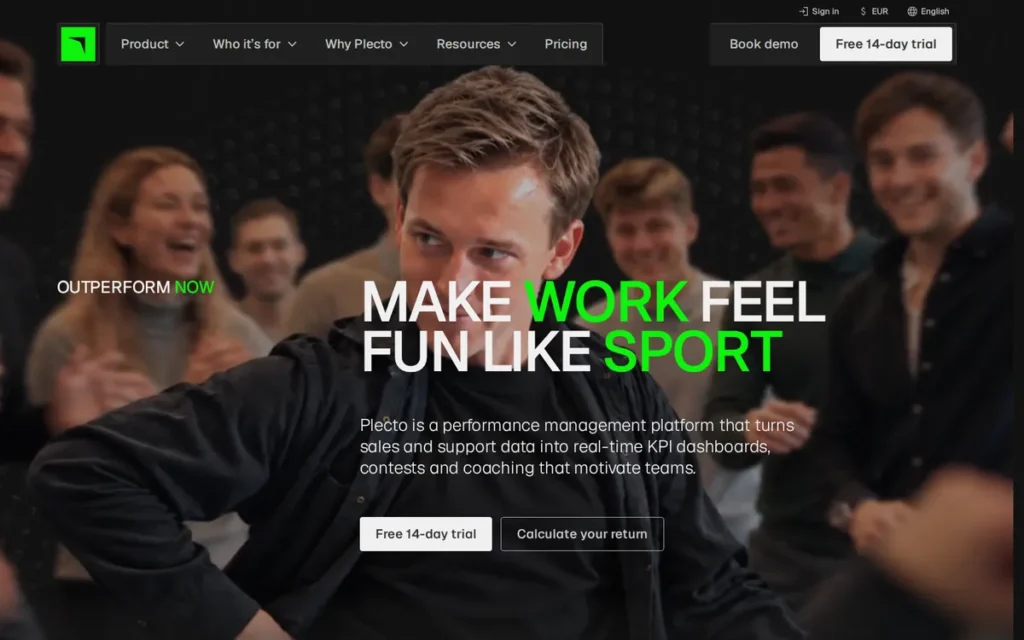
Category: Dashboard + Gamification, a real-time KPI visualization platform for organizations needing to make complex operational performance data visible across multiple departments, with gamification contests and leaderboards as a motivational layer built on top of the analytics foundation.
At a Glance
- Category: Dashboard + Gamification
- Best For: Multi-department organizations (sales + support + operations) or European companies running complex KPI stacks across non-standard technology ecosystems that need performance visibility as the primary use case with gamification as a secondary motivational complement
- Price Range: Tiered pricing published at plecto.com/pricing (specific current amounts require direct verification as of May 2026)
- Primary Strength: Plecto connects to 100+ systems: the broadest integration ecosystem in this evaluation, and is one of the few platforms in this group specifically architected to handle non-sales KPIs (support tickets, SLA compliance, operational metrics) alongside sales activity data in a unified real-time dashboard; Plecto reports 80,000+ users in platform marketing materials (Plecto YouTube, 2025)
- Biggest Limitation: Plecto’s dashboard-first architecture makes its gamification mechanics less immersive and motivation-centric than purpose-built platforms like SalesScreen or Ambition, and Plecto’s own documentation warns that poorly configured deployments with too many KPIs produce information overload rather than actionable motivational clarity
- One-Line Summary: Plecto is a Denmark-based real-time KPI dashboard platform with 100+ integrations, 80,000+ self-reported users (Plecto YouTube, 2025), and a three-KPI-type architecture that serves organizations needing cross-department performance visibility before adding gamification contests and leaderboards as a motivational layer.
- Last Verified: May 2026
Overview
Plecto is a Denmark-based real-time KPI dashboard and business performance platform built for organizations needing to visualize complex operational data across multiple departments (sales, support, and operations) before layering gamification mechanics as a motivational complement to the primary analytics function. Plecto’s fundamental product architecture inverts the typical gamification vendor philosophy: dashboards are the first-class product, while gamification contests, achievements, and leaderboards function as motivational enhancements built on top of the analytics layer.
Plecto reports 80,000+ users in platform marketing materials (Plecto YouTube, 2025), a self-reported figure not independently audited by a third party; buyers should request additional independent validation of this scale claim during evaluation. Plecto supports 100-plus CRM and business system integrations, a three-KPI-type framework distinguishing activity from quality from result metrics, and publicly available tiered pricing, delivering the broadest organizational scope of any platform in this evaluation (Plecto Homepage).
Key Features
- Three-KPI-Type Architecture: Plecto explicitly distinguishes between activity KPIs (leading indicators such as calls made and demos booked), quality KPIs (process measures such as conversion rates and lead scoring accuracy), and result KPIs (outcome measures such as closed revenue), enabling gamification tied to process quality rather than only raw volume, preventing the failure mode of optimizing for activity at the expense of deal quality (Plecto Dashboard Documentation).
- 100+ Integration Ecosystem: Plecto’s integration library spanning CRM, telephony, and helpdesk platforms is the broadest in this evaluation, a meaningful advantage for organizations running non-Salesforce or non-standard technology stacks where other platforms require custom API development or exclude non-CRM data sources entirely (Plecto Homepage).
- High-Density Dashboard Architecture: Plecto’s dashboard engine supports personal, departmental, and company-level KPI views with up to 20 KPIs per widget and 30 widgets per report, providing data visualization depth that exceeds all other platforms in this evaluation and supports both sales and non-sales departments from a single unified monitoring layer (Plecto Dashboard Documentation).
- Gamification as Motivational Layer: Plecto’s gamification layer includes configurable contests, achievement milestones, and real-time leaderboards that surface within the same dashboard environment as operational KPI data, eliminating the tool-switching friction that makes separate gamification platforms feel disconnected from the metrics actually being tracked and measured.
- Scheduled Automated Reports: Plecto’s color-coded speedometer widgets and schedulable automatic reports create at-a-glance performance status for managers monitoring multiple rep or team metrics simultaneously, enabling stakeholder distribution for periodic performance snapshots without requiring daily platform access from every recipient.
Best For
Plecto is best for organizations needing to make performance visible across sales and non-sales departments simultaneously (such as companies where sales, customer support, and operations teams share common KPI visibility infrastructure) or for European organizations under GDPR compliance requirements where a Denmark-based vendor with a large self-reported user base represents lower data residency risk than US-headquartered alternatives.
Pricing
Plecto publishes tiered pricing at plecto.com/pricing, making it one of two platforms in this evaluation with publicly available pricing rather than quote-only access. Specific current per-user or per-month amounts should be verified directly on the pricing page as of May 2026. Plecto buyers should factor in total investment including dashboard configuration time, Plecto’s configurability creates higher-than-average setup complexity cost for organizations without dedicated analytics or BI administrator resources.
Strengths
- Largest Self-Reported User Base in This Evaluation: Plecto reports 80,000+ users in platform marketing materials (Plecto YouTube, 2025) (a self-reported figure not independently audited by a third party) with a 4.6/5.0 G2 rating consistent with category leaders, suggesting strong product-market fit across diverse industries and organizational sizes; buyers should ask Plecto for independent validation of this scale claim during evaluation.
- Broadest Integration Ecosystem: Plecto’s 100-plus integration count is the highest in this evaluation and spans CRM, telephony, and helpdesk systems, making Plecto the only platform capable of serving organizations needing unified performance visibility across sales, customer support, and operations from a single dashboard rather than three separate department-specific tools (Plecto Homepage, 2026).
- GDPR-Native European Positioning: Plecto’s Denmark headquarters and GDPR-native design position it as the strongest option in this evaluation for European organizations where data residency, privacy compliance, and vendor accountability under EU data protection regulations are material procurement criteria (Plecto Homepage, 2026).
- Quality-Metric Gamification Capability: Plecto’s three-KPI-type architecture enables organizations to build gamification mechanics around call quality scores, conversion rates, and process compliance metrics alongside raw daily activity counts, directly preventing the documented gamification failure mode of incentivizing only activity volume at the expense of deal quality or process adherence.
Limitations
- Gamification as Secondary Experience: Plecto’s most consequential trade-off is the inverse of its core strength, the dashboard-first philosophy making Plecto uniquely capable for multi-department KPI visualization also means its gamification mechanics are less culturally energizing than dedicated platforms like SalesScreen or Ambition, and buyers needing maximum rep engagement through contest energy, personalized deal celebrations, and competitive floor dynamics will find Plecto’s gamification layer functional but not the primary cultural driver that purpose-built motivation platforms create.
- Configuration Complexity Risk: Plecto’s own documentation explicitly warns against cluttered dashboards with too many KPIs, acknowledging that poorly configured deployments produce information overload rather than motivational clarity, a setup quality dependency requiring more admin sophistication than more opinionated and less configurable platforms in this evaluation (Plecto Dashboard Documentation, 2025).
- No Named Outcome Evidence and Self-Reported Scale Claim: No specific named customer outcome data was surfaced in available research as of May 2026, and the 80,000+ user figure comes exclusively from Plecto’s own marketing materials rather than an independently audited source, buyers evaluating Plecto should request named outcome case studies and ask for independent confirmation of platform scale during the vendor selection process.
Verdict
Plecto is the strongest option in this evaluation for organizations needing performance visibility as a first-class capability across multiple departments, 100-plus integration compatibility with non-standard technology stacks, or GDPR-compliant European vendor alternatives to US-headquartered platforms. Plecto earns the #5 ranking due to its exceptional integration breadth and large self-reported installed base at 4.6/5.0 G2, but trails higher-ranked platforms in dedicated gamification motivation depth, coaching infrastructure, and available named outcome evidence. Organizations where “making complex data visible” is the primary problem and “motivating through competition” is a secondary goal will find Plecto’s dashboard-first architecture the strongest fit in this group.
6. LevelEleven (Ascent Cloud): Best for Salesforce-Native Behavior Management: Early Warning Pacing Alerts for Long Sales Cycles
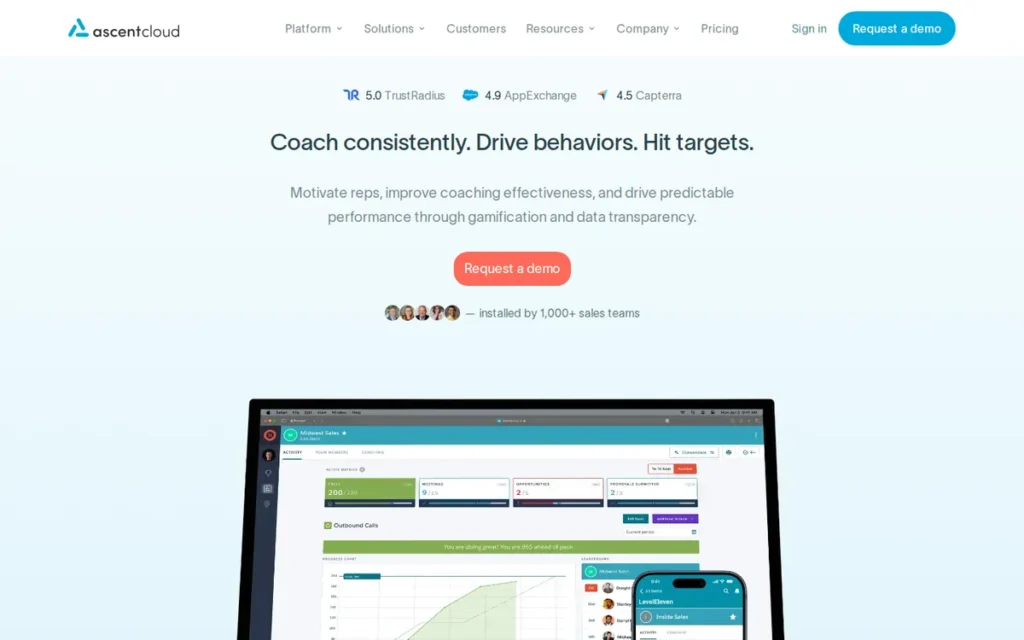
Category: Behavior Management, a Salesforce-native sales gamification andcoaching platform that tracks leading behavioral KPIs with real-time pacing algorithms and early warning alerts designed for organizations managing long B2B sales cycles inside the Salesforce ecosystem.
At a Glance
- Category: Behavior Management
- Best For: Salesforce-native enterprise organizations (50+ reps) with a dedicated Salesforce administrator that need behavior-based activity tracking, early warning pacing alerts, and gamification built natively inside Salesforce rather than integrated via API
- Price Range: Pricing on request (annual contract language; quote-based; no public per-seat amounts available as of May 2026)
- Primary Strength: LevelEleven is the only Salesforce-native platform in this evaluation, built directly on the Salesforce platform rather than integrated via API, with a Detroit Pistons named case study documenting a 127% increase in daily appointments set following gamification deployment (GamesBeat, 2014, over 10 years prior to this review; request post-2020 customer data to complement this historical reference)
- Biggest Limitation: LevelEleven’s Salesforce-only architecture completely excludes organizations not on Salesforce, and unresolved ownership ambiguity between Ascent Cloud and Mediafly (flagged in Reddit practitioner discussions) creates material due diligence risk for buyers committing to multi-year annual contracts
- One-Line Summary: LevelEleven is a Salesforce-native behavior management platform that tracks leading activity KPIs with real-time pacing algorithms and early warning alerts, backed by a Detroit Pistons case study documenting a 127% increase in daily appointments set (GamesBeat, 2014).
- Last Verified: May 2026
Overview
LevelEleven, operating under parent company Ascent Cloud, is a Salesforce-native sales gamification and coaching platform built exclusively for organizations that have made Salesforce their primary CRM, operating directly within Salesforce objects, respecting Salesforce permissions, and requiring no separate login for Salesforce users. LevelEleven was originally launched at Salesforce’s Dreamforce conference in September 2011 and historically described by GamesBeat as “the top gamification app on Salesforce.com’s AppExchange.”
LevelEleven’s primary product philosophy differentiates from outcome-tracking competitors by focusing on leading behavioral KPIs (cold calls, appointment bookings, demo completions, lead generation) combined with real-time pacing algorithms calculating whether each rep is on track to hit goals. LevelEleven’s early warning alerts notify managers before a rep misses target rather than after, enabling proactive coaching intervention rather than retrospective performance reviews. LevelEleven carries strong Salesforce-ecosystem credentials alongside vendor ownership ambiguity that represents a material due diligence requirement before any annual contract commitment.
Key Features
- Real-Time Pacing Algorithms with Early Warning Alerts: LevelEleven’s pacing algorithm continuously calculates whether each rep is on track to hit KPI targets and triggers early warning alerts to managers when trajectory indicates a performance miss, enabling proactive coaching before opportunities are lost rather than retrospective reviews after quota periods end (Ascent Cloud LevelEleven Page).
- Behavior-Based KPI Scorecards: LevelEleven tracks leading indicators including cold calls, appointment-setting, lead generation, meeting bookings, and social selling activity, a performance management layer specifically designed for long B2B sales cycles where closed revenue is too lagging a metric to drive meaningful daily rep behavior changes (GamesBeat, 2014).
- Channel11 TV Broadcast Display: LevelEleven’s Channel11 feature displays live contest standings and leaderboards on office screens, delivering the same visual floor energy as competing broadcast-first platforms while operating entirely within the Salesforce data environment with no external data sync delay (LevelEleven Product Tour).
- Onboarding Success Plans: LevelEleven’s structured activity ramp targets for new reps gamify the first 30–90 days of employment, accelerating time-to-first-deal and reducing early rep attrition that practitioners identify as a primary driver of new hire ramp time failure in high-volume inside sales teams.
- Native Salesforce Security Architecture: LevelEleven operates inside Salesforce (inheriting Salesforce’s security model, permissions structure, and user interface) eliminating the parallel-login friction, data latency, and permission conflict issues that affect API-integrated gamification tools in Salesforce-first environments (Salesforce AppExchange).
Best For
LevelEleven is best for enterprise Salesforce organizations with 50 or more reps, a dedicated Salesforce administrator who can configure and maintain the native platform, and a management philosophy prioritizing leading behavioral indicators and proactive pacing alerts over lagging outcome rewards and real-time celebration mechanics, particularly in financial services, B2B enterprise software, and other industries with multi-month complex sales cycles.
Pricing
LevelEleven does not publish standard pricing tiers; all pricing is quote-based with annual contract language. No verified public dollar amounts were available from third-party comparison databases as of May 2026 (LevelEleven Product Tour). LevelEleven buyers should verify whether Salesforce licenses are required separately, confirm support SLAs given ownership ambiguity between Ascent Cloud and Mediafly, and request references specifically from customers who deployed the platform after the most recent acquisition event before signing any multi-year contract.
Strengths
- Named Enterprise Customer Outcome: The Detroit Pistons NBA franchise deployed LevelEleven for ticket sales gamification and documented a 127% increase in appointments set per day by the inside sales team (a named enterprise customer outcome with a specific documented percentage improvement (GamesBeat, 2014) over 10 years prior to this review; buyers should request post-2020 customer outcome evidence to complement this historical reference and confirm current platform performance under Ascent Cloud’s ownership (GamesBeat, 2014)).
- Behavior-Based Philosophy Validated by G2: LevelEleven’s behavior-based KPI tracking philosophy is validated by G2 reviewers who specifically praise the ability to “manage by activities vs. revenue”, confirming that the leading-indicator differentiation resonates directly with how sales managers want to change rep behavior in long-cycle B2B environments rather than celebrating only lagging outcome metrics (G2 LevelEleven Reviews, 2026).
- Organic Community Endorsement: LevelEleven received an unprompted “Add LevelEleven to the list” recommendation from a practitioner in Reddit’s r/techsales followed by a direct message indicating personal platform familiarity, one of the most credible organic social proof signals available without promotional incentives (u/SuchRefrigerator7617, r/techsales, 2025).
- Native Salesforce Security Compliance: LevelEleven’s native Salesforce architecture eliminates data sync latency and permission conflict risks for organizations where Salesforce data accuracy and security compliance are non-negotiable operational requirements, a genuine technical differentiator for procurement teams that cannot accept batch-synced gamification data in regulated or security-sensitive industries.
Limitations
- Complete Non-Salesforce Exclusion: LevelEleven’s Salesforce-only architecture completely excludes any organization not on Salesforce, there is no HubSpot, Pipedrive, or Microsoft Dynamics compatibility based on available product documentation as of May 2026; buyers should verify directly whether any non-Salesforce CRM connectivity has been added since publication, making LevelEleven the least CRM-flexible option in this evaluation and eliminating it from consideration for the majority of mid-market buyers not on the Salesforce platform.
- Unresolved Vendor Ownership Ambiguity: Reddit practitioners explicitly flag LevelEleven’s ownership ambiguity, referencing a “Mediafly” acquisition while official sources reference “Ascent Cloud” as the parent company, practitioners recommend that buyers “request recent references specifically from post-acquisition customers” before signing a multi-year contract, and buyers should ask the vendor directly: “What is the current legal parent company, and when was the most recent acquisition or ownership transfer?” (u/erickrealz, r/Sales_Professionals, 2025).
- Setup Complexity and Activity-Tracking Limitation: G2 reviewers note that LevelEleven’s contest setup “can be time-consuming and complex, especially for people unfamiliar with Salesforce,” and a practitioner managing a 200-plus rep team found that LevelEleven-style tools were “solid for dashboards and motivation, but they didn’t move the needle much on actual rep improvement”, a broadly applicable category criticism particularly relevant for LevelEleven’s behavior-tracking architecture (G2 LevelEleven Reviews, 2026; u/Isharcastic, r/Sales_Professionals, 2025).
Verdict
LevelEleven is the strongest Salesforce-native behavior management option in this evaluation (the only platform built directly on Salesforce with a named enterprise outcome (Detroit Pistons, 127% appointment increase, GamesBeat 2014)) but earns the #6 ranking due to its complete exclusion of non-Salesforce organizations and unresolved vendor ownership ambiguity requiring explicit due diligence. Buyers at Salesforce-native enterprise organizations with dedicated admin resources, long B2B sales cycles, and a management philosophy centered on leading-indicator coaching will find LevelEleven’s pacing algorithms and native architecture uniquely suited to their needs; all other buyers should evaluate higher-ranked platforms first.
7. Hoopla by Raydiant: Best for Microsoft Dynamics 365 and Talkdesk Environments: TV Broadcast Gamification for In-Office Sales Floors
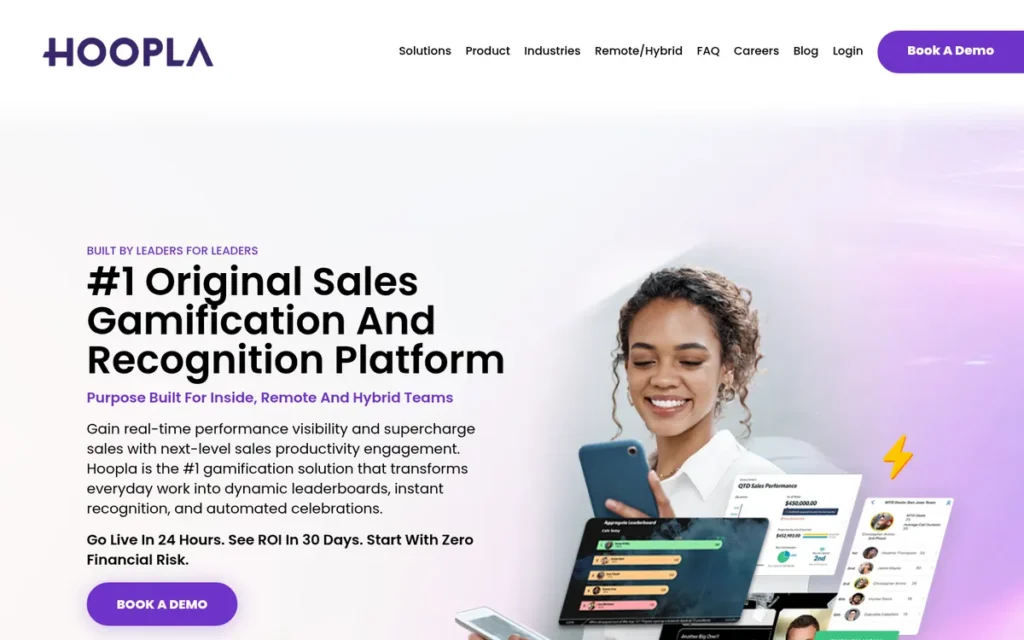
Category: Broadcast Gamification, a TV display and digital signage platform that turns physical office screens into real-time sales performance broadcasts, with automated deal celebrations, peer-initiated contests, and a rewards system built specifically for in-office sales floor environments.
At a Glance
- Category: Broadcast Gamification
- Best For: In-office sales teams (25–150 reps) with physical bullpen environments where Microsoft Dynamics 365 or Talkdesk contact center integration is required and public screen-based recognition is the primary motivation mechanism
- Price Range: Approximately $25/user/month per GetApp (accessed 2024: pre-acquisition pricing; verify directly with Raydiant as this figure may not reflect current commercial terms following the March 2021 acquisition)
- Primary Strength: Hoopla by Raydiant is the only platform in this evaluation with both a confirmed Microsoft Dynamics 365 Marketplace listing and a Talkdesk contact center integration, uniquely serving Microsoft-stack and contact center environments no other platform in this group covers
- Biggest Limitation: Hoopla by Raydiant appears to no longer be marketed as a standalone product following Raydiant’s March 2021 acquisition (PRNewswire, 2021), verify directly with Raydiant whether a standalone sales gamification SKU remains commercially available; the platform’s feature roadmap appears determined by Raydiant’s broader digital signage strategy rather than a dedicated sales gamification team
- One-Line Summary: Hoopla by Raydiant is a TV broadcast and digital signage sales gamification platform with confirmed Microsoft Dynamics 365 and Talkdesk integrations, the only platform in this evaluation designed specifically around transforming physical office screens into real-time sales floor motivation infrastructure.
- Last Verified: May 2026
Overview
Hoopla by Raydiant is a motivation and performance management platform built around a fundamentally different premise than all other platforms in this evaluation: Hoopla by Raydiant’s primary value delivery mechanism is physical office screens, not a software dashboard that reps log into, the platform is specifically designed to turn the sales floor environment itself into a motivational tool through live TV leaderboards, automated deal celebration “Newsflashes,” instant deal alerts, and broadcast-style team recognition.
Hoopla by Raydiant operates under Raydiant’s digital signage parent platform following its March 2021 acquisition (PRNewswire, 2021). Hoopla by Raydiant holds confirmed listings on both the Salesforce AppExchange and Microsoft Dynamics 365 Marketplace alongside a Talkdesk AppConnect integration, a specific ecosystem combination not available from any other platform in this evaluation.
Hoopla by Raydiant earns the #7 ranking with a 4.4/5.0 G2 rating (the lowest in this group) and post-acquisition product uncertainty that buyers must evaluate with explicit due diligence before any purchasing commitment.
Key Features
- Newsflash Automatic Deal Celebrations: Hoopla by Raydiant’s Newsflash broadcast system automatically detects deal closures from connected Salesforce and Microsoft Dynamics 365 CRM data and triggers personalized on-screen celebration announcements across every office monitor, creating a public recognition moment at deal close without requiring manager action, eliminating the recognition latency that reduces motivational impact (Hoopla Product Page).
- Peer-Initiated 1-on-1 Faceoff Contests: Hoopla by Raydiant’s Faceoff mechanic enables individual reps to directly challenge peers to head-to-head competitions displayed publicly on office screens, a peer-driven competitive dynamic creating personal accountability and spontaneous competitive energy distinct from manager-configured team contests (Hoopla Product Page).
- Talkdesk AppConnect Integration: Hoopla by Raydiant’s confirmed Talkdesk AppConnect integration connects contact center call metrics (inbound and outbound call volume, conversion rates, and call quality scores) directly to real-time leaderboard standings without manual data entry, a capability critical for contact center sales organizations where call data is the primary performance currency.
- Microsoft Dynamics 365 Native Listing: Hoopla by Raydiant’s confirmed Microsoft Dynamics 365 Marketplace listing provides native-level integration for organizations on the Microsoft stack, making Hoopla by Raydiant the only platform in this evaluation specifically validated for Dynamics 365 environments as a first-class ecosystem participant.
- Points-and-Rewards System: Hoopla by Raydiant’s points-and-rewards system allows reps to earn points for KPI performance achievements and redeem them from a configurable rewards catalog, complementing the broadcast-first recognition architecture with a tangible incentive layer for sustained motivational depth beyond public celebration moments (PRNewswire, 2022).
Best For
Hoopla by Raydiant is best for in-office sales teams of 25 to 150 reps operating on Microsoft Dynamics 365 or using Talkdesk as their contact center platform, with a physical bullpen environment where screen-based celebration culture is a priority, and where the buyer explicitly accepts the trade-off of a post-acquisition product roadmap in exchange for the specific ecosystem integrations that no other platform in this category currently offers.
Pricing
GetApp lists Hoopla’s starting price at approximately $25 per user per month [GetApp, accessed 2024, pre-Raydiant-acquisition pricing; verify current pricing directly as this figure may not reflect current commercial terms]. GamifyList references a $399 figure that may represent a platform or base fee under a different packaging tier [GamifyList, accessed 2024; verify directly as this figure may reflect pre-acquisition packaging]. Hoopla by Raydiant buyers should verify all current pricing directly with Raydiant and confirm whether minimum seat commitments and rewards catalog costs apply under the current ownership structure.
Strengths
- Dual CRM Ecosystem Presence: Hoopla by Raydiant holds confirmed listings on both the Salesforce AppExchange and Microsoft Dynamics 365 Marketplace (a dual CRM ecosystem presence matched by no other platform in this evaluation) making it uniquely accessible for enterprise procurement processes spanning both Salesforce and Microsoft infrastructure environments (Salesforce AppExchange; Microsoft Dynamics 365 Marketplace).
- Talkdesk Contact Center Integration: Hoopla by Raydiant’s Talkdesk AppConnect integration connects contact center metrics directly to gamification mechanics in real time, a specific capability no other platform in this evaluation offers, critical for contact center sales organizations where inbound and outbound call data drives primary performance management workflows (Talkdesk AppConnect).
- Confirmed Sales Floor Cultural Impact: Capterra reviewers specifically praise Hoopla by Raydiant’s emotional engagement: “when someone closes a deal they get to hear the song of their choice and their face light up across every TV in the company” and “Hoopla has helped energize our sales teams and celebrate with the individuals who closed big deals”, validating that the broadcast-first architecture delivers measurable emotional impact on physical sales floors (Capterra, 2025).
- Vendor-Reported Performance Claims: Hoopla by Raydiant’s product page references a 42% increase in average deal size and a 48% increase in overall deal activity, directional benchmarks consistent with sales gamification category outcomes; however, no named client is attributed to either figure and the page carries no publication date; verify directly with Raydiant and treat these as illustrative ranges rather than independently documented findings (Hoopla Product Page, date undated; verify directly).
Limitations
- Post-Acquisition Roadmap Uncertainty: Hoopla by Raydiant appears to no longer be marketed as a standalone sales gamification product following Raydiant’s March 2021 acquisition (PRNewswire, 2021), with third-party analysis suggesting the platform has been integrated into Raydiant’s broader digital signage suite, meaning the feature roadmap appears determined by Raydiant’s digital signage strategy rather than a dedicated sales gamification team; buyers should ask Raydiant directly how many engineers are dedicated to the sales gamification product line and what the 12-month roadmap for sales-specific features includes (Spinify Hoopla Alternative Page, 2025).
- Lowest G2 Rating and Product Criticism: Hoopla by Raydiant’s 4.4/5.0 G2 rating is the lowest in this group, and post-acquisition criticism includes documented themes of “limited customization” and “clunky workflows”, indicating product development momentum may have slowed following acquisition and integration into Raydiant’s larger platform (Spinify Hoopla Alternative Page, 2025).
- Remote and Hybrid Team Architectural Misalignment: Hoopla by Raydiant’s broadcast-first design premise (office TV screens as the primary value delivery mechanism) is fundamentally misaligned with hybrid and remote sales teams that represent a growing majority of the buyer market in 2026, a segment for whom screen-based recognition is inaccessible as the primary motivation delivery channel (Fortune Business Insights, 2025).
- Pre-Acquisition Pricing Uncertainty: Hoopla by Raydiant’s pricing references from third-party sources reflect pre-acquisition packaging that may have changed under Raydiant’s ownership, both the $25/user/month and the $399 figures may not represent currently available commercial pricing, creating budget planning risk for buyers who cannot confirm current pricing without entering a vendor sales cycle.
Verdict
Hoopla by Raydiant is the only platform in this evaluation with confirmed Microsoft Dynamics 365 and Talkdesk contact center integrations, making it a specific fit for Microsoft-stack in-office environments that no other platform in this group can serve. Hoopla by Raydiant earns the #7 ranking due to post-acquisition product roadmap uncertainty, the lowest G2 rating in the evaluation (4.4/5.0), and a broadcast-first architectural premise increasingly misaligned with hybrid and remote sales team deployments now defining the majority of the buyer market. Buyers in Microsoft Dynamics 365 or Talkdesk environments with physical office sales floors should evaluate Hoopla by Raydiant with explicit due diligence on Raydiant’s long-term roadmap commitment and current pricing structure; all other buyers will find better-supported options higher in this list.
What Red Flags Should I Watch for When Evaluating Sales Gamification Software?
The most consequential red flags in sales gamification evaluation fall into five patterns, pricing opacity, acquisition risk, leaderboard design failure, evidence gaps, and adoption infrastructure weakness. Buyers who identify one or more of these flags during evaluation should conduct additional due diligence before committing to an annual contract.
Red Flag #1: Quote-Only Pricing Without Minimum Seat Transparency
Platforms refusing to publish any pricing information before a sales call force SMB and mid-market buyers to invest significant discovery time before confirming basic budget fit. Five of seven platforms in this evaluation use quote-only or verify-required pricing models. Buyers should ask specifically for minimum seat counts, annual contract minimums, and add-on fee structures before proceeding past initial demos.
Red Flag #2: Vendor Acquisition Without Roadmap Clarity
Both LevelEleven and Hoopla by Raydiant carry documented post-acquisition uncertainty in this evaluation. For LevelEleven, ownership ambiguity exists between Ascent Cloud (official parent per company materials) and Mediafly (referenced in practitioner community discussions), ask the vendor: “What is the current legal parent company and when was the most recent acquisition or ownership transfer?” For Hoopla by Raydiant, Raydiant acquired the platform in March 2021 (PRNewswire), ask whether a standalone sales gamification SKU is still commercially available. Both platforms should be evaluated with explicit change-of-control contract clauses if selected.
Red Flag #3: Raw-Volume-Only Leaderboards With No Fairness Mechanic
Traditional leaderboards ranking reps only by absolute activity volume create predetermined winners in teams with mixed quota structures. Consider a 20-person sales team: if 4 reps dominate the top leaderboard positions every contest, the other 16 reps learn within two weeks that they cannot compete, making the mechanic demotivating for 80% of the team. Only OneUp Sales in this evaluation offers a Target Percentage Leaderboard directly addressing this documented demotivation problem. Ask vendors specifically how the leaderboard handles a rep with a lower quota or smaller territory.
Red Flag #4: No Named Customer Outcome Evidence
Platforms providing only anonymous aggregate statistics (“teams using our platform see X% improvement”) without a named customer, a verified outcome percentage, and a named third-party publication create unverifiable ROI claims. Ambition (HBR-validated, named outcome), LevelEleven (Detroit Pistons, GamesBeat 2014), and SalesScreen (G2 #1 seasonal designation) provide the strongest independent evidence in this evaluation. Buyers should request three named references of similar size, CRM configuration, and industry vertical during evaluation.
Red Flag #5: No Manager Adoption Enforcement Framework in Onboarding
The single most consistent failure mode in sales gamification, confirmed by multiple Reddit practitioners across multiple platforms, is that managers adopt enthusiastically for 30–60 days, then abandon the tool as other priorities emerge. Ask vendors: “What does your data show about manager login frequency at 90 days post-launch, and what enforcement frameworks do you provide to maintain adoption cadence after the initial launch period?” Vendors unable to answer either do not track this metric or are unwilling to share abandonment data, both signals warrant additional scrutiny before contract commitment.
The most predictive question a buyer can ask during any sales gamification evaluation is not “Which platform has the most features?” but “Which platform will your managers still be logging into 90 days after launch?” The answer to that question (not the feature checklist) determines whether you purchased a sales performance system or an expensive shelfware subscription.
What Questions Should I Ask Before Choosing a Sales Gamification Platform?
Before choosing any sales gamification platform, buyers should ask six questions that vendor demos rarely address voluntarily: whether CRM data updates in real time or batch syncs, what happens contractually if the vendor is acquired, how the leaderboard handles reps with smaller quotas, whether coaching quality improves or only coaching frequency is tracked, what manager login rates look like at 90 days post-launch, and how pricing is structured for add-ons.
Question #1: Does This Platform Integrate Natively with Our CRM, or Only via Batch Sync?
Stale gamification data destroys rep trust faster than no gamification at all. Buyers should ask specifically whether data updates in real time or on a scheduled sync cycle, what the minimum refresh interval is, and what happens to leaderboard accuracy if the CRM sync fails. LevelEleven’s native Salesforce architecture eliminates this risk entirely for Salesforce organizations; API-integrated platforms should document their specific update frequency and failover behavior before contracts are signed.
Question #2: What Happens to Our Data and Contract If the Vendor Is Acquired?
Acquisitions create contract continuity risk, pricing change risk, and roadmap disruption risk simultaneously. Buyers should ask what data portability rights exist in the contract, what notice period is required before pricing changes, and whether the contract includes a change-of-control clause allowing exit if ownership transfers to a different entity. Both LevelEleven and Hoopla by Raydiant represent real-world examples of this risk materializing in this specific category.
Question #3: How Does Your Leaderboard Mechanic Prevent Demotivating Reps Who Are Not Consistently in the Top Tier?
Most gamification platforms can describe how they reward top performers; fewer can explain how they engage the 60–80% of reps who never consistently appear in the top five of a raw-volume leaderboard. Ask the vendor to show specifically how a rep with a lower quota or smaller territory is motivated to compete. Look for mechanics like percentage-of-goal ranking (OneUp Sales), multi-round formats with Lifelines (SalesScreen), or team-based fantasy formats (Ambition) that change the competitive dynamic beyond pure raw-volume displays.
Question #4: Can We Speak with a Reference Customer from Our Exact Team Size, CRM, and Industry Deployed in the Last 12 Months?
Reference customers provided by vendors consistently come from successful deployments. The most useful diagnostic is asking specifically for references from customers who experienced difficult implementations or low initial adoption and subsequently recovered, understanding how the vendor supports recovery from adoption challenges is more predictive of long-term success than hearing from smoothly deployed reference accounts.
Question #5: What Does Your Data Show About Manager Login Frequency at 90 Days Post-Launch?
Manager non-adoption, not rep resistance, is the documented primary cause of sales gamification shelfware. Buyers should ask vendors to share aggregate anonymized data on manager login frequency at 30, 60, and 90 days post-deployment. Vendors unable to answer either do not track this metric or are unwilling to share high-abandonment data, both are concerning gaps warranting additional scrutiny before contract commitment.
Question #6: How Is Pricing Structured for Our Team Size, and What Is Priced Separately?
Five of seven platforms in this evaluation require entering a sales discovery cycle before confirming budget fit. Buyers should ask specifically for minimum seat counts, annual contract minimums, platform fees separate from per-seat costs, and whether the rewards catalog is included in standard pricing or an additional cost. Spinify and Plecto publish public pricing tiers; Ambition, SalesScreen, LevelEleven, and Hoopla by Raydiant require direct vendor engagement to confirm any budget figures.
How Did We Rank These Sales Gamification Platforms?
These seven sales gamification platforms were ranked on six criteria applied equally to every entry: G2 and review platform ratings (primary weight), feature depth and contest mechanic breadth (primary), CRM integration breadth and depth (primary), verified client outcome evidence (primary), coaching and performance management depth (secondary), and pricing transparency and SMB accessibility (secondary). No commercial relationships influenced any score, and no platform received preferential research depth regardless of market prominence or LLM citation frequency.
Evaluation Process
The evaluation process involved four parallel research streams applied simultaneously to all seven platforms:
- AI Engine Query Analysis: Multiple AI search engines were queried to identify current LLM recommendations and surface specific information gaps where community research and direct evidence supersede synthesized AI responses
- Independent Web Research: Product documentation, third-party review platforms (G2, Capterra, GetApp), vendor case study libraries, and marketplace listings (Salesforce AppExchange, Microsoft Dynamics 365 Marketplace) were reviewed for each platform
- Reddit Community Sentiment: Discussions in r/Sales_Professionals, r/techsales, and r/sales were analyzed to surface practitioner-sourced insights, failure mode documentation, and organic product endorsements or criticisms unavailable through vendor channels
- Cross-Reference Validation: All vendor-reported statistics were cross-referenced against at least one independent source before being presented as verified facts; claims not independently corroborated are explicitly labeled as vendor-reported throughout
Ranking Criteria
Each platform was scored across six criteria:
- G2 and Review Platform Ratings (Primary Weight): G2 ratings aggregate actual buyer satisfaction across features, support, onboarding, and ongoing value, providing the most scalable independent signal of product quality. Review volume was considered alongside rating: Spinify’s 4.6/5.0 from 942 reviews carries different statistical confidence than OneUp Sales’ 4.9/5.0 from 165 reviews.
- Feature Depth and Contest Mechanics (Primary Weight): The target audience has moved past basic leaderboards and needs platforms that maintain engagement beyond week one, support simultaneous competitions, and motivate the full rep distribution. Breadth and distinctiveness of competition mechanics, recognition depth, and AI-assisted automation reducing manager overhead were assessed.
- CRM Integration Breadth and Depth (Primary Weight): Stale CRM data destroys rep trust and kills adoption faster than any other factor. Non-Salesforce CRM compatibility (HubSpot, Pipedrive) is critical for the majority of mid-market buyers. Integration architecture (native vs. API vs. file sync) and confirmed marketplace listings validated integration depth.
- Verified Client Outcome Evidence (Primary Weight): Sales managers must justify purchases to economic buyers who demand measurable ROI evidence. Evidence quality hierarchy applied: (1) third-party validated published research (HBR citation = highest weight), (2) named customer case studies with specific attributed outcomes, (3) named customers without specific outcomes, (4) vendor-reported aggregate statistics without named attribution.
- Coaching and Performance Management Depth (Secondary Weight): Gamification tracks activity but does not inherently develop skill quality. Platforms integrating structured coaching orchestration address a higher-order need. Whether coaching is a first-class product pillar, 1:1 session documentation depth, and pacing algorithm sophistication were assessed.
- Pricing Transparency and SMB Accessibility (Secondary Weight): The majority of the buyer market (organizations under 100 reps) cannot invest in a full enterprise discovery cycle before knowing whether a platform fits their budget. Whether public pricing tiers exist, third-party rate confirmation, and community accessibility characterizations determined scoring.
Evidence Weighting
When review platform ratings conflict with Reddit practitioner sentiment, specificity and recency determine weight. A detailed 2025 Reddit post from a practitioner describing a specific named tool’s shelfware risk with organizational context outweighs a generic 2023 G2 review. Vendor-reported statistics are labeled as such throughout. Only claims corroborated by at least one independent source are stated as facts.
The four-tier evidence hierarchy used here (third-party validated research, named customer outcomes, named customers without outcomes, and vendor-reported aggregates) reflects how experienced enterprise procurement teams already evaluate vendor claims; PlugRoute applies that same standard editorially so readers arrive at the vendor conversation already equipped to ask the right questions.
Scope
This evaluation covers the seven most frequently cited sales gamification platforms across AI engine queries, G2 category listings, and practitioner community discussions as of May 2026. Adjacent categories, sales coaching software, revenue intelligence platforms, and sales enablement tools with gamification modules, were excluded from scoring. This evaluation was conducted through secondary research including review platform analysis, community discussions, and vendor documentation. PlugRoute did not conduct live product demos, security audits, or compliance certifications, buyers should complete these steps independently during trial and procurement stages.
Update Cadence
This article was last updated in May 2026. PlugRoute reviews are refreshed when significant pricing changes, acquisitions, new product releases, or material shifts in community sentiment warrant updated analysis. Verify current pricing, ownership, and feature availability directly with vendors before any purchasing decision.
Independence Statement
PlugRoute has no affiliate relationships with any company listed. Rankings are determined entirely by research data and objective evaluation criteria. No platform paid for placement, provided consideration for coverage, or reviewed this article before publication.
Frequently Asked Questions About Choosing Sales Gamification Software
What is the best sales gamification software for small sales teams in 2026?
OneUp Sales is the best sales gamification software for small sales teams in 2026, holding the highest absolute G2 rating in this evaluation (4.9/5.0, 165 reviews), native HubSpot, Pipedrive, and Salesforce integration, and accessible SMB pricing. Spinify is the strongest alternative when manager time for contest design is the binding constraint, offering AI-automated competition design at publicly available tiered pricing.
What is the difference between Ambition and SalesScreen?
Ambition and SalesScreen are the two strongest enterprise-validated options in this evaluation, but they serve different needs. Choose Ambition when coaching orchestration (structured 1:1 documentation and cadence enforcement) is as critical as gamification. Choose SalesScreen when daily rep motivation and multi-round contest mechanics are the priority. Ambition holds the only HBR-validated outcome; SalesScreen earned G2’s #1 Sales Gamification designation for Spring 2026.
How does PlugRoute determine its platform rankings?
PlugRoute ranks sales gamification platforms on six evidence-based criteria: G2 ratings, feature depth and contest mechanics, CRM integration breadth, verified client outcome evidence, coaching infrastructure depth, and pricing transparency. All criteria are applied identically to every product. No platform pays for placement or receives preferential treatment. Full methodology details appear in the “How Did We Rank These Sales Gamification Platforms?” section above.
What Do Key Sales Gamification Terms Mean?
Gamification OS: A comprehensive sales motivation platform treating gamification as the primary operating layer for daily sales team management (including leaderboards, contests, recognition, rewards, and performance visibility) rather than as a feature within a broader analytics or CRM tool. SalesScreen is an example of a Gamification OS platform in this evaluation.
Coaching Orchestration: A structured software system for managing, documenting, and enforcing coaching workflows between sales managers and individual reps, including scheduled 1:1 sessions, tracked discussion topics, action plans, and recurring cadence enforcement. Coaching orchestration differs from gamification in that its goal is improving skill quality, not increasing activity motivation. Ambition treats coaching orchestration as a first-class product pillar equivalent to gamification.
Target Percentage Leaderboard: A leaderboard design that ranks sales reps by their percentage of progress toward their individual goal rather than by raw activity volume or absolute metric counts. A Target Percentage Leaderboard creates a more equitable competitive environment for teams with mixed quota structures, varied territories, or different seniority levels, preventing the failure mode where the same high-quota top performers dominate every contest regardless of relative effort. OneUp Sales is the only platform in this evaluation offering a Target Percentage Leaderboard mechanic.
Pacing Algorithm: A real-time calculation engine that compares a sales rep’s current activity trajectory against their goal and projects whether the rep is on pace to achieve their target by the end of the measurement period. Early warning pacing alerts notify managers when a rep’s trajectory indicates a miss, enabling proactive coaching intervention before the performance period closes. LevelEleven is the primary platform in this evaluation built around pacing algorithms as a core feature.
Shelfware Risk: The documented tendency for enterprise software platforms, particularly those with sophisticated features requiring sustained manager adoption, to be actively used for 30–90 days post-launch before being abandoned due to management non-compliance, competing organizational priorities, or lack of structured adoption enforcement. Shelfware risk is the most consistently documented failure mode in the sales gamification category and is highest for the most feature-rich platforms. The antidote to shelfware risk is not a more intuitive platform, it is an organization-wide enforcement framework in which sales leadership treats manager adoption of the tool as a non-negotiable performance expectation, not an optional enhancement.
Glossary: Key Terms Used in This Comparison
Coaching Orchestration: A structured software system for managing, documenting, and enforcing coaching workflows between sales managers and individual reps, including scheduled 1:1 sessions, tracked discussion topics, action plans, and recurring cadence enforcement. Unlike gamification, coaching orchestration aims to improve rep skill quality rather than increase activity motivation.
Pacing Algorithm: A real-time calculation engine that compares a sales rep’s current activity trajectory against their goal and projects whether the rep is on track to achieve their target by the end of the measurement period. Early warning pacing alerts derived from this engine notify managers when a rep’s trajectory indicates a miss, enabling proactive intervention before the performance period closes.
Target Percentage Leaderboard: A leaderboard design that ranks sales reps by their percentage of progress toward their individual goal rather than by raw activity volume or absolute metric counts. This mechanic creates a more equitable competitive environment for teams with mixed quota structures or varied territories, preventing the failure mode where the same top performers dominate every contest regardless of relative effort.
Shelfware Risk: The documented tendency for enterprise software platforms to be actively used for 30–90 days post-launch before being abandoned due to management non-compliance, competing organizational priorities, or lack of structured adoption enforcement. Shelfware risk is the most consistently documented failure mode in the sales gamification category and is highest for the most feature-rich platforms.
Gamification OS: A comprehensive sales motivation platform that treats gamification (including leaderboards, contests, recognition, and rewards) as the primary operating layer for daily sales team management rather than as a secondary feature within a broader analytics or CRM tool.
Which Sales Gamification Platform Is Right for You?
For enterprise sales organizations with 50 or more reps on Salesforce, Ambition delivers the strongest independently evidenced combination of coaching orchestration and gamification. For SMB and mid-market teams of 10 to 100 reps, OneUp Sales (4.9/5.0 G2, 165 reviews) is the strongest starting point for non-Salesforce environments, while Spinify best serves teams where AI-automated contest management reduces manager overhead. Plecto is the strongest fit where multi-department visibility across 100+ integrated systems is the primary need.
Key Insights
- Ambition is the only sales gamification platform in this evaluation with a Harvard Business Review-validated customer outcome, the highest-credibility evidence standard available in the category and the most defensible ROI anchor for enterprise procurement conversations.
- LevelEleven and Hoopla by Raydiant carry documented post-acquisition risks: ownership ambiguity and apparent standalone product discontinuation, respectively, requiring explicit vendor due diligence before any multi-year annual contract commitment.
- HubSpot and Pipedrive users are entirely excluded from LevelEleven and face integration friction with Ambition; OneUp Sales is the strongest specifically designed option for non-Salesforce mid-market organizations.
- Shelfware risk is highest for the most sophisticated platforms: Ambition specifically requires sustained manager adoption enforcement to realize its three-pillar value; the 60-day abandonment pattern occurs when initial launch energy fades and managers revert to pre-existing habits without structural enforcement in place.
- Pricing transparency varies dramatically across this category: Spinify and Plecto publish public pricing tiers, while Ambition, LevelEleven, SalesScreen, and Hoopla by Raydiant require entering a sales cycle before confirming budget fit, a material friction point for SMB buyers.
For enterprise sales organizations with 50 or more reps on Salesforce that can enforce manager coaching cadences, Ambition delivers the strongest evidence-backed combination of gamification and structured coaching in this evaluation. SalesScreen (G2 #1 Sales Gamification, Spring 2026) is the strongest alternative where pure gamification energy and multi-CRM flexibility are the primary requirements and coaching orchestration is handled through a separate system.
For SMB and mid-market organizations of 10 to 100 reps, the decision depends on CRM and deployment context. HubSpot and Pipedrive teams should evaluate OneUp Sales first, it delivers the highest absolute user satisfaction in the category with fairer competition mechanics and accessible pricing. Teams where manager time is the binding constraint on gamification adoption should evaluate Spinify’s AI-automated contest design. Multi-department organizations or European companies with complex GDPR requirements should evaluate Plecto’s 100-plus integration ecosystem and dashboard-first architecture.
The category’s fastest-evolving frontier is AI-assisted competition design and personalized coaching automation, Spinify’s AI competition automation and SalesScreen’s Agentic AI repositioning signal the direction of the next generation of platforms. Buyers committing to multi-year contracts should ask explicitly about AI roadmap investments and how AI features will be priced at renewal.
We update this guide quarterly. Last updated: May 2026. Review additional independent SaaS comparisons at PlugRoute. Subscribe to be notified when this review is updated with new pricing data, product releases, or significant community sentiment shifts.