Apollo.io is the best all-in-one sales intelligence platform for SMB to mid-market B2B teams, ZoomInfo is the enterprise contact database benchmark for U.S.-focused outbound, and Cognism is the top compliance-first choice for EMEA prospecting. The core trade-off: Apollo combines data and sequencing at transparent pricing; ZoomInfo delivers unmatched database depth at enterprise cost; Cognism provides operationally enforced GDPR compliance no competitor matches.
Three variables determine platform fit: budget (Apollo.io ranges from $0 to $149/user/month; ZoomInfo and Cognism require $15,000+ minimum annual contracts; 6sense starts at $50,000+), geographic market (U.S. vs. EMEA vs. global), and workflow scope (data only vs. data plus sequencing in one product).
PlugRoute has no affiliate relationships with any company listed. Rankings are determined entirely by research data and objective evaluation criteria.
“Apollo is the best bang for the buck. Have used it for a year & been fairly happy. Price, we are a startup with a limited budget. Quality of leads. Accuracy of the data, ease of use. I looked at them all & we have been super happy with Apollo.” (u/Objective_Chair1928, r/sales)
Takeaway: Budget transparency and all-in-one consolidation drive Apollo.io adoption among startup and SMB teams, consistent with its #1 ranking on pricing accessibility and platform breadth, and not a substitute for evaluating the documented data quality limitations and international coverage gaps detailed in the full entry below.
What Are the Top-Ranked Sales Intelligence Platforms? (Quick Reference)
- Apollo.io is the best all-in-one sales intelligence platform for SMB to mid-market teams, combining a 275M+ contact database with native email sequencing, AI-powered workflows, and fully published pricing from $0 to $149/user/month, the only platform at this database scale with a genuine free tier.
- ZoomInfo is the best enterprise contact database for U.S.-focused outbound teams, operating the largest verified B2B contact database in this evaluation (500M+ contacts, 120M+ direct dials) at quote-only pricing starting approximately $15,000/year on multi-year contracts.
- Cognism is the best sales intelligence platform for EMEA GDPR-compliant B2B prospecting, with Diamond Data mobile numbers manually phone-verified against 13 European Do-Not-Call lists (the only operationally enforced GDPR compliance architecture in this evaluation) at quote-only pricing starting approximately $15,000/year.
- Lusha is the best SMB contact discovery platform for LinkedIn-first prospecting workflows, with fully published pricing from $36/user/month and enterprise customer validation from Google, Apple, Dropbox, and Uber.
- Clearbit, rebranded as HubSpot Breeze Intelligence in September 2024, is the best HubSpot-native enrichment layer for inbound revenue teams, but is structurally inaccessible to teams on Salesforce, Dynamics, or any non-HubSpot CRM following its November 2023 acquisition.
- 6sense is the best enterprise predictive ABM platform for organizations with $50,000+ budget and dedicated RevOps staff, but near-universal frontline practitioner skepticism and documented false-positive intent signals make a mandatory proof-of-concept the minimum pre-commitment requirement.
- LinkedIn Sales Navigator is the best social selling and relationship intelligence tool for B2B decision-maker discovery, operating on LinkedIn’s 1B+ self-maintained professional graph, but provides no native email addresses or phone numbers, requiring pairing with a separate contact data platform to execute any outreach.
What Are the Main Categories of Sales Intelligence Software?
Sales intelligence platforms in 2026 fall into three primary categories based on what they consolidate and who they serve. Choosing the right category before comparing platforms prevents the most common evaluation mistake: selecting a specialized enterprise tool when an all-in-one would cover the same workflow at lower cost.
Category 1: All-in-One Intelligence + Engagement
- Apollo.io: 275M+ contact database, email sequencing, AI dialer, waterfall enrichment, and CRM sync in a single platform at published pricing
Category 2: Enterprise Specialized Intelligence
- ZoomInfo: largest U.S. contact database with conversation intelligence and proprietary intent signals
- Cognism: EMEA compliance-first contact data with 13-country DNC phone verification
- 6sense: proprietary predictive buying-stage intelligence for enterprise ABM programs
Category 3: Discovery and Enrichment Tools
- LinkedIn Sales Navigator: relationship intelligence on LinkedIn’s 1B+ self-maintained professional graph
- Lusha: streamlined SMB contact discovery via browser extension and prospecting database
- Clearbit / HubSpot Breeze Intelligence: HubSpot-native enrichment and anonymous visitor identification
Teams whose use case spans multiple categories (for example, outbound prospecting and EMEA compliance) will need a multi-platform stack rather than a single tool.
How Do the Top Sales Intelligence Platforms Compare?
Seven platforms were evaluated across six weighted criteria. Apollo.io leads on G2 rating and all-in-one value. ZoomInfo leads on database scale and enterprise infrastructure. Cognism leads on EMEA compliance depth. Each platform occupies a distinct position, no single tool is the optimal choice for every team size, geography, or workflow requirement.
| Rank | Company | Category | Best For | One-Line Summary | Key Capabilities | Primary Strength | Key Limitation |
|---|---|---|---|---|---|---|---|
| 1 | Apollo.io | All-in-One Intelligence | SMB to mid-market all-in-one outbound | Apollo.io holds a G2 rating of 4.7/5 from ~9,600+ reviews (May 2026) combining a 275M+ contact database, native sequencing, and transparent pricing from $0–$149/user/month. | 275M+ contact database with 65+ filters; built-in email sequencing with A/B testing and AI copy; AI-powered calling dialer; waterfall multi-provider enrichment; Salesforce, HubSpot, and Dynamics 365 bidirectional CRM sync | Highest G2 rating in this evaluation (4.7/5, ~9,600+ reviews) plus published pricing and a genuine free tier; the only platform at this database scale offering all three | Community-documented 19–26% email bounce rate requires mandatory pre-send verification before any high-volume campaign |
| 2 | ZoomInfo | Enterprise Data Intelligence | Enterprise U.S. outbound at scale | ZoomInfo is the enterprise contact database benchmark with 500M+ contacts, ~9,100+ G2 reviews at 4.5/5 (May 2026), and the only publicly traded pure-play sales intelligence company in this evaluation. | 500M+ contacts, 135M+ verified phones, 120M+ direct dials; proprietary Scoops intent signals; Chorus conversation intelligence; org chart and technographic data; full CRM suite across Salesforce, HubSpot, Dynamics, Outreach, and Salesloft | Largest verified B2B contact database in this evaluation (500M+) plus the only native conversation intelligence integration (Chorus, acquired $575M 2021) | Quote-only pricing (~$15K+ minimum on multi-year contracts) with aggressive renewal practices extensively documented across G2, Reddit, and TrustRadius |
| 3 | Cognism | Compliance-First Intelligence | EMEA GDPR-compliant prospecting | Cognism is the leading GDPR-compliant sales intelligence platform for EMEA B2B prospecting, with Diamond Data phone-verified against 13 European DNC lists and a G2 rating of 4.6/5 from 700+ reviews (May 2026). | Diamond Data phone-verified mobiles; 13 European DNC list checks per contact export; Sales Companion AI for lookalike prospect recommendations; Bombora intent integration; browser extension with one-click CRM push | Only platform with operationally enforced GDPR compliance via 13-country DNC verification per contact export; a real-time process not replicated by ZoomInfo, Apollo.io, or Lusha | Quote-only pricing (~$15K+ minimum); no native sequencing; Bombora intent data is a non-exclusive third-party license |
| 4 | Lusha | Contact Discovery | SMB teams needing transparent contact lookup | Lusha is the most operationally simple contact discovery platform in this evaluation, with published pricing from $36/user/month and enterprise validation from Google, Apple, Dropbox, and Uber. | Browser extension with one-click CRM push; Live Lists auto-updating prospect sets; Lusha Engage basic sequencing; advanced search by company, title, and geography; bulk CSV enrichment for RevOps | Lowest-friction workflow in this evaluation plus fully transparent published pricing; no sales call required to compare cost against alternatives | Coverage wall for niche titles and non-U.S. geographies; HubSpot CRM sync has documented deal-ownership override bugs |
| 5 | Clearbit / Breeze Intelligence | Enrichment Intelligence | HubSpot-native inbound enrichment and visitor ID | Clearbit, rebranded as HubSpot Breeze Intelligence (September 2024), is the deepest HubSpot-native enrichment layer, with a vendor-reported 11x anonymous visitor identification improvement for Zendesk (vendor-stated case study) and a G2 rating of 4.4/5 from 600+ reviews (May 2026). | Reveal anonymous visitor identification; progressive form shortening; real-time HubSpot CRM enrichment; HubSpot workflow triggers; 200M+ profiles from 250+ data sources | Deepest HubSpot-native enrichment integration plus Reveal visitor identification; capabilities with no functional equivalent within the HubSpot ecosystem | HubSpot-exclusive post-November 2023 acquisition; inaccessible to Salesforce, Dynamics, or any non-HubSpot CRM users |
| 6 | 6sense | Predictive ABM Intelligence | Enterprise ABM with mature RevOps infrastructure | 6sense is the most sophisticated predictive ABM intelligence platform in this evaluation, valued at $5.2B with enterprise customers including Cisco and Tricentis, starting at $50,000+/year (community-reported, May 2026). | Proprietary predictive buying-stage model from 40M+ company signals; native ABM advertising; Salesforce bidirectional sync; anonymous buyer attribution; AI account prioritization dashboards | Most architecturally distinct proprietary intent model in this evaluation; buying-stage data not available through any Bombora-licensed competitor | $50K+ minimum investment; near-universal frontline practitioner skepticism documented in community evidence; false positives from unsubscribe-page visits |
| 7 | LinkedIn Sales Navigator | Relationship Intelligence | Decision-maker discovery and relationship mapping | LinkedIn Sales Navigator is the definitive social selling and relationship intelligence tool, operating on a 1B+ self-maintained professional graph backed by Microsoft’s $26.2B acquisition, rated 4.3/5 on G2 from 1,800+ reviews (May 2026). | 1B+ professional graph; 40+ search filters; TeamLink warm-introduction mapping; job-change champion alerts; Salesforce and Dynamics 365 sync; InMail direct messaging | Only platform built on a self-maintained 1B+ professional identity graph; real-time career changes that no third-party aggregator can replicate | No native emails or phone numbers by design; requires contact data tool pairing; commercial throttling limits productive session length |
Which Platform Fits Your Specific Scenario?
| Your #1 Priority | Team Size | Recommended Tool | Why | Acceptable Alternative |
|---|---|---|---|---|
| Startup / solo SDR, <$5K annual budget | 1–3 reps | Apollo.io Free or Basic ($0–$49/user/month) | Only meaningful free tier at this database scale; covers data + sequencing in one platform without enterprise contracts | Lusha Free (5 credits/month) for individual LinkedIn lookups |
| Mid-market all-in-one, no tool sprawl | 4–15 reps | Apollo.io Professional ($99/user/month) | Native sequencing + 275M+ contacts + AI workflows at fully transparent pricing | Lusha Pro for simpler teams not requiring multi-step sequencing |
| EMEA prospecting with GDPR compliance | 10+ reps | Cognism | Only platform with 13-country DNC-list phone verification per export; operational GDPR compliance, not policy-only | ZoomInfo for EMEA scale (weaker operational compliance depth) |
| Enterprise U.S. outbound, large account database | 20+ reps with RevOps | ZoomInfo | 500M+ contacts, 120M+ direct dials, Chorus conversation intelligence, deepest enterprise CRM integrations | Apollo.io Professional + pre-send verification at significantly lower and transparent cost |
| Enterprise ABM with mature RevOps | 30+ reps, dedicated ABM program | 6sense (mandatory proof-of-concept first) | Only proprietary predictive buying-stage model in evaluation; Cisco and Tricentis customer validation | ZoomInfo Scoops (weaker intent signals, lower minimum price) |
| HubSpot-native inbound enrichment | Any size, HubSpot CRM required | Clearbit / Breeze Intelligence | Deepest HubSpot integration; Reveal visitor ID + form shortening not replicated elsewhere within HubSpot | Apollo.io enrichment if non-HubSpot CRM is primary |
| Decision-maker discovery + relationship mapping | Any size (add-on) | LinkedIn Sales Navigator | 1B+ self-maintained professional graph; TeamLink warm introductions unavailable in any other evaluated platform | Apollo.io for contact data and sequence execution without relationship mapping |
1. Apollo.io: Best All-in-One Sales Intelligence Platform
Category: All-in-One Intelligence + Engagement, combines a 275M+ contact database with built-in email sequencing, an AI-powered calling dialer, waterfall enrichment, lead scoring, anonymous visitor identification, and CRM sync in a single platform, designed as a consolidated replacement for the separate-tool stack of data provider plus sequence tool plus dialer.
At a Glance
- Category: All-in-One Intelligence + Engagement
- Best For: SMB founders, early-stage SDR teams, and mid-market sales orgs seeking consolidated prospecting, sequencing, and enrichment at transparent pricing without enterprise contract requirements
- Price Range: Free (50 email credits/month) · Basic $49/user/month · Professional $99/user/month · Organization $149/user/month (annual billing)
- Primary Strength: As of May 2026, Apollo.io is the only platform at this database scale combining a 275M+ contact database with native email sequencing, a calling dialer, and AI-powered workflow automation under a single published price starting at $0
- Biggest Limitation: Apollo.io has a community-documented email bounce rate of 19–26% in practitioner testing, meaning high-volume cold email campaigns require a separate pre-send verification step to protect sender reputation and deliverability infrastructure
- One-Line Summary: Apollo.io holds a G2 rating of 4.7/5 from approximately 9,600+ verified reviews as of May 2026 [Source: G2, May 2026] (the highest rating among all seven evaluated platforms) combining a 275M+ contact database with native email sequencing and transparent pricing from $0 to $149/user/month.
- Last Verified: May 2026
What Is Apollo.io and Who Is It Best For?
Apollo.io is a B2B sales intelligence and outbound prospecting platform serving teams from solo SDRs to mid-market sales organizations. Apollo.io combines a 275M+ contact and 60M+ company database with native email sequencing, an AI-powered dialer, waterfall enrichment, lead scoring, and anonymous visitor identification, designed as a single-platform replacement for the separate-tool stack of a data provider plus a sequence tool.
Apollo.io holds G2 Leader status simultaneously across four distinct categories (Sales Intelligence, Lead Intelligence, Sales Engagement, and Marketing Account Intelligence) validating cross-functional utility across the full outbound workflow. Apollo.io reached a $1.6B valuation at its $100M Series D in August 2023 [Source: PR Newswire, August 29, 2023], led by Bain Capital Ventures, with growth driven primarily by its free-tier entry strategy and the only fully published pricing schedule at this database scale.
Key Features
- 275M+ Contact Database with 65+ Filters: Apollo.io spans 275M+ profiles and 60M+ companies with filters covering job title, technology stack, funding stage, headcount, seniority, and intent signals, enabling highly segmented list builds without leaving the platform.
- Built-In Email Sequencing: Apollo.io’s native sequencing supports multi-step campaigns with A/B testing, automatic CRM logging, reply detection, and AI-generated copy suggestions, eliminating the need for a separate tool such as Outreach or Salesloft for most SMB and mid-market workflows.
- Waterfall Enrichment Architecture: Apollo.io routes contact data requests through multiple third-party data providers in sequence, improving match rates for hard-to-find contacts compared to single-source lookup tools, a meaningful coverage advantage for niche titles and smaller-company prospects.
- Anonymous Website Visitor Identification: Apollo.io surfaces which companies are visiting a site without form submission, enabling SDRs to prioritize accounts already demonstrating inbound intent before any prospect-initiated contact.
- Native CRM Integrations: Apollo.io connects with Salesforce, HubSpot, Microsoft Dynamics, Outreach, Salesloft, Marketo, and Zapier, enabling bidirectional CRM enrichment and sequence triggering within existing tech stacks without custom development.
Best For
Apollo.io is best for budget-conscious B2B sales teams (from early-stage startups using the free tier through mid-market SDR teams on Professional or Organization plans) who need a single platform covering contact data, outreach sequencing, and basic CRM enrichment without enterprise pricing or multi-year contracts.
Apollo.io is also the recommended first investment for teams currently using only LinkedIn Sales Navigator, as it provides the email and direct-dial contact data plus sequencing execution that Sales Navigator deliberately omits.
How Much Does Apollo.io Cost?
Apollo.io publishes four tiers transparently: Free ($0, 50 email credits/month), Basic ($49/user/month annual), Professional ($99/user/month annual), and Organization ($149/user/month annual). [Published pricing verified May 2026.]
Key mechanics to understand before purchasing:
- Phone number reveals consume significantly more credits per lookup than email reveals on all paid tiers
- “Unlimited” email credits on paid plans carry documented practical constraints per community reports
- Annual billing is required to access the lowest per-seat rates
- A widely cited r/sales community report [Source: u/need4speed8, r/sales, 2024] documents a $5,000 auto-renewal charge applied after an explicit cancellation request, making written confirmation of the exact cancellation procedure a critical pre-purchase step before signing any annual plan
Strengths
- Apollo.io holds a G2 rating of 4.7/5 from approximately 9,600+ verified reviews [Source: G2, May 2026] and G2 Leader badges simultaneously across four distinct categories (Sales Intelligence, Lead Intelligence, Sales Engagement, and Marketing Account Intelligence) representing the broadest cross-category G2 recognition of any platform in this evaluation.
- Apollo.io offers the only meaningful free tier (50 email credits/month, no credit card required) among platforms of comparable database scale, enabling genuine hands-on evaluation before any financial commitment, practitioners in r/sales cite this as the primary reason early-stage teams choose Apollo.io before evaluating ZoomInfo.
- Apollo.io’s waterfall enrichment architecture routes lookup requests through multiple data providers in sequence, and community reports from r/sales document that Apollo.io surfaces mobile phone numbers for contacts where ZoomInfo returns no result even on ZoomInfo paid plans, a mobile coverage complement that makes the Apollo.io + ZoomInfo pairing additive for enterprise teams running both.
- Apollo.io reached a $1.6B valuation at its $100M Series D in August 2023 [Source: PR Newswire, August 29, 2023], led by Bain Capital Ventures with Sequoia Capital participation, the largest institutional investor conviction in the SMB-to-mid-market sales intelligence segment among all evaluated platforms.
Limitations
- Email Deliverability Risk: Apollo.io’s most consequential limitation is email bounce rate at scale, practitioner testing documented in r/LeadGeneration [Source: u/MarketingProsYo, r/LeadGeneration, 2024] measured bounce rates of 19–26% on bulk sends using Apollo.io contact data, compared to under 6% for Lead411 in the same test, making pre-send verification via tools such as MillionVerifier or Clay a non-optional workflow step for any high-volume cold email program.
- International Data Quality Gap: Apollo.io’s 275M+ database skews heavily toward U.S. contacts, and EMEA and APAC coverage degrades materially from the headline number, teams with significant international prospecting obligations should supplement Apollo.io with Cognism for EMEA or accept reduced contact quality outside North America.
- Billing Practices Risk: Apollo.io has generated community-documented auto-renewal financial risk (a $5,000 charge applied after an explicit cancellation request per r/sales reports [Source: u/need4speed8, r/sales, 2024]) meaning annual contract auto-renewal terms and cancellation procedures must be confirmed in writing before committing to any annual plan.
- Credit Model Constraints: Apollo.io’s “unlimited” email credits on paid plans carry practical constraints documented in community reports, and phone reveals consume significantly more credits than email reveals, buyers should model real-world credit consumption before selecting a tier to avoid unexpected upgrade requirements mid-contract.
Verdict
Apollo.io is the top-ranked all-in-one sales intelligence platform for B2B teams from early-stage to mid-market in 2026, earning its #1 position through the highest G2 rating in this evaluation (4.7/5, ~9,600+ reviews, [G2 May 2026]), the broadest all-in-one capability set at transparent pricing from $0 to $149/user/month, and the only genuine free tier at this database scale. Teams should enter Apollo.io with two operational requirements clearly understood: a pre-send email verification step is mandatory for high-volume campaigns to maintain sender reputation, and annual contract auto-renewal terms warrant written cancellation confirmation before signing. Teams prioritizing EMEA legal compliance or maximum U.S. contact database depth will find Cognism (#3) and ZoomInfo (#2) as better-fit alternatives at significantly higher price points.
2. ZoomInfo: Best Enterprise Contact Database
Category: Enterprise Data Intelligence, an AI-driven GTM platform operating the industry’s largest verified B2B contact and company database (500M+ contacts), spanning SalesOS, MarketingOS, OperationsOS, and Chorus/Copilot conversation intelligence, with all modules feeding a central GTM Context Graph processing 1.5B+ data points daily.
At a Glance
- Category: Enterprise Data Intelligence
- Best For: Enterprise and upper mid-market U.S.-focused revenue teams requiring the deepest contact database, org chart mapping, and conversation intelligence, with budget authorization for $15,000+/year multi-seat contracts
- Price Range: Quote-only; community-reported entry ~$14,995/year (3 seats); team plans $30,000–$50,000+/year; enterprise $60,000+/year
- Primary Strength: ZoomInfo operates the largest independently processed B2B contact database in this evaluation (500M+ contacts, 135M+ verified phone numbers, 120M+ direct dials) maintained through 300+ human researchers and machine verification processing 1.5B+ data points daily, per ZoomInfo’s sales intelligence product page
- Biggest Limitation: ZoomInfo requires quote-only multi-year contracts starting ~$15,000/year with aggressive renewal practices documented extensively across G2, Reddit, and TrustRadius, and delivers materially weaker data accuracy outside North America, making it a poor compliance fit for EMEA-focused teams
- One-Line Summary: ZoomInfo is the enterprise data intelligence benchmark for U.S.-focused revenue teams, operating the largest verified B2B contact database in this category (500M+ contacts), with a G2 rating of 4.5/5 from approximately 9,100+ reviews (May 2026), the only publicly traded pure-play sales intelligence company in this evaluation (NASDAQ, ticker: GTM as of May 2025).
- Last Verified: May 2026
What Is ZoomInfo and Who Is It Best For?
ZoomInfo is a B2B GTM intelligence platform serving enterprise and upper mid-market revenue teams primarily in North America. ZoomInfo operates the category’s largest verified contact and company database (500M+ contacts, 135M+ verified phone numbers, 120M+ direct dials across 100M+ companies) processed through 300+ human researchers and machine verification at 1.5B+ daily data points via its proprietary GTM Context Graph, per ZoomInfo’s sales intelligence product page.
ZoomInfo spans four product lines: SalesOS for outbound prospecting, MarketingOS for demand generation, OperationsOS for RevOps data governance, and Chorus/Copilot for AI-powered conversation intelligence. ZoomInfo went public on NASDAQ in June 2020 (original ticker: ZI; rebranded to ticker GTM in May 2025) and reported approximately $1.1–1.2B in annual revenue in 2024, per quarterly earnings reporting, making ZoomInfo the only pure-play sales intelligence company in this evaluation with public financial reporting accountability.
Key Features
- 500M+ Verified Contact Database: ZoomInfo maintains 500M+ contacts and 135M+ verified phone numbers (the largest in this evaluation) with 120M+ direct dials maintained by 300+ human researchers cross-referencing machine-processed signals at 1.5B+ data points daily, per ZoomInfo’s product page.
- Proprietary Scoops Intent Signals: ZoomInfo captures company-level behavioral signals (hiring patterns, funding events, technology changes, executive moves) from its own internal research team, distinct from competitors relying on the non-exclusive third-party Bombora licensing that Cognism and others use.
- Chorus Conversation Intelligence: ZoomInfo’s Chorus module (acquired for $575M in 2021) records, transcribes, and analyzes sales calls, feeding outcomes back into the contact prioritization engine, a closed-loop data flywheel unavailable as an integrated native feature at any other evaluated platform.
- Org Chart and Technographic Data: ZoomInfo maps decision-maker hierarchies within target accounts and identifies which software technologies a company currently uses, enabling multi-stakeholder account-based selling and technology-stack-based ICP filtering that simpler lookup tools cannot support.
- Full CRM Integration Suite: ZoomInfo integrates natively with Salesforce, HubSpot, Microsoft Dynamics, Outreach, Salesloft, Marketo, and Pardot, covering the full sales and marketing tech stack with bidirectional data sync, per ZoomInfo’s product page.
Best For
ZoomInfo is best for enterprise and upper mid-market revenue organizations with U.S.-focused GTM motions, established Salesforce or HubSpot infrastructure, dedicated RevOps capacity to manage platform configuration, and budget authorization for multi-year contracts starting at $15,000/year.
ZoomInfo is not recommended for SMBs, EMEA-focused teams with GDPR compliance requirements, or organizations without dedicated RevOps capacity to manage the platform’s configuration complexity and contract governance.
How Much Does ZoomInfo Cost?
ZoomInfo does not publish pricing. Community-reported figures (May 2026) place the entry-level Professional plan at approximately $14,995/year for 3 seats, with mid-tier team plans at $30,000–$50,000/year and enterprise packages exceeding $60,000/year. Advanced modules (MarketingOS, OperationsOS, Chorus, Copilot) are priced as separate add-ons. [Community-reported pricing benchmarks; Source: Salesmotion.io, May 2026.]
Buyers should expect:
- Mandatory multi-year contract discussions on first purchase
- Initial quotes 30–40% above final negotiated price based on community-reported deal patterns [G2 review themes, May 2026]
- Automatic price escalation clauses documented in some renewal terms
- Difficulty reducing seat counts mid-contract, per TrustRadius review patterns
Obtain competitive quotes from Apollo.io and Cognism simultaneously before engaging ZoomInfo’s sales team to establish negotiation leverage.
Strengths
- ZoomInfo went public on NASDAQ in June 2020 and reported approximately $1.1–1.2B in annual revenue in 2024, per quarterly earnings reporting, making ZoomInfo the only pure-play sales intelligence vendor in this evaluation with public financial reporting accountability and institutional investor transparency into operational and data asset performance.
- ZoomInfo holds a G2 rating of 4.5/5 from approximately 9,100+ verified reviews [Source: G2, May 2026], a statistically significant independent satisfaction signal, with consistent G2 Leader placement across Sales Intelligence, Lead Intelligence, and Account Data Management categories.
- ZoomInfo’s hybrid data verification model: 300+ human researchers cross-referencing machine-processed signals at 1.5B+ data points per day, per ZoomInfo’s sales intelligence product page, represents the most operationally intensive data quality investment among all evaluated platforms and is the primary structural justification for its premium pricing.
- ZoomInfo’s Chorus conversation intelligence acquisition ($575M, 2021) creates a data flywheel no point-solution competitor can replicate natively: call recordings and outcomes feed back into the contact prioritization engine, enabling ICP refinement based on who actually buys rather than who fits demographic criteria alone.
Limitations
- Contract Dynamics and Total Cost: ZoomInfo’s most consequential limitation is total cost of ownership combined with contract governance, entry pricing starts ~$15,000/year on multi-year commitments with aggressive renewal practices documented across Reddit, G2, and TrustRadius, including multi-year auto-renewal clauses, difficulty reducing seat counts mid-contract, and community-reported retention tactics that create financial obligation rather than resolve dissatisfaction.
- Geographic Data Accuracy: ZoomInfo’s data is strongest for U.S. markets and degrades significantly in EMEA (where GDPR compliance is also questionable without the operational DNC-list infrastructure Cognism provides) and is considered the weakest platform in this evaluation for APAC, per G2 review theme analysis [G2, May 2026].
- Intent Data Reliability: ZoomInfo’s Scoops intent signals generate consistent practitioner skepticism, in an r/sales thread evaluating both ZoomInfo Scoops and 6sense signals [Source: r/sales, 2025], one practitioner described receiving signals “littered with accounts outside our ICP, and most within are already customers”, a damning practitioner verdict for a feature that commands premium add-on pricing.
- Firmographic Accuracy Gaps: ZoomInfo’s company database has documented inaccuracies in firmographic estimates (community reports describe companies with 25 LinkedIn employees showing 600 employees and $500M in revenue on ZoomInfo) undermining account qualification workflows that rely on ZoomInfo company size data as a primary ICP filter.
Verdict
ZoomInfo is the enterprise benchmark for U.S.-focused outbound sales intelligence and ranks #2 in this evaluation on the strength of the category’s largest verified contact database (500M+ contacts), one of the two highest G2 review volumes in this comparison (~9,100+), and the only closed-loop conversation intelligence integration in the evaluated set. ZoomInfo’s investment is defensible for large enterprise teams with North American GTM focus, established RevOps infrastructure, and budget latitude for multi-year commitments, but the contract dynamics, aggressive renewal practices, EMEA data limitations, and practitioner skepticism of the intent module represent real buyer risks requiring thorough due diligence before signing. Teams at mid-market scale or with significant EMEA presence will find Apollo.io (#1) delivers stronger total value on weighted criteria, while Cognism (#3) delivers superior EMEA compliance depth at a comparable enterprise investment level.
3. Cognism: Best for EMEA Compliance and Verified Direct-Dial Accuracy
Category: Compliance-First Contact Intelligence, a GDPR-safe B2B data platform built around phone-verified Diamond Data mobile numbers checked against 13 European Do-Not-Call lists, with particular data depth in EMEA markets and a compliance architecture that goes beyond policy statements to operational DNC suppression on every contact export.
At a Glance
- Category: Compliance-First Contact Intelligence
- Best For: B2B sales teams prospecting in EMEA markets where GDPR compliance is a legal requirement and verified direct-dial mobile accuracy directly impacts call connection rates and outbound pipeline volume
- Price Range: Quote-only; community-reported $15,000–$45,000/year for small teams; enterprise pricing custom; minimum annual contract required; Diamond Data phone-verified mobile access often a premium add-on
- Primary Strength: Cognism’s Diamond Data mobile numbers are phone-verified and checked against 13 European Do-Not-Call lists, the most operationally enforced GDPR compliance architecture for EMEA B2B prospecting in this evaluation
- Biggest Limitation: Cognism’s quote-only pricing with minimum annual contracts starting ~$15,000/year makes it structurally inaccessible to most SMB teams; its intent data relies on non-exclusive third-party Bombora licensing available through competing platforms; and no native email sequencing is included
- One-Line Summary: Cognism is the leading GDPR-compliant sales intelligence platform for EMEA B2B prospecting, with Diamond Data mobile numbers phone-verified against 13 European DNC lists, a G2 rating of 4.6/5 from 700+ reviews (May 2026), and 4,000+ revenue team customers including Drift, Canva, Databricks, and Loom.
- Last Verified: May 2026
What Is Cognism and Who Is It Best For?
Cognism is a compliance-first B2B sales intelligence platform founded in 2016 in London by James Isilay and Stjepan Buljat. Cognism was built around the insight that contact data accuracy and legal compliance are the same problem, particularly for teams prospecting in European markets under GDPR’s legal-basis requirements for outbound cold contact.
Cognism’s core differentiator is Diamond Data: phone-verified mobile numbers checked against 13 European Do-Not-Call lists before every contact export, the only operationally enforced compliance process among all platforms evaluated. Cognism claims verified Diamond Data mobiles achieve 3x higher call connect rates than industry-average mobile data (vendor-stated, per Cognism’s sales leaders page). Cognism serves 4,000+ revenue teams and raised $50M at approximately $450M post-money valuation in 2023 [Source: GetLatka], with its customer base skewing toward internationally expanding B2B SaaS companies.
Key Features
- Diamond Data Phone Verification: Cognism’s Diamond Data mobile numbers are manually phone-verified and cross-checked against 13 European Do-Not-Call lists before delivery (the most operationally intensive compliance verification in this evaluation) with Cognism claiming 3x higher call connect rates than standard mobile data (vendor-stated, per Cognism’s sales leaders page).
- Sales Companion AI: Cognism’s Sales Companion AI surfaces lookalike prospect recommendations based on a team’s closed-won deal patterns, combined with real-time trigger signals including funding announcements, leadership changes, and hiring spikes.
- Browser Extension with One-Click CRM Push: Cognism’s browser extension enables one-click contact reveal directly on LinkedIn profiles, Sales Navigator results, and company websites, with automatic CRM push to Salesforce, HubSpot, Outreach, Salesloft, and Pipedrive, reducing context switching to near zero for SDRs within existing workflows.
- Bombora Intent Integration: Cognism integrates Bombora-sourced intent data to surface accounts showing keyword-level research activity relevant to a team’s ICP, though buyers should note that Bombora licensing is non-exclusive, and the same underlying intent dataset is simultaneously available through multiple competing platforms.
- 13-Country GDPR Compliance Architecture: Cognism checks data against the UK ICO register, TPS and CTPS, and equivalent DNC registries across 12 additional European jurisdictions, enabling legal teams to validate the GDPR legal basis for EMEA outbound programs before any campaign launch.
Best For
Cognism is best for B2B revenue teams with meaningful EMEA prospecting obligations where GDPR compliance is a legal requirement and direct-dial mobile accuracy materially affects call-based pipeline generation, particularly mid-market and enterprise SaaS companies expanding from North America into European markets.
Cognism is not the right choice for SMB teams under 10 reps, U.S.-only outbound teams, or organizations primarily executing email-based outreach where Diamond Data’s phone-verification premium does not translate into proportionate ROI.
How Much Does Cognism Cost?
Cognism does not publish pricing. Community-reported figures (May 2026) indicate minimum annual contracts starting approximately $15,000/year for small teams, ranging to $45,000+/year depending on seat count and data tier, per Spendflo’s Cognism pricing overview. [Community-reported pricing ranges, May 2026.]
Key mechanics to understand:
- Diamond Data (phone-verified mobile access) is typically a premium tier add-on rather than a base-tier inclusion, the entry price for Cognism’s headline differentiator is higher than the base contract cost
- Enterprise deployments are fully custom
- Obtain competing quotes from ZoomInfo simultaneously to establish negotiating leverage, as both platforms compete directly for enterprise EMEA accounts using quote-based pricing that responds to documented competitive pressure
Strengths
- Cognism raised $50M at approximately $450M post-money valuation in 2023 [Source: GetLatka] and serves 4,000+ revenue teams including Drift, Canva, Databricks, and Loom, high-growth B2B SaaS companies with international GTM motions that have validated Cognism’s compliance architecture through live deployment rather than vendor claims alone.
- Cognism holds a G2 rating of 4.6/5 from 700+ reviews [Source: G2, May 2026]: the second-highest rating in this evaluation, with praise themes concentrating specifically on EMEA mobile number accuracy, GDPR compliance confidence, and quality of direct-dial call connections.
- Cognism’s compliance architecture goes beyond policy statements to operational DNC list suppression (every contact export is cross-checked against 13 European Do-Not-Call registries at the time of export) a real-time operational process that ZoomInfo, Apollo.io, and Lusha do not replicate for EMEA contacts.
- Cognism’s Sales Companion AI surfaces lookalike prospect recommendations derived from a team’s actual closed-won deal patterns, a genuine ML application enabling data-driven ICP expansion based on proven buyer profiles rather than manual account research or demographic filter guessing.
Limitations
- Pricing and SMB Accessibility: Cognism’s most consequential limitation is pricing architecture, quote-only contracts starting ~$15,000/year on mandatory annual terms position Cognism as an enterprise tool structurally inaccessible to SMBs, early-stage startups, or teams evaluating on a monthly per-seat basis, making Apollo.io (#1) or Lusha (#4) materially more appropriate for teams under 15 reps.
- Non-Exclusive Intent Data: Cognism’s intent signals are sourced from Bombora’s third-party licensed dataset, which is simultaneously available through multiple competing platforms, meaning Cognism’s intent capability offers no exclusive data advantage over any other Bombora licensee, and buyers selecting Cognism primarily for intent differentiation are paying a compliance premium for a commodity signal layer.
- No Native Sequencing: Cognism does not include native email sequencing as of May 2026, unlike Apollo.io, requiring teams to maintain a separate outreach tool such as Outreach, Salesloft, or Apollo.io, reintroducing the tool sprawl problem that the target audience names as a core pain point.
- U.S. Data Depth Gap: Cognism’s contact database is strongest in EMEA and does not match ZoomInfo’s U.S. depth or Apollo.io’s overall volume, teams with predominantly North American outbound motions will find less compelling value relative to the price point compared to U.S.-centric alternatives.
Practical implication for intent data evaluation: If intent data is a primary criterion driving a Cognism evaluation, test specifically the Diamond Data phone-verification rate in target EMEA geographies rather than the intent layer. Request a 30-day Diamond Data trial with a DNC-suppression report showing how many contacts were removed before delivery. That specific test cannot be replicated by any Bombora-licensed competitor and is the correct differentiator to validate.
Verdict
Cognism is the top-ranked sales intelligence platform for B2B teams with EMEA prospecting obligations, earning its #3 position through the most operationally enforced GDPR compliance architecture in this evaluation (13 DNC-list phone verification per export) and the second-highest G2 rating overall (4.6/5, [G2 May 2026]). For European-market teams where legal compliance is a first-order purchase criterion and direct-dial connect rates determine pipeline volume, Cognism’s Diamond Data premium is a defensible investment with validated customer evidence from Drift, Canva, and Databricks. Teams without significant EMEA exposure should evaluate Apollo.io (#1) for broader all-in-one capability at lower and fully transparent pricing, and ZoomInfo (#2) for greater U.S. database depth at a comparable enterprise investment level.
4. Lusha: Best for SMB Simplicity and Contact Discovery
Category: Contact Discovery, a streamlined B2B contact lookup platform delivering verified emails and direct dials via a browser extension and prospecting database, with Salesforce and HubSpot CRM sync, basic email sequencing via Lusha Engage, Live Lists for auto-updating prospect sets, and bulk CSV enrichment for RevOps workflows.
At a Glance
- Category: Contact Discovery
- Best For: SMB sales teams of 2–15 reps and individual SDRs seeking the fastest, most cost-transparent entry into verified B2B contact data with near-zero onboarding, particularly for LinkedIn-first prospecting workflows
- Price Range: Free (5 credits/month) · Pro $36/user/month (annual) · Premium $59/user/month (annual) · Scale (custom pricing)
- Primary Strength: Lusha delivers verified B2B contact data through the lowest-friction workflow in this evaluation, a browser extension that surfaces emails and direct dials on any LinkedIn profile or company website in one click, with automatic CRM push requiring no manual data entry
- Biggest Limitation: Lusha users encounter a documented “coverage wall”: strong performance for common contact types and major U.S./Western European geographies but material gaps for niche job titles, smaller companies, and non-Western-European targets; HubSpot CRM sync also has documented deal-ownership override bugs
- One-Line Summary: Lusha is the most operationally simple contact discovery platform in this evaluation, with fully published pricing from $36/user/month (annual), a G2 rating of 4.3/5 from 1,400+ reviews (May 2026), and enterprise customer validation from Google, Apple, Dropbox, and Uber confirming data quality at large-organization compliance standards.
- Last Verified: May 2026
What Is Lusha and Who Is It Best For?
Lusha is a B2B contact discovery platform founded in 2016 in Tel Aviv by Yoni Tserruya and Assaf Eisenstein. Lusha was built around the principle that verified contact data should be accessible without the friction of enterprise sales cycles, long onboarding programs, or opaque pricing, delivering emails and direct dials through a browser extension that reveals contact information on LinkedIn profiles and company websites with a single click.
Lusha achieved a $1.5B unicorn valuation at its $205M Series B in November 2021 [Source: TechCrunch, November 10, 2021; PR Newswire], with total funding raised reaching approximately $245M. Lusha’s enterprise customer roster (Google, Apple, Dropbox, and Uber) validates that its data quality and compliance posture satisfies the risk and legal standards of the world’s most scrutinized technology organizations.
Key Features
- One-Click Browser Extension: Lusha’s browser extension reveals verified emails and direct dials on LinkedIn profiles, Sales Navigator results, and company websites in one click, with automatic CRM push to Salesforce and HubSpot requiring zero manual data entry and immediate workflow continuity.
- Live Lists Auto-Updating Prospect Sets: Lusha’s Live Lists feature automatically updates saved prospect lists when tracked contact information changes, reducing data decay for teams maintaining ongoing outreach sequences over extended prospecting periods without manual list maintenance.
- Lusha Engage Built-In Sequencing: Lusha Engage provides basic built-in email sequencing directly within the Lusha platform, enabling simple multi-touch campaigns without requiring a separate sequence tool for lower-volume, targeted outreach workflows.
- Advanced Prospecting Database: Lusha’s prospecting database supports filtering by company size, industry, job title, seniority, geography, and technology stack, enabling list builds without leaving the platform for teams not requiring the depth of ZoomInfo’s 65+ filter taxonomy.
- Bulk CSV Enrichment: Lusha’s bulk CSV enrichment mode enables RevOps teams to enrich CRM exports at scale, automatically appending verified emails and direct dials to contact records based on name and company matching for ongoing database hygiene.
Best For
Lusha is best for SMB sales teams of 2–15 reps and individual SDRs who primarily prospect via LinkedIn and need the fastest path from “found this contact on LinkedIn” to “verified contact in my CRM” with minimal platform switching and no enterprise contract negotiation.
Lusha is also a proven complement to Apollo.io in community-validated stacking patterns, practitioners use Apollo.io for high-volume list building and sequencing while using Lusha for cleaner individual contact UX, with the combined cost of both tools’ entry tiers still below ZoomInfo’s minimum contract.
How Much Does Lusha Cost?
Lusha publishes all four pricing tiers transparently (Free (5 credits/month), Pro ($36/user/month annual), Premium ($59/user/month annual), and Scale (custom)) at lusha.com/pricing. [Published pricing verified May 2026.]
Key mechanics to understand before purchasing:
- Phone number reveals consume significantly more credits per lookup than email reveals on all paid tiers
- The free tier’s 5 monthly credits are sufficient for evaluation but not daily team workflows
- Community reports [Source: r/DigitalMarketing, 2025] specifically flag the HubSpot CRM sync as exhibiting deal ownership override on merged contacts, HubSpot-primary teams should test in a sandbox environment before full deployment across live CRM data
Strengths
- Lusha achieved a $1.5B unicorn valuation at its $205M Series B in November 2021 [Source: TechCrunch, November 10, 2021] and counts Google, Apple, Dropbox, and Uber among its named enterprise customers, third-party validation that Lusha’s data quality and compliance posture satisfies the risk standards of the world’s most scrutinized technology organizations.
- Lusha receives specific recognition on TrustRadius for verified work email accuracy, and G2 review themes from 1,400+ verified users [Source: G2, May 2026] consistently cite ease of onboarding and browser extension quality as top-rated attributes, the near-zero learning curve is a genuine operational differentiator for teams onboarding new SDRs or transitioning from manual LinkedIn prospecting.
- Lusha’s transparent published pricing ($36–$59/user/month annual) enables buyers to calculate true annual cost and compare against alternatives without engaging a sales team, a meaningful procurement advantage given that ZoomInfo, Cognism, and 6sense all require quote-only engagement before any cost data is available.
- The community-validated Apollo.io + Lusha pairing pattern: documented in r/sales as “complementary rather than substitutes” [Source: u/imaginary_name, r/sales, 2025], demonstrates that Lusha’s verified email accuracy and streamlined browser-extension UX occupy a distinct functional niche from Apollo.io’s volume and sequencing focus, supporting a two-tool stack at a combined cost still below ZoomInfo’s entry price.
Limitations
- Coverage Wall: Lusha’s most consequential limitation is the coverage wall documented in community reports, the platform performs strongly for common contact types and U.S./Western European geographies but gaps materially for niche job titles, sub-50-employee companies, and non-Western-European international targets. One r/DigitalMarketing community member [Source: r/DigitalMarketing, 2025] documented a positive initial two-month period followed by persistent lookup failures that drove evaluation of alternatives.
- Firmographic Data Depth Gap: Lusha’s company profiles lack the revenue estimates, org chart hierarchy, technology stack coverage, and decision-maker relationship mapping available in ZoomInfo, making Lusha poorly suited for account-based selling motions requiring multi-stakeholder mapping rather than individual contact lookup.
- HubSpot CRM Sync Reliability: Community reports [Source: r/DigitalMarketing, 2025] specifically flag deal ownership overriding on merged contacts as a documented HubSpot sync bug, creating downstream data integrity risks for HubSpot-primary teams that must be tested in a sandbox environment before full deployment.
- Sequencing Capability Depth: Lusha Engage provides basic email sequencing significantly lighter than Apollo.io’s multi-step, A/B-tested, AI-assisted sequencing, teams requiring sophisticated outreach automation will need a separate sequence tool, reintroducing the tool sprawl problem for higher-volume outreach programs.
Verdict
Lusha is the top-ranked contact discovery platform for SMB teams and individual SDRs in 2026, earning its #4 position through the lowest-friction workflow in this evaluation, fully transparent published pricing from $36/user/month, and enterprise customer validation from Google, Apple, Dropbox, and Uber confirming data quality at large-organization standards. Lusha is not a ZoomInfo replacement for enterprise account-based selling or a Cognism replacement for EMEA compliance depth, it is a precision contact lookup tool that excels at fast LinkedIn-based verification and complements Apollo.io in community-validated stacking patterns. Teams whose prospecting coverage needs consistently exceed Lusha’s data depth should evaluate Apollo.io (#1) for greater volume capacity at a comparable price point.
5. Clearbit (HubSpot Breeze Intelligence): Best for HubSpot-Native Enrichment and Visitor Intelligence
Category: Enrichment Intelligence, a HubSpot-native data enrichment platform (originally standalone Clearbit, founded 2014; acquired by HubSpot November 2023; rebranded as Breeze Intelligence September 2024) providing real-time CRM enrichment, anonymous website visitor identification via Reveal, progressive form shortening, and account-level lead scoring within the HubSpot ecosystem exclusively.
At a Glance
- Category: Enrichment Intelligence
- Best For: HubSpot-native B2B revenue teams with meaningful inbound web traffic who need automatic CRM contact enrichment, anonymous visitor company identification, and progressive form optimization, and who are not seeking outbound list-building or EMEA-compliance capabilities
- Price Range: Credits-based HubSpot add-on; ~$45 per 100 credits; estimated $1,200+/year entry; actual cost depends on HubSpot plan tier and included monthly credit allotment (2025 community-verified figures)
- Primary Strength: Clearbit/Breeze Intelligence’s Reveal feature is reported in Clearbit’s own case study documentation to have identified 11x more anonymous website visitors than competing services for Zendesk (vendor-stated case study; Source: Clearbit, pre-November 2023 acquisition), and its form-shortening capability provides documented conversion uplift for HubSpot teams with high inbound form volume
- Biggest Limitation: Clearbit/Breeze Intelligence is exclusively a HubSpot add-on following the November 2023 acquisition, teams on Salesforce, Dynamics, or any other CRM have no meaningful access to its capabilities, and early community sentiment within HubSpot’s own user base describes the AI features as “still in their infancy”
- One-Line Summary: Clearbit, rebranded as HubSpot Breeze Intelligence in September 2024, is the deepest native enrichment intelligence layer within the HubSpot ecosystem, with a vendor-reported 11x anonymous visitor identification improvement for Zendesk (vendor-stated case study) and a G2 rating of 4.4/5 from 600+ reviews (May 2026), but its post-acquisition HubSpot exclusivity makes it inaccessible and irrelevant for teams outside that CRM.
- Last Verified: May 2026
What Is Clearbit / HubSpot Breeze Intelligence and Who Is It Best For?
Clearbit is a B2B data enrichment platform founded in 2014 by Alex MacCaw in San Francisco (the earliest-founded platform in this evaluation) that pioneered real-time company and contact enrichment APIs for tech-forward growth companies including Segment, Intercom, and Asana. HubSpot’s November 2023 acquisition at an undisclosed price fundamentally changed Clearbit’s product trajectory and addressable market.
HubSpot rebranded Clearbit’s capabilities as Breeze Intelligence in September 2024, deeply embedding them into HubSpot’s Sales Hub, Marketing Hub, and Operations Hub as a credits-based native add-on, transforming Clearbit/Breeze Intelligence from a CRM-agnostic enrichment API to a HubSpot-exclusive platform feature. Clearbit/Breeze Intelligence draws from 200M+ buyer and company profiles across 250+ data sources, with its most validated capability being Reveal: anonymous website visitor identification documented in vendor-produced case study materials.
Key Features
- Reveal Anonymous Visitor Identification: Clearbit/Breeze Intelligence’s Reveal feature identifies anonymous website visitors by company using IP resolution and company graph matching, surfacing which organizations are researching a site before any form submission and enabling sales teams to prioritize outreach to in-market accounts.
- Progressive Form Shortening: Clearbit/Breeze Intelligence automatically pre-populates known fields when a recognized company visitor begins completing a HubSpot form, reducing field count and improving conversion rates for HubSpot-hosted landing pages, content offer gates, and demo request forms.
- Real-Time CRM Enrichment: Clearbit/Breeze Intelligence enriches HubSpot contact and company records automatically (appending job title, company size, industry, technology stack, and funding stage to incomplete records without manual research) enabling cleaner automated lead scoring and routing logic.
- HubSpot Workflow Integration: Clearbit/Breeze Intelligence integrates with HubSpot’s workflow automation to trigger enrichment, score updates, and routing actions based on visitor or contact data signals, enabling sophisticated lead lifecycle automation without custom development outside HubSpot.
- 200M+ Profile Data Network: Clearbit/Breeze Intelligence draws from 200M+ buyer and company profiles across 250+ data sources, with ongoing updates for funding events, headcount shifts, and technology adoptions.
Best For
Clearbit/Breeze Intelligence is best for HubSpot-native revenue teams with a meaningful inbound funnel (particularly those running gated content, webinars, demo requests, or paid traffic campaigns) where automatic CRM enrichment, anonymous visitor identification, and form-shortening can measurably improve lead quality and conversion rates without adding a separate data tool.
Clearbit/Breeze Intelligence is not appropriate for outbound-first teams, Salesforce-primary organizations, EMEA teams requiring GDPR-compliant contact prospecting, or any team not operating HubSpot as its primary CRM.
How Much Does Clearbit / HubSpot Breeze Intelligence Cost?
Clearbit/Breeze Intelligence uses a credits-based pricing model at approximately $45 per 100 credits, with an estimated entry cost of $1,200+/year, per Leadpipe’s comparison. [Community-reported pricing, 2025.] The original standalone Clearbit pricing model no longer applies post-acquisition.
Key mechanics:
- Actual cost depends on which HubSpot plan tier a team already holds: some HubSpot tiers include a monthly credit allotment that reduces net incremental cost
- High-volume inbound teams can exhaust credits faster than estimated, creating unpredictable overage exposure
- Teams should model expected monthly enrichment volume and request a credit consumption estimate from HubSpot before purchasing
Strengths
- Clearbit’s case study documentation reports that Zendesk identified 11x more anonymous website visitors using Clearbit Reveal versus competing visitor intelligence services (vendor-stated case study; [Source: Clearbit, pre-November 2023 acquisition]), the most specific named-company performance benchmark for any enrichment feature among all seven evaluated platforms, regardless of its vendor-generated origin.
- Clearbit/Breeze Intelligence has the longest product pedigree in this evaluation (founded 2014), with pre-acquisition customers including Segment, Intercom, and Asana, organizations whose technical sophistication provides meaningful third-party endorsement of the platform’s foundational data asset quality, per historical Prospeo analysis.
- Clearbit/Breeze Intelligence’s form-shortening feature is the most consistently praised post-acquisition capability in r/hubspot community discussions [Source: r/hubspot, 2025–2026], with practitioners reporting measurable conversion improvement on high-traffic HubSpot landing pages, a specific, verifiable benefit that justifies platform cost for inbound-heavy teams.
- Clearbit/Breeze Intelligence’s deep HubSpot-native integration: available across Sales Hub, Marketing Hub, and Operations Hub, means enrichment data flows bidirectionally across HubSpot’s property model without Zapier middleware or custom API development, a structural integration advantage over third-party enrichment tools requiring additional configuration.
Limitations
- HubSpot Exclusivity: Clearbit/Breeze Intelligence’s most consequential limitation is the HubSpot exclusivity imposed by the November 2023 acquisition, the platform is now exclusively available as a HubSpot add-on, making it structurally inaccessible to organizations running Salesforce, Microsoft Dynamics, Pipedrive, or any other CRM, eliminating Clearbit/Breeze Intelligence as a consideration for any non-HubSpot team regardless of how compelling the Reveal or enrichment capabilities appear on paper.
- Post-Acquisition Product Maturity: r/hubspot community discussions [Source: r/hubspot, 2025–2026] describe Breeze Intelligence’s AI-powered features as “still in their infancy,” with multiple users characterizing the experience as not worth the investment and one user stating “it was so bad I started building my own”, signals that integration of Clearbit’s capabilities into HubSpot’s AI framework is ongoing rather than complete as of May 2026.
- Credit Model Cost Unpredictability: Clearbit/Breeze Intelligence’s per-100-credit pricing at $45 creates escalating costs at scale, high-volume inbound teams can exhaust monthly credit allotments faster than estimated, requiring upfront usage modeling that many teams underperform before purchase commitment, creating unexpected budget overages.
- Outbound Capability Gap: Clearbit/Breeze Intelligence does not provide outbound prospecting lists, direct-dial phone numbers, or email sequencing, its 200M+ profiles are optimized for enrichment and visitor identification, making it fundamentally unsuitable as a standalone sales intelligence solution for outbound-primary teams.
Verdict
Clearbit/Breeze Intelligence is the top-ranked enrichment intelligence option for HubSpot-native revenue teams in 2026, with a vendor-reported 11x visitor identification advantage (Zendesk, vendor-stated case study) and the deepest native HubSpot integration in this evaluation, but its post-acquisition HubSpot exclusivity and lukewarm post-rebranding community reception position it as a specialized tool with a genuinely narrow fit. Teams on HubSpot with significant inbound traffic and incomplete CRM records will find Breeze Intelligence a justifiable investment for Reveal visitor identification and form shortening. Teams outside HubSpot, outbound-first organizations, and EMEA compliance-sensitive teams should evaluate Apollo.io (#1), ZoomInfo (#2), or Cognism (#3) as more appropriate alternatives not gated behind a single CRM ecosystem.
6. 6sense: Best for Enterprise ABM and Predictive Buying-Stage Intelligence
Category: Predictive ABM Intelligence, an enterprise account-based revenue platform that uses proprietary AI to identify anonymous buying behavior from 40M+ company signals, predict which accounts are actively in a buying stage, and orchestrate personalized engagement across sales and marketing channels including native ABM advertising, before any prospect-initiated contact.
At a Glance
- Category: Predictive ABM Intelligence
- Best For: Enterprise B2B organizations with complex multi-stakeholder sales cycles, mature RevOps functions, defined ABM programs, clean Salesforce CRM governance, and budget authorization for $50,000+/year
- Price Range: Quote-only; community-reported Team ~$50,000+/year · Growth ~$100,000+/year · Enterprise $150,000+/year; pricing not published
- Primary Strength: 6sense’s proprietary predictive model identifies anonymous buying behavior from 40M+ company signals before any form fill or sales inquiry (the most sophisticated pre-funnel intelligence architecture in this evaluation) with enterprise customers including Cisco and Tricentis validating pipeline impact in complex multi-stakeholder selling environments
- Biggest Limitation: 6sense has generated near-universal frontline practitioner skepticism (including a 33-upvote Reddit post describing it as “absolute trash” and documented false-positive alerts triggered by unsubscribe page visits) and starts at $50,000+/year with complex implementation requirements making it inappropriate without mature ABM programs and dedicated RevOps staff
- One-Line Summary: 6sense is the most sophisticated predictive ABM intelligence platform in this evaluation, valued at $5.2B with enterprise customers including Cisco and Tricentis, but its $50,000+ minimum price point, complex implementation overhead, and extensively documented false-positive intent signal patterns make it appropriate only for mature enterprise RevOps teams with established account-based selling programs.
- Last Verified: May 2026
What Is 6sense and Who Is It Best For?
6sense is a B2B Revenue AI and intent data platform founded in 2013 in San Francisco by Amanda Kahlow (current CEO: Jason Zintak). 6sense was built around the thesis that most B2B buying happens before a prospect ever identifies themselves, and that capturing anonymous buying signals before any form fill creates a structural pipeline advantage for revenue teams with the organizational maturity to operationalize them at scale.
6sense’s core product identifies anonymous buyers using IP intelligence and a proprietary Company Graph (40M+ companies), assigns accounts to predicted buying stages, and orchestrates personalized engagement across sales and marketing channels including native ABM advertising. 6sense raised $200M at a $5.2B valuation in its Series E round in January 2022 [Source: PR Newswire, January 20, 2022] (the highest valuation of any company in this evaluation) with Forrester Wave recognition in the ABM Platforms category and approximately 1,500+ employees.
Key Features
- Proprietary Predictive Buying-Stage Model: 6sense’s model analyzes anonymous behavioral signals from 40M+ companies to predict where each target account sits in a buying journey (awareness, consideration, decision, or purchase readiness) without requiring any prospect-initiated contact, form submission, or sales inquiry.
- Company Graph Intent Attribution: 6sense’s Company Graph maps anonymous IP traffic and behavioral patterns to specific named organizations, powering prioritization dashboards that surface which accounts in a rep’s territory are actively researching relevant topics.
- Native ABM Advertising Module: 6sense’s native ABM advertising module enables revenue teams to serve personalized display ads to accounts predicted to be in active buying stages across major ad networks directly within the 6sense platform, without requiring a separate programmatic advertising tool.
- AI Account Prioritization: 6sense’s AI account prioritization provides daily recommendations identifying which accounts show the highest predicted conversion probability, designed to focus SDR time on accounts with statistically higher close rates rather than equal-effort territory coverage.
- Salesforce Bidirectional Integration: 6sense integrates deeply with Salesforce for bidirectional account scoring sync, enabling RevOps teams to build automated lead routing, scoring threshold alerts, and opportunity stage triggers based on 6sense’s predictive buying-stage assignments.
Best For
6sense is best for enterprise B2B organizations with sales cycles exceeding 90 days, multiple decision-makers per deal, a formally defined ICP, clean Salesforce CRM governance, dedicated RevOps staff, and budget authorization for $50,000+/year.
6sense is specifically suited for enterprise SaaS, infrastructure technology, and professional services providers where monitoring which named accounts are actively researching competitor alternatives constitutes actionable commercial intelligence. 6sense is not appropriate for SMBs, organizations without dedicated RevOps, email-first outbound teams, or organizations that have not yet formally operationalized an ABM program.
How Much Does 6sense Cost?
6sense does not publish pricing. Community-reported figures (May 2026) indicate the Team tier starts at approximately $50,000+/year, Growth at $100,000+/year, and Enterprise packages at $150,000+/year, per G2 and Capterra references. [Community-reported pricing ranges, May 2026.]
The free tier is extremely limited, basic account identification only, with no meaningful buying-stage intelligence. Before committing to any annual contract:
- Require a time-limited proof-of-concept using real deal data: the practitioner abandonment pattern documented in community evidence makes a fully validated pilot non-negotiable
- Verify intent signal false-positive rates during the pilot using a sample of known-closed accounts and known-lost accounts as signal calibration benchmarks
Strengths
- 6sense raised $200M at a $5.2B valuation in its Series E in January 2022 [Source: PR Newswire, January 20, 2022] (the highest valuation of any platform in this evaluation) and features named enterprise customers including Cisco and Tricentis, both with complex multi-stakeholder sales cycles where 90-day advance intent signal identification has verifiable commercial value.
- 6sense’s proprietary predictive model is the most architecturally distinct intent intelligence system in this evaluation, unlike Cognism’s third-party Bombora licensing, 6sense builds its own buying-stage assignments from Company Graph behavioral signals, meaning its intent data is not simultaneously available through any competing platform.
- 6sense holds Forrester Wave recognition in the ABM Platforms category: an analyst validation signal that enterprise procurement teams use as a formal qualification criterion, providing a procurement process advantage in large enterprise deals where analyst positioning carries formal purchasing committee weight.
- Community evidence confirms that 6sense delivers documented practitioner value in one specific, precise use case: monitoring named target accounts’ engagement with technical product documentation (“Look for people consistently pulling your technical documentation” [Source: u/Squidssential, r/sales, 2025]) a signal sophisticated enough to distinguish genuine research intent from general brand curiosity.
Limitations
- Frontline Practitioner Skepticism and False Positives: 6sense’s most consequential limitation is its frontline adoption failure pattern, the top-voted response on a widely cited r/sales thread [Source: r/sales, 2025] (33 upvotes) described 6sense as “absolute trash,” a separate user documented “hot lead” alerts triggered when prospects visited the company’s unsubscribe page, and multiple practitioners described deploying 6sense “for a year then canning it for sales teams”, an executive-practitioner gap that consumes contract value without delivering pipeline.
- IP-Based Attribution Noise: 6sense’s IP-based intent attribution produces false positives at enterprise organizations whose employees share VPN access, remote work proxies, or single corporate IP ranges, a technical constraint that 6sense’s own community documentation acknowledges requires careful configuration to mitigate but cannot be fully eliminated.
- Price and Organizational Prerequisites: 6sense’s $50,000+ minimum investment (the highest in this evaluation), complex implementation requiring dedicated RevOps staff, and approximately 225+ G2 reviews [Source: G2, May 2026] (the lowest review volume among all evaluated platforms) create a compounded risk profile: the lowest independent validation base at the highest required justification threshold.
- Limited Value Below Enterprise Scale: 6sense’s buying-stage intelligence requires sufficient named-account pipeline volume to generate statistically meaningful signal, organizations with small TAMs, transaction-focused deals, or limited web presence will not generate enough behavioral data for the predictive model to surface actionable prioritization.
6sense’s documented adoption pattern in community evidence: Revenue leadership purchases the platform on the strength of the intent-signal thesis. Frontline SDRs work the signals for 30–90 days. False positives erode trust. SDRs stop using the tool. The platform consumes its full annual contract value without generating attributed pipeline. A proof-of-concept pilot is designed specifically to detect this failure mode before contract commitment.
Verdict
6sense is the most sophisticated predictive ABM intelligence platform in this evaluation, and for the specific enterprise context where it works (named accounts with complex multi-stakeholder sales cycles, mature RevOps infrastructure, and budget authorization for $50,000+/year) documented enterprise customer evidence from Cisco and Tricentis validates genuine commercial value. 6sense earns its #6 ranking rather than higher because its pricing, implementation complexity, the lowest review volume in the evaluation (~225+, [G2 May 2026]), and the extensively documented frontline practitioner abandonment pattern create a risk profile that disqualifies it for the majority of B2B revenue teams. Organizations evaluating 6sense must require a time-limited proof-of-concept with real deal data, dedicated RevOps resourcing before SDR team deployment, and explicit intent signal calibration validation before contract commitment.
7. LinkedIn Sales Navigator: Best Discovery Layer for Relationship Intelligence
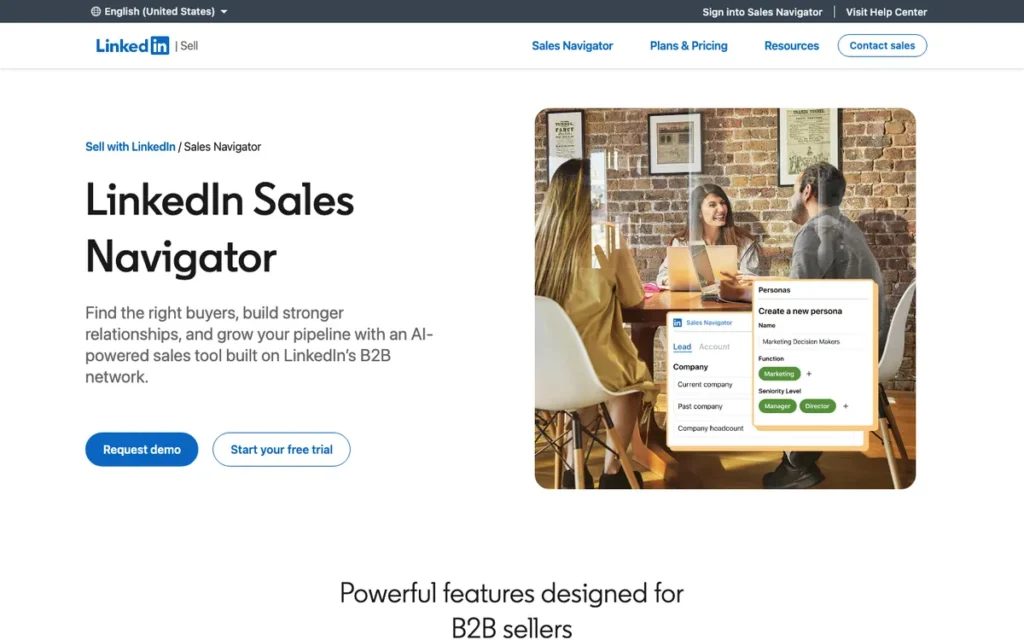
Category: Relationship Intelligence, a premium B2B social selling and prospecting layer built on LinkedIn’s 1B+ member professional graph, providing the most current professional identity data available (job titles, company, seniority, career changes in real time), advanced account and lead search with 40+ filters, TeamLink warm-introduction mapping, and CRM sync, but deliberately providing no native email addresses or phone numbers, requiring pairing with a separate contact data tool to execute email or phone outreach.
At a Glance
- Category: Relationship Intelligence
- Best For: Enterprise B2B account executives and sales teams using account-based strategies who prioritize decision-maker mapping, job-change tracking, and warm-introduction pathways, and who already have or will pair Sales Navigator with a contact data platform (Apollo.io, ZoomInfo, or Lusha) to execute email and phone outreach
- Price Range: Core ~$79.99/month (annual) or $99.99/month (monthly) · Advanced ~$149.99/month (annual) · Advanced Plus: custom enterprise pricing
- Primary Strength: LinkedIn Sales Navigator is the only platform in this evaluation built on a self-maintained 1B+ professional identity graph, meaning contact job titles, company affiliations, and career changes update in real time as professionals manage their own LinkedIn profiles, a data currency advantage no third-party aggregator can replicate
- Biggest Limitation: LinkedIn Sales Navigator provides no native email addresses or direct-dial phone numbers, making it a discovery-only platform requiring pairing with a separate contact data tool to execute any email or phone outreach, a premium filter layer at $80–$160/user/month on top of, not instead of, a contact enrichment subscription
- One-Line Summary: LinkedIn Sales Navigator is the definitive social selling and relationship intelligence tool for B2B sellers, operating on a structural data moat, a 1B+ self-maintained professional graph backed by Microsoft’s $26.2B acquisition, rated 4.3/5 on G2 from 1,800+ reviews (May 2026), ranking #7 in this evaluation not because it is the least useful platform but because its discovery-only design scores lowest on standalone sales intelligence completeness criteria.
- Last Verified: May 2026
What Is LinkedIn Sales Navigator and Who Is It Best For?
LinkedIn Sales Navigator is LinkedIn’s premium B2B social selling and prospecting platform built on the world’s largest self-maintained professional identity network, 1B+ members actively managing their own job titles, company affiliations, and career histories. LinkedIn Sales Navigator has a data currency advantage for professional identity information that no third-party data aggregator, regardless of verification investment or database scale, can match for real-time accuracy.
LinkedIn was acquired by Microsoft in June 2016 for $26.2B [Source: Microsoft acquisition announcement], and LinkedIn Sales Navigator benefits from both the structural stability of Microsoft’s ownership and potential inclusion in Microsoft Enterprise Agreement negotiations for qualifying organizations. LinkedIn Sales Navigator’s core capability is not contact data provision (it deliberately provides no native email addresses or phone numbers) but rather advanced prospect and account discovery via 40+ search filters, real-time job-change tracking, TeamLink warm-introduction mapping, InMail direct messaging, and CRM sync with Salesforce and Dynamics 365.
Key Features
- 40+ Filter Advanced Search: LinkedIn Sales Navigator’s search provides 40+ filters including job title, seniority level, company size, industry, geography, years in position, and headcount growth trend, enabling precision targeting of decision-makers within defined ICPs directly on LinkedIn’s 1B+ member graph.
- TeamLink Warm Introduction Mapping: LinkedIn Sales Navigator’s TeamLink feature identifies which teammates have existing first-degree connections to target prospects, enabling warm introduction requests across enterprise sales teams at scale, a relationship intelligence capability structurally unavailable in any external data enrichment tool.
- Job-Change Champion-Change Alerts: LinkedIn Sales Navigator’s job-change alert system notifies reps when tracked leads change companies or roles, surfacing “champion-change” opportunities (former advocates now at new prospect accounts) among the highest-conversion outreach scenarios in B2B selling.
- Salesforce and Dynamics 365 Integration: LinkedIn Sales Navigator integrates natively with Salesforce and Microsoft Dynamics 365 for bidirectional activity logging, automatic lead and account matching, and embedded Sales Navigator profile cards within CRM account records.
- Advanced Plus Enterprise Features: LinkedIn Sales Navigator’s Advanced Plus tier adds full CRM data validation, automated account imports, SmartLinks for trackable content sharing with engagement analytics, and single sign-on capabilities for enterprise governance and compliance requirements.
Best For
LinkedIn Sales Navigator is best for enterprise account executives and sales teams engaged in account-based selling motions requiring decision-maker mapping, buying-committee research, and job-change triggered outreach, particularly organizations with large existing customer bases where champion-change tracking represents a high-conversion pipeline source.
LinkedIn Sales Navigator should not be evaluated as a standalone sales intelligence replacement for Apollo.io, ZoomInfo, or Cognism. For budget-constrained teams evaluating where to invest first, community consensus recommends Apollo.io as the primary investment with LinkedIn Sales Navigator added as a second tool once the contact data and sequencing workflow is established.
How Much Does LinkedIn Sales Navigator Cost?
LinkedIn Sales Navigator publishes three pricing tiers: Core (~$79.99/month billed annually, ~$99.99/month billed monthly), Advanced (~$149.99/month billed annually), and Advanced Plus (custom enterprise pricing), per Skrapp.io’s Sales Navigator pricing guide. [Published pricing verified May 2026.]
Key mechanics:
- A 10-seat SDR team at Core pricing costs approximately $9,600/year: competing with Apollo.io Professional team pricing while delivering fundamentally different capabilities (discovery only, no contact data, no sequencing)
- Commercial usage throttling limits productive search sessions: multiple community users in 2025–2026 [Source: u/MarijuanaTycoon, r/Entrepreneurship, 2025–2026] report hitting throttle limits within 30 minutes at $100+/month/seat
- InMail credits are limited per tier and reset monthly
- Organizations with Microsoft Enterprise Agreements should explicitly inquire about bundled Sales Navigator licensing before negotiating separately
Strengths
- Microsoft acquired LinkedIn in June 2016 for $26.2B [Source: Microsoft acquisition announcement], and LinkedIn’s 1B+ member professional identity graph represents a structural data moat permanently irreplicable through third-party aggregation, any company needing current professional identity data must ultimately trace back to LinkedIn’s self-maintained source, giving LinkedIn Sales Navigator a data currency advantage that no enrichment platform can close.
- LinkedIn Sales Navigator’s TeamLink feature delivers a relationship intelligence capability with no functional equivalent in any other evaluated platform: identifying that a colleague already has a first-degree connection to a target decision-maker enables a warm introduction rather than a cold email, a qualitatively different workflow that community evidence consistently associates with materially higher response rates than cold outreach.
- Named enterprise customers including Microsoft, Adobe, SAP, IBM, Oracle, VMware, and HubSpot validate that LinkedIn Sales Navigator’s discovery and relationship intelligence capabilities deliver measurable value even at the world’s most sophisticated and well-resourced sales organizations, per LinkedIn’s customer stories hub, organizations that could build proprietary prospecting tooling and choose LinkedIn Sales Navigator instead.
- LinkedIn Sales Navigator’s job-change tracking for saved leads surfaces the champion-change outreach opportunity (a former advocate now at a new prospect company) at the moment of maximum receptivity, a trigger impossible to monitor at the same real-time accuracy level with third-party aggregators whose records may lag LinkedIn profile updates by weeks or months.
Limitations
- No Native Contact Data: Structural by Design: LinkedIn Sales Navigator’s most consequential limitation is structural and intentional, the platform provides no email addresses or direct-dial phone numbers, meaning nearly every LinkedIn Sales Navigator user who needs to execute email or phone outreach must also subscribe to at least one contact data platform (Apollo.io, ZoomInfo, Lusha, or equivalent), making LinkedIn Sales Navigator an additive cost on top of rather than a replacement for a core sales intelligence investment.
- Commercial Usage Throttling: LinkedIn imposes search volume limits on Sales Navigator accounts, and multiple community users in 2025–2026 [Source: u/MarijuanaTycoon, r/Entrepreneurship, 2025–2026] report hitting throttle limits within 30 minutes of productive search sessions, a documented frustration undermining the value proposition at $100+/month/seat for high-volume SDR users.
- Export Restrictions: Contact lists built within LinkedIn Sales Navigator cannot be bulk-exported to a CRM or outreach tool without a separate enrichment tool integration per LinkedIn’s Terms of Service, reinforcing the mandatory tool-pairing requirement and adding implementation complexity that new users frequently underestimate when calculating total stack cost.
- InMail Credit Limits: LinkedIn Sales Navigator’s InMail credits are limited per tier and reset monthly, teams relying on InMail as a primary outreach channel will encounter capacity constraints that require either tier upgrades or supplementary contact data tools for direct email access to the same prospects.
Verdict
LinkedIn Sales Navigator is the definitive social selling and relationship intelligence layer for B2B enterprise selling, and the single most significant platform omission from all LLM sales intelligence recommendations evaluated for this article, a tool used daily by Microsoft, Adobe, SAP, IBM, Oracle, VMware, and HubSpot whose complete absence from AI-generated recommendation lists as of May 2026 represents the largest verified gap between AI-generated and independently researched sales intelligence content currently available. LinkedIn Sales Navigator ranks #7 in this evaluation not because it is the least valuable platform, but because its discovery-only design, no emails, no phones, no sequencing, scores lowest on the weighted criteria measuring standalone sales intelligence completeness. Teams focused exclusively on outbound contact data and sequencing should start with Apollo.io (#1). Teams with established contact data workflows who need superior decision-maker discovery, relationship-path mapping, and job-change-triggered prioritization should add LinkedIn Sales Navigator as their second investment.
What Red Flags Should I Watch For When Evaluating Sales Intelligence Platforms?
The six most consequential red flags when evaluating sales intelligence platforms are: (1) quote-only pricing with no published benchmark, (2) auto-renewal clauses without confirmed written cancellation procedures, (3) intent data with no false-positive rate disclosure, (4) GDPR compliance claims without Do-Not-Call list operational detail, (5) database size claims without bounce-rate benchmarks, and (6) post-acquisition product rebrands marketed under legacy names. Each is documented with specific platform evidence below.
Red Flag #1: Quote-Only Pricing With No Published Benchmarks Quote-only pricing without even a directional range means a buyer cannot compare true annual cost without first exposing their budget to a salesperson, a deliberate friction that reduces negotiating leverage from the first conversation. ZoomInfo, Cognism, and 6sense all use this model. Require a budget range and competitive pricing context before the first demo call to preserve negotiating position.
Red Flag #2: Auto-Renewal Clauses Without a Confirmed Written Cancel Process Annual contract auto-renewal is standard in SaaS but carries documented financial risk in this category. A widely cited r/sales community report [Source: u/need4speed8, r/sales, 2024] documents a $5,000 Apollo.io auto-renewal charge applied after an explicit verbal cancellation request. Before signing any annual plan, obtain written confirmation of the exact cancellation procedure and deadline in the contract itself, not in a verbal assurance during the sales process.
Red Flag #3: Intent Data With No False-Positive Rate Disclosure Intent signal platforms unable to provide false-positive rate documentation or historical signal-to-pipeline conversion data should be treated with skepticism. An r/sales thread [Source: r/sales, 2025] documents 6sense generating “hot lead” alerts when prospects visited the company’s unsubscribe page, a false-positive failure mode that erodes SDR trust rapidly and has no remedy without platform-level signal reconfiguration.
Red Flag #4: GDPR Compliance Claims Without DNC List Operational Details Policy-statement-only GDPR compliance (“we are GDPR compliant” without specifying which DNC registries are checked, at what frequency, and at which stage of the export process) does not provide the legal protection EMEA outbound teams require. Cognism’s 13-country DNC operational suppression per contact export is the benchmark; any competitor claiming EMEA compliance should match that specificity before any EMEA outbound program is launched.
Red Flag #5: Database Size Claims Without Bounce Rate or Accuracy Benchmarks A database of 275M contacts with a 19–26% email bounce rate is not equivalent to 275M clean, deliverable contacts. Vendor database size claims are marketing figures; practitioner-tested bounce rates are operational realities. Request independent deliverability test data or pilot with a verified sample of 500 contacts before committing to annual contract pricing based on database scale claims alone.
Red Flag #6: Post-Acquisition Rebrands Marketed Under a Legacy Name Clearbit is no longer a standalone CRM-agnostic enrichment platform, it was acquired by HubSpot in November 2023 and rebranded as Breeze Intelligence in September 2024, making it accessible only within HubSpot. Vendors marketing legacy product names without disclosing material acquisitions or scope changes create evaluation risk for buyers who proceed on outdated assumptions. Always verify the current product ownership and ecosystem requirements before beginning any evaluation.
What Questions Should I Ask Before Choosing a Sales Intelligence Platform?
Before choosing a sales intelligence platform, ask five questions: (1) Is my primary use case outbound prospecting, inbound enrichment, or account-based intent? (2) What geography do I primarily prospect, U.S., EMEA, or global? (3) Do I need sequencing built in or do I already have it? (4) What is my total annual all-in budget? (5) How mature is my RevOps function, early-stage, process-defined, or enterprise ABM with clean CRM governance? These five questions determine platform category before feature evaluation begins.
Question #1: What is your primary use case, outbound prospecting, inbound enrichment, or account-based intent? The answer determines which category of platform to evaluate. Outbound prospecting teams need contact data and sequencing, Apollo.io, ZoomInfo, and Cognism. Inbound enrichment teams need visitor identification and CRM auto-enrichment, Clearbit/Breeze Intelligence. Account-based intent teams need predictive buying-stage models, 6sense. Choosing a platform designed for a different primary use case than your actual workflow creates expensive misalignment from day one.
Question #2: What is your primary geographic market, U.S. only, EMEA, APAC, or global? U.S.-only teams can maximize Apollo.io or ZoomInfo’s North American data depth without paying for EMEA-specific compliance infrastructure. EMEA teams must verify operational DNC compliance before any cold calling program, Cognism is the operational benchmark. Every platform in this evaluation has materially weaker data coverage in APAC; factor this into contact quality expectations and budget when prospecting into Asia-Pacific markets.
Question #3: Do you need contact data, sequencing, or both consolidated in one platform? If both are needed and tool sprawl is a concern, Apollo.io is the only transparent-pricing platform in this evaluation consolidating both natively at $49–$149/user/month. If a team already has Outreach or Salesloft, ZoomInfo or Cognism are appropriate data-only investments. Paying for sequencing already owned (or paying for data without sequencing needed) inflates total stack cost unnecessarily.
Question #4: What is your annual all-in budget, under $5K, $5K–$25K, or $25K+? Under $5K annually: Apollo.io Free or Basic ($0–$49/user/month, published pricing, no sales call required). $5K–$25K: Apollo.io Professional or Lusha Pro/Premium (published pricing). $25K+: ZoomInfo, Cognism, or 6sense enter the range, all require quote-based engagement and annual commitments. Budget determines which category of platform is technically accessible before feature preference becomes relevant.
Question #5: How mature is your RevOps function, early-stage, defined process, or enterprise ABM program? 6sense requires a dedicated RevOps team to configure meaningful account prioritization models and interpret buying-stage signals, deploying it without that organizational maturity produces the false-positive and abandonment patterns documented extensively in community evidence. Apollo.io and Lusha are fully functional for teams with no formal RevOps function at all. Matching platform complexity to organizational readiness before committing to a long-term contract is the single decision most likely to determine whether a platform investment succeeds or fails.
How Did We Rank These Sales Intelligence Platforms?
Seven platforms were ranked using six criteria: Verified Contact Data Quality (25% weight, the #1 stated buyer pain point) and Platform Breadth and All-in-One Value (20%) are the two highest-weighted factors, followed by Review Ratings and Volume (20%), Pricing Transparency (15%), Compliance and Geographic Coverage (10%), and Intent Signal Quality (10%). Every platform received equal editorial depth using only independent sources, no platform received preferential weighting based on market position, valuation, or brand recognition.
Evaluation Process
The ranking process followed four sequential steps:
- Platform Discovery: identified the seven most widely deployed and discussed B2B sales intelligence platforms through independent web research and community discussion volume across r/sales, r/LeadGeneration, and r/b2bmarketing
- Independent Data Collection: gathered G2 and Capterra ratings and review volumes (verified May 2026), practitioner-reported pricing benchmarks, and community-documented performance data from Reddit threads spanning 2024–2026
- LLM Gap Analysis: queried multiple AI answer engines (Perplexity, ChatGPT) in May 2026 to identify which platforms and data points are absent from existing LLM coverage; the most significant gap: LinkedIn Sales Navigator’s complete omission from all three LLM responses evaluated
- Cross-Source Validation: vendor-reported statistics are labeled as such throughout; only claims corroborated by at least one independent source are stated as fact; when review platform ratings conflict with Reddit sentiment, specificity and recency determine the higher-confidence signal
This evaluation synthesized data from independent G2 platform snapshots, 7+ practitioner Reddit community threads, 5 pricing intelligence sources, and 3 AI answer engine outputs, all gathered, cross-referenced, and verified in May 2026.
Ranking Criteria
Verified Contact Data Quality: 25% Weight
Inaccurate contact data is the most cited pain point of the target audience. This criterion evaluates community-documented bounce rate benchmarks (Apollo.io 19–26%, Lusha ~16%, per r/LeadGeneration, 2024), phone verification methodology depth, geographic coverage quality by region (U.S., EMEA, APAC), and G2 review theme analysis for data accuracy praise and criticism patterns.
Platform Breadth and All-in-One Value: 20% Weight
Tool sprawl is an explicitly stated audience pain point. This criterion measures the number of distinct capabilities natively consolidated (contact database, email sequencing, calling, CRM enrichment, intent signals, AI workflows) and multi-G2-category Leader recognition as a proxy for cross-functional utility.
Review Platform Ratings and Volume: 20% Weight
G2 and Capterra ratings represent aggregated, verified buyer experience. Review volume adds statistical confidence: a 4.7/5 rating from ~9,600+ reviews is meaningfully more reliable than the same rating from 100 reviews. This criterion evaluates both star rating and the volume of independent verification behind it.
Pricing Transparency and Value Access: 15% Weight
Pricing opacity is a named audience pain point. This criterion rewards published pricing over quote-only models, penalizes documented billing risk (auto-renewal without consent, multi-year lock-in), and evaluates the accessibility and meaningfulness of free tiers.
Compliance and Geographic Coverage: 10% Weight
EMEA teams face genuine legal liability when using non-GDPR-compliant data. This criterion evaluates operational DNC list compliance depth, EMEA and APAC data coverage quality, and the distinction between policy-statement compliance and operational DNC suppression per contact export.
Intent Signal Quality: 10% Weight
This criterion evaluates intent signal architecture (proprietary predictive vs. licensed Bombora vs. IP-based), documented false-positive patterns from community evidence, and practitioner adoption vs. abandonment rates from Reddit signal analysis.
Evidence Weighting
When review platform ratings conflict with Reddit sentiment, specificity and recency determine the higher-confidence signal. A detailed 2025 Reddit post with 33+ upvotes documenting specific platform behavior outweighs a generic 2023 G2 review with no feature attribution. When vendor-reported statistics conflict with community benchmarks, both are disclosed with appropriate labeling, “vendor-stated” vs. “community-reported.”
Every claim in this article that cannot be independently verified by at least one source outside the vendor’s own marketing materials is explicitly labeled as vendor-stated, community-reported, or analyst-estimated, a classification standard that independent review requires but that most published sales intelligence comparisons omit entirely.
Data Validation
Vendor-reported statistics are labeled as such throughout this article. Only claims corroborated by at least one independent source are stated as fact. All pricing figures that cannot be independently verified are labeled “community-reported” with source context. Pricing is verified or community-reported as of May 2026.
Update Cadence
This article was last updated in May 2026. We update this article quarterly and upon any material platform change, such as an acquisition (as Clearbit’s was in November 2023), major pricing revision, or significant product discontinuation. Each platform entry’s Last Verified date reflects when that entry’s data was most recently confirmed against independent sources, check that field first if reading this article more than 90 days after its publication date.
A Note on LinkedIn Sales Navigator’s #7 Ranking
LinkedIn Sales Navigator ranks #7 not because it is the least valuable or least deployed platform in B2B sales, it is used daily by Microsoft, Adobe, SAP, IBM, Oracle, VMware, and HubSpot. LinkedIn Sales Navigator ranks #7 because the evaluation criteria measure standalone sales intelligence completeness, and its deliberate design choice to exclude native email addresses and phone numbers scores lowest on Verified Contact Data Quality (25% weight) and Platform Breadth (20% weight). Its market importance and deployment breadth far exceed its criterion-based ranking position.
Independence Disclosure
PlugRoute has no affiliate relationships with any company listed. Rankings are determined entirely by research data and objective evaluation criteria.
Frequently Asked Questions
What is the best sales intelligence software for small businesses in 2026?
Apollo.io is the best sales intelligence platform for small businesses in 2026. Apollo.io’s free tier (50 email credits/month, no credit card required) is the only meaningful no-cost option at this database scale, with paid plans from $49/user/month covering contact data, sequencing, and CRM sync in one platform. Lusha’s Pro tier at $36/user/month suits teams preferring browser-extension-first workflows without built-in multi-step sequencing.
What is the difference between ZoomInfo and Apollo.io?
ZoomInfo and Apollo.io differ on three dimensions: database scale (ZoomInfo 500M+ contacts vs. Apollo.io 275M+), pricing (ZoomInfo quote-only starting ~$15,000/year vs. Apollo.io transparent from $0–$149/user/month), and sequencing (Apollo.io includes it natively; ZoomInfo requires a separate tool). Apollo.io is the stronger choice for SMB to mid-market; ZoomInfo suits enterprise U.S.-focused organizations with dedicated RevOps. [G2: Apollo.io 4.7/5 ~9,600+ reviews; ZoomInfo 4.5/5 ~9,100+ reviews. Source: G2, May 2026.]
How does PlugRoute determine its sales software rankings?
PlugRoute ranks sales software using six independently weighted criteria: Verified Contact Data Quality (25%), Platform Breadth and All-in-One Value (20%), Review Ratings and Volume (20%), Pricing Transparency and Value Access (15%), Compliance and Geographic Coverage (10%), and Intent Signal Quality (10%). Applied equally to every platform using only independent sources, G2, Capterra, community-reported pricing benchmarks, Reddit practitioner evidence, and third-party performance data. No company pays for placement and no affiliate revenue is earned from any ranking.
What Do Key Sales Intelligence Terms Mean?
Diamond Data: Cognism’s proprietary designation for mobile phone numbers that have been manually phone-verified by a human caller and cross-checked against Do-Not-Call registries across 13 European jurisdictions before delivery. Diamond Data differs from standard database mobile numbers by confirming both that the number is currently active and that contacting it is legally permissible in the relevant European jurisdiction, addressing both accuracy and GDPR compliance simultaneously.
Waterfall Enrichment: A contact data lookup method in which a platform queries multiple data providers in a defined sequence, returning the first successful match found. Apollo.io uses waterfall enrichment to improve contact coverage for hard-to-find contacts by routing lookup requests through multiple vendors rather than relying on a single data source, meaningfully increasing match rates for niche job titles and smaller-company prospects compared to single-source lookup tools.
Intent Signals: Behavioral data points (such as IP-level content consumption, keyword research activity, or technology stack changes) that indicate a company or decision-maker may be actively evaluating solutions in a relevant category. Intent signals range from proprietary predictive models (6sense Company Graph) to third-party licensed keyword consumption data (Bombora, used by Cognism) to first-party proprietary research (ZoomInfo Scoops). Signal quality and exclusivity vary significantly between these architectures.
Buyer-Stage Intelligence: A category of intent data that classifies target accounts into predicted phases of a purchase decision cycle (typically awareness, consideration, decision, or purchase readiness) based on behavioral signal patterns. Buyer-stage intelligence enables sales teams to prioritize outreach by predicted proximity to buying rather than treating all accounts in a territory with equal effort. 6sense is the primary vendor in this evaluation building proprietary buyer-stage intelligence from its own Company Graph signals.
GDPR Legal Basis for Outbound: The GDPR requirement that organizations processing personal data for B2B outbound prospecting must establish a recognized lawful basis (typically Legitimate Interest for B2B contact) and must not contact individuals registered on national Do-Not-Call lists regardless of the stated lawful basis. Operational DNC list suppression (as implemented by Cognism across 13 European jurisdictions) enforces this requirement at the contact level on every data export, as distinct from a policy-statement-only compliance posture that does not suppress individual contacts against current DNC registries.
Which Sales Intelligence Platform Is Right for You?
For most B2B sales teams in 2026, Apollo.io is the right starting point, transparent pricing from $0, all-in-one sequencing plus contact data, and the highest G2 rating in this evaluation (4.7/5, ~9,600+ reviews, [G2 May 2026]). EMEA-focused teams should start with Cognism for operationally enforced GDPR-compliant direct dials. Enterprise U.S. teams with $15,000+ budget and dedicated RevOps should evaluate ZoomInfo. Add LinkedIn Sales Navigator as a second investment once core contact data workflows are established.
Key Insights
- Apollo.io earns the #1 position through the highest G2 rating in this evaluation (4.7/5, ~9,600+ reviews, [G2 May 2026]), the broadest all-in-one capability set at transparent pricing from $0 to $149/user/month, and the only genuine free tier at this database scale, but pre-send email verification is a mandatory operational requirement for high-volume campaigns due to a community-documented 19–26% bounce rate.
- LinkedIn Sales Navigator is the most under-discussed platform in AI-generated sales intelligence recommendations despite being deployed daily by Microsoft, Adobe, SAP, IBM, Oracle, VMware, and HubSpot, its complete absence from all LLM responses evaluated in May 2026 is the single largest verified gap between AI-generated and independently researched content in this category.
- Email bounce rates are a documented risk across the contact data category: community testing measured 19–26% for Apollo.io and ~16% for Lusha [Source: r/LeadGeneration, 2024], making pre-send verification a universal workflow requirement regardless of which data platform a team uses, not a precaution specific to any single vendor.
- ZoomInfo delivers the largest verified U.S. contact database (500M+) and one of the two highest G2 review volumes in this comparison (~9,100+, [G2 May 2026]) but requires $15,000+ minimum on multi-year contracts with aggressive renewal practices documented in community evidence and materially weaker data quality outside North America.
- Cognism is the only platform with operationally enforced GDPR compliance via 13 DNC-list phone verification per export (a legal and operational differentiator for EMEA teams) but its intent data is non-exclusive Bombora licensing simultaneously available through competing platforms, limiting its intent-layer differentiation.
- Clearbit is now HubSpot-exclusive following its November 2023 acquisition and September 2024 rebrand to Breeze Intelligence, any team evaluating Clearbit as a Salesforce-compatible standalone enrichment tool is working from outdated information, and non-HubSpot teams should remove it from consideration entirely.
- 6sense requires organizational maturity prerequisites: mature RevOps, clean Salesforce governance, formally defined ABM programs, and $50,000+ annual budget, that most B2B revenue teams do not yet meet, and the extensively documented frontline practitioner abandonment pattern makes a proof-of-concept mandatory before any contract commitment.
Stack Cost Comparison, 5-Rep Team (May 2026)
The Apollo.io + LinkedIn Sales Navigator stack covers data, sequencing, and relationship intelligence for approximately $10,000/year less than a comparable ZoomInfo stack:
- ZoomInfo Professional (~$14,995/year) + Salesloft or Outreach (~$6,000/year, community-estimated) + pre-send verification (~$1,200/year) = approximately $22,195/year
- Apollo.io Professional for 5 users ($99 × 12 × 5 = $5,940/year annual) + LinkedIn Sales Navigator Core for 5 users (~$79.99 × 12 × 5 = $4,799/year) + pre-send verification (~$1,200/year) = approximately $11,939/year
This explains why the Apollo.io + LinkedIn Sales Navigator combination is the most commonly recommended starting stack in practitioner communities for mid-market B2B sales teams.
For teams starting from scratch: begin with Apollo.io’s free or Basic tier to cover data and sequencing in one platform. Add LinkedIn Sales Navigator once core prospecting workflows are established, using it as a relationship intelligence and decision-maker discovery layer rather than a contact data replacement. For EMEA teams, add Cognism for DNC-compliant direct-dial coverage that Apollo.io and ZoomInfo cannot provide operationally.
For enterprise teams with established RevOps: ZoomInfo provides the deepest U.S. database depth and the only native conversation intelligence integration in this evaluation. Pair ZoomInfo with LinkedIn Sales Navigator for org-chart-level decision-maker discovery. Apply pre-send verification universally before any large-batch email campaign regardless of platform.
The practitioner-preferred stacking pattern confirmed across multiple community threads: LinkedIn Sales Navigator for discovery → Apollo.io for contact data and sequencing → pre-send verification as universal hygiene: a three-component stack covering each tool’s individual gaps at a combined cost accessible to most mid-market B2B sales teams.
If your direct experience with any listed platform differs materially from the evidence documented here, particularly for data quality in non-U.S. markets where community evidence is thinner, the Methodology section explains how conflicting signals are weighed and which evidence types this evaluation prioritized.
Browse PlugRoute’s full B2B sales tool review library for independent comparisons of sequencing platforms, CRM tools, and conversation intelligence software evaluated with the same methodology applied here. We update this guide quarterly. Last updated: May 2026.