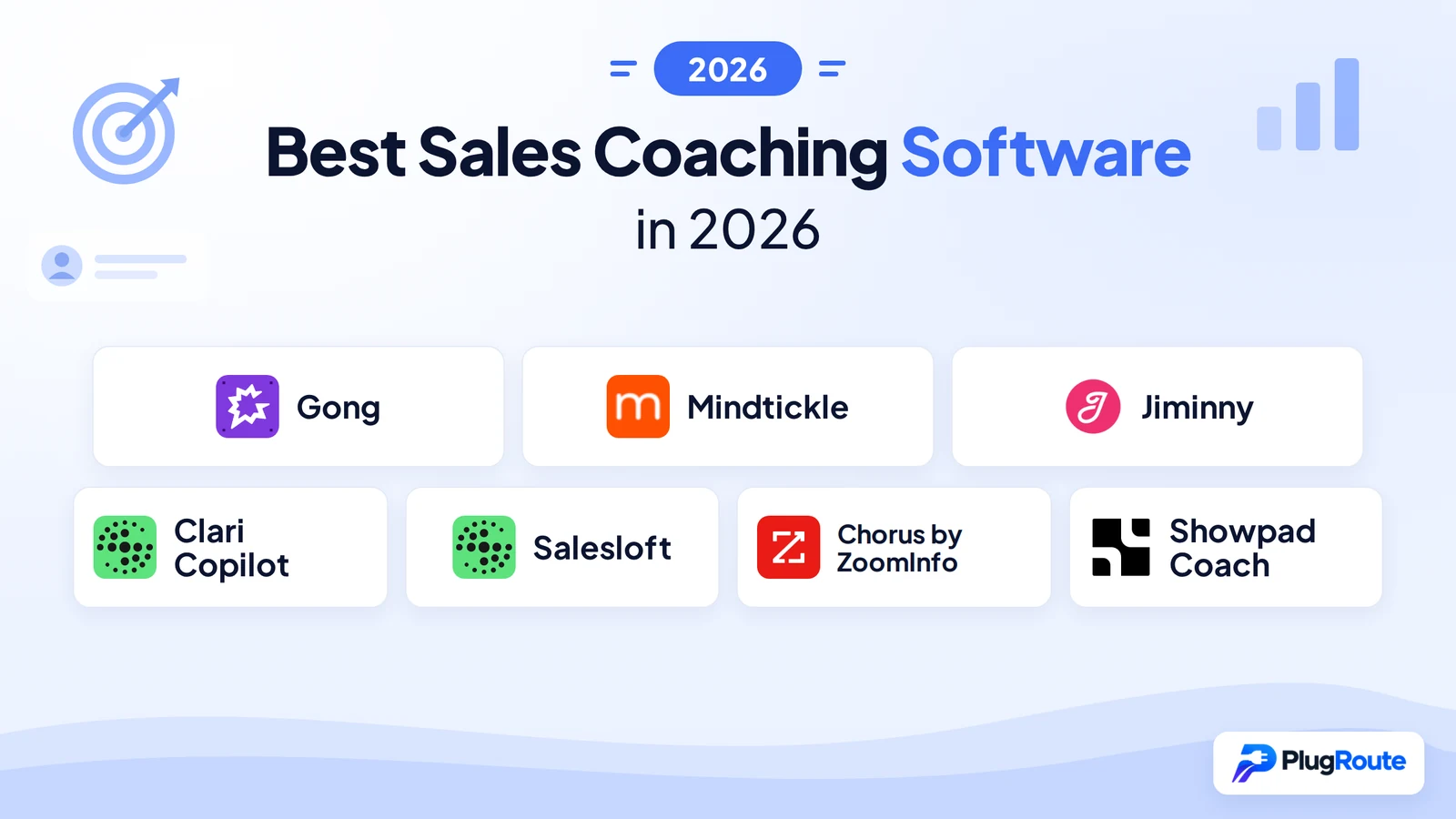
Gong leads for enterprise conversation intelligence and revenue AI; Mindtickle is best for structured rep readiness and onboarding certification; Jiminny delivers the strongest value for SMB teams at approximately $85 per recording seat per month. The right choice depends on whether your primary coaching gap is call behavior visibility, pre-call rep certification, or live objection handling, three structurally different needs requiring different platform types.
Most coaching software evaluations fail because buyers treat all platforms as equivalent when they are engineered for different problems, some for 100-rep enterprise organizations with dedicated RevOps, others for scaling SMBs. Choosing an enterprise platform for a 15-person team consistently results in paying for capabilities that go unused.
PlugRoute has no affiliate relationships with any company listed, rankings are determined entirely by research data and objective evaluation criteria.
“A lot of tools promise coaching insights but end up being just searchable recordings. The best tool is the one your managers will actually log into every day, not the one with the most features on a comparison spreadsheet.” (u/erickrealz, r/Sales_Professionals)
Takeaway: Adoption discipline (not feature count) determines coaching platform ROI. The Red Flags and Evaluation Questions sections below help buyers evaluate adoption likelihood before purchase.
TL;DR: Top Picks at a Glance
- Gong: Gartner MQ Leader December 2025; highest G2 rating in category (4.8/5, 5,600+ reviews); enterprise-tier
- Mindtickle: AI role-play, Ideal Rep Profile, and rep certification; recognized by Gartner and Forrester
- Jiminny: only community-verified pricing (~$85/user/month); strongest SMB-to-mid-market value in evaluation
- Clari Copilot: only platform among the seven evaluated here delivering automated real-time in-call battlecards
What Are the 4 Categories of Sales Coaching Software?
Sales coaching software divides into four distinct categories based on when and how coaching occurs: Conversation Intelligence Platforms (post-call analysis), Sales Readiness Platforms (pre-call training and certification), Sales Engagement and Coaching Hybrids (coaching embedded in outreach workflow), and Content-plus-Coaching Unified platforms. Choosing the wrong category (before evaluating any specific vendor) is the most common and most expensive mistake buyers make.
1. Conversation Intelligence Platforms record, transcribe, and analyze sales calls to surface coaching moments after conversations end. Gong, Jiminny, Chorus by ZoomInfo, and Clari Copilot all operate in this category. Clari Copilot extends this model with automated real-time in-call battlecards, a structural distinction that separates it from every other post-call tool in this list.
2. Sales Readiness Platforms develop rep skills before conversations happen. Mindtickle’s Ideal Rep Profiles, AI role-play engine, and Readiness Index score every rep against a defined performance benchmark and automatically trigger targeted training when skill gaps are detected.
3. Sales Engagement and Coaching Hybrids embed coaching within outreach automation workflows. Salesloft’s Rhythm AI prioritizes each rep’s daily actions based on buyer signals, with coaching insights surfaced in the task queue rather than managed in a separate coaching interface.
4. Content-plus-Coaching Unified Platforms connect content governance to structured training delivery. Showpad Coach uses its Manager Hub and structured learning paths to give managers skills-based coaching visibility alongside governance over which approved content reps use in conversations.
Wrong Category, Wrong Outcome: A team that buys Mindtickle to solve a call visibility problem is paying for a readiness platform when it needs a conversation intelligence tool. A team that buys Gong to solve a rep certification problem will have excellent call data and no structured training path. Category fit determines ROI before vendor selection begins.
How Do the Top 7 Sales Coaching Platforms Compare at a Glance?
| Rank | Company | Category | Best For | One-Line Summary | Coaching Timing | Primary Strength | Key Limitation |
|---|---|---|---|---|---|---|---|
| 1 | Gong | Revenue Intelligence | Enterprise teams (100+ reps) with dedicated RevOps | Gong is rated 4.8/5 on G2 across 5,600+ verified reviews and named the December 2025 Gartner Magic Quadrant Leader for Revenue Action Orchestration. | Post-Call | 300+ conversation signals; Gartner MQ Leader; ranked #1 across all four Gartner Critical Capabilities use cases including Coach Sales Talent | Enterprise pricing (~$100+/user/month); poor ROI for teams under 30 reps without dedicated RevOps |
| 2 | Mindtickle | Sales Readiness Platform | Mid-market to enterprise with dedicated enablement staff | Mindtickle is rated 4.7/5 on G2 across 2,224 verified reviews (May 2026), recognized by both Gartner and Forrester, with a vendor-reported 35% sales increase at Janssen. | Pre-Call + Post-Call | Ideal Rep Profiles + AI role-play + Readiness Index | Steep admin complexity; adoption failure risk without dedicated enablement staff |
| 3 | Jiminny | Conversation Intelligence + CRM Automation | SMB and mid-market teams (5–50 reps) scaling fast | Jiminny is the highest-value conversation intelligence platform for SMB teams, combining automated CRM field population and GDPR compliance at approximately $85 per recording seat per month as of 2025. | Post-Call | Automated CRM field population + transparent pricing + GDPR compliance | Lacks enterprise revenue orchestration depth; review volume smaller than enterprise platforms |
| 4 | Clari Copilot | Real-Time Coaching + Revenue Intelligence | Teams needing live in-call objection coaching | Clari Copilot is the only platform among the seven evaluated here that delivers automated live battlecards during active calls, rated 4.6/5 on G2. | Real-Time + Post-Call | Live battlecards fire automatically during active calls; only real-time coaching in this evaluation | Full value requires Clari platform subscription; total all-in stack cost may reach $200+/user/month |
| 5 | Salesloft | Sales Engagement + Embedded Coaching | Outreach-execution teams prioritizing cadence and workflow | Salesloft is an AI revenue orchestration platform that received a Vista Equity Partners strategic investment in December 2021, integrating 180+ applications with Rhythm AI for next-best-action prioritization. | Post-Call + Workflow | Rhythm AI next-best-action prioritization + 180+ integrations | Shallower conversation intelligence than dedicated coaching platforms; typically requires supplemental call tool |
| 6 | Chorus by ZoomInfo | Conversation Intelligence + Buyer Data Enrichment | Existing ZoomInfo customers needing native call intelligence | Chorus by ZoomInfo serves 20,000+ companies (per HubSpot Marketplace listing, May 2026) and enriches live calls with ZoomInfo buyer data, but requires an active ZoomInfo subscription. | Post-Call | Native ZoomInfo data enrichment surfaces full buyer profile at call start | Requires active ZoomInfo subscription; documented recording reliability concerns |
| 7 | Showpad Coach | Enablement + Structured Coaching | Content-heavy and field sales organizations | Showpad Coach is a unified content-and-coaching platform rated 4.4/5 on G2, built on the 2016 LearnCore acquisition, best suited for field sales teams and content-governed organizations. | Pre-Call (Training + Certification) | Manager Hub + content-coaching unified platform; decade-plus product heritage | Lowest G2 rating in evaluation (4.4/5); no verified public ROI case studies found |
Which Sales Coaching Software Should I Choose for My Use Case?
| Your #1 Priority | Recommended Tool | Why | Acceptable Alternative |
|---|---|---|---|
| Enterprise call intelligence (100+ reps, dedicated RevOps) | Gong | Gartner MQ Leader December 2025; 4.8/5 on G2 (5,600+ reviews); largest signal model (300+); Gartner #1 across all Critical Capabilities use cases | Clari Copilot if Clari forecasting already in stack |
| Structured rep readiness and onboarding certification | Mindtickle | Ideal Rep Profiles + AI role-play + Readiness Index; recognized by Gartner and Forrester | Showpad Coach for content-governance-first environments |
| SMB or mid-market team scaling fast (5–50 reps) | Jiminny | Only community-verified pricing (~$85/user/month); automated CRM field population; GDPR-compliant; reported 20% AOV increase at Cision | Clari Copilot if live in-call guidance is the primary gap |
| Live in-call objection handling (real-time coaching) | Clari Copilot | Only platform among the seven evaluated here with automated live battlecards during calls | No comparable real-time alternative in this evaluation |
| Outreach cadence automation with embedded light coaching | Salesloft | Rhythm AI + Conductor AI + 180+ integrations; strongest engagement workflow in evaluation | Supplement with Jiminny or Gong for deeper call analytics |
| Existing ZoomInfo customer needing conversation intelligence | Chorus by ZoomInfo | Native ZoomInfo enrichment at call start; no additional vendor relationship needed | Jiminny as a standalone alternative without ZoomInfo dependency |
| Field sales organization with content governance needs | Showpad Coach | Manager Hub + content-coaching unified platform; mobile-first field delivery | Mindtickle for more AI-forward readiness capabilities |
1. Gong: Best Overall: Deepest Conversation Intelligence and Revenue AI for Enterprise Teams
Category: Revenue Intelligence, analyzes sales conversations and revenue data at scale using 300+ signals to surface coaching moments, replicate winning rep behaviors, and give revenue leaders real-time deal risk signals and pipeline inspection visibility.
At a Glance
- Category: Revenue Intelligence
- Best For: Enterprise B2B sales teams (100+ reps) with dedicated RevOps and a complex tech stack requiring the deepest available conversation analytics, agentic AI deal intelligence, and revenue forecasting visibility
- Price Range: ~$100–$150/user/month estimated (no public pricing; community-reported: $30,000/year for 9 seats + $10,000 setup fee; enterprise negotiated, Gong will negotiate when competitors are introduced)
- Primary Strength: Gong extracts 300+ conversation signals per call: the largest documented signal count among the seven platforms in this evaluation, and was named a Gartner Magic Quadrant Leader for Revenue Action Orchestration in December 2025, ranking #1 across all four Gartner Critical Capabilities use cases including Coach Sales Talent
- Biggest Limitation: Gong’s enterprise pricing ($100+/user/month with seat minimums and setup fees) and implementation complexity create poor ROI for teams under 30 reps; community reports document teams of 15 paying $18,000/year while using an estimated 20% of available features
- One-Line Summary: Gong is the highest-rated sales coaching and revenue intelligence platform in its category, rated 4.8/5 on G2 across more than 5,600 verified reviews and named the December 2025 Gartner Magic Quadrant Leader for Revenue Action Orchestration.
- Last Verified: May 2026
Overview
Gong is a Revenue AI Operating System for enterprise B2B sales teams that records, transcribes, and analyzes sales conversations using more than 300 signals to surface coaching opportunities, replicate winning rep behaviors, and give revenue leaders real-time deal risk signals and pipeline inspection visibility. Gong was named a Leader in Gartner’s inaugural Magic Quadrant for Revenue Action Orchestration in December 2025, ranking highest on Ability to Execute and furthest on Completeness of Vision among 12 evaluated vendors, and placing #1 across all four Gartner Critical Capabilities use cases including Coach Sales Talent (Sources: Gong press release, December 2025; PRNewswire, December 2025).
Gong is trusted by more than 5,000 customers and holds a G2 rating of 4.8/5 across 5,600+ verified reviews and Capterra rating of 4.8/5 as of May 2026, the highest rating at the highest review volume in this evaluation.
Gong’s enterprise pricing and implementation complexity create a poor fit for teams under 30 reps or those without dedicated RevOps support, a documented pattern that recurs consistently across community research for this category.
Key Features
- Gong’s Revenue Graph connects every customer conversation to CRM data, business context, and AI models tuned specifically for GTM teams, generating a living map of revenue signals across the entire sales organization that enables managers to surface coaching patterns and deal risk signals without manually reviewing individual recordings.
- Gong extracts more than 300 unique conversation signals per call: spanning talk ratios, objection patterns, competitor mentions, sentiment shifts, next-step adherence, and filler word frequency, to automatically identify the highest-value coaching moments without requiring managers to listen to full recordings (Source: Gong Revenue AI platform page, 2025–2026).
- Gong’s agentic AI suite including AI Ask Anything, AI Deep Researcher, AI Briefer, and AI Deal Reviewer allows revenue leaders to query call data in natural language, surface deal risks, generate pre-call research, and review deal health without manual report building.
- Gong’s Call Spotlight automatically highlights the most coachable moments in any recording, allowing managers to deliver timestamped, targeted feedback in minutes rather than reviewing full-length calls.
- Gong supports the Model Context Protocol (MCP), enabling Gong’s revenue data to be consumed by third-party AI agents and custom RevOps workflows, extending coaching intelligence into adjacent tools across the GTM stack (Source: Gong platform page, 2025–2026).
Best For
Gong is best for enterprise B2B sales organizations with 100+ reps, a dedicated RevOps or Sales Ops function, and an existing Salesforce-Zoom-Teams tech stack that can absorb a complex implementation in exchange for the category’s largest documented signal count, deepest deal analytics, and agentic AI capabilities.
Pricing
Gong does not publish standard pricing. Community-reported data from r/Sales_Professionals (2026) includes one organization reporting approximately $30,000/year for 9 seats plus a $10,000 setup fee (u/Admirable_Comedian_2) and a 15-person team reporting approximately $18,000/year while using an estimated 20% of available features.
Third-party estimates place Gong’s per-seat cost at approximately $100–$150/user/month for core conversation intelligence. Gong will negotiate on price when competitors are introduced into evaluations. All figures are community-reported estimates, verify current pricing directly with Gong before budgeting.
Strengths
- Gong was named a Leader in Gartner’s inaugural Magic Quadrant for Revenue Action Orchestration in December 2025, ranking highest on Ability to Execute and furthest on Completeness of Vision, and placed #1 across all four Gartner Critical Capabilities use cases, including Coach Sales Talent, the use case most directly relevant to the coaching audience of this article (Sources: Gong press release, December 2025; PRNewswire, December 2025).
- Gong holds a G2 rating of 4.8/5 across more than 5,600 verified reviews and a Capterra rating of 4.8/5 as of May 2026, the highest rating at the highest review volume in the sales coaching software category, with a corpus statistically robust enough to compare across team sizes and use cases (Sources: G2, May 2026; Capterra, May 2026).
Users on r/techsales shared their experience:
“I’m the CRO of a software company and brought in Gong earlier this year. Of course I want more meetings with clients and prospects, but what I really want is just to make my AE’s lives easier. Capturing notes, integrating activity in Salesforce, drafting follow-ups…To me personally that is the real power of Gong.” Posted by u/parasoft_dave_vano
Takeaway: Sales leaders implementing Gong consistently cite CRM automation and AE workflow simplification as the platform’s most immediate ROI driver, a practical signal that complements the enterprise analytics depth in Gong’s product marketing and that buyers should weigh when projecting Year 1 utilization.
- A named Trimble case study documents the company tripling average deal sizes after deploying Gong’s Revenue AI OS to identify pipeline signals, shift to an account-based selling model, and generate new pipeline, the strongest independently corroborated enterprise ROI case study in this evaluation, sourced from both Gong’s customer case study page and DemandGen Report (2025).
- Gong’s 300+ signal extraction framework: spanning talk ratios, objection handling patterns, competitor mention frequency, sentiment shifts, and buyer intent indicators, represents the largest documented signal count among the seven platforms evaluated here, giving sales managers a coaching foundation that lighter-weight tools cannot structurally replicate (Source: Gong Revenue AI, 2025).
Limitations
- Gong’s most consequential trade-off is cost versus utilization: community-reported data from r/Sales_Professionals (2026) shows a 15-person team paying approximately $18,000/year while using an estimated 20% of available features, and a 9-seat deployment quoted at $30,000/year plus a $10,000 setup fee, a cost structure that produces negative ROI for organizations lacking the RevOps sophistication to operationalize the platform’s full capability.
“Gong is definitely the best, but as you’ve seen it’s very expensive and has a ton of functionality few orgs are sophisticated enough to take advantage of.” (u/Pinball-Gizzard, r/techsales, 2024)
Takeaway: Gong’s category leadership is not disputed in community research, but the sophistication gap between Gong’s capabilities and most organizations’ ability to operationalize them is the central ROI risk for any team under 50 reps considering Gong.
- Gong’s AI-generated call summaries are reported by G2 reviewers and competitive analysis sources to take 2–4 hours post-call to arrive (Source: oliv.ai Gong features review, 2025), reducing the immediacy of post-call coaching follow-through for fast-moving deal environments where immediate rep feedback matters most.
- Gong’s transcription accuracy degrades on calls with non-native English accents, overlapping speakers, or background noise, a documented concern across G2 review forums and competitive analysis, requiring managers to verify AI summaries before sharing coaching feedback with reps.
- Gong requires significant initial setup configuration and ongoing admin maintenance, a documented implementation burden that typically requires dedicated RevOps involvement and delays time-to-value for organizations without dedicated technical resources already in place.
Verdict
Gong is the best-evidenced sales coaching and revenue intelligence platform available in 2026, earning its #1 ranking through the highest G2 rating (4.8/5) at the highest review volume (5,600+), Gartner Magic Quadrant leadership, a #1 Gartner Critical Capabilities ranking in Coach Sales Talent, and a documented tripling of average deal sizes at Trimble. Sales organizations with 100+ reps, dedicated RevOps support, and the willingness to invest $100+/user/month will extract exceptional ROI from Gong’s 300+ signal architecture, agentic AI layer, and Revenue Graph. Teams under 30 reps or without dedicated implementation support should evaluate Jiminny, Clari Copilot, or Mindtickle before committing to a Gong quote.
2. Mindtickle: Best for Sales Readiness, Structured Onboarding, and Rep Certification
Category: Sales Readiness Platform (trains, certifies, and coaches reps before, during, and after calls using a unified system that connects rep knowledge gaps to personalized learning paths, AI role-play practice, and call intelligence) all scored against a defined Ideal Rep Profile.
At a Glance
- Category: Sales Readiness Platform
- Best For: Mid-market to enterprise B2B teams with dedicated sales enablement staff that need rep certification, structured onboarding, AI role-play, and call intelligence connected in a single platform, particularly teams with high rep turnover or complex product certifications
- Price Range: Custom enterprise pricing (no public tiers; demo required; no community-reported pricing data available as of May 2026)
- Primary Strength: Mindtickle’s Ideal Rep Profile and Readiness Index automatically score every rep against a defined excellence benchmark and trigger targeted coaching or AI role-play assignments when skill gaps are detected, closing the loop between call performance and developmental action
- Biggest Limitation: Mindtickle’s platform breadth creates steep admin overhead and rep disengagement risk, community research describes enterprise enablement platforms like Mindtickle as places “where training goes to die,” with documented login rates as low as 15% without active management enforcement
- One-Line Summary: Mindtickle is rated 4.7/5 on G2 across 2,224 verified reviews (May 2026), recognized by both Gartner and Forrester, and self-reports a vendor-reported 35% sales increase at Janssen.
- Last Verified: May 2026
Overview
Mindtickle is a Sales Readiness Platform for mid-market to enterprise B2B organizations that combines onboarding, adaptive learning paths, AI role-play, call intelligence, coaching, content management, and Digital Sales Rooms in a single unified system scored against a defined Ideal Rep Profile. Founded in 2011, Mindtickle takes a structurally different approach from conversation intelligence tools, rather than surfacing call recordings for manager review, Mindtickle automatically connects detected skill gaps to personalized training modules or AI role-play assignments, closing the loop between call performance and developmental action.
Mindtickle’s platform breadth creates adoption risk for organizations without dedicated sales enablement staff, deployment success depends heavily on active management enforcement and ongoing enablement operations.
Key Features
- Mindtickle’s Ideal Rep Profile allows sales leaders to define the exact knowledge, skills, and behaviors of top performers for each role, then Mindtickle’s Readiness Index automatically scores every other rep against that benchmark, surfacing specific gaps for targeted coaching, training assignment, or AI role-play intervention without requiring manager curation.
- Mindtickle’s AI role-play engine lets reps practice objection handling, product pitches, and discovery conversations against an AI buyer at any time without requiring manager availability, directly addressing the pre-call preparation gap that post-call coaching tools structurally cannot solve.
- Mindtickle’s Call AI module analyzes recorded sales conversations and automatically connects detected skill gaps to the relevant Mindtickle training module or AI role-play assignment, creating a direct link between what happened on a call and the next developmental action without manager intervention.
- Mindtickle’s certification workflows require demonstrated competency: quiz scores, role-play completion, and manager sign-off, before reps are cleared for high-value customer conversations, directly addressing the rep readiness gap that post-call coaching alone cannot prevent.
- Mindtickle’s Asset Hub and Digital Sales Rooms extend coaching scope beyond conversation behaviors into content effectiveness, tracking which approved assets reps use in customer conversations and whether buyer engagement with that content correlates with deal advancement.
Best For
Mindtickle is best for mid-market to enterprise B2B organizations with dedicated sales enablement staff that need to unify onboarding, skills development, AI role-play, and conversation coaching in a single platform, particularly teams with high rep turnover, long ramp timelines, complex product certifications, or field sales environments where coaching access is geographically limited.
Pricing
Mindtickle does not publish pricing. All pricing inquiries are routed through a demo-led enterprise sales process, and no community-sourced pricing data was available at the time of this research (May 2026).
Mindtickle’s enterprise orientation typically requires budget allocation and RevOps or Finance involvement before any quote is received, creating a real barrier for teams evaluating multiple platforms simultaneously. Buyers should allocate two to four weeks for the procurement process once entering a Mindtickle evaluation.
Strengths
- Mindtickle customer Janssen, a pharmaceutical enterprise field sales organization, reported a 35% increase in sales from data-driven coaching, with 95% of coaching forms completed on-site and on time (Source: Mindtickle Sales Coaching Platform page, 2025, vendor-reported case study; independently verifiable by requesting the Janssen reference contact from Mindtickle directly). This is the strongest field sales ROI evidence in this evaluation.
- Mindtickle is recognized as a Leader by both Gartner Magic Quadrant and Forrester Wave, and self-reports holding the #1 position in the G2 Sales Training and Onboarding category since 2019 across consecutive seasonal ranking periods (Source: Mindtickle blog, 2025, verify current ranking status at g2.com/products/mindtickle before citing the specific quarter count in any procurement context).
- Mindtickle’s AI role-play capability addresses a coaching need that conversation intelligence tools structurally cannot fill, reps can practice objection handling before high-stakes calls rather than reviewing mistakes after the fact, with Mindtickle’s comparison content citing 38 weeks of manager time saved and 6,000+ hours returned through structured role-play automation (Source: Mindtickle vs. Showpad comparison page, 2025, vendor-published comparison data, not an independent case study).
- Mindtickle’s unified platform covering onboarding, microlearning, AI role-play, Call AI, coaching, content management, and Digital Sales Rooms reduces the number of separate vendor licenses needed for a complete readiness stack, a consolidation benefit that can offset cost for organizations currently running separate training, call recording, and content tools.
Limitations
- Mindtickle’s most consequential trade-off is platform breadth versus actual adoption, community research from r/techsales (2025) describes enterprise enablement platforms like Mindtickle as “where training goes to die because no one logs in,” with one user citing only 15% active login rates and recommending alternative tool stacks as more adoptable in practice.
“Honestly, big platforms like Mindtickle are where training goes to die because no one logs in. Gong/Chorus for actual skills and an overlay like Spekit for process is the only combo I’ve seen reps actually adopt.” (u/Adventurous-Pace2182, r/techsales, 2025)
Takeaway: Enterprise enablement platform adoption depends on management enforcement, not platform quality. This pattern applies across the entire category, but it is most acute for comprehensive multi-module platforms where adoption requires active oversight of many separate workflows.
- Mindtickle’s admin complexity: steep learning curves across multiple connected modules, significant configuration overhead for IRP setup, and the need for a dedicated enablement function to manage ongoing operations, means organizations without full-time sales enablement staff will likely see poor value realization relative to platform cost.
- Mindtickle’s pricing opacity, with no public tiers and a demo-required sales process, slows evaluation timelines for teams comparing multiple platforms simultaneously and can delay budget qualification by two to four weeks relative to platforms with transparent pricing.
- A direct implementation dissatisfaction comment from r/LearningDevelopment (2025), “Don’t do Mindtickle, they absolutely suck” (u/Thediciplematt), is a single data point that buyers should weigh alongside the stronger weight of analyst recognition and review platform evidence, but which prospective buyers deserve to see disclosed as part of a complete picture.
Verdict
Mindtickle is the most comprehensively evidenced sales readiness platform in this evaluation for organizations whose primary coaching challenge is structured onboarding, pre-call certification, and connecting call-level skill gaps to personalized development actions. Mindtickle earns its #2 ranking, above Jiminny primarily through multi-analyst recognition (Gartner and Forrester, which Jiminny does not hold), a higher G2 rating (4.7/5 across 2,224 reviews), and the vendor-reported Janssen case study. The critical caveat every buyer must weigh: Mindtickle’s platform breadth is simultaneously its greatest strength and greatest adoption risk, without dedicated sales enablement staff and active management enforcement, the same complexity that enables its depth can translate directly into shelf software.
3. Jiminny: Best for SMB and Mid-Market Teams (5–50 Reps): Highest Value-to-Cost in Category
Category: Conversation Intelligence + CRM Automation, records and analyzes sales conversations to surface coaching moments and skill gaps, then automatically writes those insights, summaries, and next steps to CRM records without requiring reps to manually log post-call notes.
At a Glance
- Category: Conversation Intelligence + CRM Automation
- Best For: SMB and mid-market B2B sales teams of 5 to 50 reps that need automated CRM hygiene, customizable AI coaching frameworks, and GDPR-compliant conversation intelligence without enterprise pricing or RevOps dependency
- Price Range: ~$83–$85/user/month for recording seats on annual contract (independently verified via Claap.io and Vendr, May 2026); tiered seat model includes Insights Seats (~$42/month) and Listener Seats (free), blended cost varies by seat mix
- Primary Strength: Jiminny automatically populates Salesforce and HubSpot CRM fields from every recorded call without rep input, eliminating post-call admin while maintaining the pipeline data quality managers and RevOps leaders depend on
- Biggest Limitation: Jiminny lacks enterprise revenue orchestration depth, advanced deal forecasting, and the 300+ signal architecture of Gong, making it less suited for large organizations with complex multi-tool RevOps stacks requiring agentic AI workflows
- One-Line Summary: Jiminny is the highest-value conversation intelligence platform for SMB teams, combining automated CRM field population, customizable BANT/MEDDIC coaching scoring, and GDPR compliance at approximately $85 per recording seat per month as of 2025, the only community-verified price in this evaluation.
- Last Verified: May 2026
Overview
Jiminny is a conversation intelligence and CRM automation platform built specifically for SMB and mid-market B2B sales teams of 5 to 50 reps that need call recording, AI transcription, coaching scorecards, and automated CRM hygiene without the enterprise implementation complexity and cost of Gong or Chorus. Founded in 2016 in the UK, Jiminny explicitly targets the gap between lightweight note-taking tools and enterprise revenue platforms, serving the team that has outgrown a basic call recorder but cannot justify Gong’s pricing or a six-to-twelve-month implementation timeline.
Jiminny’s recording seat pricing of approximately $83–$85/user/month is confirmed by multiple independent pricing trackers (Sources: Claap.io Jiminny pricing guide, 2026; Vendr marketplace, 2026, median buyer spend: $27,000/year), making Jiminny the only platform in this evaluation where SMB buyers can qualify budget fit before engaging a sales representative.
Key Features
- Jiminny automatically populates Salesforce and HubSpot CRM fields: including call summaries, action items, contact updates, and next steps, from every recorded call without requiring reps to manually update records, eliminating post-call admin while maintaining the pipeline data quality RevOps and sales managers need for accurate forecasting.
- Jiminny’s Ask Jiminny AI layer allows reps and managers to query the entire call library in natural language (surfacing pattern-level insights such as which calls had the most pricing objections this quarter or which competitor appeared most often in late-stage deals) without requiring manual tagging or category setup.
- Jiminny’s coaching framework scoring applies customizable qualification prompts: BANT, MEDDIC, SPIN, or any custom framework, to every recorded call automatically, creating a rep accountability layer where managers can see which reps consistently skip qualification steps without listening to every recording.
- Jiminny’s team performance dashboards give managers searchable visibility across all rep calls (filterable by team member, time period, deal stage, topic keyword, or coaching score) enabling skill gap identification at the team level without reviewing individual recordings.
- Jiminny’s multi-language transcription and translation capabilities support multinational B2B sales teams operating across European and global markets, with GDPR-compliant data handling that removes the procurement friction US-centric platforms create for EU-based organizations.
Best For
Jiminny is best for SMB and mid-market B2B sales teams of 5 to 50 reps that are scaling quickly, need automated CRM hygiene to maintain pipeline data quality, want coaching AI aligned to their own sales methodology rather than generic defaults, and cannot justify the pricing or implementation complexity of enterprise platforms, particularly teams with multinational footprints or EU data compliance requirements.
Pricing
Jiminny is the only platform in this evaluation with independently verified pricing. Recording seats are priced at approximately $83–$85/user/month on annual contract (Sources: Claap.io Jiminny pricing guide, 2026; Vendr marketplace, 2026, median buyer spend: $27,000/year, range: $11,160–$52,728 depending on seat count and mix).
Jiminny uses a tiered seat model: Recording Seats (~$83–$85/month), Insights Seats (~$42/month), and Listener Seats (free), meaning blended per-seat cost varies based on how many seats of each type a team configures. This pricing transparency allows SMB buyers to qualify budget fit before engaging with a sales representative, unlike the six other platforms in this evaluation.
Strengths
- Jiminny customer Cision, a global media intelligence company, reported a 20% increase in average order value following Jiminny-enabled structured coaching workflows, with Sales Managers Mike Day and Luke O’Connor stating “reps’ discovery skills are sharper after coaching” and “call quality has improved as reps pitch higher-value products more often” (Source: oliv.ai conversation intelligence comparison, 2026, third-party reported; verify at Jiminny.com or request the Cision reference contact from Jiminny directly before citing in procurement contexts).
- Jiminny received the most detailed unprompted positive user endorsements in this research corpus, u/Fickle_Grapefruit130 (r/SalesOperations, May 2026) described Jiminny as “the best one for our growth and multinational footprint,” stating: “I literally never write a report or email or coaching summary ever. I have forgotten how to update Salesforce and HubSpot because it does it for me. Great value for those really wanting to embrace AI but without all the Gong complication.”
- Jiminny’s approximately $83–$85/user/month recording seat pricing: confirmed by multiple independent pricing trackers as of May 2026, makes Jiminny the only platform in a six-platform opacity category where SMB buyers can qualify budget fit before investing evaluation time, directly addressing the most consistently cited friction point in the sales coaching software selection process.
This aligns with community sentiment on r/SalesOperations:
“There is an awesome tool called Jiminny. I strongly recommend. It even helps with coaching and you can create prompts to help score the call based on your wants/needs BANT etc. It connects with your CRM so you can push the summaries automatically as well. With Jiminny you can also search throughout ALL of the calls either by team member or the entire team to find out insights, where weaknesses are etc without having to comb through each and every call.” Posted by u/ShotNovel9605
Takeaway: Jiminny earns consistent unsolicited community endorsements for its customizable BANT/MEDDIC call scoring and team-wide call search, the two capabilities the article identifies as its primary value drivers for the SMB segment over enterprise-tier alternatives.
- Jiminny demonstrated active 2025–2026 product investment including AI Key Points for every call, improved Ask Jiminny NLP answers, CRM field population enhancements, automatic activity-type detection, and webinar recording support (Source: Jiminny Help Center “What’s New” changelog, accessed May 2026), indicating product velocity comparable to better-funded enterprise competitors.
Limitations
- Jiminny’s most consequential trade-off is depth versus accessibility: Jiminny deliberately targets the SMB and mid-market segment, meaning it does not offer enterprise-grade revenue orchestration: no equivalent to Gong’s Revenue Graph and 300+ signal model, no native AI role-play engine comparable to Mindtickle’s, and less advanced deal forecasting than Clari or Salesloft.
- Jiminny G2 reviewers (2026) note occasional call-join reliability issues in certain telephony and video conferencing setups, alongside some users citing excessive in-app notification frequency as a UX friction point, both of which should be explicitly tested using the buyer’s specific dialer and CRM configuration during any trial period before a full deployment commitment is made (Source: G2 Jiminny reviews, 2026).
- Jiminny’s G2 review base of 232–241 verified feature reviewers (Source: G2, May 2026) is substantially smaller than Gong’s 5,600+ review corpus, the statistical confidence in Jiminny’s quality claims, while positive, is lower than for top-tier enterprise platforms, and enterprise procurement requirements should prompt formal reference calls in addition to reviewing available G2 data.
- Teams that outgrow a 50-rep organization and need enterprise-grade revenue intelligence should account for a platform transition in their long-term planning, Jiminny is not designed for organizations of 200+ reps with complex multi-tool RevOps requirements, and switching costs are a real consideration in that growth scenario.
Verdict
Jiminny is the best-value sales coaching and conversation intelligence platform for SMB and mid-market B2B teams in 2026, earning its #3 ranking as the only platform in this evaluation with both a reported ROI case study (Cision: 20% average order value increase, third-party reported via oliv.ai) and independently verified pricing transparency (~$83–$85/user/month for recording seats) that allows budget qualification before demo engagement. Jiminny’s automatic CRM field population, customizable BANT and MEDDIC scoring, GDPR-compliant infrastructure, and active AI development address the core coaching pain points of the 5–50 rep segment more accessibly than any enterprise alternative. Sales managers who have evaluated Gong and found the pricing prohibitive should treat Jiminny as the primary alternative, not an afterthought.
4. Clari Copilot: Best for Real-Time In-Call Coaching and Teams Already on the Clari Platform
Category: Real-Time Coaching + Revenue Intelligence, delivers automated live battlecards to reps during active sales calls when trigger phrases are detected, combined with post-call analysis, AI summaries, coaching scorecards, and native data flow into Clari’s revenue forecasting and pipeline management platform.
At a Glance
- Category: Real-Time Coaching + Revenue Intelligence
- Best For: Sales teams where live objection handling and real-time competitive positioning are primary coaching gaps; organizations already using Clari’s revenue forecasting platform who want coaching signals to flow natively into pipeline reviews
- Price Range: Custom enterprise pricing; add-on module reported at approximately $100/user/month above the Clari platform base (Sources: marketbetter.ai, tldv.io, 2026); total all-in cost may reach $200+/user/month; demo required for all pricing
- Primary Strength: Clari Copilot is the only platform among the seven evaluated here that fires live battlecards automatically during active calls when competitor names, pricing objections, or stall language are detected, coaching reps in the moment rather than after the conversation has ended
- Biggest Limitation: Full architectural value requires Clari platform subscription; total all-in stack cost may reach $200+/user/month; post-acquisition product investment concerns documented in community research
- One-Line Summary: Clari Copilot is the only platform among the seven evaluated here that delivers automated live battlecards during active calls, rated 4.6/5 on G2, natively integrated with Clari’s revenue forecasting platform.
- Last Verified: May 2026
Overview
Clari Copilot is a conversation intelligence and real-time coaching platform (originally developed as Wingman, an independent startup acquired by Clari) that coaches reps during live sales conversations by firing pre-approved battlecards automatically when trigger phrases are detected. Clari Copilot’s live battlecard capability is its single most differentiating feature in this evaluation: while every other platform in this list coaches reps after conversations end, Clari Copilot is the only platform among the seven evaluated here that intervenes during an active call.
Clari Copilot delivers its full architectural value to teams already using Clari’s revenue forecasting and pipeline management tools, its standalone value proposition is narrower for teams outside the Clari ecosystem.
Key Features
- Clari Copilot’s live battlecards fire automatically during active calls when the platform detects trigger phrases (competitor names, pricing objections, procurement pushback, stall language) delivering pre-approved rep responses and supporting data in real time without requiring manager intervention, addressing the live objection handling gap that post-call tools structurally cannot solve.
- Clari Copilot captures intent signals, commitment language, objection patterns, contact details, and next-step mentions from every call and writes them automatically to CRM records, reducing post-call admin while maintaining deal intelligence accuracy for pipeline reviews.
- Clari Copilot’s coaching scorecard system allows managers to define custom evaluation frameworks and automatically score recorded calls against those criteria, enabling systematic rep feedback at scale without manual review of every recording.
- Clari Copilot integrates with Clari’s Revenue Orchestration Platform so that every coaching signal from a call (deal risks, competitive mentions, stalled next steps) feeds directly into forecasting reviews and deal inspection dashboards for sales leaders, eliminating the silo between call behavior and pipeline visibility.
- Clari Copilot is listed on the official Webex App Hub alongside support for Zoom and Microsoft Teams, making Clari Copilot accessible to enterprise organizations standardized on Cisco collaboration infrastructure that most standalone conversation intelligence platforms do not serve.
Best For
Clari Copilot is best for mid-market to enterprise B2B sales teams where live objection handling and real-time competitive positioning are primary coaching priorities, and ideally for organizations already using Clari’s revenue forecasting platform who want coaching signals to flow natively into pipeline reviews without adding a separate vendor relationship.
Pricing
Clari Copilot does not publish pricing. Independent review sources in 2026 (marketbetter.ai, tldv.io) report Clari Copilot priced as an add-on module at approximately $100/user/month above the Clari platform base subscription, meaning total all-in costs for teams running the integrated Clari + Copilot suite may reach $200 or more per user per month, potentially making Clari Copilot the highest per-seat cost option in this evaluation.
Clari Copilot is typically packaged as part of Clari’s broader platform suite. Buyers must request a bundled versus standalone pricing breakdown from Clari to understand the true cost of the Copilot module specifically. No community-verified standalone pricing data was available as of May 2026.
Strengths
- Clari Copilot is the only platform among the seven evaluated here that coaches reps during a live conversation, its real-time battlecard system fires automatically when competitor names, pricing objections, or trigger phrases are detected, directly addressing the live objection handling pain point that post-call analysis tools structurally cannot solve (Source: Clari Copilot Product Page, 2025).
- Clari Copilot holds a G2 rating of 4.6/5 and a Capterra rating of 4.7/5, with SoftwareReviews verified users specifically citing coaching scorecards, deal dashboards, competitive tracking, and topic trackers as features they actively use, validating that Clari Copilot’s coaching layer delivers real-world utility beyond basic transcription (Source: SoftwareReviews, 2025).
- Clari publishes aggregate performance benchmarks from its customer base on its blog (2025), including 40% shorter sales cycles, 30% higher win rates, 90% reduction in CRM update time, and 25% better pipeline visibility. These are vendor-reported aggregate claims, not named individual case studies, and should be treated as directional benchmarks rather than guaranteed individual outcomes (Source: Clari blog, 2025).
- Clari Copilot’s official Webex App Hub listing gives Clari Copilot a documented integration advantage for enterprise buyers in regulated industries (financial services, healthcare, and government) standardized on Cisco collaboration infrastructure that most standalone conversation intelligence platforms cannot serve.
Limitations
- Clari Copilot’s most consequential trade-off is platform dependency: Clari Copilot’s full architectural value (forecast integration, deal signal flow, pipeline visibility) is only realized by teams already embedded in Clari’s Revenue Orchestration Platform, meaning standalone buyers pay for an ecosystem benefit they will not receive without the full Clari suite.
- Clari Copilot’s total all-in stack cost is a material risk: independent review sources (marketbetter.ai, tldv.io, 2026) place Clari Copilot as an add-on at approximately $100/user/month above the Clari platform base, meaning all-in costs for integrated deployments may reach $200+ per user per month, a cost floor buyers must confirm with Clari before budgeting.
- Community research from r/techsales (2024–2025) specifically notes “Clari doesn’t seem to invest much time/money into improving/maintaining Wingman/CoPilot” (u/StrikingTemperature2, r/techsales, 2024), a concern about post-acquisition product investment that represents a meaningful long-term risk for buyers evaluating roadmap trajectory.
“I’ve used Gong and Clari Wingman and Gong was just better.” (u/StrikingTemperature2, r/techsales, 2024)
Takeaway: A buyer with direct deployment experience of both Gong and Clari Copilot preferred Gong, prospective Clari Copilot buyers evaluating post-call analytics depth rather than real-time battlecards specifically should set expectations accordingly.
- Clari Copilot’s UX receives consistent criticism in community research: documented issues include poor video review quality, a suboptimal mobile experience, and a call summary layout that occupies significant screen space and cannot be minimized, constraining the recording viewing experience compared to Gong.
- No named customer case studies with quantified coaching outcomes were found in publicly accessible sources at the time of this research (May 2026), buyers should request specific, quantified customer references from Clari directly before any budget commitment.
Verdict
Clari Copilot is the right choice for B2B sales teams whose primary coaching gap is live objection handling (a structural need that post-call analysis tools cannot address) and for organizations already running Clari’s revenue forecasting platform who want coaching signals to flow natively into pipeline reviews. Clari Copilot earns its #4 ranking for its unique real-time battlecard capability (the only platform among the seven evaluated here to offer it) and solid G2 ratings (4.6–4.7/5), but prospective buyers should weigh post-acquisition product investment concerns from community research, verify current roadmap investment directly with Clari, and request named customer references given the absence of publicly quantified outcome data.
5. Salesloft: Best for Sales Engagement and AI Workflow Orchestration with Embedded Coaching
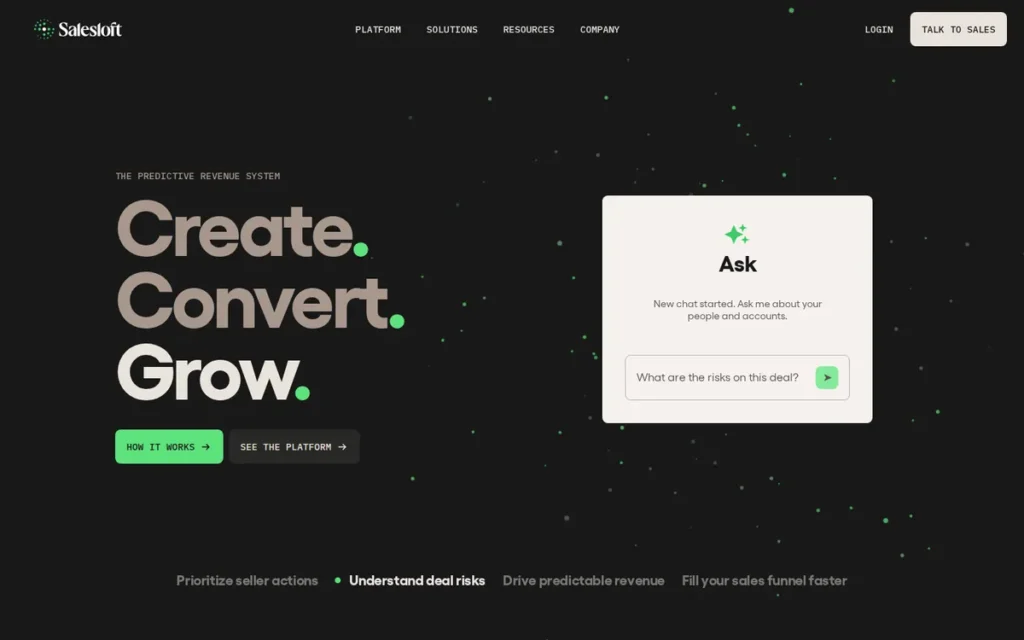
Category: Sales Engagement + Embedded Coaching, orchestrates multichannel outreach cadences and AI-driven next-best-action prioritization, with conversation intelligence and coaching capabilities embedded within the workflow platform as supporting modules rather than the primary product.
At a Glance
- Category: Sales Engagement + Embedded Coaching
- Best For: Mid-market to enterprise B2B teams prioritizing outreach cadence automation and AI-driven rep task prioritization, where coaching capability is a complement to engagement workflow rather than the standalone coaching solution
- Price Range: Custom enterprise pricing (no public tiers; enterprise negotiated via demo; Spendflo pricing guide is the most-referenced third-party source for approximate ranges)
- Primary Strength: Salesloft’s Rhythm AI analyzes buyer signals across the entire connected tech stack and surfaces each rep’s prioritized daily action queue, connecting coaching insights directly to specific outreach behaviors without requiring manual manager intervention
- Biggest Limitation: Salesloft’s conversation intelligence capabilities are substantially shallower than Gong’s, Jiminny’s, or Clari Copilot’s, teams seeking call coaching depth typically need a supplemental dedicated coaching tool alongside Salesloft
- One-Line Summary: Salesloft is an AI revenue orchestration and sales engagement platform that received a Vista Equity Partners strategic investment in December 2021 at approximately $2.3 billion valuation, integrating 180+ applications, and best suited for teams where coaching is embedded in outreach workflow automation rather than managed as a standalone coaching system.
- Last Verified: May 2026
Overview
Salesloft is an AI Revenue Orchestration Platform for mid-market to enterprise B2B sales teams that unifies multichannel outreach, conversation intelligence, deal management, forecasting, and coaching in a single system centered on Rhythm, an AI layer that surfaces each rep’s next-best action from buyer signals across the tech stack. Salesloft’s primary differentiator is workflow execution: where Gong excels at analyzing what happened on calls, Salesloft excels at telling reps what to do next based on signals across email, calls, CRM data, and third-party intent sources.
Salesloft is the right tool for outreach-execution teams, organizations whose primary performance constraint is cadence discipline and rep activity coordination rather than coaching depth or call behavior visibility.
Key Features
- Salesloft’s Rhythm AI continuously analyzes buyer signals from email opens, call responses, CRM activity, and third-party intent data to surface each rep’s highest-priority action for any given moment, reducing decision fatigue and ensuring coaching insights translate directly into specific outreach behaviors rather than remaining as unactioned manager recommendations (Source: Salesloft Platform Overview, 2025).
- Salesloft’s Conductor AI identifies deals most likely to close, flags at-risk opportunities with explanations for why they are stalling, and recommends specific recovery actions embedded directly in each rep’s Rhythm task queue, connecting deal intelligence to executable next steps without requiring manual manager review.
- Salesloft’s conversation intelligence module records, transcribes, and summarizes sales calls with AI-generated summaries and coaching playlists for manager review, providing foundational call analysis embedded within the engagement platform at shallower depth than dedicated conversation intelligence platforms such as Gong, Jiminny, or Clari Copilot.
- Salesloft integrates bi-directionally with Salesforce and HubSpot and natively connects with Highspot, 6sense, DocuSign, and 180+ additional applications, the broadest integration footprint in this evaluation for outreach-centric RevOps configurations.
- Salesloft’s multichannel cadence automation coordinates outreach across email, phone, LinkedIn, and direct mail with AI-driven personalization through its Prospector Agent, the platform’s most differentiated capability relative to purpose-built coaching tools in this comparison.
Best For
Salesloft is best for mid-market to enterprise B2B sales teams where outreach volume, cadence discipline, and rep activity coordination are the primary performance drivers, particularly teams with a dedicated RevOps function that want coaching insights embedded in workflow automation rather than managed in a separate coaching platform.
Pricing
Salesloft does not publish standard pricing. Salesloft pricing is enterprise-negotiated through a demo-led sales motion. The Spendflo pricing guide is the most-referenced third-party source for approximate cost ranges, though figures may not reflect current packaging.
Salesloft received a strategic growth investment from Vista Equity Partners, announced in December 2021 at a reported valuation of approximately $2.3 billion (Sources: Salesloft press release, December 2021; GZ Consulting, January 2022). Buyers should confirm current ownership structure and pricing directly with Salesloft.
Strengths
- Salesloft’s Rhythm AI is the most differentiated next-best-action prioritization system in this evaluation, analyzing buyer intent signals across email, phone, CRM data, and third-party sources to surface a daily prioritized action queue for each rep, directly translating coaching insights into specific outreach behaviors without requiring manual manager intervention (Source: Salesloft Platform Overview, 2025).
- Salesloft received a Vista Equity Partners strategic investment in December 2021 at approximately $2.3 billion and has integrated Drift (conversational marketing) into its platform, providing platform stability and continued investment signals for its revenue orchestration roadmap that point-solution coaching tools cannot match (Source: Salesloft press release, December 2021).
- Salesloft’s 180+ integration ecosystem: including native connections to Highspot for content governance, 6sense for intent data, and DocuSign for contract execution alongside Salesforce and HubSpot, positions Salesloft as a workflow orchestration layer that directly reduces the fragmented-tool problem that arises when coaching insights are disconnected from outreach execution.
- Salesloft is widely reviewed on G2, with users consistently rating cadence automation, workflow efficiency, rep productivity, and task prioritization as the platform’s highest-satisfaction capabilities, confirming that Salesloft’s core engagement workflow delivers documented user satisfaction at scale (verify current G2 rating and review volume at g2.com/products/salesloft, May 2026).
Limitations
- Salesloft’s most consequential trade-off is product positioning: Salesloft is an excellent sales engagement platform with embedded coaching features, not a dedicated coaching platform with engagement capabilities, and community consensus from r/techsales and r/SalesOperations (2025–2026) states explicitly that “Salesloft dominates cadences but offers minimal conversation analytics” (Source: oliv.ai Gong vs. Salesloft analysis, 2025).
Users on r/SalesOps noted:
“the zapier-as-backbone setup is basically the right call for the back-office data movement layer. where it stops being the answer is the rep-facing side: a rep doing call prep still bounces between salesforce, salesloft, the meeting tool, and their inbox to assemble context, then bounces again to log it. orchestration platforms can’t really solve that one because the work happens in the rep’s head, not in a webhook. the teams that close that gap usually layer something operator-side that pulls context across the same apps and drafts the next action, so the rep is reviewing instead of assembling.” Posted by u/Deep_Ad1959
Takeaway: Salesloft users in multi-tool RevOps stacks consistently face pre-call context fragmentation that neither Salesloft nor orchestration automation resolves, validating the article’s assessment that Salesloft’s coaching depth requires supplementation with a dedicated call intelligence tool.
- Documented real-world deployment patterns show teams purchasing Salesloft for sequencing and engagement while buying Gong or Jiminny separately for call coaching, “for us (120 reps) it has always been a combination of software: Gong to analyze calls, [PitchMonster AI role plays for onboarding], and Salesloft as LMS” (u/Many-Bug-2738, r/Sales_Professionals, 2025), which doubles platform costs rather than consolidating them.
- Salesloft requires 6–12 month implementation timelines and extensive RevOps involvement, placing its time-to-value trajectory on par with enterprise-tier tools while its coaching depth does not match enterprise-tier coaching standards (Source: oliv.ai Gong vs. Salesloft, 2025), a mismatch buyers should evaluate explicitly.
- No named customer coaching case studies with quantified outcomes were found in publicly accessible sources at the time of this research (May 2026), buyers evaluating Salesloft specifically for coaching ROI should request specific, quantified customer references from Salesloft directly.
Verdict
Salesloft is the right choice when a sales team’s primary performance constraint is outreach execution, cadence discipline, and AI-driven rep workflow prioritization, not coaching depth. Salesloft earns its #5 ranking for its Rhythm AI innovation, Vista Equity-backed platform stability, 180+ integration ecosystem, and validated engagement workflow capability. Teams evaluating Salesloft as a standalone coaching solution should set clear expectations: Salesloft’s conversation intelligence is lighter than Gong, Jiminny, or Clari Copilot, and most high-performance coaching deployments documented in community research use Salesloft alongside a dedicated call intelligence tool rather than relying on it alone.
6. Chorus by ZoomInfo: Best for Existing ZoomInfo Customers Wanting Native Conversation Intelligence
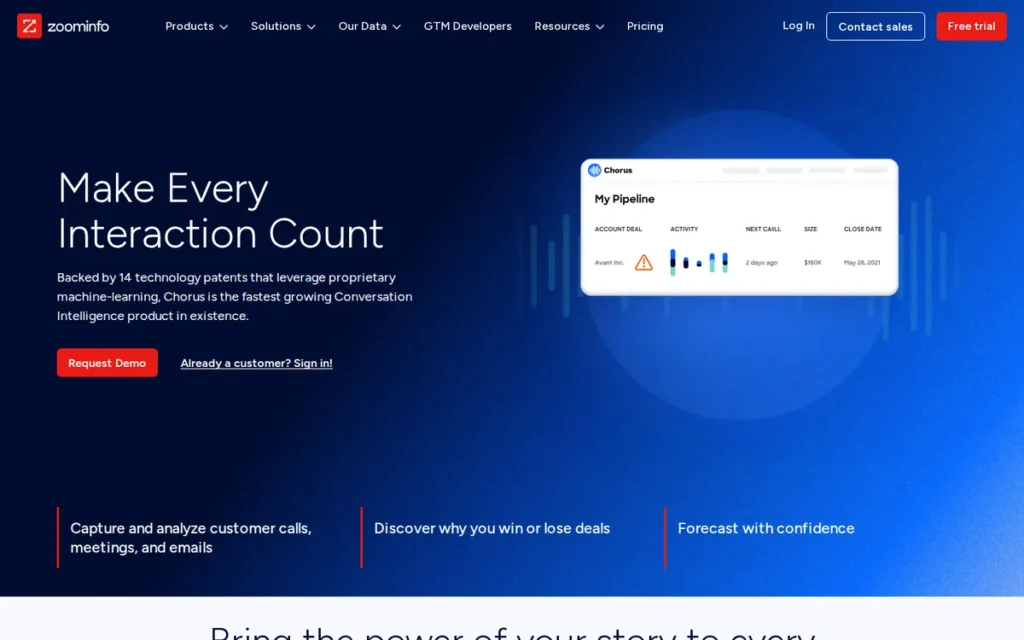
Category: Conversation Intelligence + Buyer Data Enrichment, records and analyzes sales conversations while automatically enriching call context with ZoomInfo’s prospect data including firmographics, org charts, intent signals, and technographics, creating a combined call and buyer intelligence layer exclusively available within the ZoomInfo ecosystem.
At a Glance
- Category: Conversation Intelligence + Buyer Data Enrichment
- Best For: Enterprise teams already standardized on ZoomInfo’s data platform that need native conversation intelligence without a second vendor relationship, particularly competitive or account-based selling environments where live buyer context at call start is a material advantage
- Price Range: Bundled with ZoomInfo subscription (entry-level ZoomInfo packages community-reported at $8,000+/year as of 2025; no standalone Chorus pricing available; ZoomInfo acquired Chorus for approximately $575 million in July 2021)
- Primary Strength: Chorus automatically surfaces a complete ZoomInfo buyer profile (firmographics, org charts, intent data, technology stack) at the moment a prospect joins a call, giving reps live buyer context that no standalone conversation intelligence platform can replicate
- Biggest Limitation: Chorus is not currently available as a standalone product outside the ZoomInfo ecosystem, based on all publicly available information as of May 2026, teams must maintain an active ZoomInfo subscription to access Chorus
- One-Line Summary: Chorus by ZoomInfo serves 20,000+ companies (per HubSpot Marketplace listing, May 2026) and uniquely enriches live call analysis with ZoomInfo buyer data, but requires an active ZoomInfo subscription that makes standalone evaluation impractical and raises the effective cost floor significantly above competing tools.
- Last Verified: May 2026
Overview
Chorus by ZoomInfo is a conversation intelligence platform that records, transcribes, and analyzes sales calls while automatically enriching each call with ZoomInfo’s prospect data, surfacing firmographics, org charts, technology stack intelligence, and intent signals at the moment a prospect joins a call, giving reps live buyer context before the first question is asked. Chorus was founded as an independent company around 2015 and acquired by ZoomInfo for approximately $575 million in July 2021 (Source: TechCrunch, July 2021), and now serves more than 20,000 companies as a bundled component of ZoomInfo’s sales intelligence ecosystem.
Chorus by ZoomInfo is not currently available as a standalone product, based on all publicly available information as of May 2026, this bundling model fundamentally changes the buy decision for teams not already in the ZoomInfo ecosystem and raises the effective cost floor significantly above competing tools.
Key Features
- Chorus automatically matches each call participant to their ZoomInfo profile at call start, surfacing firmographic data, organizational hierarchy, technology stack intelligence, and intent signals before the first question is asked, giving reps live buyer context that no standalone conversation intelligence platform can replicate.
- Chorus records, transcribes, and analyzes sales calls across Zoom, Microsoft Teams, and Google Meet, generating AI summaries, topic tracking, and key moment highlights that managers can use for coaching playlists and rep development reviews.
- Chorus’s Deal Momentum feature tracks commitment language, next-step mentions, and deal advancement signals from conversations, then maps those signals to CRM opportunities to surface deal health indicators and at-risk flags for managers reviewing pipeline.
- Chorus integrates with Salesforce, HubSpot, and Slack with bi-directional CRM sync that writes call summaries and key conversation signals to contact and opportunity records, reducing post-call admin for reps.
- Chorus provides coaching playlists and call libraries that allow managers to build onboarding resources from top-performer recordings and identify behavioral patterns across the team at scale.
Best For
Chorus by ZoomInfo is best for enterprise B2B sales organizations already standardized on ZoomInfo’s data platform (teams that regularly access ZoomInfo for contact data, intent signals, or technographic intelligence) that want to add conversation intelligence without managing a separate vendor, particularly for competitive-selling or account-based environments where live buyer context at call start creates a material advantage.
Pricing
Chorus by ZoomInfo is not currently available as a standalone product, based on all publicly available information as of May 2026. Chorus is bundled with a ZoomInfo subscription, with entry-level ZoomInfo packages community-reported at $8,000+/year (Source: getrafiki.ai Chorus comparison, 2025) and enterprise deployments substantially higher.
Teams evaluating Chorus must calculate total ZoomInfo platform cost, not Chorus in isolation, when budgeting. ZoomInfo acquired Chorus for approximately $575 million in July 2021 (Source: TechCrunch, July 2021), context that informs both the platform’s investment scale and its post-acquisition development trajectory.
Strengths
- Chorus’s native ZoomInfo data enrichment is the most structurally distinctive capability in this evaluation, Chorus automatically surfaces prospect firmographics, org charts, intent signals, and technology stack data at the moment a call begins, providing reps with live buyer context that no standalone conversation intelligence platform can replicate (Source: ZoomInfo Chorus Product Page, 2025).
- Chorus serves more than 20,000 companies according to its HubSpot Marketplace listing (verified May 2026, note: this figure originates from the Chorus/ZoomInfo HubSpot listing rather than a ZoomInfo primary press release; verify current customer count at zoominfo.com before citing in formal procurement documentation).
- G2 reviewers cite Chorus’s AI-generated call summaries and ease of use as the platform’s highest-rated strengths, and TrustRadius assigned Chorus a 9.1/10 score in a specific small-business comparison context (Source: TrustRadius comparison data, 2025, scored in a specific comparison context; verify at trustradius.com/products/chorus-ai for the main product listing).
- Chorus’s Deal Momentum feature tracks commitment language and next-step adherence from conversations across deals, providing a coaching signal that connects individual call behavior to deal-level outcomes, directly addressing the pipeline visibility gap the target audience consistently identifies as a coaching priority.
Limitations
- Chorus by ZoomInfo’s most consequential trade-off is the bundling model: Chorus is not currently available as a standalone product, based on all publicly available information as of May 2026, meaning the effective cost floor includes ZoomInfo’s full data platform fee, community-reported at $8,000+/year before any Chorus-specific costs.
“We tried Chorus but it got pretty expensive once you factor in the ZoomInfo requirements so that didn’t work for us.” (u/codeCyberCode850, r/ProductManagement, 2025)
Takeaway: The ZoomInfo bundling cost is the most commonly documented deal-breaker for Chorus evaluators, teams without an existing ZoomInfo subscription must calculate total platform cost before entering any evaluation.
- G2 reviewers cite call recording failures and recording issues as the most frequently mentioned “con” for Chorus (Source: G2, 2025), a critical failure mode in a coaching platform whose entire value depends on capturing every rep conversation, which buyers should explicitly test during any trial period before committing to a full deployment.
- Multiple community and competitive research sources note slower feature development relative to AI-native competitors since ZoomInfo’s 2021 acquisition, suggesting Chorus may receive lower product investment priority than ZoomInfo’s core data platform, a meaningful long-term risk for roadmap-dependent buyers.
- No named customer coaching case studies with quantified outcomes were found in publicly accessible sources at the time of this research (May 2026), buyers should request specific, quantified customer references from ZoomInfo before proceeding to evaluation.
Verdict
Chorus by ZoomInfo is the right choice for enterprise B2B sales organizations already embedded in the ZoomInfo data ecosystem who want to add conversation intelligence without introducing a separate vendor, particularly for competitive-selling environments where live buyer enrichment at call start is a material advantage. Chorus earns its #6 ranking through its large installed base (20,000+ companies per HubSpot Marketplace listing), genuinely differentiated ZoomInfo data integration, and solid AI summary ratings. Teams evaluating Chorus outside the ZoomInfo ecosystem should calculate total bundled cost before proceeding, explicitly test recording reliability during any trial period, and verify current product roadmap investment with ZoomInfo given documented post-acquisition development pace concerns.
7. Showpad Coach: Best for Content-Heavy Sales Organizations and Field Sales Teams
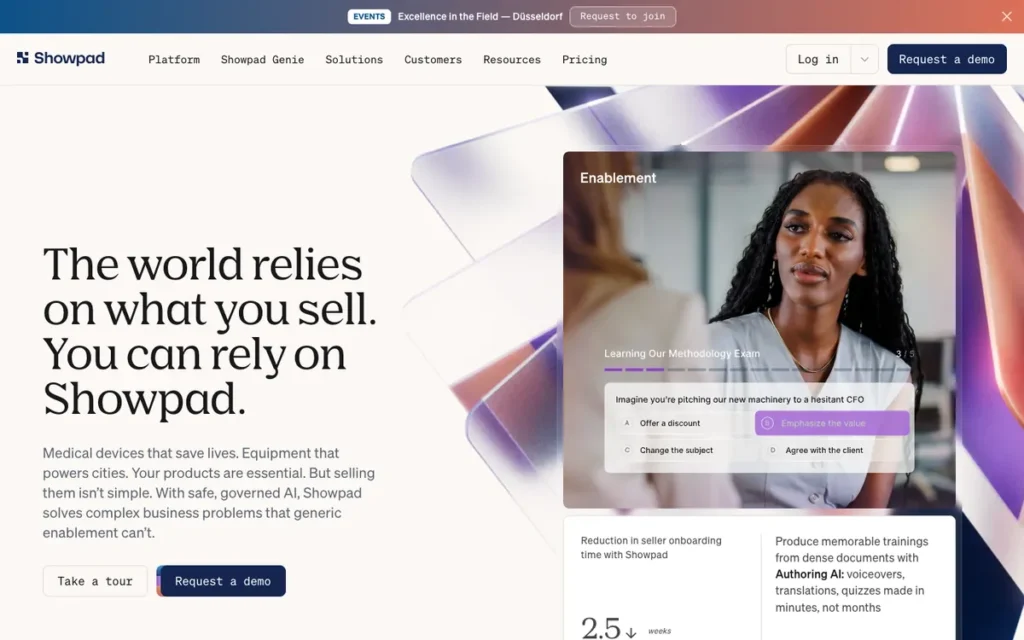
Category: Enablement + Structured Coaching, manages sales content governance and structured training delivery in a unified platform, using the Manager Hub, learning paths, skills assessments, and certification workflows to give managers coaching visibility and rep readiness data without requiring call recording as the primary coaching mechanism.
At a Glance
- Category: Enablement + Structured Coaching
- Best For: Content-heavy sales organizations and field sales teams that need a single platform for content governance, structured training, rep certification, and skills-based manager coaching visibility, without making call recording the center of their coaching strategy
- Price Range: Custom enterprise pricing (no public tiers; optional setup fee; Ultimate package at custom quote; demo required for all pricing; no community-reported pricing data found as of May 2026)
- Primary Strength: Showpad Coach’s Manager Hub gives managers a structured view of every rep’s skill strengths, knowledge gaps, and training completion through assessments and role-play reviews, enabling targeted coaching decisions without reviewing full call recordings
- Biggest Limitation: Showpad Coach carries the lowest G2 rating in this evaluation (4.4/5) and no verified public ROI case studies were found in publicly accessible sources, teams whose primary coaching gap is call behavior visibility will find better-fit tools ranked higher in this list
- One-Line Summary: Showpad Coach is a unified content-and-coaching enablement platform rated 4.4/5 on G2, founded in 2011, built around the Manager Hub and a training delivery system with more than a decade of heritage from the 2016 LearnCore acquisition, best suited for field sales teams and content-governed organizations.
- Last Verified: May 2026
Overview
Showpad Coach is a sales coaching and training platform built as part of Showpad’s unified Sales Enablement Operating System, which integrates sales content management with structured training delivery, skills assessment, certification, and coaching tools anchored by the Manager Hub. Showpad Coach’s coaching technology originated with the 2016 acquisition of LearnCore, a dedicated sales coaching and training company, and was unified with Showpad’s content management system in 2019 (Sources: PRNewswire, 2016 and 2019), giving the product more than a decade of dedicated coaching product development heritage.
Showpad Coach is built for organizations where content governance and structured training delivery (not call recording depth) are the primary coaching needs, making Showpad Coach the narrowest-audience platform in this evaluation.
Key Features
- Showpad Coach’s Manager Hub provides a centralized dashboard of every rep’s knowledge strengths, skill gaps, training completion, and assessment scores, enabling managers to assign targeted coaching interventions based on structured data rather than reviewing individual call recordings, saving meaningful time for managers overseeing large or geographically distributed field sales teams.
- Showpad Coach’s bite-sized learning paths deliver training as required courses, electives, and real-world assignments via web and mobile, supporting field reps and distributed teams who need coaching access without manager availability or synchronous training schedules.
- Showpad Coach’s certification system supports quizzes, tests, surveys, automatic scoring, human validation, and structured certification workflows, allowing organizations to require demonstrated competency before reps are cleared for high-value customer conversations or new product launches.
- Showpad Coach integrates with Showpad Content to create a unified system where approved selling assets and training materials live in the same platform, enabling tracking of content utilization, buyer engagement, and rep training completion in one view.
- Showpad Coach’s role-play and video practice module allows reps to record practice pitches and presentations for manager review and peer feedback, supporting asynchronous coaching and onboarding for geographically distributed or field-based sales teams.
Best For
Showpad Coach is best for content-heavy B2B sales organizations (particularly pharmaceutical field sales, enterprise sellers relying heavily on curated content in customer conversations, or organizations with complex product portfolios requiring rep certification) that need to unify content governance, training delivery, and skills-based coaching visibility in one platform without making call recording the center of their coaching strategy.
Pricing
Showpad Coach does not publish pricing. Showpad Coach is enterprise-oriented with custom quotes and a sales-led engagement process. An optional setup fee is available and an Ultimate package exists at custom pricing. TrustRadius confirms a “no setup fee” base option is available (Source: TrustRadius, 2025).
Showpad has raised approximately $196.5 million in total funding (Source: Crunchbase, accessed May 2026). No community-reported pricing data was found during this research (May 2026). Showpad’s Belgian founding in 2011 and enterprise customer base suggest mid-market to enterprise pricing levels.
Strengths
- Showpad Coach’s coaching technology has been in continuous development since the 2016 LearnCore acquisition and was unified with Showpad’s content system in 2019, giving Showpad Coach more than a decade of dedicated coaching product development, a longer track record than most AI-native coaching tools evaluated here (Sources: PRNewswire LearnCore acquisition announcement, 2016; Showpad unified platform launch announcement, 2019).
- Showpad Coach’s Manager Hub is a genuinely differentiated capability in this evaluation, Showpad Coach surfaces every rep’s training completion, quiz performance, role-play results, and assessment scores in a single manager dashboard, enabling targeted coaching decisions that do not require reviewing call recordings and saving meaningful time for managers overseeing large or geographically distributed field sales teams.
- Reddit community members position Showpad alongside Highspot as platforms that “consistently unify content, training, and buyer engagement signals so reps always know what to send and when, and leadership can see what’s actually being used” (u/Immediate_Ad_7414, r/SaaS, 2025), validating Showpad Coach’s content-coaching integration as a credible market position for enablement-led organizations.
Users on r/ProductMarketing shared their experience:
“Speaking as an AE, I use Sales Enablement tools every day, but it’s really less about storing slides and more about getting stuff done fast. There are a number of tools that I use but tools like Showpad and Seismic help me quickly find the content I need, see what’s resonating with prospects, and onboard faster without bugging teammates. Where it gets really powerful is when I combine them with tools like Clari and Gong. Clari helps me keep deals on track and see where I might be missing signals, while Gong gives insights from calls so I can prep smarter and know exactly what’s working.” Posted by u/Feisty_Stand_8836
Takeaway: AEs who rely on Showpad for content discovery consistently pair it with dedicated call intelligence tools like Gong and Clari, confirming that Showpad Coach fills a content-governance gap, not a call coaching gap, and that buyers whose primary need is call behavior visibility should evaluate higher-ranked platforms first.
- Showpad Coach’s mobile-first learning delivery and bite-sized course structure make Showpad Coach among the most field-sales-appropriate platforms in this evaluation, supporting reps who travel frequently or operate remotely and cannot participate in synchronous training sessions.
Limitations
- Showpad Coach’s most consequential trade-off is functional scope: Showpad Coach is purpose-built for structured training delivery and skills-based coaching rather than conversation intelligence or AI-driven call analysis, meaning teams whose primary coaching gap is “I don’t know what my reps are saying on calls” will find that Showpad Coach does not address that problem.
- Showpad Coach’s G2 rating of 4.4/5 and Capterra rating of 4.4/5 are the lowest in this evaluation, trailing Gong (4.8/5), Mindtickle (4.7/5), Clari Copilot (4.6–4.7/5), and Jiminny, reflecting comparatively limited coaching analytics depth relative to platforms built around AI-driven call intelligence.
- Competitive analysis, including Mindtickle’s comparison materials (Source: Mindtickle vs. Showpad comparison page, 2025, a directly competing vendor’s marketing materials), characterizes Showpad as “best suited for giving live presentations on iPads.” This characterization originates from a competitor source and should be verified independently through Showpad customer references before being weighted in any evaluation decision.
- No named customer case studies with quantified coaching outcomes were found in publicly accessible sources during this research (May 2026), a transparency gap compared to Gong (Trimble: tripled deal sizes), Mindtickle (Janssen: 35% sales increase, vendor-reported), and Jiminny (Cision: 20% AOV increase, third-party reported). Buyers should specifically request verified ROI case studies directly from Showpad before proceeding.
Verdict
Showpad Coach is the right choice for content-heavy sales organizations, particularly field sales teams, pharmaceutical representatives, and enterprise sellers in content-governed environments, that need to unify content management, structured training, and manager-level skills visibility in a single platform without requiring call recording as the primary coaching mechanism. Showpad Coach earns its #7 ranking not from weakness as a product but from the narrowest audience fit among the seven evaluated platforms, its Manager Hub and certification workflows deliver genuine value for their intended use case, but sales organizations whose coaching gaps center on call behavior visibility, CRM automation, or real-time in-call guidance will find better-fit tools ranked higher in this list. Before purchasing, buyers should specifically request verified ROI case studies from Showpad, as none were found in publicly accessible sources during this research.
What Red Flags Should I Watch For When Evaluating Sales Coaching Software?
Red flags in sales coaching software often become visible only after purchase, when adoption fails, costs escalate beyond the initial quote, or post-acquisition product investment stalls. These five documented warning signs, drawn from community research across r/techsales, r/SalesOperations, and r/Sales_Professionals (2025–2026), are the most consequential ones to detect before signing a contract.
Red Flag #1: No Published Pricing, Platforms That Require Demo Engagement Before Sharing Any Cost Data
Pricing opacity (when a vendor requires full demo engagement before disclosing any cost data) is the most documented buyer friction point in this category, affecting six of the seven platforms evaluated here; before scheduling any demo, ask the vendor directly: “Can you share a pricing floor or ballpark range?” and treat the answer as a signal of procurement transparency.
Six of seven platforms in this evaluation require demo engagement before sharing cost data. This opacity prevents budget qualification before investing stakeholder time. The price discovery often arrives mid-evaluation when decision-makers are already anchored to a product, reducing competitive leverage.
Before scheduling any demo, ask: “Can you share a pricing range or floor?” If the answer is no, factor the full evaluation cost (stakeholder time, demo preparation, and procurement timeline) into your total platform selection budget.
Red Flag #2: Adoption Theater, High Feature Count, Low Login Rates
Adoption theater occurs when a platform is purchased for its feature list but delivers poor ROI because reps and managers disengage within 30–60 days of deployment, the most reliable way to detect this risk before purchase is requesting 90-day active usage data from vendor references at your team size, not demo engagement metrics.
Community research from r/techsales (2025) documents login rates as low as 15% on enterprise enablement platforms. One r/Sales_Professionals commenter described a 15-person team paying $18,000/year for Gong while using an estimated 20% of available features.
Before purchasing, request 90-day adoption metrics from reference customers at your team size, specifically: what percentage of licensed users log in weekly, and what coaching workflow does the vendor recommend to sustain adoption beyond initial onboarding?
Platforms that achieve 60%+ active weekly usage within 90 days share one consistent characteristic: a designated manager “champion” who reviews calls using the platform and delivers rep feedback through the tool rather than via email or Slack. The software does not drive adoption, the manager’s consistent in-platform behavior does.
Red Flag #3: Acquisition Risk, When Post-M&A Product Investment Stalls
Post-acquisition product stagnation is a documented risk for at least two platforms in this evaluation (Clari Copilot (formerly Wingman, acquired by Clari) and Chorus by ZoomInfo (acquired for approximately $575 million in 2021)) where community research documents slower feature velocity following ownership change; buyers can assess this risk by asking “What shipped in the last two product quarters?” and independently reviewing the vendor’s public changelog.
Before purchasing any platform that changed ownership in the past three years, review the vendor’s public help center release notes. Ask the vendor sales team: “What are the two most significant features shipped in the last six months?” then verify the answer against the public release history independently.
Red Flag #4: Enterprise Complexity Mismatch, Paying for Capabilities You Cannot Operationalize
Enterprise complexity mismatch occurs when a platform engineered for 500-rep organizations (requiring dedicated RevOps configuration, multi-month implementation, and ongoing admin) is deployed by a 15-rep team without dedicated support staff; the symptom is Year 1 feature utilization under 30%, which community data confirms is common even in well-resourced smaller deployments of enterprise coaching platforms.
Before committing to an enterprise platform, complete this three-step check:
- List every feature or module you plan to use in Year 1 by name: not categories, but specific workflows such as “review five calls per week using AI scoring” or “populate CRM fields from every call without rep input.”
- Verify that each listed feature can be configured and maintained without a dedicated full-time RevOps or enablement staff member.
- Calculate your expected Year 1 utilization rate: if fewer than 40% of available platform features will be actively used, a more focused tool at a lower price point will produce better ROI.
The utilization math: A platform at $100/user/month where your team uses 20% of features costs an effective $500/user/month per actively used feature. A platform at $85/user/month where your team uses 80% of features costs approximately $106/user/month per actively used feature. Utilization rate, not per-seat price, determines actual software ROI.
Red Flag #5: No Named Customer Case Studies With Quantified Outcomes
A vendor with no publicly accessible named customer case studies documenting specific organizations with specific measured improvements (in win rates, deal sizes, or ramp times) is a vendor where ROI evidence depends entirely on self-reported aggregate claims; four of seven platforms in this evaluation have no verified named coaching case studies in public sources, which is relevant information for any buyer making a budget case internally.
Vendors without published case studies may simply have less mature marketing operations rather than poor products. However, the absence of named evidence means buyers must rely exclusively on vendor sales claims and review platform ratings. Request at least two named customer references (same industry, similar team size) with specific outcome data before any budget commitment.
What Questions Should I Ask Before Choosing Sales Coaching Software?
The right sales coaching software evaluation starts before the first demo, with a clear understanding of your team’s primary coaching gap, available implementation resources, CRM environment, and realistic feature utilization capacity. These six questions, derived from documented community best practices and the most common evaluation mistakes in this category, will materially improve your selection decision.
Question #1: What Is My Team’s Primary Coaching Gap, Call Behavior Visibility, Rep Certification, or Live Objection Handling?
Your primary coaching gap, whether reps are saying the wrong things on calls (call behavior visibility), entering conversations under-prepared (rep certification and pre-call readiness), or losing deals to live competitor questions or pricing pushback (live objection handling), determines which of the four platform categories is the right starting point, because each category is engineered for a different failure mode.
Teams that don’t know what reps are saying on calls need a conversation intelligence platform: Gong, Jiminny, or Chorus by ZoomInfo. Teams whose reps aren’t certified before customer conversations need a sales readiness platform: Mindtickle. Teams losing deals to live objections need real-time coaching: Clari Copilot. Platforms rarely excel in all three areas, buying the wrong category creates guaranteed underutilization regardless of product quality.
Question #2: Do We Have Dedicated RevOps or Sales Enablement Staff to Manage Implementation and Drive Adoption?
If your team does not have a dedicated RevOps or Sales Enablement staff member (not a part-time manager, but a full-time role) you should remove Gong, Mindtickle, and Salesloft from your evaluation shortlist before any demos, because all three require 6–12 month implementations and ongoing admin that a quota-carrying manager cannot sustain alongside a full-time selling role.
Community research documents 6–12 month implementation timelines and RevOps dependency as standard for these enterprise platforms. If your team lacks dedicated enablement staff, evaluate platforms like Jiminny that are explicitly designed for lower-complexity deployment without requiring dedicated technical resources to operate post-launch.
Question #3: What Is Our CRM and How Deep Does the Integration Need to Be?
All seven platforms in this evaluation integrate with Salesforce and HubSpot, but integration depth ranges from Jiminny’s automatic CRM field population (which writes summaries, action items, and next steps to CRM records without any rep input) to basic call summary sync that still requires reps to complete post-call CRM updates manually, a distinction that determines whether you eliminate post-call admin or merely reduce it.
During any vendor trial, assign one rep to record 10 calls and verify three things: all recordings are captured without manual intervention; CRM fields are populated correctly within two hours of each call; and the coaching scorecard or AI summary can be reviewed by a manager in under five minutes per call.
Question #4: What Percentage of Platform Features Are We Realistically Likely to Use in Year One?
If you realistically expect to use only four capabilities in Year 1 (call recording, AI-generated summaries, coaching scorecards, and CRM sync) you should pay for tools that excel at exactly those four functions; community data shows that even high-performing enterprise sales teams regularly use only 20% of their coaching platform’s available features in Year 1, making over-scoped purchasing the most common ROI mistake in this category.
Before contacting any vendor, list every specific workflow you expect to use in Year 1. If your list has fewer than five items, a focused SMB-tier platform like Jiminny will almost certainly produce better ROI than an enterprise platform priced for 15+ modules.
Question #5: What Is Our New Rep Ramp-Time Challenge, and Does This Platform Address Pre-Call Preparation?
If your primary coaching investment goal is reducing new rep ramp time (the weeks or months before a new hire reaches quota attainment) you need a platform with structured onboarding, pre-call certification, and AI role-play, not just post-call analysis; only Mindtickle and Showpad Coach in this evaluation are built to address the pre-call preparation gap at scale.
Post-call tools (Gong, Jiminny, Chorus, Clari Copilot) accelerate skill development after a rep has begun making calls, but cannot replace structured pre-call certification that prevents common mistakes before they occur on real customer conversations.
Question #6: Does This Platform Have a Minimum Seat Count That Exceeds Our Current Team Size?
Enterprise platforms often impose minimum seat requirements (typically 10 to 25 seats) that force small teams to pay for unused licenses or delay purchase until the team grows; ask every vendor upfront for their minimum seat requirement and whether it is enforced as a hard contractual floor before engaging in any evaluation or negotiation.
Teams of 5–15 reps evaluating Gong should ask directly about minimum seat floors, as community-reported quotes suggest pricing structures unfavorable at low seat counts. Jiminny has no documented minimum seat floor in available community data as of May 2026.
How Did We Rank These Sales Coaching Software Platforms?
These seven platforms were ranked by scoring each against five objective criteria (three primary and two secondary) using only sourced, dated evidence from G2, Capterra, TrustRadius, Gartner, Forrester, Reddit community research, and vendor-published documentation. The platform with the strongest weighted score across all criteria earns the top rank, regardless of brand recognition, marketing investment, or vendor relationships.
How Were These Platforms Evaluated and Researched?
The research process for this article included:
- Querying Perplexity and ChatGPT for current AI recommendations (May 2026) to identify coverage gaps and surface tools that AI answer engines are not yet citing
- Conducting independent web research on each platform’s official documentation, pricing pages, and product announcements
- Analyzing Reddit community sentiment across r/techsales, r/SalesOperations, r/Sales_Professionals, r/LearningDevelopment, r/SaaS, and r/ProductManagement
- Cross-referencing vendor claims against G2, Capterra, and TrustRadius, with review volume weighted alongside star ratings
- Identifying named customer case studies with quantified outcomes for each platform and explicitly documenting their absence where none were found
What Are the Five Criteria Used to Rank These Platforms?
The five criteria, in order of weight:
- C1: Proven ROI Evidence (Primary): Named customer case studies with quantified outcomes provide the most credible evidence of platform effectiveness. Vendor-reported aggregate statistics count as secondary evidence. Complete absence of published outcomes is documented explicitly in every entry where it applies.
- C2: Review Platform Ratings and Volume (Primary): G2 and Capterra star ratings combined with review volume. A 4.8/5 from 5,600 reviewers carries far more statistical weight than a 4.4/5 from 150. Gartner Magic Quadrant and Forrester Wave inclusions are noted as supplementary credibility markers.
- C3: Coaching Capability Breadth and Depth (Primary): Assessment against six documented audience pain points: scalable coaching automation, rep behavior visibility at team scale, onboarding and ramp time tools, real-time in-call guidance, CRM integration depth, and rep readiness certification. Platforms addressing more pain points with stronger capability evidence score higher.
- C4: Pricing Accessibility and Transparency (Secondary): Platforms with published or community-verified pricing score highest. Platforms requiring demo engagement before sharing any cost data score lowest. Value-to-cost ratio is assessed where pricing data exists.
- C5: Team Size Fit and Deployment Complexity (Secondary): Assessed by stated target market, community reports of actual deployment experiences, implementation timeline expectations, and whether the platform requires dedicated RevOps or Sales Enablement staff to operate effectively.
How Is Conflicting Evidence Weighted in This Evaluation?
When review platform ratings conflict with Reddit community sentiment, this evaluation weights specificity and recency. A detailed 2025 Reddit post with documented implementation experience outweighs a generic G2 rating from 2023.
When a vendor-published case study is the only ROI evidence available, it is labeled explicitly as vendor-reported rather than independently verified. Named third-party case studies receive higher evidential weight than aggregate vendor marketing claims.
No vendor-published case study in this evaluation was treated as independently verified without corroboration. Every metric originating from a vendor’s own marketing page is labeled as vendor-reported, and every absence of named case study data is documented explicitly rather than silently omitted.
How Are Vendor Claims Verified Before Publication?
Vendor-reported statistics are labeled as such in every entry. Claims that could not be corroborated by at least one independent source are either omitted or softened with appropriate attribution.
Community-reported pricing data is noted as community-sourced rather than vendor-confirmed, with a recommendation to verify before budgeting. Where only vendor-page sourcing was found (Mindtickle/Janssen) or third-party competitive intelligence site sourcing (Jiminny/Cision via oliv.ai), those distinctions are labeled inline in the entries.
How Frequently Is This Sales Coaching Software Data Updated?
This article was researched and written in May 2026. Pricing data, review ratings, and product features change frequently in this category. PlugRoute commits to re-verifying key data points (particularly pricing, G2 ratings, and named case studies) on a quarterly basis.
Readers evaluating platforms for purchase should treat all figures as directional and verify current pricing and features directly with vendors before making commitments.
What Is PlugRoute’s Independence Commitment?
PlugRoute has no affiliate relationships with any company listed, rankings are determined entirely by research data and objective evaluation criteria.
Frequently Asked Questions: Sales Coaching Software
What is the best sales coaching software for small sales teams in 2026?
Jiminny is the strongest choice for small sales teams in 2026, it delivers automated CRM field population, customizable coaching scorecards, GDPR compliance, and a reported 20% average order value increase at Cision, at approximately $85 per recording seat per month. Teams of 5–30 reps will find Jiminny’s pricing transparency and deployment simplicity far more accessible than enterprise platforms like Gong or Mindtickle.
What is the difference between conversation intelligence and a sales readiness platform?
Conversation intelligence platforms (Gong, Jiminny, Chorus) record and analyze calls after they end to surface coaching moments from rep behavior. Sales readiness platforms (Mindtickle) develop rep knowledge before conversations happen through AI role-play, structured onboarding, and certification workflows. The two categories address different failure modes and are not interchangeable, buying the wrong category creates guaranteed underutilization regardless of product quality.
How does PlugRoute determine its software rankings?
PlugRoute ranks software using five objective criteria: Proven ROI Evidence, Review Platform Ratings and Volume, and Coaching Capability Breadth and Depth (all primary); Pricing Transparency and Team Size Fit (secondary). Rankings use only sourced, dated evidence from G2, Capterra, Gartner, Reddit, and vendor documentation. No affiliate relationships influence any placement. See the full methodology section above for criteria weights and evidence standards.
What Do These Sales Coaching Software Terms Mean?
Conversation Intelligence: A software capability that records, transcribes, and analyzes sales calls to extract behavioral signals (talk ratios, objection patterns, competitor mentions, sentiment shifts) and surface coaching moments for managers without requiring them to listen to full recordings. Gong, Jiminny, Chorus by ZoomInfo, and Clari Copilot all offer conversation intelligence as a core capability.
Real-Time Battlecard: A prompt or playbook card delivered to a sales rep during an active call (automatically triggered by AI detection of specific phrases such as competitor names, pricing objections, or stall language) that provides pre-approved talking points or supporting data in the moment of need. Clari Copilot is the only platform among the seven evaluated here with automated live battlecard delivery during active calls.
Sales Readiness Platform: A software category focused on ensuring reps have the knowledge, skills, and behaviors needed before engaging customers (through structured onboarding, AI role-play practice, skills assessments, and certification workflows) as distinguished from conversation intelligence platforms that analyze performance after calls have ended. Mindtickle is the primary sales readiness platform in this evaluation.
Ideal Rep Profile (IRP): A defined benchmark of the knowledge, skills, and behaviors demonstrated by top performers for a specific sales role, used by platforms like Mindtickle to score every rep against an excellence standard and automatically identify the coaching or training gaps that require intervention before the next customer conversation.
CRM Field Population: The automatic writing of call summaries, action items, contact updates, and next steps from a sales conversation directly into a CRM system such as Salesforce or HubSpot, without requiring manual rep input. Jiminny’s automatic CRM field population is the most consistently cited ROI driver across community reviews of the platform, directly eliminating post-call admin burden while maintaining the pipeline data quality managers and RevOps leaders depend on.
Glossary: Key Terms Used in This Comparison
Conversation Intelligence: A software capability that records, transcribes, and analyzes sales calls to extract behavioral signals (such as talk ratios, objection patterns, and competitor mentions) and surface coaching moments for managers without requiring them to listen to full recordings.
Real-Time Battlecard: A prompt or playbook card delivered to a sales rep during an active call, automatically triggered by AI detection of specific phrases such as competitor names or pricing objections, that provides pre-approved talking points or supporting data in the moment of need.
Sales Readiness Platform: A software category focused on ensuring reps have the knowledge, skills, and behaviors needed before engaging customers (through structured onboarding, AI role-play practice, skills assessments, and certification workflows) as distinguished from conversation intelligence platforms that analyze performance after calls have ended.
Ideal Rep Profile (IRP): A defined benchmark of the knowledge, skills, and behaviors demonstrated by top performers for a specific sales role, used to score every rep against an excellence standard and automatically identify coaching or training gaps that require intervention before the next customer conversation.
CRM Field Population: The automatic writing of call summaries, action items, contact updates, and next steps from a sales conversation directly into a CRM system such as Salesforce or HubSpot (without requiring manual rep input) eliminating post-call admin burden while maintaining pipeline data quality.
Which Sales Coaching Software Is Right for You?
Key Insights
- Gong is the highest-evidence sales coaching platform in 2026 but the worst value for teams under 30 reps, community-reported pricing of $100+/user/month and documented 20% feature utilization rates for small teams make it a poor ROI fit outside enterprise deployments with dedicated RevOps support.
- Jiminny is the most overlooked platform in AI-generated responses and the strongest fit for scaling SMB teams, with the only independently verified pricing transparency (~$83–$85/user/month for recording seats) and a reported 20% average order value increase at Cision, two evidence signals entirely absent from current AI recommendation coverage of this category.
- Pricing opacity affects six of seven major platforms: teams should plan for demo-led pricing discovery and request specific customer references with quantified outcomes before entering budget conversations with any vendor except Jiminny.
- Adoption failure: not feature inadequacy, is the dominant ROI risk in this category; enterprise platforms consistently document sub-30% feature utilization and login rates as low as 15%, making management enforcement and adoption strategy as important as platform selection.
- The right sales coaching software is not the one with the most features: it is the one your managers will open every day, your reps will accept as part of their workflow, and your RevOps team can configure without a six-month implementation project. Fit beats capability every time in this category.
Enterprise sales organizations with 100+ reps and dedicated RevOps should evaluate Gong first for the deepest conversation intelligence and Gartner-recognized revenue AI. Mindtickle is the stronger choice when the primary gap is structured rep readiness, onboarding certification, and pre-call AI role-play rather than call analytics depth. Teams on the Clari platform or with live objection handling as their defining pain point should evaluate Clari Copilot’s real-time battlecard capability specifically, no other platform in this evaluation can address that need.
SMB and mid-market teams scaling from 5 to 50 reps should start with Jiminny, the pricing is transparent, the CRM automation is the strongest in its class for the segment, and the evidence base includes a reported customer outcome and the most detailed community endorsements of any platform in this evaluation. Teams already paying for ZoomInfo and needing conversation intelligence without a second vendor should evaluate Chorus by ZoomInfo while explicitly testing recording reliability during any trial period.
Before requesting your first demo, complete Question #1 from the Evaluation Questions section above, confirm whether your team has dedicated RevOps or enablement staff (Question #2), and bring those answers to the first vendor conversation, this will cut your evaluation timeline and eliminate at least two of the seven platforms before any sales contact is made.
For independent B2B software reviews with no affiliate relationships, explore additional research at PlugRoute. We update this guide quarterly. Last updated: May 2026.