JustCall is the best overall outbound call tracking software for SMB and mid-market sales teams, CloudTalk leads for mid-market teams running multi-geography outbound campaigns, and Five9 is the top choice for enterprise contact centers in regulated industries requiring TCPA compliance infrastructure. No single platform in 2026 perfectly combines marketing-channel attribution with high-velocity automated dialing, teams needing both must stack two tools.
The most consequential distinction in this category is structural: attribution-native tools like CallRail and outbound execution platforms like JustCall and CloudTalk are fundamentally different products that appear on the same comparison lists. Attribution trackers reveal which marketing campaign drove a call; execution platforms automate call volume, rep coaching, and CRM synchronization. Selecting the wrong category is the most expensive evaluation error in this market.
PlugRoute has no affiliate relationships with any company listed. Rankings are determined entirely by research data and objective evaluation criteria.
The seven platforms in this evaluation span from $15 to $149 per user per month, a 10x cost range for software that, at different price points, automates the same core outbound calling workflow at fundamentally different audience scales and compliance depths.
TL;DR: Top Picks at a Glance
- JustCall: three dialing modes plus 31-field campaign analytics; top-ranked mid-market outbound platform starting at $29/user/month
- CloudTalk: G2 Leader in outbound call tracking for mid-market teams; automated local presence dialing for multi-geography campaigns
- Five9: deepest enterprise compliance infrastructure (TCPA automation, DNC management, pursuing FedRAMP Moderate authorization); purpose-built for regulated contact centers
- Dialpad: highest AI conversation intelligence per dollar at $15/user/month with DialpadGPT across all paid tiers
What Are the Two Types of Outbound Call Tracking Tools, and Why Does It Matter?
Outbound call tracking tools divide into two structurally distinct categories: Attribution Trackers and Execution + Intelligence Platforms. Confirming which category you need before evaluating individual features is the single most important step in this procurement process, and the one most buyers skip. No configuration within CallRail’s current product scope enables predictive dialing, that requires a separate execution platform.
Attribution Trackers answer: “Which marketing campaign, keyword, or ad source prompted this call?”
- Attribution trackers use Dynamic Number Insertion (DNI) to swap phone numbers on websites in real time, linking every call to its specific marketing origin, the campaign, keyword, or landing page that drove the visitor.
- Attribution trackers do not offer predictive dialing, power dialing, or automated outbound campaign execution, they are measurement tools, not calling tools. These tools are also referred to as call attribution software or DNI call tracking platforms.
- CallRail is the only Attribution Tracker evaluated in this article.
Execution + Intelligence Platforms answer: “How many calls did my team make, how did they convert, and what was said on each call?”
- Execution platforms offer automated multi-mode dialing (predictive, power, dynamic, parallel), voicemail drop, answering machine detection, and campaign list management, also referred to as sales dialers, outbound dialers, or call tracking software for sales teams.
- Execution platforms log call recordings, AI transcripts, and outcomes to CRM records in real time.
- JustCall, CloudTalk, Five9, Dialpad, HubSpot Sales Hub, and Aircall are Execution + Intelligence Platforms in this evaluation.
For teams needing both: The most complete outbound stack for a 10-rep mid-market team in 2026 is JustCall Pro ($490/month) plus CallRail Call Tracking + Intelligence (approximately $85/month), a combined $575/month covering three dialing modes, 31-field analytics, AI coaching, dynamic attribution, and conversation intelligence. No single platform in this evaluation provides all of this at any price.
How Do the Top 7 Outbound Call Tracking Platforms Compare at a Glance?
The seven evaluated platforms span three functional categories at per-seat pricing from $15 to $149 per month, a 10x range for software serving fundamentally different outbound calling needs. The table below compares all seven platforms on eight criteria most critical to procurement decisions, followed immediately by a quick routing framework for use-case matching.
| Rank | Company | Category | Best For | One-Line Summary | G2 Rating | Starting Price | Key Limitation |
|---|---|---|---|---|---|---|---|
| 1 | JustCall | Execution + Intelligence | SMB and mid-market SDR teams needing multi-mode dialing | JustCall combines three dialing modes and 31-field call analytics at published pricing from $29/user/month; the top-ranked mid-market outbound platform in this 2026 evaluation. | 4.3/5.0 | $29/user/month | Predictive dialing and full AI coaching require Business tier at $89/user/month |
| 2 | CloudTalk | Execution + Intelligence | Mid-market teams running multi-geography outbound campaigns | CloudTalk is the G2 Leader in Outbound Call Tracking Software; Mid-Market, with four dialing modes and automated local presence for multi-geography campaigns. | 4.3/5.0 | ~$49/user/month | Full pricing not published online; advanced features require contacting sales |
| 3 | Five9 | Enterprise Execution Suite | Regulated enterprise contact centers with 50+ agents | Five9 is pursuing FedRAMP Moderate authorization with four dialing modes, TCPA compliance automation, and no-code GenAI Studio; the leading enterprise platform for regulated-industry outbound teams. | 4.0/5.0 | $149/user/month | Enterprise pricing and implementation complexity make it unsuitable for SMB and mid-market buyers |
| 4 | Dialpad | AI-Native Dialer | Teams prioritizing AI conversation intelligence at lowest per-seat cost | Dialpad delivers DialpadGPT-powered CSAT prediction at 87% accuracy across all calls and four-mode supervisor coaching at $15/user/month; the highest AI value per dollar in this 2026 evaluation. | 4.4/5.0 | $15/user/month | Documented reliability degradation at rapid scale; support abandonment complaints at SMB tier |
| 5 | CallRail | Attribution Tracker | Marketing teams attributing calls to campaigns and keywords | CallRail is a marketing attribution platform with Dynamic Number Insertion earning a G2 rating of 4.6/5.0; best deployed as a companion attribution layer alongside a separate outbound dialer. | 4.6/5.0 | Entry plans from approx. $45/month (5 numbers, 250 mins); outbound calls billed per-minute; verify current rates directly with CallRail | Not a sales dialer; no predictive, power, or automated outbound campaign execution modes |
| 6 | HubSpot Sales Hub | CRM-Native Caller | Teams already operating inside the HubSpot CRM ecosystem | HubSpot Sales Hub embeds Power Dialer and Breeze AI conversation intelligence directly in the HubSpot CRM; strongest for HubSpot-committed teams, expensive for teams starting fresh. | 4.4/5.0 | $100/seat/month (Professional tier, required for full outbound features) | No native marketing channel attribution; Power Dialer gated behind $100/seat/month Professional tier |
| 7 | Aircall | Cloud Phone System | Distributed SMBs needing fast setup and 100+ SaaS integrations | Aircall is a cloud phone system with 100+ business tool integrations, a Power Dialer, voicemail drop, and AI outbound virtual agents; outpaced on dialing depth, AI maturity, and user satisfaction by the six higher-ranked platforms in this 2026 evaluation. | 4.1/5.0 | $30/seat/month (3-seat minimum) | Single dialing mode only; 3-seat minimum; 2026 billing change complaints driving active churn |
Which Outbound Call Tracking Platform Should I Choose for My Use Case?
The right platform depends on your primary operational need (call attribution or outbound call execution) and your team size, budget, and compliance requirements. Use the framework below to identify the best match before evaluating detailed feature sets; teams unsure of their primary need should start with JustCall Pro to test both execution and attribution integration.
| Your #1 Priority | Recommended Tool | Why | Acceptable Alternative |
|---|---|---|---|
| Solo/micro-team (1–2 reps) on tight budget | Dialpad Standard ($15/user/month) | Lowest entry price with DialpadGPT AI included; no seat minimum | JustCall Team ($29/user/month) |
| Marketing attribution; campaign, keyword, ad source | CallRail Analytics Suite | Only DNI-based attribution platform in this evaluation | HubSpot + CallRail integration |
| SMB multi-mode outbound (3–25 reps) | JustCall Team or Pro | Three dialing modes, 31-field analytics, transparent published pricing | CloudTalk Starter |
| Mid-market multi-geography outbound (5–100 reps) | CloudTalk Expert | G2-certified outbound leader with automated local presence dialing | JustCall Business |
| AI-first conversation intelligence priority | Dialpad Pro ($25/user/month) | DialpadGPT, four-mode supervisor coaching, CSAT prediction at 87% accuracy across all calls | JustCall Business (AI coaching tier) |
| HubSpot CRM ecosystem team | HubSpot Sales Hub Professional | CRM-native calling eliminates sync overhead for existing HubSpot users | JustCall (HubSpot native integration) |
| Regulated industry or enterprise (50+ agents, TCPA required) | Five9 Core ($149/user/month) | Only platform in this evaluation pursuing FedRAMP authorization; TCPA automation and DNC management; verify compliance status directly at marketplace.fedramp.gov before shortlisting | No comparable alternative evaluated at equivalent compliance depth |
| Unsure of primary need | JustCall Pro ($49/user/month) | Three dialing modes plus transparent pricing enable testing execution and attribution integration before committing to a specialized stack | CloudTalk Starter |
1. JustCall: Best Overall for SMB and Mid-Market Outbound Sales Teams
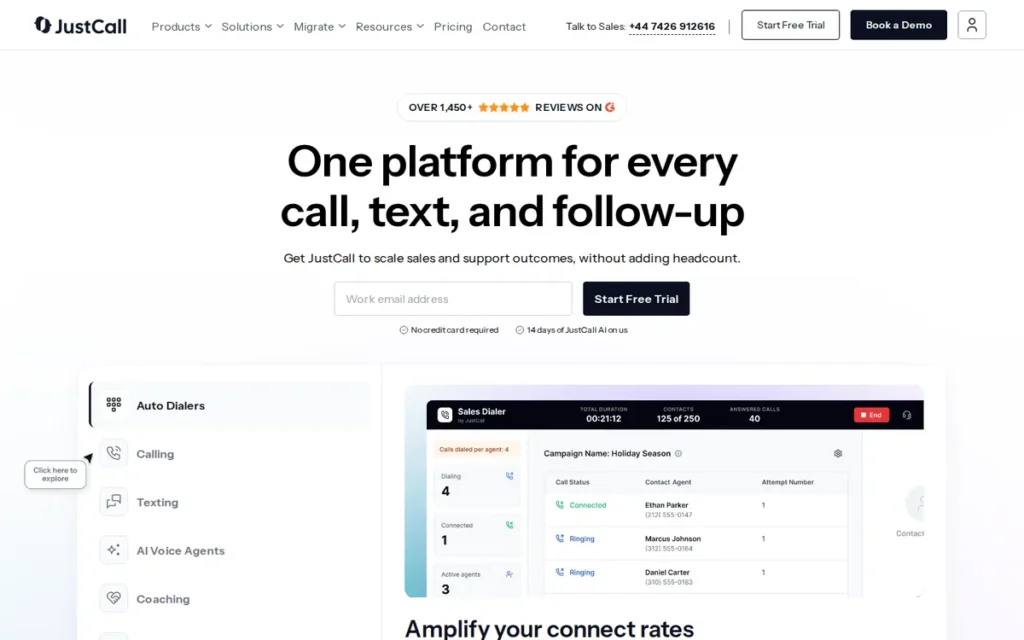
Category: Execution + Intelligence: outbound calling platform with three dialing modes, 31-field call analytics, AI coaching, and integrated SMS automation.
At a Glance
- Category: Execution + Intelligence
- Best For: SMB and mid-market sales teams of 3–50 reps running multi-channel outbound campaigns who need Predictive, Power, and Dynamic dialing plus built-in SMS automation in one platform without enterprise pricing
- Price Range: $29–$89/user/month (annual billing); Enterprise pricing on request
- Primary Strength: JustCall tracks 31 distinct data fields per outbound call: including connect rates, human pickup rates, voicemail drop counts, and disposition codes, providing SDR managers granular campaign intelligence unavailable at this price point from any other evaluated platform
- Biggest Limitation: JustCall’s predictive dialing and full AI coaching suite are gated behind the Business tier at $89/user/month, meaning teams entering at the $29 Team plan must budget for a significant upgrade to unlock the high-volume dialing features that most outbound SDR teams require
- One-Line Summary: JustCall is an outbound-first calling and SMS platform that combines three dialing modes (Predictive, Power, and Dynamic) with 31-field campaign analytics and an AI coaching suite, making it the top-ranked mid-market outbound execution tool in this 2026 evaluation at published pricing from $29/user/month.
- Last Verified: May 2026
Overview
JustCall is an all-in-one outbound sales calling and SMS platform designed for SMB and mid-market teams needing automated multi-mode dialing, granular campaign analytics, and CRM-synced call intelligence without enterprise-tier pricing or complex technical implementation. JustCall differentiates from other platforms in its price range by tracking 31 data fields per outbound call (including connect rate, human pickup rate, voicemail drop count, and disposition codes) enabling the operational granularity most tools reserve for significantly higher pricing tiers. JustCall is built by SaaS Labs, founded in 2016, and serves 6,000+ customers globally as of mid-2026.
Key Features
- JustCall’s three automated dialing modes: Predictive (AI-driven pacing based on agent availability), Power (sequential automated list dialing), and Dynamic, enable teams to match their dialing strategy to campaign volume, rep headcount, and target audience type without switching platforms.
- JustCall’s 31-field campaign analytics track connect rate, human pickup rate, voicemail drop count, ring time, hold time, agent-level efficiency scores, and disposition codes per call, providing campaign-level operational intelligence that most mid-market tools either omit or gate behind enterprise pricing, verified against JustCall’s outbound call center software page in May 2026.
- JustCall’s integrated SMS automation treats SMS as a co-equal outreach channel with voice calling, enabling teams to trigger automatic SMS follow-ups after missed calls, run bulk SMS campaigns in parallel with call sequences, and maintain full call-to-text continuity within a single platform without a separate SMS tool.
- JustCall’s AI coaching toolkit includes call whispering (real-time agent coaching the prospect cannot hear), call barging (supervisor joins the live call), automatic call scoring, sentiment analysis, and objection handling suggestions, a coaching depth comparable to platforms costing significantly more per seat.
- JustCall connects to 100+ business tools: including Salesforce, HubSpot, Zoho CRM, Pipedrive, Zendesk, Freshdesk, Intercom, and Slack, with outbound call data including recordings, outcomes, duration, and disposition automatically logged to connected CRM records in real time.
Best For
JustCall is best suited for outbound SDR teams of 3 to 50 reps at SMBs or growth-stage companies who need multi-mode dialing automation, SMS-to -voice continuity, and granular campaign analytics at transparent published pricing, and who want to evaluate and onboard without a mandatory sales conversation to access tier pricing information.
Pricing
JustCall’s published annual pricing (verified May 2026): Team at $29/user/month, Pro at $49/user/month, Business at $89/user/month, and Enterprise on custom quote. The critical feature gating point is the Business tier at $89: predictive dialing and full AI coaching (including scoring, sentiment analysis, and whisper and barge capabilities) require this tier. Teams entering at Team ($29) receive Power Dialer and basic call tracking but not the AI or predictive features that define high-volume outbound viability at scale. No documented seat minimum exists, unlike Aircall’s 3-seat floor.
Strengths
- JustCall’s 31-field outbound call data tracking: covering connect rate, human pickup rate, voicemail drop count, ring time, hold time, and disposition codes per campaign, is the highest documented data granularity of any platform at comparable pricing in this evaluation, verified against JustCall’s outbound call center software page in May 2026.
- JustCall’s three distinct dialing modes (Predictive, Power, Dynamic) eliminate the need to switch or stack outbound execution tools as team size or campaign strategy evolves, a structural advantage over single-mode platforms like Aircall (Power Dialer only) or HubSpot Sales Hub (Power Dialer in beta at time of publication).
- An independently conducted Reddit community comparison on r/EntrepreneurRideAlong in 2025 ranked JustCall as the number-two recommended alternative to Dialpad based on G2 and review platform data, confirming JustCall’s community standing as a reliable mid-market outbound option.
- JustCall’s native SMS automation: including missed-call triggered SMS, bulk campaigns, and call-to-text workflow continuity, is integrated directly into the calling platform, avoiding the data synchronization overhead and additional cost of connecting a separate SMS tool to an outbound calling stack.
Limitations
- Feature Gating at Business Tier: JustCall’s most consequential trade-off is cost escalation, predictive dialing and the full AI coaching suite require the $89/user/month Business plan, making the effective cost for a 10-rep team running high-volume outbound $890/month annually rather than the $290/month suggested by the Team plan entry point.
- Call Quality and Mobile App Stability: JustCall user reviews and community discussions document recurring complaints about dropped calls, mobile app instability, and support response delays, considerations common across cloud calling platforms that warrant structured evaluation during any trial period before an annual commitment.
Users on r/SaaS noted:
“I can’t speak much to KrispCall’s SMS, but I know support can be hit or miss. JustCall was fine but a bit clunky for us. We ended up going with CloudTalk because it plugged into Pipedrive really easily, and their support team has been quick whenever we needed help. Might be worth adding to your shortlist.” Posted by u/Still_Row4339
Takeaway: JustCall’s UX friction and inconsistent support quality are the two factors most commonly cited by mid-market teams when explaining why they switched to an alternative platform.
- Attribution Gap: JustCall does not offer Dynamic Number Insertion or marketing-channel call attribution, teams needing to identify which campaign or keyword drove a call must add a dedicated attribution tool like CallRail, increasing total stack cost beyond the per-seat fees shown at any tier.
- No Named Customer ROI Case Study: JustCall does not currently publish a named customer outcome study with specific performance metrics comparable to CloudTalk’s MyHeritage result, buyers should request reference contacts during trial evaluation to verify that 31-field analytics granularity translates to measurable campaign improvement at their team size.
Verdict
JustCall is the top-ranked outbound calling platform for SMB and mid-market sales teams in this 2026 evaluation, combining three dialing modes, 31-field campaign analytics, and an AI coaching suite at published pricing from $29/user/month. JustCall earns the number-one ranking because it scores highest across the weighted composite of outbound feature depth, CRM integration breadth, and pricing transparency, combining a three-mode dialing architecture with the highest documented call analytics granularity at its price point among all evaluated mid-market alternatives. Teams should plan for the Business tier upgrade at $89/user/month to unlock predictive dialing and full AI coaching, and should validate call quality reliability during a structured trial period given community-documented audio consistency concerns.
2. CloudTalk: Best for Mid-Market Outbound Teams Needing Multi-Mode Dialing and Automated Local Presence
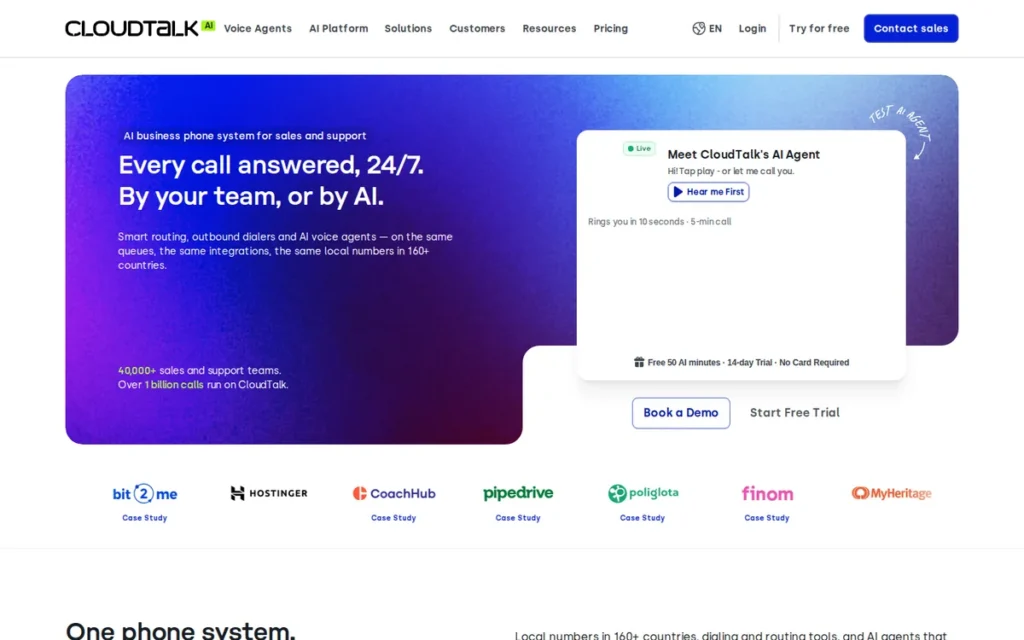
Category: Execution + Intelligence: outbound-first cloud calling platform with multi-mode dialers, automated local presence, and AI-powered call analytics purpose-built for mid-market sales teams.
At a Glance
- Category: Execution + Intelligence
- Best For: Mid-market outbound sales teams of 5–100 reps conducting multi-country or multi-region campaigns who need automated local presence dialing, multiple dialing modes, and AI-generated call analytics without enterprise implementation complexity
- Price Range: Approximately $49/user/month (Starter tier, annual billing); Expert and Enterprise tiers require contacting sales for pricing
- Primary Strength: CloudTalk is the only platform in this evaluation with an explicit G2 Leader designation in the Outbound Call Tracking Software, Mid-Market category, and its automated virtual caller ID matches the displayed phone number to the recipient’s country on every outbound call to directly counter unfamiliar area code suppression of answer rates
- Biggest Limitation: CloudTalk does not prominently publish complete pricing online (a documented friction point in Reddit communities) and advanced outbound features including workflow automation, unlimited concurrent calls, and the visual call flow designer require higher-tier plans accessible only through a sales conversation
- One-Line Summary: CloudTalk is an outbound-first cloud calling platform holding an explicit G2 Leader designation in the Outbound Call Tracking Software, Mid-Market category, offering Smart, Power, Preview, and Parallel dialing modes, automated local presence, and AI-powered call analytics for sales teams running multi-geography campaigns.
- Last Verified: May 2026
Overview
CloudTalk is an outbound-first cloud calling platform built for mid-market sales teams needing multi-mode automated dialing, international local presence, and AI-powered campaign analytics, and is the only platform in this seven-tool evaluation with an explicit G2 Leader designation in the Outbound Call Tracking Software mid-market category as of 2026. CloudTalk’s dialing infrastructure spans Smart Dialer, Power Dialer, Preview Dialer, and Parallel Dialer modes, and its automated virtual caller ID system displays a phone number matching the recipient’s country on every outbound call. CloudTalk was founded approximately 2018 in Slovakia, operates with a cloud-native architecture built without legacy telecom infrastructure, and serves 4,000+ business customers globally.
Key Features
- CloudTalk’s multi-mode dialing infrastructure: Smart Dialer, Power Dialer, Preview Dialer, and Parallel Dialer, enables teams to match their dialing strategy to campaign type, shifting from methodical warm outreach (Preview) to high-throughput automated dialing (Power or Parallel) within a single platform without switching tools.
- CloudTalk’s automated virtual caller ID displays a local phone number matching the recipient’s geographic location on every outbound call, directly addressing the unfamiliar area code problem that is the primary suppressor of answer rates for outbound teams calling across multiple countries or regions simultaneously.
- CloudTalk’s AI Smart Notes automatically generate a structured call summary within seconds of call completion, documented to save 5+ minutes of post-call administrative work per rep, meaningful productivity recovery for outbound teams conducting 50 to 100 calls per day.
- CloudTalk’s AI Call Scoring automatically evaluates call quality at scale using consistent assessment criteria applied to every recorded call, enabling quality management for large outbound teams without proportional manual QA review overhead.
- CloudTalk integrates with Salesforce, HubSpot, Pipedrive, and Zoho, with outbound call data, recordings, and outcomes automatically synced to contact records in real time, confirmed by r/msp community reports in 2024 of successful HubSpot integration for sales call tracking.
Best For
CloudTalk is best suited for mid-market outbound sales teams of 5 to 100 reps who conduct multi-country calling campaigns and need automated local presence dialing, multiple dialing modes, and AI-generated call summaries without the implementation complexity or per-seat pricing of enterprise contact center platforms.
Pricing
CloudTalk’s entry pricing is approximately $49/user/month at the Starter tier on annual billing, based on third-party pricing analysis verified May 2026, though CloudTalk does not prominently publish complete pricing on its website. A user on r/msp in 2024 described CloudTalk as appearing to hide pricing, reporting a difficult sign-up process and unclear per-call cost structures. Advanced outbound features including workflow automation, unlimited concurrent calls, and the visual call flow designer require Expert or Custom tiers. Teams should request a complete feature-gating and pricing matrix from CloudTalk before shortlisting, and verify all pricing directly before procurement.
Strengths
- CloudTalk holds an explicit G2 Leader designation in the Outbound Call Tracking Software, Mid-Market category, the specific product category this article evaluates, making it the only platform with direct third-party validation for this exact use case, verified in May 2026.
This aligns with community sentiment on r/msp:
“We’ve been using CloudTalk with HubSpot for our sales calls and tracking. It’s been easy for new team members to pick up, and the interface just feels more straightforward. I know Nextiva has great call quality and solid support, but for us CloudTalk’s simplicity and how well it fits growing teams made the difference” Posted by u/DimensionHour3887
Takeaway: CloudTalk’s ease of onboarding and HubSpot CRM integration are the two reasons growing mid-market sales teams most commonly cite when choosing it over established competitors.
- MyHeritage reported a 49% increase in outbound calls after adopting CloudTalk’s automated dialing campaigns, the strongest documented call volume improvement from a named customer case study among mid-market platforms in this evaluation CloudTalk Automated Outbound Calling Blog, 2024.
- CloudTalk’s AI analytics layer: Smart Notes saving 5+ minutes per call, Call Scoring providing automated quality assessment at scale, and Topic Extraction identifying trending customer concerns, delivers conversation intelligence without requiring a separate tool, confirmed by G2 user reviews praising practical utility.
- CloudTalk’s cloud-native architecture built from approximately 2018 without legacy telecom infrastructure provides a modern codebase advantage over older enterprise platforms, resulting in faster feature iteration and reduced dependency on legacy telephony constraints that affect platforms with pre-2010 origins.
Limitations
- Pricing Opacity: CloudTalk’s most consequential trade-off is transparency: CloudTalk does not readily publish complete pricing online, and r/msp community members in 2024 described a difficult sign-up process with unclear per-call cost structures that create procurement friction for self-service evaluation-stage buyers who need cost comparisons before engaging sales.
- Regional Support Inconsistency: CloudTalk’s support quality is described as “hit or miss depending on region” by u/Top_Cantaloupe8370 on r/CloudTalk_Official in 2026, a meaningful reliability consideration for globally distributed teams that should be addressed with a written support SLA and regional reference contacts before committing to any tier.
- Advanced Feature Gating: CloudTalk gates workflow automation, unlimited concurrent calls, and the visual call flow designer behind Expert and Custom tiers that require a sales conversation to price, preventing transparent self-service cost comparison at the feature level most outbound teams ultimately require. Teams should request a specific feature-by-tier breakdown and full pricing matrix before shortlisting.
Verdict
CloudTalk is the leading mid-market outbound call tracking platform in this 2026 evaluation, validated by an explicit G2 Leader designation in the outbound call tracking category, a documented 49% increase in outbound calls at a named enterprise customer, and a multi-mode dialing infrastructure purpose-built for outbound execution across multiple geographies. CloudTalk ranks number two overall (behind JustCall) primarily due to pricing transparency concerns and the requirement to engage sales for full pricing information, creating structural friction for evaluation-stage buyers building internal cost comparisons. Teams should request a complete feature-gating breakdown and pricing matrix from CloudTalk before shortlisting, and should verify support coverage for their region during any trial period.
3. Five9: Best for Enterprise Contact Centers and Regulated Industries
Category: Enterprise Execution Suite: full-stack enterprise contact center with four outbound dialing modes, no-code AI workflow building via GenAI Studio, and the deepest compliance infrastructure (TCPA, DNC, pursuing FedRAMP Moderate authorization, E911) of any evaluated platform.
At a Glance
- Category: Enterprise Execution Suite
- Best For: Enterprise contact centers with 50+ agents and regulated-industry outbound teams in healthcare, insurance, financial services, or government sectors requiring TCPA compliance automation, DNC management, and AI-powered outbound orchestration at scale
- Price Range: $149/user/month (Core tier, published); Premium, Optimum, and Ultimate tiers on custom quote, annual contracts standard
- Primary Strength: Five9 offers the deepest enterprise compliance infrastructure in this evaluation (TCPA automation, DNC management, E911, time-based geographic dialing controls, and GenAI Studio for custom no-code AI workflows) and is the only platform in this evaluation pursuing FedRAMP Moderate authorization for government-sector deployments (verify current authorization status at marketplace.fedramp.gov before procurement)
- Biggest Limitation: Five9’s $149/user/month minimum entry price makes it the most expensive platform by a factor of approximately 3x to 10x depending on comparison tier, and documented API complexity and configuration-sensitive reliability create total cost of ownership that extends well beyond the per-seat license fee
- One-Line Summary: Five9 is an enterprise contact center platform with four outbound dialing modes, TCPA and DNC compliance automation, and a no-code GenAI Studio for custom AI workflow building, the leading choice for regulated-industry outbound teams at enterprise scale but prohibitively complex and expensive for SMB and mid-market buyers.
- Last Verified: May 2026
Overview
Five9 is a publicly traded enterprise cloud contact center platform (NASDAQ: FIVN, founded 2001) purpose-built for high-volume outbound operations in regulated and enterprise environments, offering the most comprehensive compliance infrastructure of any evaluated platform, including TCPA enforcement automation, DNC list management, E911 support, and time-based geographic dialing controls. Five9’s four-mode dialing architecture (Predictive, Progressive, Power, Preview) is paired with AI Agent Assist, AI Summaries, AI Insights, and GenAI Studio, serving 2,000+ enterprise customers. Five9 is pursuing FedRAMP Moderate authorization for government-sector deployments, buyers should verify current authorization status at marketplace.fedramp.gov before making procurement decisions based on this credential. Five9 pricing begins at $149/user/month on annual contracts.
Key Features
- Five9’s four outbound dialing modes: Predictive (AI-driven pacing for maximum agent utilization), Progressive (one call per agent at completion), Power (one active line per agent), and Preview (agent reviews contact before dialing), allow enterprise contact centers to match dialing strategy to campaign type, compliance requirements, and agent capacity simultaneously.
- Five9’s compliance toolkit includes automated DNC list management with real-time scrubbing, TCPA enforcement controls, time-of-day and location-based dialing restrictions, answering machine and fax detection, E911 support, and agent scripting, making Five9 one of the most comprehensive auto-dialer compliance platforms available for regulated-industry outbound campaigns evaluated in 2026.
- Five9 is pursuing FedRAMP Moderate authorization for government-sector deployments, a cloud security standard that, if achieved, would qualify Five9 for U.S. federal government and high-security regulated use where certification is a threshold procurement requirement. Buyers should verify current authorization status directly at marketplace.fedramp.gov before shortlisting Five9 for compliance-gated evaluations.
- Five9’s GenAI Studio is a no-code custom AI workflow builder allowing enterprise teams to create bespoke AI-driven outbound processes, automated response logic, and intelligent routing without writing code, going significantly beyond the AI feature depth available in any mid-market alternative in this evaluation.
- Five9’s campaign and list management automatically updates calling lists based on call outcomes (removing connected contacts, rescheduling callbacks, and refining targeting based on dispositions) eliminating manual list hygiene overhead for large outbound campaigns running millions of dials annually.
Best For
Five9 is best suited for enterprise contact centers with 50+ agents, particularly those in regulated industries including healthcare, insurance, financial services, and government sectors where TCPA compliance automation, DNC management, and enterprise-grade AI infrastructure are non-negotiable procurement requirements that no evaluated mid-market alternative can satisfy.
Pricing
Five9’s published Core tier begins at $149/user/month on annual contract (verified May 2026); Premium, Optimum, and Ultimate tiers require custom quotes. A 10-agent team at the Core tier costs a minimum of $17,880 per year before add-ons, compared to $3,480 for Dialpad Standard or $3,480 for JustCall Team at comparable headcount. Add-ons for workforce management, quality assurance, advanced reporting, and premium support materially increase total cost. An independent review from AlphaRun in 2024 notes that meaningful support assistance requires paying for a dedicated support tier beyond the base license. Teams should model full total cost of ownership including implementation, add-ons, and premium support before budgeting.
Strengths
- Five9 holds Gartner Magic Quadrant recognition for Contact Center as a Service (2025) and Aragon Research recognition in conversational AI and contact center analytics, the only platform in this evaluation with dual top-tier analyst recognition across both categories, verified against the Five9 analyst reports page in May 2026.
- Five9 serves 2,000+ enterprise customers as a publicly traded company (NASDAQ: FIVN) with 24 years of operating history since its 2001 founding, providing financial stability and enterprise contract longevity that no private-backed competitor in this evaluation can demonstrate with equivalent public-market credibility.
- Five9’s three-layer AI stack: AI Agent Assist providing real-time agent suggestions during live calls, AI Summaries generating automated post-call notes, and GenAI Studio enabling custom AI workflow creation without code, addresses pre-call intelligence, in-call support, and post-call analytics simultaneously, a depth unavailable on any mid-market alternative in this evaluation.
- Five9’s automated campaign and list management continuously refines calling lists based on call dispositions without manual intervention, eliminating the list hygiene overhead that consumes analyst time on large outbound campaigns, a capability typically absent from mid-market tools in this comparison.
Limitations
- Enterprise-Exclusive Pricing: Five9’s most consequential trade-off is the combination of enterprise pricing and implementation complexity, at 10 seats on the Core tier, Five9 costs approximately $17,880 per year before add-ons, roughly 5 to 10 times the annual cost of comparably performing mid-market alternatives for teams that do not require enterprise-grade compliance infrastructure.
- API and Implementation Complexity: A user on r/ITManagers in 2024 described Five9’s API as “a tangled, undocumented mess” requiring premium support tiers to obtain actionable technical guidance, adding a significant hidden cost to the already-elevated per-seat license fee for teams without dedicated contact center engineering staff.
This aligns with community sentiment on r/sysadmin:
“We’ve started calling Five9 ‘Four9’ at this point and we’re very close to going to ‘Three9.’ Support is all offshored unless you pay for a TAM who won’t actually be able to help with tickets but can chase people internally if you yell loud enough. Support also likes to say everything is ‘jitter’ and insist on wireshark captures which they will try to explain (badly) and use as excuses to not fix the issue.” Posted by u/sithanas
Takeaway: Five9’s support model, offshored tiers, deflective diagnostics, and paywalled escalation paths, creates a compounding operational burden that sits well above the $149/user/month entry license and is consistently documented by enterprise IT teams.
- Configuration-Sensitive Reliability: Reddit community discussions on r/callcentres in 2026 document persistent reports of call drops, agent login instability, and configuration-sensitive reliability, with community expert consensus that “Five9 is generally stable, but its SIP connection can be very finicky if you don’t have a pristine setup.”
Verdict
Five9 is the leading purpose-built enterprise contact center platform in this 2026 evaluation for regulated-industry outbound teams, offering the most comprehensive compliance infrastructure, TCPA automation, DNC management, four dialing modes, and Gartner Magic Quadrant recognition (2025), that no mid-market alternative in this evaluation can replicate. Five9 ranks number three overall, rather than higher, because its $149/user/month starting price, documented implementation complexity, and G2 rating of 4.0/5.0, the lowest of the seven platforms evaluated, compared to the category high of 4.6/5.0 for CallRail, make it inaccessible and inappropriate for the SMB and mid-market buyers who constitute the majority of this article’s audience. Teams in healthcare, insurance, financial services, or government-adjacent sectors where compliance is a procurement threshold should evaluate Five9 as a primary candidate and verify its current FedRAMP authorization status before committing; all other buyers should begin with JustCall, CloudTalk, or Dialpad.
4. Dialpad: Best for AI-First Teams and Budget-Conscious Buyers Who Prioritize Conversation Intelligence

Category: AI-Native Dialer: AI-first unified communications platform powered by proprietary DialpadGPT, with four-mode supervisor coaching, Power Dialer, and the lowest entry price in the evaluated category at $15/user/month.
At a Glance
- Category: AI-Native Dialer
- Best For: Small to mid-market sales teams of 1–25 reps prioritizing AI conversation intelligence and real-time coaching at the lowest per-seat cost, particularly teams currently paying separately for Gong or Chorus who want to consolidate calling and analytics into one platform
- Price Range: $15/user/month (Standard, annual); $25/user/month (Pro, annual); Enterprise on custom quote
- Primary Strength: Dialpad includes DialpadGPT: its proprietary AI model with CSAT prediction at 87% accuracy across all calls and four-mode supervisor coaching, in all paid tiers at $15/user/month, delivering conversation intelligence depth that competing platforms charge $50 to $100+ per seat for separately
- Biggest Limitation: Dialpad has well-documented reliability degradation at rapid scale (multiple r/sysadmin users in 2024 and 2025 describe the platform going brittle when teams grow quickly and support becoming unresponsive) making it a meaningful risk for fast-scaling SDR organizations
- One-Line Summary: Dialpad is an AI-native calling platform powered by proprietary DialpadGPT that delivers real-time transcription, four-mode supervisor coaching, and CSAT prediction at 87% accuracy across all calls at $15/user/month, the highest AI feature density per dollar of any evaluated outbound call tracking platform in 2026.
- Last Verified: May 2026
Overview
Dialpad is an AI-first unified communications platform for small to mid-market sales teams prioritizing conversation intelligence, founded in 2011 in San Francisco and backed by $446M+ in funding to build its proprietary DialpadGPT model. Dialpad is the most accessible conversation intelligence platform (combining AI call coaching, real-time transcription, and automated call summaries) at any price point in this evaluation, with these features included across all paid tiers starting at $15/user/month. Dialpad’s CSAT prediction achieves 87% accuracy across all calls, improving effective quality measurement coverage from the industry-average ~5% manual survey response rate to approximately 75% of all call interactions (Dialpad AI CSAT documentation, verified May 2026).
Key Features
- Dialpad’s DialpadGPT proprietary AI model: built on $446M+ in R&D investment, provides real-time call transcription, automated post-call summaries, sentiment analysis, CSAT prediction at 87% accuracy across all calls, and customizable keyword detection across all paid tiers, eliminating the need for a separate conversation intelligence subscription.
- Dialpad offers four distinct real-time supervisor monitoring modes: Call Listening (silent monitoring), Call Whispering (coaching the agent mid-call without the prospect hearing), Call Barging (supervisor joins the live conversation), and Call Takeover (supervisor removes agent and takes over), the most comprehensive live coaching toolkit of any evaluated platform, confirmed in Dialpad’s published help documentation.
- Dialpad’s granular analytics exports cover three log types for comprehensive outbound performance reporting: Group Statistics Log (team-level call volume, service level percentage, concurrent calls, and unanswered rates); Daily Statistics Log (date-segmented activity and historical trend data); User Statistics Log (individual agent call duration, AI keyword tracking, and leaderboard rankings), all available without custom integrations.
- Dialpad’s Power Dialer enables reps to work through call lists without manual tab-switching, automatically validate numbers, and leave voicemail drops, with all outcomes captured and synced to connected CRM platforms at the Pro tier and above.
- Dialpad integrates with Salesforce, HubSpot, and Zoho at the Pro tier ($25/user/month), with call recordings, AI summaries, and outcomes automatically logged to contact records in real time.
Best For
Dialpad is best suited for small to mid-market sales teams of 1 to 25 reps who prioritize AI conversation intelligence and real-time coaching at the lowest possible per-seat cost, and for teams currently paying separately for a conversation intelligence tool like Gong or Chorus who want to consolidate calling and analytics into a single platform without significantly increasing per-seat spend.
Pricing
Dialpad’s published annual pricing (verified May 2026): Standard at $15/user/month and Pro at $25/user/month. Monthly billing adds approximately 80% to annual rates ($27 Standard / $35 Pro monthly). CRM integrations and advanced analytics require the Pro tier. The Standard tier at $15 includes DialpadGPT AI features, a meaningful differentiator since AI conversation intelligence is gated behind much higher tiers on competing platforms. No documented seat minimum exists. Community reports from r/EntrepreneurRideAlong in 2024 describe instances of upselling and pricing disputes at renewal, buyers should request explicit written contract terms before committing to any annual plan.
Strengths
- Dialpad’s DialpadGPT achieves CSAT prediction at 87% accuracy across all calls: improving effective quality measurement coverage from the industry-average ~5% manual survey response rate to approximately 75% of all call interactions, enabling managers to prioritize QA review on calls most likely to produce negative outcomes without listening to every recording (Dialpad AI CSAT documentation, verified May 2026).
- At $15/user/month on the Standard annual plan, Dialpad is the lowest-entry-price platform in this evaluation: a 10-rep team pays $1,800 per year versus $3,480 for JustCall Team, $5,880 for Aircall Essentials, or $17,880 for Five9 Core, while receiving AI conversation intelligence features that comparable platforms reserve for premium tiers.
- Dialpad holds Gartner Magic Quadrant recognition (2025) and multiple G2 Leader badges across cloud communication categories, providing analyst-validated enterprise credibility for formal procurement processes where analyst report citations are required.
- Dialpad’s four supervisor monitoring modes: Listen, Whisper, Barge, and Takeover, enable real-time coaching intervention across the full spectrum of scenarios, from passive observation to active call rescue, confirmed in Dialpad’s published help documentation and consistently cited as the platform’s strongest feature in G2 user reviews.
Limitations
- Scale Brittleness: Dialpad’s most consequential trade-off is documented reliability degradation at rapid growth, multiple r/sysadmin users in 2024 describe the platform generating compounding technical issues when teams scale quickly, with one user reporting that “support will churn you to oblivion” at growth scale (u/Dry-Position-9734, r/sysadmin, 2024).
- Support Quality Concerns at SMB Tier: A separate r/EntrepreneurRideAlong user in 2024 described five months without issue resolution after reporting a product malfunction, characterizing the experience as deceptive upselling followed by complete support abandonment (u/700xof), a pattern echoed across multiple Reddit threads for small business accounts.
Users on r/SaaS noted:
“We actually went from Dialpad to Nextiva about a year ago (similar size team ~45 people) and it was mostly driven by support issues and reliability problems during peak hours. Haven’t used RingCentral but can share our experience if it helps. Dialpad’s admin controls were decent but we kept having call quality issues and their support was frustrating when things went wrong” Posted by u/GoldenJalapeno
Takeaway: Dialpad’s call quality degradation and support failures at the ~45-person scale independently validate the platform’s documented reliability ceiling, teams approaching that headcount should build structured trial periods into their evaluation before committing to an annual contract.
- Power Dialer Only for Outbound Execution: Dialpad offers a Power Dialer at the Pro tier but does not provide Predictive, Dynamic, or Parallel dialing modes, teams needing high-velocity predictive dialing should evaluate JustCall Business or CloudTalk Expert, which offer those modes at comparable or only modestly higher pricing.
Verdict
Dialpad is the highest-AI-value outbound calling platform per dollar evaluated in 2026, delivering DialpadGPT-powered conversation intelligence (including CSAT prediction at 87% accuracy across all calls, four-mode live supervisor coaching, and real-time transcription) at $15/user/month where competing platforms offer none of these capabilities at comparable pricing. Dialpad earns the number-four overall ranking rather than higher because well-documented community evidence of scale brittleness and support abandonment at growth-stage team sizes introduces reliability risk that more stable platforms do not present at comparable scale. Dialpad is the right first choice for stable teams of 1 to 25 reps prioritizing AI conversation intelligence; Dialpad is a higher-risk choice for fast-growing SDR organizations where the documented reliability ceiling could disrupt operations during a critical scaling phase.
5. CallRail: Best for Marketing Teams Attributing Outbound and Inbound Calls to Campaigns and Keywords
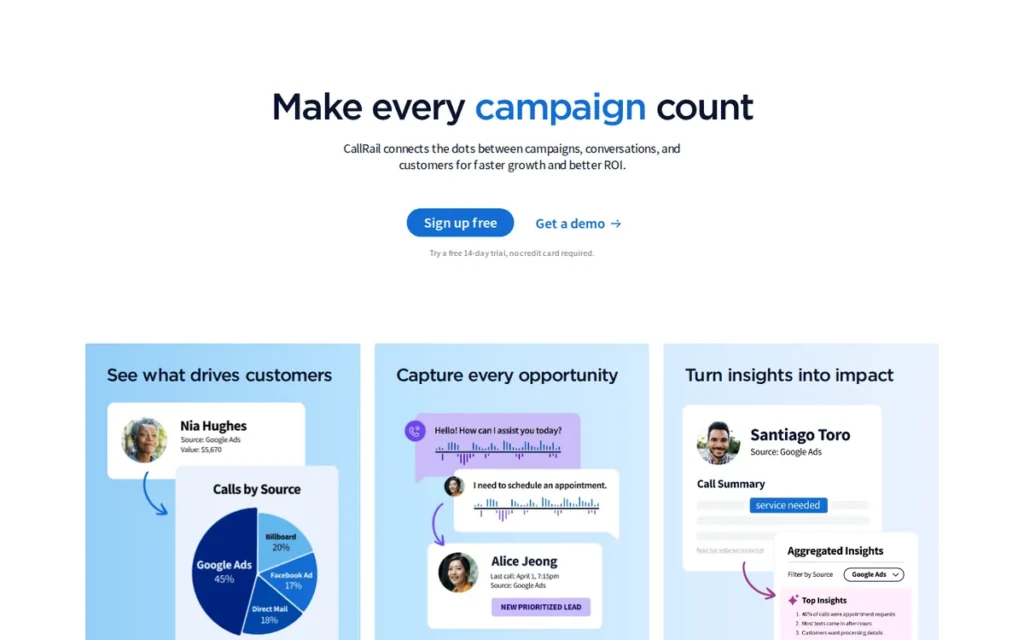
Category: Attribution Tracker: marketing call attribution specialist with Dynamic Number Insertion, Conversation Intelligence, and form tracking; outbound calling from tracking numbers uses per-minute billing and does not include predictive or power dialing modes.
At a Glance
- Category: Attribution Tracker
- Best For: Marketing teams and digital agencies that need to attribute outbound and inbound calls to specific campaigns, keywords, and ad sources, particularly teams running Google Ads where call attribution directly informs bid strategy and ROI reporting
- Price Range: Entry plans from approximately $45/month (5 tracking numbers, 250 minutes); outbound calls billed per-minute on top of plan fees, contact CallRail for current exact rates (verified May 2026)
- Primary Strength: CallRail’s Dynamic Number Insertion is the most precise call attribution technology in the evaluated category, tying every outbound and inbound call to the specific campaign, keyword, or marketing source that generated it, and CallRail’s G2 rating of 4.6/5.0 is the highest of all seven evaluated platforms
- Biggest Limitation: CallRail is an attribution tracker, not a sales dialer: it does not offer predictive, power, or automated dialing modes, and its outbound calling uses per-minute billing that accumulates rapidly for SDR teams making 50 to 100+ calls per day
- One-Line Summary: CallRail is a marketing attribution platform with Dynamic Number Insertion earning the highest G2 rating of 4.6/5.0 among all evaluated platforms, best deployed as a companion attribution layer alongside a separate outbound dialer rather than as a standalone outbound execution tool.
- Last Verified: May 2026
Overview
CallRail is an AI-powered marketing call attribution platform founded in 2011 in Atlanta, Georgia that leads the evaluated category in G2 rating (4.6/5.0, verified May 2026) and attribution precision, its Dynamic Number Insertion technology swaps phone numbers on websites and landing pages in real time, attributing every inbound and outbound call to the specific marketing source, campaign, keyword, or page that generated it. CallRail supports outbound calling from tracking numbers, enabling reps to place calls with tracking numbers visible on caller ID so all outbound activity is logged, recorded, and attributable alongside inbound calls in the same reporting system. CallRail is an attribution-native tool, not an outbound execution platform, and its outbound calling uses per-minute billing rather than flat-rate seat fees.
Key Features
- CallRail’s Dynamic Number Insertion (DNI) dynamically swaps phone numbers on websites and landing pages based on visitor session data, attributing every call to the specific marketing source, ad campaign, keyword, geographic location, or landing page that drove the visitor, with the precision required to optimize Google Ads campaigns based on actual call outcomes.
- CallRail’s Conversation Intelligence platform transcribes every recorded call using AI, performs keyword analysis across transcripts, and surfaces insights connecting what was said during calls to the marketing sources that drove those calls, enabling content and messaging optimization grounded in actual rep-to-prospect conversations.
- CallRail supports outbound call tracking from tracking numbers, allowing reps to place calls with the tracking number displayed as caller ID, with all outbound activity logged, recorded, attributable, and reported alongside inbound call data in a unified attribution dashboard.
- CallRail’s form tracking capability attributes web form submissions to marketing sources alongside phone call data, giving marketing teams a unified campaign-to-lead conversion view spanning both call and non-call touchpoints, without requiring a separate form analytics integration.
- CallRail integrates with HubSpot, Salesforce, Google Ads, and Google Analytics 4, enabling call attribution data to flow directly into campaign management tools and influence bid strategy and budget allocation decisions in real time.
Best For
CallRail is best suited for marketing teams at digital agencies and SMBs running Google Ads and multi-channel campaigns who need to prove which campaigns, keywords, and sources drive phone calls and form submissions, particularly teams that currently cannot attribute outbound or inbound calls to marketing spend and need to close that ROI measurement gap without building a custom attribution infrastructure.
Pricing
CallRail uses a modular pricing structure based on feature set rather than per-seat pricing (verified May 2026): plans differentiate between Call Tracking only, Call Tracking plus Intelligence (adds AI transcription), Call Tracking plus Form Tracking, and the Analytics Suite (full feature set). Entry plans include approximately 5 tracking numbers and 250 minutes. Outbound calling incurs per-minute fees on top of plan costs, a material cost driver for high-volume teams that must be calculated against projected monthly call minutes. A 2026 Reddit report on r/PPC (u/ifheartsweregold) reported data access fees adding up to 50% of monthly bills for some accounts, buyers should request current fee structures explicitly and model costs at expected usage volume before signing.
Strengths
- CallRail holds a G2 rating of 4.6/5.0: the highest of all seven evaluated platforms, with a review base spanning thousands of digital marketing agencies and SMBs who confirm its attribution precision in connecting call outcomes to marketing sources, verified in May 2026.
- CallRail’s 15-year specialization in call attribution since its 2011 founding gives it a depth advantage in DNI precision and multi-touch attribution that newer, broader platforms cannot replicate, particularly in edge cases such as cross-device session tracking and complex multi-channel customer journeys.
- Digital marketing agencies managing multiple client accounts consistently report CallRail as the most reliable solution for presenting campaign-level call ROI to clients, one reviewed agency user described use across 30+ client accounts with sustained satisfaction (u/fsufan451, r/PPC, 2023), confirming its scalability as an agency-managed attribution layer.
- CallRail’s unified attribution reporting covers both phone calls and web form submissions in one platform, providing marketing teams a single-source campaign ROI view that requires two separate tools and two separate integrations on every other evaluated platform in this comparison.
Limitations
- Category Mismatch Risk: CallRail’s most consequential trade-off is structural (CallRail is an attribution tracker, not a sales dialer, and does not offer predictive dialing, power dialing, or automated outbound campaign execution) meaning teams that purchase CallRail expecting a high-velocity calling tool will find CallRail structurally unsuited to that need from the first week of use.
- Per-Minute Billing Accumulation: CallRail’s outbound calling incurs per-minute fees that accumulate rapidly for SDR teams making 50 to 100 calls daily, and a 2026 Reddit report from r/PPC described data access fees adding up to 50% of monthly bills, with community users characterizing CallRail’s billing model as complex and its pricing changes as frequent (u/dorothyKelly and u/blouuuuuuuu, r/PPC, 2023).
- Support and Onboarding Friction: CallRail’s support quality is described as poor by multiple community users, and the UI is characterized as potentially difficult for new users, with one community member switching services after finding guides insufficient and data export capabilities limited (r/PPC, 2023). Teams needing both attribution and dialing should evaluate stacking CallRail with JustCall or CloudTalk rather than expecting CallRail alone to serve both functions.
Verdict
CallRail is the leading marketing attribution platform in the evaluated outbound call tracking category, earning the highest G2 rating of 4.6/5.0 of any evaluated platform and offering Dynamic Number Insertion precision that no competing platform matches for tying calls to campaign sources. CallRail ranks number five overall because its outbound feature depth is the lowest of any platform that includes calling capability (CallRail is fundamentally an attribution tracker, not an outbound execution tool) and because 2026 community reports of escalating data access fees and per-minute billing create unpredictable cost structures for high-volume outbound teams. Marketing teams and agencies that need to prove campaign-to-call ROI should evaluate CallRail as their attribution layer; SDR teams needing a high-velocity dialer should start with JustCall or CloudTalk and integrate CallRail as a complementary attribution tool.
6. HubSpot Sales Hub: Best for Teams Already Operating Inside the HubSpot CRM Ecosystem
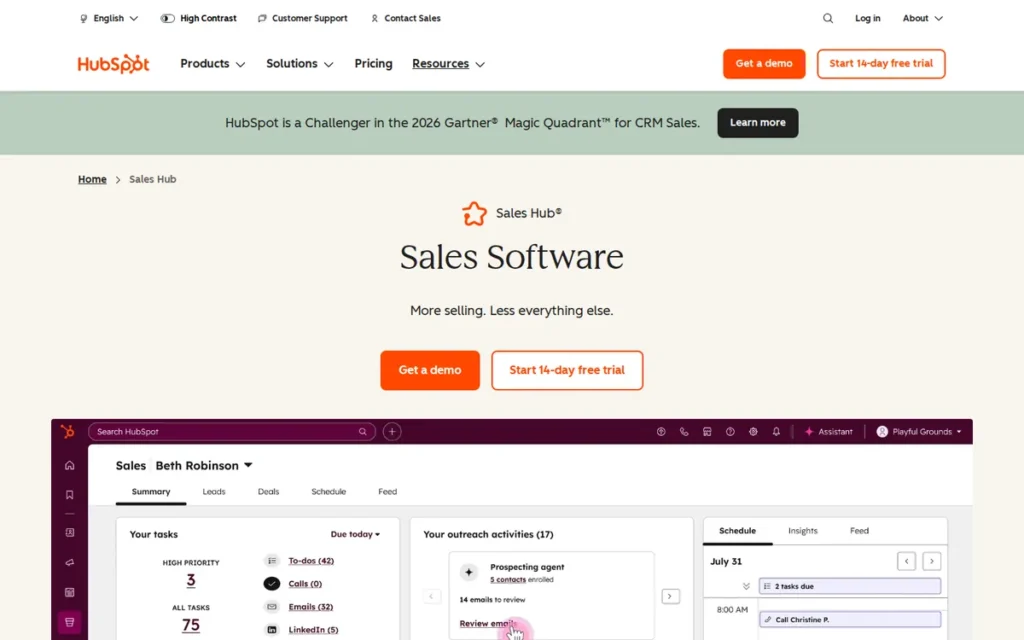
Category: CRM-Native Caller: outbound calling embedded directly in the HubSpot CRM with Breeze AI transcription and summaries, Power Dialer (beta), and sequences, optimized for CRM data capture and sales workflow automation, not standalone attribution or high-velocity predictive dialing.
At a Glance
- Category: CRM-Native Caller
- Best For: Sales teams already using HubSpot CRM at the Professional or Enterprise tier who want to eliminate overhead of syncing a separate calling tool and prioritize automatic call logging, Breeze AI conversation intelligence, and multi-step sequence automation over advanced dialing modes or marketing channel attribution
- Price Range: Free ($0, limited CRM only); Starter ~$20/seat/month; Professional ~$100/seat/month; Enterprise ~$150/seat/month, Power Dialer and Breeze AI require Professional or Enterprise tiers
- Primary Strength: HubSpot Sales Hub is a CRM-native calling platform that automatically logs every call’s recording, transcript, Breeze AI summary, and follow-up tasks to the contact and deal record in real time, eliminating the synchronization failures that cause revenue blind spots when standalone calling tools lose CRM sync
- Biggest Limitation: HubSpot Sales Hub does not natively provide marketing-channel call attribution (teams needing to know which campaign or ad source prompted a call must add a separate attribution tool) and full outbound calling features require the Professional tier at $100/seat/month, making HubSpot 4 to 7 times more expensive per seat than Dialpad or JustCall for equivalent outbound calling capability
- One-Line Summary: HubSpot Sales Hub is a CRM-native outbound calling platform that embeds Power Dialer, Breeze AI conversation intelligence, and multi-step sequences directly in the HubSpot CRM, making it the strongest choice for HubSpot-ecosystem teams that prioritize call data integrity and CRM automation over dialing velocity or marketing attribution.
- Last Verified: May 2026
Overview
HubSpot Sales Hub is a CRM-native calling and sales engagement platform built directly into the HubSpot CRM ecosystem, where reps place outbound calls from contact records and every call’s recording, AI transcript, Breeze AI summary, and action items are automatically logged to the corresponding contact and deal record without post-call manual entry. HubSpot Sales Hub differentiates from all other evaluated platforms by being the CRM itself rather than a tool integrating with a CRM, meaning sales and marketing data share a single system of record, eliminating the synchronization failures and field-mapping errors that create data silos. HubSpot was founded in 2006, is publicly traded on NYSE: HUBS, and serves 200,000+ organizations globally across its platform ecosystem.
Key Features
- HubSpot Sales Hub’s CRM-native click-to-call allows reps to place outbound calls directly from contact and deal records, with recordings, AI transcripts, Breeze AI call summaries, and action items automatically logged to the record in real time, no post-call manual sync or field mapping required.
- HubSpot Sales Hub’s Power Dialer (beta) enables reps to work through call lists with automatic number validation, voicemail drops, and sequential call capture, integrating outbound dialing directly into multi-step sequence workflows that combine calls, emails, and LinkedIn outreach.
- HubSpot Sales Hub’s Breeze AI conversation intelligence provides real-time call transcription, editable AI-generated call summaries, and automatic action item extraction for every recorded call, delivering conversation intelligence comparable to dedicated tools for teams already operating inside the HubSpot ecosystem at Professional or Enterprise tier.
- HubSpot Sales Hub’s 1,500+ app marketplace enables teams to extend native calling limitations with integration partners (including CallRail for marketing channel attribution and specialized outbound dialers for predictive dialing) while maintaining HubSpot as the unifying system of record.
- HubSpot Sales Hub’s sequence automation enables multi-touch outbound workflows combining calls, emails, and social outreach in a single programmable sequence, with all activity logged to CRM records and pipeline stages updated automatically based on call outcomes and rep dispositions.
Best For
HubSpot Sales Hub is best suited for sales teams already committed to the HubSpot CRM at the Professional or Enterprise tier that want to consolidate outbound calling into their existing CRM investment, eliminate manual data sync between a calling tool and their CRM, and access Breeze AI conversation intelligence without adding a separate vendor.
Pricing
HubSpot Sales Hub annual pricing (verified May 2026): Free at $0 (limited CRM only), Starter at approximately $20/seat/month, Professional at approximately $100/seat/month, Enterprise at approximately $150/seat/month. The Power Dialer, Breeze AI conversation intelligence, and advanced call analytics are gated behind Professional and Enterprise tiers. A 10-rep team on Professional pays approximately $12,000 per year in Sales Hub seat fees, versus $3,480 for Dialpad Pro or $5,880 for JustCall Pro for comparable AI-assisted outbound calling on standalone platforms. HubSpot-provided numbers support inbound return calls; user-registered outbound numbers cannot receive browser-based inbound calls, per the HubSpot Knowledge Base (verified May 2026). Calling minute limits apply by tier and should be verified against projected outbound call volume before committing.
Strengths
- Casio UK reported 496% growth in leads and generated approximately £1M in net revenue from HubSpot email campaigns after consolidating its marketing and sales activity on HubSpot (demonstrating how CRM-native call tracking and workflow automation contribute to pipeline velocity when sales and marketing data are unified in one system (HubSpot Customer Case Study) Casio UK, verified May 2026).
- HubSpot Sales Hub’s 1,500+ app marketplace is the broadest integration ecosystem of any evaluated platform, enabling teams to add CallRail for marketing attribution, Gong for advanced conversation intelligence, or specialized outbound dialers while keeping HubSpot as the unifying system of record, reducing vendor consolidation risk and switching cost for teams committed to the HubSpot ecosystem.
- HubSpot’s public company status (NYSE: HUBS, founded 2006, 200,000+ customers) provides enterprise-grade financial stability and a product roadmap backed by public market accountability, reducing platform longevity risk for buyers committing to multi-year CRM-native workflows where vendor continuity is critical.
- HubSpot Sales Hub’s Breeze AI: delivering real-time transcription, AI call summaries, and action item extraction, is included in Professional and Enterprise tiers without requiring a separate conversation intelligence subscription, making it competitive with dedicated tools for teams already paying for these HubSpot tiers.
Limitations
- No Native Marketing Channel Attribution: HubSpot Sales Hub’s most consequential limitation is the absence of native marketing-channel call attribution, independent analysis from Voiso in 2024 confirms that HubSpot provides “no way to know what prompted the call or which marketing effort influenced it,” meaning attribution-sensitive outbound teams must add a separate tool like CallRail on top of already-elevated HubSpot investment. HubSpot’s own marketplace includes CallRail as the recommended integration for this gap.
- Elevated Pricing Relative to Feature Access: Unlocking the Power Dialer and Breeze AI requires the Professional tier at $100/seat/month, making HubSpot Sales Hub 4 to 7 times more expensive per seat than Dialpad or JustCall for equivalent outbound AI calling features, a cost differential that makes HubSpot an expensive choice for teams not already embedded in the ecosystem.
- Calling Constraints at Standard Tiers: HubSpot-provided numbers support inbound return calls while user-registered outbound numbers cannot receive browser-based inbound calls, and calling minute limits by tier create operational constraints that teams must model against projected outbound call volume, constraints absent from dedicated outbound calling platforms in this comparison.
Users on r/sales shared their experience:
“The platform will not allow you to make any calls not directly through a contact page. anybody who has ever made calls knows that sometimes you need to dial a number here or there to navigate within an organization. in order to do this on this platform you would need to continuously create garbage in your CRM… For what it is worth I could see its applicability for a small marketing org, but as a tool for BDRs it is basically a bait and switch, like buying a hammer only to find out it is for smashing flys and using it on a nail voids the warranty.” Posted by u/OGready
Takeaway: HubSpot Sales Hub’s calling architecture is designed around CRM-native contact workflows, not cold outbound prospecting, BDR teams that need dial flexibility outside of existing contact records consistently hit structural limits the platform was never built to remove.
Verdict
HubSpot Sales Hub is the best outbound calling option for teams already operating inside the HubSpot CRM ecosystem, delivering CRM-native call logging, Breeze AI conversation intelligence, Power Dialer automation, and the broadest integration marketplace of any evaluated platform within one unified ecosystem. HubSpot ranks number six overall because its Professional tier pricing at $100/seat/month makes it among the most expensive evaluated options for teams that do not already use HubSpot CRM, and because its absence of native marketing channel attribution leaves a critical gap for outbound teams that need campaign-level call ROI measurement. Teams not already on HubSpot should evaluate JustCall, CloudTalk, or Dialpad first and add CallRail for attribution; teams already on HubSpot Professional or Enterprise should evaluate Sales Hub calling as their default first option before considering a separate platform.
7. Aircall: Best for Distributed SMB Teams Needing Fast Setup and Broad SaaS Integration
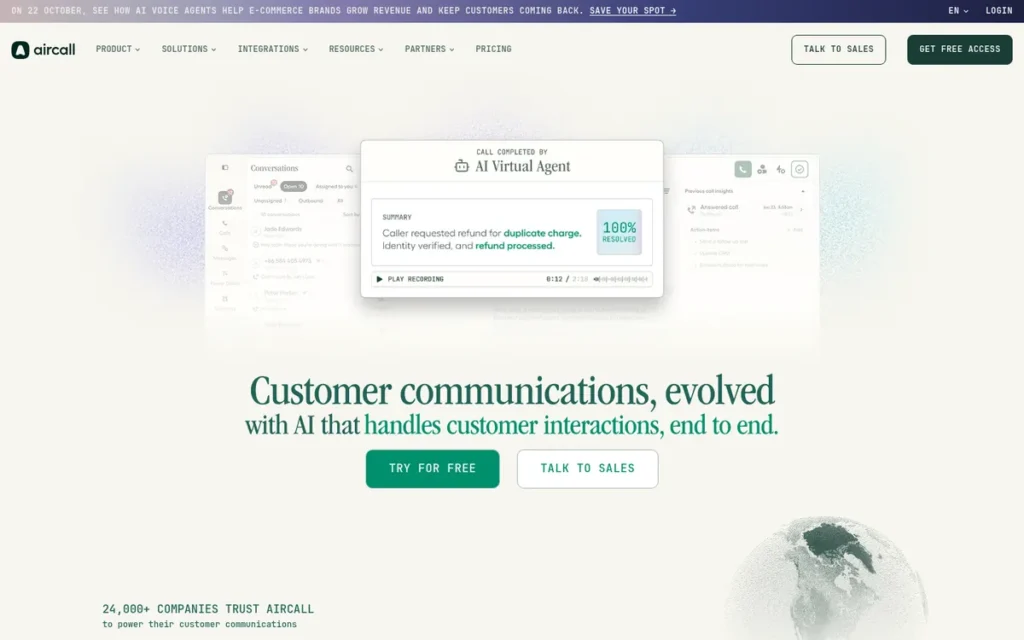
Category: Cloud Phone System: cloud-first calling platform with Power Dialer, AI outbound virtual agents, voicemail drop, and 100+ SaaS integrations; best positioned as a voice layer within existing tech stacks rather than a standalone outbound execution specialist.
At a Glance
- Category: Cloud Phone System
- Best For: Distributed SMB and mid-market teams of 3–50 reps who need fast deployment, broad integration across 100+ business tools, and international number availability, and who do not require Predictive, Dynamic, or Parallel automated dialing modes
- Price Range: $30/seat/month (Essentials, annual, 3-seat minimum); $50/seat/month (Professional, annual, 3-seat minimum); Custom/Enterprise on request
- Primary Strength: Aircall integrates with 100+ business tools including Salesforce, HubSpot, Zendesk, Shopify, and Stripe with automatic call logging to connected platforms, enabling deployment as a voice layer within an existing SaaS ecosystem without requiring integration development or post-call manual data entry
- Biggest Limitation: Aircall’s 3-seat minimum forces teams smaller than 3 reps to pay for unused licenses, outbound dialing is limited to Power Dialer with no Predictive or multi-mode options, and 2026 Reddit community reports document active user churn driven by billing changes and recurring call quality inconsistency
- One-Line Summary: Aircall is a cloud phone system with 100+ business tool integrations, a Power Dialer, voicemail drop, and AI outbound virtual agents, a functional voice layer for distributed SMB teams on standard SaaS stacks, though outpaced on dialing depth, AI maturity, pricing value, and G2 user satisfaction by the six higher-ranked platforms in this 2026 evaluation.
- Last Verified: May 2026
Overview
Aircall is a cloud phone system for distributed SMB and mid-market sales teams founded in Paris in 2014, backed by $226M+ in total funding, and designed as a voice layer integrating with 100+ business tools, including Salesforce, HubSpot, Zendesk, Shopify, and Stripe, enabling teams to go live within hours and automatically log calls to existing CRM systems. Aircall’s outbound-specific features include a Power Dialer, voicemail drop documented to save up to 5 hours per agent per week, call whisper and coaching, warm transfer, and Aircall AI outbound virtual agents, though outbound dialing is limited to Power Dialer mode with no Predictive, Dynamic, or Parallel alternatives. Aircall holds a G2 rating of 4.1/5.0 with 1,000+ reviews, and 2026 Reddit community reports document active user churn driven by billing changes and call quality inconsistency.
Key Features
- Aircall’s Power Dialer with voicemail drop automates sequential outbound calling from contact lists, with voicemail drop documented to save up to 5 hours per agent per week, approximately 13% of a 40-hour working week recovered from manual voicemail recording, representing 50 hours of collective selling time recovered weekly for a 10-agent team (Aircall Blog, 2024).
- Aircall’s AI outbound virtual agents can conduct automated first-contact calls for lead qualification, appointment setting, and initial routing, handling repetitive outbound call types that do not require human judgment and freeing reps for higher-value conversations, though published performance benchmarks are not yet available as of May 2026.
- Aircall integrates with 100+ SaaS tools including Salesforce, HubSpot, Zendesk, Shopify, Stripe, and Intercom, with call recordings, outcomes, summaries, and voicemails automatically synced to connected platforms in real time, enabling Aircall to function as the voice layer in an existing SaaS ecosystem without additional integration development.
- Aircall provides real-time coaching and live monitoring via call whisper (supervisor coaching the agent during a live call without the prospect hearing), warm transfer (agent briefs the receiving party before handoff), and live analytics dashboards displaying team call activity, queue status, and individual rep performance.
- Aircall supports international number availability across 100+ countries, with local presence dialing options for outbound teams operating across multiple geographies, backed by $226M+ in funding and 500 to 1,000+ employees globally supporting continued international telephony infrastructure.
Best For
Aircall is best suited for distributed SMB and mid-market sales and support teams of 3 to 50 reps deeply embedded in a standard SaaS stack including Salesforce, HubSpot, Zendesk, or Shopify, who need fast deployment without technical configuration and primarily need Power Dialer efficiency and voicemail drop rather than multi-mode predictive dialing, deep AI conversation intelligence, or granular attribution reporting.
Pricing
Aircall’s published annual pricing (verified May 2026): Essentials at $30/seat/month with a 3-seat minimum, Professional at $50/seat/month with a 3-seat minimum, Custom and Enterprise on request. The 3-seat minimum means a 1 to 2 rep team pays for 3 seats regardless, $90 to $150 per month before usage fees. AI add-ons for enhanced conversation intelligence and advanced analytics increase effective costs beyond published tier pricing. A 2026 Reddit post on r/CloudTalk_Official (u/Flimsy-Movie-2193) documented billing changes prompting active evaluation of alternatives; new buyers should request written terms for pricing stability before committing to an annual contract.
Strengths
- Aircall’s voicemail drop is documented to save up to 5 hours per agent per week: approximately 13% of a 40-hour working week recovered from manual voicemail recording per rep, representing 50 hours of collective selling time recovered weekly for a 10-agent team (Aircall Blog, Seven Strategies for Outbound Sales Dialing, 2024).
- Aircall’s 100+ business tool integration ecosystem: spanning Salesforce, HubSpot, Zendesk, Shopify, and Stripe, is among the broadest of any evaluated platform, enabling automatic call logging and outcome sync without requiring custom API development for teams on standard SaaS stacks.
- Aircall’s $226M+ in total funding (Crunchbase, 2024) and 500 to 1,000+ global employees provide the financial stability and international infrastructure to support globally distributed outbound teams requiring local numbers in 100+ countries simultaneously.
- Aircall AI outbound virtual agents represent a meaningful product evolution positioning Aircall toward AI-assisted outbound orchestration (automating initial qualification and appointment setting calls) though published accuracy and performance benchmarks are not yet available as of May 2026. Buyers evaluating Aircall specifically for AI virtual agent capability should treat these features as beta-stage, useful for experimentation but not yet validated for production SDR campaigns where AI failure directly impacts revenue-generating programs.
Limitations
- Structural Dialing Limitations and Seat Minimum: Aircall’s 3-seat minimum forces small teams to overpay for unused licenses, and outbound dialing is limited to Power Dialer with no Predictive, Dynamic, or Parallel alternatives, a constraint that becomes increasingly material as teams scale outbound call volumes beyond what single-mode sequential dialing efficiently handles.
- Billing Changes and Call Quality Concerns: A 2026 user on r/CloudTalk_Official (u/Flimsy-Movie-2193) specifically described Aircall’s “call drops and billing issues becoming too frequent” as the active trigger for evaluating alternatives, mirroring review platform patterns of audio quality inconsistency and billing changes accelerating churn in 2026.
- Unvalidated AI Performance: Aircall’s AI virtual agents are a recent addition without published performance benchmarks, and Aircall’s G2 rating of 4.1/5.0 is the second-lowest in the evaluated category, indicating that despite integration breadth and fast setup appeal, aggregate user satisfaction lags behind the six higher-ranked platforms.
Verdict
Aircall is a capable cloud phone system for distributed SMB teams who need fast deployment, broad SaaS integration across 100+ tools, and international number availability, and Aircall’s voicemail drop efficiency, AI virtual agents, and global infrastructure make it a functional choice for teams with those specific requirements. Aircall ranks number seven in this evaluation because competing platforms outperform Aircall on outbound dialing depth (no Predictive or multi-mode options), AI conversation intelligence maturity (no published benchmark data for virtual agents), pricing value (3-seat minimum and 2026 billing change complaints), and overall G2 user satisfaction at 4.1/5.0. Teams comparing Aircall against JustCall or CloudTalk for outbound calling should conduct side-by-side trials focused on dialing mode flexibility, call quality reliability, and pricing stability before committing to an annual contract.
What Red Flags Should I Watch For When Evaluating Outbound Call Tracking Software?
Five documented buyer errors most consistently lead to expensive procurement mistakes in outbound call tracking software: attribution-dialer category confusion, per-minute billing accumulation, feature gating above entry price, seat minimums that force overpayment, and scale brittleness without adequate vendor support.
The five critical red flags at a glance:
- Red Flag #1: Category confusion: purchasing an attribution tracker when you need a predictive dialer
- Red Flag #2: Per-minute billing accumulation: outbound call fees compounding rapidly at SDR call volumes
- Red Flag #3: Feature gating: predictive dialing and AI coaching locked at 2x–6x the headline entry price
- Red Flag #4: Seat minimums: paying for unused licenses on teams smaller than the mandatory minimum
- Red Flag #5: Scale brittleness: reliability degradation and support abandonment when teams grow rapidly
Red Flag #1: Attribution-Dialer Category Confusion
Selecting an attribution tracker (such as CallRail) when your primary need is high-velocity automated dialing is the most consequential category-level error in this market. No configuration within CallRail’s current product scope enables predictive dialing or automated list management, those require a separate outbound execution platform. Buyers should confirm their primary category need before evaluating any individual feature set.
Red Flag #2: Per-Minute Billing Accumulation
Outbound calling per-minute fees compound rapidly for SDR teams making 50 to 100 calls per day. A team of 10 reps each making 80 calls per day at 3 minutes average duration generates 24,000 minutes of monthly billable time.
Request a written cost scenario from any per-minute billing vendor at 50%, 100%, and 150% of projected monthly volume before committing. The six platforms in this evaluation with flat per-seat billing (JustCall, CloudTalk, Dialpad, HubSpot, Aircall, Five9) are structurally lower total cost risk for high-volume SDR teams than per-minute alternatives like CallRail.
Red Flag #3: Feature Gating Above Entry Price
Predictive dialing and AI coaching are locked behind premium tiers on JustCall ($89/user/month Business), Dialpad (Pro at $25 for CRM integration), and HubSpot ($100/user/month Professional for Power Dialer), 2x to 6x the headline entry price. Buyers who budget at the entry-tier headline price and need advanced features will face significant unplanned cost increases at the first renewal cycle.
Red Flag #4: Seat Minimums Forcing Overpayment
Aircall’s mandatory 3-seat minimum requires teams of 1 to 2 reps to pay for unused licenses regardless of actual team size. A solo agent on Aircall Essentials pays $90/month minimum, versus $15/month on Dialpad Standard or $29/month on JustCall with no documented seat minimum. Confirm minimum seat requirements explicitly before assuming per-seat pricing applies to your actual headcount.
Red Flag #5: Scale Brittleness Without Support
Dialpad community documentation from r/sysadmin in 2024 and 2025 describes a consistent pattern of reliability degradation and support abandonment when teams grow rapidly beyond the platform’s validated operating range. Fast-scaling SDR organizations should ask vendors what their largest stable customer team size is, request reference contacts at that scale, and build structured trial periods at representative volume into procurement before signing annual contracts.
What Questions Should I Ask Before Choosing Outbound Call Tracking Software?
Six questions most reliably separate the right platform from a costly misfit, each addressing a dimension that vendor marketing consistently obscures: category fit, billing structure, CRM compatibility, compliance requirements, total cost at scale, and trial validation.
Question #1: Do you need call attribution, call execution, or both, and does one platform handle your primary need without a second tool?
If your primary goal is proving which campaigns drive calls, you need an attribution tracker like CallRail. If your primary goal is increasing automated call volume and rep efficiency, you need an execution platform like JustCall or CloudTalk. If you need both, plan from day one for a two-tool stack, no single evaluated platform fully delivers both functions at production quality.
Look for vendors to distinguish clearly between marketing attribution and outbound execution. If a vendor claims to do both equally, request specific documentation of their DNI attribution methodology or their predictive dialer throughput benchmarks, not marketing language.
Question #2: What is your projected monthly outbound call volume, and how does per-minute billing affect your total cost at that volume?
Per-minute billing versus flat per-seat billing is the single largest hidden cost variable in outbound call tracking software. A team of 10 reps making 80 calls per day at a 3-minute average generates 24,000 billable minutes monthly, a cost that can exceed the headline platform fee on per-minute models.
The six platforms in this evaluation with flat per-seat billing (JustCall, CloudTalk, Dialpad, HubSpot, Aircall, Five9) are structurally lower total cost risk for high-volume SDR teams than per-minute alternatives. Request a written cost scenario from any per-minute vendor at 50%, 100%, and 150% of projected monthly volume before signing.
Question #3: Which CRM are you using, and does the platform sync natively with full field fidelity?
CRM integration quality varies dramatically among the seven evaluated platforms even though all claim native HubSpot and Salesforce compatibility. The critical differentiators are field fidelity (which specific fields sync), sync latency (real-time vs. delayed), and duplicate-lead handling, factors vendor marketing consistently obscures but that determine whether call data reliably reaches CRM records.
To verify integration quality before committing, ask vendors:
- Which specific fields sync (contact name, deal stage, call outcome, recording URL, AI summary, disposition code)?
- What is the documented maximum sync delay and frequency of documented sync failure incidents?
- How does the platform handle duplicate lead creation when the same number calls multiple times?
- Can you provide a reference contact at a customer using your specific CRM at comparable team size?
Question #4: Do you operate in a regulated industry requiring TCPA compliance, DNC automation, or government-grade security certification?
If yes, Five9 is the only platform in this evaluation with documented TCPA automation, DNC management infrastructure, and a government-sector cloud security pursuit (pursuing FedRAMP Moderate authorization, verify current status at marketplace.fedramp.gov before procurement). Buyers in healthcare, insurance, financial services, or government-adjacent sectors should verify compliance certifications independently. TCPA violation penalties can significantly exceed the cost of any platform subscription, making inadequate compliance infrastructure a business-critical risk.
Question #5: What is your total budget per seat including hidden costs (seat minimums, feature tier upgrades, add-ons, and support tiers) at your projected team size in 12 months?
The true 12-month cost per seat for a 10-rep outbound team varies from $1,800 (Dialpad Standard) to $17,880 (Five9 Core), a 10x range that headline per-seat pricing comparisons completely obscure. The biggest hidden cost drivers are:
- Seat minimums (Aircall requires 3 seats regardless of team size)
- Premium-tier upgrades for key features (JustCall Business at $89/seat, HubSpot Professional at $100/seat)
- Per-minute billing at scale (CallRail)
- Premium support tiers functionally required to use the platform effectively (Five9)
Build a 12-month total cost model at your projected team size in 12 months (not current team size) before the vendor’s first renewal discussion.
Question #6: What does a structured 14-day trial at representative production volume look like for this platform?
Request a minimum 14-day paid trial with live outbound data (not a sandbox environment) before committing to any annual contract. The call quality and CRM sync reliability issues documented in community evidence for all seven evaluated platforms only manifest under production load conditions, not in guided demo environments. Ask specifically for a reference contact at a team your size who has used the platform for at least 12 months.
How Did We Rank These Outbound Call Tracking Platforms?
The seven platforms in this evaluation were ranked by scoring each product across six weighted criteria using G2 and Capterra ratings, documented client results, Reddit community evidence from 2023 to 2026, and published feature and pricing data verified in May 2026. Rankings are determined entirely by research data and objective evaluation criteria. No platform was offered the opportunity to review this article prior to publication, and no platform received advance notice of its ranking.
Evaluation Process
The evaluation followed a four-step research process:
- Platform discovery: Perplexity and ChatGPT were queried for current outbound call tracking recommendations to identify coverage gaps and prevalent LLM recommendations, specifically to surface which platforms and criteria were missing from AI-generated answers.
- Independent research: Each platform’s product pages, pricing pages, and knowledge base documentation were reviewed as of May 2026 to capture current features, pricing tiers, and documented limitations directly from vendor sources.
- Third-party validation: G2 and Capterra review platforms were cross-referenced for rating, review volume, and category leadership badges. Analyst reports from 360iResearch, Business Research Insights, The Business Research Company, and Market Research Future were reviewed for market context and trend data.
- Community sentiment analysis: Reddit threads from r/PPC, r/sysadmin, r/callcentres, r/ITManagers, r/EntrepreneurRideAlong, r/CloudTalk_Official, and r/msp (sourced from 2023 to 2026) were analyzed for recurring praise patterns, documented failure modes, and active churn triggers.
Ranking Criteria
Each platform was scored across six criteria, producing a weighted composite score:
- Outbound-Specific Feature Depth (Primary: 25%): Number of dialing modes supported; presence of answering machine detection, voicemail drop, and local presence dialing; campaign and list management capabilities; documented call volume improvements from named case studies. Why it matters: The core job of outbound call tracking software is to automate and track outbound calls at scale, dialing infrastructure directly determines connect rates and rep efficiency.
- AI and Conversation Intelligence (Primary: 20%): AI feature depth taxonomy, transcription-only vs. coaching-level vs. predictive and autonomous; documented accuracy metrics where published; productivity metrics such as time saved per call or coverage improvement percentage; whether AI is included in base pricing or gated behind add-ons. Why it matters: AI adoption in outbound call tracking increased 62% between 2023 and 2025 (Business Research Insights, 2025), making AI depth a primary evaluation criterion for 2026 buyers.
- CRM Integration and Attribution Quality (Primary: 20%): Number of documented native CRM integrations; whether DNI is supported for campaign-level attribution; quality of automatic call logging including fields synced and real-time vs. delayed sync; presence of marketing attribution reporting. Why it matters: Data silos between sales and marketing are the top documented pain point for the target audience, integration quality directly determines whether call data drives decisions.
- Review Platform Validation (Secondary: 15%): G2 star rating out of 5.0 and total review count; Capterra listing presence; G2 category leader designation in relevant outbound calling categories. Why it matters: Ratings with substantial review volumes represent aggregated third-party validation from verified users, the most independent signal available for software quality assessment at scale.
- Pricing Transparency and Value (Secondary: 10%): Entry-level published price; whether advanced outbound features require premium tier upgrades; presence of per-minute billing or seat minimums; documented billing change complaints from 2025 and 2026 community sources. Why it matters: Pricing surprises are the documented number-one churn trigger across every platform in this category based on Reddit community analysis from 2025 to 2026.
- Compliance and Reliability Track Record (Secondary: 10%): Documented TCPA and DNC compliance tooling; government security certification status; call quality and reliability community sentiment from 2025 and 2026 Reddit threads; company founding year, total funding, and public vs. private status. Why it matters: For regulated industries, compliance tooling is a threshold requirement; for all buyers, reliability track record directly reduces switching risk.
Evidence Weighting
When review platform ratings conflict with Reddit community sentiment, this evaluation weights specificity and recency. PlugRoute weights recency over volume and specificity over sentiment: a single 2026 Reddit post naming a documented failure mode (with a username, subreddit, and date) is treated as higher-quality reliability evidence than 50 generic positive G2 reviews from 2022.
Vendor-published case studies are labeled as such and treated as directional evidence rather than independent verification. Named customer results are weighted more heavily than aggregate platform marketing claims.
Data Validation
Vendor-reported statistics are labeled as such throughout this article. Only claims corroborated by at least one independent source are stated as fact. All pricing data is verified against vendor pricing pages in May 2026 and flagged with the verification date. Prices change frequently in this category, readers should verify directly with vendors before making procurement decisions.
Update Cadence
We update this guide quarterly. Last updated: May 2026.
Independence Statement
PlugRoute has no affiliate relationships with any company listed. Rankings are determined entirely by research data and objective evaluation criteria. No platform received advance notice of its ranking, and no platform was offered the opportunity to review this article prior to publication.
What Do Buyers Most Frequently Ask About Outbound Call Tracking Software in 2026?
The three questions below represent the most common decision-stage questions from outbound call tracking software buyers evaluating tools in 2026, with direct answers grounded in the same evidence used for this article’s rankings.
What is the best outbound call tracking software for small sales teams in 2026?
JustCall is the best overall choice for small sales teams in 2026, starting at $29/user/month with no documented seat minimum. Dialpad Standard at $15/user/month is best for budget-constrained micro-teams of 1 to 3 reps who prioritize AI conversation intelligence over multi-mode dialing, both platforms offer transparent published pricing, 100+ CRM integrations, and no mandatory sales engagement to access tier pricing.
What is the difference between outbound call tracking and call attribution?
Outbound call tracking monitors rep call volume, duration, conversations, and outcomes, logging data to CRM records for performance analysis. Call attribution identifies which marketing campaign or keyword prompted a specific call. CallRail specializes in attribution via Dynamic Number Insertion; JustCall, CloudTalk, and Dialpad specialize in outbound tracking. SDR teams primarily need outbound tracking; marketing teams primarily need attribution; integrated sales-and-marketing programs typically need both tools stacked.
How does PlugRoute determine its software rankings?
PlugRoute ranks software using a six-criterion weighted scoring model (outbound feature depth (25%), AI and conversation intelligence (20%), CRM integration quality (20%), review platform validation (15%), pricing transparency (10%), and compliance track record (10%)) applied consistently across all seven evaluated platforms. Evidence comes from G2, Capterra, Reddit threads dated 2023–2026, and analyst reports. No platform had advance visibility into its ranking.
What Do Key Outbound Call Tracking Terms Mean?
The five terms below are the most frequently misunderstood in outbound call tracking software evaluations, each defined for standalone reference to answer “What is [term]?” without requiring surrounding article context.
Dynamic Number Insertion (DNI): Dynamic Number Insertion is a call attribution technology that automatically swaps the phone number displayed on a website or landing page based on a visitor’s session data, tracking the specific marketing source, campaign, keyword, or page that drove each call, enabling campaign-level ROI measurement from phone conversations without manual tagging or post-call data entry.
Predictive Dialer: A predictive dialer is an automated outbound calling system that uses AI algorithms to dial multiple phone numbers simultaneously, connecting agents only when a live person answers, predicting agent availability and adjusting dial rate dynamically to maximize live conversations per hour while minimizing idle time between calls and reducing abandoned call rates.
Power Dialer: A power dialer is an automated outbound calling tool that dials one number at a time per agent from a pre-loaded contact list, connecting the agent as soon as a live person answers, more efficient than manual dialing and less aggressive than a predictive dialer, with no risk of abandoned calls from simultaneous dial attempts and greater agent control over call pacing.
Conversation Intelligence: Conversation intelligence is a category of software that automatically records, transcribes, and analyzes sales and support calls using AI, identifying keywords, sentiment patterns, objections, and coaching opportunities to improve rep performance and connect call quality to business outcomes without requiring managers to manually review every recording.
TCPA Compliance: The Telephone Consumer Protection Act (TCPA) is a U.S. federal law regulating outbound calling practices (including rules governing automated dialing systems, Do-Not-Call (DNC) list management, calling hours by time zone, and consent requirements for recorded calls) with per-call violation penalties that make automated compliance tooling a procurement threshold requirement for healthcare, insurance, financial services, and government-adjacent outbound programs.
Glossary: Key Terms Used in This Comparison
Dynamic Number Insertion (DNI): Dynamic Number Insertion is a call attribution technology that automatically swaps the phone number displayed on a website or landing page based on a visitor’s session data, linking every call to the specific marketing source, campaign, or keyword that drove it. It is the core mechanism used by attribution trackers like CallRail to measure campaign-level ROI from phone conversations.
Predictive Dialer: A predictive dialer is an automated outbound calling system that uses AI algorithms to dial multiple numbers simultaneously, connecting agents only when a live person answers while dynamically adjusting dial rate based on agent availability. Its primary purpose is to maximize live conversations per agent hour while minimizing idle time between calls.
Conversation Intelligence: Conversation intelligence is a category of software that automatically records, transcribes, and analyzes sales calls using AI to surface keywords, sentiment patterns, objections, and coaching opportunities. It enables sales managers to improve rep performance and connect call quality to business outcomes without manually reviewing every recording.
TCPA Compliance: The Telephone Consumer Protection Act (TCPA) is a U.S. federal law governing outbound calling practices, including rules on automated dialing systems, Do-Not-Call (DNC) list management, permitted calling hours by time zone, and consent requirements for recorded calls. Per-call violation penalties make automated TCPA compliance tooling a threshold procurement requirement for outbound teams in healthcare, insurance, financial services, and government-adjacent sectors.
Power Dialer: A power dialer is an automated outbound calling tool that dials one number at a time per agent from a pre-loaded contact list, connecting the agent as soon as a live person answers. It improves efficiency over manual dialing without the abandoned-call risk associated with predictive dialers that place simultaneous multi-line calls.
Which Outbound Call Tracking Platform Is Right for You?
After evaluating seven outbound call tracking platforms across six weighted criteria using verified pricing, G2 data, and community evidence from 2023 to 2026, three decisions determine whether a buyer selects the right platform or the most expensive procurement mistake in this category: the attribution-versus-execution distinction, the true 12-month total cost at projected team size, and whether compliance requirements make mid-market alternatives structurally insufficient.
Key Insights
- Attribution trackers (CallRail) and outbound execution platforms (JustCall, CloudTalk, Dialpad, Five9, HubSpot, Aircall) are structurally different tools, confirming your primary need before evaluating features prevents the most expensive procurement error in this category.
- JustCall leads on aggregate value for most mid-market outbound teams, combining three dialing modes, 31-field campaign analytics, and transparent published pricing at $29/user/month, the highest composite score across the six weighted evaluation criteria.
- Dialpad delivers the highest AI feature density per dollar at $15/user/month, including DialpadGPT conversation intelligence with CSAT prediction at 87% accuracy across all calls, but community-documented scale brittleness makes Dialpad a higher-risk choice for fast-growing SDR organizations.
- Five9 offers the deepest enterprise compliance infrastructure: TCPA automation, DNC management, four dialing modes, and Gartner Magic Quadrant recognition (2025), for regulated-industry enterprise buyers; at $149/user/month, Five9 is demonstrably unsuitable for SMB and mid-market teams.
- CallRail’s per-minute billing and attribution-only positioning make it cost-prohibitive as a standalone outbound dialer for high-volume SDR teams, CallRail is most effective as a complementary attribution layer stacked with JustCall or CloudTalk.
- Teams needing both campaign attribution and dialing velocity currently need two tools: one Attribution Tracker (CallRail) and one Execution + Intelligence platform (JustCall or CloudTalk).
The path forward depends on your primary need. Teams running high-volume outbound campaigns without marketing attribution requirements should start with JustCall at the Pro tier ($49/user/month) for the best balance of feature depth, pricing transparency, and CRM integration breadth. For any platform on your shortlist, request a minimum 14-day paid trial with live outbound data before committing to an annual contract, the call quality and CRM sync reliability issues documented for all seven platforms only manifest under production load conditions.
Teams where AI conversation intelligence is the primary priority and team size is stable under 25 reps should start with Dialpad Standard ($15/user/month) and upgrade to Pro ($25) as CRM integration becomes critical. Regulated-industry teams in healthcare, insurance, financial services, or government sectors should evaluate Five9 and verify its current compliance certification status directly before shortlisting. Marketing teams and digital agencies focused on campaign attribution should evaluate CallRail as their primary measurement layer and stack it with JustCall or CloudTalk for outbound execution.
Browse our other independent SaaS reviews at PlugRoute to see how we apply the same evidence-based methodology across CRM, sales engagement, conversation intelligence, and marketing attribution categories.