Last updated: May 9, 2026 | Pricing verified: May 2026 | Next scheduled review: August 2026
Apollo.io is the best overall sales acceleration software for SMB and mid-market B2B teams, unifying a 224M+ contact database, multi-channel sequences, and AI prospecting agents at free-to-$99/month. Gong leads for enterprise conversation intelligence and rep coaching. Salesloft leads for AI-guided revenue orchestration on Salesforce. The right choice depends on whether your primary bottleneck is prospecting data, outreach automation, or deal coaching.
B2B sales reps spend the majority of their day on manual research and repetitive follow-up instead of closing. Contact data is often outdated the moment it enters most systems. Disconnected point solutions create forecasting blind spots. Sales acceleration software addresses these bottlenecks, but only when matched to the specific pipeline gap your team actually has.
PlugRoute has no affiliate relationships with any company listed in this review. Rankings are determined entirely by research data, verified third-party sources, and objective evaluation criteria, no vendor has paid for placement, and no ranking has been adjusted based on commercial considerations.
“SDRs spend up to 40% of their time on non-selling activities, researching prospects, logging calls, and managing follow-up manually. Sales acceleration software exists to reclaim that time.”, NimitAI State of B2B Sales AI, 2026
Takeaway: Non-selling time is the category’s primary ROI driver, choose a platform that eliminates the specific manual step consuming the most rep hours in your workflow, not the platform with the longest feature list.
TL;DR: Top Picks at a Glance
- Apollo.io: Most accessible all-in-one outbound for SMB teams; highest G2 review volume in the category; genuine free tier
- Gong: Independently validated enterprise standard for conversation intelligence and rep coaching; Gartner RAO MQ Leader, December 2025
- Salesloft: AI-guided revenue orchestration for Salesforce teams; Rhythm AI prioritization; highest CRM sync reliability in the engagement category
- ZoomInfo Sales: Premier B2B intent data layer for North American enterprise prospecting; requires a companion execution platform
What Are the Three Core Categories of Sales Acceleration Software?
Sales acceleration software divides into three functional categories that address different pipeline bottlenecks: data and intelligence platforms (supplying verified B2B contacts and buyer intent signals), outreach and execution platforms (automating multi-channel sequences and AI-guided rep prioritization), and CRM and revenue intelligence platforms (recording deal history and coaching reps from conversation patterns). The category determines the tool; the bottleneck determines the category.
Group 1: Data and Intelligence Platforms supply verified contact records, buyer intent signals, and real-time business event alerts, the raw material that makes every other tool in the stack more effective.
Platforms in this group:
- ZoomInfo Sales (B2B Data Intelligence: 260M+ contacts, 88%+ direct-dial accuracy, 12,000+ topic Bombora intent engine)
Group 2: Outreach and Execution Platforms automate multi-channel prospecting sequences, surface signal-driven action queues, and manage deal progression workflows across email, phone, LinkedIn, and SMS.
Platforms in this group:
- Apollo.io (All-in-One Outbound: database + sequences in one product)
- Salesloft (Revenue Orchestration: AI buyer signal prioritization + cadences)
- Outreach (Sales Engagement: enterprise conditional sequence depth)
- HubSpot Sales Hub (CRM-Native: unified inbound + outbound in one system)
Group 3: CRM and Revenue Intelligence Platforms function as the authoritative system of record and analyze pipeline outcomes to coach reps, forecast revenue, and inspect deal health at scale.
Platforms in this group:
- Salesforce Sales Cloud (Enterprise CRM + AI: the integration backbone for the category)
- Gong (Revenue Intelligence: call analysis, coaching, and deal inspection)
How Do the Top 7 Sales Acceleration Platforms Compare?
| Rank | Company | Category | Best For | One-Line Summary | Key Capabilities | Primary Strength | Key Limitation |
|---|---|---|---|---|---|---|---|
| 1 | Apollo.io | All-in-One Outbound | SMB to mid-market outbound teams needing database + sequences in one product | Apollo.io delivers a unified 224M+ contact database, multi-channel sequences, and AI prospecting agents at free-to-$99/month; the largest G2 review volume (4.7/5, 9,600+ reviews, Winter 2026) in the sales acceleration category | 224M+ contact DB, multi-channel sequences, built-in dialer, AI prospecting agents, CRM integrations | Largest G2 review volume in category (4.7/5, 9,600+ reviews, Winter 2026); functional free tier; best value per dollar | Direct-dial accuracy 71% vs. ZoomInfo 88%+; EU data quality unreliable; rigid annual cancellation terms |
| 2 | Gong | Revenue Intelligence | Enterprise sales organizations prioritizing coaching quality and deal inspection at scale | Gong is the 2025 Gartner Magic Quadrant Leader in Revenue Action Orchestration, trained on 3.5B+ sales interactions, with $300M ARR at 28% YoY growth | Revenue Graph, call recording/AI analysis, Deal Inspection, Gong Forecast, Orchestrate workflow automation | Gartner RAO MQ Leader placed highest on both axes (December 2025); largest conversation AI training set (3.5B+ interactions) | No published pricing; mandatory Foundation fee; pre-call guidance weaker than Salesloft Rhythm |
| 3 | Salesloft | Revenue Orchestration | Mid-enterprise Salesforce teams wanting AI buyer signal prioritization | Salesloft earned Visionary recognition in Gartner’s inaugural Revenue Action Orchestration MQ (December 2025) with Rhythm AI buyer-signal prioritization and 98%+ Salesforce activity logging accuracy | Cadence, Rhythm AI, Conversations, Deals, Forecast, April 2026 MCP Server | Rhythm AI signal-based daily action queue; 98%+ Salesforce sync accuracy; 4.6/5 G2 rating | Rhythm value depends on Salesforce data hygiene; ~20% post-Vista acquisition pricing increase documented |
| 4 | Salesforce Sales Cloud | Enterprise CRM + AI | Complex global enterprise organizations requiring a single system of record | Salesforce Sales Cloud is the G2 #1 CRM across all company sizes (2024), serving 150,000+ customers with Agentforce AI, AppExchange (4,000–9,000+ integrations), and Summer ’26 ChatGPT agent integration | Einstein AI scoring, Agentforce autonomous agents, Sales Engagement sequences, Revenue Intelligence, AppExchange | G2 #1 CRM cross-segment (2024 Grid Award); AppExchange integration backbone for all tools in this review | Requires dedicated admin ($80K–$130K/year); enterprise TCO $200K–$500K/year; Agentforce three-model pricing complexity |
| 5 | Outreach | Sales Engagement | Enterprise SDR teams on Salesforce running high-volume multi-channel outbound | Outreach earns a 4.3/5 G2 rating across 3,500+ reviews, serving enterprise teams at Okta, Snowflake, and Datadog with the deepest conditional sequence logic and Kaia AI real-time call coaching | Sequences with conditional branching, AI SMART Actions, Kaia AI real-time coaching, Deal Management, ZoomInfo Smart Data Enrichment (February 2026) | Deepest conditional sequence architecture; Kaia AI concurrent real-time call coaching | 7.7/10 G2 ease-of-setup (vs. Salesloft 8.6); HubSpot integration materially weaker than Salesforce |
| 6 | HubSpot Sales Hub | CRM-Native Sales Platform | SMB to mid-market teams not on Salesforce wanting one unified system | HubSpot Sales Hub serves 215,000+ customers across 120+ countries with fully published pricing from free to $150/user/month and a native CRM architecture that eliminates data-sync fragmentation | Sequences, Breeze AI scoring, meeting scheduling, deal pipelines, ABM, conversation intelligence (Enterprise) | Most transparent pricing in category; genuine functional free tier; native CRM eliminates sync fragmentation | Sequences locked at Professional ($100/month); 500 contacts/day cap; 5x Starter-to-Professional price jump |
| 7 | ZoomInfo Sales | B2B Data Intelligence | Enterprise SDR teams targeting North American accounts needing verified direct dials and buyer intent | ZoomInfo Sales is a Gartner Magic Quadrant Leader in Account-Based Marketing Platforms (2024 and 2025); the gold standard for North American B2B contact data and buyer intent intelligence | 260M+ contact DB, 88%+ direct-dial accuracy, Bombora intent engine (12,000+ topics), Scoops alerts, ZoomInfo Copilot (Elite) | Two consecutive years of Gartner ABM Platforms Leader recognition; 88%+ direct-dial accuracy vs. Apollo.io 71% | $15,000/year minimum contract; no free tier; documented auto-renewal enforcement; not GDPR-compliant for EU outbound |
Which Sales Acceleration Tool Should I Choose for My Situation?
| Your #1 Priority | Recommended Tool | Why | Acceptable Alternative |
|---|---|---|---|
| Prospecting data + direct-dial accuracy (North America, enterprise) | ZoomInfo Sales | ZoomInfo Sales delivers 88%+ direct-dial accuracy, a 12,000-topic Bombora intent engine, and 39% pipeline attribution at enterprise customer Seismic; the highest data quality benchmark in this review | Apollo.io (71% direct-dial accuracy, fraction of the cost) |
| All-in-one outbound without enterprise budget | Apollo.io | Apollo.io combines 224M+ contacts, multi-channel sequences, and a built-in dialer at $39–$99/month with a genuine free tier | HubSpot Sales Hub (weaker database, stronger native CRM experience) |
| AI-guided rep prioritization + revenue orchestration (Salesforce shops) | Salesloft | Salesloft’s Rhythm AI synthesizes intent signals into prioritized daily action queues with 98%+ Salesforce sync accuracy | Outreach (deeper sequence logic, less intuitive AI-guided prioritization) |
| Enterprise high-volume multi-channel outbound (Salesforce, complex sequences) | Outreach | Outreach provides the deepest conditional sequence architecture with Kaia real-time call coaching and Fortune 100 tech penetration | Salesloft (easier setup; stronger AI buyer signal prioritization) |
| Conversation intelligence, rep coaching, deal inspection | Gong | Gong is trained on 3.5B+ sales interactions and is the Gartner RAO MQ Leader (December 2025) with a 4.7/5 G2 rating across 6,400+ reviews | Salesforce Revenue Intelligence (for Salesforce-native teams on Einstein 1 Sales) |
| Full enterprise CRM + AI with global compliance | Salesforce Sales Cloud | Salesforce Sales Cloud holds G2 #1 CRM across all company sizes, serves 150,000+ customers, and provides FedRAMP authorization | HubSpot Sales Hub (better for SMB/mid-market not on Salesforce; lower TCO) |
| Budget under $100/seat/month | Apollo.io or HubSpot Sales Hub Professional | Apollo.io ($39–$99/month annually) and HubSpot Professional ($100/month) provide the best value per feature with transparent pricing and free tiers | Outreach Standard (~$100/month, quote-based, no free tier) |
| EMEA outbound with GDPR compliance | Cognism (outside this review) | Cognism holds ISO 27701 certification with Diamond Data mobile verification optimized for GDPR-compliant EU outbound | ZoomInfo Global Data Passport add-on (significant additional cost; GDPR posture still weaker than Cognism) |
1. Apollo.io: Best Overall for SMB and Mid-Market Outbound
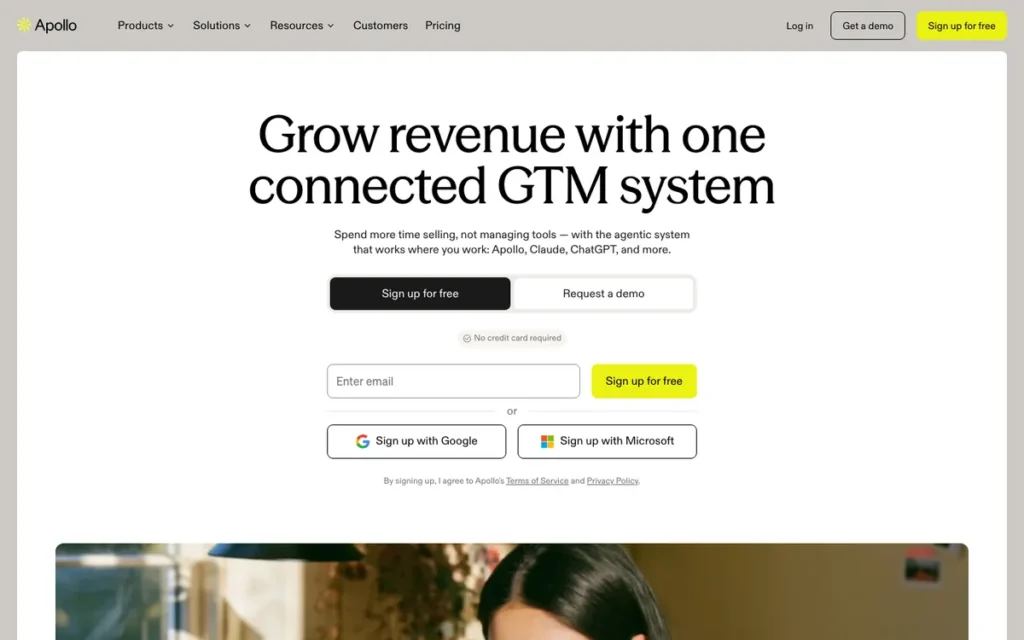
Category: All-in-One Outbound Platform, combines a 224M+ verified B2B contact database, multi-channel email sequences, a built-in dialer, LinkedIn automation, and AI prospecting agents in a single product at SMB-to-mid-market pricing.
At a Glance
- Category: All-in-One Outbound Platform
- Best For: SMB to mid-market B2B sales teams (1–100 reps) needing a unified prospecting-to-outreach platform without enterprise budget requirements or separate database and sequencing subscriptions
- Price Range: Free / $39–$99/user/month billed annually; Organization tier custom pricing
- Primary Strength: Apollo.io unifies a 224M+ verified contact database, multi-channel sequences, AI prospecting agents, and a built-in dialer in a single platform, the largest G2 review volume in the sales acceleration category (4.7/5 across 9,600+ reviews, Winter 2026)
- Biggest Limitation: Apollo.io’s direct-dial phone accuracy benchmarks at 71%: significantly below ZoomInfo’s 88%+, and EU contact data quality is unreliable for EMEA-focused outbound teams, requiring supplemental tools for either phone or international use cases
- One-Line Summary: Apollo.io delivers a unified 224M+ contact database, multi-channel sequences, and AI prospecting agents at a free-to-$99/month price point, earning the largest G2 review volume in the sales acceleration category (4.7/5, 9,600+ reviews, Winter 2026) and the “Best Overall Value” designation in PuzzleInbox’s independent 2026 B2B Data Providers comparison
- Last Verified: May 2026
Overview
Apollo.io is an all-in-one B2B sales intelligence and engagement platform serving 2M+ users across 600,000+ companies, combining a 224M+ verified contact database, multi-channel email sequences, a built-in dialer, LinkedIn automation, and AI prospecting agents in a single product designed for SMB and mid-market outbound teams.
Apollo.io eliminates the data-to-outreach gap that forces most sales teams to maintain separate prospecting databases and sequencing tools. Apollo.io’s unified architecture delivers approximately 80–90% of the combined functionality of ZoomInfo plus Outreach at a fraction of the combined annual cost, a value position validated by a $250M Series D announced in 2024 (vendor-reported, Apollo.io, 2024) and the highest G2 review volume in the category.
Key Features
- Apollo.io’s prospecting engine provides 100+ targeting filters: including technographics identifying companies using specific competitor tools, VC funding stage, hiring signals, and buying intent detection, enabling SDRs to build ICP-matched lead lists within the platform without switching to a separate database tool.
- Apollo.io’s Sequence module supports automated email, phone, and LinkedIn outreach steps with conditional branching logic, A/B testing on subject lines and messaging, and AI-generated personalized copy suggestions, scaling multi-touch outbound without requiring manual management at each sequence step.
- Apollo.io’s built-in dialer provides local presence calling, call recording, real-time rep notes, and post-call activity logging, allowing SDRs to prospect, call, and record outcomes in a single interface without purchasing a dedicated dialing solution.
- Apollo.io’s AI Prospecting Agents autonomously identify high-fit accounts based on ICP criteria and surface prioritized outreach recommendations with AI-generated talking points, reducing per-prospect research time by automating the account qualification step that precedes outreach.
- Apollo.io integrates bi-directionally with Salesforce, HubSpot, and Pipedrive: pushing enriched contact records, sequence activity logs, and call notes into the connected CRM automatically to maintain pipeline data integrity without manual entry.
Best For
Apollo.io is best for SMB to mid-market B2B sales teams of 1–100 reps that need a unified prospecting-to-outreach platform, cannot justify a $30,000+ ZoomInfo contract plus a separate sequencing tool, and prioritize email-first outbound motions over high-volume phone prospecting.
Apollo.io is also the strongest choice for teams that need to evaluate the platform at zero cost before committing budget, its genuine free tier provides risk-free validation that no other platform in this review matches.
Pricing
Apollo.io publishes full pricing on its website (verified May 2026):
- Free: $0/month (10,000 credits/month, basic sequences, 5 mobile credits/day, basic CRM integrations)
- Basic: $49/month or $39/month billed annually ($468/year per seat)
- Professional: $99/month or $79/month billed annually (full AI features, 30,000 credits/month, A/B testing, 300 mobile credits/day)
- Organization: Custom pricing (unlimited credits, SSO, dedicated support, advanced analytics)
A 5-person SDR team on Professional annual billing costs approximately $4,740/year. Community reviewers on r/SaaS and r/coldemail (May 2026) document aggressive upsell during onboarding and rigid 12-month cancellation policies, verify contract cancellation flexibility in writing before signing any annual agreement.
Strengths
- Apollo.io holds a 4.7/5 G2 rating across more than 9,600 verified reviews as of Winter 2026 (the largest review volume in the sales acceleration category) earning the “Best Overall Value” designation in PuzzleInbox’s independent 2026 B2B Data Providers comparison, ranked above ZoomInfo, Lusha, and Cognism on cost-to-value ratio (PuzzleInbox B2B Data Providers 2026).
- Apollo.io serves approximately 100,000 paying customers across 2M+ total users as of 2026, with a $250M Series D announced in 2024 (vendor-reported, Apollo.io, 2024), scale indicators consistent with strong product-market fit achieved during a period of broader SaaS funding contraction.
- Apollo.io’s aggregate platform benchmarks from its 2026 user base show reported improvements of +42% in lead quality, +38% more meetings booked, and +22% quota attainment improvement, with a 94% email deliverability benchmark across verified sends (Apollo.io platform data, 2026, vendor-reported aggregate benchmarks; not independently audited).
- Apollo.io’s free tier provides 10,000 monthly credits, basic sequences, meeting scheduling, and CRM integrations at $0/month, enabling genuine platform evaluation without financial commitment, a depth that all six other platforms in this review cannot match at zero cost.
Limitations
- Phone Data Accuracy Trade-Off: Apollo.io’s direct-dial phone accuracy benchmarks at 71% in third-party testing (compared to ZoomInfo’s 88%+) meaning SDR teams whose primary outbound motion depends on mobile number connect rates will experience materially lower call effectiveness per prospecting hour than ZoomInfo users (Mindcase B2B Data Accuracy Report, 2026).
- Email Verification Reliability Trade-Off: Apollo.io’s “verified” email labels still produce 10–15% bounce rates in high-volume sends per practitioner reports (r/coldemail, May 2026), requiring supplemental validation through ZeroBounce or NeverBounce before large-scale campaigns to protect sending domain health.
“the ‘verified’ emails still bounce like 10-15% of the time. If you send that raw, you burn your domains fast. Never trust the green tick.”, u/hardiktri56, r/coldemail, 2026
Takeaway: Treat Apollo.io’s email verification status as a first-pass filter only, run a third-party verification step before any campaign exceeding 1,000 sends to protect sending domain reputation.
- EU and International Data Trade-Off: Apollo.io’s contact data accuracy degrades significantly for non-US markets, and the built-in dialer applies a surcharge for EU-based reps, making Apollo.io a poor fit for teams with primarily EMEA target accounts, where Cognism’s GDPR-compliant, ISO 27701-certified data is the stronger alternative (u/ecra93, r/SaaS, 2025).
- Contract and Support Trade-Off: Apollo.io’s annual plans enforce rigid 12-month commitments with documented resistance to mid-contract cancellations, and support quality degrades noticeably on lower-tier plans, verify cancellation terms explicitly in writing before signing any annual agreement.
“We tried to cancel and they refuse to allow downgrades or cancellations before a full 12 months is up.”, u/AngieMG9, r/SaaS, 2025
Takeaway: Apollo.io’s cancellation policy is a procurement requirement to resolve in writing before the contract starts, not a negotiation preference to revisit after signing.
Verdict
Apollo.io is the best-value all-in-one sales acceleration platform for SMB and mid-market B2B teams in 2026, holding the largest G2 review volume in the category (4.7/5 across 9,600+ reviews, Winter 2026) alongside the most accessible pricing structure (free tier through $99/month) and a unified database-plus-sequencing architecture that directly addresses the “too many disconnected tools” bottleneck without enterprise budget requirements.
Teams deploying Apollo.io should implement third-party email verification before high-volume campaigns and confirm contract cancellation terms in writing before signing annual agreements. Teams for whom direct-dial phone accuracy or GDPR-compliant EU data are primary requirements should evaluate ZoomInfo or Cognism as data layer alternatives.
2. Gong: Best Revenue Intelligence for Coaching and Deal Inspection at Scale
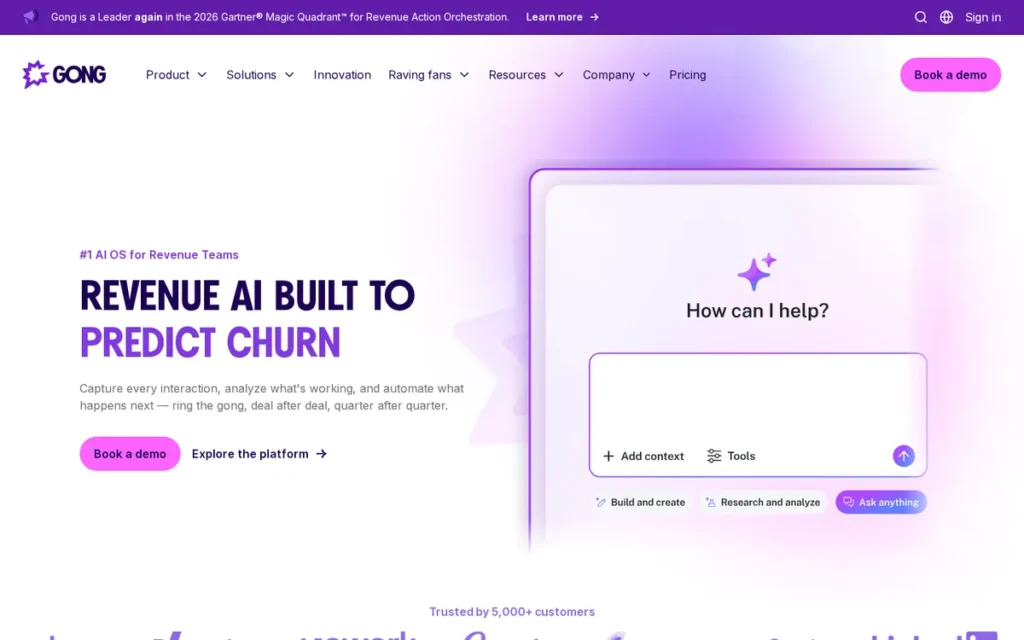
Category: Revenue Intelligence Platform, captures and analyzes all customer-facing interactions (calls, emails, meetings) to produce rep coaching recommendations, deal health scores, revenue forecasts, and AI-automated workflow actions across the sales organization.
At a Glance
- Category: Revenue Intelligence Platform
- Best For: Enterprise sales organizations (100+ reps) where coaching quality, win-rate improvement through conversation pattern analysis, and real-time deal risk visibility are the primary revenue leadership objectives
- Price Range: ~$160–$250/user/month (third-party estimates, May 2026); mandatory Foundation fee applies; enterprise implementations commonly exceed $100,000/year, all pricing requires a direct vendor quote
- Primary Strength: Gong’s Revenue AI is trained on 3.5 billion+ sales interactions (the largest proprietary conversation intelligence dataset in the category) enabling nuanced call analysis, multi-stakeholder engagement mapping, and deal risk predictions at a scale that no competitor’s publicly disclosed training dataset approaches as of May 2026
- Biggest Limitation: Gong does not publish pricing and charges a mandatory Foundation fee before any per-seat access, creating cost surprises during procurement, with enterprise year-one costs commonly exceeding $100,000 when all modules are included
- One-Line Summary: Gong is the 2025 Gartner Magic Quadrant Leader in Revenue Action Orchestration (placed highest on both ability-to-execute and completeness-of-vision axes (December 2025)) with $300M ARR at 28% year-over-year growth and a Revenue AI trained on 3.5 billion+ sales interactions
- Last Verified: May 2026
Overview
Gong is a Revenue AI platform that captures and analyzes customer interactions across calls, emails, and meetings to produce rep coaching recommendations, deal health inspections, pipeline forecasts, and automated workflow actions, serving approximately 4,500 customers (Sacra estimate, January 2025) on an AI model trained on more than 3.5 billion sales interactions.
Gong’s core architectural innovation is the Revenue Graph, a unified AI-powered knowledge base that maps relationships between conversations, deal stages, stakeholder engagement levels, and win/loss outcomes across the entire sales organization. Gong’s Revenue Graph enables pattern-based coaching and deal risk predictions derived from actual closed deals rather than theoretical sales methodology frameworks.
Key Features
- Gong’s Foundation module automatically records and transcribes customer conversations across Zoom, Microsoft Teams, and Google Meet, applying AI analysis trained on 3.5 billion+ interactions to detect competitor mentions, pricing objections, buying signals, and sentiment shifts across 70+ languages.
- Gong’s Deal Inspection capability applies machine learning models to flag at-risk pipeline opportunities, identify stalled deals, and surface specific manager coaching interventions before pipeline slippage occurs, providing deal health heatmaps that distinguish active engagement from silent accounts at the portfolio level.
- Gong’s Orchestrate module (launched October 2025) automates post-call follow-ups, pipeline record updates, and forecast corrections based on conversation analysis, with Gong’s own State of Revenue AI 2026 report attributing 5x execution acceleration and 2x individual rep productivity gains (vendor-reported analysis of 7.1 million opportunities; not controlled study results).
- Gong Forecast provides AI-generated revenue predictions with confidence scores, deal-level attainment probability, and pipeline variance analysis, operating as an independent revenue intelligence layer above CRM data in Salesforce, HubSpot, and Microsoft Dynamics environments.
- Gong Engage (optional add-on module) adds AI-prioritized sales engagement sequences, a built-in dialer, SMS, and email orchestration directly within the Gong platform, enabling teams to consolidate conversation intelligence and outreach management without a separate dedicated sequencing subscription.
Best For
Gong is best for enterprise sales organizations of 100+ reps where sales leadership’s primary objectives are improving rep coaching quality at scale, increasing win rates through conversation pattern recognition, and maintaining real-time deal risk visibility.
Gong requires dedicated RevOps resources for platform implementation, module configuration, and the change management required to drive rep adoption at the organizational scale where Gong’s AI advantages compound most meaningfully.
Pricing
Gong does not publish pricing on its website (verified May 2026). Third-party analyses (CheckThat, 2026; CloudTalk, 2026; MarketBetter, 2026) place enterprise per-seat pricing at approximately $160–$250/user/month, with a mandatory platform Foundation fee assessed separately from per-seat licensing.
Year-one implementation costs add $7,500–$65,000 depending on team size and module selection. Enterprise deployments with Engage, Insights, and Forecast modules commonly exceed $100,000/year total. Request an itemized quote that separately lists the Foundation fee, per-seat cost for each module, and implementation fees before finalizing budget projections.
Strengths
- Gong was named the Leader in Gartner’s Magic Quadrant for Revenue Action Orchestration (December 2025), placed highest on both the ability-to-execute and completeness-of-vision axes simultaneously, the most definitive independent analyst validation of category leadership available (Gartner MQ for Revenue Action Orchestration, December 2025; Clari was also named a Leader in the same evaluation).
- Gong surpassed $300M ARR in January 2025 at 28% year-over-year growth: the strongest reported financial performance of any standalone revenue intelligence platform, with the $300M milestone announced via press release on March 5, 2025 and confirmed by independent Sacra research estimating the underlying growth trajectory (Gong Press Release, March 5, 2025; Sacra, January 2025).
- Gong holds a 4.7/5 G2 rating across 6,400+ verified reviews as of May 2026: the highest sustained rating among revenue intelligence competitors (Chorus: 4.5/5 with 2,280+ reviews; Clari: 4.6/5 with 400+ reviews), with approximately 16x Clari’s review volume, reflecting significantly broader adoption across industry verticals (Tellius Best Revenue Intelligence Platforms 2026).
- Gong holds SOC 2 Type II, HIPAA, PCI-DSS, and ISO 27001 certifications: enabling compliant call recording in healthcare and financial services sales organizations whose industry-specific regulations exclude most conversation intelligence competitors (Gong certifications documentation, 2026).
Limitations
- Pricing Opacity Trade-Off: Gong does not publish pricing, assesses a mandatory Foundation fee separately from per-seat licensing, and commonly produces year-one costs exceeding $100,000 for enterprise deployments, making pre-purchase ROI modeling difficult and creating budget surprises during procurement (CheckThat Gong Pricing, 2026; MarketBetter Revenue Intelligence, 2026).
Users on r/AIToolTesting shared their experience:
“I’ve been on Gong for about 8 months now and the conversation intelligence is insane. Our close rate jumped by like 9 points just from coaching based on what Gong surfaces. The AI picks up on stuff I never would have caught, like how often reps interrupt prospects or when they lose deals after mentioning price too early. But man… $12k minimum annual contract? And that’s just for 3 seats. We’re a 15 person sales team and it would cost us roughly 60k a year to get everyone on it. CFO almost had a heart attack.” Posted by u/hydra_2108
Takeaway: Gong’s coaching ROI is practitioner-validated and measurable, but its per-seat pricing at full-team scale creates a budget barrier that makes enterprise-wide deployment impractical without explicit CFO-level budget commitment secured before procurement begins.
- Pre-Call Guidance Trade-Off: Gong is the category standard for analyzing what happened on a call and why a deal is at risk, but consistently delivers less actionable guidance on what reps should do before the next call, a gap that Salesloft’s Rhythm AI and Outreach’s SMART Actions address more directly, meaning Gong delivers its highest value when paired with a dedicated engagement platform rather than as a standalone solution.
- Platform Complexity Trade-Off: Gong requires dedicated RevOps support and significant change management to achieve rep adoption, teams that frame Gong as monitoring software rather than a coaching tool face systemic underutilization despite paying enterprise license fees, and many organizations report using only a fraction of the platform’s functionality (G2 user reviews, 2025–2026).
- Forecasting Overlap Trade-Off: Organizations frequently purchase both Gong (~$200–250/user/month) and Clari (~$200/user/month) simultaneously for overlapping forecasting capabilities (paying approximately $450/user/month for potentially redundant functionality) a rationalization opportunity that RevOps leaders should audit before adding Gong to an existing forecasting stack (MarketBetter Revenue Intelligence, 2026).
Verdict
Gong is the independently recognized category leader in revenue intelligence, earning the highest dual-axis ranking in Gartner’s 2025 Magic Quadrant for Revenue Action Orchestration, placed above all peers on both execution and vision simultaneously alongside Clari as the only other Leader in that evaluation.
For enterprise sales organizations where coaching quality, win-rate improvement, and deal risk visibility are primary objectives, Gong provides an AI advantage built on a 3.5B+ interaction training set that no competitor’s publicly disclosed dataset approaches as of May 2026.
The investment requires pricing transparency from the vendor, confirmed RevOps resourcing, and an internal positioning strategy that frames the platform as a coaching tool rather than monitoring software to realize that advantage in practice.
3. Salesloft: Best Revenue Orchestration for Enterprise Signal-Based Selling on Salesforce
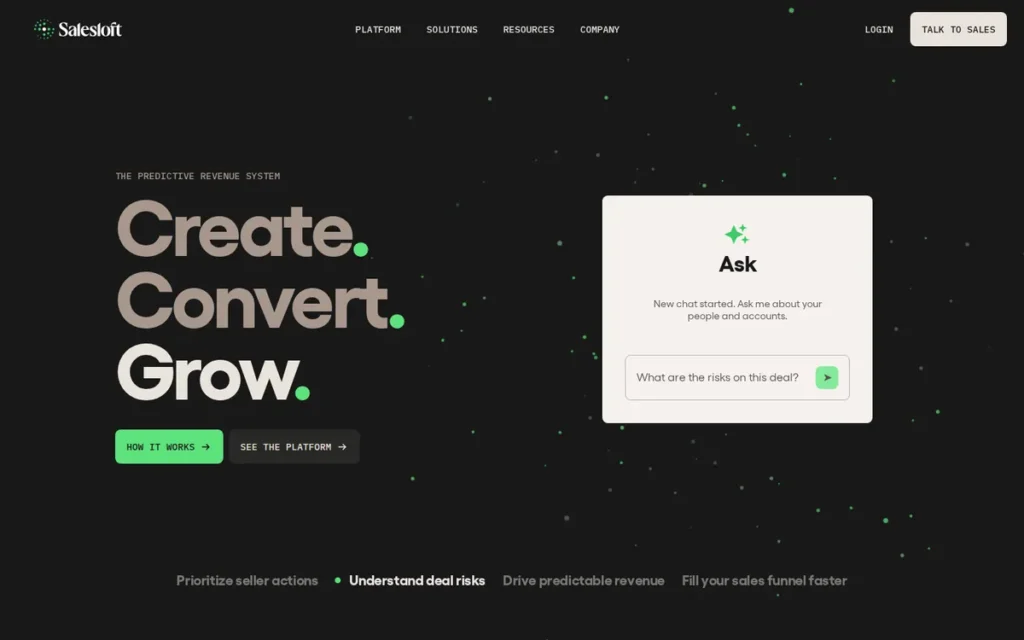
Category: Revenue Orchestration Platform, guides rep decision-making through AI buyer signal analysis, structures multi-channel outreach workflows, manages deal pipelines, and forecasts revenue across the full enterprise sales cycle.
At a Glance
- Category: Revenue Orchestration Platform
- Best For: Mid-market to enterprise B2B sales teams (50–1,000+ reps) standardized on Salesforce that want AI-guided daily prioritization, structured multi-channel outbound, and signal-based selling
- Price Range: ~$125+/user/month estimated floor (Essentials tier, third-party sources, May 2026); Advanced and Premier tiers higher; all plans are quote-based with no self-serve pricing
- Primary Strength: Salesloft’s Rhythm AI synthesizes first- and third-party buyer signals to automatically generate each rep’s prioritized daily action queue with specific next-step recommendations, the most commercially mature buyer-signal prioritization engine with documented enterprise deployment in the sales engagement category as of May 2026
- Biggest Limitation: Salesloft’s Rhythm AI is only as effective as the underlying Salesforce data that feeds it (teams with poor CRM hygiene see limited AI value despite paying enterprise rates) and pricing increased approximately 20% following Vista Equity Partners’ 2021 acquisition, introducing PE-ownership pricing risk
- One-Line Summary: Salesloft earned Visionary recognition in Gartner’s inaugural Magic Quadrant for Revenue Action Orchestration (December 2025), serving 5,000+ enterprise customers with its Rhythm AI buyer-signal prioritization engine, 98%+ Salesforce sync accuracy, and a 4.6/5 G2 rating across 1,500+ reviews
- Last Verified: May 2026
Overview
Salesloft is an AI-powered Revenue Orchestration Platform combining multi-channel cadence automation, Rhythm AI buyer signal prioritization, Conversations call intelligence, Deals pipeline management, and revenue Forecasting, serving 5,000+ enterprise customers globally since its 2011 founding, with a 4.6/5 G2 rating across 1,500+ reviews as of May 2026.
Salesloft’s Rhythm module is its most architecturally distinctive capability. Rather than automating outreach sequences alone, Salesloft’s Rhythm AI analyzes engagement signals across the rep’s connected technology stack (email opens, website visits, ZoomInfo intent signals, LinkedIn interactions) and surfaces a prioritized action queue with the specific reasoning behind each recommendation, shifting the platform’s value from outreach automation to AI-guided rep decision-making.
Key Features
- Salesloft’s Cadence module enables multi-channel outreach sequences across email, phone, LinkedIn, and SMS with conditional branching logic that automatically adapts sequence progression based on prospect engagement signals (including opens, clicks, direct replies, and meeting bookings) without requiring manual rep intervention at each decision point.
- Salesloft’s Rhythm AI aggregates first-party engagement signals and third-party intent data (including ZoomInfo buying signals, LinkedIn engagement, and website behavioral data) to automatically generate each rep’s prioritized daily action queue with specific recommended next actions and the reasoning behind each prioritization.
- Salesloft’s Conversations module records, transcribes, and analyzes all sales calls to surface competitor mentions, pricing objections, follow-up commitments, and rep performance patterns, providing managers with AI-generated coaching alerts without requiring manual call review across the full rep team.
- Salesloft’s April 2026 MCP (Model Context Protocol) Server allows AI tools including Claude to query live pipeline data, call records, and account information directly from Salesloft, available with the Salesloft Agentic add-on, positioning the platform at the frontier of agentic sales AI architecture (Salesloft April 2026 Release Notes).
- Salesloft’s Salesforce integration logs activities at 98%+ accuracy with bi-directional sync supporting custom objects and granular field mapping, maintaining complete outreach activity records in CRM to preserve the forecasting data integrity that RevOps leaders depend on for accurate pipeline predictions (LaGrowthMachine Salesloft Review, May 2026).
Best For
Salesloft is best for mid-market to enterprise B2B sales teams of 50–1,000+ reps that are standardized on Salesforce, run structured multi-channel outbound motions, want AI-guided daily prioritization to replace manual task planning, and have trained RevOps administrators available to maintain the Salesforce data quality that Rhythm AI requires to function effectively.
Pricing
Salesloft does not publish pricing on its website (verified May 2026). Third-party sources (LaGrowthMachine, 2026; Landbase, 2026) estimate:
- Essentials: ~$125/user/month (estimated floor; core Cadence workflows)
- Advanced: Higher; adds Rhythm AI and Conversations call intelligence
- Premier: Highest; adds Deals pipeline management and Forecast module
All plans require a sales conversation for a custom annual quote. Multiple G2 reviewers and r/sales community members report approximately 20% price increases following Vista Equity Partners’ 2021 acquisition, request contractual price-lock provisions if committing to multi-year terms.
Strengths
- Salesloft earned Visionary recognition in Gartner’s inaugural Magic Quadrant for Revenue Action Orchestration (December 2025) (the new unified category replacing the Sales Engagement Platforms designation) alongside Forrester Wave recognition for AI-driven orchestration (Q4 2024), providing dual analyst-firm validation of its platform direction (Gartner MQ RAO, December 2025; Forrester Wave Q4 2024).
- Salesloft’s Salesforce integration achieves 98%+ activity logging accuracy with bi-directional sync supporting custom objects and granular field mapping, the highest independently reported CRM sync reliability in the sales engagement category, directly protecting the forecasting data integrity RevOps teams require for accurate pipeline models (LaGrowthMachine Salesloft Review, May 2026).
- Salesloft-attributed customer outcomes cited in third-party comparative analyses (Sybill, Avoma, 2025–2026) include quota attainment improvements reported in the range of 25–30 percentage points for enterprise technology customers using Cadence and Rhythm AI workflows, directionally consistent with AI productivity uplift documented in Salesforce State of Sales 2024, though not independently verified by PlugRoute through primary case study documentation; request named case studies directly from Salesloft before using these figures in internal ROI models.
- Salesloft’s April 2026 MCP Server launch enables direct AI agent integration with tools including Claude, allowing live pipeline, call, and account data queries for AI-powered analysis, making Salesloft among the first revenue orchestration platforms to publish a documented agentic AI architecture for enterprise deployments (Salesloft Release Notes, April 2026).
Limitations
- CRM Data Quality Dependency Trade-Off: Salesloft’s Rhythm AI signal-based prioritization is only as accurate as the Salesforce data that feeds it, teams with inconsistent CRM hygiene, stale contact records, or fragmented activity logging realize limited AI value despite paying premium enterprise rates for Advanced or Premier tiers (G2 user reviews, 2025; Trellus Comparison, 2026).
- PE Ownership Pricing Trade-Off: Vista Equity Partners’ 2021 acquisition at a $2.4B valuation has produced documented post-acquisition price increases of approximately 20% according to r/sales community reports, request contractual price-lock provisions before committing to multi-year annual terms to protect against ongoing pricing escalation.
- Gartner Recognition Gap Trade-Off: Salesloft earned Visionary (not Leader) recognition in Gartner’s inaugural Revenue Action Orchestration MQ (December 2025), a distinction that holds significance for enterprise procurement teams using Gartner Leader status as a vendor qualification criterion, particularly when comparing against Gong and Clari, both of which were named Leaders in the same evaluation cycle.
Users on r/sales noted:
“We just switched to salesloft to replace Gong and Outreach and pretty much everyone in the org hates it. SL AI recording transcription is supremely dogshit, it thinks I’m the prospect 90% of the time and never captures next steps the way Gong would. As annoying Gong reps are I like the product.” Posted by u/Im_Mr_November
Takeaway: Teams consolidating from Gong onto Salesloft’s Conversations module as their primary call intelligence layer will face a documented quality downgrade in AI transcription accuracy and automated next-steps capture relative to Gong’s market-leading standard.
- Pricing Opacity Trade-Off: Salesloft does not publish self-serve pricing, requiring all prospects to enter a vendor sales process before completing basic budget planning, a friction that advantages platforms with transparent pricing (Apollo.io, HubSpot) during early shortlisting stages.
Verdict
Salesloft is the leading revenue orchestration platform for enterprise Salesforce teams in 2026, earning Gartner Visionary recognition in the inaugural Revenue Action Orchestration MQ (December 2025), a 4.6/5 G2 rating across 1,500+ reviews, and the highest independently reported Salesforce sync reliability (98%+) in the sales engagement category, combined with the April 2026 MCP Server positioning Salesloft at the frontier of agentic AI architecture for revenue teams.
Teams evaluating Salesloft should audit Salesforce data quality before Rhythm AI deployment, budget beyond the ~$125/seat estimated floor for Advanced and Premier tiers, and secure contractual price-lock provisions given documented post-Vista acquisition pricing escalation patterns before committing to annual terms.
4. Salesforce Sales Cloud: Best Enterprise CRM + AI Suite for Complex Global Sales Operations
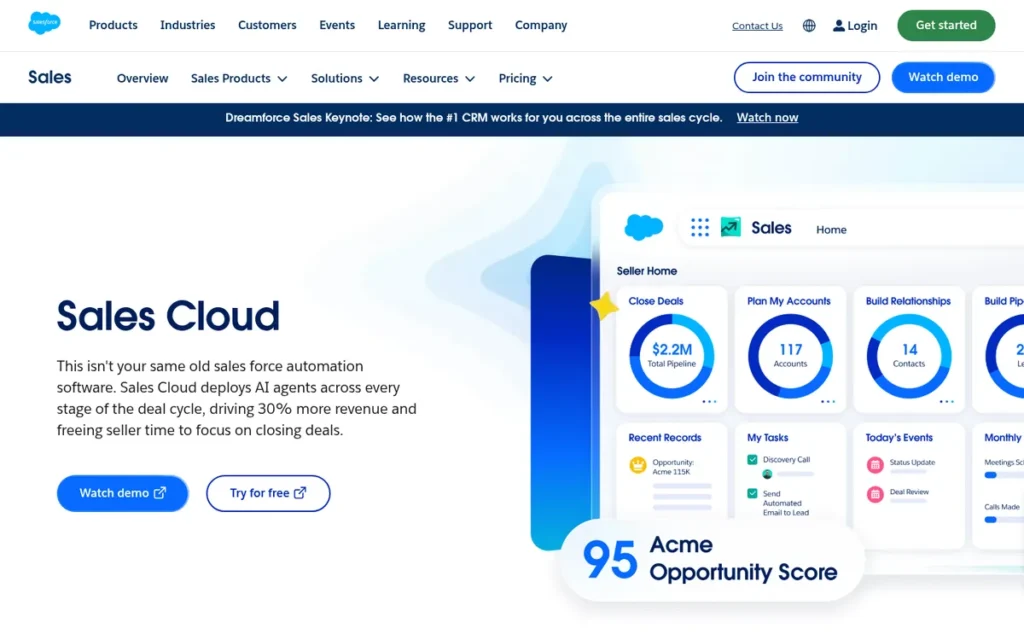
Category: Enterprise CRM + AI Suite, the world’s most widely deployed CRM platform with embedded sales acceleration tools (sequences, Einstein AI scoring, Agentforce autonomous agents), revenue intelligence dashboards, and the largest B2B software integration ecosystem via AppExchange.
At a Glance
- Category: Enterprise CRM + AI Suite
- Best For: Enterprise and large mid-market organizations (100+ reps) requiring a single system of record for complex, multi-territory, multi-product sales operations with maximum configurability and dedicated Salesforce administrator resources
- Price Range: $25–$500/user/month list price (published); enterprise TCO for a 50-rep team typically $200,000–$500,000/year including admin salary, implementation, and add-ons
- Primary Strength: Salesforce Sales Cloud is the only CRM ranked #1 by G2 across SMB, Mid-Market, and Enterprise segments simultaneously (2024 Grid Award), serving 150,000+ companies with an AppExchange of 4,000–9,000+ integrations that makes it the integration backbone for virtually every other sales acceleration platform in this review
- Biggest Limitation: Salesforce Sales Cloud requires a dedicated administrator ($80,000–$130,000/year salary) for meaningful customization, and its Agentforce AI now offers three pricing models, $2/conversation, Flex Credits (~$0.10/action, introduced May 2025), and per-user licenses, creating budget modeling complexity on top of an already high enterprise TCO
- One-Line Summary: Salesforce Sales Cloud is the G2 #1 CRM across all company sizes (2024 Grid Award), serves 150,000+ customers including the majority of the Fortune 500, and provides the integration backbone for virtually every other platform in this review through its AppExchange of 4,000–9,000+ apps
- Last Verified: May 2026
Overview
Salesforce Sales Cloud is the world’s leading enterprise CRM and sales automation platform, serving 150,000+ companies globally, generating over $34 billion in annual revenue (FY2024), and functioning as the integration backbone that all major sales engagement platforms (Salesloft, Outreach, Gong, ZoomInfo) build their deepest compatibility with first.
Salesforce Sales Cloud’s 2026 platform combines Einstein AI (predictive lead and opportunity scoring, automated activity capture), Agentforce (autonomous AI agents for prospect qualification and CRM record updates via ChatGPT and Slack), Sales Engagement sequences, Revenue Intelligence dashboards, and the AppExchange marketplace. Salesforce Sales Cloud’s realized value scales directly with the organizational investment in administrator expertise and implementation quality.
Key Features
- Salesforce Sales Cloud’s Agentforce platform (Summer ’26) deploys autonomous AI agents that qualify contacts and company accounts against Ideal Customer Profile criteria, execute account research using live Salesforce data, and update CRM records via natural language commands directly within ChatGPT and Slack, enabling reps to complete qualification tasks without leaving their existing AI interfaces (Salesforce Ben Summer 2026 Release Notes).
- Salesforce Sales Cloud’s Einstein AI provides predictive lead scoring, opportunity health scoring, and automated activity capture from Outlook and Gmail, automatically logging emails and calendar events to maintain complete contact engagement histories and reduce the manual data entry burden that consistently drives rep non-adoption of CRM systems.
- Salesforce Sales Cloud’s Summer ’26 Pipeline Inspection module introduces a 30-day engagement heatmap displaying voice call, video call, event, and email activity levels per deal, giving managers at-a-glance relationship health visibility for every open opportunity without drilling into individual contact records (LevelShift Spring 2026 Sales Cloud Features).
- Salesforce Sales Cloud’s AppExchange marketplace provides 4,000–9,000+ native integrations (including Salesloft, Outreach, Gong, ZoomInfo, and LinkedIn Sales Navigator) making Salesforce the only CRM in this review capable of simultaneously integrating cleanly with every other category of sales acceleration tool.
- Salesforce Sales Cloud’s Revenue Intelligence module provides territory performance comparison, deal health scoring by segment, and multi-tier pipeline inspection, feeding enterprise-grade analytics into forecasting models without requiring a separate BI tool for sales operations teams managing complex, multi-territory pipelines.
Best For
Salesforce Sales Cloud is best for enterprise and large mid-market organizations of 100+ reps with dedicated Salesforce administrator resources, complex multi-territory or multi-product sales motions requiring maximum platform configurability, and operational needs that include FedRAMP, HIPAA, or PCI-DSS compliance.
Salesforce Sales Cloud is particularly suited for organizations whose sales motion depends on layering specialized tools (Salesloft, Outreach, Gong, ZoomInfo) cleanly on top of a single system of record, since every major acceleration platform in this review builds its deepest integration with Salesforce first.
Pricing
Salesforce Sales Cloud publishes list pricing on its website (verified May 2026):
- Starter Suite: ~$25/user/month
- Pro Suite: ~$80/user/month
- Enterprise: ~$165/user/month (custom objects, territory management, advanced reporting)
- Unlimited: ~$330/user/month (Einstein AI, 24/7 support)
- Einstein 1 Sales: ~$500/user/month (full Agentforce, Data Cloud, Slack)
Enterprise TCO for a 50-person team typically runs $200,000–$500,000/year when a dedicated Salesforce administrator salary ($80,000–$130,000/year), professional services implementation (20–100% of year-one license cost), Agentforce usage fees, and required add-ons are included. Evaluate list price and total cost of ownership separately, the gap between them is the most common source of Salesforce budget overruns (DigitalApplied HubSpot vs. Salesforce 2026).
Strengths
- Salesforce Sales Cloud holds the #1 position on G2’s CRM Grid across SMB, Mid-Market, and Enterprise segments simultaneously (2024 Grid Award) (a cross-segment leadership achievement no other CRM in this review has replicated) and earns Gartner Magic Quadrant Leader recognition in Sales Force Automation (2024), specifically for Agentforce’s flexibility for sales operations administrators.
- Salesforce’s State of Sales report (2024) found that AI users in sales are 2.8x more likely to exceed quota than non-AI users (83% attainment rate versus 66% for non-AI users) with 76% of AI-using sales teams reporting revenue increases; findings consistent with independent McKinsey and Forrester research on AI-driven sales productivity (Salesforce State of Sales, 2024).
- Salesforce generates over $34 billion in annual revenue (FY2024), employs approximately 72,000 people globally, operates in 90+ countries, and holds SOC 1 Type II, SOC 2 Type II, ISO 27001, and FedRAMP certifications, providing enterprise procurement teams with vendor stability and a 20M+ certified professional ecosystem that materially reduces platform dependency risk.
- Salesforce Sales Cloud Summer ’26 introduces an Agentforce Sales App in ChatGPT: enabling reps to update CRM records, research leads, and plan account strategies within external AI interfaces using secure, live Salesforce data, representing the most advanced autonomous AI CRM architecture commercially available as of May 2026 (Salesforce Ben Summer 2026 Release Notes).
Limitations
- Admin Dependency and Hidden TCO Trade-Off: Salesforce Sales Cloud requires a dedicated administrator (commanding $80,000–$130,000/year in market salary) along with professional services implementation costs that commonly add 20–100% to year-one licensing, making the effective enterprise TCO $200,000–$500,000/year for a 50-rep team versus list pricing of $54,000–$112,500/year before add-ons (DigitalApplied, 2026; CRMSwitch).
- Agentforce Pricing Complexity Trade-Off: Salesforce Sales Cloud’s Agentforce AI launched at $2/conversation (October 2024), with Salesforce introducing Flex Credits (~$0.10/action) in May 2025 and per-user licenses for high-volume deployments, creating three pricing models that, while flexible, increase budgeting complexity and require careful usage monitoring to prevent cost overruns (Salesforce Agentforce Pricing, 2026; SaaStr, 2025).
- Interface Complexity and Adoption Risk Trade-Off: Salesforce Sales Cloud’s rep-facing interface consistently draws complexity criticism that drives non-adoption in resource-constrained deployments (the r/sales community captures the practical trade-off directly: “HubSpot has a higher floor, Salesforce has a higher ceiling”) meaning teams without admin resources to configure Salesforce properly pay enterprise prices for a mid-market deployment (CRMSwitch, 2026).
- Workflow Automation Learning Curve Trade-Off: Salesforce Sales Cloud’s Flows (workflow automation) require certified Salesforce administrators to configure effectively, creating a capability gap between what the platform can theoretically achieve and what under-resourced teams actually deploy in practice.
Verdict
Salesforce Sales Cloud is the most extensively validated enterprise CRM + AI platform in this review, holding G2 #1 CRM status across all company sizes (2024), serving 150,000+ customers globally, and providing the AppExchange integration backbone that makes it the default infrastructure choice for organizations layering specialized sales acceleration tools onto a single authoritative system of record.
Organizations evaluating Salesforce must model total cost of ownership accurately beyond list pricing, including dedicated admin salary, professional services, and multi-model Agentforce usage fees. Confirm that administrator resources are secured before deployment to avoid paying enterprise rates for an under-configured system.
5. Outreach: Best Sales Engagement Depth for Enterprise High-Volume Outbound on Salesforce
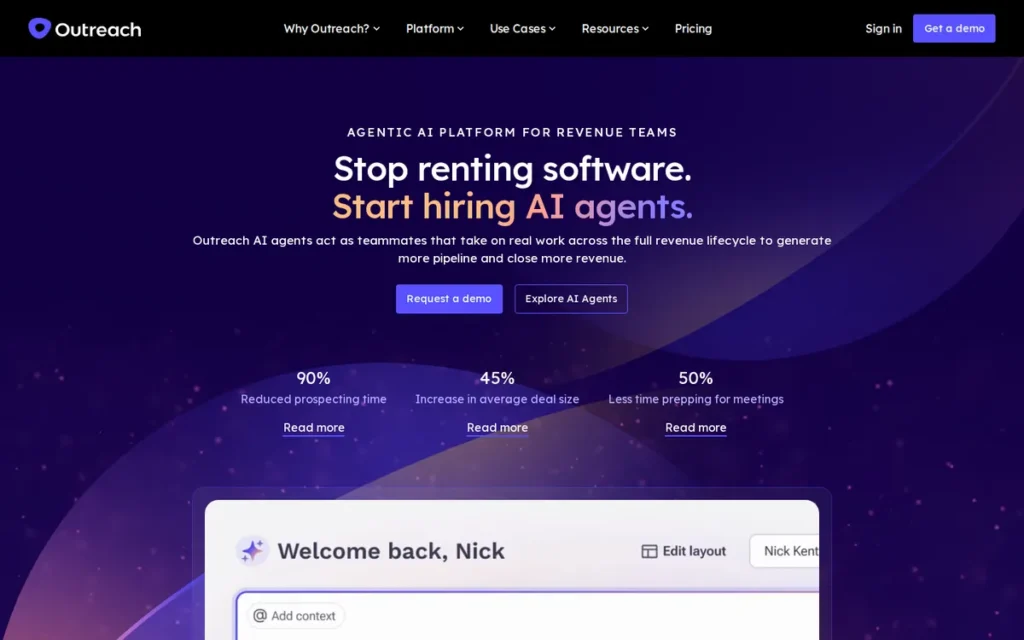
Category: Sales Engagement Platform, automates and orchestrates multi-channel outbound sequences with AI-assisted next-action prioritization, real-time Kaia AI call coaching, pipeline risk management, and revenue intelligence for enterprise SDR and AE teams.
At a Glance
- Category: Sales Engagement Platform
- Best For: Enterprise B2B SDR and AE teams (100+ reps) running Salesforce as their primary CRM, executing high-volume multi-channel outbound with complex conditional sequence logic, and backed by dedicated RevOps administrators
- Price Range: ~$100–$200+/user/month (third-party estimates, May 2026); On-Demand add-on ~$50/user/month; all plans quote-based with no self-serve pricing
- Primary Strength: Outreach provides the deepest conditional multi-channel sequence architecture in the enterprise sales engagement category, with claimed 75% penetration across Fortune 100 technology companies (vendor-reported), Kaia AI real-time call coaching, and a February 2026 ZoomInfo Smart Data Enrichment integration
- Biggest Limitation: Outreach scores 7.7/10 on G2’s ease-of-setup metric: meaningfully below Salesloft’s 8.6/10, and its HubSpot CRM integration is materially weaker than its Salesforce integration, making Outreach a poor fit for mid-market teams on HubSpot
- One-Line Summary: Outreach earns a 4.3/5 G2 rating across 3,500+ verified reviews, serving enterprise SDR teams at Okta, Snowflake, Datadog, and Samsara with the deepest conditional multi-channel sequence automation and Kaia AI real-time call coaching in its competitive category
- Last Verified: May 2026
Overview
Outreach is an enterprise sales execution platform built for high-velocity SDR and AE teams (combining multi-channel sequence automation, AI SMART Actions for signal-driven task prioritization, Kaia AI real-time call coaching, and deal management with pipeline risk alerts) serving 5,000+ customers as of 2026.
Outreach’s February 2026 platform update integrated ZoomInfo’s Smart Data Enrichment to surface website visitor intent signals directly within the sequencing workflow, advancing Outreach’s evolution from outreach automation toward signal-driven sales intelligence that competes more directly with Salesloft’s Rhythm AI in the buyer-signal orchestration space (Outreach Product Release Notes, February 2026).
Key Features
- Outreach’s Sequences module supports multi-channel automated outreach across email, phone, LinkedIn, and SMS, with conditional branching logic, A/B testing on messaging variants, compliance checks for CAN-SPAM and GDPR, and dynamic scheduling that adjusts send timing based on recipient time zone and historical engagement patterns.
- Outreach’s AI SMART Actions surface signal-driven task recommendations synthesized from conversation intelligence, CRM deal data, buyer engagement patterns, and third-party intent signals, automatically generating prioritized action queues to reduce the daily prospecting decision burden for SDRs managing large book-of-business volumes.
- Outreach’s Kaia AI delivers real-time in-call coaching during live customer conversations (including suggested responses to detected objections, competitor mention alerts, and automated note capture) coaching the rep concurrently while the call is happening rather than solely through post-call analysis.
- Outreach’s Deal Management module flags at-risk pipeline opportunities based on engagement gap analysis, visualizes stage progression health, generates mutual customer action plans, and pushes risk alerts to managers, integrating with Salesforce deal records to maintain data consistency across both platforms.
- Outreach’s February 2026 ZoomInfo Smart Data Enrichment integration identifies high-intent accounts actively visiting a prospect’s website and surfaces those signals directly within Outreach’s sequencing workflow, enabling intent-triggered outreach without requiring reps to switch to a separate ZoomInfo interface (Outreach Product Release Notes, February 2026).
Best For
Outreach is best for enterprise B2B sales organizations of 100+ reps that run Salesforce as their primary CRM, require sophisticated multi-step conditional sequence logic with granular Salesforce field-level mapping, have dedicated RevOps administrators to manage platform configuration, and prioritize maximum sequence customization depth and real-time AI call coaching over ease of initial platform setup.
Pricing
Outreach does not publish pricing on its website (verified May 2026). Third-party estimates (Sybill, 2026; Skyp.ai, 2026):
- Standard: ~$100/seat/month (core sequences, basic reporting, email/call integration)
- Professional: ~$150/seat/month (AI SMART Actions, Kaia conversation intelligence, forecasting)
- Enterprise: ~$200+/seat/month (full Sales AI, revenue intelligence, SSO, ZoomInfo Smart Data Enrichment)
- On-Demand add-on: ~$50/user/month for high-volume sending
These figures are third-party estimates as of May 2026, verify current pricing directly with Outreach during evaluation before any budget commitment.
Strengths
- Outreach holds a 4.3/5 G2 rating across 3,500+ verified reviews, a 4.6/5 Capterra rating across 1,100+ reviews, and an 8.9/10 TrustRadius rating across 450+ reviews as of May 2026, with claimed penetration across 75% of Fortune 100 technology companies including Okta, Zoom, Samsara, OneTrust, Autodesk, Snowflake, and Datadog (vendor-reported, Outreach.io, 2026; not independently verified by PlugRoute).
- Outreach’s February 2026 ZoomInfo Smart Data Enrichment integration delivers website visitor intent signals identifying high-intent accounts, surfaced directly within Outreach’s sequencing workflow without requiring reps to access ZoomInfo separately, advancing Outreach’s signal-based selling architecture toward Salesloft’s Rhythm AI capability level (Outreach Product Release Notes, February 2026).
- Outreach’s Kaia AI provides real-time in-call coaching during live conversations: delivering suggested objection responses, competitor mention alerts, and automated action item capture concurrently as the call unfolds, a capability that Salesloft’s Conversations module delivers primarily through post-call analysis rather than concurrent rep guidance.
- Outreach raised $519M in total funding across seven rounds, most recently a $200M Series G at a $4.4B valuation in 2022, with CEO Salem Cherchaoui appointed in 2024 following founder Manny Medina’s transition to Executive Chair, marking a shift to professionally managed operations targeting profitability.
Limitations
- Setup Complexity Trade-Off: Outreach’s G2 ease-of-setup score of 7.7/10: versus Salesloft’s 8.6/10, reflects a real implementation friction that extends time-to-value for new deployments, earning the “SUV of the category” description from experienced users: powerful for teams that can manage its complexity, overbuilt for smaller teams with simpler linear sales motions (SalesRobot; Skyp.ai, 2026).
- Salesforce Sync Latency Trade-Off: Outreach’s Salesforce integration: despite being architecturally deep, draws documented community criticism for sync latency in high-velocity SDR environments that creates activity logging gaps in forecasting models.
“integration with Salesforce is laggy at best and gives me a level of rage I didn’t think I would ever have.”, u/SmolDiamondHands, r/sales (102 upvotes)
Takeaway: Even Outreach’s deepest integration (Salesforce) draws documented latency complaints at high velocity; test Salesforce sync speed under production conditions before committing to an annual contract.
- HubSpot Integration Gap Trade-Off: Outreach’s HubSpot CRM integration is materially weaker than its Salesforce integration, making Outreach a poor architectural choice for mid-market organizations standardized on HubSpot, teams in this configuration should evaluate Salesloft or HubSpot Sales Hub Professional instead.
- Cost Premium Trade-Off: Outreach’s $100–$200+/seat/month pricing is prohibitive for teams under 50 reps or those with straightforward linear sales motions, the platform’s power and complexity are overkill for simple prospecting sequences that Apollo.io or HubSpot Professional handles at a fraction of the cost.
Verdict
Outreach is the enterprise standard for high-velocity multi-channel sales execution, earning a 4.3/5 G2 rating across 3,500+ reviews and claimed adoption across 75% of Fortune 100 technology companies, making it the strongest choice for large enterprise SDR teams running complex conditional sequence logic on Salesforce with dedicated RevOps support.
The primary trade-off versus Salesloft is clear and evidence-backed: Outreach offers deeper sequence customization and real-time concurrent call coaching (Kaia AI) at the cost of greater admin investment, a weaker HubSpot integration, and a 0.3-point lower G2 rating (4.3 vs. Salesloft’s 4.6). Teams prioritizing AI buyer signal prioritization, Salesforce sync reliability, and a more modern interface will find Salesloft the stronger fit despite Outreach’s sequence depth advantage.
6. HubSpot Sales Hub: Best CRM-Native Platform for SMB and Inbound-Aligned Sales Teams
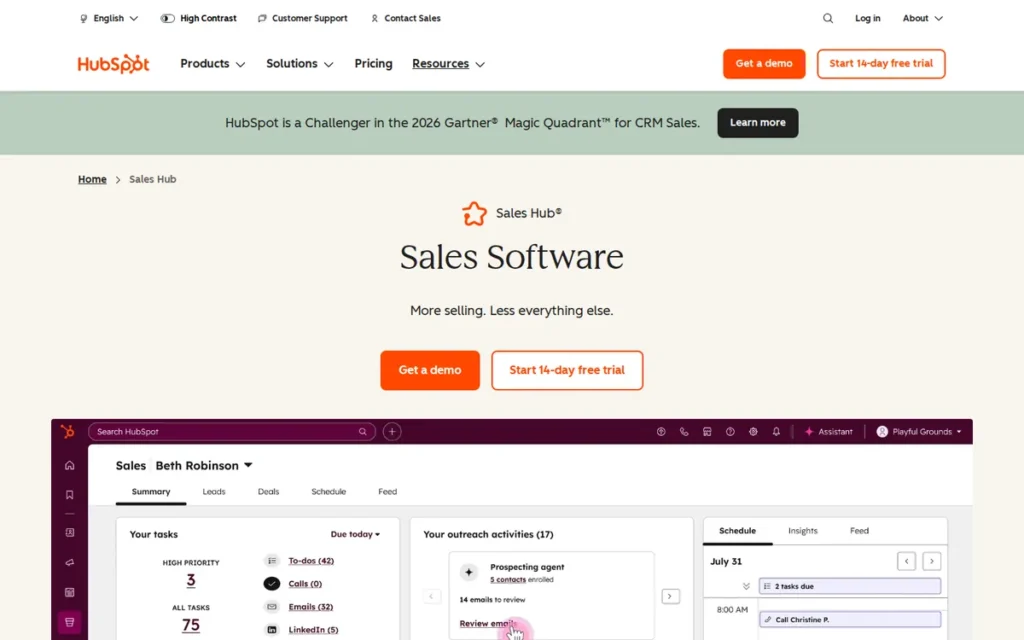
Category: CRM-Native Sales Platform, combines a full-featured free CRM with built-in sales acceleration tools (sequences, meeting scheduling, Breeze AI coaching, deal pipelines, ABM, and forecasting) in a single unified system connecting marketing, sales, and service data without inter-platform sync requirements.
At a Glance
- Category: CRM-Native Sales Platform
- Best For: SMB to mid-market B2B teams (1–200 reps) that have not standardized on Salesforce, want a unified CRM-plus-acceleration platform with transparent pricing and a functional free tier, and run a hybrid inbound-plus-outbound motion
- Price Range: Free ($0); Starter $20/user/month; Professional $100/user/month; Enterprise $150/user/month (published, verified May 2026)
- Primary Strength: HubSpot Sales Hub provides the most transparent, accessible pricing structure in the sales acceleration category (from a genuinely functional free tier through $150/user/month Enterprise) while eliminating CRM integration friction through its native architecture that keeps all customer data, sales activity, and marketing attribution in one system
- Biggest Limitation: HubSpot Sales Hub locks sequences, forecasting, and lead scoring behind the Professional tier ($100/user/month) (a 5x price increase from the $20/month Starter tier) and imposes a 500-contacts-per-day sequence cap that constrains high-volume SDR teams
- One-Line Summary: HubSpot Sales Hub is a CRM-native sales acceleration platform serving 215,000+ customers across 120+ countries with fully published pricing from free to $150/user/month, a genuine free tier, and a native architecture that eliminates data-sync complexity, the leading choice for SMB and mid-market B2B teams not standardized on Salesforce in 2026
- Last Verified: May 2026
Overview
HubSpot Sales Hub is a CRM-native sales acceleration platform combining email tracking, automated sequences, meeting scheduling, deal management, Breeze AI scoring, forecasting, and ABM tools in a single unified system, serving 215,000+ customers across 120+ countries as of 2026 (HubSpot public filings, Q4 2024).
HubSpot Sales Hub’s foundational architectural advantage is the elimination of CRM integration friction. HubSpot Sales Hub keeps all contact records, marketing attribution data, sales activity, and customer service history in one system, avoiding the Salesforce sync reliability issues and activity logging gaps that Outreach and Salesloft users document as primary sources of forecasting inaccuracy in multi-tool deployments.
Key Features
- HubSpot Sales Hub’s Sequences module enables automated email and task-based outreach cadences for up to 500 contacts per day at the Professional tier, with full behavioral timeline views per contact showing emails, calls, meetings, page visits, and form submissions in chronological order within the CRM record, giving reps complete context without switching between systems.
- HubSpot Sales Hub’s Breeze AI suite provides predictive lead scoring, AI-generated call and email summaries, Next-Best-Action recommendations, and deal insight alerts, integrating AI coaching natively into the CRM record without requiring a separate conversation intelligence tool subscription (Sidekick Strategies HubSpot Guide, 2026).
- HubSpot Sales Hub’s Meeting Scheduling feature: available at the free tier, allows prospects to book directly from a rep’s calendar availability link and logs booked meetings automatically to the contact record and connected deal pipeline, reducing email coordination overhead in manual scheduling workflows.
- HubSpot Sales Hub’s Account-Based Marketing tools at the Professional tier enable company scoring, target account list management, and ABM-specific dashboards, supporting structured enterprise account prospecting alongside standard outbound contact sequences within a single platform.
- HubSpot Sales Hub provides multi-pipeline deal management with deal splits for team revenue attribution and 36 months of historical data for forecasting analytics at Enterprise, supporting multi-segment sales organizations that need parallel inbound and outbound pipeline tracking (MarketBetter AI HubSpot Review, 2026).
Best For
HubSpot Sales Hub is best for SMB to mid-market B2B teams of 1–200 reps that are not committed to Salesforce, want a single platform for CRM and sales acceleration without integration complexity, and prefer fully published transparent pricing over vendor-negotiated annual contracts.
HubSpot Sales Hub is also well-suited for teams running a hybrid inbound-and-outbound motion that benefits from marketing-sales data sharing, the native architecture eliminates the attribution blind spots that occur when outreach tools maintain separate activity logs from the CRM system of record.
Pricing
HubSpot Sales Hub publishes full pricing on its website (verified May 2026):
- Free: $0/month (1 pipeline, 200 email notifications/month, meeting scheduling, basic deal management)
- Starter: $20/user/month (simple automation, 5,000 email templates, 500 calling minutes/month)
- Professional: $100/user/month (sequences up to 500 contacts/day, forecasting, custom reports, ABM, lead scoring)
- Enterprise: $150/user/month (predictive AI scoring, conversation intelligence, custom objects, deal splits, sandbox, IVR)
The Starter-to-Professional jump ($20 to $100/user/month) is the most-cited pricing friction point, sequences and forecasting are locked behind Professional. Annual commitment reduces costs approximately 10–20% versus monthly billing (MarketBetter AI HubSpot Review, 2026).
Strengths
- HubSpot Sales Hub earned #1 or top-3 placement in G2’s CRM Grid for SMB and Mid-Market segments in both 2024 and 2025, with GetApp ratings of 4.6/5 for Activity Tracking and 4.8/5 for Reminders across 498 verified reviews, consistent top-segment recognition reflecting sustained satisfaction among the non-enterprise buyer segment that represents HubSpot’s primary market (G2 CRM Grid, 2024–2025; GetApp, 2026).
- HubSpot Sales Hub serves 215,000+ customers across 120+ countries: the highest total customer count of any platform in this review, built through 18+ years of product development since HubSpot’s 2006 founding, with 1,000+ native integrations and HubSpot Academy providing the most comprehensive vendor-built sales training infrastructure in the category for reducing new-hire ramp time.
- HubSpot Sales Hub’s free tier provides genuine, functional sales acceleration capabilities (meeting scheduling, email tracking, deal pipelines, CRM records, and 200 email notifications per month at $0/month) enabling teams to validate the platform’s core workflow before committing any budget, a depth that all six other platforms in this review cannot match at zero cost.
- HubSpot Sales Hub’s native CRM architecture eliminates the Salesforce sync reliability issues documented for Outreach and Salesloft, all contact engagement data, marketing attribution, sales activity, and customer service history live in a single system, removing the data fragmentation that creates forecasting blind spots when outreach tools maintain separate activity logs from the CRM (MarketBetter AI HubSpot Review, 2026; LaGrowthMachine HubSpot vs. Outreach).
Limitations
- Starter-to-Professional Price Barrier Trade-Off: HubSpot Sales Hub’s 5x price jump from Starter ($20/user/month) to Professional ($100/user/month) (where sequences, forecasting, and lead scoring unlock) creates a budget barrier precisely when growing teams most need acceleration capabilities, and the 500-contacts-per-day sequence cap constrains high-volume SDR teams relative to enterprise platforms like Outreach and Salesloft (MarketBetter AI Review, 2026; LaGrowthMachine).
- Engagement Tool Layering Trade-Off: HubSpot Sales Hub does not integrate cleanly with enterprise engagement tools (teams layering Outreach or Salesloft on top of HubSpot CRM face “operational challenges and failures including sync issues and lost revenue data,” as documented by multiple professional sources) making HubSpot an architectural all-or-nothing choice rather than an incrementally extensible one (Orange Marketing Blog).
- Conversation Intelligence Gap Trade-Off: HubSpot Sales Hub’s native call coaching AI (Breeze AI) is available only at the Enterprise tier ($150/user/month), teams at the Professional tier must purchase a separate conversation intelligence tool to access call recording and AI analysis, partially negating the “one platform” value proposition.
- Feature Ceiling Trade-Off: HubSpot Sales Hub’s capability ceiling is accurately described as “good enough for 80% of teams” (MarketBetter AI, 2026), the 20% for whom it falls short include teams requiring enterprise conditional sequence logic, granular CRM field mapping, and the multi-stakeholder deal management depth that Outreach, Salesloft, and Salesforce provide natively.
Verdict
HubSpot Sales Hub is the strongest sales acceleration platform for SMB and mid-market B2B teams that want a unified CRM-plus-acceleration system with fully transparent pricing, a functional free tier, and no integration complexity, validated by 215,000+ customers and top-3 G2 CRM Grid placement for SMB and Mid-Market (2024–2025).
Teams should evaluate HubSpot carefully against the 5x Starter-to-Professional price step, confirm that the 500-contact-per-day sequence limit is sufficient for their SDR volume, and plan explicitly for the platform migration decision that will arise if the organization scales beyond 200 reps or graduates to enterprise multi-stakeholder selling requiring deeper sequence logic than HubSpot’s Professional tier provides.
7. ZoomInfo Sales: Best B2B Data Intelligence for North American Enterprise Prospecting
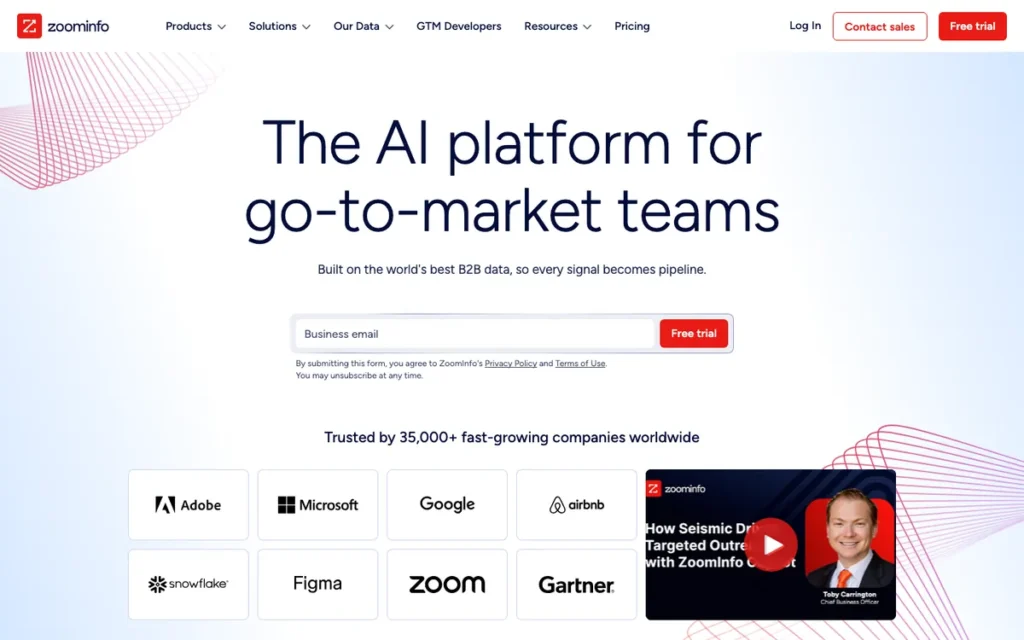
Category: B2B Data and Sales Intelligence Platform, provides verified contact and company databases, buyer intent signals, and real-time business event alerts to feed higher-quality prospect information into connected sales execution platforms; not a standalone outreach or CRM tool.
At a Glance
- Category: B2B Data and Sales Intelligence Platform
- Best For: Enterprise sales organizations (50+ reps) targeting North American accounts at scale where direct-dial mobile accuracy and intent-triggered outreach timing are the primary pipeline bottlenecks, deployed alongside a separate sales engagement platform (Salesloft, Outreach) for full-stack coverage
- Price Range: ~$15,000/year (3-seat Professional minimum, no free tier); Advanced $25,000–$30,000/year; Elite $40,000–$45,000+/year; team costs typically $30,000–$60,000/year before add-ons, all pricing requires direct vendor engagement
- Primary Strength: ZoomInfo Sales provides 260M+ verified B2B contacts, 135M+ verified phone numbers with 88%+ direct-dial accuracy, and a Bombora-powered intent engine tracking 12,000+ topics, with documented outcomes including 39% of total pipeline attributed to ZoomInfo signals at enterprise customer Seismic and 11.5 hours per week saved per rep (ZoomInfo/Seismic Case Study, 2024–2025; DemandGen Report, 2025)
- Biggest Limitation: ZoomInfo Sales requires a minimum $15,000/year annual contract with no free tier, carries documented auto-renewal and multi-year lock-in risks across multiple independent community sources, and is not compliant for GDPR-regulated EU outbound
- One-Line Summary: ZoomInfo Sales is a Gartner Magic Quadrant Leader in Account-Based Marketing Platforms for two consecutive years (2024 and 2025), the gold standard for North American B2B contact data and buyer intent intelligence, and the only platform in this review with back-to-back Gartner Leader recognition in the same category
- Last Verified: May 2026
Overview
ZoomInfo Sales is a B2B go-to-market intelligence platform providing 260M+ verified contacts, 135M+ verified phone numbers, and a Bombora intent engine tracking 12,000+ buying topics, processing 1.5 billion data points daily, serving approximately 28,000 paying customers as of Q4 2024 (ZoomInfo Q4 FY2024 Earnings Release; NASDAQ: ZI).
ZoomInfo Sales is architecturally distinct from every other platform in this review: ZoomInfo Sales is a data and intelligence layer designed to feed higher-quality prospect information into connected execution platforms (Salesloft, Outreach, Salesforce, Apollo.io) rather than a standalone outreach or CRM tool. ZoomInfo Sales delivers its highest ROI for enterprise teams that integrate its intent signals with a dedicated sequencing platform to trigger outreach at precisely the moment buyers are actively researching the category.
Key Features
- ZoomInfo Sales processes 1.5 billion data points daily through 300+ human researchers and AI verification (maintaining a B2B contact database of 260M+ profiles with a direct-dial phone accuracy benchmark of 88%+) materially above Apollo.io’s documented 71% benchmark for phone-first SDR teams (Mindcase B2B Data Accuracy Report, 2026).
- ZoomInfo’s Bombora-partnership intent engine tracks content consumption signals across 12,000+ B2B topics, identifying companies actively researching specific solution categories and flagging them as “Likely to Listen” accounts for time-sensitive outreach generating documented 2–3x higher reply rates versus cold outreach from static lists (SyncGTM Review, 2026).
- ZoomInfo’s Scoops intelligence feature delivers real-time alerts on leadership changes, hiring sprees, funding rounds, and technology adoption signals, enabling reps to contact target accounts at organizational inflection points when receptivity to specific value propositions is highest.
- ZoomInfo’s WebSights capability identifies anonymous website visitors by company, mapping which target accounts are actively researching the prospect’s category, integrating with CRM and marketing automation platforms to trigger account-based outreach at the precise moment of demonstrated in-market intent.
- ZoomInfo Copilot (Elite tier) provides AI-generated next-best-action recommendations based on intent signal synthesis and account history (ZoomInfo attributes saving 10+ hours per week per rep in documented enterprise customer case studies (ZoomInfo Pipeline Blog, 2026) vendor-reported; independently supported by the Seismic case study at 11.5 hours/week).
Best For
ZoomInfo Sales is best for enterprise sales organizations of 50+ reps with dedicated SDR teams targeting North American accounts at high volume, where direct-dial mobile phone accuracy is essential for call connect rates, and where the $30,000–$60,000/year total cost can be justified by documented improvements in pipeline velocity from signal-based prospecting.
ZoomInfo Sales must be deployed alongside a dedicated sales execution platform, the true total stack cost for a ZoomInfo-enabled outbound team adds $100–$250/seat/month in Outreach, Salesloft, or Salesforce fees above the ZoomInfo contract itself, making ZoomInfo infrastructure to be budgeted as such.
Pricing
ZoomInfo Sales does not publish pricing on its website (verified May 2026). Third-party verified estimates (Cleanlist, 2026; SalesMotion, 2026; MarketBetter, 2026):
- Professional: ~$14,995–$15,000/year (3-seat minimum; basic contact and company search; intent data not included)
- Advanced: ~$25,000–$30,000/year (full intent data, advanced filtering)
- Elite: ~$40,000–$45,000+/year (ZoomInfo Copilot AI, pipeline tools)
- Add-ons: CRM Enrichment $10,000–$15,000/year; Global Data Passport $10,000+/year
Critical Warning: Multiple r/sales and TrustRadius reviewers document aggressive auto-renewal clauses and resistance to mid-contract cancellations (SalesMotion ZoomInfo Pricing, 2026), secure explicit written cancellation rights, renewal notification requirements, and add-on opt-out terms before signing. Note: the Professional tier does not include intent data, the feature that most justifies ZoomInfo’s premium over Apollo.io.
Strengths
- ZoomInfo Sales holds Gartner Magic Quadrant Leader status in Account-Based Marketing Platforms for two consecutive years (2024 and 2025), the only platform in this review to achieve back-to-back Gartner Leader recognition in the same category, providing the strongest independent analyst validation of data intelligence leadership available for consecutive evaluation cycles (Gartner MQ ABM Platforms, 2024; Gartner MQ ABM Platforms, 2025).
- ZoomInfo Sales generated 39% of Seismic’s total pipeline through buyer signals and documented that Seismic reps saved 11.5 hours per week on prospect research after implementation, equivalent to approximately 598 additional selling hours per rep annually, with nearly two-fifths of total opportunity volume traceable to intent-triggered outreach (ZoomInfo/Seismic Case Study, 2024–2025; DemandGen Report, 2025).
- ZoomInfo Sales provides 135M+ verified phone numbers with a direct-dial accuracy benchmark of 88%+, materially higher than Apollo.io’s documented 71% benchmark (Mindcase B2B Data Accuracy Report, 2026), giving phone-first SDR teams significantly higher call connect rates per prospecting hour in North American enterprise outbound campaigns.
This aligns with practitioner feedback on r/sales:
“Had a trial for it – didn’t use any of the integrations yet, but contact data (office, cell, email) is light years ahead of any competitor. Found their technographic info to be mostly useless though (our focus was ESP used and was at best 30% accurate)” Posted by u/The_Cave_man
Takeaway: ZoomInfo’s core contact data quality advantage over alternatives is independently practitioner-confirmed, but its technographic intelligence data should be validated against your specific target market and vertical before treating it as a reliable account-targeting layer.
- ZoomInfo (NASDAQ: ZI) is the only publicly traded company in this review, reporting approximately 28,000 paying customers as of Q4 2024, with SEC filing transparency providing independent financial verification for enterprise procurement teams assessing vendor stability and long-term investment trajectory (ZoomInfo Q4 FY2024 Earnings Release; NASDAQ: ZI).
Limitations
- Minimum Commitment and Cost Opacity Trade-Off: ZoomInfo Sales requires a $15,000/year minimum annual contract with no free tier, no monthly billing, and no self-serve pricing (the highest entry barrier in this review) combined with a credit system that rations data access and depletes quickly at high prospecting volume, creating cost unpredictability that Apollo.io users with annual bulk credits do not face in the same way (SalesMotion ZoomInfo Pricing, 2026).
- Auto-Renewal and Lock-In Risk Trade-Off: ZoomInfo’s contract practices include documented aggressive auto-renewal enforcement and resistance to mid-contract downgrades or cancellations (flagged extensively across r/sales community discussions, G2, and TrustRadius) representing a significant post-purchase risk requiring careful upfront contract negotiation before signing any ZoomInfo agreement (SalesMotion, 2026).
- EU and GDPR Compliance Trade-Off: ZoomInfo’s EU contact data accuracy falls significantly below its North American benchmark, and ZoomInfo’s GDPR compliance posture has been criticized across G2 and TrustRadius for creating legal exposure for teams running EU outbound campaigns, where Cognism’s ISO 27701 certification and GDPR-optimized Diamond Data verification represent a meaningfully safer alternative (TechnologyMatch, 2026).
- Data-Only Architecture Trade-Off: ZoomInfo Sales functions as a data layer requiring a separate sales execution platform, meaning the true total stack cost for a ZoomInfo-enabled outbound team includes $100–$250/seat/month in additional Outreach, Salesloft, or Salesforce fees, making the full ZoomInfo-enabled enterprise stack one of the highest-cost configurations in this review.
Verdict
ZoomInfo Sales is the independently validated gold standard for North American B2B contact data and buyer intent intelligence, holding two consecutive years of Gartner Magic Quadrant Leader recognition in Account-Based Marketing Platforms (2024, 2025) and documented outcomes including 39% total pipeline attribution from intent signals at enterprise customer Seismic.
ZoomInfo Sales is the strongest choice for large enterprise SDR teams where direct-dial accuracy (88%+) and signal-triggered prospecting timing are the primary pipeline bottlenecks that no budget-friendly alternative fully addresses.
Teams must protect themselves contractually before signing: secure explicit written cancellation rights, require advance renewal notification terms, audit add-on opt-out provisions, model the full stack cost including a required execution platform, and evaluate Cognism rather than ZoomInfo for EMEA-focused outbound to eliminate GDPR compliance exposure from the outset.
What Red Flags Should I Watch For When Evaluating Sales Acceleration Software?
The six most consequential red flags when evaluating sales acceleration software are: pricing opacity with no self-serve estimates, data accuracy claims that degrade in real-world sending, auto-renewal contract enforcement without advance notification, GDPR compliance gaps in data providers for EU outbound, integration architectures that create new data sync failures instead of solving existing fragmentation, and capability tiers that lock core features behind dramatic price jumps. Each is documented by practitioners in r/sales, r/coldemail, and r/SaaS, none is disclosed in vendor marketing materials.
This mirrors a consistent community observation on r/sales:
“All of these tools live and die by implementation and adoption. Any tool will suck if you don’t apply it correctly, have requirements defined, train the user base, and measure the usage.” Posted by u/MauriceLevy_Esq
Takeaway: Sales acceleration platform failures are predominantly implementation and change management failures, not product failures, making RevOps resourcing and training infrastructure as critical to ROI as the software evaluation itself.
Red Flag #1: Pricing Hidden Behind Demo Walls
Five of the seven platforms in this review (ZoomInfo, Salesloft, Outreach, Gong, and Salesforce at enterprise tiers) require a sales conversation before any cost information is disclosed. If a vendor cannot provide a ballpark estimate in response to a direct question, treat that opacity as evidence of aggressive upsell tactics during demos. Request written pricing estimates with scope and exclusions before engaging the vendor sales team further.
Red Flag #2: Data Accuracy Claims That Don’t Hold in Practice
Vendor-published accuracy figures rarely reflect real-world performance at scale. Apollo.io’s “verified” emails still produce 10–15% bounce rates in high-volume sends (u/hardiktri56, r/coldemail, 2026). ZoomInfo users report 60–70% real-world accuracy on some contact types despite headline claims (G2 user reviews, 2025). Always run a 100-contact sample test against your specific target market and vertical before signing any data contract.
Red Flag #3: Auto-Renewal Contracts Without Notification
ZoomInfo is most frequently cited for aggressive auto-renewal enforcement and resistance to mid-contract cancellations (SalesMotion, 2026). Apollo.io’s annual plans enforce rigid 12-month commitments documented across r/SaaS (u/AngieMG9, r/SaaS, 2025). Salesloft post-Vista acquisition pricing increases of ~20% have been documented in r/sales. Before signing any annual contract, verify in writing: (a) cancellation notice period, (b) auto-renewal notification requirements, and (c) downgrade provisions.
Red Flag #4: EU and GDPR Compliance Gaps in Data Providers
Apollo.io’s EU contact data accuracy degrades significantly for non-US markets and lacks ISO 27701 certification. ZoomInfo has received GDPR compliance criticism on G2 and TrustRadius for EU outbound legal exposure (TechnologyMatch, 2026). If your target market includes EU accounts, require a written GDPR compliance statement and request the vendor’s Data Processing Agreement before engaging procurement on any data provider contract.
Red Flag #5: Integration Complexity That Creates Worse Fragmentation
Layering enterprise engagement platforms (Outreach, Salesloft) on top of HubSpot CRM creates “operational challenges and failures including sync issues and lost revenue data” according to multiple professional sources (Orange Marketing Blog). Sales acceleration tools are designed to solve fragmentation, if the proposed integration architecture creates new sync failures, the tool is not solving the problem it was purchased to address. Map your integration architecture on paper before committing to any platform that does not natively connect to your existing CRM.
Red Flag #6: Capability Tiers That Lock Core Features Behind Large Price Jumps
HubSpot Sales Hub locks sequences and forecasting behind Professional ($100/month), a 5x increase from Starter ($20/month). Salesforce’s Agentforce AI requires Unlimited ($330/month) or Einstein 1 Sales ($500/month) for full deployment. When evaluating any platform, identify which tier includes the specific feature your team actually needs and model the full cost at that tier, not the entry-tier price used in most promotional comparisons.
What Questions Should I Ask Before Choosing a Sales Acceleration Platform?
Five questions determine sales acceleration platform fit before any vendor demo: What is our primary pipeline bottleneck, data, outreach, coaching, or deal management? What CRM are we standardized on and how deep is each integration? What is total cost of ownership including admin salary? Does our target market require GDPR-compliant data? What are the contract cancellation terms before we sign? Answering these five questions eliminates the majority of mismatched vendor options before evaluation begins.
Question #1: What Is Our Primary Pipeline Bottleneck, Data Quality, Outreach Volume, Coaching, or Deal Management?
The answer determines your category before your vendor. Prospecting data gaps point to ZoomInfo Sales (enterprise) or Apollo.io (SMB). Outreach automation gaps point to Outreach, Salesloft, or Apollo.io. Rep coaching and win-rate gaps point to Gong. Deal management and forecasting gaps point to Salesforce or Gong. Buying a revenue intelligence platform when your actual bottleneck is contact data quality is a category mismatch that no feature depth can overcome.
Question #2: What CRM Are We Standardized On, and How Deep Is Each Platform’s Integration?
Outreach and Salesloft are purpose-built for Salesforce, their HubSpot integrations are materially weaker. Gong integrates with Salesforce, HubSpot, and Microsoft Dynamics at varying depths. Apollo.io integrates with all three via bi-directional sync but lacks enterprise field-mapping granularity. HubSpot Sales Hub is native, no integration required, which is a structural advantage if your team is not already on Salesforce.
Question #3: What Is the Total Cost of Ownership Including Admin Resources and Implementation?
Salesforce’s enterprise TCO runs $200,000–$500,000/year for a 50-rep team when admin salary and professional services are included. Gong’s mandatory Foundation fee and per-module pricing push enterprise year-one costs past $100,000. ZoomInfo requires a $15,000/year minimum plus a companion execution platform costing $100–$250/seat/month. Request itemized quotes that separately disclose: per-seat license, platform fees, implementation costs, required add-ons, and admin resource requirements.
Question #4: Does Our Target Market Include EU Accounts, and Does This Platform Have Verified GDPR Compliance?
Apollo.io’s EU data degrades significantly in quality and lacks ISO 27701 certification. ZoomInfo’s GDPR posture has received documented criticism for EU outbound legal exposure. If more than 20% of your target accounts are EU-based, evaluate Cognism (outside this review but ISO 27701 certified) as your primary data layer before committing to Apollo or ZoomInfo. Require a Data Processing Agreement in writing from any data provider before signing.
Question #5: What Are the Contract Cancellation Terms, Before We Sign, Not After?
Auto-renewal enforcement, rigid cancellation policies, and resistance to mid-contract downgrades are the most consistently cited post-purchase pain points for ZoomInfo, Apollo.io, and Salesloft across community sources. Before signing any annual contract: request the cancellation notice period in writing, confirm the auto-renewal notification lead time, ask whether downgrade to a lower tier is permitted mid-contract, and verify whether pilot or monthly billing is available for the first 60–90 days before committing to an annual term.
Question #6: What Does the Full Stack Cost When This Tool Is Added?
ZoomInfo is a data layer requiring a companion execution platform, adding $100–$250/seat/month above the ZoomInfo contract. Gong is a coaching layer that many teams pair with a dedicated engagement platform. Salesforce is a system of record that most teams layer Gong, ZoomInfo, and an engagement platform on top of. Model the combined stack cost before evaluating any single platform’s pricing in isolation, total stack cost is the only financially honest comparison.
Question #7: What Data Sources and Training Scale Power the AI Features?
Gong’s AI is trained on 3.5B+ interactions (confirmed). Salesloft’s Rhythm AI depends on your Salesforce CRM data quality. Apollo.io’s AI agents are built on its 224M+ contact database (vendor-reported). Ask each vendor directly: what data trains the AI, how large is the training set, and what happens to AI effectiveness if our CRM data quality is poor? The answer reveals whether the AI is a genuine differentiator or a marketing label applied to basic automation.
How Did We Rank These Sales Acceleration Platforms?
PlugRoute ranked these seven sales acceleration platforms using six criteria with defined weights: documented client ROI evidence (25%), review platform ratings and volume (20%), sales acceleration feature breadth and depth (20%), pricing transparency and value (15%), AI capability maturity (10%), and CRM integration reliability (10%). No vendor paid for placement. Every claim in this article carries a dated, named source.
Evaluation Process
The research pipeline for this article involved four parallel workstreams:
- AI Engine Gap Analysis: Multiple AI search engines (ChatGPT, Perplexity) were queried for existing answers to “best sales acceleration software” queries. Responses were analyzed for missing platforms, missing pricing data, missing geographic limitations, missing contract risk disclosures, and architectural category conflation.
- Independent Web Research: Two rounds of Perplexity-powered web research were conducted per platform, sourcing from G2, Capterra, TrustRadius, vendor websites, third-party review publications, and official vendor release notes.
- Community Sentiment Analysis: Reddit discussions across r/sales, r/coldemail, and r/SaaS were searched and analyzed for named user experiences, with specific cited comments attributed to their Reddit source and verified for upvote context.
- Analyst Recognition Verification: Gartner Magic Quadrant and Forrester Wave placements were verified through secondary sources and cross-referenced against vendor-published citations, with positioning claims hedged where only secondary source attribution was available.
Ranking Criteria
Documented Client Results and ROI Evidence (Primary Weight, 25%): Named customer case studies with specific outcome metrics, third-party analyst ROI validation, publicly reported ARR and growth figures (SEC filings where available), and aggregate platform benchmarks. Self-reported vendor claims without independent corroboration are weighted at 50% versus independently verified outcomes and labeled “vendor-reported” throughout the article.
Review Platform Ratings and Volume (Primary Weight, 20%): Composite score weighting G2 rating and review count (primary), Capterra/GetApp (secondary), and TrustRadius (tertiary). Review volume matters as much as score, a 4.7/5 across 9,600+ reviews is more credible than 4.9/5 across 50 reviews, because larger samples reduce selection bias and reflect broader use-case coverage. Gartner and Forrester leadership counted as supplementary validation.
Breadth and Depth of Core Sales Acceleration Features (Primary Weight, 20%): Evaluation of named feature modules against eight documented pain points: manual outreach automation, contact data quality, platform consolidation, conversation coaching, deal velocity signals, field sales optimization, multi-channel cadence scaling, and CRM integration reliability. Feature recency (2025–2026 releases) weighted positively.
Pricing Transparency and Value (Secondary Weight, 15%): Binary transparency score (self-serve pricing published = high; quote-only = low) combined with a value-per-seat calculation. Free tier availability, monthly billing options, and contract flexibility factor into the value score. Community reports of aggressive contract practices reduced the score for affected platforms.
AI Capability Maturity (Secondary Weight, 10%): Training dataset scale (where disclosed), specific AI capability functions and names (not marketing language), documented AI-driven outcomes from independent sources, recency of AI feature releases (2025–2026), and practical deployment evidence from community sources. Autonomous agent capabilities (agentic AI) weighted as advanced-tier evidence.
CRM Integration and Ecosystem Reliability (Secondary Weight, 10%): Integration depth for primary CRMs (Salesforce, HubSpot, Microsoft Dynamics), documented sync accuracy percentages, community-sourced feedback on integration failure modes, security certifications (SOC 2, HIPAA, ISO 27001), and ecosystem breadth.
Evidence Weighting
When review platform ratings conflict with Reddit community sentiment, this review weights specificity and recency. A detailed 2025–2026 Reddit thread with 50+ upvotes describing a specific integration failure outweighs a generic 2023 G2 review with no specifics. Vendor-reported statistics are labeled as such. Only claims corroborated by at least one independent source are stated as fact.
Evidence Labeling Standards Applied Throughout This Article
- Vendor-reported data → labeled “vendor-reported” with parenthetical notation
- Published vendor pricing → labeled “published, verified [Month Year]”
- Third-party pricing estimates → labeled with source name and publication date
- Community-sourced claims (Reddit, G2) → attributed to platform, username, and approximate date
- Independent verification standard → every factual claim requires at least one non-vendor source to be stated as fact
Update Cadence
This article was originally published in May 2026 and is scheduled for quarterly review. Pricing data is the most rapidly changing element in this category, verify all figures directly with vendors before procurement decisions. Release notes references are accurate to the dates cited.
Independence Disclosure
PlugRoute has no affiliate relationships with any company listed in this review. Rankings are determined entirely by research data, verified third-party sources, and objective evaluation criteria, no vendor has paid for placement, and no ranking has been adjusted based on commercial considerations.
What Do Buyers Most Frequently Ask About Sales Acceleration Software?
What is the best sales acceleration software for SDR teams in 2026?
Apollo.io ($39–$99/month annually) is the best sales acceleration software for SMB and mid-market SDR teams, it combines a 224M+ contact database, multi-channel sequences, and a built-in dialer at free-to-$99/month. Salesloft (~$125+/seat/month) leads for enterprise Salesforce-based SDR teams needing AI buyer signal prioritization. Outreach (~$150/seat/month) leads for enterprise teams running the most complex conditional multi-channel outbound sequences.
What is the difference between sales acceleration software and a CRM?
A CRM (Salesforce, HubSpot) is the system of record, storing contact history, deal stages, and account data. Sales acceleration software (Apollo.io, Outreach, Salesloft, Gong) layers automation, AI guidance, and data enrichment on top of that foundation. Most B2B teams need both: a CRM as the data foundation plus at least one acceleration platform targeting their specific pipeline bottleneck, data quality, outreach volume, rep coaching, or deal management.
How does PlugRoute determine its software rankings?
PlugRoute ranks platforms using a six-criterion weighted framework: documented client ROI evidence (25%), review platform ratings and volume (20%), feature breadth and depth (20%), pricing transparency and value (15%), AI capability maturity (10%), and CRM integration reliability (10%). Every claim requires a dated, named source. No vendor pays for placement, and no ranking reflects commercial relationships of any kind.
What Do Key Sales Acceleration Terms Mean?
Revenue Orchestration: A category of sales platform that goes beyond automating outreach sequences to actively guide rep decision-making in real time, synthesizing first-party engagement data and third-party intent signals to surface prioritized daily action queues with specific next-step recommendations. Salesloft’s Rhythm AI is the primary commercial example in this review.
Buyer Intent Signal: A data point indicating that a company is actively researching a specific product category, detected through content consumption tracking, website visit patterns, or behavioral signals across third-party B2B content networks. ZoomInfo’s Bombora-powered intent engine tracks 12,000+ B2B topics; intent-triggered outreach generates documented 2–3x higher reply rates versus cold outreach from static lists.
Conversation Intelligence: A software capability that records, transcribes, and AI-analyzes sales calls and meetings to identify objections, buying signals, competitor mentions, and rep performance patterns, enabling manager coaching, deal risk identification, and outcome pattern analysis at scale. Gong is the category leader, trained on 3.5 billion+ sales interactions.
Agentic AI (Sales Context): An AI architecture in which software agents autonomously execute multi-step tasks (such as qualifying leads against ICP criteria, updating CRM records, or drafting follow-up emails) without requiring a human to initiate each action step. Distinct from AI copilots that assist human decisions, agentic AI systems own portions of a workflow autonomously. Salesforce Agentforce and Salesloft’s April 2026 MCP Server are the primary agentic deployments documented in this review.
Credit System (Data Platforms): A rationing mechanism used by Apollo.io and ZoomInfo to control data export volume, each contact lookup, email reveal, or phone number export consumes credits from a monthly or annual allowance. Teams that exhaust their credit allocation face additional costs or reduced prospecting capacity before the next renewal period, creating cost unpredictability that flat-fee data access models do not produce.
Glossary: Key Terms Used in This Comparison
Revenue Orchestration: A category of sales platform that goes beyond automating outreach sequences to actively guide rep decision-making in real time, synthesizing first-party engagement data and third-party buyer intent signals to surface prioritized daily action queues with specific next-step recommendations.
Buyer Intent Signal: A data point indicating that a company is actively researching a specific product category, detected through content consumption tracking, website visit patterns, or behavioral signals across third-party B2B content networks, used to trigger time-sensitive outreach at the moment buyers are most receptive.
Conversation Intelligence: A software capability that records, transcribes, and AI-analyzes sales calls and meetings to identify objections, buying signals, competitor mentions, and rep performance patterns, enabling manager coaching and deal risk identification at scale without manual call review.
Agentic AI (Sales Context): An AI architecture in which software agents autonomously execute multi-step tasks (such as qualifying leads, updating CRM records, or drafting follow-up emails) without requiring a human to initiate each action step, distinct from AI copilots that assist rather than independently own portions of a workflow.
Credit System (Data Platforms): A rationing mechanism used by data platforms to control contact export volume, where each email reveal or phone number lookup consumes credits from a monthly or annual allowance, creating cost unpredictability for high-volume prospecting teams when allocations are exhausted before renewal.
Which Sales Acceleration Platform Is Right for You?
Key Insights
- Apollo.io is the best-value all-in-one outbound platform for SMB and mid-market B2B teams, with the largest G2 review volume in the category (4.7/5, 9,600+ reviews, Winter 2026), but phone-first SDR teams should model the 71% direct-dial accuracy gap against ZoomInfo’s 88%+ before committing to Apollo for high-volume call prospecting.
- Gong is the Gartner RAO MQ Leader (December 2025) with the deepest AI training dataset in conversation intelligence (3.5B+ interactions), but its pricing opacity, mandatory Foundation fee, and pre-call guidance gap require a companion engagement platform and dedicated RevOps resourcing to realize full value.
- Salesloft leads for AI-guided revenue orchestration on Salesforce, with the highest independently reported Salesforce sync reliability (98%+) and Gartner Visionary recognition in the inaugural RAO MQ (December 2025), but its value depends entirely on the quality of the CRM data feeding Rhythm AI, and pricing has increased ~20% since the Vista Equity acquisition.
- Salesforce Sales Cloud is the G2 #1 CRM and integration backbone for the entire category, but its enterprise TCO ($200,000–$500,000/year for a 50-rep team when admin and implementation are included) makes it a poor choice for teams without dedicated Salesforce administrator resources.
- Outreach is the enterprise sequence depth standard with Kaia real-time call coaching and claimed Fortune 100 tech penetration, but its 4.3/5 G2 rating, setup complexity premium, and materially weaker HubSpot integration make it a Salesforce-specific platform choice for teams with dedicated RevOps capacity.
- HubSpot Sales Hub is the right choice for SMB and mid-market teams not on Salesforce, with transparent pricing, a functional free tier, and native CRM architecture that eliminates integration friction, within the 500-contacts-per-day sequence ceiling and the 5x Starter-to-Professional price step.
- ZoomInfo Sales is the gold standard for North American B2B contact data with two consecutive years of Gartner ABM Platforms Leader recognition, but its $15,000/year minimum, documented auto-renewal contract risks, and EU compliance gaps make it appropriate exclusively for North American enterprise teams with the budget and legal diligence to deploy it safely alongside a required companion execution platform.
The core decision logic is sequential, not parallel. First, identify your primary pipeline bottleneck, data quality, outreach volume, coaching, or deal management. Second, confirm your CRM and verify each platform’s integration depth for that specific system. Third, model total cost of ownership including admin resources, implementation, and required companion tools, not list price alone. Fourth, verify contract terms in writing before engaging any vendor’s sales team.
Every ranking in this article was determined by the data, not by vendor relationships, affiliate fees, or commercial considerations. If a platform earned a top position, the evidence points there. If a platform has a substantive limitation, it is disclosed regardless of how the platform’s own marketing frames it.
We update this guide quarterly. Last updated: May 9, 2026. For more independent SaaS research, browse PlugRoute. If this article helped your team make a more informed decision, share it with the RevOps or sales leadership colleague managing this purchasing process, independent research stays visible when practitioners share it.