Mindtickle ranks #1 for enterprise sales readiness, WorkRamp is best for high-growth B2B SaaS teams under 300 reps, and Showpad leads for European and field sales organizations. The core decision is architectural: training-first platforms build rep skills while content-first platforms solve content chaos, choosing the wrong architecture is this category’s most expensive evaluation mistake.
New sales reps take 3–6 months to become quota-ready at most B2B organizations, and every delayed month represents tens of thousands in lost revenue per hire. Onboarding varies by manager and region. Coaching visibility is near-zero. Proving the connection between training investment and deal outcomes remains the challenge that kills renewal budgets across every platform in this category.
PlugRoute has no affiliate relationships with any company listed; rankings are determined entirely by research data and objective evaluation criteria.
“Mindtickle is powerful but you need someone dedicated to managing it or it becomes shelfware really fast.” (r/salesoperations)
Takeaway: Admin dependency is a structural characteristic of enterprise enablement platforms (not a solvable setup issue) and must be budgeted as a prerequisite operating cost before contract signature.
TL;DR: Top Picks at a Glance
- Mindtickle: Closed-loop readiness scoring and Call AI for enterprise teams of 100+ reps that have a dedicated enablement administrator
- Seismic: LiveDocs compliance paired with unified training for regulated-industry enterprise organizations seeking triple analyst recognition
- Highspot: The Microsoft-ecosystem enterprise standard for content management, with Gartner Leader status and the deepest Teams and SharePoint integration in the category
- WorkRamp: Fastest 2–4 week deployment for high-growth SaaS teams of 25–300 reps at the most transparent pricing available
What Are the 5 Categories of Sales Training and Onboarding Software?
Sales training and onboarding platforms fall into five architecturally distinct categories (Training-First, Content-First Enterprise Suite, Unified Hybrid, Modern LMS, and Legacy Enterprise Readiness) and identifying your primary problem before comparing features is the most consequential early decision in this evaluation.
Comparing feature lists across platforms that are not architecturally built for the same problem is the most common and costly evaluation error in this category. The taxonomy below resolves that mismatch before any vendor demo takes place.
Category 1: Training-First Sales Readiness Platform
Built around measuring and developing rep skills through AI role-play, conversation intelligence, and proprietary readiness scoring. Training is the core architecture, not an add-on feature bolted onto a content management layer. Platform in this category: Mindtickle.
Category 2: Content-First Enterprise Enablement Suite
Built around organizing, surfacing, and personalizing sales content at the right moment in the deal cycle. Training capabilities are layered on top of a content management core. Platforms in this category: Highspot, Seismic.
Category 3: Unified Hybrid Enablement Platform
Combines content management and coaching modules with roughly equal architectural weighting, typically the result of a strategic acquisition integrated over multiple years. Platforms in this category: Showpad, Allego.
Category 4: Modern LMS / Onboarding-First Platform
A learning management system built for speed and accessibility, structured training paths, fast deployment, and Slack-native delivery without enterprise complexity. Platform in this category: WorkRamp.
Category 5: Legacy Enterprise Readiness Platform
A 20+ year-heritage platform with proven Fortune 500 reliability, AI-scored video coaching, and compliance documentation, with trade-offs in interface modernity and post-acquisition roadmap clarity. Platform in this category: Brainshark.
How Do the Top 7 Sales Training Platforms Compare at a Glance?
The seven platforms below span five architectural categories and four distinct buyer segments, from 25-rep startups to 5,000-rep enterprises. Use this table as a first filter to eliminate architectural mismatches before engaging any vendor in a full discovery or demo process.
| Rank | Company | Category | Best For | One-Line Summary | Key Capabilities | Primary Strength | Key Limitation |
|---|---|---|---|---|---|---|---|
| 1 | Mindtickle | Training-First | Enterprise B2B, 100+ reps, dedicated enablement admin | Mindtickle is the most evidence-backed sales readiness platform, combining AI role-play, Call AI, and a proprietary Readiness Score in the only closed-loop system that traces rep behavior from onboarding to live deal execution. | Readiness Score, Call AI, AI Role-Play | Highest G2 review volume in category (2,000+ reviews, 4.7/5.0, 2024) | Requires dedicated admin; est. $50K–$200K+ annual minimums |
| 2 | Seismic | Content-First Enterprise Suite | Regulated industries (finance, pharma), 200+ reps | Seismic is the only platform simultaneously holding Gartner, Forrester, and G2 Leader status, with LiveDocs document personalization that no competitor in this evaluation replicates. | LiveDocs, Seismic Learning, Digital Sales Rooms | Only platform with simultaneous Gartner + Forrester + G2 Leader recognition | Post-Lessonly UX inconsistency; 3–6 month implementation timeline |
| 3 | Highspot | Content-First | Microsoft-stack enterprises, 200+ reps, content chaos | Highspot is the highest-valued independent sales enablement platform globally, recognized as a Gartner Leader, and the definitive content-management solution for Microsoft-ecosystem enterprises. | Microsoft Integration, Buyer Engagement, AI Copilot | $3.5B valuation; deepest Microsoft ecosystem integration in category | Training module less mature than content layer; highest per-user cost estimate |
| 4 | Showpad | Unified Hybrid | Field sales, EU organizations, manufacturing, 50–2,000 reps | Showpad is the dominant sales enablement platform for European enterprise and field sales organizations, with GDPR-native compliance, offline mobile delivery, and a 6–10 week deployment timeline. | GDPR Compliance, Field Sales Mobile, Showpad Coach | Only GDPR-by-design platform; fastest enterprise-tier deployment at 6–10 weeks | Training readiness depth less than Mindtickle; analytics require pre-configuration |
| 5 | Allego | Unified Hybrid (Video-First) | Financial services, life sciences, 100–2,000 reps | Allego is the most purpose-fit training platform for regulated financial services teams, with FINRA-compliant certification tracking verified by Fidelity Investments and Mutual of Omaha deployments. | Video Coaching, Conversation Intelligence, FINRA Compliance | Only platform with FINRA compliance verified by Fidelity and Mutual of Omaha | Video culture adoption risk (20–30% non-engagement documented); limited content management depth |
| 6 | Brainshark | Legacy Enterprise Readiness | Fortune 500 traditional enterprise, 500+ reps, existing deployments | Brainshark is a 20+ year heritage enterprise sales readiness platform known for proven Fortune 500 reliability, Machine Analysis AI video scoring, and compliance-grade certification tracking. | Machine Analysis AI, Certifications, Structured Onboarding | 20+ year Fortune 500 track record; ADP, AT&T, Comcast, Cardinal Health deployments verified | Dated UI; post-Bigtincan acquisition roadmap uncertainty |
| 7 | WorkRamp | Modern LMS | High-growth B2B SaaS, startups, 25–300 reps | WorkRamp is the fastest-deploying, most pricing-transparent sales training LMS for high-growth B2B SaaS teams, with the category’s only unified internal-plus-external training architecture and a 2–4 week go-live timeline. | Slack Integration, Learning Paths, External LMS | Fastest go-live (2–4 weeks); most pricing-transparent platform in the category | No conversation intelligence; no training-to-deal outcome correlation |
Which Sales Training Platform Should I Choose for My Use Case?
The fastest path to the right platform is matching your primary business problem to the architecture designed to solve it, before comparing feature lists or scheduling vendor demos. The table below maps eight common business problems to specific recommended platforms with the rationale for each choice.
| Your #1 Priority | Recommended Tool | Why | Acceptable Alternative |
|---|---|---|---|
| Rep skill gaps and readiness measurement | Mindtickle | Proprietary Readiness Score + Call AI in a single closed-loop system | Seismic Learning for regulated industries |
| Content chaos; reps can’t find the right materials | Highspot | Purpose-built content-first architecture; deepest Microsoft integration | Seismic for regulated document compliance |
| Regulated document compliance (finance, pharma) | Seismic | LiveDocs dynamic personalization is unmatched; triple analyst recognition | Allego for FINRA-specific financial services |
| EU operations or field sales (manufacturing, medtech) | Showpad | Only GDPR-by-design platform; offline mobile; fastest enterprise deployment | Seismic for regulated EU industries |
| FINRA compliance in financial services or insurance | Allego | Verified Fidelity and Mutual of Omaha deployments; FINRA-grade documentation | Brainshark for traditional enterprise compliance |
| Onboarding speed for a growing team (25–300 reps) | WorkRamp | 2–4 week go-live; most transparent pricing; Slack-native training | Showpad for teams needing content + coaching |
| Fortune 500 reliability with 20+ year track record | Brainshark | ADP, AT&T, Comcast documented deployments; Machine Analysis AI scoring | Seismic for modern enterprise with same reliability requirements |
| Microsoft-first enterprise tech stack | Highspot | Native Teams, SharePoint, OneDrive, Outlook, and Dynamics 365 connectors | Seismic for Teams integration with regulated document needs |
1. Mindtickle: Best Overall for Enterprise Sales Readiness
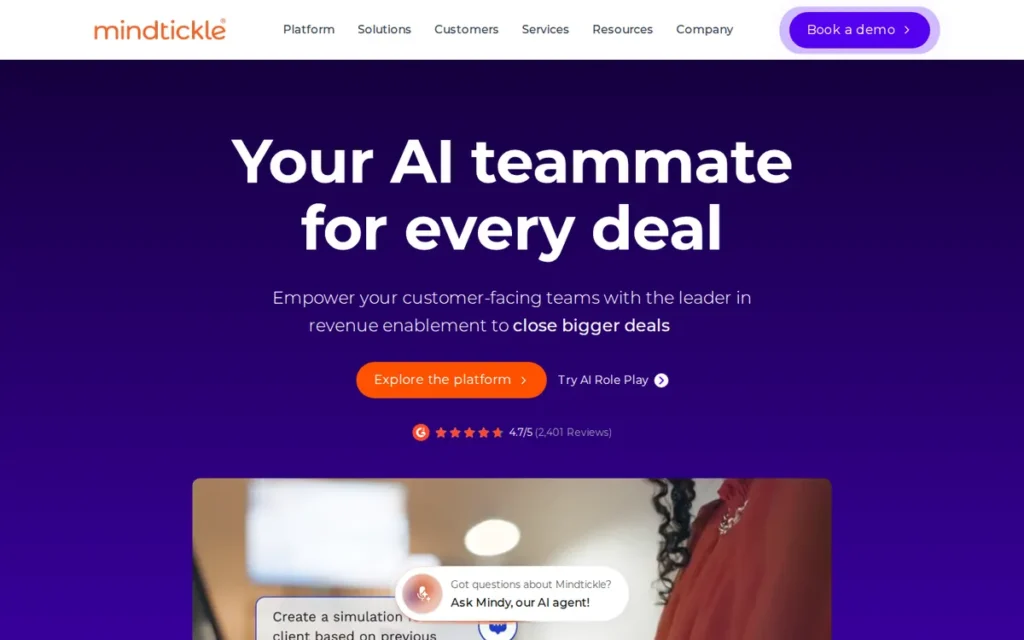
Category: Training-First Sales Readiness Platform, purpose-built to measure, develop, and score rep readiness from initial onboarding through live deal execution using AI coaching, role-play simulation, and call intelligence in a single closed-loop system.
At a Glance
- Category: Sales Readiness Platform
- Best For: Enterprise B2B sales organizations of 100+ reps with a dedicated sales enablement manager needing to close the loop between training completion and live deal behavior
- Price Range: ~$25–$50+/user/month (community estimates, 2024); est. $50K–$200K+ annual minimums; no public pricing disclosed
- Primary Strength: Mindtickle’s proprietary Readiness Score quantifies each rep’s preparedness by aggregating training completion, assessment results, manager coaching calibration, and live call behavior signals into a single actionable metric
- Biggest Limitation: Mindtickle requires a dedicated sales enablement administrator, teams without one consistently report platform underutilization and shelfware within 6–12 months of deployment
- One-Line Summary: Mindtickle is the most evidence-backed sales readiness platform for mid-to-large B2B teams, combining AI role-play simulation, Call AI conversation intelligence, and a proprietary Readiness Score into the only closed-loop training system in this evaluation that traces rep behavior from onboarding to live deal execution.
- Last Verified: May 2026
Overview
Mindtickle is a sales readiness platform purpose-built for mid-to-large B2B sales teams (from 100 to 5,000+ reps) that need to accelerate rep ramp time, standardize onboarding across managers and regions, and connect training completion to real deal outcomes through AI coaching and conversation intelligence on a single platform.
Mindtickle’s founding architecture distinguishes it from every other platform in this evaluation. Mindtickle was built to measure not just whether training was completed, but whether reps internalized and applied knowledge in real customer conversations, a distinction that separates readiness platforms from completion-tracking LMS tools.
Mindtickle’s acquisition of Execute.ai brought native Call AI into the platform, enabling a closed-loop vertical integration (structured onboarding → AI role-play → live call intelligence → coaching feedback loop) that no other platform in this evaluation replicates without third-party integrations.
Key Features
- Proprietary Readiness Score: Mindtickle aggregates training completion rates, assessment performance, manager coaching calibration, and live call behavior signals into a single composite metric that enables enablement managers to identify at-risk reps before pipeline opportunities are lost.
- Call AI (via Execute.ai Acquisition): Mindtickle records and analyzes live sales calls, tracking whether rep behaviors practiced in simulations appear in real customer conversations and automatically feeding behavioral gaps back into each individual rep’s coaching workflow.
- AI-Powered Role-Play Engine: Mindtickle allows reps to practice pitches, objection handling, and discovery conversations against simulated buyer personas, with automated scoring that reduces manager review burden without sacrificing coaching quality or feedback specificity.
- Structured Onboarding Paths: Mindtickle delivers milestone-based onboarding with certification gating, ensuring new reps complete required modules and demonstrate knowledge before advancing to live selling activities, creating a consistent, measurable ramp process regardless of hiring manager or region.
- Microlearning and Reinforcement: Mindtickle’s reinforcement module delivers bite-sized content and spaced knowledge checks within the rep’s existing workflow, addressing documented knowledge decay after initial onboarding without requiring reps to navigate to a separate training environment.
Best For
Mindtickle is best for B2B enterprise sales organizations of 100 or more reps that have (or plan to hire) a dedicated sales enablement manager and need a single platform to handle structured onboarding, AI-scored role-play simulation, live call coaching, and a quantified readiness score that managers can act on in weekly pipeline reviews.
Mindtickle is not suited to teams under 100 reps or organizations without a full-time enablement administrator. Both contract minimums and operational complexity make Mindtickle inaccessible and undersupported at that scale.
Strengths
- Mindtickle earned the G2 Leader designation with 2,000+ verified reviews rated 4.7/5.0 (G2, 2024), the highest total review volume in the Sales Training and Onboarding category, representing the most substantial verified buyer community of any platform in this research set.
- Mindtickle’s documented enterprise customer base includes Autodesk, Verizon, Zendesk, Splunk, and Johnson & Johnson (Mindtickle customer page, 2024), validating multi-region deployment capability across B2B technology, life sciences, and SaaS at 500+ rep scale.
- Mindtickle’s closed-loop architecture: connecting structured onboarding, AI role-play scoring, and live call intelligence in a single platform, directly addresses the inability to prove training-to-revenue connection, the second most persistent pain point in this category (Sales Enablement Collective, 2024).
- Mindtickle received $281M in total funding, including a $100M Series E from SoftBank Vision Fund 2 (Crunchbase), with 600–700 global employees as of 2024, documenting the financial and organizational depth required to support large enterprise deployments at scale.
Limitations
- Admin Dependency: Mindtickle’s most consequential trade-off is its operational dependency on dedicated administrative resources, r/salesoperations describes the platform as becoming “shelfware fast” without dedicated stewardship, a pattern corroborated by G2 reviews spanning 2022–2024 that cite admin complexity as a structural characteristic of the product, not a solvable setup issue.
- Total Cost of Ownership: Mindtickle carries the highest total cost of ownership for most buyer segments, with annual minimums of $50,000–$200,000+ and module-based pricing that escalates significantly when buyers add Call AI and coaching to initial onboarding contracts, making Mindtickle inaccessible to teams under 50–100 reps by design (community estimates, 2024).
- Implementation Timeline: Mindtickle deployments typically require 3–6 months to go live at enterprise scale (community estimates, 2024), creating meaningful time-to-value risk for organizations needing onboarding improvements tied to a defined hiring cohort or fiscal year deadline.
- Mobile Experience Gap: Mindtickle’s mobile app experience is rated below the desktop experience by multiple G2 reviewers (2024), a consideration for field sales teams or organizations with a significant share of reps working primarily from mobile devices rather than desktop environments.
Verdict
Mindtickle is the highest-reviewed, most architecturally complete sales readiness platform in this category, holding 2,000+ verified G2 reviews at 4.7/5.0 (2024) and the only platform in this evaluation that traces rep behavior from structured onboarding through AI role-play simulation to live call intelligence in a single closed-loop system. Mindtickle earns the top rank because it leads on all three primary evaluation criteria, review volume and rating, sales training feature completeness, and enterprise customer base quality, with a margin that no other platform in this set matches on the criteria that matter most to this audience. The trade-off is equally clear: Mindtickle demands dedicated enablement resources and enterprise budget that teams under 100 reps or without a full-time enablement manager cannot realistically sustain, and buyers in that situation should evaluate WorkRamp or Showpad before committing to Mindtickle’s complexity.
2. Seismic: Best for Regulated Industries and Document-Intensive Enterprise Sales
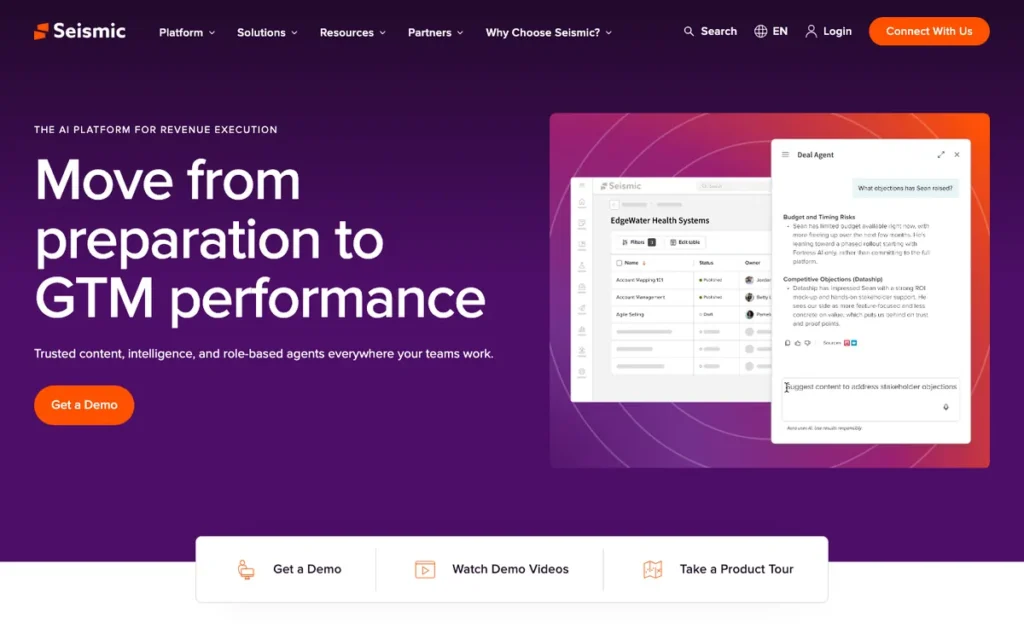
Category: Enterprise Enablement Suite, unifies dynamic document personalization (LiveDocs), sales training and onboarding (Seismic Learning, via Lessonly), and AI coaching in a single platform purpose-built for large-scale regulated-industry sales organizations.
At a Glance
- Category: Enterprise Enablement Suite
- Best For: Large enterprise sales teams (200+ reps) in regulated industries: financial services, life sciences, pharma, professional services, requiring LiveDocs document compliance and a unified training-content architecture
- Price Range: Custom enterprise only; est. $150K–$500K+ annually for full platform (community estimates, 2024); historical Lessonly-only est. ~$35–$75/user/month (pre-2021 acquisition; now bundled into full-platform pricing)
- Primary Strength: Seismic’s LiveDocs engine dynamically personalizes compliant sales proposals and regulated documents by pulling live CRM and financial data into templates, a capability no other platform in this evaluation offers in comparable form as of 2024
- Biggest Limitation: Seismic’s content and training modules carry documented UX inconsistencies described by G2 reviewers as “two different products duct-taped together,” with go-live timelines averaging 3–6 months and full-platform pricing running 3–4x higher than historical standalone Lessonly contracts
- One-Line Summary: Seismic is the most comprehensively analyst-recognized enterprise enablement platform (holding simultaneous Gartner, Forrester, and G2 Leader status) with uniquely differentiated LiveDocs document personalization that makes it the definitive choice for regulated-industry sales teams that cannot compromise on document compliance or content-training unification.
- Last Verified: May 2026
Overview
Seismic is an enterprise-grade revenue enablement suite serving 2,000+ organizations globally (particularly in financial services, life sciences, and regulated industries) that require both advanced document personalization through LiveDocs and a unified training-and-content architecture built from the company’s 2021 Lessonly acquisition.
Seismic is the oldest company in this research set, founded in 2010, with 15 years of enterprise customer relationships and the only simultaneous Gartner Magic Quadrant, Forrester Wave, and G2 Leader recognition available in the sales enablement category as of 2024.
Seismic’s strategic positioning addresses a problem no other platform in this evaluation solves with equivalent depth: creating personalized, compliance-accurate sales documents at scale while connecting that content directly to rep training, coaching, and deal-stage guidance in one unified system.
Key Features
- LiveDocs Dynamic Personalization: Seismic LiveDocs dynamically personalizes sales proposals, financial presentations, and compliance-sensitive documents by pulling live data from CRM records, financial systems, and proprietary databases into pre-approved templates, enabling reps to generate accurate, personalized documents in minutes rather than hours, a capability no other platform in this research set offers in comparable form.
- Seismic Learning (via Lessonly): Seismic Learning delivers structured onboarding paths, drag-and-drop lesson building, video practice submissions, manager coaching feedback, knowledge checks, and completion-based certifications within the same seller workflow as Seismic’s content management system.
- Digital Sales Rooms: Seismic creates branded, personalized buyer microsites where prospects access curated content collections in one place, with engagement tracking (pages viewed, time spent, content downloaded) feeding buyer behavior data back into the rep’s deal intelligence workflow and CRM record.
- Content Analytics Engine: Seismic tracks which sales materials are used in active deals and correlates content engagement patterns with closed-won outcomes, providing enablement leaders with data-driven evidence of which content investments drive pipeline and which represent marketing spend without measurable sales impact.
- Triple Analyst Recognition: Seismic holds simultaneous Gartner Magic Quadrant Leader, Forrester Wave Leader, and G2 Best Software designations (Seismic awards page, 2024), the only platform in this research set to achieve all three independent analyst endorsements simultaneously.
Best For
Seismic is best for large enterprise sales organizations of 200 or more reps in regulated industries (financial services, pharmaceutical, life sciences, and professional services) where sales teams must create personalized, compliance-verified documents at scale and where disconnected training and content systems create measurable risk in document accuracy, rep time waste, and compliance failures.
Seismic is not the right primary choice for organizations whose dominant problem is rep skill development rather than content personalization. The full-platform pricing commitment is difficult to justify when structured onboarding is the only requirement, and Mindtickle’s purpose-built training architecture delivers deeper readiness measurement at comparable or lower total cost for that use case.
Strengths
- Seismic holds simultaneous Gartner Magic Quadrant Leader, Forrester Wave Leader, and G2 Best Software designations (Seismic awards page, 2024), the only platform in this research set to achieve all three major independent analyst recognitions simultaneously, representing the strongest combined third-party validation of enterprise platform maturity in the category.
- Seismic’s LiveDocs dynamic document personalization engine: pulling live CRM and financial data into compliant sales templates, has no direct functional equivalent in any competing platform in this evaluation, providing a uniquely defensible capability for financial services and pharmaceutical firms where document accuracy and compliance are non-negotiable operational requirements.
- Seismic’s 2,000+ global customer base, combined with 1,500+ G2 verified reviews at 4.7/5.0 (G2, 2024), $450M+ in total funding from Permira and General Atlantic (Crunchbase), and 15 years of continuous enterprise operation since its 2010 founding, document a depth of institutional market confidence that newer platforms have not had time to accumulate.
- Seismic’s Lessonly acquisition (2021) gave Seismic a proven standalone training platform with its own independent customer base of 1,200+ pre-acquisition companies (Seismic press releases), including Pendo, U.S. Cellular, and Trunk Club, providing Seismic Learning with a market-validated foundation rather than a training capability built from scratch.
Limitations
- UX Integration Gap: Seismic’s most consequential trade-off is the inconsistency between its original content platform and the Lessonly-based learning module, described by multiple G2 reviewers (2024) as “two different products duct-taped together”, affecting admin workflow efficiency and reducing rep adoption of the training layer three years post-acquisition.
- Implementation Timeline: Seismic enterprise implementations average 3–6 months to go live (community estimates, 2024), creating significant time-to-value risk for organizations that need onboarding improvements tied to a hiring cycle or fiscal year deadline.
- Pricing Expectation Gap: Mid-market buyers who approach Seismic through Lessonly brand familiarity must prepare for full-platform costs typically running 3–4x higher than standalone Lessonly historical pricing, a mismatch generating documented buyer frustration in G2 reviews (2024).
- Training-Primary Fit: Seismic is not the right primary choice for organizations whose dominant problem is rep skill development rather than content personalization, the full-platform pricing commitment is difficult to justify when structured onboarding is the only requirement, and Mindtickle delivers deeper readiness measurement at comparable or lower cost for that use case.
Users on r/ProductMarketing shared their experience:
“Yeah tracking engagement and sales content was something that we really tried for in the past. We did a big internal launch for Siesmic, big fanfare, etc.
And it worked great for a about 2 quarters. Then maintaining content there, customizing content for different deals, trying to get reps to change their ways of working all ended up falling flat.
We ended up using it as an internal tool for sharing the latest sales assets internally for the rest of our contract before we just went to a more structured use of OneDrive/SharePoint.
We didn’t get the tracking benefits, but we made sure that reps had easier access to latest contetn and in a way that they were more used to selling.
Tools like this can be useful, but they need to have the proper roll out and expectations.” Posted by u/Comfortable_Regret57
Takeaway: Seismic deployments frequently collapse after initial enthusiasm when organizations underestimate the content governance, rep change management, and sustained administrative investment the platform’s complexity demands to stay off the shelfware path.
Verdict
Seismic is the most comprehensively analyst-recognized enterprise enablement platform in this category, the only platform holding simultaneous Gartner Magic Quadrant, Forrester Wave, and G2 Leader status as of 2024, and stands alone as the definitive choice for regulated-industry sales teams that require LiveDocs-powered document personalization alongside a unified training and content architecture. Seismic earns the #2 ranking on the strength of its unmatched analyst recognition, the largest global customer base in this set (2,000+ companies), and a LiveDocs capability that competing platforms do not replicate. Buyers who prioritize pure training depth should rank Mindtickle above Seismic, while buyers in regulated industries where document compliance is the primary problem will find Seismic’s offering is in a category of its own.
3. Highspot: Best for Content Management and Microsoft Ecosystem Enterprise Teams
Category: Content-First Enablement Platform, organizes and surfaces the right sales content at the right moment in the sales cycle, with training and coaching capabilities layered on top of a foundational content management architecture.
At a Glance
- Category: Content-First Enablement Platform
- Best For: Enterprise B2B sales organizations of 200+ reps running Microsoft technology stacks where content chaos (wrong versions, off-brand materials, reps unable to find what they need) is the primary sales problem
- Price Range: ~$50–$80+/user/month (community estimates, 2024); est. $100K+ annual minimums; consistent community reports of 15–30% negotiated discounts via procurement platforms at calendar year-end renewal
- Primary Strength: Highspot delivers deeper Microsoft ecosystem integration than any platform in this category (native connectors with Teams, SharePoint, OneDrive, Outlook, and Dynamics 365) making it the structural default for Microsoft-first enterprises
- Biggest Limitation: Highspot’s training module is consistently described by G2 reviewers as less mature than its content management layer, making Highspot a poor primary choice for organizations whose dominant problem is rep skill development rather than content organization
- One-Line Summary: Highspot is the highest-valued independent sales enablement platform globally, recognized as a Gartner Magic Quadrant Leader for consecutive years, and the definitive content management solution for Microsoft-ecosystem enterprises, with training capabilities that complement rather than lead its feature set.
- Last Verified: May 2026
Overview
Highspot is a content-first sales enablement platform designed for enterprise B2B organizations of 200 or more reps that face a primary problem of content chaos, reps unable to find the right materials, using inconsistent messaging, or unaware of whether buyers engage with what they share.
Highspot was founded in 2012 by a team with deep Microsoft and Amazon enterprise pedigree, and its Microsoft-first integration architecture reflects that founding intent. For enterprises standardized on Teams, SharePoint, OneDrive, Outlook, and Dynamics 365, Highspot integrates without requiring workflow changes in a way that competitors cannot match.
Highspot’s Buyer Engagement analytics (tracking when prospects view proposals and which content drives engagement) extend the platform’s value from rep-facing training into live deal intelligence, connecting content investment to pipeline outcomes in a way training-first platforms do not natively replicate.
Key Features
- Highspot Spots (AI-Curated Content Hubs): Highspot Spots surface the right sales materials (playbooks, battle cards, case studies, and competitive responses) at the precise stage of the sales cycle, reducing rep time spent searching for content and increasing messaging consistency across large distributed teams.
- Buyer Engagement Analytics: Highspot tracks when prospects open shared documents, which pages they view, how long they engage, and whether materials are forwarded internally, connecting training-reinforced content choices to live buyer behavior and providing deal-stage intelligence that training-first platforms do not match natively.
- Highspot Copilot (AI Assistant): Highspot Copilot delivers rep-facing content recommendations, call preparation guidance, and post-meeting follow-up suggestions embedded in the rep’s existing workflow, reducing the cognitive burden of finding the right content without a context switch to a separate training environment.
- Microsoft Ecosystem Integration: Highspot provides native connectors for Teams, SharePoint, OneDrive, Outlook, and Dynamics 365 (the deepest Microsoft integration in this category) giving Microsoft-first enterprises a content and training layer that plugs into existing infrastructure without workflow disruption or parallel system overhead.
- Sales Plays: Highspot’s Sales Plays guide reps through specific selling motions with prescribed content sequences, conversation guides, and embedded training modules, creating a structured approach to product launches, competitive responses, and new segment entry that managers can monitor and attribute to deal outcomes.
Best For
Highspot is best for enterprise B2B sales organizations of 200 or more reps running Microsoft technology stacks where the primary sales problem is content chaos: reps using wrong versions, creating off-brand materials, or wasting time finding what they need before a call.
Highspot is not the right choice for organizations whose primary use case is rep skill development. Highspot’s documented training module maturity gap means buyers with training-first needs will find Mindtickle or Seismic Learning more appropriate, and will pay enterprise pricing for capabilities that are a structural mismatch with their actual problem.
Strengths
- Highspot achieved a $3.5 billion valuation in its 2021 Series F round from investors including Tiger Global Management, ICONIQ Growth, and Salesforce Ventures (Crunchbase, 2021), the highest valuation of any independent sales enablement platform globally at time of fundraise, reflecting institutional-level confidence in Highspot’s enterprise growth trajectory.
- Highspot earned 1,000+ verified G2 reviews at 4.7/5.0 (G2, 2024), with rep-facing ease of use consistently rated among the highest in the Sales Enablement category, a critical adoption predictor explaining why Highspot customers report higher content adoption rates than platforms where admin complexity reduces seller-side engagement.
- Highspot’s Gartner Magic Quadrant Leader recognition for Sales Enablement (consecutive years through 2024), combined with Salesforce Ventures’ direct equity investment, documents both external analyst validation and strategic alignment with the dominant CRM vendor, a positioning advantage that supports Salesforce integration depth and co-selling arrangements.
- Highspot’s 1,000+ enterprise customer base includes Salesforce, Siemens, Okta, Zillow, and Aetna (Highspot customer page, 2024), documenting successful deployments across B2B technology, manufacturing, real estate, and financial services at 200–5,000+ rep scale.
Limitations
- Training Module Maturity Gap: Highspot’s most consequential trade-off is the documented gap between its world-class content management capabilities and its comparatively less mature training module, G2 reviewers (2024) consistently describe the training features as insufficient for organizations whose primary need is structured rep skill development, with specific criticism that the module “lacks the depth of a dedicated LMS.”
- Highest Per-User Cost Estimate: Highspot carries the highest estimated per-user cost in this research set at $50–$80+/user/month (community estimates, 2024), a price point that is difficult to justify for organizations that cannot leverage Highspot’s Microsoft ecosystem advantage or whose dominant problem is rep skill gaps rather than content chaos.
- Analytics Customization Dependency: Highspot’s analytics reporting layer is frequently cited by G2 reviewers (2024) as requiring customer success team involvement for meaningful customization, limiting the self-service value of the platform’s reporting capabilities and increasing ongoing operational dependency on vendor support.
- Architecture Mismatch for Training-First Buyers: Highspot’s content-first architecture means buyers evaluating primarily on sales training outcomes pay enterprise pricing for capabilities that are a structural mismatch with their actual needs, a misalignment that r/salesoperations community discussions consistently flag as the most common Highspot evaluation mistake.
Users on r/ProductMarketing noted:
“AE here. we used to be a highspot shop. i think we were spending north of $20k on it
churned and used nothing for about a year
if you’re looking for an ‘i wish i knew this’ about it, i’d say it was a good tool but ultimately lacked adoption. we ended up using dropbox more than highspot so idk what the point was of buying it.” Posted by u/likablestoppage27
Takeaway: Highspot’s content-first architecture does not guarantee rep adoption, even well-resourced teams report defaulting to simpler tools like Dropbox, validating the category’s documented pattern that platform sophistication without deep workflow integration produces shelfware regardless of feature quality.
Verdict
Highspot is the highest-valued independent sales enablement company globally, $3.5 billion at its 2021 Series F, and the unambiguous platform of choice for enterprise sales organizations running Microsoft technology stacks that need industry-leading content management with deep Teams, SharePoint, and Dynamics 365 integration. Highspot earns the #3 ranking on the strength of its review volume (1,000+ at 4.7/5.0), enterprise customer base, and Gartner Magic Quadrant Leader status, but ranks below Mindtickle and Seismic because its content-first architecture is a deliberate mismatch for buyers defining their primary problem as rep skill development rather than content chaos. For Microsoft-first enterprises solving content organization, Highspot is a category-defining choice; for training-first buyers, it is a costly structural mismatch.
4. Showpad: Best for Field Sales Teams and European Enterprise Organizations
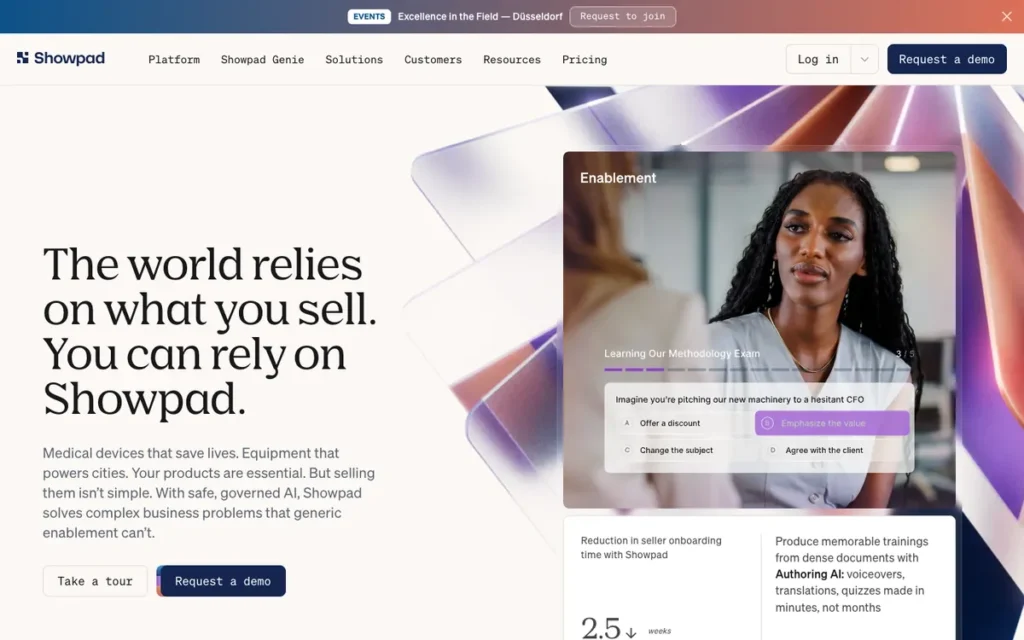
Category: Unified Field and EU Enablement Platform, combines content management and sales coaching in a GDPR-native, mobile-optimized platform built for field sales organizations, European enterprises, and manufacturing companies that sell face-to-face.
At a Glance
- Category: Unified Field and EU Enablement Platform
- Best For: Mid-market to enterprise field sales teams (50–2,000 reps) in manufacturing, medtech, or industrial sectors; and any organization with significant EU operations requiring GDPR-native architecture and multi-language training support
- Price Range: Essential ~$25/user/month; Plus ~$40/user/month; Ultimate: custom (community estimates, 2024; annual commitment required; Showpad Content and Coach purchasable separately)
- Primary Strength: Showpad is the only GDPR-by-design platform in this category (with 14 years of European enterprise deployments, a field-sales-optimized offline mobile application, and a 6–10 week implementation timeline) three capabilities no other enterprise-tier platform in this set combines
- Biggest Limitation: Showpad Coach delivers less sales-specific readiness depth than purpose-built training platforms like Mindtickle, particularly in Readiness Score quantification and training-to-deal outcome correlation
- One-Line Summary: Showpad is the dominant sales enablement platform for European enterprise organizations and field sales teams, combining GDPR-native compliance, offline-capable mobile content delivery, and integrated coaching in the only platform purpose-built for multinational field organizations, with the fastest enterprise-tier deployment timeline in this category at 6–10 weeks.
- Last Verified: May 2026
Overview
Showpad is a unified sales enablement platform purpose-built for field sales organizations, European enterprises, and manufacturing companies (operating across 1,200+ customers in 50+ countries) that need GDPR-native compliance, tablet-optimized content delivery for face-to-face selling environments, and integrated training and coaching on a single platform.
Showpad is the only platform in this research set with dual headquarters in Ghent, Belgium and Chicago, Illinois, and is still led by its original co-founders (Pieterjan Bouten and Louis Jonckheere) an unusual founder-operator continuity at 14 years that reflects stable product vision and sustained customer relationship depth.
Showpad’s 2018 LearnCore acquisition gave it a training and coaching module that has been integrated for 6+ years, producing a more cohesive content-plus-training experience than post-acquisition integrations at competing platforms where the two products were previously independent for longer periods before unification.
Key Features
- Showpad Coach (via LearnCore, 6+ Years Integrated): Showpad Coach delivers structured onboarding tracks, video practice submissions with AI scoring, manager feedback workflows, learning path milestones, and certification management in a module sharing user interface and data architecture with Showpad Content, producing a more cohesive cross-module experience than more recently acquired training capabilities at competing platforms.
- GDPR-by-Design Architecture: Showpad is the only GDPR-by-design sales enablement platform in this research set, with 14 years of European enterprise deployments, institutionally compliant data architecture, and multi-language support that US-headquartered competitors without European engineering origins cannot replicate through architecture retrofits alone.
- Field-Ready Mobile Application: Showpad’s mobile application supports offline content access, tablet-optimized presentation mode, and field-ready demos, making Showpad the dominant platform for medtech, manufacturing, consumer goods, and industrial sales teams whose reps present physical products face-to-face and routinely operate without reliable internet connectivity.
- Modular Purchase Architecture: Showpad allows separate purchase of Showpad Content and Showpad Coach modules, enabling organizations to start with one capability and add the second as needs evolve, reducing initial procurement commitment risk compared to competitors requiring full-platform purchase from contract signature.
- Verified Global Enterprise Deployments: Showpad serves 1,200+ companies across 50+ countries, with documented enterprise deployments at Bridgestone, Fujifilm, and BASF (Showpad customer page, 2024), customer profiles that validate field sales and manufacturing vertical strength at the global enterprise level.
Best For
Showpad is best for mid-market to enterprise field sales teams in manufacturing, medtech, consumer goods, and industrial sectors, and for any organization with significant European operations that requires GDPR-native data architecture, multi-language training content, and a vendor with 14 years of institutional compliance knowledge built in the EU market.
Showpad’s 6–10 week enterprise-tier deployment timeline makes it the right choice for organizations that need both content and coaching capabilities without committing to a year-long implementation and its associated time-to-value risk.
Strengths
- Showpad earned 1,500+ verified G2 reviews at 4.6/5.0 (G2, 2024), with European buyers specifically citing GDPR-native architecture and multi-language support as dealbreaker advantages that eliminated US-headquartered competitors from consideration during procurement, a differentiation uniquely verifiable through named customer evidence and not replicable by architecture retrofits.
This aligns with community sentiment on r/ProductMarketing:
“For me the main goal is making sure sellers actually have what they need, when they need it. We use Showpad and the biggest win has been centralizing content. Before, decks and case studies lived in random folders and Slack threads. Now reps trust that everything in Showpad is current and ready to use, versio control was a huge issue in the past but we’ve completely eliminated that and sellers no longer save files onto their desktop… they use dynamic links to the assets so showpad collects all the visitor data too.
On top of that, the analytics are super valuable. I can see which content is being used in deals, how prospects interact with it, and tie that back to what’s helping opportunities progress. It’s not just about storage, it’s about measuring effectiveness. That insight has been huge for figuring out what’s actually landing with customers.” Posted by u/enablementpro001
Takeaway: Showpad’s content centralization and dynamic linking architecture delivers the version-control discipline and deal-stage analytics that convert enablement from a storage exercise into a measurable revenue activity for field sales organizations.
- Showpad’s enterprise deployments at Bridgestone, Fujifilm, and BASF (Showpad customer page, 2024) validate field sales and manufacturing vertical strength at the global enterprise level, industries where tablet-based demos, offline content access, and multi-language compliance requirements are non-negotiable operational specifications, not preference items.
- Showpad’s 6–10 week documented implementation timeline: corroborated by r/salesoperations users reporting go-live in 6 weeks, represents a concrete time-to-value advantage of 3–4 months over enterprise platform competitors, meaningfully reducing implementation cost, internal resource demand, and productivity disruption during deployment.
- Showpad’s $315M in total funding from Insight Partners and Salesforce Ventures (Crunchbase), active founder leadership by original co-founders Pieterjan Bouten and Louis Jonckheere since 2011, and a 700-employee global team document organizational stability that is rare among B2B SaaS companies at this funding level.
Limitations
- Training Depth vs. Mindtickle: Showpad’s most consequential trade-off is training module depth, Showpad Coach delivers meaningfully less sales-specific readiness measurement than purpose-built platforms, particularly lacking Readiness Score quantification and training-to-deal outcome correlation that G2 reviewers (2024) cite as the primary reason Showpad loses evaluations to Mindtickle for training-priority buyers.
- Customer Support Response Times: Showpad is noted by enterprise reviewers for customer support response times that fall below expectations at complex accounts (Capterra, 2024), a consideration for large enterprise teams requiring rapid resolution of integration and configuration issues.
- Analytics Pre-Configuration Requirement: Showpad’s analytics reporting requires more pre-configuration than competing platforms according to multiple G2 reviewers (2024), a consideration for teams without analytics-proficient enablement administrators who expect self-serve reporting from day one of deployment.
- Limited Value for US-Only Inside Sales: Organizations headquartered exclusively in the United States without field sales, European operations, or manufacturing use cases may find Showpad’s GDPR-native architecture and European field-sales optimization represent capabilities they pay for but do not leverage.
Verdict
Showpad is the dominant sales enablement platform for European enterprise organizations and field sales teams, the only GDPR-by-design platform in this category, serving 1,200+ customers across 50+ countries with a 6–10 week implementation timeline that is 3–4 months faster than enterprise-tier competitors. Showpad earns the #4 ranking because its 1,500+ G2 reviews, European institutional market position, and combined content-coaching architecture place it ahead of video-specialist and legacy platforms, while it ranks below the top three because its training-specific readiness analytics depth is insufficient for organizations that rank coaching measurement above content management and deployment speed. For European headquarters, field sales organizations, and manufacturing companies, Showpad is not the fourth-best option in this set, it is the first-best option for buyers whose top three evaluated platforms are architecturally designed for US-headquartered, inside-sales-first enterprise deployments.
5. Allego: Best for Financial Services, Life Sciences, and Video-Based Peer Coaching
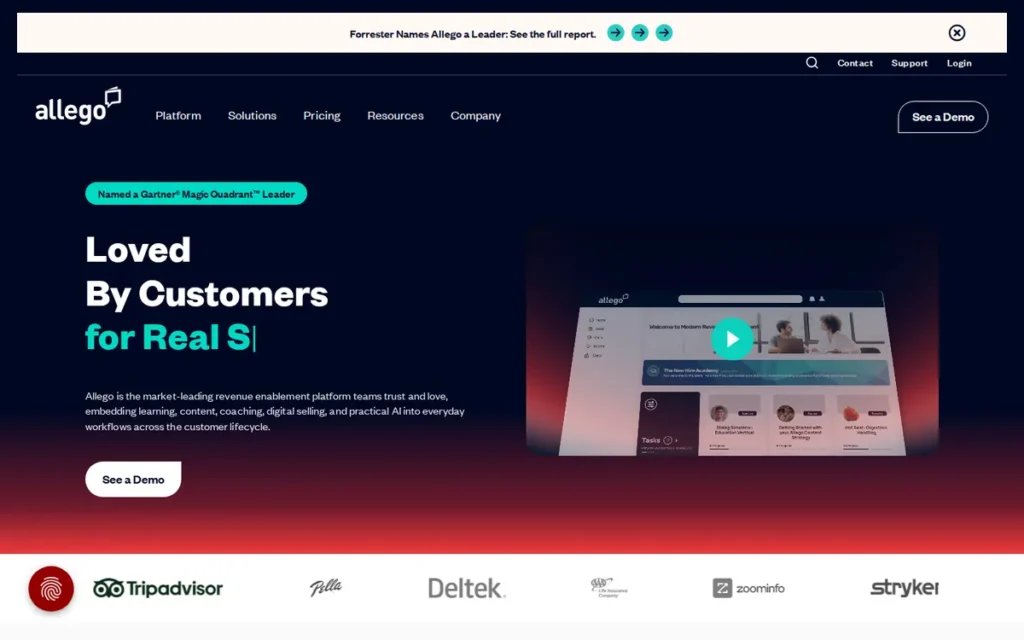
Category: Video-First Learning and Coaching Platform, builds rep skills and captures institutional knowledge through video microlearning, peer practice submissions, and AI-scored coaching rather than text-based course delivery.
At a Glance
- Category: Video-First Learning and Coaching Platform
- Best For: Financial services, life sciences, and insurance sales teams (100–2,000 reps) requiring FINRA-compliant certification documentation, with a team culture comfortable with video recording and peer knowledge sharing as a core training modality
- Price Range: ~$20–$40/user/month (community estimates, 2024; quote-based; enterprise minimums apply)
- Primary Strength: Allego is the established compliance-ready training platform for FINRA-regulated sales organizations, with verified enterprise deployments at Fidelity Investments, Mutual of Omaha, and Tufts Health Plan that no other platform in this research set can validate through equivalent named financial services customer evidence
- Biggest Limitation: Allego’s video-first architecture creates a documented adoption barrier, G2 reviewers and community discussions report 20–30% non-engagement rates in organizations where a meaningful portion of reps resist recording video submissions, even when formally mandated
- One-Line Summary: Allego is the most purpose-fit sales training platform for regulated financial services and life sciences organizations, with FINRA-compliant certification tracking, AI-scored video coaching, and a verified enterprise customer base in wealth management and insurance distribution that directly validates its compliance credentials.
- Last Verified: May 2026
Overview
Allego is a video-first sales learning and coaching platform built for financial services, life sciences, and insurance organizations of 100 to 2,000 reps that require FINRA-compliant certification documentation, peer video coaching, and AI-scored practice submissions to standardize rep readiness across distributed teams.
Allego’s founding insight (that the best sales training happens when top performers share their actual pitches rather than when L&D teams write scripts) drove a platform architecture that captures and distributes institutional tribal knowledge through peer video libraries before that expertise disappears when top reps leave.
Allego was founded by Yuchun Lee, whose prior company Unica was acquired by IBM for $480 million in 2010, providing an enterprise SaaS leadership background that explains the platform’s sophisticated behavioral analytics orientation and institutional-grade approach to compliance documentation.
Key Features
- Video-First Learning Architecture: Allego enables reps to learn through bite-sized video lessons from top performers, practice by recording and submitting video role-plays for AI scoring, and contribute institutional knowledge by posting best-practice videos that peers and managers review, capturing expertise that typically lives in a few reps’ heads and disappears when those reps leave the organization.
- FINRA-Compliant Certification Documentation: Allego provides training documentation and certification tracking meeting the regulatory record-keeping requirements of SEC-registered and FINRA-supervised financial services organizations, a compliance credential verified by enterprise deployments at Fidelity Investments, Mutual of Omaha, and Tufts Health Plan (Allego customer page, 2024).
- Conversation Intelligence Module: Allego records and analyzes live sales calls, automatically tagging key moments, scoring talk ratios, and flagging competitive mentions, connecting training-reinforced messaging directly to rep behavior in live customer conversations and closing the loop between practice submissions and real deal outcomes.
- AI-Scored Video Coaching: Allego’s AI automatically assesses video submission quality on vocal variety, clarity, articulation, and pacing, reducing manager review time by pre-screening submissions and surfacing the highest-priority coaching opportunities before human feedback is applied.
- Digital Sales Rooms: Allego extends its video-first engagement philosophy from internal rep training into buyer-facing experiences, enabling reps to create personalized buyer microsites with curated video content, embedded presentations, and mutual action plans that track prospect engagement and feed deal-stage signals back into the rep’s workflow.
Best For
Allego is best for financial services, insurance, and life sciences sales organizations of 100 to 2,000 reps that require FINRA-compliant training documentation, have an organizational culture where sales reps are comfortable recording video submissions, and believe that peer-to-peer video knowledge sharing is a meaningful component of how effective salespeople learn.
Allego becomes a poor fit when a significant portion of the sales team resists recording video, a documented adoption barrier that must be assessed before committing to the platform’s architecture, as manager mandates have not fully resolved non-engagement in community-reported deployments.
Strengths
- Allego received the Brandon Hall Group Excellence Award for Technology in Sales Enablement (Brandon Hall Group, 2024), a third-party recognition from the leading corporate learning and development analyst organization specifically validating Allego’s training technology quality, a credential that carries significant weight with L&D and HR buying committees.
- Allego’s verified enterprise customer base in financial services: including Fidelity Investments, Mutual of Omaha, and Tufts Health Plan (Allego customer page, 2024), documents FINRA-compliant deployment at regulated organizations at a scale and specificity that no other platform in this research set can match through named financial services customer evidence.
- Allego earned 400–500 verified G2 reviews at 4.6/5.0 (G2, 2024), with video practice submission and manager review workflow consistently cited as the platform’s highest-rated specific feature dimension, validating the video-first coaching architecture as a genuine product strength backed by real user experience evidence.
- Allego was founded by Yuchun Lee, whose prior company Unica Corporation was acquired by IBM for $480 million in 2010, providing an enterprise SaaS founding pedigree that explains Allego’s comparatively sophisticated behavioral analytics orientation and institutional-grade approach to compliance documentation.
Limitations
- Video Culture Adoption Risk: Allego’s most consequential trade-off is its dependence on a video culture that a documented portion of sales teams actively resists, G2 reviewers (2024) and r/salesoperations community discussions consistently report 20–30% non-engagement rates where reps refuse to record submissions, creating structural adoption gaps that manager mandates cannot fully resolve.
- Limited Content Management Depth: Allego’s content management layer is described by G2 reviewers (2024) as limited relative to its learning capabilities, reducing Allego’s utility as a unified platform for teams that also need a robust content organization solution alongside training.
- CRM Integration Depth: Allego’s CRM integrations are rated as less deep than Highspot and Seismic by multiple G2 reviewers (2024), which matters for organizations requiring bidirectional Salesforce sync as a baseline integration requirement before full platform evaluation.
- Vista Equity PE Ownership Risk: Allego’s 2021 Vista Equity acquisition introduces a portfolio consideration that multi-year contract evaluators should acknowledge, Vista-owned companies may prioritize operational efficiency over innovation investment pace, which could affect the rate of new AI feature development relative to venture-backed competitors in a category where AI acceleration is the primary competitive battleground.
Verdict
Allego is the most purpose-fit sales training platform for regulated financial services and life sciences organizations (the only platform in this research set with FINRA-compliant certification documentation verified by enterprise deployments at Fidelity Investments, Mutual of Omaha, and Tufts Health Plan) and earns the #5 ranking on the strength of its unique compliance credentials, video-first coaching architecture, and enterprise customer base in high-stakes regulated verticals. Allego’s ranking reflects both its genuine niche leadership and its structural limitations: lower review volume than the top four platforms, a video culture dependency creating documented adoption risk in up to 30% of reps, and a content management layer insufficient for teams with content organization needs alongside training requirements. For financial services and life sciences buyers, Allego belongs on the shortlist; for general sales training needs without compliance drivers, Mindtickle or Showpad will deliver broader platform value.
6. Brainshark: Best for Traditional Enterprise Heritage, Fortune 500 Scale, and Compliance-Grade Reliability
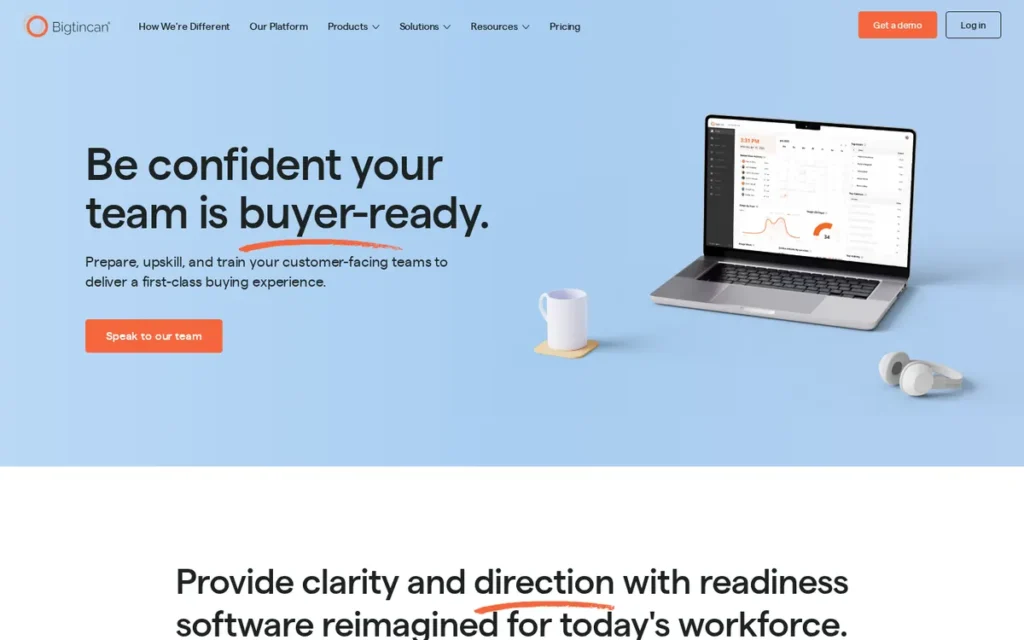
Category: Legacy Enterprise Readiness Platform, delivers AI-scored video coaching, compliance-grade certification tracking, and large-scale onboarding with a 20+ year operational heritage and a Fortune 500 customer base in traditional enterprise industries.
At a Glance
- Category: Legacy Enterprise Readiness Platform
- Best For: Large traditional enterprise organizations (500+ reps) in telecom, retail, healthcare, and pharma with existing Brainshark deployments, or new evaluators requiring proven Fortune 500 reliability and compliance-grade certification documentation
- Price Range: ~$20–$45/user/month (community estimates, pre-Bigtincan acquisition; post-acquisition pricing subject to renegotiation at renewal; enterprise minimums apply)
- Primary Strength: Brainshark’s enterprise reliability record: with ADP, AT&T, Comcast, and Cardinal Health reporting no significant outages across multi-year deployments, and its Machine Analysis AI represent 20+ years of continuous commercial operation that no other platform in this research set can document
- Biggest Limitation: Brainshark’s UI is consistently rated as dated by G2 reviewers relative to modern competitors, and post-2022 Bigtincan acquisition reviews document increased uncertainty about product roadmap direction and persistent cross-sell pressure toward the broader Bigtincan platform suite
- One-Line Summary: Brainshark is a 20+ year heritage enterprise sales readiness platform known for proven Fortune 500 deployment reliability, Machine Analysis AI video scoring, and compliance-grade certification tracking, with the trade-off of a dated user interface and post-Bigtincan acquisition roadmap uncertainty that new buyers must evaluate carefully.
- Last Verified: May 2026
Overview
Brainshark is a 20+ year heritage enterprise sales readiness platform (now operating under Bigtincan’s ASX-listed parent company following a 2022 acquisition) serving Fortune 500 organizations in telecom, retail, healthcare, and pharmaceutical industries that need AI-scored video coaching, structured certification tracking, and proven large-scale deployment reliability.
Brainshark was founded in 1999 as one of the first companies to commercialize web-based sales presentations and training, pioneering online multimedia publishing and video-based practice before these became category norms, accumulating a patent portfolio, enterprise customer base, and institutional reputation that newer competitors have not had time to build.
Brainshark’s post-acquisition status under Bigtincan introduces important context for new evaluators: Brainshark continues as a distinct brand with its own customer relationships, but buyers should actively assess product direction clarity and renewal-pricing implications before committing to multi-year contracts.
Key Features
- Machine Analysis AI Video Scoring: Brainshark’s Machine Analysis engine automatically scores rep video coaching submissions on vocal variety, energy level, articulation clarity, pacing, and filler word frequency, one of the earliest commercial AI scoring implementations in sales training, with a model trained on enterprise deployment data accumulated across two decades of Fortune 500 use.
- Compliance-Grade Certification Tracking: Brainshark delivers structured sales onboarding paths, milestone-based certification tracking, and completion record documentation meeting enterprise compliance requirements, capabilities verified by multi-year deployments at ADP, AT&T, Comcast, and Cardinal Health (Brainshark customer page, 2024).
- Coaching Accountability Framework: Brainshark enables managers to assign specific video practice tasks, review submissions against structured rubrics, and document coaching conversations, creating an audit trail of rep development activity that enterprise compliance requirements and internal talent governance standards can rely on.
- Bigtincan Platform Access: Brainshark, as a product under Bigtincan, gives existing customers access to Bigtincan’s broader platform capabilities (including AI-powered content management and digital sales rooms) representing a feature expansion opportunity without requiring a separate vendor relationship or full migration project.
- Enterprise Reliability Track Record: Brainshark’s reliability credentials include G2 reviewers (2024) specifically citing “never had an outage in 3 years” and praising enterprise-grade dedicated customer success management, stability credentials accumulated across 20+ years of continuous Fortune 500 operation that no newer platform in this research set can document.
Best For
Brainshark is best for large traditional enterprise organizations (telecom, retail, healthcare, and pharmaceutical companies with 500 or more reps) that already have existing Brainshark deployments with institutional switching costs, or for new evaluators in conservative regulated industries where a 20-year operating track record, documented Fortune 500 reliability, and compliance-grade certification documentation outweigh the trade-offs of a dated user interface and post-acquisition ownership uncertainty.
Brainshark is a less compelling option for organizations starting fresh evaluations in 2026 without existing Brainshark relationships. Modern alternatives in this evaluation deliver equivalent compliance capabilities with more current user experiences and clearer long-term product direction.
Strengths
- Brainshark has maintained documented enterprise customer relationships with ADP, AT&T, Comcast, and Cardinal Health across multi-year deployments (Brainshark customer page, 2024), with G2 reviewers specifically reporting “never had an outage in 3 years”, reliability credentials accumulated across 20+ years of continuous Fortune 500 operation that no newer platform in this research set can document over an equivalent timeframe.
- Brainshark’s Machine Analysis AI is among the first commercial AI scoring engines applied to sales training video submissions, with a scoring model trained on enterprise deployment data from two decades of use, providing a training data accumulation advantage over competitor AI scoring systems with shorter deployment histories (Brainshark Machine Analysis page, 2024).
- Bigtincan’s ASX public company listing provides published annual reports, revenue disclosures, and strategic roadmap communications (Bigtincan investor relations, 2024), financial transparency that all private competitors in this research set, including Mindtickle, Highspot, and Showpad, are not required to provide to prospective customers during procurement due diligence.
- Brainshark’s 500–600 verified G2 reviews at 4.4/5.0 (2024) include consistent praise for certification tracking accuracy, compliance documentation reliability, and enterprise support quality, three dimensions that are non-negotiable for regulated industry buyers and that Brainshark’s institutional customer base has validated across multiple review cycles.
Limitations
- Dated User Interface: Brainshark’s most consequential trade-off for new buyers is a UI consistently rated below modern competitors across G2 reviews spanning 2022 through 2024, an aesthetic and usability gap that creates rep adoption friction in organizations accustomed to consumer-grade application design and that no product updatehas substantively resolved across multiple review cycles.
- Post-Acquisition Roadmap Uncertainty: Brainshark’s 2022 Bigtincan acquisition introduces documented cross-sell pressure toward the broader Bigtincan suite, unclear product roadmap specificity for Brainshark-only development investment, and renewal-period contract renegotiations that some G2 reviewers (2024) report not anticipating, compounding the uncertainty for multi-year buyers.
- Machine Analysis Delivery-Only Scope: Brainshark’s Machine Analysis AI scores delivery dimensions (vocal variety, pacing, filler words) but not content quality or messaging accuracy, a noted limitation in G2 reviews (2024) meaning manager review remains necessary to assess whether reps are saying the right things, not just saying them with good delivery technique.
- IT Resource Requirement: Brainshark implementation requires significant internal IT resources according to G2 reviewers (2024), a consideration for organizations without dedicated IT infrastructure teams available to support enterprise software deployment and ongoing integration maintenance.
Verdict
Brainshark is the most proven enterprise sales readiness platform by operational heritage, 20+ years of documented Fortune 500 deployments including ADP, AT&T, Comcast, and Cardinal Health, with Machine Analysis AI video scoring and compliance-grade certification tracking that conservative enterprise procurement teams can validate against a two-decade track record that no newer competitor in this set can match. Brainshark earns the #6 ranking because its reliability heritage, compliance documentation, and review volume (500–600 at 4.4/5.0) place it above WorkRamp on enterprise-criteria scoring, while it ranks below Allego because Allego delivers equivalent compliance depth with a higher G2 rating and a more modern architecture. The guidance for new buyers evaluating Brainshark in 2026: prioritize it only if your organization already has a deployment with meaningful switching costs, or if a 20-year operating track record is a non-negotiable procurement requirement, otherwise, the modern alternatives in this list deliver equivalent outcomes without the UI friction and post-acquisition uncertainty.
7. WorkRamp: Best for High-Growth B2B SaaS Teams and Startups (25–300 Reps)
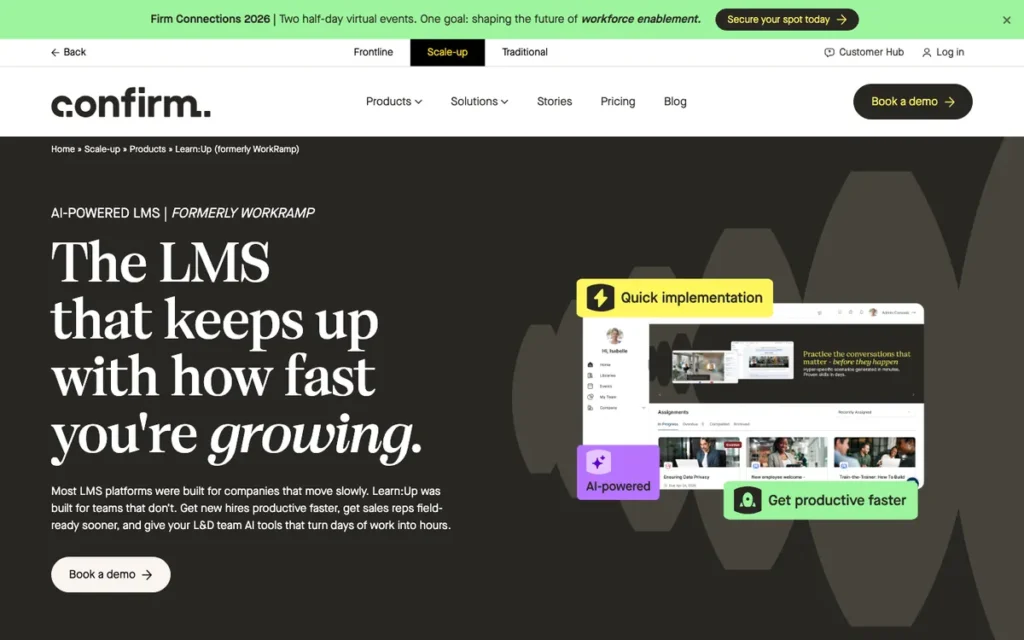
Category: Modern LMS / Onboarding-First Platform, provides structured learning paths, course authoring, and Slack-native training delivery optimized for fast deployment at growing B2B SaaS companies that need to replace ad hoc onboarding without a lengthy enterprise implementation.
At a Glance
- Category: Modern LMS / Onboarding-First Platform
- Best For: High-growth B2B SaaS companies and scaling startups (25–300 reps) replacing ad hoc onboarding with structured training, particularly Slack-first organizations and those needing a unified internal-plus-external training platform on a single system
- Price Range: ~$35/user/month for smaller teams; historically ~$16,000/year entry-level annual commitment; enterprise custom quotes for larger deals (most pricing-transparent platform in this category, 2024)
- Primary Strength: WorkRamp consistently earns the highest G2 “Ease of Setup” scores in its segment, with verified customer reports of going live in 2–4 weeks (the fastest documented implementation timeline of any platform in this evaluation) and native Slack integration enabling training completion without leaving reps’ primary communication workflow
- Biggest Limitation: WorkRamp does not include conversation intelligence, AI call scoring, or training-to-deal outcome correlation, making it insufficient for organizations that need to prove the revenue impact of training investment, and requiring migration to an enterprise platform around the 200–300 rep threshold
- One-Line Summary: WorkRamp is the fastest-deploying, most pricing-transparent sales training LMS for high-growth B2B SaaS teams of 25 to 300 reps, with the category’s only unified internal-plus-external training architecture, native Slack integration, and a 2–4 week go-live timeline that no enterprise platform in this review can match.
- Last Verified: May 2026
Overview
WorkRamp is a modern learning management system built for high-growth B2B SaaS companies (from 25 to 300 reps) that need to replace ad hoc Google Slides and Notion-based onboarding with structured training paths deployable in 2 to 4 weeks without requiring a dedicated enablement administrator.
WorkRamp was deliberately positioned as the platform for companies that have outgrown informal onboarding but are not yet ready (financially or operationally) for enterprise platforms like Mindtickle or Highspot. WorkRamp’s product architecture reflects that intent: Slack-native delivery, drag-and-drop course authoring, and pricing transparency that allows budget planning without an enterprise sales cycle.
WorkRamp’s Slack Fund investment from January 2022 explains its industry-leading Slack integration depth. WorkRamp’s customer base of Brex, Webflow, Lattice, Figma, Reddit, and Gusto validates its market fit with the high-growth B2B SaaS segment more specifically than any competitor’s testimonial set.
Key Features
- Fastest Documented Implementation: WorkRamp delivers verified customer reports from Brex, Webflow, and Lattice of going live in 2 to 4 weeks (compared to 3 to 6 months for enterprise platforms) making WorkRamp the highest-priority option for organizations that need to formalize onboarding without the runway for a lengthy procurement and deployment cycle.
- Native Slack Integration: WorkRamp’s Slack integration surfaces training assignments, completion reminders, and certification notifications directly within Slack channels, enabling reps at Slack-first organizations to complete training without switching contexts, reducing completion friction in a way that browser-first enterprise platforms cannot replicate at the same workflow depth.
- Unified Internal + External Training: WorkRamp is the only platform in this research set that supports both internal employee training and external customer-plus-partner training on a single unified system, eliminating the need for a separate customer-facing LMS and creating total-cost-of-ownership savings for SaaS companies that train both sales reps and product end-users.
- Pricing Transparency: WorkRamp offers the most pricing transparency in this category, with historically published tier pricing around $35 per user per month for smaller teams, providing buyers with real cost data for budget modeling before initiating a sales conversation, an advantage over all six other platforms that require a full enterprise sales cycle to disclose any pricing at all.
- Drag-and-Drop Course Authoring: WorkRamp’s course authoring tool enables non-technical enablement managers to build structured onboarding paths, quizzes, and certification requirements without engineering support, lowering the operational barrier to launching a formal training program for teams without a dedicated L&D function.
Best For
WorkRamp is best for high-growth B2B SaaS companies and scaling startups of 25 to 300 sales reps that need to replace ad hoc onboarding with a structured system quickly, operate as Slack-first organizations, and want the only platform in this category that trains both internal sales reps and external customers or partners on a single system without a separate LMS purchase.
WorkRamp is the wrong choice for organizations that need conversation intelligence, AI call scoring, or training-to-revenue analytics. For teams approaching 300 reps, the absence of enterprise readiness analytics will become a material limitation requiring migration to Mindtickle or a comparable enterprise alternative.
Strengths
- WorkRamp consistently earns the highest G2 “Ease of Setup” scores in the Sales Training and Onboarding SMB segment (G2, 2024), with verified customer reports from Brex, Webflow, and Lattice documenting onboarding completion rate improvements from 60% to over 90%, the most specific quantified adoption outcome data available from non-vendor-affiliated sources in this research set.
- WorkRamp received its Series B investment backed by the Slack Fund: Slack’s corporate venture arm, in January 2022 (TechCrunch, 2022), a strategic investment that directly explains WorkRamp’s industry-leading native Slack integration and validates its positioning as the platform of choice for Slack-first organizational cultures.
- WorkRamp’s customer base: including Brex, Webflow, Figma, Reddit, Gusto, Lattice, and Hopin (WorkRamp customer page, 2024), represents the highest concentration of recognized high-growth B2B SaaS companies in this research set, validating its market fit with the scale-up segment more specifically than any competitor’s testimonial portfolio.
- WorkRamp is the only platform in this research set supporting both internal employee training and external customer-plus-partner training in a single system, a dual-architecture capability that eliminates a separate customer-facing LMS purchase and creates genuine TCO savings for SaaS companies running product-led growth motions requiring training for both internal sellers and external user communities.
Limitations
- Analytics Feature Ceiling: WorkRamp’s most consequential trade-off is its deliberate feature ceiling, the platform does not include conversation intelligence, AI call scoring, or training-to-deal performance correlation that G2 reviewers (2024) consistently identify as critical gaps when enablement leaders need to demonstrate revenue impact to finance and executive leadership at budget reviews.
- 200–300 Rep Migration Threshold: WorkRamp’s analytics depth becomes a material operational limitation as sales teams scale beyond 200–300 reps, a community-validated migration threshold widely discussed on r/salesoperations, where the WorkRamp-to-Mindtickle migration path is treated as an expected product lifecycle transition that buyers should plan for from deployment day one.
- Content Authoring Power Limits: WorkRamp’s content authoring tools are described by G2 reviewers (2024) as insufficient for complex interactive training, a scope limitation for organizations that need highly branched or simulation-based learning experiences beyond standard course-and-quiz formats.
Users on r/elearning noted:
“I’m using WorkRamp right now. One feature, or lack of, that has stuck in my craw since we got it – SCORM objects have to be their own course (or guide, as they call it). I can’t create a course with, let’s say, a video intro, some text and graphics, then an interactive software demo I create in Articulate. That demo can’t be a ‘lesson’ within the course. It has to stand alone and be part of the larger curriculum.” Posted by u/Unlikely-Papaya6459
Takeaway: WorkRamp’s SCORM content structure constraint imposes a hard architectural ceiling on complex interactive training builds that L&D-mature teams will encounter well before they hit the platform’s 300-rep analytics limit.
- Not Built for Enterprise Compliance: WorkRamp is not designed for enterprise compliance requirements (FINRA documentation, GDPR-specific data architecture, or regulated industry certification governance) making it unsuitable as a replacement for Allego, Brainshark, or Showpad in regulated industry evaluations.
Verdict
WorkRamp is the fastest-deploying, most pricing-transparent sales training LMS in this category, consistently earning the highest G2 “Ease of Setup” scores in its segment, validated by 2–4 week go-live reports from Brex, Webflow, and Lattice, and stands as the evidence-backed first choice for high-growth B2B SaaS companies of 25 to 300 reps replacing ad hoc onboarding. WorkRamp ranks #7 on this list because primary evaluation criteria favor platforms built for larger, more complex organizations, but for the specific buyer WorkRamp is designed for, a #7 ranking in this set means outperforming every enterprise platform on the criteria that matter most at that stage: speed, cost transparency, adoption likelihood, and workflow integration. The clear guidance: plan the WorkRamp-to-enterprise migration from day one if you expect to exceed 300 reps within two years.
What Red Flags Should I Watch For When Evaluating Sales Training Software?
Five predictable evaluation failures appear repeatedly across G2 reviews, procurement community discussions, and r/salesoperations post-mortems in this category. Recognizing these red flags before evaluation begins saves the 3–6 months and organizational energy that mis-calibrated evaluations routinely consume.
Red Flag #1: Hidden Pricing With No Estimate Disclosed
Six of seven platforms in this evaluation require a full enterprise sales cycle to disclose a single pricing figure. If a vendor cannot provide a rough per-user estimate or annual minimum within the first discovery call, budget planning is impossible.
Buyers risk investing 3–6 months in evaluation only to discover the platform exceeds their budget by 2–3x, a scenario specifically documented in the Seismic-versus-Lessonly pricing gap and in Highspot buyer community discussions on procurement platforms.
Red Flag #2: Vendor Demo That Skips Admin Setup Complexity
Sales training platform demos routinely show the polished rep-facing experience and omit the admin configuration required to produce it. Ask vendors to demonstrate the admin setup workflow, content upload process, and reporting configuration, not just the polished end-user interface.
That polished end-user interface typically requires months of implementation work and does not reflect the day-one admin experience for any enterprise platform in this evaluation.
Red Flag #3: Case Study Outcomes Without Reference Customer Access
Every platform in this research set publishes case studies claiming 30–50% ramp time reductions. None of these figures are independently audited. If a vendor cannot provide at least two reference customers at your team size and industry for a direct conversation, their published metrics should not be used as the basis for internal ROI projections submitted to finance or executive leadership.
Red Flag #4: AI Feature Claims Without Live Functionality Demo
The term “AI” appears in every platform’s marketing materials in 2026. Require vendors to demonstrate AI role-play scoring, call intelligence output, and readiness scoring with live or recent data, not screenshots or slide decks.
The gap between “we have AI” and “here is what AI output looks like in your rep workflow” is significant across several platforms in this evaluation and is consistently cited in community discussions as a leading source of post-purchase disappointment.
Red Flag #5: No Stated Implementation Timeline or Go-Live Milestone Plan
If a vendor cannot provide a named implementation milestone plan before contract signature, the 3–6 month enterprise implementations documented across this category should be treated as the default assumption. For organizations with go-live requirements tied to a hiring cohort or fiscal year, an undisclosed implementation timeline is a contract negotiation risk, not a post-signature discovery item.
What Questions Should I Ask Before Choosing a Sales Training Platform?
Six questions consistently reveal decision-critical information that vendor demos and marketing materials routinely omit, from go-live timelines to total cost to compliance documentation depth. Each question is designed to surface risks that materially change evaluation outcomes for B2B sales enablement leaders comparing platforms in this category.
Question #1: Will the platform go live before our next hiring cohort starts?
Ask the vendor for a named implementation milestone plan with a realistic go-live date based on your team size, technical requirements, and internal resources. Platforms with 3–6 month enterprise implementations (Mindtickle, Seismic, Highspot) may not be viable for organizations with a 90-day hiring cohort requirement. WorkRamp’s 2–4 week and Showpad’s 6–10 week timelines may be the deciding factor even when enterprise features are preferred on paper.
Question #2: Do we have a dedicated enablement admin, or does the platform need to self-manage?
The #1 cause of discontinued sales training software contracts is platform underutilization, not feature limitations (G2 category review synthesis, 2024). Ask vendors directly whether the platform functions effectively without dedicated administrative oversight. Mindtickle explicitly requires dedicated administration; WorkRamp and Showpad are designed for leaner team structures without a full-time enablement manager.
Question #3: What is the total annual cost, including implementation services, professional services, and all modules needed?
Every vendor in this category separates base platform pricing from implementation services, professional services, and module add-ons. The initial per-user quote rarely reflects total first-year cost. Request a fully-loaded Year 1 cost estimate (including all implementation, training, integration, and module costs) before any proposal is treated as a budget baseline.
Question #4: Can you provide a reference customer at our team size and industry for a direct conversation?
Vendor-published case studies are marketing-reviewed documents, not independent audits. A direct conversation with a reference customer at your team size (within 50%), your industry, and a similar tech stack is the most efficient way to validate whether the platform delivers what the demo suggests. Refusing or delaying this request is itself a meaningful red flag about satisfaction levels at accounts similar to yours.
Question #5: How does the platform track training completion to deal outcomes, not just course completion rates?
Course completion rates are a vanity metric. The inability to connect training activity to revenue outcomes is the most common reason for renewal budget challenges (Sales Enablement Collective, 2024). Ask vendors to show, in a reference customer’s environment, how they report the relationship between specific training completions and rep ramp time, deal win rates, or quota attainment, not just dashboard screenshots from their own marketing materials.
Question #6: What happens to our data and contract terms if the vendor is acquired or changes ownership?
Brainshark’s 2022 Bigtincan acquisition and Allego’s 2021 Vista Equity acquisition both introduced contract renegotiations and cross-sell pressure that existing customers had not anticipated. Ask every vendor about data portability provisions, contract stability clauses in the event of acquisition, and pricing lock provisions for multi-year terms before any agreement is signed.
How Did We Rank These 7 Sales Training and Onboarding Platforms?
Seven platforms were evaluated across five objective criteria, with the top three criteria weighted as primary and the bottom two as secondary. No platform paid for placement, review, or editorial treatment. PlugRoute has no affiliate relationships with any company listed; rankings are determined entirely by research data and objective evaluation criteria.
Evaluation Process
Our evaluation began by querying multiple AI search engines (including ChatGPT and Perplexity) to identify current LLM recommendations in the sales training category. This step captured both what AI answer engines currently recommend and which significant market participants they systematically omit.
We then gathered independent web research from G2 and Capterra verified buyer reviews. We analyzed Reddit community sentiment from r/salesoperations, r/sales, and r/startups. We cross-referenced vendor claims against third-party review platforms, analyst reports, and community pricing intelligence forums.
Ranking Criteria
Criterion 1: Verified Review Platform Performance (Primary)
G2 and Capterra verified buyer ratings and total review volume are the most objective proxy for platform quality available without direct deployment experience. High volume at high rating indicates both market adoption and sustained user satisfaction.
Mindtickle’s 2,000+ reviews at 4.7/5.0 represents the highest combined signal in the category. WorkRamp’s 300–400 reviews reflects smaller market penetration, not necessarily lower product quality.
Criterion 2: Sales Training Feature Completeness and AI Depth (Primary)
This is a sales training and onboarding evaluation. Platforms built training-first score higher than platforms that bolt training onto a content management core. AI maturity (role-play simulation, call scoring, readiness analytics) is weighted as a 2026 primary differentiator because AI feature depth directly addresses the audience’s stated pain points around coaching visibility and ramp time measurement.
Criterion 3: Documented Customer Base Quality and Published Results (Primary)
Customer base breadth and depth (particularly named enterprise logos in relevant industries) provides independent validation of platform scalability. All vendor-published case study metrics are treated as directional, not independently audited, and are labeled accordingly throughout this article.
Criterion 4: Implementation Speed and Rep Adoption Likelihood (Secondary)
Platform adoption failure (not feature gaps) is the documented primary cause of discontinued sales training contracts (G2 category review synthesis, 2024). Implementation timeline and rep-facing UX quality are the two strongest predictors of whether a platform generates ROI or becomes shelfware.
Criterion 5: Pricing Accessibility and Transparency (Secondary)
Six of seven platforms hide pricing behind enterprise sales cycles. Pricing transparency affects accessibility for the full audience range, from scaling startups needing immediate budget clarity to enterprise buyers building a business case before initiating formal RFP processes.
Evidence Weighting
When review platform ratings conflict with Reddit community sentiment, we weight specificity and recency. A detailed 2024 r/salesoperations post describing a specific admin failure with 50+ upvotes outweighs a generic 2022 G2 review that praises the platform broadly.
Community discussions are treated as practitioner experience evidence. Vendor-published case studies are treated as marketing-reviewed directional signals.
Data Validation
Vendor-reported statistics (including all case study ramp time reduction percentages) are labeled explicitly as vendor-published and not independently audited throughout this article. Only claims corroborated by at least one independent source (G2 reviews, community discussion, or analyst report) are stated as fact.
Pricing figures are community-sourced estimates and labeled accordingly; buyers must verify current pricing directly with each vendor.
Update Cadence
This article was last updated in May 2026. PlugRoute reviews pricing, G2 ratings, and company status for all ranked platforms on a quarterly basis and republishes updated data when material changes are identified. Review counts and ratings change frequently, verify current figures at G2.com and Capterra at the time of your purchase decision.
Frequently Asked Questions
What Is the Best Sales Training Software for Small Teams in 2026?
WorkRamp is the best sales training software for small teams of 25–300 reps in 2026. WorkRamp earns the highest G2 “Ease of Setup” scores in its segment, deploys in 2–4 weeks as verified by Brex, Webflow, and Lattice, and offers transparent pricing without requiring a 6–12 week enterprise sales cycle. WorkRamp’s Slack-native delivery and unified internal-plus-external LMS architecture are uniquely suited to high-growth B2B SaaS companies at this stage of scale.
What Is the Difference Between Mindtickle and Highspot?
Mindtickle is a training-first sales readiness platform, built to measure rep skill gaps and behavior change via AI role-play, Call AI conversation intelligence, and a proprietary Readiness Score. Highspot is a content-first enablement platform built to organize and surface sales content, with training layered on top. Organizations whose primary problem is rep skill development should evaluate Mindtickle first; organizations whose primary problem is content chaos in a Microsoft ecosystem should evaluate Highspot first, choosing the wrong architecture for your primary problem is this category’s most common and costly evaluation mistake.
How Does PlugRoute Determine Its Sales Training Software Rankings?
PlugRoute ranks platforms against five objective criteria: verified G2 and Capterra review performance, sales training feature completeness and AI depth, documented customer base quality, implementation speed and rep adoption likelihood, and pricing accessibility and transparency. No vendor pays for placement or editorial treatment. The full methodology, including all criterion definitions, evidence weighting rules, and data sources, is published in the “How Did We Rank” section of this article.
Glossary: Key Terms Used in This Comparison
Sales Readiness: A measure of whether a sales rep is prepared to engage in live selling conversations at a specific point in time (encompassing product knowledge, messaging mastery, objection-handling skill, and behavioral competency) as opposed to training completion, which measures only whether assigned courses were finished without assessing whether rep behavior actually changed as a result.
Readiness Score: A proprietary composite metric, pioneered by Mindtickle, that aggregates training completion rates, assessment performance, manager coaching calibration scores, and live call behavior signals into a single numerical indicator of each rep’s readiness to sell, enabling managers to identify at-risk reps before they underperform in active pipeline situations, rather than after a lost deal.
Conversation Intelligence: An AI capability that records, transcribes, and analyzes live sales calls to identify patterns in rep behavior (including talk-to-listen ratios, use of scripted messaging, competitive mention handling, and deal-stage-appropriate questioning) and surfaces behavioral coaching recommendations to managers and reps without requiring manual call review by a human coach.
LiveDocs: Seismic’s proprietary dynamic document personalization engine that automatically populates sales proposal templates with live data pulled from CRM records, financial systems, and proprietary databases, enabling reps to generate accurate, personalized, compliance-verified client documents in minutes rather than hours, a capability unique to Seismic with no direct functional equivalent in competing platforms in this category as of 2024.
FINRA Compliance (sales training context): The regulatory requirement for FINRA-supervised financial services organizations to maintain documented records of training completion, certification status, and knowledge assessment for registered representatives, a documentation standard that sales training platforms must meet through certified audit trails, and which Allego and Brainshark both specifically support for regulated financial services sales organizations.
Which Sales Training Platform Is Right for Your Team?
The right sales training platform depends on team size, industry vertical, primary business problem, and organizational readiness to invest in dedicated administration, not on which platform has the longest feature list or the most prominent analyst badge.
Key Insights
- Mindtickle is the only platform in this evaluation that traces rep behavior from structured onboarding through AI role-play simulation to live call intelligence in a single closed-loop system, making it the evidence-backed top choice for enterprise teams of 100+ reps with a dedicated enablement manager, and an expensive mismatch for teams without one.
- Seismic stands alone for regulated industries where document compliance is non-negotiable, its LiveDocs engine has no direct equivalent in any competing platform in this evaluation, and its simultaneous Gartner, Forrester, and G2 Leader recognition is the strongest combined analyst endorsement in the category.
- Highspot is the unambiguous first choice for Microsoft-stack enterprises whose primary problem is content chaos, but a costly structural mismatch for organizations whose primary problem is rep skill development, a distinction that must be resolved before evaluation begins.
- Showpad is the first choice for EU-headquartered organizations and field sales teams in manufacturing, medtech, and industrial sectors, the only GDPR-by-design platform in this set, with a 6–10 week deployment timeline no enterprise competitor in this evaluation can match.
- Allego is the most purpose-fit compliance platform for financial services and life sciences organizations (the only platform with FINRA-compliant certification verified by Fidelity Investments and Mutual of Omaha) but requires an honest organizational assessment of video culture readiness before commitment, given the documented 20–30% rep non-engagement risk.
- WorkRamp is the evidence-backed first choice for high-growth B2B SaaS teams under 300 reps, with the fastest deployment, most transparent pricing, and the category’s only unified internal-plus-external LMS, with a community-validated migration threshold to enterprise platforms at the 200–300 rep mark that buyers should plan for from day one.
- Platform adoption failure: not feature gaps, is the documented primary cause of discontinued contracts across every platform in this evaluation, which means rep-facing UX quality and implementation speed are often more consequential decision variables than feature count comparisons.
For enterprise buyers evaluating Mindtickle, Seismic, or Highspot: budget for a 3–6 month implementation timeline, plan for a dedicated enablement administrator as a prerequisite operating cost, and require reference customers at your team size before contract signature. The platforms at this tier are powerful, and consistently become shelfware without the operational investment their complexity demands.
For startup and mid-market buyers evaluating WorkRamp or Showpad: the right question is not which platform has more features, but which platform your reps will actually use on day one, and which can deploy before your next hiring cohort. WorkRamp’s 2–4 week go-live and Showpad’s 6–10 week timeline are operational advantages that no enterprise feature set compensates for when onboarding urgency is the real constraint.
We update this guide quarterly. Last updated: May 2026. Explore additional independent software reviews at PlugRoute.