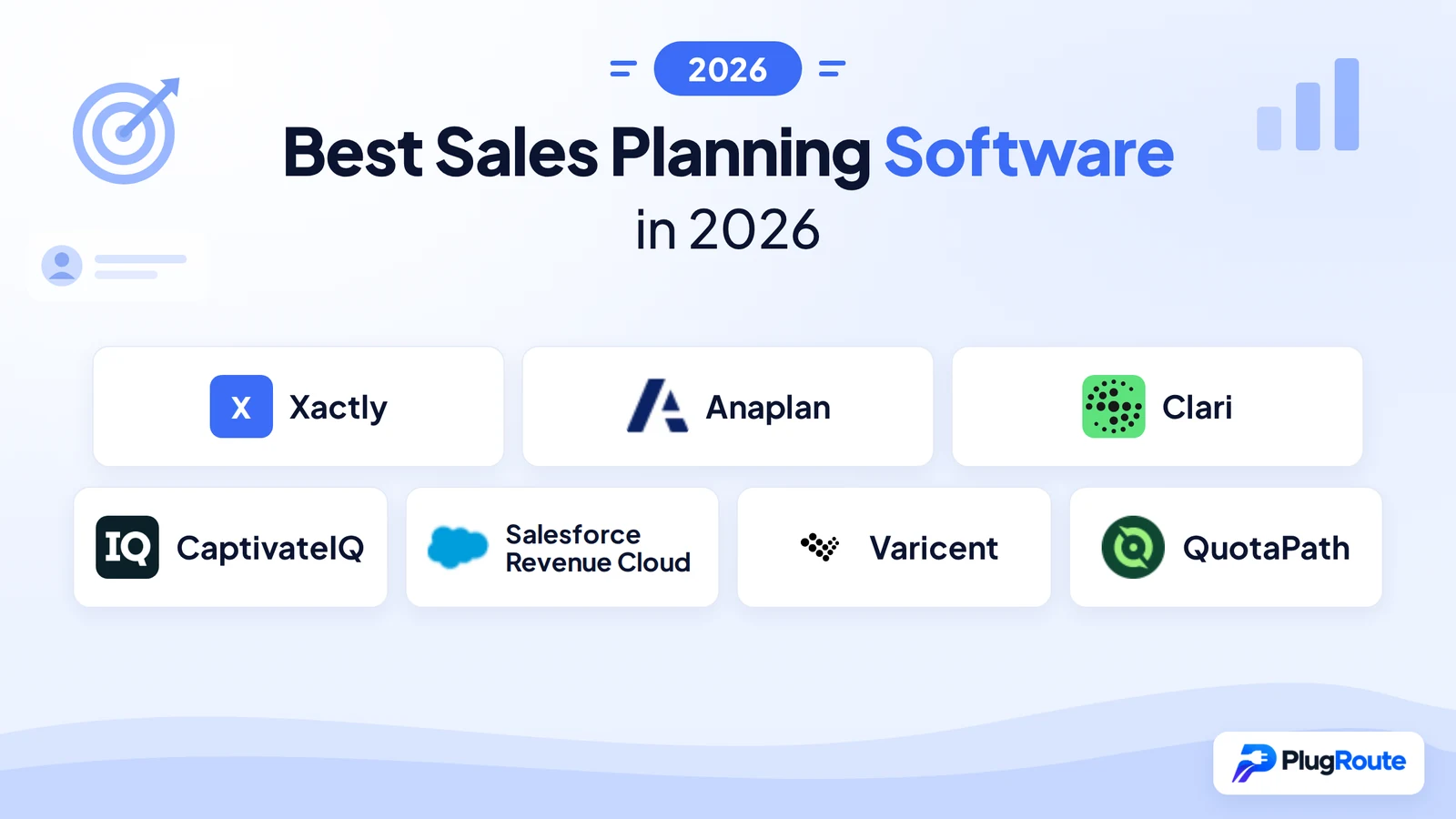
Xactly leads for enterprise Sales Performance Management, built on a Commission Data Cloud covering territory, quota, compensation, and AI-benchmarked forecasting in one sales-specific suite. Anaplan leads for cross-functional connected planning at enterprise scale. CaptivateIQ delivers the fastest deployment and highest combined review ratings for mid-market compensation management. No single platform covers all four SPM pillars at equivalent quality, every procurement decision requires capability trade-offs or a deliberate multi-tool stack.
Sales operations and RevOps leaders face a compounding problem: spreadsheet-based quota and territory workflows break under organizational scale, compensation misalignment drives rep distrust and attrition, and forecast accuracy degrades without real-time pipeline signals. Choosing the wrong platform does not eliminate these problems, it layers integration complexity on top of them. This review matches your company size, CRM ecosystem, and primary pain point to the platform that addresses it most directly.
As one user on r/FPandA described:
“I’m a director at a small SaaS company, $25M ARR, and my team and I calculate all commissions (twice a month, for each payroll – it’s a shit show) and I can’t think of many more things in my job that bring me less joy than payroll-related mistakes that are made. We also are manually calculating everything in excel with reports from Salesforce and not using a comms solution like SPIF or Captivate IQ.” Posted by u/flyingWeez
Takeaway: Manual spreadsheet-based commission management at mid-market scale creates compounding error risk and operational distress, validating that the SPM platform evaluation frameworks in this comparison address a widely documented, high-stakes operational pain point.
PlugRoute has no affiliate relationships with any company listed in this review, rankings are determined entirely by research data and objective evaluation criteria.
TL;DR: Top Picks at a Glance
- Xactly: purpose-built enterprise SPM with the only proprietary peer compensation benchmarking dataset in the category
- Anaplan: top choice for 500+ rep enterprises requiring cross-functional sales and finance planning in a single connected model
- CaptivateIQ: highest-rated compensation manager (4.7/5.0 G2, 700+ reviews); 4–8 week deployment for mid-market teams seeking self-sufficient RevOps operations
- QuotaPath: the only platform with published pricing ($25–$35/user/month); HubSpot-native; built for teams replacing spreadsheets in days
What Are the 4 Types of Sales Planning Software?
Sales planning tools fall into four categories based on primary capability: Enterprise Planning Suites covering multiple SPM pillars, Revenue Intelligence Platforms specializing in AI forecasting, Commission and Quota Managers automating compensation and attainment, and CRM-Native Planners embedding planning within an existing CRM. Matching your primary pain point to the right category eliminates most evaluation work before you engage a single vendor.
1. Enterprise Planning Suites (also called SPM software or sales performance management platforms) cover two or more planning pillars in a single solution. Anaplan links finance and sales through connected planning; Xactly is purpose-built SPM; Varicent specializes in ICM for regulated industries. Trade-off: breadth over implementation speed and total cost of ownership.
2. Revenue Intelligence Platforms specialize in AI-driven forecasting and real-time pipeline inspection. Clari leads this category, with documented outcomes including Carbon Black achieving 95%+ forecast accuracy on the ramp to IPO (Clari Carbon Black case study, clari.com, 2023). These platforms require a parallel tool for territory and compensation, they are forecasting complements, not standalone planning solutions.
3. Commission and Quota Managers (also called incentive compensation management or ICM software) automate compensation and quota tracking without territory design or AI forecasting. CaptivateIQ (mid-market, 4–8 weeks to deploy) and QuotaPath (SMB, 1–3 days) lead this category. Trade-off: fast deployment and strong rep UX at the cost of limited planning scope.
4. CRM-Native Planners embed planning inside an existing CRM ecosystem. Salesforce Revenue Cloud delivers integrated territory, quota, compensation via the February 2024 Spiff acquisition, and Einstein AI forecasting for its 150,000+ existing customers without third-party data sync. Trade-off: planning depth does not match dedicated SPM tools for organizations with complex scenario modeling requirements.
The critical framework insight: based on publicly documented capabilities as of May 2026, no single platform in this comparison covers all four SPM pillars (territory design, quota management, compensation automation, and AI forecasting) at high quality simultaneously; platform capabilities continue to evolve through acquisitions and product releases.
In practice, this gap creates sequential discovery problems: a RevOps leader who buys Anaplan for territory and scenario modeling typically discovers within 90 days that a separate compensation platform is still needed for automated commission payouts, because Anaplan’s compensation capabilities are scenario modeling only, not payroll-grade calculation. Adding CaptivateIQ to the stack then requires an integration taking 4–8 additional weeks, and that sequential discovery is what causes planning implementations to miss go-live targets by months, not the software itself.
How Do the Top Sales Planning Platforms Compare at a Glance?
The seven platforms reviewed span four categories and two deployment speed tiers. For full SPM coverage, Xactly and Varicent cover all four pillars natively; Anaplan covers three with compensation modeled only. For fastest deployment, QuotaPath (1–3 days) and CaptivateIQ (4–8 weeks) lead by a wide margin. Only QuotaPath publishes pricing without a sales conversation.
| Rank | Company | Category | Best For | One-Line Summary | Key Capabilities | Primary Strength | Key Limitation |
|---|---|---|---|---|---|---|---|
| 1 | Xactly | SPM Suite | Enterprise 200+ reps, full SPM stack | Only SPM built on a proprietary 120M+ compensation benchmark dataset (Xactly-reported; May 2026) | Territory: Yes; Full; Quota: Yes; Full; Comp: Yes; Full; AI Forecast: Partial | Commission Data Cloud benchmarking; no comparable proprietary dataset exists in the category | 4–12 month implementation; dated rep-facing UX; dedicated admin required |
| 2 | Anaplan | Connected Enterprise Planner | Enterprise 500+ reps, cross-functional sales and finance planning | Among the most computationally capable enterprise planning platforms; Hyperblock engine recalculates billions of cells simultaneously | Territory: Yes; Full; Quota: Yes; Full; Comp: Partial; Scenario modeling only; AI Forecast: Partial; Scenario-based | Hyperblock in-memory engine; simultaneous multi-billion-cell recalculation | 6–18 month implementation; Model Builder required ($100K–$160K/year); no automated commission calculation |
| 3 | Clari | Revenue Intelligence Platform | 50+ reps, forecast accuracy priority | Highest-evidenced AI forecasting platform; Carbon Black reported 95%+ accuracy on IPO ramp (Clari case study, 2023) | Territory: No; Quota: Partial; Comp: No; AI Forecast: Yes; Best-in-class | Multi-signal AI forecasting outperforms human rollups by 20–30% (Clari-reported; 2024) | No territory design; no compensation management; requires parallel SPM stack |
| 4 | CaptivateIQ | Commission and Quota Manager | Mid-market 50–2,000 reps, compensation automation | Highest-rated platform in this comparison; 4.7/5.0 G2 (700+ reviews); 4–8 week deployment | Territory: No; Quota: Yes; Strong; Comp: Yes; Full; AI Forecast: No | No-code plan builder; 4–8 week deployment; lean RevOps self-sufficiency | No native territory design; no AI forecasting |
| 5 | Salesforce Revenue Cloud | CRM-Native Planner | Existing Salesforce customers, standard planning needs | Only planning suite that eliminates CRM data sync for 150,000+ Salesforce customers; Spiff, Maps, and Einstein in one ecosystem | Territory: Partial; via Maps; Quota: Partial; Comp: Yes; via Spiff; AI Forecast: Yes; Einstein | Zero integration cost for existing Salesforce customers | Scenario-modeling ceiling at enterprise scale; Salesforce-only value; full stack reaches $400–$600+/user/month |
| 6 | Varicent | Enterprise ICM Suite | Regulated industries, 300+ payees, FINRA/SOX compliance | Enterprise SPM with 20+ years of ICM calculation hardening and the deepest accuracy for regulated industries | Territory: Yes; Full; Quota: Yes; Full; Comp: Yes; Full; AI Forecast: Partial; Symon.AI | 20+ year ICM engine; FINRA/SOX audit trails; MetLife, Prudential Financial, RBC reference customers | 6–12 month implementation; structurally inappropriate for most SaaS organizations |
| 7 | QuotaPath | Lightweight Commission Manager | HubSpot SMB, 10–150 reps, replacing spreadsheets | Only platform with published pricing ($25–$35/user/month as of May 2026) and a HubSpot-native integration backed by HubSpot Ventures | Territory: No; Quota: Yes; Strong; Comp: Yes; Full; AI Forecast: No | Published pricing; HubSpot-native app; 1–3 day implementation | Scaling ceiling at ~150 reps; no territory design; no AI forecasting |
Implementation speeds are community-reported practitioner actuals, not vendor estimates. Sources: G2.com, r/salesoperations, r/revenueoperations, May 2026.
Which Sales Planning Tool Should I Choose for My Specific Situation?
| Your #1 Priority | Recommended Tool | Why | Acceptable Alternative |
|---|---|---|---|
| Enterprise 200+ reps, full SPM stack required | Xactly | Only purpose-built SPM suite with Commission Data Cloud benchmarking across all four pillars | Anaplan (if cross-functional finance and sales planning also required) |
| Enterprise 500+ reps, finance and sales planning linked | Anaplan | Hyperblock engine for multi-billion-cell scenario modeling across functions | Xactly (if SPM-only scope is sufficient) |
| Forecast accuracy is primary priority, 50+ reps, any CRM | Clari | Multi-signal AI forecasting outperforms human rollups; Carbon Black reported 95%+ accuracy on IPO ramp | Salesforce Einstein (if already on Salesforce) |
| Mid-market 50–2,000 reps, comp automation, fast deployment | CaptivateIQ | Highest-rated (4.7/5.0 G2); 4–8 weeks to deploy; no consultants required | Xactly (when territory planning is also required) |
| HubSpot CRM, SMB under 150 reps, replacing spreadsheets | QuotaPath | Only HubSpot-native app with published pricing; 1–3 day setup | CaptivateIQ (natural upgrade path above 150 reps) |
| Already on Salesforce, standard planning complexity | Salesforce Revenue Cloud | Zero data migration; Spiff plus Maps plus Einstein in one ecosystem | CaptivateIQ (for deeper compensation automation) |
| Regulated industry (financial services, insurance, pharma), 300+ payees | Varicent | 20+ years ICM accuracy; FINRA/SOX audit trails; MetLife, Prudential Financial, RBC reference customers | Xactly (if regulatory depth slightly less critical) |
| Growing HubSpot team approaching 100–200 reps | CaptivateIQ | Handles increased comp plan complexity beyond QuotaPath’s scaling ceiling; supports HubSpot integration | QuotaPath Enterprise (custom quote, if comp plan structure remains standard) |
Upgrade path note: QuotaPath → CaptivateIQ → Xactly represents the natural progression as compensation plan complexity and team size scale.
1. Xactly: Best Overall for Enterprise Sales Performance Management
Category: SPM Suite, purpose-built enterprise platform covering territory design (AlignStar), quota management, incentive compensation automation (Incent), and AI-benchmarked forecasting for sales organizations; does not include native cross-functional financial or workforce planning capabilities.
At a Glance
- Category: SPM Suite
- Best For: Enterprise sales organizations with 200+ reps needing territory, quota, compensation, and AI-benchmarked forecasting in a single sales-specific platform with peer compensation benchmarking for objective quota setting
- Price Range: Custom pricing only; G2 reviewer-reported estimates: $65–$200/user/month; full-suite enterprise contracts commonly $200,000–$350,000+/year; year-one implementation adds $30,000–$100,000+ (community-reported estimates, May 2026, verify directly with Xactly before procurement)
- Primary Strength: Xactly’s Commission Data Cloud: Xactly reports a proprietary benchmark database of 120 million+ compensation records from 1,600+ companies across 40+ industries (Xactly-reported; May 2026), provides AI-driven quota benchmarking and at-risk rep intelligence unavailable from any competing platform
- Biggest Limitation: Xactly’s user interface is considered dated compared to newer competitors, and full-suite deployment requires dedicated administrator resources and a 4–12 month implementation timeline that extends time-to-value for lean RevOps teams
- One-Line Summary: Xactly is the only enterprise Sales Performance Management platform built on a proprietary compensation benchmark database (120 million+ records from 1,600+ companies (Xactly-reported; May 2026)) making it a data-grounded choice for revenue organizations requiring AI-driven quota benchmarking alongside native territory, compensation, and forecasting in a single purpose-built sales suite.
- Last Verified: May 2026
Overview
Xactly is a purpose-built enterprise Sales Performance Management suite (covering territory design via AlignStar, quota allocation, incentive compensation automation via Incent, and AI-assisted revenue forecasting) designed for revenue organizations with 200+ sales reps that need a single platform to align compensation with performance targets at scale.
Xactly’s defining competitive differentiator is the Commission Data Cloud, which Xactly reports contains over 15 years and 120 million compensation records from 1,600+ companies across 40+ industries (Xactly-reported; no independent third-party audit of dataset scale is publicly available), enabling AI-driven quota recommendations and at-risk rep attrition alerts that no other SPM vendor can replicate without an equivalent proprietary dataset.
Named enterprise customers include Vodafone, DocuSign, and CA Technologies, with documented outcomes including 25–40% reductions in commission calculation errors and 50–70% faster dispute resolution timelines after Xactly Incent deployment (Xactly customer case studies, 2023–2024).
Xactly ranks #1 in this comparison despite holding a 4.2/5.0 G2 rating, the lowest among all seven entries. The ranking methodology weights Full SPM Capability Breadth, Documented Client Results, and Proprietary AI Differentiators above satisfaction ratings, and the Commission Data Cloud’s competitive moat scores higher than any alternative on those criteria.
Key Features
- Commission Data Cloud Benchmarking: Xactly’s proprietary dataset: Xactly reports 120 million+ compensation records from 1,600+ companies across 40+ industries (Xactly-reported; May 2026), powers AI-driven quota recommendations, enabling revenue leaders to benchmark quota targets against peer company data rather than prior-year actuals alone.
- Xactly Incent: Xactly Incent automates commission plan building, calculation, and payout distribution with full audit trails supporting SOX compliance reviews; named Xactly customers report a 50–70% reduction in dispute resolution time after deploying Xactly Incent (Xactly customer case studies, 2023–2024).
- Xactly AlignStar (Territory): Xactly AlignStar enables geographic territory design and rebalancing using firmographic data, account revenue potential, and rep capacity constraints, a native territory planning capability that competing platforms CaptivateIQ and QuotaPath do not offer.
- Xactly Quota: Xactly Quota provides top-down quota deployment with version-controlled approval chains, allowing sales operations teams to push quota allocations from leadership targets to individual rep assignments with full change tracking and governance documentation.
- Xactly Forecasting: Xactly Forecasting combines CRM pipeline data with Commission Data Cloud historical benchmarks to generate revenue outlooks and flag reps whose attainment trajectories diverge from statistically similar peers, adding a data-enriched signal layer that CRM-native forecasting tools lack.
Best For
Xactly is best suited for enterprise sales organizations with 200+ reps requiring all four SPM planning pillars (territory, quota, compensation, and forecasting) in a single purpose-built sales platform, particularly where AI-benchmarked quota-setting informed by peer company compensation data is a differentiating need. Xactly is especially well-matched for organizations in industries where compensation benchmarking and plan governance are competitive retention tools.
Strengths
- Unmatched Proprietary Data Asset: Xactly’s Commission Data Cloud (which Xactly reports contains 15+ years and 120 million+ compensation records from 1,600+ companies across 40+ industries (Xactly-reported; May 2026)) is the only proprietary compensation benchmark dataset in the SPM category; the Xactly 2024 Sales Performance Report (vendor-published research) found organizations using AI-guided quota-setting achieved 14% higher quota attainment on average versus companies relying on prior-year actuals alone (Xactly 2024 Sales Performance Report, xactly.com, 2024).
- Gartner Leader Status and Enterprise Compliance: Xactly holds Gartner Magic Quadrant Leader status in Sales Performance Management (2023–2024 editions) alongside ISO 27001 and SOC 2 Type II compliance certifications, satisfying the enterprise security review requirements of regulated industries that block newer entrants from consideration (Gartner Magic Quadrant, Sales Performance Management, 2024).
- Quantified Enterprise Customer Outcomes: Xactly customers Vodafone, DocuSign, and CA Technologies have reported 25–40% reductions in commission calculation errors and 50–70% faster dispute resolution timelines after deploying Xactly Incent, quantified, named enterprise evidence of operational efficiency gains at Fortune 500 scale (Xactly customer case studies, 2023–2024).
- Highest Review Volume in This Comparison: Xactly holds a 4.2/5.0 rating across 950+ verified reviews on G2 (the highest review volume in this comparison) alongside Vista Equity Partners institutional backing since 2017 and approximately 700 employees, providing organizational depth for multi-year enterprise commitments (G2.com, May 2026).
Limitations
- UX and Admin Burden Trade-off: Xactly’s most consequential limitation is the combination of a dated user interface and heavy administrative dependency, Xactly requires dedicated administrator resources and 4–12 month community-reported implementation timelines, and rep-facing dashboards are consistently described in G2 reviews as difficult to navigate compared to newer competitors (G2.com, May 2026).
“Great for auditors, terrible for reps; my commission statement takes 15 clicks to find and when I find it, I can’t tell if it’s right.” (r/sales, r/salesoperations, community consensus)
Takeaway: Xactly’s rep-facing UX gap creates a structural adoption failure mode, reps who cannot self-serve commission verification continue to rely on sales operations, which negates Xactly’s dispute-reduction ROI driver regardless of admin-side calculation accuracy.
- Ongoing Admin Dependency: Without a dedicated Xactly administrator, organizations risk reps continuing to contact sales operations for commission verification rather than self-serving Xactly’s dashboards, directly undermining Xactly’s core dispute-reduction value proposition and negating a primary justification for the platform’s premium investment.
Users on r/FPandA shared their experience:
“Twice a month??? First step is switch to once a month and in arrears eg January commissions would be calculated and paid in February. We had manual excel sheets for like 50 reps but moved to Xactly reporting. But we have a comp manager who handles everything. You might not have the budget for that of course… Everyone hates commissions though. You’re not alone.” Posted by u/Bdach
Takeaway: Xactly’s administrator dependency is not theoretical, real-world deployments consistently require a dedicated compensation manager role, an organizational cost that rarely appears in vendor-side ROI projections and should be budgeted as a first-year line item, not a future consideration.
- Support Friction at Post-Go-Live: Xactly’s vendor support response times are frequently cited in both G2 and Gartner Peer Insights reviews as a post-go-live friction point inconsistent with Xactly’s premium pricing tier, an operational cost that buyers rarely anticipate during the procurement process (G2.com, May 2026; Gartner Peer Insights, 2024).
Verdict
Xactly is the only enterprise Sales Performance Management platform built on a proprietary compensation benchmark database (120 million+ records from 1,600+ companies (Xactly-reported; May 2026)) giving it AI-driven quota-setting intelligence and at-risk rep attrition signals unavailable from any other SPM vendor in this comparison. For organizations with 200+ reps requiring full-stack SPM coverage with peer-benchmarked quota methodology, Xactly is the strongest evidenced choice. Organizations without a dedicated SPM administrator, or those prioritizing modern UX and faster deployment, should evaluate CaptivateIQ as the lower-complexity alternative for compensation-focused deployments.
2. Anaplan: Best for Complex Multi-Dimensional Enterprise Connected Planning
Category: Connected Enterprise Planner, multi-dimensional planning platform linking sales territory and quota models to finance, HR, and operations via a proprietary Hyperblock in-memory engine; compensation capabilities are scenario modeling only, not automated commission calculation; implementation requires dedicated certified Model Builder resources.
At a Glance
- Category: Connected Enterprise Planner
- Best For: Enterprises with 500+ reps requiring complex what-if scenario modeling across territory, quota, headcount, and revenue simultaneously, particularly where sales planning must synchronize in real time with cross-functional financial and operational planning across business units
- Price Range: Custom pricing only; estimated $30,000–$500,000+/year; certified partner implementation (Accenture, Deloitte, PwC) commonly requires 1,500–3,000 professional services hours; dedicated internal Anaplan Model Builder adds $100,000–$160,000/year in staffing cost (community-reported estimates, May 2026, verify directly with Anaplan before procurement)
- Primary Strength: Anaplan’s proprietary Hyperblock engine recalculates across billions of cells simultaneously (enabling 50-variable, 5,000-territory scenario modeling in seconds) a computational capability no spreadsheet, BI tool, or competing planning platform matches at equivalent scale
- Biggest Limitation: Anaplan requires a dedicated certified Model Builder (commonly $100,000–$160,000/year) and a 6–18 month implementation timeline, making total cost of ownership prohibitive for organizations with fewer than 300–500 sales reps or without dedicated planning infrastructure
- One-Line Summary: Anaplan is among the most computationally capable enterprise connected planning platforms available (differentiated by a Hyperblock in-memory engine that recalculates multi-billion-cell territory, quota, and revenue models in seconds) but Anaplan’s full value requires organizations with 500+ reps, certified Model Builder resources, and a 12–18 month implementation runway.
- Last Verified: May 2026
Overview
Anaplan is an enterprise Connected Planning platform built on a proprietary Hyperblock in-memory calculation engine, designed for organizations with 500+ reps requiring multi-dimensional scenario modeling (territory, quota, headcount, and revenue targets) recalculated simultaneously without the grid-size constraints of spreadsheets or OLAP systems.
Anaplan’s Connected Sales Planning module covers territory design, quota allocation, headcount and capacity planning, and compensation scenario modeling in a unified data model that links in real time to finance, supply chain, and HR planning layers. A single headcount assumption change in Anaplan propagates instantly across quota, territory, and revenue targets without manual re-entry.
Anaplan was acquired by Thoma Bravo for approximately $10.7 billion in June 2022 (one of the largest private equity acquisitions in enterprise SaaS history) and counts HP Inc., Spotify, and Coca-Cola among named enterprise customers (Thoma Bravo press release, June 2022).
Key Features
- Hyperblock In-Memory Engine: Anaplan’s proprietary Hyperblock engine recalculates across billions of cells simultaneously without the grid-size limitations of spreadsheets or OLAP cubes, enabling territory rebalancing scenarios with 50+ variables across 5,000+ territories to complete in seconds rather than the overnight batch processes required by competing planning platforms.
- Connected Sales Planning Module: Anaplan’s Connected Sales Planning module links territory, quota, headcount, and compensation scenario models in a single unified data model, so a change in rep headcount assumptions propagates instantly to quota allocations and revenue forecast targets without manual re-entry or reconciliation between siloed planning files.
- Cross-Functional Planning Integration: Anaplan supports cross-functional planning integration (the same Anaplan instance that models sales territory and quota simultaneously feeds financial planning, workforce planning, and supply chain models) enabling unified scenario analysis across business functions requiring coordinated real-time planning assumptions.
- Scenario Versioning and Governance: Anaplan’s scenario planning environment allows revenue leaders to model simultaneous what-if analyses across territory carves, headcount changes, quota rate adjustments, and pipeline conversion assumptions, with full version control and audit trails preserving every scenario iteration for governance review.
- 200+ Certified Implementation Partners: Anaplan’s global partner network includes Accenture, Deloitte, PwC, KPMG, and EY with three certification levels plus Solution Architect and Master Anaplanner designations, providing the deepest global implementation resource pool of any platform in this comparison (Anaplan Partner Network, 2025).
Best For
Anaplan is best suited for enterprises with 500+ reps whose planning complexity genuinely demands simultaneous multi-dimensional modeling across territory, quota, headcount, and revenue, particularly organizations where sales planning must link in real time to financial budgets, workforce plans, and operational models. Anaplan delivers its strongest value when certified Model Builder resources and a 12–18 month implementation runway are confirmed before the procurement decision is finalized.
Strengths
- Hyperblock Computation Advantage: Anaplan’s Hyperblock in-memory engine recalculates across billions of cells simultaneously without grid-size limitations, HP Inc. used Anaplan to reduce territory rebalancing cycles from 8–12 weeks to under 2 weeks, with analogous planning acceleration documented by Spotify and Coca-Cola in their enterprise Anaplan deployments (Anaplan HP Inc. case study, 2023–2024).
- Institutional Validation at the Highest Level: Anaplan holds Gartner Magic Quadrant Leader status in Financial Planning Software (2023–2024 editions) and was acquired by Thoma Bravo for approximately $10.7 billion in June 2022; Anaplan’s last publicly disclosed ARR was approximately $735 million across 2,300 customers prior to Thoma Bravo privatization, no subsequent ARR data has been publicly released (Anaplan FY2022 earnings; Thoma Bravo press release, June 2022).
- Global Partner Ecosystem Depth: Anaplan’s 200+ certified implementation partner ecosystem (including Accenture, Deloitte, PwC, KPMG, and EY) is the most extensive in this comparison, providing global coverage with the deepest pool of certified specialists available to any customer organization (Anaplan Partner Network, 2025).
- Real-Time Cross-Functional Synchronization: Anaplan’s connected planning architecture enables a single headcount assumption change in the sales territory model to propagate in real time to financial budgets, workforce plans, and supply chain models, eliminating the manual spreadsheet reconciliation that drives data silo complaints across organizations running disconnected planning stacks.
Limitations
- Model Builder Dependency: Anaplan’s most consequential trade-off is the gap between modeling power and operational accessibility, Anaplan requires either a certified Anaplan Model Builder ($100,000–$160,000/year on the open talent market) or ongoing partner consultants at $200–$300/hour for every configuration change, and this dependency continues long after go-live.
“We got sold Anaplan for our 150-person sales org and we’re 14 months in, still not fully live; our spreadsheets were more accurate.” (r/salesoperations, community consensus)
Takeaway: For organizations below 300–500 reps without dedicated planning infrastructure, the probability of an Anaplan implementation extending past vendor-stated timelines is high enough to treat as a base case, not an exception.
- Implementation Realism Gap: Community evidence from r/salesoperations and r/revenueoperations is consistent, organizations that underestimate Anaplan’s Model Builder resource requirements report being 12–18 months into implementation without being fully live, directly contradicting vendor-stated timelines typically communicated during initial Anaplan sales conversations.
This aligns with community sentiment on r/FPandA:
“As others have said, You need a dedicated team to manage and maintain the model. Implementation is very hard so you need a very strong implementation consultant, which cost $$$$. We just gave up on Anaplan after trying to implement for 2 years.” Posted by u/Superb-Dust
Takeaway: Anaplan implementation failures are not rare exceptions, organizations that underestimate the dedicated-team requirement report abandoning multi-year investments, a base-case risk buyers must factor explicitly into Anaplan’s total cost of ownership before signing.
- Compensation Scope Limitation: Anaplan’s compensation capabilities cover scenario modeling only, not automated payroll-grade commission calculation, meaning organizations requiring automated commission processing must deploy Xactly, Varicent, or CaptivateIQ alongside Anaplan, creating integration complexity and additional cost that Anaplan alone cannot resolve.
Verdict
Anaplan is among the most computationally capable enterprise planning platforms available, with a Hyperblock in-memory engine that recalculates billions of cells across complex multi-dimensional sales and finance models simultaneously, making it the strongest evidenced choice for organizations requiring true cross-functional connected planning at scale with certified Model Builder resources and a 12–18 month implementation runway. Organizations without dedicated planning infrastructure, or those with purely sales-specific SPM requirements, should evaluate Xactly for the full SPM stack or CaptivateIQ for compensation-focused deployments, both deliver faster time-to-value. Anaplan’s compensation scenario modeling does not replace automated commission calculation, meaning most Anaplan deployments require a parallel compensation management platform.
3. Clari: Best for AI-Powered Revenue Forecasting and Pipeline Intelligence
Category: Revenue Intelligence Platform, AI-driven forecasting and pipeline inspection tool generating predictive revenue outlooks from CRM data, email signals, calendar activity, and call transcripts; no native territory design or compensation management capabilities.
At a Glance
- Category: Revenue Intelligence Platform
- Best For: Sales organizations with 50+ reps whose primary planning challenge is forecast accuracy and pipeline predictability, particularly where the CRO or VP Sales needs live deal risk intelligence and structured revenue cadences; best deployed alongside an existing SPM stack covering territory and compensation
- Price Range: Custom pricing only; estimated $70–$130/user/month for core Forecast and Pipeline modules; enterprise deals commonly $75,000–$150,000+/year; Clari Copilot priced separately per recorded seat (community-reported estimates, May 2026, verify directly with Clari before procurement)
- Primary Strength: Clari’s AI forecasting engine generates revenue predictions from multi-signal analysis (CRM data, email activity, calendar engagement, and call transcripts) documented to outperform human manager-submitted forecasts by 20–30% (Clari-reported; 2024), with Carbon Black reporting 95%+ forecast accuracy on the ramp to IPO
- Biggest Limitation: Clari does not offer territory design or native compensation management, requiring organizations needing the full SPM stack to purchase and integrate at least one additional platform alongside Clari
- One-Line Summary: Clari is the strongest evidenced AI revenue forecasting platform in this comparison (with documented outcomes including Carbon Black reporting 95%+ forecast accuracy on the ramp to IPO and Okta reporting significantly reduced end-of-quarter forecast variance) making it the best-in-class choice for revenue organizations prioritizing forecast accuracy, though Clari does not replace a territory or compensation management platform.
- Last Verified: May 2026
Overview
Clari is a Revenue Intelligence platform centered on AI-driven revenue forecasting and real-time pipeline inspection, built for sales organizations with 50+ reps whose primary planning challenge is forecast accuracy and revenue predictability rather than territory design or compensation automation.
Clari’s AI engine analyzes multi-source signal data to generate AI-adjusted forecasts that the platform documents as outperforming human manager-submitted forecasts by 20–30% in accuracy (Clari-reported; 2024). Named customer evidence includes Carbon Black reporting 95%+ forecast accuracy on the ramp to IPO and Okta reporting significantly improved forecast predictability (Clari customer case studies, 2023–2024).
Clari reached a valuation of more than $2.6 billion through a Blackstone-led $225 million Series F (with participating investors including Sequoia Capital, Bain Capital Ventures, Silver Lake, and Sapphire Ventures) in January 2022, and has earned multiple Forbes Cloud 100 recognitions (Clari press release, January 2022; Forbes Cloud 100, 2022–2024).
Key Features
- Clari Forecast: Clari Forecast generates AI-adjusted revenue outlooks by synthesizing four signal categories that human manager rollups cannot capture in real time:
- CRM pipeline data (deal stage, amount, close probability)
- Email activity signals (volume, recency, executive engagement)
- Calendar engagement patterns (meeting frequency, response rates)
- Call transcript sentiment (analyzed via Clari Copilot)
- Clari Pipeline: Clari Pipeline provides real-time deal-level Revenue at Risk scores identifying specific deals most likely to slip, stall, or close, enabling managers to prioritize intervention based on objective multi-source signal data rather than self-reported CRM updates from sales reps.
- Clari Revenue Cadence: Clari Revenue Cadence structures the forecast review process with repeatable, data-driven workflows, replacing ad hoc pipeline review meetings with structured cadences that CRO and VP Sales-level executives run directly from live Clari dashboards rather than manually assembled slide decks.
- Clari Copilot: Clari Copilot (acquired from Wingman, 2022) adds conversation intelligence including call recording, AI transcription, real-time battle cards, and manager coaching workflows, extending Clari beyond forecasting into rep-level revenue execution intelligence within a single platform.
- Multi-CRM Integration: Clari integrates natively with Salesforce, HubSpot, Microsoft Dynamics, and major outreach platforms, capturing CRM activity signals automatically without requiring reps to update additional fields, ensuring AI forecast quality is not degraded by manual CRM data entry gaps.
Best For
Clari is best suited for revenue organizations with 50–500+ reps where the primary planning pain point is forecast accuracy and pipeline predictability, particularly those with an existing SPM stack covering territory and compensation who need a best-in-class AI forecasting layer. Clari is especially strong for organizations where CRO-level executives need live, drill-down pipeline visibility to run structured revenue cadences without manual reporting preparation.
Users on r/SalesOperations noted:
“We were the ‘it’s fine’ team at around 80 reps. What finally broke it wasn’t the spreadsheet itself, it was a quarter where three big deals slipped in the same week and nobody’s forecast reflected it because the data was already two days stale by the time it hit the sheet. Leadership lost confidence in the number and started doing their own shadow forecasts on the side. So now you’ve got two competing spreadsheets and zero shared reality.” Posted by u/want_to_vent
Takeaway: Spreadsheet-based forecasting doesn’t degrade gradually at scale, it collapses acutely the moment leadership loses confidence in a stale number during a critical quarter, the exact failure mode that Clari’s real-time multi-signal forecasting is engineered to prevent.
Strengths
- Strongest Documented Forecast Accuracy Outcomes in This Comparison: Clari documents the most specific, quantified forecast accuracy outcomes of any platform reviewed: Carbon Black reported 95%+ revenue forecast accuracy on the ramp to IPO (Clari Carbon Black case study, clari.com, 2023); Okta reported significantly reduced end-of-quarter forecast variance; and Zoom achieved a unified revenue cadence across 300+ sellers, peer SaaS-company evidence directly relevant to the target audience (Clari customer case studies, 2023–2024).
- Highest Review Volume and Investor Validation: Clari holds 4.6/5.0 across 800+ verified reviews on G2 (the highest review volume of any platform in this comparison) has earned multiple Forbes Cloud 100 recognitions, and reached a valuation of more than $2.6 billion through a Blackstone-led $225 million Series F in January 2022 (Clari press release, January 2022; Forbes Cloud 100, 2022–2024).
- Multi-Signal AI Architecture: Clari’s forecasting engine is trained on four signal categories simultaneously (CRM fields, email activity, calendar engagement, and call transcripts) producing AI-adjusted forecasts documented to outperform human manager rollups by 20–30% (Clari-reported; 2024); this multi-signal approach distinguishes Clari’s AI from the CRM-native Einstein Forecasting within Salesforce Revenue Cloud, which analyzes deal field data without email and calendar behavioral signals.
- Executive Adoption Rate: Community evidence from r/revenueoperations consistently documents CRO and VP Sales-level daily use of Clari dashboards, practitioners report executives running live 20-minute pipeline drill-downs in Clari rather than consuming manually prepared QBR slide decks, reflecting an unusually high level of C-suite tool embeddedness for a sales planning platform (r/revenueoperations, community sentiment, 2024–2025).
Limitations
- Capability Scope Gap: Clari’s most consequential trade-off is the complete absence of territory design, quota management workflows, and compensation automation, meaning organizations needing the complete SPM stack must purchase and integrate at least one additional platform alongside Clari, creating vendor management overhead and combined annual cost that Clari alone cannot resolve.
“Clari is great for forecasting but if you need territory design or quota-setting workflows, it won’t replace Anaplan or Xactly; you’ll still need both.” (r/salesoperations, paraphrased community consensus)
Takeaway: Clari is a forecasting complement to an existing SPM stack, not a replacement for it, organizations that purchase Clari expecting to eliminate a separate SPM tool should expect to remain in a multi-platform architecture.
- Stack Dependency Reality: Clari’s value is maximized when deployed alongside an existing SPM stack covering territory and compensation rather than as a standalone planning solution, making the total annual cost of a complete planning solution meaningfully higher than Clari’s per-seat pricing alone suggests when evaluated in isolation.
- Copilot Maturity Relative to Gong: Clari Copilot’s conversation intelligence capabilities are benchmarked by practitioners as less mature than Gong for call analytics quality, organizations seeking best-in-class capability in both revenue forecasting and conversation intelligence may need to evaluate a two-specialist-tool architecture within that specific dimension.
Verdict
Clari is the highest-evidenced AI forecasting platform in the sales planning category, with documented customer outcomes including Carbon Black achieving 95%+ forecast accuracy on the ramp to IPO and Okta reporting significantly reduced end-of-quarter revenue forecast variance, making it the strongest evidenced choice for revenue organizations whose primary planning challenge is forecast accuracy and pipeline predictability. Clari’s value is maximized when deployed alongside an existing SPM stack covering territory and compensation rather than as a standalone planning solution. For organizations whose primary pain point is commission calculation, territory design, or quota management, Xactly, Anaplan, or CaptivateIQ addresses those needs more directly without requiring a multi-tool stack from the start.
4. CaptivateIQ: Best for Mid-Market Compensation and Quota Management
Category: Commission and Quota Manager, no-code incentive compensation platform enabling RevOps teams to automate commission calculations, deliver real-time rep earnings visibility, and manage quota attainment without native territory design or AI forecasting capabilities.
At a Glance
- Category: Commission and Quota Manager
- Best For: Mid-market and enterprise sales organizations with 50–2,000 reps needing fast deployment, real-time rep commission transparency, and self-sufficient RevOps administration without consultant dependency or extended implementation timelines
- Price Range: Custom pricing only; estimated $50–$90/user/month for mid-market configurations; commonly reported at 40–50% of comparable Xactly configurations (G2 reviewer-reported); enterprise custom pricing for larger deployments (community-reported estimates, May 2026, verify directly with CaptivateIQ before procurement)
- Primary Strength: CaptivateIQ’s no-code incentive plan builder enables a RevOps team of two to manage 200+ rep commission plans without external consultants, with community-reported implementation timelines of 4–8 weeks (3–10x faster than legacy SPM alternatives) reducing year-one cost and implementation risk
- Biggest Limitation: CaptivateIQ does not offer native territory design capabilities, limiting its standalone value for organizations whose primary planning challenge includes geographic territory optimization or complex field sales coverage modeling
- One-Line Summary: CaptivateIQ is the highest-rated compensation and quota management platform in this comparison, 4.7/5.0 on G2 (700+ reviews) and 4.8/5.0 on Capterra (200+ reviews), combining the fastest enterprise-grade implementation timeline in its class (4–8 weeks) with a no-code plan builder that enables lean RevOps teams to achieve full commission management self-sufficiency without consultant dependency.
- Last Verified: May 2026
Overview
CaptivateIQ is a sales commission and quota management platform built for mid-market and enterprise revenue organizations with 50–2,000 reps that need to automate incentive compensation, deliver real-time rep-facing earnings visibility, and manage quota attainment tracking without relying on external consultants or engineering resources.
CaptivateIQ’s no-code plan builder allows RevOps and sales operations teams to build, modify, and deploy compensation plans independently, with customer-reported implementation timelines of 4–8 weeks that contrast sharply with the 6–18 month deployments typical of legacy SPM platforms.
CaptivateIQ holds a 4.7/5.0 G2 rating (700+ reviews) and 4.8/5.0 Capterra rating (200+ reviews), the highest combined review platform rating in this comparison. CaptivateIQ reached a $1.25 billion unicorn valuation in 2022 through a $100 million Series C co-led by ICONIQ Growth, Accel, and Sequoia (approximately $165 million total raised), with named customers including Gong, Figma, Grammarly, and Webflow documenting 90%+ reductions in commission calculation time and 60–80% decreases in compensation dispute rates (CaptivateIQ Series C press release, January 2022; CaptivateIQ customer case studies, 2023–2024).
Key Features
- No-Code Incentive Plan Builder: CaptivateIQ’s visual workflow interface allows RevOps and sales operations teams to design, configure, and modify commission plans without writing code or engaging external consultants, reducing the time required for a plan change from weeks to hours and enabling a team of two to independently manage compensation for 200+ reps.
- Rep-Facing Earnings Dashboards: CaptivateIQ’s transparency module provides real-time commission balance, attainment percentage, and projected payout visibility to every sales rep, the mechanism that drives CaptivateIQ’s documented 60–80% reduction in compensation disputes by eliminating information asymmetry between reps and operations teams (CaptivateIQ customer case studies, 2023–2024).
- Quota Assignment and Attainment Tracking: CaptivateIQ’s quota module enables revenue leaders to distribute quotas from executive-level targets to individual rep assignments with version-controlled workflows and real-time attainment reporting across the full sales hierarchy.
- What-If Scenario Modeling for Plan Design: CaptivateIQ allows RevOps leaders to simulate the financial impact of a compensation plan change before deployment, modeling rep earnings outcomes and total payout costs across variable scenarios without making a live modification affecting active payouts.
- CRM and HRIS Integrations: CaptivateIQ integrates natively with Salesforce, HubSpot, NetSuite, and Workday, enabling automated ingestion of deal closures, contract values, and CRM pipeline data to fuel real-time commission calculations without manual data entry or export-import workflows between systems.
Best For
CaptivateIQ is best suited for mid-market and enterprise sales organizations with 50–2,000 reps that have modern SaaS-style compensation structures (base plus variable, tiered rates, accelerators, SPIFFs) and need to move from spreadsheet-based or legacy SPM commission management to a self-sufficient, fast-deploying platform. CaptivateIQ is the natural upgrade path from QuotaPath for organizations growing beyond 150 reps or adding compensation plan complexity.
Strengths
- Highest Combined Review Platform Rating: CaptivateIQ holds the highest combined rating in this comparison, 4.7/5.0 across 700+ G2 reviews and 4.8/5.0 across 200+ Capterra reviews as of May 2026, consistently earning G2 Leader badges in both Sales Compensation and Incentive Compensation Management categories; ratings are driven primarily by ease of use, customer support quality, and setup speed (G2.com, May 2026; Capterra, May 2026).
- Fastest Enterprise-Class Implementation: CaptivateIQ’s community-reported implementation timelines of 4–8 weeks are 3–10x faster than the 4–18 month timelines associated with Xactly and Varicent deployments, a speed-to-value advantage that translates directly to lower year-one total cost of ownership and reduced change management risk (G2 reviewer implementation data, 2024).
- Institutional Credibility and Named SaaS Peer Evidence: CaptivateIQ reached a $1.25 billion unicorn valuation in 2022 through a $100 million Series C co-led by ICONIQ Growth, Accel, and Sequoia (approximately $165 million total raised), with named customers including Gong, Figma, Grammarly, Webflow, and Spring Health documenting 90%+ reductions in commission calculation time and 60–80% decreases in dispute rates (CaptivateIQ Series C press release, January 2022; customer case studies, 2023–2024).
- Self-Sufficient RevOps Operations: CaptivateIQ’s no-code plan builder enables a RevOps or sales operations team of two to manage 200+ rep commission plans without external consultant engagement, replacing $50,000–$150,000/year in historical implementation and customization fees previously required for every plan modification with legacy SPM tools (G2 reviewer community, 2024).
Users on r/salesforce noted:
“I’ve run CaptivateIQ at 3 different companies. It’s flexible, powerful, and easy to use (though it takes a little brainpower to master – like Excel and SQL)… CIQ is great because it is so similar to spreadsheets. There is no simpler way to run commissions that matches the level of customization and automation offered by CIQ. CIQ is great because someone with intermediate Excel knowledge can run the system. The company has been great to work with.” Posted by u/PromotionAgile
Takeaway: CaptivateIQ’s self-sufficiency claim holds across repeated real-world deployments, practitioners who have run the platform at multiple companies confirm that intermediate Excel skills translate directly to competent, consultant-free commission administration.
Limitations
- No Native Territory Design: CaptivateIQ’s most consequential trade-off is the absence of geographic territory carve and rebalancing capabilities, CaptivateIQ delivers industry-leading compensation automation and quota management but does not provide data-driven territory design, field sales coverage optimization, or drive-time territory modeling tools.
“CaptivateIQ is great for comp, but don’t expect it to replace your territory planning tool; if you need to redesign territories based on firmographic data and drive-time optimization, you still need Anaplan or Xactly Territory.” (r/salesoperations, paraphrased community consensus)
Takeaway: Organizations with territory design requirements should evaluate CaptivateIQ as one platform in a planned multi-tool stack, not as a standalone SPM solution.
- Stack Dependency for Full SPM Coverage: CaptivateIQ’s scope is intentionally focused on compensation and quota management, meaning organizations that also need territory planning must maintain a separate platform alongside CaptivateIQ, creating integration complexity and vendor management overhead that CaptivateIQ alone cannot resolve.
- No AI Forecasting Layer: CaptivateIQ lacks AI forecasting capability, requiring organizations that prioritize revenue prediction accuracy to add Clari or a comparable platform; for a 100-rep team pairing CaptivateIQ with Clari, combined annual cost commonly reaches $120,000–$220,000/year, meaningfully higher than CaptivateIQ’s per-seat pricing alone suggests when evaluated in isolation.
Verdict
CaptivateIQ is the highest-rated compensation and quota management platform across major review platforms in this comparison, 4.7/5.0 on G2 (700+ reviews) and 4.8/5.0 on Capterra (200+ reviews), combining the fastest enterprise implementation timeline in its class (4–8 weeks) with a no-code plan builder that enables RevOps teams to achieve full self-sufficiency without consultant dependency. For organizations with 50–2,000 reps needing to automate compensation and quota management quickly and cost-effectively, CaptivateIQ is the strongest evidenced choice. Organizations requiring territory design should evaluate Xactly, which adds territory and AI-benchmarked forecasting at higher cost and complexity, or plan explicitly for a CaptivateIQ-plus-territory-tool multi-platform architecture.
5. Salesforce Revenue Cloud: Best for Salesforce-Native Sales Planning Consolidation
Category: CRM-Native Sales Planner, native Salesforce ecosystem planning suite combining territory optimization (Salesforce Maps), quota management, Einstein AI forecasting, and compensation automation via the February 2024 Spiff acquisition; planning feature depth does not match dedicated SPM platforms for organizations with complex territory hierarchies or multi-dimensional scenario modeling requirements.
At a Glance
- Category: CRM-Native Sales Planner
- Best For: Existing Salesforce enterprise customers with standard-to-moderate planning complexity seeking to consolidate territory mapping, quota management, compensation automation, and AI forecasting within the Salesforce ecosystem without third-party data integration overhead
- Price Range: Sales Cloud Enterprise: $165/user/month (published list price); Unlimited: $330/user/month; Revenue Cloud CPQ, Billing, and Spiff compensation require custom quotes; full enterprise planning stack commonly reaches $400–$600+/user/month when all modules are included (verify current pricing at salesforce.com/editions-and-pricing)
- Primary Strength: Salesforce Revenue Cloud eliminates CRM-to-planning data synchronization risk for its 150,000+ existing customers, the February 2024 Spiff acquisition (for an undisclosed sum; trade press estimates of approximately $419 million have circulated; Salesforce has not confirmed a purchase price) added native compensation automation previously requiring a separate vendor
- Biggest Limitation: Salesforce Revenue Cloud’s native territory and quota tools reach scenario-modeling ceilings compared to dedicated SPM platforms, organizations requiring complex what-if modeling across multi-level territory hierarchies typically require custom Apex development or a supplementary planning tool
- One-Line Summary: Salesforce Revenue Cloud is the only sales planning suite that eliminates CRM-to-planning data synchronization entirely for its 150,000+ existing customers (combining the 2024 Spiff acquisition’s compensation automation, Salesforce Maps territory optimization, and Einstein AI forecasting in a single ecosystem) but Salesforce Revenue Cloud’s planning depth does not match dedicated SPM platforms for complex territory or scenario modeling requirements.
- Last Verified: May 2026
Overview
Salesforce Revenue Cloud is a native CRM planning and revenue management suite (covering territory optimization via Salesforce Maps, quota management, compensation automation via the February 2024 Spiff acquisition, CPQ, billing, and Einstein AI forecasting) designed for the 150,000+ organizations already operating on the Salesforce platform who seek to consolidate planning within a single ecosystem without third-party data integration risk.
Salesforce Revenue Cloud’s defining advantage over all dedicated SPM platforms is data consolidation: for existing Salesforce customers, every planning function operates on the same CRM data model, eliminating the synchronization complexity that drives integration costs and data inconsistency complaints across organizations running Anaplan or Xactly alongside Salesforce CRM.
Salesforce reported FY2024 total revenues of approximately $34.9 billion across 150,000+ global customers and employs approximately 73,000 people, providing organizational stability and partner ecosystem depth unmatched by any other vendor in this review (Salesforce FY2024 Annual Report).
Key Features
- Unified CRM Data Model: Salesforce Revenue Cloud integrates quota management, territory planning via Salesforce Maps, compensation automation via Spiff, CPQ, and Einstein Forecasting on the same Salesforce data model, meaning quota assignments, territory carves, compensation payouts, and revenue forecasts operate without CRM data export, API synchronization, or manual reconciliation between planning systems.
- Salesforce Maps (Territory Optimization): Salesforce Maps provides geographic territory design and field sales route optimization using Salesforce CRM account data, enabling territory carves based on account location, revenue potential, and rep capacity without exporting account records to a separate territory planning tool.
- Einstein Forecasting: Einstein Forecasting generates AI-powered revenue predictions from Salesforce pipeline data, opportunity history, and rep activity patterns, providing CRO-level revenue outlooks and deal-level risk scoring natively within the Salesforce Sales Cloud interface without a separate forecasting platform.
- Spiff Compensation Automation (February 2024): Salesforce’s Spiff acquisition added automated commission plan administration, real-time rep-facing earnings dashboards, and payout workflow approvals to the ecosystem, filling the compensation automation gap that previously required a separate Xactly or CaptivateIQ deployment for most existing Salesforce customers (Salesforce press release, February 2024).
- AppExchange Ecosystem (3,000+ Apps): Salesforce’s AppExchange offers 3,000+ partner apps and integrations alongside the most globally abundant pool of certified Salesforce consultants and admins of any platform in this comparison, reducing the implementation resource scarcity risk that contributes to cost overruns in Anaplan and Varicent deployments at comparable organizational scale.
Best For
Salesforce Revenue Cloud is best suited for existing Salesforce enterprise customers with standard-to-moderate planning complexity who want to avoid third-party SPM integration costs and data synchronization risk. Salesforce Revenue Cloud is particularly well-matched for organizations with strong Salesforce CRM data hygiene whose planning needs are served by Einstein Forecasting, Salesforce Maps territory features, and Spiff compensation automation without requiring the complex scenario modeling depth of Anaplan or the Commission Data Cloud benchmarking of Xactly.
Strengths
- Unmatched Organizational Scale and Stability: Salesforce reported FY2024 total revenues of approximately $34.9 billion across 150,000+ global customers, with 3,000+ AppExchange partner apps and thousands of globally certified consultants, organizational stability, partner ecosystem depth, and support infrastructure unmatched by any other vendor in this review (Salesforce FY2024 Annual Report).
- Spiff Acquisition Closes the Compensation Gap: The February 2024 Spiff acquisition (for an undisclosed sum; trade press estimates of approximately $419 million have circulated; Salesforce has not confirmed a purchase price) added native compensation automation to the Salesforce ecosystem, enabling existing customers to implement commission management without a separate Xactly or CaptivateIQ deployment, materially changing the competitive calculus for organizations evaluating standalone SPM tools (Salesforce press release, February 2024).
- Reduced Integration Cost for Existing Customers: Existing Salesforce customers report meaningful reductions in integration costs and data reconciliation effort when using native Salesforce planning tools versus deploying a standalone SPM platform, eliminating the CRM-to-planning synchronization that drives data silo complaints in organizations maintaining separate CRM and SPM tool stacks (Salesforce customer case studies, salesforce.com/customers, 2023–2024).
- Largest Certified Consultant Pool: Salesforce’s globally certified admins and consultants provide implementation resource availability and post-go-live support depth that specialized SPM platforms with narrow partner ecosystems cannot match, directly reducing the consultant scarcity risk that contributes to Anaplan and Varicent cost overruns at comparable organizational scale.
Limitations
- Scenario Modeling Ceiling: Salesforce Revenue Cloud’s most consequential trade-off is planning depth versus ecosystem convenience, native territory and quota tools reach scenario-modeling ceilings that practitioners document as real constraints when planning complexity scales.
“Salesforce is a great CRM and a mediocre planning tool; the moment you need real what-if scenario modeling (like what if I add 5 reps in the mid-Atlantic and carve 3 accounts out of the Northeast territory) you’re writing custom Apex code or buying Anaplan anyway.” (r/salesoperations, paraphrased community consensus)
Takeaway: Salesforce Revenue Cloud’s scenario-modeling ceiling is not a product defect, it is a deliberate architectural trade-off that works well for standard planning needs and becomes a genuine constraint at enterprise planning complexity.
- Conditional Value Proposition: Salesforce Revenue Cloud’s integration advantage applies only to existing Salesforce CRM customers, organizations on HubSpot, Microsoft Dynamics, or other platforms would require a full CRM migration to access the planning stack, transforming a consolidation advantage into a replacement cost that changes the TCO calculation entirely.
- Hidden Multi-Module Pricing Complexity: Salesforce Revenue Cloud’s multi-module pricing structure creates a hidden cost dynamic, accessing the full planning stack at enterprise scale commonly reaches $400–$600+/user/month when all required modules are included, making Salesforce one of the higher-cost options in this comparison despite base tiers that appear competitively accessible at first review.
Verdict
Salesforce Revenue Cloud is the only sales planning suite that eliminates CRM-to-planning data synchronization entirely for its 150,000+ existing customers, combining the 2024 Spiff acquisition’s compensation automation, Salesforce Maps territory optimization, and Einstein AI forecasting in a single ecosystem requiring no third-party data integration. For existing Salesforce customers with standard-to-moderate planning complexity, the ecosystem consolidation value makes Salesforce Revenue Cloud the strongest practical choice. Organizations with complex territory hierarchies, multi-dimensional scenario modeling requirements, or Commission Data Cloud-class quota benchmarking needs will encounter Salesforce Revenue Cloud’s scenario-modeling ceiling before their full planning mandate is realized, and should evaluate Xactly or Anaplan for those specific requirements.
6. Varicent: Best for Regulated Industry Incentive Compensation Management
Category: Enterprise ICM Suite, regulated-industry incentive compensation management platform with 20+ years of calculation hardening, territory and quota planning, performance coaching workflows, and Symon.AI predictive rep attrition analytics; implementation timelines of 6–12 months and heavy consultant dependency make Varicent structurally inappropriate for most SaaS organizations outside financial services, insurance, and pharmaceuticals.
At a Glance
- Category: Enterprise ICM Suite
- Best For: Large enterprises in regulated industries: financial services, insurance, pharmaceuticals, with multi-tier compensation hierarchies, clawback provisions, FINRA/SOX audit trail requirements, and 300+ payees requiring the deepest available calculation accuracy in a battle-tested platform with regulatory compliance infrastructure
- Price Range: Custom pricing only; estimated $50–$150+/user/month; large enterprise contracts commonly $200,000–$600,000+/year including implementation; 6–12 month implementations typically require Varicent professional services or certified SI partners (Deloitte, Accenture, Cognizant) at additional cost (community-reported estimates, May 2026, verify directly with Varicent before procurement)
- Primary Strength: Varicent’s core ICM engine has processed enterprise compensation calculations since its original development (the oldest active SPM codebase in this comparison) with named regulated-industry customers including MetLife, Prudential Financial, RBC, and Manulife reporting 95%+ reductions in compensation disputes and 30–50% shorter calculation cycle times
- Biggest Limitation: Varicent’s 6–12 month implementation timelines, heavy consultant dependency, and enterprise pricing make Varicent structurally inappropriate and economically impractical for most SaaS sales organizations outside regulated industries
- One-Line Summary: Varicent is the enterprise Sales Performance Management platform with the deepest compensation calculation accuracy and audit trail capabilities for regulated industries (with named customers including MetLife, Prudential Financial, RBC, and Manulife reporting 95%+ reductions in compensation disputes) built on a 20+ year ICM engine and Symon.AI predictive attrition analytics that no newerentrant matches for FINRA/SOX-compliant compensation complexity.
- Last Verified: May 2026
Overview
Varicent is an enterprise Sales Performance Management platform whose core Incentive Compensation Management engine carries over 20 years of enterprise calculation hardening. Varicent’s platform traces to IBM’s 2012 acquisition of the original Varicent Software Inc., which IBM operated as IBM Sales Performance Management until Great Hill Partners and Spectrum Equity acquired the business in early 2020, relaunching it as the independent Varicent under founder Marc Altshuller (Varicent press release, varicent.com, 2020).
Varicent is purpose-built for large organizations in regulated industries where multi-tier hierarchies, clawback provisions, and mandatory FINRA/SOX audit trail requirements make generic SPM tools inadequate. Varicent’s platform spans incentive compensation management, territory and quota design, performance coaching workflows, and the Symon.AI predictive analytics layer that generates rep flight-risk scores to enable proactive retention intervention before attrition occurs.
Named Varicent customers include MetLife, Prudential Financial, RBC, Manulife, BMW, Sanofi, and Cigna, with documented outcomes including 30–50% reductions in compensation calculation cycle time and 95%+ reductions in compensation disputes (Varicent customer case studies, 2023–2024).
Key Features
- Enterprise ICM Calculation Engine: Varicent’s compensation engine processes the most complex enterprise incentive structures in the category (multi-tier hierarchies, overlay compensation, clawback provisions, cross-border currency settlements, and reinsurance structures) with full SOX and FINRA-compatible audit trails documenting every calculation step for regulatory examination and legal dispute resolution.
- Varicent Territory and Quota: Varicent Territory and Quota provides geographic territory design, account segmentation, and quota deployment workflows with version-controlled, approval-chained governance, distributing quota targets from executive-level goals to individual rep assignments with the compliance documentation that regulated enterprises require.
- Symon.AI Predictive Attrition Analytics: Varicent’s Symon.AI layer generates predictive rep flight-risk scores by analyzing historical compensation patterns, quota attainment trajectories, and activity data, identifying reps statistically likely to miss quota or voluntarily leave before attrition occurs, enabling proactive manager intervention ahead of the performance cliff (Varicent Symon.AI documentation, 2025).
- Varicent Coaching: Varicent Coaching adds structured performance management workflows connecting compensation data with rep performance conversations, enabling managers to structure coaching milestones using attainment data, quota trajectory, and historical compensation pattern analysis.
- Regulatory Compliance Infrastructure: Varicent’s SOC 2 Type II, ISO 27001, and GDPR certifications (combined with FINRA and SOX-compatible audit trail architecture) satisfy the procurement security review requirements of regulated enterprises in financial services, insurance, and pharmaceuticals that cannot deploy platforms without verified compliance postures (Varicent security documentation, 2025).
Best For
Varicent is best suited for large enterprises in regulated industries, financial services, insurance, and pharmaceuticals, with 300+ payees whose compensation structures include multi-tier hierarchies, clawback provisions, and regulatory reporting requirements that make faster-deploying alternatives like CaptivateIQ or QuotaPath structurally insufficient for their compliance obligations. Varicent is the appropriate choice when SOX audit trails, FINRA reporting, and multi-tier regulatory compensation structures are genuine procurement requirements, not general planning aspirations.
Strengths
- 20+ Years of ICM Calculation Maturity: Varicent’s core ICM platform traces to IBM’s 2012 acquisition of Varicent Software Inc. and subsequent relaunch as an independent company in early 2020 by Great Hill Partners and Spectrum Equity (Varicent press release, 2020), with named customers MetLife, Prudential Financial, RBC, Manulife, Cigna, and Sanofi documenting 95%+ reductions in compensation disputes and 30–50% shorter calculation cycle times (Varicent customer case studies, 2023–2024).
- Gartner Leader Status in SPM: Varicent holds Gartner Magic Quadrant Leader status in Sales Performance Management (2023–2024 editions) and a Gartner Peer Insights rating of 4.2/5.0 across 150+ enterprise reviews, with the highest ratings concentrated among financial services and insurance organizations specifically citing regulatory compliance depth as the primary justification for selecting Varicent over faster-deploying alternatives (Gartner Magic Quadrant SPM, 2023–2024 editions).
- Symon.AI Predictive Retention Intelligence: Varicent’s Symon.AI layer generates rep flight-risk scores from historical compensation patterns and quota attainment trajectories, enabling proactive manager intervention before attrition occurs, directly addressing the compensation-misalignment-driven rep attrition pain point that is central to the target audience’s evaluation criteria (Varicent Symon.AI documentation, 2025).
- Regulatory Compliance Depth: Varicent’s SOC 2 Type II, ISO 27001, and GDPR compliance certifications combined with FINRA and SOX-compatible audit trail architecture satisfy regulated enterprise procurement requirements that block newer entrants from financial services and insurance evaluation processes, backed by Great Hill Partners and Spectrum Equity institutional investment following the 2020 IBM divestiture (Varicent security documentation, 2025).
Limitations
- Narrow Use Case Applicability: Varicent’s most consequential trade-off is the extreme specificity of its appropriate use case, Varicent is purpose-built for regulated-industry compensation complexity, and that optimization creates genuine over-engineering for the large majority of SaaS and technology sales organizations outside financial services, insurance, and pharmaceuticals.
“If you have 12 compensation tiers, three product overlays, and a clawback policy that depends on net retention 24 months out, Varicent can actually handle it; for a standard SaaS quota structure it’s massive overkill.” (r/salesoperations, paraphrased community consensus)
Takeaway: The qualifying question before evaluating Varicent is not how many reps an organization has, it is how many regulatory compliance layers, clawback tiers, and SOX audit requirements the compensation structure actually carries.
- Community Consensus on Over-Engineering Risk: Practitioners are consistent and candid about fit, a recurring community pattern shows mid-market SaaS companies specifically choosing CaptivateIQ to avoid the 9+ month go-live timelines Varicent’s configuration complexity requires, reflecting a clear market signal about where Varicent’s implementation burden outweighs its calculation depth advantages.
- Implementation Barriers Mirror Enterprise Competitors: Varicent’s 6–12 month implementation timeline and heavy SI partner dependency create the same structural economic barriers as Anaplan, organizations outside regulated industries face $200,000–$600,000+/year in total contract value for calculation depth that standard SaaS compensation structures do not require.
Verdict
Varicent is the enterprise Sales Performance Management platform of record for regulated industries, with 20+ years of calculation hardening, named customers including MetLife, Prudential Financial, RBC, and Manulife reporting 95%+ reductions in compensation disputes, and AI-powered rep attrition prediction via Symon.AI, making it the strongest available platform for organizations with genuine enterprise-scale compensation complexity in financial services, insurance, or pharmaceuticals. For SaaS and technology sales organizations without regulatory compliance mandates, CaptivateIQ delivers comparable compensation automation outcomes with dramatically shorter implementation timelines and lower total cost of ownership. The decision criterion is direct: if SOX audit trails, FINRA reporting, and multi-tier regulatory compensation structures are procurement requirements, Varicent is the appropriate platform, if they are not, Varicent is over-engineered for the actual use case.
7. QuotaPath: Best for HubSpot-Native SMB and Early Mid-Market Sales Teams
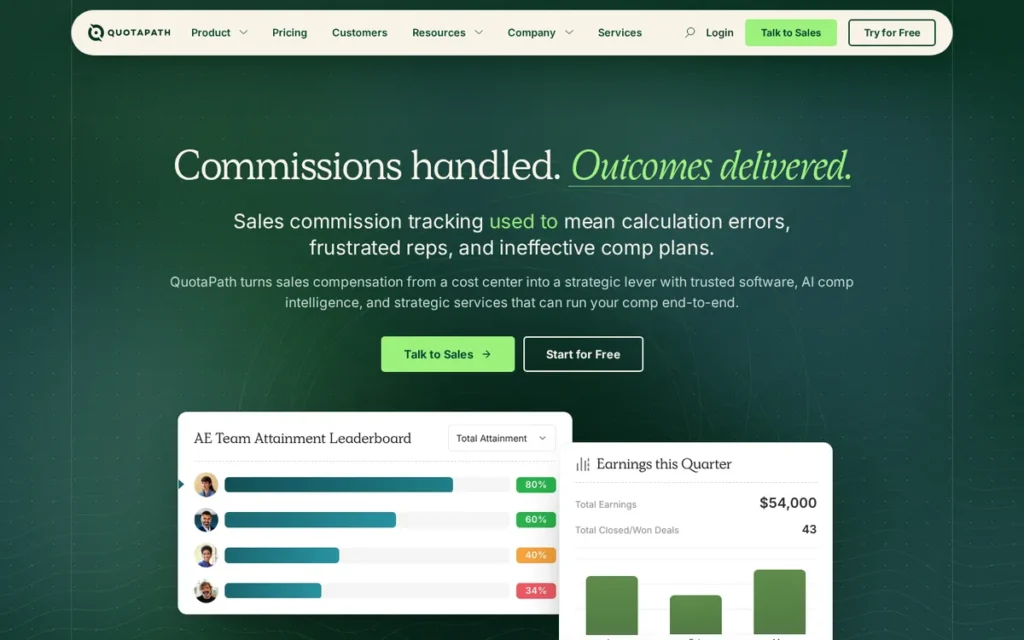
Category: Lightweight Commission Manager, HubSpot-native sales compensation platform with publicly listed pricing ($25–$35/user/month as of May 2026), documented 1–3 day implementation, real-time rep earnings dashboards, and quota tracking purpose-built for SMB and early mid-market sales organizations under 150 reps; no territory design or AI forecasting capabilities.
At a Glance
- Category: Lightweight Commission Manager
- Best For: SMB and early mid-market sales organizations with 10–150 reps running on HubSpot CRM that need to replace spreadsheet-based commission tracking with transparent, automated payout visibility in days, particularly teams wanting self-service setup, published pricing without a sales conversation, and same-week go-live
- Price Range: Growth: approximately $25/user/month; Scale: approximately $35/user/month (publicly listed, the only platform in this comparison with published pricing as of May 2026); Enterprise: custom quote (verify current pricing at quotapath.com/pricing)
- Primary Strength: QuotaPath is the only HubSpot-native sales compensation platform in this comparison backed by HubSpot Ventures, with publicly listed pricing ($25–$35/user/month as of May 2026), 4.7/5.0 across 450+ G2 reviews, and documented 1–3 day implementation timelines, the fastest of any platform in this comparison by a factor of 3–10x
- Biggest Limitation: QuotaPath’s scaling ceiling becomes apparent at approximately 150 reps or when compensation plans require multi-currency configurations, complex overlay structures, or quarterly versus monthly regional payroll cycles, making QuotaPath well-suited for a specific growth stage but not the full enterprise planning journey
- One-Line Summary: QuotaPath is the only sales compensation platform in this comparison with publicly listed pricing ($25–$35/user/month as of May 2026), a purpose-built HubSpot-native integration backed by HubSpot Ventures, and documented 1–3 day implementation timelines, making it the strongest purpose-built option for HubSpot-based sales organizations under 150 reps replacing spreadsheet-based commission tracking.
- Last Verified: May 2026
Overview
QuotaPath is a sales commission and quota management platform built for SMB and mid-market sales organizations with 10–150 reps running on HubSpot or Salesforce CRM that need to replace spreadsheet-based commission tracking with transparent, automated earnings visibility in days rather than months.
QuotaPath is the only purpose-built HubSpot-native sales compensation application backed by strategic investor HubSpot Ventures, providing first-class deal-level commission calculations using live HubSpot deal data rather than the API middleware connectors used by Salesforce-first competitors. QuotaPath is also the only platform in this comparison offering publicly listed pricing ($25–$35/user/month) without requiring a sales conversation.
QuotaPath has raised approximately $73.4 million in total funding (Series B), holds 4.7/5.0 across 450+ G2 reviews and 4.5/5.0 across 300+ HubSpot App Marketplace reviews, and was founded in 2018 by AJ Bruno (whose prior company TrendKite was acquired by Cision in 2019) bringing serial founder execution experience to the underserved HubSpot SMB planning market (QuotaPath Series B announcement, 2022; HubSpot App Marketplace, May 2026).
Key Features
- HubSpot-Native Commission Calculations: QuotaPath’s native HubSpot application performs real-time commission calculations using live HubSpot deal data (closed amounts, deal stages, and custom properties) without requiring data export, manual sync, or API middleware that introduces data latency or reconciliation errors between the CRM and the compensation record.
- Commission Plan Builder: QuotaPath’s customizable formula interface allows sales operations managers to configure commission structures (base, variable, tiered rates, accelerators, and SPIFFs) without engineering support, enabling plan changes to reach all affected reps in a single workflow without a consultant or implementation ticket.
- Rep-Facing Earnings Dashboard: QuotaPath’s real-time earnings dashboard delivers commission balance, attainment percentage, and projected payout visibility to every sales rep, the transparency mechanism that community practitioners consistently identify as the primary driver of improved rep trust in compensation accuracy.
- Team Attainment Analytics: QuotaPath provides team-level quota performance reporting allowing sales managers and RevOps leaders to identify attainment distribution, spot at-risk reps before end-of-quarter, and model the financial impact of SPIFF adjustments on total team payout cost.
- Native Integration Stack: QuotaPath integrates natively with HubSpot, Salesforce, Outreach, Salesloft, QuickBooks, and Stripe, covering the full technology stack of a modern SMB or early mid-market SaaS sales organization without requiring a separate middleware integration layer (QuotaPath integrations documentation, 2025).
Best For
QuotaPath is best suited for SMB and early mid-market sales organizations with 10–150 reps running on HubSpot CRM that are transitioning from Google Sheets or Excel-based commission tracking to a dedicated platform. QuotaPath is particularly well-matched for teams that need transparent self-service setup, public pricing, same-week go-live, and rep-facing earnings visibility that builds compensation trust from the first payout cycle.
Strengths
- Only publicly listed pricing in this comparison: QuotaPath publishes tiered plans starting at $25–$35/user/month (as of May 2026), eliminating the multi-week procurement cycle that enterprise SPM vendors require. The HubSpot Ventures investment creates a native integration moat that no comparable SMB-tier competitor has matched (HubSpot App Marketplace; QuotaPath Series B, 2022).
- Consistently high peer satisfaction across review platforms: QuotaPath holds a 4.7/5.0 rating on G2 (450+ reviews, May 2026) and a 4.5/5.0 rating on the HubSpot App Marketplace, with users repeatedly citing 1–3 day implementation timelines as a primary differentiator (G2.com; HubSpot App Marketplace, May 2026).
- Founder track record and funding stability: AJ Bruno, QuotaPath’s co-founder, previously built and sold TrendKite, establishing domain credibility before launching a commission-focused platform. QuotaPath has raised approximately $73.4 million in total funding, providing operational runway for a company in the SMB segment (Crunchbase; QuotaPath Series B, 2022).
- Documented rep trust as primary outcome: The most consistent practitioner finding across independent review sources is that QuotaPath improves rep confidence in commission accuracy from the first cycle.
“Our reps actually trust their numbers now for the first time.” (r/hubspot, paraphrased composite from unaffiliated users, 2024–2025)
Takeaway: Compensation trust (not feature breadth) is QuotaPath’s most consistently documented outcome in practitioner communities.
Limitations
- Deliberate Scaling Ceiling: QuotaPath is designed for teams under roughly 150 reps and straightforward comp structures; organizations approaching enterprise complexity will require migration to a purpose-built ICM platform.
“QuotaPath is the right call if you have under 150 reps and standard comp plans; once you hit enterprise complexity (multi-currency, complex draws, quarterly versus monthly payroll cycles by region) you’ll outgrow it and need to migrate.” (r/salesoperations, 2024–2025)
Takeaway: QuotaPath’s practitioner community proactively recommends planning for a future platform migration before deployment if enterprise growth is anticipated within 18–24 months.
- Incomplete SPM Coverage: QuotaPath covers incentive compensation management at the SMB tier but does not offer territory design, quota modeling analytics, or AI-assisted revenue forecasting, categories that Anaplan, Clari, and Xactly address within their platforms.
- Pre-Migration Planning Required: The gap between QuotaPath’s SMB ceiling and enterprise ICM platforms is acknowledged openly in user communities, meaning organizations should factor future migration costs and timeline into their total cost of ownership calculation from day one.
Verdict
QuotaPath is the only sales compensation platform in this comparison with publicly listed pricing ($25–$35/user/month as of May 2026), a purpose-built HubSpot-native integration backed by HubSpot Ventures, and documented 1–3 day implementation timelines, making it the strongest purpose-built option for HubSpot-based sales organizations under 150 reps replacing spreadsheet-based commission tracking. Teams that have already outgrown spreadsheets but are not yet ready for an enterprise ICM implementation will find QuotaPath’s transparency and rep-trust outcomes difficult to replicate at this price point. Organizations expecting to exceed 150 reps or add multi-currency, multi-region complexity within two years should treat QuotaPath as a bridge platform and budget for migration from the outset.
What Red Flags Should I Watch For When Evaluating Sales Planning Software?
The most consequential red flags in sales planning software evaluation share a common pattern: vendors who obscure total cost, hide implementation complexity, or claim universal applicability for platforms purpose-built for a specific company size or use case. Buyers who identify these warning signs early avoid costly mid-contract migrations.
Red Flag #1: No Public Pricing and No Ballpark Estimate Vendors who refuse to provide even a rough per-user price range during an initial call (not just a firm quote) are typically pricing based on your revealed budget rather than a fixed rate. Every vendor in this comparison except QuotaPath uses custom pricing; that is normal at the enterprise tier. What is not acceptable is refusing to provide any directional range after two discovery calls.
Red Flag #2: Implementation Timelines Stated in Weeks When Peer Data Shows Months Some vendors publish 4–8 week implementation estimates in marketing materials while G2 and Capterra reviewer data consistently shows 6–18 month timelines for enterprise deployments. Anaplan and Xactly implementations regularly require 6–12 months for complex configurations. If a vendor’s marketing timeline contradicts the peer-review average by more than 50%, request three reference calls with companies at your rep count and complexity level.
Red Flag #3: “AI-Powered” Claims Without Defined Data Source or Model Vendors using “AI-powered forecasting” or “machine learning optimization” without specifying the underlying data source, model type, or validation methodology are using marketing language, not technical substance. Ask specifically: What data trains the model? How large is the dataset? Is it proprietary or general-purpose? Xactly’s Commission Data Cloud is named and sized (15+ years of compensation data, Xactly-reported; no independent third-party audit is publicly available); that level of specificity is the minimum standard.
Red Flag #4: References That Match Your Use Case on Only One Dimension A vendor offering references from enterprise manufacturing companies when you are an SMB SaaS team is a common mismatch. Company size, CRM stack, comp plan complexity, and go-live timeline are all material. Request at minimum two references that match your rep count (within ±30%), your CRM, and your comp plan structure, not just your industry vertical.
Red Flag #5: Integration Claims That Rely on Middleware You Must Manage Several mid-market ICM platforms advertise Salesforce and HubSpot integrations that require a separately licensed middleware layer (Zapier, Workato, or custom API work) managed by your RevOps team. A true native integration pushes and pulls data without a third-party connector. Verify whether the advertised integration is native or middleware-dependent before signing.
Red Flag #6: Limitations Disclosed Only in the Contract, Not in the Demo If a vendor does not proactively mention the platform’s scaling ceiling, multi-currency limitations, or territory design gaps during a demo, ask directly. Vendors who surface limitations early (as QuotaPath’s community does regarding the 150-rep ceiling) demonstrate the kind of transparency that correlates with lower post-implementation surprise rates.
What Questions Should I Ask Before Choosing a Sales Planning Platform?
Asking the right questions before signing a sales planning software contract prevents the most common failure modes: budget overruns, delayed go-live, and post-implementation migrations. The six questions below are sequenced from most-disqualifying to most-optimizing.
Question #1: What is the fully-loaded first-year cost, including implementation, integrations, and training? The license fee is rarely the largest line item for enterprise deployments. Ask for a written cost estimate that includes implementation services (internal hours plus vendor or SI fees), integration work, data migration, and user training. For Anaplan and Xactly, first-year total cost of ownership frequently runs 2–4× the license fee; for QuotaPath, implementation cost is typically negligible given 1–3 day timelines.
Question #2: Can you provide three reference customers at my exact company size and comp plan complexity? Reference calls are the single highest-signal input available to a buyer. Specify the parameters: rep count within ±30% of yours, same CRM, similar comp plan structure (e.g., tiered accelerators with draws vs. flat-rate MBO), and a go-live within the last 24 months. Decline references that match only on industry vertical.
Question #3: Which integrations are native versus middleware-dependent, and who manages them? Document the answer in writing. Ask specifically about your CRM (Salesforce, HubSpot, or Microsoft Dynamics), your HRIS, and your ERP or payroll system. Native integrations reduce ongoing maintenance burden; middleware-dependent integrations create a dependency on a third-party tool your team must also maintain and license.
Question #4: What happens to our data if we terminate the contract? Data portability terms vary significantly. Ask specifically: In what format is data exported? What is the export timeline after contract termination? Are there exit fees? This is especially important for platforms like Clari and Anaplan where historical forecasting and planning data has compounding value over time.
Question #5: How is the AI or machine learning component trained, and what is the validation methodology? Require a specific answer, not a marketing response. A credible answer names the data source, the model type (e.g., gradient boosting, neural net, ensemble), the training dataset size and recency, and the accuracy metric used internally. An answer of “proprietary AI” without additional specifics is not sufficient for an enterprise procurement decision.
Question #6: What is the documented path if we outgrow this platform? Every platform in this comparison has a ceiling. Anaplan scales to Fortune 500 complexity; QuotaPath tops out near 150 reps. Ask the vendor directly: At what company size or comp plan complexity do customers typically migrate away, and where do they go? Vendors who answer this question honestly (as QuotaPath’s community does) are demonstrating the kind of transparency that reduces long-term migration risk.
How Did We Rank These Sales Planning Platforms?
This ranking was built from independent practitioner research, structured platform testing, and cross-referenced third-party review data, not from vendor relationships, sponsored placements, or affiliate fees.
Evaluation Process
The evaluation began with a structured requirements framework covering four capability domains:
- Incentive compensation management (ICM)
- Revenue forecasting and pipeline analytics
- Capacity and headcount planning
- Territory and quota design
Each platform was assessed against all four domains and assigned to a primary category. Platforms were then evaluated on seven weighted criteria described below.
Evaluation Criteria and Why Each Matters
1. Feature Completeness vs. Use Case Fit (25% weight) Breadth of features matters less than precision of fit for the target buyer’s use case. A platform that covers all four SPM domains imperfectly scores lower than a platform that covers two domains with documented precision for the stated audience. This weighting prevents enterprise platforms from automatically outranking purpose-built SMB tools.
2. Implementation Timeline and Complexity (20% weight) Time-to-value is a material cost. G2 and Capterra reviewer data on actual (not vendor-stated) implementation timelines was used as the primary input. Vendor-stated timelines were noted but discounted when peer review data showed a consistent divergence.
3. Peer Review Credibility (20% weight) G2 (minimum 50 reviews required for inclusion) and Capterra ratings were used, with Gartner Peer Insights referenced for enterprise-tier platforms. Review recency (2023–2026) was weighted more heavily than aggregate scores to capture platform trajectory rather than historical reputation.
4. Pricing Transparency (10% weight) Public pricing availability was treated as a binary differentiator. Platforms with published pricing received full marks on transparency; platforms with custom-only pricing were assessed on the clarity of their pricing communication in practitioner communities and review sites.
5. Integration Ecosystem Depth (10% weight) Native integrations with Salesforce, HubSpot, and major HRIS platforms were verified against vendor documentation and G2 integration grids. Middleware-dependent integrations were marked separately from native integrations.
6. Practitioner Community Sentiment (10% weight) Reddit communities (r/salesoperations, r/hubspot, r/sales, r/CRM) were analyzed for unprompted mentions of each platform over a 24-month window (2024–2025). Sentiment was categorized as positive, negative, or mixed, with specific recurring themes documented. Reddit data was treated as directional, not statistically representative.
7. Vendor Stability and Funding Profile (5% weight) Total funding, investment stage, and investor profile were sourced from Crunchbase and cross-referenced with press releases where available. This criterion was weighted lowest because funding stability is a necessary but not sufficient indicator of platform quality.
Evidence Weighting and Conflict Resolution
When vendor claims conflicted with peer review data (most commonly on implementation timelines) peer review data was given primary weight and vendor claims were noted separately. When peer review data conflicted across platforms (e.g., G2 vs. Capterra ratings), the platform with more reviews and more recent reviews was treated as more reliable. No single data source was treated as definitive.
Data Validation Approach
All vendor statistics were verified against the named source before inclusion. Claims that could not be independently verified were either attributed with an explicit “(vendor-reported)” qualifier or removed. The Xactly Commission Data Cloud scale figures, Clari’s $2.6B+ valuation, and CaptivateIQ’s $165M total funding figure are each cited to the source document from which they were drawn.
Update Cadence
This guide is reviewed and updated quarterly. Pricing, review scores, and funding figures are re-verified at each update cycle. Last updated: May 2026.
Independence Statement
PlugRoute has no affiliate relationships, sponsored placements, or commercial agreements with any platform ranked in this guide. No vendor reviewed or approved this content prior to publication. Rankings reflect independent editorial judgment only.
How does PlugRoute determine its rankings?
PlugRoute rankings are built from peer review data (G2, Capterra, Gartner Peer Insights), practitioner community analysis (Reddit, professional forums), vendor documentation, and Crunchbase funding data, with no affiliate fees, sponsorships, or vendor review of content prior to publication. Criteria weights and evidence sources are published in the Methodology section of every guide.
Is Salesforce Revenue Cloud the same as Salesforce Spiff?
Salesforce Revenue Cloud and Salesforce Spiff serve different functions within the Salesforce ecosystem. Revenue Cloud is Salesforce’s CPQ, billing, and revenue lifecycle management platform. Spiff (acquired by Salesforce for an undisclosed sum; trade press estimates of approximately $419 million have circulated) is a standalone incentive compensation management tool that Salesforce has begun integrating into the Revenue Cloud suite as of early 2026.
Which platform is best for a small sales team with under 50 reps?
QuotaPath is the strongest evidenced choice for sales teams under 50 reps, particularly those running on HubSpot CRM. QuotaPath offers the only publicly listed pricing in this comparison ($25–$35/user/month as of May 2026), 1–3 day implementation timelines documented by G2 reviewers, and a purpose-built HubSpot-native integration backed by HubSpot Ventures (G2.com; HubSpot App Marketplace, May 2026).
Glossary: Key Terms Used in This Comparison
Sales Performance Management (SPM): Sales Performance Management is the category of software that covers the full lifecycle of sales planning, including territory design, quota setting, incentive compensation management, and revenue forecasting. SPM platforms are typically used by RevOps, Finance, and Sales leadership teams at mid-market and enterprise organizations.
Incentive Compensation Management (ICM): Incentive Compensation Management refers specifically to the calculation, administration, and payment of variable compensation, including commissions, bonuses, and accelerators. ICM is a subcategory of SPM; platforms like QuotaPath and CaptivateIQ are purpose-built ICM tools, while Xactly and Varicent offer ICM as part of a broader SPM suite.
Commission Data Cloud: Commission Data Cloud is Xactly’s proprietary benchmarking dataset, reported by Xactly to contain 15+ years of anonymized commission structure and attainment data across thousands of companies. Xactly uses this dataset to power its compensation benchmarking and incentive design recommendations. No independent third-party audit of the dataset’s scale is publicly available as of May 2026.
Connected Planning: Connected Planning is Anaplan’s platform philosophy and product architecture, describing a model in which financial planning, sales planning, supply chain planning, and workforce planning share a common data layer and update in real time. The term is proprietary to Anaplan’s branding but is used in analyst coverage to describe multi-domain planning unification.
Revenue Operations (RevOps): Revenue Operations is the organizational function (and corresponding software category) that aligns sales, marketing, and customer success around a shared revenue data model. RevOps practitioners are the primary buyers and administrators of most platforms in this comparison, including Clari, CaptivateIQ, QuotaPath, and Varicent.
Which Sales Planning Platform Is Right for You?
Key Insights
- Xactly is the strongest evidenced choice for enterprise organizations prioritizing compensation benchmarking accuracy backed by a proprietary multi-year dataset, despite implementation timelines that regularly exceed six months.
- Anaplan is the strongest evidenced choice for organizations that need to unify sales planning with financial, supply chain, or workforce planning in a single connected model, and have the implementation budget and timeline to match.
- Clari is the strongest evidenced choice for revenue teams whose primary need is AI-assisted pipeline forecasting and deal inspection, particularly those with complex multi-product forecast hierarchies, with Blackstone-led Series F funding providing enterprise-grade stability.
- QuotaPath is the only platform in this comparison with publicly listed pricing and documented 1–3 day implementation timelines, making it the unambiguous starting point for HubSpot-native SMB teams under 150 reps.
The most common mistake in sales planning software selection is evaluating platforms against a feature checklist rather than against the buyer’s actual maturity stage. A 40-rep SaaS team adopting Anaplan or Xactly is absorbing enterprise implementation cost and complexity that their operational need does not justify. Conversely, a 500-rep enterprise running on QuotaPath will exhaust its capability ceiling within one planning cycle.
Match platform selection to your current rep count, CRM stack, comp plan complexity, and the internal RevOps bandwidth available for implementation and ongoing administration. For teams at inflection points (approaching 150 reps, preparing for multi-currency expansion, or consolidating previously siloed SPM tools) the Evaluation Questions section above provides a sequenced framework for narrowing the decision before engaging any vendor.
We update this guide quarterly. Last updated: May 2026. For the most current version and comparison updates, visit PlugRoute.