Loopio ranks #1 for RFP and proposal automation, with G2’s top rating at 811+ verified reviews and 4.6/5.0. Navattic leads no-code interactive demos with the only publicly listed flat-rate pricing in this roundup. Consensus holds 10+ consecutive years at G2 #1 for demo automation. No single platform covers all presales use cases, most mature SE teams use two to three complementary tools.
Presales teams at B2B technology companies face five documented bottlenecks: no centralized SE workload visibility, slow demo creation, disproportionate SE time on RFP responses, unmeasured presales ROI, and opaque post-demo buyer engagement. These patterns persist across the r/salesengineers community (28,000+ members as of May 2026), where SEs describe managing evaluations through Apple Notes, Slack threads, and spreadsheets, the prevailing workaround for teams without purpose-built software.
PlugRoute has no affiliate relationships with any company listed. Rankings are determined entirely by research data and objective evaluation criteria.
TL;DR: Top Picks at a Glance
- Loopio: G2 #1 RFP (811+ reviews, 4.6/5.0); best for 20+ formal proposals per quarter
- Navattic: only published pricing in roundup ($500/mo Base plan); Salesforce, HubSpot, Marketo integration
- Consensus: G2 #1 Demo Automation 10+ consecutive years; patented Demolytics® buyer analytics
- Seismic: reported Gartner MQ Leader (Nov 2025); confirm proposed Highspot merger roadmap before signing
What Are the Four Types of PreSales Management Software?
The four types of presales management software are: (1) Proposal Automation for RFP, RFI, and security questionnaire response (Loopio); (2) Interactive Demo Builders and Demo Automation platforms for product demos with buyer analytics (Navattic, Consensus, Reprise); (3) Sales Enablement Platforms for enterprise content governance and coaching (Seismic); and (4) Presales Operations tools for SE workload management and technical forecasting (Vivun, PreSkale).
Most presales software buying mistakes happen when leaders evaluate tools from the wrong category. A team evaluating Vivun (SE operations) when the primary bottleneck is RFP volume (Loopio’s category) will typically reach late-stage procurement before discovering the mismatch, six weeks recovered by reading one table.
Category 1: Proposal Automation These tools automate RFP, RFI, DDQ, and security questionnaire responses through centralized content libraries and AI-assisted drafting workflows.
- Includes: Loopio (#1)
Category 2: Interactive Demo Builders and Demo Automation These platforms create no-code, shareable product demos with stakeholder-level buyer engagement analytics for SE-led sales and marketing-led product tours.
- Includes: Navattic (#2), Consensus (#3), Reprise (#6)
Category 3: Sales Enablement Platforms These enterprise suites cover content governance, coaching, digital sales rooms, and proposal automation across the full revenue organization.
- Includes: Seismic (#4)
Category 4: Presales Operations and SE Intelligence These purpose-built SE systems of record manage workload, capacity planning, technical forecasting, and product gap analysis for solutions engineering teams.
- Includes: Vivun (#5), PreSkale/Storylane (#7)
How Do the Top PreSales Management Tools Compare at a Glance?
The seven platforms in this roundup span four functional categories and range from $500/month (Navattic, publicly listed) to six figures annually (Seismic, Loopio). The table below maps each platform to its category, primary strength, and key limitation for rapid shortlisting.
| Rank | Company | Category | Best For | One-Line Summary | Key Capabilities | Primary Strength | Key Limitation |
|---|---|---|---|---|---|---|---|
| #1 | Loopio | Proposal Automation | Enterprise RFP and proposal teams submitting 20+ per quarter | Loopio is the G2 #1-rated RFP platform with 811+ reviews at 4.6/5.0, a reported Gartner Cool Vendor designation, and named customer deployments per Loopio marketing materials including Snowflake and Workday. | Content Library | AI Autofill | Portal Autofill | SME Routing | 811+ G2 reviews at 4.6/5.0; most statistically reliable satisfaction score in this roundup | AI autofill requires 60–90 days of library buildout before reaching advertised 80% automation rates |
| #2 | Navattic | Interactive Demo Builder | Mid-market SE and marketing teams sharing demo ownership | Navattic is a no-code demo platform rated 4.8/5.0 on G2, with publicly listed pricing starting at $500/month and native Salesforce, HubSpot, Marketo, and Slack integrations. | HTML Capture | Per-Deal Personalization | CRM Sync | Copilot AI | Only platform in this roundup with publicly listed pricing tiers; no discovery call required to budget | Cannot replicate complex stateful sandbox environments for enterprise POC workflows |
| #3 | Consensus | Demo Automation | Enterprise SE teams reducing repetitive multi-stakeholder demo volume | Consensus has held G2’s #1 Demo Automation ranking for 10+ consecutive years and deploys the patented Demolytics® system at named customers including Oracle, Atlassian, and Salesforce. | Demolytics® Analytics | Demoboard Hubs | AI Branching | CRM Sync | 10+ consecutive years G2 #1 Demo Automation; $110M confirmed funding; named enterprise customers | Content governance program required before async demos deliver consistent ROI |
| #4 | Seismic | Sales Enablement Platform | Large enterprise revenue organizations replacing multiple point tools | Seismic is reported as a Leader in Gartner’s inaugural Revenue Enablement Platforms Magic Quadrant (Nov 2025, per SalesMotion.io); buyers must confirm the proposed Highspot merger roadmap before signing any 2026 contract. | AI Content Mgmt | Live Docs | Digital Sales Rooms | Agentic AI | Reported Gartner MQ Leader (Nov 2025, per SalesMotion.io); broadest platform scope reviewed | Proposed Highspot merger (announced Feb 2026, pending regulatory approval) creates product uncertainty |
| #5 | Vivun | Presales Operations | Enterprise presales leaders needing Salesforce-native SE system of record | Vivun is the category-creating presales operations platform with Hero® AI, a presales-specific AI domain model, and a product gap analysis module connecting SE field data to product roadmap. | SE Capacity Planning | Hero® AI | Product Gap Analysis | Technical Forecasting | Category creator; only presales-native AI domain model and product-field closed loop | Documented IC adoption gap: multiple r/salesengineers contributors report Vivun as administrative overhead without personal SE benefit |
| #6 | Reprise | Enterprise Demo Platform | Large SE teams running concurrent, security-sensitive live demo and POC environments | Reprise is an enterprise demo creation platform with SOC 2 Type II and ISO/IEC 27001:2022 certifications and support for 200+ concurrent demo instances; one enterprise customer reported 75% lower customer acquisition costs per Reprise’s own case study documentation (self-reported; not independently verified). | Replicate® Cloning | Replay® Capture | Reveal® Overlay | Dual Security Certs | SOC 2 Type II and ISO/IEC 27001:2022 certified; only demo platform reviewed supporting 200+ concurrent instances | G2 CRM integration satisfaction at 69%; lowest of any reviewed feature across all platforms |
| #7 | PreSkale (now Storylane) | Presales Intelligence (Transitioning) | Small SE teams needing affordable, Salesforce-integrated activity tracking | PreSkale; founded 2021, acquired by Storylane in December 2024; earned a 95% Salesforce integration satisfaction score on G2, but prospective buyers must confirm post-acquisition roadmap and pricing with Storylane before initiating any evaluation. | SE Utilization Tracking | Deal Velocity Analytics | Product Gap Capture | QuickSight Dashboards | 95% G2 Salesforce integration satisfaction; highest of any presales management tool evaluated | ~12 G2 reviews (smallest base in roundup); December 2024 acquisition creates roadmap and pricing uncertainty |
Which PreSales Tool Best Matches My Primary Pain Point?
Match your team’s primary bottleneck to the recommended category before requesting demos. Most presales software evaluation failures happen when leaders skip this step.
| Your #1 Priority | Recommended Tool | Why | Acceptable Alternative |
|---|---|---|---|
| RFP, RFI, or security questionnaire volume | Loopio | G2 #1 RFP Management (811+ reviews, 4.6/5.0); SmartScan portal autofill; reported Gartner Cool Vendor | Responsive.io (mid-market budget) |
| Demo creation speed and scale | Navattic | Publicly listed pricing ($500/mo Base); HTML fidelity; native Salesforce and HubSpot integration | Consensus (if async buyer analytics outweigh demo creation speed) |
| Async buying committee engagement | Consensus | Patented Demolytics®; 10+ consecutive years G2 #1; named customers include Oracle, Atlassian, Salesforce | Navattic (if transparent pricing and mid-market fit matter more) |
| SE workload visibility and presales ROI | Vivun | Category creator; presales-native AI domain model; product-field closed loop | PreSkale/Storylane (for smaller teams with tighter budgets) |
| Enterprise content governance and coaching | Seismic | Reported Gartner MQ Leader (Nov 2025); broadest suite: content, coaching, digital sales rooms | Confirm proposed Highspot merger roadmap before selecting |
| Enterprise POC environments and compliance | Reprise | SOC 2 Type II and ISO/IEC 27001:2022; 200+ concurrent instances | Navattic (if POC complexity is moderate) |
| Budget-conscious SE activity tracking | PreSkale/Storylane | 95% G2 Salesforce integration satisfaction; $30/month pre-acquisition pricing | Vivun (for larger teams with enterprise budgets) |
1. Loopio: Best for RFP, RFI, and Security Questionnaire Automation
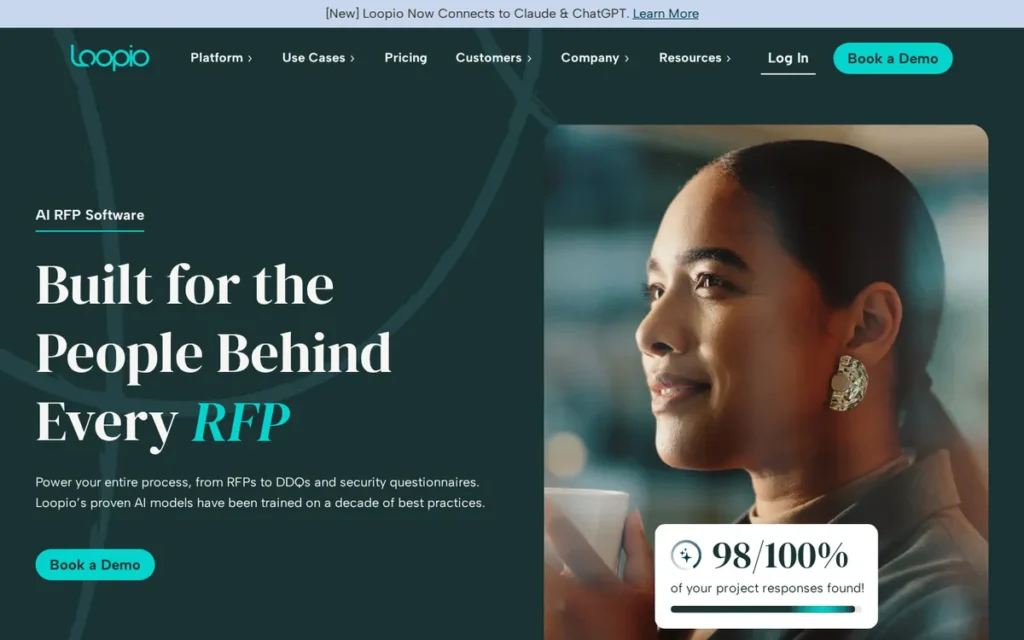
Category: Proposal Automation, automates RFP, RFI, DDQ, and security questionnaire responses through a centralized content library and AI-assisted drafting workflow.
At a Glance
- Category: Proposal Automation
- Best For: Enterprise presales and proposal teams at B2B SaaS or technology companies submitting 20 or more RFPs, RFIs, DDQs, or security questionnaires per quarter
- Price Range: ~$54,000–$142,000/year (estimated via competitive intelligence from Responsive.io; contact Loopio sales for a direct quote). No free tier or published pricing available.
- Primary Strength: Loopio holds G2’s #1 RFP Management designation with 811+ verified reviews at 4.6/5.0 across 24 consecutive G2 Leader quarters as of May 2026, the largest verified third-party review base of any platform in this roundup
- Biggest Limitation: Loopio’s AI autofill (Response Intelligence) delivers its advertised 80% automation rate only after teams invest 60–90 days building a vetted content library; practitioners with sparse libraries consistently report that manual keyword search outperforms automated drafting in early deployment
- One-Line Summary: Loopio is the G2 #1-rated RFP and proposal management platform, with 811+ reviews at 4.6/5.0, a reported Gartner Cool Vendor designation, and named deployments per Loopio marketing materials including Snowflake and Workday, offering enterprise presales teams an AI-powered content library and portal autofill system that claims to automate up to 80% of standard questionnaire responses once a vetted library is established
- Last Verified: May 2026
Overview
Loopio is an AI-powered RFP and proposal response platform founded in Calgary, Canada in 2014 by co-founders Zak Hemraj (CEO), Matt York (CTO), and Jafar Owainati.
Loopio serves enterprise presales and proposal teams that submit high volumes of RFPs, RFIs, DDQs, and security questionnaires, replacing scattered email threads and ad hoc SME coordination with a vetted content library, AI-assisted drafting, and a SmartScan browser extension that autofills answers directly into procurement portals. Loopio raised US$200M from Sumeru Equity Partners (2021), preceded by OpenView Venture Partners (2017).
Key Features
- Response Intelligence AI: Loopio’s Response Intelligence AI is trained on more than 500,000 completed RFP projects, surfacing relevant library answers, flagging stale content, recommending SME reviewers, and evaluating RFP winnability to reduce drafting time while improving content governance across the presales team.
- SmartScan Portal Autofill: Loopio’s SmartScan browser extension automatically completes questionnaire fields directly inside procurement portals such as Coupa and Jaggaer (without requiring teams to copy and paste between Loopio and external web forms) described as the presales industry’s first portal-native autofill tool per Loopio’s marketing materials.
- Slack and Teams SME Assignment: Loopio integrates natively with Salesforce, Slack, Microsoft Teams, SharePoint, and Google Drive, enabling SMEs to review and approve RFP answers directly from Slack or Teams channels without logging into Loopio, removing the new-tool-fatigue barrier for non-proposal contributors.
- Content Library Governance: Loopio’s library governance system auto-flags answers exceeding a user-defined freshness window, routes stale content to assigned owners for renewal, and tracks version history, ensuring automated drafting draws from verified, current responses rather than outdated boilerplate.
- Project Analytics: Loopio provides per-project analytics tracking time-to-completion, contributor response rates, content reuse velocity, and win/loss correlation by proposal type, giving presales leaders data to demonstrate RFP program efficiency to executive stakeholders.
Best For
Loopio is best for enterprise presales and proposal teams at B2B technology companies that submit 20 or more formal RFPs, RFIs, security questionnaires, or DDQs per quarter. Loopio requires a vetted content library of approximately 200 or more approved answers before its AI automation delivers peak value.
Pricing
Loopio does not publish pricing on its website. Based on competitive intelligence from Responsive.io and buyer-reported figures as of 2025–2026, Loopio enterprise contracts are estimated in the $54,000–$142,000 annual range depending on seat count, feature tier, and contract length.
These figures reflect third-party competitive intelligence, not direct vendor confirmation. No free trial or self-serve tier is available. A team that signs a $75,000/year Loopio contract and spends three months building its library is effectively paying $18,750 for zero automation, the ROI clock starts in April. Verify current pricing with Loopio sales before budgeting. Pricing verified to the extent possible as of May 2026.
Strengths
- Largest Verified Review Base in This Roundup: Loopio has held G2’s #1 RFP Management designation for 24 consecutive quarters as of May 2026, with 811+ verified reviews at 4.6/5.0, more than twice the review volume of the next most-reviewed platform in this comparison, making Loopio’s satisfaction rating the most statistically reliable evidence in this roundup.
- Most Transparently Documented Vendor Reviewed: Loopio was founded in 2014 by co-founders Zak Hemraj (CEO), Matt York (CTO), and Jafar Owainati; raised US$200M from Sumeru Equity Partners (2021) preceded by OpenView Venture Partners (2017); and names enterprise customers including Snowflake and Workday per Loopio’s marketing materials, providing more verifiable company background than any other vendor reviewed.
- SME Workflow Integration Validated by G2 Users: G2 reviewers consistently describe Loopio as the platform that eliminates RFP coordination from email-thread chaos to structured workflow, specifically citing Slack and Teams integration that enables SMEs to review and approve answers without logging into Loopio as the most-cited adoption enabler across the platform’s 811+ review base.
Limitations
- Library Dependency: Loopio’s most consequential trade-off is setup time: Loopio’s AI autofill delivers its marketed 80% automation rate only after teams invest 60–90 days building a well-structured, vetted content library, and practitioners on r/salesengineers with sparse libraries consistently report that manual keyword search outperforms automated drafting in early deployment.
- AI Output Quality Gap: Loopio’s earlier “Magic” AI feature was widely described by r/salesengineers contributors as “essentially a keyword search,” and in 2025, at least one practitioner reported that Gemini in a Google spreadsheet outperformed Loopio’s automation for ad hoc responses, reflecting library-sparse early deployments rather than Loopio’s ceiling performance with a mature library.
“We have Loopio licenses. I don’t use it… I just used Gemini in a Google spreadsheet for a first pass and it did a far better job than Loopio has done for me.” (u/somethingrather, r/salesengineers, 2025)
Takeaway: Library-sparse Loopio deployments can be outperformed by free general-purpose AI for isolated ad hoc responses, confirming that Loopio’s ROI depends on a mature, well-governed content library, not raw AI output quality.
- Enterprise-Only Price Point: Loopio’s estimated $54,000–$142,000 annual range places Loopio out of reach for small SE teams or organizations submitting fewer than 10 formal proposals per quarter. AI-native disruptors including Inventive AI, Arphie, and Tribble are gaining organic r/salesengineers traction among mid-market teams at significantly lower price points.
- Emerging Competitive Threat at Mid-Market: AI-native RFP tools including Inventive AI and Arphie are winning mid-market teams that cannot justify Loopio’s price point, with community discussion citing autonomous drafting capabilities that reduce the 60–90 day content library buildout that Loopio’s automation requires before delivering full value.
Verdict
Loopio is the most evidence-backed presales management platform in this roundup, ranking #1 in G2’s RFP Management category with 811+ verified reviews at 4.6/5.0, making it the defensible default for enterprise presales teams whose primary bottleneck is RFP, security questionnaire, or DDQ volume. Loopio’s SmartScan portal autofill and Response Intelligence AI provide automation advantages that general-purpose AI workarounds cannot replicate at scale for teams with multi-contributor workflows, compliance requirements, and institutional content library value. Presales leaders should plan for 60–90 days of library buildout before expecting peak automation rates, and should evaluate AI-native alternatives (Inventive AI, Arphie) if annual RFP volume is below 20 submissions or budget is below six figures.
2. Navattic: Best for No-Code Interactive Demo Creation
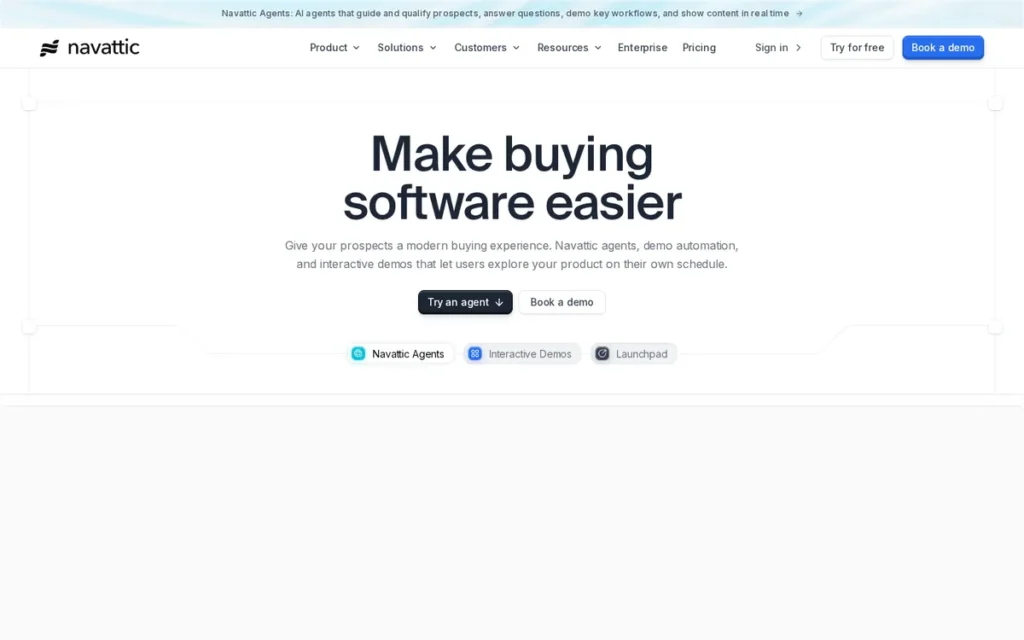
Category: Interactive Demo Builder, creates no-code, HTML-capture product demos with stakeholder-level engagement analytics, designed for both SE-led sales demos and marketing-led product tours.
At a Glance
- Category: Interactive Demo Builder
- Best For: Mid-market B2B SaaS presales and marketing teams that need a single platform for SE-led sales demos and marketing product tours, with transparent pricing and CRM-connected engagement analytics
- Price Range: $500/month Base plan; $1,000/month Growth (adds multi-team, SSO, multi-language); Enterprise custom. Public pricing confirmed on navattic.com/pricing as of May 2026. Verify current seat counts and terms directly before budgeting.
- Primary Strength: Navattic is the only platform in this roundup to publish transparent, flat-rate pricing tiers on its website, removing the discovery-call-required opacity that makes every other reviewed platform inaccessible to buyers building internal budget cases
- Biggest Limitation: Navattic’s HTML-capture approach cannot replicate complex, stateful application sandbox environments, teams needing persistent, manipulable demo instances for enterprise POC workflows or concurrent high-volume event demos will find Reprise’s full-clone architecture more capable
- One-Line Summary: Navattic is a no-code interactive demo platform rated 4.8/5.0 on G2, with publicly listed flat-rate pricing starting at $500/month and native integrations with Salesforce, HubSpot, Marketo, and Slack, making it the most accessible and community-validated HTML-capture demo tool for mid-market presales and marketing teams
- Last Verified: May 2026
Overview
Navattic is a no-code interactive demo platform founded in 2020 that uses HTML and CSS full-DOM capture to help mid-market B2B SaaS presales and marketing teams build, personalize, and share product demos without engineering involvement.
Navattic’s transparent flat-rate pricing, confirmed publicly at navattic.com/pricing as of May 2026, is the strongest pricing differentiator of any platform in this roundup. Navattic added Navattic Copilot in 2025, extending the platform into AI-assisted demo construction and A/B conversion optimization.
Key Features
- HTML/CSS Full-DOM Capture: Navattic uses HTML and CSS full-DOM capture via a Chrome extension to preserve hover states, navigation interactivity, and UI fidelity, producing demos that replicate the actual product experience, which G2 reviewers describe as “doing a fantastic job replicating the look and feel of the actual solution.”
- Launchpad Per-Deal Personalization: Navattic’s Launchpad feature enables per-deal demo personalization at scale, allowing solutions engineers to embed dynamic variables (prospect name, company logo, industry use case) into branching demo flows deployable as tracked shared links or embeds without engineering support.
- Native CRM and Marketing Integration: Navattic integrates natively with Salesforce, HubSpot, Marketo, and Slack, syncing demo engagement events and stakeholder interaction data directly to CRM opportunity records and triggering real-time alerts when prospects share demos with additional buying committee members.
- Publicly Listed Flat-Rate Pricing: Navattic publishes pricing tiers directly on navattic.com (the only platform in this roundup with publicly accessible pricing) allowing presales and marketing teams to model costs and build internal business cases without a vendor discovery call.
- Navattic Copilot AI: Navattic Copilot, launched in 2025, adds AI-powered demo building with automated discovery workflows, A/B test variant generation, and performance analytics, allowing teams to optimize demo structure based on engagement data without manual iteration cycles.
Best For
Navattic is best for mid-market B2B SaaS companies whose presales and marketing teams share demo creation responsibilities and need a single platform covering both SE-led live sales demos and async marketing product tours. Navattic provides predictable pricing confirmed publicly at navattic.com and CRM-connected engagement data feeding directly into Salesforce or HubSpot opportunity records.
Pricing
Navattic publishes pricing directly on navattic.com/pricing. As of May 2026, confirmed public tiers are:
- Base plan: ~$500/month (billed annually: ~$6,000/year): verify current seat counts, user limits, and included features directly at navattic.com/pricing before budgeting
- Growth plan: ~$1,000/month (billed annually: ~$12,000/year): adds multi-team workspace support, SSO, directory sync, multi-language demo support, and demo coaching
- Enterprise: Custom pricing: includes offline demo support and priority service tiers
Navattic is the only platform in this roundup with publicly accessible pricing. Confirm current seat allocations and plan terms directly before purchase, as SaaS pricing structures change frequently. Pricing verified May 2026.
Strengths
- Strongest Community Validation of Any Demo Platform Reviewed: Multiple r/ProductMarketing contributors report multi-company loyalty, including one practitioner who described using Navattic across three separate companies and stated it “keeps getting better and better,” and a marketing consultant who reported that “80–90% of my clients use Navattic” across engagements comparing Walnut, Tourial, Storylane, and Navattic (r/ProductMarketing, 2023).
Users on r/ProductMarketing noted:
“I’ve been a customer of Navattic for multiple years and over three companies. I couldn’t recommend it more. I know the original thread was over 2 years ago, but the software keeps getting better and better. Highly, highly recommend using Navattic over other systems.” Posted by u/Suspicious-Mood-9763
Takeaway: Navattic’s multi-year retention across multiple companies signals a platform that compounds value over time rather than delivering a one-time onboarding win.
- Only Platform with Publicly Listed Pricing in This Roundup: Navattic’s transparent pricing (starting at $500/month as of May 2026) is consistently cited by enterprise buyers as the decisive factor in cross-functional evaluations where presales and marketing teams share demo ownership, removing the per-seat cost modeling that makes competitor tools difficult to budget for combined teams.
- Widest CRM Integration Breadth of Any Demo Platform Reviewed: Navattic’s native integrations with Salesforce, HubSpot, Marketo, and Slack allow demo engagement data to flow into whichever CRM a team uses (rather than requiring a Salesforce-only stack) making Navattic compatible with a wider range of revenue technology configurations than any other demo platform in this roundup.
Limitations
- Architectural Ceiling for Complex POC Environments: Navattic’s most consequential trade-off is its HTML-capture architectural ceiling, while full-DOM capture produces superior demo fidelity versus screenshot tools, Navattic cannot replicate complex, stateful application environments requiring persistent sandbox instances, and teams running enterprise POC workflows or high-volume concurrent event demos will find Reprise’s Replicate® module more capable.
Users on r/ProductMarketing shared their experience:
“I haven’t tried Storylane but I’ve used Navattic for my SaaS startup for ~ 3 years. We’ve been pretty happy with it for a few reasons
- I can edit the data in my demo environment and the demos look like our actual product
- Chat + CSM is always pretty fast and helpful, they also share data on best practices
- It shows what companies are going through my website demos
Some things we’ve had challenges with
- Can take time to get familiar with the terminology
- Demos are one or a few paths so it can’t create a full demo environment replica” Posted by u/Apprehensive_Lion_30
Takeaway: Even long-term Navattic users confirm the single-path demo architecture as a real ceiling, validating that teams requiring true sandbox replication should evaluate Reprise before committing.
- Pricing and Seat Terms Require Verification Before Budgeting: Navattic’s publicly listed pricing provides transparency no other platform in this roundup offers, but seat counts, user allocations, and plan terms should be confirmed directly at navattic.com/pricing before committing, plan structures in the interactive demo market evolve, and budgeting on unverified assumptions can create unexpected cost increases as teams scale.
- Not Designed for Deep Sandbox Demo Environments: One community evaluation noted that Navattic has “less sales features” than Walnut for buyers whose primary need is sandbox demo environments or deep sales-team-specific tracking, positioning Navattic as a stronger choice for combined SE-marketing demo ownership than for pure presales-only, high-complexity POC workflows.
Verdict
Navattic is the best-value interactive demo platform for mid-market B2B SaaS presales and marketing teams, combining publicly listed flat-rate pricing (starting at $500/month as of May 2026, confirmed at navattic.com/pricing), a G2 rating of 4.8/5.0, and strong community validation from practitioners who have used Navattic across multiple companies. Navattic’s HTML/CSS full-DOM capture produces demos with genuine UI fidelity that prospects can interact with rather than watch, and its Launchpad personalization capability gives solutions engineers per-deal customization at scale without engineering support. Presales leaders whose teams also need enterprise-grade concurrent demo environments or full application cloning for POC workflows should evaluate Reprise alongside Navattic before deciding.
3. Consensus: Best for Async Demo Automation and Buying Committee Analytics
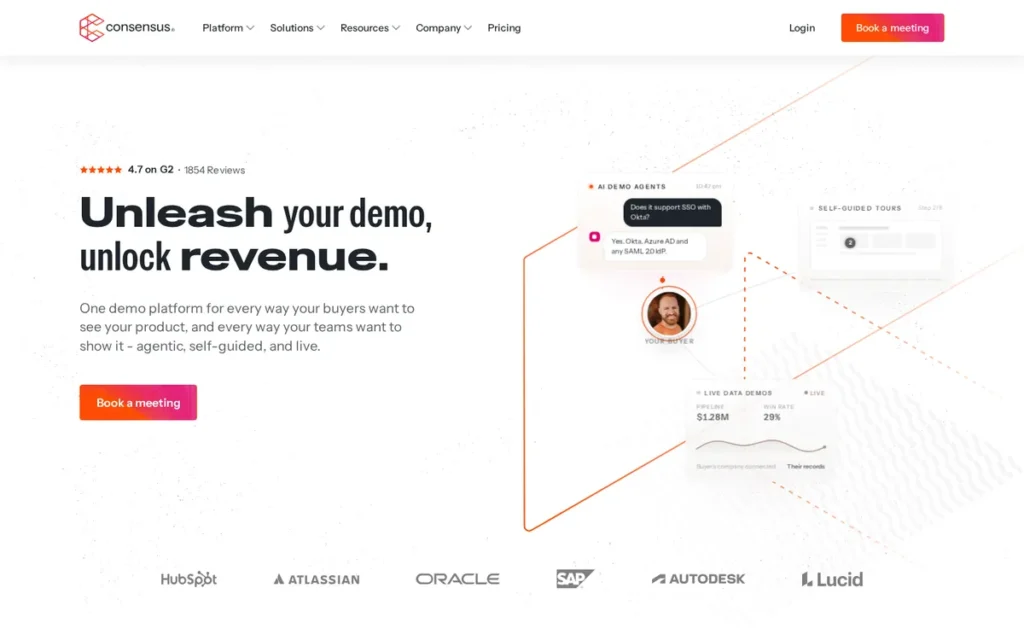
Category: Demo Automation, scales buyer engagement by replacing repetitive live SE demos with AI-powered interactive video experiences tracked through a proprietary buyer analytics system.
At a Glance
- Category: Demo Automation
- Best For: Enterprise SE teams at B2B software companies that need to reduce repetitive live demo volume, enable buyer champions to self-serve additional stakeholders, and capture granular buying committee engagement data before discovery calls
- Price Range: Pricing on request (enterprise custom; no published tiers). Deployed at Fortune 500 scale, expect enterprise-grade contract values. Contact goconsensus.com for a quote.
- Primary Strength: Consensus has held G2’s #1 Demo Automation ranking for 10 or more consecutive years as of 2026, backed by the patented Demolytics® system, which tracks viewer heatmaps, feature selection rankings, and buying committee sharing behaviors at a granularity no other reviewed platform provides
- Biggest Limitation: Consensus requires a structured content governance program and a named demo library owner before AI-powered interactive demos deliver consistent ROI, teams that deploy without dedicated enablement ownership frequently underutilize the platform, a pattern documented across multiple r/salesengineers threads
- One-Line Summary: Consensus is the 10+ consecutive year G2 #1 Demo Automation platform, trusted by 15 of the top 30 global software companies including Oracle, Atlassian, and Salesforce, offering SE teams a patented Demolytics® buyer engagement system and Demoboard champion enablement hubs that enable async buying committee coverage without proportional SE time investment
- Last Verified: May 2026
Overview
Consensus is an AI-powered demo automation platform founded in 2013 by CEO Garin Hess (a serial entrepreneur with 20+ years of experience) that enables solutions engineering teams to replace repetitive live demos with personalized async video experiences tracked through the proprietary Demolytics® buyer engagement system. Consensus raised $110M from Sumeru Equity Partners in March 2023 (per TechCrunch, March 2023).
Consensus is the category’s oldest purpose-built platform and the only one with a patented, trademarked buyer engagement analytics product. Consensus’s Demoboard feature creates personalized champion enablement hubs where buyer champions walk additional stakeholders through curated demos without SE involvement.
Key Features
- Demolytics® Buyer Engagement System: Consensus’s Demolytics® system (a patented and trademarked buyer intelligence platform) tracks granular viewer behavior including heatmaps, stakeholder feature selection rankings, CTA clicks, document downloads, and organic sharing events, providing solutions engineers with a complete buying committee engagement map before any live call.
- Demoboard Champion Enablement: Consensus’s Demoboard feature creates personalized, shareable digital rooms where buyer champions independently walk colleagues through curated, trackable demo experiences without requiring SE attendance on each stakeholder interaction, directly addressing the repetitive multi-stakeholder demo bottleneck in enterprise deals.
- AI-Powered Branching Demo Engine: Consensus’s branching demo engine allows presales teams to build interactive video demos with conditional logic paths that adapt to prospect role, use case, and expressed interest, ensuring each viewing experience surfaces the most relevant features rather than delivering a one-size-fits-all product walkthrough.
- CRM Engagement Data Sync: Consensus integrates with CRM and marketing automation platforms to sync Demolytics® engagement data to opportunity records, enabling AEs and SEs to see which features a prospect interacted with, which stakeholders viewed the demo, and how interest evolved across the buying committee before follow-up outreach.
- AI Demo Assistant: Consensus’s AI Demo Assistant supports solutions engineers in generating on-demand demo variants for specific personas or use cases without rebuilding from scratch, reducing per-demo prep time that Consensus identifies as a primary SE efficiency drain.
Best For
Consensus is best for enterprise SE teams at B2B software companies whose primary bottleneck is repetitive live demo volume across complex, multi-stakeholder buying committees. Consensus specifically serves teams that need async buyer engagement at scale, pre-call feature interest data, and champion enablement tools that extend SE coverage without proportional headcount growth.
Pricing
Consensus does not publish pricing publicly. Consensus pricing is enterprise-grade and custom, consistent with deployment at Fortune 500 companies, 15 of the top 30 global software companies, and named customers including Oracle, Atlassian, Salesforce, and SAP. No free trial or self-serve tier is documented. Organizations at startup or early-scale stages should request an explicit cost comparison before proceeding. Pricing confirmed as not publicly available as of May 2026.
Strengths
- Longest Sustained G2 Category Leadership in This Roundup: Consensus has held G2’s #1 Demo Automation ranking for more than 10 consecutive years as of May 2026, a sustained evidence standard spanning multiple review cycles that reflects consistent customer satisfaction across diverse enterprise deployments, not a single-year badge from one review period.
- Deepest Buyer Engagement Intelligence of Any Platform Reviewed: Consensus’s Demolytics® system (protected by patents and trademarks) captures buying committee interaction data at a granularity no other reviewed demo platform in this roundup provides, directly addressing the “opaque post-demo engagement” pain point that presales leaders rank as a top conversion barrier.
- Named Enterprise Customers and Confirmed Funding: Consensus is trusted by 15 of the top 30 global software companies, with named customers including Oracle, Atlassian, Salesforce, and SAP per Consensus marketing materials, and raised $110M from Sumeru Equity Partners in March 2023 (TechCrunch, March 2023), the strongest independently confirmed funding signal of any demo platform in this roundup.
Limitations
- Content Governance Prerequisite: Consensus’s most consequential trade-off is the enablement investment required before value is realized, G2 reviewers consistently cite “initial setup is time-consuming, especially when uploading and organizing content” as the primary onboarding challenge, and an r/salesengineers contributor warned that “you need serious buy-in and support to make it successful” after observing a team create more than 50 canned demos that went entirely unused.
- IC Misframing Risk: At least one r/salesengineers community member raised the concern that leadership may misframe Consensus as an SE headcount reduction tool rather than an SE efficiency multiplier, a framing that creates IC resistance and undermines adoption if not proactively addressed before rollout.
- Outcome Metrics Vary by Deployment Quality: Consensus reports sales cycle reductions of 29–68% and close rate improvements of up to 44% (per Consensus press release, March 2023, corroborated by TechCrunch), but the wide variance reflects deployment quality, content governance maturity, and deal complexity rather than a consistent platform-driven outcome that independent buyers can rely on as a planning benchmark.
Verdict
Consensus is the most enterprise-validated demo automation platform in this roundup, backed by 10+ consecutive years as G2’s #1 Demo Automation solution and deployments across 15 of the top 30 global software companies including Oracle, Atlassian, and Salesforce, making it the defensible default for large B2B SE teams whose primary bottleneck is repetitive multi-stakeholder demo volume. Consensus’s Demolytics® system provides pre-call buying committee intelligence that no competing platform in this roundup replicates. Presales leaders should budget 60–90 days for content library buildout and assign explicit demo program ownership before launch, teams that skip this enablement investment consistently underutilize Consensus’s capabilities.
4. Seismic: Best for Enterprise Sales Enablement and Content Governance
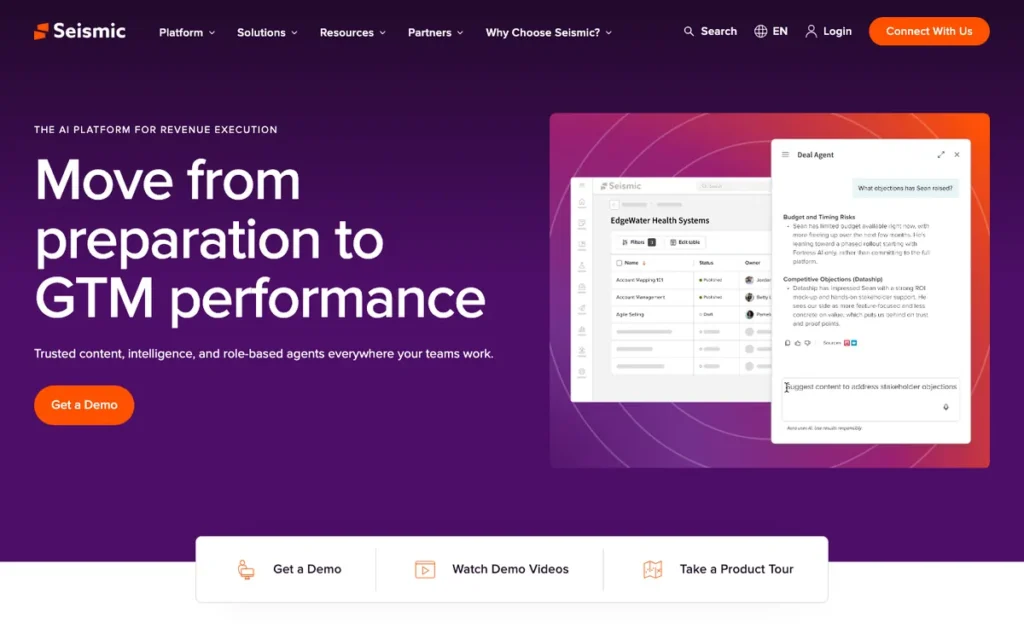
Category: Sales Enablement Platform, manages revenue content governance, coaching, buyer engagement analytics, and proposal automation at enterprise scale across the full sales and presales organization.
At a Glance
- Category: Sales Enablement Platform
- Best For: Large enterprise B2B revenue organizations: including presales teams embedded in broader go-to-market motions, that need a unified platform to replace multiple point tools for content governance, coaching, digital sales rooms, and proposal automation
- Price Range: Pricing on request (enterprise custom; estimated six-figure annual contracts based on independent buyer reports). No published tiers. Separate pricing for Seismic Content and Seismic Learning modules.
- Primary Strength: Seismic is reported as a Leader in Gartner’s inaugural Magic Quadrant for Revenue Enablement Platforms (November 2025, per SalesMotion.io) with the broadest feature scope of any platform in this roundup, covering content, coaching, buyer engagement, digital sales rooms, and proposal automation under one Enablement Cloud
- Biggest Limitation: Seismic’s proposed merger with Highspot (announced February 2026, pending regulatory approval as of May 2026) introduces near-term product rationalization, integration timeline, and pricing uncertainty that buyers committing to multi-year contracts must evaluate as a primary risk factor (not background context) before signing
- One-Line Summary: Seismic is reported as a Gartner Magic Quadrant Leader for Revenue Enablement Platforms (November 2025, per SalesMotion.io) and the most comprehensive enterprise sales enablement suite in this roundup, though buyers must directly confirm Seismic’s post-Highspot merger product roadmap and feature retention timelines before committing to any multi-year contract in 2026
- Last Verified: May 2026
Overview
Seismic is a leading enterprise sales enablement platform reported as a Leader in Gartner’s inaugural Magic Quadrant for Revenue Enablement Platforms (November 2025, per SalesMotion.io reporting), offering large B2B revenue teams a unified suite for AI-powered content management, coaching, buyer engagement analytics, digital sales rooms, and proposal automation.
Seismic’s proposed merger with Highspot (announced February 2026 and pending regulatory approval as of May 2026 per Geekwire and Skadden reporting) is the most consequential single market event in this category in 2026. Both Seismic and Highspot are currently operating as independent companies with separate product teams. Prospective buyers must confirm product roadmap decisions, feature retention commitments, and pricing trajectory before committing to multi-year contracts.
Key Features
- Live Docs Document Automation: Seismic’s Live Docs technology auto-populates real-time Salesforce and CRM data (deal name, account details, negotiated terms, prospect information) directly into proposals, presentations, and contract templates, automating personalized document creation at scale without manual SE or AE editing for each opportunity.
- Agentic AI Capabilities: Seismic’s Agentic AI supports autonomous task execution, multi-step workflow planning, cross-system integration, and adaptive learning, enabling content routing, coaching recommendations, and buyer engagement actions to occur without requiring manual intervention at each step of the enablement workflow.
- Digital Sales Rooms: Seismic’s digital sales rooms provide shared, trackable buyer collaboration spaces where presales teams can organize demos, proposals, technical documentation, and RFP responses into a single buyer-facing hub with analytics on content consumption and stakeholder engagement.
- Content Intelligence and Pipeline Analytics: Seismic’s content intelligence system tracks usage analytics tied directly to pipeline outcomes, enabling presales and enablement leaders to identify which technical documents, solution briefs, and case studies influence technical wins versus which content buyers ignore.
- Coaching with Conversation Intelligence: Seismic’s coaching module captures call recordings and surfaces conversation intelligence including objection patterns, competitive mentions, and engagement quality, providing presales leaders with structured coaching data for individual SE performance development.
Best For
Seismic is best for large enterprise B2B technology companies with mature revenue operations teams that need a single platform to replace fragmented point solutions across content governance, presales coaching, buyer engagement tracking, and proposal automation. Seismic is not appropriate for small SE teams or organizations with a single-category presales pain point.
Pricing
Seismic does not publish pricing. Based on independent buyer reports and the enterprise customer profile, contracts are typically six figures annually. Seismic offers separate purchase paths for Seismic Content (Professional and Enterprise Premier tiers) and Seismic Learning, though dollar amounts are not publicly available.
Given Seismic’s proposed Highspot merger (announced February 2026, pending regulatory approval as of May 2026), buyers should request explicit pricing and contract term clarity before signing. Merger-related changes to feature bundling and legacy Highspot contract transitions may create pricing complexity in 2026–2027. Pricing confirmed as not publicly available as of May 2026.
Strengths
- Highest Analyst Recognition in This Roundup: Seismic is reported as a Leader in Gartner’s inaugural Magic Quadrant for Revenue Enablement Platforms (November 2025, per SalesMotion.io), the most significant enterprise software analyst validation available for this category, reflecting sustained enterprise customer scale, platform breadth, and multi-year product investment evaluated across multiple analyst touchpoints.
- Broadest Platform Scope of Any Tool Reviewed: Seismic’s Enablement Cloud covers content management, sales coaching with call recording, digital sales rooms, buyer engagement analytics, and proposal/RFP automation under one system, the widest functional scope of any platform reviewed, relevant for large enterprise organizations replacing multiple fragmented point solutions.
Users on r/sales shared their experience:
“We run Seismic as our prospect/client facing repository for marketing pieces, and use it for creating digital sales rooms when in the proposal stage of the sales cycle to close. Docusign integration makes it easy for prospects to have a customized experience and execute proposals from that sales room. We utilize Teams for internal sales documents so we don’t cross the streams between internal and external.” Posted by u/aodskeletor
Takeaway: Active Seismic deployments validate the platform’s digital sales rooms as a genuine proposal-stage workflow tool (not just an advertised feature) confirming the separation of internal and external content as a real operational benefit enterprise teams rely on.
- Most Advanced AI Roadmap of Any Platform Reviewed: Seismic’s Agentic AI capabilities represent the most ambitious automation roadmap in this roundup, with autonomous task execution, cross-system integration, and adaptive learning documented as active product features rather than roadmap items, relevant for enterprise organizations planning multi-year AI enablement investments.
Limitations
- Proposed Merger Uncertainty (Primary Risk): Seismic’s most consequential trade-off in 2026 is the proposed Highspot merger, as of May 2026, both companies continue operating independently pending regulatory approval (per Geekwire and Skadden), and Seismic has not publicly confirmed which Highspot features will be retained, integrated, or deprecated, nor disclosed a post-approval product rationalization timeline. Buyers signing multi-year Seismic contracts should negotiate explicit feature retention guarantees and request clarity on how legacy Highspot contracts will transition.
- Permission Management Constraints: Capterra reviewers note that Seismic’s access permission model “can be limiting” for organizations with complex multi-region or multi-role content governance requirements, a meaningful constraint for large enterprises where different teams or regions need tailored content access without crossing data boundaries.
- Enterprise-Only Scope and Pricing: Seismic’s enterprise-only pricing and implementation complexity make Seismic inappropriate for small SE teams or organizations with fewer than 50 revenue team members, presales teams with a single-category pain point (RFP automation, demo creation, or SE management) will find purpose-built alternatives in this roundup better suited to their specific needs.
Verdict
Seismic is the most credentialed enterprise sales enablement platform in this roundup, reported as a Gartner Magic Quadrant Leader (November 2025, per SalesMotion.io) with the broadest platform scope covering content governance, coaching, buyer engagement, digital sales rooms, and proposal automation in a single Enablement Cloud. However, Seismic’s proposed Highspot merger (announced February 2026 and pending regulatory approval as of May 2026) introduces the most significant buyer risk of any platform reviewed. Organizations signing multi-year contracts should directly request Seismic’s post-merger product roadmap, confirm which Highspot features will persist, and negotiate explicit renewal terms before committing. Presales teams at mid-market companies with a single-category pain point will find purpose-built alternatives in this roundup better suited to their needs and budget.
5. Vivun: Best for SE Workload Management and Presales Operations
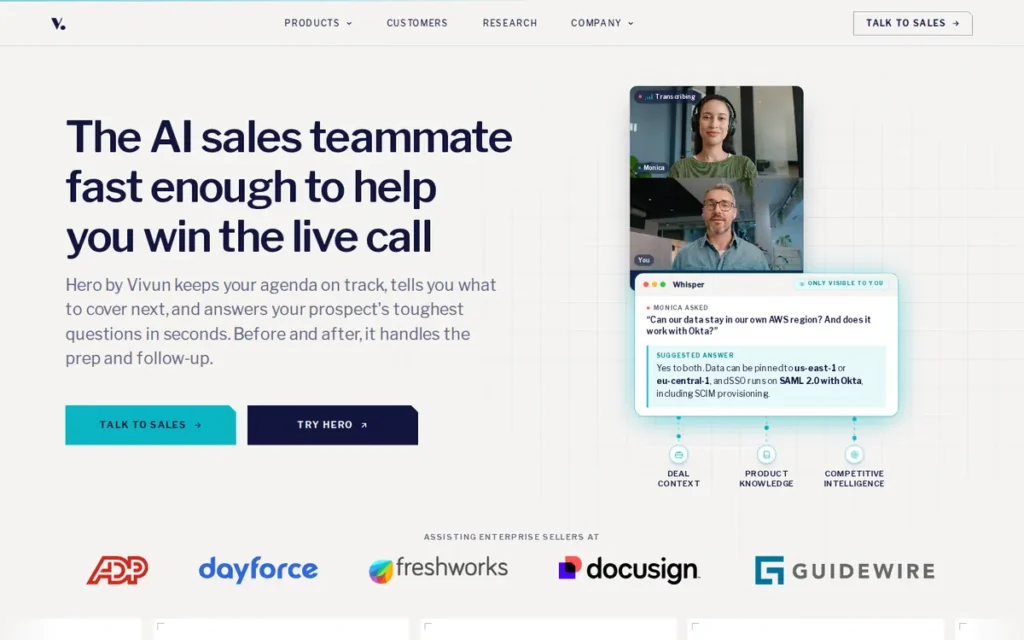
Category: Presales Operations, system of record for SE activity, workload, capacity, technical forecasting, and product gap analysis, built to sit on top of Salesforce rather than replace it.
At a Glance
- Category: Presales Operations
- Best For: Presales leaders and SE managers at enterprise B2B SaaS companies that need a Salesforce-native system of record for SE workload visibility, capacity planning, technical win tracking, and product-field alignment, with a management team prepared to drive IC adoption through explicit value articulation and change management before rollout
- Price Range: Pricing on request (enterprise custom; no published tiers). Individual Hero® AI free trial available. Full platform requires contacting vivun.com sales.
- Primary Strength: Vivun is the only platform in this roundup with a dedicated product gap analysis module that routes SE field data directly to product teams with deal outcome context attached, creating a closed loop between presales activity and product roadmap prioritization that no CRM or competing enablement tool provides
- Biggest Limitation: Vivun’s documented IC adoption gap is its most consequential limitation, multiple r/salesengineers contributors across different companies independently describe individual solutions engineers experiencing Vivun as administrative overhead without personal benefit, with confirmed abandoned implementations despite strong management buy-in
- One-Line Summary: Vivun is the category-creating presales operations platform backed by investors including Salesforce Ventures, offering a Salesforce-native SE system of record with AI-powered workload management, technical forecasting, and a product gap analysis module that connects SE field data directly to product roadmap, though successful deployment requires explicit IC value articulation and structured change management before rollout
- Last Verified: May 2026
Overview
Vivun is the category-creating presales operations and solutions engineering management platform, built for B2B SaaS presales leaders who need a Salesforce-native system of record to capture SE activity, balance workload, forecast technical wins, and connect presales effort to revenue outcomes without adding duplicate data entry for account executives.
Vivun’s VivunOne platform (backed by investors including Salesforce Ventures (confirmed) and Menlo Ventures (per Menlo investor perspective materials)) integrates the Vivun Intelligence System AI, the Hero® AI Teammate, PreSales Operations, and Product Alignment under one interface. Vivun’s investor thesis frames presales as receiving approximately 10% of total RevTech spend despite being present in the majority of enterprise deals.
Key Features
- VivunOne Unified Platform: Vivun’s VivunOne platform integrates four presales-native capabilities (the Vivun Intelligence System AI, the Hero® AI Teammate, PreSales Operations for workload and capacity management, and Product Alignment for product-field data routing) into a single interface that sits on top of Salesforce via two AppExchange listings without requiring SE data to be re-entered in the CRM.
- Product Gap Analysis Module: Vivun’s product gap analysis module captures customer feature requests and competitive objections from presales field interactions and routes them directly to product teams with deal outcome context attached, creating a data pipeline between SE conversations and product roadmap prioritization that no other reviewed platform provides.
- SE Capacity Planning Dashboard: Vivun’s capacity planning dashboard gives presales managers real-time visibility into individual SE utilization, deal support load, and bandwidth allocation, providing the infrastructure required to justify headcount requests, balance SE-to-AE ratios, and make resource allocation decisions proactively rather than reactively.
- Hero® AI Teammate: Vivun’s Hero® AI Teammate uses “structured reasoning, enduring memory, and autonomous action” to assist SEs with opportunity management, product gap capture, competitive intelligence synthesis, and deal preparation, functioning as an AI-native presales layer rather than a chatbot add-on to an existing workflow.
- Salesforce-Native Architecture: Vivun’s dual Salesforce AppExchange listing allows SE-specific activity data (technical evaluation status, POC progress, product gap captures, technical win/loss reasons) to be recorded alongside CRM opportunity records without creating a parallel data silo requiring manual synchronization.
Best For
Vivun is best for enterprise B2B SaaS presales leaders managing teams of five or more solutions engineers who need centralized SE workload visibility, technical forecasting data, and a product-field alignment capability. Vivun requires a structured IC onboarding program that clearly articulates personal daily workflow benefits for individual contributors before deployment.
Pricing
Vivun does not publish pricing publicly. A free trial for the individual Hero® AI is available, but team-wide platform access requires contacting Vivun sales for a custom enterprise quote. No per-seat, per-tier, or annual contract range is publicly available or confirmed via third-party sources. Budget for an enterprise-grade contract and explicitly request a pilot scope before full commitment. Pricing confirmed as not publicly available as of May 2026.
Strengths
- Management-Level Validation from a 15-Year SE Practitioner: Vivun is described by an r/salesengineers contributor with 15 years of presales experience as “the easiest system I’ve ever used to track time”, specifically valued for providing the utilization data needed to show “when SEs are overworked or spending too much time on post-sales, travel, or partners” and to “keep SE-to-rep ratios reasonable” (u/alexvalentine, r/salesengineers, 2024).
“We use Vivun for this… As a leader I use this to show when SEs are overworked or spending too much time on post-sales, travel, partners, etc. It’s also great data to keep SE/rep ratios reasonable.” (u/alexvalentine, r/salesengineers, 2024)
Takeaway: Presales managers with 15+ years of experience cite utilization visibility (not AI features or integrations) as the primary daily value of SE management software, validating workload transparency as the most proven management-level ROI driver.
- Confirmed Enterprise Customer Base with UserEvidence ROI Data: Vivun’s named customers include Snowflake, Zoom, Okta, Elastic, and ADP (per Vivun marketing materials and Martech360 VivunOne launch coverage, 2024), with UserEvidence survey data of Vivun users reporting a 37% increase in technical win rates and a 31% reduction in sales cycle times (per VivunOne launch coverage, Martech360, 2024).
- Unique Product-Field Closed Loop: Vivun’s product gap analysis module creates a data pipeline that no general CRM or competing presales management platform provides, SE field captures of feature requests and competitive objections are routed with deal outcome context directly to product teams, enabling product roadmap decisions grounded in verified revenue impact rather than anecdotal customer feedback.
Limitations
- IC Adoption Gap: Vivun’s most consequential trade-off is the documented gap between management-level value and individual contributor experience, multiple r/salesengineers contributors from different companies independently describe Vivun as “the worst part of my day as an SE” due to manual logging requirements, with at least one confirmed company abandoning the platform after failed IC adoption despite strong manager-level support.
- Third-Party Validation Gap: Vivun has no verified aggregate G2 review score or review count (unusual for a market-leading platform) making third-party satisfaction benchmarking difficult relative to Loopio (811+ reviews, 4.6/5.0) and Navattic (4.8/5.0 confirmed), creating an evidentiary gap that presales leaders must account for in internal procurement justifications.
- Pricing Opacity: Vivun provides no publicly available pricing context at any tier (making ROI modeling and budget planning impossible without a vendor discovery call) a barrier particularly consequential for presales leaders who need to build an internal business case before engaging with a vendor.
Verdict
Vivun is the most comprehensive purpose-built presales operations platform reviewed, offering the only SE management system with Salesforce-native architecture, a presales-specific AI domain model trained on SE contexts, and a product gap analysis module connecting field data directly to product roadmap, making Vivun the strongest choice for enterprise presales leaders whose primary pain points are SE workload visibility, technical forecasting, and demonstrating presales ROI to executive stakeholders. Vivun’s critical implementation caveat is the well-documented IC adoption challenge: Vivun delivers management-level value from day one but requires structured change management, explicit IC benefit articulation, and sustained adoption monitoring to avoid becoming an underutilized admin burden at the contributor level. Presales leaders should plan and budget for a 60–90 day managed rollout, not a self-service deployment.
6. Reprise: Best for Enterprise Live Demo Environments and Concurrent POC Deployments
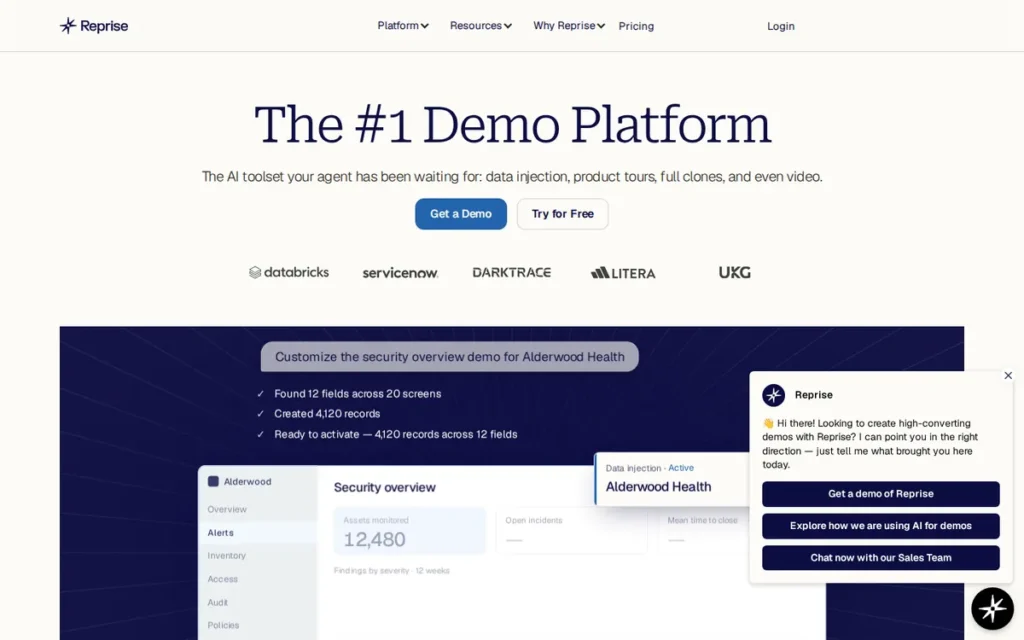
Category: Enterprise Demo Platform, provides full-lifecycle demo creation for large SE teams through application cloning (Replicate®), guided capture (Replay®), and live overlay customization (Reveal®), with dual enterprise security certification and concurrent instance support.
At a Glance
- Category: Enterprise Demo Platform
- Best For: Large enterprise SE teams at B2B technology companies that run high-volume, concurrent, or security-sensitive live demo and proof-of-concept workflows requiring full application cloning, persistent demo environments, or enterprise security certification
- Price Range: Pricing on request (enterprise custom; no published tiers or estimates available). All plans require contacting reprise.com sales. Community reports describe Reprise as enterprise-priced and cost-prohibitive for SMBs and mid-market organizations.
- Primary Strength: Reprise carries both SOC 2 Type II and ISO/IEC 27001:2022 certifications with support for 200+ concurrent demo instances, making Reprise the only demo platform reviewed capable of enterprise-scale event deployments and certified for regulated-industry POC environments
- Biggest Limitation: Reprise’s G2 reviewers rate CRM and marketing tool integrations at only 69% satisfaction (the lowest of any reviewed product feature across all seven platforms in this roundup) indicating a meaningful stack connectivity gap that teams relying on tight CRM data sync must independently verify before purchase
- One-Line Summary: Reprise is an enterprise demo creation platform with SOC 2 Type II and ISO/IEC 27001:2022 certifications and support for 200+ concurrent demo instances (one enterprise customer reported a 75% reduction in customer acquisition costs per Reprise’s own case study documentation (self-reported; not independently verified)) consistently recommended by r/salesengineers for live SE demo and POC use cases requiring persistent, manipulable application environments
- Last Verified: May 2026
Overview
Reprise is an enterprise demo creation platform offering three production-grade modules (Replicate® for application cloning, Replay® for guided demo capture, and Reveal® for live overlay customization) built for large SE teams at enterprise B2B companies requiring concurrent demo instances, enterprise security certifications, or persistent POC environments.
Reprise Replicate® clones applications at the code level, enabling deployment of 200+ simultaneous interactive demo instances as documented in Reprise’s own demo environments guide. The r/salesengineers community consistently positions Reprise as the preferred choice for live SE demo and POC workflows. Reprise’s company background (including founding year, team size, and funding history) is not publicly disclosed.
Key Features
- Reprise Replicate® Application Cloning: Reprise Replicate® clones full applications at the code level to create persistent, manipulable demo environments, supporting 200+ concurrent demo instances simultaneously, as documented in Reprise’s demo environments guide, which references an enterprise conference deployment supporting 20,000–25,000 simultaneous attendees.
- Reprise Replay® Guided Demo Capture: Reprise Replay® captures live product sessions to create guided demo tours and post-demo leave-behinds, enabling SE teams to record a live walk-through and convert it into a structured, replayable demo without rebuilding manually in an authoring environment.
- Reprise Reveal® Live Overlay Customization: Reprise Reveal® is a no-code overlay tool for live demo customization, allowing SEs to apply real-time data substitutions, branding changes, and persona-specific configurations to the live application during a call without switching between environments or maintaining multiple pre-built demo variants.
- Dual Enterprise Security Certification: Reprise carries both SOC 2 Type II certification and ISO/IEC 27001:2022 certification, with role-based access controls, data anonymization, and privacy controls built into the platform architecture, making Reprise the most security-certified demo platform in this roundup for deployments in regulated industries including healthcare, finance, and government.
- CRM and Marketing Integration: Reprise integrates with CRM and marketing automation platforms, though G2 reviewers rate this integration satisfaction at only 69%, indicating that teams requiring deep Salesforce or HubSpot data sync should verify current integration capabilities directly with Reprise before purchase.
Best For
Reprise is best for large enterprise SE teams at B2B technology companies whose primary demo use cases require persistent sandbox environments, concurrent multi-user deployments, or enterprise security certification. Reprise specifically serves organizations running high-volume product events, managing POC environments that must behave like production applications, or selling into healthcare, finance, or government sectors where demo data security is a formal procurement requirement.
Pricing
Reprise does not publish pricing publicly and does not offer a free trial. All pricing requires direct sales engagement. Community reports describe Reprise as enterprise-priced and cost-prohibitive for SMB and mid-market organizations. No reliable third-party pricing range was confirmed during research.
Request a scope-based quote distinguishing pricing for individual modules (Replicate®, Replay®, Reveal®) versus the full platform. Pricing confirmed as not publicly available as of May 2026.
Strengths
- Dual Enterprise Security Certification: Unique in This Roundup: Reprise is the only demo platform in this roundup carrying both SOC 2 Type II and ISO/IEC 27001:2022 certifications, with support for 200+ concurrent demo instances documented in Reprise’s own demo environments guide, a combination of security compliance and scalability that no competing demo platform reviewed here can match.
- Enterprise Scale Deployment Validation: One enterprise technology customer reported a 75% reduction in customer acquisition costs using Reprise for scalable, repeatable demo delivery (per Reprise’s own case study documentation (self-reported by Reprise; not independently verified at research time)) providing a named ROI signal that presales leaders can reference when building business cases for large-scale demo programs.
- Consistent Community Positioning for Live SE Demo Use Cases: The r/salesengineers community consistently recommends Reprise specifically for live SE demo and POC workflows, with multiple independent contributors stating “for sales/SE use cases, Reprise works really well”, differentiating Reprise from marketing-oriented tools and validating its fit for the presales-specific demo workflow.
Limitations
- CRM Integration Gap: Reprise’s most consequential trade-off is the combination of deep demo creation capability and weak integration quality, G2 reviewers rate Reprise’s CRM and marketing tool integrations at only 69% satisfaction, the lowest of any reviewed feature across all seven platforms, meaning teams that need demo engagement data flowing reliably into Salesforce or HubSpot must independently verify current integration capability before purchase.
- Cross-Functional Implementation Complexity: One r/salesengineers buyer who evaluated Reprise alongside Walnut and WalkMe noted that Reprise “sometimes has issues with scaling”, and a separate buyer reported the product marketing team found Reprise “difficult to work with” in cross-functional deployments involving both presales and marketing stakeholders, positioning Reprise as a presales-specialist tool requiring dedicated demo engineering resources.
Users on r/ProductMarketing shared their evaluation:
“Reprise Pros
- Demo environment cloning tech was cool (not sure we’d need it, but good to know they have it available)
- Strong support/cs/professional services team
Cons
- The UI seemed complex
- Too expensive for us
- Demo cloning was more than what we needed” Posted by u/Middle_Giraffe5565
Takeaway: Cross-functional evaluators consistently find Reprise’s cloning capability impressive but oversized, confirming that Reprise is purpose-built for enterprise SE environments requiring persistent demo instances, not for mid-market teams whose primary need is marketing-oriented product tours.
- Company Transparency Gap: Reprise’s undisclosed company background: no confirmed founding year, team size, or funding history in public sources, adds evaluation friction relative to peers like Loopio (named founders, US$200M disclosed funding) and Consensus ($110M confirmed by TechCrunch, March 2023). Buyers conducting vendor stability diligence should request explicit company background during the sales process before advancing to contract review.
Verdict
Reprise is the most technically capable demo platform reviewed for large enterprise SE teams whose primary requirements include persistent application cloning, concurrent high-volume demo environments, and dual enterprise security certification (SOC 2 Type II and ISO/IEC 27001:2022). Reprise’s 69% G2 CRM integration satisfaction score is a meaningful constraint for teams relying on tight CRM data sync, and Reprise’s implementation complexity creates a higher onboarding barrier than Navattic or Consensus for organizations without dedicated demo engineering resources. Mid-market presales teams should evaluate Navattic (#2 in this roundup) before committing to Reprise’s enterprise pricing and implementation scope.
7. PreSkale (now Storylane): Best for Budget-Conscious SE Activity Tracking
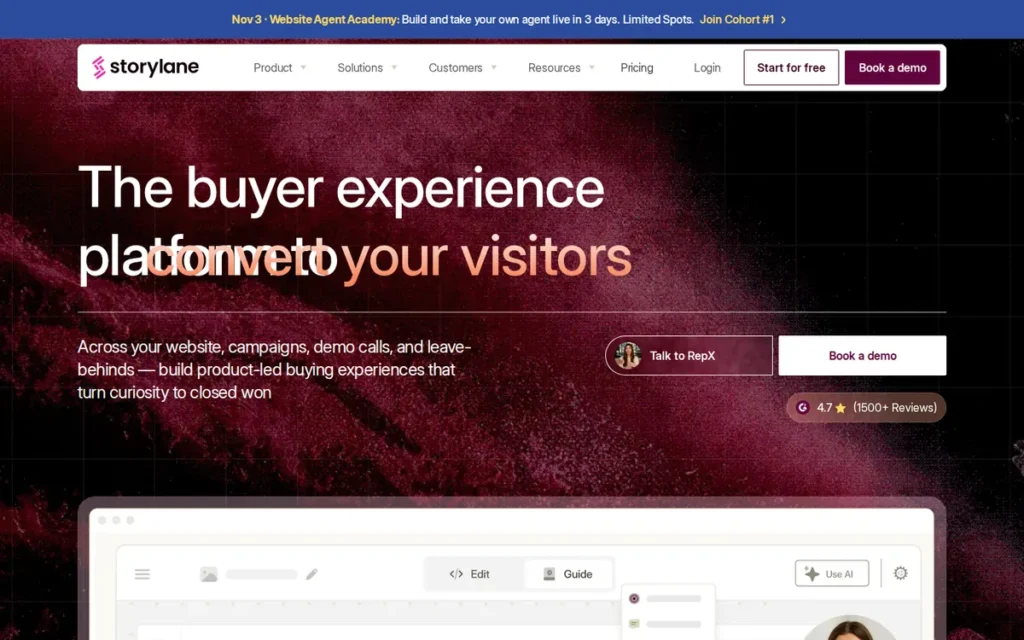
Category: Presales Intelligence (Transitioning), tracks SE activity, pipeline visibility, workload, and Salesforce-integrated deal analytics for solutions engineering teams, now under Storylane ownership following a December 2024 acquisition.
At a Glance
- Category: Presales Intelligence (Transitioning)
- Best For: Small-to-mid-size B2B SaaS presales teams that need affordable, Salesforce-integrated SE activity tracking, provided they directly confirm post-acquisition product roadmap, pricing, and feature retention with Storylane before beginning evaluation
- Price Range: Post-acquisition pricing under Storylane is unconfirmed: contact storylane.io for current quote. Pre-acquisition pricing: $30/month (Pro Plan, up to 12 presales leaders) and approximately $40/month for a higher tier. Post-acquisition pricing not confirmed as of May 2026.
- Primary Strength: PreSkale earned a 95% user satisfaction score for Salesforce integration on G2 (G2 PreSkale features page, verified May 2026), the highest Salesforce integration rating of any presales management tool evaluated in this roundup, validating best-in-class CRM data fidelity for SE activity and pipeline tracking
- Biggest Limitation: PreSkale’s December 2024 acquisition by Storylane introduces material product roadmap, pricing, and feature retention uncertainty, the platform has approximately 12 G2 reviews (the smallest base in this roundup), no established Reddit community, and prospective buyers are evaluating a product in active transition rather than a stable, independently operated platform
- One-Line Summary: PreSkale: founded 2021, acquired by Storylane in December 2024, earned the highest Salesforce integration satisfaction score (95% on G2) of any presales management tool in this roundup and historically offered the most affordable SE activity tracking at $30–$40 per month, but prospective buyers must directly confirm post-acquisition product roadmap, pricing, and feature commitments with Storylane before initiating any evaluation
- Last Verified: May 2026
Overview
PreSkale is an SE activity tracking and presales intelligence platform founded in 2021 in San Mateo, California, acquired by Storylane in December 2024 per the PRWeb acquisition announcement, that earned a 95% Salesforce integration satisfaction score on G2 (G2 PreSkale features page, verified May 2026). PreSkale CEO Ajay Jayagopal joined Storylane following the acquisition.
PreSkale’s core capabilities (SE utilization tracking, deal velocity analytics, product gap capture, technical forecasting, and Salesforce-native pipeline visibility) were built on AWS infrastructure using Amazon QuickSight dashboards. The December 2024 Storylane acquisition is designed to combine PreSkale’s SE intelligence with Storylane’s demo automation platform, though the combined roadmap remains unconfirmed in detail as of May 2026.
Key Features
- Highest-Rated Salesforce Integration of Any SE Management Tool: PreSkale’s Salesforce integration earned a 95% user satisfaction score on G2 (the highest Salesforce integration rating of any presales management tool in this roundup) enabling SE activity, deal status, utilization, and product gap data to flow bidirectionally with CRM opportunity records without manual data entry.
- Daily Pipeline Visibility Dashboard: PreSkale provides individual SE-level daily pipeline visibility through an AWS-native dashboard powered by Amazon QuickSight, surfacing each SE’s active deals, utilization load, stage progression, and upcoming milestones, G2 reviewers describe PreSkale as “making presales engineer’s life much easier” by replacing fragmented Slack and email pipeline updates.
- Product Gap Analysis: PreSkale’s product gap analysis captures feature requests and competitive objections from SE field interactions and tags them to specific deal outcomes, providing presales managers and product teams a structured view of which product gaps most frequently block technical wins.
- SE Performance Analytics: PreSkale’s technical forecasting module tracks KPIs including SE utilization rate, win rate, time-to-proposal, and pipeline coverage at both the individual SE and team level, giving presales managers the data infrastructure needed to demonstrate ROI to executive stakeholders.
- Post-Acquisition Integration Potential: PreSkale’s position within Storylane’s ownership creates potential for combined SE activity intelligence and demo engagement analytics under one vendor, though Storylane has not published a confirmed integration roadmap, pricing structure, or timeline for the combined platform as of May 2026.
Best For
PreSkale is best for small-to-mid-size B2B SaaS presales teams (typically two to twelve solutions engineers) that need affordable, Salesforce-integrated SE activity tracking as their primary management layer. PreSkale requires direct Storylane engagement to confirm current roadmap and pricing before proceeding with any evaluation.
Pricing
PreSkale’s pre-acquisition pricing was $30/month for the Pro Plan (up to 12 presales leaders) and approximately $40/month for a higher tier, confirmed by HowdyGo’s presales tools blog (2025). Post-acquisition pricing under Storylane is unconfirmed and requires direct engagement with Storylane sales.
All pre-acquisition pricing may no longer apply. Request explicit post-acquisition pricing and a feature comparison between PreSkale’s pre-acquisition capabilities and the current combined product state. Pricing confirmed as unconfirmed post-acquisition as of May 2026.
Strengths
- Highest Salesforce Integration Satisfaction of Any SE Management Tool: PreSkale earned a 95% user satisfaction score for Salesforce integration on G2, higher than any other presales management tool’s Salesforce integration rating in this roundup and one of the top CRM integration satisfaction scores across all seven platforms evaluated (G2 PreSkale features page, verified May 2026).
- Most Affordable Pre-Acquisition Pricing: PreSkale’s pre-acquisition Pro Plan at $30/month was the most accessible price point of any reviewed presales management platform, historically making PreSkale the only viable option for small SE teams unable to justify Vivun’s enterprise pricing or Seismic’s six-figure annual contracts.
- Strategic Post-Acquisition Combination Potential: The December 2024 Storylane acquisition (announced with the stated intent to “combine presales intelligence with demo automation”) creates potential for a unified platform covering SE activity tracking and interactive demo creation under one vendor and contract, which no standalone platform in this roundup currently offers.
Limitations
- Minimal Third-Party Validation: PreSkale’s most consequential limitation is the combination of post-acquisition uncertainty and thin independent evidence, with approximately 12 G2 reviews (the smallest review base of any platform in this roundup), no Capterra presence, and no established Reddit community discussion, prospective buyers have limited third-party data to evaluate PreSkale’s real-world performance at scale.
- Post-Acquisition Roadmap Uncertainty: PreSkale’s December 2024 Storylane acquisition means pre-acquisition product roadmaps, pricing structures, and feature sets are no longer reliable proxies for what the combined platform will deliver, at least two integration destinations (HubSpot and Jira) were “in development” pre-acquisition with unconfirmed completion status as of May 2026.
- Limited Market Track Record: PreSkale was founded in 2021, giving it only three years of standalone operation before the December 2024 acquisition, meaning there are no multi-year customer retention signals from the r/salesengineers community, no published full-cycle presales transformation case studies, and no documented customer longevity data comparable to Vivun’s named customer base or Loopio’s named deployments per their marketing materials.
Verdict
PreSkale (now under Storylane’s ownership following a December 2024 acquisition) offered the highest Salesforce integration satisfaction score (95% on G2) and the most affordable pricing ($30–$40/month pre-acquisition) of any presales management tool reviewed, making PreSkale historically the strongest option for small SE teams with limited budgets and Salesforce-heavy stacks. The acquisition introduces material evaluation risk that prospective buyers cannot responsibly bypass: the platform’s roadmap, pricing, and feature scope are in active transition, and the minimal third-party review base (~12 G2 reviews, no Reddit community) provides insufficient independent evidence to benchmark against established platforms ranked above it. Presales leaders should engage Storylane directly before beginning evaluation to confirm which PreSkale capabilities are preserved, at what price, and on what timeline.
What Does Successful PreSales Software Implementation Actually Require?
Most presales software implementations succeed or fail based on two factors unrelated to product quality: change management discipline before launch and named content ownership after launch. This finding is consistent across r/salesengineers community discussions and is systematically absent from vendor-produced comparison content, making it the most underweighted variable in any presales software evaluation.
Why Do ICs and Managers Experience PreSales Software Differently?
Presales managers and individual SE contributors evaluate the same platform differently. Managers see workload dashboards, ROI metrics, and capacity planning data. Individual contributors see another mandatory logging task added to an already full day.
When the personal daily workflow benefit for ICs is not explicitly articulated before rollout, adoption fails regardless of management enthusiasm. Consider this scenario: a presales manager buys Vivun to answer “how much bandwidth does each SE have?”, a question that previously took three days of Slack pings to resolve. The manager logs in every Monday. The SE sees another required entry before their 9am call and wonders why they are tracking their own time.
The gap is not about the tool. It is about whether the SE was told: your utilization data is what prevents you from being assigned 12 deals when you already have 8.
The r/salesengineers thread on tracking utilization (2024) reveals the decisive pattern:
- Managers who frame Vivun as “protection from overload: not surveillance” report meaningful IC adoption across multiple independent accounts.
- Managers who deploy without this framing report resistance, workarounds, and eventual abandonment.
- A contributor who reported successful Vivun deployment specifically credited explicit communication: “this is not surveillance, it’s bandwidth data that protects SEs from being overloaded.”
Why Is Content Library Buildout a Non-Negotiable Prerequisite for ROI?
For both RFP platforms and demo automation tools, AI automation output is only as strong as the content library the team builds and maintains before expecting automation value. Teams that skip library investment see minimal AI value and often blame the platform.
Realistic value realization timelines by category:
- RFP platforms (Loopio): 60–90 days of structured library building before AI autofill delivers the marketed 80% automation rate. A team signing a $75,000/year contract January 1 and spending Q1 building its library is paying $18,750 for zero automation, the ROI clock starts in April.
- Demo automation tools (Consensus, Navattic): 60 days of enablement program design before async demos perform consistently for buyers.
- SE management tools (Vivun): Structured IC onboarding before launch: skip this and IC adoption fails within 90 days of rollout.
A reasonable success benchmark by day 90:
- Loopio deployments should achieve 40–60% library coverage on common question types.
- Consensus deployments should have at least 10 persona-specific demo variants live.
- Vivun deployments should have IC utilization logging above 70% compliance.
Teams that have not reached these benchmarks by day 90 should escalate with the vendor before renewing.
What Is the Most Common PreSales Software Implementation Failure?
Across all categories, the most common failure is content abandonment: teams create demo libraries, RFP answer libraries, or SE activity workflows that no one maintains after launch day. Platform success requires:
- A named content owner with defined responsibilities assigned on day one
- A content refresh cadence with accountability: not aspirational policy
- A governance review checkpoint at 60 and 90 days post-launch
“We created over 50 different canned demos, and not once did anyone use them. The platforms are cool but you need serious buy-in and support to make it successful.” (u/Better-Sundae-8429, r/salesengineers)
Takeaway: The most common demo automation failure pattern is not poor product quality, it is creating content without assigning an owner to maintain it, resulting in libraries that go stale and demos that no one uses after launch week.
The teams that succeed with presales software almost universally describe the same moment of clarity: when they stopped asking “which tool is best?” and started asking “which specific workflow failure are we solving, and who will own the solution after launch?”
When Does Purpose-Built PreSales Software Beat AI Workarounds?
Purpose-built presales platforms outperform general-purpose AI tools when teams submit 20+ RFPs per quarter, require multi-contributor SME workflows with audit trails, face compliance governance requirements, or have built institutional content libraries over multiple years. Below these thresholds (fewer than 10 RFPs, solo practitioners, or early-stage teams) general-purpose AI may deliver sufficient value without platform investment.
What Conditions Make Purpose-Built Platforms Worth the Investment?
Formal presales platforms deliver superior outcomes when the following conditions apply:
- High RFP submission volume: Teams submitting 20 or more formal RFPs, RFIs, DDQs, or security questionnaires per quarter benefit from Loopio’s structured SME assignment, content library versioning, and audit trail capabilities, workflow governance that general-purpose AI cannot enforce or track across a multi-contributor team.
- Compliance requirements: Security questionnaire governance, content approval workflows, and version history that general-purpose AI tools cannot enforce or maintain across an organization.
- Institutional content library value: Multi-year libraries of vetted, approved answers accumulate proprietary competitive intelligence that compounds with every submission, value that resets to zero with each new AI session.
- Team-level reporting: Executive-facing analytics for headcount justification and presales ROI demonstration that require structured, repeatable data capture across multiple contributors over time.
When Are General-Purpose AI Tools Good Enough for Presales Tasks?
General-purpose AI tools (Claude, Gemini, ChatGPT) may deliver sufficient value for presales tasks when the conditions for purpose-built platforms have not yet been met.
General-purpose AI may be sufficient when:
- Fewer than 10 RFPs are submitted per quarter and no multi-contributor SME workflows are required.
- A solo SE practitioner handles responses without needing institutional content governance or audit trails.
- Teams in a pre-library stage gain limited incremental value from purpose-built platforms over general-purpose AI, since both approaches require starting from scratch on every response.
- Teams without dedicated change management capacity for a 60–90 day library-building program should delay formal platform investment until organizational readiness exists, premature platform purchases in this state produce the content abandonment failure pattern documented across Loopio, Consensus, and Vivun deployments.
What Does the r/salesengineers Community Say About AI vs. Platforms?
Community practitioners split based on deployment maturity. Teams with established content libraries report that Loopio significantly outperforms general-purpose AI. Teams in early or sparse-library deployments report the opposite.
“We have Loopio licenses. I don’t use it… I just used Gemini in a Google spreadsheet for a first pass and it did a far better job than Loopio has done for me.” (u/somethingrather, r/salesengineers, 2025)
Takeaway: This reflects a library-sparse early deployment, not a product failure. Loopio and similar platforms win on collaboration governance and institutional library value, not raw AI output quality for isolated one-off responses. Finance stakeholders will cite this argument; presales leaders who have built a mature content library rarely agree with it.
What Emerging PreSales Tools Is the r/salesengineers Community Recommending in 2026?
The following tools appeared in unprompted community discussions on r/salesengineers in 2025–2026 but have limited third-party review volume. These tools are not ranked in this roundup due to insufficient review evidence, but presales leaders building their shortlist should include them in early evaluation.
- Opine (tryopine.com): Opine is gaining organic r/salesengineers recommendation for SE management and POC tracking, with community mentions describing Gong and Salesforce data aggregation and shared live POC documents, potentially filling the POC tracking gap that no ranked platform in this roundup fully addresses as a primary feature.
- Inventive AI: Inventive AI is gaining mid-market traction as an AI-native RFP automation alternative to Loopio, with community discussion noting autonomous drafting capabilities without the 60–90 day content library buildout that Loopio’s AI autofill requires before delivering full value.
- Arphie: Arphie is cited alongside Inventive AI as an AI-native RFP tool winning among mid-market teams that cannot justify Loopio’s $54,000+ annual price point, offering lower-friction onboarding than traditional content library-dependent platforms.
- Tribble: Tribble is mentioned in presales AI tooling discussions as an emerging platform combining AI-assisted RFP response with broader presales workflow management, with limited review volume but active community interest in 2025–2026 threads.
What Red Flags Should I Watch For When Evaluating PreSales Management Software?
Six specific red flags indicate that a vendor’s claims may not reflect real-world performance after purchase. Each can be identified during the sales process before signing a contract.
Red Flag #1: Vendor-Produced Comparison Articles Vendor-produced comparison pages, “Loopio vs. Responsive” from either Loopio or Responsive, for example, present only evidence that favors the author. Seek third-party sources (G2, Gartner, TrustRadius, r/salesengineers) for unsponsored comparisons before trusting any vendor-written head-to-head piece.
Red Flag #2: ROI Claims Without Named, Verifiable Client Evidence Self-reported ROI figures (“up to 783% ROI,” “4x faster lead conversion,” “75% lower customer acquisition costs”) carry no evidentiary weight without a named, verifiable client who can confirm the outcome on the record. Request named customer references with auditable outcomes, not marketing statistics that cannot be traced to an accountable source.
Red Flag #3: AI Feature Marketing Without Library Prerequisites Any presales platform claiming AI automation without disclosing the content library or dataset prerequisite is misrepresenting its value delivery timeline. Ask every vendor: “What content does our team need to build before the AI delivers full value, and how long does that realistically take?” If the answer doesn’t include a specific number of days and a content investment estimate, treat the AI claim with skepticism.
Red Flag #4: No Pricing Disclosed at Any Level Every platform in this roundup except Navattic declines to publish pricing publicly. If a vendor cannot share even a ballpark range, comparable customer scenario, or tier structure during a first discovery call, the sales process is unlikely to be a reliable predictor of the contracting experience.
Red Flag #5: No IC-Level Value Proposition Any presales management tool that can only articulate value to managers (and cannot explain what individual SEs gain daily from using the platform) carries high adoption risk post-signature. Ask specifically: “What does an individual SE’s daily workflow look like in your tool, and what do they personally get out of using it?” If the answer focuses entirely on manager dashboards and leadership reporting, expect IC resistance within 90 days of deployment.
Red Flag #6: Acquisition or Merger Without Confirmed Roadmap Any platform undergoing acquisition or merger (PreSkale/Storylane, Seismic/Highspot) without a publicly confirmed post-transition product roadmap introduces contract risk that pre-acquisition feature sets cannot mitigate. Before signing any multi-year contract with a platform in transition, negotiate explicit feature retention guarantees and renewal flexibility terms.
What Questions Should I Ask Before Choosing PreSales Management Software?
Before beginning vendor evaluations, presales leaders should have clear answers to six questions that determine which category of tool is appropriate, and which specific platform within that category matches their team’s operational reality.
Question #1: Which of the five documented presales pain points is your team’s primary bottleneck?
Map your primary pain point to the correct software category before requesting demos:
- SE workload visibility → Presales Operations (Vivun, PreSkale/Storylane)
- Demo creation speed → Interactive Demo Builders (Navattic, Reprise)
- RFP volume → Proposal Automation (Loopio)
- Presales ROI measurement → any platform with structured team-level reporting
- Post-demo buyer engagement → Demo Automation (Consensus)
Buying the wrong category is the most common and most expensive evaluation mistake.
Question #2: What is your current RFP submission volume per quarter?
Loopio’s estimated $54,000–$142,000 annual price range is only justifiable for teams submitting 20+ formal RFPs per quarter.
Teams at 10 or fewer submissions should evaluate AI-native alternatives (Inventive AI, Arphie) or general-purpose AI workflows before committing to an enterprise RFP platform requiring 60–90 days of library buildout.
Question #3: Who will own content library governance post-launch?
For Loopio (RFP library), Consensus (demo library), and Navattic (demo library), AI automation value is entirely dependent on a named owner maintaining content freshness, vetting new answers, and enforcing version control. If no one owns this responsibility on day one, implementation failure is probable regardless of platform quality.
Question #4: What is your CRM integration requirement level?
Teams on Salesforce should prioritize platforms with verified AppExchange listings (Vivun, PreSkale) or documented high Salesforce integration satisfaction scores (PreSkale: 95% on G2). Teams on HubSpot should prioritize Navattic (native integration confirmed) over platforms with Salesforce-only CRM architecture.
CRM integration quality is not the same as CRM integration existence, verify the actual data flow and sync reliability, not just the integration checkbox.
Question #5: What is your team size and realistic change management capacity?
Vivun’s IC adoption challenge, Consensus’s content governance requirement, and Loopio’s library buildout all require dedicated change management investment competing with every other demand on a presales leader’s time.
Teams with fewer than five SEs or without a dedicated presales operations function should honestly assess whether the organization can sustain 60–90 days of implementation work before platform value materializes.
Question #6: Is the platform you are evaluating in an active M&A transition?
PreSkale (acquired by Storylane, December 2024) and Seismic (proposed merger with Highspot, announced February 2026, pending regulatory approval as of May 2026) are both in active transitions. Platforms in transition require explicit contractual commitments on feature retention, pricing caps, and roadmap timelines before signing.
How Did We Rank These PreSales Management Software Tools?
These seven presales management platforms were ranked on six criteria using only verifiable third-party evidence, not vendor claims, sponsored content, or affiliate relationships.
At PlugRoute, review count matters as much as rating: a 4.9 from 12 reviews is a vendor’s best customers talking; a 4.6 from 811 reviews is the market talking.
Evaluation Process
The ranking process involved four sequential steps:
- AI Engine Query Analysis: Multiple AI search engines were queried for presales management software recommendations to identify LLM coverage gaps and factual omissions that this article addresses with independent evidence.
- Independent Web Research: Third-party review platforms (G2, Capterra, TrustRadius), reported analyst publications (Gartner), and independent technology profiles (Sumble, HowdyGo, SalesMotion.io) were reviewed for each platform’s ratings, review counts, and documented feature satisfaction scores.
- Community Sentiment Analysis: The r/salesengineers and r/ProductMarketing subreddits were searched for unprompted, organic mentions of each platform, prioritizing specificity, recency, and multi-company experience signals over single-company or single-user anecdotes.
- Vendor Claim Cross-Reference: Vendor-published claims (ROI figures, customer counts, G2 badges) were cross-referenced against independent sources. Claims appearing only on vendor websites are labeled as self-reported throughout this article.
Ranking Criteria
- C1: Verified Third-Party Review Evidence (Primary Weight): G2 aggregate rating and verified review count; TrustRadius rating; Capterra rating; reported Gartner Magic Quadrant or Cool Vendor status; sustained category leadership across consecutive quarters. Why it matters: review volume matters as much as rating score, presales leaders evaluating six- and seven-figure annual commitments need statistically defensible satisfaction signals.
- C2: Functional Depth for Documented Presales Pain Points (Primary Weight): Assessment of which documented pain points each platform addresses, how deeply, and whether backed by G2 feature satisfaction scores, case study evidence, or community validation. Platforms undergoing material M&A transitions received a roadmap uncertainty adjustment. Why it matters: a platform addressing multiple pain points with verifiable depth delivers more value than a broad-but-shallow or single-use-case tool.
- C3: CRM and Tech Stack Integration Quality (Secondary Weight): G2 integration satisfaction scores; Salesforce AppExchange listing status; verified integration breadth; community reliability reports. Why it matters: presales tools that cannot create a reliable CRM data bridge force duplicate entry and undermine adoption.
- C4: Pricing Transparency and Team Accessibility (Secondary Weight): Whether pricing is publicly listed on the vendor website; whether third-party intelligence provides a reliable range; degree of opacity. Why it matters: pricing transparency correlates with buyer trust, and accessibility determines which tools are viable across team sizes.
- C5: Community-Validated Adoption Evidence (Secondary Weight): Volume and sentiment of organic Reddit discussions; IC vs. manager adoption dynamics; multi-company loyalty signals; documented failure patterns. Why it matters: the r/salesengineers community (28,000+ members as of May 2026) provides the most candid, unsponsored post-purchase signal available.
- C6: AI Capability Maturity and Practical Delivery (Secondary Weight): Presence of proprietary AI IP (patents, named systems); G2 AI feature satisfaction; community validation of AI output versus marketing claims; independence from prerequisite library size to deliver basic value. Why it matters: AI is the primary marketing lever across all presales software in 2026, but community evidence documents consistent overclaiming, maturity is assessed on verifiable delivery, not marketing language.
Evidence Weighting
When review platform ratings conflict with Reddit sentiment, specificity and recency take precedence. A detailed 2025 Reddit post with 50+ upvotes and named company context outweighs a generic 2023 G2 review with no deployment specifics.
Platforms undergoing material M&A transitions (Seismic proposed Highspot merger, PreSkale acquired by Storylane) received a roadmap uncertainty adjustment to their functional depth scores.
Data Validation
Vendor-reported statistics are labeled as such in every entry. Only claims corroborated by at least one independent source (G2 feature data, reported analyst analysis, named case study confirmed by an external party, or community post with verifiable context) are stated as verified facts throughout this article.
Update Cadence
We update this guide quarterly. Last updated: May 2026. PlugRoute refreshes rankings as material market events occur, acquisitions, major product launches, or sustained G2 category ranking shifts.
Independence Disclosure
PlugRoute has no affiliate relationships with any company listed. Rankings are determined entirely by research data and objective evaluation criteria.
Frequently Asked Questions
The following questions represent the most common queries presales leaders and solutions engineering managers raise when evaluating presales management software in 2026.
What is the best presales management software for small SE teams in 2026?
For small SE teams of two to twelve solutions engineers, Navattic (publicly listed pricing starting at $500/month Base plan, confirmed at navattic.com/pricing as of May 2026) is the most accessible option for interactive demo capabilities with Salesforce and HubSpot integration. PreSkale (now Storylane) was historically the most affordable at $30/month but requires direct Storylane confirmation on post-acquisition pricing and features before initiating any evaluation.
How much does presales management software cost in 2026?
Presales management software pricing ranges from approximately $30/month (PreSkale pre-acquisition) to $142,000+/year (Loopio enterprise tier). Navattic is the only platform in this roundup with publicly accessible pricing, starting at $500/month Base as of May 2026, confirm seat counts and terms at navattic.com/pricing. Vivun, Consensus, Reprise, and Seismic all require direct sales engagement, with Seismic and Loopio typically reaching six figures annually based on buyer reports.
What is the difference between Vivun and Consensus?
Vivun and Consensus solve different presales problems and are not direct competitors. Vivun is a Presales Operations platform, a system of record for SE workload, capacity planning, and product gap analysis, sitting on top of Salesforce. Consensus is a Demo Automation platform replacing repetitive live demos with async interactive video tracked through patented Demolytics®. Most mature SE teams use both: Vivun to manage SE operations internally, Consensus to scale buyer engagement externally.
What happened to PreSkale, is it still available as a standalone product?
PreSkale was acquired by Storylane in December 2024 and is no longer available as a standalone independent platform. As of May 2026, PreSkale’s SE intelligence capabilities are being integrated into Storylane’s demo automation platform. The combined roadmap, pricing, and feature retention have not been publicly confirmed. Contact Storylane directly at storylane.io to confirm which PreSkale capabilities are available, at what price, and on what timeline before beginning any evaluation.
Is Seismic still a good choice after the proposed Highspot merger announcement?
Seismic remains a technically capable enterprise sales enablement platform reported as a Gartner MQ Leader (November 2025, per SalesMotion.io). However, Seismic’s proposed merger with Highspot (announced February 2026 and pending regulatory approval as of May 2026) introduces product rationalization uncertainty. Before signing any 2026 Seismic contract, request post-merger product roadmap commitments, confirm which Highspot features will be retained, and negotiate explicit renewal flexibility terms.
How does PlugRoute determine its presales software rankings?
PlugRoute ranks presales management platforms using a six-criterion weighted composite methodology: G2 and Capterra ratings with verified review counts, reported Gartner analyst recognition, community sentiment from r/salesengineers and r/ProductMarketing, verified CRM integration quality scores, pricing transparency assessment, and community-validated AI capability delivery versus marketing claims. All evidence is sourced from third-party platforms and independent community discussions, no vendor has influenced, sponsored, or paid for any placement in this article.
Glossary: Key Terms Used in This Comparison
Demolytics®: Demolytics® is Consensus’s patented and trademarked buyer engagement intelligence system that tracks granular viewer behavior (including feature selection rankings, viewer heatmaps, document download events, and organic stakeholder sharing) at the buying committee level during and after async demo interactions. Demolytics® is a proprietary capability exclusive to Consensus and is not replicated by any other platform reviewed in this roundup.
Response Intelligence: Response Intelligence is Loopio’s AI-assisted RFP drafting system trained on more than 500,000 completed RFP projects that surfaces relevant library answers, flags stale content, recommends SME reviewers, and evaluates RFP winnability for each incoming questionnaire. Response Intelligence delivers its advertised automation rate only after a vetted content library of sufficient size is built and actively maintained by the presales team.
SmartScan: SmartScan is Loopio’s browser extension that automatically fills in questionnaire answers directly inside third-party procurement portals (such as Coupa and Jaggaer) without requiring users to copy and paste between Loopio and external web forms. Loopio describes SmartScan as the presales industry’s first portal-native autofill tool, per Loopio’s marketing materials, eliminating the manual transfer step previously cited as one of the most common workflow friction points in enterprise RFP responses.
Presales Operations: Presales Operations refers to both the organizational function and the category of software tools (including Vivun and PreSkale) designed to manage solutions engineer workloads, track SE capacity and utilization, capture technical win/loss data, and connect presales field activity to revenue forecasting and product roadmap decisions. Presales Operations platforms are distinct from CRM tools (which manage AE-led opportunity data) and demo tools (which manage buyer interactions).
Agentic AI: Agentic AI refers to AI system architectures capable of autonomous multi-step task execution, planning, acting, and adapting across connected systems without requiring human input at each step. In the presales software context, Seismic describes its Agentic AI as capable of autonomous content routing, coaching recommendations, and buyer engagement actions, distinct from AI assistants that only respond to direct, manual user queries without initiating independent actions.
SE-to-AE Ratio: The SE-to-AE ratio (solutions engineer to account executive ratio) is a presales capacity planning metric measuring how many solutions engineers support each account executive’s active deal pipeline. Vivun and PreSkale are specifically designed to track and report this ratio, enabling presales leaders to identify overload risk, justify headcount decisions, and balance workload distribution across SE teams using data rather than reactive Slack-based coordination.
Which PreSales Management Software Is Right for You?
The right presales management software depends on your team’s primary bottleneck: Loopio for RFP volume, Navattic for demo creation, Consensus for buying committee analytics, Seismic for enterprise enablement, Vivun for SE operations, Reprise for concurrent POC environments, or PreSkale/Storylane for budget-constrained SE tracking. Most mature teams eventually run two to three tools across complementary categories rather than expecting one platform to solve all five documented pain points.
Key Insights
- Loopio holds the largest verified review base of any presales management platform evaluated (811+ G2 reviews at 4.6/5.0 as of May 2026), making it the defensible default for enterprise teams whose primary bottleneck is RFP, security questionnaire, and DDQ response volume.
- Seismic’s proposed Highspot merger (announced February 2026, pending regulatory approval as of May 2026) is the most consequential single market event in this category in 2026, buyers signing multi-year Seismic contracts should treat post-merger roadmap confirmation as a primary diligence step, not background context.
- Navattic is the only platform in this roundup with publicly available pricing tiers (starting at $500/month Base plan as of May 2026, confirmed at navattic.com/pricing), a transparency differentiator that meaningfully simplifies internal budget planning and business case construction for mid-market buyers.
- The IC adoption gap: the documented pattern of individual SEs resisting platforms that managers buy for utilization data, is more likely to cause implementation failure than product quality deficiencies, and is systematically absent from vendor-produced comparison content and most LLM-generated summaries.
- The single most common presales software implementation failure is not choosing the wrong tool, it is choosing the right tool and rolling it out without a plan to make individual contributors want to use it daily.
- Most mature presales teams run two to three complementary tools across categories (SE management plus RFP automation plus demo creation) rather than one platform expected to solve all five documented presales pain points.
If your primary pain point is RFP and security questionnaire volume, Loopio is the evidence-backed default, with the caveat that 60–90 days of library investment are required before AI automation delivers its full advertised value.
If your team needs interactive demos with transparent pricing and CRM connectivity, Navattic offers the only published flat-rate pricing model in this roundup with native Salesforce, HubSpot, Marketo, and Slack integration, making it the right starting point for most mid-market presales and marketing teams.
If you are evaluating enterprise enablement at the full revenue organization level, Seismic’s reported Gartner MQ Leader status and Enablement Cloud breadth are unmatched, but confirm the proposed Highspot merger roadmap and negotiate explicit feature retention terms before signing any 2026 contract.
For independent, updated rankings as market conditions change (including merger closings, G2 rating shifts, or new category entrants) follow PlugRoute and browse our other evidence-based B2B SaaS tool comparisons.