Navattic is the best demo automation software overall for mid-market and enterprise B2B SaaS teams, delivering the highest HTML demo fidelity and deepest independent community validation. Storylane earns #2 for cross-functional GTM teams (highest G2 rating, 4.8/5.0); Arcade earns #3 for marketing and PLG teams. The right tool depends on demo architecture and budget, a distinction driving a $0-to-$200,000+/year pricing spread most guides never explain.
Most demo automation guides list tools by feature count without explaining the structural difference that matters most: whether a demo is screenshot-based or HTML-cloned. That architecture gap accounts for a 10x or greater price difference, and choosing the wrong tier means rebuilding your entire demo program when enterprise buyers notice the quality gap.
PlugRoute has no affiliate relationships with any company listed. Rankings are determined entirely by research data and objective evaluation criteria.
“Screenshot-based ones (like Storylane) are cheap because it’s a screenshot, not an actual interactive product demo… 80–90% of my clients end up on Navattic because HTML quality matters more than pricing at scale.” (u/SEOfortheRestOfUs, r/ProductMarketing, 2023)
Takeaway: HTML-native demo quality is the category’s decisive enterprise-tier differentiator, practitioners with multi-platform deployment experience consistently find that teams migrate toward HTML-cloning platforms once buyer perception of demo authenticity becomes a pipeline variable.
TL;DR: Top Picks at a Glance
- Navattic: best overall for HTML demo fidelity, team-scale operations, and multi-year community-validated results
- Storylane: highest G2 rating (4.8/5.0, 1,405 verified reviews); fastest AI demo creation for cross-functional GTM teams
- Arcade: most functional free tier (3 demos, no credit card); AI-assisted post-capture editing workflow uniquely reduces re-recording burden
- Supademo: G2 Fastest Growing designation 2025; six demo formats with $38/month Scale entry tier
Why Navattic ranks #1 despite Storylane’s higher G2 rating: G2 aggregates all buyer types, including early-stage teams who don’t yet face enterprise buyer scrutiny. Practitioner community signals reveal the post-scale migration pattern, a GTM consultant who has deployed all major demo tools reports that 80–90% of clients ultimately adopt Navattic because HTML quality matters more than pricing at scale (u/SEOfortheRestOfUs, r/ProductMarketing, 2023).
What Are the 4 Types of Demo Automation Tools?
The four types of demo automation tools are screenshot-based, HTML-capture/cloning, full sandbox environment cloning, and multi-format hybrid platforms. Each represents a distinct fidelity level and price tier, from $0 to $200,000+/year. Architecture type is the single most consequential variable in demo automation selection because it determines both buyer experience quality and total cost.
- Screenshot-based tools (Arcade base tier, Supademo Scale entry) capture static images of your product UI, producing demos quickly at low cost but lacking hover states, scroll behavior, and dynamic elements, also called “interactive product tours” in many vendor descriptions. Best for: marketing landing pages and onboarding walkthroughs.
- HTML-capture/cloning tools (Navattic, Walnut, Storylane Growth) copy live application HTML and CSS via a browser extension, replicating hover states, dynamic elements, and scroll behavior to produce demos that enterprise buyers experience as the actual product, also called “HTML interactive tours” or “sales leave-behinds.” Best for: sales demos and presales leave-behinds.
- Full sandbox/environment cloning tools (Reprise Replicate) create production-grade replicas of the live product with AI-injected, persona-specific data (the maximum authenticity level at maximum cost and setup time) also called “presales sandboxes” or “demo environments.” Best for: enterprise presales and SE organizations.
- Multi-format hybrid platforms (Demoboost, Supademo Growth tier) support multiple capture types, screenshot, HTML, video, and sandbox, in one platform, also called “async demo platforms.” Best for: teams that need format flexibility across funnel stages without multiple tools.
What Does This Mean for Your Budget?
The upgrade wall (where screenshot entry pricing gives way to HTML-tier pricing) appears across every major platform in this evaluation:
- Storylane: $40/month Starter (screenshot) → $500/month Growth (HTML): a 12.5x price increase
- Supademo: $38/month Scale (multi-format, including video and Figma) → $350/month Growth (HTML + AI Demo Agent)
- Navattic: No free tier: entry starts at ~$100/user/month for HTML demos
- Walnut: $9,200/year minimum, with community-reported ~$20,000/year for full enterprise feature sets
Knowing this before you start a trial changes what you trial. Budget for the HTML tier from day one.
A note on Live AI Demo Agents: An emerging sub-category (including Naoma, Karumi, Supersonik, and Saleo) uses real-time AI agents to conduct live product demonstrations. This sub-category is excluded from this ranking because no platform in it has sufficient independent practitioner community validation to support an evidence-based rank as of May 2026, despite institutional backing signals (a16z for Supersonik, YC for Karumi). PlugRoute will evaluate this sub-category when independent adoption evidence becomes available.
How Do the Top Demo Automation Tools Compare at a Glance?
| Rank | Company | Category | Best For | One-Line Summary | Top 3 Differentiators | Primary Strength | Key Limitation |
|---|---|---|---|---|---|---|---|
| 1 | Navattic | HTML Interactive Tour Platform | Mid-market to enterprise teams prioritizing HTML fidelity and team-scale demo ops | Navattic is the most evidence-backed interactive demo platform for mid-market and enterprise B2B SaaS teams, delivering pixel-perfect HTML tours, a 40,000-pattern AI Copilot with Copilot Memory, and the deepest practitioner community validation of any demo automation platform evaluated in 2026. | HTML cloning at pixel-perfect fidelity | AI Copilot with 40,000+ patterns + Copilot Memory | MCP server (2025) + bulk editing + version control | Highest independent community validation depth; documented multi-company repeat-user loyalty; pixel-perfect HTML fidelity | No free plan; ~$100/user/month minimum entry |
| 2 | Storylane | No-Code Interactive Demo Platform | Cross-functional GTM teams needing fast AI-powered demo creation across marketing, sales, presales, and CS | Storylane holds the highest G2 rating in the demo automation category (4.8/5.0 across 1,405 verified reviews as of 2026), offering cross-functional AI-powered demo creation with Lily AI across 25+ languages; with screenshot demos from $40/month and full HTML capabilities requiring the $500/month Growth plan. | Lily AI suite (scripts, voiceovers, avatars, 25+ languages) | Buyer Hubs deal rooms | Natural-language HTML editor (Growth plan) | Highest G2 rating (4.8/5.0, 1,405 reviews); fastest AI demo generation (2–10 min); broadest GTM team coverage | HTML access requires $500/month Growth plan; a 12.5x upgrade from $40/month Starter |
| 3 | Arcade | Visual Demo and Screen Recording Platform | Marketing teams, PLG organizations, and early-stage startups needing multi-channel shareable demos | Arcade is the best-value demo automation platform for marketing and PLG teams, offering the category’s most functional free plan, an AI-assisted demo update workflow (Avery AI), and single-session multi-environment capture across browser, desktop, and mobile at the lowest cost of entry in the 2026 category. | Most functional free tier (3 demos, full AI voiceover, no credit card) | Desktop 2.0 single-session cross-environment capture (browser, desktop, iOS) | Page Morph post-capture editing without re-recording | Only platform capturing browser, desktop, terminal, and iOS mobile in a single recording session; most functional free tier | Lighter depth for enterprise sales and presales; HTML capture on paid plans only |
| 4 | Supademo | Multi-Format AI Demo Platform | SMBs and budget-focused B2B SaaS teams across sales, customer success, and onboarding | Supademo is the fastest-growing demo automation platform (G2 Fastest Growing designation, 2025), offering six-format demo creation with AI voiceover and 15+ language translations at the $38/month Scale entry tier; and an AI Demo Agent for website visitor qualification available in the $350/month Growth plan. | Six demo formats in one platform (screenshot, HTML, video, Figma, desktop, media) | RouteHub AI-powered demo routing | AI Demo Agent (Growth plan) trained on company collateral | G2 Fastest Growing designation 2025; six-format flexibility; AI-native architecture from January 2023 founding | Newest major platform (founded Jan 2023); AI Demo Agent requires $350/month Growth plan; not available at $38/month entry |
| 5 | Walnut | AI-Powered Enterprise Sales Demo Platform | Enterprise sales teams with global motions, multi-stakeholder cycles, and multi-CRM integration requirements | Walnut is an AI-powered enterprise sales demo platform used by Adobe and Cisco, featuring five integrated AI agents; including StoryCapture AI for voice-to-demo assembly and Translation AI (a claimed 243 languages, vendor-reported); with bidirectional CRM sync across Salesforce, HubSpot, Marketo, and Pardot at a $9,200/year published starting price. | StoryCapture AI (voice-narration-to-demo assembly) | Translation AI (claimed 243 languages, vendor-reported) | Bidirectional CRM sync across Salesforce, HubSpot, Marketo, and Pardot | Five systematically integrated AI demo agents; broadest claimed multilingual support; multi-CRM bidirectional sync | $9,200/year minimum; community-reported ~$20,000/year for typical enterprise feature sets |
| 6 | Reprise | Enterprise Demo Environment Platform | Enterprise presales/SE organizations with complex products requiring sandbox simulation or live overlay customization | Reprise is the most technically comprehensive enterprise demo platform in the B2B SaaS category, uniquely combining guided tours, AI-powered sandbox cloning with data injection, and real-time live overlays in one SOC 2 Type II and ISO 27001-certified system; at an estimated $25,000–$200,000+/year. | Replay (guided tours) + Replicate (sandbox + AI data injection) + Reveal (live overlay) | SOC 2 Type II + ISO 27001:2022 dual certification | ICONIQ Growth and Bain Capital Ventures institutional backing | Only platform with all three demo modalities plus true sandbox AI data injection; dual compliance certifications | Lowest G2 score in evaluation (4.4/5.0); estimated $25,000–$200,000+/year; fully sales-gated evaluation |
| 7 | Demoboost | Presales Demo and Enablement Platform | Mid-to-large enterprise organizations with channel partner networks, presales-led motions, or consulting-plus-software requirements | Warsaw, Poland-based Demoboost is a presales-first enterprise demo platform used by Celonis, Bosch, and Hitachi, offering six demo format types and the only channel partner external demo library among the seven platforms in this evaluation; though it carries fully opaque pricing and the least independently verifiable community evidence of the seven platforms evaluated in 2026. | Channel partner external demo library (unique in this evaluation) | Six demo format types | Bundled consulting (4 hrs/month Core Package) | Only channel partner external demo library among the seven evaluated platforms; broadest format coverage (6 types); bundled consulting model | No identifiable organic practitioner community presence across four major subreddits; all performance metrics are self-reported; fully opaque pricing |
Which Demo Automation Tool Should I Choose for My Use Case?
| Your #1 Priority | Recommended Tool | Why | Acceptable Alternative |
|---|---|---|---|
| First demo today (same day, zero engineering) | Arcade free plan | 3 demos, AI voiceover, branching, translation; no credit card required, capture in browser immediately | Supademo free plan (5 demos) |
| Best free tier with real capability | Arcade | 3 demos with AI voiceover, branching, CTAs, forms, translation, blur; no credit card | Supademo free plan (5 demos, fewer confirmed features) |
| Lowest paid entry price | Arcade | ~$32–$38/user/month (annual) with HTML capture included on paid plans | Supademo ($38/user/month Scale plan, six formats) |
| SMB teams needing multi-format demo flexibility | Supademo | $38/month Scale plan with six demo formats, AI voiceover, 15+ language translations, and RouteHub routing | Arcade (~$32–$38/month paid) |
| Marketing and PLG demo production | Arcade | AI-assisted editing workflow + multi-environment capture + visual quality + functional free tier | Storylane Starter ($40/month) |
| Cross-functional GTM team (marketing + sales + CS) | Storylane | Single platform for all GTM functions; highest G2 rating (4.8/5.0, 1,405 reviews) | Navattic |
| Best HTML demo quality at transparent pricing | Navattic | Highest community-validated HTML fidelity; ~$6,000/year unlimited-user plan | Walnut ($9,200/year Lite) |
| Enterprise sales team with global sales motion | Walnut | Claimed 243-language Translation AI; bidirectional multi-CRM sync; Adobe and Cisco validated | Navattic |
| Enterprise presales and SE organization | Reprise | Only true sandbox with AI data injection + live overlay + guided tours in one certified system | Walnut |
| Channel partner program enablement | Demoboost | Only channel partner external demo library identified among the seven platforms in this evaluation | No direct alternative identified in this evaluation |
1. Navattic: Best Overall: Deepest Community Validation and Highest HTML Demo Fidelity in the Category
Category: HTML Interactive Tour Platform, captures live application HTML and CSS via Chrome extension to produce pixel-perfect, no-code interactive product demos that replicate real UI behavior including hover states, scroll interactions, and dynamic elements.
At a Glance
- Category: HTML Interactive Tour Platform
- Best For: Mid-market to enterprise B2B SaaS teams prioritizing HTML demo fidelity, team-scale demo operations, and CRM-integrated buyer intent intelligence
- Price Range: ~$100/user/month (billed monthly); ~$6,000/year estimated unlimited-user plan; Enterprise: custom pricing. No free plan.
- Primary Strength: Navattic produces the highest-fidelity no-code HTML interactive tours in the category with pixel-perfect UI cloning, and is the only platform offering team-scale operational infrastructure (bulk editing, version control, and AI Copilot Memory) at transparent pricing.
- Biggest Limitation: Navattic does not offer a free plan, and its ~$100/user/month minimum entry is inaccessible for individual contributors and early-stage startups that need to validate the demo automation use case before committing budget. Additionally, Navattic builds guided, path-based demos rather than free-roam sandbox environments.
- One-Line Summary: Navattic is the most evidence-backed interactive demo platform for mid-market and enterprise B2B SaaS teams, delivering pixel-perfect HTML tours built from a 40,000-pattern AI Copilot, team-scale bulk editing and version control, and the deepest practitioner community validation of any demo automation platform evaluated in 2026.
- Last Verified: May 2026
Overview
Navattic is a no-code HTML interactive demo platform built for mid-market to enterprise B2B SaaS teams, and the most consistently recommended tool in the demo automation category across independent practitioner communities as of 2026. Navattic’s Chrome extension clones live application HTML and CSS, producing demos with pixel-perfect fidelity including hover states, scroll behavior, and dynamic UI elements that screenshot-based alternatives cannot replicate at any price point. Navattic further differentiates through team-scale infrastructure, AI Copilot Memory, bulk editing, version control, and a 2025 MCP server connecting the platform with Claude, Cursor, and ChatGPT, making Navattic the most operationally mature platform in this evaluation for organizations managing large, multi-creator demo libraries.
Key Features
- HTML Cloning Chrome Extension: Navattic’s Chrome extension captures live application HTML and CSS to produce interactive demos with pixel-perfect fidelity (including hover states, scroll behavior, and dynamic UI elements) that screenshot-based tools structurally cannot replicate regardless of AI layering on top.
- AI Copilot with Copilot Memory: Navattic’s AI Copilot generates demo structures, copy, and tooltips from a library of 40,000+ patterns, with Copilot Memory preserving team-wide consistency so every demo creator builds assets in the same voice and structure without starting from scratch.
- MCP Server Integration (2025): Navattic’s MCP server: released in 2025 per Navattic’s changelog, connects the platform with AI tools including Claude, Cursor, and ChatGPT, enabling natural-language queries against demo analytics and direct action execution from AI assistants for AI-native GTM workflows.
- Playbooks and Account-Level Analytics: Navattic’s native Playbooks convert raw demo engagement events into actionable buyer intent signals, with account-level analytics identifying which companies are actively reviewing specific demos and delivering intelligence that integrates into CRM pipeline attribution and lead scoring.
- Bulk Editing, Version Control, and A/B Testing: Navattic includes bulk editing across multiple demos simultaneously, version control with restoration, and A/B testing capability in the base plan, team-scale operational features that Supademo and Storylane do not match at comparable pricing tiers.
Best For
Navattic is best for mid-market and enterprise B2B SaaS teams (particularly product marketing managers, demand generation leads, and presales organizations with five or more demo creators) who need HTML-fidelity interactive tours, team-scale demo operations with version control, and buyer intent intelligence that integrates bidirectionally into their CRM and marketing stack.
Pricing
Navattic pricing as of May 2026 is approximately $100/user/month billed monthly. An unlimited-user plan is available at approximately $6,000/year, verified via Reddit community reporting (r/ProductMarketing). HTML demos and A/B testing are included in the base plan, not gated behind a premium tier, unlike Storylane’s comparable pricing range. Enterprise pricing is custom with offline demos, priority support, and advanced collaboration. No free plan is available. Verify current pricing at navattic.com/pricing.
Strengths
- Navattic’s State of Demo Automation 2026 report: analyzing 40,000+ real demos created in 2025, found that deals including automated demos showed a 6% higher win rate and 19-day shorter sales cycles, with 72% win rates achieved when 2–3 demo touchpoints were delivered within the first 14 days of a sales process (Navattic, 2026).
- Sibill deployed Navattic interactive demos to drive website-to-free-trial conversion, using ungated demo previews to pre-qualify website visitors before expert-guided trial onboarding, a use case documented in a Navattic customer case study (Navattic Blog, 2025; specific conversion figure not independently verified by a third party). Dropbox (confirmed named customer) and Lokalise (per Navattic representative, r/salesengineers, vendor-attributed, not independently corroborated) deploy Navattic demos to pre-qualify inbound leads and reduce solution engineer involvement on poor-fit prospects.
- A GTM consultant with deployments across Walnut, Tourial, Storylane, and Navattic at multiple client sites reports that 80–90% of clients ultimately adopt Navattic because “HTML quality matters more than pricing at scale”, the most consistent theme across demo automation community evaluation threads (u/SEOfortheRestOfUs, r/ProductMarketing, 2023).
- Multiple Reddit users document three-year loyalty and repeat adoption of Navattic across multiple companies, the only platform in this evaluation with documented multi-company repeat-user adoption as an independently observable retention signal (r/ProductMarketing; r/salesengineers).
Users on r/ProductMarketing added independent confirmation of this retention pattern:
“I’ve been a customer of Navattic for multiple years and over three companies. I couldn’t recommend it more. I know the original thread was over 2 years ago, but the software keeps getting better and better. Highly, highly recommend using Navattic over other systems.” Posted by u/Suspicious-Mood-9763
Takeaway: Navattic’s multi-company repeat-user loyalty is independently corroborated by verified practitioners across multiple hiring cycles and product generations, the only retention signal in this category observable in organic community data rather than vendor-reported statistics.
Limitations
- Pricing Accessibility: Navattic’s most consequential trade-off is its entry price, with no free plan and a ~$100/user/month minimum, Navattic is inaccessible for individual contributors, early-stage startups, and small teams that need to validate the demo automation use case before committing budget, a segment better served by Arcade (free plan, no credit card) or Supademo ($38/month Scale plan).
- No Sandbox Environments: Navattic builds guided, path-based interactive tours rather than true free-roam sandbox environments, making it less suitable for complex enterprise products that require non-linear full-environment exploration, a use case served exclusively by Reprise’s Replicate product in this evaluation.
- Per-Seat Cost Dynamics: Navattic teams with fewer than three demo creators may find the per-seat pricing model more expensive than the unlimited-user annual option, requiring careful tier comparison before purchasing to determine which pricing structure delivers better economics for the team’s actual creator count.
- Path-Based Demo Architecture: Navattic demos follow one or a few guided paths rather than enabling free-roam product exploration, confirmed by a long-term Navattic user who noted the platform “can’t create a full demo environment replica” for non-linear navigation needs (u/Apprehensive_Lion_30, r/ProductMarketing). For complex enterprise products where buyers need to navigate features freely, this constraint is structural and requires evaluating Reprise’s Replicate as an alternative.
Verdict
Navattic is the most evidence-backed interactive demo platform in the B2B SaaS category, earning the #1 ranking through the strongest combination of practitioner community validation, HTML demo fidelity, team-scale operational infrastructure, and named client deployment outcomes available in the segment as of May 2026. Teams investing $6,000–$9,600/year will find Navattic’s unlimited-user model and AI Copilot Memory provide the best per-demo economics and the most defensible demo quality for sophisticated enterprise buyers. The primary reason to evaluate alternatives is budget, teams below the $6,000/year threshold should consider Storylane or Supademo, and teams requiring true sandbox environments should evaluate Reprise.
2. Storylane: Best for Cross-Functional GTM Teams: Highest G2 Rating and Most Comprehensive AI Demo Generation Suite
Category: No-Code Interactive Demo Platform (Cross-Functional), captures screenshots and HTML to produce AI-generated interactive product tours, videos, and deal room packages deployable across marketing, sales, presales, and customer success from a single platform, powered by the Lily AI suite.
At a Glance
- Category: No-Code Interactive Demo Platform
- Best For: Cross-functional GTM teams at B2B SaaS companies: marketing, sales, presales, and customer success, who need fast AI-powered demo creation and a single platform for all demo formats and deal room packages
- Price Range: Starter: $40/month (annual) / $50/month (monthly): 1 seat, screenshot demos. Growth: $500/month (annual) / $625/month (monthly), 5 seats, HTML demos, full AI personalization. Enterprise: custom pricing.
- Primary Strength: Storylane holds the highest G2 rating in the demo automation category (4.8/5.0 across 1,405 verified reviews as of 2026) and offers the most comprehensive AI demo generation suite (Lily AI) which produces complete scripts, voiceovers, avatars, and translations across 25+ languages in as little as 2 minutes.
- Biggest Limitation: Storylane’s HTML demo editing capability: the feature most critical for producing demos that feel like the real product to enterprise buyers, is gated behind the Growth plan at $500/month (annual), creating a 12.5x price increase above the $40/month Starter that is the most frequently cited criticism across community evaluations.
- One-Line Summary: Storylane holds the highest G2 rating in the demo automation category (4.8/5.0 across 1,405 verified reviews as of 2026) and offers cross-functional AI-powered demo creation with Lily AI across 25+ languages, with screenshot demos from $40/month and full HTML capabilities requiring the $500/month Growth plan.
- Last Verified: May 2026
Overview
Storylane is a no-code interactive demo platform holding the highest G2 rating in the demo automation category (4.8/5.0 across 1,405 verified reviews as of 2026) and explicitly designed for cross-functional GTM teams spanning marketing, sales, presales, and customer success at B2B SaaS companies. Storylane’s Lily AI suite generates complete demo assets, scripts, tooltips, hotspots, voiceovers, avatars, and one-click translations across 25+ languages, in as little as 2–10 minutes, making Storylane the fastest AI-powered demo creation tool in this evaluation. Storylane’s pricing structure is transparently published at $40/month (Starter, screenshot-based demos) and $500/month (Growth, HTML demos), a distinction buyers must understand before selecting a tier, as HTML editing capability is not available at the entry price.
Key Features
- Lily AI Demo Generation Suite: Storylane’s Lily AI auto-generates complete demo assets (scripts, tooltips, hotspots, AI voiceovers, AI avatars, and one-click translations across 25+ languages) reducing demo creation from hours to as little as 2–10 minutes for non-technical GTM team members.
- Buyer Hubs (Deal Rooms): Storylane’s Buyer Hubs combine interactive demos, PDFs, forms, and CTA elements into a single shareable deal room link, enabling multi-stakeholder selling where all members of a buying committee access every relevant asset from one URL with per-viewer engagement tracking.
- Natural-Language HTML Editor (Growth Plan): Storylane includes a natural-language HTML editor enabling live UI edits without writing code, alongside dynamic variable personalization (auto-fill of prospect name and company) and auto date/time adjustment for always-current demos, all available on the $500/month Growth plan.
- Cross-Functional Platform Architecture: Storylane explicitly supports marketing website embeds, sales leave-behind assets, presales demos, and customer success onboarding flows from one tool, enabling a single platform for the entire GTM organization rather than separate tools for each team function.
- CRM Integrations: Storylane includes HubSpot and Zapier integrations at the Starter tier and expands to 10+ integrations at Growth, with demo completion and engagement events pushed directly to CRM records for pipeline attribution and lead scoring.
Best For
Storylane is best for cross-functional GTM teams at B2B SaaS companies (especially those where marketing, sales, and customer success share one demo platform) who prioritize speed of demo creation with Lily AI, multilingual production across 25+ languages, and a unified deal room for multi-stakeholder buying groups. Teams primarily needing website-embedded marketing demos with one to two creators will find the Starter plan ($40/month) excellent value; teams requiring HTML-fidelity demos should budget for the Growth plan at $500/month (annual billing).
Pricing
Storylane pricing as of May 2026: Starter $40/month (annual billing), 1 seat, screenshot demos, AI voiceover, basic lead capture, HubSpot/Zapier integrations; Growth $500/month (annual billing), 5 creators, HTML editor, full personalization, advanced analytics, 10+ integrations; Enterprise: custom pricing with sandbox demos and advanced collaboration. Critical: HTML demo editing is NOT available on the $40/month Starter, this is the most-cited community criticism of Storylane. Verify current pricing at storylane.io/plans.
Strengths
- Storylane holds the highest G2 rating in the demo automation category at 4.8/5.0 across 1,405 verified reviews as of 2026 (with 87% five-star ratings) representing the highest review count and the strongest aggregate buyer quality signal of any platform in this evaluation (G2, 2026).
- Storylane demos deploy in hours using a browser extension with zero engineering resources required (compared to 1–3 months for full sandbox setup with enterprise alternatives like Reprise) making Storylane the fastest-to-value option for teams under time or resource pressure (Storylane Blog, 2026).
- Storylane’s Lily AI supports 25+ languages: including AI voiceover generation and one-click translation, enabling global GTM teams to produce localized demos without re-recording or external localization resources, a productivity advantage confirmed by multiple third-party reviewers.
- Community evaluations specifically identify Storylane as the strongest option for CRM integration ease: in a formal multi-tool evaluation, one practitioner noted “Storylane felt easier to tie into CRM” compared to Navattic, confirming a consistent integration-speed advantage (u/navid314, r/ProductMarketing, 2023).
Limitations
- HTML Upgrade Wall: Storylane’s Starter plan at $40/month delivers screenshot-based demos that independent community evaluators describe as “less professional than others”, and accessing HTML demo editing requires the Growth plan at $500/month (annual), a 12.5x price increase that is the most-cited criticism of the platform across practitioner communities (r/ProductMarketing, 2023).
- HTML Fidelity at Scale: A GTM consultant who has deployed all major demo tools across multiple client sites reports that 80–90% of clients ultimately migrate to Navattic because HTML quality matters more than pricing once demo programs scale, signaling that Storylane’s Growth tier competes on price with Navattic (~$6,000/year vs. ~$6,000/year) but may come up short on HTML fidelity for demanding enterprise buyers (u/SEOfortheRestOfUs, r/ProductMarketing, 2023).
- No Native Revenue Reporting: Storylane lacks native pipeline and revenue impact reporting, requiring manual creation of revenue attribution reports, a limitation for revenue operations and marketing leaders who need out-of-the-box ROI measurement tied directly to demo engagement data (Navattic Compare Page, 2026).
- Hub-Based Deployment: Storylane demos are hosted on a Storylane-managed demo hub rather than native website embeds, which limits teams requiring direct on-domain integration for SEO continuity, analytics attribution, or branded web experience consistency across their primary domain.
Verdict
Storylane is the highest-rated demo automation platform by G2 score (4.8/5.0 across 1,405 verified reviews) and the most widely adopted tool in the category by review volume, making it a strong default for cross-functional GTM teams that need fast, AI-powered demo creation spanning marketing, sales, and customer success under one platform. Teams operating at the Starter tier should expect that sophisticated enterprise buyers may perceive screenshot-based demos as less authentic than HTML alternatives; teams requiring HTML quality should budget for the Growth plan ($500/month, annual) or evaluate Navattic’s HTML-native platform at a comparable annual investment.
3. Arcade: Best for Marketing and PLG Teams: Category’s Best Free Tier and AI-Assisted Demo Update Workflow
Category: Visual Demo and Screen Recording Platform, records screen interactions across browser, desktop, and mobile in a single session, transforms recordings into shareable interactive demos, videos, and GIFs with AI-powered production tools, and provides an AI-assisted post-capture editing workflow (Avery AI) that reduces re-recording burden when product UI changes.
At a Glance
- Category: Visual Demo and Screen Recording Platform
- Best For: Marketing teams, product-led growth (PLG) organizations, early-stage startups, and individual contributors who need fast, visually polished, multi-channel shareable demos at the lowest total cost of entry in the category
- Price Range: Free: $0 (3 published demos, full feature access, Arcade watermark, no credit card required). Paid: ~$32–$38/user/month (annual billing). Enterprise: custom pricing with RBAC, multiple teams, version history.
- Primary Strength: Arcade is the only platform in this evaluation with an AI-assisted demo update workflow (Avery AI) and single-session cross-environment capture across browser, desktop, terminal, and iOS mobile, plus the category’s most functional free plan (3 demos with full AI voiceover, branching, and translation, no credit card required).
- Biggest Limitation: Arcade’s HTML capture is only available on paid plans, and the platform’s feature depth for advanced sales and presales workflows (live overlay customization, deep bidirectional CRM behavioral sync, sandbox environments) is lighter than enterprise-focused alternatives, making Arcade less appropriate for SE-heavy or complex B2B sales use cases.
- One-Line Summary: Arcade is the best-value demo automation platform for marketing and PLG teams, offering the category’s most functional free plan, an AI-assisted demo update workflow (Avery AI) that reduces re-recording burden when product UI changes, and single-session multi-environment capture across browser, desktop, and mobile at the lowest cost of entry in the 2026 category.
- Last Verified: May 2026
Overview
Arcade is a screen recording and AI-powered interactive demo platform designed for marketing teams, PLG organizations, and individual contributors who need polished, multi-channel shareable demos at the lowest cost of entry in the demo automation category. Arcade differentiates through two capabilities unavailable in any competing platform: Avery AI, which generates context-aware copy and annotations during and after recording and supports post-capture editing workflows that reduce re-recording burden when product UI changes, and Arcade Desktop 2.0, which captures browser flows, desktop applications, terminal interfaces, and iOS mobile apps in a single unified recording session. Arcade’s free plan delivers three published demos with AI voiceover, branching logic, custom CTAs, forms, auto-translation, and camera recording, all with no credit card required.
Key Features
- Avery AI (AI-Assisted Demo Update Workflow): Arcade’s Avery AI assistant generates context-aware copy and annotations during and after recording (analyzing page content, metadata, and visual context to produce accurate hotspot text and callouts) and supports post-capture editing workflows, including Page Morph for text and image updates without re-recording, that reduce the need for full re-recording when product UI or content changes (Arcade AI documentation, 2024).
- Arcade Desktop 2.0 Multi-Environment Capture: Arcade Desktop 2.0 captures browser flows, desktop applications, terminal interfaces, and iOS mobile apps in a single unified recording session, the only platform in this evaluation that records cross-platform product flows from one capture workflow without requiring multiple tools or separate recording sessions.
- Page Morph Post-Capture Editing: Arcade’s Page Morph feature enables post-capture editing of text, images, and data displayed in demo screenshots without re-recording, allowing demo updates for copy changes, data corrections, or minor UI adjustments in minutes rather than a full rebuild (Arcade Blog, 2024).
- AI Production Suite: Arcade includes AI Synthetic Voiceover with 20+ language support, AI Captions auto-generated from voiceovers, AI Translation for multilingual demos, and AI Copy Generation for intelligent hotspot and callout suggestions, covering the full AI production pipeline from capture through publish (Arcade AI Features, 2024).
- Most Functional Free Plan in the Category: Arcade’s free plan includes three published demos with AI voiceover, branching logic, custom CTAs, forms, auto-translation, pan/zoom, blur, and camera recording (no credit card required) making it the most genuinely capable free tier in the category for initial evaluation before any financial commitment. Note: Supademo’s free plan allows 5 published demos, which offers a higher quantity ceiling at the free tier.
Best For
Arcade is best for marketing teams, PLG organizations, early-stage startups, and individual contributors who need fast, visually polished interactive demos for landing pages, social media, and sales leave-behinds, particularly teams whose products ship frequent UI updates, where Arcade’s AI-assisted editing workflow creates a time advantage over platforms requiring full re-recording for every product change.
Pricing
Arcade pricing as of May 2026: Free plan at $0 (3 published demos, Arcade watermark, full feature access including AI voiceover, branching, and translation, no credit card required); paid plans at approximately $32–$38/user/month billed annually, with HTML capture available on paid plans. Enterprise pricing is custom with RBAC, multiple brand kits, offline access, and version history. The free plan’s hard limit of 3 published demos creates a ceiling for teams wanting to scale across multiple channels before budget approval, Supademo’s free plan allows 5 demos. Verify current pricing at arcade.software/pricing.
Strengths
- Zapier reported a 70% increase in booked meetings after adopting Arcade’s interactive demos for marketing and demo request workflows, the most specific named customer outcome available for Arcade and a directionally strong conversion signal for marketing-led use cases (Arcade Blog, 2026; self-reported, not independently verified by a third party).
- Arcade is the only platform in this evaluation with an AI-assisted demo update workflow: Avery AI generates context-aware annotations and supports Page Morph post-capture text and image editing, directly reducing the re-recording burden that all other platforms fully impose when products ship UI updates (Arcade Blog, 2024).
- Community evaluations across r/ProductMarketing consistently recommend Arcade for individual contributors and early-stage teams, “Before you build anything, check out Arcade app, they really tick the boxes” and “I personally like Arcade a bit better, it’s just more fun creating and editing”, practitioner endorsements documented independently without promotional influence (r/ProductMarketing, 2023).
- Arcade Desktop 2.0’s single-session cross-environment capture (browser, desktop, terminal, iOS mobile) eliminates the multi-tool recording workflow that teams with web and desktop product components previously required, enabling complete cross-platform demo production from one unified recording (Arcade Desktop 2.0, 2024).
Users on r/ProductMarketing shared their direct comparison experience across all three leading platforms:
“I used Arcade (free version), Storylane (free version), and Navattic (paid version). While they more or less do the same thing, the way in which they do it set themselves apart from the others. I personally feel that Navattic is just way too expensive and have a higher learning curve. Arcade and Storylane is pretty comparable, but visually, I like Arcade a bit better. It’s just more fun creating and editing the interactive demo within Arcade tbh.” Posted by u/cocaineguru
Takeaway: Among practitioners with hands-on experience across all three platforms, Arcade’s editing UX and visual appeal earn consistent preference over Storylane for the individual contributor segment, while Navattic’s cost and learning curve function as a structural barrier for cost-sensitive and early-stage evaluators.
Limitations
- Sales and Presales Feature Depth: Arcade’s most consequential trade-off is its depth for sales and presales workflows, while Arcade excels as a marketing and content production platform, it does not offer the HTML-native fidelity of Navattic, the bidirectional CRM behavioral sync of Walnut, or the sandbox environment capability of Reprise, making it less appropriate for enterprise sales organizations where demo authenticity and live overlay customization are deal-critical.
- Free Plan Demo Ceiling: Arcade’s free plan hard-limits teams to three published demos, a ceiling that prevents scaling across multiple personas or channels without budget approval, and which is more restrictive than Supademo’s free plan (5 demos) for teams needing to demonstrate more than three simultaneous product workflows before committing budget.
- Lighter Feature Breadth for Advanced Use Cases: Arcade’s feature depth for advanced documentation, structured presales workflows, and guided selling use cases is lighter than alternatives, “Arcade doesn’t have a lot of features” relative to more specialized tools (r/ProductMarketing, 2023), an important qualifier for teams whose primary use case extends beyond marketing content production.
Verdict
Arcade is the highest-value demo automation platform for marketing teams and PLG organizations, earning its #3 ranking through the combination of a genuinely functional free tier, an AI-assisted demo update workflow (Avery AI) that no competing platform matches for reducing re-recording burden, and multi-environment capture capabilities that no single competing platform delivers in one recording session. Teams whose primary use case is marketing content production, website demos, or shareable leave-behind assets will find Arcade delivers exceptional quality at the lowest cost of entry in the category as of 2026; teams requiring bidirectional CRM behavioral sync, live demo overlay support, or sandbox-grade demo environments should evaluate Walnut or Reprise for those specific workflows.
4. Supademo: Best for SMBs and Multi-Format Flexibility: Fastest-Growing Platform with Six Demo Formats at an Accessible Entry Tier
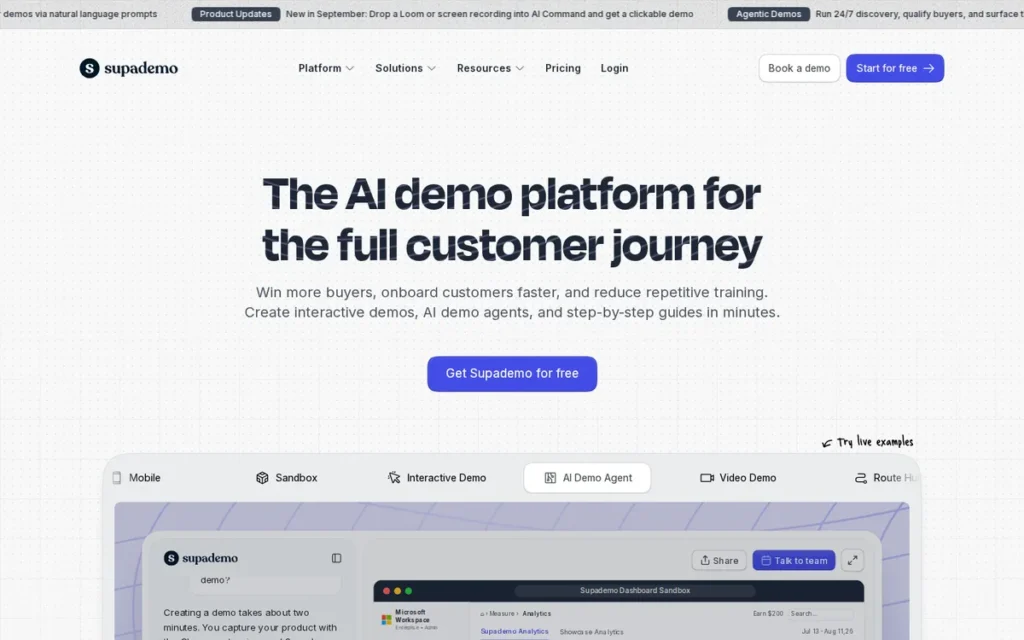
Category: Multi-Format AI Demo Platform, supports six demo creation formats (screenshot, HTML, video, Figma, desktop recording, media upload) in a single no-code workflow, with RouteHub AI-powered demo routing, AI voiceover with 15+ language translations, and an AI Demo Agent (Growth plan) trained on company collateral for autonomous visitor qualification.
At a Glance
- Category: Multi-Format AI Demo Platform
- Best For: SMBs, startups, and budget-focused B2B SaaS teams across sales, customer success, and onboarding who need multi-format demo flexibility with AI automation at an accessible entry price
- Price Range: Free: $0 (5 published demos, no credit card required). Scale: $38/user/month (annual billing), unlimited demos, AI voiceover, 15+ language translations, RouteHub routing, basic analytics. Growth: $350/month for 5 creators, HTML demos, sandbox demos, AI Demo Agent add-on. Enterprise: custom pricing.
- Primary Strength: Supademo offers the most accessible multi-format demo creation in its price tier (six formats (screenshot, HTML, video, Figma, desktop recording, media upload) with AI voiceover and 15+ language translations available in the $38/month Scale plan) plus an AI Demo Agent for website visitor qualification available in the Growth plan ($350/month for 5 creators).
- Biggest Limitation: Supademo was founded in January 2023: the newest major platform in this evaluation, and community evaluators describe the product as “still working out some kinks.” Additionally, Supademo’s AI Demo Agent for website visitor qualification is only available in the Growth plan ($350/month for 5 creators), not at the $38/month Scale entry tier.
- One-Line Summary: Supademo is the fastest-growing demo automation platform (G2 Fastest Growing designation, 2025), offering six-format demo creation with AI voiceover and 15+ language translations at the $38/month Scale entry tier, and an AI Demo Agent for website visitor qualification available in the $350/month Growth plan.
- Last Verified: May 2026
Overview
Supademo is a multi-format no-code interactive demo platform designed for SMBs, startups, and budget-focused B2B SaaS teams, and the fastest-growing platform in the demo automation category, recognized with a G2 Fastest Growing designation in 2025. Supademo’s six-format flexibility, screenshot, HTML capture, video recordings, Figma design imports, desktop screen recordings, and media uploads, from a single platform enables teams to match demo format to funnel stage without adopting multiple point solutions. Supademo also offers a Growth plan AI Demo Agent that trains on the team’s own PDFs, sales decks, case studies, and pricing pages to autonomously qualify and route website visitors, though this feature requires the $350/month Growth plan, not the $38/month Scale entry tier.
Key Features
- Six-Format Demo Creation: Supademo supports six demo creation formats from a single platform (screenshots, HTML capture, video recordings, Figma design imports, desktop screen recordings, and media uploads) enabling teams to match demo format to funnel stage without adopting multiple point solutions, a flexibility breadth unmatched by Navattic or Arcade at comparable entry pricing.
- AI Demo Agent (Growth Plan): Supademo’s AI Demo Agent: available in the Growth plan ($350/month for 5 creators), trains on the team’s own PDFs, sales decks, case studies, and pricing pages to autonomously qualify and route website visitors, generating conversation summaries pushed to sales teams automatically.
- RouteHub AI-Powered Demo Routing: Supademo’s RouteHub uses AI-powered routing to serve personalized demo experiences based on visitor behavior, industry, or persona, directing different buyer types to the most relevant product walkthrough without requiring manual setup of a separate demo version per segment.
- AI Voiceover and 15+ Language Translations: Supademo includes AI voiceover generation and translations across 15+ languages at the Scale tier, enabling multilingual demo production for global sales teams without re-recording or external localization resources, cited by community evaluators as decisive over Storylane for teams with international motions (r/b2bmarketing, 2025).
- Cross-Demo Update Editor: Supademo’s update editor applies changes simultaneously across multiple demos, reducing ongoing maintenance time as products evolve and demo libraries grow, contributing to the 8.6 hours per week average time savings reported by teams using the platform (CompareYourTech, 2025).
Best For
Supademo is best for SMBs, startups, and budget-focused B2B SaaS teams (particularly those with small sales teams, customer success onboarding workflows, or training programs) who need multi-format demo flexibility and AI automation at an accessible price point. Teams evaluating Supademo for AI-powered website visitor qualification should budget for the Growth plan ($350/month for 5 creators) rather than expecting that capability at the $38/month Scale entry tier.
Pricing
Supademo pricing as of May 2026: Free plan at $0, 5 published demos, no credit card required. Scale plan at $38/user/month (annual billing), unlimited demos, AI voiceover, 15+ language translations, RouteHub routing, and basic analytics. Growth plan at $350/month for 5 creators, HTML demos, sandbox demos, and the AI Demo Agent add-on for website visitor qualification. Enterprise pricing is custom (SSO/SAML, advanced security).
Note: community practitioners report that Supademo “gets expensive fast when you need multiple variations”, relevant for teams planning 10+ persona-specific demo versions (r/SaaSSales). Verify current pricing at supademo.com/pricing before committing to any tier.
Strengths
- G2 recognized Supademo with a Fastest Growing designation in 2025, reflecting accelerating adoption across 100,000+ professionals at companies including Turo, Beehiiv, and Jotform, verify the specific award tier at g2.com/products/supademo, as this designation reflects momentum recognition rather than a top-tier category ranking (G2, 2025).
- Teams using Supademo report saving an average of 8.6 hours per week on demo creation, editing, and localization tasks, a productivity gain attributed to AI voiceover, cross-demo updates, and multi-format flexibility reducing manual authoring (CompareYourTech, 2025).
- A community evaluator who formally tested Reprise, Storylane, and Supademo chose Supademo for “hitting the right balance between price, usability, and control”, noting Supademo’s HTML capture UX and AI localization workflow were superior to Storylane’s and required less onboarding support (u/dougie-6020, r/b2bmarketing, 2025).
- Supademo’s AI-native architecture: built from inception in January 2023 rather than retrofitted onto a legacy codebase, positions Supademo to iterate on generative AI features faster than older competitors, a structural advantage as AI capabilities become table stakes across the demo automation category.
Users on r/ProductMarketing documented their formal switching decision after evaluating Supademo against Storylane and Navattic:
“We evaluated both Storylane and Navattic a while back, and while they’re solid tools, we ended up going with Supademo for a few reasons. First, the pricing was a big factor. Supademo offered a lot more flexibility at comparatively better cost, especially when it came to features like HTML capture and sandbox-style demos, which were either limited or priced higher on the other platforms. Second was ease of use. With both Storylane and Navattic, we needed a bit of hand-holding to get started, and the interfaces felt a bit overwhelming at times. Supademo, on the other hand, was way more intuitive. We could build, edit, and share demos without looping in support every time.” Posted by u/Thick-Warning-9870
Takeaway: Teams formally comparing Supademo against Storylane and Navattic select Supademo specifically for pricing flexibility and faster time-to-productivity without requiring vendor support to onboard, a pattern that directly validates its G2 Fastest Growing trajectory among budget-focused B2B SaaS teams.
Limitations
- Platform Maturity: Supademo’s most consequential trade-off is its platform age, founded in January 2023, Supademo is the newest major platform in this evaluation, and community evaluators explicitly note the product is “still working out some kinks,” a pattern consistent with a rapidly-scaling growth-phase product that prioritizes feature velocity over stability (r/SaaSSales).
- AI Demo Agent Requires Growth Upgrade: Supademo’s most differentiated AI feature (the AI Demo Agent for website visitor qualification) is only available as a Growth plan add-on ($350/month for 5 creators), requiring a significant price increase from the $38/month Scale entry tier. Teams evaluating Supademo specifically for autonomous visitor qualification must budget for the Growth plan from the start rather than expecting this capability at entry pricing.
- Cost Escalation at Scale: Supademo’s pricing model creates cost-escalation risk for teams needing multiple persona-specific demo variations (one community practitioner specifically noted Supademo “gets expensive fast when you need multiple variations”) an important caveat for GTM teams planning 10+ persona-specific versions for enterprise multi-stakeholder deals (r/SaaSSales).
- Enterprise Integration Depth: Supademo’s enterprise integration depth: bidirectional CRM behavioral sync quality, security certifications, and team-scale governance controls, is less publicly documented than Navattic or Walnut, making it harder to validate for enterprise procurement cycles with formal security review requirements.
Verdict
Supademo is the strongest multi-format demo option in the demo automation category for SMBs and budget-focused teams, combining G2 Fastest Growing recognition in 2025, six-format demo flexibility from a single platform, and an AI-native architecture built from inception in January 2023. Teams evaluating Supademo should account for its relative platform youth compared to category leaders, budget for the Growth plan ($350/month) if AI-powered visitor qualification is a required capability, and verify that enterprise integration depth meets CRM and compliance requirements before committing; for teams whose primary needs are marketing demos, customer success onboarding, or training walkthroughs, Supademo delivers strong capability per dollar at the Scale tier.
5. Walnut: Best for Enterprise Sales Teams: Five Integrated AI Agents with the Broadest Claimed Multilingual Demo Support in the Category
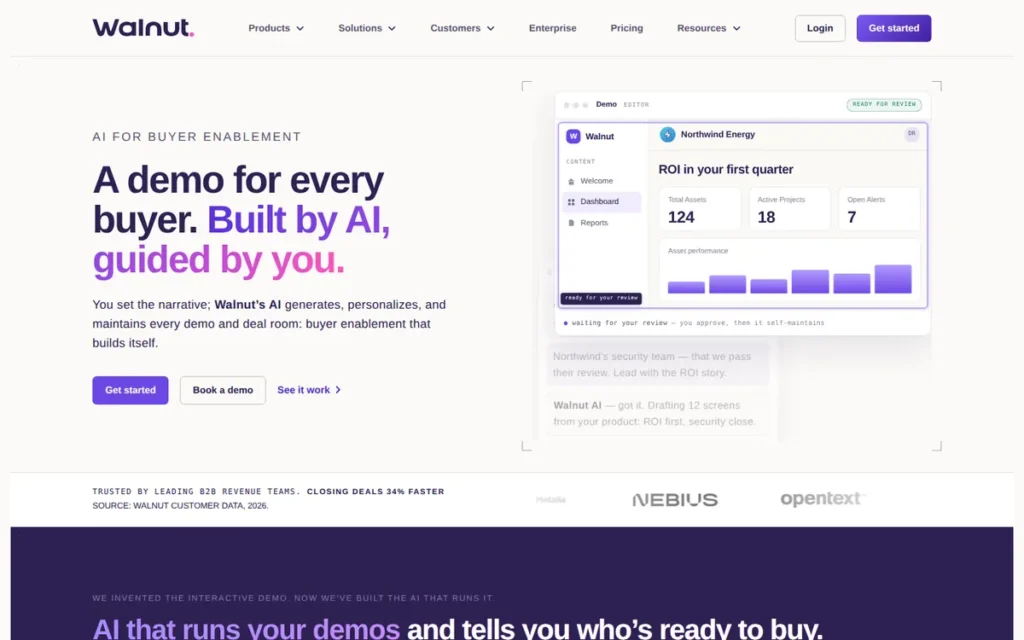
Category: AI-Powered Enterprise Sales Demo Platform (delivers HTML-based interactive product demos through five integrated AI agents covering demo creation (StoryCapture), tooltip generation (Guides AI), multilingual adaptation (Translation AI) claimed 243 languages, vendor-reported), and behavioral buyer scoring (Insights AI), with bidirectional CRM sync and deal room functionality for enterprise sales teams.
At a Glance
- Category: AI-Powered Enterprise Sales Demo Platform
- Best For: Enterprise sales teams, solution consultants, and presales engineers at B2B SaaS companies with global sales motions, multi-stakeholder deal cycles, and bidirectional CRM integration requirements across Salesforce, HubSpot, Marketo, and Pardot
- Price Range: Lite: $9,200/year (published). Pro, Accelerate, Enterprise: custom pricing. No free plan. Community reports ~$20,000/year for typical enterprise feature sets.
- Primary Strength: Walnut deploys five integrated AI agents: including StoryCapture AI for voice-narration-to-demo assembly and Translation AI (supporting a claimed 243 languages per Walnut’s product page, 2026), into a single HTML interactive demo platform used by enterprise customers including Adobe and Cisco, with bidirectional sync across Salesforce, HubSpot, Marketo, and Pardot.
- Biggest Limitation: Walnut’s $9,200/year minimum published price is the highest entry point among transparent-pricing platforms in the category, and community evaluators report that the feature set most enterprise teams actually need costs approximately $20,000/year, making Walnut inaccessible for SMBs and most mid-market teams without a dedicated sales technology budget.
- One-Line Summary: Walnut is an AI-powered enterprise sales demo platform used by Adobe and Cisco, featuring five integrated AI agents (including StoryCapture AI for voice-to-demo assembly and Translation AI (a claimed 243 languages, vendor-reported)) with bidirectional CRM sync across Salesforce, HubSpot, Marketo, and Pardot at a $9,200/year published starting price.
- Last Verified: May 2026
Overview
Walnut is an AI-powered HTML-based interactive demo platform for enterprise sales teams and presales engineers at B2B SaaS companies with complex global sales motions, deployed by named enterprise customers including Adobe and Cisco. Walnut differentiates through five integrated AI agents: AI Mode (prompt-based demo generation), StoryCapture AI (voice-narration-to-demo assembly), Guides Creation AI (auto-tooltip generation), Translation AI (claimed 243-language multilingual production, per Walnut’s product page, 2026, vendor-reported, not independently verified by third-party sources as of May 2026), and Insights AI (behavioral buyer scoring with CRM sync). Walnut’s published Lite plan starts at $9,200/year, with community-reported true costs of approximately $20,000/year for the enterprise feature sets most teams actually require.
Key Features
- StoryCapture AI: Walnut’s StoryCapture AI records a sales rep’s voice narration while simultaneously capturing HTML content, then transcribes speech, pairs it with screen interactions, and auto-assembles a step-by-step interactive demo, the only “speak and it builds itself” workflow in this evaluation, converting a real-time narration exercise into a finished demo asset without manual authoring.
- Translation AI (Claimed 243 Languages): Walnut’s Translation AI supports a claimed 243 languages for multilingual demo production without re-recording (Walnut product page, 2026 (vendor-reported, not independently verified by third-party sources as of May 2026)) enabling global GTM teams to produce localized HTML interactive demos for markets that no other evaluated platform claims to serve at equivalent HTML fidelity.
- Insights AI with Bidirectional CRM Sync: Walnut’s Insights AI tracks which demo steps generate engagement, which features drive drop-off, and which stakeholders interacted with which content, with bidirectional sync to Salesforce, HubSpot, Marketo, and Pardot simultaneously for pipeline attribution and lead scoring.
- Choose-Your-Own-Adventure Playlists: Walnut’s playlist functionality enables non-linear, self-guided demo exploration where prospects navigate directly to features most relevant to their specific use case, supporting the complex, multi-stakeholder buying group dynamics common in enterprise B2B sales.
- Enterprise Security and Administration: Walnut includes SSO/Okta integration, enterprise admin controls, role-based access management, and SOC 2 security certification, meeting the compliance and governance requirements of enterprise procurement reviews in regulated industries.
Best For
Walnut is best for enterprise sales teams and presales organizations at B2B SaaS companies with global sales motions, multi-stakeholder deal cycles, and Salesforce or HubSpot-first CRM operations, particularly teams where solution consultants are over-extended on lower-value deals that account executives could handle independently with AI-enabled demo tooling, reducing SC request volume for sub-threshold ARR deals.
Pricing
Walnut pricing as of May 2026: Lite plan at $9,200/year includes unlimited demo creation, unlimited website embeds, unlimited integrations (HubSpot, Marketo, Salesforce), demo analytics, and core features. Pro, Accelerate, and Enterprise plans are custom-priced. Critical transparency: community evaluators in formal platform comparisons consistently report that the plan with desired features (personalization, sandbox, white-label) costs approximately $20,000/year (r/ProductMarketing, 2023). Verify current pricing at walnut.io/pricing.
The gap between the advertised $9,200/year Lite price and the community-reported $20,000/year true cost for a full enterprise feature set is the most important budget verification step before committing evaluation time to a Walnut sales engagement.
Strengths
- Walnut’s named enterprise customer roster includes Adobe and Cisco: the strongest Fortune 500 customer validation of any platform in this evaluation below Reprise, demonstrating proven deployment at scale in demanding enterprise procurement environments (Walnut Homepage, 2026).
- A Reddit user in an enterprise SE organization confirmed that Walnut demos enabled account executives to independently cover SMB deals under $20K ARR, “considerably cutting down SC requests”, a specific, community-corroborated operational outcome that directly maps to the presales bandwidth scaling pain point (u/creativerbl, r/salesengineers).
- Walnut’s Translation AI supports a claimed 243 languages, the broadest claimed multilingual demo capability in the category (Walnut product page, 2026, vendor-reported, not independently verified by third-party sources as of May 2026), enabling global GTM organizations to target markets that no other platform in this evaluation claims to serve at HTML-native fidelity.
- Walnut’s bidirectional behavioral data sync across Salesforce, HubSpot, Marketo, and Pardot simultaneously is the most complete multi-platform CRM integration in the evaluation, enabling demo engagement signals to flow into pipeline attribution and lead scoring without custom data mapping.
Limitations
- Pricing Accessibility: Walnut’s most consequential trade-off is pricing, the $9,200/year minimum entry, combined with community-reported ~$20,000/year true cost for desired enterprise feature sets, places Walnut firmly in large-enterprise territory and makes it financially inaccessible for SMBs, early-stage startups, and mid-market teams without dedicated sales technology budget lines. In a formal multi-tool evaluation, an evaluator noted “not super cheap, would be $20K for the plan/features we wanted” (r/ProductMarketing, 2023), a gap buyers must resolve before investing evaluation time.
- Mobile Experience Gaps: Walnut’s mobile experience carries consistent limitations across community evaluations (browser-extension-based HTML capture is inherently desktop-first) and the platform is specifically designed for sales teams rather than cross-functional marketing or customer success use, making it a poor fit for teams needing one platform across all GTM functions.
- Feature-to-Price Transparency Gap: Walnut’s advertised $9,200/year Lite price and the community-reported ~$20,000/year true cost for a full enterprise deployment create an evaluation friction that buyers must resolve directly with Walnut’s sales team before committing resources, a transparency gap that transparent-pricing platforms like Navattic and Storylane do not impose.
Verdict
Walnut is the strongest AI-powered sales demo platform for enterprise B2B SaaS teams, earning its #5 ranking through the most systematically integrated five-agent AI framework in the evaluation, the broadest claimed multilingual capability (243 languages, vendor-reported), and bidirectional CRM integration validated by named enterprise customers including Adobe and Cisco. Walnut ranks below the top four primarily because its $9,200/year minimum (with community-reported true costs of ~$20,000/year for typical enterprise feature sets) excludes the majority of the B2B SaaS market; Walnut is justified only for enterprise organizations with complex global sales motions, active SE scaling challenges, or multi-platform CRM integration requirements that no lower-priced alternative satisfies.
6. Reprise: Best for Enterprise Presales and SE Organizations: The Only Three-Product Platform with True AI-Powered Sandbox Environments
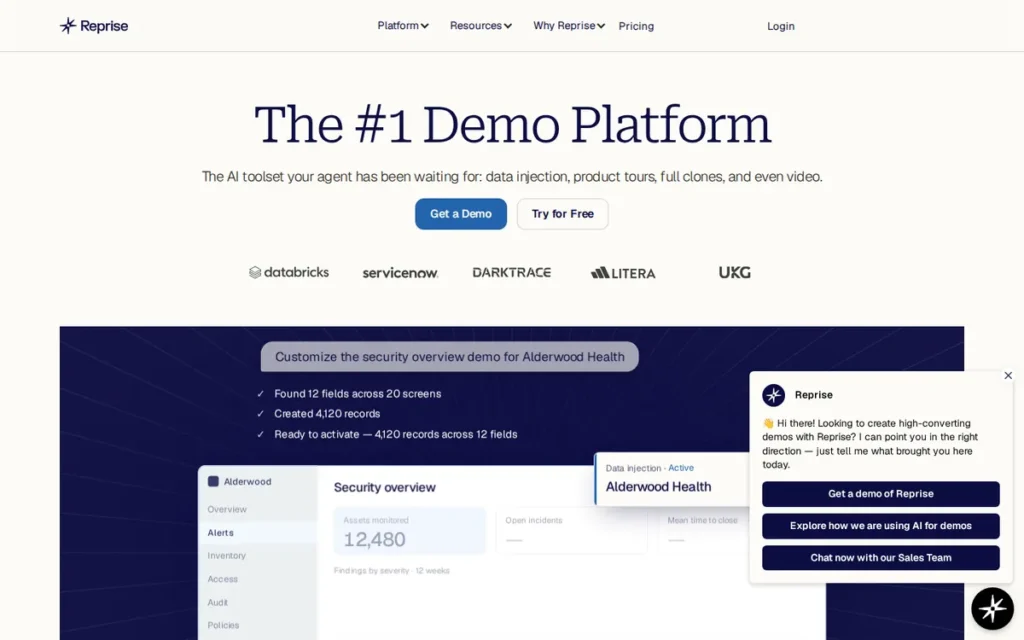
Category: Enterprise Demo Environment Platform, delivers a three-product integrated system combining guided interactive tours (Replay), full AI-powered sandbox environment cloning with data injection (Replicate), and real-time live overlay customization on the actual product (Reveal), designed for enterprise presales, solution engineering, and GTM teams with complex technical demonstration requirements.
At a Glance
- Category: Enterprise Demo Environment Platform
- Best For: Enterprise B2B SaaS organizations with dedicated presales or SE teams, complex technical products requiring production-environment simulation or live overlay customization, and regulated industry compliance requirements (SOC 2 Type II, ISO 27001:2022)
- Price Range: Custom, fully sales-gated: no published pricing. Estimated: $25,000–$200,000+/year (Prospeo median contract: $31,600/year; Vendr enterprise range: $150,000–$200,000+/year, 2026). No self-serve option or free trial.
- Primary Strength: Reprise is the only demo automation platform offering three integrated demo modalities (guided tours (Replay), full sandbox cloning with AI data injection (Replicate), and real-time live overlays (Reveal)) in one SOC 2 Type II and ISO 27001:2022 certified system, making it uniquely qualified for enterprise SE organizations that require all three formats across a complex deal cycle.
- Biggest Limitation: Reprise’s custom pricing estimated at $25,000–$200,000+/year with no published rates and no self-serve evaluation path makes it inaccessible for assessment without committing to a full sales engagement, the highest evaluation friction and highest estimated cost of any platform in this review.
- One-Line Summary: Reprise is the most technically comprehensive enterprise demo platform in the B2B SaaS category, uniquely combining guided tours, AI-powered sandbox cloning with data injection, and real-time live overlays in one SOC 2 Type II and ISO 27001-certified system (backed by ICONIQ Growth and Bain Capital Ventures) at an estimated $25,000–$200,000+/year.
- Last Verified: May 2026
Overview
Reprise is a three-product enterprise demo platform serving presales and solution engineering organizations at enterprise B2B SaaS companies, the only platform in this evaluation combining guided interactive tours, AI-powered sandbox environment cloning with data injection, and real-time live overlay customization in one integrated system. Reprise’s Replicate product creates true production-grade environment simulation: AI data injection simulates API responses and network requests for sandbox clones populated with persona-specific, industry-accurate datasets, without requiring custom JavaScript per demo scenario, a technical capability unmatched by any other platform in this evaluation. Reprise pricing is fully custom and sales-gated, with independent estimates ranging from $25,000 to $200,000+/year based on contract data from Prospeo (median: $31,600/year) and Vendr (enterprise range: $150,000–$200,000+/year, 2026).
Key Features
- Reprise Replay (Guided Tours): Reprise Replay builds guided interactive demo tours from a library of reusable assets, enabling presales teams to maintain a consistent, version-controlled demo library that individual reps can customize for specific accounts without rebuilding each demo from scratch before each call.
- Reprise Replicate (AI-Powered Sandbox Cloning): Reprise Replicate creates full sandbox environment clones of the live product with AI-powered data injection, simulating API responses and network requests for production-grade replicas populated with persona-specific, industry-accurate datasets without requiring custom JavaScript development for each demo scenario (Reprise Documentation).
- Reprise Reveal (Live Overlay): Reprise Reveal enables real-time live overlay customization applied directly to the live product during a sales call, injecting realistic data, scenario controls, and account-specific information over the production environment without exposing sensitive live data to prospects.
- Dual Security Certifications: Reprise holds SOC 2 Type II and ISO 27001:2022 dual security certifications, meeting the most stringent compliance requirements in enterprise procurement reviews for regulated industries including fintech, healthcare, and government technology.
- Institutional Investor Backing: Reprise is backed by ICONIQ Growth, Bain Capital Ventures, Accomplice VC, and Glasswing Ventures, providing enterprise buyers the vendor stability assurance and long-term capital runway that early-stage or bootstrap-funded alternatives cannot credibly offer during multi-year contract commitments (Builtin, 2026).
Best For
Reprise is best for enterprise B2B SaaS organizations with dedicated solution engineering or presales teams, complex technical products where demo environment authenticity is deal-critical, regulated industry procurement requirements (SOC 2 Type II, ISO 27001:2022), and buying processes that require institutional-backed vendor stability assurance, specifically organizations where a failed or unconvincing demo has measurable impact on high-value contract outcomes.
Pricing
Reprise does not publish pricing as of May 2026. Independent contract data estimates Reprise pricing at $25,000–$200,000+/year: Prospeo reports a median contract of $31,600/year with a high-end of $67,500/year; Vendr reports enterprise contracts reaching $150,000–$200,000+/year for large accounts (Prospeo, 2026; Vendr, 2026). No self-serve trial or free tier is available, all evaluation requires a full sales engagement.
The pricing opacity is itself an evaluative data point: buyers who need to estimate cost before a sales call cannot do so with Reprise. Obtain current pricing directly through reprise.com.
Strengths
- Reprise holds the highest review volume in this evaluation at 174 G2 reviews, received Gartner and Forrester analyst recognition, and was designated a G2 Leader for Mid-Market Content Experience Platforms (G2 Winter 2023), the strongest combination of independent analyst validation in the demo automation category (G2, 2023; Builtin, 2026).
- Reprise Replicate’s AI data injection capability: simulating realistic API responses for production-grade sandbox clones populated with persona-specific datasets, is a technical differentiation unmatched by any other platform in this evaluation, addressing the highest-stakes demo authenticity requirement for complex enterprise software products (Reprise Documentation).
- Reprise holds SOC 2 Type II and ISO 27001:2022 dual security certifications and is backed by institutional investors including ICONIQ Growth and Bain Capital Ventures, providing the compliance credentials and vendor stability signals that enterprise procurement processes require for long-term contract commitments (Builtin, 2026; ZoomInfo, 2026).
- Reprise has delivered millions of demos since its 2020 founding and carries estimated annual revenue of approximately $16.6 million (ZoomInfo, 2026), indicating a substantial enterprise customer base with recurring contract value, a vendor-scale signal relevant to buyers assessing platform operational stability.
Limitations
- Complexity, Cost, and Opacity: Reprise’s most consequential trade-off is the combination of a complex UI, an estimated $25,000–$200,000+/year custom pricing model, and a sales-only evaluation path, making Reprise technically impressive but operationally and financially inaccessible for the majority of B2B SaaS companies regardless of their demo quality aspirations. The practical implication: Reprise is worth evaluating only if you have a dedicated SE team, a complex technical product where a failed demo has direct deal impact, and a procurement process already familiar with $25,000+ annual vendor contracts.
A practitioner at a larger company who conducted a formal multi-tool evaluation captured this dynamic precisely on r/ProductMarketing:
“Reprise
Pros
- Demo environment cloning tech was cool (not sure we’d need it, but good to know they have it available)
- Strong support/cs/professional services team
Cons
- The UI seemed complex
- Too expensive for us
- Demo cloning was more than what we needed
Our findings:
I recommended we advance Navattic & Walnut to the final round, though we didn’t end up moving forward with the project.” Posted by u/Middle_Giraffe5565
Takeaway: Enterprise buyers who formally evaluate Reprise alongside mid-market alternatives consistently find the sandbox technology impressive but the UI complexity and price point prohibitive, validating Reprise’s precise fit with its intended SE-heavy niche and its misfit for any team without dedicated presales infrastructure.
- Niche Applicability: Reprise’s niche applicability is confirmed by the practitioner community: “If your primary purpose for demos is to support live demos for your sales team, you should take a look at Reprise, they are built for this specific use case, vs. marketing or product tour use cases” (u/Background-Fig9828, r/ProductMarketing, 2023). Teams purchasing Reprise for marketing tours or standard sales demos are materially over-buying.
- Scaling Reliability: At least one community user reported that Reprise “sometimes has issues with scaling”, a meaningful reliability consideration for organizations running high-volume enterprise demo programs where demo failure during a sales call has direct revenue consequences (r/salesengineers).
- Lowest G2 Score in Evaluation: Reprise holds the lowest G2 rating in this evaluation at 4.4/5.0 across 174 reviews, the highest review volume in the evaluation, suggesting the complexity friction is broadly experienced by verified enterprise buyers rather than a small minority with atypical expectations (G2, 2023).
Verdict
Reprise is the most technically comprehensive enterprise demo platform in the B2B SaaS category, uniquely qualified for presales and SE organizations that require guided tours, sandbox cloning, and live overlays in one certified, institutionally-backed system, and the only platform in this evaluation that simulates a production-grade environment with AI-injected persona-specific data. Reprise ranks #6 in this general “best demo automation software” evaluation because its $25,000+ pricing and sales-gated evaluation process appropriately position it as an enterprise-only investment inaccessible and inappropriate for the vast majority of the B2B SaaS market; teams that fit Reprise’s intended enterprise SE use case should note that its #6 position reflects its narrow applicable audience, not poor performance within that audience.
7. Demoboost: Best for Presales-Led Enterprises with Channel Partner Networks: Unique External Demo Library and Bundled Consulting Model
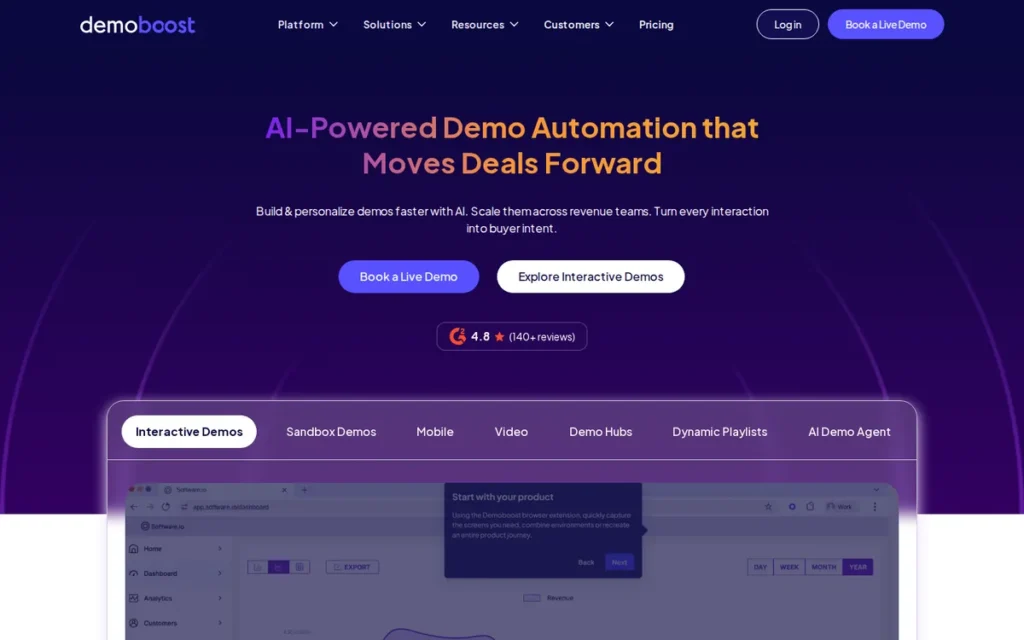
Category: Presales Demo and Enablement Platform, offers six demo format types (HTML tours, sandbox, live overlays, screenshot demos, mobile demos, video demos) with bundled expert consulting hours and a channel partner external demo library, designed for presales-led enterprise organizations with partner enablement requirements.
At a Glance
- Category: Presales Demo and Enablement Platform
- Best For: Mid-to-large enterprise B2B SaaS organizations with global channel partner, VAR, or reseller networks requiring centralized demo asset distribution; presales-led sales motions; or teams that need both demo software and expert consulting in one engagement
- Price Range: Fully custom, sales-gated: no published pricing. Core Package includes all platform tools plus minimum 4 hours/month expert consulting. Warsaw, Poland-based Demoboost has raised approximately €4.6M in total funding (€2.8M seed extension, February 2026; €1.7M prior round, October 2022).
- Primary Strength: Demoboost is the only demo automation platform offering channel partner enablement via external demo libraries (the only capability of its kind among the seven platforms in this evaluation as of May 2026) allowing enterprise organizations to distribute approved, on-brand interactive demo assets to global VAR and reseller networks without requiring each partner to build or maintain their own demos.
- Biggest Limitation: Demoboost had no identifiable organic mentions across r/ProductMarketing, r/salesengineers, r/SaaSSales, and r/b2bmarketing in this evaluation’s community analysis (May 2026), in contrast to all six other evaluated platforms, which were independently and actively discussed in these communities. All published performance metrics are self-reported aggregate claims without named-client attribution.
- One-Line Summary: Warsaw, Poland-based Demoboost is a presales-first enterprise demo platform used by Celonis, Bosch, and Hitachi, offering six demo format types and the only channel partner external demo library among the seven platforms in this evaluation, though it carries fully opaque pricing and the least independently verifiable community evidence of the seven platforms evaluated in 2026.
- Last Verified: May 2026
Overview
Demoboost is a presales-first enterprise demo platform serving mid-to-large enterprise organizations, including named customers Celonis, AvePoint, Bosch, Boost.ai, AMCS, and Hitachi, with the broadest demo format coverage in this evaluation (six types) and the only channel partner external demo library identified among the seven platforms in this evaluation. Demoboost’s Core Package bundles software with a minimum of 4 hours per month of expert presales consulting, the only “platform plus services” model in this evaluation, providing demo strategy, narrative design, and program guidance for organizations lacking internal presales enablement expertise. Demoboost carries fully sales-gated pricing with no published rates and had no identifiable organic presence in the B2B SaaS practitioner communities where all other evaluated platforms are actively discussed (community analysis, May 2026).
To make the channel partner use case concrete: if your company sells through 50 resellers across 20 countries and each partner currently gives buyers a different, outdated version of your product demo, Demoboost’s channel library solves a demo governance problem that no other platform in this evaluation addresses, every partner delivers the approved, current demo without waiting for your presales team.
Key Features
- Channel Partner External Demo Library: Demoboost’s channel partner external demo library enables enterprise organizations to publish approved, on-brand interactive demo assets to global VAR, reseller, and channel partner networks (allowing partners to deliver consistent, up-to-date product demos without independently building or maintaining their own demo assets) a capability not identified in any other platform in this evaluation.
- Six Demo Format Types: Demoboost supports six demo creation formats from a single platform (HTML product tours, sandbox environments, live overlay customization, screenshot demos, mobile demos, and video demos) the broadest format coverage in the evaluation, enabling teams to match demo modality to funnel stage without multiple tools.
- Bundled Expert Consulting (Core Package): Demoboost’s Core Package includes a minimum of 4 hours per month of expert presales consulting alongside the software license, providing demo strategy, narrative design, and program guidance for organizations that lack internal presales enablement expertise, in the only “platform plus services” offering in the evaluation.
- Non-Linear Demo Navigation: Demoboost includes non-linear “Choose Your Own Journey” demo menus, playlist functionality, autoplay with auto-translate, AI-generated text, AI Editor, AI Guides, and AI Video Narration, supporting both structured presales workflows and buyer-directed self-exploration within the same platform.
- Buyer Engagement Analytics: Demoboost tracks engagement intent across demo interactions and self-reports an 88% media completion rate and 89 NPS across its customer base, though these figures are self-reported aggregates that have not been independently verified through third-party review platforms with sufficient volume to validate statistical significance.
Best For
Demoboost is best for mid-to-large enterprise B2B SaaS organizations with three specific profile characteristics:
- A global channel partner, VAR, or reseller network that needs centralized distribution of consistent, on-brand demo assets
- A presales-led sales motion where expert demo program consulting would accelerate outcomes alongside software deployment
- A complex enterprise product stack: Celonis, Bosch, and Hitachi-tier, where six-format flexibility and a bundled services engagement justify a custom-scoped commercial engagement over self-serve alternatives
Pricing
Demoboost has no publicly published pricing as of May 2026. All pricing is obtained through a custom sales process following a prospect questionnaire. The Core Package includes all listed demo, engagement, and analytics tools plus a minimum of 4 hours/month consulting. Warsaw, Poland-based Demoboost has raised approximately €4.6M in total funding, including a €2.8M seed extension in February 2026 (Digital Ocean Ventures, RIO) and a prior €1.7M round in October 2022 (b2Venture) (Pulse2, tech.eu, TechFundingNews, February 2026).
The absence of published pricing is a transparency limitation, every competitor with published pricing enables buyer self-qualification before a sales call that Demoboost does not support. Obtain current pricing directly through demoboost.com.
Strengths
- Demoboost’s named enterprise customer roster: Celonis, AvePoint, Bosch, Boost.ai, AMCS, and Hitachi, includes the most recognizable industrial and enterprise technology brands of any mid-tier platform in this evaluation, indicating credibility in large-enterprise procurement processes with stringent vendor evaluation requirements (Demoboost Homepage, 2026).
- Demoboost’s channel partner external demo library is the only capability of its kind among the seven platforms in this evaluation: for enterprise organizations managing global VAR and reseller networks, Demoboost enables a centralized demo governance model with no practical alternative identified in this evaluation, a specific use case that no other evaluated platform addresses.
- Demoboost’s six-format coverage (HTML tours, sandbox, live overlays, screenshots, mobile, video) is the broadest in the evaluation, enabling a single-platform approach across all demo modalities and funnel stages, reducing multi-tool complexity for organizations currently using separate platforms for marketing tours and presales sandboxes.
- Warsaw, Poland-based Demoboost’s approximately €4.6M total funding, including a February 2026 seed extension from Digital Ocean Ventures and RIO, combined with the Celonis/Bosch/Hitachi customer base suggests a capital-efficient business model with demonstrable traction in complex industrial and technology sales environments (Pulse2, tech.eu, February 2026).
Limitations
- Limited Practitioner Community Presence: Demoboost had no identifiable organic mentions across r/ProductMarketing, r/salesengineers, r/SaaSSales, and r/b2bmarketing in this evaluation’s community analysis (May 2026), in contrast to all six other evaluated platforms, which were independently and actively discussed in these communities. Demoboost is the only platform in this evaluation where independent buyer experience cannot be verified through practitioner community evidence, meaning prospective buyers must rely entirely on vendor-provided references and G2 reviews.
- Self-Reported Metrics Only: All published performance metrics: including the 74% reduction in unqualified sales calls, 32% shorter sales cycles, tripled ARR, and 50% higher revenue per account, are self-reported aggregate claims with no named-client attribution or third-party corroboration; prospective buyers should require reference customers and independently verifiable case studies before advancing Demoboost through procurement.
- Limited G2 Evidence Base: Demoboost’s claimed G2 4.9/5.0 rating carries “not enough data” flags on multiple G2 feature categories (reducing its statistical validity compared to platforms with hundreds of verified reviews) and making the high nominal rating less meaningful as an independent quality signal (G2, 2026).
- Maximum Pricing Opacity: Demoboost’s fully sales-gated pricing requires a complete prospect questionnaire and custom commercial engagement before any cost information is available, the maximum evaluation friction of any platform reviewed, creating a structural disadvantage in competitive shortlist processes where buyers use published pricing to pre-qualify before committing evaluation time.
Verdict
Demoboost ranks #7 in this evaluation not because its capabilities are weak (its channel partner external demo library, six-format flexibility, bundled consulting, and enterprise customer roster (Celonis, Bosch, Hitachi) are genuine differentiators) but because Demoboost carries the least independently verifiable evidence of any platform evaluated: no identifiable practitioner community presence, self-reported-only performance metrics, and fully opaque pricing that requires a sales engagement to evaluate. Organizations with global channel partner networks or presales-led enterprise motions should include Demoboost in their shortlist specifically for the partner library capability, which has no real alternative in this evaluation; all other buyers should prioritize platforms with stronger independent evidence bases before considering Demoboost.
What Red Flags Should I Watch For When Evaluating Demo Automation Software?
The five most common red flags in demo automation evaluation are: pricing without feature tier clarity, self-reported metrics without client attribution, no practitioner community presence for a B2B SaaS platform, screenshot demos marketed as interactive without fidelity disclosure, and sales-gated pricing that requires a full engagement before cost can be assessed. Each signals a mismatch between advertised positioning and buyer-accessible value.
Red Flag #1: Pricing Without Feature Tier Clarity
Platforms advertising low entry prices without disclosing which critical features, especially HTML access, are gated behind significantly higher tiers create budget mismatch risk. Storylane’s most-cited community criticism is precisely this: the $40/month entry price is real, but HTML demo editing requires the $500/month Growth plan, a 12.5x price increase. Similarly, Supademo’s AI Demo Agent requires the $350/month Growth plan, not the $38/month Scale entry tier. Always ask: “At which specific tier does the feature I actually need become available?”
Red Flag #2: Self-Reported Metrics Without Client Attribution
Aggregate performance percentages not linked to named customers with verifiable context should be treated as directional marketing claims, not proof of outcomes. Walnut’s self-reported “34% faster sales cycles” and Demoboost’s “74% reduction in unqualified calls” are the most prominent examples in this evaluation, neither figure is independently verified or attributed to a named client with documented methodology. In contrast, Navattic’s Dropbox pre-qualification deployment and Sibill website-to-trial conversion use case are documented in named customer case studies, the evidence standard buyers should require.
Red Flag #3: No Practitioner Community Presence for a B2B SaaS Platform
Absence from practitioner communities where peers openly discuss tooling experiences, specifically r/ProductMarketing, r/salesengineers, and r/SaaSSales, is a meaningful credibility gap for platforms targeting the exact professionals in those communities. Demoboost had no identifiable organic mentions across all four communities analyzed in this evaluation (May 2026). This absence either reflects a very small customer base, a niche enterprise audience that avoids public forums, or limited brand awareness, none of which is reassuring during vendor evaluation.
Red Flag #4: Screenshot Demos Marketed as “Interactive” Without Fidelity Disclosure
The quality distinction between screenshot-based captures and HTML-cloned demos is not cosmetic, it determines whether enterprise buyers experience the demo as a representation of the product or as the product itself. Platforms that market screenshot demos as “interactive product demos” without disclosing the fidelity difference can mislead buyers who discover the gap only after purchase. A GTM consultant with deployments across four major platforms reports the quality distinction becomes decisive at scale: 80–90% of clients ultimately migrate to HTML-native platforms (u/SEOfortheRestOfUs, r/ProductMarketing, 2023).
Red Flag #5: Sales-Gated Pricing Requiring Full Sales Engagement to Evaluate
Buyers who cannot estimate cost without a sales call cannot efficiently determine whether a platform fits their budget before investing evaluation time in demos, proof-of-concept, and stakeholder alignment. Both Reprise and Demoboost require a full sales engagement before any pricing information is disclosed, the two highest-friction evaluation experiences in this category. Teams on constrained procurement timelines or with limited evaluation capacity should factor this friction directly into their shortlisting decision.
What Questions Should I Ask Before Choosing Demo Automation Software?
Before choosing demo automation software, ask: what demo type do you need (screenshot, HTML, or sandbox), what is your true all-in budget at the HTML-capable tier, does the platform integrate bidirectionally with your CRM, how often your product ships UI updates and how much re-recording your team can absorb, and whether you need SOC 2 or ISO 27001 certification for enterprise procurement. These five questions eliminate the most common post-purchase regrets in the category.
Question #1: What type of demo do I need, marketing tour, sales leave-behind, presales sandbox, or live overlay?
The answer to this question determines which technical architecture tier is appropriate (screenshot vs. HTML vs. sandbox vs. live overlay) and eliminates entire pricing categories from consideration. Teams whose primary use case is marketing landing page demos can be fully served by Arcade or Supademo at a fraction of the cost of Walnut or Reprise. Teams whose primary need is live SE-overlay support during calls have only one evaluated option (Reprise Reveal). Misidentifying the demo type is the most common source of over-buying in this category.
Question #2: What is my true all-in budget, including the HTML-tier price, team-size multiplier, and annual commitment premium?
Demo automation tools advertise entry prices that rarely reflect the true cost of a functional deployment for the buyer’s actual use case. Concretely:
- Storylane’s true cost for HTML demos: $500/month (not $40/month)
- Supademo’s true cost for HTML + AI Demo Agent: $350/month Growth (not $38/month Scale)
- Navattic’s true cost for 10+ creators: ~$6,000/year unlimited plan (not $100/user/month × 10)
- Walnut’s community-reported true cost: ~$20,000/year (not $9,200/year Lite)
Calculate cost at your actual creator count and required feature tier before shortlisting.
Question #3: Does this platform integrate bidirectionally with my CRM and marketing automation stack, or only capture demo completion events?
View-only completion tracking is insufficient for pipeline attribution and lead scoring, which require behavioral intent data (which features the prospect engaged with, how long, and across which stakeholders) pushed bidirectionally into CRM records. Walnut offers the strongest multi-CRM bidirectional sync in the evaluation (Salesforce, HubSpot, Marketo, Pardot simultaneously); Navattic’s Playbooks convert engagement events into intent signals; Arcade’s CRM integration is lighter and primarily completion-based. Buyers who need true behavioral pipeline attribution must verify integration directionality before committing.
Question #4: How often does my product ship UI updates, and how much demo maintenance can my team sustainably absorb?
For products shipping UI updates weekly or faster, demo maintenance is a hidden ongoing cost that compounds as demo libraries grow. Arcade is the only platform in this evaluation with an AI-assisted demo update workflow (Avery AI) and Page Morph post-capture editing that reduce re-recording burden when product UI changes, addressing this pain point more directly than any competing platform. All other platforms require full manual re-recording for significant UI changes. Teams at high-velocity companies with weekly or bi-weekly release cycles should weight this capability heavily.
Question #5: Do I need SOC 2 or ISO 27001 certification to pass my buyers’ security review process?
Enterprise procurement processes in regulated industries (fintech, healthcare, government technology) often require specific vendor security certifications before a tool can be approved for use with customer data. Of the seven platforms in this evaluation, Reprise holds both SOC 2 Type II and ISO 27001:2022 certifications (the strongest compliance profile); Walnut holds SOC 2; Navattic and Storylane’s certification status should be verified directly with each vendor. Teams selling into regulated enterprise accounts should confirm certification requirements before shortlisting to avoid late-stage procurement failures.
How Did We Rank These Demo Automation Tools?
Navattic ranks #1, Storylane #2, and Arcade #3 because these three tools demonstrate the strongest combination of independent community validation, demo capability depth, documented client results, pricing transparency, and GTM stack integration quality across the five weighted criteria used in this evaluation. Rankings reflect the evidence available as of May 2026 and are not influenced by affiliate relationships.
Evaluation Process
The PlugRoute evaluation for this article included:
- LLM Query Analysis: Multiple AI search engines (Perplexity, ChatGPT) were queried with each target search query to document what recommendations current AI models surface and where gaps exist versus community-validated evidence. Notably, Arcade is among the most consistently recommended platforms in practitioner communities but appears inconsistently in LLM outputs, an editorial finding that illustrates how AI-generated guidance can under-index actual community adoption.
- Web Research: Independent research was gathered across vendor documentation, third-party comparison blogs, analyst reports (Aragon Research, Verified Market Reports), and review aggregators (G2, GetApp, CompareYourTech).
- Reddit Community Analysis: Practitioner discussions were analyzed across r/ProductMarketing, r/salesengineers, r/SaaSSales, and r/b2bmarketing, prioritizing posts with formal multi-tool evaluations, multi-company repeat-user loyalty signals, and explicit elimination reasoning over generic recommendations.
- Cross-Reference and Verification: Vendor claims were cross-referenced against third-party review platforms and community corroboration. Self-reported metrics are labeled as such throughout the article. Pricing claims were verified against current vendor pricing pages and independent contract data sources (Prospeo, Vendr).
Ranking Criteria
- C1, Review Platform Ratings and Community Validation (Primary Weight): G2 ratings aggregate verified buyer experience, but organic Reddit practitioner communities surface unfiltered deployment feedback, switching stories, formal evaluation eliminations, and quality distinctions, that aggregate ratings do not capture. When Navattic (G2: 4.6/5.0) ranks above Storylane (G2: 4.8/5.0), it is because community validation (C1) and demo capability depth (C2) outweigh review platform ratings alone, Navattic’s documented multi-company, multi-year loyalty pattern is an independent retention signal that aggregate G2 scores structurally cannot capture.
- C2, Demo Capability Breadth and Depth (Primary Weight): The technical architecture of a demo tool, screenshot capture, HTML cloning, sandbox cloning, or multi-format hybrid, directly determines how authentic the buyer experience feels. AI feature quality, HTML fidelity, personalization depth, and unique capabilities unavailable from competing platforms are assessed across five dimensions.
- C3: Documented Client Results (Primary Weight): Named client outcomes independently corroborated in community discussions are weighted above community-corroborated vendor claims; self-reported aggregate metrics receive the lowest confidence weight. Vendor-sourced Reddit comments are labeled as vendor-attributed and weighted below independently documented practitioner experiences.
- C4, Pricing Transparency and Value (Secondary Weight): Platforms with published pricing, transparent tier boundaries, and functional free tiers receive higher scores than fully sales-gated alternatives. The most critical tier boundaries, where HTML access is gated, are explicitly documented for every applicable platform.
- C5: GTM Stack Integration and Team Scalability (Secondary Weight): CRM integration depth and directionality, team-scale operational features (bulk editing, version control, Copilot Memory), enterprise security certifications, and vendor stability signals are assessed to determine long-term organizational fit.
Evidence Weighting
When review platform ratings conflict with Reddit sentiment, specificity and recency are weighted most heavily. A detailed 2025 Reddit post from a practitioner who formally evaluated four platforms and documented elimination reasoning outweighs a generic 2023 G2 review. When multiple independent community posts corroborate a specific claim (e.g., Navattic’s Dropbox pre-qualification deployment), that community corroboration elevates the claim’s confidence tier above a lone self-reported vendor statistic.
Data Validation
Vendor-reported statistics are labeled as self-reported throughout this article. Only claims corroborated by at least one independent source (practitioner community post, third-party analyst report, or named-client reference) are stated as fact without qualification. Pricing figures that community evaluators report as higher than published advertised prices are explicitly noted alongside the vendor’s published price (e.g., Walnut’s $9,200/year Lite vs. ~$20,000/year community-reported true cost for full enterprise feature sets).
Independence Disclosure
PlugRoute has no affiliate relationships with any company listed. Rankings are determined entirely by research data and objective evaluation criteria.
Update Cadence
This article was researched and written in May 2026. Demo automation pricing and features change frequently; readers should verify current pricing directly with each vendor before making procurement decisions. PlugRoute refreshes category rankings when significant new evidence (major product changes, pricing restructuring, or substantial shifts in community sentiment) is identified.
What Do B2B SaaS Buyers Most Frequently Ask About Demo Automation Software?
The following questions represent the most common queries from B2B SaaS practitioners evaluating demo automation software in 2026. Each answer is drawn from the same independent research methodology used throughout this article, with no affiliate relationships influencing any recommendation.
What is the best demo automation software for B2B SaaS sales teams in 2026?
Navattic is the best overall demo automation software for mid-market and enterprise B2B SaaS sales teams in 2026, based on the strongest combination of HTML demo fidelity, independent community validation, and named client deployment outcomes in the category. Teams with budgets below $6,000/year should evaluate Supademo’s Scale plan ($38/month) or Arcade’s free tier. Teams requiring true sandbox environments should evaluate Reprise. The right tool is determined by demo type, budget, and team size.
What is the difference between a screenshot demo and an HTML interactive demo?
A screenshot demo captures static images of your product UI, while an HTML interactive demo clones the live application’s HTML and CSS to replicate real hover states, scroll behavior, and dynamic elements, producing a demo enterprise buyers experience as the actual product. This architecture difference drives a 5–12x price gap across most platforms in the category, and is the single most important factor in demo tool selection for teams selling to enterprise buyers.
How does PlugRoute determine its demo automation software rankings?
PlugRoute ranks demo automation tools using five weighted criteria (review platform ratings and community validation, demo capability breadth and depth, documented client results, pricing transparency, and GTM stack integration) evaluated through LLM query analysis, independent web research, G2 data, and analysis of organic practitioner discussions across four major subreddits. PlugRoute has no affiliate relationships with any company listed; community-corroborated named-client outcomes receive the highest evidence weight, and self-reported vendor aggregate metrics receive the lowest.
What Key Demo Automation Terms Should I Know Before Evaluating Tools?
HTML Cloning: HTML cloning is a browser-extension-based technology that copies a live web application’s HTML and CSS code to produce an interactive demo that replicates real UI behavior (including hover states, scroll interactions, and dynamic elements) with pixel-perfect fidelity. Also known as: HTML interactive tour, no-code interactive demo, guided product tour. HTML-cloned demos are the standard for enterprise sales and presales use cases where buyers expect the demo to feel identical to the actual product; they cost significantly more to produce and maintain than screenshot-based alternatives.
AI Demo Agent: An AI Demo Agent is an autonomous qualification system embedded in an interactive demo platform that engages website visitors with conversational prompts, qualifies them against the team’s ideal customer profile using information from uploaded PDFs, case studies, pricing pages, and sales collateral, and routes qualified visitors to the appropriate demo experience or sales contact. Supademo’s AI Demo Agent is available in the Growth plan ($350/month for 5 creators) as of May 2026, not at the entry Scale tier.
Demo Sandbox Environment: A demo sandbox environment is a production-grade replica of a live software product (populated with persona-specific, realistic data and simulated API responses) that enables prospects to explore the product freely without accessing the live production system or requiring per-demo developer customization. Also known as: presales sandbox, demo environment, product clone, SE demo. Reprise’s Replicate product is the only platform in this evaluation offering true AI-powered sandbox environment cloning with data injection.
Buyer Intent Intelligence: Buyer intent intelligence refers to behavioral analytics data derived from a prospect’s interaction with an interactive demo (including which features they engaged with, how long, in what order, and across which stakeholders in a buying group) that is used to infer purchase readiness and personalize follow-up. Navattic’s Playbooks and Walnut’s Insights AI are the primary implementations of buyer intent intelligence in this evaluation; both platforms push engagement signals bidirectionally into CRM records for pipeline attribution and lead scoring.
Demo Cadence: Demo cadence refers to the timing and sequencing of automated demo touchpoints within a sales cycle. Navattic’s State of Demo Automation 2026 (analyzing 40,000+ demos created in 2025) found that delivering 2–3 demo touchpoints within the first 14 days of a sales process achieves 72% win rates, and that each automated demo touchpoint contributed to a 6% higher win rate and 19-day shorter sales cycle compared to deals without automated demos (Navattic, 2026). Demo cadence is a key variable in outbound and inbound sales process design when adopting demo automation tools.
Glossary: Key Terms Used in This Comparison
HTML Cloning: HTML cloning is a browser-extension-based capture method that copies a live web application’s HTML and CSS code to produce an interactive demo replicating real UI behavior (including hover states, scroll interactions, and dynamic elements) with pixel-perfect fidelity. It is the defining architecture of enterprise-tier demo tools and produces demos that buyers experience as the actual product, unlike screenshot-based alternatives.
Demo Sandbox Environment: A demo sandbox environment is a production-grade replica of a live software product populated with persona-specific, realistic data and simulated API responses, enabling prospects to explore the product freely without accessing the live system or requiring per-demo developer customization. It represents the highest fidelity and highest cost tier in demo automation architecture.
Buyer Intent Intelligence: Buyer intent intelligence refers to behavioral analytics data derived from a prospect’s interaction with an interactive demo (including which features they engaged with, for how long, and across which stakeholders) used to infer purchase readiness and personalize follow-up. Platforms like Navattic and Walnut push these engagement signals bidirectionally into CRM records for pipeline attribution and lead scoring.
AI Demo Agent: An AI Demo Agent is an autonomous qualification system embedded in a demo platform that engages website visitors conversationally, qualifies them against an ideal customer profile using uploaded company collateral, and routes qualified visitors to the appropriate demo or sales contact. In this evaluation, Supademo’s AI Demo Agent is available only at the $350/month Growth plan tier, not at the $38/month Scale entry tier.
Demo Cadence: Demo cadence refers to the timing and sequencing of automated demo touchpoints delivered within a sales cycle. Navattic’s State of Demo Automation 2026 found that delivering 2–3 demo touchpoints within the first 14 days of a sales process correlates with 72% win rates and a 19-day shorter average sales cycle compared to deals without automated demos.
Which Demo Automation Tool Is Right for You?
The best demo automation software for your team depends on three variables: the type of demo your buyers need (screenshot, HTML, or sandbox), your realistic all-in budget at the tier where your required features are actually available, and whether your primary use case is marketing content, sales qualification, or enterprise presales. The market’s $0-to-$200,000+/year pricing range reflects genuine technical architecture differences, not arbitrary vendor positioning.
Key Insights
- Navattic holds the deepest community validation and highest HTML demo fidelity for mid-market to enterprise teams: the only platform in this evaluation with documented multi-company repeat-user loyalty and named client deployment outcomes (Dropbox pre-qualification, Sibill website-to-trial conversion) corroborated independently in practitioner communities.
- Storylane holds the highest G2 rating in the category (4.8/5.0 across 1,405 verified reviews, 87% five-star) and is the most widely adopted tool by review volume, but HTML access requires the $500/month Growth plan, a 12.5x upgrade from the $40/month Starter that is the most frequently cited community criticism.
- Arcade offers the category’s best free tier (3 demos with full AI voiceover, branching, and translation, no credit card required) and an AI-assisted demo update workflow (Avery AI), making it uniquely suited for marketing teams at companies with frequent product release cycles where reducing re-recording burden is a recurring productivity requirement.
- Supademo is the fastest-growing platform (G2 Fastest Growing designation, 2025) with the most accessible multi-format entry tier ($38/month Scale): offering six demo formats with AI voiceover and 15+ language translations, plus an AI Demo Agent available in the Growth plan ($350/month for 5 creators) that no competing platform offers at equivalent pricing.
- Walnut is the only platform with five integrated AI agents and claimed 243-language Translation AI support (vendor-reported), validated by named enterprise customers including Adobe and Cisco, with bidirectional CRM sync across Salesforce, HubSpot, Marketo, and Pardot, at a $9,200/year minimum with community-reported true costs of ~$20,000/year.
- Reprise is the only three-product platform with true sandbox cloning and AI data injection: uniquely qualified for enterprise SE organizations with complex technical products, but starts at an estimated $25,000+/year with fully sales-gated evaluation and the lowest G2 score in this evaluation (4.4/5.0).
- Demoboost offers the only channel partner external demo library identified among the seven platforms in this evaluation but carries no identifiable practitioner community presence and fully opaque pricing, making it evaluable only for the specific channel partner enablement use case it uniquely addresses.
- The category’s most common evaluation error is selecting a platform at its screenshot-based entry price and discovering at scale that enterprise buyers expect HTML-fidelity: a $480/year decision that becomes a $6,000/year correction. Budget for the HTML tier from day one.
There is no penalty for starting with a free or entry-tier tool. Arcade’s free plan and Supademo’s $38/month Scale plan deliver genuine, professional demo capability for the majority of B2B SaaS use cases. The argument for HTML-native platforms is strongest when your buyers are enterprise decision-makers who will notice the authenticity difference, not every deal requires that level of fidelity.
Here is practical guidance based on your situation:
- SMB and individual contributors: Start with Arcade’s free plan (3 demos, AI voiceover, branching (no credit card required) or Supademo’s Scale plan ($38/month)) both deliver professional demo capability without budget risk or long-term contract commitment.
- Mid-market teams with enterprise buyers: Prioritize Navattic’s HTML-native platform (~$6,000/year unlimited-user plan), the practitioner community evidence for its HTML quality threshold and enterprise buyer acceptance is the strongest in the category.
- Enterprise SE organizations with complex products: Reprise is the only platform in this evaluation combining sandbox cloning, live overlays, and guided tours in a SOC 2 Type II and ISO 27001-certified system, budget $25,000–$200,000+/year for the engagement.
- Cross-functional GTM teams (marketing + sales + CS): Storylane’s Growth plan ($500/month, 5 creators) spans all GTM functions from one platform at the highest G2-rated option in the category (4.8/5.0, 1,405 reviews, 2026).
- Global enterprise sales teams with multilingual requirements: Walnut’s claimed 243-language Translation AI and five integrated AI agents justify the $9,200+/year investment for organizations with active international expansion motions and multi-CRM integration requirements.
PlugRoute publishes independent, evidence-based SaaS tool rankings with no affiliate relationships. Visit PlugRoute to read our full evaluation methodology, explore other B2B SaaS category evaluations, and subscribe for pricing update alerts when vendors revise their tier structures. We update this guide quarterly. Last updated: May 2026.