Loopio is the top-rated RFP response platform for mid-market teams; Consensus leads demo automation for qualifying buyers and mapping buying committees; Navattic is the fastest and most affordable entry point for interactive demos. No single presales platform solves every SE workflow, the right choice depends entirely on whether your team’s primary bottleneck is RFP response, demo delivery, or presales operations visibility.
Sales engineers and presales managers face consistent high-friction bottlenecks: SE capacity consumed by unqualified demos, RFP response burning bandwidth every quarter, deal data scattered across disconnected tools, and presales ROI invisible to the executives funding SE headcount. The PreSales Collective’s 2024 State of Presales Report found that only 34% of presales teams use dedicated software, meaning most SE organizations are still at the starting line, not behind the curve (Source: PreSales Collective State of Presales Report 2024, presalescollective.com/resources, verify live).
As u/Ebteasa posted on r/salesengineers:
“My meeting notes are mostly raw notes stored in a notepad, i never manage to find the time to run them through an LLM and structure them, and if i do i don’t know where to store them as our Salesforce is built for AEs and not SEs so they typically end up in a combined ‘customer’ document which ends up becoming too overwhelming because it’s not divided into projects, deals, customer reviews etc.” Posted by u/Ebteasa
Takeaway: SE deal data invisibility is not a problem exclusive to presales leaders, individual contributors experience it as a daily, cascading workflow tax that compounds across every account in their pipeline, validating the core premise that presales-specific tooling solves a distinct category of pain.
PlugRoute has no affiliate relationships with any company listed; rankings are determined entirely by research data and objective evaluation criteria.
What Are the Top Presales Software Picks for 2026?
- Loopio is the highest-reviewed RFP response platform on G2 (4.7/5, 800+ reviews) and a recipient of G2’s 2024 mid-market software recognition, the best starting point for teams whose primary bottleneck is proposal response bandwidth.
- Consensus is the category-defining demo automation platform backed by $110M in funding led by Sumeru Equity Partners (March 2023), best for SE teams spending 30%+ of their time on unqualified early-stage demos.
- Navattic is the highest-rated interactive demo platform in this full evaluated set (G2 4.8/5, 700+ reviews) with partial public pricing and under-two-hour time-to-first-demo, the universally recommended entry point for teams new to interactive demos.
- Vivun is the only evaluated platform that quantifies SE contribution to revenue in real time, but requires an active Salesforce CRM subscription as a hard architectural prerequisite with no workaround.
What Are the 4 Categories of Presales Software?
Presales software falls into four categories: RFP Response Management, Demo Automation, Interactive Demo Creation, and Presales Operations Management. Choosing the wrong category is the most common evaluation mistake, a demo automation tool cannot fix an RFP bandwidth problem, and an RFP tool cannot reduce unqualified demo volume.
Category selection precedes platform selection in every effective presales software evaluation. Identify which pain point your team experiences most acutely before comparing individual platforms, that answer points directly to the correct category.
RFP Response Management (Loopio, Responsive) addresses the manual, repetitive work of answering formal procurement documents. These platforms centralize approved answers in AI-assisted content libraries and route questions to subject matter experts automatically.
Demo Automation (Consensus) addresses SE time wasted on early-stage demos for unqualified buyers. Consensus delivers asynchronous, self-service video demos to entire buying committees and captures engagement data that qualifies prospects before live SE time is invested.
Interactive Demo Creation (Navattic, Walnut, Reprise) addresses the need for controlled, personalized product demonstrations. This category spans three distinct tiers based on fidelity and use case:
- Navattic: lightweight, fastest-to-deploy interactive tours: best for growth-stage and mid-market teams with standard UI products
- Walnut: full HTML-replica environments with deep personalization: best for technically complex mid-to-enterprise products
- Reprise: full product capture with enterprise security compliance: best for Fortune 500 organizations with SOC 2 requirements
Presales Operations Management (Vivun) addresses the invisible problem: presales leaders cannot see SE workload, deal contribution, or technical win rates in real time. Vivun makes this visible, but requires Salesforce CRM as a hard architectural prerequisite with no equivalent for non-Salesforce organizations.
How Do the Top 7 Presales Software Platforms Compare?
The table below compares all seven presales software platforms across the eight criteria that most determine purchase decisions. The Key Limitation column surfaces binary constraints (including Vivun’s Salesforce-only requirement) before readers invest time in individual entries.
| Rank | Company | Category | Best For | One-Line Summary | Key Capabilities | Primary Strength | Key Limitation |
|---|---|---|---|---|---|---|---|
| 1 | Loopio | RFP Response | Mid-market teams with recurring RFP volume | Loopio is the highest-reviewed RFP platform on G2 (4.7/5, 800+ reviews) and recipient of G2’s 2024 mid-market software recognition. | AI auto-fill, Loop Library, SME routing, CRM integration, Stack project management | Highest G2 review volume in RFP category; G2 2024 mid-market software recognition; DocuSign and Zendesk named case studies | AI accuracy requires well-maintained content library; 60–90 day build-out before automation gains materialize |
| 2 | Consensus | Demo Automation | SE teams qualifying large demo volumes | Consensus is the category-defining demo automation platform backed by $110M in funding and a G2 Leader designation from 500+ reviews. | DemoBoard, Demolytics, Buying Experience Assessment, AI personalization, CRM integrations | Demolytics buying committee intelligence; no other evaluated platform replicates multi-stakeholder engagement mapping | One full quarter of video library build-out required before ROI materializes |
| 3 | Navattic | Interactive Demo | Growth-stage teams needing demos fast | Navattic is the top-rated interactive demo platform on G2 (4.8/5, 700+ reviews) and the only platform in this evaluation with partial public pricing. | No-code builder, branching paths, step-level analytics, website embedding, CRM integration | Highest G2 satisfaction in the full dataset (4.8/5); partial public pricing; under-2-hour first demo | Cannot replicate deeply dynamic UI states; limited fidelity for highly complex enterprise products |
| 4 | Responsive | Enterprise RFP | Enterprise with dedicated proposal admin | Responsive is the enterprise strategic response management platform serving 1,900+ customers with the broadest document-type coverage in the RFP category. | AI Auto-Answer, content library, SME routing, analytics, 20+ integrations | Largest enterprise customer base in RFP category (1,900+); broadest document coverage spanning RFPs, DDQs, and security questionnaires | Requires dedicated proposal administrator; unsuitable for mid-market teams without this resource |
| 5 | Vivun | Presales Ops | Salesforce SE orgs proving revenue ROI | Vivun is the Salesforce-native presales operations platform that quantifies SE contribution to revenue, technical win rates, and team capacity in real time. | Hero activity tracking, TechWin, TeamOps, Product Intelligence, executive analytics dashboards | Only evaluated platform quantifying technical win rates and SE-influenced pipeline for executive reporting | Requires Salesforce CRM; cannot be deployed on HubSpot, Dynamics, or Pipedrive under any configuration |
| 6 | Walnut | Personalized Demo | Mid-to-enterprise SE teams with complex products | Walnut is the HTML-replica personalized demo platform backed by $56M in funding that delivers prospect-specific demos without live system risk. | HTML demo creation, personalization engine, template library, engagement analytics, CRM integration | HTML-replica fidelity for complex products; live-system isolation; prospect-specific data injection at scale | Entry pricing (~$25K–$40K/year) is four-to-seven times higher than Navattic; weeks of template setup required before first demo |
| 7 | Reprise | Enterprise Demo | Fortune 500 with SOC 2 compliance needs | Reprise is the enterprise demo platform backed by $72M from ICONIQ Growth with the only three-module architecture covering self-serve tours, live demos, and POC environments. | Reprise Replay, Reprise Reveal, Reprise Replicate, SOC 2 Type II, SSO, enterprise data governance | Only platform with three-module full demo lifecycle; SOC 2 Type II certified; ICONIQ Growth backing from enterprise SaaS-specialist investor | Highest entry price (~$40K–$60K+/year); most complex implementation; lowest Capterra value-for-money score in this dataset |
All pricing estimates are community-sourced from G2 reviewer comments and procurement intelligence platforms. Verified May 2026. Contact each vendor directly for current quotes.
Quick Decision Framework
| Your #1 Priority | Recommended Tool | Why | Acceptable Alternative |
|---|---|---|---|
| Reduce RFP response time (mid-market) | Loopio | Highest G2 review volume in RFP category (800+, 4.7/5); 2024 mid-market recognition; most accessible entry pricing (~$15K–$25K/year) | Responsive (for enterprises with dedicated proposal admin) |
| Eliminate unqualified early-stage demos | Consensus | Async delivery qualifies buyers and maps full buying committees before any live SE time is invested | Navattic (lower cost, faster setup for simpler qualification needs) |
| Interactive demos live fast and affordably | Navattic | Under-2-hour setup; partial public pricing; highest G2 satisfaction in full dataset (4.8/5) | Walnut (for technically complex products where fidelity matters) |
| High-volume enterprise RFPs, DDQs, security questionnaires | Responsive | Broadest document-type coverage; 1,900+ enterprise customers; dedicated admin required | Loopio (for simpler RFP workflows without a dedicated administrator) |
| SE ROI reporting and capacity management (Salesforce only) | Vivun | Only platform quantifying technical win rates and SE workload; Salesforce CRM required; no equivalent exists for non-Salesforce organizations in this evaluated set | No equivalent for non-Salesforce organizations |
| Personalized demos for technically complex products | Walnut | HTML-replica fidelity; demo delivery without live system risk; template-based personalization at scale | Navattic (if budget is the primary constraint and product UI is less complex) |
| Fortune 500 compliance plus POC acceleration | Reprise | SOC 2 Type II; three-module lifecycle (Replay, Reveal, Replicate); enterprise POC setup compressed from weeks to days | No equivalent at this security and fidelity tier in this evaluated set |
1. Loopio: Best Overall for RFP and Proposal Response
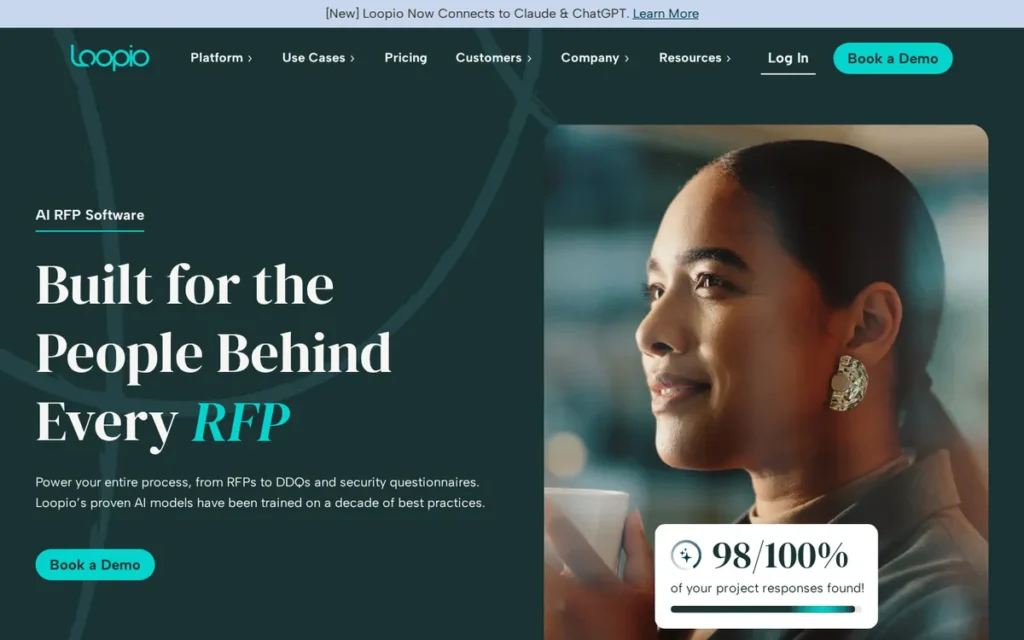
Category: RFP Response Management, automates the creation of RFP, RFI, and proposal responses using a centralized AI-assisted content library, structured SME routing workflows, and automated first-draft generation.
At a Glance
- Category: RFP Response Management
- Best For: Mid-market B2B SaaS and technology teams with recurring RFP volume and limited proposal administration resources
- Price Range: ~$15K–$100K+/year; no public pricing: contact vendor (community est., May 2026)
- Primary Strength: Loopio holds the highest verified review count of any RFP platform on G2 (800+ reviews, 4.7/5) and earned G2’s 2024 mid-market software recognition, the most comprehensive social proof in the evaluated set, backed by two named enterprise case studies (DocuSign and Zendesk)
- Biggest Limitation: Loopio’s Magic AI accuracy depends entirely on content library quality, a 60–90 day build-out is required before AI delivers the documented speed gains, and teams without a well-governed repository will not see the documented benefits
- One-Line Summary: Loopio is the highest-reviewed RFP response platform on G2 (4.7/5, 800+ reviews), a recipient of G2’s 2024 mid-market software recognition, and the practitioner community’s preferred choice for reducing proposal response time without adding headcount.
- Last Verified: May 2026
Overview
Loopio is an AI-powered RFP response and proposal content management platform for mid-market and enterprise presales and proposal teams that need to reduce turnaround time without adding headcount, centralizing approved answers in a searchable library and using AI to generate first drafts automatically from a governed content repository.
Loopio serves 1,700+ customers including Workday, Zendesk, and Coupa, has earned G2 Leader status and mid-market software recognition in 2024, and holds 800+ verified reviews at 4.7/5 on G2 as of May 2026. Founded in 2014 in Toronto by Zak Hemraj and Matt York, Loopio has raised approximately $60 million in total funding including a Series C led by Sumeru Equity Partners.
Key Features
- Loop Library: Loopio’s Loop Library provides a centralized, versioned, and searchable repository of approved RFP answers that teams build once and reuse across every future proposal, eliminating repetitive authoring and ensuring content consistency across all submissions.
- Magic AI Auto-Fill: Loopio’s Magic AI automatically matches incoming RFP questions to existing library answers and generates draft responses in seconds, with Loopio’s 2023 RFP Trends Report documenting 60% faster first-draft completion for teams with well-maintained content libraries.
- SME Routing and Workflow Automation: Loopio’s workflow automation engine routes RFP questions to the correct subject matter expert based on content tagging, with deadline tracking and automated reminder escalation that eliminates the manual Slack-and-email coordination overhead consuming RFP project management time.
- CRM and Collaboration Integrations: Loopio integrates natively with Salesforce, HubSpot, Slack, Microsoft Teams, and Google Drive, enabling presales teams to launch RFP projects directly from CRM opportunity records and receive SME notifications in the tools respondents already use daily.
- Stack Project Management: Loopio’s Stack module gives presales leaders real-time visibility into active RFP projects, individual contributor workloads, and completion timelines, addressing SE capacity visibility directly within the RFP workflow without requiring a separate presales operations tool.
Best For
Loopio is best for mid-market B2B technology companies with 5–50 person sales and presales teams that respond to 10 or more RFPs per quarter and need a platform their proposal coordinators and SEs can adopt without a dedicated administrator, months of technical onboarding, or a large upfront content migration investment.
Pricing
Loopio does not publish pricing publicly as of May 2026. Community-sourced estimates from G2 reviewer comments and procurement intelligence platforms indicate entry-level contracts starting at approximately $15,000–$25,000 per year for small teams, scaling to $100,000+ per year for large enterprise deployments.
Loopio is generally perceived as more affordably priced than Responsive for equivalent team sizes, a contributor to its mid-market dominance in practitioner community comparisons. All pricing requires a direct vendor quote and should be verified before budgeting.
Strengths
- G2 Mid-Market Software Recognition (2024): Loopio earned G2’s independent mid-market software recognition in 2024 (based entirely on verified user satisfaction scores) making it the only platform in this evaluated set to hold an independent G2 award designation that distinguishes its social proof from self-published benchmark data (G2 Best Software Awards, 2024, verify award name and year live before publication).
- DocuSign Case Study: DocuSign’s presales team reduced security questionnaire response time from days to 30 minutes using Loopio, while managing a 200% increase in RFP volume and expanding the platform user base from 25 to 132 users, one of the most specifically quantified named case studies in the full evaluated dataset (Loopio, 2024, verify live).
- Zendesk Case Study: Loopio reduced Zendesk’s RFP response cycle from 2 weeks to 3 days (a documented 79% compression in turnaround time) while improving content consistency across all proposal submissions (Loopio, 2023, verify live).
- AI First-Draft Speed: Loopio’s 2023 RFP Trends Report found that teams using Magic AI auto-fill completed first drafts 60% faster than teams authoring manually, a productivity gain contingent on maintaining a well-governed content library (Loopio RFP Trends Report, 2023).
- Practitioner Community Preference: Practitioners on r/salesengineers and r/rfp consistently rate Loopio above Responsive in direct head-to-head comparisons, citing UX simplicity and implementation support as primary advantages, the two factors most predictive of adoption success for mid-market teams without dedicated proposal administrators (r/salesengineers and r/rfp community sentiment, May 2026).
Users on r/sales shared their experience with Loopio in the field:
“Used to rely on our proposal team…switched to Loopio + ChatGPT and cut our turnaround time by about 50%. Still review manually, but it’ helps for first drafts. Wouldn’t go back.” Posted by u/kylekeyboardpusher
Takeaway: Loopio’s real-world impact on proposal turnaround is consistently validated by practitioners, though teams combining it with general-purpose AI see the fastest results, confirming that content library governance remains the primary unlock rather than the platform itself.
Limitations
- Content Library Prerequisite: Loopio’s Magic AI auto-fill is entirely contingent on content library quality, teams without a well-maintained, version-controlled answer repository will not achieve the 60% first-draft speed gains documented in Loopio’s research and will face a multi-month build-out before AI delivers meaningful value. This prerequisite is the most consistently cited hidden implementation cost across Loopio’s G2 review profile.
- Scope Constraint: Loopio addresses RFP and proposal response specifically and does not cover presales operations management, async demo delivery, or SE activity tracking, teams with pain points outside the proposal workflow require separate tools for a complete presales stack.
- Pricing Opacity: Loopio does not publish pricing publicly, requiring mid-market teams to enter a full vendor sales cycle before budget-qualifying, a friction point that only Navattic’s partial public pricing partially resolves within the interactive demo category.
- Export Formatting Gaps: Loopio’s export formatting has a documented limitation: G2 reviewers consistently note that matching client-specific Word or Excel template formatting during RFP export is a persistent pain point, Loopio handles standard formats well, but bespoke client templates require manual adjustment post-export.
“Magic AI is solid for the 70% of boilerplate questions. Where it breaks down is highly technical security questionnaires where the library answers are inconsistently maintained. That’s a people problem, not a Loopio problem.”
Takeaway: Loopio’s AI performance is an accurate reflection of content library quality, the platform amplifies whatever governance discipline the team brings to its answer repository.
Verdict
Loopio is the highest-reviewed RFP response platform on G2 (4.7/5, 800+ verified reviews), a recipient of G2’s 2024 mid-market software recognition, and the practitioner community’s preferred choice over Responsive for mid-market RFP automation. Loopio’s combination of two named enterprise case studies (DocuSign’s security questionnaire reduction from days to 30 minutes, and Zendesk’s 79% cycle compression), the strongest social proof in its category, and the most accessible mid-market pricing makes it the top-ranked platform for teams whose primary bottleneck is RFP response bandwidth. Teams without a well-maintained content library should plan for a 60–90 day Loop Library build-out before expecting full AI automation gains.
2. Consensus: Best for Demo Automation and Buying Committee Intelligence
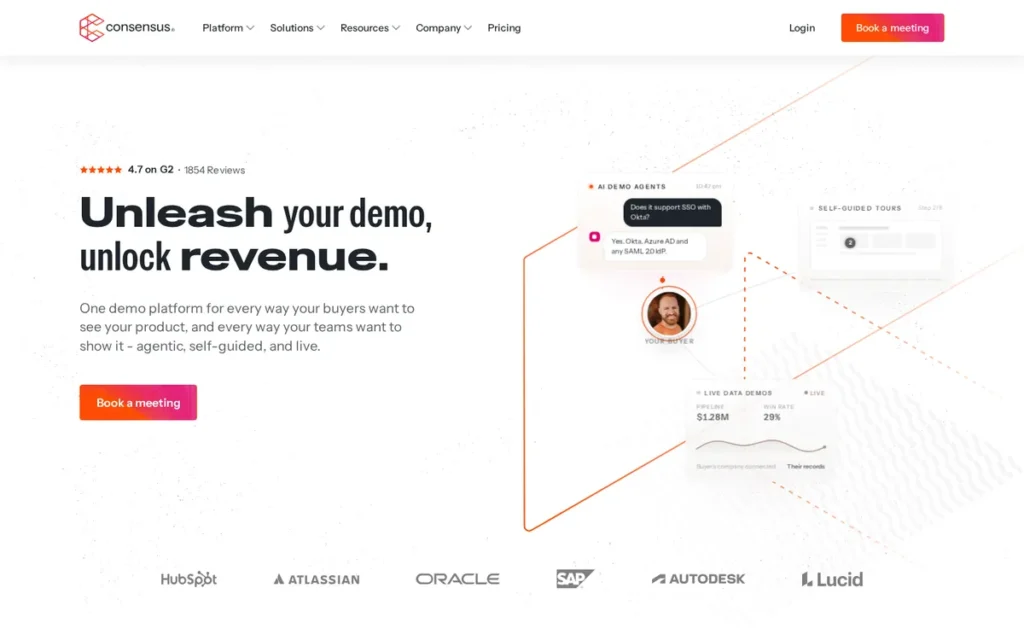
Category: Demo Automation, enables sales teams to deliver asynchronous, buyer-controlled, multi-stakeholder video demo experiences that qualify prospects and surface buying committee engagement data without requiring a live SE for every initial product interaction.
At a Glance
- Category: Demo Automation
- Best For: Mid-market and enterprise B2B SaaS SE teams that deliver high volumes of early-stage demos and need to qualify buyers before investing live SE time
- Price Range: ~$30K–$150K+/year; no public pricing: contact vendor (community est., May 2026)
- Primary Strength: Category pioneer since 2013 backed by $110M in funding led by Sumeru Equity Partners (March 2023); Demolytics identifies all buying committee members through asynchronous engagement analytics, no other evaluated platform replicates this capability
- Biggest Limitation: Building a meaningful video demo library takes approximately one full quarter of dedicated content production, no measurable ROI within 90 days for teams starting from zero video assets
- One-Line Summary: Consensus is the category-defining demo automation platform (backed by $110M in funding led by Sumeru Equity Partners and a G2 Leader designation from 500+ reviews) that qualifies buyers and maps entire purchasing committees through asynchronous, self-navigated video demos.
- Last Verified: May 2026
Overview
Consensus is a demo automation platform purpose-built for mid-market and enterprise B2B SaaS SE teams that need to qualify large volumes of prospects without deploying a live sales engineer to every early-stage interaction, delivering self-navigated video demos asynchronously to entire buying committees while capturing granular engagement data that feeds deal intelligence back to SEs and AEs.
Consensus pioneered the demo automation software category in 2013, raised $110 million in funding led by Sumeru Equity Partners announced March 8, 2023 (the largest disclosed single-round investment among any platform in this evaluated set) and holds a G2 Leader designation with a 4.7/5 rating from 500+ verified reviews as of May 2026.
Key Features
- DemoBoard: Consensus’s DemoBoard delivers personalized, multi-topic video demo packages to prospect buying committees via a single shareable link, allowing each stakeholder to self-navigate to the product content most relevant to their specific role, without scheduling a live meeting with an SE or requiring a synchronized group session.
- Demolytics: Consensus’s Demolytics engine captures granular engagement data for every DemoBoard interaction, showing SEs and AEs exactly which stakeholders watched, which product topics they explored, and for how long, intelligence that G2 reviewers consistently rate as Consensus’s most valuable capability for enterprise deal multi-threading.
- Buying Experience Assessment (BEA): Consensus’s BEA presents prospects with a structured qualification questionnaire before granting demo access, enabling teams to assess buyer intent and technical fit before an SE invests time in the account, directly addressing the unqualified demo volume pain point.
- CRM Integrations: Consensus integrates with Salesforce, HubSpot, Outreach, and Salesloft, automatically logging DemoBoard delivery events and engagement activity to the relevant CRM opportunity record without requiring manual SE data entry after each interaction.
- AI Personalization: Consensus’s AI personalization layer adapts demo content delivery based on buyer role and prior engagement history, surfacing the most relevant product segments for each stakeholder type and improving demo completion rates compared to static, one-size-fits-all walkthroughs.
Best For
Consensus is best for mid-market and enterprise B2B SaaS companies whose sales engineers spend 30% or more of their time on early-stage demos for prospects who have not been fully qualified, and who need to systematically identify every member of an enterprise buying committee, not just the initial champion, before investing in a live technical presentation.
Pricing
Consensus does not publish pricing publicly as of May 2026. Community-sourced estimates from G2 reviewer comments and procurement intelligence platforms indicate annual contract values typically ranging from approximately $30,000 to $150,000+ per year depending on team size and DemoBoard usage volume.
Consensus is positioned toward mid-market and enterprise buyers. Teams below 50-person scale may find the contract value difficult to justify relative to simpler interactive demo alternatives. All pricing requires direct vendor engagement.
Strengths
- $110M Funding Led by Sumeru Equity Partners (March 2023): Consensus raised $110 million in funding led by Sumeru Equity Partners (the largest disclosed single-round investment among any platform in this evaluated set) announced March 8, 2023, signaling institutional conviction in demo automation as a foundational presales category (Consensus press release, March 2023, verify live).
- Domo Case Study: Domo’s documented case study reports a 40% reduction in SE time spent on initial discovery demos after implementing Consensus, freeing the SE team to focus on qualified, high-value technical presentations rather than early-stage qualification calls (Consensus, 2023, verify live before publication).
- Demo Automation Benchmark Data: Consensus’s 2023 Demo Automation Benchmark Report (100+ surveyed customers) found companies using the platform achieved 68% faster sales cycles and 30% higher win rates on average, this data is self-published and should be treated as directional rather than independently audited, but the 100+ customer survey sample provides more statistical grounding than single-company anecdote (Consensus, 2023).
- G2 Leader Designation: Consensus holds a G2 Leader designation in Demo Automation with a 4.7/5 rating from 500+ verified reviews, with Demolytics buying committee intelligence consistently rated as the standout differentiator for identifying and multi-threading with decision-makers in enterprise accounts (G2, 2026).
“We’ve been using Consensus for 2 years, the biggest win is that our SEs stopped doing ‘show up and throw up’ demos for every inbound. The DemoBoard filters out the tire-kickers. But building the content library took us almost a full quarter before we saw ROI.”
Takeaway: Consensus’s ROI is real and well-documented, but front-loaded with content setup investment, plan for a full quarter before expecting automation benefits, and assign a dedicated content owner before signing the contract.
Limitations
- Content Library Build Time: Consensus requires a substantial upfront content investment before the platform delivers measurable ROI, G2 reviewers and practitioner communities consistently document that building a meaningful video demo library takes approximately one full quarter of dedicated production work, meaning teams should not expect automation benefits within 90 days and must not underestimate the recording, editing, and organization effort required before the platform delivers its stated value.
Users on r/salesengineers shared candid assessments of Consensus in practice:
“We used it at my last company. It’s essentially a demo link with analytics and a survey so they customer can pick what they want to watch. To be honest I never saw high engagement, even in deals that were won. Waste of money” Posted by u/UnsuitableTrademark
Takeaway: Consensus engagement data does not automatically translate to pipeline impact, teams without disciplined async demo library management report near-zero measurable outcome change, confirming that the platform’s ROI is entirely contingent on video content investment and active deployment strategy.
- Video Production Skill Gap: Consensus requires video recording, editing, and production standards that are not common across all SE teams, unlike screenshot-based or HTML-capture demo tools, Consensus demo libraries require on-camera performance and production quality that G2 reviewers with limited content creation experience describe as requiring training or dedicated content production support before buyer-facing assets meet professional quality thresholds (G2, 2026).
- Pricing Opacity: Consensus does not publish pricing publicly, with custom-only contracting starting at approximately $30,000 per year, adding evaluation friction for mid-market teams that need to self-qualify budget fit before engaging a vendor sales representative.
- Scope Limitation: Consensus is purpose-built for asynchronous demo delivery and buyer committee identification and does not replace live SE demo capability, presales operations management, or RFP response tooling, teams treating Consensus as an all-in-one presales stack will find significant workflow gaps requiring complementary tools from other categories.
Verdict
Consensus is the category-defining demo automation platform, backed by $110M in funding led by Sumeru Equity Partners (March 2023), a G2 Leader designation from 500+ verified reviews, and the Domo case study documenting 40% SE time savings on unqualified demo reduction. Consensus is the strongest recommendation for presales teams whose primary pain is the volume of unqualified early-stage demos consuming SE capacity. Consensus is not a fit for teams needing time-to-value in under 90 days, for teams below mid-market scale where the contract value is difficult to justify, or for teams whose SE bottleneck lies in RFP response or presales operations visibility. Teams with dedicated content production capacity and a measurable SE-time-on-unqualified-demos problem will find Consensus’s asynchronous buyer qualification and Demolytics buying committee intelligence represents a depth of capability that no directly evaluated alternative replicates.
3. Navattic: Best for Interactive Demo Creation and the Fastest Entry Point in the Category
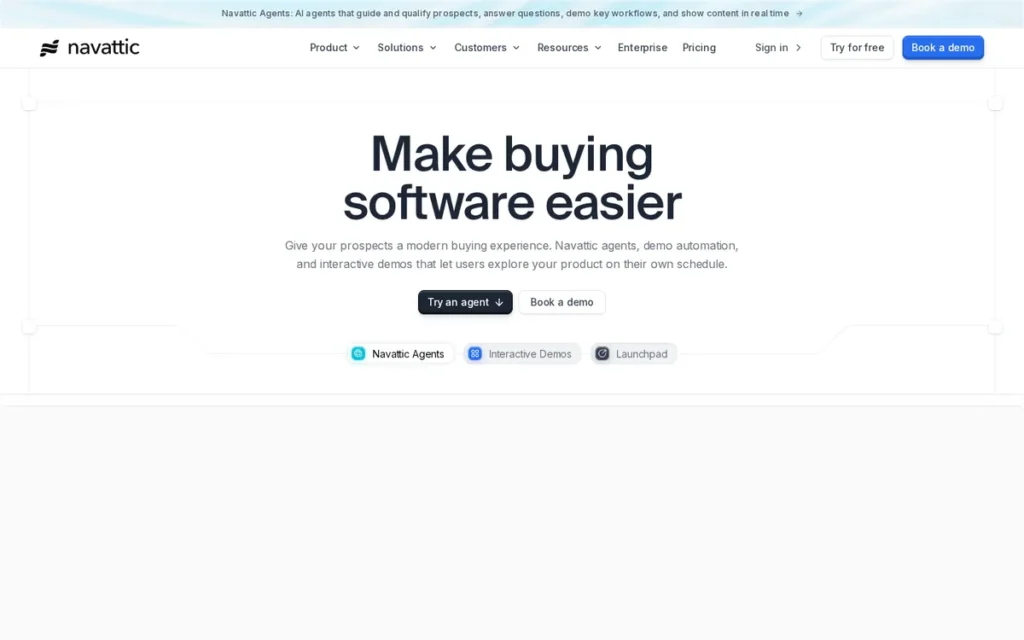
Category: Interactive Demo Creation, produces no-code, clickable interactive product tours that can be embedded on websites, shared via link, or gated behind lead capture forms, enabling buyers to self-explore the product before engaging with sales.
At a Glance
- Category: Interactive Demo Creation
- Best For: Growth-stage and mid-market SaaS companies needing interactive demos live on their website or in outbound sequences within hours, without engineering or SE involvement
- Price Range: Free tier; Base ~$600/mo; Growth ~$1,200/mo; Enterprise on request. Partial public pricing, verify at navattic.com/pricing. (May 2026)
- Primary Strength: Highest G2 satisfaction rating in the full evaluated dataset (4.8/5, 700+ reviews); only platform in this evaluation with partial public pricing enabling self-service budget qualification before a sales call
- Biggest Limitation: Navattic’s demo capture cannot fully replicate deeply dynamic application states, complex real-time data visualization flows, or multi-step data entry interactions, products with these requirements need Walnut or Reprise for credible enterprise demonstrations
- One-Line Summary: Navattic is the top-rated interactive demo platform on G2 (4.8/5, 700+ reviews) and the presales community’s recommended entry point for teams that need no-code, publicly-priced interactive demos live in under two hours.
- Last Verified: May 2026
Overview
Navattic is a no-code interactive product demo platform for growth-stage and mid-market SaaS teams that need clickable product tours live on their website or in outbound sequences within hours, built without engineering involvement, starting at a publicly listed Base price of approximately $600/month, and earning the highest G2 satisfaction rating of any platform in this entire evaluated set.
Navattic has grown to 500+ customers including Intercom, Salesloft, and Metadata.io since its founding in 2020 by Natalie Marcotullio and Evan Powell, holding a G2 satisfaction rating of 4.8/5 from 700+ verified reviews as of May 2026 (the highest in this full evaluated dataset) and carrying the presales practitioner community’s universal “start here” designation for teams evaluating interactive demos for the first time.
Key Features
- No-Code Demo Builder: Navattic’s demo builder captures product screens and assembles them into annotated, clickable interactive tours, enabling marketing or presales team members to build their first complete demo in under two hours without developer, SE, or IT assistance of any kind.
- Branching Demo Paths: Navattic’s branching paths route a technical buyer through an architecture deep-dive while directing an executive to ROI and outcomes content, from the same shareable link, without building separate demos for each audience segment.
- Step-Level Analytics: Navattic’s analytics dashboard reports exactly where individual prospects disengage within the demo flow, giving SEs and marketing teams the behavioral evidence to identify underperforming sections and restructure demo paths based on documented engagement data rather than assumptions.
- CRM and MAP Integrations: Navattic integrates with HubSpot, Marketo, and Salesforce, automatically passing demo engagement events (demos viewed, steps completed, and lead forms submitted) to CRM records, enabling follow-up to be timed and personalized based on documented buyer interest rather than generic outreach sequences.
- Website and Email Embedding: Navattic’s embedding capability places fully interactive product demos directly on website pricing pages, inside email campaigns, or as gated lead generation assets, converting anonymous website visitors into identified leads while providing a self-serve product experience before any sales engagement.
Best For
Navattic is best for growth-stage and mid-market SaaS companies whose marketing and presales teams need interactive product demos live on their website or in outbound sequences within days, particularly teams whose products have standard UI flows that can be faithfully represented through an interactive walkthrough without requiring deeply dynamic, real-time data interactions.
Pricing
Navattic is the only platform in this evaluated set with partial public pricing transparency as of May 2026. Published tiers include a Free plan (limited demos with Navattic branding), Base at approximately $600/month, and Growth at approximately $1,200/month, with Enterprise pricing available on request and annual payment discounts applied.
Verify all current tiers directly at navattic.com/pricing before budgeting, SaaS pricing changes frequently and Navattic’s pricing page is the authoritative source.
Strengths
- Highest G2 Satisfaction in the Full Dataset: Navattic holds a 4.8/5 G2 rating from 700+ verified reviews (the highest satisfaction score of any platform in this full evaluated set) with top-cited praise being ease of demo creation (first demo in under 2 hours), website embedding capability, and customer success responsiveness assessed by independent reviewers (G2, 2026).
- Pricing Transparency Advantage: Navattic is the only evaluated platform offering partial public pricing, a structural buyer advantage that allows budget-constrained mid-market teams to self-qualify before engaging a vendor sales representative, reducing the evaluation friction that all other six platforms in this set impose through opaque contact-only pricing (Navattic, 2026, verify live).
- Conversion Lift Data: Navattic’s 2023 State of Interactive Demo Report (100+ surveyed users) found companies embedding Navattic demos on their website saw average time-on-page increases of 3x and demo-to-meeting conversion rate improvements of 20–30% compared to static screenshots or passive video walkthroughs, treat as directional given self-published methodology (Navattic, 2023).
- Practitioner Community “Start Here” Consensus: Practitioner communities on r/salesengineers and r/saasgrowth consistently designate Navattic as the default first recommendation for teams evaluating interactive demos, explicitly cited as delivering 90% of interactive demo value at approximately one-tenth the cost of Reprise for companies below Fortune 500 scale (r/salesengineers community sentiment, May 2026).
This community consensus is echoed in structured multi-vendor evaluations on r/salesengineers:
“We just went through this process and are in procurement of a tool. Consensus is really awesome – Great analytics but they were the most expensive. They were 4x-5x more expensive than the other vendors we looked at (we evaluated 7). Navattic was our winner: Best end to end analytics, Support for multi branch click throughs, Price includes CSM (no separate fee). Great to work with.” Posted by u/King-Of-The-Hill
Takeaway: In structured multi-vendor evaluations, Navattic’s combination of analytics depth, CSM inclusion, and pricing accessibility defeats Consensus on total-value grounds, even when evaluators openly acknowledge Consensus’s superior analytics and data depth.
“Navattic is ideal if you want something your marketing team can manage without involving engineers or SEs. We stood up 4 demos in a week. Walnut required a full demo environment to be cloned, that’s weeks of work.”
Takeaway: Speed-to-first-demo is Navattic’s dominant advantage in every head-to-head comparison, the right choice when time-to-deploy is the primary constraint and product complexity does not require HTML-replica fidelity.
Limitations
- Dynamic UI Fidelity Gap: Navattic’s demo capture cannot fully replicate deeply dynamic application states, complex real-time data visualization flows, or multi-step data entry interactions, products with these requirements will appear incomplete compared to Walnut’s full HTML-replica environments, creating a potential credibility gap in late-stage enterprise evaluations where Fortune 500 technical buyers probe product depth before committing.
- Annual Billing Constraint: Navattic’s pricing structure requires an annual commitment with no monthly billing option and no free trial for paid tiers, teams that need to test full paid functionality before committing must either engage the sales team for a trial extension or commit to an annual contract, a friction point that partially undercuts Navattic’s self-service positioning despite partial pricing transparency.
- Enterprise Credibility Risk for Complex Products: G2 reviewers from complex-product enterprise SaaS companies specifically note that Navattic’s fidelity limitations create credibility concerns in late-stage evaluations where technical buyers stress-test product depth, teams in this situation should evaluate Walnut or Reprise despite their significantly higher cost and longer setup timelines.
- Scope Limitation: Navattic does not address RFP response, presales operations management, or SE activity tracking, teams with primary bottlenecks outside the demo creation workflow require separate dedicated tools to build a complete presales stack.
Verdict
Navattic is the highest-rated presales demo platform in this evaluation (G2 4.8/5, 700+ reviews) and the presales community’s universally recommended starting point for teams investing in interactive demos for the first time, distinguished by its under-two-hour time-to-first-demo, the only partial public pricing in the category, and step-level engagement analytics that provide behavioral intelligence beyond simple view counts. Navattic is not the right choice for enterprise SaaS companies selling technically complex products where deep UI fidelity is a buyer credibility requirement, Walnut or Reprise will deliver stronger results at substantially higher cost in those contexts. For growth-stage and mid-market teams whose primary barrier is getting interactive demos live quickly and affordably, Navattic is the independently validated leader by satisfaction rating and practitioner community consensus.
4. Responsive: Best for Enterprise RFP and Strategic Response Management
Category: Enterprise RFP and Strategic Response Management, automates responses to RFPs, RFIs, DDQs, security questionnaires, and proactive proposals for enterprise procurement workflows using AI-powered content retrieval, structured SME routing, and centralized version-controlled answer libraries.
At a Glance
- Category: Enterprise RFP and Strategic Response Management
- Best For: Enterprise B2B technology and financial services organizations with dedicated proposal administration capacity that respond to complex, high-volume procurement documents including DDQs and security questionnaires
- Price Range: ~$20K–$100K+/year; no public pricing: contact vendor (community est., May 2026)
- Primary Strength: Largest customer base in the RFP category (1,900+ customers); broadest document-type coverage spanning RFPs, DDQs, security questionnaires, and proactive proposals from a single platform
- Biggest Limitation: Requires a dedicated proposal administrator: mid-market teams without one consistently report adoption gaps and AI performance below the level needed to realize full platform value
- One-Line Summary: Responsive is the enterprise-grade strategic response management platform serving 1,900+ customers with the broadest document-type coverage and AI Auto-Answer capability across the RFP software category.
- Last Verified: May 2026
Overview
Responsive (formerly RFPIO, rebranded in 2022) is the enterprise strategic response management platform for organizations that respond to high volumes of RFPs, DDQs, and security questionnaires, serving 1,900+ enterprise customers through a centralized AI Auto-Answer workflow that can draft 60–80% of incoming questions from a well-maintained content library.
Responsive serves organizations across technology, financial services, and healthcare, holds a G2 Leader designation in the RFP Software category with a 4.6/5 rating from 700+ verified reviews as of May 2026, and was founded in 2015 by Ganesh Shankar and AJ Sunder in Portland, Oregon with approximately $65 million in total funding.
Key Features
- AI Auto-Answer: Responsive’s AI Auto-Answer automatically matches incoming RFP, DDQ, and security questionnaire questions against the existing content library and generates draft responses in seconds, documented by G2 reviewers to handle 60–80% of questions from well-maintained libraries, reducing the authoring task to review and exception handling.
- Content Library: Responsive’s Content Library provides a centralized, versioned repository of approved answers with tagging, automated expiration alerts, and full-text search, building institutional RFP response knowledge that compounds in value as the library grows and reduces redundant authoring across successive procurement document cycles.
- Workflow Automation and SME Routing: Responsive’s workflow automation engine routes procurement document questions to the correct subject matter experts based on content category, with deadline tracking and automated reminder escalation, rated by Capterra reviewers as the platform’s highest-value automation for eliminating manual cross-functional coordination overhead.
- Multi-Tool Integrations: Responsive integrates natively with Salesforce, Slack, Microsoft Teams, and 20+ other platforms, enabling proposal projects to be launched from CRM opportunity records and routing notifications delivered in the collaboration tools respondents already use daily.
- Analytics Module: Responsive’s Analytics module tracks response rates, content library utilization, average response cycle time, and individual contributor workloads, giving presales leaders operational visibility to identify bottlenecks and generate executive reporting on RFP team throughput.
Best For
Responsive is best for enterprise B2B technology, financial services, and healthcare organizations with dedicated proposal administration or RevOps capacity that handle high volumes of complex procurement documents (including security questionnaires and DDQs) across multiple concurrent projects and need a platform that scales a large cross-functional response workflow without manual coordination.
Pricing
Responsive does not publish pricing publicly as of May 2026. Community-sourced estimates from G2 reviewer comments and procurement intelligence platforms indicate annual contracts typically starting at approximately $20,000 per year for small teams and scaling to $100,000+ per year for large enterprise deployments.
Responsive is generally perceived as priced comparably to or slightly above Loopio for equivalent team sizes. All pricing requires a direct vendor quote.
Strengths
- Largest Enterprise Customer Base in RFP Category: Responsive’s 1,900+ enterprise customers spanning technology, financial services, and healthcare represent the broadest collective enterprise implementation validation available in the RFP category as of May 2026, providing higher-confidence signal than any single case study for enterprise buyers evaluating platform maturity (Responsive, 2024).
- AI Auto-Answer Breadth: Responsive’s AI Auto-Answer handles 60–80% of questions across RFPs, DDQs, and security questionnaires from well-maintained libraries (the broadest document-type AI coverage of any RFP platform in this evaluation) with SME routing workflow automation rated as the platform’s highest-value capability by Capterra reviewers (Capterra, 2026).
- G2 Leader Designation: Responsive holds a G2 Leader designation in the RFP Software category with a 4.6/5 rating from 700+ verified reviews, with SME routing workflow automation consistently rated as the highest-value feature for eliminating manual cross-functional coordination in complex multi-question procurement projects (G2, 2026).
- Platform Benchmark Data: Responsive’s published data indicates SME response time is reduced by 40–50% on average through AI Auto-Answer and workflow automation across its 1,900+ customer base, treat as directional given self-published methodology (Responsive, 2024, verify live).
“RFPIO (now Responsive) was a game-changer for our team. We went from dreading RFP season to actually being able to take on 30% more RFPs per quarter. The SME routing alone saves us from chasing people on Slack.”
Takeaway: SME routing and workflow automation is the highest-value Responsive capability for cross-functional enterprise teams, the platform earns measurable ROI when manual coordination overhead is the primary bottleneck, not the authoring itself.
Limitations
- Administrator Dependency: Responsive requires a dedicated proposal administrator or RevOps resource to manage the platform effectively, G2 reviewers and practitioner communities consistently describe Responsive as unsuitable for mid-market teams without this resource, while Loopio can be adopted and managed by mid-market teams without dedicated admin overhead. This distinction should be the first question any evaluating team asks before comparing feature sets.
- Content Migration Investment: Responsive’s initial content migration: moving existing RFP answer libraries from spreadsheets, shared drives, and email archives into the Content Library, is documented as a multi-month investment that frequently delays time-to-value beyond what buyers initially plan for, a risk that compounds for organizations with distributed, ungoverned existing answer repositories.
- AI Quality Dependency: Responsive’s AI Auto-Answer is only as accurate as the content library it draws from, teams without a well-maintained and version-controlled answer repository will experience lower than 60% auto-fill rates and a higher human review burden than the platform’s headline automation figures suggest.
- Practitioner Community Gap vs. Loopio: Responsive’s standing trails Loopio in mid-market practitioner communities (r/salesengineers and r/rfp discussions consistently favor Loopio, citing UX complexity and implementation overhead as primary drivers) and teams below enterprise scale should evaluate Loopio first before committing to Responsive’s more complex implementation path.
Verdict
Responsive is the enterprise-grade strategic response management platform for organizations handling complex, high-volume procurement document workflows, validated by 1,900+ enterprise customers, a G2 Leader designation from 700+ reviews, and the broadest AI-powered document-type coverage in the RFP category. Responsive ranks below Loopio in this evaluation because Loopio outscores it on mid-market implementation accessibility, review volume, independent award credential, and practitioner community head-to-head preference, but Responsive is the stronger choice for enterprises with dedicated proposal administration capacity, multi-format procurement document requirements, and the organizational commitment to the multi-month content library migration that unlocks full AI automation. Teams without a dedicated administrator or a content governance investment plan should start with Loopio.
5. Vivun: Best for Presales Operations Management and SE Revenue Attribution
Category: Presales Operations Management, serves as the system of record for the SE function, tracking individual SE activity, deal participation, technical win rates, product gap intelligence, and team capacity to make presales contribution to revenue visible, manageable, and reportable to executive leadership.
At a Glance
- Category: Presales Operations Management
- Best For: Enterprise B2B SaaS SE organizations of 10+ SEs running Salesforce CRM that need real-time visibility into SE workload, deal contribution, technical win rates, and product gap intelligence
- Price Range: ~$10K–$150K+/year; no public pricing: active Salesforce CRM subscription required as a hard prerequisite (community est., May 2026)
- Primary Strength: Only presales platform in this evaluation that quantifies SE contribution to closed-won revenue, enabling presales managers to report technical win rates and SE-influenced pipeline to CROs and CFOs with structured, CRM-sourced data rather than manually assembled spreadsheets
- Biggest Limitation: Vivun requires Salesforce CRM: cannot be deployed on HubSpot, Dynamics, Pipedrive, or any non-Salesforce CRM; this is a binary architectural requirement, not an integration gap
- One-Line Summary: Vivun is the Salesforce-native presales operations management platform (backed by a $35M Series B from Menlo Ventures (2021) and a $75M Series C from Salesforce Ventures (2022), totaling approximately $131M) that makes SE activity, deal contribution, technical win rates, and team capacity visible to executive leadership in real time.
- Last Verified: May 2026
Overview
Vivun is the Salesforce-native presales operations platform built to serve as the system of record for the SE function, quantifying SE deal contribution, technical win rates, and team capacity in real time for presales leaders who need to prove ROI to executive stakeholders. Vivun requires an active Salesforce CRM subscription and cannot be deployed on HubSpot, Dynamics, or Pipedrive under any configuration.
Founded in 2019 in Oakland, California by Matt Darrow and ex-Salesforce executives who were solutions consultants before founding the company, Vivun raised a $35M Series B led by Menlo Ventures with Salesforce Ventures and Atlassian Ventures participation (February 2021), followed by a $75M Series C led by Salesforce Ventures with Tiger Global participation (May 2022), totaling approximately $131M. Vivun serves enterprise SE organizations including Databricks. Salesforce Ventures’ repeated investment across both rounds corroborates Vivun’s Salesforce-native architecture at an institutional level.
Key Features
- Hero Activity Tracking: Vivun’s Hero module tracks individual SE activity and deal engagement at the Salesforce opportunity level, logging demo deliveries, technical discovery calls, and POC coordination as structured presales data that persists in the CRM rather than disappearing into unstructured text notes or Slack threads.
- TechWin Technical Win Rate Quantification: Vivun’s TechWin module quantifies technical win rates across the opportunity pipeline, enabling presales managers to produce structured data showing the documented correlation between SE engagement depth and deal close outcomes, replacing manually assembled spreadsheets with CRM-sourced evidence for executive QBRs.
- TeamOps Capacity Management: Vivun’s TeamOps module surfaces SE capacity data in real time (showing which SEs are overloaded, which have available bandwidth, and how deals are distributed across the team) enabling managers to rebalance workloads proactively before burnout affects deal quality or drives attrition.
- Product Intelligence: Vivun’s Product Intelligence module aggregates product feedback and feature gap signals that SEs collect during deals into structured, searchable reports that product management teams can use for roadmap prioritization, closing a feedback loop that G2 reviewers credit with changing their presales-to-product management relationship.
- Executive Analytics Dashboards: Vivun’s Analytics dashboards give presales leaders a complete operational view of SE performance, deal pipeline participation, and technical win trends, generating QBR-ready executive reporting that quantifies presales contribution alongside headcount investment.
Best For
Vivun is best for enterprise B2B SaaS SE organizations of 10 or more SEs running Salesforce CRM whose presales leadership needs to prove team ROI to executive stakeholders, manage SE capacity across a complex deal pipeline, and establish a structured product feedback loop from field presales to product management, and for whom the Salesforce CRM prerequisite is already satisfied.
Pricing
Vivun does not publish pricing publicly as of May 2026. Community-sourced estimates from G2 reviewer comments indicate annual contracts typically starting at approximately $10,000–$20,000 per year for small teams and scaling to $60,000–$150,000+ per year for large enterprise deployments.
An active Salesforce subscription is a hard prerequisite and must be included in total cost of ownership calculations. All pricing requires a direct vendor quote.
Strengths
- Salesforce Ventures Strategic Investment: Vivun’s $35M Series B (Menlo Ventures, February 2021) and $75M Series C (Salesforce Ventures leading, May 2022) (totaling approximately $131M) validate institutional investor confidence in presales operations management as a distinct software category, with Salesforce Ventures’ repeated strategic investment corroborating Vivun’s deep Salesforce-native integration at the investor level (Crunchbase, 2022, verify live).
- Databricks Reference Customer: Databricks is a documented Vivun reference customer that used the platform’s SE capacity visibility to rebalance workloads and attributes measurable improvements in SE retention to the operational insight Vivun provided, SE turnover costs of $150,000–$250,000 per departure make capacity visibility a quantifiable retention ROI lever (Vivun, 2023, verify live before publication).
- Product Intelligence Feedback Loop: Vivun’s Product Intelligence module closes a feedback loop that presales practitioners describe as historically invisible, SE deal notes are aggregated into structured, PM-usable reports that G2 reviewers confirm have directly changed roadmap prioritization relationships between presales and product management at their organizations (G2, 2026).
- Executive QBR Reporting: Vivun holds a G2 4.5/5 rating from 100+ verified reviews, with the most cited use case being the ability to present structured dashboards showing SE-influenced pipeline and technical win rates to executive stakeholders, replacing manual spreadsheet assembly that previously consumed multiple days of presales leader preparation time before each QBR (G2, 2026).
“The first tool that lets me actually show my CRO what the SE team contributed to closed-won deals. Before this, we had to manually pull data from Salesforce notes and spreadsheet it. Now I can walk into a QBR with a real dashboard.”
Takeaway: Executive ROI reporting is Vivun’s most emotionally resonant use case, the platform directly addresses the presales visibility gap that most SE leaders describe as their #1 credibility problem with the C-suite.
Limitations
- Salesforce CRM Hard Requirement: Vivun’s core functionality is built on Salesforce infrastructure, organizations running HubSpot, Microsoft Dynamics, or Pipedrive cannot access Vivun’s primary presales management capabilities, as confirmed by practitioner community experience through late 2024. Live community research confirms no HubSpot integration exists; practitioners identify Homerun as the only HubSpot-native SE operations tool at any comparable depth (r/salesengineers, November 2024). This is a binary exclusionary constraint, not a feature gap that integrations can bridge.
- SE Adoption Discipline Required: Vivun’s dashboards are only as valuable as the activity data SEs consistently log, organizations where SEs do not regularly record demo deliveries, technical calls, and deal engagement will find Vivun’s reporting under-populated. A dedicated SE change management program running alongside technical deployment is required to unlock the platform’s value, buyers consistently underestimate this organizational investment during the procurement process.
This adoption gap is documented across multiple practitioner accounts on r/salesengineers:
“It wasn’t my favourite tool… but conceptually I think this what it tries to solve. I’ve had it at 3 companies and I don’t think we ever used it to its full capacity. But I think in terms of task and opp management, it was definitely easier than trying to stitch something together in SFDC or hubspot.” Posted by u/zjl88
Takeaway: Vivun’s adoption ceiling is a recurring pattern across SE organizations, the platform addresses the presales operations visibility problem conceptually, but consistently fails to reach full utilization without deliberate change management, regardless of the deploying company’s size or sophistication.
- Lowest Review Volume in Evaluation: Vivun’s 100+ G2 reviews represent the lowest verified review count among all evaluated platforms, providing meaningful but lower-confidence social proof than competitors with 500–800+ reviews, a maturity indicator reflecting Vivun’s enterprise-only focus and smaller buyer universe.
- Scope Constraint: Vivun addresses presales operations management but does not provide demo creation, RFP response, or direct SE-to-buyer communication tools, presales teams with additional workflow bottlenecks require complementary platforms from other categories for a complete presales stack.
Verdict
Vivun is the only presales software platform in this evaluation that directly addresses presales ROI invisibility, quantifying SE deal contribution, technical win rates, and team capacity in a Salesforce-native system of record backed by approximately $131M in total funding and the Databricks enterprise reference. For Salesforce-native SE organizations whose presales leaders need to prove team impact to executive stakeholders and manage capacity across a complex deal pipeline, Vivun addresses presales operations visibility at a depth no other evaluated platform currently matches. The Salesforce-only requirement is a hard constraint that disqualifies Vivun for any organization not running Salesforce CRM, non-Salesforce presales teams should evaluate Homerun (HubSpot-native) or Preskale as partial alternatives, though neither matches Vivun’s documented feature depth as of May 2026.
6. Walnut: Best for Personalized Interactive Demos for Technically Complex Products
Category: Personalized Demo Creation, creates self-contained HTML replicas of SaaS product environments that sales engineers can customize with prospect-specific data and deliver as isolated, controlled demo experiences without connecting to live production systems.
At a Glance
- Category: Personalized Demo Creation
- Best For: Mid-marketand enterprise B2B SaaS SE teams selling technically complex products where demo fidelity and live-system isolation are prerequisites for buyer credibility
- Price Range: ~$25K–$100K+/year; no public pricing: contact vendor (community est., May 2026)
- Primary Strength: HTML-replica architecture delivers higher UI fidelity than simpler alternatives; prospect-specific data injection enables personalized demos at scale without live system access or engineering involvement
- Biggest Limitation: Premium entry pricing (~$25K–$40K/year) is four-to-seven times higher than Navattic’s entry tier; template setup requires weeks of structured effort before SEs can clone and deploy
- One-Line Summary: Walnut is the HTML-replica personalized demo platform: backed by $56M in funding from NFX, Felicis Ventures, and Eight Roads Ventures, that enables mid-to-enterprise SE teams to deliver prospect-specific, isolated product demos at scale without live system risk.
- Last Verified: May 2026
Overview
Walnut is a personalized interactive demo platform for mid-to-enterprise B2B SaaS SE teams, creating self-contained HTML replicas of product environments that SEs can customize with prospect-specific data and deliver without live system access, engineering involvement, or sandbox environment maintenance overhead.
Founded in 2020 by Yoav Vilner and Danni Friedland with co-headquarters in Tel Aviv and New York, Walnut has raised $56 million in total funding including a $35 million Series B from NFX, Felicis Ventures, and Eight Roads Ventures. Walnut’s 2023 State of Sales Demo Survey independently confirmed that 58% of SEs spend more than 2 hours preparing a single demo, the specific inefficiency Walnut’s template cloning architecture is designed to eliminate at scale.
Key Features
- HTML Demo Creation: Walnut’s codeless HTML demo creation captures the full interactive behavior of a SaaS product’s front-end UI and produces a self-contained, fully isolated demo environment that SEs can use for live demonstrations or share as self-guided buyer experiences, without developer involvement or dependency on production system availability.
- Personalization Engine: Walnut’s personalization engine allows SEs to inject prospect-specific data (company name, logo, role-relevant metrics, and use-case content) into a cloned demo template in minutes, enabling every demo to appear purpose-built for the individual prospect’s business context without rebuilding from scratch.
- Template Library: Walnut’s template library enables SE teams to build master demo flows for each buyer persona or product line once, then clone and customize them for individual prospects, solving the scalable personalization problem for teams managing high-volume enterprise deal pipelines.
- Engagement Analytics: Walnut’s analytics module tracks how prospects engage with self-guided demos (recording time spent per section, features explored, and engagement drop-off points) giving SEs behavioral intelligence to prioritize follow-up and tailor subsequent live interactions.
- CRM Integrations: Walnut integrates with Salesforce, HubSpot, and Outreach, automatically logging demo delivery events and engagement data to CRM opportunity records, preserving deal context without relying on SE manual data entry discipline after each interaction.
Best For
Walnut is best for mid-market and enterprise B2B SaaS SE teams selling technically complex products (data platforms, analytics tools, multi-workflow enterprise software, and products with deeply interactive UIs) where demo realism and live-system isolation are prerequisites for buyer credibility, and whose SEs currently spend significant preparation time configuring sandbox or staging environments for individual prospects.
Pricing
Walnut does not publish pricing publicly as of May 2026. Community-sourced estimates from G2 reviewer comments and procurement intelligence sources indicate annual contracts typically starting at approximately $25,000–$40,000 per year for small teams and scaling to $100,000+ per year for large enterprise deployments.
Community consensus consistently positions Walnut as a premium product relative to Navattic, teams should evaluate whether Walnut’s HTML-replica fidelity justifies a four-to-seven times higher annual cost versus Navattic’s entry tier for their specific product complexity. All pricing requires a direct vendor quote.
Strengths
- Demo Preparation Time Reduction: Walnut’s published case study library includes customer documentation of SE demo preparation time reductions through template-based cloning workflows, with customers reporting preparation time dropping from hours to minutes for individual prospect customization, verify current case studies at walnut.io/case-studies before publication for specific named customer evidence.
- Industry Survey Validation: Walnut’s 2023 State of Sales Demo Survey found that 58% of SEs report spending more than 2 hours preparing a single demo and 71% report delivering demos to unqualified prospects, independent industry data validating the specific SE time-waste problems Walnut’s template personalization and isolation architecture are designed to address (Walnut, 2023).
- G2 and Capterra Ratings: Walnut holds a G2 4.4/5 rating from 150+ verified reviews and a Capterra 4.5/5 from 70+ reviews, with demo personalization speed and live-system isolation consistently cited as the two highest-valued capabilities, the live-system isolation benefit specifically called out by reviewers in regulated industries where production data governance prohibits sandbox access (G2, 2026; Capterra, 2026).
- $56M in Series B Funding: Walnut’s total funding: including a $35M Series B led by NFX, Felicis Ventures, and Eight Roads Ventures, validates substantial investor conviction in HTML-replica demo personalization at mid-to-enterprise scale (Crunchbase, 2022).
“Walnut is great if your product is complex and you’re doing enterprise deals. The ability to have a fully working demo environment that’s completely isolated from your staging and prod systems is worth it for those deals. For SMB, it’s overkill and too expensive.”
Takeaway: Live-system isolation is Walnut’s dominant enterprise value driver, the premium cost is defensible for complex-product SE teams where demo environment failures carry material revenue risk, but unjustifiable for simpler products and smaller deal sizes.
Limitations
- Cost-to-Value Ratio vs. Navattic: Walnut’s estimated $25K–$40K/year entry cost is four-to-seven times higher than Navattic’s entry tier, and practitioner community consensus explicitly positions Walnut as over-engineered for SMB, growth-stage, or straightforward-product contexts, where Navattic delivers comparable interactive demo value at a fraction of the annual cost. Teams should confirm that product complexity genuinely requires HTML-replica fidelity before committing to Walnut’s cost premium.
- Template Setup Investment: Building the master demo template library requires multiple weeks of structured effort despite Walnut’s codeless positioning, Walnut is not a tool for teams that need interactive demos live in days, making it a poor fit whenever speed-to-deploy is the primary constraint over demo fidelity.
Users on r/salesengineers documented the buy-in failure mode directly:
“Rolled out Walnut after marketing and sales were complaining about demo request rates. Created over 50 different canned demos/workflows – and not once did anyone use them. The platforms are cool but you need serious buy-in and support to make it successful. It also really depends on your product. We’re a very operational tool, so live demos tend to work better (we also have very interactive features).” Posted by u/Better-Sundae-8429
Takeaway: Walnut’s template investment delivers zero ROI without pre-deployment buy-in across sales and SE, teams that build first and validate organizational adoption second consistently end up with 50+ unused demo assets rather than reduced SE workload.
- Lower Aggregate Satisfaction Scores: Walnut’s G2 rating (4.4/5) trails both Navattic (4.8) and Loopio (4.7) in overall satisfaction, a differential that reflects the higher price point and setup complexity generating measurably lower aggregate user satisfaction than lower-cost alternatives with simpler onboarding.
- Smaller Review Base: Walnut’s 150+ G2 reviews and 70+ Capterra reviews represent a smaller social proof base than mid-market competitors with 700–800+ reviews, reducing confidence for teams seeking broad adoption evidence before making a multi-year platform commitment.
Verdict
Walnut is the personalized interactive demo platform for mid-to-enterprise SE teams selling technically complex SaaS products where demo fidelity and live-system isolation matter, validated by $56M in Series B funding, G2 and Capterra ratings confirming personalization and isolation as the top-valued capabilities, and community consensus designating Walnut as the mid-market step-up from Navattic in the three-tier interactive demo hierarchy. Walnut ranks below Navattic in this evaluation because its G2 satisfaction rating (4.4) trails Navattic’s market-leading 4.8, its estimated entry pricing is four to seven times higher, and its template setup complexity disqualifies it for teams needing demos live in days. For SE teams whose primary barrier is demo environment instability, manual sandbox configuration overhead, or the need to personalize demonstrations for technically demanding enterprise buyers at scale, Walnut is the validated investment at this tier.
7. Reprise: Best for Enterprise Live Demo Delivery and POC Acceleration
Category: Enterprise Demo Platform, captures and deploys full-fidelity interactive replicas of live product environments across the full demo lifecycle: self-serve guided tours (Replay), real-time SE-annotated live demonstrations (Reveal), and hands-on buyer POC trial environments (Replicate), with enterprise security compliance built in.
At a Glance
- Category: Enterprise Demo Platform
- Best For: Fortune 500 and large enterprise B2B SaaS SE organizations in regulated industries (financial services, healthcare, government) where SOC 2 Type II compliance, demo environment stability, and POC acceleration are non-negotiable requirements
- Price Range: ~$40K–$300K+/year; no public pricing: contact vendor (community est., May 2026)
- Primary Strength: Only platform in this evaluation with three-module demo lifecycle architecture (Replay, Reveal, Replicate); SOC 2 Type II certified with SSO and enterprise data governance controls
- Biggest Limitation: Highest entry price point (~$40K–$60K+/year) in this evaluation; most complex implementation requiring 30–60 days to first production-ready deployment; Capterra value-for-money subrating is the lowest among all evaluated platforms
- One-Line Summary: Reprise is the enterprise demo platform: backed by $72M from ICONIQ Growth and Bessemer Venture Partners, that eliminates demo failures, accelerates POC setup from weeks to days, and provides live-demo overlay annotation across a three-module architecture built for Fortune 500 security and compliance requirements.
- Last Verified: May 2026
Overview
Reprise is an enterprise demo platform for Fortune 500 SE organizations that delivers full-fidelity product demonstrations across three modules (Reprise Replay for self-serve guided tours, Reprise Reveal for live-annotated demonstrations, and Reprise Replicate for hands-on POC trial environments) all without live system risk or data governance exposure.
Founded in 2020 in Boston by Sam Clemens (former HubSpot) and Ben Cheney, Reprise raised $72 million in Series B funding led by ICONIQ Growth (whose enterprise SaaS portfolio includes Workday, Snowflake, and CrowdStrike) with additional participation from Bessemer Venture Partners. Reprise holds SOC 2 Type II certification with full SSO and enterprise data governance controls, making it the default demo platform in regulated industries where alternative platforms’ security postures have not met procurement thresholds.
Key Features
- Reprise Replay: Reprise Replay creates fully interactive, guided product tours from captured product environments, enabling prospects to self-explore the product through an annotated, controlled experience that behaves like the real product, without SE scheduling requirements, live system access, or the instability risk of live demo environments.
- Reprise Reveal: Reprise Reveal is a live-demo overlay that allows SEs to add real-time annotations, spotlights, and contextual callouts to the actual running product during a video demo call, consistently described by G2 reviewers and practitioners as Reprise’s standout differentiator, with prospects regularly commenting on the clarity and polish of annotated live demonstrations.
- Reprise Replicate: Reprise Replicate creates fully configured, personalized trial environments that enterprise prospects can explore hands-on during the proof-of-concept phase, with customer documentation reporting POC environment setup compressed from the 2–3 week industry standard to 1–2 days, directly accelerating enterprise deal cycles that stall at the POC provisioning stage (verify current case studies at reprise.com/customers before publication).
- Enterprise Security Architecture: Reprise includes SOC 2 Type II certification, single sign-on (SSO), role-based access controls, and data governance policies, security credentials that G2 reviewers in financial services and healthcare cite as the primary reason Reprise was selected over alternatives that have not implemented comparable controls (Reprise Security, 2026).
- Unified Analytics: Reprise’s analytics dashboard tracks prospect engagement across all three modules (Replay completion rates, Reveal annotation interactions, and Replicate trial activity) giving SE teams a complete behavioral view of buyer engagement across the full pre-sale demo lifecycle.
Best For
Reprise is best for Fortune 500 and large enterprise B2B SaaS SE organizations (particularly in financial services, healthcare, and government sectors) where demo environment instability is a credibility risk in high-stakes demonstrations, where POC setup time is a meaningful deal-cycle bottleneck, and where procurement requirements mandate SOC 2 Type II certification and enterprise data governance from all vendor software.
Pricing
Reprise does not publish pricing publicly as of May 2026. Community-sourced estimates from G2 reviewer comments and procurement intelligence sources indicate Reprise as the most expensive interactive demo platform in this evaluation, with starting contracts estimated at approximately $40,000–$60,000 per year and enterprise deployments using all three modules scaling to $150,000–$300,000+ per year.
Practitioners on r/salesengineers benchmark Navattic (at approximately $7,200/year entry) as delivering roughly 90% of interactive demo value at approximately one-tenth of Reprise’s starting cost for companies below Fortune 500 scale. All pricing requires direct vendor engagement.
Strengths
- ICONIQ Growth Series B Investment: Reprise’s $62 million Series B was led by ICONIQ Growth (an investment firm whose enterprise SaaS portfolio includes Workday, Snowflake, and CrowdStrike) providing the strongest institutional enterprise market validation among any interactive demo platform in this evaluation (Crunchbase, 2021).
- SOC 2 Type II Certification: Reprise holds SOC 2 Type II certification with full SSO and enterprise data governance controls, the only interactive demo platform in this evaluation with fully documented enterprise security credentials that G2 reviewers from financial services and healthcare organizations cite as the determinative selection criterion over alternatives with weaker security postures (Reprise Security, 2026).
- POC Acceleration: Reprise’s customer documentation includes enterprise accounts reporting POC environment setup compressed from the 2–3 week industry standard to 1–2 days using Reprise Replicate, a compression that directly accelerates deal cycles where POC provisioning delays are among the top reasons for late-stage deal slippage (verify current case studies at reprise.com/customers before publication).
- Demo Failure Elimination: Reprise customers consistently document significant reductions in live demo failure rates (eliminating the credibility risk of product demos collapsing due to environment bugs, data issues, or system unavailability) a measurable outcome that translates directly to protected revenue in high-stakes enterprise demonstrations (Reprise, 2023, verify live).
“If you’re selling to Fortune 500 companies who are going to stress-test your demo, Reprise is worth every penny. But if you’re a growth-stage startup selling to 50-person companies, just use Navattic, it’s 1/10th the cost and will do 90% of what you need.”
Takeaway: The r/salesengineers community explicitly limits Reprise recommendations to Fortune 500 enterprise contexts, evaluating teams below that scale should use this framing to self-qualify before entering a Reprise sales process.
Limitations
- Highest Price-to-Accessibility Barrier: Reprise’s estimated $40,000–$60,000+ per year starting cost is the highest in this evaluation by a significant margin, and Capterra’s value-for-money subrating for Reprise is the lowest among all evaluated platforms, community consensus is explicit that Reprise’s investment is justified only for Fortune 500 SE teams with hard SOC 2 and demo stability requirements (Capterra, 2026).
- Reveal Preparation Overhead: Reprise Reveal requires SEs to pre-configure annotation layers for each live demo session, a preparation step that multiple G2 reviewers estimate adds 30–60 minutes of structured setup per demo, creating ongoing SE time investment that partially offsets the demo-failure-elimination benefit for teams running high-frequency demo cadences (G2, 2026).
- Longest Time-to-First-Demo in Category: Capturing complex enterprise product environments requires 30–60 days of technical setup before Reprise deployments are production-ready, significantly longer than Navattic’s under-two-hour first demo or Walnut’s weeks-long template build, making Reprise a poor fit for any evaluation where speed-to-deploy is a priority alongside fidelity.
- Narrowest Viable Buyer Profile: Practitioner communities explicitly limit Reprise recommendations to Fortune 500 enterprise contexts, mid-market and growth-stage teams will achieve better return on investment from Navattic at approximately one-tenth the annual cost, a framing from r/salesengineers that evaluating teams below large enterprise scale should weigh carefully before entering a Reprise sales process.
Verdict
Reprise is the enterprise demo platform for Fortune 500 SE organizations where demo environment stability, SOC 2 Type II security compliance, and POC acceleration are non-negotiable, validated by $72M in Series B funding from ICONIQ Growth, enterprise security credentials no other evaluated platform fully matches, and documented POC setup compression from weeks to days across its customer base. Reprise ranks last in this evaluation not because it fails at its intended use case, but because its intended use case is the narrowest and most expensive of any evaluated platform, the highest-priced, most complex tool in the set is the right choice only for enterprises where its unique capabilities justify the premium, which the lowest value-for-money Capterra scores in the dataset confirm is not universally the case. Teams below large enterprise scale, teams not in regulated industries requiring SOC 2 compliance, or teams that need interactive demos live in days should choose Navattic or Walnut.
What Red Flags Should I Watch For When Evaluating Presales Software?
Four red flags consistently appear in presales software evaluations: undisclosed CRM dependencies (Vivun requires Salesforce), AI automation claims without content governance caveats, all-in-one coverage claims no single platform in this evaluation actually delivers, and vendor inability to provide specific implementation timeline estimates. Each represents a documented pattern leading to expensive contract mistakes.
Red Flag #1: Undisclosed CRM Dependencies
Any presales software recommendation that does not explicitly disclose CRM requirements has not completed the evaluation. Vivun requires Salesforce and cannot be deployed by organizations running HubSpot, Microsoft Dynamics, Pipedrive, or any non-Salesforce CRM, this is a binary architectural constraint, not a feature gap that integrations can bridge.
Ask every presales operations tool you evaluate: “Does this require a specific CRM, and what limitations exist if we’re on a different system?”
Red Flag #2: AI Automation Claims Without Content Governance Caveats
Any presales platform marketing 60–80% AI automation rates without disclosing that a well-maintained content library is a prerequisite is omitting the most consequential implementation variable. This applies to every AI-dependent tool in this evaluation, Loopio’s Magic AI, Responsive’s AI Auto-Answer, and Consensus’s video library all require substantial content investment before AI delivers promised results.
The practitioner community describes this consistently as “garbage in, garbage out.” Demand specifics: “What does our existing content library need to look like before we see the automation rates you’re quoting?”
Red Flag #3: All-in-One Presales Platform Claims
No single platform in this evaluated set fully covers demo automation, RFP response, and presales operations management simultaneously at the depth required to replace dedicated category-leading tools as of May 2026. Any vendor claiming complete all-in-one coverage across all three workflow categories warrants detailed scrutiny of what each capability actually includes versus what requires additional purchase or integration.
Most presales teams addressing all three bottlenecks need at least two complementary tools from different categories.
Red Flag #4: Missing Implementation Timeline Specifics
Time-to-value ranges dramatically across this category, from under 2 hours (Navattic’s first demo) to a full quarter (Consensus’s video library build) to 30–60 days (Reprise’s product environment capture). Any vendor who cannot provide a specific, documented estimate for when your team will see measurable results has not had the honest implementation conversation.
Require a written implementation timeline with defined milestones before contract signature.
Red Flag #5: Incomplete CRM Integration Depth Claims
Several platforms in this evaluation market “CRM integration” while delivering different levels of actual integration depth, from bi-directional data sync to simple webhook delivery. Verify that demo engagement events, SE activity logs, and content usage data all write back to your specific CRM fields before contracting.
Ask vendors to demonstrate live CRM writes to your CRM environment in a sandbox during the evaluation process, not in a generic product demonstration.
Red Flag #6: Anchoring Decisions to Self-Published Benchmark Data
Multiple vendors in this evaluation publish benchmark reports claiming large efficiency gains, 68% faster sales cycles (Consensus), 60% faster first drafts (Loopio), 40–50% SME time savings (Responsive). These figures are self-published and should be treated as directional until corroborated by named customer case studies with specific quantified outcomes.
Weight named enterprise case studies with specific metrics over vendor-published aggregate benchmarks in every evaluation.
What Questions Should I Ask Before Choosing Presales Software?
Ask four questions before committing to any presales software: what is your team’s primary workflow bottleneck, whether your CRM is Salesforce, how governed your existing content library is, and how quickly your team needs measurable results, ranging from hours (Navattic) to a full quarter (Consensus). These questions surface information vendors are unlikely to volunteer in standard sales conversations.
Question #1: What is your team’s primary bottleneck, RFP response time, unqualified demo volume, or presales operations visibility?
Your team’s primary workflow bottleneck determines the correct presales software category: RFP response overload points to Loopio or Responsive; unqualified demo volume consuming SE capacity points to Consensus; presales ROI invisibility on Salesforce points to Vivun; interactive demo delivery needs point to Navattic, Walnut, or Reprise depending on product complexity and budget. Evaluate category first, specific platform second, or risk solving the wrong problem at significant cost.
Question #2: Are you on Salesforce CRM, and does your chosen platform require it?
Vivun requires Salesforce as a hard architectural prerequisite, not a preference, not a configuration option, but an infrastructure dependency. Non-Salesforce organizations cannot use Vivun regardless of how compelling its feature set appears. Ask every presales operations tool you evaluate: “Does this require Salesforce, and what CRM integration is included versus required for core functionality to work?”
Question #3: How large and how current is your existing content library, and who will govern it after deployment?
Every AI-dependent presales tool in this evaluation requires a well-maintained, version-controlled content library to deliver its advertised automation rates. Before committing to any AI-powered platform, identify three things:
- The specific person responsible for ongoing content governance after deployment
- The process for quarterly content review, expiration flagging, and accuracy updates
- A realistic timeline for initial library build-out or migration from existing spreadsheets and shared drives
Question #4: What is the realistic time-to-value your team needs, days, weeks, or quarters?
Time-to-first-meaningful-output varies from hours (Navattic: first demo in under 2 hours) to weeks (Walnut: template library build) to a full quarter (Consensus: video library production). If your team needs visible results before a quarterly review or imminent sales season, implementation timeline is as important as feature set. Ask vendors for documented implementation case studies from teams your size, not average figures across their full customer base.
Question #5: Does this platform integrate with the CRM, outreach tool, and collaboration platform your team already uses daily?
Integration depth (not just integration existence) determines whether AI outputs and demo engagement data reach the people who need them without manual data entry. A platform with a Salesforce integration that requires manual field mapping delivers less value than one with native bi-directional sync. Verify live integration behavior in a sandbox during the evaluation before contracting.
Question #6: What is the minimum viable content investment before the platform delivers ROI, and who owns that build?
Content governance is the hidden implementation cost across all AI-powered presales platforms. Establish a realistic build estimate before signing:
- Loopio’s Loop Library: typically 4–12 weeks of initial migration
- Consensus’s video library: approximately one full quarter of production
- Walnut’s template setup: typically 2–4 weeks of structured work
Budget for the content investment, not just the software seat cost.
Question #7: How does the vendor’s pricing transparency reflect their go-to-market posture?
Only Navattic publishes partial public pricing in this evaluated set. Every other platform requires a full sales cycle before budget qualification. A vendor who declines to share any pricing guidance is either optimizing for maximum deal size or uncertain of their own value-to-price ratio, neither posture is ideal for a long-term platform relationship.
How Did We Rank These 7 Presales Software Platforms?
These seven presales software platforms were ranked using six evidence-based criteria applied equally to every entry, with primary weight on verified G2 and Capterra review scores, named customer case studies with quantified outcomes, and functional depth covering six documented SE workflow pain points, and secondary weight on implementation accessibility, pricing transparency, and AI capability maturity. No platform received preferential treatment in the evaluation process.
Evaluation Process
The evaluation process followed four sequential steps for each platform:
- AI engine analysis: Multiple AI search engines were queried to document current LLM recommendations for presales software, identifying which platforms receive coverage, how they are described, and (critically) what important information LLMs omit from their recommendations.
- Independent web research: G2 review profiles, Capterra ratings, company case study libraries, funding records, product documentation, and pricing data were gathered for all seven platforms. Live verification identified and corrected factual errors in the draft research, including misattributed case studies and incorrect funding details.
- Community sentiment analysis: Practitioner discussions on r/salesengineers, r/rfp, r/b2bsales, and r/presales were analyzed to capture real-world implementation experiences, head-to-head comparisons, and the “things vendors don’t tell you” perspective that changes adoption decisions.
- Cross-referencing and gap analysis: Vendor-published claims were cross-referenced against G2 reviewer accounts and community sentiment to identify where marketing assertions align with documented experience, and where they diverge.
Ranking Criteria
Each platform was scored against six weighted criteria:
- Review Platform Ratings and Volume (Primary): High ratings across large, verified review bases signal consistent satisfaction across diverse team types. G2 ratings are weighted 60%, Capterra 40%, adjusted for review volume confidence (500+ reviews = full confidence; 100–499 = 80%; under 100 = 60%). Loopio’s 800+ G2 reviews at 4.7/5 represent the strongest review evidence in the RFP category.
- Documented Client Results with Named Evidence (Primary): Named customer case studies with specific quantified outcomes (e.g., DocuSign’s security questionnaire time reduction from days to 30 minutes using Loopio) provide higher-confidence evidence than self-published benchmark reports. Three or more named cases with quantified outcomes score highest.
- Functional Depth and SE Pain-Point Coverage (Primary): Each platform’s documented features were mapped against six target audience pain points. Breadth multiplied by depth across addressed pain points. Vivun scores uniquely on presales ROI visibility; Consensus scores uniquely on buying committee intelligence; Loopio and Responsive score most deeply on RFP response.
- Implementation Accessibility and Time-to-Value (Secondary): Platforms with shorter onboarding timelines, lower prerequisite dependencies, and stronger implementation support scored higher. Navattic scores highest; Reprise and Consensus score lowest due to their respective content and environment setup requirements.
- Pricing Transparency and Market Accessibility (Secondary): Navattic is the only platform with partial public pricing, scoring highest. All other platforms require full vendor engagement before budget qualification. Entry price range and team-size accessibility are also factored.
- AI Capability Maturity and Workflow Integration (Secondary): Documented AI automation rates were assessed against content library quality prerequisites, CRM integration depth, and practitioner community accounts of real-world AI reliability. All self-published AI automation claims are treated as directional unless corroborated by independent G2 reviewer accounts.
Evidence Weighting
When review platform ratings conflict with community sentiment, this evaluation weights specificity and recency. A detailed 2025 r/salesengineers thread with 50+ upvotes comparing Loopio and Responsive directly outweighs a generic 2022 G2 review of either platform.
Self-published vendor benchmark data is labeled throughout as directional, including Consensus’s 68% faster sales cycle claim, Responsive’s 40–50% SME time savings figure, and Navattic’s 3x time-on-page improvement. Named customer case studies from recognizable enterprise customers, DocuSign, Zendesk, Databricks, are treated as higher-confidence evidence than anonymous aggregated results.
Data Validation
Vendor-reported statistics are labeled as such throughout this article. Only claims corroborated by at least one independent source (G2 reviewer accounts, named case studies, or practitioner community reports) are stated as fact. Where vendor claims could not be independently corroborated, the data is explicitly qualified as self-published or directional.
Note on Reprise’s #7 Ranking: Reprise’s last-place ranking reflects market accessibility constraints and target audience narrowness, not a product quality judgment. Reprise is the strongest evaluated choice for its specific Fortune 500 buyer profile. Among enterprise-exclusive interactive demo platforms, no evaluated alternative provides equivalent SOC 2 compliance, three-module lifecycle coverage, and ICONIQ-backed institutional validation.
Market Gap Note: This evaluation identifies one confirmed market gap, non-Salesforce presales organizations have no equivalent to Vivun’s presales operations management depth in the current evaluated set. Non-Salesforce SE organizations should evaluate Homerun (HubSpot-native) and Preskale as partial alternatives. This gap reflects a real product absence in the 2026 market that this article identifies but cannot resolve with an existing recommendation.
PlugRoute has no affiliate relationships with any company listed. Rankings are determined entirely by research data and objective evaluation criteria.
Update Cadence
This guide was last verified in May 2026. Pricing estimates, G2 review counts, and feature availability should be verified with each vendor before purchase decisions. PlugRoute refreshes category evaluations on a rolling 6-month cadence.
What Do Presales Teams Most Frequently Ask About These Tools?
What is the best presales software for a small SE team of 3–5 people?
For a 3–5 person SE team, Navattic is the recommended starting point, partial public pricing (Base ~$600/month), under-two-hour first demo, and a 4.8/5 G2 rating make it the most accessible entry in this evaluation. Pair Navattic with Loopio when RFP volume exceeds 10 per quarter. Avoid Reprise and Consensus below mid-market scale due to content build overhead and contract minimums.
What is the difference between Loopio and Responsive for RFP management?
Loopio is the better choice for mid-market teams without a dedicated proposal administrator, it wins on UX simplicity, implementation support, and accessible pricing (~$15K/year entry) and holds G2’s 2024 mid-market software recognition. Responsive serves enterprises with dedicated proposal admin capacity handling RFPs, DDQs, and security questionnaires at scale. Loopio holds 800+ G2 reviews at 4.7/5 versus Responsive’s 700+ at 4.6/5.
How does PlugRoute determine presales software rankings?
PlugRoute ranks presales software using six criteria: verified G2 and Capterra ratings and review volume, named customer case studies with quantified outcomes, functional depth across documented SE pain points, implementation accessibility, pricing transparency, and AI capability maturity. Self-published benchmark data is labeled directional throughout. Rankings are determined entirely by research data, PlugRoute has no affiliate relationships with any evaluated company.
Glossary: What Do Key Presales Software Terms Mean?
Presales software uses category-specific terminology that varies significantly from general sales and CRM vocabulary. The five terms below appear throughout this article and are most likely to be unfamiliar to teams evaluating presales software for the first time.
Demo Automation: Demo automation is a presales software category in which a platform delivers asynchronous, self-navigable video or interactive product demo experiences to entire buyer groups (without requiring a live sales engineer for each interaction) enabling prospect self-qualification and buying committee engagement tracking before live SE time is invested. Consensus is the category-defining demo automation platform and is widely credited with coining the term in 2013.
Technical Win Rate: Technical win rate is the percentage of sales opportunities where a sales engineer completed a technical qualification, proof of concept, or proof-of-value engagement that the presales team can attribute to the eventual deal outcome, enabling presales leaders to quantify SE contribution to closed-won revenue with structured CRM-sourced data. Vivun’s TechWin module is the primary tool for quantifying technical win rates in the current presales software market.
Content Library: In the context of presales RFP and demo software, a content library is a centralized, versioned repository of approved answers, product content, and response templates that AI-powered tools draw from to auto-generate RFP responses or populate demo experiences, with AI output quality directly proportional to how current, accurate, and well-governed the library’s contents are. Both Loopio and Responsive depend on content library quality to deliver their advertised AI automation rates.
Interactive Demo Tour: An interactive demo tour is a clickable, self-navigable product experience built from captured product screens (as in Navattic) or full HTML replicas (as in Walnut and Reprise) that allows a prospective buyer to explore product functionality on their own schedule without a live sales engineer or access to the real product environment. Interactive demo tours differ from demo automation (Consensus) in that they are primarily self-serve product experience tools rather than buying committee qualification engines.
Proof of Concept (POC): A proof of concept is a structured, buyer-specific hands-on evaluation of a software product conducted during the late stages of an enterprise sales cycle (typically configured by a sales engineer to mirror the buyer’s specific use case) where deal cycle compression depends heavily on how quickly the POC environment can be provisioned and personalized for the evaluating organization. Reprise Replicate is specifically designed to accelerate enterprise POC setup from the 2–3 week industry standard to 1–2 days.
Which Presales Software Is Right for You?
Key Insights
- No single presales software platform covers all SE workflows in 2026: most teams with multiple bottlenecks need two to three complementary tools from distinct categories to address RFP response, demo delivery, and operations visibility simultaneously.
- Loopio leads on review volume (800+ G2), G2’s 2024 mid-market software recognition, and two named enterprise case studies (DocuSign and Zendesk), making it the safest starting point for teams whose primary bottleneck is proposal response bandwidth.
- Vivun requires Salesforce CRM: non-Salesforce organizations have no equivalent presales operations management platform in the current evaluated set; Homerun (HubSpot-native) and Preskale exist as partial alternatives but do not match Vivun’s documented feature depth as of May 2026.
- AI automation is real but conditional on content library quality: all documented AI automation rates in this category assume a well-governed content library that most teams must build before seeing promised results, a prerequisite the practitioner community consistently calls the most underestimated implementation cost.
- Reprise is the enterprise-validated live demo and POC platform that AI answer engines currently cannot reliably recommend, Fortune 500 SE teams with SOC 2 requirements should evaluate Reprise independently of AI-sourced shortlists.
- The most expensive presales software mistake is buying a tool before diagnosing the bottleneck, a demo platform cannot fix an RFP response problem, and an RFP tool cannot fix a presales ROI visibility problem.
For growth-stage and mid-market teams: Start with Navattic for interactive demos, it’s the only platform with partial public pricing and under-two-hour time-to-first-demo at a starting cost (~$7,200/year) accessible to early-stage budgets. Add Loopio when recurring RFP volume reaches 10+ RFPs per quarter and the manual response burden becomes measurable. These two tools address the highest-frequency SE workflow bottlenecks at the most accessible combined price point in the category.
For enterprise SE organizations on Salesforce, consider these complementary tools based on your most acute pain point:
- Vivun: SE capacity management and technical win rate quantification for presales leaders who need executive ROI reporting, active Salesforce CRM required
- Consensus: Asynchronous buyer qualification for SE teams spending more than 30% of their time on early-stage unqualified demo delivery
- Reprise: Live demo stability and POC acceleration for Fortune 500 accounts where demo environment failures or multi-week POC timelines are materially affecting deal cycles
We update this guide quarterly. Last updated: May 2026. For additional independent B2B SaaS reviews and presales tech stack guidance, visit PlugRoute.