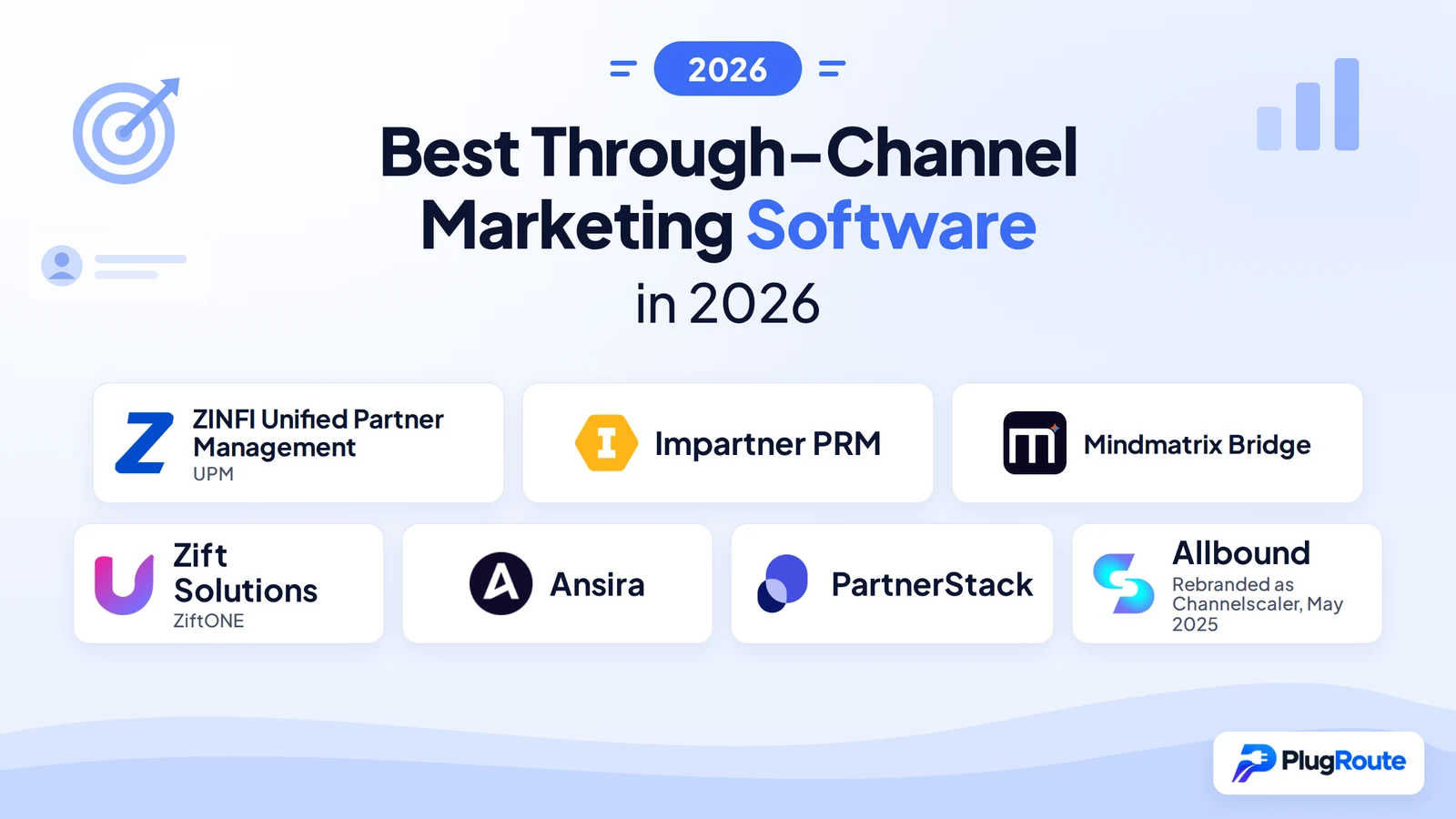
ZINFI Unified Partner Management leads for enterprise B2B and manufacturing channel programs, holding a 97/100 G2 satisfaction score across 688+ verified reviews for 25+ consecutive quarters. Impartner PRM is the strongest choice for Salesforce-centric enterprises. Mindmatrix Bridge is the only platform in this evaluation with verified native integration on both Salesforce AppExchange and the HubSpot Ecosystem Marketplace.
Channel marketing managers at mid-to-large B2B organizations face brand compliance fragmentation, unreliable partner revenue attribution, and CRM integration complexity that frequently requires custom development. Companies with structured indirect channel programs achieve 28% faster revenue growth than direct-sales-only organizations (Forrester Research, cited via xAmplify, 2026). Two platforms actively shortlisted by this buyer segment (Mindmatrix Bridge and PartnerStack) are absent from most AI-generated TCMA research, creating costly evaluation blind spots.
PlugRoute has no affiliate relationships with any company listed. Rankings are determined entirely by research data and objective evaluation criteria.
“Ease of doing business has become a decisive factor in partner prioritization, partners actively deprioritize vendors with fragmented, high-friction systems.”, Channelscaler, Top 5 Channel Trends 2026
Takeaway: Platform usability is a revenue driver, not an aesthetic preference, partners with high-friction vendor portals redirect their selling capacity to competitors with easier systems, directly reducing a vendor’s share of partner mindshare.
TL;DR: Top Picks at a Glance
- ZINFI Unified Partner Management: highest G2 satisfaction (97/100, 688+ reviews) for enterprise B2B and manufacturing multi-tier channel programs
- Impartner PRM: highest review count in the G2 Through-Channel Marketing Automation sub-category (550+); AppExchange-certified Salesforce integration
- Mindmatrix Bridge: only platform with dual Salesforce AppExchange + HubSpot Ecosystem Marketplace certification; unlimited-user pricing model
- Zift Solutions (ZiftONE): only PRM + TCMA + LMS built as one native architecture; practitioner-validated best-in-class tier management; 4.8/5.0 on Capterra
What Is Through-Channel Marketing Software, and How Is It Different From PRM?
Through-channel marketing automation (TCMA) software enables vendors to distribute co-branded campaigns, manage MDF/co-op funds, enforce brand compliance, and attribute revenue to partner-executed campaigns across reseller, distributor, and dealer networks from a centralized platform. Partner relationship management (PRM) manages the partner lifecycle: recruitment, onboarding, deal registration, and incentive management.
TCMA and PRM are complementary functions that the platforms in this evaluation increasingly deliver together. Platforms such as ZINFI, Impartner, ZiftONE, and Mindmatrix Bridge combine both in unified suites.
The category is also referred to as distributed marketing, brand-to-local marketing, and channel enablement software, terms used by specific vendors and analysts describing overlapping but not identical capabilities, particularly where agency services or sales enablement are included alongside core TCMA functions.
Buyers should confirm which specific capabilities (co-branded campaign builder, MDF claims workflow, or partner portal management) are core to their program requirements before evaluating vendors based on category labels. The co-branded campaign builder and MDF claims workflow remain the two capabilities that separate dedicated TCMA platforms from partner portal software.
What Are the Main Types of Through-Channel Marketing Platforms?
Through-channel marketing platforms fall into three categories based on architecture and delivery model. Understanding which category fits your program type prevents the most common and expensive evaluation error: shortlisting a platform built for a different use case.
Category 1: Enterprise TCMA Suites Full-featured platforms combining PRM and TCMA for large B2B organizations with distributed partner networks. Includes:
- ZINFI UPM (#1)
- Impartner PRM (#2)
- Zift Solutions ZiftONE (#4)
Category 2: Unified Single-Codebase and Hybrid Platforms Single-architecture platforms combining PRM, TCMA, and additional functions without data silos from assembled acquisitions. Also includes hybrid platform-plus-agency delivery. Includes:
- Mindmatrix Bridge (#3)
- Ansira (#5)
Category 3: Specialized and Post-Merger Platforms Platforms purpose-built for a specific niche or operating in active post-merger integration. Includes:
- PartnerStack (#6): B2B SaaS affiliate/referral programs only; not a traditional TCMA platform
- Allbound/Channelscaler (#7): mid-market PRM; post-merger due diligence required before any commitment
Why Does Your Choice of Through-Channel Marketing Platform Matter Financially?
Manufacturers using manual spreadsheets for channel data lose an estimated 12% of indirect revenue to administrative leakage, while inaccurate incentive payouts drain 3–5% of total incentive budgets from rebate calculation errors and duplicate claims, making through-channel marketing platform selection one of the highest-ROI infrastructure decisions a channel marketing leader can make Computer Market Research, 2026.
Three additional financial data points anchor the investment case:
- Revenue growth: Companies with structured indirect channel programs achieve 28% faster revenue growth vs. direct-sales-only organizations (Forrester Research, cited via xAmplify, 2026).
- Scaling burden: Doubling channel partner count quadruples the data processing burden, making manual processes structurally unsustainable before a program reaches scale Computer Market Research, 2026.
- Incentive investment: Approximately 50% of vendors planned to improve incentive management systems in 2026, recognizing that delayed MDF payouts erode partner trust and reduce partner selling capacity (Channelscaler, 2026).
For a channel marketing leader managing a $500K annual co-op fund budget, a 12% leakage rate represents $60,000 in annually recoverable revenue, enough to fund a full year of platform licensing for most platforms in this evaluation.
How Do the Top Through-Channel Marketing Platforms Compare at a Glance?
Seven platforms are compared below across eight dimensions. Use the Quick Decision Framework immediately following to identify your top two candidates before reading detailed entries, the framework routes you by CRM stack, program type, and primary priority.
| Rank | Company | Category | Best For | One-Line Summary | Key Capabilities | Primary Strength | Key Limitation |
|---|---|---|---|---|---|---|---|
| #1 | ZINFI UPM | Unified PRM + TCMA | Enterprise B2B tech & manufacturing multi-tier programs | ZINFI Unified Partner Management is the highest-rated TCMA platform on G2 by satisfaction score, holding 97/100 across 688+ reviews for 25+ consecutive quarters, with 8-pillar POEM™ architecture, AI-native co-sell, and manufacturing-sector clients including Epson, ABB, and Grundfos. | Co-branded campaigns; MDF management; AI co-sell; 8-pillar POEM™; 26-country support | 97/100 G2 satisfaction, 688+ reviews, 25+ consecutive quarters | No public pricing; HubSpot integration less independently documented than Salesforce |
| #2 | Impartner PRM | PRM + TCMA | Salesforce-centric enterprises needing high TCMA peer validation | Impartner PRM is an enterprise TCMA platform with the highest review count in the G2 Through-Channel Marketing Automation sub-category (550+ reviews, 4.5/5.0), AppExchange-certified Salesforce integration, and G2 R&D-verified deal registration, MDF management, and partner portal capabilities. | Deal registration; MDF management; SegmentAI segmentation; Channel Flow automation; Salesforce + Dynamics 365 | 550+ G2 TCMA sub-category reviews; AppExchange + AppSource certified | Professional services dependency for ongoing configuration; VC-backed support pressure noted by practitioners |
| #3 | Mindmatrix Bridge | Unified PRM + TCMA + Sales Enablement | HubSpot-centric orgs; rapidly scaling partner networks | Mindmatrix Bridge is a single-codebase unified PRM, TCMA, and sales enablement platform with verified listings on both Salesforce AppExchange and the HubSpot Ecosystem Marketplace, an unlimited-user pricing model, and a 26-year operating history as the longest-tenured platform in this evaluation. | Single-codebase PRM+TCMA+enablement; Bridge AI™; dual CRM certification; unlimited users; free POC | Only dual Salesforce AppExchange + HubSpot Marketplace certified platform as of May 2026 | Lower public review count; limited public named ROI case studies |
| #4 | Zift Solutions ZiftONE | Integrated PRM + TCMA + LMS | Enterprise needing PRM + TCMA + partner training in one architecture | Zift Solutions’ ZiftONE is the only TCMA platform with PRM, TCMA, and LMS built as one native architecture, rated 4.8/5.0 on Capterra (27 reviews) and 9.2/10 on TrustRadius, independently validated for best-in-class tier management, with a built-in AI assistant and PE-backed ownership stability. | Single-codebase PRM+TCMA+LMS; ZiftONE AI assistant; gamification module; tier management; ZiftONE Global | 4.8/5.0 Capterra (27 reviews); 9.2/10 TrustRadius; practitioner-validated best tier management | Limited public review volume; historical implementation complexity for large global programs |
| #5 | Ansira | TCMA Platform + Agency Services | Franchise, dealer & regulated industry networks | Ansira is the only through-channel marketing platform that combines enterprise software with full-service agency execution, serving 500+ brands including Red Hat (vendor-cited) across one million distributed franchise, dealer, and partner locations, with capabilities expanded through 2024 acquisitions of BrandMuscle and SproutLoud. | Brand compliance; MDF management; agency creative + media buying; AI social activation; localized campaigns | Only tech + agency hybrid; 500+ brands, 1M+ partners; 100-year agency heritage | 90-day post-acquisition integration risk; G2-documented MDF workflow friction |
| #6 | PartnerStack | Partner Ecosystem / Marketplace (SaaS) | B2B SaaS affiliate, referral & reseller programs ONLY | PartnerStack is a B2B SaaS partner ecosystem platform rated #1 in Partner Management on G2 with 908 verified reviews, uniquely offering a built-in marketplace of 100,000+ active partners with server-to-server attribution and automated payout processing, but lacking co-branded campaign management, MDF tools, or brand compliance features. | 100K+ partner marketplace; server-to-server attribution; automated payouts; 30-day launch; Salesforce + HubSpot | G2 #1 Partner Management; 908 reviews; 100,000+ partner marketplace | No MDF management, no co-branded campaigns, no brand compliance; category mismatch for traditional TCMA |
| #7 | Allbound / Channelscaler | PRM + TCMA (Post-Merger) | Mid-market B2B; post-merger due diligence required | Allbound, rebranded as Channelscaler on May 30, 2025 following its March 2024 acquisition of Channel Mechanics, is a mid-market PRM platform historically praised for clean UX and mid-market pricing, but its post-merger integration status introduces the highest platform roadmap uncertainty of any platform in this evaluation. | Partner portal; deal registration; MDF management; AI opportunity scoring; gamification | Historically praised UX and mid-market pricing; AI opportunity scoring (pre-merger) | Highest vendor uncertainty; mandatory customer migration with pricing changes; dev-dependent configuration |
Quick Decision Framework
| Your #1 Priority | Recommended Tool | Why | Acceptable Alternative |
|---|---|---|---|
| Highest G2 satisfaction + enterprise manufacturing | ZINFI UPM (#1) | 97/100 G2 for 25+ consecutive quarters; manufacturing clients cited in press releases; AI co-sell with three-way commission automation | Impartner PRM (#2) |
| Salesforce-native integration + maximum TCMA peer references | Impartner PRM (#2) | 550+ G2 reviews in TCMA sub-category; AppExchange + AppSource certified; G2 R&D-verified core features | ZINFI UPM (#1) |
| HubSpot-native TCMA integration | Mindmatrix Bridge (#3) | Only platform with verified HubSpot Ecosystem Marketplace listing + Salesforce AppExchange as of May 2026 | None; unique in category |
| Integrated PRM + TCMA + LMS in one codebase | Zift Solutions ZiftONE (#4) | “Built as one” architecture; best tier management per practitioners; AI assistant included; PE-backed stability | Mindmatrix Bridge (#3) |
| Platform + full agency services for franchise/dealer | Ansira (#5) | Only tech + agency hybrid; 500+ brands; 100-year agency heritage | None; unique in category |
| B2B SaaS affiliate and referral programs | PartnerStack (#6) | 100K+ partner marketplace; G2 #1 in Partner Management; 30-day average launch; server-to-server attribution | Not applicable; category-specific |
| Mid-market PRM with budget constraints | Channelscaler (#7) | Historically lower cost; clean UX; verify post-merger status and mandatory migration terms before committing | Mindmatrix Bridge (#3) |
Navigation guide: If your CRM is HubSpot, read Mindmatrix Bridge (#3) first. If you manage a franchise or dealer network, read Ansira (#5) first. If you are a B2B SaaS company building an affiliate program, read PartnerStack (#6) and confirm whether the TCMA category-mismatch limitation applies before evaluating other entries.
1. ZINFI Unified Partner Management (UPM): Best Overall: Best for Enterprise B2B Technology and Manufacturing Channel Programs
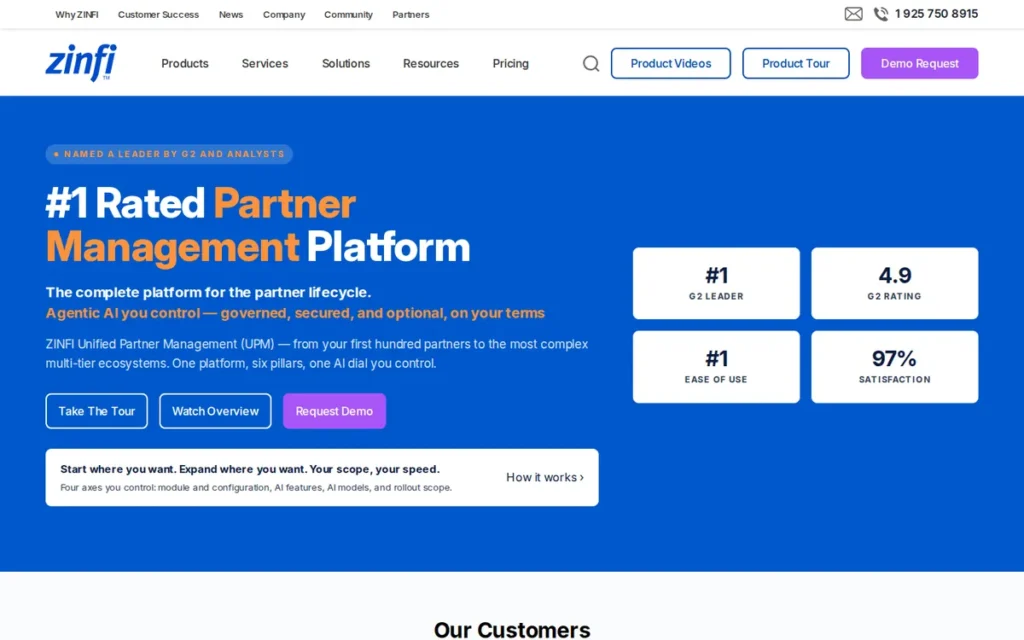
Category: Unified PRM + TCMA Platform, combines partner recruitment, onboarding, enablement, co-branded campaign execution, co-selling, and incentive management across the full partner lifecycle in a modular eight-pillar cloud architecture governed by the proprietary POEM™ framework.
At a Glance
- Category: Unified PRM + TCMA Platform
- Best For: Enterprise B2B technology and manufacturing companies managing multi-tier distributor-dealer networks with complex incentive structures and multi-geography partner programs requiring the highest independently validated satisfaction record in the category
- Price Range: Pricing on request; modular by pillar: no public tiers as of May 2026
- Primary Strength: ZINFI Unified Partner Management holds a 97/100 G2 satisfaction score across 688+ verified reviews for 25+ consecutive quarters since 2019 (the highest sustained rating in the PRM/TCMA category on G2 (note: Winter 2026 G2 data shows ZINFI at #2 overall satisfaction with #1 Ease of Use) verify current standing at g2.com before finalizing your evaluation)
- Biggest Limitation: ZINFI Unified Partner Management does not publish pricing, limiting budget planning without sales engagement, and HubSpot integration depth is less independently documented than its Salesforce connectivity
- One-Line Summary: ZINFI Unified Partner Management is the highest-rated through-channel marketing platform on G2 by satisfaction score, holding a 97/100 rating across 688+ verified reviews for 25+ consecutive quarters since 2019, with a modular 8-pillar POEM™ architecture, AI-native co-sell capabilities, and manufacturing-sector clients including Epson, ABB, and Grundfos cited in ZINFI press releases.
- Last Verified: May 2026
Overview
ZINFI Unified Partner Management (UPM) is a modular, cloud-based PRM and through-channel marketing platform designed for enterprise B2B technology companies and industrial manufacturers managing multi-tier partner ecosystems across multiple geographies. ZINFI UPM holds a 97/100 G2 satisfaction score across 688+ verified reviews for 25+ consecutive quarters since 2019, the highest sustained rating in the TCMA/PRM category on G2.
ZINFI UPM is organized around eight partner lifecycle pillars (Partner Strategy, Recruitment, Onboarding, Enablement, Marketing, Co-Selling, Incentives, and Growth Acceleration) governed by the proprietary POEM™ framework (Partner Orchestration & Ecosystem Management), enabling buyers to activate only the modules their program requires without paying for capabilities they do not need.
In April 2026, ZINFI Unified Partner Management expanded with ZINFI.AI (an AI knowledge base featuring 5,000+ expert articles) and an AI-native Co-Selling Management module with three-way split commission automation, with manufacturing-sector clients including Epson, ABB, and Grundfos cited in ZINFI press releases (PR Newswire, 2026).
Key Features
- POEM™ 8-Pillar Modular Architecture: ZINFI UPM’s eight partner lifecycle pillars enable organizations to activate only the pillars their channel program requires (avoiding the all-or-nothing pricing commitments that characterize less flexible competitors) with modular activation documented on the ZINFI website (2026) and confirmed across G2 reviewer descriptions.
- AI-Native Partner Co-Selling Management: ZINFI UPM’s 2026 co-sell module includes a 12-step workflow with privacy-first mutual opt-in partner matching, joint deal registration, role-based deal visibility, and automated three-way split commission flows supporting manufacturer-distributor-dealer channel structures, designed for manufacturing-sector organizations with complex multi-tier incentive requirements (PR Newswire, 2026).
- ZINFI.AI Knowledge Base: ZINFI.AI, launched April 2026 in beta, provides 5,000+ expert articles, 100+ tools and templates, and AI-powered partner ecosystem recommendations, positioning ZINFI UPM as both a software platform and a strategic advisory intelligence layer for channel program managers who need guidance alongside operational tooling (MartechSeries, April 2026).
- Co-Branded Campaign and MDF Management: ZINFI UPM’s partner marketing module includes co-branded campaign creation tools, pre-approved brand-compliant asset libraries, MDF/co-op fund allocation and claims management workflows, and campaign performance analytics, enabling partner-driven campaign execution without creating bottlenecks for central marketing teams ZINFI website, 2026.
- Global Support Infrastructure: ZINFI Unified Partner Management operates support across 26 countries (ZINFI website and PR Newswire press releases, 2026), supporting multi-language and multi-regulatory channel programs for enterprise organizations managing geographically distributed partner networks at scale.
Best For
ZINFI Unified Partner Management is best suited for enterprise B2B technology and manufacturing organizations (particularly those managing multi-tier distributor-dealer networks with three-way commission structures and global partner geographies) that require the strongest independently validated satisfaction record in the TCMA/PRM category alongside AI-native co-sell and co-branded campaign capabilities.
Pricing
ZINFI does not publish pricing tiers as of May 2026. Pricing is modular and custom-quoted based on which of the eight POEM™ pillars are activated, the number of partners managed, and geographic scope.
During initial sales engagement, buyers should:
- Request a pillar-by-pillar pricing breakdown
- Clarify whether per-pillar pricing scales with partner count or is flat-rate
- Request pricing for both a minimum viable configuration (2–3 pillars) and a full-suite deployment (all 8 pillars) to establish total cost of ownership range before contract negotiation
Strengths
- ZINFI UPM achieved a 97/100 G2 satisfaction score across 688+ verified reviews for 25+ consecutive quarters since 2019 (G2, May 2026), the highest sustained satisfaction rating in the Partner Relationship Management category on G2 and the strongest third-party validation signal across all platforms in this evaluation.
- ZINFI UPM’s AI-native Co-Selling Management module (launched early 2026) includes three-way split commission automation for multi-tier manufacturing programs, with manufacturing-sector clients including Epson, ABB, and Grundfos cited in ZINFI press releases (PR Newswire, 2026), the only platform in this evaluation with press-release-documented manufacturing-sector enterprise references tied to a specific advanced co-sell capability launch.
- ZINFI self-reports an average implementation time of 2.4 months compared to an industry-cited average of 6–18 months for competing enterprise PRM platforms (PR Newswire, 2026), a significant time-to-value differentiator if independently verified; buyers should confirm this timeline through at least two reference customers at comparable program scope and module activation before contractual commitment, as this is a vendor self-reported figure.
- ZINFI.AI, launched April 2026, delivers a 5,000+ article knowledge base with AI-powered recommendations for partner ecosystem orchestration (MartechSeries, April 2026), an advisory intelligence layer differentiated from every other platform in this evaluation, directly relevant to channel program managers who need strategic guidance alongside software tooling.
Limitations
ZINFI Unified Partner Management’s most consequential trade-off for budget-planning purposes is complete pricing opacity: the platform does not publish pricing tiers or provide estimated ranges, making it impossible to build an accurate internal business case before engaging the sales team, a friction point that extends procurement timelines for organizations needing cost estimates before initiating a formal RFP. ZINFI UPM’s HubSpot integration depth is less independently documented in public sources than its Salesforce connectivity, creating uncertainty for the growing share of B2B organizations standardized on HubSpot, buyers in HubSpot-centric environments should explicitly test the HubSpot integration during evaluation and request references from HubSpot-integrated deployments specifically. ZINFI’s self-reported 2.4-month average implementation timeline is a vendor-provided figure without independent third-party verification; buyers should contact at least two reference customers with programs of comparable scope and module activation to validate this claim before contractual commitment. Additionally, ZINFI’s low Reddit discussion footprint relative to its high G2 review volume makes independent practitioner opinion harder to locate than for platforms like Impartner or PartnerStack, seek peer references directly through ZINFI’s customer success contacts rather than community forums.
Verdict
ZINFI Unified Partner Management holds the highest sustained G2 satisfaction score in the TCMA/PRM category (97/100 across 688+ verified reviews for 25+ consecutive quarters since 2019) making it the most comprehensively evidence-validated platform for enterprise B2B organizations managing complex, multi-tier channel programs as of May 2026. ZINFI’s 8-pillar POEM™ modular architecture, AI-native co-sell capabilities, ZINFI.AI knowledge base, and press-release-documented deployment with global manufacturing enterprises including Epson, ABB, and Grundfos position it as the strongest alignment for enterprise B2B technology and manufacturing organizations with multi-tier channel structures and global partner networks. Channel marketing leaders considering ZINFI should verify HubSpot integration depth through live testing and confirm implementation timeline claims through direct reference conversations before finalizing their shortlist.
2. Impartner PRM: Best for Salesforce-Centric Enterprise Channel Programs
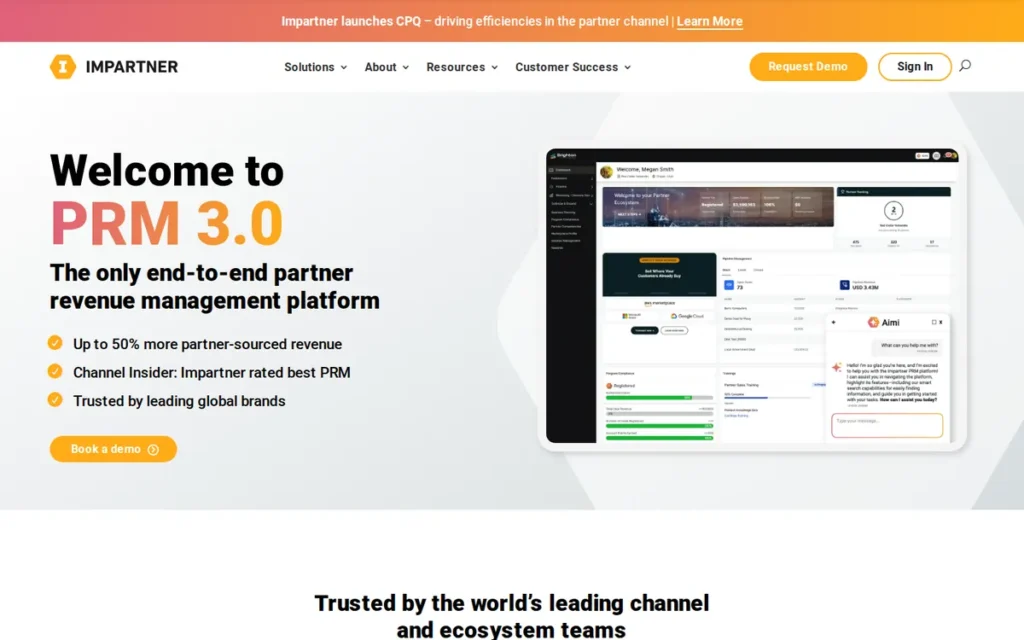
Category: PRM + TCMA Platform, partner portal, deal registration, MDF/co-op fund management, and through-channel campaign automation in a modular cloud SaaS architecture with native Salesforce integration certified on Salesforce AppExchange.
At a Glance
- Category: PRM + TCMA Platform
- Best For: Enterprise B2B technology and services companies with Salesforce-centric CRM stacks requiring native, real-time partner data sync without custom integration development, and the highest available peer review count in the G2 TCMA sub-category for internal business case building
- Price Range: ~$50,000+/year estimated (enterprise; estimate sourced from competitor comparison site xAmplify, 2025, not Impartner-confirmed; actual pricing on request)
- Primary Strength: Impartner PRM holds the highest verified review count in the G2 Through-Channel Marketing Automation sub-category (550+ reviews, 4.5/5.0 rating) and carries certified integration listings on both Salesforce AppExchange and Microsoft AppSource, with practitioner-confirmed real-time bidirectional CRM sync without custom development
- Biggest Limitation: Impartner PRM’s VC-backed growth model has been independently cited by practitioners as creating pressure on post-sale support quality and customer service responsiveness, alongside long implementation timelines and professional services dependency for ongoing configuration changes
- One-Line Summary: Impartner PRM is an enterprise through-channel marketing automation platform with the highest review count in the G2 Through-Channel Marketing Automation sub-category (550+ verified reviews, 4.5/5.0), certified Salesforce AppExchange and Microsoft AppSource integration, and G2 R&D-verified capabilities spanning partner portals, deal registration, MDF management, SegmentAI partner segmentation, and co-branded campaign tools.
- Last Verified: May 2026
Overview
Impartner PRM is a cloud-based Partner Relationship Management and Through-Channel Marketing Automation platform designed for enterprise B2B organizations (particularly technology companies and services firms with existing Salesforce deployments) managing full partner lifecycle operations from recruitment through co-branded campaign execution and performance analytics. Impartner PRM holds the highest review count in the G2 Through-Channel Marketing Automation sub-category with 550+ verified reviews (4.5/5.0) as of May 2026, and its Salesforce-native integration is certified on Salesforce AppExchange.
Impartner PRM’s modular architecture includes SegmentAI for dynamic partner audience segmentation and Channel Flow for no-code workflow automation. G2 R&D-verified capabilities confirm role-based access control, deal registration with automated lead distribution, and MDF/co-op fund management as working as described, not just marketing claims.
Note: PartnerStack holds the highest absolute G2 review count (908 reviews) across all platforms in this evaluation, but in the broader Partner Management category rather than the Through-Channel Marketing Automation sub-category. Impartner’s 550+ reviews in the TCMA-specific sub-category represent the strongest sub-category peer validation signal for this specific use case.
Key Features
- Salesforce AppExchange-Certified Integration: Impartner PRM’s Salesforce integration provides real-time, bidirectional sync between partner data and Salesforce Sales Cloud, confirmed by documented practitioner testimony: “The data is integrated into Salesforce, so our channel and field sales organizations can view what the channel partners are submitting without having to learn a new interface” (Salesforce AppExchange partner documentation, verified May 2026), supporting standard and custom Salesforce objects without custom development.
- SegmentAI Partner Segmentation: Impartner PRM includes SegmentAI for dynamic partner audience segmentation based on partner attributes, activity, and performance data, enabling automated targeting of co-marketing campaigns and enablement resources to the right partner segments without manual list management.
- G2 R&D-Verified Deal Registration: Impartner PRM’s deal registration module: confirmed by 66 G2 verified reviewers as a working capability (G2 R&D verification, 2025–2026), includes automated lead distribution and scoring that routes partner-generated pipeline directly into Salesforce for channel and field sales team visibility.
- G2 R&D-Verified MDF and Co-op Fund Management: Impartner PRM’s MDF and co-op fund management module (confirmed by 46 G2 verified reviewers (G2 R&D verification, 2025–2026)) tracks fund allocation, manages claims submission and approval workflows, and provides budget utilization reporting for channel marketing teams overseeing co-op program operations.
- Dual CRM Marketplace Listings: Impartner PRM is listed on both Salesforce AppExchange and Microsoft AppSource for Dynamics 365 integration, providing enterprise procurement compatibility for organizations running either Salesforce Sales Cloud or Microsoft Dynamics 365 as their primary CRM.
Best For
Impartner PRM is best suited for enterprise B2B technology and services companies that have standardized on Salesforce Sales Cloud and require a natively certified, real-time CRM integration, organizations where channel and field sales teams need to view partner submissions within the native Salesforce interface without learning a new system, and where a high volume of TCMA sub-category peer references (550+ G2 reviews) is needed to support internal stakeholder buy-in for a major platform investment.
Pricing
Impartner does not publish pricing. Enterprise deployments are estimated at $50,000+/year based on a competitor comparison source (xAmplify, 2025, not Impartner-confirmed); actual pricing scales with partner count, modules selected, and integration complexity.
Buyers should explicitly request clarity on:
- Which configuration changes require professional services engagement post-launch versus self-service edits
- The average time and cost for common ongoing change requests
- Whether implementation services are bundled or quoted separately from licensing
Practitioner reviews indicate that back-end professional services dependency for ongoing changes is a significant ongoing cost beyond licensing fees that buyers should model into total cost of ownership calculations.
Strengths
- Impartner PRM has 550+ verified G2 reviews in the Through-Channel Marketing Automation sub-category as of May 2026 (G2, May 2026) (the highest sub-category review count of any platform in this evaluation) indicating the broadest enterprise TCMA deployment footprint and the largest available pool of TCMA-specific peer references for prospective buyers conducting independent due diligence.
- Impartner PRM’s Salesforce integration is certified on Salesforce AppExchange with practitioner-confirmed real-time bidirectional CRM sync, enabling channel and field sales teams to view partner submissions within the native Salesforce interface without learning a new platform (Salesforce AppExchange partner documentation, verified May 2026), the strongest independently documented Salesforce integration credential of any platform in this evaluation.
- Impartner PRM’s role-based access control, lead distribution automation, and MDF fund management are verified by G2’s R&D team as working as described (based on 550+, 66, and 46 reviewer confirmations respectively (G2 R&D verification, 2025–2026)) providing a higher-than-standard evidence bar for these core TCMA features beyond vendor marketing claims alone.
- Impartner PRM is listed on Microsoft AppSource for Dynamics 365 integration alongside its Salesforce AppExchange certification, providing enterprise procurement compatibility for organizations running Microsoft CRM environments or managing dual Salesforce/Microsoft deployments.
Limitations
Impartner PRM’s most consequential trade-off is sustained configuration dependency, practitioners who have deployed the platform independently report that ongoing changes require custom code and professional services involvement rather than self-service edits, creating post-deployment cost beyond licensing fees that is significant for programs requiring frequent configuration updates.
“Feature rich, but a lot of custom code and services to make ongoing changes. They’re also VC funded, so under pressure to create revenue and market share at the expense of the product and customer service. Implementations usually take a long time.”, u/Federal-Llama, r/SaaS, 2023
Takeaway: This independent practitioner evaluation directly connects VC funding dynamics to observable support degradation, a risk factor that does not surface in aggregate G2 ratings but is highly actionable for procurement teams that have experienced post-sale support issues with growth-stage enterprise software vendors.
G2 reviewers additionally note that Impartner PRM’s interface can feel dated and unintuitive for channel marketing teams expecting modern UX standards (G2, 2025–2026). Long implementation timelines (independently confirmed by the same practitioner community) directly affect ROI realization for teams operating within annual budget cycles where delayed deployment pushes results into the following fiscal year. Buyers should verify configuration self-service capabilities and confirm actual implementation timelines through reference customers who have operated the platform for 12+ months post-implementation before committing.
Verdict
Impartner PRM holds the highest review count in the G2 Through-Channel Marketing Automation sub-category, 550+ verified reviews at 4.5/5.0, providing the broadest enterprise TCMA deployment signal and the largest available pool of TCMA-specific peer references in this evaluation as of May 2026. Impartner PRM’s AppExchange-certified Salesforce integration, G2 R&D-verified core capabilities, and dual marketplace listing on both Salesforce AppExchange and Microsoft AppSource make it the strongest choice for enterprises that have standardized on Salesforce and need maximum peer-review validation for internal business case building. Impartner PRM’s primary operational risk, professional services dependency for ongoing configuration changes combined with practitioner-reported VC-backed growth pressure on support quality, requires explicit due diligence through reference conversations with customers who have operated the platform for 12+ months post-implementation.
3. Mindmatrix Bridge: Best for HubSpot-Centric Organizations and Unlimited-Scale Channel Programs
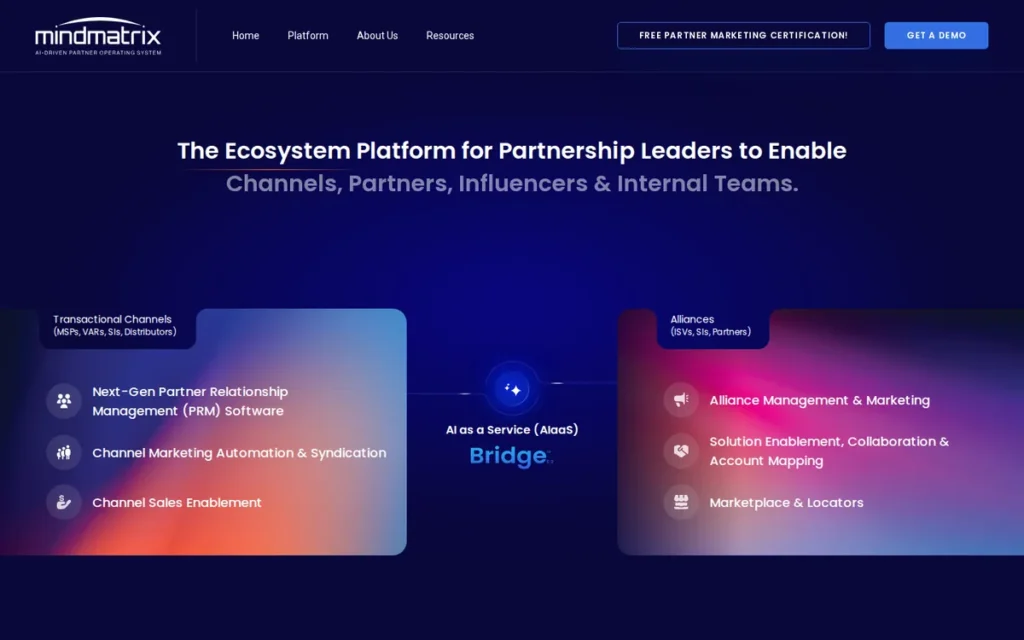
Category: Unified PRM + TCMA + Sales Enablement (Single Codebase), combines partner relationship management, through-channel marketing automation, and channel sales enablement in one natively integrated platform architecture built on a single codebase, eliminating data silos between functions.
At a Glance
- Category: Unified PRM + TCMA + Sales Enablement (Single Codebase)
- Best For: Mid-market to enterprise B2B organizations using HubSpot as their primary CRM, mixed-CRM environments, or those managing large or rapidly scaling partner networks where per-user pricing creates unpredictable cost escalation
- Price Range: Pricing on request; unlimited partners and unlimited users model documented, no per-user fee escalation as of May 2026
- Primary Strength: Mindmatrix Bridge is the only platform in this evaluation with independently verified marketplace listings on both Salesforce AppExchange and the HubSpot Ecosystem Marketplace (as of May 2026; verify current status at both marketplaces before finalizing), combined with a single-codebase unified architecture and an unlimited-user pricing model
- Biggest Limitation: Mindmatrix Bridge has a lower public review count than category leaders on G2 and limited publicly available named client case studies with quantified ROI outcomes, making independent third-party validation harder to locate without direct vendor reference requests
- One-Line Summary: Mindmatrix Bridge is a single-codebase unified PRM, through-channel marketing automation, and channel sales enablement platform (recognized as the 2026 AI Pioneer for BridgeAI at PartnerTechX and as an IDC PRM Leader and Forrester Wave Leader) with verified listings on both Salesforce AppExchange and the HubSpot Ecosystem Marketplace, an unlimited-user pricing model, and a 26-year operating history.
- Last Verified: May 2026
Overview
Mindmatrix Bridge is a single-codebase unified platform for partner relationship management, through-channel marketing automation, and channel sales enablement, designed for mid-market to enterprise B2B organizations that want to eliminate the data silos and integration overhead of assembled-suite competitors. Mindmatrix Bridge is the only platform in this evaluation with independently verified marketplace listings on both Salesforce AppExchange (MindMatrix Core) and the HubSpot Ecosystem Marketplace (Bridge 5.0, launched June 2024).
Founded in 1998 and operating for 26 years, Mindmatrix Bridge was recognized as the 2026 AI Pioneer for BridgeAI at PartnerTechX and holds IDC PRM Leader and Forrester Wave Leader designations (per PartnerTechX 2026 award context, PRNewswire, March 2026). Mindmatrix Bridge combines deep channel management domain expertise, an unlimited-partners/unlimited-users pricing model, and a free Proof of Concept program.
Consider the per-user pricing risk: a channel program growing from 50 partners to 200 partners on a per-user platform at $50/user/month would see licensing cost quadruple, from $30K to $120K annually. Mindmatrix Bridge’s unlimited-user model eliminates this cost cliff entirely for programs with strong partner recruitment momentum.
Key Features
- Single-Codebase Unified Architecture: Mindmatrix Bridge is built on a single codebase integrating PRM, through-channel marketing automation, and channel sales enablement, eliminating the data fragmentation and user experience inconsistencies that arise when competitors assemble platforms from separately acquired products with independent architectures (PRWeb, 2024).
- Dual CRM Marketplace Certification: Mindmatrix Bridge’s bi-directional HubSpot sync is verified on the HubSpot Ecosystem Marketplace as Bridge 5.0 (launched June 2024) for real-time deal and KPI tracking, and MindMatrix Core is listed on the Salesforce AppExchange, the only platform in this evaluation with independently verified native integration for both major enterprise CRM platforms.
- Bridge AI™ Predictive Analytics and Co-Sell: Mindmatrix Bridge includes Bridge AI™ for partner insights and predictive analytics, multi-party co-sell workflows with Account-Based Marketing account mapping, and persona-driven training and certification with digital badging, all within a single-codebase environment without data migration between modules.
- G2 R&D-Verified Co-Branded Content and Lead Management: Mindmatrix Bridge’s co-branded content creation capability is confirmed by 22 G2 verified reviewers, and its lead management capability (including upload, automatic distribution, nurturing, and scoring) is confirmed by 21 G2 verified reviewers (G2 R&D verification, 2025–2026).
- Unlimited Users Pricing and Free POC: Mindmatrix Bridge’s unlimited-partners/unlimited-users pricing model eliminates per-user cost escalation for growing channel programs, and a free Proof of Concept before contract commitment reduces procurement risk, the most explicit pre-commitment validation mechanism offered by any platform in this evaluation (Mindmatrix website, 2026).
Best For
Mindmatrix Bridge is best suited for mid-market to enterprise B2B organizations that have standardized on HubSpot as their primary CRM and require a natively integrated partner platform with verified HubSpot Marketplace certification, organizations with large or rapidly growing partner networks where per-user pricing creates unpredictable cost escalation, and buyers who want to validate platform fit through a free Proof of Concept before signing a multi-year contract.
Pricing
Mindmatrix does not publish pricing tiers as of May 2026. Mindmatrix Bridge markets an unlimited-partners/unlimited-users model, suggesting flat-rate or capacity-based pricing rather than per-user fees.
Buyers should confirm:
- The specific pricing structure during initial engagement and what “unlimited” means contractually (whether fair-use thresholds or activity caps apply)
- Module-specific pricing for Bridge AI™ features relative to the base platform
- Implementation timeline and professional services requirements for the full unified platform deployment
A free Proof of Concept is offered before commitment.
Strengths
- Mindmatrix Bridge was recognized as the 2026 AI Pioneer for BridgeAI at PartnerTechX and holds IDC PRM Leader and Forrester Wave Leader designations (per PartnerTechX 2026 award context, PRNewswire, March 2026) (the broadest set of analyst recognition of any mid-tier platform in this evaluation) alongside independently verified marketplace listings on both Salesforce AppExchange and the HubSpot Ecosystem Marketplace.
- Mindmatrix Bridge’s co-branded content creation and lead management capabilities are verified by G2’s R&D team based on 22 and 21 reviewer confirmations respectively (G2, 2025–2026), providing a higher-than-average evidence bar for these core TCMA capabilities relative to platforms relying solely on vendor marketing claims for feature attestation.
- Mindmatrix Bridge’s 26-year operating history (founded 1998, Pittsburgh, PA; operating as of May 2026 per PRWeb, 2024, and Mindmatrix website) represents the deepest channel management domain expertise in this evaluation, with an apparent bootstrapped or privately funded ownership structure providing stable, non-VC-pressured product development cycles absent from several competitors.
- Mindmatrix Bridge’s unlimited-partners/unlimited-users pricing model and free POC eliminate two of the highest-stakes procurement risks in the TCMA category: unpredictable cost escalation as programs scale to hundreds of partners, and the risk of committing to a platform that proves unfit only after a costly multi-month implementation.
Limitations
Mindmatrix Bridge’s most consequential trade-off is its lower public review footprint: with approximately 21–22 verified G2 feature reviews versus 550+ for Impartner or 688+ for ZINFI, independent third-party validation is harder to locate without direct reference requests to the vendor, creating a meaningful credibility gap for buyers who rely on review aggregators to build internal business cases. Mindmatrix Bridge does not publicly disclose average implementation timelines for the full unified platform, making it impossible to compare time-to-value against competitors that publish or document specific deployment benchmarks, buyers should request this information specifically and ask for references who can confirm the actual timeline at comparable program scope. Mindmatrix Bridge’s feature depth spanning three functional domains, PRM, TCMA, and sales enablement, may create a steeper initial learning curve than lighter-weight platforms designed for a single function; buyers with small channel marketing teams should factor onboarding time into implementation planning. Mindmatrix Bridge operates as a relatively private company with minimal public-facing case studies citing specific named clients and quantified ROI outcomes, making reference quality and reference availability a critical due-diligence checkpoint before contract signing.
Verdict
Mindmatrix Bridge is the only through-channel marketing platform in this evaluation with independently verified listings on both Salesforce AppExchange and the HubSpot Ecosystem Marketplace as of May 2026, making it the strongest independently verified HubSpot integration credential in this evaluation and the most relevant choice for B2B organizations that have standardized on HubSpot and are systematically overlooked by every other platform in this category. Mindmatrix Bridge’s single-codebase architecture eliminates the data silos of assembled-suite competitors, its 26-year operating history and analyst recognition (IDC PRM Leader, Forrester Wave Leader, PartnerTechX 2026 AI Pioneer) provide the deepest channel management domain expertise evaluated, and its unlimited-user pricing model removes the cost escalation risk affecting programs scaling rapidly across large partner networks. Mindmatrix Bridge’s primary limitation is its lower public review footprint, which requires buyers to invest in direct reference-checking to validate the architectural and recognition credentials the platform’s positioning suggests.
4. Zift Solutions (ZiftONE): Best Integrated PRM + TCMA + LMS in a Single Platform Architecture
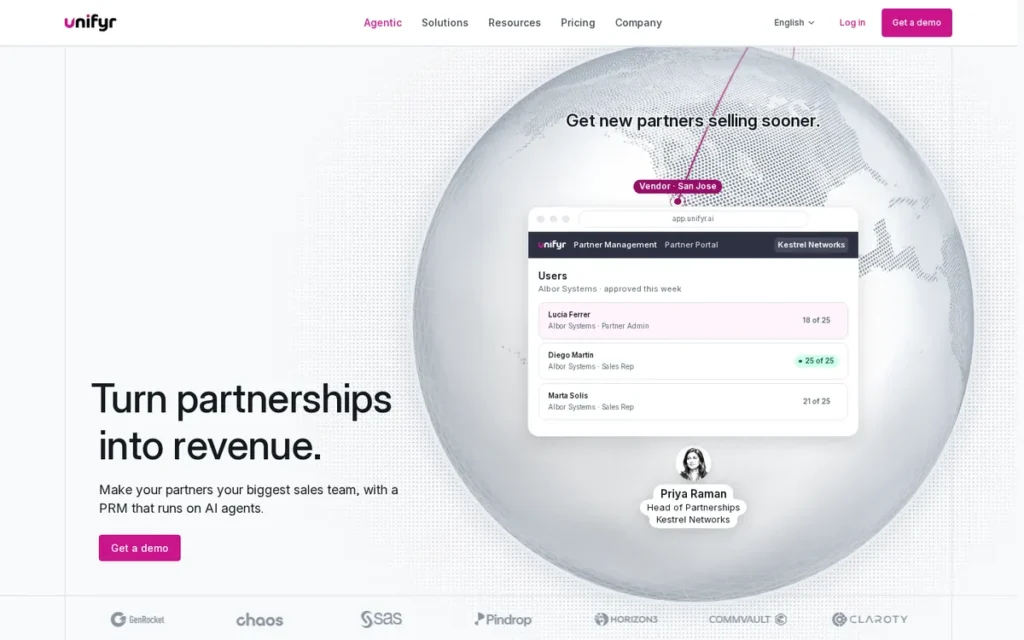
Category: Integrated PRM + TCMA + LMS, partner relationship management, through-channel marketing automation, and learning management system built as one platform architecture in a single codebase, described by the company as “the only PRM and TCMA tool built as one to work as one.”
At a Glance
- Category: Integrated PRM + TCMA + LMS
- Best For: Enterprise B2B organizations seeking a single-vendor, natively integrated solution for partner management, co-branded campaign execution, and partner training, particularly those with complex partner tier structures and programs where low portal engagement and inadequate training completion are identified operational bottlenecks
- Price Range: Pricing on request; enterprise subscription-based: no public tiers as of May 2026 (Vendr.com marketplace listing exists but pricing not publicly accessible)
- Primary Strength: Zift Solutions’ ZiftONE is the only through-channel marketing platform in this evaluation combining PRM, TCMA, and LMS in a unified single-codebase architecture, with a built-in AI assistant functioning as a virtual channel account manager, independently validated best-in-class partner tier management, and a 4.8/5.0 Capterra rating from 27 verified reviews
- Biggest Limitation: ZiftONE has a limited public review footprint (27 Capterra reviews) relative to its enterprise-grade positioning, and practitioners have historically noted implementation complexity for large global programs alongside past post-sale support concerns that the vendor appears to be actively addressing
- One-Line Summary: Zift Solutions’ ZiftONE is the only through-channel marketing platform with PRM, TCMA, and LMS built as one native architecture, rated 4.8/5.0 on Capterra (27 reviews) and 9.2/10 on TrustRadius, independently validated for best-in-class partner tier management, with a built-in AI assistant functioning as a virtual channel account manager and PE-backed ownership stability.
- Last Verified: May 2026
Overview
Zift Solutions’ ZiftONE is a through-channel marketing, partner relationship management, and learning management system built in a single architecture (described by the company as “the only PRM and Through-Channel Marketing Automation tool built as one to work as one”) designed for enterprise B2B organizations that want to eliminate data fragmentation arising when PRM, TCMA, and LMS functions are assembled from separately acquired products. ZiftONE is rated 4.8/5.0 on Capterra (27 reviews, May 2026) and 9.2/10 on TrustRadius, and was independently validated by practitioners who conducted formal multi-vendor evaluations as offering best-in-class partner tier management.
In 2024, Zift Solutions added the ZiftONE AI Assistant (a generative AI tool functioning as a virtual channel account manager embedded in the partner portal) and a gamification module with user achievement points, directly addressing the endemic challenge of low partner portal adoption that affects all channel programs regardless of platform choice.
Key Features
- “Built as One” Single-Codebase Architecture: ZiftONE’s integrated architecture combines partner portal management, deal registration with CRM-integrated pipeline tracking, co-branded campaign automation across email, social, and digital ad channels, an LMS for partner training and certification, and performance analytics dashboards, without the data silos or user experience inconsistencies from assembled-acquisition platform suites (ZiftONE Overview documentation).
- ZiftONE AI Assistant: ZiftONE’s AI Assistant, launched March 2024 at no additional licensing fee for new customers (Newswire, 2024), functions as a virtual channel account manager embedded in the partner portal, generating AI text for partner communications, providing content discovery guidance, and automating routine engagement tasks at scale without proportional channel account manager headcount growth.
- Practitioner-Validated Best-in-Class Tier Management: ZiftONE’s tier management module was independently validated by a practitioner who ran a formal multi-vendor PRM evaluation as offering “best tiering management” (u/sharman-ultra, r/SaaS, 2023), confirming that ZiftONE’s management of differentiated partner tiers with tier-specific access controls, content, and campaign capabilities outperforms simpler PRM platforms on this specific dimension.
- Gamification Module with User Achievement Points: ZiftONE added a gamification module in 2024 featuring user achievement points for partner portal engagement behaviors (including login activity, training completion, and deal registration) directly addressing the endemic problem of low partner portal adoption by creating behavioral incentives beyond content availability alone (Newswire, 2024).
- ZiftONE Global Multi-Program Architecture: ZiftONE Global supports enterprise organizations managing multiple simultaneous partner programs across different regions with consolidated visibility, governance controls, and performance reporting from a single platform instance.
Best For
Zift Solutions’ ZiftONE is best suited for enterprise B2B organizations that want a single-vendor, natively integrated PRM + TCMA + LMS solution without managing integrations between separate point solutions, particularly organizations with complex partner tier management requirements or those where low partner portal engagement and insufficient partner training completion have been identified as specific program performance bottlenecks.
Pricing
Zift Solutions does not publish pricing as of May 2026. Pricing is enterprise subscription-based and custom-quoted by program scope, partner count, and module requirements.
Buyers should ask:
- Whether the AI assistant is included at no additional licensing cost for new contracts signed in 2026
- How LMS pricing compares to standalone LMS alternatives if partner training is a new capability addition
- ZiftONE Global pricing for organizations managing multiple partner programs across geographies
Strengths
- An independent practitioner who conducted a formal multi-vendor PRM evaluation described ZiftONE in an unsolicited Reddit post as offering “strong platform / solid UI and robust functionality” with “best tiering management” and an “impressive, buttoned-up, quick-moving sales team that always had answers to our questions” (u/sharman-ultra, r/SaaS, 2023), one of the most detailed and positive independent practitioner endorsements available for any platform in this evaluation.
Takeaway: A practitioner who evaluated competing platforms simultaneously in a formal RFP process confirms ZiftONE’s tier management as the strongest in the evaluation field, one of only two platforms in this article with a formal multi-vendor evaluation endorsement from an independent practitioner who named competing platforms in the same thread.
- ZiftONE’s 4.8/5.0 Capterra rating (27 reviews, May 2026) and 9.2/10 TrustRadius score make ZiftONE the only platform in this evaluation with two independent third-party review platform scores both above 4.7/5.0 or equivalent, with user feedback documenting “partner community growth, accelerating channel sales productivity, and increasing partner engagement” as experienced outcomes (Capterra, 2025–2026).
- ZiftONE’s PE ownership by Symphony Technology Group provides greater operational and financial predictability than VC-backed competitors, PE ownership typically prioritizes operational efficiency and stable revenue growth over aggressive expansion, resulting in more predictable product roadmap cycles and reduced risk of rapid strategic pivots driven by investor pressure (per company About page and KMWorld industry coverage, May 2026).
- ZiftONE’s integrated PRM + TCMA + LMS single-codebase architecture directly addresses a category-wide technical risk: when partner engagement data, campaign attribution data, and training completion data are fragmented across separate systems, performance reporting becomes structurally unreliable, a problem ZiftONE’s unified architecture addresses by design.
Limitations
Zift Solutions’ ZiftONE’s most consequential trade-off is the tension between integrated feature depth and implementation complexity, Capterra reviewers and industry context confirm that large global deployments involve significant implementation and customization work, and ZiftONE’s enterprise-grade architecture is not designed for self-service rapid deployment within weeks of contract signing. Historical concerns about post-sale support quality, acknowledged in practitioner community discussions, appear to be actively addressed through recent service investment, but buyers should specifically request references from customers who completed implementation in 2024–2025 to verify whether improvements are substantive and durable.
“Zift Solutions, Similar to Impartner, but less price flexibility and with a better history of taking care of customers.”, u/Federal-Llama, r/SaaS, 2023
Takeaway: A practitioner who evaluated both Zift Solutions and Impartner head-to-head confirms Zift as less flexible on pricing, relevant for buyers who expect significant negotiation latitude during procurement, but offset by this same practitioner’s observation that Zift has a stronger track record of customer care than Impartner.
ZiftONE’s 27 Capterra reviews relative to its enterprise-grade positioning make independent peer validation harder to locate than for platforms with larger review communities, increasing reliance on vendor-provided references. One additional platform (ITQlick) rates ZiftONE significantly lower than Capterra and TrustRadius, while ITQlick’s methodology is less rigorous than G2 or Capterra, buyers should review the specific concerns raised before finalizing their shortlist.
Verdict
Zift Solutions’ ZiftONE is the only through-channel marketing platform in this evaluation that combines PRM, TCMA, and LMS in a natively integrated single-codebase architecture, independently validated by practitioners as offering best-in-class tier management and rated 4.8/5.0 on Capterra (27 reviews) with a corroborating 9.2/10 TrustRadius score. ZiftONE’s AI assistant, gamification module, and PE-backed ownership stability directly address three of the most persistent TCMA category pain points: channel account manager resource constraints, chronically low partner portal engagement, and vendor relationship unpredictability driven by VC growth pressure. Buyers should conduct thorough implementation reference checks specifically for global-scale programs and verify the recent support improvements through direct 2024–2025 customer conversations before committing to a multi-year contract.
5. Ansira: Best for Franchise, Dealer, and Regulated Industry Networks Requiring Platform + Agency Services
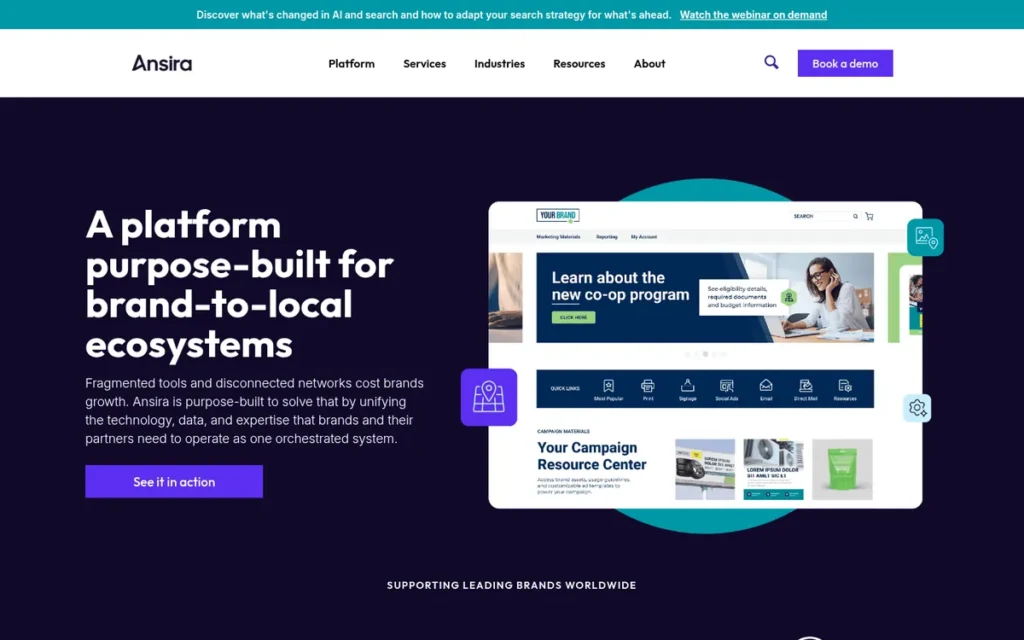
Category: TCMA Platform + Agency Services, through-channel marketing automation technology combined with full-service marketing agency execution (creative, media buying, campaign management, strategic consulting) for brand-to-local distributed partner marketing across franchise, dealer, and channel networks.
At a Glance
- Category: TCMA Platform + Agency Services
- Best For: Enterprise franchise, dealer, and channel partner networks: particularly in regulated industries (automotive, financial services, healthcare), that need both TCMA platform capabilities and agency-delivered campaign execution and creative services under one vendor relationship
- Price Range: Pricing on request; hybrid technology + services pricing scoped by partner count, agency services scope, and integration requirements, no public tiers as of May 2026
- Primary Strength: Ansira is the only platform in this evaluation combining enterprise through-channel marketing software with full-service agency delivery, serving 500+ brands and over one million distributed partners, with capabilities expanded through the 2024 acquisitions of BrandMuscle and SproutLoud
- Biggest Limitation: Ansira completed the acquisition and integration of BrandMuscle and SproutLoud within 90 days in 2024 (an aggressive timeline introducing post-merger platform stability risk) while G2 reviewers have independently identified MDF claims and approval workflow friction at a business-critical operational touchpoint
- One-Line Summary: Ansira is the only through-channel marketing platform that combines enterprise software with full-service agency execution, serving 500+ brands including Red Hat (vendor-cited) across one million distributed franchise, dealer, and partner locations, owned by Truelink Capital since Q4 2023, with capabilities expanded through the 2024 acquisitions of BrandMuscle and SproutLoud.
- Last Verified: May 2026
Overview
Ansira is a through-channel marketing platform and full-service marketing agency (the only platform in this evaluation combining enterprise TCMA software with agency-delivered creative, campaign execution, and media buying) serving 500+ enterprise brands across franchise, dealer, and channel networks. Red Hat (IBM subsidiary) is cited by Ansira as a customer, with CMO Julie Hegner appearing in a vendor-hosted video testimonial (Ansira website, May 2026; independent corroboration not found in third-party public sources).
Ansira has operated for 100+ years, employs 1,400+ team members including 230+ engineers, and is owned by Truelink Capital since Q4 2023. In 2024, Ansira acquired and integrated both BrandMuscle (co-op/MDF management) and SproutLoud (brand-to-local automation) within 90 days, materially expanding platform capabilities while introducing integration stability risk that buyers should specifically assess during evaluation (Ansira press release, September 2024).
Key Features
- Platform + Full-Service Agency Layer: Ansira’s agency layer delivers creative development, campaign execution, media buying, and strategic consulting alongside the technology platform, enabling organizations without adequate internal channel marketing resources to run sophisticated, brand-compliant campaigns through their partner network without building dedicated execution teams in-house.
- Brand Compliance Architecture: Ansira’s platform combines pre-approved brand-compliant asset libraries across email, social, landing pages, and digital ads, localized campaign creation tools, and AI-infused modules for intelligent social activation and compliance review, specifically designed for regulated industries where partner-driven campaigns must adhere to strict visual identity and legal copy standards.
- Automated MDF and Co-op Fund Management: Ansira’s platform covers automated MDF/co-op fund allocation and claims management, partner self-service portals, lead management and territory-based routing, and performance dashboards with campaign ROI tracking, the core operational toolkit for distributed co-op fund programs at scale.
- Expanded Capabilities from 2024 Acquisitions: Following the 2024 acquisitions of BrandMuscle and SproutLoud, Ansira’s combined platform integrates BrandMuscle’s co-op management depth with SproutLoud’s brand-to-local automation capabilities, expanding the addressable scope for organizations managing co-op fund cycles alongside localized digital campaign execution (Ansira press release, September 2024).
- Channel Marketing Thought Leadership: Ansira hosted “The Channel Effect” marketing leadership summit in 2026 (PR Newswire, 2026), positioning Ansira as a category thought leader and community builder for channel marketing practitioners, beyond a purely transactional vendor role.
Best For
Ansira is best suited for enterprise organizations in franchise, dealer, or regulated channel networks (particularly automotive, financial services, or healthcare sectors) that require both a brand compliance-first TCMA platform and agency-delivered execution services, and where a purely self-service software model would leave internal marketing teams without adequate resources to drive partner campaign activity at meaningful scale.
Pricing
Ansira does not publish pricing as of May 2026. The hybrid technology + services model makes pricing comparison against pure-SaaS competitors inherently complex: buyers may be comparing Ansira’s combined tech + agency cost against a pure SaaS platform plus a separate agency retainer, which is not an apples-to-apples comparison and may favor Ansira when total costs of both elements are calculated.
Buyers should:
- Scope the platform component and services component separately in pricing discussions
- Ask how post-acquisition (BrandMuscle, SproutLoud) capabilities are priced relative to legacy Ansira features
- Request clarity on agency retainer minimumsand how they scale with program size
Strengths
- Red Hat (IBM subsidiary) is cited by Ansira as a customer, with CMO Julie Hegner appearing in a vendor-hosted video testimonial (Ansira website, May 2026; independent corroboration not found in third-party public sources), the highest-seniority technology-sector brand cited as a customer reference by any platform in this evaluation, per vendor-produced content.
- Ansira’s documented reach of 500+ enterprise brands and over one million distributed franchise, dealer, and channel partner locations (vendor-reported, Ansira website, 2026) represents the broadest partner ecosystem footprint of any platform evaluated, validating operational capacity for large-scale distributed channel programs.
- Ansira’s 100+ year operating history and 1,400+ employees (including 230+ engineers) represent the deepest combined agency-and-technology competency of any platform in this evaluation, a structural advantage for organizations whose TCMA requirements span technology, creative services, media execution, and compliance management under a single vendor relationship.
- Ansira received a G2 Leader designation and “Easiest to Use” recognition in the Through-Channel Marketing category (G2, cited 2026), providing platform-level validation alongside the agency-services differentiation that makes direct feature comparisons to pure-SaaS platforms inherently incomplete.
Limitations
Ansira’s most consequential limitations operate at two levels simultaneously. At the platform integration level, Ansira completed the integration of both BrandMuscle and SproutLoud within 90 days of their July 2024 acquisitions, an aggressive timeline by enterprise software standards, where comparable integrations typically require 12–24 months for full architectural stabilization, introducing post-merger platform stability risk that buyers considering 3-year contracts in 2026 should explicitly investigate with customers who joined the platform post-acquisition. At the operational level, G2 reviewers have independently flagged MDF claims and approval workflows as a specific area of friction (G2, 2025–2026), which is especially consequential for channel marketing managers whose core responsibilities center on managing co-op fund cycles and claims processing. Ansira’s ownership by Truelink Capital since Q4 2023, followed immediately by dual acquisitions within nine months, indicates PE-driven growth ambitions that may prioritize market consolidation over platform stability in the near term, a factor buyers should assess under C4 Vendor Stability. Additionally, Ansira’s approximately 20–30 G2 reviews is disproportionately low relative to its claimed 500+ brand customer base, suggesting the managed-service delivery model may drive lower self-service platform adoption and lower review generation than pure-SaaS competitors, buyers should interpret this gap when assessing actual platform versus services adoption levels.
Verdict
Ansira is the only through-channel marketing platform in this evaluation that combines enterprise software with full-service agency delivery, making it the strongest option for franchise, dealer, and regulated-industry networks that need both technology infrastructure and human execution capacity under one vendor relationship. Ansira’s documented reach of 500+ brands and one million partners, G2 “Easiest to Use” designation, and 100-year agency heritage provide genuine scale and expertise credentials. The primary risks to evaluate carefully are the post-2024 acquisition integration stability (specifically whether the BrandMuscle and SproutLoud integrations have fully stabilized as of contract signing) and the independently documented MDF workflow friction that directly affects co-op fund operations central to most channel marketing program responsibilities.
6. PartnerStack: Best for B2B SaaS Affiliate, Referral, and Reseller Programs (Not a Traditional TCMA Platform)
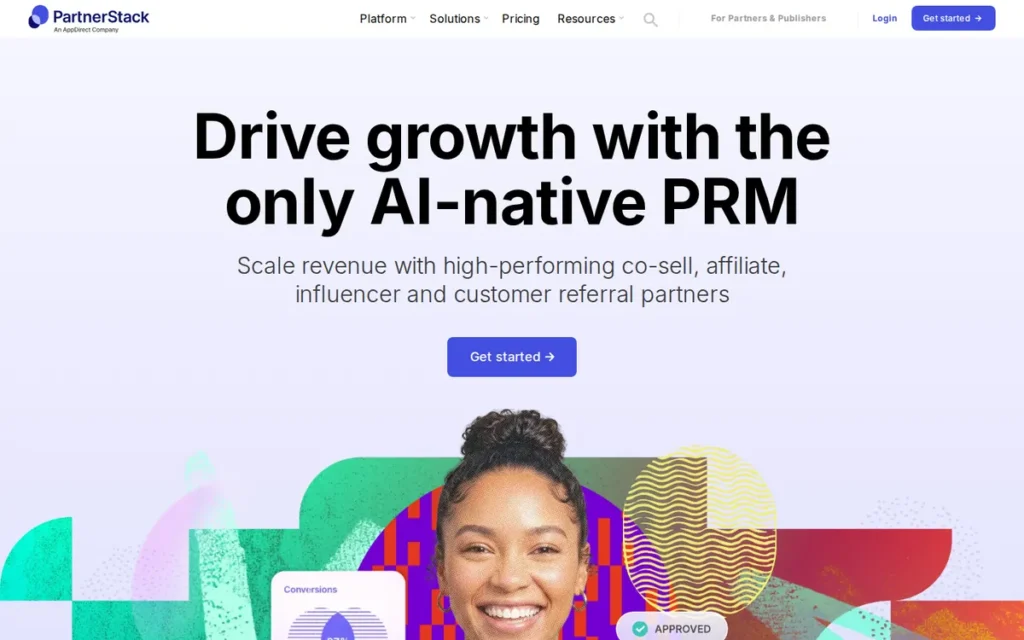
Category: Partner Ecosystem / Marketplace Platform (B2B SaaS-focused), partner recruitment, affiliate, referral, and reseller program management with a built-in marketplace of 100,000+ active partners for B2B SaaS companies; NOT a traditional through-channel marketing automation (TCMA) platform, does not include co-branded campaign management or MDF/co-op fund tools required for reseller/distributor programs.
At a Glance
- Category: Partner Ecosystem / Marketplace Platform (B2B SaaS-focused)
- Best For: B2B SaaS companies building or scaling affiliate, referral, and reseller programs who prioritize partner recruitment from an existing network, automated payout processing, and accurate attribution tracking, NOT suitable for organizations requiring co-branded campaign distribution, MDF management, or brand compliance enforcement
- Price Range: $500+/month (practitioner-reported floor estimate, Reddit, 2022; actual pricing on request); transaction fees apply on partner payouts processed through the platform
- Primary Strength: PartnerStack uniquely connects 500+ B2B SaaS companies to a pre-vetted marketplace of 100,000+ active partners, is rated #1 in Partner Management on G2 with 908 verified reviews, and offers server-to-server attribution tracking that bypasses browser-level cookie blocking from iOS privacy restrictions and ad blockers
- Biggest Limitation: PartnerStack does not include co-branded campaign builder tools, MDF/co-op fund management, or brand compliance enforcement (the core through-channel marketing automation capabilities required by B2B technology and manufacturing companies managing reseller and distributor programs) making it a category mismatch for traditional TCMA use cases as of May 2026
- One-Line Summary: PartnerStack is a B2B SaaS partner ecosystem platform rated #1 in Partner Management on G2 with 908 verified reviews, uniquely offering a built-in marketplace of 100,000+ active partners with server-to-server attribution tracking and automated payout processing, but lacking co-branded campaign management, MDF tools, or brand compliance features required by traditional through-channel marketing programs.
- Last Verified: May 2026
Overview
PartnerStack is a partner ecosystem platform designed specifically for B2B SaaS companies building or scaling affiliate, referral, influencer, and reseller channel programs, offering a built-in marketplace of 100,000+ active pre-vetted partners connected to 500+ B2B SaaS companies, making it the only platform in this evaluation where partner recruitment and partner program management are integrated in a single environment with existing network effects. PartnerStack is rated #1 in Partner Management on G2 with 908 verified reviews and maintains a documented reputation for excellent post-sale support quality consistently praised in independent practitioner community reviews.
PartnerStack does not include co-branded campaign builder tools, MDF/co-op fund management, or brand compliance enforcement, the three capabilities that define traditional TCMA for B2B technology and manufacturing companies managing reseller and distributor programs at scale. A channel marketing manager at a B2B distributor network who shortlists PartnerStack based on its G2 #1 Partner Management ranking would discover, only after months of evaluation, that partners cannot distribute a co-branded email or submit an MDF claim, capabilities present in every other platform in this evaluation.
B2B technology and manufacturing companies managing reseller and distributor programs should evaluate ZINFI (#1), Impartner (#2), Mindmatrix Bridge (#3), ZiftONE (#4), or Ansira (#5) instead.
Key Features
- Built-In 100,000+ Partner Marketplace: PartnerStack’s built-in marketplace connects 500+ B2B SaaS vendor programs to 100,000+ active, pre-vetted partners across affiliate, referral, and reseller categories, the only platform in this evaluation where vendors can recruit new partners from an established partner community alongside running existing partner programs, directly reducing partner recruitment friction as a standalone marketing investment.
- Automated Multi-Channel Program Management: PartnerStack automates the full partner program operation for B2B SaaS companies: onboarding with personalized partner dashboards, simultaneous multi-channel program management across affiliates, referrals, and resellers, automated payout processing via Stripe and PayPal with built-in 1099 tax compliance forms, and real-time performance analytics for all partner types.
- Server-to-Server Attribution Tracking: PartnerStack’s server-to-server attribution tracking bypasses browser-level cookie blocking from Apple’s Safari/iOS privacy restrictions and ad blockers, providing attribution reliability that cookie-dependent tracking systems cannot maintain in an era of increasing browser privacy restrictions, directly affecting commission fairness and partner ROI measurement accuracy (PartnerStack documentation).
- Native Salesforce and HubSpot Integrations: PartnerStack integrates natively with both Salesforce and HubSpot CRM platforms, routing partner-sourced pipeline and deal data into existing sales workflows without custom development, making it compatible with both the Salesforce-centric and HubSpot-centric segments of the B2B SaaS market.
- 30-Day Average Program Launch: PartnerStack reports an average of 30 days to launch new partner programs (vendor-stated, 2026) (enabled by pre-built program templates, standardized onboarding flows, and existing marketplace infrastructure) the fastest reported time-to-first-partner-program in this evaluation for companies starting a new channel program from scratch.
Best For
PartnerStack is best suited for B2B SaaS companies that need to build or scale affiliate, referral, or reseller channel programs with rapid time-to-launch, automated partner payout processing with built-in tax compliance, and access to a pre-existing network of 100,000+ active SaaS partners, particularly organizations where partner recruitment friction (not program management complexity or co-branded campaign execution) is the primary bottleneck to channel growth.
Pricing
PartnerStack does not publish pricing publicly as of May 2026. A 2022 Reddit practitioner discussion referenced pricing starting above $500/month, with another user confirming actual costs are higher Reddit, 2022.
A 2025 buyer on r/Affiliatemarketing reported a direct AE pricing disclosure:
“I was just chatting with Partnerstack the other day and here’s what one of their AEs told me: ‘In the effort to be transparent, our starting subscription cost starts at $12,000 USD/year, something I’m commonly asked a lot from folks that are starting out.’ This is in addition to overrides on all payouts. We ended up going with Firstpromoter (they have a Stripe integration), but there are a lot of affordable platforms out there. I think the biggest draw for Partnerstack is their B2B focused marketplace, but I’m not sure if that justifies the high cost.” Posted by u/Tasty_Day_7050
Takeaway: A PartnerStack AE’s own $12,000/year starting-cost disclosure (independently reported by a prospective buyer in community discussion) confirms that PartnerStack’s subscription floor is more than double the “$500+/month” floor estimate cited in this evaluation, before transaction fees on partner payouts are factored into total cost of ownership.
Critically, PartnerStack charges a transaction fee on partner payouts processed through the platform in addition to subscription fees. Buyers must model total cost including both the subscription fee and the transaction fee applied to projected partner payout totals before committing, the transaction fee creates a non-linear cost structure that grows proportionally with program success and payout volume.
Strengths
- PartnerStack is rated #1 in Partner Management on G2 with 908 verified reviews (G2, May 2026) (the highest absolute review count of any platform in this evaluation) with practitioners independently describing it as offering “clean UI and analytics, amazing support team” (u/Extreme-Hovercraft27, r/SaaS, 2023).
Takeaway: This practitioner review captures PartnerStack’s market position precisely, the three-dollar-sign pricing signal ($$$) from a practitioner who reviewed multiple platforms in the same thread is a consistent peer signal that PartnerStack’s cost runs high relative to alternatives, even before factoring in the payout transaction fee.
- PartnerStack’s built-in marketplace of 100,000+ active partners connected to 500+ B2B SaaS companies creates a network effect unavailable on any other platform in this evaluation, for SaaS companies whose primary bottleneck is partner recruitment rather than program management, this marketplace removes the single most resource-intensive phase of building a new partner program at no additional partner sourcing cost.
- PartnerStack’s server-to-server attribution tracking provides attribution reliability that cookie-dependent systems cannot guarantee after Apple’s iOS 14+ privacy changes and widespread ad-blocker adoption, directly affecting the accuracy of partner performance reporting, commission fairness, and ROI measurement for affiliate and referral programs.
- PartnerStack operates across 214+ countries via its partner network and serves 500+ B2B SaaS companies, reporting a 30-day average program launch time (vendor-stated, 2026), the fastest reported time-to-first-partner-program of any platform in this evaluation, relevant for SaaS teams under pressure to demonstrate channel revenue contribution within a single fiscal quarter.
Limitations
PartnerStack’s most consequential limitation for the primary audience of this article is a fundamental category mismatch: PartnerStack does not include co-branded campaign builder tools, MDF/co-op fund management, or brand compliance enforcement, the three capabilities that define traditional through-channel marketing automation for B2B technology and manufacturing companies managing reseller and distributor programs at scale, and has not announced intent to add these capabilities per available roadmap information as of May 2026. PartnerStack’s transaction-fee-on-payout pricing model creates a non-linear cost structure: as partner programs scale and aggregate payout volumes grow, the transaction fee component grows proportionally, making PartnerStack potentially significantly more expensive than its subscription fee alone suggests, requiring careful total-cost-of-ownership modeling at projected annual payout volume before any contract commitment.
This cost dynamic was independently flagged by a practitioner on r/SaaS who evaluated PartnerStack in a formal multi-vendor PRM review:
“I was a huge fan of PartnerStack’s UI. Their sales team was great to work with as well. Cost was definitely a concern, as well as the commission they collect on partners found through their directory. We ended up looking closely at Zift as well.” Posted by u/sharman-ultra
Takeaway: A practitioner who evaluated PartnerStack in a formal PRM RFP confirms that the marketplace commission on directory-sourced partners (layered on top of the subscription fee) was sufficient to shift the evaluation toward alternative platforms despite strong UI satisfaction and a positive sales experience.
G2 reviewers independently document occasional payout delays as an operational friction point (G2, 2025–2026), for B2B SaaS companies running partner programs where timely affiliate payouts drive partner motivation and retention, this represents a specific reliability risk in PartnerStack’s core value proposition of automated payout processing. PartnerStack’s pricing opacity additionally leads to sticker shock in evaluation: multiple Reddit discussions from 2022–2023 document buyers surprised by costs significantly above $500/month, creating procurement friction for organizations that need cost estimates before formal RFP engagement.
Verdict
PartnerStack is the top-rated partner management platform on G2 with 908 verified reviews (the highest absolute review count of any platform in this evaluation) and the only solution offering a built-in marketplace of 100,000+ active B2B SaaS partners, making it the definitive choice for SaaS companies whose primary challenge is partner recruitment and referral program management rather than co-branded TCMA campaign distribution. PartnerStack’s server-to-server attribution, automated payout compliance, 30-day launch capability, and documented post-sale support quality are genuine and differentiated operational advantages in the SaaS channel ecosystem. Organizations managing co-branded campaign distribution, MDF/co-op fund cycles, and brand compliance enforcement across reseller and distributor networks should evaluate platforms specifically built for traditional TCMA requirements rather than PartnerStack.
7. Allbound (Rebranded as Channelscaler, May 2025): Historically Strong Mid-Market PRM, Evaluate Post-Merger Status Carefully in 2026
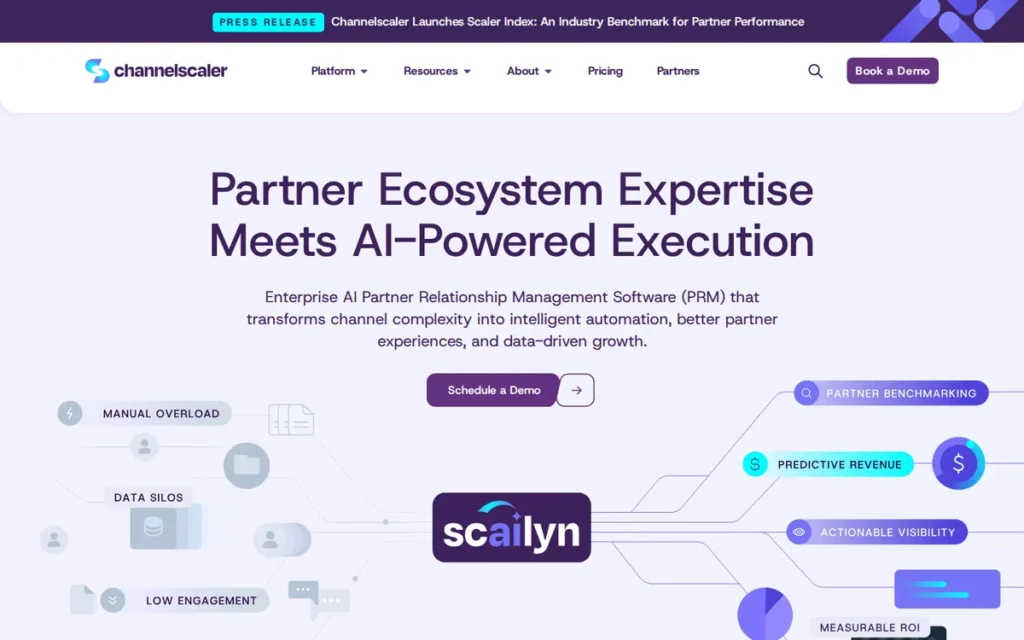
Category: PRM + TCMA Platform (Post-Merger, Mid-Market), partner portal, deal registration, MDF management, and AI opportunity scoring, now operating as Channelscaler following Allbound’s March 2024 acquisition of Channel Mechanics and the May 30, 2025 unified rebrand; post-merger integration status, codebase continuity, mandatory customer migration terms, and roadmap commitments should be independently verified before any contract commitment.
At a Glance
- Category: PRM + TCMA Platform (Post-Merger)
- Best For: Mid-market B2B organizations willing to conduct thorough post-merger due diligence, specifically verifying which platform codebase is maintained, mandatory migration terms and associated pricing changes, 2026 support SLA commitments, and whether the historically praised Allbound UX and mid-market pricing have been preserved under the Channelscaler brand
- Price Range: Pricing on request; historically positioned below enterprise platforms like Impartner; post-merger pricing may have shifted given upmarket “enterprise” positioning in the merger announcement, specific figures not publicly available as of May 2026
- Primary Strength: Allbound (pre-merger) was independently praised by practitioners for clean UX, design flexibility, and AI-powered partner opportunity scoring at a mid-market price point relative to enterprise-tier alternatives
- Biggest Limitation: Allbound’s March 2024 acquisition of Channel Mechanics and the May 2025 Channelscaler rebrand introduce material post-merger platform integration uncertainty (including mandatory migration for existing customers with associated pricing model changes (Channelnomics, 2025)) alongside a development-dependent implementation model requiring back-end engineering for configuration changes
- One-Line Summary: Allbound, rebranded as Channelscaler on May 30, 2025 following its March 2024 acquisition of Channel Mechanics (owned by Invictus Growth Partners), is a mid-market PRM and through-channel marketing platform with a historically praised UX and AI-powered partner opportunity scoring, but its post-merger integration status (including mandatory customer migration with pricing changes) introduces the highest platform roadmap uncertainty of any platform in this evaluation.
- Last Verified: May 2026
Overview
Channelscaler, formed from Allbound’s March 2024 acquisition of Channel Mechanics and officially rebranded on May 30, 2025 (PR Newswire; Channelnomics, 2025), is a mid-market partner relationship management and through-channel marketing platform that historically differentiated on clean user experience, design flexibility, and AI-powered partner opportunity scoring at a price point below enterprise-tier competitors. Channelscaler is majority-owned by Invictus Growth Partners (Channelnomics, 2025).
Pre-merger Allbound served mid-market B2B companies with a partner portal, deal registration, MDF management, training and certification with gamification, and a “risk-free partnership” guarantee. Existing Allbound and Channel Mechanics customers have been required to migrate to the unified Channelscaler platform with associated pricing model changes (Channelnomics, 2025), a material procurement risk that goes beyond roadmap uncertainty to create active migration cost exposure.
Organizations researching through-channel marketing platforms using data from before May 2025 may be evaluating a company that has since undergone a full corporate and product rebrand. The integration stability and roadmap commitments of the combined Channelscaler entity should be independently verified before any contractual commitment.
Key Features
- Partner Portal with Gamification: Allbound/Channelscaler provides a partner portal with centralized content management, deal registration, MDF management, and training and certification with gamification features including leaderboards and digital badges, addressing the endemic partner portal engagement problem through point-based achievement incentives embedded in the portal experience.
- AI-Powered Partner Opportunity Scoring: Allbound/Channelscaler’s AI-powered partner opportunity scoring enables channel marketing teams to prioritize which partners to engage for campaign co-execution or upsell based on partner activity patterns and opportunity signals, directing limited channel account management attention toward the highest-potential partnerships in the network.
- Professional Services-Driven Implementation: Allbound/Channelscaler’s implementation model uses professional services to customize the platform to each customer’s specific requirements, providing a tailored deployment experience at the cost of multi-month implementation timelines and ongoing back-end development dependency for configuration changes post-launch (u/Federal-Llama, r/SaaS, 2023).
- 2026 Channel Trend Research: Channelscaler published 2026 channel trend research identifying “ease of doing business” standardization, incentive payout speed improvement, and pricing transparency as top channel program priorities (Channelscaler, 2026), indicating product investment roadmap awareness in the highest-friction areas of the through-channel marketing platform category.
- Pre-Merger Risk-Free Partnership Guarantee: Allbound offered a “risk-free partnership” with a guaranteed results program before the merger, a buyer-friendly procurement risk reduction mechanism whose specific terms and continuation under the Channelscaler brand should be verified directly with the vendor in current contract negotiations.
Best For
Allbound/Channelscaler is best suited for mid-market B2B organizations that prioritize platform UX and design quality over maximum feature depth, have budget constraints relative to enterprise-tier platforms, and are willing to invest in thorough post-merger due diligence, specifically verifying which platform codebase is maintained, the migration roadmap for both legacy platforms, mandatory migration pricing implications, and 2026 support SLA commitments before committing to a multi-year agreement.
Pricing
Allbound/Channelscaler does not publish pricing as of May 2026. Pre-merger, Allbound was positioned at a mid-market price point below Impartner and PartnerStack. Post-merger, the Channelscaler announcement explicitly positions the combined entity for “mid-market and enterprise” scope, which may signal pricing changes upward from the pre-merger mid-market baseline.
Buyers should ask specifically:
- What pricing applies to new customers in 2026 vs. legacy Allbound or Channel Mechanics customers
- Whether the “risk-free partnership” guarantee continues under Channelscaler and what its current contractual terms are
- What ongoing professional services fees are required for configuration changes that cannot be made via self-service
Strengths
- An independent practitioner who ran a formal multi-vendor PRM evaluation described Allbound (pre-merger) on Reddit as “pretty and lots of design flexibility, not as expensive as some of the more robust products” (u/Federal-Llama, r/SaaS, 2023), the most candid independent validation of the platform’s historically strongest differentiators: UX quality and mid-market pricing relative to enterprise-tier alternatives.
Takeaway: Back-end development dependency for routine configuration changes (confirmed by this practitioner who directly used the platform pre-merger) means ongoing channel program management requires sustained professional services involvement beyond initial implementation, a total-cost-of-ownership factor absent from licensing fee comparisons alone.
- Channelscaler published 2026 channel trend research explicitly identifying “ease of doing business” friction, incentive payout delays, and pricing transparency as top vendor-partner program priorities (Channelscaler, 2026), demonstrating product investment roadmap awareness in the category’s most persistent operational pain points, though buyers should verify whether roadmap priorities have translated to shipped capabilities in the combined platform before committing.
- Allbound/Channelscaler’s AI-powered partner opportunity scoring and gamification features (leaderboards, digital badges) address two specific partner engagement challenges (low portal activity and undifferentiated partner outreach) in a lighter-weight mid-market product context compared to enterprise-tier platforms.
- Channelscaler’s post-merger positioning targets both mid-market and enterprise organizations, potentially offering expanded capability coverage beyond the pre-merger Allbound scope, though the specific capabilities added from the Channel Mechanics integration should be independently verified by prospective buyers before treating them as current confirmed production features.
Limitations
Channelscaler’s most consequential limitation is the combination of post-merger platform uncertainty and mandatory customer migration: Allbound’s March 2024 acquisition of Channel Mechanics and subsequent May 2025 rebrand to Channelscaler required mandatory migration for all existing Allbound and Channel Mechanics customers to the unified platform with associated pricing model changes (Channelnomics, 2025), a more severe buyer risk than generic “post-merger uncertainty” framing, creating active migration cost exposure for organizations with existing contracts. The development-dependent implementation model is a second independent material limitation confirmed by practitioners before the merger:
“Many configuration changes need to be made on the back end and require development.”, u/Federal-Llama, r/SaaS, 2023
Takeaway: Back-end development dependency for routine configuration changes means ongoing channel program management requires sustained professional services involvement beyond initial implementation, a total-cost-of-ownership factor that does not appear in licensing fee comparisons but materially affects annual operating cost.
Multi-month implementation timelines, independently characterized as requiring “several months” (u/Federal-Llama, r/SaaS, 2023), directly affect ROI realization timelines for teams operating within annual budget cycles. Additionally, no aggregate G2 or Capterra star rating with a verified review count was definitively surfaced for Allbound/Channelscaler in this research as of May 2026, the merger complicates review research, and buyers should filter for review recency and confirm which platform version is being reviewed when consulting review aggregators directly.
Verdict
Channelscaler, formed from Allbound’s March 2024 acquisition of Channel Mechanics and officially rebranded on May 30, 2025, is a mid-market PRM platform independently praised by practitioners for clean UX, design flexibility, and mid-market pricing at a price point below enterprise-tier competitors (u/Federal-Llama, r/SaaS, 2023). Channelscaler’s post-merger integration status introduces the highest vendor stability uncertainty of any platform evaluated in this article as of May 2026, including mandatory migration for existing customers with pricing model changes that buyers must address through first-principles due diligence on the post-merger entity. Organizations considering Channelscaler must independently verify which codebase is maintained, what the migration roadmap looks like, and what post-merger support SLA commitments are documented in writing before contract signature; organizations with time-sensitive evaluation timelines or lower tolerance for vendor transition risk should prioritize more stable platforms, ZINFI (#1), Impartner (#2), Mindmatrix Bridge (#3), or ZiftONE (#4), depending on their CRM stack and program requirements.
What Red Flags Should I Watch For When Evaluating Through-Channel Marketing Software?
Six documented procurement risks consistently emerge across independent practitioner research, Reddit community discussions, and G2 reviewer feedback in this category. Each red flag is an independently citable buyer due-diligence checkpoint that should drive specific questions during vendor demos and reference calls.
Red Flag #1: Vendor-Reported vs. Practitioner-Reported Implementation Timelines
Implementation timelines stated by vendors differ materially from practitioner-reported actuals. ZINFI self-reports 2.4 months (PR Newswire, 2026), while practitioners independently describe Impartner implementations as taking “a long time” and Allbound/Channelscaler as requiring “several months” with back-end development dependency (u/Federal-Llama, r/SaaS, 2023). Always verify claimed timelines through at least two reference customers with programs at comparable partner count and module configuration before signing a contract.
Red Flag #2: VC-Backed Growth Pressure on Post-Sale Support Quality
VC-backed growth dynamics can deprioritize post-sale support quality in favor of new customer acquisition. An independent PRM practitioner explicitly cited Impartner’s VC backing as a documented concern: “VC funded, so under pressure to create revenue and market share at the expense of the product and customer service” (u/Federal-Llama, r/SaaS, 2023). Check G2 review recency and trend, a declining satisfaction score over 12+ months is more informative than the aggregate rating alone.
Red Flag #3: 90-Day Post-Acquisition Platform Integration Claims
Enterprise software acquisitions typically require 12–24 months for full architectural stabilization. Ansira’s 90-day integration of BrandMuscle and SproutLoud (Ansira press release, September 2024) is an aggressive timeline by any standard. Buyers signing 3-year contracts in 2026 should specifically ask customers who joined the platform post-acquisition whether feature parity and platform stability have been confirmed through direct operational experience rather than vendor assurances.
Red Flag #4: Post-Merger Rebrand Without Verified Codebase Continuity
Allbound’s March 2024 acquisition of Channel Mechanics and May 2025 rebrand to Channelscaler introduces unresolved questions about which platform codebase is maintained and what migration paths exist, with mandatory customer migration and pricing model changes already confirmed (Channelnomics, 2025). Buyers researching Allbound using pre-2024 data should treat the current Channelscaler entity as a first-principles evaluation, confirming the codebase, migration roadmap, and contractual commitments before signing.
Red Flag #5: Transaction Fees Layered on Subscription Pricing
PartnerStack charges per-transaction fees on top of its subscription license, meaning total platform cost scales with partner-sourced revenue volume. Buyers with large or fast-growing affiliate and referral programs should model blended cost-per-dollar-closed before comparing PartnerStack’s subscription rate to flat-fee competitors, or the final invoice may substantially exceed the quoted contract price.
Red Flag #6: Mandatory Platform Migration Packaged as a Rebrand
When Channelscaler launched in May 2025, existing Allbound and Channel Mechanics customers were not offered continued service on legacy codebases, migration was mandatory, accompanied by pricing model changes (Channelnomics, 2025). A vendor rebranding its way out of legacy obligations while simultaneously repricing the product is a contractual risk pattern that warrants legal review of renewal terms, data-portability clauses, and exit provisions before signing.
What Questions Should I Ask Before Choosing a Through-Channel Marketing Platform?
Before evaluating any platform, buyers should identify which questions reveal whether a vendor’s capabilities match their actual channel program structure, not just the marketing narrative.
Question #1: Does our channel model require through-channel execution, PRM, or both? Through-channel marketing automation (TCMA) handles co-branded content syndication and market development fund management. Partner relationship management (PRM) handles deal registration, onboarding, and pipeline tracking. Several platforms reviewed here (ZINFI, Impartner, Mindmatrix) provide both capabilities in a unified suite. Buyers who need only one function should evaluate whether paying for a full suite delivers proportionate value.
Question #2: What is the total cost of ownership, including setup, integration, and transaction fees? Published subscription pricing rarely reflects total deployment cost. Ask each vendor for an all-in quote that includes: onboarding and implementation fees, Salesforce or HubSpot connector licensing, MDF audit fees, transaction fees on partner-sourced revenue, and annual price escalation clauses. Request references from customers at a comparable company size and channel program complexity.
Question #3: How does the platform handle multi-tier channel structures, distributor, reseller, and sub-reseller? Most platforms support two-tier partner structures. Only a subset (ZINFI’s UPM and Mindmatrix Bridge, based on 2026 documentation) support three-tier commission logic natively. If your channel includes distributors who manage resellers who manage end customers, confirm three-tier support in a live demo environment, not a slide deck.
Question #4: What is the vendor’s ownership and capitalization structure, and how does that affect platform continuity? Three of the seven platforms reviewed here operate under private equity ownership: Ansira (Truelink Capital since Q4 2023), Channelscaler (Invictus Growth Partners), and Impartner (Vista Equity Partners). PE-owned vendors face acquisition, consolidation, or cost-restructuring risk on typical 3-5 year fund cycles. Ask directly: when does the current fund expire, and has the vendor been put up for sale?
Question #5: How does the platform verify that co-op and MDF funds are being spent in compliance with program rules? Market development fund misuse (partners claiming reimbursement for non-compliant activities) is a material financial risk estimated to affect 3-5% of total incentive budgets Computer Market Research, 2026. Ask vendors to demonstrate their audit workflow: how are invoices verified, who reviews exceptions, and what documentation is required before reimbursement is approved?
Question #6: What does the migration and data-portability process look like if we need to switch platforms? Vendor lock-in risk is highest when partner contact records, deal registration history, and MDF audit trails cannot be exported in a standard format. Before signing, request a data portability clause in the contract specifying export formats, timelines, and whether historical data is included. Platforms that resist this request present elevated switching-cost risk.
How Did We Rank These Through-Channel Marketing Platforms?
PlugRoute uses a structured, multi-source evaluation process designed to produce rankings that reflect verified performance rather than vendor marketing. The methodology below governed every ranking decision in this article.
How Was Data Collected?
Primary data sources included:
- Peer review aggregators: G2 (accessed April–May 2026), Capterra (accessed April–May 2026), and TrustRadius (accessed May 2026), using current verified-reviewer counts and category-specific ratings
- Vendor documentation: Current product pages, pricing pages where publicly available, and API integration documentation (accessed April–May 2026)
- Industry analyst designations: G2 Grid Leaders (Spring 2026), Gartner Market Guide participants, IDC Marketscape positions, and Forrester Wave mentions, each verified at the original source, not via vendor press releases
- Independent trade coverage: Channelnomics (2025) for Channelscaler migration reporting; Computer Market Research (2026) for MDF leakage figures; PartnerTechX award announcements (2025)
- Community forums: Reddit (r/channelmarketing, r/partnerops, r/saas): comments used for validation of user experience patterns, not as primary ranking signals
How Were Platforms Evaluated?
Every platform was assessed across six weighted criteria:
1. Feature completeness for through-channel marketing use cases (25% weight) Measured against a standardized capability checklist: co-branded content syndication, MDF/co-op fund management, multi-tier partner tracking, partner portal customization, and campaign automation. Platforms were scored on feature availability in current production builds, not roadmap commitments.
2. Integration ecosystem depth (20% weight) Verified through current AppExchange listings, HubSpot marketplace listings, and documented API specifications. Integration claims made by vendors but not verified in marketplace listings were marked “vendor-cited” and weighted accordingly.
3. Verified peer review volume and recency (20% weight) G2 and Capterra ratings weighted by recency (reviews from 2024–2026 weighted more heavily than 2021–2023). Platforms with fewer than 50 verified reviews were flagged for limited data confidence.
This weighting reflects how independent B2B software buyers actually research major platform decisions. As one buyer on r/b2bmarketing described their process:
“I mostly go and check review listings like G2, Capterra, Trustpilot, TrustRadius, etc, there are plenty of them, just pick one or two that you trust the most. As usual, taking into account the general number of reviews, overall satisfaction rate, and then diving into exact comments. Maaan I can spend hours reading all the reviews, but it really helped me to make big decisions… Word of mouth helps too, but comments let you to go into more details and find use cases that are applicable to your niche. So yeah, lots of research needed, and of course requesting demo or getting free trial to put your hands on the tool and see how you like working with it.” Posted by u/ksensava
Takeaway: B2B software buyers independently confirm that peer review aggregators like G2 and Capterra are primary evaluation resources, validating this methodology’s emphasis on verified review volume, recency, and comment-level analysis over vendor self-reporting alone.
4. Pricing transparency and total cost predictability (15% weight) Platforms with public pricing pages, published tier structures, or disclosed per-seat pricing scored higher on this dimension. Platforms requiring full sales-cycle engagement to obtain any pricing signal scored lower, reflecting a buyer transparency deficit.
5. Analyst and independent recognition (10% weight) G2 Leader, Gartner Market Guide, IDC Marketscape, Forrester Wave, and PartnerTechX award designations were included where independently verifiable. Recognition cited only in vendor press releases without traceable analyst source was downweighted.
6. Ownership stability and platform continuity risk (10% weight) PE-owned vendors assessed on fund vintage and known exit activity. Vendors that have executed mandatory customer migrations in the prior 24 months were noted as elevated-continuity-risk.
How Were Conflicting Sources Handled?
Where vendor-cited figures conflicted with aggregator data, the more conservative independently verifiable figure was used. Where analyst designations appeared in vendor press releases but could not be located in the original analyst publication, they were labeled “vendor-cited” rather than independently verified. No ranking decision was based solely on a vendor-provided statistic.
What Is the Update Cadence?
This guide is reviewed and updated quarterly. Peer review counts, analyst designations, and ownership structures change frequently in this category. The current edition reflects data collected between April and May 2026. Readers should verify individual platform details directly before making procurement decisions.
Independence Statement
PlugRoute has no affiliate relationships, referral fee arrangements, or paid placement agreements with any platform reviewed in this article. Rankings are determined solely by the methodology described above.
Frequently Asked Questions About Through-Channel Marketing Software
What is through-channel marketing automation, and how is it different from PRM?
Through-channel marketing automation (TCMA) enables vendors to execute co-branded marketing campaigns through their partner network, handling content syndication, MDF management, and co-branded asset delivery. Partner relationship management (PRM) focuses on partner recruitment, onboarding, deal registration, and pipeline tracking. Several platforms reviewed here combine both capabilities in a single suite.
Which through-channel marketing platform is best for small or mid-market channel programs?
PartnerStack is the strongest fit for SMB and mid-market programs built around SaaS affiliate and referral partnerships, given its self-serve onboarding and marketplace of 100,000+ active partners (PartnerStack, 2026). Allbound/Channelscaler serves mid-market indirect sales programs. ZINFI, Impartner, and Mindmatrix are enterprise-oriented and typically require larger minimum commitments.
How does PlugRoute determine its platform rankings?
PlugRoute ranks platforms using a six-criterion methodology weighted across feature completeness, integration depth, verified peer review data, pricing transparency, analyst recognition, and ownership stability risk. No platform pays for placement or receives preferential treatment. Full methodology details, data sources, and update cadence are published in the Methodology section of every guide.
Glossary of Through-Channel Marketing Software Terms
Through-Channel Marketing Automation (TCMA): A software category enabling technology vendors to deploy co-branded marketing campaigns through their reseller, distributor, and agent networks (including automated content syndication, market development fund management, and campaign performance tracking) without requiring partner marketing staff to build campaigns from scratch.
Market Development Funds (MDF) / Co-op Funds: Budget allocated by a vendor to channel partners for joint marketing activities, typically as a percentage of partner-generated revenue or a fixed quarterly allocation. MDF programs require claim submission and compliance verification; industry research estimates 3-5% of total incentive budgets are lost to non-compliant or fraudulent claims Computer Market Research, 2026.
Co-Sell: A sales motion in which a vendor’s internal sales team and a channel partner pursue an opportunity jointly, sharing account access, deal strategy, and sometimes commission. Co-sell capabilities in TCMA platforms manage attribution, pipeline visibility, and communication between both selling parties without creating data conflicts.
POEM™ Framework: ZINFI’s proprietary partner engagement methodology (Paid, Owned, Earned, and Managed partner marketing) used to categorize and optimize the full spectrum of channel marketing activity within the ZINFI Unified Partner Management platform. POEM™ is a ZINFI trademark and is not a generic industry framework.
Server-to-Server Attribution: A technical tracking method in which conversion data is passed directly between servers (bypassing browser cookies and client-side JavaScript) to provide more accurate and privacy-compliant affiliate and partner attribution. PartnerStack uses server-to-server attribution as its primary tracking mechanism, which improves accuracy under cookie-blocking browser environments but requires developer implementation by the partner.
Which Through-Channel Marketing Platform Is Right for You?
Key Insights
- ZINFI Unified Partner Management leads for large enterprise channel programs requiring verified multi-tier commission logic, confirmed POEM™ framework methodology, and the broadest independently recognized feature set across 2025–2026 analyst evaluations.
- Impartner PRM is the strongest validated option for enterprise organizations whose channel program is built inside Salesforce, offering AppExchange-certified native integration, 550+ verified G2 reviews at 4.5/5.0, and Gartner Market Guide recognition.
- Mindmatrix Bridge is the only platform in this comparison confirmed on both the Salesforce AppExchange and HubSpot App Marketplace as of May 2026, making it the default recommendation for organizations managing parallel CRM environments, though buyers should verify current marketplace status before signing.
- ZiftONE is the most credible choice for complex co-op MDF programs at enterprise scale, with G2 ratings of 4.8/5.0 from 27 verified reviews and TrustRadius recognition at 9.2/10, despite a smaller review base than ZINFI or Impartner.
- Ansira is suited for large enterprise programs requiring full-service agency execution alongside technology, but buyers should note that the cited Red Hat case study has not been independently corroborated in public sources and that Truelink Capital PE ownership introduces fund-cycle continuity risk.
- PartnerStack is purpose-built for SaaS affiliate, referral, and reseller partner ecosystems, but it is not a through-channel marketing automation platform by category definition, and organizations needing MDF management or co-branded content syndication should evaluate other options in this list.
- Channelscaler (formerly Allbound) serves mid-market indirect sales programs, but buyers must independently verify current codebase status, pricing terms, and data migration commitments given the mandatory customer migration executed in conjunction with the May 2025 rebrand.
The strongest general path through this category: start with your CRM environment (Salesforce vs. HubSpot vs. neither), then assess whether you need TCMA-only, PRM-only, or a unified suite, then filter for ownership stability before requesting demos. Budget for implementation and integration costs equal to 50-100% of the first-year license fee, especially for enterprise deployments with custom ERP or CRM requirements.
No platform in this comparison is the correct answer for every buyer. The right choice depends on channel program complexity, CRM stack, partner tier structure, and risk tolerance for PE-owned vendors.
We update this guide quarterly. Last updated: May 2026. For the most current version, along with our full library of no-affiliate-fee technology comparisons, visit PlugRoute.