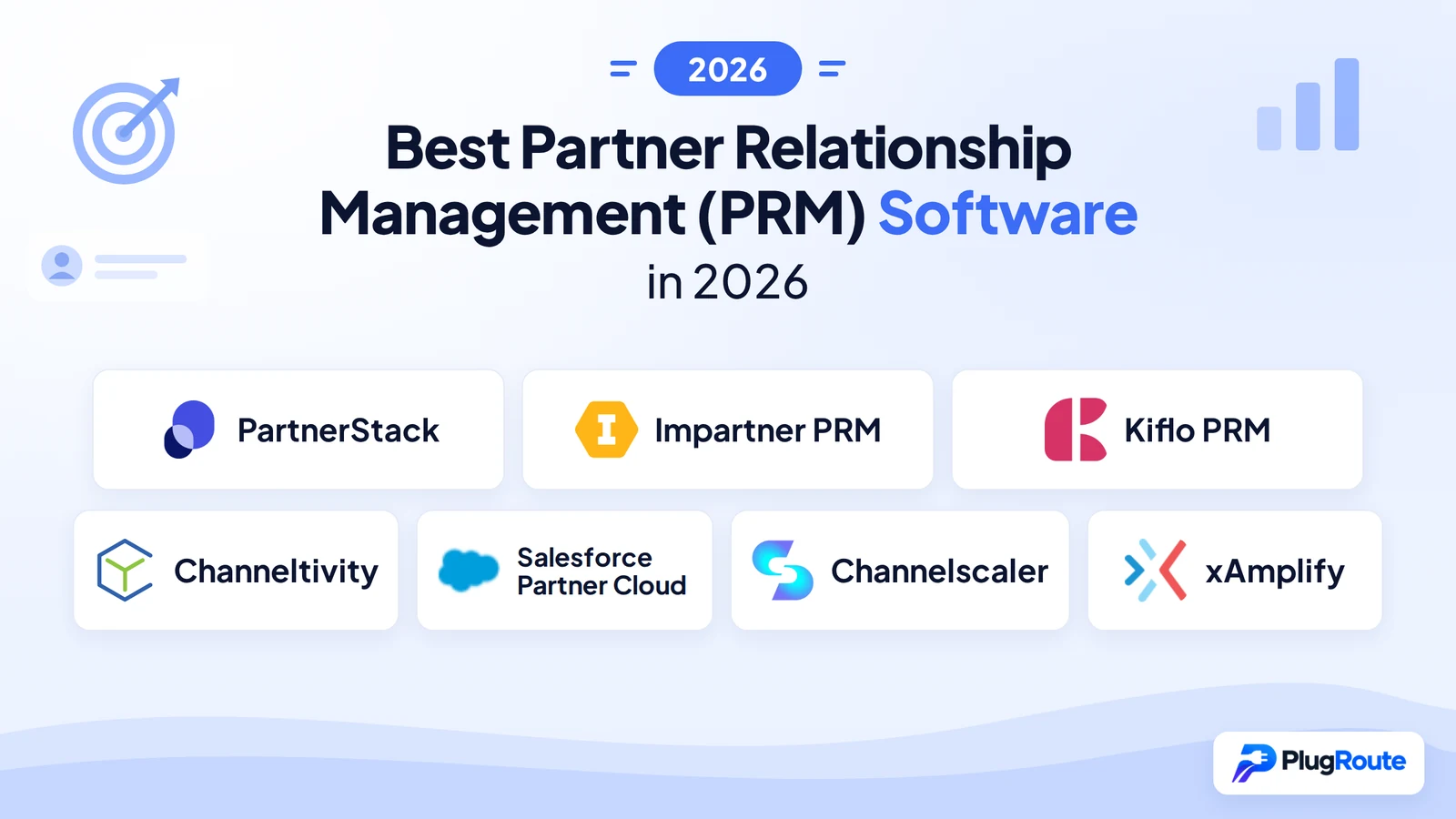
PartnerStack is the best PRM for SaaS companies scaling affiliate and referral programs, Impartner PRM leads for enterprise reseller and distribution channel management, and Kiflo PRM delivers the strongest value for startups and SMBs. The critical trade-off across all seven platforms is feature depth versus implementation speed, no single tool wins on both simultaneously.
Most channel managers reach PRM evaluation after the same inflection point: a partner program that has outgrown spreadsheets but not yet outgrown the budget or patience for a months-long enterprise implementation. The cost appears in missed deal attribution, manual MDF reconciliation, fragmented partner ecosystems with no co-sell visibility, and no defensible channel program ROI to present to leadership.
PlugRoute has no affiliate relationships with any platform in this comparison; rankings reflect third-party review data, community sentiment, pricing transparency, and documented feature evidence exclusively.
“The best PRM really depends on how many partners you have, the type of partners, and your budget.” Posted by u/Federal-Llama, r/SaaS, 2023
Takeaway: The most experienced channel practitioners filter by partner type, budget, and customization need before evaluating platforms, not after. This comparison is structured around exactly those three variables.
TL;DR: Top Picks at a Glance
- PartnerStack: Built-in marketplace of 100,000+ active partners for SaaS affiliate and referral programs needing passive partner recruitment alongside deal management.
- Impartner PRM: Deepest enterprise feature set with 554+ G2 reviews; the standard for 100+ partner programs with full TCMA, MDF, and AI automation requirements.
- Kiflo PRM: Transparent public pricing from $399/month with a G2 High Performer rating; the clearest value for SMB teams outgrowing spreadsheets on HubSpot or Salesforce.
- Channeltivity: Four native CRM integrations and implementation measured in weeks; the practical mid-market choice for tech channel programs with multi-CRM environments.
What Are the Three Core Categories of PRM Software?
PRM platforms fall into three tiers: Full-Stack Enterprise (Impartner, Channelscaler, Salesforce Partner Cloud) for 100+ partner programs with MDF and TCMA needs; SaaS-Native (PartnerStack, Kiflo) for growth-stage affiliate and reseller programs; and Specialist/Emerging (Channeltivity, xAmplify) for defined-niche or AI-pilot use cases.
The tier a platform belongs to determines implementation complexity, pricing model, and feature depth, not just marketing positioning. Selecting a Full-Stack Enterprise PRM for a 15-partner startup program is one of the most common and costly mismatches in channel operations.
A practical note on pricing models: at 10 active partners, Kiflo’s $399/month represents clear value. At 100 active partners on a per-partner pricing model, the same platform may cost $3,990/month or more, a 10× cost increase for a 10× partner count increase.
Flat-fee (Channeltivity) and unlimited-user (Channelscaler) models break this linear cost curve, which matters when partner recruitment targets are aggressive. The tier and pricing model you choose at launch will determine your cost structure at scale.
How Do the Top Seven PRM Platforms Compare?
Seven PRM platforms span three tiers in this comparison. PartnerStack leads on G2 satisfaction (4.7/5.0) and implementation speed. Impartner leads on feature depth and review volume (554+ G2 reviews). Kiflo leads on transparent pricing and SMB value ($399/month). Channeltivity leads on per-reviewer G2 satisfaction (4.7/5.0 across 56 reviews) and native CRM breadth. Salesforce Partner Cloud is the only CRM-native option. Channelscaler offers unlimited-user pricing. xAmplify is the only platform with a no-cost pilot path.
| Rank | Company | Category | Best For | One-Line Summary | Key Capabilities | Primary Strength | Key Limitation |
|---|---|---|---|---|---|---|---|
| 1 | PartnerStack | SaaS-Native | SaaS affiliate, referral & reseller programs | PartnerStack is the highest-rated PRM on G2 (4.7/5.0) with a built-in partner marketplace of 100,000+ active partners driving partner-sourced revenue across 600+ SaaS vendor programs. | Unified partner dashboard, automated payouts, marketplace discovery, Salesforce + HubSpot sync (no native AI engine) | Built-in 100,000+ partner marketplace; the only passive partner recruitment engine among the seven platforms compared | No public pricing; per-deal marketplace commission adds ongoing cost at scale |
| 2 | Impartner PRM | Full-Stack Enterprise | Enterprise reseller, distributor & tech partner programs | Impartner PRM is the most-reviewed PRM in this comparison on G2 (554+ reviews, 4.5/5.0) with Aimi AI, full TCMA, and the deepest enterprise feature set evaluated here. | Full partner lifecycle management, Aimi AI engine, unified marketing automation, MDF tracking, gamification | Largest G2 review footprint in this comparison (554+ reviews) with enterprise AI launched December 2025 | Months-long implementation; no public pricing; configuration changes require developer involvement |
| 3 | Kiflo PRM | SaaS-Native | SMB and startup teams scaling their first partner program | Kiflo PRM is a G2 High Performer rated ~4.8/5.0 with transparent public pricing from $399/month and bidirectional HubSpot and Salesforce sync. | Reseller/referral/affiliate portals, two-way CRM sync, per-active-partner pricing, 14-day trial (no native AI engine) | Highest satisfaction score with fully transparent public pricing; rare in the PRM category | Per-active-partner pricing escalates as the partner network grows beyond ~50 active accounts |
| 4 | Channeltivity | Specialist | Mid-market tech companies needing multi-CRM, flat-fee PRM | Channeltivity is a purpose-built tech-channel PRM rated 4.7/5.0 on G2 (56 reviews) and 4.6/5.0 on Capterra (5 reviews), with flat-fee pricing and four native CRM integrations deployed in weeks. | Deal registration, MDF management, LMS, flat-fee pricing, native Salesforce/HubSpot/Dynamics 365/Zoho integration (no native AI engine) | Highest per-reviewer G2 satisfaction score in this comparison (4.7/5.0) with fastest mid-market implementation timeline | Limited customization ceiling; incomplete MDF budgeting module in some configurations |
| 5 | Salesforce Partner Cloud | Full-Stack Enterprise | Salesforce-native orgs with existing Sales Cloud investment | Salesforce Partner Cloud is the only CRM-native PRM that eliminates third-party sync, with Einstein AI and Agentforce embedded platform-wide and a 4.4/5.0 G2 rating across 275 reviews. | Einstein AI + Agentforce, Experience Cloud portals, SPIFF/MDF/rebate management, AppExchange ecosystem | Zero CRM sync latency; all partner data lives natively in one Salesforce instance | Highest analyst-estimated TCO in this comparison (~$100K–$300K/year mid-market); 4.4/5.0 G2 among the lower scores compared here |
| 6 | Channelscaler | Full-Stack Enterprise | Mid-enterprise teams needing unlimited-user pricing and financial channel automation | Channelscaler is the May 2025 rebrand of merged Allbound and Channel Mechanics, managing 1.1M+ registered opportunities totaling $140B+ in partner-sourced sales, with Claude AI and unlimited-user pricing. | Unlimited users/partners, Claude AI integration, bidirectional CRM sync, MDF/rebates/SPIFFs, LMS, Slack/email off-portal nudges | Unlimited-user model eliminates per-seat cost escalation as partner programs scale | Post-rebrand brand unfamiliar to buyers; months-long implementation typical; no public pricing |
| 7 | xAmplify | Specialist/Emerging | Forward-looking teams piloting AI-native PRM at zero initial cost | xAmplify is the only platform in this comparison with a no-cost pilot path and an embedded Oliver AI engine with predictive partner scoring, co-branded content generation, and six native CRM integrations including ConnectWise and HaloPSA. | Oliver AI (predictive scoring, deal intelligence, behavior automation), full TCMA, MDF management, 6 native CRM integrations including ConnectWise and HaloPSA | Only no-cost pilot path in this comparison with the broadest native CRM integration portfolio (6 platforms) | Low G2 review volume; company background undisclosed; AI performance claims unvalidated by independent sources |
Which PRM Tool Should I Choose for My Use Case?
| Your #1 Priority | Recommended Tool | Why | Acceptable Alternative |
|---|---|---|---|
| Affiliate/referral program + partner marketplace | PartnerStack | 100,000+ marketplace partners, 30-day average launch, G2 4.7/5.0 | Kiflo PRM ($399/month, no marketplace; choose if marketplace commission is a cost concern) |
| Enterprise reseller/distribution program | Impartner PRM | Deepest feature set, 554+ G2 reviews, Aimi AI (Dec 2025) | Channelscaler (unlimited users, Claude AI, $140B+ managed; choose if per-seat cost is a scaling constraint) |
| SMB/startup launching first partner program | Kiflo PRM | $399/month public pricing, weeks to deploy, G2 High Performer ~4.8/5.0 | xAmplify (no-cost pilot for ≤10 partners; choose if AI-native features are a priority over proven track record) |
| Mid-market tech channel with multi-CRM stack | Channeltivity | Four native CRM integrations, flat-fee model, weeks to deploy, 4.7/5.0 G2 | Kiflo PRM (HubSpot + Salesforce only; lower cost; choose if budget is the primary constraint) |
| Salesforce-first organization | Salesforce Partner Cloud | Zero CRM sync overhead; Einstein AI + Agentforce native | Channeltivity (dedicated Salesforce Edition; choose if TCO of $100K–$300K/year is not feasible) |
| Unlimited partner scaling + financial automation | Channelscaler | Unlimited users/partners, rebates/SPIFFs/MDF, Claude AI | Impartner PRM (deeper overall feature set; choose if AI validation and TCMA breadth outweigh per-seat pricing concern) |
| Zero-cost AI pilot for ≤10 partners | xAmplify | Only no-cost pilot path in this comparison; Oliver AI; 6 CRM integrations | Kiflo PRM ($399/month, proven at SMB scale; choose if company stability is a higher priority than zero initial cost) |
How to Use This Comparison: If you have 10–50 partners, start at Entry #3 (Kiflo) or Entry #4 (Channeltivity). If you are committed to Salesforce, go directly to Entry #5. If you want a built-in partner marketplace, Entry #1 (PartnerStack) is your primary decision. If you manage 100+ partners with MDF complexity, evaluate Entry #2 (Impartner) and Entry #6 (Channelscaler) side by side before requesting demos.
1. PartnerStack: Best for SaaS Affiliate, Referral, and Reseller Programs
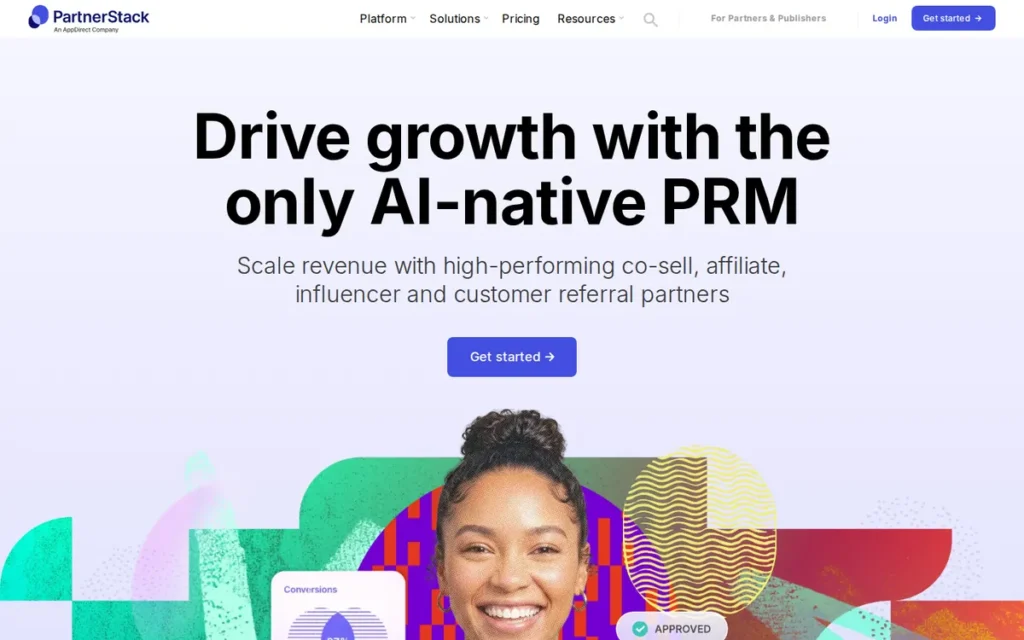
Category: SaaS-Native PRM, unified affiliate, referral, and reseller management with a built-in partner marketplace and automated payout engine.
At a Glance
- Category: SaaS-Native PRM
- Best For: SaaS companies scaling affiliate, referral, and reseller partner programs simultaneously
- Price Range: Custom enterprise pricing; marketplace commission applies per partner-sourced deal
- Primary Strength: Built-in marketplace of 100,000+ active partners: the only passive partner recruitment engine among the seven platforms compared here
- Biggest Limitation: No public pricing; per-deal marketplace commission adds ongoing cost at scale that is separate from the license fee
- One-Line Summary: PartnerStack is the highest-rated established PRM on G2 (4.7/5.0) with a built-in partner marketplace across 600+ SaaS vendor programs and an average 30-day program launch timeline that outpaces every enterprise alternative in this comparison.
- Last Verified: May 2026
Overview
PartnerStack is a SaaS-native partner ecosystem platform that unifies affiliate, referral, reseller, influencer, and co-sell partner management within a single dashboard, including automated onboarding, commission tracking, payout processing, and full-funnel analytics. PartnerStack is headquartered in Toronto, Canada and serves 600+ SaaS companies.
PartnerStack’s proprietary marketplace contains more than 100,000 active partners (vendor-reported as 136,000+ as of 2025) across 600+ SaaS vendor programs, a passive recruitment channel that no competing platform in this comparison currently replicates. PartnerStack’s own research data reports $390M+ in annual partner-sourced revenue across its vendor network, a vendor-reported aggregate not independently audited (PartnerStack Research Lab, 2025).
PartnerStack ranks #1 not on feature depth (Impartner has more capabilities) but on the combination of the highest G2 score among established platforms (4.7/5.0), a 30-day average launch path that outpaces all enterprise alternatives, and the only built-in partner marketplace in this comparison. For the majority of SaaS companies building their first or second multi-type partner program, these factors outweigh enterprise TCMA depth.
Key Features
- Built-In Partner Marketplace: PartnerStack operates a proprietary marketplace containing more than 100,000 active partners (vendor-reported as 136,000+) across 600+ SaaS vendor programs, giving new vendors immediate exposure to pre-vetted affiliates and resellers without manual outreach, a passive recruitment channel no competing PRM in this comparison currently replicates.
- Automated Payout Engine: PartnerStack automates end-to-end commission calculation, reward tracking, incentivization, and payout processing with customizable commission structures across all partner types, including affiliates, referrals, and resellers in a single workflow.
- 30-Day Program Launch: PartnerStack enables new partner programs to go live in an average of 30 days (significantly faster than enterprise PRMs requiring 3–6 months of implementation) preserving channel momentum from the moment of contract signing (PartnerStack platform page, 2025).
- Full-Funnel Attribution: PartnerStack tracks the complete attribution funnel from partner click through signup to closed revenue, giving channel teams accurate partner-sourced revenue reporting across all partner types and eliminating the attribution gaps that spreadsheet-based programs consistently create.
- CRM and Tool Integrations: PartnerStack integrates natively with Salesforce and HubSpot for bidirectional CRM sync, Stripe and PayPal for automated commission payouts, and Mailchimp, ActiveCampaign, Slack, and Zapier for communication workflows and 3,000+ additional app connections (DustinHowes.com, 2024).
Best For
PartnerStack is best for B2B SaaS and technology software companies that manage multiple partner types simultaneously (affiliates, referrals, and resellers) and want passive partner recruitment through a built-in marketplace. PartnerStack is specifically well-matched for software vendors with existing partnership budgets who need fast program activation without months-long configuration overhead.
Pricing
PartnerStack does not publish public pricing. Pricing is enterprise-quoted via sales conversation; third-party reviewers characterize the cost as premium (“$$$”) for large B2B enterprises (DustinHowes.com, 2024).
An additional per-deal commission is charged on partner sales sourced through the PartnerStack marketplace directory. This cost accumulates at scale and is separate from the platform license fee, total cost of ownership modeling should account for projected marketplace-sourced deal volume before committing. Pricing verified: May 2026.
Strengths
- Highest G2 Rating Among Established Platforms: PartnerStack holds a 4.7/5.0 G2 rating (the highest score among established PRM platforms in this comparison) consistently reflecting high user satisfaction with UI quality, analytics, and support responsiveness (G2, verified May 2026).
- Proprietary Partner Network: PartnerStack’s marketplace of more than 100,000 active partners across 600+ SaaS vendor programs provides passive partner recruitment that no competing platform in this comparison currently replicates, a structural advantage for vendors that want pre-vetted affiliate discovery alongside their core PRM workflows.
This aligns with community sentiment on r/Affiliatemarketing:
“PartnerStack is what you want here. Yes, it’s pricier (annual commitment upfront), but here’s why that actually works in your favor for B2B SaaS: The affiliates there specialize in SaaS. They understand MRR, they know how to sell to developers and technical buyers, and they’re not pushing impulse-buy junk. You’re capped at ~200 outreach invites per week, which sounds limiting but forces you to be strategic instead of spraying and praying. They also vet affiliates on their end, so you’re not spending hours filtering out crypto bros and coupon sites that’ll never convert your mapping API audience.” Posted by u/armored_strawberries
Takeaway: PartnerStack’s curated SaaS-specialist partner pool delivers higher-quality affiliate matches than open networks, at the cost of enrollment caps that constrain rapid program scaling for vendors accustomed to unrestricted outreach volume.
- 30-Day Launch Speed: PartnerStack enables program launch in approximately 30 days, compared to several months for enterprise PRMs like Impartner and Channelscaler, preserving channel momentum from the moment of contract signing (PartnerStack platform page, 2025).
- Practitioner-Endorsed Support Quality: Practitioners with hands-on multi-platform PRM experience consistently identify PartnerStack’s support team as a primary differentiator, alongside clean UI and analytics, in direct comparison discussions (u/Extreme-Hovercraft27, r/SaaS, 2023).
Limitations
- Pricing Opacity: PartnerStack discloses no pricing tiers publicly, requiring a full sales cycle before basic budget qualification, a friction point that extends procurement timelines for resource-constrained channel teams and makes competitive cost comparison difficult before investing demo cycle time.
- Marketplace Commission Cost: PartnerStack charges a per-deal commission on partner-sourced sales through its marketplace directory, adding an ongoing per-transaction cost that makes total cost of ownership materially higher than the headline license fee for high-volume partner programs (u/sharman-ultra, r/SaaS, 2023).
- Partner Approval Friction: PartnerStack’s curated approval process has blocked high-performing affiliates from expanding their program reach, a concern for vendors wanting a broader, less curated partner pool where manual recruitment complements marketplace discovery (u/CTPENGUIN88, r/Affiliatemarketing, 2024).
- SaaS-Centric Architecture: PartnerStack’s platform is optimized for SaaS and digital-product partner programs; companies with physical products, complex distribution channels, or non-SaaS business models may find the platform’s structural assumptions misaligned with their program requirements.
Users on r/b2bmarketing noted:
“Don’t expect Partnerstack to bring you new partners and grow partner network. It’s a good tool if you have GTM towards agency / partners / affiliates recruitment already and just use it to admin. Unless you have a product that’s more B2C/solopreneurs focused SaaS and publishers can see easy money in promoting it. Most of the partners nowadays there are very low-quality publishers. Be careful with partners who launch the branded ads on your SaaS name (Specifically in e.g. Bing) – it’s a very common practice and it happened to me at Survicate multiple times.” Posted by u/EveryAnything5183
Takeaway: PartnerStack functions as partner management infrastructure rather than a partner acquisition engine, niche B2B vendors consistently report low marketplace partner quality and branded ad abuse as persistent operational hazards that inflate true program costs.
Verdict
PartnerStack is the strongest PRM for SaaS companies that need to scale affiliate and referral programs quickly, with a 100,000+ partner marketplace providing a passive recruitment engine that no competitor in this comparison replicates. PartnerStack’s 4.7/5.0 G2 rating, 30-day average launch speed, and unified multi-partner-type support make it the most versatile SaaS-native PRM at this tier, but the premium pricing and per-deal marketplace commission require careful total cost modeling against projected partner-sourced revenue before committing.
2. Impartner PRM: Best for Enterprise Channel Programs
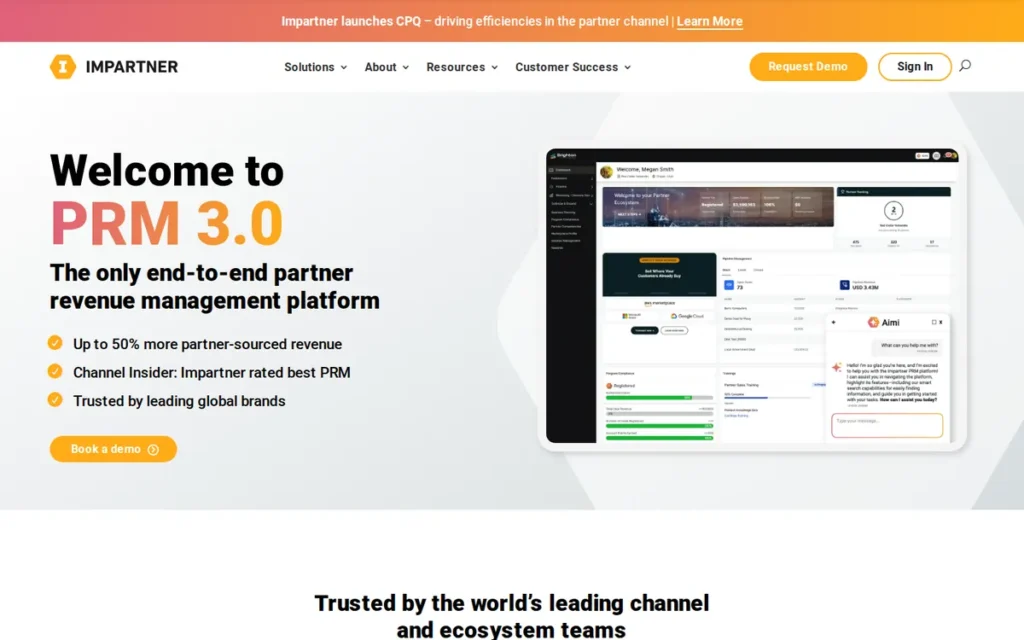
Category: Full-Stack Enterprise PRM, full partner lifecycle management with Aimi AI engine, TCMA, MDF automation, and the largest G2 review footprint in this comparison.
At a Glance
- Category: Full-Stack Enterprise PRM
- Best For: Enterprise organizations managing 100+ partners across reseller, distributor, and technology partner models with complex TCMA and MDF requirements
- Price Range: Custom enterprise pricing; no public tiers available
- Primary Strength: Most-reviewed PRM in this comparison on G2 (554+ reviews, 4.5/5.0) with Aimi AI engine launched December 2025
- Biggest Limitation: Implementation typically takes months; ongoing configuration changes require developer involvement; no public pricing
- One-Line Summary: Impartner PRM is a full partner lifecycle management platform with 554+ G2 reviews (4.5/5.0) and Aimi AI (launched December 2025) delivering voice and text deal capture, intelligent content generation, and AI-powered multi-channel partner marketing.
- Last Verified: May 2026
Overview
Impartner PRM is a full partner lifecycle management platform founded in 2002 and headquartered in South Jordan, Utah, one of the longest-running dedicated PRM vendors in this category. Impartner PRM covers partner onboarding, enablement, deal registration, MDF management, Through-Channel Marketing Automation (TCMA), performance analytics, and gamification within a single enterprise system.
In December 2025, Impartner launched Aimi: an embedded enterprise AI engine providing intelligent content creation and translation, natural-language record creation via text or voice, conversational deal registration field-prompting, and a virtual assistant for instant partner resource access (Impartner blog, December 2025).
Impartner’s March 2026 Unified Partner Marketing Automation update added AI-driven AdTech for automated multi-channel campaigns across email, social, Google, Microsoft Ads, Facebook, and Instagram, with lifecycle-triggered execution that adjusts based on partner engagement data (Impartner blog, March 2026).
Impartner ranks #2 rather than #1 because its implementation complexity (months, not days), pricing opacity, and developer-dependency for configuration changes reduce its applicability to the broadest buyer profile. For enterprise channel teams, it remains the deepest, most validated dedicated PRM platform available.
Key Features
- Aimi Enterprise AI Engine: Impartner’s Aimi (launched December 2025) provides intelligent content creation, natural-language deal registration field-prompting via text or voice, real-time translation, and a virtual assistant for instant partner resource access, with a voice input filter that actively removes background noise for field-capture accuracy.
- AI-Powered AdTech (March 2026): Impartner’s Unified Partner Marketing Automation delivers predictive optimization of keywords, bids, audiences, and campaign budgets across email, social, Google, Microsoft Ads, Facebook, and Instagram, with lifecycle-triggered execution that adjusts campaigns based on partner engagement data (Impartner blog, March 2026).
- Full MDF and Incentive Tracking: Impartner’s offer and fund tracking is independently validated by 46 G2 reviews (one of the most confirmed MDF management capabilities in the PRM category) enabling structured MDF approval, reconciliation, and reporting workflows (G2, verified May 2026).
- Role-Based Permissions: Impartner’s role-based permissions system is confirmed by 77 G2 reviews (the most-verified individual feature on the platform) enabling granular access control across complex multi-tier partner hierarchies.
- Gamification, Analytics, and CRM Integration: Impartner includes gamification features (leaderboards, points, rewards) to drive partner portal engagement, Impartner Analytics with pre-built dashboards, and native Salesforce AppExchange integration for enterprise CRM organizations (Salesforce AppExchange, verified May 2026).
Best For
Impartner PRM is best for enterprise technology companies, hardware manufacturers, and software vendors managing 100+ reseller, distributor, or technology partners who need a full TCMA suite, sophisticated MDF management, and an AI-augmented partner engagement layer. Impartner PRM requires the implementation budget and timeline tolerance to support a multi-month deployment.
Pricing
Impartner PRM does not publish public pricing. All plans are custom enterprise-quoted with no self-service tiers available (Impartner pricing page, 2025).
This positions Impartner as viable primarily for organizations with significant channel programs and dedicated implementation budgets. Pricing verified: May 2026.
Strengths
- Largest G2 Review Footprint in This Comparison: Impartner PRM holds 554+ verified G2 reviews (4.5/5.0), independently confirming role-based permissions (77 reviews), lead management (66 reviews), and fund tracking (46 reviews) as core capabilities, with a validation breadth no competing platform in this comparison approaches (G2, verified May 2026).
- Documented Customer Results: Lookout (cybersecurity) reported cutting support costs by 40% and scaling partner engagement after implementing Impartner’s AI-powered self-service layer, a result cited in Impartner’s own case study documentation and not independently corroborated by third-party sources (Impartner blog, 2025). Separately, a Forrester Total Economic Impact study commissioned by Impartner found representative customers achieved 296% ROI, a 50% increase in partner-sourced deals, and a 75% reduction in cost-per-lead (Forrester TEI, Impartner, 2024).
- Independent Analyst Alignment: Jay McBain, Chief Analyst for Channels, Partnerships, and Ecosystems at Omdia, serves as the headline speaker at ImpartnerCon 2026 with a keynote focused on ecosystem evolution and indirect revenue scaling, an independent signal that Impartner’s platform direction aligns with where leading channel analysts see the category heading (BusinessWire, March 2026).
- 22+ Years of Category Experience: Founded in 2002, Impartner has more institutional channel program knowledge than any other independent PRM vendor in this comparison, relevant for enterprise teams designing complex, multi-tier partner ecosystems that require more than standard configuration.
Limitations
- Implementation Complexity: Impartner typically requires months-long implementation timelines, and ongoing configuration changes depend on custom code and vendor professional services, creating both launch delays and persistent operational dependency on the vendor (u/Federal-Llama, r/SaaS, 2023).
- Pricing Opacity: Impartner discloses no pricing on its website, requiring a full sales cycle before basic budget qualification, a significant friction point for buyers trying to shortlist vendors efficiently without committing procurement resources prematurely.
- Growth Pressure and Support Tension: A practitioner with direct Impartner experience noted the platform is “VC funded, so under pressure to create revenue and market share at the expense of product and customer service”, a structural tension that buyers should assess through reference calls (u/Federal-Llama, r/SaaS, 2023). Impartner’s 4.5/5.0 G2 rating and 554+ reviews suggest this pressure has not uniformly eroded user satisfaction.
- Overhead for Smaller Programs: Impartner’s enterprise feature depth and implementation requirements make it an over-engineered solution for organizations with fewer than 50 active partners, where platforms like Kiflo or Channeltivity deliver equivalent core value at significantly lower cost and faster deployment speed.
Verdict
Impartner PRM is the most extensively reviewed and most feature-complete enterprise PRM platform in this comparison, with 554+ G2 reviews confirming core capabilities and a 2026 AI layer that no competing platform currently matches at enterprise scale. The trade-off is implementation complexity and cost opacity, buyers should budget for a multi-month deployment, a dedicated implementation partner, and ongoing professional services engagement for configuration changes before committing to a contract.
As one practitioner shared on r/SaaS:
“Impartner – Feature rich, but a lot of custom code and services to make ongoing changes. They’ve been moving to become more self-service, but their product is very broad and they keep adding more functionality. They’re also VC funded, so under pressure create revenue and market share (which they have) at the expense of the product and customer service. Implementations usually take a long time.” Posted by u/Federal-Llama
Takeaway: Experienced PRM evaluators identify Impartner’s VC growth pressure and developer-dependent configuration model as structural risks that inflate total cost of ownership and timeline expectations well beyond what the platform’s feature depth alone would imply.
3. Kiflo PRM: Best Value for SMB and Startup Partner Programs
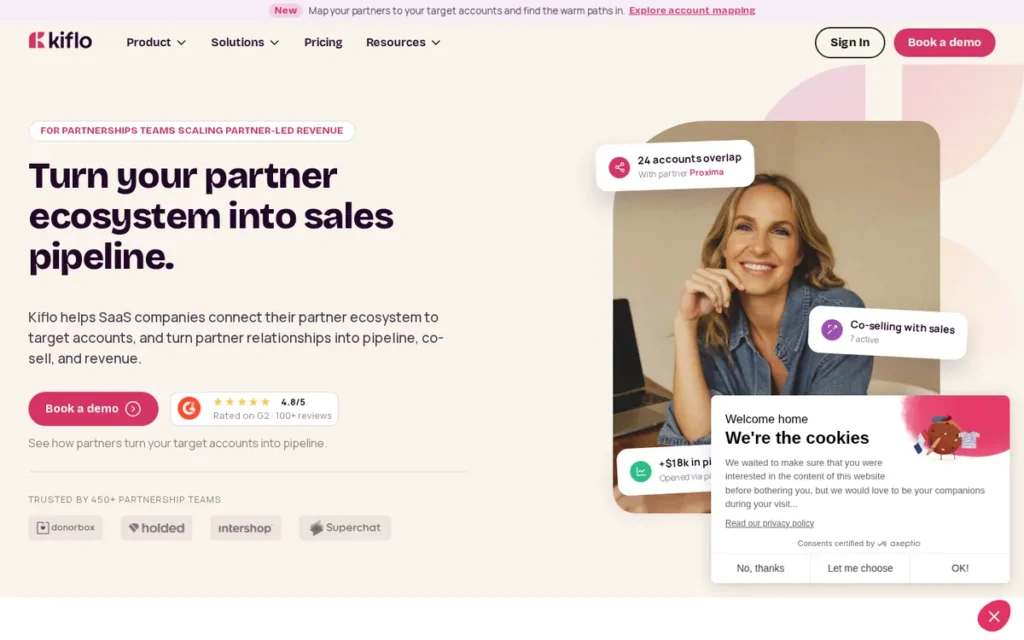
Category: SaaS-Native PRM, transparent per-active-partner pricing with bidirectional CRM sync and the highest practitioner satisfaction score in this comparison.
At a Glance
- Category: SaaS-Native PRM
- Best For: SMB and startup B2B SaaS teams building their first or second structured partner program on HubSpot or Salesforce
- Price Range: From $399/month (Core plan, billed annually); 14-day free trial, no credit card required
- Primary Strength: G2 High Performer (~4.8/5.0) with the most transparent public pricing in the PRM category
- Biggest Limitation: Per-active-partner pricing model escalates as partner networks grow beyond ~50 active accounts
- One-Line Summary: Kiflo PRM is a G2 High Performer rated ~4.8/5.0 with transparent public pricing from $399/month, bidirectional HubSpot and Salesforce sync, and practitioner-endorsed support quality, the clearest value option for SaaS teams outgrowing spreadsheets.
- Last Verified: May 2026
Overview
Kiflo PRM is a transparency-first partner management platform designed specifically for small to mid-sized B2B SaaS companies scaling their first or second structured partner program. Kiflo PRM supports resellers, referral partners, affiliates, and service partners via customizable tiers, reward structures, and self-service partner portals, without per-user seat fees or enterprise implementation overhead.
Kiflo PRM’s core value proposition is eliminating the “What’s happening with my deal?” cycle, giving partners real-time, autonomous visibility into their own lead status, commission calculations, and performance metrics. This directly addresses the trust and transparency gap that characterizes poorly managed early-stage partner programs.
Kiflo PRM is listed on the HubSpot App Marketplace with a 5.0/5.0 rating and 200+ installs, confirming active ecosystem traction, though the rating is based on one verified review as of May 2026 and should be interpreted accordingly (HubSpot App Marketplace, verified May 2026).
Key Features
- Bidirectional CRM Sync: Kiflo PRM provides two-way native integration with HubSpot and Salesforce, partner-submitted deals automatically create or update CRM records, and sales team status updates propagate back to the partner portal, protecting sensitive customer data while maintaining full attribution accuracy (Kiflo.com product page, 2025).
- Per-Active-Partner Pricing: Kiflo PRM charges per active partner (defined as at least one user with portal access), with unlimited users per partner, eliminating per-seat cost escalation and providing predictable, per-program budgeting for growing organizations.
- Multi-Type Partner Support: Kiflo PRM supports resellers, referral partners, affiliates, and service partners with customizable tier structures, reward mechanisms, and role-based portal access within a single platform at no additional module cost.
- 14-Day Free Trial: Kiflo PRM offers a 14-day free trial without requiring a credit card, enabling buyers to validate platform fit before committing to any paid plan, a rarity at the mid-market PRM tier.
- Real-Time Partner Pipeline Visibility: Kiflo PRM enables partners to track deal stages and commission status autonomously in real time, eliminating the inbound “deal status” email traffic that consumes channel team bandwidth at scale and reinforcing partner trust in the program’s transparency.
Best For
Kiflo PRM is best for B2B SaaS startups and SMB technology companies with 10–50 active partners that are outgrowing spreadsheets and manual CRM workarounds. Kiflo PRM is specifically well-matched for organizations running HubSpot or Salesforce as their primary CRM and needing a purpose-built partner portal without enterprise-tier cost or implementation complexity.
Pricing
Kiflo PRM’s Core plan starts at $399/month billed annually, with a 14-day free trial (Kiflo pricing page, verified May 2026).
Note: Some third-party sources (TrustRadius, older listings) cite $149–$299/month starting prices that may reflect prior pricing tiers or promotional rates, buyers should verify current pricing directly at kiflo.com/pricing before budgeting. Plus and Premier plans (priority support, dedicated success manager, Slack support) require direct quotes. Pricing verified: May 2026.
Strengths
- Highest Satisfaction Score Among Established Platforms: Kiflo PRM is a G2 High Performer in the Small Business PRM category with an estimated 4.8/5.0 rating (the highest satisfaction score among established platforms in this comparison) consistently reflecting clean UI, responsive support, and competitive pricing relative to alternatives (G2, verified May 2026).
- Category-Leading Pricing Transparency: Kiflo PRM publicly discloses its Core plan at $399/month, one of only two platforms in this comparison (alongside xAmplify’s no-cost path) that enables budget qualification without a sales conversation, removing a procurement barrier that affects every enterprise-tier platform evaluated here.
- Practitioner Endorsement: A practitioner with hands-on experience across multiple PRM systems ranked Kiflo PRM alongside PartnerStack as a top recommendation, explicitly contrasting its “$” cost signal to PartnerStack’s “$$$” while praising clean UI, CRM integration quality, and support as primary strengths (u/Extreme-Hovercraft27, r/SaaS, 2023).
- Accurate CRM Attribution: Kiflo PRM’s bidirectional sync ensures partner-sourced deals appear in the sales team’s native CRM workflow without requiring partners to have direct CRM access, preserving data security while maintaining full deal attribution accuracy across the pipeline.
Limitations
- Per-Active-Partner Cost Escalation: Kiflo PRM’s pricing model means rapid partner network growth directly increases platform cost, at $399/month base, scaling from 10 to 100 active partners can create a material financial constraint for organizations with aggressive partner recruitment targets.
- No Enterprise Feature Depth: Kiflo PRM does not offer full TCMA capabilities, advanced MDF budgeting and reconciliation workflows, or the gamification features available in enterprise platforms like Impartner, making it an insufficient choice for organizations with complex, multi-tier channel requirements.
- Limited Company Transparency: Kiflo PRM’s founding year, headquarters location, and team size are not publicly disclosed on the company website, a standard vendor-stability due-diligence consideration for organizations evaluating multi-year contract decisions where roadmap reliability matters (Kiflo.com, 2025).
- Two-CRM Integration Limit: Kiflo PRM’s native CRM integrations cover HubSpot and Salesforce exclusively, organizations running Microsoft Dynamics 365, Zoho, or other CRMs must rely on Zapier-based connections rather than native bidirectional sync.
Verdict
Kiflo PRM is the strongest value proposition in the SMB PRM segment, combining a G2 High Performer rating (~4.8/5.0), transparent public pricing from $399/month, and practitioner-endorsed support quality into a package that directly outperforms generic CRM workarounds for growing partner programs. Kiflo PRM’s per-active-partner pricing and absence of enterprise TCMA mean the platform reaches its ceiling as programs scale beyond 50 partners or require complex MDF workflows, at that inflection point, Channeltivity or Impartner become more appropriate choices.
Users on r/SaaS shared their experience:
“Kiflo – Again, super easy to get started and set up. Works really well with integrations into your CRM to track deals, etc. Clean UI and analytics, and again amazing support team. Also a lot of fun moving deals through their deal registration portal! $” Posted by u/Extreme-Hovercraft27
Takeaway: Kiflo PRM consistently earns top practitioner marks for setup speed, CRM integration reliability, and support quality, a trifecta that justifies its position as the SMB-first PRM recommendation for teams leaving spreadsheets behind.
4. Channeltivity: Best for Mid-Market Tech Channel Programs
Category: Specialist PRM, purpose-built for technology company channel programs with flat-fee organizational pricing and four native CRM integrations.
At a Glance
- Category: Specialist PRM
- Best For: Mid-market technology companies running reseller and channel programs across multiple CRM environments (Salesforce, HubSpot, Dynamics 365, Zoho)
- Price Range: Flat-fee per organization (no per-user or per-partner fees); exact pricing requires sales contact
- Primary Strength: Highest per-reviewer G2 satisfaction score in this comparison (4.7/5.0 across 56 reviews) with the broadest native CRM portfolio and implementation measured in weeks
- Biggest Limitation: Limited customization ceiling for bespoke programs; incomplete MDF budgeting module in some configurations
- One-Line Summary: Channeltivity is a purpose-built tech-channel PRM rated 4.7/5.0 on G2 (56 reviews) and 4.6/5.0 on Capterra (5 reviews), with flat-fee pricing, four native CRM integrations, and deployment timelines measured in weeks rather than months.
- Last Verified: May 2026
Overview
Channeltivity is a modular, purpose-built PRM platform designed exclusively for technology company channel programs, founded in 2007 and headquartered in Austin, Texas. Channeltivity covers the full tech-channel partner lifecycle across three domains:
- Partner Enablement: Training and certification programs, resource library, and structured onboarding content for channel partners.
- Channel Marketing: Co-branded collateral management, MDF request workflows, and email marketing automation for partner-activated campaigns.
- Channel Sales: Deal registration, lead distribution, and partner performance dashboards with direct CRM integration across four native platforms.
Channeltivity has operated exclusively in the technology company channel segment for 18+ years, producing depth in its specific domain without the feature sprawl of enterprise platforms that simultaneously serve manufacturing, distribution, and other industries.
Channeltivity’s 4.7/5.0 G2 score is the highest per-reviewer satisfaction rating in this comparison, but its 56 verified reviews represent a fraction of Impartner’s 554+. Channeltivity also lacks enterprise TCMA and full MDF financial automation, placing it at #4 for all-profile applicability despite leading on satisfaction within its specific tech-channel niche.
Key Features
- Four Native CRM Integrations: Channeltivity provides native bidirectional integration with Salesforce, HubSpot, Microsoft Dynamics 365, and Zoho, the broadest native CRM integration portfolio of any platform in this comparison, with no middleware or Zapier required for core deal registration workflows (Channeltivity PRM integrations page, verified May 2026).
- HubSpot Edition (Point-and-Click): Channeltivity’s HubSpot Edition enables point-and-click connectivity so partner-submitted deals automatically create and update HubSpot records in real time, available since 2021 and confirmed as current in Channeltivity’s integration documentation as of May 2026 (Channeltivity.com, verified May 2026).
- Flat-Fee Organizational Pricing: Channeltivity charges a flat fee per organization rather than per user or per partner, meaning partner program growth does not directly increase PRM cost, providing a financially predictable model for teams with aggressive partner recruitment targets.
- Integrated Partner LMS: Channeltivity includes an integrated Learning Management System for partner training and certification programs, enabling structured partner enablement without purchasing a separate learning platform or paying additional per-seat fees.
- Multi-Language Portals and Community Forums: Channeltivity supports multi-language partner portals for international channel programs and includes partner community forums, reducing channel team support burden by enabling partner-to-partner knowledge sharing directly within the portal environment (Channeltivity platform features, verified May 2026).
Best For
Channeltivity is best for mid-market technology companies with 25–200 active reseller and channel partners running HubSpot, Salesforce, Dynamics 365, or Zoho CRMs. Channeltivity is specifically well-matched for organizations that need a purpose-built partner portal with deal registration, MDF management, and enablement content, deployed in weeks without a months-long implementation project.
Pricing
Channeltivity uses a flat-fee per organization pricing model with tiered plans, plus separate HubSpot Edition and Salesforce Edition offerings. No exact dollar amounts are publicly disclosed on Channeltivity’s website; sales contact is required for specific pricing (Channeltivity pricing page, verified May 2026). Pricing verified: May 2026.
Strengths
- Highest Per-Reviewer G2 Satisfaction in This Comparison: Channeltivity holds a 4.7/5.0 G2 rating across 56 verified reviews (the highest per-reviewer satisfaction score in this comparison) reflecting consistent satisfaction with implementation speed, CRM integration reliability, and customer support responsiveness (G2, verified May 2026).
- Weeks-Not-Months Implementation: Practitioners with hands-on experience across multiple PRM systems specifically cite Channeltivity’s rapid implementation as a primary differentiator from Impartner and Channelscaler, where deployments routinely stretch to several months (u/Federal-Llama, r/SaaS, 2023).
- Broadest Native CRM Portfolio: Channeltivity’s native support for Salesforce, HubSpot, Microsoft Dynamics 365, and Zoho enables channel teams to keep their existing CRM without switching, the broadest multi-CRM integration portfolio of any platform in this comparison, requiring no middleware for core deal registration workflows.
- 18+ Years of Tech-Channel Focus: Channeltivity has operated exclusively in the technology company channel segment since 2007, producing purpose-fit product depth that broader enterprise PRMs serving manufacturing and distribution simultaneously cannot consistently match for tech-channel use cases.
Limitations
- Limited Customization Ceiling: Channeltivity’s professional services capabilities are described as “limited if you need something customized”, making it an insufficient choice for channel programs requiring highly bespoke partner journey automation or complex workflow logic beyond standard configurations (u/Federal-Llama, r/SaaS, 2023).
- Incomplete MDF Module in Some Configurations: Channeltivity does not include a full MDF budgeting and reconciliation module across all plan tiers, organizations with complex MDF approval workflows, co-op advertising management, or fund reconciliation requirements will need supplementary tools or workarounds (G2 Channeltivity reviews, verified May 2026).
- Dated UI: G2 and Capterra reviewers describe Channeltivity’s interface as dated compared to newer SaaS tools, a consideration for organizations where partner portal adoption rates are a priority, since UI quality meaningfully influences partner login frequency and overall program engagement.
- Limited Advanced Analytics: Channeltivity’s analytics capabilities are constrained to standard dashboards, organizations requiring deep pipeline attribution modeling, AI-driven partner scoring, or custom reporting beyond pre-built views will find the platform’s analytics layer insufficient for advanced channel intelligence requirements.
Verdict
Channeltivity is the most practical choice for mid-market technology companies that need a proven, purpose-built PRM with the broadest native CRM integration portfolio and implementation timelines measured in weeks. Channeltivity’s flat-fee pricing, 4.7/5.0 G2 per-reviewer rating, and 18+ years of exclusive tech-channel focus make it a low-risk, high-fit choice for companies with 25–200 partners across HubSpot, Salesforce, Dynamics, or Zoho environments, provided the program does not require complex MDF reconciliation or deep workflow customization beyond standard configurations.
5. Salesforce Partner Cloud: Best for Salesforce-Native Organizations
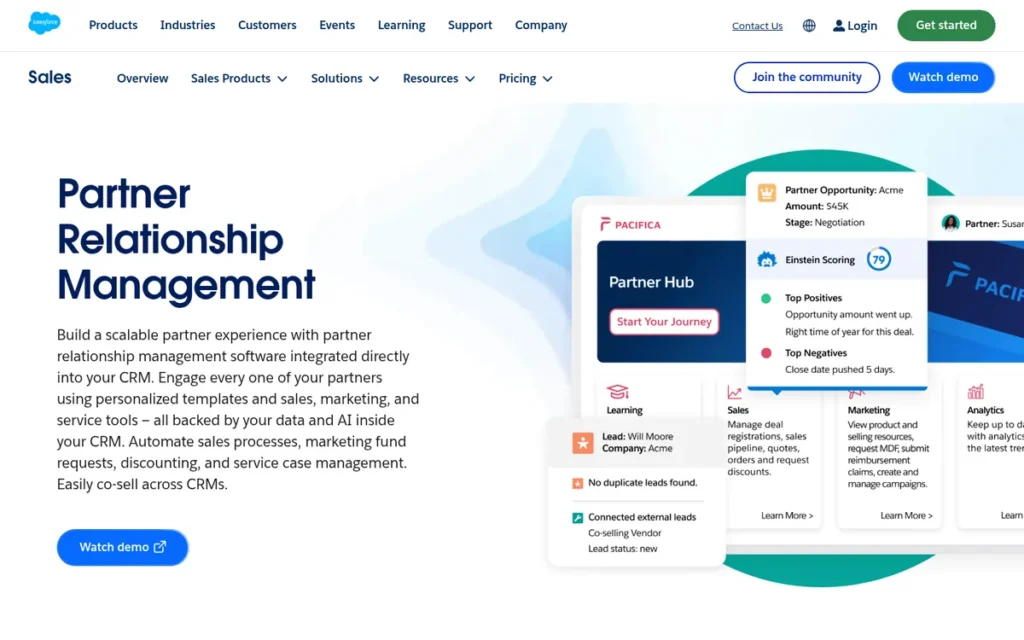
Category: Full-Stack Enterprise PRM, CRM-native partner management with Einstein AI and Agentforce, zero sync overhead, and the Salesforce platform ecosystem.
At a Glance
- Category: Full-Stack Enterprise PRM
- Best For: Enterprise organizations already running Salesforce Sales Cloud with the budget for native, zero-sync partner management
- Price Range: Experience Cloud from ~$25/user/month; total mid-market TCO analyst-estimated at $100K–$300K/year
- Primary Strength: Zero CRM sync latency: all partner and customer data native to one Salesforce instance, significantly reducing integration overhead
- Biggest Limitation: Among the lower G2 ratings in this comparison (4.4/5.0, 275 reviews); highest analyst-estimated TCO at $100K–$300K/year for mid-market
- One-Line Summary: Salesforce Partner Cloud is the only CRM-native PRM that eliminates third-party sync, with Einstein AI and Agentforce embedded platform-wide, the strongest choice for organizations already deeply committed to the Salesforce ecosystem that can absorb the cost structure.
- Last Verified: May 2026
Overview
Salesforce Partner Cloud is a Partner Ecosystem Management (PEM) platform built natively on the Salesforce CRM, combining partner portals, deal registration, enablement, SPIFF/MDF/rebate management, and Einstein AI within one platform, without any third-party integration or data synchronization overhead.
Salesforce Partner Cloud evolved from a legacy Experience Cloud portal module into the current unified PEM offering as of 2023, with Einstein AI and Agentforce now embedded at the platform level rather than as add-ons (SalesforceBen.com, 2025).
Salesforce Partner Cloud is the only platform in this comparison where all partner data (leads, opportunities, accounts) lives within the same Salesforce instance as direct sales data. This architecture significantly reduces (though does not entirely eliminate in complex multi-org configurations) the sync delays, middleware dependencies, and duplicate record issues that affect every other PRM platform evaluated here.
Key Features
- Einstein AI and Agentforce Integration: Salesforce Partner Cloud embeds Einstein Opportunity and Lead Scoring directly in partner portals, with AI-generated deal insights, Knowledge Base AI search answers, 24/7 AI chatbots, custom AI prompts, and Agentforce for autonomous partner outreach and personalized enablement, at the platform level, not as a bolt-on add-on (SalesforceBen.com, 2025).
- Native CRM Architecture: Salesforce Partner Cloud places all partner data within the same Salesforce instance as direct sales data, significantly reducing sync delays, middleware dependencies, and the duplicate record issues that are the top operational complaint across the third-party PRM integrations in this comparison.
- SPIFF, MDF, and Rebate Management: Salesforce Partner Cloud manages SPIFFs, MDF approvals, rebates, and incentive tiers natively within Salesforce, enabling consolidated reporting across partner incentives and direct sales in one platform, as confirmed by G2 reviewers (G2 Salesforce Partner Cloud reviews, verified May 2026).
- Experience Cloud Partner Portals: Salesforce Partner Cloud deploys partner portals via Experience Cloud, supporting branded partner experiences with role-based access to deal registration, enablement content, and performance dashboards, all within the native Salesforce environment.
- AppExchange Ecosystem Access: Salesforce Partner Cloud buyers gain access to the AppExchange marketplace, providing additional PRM-adjacent tools and integrations without leaving the Salesforce environment or adding third-party middleware dependencies.
Best For
Salesforce Partner Cloud is best for enterprise technology companies, financial services firms, and software vendors already deeply committed to Salesforce Sales Cloud. Salesforce Partner Cloud requires an analyst-estimated mid-market TCO of $100K–$300K/year and is economically rational only for organizations that prioritize CRM data integrity and Einstein AI integration over implementation speed or cost efficiency.
Pricing
Salesforce Partner Cloud pricing is modular and cumulative. Components include:
- Experience Cloud (portal infrastructure): ~$25/user/month (Growth edition) to ~$500/org/month (Unlimited)
- Partner Ecosystem Management add-on: estimated $50–100/partner user/month
- Salesforce Sales Cloud (internal users): $25–165/user/month per internal user
- Professional services (implementation): $50,000+ minimum, 3–6 months typical
Total mid-market TCO (50 internal + 200 partners) is analyst-estimated at $100,000–$300,000/year, a modeled range based on published list pricing, not a disclosed figure; actual costs vary by negotiated discounts and implementation scope (SalesforceBen.com, 2025; Kasmo Digital, 2025). Pricing verified: May 2026.
Strengths
- Architecturally Native CRM Integration: Salesforce Partner Cloud is the only platform in this comparison where partner data is fully native to the CRM, significantly reducing sync delays, duplicate records, and middleware dependencies that are the leading operational pain point across all other PRM integrations evaluated here.
- Einstein AI at Platform Level: Salesforce Partner Cloud embeds Einstein AI at the architectural level, meaning AI opportunity scoring, lead scoring, and deal insights propagate simultaneously across deal registration, partner portals, and analytics without separate tool configuration (SalesforceBen.com, 2025).
- Cross-Ecosystem Incentive Cohesion: A verified G2 reviewer confirms Salesforce Partner Cloud “integrates cleanly with other parts of the partner ecosystem, like SPIFF and MDF”, reflecting the tangible operational benefit of a native Salesforce data model for teams already managing incentive programs in Salesforce (G2, verified May 2026).
- Enterprise Scalability: Salesforce Partner Cloud tracks thousands of partner portals globally, and Salesforce’s infrastructure handles enterprise-scale data volumes with reliability that purpose-built SMB PRM platforms cannot consistently match at the same operational scale.
Limitations
- Highest Analyst-Estimated TCO in This Comparison: Salesforce Partner Cloud’s mid-market total cost of ownership is analyst-estimated at $100K–$300K/year (3–5× the cost of purpose-built alternatives for equivalent partner counts) making it economically irrational for organizations not already committed to Salesforce Sales Cloud (SalesforceBen.com, 2025).
- Among the Lower G2 Ratings in This Comparison: Salesforce Partner Cloud holds a 4.4/5.0 G2 rating across 275 reviews, users consistently cite implementation friction, administrative overhead, and complexity as primary frustrations relative to the platform’s cost and stated capabilities (G2, verified May 2026).
- Opaque and Confusing Pricing Architecture: Salesforce’s pricing is widely described as difficult to navigate, module pricing pages appear visually similar, making accurate TCO estimation genuinely difficult before full sales engagement and creating procurement planning risk (u/ImTheDeveloper, r/CRM, 2024).
- Auto-Renewal Contract Risk: Salesforce’s documented auto-renewal policy requires advance notice to prevent annual contract renewal; customers who attempted to renegotiate or exit mid-term have reported being locked in for additional full years (u/Better_Mechanic_7193, r/CRM, 2024). Request a signed addendum confirming the advance-notice window as a condition of contract execution.
Verdict
Salesforce Partner Cloud is the correct choice for organizations already deeply committed to Salesforce Sales Cloud that can absorb a $100K–$300K/year analyst-estimated TCO in exchange for zero CRM sync complexity and Einstein AI embedded at the platform level. For any organization not already on Salesforce, or unable to absorb this cost structure, the 4.4/5.0 G2 rating and documented implementation complexity make a purpose-built PRM (Channeltivity, Impartner, or Kiflo) a more rational and better-validated choice.
6. Channelscaler: Best for Mid-Enterprise Teams Needing Unlimited-User Scaling
Category: Full-Stack Enterprise PRM, the May 2025 rebrand of merged Allbound and Channel Mechanics, with Claude AI integration, unlimited-user pricing, and enterprise financial channel automation.
At a Glance
- Category: Full-Stack Enterprise PRM
- Best For: Mid-enterprise channel teams needing unlimited-user pricing with financial channel automation (rebates, SPIFFs, incentive tiers)
- Price Range: Custom enterprise pricing; no public tiers; demo required
- Primary Strength: Unlimited users and partners with $140B+ in verified partner-sourced sales managed on the combined platform
- Biggest Limitation: Post-rebrand name unfamiliar to buyers; months-long implementation typical; no public pricing; AI capabilities not yet independently validated
- One-Line Summary: Channelscaler is the May 2025 rebrand of merged Allbound and Channel Mechanics, managing 1.1M+ registered opportunities and $140B+ in partner-sourced sales, with Claude AI integration and an unlimited-user pricing model that eliminates per-seat cost escalation.
- Last Verified: May 2026
Overview
Channelscaler is the result of Allbound’s acquisition of Channel Mechanics, announced in March 2024 and unified under the Channelscaler brand in May 2025, led by CEO Kenneth Fox. Channelscaler combines Allbound’s partner portal and partner activation features (Allbound founded 2011) with Channel Mechanics’ enterprise-grade pricing automation, rebates, and channel program financial management (Channel Mechanics founded 2004), headquartered across San Mateo, CA and Galway, Ireland.
The combined platform manages over 1.1 million registered opportunities totaling more than $140 billion in partner-sourced sales, confirming enterprise-scale deployment across the merged customer base (Channelscaler merger announcement, March 2024).
Channelscaler’s #6 ranking reflects post-rebrand brand unfamiliarity and thin independent validation, not platform inferiority. For organizations with 50–500 partners and complex rebate requirements, Channelscaler’s unlimited-user model and financial automation depth may represent a stronger fit than platforms ranked above it.
Key Features
- Unlimited Users and Partners: Channelscaler charges no per-user or per-partner seat fees, the entire partner ecosystem and internal channel team access the platform without cost escalation as the program grows, eliminating the per-seat cost cliff common to per-user pricing models like Salesforce Partner Cloud.
- Claude AI Integration: Channelscaler markets itself as the first PRM with native Claude AI integration, providing AI-powered partner engagement nudges, an AI support agent, and behavioral-data-driven partner prioritization, capabilities that are vendor-described and have not yet accumulated independent third-party validation as of May 2026 (Channelscaler PRM software page, 2025).
- Off-Portal Engagement via Slack and Email: Channelscaler directly addresses the industry-wide challenge of low partner portal login rates through off-portal engagement nudges delivered via Slack and email, meeting partners in their existing workflows rather than requiring platform adoption as a prerequisite for engagement.
- Full MDF, Rebates, and SPIFF Management: Channelscaler manages the complete financial channel automation stack (MDF approvals, rebate tracking, SPIFF payouts, and incentive tiers) combining Channel Mechanics’ deep financial automation heritage with Allbound’s portal UX for comprehensive incentives management.
- Bidirectional CRM Sync and Integrated LMS: Channelscaler provides bidirectional integration with HubSpot and Salesforce for deal registration workflows, and includes an integrated Learning Management System for partner training and certification, enabling deal management, partner enablement, and performance analytics within the same platform.
Best For
Channelscaler is best for mid-enterprise technology vendors and ISVs managing 50–500+ reseller, distributor, or SI partners requiring unlimited-user scaling, sophisticated financial channel automation (rebates, SPIFFs, incentive tiers), and off-portal partner engagement capabilities. Channelscaler requires the implementation budget and timeline tolerance for a multi-month deployment.
Pricing
No public pricing is available for Channelscaler. The platform uses custom enterprise pricing inherited from both Allbound and Channel Mechanics, requiring a demo and sales engagement before budget qualification (Capterra Allbound listing, 2025). Pricing verified: May 2026.
Strengths
- Verified Enterprise Scale: Channelscaler manages 1.1 million+ registered opportunities totaling $140B+ in partner-sourced sales across its combined platform, the largest verified scale metric of any platform in this comparison, confirming enterprise-level deployment credibility (Channelscaler merger announcement, March 2024).
- Post-Merger Performance Momentum: Channelscaler reported more than doubling year-over-year pipeline growth for partner programs across its customer base in 2025, the first independently reported post-merger performance signal confirming measurable channel results on the unified platform (GlobeNewswire, January 12, 2026).
- Unlimited-User Economics: Channelscaler’s unlimited-user model eliminates the per-seat cost escalation that affects PartnerStack (marketplace commission), Kiflo (per-active-partner), and Salesforce Partner Cloud (per-user licensing), creating predictable, non-scaling PRM costs as the partner ecosystem grows aggressively.
- Combined 20+ Year Institutional Heritage: With Channel Mechanics’ roots going back to 2004 and Allbound’s to 2011, Channelscaler carries one of the longest combined institutional histories in the PRM category, meaningful for enterprise buyers evaluating vendor staying power and financial stability in a long-term platform commitment.
Limitations
- Post-Rebrand Brand Recognition Gap: Channelscaler is a brand name created in May 2025, unfamiliar to buyers entering the PRM market in 2025–2026, requiring additional research to understand the Allbound and Channel Mechanics lineage and assess post-merger product integration maturity before committing to a contract.
- Months-Long Implementation: Practitioner reviewers with direct Allbound experience describe implementations that “often take several months” and require backend development work for configuration changes, a structural limitation that reduces channel momentum for teams needing rapid partner program activation (u/Federal-Llama, r/SaaS, 2023).
- Pricing Opacity: No public pricing is available for Channelscaler, requiring full sales engagement before budget qualification, consistent with the enterprise PRM tier but a significant friction point for buyers trying to shortlist vendors efficiently before investing demo cycle time.
- Unvalidated AI Capabilities: Channelscaler’s Claude AI capabilities: smart nudges, partner prioritization, AI support agent, are vendor-marketed and have not yet accumulated independent third-party review evidence confirming production results. Buyers should request specific AI performance references and named outcome data during evaluation.
Verdict
Channelscaler is a compelling mid-enterprise choice for organizations that need unlimited-user pricing, sophisticated financial channel automation, and off-portal partner engagement in a single platform, with $140B+ in managed partner-sourced sales and a verified 2025 doubling of year-over-year pipeline growth confirming enterprise-scale deployment credibility. The primary risks are post-rebrand product integration maturity, months-long implementation timelines, and the absence of independent AI validation, all warranting thorough reference customer engagement before committing to a multi-year contract.
7. xAmplify: Best for AI-Native PRM Pilots at Zero Initial Cost
Category: Specialist/Emerging PRM, AI-native Through-Channel Marketing Automation with the only no-cost pilot path in the PRM category.
At a Glance
- Category: Specialist/Emerging PRM
- Best For: Forward-looking SaaS teams piloting AI-native PRM for ≤10 partners, or technology vendors with MSP partner channels needing ConnectWise/HaloPSA integration
- Price Range: No-cost pilot paths available (open-source self-hosted via GitHub with Docker Compose, or hosted free tier for up to 10 partners); paid tiers custom-quoted (mid-market estimated $10,000–$50,000/year, unverified)
- Primary Strength: Only no-cost pilot path in this comparison, with Oliver AI providing predictive partner scoring and the broadest native CRM integration portfolio (6 platforms including MSP-specific ConnectWise and HaloPSA)
- Biggest Limitation: Self-hosted free option requires technical deployment resources; low G2 review volume; company background undisclosed; AI performance claims lack independent validation
- One-Line Summary: xAmplify is the only platform in this comparison offering a no-cost pilot path and an embedded Oliver AI engine with predictive partner scoring, co-branded content generation, and six native CRM integrations, including MSP-specific platforms ConnectWise and HaloPSA.
- Last Verified: May 2026
Overview
xAmplify is an AI-native partner relationship management platform built around full Through-Channel Marketing Automation (TCMA) capabilities, combining partner portal, deal registration, co-branded campaign automation, MDF management, LMS, and the Oliver AI engine in a single platform.
xAmplify offers two no-cost paths: an open-source, self-hosted PRM core available on GitHub (requiring Docker Compose deployment, technical setup required) and a hosted free tier for up to 10 partners. xAmplify is the only platform in this comparison with a zero-cost pilot option, though the self-hosted route requires engineering resources for deployment and maintenance that teams without available technical staff should factor into their evaluation.
xAmplify’s company background (including founding year, headquarters, CEO and leadership team, funding history, and team size) is not publicly disclosed on the company’s website or in third-party sources. This opacity is a material due-diligence consideration for enterprise buyers evaluating a multi-year platform commitment.
Key Features
- Oliver AI Engine: xAmplify’s Oliver AI provides predictive partner scoring, automated co-branded content generation, partner engagement scoring, deal intelligence including revenue signals and risk alerts, and behavior-based marketing automation, with xAmplify reporting $2.4M+ in pipeline identified via Oliver AI, a vendor-reported aggregate not independently corroborated by named client case studies (xAmplify PRM guide, 2026).
- No-Cost Pilot Path: xAmplify offers two zero-cost entry points: an open-source self-hosted PRM (GitHub with Docker Compose) and a hosted free tier for up to 10 partners, the only no-cost pilot option in this comparison, though the self-hosted path requires technical deployment capability that non-engineering teams should account for separately.
- Broadest Native CRM Integration Portfolio: xAmplify provides native bidirectional CRM sync via MCP protocol across six platforms:
- SaaS CRMs: Salesforce, HubSpot, and Microsoft Dynamics (bidirectional deal registration and pipeline sync)
- MSP-specific CRMs: ConnectWise (announced September 2024) and HaloPSA: the only PRM in this comparison with native MSP CRM support
- Marketing automation: Marketo (bidirectional sync for partner-activated campaign tracking)
- Full TCMA Capabilities: xAmplify provides complete Through-Channel Marketing Automation (co-branded campaign execution, MDF management, and partner-activated marketing workflows) positioning xAmplify among the most TCMA-complete platforms evaluated, alongside Impartner.
- HubSpot App Marketplace Listing: xAmplify is listed on the HubSpot App Marketplace with an active integration, providing third-party distribution validation and HubSpot ecosystem access that extends beyond self-reported vendor claims (HubSpot App Marketplace, verified May 2026).
Best For
xAmplify is best for forward-looking SaaS companies and technology vendors with fewer than 10 active partners who want to pilot AI-native PRM and TCMA capabilities at zero initial cost. xAmplify is also the right choice for technology vendors with established MSP partner channels requiring ConnectWise and HaloPSA integration unavailable on any other platform in this comparison.
Pricing
xAmplify provides two no-cost paths: an open-source self-hosted core (GitHub with Docker Compose setup required) and a hosted free tier for up to 10 partners, no credit card required for either option. Paid tiers are custom-quoted for unlimited partners with full Oliver AI, advanced TCMA, and revenue signal features.
Mid-market paid pricing is estimated at approximately $10,000–$50,000/year based on comparable AI-PRM platforms, this is an inferred range, not a disclosed figure; buyers should verify current pricing directly with xAmplify (xAmplify.com, 2025). Pricing verified: May 2026.
Strengths
- Only No-Cost Pilot Path in This Comparison: xAmplify’s no-cost entry options: open-source self-hosted or hosted free tier for up to 10 partners, eliminate financial risk for initial program pilots, making xAmplify the lowest-friction entry point for evaluating AI-native PRM capabilities before committing to any paid tier.
- MSP-Specific CRM Integrations: xAmplify is the only platform in this comparison with native support for ConnectWise and HaloPSA, MSP CRMs essential for technology vendors whose partner channels are primarily composed of managed service providers rather than traditional resellers (xAmplify, 2025).
- AI-Native Architecture: xAmplify’s Oliver AI engine includes predictive partner scoring and behavior-based marketing automation built into the platform’s architecture, capabilities that most competing platforms are only beginning to add as bolt-on features, not native layers.
- Cross-Team Alignment Evidence: A verified G2 reviewer described xAmplify as a platform that “bridges marketing/sales/partner teams” with co-branded campaigns that “scale outreach without bottlenecks, a rare find” for cross-functional alignment (G2 xAmplify reviews, verified May 2026).
Limitations
- Self-Hosted Free Tier Requires Technical Setup: xAmplify’s open-source self-hosted tier requires Docker Compose deployment via GitHub, teams without available engineering resources for setup and maintenance should budget for the hosted paid tier rather than treating the open-source option as a straightforward no-cost starting point comparable to SaaS freemium tools.
- Low G2 Review Volume: xAmplify does not appear in G2’s top-ranked PRM platform list, indicating low review volume relative to category leaders, buyers relying on review-platform social proof for shortlisting will not encounter xAmplify organically in standard research workflows (G2 PRM category, verified May 2026).
- Undisclosed Company Background: xAmplify does not publicly disclose founding year, headquarters, leadership team, funding history, or team size, a material due-diligence gap for organizations evaluating a multi-year PRM commitment that requires vendor financial stability and roadmap reliability assessment.
- Unvalidated AI Performance Claims: xAmplify’s vendor-reported performance metrics, 2× partner pipeline, 60% faster partner onboarding, $2.4M+ in Oliver AI-identified pipeline, are not independently corroborated by named client case studies or third-party audits; buyers should request specific reference customers and documented outcomes during evaluation (xAmplify PRM guide, 2026).
Verdict
xAmplify is the right starting point for teams that want to pilot AI-native PRM and TCMA capabilities at zero cost, or for technology vendors with MSP partner channels needing ConnectWise or HaloPSA integration unavailable on any other platform in this comparison. xAmplify’s undisclosed company background and thin independent review record are legitimate concerns for enterprise buyers, xAmplify is best treated as a pilot or emerging-platform evaluation, not a primary PRM commitment for large or complex partner programs.
What Red Flags Should I Watch For When Evaluating PRM Software?
Seven red flags consistently separate high-risk PRM purchases from well-matched ones: (1) pricing opacity with no self-serve demos, (2) months-long implementations, (3) developer-required configuration, (4) unvalidated AI claims, (5) per-partner cost cliffs, (6) predatory auto-renewal clauses, and (7) no practitioner community presence. Each is documented below with real examples from the platforms in this comparison.
Red Flag #1: Pricing Opacity Combined with a Mandatory Demo Requirement
Every enterprise PRM platform in this comparison (Impartner, PartnerStack, Salesforce Partner Cloud, Channelscaler) withholds public pricing and requires a demo before providing budget information.
When pricing opacity combines with a multi-week sales cycle, buyers commit significant procurement resources before discovering whether a platform is financially viable. Build a rough budget range assumption before scheduling demos, and ask for a ballpark cost range on first contact.
Any vendor unable to provide even a range within the first email exchange is signaling that procurement friction is a feature of their sales motion, not a bug.
Red Flag #2: Implementation Timelines Quoted in “Months”
Implementations for Impartner, Channelscaler, and Salesforce Partner Cloud regularly stretch to several months, a timeline that directly undermines channel momentum, because partners wait on a structured program while the tool is being configured.
A three-month implementation delay means three months of partners being onboarded through email, deals unregistered, attribution lost, and competitive conflicts unresolved. For a program with 50 partners averaging two deals per quarter, a 90-day delay can mean 300 untracked deal registrations.
Any vendor quoting “several months” for a standard deployment without a named acceleration path is flagging a significant partner engagement risk. Ask for a named customer who went live in under 60 days and speak with them directly.
Red Flag #3: Configuration Changes Requiring Developer Involvement
Some PRM platforms (Impartner and Channelscaler) require backend developer work for ongoing configuration changes, meaning every program adjustment creates a service ticket and a wait cycle.
This dependency effectively creates vendor lock-in: the longer a configuration is in place, the more expensive migration becomes, raising total cost of ownership beyond the licensing fee alone.
For channel teams without a dedicated PRM administrator or development budget, this dependency limits responsiveness to partner feedback and creates a permanent managed-services relationship with the vendor.
Red Flag #4: AI Features Without Independent Validation
Multiple platforms in this comparison market AI capabilities (Aimi, Oliver AI, Claude AI integration) without independent third-party validation of real-world performance.
Before accepting any vendor’s AI claim as due-diligence evidence, verify:
- At least one named reference customer willing to discuss AI-specific results
- A specific, quantified outcome (not “improved partner engagement”)
- Independence: whether the statistic comes from the vendor or from a third-party audit
Vendor-reported AI statistics (e.g., xAmplify’s claimed $2.4M+ in Oliver AI-surfaced pipeline) should be verified through direct reference customer conversations, not treated as evidence on their own.
Red Flag #5: Per-User or Per-Partner Pricing with No Cost Ceiling
Pricing models that charge per active partner (Kiflo) or per marketplace-sourced deal (PartnerStack) create cost escalation as partner programs grow.
Model total cost at 2× and 5× your current partner count before committing (not just at current volume) to identify potential cost cliffs before they materialize. Flat-fee models (Channeltivity) and unlimited-user models (Channelscaler) offer more predictable scaling economics, though both require validation that the base fee is competitive at anticipated scale.
Red Flag #6: Auto-Renewal Contract Clauses
Salesforce’s documented auto-renewal policy requires advance notice to prevent annual contract renewal, customers who attempted to renegotiate or exit mid-term have reported being locked in for additional full-year terms (u/Better_Mechanic_7193, r/CRM, 2024).
Any PRM contract should receive dedicated legal review for auto-renewal provisions, notice periods, and price-increase clauses before signature. Request a signed addendum confirming the advance-notice window as a condition of contract execution.
Red Flag #7: No Independent Practitioner Community Discussion
xAmplify, despite active content marketing and a HubSpot marketplace listing, has generated no organic practitioner discussion on major SaaS and channel partnership forums.
When a platform cannot be found in practitioner word-of-mouth communities, it typically indicates very recent market entry, limited adoption, or a customer base without enough deployment history to have formed independent opinions. All of these conditions increase due-diligence requirements before committing to any multi-year contract.
What Questions Should I Ask Before Choosing a PRM Tool?
Five questions consistently reveal whether a PRM platform is right for your organization before committing to a contract: CRM integration quality, implementation timeline and operational independence, partner portal adoption benchmarks, total cost at scale, and reference customer availability. Use these as your minimum evaluation framework before any purchase decision.
Question #1: Does the platform integrate natively with our CRM, and is the sync bidirectional?
Ask for a live demonstration of the integration, not a slide deck. Specify your CRM (Salesforce, HubSpot, Dynamics 365, Zoho) and ask what happens when a partner submits a deal: how long before it appears in the CRM, and does the partner portal update automatically when the CRM opportunity status changes?
Integration quality varies significantly across platforms, and data sync failures are the leading operational complaint in post-implementation reviews across all seven platforms evaluated here. Never accept a slide deck in place of a live integration demonstration with real test data.
Question #2: What is the average implementation time for a company our size, and what is included in professional services?
Request references from customers with similar partner counts and CRM environments who went live in the last 12 months. Ask specifically: “How many weeks elapsed between contract signing and first live partner deal submission?”
Implementations requiring developer involvement for ongoing configuration changes should be flagged explicitly, they create an ongoing service dependency that can negate the efficiency gains of the PRM software itself, turning a tool purchase into a managed-services relationship.
Question #3: How do you handle partner portal adoption, what percentage of partners log in monthly across your customer base?
No PRM delivers ROI if partners default to email and phone rather than using the platform. Ask for documented portal adoption benchmarks from the vendor’s existing customer base.
Specifically ask what features drive repeat partner logins, gamification, deal status notifications, commission transparency, Slack nudges. A vendor unable to answer this question with benchmark data does not have a proven, tested solution to the category’s most persistent operational problem.
Question #4: What does total cost of ownership look like at 2× and 5× our current partner count?
Model cost at scale before committing. Per-user, per-partner, and per-deal pricing models create unexpected cost cliffs as programs grow beyond initial scope.
Flat-fee models (Channeltivity) and unlimited-user models (Channelscaler) offer more predictable scaling economics, but require validation that the flat fee itself is competitive at the scale you anticipate reaching within 24 months.
Question #5: Can you provide three reference customers in our industry with our partner type, and can I speak with them directly?
Reference calls are more valuable than vendor-produced case studies. Ask specifically for customers with the same CRM, similar partner count and type, and similar company size to your own.
Vendor-reported statistics and published case studies should be treated as directional context, not evidentiary proof, independent reference conversations are the most reliable signal available before committing to a multi-year contract.
A well-structured PRM evaluation for a 25–50 partner program typically requires 3–4 weeks: Week 1, shortlist 2–3 platforms using the decision matrix above. Week 2, run live demos with a standardized question list. Week 3, reference calls with 2 customers per platform. Week 4, contract review and final decision. Skipping reference calls is the most common cause of post-implementation regret in this category.
How Did We Rank These PRM Platforms?
PlugRoute ranked these seven PRM platforms across seven criteria: G2 and Capterra review scores and volume, Reddit practitioner community sentiment, pricing transparency, CRM integration quality and breadth, AI capability validation, and implementation speed. Review platform data and practitioner sentiment together account for the majority of ranking weight. No affiliate relationships influenced any placement.
How Were These PRM Platforms Identified and Selected?
To identify the top PRM platforms, we queried multiple AI search engines and web research tools using five target queries:
- “Best Partner Relationship Management (PRM) Software”
- “Best PRM software for SaaS companies 2026”
- “Partner relationship management software comparison by company size”
- “Best PRM software with CRM integration for channel partners”
- “Top partner relationship management software for reseller and affiliate programs”
We gathered structured research data on each platform, analyzed Reddit community sentiment from r/SaaS, r/partnerships, r/CRM, and r/Affiliatemarketing, and cross-referenced vendor feature claims against third-party review platforms including G2, Capterra, TrustRadius, Salesforce AppExchange, and HubSpot App Marketplace listings.
What Criteria Were Used to Rank These PRM Platforms?
- Review Platform Ratings and Volume: G2 and Capterra ratings reflect aggregated real-world user experience across implementation quality, feature performance, and support responsiveness. Both score and review volume were weighted: a 4.8 rating from 5 reviews is less reliable than a 4.5 from 554 reviews, and both dimensions influenced ranking.
- Real-World Practitioner Sentiment: Discussions on r/SaaS and r/CRM provide unfiltered signals about platform pain points that aggregate review platforms underrepresent, particularly implementation complexity, support quality under load, and vendor contract behaviors.
- Pricing Transparency and Value: Platforms with publicly disclosed pricing (Kiflo, xAmplify) were credited for reducing buyer friction and enabling budget qualification without a full sales cycle.
- CRM Integration Quality and Breadth: Native bidirectional CRM sync was weighted more heavily than Zapier-based integration. The number of natively supported CRMs was tracked as a proxy for integration investment depth.
- Feature Depth Relative to Use Case: No platform was penalized for targeting a specific segment. Kiflo’s absence of enterprise TCMA is a gap only in enterprise context; for SMB buyers, it is irrelevant. Rankings reflect fit within each platform’s declared segment.
- AI Capability and Independent Validation: AI features were credited where documented, but vendor-reported AI performance metrics were weighted at half the evidential value of independently corroborated results.
- Implementation Speed and Operational Independence: Platforms enabling channel teams to configure programs without developer involvement were weighted higher than platforms requiring ongoing professional services for standard configuration changes.
How Is Conflicting Evidence Weighted in These Rankings?
When review platform ratings conflict with Reddit community sentiment, we weight specificity and recency. A detailed practitioner comment with hands-on multi-platform experience from 2023 outweighs a generic 2021 G2 review.
On PlugRoute, a detailed practitioner post with hands-on experience outweighs a generic vendor case study. Specificity, recency, and independence determine evidence weight, not source authority alone.
How Was Data Validated?
Vendor-reported statistics are labeled as such throughout this article. Claims corroborated by at least one independent source (G2 reviews, Reddit practitioner posts, third-party analyst commentary) are stated as fact with attribution. Claims appearing only in vendor-produced content are presented with source attribution and explicit hedging language.
This article has one structural limitation: xAmplify and Channelscaler have low independent review volume, meaning their entries rely more heavily on vendor-reported evidence than the other five entries. Readers evaluating either platform should weight reference customer conversations more heavily than the published claims included here.
How Often Is This Guide Updated?
This article was last updated in May 2026. PlugRoute reviews PRM category rankings on a semi-annual basis. Pricing data is particularly volatile in this category, readers should verify current pricing directly with vendors before making purchasing decisions.
Independence Disclosure
PlugRoute has no affiliate relationships with any company listed in this comparison. No vendor has paid for placement, review, or editorial treatment. Rankings are determined entirely by the methodology described above.
What Are the Most Common Questions About PRM Software?
What is the difference between a PRM and a CRM for managing partner programs?
A PRM is purpose-built for indirect sales channels (resellers, affiliates, and distributors) with deal registration portals, MDF tracking, and partner performance analytics that generic CRM objects cannot replicate without heavy customization. A CRM manages direct customer relationships. Most PRM platforms integrate bidirectionally with existing CRMs rather than replacing them, since the two systems handle fundamentally different relationship types and workflows.
How does PlugRoute determine PRM platform rankings?
PlugRoute ranks PRM platforms using a seven-criteria methodology combining G2 and Capterra review scores and volume, Reddit practitioner sentiment, pricing transparency, CRM integration quality, AI capability validation, and implementation speed. The complete methodology, evidence weighting, and data sources are documented in the “How Did We Rank These PRM Platforms?” section above.
Which PRM platform is best for a SaaS company just starting its first partner program?
Kiflo PRM is the best starting point for most SaaS companies launching their first structured partner program, offering transparent pricing from $399/month, a 14-day free trial with no credit card required, bidirectional HubSpot and Salesforce sync, and a G2 High Performer rating (~4.8/5.0). xAmplify’s no-cost pilot path (hosted free tier for up to 10 partners) is the lowest-friction option for teams prioritizing AI-native evaluation before any paid commitment.
What PRM Terms Should I Know Before Evaluating These Platforms?
Through-Channel Marketing Automation (TCMA): TCMA is technology that enables vendors to distribute co-branded marketing campaigns to and through their partner ecosystem at scale, automating the creation, customization, and execution of partner-facing marketing content (email, social media, paid ads) without requiring manual coordination for each partner or campaign. Platforms with full TCMA (Impartner, xAmplify, Channelscaler) are differentiated from those with basic or no native TCMA capabilities (PartnerStack, Kiflo).
Market Development Funds (MDF): MDF refers to vendor-provided budget allocated to channel partners to fund marketing activities (events, paid advertising, content, webinars) that generate leads and awareness for the vendor’s products through the partner’s local market presence. PRM platforms manage MDF request workflows, approval processes, fund reconciliation, and reporting, replacing the email and spreadsheet processes that create reconciliation errors in manual channel programs.
Deal Registration: Deal registration is the process by which a channel partner formally claims an opportunity with a vendor before the deal closes, triggering CRM record creation, pricing protections, and commission tracking. Purpose-built PRM platforms automate deal registration workflows, replacing email-based and spreadsheet processes that create attribution errors when managed through generic CRMs without a dedicated partner layer.
Partner Ecosystem Management (PEM): PEM is an emerging category designation (used by Salesforce and others) that extends beyond traditional PRM to encompass the full partner lifecycle, including co-sell workflows, partner marketplace management, ecosystem analytics, and AI-assisted partner matching across direct, indirect, and technology partnership types simultaneously.
SPIFF (Sales Performance Incentive Fund): A SPIFF is a short-term, direct financial incentive paid to individual partner sales representatives for selling a specific vendor product or achieving a defined sales target within a time window. PRM platforms with SPIFF management (Salesforce Partner Cloud, Channelscaler) automate SPIFF calculation, tracking, and payout, replacing manual partner compensation spreadsheets and reducing reconciliation disputes with partner sales teams.
Glossary: Key Terms Used in This Comparison
Through-Channel Marketing Automation (TCMA): Technology that enables vendors to distribute co-branded marketing campaigns to and through their partner ecosystem at scale, automating the creation, customization, and execution of partner-facing content across email, social media, and paid advertising without manual coordination per partner. Platforms with full TCMA capabilities (including Impartner, xAmplify, and Channelscaler) are structurally differentiated from those with limited or no native TCMA.
Market Development Funds (MDF): Vendor-provided budget allocated to channel partners to fund local marketing activities (events, paid advertising, content, webinars) that generate leads and awareness for the vendor’s products through the partner’s market presence. PRM platforms manage MDF request workflows, approval processes, fund reconciliation, and reporting, replacing the error-prone email and spreadsheet processes common in manually managed channel programs.
Deal Registration: The process by which a channel partner formally claims an opportunity with a vendor before the deal closes, triggering CRM record creation, pricing protections, and commission tracking. Purpose-built PRM platforms automate deal registration workflows, eliminating the attribution gaps that occur when partners submit opportunities through unstructured email or generic CRM processes.
Partner Ecosystem Management (PEM): An emerging category designation (used notably by Salesforce) that extends beyond traditional PRM to encompass the full partner lifecycle, including co-sell workflows, partner marketplace management, ecosystem analytics, and AI-assisted partner matching across direct, indirect, and technology partnership types simultaneously.
SPIFF (Sales Performance Incentive Fund): A short-term, direct financial incentive paid to individual partner sales representatives for selling a specific vendor product or hitting a defined sales target within a set time window. PRM platforms with SPIFF management automate calculation, tracking, and payout, replacing manual partner compensation spreadsheets and reducing reconciliation disputes between vendors and partner sales teams.
Which PRM Tool Is Right for You?
Key Insights
- PartnerStack is the best PRM for SaaS companies managing multiple partner types simultaneously, with its 100,000+ partner marketplace providing passive partner recruitment that no competing platform in this comparison replicates.
- Impartner PRM leads the enterprise segment with the deepest feature set, the largest G2 review footprint in this comparison (554+ reviews, 4.5/5.0), and the most advanced AI capability (Aimi, launched December 2025), but requires multi-month implementation timelines and significant budget commitment.
- Kiflo PRM offers the strongest value for SMB and startup teams, combining a G2 High Performer rating (~4.8/5.0) with transparent public pricing from $399/month and practitioner-endorsed support quality that consistently outperforms expectations for its price tier.
- Every PRM platform in this comparison, including the highest-rated, faces the same unsolved problem: partners default to email and Slack rather than logging into portals. Buying a PRM creates the infrastructure; partner adoption requires a structured onboarding program running alongside the software investment, budget for both, not just the license.
If you are a SaaS company with an established partner budget and multiple partner types (affiliates, referrals, resellers), PartnerStack is the highest-confidence choice, its 4.7/5.0 G2 rating, marketplace network effect, and 30-day average launch speed make it the most validated option for this profile.
If you are scaling from spreadsheets with 10–50 partners on HubSpot or Salesforce and need to move quickly without enterprise overhead, Kiflo PRM is the lowest-risk starting point, transparent pricing, rapid setup, and community-endorsed support quality make it the safest first PRM investment in the category.
If you are an enterprise channel team managing 100+ partners with complex MDF, TCMA, and AI automation requirements, Impartner PRM is the most feature-complete option, accept the implementation timeline and budget accordingly, and plan for a multi-month deployment before first partner submissions go live.
The PRM category is evolving rapidly: AI features, autonomous partner outreach, and TCMA automation are shifting from differentiators to table stakes across the enterprise tier. Platforms without credible AI roadmaps risk becoming the “legacy” option within 18–24 months. Revisit this comparison in late 2026 and 2027 as independent AI performance data accumulates across the category and post-merger product maturity evidence becomes available for Channelscaler.
Have a question about a specific PRM platform or use case not covered here? Submit it to PlugRoute for independent editorial review. We update this guide semi-annually. Last updated: May 2026.