Clazar leads overall with 84 verified G2 reviews at 4.9/5.0 and full-lifecycle AWS, Azure, and GCP automation. Labra is the top AI-native choice with a free AWS entry tier and AWS Premier Tier Partner status. Tackle.io is the category-originating platform for Salesforce-centric enterprise teams needing proprietary buyer intent data. The right choice depends on your CRM, cloud footprint, and pricing model tolerance.
ISVs expect marketplace revenue to grow from 20% to 32% of total revenue within 12 months (Tackle.io State of Cloud GTM Report, 2025). Combined hyperscaler committed spend crossed $531 billion in Q3 2025 (Partner Insight, 2025). AWS partners generate $7.13 in ecosystem revenue for every $1 of AWS technology sold, making co-sell automation one of the highest-ROI GTM investments available to an ISV in 2026 (Partner Insight, citing Omdia data, 2025).
PlugRoute has no affiliate relationships with any company listed. Rankings are determined entirely by research data and objective evaluation criteria.
“Marketplace is not the Field of Dreams. To have any meaningful success, it needs to be a well-defined channel in your GTM strategy.” (u/dp2sholly, r/googlecloud)
Takeaway: Listing on a cloud marketplace is not a revenue strategy, it is a procurement mechanism. The platforms in this comparison exist to build the co-sell motion that makes marketplace listings generate revenue rather than collect dust.
TL;DR: Top Picks at a Glance
- Clazar earns the #1 overall ranking for its 84 verified G2 reviews at 4.9/5.0 and full-lifecycle automation (including billing reconciliation and renewal management) across AWS, Azure, and GCP with native HubSpot and Salesforce parity at no add-on cost.
- Labra earns the #2 ranking for its SmartGTM agentic AI, Propensity To Buy ML scoring, and confirmed AWS Premier Tier Partner status plus AWS Global Partner of the Year 2025, available with a free AWS Marketplace entry tier.
- Tackle.io earns the #3 ranking as the category-originating platform with the proprietary Cloudographic™ buyer intent dataset, the strongest choice for enterprise ISVs running Salesforce-centric co-sell workflows.
- Suger earns the #4 ranking as the only Cloud GTM platform in this comparison with confirmed native Snowflake Marketplace integration alongside AWS, Azure, and GCP.
What Are the 3 Types of Cloud GTM Platforms, and Which One Do You Need?
Cloud GTM platforms fall into three structurally distinct categories. Full-Lifecycle Platforms (including Clazar, Labra, and Suger) automate the complete listing-to-renewal workflow in a single system. Co-Sell Orchestration Platforms, led by Tackle.io, layer proprietary buyer intent intelligence on standard automation. Ecosystem Management Platforms like WorkSpan manage 30+ partner relationships across GSIs, MSPs, and resellers at enterprise scale.
Full-Lifecycle Platforms handle listing, co-sell, private offers, billing reconciliation, and renewal automation in an integrated system. Each platform in this group has a distinct sub-specialization:
- Clazar: Zero-downtime Lift-n-Shift migration and native HubSpot-plus-Salesforce CRM parity at no add-on cost
- Labra: AI-native SmartGTM agentic interface and Propensity To Buy ML lead scoring trained on cloud-specific purchasing signals
- Suger: Snowflake Marketplace integration and API-first programmatic architecture supporting all four major cloud procurement channels
Co-Sell Orchestration Platforms differentiate through intelligence layers on top of standard automation. Tackle.io’s Cloudographic™ dataset identifies which target accounts are actively purchasing through each hyperscaler’s marketplace, a proprietary intelligence capability with no direct equivalent in any other platform in this comparison.
Ecosystem Management Platforms are built for enterprises managing dozens of simultaneous partner relationships across multiple tiers. WorkSpan is the only platform in this comparison designed for multi-party co-sell programs involving cloud providers, GSIs, and resellers each operating from separate CRMs. Two additional focused entrants (Automatum (flat-fee, Red Hat Marketplace) and Invisory (services-led, Salesforce AppExchange)) occupy specialized niches addressed in the ranked entries below.
Users on r/sales shared their experience with the operational reality of marketplace transactions:
“We did a massive deal through a CSP marketplace last year, and it was such an enormous pain in the ass that no one involved would sign up to do another one any time soon. Usually the benefit is that a) the customer can retire some of their unused committed spend with the CSP with the transaction, and b) the CSP will often chip in $ or credits for the project if you transact through their marketplace. But instead of just having to navigate the vendor and purchaser’s procurement rules to get the deal signed, now you also have to also have to follow the CSP’s ridiculous marketplace procurement rules as well. It was an s-show. That said, we did retire a big chunk of the customer’s committed spend with that CSP through the transaction, which helped the deal get through procurement.” Posted by u/sopwithsnipe2
Takeaway: ISVs face three simultaneous procurement rule sets in any cloud marketplace deal, the operational complexity that Cloud GTM platforms are built to absorb so individual reps are not carrying it manually.
How Do the Top Cloud GTM Platforms Compare?
| Rank | Company | Category | Best For | One-Line Summary | Key Capabilities | Primary Strength | Key Limitation |
|---|---|---|---|---|---|---|---|
| #1 | Clazar | Full-Lifecycle Cloud GTM Platform | Growth-stage ISVs on HubSpot or Salesforce needing multi-cloud automation through renewal | Clazar manages every stage from listing through contract renewal across AWS, Azure, and GCP with native HubSpot and Salesforce parity at no add-on cost. | AWS, Azure, GCP listing and co-sell; private offers; renewal automation; Lift-n-Shift migration; Buyer-360 analytics; Salesforce and HubSpot (native, no add-on) | 84 verified G2 reviews at 4.9/5.0 (May 2026); highest G2 review count in category; native HubSpot plus Salesforce parity; zero-downtime migration program | No published pricing; no Snowflake, Red Hat, or AppExchange support; limited named case studies with verified revenue outcomes |
| #2 | Labra | AI-Native Cloud GTM Platform | AWS-first ISVs wanting ML-driven lead prioritization and a free entry point before multi-cloud expansion | Labra is an AI-native Cloud GTM platform with SmartGTM agentic interface and Propensity To Buy lead scoring; available with a free AWS Marketplace tier and AWS Premier Tier Partner status. | AWS (free tier), Azure, GCP listing and co-sell; SmartGTM AI agent; PTB ML scoring (500+ leads); WAFR/FTR signals; Salesforce (primary) and HubSpot | AWS Premier Tier Partner plus AWS Global Partner of the Year 2025; 4.9/5.0 from 58 AWS Marketplace reviews (May 2026) | GCP PTB signal density lags AWS and Azure; founding details not publicly verifiable |
| #3 | Tackle.io | Co-Sell Orchestration Platform | Enterprise Salesforce ISVs needing proprietary buyer intent intelligence and mature co-sell orchestration | Tackle.io is the category-originating Cloud GTM platform with proprietary Cloudographic™ buyer intent data, 74 G2 reviews at 4.7/5.0, and end-to-end co-sell orchestration across AWS, Azure, and GCP. | AWS, Azure, GCP co-sell and listing; Cloudographic™ Prospect; Smart Onboarding; Offers module; Reporting; Salesforce (paid add-on above base price); no native HubSpot | Cloudographic™ dataset is unique in the category; 74 G2 reviews at 4.7/5.0; annual State of Cloud GTM Report | Salesforce integration is a paid add-on; no native HubSpot; Prospect module starts at $12,750 |
| #4 | Suger | Multi-Marketplace Cloud GTM Platform | Data and analytics ISVs targeting Snowflake Marketplace alongside AWS, Azure, and GCP | Suger is the only Cloud GTM platform supporting AWS, Azure, GCP, and Snowflake Marketplace natively from a single API-first system with volume-tiered pricing. | AWS, Azure, GCP, Snowflake listing and co-sell; REST API (100 req/sec); one-click private offers; ERP sync; revenue recognition; 30-plus integrations; Salesforce and HubSpot (native) | Confirmed GCP Partner Directory listing (independently verifiable); only native Snowflake Marketplace integration in this comparison | No published pricing; no named case studies with verified revenue outcomes |
| #5 | Automatum | Flat-Fee Self-Serve Cloud GTM Platform | SMB and mid-market ISVs on HubSpot needing Red Hat Marketplace access and published pricing with zero revenue share | Automatum is a flat-fee, self-serve Cloud GTM platform with published pricing starting at $1,199/year, zero revenue share, Red Hat Marketplace support, and HubSpot-at-parity CRM integration. | AWS, Azure, GCP, Red Hat Marketplace listing; private offers; co-sell automation; self-serve activation; HubSpot and Salesforce (Enterprise tier only); published annual pricing tiers | Only platform with publicly verifiable pricing ($1,199 to $9,999/year flat fee, zero revenue share); cost independently confirmable without a sales call | CRM co-sell integration gated to Enterprise tier ($9,999/year); newest entrant with fewest enterprise case studies |
| #6 | Invisory | Services-Led Cloud GTM Platform | Early-stage ISVs entering Salesforce AppExchange plus hyperscalers with strategic CSM guidance | Invisory is a services-led Cloud GTM platform covering AWS, Azure, GCP, and Salesforce AppExchange with fixed package pricing, dedicated CSM support, and automated GTM deliverables. | AWS, Azure, GCP, Salesforce AppExchange listing and co-sell; partner fit scores; dedicated CSM; automated GTM deliverables (1-pagers, battle cards); Salesforce and HubSpot (native) | Only platform with native Salesforce AppExchange support alongside three hyperscalers; fixed pricing, no revenue share; CSM and deliverables included | 11 AWS Marketplace reviews; lowest volume in comparison; leadership expansion documented August 2023; funding undisclosed |
| #7 | WorkSpan | Enterprise Ecosystem Business Management Platform | Enterprises managing 30-plus partner relationships across GSIs, MSPs, and cloud marketplaces | WorkSpan is an enterprise Ecosystem Business Management Platform used by SAP, Wipro, and VMware to manage multi-party partner programs with Microsoft Dynamics 365 integration. | Multi-party deal registration; Microsoft Dynamics 365 (formally documented connector); bi-directional CRM sharing; WorkSpan AI; shared business plans; AWS, Azure, GCP co-sell | Formally documented Microsoft Learn connector; named customers SAP, Wipro, Kyndryl, VMware; $50 billion in shared pipeline (self-reported, workspan.com; not independently audited) | Lowest review volume and rating (10 GetApp reviews at 4.4/5.0); enterprise-only pricing; systematically unsuitable for growth-stage ISVs |
Which Cloud GTM Platform Should I Choose for My Use Case?
| Your #1 Priority | Recommended Tool | Why | Acceptable Alternative |
|---|---|---|---|
| Full-lifecycle multi-cloud automation (HubSpot or Salesforce) | Clazar | 84 G2 reviews at 4.9/5.0; native HubSpot plus Salesforce parity at no add-on cost; Lift-n-Shift zero-downtime migration | Labra (if AWS-first and AI-driven prioritization matters most) |
| AI-driven lead prioritization plus free AWS entry tier | Labra | SmartGTM agent plus PTB ML scoring; AWS Premier Tier plus Global Partner of the Year 2025; free AWS tier up to $100K | Clazar (if review volume and renewal automation are the priority) |
| Enterprise Salesforce co-sell plus proprietary buyer intent data | Tackle.io | Cloudographic™ dataset (unique in category); 74 G2 reviews at 4.7/5.0; mature co-sell orchestration | Clazar (if HubSpot is needed or Salesforce add-on cost is prohibitive) |
| Snowflake Marketplace alongside AWS, Azure, and GCP | Suger | Only platform natively supporting all four; confirmed GCP Partner Directory credential; API-first architecture | No equivalent alternative in this comparison |
| Flat-fee pricing and Red Hat Marketplace | Automatum | Published pricing ($1,199 to $9,999/year flat fee); zero revenue share; Red Hat support confirmed | Tackle.io (also announced Red Hat support; verify current feature scope at tackle.io/resources/news/tackle-red-hat-marketplace/) |
| Salesforce AppExchange plus hyperscalers plus strategic CSM guidance | Invisory | Only AppExchange-native platform; fixed package pricing; CSM and GTM deliverables included | No equivalent alternative for AppExchange coverage |
| Enterprise with 30-plus partner ecosystem (GSIs, MSPs, resellers) | WorkSpan | Only multi-party deal registration; Dynamics 365 integration; named customers SAP, Wipro, VMware | No equivalent in this comparison for that program complexity |
If your use case matches two rows, apply this tie-breaker between Clazar and Labra:
- Choose Clazar if your team runs HubSpot alongside Salesforce, manages active deal volumes across all three hyperscalers, and needs renewal automation and billing reconciliation as core requirements.
- Choose Labra if your pipeline is AWS-first, lead volume exceeds what your team can manually prioritize, or you want to validate ROI before committing budget via the free AWS entry tier.
Reading guidance: If you know your CRM stack and primary marketplace, use the Quick Decision Framework above to skip directly to your recommended entry. If you are still scoping requirements, read the Clazar (#1) and Labra (#2) reviews first, they represent the two most distinct approaches for the growth-stage ISV audience this comparison is written for.
Which Cloud GTM Platforms Made the Top 7, and Why?
1. Clazar: Best Overall: Full-Lifecycle Automation Across AWS, Azure, and GCP with Native HubSpot and Salesforce Parity
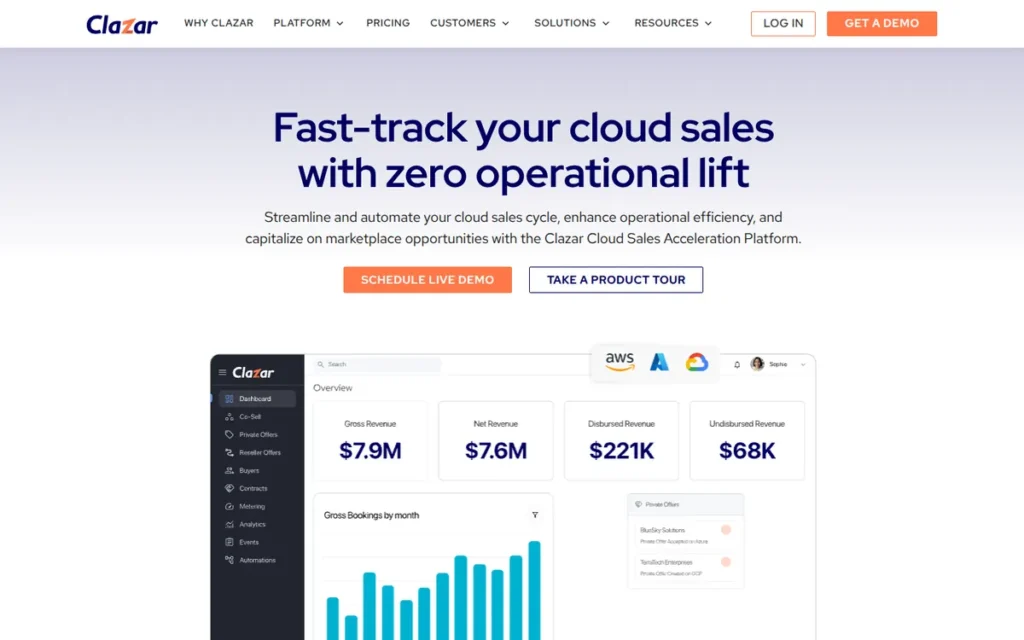
Category: Full-Lifecycle Cloud GTM Platform, automates every stage from marketplace listing through contract renewal across AWS, Azure, and GCP in a single no-code system.
At a Glance
- Category: Full-Lifecycle Cloud GTM Platform
- Best For: Growth-stage and enterprise ISVs managing AWS, Azure, and GCP simultaneously who need full-lifecycle automation including renewal management and native HubSpot support without add-on cost
- Price Range: Custom pricing on request; usage-based; no free tier (contact clazar.io, pricing not publicly disclosed as of May 2026)
- Primary Strength: Clazar carries 84 verified G2 reviews at 4.9/5.0 as of May 2026 (the highest G2 review count among all platforms in this comparison) with additional reviews on Capterra whose count was not independently confirmed at time of publication
- Biggest Limitation: Clazar does not publish pricing publicly, and named client case studies with independently verifiable revenue metrics are limited in publicly accessible sources as of May 2026
- One-Line Summary: Clazar is a full-lifecycle Cloud GTM platform managing every stage from marketplace listing through contract renewal across AWS, Azure, and GCP, with native HubSpot and Salesforce support at equal parity and a zero-downtime migration program for ISVs switching from competing platforms.
- Last Verified: May 2026
Overview
Clazar is a full-lifecycle Cloud GTM platform built for growth-stage and enterprise ISVs that need a single no-code system managing marketplace listing, co-sell automation, private offer creation, billing reconciliation, and renewal management across AWS, Azure, and Google Cloud Marketplace. Clazar distinguishes itself through its Lift-n-Shift migration program (enabling zero-downtime transfer of existing marketplace listings from competing platforms) and its native HubSpot integration at equal parity with Salesforce, without additional cost. Clazar collaborates directly with hyperscaler engineering teams as a beta program participant for early API access, as documented by TFiR.io (2026).
Key Features
- No-Code Listing Management: Clazar’s no-code listing management system enables ISV teams to update marketplace descriptions, pricing plans, and branding across AWS, Azure, and GCP within 1–2 days without engineering involvement, eliminating the DevOps bottleneck that delays most hyperscaler listing updates.
- Lift-n-Shift Migration: Clazar’s Lift-n-Shift migration program transfers existing marketplace listings from competing platforms, including Tackle.io and others, with zero downtime, removing the switching cost that typically locks ISVs into legacy platforms during active deal periods.
- Co-Sell Automation: Clazar’s co-sell automation creates co-sell opportunities directly from Salesforce or HubSpot CRM records in real time, syncs deal status with AWS ACE and Azure IP Co-Sell portals, and surfaces account manager engagement scores to help reps prioritize active deals by partner activity.
- Automation Builder: Clazar’s Automation Builder provides event-triggered workflows, multi-tier approval chains, and automated alerts, replacing manual hyperscaler portal management for ISVs whose deal volumes make manual portal work operationally unsustainable.
- Buyer-360 Analytics: Clazar’s Buyer-360 analytics delivers a unified real-time dashboard of transactions, renewals, drop-offs, and listing expiries across all three supported cloud marketplaces, giving finance and operations teams a single source of truth for marketplace revenue reconciliation.
Best For
Clazar is best for growth-stage and scaling ISVs managing AWS, Azure, and GCP simultaneously, particularly those running sales on HubSpot (not only Salesforce), needing full lifecycle management through renewal automation, or evaluating a platform switch from a competitor without accepting downtime risk on active marketplace listings.
Pricing
Clazar does not publish pricing publicly as of May 2026. All pricing is custom-quoted and reported to be usage-based; no free tier is available. Contact Clazar directly at clazar.io for a current quote. Confirm whether finance integrations (NetSuite, data warehouse exports) and add-on automation features carry separate costs before finalizing any evaluation.
Strengths
- Clazar carries 84 verified G2 reviews at 4.9/5.0 as of May 2026: the highest G2 review count among all platforms in this comparison, with additional reviews on Capterra whose count was not independently confirmed at publication; verify current totals at g2.com/products/clazar-cloud-sales-platform/reviews.
This aligns with community sentiment on r/SaaS:
“You will need to invest time upfront. Listings, contracts, metering, reporting, and co-sell requirements take time to understand. This is where a lot of solo founders stall, which is also why companies like Clazar exist. They basically automate the marketplace plumbing so you can act like a bigger vendor without burning weeks on the mechanics. Totally optional, but a big time saver if you are trying to move fast.” Posted by u/UseIndividual6353
Takeaway: Clazar’s no-code marketplace automation removes the operational burden that stalls most early-stage ISVs before they close their first cloud marketplace deal.
- Clazar’s Lift-n-Shift migration program is the only published zero-downtime migration mechanism in the cloud GTM platform category, directly reducing the switching cost that prevents ISVs from moving off legacy platforms, a named technical differentiator documented in Clazar’s product materials and confirmed by independent editorial coverage from TFiR.io (2026).
- Clazar offers native HubSpot and Salesforce CRM integration at full feature parity and no additional cost, a capability that Tackle.io (Salesforce as a paid add-on; no native HubSpot) does not match for the growth-stage ISV audience that predominantly runs HubSpot.
- Clazar maintains active collaboration with AWS, Azure, and GCP engineering teams as a beta program participant, enabling early access to new marketplace APIs before general availability, a product velocity advantage documented by TFiR.io (2026) that reduces the risk of feature lag behind hyperscaler program changes.
Limitations
- Proof Scarcity: Clazar’s most consequential trade-off is the near-complete absence of publicly verifiable named case studies with specific, auditable revenue outcomes, the company publishes directional aggregate claims without the client attribution enterprise buyers use for independent due diligence. Until Clazar publishes named case studies with verifiable revenue timelines, enterprise buyers above $10M ARR should request a reference call before signing a multi-year contract.
- Pricing Opacity: Clazar does not disclose pricing publicly, requiring a sales conversation before any financial modeling can begin, creating evaluation friction for ISVs trying to self-assess cost-to-value ratios against competitors with published pricing such as Automatum.
- Marketplace Coverage Gaps: Clazar covers only AWS, Azure, and GCP; ISVs that also target Snowflake Marketplace (Suger only), Red Hat Marketplace (Automatum and Tackle.io), or Salesforce AppExchange (Invisory only) will require either a separate platform or manual management for those channels.
Verdict
Clazar is the highest-rated Cloud GTM platform by G2 review count in the category as of May 2026, carrying 84 reviews at 4.9/5.0, and is the only platform offering both a zero-downtime migration program and native HubSpot-plus-Salesforce CRM parity without add-on cost. Clazar earns the top overall ranking for growth-stage and enterprise ISVs managing the three major hyperscaler marketplaces who prioritize review-backed credibility, CRM flexibility, and full-lifecycle automation through contract renewal. ISVs that also sell through Snowflake, Red Hat, or Salesforce AppExchange should evaluate Suger, Automatum, or Invisory alongside Clazar to ensure complete marketplace channel coverage.
2. Labra: Best AI-Native Platform: ML-Driven Lead Prioritization and Agentic Co-Sell Execution Across AWS, Azure, and GCP
Category: AI-Native Cloud GTM Platform, applies machine learning lead prioritization and agentic co-sell automation to cloud marketplace operations across AWS, Azure, and GCP.
At a Glance
- Category: AI-Native Cloud GTM Platform
- Best For: AWS-first to multi-cloud ISVs wanting ML-driven lead prioritization and agentic co-sell execution, and early-stage ISVs wanting a free AWS Marketplace entry point before committing to paid tiers
- Price Range: Free (AWS-only, up to $100K in cumulative transactions); paid Growth and Enterprise tiers priced on request (contact labra.io, as of May 2026)
- Primary Strength: Labra holds AWS Premier Tier Partner status: the highest tier in the AWS Partner Network, and won the AWS Global Partner of the Year 2025 award (confirmed at labra.io/labra-recap-2025/), alongside a 4.9/5.0 rating from 58 AWS Marketplace reviews as of May 2026
- Biggest Limitation: Labra’s Propensity To Buy scoring draws on thinner GCP co-sell signal data than AWS or Azure data, reducing PTB accuracy for ISVs with significant Google Cloud Marketplace exposure
- One-Line Summary: Labra is an AI-native Cloud GTM platform with a SmartGTM agentic interface and Propensity To Buy lead scoring purpose-built for cloud marketplace buying signals, available with a free AWS Marketplace tier and confirmed AWS Premier Tier Partner status.
- Last Verified: May 2026
Overview
Labra is an AI-native Cloud GTM platform designed for AWS-heavy to multi-cloud ISVs that want machine-learning-driven lead prioritization and agentic co-sell execution, with a free AWS Marketplace tier and paid tiers covering Azure and GCP. Labra differentiates from all competitors through its SmartGTM AI agent (launched November 2025), which delivers Smart Signals, one-click Critical Actions, and daily deal highlights within a conversational interface. Labra holds confirmed AWS Premier Tier Partner status and won the AWS Global Partner of the Year 2025 award (labra.io/labra-recap-2025/), the strongest AWS institutional credentials documented for any platform in this comparison.
Key Features
- SmartGTM AI Agent: Labra’s SmartGTM AI agent: launched November 2025, delivers a conversational interface with Smart Signals (Cloud Alignment Score, Engagement Score) and Critical Actions requiring only one click to execute, including referral acceptance, lead routing, and opportunity status updates across AWS, Azure, and GCP co-sell programs.
- Propensity To Buy Scoring: Labra’s Propensity To Buy scoring model assigns High, Medium, Low, or Unknown scores to 500-plus leads based on cloud-specific signals (hyperscaler relationships, cloud spend levels, tech stack data, marketplace transaction history, and co-sell program readiness) purpose-built for cloud procurement context rather than generic CRM scoring.
- Multi-Cloud Listing and Co-Sell: Labra’s marketplace listing management covers AWS (free tier), Azure, and GCP with SEO-optimized listing tools, co-sell data integration into CRM pipeline, and real-time reports across all three hyperscaler programs from a unified Overview Page dashboard.
- Private Offer Workflows: Labra’s private offer workflows: available in Growth and Enterprise tiers, manage advanced offer creation, CPPO (Channel Partner Private Offer) support, and Agreement-Based Offer handling with full CRM synchronization for Salesforce-primary and HubSpot environments.
- WAFR/FTR Review Support: Labra’s Propensity To Buy scoring incorporates AWS Workload Architecture Review (WAFR) and Foundational Technical Review (FTR) readiness as co-sell signals, enabling ISVs to prioritize prospects aligned with AWS partner program requirements, a capability unavailable in competing platforms.
Best For
Labra is best for AWS-first or multi-cloud ISVs at growth to enterprise stage that want to automate lead prioritization based on cloud-specific buying signals, for early-stage ISVs wanting to start on a free AWS Marketplace tier and scale into paid multi-cloud tiers, and for teams evaluating the most AI-advanced platform in the category as of 2026.
Pricing
Labra offers a free tier covering AWS Marketplace operations up to $100K in cumulative transactions, the most accessible self-serve entry point among full-featured co-sell platforms in this comparison as of May 2026. Growth tiers add Azure and GCP coverage; Enterprise adds AI optimization, advanced co-sell management, and advanced private offer workflows. Dollar amounts for paid tiers require contact with Labra sales at labra.io. Verify GCP co-sell data coverage meets your team’s needs during a demo before committing to a paid plan.
Strengths
- Labra holds AWS Premier Tier Partner status, the highest tier in the AWS Partner Network, and won the AWS Global Partner of the Year award in 2025 (confirmed at labra.io/labra-recap-2025/), the strongest AWS program credentials independently verified for any platform in this comparison, providing institutional validation from the AWS marketplace organization itself.
- Labra carries a 4.9/5.0 rating from 58 AWS Marketplace reviews as of May 2026: with the most recent review dated approximately 2 months before the research date, representing the highest per-review average rating in this comparison on a platform that applies independent verification standards.
- Labra’s SmartGTM AI agent (November 2025) and Propensity To Buy scoring (Q1 2025) are the most architecturally advanced AI implementations in the Cloud GTM category, built as core platform architecture rather than a feature layer added to an existing system, enabling lead-level cloud-specific signal processing that no competing platform currently offers.
- Labra’s free AWS Marketplace tier (up to $100K in transactions) is the most accessible functional entry point among platforms with full co-sell automation capability, enabling ISVs to validate platform ROI and team workflow fit before committing to paid Growth or Enterprise tiers.
Limitations
- GCP Signal Depth: Labra’s most consequential trade-off is GCP data density: the Propensity To Buy scoring model draws on denser AWS and Azure co-sell signal data than it currently has for Google Cloud, producing lower PTB accuracy for ISVs with significant GCP marketplace exposure or equal-weight multi-cloud strategies. Teams where GCP is a primary revenue channel should pressure-test PTB score accuracy for GCP-originated leads in a demo before committing to a paid plan.
- Unverified Performance Benchmarks: Labra’s self-reported aggregate benchmarks ($1.25 billion in pipeline managed, 90% deal cycle reduction, 2x marketplace revenue increase) are not independently audited in publicly available sources, buyers should request reference calls with comparably sized customers before using these figures in internal business cases.
- Company Transparency: Labra’s founding year, total funding raised, investor names, and confirmed headcount are not publicly verifiable as of May 2026. While its AWS Premier Tier status and Global Partner of the Year award signal organizational capability, buyers evaluating vendor longevity for multi-year contracts should request team and funding documentation directly.
Verdict
Labra is the only Cloud GTM platform in this comparison to hold both AWS Premier Tier Partner status (the highest AWS partner designation) and an AWS Global Partner of the Year 2025 award, making it the most institutionally validated AWS-centric platform in this evaluation. Labra ranks second overall because its G2 review volume trails Clazar’s (58 vs. 84) and its GCP co-sell signal density lags behind its AWS and Azure capabilities, but Labra is the clear first choice for ISVs that prioritize AI-driven lead prioritization, want a free entry point to validate the platform, or are AWS-first sellers where PTB signal density and SmartGTM agentic execution are highest.
3. Tackle.io: Best for Enterprise ISVs Running Salesforce-Centric GTM Workflows Who Need Proprietary Buyer Intent Intelligence
Category: Co-Sell Orchestration Platform, end-to-end automation of cloud marketplace listing, co-sell, private offers, and buyer intent intelligence with the proprietary Cloudographic™ data layer across AWS, Azure, and GCP.
At a Glance
- Category: Co-Sell Orchestration Platform
- Best For: Mid-market to enterprise ISVs running Salesforce as their primary CRM who need mature co-sell orchestration and proprietary buyer intent data to prioritize outbound by cloud purchasing behavior
- Price Range: Tackle Prospect (standalone module) starts at $12,750; full platform contact-sales pricing; Salesforce integration is a paid add-on above base cost; no free tier (as of May 2026)
- Primary Strength: Tackle.io is the only Cloud GTM platform with the proprietary Cloudographic™ buyer intent dataset (identifying which target accounts are actively purchasing through each hyperscaler’s marketplace) with no direct equivalent available from any competing platform
- Biggest Limitation: Tackle.io’s Salesforce integration is an optional paid add-on above the base subscription cost, and no native HubSpot integration is available, creating additional cost and workflow gaps for ISV teams not running Salesforce as their sole CRM
- One-Line Summary: Tackle.io is the category-originating Cloud GTM platform with proprietary Cloudographic™ buyer intent data, 74 G2 reviews at 4.7/5.0, and end-to-end co-sell orchestration across AWS, Azure, and GCP, designed for mid-market to enterprise ISVs running Salesforce-centric GTM workflows.
- Last Verified: May 2026
Overview
Tackle.io is the category-originating Cloud GTM platform designed for mid-market and enterprise ISVs seeking end-to-end marketplace listing, co-sell automation, private offer management, and buyer intent intelligence across AWS, Azure, and Google Cloud Marketplace. Tackle.io is credited with coining the term “Cloud GTM” and publishes the annual State of Cloud GTM Report (a widely cited benchmark document in the category) giving it among the highest institutional credibility in the category among hyperscaler field teams and ISV Alliances leaders. Tackle.io is structured around five integrated modules, with the Salesforce application available as an optional paid add-on and no native HubSpot integration currently offered.
Key Features
- Smart Onboarding: Tackle.io’s Smart Onboarding module enables zero-engineering marketplace setup across AWS, Azure, and GCP, handling listing configuration, technical submission requirements, and hyperscaler compliance without requiring ISV DevOps or engineering resources.
- Offers Module: Tackle.io’s Offers module manages the full private offer workflow (including standard private offers, Agreement-Based Offers (ABOs), and Channel Partner Private Offers (CPPOs)) as well as pay-as-you-go product configurations across all three hyperscalers.
- Co-Sell Automation: Tackle.io’s Co-Sell module automates end-to-end co-sell workflows with AWS ACE and Microsoft Partner Center, handling opportunity registration, deal status sync, referral management, and partner manager engagement tracking in real time from a centralized interface.
- Cloudographic™ Prospect: Tackle.io’s Prospect module: powered by the proprietary Cloudographic™ dataset, identifies which target accounts are actively purchasing through each hyperscaler’s marketplace, enabling ISV sales teams to prioritize outbound targeting based on verified cloud-spend alignment rather than generic intent signal proxies.
- Unified Reporting: Tackle.io’s Reporting module delivers unified revenue, order management, and usage metering data across all supported hyperscalers, providing finance and operations teams with consolidated marketplace performance visibility from a single reporting layer.
Best For
Tackle.io is best for mid-market to enterprise ISVs running Salesforce as their primary CRM (and can absorb the add-on cost for CRM integration) that need the most institutionally validated co-sell orchestration in the market and want to leverage Cloudographic™ buyer intent data to prioritize outbound targeting by cloud marketplace purchasing behavior.
Pricing
Tackle Prospect (buyer intent module, standalone) starts at $12,750 as of May 2026, confirmed on the Microsoft Commercial Marketplace listing. The full Tackle Cloud GTM Platform requires contact with sales for pricing; the Salesforce CRM application integration is an optional paid add-on above the base subscription. No free tier or self-serve entry is available. Budget for the Salesforce add-on cost when modeling total cost of ownership against competitors that include CRM integration in base pricing.
Strengths
- Tackle.io publishes the annual State of Cloud GTM Report: a widely cited benchmark document in the cloud marketplace category, with the 2025 edition documenting that marketplace revenue is projected to grow from 20% to 32% of total ISV revenue within 12 months and that 46% of ISVs rate access to partner development managers as extremely challenging (Tackle.io State of Cloud GTM Report, 2025), establishing research authority that competitors reference rather than produce.
- Tackle.io carries 74 G2 reviews at 4.7/5.0 as of May 2026: the highest G2 rating among platforms with 70-plus reviews in this comparison, with verified users praising its ability to “launch, scale, and manage cloud marketplace presence without requiring heavy engineering resources” and describing it as a “true partner in cloud GTM journey” (G2 verified reviews, 2026).
- Tackle.io’s Cloudographic™ buyer intent dataset is a proprietary intelligence layer with no direct equivalent in any competing platform, enabling ISVs to identify accounts actively purchasing through specific cloud marketplaces and prioritize outbound targeting based on verified cloud procurement behavior rather than generic web activity signals.
- Tackle.io is listed as a vendor on both AWS Marketplace and Microsoft Commercial Marketplace, and maintains a formal Cloud GTM Ecosystem of technology companies, services firms, and channel partners, providing institutional validation from the hyperscalers the platform serves.
Limitations
- CRM Add-On Cost: Tackle.io’s most consequential trade-off is CRM integration cost structure, the Salesforce application is an optional paid add-on above the base subscription rather than included at no additional cost, increasing total cost of ownership in a category where Clazar and Labra include CRM integration in base pricing. Budget modeling must account for this add-on before comparing headline prices.
- No Native HubSpot: Tackle.io does not offer a native HubSpot integration, meaning ISVs whose sales teams run on HubSpot (the dominant CRM for growth-stage ISVs) face a manual data-transfer gap or require a third-party connector, a material workflow friction that multiple alternatives in this comparison resolve natively.
- High Entry Cost: Tackle.io has no self-serve or free entry tier, and the Prospect module alone starts at $12,750, making it the highest-cost entry point in the category alongside WorkSpan, a barrier for ISVs under $5M in ARR evaluating their first Cloud GTM platform.
Verdict
Tackle.io is the category-originating Cloud GTM platform, credited with coining the term “Cloud GTM” and carrying 74 G2 reviews at 4.7/5.0 alongside the proprietary Cloudographic™ buyer intent dataset found in no competing platform. Tackle.io earns the #3 ranking because its Salesforce-as-add-on pricing model and absence of native HubSpot integration create material cost and workflow gaps for the growth-stage ISV audience that Clazar and Labra address natively. Tackle.io remains the strongest choice for enterprise-scale ISVs running Salesforce-centric GTM operations who need the most institutionally validated co-sell orchestration platform and are willing to absorb the premium pricing that maturity and Cloudographic™ access command.
4. Suger: Best for Data and Analytics ISVs: Only Platform with Native Snowflake Marketplace Integration Alongside AWS, Azure, and GCP
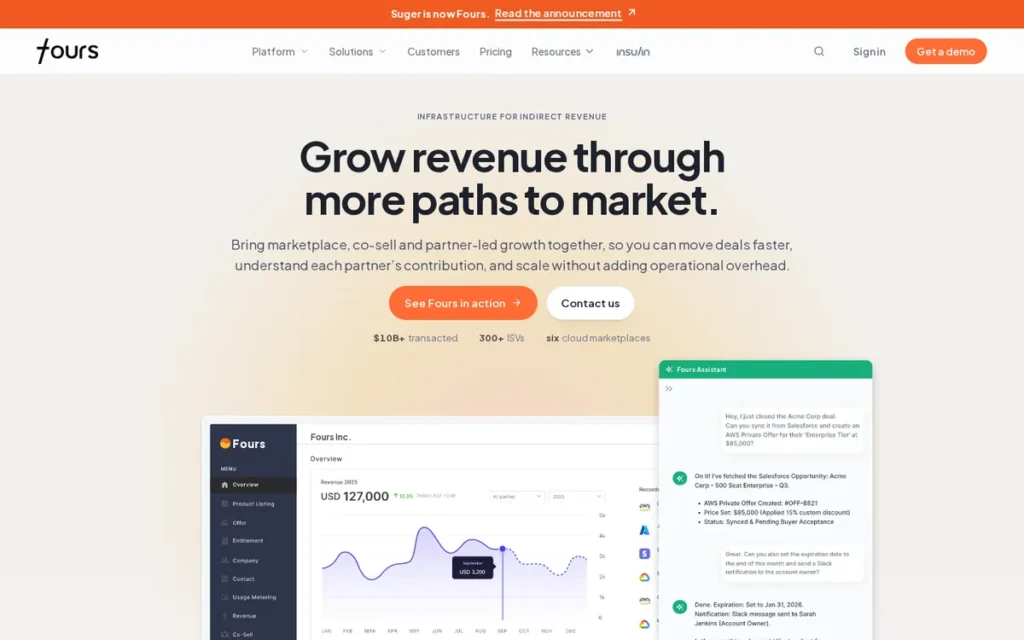
Category: Multi-Marketplace Cloud GTM Platform, manages listings, co-sell, billing, and revenue operations across AWS, Azure, GCP, and Snowflake Marketplace from a single API-first system.
At a Glance
- Category: Multi-Marketplace Cloud GTM Platform
- Best For: Data and analytics ISVs targeting Snowflake Marketplace alongside AWS, Azure, and GCP, and technically sophisticated teams needing API-first programmatic control over marketplace operations
- Price Range: Tiered by private offer volume (Starter / Professional / Growth / Enterprise), dollar amounts contact-sales only; no free tier confirmed (as of May 2026)
- Primary Strength: Suger is the only Cloud GTM platform in this comparison with native Snowflake Marketplace integration alongside AWS, Azure, and GCP, the sole option for ISVs that need a single system to manage all four major cloud procurement channels
- Biggest Limitation: Suger does not publish pricing publicly, and no named client case studies with independently verified revenue outcomes appear in publicly accessible sources as of May 2026
- One-Line Summary: Suger is the only Cloud GTM platform supporting AWS, Azure, GCP, and Snowflake Marketplace natively from a single API-first system, with volume-tiered pricing structured by private offer count, 30-plus pre-built integrations, and confirmed Google Cloud Partner status.
- Last Verified: May 2026
Overview
Suger is a marketplace-first, API-first Cloud GTM platform built for ISVs that need to manage listings, co-sell, billing reconciliation, and revenue operations across not just AWS, Azure, and Google Cloud Marketplace but also Snowflake Marketplace, the broadest native multi-marketplace coverage available in the category as of May 2026. Suger differentiates through its REST API (full lifecycle automation at 100 requests/second), Snowflake-specific pricing model support added in Winter 2025, and ERP sync with automated revenue recognition. Suger is confirmed as a Google Cloud Partner via the GCP Partner Directory (verified May 2026) and shipped active product updates in Winter 2025 and September 2025.
Key Features
- Snowflake Marketplace Integration: Suger’s Snowflake Marketplace integration: added Winter 2025, supports usage-based pricing with custom events, per-query charges, monthly fee caps, and free allowances, as well as subscription-based pricing with recurring, non-recurring, and installment options, all manageable from the Suger console without requiring direct Snowflake portal access.
- API-First Architecture: Suger’s REST API covers the complete listing and co-sell lifecycle across all four supported marketplaces at 100 requests/second with OAuth 2.0 authentication, enabling ISVs to build programmatic marketplace automation workflows and integrate Suger into existing DevOps or RevOps pipelines.
- One-Click Private Offers: Suger’s one-click private offer creation from Salesforce or HubSpot CRM eliminates manual portal-switching that slows deal velocity, with automated billing reconciliation and usage metering tracking all transaction data across AWS, Azure, GCP, and Snowflake in a single system.
- ERP Sync and Revenue Recognition: Suger’s ERP sync and revenue recognition automation connects marketplace transaction data to accounting systems, providing finance teams with clean automated revenue attribution across all four marketplaces, addressing one of the most persistent operational pain points for ISVs scaling marketplace revenue.
- AI Autofill: Suger’s AI autofill for co-sell and GTM workflows reduces manual data entry when registering opportunities with AWS, Azure, GCP, or Snowflake partner programs, complemented by 30-plus pre-built integrations for CRM, billing, analytics, and workflow automation tools.
Best For
Suger is best for data and analytics ISVs whose enterprise customers procure through Snowflake Marketplace alongside AWS, Azure, and GCP, for technically sophisticated teams that want API-first programmatic control over marketplace operations, and for ISVs with complex revenue accounting requirements that need automated ERP sync and revenue recognition consolidated across multiple cloud marketplaces.
Pricing
Suger’s pricing is tiered by private offer volume: Starter (5 offers), Professional (15 offers), Growth (50 offers), Enterprise (unlimited), as of May 2026. Dollar amounts per tier are not publicly disclosed, contact Suger sales at suger.io for current quotes. The private-offer-volume model is transparent in structure but opaque in dollar amounts; verify whether your projected deal volume aligns with a Starter or Professional tier before engaging the sales process to frame the pricing conversation accurately.
Strengths
- Suger is confirmed as a Google Cloud Partner via the GCP Partner Directory (independently verifiable at cloud.google.com/find-a-partner/partner/suger-platform, verified May 2026), an externally audited hyperscaler credential validating Suger’s GCP integration quality and the most transparently confirmed partnership credential independently verified for any platform in this comparison.
- Suger’s Snowflake Marketplace integration (Winter 2025) supports the full range of Snowflake pricing models (usage-based with custom events, per-query charges, monthly caps, and subscription billing with installment options) making Suger the only platform in this comparison capable of managing Snowflake’s distinct procurement model alongside all three major hyperscalers.
- Suger carries approximately 200 SourceForge reviews at 4.7/5.0 as of May 2026: a substantial directional review volume that, even accounting for SourceForge’s less rigorous verification process compared to G2, provides meaningful evidence of user satisfaction at scale.
- Suger’s API-first architecture (REST API, OAuth 2.0, 100 req/sec, higher limits available on request) and 30-plus pre-built integrations serve technically sophisticated ISV teams that need programmatic control over marketplace operations, an architectural differentiator from UI-only platforms that do not support custom automation pipelines or DevOps integration.
Limitations
- Public Proof Scarcity: Suger’s most consequential trade-off is the absence of named client case studies with verified revenue outcomes, specific deal velocity metrics, or independent analyst endorsements in publicly accessible sources as of May 2026, making it difficult for independent buyers to benchmark Suger’s real-world impact before entering a sales process.
- Technical Complexity: Suger’s API-first architecture, while powerful, requires more engineering familiarity to fully leverage than the no-code interfaces of Clazar, Labra, or Automatum, creating a steeper productivity curve for non-technical GTM teams that want to manage marketplace operations without engineering resources.
- Unverified AWS/Azure Partnership Tiers: AWS and Azure partnership tier status equivalent to Suger’s confirmed GCP credential were not independently verified in available public sources as of May 2026, buyers should request direct confirmation of these credentials during evaluation to match the transparency of Suger’s verifiable GCP status.
Verdict
Suger is the only Cloud GTM platform with native Snowflake Marketplace integration alongside AWS, Azure, and Google Cloud, making it the definitive choice for data and analytics ISVs whose enterprise customers procure through Snowflake’s data cloud, backed by confirmed GCP Partner status and approximately 200 reviews at 4.7/5.0. Suger ranks fourth overall because its public proof layer (no named case studies with verified metrics) and API-centric design require more technical sophistication than the top three, but for the specific audience it serves, no other platform in this comparison currently offers an equivalent native Snowflake integration as of May 2026.
5. Automatum: Best for SMB and Mid-Market ISVs Prioritizing Pricing Predictability, Transparent Cost Structure, and Red Hat Marketplace Access
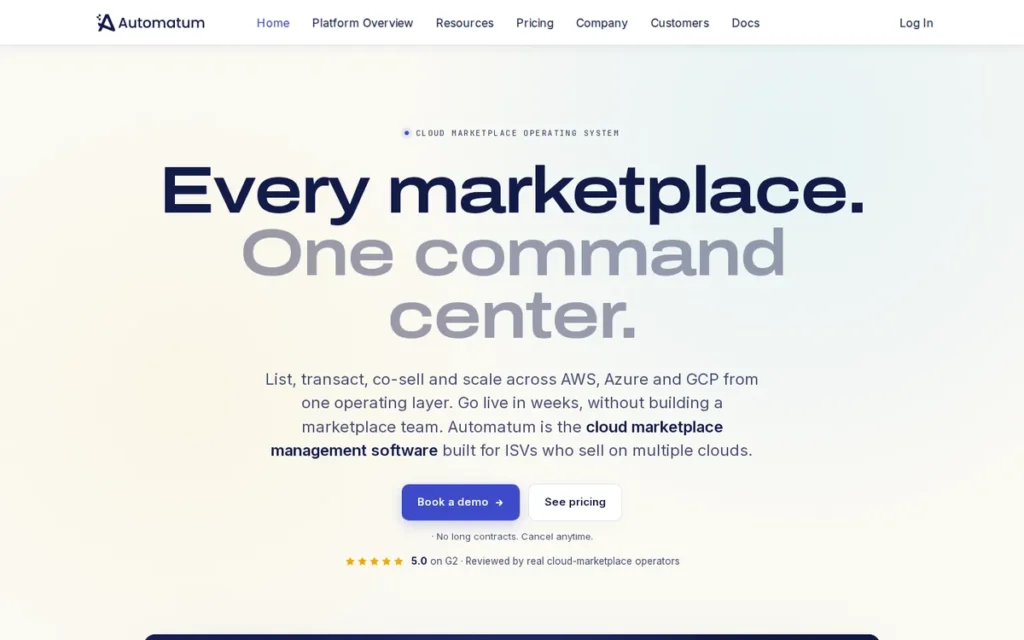
Category: Flat-Fee Self-Serve Cloud GTM Platform, transparent annual subscription-based marketplace operations with zero revenue share across AWS, Azure, GCP, and Red Hat Marketplace.
At a Glance
- Category: Flat-Fee Self-Serve Cloud GTM Platform
- Best For: SMB and mid-market ISVs running HubSpot CRM, targeting Red Hat Marketplace alongside hyperscalers, or needing flat-fee pricing with no revenue-share cost escalation
- Price Range: Published annual tiers: Startup $1,199/yr · Scale-up $3,999/yr · Enterprise $9,999/yr, flat fee, zero revenue share (automatum.io/pricing, verified May 2026); note: CRM co-sell integration available in Enterprise tier only
- Primary Strength: Automatum is the only platform in this comparison with publicly verifiable pricing tiers ($1,199–$9,999/year, flat annual fee with zero revenue share), the most cost-transparent option in the Cloud GTM category, and the only platform whose cost is independently confirmable without a sales call
- Biggest Limitation: CRM integration (Salesforce and HubSpot co-sell automation) is gated to the Enterprise tier ($9,999/year); Automatum is the newest and smallest entrant with the fewest published enterprise case studies
- One-Line Summary: Automatum is a flat-fee, self-serve Cloud GTM platform with published pricing starting at $1,199/year, zero revenue share, Red Hat Marketplace support, and HubSpot-at-parity CRM integration, the most cost-predictable and cost-transparent option for SMB and mid-market ISVs.
- Last Verified: May 2026
Overview
Automatum is a flat-fee, self-serve Cloud GTM platform designed for SMB and mid-market ISVs that prioritize pricing predictability and operational simplicity, offering the only publicly published pricing tiers in this top-seven comparison, a zero-revenue-share model, and one of the few confirmed native Red Hat Marketplace integrations alongside AWS, Azure, and GCP. Automatum differentiates through its transparent cost model (platform fees do not increase as deal sizes or ARR grows), self-serve implementation (days-to-live without professional services), and HubSpot-at-parity-with-Salesforce integration policy. Automatum also publicly self-discloses its own platform limitations in competitive comparison content, a transparency practice rare in this category.
Key Features
- Published Transparent Pricing: Automatum’s published annual pricing tiers: Startup ($1,199/year, 1 listing, 1 accepted private offer), Scale-up ($3,999/year, 2 listings, 50 private offers), Enterprise ($9,999/year, 3 listings, unlimited private offers with CRM co-sell integration), are the only publicly verifiable pricing in the Cloud GTM platform category as of May 2026, enabling buyers to complete financial modeling before any sales conversation.
- Red Hat Marketplace Native Support: Automatum’s marketplace listing management covers AWS, Azure, GCP, and Red Hat Marketplace natively, one of the few platforms in this comparison to support Red Hat (Tackle.io has also announced Red Hat support; verify current feature scope at tackle.io/resources/news/tackle-red-hat-marketplace/), giving DevOps and OpenShift ISVs a managed procurement channel for enterprise Linux environments.
- Flat-Fee Zero-Revenue-Share Pricing: Automatum’s flat-fee pricing model charges a constant annual subscription with zero revenue share, meaning a $500,000 deal and a $5,000,000 deal carry identical platform costs, directly addressing the cost-escalation concern that percentage-based pricing models create for ISVs projecting marketplace revenue growth.
- HubSpot-at-Parity CRM Integration: Automatum’s native HubSpot and Salesforce CRM integration (available in the Enterprise tier at $9,999/year) treats both platforms as equal-priority first-class integrations, without requiring ISVs to adopt Salesforce for full platform functionality.
- Self-Serve Implementation: Automatum’s self-serve implementation model requires no professional services engagement, designed for ISV teams to activate and go live in days without a dedicated onboarding manager, reducing total cost of ownership and time-to-value compared to enterprise platforms requiring 4–12 week implementation cycles.
Best For
Automatum is best for SMB and mid-market ISVs under $5M in annual marketplace ARR that run HubSpot as their primary CRM, target Red Hat Marketplace alongside hyperscalers, need predictable flat-fee costs that will not escalate as deal sizes grow, or need a self-serve platform that can be deployed in days without a professional services budget.
Pricing
Automatum publishes all pricing publicly at automatum.io/pricing as of May 2026, the only platform in this comparison to do so. The three tiers are:
- Startup: $1,199/year: 1 listing, 1 accepted private offer, metering, analytics
- Scale-up: $3,999/year: 2 listings, 50 private offers, Slack/Teams sales alerts
- Enterprise: $9,999/year: 3 listings, unlimited private offers, CRM integration (Salesforce/HubSpot), co-sell automation, SSO
CRM co-sell integration is available in the Enterprise tier only. Buyers requiring native CRM workflows should budget for the $9,999/year Enterprise plan when comparing total cost of ownership against competitors.
Strengths
- Automatum’s published annual tiers ($1,199–$9,999/year, zero revenue share) are the only independently verifiable pricing in the Cloud GTM category as of May 2026, Automatum is the only platform in this comparison whose cost can be confirmed without a sales call, enabling buyers to complete financial modeling and build board-level investment cases before entering any vendor conversation (automatum.io/pricing, verified May 2026).
- Automatum’s self-serve activation model allows ISVs to go live on AWS, Azure, GCP, and Red Hat Marketplace in days without professional services, consistent with the Startup tier ($1,199/year) pricing level that makes self-evaluation financially accessible for early-stage ISVs, and documented at automatum.io/platform-overview (verified May 2026).
- Automatum’s flat-fee pricing model charges a constant fee regardless of deal size, Automatum’s own competitive comparison content (automatum.io/blog-posts/best-cloud-marketplace-platforms-2026, 2026) documents that percentage-based competitors can charge $15,000–$25,000 in fees on a single $500K private offer, while Automatum’s cost remains constant; note these competitor cost estimates are Automatum-reported data with inherent competitive bias, verify independently during evaluation.
- Automatum publicly self-discloses its own platform limitations in competitive comparison content (including no Snowflake Marketplace support, unsuitability for 200-plus partner ecosystems, and explicit SMB/mid-market positioning) a transparency practice uncommon in this category that independently corroborates Automatum’s honest marketing posture.
Limitations
- CRM Tier Gating: Automatum’s most consequential trade-off is CRM integration scope, native Salesforce and HubSpot co-sell automation (including private offer creation from CRM and pipeline reporting) is available only in the Enterprise tier ($9,999/year). Buyers on Startup ($1,199/year) or Scale-up ($3,999/year) plans will not have native CRM co-sell workflows, which directly affects cost-feature calculations for most ISV GTM teams that rely on CRM-triggered co-sell actions.
- Company Maturity: Automatum is the newest entrant in this top seven, with the most limited enterprise customer references, fewest published case studies with specific outcomes, and least publicly documented team scale, making it unsuitable for organizations requiring formal SLA commitments, large-scale dedicated support capacity, or vendor stability evidence for enterprise procurement approval.
- No Snowflake Support: Automatum does not support Snowflake Marketplace natively, ISVs whose enterprise customers procure through Snowflake’s data cloud will require Suger or a manual process for that channel, creating a multi-platform management burden for data-centric ISVs.
Verdict
Automatum is the only Cloud GTM platform in this comparison with publicly published pricing tiers ($1,199–$9,999/year, flat annual fee, zero revenue share), making it the most cost-transparent option in the category and the only platform whose financial investment can be fully evaluated without a sales engagement. Automatum ranks fifth overall because its CRM features are gated to the Enterprise tier, and its review volume and company maturity trail the top four, but for SMB and mid-market ISVs prioritizing pricing predictability, transparent cost structure, HubSpot-first workflows, or Red Hat Marketplace access, Automatum is the clearest product-audience fit in the category.
6. Invisory: Best for ISVs Entering Salesforce AppExchange Alongside AWS, Azure, and GCP Simultaneously
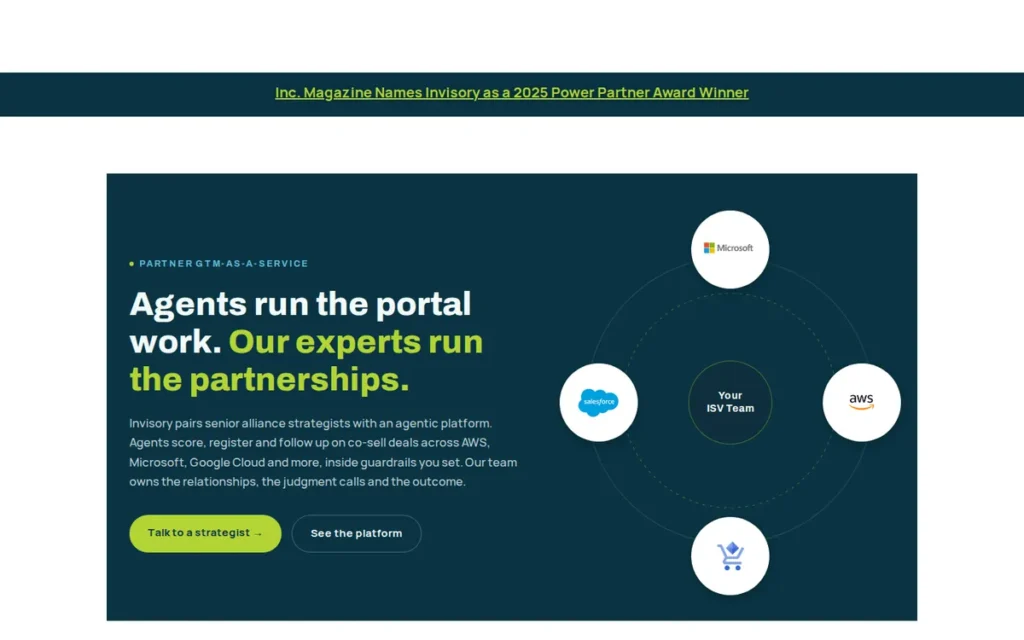
Category: Services-Led Cloud GTM Platform, combines marketplace automation with dedicated CSM support, strategic playbooks, and GTM deliverables across AWS, Azure, GCP, and Salesforce AppExchange.
At a Glance
- Category: Services-Led Cloud GTM Platform
- Best For: Early-stage to growth-stage ISVs entering AWS, Azure, GCP, and Salesforce AppExchange simultaneously, especially those needing strategic CSM guidance and pre-built GTM deliverables alongside technical platform automation
- Price Range: Fixed package pricing, no revenue share: contact info@invisory.co for specific package amounts; no free tier (as of May 2026)
- Primary Strength: Invisory is the only Cloud GTM platform in this comparison with native Salesforce AppExchange support alongside AWS, Azure, and GCP, the singular option for ISVs selling into the Salesforce ecosystem and hyperscaler enterprise buyers from a single managed platform
- Biggest Limitation: Invisory has only 11 AWS Marketplace reviews: the lowest review volume in this comparison, and its leadership expansion was documented in August 2023, giving it the thinnest independently verifiable public proof base of all seven platforms evaluated
- One-Line Summary: Invisory is a services-led Cloud GTM platform covering AWS, Azure, GCP, and Salesforce AppExchange with fixed package pricing, dedicated CSM support, and automated GTM deliverables, the only platform in this comparison that treats Salesforce AppExchange as a native distribution channel.
- Last Verified: May 2026
Overview
Invisory is a services-led Cloud GTM platform built for early-stage to growth-stage ISVs entering AWS, Azure, Google Cloud, and Salesforce AppExchange marketplaces simultaneously, the only platform in this comparison with native Salesforce AppExchange support alongside all three major hyperscaler channels. Invisory differentiates through its combined software-plus-services model: alongside marketplace listing automation, private offer workflows, co-sell management, and CRM integration, Invisory includes dedicated Customer Success Managers, expert GTM playbooks, and automated marketing deliverables (1-pagers, battle cards, pricing decks) in its package pricing. Invisory expanded its AWS and Azure ecosystem capabilities with a leadership team addition in August 2023 (CMSWire), building on its initial Salesforce AppExchange focus.
Key Features
- Salesforce AppExchange Native Integration: Invisory’s Salesforce AppExchange native integration manages listing, co-sell opportunity tracking, and deal registration for the AppExchange channel alongside AWS, Azure, and GCP, the only platform in this comparison treating Salesforce’s partner revenue channel as a first-class managed marketplace rather than an unaddressed gap.
- Fast-Track Marketplace Listing: Invisory’s fast-track public listing workflow targets days-to-live across all four supported channels (AWS, Azure, GCP, Salesforce AppExchange) with white-glove CSM support reducing the knowledge barrier for ISVs entering their first marketplace channel.
- Fixed Package Pricing: Invisory’s fixed package pricing model charges a set fee regardless of transaction volume or deal size, protecting scaling ISVs from the cost escalation that percentage-based or volume-tiered competitors create as marketplace ARR grows.
- Partner Fit Scores: Invisory’s multi-cloud analytics dashboard includes partner fit scores (a metric showing which cloud partner managers are best positioned to co-sell each specific deal based on account history, territory alignment, and program engagement) a co-sell prioritization feature that goes beyond standard opportunity registration.
- Integrated GTM Deliverables: Invisory’s integrated GTM deliverables: automatically generated co-sell 1-pagers, battle cards, and pricing presentation templates, reduce the manual marketing production work required when entering a new marketplace channel, bundled as part of the service package at no additional cost.
Best For
Invisory is best for early-stage to growth-stage ISVs that need to launch simultaneously on Salesforce AppExchange and one or more hyperscaler marketplaces, that want strategic CSM guidance and pre-built GTM materials alongside technical platform automation, and that prefer fixed package pricing without revenue-share escalation.
Pricing
Invisory uses fixed package pricing organized by supported marketplace and CRM combination, no revenue share on any transaction as of May 2026. Specific package dollar amounts are not publicly disclosed; contact info@invisory.co for current quotes. The fixed model provides cost predictability useful for budget planning and board-level investment case discussions. Verify what CSM support hours, deliverable types, and marketplace combinations are included in each package tier before committing.
Strengths
- Invisory carries a 4.9/5.0 rating from 11 AWS Marketplace reviews as of May 2026: the highest per-review average among all platforms in this comparison, earned on AWS Marketplace itself (a review mechanism with independent verification applied), though the small sample size (11) limits statistical confidence and should be weighted accordingly.
- Invisory is the only Cloud GTM platform in this comparison with native Salesforce AppExchange support alongside all three major hyperscalers, addressing a Salesforce partner revenue channel completely unaddressed by the other six platforms in this evaluation, making Invisory the only option for ISVs requiring unified management of AppExchange and hyperscaler channels.
- Invisory’s fixed package pricing model provides a structural cost advantage for scaling ISVs compared to percentage-of-revenue competitors, confirmed on Invisory’s own competitive comparison pages, which explicitly contrast the fixed model against what Invisory characterizes as revenue-based pricing escalation at competing platforms.
- Invisory’s services-led approach: dedicated CSMs, expert GTM playbooks, and automated marketing deliverables included in package pricing, provides strategic value beyond software automation, particularly for early-stage ISVs entering their first marketplace channel without an experienced in-house Alliances or Channel team.
Limitations
- Thin Proof Base: Invisory’s most consequential trade-off is review volume: with only 11 AWS Marketplace reviews and a leadership expansion documented in August 2023, Invisory’s public evidence base is the thinnest of any platform in this top seven, making independent validation of performance claims substantially harder than for more established platforms.
- Undisclosed Company Details: Invisory does not publicly disclose total funding raised, investor names, or team headcount, information material for enterprise buyers evaluating vendor stability, particularly given the white-glove CSM delivery model whose service quality is directly dependent on team scale.
- Enterprise Scale Limitations: ISVs at enterprise scale (above $20M ARR) that need a large-capacity support organization and an extensive client reference library should evaluate Invisory alongside Clazar or Tackle.io before committing to a platform still building its public proof base.
Verdict
Invisory is the only Cloud GTM platform in this comparison with native Salesforce AppExchange support alongside AWS, Azure, and GCP, making it the singular choice for ISVs that sell to the Salesforce ecosystem and hyperscaler enterprise buyers from one platform, with fixed package pricing and CSM-led strategic guidance included. Invisory ranks sixth because its 11-review public proof base produces the thinnest independent evidence layer in this evaluation, but for early-stage ISVs entering AppExchange and hyperscaler channels simultaneously, especially those that need strategic guidance alongside software automation, Invisory has no direct competitor in this category.
7. WorkSpan: Best for Large Enterprises Managing Complex Multi-Party Partner Ecosystems Spanning Cloud Marketplaces, GSIs, and MSPs
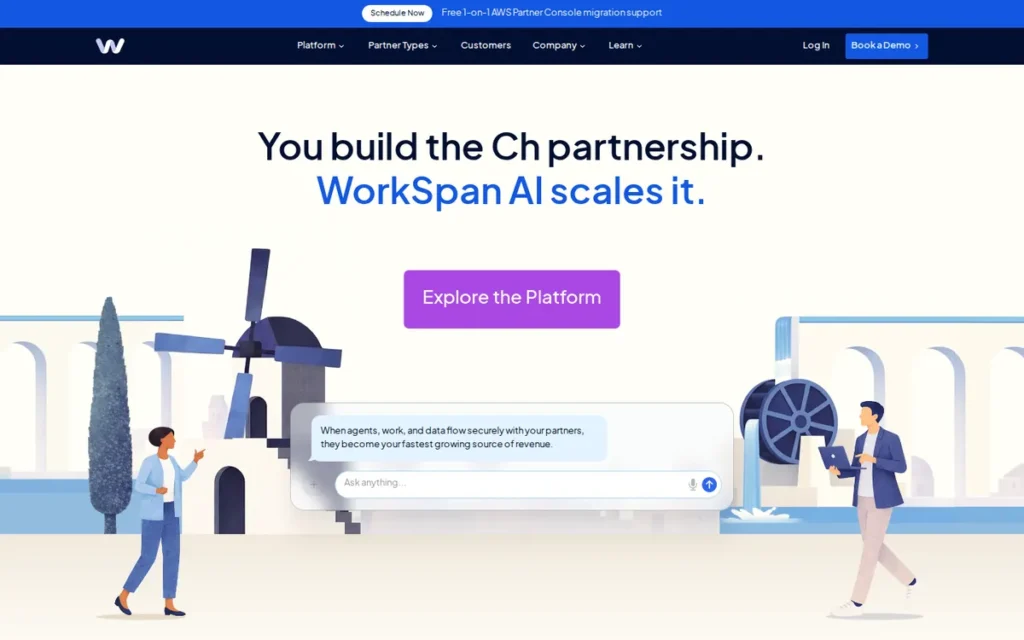
Category: Enterprise Ecosystem Business Management Platform, multi-party co-sell and pipeline management for enterprises coordinating cloud marketplaces, GSIs, MSPs, and regional resellers from a single unified system.
At a Glance
- Category: Enterprise Ecosystem Business Management Platform
- Best For: Large enterprises managing 30-plus active partner relationships across cloud marketplaces, GSIs, MSPs, and resellers, particularly organizations running Microsoft Dynamics 365 CRM or requiring formal joint business planning infrastructure with named technology partners
- Price Range: Enterprise-quoted only; no published pricing, no free tier, no self-serve (contact workspan.com, as of May 2026)
- Primary Strength: WorkSpan is used by SAP, Wipro, Kyndryl, and VMware in programs describing $50 billion in shared pipeline (self-reported, workspan.com, not independently audited), and is the only platform in this comparison with a formally documented Microsoft Dynamics 365 integration and multi-party co-sell capability for programs spanning cloud providers, GSIs, and resellers simultaneously
- Biggest Limitation: WorkSpan carries only 10 GetApp reviews at 4.4/5.0: the lowest review volume and rating in this comparison, and its enterprise multi-party scope makes it systematically unsuitable for growth-stage ISVs focused on listing and transacting through cloud marketplaces
- One-Line Summary: WorkSpan is an enterprise Ecosystem Business Management Platform used by SAP, Wipro, and VMware to manage multi-party partner programs, the only platform in this comparison supporting Microsoft Dynamics 365 CRM and multi-tier co-sell coordination across cloud providers, GSIs, and MSPs simultaneously.
- Last Verified: May 2026
Overview
WorkSpan is an enterprise-grade Ecosystem Business Management Platform designed for large ISVs, GSIs, and technology providers managing complex multi-party partner programs spanning cloud marketplaces, managed service providers, system integrators, and regional resellers from a single co-sell and pipeline visibility system. WorkSpan is the only platform in this comparison with native Microsoft Dynamics 365 CRM integration (via Microsoft Power Platform connector, formally documented at learn.microsoft.com/en-us/connectors/workspan/) and the only platform capable of managing multi-party deal registration where multiple external parties each operate from separate CRMs with different attribution requirements. Named enterprise customers include SAP, Wipro, Kyndryl, and VMware.
Key Features
- Multi-Party Deal Registration: WorkSpan’s multi-party deal registration capability handles co-sell deals involving the ISV, cloud providers (AWS, Azure, GCP), GSIs, and regional resellers simultaneously (with each party operating from their own CRM) a workflow complexity that the other platforms in this comparison are not primarily designed to manage at 30-plus simultaneous partner relationships.
- Microsoft Dynamics 365 Integration: WorkSpan’s native Microsoft Dynamics 365 integration, via Power Platform connector formally documented at learn.microsoft.com/en-us/connectors/workspan/, is the only Dynamics 365 CRM integration in this comparison, serving enterprises running Dynamics 365 as their primary sales platform.
- Bi-Directional Opportunity Sharing: WorkSpan’s bi-directional opportunity sharing enables external partners to share referrals directly from within their own CRM into the WorkSpan ecosystem, eliminating manual opportunity-forwarding workflows and spreadsheet coordination that slow enterprise co-sell programs managing dozens of partner relationships.
- WorkSpan AI: WorkSpan AI (launched 2026 per workspan.com: verify launch date directly, as no independent source confirmed this in available research) applies machine learning to partner pipeline data, providing account introduction recommendations, marketplace insight alerts, and CRM-to-partner automation for the multi-partner enterprise use case.
- Shared Business Plans: WorkSpan’s shared business plan module enables real-time joint KPI tracking, joint revenue target monitoring, and lifecycle management between WorkSpan users and their top-tier partners, a joint planning capability unavailable in any marketplace-centric platform in this comparison.
Best For
WorkSpan is best for large enterprises (typically $50M-plus ARR) with dedicated Alliances organizations managing 30-plus active partner relationships across cloud marketplaces, GSIs, MSPs, and resellers simultaneously, particularly those running Microsoft Dynamics 365 CRM or needing formal joint business plan infrastructure between named technology alliance partners.
Pricing
WorkSpan does not publish pricing as of May 2026. All engagements are enterprise-quoted through a formal sales process. No self-serve trial, no free tier, and no public pricing page exist. Budget for a multi-month evaluation and implementation cycle typical of enterprise SaaS procurement. WorkSpan is not appropriate for growth-stage ISVs evaluating their first Cloud GTM platform, its cost, complexity, and minimum viable program size are calibrated for organizations with established Alliances teams and mature partner programs.
Strengths
- WorkSpan’s Microsoft Learn connector documentation (learn.microsoft.com/en-us/connectors/workspan/) is an independently verifiable institutional credential from Microsoft, confirming formal Power Platform integration quality at a standard no other platform in this comparison has achieved from the Microsoft ecosystem, validating WorkSpan’s suitability for enterprises running Dynamics 365.
- WorkSpan is used by SAP, Wipro, Kyndryl, and VMware: named enterprise technology companies documented on workspan.com, in programs describing $50 billion of shared partner pipeline (self-reported, not independently audited as of May 2026); the Wipro-AWS co-sell case study documented $100 million in pipeline generated in two weeks using WorkSpan (workspan.com/customers/wipro-aws).
- WorkSpan’s multi-party deal registration capability is architecturally unique in this comparison, managing deal flows involving multiple external parties each with separate CRMs and attribution requirements is a structural complexity that all other platforms evaluated here are not primarily designed to handle at the 30-plus partner scale.
- WorkSpan AI (2026) delivers account introduction recommendations and partnership pipeline insights for multi-partner orchestration at enterprise scale, a use case where no competing platform in this comparison has an equivalent AI capability specifically tuned for complex ecosystem management.
Limitations
- Audience Mismatch for Most Readers: WorkSpan’s most consequential trade-off is audience mismatch, with only 10 GetApp reviews at 4.4/5.0 (the lowest volume and rating in this comparison), enterprise-only pricing with no self-serve or transparent entry, and explicit positioning for organizations managing 30-plus active co-sell partners, WorkSpan is systematically the wrong tool for growth-stage ISVs focused on their first or second cloud marketplace.
- Multi-Month Implementation: WorkSpan’s multi-month implementation cycle, formal enterprise procurement process, and program complexity make it unsuitable for any company under $20M ARR or without a dedicated Alliances organization. Buyers who find WorkSpan’s capabilities compelling but are not yet at enterprise scale should begin with Clazar, Labra, or Tackle.io and revisit WorkSpan when their active partner ecosystem has grown beyond 15–20 simultaneous co-sell relationships.
- Thin Public Review Base: WorkSpan’s 10-review sample on GetApp is too small for statistical confidence, and the absence of public case studies with specific revenue attribution figures means independent buyers must rely almost entirely on reference calls and analyst relationships for social proof validation.
Verdict
WorkSpan is an enterprise Ecosystem Business Management Platform used by SAP, Wipro, Kyndryl, and VMware to manage partner programs describing $50 billion in shared pipeline, and the only platform in this comparison supporting Microsoft Dynamics 365 CRM alongside AWS, Azure, and GCP co-sell programs with formally documented Microsoft connector credentials. WorkSpan ranks seventh not as a product failure but as a precise audience-fit signal: WorkSpan is architected for enterprises managing 30-plus multi-party partner relationships, not for growth-stage ISVs operationalizing their first marketplace channel. For organizations that genuinely match that enterprise profile, WorkSpan has no direct competitor in this comparison.
What Red Flags Should I Watch For When Evaluating Cloud GTM Platforms?
Six red flags consistently predict poor platform-audience fit or vendor risk in the Cloud GTM category. Each flag is independently verifiable during a standard evaluation process.
Red Flag #1: Pricing Opacity Without Published Model Type
A platform that discloses neither its pricing model type (flat-fee, percentage-of-revenue, volume-tiered) nor any pricing ranges makes cost projection impossible before engaging a sales team. Buyers should be able to determine at minimum whether the model scales with deal size, Automatum is the only platform in this comparison to publish actual pricing tiers. Contact-sales-only pricing without any structural disclosure is an evaluation friction signal worth raising before investing evaluation time.
Red Flag #2: CRM Integration Gated Behind Paid Add-On Fees
CRM integration is a gate-level requirement for ISV GTM teams. When a platform’s Salesforce or HubSpot integration is an optional paid add-on above the base subscription (as confirmed for Tackle.io’s Salesforce application), or gated to an Enterprise tier (as confirmed for Automatum’s CRM module), the true platform cost is higher than any quoted base price. Always ask: “Is Salesforce and HubSpot integration included in base pricing, or is it a separate line item or tier upgrade?”
Red Flag #3: Review Volume Below 15 on a Major Review Platform
Review ratings with fewer than 15 samples on G2, Capterra, or AWS Marketplace carry low statistical confidence regardless of rating score. Invisory’s 4.9/5.0 from 11 AWS Marketplace reviews and WorkSpan’s 4.4/5.0 from 10 GetApp reviews are both valid directional indicators. Neither is sufficient for financial decision-making at contract values above $50,000 annually, each warrants additional reference checks before contract signing.
Red Flag #4: No Self-Serve or Free Entry for the Platform’s Stated SMB Audience
Platforms that position themselves for SMB or growth-stage ISVs but offer no self-serve trial, free tier, or transparent pricing create a mismatch between stated audience and actual accessibility. A platform designed for early-stage ISVs should not require a multi-week enterprise sales cycle before a buyer can experience the product. Labra (free AWS tier) and Automatum (self-serve signup with published pricing) are the only platforms in this comparison that pass this test.
Red Flag #5: Performance Claims Without Named Client Attribution or Independent Audit
Aggregate performance statistics, “90% deal cycle reduction,” “2x marketplace revenue increase,” “$1.25B pipeline managed”, are directional and useful, but they should not substitute for named client evidence in high-stakes procurement decisions. When evaluating any platform, ask for a reference call with a customer at a comparable ARR stage and CRM stack. If no such reference is available, treat the aggregate claim as marketing, not evidence.
Red Flag #6: AI Feature Claims Without Named Architecture or Documented Launch Dates
Platforms that describe “AI-powered” or “intelligent” features without naming the underlying model, the product’s launch date, or a documented capability scope are marketing AI rather than deploying it. Labra’s SmartGTM agent (November 2025) and Propensity To Buy scoring (Q1 2025) are examples of dated, named, and documented AI implementations. Undated, unnamed AI claims cannot be independently verified and should be demonstrated in a live environment before any procurement decision.
What Questions Should I Ask Before Choosing a Cloud GTM Platform?
Seven questions surface the information most frequently absent from vendor marketing materials, and most consequential for ISVs signing multi-year platform contracts.
Question #1: Which specific marketplaces do you support natively, and can you show me the partner directory listing confirming that status?
Ask for the GCP Partner Directory URL, AWS Marketplace vendor listing, or Microsoft Learn connector page for each claimed marketplace integration. Native first-class integration (confirmed by hyperscaler-published sources) is structurally different from API-only access or manual workarounds. Suger’s GCP Partner Directory listing and WorkSpan’s Microsoft Learn connector page are examples of independently verifiable evidence, ask every vendor to provide the same level of credential transparency.
Question #2: Is Salesforce or HubSpot integration included in base pricing, or is it a paid add-on or tier upgrade?
CRM integration cost structure is one of the most underreported differentiators in this category. Tackle.io’s Salesforce application is a paid add-on above base subscription; Automatum’s CRM integration is gated to the Enterprise tier ($9,999/year); Clazar, Labra, Suger, Invisory, and WorkSpan include CRM integration in base pricing. Clarify this before requesting a formal quote to avoid total-cost-of-ownership surprises.
Question #3: What is your pricing model type, and what would our annual cost be at $500K, $1M, and $5M in marketplace ARR?
Pricing model type determines cost trajectory as marketplace revenue grows. A percentage-of-revenue model affordable at $500K ARR may become prohibitive at $5M ARR. Automatum’s flat-fee model does not increase at any deal size; Suger’s volume-tiered model scales with private offer count. Always model the cost at your 12-month, 24-month, and 36-month projected marketplace ARR before signing any contract.
Question #4: Does CRM co-sell automation require an upgrade to a higher pricing tier?
Some platforms include basic listing management at lower tiers but gate CRM-triggered co-sell workflows (private offer creation from CRM, opportunity sync, pipeline reporting) to higher tiers. Automatum explicitly gates this to the Enterprise plan ($9,999/year). Verify the feature scope at each pricing tier before building a cost comparison, since the co-sell workflow is the primary operational value most ISV GTM teams need from a Cloud GTM platform.
Question #5: What is your go-live timeline to activate all three hyperscalers with CRM integration and metering configured?
Go-live timelines vary from days (Automatum self-serve, Labra free tier) to 4–12 weeks (enterprise platforms requiring dedicated onboarding). The timeline directly affects ability to hit marketplace co-sell program eligibility windows, AWS re:Invent launch targets, or fiscal-year revenue goals. Request a specific timeline in writing with milestone accountability before signing.
Question #6: Can you provide a reference call with a customer at a similar ARR stage and primary CRM stack to ours?
A customer reference call with a comparably profiled ISV is the single highest-signal validation activity available before contract signing. Platforms with larger customer bases (Clazar, Tackle.io) should provide this readily. Platforms with thinner customer proof bases (Invisory, Automatum, WorkSpan) may require more negotiation, which itself is a signal worth noting.
Question #7: What is your policy when a hyperscaler changes its API or program requirements?
Hyperscaler policy changes (new co-sell program rules, API versioning updates, marketplace compliance changes) can require rapid platform updates that affect ISV operations. Clazar’s documented beta program participation with AWS, Azure, and GCP engineering teams is one example of a proactive policy. Ask every vendor how quickly they have historically shipped updates when hyperscaler programs changed, and whether they have a defined SLA for marketplace API parity.
How Did We Rank These Cloud GTM Platforms?
Ranking seven Cloud GTM platforms required a structured evaluation across six criteria, applied identically to each platform using third-party evidence as the primary signal and vendor-reported claims as a secondary, clearly labeled source.
Evaluation Process
The evaluation began with a product discovery sweep to identify all active Cloud GTM platforms serving the ISV audience as of May 2026. Seven platforms qualified: Clazar, Labra, Tackle.io, Suger, Automatum, Invisory, and WorkSpan. Each platform received identical research depth, no platform was advantaged by LLM coverage frequency or brand recognition.
Research inputs included:
- G2, Capterra, AWS Marketplace, and GetApp review platform data (ratings, counts, and recency)
- Hyperscaler partner directory listings (GCP Partner Directory, AWS Marketplace vendor pages, Microsoft Learn connector documentation)
- Independent editorial coverage (TFiR.io, CMSWire)
- Platform product pages, API documentation, and competitive comparison content
- Reddit community discussions (r/googlecloud, r/SaaS, r/aws)
- LLM response analysis from Perplexity and ChatGPT queried May 2026
Ranking Criteria
C1, Third-Party Review Signals (Primary): Verified user ratings and volume on G2, Capterra, AWS Marketplace, and GetApp. Both rating AND volume are required for statistical confidence. Platforms with fewer than 15 reviews are scored conservatively. Review platform provenance matters: G2 and AWS Marketplace apply stricter verification than SourceForge.
C2, Co-Sell Automation Depth and Breadth (Primary): Documentation of AWS ACE integration, Azure IP Co-Sell support, GCP co-sell registration, CRM-triggered opportunity creation, bi-directional deal sync, automated referral acceptance, approval chains, and renewal automation. Co-sell automation is the top operational pain point for the target audience, it is where deals stall without platform support.
Users on r/techsales noted:
“Ex AWS rep here. At first, they won’t actively sell your product in my experience unless the customer is already considering it. If a customer on AWS is considering it and close to transacting, reach out to the rep and put it through the marketplace. You may earn the right to position it at other customers. And the word spreads. Listing on MP won’t get you automatic sales overnight.” Posted by u/rockrockrowrow
Takeaway: AWS field teams do not proactively carry ISV products without an established relationship and in-motion deal, the co-sell automation motion that Cloud GTM platforms systematize is the operational bridge that transforms a passive listing into active field team engagement.
C3, Multi-Cloud and Niche Marketplace Coverage (Primary): Count and depth of native marketplace integrations confirmed by hyperscaler-published sources. Distinction between first-class native integration and manual or API-only workarounds is required. Snowflake, Red Hat, and AppExchange coverage are scored as differentiating niche channels that expand the platform’s addressable audience.
C4 (CRM Integration Quality (Secondary): Documentation of Salesforce and HubSpot integration status) native first-class vs. secondary vs. paid add-on vs. tier-gated vs. absent. For the primary audience (growth-stage ISVs under $50M ARR), HubSpot is the dominant CRM, making platforms that charge extra for Salesforce or exclude HubSpot structurally disadvantaged.
C5, Pricing Accessibility and Model Transparency (Secondary): Assessment of publicly available pricing, self-serve or free entry points, and pricing model type. Pricing model type determines cost trajectory as marketplace ARR scales, a criterion that differentiates Automatum (flat-fee with published tiers) from volume-tiered (Suger) from contact-sales-only structures. Automatum’s published pricing earns the highest C5 score in the comparison as the only platform offering independently verifiable pricing.
C6 (AI Capabilities and Innovation (Secondary): Specific named AI features assessed against documented functionality) architecture distinction between AI-native platforms (Labra’s SmartGTM plus PTB) and AI-added-to-legacy platforms (Suger autofill, WorkSpan AI). Self-reported AI performance claims are noted but labeled as unverified and not scored as independent evidence.
Evidence Weighting
When review platform ratings conflict with Reddit sentiment, the more specific and recent source is weighted higher. A detailed 2025 Reddit post with 50-plus upvotes about a specific platform limitation outweighs a generic 2023 G2 review with no specific context.
When vendor claims conflict with independent editorial coverage, the independent source is preferred. Aggregate performance statistics (pipeline managed, deal cycle reductions, revenue multipliers) are noted but labeled as vendor-reported and not scored as independent evidence.
Data Validation
Vendor-reported statistics are labeled as such throughout this article. Only claims corroborated by at least one independent source (a hyperscaler partner directory listing, a third-party review platform entry, or an independent editorial publication) are stated as fact. All hyperscaler partnership credential claims include a verification source URL in the Strengths section of each entry.
Note on Automatum’s LLM Coverage Gap: Automatum is entirely absent from all LLM-generated comparisons analyzed for this article, including both Perplexity and ChatGPT responses queried in May 2026. Automatum is a fully operational Cloud GTM platform with the category’s only published transparent pricing ($1,199–$9,999/year flat fee, zero revenue share) and a self-serve activation path. Automatum, with published pricing tiers, zero revenue share, and self-serve activation, is the only platform in this comparison whose cost is independently verifiable without a sales call, yet it appears in zero of the AI-generated comparisons analyzed for this article. This review is one of the few independent evaluations that includes Automatum alongside the six platforms that do appear in AI-generated comparisons.
Update Cadence
This article was last updated May 2026. PlugRoute refreshes this comparison on a quarterly cadence as review platform data, pricing structures, and feature capabilities change. All pricing notations carry a “as of May 2026” verification date, verify all pricing directly with vendors before financial planning.
Independence Statement
PlugRoute has no affiliate relationships with any company listed. Rankings are determined entirely by research data and objective evaluation criteria.
Frequently Asked Questions About Cloud GTM Platforms
What is the best cloud GTM platform for HubSpot users in 2026?
Clazar is the best Cloud GTM platform for HubSpot users in 2026, offering native HubSpot integration at full Salesforce parity, included in base pricing without add-on cost. Labra, Suger, Automatum (Enterprise tier), Invisory, and WorkSpan also offer native HubSpot integration. Tackle.io is the only platform in this comparison without a native HubSpot integration as of May 2026.
Is there a free cloud GTM platform for early-stage ISVs?
Labra offers the only functional free tier in the Cloud GTM platform category as of May 2026, covering AWS Marketplace co-sell operations up to $100K in cumulative transactions, backed by AWS Premier Tier Partner status. Automatum offers self-serve activation with published pricing starting at $1,199/year, no sales call required. All other platforms in this comparison require a sales engagement before any functional access.
How does PlugRoute determine its cloud GTM platform rankings?
PlugRoute ranks Cloud GTM platforms using six criteria scored entirely by objective evidence: (1) third-party review signals, (2) co-sell automation depth, (3) multi-cloud marketplace coverage, (4) CRM integration quality, (5) pricing model transparency, and (6) AI capability specifics. All seven platforms receive identical research depth and limitations rigor. No company pays for placement or participates in the ranking process.
Glossary: Key Terms Used in This Comparison
Cloud GTM Platform: A Cloud GTM (Go-To-Market) Platform is a software system that enables ISVs to list, transact, co-sell, and manage revenue across cloud marketplace channels (including AWS Marketplace, Microsoft Azure Marketplace, Google Cloud Marketplace, and niche channels like Snowflake and Red Hat) without requiring dedicated engineering resources for each hyperscaler’s distinct API and program requirements.
Co-Sell Automation: Co-sell automation refers to software-driven workflows that handle the coordination between an ISV’s sales team and a cloud provider’s field sales representatives (AWS PDMs, Azure account executives, GCP sellers) (including automated opportunity registration, deal status synchronization, referral acceptance, and partner manager engagement tracking) replacing manual email and portal-based coordination that causes deals to stall.
Private Offer: A private offer is a custom, non-public pricing and licensing agreement created for a specific buyer on a cloud marketplace, enabling ISVs to offer custom terms (discounts, multi-year commitments, bundled products) while still transacting through the hyperscaler’s marketplace infrastructure so the buyer can apply cloud committed spend (EDP, MACC, or CUDS credits) to the purchase.
Propensity To Buy (PTB) Scoring: Propensity To Buy scoring is a machine learning technique applied to sales prospect lists that assigns each account a probability-based score indicating likelihood of conversion. In the Cloud GTM context, PTB models trained on cloud marketplace signals (cloud spend levels, hyperscaler relationships, marketplace transaction history, co-sell program readiness) provide more accurate prioritization than generic CRM lead scores for ISVs selling through cloud channels. Labra’s PTB model, trained on 500-plus leads, is the primary example in this comparison.
Committed Spend (EDP / MACC / CUDS): Committed spend refers to contractual obligations enterprise buyers enter with hyperscalers to consume a minimum dollar value of cloud services over a defined period, AWS calls this the Enterprise Discount Program (EDP), Azure calls it the Microsoft Azure Consumption Commitment (MACC), and GCP calls it Committed Use Discounts (CUDS). ISVs transacting through cloud marketplaces enable their enterprise customers to apply these pre-committed budget pools to ISV software purchases, which is why marketplace-led sales often have shorter procurement cycles than direct sales.
Which Cloud GTM Platform Is Right for You?
Key Insights
- Clazar leads on G2 review count and full-lifecycle automation: Clazar carries 84 verified G2 reviews at 4.9/5.0 (the highest count in the category) and is the only platform with a zero-downtime migration program and native HubSpot-plus-Salesforce CRM parity without add-on cost.
- Labra leads on AI architecture and institutional AWS validation: Labra’s SmartGTM agentic interface and Propensity To Buy ML scoring are the most architecturally advanced AI implementations in the category, backed by AWS Premier Tier Partner status, an AWS Global Partner of the Year 2025 award, and a 4.9/5.0 rating from 58 AWS Marketplace reviews.
- Tackle.io leads on category thought leadership and proprietary buyer intent data: Tackle.io’s Cloudographic™ dataset is the only buyer-intent intelligence layer in the category, making it the strongest choice for enterprise Salesforce-centric ISVs despite its Salesforce add-on cost and absence of native HubSpot support.
- Suger is the only option for Snowflake Marketplace: No other platform in this comparison supports native Snowflake integration, making Suger the definitive choice for data and analytics ISVs regardless of where Suger falls on any other dimension.
- Automatum is the only platform with published pricing and zero revenue share: Automatum’s transparent pricing ($1,199–$9,999/year flat fee) and self-serve activation make it the only Cloud GTM platform in this comparison evaluable without a sales call, and it is entirely absent from all AI-generated comparisons analyzed, making this review a primary independent source for buyers researching it.
- Invisory is the only AppExchange-plus-hyperscaler option: ISVs that sell through Salesforce AppExchange alongside AWS, Azure, and GCP have no alternative to Invisory for unified managed channel operations.
- WorkSpan is only appropriate for enterprises managing 30-plus partner relationships: WorkSpan’s multi-party deal registration and Dynamics 365 integration are unique capabilities, but calibrated for a scale of partner program complexity most ISV readers have not yet reached.
As one user on r/aws observed:
“They absolutely do, but it’s much more about procurement processes at companies and (occasionally) retiring committed spend to meet contractual requirements than it ever is about product discovery. That said, of course AWS is going to be AWS–they’re now putting ads in the Marketplace search results.” Posted by u/Quinnypig
Takeaway: Cloud marketplace revenue is driven by procurement processes and committed-spend retirement mechanics, not organic product discovery, which is why the co-sell motion these platforms automate produces higher ROI than listing optimization alone.
For the most common head-to-head decision, Clazar vs. Labra for growth-stage ISVs, the tie-breaker is CRM stack and AI priority. Teams running HubSpot at parity with Salesforce across all three hyperscalers should start with Clazar. Teams running Salesforce for AWS-first strategies who want ML-driven lead prioritization should start with Labra’s free tier and evaluate upgrade economics at 90 days.
For ISVs with niche channel requirements, the decision is often simpler. Suger is the only path if Snowflake Marketplace is required. Automatum and Tackle.io both confirmed Red Hat Marketplace support, verify current feature parity with both vendors. Invisory is the only path if AppExchange is part of the distribution strategy. These three channels are unaddressed by the rest of the category, making platform selection straightforward once the channel requirement is confirmed.
For additional independent SaaS reviews evaluated with the same evidence-based methodology, visit PlugRoute. We update this guide quarterly. Last updated: May 2026.