Gong leads the 2026 Revenue AI rankings for conversation intelligence and rep coaching. Salesloft leads for AI-guided engagement at scale. Clari leads for CRO-level forecast accuracy. The right choice depends entirely on whether your primary pain point is coaching reps, automating outreach, predicting revenue, identifying in-market buyers, or proving channel ROI, no single platform excels at all five simultaneously.
B2B revenue teams are consolidating fragmented GTM tech stacks around platforms that deliver pipeline visibility, revenue predictability, and CRM data hygiene without manual rep data entry. The Revenue Intelligence market reached approximately $4.2 billion in 2025 at a 12% compound annual growth rate [Custom Market Insights, March 2026; Dataintelo, 2025]. Sixty-two percent of B2B firms consolidated their RevOps tech stacks in 2025 [Gartner RevOps Trends 2026], and 54% of B2B organizations are now deploying agentic AI across their sales cycles [Futurum Research, cited in Warmly.ai, 2026]. The most common (and most expensive) failure mode is choosing a platform in the wrong sub-category for the problem you are actually trying to solve.
As one user on r/SalesOperations described the breaking point of manual pipeline management:
“We were the ‘it’s fine’ team at around 80 reps. What finally broke it wasn’t the spreadsheet itself, it was a quarter where three big deals slipped in the same week and nobody’s forecast reflected it because the data was already two days stale by the time it hit the sheet. Leadership lost confidence in the number and started doing their own shadow forecasts on the side. So now you’ve got two competing spreadsheets and zero shared reality. The thing that helped us was getting really honest about what the spreadsheet was actually doing vs what we thought it was doing. We thought it was a forecasting tool. It was actually just a reporting artifact that people edited based on vibes and then defended in pipeline meetings. Once we framed it that way it got a lot easier to justify actually investing in fixing the process. IME the snap moment isn’t about rep count or ARR, it’s about the first time leadership makes a bad call because the number they trusted was quietly wrong.” Posted by u/want_to_vent
Takeaway: The trigger for investing in Revenue AI forecasting is rarely team size or ARR, it’s the first quarter where stale pipeline data causes a board-level confidence failure that no spreadsheet process can recover from.
PlugRoute has no affiliate relationships with any company listed. Rankings are determined entirely by research data and objective evaluation criteria.
“I love Gong. I’m not that deep into the AI conversation insights, but I like that it shows the positions of champions and decision-makers, the communication bubbles, and next steps.” (u/Improvcommodore, r/techsales (31 upvotes))
Takeaway: Mainstream Gong adoption centers on relationship mapping and deal visibility features, not the advanced AI capabilities that drive the platform’s pricing premium. Teams should audit which features reps actually use before renewing at enterprise contract rates.
TL;DR: Top Picks at a Glance
- Best for coaching and deal risk detection: Gong: G2’s top-rated Revenue AI platform (4.8/5, highest review volume in Revenue Intelligence as of May 2026), best suited for teams of 25+ reps that need call coaching depth grounded in actual conversation data.
- Best for outbound at scale with AI-guided rep prioritization: Salesloft: the #1 Sales Engagement platform on G2 by review volume (4,200+ reviews, 4.5/5), with 21+ named AI agents (per Salesloft documentation, May 2026) and Clari’s enterprise forecasting layer post-merger.
- Best for Salesforce-native compliance and governance: Salesforce Revenue Intelligence, the only enterprise Revenue AI platform with publicly published per-seat pricing and a native PII-masking compliance layer (Einstein Trust Layer).
- Best for proving marketing and channel ROI: Dreamdata: the most pricing-transparent platform in this evaluation ($999/month Team tier, published), purpose-built for multi-touch B2B revenue attribution where other platforms provide no coverage.
What Are the Seven Revenue AI Sub-Categories, and Why Does It Matter?
Revenue AI platforms fall into seven distinct sub-categories, each solving a different primary problem: conversation intelligence (Gong), revenue orchestration (Salesloft), CRM-native Revenue AI (Salesforce), AI forecasting (Clari), intent data and ABM intelligence (6sense), B2B revenue attribution (Dreamdata), and AI revenue workflow automation (Outreach). No single platform in this evaluation excels at all seven simultaneously.
The Seven Sub-Categories Defined:
- Conversation Intelligence: captures and analyzes sales calls to coach reps and detect deal risk in real time. Primary platform in this evaluation: Gong.
- Revenue Orchestration: AI-guided multi-channel engagement sequences with daily rep prioritization. Primary platform: Salesloft.
- CRM-Native Revenue AI: AI forecasting and autonomous agent automation built inside your existing CRM. Primary platform: Salesforce Revenue Intelligence.
- AI Forecasting and Revenue Orchestration: customer-specific predictive models for CRO-level quarterly accuracy and cross-functional governance. Primary platform: Clari.
- Intent Data and ABM Intelligence: identifies anonymous in-market accounts before any sales contact is initiated. Primary platform: 6sense.
- B2B Revenue Attribution: proves which marketing and sales activities across the full buyer journey drove pipeline and closed revenue. Primary platform: Dreamdata.
- AI Revenue Workflow Automation: enterprise multi-channel sequence automation with conditional branching logic for complex multi-stakeholder deals. Primary platform: Outreach.
A concrete example of why this matters: a marketing ops leader chooses Gong because it tops every list. Six months later, she still cannot answer her CMO’s question, “which channels drove our last 20 closed deals?” That is a Dreamdata problem. Gong solves rep coaching and pipeline risk. The mismatch, not the platform’s quality, caused the failed investment.
If you have asked ChatGPT, Gemini, or Perplexity to recommend Revenue AI platforms, you have likely received a list that excludes 6sense and Dreamdata entirely. Those omissions mean the entire intent data and revenue attribution sub-categories are invisible in AI-generated recommendations, which is precisely why this evaluation exists.
How Do the 7 Revenue AI Platforms Compare Side by Side?
| Rank | Platform | Category | Best For | One-Line Summary | Key Capabilities | Primary Strength | Key Limitation |
|---|---|---|---|---|---|---|---|
| 1 | Gong | Revenue AI Operating System | Teams of 25+ reps needing call coaching and real-time deal risk detection | Top-rated Revenue AI platform on G2 (4.8/5, highest review volume in Revenue Intelligence, May 2026) with a 300+ integration Revenue Graph and Gartner recognition in 2025 sales AI evaluations | Conversation intelligence, AI forecasting (Forecast), sales engagement (Engage), rep coaching (Enable), MCP Client/Server architecture | Broadest documented multi-modal data architecture in this evaluation; 300+ integrations, 70+ languages, 3.5B+ analyzed interactions | Fully opaque pricing; Gong Engage module widely documented by practitioners as weaker than dedicated engagement platforms like Salesloft or Outreach |
| 2 | Salesloft | Revenue Orchestration Platform | Mid-market to enterprise outbound teams (20+ reps) needing AI-guided rep prioritization at scale | Number 1 Sales Engagement platform on G2 by review volume (4,200+ reviews, 4.5/5) with 21+ named AI agents and post-merger Clari forecasting depth | Rhythm AI prioritization, 21+ AI agents, multi-channel cadences, Clari AI forecasting, Drift conversational AI | Largest named AI agent inventory among engagement-first platforms, with the broadest practitioner adoption evidence by G2 review volume | Post-merger UI inconsistencies with Clari; conversation intelligence less analytically deep than Gong for detailed call coaching |
| 3 | Salesforce Revenue Intelligence | CRM-Native Revenue AI | Salesforce-native enterprises with compliance requirements and 200+ reps | Only enterprise Revenue AI platform with published per-seat pricing and a native PII-masking Einstein Trust Layer | Agentforce autonomous agents (Flex Credits pricing), Einstein Trust Layer, Atlas Reasoning Engine, Revenue Intelligence dashboards, Einstein Activity Capture | Only purpose-built PII-masking AI compliance architecture in this evaluation; the strongest data governance option for regulated industries | Requires 3–6+ months to deploy fully; lacks Gong-level call coaching depth; no value for teams not on Salesforce |
| 4 | Clari | AI Forecasting and Revenue Orchestration | Enterprise CROs managing $50M+ revenue programs on Salesforce | Purpose-built AI forecasting with customer-specific Opportunity Scores (0–100) and cross-functional Revenue Cadences | Customer-specific AI Opportunity Scores, Revenue Cadences, Smart CRM Updates (80% manual entry reduction), Clari Copilot conversation intelligence | Most purpose-built enterprise AI forecasting architecture; customer testimonials report landing within a few percentage points of quarterly targets | Documented HubSpot integration gaps; fully opaque enterprise pricing; post-merger integration friction with Salesloft |
| 5 | 6sense | Intent Data and ABM Intelligence | ABM-driven enterprises ($50M+ ARR) needing to identify anonymous in-market buyers before competitors | Leading B2B intent data platform processing 1 trillion+ buying signals daily via the Signalverse; the only platform in this evaluation identifying anonymous in-market accounts at this scale | Anonymous account identification, predictive buying stage scoring (awareness to evaluation), Sales Copilot, AI Email Agents, Slintel technographic data | Signalverse processes 1 trillion+ buying signals daily; confirmed by multiple independent 2026 analyses; with no comparable capability among other platforms evaluated | Premium pricing (approximately $55K/year median); documented contact-level data gaps require supplemental enrichment tools |
| 6 | Dreamdata | B2B Revenue Attribution Platform | RevOps and marketing ops teams at B2B SaaS companies (50–500 employees) proving channel ROI | Most pricing-transparent Revenue AI platform in this evaluation ($999/month Team tier, published) with strong G2 standing in the B2B Revenue Attribution category | Multi-touch attribution (all major models), buyer journey analytics, BigQuery output, native LinkedIn attribution partnership, no-code data pipeline | The only platform in this evaluation whose entire architecture is built specifically for multi-touch B2B revenue attribution | Not a sales execution tool; no conversation intelligence, sequencing, forecasting, or agentic capabilities |
| 7 | Outreach | AI Revenue Workflow Platform | Large enterprise teams (100+ reps) with complex multi-stakeholder multi-channel outbound needs | Consistent Forrester Wave Sales Engagement Leader serving 6,000+ businesses with 12-variant A/B sequence testing and five named Amplify AI agents | Engage (conditional multi-channel sequences), Kaia AI real-time during-call coaching, Deal Health Scores, Commit AI forecasting, five Amplify agents (Revenue, Deal, Research, Expansion, Conversation) | Most sophisticated conditional multi-channel sequence automation in this evaluation for complex enterprise B2B deals | November 2024 workforce restructuring (~70 employees, ~9% of workforce, go-to-market roles [GeekWire, November 2024]) raises enterprise vendor stability concerns; support satisfaction below Salesloft |
Quick Decision Framework
| Your #1 Priority | Recommended Tool | Why | Acceptable Alternative |
|---|---|---|---|
| Rep coaching from real conversation data | Gong | Highest G2 rating (4.8/5) in Revenue Intelligence; Revenue Graph captures every interaction across 300+ integrations without manual CRM entry | Clari Copilot, for teams already evaluating the full Clari platform |
| AI-guided rep prioritization and outbound at scale | Salesloft | Number 1 Sales Engagement platform on G2 by review volume; Rhythm AI surfaces daily rep priorities automatically | Outreach, for teams that need advanced conditional sequence branching Salesloft does not match |
| CRM-native Revenue AI with enterprise compliance requirements | Salesforce Revenue Intelligence | Only platform with published per-seat pricing and a native PII-masking Einstein Trust Layer; only relevant if already on Salesforce | No direct alternative in this evaluation for non-Salesforce environments |
| CRO-level forecast accuracy and cross-team pipeline governance | Clari | Customer-specific AI Opportunity Scores and Revenue Cadences extending governance to customer success and finance | Gong Forecast, for teams wanting forecasting within their conversation intelligence platform |
| Identifying anonymous in-market accounts before competitors | 6sense | Signalverse processes 1 trillion+ daily signals; no other platform in this evaluation identifies anonymous in-market buyers at comparable scale | None in this evaluation; 6sense addresses a sub-category not covered by other platforms reviewed |
| Proving which channels and activities drove closed revenue | Dreamdata | Only platform in this evaluation built specifically for multi-touch B2B revenue attribution; $999/month Team tier is the most accessible entry point in this evaluation | None in this evaluation; revenue attribution is Dreamdata’s exclusive focus |
| Complex enterprise multi-stakeholder outbound sequences with conditional branching | Outreach | 12-variant A/B testing and conditional branching across five channels; most technically sophisticated engagement sequencing in this evaluation | Salesloft, if sequence complexity does not genuinely require multi-path conditional automation |
#1. Gong: Best Overall: Conversation Intelligence and Revenue AI OS for Coaching-Driven, High-Visibility Sales Teams
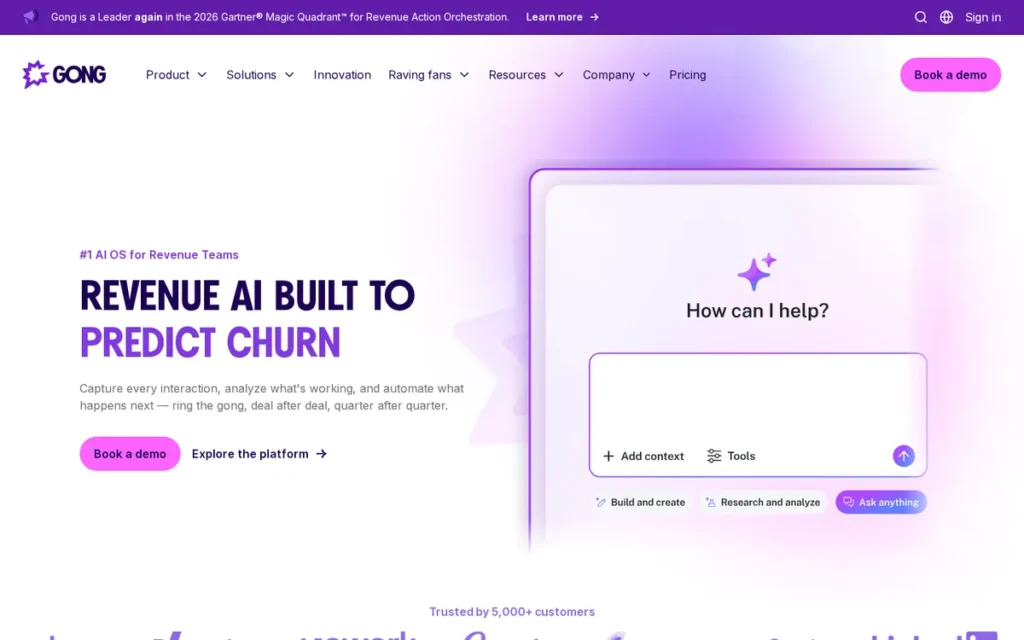
Category: Revenue AI Operating System, a unified platform that automatically captures every customer interaction across 300+ integrations and applies AI across conversation intelligence, forecasting, sales engagement, and rep coaching from a single connected data layer.
At a Glance
- Category: Revenue AI Operating System
- Best For: B2B sales teams (25+ reps, mid-market to enterprise) prioritizing deep call coaching, real-time deal risk detection, and pipeline visibility grounded in actual customer conversation data rather than manual CRM entry
- Price Range: Custom enterprise pricing (not publicly disclosed); estimated $40,000–$120,000+/year for mid-market teams based on third-party intelligence and community data; no free tier
- Primary Strength: Gong’s Revenue Graph captures customer interactions across 300+ integrations and 70+ languages, the broadest documented integration count of any platform in this evaluation as of May 2026
- Biggest Limitation: Gong’s pricing is fully opaque and estimated at premium-enterprise rates; its Gong Engage sequencing module is widely documented by practitioners as weaker than dedicated engagement platforms like Salesloft or Outreach for complex outbound sequences
- One-Line Summary: Gong is the top-rated Revenue AI platform on G2 (4.8/5, highest review volume in the Revenue Intelligence category as of May 2026), recognized in Gartner’s 2025 sales AI platform evaluations, and the only platform in this evaluation with a native MCP architecture enabling third-party AI agent integration into its Revenue Graph
- Last Verified: May 2026
Overview
Gong is a Revenue AI Operating System that automatically captures every B2B sales interaction (calls, emails, video meetings, and messages across 300+ integrations) and converts that data into deal intelligence, pipeline forecasts, and rep coaching without manual CRM entry. Gong serves more than 4,000 businesses globally [Sacra, March 2025; TechCrunch, March 2025] and surpassed $300M ARR in early 2025 [Gong press release, March 2025]. Gong is best suited for RevOps leaders and sales managers who need both a coaching instrument and a pipeline governance tool in a single connected platform, with budget for a premium enterprise investment and a dedicated RevOps resource to configure advanced AI features at full value.
Key Features
- Revenue Graph: Gong’s Revenue Graph automatically captures and connects every customer interaction across 300+ integrations (including Zoom, Teams, Google Meet, phone, email, SMS, LinkedIn, and calendar) without requiring manual data entry from sales reps, building a connected intelligence layer across 70+ languages on top of more than 3.5 billion analyzed interactions.
- Gong Forecast: Gong Forecast delivers AI-driven pipeline predictions using 300+ signals per deal, with named customers Upwork and PointClickCare reporting 95% forecast accuracy in Gong-published case studies [Gong press release, FY2025], the most specifically attributed forecast accuracy outcomes of any platform in this evaluation.
- AI Agents: Gong’s Deal Driver and AI Data Extractor agents execute sales motions autonomously, completing tasks Gong benchmarks at up to 5x faster than manual processes and implementing sales methodologies in approximately two weeks versus the traditional ten-week timeline, per Gong’s internal platform benchmarks [Gong Platform, May 2026].
- Gong Enable: Gong Enable grounds rep coaching in actual recorded customer conversations, providing AI-generated scorecards, objection pattern analysis, competitor mention detection, and buying signal identification benchmarked against Gong’s 3.5B+ analyzed interaction library.
- MCP Architecture: Gong acts as both an MCP Client and MCP Server, enabling third-party AI agents to access and write to the Revenue Graph, positioning Gong as AI revenue data infrastructure rather than a closed point solution for teams building AI-native GTM workflows.
Best For
Gong is best suited for B2B sales teams of 25+ reps where the primary bottleneck is rep performance consistency, organizations losing deals due to poor objection handling, inconsistent messaging, or lack of visibility into actual customer conversations, rather than teams whose primary need is outbound sequence volume, revenue attribution, or anonymous account identification.
Pricing
Gong does not publish pricing as of May 2026. Third-party comparison sources and community data suggest annual contracts typically range from approximately $40,000 to $120,000+ for mid-market teams of 10–100 users, with enterprise contracts significantly higher based on user count, feature modules, data storage, and integrations. One r/SalesOperations community member cited budget as the primary reason for not purchasing Gong despite a positive sales experience [r/SalesOperations, 2025]. If your team does not require Gong Engage for outbound sequencing, negotiate to exclude or discount the Engage module, community consensus confirms Gong Engage underperforms vs. Salesloft and Outreach for teams with complex sequence requirements, and paying for unused modules widens the cost-to-value gap that drives platform replacement decisions.
Strengths
- Gong earned recognition in Gartner’s 2025 sales AI platform evaluations and was named to Fast Company’s 2026 World’s Most Innovative Companies list (Gong press release, February 2026), two independent credentialing events placing Gong among the most externally validated platforms in this evaluation.
- Gong holds a G2 rating of 4.8/5 with the highest review volume in the Revenue Intelligence category as of May 2026 [G2 Revenue AI Platforms Grid, May 2026], the strongest simultaneous signal of practitioner quality and breadth of daily-use adoption across all platforms in this evaluation.
- Gong customers report a 64% increase in seller productivity and approximately 10 additional revenue-generating hours per AE per week, with frontline managers saving 3–4 hours previously spent on spreadsheet-based forecasting, aggregate customer-reported outcomes from Gong FY2025 customer communications (self-selected, not independently controlled).
- Gong’s MCP Client and Server architecture allows third-party AI agents to connect into the Revenue Graph, a unique infrastructure-level differentiator as agentic AI adoption reaches 54% of B2B organizations in 2026 [Futurum Research, cited in Warmly.ai, 2026].
Limitations
- Pricing and Engagement Module Trade-off: Gong’s most consequential limitation is the combination of opaque premium pricing and a documented weakness in the Gong Engage sequencing module, teams that sign with Gong expecting an all-in-one platform frequently discover they still need a dedicated engagement tool, effectively paying for two platforms. Multiple r/SalesOperations and r/techsales practitioners confirm Gong Engage is not a viable substitute for teams with complex outbound sequencing requirements.
- Surveillance Perception Risk: Gong’s AI scoring metrics: used by some organizations in rep performance evaluations and performance improvement plans, generate documented rep-level resistance in r/techsales community discussions (49-comment thread, 2025), with users describing a “big brother” dynamic that can undermine platform adoption when not proactively managed in rollout planning.
- RevOps Bandwidth Dependency: Gong’s advanced AI features: beyond call recording and CRM auto-fill, require dedicated RevOps bandwidth to configure and maintain. Teams without a RevOps function frequently report using the platform “nowhere near its capabilities” [r/SalesOperations, 2025], reducing return on the premium investment.
“Gong is overpriced, but it’s a good tool. Gong Engage is straight trash, though.” (u/Lazy-Bar-4871, r/SalesOperations)
Takeaway: The practitioner consensus on Gong Engage is consistent and specific, it is not a viable substitute for dedicated engagement platforms. Teams considering Gong as an all-in-one platform should budget separately for a sequencing tool or negotiate to exclude the Engage module from contract pricing to close the cost-to-value gap that drives platform replacement decisions.
Verdict
Gong is the highest-rated Revenue AI platform in the category by G2 practitioner reviews (4.8/5, highest review volume in Revenue Intelligence as of May 2026), recognized in Gartner’s 2025 sales AI platform evaluations, and the only platform in this evaluation with a native MCP architecture enabling third-party AI agent integration into its Revenue Graph. Gong earns the #1 ranking for the broadest combination of verified evidence across all six weighted criteria, with particular strength in its multi-modal data architecture, independent recognition, and practitioner-validated adoption. Teams that need best-in-class enterprise sequencing alongside their Revenue AI investment should budget separately for Salesloft or Outreach rather than relying on Gong Engage, and should plan for advanced AI features to require a dedicated RevOps resource to configure and maintain at full value.
#2. Salesloft: Best for Mid-Market to Enterprise Revenue Orchestration: AI-Guided Rep Productivity and Engagement at Scale
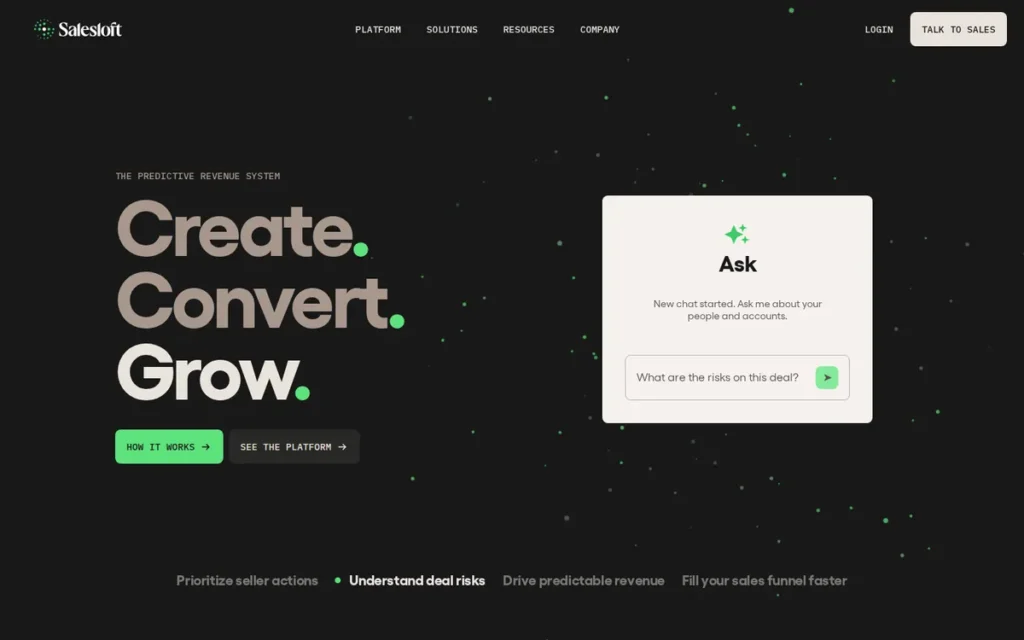
Category: Revenue Orchestration Platform, combines AI-guided multi-channel sales engagement (cadences), conversation intelligence, deal management, and AI forecasting in a single system, with the Rhythm AI engine automatically prioritizing each rep’s daily actions.
At a Glance
- Category: Revenue Orchestration Platform
- Best For: Mid-market to enterprise B2B sales teams with high outbound volume (20+ SDR/AE/CSM) where rep-level AI prioritization, cadence consistency, and engagement-to-pipeline visibility across the full revenue cycle are the primary investment drivers
- Price Range: Custom enterprise pricing (not publicly disclosed); estimated $75–$125/user/month (annual billing) based on third-party comparison sources; Vendr third-party median annual contract approximately $43,000 [Vendr, 2025]; no public pricing page
- Primary Strength: Salesloft’s Rhythm AI engine and 21+ named AI agents (per Salesloft platform documentation, May 2026) provide the most comprehensive AI-guided daily rep prioritization of any Revenue Orchestration platform in this evaluation
- Biggest Limitation: Salesloft’s post-merger integration with Clari has introduced documented UI inconsistencies and increased platform complexity; conversation intelligence capabilities offer less analytical depth than Gong’s call analysis for teams prioritizing detailed coaching scorecards
- One-Line Summary: Salesloft is the #1-rated Sales Engagement platform on G2 by review volume (4,200+ reviews, 4.5/5, Capterra 4.6/5 as of May 2026) and offers the largest named AI agent inventory (21+, per Salesloft documentation) of any Revenue Orchestration platform evaluated, now augmented with Clari’s enterprise AI forecasting depth through the 2024 merger under Vista Equity Partners
- Last Verified: May 2026
Overview
Salesloft is a Revenue Orchestration Platform for B2B sales teams that combines AI-driven multi-channel cadences, conversation intelligence, deal management, and predictive forecasting in a single system, using its proprietary Rhythm AI engine to continuously analyze CRM data, engagement signals, and external buying triggers to prioritize each rep’s daily actions automatically, without requiring managers to assign tasks or reps to review dashboards. Salesloft was founded in 2011, acquired by Vista Equity Partners in 2022 at a reported ~$4.6 billion valuation, merged with Clari in 2024 to form the Predictive Revenue System, and acquired conversational AI platform Drift in 2023. Salesloft holds the #1 G2 position in Sales Engagement by review volume (4,200+ reviews, 4.5/5 [G2 Sales Engagement category, May 2026]) and is most valuable for outbound-heavy B2B teams needing AI-guided rep execution at scale and post-merger forecasting depth without a separate Clari platform investment.
Key Features
- Rhythm AI Engine: Salesloft’s Rhythm AI engine analyzes CRM activity, engagement signals, and external buying triggers to automatically surface prioritized next-best actions for each rep daily, reducing cognitive overhead on which deals and prospects need attention without requiring manual dashboard review from reps or task assignment from managers.
- 21+ Named AI Agents: Salesloft’s 21+ named AI agents (per Salesloft platform documentation, May 2026) execute specific revenue workflows autonomously, including sequence optimization, deal risk detection, meeting summary generation, coaching recommendations, and pipeline update automation across the full sales cycle.
- Drift Conversational AI: Salesloft’s 2023 Drift acquisition embedded conversational AI chatbots into the platform, enabling real-time anonymous website visitor engagement that connects directly to Salesloft’s sequence enrollment, rep routing, and notification workflows, connecting marketing’s top-of-funnel intent signals to live sales engagement in a single workflow unavailable on Gong or standalone Clari.
- Clari-Powered Forecasting: Salesloft integrates Clari’s AI Opportunity Scores (0–100, calibrated via customer-specific models to each organization’s deal history) and Revenue Cadences into its forecasting layer, providing CRO-level pipeline governance within the same platform as engagement workflow management.
- Multi-Channel Cadences: Salesloft supports multi-channel outreach across email, phone, LinkedIn, SMS, and video with A/B testing, conditional sequence logic, and CRM-native activity logging, eliminating manual data entry for reps while providing engagement analytics that feed Clari’s forecasting models.
Best For
Salesloft is best suited for B2B sales organizations with 20+ SDR, AE, or CSM team members where outbound cadence consistency, rep-level AI guidance, and engagement-to-pipeline visibility are the primary ROI drivers, particularly teams transitioning from fragmented point-solution stacks (separate engagement, forecasting, and conversation intelligence tools) seeking a single revenue orchestration platform with the lowest rep adoption friction in the engagement-first category.
Pricing
Salesloft does not publish pricing publicly as of May 2026. Vendr purchasing intelligence places the median annual contract at approximately $43,000 [Vendr, 2025], with per-seat estimates from independent comparison sources at $75–$125/user/month annually. Enterprise deployments incorporating the post-merger Clari forecasting capabilities command higher contract values. Key pricing considerations:
- Teams on HubSpot must verify current HubSpot integration depth and specific feature support before committing, community data flags HubSpot compatibility as a limitation area for certain Clari-powered forecasting features.
- Budget for post-merger platform complexity: some customers report increased configuration overhead since the Clari integration, which may require additional RevOps hours.
- Verify whether Rhythm AI agent capabilities are included at base contract or metered separately.
Strengths
- Salesloft holds the #1 position in Sales Engagement on G2 by review volume with 4,200+ reviews at 4.5/5 and a Capterra rating of 4.6/5 (500+ reviews) as of May 2026 [G2 Sales Engagement category; Capterra, May 2026], the broadest combined practitioner validation of any engagement-first Revenue AI platform in this evaluation.
This aligns with community sentiment on r/sales:
“I switched from outreach to Salesloft almost a year ago. Outreach was buggy as hell. UI was changing all the time and had a lot of not useful information for us. In the course of a year went through 5 different account managers. Our paid for integration specialist has no clue and didn’t set us up for success. If we needed help, it was ALWAYS a link to fuckin outreach university. The automations/triggers are on par between the two but with outreach, it work one day, quit the next and then start working again. Constantly. Switched to salesloft. Process was much much smoother, the sales approach was more laid back and overall a better exp for me. (Turner, you’re my guy!). If I have issues, need help, etc I get fucking support. Good support too. Yes, they have a university too if you want to learn on your own, etc but it’s not the default response every single time you might ask for help. So far, have experienced zero bugs. About to renew in another month for the next year. Overall, the feedback from the team members is that it’s a lot more user friendly and I have found it to be just as functional. That being said, if you’re not going to be dialing and are going to be a spam cannon, might want to look into a product that allows you to rotate inboxes, etc. Even phone number rotation is something that is a concern for me, too with some of the new rules hitting. But between the two, 100% Salesloft 100% of the time.” Posted by u/VonGrugen
Takeaway: Practitioners who migrate from Outreach to Salesloft consistently cite reliability, responsive human support, and rep-level usability as primary differentiators, though Salesloft’s deliverability architecture warrants scrutiny for high-volume cold outbound teams operating under inbox rotation requirements.
- Salesloft’s 21+ named AI agents (per Salesloft platform documentation, May 2026) represent the largest documented agent inventory in the Revenue Orchestration category, providing continuous rep prioritization, deal risk detection, and coaching recommendations without requiring per-agent RevOps configuration.
- Salesloft’s 2024 merger with Clari under Vista Equity Partners adds enterprise-grade AI forecasting (customer-specific Opportunity Scores, Revenue Cadences, Smart CRM Updates reducing manual data entry by 80% [Clari, 2025]) to Salesloft’s engagement layer, delivering capabilities previously requiring two separate platform investments each estimated at approximately $43,000+/year.
- Salesloft’s 2023 Drift acquisition creates a unique capability in the Revenue Orchestration category: real-time anonymous website visitor conversational AI that feeds directly into Salesloft’s sequence enrollment and rep routing, connecting marketing intent signals to live sales engagement in a single workflow not offered by Gong or Clari alone.
Limitations
- Post-Merger Integration Complexity: Salesloft’s most consequential current trade-off is the integration complexity introduced by the 2024 Clari merger, reviewers document UI inconsistencies and interface friction as two large platforms consolidate, with some describing the combined experience as “clunky.” Teams should factor a two-to-four month integration maturation period into realistic adoption timeline planning.
- Conversation Intelligence Depth Gap: Teams prioritizing the deepest available conversation intelligence for call coaching will find Salesloft’s CI capabilities less analytically comprehensive than Gong’s, specifically lacking Gong’s competitor mention detection, objection pattern analysis, and AI coaching scorecards derived from Gong’s 3.5B+ analyzed interaction benchmark.
Users on r/sales noted:
“We just switched to salesloft to replace Gong and Outreach and pretty much everyone in the org hates it. SL AI recording transcription is supremely dogshit, it thinks I’m the prospect 90% of the time and never captures next steps the way Gong would. As annoying Gong reps are I like the product.” Posted by u/Im_Mr_November
Takeaway: Salesloft’s AI transcription and conversation intelligence accuracy trail Gong’s significantly in direct practitioner comparisons, teams consolidating onto Salesloft from a Gong deployment should budget for a concrete drop in call coaching depth as the acknowledged cost of engagement-platform unification.
- HubSpot Integration Variability: HubSpot integration quality has been flagged in community discussions as a limitation for teams not running Salesforce, particularly for Clari-powered forecasting features that may require Salesforce data models. Verify specific feature parity before committing if your primary CRM is HubSpot.
- Conditional Sequence Complexity Ceiling: Teams with complex enterprise multi-stakeholder sequences requiring advanced conditional branching logic may find Outreach’s sequencing engine more technically sophisticated than Salesloft’s for their specific deal cycle requirements.
Verdict
Salesloft is the #1 platform in Sales Engagement on G2 by review volume and the only Revenue Orchestration platform in this evaluation that combines 21+ named AI agents, Rhythm AI-guided daily rep prioritization, Drift conversational AI, and Clari’s enterprise forecasting depth under a single contract. Salesloft earns the #2 ranking behind Gong primarily due to Gong’s stronger independent analyst recognition, higher G2 rating, and more specifically attributed customer outcome evidence, but Salesloft outperforms Gong for teams whose primary ROI driver is outbound engagement volume, AI-guided rep prioritization at scale, and post-merger forecasting access rather than conversation intelligence depth or call coaching sophistication. Teams evaluating Salesloft should plan for a two-to-four month post-merger integration maturation period and verify current HubSpot integration status before committing if not operating on Salesforce.
#3. Salesforce Revenue Intelligence: Best for Teams Already on Salesforce: CRM-Native Revenue AI with the Lowest Integration Risk and Highest Compliance Architecture
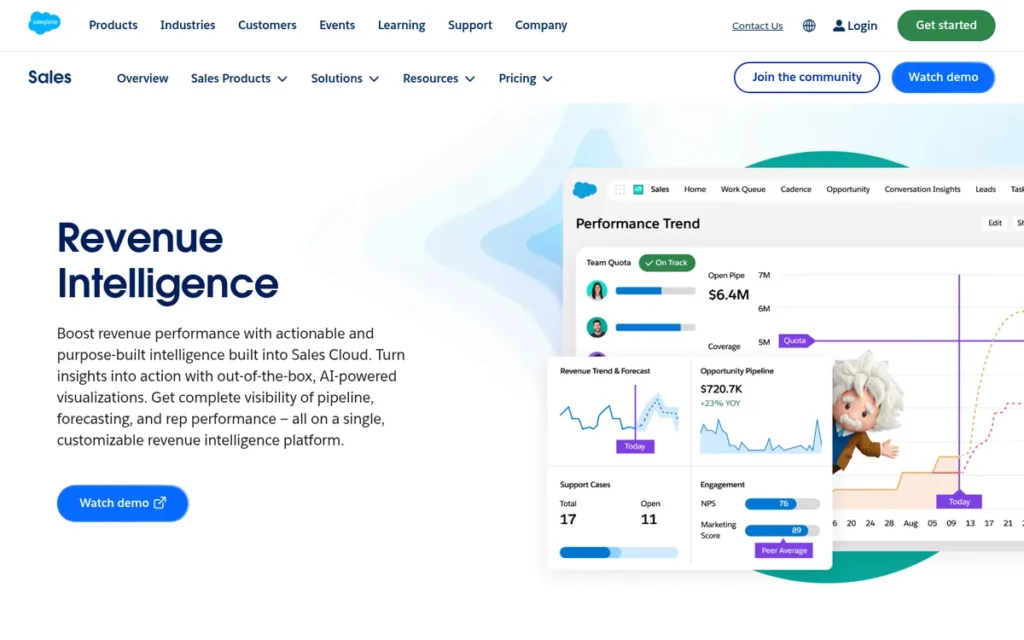
Category: CRM-Native Revenue AI, AI forecasting, deal scoring, conversation intelligence, and autonomous Agentforce agents built natively inside Salesforce CRM, operating directly on live CRM data without requiring external data pipelines or integration middleware.
At a Glance
- Category: CRM-Native Revenue AI
- Best For: Enterprises already operating on Salesforce who want to add Revenue AI capabilities (forecasting, deal scoring, autonomous AI agents) with zero integration overhead, native CRM data operations, and the strongest compliance and data governance architecture of any platform in this evaluation
- Price Range: Published tiers (May 2026, annual billing): Starter Suite $25/user/month, Pro Suite $100, Enterprise $165, Unlimited $330, Einstein 1 Sales $500. Revenue Intelligence requires Enterprise minimum. Agentforce agents: Flex Credits at $500 per 100,000 credits (~$0.10/action) as of May 2025 [Salesforce press release, May 2025]; verify current pricing at salesforce.com/agentforce/pricing before contracting
- Primary Strength: Salesforce Revenue Intelligence’s Einstein Trust Layer is the only purpose-built PII-masking AI compliance architecture in this evaluation, masking customer data before it contacts external LLMs and grounding AI outputs in live Data Cloud records, the strongest data governance option for regulated industries
- Biggest Limitation: Salesforce Revenue Intelligence requires 3–6+ months for full deployment and dedicated Salesforce admin resources (the longest time-to-value of any platform in this evaluation) and its conversation intelligence via Einstein Activity Capture lacks the call coaching depth, objection pattern analysis, and competitive mention detection that purpose-built tools like Gong provide
- One-Line Summary: Salesforce Revenue Intelligence is the only enterprise Revenue AI platform in this evaluation with publicly published per-seat pricing, a native PII-masking compliance layer (Einstein Trust Layer), and consumption-based Agentforce AI agents, making it the strongest choice for Salesforce-native enterprises where data governance and native integration outweigh deployment speed as selection criteria
- Last Verified: May 2026
Overview
Salesforce Revenue Intelligence is the AI-native revenue management layer built directly into Salesforce CRM, spanning Einstein Activity Capture (email and calendar sync), Sales Cloud Einstein (predictive deal scoring and pipeline inspection), Revenue Intelligence dashboards (AI-powered forecasting and scenario modeling), and Agentforce for Sales (autonomous AI agents for deal progression, meeting prep, quote-to-cash, and coaching), all powered by the Atlas Reasoning Engine and protected by the Einstein Trust Layer, which masks PII before any data contacts external AI services. Salesforce Revenue Intelligence is the right evaluation priority for B2B enterprises already running Salesforce as their system of record, a position held by 87% of B2B sales organizations per Salesforce State of Sales 2026, who want to add Revenue AI without introducing external data pipelines, integration overhead, or third-party AI compliance risk. Salesforce Revenue Intelligence scores highest in this evaluation on AI architectural innovation and pricing transparency but requires the longest implementation timeline, realistically 3–6+ months, and is not suitable for teams needing fast time-to-value or teams not operating on Salesforce.
Key Features
- Agentforce AI Agents: Salesforce Agentforce deploys autonomous AI sales agents, including meeting prep, deal update, coaching, and quote-to-cash agents, priced via Flex Credits at $500 per 100,000 credits (approximately $0.10 per action, launched May 2025 per Salesforce press release), with a per-user add-on ($125/user/month for unlimited employee-facing usage, introduced Summer 2025), enabling autonomous revenue workflow execution at a structurally different cost model than per-seat AI alternatives.
- Einstein Trust Layer: Salesforce Revenue Intelligence’s Einstein Trust Layer masks personally identifiable information from all CRM records before data contacts external LLMs, then retrieves AI-generated content and grounds it in live Salesforce Data Cloud records, the only purpose-built PII compliance architecture of its type among all platforms in this Revenue AI evaluation.
- Atlas Reasoning Engine: The Atlas Reasoning Engine powers multi-step agent reasoning across Salesforce objects, flows, and external APIs, enabling Agentforce agents to chain complex revenue workflows (identify at-risk deal, research account, draft stakeholder outreach, update forecast) without human intervention between steps.
- Custom Einstein Scoring Models: Salesforce Revenue Intelligence’s custom Einstein scoring models, when fully configured for each organization, support high-forecast-accuracy outcomes, enterprise teams using fully customized models report 95% forecast accuracy in one Salesforce-focused consulting analysis [Kelley Austin, 2025; note: Kelley Austin is a Salesforce consulting firm, not an independent research institution; treat this as a practitioner benchmark, not a controlled study].
- Einstein Activity Capture: Salesforce Revenue Intelligence’s Einstein Activity Capture automatically syncs email and calendar data into Salesforce CRM records, reducing manual data entry, though it lacks the call recording depth, multi-language conversation analysis, and coaching scorecard capabilities of dedicated conversation intelligence platforms like Gong.
Best For
Salesforce Revenue Intelligence is best suited for enterprises with 200+ sales reps, existing Salesforce infrastructure, a dedicated Salesforce admin and RevOps team, and compliance requirements in regulated industries (financial services, healthcare, legal) that make third-party AI data processing a governance risk, organizations for whom native integration and data sovereignty outweigh the faster time-to-value of purpose-built platforms like Gong or Clari.
Pricing
Salesforce Revenue Intelligence is the most pricing-transparent platform in this evaluation as of May 2026. Revenue Intelligence features begin at the Enterprise tier ($165/user/month, annual billing). Full AI capabilities including Agentforce require Einstein 1 Sales Edition at $500/user/month. Agentforce pricing key facts:
- Original launch model (October 2024): $2/conversation: this model has since been superseded.
- Current primary model (as of May 2025): Flex Credits at $500 per 100,000 credits, approximately $0.10 per action [Salesforce press release, May 2025; SaaStr analysis, 2025].
- Per-user add-on (Summer 2025): $125/user/month for unlimited employee-facing agent usage.
- Verify all current Agentforce pricing directly at salesforce.com/agentforce/pricing before any procurement decision, pricing models have evolved rapidly.
Factor in professional services costs for implementation, realistic enterprise deployments commonly require $25,000–$75,000 in services investment across the 3–6 month deployment period. Model Agentforce Flex Credit consumption costs separately from per-seat licensing in all budget scenarios.
Strengths
- Salesforce is a Gartner Magic Quadrant Leader for Sales Force Automation (2025), backed by 87% market penetration across B2B sales organizations [Salesforce State of Sales 2026], providing the largest installed-base data advantage and ecosystem integration depth of any platform in this evaluation for teams already running Salesforce.
- Salesforce Revenue Intelligence’s Einstein Trust Layer is the only purpose-built PII-masking AI compliance architecture in this evaluation, the primary selection criterion for enterprise buyers in financial services, healthcare, and legal industries requiring data governance over third-party AI processing, with no equivalent architecture documented among any other platform evaluated.
- Salesforce Agentforce’s Flex Credits consumption model ($500/100,000 credits, ~$0.10/action as of May 2025 [Salesforce press release, May 2025]) enables AI agent deployment at fundamentally different per-interaction economics than per-seat licensing models, making autonomous revenue workflow execution economically scalable for high-volume enterprise RevOps teams.
- Salesforce Revenue Intelligence is the only enterprise Revenue AI platform in this evaluation with fully published per-seat pricing tiers ($25–$500/user/month, annual billing, May 2026), enabling budget planning without initiating a full vendor sales cycle, a meaningful advantage given that six of seven platforms in this evaluation use opaque pricing.
Limitations
- Implementation Overhead: Salesforce Revenue Intelligence’s most consequential trade-off is its implementation timeline, a realistic deployment of full Revenue Intelligence and Agentforce capabilities requires 3–6+ months, dedicated Salesforce admin resources, data model configuration, and change management investment that purpose-built platforms like Gong or Dreamdata explicitly market against [Kelley Austin, 2025; third-party comparison analysis].
- Conversation Intelligence Gap: RevOps professionals in r/SalesOperations and r/salesforce communities consistently describe layering Gong or Clari on top of Salesforce rather than relying solely on Einstein for forecasting and coaching, indicating that native capabilities, while architecturally sound, do not match purpose-built platforms in out-of-the-box conversation intelligence depth, call coaching, or competitive mention detection.
- Agentforce Cost Unpredictability: Agentforce Flex Credits can produce unpredictable total cost of ownership for high-volume RevOps workflows, teams deploying agents across large rep populations should model consumption scenarios carefully before contracting, as per-action costs compound quickly with automated pipeline updates and multi-step agent workflows.
- Salesforce Dependency: Salesforce Revenue Intelligence provides no meaningful Revenue AI value to teams not already operating on Salesforce, it is not a standalone Revenue AI platform and cannot substitute for Gong, Clari, or Salesloft in non-Salesforce environments.
Verdict
Salesforce Revenue Intelligence is the strongest Revenue AI platform in this evaluation for enterprises already operating on Salesforce who prioritize data governance, compliance, and native integration over deployment speed, earning the #3 ranking behind Gong and Salesloft on the strength of its Agentforce agent architecture, Einstein Trust Layer compliance capability, published pricing transparency, and the largest installed-base integration advantage in the category. Salesforce Revenue Intelligence is not the right choice for teams needing fast time-to-value, teams running HubSpot or Microsoft Dynamics 365 as their primary CRM, or teams whose primary ROI driver is conversation intelligence and call coaching without a parallel Salesforce admin investment. Teams selecting Salesforce Revenue Intelligence should budget for a 3–6 month implementation timeline, plan supplementary investments in purpose-built conversation intelligence if rep coaching is a priority, and verify current Agentforce Flex Credits pricing directly with Salesforce before finalizing contract terms.
#4. Clari: Best for Enterprise Revenue Forecasting: CRO-Level Pipeline Governance with Customer-Specific AI Opportunity Scores
Category: AI Forecasting and Revenue Orchestration Platform, uses customer-specific predictive models (Opportunity Scores 0–100), pipeline waterfall analytics, and cross-team Revenue Cadences to give CROs and RevOps leaders precise, accountable revenue forecasts and systematic pipeline governance.
At a Glance
- Category: AI Forecasting and Revenue Orchestration Platform
- Best For: Enterprise B2B RevOps leaders and CROs managing $50M+ revenue programs on Salesforce CRM who need the highest available AI forecasting accuracy, cross-team pipeline governance extending to customer success and finance, and systematic accountability through Revenue Cadences
- Price Range: Custom enterprise pricing (not publicly disclosed); estimated ~$100/user/month based on third-party intelligence; Clari Copilot separately documented at $600/license per r/SalesOperations community data [2025]; no free tier
- Primary Strength: Clari’s customer-specific AI Opportunity Scores and Revenue Cadences are the most purpose-built enterprise forecasting and cross-functional revenue alignment architecture in this evaluation, designed for CROs accountable to boards for quarterly revenue accuracy
- Biggest Limitation: Clari’s documented HubSpot integration limitations make it a poor fit for teams not operating on Salesforce, and post-merger UI integration with Salesloft has introduced short-term interface complexity and increased platform configuration overhead that buyers should factor into realistic adoption timelines
- One-Line Summary: Clari is an enterprise Revenue Orchestration Platform with purpose-built AI forecasting architecture (using customer-specific Opportunity Scores (0–100) and cross-functional Revenue Cadences) now integrated with Salesloft’s engagement layer as the Predictive Revenue System under Vista Equity Partners
- Last Verified: May 2026
Overview
Clari is a Revenue Orchestration Platform purpose-built for enterprise CROs, VPs of Sales, and RevOps leaders that delivers AI-powered forecasting accuracy, cross-team pipeline governance, and systematic accountability from initial opportunity through renewal, using customer-specific AI Opportunity Scores (0–100) calibrated to each organization’s unique deal patterns rather than a generic predictive algorithm applied uniformly. Clari’s core technical differentiation is its customer-specific modeling approach: Clari builds a unique Opportunity Score model for each customer organization using CRM data, deal context, conversation signals, activity patterns, and partner information. A named enterprise customer testimonial published on Clari’s homepage reports landing within a few percentage points of actual quarterly revenue targets consistently over two years, compared to the industry average forecast error of 15–30% per Gartner Peer Insights, though third-party confirmation with a named company is not available. Clari merged with Salesloft under Vista Equity Partners in 2024, creating the Predictive Revenue System.
Key Features
- Customer-Specific AI Opportunity Scores: Clari’s AI Opportunity Scores (0–100) build a unique predictive model for each customer organization using CRM data, deal context, conversation signals, activity patterns, and partner data (not a generic algorithm) enabling forecast accuracy calibrated to each company’s specific deal dynamics and historical win patterns rather than industry-wide averages.
- Revenue Cadences: Clari’s Revenue Cadences create automated cross-functional workflows that enforce pipeline review accountability across sales, customer success, and finance teams through structured operating rhythms, ensuring forecast discipline at the organizational level rather than depending on individual manager consistency.
- Smart CRM Updates: Clari’s Smart CRM Updates automatically extract MEDDPICC and other sales methodology-aligned information from conversations and populate Salesforce fields, with customers reporting an 80% reduction in manual data entry and recovery of more than 20% of sales team time for revenue-generating activities [Clari, 2025].
- Pipeline Waterfall Analytics: Clari’s Pipeline Waterfall analytics provide granular visibility into pipeline movement (tracking new deals entered, pull-ins, push-outs, and slippages by segment, rep, and time period) giving RevOps leaders detailed understanding of pipeline dynamics beyond static snapshot reporting.
- Clari Copilot: Clari Copilot delivers conversation intelligence (call recording, AI summaries, deal risk signals) that integrates directly with Clari’s forecasting and pipeline models, correlating what reps say in calls with pipeline outcomes and updating Opportunity Scores in real time as conversations progress.
Best For
Clari is best suited for enterprise B2B organizations with $50M+ annual revenue programs, dedicated RevOps teams, and Salesforce as the primary CRM, specifically CROs facing board-level accountability for quarterly revenue accuracy who need systematic AI-grounded pipeline governance extending beyond the sales team to customer success and finance through structured Revenue Cadences.
Pricing
Clari does not publish pricing as of May 2026. Based on third-party intelligence, the full Revenue Orchestration Platform runs approximately $100/user/month for mid-market accounts, with enterprise contracts significantly higher. Important pricing considerations:
- Clari Copilot conversation intelligence module: documented at $600/license per r/SalesOperations community data [2025], confirming the complete platform investment is substantial.
- Request separate module pricing for AI Forecasting, Copilot, and Revenue Cadences to understand which capabilities are included at which contract tier.
- Teams on HubSpot must verify specific integration depth before committing: community data specifically flags HubSpot compatibility as a limitation area for Clari-powered forecasting features.
- Separately clarify how the Clari-standalone vs. Clari-as-part-of-Salesloft roadmaps differ, this affects long-term product continuity planning for enterprise contracts under Vista Equity Partners.
Strengths
- A named enterprise customer testimonial published on Clari’s homepage reports landing within a few percentage points of actual quarterly revenue targets consistently over two years (compared to the industry average forecast error of 15–30% per Gartner Peer Insights) representing the most granular customer-reported forecast accuracy outcome of any platform in this evaluation, though a specific company name is not disclosed in the testimonial.
- Clari customers report an average 12x improvement in forecasting accuracy and 20% faster deal close rates following deployment, aggregate results from Clari Labs internal analysis [Clari, 2024–2025], consistently cited across Clari’s customer-facing communications.
- Clari’s Smart CRM Updates reduce manual data entry by 80% [Clari, 2025], directly addressing CRM data hygiene (the #1 implementation challenge cited by 55% of Revenue AI platform users [Forrester Revenue Intelligence Wave Q1 2026]) recovering more than 20% of sales team time for revenue-generating activities.
- Clari’s $225M Series E and consolidation with Salesloft under Vista Equity Partners (combining Clari’s forecasting architecture with Salesloft’s 4,200+ G2 reviews and 21+ AI agent inventory) creates the most comprehensively capitalized Revenue Orchestration business in the category as of May 2026.
Limitations
- CRM Dependency: HubSpot Gap: Clari’s most consequential limitation for prospective buyers is its CRM dependency: independent analysis and community data specifically document that Clari does not support HubSpot for key forecasting integration features, a material constraint for the significant segment of mid-market B2B companies not operating on Salesforce as their primary CRM. This is a binary disqualifier for HubSpot teams.
- Post-Merger Integration Friction: The post-merger UI integration with Salesloft is a current source of documented user friction, with reviewers describing interface inconsistencies as two large platforms consolidate under a single product architecture, buyers should factor realistic short-term adoption overhead into implementation planning and training budgets.
- Pricing Opacity: Clari’s fully opaque pricing: no published tiers, community-estimated at approximately $100/user/month with a separate $600/license Copilot add-on, places it among the least pricing-transparent platforms in this evaluation, requiring a full sales cycle before budget qualification.
- Enterprise-Grade Configuration Required: Clari’s cross-functional Revenue Cadences and customer-specific AI model calibration require meaningful RevOps investment to configure correctly, the learning curve is steepest for frontline reps compared to managers and CROs, which can create rep adoption friction in rollouts lacking dedicated change management planning.
This aligns with community sentiment on r/SalesOperations:
“It’s great for analysis – answering those questions that require daily data snapshots you don’t get out of the box in Salesforce. It has saved me a TON of time trying to build that crap myself. The AI predictions are mid, but it could be we just don’t have the historic data (shifting ICPs will do that). On the Opp inspection side, our sales leadership is obsessed with reading all the emails attached to Opps. Sometimes he sees the email before the rep does. I don’t see much adoption of the dashboards so far, and we’re going into year 2. We also use Copilot.” Posted by u/robwalte
Takeaway: Clari earns strong RevOps endorsement for pipeline snapshot analytics and CRM augmentation, but AI forecast accuracy is data-maturity dependent, and rep-level dashboard adoption remains a documented challenge even after two full years of deployment, pointing to the change management investment buyers must plan for.
Verdict
Clari is the most purpose-built enterprise AI forecasting platform in this evaluation, with the most granular customer-reported forecast accuracy outcomes and a unique Revenue Cadences architecture extending pipeline governance to customer success and finance beyond what any other platform evaluated provides. Clari earns the #4 ranking behind Gong (superior broad-market validation), Salesloft (higher review volume and rep-level adoption), and Salesforce (pricing transparency and compliance architecture), but is the strongest standalone choice for Salesforce-native enterprises where CRO-level forecast accuracy and cross-team revenue accountability are primary mandates and budget supports a premium enterprise investment. Teams on HubSpot, teams with under 50 reps, or teams needing fast time-to-value from a first Revenue AI investment should evaluate Salesloft or Gong before Clari.
#5. 6sense: Best for ABM-Driven Teams: Identifying Anonymous In-Market Accounts Before Competitors Engage Them
Category: Intent Data and ABM Intelligence Platform, identifies anonymous B2B accounts showing purchase intent before self-identifying, classifies buying stages using ML/NLP/GenAI, and activates account-level signals across sales and marketing teams to drive prioritized outreach at the optimal buying moment.
At a Glance
- Category: Intent Data and ABM Intelligence Platform
- Best For: Mid-enterprise to enterprise B2B companies ($50M+ ARR) running Account-Based Marketing strategies who need to identify anonymous in-market buyers before competitors and prioritize account outreach based on predictive buying stage intelligence rather than rep intuition or arbitrary cadence timing
- Price Range: Custom enterprise pricing (not publicly disclosed); AWS Marketplace listing: $100,000 for 24 months/5 licenses (25% discount applied) [AWS Marketplace, verified May 2026]; Warmly.ai third-party median annual contract approximately $55,000/year [Warmly.ai, 2026]; no public pricing page, no free tier
- Primary Strength: 6sense’s Signalverse processes more than 1 trillion buying signals per day, confirmed by multiple independent 2026 analyses [Prospeo, 2026; Warmly.ai, 2026; Milkandcookies Studio, 2026], to identify anonymous accounts actively researching your solution category before any sales contact is initiated
- Biggest Limitation: 6sense’s intent data strength at the account level has documented gaps at the contact level [Influ2, 2026] (teams typically need supplemental contact enrichment tools to identify specific individuals within target accounts) and premium pricing (~$55K/year) requires a mature ABM function to justify the investment
- One-Line Summary: 6sense is a leading B2B intent data platform: named a Leader in independent analyst evaluations of intent data providers per 6sense press materials (verify current Forrester Wave B2B Intent Data Providers standing at forrester.com before citing in procurement documentation), processing more than 1 trillion buying signals daily via its Signalverse to identify anonymous in-market accounts before competitors; the only platform in this evaluation with this pre-outreach anonymous buyer identification capability at enterprise scale
- Last Verified: May 2026
Overview
6sense is a Revenue AI Platform built on intent data and account-based marketing (ABM) intelligence that identifies anonymous B2B buyers showing purchase intent before they self-identify, using its proprietary Signalverse, which processes more than 1 trillion buying signals daily from first-party web data and third-party B2B behavioral sources [confirmed independently by Prospeo, 2026; Warmly.ai, 2026], to reveal which accounts are actively researching your solution category and where they sit in the buying journey. 6sense was founded in 2013, raised a $200M Series E at a $5.2 billion valuation in 2021, and employs approximately 1,500 people. 6sense serves a distinct buyer profile from every other platform in this evaluation, its primary value is pre-outreach account prioritization rather than rep productivity, conversation coaching, or revenue forecasting, making it a strategic complement to, not a replacement for, engagement platforms like Salesloft or intelligence tools like Gong.
Key Features
- Signalverse Processing: 6sense’s Signalverse processes more than 1 trillion buying signals per day from first-party web data (keyword research tracking, page visit analysis, form interactions) and third-party B2B behavioral data networks, identifying which companies are actively researching your solution category before any sales team member initiates contact.
- Predictive Buying Stage Classification: 6sense’s Predictive AI Scoring uses machine learning, NLP, and generative AI to classify each tracked account into a buying stage (awareness, consideration, decision, or evaluation), enabling sales teams to sequence outreach based on buying readiness signals rather than arbitrary cadence timing.
- Sales Copilot: 6sense’s Sales Copilot generates AI-powered account summaries, recommended talking points calibrated to each account’s buying stage and research behavior, and optimal outreach timing recommendations, reducing the research time required for account-based personalization at scale.
- AI Email Agents: 6sense’s AI Email Agents generate personalized outreach messaging calibrated to each target account’s specific intent signals and buying stage, enabling account-level content personalization across high-volume outreach without requiring manual research per account.
- Technographic Intelligence: 6sense’s Slintel-powered technographic data (from the Slintel acquisition) provides technology stack intelligence and contact information for target accounts, reducing dependency on external enrichment tools, though contact-level data quality requires independent verification against dedicated enrichment platforms for outbound use cases.
Best For
6sense is best suited for mid-enterprise and enterprise B2B companies (typically $50M+ ARR) running Account-Based Marketing programs where the primary constraint is identifying which accounts to prioritize for outreach, specifically organizations with a defined ICP, multi-stakeholder buying committee targeting, a dedicated ABM or demand generation function capable of actioning intent signals, and an existing engagement platform (Salesloft, Outreach) to execute on those signals.
Pricing
6sense does not publish pricing publicly as of May 2026. Verified third-party pricing benchmarks:
- AWS Marketplace listing: $100,000 for 24 months/5 licenses (25% discount applied), equivalent to approximately $40,000/year for 5 users [AWS Marketplace, verified May 2026].
- Warmly.ai median enterprise contract: approximately $55,000/year [Warmly.ai Revenue AI Market Landscape, 2026].
- At approximately $55K/year, 6sense is among the two highest-priced platforms in this evaluation and is cost-prohibitive for growth-stage teams without a dedicated ABM budget.
- Enterprise negotiation levers: number of tracked accounts in the Signalverse data package, Salesforce vs. HubSpot integration tier, and whether AI Email Agent conversation volume is included at contract rate or metered separately.
Strengths
- 6sense has been named a Leader in independent analyst evaluations of B2B intent data providers, including recognition cited in 6sense press materials as a Forrester Wave Leader with top scores for accuracy, noise filtering, and buying cycle analysis, readers should verify the current Forrester Wave B2B Intent Data Providers report directly at forrester.com before citing this designation in procurement documentation. 6sense also holds consistent G2 Leadership recognition in Account-Based Marketing and Revenue Intelligence categories [G2, May 2026].
- 6sense’s Signalverse processes more than 1 trillion buying signals daily: confirmed by multiple independent platform analyses [Prospeo, 2026; Warmly.ai, 2026], with AWS Marketplace customers self-reporting outcomes including 2X Average Contract Value increases, 4X win rate improvements, and 20–40% faster deal close times [AWS Marketplace self-reported data, 2025; these represent outcomes reported by customers who chose to publish results, not typical results across all deployments].
- 6sense’s $200M Series E at a $5.2 billion valuation (2021) and approximately 1,500 employees provide enterprise-grade balance sheet stability, relevant for procurement teams evaluating long-term vendor viability following the consolidation and restructuring events documented among other platforms in this evaluation period.
- 6sense is recognized in multiple independent analyses [Prospeo, 2026; Warmly.ai, 2026] as providing a centralized source for marketing and sales insights across both functions simultaneously, eliminating the organizational disconnect between marketing’s ICP buying signals and sales team account prioritization that creates pipeline timing misalignment in ABM-driven organizations.
Limitations
- Contact-Level Data Gaps: 6sense’s most consequential trade-off is that its intent data strength at the account level does not extend reliably to the contact level, documented by independent analysis (Influ2, 2026) as having “real gaps at the contact level,” meaning 6sense answers “which companies should we engage?” but does not reliably answer “which specific person at that company should we call?” without supplemental enrichment tools such as ZoomInfo or Apollo, effectively increasing total stack cost beyond the 6sense contract alone.
- Premium Pricing and ABM Prerequisite: At approximately $55,000/year median contract, 6sense requires a dedicated ABM strategy, a demand generation function capable of actioning intent signals, and an existing engagement platform (Salesloft, Outreach) to convert signals into pipeline, teams without this organizational infrastructure are unlikely to generate returns proportional to the investment.
- LinkedIn Intent Signal Gaps: LinkedIn intent signal performance has been cited in 2026 r/b2bmarketing community discussions as an area where 6sense does not fully meet expectations for B2B social selling use cases, teams heavily reliant on LinkedIn engagement signals for prospecting should evaluate this limitation specifically before committing.
- Additive Budget, Not a Replacement: 6sense does not provide conversation intelligence, sales sequencing, or revenue forecasting, it must be combined with the platforms ranked above it for complete Revenue AI coverage, meaning 6sense represents an additive budget line, not a platform replacement.
Verdict
6sense is the leading B2B intent data platform in this evaluation based on confirmed Signalverse scale (1 trillion+ daily signals per multiple independent 2026 analyses) and the only platform in this evaluation capable of identifying anonymous in-market accounts before competitors, making it the unambiguous choice for ABM-driven enterprises whose primary investment question is “which accounts should we engage and when?” rather than “how do we coach reps or forecast revenue.” 6sense earns the #5 ranking in this overall Revenue AI evaluation because its use case is distinct from and narrower than the full-platform tools ranked above it, it does not replace conversation intelligence, engagement sequencing, or forecasting capabilities, and its premium pricing (~$55K/year) requires a mature ABM function to justify. Teams should evaluate 6sense as a strategic account-prioritization layer on top of an existing engagement and forecasting stack, not as a standalone Revenue AI platform replacement.
#6. Dreamdata: Best for B2B Revenue Attribution: Proving Which Marketing and Sales Activities Actually Drive Pipeline and Closed Revenue
Category: B2B Revenue Attribution Platform, tracks every marketing and sales touchpoint across the full buyer journey from first anonymous website visit to closed-won deal, distributes revenue credit across channels using multi-touch attribution models, and outputs raw data to BigQuery for BI-tool analysis.
At a Glance
- Category: B2B Revenue Attribution Platform
- Best For: B2B SaaS companies (50–500 employees, $5M–$100M ARR) with complex multi-touch buying cycles where RevOps and marketing operations teams need to prove the revenue impact of specific channels, campaigns, and activities, and connect that attribution data to existing BI tools (Tableau, Looker, PowerBI) via BigQuery
- Price Range: Published pricing (May 2026): Free tier (basic attribution, limited data); Team: $999/month billed annually (up to 10 users, core attribution and journey analytics) [confirmed by Factors.ai, HockeyStack, Zoftware, 2025–2026]; Business: custom pricing (typically $20,000+/year for enterprise deployments)
- Primary Strength: Dreamdata is the only platform in this evaluation whose entire product architecture is built specifically for multi-touch B2B revenue attribution, tracking every buyer journey touchpoint from first anonymous web visit to closed-won and distributing revenue credit across all channels simultaneously using all major attribution models
- Biggest Limitation: Dreamdata is not a sales execution platform: it has no conversation intelligence, no sales engagement sequencing, no AI forecasting, and no agentic capabilities, making it a complement to, rather than a replacement for, the engagement and intelligence platforms ranked above it in this evaluation
- One-Line Summary: Dreamdata is among the top-rated B2B Revenue Attribution platforms on G2 (verify the exact current rating and review count at g2.com/products/dreamdata before publication), with the most transparent pricing in this evaluation (Free plus $999/month Team tier, published), providing multi-touch attribution across all revenue channels with a native LinkedIn attribution partnership and direct BigQuery output for data warehouse teams
- Last Verified: May 2026
Overview
Dreamdata is a B2B Revenue Attribution Platform that answers the question most Revenue AI execution platforms leave unanswered: which specific marketing and sales activities across the full buyer journey drove pipeline and closed revenue? Founded in 2018 in Copenhagen by Lars Grønnegaard Hansen (CEO, former Kissmetrics executive) and Steffen Hedebrandt, Dreamdata captures touchpoints from CRM, advertising platforms, marketing automation, website analytics, and sales engagement tools (including a native Outreach integration) applies all major multi-touch attribution models, and outputs raw attribution data to BigQuery for teams with existing BI infrastructure. Dreamdata is best suited for RevOps leaders and marketing operations teams at B2B SaaS companies (50–500 employees) that need to justify channel spend with verified revenue data, have complex multi-touch buying cycles where CRM reporting cannot connect marketing activities to closed deals, and want to start building attribution capability at a transparent, budget-plannable cost rather than a $40,000+ opaque enterprise commitment.
Key Features
- Multi-Touch Attribution Models: Dreamdata’s attribution engine supports all major models (linear, time-decay, first-touch, last-touch, U-shaped, W-shaped, and data-driven) applied at the account level across the complete B2B buyer journey from first anonymous website interaction to closed-won deal.
- No-Code Data Pipeline: Dreamdata’s no-code pipeline auto-captures activity from CRM (Salesforce, HubSpot), advertising platforms (Google, LinkedIn, Meta), marketing automation, website analytics, and sales engagement tools (including a native Outreach integration) without requiring data engineering resources to build or maintain the pipeline.
- BigQuery Output: Dreamdata’s native BigQuery output sends all raw attribution data directly to the customer’s data warehouse, enabling RevOps and data teams to run custom SQL queries and connect attribution intelligence to existing BI tools (Tableau, Looker, PowerBI) without being locked into Dreamdata’s dashboard interface.
- Native LinkedIn Attribution Partnership: Dreamdata’s native LinkedIn attribution partnership delivers accurate paid social ROI measurement, a documented technical differentiator, as competing attribution tools typically approximate LinkedIn paid social ROI through modeled estimates rather than accessing it through a direct platform partnership.
- Buyer Timeline Analysis: Dreamdata’s buyer timeline analysis maps the complete sequence of touchpoints across every deal in the pipeline, revealing not only which channels contributed to revenue, but where in the buyer journey specific sales handoff gaps or content conversion gaps are creating pipeline leakage that CRM reporting cannot surface.
Best For
Dreamdata is best suited for RevOps leaders and marketing operations teams at B2B SaaS companies (50–500 employees) with multi-touch, multi-channel buying cycles where the primary pain point is an inability to answer “which channels and activities are driving pipeline and revenue?”, specifically organizations where existing CRM reporting, Google Analytics, and ad platform dashboards provide siloed, channel-specific data that cannot be connected into a complete buyer journey view at the account level.
Pricing
Dreamdata offers the most transparent and accessible pricing structure in this evaluation as of May 2026:
- Free tier: Basic multi-touch attribution with limited data volume: useful for initial validation before committing to a paid tier.
- Team tier: $999/month billed annually (up to 10 users), covering core attribution models, buyer journey analytics, and BigQuery output [confirmed by Factors.ai, HockeyStack, Zoftware, 2025–2026]. This is the lowest mid-market entry point of any platform in this evaluation.
- Business tier: Custom pricing (typically $20,000+/year for enterprise) covering unlimited users, advanced segmentation, and full data access.
Initial setup requires 1–4 weeks of integration configuration across data sources even with the no-code pipeline, budget this time in project planning. Note that BigQuery storage and query costs are additional to the Dreamdata subscription fee and can increase meaningfully at high data volumes [SaaS Hero analysis, 2026].
Strengths
- Dreamdata holds a strong G2 rating in the B2B Revenue Attribution category, verify the exact current rating and review count directly at g2.com/products/dreamdata before publication, as different third-party analysis sources report varying figures (third-party sources reference 245+ reviews as of 2025–2026 [Prospeo, 2025–2026]), with G2 verified reviewers reporting outcomes including “buyer timelines revealed sales handoff gaps, boosting close rates 25%” and “transformed our attribution, now see exact revenue per channel without manual exports” [G2 verified reviews, 2025–2026].
- A named customer case study documents 40% pipeline growth directly attributed to marketing activities previously invisible in CRM and analytics reporting, cited in third-party platform comparison analyses [Usermaven, 2025]; this outcome has not been independently verified by PlugRoute and should be treated as a directional benchmark from a self-selected reporting company.
- Dreamdata’s $999/month Team tier is the most accessible mid-market Revenue AI entry point in this evaluation, six other platforms require $40,000+ annual commitments through opaque sales processes, while Dreamdata enables a RevOps team to begin multi-touch attribution within weeks at a published, budget-plannable price.
- Dreamdata’s native LinkedIn attribution partnership is a documented technical differentiator specifically cited in G2 reviews, most competing attribution tools approximate LinkedIn paid social ROI through modeled estimates, while Dreamdata’s direct partnership preserves signal accuracy for one of the highest-spend B2B advertising channels.
Limitations
- Deliberately Narrow Scope: Dreamdata’s most consequential trade-off is its deliberate scope limitation, Dreamdata is a revenue analytics tool, not a revenue execution platform, with no conversation intelligence for call coaching, no outbound email or call sequencing, no AI forecasting, no pipeline governance, and no agentic workflow capabilities. Teams evaluating Dreamdata as a standalone Revenue AI replacement for Gong, Clari, or Salesloft will find the scope insufficient for their needs.
Users on r/b2bmarketing shared their experience:
“No tool fully solves attribution specially with long B2B journeys. From what I have seen, Dreamdata and HockeyStack tend to work best for B2B because they are built around multi touch and account level thinking but they still need clean CRM data and some upfront setup. Wicked Reports is solid but often feels heavier than most small teams expect. If you don’t have a data specialist, I would start simpler, tighten CRM hygiene, define 2–3 attribution questions you actually care about and use one tool to answer those only. Attribution breaks when teams try to measure everything at once.” Posted by u/Visual-Sun-6018
Takeaway: Dreamdata earns consistent practitioner endorsement as the leading B2B-native multi-touch attribution tool, but clean CRM data and a clearly scoped set of attribution questions are prerequisites, teams without a data-literate RevOps resource who attempt to measure everything simultaneously will find the tool’s outputs unusable regardless of platform quality.
- Setup Complexity: Setup requires 1–4 weeks of integration configuration even with no-code tooling, and teams without a data-literate RevOps or marketing operations resource capable of interpreting attribution outputs will struggle to act on Dreamdata’s findings without additional analytical support.
- Limited AI Capabilities vs. Full Platforms: Dreamdata’s AI capabilities are limited relative to the full Revenue AI platforms in this evaluation, multi-touch attribution models are analytically sophisticated, but Dreamdata does not offer predictive scoring, agentic workflows, or real-time coaching capabilities.
- Small Team and Feature Velocity: Dreamdata’s lean team (~50–70 employees, approximately $13M total funding) means slower feature development velocity than the enterprise-backed platforms in this evaluation, a relevant factor for teams with rapidly expanding attribution needs or requirements for enterprise-grade SLA support guarantees.
Verdict
Dreamdata is the most pricing-transparent platform in this evaluation, the only tool with a published sub-$1,000/month entry point for RevOps teams needing multi-touch attribution without enterprise contract complexity or opaque pricing. Dreamdata earns the #6 ranking because its scope is deliberately narrow, Dreamdata solves the revenue attribution problem better than any platform in this evaluation, but does not address the engagement, forecasting, or coaching problems that the platforms ranked above it solve. Dreamdata is the right choice for B2B SaaS RevOps and marketing operations teams whose primary unanswered question is “what is actually driving our pipeline?” and who already have, or are independently planning, an engagement and forecasting platform investment. Put simply: the other six platforms in this evaluation tell you what is happening in your pipeline right now. Dreamdata tells you why it happened and which investments caused it.
#7. Outreach: Best for Complex Enterprise Outbound: Sophisticated Multi-Stakeholder Sequencing with Five Named Amplify AI Agents
Category: AI Revenue Workflow Platform, enterprise multi-channel sales engagement with conditional sequence automation, Kaia AI conversation intelligence, AI deal health scoring, revenue forecasting, and an Amplify AI agent layer for autonomous revenue operations.
At a Glance
- Category: AI Revenue Workflow Platform
- Best For: Large enterprise B2B sales teams (100+ reps) with complex multi-stakeholder deals requiring the most technically sophisticated multi-channel sequence logic, conditional branching automation, and real-time during-call AI coaching, specifically where Salesloft’s simpler cadence approach is insufficient for the sequence complexity required
- Price Range: Custom enterprise pricing (not publicly disclosed); Vendr third-party median annual contract approximately $45,000 [Vendr, 2025]; enterprise contracts commonly $100+/user/month based on comparison source intelligence; Amplify AI agents priced separately via credit-based consumption; no public pricing page
- Primary Strength: Outreach’s sales engagement engine supports 12-variant A/B sequence testing and conditional multi-channel branching logic across five channels, the most technically sophisticated outbound automation architecture of any platform in this evaluation for teams with complex multi-stakeholder deal requirements
- Biggest Limitation: Outreach reduced its workforce by approximately 9% (~70 employees) in November 2024, primarily affecting go-to-market roles [GeekWire, November 2024; BizJournals, November 2024], creating legitimate vendor stability concerns for enterprise buyers evaluating multi-year contracts, compounded by documented customer support quality gaps below Salesloft’s satisfaction benchmarks in direct comparison analyses
- One-Line Summary: Outreach is a consistent Forrester Wave Sales Engagement Leader serving 6,000+ businesses with the most sophisticated conditional multi-channel sequencing in this evaluation, augmented by five named Amplify AI agents and Kaia real-time call coaching launched in 2025, though enterprise buyers should conduct explicit vendor stability due diligence following the company’s November 2024 workforce restructuring before committing to multi-year contracts
- Last Verified: May 2026
Overview
Outreach is an AI Revenue Workflow Platform for enterprise B2B sales teams that combines multi-channel sales engagement (Engage), conversation intelligence with real-time during-call coaching (Meet with Kaia AI), deal management (Deal with AI Health Scores), revenue forecasting (Forecast with Commit AI), and autonomous AI agents (Amplify) in a unified platform, with its sequencing engine supporting 12-variant A/B testing and conditional branching logic across five channels. Outreach was founded in 2014 by Manny Medina in Seattle, has raised $489M in total funding, serves 6,000+ businesses globally, and has earned consistent Forrester Wave Leadership in Sales Engagement across multiple evaluation cycles. Outreach earns the #7 ranking, last in this evaluation, not due to capability deficiency in Outreach’s primary use case of enterprise multi-stakeholder sequencing, but because Outreach’s November 2024 workforce restructuring, documented support quality gaps below Salesloft in direct G2 comparisons, and a median annual contract of approximately $45,000 with the lowest ease-of-use ratings among engagement platforms combine to score Outreach below all other platforms on the weighted criteria.
Key Features
- Engage Sequencing Engine: Outreach’s Engage module supports 12-variant A/B sequence testing with conditional multi-channel branching logic across email, phone, LinkedIn, SMS, and video, enabling enterprise teams to orchestrate sophisticated branching sequences for complex multi-stakeholder B2B deals without requiring manual rep decision-making at each sequence step.
- Amplify AI Agents: Outreach’s five Amplify AI agents: Revenue Agent (prospect sourcing and enrichment), Deal Agent (CRM hygiene automation), Research Agent (account and prospect intelligence), Expansion Agent (upsell and cross-sell identification), and Conversation Agent (pre-meeting briefs with tailored talking points), were launched at Unleash 2025 on a credit-based consumption pricing model, enabling autonomous execution of targeted revenue workflows.
- Kaia Real-Time Coaching: Outreach’s Kaia AI delivers real-time during-call coaching (surfacing battle cards, objection responses, and relevant content as live conversations unfold) rather than providing only post-call analysis, differentiating Outreach from platforms that provide conversation insights only after the conversation ends.
- Commit AI Forecasting: Outreach’s Commit AI forecasting integrates deal health scores, sequence engagement signals, and CRM data into pipeline projections, providing forecasting capability within the same platform as the engagement workflow without requiring a separate forecasting tool for teams with basic forecasting requirements.
- Multi-CRM Compatibility: Outreach integrates natively with Salesforce, HubSpot, and Microsoft Dynamics 365 (broader CRM compatibility than Clari’s Salesforce-primary architecture) making it a viable enterprise engagement layer for organizations not standardized on Salesforce.
Best For
Outreach is best suited for large enterprise B2B sales organizations (100+ reps) with high-volume outbound, complex multi-stakeholder deal cycles requiring advanced conditional sequence branching, and dedicated RevOps resources to configure and maintain the platform, specifically teams for whom Salesloft’s cadence approach does not provide the sequence conditional logic depth required for their enterprise B2B sales motion.
Pricing
Outreach does not publish pricing as of May 2026. Vendr purchasing intelligence places the median annual contract at approximately $45,000 [Vendr, 2025], with enterprise contracts commonly reaching $100+/user/month for full platform access. Key pricing considerations:
- Amplify AI agents use separate credit-based consumption pricing: model this as an additional cost of ownership line item beyond per-seat licensing when building budget scenarios.
- “Expensive for the value” appears repeatedly in G2 reviews, particularly from teams not maximizing advanced conditional sequencing capabilities that justify the pricing premium.
- Enterprise buyers assessing the November 2024 workforce restructuring risk should negotiate multi-year contract protections, support escalation SLAs, and roadmap commitments before signing.
Strengths
- Outreach has earned consistent Forrester Wave Leadership in Sales Engagement across multiple consecutive evaluation cycles, the most sustained independent analyst validation of enterprise sales engagement depth in this evaluation, alongside Gong’s Gartner recognition.
- Outreach serves 6,000+ businesses globally: the highest customer count among all non-Salesforce platforms in this evaluation, demonstrating enterprise-scale deployability across a wide range of industries, company sizes, and CRM configurations including Salesforce, HubSpot, and Microsoft Dynamics 365.
- Outreach’s five named Amplify AI agents (Revenue, Deal, Research, Expansion, Conversation), launched at Unleash 2025 on a credit-based consumption pricing model, represent the most comprehensively documented agent inventory refresh of any platform in this evaluation in 2025, with specific named agents per business function rather than generic “AI-powered” feature labels.
- Outreach’s Kaia AI provides real-time during-call coaching: surfacing battle cards and objection responses as conversations unfold, a differentiated capability for teams whose primary coaching challenge is in-the-moment rep guidance rather than retrospective skill development through post-call review only.
Limitations
- November 2024 Vendor Stability Risk: Outreach’s most consequential limitation for enterprise procurement is its November 2024 workforce restructuring (GeekWire reported approximately 70 employees (~9% of the workforce) were reduced, primarily in go-to-market roles [GeekWire, November 6, 2024; BizJournals, November 2024]) raising legitimate questions about product roadmap continuity and enterprise support capacity that buyers must explicitly evaluate before signing multi-year contracts. This follows earlier workforce reductions in 2022 and 2023 as Outreach has pursued a path to profitability.
- Support Quality Gap: Outreach’s support satisfaction scores fall below Salesloft’s in direct G2 comparison analyses [GrowthtechSpotlight, 2025], a meaningful signal for enterprise teams investing approximately $45,000+/year who expect responsive, SLA-backed support post-implementation.
- Cost-to-Value for Simpler Sequences: G2 reviewers describe Outreach as “expensive for the value” specifically when advanced conditional sequencing capabilities are not fully utilized, teams with simpler outbound processes will consistently find better cost-to-value in Salesloft at comparable median contract pricing.
- Complexity as a Liability for Some Teams: Outreach’s complexity advantage over Salesloft (12-variant A/B testing, conditional branching) is only relevant for teams whose deal cycles genuinely require multi-path automation, for teams that do not, the added configuration overhead creates adoption friction without proportional return on investment.
“I would never work at a place that used Gong [Engage] in place of Outreach or Salesloft.” (u/Revolutionary-Big215, r/SalesOperations)
Takeaway: Practitioners consistently position Outreach and Salesloft as the preferred dedicated engagement platforms, even users frustrated with Outreach’s pricing or complexity acknowledge its sequencing superiority over bundled alternatives like Gong Engage. The Outreach-vs-Salesloft decision centers on whether sequence conditional logic requirements genuinely justify Outreach’s added implementation complexity and cost.
Verdict
Outreach is a consistent Forrester Wave Sales Engagement Leader serving 6,000+ enterprise businesses with the most sophisticated conditional multi-channel sequence automation in this evaluation, augmented by five named Amplify AI agents and Kaia real-time coaching, making it the strongest choice for large enterprise teams with complex multi-stakeholder outbound requirements where Salesloft’s simpler cadence approach is genuinely insufficient. Outreach earns the #7 ranking, last in this evaluation, because every other platform scores higher on the weighted combination of proven results, review volume, pricing fairness, implementation reliability, and vendor stability documentation. Enterprise buyers evaluating Outreach should conduct explicit vendor stability due diligence on the November 2024 restructuring [GeekWire, November 2024], negotiate contract-level protections and roadmap commitments accordingly, and make an honest assessment of whether advanced conditional sequencing depth genuinely justifies the premium pricing relative to Salesloft for their specific deal cycle complexity.
What Red Flags Should I Watch For When Evaluating Revenue AI Platforms?
The most costly Revenue AI evaluation mistake is discovering a show-stopping constraint (opaque pricing, CRM incompatibility, or vendor instability) after weeks of demo cycles. These six red flags are the signals most buyers miss before committing to a $40,000+ annual contract.
Red Flag #1: Opaque Pricing Without Third-Party Benchmarks
Six of the seven platforms in this evaluation use “contact sales” pricing models with no published tiers. Entering a vendor sales cycle without pricing context means negotiating blind. Before any demo, consult Vendr purchasing intelligence, AWS Marketplace listings (6sense), and community data (r/SalesOperations for Clari Copilot $600/license) to establish a budget range. Platforms that cannot share even a baseline contract range on a first call are maximizing information asymmetry in the negotiation, and the only platform in this evaluation with fully transparent published pricing is Salesforce and Dreamdata.
Red Flag #2: Vendor Stability Signals, Layoffs, Restructuring, or PE Ownership Changes
Outreach reduced its workforce by approximately 9% (~70 employees, primarily in go-to-market roles) in November 2024 [GeekWire, November 2024], the third workforce reduction event since 2022. Salesloft and Clari are both now owned by Vista Equity Partners following PE acquisition and merger. When a platform has experienced recent organizational restructuring, enterprise buyers should negotiate multi-year contract protections, support escalation SLAs, and product roadmap commitments before signing. PE ownership changes can accelerate feature consolidation or platform sunset decisions that affect active enterprise contracts.
Red Flag #3: CRM Compatibility Gaps Not Disclosed Before Demo
Clari’s HubSpot integration has documented gaps for key forecasting features, a deal-breaker for teams not operating on Salesforce that may not surface until weeks into a vendor evaluation. Ask “Does this platform natively support [your specific CRM] for all core features, including forecasting, AI Opportunity Scores, and Smart CRM Updates?” as the first question in every vendor demo, before any feature walkthrough begins. CRM compatibility is a binary gate: a platform either fully supports your CRM or it does not.
Red Flag #4: Forecasting Accuracy Claims Without Named Customer or Independent Evidence
Only 41% of Revenue AI platform users report greater than 80% AI forecast accuracy [Gartner Peer Insights], yet vendor marketing routinely claims 90%+ accuracy. Require named customer case studies (company name, specific metric, and source) rather than aggregate “customers report X%” claims. Clari’s homepage testimonial is granular but does not disclose a company name; Gong’s Upwork and PointClickCare cases are named. The source chain behind a claim matters as much as the claim itself when evaluating forecast accuracy evidence.
Red Flag #5: Engagement Modules Bundled With Conversation Intelligence Without Standalone Benchmarks
Gong Engage (Gong’s sequencing module) is consistently described by r/SalesOperations practitioners as significantly weaker than dedicated engagement platforms like Salesloft or Outreach. When a platform bundles an engagement module into its conversation intelligence or forecasting offering, independently benchmark the engagement module against Salesloft and Outreach before assuming the bundle eliminates your need for a standalone engagement tool. Paying for a bundled module you do not use maximizes the cost-to-value gap that drives platform replacement decisions within 24 months of signing.
Red Flag #6: Rep Adoption Risk From AI Surveillance Perception
Gong’s AI scoring metrics, used by some organizations in performance improvement plans, generate documented rep-level resistance in r/techsales community discussions [49-comment thread, 2025]. Any Revenue AI platform that records calls, generates AI performance scores, or tracks rep activity can create surveillance anxiety that suppresses adoption. Rollout plans must explicitly address what AI data will be visible to managers versus reps, and whether AI-generated scores will appear in performance evaluations, before the first rep logs in.
What Questions Should I Ask Before Choosing a Revenue AI Platform?
Entering a vendor demo without prepared questions gives the vendor control of the evaluation narrative. These eight questions surface the information most commonly omitted from vendor-led demos, but most consequential to post-purchase satisfaction.
Question #1: What CRM Are We Running, and Does This Platform Natively Support It for All Core Features?
CRM compatibility is your first gate question, before any feature demo, before any pricing conversation. Clari’s HubSpot gaps and Salesforce Revenue Intelligence’s non-Salesforce inapplicability are the two most consequential CRM compatibility failures in this evaluation. Get a written commitment on CRM feature parity before advancing to procurement.
Question #2: Is Our Primary Pain Point Rep Coaching, Engagement Volume, Forecast Accuracy, Channel Attribution, or In-Market Account Identification?
Each answer maps to a different primary platform: coaching maps to Gong, engagement volume to Salesloft or Outreach, forecast accuracy to Clari, channel attribution to Dreamdata, and in-market account identification to 6sense. No single platform in this evaluation excels at all five simultaneously, identifying your primary pain point before evaluating platforms is the most impactful single decision in the evaluation process.
Question #3: What Is the Realistic Implementation Timeline for Our Team Size and RevOps Bandwidth?
Vendors systematically understate deployment complexity. Realistic timelines range from one to four weeks (Dreamdata) to three to six or more months (Salesforce Revenue Intelligence). Ask for references from customers with a similar CRM stack, team size, and RevOps headcount, not from enterprise reference customers if you are a 50-rep mid-market team. Mismatched references produce systematically optimistic timeline estimates.
Question #4: What Is the Total Cost of Ownership Beyond Per-Seat Licensing?
Per-seat pricing is the starting point, not the total cost. Add professional services for implementation ($25,000–$75,000 for enterprise Salesforce deployments), AI agent consumption fees (Agentforce Flex Credits; Outreach Amplify credits), data storage costs (Dreamdata BigQuery fees), and CRM integration maintenance overhead. Require all cost components in writing before signing any contract.
Question #5: How Will AI-Generated Rep Performance Data Be Used, and by Whom?
Documented rep-level resistance to Gong’s AI scoring metrics [r/techsales, 2025] is the most frequently cited adoption failure mode in community discussions. Before signing, document how AI performance scores, activity tracking data, and call recordings will be accessible to managers vs. reps, and whether AI-generated metrics will appear in performance evaluations. A written data governance policy at contract time prevents the adoption failure pattern community discussions consistently identify as the primary Gong implementation risk.
Question #6: Which Specific AI Agents Are Available Today vs. on the Roadmap, and How Are They Priced?
Every platform in this evaluation launched named AI agents in 2024–2025. The difference between “available today” and “on the roadmap” determines whether you are buying current functionality or funding future development. Require a demo of each specific named agent you plan to deploy, and confirm whether agents are included in the per-seat contract or priced separately via consumption models (Agentforce Flex Credits; Outreach Amplify credits). Agents in active consumption pricing can materially increase total cost of ownership at scale.
Question #7: What Reference Customers Can We Speak With Who Have a Similar CRM, Team Size, and Use Case?
Generic enterprise reference customers produce misleading benchmarks for mid-market buyers. Request at least two reference customers who match your company’s primary CRM, revenue team size within 50%, and primary use case (coaching vs. engagement vs. forecasting vs. attribution). If a vendor cannot provide matched references, that is a material signal about the breadth of its implementation success across different buyer profiles.
Question #8: What Happens to Our Data and Contract If the Vendor Is Acquired or Restructured?
The 2024 Clari-Salesloft merger and Outreach’s November 2024 workforce restructuring are the two most significant vendor stability events in this evaluation period. Enterprise procurement teams should require contract provisions covering: data portability on 30-day notice, SLA continuity through ownership changes, and roadmap change notification periods of at least 90 days before discontinuing features in active use. These provisions are standard in enterprise software contracts but are rarely volunteered by vendors, ask for them.
How Did We Rank These Revenue AI Platforms?
Rankings are determined by scoring each platform across six criteria using a weighted model. Three primary criteria, Proven Results, Review Ratings and Volume, and Capability Depth and Breadth, are each weighted at 2x. Three secondary criteria, Pricing Transparency, Implementation Reality, and AI Agent Capabilities, are each weighted at 1x. The platform with the highest total weighted score earns the #1 ranking. No subjective editorial judgment or affiliate relationships influence any score.
PlugRoute has no affiliate relationships with any company listed. Rankings are determined entirely by research data and objective evaluation criteria.
Criterion C1: Proven Results and Documented Evidence (Primary, 2x Weight)
Revenue AI buyers are accountable to CROs and boards for technology ROI. Platforms with named customer case studies, independently validated outcomes from Gartner or Forrester, and verifiable ARR milestones provide evidence buyers can use for internal justification. Only 41% of Revenue AI platform users report greater than 80% AI forecast accuracy [Gartner Peer Insights], context-specific, named evidence matters more than aggregate vendor claims.
Assessed by: volume and specificity of named customer case studies; Gartner Magic Quadrant or Forrester Wave positions with evaluation cycle citation; ARR and customer count milestones from press releases or verified secondary sources; G2 verified review outcomes. Named, verifiable outcomes scored higher than aggregate self-reported averages. Self-reported vendor outcomes are labeled explicitly throughout this evaluation.
Criterion C2: Review Platform Ratings and Volume (Primary, 2x Weight)
G2, Capterra, and Gartner Peer Insights ratings at high volume represent the aggregate daily-use experience of practitioners, not only executive buyers. Review volume is a proxy for real-world adoption breadth; combined rating quality reflects whether the platform delivers at the rep level where adoption determines actual ROI.
Assessed by: G2 rating and review count in Revenue Intelligence, Sales Engagement, and related G2 categories; Capterra rating and review count where available; Gartner Peer Insights and Magic Quadrant recognition; G2 Leader and category-specific badges. Higher rating combined with higher review volume equals a higher score.
Criterion C3: Core Capability Depth and Breadth (Primary, 2x Weight)
The target audience is consolidating fragmented RevOps stacks. A platform’s ability to cover multiple use cases (forecasting, engagement, conversation intelligence, coaching, attribution) from a single data layer reduces point-solution sprawl. Depth in the platform’s primary category also matters, a best-in-class single-purpose tool may serve specific teams better than a mediocre all-in-one.
Assessed by: number and quality of documented core platform modules; unique technical capabilities not replicated by competitors (Gong’s Revenue Graph, 6sense’s Signalverse, Salesforce’s Einstein Trust Layer); AI agent inventory with named agents and documented capabilities; integration count with major CRMs; differentiated features identified in independent comparison analyses.
Criterion C4: Pricing Transparency and Accessible Value (Secondary, 1x Weight)
Six of seven platforms in this evaluation use opaque “contact sales” pricing, forcing buyers through full sales cycles before knowing budget fit. Platforms with published tiers or verified third-party pricing benchmarks reduce buyer friction and enable faster, informed decisions.
Assessed by: whether the vendor publishes pricing (full credit) vs. requires sales contact (partial credit); availability of verified third-party pricing data; entry price point for mid-market teams; pricing model transparency. Sources used: Salesforce published tiers, Dreamdata published tiers, Vendr median contracts [2025], AWS Marketplace (6sense), Reddit community (Clari Copilot at $600/license [r/SalesOperations, 2025]).
Criterion C5: Implementation Reality and Time-to-Value (Secondary, 1x Weight)
Implementation timelines directly determine whether a platform delivers ROI in the evaluation period. Vendors systematically understate deployment complexity; actual timelines range from one to four weeks (Dreamdata) to three to six or more months (Salesforce Revenue Intelligence). CRM compatibility gaps and rep adoption friction are the two most-cited implementation failure modes.
Assessed by: documented implementation timelines from comparison analyses and community reports; CRM compatibility; onboarding resource requirements; rep-level UX friction signals from G2 reviews; vendor stability signals (organizational restructuring events, support quality documentation).
Criterion C6: AI Innovation and Agentic Capabilities (Secondary, 1x Weight)
54% of B2B organizations are now deploying AI agents across sales cycles [Futurum Research, cited in Warmly.ai, 2026]. Platforms with named, documented AI agents executing specific revenue workflows are better positioned for 2026–2028 procurement decisions than platforms with generic “AI-powered” feature labels.
Assessed by: number and specificity of named AI agents with documented capabilities; architectural differentiation (Gong MCP Client/Server, Salesforce Einstein Trust Layer); AI model sophistication (customer-specific models vs. generic algorithms); evidence of autonomous action execution vs. insight-only dashboards; agent pricing model transparency.
How Conflicting Sources Are Handled
When vendor-reported data conflicts with independent sources, independent sources take precedence. Vendor self-reported metrics are labeled as “vendor-reported” or “self-reported” and are not presented as independently validated. Claims that could not be confirmed by independent verification are softened with explicit hedging language. Material factual corrections applied in this evaluation include:
- Gong customer count updated to “more than 4,000 businesses globally” [Sacra, March 2025] from vendor-stated figures.
- Salesforce Agentforce pricing updated from the original $2/conversation launch model to the current Flex Credits model [Salesforce press release, May 2025].
- Outreach November 2024 restructuring corrected to “approximately 70 employees (~9% of workforce), primarily in go-to-market roles” [GeekWire, November 2024], replacing unverified community-sourced framing.
- Market CAGR updated to approximately 12% at ~$4.2 billion in 2025 [Custom Market Insights, March 2026; Dataintelo, 2025], replacing figures that could not be confirmed through independent research firm verification.
Frequently Asked Questions
What is the best Revenue AI platform for B2B sales teams in 2026?
Gong is the top-rated Revenue AI platform overall, G2’s highest-rated platform in Revenue Intelligence (4.8/5, highest review volume as of May 2026) with Gartner recognition. However, the best platform depends entirely on primary use case: Salesloft for engagement scale, Clari for forecast accuracy, Salesforce Revenue Intelligence for Salesforce-native teams, 6sense for in-market buyer identification, and Dreamdata for revenue attribution. Matching platform category to primary pain point outweighs brand name in this decision.
What is the difference between Gong and Clari?
Gong is primarily a conversation intelligence platform that captures and analyzes sales calls to coach reps and detect deal risk in real time. Clari is primarily a forecasting platform that uses customer-specific AI models to predict quarterly revenue and enforce pipeline governance across sales, finance, and customer success teams. Teams whose primary bottleneck is rep performance use Gong; teams whose primary bottleneck is forecast accuracy and cross-team accountability use Clari. Many enterprise teams use both.
How does PlugRoute determine its Revenue AI platform rankings?
PlugRoute scores each platform across six weighted criteria using G2 and Capterra practitioner review data, verified pricing from Vendr, AWS Marketplace, and community sources, documented customer outcomes with named source attribution, and practitioner sentiment from r/SalesOperations, r/techsales, r/b2bmarketing, and r/sales. Primary criteria (Proven Results, Review Ratings, Capability Depth) are weighted 2x; secondary criteria (Pricing Transparency, Implementation Reality, AI Agents) are weighted 1x. No affiliate relationships exist with any company evaluated.
Glossary: Key Terms Used in This Comparison
Revenue Graph: Gong’s proprietary data architecture that automatically captures and connects every customer interaction (calls, emails, video meetings, messages, and calendar events) across 300+ integrations and 70+ languages without manual CRM entry. The Revenue Graph is the connected data layer that powers Gong’s AI forecasting, deal intelligence, coaching, and MCP interoperability capabilities.
Revenue Cadences: Clari’s cross-functional workflow system that enforces pipeline review accountability across sales, customer success, and finance teams through structured automated operating rhythms. Revenue Cadences ensure forecast discipline at the organizational level rather than relying on individual manager consistency, a design specifically targeting the CRO accountability gap in enterprise B2B organizations.
Intent Data: Third-party behavioral signals indicating that a specific company or individual is actively researching a solution category, including keyword research tracking, page visit analysis, and content consumption patterns collected from third-party B2B web networks. Intent data is the foundation of 6sense’s Signalverse and is distinct from first-party CRM data or sales engagement activity data captured by tools like Gong or Salesloft.
Multi-Touch Attribution (MTA): A methodology for distributing revenue credit across all marketing and sales touchpoints that influenced a closed deal, rather than crediting only the first or last interaction. Dreamdata applies MTA at the B2B account level across all major attribution models (linear, time-decay, U-shaped, W-shaped, data-driven) to answer “which specific activities drove closed revenue?” across every channel simultaneously.
Agentic AI: AI systems that take autonomous actions within defined workflows, not just generate insights or surface recommendations for human review. In Revenue AI, documented examples include Gong’s Deal Driver (autonomously progressing deal steps), Outreach’s five Amplify agents (sourcing prospects, updating CRM, generating meeting briefs), and Salesforce’s Agentforce (chaining multi-step revenue workflows across Salesforce objects using the Atlas Reasoning Engine). Agentic AI is architecturally distinct from analytical AI that surfaces dashboards requiring human interpretation before action is taken.
Which Revenue AI Platform Is Right for You?
Key Insights
- No single Revenue AI platform in 2026 covers all seven primary sub-categories: conversation intelligence, engagement orchestration, CRM-native AI, AI forecasting, intent data, revenue attribution, and advanced workflow automation, at best-in-class depth. Most enterprise B2B teams need two to three complementary platforms to fully instrument their revenue workflow without capability gaps.
- CRM compatibility is the upstream gate question: verify Salesforce vs. HubSpot native support for all core features before engaging any vendor sales team. Clari’s HubSpot gaps and Salesforce Revenue Intelligence’s Salesforce-only applicability are the two most consequential compatibility constraints in this evaluation and the most commonly missed pre-qualification steps.
- Vendor stability signals matter at enterprise scale: Outreach’s November 2024 workforce restructuring (~70 employees, ~9% of workforce, go-to-market roles per GeekWire) is a documented risk factor for multi-year contracts, negotiate explicit contract protections, support SLA commitments, and roadmap change notification rights before signing.
- Pricing opacity is systemic in this category: six of seven platforms require a full sales cycle before revealing contract cost. Use Vendr median contracts, AWS Marketplace listings, and community data to pre-qualify budget fit before initiating any demo cycle. Entering a demo without pricing context transfers negotiating leverage to the vendor.
For mid-market teams (10–200 reps) choosing their first consolidated Revenue AI platform: Start with Salesloft or Gong, both offer the strongest combination of practitioner validation and rep-level adoption with lower RevOps configuration overhead than Clari or Salesforce Revenue Intelligence. Verify HubSpot integration depth before committing to either. If outbound engagement volume and rep prioritization are your primary drivers, start with Salesloft’s Rhythm AI and evaluate Clari’s forecasting layer as a post-merger add-on. If call coaching and deal visibility are your primary drivers, start with Gong and budget separately for a sequencing tool rather than relying on Gong Engage.
For enterprise teams (200+ reps) auditing an existing multi-platform stack: Map each current tool to one of the seven sub-categories documented in this evaluation. Identify coverage gaps, most commonly: no revenue attribution layer, no intent data layer, and redundancies, most commonly: both Gong Engage and a dedicated engagement platform running simultaneously. Consolidation should eliminate redundant modules and add missing attribution or intent data capability, not replace best-in-class tools with weaker bundled alternatives simply to reduce vendor count.
We update this guide quarterly. Last updated: May 2026. For additional independent B2B sales technology comparisons held to the same evidence standards, visit PlugRoute.