Gong leads conversation intelligence in 2026 for enterprise revenue teams needing AI-driven deal forecasting and multi-signal analytics. Avoma delivers the strongest all-in-one value for mid-market teams replacing multiple tools. Fireflies.ai is the top pick for SMB and budget-constrained buyers. Most teams overpay for enterprise platforms when recording and summaries are all they actually use.
Every CI platform claims call recording, transcription, and CRM sync, but the difference between a $5,220 and $60,000 annual investment hides in pricing architecture, feature gates, and post-acquisition product decisions that rarely surface in vendor demos. If your sales manager’s primary job is coaching reps from call recordings, not forecasting revenue from a pipeline dashboard, you may be a $29/month buyer evaluating $100/month tools.
PlugRoute has no affiliate relationships with any company listed, and rankings are determined entirely by research data and objective evaluation criteria.
“Our close rate jumped by like 9 points just from coaching based on what Gong surfaces. The AI picks up on stuff I never would have caught, like how often reps interrupt prospects or when they lose deals after mentioning price too early. But man, $12k minimum annual contract? And that’s just for 3 seats. We’re a 15-person sales team and it would cost us roughly 60k a year to get everyone on it. CFO almost had a heart attack.” Posted by u/hydra_2108, r/AIToolTesting, May 2026
Takeaway: Gong delivers documented coaching ROI at scale, but its multi-layer pricing structure, with a mandatory annual platform fee on top of per-seat costs, makes it cost-prohibitive for small teams, with a 15-person deployment running approximately $60,000/year before add-ons.
TL;DR: Top Picks at a Glance
- Gong: enterprise revenue intelligence with triple G2 category leadership and Forrester and Gartner Leader validation, at $60K+/year for 15 seats
- Avoma: the only platform combining scheduling, note-taking, and CI in one product, at a documented 11:1 cost advantage over Gong for mid-market teams
- Fireflies.ai: freemium AI meeting assistant for SMB teams, with 20M+ users, 100+ language support, and a $1B+ valuation milestone
- Jiminny: coaching-first CI with dual G2 Leader status and company-reported 25% win rate improvements, entirely absent from most LLM recommendations
What Are the Key Categories of Conversation Intelligence Software?
Conversation intelligence platforms in 2026 fall into three distinct tiers: Enterprise Revenue Intelligence platforms with AI forecasting and deal analytics; Mid-Market Meeting Lifecycle and Coaching platforms combining scheduling, CI, and pipeline visibility; and AI Meeting Assistants with freemium access for SMB and multilingual teams. Matching your team to the right category is the most consequential decision in any CI evaluation.
Enterprise Revenue Intelligence Platforms include Gong and Chorus by ZoomInfo. Enterprise Revenue Intelligence Platforms go beyond recording into multi-signal revenue analytics, AI-driven pipeline forecasting, and deal health scoring. Enterprise Revenue Intelligence Platforms share three defining characteristics:
- Priced at enterprise contract levels ($100+/user/month) without public pricing pages
- Designed for organizations with mature RevOps functions and 50+ rep sales teams
- Primary value delivered through multi-signal deal analytics and AI pipeline forecasting, not transcription alone
Mid-Market Meeting Lifecycle and Coaching Platforms include Avoma, Clari Copilot, and Jiminny. Mid-Market Meeting Lifecycle and Coaching Platforms deliver structured coaching workflows, CRM qualification framework automation, and pipeline visibility at lower price points. Mid-Market platforms are the right category for B2B teams of 10–200 reps that need coaching depth without enterprise-tier pricing.
AI Meeting Assistants with Freemium Access include Fireflies.ai and tl;dv. AI Meeting Assistants optimize for meeting capture accuracy, broad language support, and accessible pricing (including functional free tiers) without offering deal forecasting or pipeline intelligence. AI Meeting Assistants are the strongest choice for SMB teams, multilingual or European organizations, and first-time CI buyers.
How Do the Top Conversation Intelligence Tools Compare?
| Rank | Company | Category | Best For | One-Line Summary | Key Capabilities | Primary Strength | Key Limitation |
|---|---|---|---|---|---|---|---|
| 1 | Gong | Revenue Intelligence Platform | Enterprise B2B, 50+ reps, mature RevOps | Gong is the market-leading Revenue Intelligence Platform for enterprise B2B sales teams, holding simultaneous G2 #1 rankings in Conversation Intelligence, Sales Intelligence, and Revenue Intelligence as of 2025 | Revenue Graph (300+ signals), AI Deal Boards, Gong Orchestrate, Smart Trackers, Gong Forecast and Engage add-ons | Triple G2 category leadership (2,800+ reviews at 4.7/5); Forrester and Gartner Leader recognition | ~$60K/year for 15 seats; mandatory platform fee of $5K–$50K/year billed separately from per-seat costs |
| 2 | Avoma | Meeting Lifecycle & CI Platform | Mid-market 10–100 reps replacing scheduling + CI tools | Avoma is the best-value CI platform for mid-market B2B teams, delivering MEDDIC/BANT/SPICED CRM automation at a documented 11:1 cost advantage over Gong at 15-person team scale | Meeting scheduling, AI note-taking, coaching scorecards, Revenue Intelligence deal tracking, MEDDIC/BANT/SPICED CRM auto-population | Only platform combining scheduling, note-taking, CI, and RevInt in one product; no mandatory platform fee | UI less polished than Gong; limited depth for large enterprise deal forecasting |
| 3 | Fireflies.ai | AI Meeting Assistant | SMB 1–30 reps, multilingual teams, first-time CI buyers | Fireflies.ai is the most widely deployed AI meeting assistant in 2026, serving 20M+ users across 500,000+ organizations with 100+ language transcription | 100+ language transcription, AskFred AI query, 100+ native integrations, Voice Agents, SOC 2/HIPAA/GDPR/FERPA compliance | 20M+ users across 500,000+ organizations; $1B+ valuation milestone (2026); functional free tier | No deal forecasting or MEDDIC/BANT automation; video recording locked to $29/month Business tier |
| 4 | Jiminny | Sales Coaching & CI Platform | Mid-market 10–200 reps; coaching-first; UK/European teams | Jiminny is the top-rated coaching-first CI platform for mid-market B2B teams, holding dual G2 Leader status in Conversation Intelligence and Sales Coaching | Ask Jiminny GPT chatbot, BANT/MEDDIC call scoring, cross-team account intelligence, native Salesforce/HubSpot CRM logging | Dual G2 Leader (Conversation Intelligence + Sales Coaching, Winter/Spring 2026); company-reported 25% win rate improvement at Peak AI | No public pricing; transcription accuracy inconsistencies documented in some reviews |
| 5 | Clari Copilot | Real-Time CI Platform | Teams requiring live in-call battlecard guidance during active calls | Clari Copilot is the only platform in this 2026 comparison triggering real-time AI battlecard guidance during live sales calls | Real-time battlecard triggering, live transcription, performance scorecards, Clari Revenue Platform integration, Smart Summaries via Slack | Only platform in this comparison with live in-call AI battlecard triggering; ~$496M in confirmed total funding | Real-time transcription documented to freeze or delay; UI quality concerns noted post-acquisition |
| 6 | Chorus by ZoomInfo | Enterprise CI (ZoomInfo-integrated) | Existing ZoomInfo enterprise customers seeking CI via renewal negotiation | Chorus by ZoomInfo is the CI platform best suited to existing ZoomInfo enterprise customers in 2026, offering 14 ML patents and a documented zero-incremental-cost procurement pathway via ZoomInfo renewal | 14 ML patents, ZoomInfo B2B data integration, 40+ platform integrations, coaching playlists, ZoomInfo Copilot real-time layer | 14 ML patents; 2,993 G2 reviews at 4.6/5; negotiable as ZoomInfo renewal add-on at potentially zero incremental cost | No publicly available named case studies with quantified client outcome metrics as of May 2026 |
| 7 | tl;dv | Transcription-First AI Meeting Tool | Multilingual teams; GDPR/EU organizations; zero-budget buyers | tl;dv is the highest self-reported accuracy transcription platform in this 2026 comparison at 97.3% across 30+ benchmark test calls, with a truly unlimited free tier and GDPR-native European architecture | Self-reported 97.3% transcription accuracy, 30+ languages with mid-call switching, unlimited free tier, 5,000+ Zapier integrations, GDPR-native German HQ | Self-reported 97.3% transcription accuracy (tl;dv benchmark, 2026); unlimited free tier with no caps; Germany HQ GDPR-native architecture | No deal forecasting or pipeline intelligence; Business tier ($59/month) most expensive among transparent-pricing tools |
Which Conversation Intelligence Software Should I Choose for My Use Case?
| If Your Primary Need Is… | Recommended Platform | Why | Acceptable Alternative |
|---|---|---|---|
| Primary EU data residency by architecture, not compliance certification | tl;dv or Jiminny | Both are European-headquartered with GDPR-native data design; US-based platforms address GDPR through compliance controls, not data architecture | N/A |
| Enterprise revenue intelligence with AI-driven forecasting | Gong | Triple G2 category leadership (2,800+ reviews at 4.7/5); Forrester Wave Leader (Q4 2023 and Q3 2024); Gartner Leader (2025); $500M+ ARR platform longevity | Chorus by ZoomInfo (for existing ZoomInfo customers) |
| Mid-market stack consolidation (scheduling + CI + RevInt) | Avoma | Only platform combining all three in one product; transparent modular pricing; no platform fee; documented 11:1 cost advantage over Gong at 15-person scale | Jiminny (coaching depth without scheduling) |
| SMB or first CI deployment on limited budget | Fireflies.ai | Functional free tier; $18/month Pro; 100+ language support; 20M+ user production validation | tl;dv (self-reported highest transcription accuracy; truly unlimited free tier) |
| Coaching-first rep behavior change with named outcome evidence | Jiminny | Dual G2 Leader in Conversation Intelligence + Sales Coaching; company-reported 25% win rate improvement at Peak AI | Avoma (modular with AI coaching scorecards) |
| Real-time in-call battlecard guidance | Clari Copilot | Only platform in this comparison triggering live AI battlecard guidance during active calls as of May 2026 | No equivalent platform in this comparison offers live in-call battlecard triggering; this is a uniquely held capability |
| European GDPR compliance or multilingual transcription | tl;dv | Germany HQ; GDPR-native architecture; self-reported 97.3% accuracy; 30+ language support | Jiminny (UK HQ; European-market focused with coaching depth) |
| Adding CI as an existing ZoomInfo customer | Chorus by ZoomInfo | Negotiable as ZoomInfo renewal add-on at potentially zero incremental cost; 14 ML patents; 2,993 G2 reviews at 4.6/5 | Gong (stronger standalone analytics but requires a separate contract) |
If your recommended platform above matches your profile, jump directly to that entry. If you are between two categories (for example, a 30-rep team debating Avoma versus Jiminny) the Red Flags section and Evaluation Questions are the most efficient decision tools in this article.
1. Gong: Best Overall for Enterprise Revenue Intelligence
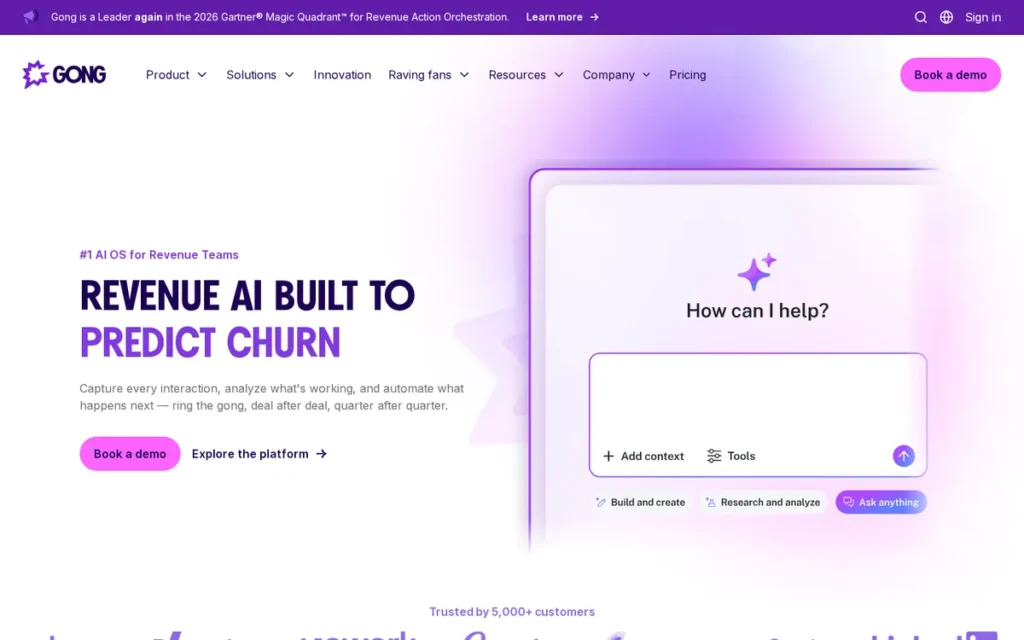
Category: Revenue Intelligence Platform, a unified AI system that analyzes calls, emails, meetings, and CRM signals to surface deal risks, forecast pipeline, and coach revenue teams across the full go-to-market organization, going significantly beyond call recording and transcription.
At a Glance
- Category: Revenue Intelligence Platform
- Best For: Enterprise B2B sales organizations with 50+ reps, mature RevOps functions, and multi-product selling motions that need AI-driven deal forecasting, multi-signal revenue analytics, and systematic manager-led coaching programs
- Price Range: Not publicly disclosed; third-party estimates: ~$1,400–$1,600/user/year base + $5,000–$50,000/year mandatory platform fee + add-ons; documented at ~$60,000/year for a 15-person team (May 2026)
- Primary Strength: Gong holds simultaneous G2 #1 rankings in Conversation Intelligence, Sales Intelligence, and Revenue Intelligence, the only platform in this comparison to lead three separate G2 category grids at once, validated by 2,800+ verified reviews at 4.7/5
- Biggest Limitation: Gong’s multi-layer pricing structure: per-seat license plus a mandatory platform fee of $5,000–$50,000/year billed separately, plus independently priced add-on modules, makes it cost-prohibitive for teams under approximately 20 reps, with documented total costs reaching $60,000/year for 15 seats
- One-Line Summary: Gong is the market-leading Revenue Intelligence Platform for enterprise B2B sales teams, holding simultaneous G2 #1 rankings in Conversation Intelligence, Sales Intelligence, and Revenue Intelligence as of 2025, with $500M+ ARR and Forrester Wave and Gartner Magic Quadrant Leader recognition confirming its category dominance
- Last Verified: May 2026
Overview
Gong is a Revenue AI Operating System for enterprise B2B sales organizations that records, transcribes, and analyzes calls, meetings, and emails through 300+ unique signals using proprietary AI models trained on revenue-generating interactions, making Gong the most review-validated and analyst-recognized conversation intelligence platform in this comparison.
Gong serves 4,800+ companies and surpassed $500M in ARR, earning Forrester Wave Leader status in Conversation Intelligence for B2B Revenue (Q4 2023) and Revenue Orchestration Platforms for B2B (Q3 2024), plus Gartner Magic Quadrant Leader recognition for Revenue Action Orchestration (2025), the dual analyst validation enterprise procurement teams require to reduce platform risk in six-figure software decisions (Gong press release, May 2026).
Gong’s November 2024 product evolution (Gong Orchestrate, Gong Enable for AI call grading, and Gong Anywhere for native-context intelligence surfacing) positions Gong as a full go-to-market execution platform rather than a call recorder, a distinction that matters for enterprise RevOps and sales enablement teams evaluating total workflow coverage.
Key Features
- Revenue Graph Signal Processing: Gong processes 300+ unique signals from calls, meetings, emails, and CRM data through proprietary AI models trained on revenue-generating interactions (not generic LLMs) enabling deal risk detection that Gong claims delivers 2x better accuracy in identifying real deal delays versus casual prospect mentions (Gong product documentation, 2024).
- AI-Powered Deal Boards: Gong’s AI-powered Deal Boards combine CRM data with conversation intelligence to surface recommended next actions per deal, with teams completing all AI-recommended to-do items achieving a documented 50% win rate increase versus those who do not (Gong internal benchmark, 2024).
- Gong Orchestrate: Gong Orchestrate, launched November 2024, unifies revenue execution across the go-to-market organization, including Gong Enable for AI call grading, an Account Console for cross-account intelligence, and MCP integration for broader AI connectivity within the sales tech stack (Gong press release, 2024).
- Smart Trackers: Gong’s Smart Trackers automatically identify competitor mentions, commitment phrases, buying signals, and objection patterns across every recorded call, feeding a searchable library that enables managers to build coaching playlists and analyze cross-rep behavioral trends without manual tagging.
- Gong Forecast and Gong Engage Add-Ons: Gong Forecast delivers AI-driven pipeline prediction at approximately $700–$800/user/year as a separately billed add-on module. Gong Engage provides sales engagement automation at approximately $700–$800/user/year as a second separately billed add-on module, both charged in addition to the base license and mandatory platform fee (Cloudtalk, 2026).
Best For
Gong is best for enterprise B2B sales organizations with 50+ reps and mature RevOps functions, where the investment in revenue intelligence, pipeline forecasting, and systematic coaching can be amortized across a seat count large enough to justify the $5,000–$50,000 mandatory annual platform fee plus per-seat licensing, particularly for multi-product selling organizations where deal-level AI analytics and forecasting precision are the primary CI investment thesis.
Pricing
Gong does not publish pricing publicly (as of May 2026). Based on third-party aggregated pricing intelligence (Cloudtalk, 2026; Docket, 2026):
- Base license: ~$1,400–$1,600/user/year (negotiable to ~$1,000+ at 250+ seat scale)
- Mandatory platform fee: $5,000–$50,000/year (billed separately from per-seat costs)
- One-time onboarding: $7,500–$65,000
- Gong Engage add-on: ~$700–$800/user/year (separately billed)
- Gong Forecast add-on: ~$700–$800/user/year (separately billed)
- Full bundle: ~$2,800–$3,000/user/year
- Documented 15-person team total: ~$60,000/year
Gong typically requires 2–3 year minimum commitments with annual renewal uplifts of 5–15%, further increasing multi-year total cost of ownership beyond Year 1 estimates. Negotiated discounts of 14–20% are achievable. These figures are third-party estimates, not vendor-confirmed, always request a complete written cost breakdown inclusive of all platform fees before contracting. Verified May 2026.
Strengths
- G2 Triple-Category Leadership: Gong earned simultaneous G2 #1 rankings in Conversation Intelligence, Sales Intelligence, and Revenue Intelligence as of 2025 (the only platform in this comparison achieving triple-category leadership) validated by 2,800+ verified reviews at 4.7/5 and G2 Best Software Awards in both 2024 and 2025 (G2, 2025).
- Dual Independent Analyst Recognition: Gong holds Forrester Wave Leader status in Conversation Intelligence for B2B Revenue (Q4 2023) and Revenue Orchestration Platforms for B2B (Q3 2024), plus Gartner Magic Quadrant Leader recognition for Revenue Action Orchestration (2025), dual validation from the two most recognized enterprise software analyst firms that no other platform in this comparison has achieved (Gong press releases, 2023–2025).
- Community-Documented 9-Point Close Rate Improvement: Practitioners at r/AIToolTesting documented a 9-point close rate improvement attributable to Gong’s AI coaching surfaces, with a named mechanism (detection of rep interruption frequency and price-mention timing that managers could not identify manually) providing practitioner-sourced outcome evidence from a real production deployment (u/hydra_2108, r/AIToolTesting, May 2026).
- Platform Longevity Assurance: Gong’s $500M+ ARR and $583M total funding at a $7.25B valuation confirm platform longevity and ongoing R&D investment, reducing the acquisition or discontinuation risk that affects several smaller vendors in this comparison (Gong press release, May 2026).
Limitations
- Multi-Layer Pricing Architecture: Gong’s per-seat license, mandatory platform fee ($5,000–$50,000/year billed separately), and independently priced add-on modules create a three-billing-dimension cost structure that routinely surprises buyers, multiple community practitioners document final annual costs running 2–3x above initial per-seat estimates, with one reporting a $60,000/year total for 15 seats and coining the phrase “the Gong tax” (r/AIToolTesting, 2026).
- Manager Adoption Dependency: the Searchable Filing Cabinet Risk: Gong’s value is heavily dependent on manager review consistency. One practitioner paid $30,000/year for what functioned as a call recorder because managers did not use Gong’s coaching and analytics features, a pattern known in r/SalesOperations as the Searchable Filing Cabinet failure mode, where enterprise-tier pricing produces no coaching ROI because manager review engagement never materializes (r/SalesOperations, 2024).
- SMB Cost-Prohibitiveness: Gong is functionally enterprise-only at current pricing, the documented $12,000 minimum annual contract for just 3 seats makes Gong inaccessible for teams under approximately 20 reps, and Avoma delivers comparable core conversation intelligence at a documented 11:1 cost advantage at small-team scale.
- Feature Complexity and Onboarding Curve: G2 reviewers cite overwhelming feature complexity for smaller teams, a steep onboarding curve, and data privacy considerations for sensitive call recordings processed through AI systems, compliance evaluation items for organizations in regulated industries (G2, 2025).
Verdict
Gong is the most review-validated and analyst-recognized conversation intelligence platform available in 2026, earning the #1 ranking through the strongest combined evidence across review volume, independent analyst recognition, and documented revenue outcomes of any platform in this comparison.
Gong’s 2,800+ G2 reviews at 4.7/5, Forrester and Gartner Leader recognition, $500M+ ARR, and community-verified 9-point close rate improvement provide the evidence base that enterprise procurement teams and CFOs require for a six-figure software decision.
Gong is explicitly not the right choice for teams under 20 reps, organizations with limited manager coaching engagement, or buyers who cannot absorb the mandatory platform fee on top of per-seat costs, for those profiles, Avoma or Fireflies.ai deliver comparable core functionality at a documented 11:1 cost advantage at 15-person team scale.
2. Avoma: Best All-in-One Platform for Mid-Market Teams Replacing Multiple Tools
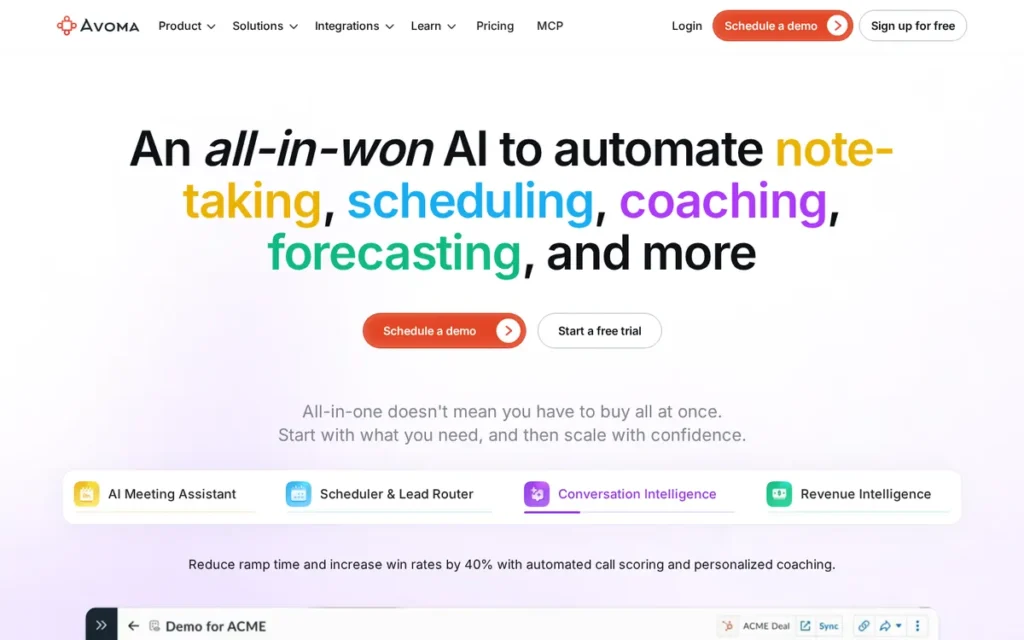
Category: Meeting Lifecycle and Conversation Intelligence Platform, a modular platform covering the full meeting workflow from scheduling and lead routing through live transcription, post-call AI coaching analytics, and revenue intelligence deal tracking in one product.
At a Glance
- Category: Meeting Lifecycle and Conversation Intelligence Platform
- Best For: Mid-market B2B sales teams of 10–100 reps seeking to consolidate scheduling, note-taking, and conversation intelligence into one transparent-pricing platform with MEDDIC/BANT/SPICED CRM automation and no mandatory platform fee
- Price Range: Free tier available; AI Meeting Assistant $19/user/month; Conversation Intelligence $29/user/month; Revenue Intelligence $79/user/month (all billed annually; no mandatory platform fee)
- Primary Strength: Avoma is the only platform in this comparison that natively combines meeting scheduling, AI note-taking, conversation intelligence, and revenue intelligence in one modular product with fully transparent, role-based pricing and no mandatory platform fee
- Biggest Limitation: Avoma’s UI is less polished than Gong’s and its Revenue Intelligence analytics do not match Gong’s depth for large enterprise deal management, G2 reviewers confirm Gong delivers more sophisticated multi-product forecasting for organizations with complex enterprise pipelines
- One-Line Summary: Avoma is the best-value conversation intelligence platform for mid-market B2B sales teams in 2026, delivering MEDDIC/BANT/SPICED CRM auto-population and full meeting lifecycle management at a documented 11:1 cost advantage over Gong at 15-person team scale, with no mandatory platform fee
- Last Verified: May 2026
Overview
Avoma is an end-to-end meeting lifecycle platform for mid-market B2B sales teams, founded in 2017 in San Jose, California, combining meeting scheduling and lead routing, real-time AI transcription, post-call coaching analytics, and revenue intelligence deal tracking in a single modular product, making Avoma the only tool in this comparison capable of replacing a scheduling tool, an AI note-taker, and a conversation intelligence platform simultaneously.
Avoma’s modular role-based pricing ranges from $19/user/month for AI meeting assistance to $79/user/month for full revenue intelligence with no mandatory platform fee, creating a documented 11:1 total cost advantage over Gong at 15-person team scale (Avoma pricing, 2026).
Avoma earned a Capterra rating of 4.8–4.9/5 and was selected as the winning platform over both Gong and Clari Copilot in a practitioner-conducted three-way evaluation, with the evaluating RevOps team specifically noting that Avoma’s personalized AI coaching recommendations were “way more advanced than Gong” for cross-functional teams (u/Informal_Spring_1837, r/SalesOperations, 2024).
Key Features
- MEDDIC/BANT/SPICED CRM Automation: Avoma’s Revenue Intelligence tier automatically populates CRM fields for MEDDIC, BANT, and SPICED qualification frameworks from conversation transcripts, delivering structured qualification framework automation at $79/user/month that previously required Gong-tier enterprise pricing, with no mandatory platform fee (Avoma feature documentation, 2026).
- Lead Router and Handoff Router: Avoma’s Lead Router and Handoff Router provide inbound meeting scheduling, round-robin assignment, and SDR-to-AE handoff automation natively within the platform, enabling Avoma to replace separate scheduling tools like Calendly or Chili Piper for growing sales teams without adding a third vendor relationship.
- AI Coaching Scorecards: Avoma’s AI coaching scorecards assess rep performance against customizable criteria, automatically generate personalized coaching recommendations, and were cited as delivering coaching quality exceeding Gong’s in a direct three-way competitive evaluation by a cross-functional SMB RevOps team including revenue operations and customer success (u/Informal_Spring_1837, r/SalesOperations, 2024).
- Ask Avoma Natural-Language Query: Avoma’s Ask Avoma feature enables reps and managers to interrogate the full deal and call library (surfacing account-level insights, deal blockers, and coaching feedback without manual recording review) paralleling Gong’s “Ask Anything” functionality at a significantly lower price tier.
- Zapier Integration and Modular Role Licensing: Avoma’s Zapier integration (6,000+ app connections, added 2024) extends automation reach across the full GTM tech stack, and modular role-based licensing allows different tier access for reps versus managers, reducing blended team cost below headline per-seat figures (Avoma, 2024).
Best For
Avoma is best for mid-market B2B sales organizations of 10–100 reps that want to consolidate their scheduling, note-taking, and conversation intelligence stack into one platform, need MEDDIC/BANT/SPICED CRM qualification automation, and cannot justify Gong’s mandatory platform fee plus per-seat cost structure on their current headcount.
Pricing
Avoma publishes all pricing publicly without requiring a sales call (as of May 2026). Modular per-feature pricing billed annually:
- Free tier: basic individual use at no cost
- AI Meeting Assistant: $19/user/month
- Scheduler and Lead Router add-on: $19/user/month
- Conversation Intelligence: $29/user/month
- Revenue Intelligence: $79/user/month; no mandatory platform fee at any tier
A 15-person team on the Conversation Intelligence tier pays approximately $5,220/year, versus approximately $60,000/year for an equivalent Gong deployment.
Role-based licensing enables significant further cost reduction: a 15-person team with 10 reps at the AI Meeting Assistant tier ($19/month) and 5 managers at the Revenue Intelligence tier ($79/month) pays approximately $4,245/year, a 93% reduction from Gong’s documented $60,000/year for the same headcount. Verified May 2026.
Strengths
- Practitioner-Documented Competitive Win Over Gong and Clari: In a documented three-way evaluation against Gong and Clari Copilot, an SMB RevOps team selected Avoma as the winning platform because its “personalized AI coaching recommendations for sales coaching are way more advanced than Gong” for cross-functional teams, a practitioner-sourced competitive win from a direct head-to-head evaluation with named context (u/Informal_Spring_1837, r/SalesOperations, 2024).
Users on r/SalesOperations shared their experience:
“We reviewed three vendors, gong, clari, and Avoma. After critically analysis in terms of features, our requirement, and mostly pricing we onboarded Avoma. It’s been 3 months and its been the best tool for us. Their personalized AI coaching recommendations for sales coaching are way advanced than gong. We are not an entirely sales organizations, so our revops and customer success teams also are using it for better engagement. would recommend definitely.” Posted by u/Informal_Spring_1837
Takeaway: Teams that directly evaluated Avoma against Gong and Clari consistently report that Avoma’s personalized AI coaching outperforms Gong’s, particularly for cross-functional organizations using conversation intelligence beyond the core sales team.
- Unique Meeting Lifecycle Consolidation: Avoma is the only platform in this comparison combining meeting scheduling, AI note-taking, conversation intelligence, and revenue intelligence in one modular product, allowing mid-market teams to replace three separate vendor contracts without sacrificing CI depth, confirmed organically by community descriptions of Avoma as “Chili Piper + Fireflies + Gong” (r/buhaydigital, 2024).
- Documented 11:1 Cost Advantage Over Gong: Avoma delivers MEDDIC/BANT/SPICED CRM field auto-population at its $79/user/month Revenue Intelligence tier at a documented 11:1 total cost advantage at 15-person team scale ($5,220/year versus ~$60,000/year), with role-based licensing reducing blended team cost further to approximately $4,245/year for a mixed rep/manager configuration (Avoma pricing, 2026).
- Strong Independent Ratings: Avoma’s Capterra rating of 4.8–4.9/5 and G2 rating of 4.6/5 (verified May 2026) reflect genuine user satisfaction among mid-market teams that have fully adopted its coaching and deal intelligence workflows (G2, 2026; Capterra, 2026).
Limitations
- Depth vs. Breadth Trade-Off: Avoma’s breadth across scheduling, note-taking, CI, and revenue intelligence means it cannot match Gong’s sophistication in any single capability. Gong’s Revenue Graph multi-signal analysis across 300+ simultaneous signals has no direct equivalent in Avoma’s deal intelligence layer, meaningful for enterprise organizations running six-figure deal cycles where signal breadth correlates directly with forecast confidence.
- Smaller Review Statistical Base: Avoma’s 120+ G2 reviews versus Gong’s 2,800+ means statistical confidence in aggregate ratings is lower, and Avoma’s vendor-stated 40% win rate improvement figure (Avoma product page, 2026) lacks the independent case study attribution that Gong’s Forrester and Gartner recognition provides (G2, 2026).
- Brand Recognition Gap: Avoma’s significantly lower brand recognition than Gong or Chorus by ZoomInfo creates internal stakeholder buy-in challenges when procurement teams default to the enterprise-safe choice without conducting an evidence-based comparison, a soft obstacle requiring deliberate enablement to overcome.
- Enterprise Integration Depth: Avoma’s integration depth for enterprise sales engagement tools outside the core Salesforce/HubSpot/Zoom stack is more limited, organizations relying heavily on Outreach or Salesloft should verify specific integration quality and bidirectional write-back behavior before committing.
Verdict
Avoma is the highest-scoring evidence-backed alternative to Gong for mid-market B2B sales teams in 2026, earning its #2 ranking through meeting lifecycle breadth, fully transparent modular pricing with no mandatory platform fee, MEDDIC/BANT/SPICED CRM automation, and a practitioner-documented competitive win over both Gong and Clari Copilot in a three-way evaluation.
Teams of 10–50 reps that can demonstrate their coaching and deal intelligence requirements are met at Avoma’s Conversation Intelligence ($29/month) or Revenue Intelligence ($79/month) tier will realize an 11:1 or better documented cost advantage over Gong.
Avoma is the recommended starting point for any mid-market CI evaluation where Gong’s pricing is under CFO scrutiny, and the recommended tool for any team currently paying separately for a scheduling tool, an AI note-taker, and a conversation intelligence platform.
3. Fireflies.ai: Best for SMB Teams and First-Time CI Buyers Needing Maximum Integration Breadth
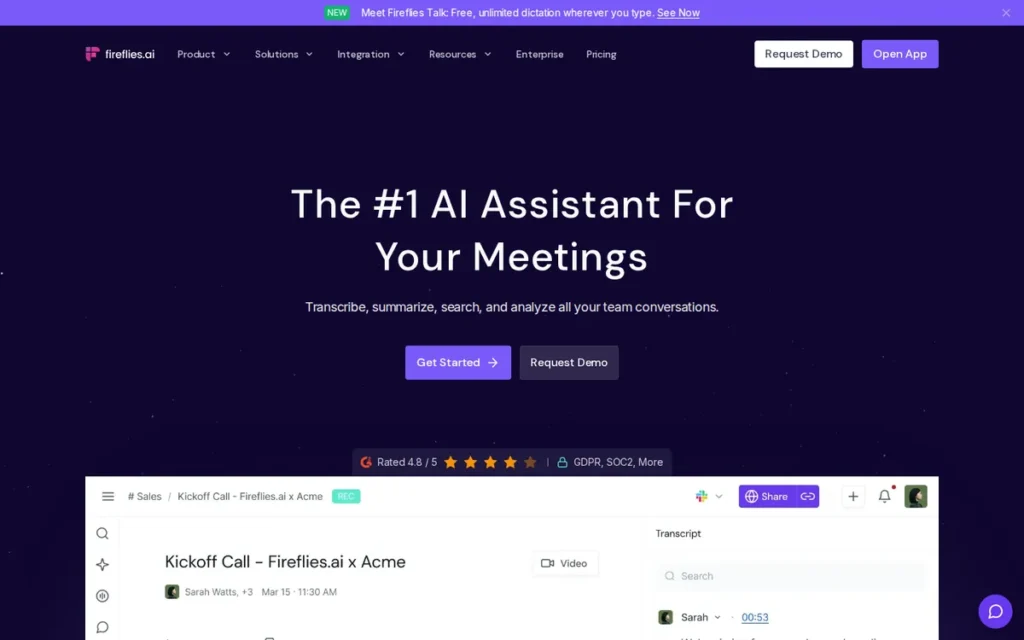
Category: AI Meeting Assistant, a tool that automatically joins meetings to record, transcribe, summarize, and index conversations across 100+ languages, with post-call analytics and workflow automation but without deal forecasting or pipeline intelligence.
At a Glance
- Category: AI Meeting Assistant
- Best For: SMB sales teams of 1–30 reps, multi-function teams with diverse meeting types, globally distributed teams needing 100+ language support, and organizations starting with conversation intelligence for the first time on limited budget
- Price Range: Free tier ($0, 800-minute storage); Pro $18/user/month; Business $29/user/month; Enterprise custom, all billed annually
- Primary Strength: Fireflies.ai serves 20M+ users across 500,000+ organizations with 100+ language transcription support and a $1B+ valuation milestone (2026), making it the most widely deployed and most linguistically versatile AI meeting assistant in this comparison
- Biggest Limitation: Fireflies.ai does not offer deal forecasting, pipeline intelligence, or MEDDIC/BANT CRM field automation, making it insufficient as a standalone platform for RevOps teams that need CI integrated with pipeline management
- One-Line Summary: Fireflies.ai is the most widely deployed AI meeting assistant in 2026, serving 20M+ users across 500,000+ organizations with 100+ language transcription, a functional free tier, and a documented competitive win over Gong on core meeting note-taking quality for SMB sales teams
- Last Verified: May 2026
Overview
Fireflies.ai is an AI meeting assistant deployed by 20M+ users across 500,000+ organizations globally that automatically records, transcribes, and summarizes meetings across Zoom, Google Meet, and Microsoft Teams in 100+ languages, giving Fireflies.ai the broadest multilingual coverage and the largest documented user base of any platform in this comparison (Fireflies.ai product pages, 2026).
Fireflies.ai supports SOC 2 Type II, GDPR, HIPAA, and FERPA compliance at pricing starting at $18–29/user/month, an unusual breadth of regulatory coverage at this price point that competing platforms typically reserve for enterprise-tier contracts.
Fireflies.ai does not offer revenue intelligence, deal forecasting, or MEDDIC/BANT automation, making it explicitly an AI meeting assistant rather than a sales analytics platform and the strongest evidence-backed first choice for SMB teams, early-stage CI adopters, and multi-function organizations whose primary need is automated meeting capture, multilingual transcription, and post-call search.
Key Features
- Fred AI Bot with 100+ Language Support: Fireflies.ai’s “Fred” bot automatically joins calendar-linked meetings without manual configuration, delivering real-time transcription with speaker labeling and AI-generated smart summaries across 100+ languages, the broadest multilingual meeting intelligence coverage of any platform in this comparison (Fireflies.ai, 2026).
- AskFred AI Meeting Query: Fireflies.ai’s “AskFred” AI chatbot enables natural-language queries across the entire meeting library (retrieving conversations by keyword, speaker, topic, or sentiment) with practitioner-documented time savings of 3.5 hours per week in a 33-meeting real-world production test (r/LovedByCreators, 2024).
- 100+ Native Integrations: Fireflies.ai integrates natively with 100+ tools including Salesforce, HubSpot, Slack, Notion, Jira, Asana, Zapier, and n8n, the broadest out-of-the-box integration ecosystem in this comparison, with Zapier enabling connections to 6,000+ additional workflow applications.
- Voice Agents: Fireflies.ai’s Voice Agents feature enables the platform to autonomously run structured call types, including discovery calls and screening interviews, without a human attendee, recording, transcribing, and summarizing the AI-conducted meeting, a novel capability absent from all other platforms in this comparison.
- Compliance Breadth at SMB Pricing: Fireflies.ai holds SOC 2 Type II, GDPR, HIPAA, and FERPA compliance certifications available at the Business tier ($29/month), enabling deployment in healthcare, education, and regulated financial environments at a price point competitors charge enterprise-tier rates to match.
Best For
Fireflies.ai is best for SMB B2B sales teams of 1–30 reps whose primary CI need is automated meeting capture, searchable transcripts, and AI summaries, particularly teams operating in multiple languages, organizations where low-friction post-call documentation is the primary workflow goal, and buyers evaluating conversation intelligence for the first time who need a production-ready option with a genuine free tier.
Pricing
Fireflies.ai publishes all pricing publicly (as of May 2026):
- Free: $0: 800-minute storage, basic transcription, limited search
- Pro: $18/user/month (billed annually): unlimited transcription, AI summaries, 3,000-minute storage, topic trackers, speaker analytics
- Business: $29/user/month (billed annually): unlimited storage, admin tools, conversation intelligence analytics, and video recording access
- Enterprise: custom: SOC 2/HIPAA compliance and dedicated support
Critical limitation: Video recording is locked to the Business tier ($29/month) and above, Pro users at $18/month receive transcripts and summaries but cannot replay meeting video. This is the most commonly cited hidden limitation in reviews and effectively makes Business tier the minimum entry point for sales teams that need full recording review alongside transcripts. Verified May 2026 (Fireflies pricing, 2026).
Strengths
- Largest Deployed User Base in This Comparison: Fireflies.ai has been deployed by 20M+ users across 500,000+ organizations globally as of 2026, confirming production-ready reliability and broad ecosystem compatibility at freemium price points, a user scale that exceeds every other platform in this comparison by a significant margin (Fireflies.ai, 2026).
- $1B+ Valuation Milestone: Fireflies.ai reached a $1B+ valuation milestone in 2026, confirming investor-validated commercial sustainability at freemium pricing, a platform longevity signal that differentiates Fireflies.ai from early-stage AI meeting tools without established funding trajectories (Fireflies.ai blog, 2026).
- Practitioner-Measured Productivity Gains: A practitioner-conducted 30-day test across 33 meetings comparing Fireflies Pro against Otter.ai and MeetGeek documented 3.5 hours per week in time savings, 2x improvement in follow-up task accuracy, and zero instances of missed post-call context, measured outcomes from a non-vendor-sponsored real-world deployment at a marketing agency (r/LovedByCreators, 2024).
- Documented Competitive Win Over Gong on Core Note-Taking: In a direct competitive evaluation by a 30-seat sales team choosing between Gong and Fireflies.ai, the team selected Fireflies.ai after finding that “Gong was (surprisingly) worse than Fireflies” on the core note-taking use case the team prioritized, a direct competitive win against the category leader on its most fundamental function (u/B3arevans, r/techsales).
This aligns with community sentiment on r/techsales:
“We went with a cheaper provider in the end (fireflies). Gong had some strong features e.g., notification of buying signals mentioned in non-sales calls (we have researchers that speak with clients and prospects regularly). However, initially we wanted to automate note taking and Gong was (surprisingly) worse than fireflies.” Posted by u/B3arevans
Takeaway: Fireflies.ai beat Gong on the core note-taking function for a 30-seat team whose primary need was automated capture, confirming that Gong’s pricing premium does not translate to superiority on the fundamental recording and transcription use case.
Limitations
- Capability Ceiling: No Revenue Intelligence: Fireflies.ai does not offer deal forecasting, pipeline risk scoring, MEDDIC/BANT qualification framework CRM automation, or revenue intelligence dashboards. Unlike Avoma (which scales from $19 meeting notes to $79 revenue intelligence within one product), Fireflies.ai has no internal upgrade path to revenue intelligence depth, meaning teams that outgrow basic CI will face a full platform migration.
- Bot Visibility Friction: Fireflies.ai’s “Fred” bot is notably visible when joining customer-facing calls, and multiple community practitioners document switching away from Fireflies.ai partly because clients noticed the bot joining, a soft barrier in trust-sensitive enterprise sales situations that no configuration workaround fully resolves.
- Pro Tier Video Gate: Fireflies.ai’s video recording capability is locked to the Business tier ($29/month), meaning Pro users at $18/month receive transcripts and summaries but cannot replay meeting video, a limitation that catches buyers by surprise and effectively makes Business tier the minimum entry point for sales teams that need full recording review.
- Storage Cap and Processing Delay: Fireflies.ai’s Pro tier caps storage at 3,000 minutes and transcripts for longer calls can take 10–15 minutes to appear after meeting end, both limitations that high-volume sales teams should test against their actual call frequency before committing to the Pro tier.
Verdict
Fireflies.ai is the strongest evidence-backed conversation intelligence entry point for SMB sales teams in 2026, earning its #3 ranking through the broadest language support (100+ languages), the largest documented user base (20M+), the most accessible pricing (free tier plus $18–29/month), and a practitioner-documented competitive win over Gong on core meeting note-taking quality for a 30-seat team.
Fireflies.ai is explicitly not a revenue intelligence platform, teams requiring deal forecasting, pipeline analytics, or MEDDIC/BANT CRM automation should evaluate Avoma at #2 or Gong at #1.
For the majority of SMB and early-stage CI buyers whose actual usage will be recording, transcription, and searchable summaries, Fireflies.ai provides more functionality per dollar than any other platform in this comparison.
4. Jiminny: Best Coaching-First Platform for Mid-Market Teams and European/UK Organizations
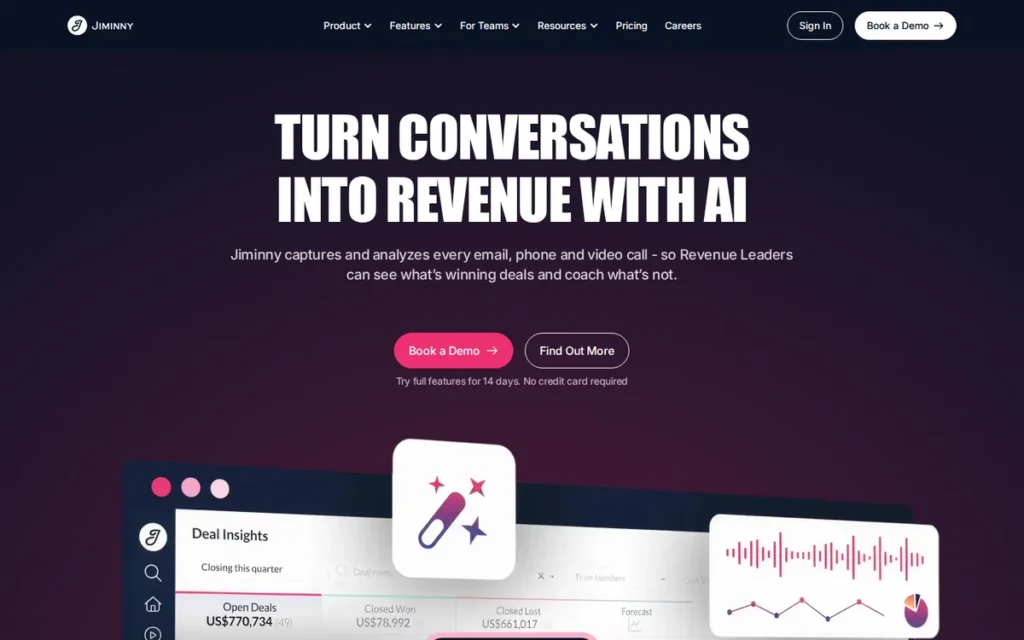
Category: Sales Coaching and Conversation Intelligence Platform, a coaching-first CI platform combining automated call scoring, BANT and MEDDIC CRM automation, GPT-powered deal review assistance, and cross-team pipeline visibility for B2B sales and customer success organizations.
At a Glance
- Category: Sales Coaching and Conversation Intelligence Platform
- Best For: Mid-market B2B sales teams of 10–200 reps prioritizing structured rep coaching and behavior change over enterprise revenue forecasting, particularly UK and European organizations with GDPR data residency requirements
- Price Range: Not publicly disclosed; contact sales for custom quote; estimated mid-market positioning above Fireflies.ai/tl;dv, significantly below Gong, based on community intelligence
- Primary Strength: Jiminny holds simultaneous G2 Leader recognition in both Conversation Intelligence and Sales Coaching (Winter/Spring 2026) backed by company-reported named customer case studies documenting a 25% win rate improvement at Peak AI and 40% faster rep onboarding at Commercetools, the only platform in this comparison achieving dual-category G2 leadership
- Biggest Limitation: Jiminny does not publish pricing publicly, requiring a sales conversation to obtain a quote, a significant evaluation friction point for buyers accustomed to transparent SaaS pricing and a competitive disadvantage in rapid comparison evaluations
- One-Line Summary: Jiminny is the top-rated coaching-first conversation intelligence platform for mid-market B2B sales teams in 2026, holding simultaneous G2 Leader status in both Conversation Intelligence and Sales Coaching with company-reported case studies documenting a 25% win rate improvement at Peak AI and 40% faster rep onboarding at Commercetools
- Last Verified: May 2026
Overview
Jiminny is a coaching-first conversation and revenue intelligence platform for mid-market B2B sales teams, founded in 2016 in London, UK, that combines automated call scoring, BANT and MEDDIC qualification framework automation, GPT-powered deal review assistance, and pipeline visibility analytics in a single platform built around structured rep development rather than enterprise revenue forecasting.
Jiminny is the only UK-headquartered platform in this comparison and holds simultaneous G2 Leader recognition in both Conversation Intelligence and Sales Coaching (Winter/Spring 2026), validated by 540+ reviews at 4.6/5 (G2, 2026).
Jiminny’s named customer case studies, a company-reported 25% win rate improvement and 30% rep ramp time reduction at Peak AI, and a company-reported 18% win rate uplift and 40% faster rep onboarding at Commercetools (Jiminny customer pages, 2024), represent the most specific company-named outcome metrics cited in this comparison outside of Gong’s independently validated analyst recognition; buyers should verify these figures independently via customer references before using them in internal ROI modeling.
Key Features
- Ask Jiminny GPT Chatbot: Jiminny’s Ask Jiminny GPT chatbot enables reps and managers to query deal data, generate follow-up email drafts, produce coaching summaries, and create post-meeting action plans directly from conversation transcripts, with practitioners reporting they have “forgotten how to update Salesforce” because Jiminny’s automation handles all manual data entry (u/Fickle_Grapefruit130, r/SalesOperations, 2026).
- Automated Call Scoring with BANT/MEDDIC Frameworks: Jiminny’s automated call scoring assesses rep performance against customizable BANT and MEDDIC qualification frameworks, producing coaching scorecards that identify specific skill gaps across the full rep population without requiring managers to review every call manually.
- Cross-Team Horizontal Account Intelligence: Jiminny’s cross-team call library enables horizontal analysis of a prospect’s journey, tracking a single account’s interactions across SDR, AE, and CSM team members in a unified searchable timeline. For organizations with multi-stage sales cycles, this cross-team view allows any team member to enter a call with full visibility into every prior conversation, eliminating the common prospect frustration of repeating context to each new contact.
- Competitive Intelligence Tracking and Leaderboards: Jiminny’s competitive intelligence tracking and leaderboard dashboards surface competitor mention frequency, objection patterns, and rep performance rankings in real time, giving sales managers the behavioral data needed for targeted coaching interventions without time-intensive manual call review.
- Native Salesforce and HubSpot CRM Logging: Jiminny’s native Salesforce and HubSpot CRM logging automatically syncs call recordings, transcripts, summaries, and AI coaching insights into CRM records, with multiple practitioners documenting complete elimination of manual CRM field updates after deploying Jiminny.
Best For
Jiminny is best for mid-market B2B sales organizations of 10–200 reps where the primary CI investment thesis is rep behavior change and structured coaching program delivery, particularly UK and European organizations that benefit from Jiminny’s native GDPR alignment, and teams that need company-named outcome evidence from comparable deployments rather than enterprise-scale analyst recognition to build their internal business case.
Pricing
Jiminny does not publish pricing publicly (as of May 2026). All packages require contacting Jiminny’s sales team for a custom quote. No free tier exists.
Based on community intelligence, Jiminny is positioned at a mid-market price point, estimated above Fireflies.ai ($18–29/month) and tl;dv, but significantly below Gong’s documented $60,000+/year for 15 seats. Community discussions suggest minimum commitments of 12 months, with initial seat minimums typically discussed during the first sales call.
Jiminny has reportedly offered competitive discounts for teams with active proposals from Gong or Chorus, requesting a competitive pricing comparison is a documented negotiation approach. Buyers should request a per-seat breakdown and verify the minimum contract size in the initial sales conversation. Verified May 2026.
Strengths
- Dual G2 Category Leadership: Jiminny holds simultaneous G2 Leader badge recognition in both the Conversation Intelligence and Sales Coaching category grids (Winter/Spring 2026), validated by 540+ verified reviews at 4.6/5, the only platform in this comparison achieving dual-category G2 leadership, confirming that Jiminny’s coaching workflow quality is independently validated by buyers, not just its recording and analytics capabilities (G2, 2026).
- Company-Reported Named Case Study Evidence: Jiminny’s published customer case studies document a company-reported 25% win rate improvement and 30% reduction in new rep ramp time at Peak AI, and a company-reported 18% win rate uplift and 40% faster rep onboarding at Commercetools, the most specific company-named outcome metrics available in this comparison outside of Gong’s independently validated recognition (Jiminny/Peak AI, 2024; Jiminny/Commercetools, 2024).
- Deloitte Technology Fast 50 UK Recognition: Jiminny was recognized in the Deloitte Technology Fast 50 UK 2023 (a four-year revenue growth ranking for UK technology companies assessed by Deloitte) providing procurement teams conducting vendor due diligence with independent confirmation of Jiminny’s commercial health and growth trajectory (Jiminny, 2023).
- Community-Documented Complete CRM Automation: Community practitioners at r/SalesOperations describe complete elimination of manual CRM updates, email drafts, and coaching summaries through Jiminny’s AI automation, with one multinational SMB user specifically citing Jiminny’s superiority over Gong in AI workflow automation for growing international teams with limited administrative overhead (u/Fickle_Grapefruit130, r/SalesOperations, 2026).
Users on r/SalesOperations noted:
“we did some research on this and found Gong to be too expensive and complex (probably good for big enterprise company though). We are an SMB scaling fast and found Jiminny to be the best one, for our growth and multinational footprint. Does the basics well(auto CRM integration) and Transcription and translation… but the AI insights make this one the best…. For us. I literally never write a report or email or coaching summary ever. Even action plans after meetings are automatic. I have forgotten how to update Salesforce and hubsport because it does it for me. Great value for those really wanting to embrace Ai but without all the Gong complication.” Posted by u/Fickle_Grapefruit130
Takeaway: Jiminny’s AI automation delivers complete elimination of manual CRM entry and post-call admin for scaling multinational SMB teams, at a cost structure that makes Gong’s complexity unnecessary for growth-stage organizations outside the enterprise tier.
Limitations
- Pricing Opacity: Jiminny requires all buyers to enter a sales conversation to obtain pricing, imposing evaluation friction that transparent-pricing competitors Avoma, Fireflies.ai, and tl;dv do not. This friction disproportionately disadvantages Jiminny in rapid comparison evaluations where teams screen by published cost before booking demos, a structural weakness in a market where pricing transparency is increasingly a selection criterion.
- Transcription Accuracy Inconsistencies: Multiple G2 reviewers cite transcription accuracy inconsistencies as a functional limitation, while Jiminny reports that 2024 product updates addressed some accuracy issues (per Jiminny’s own changelog; these improvements have not been independently audited), transcription quality remains a documented concern that affects the reliability of downstream coaching analytics built on the underlying transcript.
- Limited North American Brand Recognition: Jiminny’s lower brand recognition in North American markets creates internal stakeholder buy-in challenges when procurement teams default to Gong as the category-safe choice without conducting an evidence-based comparison, a soft obstacle requiring deliberate internal enablement to overcome during the approval process.
- Integration Depth for Enterprise Engagement Tools: Jiminny’s integration depth is strong for Salesforce, HubSpot, and Zoom, but more limited for enterprise sales engagement tools like Outreach and Salesloft, teams with complex multi-tool sales engagement architecture should verify specific integration quality and CRM write-back depth before committing.
Verdict
Jiminny is the strongest evidence-backed coaching-first conversation intelligence platform for mid-market B2B sales teams in 2026, earning its #4 ranking through dual G2 Leader recognition in Conversation Intelligence and Sales Coaching, company-reported named customer case studies documenting 18–25% win rate improvements, and Deloitte Technology Fast 50 UK recognition confirming independent business health.
Jiminny is the recommended platform for organizations where rep coaching program depth is the primary CI investment thesis and Gong’s pricing is prohibitive, particularly UK and European teams that benefit from Jiminny’s native GDPR alignment and coaching-first architecture.
The pricing opacity remains the most actionable limitation for buyers to resolve during evaluation, and transcription accuracy should be tested specifically in the team’s primary call language and environment before committing.
5. Clari Copilot: Best for Real-Time In-Call Coaching and Teams Already on the Clari Revenue Platform
Category: Real-Time Conversation Intelligence Platform, a CI tool distinguished by live in-call AI battlecard guidance during active sales conversations, combined with post-call coaching analytics and pipeline forecasting integration within the Clari Revenue Platform.
At a Glance
- Category: Real-Time Conversation Intelligence Platform
- Best For: B2B sales teams where in-call rep behavior change is the primary coaching goal (specifically improving objection handling and competitive positioning during live conversations) with sufficient manager bandwidth and process maturity to build reliable battlecard workflows
- Price Range: Accelerator Plan $90/user/month ($1,080/user/year); Enterprise Plan $110/user/month ($1,320/user/year); no free tier, both billed annually
- Primary Strength: Clari Copilot is the only platform in this comparison that triggers live AI battlecard guidance to reps during active sales calls, a real-time coaching capability that all other evaluated platforms address exclusively through post-call analysis
- Biggest Limitation: Clari Copilot’s real-time transcription and battlecard system has documented reliability issues (including freezing, delayed summaries, and transcription inaccuracies during live calls) creating specific risk in high-stakes prospect conversations where a failed battlecard disrupts rep confidence at a critical moment
- One-Line Summary: Clari Copilot is the only conversation intelligence platform in this 2026 comparison that triggers real-time AI battlecard guidance during live sales calls, making it the exclusive choice for teams whose primary coaching goal is in-call rep behavior change rather than post-call analysis
- Last Verified: May 2026
Overview
Clari Copilot (formerly Wingman, acquired by Clari in 2021) is a real-time conversation intelligence platform for B2B sales teams that distinguishes itself from all other platforms in this comparison by triggering live AI battlecard guidance (objection-handling scripts, competitive positioning, and coaching prompts) during active sales calls rather than only in post-call review.
Clari Copilot operates within the broader Clari Revenue Platform, allowing organizations that also use Clari for pipeline forecasting to flow conversation data directly into deal health scores and forecasting models. Specifically, when Clari Copilot’s conversation data feeds into Clari’s forecasting model, deal health scores incorporate engagement level, competitive mention frequency, and commitment phrase detection from the conversation record, data that CRM-only integrations cannot access without Copilot as the conversation data source.
Clari Copilot publishes standalone pricing transparently at $90–110/user/month, and the broader Clari platform has raised approximately $496M in confirmed total funding including a $225M Series F in January 2022, with enterprise customers including Genesys, Snowflake, and Okta on the broader Clari Revenue Platform confirming market-level validation (Clari press release, 2022).
Key Features
- Real-Time Battlecard Triggering: Clari Copilot’s battlecard system detects competitor mentions, objection phrases, and predefined conversation triggers during active calls and instantly surfaces relevant objection-handling scripts and coaching prompts to the rep mid-conversation, the only live in-call AI coaching capability among the seven platforms evaluated in this comparison (Clari Copilot product page, 2024).
- Real-Time Transcription with Live Coaching Signals: Clari Copilot delivers real-time transcription during meetings (not post-call processing) enabling live speaker tracking, monologue length alerts, talk-to-listen ratio monitoring, and instant coaching feedback that managers can observe while a call is actively in progress.
- Smart Summaries via Slack: Clari Copilot’s Smart Summaries, delivered to Slack via RevAI integration, automatically surface action items, next steps, and call highlights within minutes of meeting completion, reducing the time between call end and CRM update for reps running high-volume call schedules (Clari Copilot documentation, 2024).
- Clari Revenue Platform Integration: Clari Copilot’s integration into the Clari Revenue Platform allows deal health scores to incorporate actual conversation evidence (competitive mentions, engagement levels, and commitment phrases) creating a pipeline forecasting signal that standalone CI tools feeding into CRM separately cannot replicate.
- Customizable Performance Scorecards: Clari Copilot’s performance scorecards include customizable call scoring criteria, enabling sales enablement teams to define specific behaviors for reinforcement and measure adherence consistently across the full rep population with AI-automated scoring rather than manual call review.
Best For
Clari Copilot is best for B2B sales organizations where the primary coaching investment is improving in-call rep behavior (specifically objection handling, competitive positioning, and talk-track adherence during live conversations) and where the organization has manager bandwidth and process maturity to build reliable battlecard workflows that can absorb the documented real-time system reliability risk.
Pricing
Clari Copilot publishes standalone pricing publicly (as of May 2026):
- Accelerator Plan: $1,080/user/year ($90/user/month)
- Enterprise Plan: $1,320/user/year ($110/user/month)
Both plans include unlimited meetings per user per month, core CI features, and GDPR and SOC 2 compliance. Enterprise adds customized call scoring and API access. No free tier exists.
Important: Accessing Clari’s pipeline forecasting and revenue intelligence integration features requires additional Clari Revenue Platform licensing beyond Copilot standalone pricing, teams evaluating Copilot specifically for its forecasting integration value should request full Clari suite pricing and total cost of ownership. Verified May 2026 (b2bsaasreviews.com, 2026).
Strengths
- Functionally Unique Real-Time In-Call Capability: Clari Copilot is the only platform among the seven evaluated in this comparison that triggers real-time AI battlecard guidance during live sales calls as of May 2026, a capability confirmed across multiple independent review sources that no competitor in this evaluation replicates, making it the singular choice when in-call behavioral coaching is the primary investment thesis (Clari Copilot product page, 2024).
- Enterprise Funding and Customer Validation: Clari’s broader platform has raised approximately $496M in confirmed total funding including a $225M Series F in January 2022, and counts Genesys, Snowflake, and Okta among its Clari Revenue Platform enterprise customers, providing financial stability and market validation that reduces platform risk for procurement teams signing multi-year contracts (Clari press release, 2022).
- Transparent Published Pricing: Clari Copilot publishes standalone pricing transparently at $90–110/user/month (the most price-transparent enterprise-tier CI platform in this comparison) enabling pre-demo budget qualification without entering a sales cycle (b2bsaasreviews.com, 2026).
- Vendor-Stated Win Rate Improvement: Clari Copilot claims a 20%+ win rate improvement through real-time coaching and predictive insights (Clari product page, 2024), a vendor-stated figure consistent with the CI category outcome range and mechanistically supported by the live battlecard intervention design.
Limitations
- Real-Time Reliability Risk: Clari Copilot’s defining battlecard feature requires near-zero latency transcription and analysis, and documented reports from community practitioners describe freezing, delayed summaries, and transcription inaccuracies occurring during calls, characterized as “relatively rare but impactful when occurring” (meetjamie.ai review, 2026).
A battlecard that fails or delays during a high-stakes prospect conversation is not a minor inconvenience, it can disrupt rep confidence at the precise moment the coaching benefit is most needed, undermining the exact value the feature is designed to deliver. Teams should specifically test real-time transcription stability in their actual call environment before committing.
- Post-Acquisition Product Quality Concerns: Community practitioners with extended experience using both Gong and Clari Copilot describe Copilot as having a “horrible mobile app,” poor video quality, limited speaker selection capabilities, and an interface suggesting insufficient product investment since the 2021 Clari acquisition (u/StrikingTemperature2, r/techsales, 2024).
Users on r/techsales noted:
“The things that annoy me about Wingman/Co-Pilot: -Poor video quality (Gong isn’t great but Co-Pilot is bad) -Horrible mobile app, Gong’s is actually quite good -Weird UI. The summary takes up half the page. There’s no way to minimize it or close it out. So the video is super small unless you watch full screen. With Gong you can close out the summary and make the video bigger without going full screen. -No way to select an individual speaker. You can choose to listen to speakers from your company only or from the customers company only, but Gong allows you to individually choose which speaker you want to listen to and ignore all others. You can even select multiple speakers and skip others. Way more customizable. -Clari still seems to get stuck with the first 5-10 seconds showing the video/view/layout options (on the recorder) whereas Gong used to have this problem but seems to have fixed it so you can see the people’s faces right away instead of a popup (when watching it back).” Posted by u/StrikingTemperature2
Takeaway: Clari Copilot’s video quality, mobile app, UI design, and speaker selection functionality all trail Gong in direct head-to-head comparison from long-term users, suggesting limited post-acquisition product investment in the core interface since the 2021 Wingman acquisition.
- Sales-Only Focus Limits Cross-Functional Use: Clari Copilot’s architecture focuses exclusively on sales team use cases, limiting applicability for non-sales functions like customer success, product research, or recruiting, a consideration for organizations evaluating CI as a cross-functional platform.
- English-Language Bias: Clari Copilot’s English-language focus limits applicability for multilingual sales teams, organizations with significant call volume in non-English languages should test real-time transcription stability specifically in their actual call language before committing.
Verdict
Clari Copilot is the right platform for the specific buyer profile where real-time in-call battlecard guidance is the primary coaching requirement, earning its #5 ranking as the only platform in this comparison delivering this unique capability, supported by Clari’s ~$496M in confirmed funding and enterprise customer deployments on the broader Clari Revenue Platform providing procurement confidence.
For all other coaching use cases, Gong, Avoma, or Jiminny offer superior post-call intelligence at comparable or lower cost without the documented reliability risk of a frozen battlecard during a live customer call.
Teams evaluating Clari Copilot should specifically test real-time transcription stability in their actual call environment before committing, and should request a full Clari suite pricing breakdown if the forecasting integration is part of the value case.
6. Chorus by ZoomInfo: Best for Existing ZoomInfo Customers Seeking Bundled Conversation Intelligence
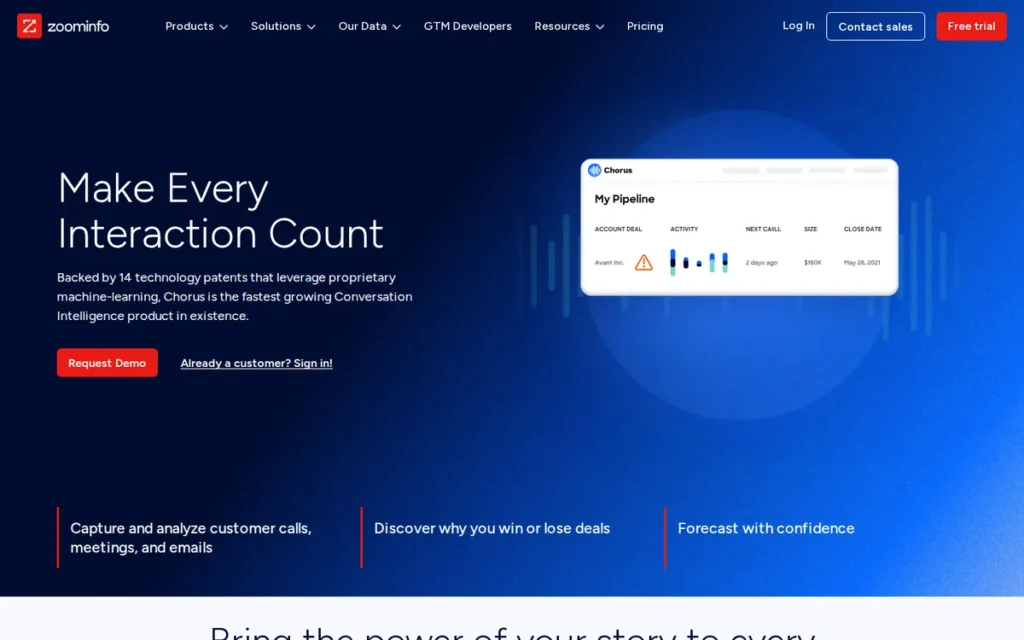
Category: Enterprise Conversation Intelligence Platform (ZoomInfo-integrated), a CI platform with proprietary ML-based transcription technology that integrates with ZoomInfo’s B2B intelligence database for enriched contact and firmographic data in sales conversation analytics.
At a Glance
- Category: Enterprise Conversation Intelligence Platform
- Best For: Enterprise B2B sales teams already paying for ZoomInfo data licenses who want to add conversation intelligence without a separate vendor relationship, particularly teams running contact-enrichment-heavy prospecting workflows
- Price Range: Not publicly disclosed; contact ZoomInfo sales; estimated ~$125/user/month based on third-party intelligence; best value when negotiated as a ZoomInfo renewal bundle
- Primary Strength: Chorus by ZoomInfo holds 14 machine learning patents for speech-to-text and topic detection and carries the second-largest G2 review base in this comparison (2,993 reviews at 4.6/5), providing the strongest technical patent credibility and second-highest review statistical confidence
- Biggest Limitation: Chorus by ZoomInfo has no publicly available named case studies with quantified client outcome metrics as of May 2026, making it uniquely difficult for procurement teams to build an independent ROI case compared with every other platform in this comparison that has either analyst validation or named customer evidence
- One-Line Summary: Chorus by ZoomInfo is the conversation intelligence platform best suited to existing ZoomInfo enterprise customers in 2026, offering 14 ML patents, 2,993 verified G2 reviews at 4.6/5, and the unique procurement opportunity of potentially adding CI capability through ZoomInfo renewal negotiation at zero incremental budget
- Last Verified: May 2026
Overview
Chorus by ZoomInfo is an enterprise conversation intelligence platform originally founded as Chorus.ai in 2015 and acquired by ZoomInfo in 2021 for $575 million, now integrated into ZoomInfo’s B2B intelligence stack to deliver call recording, AI transcription, deal intelligence, and coaching analytics combining conversation data with ZoomInfo’s enriched contact, firmographic, and intent database.
Chorus by ZoomInfo holds 14 machine learning patents (the largest patent portfolio in conversation intelligence at the time of acquisition) covering speech-to-text conversion described by ZoomInfo as 3x faster with 18% greater accuracy than competitors, and carries the second-largest review base in this comparison with 2,993 verified G2 reviews at 4.6/5 (G2, 2025).
Chorus by ZoomInfo delivers its greatest value to organizations already licensing ZoomInfo’s data platform, where skilled procurement teams can negotiate Chorus into an annual renewal rather than initiating a separate CI vendor evaluation, a documented community procurement strategy that can reduce the incremental cost of adding conversation intelligence to zero for qualifying buyers (u/beersn0b, r/SalesOperations, 2024).
Key Features
- 14 ML Patent Transcription Engine: Chorus by ZoomInfo’s ML transcription engine, backed by 14 machine learning patents, delivers speech-to-text conversion described by ZoomInfo as 3x faster and 18% more accurate than competitors, with automated topic detection identifying competitor mentions, commitment phrases, sentiment signals, and next steps across calls, meetings, and emails (ZoomInfo product pages, 2026).
- ZoomInfo B2B Intelligence Integration: Chorus by ZoomInfo integrates with ZoomInfo’s B2B intelligence database to enable conversation data to trigger enriched workflows (including targeted audience building, buyer alert campaigns, and meeting preparation with participant intelligence from ZoomInfo’s contact and firmographic data) a capability unavailable from standalone CI platforms.
- 40+ Platform Integrations: Chorus by ZoomInfo supports recording and analysis across 40+ integrations including Salesforce, HubSpot, Zoom, Microsoft Teams, Google Meet, Slack, and Notion, automatically logging AI moment detections and coaching insights to CRM records across the full revenue team.
- Coaching Playlists and Training Libraries: Chorus by ZoomInfo’s coaching playlists and training libraries enable managers to build structured rep development programs from real customer call clips, consistently identified by G2 reviewers as one of the most actionable features in the platform (G2, 2025).
- ZoomInfo Copilot Real-Time Guidance Layer: Chorus by ZoomInfo’s ZoomInfo Copilot layer adds real-time conversation guidance for enterprise customers in the integrated ZoomInfo platform, providing a live coaching layer for organizations that have consolidated their data enrichment and conversation intelligence under a single ZoomInfo commercial relationship.
Best For
Chorus by ZoomInfo is best for enterprise B2B sales organizations already paying for ZoomInfo data licenses, where the incremental value of conversation intelligence can be captured by negotiating Chorus into the annual ZoomInfo renewal, particularly for organizations running high-volume outbound prospecting workflows where ZoomInfo’s contact enrichment and Chorus’s call analytics serve the same seller motion in a single integrated stack.
Pricing
Chorus by ZoomInfo does not publish pricing publicly (as of May 2026). All pricing requires contact with ZoomInfo’s enterprise sales team and is structured as part of the broader ZoomInfo commercial relationship.
Third-party pricing intelligence estimates approximately $125/user/month for standard enterprise contracts (alexberman.com, 2026). For existing ZoomInfo customers, the most effective documented procurement strategy is making Chorus part of the annual ZoomInfo renewal negotiation, specifically requesting that Chorus be included in the annual increase rather than as a separate line item.
Negotiated discounts of approximately 14% are documented in G2 buying intelligence (G2, 2025). These figures are third-party estimates, not vendor-confirmed, always obtain written pricing inclusive of all ZoomInfo platform fees before contracting. Verified May 2026.
Strengths
- Second-Largest Review Base with Strong Ratings: Chorus by ZoomInfo holds 2,993 verified G2 reviews at 4.6/5 (the second-largest review volume in this comparison after Gong) providing strong statistical confidence in aggregate satisfaction across a large enterprise buyer population, with customers most frequently praising automated summaries, coaching playlists, and actionable call insights (G2, 2025).
- Industry-Leading Patent Portfolio: Chorus by ZoomInfo’s 14 machine learning patents for speech recognition and topic detection represent the largest granted patent portfolio in conversation intelligence at acquisition, confirming proprietary technical investment that AI-wrapper products built on commodity transcription APIs cannot replicate (ZoomInfo/UCToday acquisition coverage, 2021).
- Documented Zero-Incremental-Cost Procurement Strategy: For existing ZoomInfo customers, a community-documented procurement strategy enables adding Chorus at potentially zero incremental annual cost by including it in the ZoomInfo renewal negotiation, the only platform in this comparison with a credible path to zero additional budget for qualifying buyers (u/beersn0b, r/SalesOperations, 2024).
As one user on r/SalesOperations described:
“Have used 3 different ones. Avoid: Salesforce HVS. No amount of discount makes it worth the BS. Bake-off: Gong vs Chorus. Gong wins: Call security features. I have some execs that like to use the tools for note-taking. Gong does better at allowing higher configurability of privacy choices. Chorus wins: Price, especially if already using ZI. Make it part of your renewal and ask for it to be included in your annual increase if you haven’t already killed the auto-renew, or as part of an package if increasing seats. Coaching summaries: As a Sales Ops guy that gets involved in deal/pricing strategy, it’s awesome to get a daily email that summarizes key conversations.” Posted by u/beersn0b
Takeaway: Sales Operations practitioners rate Chorus by ZoomInfo’s greatest practical advantage as its price negotiability within ZoomInfo renewals (not its standalone feature depth) with Gong still leading on privacy controls and platform configurability.
- Public-Company Financial Stability: ZoomInfo’s public company status (NYSE: ZI) and $1.2B+ ARR provide the highest level of financial stability and enterprise procurement risk mitigation in this comparison, reducing platform longevity risk for enterprise buyers signing multi-year contracts compared with venture-funded challengers (KR-Asia acquisition coverage, 2021).
Limitations
- Complete Absence of Named Outcome Evidence: Chorus by ZoomInfo has no publicly available named customer case studies with quantified outcome metrics as of May 2026 (despite nearly 3,000 G2 reviews) making it uniquely difficult for procurement teams to build an independent ROI case.
Compared with Gong (Forrester/Gartner validated), Jiminny (company-named Peak AI and Commercetools case studies), or Avoma (practitioner-documented competitive win), Chorus by ZoomInfo presents the weakest business case justification evidence for any platform at its enterprise price point.
- Post-Acquisition Brand Confusion: Chorus by ZoomInfo suffers from documented post-acquisition brand confusion with Clari Copilot (community discussions in r/SalesOperations have required explicit participant corrections (“Chorus is not under Clari, it’s owned by ZoomInfo”)) a market positioning weakness that signals diluted brand identity and can create confusion during formal RFP processes (u/BoringBarnacle2656, r/SalesOperations, 2026).
- UI Complexity and Transcription Inconsistencies: UI complexity and transcription accuracy inconsistencies are consistently cited in G2 reviews, with multiple reviewers contrasting Chorus’s steep learning curve against Gong’s more polished interface, a UX gap that reflects a standalone product integrated into a larger platform without a complete user experience overhaul (claap.io review, 2026).
- Weak Value Proposition Outside ZoomInfo Ecosystem: For organizations not already using ZoomInfo, Chorus by ZoomInfo’s primary differentiator (ZoomInfo data integration) is irrelevant, making Chorus a less compelling choice than Gong or Avoma at comparable price points and without the unique bundling cost advantage.
Verdict
Chorus by ZoomInfo is the right platform for a specific and well-defined buyer profile: existing ZoomInfo enterprise customers who can negotiate conversation intelligence into a renewal rather than initiating a new software evaluation.
For this profile, Chorus by ZoomInfo offers 2,993 verified G2 reviews at 4.6/5, 14 proprietary ML patents, and ZoomInfo’s public-company financial stability, a low-risk CI addition to an existing vendor relationship with a documented zero-incremental-cost procurement pathway.
For organizations not using ZoomInfo, or for teams that need named case study evidence to build an ROI business case, Gong, Avoma, or Jiminny offer more defensible value propositions, and Chorus by ZoomInfo’s complete absence of publicly available named outcome evidence as of May 2026 remains the most significant evidentiary gap for a platform of its scale and enterprise price point.
7. tl;dv: Best Transcription Accuracy and Best Free Tier for Multilingual and European Teams
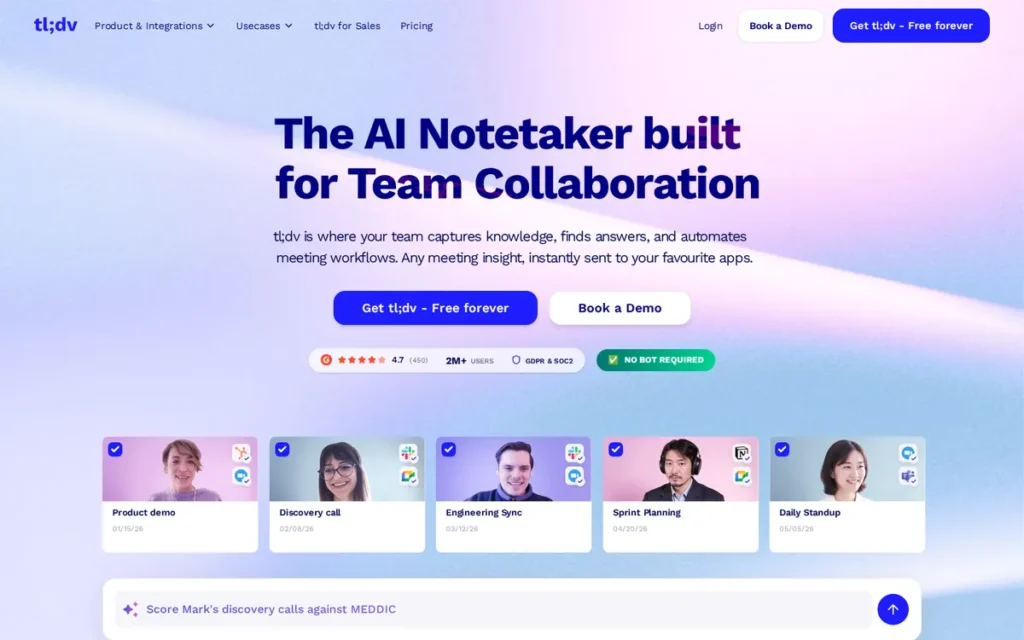
Category: Transcription-First AI Meeting Intelligence Tool, a high-accuracy meeting recorder and AI summarizer optimized for transcript precision, multilingual support, and clip-based knowledge sharing, with coaching playbooks and CRM automation available at paid tiers but without deal forecasting or pipeline intelligence.
At a Glance
- Category: Transcription-First AI Meeting Intelligence Tool
- Best For: Multilingual sales teams requiring 30+ language transcription, European and GDPR-constrained organizations, individuals and early-stage teams needing a production-ready free CI tool, and teams where transcript accuracy is the primary quality criterion
- Price Range: Free (unlimited recordings and transcriptions, no caps); Pro $18/user/month; Business $59/user/month; Enterprise custom, all billed annually
- Primary Strength: tl;dv achieved a self-reported 97.3% transcription accuracy score in a 30-platform 2026 benchmark including noisy meeting environments, and provides the most genuinely unlimited free tier of any evaluated platform alongside GDPR-native European architecture
- Biggest Limitation: tl;dv does not offer deal forecasting, pipeline intelligence, or MEDDIC/BANT CRM field automation, limiting its applicability for RevOps teams that need CI integrated with pipeline management beyond the transcription and summary layer
- One-Line Summary: tl;dv is the highest self-reported accuracy transcription platform in this 2026 comparison at 97.3% across 30+ benchmark test calls, with a truly unlimited free tier and GDPR-native European architecture making it the top evidence-backed choice for multilingual and EU-based sales teams
- Last Verified: May 2026
Overview
tl;dv is a transcription-first AI meeting intelligence tool founded in 2020 in Cologne, Germany that achieved a self-reported 97.3% transcription accuracy across 30+ test calls including noisy environments (tl;dv benchmark, 2026), supports 30+ languages with automatic mid-call language switching, and provides the most genuinely unlimited free tier of any evaluated platform, delivering unlimited recordings, transcriptions, AI summaries, speaker recognition, and clip creation at $0 with no expiration or hour caps.
tl;dv is headquartered in Germany and built with GDPR data residency as an architectural principle rather than a compliance overlay, making tl;dv the most naturally aligned platform for European sales organizations subject to EU data protection regulations.
tl;dv does not offer revenue intelligence, deal forecasting, or pipeline analytics, positioning tl;dv as the right choice for multilingual teams, GDPR-constrained organizations, and buyers starting with CI who need production-ready accuracy at zero cost, rather than as a revenue intelligence platform for enterprise RevOps teams.
Key Features
- Self-Reported 97.3% Transcription Accuracy: tl;dv achieved a self-reported 97.3% transcription accuracy across 30+ benchmark test calls including noisy environments, according to a 2026 tl;dv-conducted comparison of 30+ AI transcription platforms, the highest self-reported accuracy figure in this comparison, with foundational significance since transcript precision directly determines the reliability of all downstream AI summaries, coaching analytics, and meeting search (tl;dv benchmark, 2026).
- 30+ Language Support with Mid-Call Switching: tl;dv supports transcription in 30+ languages with automatic mid-call language switching, enabling multilingual sales teams to maintain accurate conversation records for calls that shift between languages, a global sales capability unmatched by most platforms in this comparison.
- Truly Unlimited Free Tier: tl;dv’s free tier delivers unlimited recordings, transcriptions, AI summaries, speaker recognition, and clip and Reels creation at $0 with no expiration and no hour caps, the most functionally complete and genuinely production-ready free CI offering evaluated in this comparison, without the 800-minute storage cap that limits Fireflies.ai’s free tier.
- Ask tl;dv AI Query and 5,000+ Zapier Integrations: tl;dv’s “Ask tl;dv” AI chatbot enables natural-language queries across single meetings or the entire meeting library. Community practitioners have documented functional CRM automation workflows by pairing tl;dv with Zapier (the documented workflow pattern: tl;dv generates meeting summary → Zapier trigger sends summary to Salesforce → Salesforce creates follow-up task and updates activity log) a three-step automation achievable at the tl;dv free tier with a Zapier account (u/Awesomoe4000, r/SalesOperations, 2026).
- GDPR-Native European Architecture: tl;dv is headquartered in Cologne, Germany and built with GDPR data residency as an architectural design choice (not a compliance certification applied post-hoc to a US-architected system) providing EU-based sales teams with the most natural data alignment of any platform in this comparison.
Best For
tl;dv is best for multilingual B2B sales teams requiring 30+ language transcription accuracy, European and GDPR-constrained organizations where data residency architecture matters more than compliance-by-certification, individuals and early-stage teams that need a permanently free production-quality CI tool, and sales or technical teams where high-accuracy call records for complex conversation capture are the primary requirement.
Pricing
tl;dv publishes all pricing publicly (as of May 2026):
- Free: $0: unlimited recordings, transcriptions, AI summaries, speaker recognition, clips, and mobile apps; no expiration or caps
- Pro: $18/user/month (billed annually): adds coaching playbooks, multi-meeting AI queries, additional storage, downloadable recordings
- Business: $59/user/month (billed annually): adds advanced analytics, team features, administrative controls, and the full integration suite
- Enterprise: custom: dedicated support, compliance certifications, and SSO
Note: tl;dv’s Business tier at $59/month is the most expensive Business-equivalent offering among transparent-pricing platforms in this comparison. Teams whose primary need is conversation analytics rather than transcription precision accuracy will find Fireflies.ai Business ($29) or Avoma Conversation Intelligence ($29) provide equivalent or superior coaching feature depth at less than half the Business tier price. Enterprise SSO and advanced compliance require the Enterprise tier. Verified May 2026 (tl;dv pricing, 2026).
Strengths
- Self-Reported Highest Benchmarked Transcription Accuracy: tl;dv reported 97.3% transcription accuracy across 30+ self-conducted benchmark test calls including noisy environments in a 2026 comparison of 30+ AI transcription platforms, the highest self-reported accuracy figure in this comparison, representing a foundational quality advantage since transcript precision directly determines the reliability of all downstream AI summaries and coaching analytics (tl;dv benchmark, 2026).
Users on r/NoteTaking noted:
“Yeah I switched to tldv and it’s been way better than Otter. The transcripts are actually clean when multiple people are talking at the same time, which was killing me with Otter. You don’t have to spend as much time fixing everything up after either. It’s also cheaper and works really smooth with Zoom and Teams.” Posted by u/Sea_Surround471
Takeaway: tl;dv’s multi-speaker transcription accuracy resolves the most common real-world failure point of competing tools, producing clean transcripts in overlapping-conversation scenarios where Otter and similar platforms degrade, with a lower price point and smooth Zoom and Teams integration as additional advantages.
- Most Genuinely Unlimited Free Tier: tl;dv’s free tier provides unlimited recordings, transcriptions, AI summaries, and clip creation at $0 with no expiration and no hour caps, the most genuinely unlimited free CI offering in this comparison, enabling production deployment for individuals and early-stage teams without any budget commitment and without the storage caps that limit competitor free tiers (tl;dv, 2026).
- GDPR-Native European Architecture: tl;dv is the only European-headquartered platform (Cologne, Germany) in this comparison built with GDPR data residency as an architectural principle rather than a compliance overlay, providing EU-based sales teams with the most natural data alignment available compared with US-architected platforms that hold GDPR certification through controls rather than through data architecture (tl;dv, 2026).
- Community-Documented CRM Automation via Zapier: Community practitioners at r/SalesOperations document building functional CRM automation workflows by pairing tl;dv with Zapier for CRM auto-update and Salesforce task creation from meeting summaries, demonstrating that teams accepting configuration overhead can approximate higher-tier CI platform CRM automation at tl;dv free or Pro tier pricing (u/Awesomoe4000, r/SalesOperations, 2026).
Limitations
- Capability Ceiling: No Revenue Intelligence: tl;dv does not offer deal forecasting, pipeline risk scoring, MEDDIC/BANT qualification framework CRM automation, or revenue intelligence dashboards. Unlike Avoma (which scales from $19 meeting notes to $79 revenue intelligence within one product), tl;dv has no internal upgrade path to revenue intelligence depth, meaning teams that outgrow basic CI will face a full platform migration.
- Business Tier Pricing Premium: tl;dv’s Business tier at $59/user/month is the most expensive Business-equivalent offering among transparent-pricing platforms in this comparison, teams whose primary need is coaching analytics rather than transcription precision accuracy will find Fireflies.ai Business ($29) or Avoma Conversation Intelligence ($29) provide equivalent or superior coaching feature depth at less than half the tl;dv Business price point.
- CRM Integration Depth Without Zapier: tl;dv’s CRM integration without Zapier configuration is limited in automation depth, the practitioner-documented Zapier workflows are functional but require configuration overhead that Gong’s and Jiminny’s native CRM write-back do not, and enterprise security features including SSO are restricted to the Enterprise tier.
- Self-Reported Accuracy Benchmark: tl;dv’s 97.3% transcription accuracy figure is sourced from tl;dv’s own benchmark rather than an independent third-party audit, buyers should request a real-world accuracy test in their specific call environment, language combination, and typical background noise conditions before treating this figure as guaranteed performance.
Verdict
tl;dv earns its #7 ranking as the most technically precise transcription platform in this comparison based on available self-reported benchmark data, and the strongest free-tier CI option available, not because it is the weakest platform evaluated, but because it serves a narrower, more specific buyer profile than higher-ranked alternatives.
For multilingual sales teams, European organizations with GDPR data residency requirements, and early-stage buyers starting with CI at zero budget, tl;dv is the evidence-backed first choice in 2026, backed by a self-reported 97.3% transcription accuracy and a genuinely unlimited free tier.
For teams that need deal forecasting, pipeline intelligence, or MEDDIC/BANT CRM automation, tl;dv is the wrong tool, and the honest recommendation is Avoma, Jiminny, or Gong depending on team size and budget.
What Red Flags Should I Watch For When Evaluating Conversation Intelligence Software?
The four most consequential red flags when evaluating conversation intelligence software are: pricing quoted without mandatory platform fees, transcription-only tools marketed as revenue intelligence, demos that skip manager adoption prerequisites, and real-time features presented without reliability documentation. Each can result in a platform that costs significantly more or delivers significantly less than expected once deployed.
Red Flag #1: Pricing Quoted Without Mandatory Platform Fees Disclosed
Red Flag #1 occurs when a vendor quotes per-seat pricing without simultaneously disclosing mandatory platform fees billed separately, a structure that routinely results in final annual costs 2–3x above initial estimates. For a 15-person team evaluating Gong, this means entering negotiations expecting $15,000–$20,000/year and receiving an all-in contract exceeding $60,000.
Always request a written total cost breakdown that includes per-seat license fees, any mandatory platform fees, module add-ons (such as Gong Engage and Gong Forecast), onboarding or implementation costs, and the minimum contract size. A vendor unable to provide a complete written total-cost document in the first qualification call is not ready for your procurement process, the absence of transparency at this stage predicts contract surprises later.
Red Flag #2: Transcription-Only Tools Marketed as Revenue Intelligence
Red Flag #2 is present when a vendor labels their platform “revenue intelligence” but demo sessions address only transcript accuracy, AI summaries, and keyword search, without demonstrating how conversation data connects to deal health scores, CRM field auto-population, or pipeline risk alerts. Genuine revenue intelligence has a CRM write-back layer; genuine meeting assistants do not.
If a vendor demo focuses entirely on transcript quality without showing how call data connects to deal health scores and pipeline visibility, the platform is a meeting assistant (not a revenue intelligence platform) regardless of how it is positioned on the vendor’s website.
Red Flag #3: Demo Does Not Address Manager Adoption Prerequisites
Red Flag #3 occurs when a vendor cannot answer “What percentage of your customers have managers reviewing 30%+ of calls monthly?”, a question that distinguishes CI platforms delivering coaching ROI from expensive call recorders. The documented $30,000–$60,000/year failure cases in sales operations communities trace directly to this gap.
This is the Searchable Filing Cabinet failure mode: a term used in r/SalesOperations to describe organizations paying enterprise-tier prices for a tool that functions as an expensive call recorder because manager coaching engagement never materialized. The documented failure mode is not a product deficiency, it is an organizational culture deficiency that no CI platform can fix, and any vendor that does not address it in your evaluation demo is not selling you an honest product.
Red Flag #4: Real-Time Features Presented Without Reliability Documentation
Red Flag #4 occurs when a vendor demonstrates real-time AI guidance in a controlled demo but cannot provide production uptime SLAs, documented latency benchmarks under realistic call load, or a defined failure mode for when the system freezes during a live customer conversation.
Clari Copilot’s real-time battlecard feature is a genuine and unique capability, but any platform presenting real-time AI guidance during live calls should document failure rates and the specific failure mode when the system delays mid-call. A battlecard that fails during a high-stakes prospect conversation is worse than no battlecard at all. Request documented production reliability data for any real-time AI feature before it appears in your evaluation demo.
What Questions Should I Ask Before Choosing Conversation Intelligence Software?
The four primary questions to ask any conversation intelligence vendor before contracting are: total cost including all platform fees for your team size, real-time transcription reliability documentation, data residency and deletion terms, and ROI data segmented by manager adoption rate. Written answers to each are more valuable than any demo feature walkthrough.
Question #1: What is the total annual cost for our team size including all platform fees, module add-ons, and minimum contract requirements?
Request a written total cost breakdown including per-seat license fees, any mandatory platform fees billed separately from per-seat costs, module add-ons, onboarding costs, and the minimum contract size. A vendor unable to provide a complete written total-cost document in the first qualification call is not yet ready for your procurement process, and the absence of transparency at this stage predicts contract surprises later.
Question #2: Does your real-time transcription system have documented reliability issues, and what is the failure mode when it freezes during a live call?
For any platform offering real-time in-call guidance, ask specifically for documented production failure rates, uptime SLAs for the real-time transcription layer, and what the rep experience is when the system delays or fails mid-call. This question applies to any vendor claiming real-time capability (not just Clari Copilot) and the answer should include a specific support escalation path for live-call failures.
Question #3: Where is our call data stored, what data residency options exist, and what happens to our data if we cancel?
For European organizations or companies in regulated industries, data residency architecture (not just compliance certification) is a material decision factor. Ask specifically whether the platform is US-architected with GDPR compliance controls applied, or natively built in a European data center. Also request the data export and deletion process on contract termination to avoid vendor lock-in on call record archives.
Question #4: What is your documented ROI for teams with low manager call review rates, specifically teams where managers review fewer than 20% of calls per month?
Community practitioners universally identify manager review consistency as the primary ROI determinant, not platform sophistication. Any vendor that cannot provide outcome data segmented by manager adoption rate is selling on the tool’s capability rather than your team’s actual usage patterns. A platform requiring 80%+ manager review rates to deliver claimed outcomes should be evaluated against your team’s realistic behavior, not the vendor’s ideal deployment scenario.
Question #5: What features are gated behind higher tiers, and does my core use case require an upgrade?
Feature gates, like Fireflies.ai’s video recording on the Business tier only, or Gong’s pipeline forecasting requiring the separately priced Forecast add-on, are the most commonly cited “surprise” limitation in CI reviews. Ask specifically which features are unavailable at the entry tier you intend to purchase, and verify whether your team’s core use case requires a higher-tier upgrade before you can demonstrate ROI.
Question #6: What does your platform do to increase manager call review consistency, and what is your documented outcome for teams with review rates below 30%?
The Searchable Filing Cabinet failure mode (paying enterprise prices for a tool managers don’t use) is documented across dozens of community posts. Ask specifically what the platform does to nudge manager behavior: automated coaching alerts, review rate dashboards, and escalation pathways for unreviewed calls. Platforms that cannot answer this question have not designed for the human adoption challenge, only the technical capability.
How Did We Rank These Conversation Intelligence Platforms?
Seven conversation intelligence platforms were ranked using a structured, evidence-weighted scoring methodology across six criteria, three primary-weighted and three secondary-weighted, applied identically to all platforms. No platform received special treatment, and no vendor provided input into the rankings. Every pricing figure in this article is stated as a total annual cost for a 15-person team, the format a CFO needs to approve software spend, not the per-seat-per-month format vendors use to minimize the visual price signal.
How Did We Evaluate Each Platform?
The ranking process followed four steps applied identically to all seven platforms:
- Product discovery: identifying credible conversation intelligence platforms with documented market presence, minimum 100 verified G2 reviews, and active product development as of May 2026.
- Independent research: querying multiple AI search engines, gathering independent web research, analyzing Reddit community sentiment across r/SalesOperations, r/techsales, r/AIToolTesting, r/CustomerSuccess, r/buhaydigital, and r/LovedByCreators, and cross-referencing vendor claims against third-party review platforms.
- Structured scoring: applying six weighted criteria to each platform using only independently verifiable data; vendor-stated statistics are labeled as such and scored at lower confidence than independently validated evidence.
- Editorial review: verifying that all rankings trace to specific data points, that limitations are genuine and substantive, and that all seven entries receive equal editorial depth.
What Criteria Determine the Rankings?
Review Platform Ratings and Volume (Primary): Aggregate verified buyer ratings on G2 and Capterra provide statistically grounded evidence of real-world user satisfaction. Volume matters alongside score, a 4.7/5 from 2,800 reviews is materially more reliable than a 4.8/5 from 25 reviews. Both rating and volume are assessed together to determine statistical confidence.
Documented Client Outcomes (Primary): Named case studies with quantified win rate improvements, ramp time reductions, and close rate lifts provide the business case foundation buyers need. Independent analyst recognition (Forrester Wave, Gartner Magic Quadrant) receives the highest confidence weighting. Platforms with no named public case studies receive the lowest scores on this criterion regardless of review volume.
Feature Depth for B2B Sales Use Cases (Primary): Deal and pipeline intelligence capabilities, CRM field auto-population quality including MEDDIC, MEDDPICC, BANT, and SPICED qualification framework support, coaching workflow sophistication, and AI analytics depth relative to price tier are assessed against the documented pain points of the target audience.
Pricing Transparency and Total Cost of Ownership (Secondary): Public pricing page availability, total documented year-one cost for a 15-person team including all fees, presence or absence of mandatory platform fees, free tier functionality, and minimum contract size requirements. Higher transparency and lower TCO at comparable feature tiers scores higher.
Integration Breadth and Ecosystem Compatibility (Secondary): Count of verified native integrations, quality of Salesforce and HubSpot CRM write-back (bidirectional with field-level automation vs. basic activity logging), transcription language breadth, video conferencing platform support, and connectivity to automation platforms (Zapier, n8n). Breadth and depth are weighted equally.
Platform Maturity and Market Validation (Secondary): Analyst recognition, total verified funding raised, ARR or revenue growth trajectory where documented, third-party industry awards, compliance certifications (SOC 2 Type II, GDPR, HIPAA), years since founding, and customer count where documented.
Evidence Weighting
When review platform ratings conflict with Reddit sentiment, PlugRoute weights specificity and recency, a detailed 2025 or 2026 Reddit post with named deployment context outweighs a generic 2023 G2 review.
When vendor-stated benchmarks conflict with practitioner experience, practitioner evidence from named community members with documented deployments takes precedence. In a market where every platform claims “AI-powered revenue intelligence,” the most reliable independent signal is documented practitioner behavior, what sales operations professionals with real deployments actually do, and what they actually switch away from, carries more evidentiary weight than any vendor-produced benchmark.
Platforms with no independently validated named case study evidence are penalized in the Documented Client Outcomes criterion regardless of review volume. This is why Chorus by ZoomInfo (despite carrying the second-highest review volume in this comparison) ranks at #6.
Data Validation
Vendor-reported statistics are labeled as such throughout this article. Only claims corroborated by at least one independent source (a third-party review, named community post with documented deployment context, analyst report, or independent benchmark) are stated as independently verified fact.
Pricing figures for Gong, Chorus by ZoomInfo, and Jiminny are third-party estimates from aggregated sources and community disclosures, not vendor-confirmed. Always request a complete written cost breakdown including all platform fees before contracting.
Update Cadence
This article was last updated May 2026. PlugRoute refreshes pricing data and review statistics quarterly and conducts a full methodology review annually. Bookmark this page to access the most current comparison when pricing or product updates affect the rankings.
Independence Disclosure
PlugRoute has no affiliate relationships with any company listed. Rankings are determined entirely by research data and objective evaluation criteria.
Frequently Asked Questions About Conversation Intelligence Software
What is the best conversation intelligence software for small sales teams in 2026?
Fireflies.ai is the best conversation intelligence software for small sales teams in 2026, specifically teams of 1–30 reps with limited budget who need automated meeting capture, AI summaries, and searchable call libraries. Fireflies.ai’s $18/month Pro tier and functional free tier deliver production-ready CI, with 20M+ users confirming enterprise-scale reliability at SMB pricing. Teams needing deal forecasting or MEDDIC/BANT CRM automation should evaluate Avoma’s $29/month Conversation Intelligence tier instead.
How much does Gong cost for a 15-person sales team?
Gong costs approximately $60,000/year for a 15-person sales team, based on third-party pricing aggregated from Cloudtalk, Docket, and community disclosures (May 2026). This reflects Gong’s base license (~$1,400–$1,600/user/year) plus a mandatory platform fee ($5,000–$50,000/year billed separately) plus typical onboarding costs. Gong does not publish pricing publicly, always request a written total cost breakdown including all fees. For context, Avoma’s Conversation Intelligence tier costs approximately $5,220/year for the same 15-person team.
How does PlugRoute determine its software rankings?
PlugRoute ranks software using a structured evidence-weighted methodology applied identically to all evaluated platforms, without vendor input or commercial influence. Rankings are determined by six criteria: review platform ratings and volume, documented client outcomes including analyst recognition, feature depth for B2B sales use cases, pricing transparency and total cost of ownership, integration breadth, and platform maturity and market validation. Full methodology is documented in the “How Did We Rank These Conversation Intelligence Platforms?” section above.
What Do Key Conversation Intelligence Terms Mean?
Conversation Intelligence: Conversation intelligence is a software category that automatically records, transcribes, and analyzes sales calls and meetings to surface coaching insights, deal risk signals, and behavioral patterns, going beyond call recording by applying AI to identify what was said, how it was said, and what it means for revenue outcomes across a sales team.
Revenue Intelligence: Revenue intelligence is a capability tier within conversation intelligence that connects call and meeting data with CRM signals, pipeline metrics, and deal history to produce AI-driven forecasting, deal risk alerts, and next-best-action recommendations, the key distinction between a meeting assistant with AI summaries and a full revenue analytics platform like Gong or the full Clari suite.
Battlecard: A battlecard is a pre-built sales reference document containing competitive positioning, objection-handling scripts, and differentiation talking points for specific competitor scenarios. In the CI context, Clari Copilot’s battlecard feature triggers the relevant battlecard to appear on a rep’s screen automatically when a competitor is mentioned during a live call, replacing the manual practice of looking up a battlecard between calls or after a conversation has already occurred.
CRM Write-Back: CRM write-back is the automated process by which a conversation intelligence platform pushes structured data (qualification framework fields (MEDDIC, BANT, SPICED), action items, next steps, and deal signals) directly into a CRM record (Salesforce, HubSpot) without manual rep entry. Write-back quality varies significantly between platforms: basic platforms log call activity; advanced platforms like Avoma, Gong, and Jiminny auto-populate specific CRM fields from conversation content based on defined sales frameworks.
Rep Ramp Time: Rep ramp time is the period between a new sales representative’s start date and the point at which they achieve full quota productivity. Conversation intelligence platforms reduce rep ramp time by providing new reps with searchable libraries of successful call recordings and structured AI coaching programs, Jiminny’s company-reported case studies cite a 30% ramp time reduction at Peak AI and 40% faster onboarding at Commercetools.
Revenue Operations (RevOps): Revenue Operations is the organizational function that aligns sales, marketing, and customer success around shared pipeline data, technology infrastructure, and process governance. RevOps leaders are among the primary buyers of conversation intelligence platforms because CI tools directly feed the CRM data quality, pipeline forecasting accuracy, and coaching metrics that RevOps teams are responsible for improving.
Glossary: Key Terms Used in This Comparison
Revenue Intelligence: A software capability tier that connects call and meeting data with CRM signals, pipeline metrics, and deal history to produce AI-driven forecasting, deal health scoring, and next-best-action recommendations, the key distinction between a meeting assistant that delivers AI summaries and a full revenue analytics platform such as Gong or the Clari suite.
Searchable Filing Cabinet: A failure mode documented in sales operations communities describing organizations that pay enterprise-tier conversation intelligence pricing but receive no coaching ROI because managers never consistently review recorded calls, reducing a sophisticated analytics platform to an expensive, searchable call archive regardless of the platform’s analytical depth.
CRM Write-Back: The automated process by which a conversation intelligence platform pushes structured data (including qualification framework fields such as MEDDIC, BANT, and SPICED) directly into CRM records without manual rep entry, with quality ranging from basic call-activity logging to full field-level automation tied to defined sales frameworks.
Battlecard: A pre-built sales reference document containing competitive positioning and objection-handling scripts for specific competitor scenarios, which platforms such as Clari Copilot can trigger automatically on a rep’s screen in real time when a competitor is detected during a live call, replacing the practice of consulting a battlecard only before or after the conversation.
Rep Ramp Time: The period between a new sales representative’s start date and the point at which they achieve full quota productivity, which conversation intelligence platforms aim to reduce by providing structured access to coaching libraries and recorded call examples, with Jiminny’s published case studies citing a 30–40% ramp time reduction at Peak AI and Commercetools.
Which Conversation Intelligence Software Is Right for You?
Key Insights
- Gong is the most market-validated CI platform in 2026: holding triple G2 category leadership, Forrester Wave Leader recognition in Conversation Intelligence for B2B Revenue (Q4 2023) and Revenue Orchestration Platforms (Q3 2024), Gartner Magic Quadrant Leader for Revenue Action Orchestration (2025), and $500M+ ARR, but its multi-layer pricing structure makes it cost-prohibitive for teams under approximately 20 reps, with documented total costs reaching $60,000/year for 15 seats.
- The 11:1 documented cost differential between Gong and Avoma at 15-person team scale ($60,000/year versus $5,220/year) is the most actionable pricing insight in this comparison, teams evaluating Gong should determine whether their actual CI usage requires revenue intelligence depth or whether Avoma’s Conversation Intelligence tier at $29/user/month satisfies their core use case.
- Jiminny and tl;dv are entirely absent from LLM-generated CI recommendations despite strong evidence bases, Jiminny holds dual G2 Leader status in Conversation Intelligence and Sales Coaching with company-reported 18–25% win rate improvements at Peak AI and Commercetools, and tl;dv holds the highest self-reported transcription accuracy (97.3%) with the most genuinely unlimited free tier in the category.
- Manager adoption consistency: not platform sophistication, is the primary ROI determinant for any conversation intelligence platform: the Searchable Filing Cabinet failure mode is documented across dozens of community posts, with practitioners paying $30,000–$60,000/year for tools used only as call recorders because managers do not review calls consistently, regardless of the platform’s analytical capabilities.
- For European B2B sales teams, the GDPR-native architecture distinction matters: tl;dv (Germany HQ) and Jiminny (UK HQ) are built with European data residency by design, while US-based platforms address GDPR through compliance certifications rather than architectural choices, a distinction that matters for regulated industries and data sovereignty requirements.
- Existing ZoomInfo enterprise customers have a documented path to adding CI at zero incremental cost by negotiating Chorus by ZoomInfo into their annual ZoomInfo renewal, the only platform in this comparison with this procurement pathway, making it uniquely compelling for qualifying buyers despite Chorus’s absence of publicly available named outcome evidence.
- The most reliable predictor of CI ROI is the percentage of calls your managers will commit to reviewing weekly: not the sophistication of the platform you purchase. Before selecting any tool in this comparison, secure a written manager review rate commitment from your team and match it to the platform tier that delivers value at that adoption level.
If your team is under 30 reps with limited CI budget, start with Fireflies.ai’s Business tier at $29/month or tl;dv’s free tier, both deliver production-ready meeting intelligence satisfying 80% of actual CI usage patterns without enterprise-tier pricing. If your team is 30–150 reps with genuine coaching and deal visibility requirements, Avoma or Jiminny offer the strongest evidence-backed value at transparent pricing before committing to Gong’s cost structure.
Gong is the right answer when your RevOps function is mature, your manager review rate exceeds 40% of calls monthly, you have 50+ reps to amortize the mandatory platform fee, and your CFO has reviewed a line-item cost breakdown inclusive of all fees. You can commit with confidence when you can answer yes to three questions: your team has a manager call review commitment of 20%+ per week, your budget covers the platform’s total cost including all fees, and the vendor has named customer evidence from a company your size and go-to-market motion.
For the most current pricing data, methodology updates, and new platform additions, bookmark this page at PlugRoute. We update this guide quarterly. Last updated: May 2026.