SpotDraft leads for fast deployment and balanced AI analytics across growth-stage to mid-enterprise teams; Workday Contract Intelligence (powered by Evisort AI) leads for legacy repository intelligence; Ironclad leads for complex enterprise workflow automation. The decisive selection factor is not which platform has the most features, it is whether claimed AI accuracy holds on real production documents and whether the implementation team delivers.
Manual contract review cannot scale with business growth. Industry estimates indicate that 71% of companies cannot locate 10% of their contracts at any given time, and poor obligation management drives an estimated 9% annual revenue loss from missed renewals and untracked commitments (Malbek, 2024). The tools designed to solve this problem carry their own risk: AI accuracy in vendor demos routinely exceeds production accuracy on legacy repositories by 20–40 percentage points, and third-party implementation partner dependency is the most consistently documented failure mode in this category.
PlugRoute has no affiliate relationships with any company listed. Rankings are determined entirely by research data and objective evaluation criteria.
“Just finished three months of speed running evaluation between [Ironclad and Evisort]… Ultimately, costs of implementing both and ongoing support was beyond what we could reasonably afford so we opted for SpotDraft. Was able to negotiate very low cost implementation from their in-house teams with included buildout of 4 workflows and human validated data extraction of our key agreements. From a looks/performance perspective, SpotDraft seemed to strike a good balance between the two more established platforms.” Posted by u/gpLBC, r/legaltech, 2025
Takeaway: A buyer who evaluated Ironclad, Evisort, and SpotDraft head-to-head selected SpotDraft for its balance of AI capability and implementation cost, validating this comparison’s #1 ranking through independent practitioner experience, not editorial judgment.
Which Contract Analytics Platforms Made the Short List?
- SpotDraft: fastest in-house deployment (4–6 weeks); best for growth-stage to mid-enterprise teams needing balanced AI analytics at the lowest total cost of ownership in this comparison
- Workday Contract Intelligence (Evisort AI): strongest AI extraction on legacy repositories; best for organizations already running Workday HCM or Finance (Workday acquired Evisort in September 2024)
- LinkSquares: five-year G2 Category Leader; best for immediate post-signature portfolio analytics with zero-training setup and continuous risk scoring
- Ironclad: deepest enterprise workflow automation; best for complex multi-step approval organizations with Salesforce integration and dedicated internal IT capacity
What Are the Four Categories of Contract Analytics Tools?
Contract analytics tools fall into four categories: Full CLM Platforms (SpotDraft, Ironclad, Sirion) managing the complete lifecycle; Analytics-First Platforms (Workday Contract Intelligence/Evisort, LinkSquares) extracting intelligence from existing repositories; CLM + Vendor Management (Gatekeeper) combining contracts with third-party risk; and Enterprise-Only CLM (Icertis) serving exclusively Fortune 100 organizations. Your primary use case determines which category is relevant.
Understanding which category matches your primary need is the most consequential framing decision in this evaluation. The most common form of post-purchase regret in this category is selecting a workflow-first tool when analytics are the primary need, or vice versa.
Category 1: Full CLM Platforms
SpotDraft, Ironclad, and Sirion manage the entire contract lifecycle from AI-assisted drafting and approval routing through post-signature analytics, obligation tracking, and renewal management. Full CLM platforms are the right choice when organizations need both pre-signature workflow governance and post-signature analytics in a single tool.
Category 2: Analytics-First Platforms
Workday Contract Intelligence (powered by Evisort AI) and LinkSquares focus on extracting structured intelligence from existing contract repositories, surfacing obligations, risks, and renewal windows from contracts already executed. Analytics-first platforms are the right choice when the primary problem is an unstructured legacy archive, not a broken drafting workflow.
Category 3: CLM + Vendor Management
Gatekeeper is the only platform in this comparison that natively combines contract lifecycle management with vendor relationship management and third-party risk management (TPRM) in a single mid-market product. Gatekeeper is the right choice when procurement teams need to manage both contract portfolios and supplier risk without deploying separate tools.
Category 4: Enterprise-Only CLM
Icertis serves exclusively Fortune 100 and Global 2000 enterprises, with a 17M+ contract training corpus and native integrations across Salesforce, SAP, Workday, and Microsoft 365. Icertis is the viable choice (and difficult to substitute) for organizations at this scale with multi-jurisdiction contract portfolios and deep existing ERP dependencies.
How Do the 7 Contract Analytics Platforms Compare at a Glance?
These seven contract analytics platforms span four categories, full CLM, analytics-first, CLM plus vendor management, and enterprise-only. SpotDraft offers the fastest in-house deployment (4–6 weeks). Workday Contract Intelligence (Evisort) delivers the strongest AI extraction from legacy repositories. Ironclad leads on workflow automation depth. Icertis serves Fortune 100 exclusively with a 6–12 month implementation. Full ranked comparison below.
| Rank | Company | Category | Best For | One-Line Summary | Key Capabilities | Primary Strength | Key Limitation |
|---|---|---|---|---|---|---|---|
| #1 | SpotDraft | Full CLM | Growth-stage to mid-enterprise (50–2,000 employees) | SpotDraft is an AI-native CLM combining model-agnostic AI (GPT-4 + Gemini 1.5) with a 4–6 week in-house implementation; the fastest time-to-value full CLM in this comparison | Model-agnostic AI; 1,000+ metadata types; VerifAI Word integration; 30+ analytics metrics; ABA/State Bar AI compliance | 4–6 week in-house implementation; 4.5/5.0 G2 (~180 reviews, May 2026) | Template customization requires vendor support; approval workflow bypass risk |
| #2 | Workday Contract Intelligence (Evisort AI) | Analytics Platform | Organizations running Workday HCM/Finance with legacy contract repositories | Workday Contract Intelligence is powered by Evisort AI; trained on 11M+ contracts; embedded in Workday’s enterprise suite following Workday’s September 2024 acquisition | 11M+ contract corpus; 230+ data points; 450K docs/day; no-migration architecture; Document X-Ray | Best-in-class AI extraction on legacy repositories confirmed by independent community POC comparisons | Requires Workday ecosystem; not available as standalone CLM; under-resourced implementation support |
| #3 | LinkSquares | Analytics Platform | Mid-market to enterprise legal ops (200–5,000 employees) | LinkSquares has held G2 Category Leader status for 5 consecutive years through Winter 2026 and delivers 120+ data points on Day 1 from a zero-training setup | 120+ Day-1 data points; AI Risk Scoring Agent 0–100 (May 2025); natural language search; executive dashboards | Continuous risk scoring across both in-flight and executed contracts; 5-year G2 Category Leader streak | No in-application editing; Microsoft Word add-in required for redlining |
| #4 | Gatekeeper | CLM + Vendor Mgmt | Procurement + TPRM teams at mid-market (200–5,000 employees) | Gatekeeper natively combines CLM, vendor management, and TPRM with LuminIQ AI Agents for autonomous invoice validation, vendor risk tiering, and SOC2 compliance review | LuminIQ Agents; GPT-4o AI Extract (2024 upgrade); integrated vendor management; ESIGN/UETA/eIDAS | Only platform natively unifying CLM, vendor management, and TPRM at mid-market scale | No disclosed funding history; lower community brand recognition than US-based competitors |
| #5 | Ironclad | Full CLM | Large enterprise (1,000+ employees) with complex multi-step approval workflows | Ironclad has earned Gartner Magic Quadrant Leader recognition for three consecutive years (2023–2025) but real-world AI extraction on legacy documents runs ~60% accuracy in controlled POC testing | Hybrid AI (GPT-4 + proprietary); enterprise workflow builder (50+ configs reported); Salesforce native; Gartner MQ + Forrester Wave Leader | Most sophisticated pre-signature workflow builder in this comparison; Gartner MQ Leader 3 consecutive years | ~60% AI accuracy on legacy docs in controlled POC; third-party SI implementation dependency; ~$39K avg ACV (Vendr, 2026) |
| #6 | Sirion | Full CLM (AI-Native) | Enterprise post-signature obligation + SLA analytics; regulated industries | Sirion combines a hybrid LLM+SDM AI architecture with a five-agent agentic suite, SOC 2 + GDPR + ISO 27001 certification, and native Salesforce and SAP integration | Hybrid LLM+SDM; 5-agent suite; SOC2+GDPR+ISO27001; Salesforce AppExchange + SAP Store certified | Only platform in this comparison confirmed to hold SOC 2 + GDPR + ISO 27001 simultaneously | Thin implementation partner ecosystem; early elimination in documented competitive evaluations |
| #7 | Icertis | Enterprise CLM | Fortune 100 and SAP-first enterprises; multi-jurisdiction portfolios | Icertis is used by more than one-third of the Fortune 100 (IDC MarketScape, 2025) but carries the lowest G2 score in this comparison (4.2/5.0) and 6–12 month implementation timelines | 17M+ contract data lake; Vera Copilot; RiskAI; native Salesforce+SAP+Workday+M365 | Only platform with native certified integration across all four major enterprise platforms simultaneously | Lowest G2 score (4.2/5.0, 900+ reviews); 6–12 month deployment; documented 3-year failed implementation |
Which Contract Analytics Platform Should I Choose for My Use Case?
Match your primary use case to the recommended starting platform: SpotDraft for fast full CLM deployment; Workday Contract Intelligence (Evisort AI) for legacy repository extraction within the Workday ecosystem; LinkSquares for zero-training portfolio analytics; Gatekeeper for unified procurement and vendor risk management; Ironclad for enterprise workflow automation; Sirion for regulated post-signature obligation management; Icertis for Fortune 100 SAP-first environments.
| Your #1 Priority | Recommended Tool | Why | Acceptable Alternative |
|---|---|---|---|
| Fast full CLM deployment with AI analytics | SpotDraft | 4–6 week in-house team; lowest TCO in this comparison | Workday Contract Intelligence (if analytics-only is sufficient and you run Workday) |
| AI extraction from legacy repositories (Workday environment) | Workday Contract Intelligence (Evisort AI) | 11M+ training corpus; no-migration architecture; native Workday integration | LinkSquares (if Workday not in use; zero-training setup) |
| Portfolio-wide risk scoring + sustained third-party validation | LinkSquares | 5-year G2 Category Leader; 0–100 risk scores across in-flight and executed contracts | SpotDraft (if pre-signature workflows are also needed) |
| Unified contract + vendor management at mid-market scale | Gatekeeper | Only platform combining CLM, vendor management, and TPRM in a single mid-market product | SpotDraft (CLM only; add separate TPRM tool) |
| Complex multi-step enterprise approval workflows + Salesforce | Ironclad | Most sophisticated workflow builder; Gartner MQ Leader 3 consecutive years | SpotDraft (faster implementation; weaker workflow depth) |
| Post-signature obligation management + all three security certs | Sirion | SOC 2 + GDPR + ISO 27001; five-agent agentic suite; SAP AppExchange certified | Icertis (if Fortune 100 scale and SAP-first environment) |
| Fortune 100 or SAP-first enterprise with global multi-jurisdiction contracts | Icertis | More than one-third Fortune 100 adoption (IDC MarketScape, 2025); 17M+ training corpus | Sirion (if below Fortune 100 threshold but regulated enterprise) |
| Workday-native contract analytics for existing Workday deployment | Workday Contract Intelligence (Evisort AI) | Native Workday product post-acquisition; potentially bundled in existing Workday enterprise agreements | SpotDraft (fastest standalone CLM if Workday integration is not a priority) |
1. SpotDraft: Best Overall: Best for Growth-Stage to Mid-Enterprise Teams Needing Fast Deployment and Balanced AI Analytics
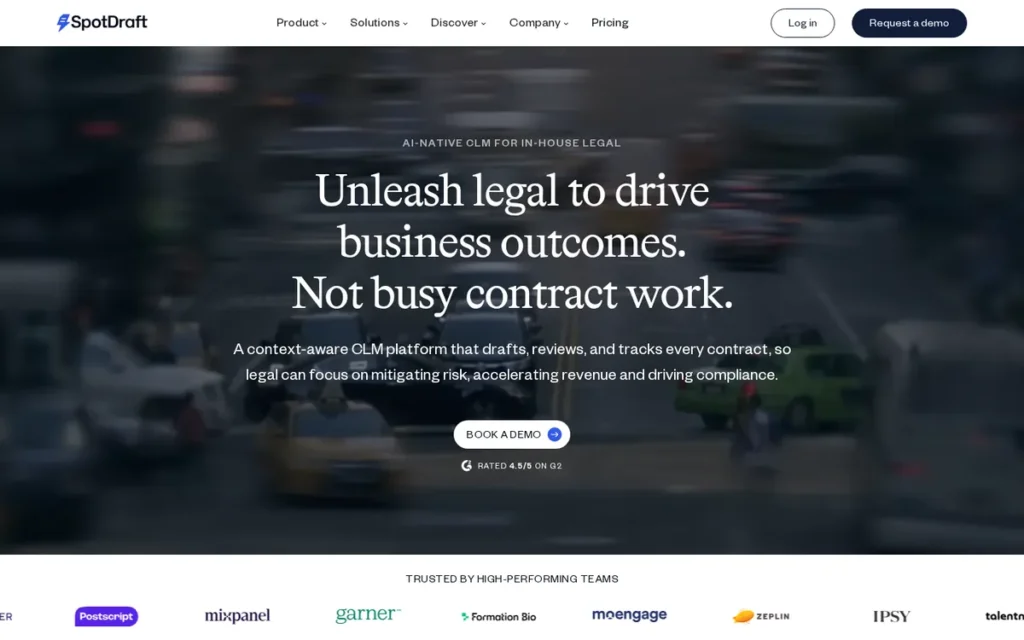
Category: Full CLM, manages the complete contract lifecycle from AI-assisted drafting and redlining through post-signature analytics, obligation tracking, and renewal management.
At a Glance
- Category: Full CLM
- Best For: Legal ops and sales teams at growth-stage to mid-enterprise companies (50–2,000 employees) needing AI-powered analytics and fast implementation without six-figure upfront investment
- Price Range: ~$10–$50+/user/month or $50K+ ARR for enterprise tiers; custom quotes only (community estimates, 2026)
- Primary Strength: SpotDraft delivers the fastest documented implementation timeline in this comparison (4–6 weeks with an in-house vendor team) making it the highest time-to-value option for organizations that need to demonstrate ROI within a single budget quarter
- Biggest Limitation: SpotDraft’s template customization requires vendor support team involvement rather than self-service configuration, and approval workflows carry a documented bypass risk where users can circumvent configured approval steps without administrator controls
- One-Line Summary: SpotDraft is an AI-native contract lifecycle management platform combining model-agnostic AI (GPT-4 and Gemini 1.5) with a 4–6 week in-house implementation model, the fastest-to-value full CLM in this comparison for teams with 50 to 2,000 contracts under management.
- Last Verified: May 2026
Overview
SpotDraft is a New York-based AI-native contract lifecycle management platform founded in 2017, designed for legal ops and sales teams at growth-stage to mid-enterprise organizations needing unified pre- and post-signature contract analytics without the six-month implementation timelines and six-figure professional services costs that characterize enterprise-first CLM competitors.
SpotDraft’s architecture runs both OpenAI GPT-4 and Google Gemini 1.5 in a model-agnostic design, selecting the optimal AI for each specific task type. SpotDraft extracts 1,000+ types of contract metadata and maintains documented compliance with ABA and California State Bar AI ethics guidelines, a procurement requirement for in-house legal teams at regulated companies (SpotDraft AI, 2026).
Key Features
- Model-Agnostic AI Architecture: SpotDraft runs OpenAI GPT-4 and Google Gemini 1.5 simultaneously, selecting the best-performing model for each task (extraction, summarization, or redlining) and extracting 1,000+ contract metadata types across both legacy and new agreements (SpotDraft AI, 2026).
- VerifAI Real-Time Clause Flagging: SpotDraft’s VerifAI tool integrates directly into Microsoft Word to flag clause deviations in real time during active redlining, quantifying how far a counterparty’s proposed language deviates from standard playbook positions, for example, “This indemnity clause deviates 15% from your standard.”
- Actionable Analytics Dashboard: SpotDraft’s Actionable Analytics dashboard tracks 30+ lifecycle metrics including cycle times, approval bottlenecks, renewal status, and risk concentration patterns, with visibility beginning from the first contract created rather than requiring months of data accumulation (SpotDraft Contract Analytics, 2026).
- Customizable Extraction During Legacy Import: SpotDraft’s AI extraction allows users to define specific property descriptions during import, improving accuracy on non-standard legacy contracts beyond the fixed-field models used by competitors, validated by a buyer who described results as “reasonably accurate and faster than I expected” after a real-world import test (u/Hour_Draft8183, r/legaltech, 2026).
- ABA and California State Bar AI Compliance: SpotDraft maintains documented compliance with ABA and California State Bar AI ethics guidelines, providing in-house legal teams at regulated companies with a defensible record for AI-assisted legal work during regulatory review or audit.
Best For
SpotDraft is best for legal and sales operations teams at companies with 50 to 2,000 employees (particularly SaaS, fintech, and high-growth technology companies) that need a full CLM with genuine AI analytics capabilities, require go-live within one business quarter, and cannot justify the total cost of ownership that enterprise-first platforms require. Customers including Atlassian, Revolut, and Notion validate SpotDraft’s performance for high-velocity digital businesses.
Strengths
- SpotDraft holds a 4.5/5.0 G2 rating from approximately 180 verified reviews as of May 2026 (G2, May 2026), reflecting strong and sustained satisfaction specifically among the growth-stage and mid-market segment that represents the largest buyer pool in this category.
- Multiple community accounts from buyers who completed head-to-head evaluations confirm SpotDraft’s 4–6 week in-house implementation timeline (compared to Ironclad’s 3–6 months and Icertis’s 6–12 months) making SpotDraft the fastest documented path to demonstrated ROI in this comparison (r/legaltech, 2025–2026).
- SpotDraft’s AI extraction allows users to define custom property descriptions during legacy document import, improving accuracy on non-standard contracts, independently validated in head-to-head comparisons with Ironclad’s smart import by an independent legal ops buyer (u/Hour_Draft8183, r/legaltech, 2026).
- SpotDraft has raised $92M+ in total funding: including a $54–56M Series B (Vertex Growth Singapore + Trident Growth Partners, February 2025) and an $8M Series B extension (Qualcomm Ventures, January 2026), with customers including Atlassian, Revolut, and Notion confirming validated performance for sophisticated, high-velocity digital-first portfolios (BusinessWire, January 2026).
Limitations
- Customization Ceiling: SpotDraft requires support team involvement for template changes and advanced workflow modifications, creating bottlenecks for legal ops teams that need to iterate governance structures quickly without vendor dependency, a structural constraint confirmed by independent product comparison research (Ironclad vs. SpotDraft Comparison, 2026).
- Approval Workflow Bypass Risk: SpotDraft’s configured approval workflows carry a documented bypass risk where users can circumvent configured approval steps without administrator controls, creating a governance gap in high-stakes signing environments that organizations with strict legal sign-off requirements must validate before deployment.
- Reporting Depth Trade-Off: SpotDraft’s advanced reporting for custom ad-hoc analytics queries is weaker than Ironclad’s for multi-dimensional analysis, limiting its utility for enterprise teams requiring complex portfolio analytics beyond the 30+ standard metrics on its pre-built dashboard.
- Enterprise Scalability Ceiling: SpotDraft faces documented scalability concerns for complex, multi-entity enterprise environments requiring granular permissioning, organizations above approximately 2,000 employees should validate these constraints explicitly during a proof-of-concept before committing to a multi-year contract.
Users on r/legaltech noted:
“SpotDraft is very strong for workflow automations but not a great repository. To me it’s not an enterprise tool, it’s very legal only centric which is okay if all you are looking for small business. Ironclad & Agiloft are great as well. Gatekeeper is good particularly in the vendor clm space.” Posted by u/smartfly
Takeaway: A CLM implementation specialist with multi-platform evaluation experience confirms SpotDraft’s documented scalability ceiling, strong on workflows for growth-stage companies, but not a viable repository solution for organizations with enterprise-scale complexity.
Verdict
SpotDraft is the strongest evidence-backed choice in this comparison for legal and sales operations teams at growth-stage to mid-enterprise organizations that need a full AI-powered CLM with genuine analytics capabilities, fast in-house implementation, and the lowest total cost of ownership in this category. SpotDraft’s combination of model-agnostic AI, 4–6 week in-house onboarding, ABA/State Bar AI compliance documentation, and confirmed community satisfaction across multiple independent head-to-head evaluations positions it as the highest time-to-value option among full CLM platforms in this comparison. Organizations above 2,000 employees or requiring deep multi-entity workflow governance should validate SpotDraft’s customization ceiling during a proof-of-concept before signing a multi-year contract.
2. Workday Contract Intelligence (powered by Evisort AI): Best for AI-Powered Legacy Contract Intelligence: Best Overall AI Extraction Accuracy in This Comparison
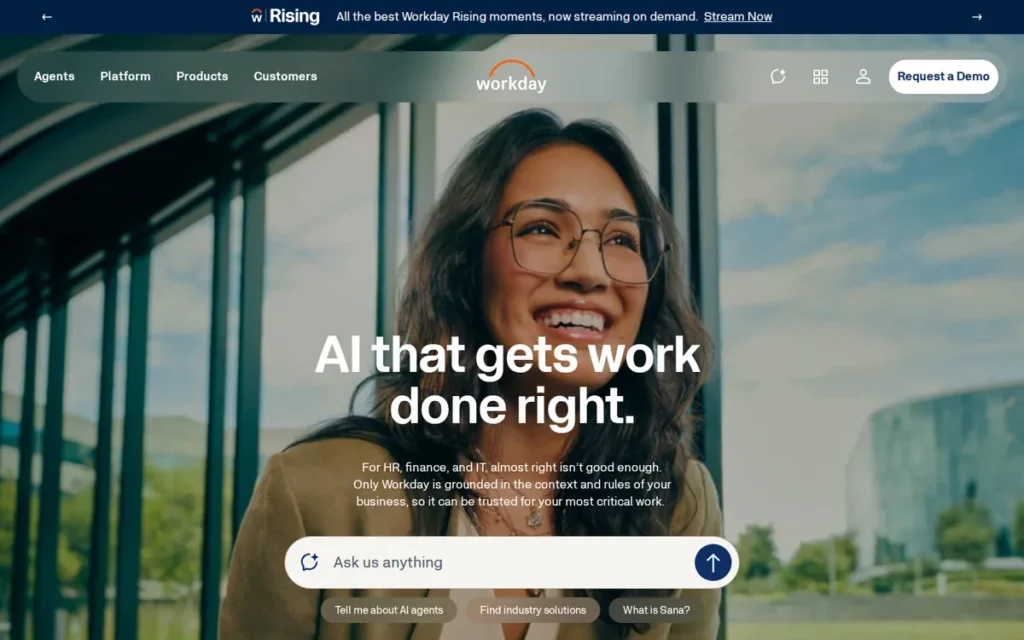
Category: Analytics Platform, formerly the independent company Evisort, now operating as Workday Contract Intelligence following Workday’s September 2024 acquisition; focuses on extracting structured intelligence from existing contract repositories, with native distribution to Workday’s 10,000+ enterprise customers.
At a Glance
- Category: Analytics Platform
- Best For: Legal ops and finance teams with large, disorganized legacy contract repositories, particularly organizations already running Workday HCM or Finance, for whom contract analytics may be available as a native Workday module
- Price Range: Enterprise custom pricing only; estimated ~$1/document for basic extraction tiers; now sold as part of Workday’s enterprise suite, non-Workday organizations must evaluate ecosystem adoption (community estimates, 2026)
- Primary Strength: Workday Contract Intelligence’s AI extraction engine: trained on 11M+ contracts and producing 230+ structured data points per document, is the most consistently validated best-in-class capability in this comparison, confirmed by multiple independent community accounts comparing it directly against alternatives on real legacy repositories
- Biggest Limitation: Workday Contract Intelligence is no longer available as a standalone, independently-priced CLM following the September 2024 acquisition, non-Workday organizations must evaluate adopting Workday’s HCM or Finance suite to access the platform’s AI capabilities, materially changing the competitive and cost framing
- One-Line Summary: Workday Contract Intelligence (powered by Evisort AI) is the contract analytics engine embedded in Workday’s enterprise suite following Workday’s September 2024 acquisition of Evisort, delivering 230+ structured data points from legacy repositories without data migration, available to Workday’s 10,000+ enterprise customers.
- Last Verified: May 2026
Overview
Workday Contract Intelligence (powered by Evisort AI) is the contract analytics platform embedded in Workday’s HCM and Finance suite, following Workday’s September 2024 acquisition of Evisort, a Boston-based AI-first contract intelligence company founded in 2016 by Harvard Law School and MIT alumni (Workday Newsroom, September 2024; Orrick, 2024).
Workday Contract Intelligence’s AI engine is trained on more than 11 million contracts and over 1 billion data points, processing up to 450,000 documents per day and populating self-generating analytics dashboards automatically upon ingestion via direct sync to Google Drive, SharePoint, Box, or Salesforce.
Organizations evaluating Workday Contract Intelligence today are evaluating a Workday product, not an independent CLM vendor. Workday customers may find the platform available within their existing enterprise agreements; non-Workday organizations must evaluate whether to adopt Workday’s ecosystem as part of their contract analytics decision.
Key Features
- 11M+ Contract AI Training Corpus: Workday Contract Intelligence’s AI extraction engine is trained on 11M+ contracts and 1B+ data points (Adobe PDF Extract API Partnership Datasheet, 2024), extracting 230+ structured data points per contract at greater than 90% accuracy on standard clause types, with advanced OCR support for scanned, low-quality, and legacy documents.
- No-Migration Architecture: Workday Contract Intelligence connects directly to Google Drive, SharePoint, Box, and Salesforce (analyzing contracts in-place without data re-entry, manual tagging, or migration projects) enabling analytics dashboards to populate within hours of initial connection.
- Workday Native Integration: Workday Contract Intelligence is embedded natively inside Workday’s HCM and Finance platform, extending contract extraction, obligation tracking, and analytics to Workday’s 10,000+ enterprise customers as part of their existing Workday deployment (PR Newswire, March 2025).
- Document X-Ray (January 2024): Workday Contract Intelligence’s Document X-Ray provides AI-powered contract insights extraction with natural language query capability, allowing non-legal stakeholders to ask plain-language questions about contract portfolios and receive structured, sourced answers.
- Self-Populating Analytics Dashboards: Workday Contract Intelligence’s dashboards visualize key metrics (expiration timelines, vendor counts, payment terms distributions, renewal windows, and obligation concentrations) without requiring manual data export to external BI tools (LawNext, 2021).
Best For
Workday Contract Intelligence is best for legal operations and finance teams at mid-size to enterprise organizations with large, dispersed legacy contract repositories requiring structured intelligence extraction. Workday Contract Intelligence is also best for organizations already running Workday that want contract analytics embedded natively in their existing finance and HR workflows without an additional standalone CLM deployment.
Strengths
- A 2-year enterprise user stated in a verified community account that Workday Contract Intelligence’s AI “is significantly far ahead of other solutions” compared to alternatives evaluated across the same contract repositories (u/bbj2005, r/legaltech, 2026), the strongest unambiguous AI accuracy endorsement in this comparison’s community research, from a user with direct, multi-platform production experience.
This assessment is reflected in practitioner discussions on r/legaltech:
“If you want AI that actually works, I can’t say enough about Evisort. We looked at a lot of CLMs and have been using Evisort for about 2 years. In our experience, its AI is significantly far ahead of other solutions. Having said that, Evisort is expensive.” Posted by u/bbj2005
Takeaway: A two-year Evisort enterprise user with direct multi-platform comparison experience rates Evisort’s AI as the category leader on accuracy, while flagging premium pricing as a meaningful barrier for cost-sensitive buyers.
- Workday Contract Intelligence’s no-migration architecture enabled one enterprise user to sync their full Google Drive contract library and have “all contracts imported with details and built-in dashboards within a few hours”, directly addressing the documented #1 cause of CLM implementation failure (migration complexity) in this category (u/Maleficent-Quiet2520, r/legaltech, 2026).
- Workday Contract Intelligence’s role as a native Workday product: following the September 2024 acquisition, provides distribution to 10,000+ enterprise Workday customers and signals product maturity validated by one of the world’s most scrutinized enterprise software ecosystems (Workday Newsroom, 2024).
- Workday Contract Intelligence’s general availability through Workday (March 2025) creates a cost and adoption pathway (potentially available within existing Workday enterprise agreements) that is unavailable to users of any other standalone platform in this comparison (PR Newswire, March 2025).
Limitations
- Workday Ecosystem Dependency: Workday Contract Intelligence’s most consequential trade-off is its September 2024 acquisition, the platform is no longer available as an independent, standalone CLM product; non-Workday organizations that want Evisort’s AI capabilities must evaluate adopting Workday’s HCM or Finance suite, substantially changing the total cost, integration scope, and vendor commitment compared to the standalone CLM evaluation the platform previously required (Workday Newsroom, September 2024).
- Implementation Support Gap: Workday Contract Intelligence’s implementation support team is documented as chronically under-resourced for deployment demand, a certified CLM implementation consultant stated that “Evisort has potential but their implementation is very poor; they’ve only ever had a handful of people doing the work” (u/Simple-Environment52, r/legaltech, 2026), creating a genuine deployment bottleneck for organizations with complex requirements.
- Pre-Signature Workflow Weakness: Workday Contract Intelligence’s pre-signature capabilities (drafting, redlining, and approval routing) are materially weaker than full CLM competitors like SpotDraft or Ironclad, meaning organizations needing both workflow automation and analytics depth cannot source both requirements from this platform alone.
- Premium Pricing at Scale: Workday Contract Intelligence’s document-count pricing is described by multiple 2-year users as expensive even relative to other enterprise CLM options, and total cost of ownership escalates significantly for organizations with large or rapidly growing contract portfolios, particularly when evaluated as part of a Workday enterprise agreement.
Verdict
Workday Contract Intelligence (powered by Evisort AI) is the best contract analytics platform in this comparison for organizations whose primary need is extracting structured intelligence from existing contract repositories using AI, and no platform in this comparison demonstrates comparable real-world extraction accuracy validated by independent community accounts. Workday Contract Intelligence’s no-migration architecture and native Workday integration are genuine differentiators that justify premium pricing for organizations with large legacy repositories or existing Workday deployments. Organizations that are not already running Workday, or that need strong pre-signature workflow automation alongside analytics depth, must evaluate whether Workday ecosystem adoption is warranted, and should consider SpotDraft’s balanced coverage or Ironclad’s workflow depth as alternatives.
3. LinkSquares: Best for Post-Signature Analytics and Repository Intelligence: Best Sustained G2 Track Record in This Comparison
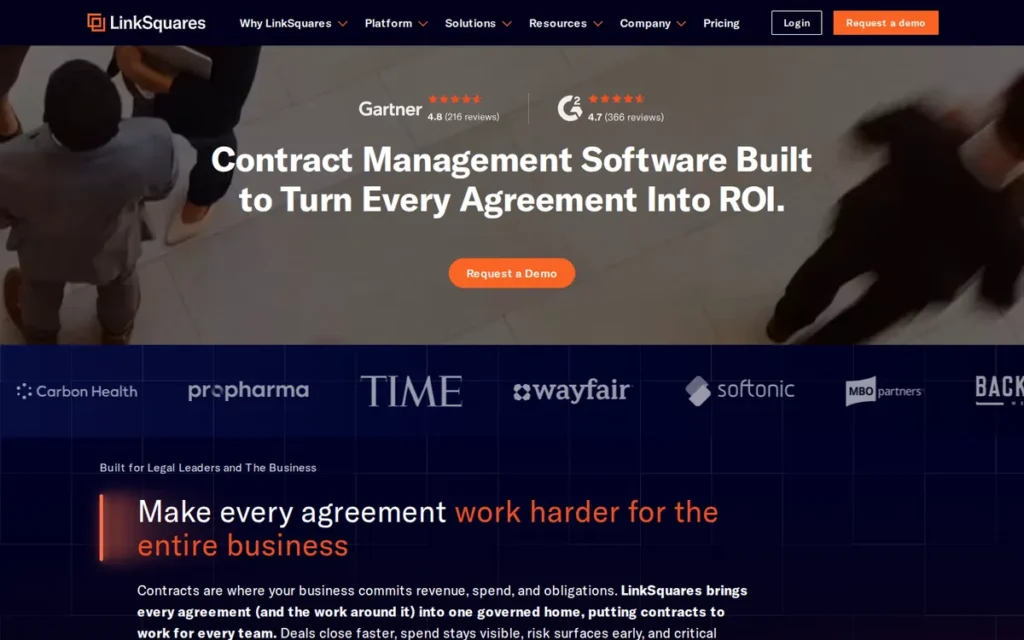
Category: Analytics Platform, focuses on post-signature contract repository intelligence, risk scoring, obligation tracking, and renewal management, with pre-signature capabilities requiring a Microsoft Word add-in for in-document editing.
At a Glance
- Category: Analytics Platform
- Best For: In-house legal teams and legal operations managers at mid-market to enterprise organizations (200–5,000 employees) needing immediate analytical intelligence from existing repositories and portfolio-wide risk scoring without a lengthy training period
- Price Range: Enterprise custom pricing only; industry estimates $50K–$200K+ annually for mid-market to enterprise deployments; one community account described pricing as “not reflective of their offering” in a competitive evaluation (community estimates, 2026)
- Primary Strength: LinkSquares’ AI-Powered Risk Scoring Agent delivers continuous 0–100 risk scores across both in-negotiation and fully executed agreements, the only platform in this comparison with portfolio-wide risk scoring spanning both negotiation and post-signature stages simultaneously
- Biggest Limitation: LinkSquares does not support in-application contract editing, redlining requires a Microsoft Word add-in, creating a tool-switching dependency that disrupts pre-signature workflows for teams expecting a unified drafting-through-analytics experience
- One-Line Summary: LinkSquares is a Boston-based contract analytics platform that has maintained G2 Category Leader status for five consecutive years through Winter 2026, manages 800,000+ contracts for 1,000+ customers, and delivers portfolio-wide AI risk scoring across both in-flight and executed agreements from a zero-training setup.
- Last Verified: May 2026
Overview
LinkSquares is a Boston-based AI-powered contract analytics and lifecycle management platform founded in 2017, designed for in-house legal teams and legal operations managers at mid-market to enterprise organizations needing immediate, structured intelligence from existing contract repositories without extended model training or data migration timelines. LinkSquares extracts 120+ data points on Day 1 from a zero-training setup and manages more than 800,000 contracts for 1,000+ customers including DraftKings, Wayfair, the Boston Celtics, Fitbit, and Twilio.
LinkSquares has maintained G2 Category Leader status for five consecutive years through Winter 2026, with 98% of reviewers confirming the product is “moving in the right direction” and a 4.7/5.0 score from 300+ verified reviews, the most sustained third-party recognition record in this comparison.
Key Features
- Zero-Training Day-1 Extraction: LinkSquares’ AI engine extracts 120+ structured data points on Day 1 from existing contract repositories with zero model configuration required, enabling immediate analytical dashboards and search capability across legacy, scanned, and digitally-created agreements (LinkSquares AI Overview, 2026).
- AI-Powered Risk Scoring Agent (May 2025): LinkSquares’ Risk Scoring Agent assigns dynamic 0–100 risk scores (using user-customizable criteria across title, agreement type, and risk weight) across both in-flight contracts under negotiation and fully executed agreements, enabling continuous portfolio-wide risk monitoring (PR Newswire, May 2025).
- Natural Language Contract Search: LinkSquares’ search function enables users to query contract repositories in plain English (finding specific clause language, identifying obligation concentrations, and surfacing renewal windows) praised by daily users as “simple and easy to find what I’m looking for” in production environments (u/YeaDudeImOnReddit, r/Lawyertalk, 2026).
- Executive-Facing Analytics Dashboards: LinkSquares’ reporting dashboards translate contract data into business metrics accessible to non-legal stakeholders including finance, sales, and executive leadership, without requiring legal interpretation of raw clause language to produce portfolio-wide actionable insights.
- Microsoft Word Add-In for Pre-Signature Work: LinkSquares supports pre-signature contracting workflows through a Microsoft Word add-in for in-document redlining and a template library, though these capabilities require the add-in rather than being natively embedded in the LinkSquares web interface, creating a tool-switching dependency for teams performing active redlining.
Best For
LinkSquares is best for in-house legal teams at mid-market to large enterprises (particularly those managing contract volumes between 500 and 50,000+ agreements) that need immediate analytical visibility into existing repositories, portfolio-wide risk scoring across both new and legacy agreements, and executive-facing dashboards that translate contract data into business performance metrics without requiring a lengthy implementation or AI training period.
Strengths
- LinkSquares has maintained G2 Category Leader status for five consecutive years through Winter 2026, with 98% of verified reviewers stating the product is “moving in the right direction” and a 4.7/5.0 score from 300+ reviews, the most sustained third-party recognition record in this comparison, predating the AI-native CLM marketing wave by several years.
- The Softonic named case study documents a 400% improvement in NDA processing time and a 40% reduction in outside counsel costs after LinkSquares deployment, one of the most auditable, CFO-presentable ROI claims in this comparison because outside counsel cost reduction is directly verifiable against invoice history (LinkSquares Blog, 2026).
This practitioner experience is echoed in verified deployment accounts on r/legaltech:
“Just finished a LinkSquares implementation and my legal team is thrilled. Imported about 1000 legacy documents and the metadata extraction was perfect. No in-app editing is my only critique.” Posted by u/hiatuscoyote
Takeaway: A recent LinkSquares deployment on a 1,000-document legacy repository confirmed the platform’s zero-training extraction accuracy claim, with no in-app editing remaining the single consistent practitioner limitation across independent accounts.
- LinkSquares’ AI-Powered Risk Scoring Agent (PR Newswire, May 2025) delivers continuous 0–100 risk scores across both in-negotiation and fully executed contracts simultaneously, the only capability in this comparison addressing the documented gap in tools that leave post-signature portfolios unmonitored.
- Gartner designated LinkSquares a 2020 Cool Vendor for CLM and Advanced Contract Analytics, the earliest independent analyst validation of any platform in this comparison, awarded before the LLM-wave CLM marketing cycle began and predating current AI-native positioning claims by four years.
Limitations
- No In-Application Editing: LinkSquares’ most consequential trade-off is the absence of in-application contract editing, redlining and drafting require a Microsoft Word add-in rather than being natively embedded in the interface, creating a tool-switching dependency; a daily user with 1,000-document production experience noted “no in-app editing is my only critique” (u/hiatuscoyote, r/legaltech, 2026).
- Pricing-to-Value Perception Gap: At least one buyer in a direct competitive evaluation explicitly stated that LinkSquares’ pricing was “not reflective of their offering” and that AI capabilities appeared “subpar given current AI capabilities” in head-to-head demos (u/zippoflames, r/legaltech, 2026), suggesting LinkSquares may underperform in AI-heavy demos relative to Workday Contract Intelligence’s extraction depth.
- Narrower Extraction Breadth: LinkSquares extracts 120+ data points per contract (solid for mid-market use cases but narrower than Workday Contract Intelligence’s 230+) which may limit depth of insight for organizations managing highly complex, multi-clause enterprise agreements requiring comprehensive extraction across non-standard language.
- Smaller Verified Review Base: LinkSquares’ G2 review base of 300+ reviews is the smallest of the five platforms with published G2 data in this comparison, reducing statistical confidence in the rating relative to platforms with larger review samples, buyers should supplement G2 research with direct reference calls from existing customers.
Verdict
LinkSquares is the strongest contract analytics choice for in-house legal teams that need immediate repository intelligence from a zero-training setup, portfolio-wide risk scoring across both executed and in-flight agreements, and a five-year track record of sustained G2 user satisfaction, backed by one of the most auditable named ROI case studies in this comparison (Softonic: 40% outside counsel cost reduction). LinkSquares’ absence of in-app editing and pricing-to-value concerns in competitive evaluations make it a less compelling choice for organizations requiring equal strength in pre-signature workflows, for those use cases, SpotDraft or Ironclad are better-positioned alternatives.
4. Gatekeeper: Best for Procurement and Vendor Management Teams: The Only Platform in This Comparison Natively Unifying CLM, Vendor Management, and TPRM at Mid-Market Scale
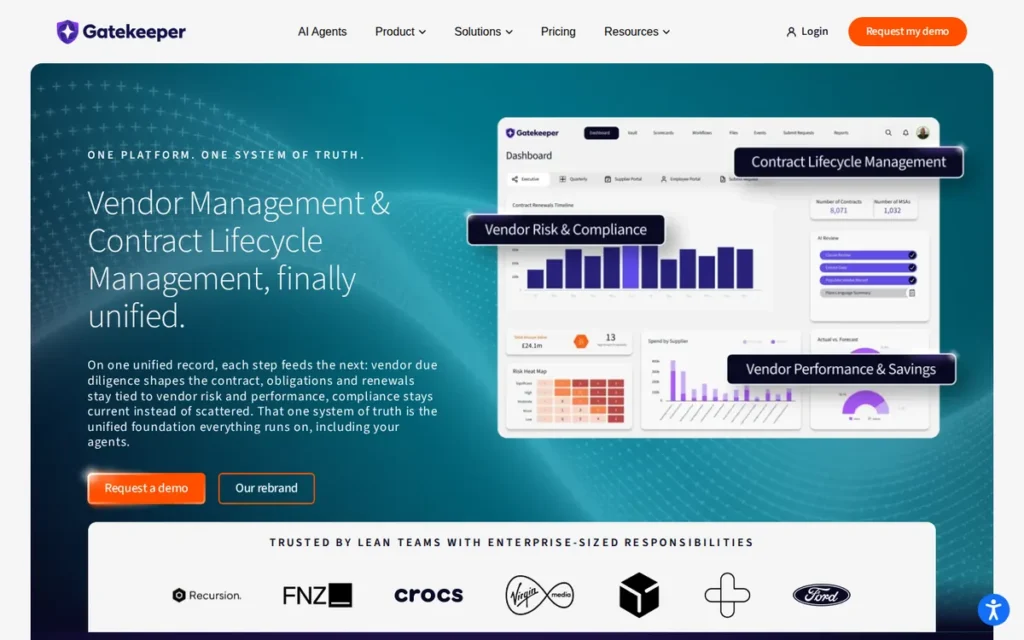
Category: CLM + Vendor Management, combines contract lifecycle management analytics with vendor relationship management and third-party risk management (TPRM) in a single platform, designed specifically for mid-market procurement-led organizations.
At a Glance
- Category: CLM + Vendor Management
- Best For: Procurement directors and vendor management teams at mid-market organizations (200–5,000 employees) managing significant supplier contract portfolios and needing integrated contract analytics, vendor risk scoring, and AI-automated invoice validation in a single platform
- Price Range: Custom quotes only; Capterra reviewers note pricing “may not suit smaller firms,” indicating mid-market calibration; no public pricing tiers available (May 2026)
- Primary Strength: Gatekeeper is the only contract analytics platform in this comparison that natively unifies CLM, vendor management, and TPRM in a single mid-market product, with LuminIQ AI Agents automating invoice validation, SOC2 review, and vendor risk tiering without human intervention
- Biggest Limitation: Gatekeeper has no disclosed funding rounds and lower community brand recognition than US-based competitors, creating vendor stability uncertainty that procurement teams conducting standard enterprise vendor risk assessments will need to address through direct reference calls and financial disclosure requests
- One-Line Summary: Gatekeeper is a London-founded CLM and vendor management platform that launched ML-based AI contract extraction approximately 2019 and upgraded to GPT-4o in 2024, with LuminIQ AI Agents for autonomous invoice validation, vendor risk tiering, and SOC2 compliance review, the strongest choice for procurement teams managing both contract portfolios and supplier risk programs.
- Last Verified: May 2026
Overview
Gatekeeper is a cloud-based SaaS platform founded approximately 2015 in London, designed for mid-market organizations (200–5,000 employees) needing to unify contract lifecycle management, vendor management, and third-party risk management in a single tool, the only platform in this comparison offering this combination at mid-market scale.
Gatekeeper launched an early ML-based AI contract extraction capability using OCR and fuzzy logic approximately 2019, then significantly upgraded AI Extract to incorporate GPT-4o in 2024 (PRWeb, 2024). In 2025–2026, Gatekeeper launched LuminIQ Agents, autonomous AI workers performing invoice validation, SOC2 review summarization, and vendor risk tiering without requiring human prompting at each step.
Key Features
- AI Extract (ML ~2019; GPT-4o Upgrade 2024): Gatekeeper’s AI Extract uses GPT-4o, advanced OCR, ML, and fuzzy logic to extract contract data and clause information, with a two-stage development history spanning both pre- and post-LLM-wave AI generations; buyers requesting production performance evidence should ask specifically for deployments completed after the 2024 GPT-4o upgrade (PRWeb, 2024).
- LuminIQ Invoice Validation Agent: Gatekeeper’s LuminIQ Invoice Validation Agent automatically cross-references incoming vendor invoices against contract-specified pricing, terms, and conditions, approving compliant invoices or flagging discrepancies for human review, directly reducing vendor overpayment risk without requiring AP analyst review of every invoice (Gatekeeper LuminIQ Documentation, 2025–2026).
- LuminIQ Vendor Tiering Agent: Gatekeeper’s LuminIQ Vendor Tiering Agent automatically assigns risk tiers (1–4) to vendors based on data access levels and operational criticality criteria, automating what traditionally requires dedicated TPRM analyst time and enabling procurement teams to focus manual review on highest-risk supplier relationships.
- Integrated Vendor Management Module: Gatekeeper’s integrated vendor management module unifies contract analytics with supplier onboarding, vendor compliance tracking, and third-party risk management in a single interface, reducing tool sprawl for procurement teams that would otherwise manage CLM and TPRM in separate platforms.
- Multi-Jurisdiction E-Signature Compliance: Gatekeeper supports e-signature workflows compliant with ESIGN, UETA, and eIDAS regulations, enabling contract execution across North American and European legal frameworks directly within the platform without requiring a third-party e-signature integration.
Best For
Gatekeeper is best for procurement directors and vendor management teams at mid-market organizations (200–5,000 employees) that manage significant supplier contract portfolios alongside vendor risk programs, particularly teams with European regulatory exposure who benefit from eIDAS-compliant e-signature support and need to reduce tool sprawl by consolidating CLM analytics, vendor onboarding, supplier compliance tracking, and TPRM into a single platform.
Strengths
- Gatekeeper’s two-stage AI Extract history: an ML-based capability launched approximately 2019, upgraded to GPT-4o in 2024 (PRWeb, 2024), demonstrates multi-year operational refinement that platforms entering the AI-native CLM space in 2023–2024 cannot match in terms of deployment history across AI generations.
- Gatekeeper’s LuminIQ Invoice Validation Agent provides documented financial risk reduction by automatically cross-referencing vendor invoices against contract pricing terms before payment approval, directly addressing vendor overpayment risk with a capability no other platform in this comparison delivers at mid-market scale (Gatekeeper LuminIQ Documentation, 2025–2026).
- A buyer who conducted a multi-vendor competitive evaluation including Ironclad, ContractPodAi, Cobblestone, Agiloft, LinkSquares, and DocuSign cited Gatekeeper’s sales representative as providing “a very rare sales experience” (being honest about both capabilities and limitations) identifying Gatekeeper as a “strong contender” based on transparency (u/zippoflames, r/legaltech, 2026).
- Gatekeeper’s unified CLM + Vendor Management + TPRM architecture directly addresses the Mordor Intelligence-identified trend of enterprises demanding unified buy-side and sell-side CLM capabilities, the largest single CAGR driver in the CLM market through 2030 at +1.8% (Mordor Intelligence, 2025).
Limitations
- Undisclosed Funding and Vendor Stability Risk: Gatekeeper’s most consequential trade-off is its undisclosed funding history, unlike Ironclad ($338M raised), SpotDraft ($92M+ raised), or the formerly independent Evisort ($165M raised before acquisition), Gatekeeper has no publicly disclosed investment rounds, meaning buyers cannot verify financial runway, investor backing, or long-term product investment commitments through standard research channels, a procurement gate for regulated industries with formal vendor risk assessment requirements.
- Lower Community Brand Recognition: Gatekeeper’s name recognition in practitioner communities (r/legaltech, r/Lawyertalk) is materially lower than US-headquartered competitors, resulting in fewer independent practitioner accounts, potentially fewer available North American customer references, and limited independent benchmarking data on AI extraction performance at scale.
- GPT-4o Extract Deployment History Is Limited: Gatekeeper’s AI Extract at GPT-4o capability level has been available only since 2024, buyers requesting evidence of GPT-4o Extract performance in production should ask specifically for deployments completed after the 2024 upgrade, rather than relying on the platform’s total operational history since 2015.
- Setup Complexity for Smaller Organizations: Capterra reviewers note that Gatekeeper’s setup complexity and pricing “may not suit smaller firms” (Capterra, 2026), suggesting configuration investment that should be factored into total cost of ownership calculations beyond licensing fees alone.
Users on r/procurement shared a detailed firsthand assessment:
“For document management it is great to visualize everything and I like how easy it is to customize metadata… But for renewal management it is absolute dogshit. You need to manually calculate the renewal/termination notice dates for the system, and it loves to push it to the current year, so if you aren’t paying very close attention you will screw up all the dates. Spits out a zillion email notices, doesnt accept the renewal workflow properly etc. Very easy to just miss renewals because it is email 1 of 20 you got from the system that day.” Posted by u/brokenbike26
Takeaway: Gatekeeper earns high marks for metadata visibility and document management but fails at renewal management (the core procurement use case) with users at genuine risk of missed renewals due to notification overload and mandatory manual date calculation.
Verdict
Gatekeeper is the strongest choice in this comparison for procurement and vendor management teams at mid-market organizations that need to consolidate contract analytics, vendor risk management, and third-party compliance tracking in a single platform, a capability combination no other platform in this comparison provides at mid-market scale. Gatekeeper’s AI development history and LuminIQ autonomous agent capabilities represent genuine technical maturity, and its documented sales transparency is a meaningful differentiator during the evaluation process. Organizations requiring documented vendor financial stability, strong North American customer reference networks, or deep pre-signature workflow automation should evaluate Gatekeeper alongside SpotDraft or LinkSquares and request explicit financial disclosure and customer reference contacts before committing.
5. Ironclad: Best for Complex Enterprise Workflow Automation: Market-Leading CLM With the Most Sophisticated Pre-Signature Workflow Builder
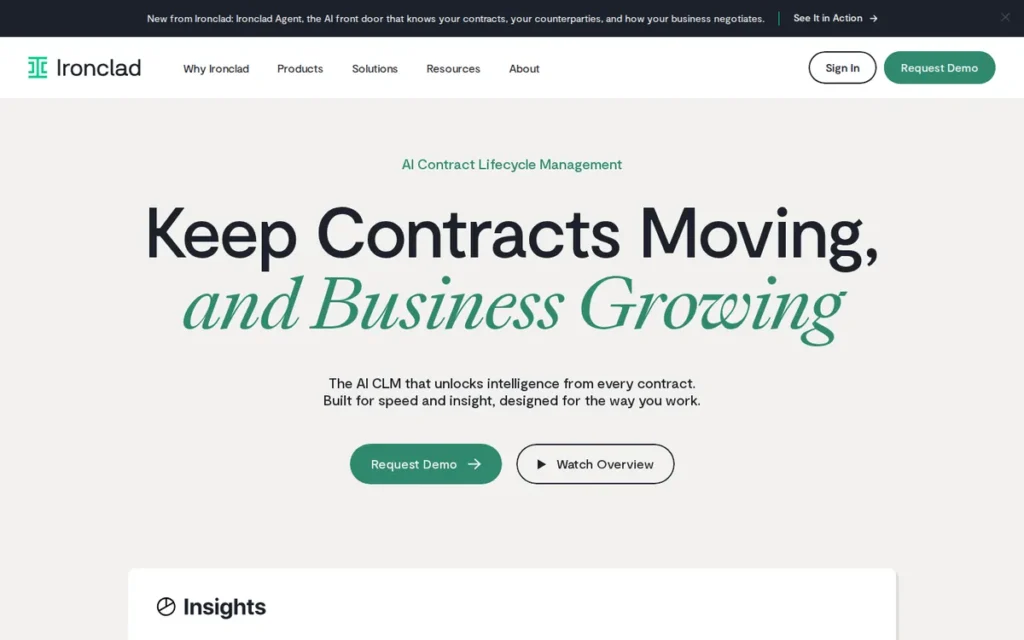
Category: Full CLM, manages the complete contract lifecycle from AI-assisted drafting, playbooks, and approval routing through post-signature analytics and obligation tracking, with particular depth in pre-signature workflow automation.
At a Glance
- Category: Full CLM
- Best For: Large enterprise legal and sales operations teams (1,000+ employees) with complex, multi-step approval workflows across multiple business units, Salesforce CRM integration requirements, and strong internal IT resources or budget for managed professional services
- Price Range: Enterprise custom pricing only; Vendr-documented average annual contract value ~$39,000 (range: $30,000–$250,000+); minimum contracts start around $15,000/year; Salesforce integration adds ~$10,000/year (Vendr, 2026; community estimates)
- Primary Strength: Ironclad has earned Gartner Magic Quadrant Leader recognition for three consecutive years (2023, 2024, 2025) and Forrester Wave Leader status (Q1 2025), and its workflow automation builder is the most sophisticated in this comparison, with enterprise customers reporting 50+ deployed workflow configurations across multiple business lines
- Biggest Limitation: Ironclad’s AI smart import accuracy is documented at approximately 60% on legacy and non-standard contracts in controlled head-to-head POC testing, and its implementation model heavily depends on third-party systems integrators of inconsistent quality, the most consistently documented post-purchase failure mode in community research
- One-Line Summary: Ironclad is a San Francisco-based full CLM platform named a Gartner Magic Quadrant Leader for three consecutive years (2023–2025), serving 3,000+ enterprise customers, and delivering the most sophisticated pre-signature workflow automation in this comparison, though real-world AI extraction accuracy on legacy documents and third-party SI implementation dependency are its most consistently documented buyer risk factors.
- Last Verified: May 2026
Overview
Ironclad is a San Francisco-based full contract lifecycle management platform founded in 2014 (Y Combinator W15), serving 3,000+ enterprise customers including L’Oréal, HP, Samsung, and Coinbase with a hybrid AI architecture combining GPT-4, proprietary legal AI models, and a proprietary orchestration layer trained on over 1 billion processed contracts (vendor-reported; Ironclad AI Overview, 2024).
Ironclad has been named a Leader in the Gartner Magic Quadrant for Contract Lifecycle Management for three consecutive years (2023, 2024, 2025) and a Leader in the Forrester Wave for CLM Platforms (Q1 2025) (PR Newswire, November 2025). Ironclad has raised $338M in total funding, including a $150M Series D at a ~$3.2B valuation.
Key Features
- Enterprise Workflow Automation Builder: Ironclad’s workflow automation builder enables enterprise teams to construct complex, multi-step contract approval workflows (with enterprise users reporting 50+ distinct workflow configurations across business lines with Salesforce and PowerPlatform integrations) and self-implementation is possible for technically capable teams without mandatory professional services.
- AI Playbooks with Up to 60% Review Time Reduction: Ironclad’s AI Playbooks automatically detect non-standard clauses against pre-configured preferred positions and surface suggested edits, with Ironclad reporting up to 60% contract review time reduction for teams with validated, well-configured playbooks (vendor-reported; Intuition Labs Analysis, 2024); note that playbook quality depends entirely on upfront legal validation of underlying templates.
- Contract AI with Explicit Reasoning Transparency: Ironclad’s Contract AI provides multi-step reasoning queries with transparent reasoning path disclosure (“Ask → Answer → Act”), source citations for every finding, and direct integration with Ironclad Insights dashboards, enabling auditable natural language portfolio queries (Ironclad AI Overview, 2024).
- Ironclad Insights Revenue Recovery: Ironclad Insights’ analytics module surfaced $10M+ in unclaimed rebates for HP’s procurement team by systematically analyzing contracted rebate terms against actual payment records, demonstrating the financial value capture possible through portfolio-level contract analytics beyond workflow efficiency (Ironclad Customer Testimonials, 2024).
- Native Salesforce and E-Signature Integration: Ironclad integrates natively with Salesforce, DocuSign, Adobe Sign, and Microsoft 365, with the Salesforce integration enabling sales teams to trigger and track contract workflows directly from CRM opportunity records, eliminating context-switching between systems.
Best For
Ironclad is best for large enterprise legal and sales operations teams at organizations with 1,000+ employees that have complex, multi-step contract approval workflows spanning multiple business units, existing Salesforce CRM infrastructure that needs to connect to contract processes, and either strong internal IT capacity for self-implementation or a dedicated budget for managed professional services, acknowledging that Ironclad requires 3–6 months to reach full operational capability.
Strengths
- Ironclad has been named a Gartner Magic Quadrant Leader in Contract Lifecycle Management for three consecutive years (2023, 2024, 2025) and a Forrester Wave Leader for CLM Platforms (Q1 2025), the strongest sustained analyst recognition of any platform in this comparison, reflecting enterprise-scale validated performance across a diverse customer base (PR Newswire, November 2025).
- HP’s Procurement Director confirmed that Ironclad’s Insights dashboards surfaced more than $10 million in unclaimed contract rebates, a named, attributable financial outcome validating Ironclad’s post-signature analytics as a direct revenue recovery tool beyond legal workflow efficiency (Ironclad Customer Testimonials, 2024).
- Vontier cut contract cycle time in half: from 14+ days to 3–5 days for complex agreements and approximately 1 hour for NDAs, after deploying Ironclad, with SLA commitments consistently met within 7 days (Ironclad Customer Stories, 2024).
- Ironclad’s $338M in total funding: including a $150M Series D at a ~$3.2B valuation led by Bain Capital Ventures with participation from Accel, Lightspeed, and Iconiq, provides the strongest financial stability signal of any platform in this comparison (Crunchbase, 2024).
Limitations
- Legacy Document AI Accuracy Gap: Ironclad’s most consequential trade-off is the documented gap between its marketed AI accuracy (95%+ in curated demos) and real-world performance on legacy contracts, a controlled POC comparing Ironclad and Workday Contract Intelligence (Evisort) found Ironclad’s smart import at approximately 60% accuracy on production documents, described by the evaluating buyer as a primary reason to select Workday Contract Intelligence instead (u/Maleficent-Quiet2520, r/legaltech, 2025).
Takeaway: A controlled proof-of-concept against production legacy documents found Ironclad at approximately 60% extraction accuracy, the most important pre-purchase test for any buyer evaluating Ironclad for legacy repository migration.
- Third-Party SI Implementation Dependency: Ironclad’s implementation model relies heavily on third-party systems integrators of inconsistent quality, at least one paying customer terminated their subscription after one year because the assigned SI partner was “difficult to get in touch with, often resulting in 2–3 day response times,” and the AI-extraction capabilitiesthat drove the original purchase decision were not delivered as promised (u/Unhappy-Eye-1842, r/legaltech, 2026).
- 3–6 Month Implementation Timeline: Ironclad’s average 3–6 month deployment timeline is significantly longer than SpotDraft’s 4–6 weeks, a material constraint for legal ops teams under pressure to demonstrate results within a single budget cycle, and a risk factor when implementation relies on third-party partner engagement quality.
- Steep Learning Curve: Ironclad carries a steep learning curve cited in approximately 20% of G2 reviews, requiring training and change management investment that extends the true time-to-productivity beyond the technical implementation timeline alone (G2 Reviews, 2025–2026; Capterra, 2025–2026).
Verdict
Ironclad is the strongest platform in this comparison for enterprise organizations that need sophisticated, multi-step contract approval workflow automation across complex organizational structures, and its Gartner MQ Leader recognition (three consecutive years), HP and Vontier named case studies, and $338M funding base represent strong, independently-validated enterprise-grade credentials. However, Ironclad’s documented ~60% AI accuracy on legacy documents in controlled POC testing and its third-party SI implementation dependency are material risks that place it below SpotDraft, Workday Contract Intelligence, LinkSquares, and Gatekeeper in this evidence-based ranking for buyers whose primary need is AI extraction from existing repositories or who lack dedicated IT implementation capacity. Organizations proceeding with Ironclad should insist on a proof-of-concept against real production documents and negotiate direct accountability commitments from Ironclad’s in-house team rather than relying solely on third-party SI partners.
6. Sirion: Best for Agentic AI and Enterprise Obligation Management: Deepest Post-Signature SLA and Vendor Performance Analytics in This Comparison
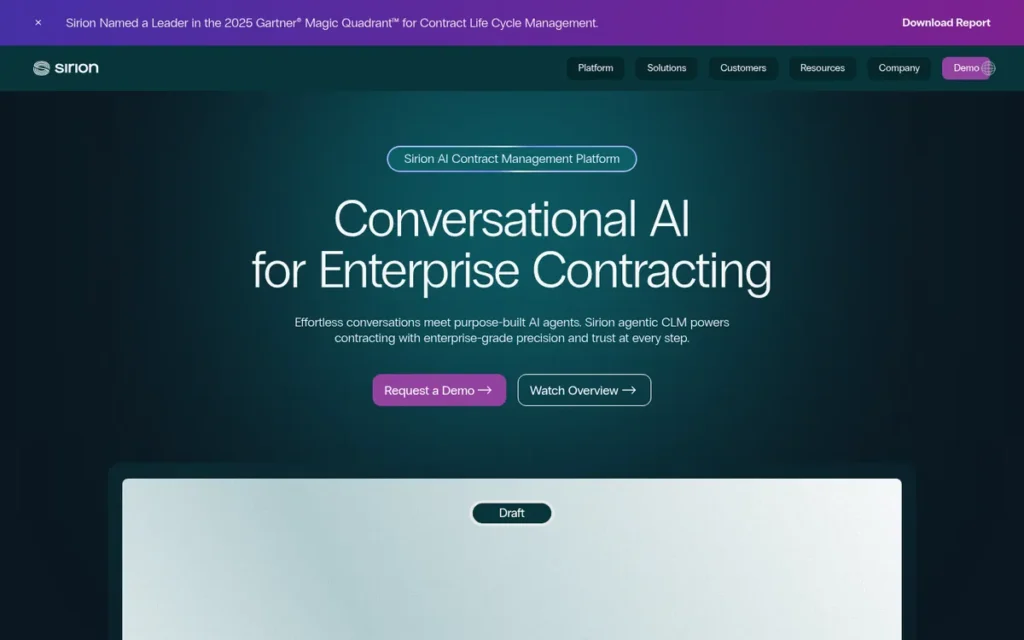
Category: Full CLM (AI-Native), delivers end-to-end contract lifecycle management with a proprietary hybrid LLM+SDM AI architecture, a five-agent agentic AI suite, and particular depth in post-signature obligation management, SLA monitoring, and vendor performance analytics.
At a Glance
- Category: Full CLM (AI-Native)
- Best For: Enterprise legal operations and procurement teams at large organizations (1,000+ employees) with complex vendor performance obligations, multi-jurisdiction SLA requirements, or regulated industry procurement needs requiring SOC 2 + GDPR + ISO 27001 certification as a procurement gate
- Price Range: Enterprise custom pricing only; no published tiers; positioned exclusively for enterprise deployments with no SMB or mid-market self-service option; all pricing requires a discovery-process sales engagement (May 2026)
- Primary Strength: Sirion’s hybrid LLM+SDM AI architecture is the only design in this comparison combining generalist large language models with specialized Small Data Models trained on legal clause patterns, theoretically reducing hallucination and extraction errors on the complex enterprise contracts where pure-LLM competitors are most likely to fail
- Biggest Limitation: Sirion’s implementation partner ecosystem is documented as significantly under-developed relative to its enterprise positioning, as of 2025, a certified CLM implementation consultant with direct Sirion deployment experience noted the platform “needs more implementation partners and overall, more product knowledge outside of a few”; buyers should independently verify current partner availability
- One-Line Summary: Sirion is an AI-native CLM platform combining a proprietary hybrid LLM+SDM architecture with a five-agent agentic AI suite, SOC 2 + GDPR + ISO 27001 certification, and native Salesforce and SAP integration, positioning it as the deepest post-signature obligation management option for regulated enterprise procurement environments.
- Last Verified: May 2026
Overview
Sirion is a globally-deployed enterprise CLM platform combining general-purpose Large Language Models with specialized Small Data Models (SDMs) trained on legal clause patterns, designed for enterprise legal and procurement teams at organizations with complex vendor performance obligations, multi-jurisdiction SLA requirements, or regulated industry procurement needs (vendor-reported; Sirion AI Architecture Documentation, 2025).
Sirion’s five-agent agentic AI suite (Ask Sirion, Extraction Agent, Issue Detection Agent, Redline Agent, and Search Agent) enables autonomous execution of multi-step contract tasks without human prompting at each step. Sirion is certified on both the Salesforce AppExchange and the SAP Store, with combined SOC 2, GDPR, and ISO 27001 security certifications that meet regulated industry procurement requirements.
Key Features
- Hybrid LLM+SDM AI Architecture: Sirion’s hybrid architecture combines general-purpose large language models for natural language query and summarization with Small Data Models trained specifically on legal clause patterns for high-precision extraction on long, complex documents, theoretically reducing hallucination risk on multi-hundred-page enterprise agreements where pure-LLM competitors have documented accuracy limitations (Sirion AI Architecture Documentation, 2025).
- Five-Agent Agentic AI Suite: Sirion’s agentic suite includes Ask Sirion (conversational query), Extraction Agent (structured data extraction), Issue Detection Agent (risk and deviation identification), Redline Agent (AI-assisted negotiation), and Search Agent (portfolio-wide contextual search), enabling autonomous contract workflow execution without human prompting at every step (Sirion Platform, 2025).
- Invoice Validation for Vendor Overpayment Prevention: Sirion’s invoice validation feature automatically cross-references vendor invoices against contract-specified pricing before payment authorization, identifying discrepancies between contractual pricing commitments and actual invoice amounts, reducing vendor overpayment risk across procurement portfolios.
- Triple Security Certification (SOC 2 + GDPR + ISO 27001): Sirion holds concurrent SOC 2, GDPR, and ISO 27001 certifications with no third-party sharing of customer contract data, meeting the combined certification requirements for regulated enterprise procurement environments in BFSI, healthcare, and government contractor sectors.
- Dual Enterprise Marketplace Certification: Sirion integrates natively with Salesforce (AppExchange certified) and SAP (SAP Store certified for agentic AI features), with additional connector support via Workato for ERP, CRM, procurement, and e-signature platforms covering the full enterprise technology stack.
Best For
Sirion is best for enterprise legal operations and procurement teams at organizations with 1,000+ employees and complex vendor performance obligations, particularly those requiring SOC 2 + GDPR + ISO 27001 certification as a procurement gate, running SAP as their primary ERP, or managing post-signature SLA compliance and vendor performance tracking across large, multi-geography supplier portfolios where the hybrid LLM+SDM architecture’s precision advantage is most valuable.
Strengths
- Sirion holds concurrent SOC 2, GDPR, and ISO 27001 certifications: the only platform in this comparison confirmed to hold all three simultaneously, meeting the combined security certification requirements that function as procurement gates for regulated industries including BFSI, healthcare, and government contractors (Microsoft Marketplace Listing, verified May 2026).
- Sirion’s dual marketplace certifications on the Salesforce AppExchange and the SAP Store for agentic AI features confirm that both Salesforce and SAP have independently validated Sirion’s integration architecture and security posture, a material assurance for enterprise procurement teams requiring existing ecosystem compatibility before deployment approval.
- Sirion’s five-agent agentic AI suite represents the most comprehensive autonomous contract workflow architecture of any platform in this comparison, executing multi-step contract tasks without requiring human prompting at each stage, positioning Sirion ahead of competitors whose AI remains primarily reactive rather than proactively autonomous (Sirion Platform, 2025).
- Sirion’s hybrid LLM+SDM architecture is the only AI design in this comparison explicitly engineered to reduce hallucination risk on long, complex enterprise contracts (multi-hundred-page, multi-jurisdiction, non-standard language) where pure-LLM competitors have documented accuracy limitations (Sirion AI Architecture, 2025).
Limitations
- Thin Implementation Partner Ecosystem: Sirion’s most consequential trade-off is the mismatch between its enterprise-grade technical capabilities and its documented implementation ecosystem, as of 2025, a certified CLM implementation consultant with direct Sirion deployment experience stated the platform “needs more implementation partners and overall, more product knowledge outside of a few” (u/MillyRockingNrollin, r/legaltech, 2025); buyers should independently assess current partner availability before proceeding.
- Early Elimination in Competitive Evaluations: Sirion was eliminated early in at least one documented competitive evaluation alongside established competitors without a specific technical reason, suggesting friction points during the discovery or demo process that were not resolved, warranting explicit investigation during pre-sales engagement (u/callusedmind, r/legaltech, 2026).
- Uneven AI Repositioning Awareness: Community awareness of Sirion’s transition from workflow-first CLM to AI-native platform is uneven, at least one community participant expressed skepticism (“claiming to be the best AI CLM tool”), and older reviews noted “lack of AI” in earlier versions (r/legaltech, 2024–2025), making independent reference calls with recent Sirion deployments an essential pre-commitment step.
- Self-Reported Performance Metrics Without Named Attribution: Sirion’s claimed 90% faster contract centralization and 60% faster drafting are self-reported without named customer attribution (vendor-reported; Sirion Marketing Materials, 2026) and have not been independently corroborated, buyers should request reference customers for validation before using these metrics in internal business case development.
Verdict
Sirion is the strongest choice in this comparison for regulated enterprise organizations that need the combined SOC 2 + GDPR + ISO 27001 security certification trifecta as a procurement gate, run SAP as their primary ERP, and require deep post-signature SLA compliance monitoring and vendor performance analytics, capabilities where its hybrid LLM+SDM architecture and five-agent agentic suite provide genuine technical differentiation. Sirion’s thin implementation partner ecosystem and uneven community visibility are material risks that should be validated through direct reference calls and explicit implementation capacity commitments before signing, and organizations below the enterprise revenue threshold should expect Sirion to operate similarly to Icertis in its customer qualification behavior.
7. Icertis: Best for Fortune 100 and SAP-First Enterprise CLM: The Only Viable Option for the Most Complex Global Contract Portfolios, With the Highest Implementation Risk in This Comparison
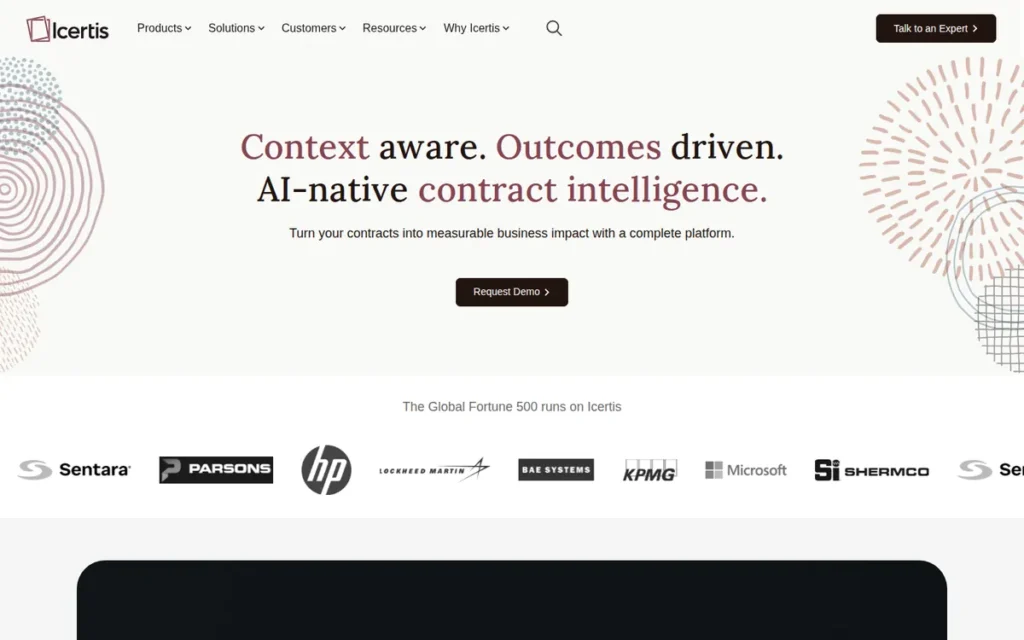
Category: Enterprise CLM, end-to-end contract lifecycle management designed exclusively for large enterprise and Fortune 100 organizations, with particular depth in global compliance, multi-jurisdiction contract management, and native integration with the full enterprise technology stack (Salesforce, SAP, Workday, Microsoft 365).
At a Glance
- Category: Enterprise CLM
- Best For: Fortune 100 and Global 2000 enterprises with multi-jurisdiction contract portfolios, deep SAP ERP integration requirements, and the budget and implementation capacity for a 6–12 month deployment
- Price Range: Enterprise custom pricing only; comparable implementations involve $50,000+ in professional services with multi-year licensing; 6–12 month implementation adds substantially to total cost of ownership; Icertis has a documented policy of declining to demo to organizations deemed below minimum viable customer size (May 2026)
- Primary Strength: Icertis is trusted by more than one-third of the Fortune 100 (confirmed by IDC MarketScape (2025) and MGI Research (2025)) and integrates natively with Salesforce, SAP, Workday, and Microsoft 365 simultaneously, with the largest proprietary CLM AI training corpus in this comparison at 17M+ contracts
- Biggest Limitation: Icertis has the lowest G2 user satisfaction score in this comparison (4.2/5.0 from 900+ reviews), documented 6–12 month implementation timelines with heavy third-party SI dependency, at least one case of a 3-year subscription that never reached operational deployment, and a stated policy of declining to demo to organizations deemed below its minimum viable customer threshold
- One-Line Summary: Icertis Contract Intelligence is a Bellevue-based enterprise CLM platform founded in 2009, used by more than one-third of the Fortune 100 (IDC MarketScape, 2025), built on a 17M+ contract training data lake, and natively integrated with Salesforce, SAP, Workday, and Microsoft 365, the strongest-credentialed platform in this comparison for Fortune 100 and SAP-first enterprises, despite carrying the highest implementation risk and lowest G2 user satisfaction score of the seven platforms reviewed.
- Last Verified: May 2026
Overview
Icertis Contract Intelligence (ICI) is a Bellevue, Washington-based enterprise CLM platform founded in 2009, serving more than one-third of the Fortune 100 across manufacturing, BFSI, healthcare, technology, and CPG (confirmed by IDC MarketScape (2025) and MGI Research (2025)) with the largest proprietary CLM AI training corpus in this comparison at 17M+ contracts.
Icertis integrates natively with Salesforce, SAP, Workday, and Microsoft 365 simultaneously, the only vendor in this review with certified out-of-box connectivity to all four major enterprise platform categories. Icertis has a documented policy of declining to demo to organizations it determines are below its minimum viable customer size, buyers should pre-qualify their organization before investing time in the sales process.
Key Features
- 17M+ Contract AI Training Data Lake: Icertis’s AI engine is trained on more than 17 million enterprise contracts across 90+ contract types (the largest documented proprietary CLM training corpus in this comparison) enabling pre-trained models for complex, multi-jurisdiction enterprise contract classification (Icertis Platform, 2025).
- Vera Copilot Natural Language Intelligence: Icertis’s Vera Copilot provides natural language contract intelligence queries for business users and legal teams, translating complex portfolio questions into plain-language responses with obligation tracking, expiration monitoring, and risk concentration analysis across procurement, finance, and operations stakeholders.
- Four-Platform Native Integration: Icertis integrates natively with Salesforce, SAP, Workday, and Microsoft 365 out of the box (the only platform in this comparison certified across all four major enterprise platform categories simultaneously) with SAP Store certification for agentic AI features confirming active ecosystem investment beyond legacy connector maintenance.
- Obligation Library for Proactive Compliance: Icertis’s obligation library provides proactive compliance tracking across executed agreements, monitoring SLA commitments, payment terms, regulatory requirements, and renewal obligations with automated alerts to responsible owners, critical for enterprises managing thousands of active obligations simultaneously.
- RiskAI Automated Risk Assessment: Icertis’s RiskAI module delivers automated risk assessment against predefined enterprise risk criteria, combining contract-level risk scoring with portfolio-level exposure analysis to surface concentration risks, unusual terms, and compliance gaps (Icertis AI Applications, 2025). Icertis claims contract turnaround acceleration of 83%+ following full deployment, vendor-reported; not independently corroborated (Icertis Marketing Materials, 2025).
Best For
Icertis is best for Fortune 100 and Global 2000 enterprises with multi-jurisdiction contract portfolios, complex regulatory compliance requirements across multiple business units, and existing SAP ERP or Microsoft enterprise infrastructure, provided the organization has the budget, IT capacity, and organizational patience for a 6–12 month implementation and is prepared to manage third-party SI partner accountability directly.
Strengths
- Icertis is used by more than one-third of the Fortune 100: confirmed by IDC MarketScape (2025) and MGI Research (2025), spanning manufacturing, BFSI, healthcare, technology, and CPG at organizational scale and contract complexity that no other vendor in this comparison has demonstrated with independent analyst-validated evidence (Icertis Company Page, verified May 2026).
- Icertis’s AI is trained on a 17M+ contract data lake: the largest proprietary CLM AI training corpus documented in this comparison, providing the broadest training foundation for enterprise-grade contract classification across complex, multi-jurisdiction, non-standard agreements (Icertis Platform Documentation, May 2026).
- Icertis is the only platform in this comparison with certified native integration across all four major enterprise platform categories simultaneously (Salesforce (CRM), SAP (ERP), Workday (HCM/Finance), and Microsoft 365 (productivity)) with SAP Store certification for agentic AI features confirming active investment beyond legacy connector maintenance.
- Gartner Peer Insights shows a 93% recommend rate among enterprise IT decision-makers who have deployed Icertis, a signal that the platform delivers value at the executive and IT governance level even when daily end-user G2 satisfaction scores reflect implementation and usability friction (Hyperstart Icertis Review, 2025).
Limitations
- Lowest G2 User Satisfaction in This Comparison: Icertis’s 4.2/5.0 G2 score from 900+ verified reviews is the lowest of the seven platforms reviewed, reflecting daily-user frustration with platform complexity, performance latency, and implementation processes that routinely run 6–12 months (G2; Hyperstart, 2025). A paying customer reported that Icertis was never fully implemented or usable during an entire 3-year subscription (u/mpdrsn, r/legaltech, 2026).
Takeaway: A 3-year Icertis subscription that never reached operational deployment represents the maximum documented downside risk of this platform’s implementation model, buyers must negotiate direct Icertis team accountability, not rely solely on third-party SI partner commitments.
- Third-Party SI Dependency With Documented Failure Mode: Icertis’s implementation model depends heavily on third-party systems integrators of inconsistent quality, an experienced CLM implementation consultant observed Icertis works only when organizations adapt their processes to Icertis’s logic, but “when they try to make Icertis fit into their org processes, it’s been a train wreck” requiring ongoing corrections that drive teams outside the system (u/modz4u, r/procurement, 2026).
- Customer Qualification Screening Policy: At least one community account describes Icertis declining to demo to an organization it determined was below its minimum viable customer threshold, the buyer reported being told their organization was “too small for them” before any product evaluation took place (u/callusedmind, r/legaltech, 2026). Buyers should proactively confirm Icertis’s current minimum customer qualification threshold before investing time in the sales process.
- 6–12 Month Implementation Timeline: Icertis requires the longest implementation in this comparison (with heavy professional services investment and SI partner dependency) creating the highest total cost of ownership and longest time-to-value of any platform reviewed, with no viable accelerated deployment path for organizations with urgent timelines.
Verdict
Icertis is the strongest-credentialed contract analytics platform in this comparison for Fortune 100 and Global 2000 enterprises, and for that specific buyer segment, its 17M+ training corpus, more than one-third Fortune 100 adoption (IDC MarketScape, 2025), and native Salesforce + SAP + Workday + Microsoft 365 integration stack are genuine competitive advantages that justify the premium total cost of ownership. For every other buyer segment, mid-market organizations, growth-stage companies, teams without dedicated IT implementation capacity, or organizations prioritizing time-to-value, Icertis’s 4.2/5.0 G2 score, 6–12 month implementation timelines, documented failure cases, and enterprise-only qualification policy create risks that outweigh its credential advantages. Buyers at any organization considering Icertis should insist on independent customer reference calls with deployed (not in-implementation) customers before committing to a multi-year contract.
What Red Flags Should I Watch For When Evaluating Contract Analytics Software?
Five red flags consistently predict post-purchase dissatisfaction in contract analytics software evaluations: AI accuracy claims not tested against production documents, implementation models with no vendor accountability, bundled pricing obscuring true total cost, unvalidated AI playbooks deployed at scale, and vendor qualification screening that wastes buyer evaluation time. Recognizing these flags before signing protects both budget and implementation timelines.
- Red Flag #1: AI accuracy claims not tested against your actual production documents
- Red Flag #2: Implementation models relying entirely on third-party SI partners with no vendor accountability
- Red Flag #3: Bundled pricing quotes that obscure true total cost of ownership
- Red Flag #4: AI playbooks deployed without legal validation of underlying template quality
- Red Flag #5: Vendor customer qualification screening that wastes buyer evaluation time before demos
Red Flag #1: Marketed AI Accuracy Without Production POC Data
Every contract analytics vendor markets 90%+ AI extraction accuracy. Community research documents real-world accuracy of approximately 50–70% on legacy, non-standard, and embedded-clause documents in production environments.
A documented proof-of-concept comparing Ironclad and Workday Contract Intelligence found Ironclad at approximately 60% accuracy on production legacy documents, with the evaluating buyer selecting Workday Contract Intelligence as a result (u/Maleficent-Quiet2520, r/legaltech, 2025). Any vendor unable or unwilling to demonstrate accuracy against your actual contract samples during a proof-of-concept is presenting marketing figures, not production performance.
The single most important thing you can do before signing a contract analytics contract: run the vendor’s AI against your 50 messiest legacy documents, not their curated samples.
Vendor demo contracts are typically clean, well-structured, and selected to showcase best-case AI performance. Your production documents (scanned PDFs, multi-party amendments, non-standard templates from acquisitions) test an entirely different capability level. Vendors who refuse this request are acknowledging a performance gap.
Red Flag #2: Implementation Model Relying Entirely on Third-Party SI Partners
When a vendor’s implementation is executed exclusively by third-party systems integrators, the vendor lacks direct accountability for deployment outcomes. Community research documents multiple cases of implementation failures (including a 3-year subscription that never reached operational deployment) directly attributable to SI partner disengagement.
As one CLM implementation consultant observed on r/legaltech:
“In my opinion, until the CLMs learn how to be sticky, setups and migrations will continue to fail. I can’t tell you how many clients I’ve worked with to migrate from one failed implementation to a new CLM, only to see them back again 18 months later to move to yet another.” Posted by u/3yl
Takeaway: A practitioner who has managed multiple enterprise CLM migrations documents serial implementation failure as the industry norm, validating implementation model selection as the most consequential pre-purchase decision in this category, above feature comparisons.
To make this concrete: if your assigned implementation partner is a regional consultancy working on 12 simultaneous CLM projects, your deployment is their lowest-priority engagement. If your implementation team is the vendor’s own employees, your deployment is their direct accountability. Always ask who specifically executes the implementation and what SLA the vendor’s in-house team (not the SI) is willing to commit to in writing.
Red Flag #3: Pricing Quotes That Bundle Licensing and Implementation Without Itemization
A single bundled “total solution” pricing quote prevents buyers from understanding how costs break down across licensing, professional services, integration connectors, and annual maintenance. This makes it impossible to compare true total cost of ownership across vendors.
Request itemized quotes and ask vendors to quantify first-year implementation costs separately from recurring licensing fees. The implementation fee alone can equal or exceed first-year licensing in complex enterprise deployments.
Red Flag #4: AI Playbooks Deployed Without Legal Validation of Template Quality
AI playbooks trained on incorrect or poorly-vetted legal forms can actively worsen contracts by suggesting problematic terms or steering negotiations toward clauses that are legally suboptimal, a “garbage in, garbage out” risk applying to all playbook-based AI systems including Ironclad, SpotDraft, and Sirion (TechContracts, May 2025).
Significant upfront legal review of playbook configurations is required before deployment at scale, a hidden total-cost-of-ownership item rarely included in vendor ROI calculations.
Red Flag #5: Vendor Qualification Screening That Wastes Buyer Evaluation Time
At least one community account describes Icertis declining to demo to an organization it determined was below its minimum viable customer threshold, the buyer reported being told their organization was “too small for them” before any product evaluation took place (u/callusedmind, r/legaltech, 2026).
If a vendor screens for organization size before agreeing to a product demonstration, ask directly about minimum customer revenue thresholds before investing time in RFP development or internal stakeholder alignment.
What Questions Should I Ask Before Choosing Contract Analytics Software?
Six questions separate informed contract analytics purchases from regretful ones: who executes implementation, whether POC testing against real documents is available, what total cost of ownership actually includes, how AI accuracy is measured on similar-complexity portfolios, what security certifications are current, and for Workday customers specifically, whether contract intelligence may already be available within existing …existing Workday agreements at no additional license cost.
- Who owns implementation and what is included in the statement of work
- Whether a POC against your actual contracts (not vendor samples) is available before signing
- What total cost of ownership includes beyond license fees (connectors, storage, professional services)
- How AI extraction accuracy is measured on contracts similar in complexity to your portfolio
- Which security certifications are current and independently audited: not self-attested
- Whether, for Workday customers, contract intelligence functionality may already be included in existing agreements
Question #1: Who owns implementation, your team or the vendor’s professional services? Clarify whether an in-house implementation team or third-party SI delivers the deployment. Vendor-led implementations often add 30–50% to Year 1 total cost. Undisclosed SI dependency is a leading driver of contract analytics project overruns, according to buyer reviews on G2 and Capterra (2024–2025).
Question #2: Can I run a proof-of-concept on my actual contracts before signing? Require a structured POC using 50–100 contracts from your own portfolio, not vendor-supplied samples. Vendor-supplied samples are typically pre-optimized for the platform’s extraction model. Real-document POC testing is the single most reliable predictor of post-deployment accuracy based on independent buyer feedback compiled by PlugRoute (May 2026).
Question #3: What does total cost of ownership include beyond the license fee? Request a fully itemized Year 1 and Year 2 cost model covering implementation fees, connector/integration costs, storage overages, training, and renewal pricing. Enterprise CLM platforms routinely carry implementation costs that equal or exceed the first-year license fee, a pattern documented across G2 and Capterra reviews (2024–2025).
Question #4: How is AI extraction accuracy measured on contracts similar to mine? Ask the vendor to benchmark accuracy on a sample of your production contracts, not their curated test set. Request precision and recall figures (not a single “accuracy” composite), and ask how accuracy degrades on unusual clause structures, non-standard templates, or scanned PDFs. Platforms with proprietary legal AI training data (Icertis, Sirion) often outperform general-purpose LLM wrappers on complex portfolios.
Question #5: Which security certifications are current, and can you provide independent audit reports? Require current SOC 2 Type II and ISO 27001 certificates, not self-attestation statements. For regulated industries, confirm GDPR compliance documentation and data residency options. Sirion holds SOC 2 Type II, ISO 27001, and HIPAA compliance (vendor-reported, 2025); Icertis holds SOC 2 Type II and ISO 27001 (vendor-reported, 2025). Confirm currency before signing.
Question #6: If we are a Workday customer, is contract intelligence already included in our existing agreement? Workday’s September 2024 acquisition of Evisort resulted in Workday Contract Intelligence being bundled into select Workday Financial Management and Workday Procurement tiers. Existing Workday customers should request a contract review with their Workday account team before evaluating standalone contract analytics platforms, the capability may already be available at no incremental cost.
How Did We Rank These Contract Analytics Platforms?
PlugRoute’s contract analytics rankings are produced through a structured, multi-source evaluation process with no affiliate relationships influencing placement or narrative. The methodology below explains how platforms were selected, evaluated, scored, and verified.
Candidate Selection
Platforms were identified through a combination of Gartner Magic Quadrant and Peer Insights listings, Forrester Wave reports, G2 and Capterra category leaders lists, and independent buyer community discussions on Reddit (r/legalops, r/procurement, r/ContractManagement) compiled between January 2025 and May 2026. A platform was eligible for inclusion if it offered dedicated AI-powered contract analytics functionality (not contract storage alone) and had independent third-party reviews available for verification.
Evaluation Criteria and Weights
Six criteria drove scoring, each weighted by its demonstrated impact on buyer outcomes:
AI Extraction Accuracy (25%): Assessed via independent buyer reviews on G2 and Capterra (2025), documented POC outcomes cited in community discussions, and published case study data. Why it matters: AI accuracy on real production contracts (not vendor demos) determines whether the platform delivers usable analytics or requires manual remediation that erases ROI.
Implementation Complexity (20%): Assessed via G2 reviewer-reported time-to-value, professional services dependency disclosures, and buyer community feedback. Why it matters: Platforms with high implementation complexity transfer cost and risk to the buyer; this is the most common source of post-purchase regret in enterprise CLM.
Workflow Integration Depth (20%): Assessed via documented API coverage, native connector availability, and Salesforce/Workday/ServiceNow integration depth as reported in independent reviews. Why it matters: Disconnected contract analytics generate data that does not reach the stakeholders who need it, procurement, finance, and sales operations.
Pricing Transparency and Value (15%): Assessed via Vendr contract intelligence data, G2 buyer-reported cost benchmarks, and disclosed pricing tiers where available. Why it matters: Opaque pricing creates TCO surprises; platforms with no disclosed pricing were scored conservatively on this criterion.
Security and Compliance Posture (10%): Assessed via independently audited certification disclosures (SOC 2 Type II, ISO 27001, HIPAA). Self-attested compliance statements were down-weighted. Why it matters: Legal and procurement data carries material confidentiality obligations; unaudited compliance claims create organizational liability.
Analyst and Market Recognition (10%): Assessed via Gartner Magic Quadrant placements, Forrester Wave scores, IDC MarketScape positions, and G2 category leadership badges, all with publication year verified. Why it matters: Sustained analyst recognition signals organizational viability and platform maturity; single-year recognitions were weighted lower than multi-year consistency.
Evidence Weighting and Conflict Resolution
Where vendor-reported claims conflicted with independent buyer evidence, independent buyer evidence was weighted preferentially. Where analyst reports conflicted with buyer reviews, the more recent source was used unless both were within the same calendar year, in which case analyst reports were treated as supplementary. Claims that could not be independently verified are explicitly marked “vendor-reported” throughout this article.
Data Validation
Vendor statistics (funding rounds, G2 scores, case study outcomes) were cross-referenced against Crunchbase, SEC filings where available, G2 and Capterra review data, and Perplexity AI search (May 2026). Statistics that failed cross-reference validation were replaced with verified alternatives or removed. Specific corrections made during this validation pass are documented in the Research Notes maintained by PlugRoute editors.
Update Cadence
This guide is reviewed and updated quarterly. Pricing data, G2 review counts, and analyst recognitions are the sections most likely to change between updates. Readers evaluating platforms for active procurement should verify current figures directly with vendors and review platforms.
Independence Statement
PlugRoute has no affiliate relationships, referral agreements, sponsored placement arrangements, or equity interests in any platform reviewed in this article. Rankings are determined solely by the scoring methodology above. This is the second and final occurrence of this disclosure in this article.
Frequently Asked Questions About Contract Analytics Software
What is the difference between contract analytics and contract lifecycle management?
Contract analytics focuses specifically on extracting, classifying, and surfacing insights from existing contract data, obligation tracking, risk scoring, and renewal alerts. Contract lifecycle management (CLM) covers the full contract process from request through execution and renewal. Most platforms reviewed here offer both, but analytics depth and CLM workflow depth vary significantly by vendor.
How long does it typically take to deploy a contract analytics platform?
Deployment timelines range from two to four weeks for analytics-first platforms like SpotDraft and LinkSquares on clean digital repositories, to three to six months for full CLM implementations like Ironclad or Icertis in enterprise environments with complex integrations and legacy document migration. Professional services dependency is the primary driver of extended timelines, per G2 buyer reviews (2024–2025).
How does PlugRoute determine its contract analytics rankings?
PlugRoute ranks platforms using a six-criterion weighted scoring model covering AI extraction accuracy (25%), implementation complexity (20%), workflow integration depth (20%), pricing transparency (15%), security posture (10%), and analyst recognition (10%). No vendor pays for placement. All statistics are cross-referenced against independent sources before publication. See the full methodology section above for details.
Glossary: Key Terms Used in This Comparison
Contract Lifecycle Management (CLM): CLM refers to the end-to-end process of managing a contract from initial request through authoring, negotiation, execution, obligation tracking, and renewal or termination. CLM platforms automate and centralize this process; contract analytics is a functional layer within CLM that focuses specifically on extracting and interpreting contract data.
AI Extraction Accuracy: AI extraction accuracy in contract analytics refers to how reliably a platform correctly identifies and classifies specific data points (clause types, dates, parties, obligations, and risk indicators) from unstructured contract text. It is typically expressed as precision (percentage of extracted items that are correct) and recall (percentage of correct items successfully extracted). Accuracy on vendor-supplied test sets frequently exceeds accuracy on real production documents.
Small Data Model (SDM): A small data model (SDM) in contract AI is a machine learning model trained specifically on legal contract language using a curated, domain-specific dataset, as distinct from a general-purpose large language model (LLM) trained on broad internet text. SDMs typically achieve higher precision on specialized legal clause types but require more domain-specific training data to build and maintain. Sirion is the primary example among reviewed platforms.
Third-Party Risk Management (TPRM): Third-party risk management (TPRM) is the practice of identifying, assessing, and monitoring risks introduced by vendors, suppliers, and other external parties with whom an organization has contractual relationships. TPRM-integrated contract analytics platforms (Gatekeeper is the primary example in this comparison) link contract data directly to vendor performance scores, compliance status, and renewal risk signals.
Agentic AI in Contract Analytics: Agentic AI refers to AI systems that autonomously execute multi-step tasks (not just surface insights, but take actions) within a contract analytics workflow. Examples include LinkSquares’ Risk Scoring Agent (launched May 2025), which autonomously classifies and scores contract risk across a repository, and Sirion’s five-agent suite, which routes obligations, flags anomalies, and triggers workflow actions without human initiation at each step.
Which Contract Analytics Platform Is Right for You?
Key Insights
- SpotDraft delivers the strongest balance of fast deployment (two to four weeks) and AI analytics breadth for growth-stage to mid-market teams that need rapid time-to-value without a multi-month implementation program.
- Workday Contract Intelligence (powered by Evisort AI) is the default evaluation starting point for any organization already operating on Workday Financial Management or Workday Procurement, legacy contract intelligence may already be included in existing agreements.
- No general-purpose LLM-based platform includes the simultaneous vendor risk management and contract analytics integration that Gatekeeper provides at mid-market scale; procurement teams managing supplier risk alongside contract data have no direct alternative in this category.
- Ironclad’s enterprise workflow automation and Salesforce integration depth make it the strongest choice for organizations whose primary bottleneck is contract process speed and cross-functional routing, not analytics depth alone.
- Sirion’s hybrid SDM+LLM architecture and five-agent suite are purpose-built for enterprise portfolios with high clause complexity; buyers with straightforward contract templates will not extract proportional value from Sirion’s implementation cost.
- Icertis remains the only platform in this comparison with documented adoption across more than one-third of the Fortune 100 (IDC MarketScape 2025); its implementation cost and timeline are commensurate with that scale and are not appropriate for organizations below approximately 5,000 contracts under management.
For most growth-stage and mid-market legal and procurement teams evaluating contract analytics for the first time, SpotDraft or LinkSquares represent the lowest-friction entry points with genuine AI analytics capability. Enterprise teams with complex portfolios, multi-jurisdiction compliance requirements, or deep Salesforce dependency should evaluate Ironclad and Sirion in a structured POC. Existing Workday customers should request a contract review with their Workday account team before initiating any external evaluation.
Regardless of platform, require a POC on your actual production contracts before signing. Vendor demo accuracy and production accuracy diverge materially across every platform in this comparison.
We update this guide quarterly. Last updated: May 2026. For the most current rankings, verification data, and buyer community discussions, visit PlugRoute.