BigID leads for regulated-industry enterprise data discovery and residency-compliant architecture, holding the only confirmed same-year dual analyst recognition from both IDC and Forrester (Q4 2025). OneTrust delivers the broadest regulatory template library across 300+ jurisdictions. Transcend is the strongest validated choice for engineering-led DSR automation at scale. The right platform depends on whether discovery depth, regulatory breadth, or automation velocity is your organization’s primary requirement.
GDPR cumulative fines exceeded €5.65 billion as of March 2025 (Source: CMS GDPR Enforcement Tracker). The California Privacy Protection Agency issued its first enforcement actions against Honda, Tractor Supply, and Todd Snyder in 2024–2025. More than 10 US states enacted comprehensive privacy laws since 2023. The window for “we’re working on it” compliance has closed, enforcement is active, and the cost of a wrong platform decision is now measurable in fines.
As one practitioner on r/cipp described:
“Have run global privacy at two F500 companies and a couple well known, large internet platforms doing compliance, data inventory, DSAR and other functions at scale. OneTrust customer several times over as well as some of the competition.
If you’re doing a high volume of DSAR, 10-100k plus/yr, you’ll know what tools to buy, where OneTrust falls apart and when it’s time to roll your own, but 9 times out of 10 Id rather have an ambitious privacy analyst skilled with excel or Google sheets and some good email templates in the can.” Posted by u/jrandomslacker
Takeaway: Even enterprise privacy leaders with multi-platform F500 experience warn that all privacy platforms hit operational ceilings at high DSAR volume, making category fit and internal team capability more decisive than brand recognition in the selection decision.
PlugRoute has no affiliate relationships with any company listed, rankings are determined entirely by research data and objective evaluation criteria.
“OneTrust remains the enterprise default. If you’re a large organization with dedicated privacy staff, it works. For growing companies it’s often overkill, you’re looking at months of setup and six-figure annual contracts for meaningful deployments.” (u/whatwilly0ubuild, r/fintech, February 2026)
Takeaway: OneTrust delivers the broadest regulatory coverage for large enterprises with dedicated privacy staff, but its implementation complexity and cost make it the wrong default for growing organizations that have not yet built a full-time privacy function.
TL;DR: Top Picks at a Glance
- BigID is the only data privacy management platform in this review with confirmed Leader recognition from two independent analyst firms in the same 12-month window (IDC MarketScape: Worldwide Data Privacy Compliance Software (November 2025) and Forrester Wave: Privacy Management Software (Q4 2025)) best for regulated-industry enterprises requiring agentless no-copy architecture for data residency compliance.
- OneTrust holds confirmed IDC MarketScape 2025 Leader and KuppingerCole 2024 Market Leader designations, covers 300+ global regulations with the category’s highest peer-review volume (284 G2 reviews, 4.4/5.0), and introduced the first cross-cloud AI agent detection spanning AWS Bedrock, Azure Foundry, and Google Vertex in its Winter 2026 release.
- Transcend is an IDC MarketScape Leader (2025) for consent management, DSR automation, and privacy orchestration, having processed 14 billion+ data rights honored and 1 billion+ opt-outs enforced through its developer-native Sombra database-level proxy architecture, best for engineering-led organizations with high DSAR volumes.
- Osano is the only platform among the seven reviewed offering a $500,000 No Fines, No Penalties regulatory guarantee (available to Start, Trust, or Scale plan customers) and the only platform with confirmed public entry pricing at approximately $2,400 per year, backed by a vendor monitoring database covering 11,000+ vendors (vendor-reported, April 2026).
What Are the Four Categories of Data Privacy Management Software?
Data privacy management platforms fall into four categories: Full-Suite Platforms (OneTrust, TrustArc, Securiti) managing consent, DSARs, vendor risk, and data mapping in a single system; Data Discovery Platforms (BigID) scanning structured and unstructured data with agentless no-copy architecture; Developer-Native Orchestrators (Transcend) automating DSRs at the database level via API; and SaaS-Native Platforms (DataGrail, Osano) providing continuously updated cloud-tool integration networks and vendor monitoring.
Understanding which category matches your organization’s infrastructure and team profile is the most critical decision before comparing features, pricing, or analyst designations.
- Full-Suite Privacy Platforms: OneTrust, TrustArc, and Securiti, manage consent management, DSAR automation, data mapping, and vendor risk in a single system with broad regulatory template coverage across GDPR, CCPA, LGPD, and emerging AI governance frameworks, suited for large enterprises with dedicated privacy programs and multi-jurisdictional compliance obligations.
- Data Discovery and Unified Privacy Platforms: BigID, lead with AI-powered classification across structured and unstructured data, DSPM integration, and agentless no-copy architecture designed for financial services, healthcare, and government organizations subject to strict data residency regulations.
- Developer-Native Orchestrators: Transcend, automate DSRs and consent enforcement at the database level through API-first architecture designed for engineering-led teams that can configure and maintain database-level integrations programmatically.
- SaaS-Native Data Map and DSR Platforms: DataGrail and Osano, provide continuously updated SaaS integrations, automated data maps, and vendor monitoring for cloud-first organizations whose personal data flows primarily through modern SaaS tools rather than on-premises infrastructure.
How Do the Top 7 Data Privacy Management Platforms Compare?
| Rank | Company | Category | Best For | One-Line Summary | Key Capabilities | Primary Strength | Key Limitation |
|---|---|---|---|---|---|---|---|
| 1 | BigID | Data Discovery + Unified Privacy | Large enterprise, regulated industries (financial services, healthcare, government) | BigID combines the only confirmed same-year dual analyst recognition in this review; IDC and Forrester (both 2025); with an agentless no-copy architecture and March 2026 Unified Privacy Management governing personal data and AI end-to-end. | IDC MarketScape Leader (Nov 2025); Forrester Wave Leader (Q4 2025); Agentless no-copy architecture; Hyperscan AI (100+ languages); DSPM integration; Unified Privacy Management (March 2026) | Only platform in this review with same-year Leader recognition from two independent analyst firms; IDC (November 2025) and Forrester Wave (Q4 2025) | Steep learning curve; dedicated data governance and engineering resources required; multi-month implementation for complex environments |
| 2 | OneTrust | Full-Suite Privacy & Governance | Large enterprises with dedicated privacy programs requiring the broadest cross-functional regulatory coverage across multiple jurisdictions | OneTrust holds IDC 2025 Leader and KuppingerCole 2024 Market Leader designations, covers 300+ regulations, and introduced the first cross-cloud AI agent detection spanning AWS Bedrock, Azure Foundry, and Google Vertex in Winter 2026. | IDC MarketScape Leader 2025; KuppingerCole Market Leader 2024; 300+ regulation templates; G2 4.4/5.0 (284 reviews, April 2026); cross-cloud AI agent detection (Winter 2026) | Broadest confirmed regulatory template library with dual-firm analyst recognition (IDC 2025 + KuppingerCole 2024) and the highest peer-review evidence base in the category | Complex multi-month implementation; documented aggressive renewal pricing (reported 10x quotes); reported PE acquisition discussions (single source, unverified) |
| 3 | Transcend | Developer-Native Privacy Orchestrator | Engineering-led organizations with high DSAR volume and SaaS-first infrastructure | Transcend is an IDC MarketScape Leader (2025) for consent management and DSR automation, having processed 14B+ data rights honored through its Sombra database-level proxy architecture. | IDC MarketScape Leader 2025 (Consent Mgmt, DSR Automation, Privacy Orchestration); 14B+ data rights honored; 1B+ opt-outs enforced; Sombra proxy architecture; Deloitte Technology Fast 500 (2025) | IDC MarketScape Leader recognition precisely for the highest-friction daily privacy workflows, validated by the largest confirmed operational scale metric in this review (14B+ data rights) | Engineering team required for Sombra proxy implementation; limited on-premises coverage; no confirmed G2 rating score |
| 4 | TrustArc | AI-Powered Full-Suite Privacy | Multi-jurisdictional enterprises requiring regulatory intelligence depth and AI guidance grounded in expert legal knowledge | TrustArc’s Arc platform (December 2025) combines 28 years of regulatory expertise with Arc Intelligence built on the Nymity Research database (TrustArc’s 2021 acquisition), explicitly not training on user data. | Arc Intelligence (Nymity Research database, 50,000+ references; vendor-reported; Nymity acquisition confirmed 2021); no-user-data-training design; Individual Rights Manager; Assessment Manager | 28-year market history originating as TRUSTe (~1997); the longest confirmed track record among platforms reviewed; embedded in Arc Intelligence that explicitly does not train on customer compliance data | Post-sale support quality documented below enterprise price expectations; no confirmed G2 rating score; enterprise-tier pricing without public rates |
| 5 | DataGrail | SaaS-Native Data Map + DSR | Mid-market to enterprise organizations with SaaS-heavy environments requiring continuously updated data maps and automated DSAR fulfillment | DataGrail is an IDC MarketScape Leader (2025) with the largest confirmed SaaS integration network in this review; 5,451 continuously updated systems; and a Vera AI agent for privacy operations (vendor-reported GA February 2026, independently unverified). | IDC MarketScape Leader 2025; 5,451-system Live Data Map (continuously updated, December 2025); Vera AI agent (vendor-reported GA February 2026); Risk Register for AI tool detection; ServiceNow/Salesforce B2C DSAR integration | 5,451-system Live Data Map; the largest confirmed integration network in the category; continuously updated without manual scan cycles, plus confirmed IDC MarketScape 2025 Leader status | On-premises data environments require special agreements; Vera AI agent GA independently unverified; thin public company profile |
| 6 | Osano | All-in-One Consent + Vendor Risk | Growth-stage and mid-market organizations managing multiple domains prioritizing cost transparency, vendor risk monitoring, and regulatory risk transfer | Osano is the only platform in this review offering a $500,000 No Fines, No Penalties guarantee (Start, Trust, or Scale plan customers) and the only platform with confirmed public entry pricing at approximately $2,400 per year. | $500K regulatory penalty guarantee (Start/Trust/Scale plans); B Corp certified; traffic-based billing; ~$2,400/yr entry price (confirmed); 11,000+ vendor monitoring (vendor-reported, unverified) | Only confirmed public entry pricing in the category (~$2,400/yr) plus the only regulatory penalty guarantee among the seven platforms reviewed, originally $200K and raised to $500K; signaling growing vendor confidence | Analytics tool integration gaps; non-trivial setup despite mid-market positioning; 11,000+ vendor database figure vendor-reported and unverified |
| 7 | Securiti | Unified PrivacyOps + Data Command | Hybrid multicloud enterprises converging privacy, security, and AI governance; with Veeam product roadmap due diligence required | Securiti’s Data Command Center unifies privacy, security, and AI governance for hybrid multicloud environments; Veeam acquired Securiti for $1.725 billion on December 11, 2025; buyers should verify post-acquisition PrivacyOps roadmap commitments before signing multi-year contracts. | Data Command Center (privacy + security + AI governance); PrivacyOps automation; AI pipeline classification; Agent Commander (joint Securiti-Veeam product); pre-acquisition Forrester and IDC recognition | Unified control layer combining privacy compliance, data security, and AI governance across hybrid multicloud; targeting the converged CISO/DPO organizational structure | Post-acquisition product roadmap alignment with Veeam’s data protection focus uncertain; no current post-acquisition independent analyst evaluation confirmed; no pricing data confirmed from any independent source |
Which Data Privacy Management Platform Fits Your Use Case?
| Your #1 Priority | Recommended Platform | Why | Acceptable Alternative | Team Required |
|---|---|---|---|---|
| Regulated-industry data residency (financial services, healthcare, government) | BigID | Only platform with same-year dual analyst recognition (IDC + Forrester, both 2025) and agentless no-copy architecture satisfying data residency requirements that preclude cloud-based extraction | OneTrust (broader regulatory templates; dual-firm recognition across two years; cross-cloud AI governance) | Dedicated data governance team + engineering resources for legacy system integration |
| Broadest multi-jurisdictional regulatory template coverage | OneTrust | 300+ regulation templates; IDC 2025 Leader + KuppingerCole 2024 Market Leader; highest G2 review volume (284 reviews, 4.4/5.0, April 2026); first cross-cloud AI agent detection (Winter 2026) | TrustArc (similar scope; practitioners describe as slightly easier to deploy than OneTrust) | Dedicated privacy team + technical implementation staff for multi-month deployment |
| Best-in-class DSR automation + SaaS-first engineering-led team | Transcend | IDC Leader precisely for DSR automation + consent management (2025); 14B+ data rights processed; Sombra proxy for database-level fulfillment | DataGrail (5,451-system Live Data Map; IDC Leader 2025; Vera AI agent; vendor-reported) | Engineering team with API development capacity + privacy manager |
| Regulatory intelligence depth + expert-curated AI guidance | TrustArc | Arc Intelligence built on Nymity Research database (2021 acquisition confirmed); explicitly no user-data training; 28-year institutional regulatory expertise | OneTrust (DataGuidance library; broader cross-cloud AI governance) | Dedicated privacy or legal team; no engineering dependency |
| SaaS-heavy environment + continuous data mapping without manual refresh | DataGrail | 5,451-system integration network (December 2025); IDC Leader 2025; Vera AI agent (vendor-reported); Risk Register for proactive AI tool detection | Transcend (developer-native DSR automation depth; same IDC Leader report) | Privacy manager + SaaS admin capabilities; limited engineering typically needed |
| Multi-domain cost efficiency + vendor risk monitoring + penalty guarantee | Osano | Only $500K guarantee in this review (Start, Trust, or Scale plans, raised from $200K original cap); only confirmed public entry pricing (~$2,400/yr); 11,000+ vendor monitoring (vendor-reported) | DataGrail (stronger DSAR automation at scale; IDC Leader 2025) | Privacy manager or compliance officer; initial setup support recommended |
| Hybrid multicloud privacy + security convergence (with Veeam due diligence) | Securiti | Data Command Center unifies privacy, security, AI governance; pre-acquisition Forrester and IDC recognition; Agent Commander joint product post-acquisition | BigID (stronger current analyst recognition; agentless architecture; no post-acquisition uncertainty) | Privacy + security convergence team + engineering; verify current capabilities under Veeam ownership |
1. BigID: Best for Enterprise Data Discovery, DSPM, and Unified Privacy + AI Governance
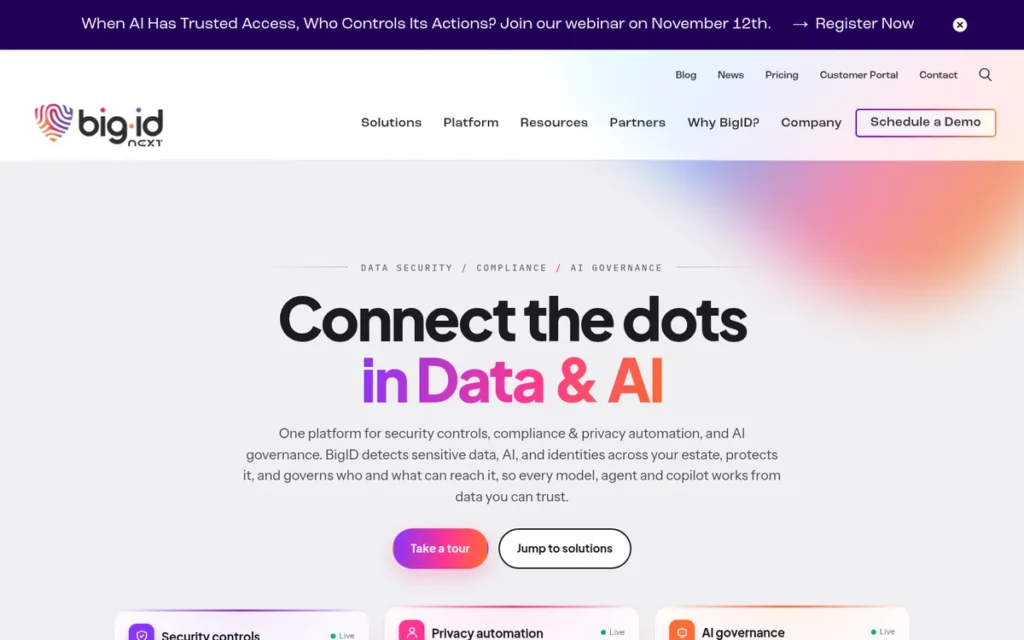
Category: Data Discovery and Unified Privacy Platform, scans, classifies, and governs personal data across structured and unstructured enterprise environments while automating DSAR fulfillment, Data Security Posture Management, and AI compliance in a single agentless no-copy system.
At a Glance
- Category: Data Discovery and Unified Privacy Platform
- Best For: Large enterprises and regulated-industry organizations: financial services, healthcare, government, requiring comprehensive sensitive data discovery, DSPM, and unified privacy plus AI governance with strict data residency requirements that preclude cloud-based data extraction
- Price Range: Custom enterprise quote only: no public pricing. Estimated $50,000–$500,000+ annually. Budget additionally for professional services; implementation is measured in months for complex environments. Last verified April 2026.
- Primary Strength: BigID is the only platform in this review with confirmed Leader recognition from two independent analyst firms in the same 12-month window (IDC MarketScape: Worldwide Data Privacy Compliance Software (November 2025) and Forrester Wave: Privacy Management Software (Q4 2025)) combined with an agentless no-copy architecture and a March 2026 Unified Privacy Management platform governing both personal data and AI systems end-to-end
- Biggest Limitation: BigID carries a steep learning curve and significant setup complexity (particularly when integrating with legacy systems) requiring dedicated data governance expertise and engineering resources that make it unsuitable for organizations without an established privacy function and technical implementation team
- One-Line Summary: BigID is the enterprise data privacy platform with the only confirmed same-year dual analyst recognition in this review, IDC MarketScape Leader (November 2025) and Forrester Wave Leader (Q4 2025), combining patented AI-powered discovery across 100+ languages with an agentless no-copy architecture for regulated-industry data residency compliance and a March 2026 unified platform governing both personal data and AI systems. (BigID separately reports Gartner MQ Challenger status for Data and Analytics Governance Platforms 2026, verify directly through Gartner, as this has not been independently confirmed beyond BigID’s own blog as of April 2026.)
- Last Verified: April 2026
Overview
BigID is an enterprise data discovery and unified privacy management platform designed for large organizations and regulated industries (including financial services, healthcare, and government) that require comprehensive classification of sensitive personal data across structured and unstructured sources, automated DSAR fulfillment, Data Security Posture Management, and AI governance within a single agentless no-copy architecture that processes all data inside the customer’s own environment.
BigID was named a Leader in the Forrester Wave: Privacy Management Software, Q4 2025 (achieving the highest scores in 19 evaluation criteria including personal data discovery, dynamic privacy risk assessments, and AI third-party risk evaluation) with above-average customer feedback confirmed in the independent assessment (Source: PR Newswire, Q4 2025; independently confirmed, April 2026).
BigID also holds IDC MarketScape Leader designation in the Worldwide Data Privacy Compliance Software report (November 2025), the same report that recognized OneTrust, Transcend, and DataGrail as Leaders. BigID’s additional Forrester Wave Leader designation in the same 12-month window provides the cross-firm differentiation supporting the #1 ranking in this review.
BigID’s March 2026 Unified Privacy Management launch introduced claimed first-in-category end-to-end governance of both personal data and AI systems in one platform, directly addressing EU AI Act data governance obligations and CPPA automated decision-making requirements active in 2026 (Source: PR Newswire, March 30, 2026).
Key Features
- Patented Identity-Aware AI (Hyperscan): BigID’s Hyperscan engine classifies sensitive personal data across 100+ languages using Named Entity Recognition, deep learning classifiers, and identity-aware AI that correlates direct and indirect personal identifiers to individuals across both structured and unstructured data stores, enabling accurate DSAR fulfillment without system-by-system manual lookup across siloed environments.
- Agentless No-Copy Architecture: BigID processes all data within the customer’s environment without backhauling personal data to BigID infrastructure, a critical compliance requirement for financial services, healthcare, and government organizations subject to data residency regulations where cloud-based data extraction would constitute a compliance violation (r/cybersecurity, 2025).
- Unified Privacy Management Platform (March 2026): BigID’s Unified Privacy Management launch governs both personal data and AI systems end-to-end in a single interface, covering AI Privacy Impact Assessments, AI model inventory, and enforcement controls for EU AI Act data governance requirements and CPPA automated decision-making obligations (Source: PR Newswire, March 30, 2026).
- Integrated Data Security Posture Management: BigID integrates DSPM directly with privacy compliance workflows, enabling CISOs and DPOs to manage data discovery, risk prioritization, breach notification, and regulatory compliance within a single platform rather than maintaining separate privacy and security tooling, addressing the tool-fragmentation pain point most commonly raised in CISO/DPO interviews.
- Data Minimization via Cluster Analysis: BigID’s cluster analysis capability identifies redundant, obsolete, and trivial data across the enterprise, automatically flagging data eligible for deletion to reduce attack surface, storage costs, and regulatory exposure from unnecessary personal data retention practices.
Best For
BigID is best for large enterprises and regulated-industry organizations (particularly in financial services, healthcare, and government) that have significant unstructured data volumes across hybrid cloud and on-premises environments, require data residency compliance that precludes cloud-based data extraction, and need a single platform bridging data discovery, DSPM, DSAR automation, and AI governance.
Organizations in financial services, healthcare, or government that have evaluated OneTrust and found its cloud-centric data discovery insufficient for their data residency requirements consistently identify BigID as the architecturally correct next step for environments where cloud-based data extraction would create regulatory violations.
Strengths
- BigID was named a Leader in the Forrester Wave: Privacy Management Software, Q4 2025 (achieving the highest scores in 19 evaluation criteria including personal data discovery, dynamic privacy risk assessments, and AI third-party risk evaluation) making BigID the only platform in this review with same-year dual analyst recognition from two independent firms (IDC November 2025 + Forrester Q4 2025) (Source: PR Newswire, Q4 2025; independently confirmed via Perplexity, April 2026).
- BigID holds IDC MarketScape Leader status in the Worldwide Data Privacy Compliance Software 2025 report alongside OneTrust, Transcend, and DataGrail, and the additional Forrester Wave Leader designation in the same 12-month window is the cross-firm validation that differentiates BigID at #1 in this ranking (Source: IDC MarketScape, November 2025).
- BigID’s agentless no-copy architecture processes data within the customer’s environment without external data transfer, an architectural requirement for financial services, healthcare, and government organizations operating under data residency regulations, confirmed by practitioner testimony in a professional community discussion (r/cybersecurity, 2025).
- Privacy practitioners in professional communities position BigID alongside OneTrust as one of only two platforms warranted for “complex, global enterprise needs”, an unprompted comparative community endorsement reflecting genuine hands-on recognition rather than vendor-driven ranking (r/fintech, February 2026).
Limitations
- Implementation Complexity: BigID’s most consequential trade-off is a steep learning curve and significant setup friction (particularly when integrating with legacy systems) requiring dedicated data governance expertise and engineering resources; one practitioner noted that evaluating BigID at terabyte scale raised the question of whether classification accuracy could even be verified: “essentially when you have terabytes of data who even can tell if the classification worked” (r/cybersecurity, 2025).
- Organizational Change Management Risk: BigID’s enterprise-wide data discovery creates challenges beyond platform capabilities, community testimony documents cases where discovery projects failed due to internal resistance from product teams whose data access would be restricted by classification policies (r/cybersecurity, 2025), a change management challenge requiring advance stakeholder alignment before initiating deployment.
- Limited Public Review Data: BigID has no confirmed G2 or Capterra overall rating score in this research cycle (April 2026), limiting direct review-platform comparison with platforms such as OneTrust that have confirmed public scores; buyers should consult G2 directly for current ratings before procurement decisions.
Users on r/cybersecurity shared their evaluation experience:
“We were actually using Varonis but found it outdated and not designed for cloud-native environments (which is a priority for us). That led us to evaluate BigID, Cyera, and Sentra. BigID has strong compliance features but felt overly complex to set up and manage, especially for scanning.” Posted by u/Such-Evening5746
Takeaway: BigID’s setup complexity and scanning management overhead represent a real implementation barrier for organizations without dedicated data governance resources, not just a minor onboarding inconvenience that resolves itself after initial configuration.
Verdict
BigID is the only data privacy management platform in this review with confirmed Leader recognition from two independent analyst firms in the same 12-month window (IDC MarketScape (November 2025) and Forrester Wave (Q4 2025)) combined with an agentless no-copy architecture that is the architecturally correct choice for regulated industries with data residency requirements precluding cloud-based data extraction. BigID is best suited for organizations with mature data governance programs, dedicated privacy and engineering resources, and complex multi-cloud or hybrid data environments where discovery depth and DSPM integration are non-negotiable requirements. Organizations without dedicated technical implementation resources should evaluate Transcend or DataGrail before committing to BigID’s deployment complexity and total cost of ownership.
2. OneTrust: Best for Broadest Regulatory Coverage and Enterprise-Scale Consent Management Across Multiple Jurisdictions
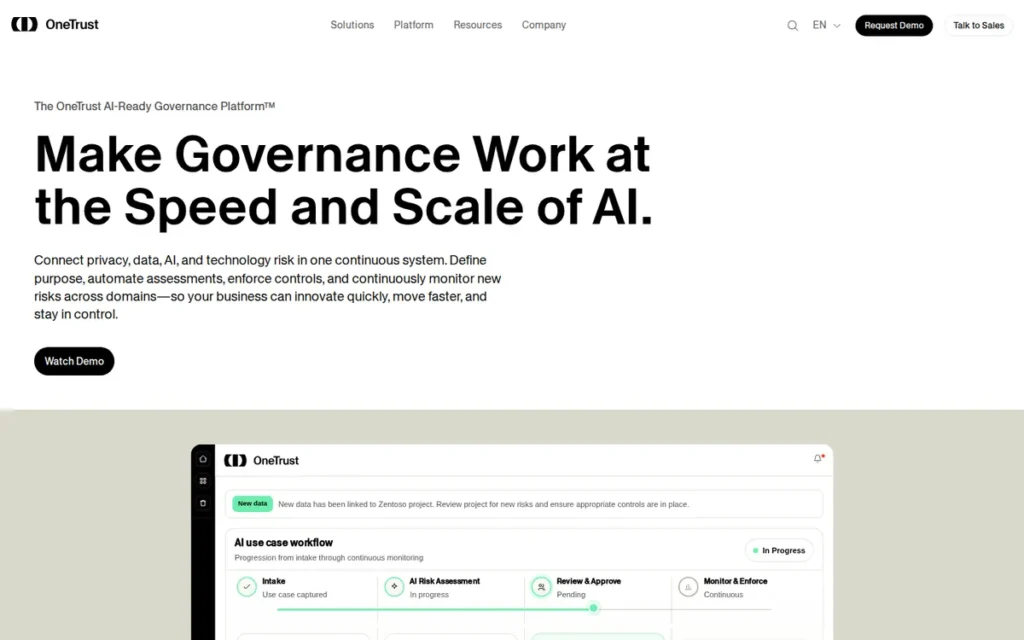
Category: Full-Suite Privacy and Governance Platform, end-to-end consent management, DSAR automation, data mapping, vendor risk, and cross-cloud AI governance for enterprise compliance programs spanning multiple jurisdictions.
At a Glance
- Category: Full-Suite Privacy and Governance Platform
- Best For: Large enterprises with dedicated privacy programs requiring the broadest cross-functional regulatory coverage (consent, DSARs, data mapping, vendor risk, and AI governance) across multiple overlapping jurisdictions simultaneously
- Price Range: Starts at approximately $10,000/year for mid-market entry; enterprise estimated $50,000–$500,000+ annually. No fixed public pricing tiers, all enterprise pricing requires direct sales quote. Last verified April 2026.
- Primary Strength: OneTrust holds confirmed dual-firm analyst recognition: IDC MarketScape Leader 2025 and KuppingerCole Data Governance Compass Market Leader 2024, combined with the broadest confirmed regulatory template library (300+ global regulations), the first cross-cloud AI agent detection spanning AWS Bedrock, Azure Foundry, and Google Vertex (Winter 2026), and the highest G2 peer-review evidence base in the category (284 reviews, 4.4/5.0, April 2026)
- Biggest Limitation: OneTrust’s implementation is among the most complex in the category (requiring months of configuration and dedicated internal privacy staff) and buyers face documented risks of aggressive renewal pricing (reported 10x quote increases) and reported PE acquisition discussions (single source, April 2026; verify directly with OneTrust) that introduce business continuity uncertainty for multi-year contracts
- One-Line Summary: OneTrust is the most widely deployed enterprise privacy platform in 2026, holding confirmed IDC MarketScape 2025 Leader and KuppingerCole 2024 Market Leader designations and offering 300+ regulatory templates with the first cross-cloud AI agent governance capability, but it requires dedicated privacy staff, multi-month implementation, and proactive renewal contract management to avoid documented pricing escalation
- Last Verified: April 2026
Overview
OneTrust is a modular, enterprise-grade privacy and data governance platform serving large organizations that require unified management of consent, DSAR workflows, data mapping, privacy impact assessments, vendor risk, and AI governance compliance across multiple global regulatory frameworks simultaneously.
OneTrust was confirmed as a Leader in the IDC MarketScape: Worldwide Data Privacy Compliance Software 2025 (Source: onetrust.com/news, confirmed via Perplexity, April 2026) alongside BigID, Transcend, and DataGrail in the same report, and was recognized as Market Leader in the 2024 KuppingerCole Data Governance Compass, receiving highest ratings across Security, Functionality, Deployment, Interoperability, and Usability.
OneTrust holds the highest confirmed G2 review volume in the privacy management category, 4.4/5.0 across 284 reviews as of April 2026 (Privacy Automation: 4.3/5.0 from approximately 152 reviews; Tech Risk and Compliance: 4.6/5.0 from approximately 109 reviews).
OneTrust’s Winter 2026 release introduced the first cross-cloud AI agent detection capability spanning AWS Bedrock, Azure Foundry, and Google Vertex, plus Data Policy Enforcement for Snowflake and Databricks, positioning OneTrust at the direct intersection of traditional privacy compliance and EU AI Act governance requirements active in 2026 (Source: OneTrust Winter 2026 release blog, January 2026).
Key Features
- DataGuidance Regulatory Intelligence: OneTrust’s DataGuidance module provides real-time regulatory intelligence across 300+ global regulations, enabling privacy teams to track the US state law patchwork (10+ states enacted since 2023), GDPR, LGPD, and emerging AI regulation without maintaining separate regulatory monitoring teams or outsourcing jurisdictional research.
- Cross-Cloud AI Agent Detection (Winter 2026): OneTrust’s Winter 2026 platform release introduced AI Inventory and Evidence Analysis, cross-cloud AI Agent Detection across AWS Bedrock, Azure Foundry, and Google Vertex, and a Data Policy Enforcement engine for Snowflake and Databricks, the first confirmed cross-cloud AI governance capability in the privacy management category (Source: OneTrust Winter 2026 release blog, January 2026).
- Multi-Jurisdictional Consent Management Platform: OneTrust’s Consent Management Platform automates consent lifecycle across GDPR, CCPA/CPRA, LGPD, and 300+ global regulations using pre-built regulatory templates, including support for Universal Opt-Out (GPC signal) mechanisms subject to CPPA enforcement following California’s first actions against Honda, Tractor Supply, and Todd Snyder in 2024–2025.
- DSAR Automation: OneTrust’s integrated DSAR module manages the full data subject rights request lifecycle (intake, verification, automated data retrieval, and audit-ready fulfillment documentation) though practitioners note that OneTrust encounters material limitations at very high DSAR volumes of 10,000–100,000+ requests annually (r/cipp, October 2025).
- Third-Party Risk Management: OneTrust’s Third-Party Risk Management module extends privacy governance to vendor and supplier ecosystems, enabling assessments of third-party privacy practices, contract compliance, and breach notification obligations within the same platform used for internal privacy management.
Best For
OneTrust is best for large enterprises with dedicated privacy programs (including full-time privacy team members, technical implementation resources, and a multi-year compliance investment horizon) that require the broadest possible cross-functional regulatory coverage in a single platform and whose scale of regulatory obligation justifies OneTrust’s implementation overhead and total cost of ownership.
Strengths
- OneTrust was confirmed as a Leader in the IDC MarketScape: Worldwide Data Privacy Compliance Software 2025 alongside BigID, Transcend, and DataGrail (and additionally holds Market Leader status in the 2024 KuppingerCole Data Governance Compass) giving OneTrust confirmed dual-firm analyst recognition across a two-year window, the broadest of any platform in this review aside from BigID (Source: onetrust.com/news, confirmed via Perplexity, April 2026).
- OneTrust holds the highest confirmed G2 review volume in the privacy management category, 4.4/5.0 across 284 reviews as of April 2026, providing the most statistically robust peer-review evidence base of any platform reviewed and the strongest community-sourced validation of real-world implementation depth.
- OneTrust’s Winter 2026 product release introduced cross-cloud AI Agent Detection across AWS Bedrock, Azure Foundry, and Google Vertex, plus Data Policy Enforcement for Snowflake and Databricks, documented as the first cross-cloud AI governance capability in the privacy management category, directly addressing EU AI Act enforcement and California ADMT compliance requirements active in 2026 (Source: OneTrust Winter 2026 release blog, January 2026).
- OneTrust’s DataGuidance regulatory library covers 300+ global regulations: enabling multi-jurisdictional enterprises to track 10+ US state comprehensive privacy laws enacted since 2023, GDPR, LGPD, and emerging AI-specific requirements without maintaining dedicated regulatory monitoring staff.
Limitations
- Implementation Overhead vs. Capability Breadth: OneTrust’s most consequential trade-off is the gap between its capability breadth and the operational overhead required to realize it, a privacy consultant described OneTrust as “often overkill for growing companies” requiring “months of setup and six-figure annual contracts,” while a web developer documented migration citing “needlessly complicated” configuration and near-zero post-sale contact after contract signing (r/fintech, February 2026; r/webdev).
- Renewal Pricing Risk: Multiple community sources document renewal pricing increases described as 10x quotes delivered days before contract expiration, practitioners recommend managing this risk through upfront multi-year pricing agreements with explicit renewal cap negotiation during initial contracting, not as an afterthought (r/cipp, October 2025).
- DSAR Volume Ceiling: A practitioner with experience running global privacy at two Fortune 500 companies explicitly notes that OneTrust “falls apart” at very high DSAR volumes of 10,000–100,000+ requests annually, a material limitation for enterprises expecting significant data rights request volumes that should be evaluated during the sales process (r/cipp, October 2025).
- Reported PE Acquisition Risk: Independent analysis sources (Captain Compliance, 2026) report active OneTrust PE acquisition discussions, this review could not independently confirm the status or terms of any such discussions through additional sources as of April 2026; buyers signing multi-year contracts should ask OneTrust directly and in writing about current ownership structure before committing.
Verdict
OneTrust is the most widely deployed enterprise privacy platform in 2026, offering the broadest confirmed regulatory template library and cross-functional capability suite of any platform reviewed, making it the defensible default for large enterprises with dedicated privacy teams and six-figure compliance budgets who need a single platform spanning consent, DSAR, data mapping, vendor risk, and AI governance. OneTrust’s advantages are real and validated through dual-firm analyst recognition and the category’s largest peer-review evidence base, but buyers must approach procurement with clear expectations about implementation complexity, post-sale support variability, and the documented pattern of aggressive renewal pricing requiring proactive contract management. Organizations without a dedicated privacy implementation team, operating at very high DSAR volumes, or uncertain about multi-year commitments during a potential ownership transition should evaluate BigID or Transcend before defaulting to OneTrust.
3. Transcend: Best for Engineering-Led Organizations Requiring Best-in-Class DSR Automation and Consent Enforcement at Scale
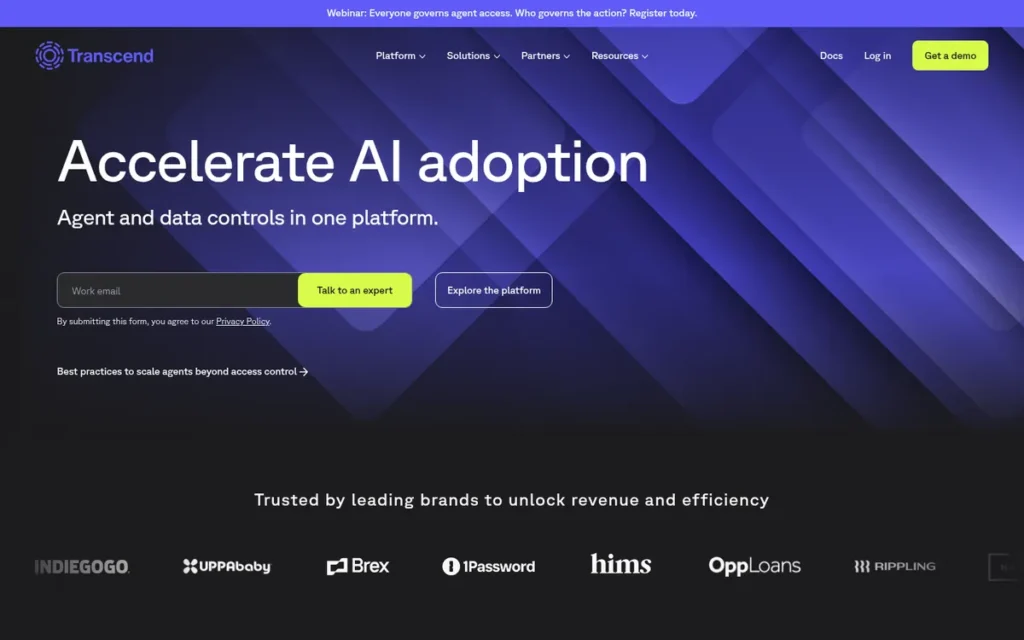
Category: Developer-Native Privacy Orchestrator, API-first platform for automated DSR fulfillment at the database level, real-time consent enforcement across SaaS ecosystems, and AI pipeline privacy governance for engineering-led organizations.
At a Glance
- Category: Developer-Native Privacy Orchestrator
- Best For: Mid-market to enterprise organizations with engineering-led privacy programs requiring best-in-class DSR automation at the database level, real-time consent enforcement across SaaS ecosystems, and AI pipeline governance, with internal engineering resources available for API implementation and database-level integration
- Price Range: Custom enterprise quote only: no public pricing. Community positions Transcend at $20,000–$100,000+ annually. Engineering implementation hours add to total cost of ownership beyond the platform license. Last verified April 2026.
- Primary Strength: Transcend is recognized as an IDC MarketScape Leader for Consent Management, DSR Automation, and Privacy Orchestration (2025) and has processed 14 billion+ data rights honored and 1 billion+ opt-outs enforced (the largest confirmed operational scale metric in this review) through its Sombra proxy architecture that fulfills DSRs at the database level
- Biggest Limitation: Transcend’s Sombra proxy architecture requires engineering team involvement for implementation and database-level integration (organizations without internal technical resources cannot unlock the platform’s core automation depth) and on-premises data environments have limited integration coverage requiring supplementary manual processes
- One-Line Summary: Transcend is the privacy orchestration platform with IDC MarketScape Leader recognition (2025) for consent management, DSR automation, and privacy orchestration, having processed 14 billion+ data rights and 1 billion+ opt-outs through a developer-native Sombra proxy architecture, the strongest independently validated choice for engineering-led organizations that prioritize automation depth and product velocity
- Last Verified: April 2026
Overview
Transcend is a developer-native privacy orchestration platform built API-first for mid-market and enterprise organizations that require best-in-class automation of Data Subject Request fulfillment, real-time consent enforcement across SaaS ecosystems, and AI pipeline privacy governance, designed for engineering teams that can integrate Transcend’s Sombra data proxy directly into data infrastructure at the database level.
Transcend was recognized as a Leader in the 2025 IDC MarketScape: Worldwide Data Privacy Compliance Software (the same report that recognized BigID, OneTrust, and DataGrail) with category-specific recognition for Consent Management, DSR Automation, and Privacy Orchestration most precisely matching Transcend’s product focus (Source: transcend.io/resources/idc-marketscape-2025).
Transcend has processed 14 billion+ data rights honored and 1 billion+ opt-outs enforced across its customer platform, the largest single confirmed operational scale metric of any vendor reviewed (Source: Transcend 2025 Data Rights Unwrapped blog). Transcend was also recognized in the Deloitte Technology Fast 500 for 2025, a vendor growth and stability signal (Source: BusinessWire, November 2025).
Transcend’s 2026 product evolution extends AI privacy governance to training data consent, agentic AI compliance, and privacy rule enforcement in AI-driven personalization, operationalizing EU AI Act obligations at the data pipeline level rather than treating them as documentation requirements.
Key Features
- Sombra Proxy Architecture: Transcend’s Sombra proxy sits between the privacy request workflow and actual data systems, enabling real-time data retrieval, deletion, and permissioning at the database level across Snowflake, Amazon Redshift, Azure, and Salesforce without extracting personal data to Transcend’s cloud infrastructure, producing more reliable automated DSR fulfillment than integration-layer alternatives that rely on periodic data pulls.
- Real-Time Consent Enforcement: Transcend’s consent and preference management system enforces permissions in real time across connected SaaS ecosystems, propagating consent signals and opt-outs across downstream data systems at the moment of collection rather than relying on periodic synchronization cycles that can create compliance windows between opt-out and enforcement.
- AI Pipeline Privacy Governance (2026): Transcend’s 2026 AI governance capabilities track consent for AI training data, automate privacy compliance assessments across AI use cases, and enforce privacy rules in AI-driven personalization experiences, directly addressing EU AI Act Article 10 data governance requirements and CPPA automated decision-making technology rules effective 2026–2027 (Source: Transcend website, 2026).
- Privacy-as-Code API Layer: Transcend’s developer-first API layer allows engineering teams to programmatically configure DSR workflows, consent enforcement logic, and data deletion policies as version-controlled code, enabling privacy rules to be deployed alongside product code rather than maintained as separate platform configurations disconnected from engineering workflows.
- Data Silo Discovery and Inventory: Transcend’s data silo discovery module continuously maps connected systems (identifying where personal data lives across the SaaS stack) to maintain current data inventories that support DSAR accuracy and regulatory audit readiness without manual refresh cycles that introduce staleness risk.
Best For
Transcend is best for mid-market and enterprise organizations with engineering-led privacy programs (particularly those in SaaS-heavy environments with meaningful DSAR volumes) that want to automate consent enforcement and DSR fulfillment at the database level through API integrations, and that have internal engineering resources to implement and maintain the Sombra proxy and API connections at the data infrastructure level.
Strengths
- Transcend was designated a Leader in the 2025 IDC MarketScape: Worldwide Data Privacy Compliance Software, with the specific category recognition for Consent Management, DSR Automation, and Privacy Orchestration aligning precisely with the highest-friction workflows in daily privacy management, validated by an independent analyst firm (Source: IDC MarketScape 2025, confirmed via transcend.io/resources/idc-marketscape-2025, April 2026).
- Transcend has processed 14 billion+ data rights honored and 1 billion+ opt-outs enforced in real time, the largest single quantified operational scale metric of any vendor in this review, indicating genuine at-scale production privacy processing rather than primarily compliance documentation tooling (Source: Transcend 2025 Data Rights Unwrapped blog).
- A GRC professional with direct comparative experience across OneTrust, DataGrail, and Transcend explicitly chose Transcend in an unprompted community post, citing “easier to maintain, more automation and tracking, and faster feature velocity”, the most specific and comparative community endorsement found for any platform in this review (r/dataengineering, 2024).
- Transcend’s 2026 AI governance module operationalizes EU AI Act compliance at the data pipeline level (tracking consent for AI training data and enforcing privacy rules in agentic AI systems) rather than treating AI governance as documentation-only; Transcend was also recognized in the Deloitte Technology Fast 500 for 2025, confirming organizational growth trajectory (Sources: Transcend website, 2026; BusinessWire, November 2025).
This aligns with community sentiment on r/fintech:
“For mid-market and growing companies, Osano and Transcend have carved out niches by focusing on faster implementation. Osano’s consent management is straightforward to deploy and their pricing scales more reasonably. Transcend focuses heavily on automated DSAR fulfillment with good integrations into common SaaS tools, which is where a lot of the operational burden actually lives.” Posted by u/whatwilly0ubuild
Takeaway: Transcend’s focus on DSAR automation for SaaS-heavy environments gives it a meaningful operational advantage over full-suite platforms for organizations where request fulfillment (not regulatory documentation breadth) is the primary daily compliance burden.
Limitations
- Engineering Dependency: Transcend’s most consequential trade-off is the engineering dependency that unlocks its automation depth, the Sombra proxy architecture and API-first design require meaningful engineering involvement to implement, configure, and maintain; practitioners confirm that Transcend “works well for engineering-led teams,” implying that compliance-led teams without technical staff find Transcend’s value proposition significantly reduced (r/gdpr).
- On-Premises Coverage Gap: Transcend’s strength is SaaS ecosystem integration, and organizations with significant on-premises legacy infrastructure will encounter gaps requiring supplementary manual processes or an entirely different platform, a material limitation for regulated industries including financial services and healthcare with legacy on-premises data environments.
- Limited Public Review Data: Transcend has no confirmed G2 or Capterra rating score available in this research cycle (April 2026), limiting direct review-platform comparison with OneTrust or TrustArc; buyers should check current ratings directly at G2 before procurement decisions.
Verdict
Transcend is the strongest choice for engineering-led organizations needing best-in-class DSR automation and consent enforcement, backed by IDC MarketScape Leader recognition (2025) in precisely the workflows where privacy operations teams create the most legal exposure, validated by the largest confirmed operational scale metric in this review at 14 billion+ data rights processed. Transcend’s engineering dependency is a real and material limitation for compliance-led teams without technical resources, but for organizations that can implement it, Transcend delivers automation depth and product velocity that independent practitioner testimony consistently rates above both OneTrust and DataGrail for SaaS-first environments.
4. TrustArc: Best for Organizations Requiring Deep Regulatory Intelligence and Expert-Curated AI Privacy Guidance
Category: AI-Powered Full-Suite Privacy Platform, unified consent, DSAR, assessments, and regulatory intelligence powered by 28 years of institutional expertise embedded in a proprietary knowledge base that does not train on user data.
At a Glance
- Category: AI-Powered Full-Suite Privacy Platform
- Best For: Enterprise and upper-mid-market organizations requiring deep regulatory intelligence across multiple jurisdictions, an AI privacy assistant grounded in expert-curated regulatory knowledge that does not train on confidential user inputs, and a full-suite platform somewhat easier to deploy than OneTrust
- Price Range: Custom enterprise quote only: no public pricing. Community positions TrustArc in a comparable range to OneTrust, estimated $50,000–$500,000+ annually for enterprise. Last verified April 2026.
- Primary Strength: TrustArc’s Arc Intelligence is built on the Nymity Research database (acquired by TrustArc in 2021 (independently confirmed) and reported to contain 50,000+ expert-written privacy references updated daily (vendor-reported figure, April 2026)) and explicitly does not train on user data, delivering privacy-specific regulatory guidance that generic AI tools cannot match
- Biggest Limitation: TrustArc’s customer support quality has been independently characterized by multiple practitioners as falling materially below expectations for an enterprise-priced platform, a recurring pattern in community discussions not publicly addressed by the vendor
- One-Line Summary: TrustArc is the data privacy management platform with the longest confirmed market history among the platforms reviewed (28 years, originating as TRUSTe (~1997)) and an AI platform, Arc Intelligence, grounded in the Nymity Research database (TrustArc’s 2021 acquisition) that explicitly does not train on user data
- Last Verified: April 2026
Overview
TrustArc is a full-suite privacy management platform for enterprise and upper-mid-market organizations, offering unified consent management, DSAR automation, privacy risk scoring, cookie compliance, and assessment workflows through its Arc platform (launched December 18, 2025) powered by Arc Intelligence, an AI layer built on the proprietary Nymity Research database acquired by TrustArc in 2021 (independently confirmed).
TrustArc originated as TRUSTe, one of the earliest privacy assurance programs on the internet (founded approximately 1997–1998), giving TrustArc 28 years of continuous regulatory expertise, the longest confirmed market track record of any vendor reviewed in this article.
TrustArc’s no-user-data-training design is a deliberate architectural choice addressing a critical enterprise concern: that AI-powered privacy tools may inadvertently expose confidential compliance data through training processes, a risk making generic LLM-based tools inappropriate for sensitive regulatory guidance.
TrustArc ranked #10 in G2’s data privacy management category (April 2026) and received a named customer testimonial from Dominika Partelova, Senior Counsel and Global Data Protection Officer at Edgewell, describing Arc as transforming “automation from a rigid process into something interactive and intuitive” (Source: TrustArc Arc press release, December 2025).
Key Features
- Arc Intelligence (Nymity Research Database): TrustArc’s Arc Intelligence is powered by the Nymity Research database (reported to contain 50,000+ expert-written privacy references updated daily (vendor-reported, April 2026; Nymity acquisition by TrustArc independently confirmed, 2021)) enabling Ask Arc queries via voice or file input that return cited, jurisdiction-specific regulatory guidance without the confidentiality risk of AI tools that train on customer inputs.
- Individual Rights Manager (DSAR Automation): TrustArc’s Individual Rights Manager automates DSAR intake, verification, workflow routing, and fulfillment documentation, providing audit-ready records for regulatory inquiries across GDPR Article 15–22 rights, CCPA/CPRA consumer rights, and equivalent frameworks in other jurisdictions.
- Assessment Manager (PIA/DPIA): TrustArc’s Assessment Manager provides automated privacy risk scoring for PIAs and DPIAs (with pre-built templates for common high-risk processing activities) enabling privacy teams to systematically evaluate new projects, vendors, and AI use cases against regulatory thresholds rather than conducting manual risk assessments for each evaluation.
- Cookie Consent Manager (Multi-Jurisdictional): TrustArc’s Cookie Consent Manager handles multi-jurisdictional cookie compliance across GDPR, ePrivacy Directive, and US state law requirements, with consent receipts, preference center configuration, and Google Consent Mode v2 support for organizations relying on consent mode for analytics and advertising measurement.
- PrivacyCentral Unified Workspace: TrustArc’s PrivacyCentral workspace consolidates consent management, DSAR automation, assessment workflows, and Arc Intelligence queries in a single interface, reducing the context-switching overhead that privacy teams face when managing multiple compliance workstreams simultaneously across different tool interfaces.
Best For
TrustArc is best for enterprise and upper-mid-market organizations that manage privacy obligations across many jurisdictions simultaneously, value regulatory intelligence depth over configuration breadth, require an AI privacy assistant demonstrably grounded in expert-curated legal knowledge rather than generic LLMs (one that will not use sensitive compliance inputs for AI training) and are seeking a full-suite alternative to OneTrust that practitioners describe as somewhat more approachable to deploy.
Strengths
- TrustArc’s Arc Intelligence is built on the Nymity Research database: acquired by TrustArc in 2021 (independently confirmed) and reported to contain 50,000+ expert-written privacy references updated daily (vendor-reported figure, April 2026), and explicitly does not train on user data, representing the only AI privacy assistant in this review with an architectural commitment preventing sensitive compliance information from being used in AI training processes (Source: TrustArc Arc platform press release, December 18, 2025).
- TrustArc’s 28-year continuous market history: originating as the TRUSTe privacy seal in approximately 1997–1998 through every regulatory wave from COPPA through GDPR to CCPA and now the EU AI Act, is the longest confirmed track record of any vendor reviewed in this article, providing regulatory expertise depth that no competitor with a more recent founding date can replicate through technology alone.
- TrustArc ranked #10 in G2’s data privacy management category (April 2026) with a named enterprise testimonial from Dominika Partelova, Global DPO at Edgewell, confirming real-world adoption by senior privacy professionals (Source: TrustArc Arc press release, December 2025).
- Practitioners characterize TrustArc as “similar in scope to OneTrust but generally considered slightly easier to implement”, a usability advantage for enterprise buyers who require full-platform capabilities but lack the dedicated technical resources required for OneTrust’s maximum-complexity deployment (r/fintech, February 2026).
Limitations
- Support Quality Gap: TrustArc’s most consequential trade-off is the documented gap between its enterprise pricing tier and its post-sale support quality, one practitioner explicitly stated TrustArc’s support is “sadly nowhere near as competent as they should be considering the price of the service,” additionally citing historically problematic Google Tag Manager integration as a recurring technical frustration; these are recurring themes in community discussions rather than isolated incidents (r/webdev).
- Google Tag Manager Integration History: TrustArc’s Google Tag Manager integration has been described as historically problematic by practitioners who have implemented multiple consent platforms, a specific integration failure point that compliance officers managing web analytics teams will find materially relevant when evaluating deployment risk for organizations relying on tag-based analytics (r/webdev).
- Limited Public Review Data: TrustArc has no confirmed G2 overall rating score (X.X out of 5.0 with review count) available in this research cycle (April 2026), limiting direct score-based comparison with platforms such as OneTrust; buyers should consult G2 directly for current ratings before procurement.
Verdict
TrustArc is the data privacy management platform with the deepest regulatory institutional knowledge in the category, built over 28 years and embedded in the Nymity Research database powering an AI assistant that explicitly refuses to train on customer data, a critical differentiator for privacy-sensitive enterprises needing regulatory guidance they can trust with confidential compliance information that generic LLM-based tools cannot safely handle. TrustArc is the strongest option for organizations managing overlapping global privacy obligations who value regulatory intelligence depth, require a full-suite platform, and find OneTrust’s implementation complexity prohibitive, but buyers must enter procurement with explicit expectations about support quality and should negotiate dedicated customer success resources as a contractual requirement rather than an assumption.
5. DataGrail: Best for SaaS-First Organizations with High DSAR Volume and Continuous Automated Data Mapping Needs
Category: SaaS-Native Privacy Data Map and DSR Platform, continuously detects and maps personal data across 5,400+ connected SaaS systems and automates DSAR fulfillment without manual data inventory refresh cycles.
At a Glance
- Category: SaaS-Native Privacy Data Map and DSR Platform
- Best For: Mid-market to enterprise organizations with SaaS-heavy technology stacks, meaningful DSAR volumes, and frequent addition of new cloud tools that would otherwise create stale data maps, particularly organizations migrating from OneTrust seeking faster deployment timelines
- Price Range: Custom enterprise quote only: no public pricing. Community positions DataGrail at $20,000–$100,000+ annually. Migration support up to $20,000 reportedly available for OneTrust customers, confirm during sales engagement and request in writing. Last verified April 2026.
- Primary Strength: DataGrail holds confirmed IDC MarketScape 2025 Leader status in the Worldwide Data Privacy Compliance Software report and operates the largest confirmed integration network in this review (5,451 continuously updated SaaS systems) providing automatically refreshed data maps without manual scan cycles
- Biggest Limitation: DataGrail’s Live Data Map coverage is materially limited for on-premises data environments, systems without SaaS integrations require special agreements and manual entry, meaning organizations with significant on-premises infrastructure will have meaningful automated data inventory gaps the platform’s standard capabilities cannot close
- One-Line Summary: DataGrail is an IDC MarketScape Leader (2025) and SaaS-native privacy management platform with the largest confirmed integration network in this review (5,451 continuously connected systems) providing automatically updated data maps and a Vera AI agent for privacy operations (vendor-reported GA February 2026; independently unverified as of April 2026)
- Last Verified: April 2026
Overview
DataGrail is a SaaS-native privacy management platform for mid-market and enterprise organizations whose personal data flows primarily through modern cloud and SaaS tools, offering a continuously updated Live Data Map covering 5,451 integrated systems (confirmed, December 2025), automated DSAR fulfillment across connected platforms, and Vera, an AI agent for privacy operations announced as Generally Available in February 2026 per DataGrail’s product blog (vendor-reported; independently unverified as of April 2026).
DataGrail was named a Leader in the IDC MarketScape: Worldwide Data Privacy Compliance Software 2025 (the same report that recognized BigID, OneTrust, and Transcend) confirming DataGrail’s standing in independent analyst evaluation alongside the other top-ranked platforms in this review (Source: datagrail.io/resources/reports/idc-marketscape-2025/, confirmed via Perplexity, April 2026).
DataGrail’s 2026 product vision centers on proactive AI risk management, automatically detecting unapproved AI tool usage, vendor compliance gaps, and data residency violations through a Risk Register built on its integration layer, shifting the privacy program from reactive compliance documentation toward proactive risk identification (Source: DataGrail 2026 Product Vision blog).
Key Features
- Live Data Map (5,451 Systems): DataGrail’s Live Data Map covers 5,451 integrated systems (the largest confirmed integration network in the privacy management category as of December 2025) continuously detecting new SaaS tools through AI-detected metadata signals including sensitive data classification, AI usage indicators, risk scoring, and automated RoPA generation without requiring manual scan cycles.
- Vera AI Agent (Vendor-Reported GA February 2026): DataGrail’s Vera AI agent: announced as Generally Available in February 2026 per DataGrail’s product blog (vendor-reported; independently unverified as of April 2026), provides context-aware privacy operational guidance and automated risk prioritization through the Risk Register; buyers should confirm current Vera availability and capability scope directly with DataGrail during evaluation before factoring Vera into their decision.
- DSAR Automation with ServiceNow + Salesforce B2C: DataGrail’s DSAR automation includes a configurable Privacy Request Center with multi-channel intake, global search across all connected systems, ServiceNow and Salesforce B2C integrations, and a Request Manager Agent, enabling automated personal data retrieval and deletion across the SaaS stack rather than routing requests through manual system-by-system processes.
- AI Risk Register: DataGrail’s Risk Register automatically detects and prioritizes privacy risks including unapproved AI tool usage across the connected SaaS environment, vendor compliance gaps, and data residency violations, directly relevant to EU AI Act Article 9 risk management obligations and CPPA automated decision-making requirements active in 2026 (Source: DataGrail 2026 Product Vision blog).
- Sub-3-Second Data Map Loading: DataGrail’s Live Data Map loads large inventories in under 3 seconds, a performance specification material for privacy teams querying data inventories frequently during DSAR responses or regulatory audit preparation where latency creates operational bottlenecks in time-sensitive compliance workflows (Source: DataGrail product blog).
Best For
DataGrail is best for mid-market and enterprise organizations whose data environment is predominantly SaaS-based (companies with 50 to 500+ connected cloud tools across marketing, sales, HR, and engineering stacks) that need a continuously updated data map that will not go stale as new tools are adopted, handle meaningful DSAR volumes with automated cross-system data retrieval, and want proactive AI risk monitoring to detect unapproved tool usage before regulatory exposure materializes.
Strengths
- DataGrail was named a Leader in the IDC MarketScape: Worldwide Data Privacy Compliance Software 2025 (the same report that recognized BigID, OneTrust, and Transcend) providing confirmed independent analyst validation alongside the top-ranked platforms in this review (Source: datagrail.io/resources/reports/idc-marketscape-2025/, confirmed via Perplexity, April 2026).
- DataGrail’s Live Data Map covers 5,451 integrated systems: the largest confirmed integration network in the privacy management category as of December 2025, with continuously updated AI-detected metadata including sensitive data signals, AI usage indicators, and automated RoPA generation, eliminating the manual scan cycles that consistently produce stale data inventories across competing platforms (Source: DataGrail December 2025 product update blog).
- A GRC professional with direct comparative experience across DataGrail, OneTrust, and Transcend described DataGrail as a serious platform warranting evaluation alongside OneTrust for DSAR automation, an unprompted practitioner validation reflecting genuine market standing in the enterprise privacy tier (r/dataengineering, 2024).
- DataGrail’s Risk Register automatically detects unapproved AI tool usage across the connected SaaS environment, a proactive governance capability directly relevant to EU AI Act Article 9 risk management obligations and CPPA automated decision-making technology rules active in 2026 (Source: DataGrail 2026 Product Vision blog).
Users on r/fintech noted:
“Osano is fast for cookie+basic DSR; TrustArc is strong on assessments and RoPA. If you need deeper connectors and API-first workflows, Transcend or DataGrail have worked better for us. We ran Tealium for consent and DataGrail for DSR, and DreamFactory exposed internal DBs and S3 as RBAC’d APIs so DSR jobs could query and write audit logs.” Posted by u/smarkman19
Takeaway: Practitioners deploying DataGrail in production stack environments consistently validate its API-first DSAR architecture as the right choice for organizations that need deep database-level connectivity across their full SaaS ecosystem, not just surface-level consent banner management.
Limitations
- On-Premises Coverage Gap: DataGrail’s most consequential trade-off is its SaaS-first architecture, the Live Data Map’s continuous detection applies to connected SaaS integrations, and organizations with significant on-premises infrastructure encounter material coverage gaps requiring special agreements for on-premises data discovery and manual entry for isolated legacy systems; the staleness risk simply shifts from SaaS to on-premises environments for hybrid-infrastructure organizations (Source: DataGrail documentation, docs.datagrail.io).
- Vera AI Agent Verification Gap: DataGrail’s Vera AI agent was announced as Generally Available in February 2026 per DataGrail’s product blog, but this could not be independently verified in this research cycle (April 2026); buyers should confirm current Vera availability, feature scope, and integration requirements directly with DataGrail during demo before factoring Vera into their evaluation decision or budget planning.
- Thin Public Company Profile: DataGrail’s company profile lacks publiclyverifiable organizational details (founding date, total funding raised, CEO identity, and headquarters location were all unconfirmed in this research cycle (April 2026)) which limits the vendor stability assessment that organizations should conduct during procurement and warrants direct due diligence questions during the sales process.
Verdict
DataGrail is the strongest choice for SaaS-first organizations with meaningful DSAR volumes needing a continuously maintained data map without manual scan cycles, the 5,451-system integration network is a genuine competitive moat in modern cloud-native data environments, now backed by confirmed IDC MarketScape 2025 Leader status. DataGrail’s significant limitation is on-premises infrastructure coverage, organizations in regulated industries with legacy on-premises data environments should evaluate BigID before DataGrail, and the thin public company profile warrants additional vendor stability due diligence during the procurement process.
6. Osano: Best for Cost-Conscious and Multi-Domain Organizations Seeking Full-Featured Privacy Management with Vendor Risk Monitoring
Category: All-in-One Consent and Vendor Risk Platform, unified consent management, DSAR automation, data discovery, automated website compliance scanning, and continuous monitoring of third-party vendor privacy practices in a single B Corp-certified platform.
At a Glance
- Category: All-in-One Consent and Vendor Risk Platform
- Best For: Growth-stage and mid-market organizations managing privacy compliance across multiple domains who want full-featured platform capabilities (including the most comprehensive automated vendor privacy monitoring among the platforms reviewed) at the most accessible confirmed entry price point, backed by a unique $500,000 penalty guarantee
- Price Range: Starts at approximately $199/month (~$2,400/year) for standard plans, confirmed from community sources (April 2026). Enterprise custom pricing not publicly disclosed. Traffic-based billing advantages multi-domain organizations over per-domain pricing models. Last verified April 2026.
- Primary Strength: Osano offers the only $500,000 No Fines, No Penalties regulatory penalty guarantee among the seven platforms reviewed (available to Start, Trust, or Scale plan customers who fully implement the platform per documentation, raised from an original $200,000 cap) combined with the only confirmed public entry pricing in the category (~$2,400/yr) and a vendor monitoring database covering 11,000+ vendors (vendor-reported, April 2026)
- Biggest Limitation: Osano’s integration compatibility with data reporting and analytics tools is limited (multiple community sources identify friction connecting Osano to common analytics and data reporting stacks) and experienced implementers describe the platform as “not the easiest to set up” despite its mid-market positioning
- One-Line Summary: Osano is the only data privacy management platform among the seven reviewed offering a $500,000 No Fines, No Penalties regulatory penalty guarantee (qualifying plan customers), B Corp certification, and confirmed entry pricing starting around $2,400 per year with traffic-based billing that advantages multi-domain organizations over competitors charging per domain
- Last Verified: April 2026
Overview
Osano is an all-in-one data privacy management platform for growth-stage and mid-market organizations (scalable to enterprise) that bundles consent management, DSAR automation, data discovery, automated website compliance scanning, and continuous vendor privacy monitoring in a single platform with the most accessible confirmed entry pricing in this review.
Osano is distinguished by two genuinely unique market differentiators not available from any other platform reviewed: a $500,000 No Fines, No Penalties guarantee that transfers regulatory penalty risk to Osano for qualifying plan customers implementing the platform correctly, and its position as the only platform in this review with any confirmed public pricing transparency.
Osano’s penalty guarantee was originally introduced at a $200,000 cap and raised to $500,000, a trajectory suggesting growing vendor confidence in the platform’s compliance effectiveness rather than a static marketing commitment (Source: Osano PR and terms history, confirmed via Perplexity, April 2026). Osano is B Corp certified, independently verified for social and environmental performance standards, supporting compliance across 50+ countries.
Key Features
- Vendor Privacy Monitoring (11,000+ Vendors: Vendor-Reported): Osano’s Vendor Privacy Management module continuously monitors third-party vendors across privacy criteria, Osano reports 11,000+ vendors and 163 criteria (vendor-reported figures; independently unverified as of April 2026); buyers should request a live demonstration of vendor coverage for their specific third-party ecosystem before signing to confirm the monitoring database includes vendors material to their program.
- $500,000 No Fines, No Penalties Guarantee: Osano’s penalty guarantee commits to covering up to $500,000 in regulatory penalties for customers on Start, Trust, or Scale plans who receive a fine while correctly implementing the platform per documentation (raised from an original $200,000 cap, signaling growing vendor confidence) a risk transfer mechanism uniquely available in this review (Source: Osano pledge page, confirmed via Perplexity, April 2026).
- Traffic-Based Billing Model: Osano’s billing charges based on aggregate website traffic across all domains rather than per-domain fees, a pricing structure that materially advantages organizations managing three or more websites, with practitioner testimony documenting significant cost savings over per-domain competitors when managing multi-property digital portfolios (r/webdev, 2024).
- Automated Privacy Monitoring: Osano’s automated Privacy Monitoring module continuously scans websites for compliance gaps (identifying unauthorized cookies, outdated consent configurations, and new tracking technologies added without privacy review) providing ongoing compliance assurance without manual audit cycles that would otherwise require dedicated staff time.
- DSAR Automation with Audit Logs: Osano’s DSAR Automation module manages the full data subject rights request lifecycle with audit logs, automated deletion workflow orchestration, and configurable intake forms, supporting GDPR Article 15–22 rights, CCPA/CPRA consumer rights, and equivalent frameworks across 50+ countries (Source: Osano website, April 2026).
Best For
Osano is best for growth-stage companies and mid-market organizations managing privacy compliance across multiple websites or domains, prioritizing platform accessibility (lowest confirmed entry price in this review), unique regulatory risk transfer through the penalty guarantee, and comprehensive continuous third-party vendor privacy monitoring, and willing to invest in initial setup complexity in exchange for a fully integrated platform that avoids per-domain fee structures.
Strengths
- Osano is the only data privacy management platform in this review offering a $500,000 No Fines, No Penalties regulatory penalty guarantee for qualifying customers on Start, Trust, or Scale plans (raised from an original $200,000 cap, indicating growing vendor confidence) a risk transfer mechanism available from no other platform reviewed, applicable to board-level justification for privacy program investment (Source: Osano pledge page; Perplexity, April 2026).
- Osano’s traffic-based billing model advantages organizations managing three or more domains: a practitioner documented that adding two additional websites under a single consent framework was significantly more cost-effective under Osano’s traffic-based model than OneTrust’s per-domain pricing, citing this as the primary driver for platform migration (r/webdev, 2024).
- Osano’s B Corp certification provides independently verified confirmation of social and environmental performance standards, a procurement-relevant signal for organizations with ESG reporting requirements or purpose-driven procurement policies, representing organizational accountability verified by a third party rather than self-declared (Osano website, April 2026).
- Osano is the only platform in this review with confirmed partial public pricing transparency (entry-level standard plans confirmed at approximately $199/month (~$2,400/year) from community sources (r/webdev, April 2026)) making Osano the only starting point for budget planning that does not require a sales engagement first.
Limitations
- Analytics Integration Gaps: Osano’s most consequential trade-off is limited integration compatibility, multiple independent sources identify that Osano “doesn’t comply with a lot of integrations with other data reporting tools” (Source: ConsentStack comparison, April 2026), creating operational friction for marketing and analytics teams who rely on privacy-compliant data flows across their reporting and measurement stack.
- Setup Complexity vs. Mid-Market Positioning: Practitioners with direct multi-platform implementation experience describe Osano as “quite nice, but not the easiest to set up”, and a user who migrated from OneTrust confirmed the solution is “significantly better” but noted the company “didn’t follow through on a lot of things discussed during the sales process” (r/webdev, 2024), a gap between sales promises and implementation support that mirrors the broader category pattern.
Users on r/webdev shared their migration experience:
“we used OneTrust for a year, but it felt like they just were a sales team and after we were clients we had nearly zero contact. the platform was needlessly complicated as well. They used it like a selling point, complete customizability, but really it seemed more like an unfinished product.
We switched to Osano, and that has been significantly better, but still not much contact post sale. There’s basic onboarding calls, but they didn’t follow through on a lot of the things we talked about in the sales process, but the solution works” Posted by u/jdbrew
Takeaway: Osano resolves OneTrust’s implementation complexity and multi-domain pricing problems for growing organizations, but its post-sale follow-through gap mirrors the broader enterprise privacy platform category pattern of pre-sale attention not carrying over to post-contract support.
- Vendor Monitoring Database Verification: Osano’s 11,000+ vendor monitoring database figure is vendor-stated and could not be independently verified in this research cycle (April 2026); buyers should request a live demonstration of vendor coverage for their specific third-party ecosystem before signing to confirm the monitoring database includes the vendors material to their privacy program.
Verdict
Osano is the strongest choice for cost-conscious growth-stage and mid-market organizations needing a genuinely full-featured privacy management platform, not just a consent banner, with the added regulatory risk protection of the $500,000 penalty guarantee (raised from an original $200K cap, signaling vendor confidence) and the most comprehensive automated vendor privacy monitoring among the platforms reviewed. Osano’s traffic-based billing delivers real multi-domain cost savings, and the confirmed entry pricing at approximately $2,400/year makes it the most accessible starting point for organizations building their first integrated privacy program. The platform’s limitations, analytics integration gaps, non-trivial setup complexity despite mid-market positioning, and a vendor monitoring database size requiring direct verification, should be evaluated honestly alongside explicit integration documentation for the organization’s existing analytics stack during the sales process.
7. Securiti: Best for Hybrid Multicloud Enterprises Requiring Unified Privacy, Security, and AI Governance, With Post-Acquisition Due Diligence Required
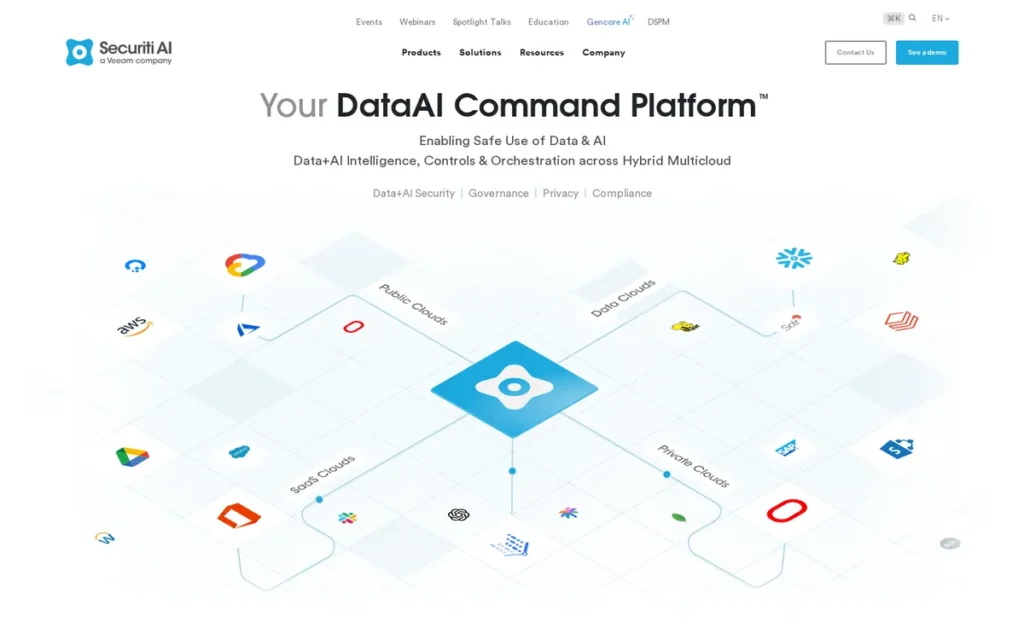
Category: Unified PrivacyOps and Data Command Platform, AI-powered platform combining privacy compliance, data security, and governance in a unified control layer across hybrid multicloud environments; Veeam Software acquired Securiti for $1.725 billion on December 11, 2025.
At a Glance
- Category: Unified PrivacyOps and Data Command Platform
- Best For: Enterprise organizations in hybrid multicloud environments seeking to unify privacy compliance, data security, and AI governance in a single platform, and who can verify current Veeam-era product roadmap commitments for PrivacyOps capabilities before committing to a multi-year contract
- Price Range: Custom enterprise quote only: no pricing data confirmed from any independent source as of April 2026. Given Securiti’s enterprise positioning, pricing is likely comparable to OneTrust enterprise tier ($50,000–$500,000+ annually) but cannot be confirmed without direct sales engagement. Last verified April 2026.
- Primary Strength: Securiti’s Data Command Center provides a unified control layer for security, privacy, governance, and AI compliance across hybrid multicloud environments (combining capabilities that competing platforms typically require separate products to address) through its PrivacyOps framework; prior to Veeam’s December 2025 acquisition, Securiti held recognized rankings from both Forrester and IDC for AI-driven data discovery, privacy, and security capabilities
- Biggest Limitation: Veeam Software’s $1.725 billion acquisition of Securiti (December 11, 2025) introduces material uncertainty about how Veeam’s strategic priorities (centered on data protection and backup/recovery) will affect Securiti’s PrivacyOps roadmap, support staffing, and privacy-specific product investment; no current post-acquisition independent analyst evaluation has been confirmed as of April 2026
- One-Line Summary: Securiti’s Data Command Center unifies privacy, security, and AI governance for hybrid multicloud environments through its PrivacyOps framework, Veeam Software acquired Securiti for $1.725 billion on December 11, 2025; Securiti held pre-acquisition Forrester and IDC recognition; buyers should verify post-acquisition roadmap alignment with their specific privacy compliance needs before signing
- Last Verified: April 2026
Overview
Securiti is an enterprise privacy and data security convergence platform that positions its Data Command Center as a unified control layer for privacy compliance, data security, governance, and AI risk management across hybrid multicloud environments, built on its PrivacyOps philosophy of AI-powered robotic automation processing all major privacy workflows simultaneously.
Veeam Software acquired Securiti for $1.725 billion, with the merger closing December 11, 2025, Veeam’s largest acquisition to date (Source: Mayfield Fund press release; Securiti/Veeam Q&A, confirmed via Perplexity, April 2026). Prior to the acquisition, Securiti had raised $156 million in funding and reported $75.9 million in revenue by October 2024 (Source: Forge Global, confirmed via Perplexity, April 2026).
Prior to Veeam’s acquisition, Securiti held recognized rankings from both Forrester and IDC for AI-driven data discovery, privacy, and security capabilities (Source: independent reporting, confirmed via Perplexity, April 2026). The central procurement question in 2026 is whether those pre-acquisition capabilities and investments continue as primary priorities under Veeam’s ownership.
Following the acquisition, Securiti and Veeam jointly launched Agent Commander (described as the first integrated solution for scaling safe AI agents) which may create unique value for organizations already using Veeam for backup and recovery (Source: securiti.ai, April 2026).
Key Features
- Data Command Center: Securiti’s Data Command Center provides a unified control layer across security, privacy, governance, and compliance for hybrid multicloud environments (integrating capabilities that competing platforms typically deliver through separate products) targeting the converged organizational structure where CISOs and DPOs share responsibility for both cybersecurity and privacy regulatory obligations (Source: Securiti website, April 2026).
- PrivacyOps Framework: Securiti’s PrivacyOps framework automates privacy compliance workflows through AI-powered robotic automation, covering consent lifecycle management, DSAR fulfillment orchestration, sensitive data discovery across structured and unstructured sources, breach notification workflows, and third-party risk assessment simultaneously rather than requiring sequential module configuration.
- AI-Powered Sensitive Data Discovery: Securiti’s sensitive data discovery uses AI to automatically scan data stores across hybrid multicloud environments and update privacy notices in real time when new personal data processing activities are detected, addressing the unstructured data discovery gap that practitioners consistently identify as one of the most common privacy program implementation failures.
- AI Pipeline Governance: Securiti’s AI pipeline governance capabilities classify and monitor personal data flowing through AI systems (including training data sets, AI model outputs, and AI-driven processing activities) positioning the platform for organizations managing EU AI Act Article 10 data governance obligations and CPPA automated decision-making rules effective 2026–2027.
- Agent Commander (Joint Securiti-Veeam Product): Securiti and Veeam jointly launched Agent Commander post-acquisition (described as the first integrated solution enabling safe AI agents at scale) creating potential unique value for organizations already using Veeam’s data protection and backup/recovery infrastructure who want to extend governance to AI agent workflows (Source: securiti.ai, April 2026).
Best For
Securiti is best for large enterprises managing converged privacy and security obligations across hybrid multicloud environments (particularly those already within the Veeam ecosystem or those building AI products alongside traditional privacy compliance) that need a single platform replacing separate privacy, DSPM, and AI risk tools, and that can invest in independent due diligence to verify Securiti’s post-acquisition roadmap commitments before signing multi-year contracts.
Strengths
- Securiti’s Data Command Center provides a unified control layer for security, privacy, governance, and AI compliance across hybrid multicloud environments, an architectural approach combining capabilities competing platforms deliver through separate products, directly addressing the tool fragmentation pain point most commonly raised by CISOs and DPOs managing converged regulatory obligations (Source: Securiti website; PrivacyOps platform documentation, April 2026).
- Prior to Veeam’s December 2025 acquisition, Securiti held recognized rankings from both Forrester and IDC for AI-driven data discovery, privacy, and security capabilities, providing a pre-acquisition analyst validation baseline that buyers should verify is reflected in current post-acquisition Securiti documentation before procurement (Source: independent reporting, confirmed via Perplexity, April 2026).
- Securiti was the first unprompted recommendation in a practitioner forum thread asking which privacy platforms enterprises rely on for compliance (r/fintech, February 2026), suggesting genuine hands-on familiarity; Securiti’s $156 million in pre-acquisition funding and $75.9 million in revenue by October 2024 indicate organizational scale and market investment prior to the Veeam acquisition (Source: Forge Global, confirmed via Perplexity, April 2026).
- Securiti’s Agent Commander: jointly developed with Veeam post-acquisition, positions Securiti uniquely for organizations managing AI agent governance alongside traditional privacy compliance, particularly those already using Veeam’s data protection infrastructure who can realize convergence value from a single vendor relationship (Source: securiti.ai, April 2026).
Limitations
- Post-Acquisition Product Roadmap Uncertainty: Securiti’s most consequential limitation in 2026 is uncertainty about how Veeam’s strategic priorities (centered on data protection and backup/recovery) will affect Securiti’s PrivacyOps roadmap, support staffing levels, and privacy-specific product investment following the December 11, 2025 acquisition at $1.725 billion; buyers should request written roadmap and support SLA commitments from Veeam/Securiti before signing any multi-year contracts.
- Absence of Current Post-Acquisition Analyst Evaluation: While Securiti held Forrester and IDC rankings prior to the Veeam acquisition, this research cycle (April 2026) could not confirm a current, post-acquisition independent analyst evaluation of the Securiti platform under Veeam ownership, buyers should request current analyst report documentation directly from Securiti/Veeam during the sales process to verify whether pre-acquisition evaluations remain current.
- Pricing and Roadmap Opacity: No pricing data from any independent source was confirmed for Securiti in this research cycle (April 2026), and the post-acquisition product roadmap has not been publicly disclosed with specific privacy feature investment commitments, creating procurement planning challenges that direct sales engagement alone may not fully resolve without requesting written documentation.
Verdict
Securiti’s Data Command Center architecture represents a genuinely compelling approach for enterprises needing to converge privacy compliance, data security, and AI governance in a single platform across hybrid multicloud environments, and Securiti’s pre-acquisition Forrester and IDC recognition confirms the platform’s historical standing in independent analyst evaluations. Securiti is placed seventh in this ranking as a direct consequence of the post-acquisition uncertainty introduced by Veeam’s December 2025 acquisition: the absence of a current post-acquisition analyst evaluation, entirely unavailable pricing data, and unresolved questions about PrivacyOps roadmap alignment with Veeam’s data protection focus create material procurement justification gaps. Organizations that conduct additional due diligence, verified reference calls with post-acquisition customers, direct requests for roadmap commitments from Veeam/Securiti, and written support SLA terms, may find Securiti the right architectural fit for their specific hybrid multicloud environment.
What Red Flags Should I Watch For When Evaluating Data Privacy Management Platforms?
Five red flags identify vendor-inflated privacy platform rankings and post-signature regret: analyst citations tracing only to vendor blogs (Risk Cognizance appears #1 in AI-generated rankings with all supporting citations from its own website); no deployment timeline provided during sales discovery; per-domain pricing quoted without traffic-based comparison; post-sale support SLAs absent from contract terms; and undisclosed ownership structure changes, OneTrust has reported PE discussions (single source); Securiti was acquired by Veeam for $1.725 billion in December 2025.
Red Flag #1: All Analyst Citations Trace to Vendor-Published Content
The most acute example in 2026 is Risk Cognizance, which appears as the #1 data privacy management platform in multiple AI-generated rankings. Every supporting citation for Risk Cognizance traces back to the riskcognizance.com vendor blog, with no confirmed presence in IDC, Gartner, Forrester, or KuppingerCole reports and no documented community presence in r/cipp, r/gdpr, r/fintech, r/dataengineering, or r/webdev. Ask any vendor for the specific report name, designation level (Leader, Challenger, Major Player), year, and category, not a generic “recognized by IDC” claim. If a vendor cannot provide a hyperlink to an independently published analyst report, treat the recognition as unconfirmed.
Red Flag #2: No Deployment Timeline Provided During Sales Discovery
Across all platforms in this review, implementation complexity is the most common source of post-sale buyer regret, and the most consistently understated factor during the sales process. If a vendor cannot provide a realistic deployment timeline with milestone definitions, internal resource requirements, and professional services estimates for your specific infrastructure type, treat the gap as a signal of either underdeveloped implementation methodology or deliberate ambiguity. A realistic enterprise implementation runs months, not days or weeks.
Red Flag #3: Pricing Quoted Per Domain Without Traffic-Based Alternative Evaluation
For organizations managing three or more websites, per-domain pricing models can dramatically inflate total cost of ownership compared to traffic-based alternatives. Practitioners have documented switching from OneTrust to Osano specifically to avoid per-domain fees for additional properties (r/webdev, 2024). Always ask: “Is your pricing per domain, per traffic volume, or per user?” and model your full property portfolio against each pricing structure before assuming any vendor’s model is cost-optimal for your situation.
Red Flag #4: Post-Sale Support SLAs Not Specified as Contract Terms
A recurring pattern across multiple platforms in this review (documented independently for OneTrust, TrustArc, and Osano) is post-sale support quality that declines materially relative to pre-sale experience. Practitioners consistently document that sales teams become unreachable after contracts are signed. Negotiate dedicated customer success resources, named escalation contacts, and response time SLAs as contract terms during initial procurement. If a vendor declines to include support SLAs in the contract, treat this as a high-risk signal.
Red Flag #5: Ownership Structure Not Disclosed or Recently Changed Without Explanation
OneTrust’s reported PE acquisition discussions (Captain Compliance, 2026, single source, not independently confirmed) and Securiti’s confirmed Veeam acquisition ($1.725 billion, December 11, 2025) are the most material vendor stability risks identified in this review cycle. For any platform under consideration, ask directly in writing: “Has your ownership structure changed in the last 12 months, and is any ownership change pending?” A vendor that declines to answer in writing before contract signing should be treated as a business continuity risk for multi-year commitments.
What Questions Should I Ask Before Choosing a Data Privacy Management Platform?
Ask every data privacy management vendor these six questions before signing: (1) What is your current ownership structure and has it changed in the past 12 months? (2) What on-premises data discovery coverage do you provide, and which gaps require manual processes? (3) How many customers migrated from your primary competitor and what were their documented reasons? (4) What are your multi-year pricing terms, renewal caps, and price escalation limits? (5) Which specific EU AI Act capabilities are released, in which product version, and what is your ADMT compliance roadmap? (6) What professional services costs should we budget beyond the platform license?
Question #1: What is your current ownership structure, and has it changed in the past 12 months?
Ask for a direct written answer about current ownership, any pending transactions, and how an ownership change would affect contract terms, pricing commitments, and support staffing. Both OneTrust (reported PE acquisition discussions, 2026) and Securiti (Veeam acquisition confirmed $1.725 billion, December 11, 2025) illustrate why this question is material for any multi-year contract commitment in the current market. Get the answer in writing before signing.
Question #2: What is your on-premises data discovery coverage, and which infrastructure types require special agreements or manual processes?
DataGrail and Transcend have confirmed on-premises coverage limitations requiring special agreements or manual entry, gaps material for financial services, healthcare, and government organizations with legacy infrastructure. Ask vendors specifically what percentage of your data environment their platform discovers automatically, and request documentation of requirements for each coverage gap before evaluating whether the platform meets your needs.
Question #3: How many customers have migrated from your primary competitor to your platform, and what were their documented primary reasons?
DataGrail’s claim that over 60% of its customers migrated from OneTrust is a vendor-attributed figure (r/cipp, October 2025). Asking for independently contactable references who migrated from your current vendor is the most reliable way to validate any migration claim. A vendor who cannot provide migration references with documented reasons cannot have their switching claims evaluated.
Question #4: What are your multi-year pricing terms, renewal cap commitments, and price escalation limits?
OneTrust’s documented pattern of 10x renewal quote increases delivered days before contract expiration (reported across multiple independent community sources) is the most important pricing question in the category. Ask specifically: “What is the maximum percentage by which our contract price can increase at renewal?” and negotiate a written cap before signing. Any vendor that declines to put renewal pricing terms in writing should be treated as a renewal pricing risk.
Question #5: What specific EU AI Act compliance capabilities does your platform provide, in which product release were they introduced, and what is your roadmap for ADMT rule compliance?
AI governance is the defining differentiator in 2026, but also the category’s most inflated marketing claim. Ask for the specific product release announcement with date, the precise scope of AI governance coverage (agent detection? training data consent? ADMT compliance? AI pipeline classification?), and the roadmap for capabilities not yet available. OneTrust’s Winter 2026 release, BigID’s March 2026 Unified Privacy Management launch, and Transcend’s 2026 AI governance module are examples of verifiable, date-anchored capability releases that demonstrate the specificity to require.
Question #6: What professional services costs should we budget beyond the platform license, and what is your typical implementation timeline for organizations with our infrastructure profile?
Six of the seven platforms in this review require significant professional services investment beyond the platform license, and implementations run months for enterprise deployments. Request a realistic timeline with milestone definitions, internal resource requirements, and professional services estimates specific to your infrastructure before signing, not as an afterthought after the contract is executed.
How Did We Rank These 7 Data Privacy Management Platforms?
These seven platforms were ranked using six equally applied criteria: (1) independent analyst recognition from IDC, Gartner, Forrester, and KuppingerCole; (2) capability breadth and AI governance depth confirmed in dated official releases; (3) practitioner community sentiment from G2 and professional Reddit communities; (4) implementation practicality and organizational fit; (5) pricing transparency and total cost of value; and (6) vendor stability and business continuity risk. Research was conducted in April 2026.
A Note on Risk Cognizance
Risk Cognizance appears as the #1 data privacy management platform in multiple AI-generated rankings. Risk Cognizance does not appear in this review.
Every supporting citation for Risk Cognizance in AI-generated content traces back to the riskcognizance.com vendor blog (a self-published vendor source) with no independently verified analyst recognition from IDC, Gartner, Forrester, or KuppingerCole, and no documented presence in professional practitioner communities including r/cipp, r/gdpr, r/fintech, r/dataengineering, or r/webdev.
This exclusion is not a judgment of Risk Cognizance’s product quality. It is a direct application of PlugRoute’s methodology, which requires independently verifiable evidence.
The Risk Cognizance case illustrates the defining flaw in AI-generated privacy software rankings: the platforms ranked highest by AI engines are often those with the most content on the web about themselves, not those with the strongest independent validation from IDC, Gartner, Forrester, or practitioner communities. This is the clearest single demonstration of why AI-generated rankings for this topic require independent verification.
Evaluation Process
The research process for this review included:
- Querying multiple AI search engines to identify current LLM recommendations and coverage gaps
- Gathering independent web research from analyst publications (IDC, Gartner, Forrester, KuppingerCole)
- Analyzing professional Reddit community sentiment across r/cipp, r/gdpr, r/fintech, r/dataengineering, r/webdev, and r/cybersecurity
- Cross-referencing vendor claims against third-party review platforms (G2, Capterra)
- Reviewing official vendor product release documentation with dates
- Examining third-party pricing analyses (SmartSuite, CheckThat.ai)
Ranking Criteria
C1, Independent Analyst Recognition and Market Validation (Primary Weight)
Compliance officers and IT directors face internal procurement scrutiny requiring third-party validation defensible beyond vendor marketing. Named analyst designations from IDC MarketScape, Gartner Magic Quadrant, Forrester Wave, and KuppingerCole (with the specific report name, designation level, year, and category) provide the evidence layer required to justify budget requests.
One calibration note for buyers: four vendors in this review (BigID, OneTrust, Transcend, and DataGrail) all received Leader status in the same IDC MarketScape 2025 report. That single designation cannot differentiate between them. BigID’s additional Forrester Wave Leader designation (Q4 2025) in the same 12-month window provides the cross-firm differentiation supporting the #1 ranking. Buyers should ask any vendor claiming IDC leadership: which specific report, what designation level, and are you the only company in that report with Leader status?
C2, Capability Breadth, Depth, and AI Governance Coverage (Primary Weight)
The target audience manages overlapping regulatory obligations across consent management, DSAR workflows, data discovery, and AI governance under the EU AI Act and CPPA automated decision-making rules active in 2026. AI governance specificity (confirmed in dated official release notes) is the defining differentiator in 2026, not a generic marketing label applied to any platform with an AI feature.
C3, Review Platform Ratings and Practitioner Community Sentiment (Primary Weight)
Privacy practitioners with hands-on platform experience are the most credible source of real-world assessment. Community testimony in professional forums reveals what vendors promise versus what implementations deliver, the gap that consistently separates useful from misleading procurement intelligence. Community posts from 2025–2026 are weighted higher than reviews from 2023 or earlier.
C4, Implementation Practicality and Organizational Fit (Secondary Weight)
Implementation complexity is frequently the deciding factor between functionally equivalent platforms. Post-sale support quality, which community testimony documents as declining relative to pre-sale experience across multiple platforms, is a critical fit factor for multi-year investments. Target segment fit, startup, mid-market, or enterprise; compliance-led vs. engineering-led, is assessed for each platform.
C5, Pricing Transparency and Total Cost of Value (Secondary Weight)
Pricing opacity creates friction for procurement teams and, as documented in community sources, correlates with aggressive renewal pricing practices. Platforms offering any pricing transparency signal fair commercial practices and reduce buyer risk. Osano is the only platform in this review with any confirmed public pricing data.
C6, Vendor Stability and Business Continuity Risk (Secondary Weight)
Data privacy platform deployments are multi-year commitments involving sensitive compliance infrastructure. Ownership transitions create material continuity risks. Securiti’s ranking at #7 reflects post-acquisition integration uncertainty following Veeam’s December 2025 acquisition, not a product quality judgment. Organizations that conduct additional due diligence may appropriately reach a different conclusion for their specific needs.
Evidence Weighting
When review platform ratings conflict with Reddit community sentiment, this review weights specificity and recency, a detailed 2025–2026 practitioner post with specific platform experience outweighs a generic 2023 G2 review.
When vendor-attributed claims conflict with independent sources, the independent source is cited and vendor claims are explicitly labeled as vendor-attributed rather than independently verified. Unverified quantitative figures (such as Osano’s 11,000+ vendor database count and TrustArc’s 50,000+ Nymity references) are consistently labeled as vendor-reported throughout this article.
Update Cadence
This article was last updated in April 2026. The privacy management software category evolves rapidly due to regulatory change, product releases, and vendor consolidation, readers should verify current ownership structures, product capabilities, and pricing directly with vendors before final procurement decisions. This article is reviewed and updated quarterly.
Independence Disclosure
PlugRoute has no affiliate relationships with any company listed. Rankings are determined entirely by research data and objective evaluation criteria. Platforms including Risk Cognizance, which appears prominently in AI-generated rankings for this topic, were excluded because PlugRoute applies its methodology consistently, platforms without independently verifiable evidence from named analyst reports, confirmed review platforms, or professional practitioner communities do not appear in this review regardless of their AI-ranking prominence.
Frequently Asked Questions About Data Privacy Management Software
What is the best data privacy management software for enterprise organizations in 2026?
BigID is the strongest independently validated enterprise choice for 2026, holding the only same-year dual analyst recognition from IDC MarketScape and Forrester Wave (both 2025), best for regulated industries with data residency requirements. OneTrust is the defensible default for enterprises requiring the broadest regulatory coverage (300+ frameworks) with the category’s highest peer-review base, 284 G2 reviews at 4.4/5.0 as of April 2026. The right answer depends on whether data discovery depth or regulatory template breadth is the primary organizational requirement.
How much does data privacy management software cost in 2026?
Data privacy management software ranges from approximately $2,400 per year (Osano’s entry plan, the only platform in this review with confirmed public pricing, April 2026) to $50,000–$500,000+ annually for enterprise platforms including OneTrust, BigID, TrustArc, and Securiti, based on community-sourced estimates. Mid-market platforms including DataGrail and Transcend are estimated at $20,000–$100,000+ annually. All enterprise platforms require direct sales engagement; implementation professional services add substantially to total cost of ownership.
How does PlugRoute determine its data privacy software rankings?
PlugRoute ranks platforms using six criteria applied consistently: independent analyst recognition (IDC, Gartner, Forrester, KuppingerCole), capability breadth and AI governance depth, practitioner community sentiment (G2, professional Reddit communities), implementation practicality, pricing transparency, and vendor stability. Every cited statistic includes a year and source. Platforms without independently verifiable evidence from named analyst reports or professional practitioner communities do not appear in this review. See the Methodology section above for full criteria weights, evidence standards, and data sources.
What Do Key Data Privacy Management Terms Mean?
Data Subject Access Request (DSAR): A formal request by an individual (data subject) to an organization, under privacy regulations such as GDPR Article 15 or CCPA, to access, correct, delete, or restrict the processing of their personal data, compliance officers commonly cite high DSAR volumes as the highest-friction, highest-legal-exposure workflow in daily privacy operations, and DSAR automation capability is the most frequently cited evaluation criterion across professional practitioner communities.
Data Security Posture Management (DSPM): A security discipline and tool category that continuously discovers, classifies, and monitors the security risk of personal and sensitive data across cloud and on-premises environments, BigID is the primary platform in this review integrating DSPM capabilities directly with privacy compliance workflows, enabling CISOs and DPOs to manage converged obligations from a single platform rather than maintaining separate tooling.
PrivacyOps: A framework and philosophy (associated primarily with Securiti) that applies the principles of DevOps automation and orchestration to privacy compliance, using AI-powered robotic automation to execute privacy workflows (consent management, DSAR fulfillment, data discovery, breach notification) systematically and at scale rather than through manual, team-dependent processes.
Agentless Architecture: A data processing design in which a platform scans, classifies, and governs data within the customer’s own environment without deploying persistent software agents on customer systems or transferring copies of actual data to the vendor’s cloud infrastructure, BigID’s agentless no-copy architecture is the defining differentiator for regulated industries with strict data residency requirements where cloud-based data extraction would constitute a compliance violation.
Records of Processing Activities (RoPA): A documented inventory of an organization’s data processing activities required under GDPR Article 30 (including purposes, categories of data subjects, data flows, and retention schedules for each processing activity) the quality and currency of a RoPA is a primary indicator of GDPR compliance maturity and a common focus of regulatory audits; DataGrail’s Live Data Map auto-generates RoPA continuously from its 5,451-system integration network.
Glossary: Key Terms Used in This Comparison
Data Subject Request (DSR/DSAR): A formal request submitted by an individual to an organization (under regulations such as GDPR or CCPA) to access, correct, delete, or restrict the processing of their personal data. High DSAR volume is consistently cited by privacy practitioners as the highest-friction, highest-legal-exposure workflow in daily privacy operations.
Agentless No-Copy Architecture: A data processing design in which a platform scans and classifies data entirely within the customer’s own environment, without deploying persistent software agents or transferring copies of personal data to the vendor’s cloud infrastructure. This architecture is required by financial services, healthcare, and government organizations subject to data residency regulations that prohibit external data extraction.
Data Security Posture Management (DSPM): A security discipline and tool category that continuously discovers, classifies, and monitors the risk of sensitive and personal data across cloud and on-premises environments. DSPM capabilities integrated with privacy compliance workflows allow CISOs and DPOs to manage converged security and regulatory obligations from a single platform.
PrivacyOps: A framework (associated primarily with Securiti) that applies DevOps automation principles to privacy compliance, using AI-powered robotic automation to execute workflows such as consent management, DSAR fulfillment, data discovery, and breach notification systematically at scale rather than through manual processes.
Records of Processing Activities (RoPA): A documented inventory of an organization’s data processing activities required under GDPR Article 30, capturing purposes, categories of data subjects, data flows, and retention schedules for each processing activity. RoPA currency and quality are primary indicators of GDPR compliance maturity and a common focus of regulatory audits.
Which Data Privacy Management Platform Is Right for You?
The most important procurement insight from this review: in the data privacy management category in 2026, the platform with the most AI-generated rankings is not necessarily the platform with the most independent evidence, and conflating the two is the most consequential mistake a compliance officer can make before signing a multi-year contract.
Key Insights
- BigID is the only platform in this review with confirmed same-year dual analyst recognition for both privacy management and data governance (IDC MarketScape Leader (November 2025) and Forrester Wave Leader (Q4 2025)) making it the strongest verifiable procurement justification for regulated-industry enterprise buyers who need to defend vendor selection to finance and legal leadership.
- A lower rank in this review does not mean a platform is wrong for your organization: Securiti’s integration with Veeam may create unique value for organizations already in the Veeam ecosystem; TrustArc’s 28-year regulatory depth may be decisive for organizations managing 15+ overlapping jurisdictions; DataGrail’s SaaS integration breadth may outweigh BigID’s discovery depth for cloud-native organizations with no on-premises infrastructure.
- On-premises infrastructure coverage is a decisive criterion that eliminates DataGrail and Transcend from initial consideration for regulated industries, buyers with significant on-premises data environments should begin their evaluation with BigID or OneTrust before evaluating SaaS-native alternatives.
- Vendor stability risks are present at the category leader (OneTrust’s reported PE acquisition discussions, 2026 (single source, verify directly) and a strong enterprise contender (Securiti’s confirmed Veeam acquisition, December 2025)) multi-year contracts for any platform should include negotiated renewal price caps, support SLA guarantees, and written ownership disclosure terms before signing.
- AI governance depth varies from data-pipeline-level enforcement (Transcend’s Sombra proxy, BigID’s March 2026 Unified Privacy Management) to expert-grounded regulatory assessment (TrustArc’s Arc Intelligence) to proactive risk detection (DataGrail’s Risk Register), buyers under active EU AI Act obligations in 2026 should specify the required implementation depth before beginning vendor evaluation rather than treating “AI governance” as a comparable feature across all platforms.
For Enterprise Buyers Choosing Between BigID and OneTrust
BigID is the stronger choice when data residency compliance, regulated-industry architecture requirements, and deep unstructured data discovery are non-negotiable, its agentless architecture and same-year dual analyst recognition make it the most defensible procurement decision for financial services, healthcare, and government organizations.
OneTrust is the stronger choice when regulatory template breadth across 300+ jurisdictions, cross-functional module coverage (consent + DSAR + vendor risk + AI governance in one platform), and a statistically robust peer-review base are the priority. Budget for multi-month implementation, manage renewal pricing proactively, and verify the reported PE acquisition status before signing long-term contracts.
For Mid-Market Buyers Building a First Integrated Privacy Program
DataGrail is the strongest starting point for SaaS-heavy environments where continuous data map accuracy and DSAR automation are the primary pain points and on-premises coverage is not required. Transcend is the strongest choice for engineering-led teams that can implement database-level automation and prioritize DSR execution depth over configuration breadth. Osano is the strongest choice for organizations managing multiple domains who need the lowest confirmed entry price, the unique $500,000 penalty guarantee, and comprehensive vendor privacy monitoring.
For additional independent research on related compliance software categories, see PlugRoute’s independent review methodology and category coverage. We update this guide quarterly. Last updated: April 2026.